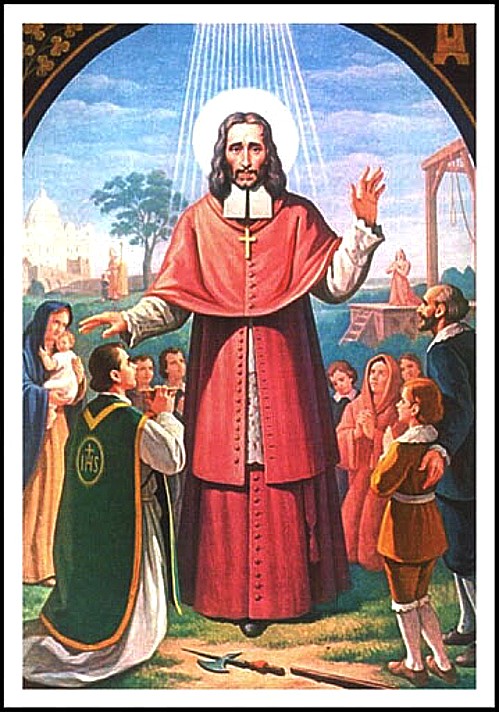
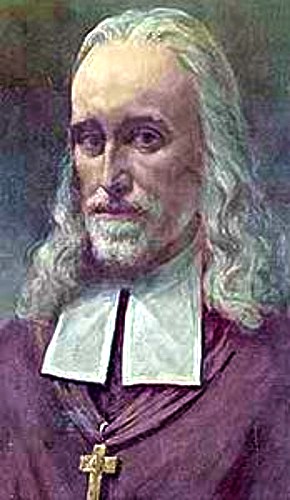
Saint of the Day – 7 March – Saint Siméon-François Berneux MEP (1814-1866) Bishop, Martyr, Missionary of the Paris Foreign Missions Society, Professor and Spiritual Director at the Mans seminary. Born on 14 May 1814 in Château-du-Loir, Sarthe, France and died by being tortured, blinded by having quicklime thrown in his eyes and then beheaded on 7 March 1866 on a beach beside the Han River in Sae-nam-teo, Seoul, South Korea. St Siméon-François is also venerated along with the rest of the 103 Korean Martyrs on 20 September.
Siméon-François was born to a poor and pious family. He felt a call to the Priesthood at the age ten and in 1831 at the age of seventeen, he entered the Seminary in Mans, France. Due to health problems, he had to leave the Seminary for two years, during which time he worked as a tutor. Finally he was Ordained a Diocesan Priest on 20 May 1837. Initially, Father Berneux served as a Professor and Spiritual Director at the Mans seminary which specifically trained Priests for the Missions.
In 1839 Siméon joined the Paris Foreign Missions Society and left for the Asian missions on 13 January 1840. He arrived first in Manila, Philippines before being assigned to the Tonkin region of modern Vietnam on 17 January 1841.
He began his work near a small Convent outside the town of Moi-yen, learning the Annam language. But he was barely started, when he was arrested on Holy Saturday 1841 during one of the periodic anti–Christian persecutions, Siméon and a brother Priest were dragged from place to place, ordered to renounce Christianity, ordered to convince lay people to renounce the faith and when their persecutors finally realised that the 2 Priests would not co-operate, they were sentenced to death on 8 October 1842.
However, before the sentence could be officially approved, a French official learned of their imprisonment and on 7 March 1843, had them released. Father Berneux was sent to the Chinese province of Manchuria where he continued his missionary work for the next ten years, sometimes in Singapore or Macao.
On 5 August 1854 he was chosen the fourth Vicar Apostolic of Korea by Pope Pius IX and arrived there with some fellow Missionaries in early 1856. For administrative reasons, he was also appointed Titular Bishop of Capsa and was Consecrated on 27 December 1954.
He learned Korean and then, as Bishop, spent time on the road visiting rural Christians, started a Seminary in Pae-ron, founded several schools and started a printing house that published Catholic works in Korean.
Thousands were Baptised during his time as Bishop but a palace coup in 1864 and threats of Russian invasion, led to a resurgence in anti-Western, anti–Christian nationalism and official persecution of the Church.
Bishop Berneux was arrested on 23 February 1866. He was taken to the capital and from 3 to 7 March he was repeatedly beaten and interrogated under torture until the bones in his legs were shattered. As he was dragged to his death, Bishop Siméon preached to the people who had come out to witness the execution and to remind his fellow sufferers, that they died for the glory of the Kingdom of God, imitating their Redeemer.
The interrogation of Bishop Siméon
The deaths of Berneux and other Catholic Missionaries in Korea, was followed by a French punitive expedition which only served to reinforce the Korean policy of isolationism.
The Korean Martyrs were Canonised on 6 May 1984.
St Siméon-François relics were brought to Berlin in 2001 and are held in the Institute of St Philipp Neri in Berlin, Germany.
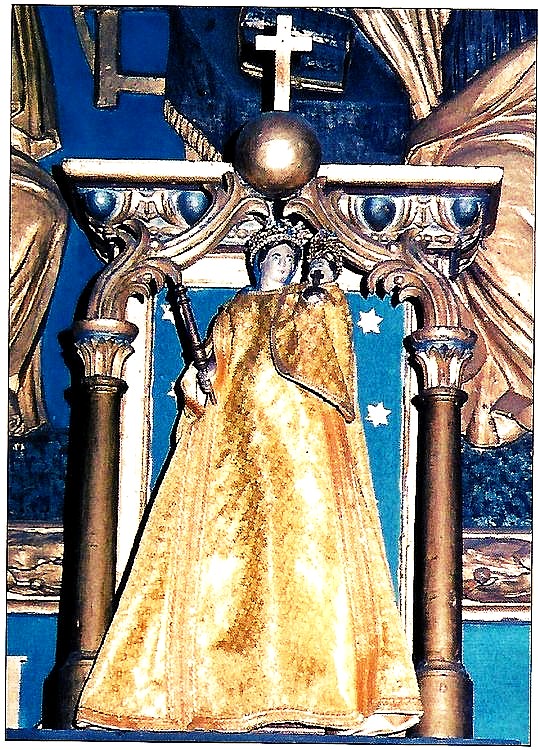
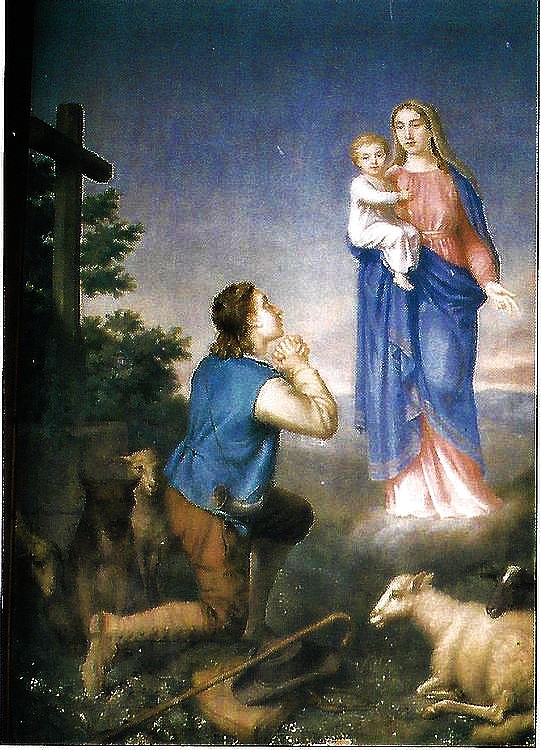
Nossa Senhora da Estrela / Our Lady of the Star, Villa Vicosa, Portugal (1050) – 7 March:
In the year 1050 there were two Benedictine Monks who lived in the convent of Monte Cassino. They decided to go on pilgrimage, teaching and catechising all those they met along the way. One night they found themselves wandering on the coast of Normandy, France, near a place called Grand Champ. Tired and sleepy, they decided to spend the night on the beach under the stars. Father Rogerio slept on the cool sand and the other Monk found himself a place to rest in a small boat nearby. As the night went on, the tide came up and the little boat was gently drawn out onto the sea. Without realising it, the Monk was going on an adventure in which he would not awaken until he was just off the coast of England. In Salisbury, England, everyone was amazed to see the Monk in the little boat, convinced that it was a miracle that he had crossed the French Sea in a small boast and lived to see the shores of England. Soon, the Monk was made Bishop and his period in office was marvellous to the people because he was a humble man of prayer, who sacrificed everything for God. The Monk who had stayed on the beach, Father Rogerio, knew nothing of what had happened to his friend. All he knew was that he and the boat had disappeared and, giving his concerns into the hands of God, he determined to continue on his journey alone. One night not long afterward, Father Rogerio went to sleep and had a dream that would change his life forever. In his dream he saw a great star fall from the sky, burning all the bushes and trees and heard a voice that said: “Our Lady wants a Church built in this place.” When he awoke, Father Rogerio looked about himself. He was not injured but this indeed was the place he had seen in his dream, for everything around him was burned. Father understood that Our Lady really did desire that he should build a Church there in her honour. He also felt in his heart, the desire to give Mary the title of “Our Lady of the Star” because of the star he had seen in his dream. Due to the poverty of those who inhabited that region, Father Rogerio was only able to build a small Altar and a tiny Chapel which would be the seed of the great Abbey of Our Lady of the Star of Monteburgo. One day an immense Chapel would be built, sheltering not only the Church but a very large convent as well. King William, who was the Duke of Normandy and he who had conquered England, learning of the Shrine of Our Lady of the Star, sent his private doctor to visit the little Chapel to find out for himself how it had all come about. Upon arriving there, the doctor discovered that he was the brother of the Monk Rogerio! He listened to his brother’s account of how he had been separated from his friend and then told about his dream. The doctor believed everything at once and to Father Rogerio’s surprise, the doctor knew the Monk who had crossed the channel in a small boat and informed his brother, that his lost friend had become the Bishop of Salisbury! The two brothers excitedly thanked Our Lady for providing this reunion. The Bishop of Salisbury, our former friend of the Monk Rogerio, asked King William to help his brother in the faith, for they were both blessed by Our Lady on their pilgrimage. William the Conqueror, with a glad heart, donated to Father Rogerio the entire region of Monteburg, along with the resources to build a great Church and an Abbey there that became a great seminary. The work was finished by the son of King William, King Henry. He, taking the throne, continued the work until its completion. The Abbey of Our Lady of the Star was, for many centuries, a centre of the Church for the whole region. Dark centuries ensued and the Church and Abbey suffered a decline until in 1842, the Vicar General of Coutances took possession of what was by that time little more than an enclosure of ruins. He turned it over to the Brothers of Mercy, a new order meant to promote Catholic education. The Abbey Church was rebuilt but as time went on, the Brothers of Mercy also left and all is now used as part of an agricultural school. As for Our Lady of the Star, it is a story almost completely forgotten, even to Catholics.
Prayer to Our Lady of the Star
“O, Our Lady of the Star, to you our gaze turns and our childlike hearts. You are the Morning Star, that announces the arrival of the day. You are the Evening Star, that shines in our night. You are the Star of the Sea, who sends us her son Jesus, the eternal Light of the world. Through the darkness and storms of life, in the hour of doubt or of temptation, in the revolt, be our clarity and our peace. Be our hope and our purity, be our sweetness and our strength, O Lady of the Star. May our gaze and our hearts forever rest on you. O Lady of the Star, Pray for us. Amen”
St Ardo of Aniane St Deifer of Bodfari St Drausinus of Soissons St Enodoch St Esterwine of Wearmouth St Eubulus of Caesarea St Gaudiosus of Brescia Bl Henry of Austria Blessed Leonid Feodorov (1879-1935) Martyr His Life and Death: https://anastpaul.com/2019/03/07/saint-of-the-day-7-march-blessed-leonid-feodorov-1879-1935-martyr/ St Paul of Prusa St Paul the Simple St Reinhard of Reinhausen Bl William of Assisi — Martyrs of Carthage – 4 saints: A catechist and three students martyred together for teaching and learning the faith. We know little more than their names – Revocatus, Saturninus, Saturus and Secundulus. Mauled by wild beasts and beheaded 7 March 203 at Carthage, North Africa
Martyrs of Korea St Siméon-François Berneux MEP (1814-1866) Bishop, Martyr St Bernard-Louis Beaulieu St Ioannes Baptista Nam Chong-Sam St Pierre-Henri Dorie St Simon-Marie-Just Ranfer de Bretenières
Martyrs of Laos Bl Luc Sy Bl Maisam Pho Inpèng Martyrs of Tyburn Bl German Gardiner Bl John Ireland Bl John Larke
Thought for the Day – 6 March – Meditations with Antonio Cardinal Bacci (1881-1971)
Filial and Servile Fear
“We should not be afraid of God because He is our greatest benefactor and loves us infinitely. When we are lost, He searches for us as a loving father would search for a wandering son. Because they think only of the majesty and justice of God, some people keep themselves at a distance from Him, as Adam did, after he had sinned. They forget that the Lord told Adam, the sinner, of the coming of the pardoning Redeemer (Gen 3:9). Bossuet truly observes, that “after the curse which came upon men through sin, there has always remained in their hearts, a certain dread of the supernatural, which prevents them from approaching God with confidence.” Jansenism increased this fear, emphasising the justice and majesty of God, rather, than the infinite love of Jesus and the beauty of His teaching.
Some writers compare our souls with the divine majesty and justice, in order to stress our unworthiness but, they forget, that Jesus is “Meek and humble of heart,” that He forgave the penitent woman, the good thief and the adulteress and, had kind words for the lost sheep and the prodigal son. They never think of the wonderful words of the beloved disciple: “God is love” (1 Jn 4:16).
This false fear of God, dries up our piety and lessens our trust in His mercy. It can lead to moroseness, to scrupulosity and to discouragement.
We should avoid this excessive fear which separates us from God. Even though we are sinful and unworthy, we should remember, that God is our loving Father, Who is always ready to help us and to grant us forgiveness. We should recall, moreover, that out of love for us, He did not spare His own Son, (Cf Rom 8:32) but gave Him to us for our redemption. If Jesus shed His blood and died for us, how can we doubt His love?”
Day Eighteen of our Lenten Journey – 6 March – Saturday of the Second week of Lent, Readings: Micah 7:14-15, 18-20, Psalms 103: 1-2, 3-4, 9-10, 11-12, Luke 15: 1-3, 11-32
Imitating Christ with Thomas à Kempis (1380-1471)
In You is the source of life and in Your Light Lord, we see light Psalm 35(36)
I will arise and go to my father and I will say to him, “Father, I have sinned against heaven and before you” – Luke 15:18
In that day every trial borne in patience will be pleasing and the voice of iniquity will be stilled; the devout will be glad; the irreligious will mourn and the mortified body will rejoice far more than if it had been pampered with every pleasure. Then the cheap garment will shine with splendour and the rich one become faded and worn; the poor cottage will be more praised than the gilded palace. In that day persevering patience will count more than all the power in this world; simple obedience will be exalted above all worldly cleverness; a good and clean conscience will gladden the heart of man far more than the philosophy of the learned and contempt for riches will be of more weight than every treasure on earth.
Then you will find more consolation in having prayed devoutly than in having fared daintily; you will be happy that you preferred silence to prolonged gossip.
Then holy works will be of greater value than many fair words; strictness of life and hard penances will be more pleasing than all earthly delights.
Learn, then, to suffer little things now that you may not have to suffer greater ones in eternity. Prove here what you can bear hereafter. If you can suffer only a little now, how will you be able to endure eternal torment? If a little suffering makes you impatient now, what will hell fire do? In truth, you cannot have two joys: you cannot taste the pleasures of this world and afterward reign with Christ.
If your life to this moment had been full of honours and pleasures, what good would it do if at this instant you should die? All is vanity, therefore, except to love God and to serve Him alone.
He who loves God with all his heart does not fear death or punishment or judgement or hell, because perfect love assures access to God.
It is no wonder that he who still delights in sin fears death and judgment.
It is good, however, that even if love does not as yet restrain you from evil, at least the fear of hell does. The man who casts aside the fear of God cannot continue long in goodness but will quickly fall into the snares of the devil. (Book 1 Ch 24:5-7)
Quote/s of the Day – 6 March – Saturday of the Second week of Lent, Readings: Micah 7:14-15, 18-20, Psalms 103: 1-2, 3-4, 9-10, 11-12, Luke 15: 1-3, 11-32
“Quickly bring the finest robe and put it on him”
Luke 15:22
‘God, be merciful to me a sinner!’
Luke 18:13
“You do not know when your last day may come. You are an ingrate! Why not use the day, today, that God has given you to repent?”
“He who calls us, came here below, to give us the means of getting there. He chose the wood that would enable us to cross the sea – indeed, no-one can cross the ocean of this world, who is not borne by the Cross of Christ. Even the blind can cling to this Cross. If you can’t see where you are going very well, don’t let go of it, it will guide you by itself. ”
St Augustine (354-430) Father & Doctor of Grace
“A saint is not someone, who never sins, but one who sins less and less frequently and gets up more and more quickly.”
St Bernard of Clairvaux (1090-1153) Mellifluous Doctor
“Aspire to God with short but frequent outpourings of the heart, admire His bounty, invoke His aid, cast yourself in spirit at the foot of His Cross, adore His goodness, treat with Him of your salvation, give Him your whole soul – a thousand times in the day.”
One Minute Reflection – 6 March – Saturday of the Second week of Lent, Readings: Micah 7:14-15, 18-20, Psalms 103: 1-2, 3-4, 9-10, 11-12, Luke 15: 1-3, 11-32
“Quickly bring the finest robe and put it on him” – Luke 15:22
REFLECTION – “How many there are who, through repentance, have been worthy to receive the love You hold for humankind. You justified the anguished publican and the weeping woman who was a sinner (Lk 18.14; 7,50) for, through a predetermined design, You foresee and grant pardon. Convert me also together with them, You, Who desire that all should be saved.
My soul was soiled as it put on the garment of its sins (Gn 3,21). O let me make fountains flow from my eyes that I may purify it by repentance. Clothe me with the shining robe worthy of Your wedding (Mt 22,12), You, Who desire that all should be saved…
O heavenly Father, have compassion for my cry as You did for the prodigal son, for I, too, am throwing myself at Your feet and crying aloud as he cried: “Father, I have sinned!” Do not reject me Your unworthy child, O my Saviour but cause Your angels to rejoice also on my behalf, O God of goodness You, Who desire that all should be saved.
For you have made me Your child and Your own heir through grace (Rm 8,17). Yet as for me, because I have offended You, am here a prisoner, an unhappy slave sold over to sin! Take pity on Your own image (Gn 1,26) and call it back from exile, O Saviour, You, Who desire that all should be saved…
Now is the time for repentance… The words of Paul urge me to persevere in prayer (Col 4,2) and await You. Therefore, with trust I pray, for I well know Your mercy, I know You come the first towards me and I am calling out for help. Should You delay, it is to give me the reward for perseverance, You, Who desire that all should be saved.
Grant me always to extol You and give You glory by leading a life that is pure. Grant that my deeds may be in accord with my words, that I may sing to You, Almighty… with pure prayer, Christ alone who desires that all should be saved.” – St Romanos Melodios (c 490-c 556) Monk, Composer of hymns, Poet – Hymn 55; SC 283
PRAYER – Almighty God, Whose sanctifying grace, even here on earth, brings us the gifts of heaven, guide us in this present life and lead us, in the footsteps of that Light the Christ, Whom You sent to lead us in His Light to the light of Your dwelling. May the prayers of all Your angels with the Blessed Virgin our Mother, St John the Baptist, St Joseph, Blessed Sylvester of Assisi and all the Saints strengthen and lighten our way. Through Jesus Christ our Lord, with the Holy Spirit, God forever, amen.
Our Morning Offering – 6 March – Saturday of the Second week of Lent and always a Marian day
O Jesus, Mary’s Son! By St Thomas Aquinas (1225-1274) Doctor Angelicus, Doctor communis
Hail to Thee! True body sprung From the Virgin Mary’s womb! The same that on the cross was hung And bore for man the bitter doom. Thou Whose side was pierced and flowed Both with water and with blood. Suffer us to taste of Thee In our life’s last agony. O kind, O loving One! O Jesus, Mary’s Son! Amen
Saint of the Day – 6 March – Blessed Sylvester of Assisi OFM (Died 1240) Priest, Franciscan Frria. One of the first 4 followers of St Francis of Assisi and was the first Priest in the Franciscan Order.
Sylvester was a member of one of the noblest and wealthiest families of the City of Assisi, the Uncle of St Clare Of Assisi.
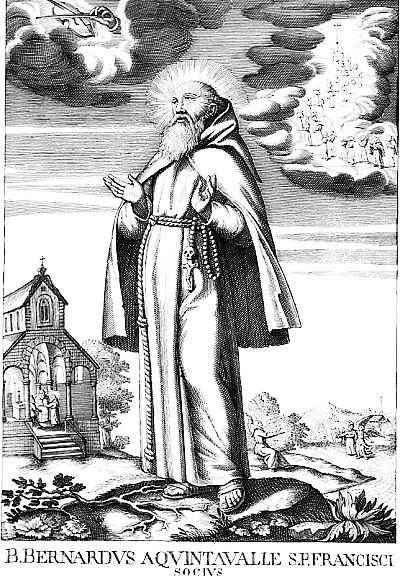
When St Francis embarked on his campaign to “rebuild My church” Sylvester sold Francis stones which were to be used to rebuild the little Church of St Damiano. When, a short while later, he saw Francis and Blessed Bernard of Quintavalle distributing Bernard’s wealth to the poor, Sylvester complained that he had been poorly paid for the stones and asked for more money.
Though Francis obliged, the handful of money he gave Sylvester later caused him to regret this spirit of greed he found in himself, his conscience rebuked him and he was filled with guilt. He sold all of his goods and gave the money to the poor and began a life of penance. Sylvester was Ordained a Priest and became a Canon of the Cathedral of San Rufino in Assisi.
Thereafter, he joined St Francis. Sylvester became a holy and prayerful man and a favourite of Francis. He was known in the Order for his strict observance of the life of poverty and contemplation. Together with his cousin, Clare, he later prayed for enlightenment to discern the will of God for Francis, when Francis sought advice on how he should best serve God. Should he go out to preach rather than by devoting himself solely to prayer?
The cave at the Eremo delle Carceri, near Assisi, where Blessed Sylvester spent long periods in solitary prayer
Sylvester often accompanied Francis during his preaching tours. Once, in the city of Arezzo, it was claimed by the residents, that Sylvester’s preaching and prayers brought peace to the City, which was falling prey to hatred and violence amongst its citizens. In another City where civil war was raging, Sylvester was commanded by Francis to drive the devils out. At the City gate Sylvester cried out: “In the name of almighty God and by virtue of the command of His servant Francis, depart from here, all you evil spirits.” The devils departed and peace returned to the City.
St Bonaventure, in a special way, mentions the visions which Sylvester had concerning Francis.
Sylvester died in Assisi in 1240, surviving Francis by 14 year. He is one of Francis’ four original companions who are buried near his tomb in the Basilica of St Francis in Assisi.
Nossa Senhora da Nazaré/Our Lady of Nazareth, Pierre Noire, Portugal, (1150) – 6 March:
The Abbot Orsini wrote: “This image was honoured at Nazareth in the time of the Apostles, if we may believe a writing which was found, by a hunter, attached to this image, in the year 1150.”
The Shrine of Our Lady of Nazareth, known in Portugal as Nossa Senhora da Nazare, is found in the village of Nazare on the Atlantic coast in Portugal. Indeed, the village is named after this miraculous statue of the Blessed Mother and the Christ Child, that was brought to the area many centuries ago. According to tradition, this miraculous image was carved by the hands of Saint Joseph, the foster-father of Christ, while in the very presence of the Infant Jesus and the Mother of God. Later, the faces and hands of the images were painted by Saint Luke the Evangelist. This remarkable image is still preserved in a Church where it can be viewed by anyone and the story surrounding it is a fascinating one. It is known that the statue of Our Lady of Nazareth came from the Holy Land where it was one of the oldest images ever venerated by Christians. It was saved from destruction at the hands of the iconoclasts sometime early in the 5th century by a Monk named Ciriaco, who gave the statue to Saint Jerome. Saint Jerome later gave it to Saint Augustine in Africa, to protect the statue by removing it from the Holy Land. Saint Augustine then gave it into the safekeeping of the Monastery of Cauliniana, near Merida, a Monastery on the Iberian Peninsula. When the Arabs invaded the Iberian Peninsula in the year 711, King Roderic met them with his Visigothic army at the battle of Guadalete, where he was soundly defeated. It is a fact of history, that the body of Roderic was never found upon the field of battle, although his horse was found and it is often assumed by historians, that Roderic died that day when he lost his kingdom. According to this legend, however, Roderic was not killed but survived the battle and disguised himself as a beggar as he travelled north. Alone and unknown, he made his way to the Monastery of Cauliniana where he sought shelter for the night. Going to Confession, he, of necessity, revealed his true identity to the friar, Frei Romano. As it turned out, the Monks were preparing to leave the Monastery in advance of the Arabs and so Frei Romano asked the King if he could accompany him in his travels. Roderic agreed and the friar took with him the statue of Our Lady of Nazareth and the relics of Saint Bras and Saint Bartholomew. They travelled together until they arrived at a place later named Monte de Saint Bartolomeu in November of the year 714. They made for themselves a hermitage with the friar living in a small cave at the edge of a cliff that overlooked the sea. He placed the image in a niche among the stones upon a pedestal of simple rocks. Roderic went a little ways off by himself to a hill where he also began to live the life of a hermit. After a year, though, King Roderic left the hermitage and nothing else is said of him in this legend. One wonders if he ever learned of his kinsman Pelayo, who had retreated into the mountains and continued to heroically defy the invaders. Before his death, Frei Romano hid the image in his small cave, where it remained undisturbed for some centuries until it was discovered by shepherds, who came there to venerate the statue. Inside that little, ancient sanctuary they had found the renowned and sacred image of Our Lady of Nazareth. Carved of wood, it was unlike any other statue of the Madonna they had ever seen, for it depicts the Blessed Virgin breastfeeding her Divine Child while seated upon a simple bench. When miracles began to frequently occur, it became a major pilgrimage site. Then, in the early morning of 14 September in the year 1182, the Mayor of Porto de Mos, Dom Fuas Roupinho, was hunting on his land when he observed a deer. Chasing it up a steep slope on horseback that misty morning, the fog became heavier all of a sudden. The deer, later suspected to be the devil in the guise of a deer, jumped off the edge of the hilltop into the empty void. Despite his efforts to stop his horse, the spirited mount was determined to follow after the deer. Helpless to save himself, the rider suddenly recognised that he was near the sacred grotto where he would often come to pray. Fuas Roupinho cried out to the Blessed Virgin, praying aloud: “Our Lady, Help Me!”
The horse stopped immediately, as if he were digging his hooves into the rocky cliff above the void. Suspended in an unnatural manner at the edge of the cliff, Fuas Rouphinho knew the drop to be over 100 meters and surely would mean his death if he had fallen. He was then able to back slowly away from the edge, looking down to see the evidence of the impossible and unimaginable – for there in the hard stone was the imprint of one of his horse’s hooves. One of those marks can still be seen in the native rock. Faus Rouphinho dismounted and went to the grotto to pray and give thanks, subsequently causing a chapel ‘Capela da Memoria,’ or ‘The Chapel of Remembrance,’ to be built very near the spot where his life had been miraculously saved. When the masons he had hired took apart the primitive altar in the cave, they found an ivory box of sorts that contained the relics of Saint Bras and Saint Bartholomew. There was also an ancient scroll that they carefully removed. Opening the scroll, they found that it explained the history of the statue of the Blessed Virgin Mary and her Divine Child, now known as Our Lady of Nazareth, as outlined above. The church Santuario de Nossa Senhora da Nazare was later built on the hilltop overlooking Nazare by King Ferdinand I of Portugal in the year 1377. Its construction was necessary due to the large number of pilgrims who continued to come to venerate the image.
Over the years it was often rebuilt, or had additions made, especially in the 17th, 18th and 19th centuries. The profusely decorated and gilded apse displays the statue of Nossa Senhora da Nazare in a lighted niche above the main altar, flanked by twisted columns. The first King of Portugal, Don Afonso Henriques, as well as the chief nobles of his court, were among the early pilgrims to the shrine. Many notable figures came to visit Our Lady of Nazareth throughout history, including Vasco de Gama, who came as a pilgrim before setting out for India and Pedro Alvares Cabral, who later discovered Brazil. St Francis Xavier, the Apostle of the East, went on pilgrimage to Our Lady of Nazareth before later leaving for Goa.
A close-up of the little Statue in it’s niche above the Altar – at Christmas, see the little trees.
According to a plaque placed in the Chapel in 1623, the image was carved by Saint Joseph in Galilee when Jesus was a baby. Some decades later St Luke the Evangelist painted the faces and hands of the images. It remained in Nazareth until brought by the Greek Monk Ciriaco to the Iberian Peninsula. It is believed to be one of the oldest images venerated by Christians.
Nossa Senhora de Nazaré in its Sanctuary of the Portuguese village of Nazaré.
St Cyriacus of Trier St Cyril of Constantinople St Evagrius of Constantinople St Fridolin Vandreren of Säckingen Bl Guillermo Giraldi St Heliodorus the Martyr Bl Jordan of Pisa St Julian of Toledo St Kyneburga of Castor St Kyneswide of Castor St Marcian of Tortona Bl Ollegarius of Tarragona St Patrick of Malaga St Sananus Blessed Sylvester of Assisi OFM (Died 1240) Priest
St Tibba of Castor St Venustus of Milan — Martyrs of Amorium – 42 saints – Also known as Martyrs of Syria and Martyrs of Samarra A group of 42 Christian senior officials in the Byzantine empire who were captured by forces of the Abbasid Caliphate when the Muslim forces overran the city of Amorium, Phrygia in 838 and massacred or enslaved its population. The men were imprisoned in Samarra, the seat of the Caliphate, for seven years. Initially thought to be held for ransom due to their high position in the empire, all attempts to buy their freedom were declined. The Caliph repeatedly ordered them to convert to Islam and sent Islamic scholars to the prison to convince them; they refused until the Muslims finally gave up and killed them. Martyrs. We know the names and a little about seven of them: • Aetios • Bassoes • Constantine • Constantine Baboutzikos • Kallistos • Theodore Krateros • Theophilos but details about the rest have disappeared over time. However, a lack of information did not stop several legendary and increasingly over-blown “Acts” to be written for years afterward. One of the first biographers, a monk name Euodios, presented the entire affair as a judgement by God on the empire for its official policy of Iconoclasm. Deaths: • beheaded on 6 March 845 in Samarra (in modern Iraq) on the banks of the Euphrates river by Ethiopian slaves • the bodies were thrown into the river, but later recovered by local Christians and given proper burial.
Today was a bit of a disaster, in more ways than one, so please accept my apologies for the dearth of posts. I am a little worried, mostly about financial matters.
“They seized him, threw him out of the vineyard and killed him”… Matthew 21:39
REFLECTION – “The vineyard of the Lord of Hosts is the house of Israel” says the prophet (Is 5:7). We ourselves are this house… and, since we are His Israel, we are the vineyard. So let us take good care that grapes of wrath (Rv 14:19) rather than sweetness do not grow from our branches, so that no-one may say to us: “I expected grapes but it yielded wild grapes” (Is 5:4). What fruitless soil! The soil that should have presented its master with fruits of sweetness, pierced Him with its sharp thorns. In the same way His enemies, who ought to have welcomed our Saviour with all the devotion of their faith, crowned Him with the thorns of His Passion. In their eyes this crown expressed insult and abuse but in the Lord’s eyes it was the crown of virtue…
My brethren, take good care that no one says with regard to you: “He expected it to yield grapes but it yielded wild grapes” (Is 5:2)… Let us be careful that our evil deeds do not rub against our Lord’s head like thorns. ” … St Maximus of Turin (c 380-c 420) – Sermon for the feast of Saint Cyprian – CC Sermon 11
PRAYER – Almighty God, help us dear Father to produce fruits acceptable to You. Help us to reach out of our enclosed spaces in love to all. Even when the road is rocky, grant that we may not falter but always turn back to Your merciful gaze.ay the prayers of our Blessed Mother, the Virgin Mary, who fearlessly withstood the fury of evil, be a help in our times of need and fear. We make our prayer through our Lord Jesus Christ, with the Holy Spirit, one God for all eternity, amen.
Our Morning Offering – 5 March – Friday of the Second week of Lent
A Lenten Prayer By St Pope Pius V (1504-1572)
Look with favour, Lord, on Your household. Grant that, though our flesh be humbled by abstinence from food, our souls, hungering after You, may be resplendent in Your sight. Amen
St Pius V is the Pope of the Council of Trent, the Counter Reformation, the excommunication of Elizabeth I for Heresy and persecution of English Catholics and of the Battle of Lepanto, amongst many other illustrious and holy achievements.
Saint of the Day – 5 March – Saint Piran (Died 480) Abbot, Hermit, Missionary, miracle-worker. Died on 5 March 480 of natural causes. Patronages – Cornwall, England, miners, Piran, Slovenia, tin miners, tinners. He is also known as Pyran, Peranus, Peran.
Piran’s family origins are obscure; tradition says he was born in Ireland but spent his youth in south Wales where he founded a Church in Cardiff. He received religious schooling at the Monastery of Saint Cadog at Llancarfon, where he met Saint Finnian of Clonard. The two returned together to Ireland where Finnian founded six Monasteries, including his most famous one at Clonard. Piran lived there before visiting Saint Enda on Aran Island and then Saint Senan on Scattery Island. He founded his own community at Clonmacnoise, known as “Ireland’s University.”
Cornish legend says Piran was captured in his middle years by pagan Irish, jealous of his miraculous powers, especially his ability to cure many illnesses. They tied a millstone around his neck and threw him off a cliff into the sea during a storm. As Piran hit the water the storm abated and the millstone bobbed to the surface like a cork. On his stone raft, Piran sailed for Cornwall, landed at Perran Beach, built a small Chapel on Penhale Sands and made his first converts – a badger, a fox and a bear. He lived there for years as a Hermit, working miracles for the locals.
Piran founded Churches at Perran-Uthno and Perran-Arworthal, a Chapel at Tintagel and a holy-well called the “Venton-Barren” at Probus. He made trips to Brittany, France, where he worked with Saint Cai. Arthurian tradition from Geoffrey of Monmouth, says he was Chaplain to King Arthur as well as being appointed as the Archbishop of York after Saint Samson was exiled by Saxon invasions, though it is doubtful he ever took up his See.
Piran’s Patronage of Cornwall derives from his popularity with the Cornish tin-miners. Legend says that Piran discovered tin in Cornwall when he used a large black rock to build a fireplace and found that the heat made a trickle of pure white metal ooze from the stone. He shared this discovery with the locals, providing the Cornish with a lucrative living. The people were so delighted that they held a sumptuous feast where the wine flowed like water. Piran was fond of the odd tipple, resulting in the Cornish phrase “As drunk as a Perraner.” The trickle of white metal upon a black background remains as the White Cross of Saint Piran on the Cornish National flag.
Piran died at his little Hermitage near the beach. His relics were a great draw to pilgrims but, due to being inundation by the sands, they were moved inland to the Parish Church of Perran-Zabulo, built to house them.
St Piran’s tiny Hermitage
St Piran’s Day is popular in Cornwall and the term ‘Perrantide’ has been coined to describe the week prior to this day. The largest St Piran’s Day event is the pilgrimage across the dunes to St Piran’s Cross which hundreds of people attend, generally dressed in black, white and gold, and carrying the Cornish Flag and a Crucifix.
There are many Churches and even towns and villages decicated to St Piran in both Cornwall and Brittany.
Notre-Dame-de-Bon-Secours/Our Lady of Good Help, Montreal, Canada (1657) – 5 March:
This is the original Statue brought to the Chapel by St Marguerite Bourgeoys and which survived the fire intact, which though destroyed the entire Chapel, It is tiny, only 17cm tall.
Dedicated to Our Lady of Good Help, Notre-Dame-de-Bon-Secours, has been for 350 years the Sanctuary for seamen leaving Montreal for the seven seas. A wooden Chapel was built in 1657, replaced in 1675 by a building whose foundations serve the present Church which was erected in 1771.
Over the entrance is an inscribed message: “If the love of Mary is graven in your heart, forget not a prayer in passing.”
Our Lady of Good Help is a beautiful little Church, with fine paintings. On the walls are mosaics of St Marguerite Bourgeoys, who inspired the first Chapel and of Maisonneuve, Founder of Montreal, said to have felled the first oak for the Chapel. A narrow stairway, lined with pilgrims’ acknowledgments, leads to an aerial Chapel set in the roof. Here is a facsimile of the Santa Casa, the house of the Virgin carried by angels from Nazareth to Loreto. Saint Marguerite Bourgeoys was the Founder of the Congregation of Notre Dame. When she returned from France in 1673 she brought back with her a wooden statue of Our Lady of Good Help. It can still be seen in the reliquary on the gospel side of the altar, for when the Church burned in 1754, the statue was saved from the fire. This is not to say that someone took the statue from the Church, for after the fire had ravaged the original Chapel, the statue was found uninjured among the smouldering embers that remained. The mortal remains of Saint Marguerite Bourgeoys were interred in the Sanctuary of the Church in the year 2005, the 350th anniversary of Notre-Dame-de-Bon-Secours. She rests now at the feet of the statue she herself had brought from France. In 1849 the Bishop of Montreal placed a statue of the Blessed Virgin, Star of the Sea, atop the tower facing the harbour. For this reason, the Chapel is also known as the Sailor’s Church. There are votive offerings, carved ships, models of sailing ships suspended from the vault of the Chapel in thanksgiving to the Blessed Virgin for her assistance in their safe return from the sea.
St Adrian of Caesarea St Caron St Carthach the Elder Bl Christopher Macassoli of Vigevano St Clement of Santa Lucia St Colman of Armagh St Conon of Pamphylia Bl Conrad Scheuber St Eusebius of Cremona St Eusebius the Martyr St Gerasimus Bl Giovanna Irrizaldi Bl Ion Costist St John Joseph of the Cross OFM (1654-1734) – Priest Biography: https://anastpaul.com/2019/03/05/saint-of-the-day-5-march-st-john-joseph-of-the-cross-ofm-1654-1734/ St Kieran Bl Lazër Shantoja St Lucius I, Pope St Mark the Ascetic St Oliva of Brescia St Phocas of Antioch St Piran (Died 480) Abbot
Bl Roger Bl Romeo of Limoges St Theophilus of Caesarea St Virgilius of Arles
Thought for the Day – 4 March – Meditations with Antonio Cardinal Bacci (1881-1971)
Riches and Poverty
“There is a striking contrast between the luxurious living of wealthy people who waste their money on pleasure and amusement and the abject poverty of those who are without food, clothing and shelter. This is in complete contradiction of the Gospel message which has proclaimed that we are all brothers.
Extravagance is always self-centred, whereas Christianity, is the creed of love. Sumptuous living cannot be justified by an appeal to the right to own property, for, it is a shameless betrayal of the Gospel spirit of fraternl charity. When St Thomas Aquinas is defending the right to private property, he adds at once: “In regard to the use of it, however, a man should not regard material goods as belonging entirely to himself but … should be ready to share them with others in their necessity” (Summa Theologiae, II-II, 1 66, a 2). If such maxims, which derive their inspiration from the Gospel, were put into practice, there would be neither excessive wealth, nor excessive poverty, in the world today.
It is true, that there would still be poverty but, destitution would disappear.
Poverty is good, in that it makes us detached from worldly things and helps us to think more about the next life. But, destitution is really a social crime, for it is the result of human egoism and can breed hatred and spiritual degradation.
“Poverty,” writes Péguy, “is decent. It does not dress in rags … It’s dwelling is tidy, healthy and affords a welcome. It can have a change of linen once a week. It is not emaciated nor hungry… It is not good for anyone to live in easy circumstances; on the contrary, it is much better always to feel the goad of necessity…” (La guerre et la paix, p 338).
It was, in this sense, that Jesus blessed the poor and condemned the rich. He is referring to the poor man who has enough to supply his needs, is detached from worldly possessions, uses his poverty to assist him in his journey towards Heaven and, is happy or, at any rate, content. But He condemns the rich man who squanders his wealth on selfish amusement and is deaf to the entreaties of those in need.
After twenty centuries of Christianity, the violent contrast still exists in modern society. If we have any reason to reproach ourselves, let us try now, to make up for our deficiencies.
Day Sixteen of our Lenten Journey – 4 March – Wednesday of the Second week of Lent, Readings: Jeremiah 17:5-10, Psalms 1: 1-2, 3, and 6, Luke 16: 19-31
Imitating Christ with Thomas à Kempis (1380-1471)
In You is the source of life and in Your Light Lord, we see light Psalm 35(36)
And he called out, ‘Father Abraham, have mercy on me and send Lazarus to dip the end of his finger in water and cool my tongue, for I am in anguish in this flame.’ … Luke 16:24
IN ALL things consider the end, how you shall stand before the strict Judge from Whom nothing is hidden and Who will pronounce judgement in all justice, accepting neither bribes nor excuses. And you, miserable and wretched sinner, who fear even the countenance of an angry man, what answer will you make to the God Who knows all your sins? Why do you not provide for yourself against the day of judgement when no man can be excused, or defended by another because each will have enough to do, to answer for himself? In this life your work is profitable, your tears acceptable, your sighs audible, your sorrow satisfying and purifying.
The patient man goes through a great and salutary purgatory when he grieves more over the malice of one who harms him, than for his own injury; when he prays readily for his enemies and forgives offenses from his heart; when he does not hesitate to ask pardon of others; when he is more easily moved to pity than to anger; when he does frequent violence to himself and tries to bring the body into complete subjection to the spirit.
It is better to atone for sin now and to cut away vices than to keep them for purgation in the hereafter. In truth, we deceive ourselves by our ill-advised love of the flesh. What will that fire feed upon but our sins? The more we spare ourselves now and the more we satisfy the flesh, the harder will the reckoning be and the more we keep for the burning.
For a man will be more grievously punished in the things in which he has sinned. There the lazy will be driven with burning prongs and gluttons tormented with unspeakable hunger and thirst; the wanton and lust-loving will be bathed in burning pitch and foul brimstone; the merciless will howl in their grief like mad dogs.
Every vice will have its own proper punishment. The proud will be faced with every confusion and the avaricious pinched with the most abject want. One hour of suffering there will be more bitter than a hundred years of the most severe penance here. In this life men sometimes rest from work and enjoy the comfort of friends but the damned have no rest or consolation.
You must, therefore, take care and repent of your sins now so that on the day of judgment you may rest secure with the blessed. For on that day the just will stand firm against those who tortured and oppressed them and he who now submits humbly to the judgement of men, will arise to pass judgement upon them. The poor and humble will have great confidence, while the proud will be struck with fear. He who learned to be a fool in this world and to be scorned for Christ will then appear to have been wise.
If your life to this moment had been full of honours and pleasures, what good would it do if at this instant you should die? All is vanity, therefore, except to love God and to serve Him alone. (Book 1 Ch 24:1-5,7)
Quote/s of the Day – 4 March – Thursday of the Second week of Lent, Readings: Jeremiah 17:5-10, Psalms 1: 1-2, 3, and 6, Luke 16: 19-31
“There was a rich man who was clothed in purple and fine linen and who feasted sumptuously everyday. And at his gate was laid, a poor man named Lazarus …”
Luke 16:19-20
“You, who think that you have a healthy hand, beware lest it is withered by greed or by sacrilege. Hold it out often. Hold it out to the poor person who begs you. Hold it out to help your neighbour, to give protection to a widow, to snatch from harm one whom you see subjected to unjust insult. Hold it out to God for your sins.”
St Ambrose (340-397) Father and Doctor of the Church
“… Let us be afraid, my beloved, lest we also see the poor and pass them by, lest instead of Lazarus, there be many to accuse us hereafter.”
St John Chrysostom (347-407) Father & Doctor of the Church
“God resists the proud” whether they are covered with silk or with rags but “he gives grace to the humble” (Jas 4:6) whether or not, they have possessions in this world. God looks at what is within, it is there He assesses, there He examines.”
St Augustine (354-430) Father & Doctor of Grace
“What sort of people are we? When God gives, we want to receive, when He asks, we refuse to give? When a poor man is hungry, Christ is in need, as He said Himself: “I was hungry and you gave me no food.” Take care not to despise the hardship of the poor, if you would hope, without fear, to have your sins forgiven… What He receives on earth, He returns in heaven.”
One Minute Reflection –4 March – Thursday of the Second week of Lent, Readings Jeremiah 17:5-10, Psalms 1: 1-2, 3, and 6, Luke 16: 19-31 and the Memorial of St Casimir- (1458-1484)
The poor man died and was carried by the angels to Abraham’s bosom. The rich man also died and was buried and in Hades, being in torment, he lifted up his eyes and saw Abraham far off and Lazarus in his bosom. … Luke 16:22-23
REFLECTION – By St Nerses Chnorhali (1102-1173) Armenian Bishop – Jesus, Only Son of the Father, 624 f.
Like the rich man who loved a life of pleasure I, too, have loved pleasures that pass away With this animal body of mine, In the pleasures of that fool.
And from so many and such great blessings That You have so freely given me I have not paid back the tenth From Your own gifts.
But, out of everything under my roof, Gathered from earth and sky and sea, I believed Your numberless blessings To be my own possession.
Nothing of these have I given to the poor, Nor set anything aside for his needs: Neither food for the hungry Nor covering for the naked body,
Neither shelter for the homeless Nor abode for the foreign guest, Nor visit to the sick Nor even concern for the prisoner (cf. Mt 25:31 f.).
I was not saddened for the sorrow Of the one cast down by his burdens, Nor shared the joy of the joyful But burned with jealousy against him.
All of them were another Lazarus, (…) They lay outside at my gate; … Yet I, deaf to their appeal, Never gave them the crumbs from my table. …
The dogs of your Law outside Comforted them, at least with their tongues; Yet I, who listened to Your commandment, Wounded the one who bore Your likeness with my tongue (Mt 25:45). (…)
Yet only grant me repentance here below That I may make reparation for my sins, … That these tears may extinguish the blazing furnace With its burning flames. …
And, instead of acting like the merciless, Set merciful compassion within me, That, by showing mercy to the poor, I may obtain Your mercy.
PRAYER – Dear and Holy God, let us offer You all our daily struggles against sin and evil. Grant us the strength to resist all forms of idolatry, to seek only You and never to allow the material goods of this world to seduce us. Sustain us ever more with Your word and help us to find in it, the source of life. Grant that by the intercession of St Casimir we may grow in charity us during our life on earth. Grant this, through our Lord Jesus Christ, Your Son, in union with the Holy Spirit, one God forever and ever. Amen

Our Morning Offering – 4 March – Thursday of the Second week of Lent
O Lord and Master of My Life By Saint Ephrem (306-373) Father & Doctor of the Church
O Lord and Master of my life, give me not a spirit of sloth, vain curiosity, lust for power and idle talk. But give to me, Thy servant, a spirit of soberness, humility, patience and love. O Lord and King, grant me to see my own faults and not to condemn my brother. For blessed art Thou to the ages of ages. Amen O God, be merciful to me a sinner. O God, cleanse me, a sinner. O God, my Creator, save me and for my many sins forgive me!
Saint of the Day – 4 March – Blessed Placida Viel SSC (1815—1877) Virgin, Religious Sister of the Sisters of the Christian Schools of Mercy, which focused on the education of girls. Born Eulalie-Victoire Jacqueline Viel on 26 September 1815 at Quettehou, Normandy, France and died on 4 March 1877 at Saint-Sauveur-le-Vicomte, France of natural causes. She is also known as Eulalie Victoire Jacqueline Viel, Eulalie-Victoire Viel, Placide Viel .
Vittoria Eulalia Giacomina Vicl, the future second Superior General of the Sisters of the Christian Schools of Mercy, was born in 1815 in the village of Val-Vacher in Normandy. Vittoria was the eighth of eleven children, (she was baptised just moments after her birth). Her family, formerly wealthy and respected throughout Quettehou, eventually degraded to the status of a small farmer. Vittoria, between five and twelve years of age, attended a girls’ school, then studied sewing for a year. She, therefore, received minimal education, which, however, being very devout, she was able to enrich by attending Catechism courses at the Parish of the town, where later she also taught. She made her First Communion before the mandated age because the Parish Priest believed she was mature and devout enough. At eighteen she was a tall, generous and cheerful girl but very shy.
Her father’s cousin, Maria, always considered as Vittoria’s Aunt, was first a disciple and then one of the first companions of St Marie-Madeline Postel (1756-1846) (16 July), of whose small community she had also been treasurer. Sr Marie-Madeline invited Vittoria to visit the group that had recently settled in Saint-Sauveur-le-Vicomte. Vittoria was immediately fascinated by the Superior and conceived the desire to share the extremely poor but obviously happy life of the nuns. In May 1833 she left home to join the community. She was greatly saddened by the separation from her father but was also overjoyed at her vocation.
In 1833, when Vittoria arrived, she found a community made up of fourteen professed and nine novices who lived in extreme poverty. She also found a saint of about eighty, from whom she absorbed her virtues, her knowledge and her charity. The postulant embraced her new life with great enthusiasm and received the novice habit in 1835 along with ten other young women and was given the name of Placida. She worked as an assistant cook until 1838, the year in which she made her Profession and in which she began a long series of ever new tasks.
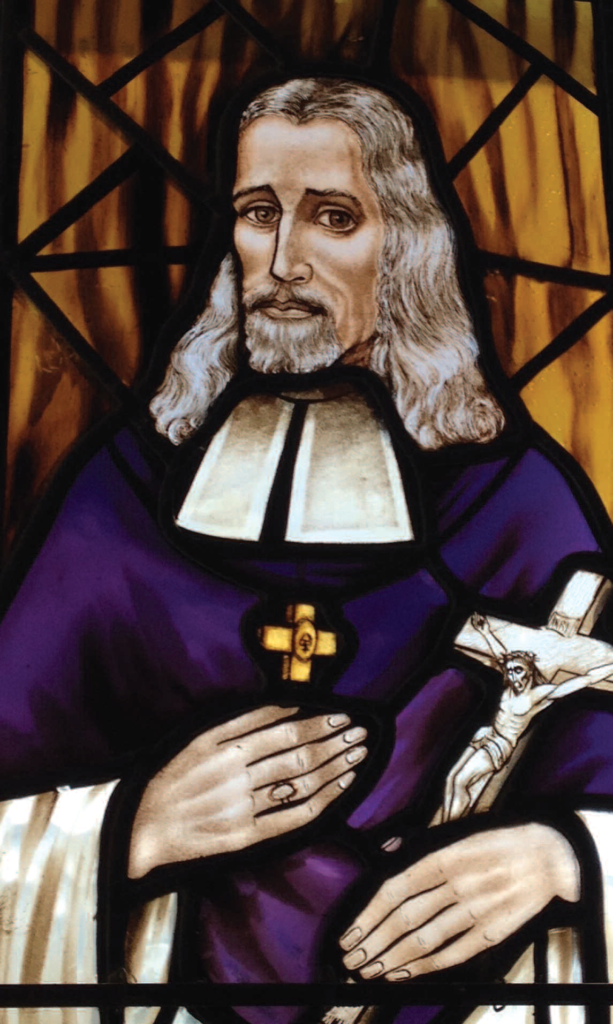
Firstly, the Superior sent her back to school so that she could improve her level of education. The course of studies was supposed to last two years but Sr Placida completed it within three months and after obtaining her Diploma she even became a teacher at the college, was appointed head of the novices and also a councillor. Maria soon understood that the Mother Superior had decided to prepare that young girl for the highest responsibilities and her attempts to guide her niece towards the strictest religious observance turned into evident hostility. The Aunt did nothing but point out and underline Placida’s faults and seemed to want her to be removed from the Monastery of Saint-Sauveur-le-Vicomte. The Mother Superior, however, was adamant and even appointed Placida Assistant Superior and gave her the task of founding a new Convent.
One day, while the Bishop was expressing his concern for the future, to the elderly Foundress, Placida passed by and Mary Magdalene said: “It will be that twenty-four-year-old nun who will succeed me. God will tell you how to do it.” He then ordered Placida to go to Paris and raise the necessary funds to restore the Church. He told her to go to the Queen and the most important Ministers of the Government and to collect what was still needed, begging from door to door. For four years Placida carried out this task, committing herself and accepting the refusals, disdain and profound solitude, with a great spirit of obedience, humility and sacrifice.
In May 1846 she was recalled to Saint-Sauveur-le-Vicomte because the Superior was dying. St Mary Magdalene Postel died on 16 July 1846 . The General Chapter for the election of the new Superior was held in September of the same year and all but two votes were in favour of Placida, who felt completely unworthy and apologised on her knees. While her Aunt and the Chaplain, were of the opinion that the role of Superior belonged to the Aunt, the Bishop was adamant and validated the votes . A very strange period followed. Placida submitted to the Chapter her need to complete the task entrusted to her for the raising of funds and suggested that she postpone her taking Office for a year and keep only some functions in the interim. The Chapter agreed and entrusted the daily leadership of the community to her Aunt. However, that situation lasted ten years, years in which the Mother Superior, Placida, extended the range of her travels outside of Paris, always moving on foot and often spending the night outdoors.
She kept in correspondence with the members of the community and gave instructions for the assignment of tasks but her short stays at the Convent were rather sad. Maria had taken possession of the Superior’s rooms, while Placida was relegated to an attic; the Aunt humiliated the young Superior in front of the whole community, gave her orders, opened her post, made decisions together with the Chaplain and instructed her on what she should do.
Why was all this possible? Had Placida abdicated her role? Shouldn’t she have taken some more vigorous action towards Maria? In the end, her great sufferings paid off; forcing the Aunt into submission would have jeopardised the already fragile balance of the congregation, which the true Mother Superior knew she had to avoid at all costs.
Shortly after the Consecration of the Abbey Church, which had been completed with the vast funds Placida had raised, Maria died. Placida ran the Community for thirty more years and received Papal approval for the order in 1859 from Pope Pius IX. Her tenure as Mother Superior saw Sisters in the Order increase from 150 to more than 1000, as well as seeing an increase in the number of Convents. Placida’s ambition was to do for the students, the same, that St John the Baptist de La Salle had done for the boys.
Placida died on 4 March 1877 at Saint-Sauveur-le-Vicomte after having been organising relief during the Franco-Prussian War. Placida was Beatified 6 May 1951 by Pope Pius XII.
The Roman Martyrology states – “In the Monastery of Saint-Sauveur-le-Vicomte in Normandy in France, Blessed Placida (Eulalia) Viel, virgin, who distinguished herself in leading the Congregation of the Christian Schools of Mercy with commitment and humility.”
Notre-Dame-de-la-Garde / Our Lady of the Guard , Marseille, France (1221) – 4 March:
The Statue inside the Basilica
Late one afternoon during the thirteenth century, a solitary French fisherman was fishing off the harbour of Marseille. Before he became aware of it, a terrific storm descended upon him. His boat tossed around like a shell and filled with water faster than he could bail it out. His rudder was lost. his mast snapped. Cutting himself free from the rigging with a knife, he had saved himself temporarily from certain drowning. Still, everything looked hopeless and he felt he could never get back to the harbour. The fisherman thought of the family he would never see again and cast a despairing look at the City, the huge rock standing like a sentinel or guard on the mountain which overlooked the City and harbour. Dimly through the gloom, he suddenly saw a solitary figure of a lady, dressed in white, standing firmly on the very top of the rock. She seemed to be extending her hand as if she would help him to the shelter and safety of the harbour. At once it came to him that the Lady so calmly defying the wind and rain could only be the Blessed Mother, so he prayed to her to help him. Almost immediately his boat ceased its wild tossing, righted itself and pushed by a friendly gust of wind, raced into the calm water of the harbour until it drove onto the shore at the very foot of the mountain. Stepping onto the shore, the fisherman fell to his knees and poured out his thanks to the Blessed Virgin and then hurried home to his worried family. The story of his rescue through the assistance of Our Lady, quickly spread throughout the port. It was remembered that other sailors, on numerous occasions during severe storms, had also seen the figure of the Lady on top of the rock. Always when she had appeared, the angry seas had calmed and their crafts had ridden safely into the shelter.
Soon everyone came to believe that the rock was the spot on which the Blessed Virgin, Our Lady of Guard, would appear whenever her help was desperately required. In thanksgiving to her the sailors of Marseille, in 1213-1218, erected a Chapel on top of the rock . In it they enshrined a lovely Statue of Our Lady. Around 1544, the Chapel was replaced by a large Church and the Statue transferred to it. Sometime during the French Revolution the Statue of Our Lady of Guard was destroyed but during the 1830’s a new Statue was dedicated. That Mary did not confine her help only to sailors was proved in the year 1832, when a severe epidemic of cholera struck Marseille, the people decided to appeal to Mary. Forming a procession, they climbed the mountain, removed the Statue from the Chapel, brought it down and solemnly carried it through the streets of the City. Almost immediately the epidemic waned and in a few days vanished. So they called Mary, Our Lady of Help – the sailors called her Our Lady of Mariners. Some years later, as the fame of the shrine on top of the mountain spread, more and more people made pilgrimages to venerate the Blessed Virgin. The shrine acquired still another name, a name more reflective of who Our Lady truly is for all who call upon her – Notre Dame de la Guarde – Our Lady of Guard, or Guardian.
In Marseilles today, the hill of Notre Dame de la Garde is topped by a beautiful Basilica, built in 1864, at an altitude of 550 feet. This commanding site, however, has been occupied by a Chapel since the year 1214. The interior has a multitude of sailors’ votive offerings and model ships are hung in all parts of it, as signs of thanksgiving for all the mariners who have been assisted by their heavenly mothe, the beautiful Stella Maris.. A golden statue of the Virgin and Child suitably dominates the City from its place on top of the western tower spire.
Votive replicas of ships saved at sea hang everywhere from the vaults of the Basilica
— St Adrian of May St Adrian of Nicomedia Bl Alexander Blake St Appian of Comacchio St Arcadius of Cyprus St Basinus of Trier Bl Christopher Bales St Felix of Rhuys St Gaius of Nicomedia Bl Humbert III of Savoy St Leonard of Avranches St Nestor the Martyr St Owen Bl Paolo of Brescia St Peter of Pappacarbone Blessed Placida Viel SSC (1815—1877) Virgin, Religious Sister Bl Rupert of Ottobeuren — Martyrs on the Appian Way – 900 saints – Group of 900 martyrs buried in the catacombs of Saint Callistus on the Appian Way, Rome, Italy.c260
Martyrs of Nicomedia – 20 saints – A group of 20 Christians murdered together for their faith. The only details about them to survive are three of their names – Archelaus, Cyrillos and Photius. Nicomedia, Bithynia (in modern Turkey)
Martyrs of the Crimea – 7 saints – A group of 4th century missionary bishops who evangelized in the Crimea and southern Russia, and we martyred for their work. We know little else beyond the names – Aetherius, Agathodorus, Basil, Elpidius, Ephrem, Eugene and Gapito.
Martyred by Communists: Bl Giovanni Fausti, Bl Gjelosh Lulashi, Bl Kolë Shllaku, Bl Zoltán Lajos Meszlényi
Martyred by Elizabeth I: Bl Alexander Blake, Bl Christopher Bales, Bl Nicholas Horner
Thought for the Day – 3 March – Meditations with Antonio Cardinal Bacci (1881-1971)
Steadfastness in Suffering
“When we feel depressed or when we are tempted to strike out angrily against human injustice and misunderstanding, there are two considerations which should help us to be patient.
The first, is the reflection, that everything comes to us from God, or is at least permitted by Him. Why should we rebel against the will of God? Jesus was innocence itself yet He willed to suffer for love of us. Are we unwilling to suffer for love of Him?
The second, is the realisation, that we are sinners who have offended God many times and deserve to be punished. It is necessary to accept patiently, all the sufferings which God sends us in expiation ofour sins. “We are receiving what our deeds deserved” (Lk 23:41).
Above all, we ought to resolve, never to give way to anger in word or deed when we are offended. On these occasions, we should wait until we have calmed down and have asked God for peace of mind. Before we do anything, we need time for reflection and prayer. If we act in this way, we shall not have to be sorry afterwards.
Patience can help us to achieve anything and will eventually help us to gain Heaven.”
Day Fifteen of our Lenten Journey – 3 March – Wednesday of the Second week of Lent, Readings: Jeremiah 18:18-20,Psalms 31: 5-6, 14, 15-16, Matthew 20: 17-28
Imitating Christ with Thomas à Kempis (1380-1471)
In You is the source of life and in Your Light Lord, we see light Psalm 35(36)
“Are you able to drink the cup that I am to drink?” – Matthew 20:22
Each day we ought to renew our resolutions and arouse ourselves to fervour, as though it were the first day of our turning back to God. We ought to say: “Help me, O Lord God, in my good resolution and in Your holy service. Grant me now, this very day, to begin perfectly, for thus far I have done nothing.”
As our intention is, so will be our progress and he who desires perfection must be very diligent. If the strong-willed man fails frequently, what of the man who makes up his mind seldom or half-heartedly? Many are the ways of failing in our resolutions …
Just men depend on the grace of God rather than on their own wisdom in keeping their resolutions. In Him they confide every undertaking, for man, indeed, proposes but God disposes and God’s way is not man’s. If a habitual exercise is sometimes omitted out of piety or in the interests of another, it can easily be resumed later. But if it be abandoned carelessly, through weariness or neglect, then the fault is great and will prove hurtful. Much as we try, we still fail too easily in many things. Yet we must always have some fixed purpose, especially against things which beset us the most. Our outward and inward lives alike, must be closely watched and well ordered, for both are important to perfection. (Book 1 Ch 19:1-2)
Quote/s of the Day – 3 March – Wednesday of the Second week of Lent, Readings: Jeremiah 18:18-20,Psalms 31: 5-6, 14, 15-16, Matthew 20: 17-28
“Are you able to drink the cup that I am to drink?”
Matthew 20:22
“Only let it be in the name of Jesus Christ, that I may suffer together with Him! I endure everything because He Himself, Who is perfect man, empowers me.”
St Ignatius of Antioch (c 35–107) Martyr
“Do not rejoice in the Cross only in times of peace, preserve the same faith in times of persecution. Do not be a friend to Jesus in times of peace alone, only to become His enemy in times of war. You are now receiving forgiveness for your sins and the spiritual gifts lavishly bestowed by your King so, when war breaks out, fight valiantly for your King.”
St Cyril of Jerusalem (315-387) Father and Doctor of the Church
“Do not live any longer in yourself but let Jesus Christ live in you in such a way that the virtue of this Divine Saviour may be resplendent in all your actions, in order that all may see in you a true portrait of the Crucified and sense, the sweetest fragrance of the holy virtues of the Lord, in interior and exterior modesty, in patience, in gentleness, suffering, charity, humility and in all others that follow.”
St Paul of the Cross (1604-1775)
“To labour and to suffer for the One we love, is the greatest proof of our love.”
“You do not know what you are asking. Are you able to drink the cup that I am to drink?” They said to him, “We are able.” … the Son of Man came not to be served but to serve and to give his life as a ransom for many.” … Matthew 20:22,28
REFLECTION – “It is our task and, in our case, an obligation, to make of you the object of all our care, our zeal, our ministrations, by word and deed, by warnings, encouragement, admonitions and incitement, (…) so that, in this way, we might insert you into the rhythm of the divine will and face you towards the goal set before us – to give pleasure to God. …
He who is immortal, voluntarily shed His blood. He who created the host of angels, was bound at the hands of soldiers and He who is to judge the living and the dead, was dragged to justice (cf. Acts 10:42; 2 Tm 4:1). Truth was exposed to false witnesses, was slandered, struck, covered with spittle, hung on the wood of the cross – the Lord of glory (cf. 1 Cor 2:8) endured every outrage and suffering without Himself needing these trials. How could this have happened to Him who, even as man, was without sin and who, to the contrary, snatched us away from the tyranny of the sin through which death came into the world and falsely took possession of our first father?
So there is nothing surprising about it, if we submit to even one of these trials since such is our condition … Therefore, we too have to be offended and tempted, afflicted by the cutting off of our wills. According to the interpretation of our Fathers, there is in this, a shedding of blood for this is what it means to be a monk. And we must gain the Kingdom of heaven in that way, by spending our lives in imitation of the Lord. … Apply yourselves zealously to your duties in the thought that by means of them, far from being slaves of men, you are serving God.” … St Theodore the Studite (759- 826) Monk at Constantinople – Catecheses 1
PRAYER – Protect Your family, Lord, trained as it is by the constant exercise of good works. Renew our spirit with the grace that teaches us how to imitate You, to suffer for You and with You, strengthen us with Your consoling presence and lead us, to the joys of heaven. May the intercession of our Mother, the Blessed Virgin Mary keep us on the path of Your kingdom’s glory. Through Christ our Lord, with the Holy Spirit, God forever, amen.
Our Morning Offering – 3 March – Wednesday of the Second Week of Lent
Thy Grace A Lenten Prayer By St John Henry Newman (1801-1890)
O my God, suffer me still, bear with me in spite of my waywardness, perverseness and ingratitude! I improve very slowly but really, I am moving onto heaven, or at least, I wish to move. Only give me Thy grace meet me with Thy grace, I will, through Thy grace, do what I can and Thou shall perfect it for me. Then shall I have happy days, in Thy Presence and in the sight and adoration of Thy five Sacred Wounds. Amen
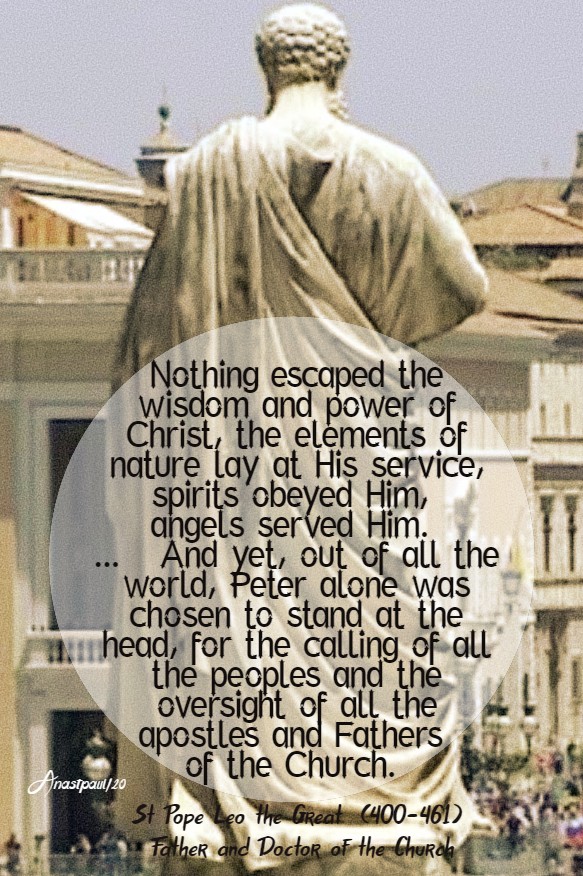
Saint of the Day – 3 March – Blessed Pietro de Geremia OP (1381-1452) Dominican Priest and Friar, renowned and brilliant Preacher, miracle-worker. In addition to his many miracles and conversions of sinners, he founded the University of Catania and help establish several Dominican Monasteries. Born in 1381 at Palermo, Sicily and died on 3 March 1452 in the Convent of Santa Zita, Palermo, Sicily of natural causes. He is also known as Peter Geremia. Patronages – Palermo, Preachers.
Pietro Geremia was born in Palermo on 10 August 1399 to aristocrats. ad He studied at the Bologna college and was perceived to be an excellent law student and his own pride led him to believe this.
One night in 1422 as he meditated on his vain success and what his future would bring, a recently deceased relative knocked on his third floor window. Pietro sat upright and asked who was there. The relative told him that his constant seeking after worldly glory had caused him to be eternally lost. He warned Pietro not to repeat the fatal errors of sin and pride and thus lose his eternal salvation!
The shaken Geremia purchased an iron chain to wear in mortification and began to seriously pray for guidance in his vocation. He received a sign that he was to enter the Order of Preachers.
His enraged father came to Bologna to stop him but saw how changed Pietro was and the peace and happiness which he emanated. He began his novitiate in Fiesole and was Ordained to the Priesthood in 1424. He made his vows in 1423 and returned to Palermo in 1433, where his superiors appointed him Prior at the Convent of Santa Cita in Palermo, Sicily.
His fame as a Preacher caught the attention of St Vincent Ferrer who once visited him and the two discussed spiritual matters at great lengths. Pietro was seen as one of the finest Preachers on the island and preached in the open often because the Churches never could hold the vast number of people who flocked to hear him.
On one particular occasion there was no food for the people and he asked a fisherman for a donation but the fisherman refused him in a rude manner. So he got into a boat and rowed out to sea and made a sign to the fish who broke the nets in the water and followed him back to the shore. The fisherman apologised and so he made another sign to the fish who returned to the nets in the sea. In 1444 he was preaching on repentance in Catania, when Mount Etna erupted. The people begged him to save them and he went to the Saint Agatha Shrine and removed the Saint’s veil. He held the veil towards the flow of lava heading towards the town and the eruption and lava flow ceased.
These and countless other miracles he performed which caused him to be revered as a saint. He raised the dead to life, healed the crippled and the blind and brought obstinate sinners to the feet of God.
Pope Eugene IV (1431-47) had a great appreciation for his skills and during the Council of Florence (1431-45), which briefly reconciled the Orthodox and Catholic Churches, the Pontiff relied on Pietro to help mediate between the two sides.
He died on 3 March 1452 in the Santa Zita Convent in Palermo and was Beatified on 12 May 1784 by Pope Pius VI.
Notre-Dame des Anges de Toulouse / Our Lady of Angels of Toulouse, France (1212) – 3 March:
In the year 1212, three merchants from Angers were passing through the forest of Bondy in France, when they were set upon by robbers. After being robbed, they were bound to trees and left to their fate. Since it was a wild and lonely place, known to be the haunt of robbers, their chances of rescue were few. They prayed earnestly to God and Our Lady and, after a day and a night, angels came in visible form and released them. The men discovered a spring near the place where they had been bound, which they considered to be miraculous. They determined to set up a Shrine of Our Lady on the spot in thanksgiving for their deliverance. The first statue they put into the Shrine was only intended to be temporary, to be used until something better could be made or purchased. However, almost immediately there began a stream of miraculous cures among those who prayed before the rough little statue. In the years that followed, fervent pilgrims came in droves to the Shrine, as evidenced by the numerous drinking vessels found during archaeological excavations carried out on the site. In 1260 the little Chapel was enlarged to enclose also the spring. In 1663 the Chapel was rebuilt and redecorated and so remained until the French Revolution, when it was completely destroyed. However, after the Terror had passed, the Chapel was rebuilt in 1808. One of the many thank-offerings in the Chapel is a ship suspended above the altar, as an ex-voto from a group of sailors who were saved from shipwreck at the intercession of Our Lady. On Sunday, 9 September 2012, the Diocese of Saint-Denis celebrated the 800th anniversary of the pilgrimage to Notre-Dame-des-Anges in Clichy-sour-Bois, under the leadership of Bishop Pascal Delannoy. The pilgrimage to the small Shrine always takes place on the second Sunday of September, and is thought by some to be the second oldest pilgrimage site in France.
__ St Katharine Drexel SBS (1858-1955) (Optional Memorial) Biography: https://anastpaul.com/2017/03/03/saint-of-the-day-3-march-st-katharine-drexel/ — St Anselm of Nonantola St Arthelais of Benevento Bl Benedetto Sinigardi da Arezzo St Calupan St Camilla St Cele-Christ St Cunegundes St Foila Bl Frederick of Hallum St Gervinus Bl Innocent of Berzo Bl Jacobinus de’ Canepaci St Lamalisse St Non Blessed Pietro de Geremia OP (1381-1452) Priest Bl Pierre-René Rogue St Sacer St Teresa Eustochio Verzeri St Titian of Brescia St Winwallus of Landévennec — 40 Martyrs in North Africa – A group of Christians martyred together in North Africa, date unknown. No details have survived, but we know these names – Antonius, Artilaus, Asclipius, Astexius, Basil, Bosimus, Carissimus, Castus, Celedonius, Claudianus, Cyricus, Donata, Emeritus, Emeterius, Euticus, Felix, Fortunatus, Frunumius, Gajola, Georgius, Gorgonius, Hemeterus, Isicus, Janula, Julius, Luciola, Luciolus, Marcia, Marinus, Meterus, Nicephorus, Papias, Photius, Risinnius, Sabianus, Savinianus and Solus
Martyrs of Pontus – 3+ saints – A large group of Christians martyred together in the persecutions of Emperor Maximian Galerius and governor Ascleopiodato. We have some details on three of them – Basiliscus, Cleonicus and Eutropius. 308 in Pontus (in modern Turkey) Martyrs of Caesarea; Asterius Marinus Martyrs of Calahorra Cheledonius Emeterius
Martyrs of Gondar, Ethiopia: Bl Antonio Francesco Marzorati Bl Johannes Laurentius Weiss Bl Michele Pío Fasol
Thought for the Day – 2 March – Meditations with Antonio Cardinal Bacci (1881-1971)
The Christian Formation of Character
“St Francis de Sales writes thus, with his usual simplicity: “A way has been found of making bitter almonds sweet, by pucturing them at the base and squeezing out the juice. Why cannot we eject our evil inclinations in order to make ourselves better. There is nobody so good by nature, that a bad habit could not altogether corrupt him. Similarly, there is nobody so bad by nature, that he could not be trained in goodness by the grace of God and his own perseverance.” St Francis de Sales did not teach this in theory alone but, he put his advice into practice to an heroic degree in his own life. He was endowed by nature, with a vigorous, irascible and resentful disposition and he bacame an angel of gentleness and affability. From his youth, he was aware of the defects in his character. He himself, admitted, that he struggled against them for twenty two years with God’s help. He reached the point where he was able to remain silent when he was insulted and to refrain from defending himself, when he was slandered, for he had acquired an inward peace and a remarkable calmness of manner. This gentleness of character enabled him to convert over seventy thousand heretics, to win back hardened sinners to Jesus Christ and, to set countless souls on fire with the love of God. This is the man called “the Gentle Christ of Geneva” and “the Gentleman Saint!” We have a great deal to learn from him!
Day Fourteen of our Lenten Journey – 1 March – Monday of the Second week of Lent, Readings: Isaiah 1:10, 16-20,Psalms 50: 8-9,16-17, 21 and 23, Matthew 23:1-12
Imitating Christ with Thomas à Kempis (1380-1471)
In You is the source of life and in Your Light Lord, we see light Psalm 35(36)
“Whoever exalts himself will be humbled and whoever humbles himself will be exalted.” … Matthew 23:12
WE MUST not rely too much upon ourselves, for grace and understanding are often lacking in us. We have but little inborn light and this we quickly lose through negligence. Often we are not aware that we are so blind in heart.
Meanwhile, we do wrong and then do worse in excusing it. At times, we are moved by passion and we think it zeal. We take others to task for small mistakes and overlook greater ones in ourselves.
We are quick enough to feel and brood over the things we suffer from others but we think nothing of how much others suffer from us.
If a man would weigh his own deeds fully and rightly, he would find little cause to pass severe judgement on others. The interior man, puts the care of himself before all other concerns and he who attends to himself carefully, does not find it hard to hold his tongue about others. You will never be devout of heart unless you are thus silent about the affairs of others and pay particular attention to yourself.
If you attend wholly to God and yourself, you will be little disturbed by what you see about you. … You will sweetly repose if your heart does not rebuke you. Rejoice at nothing but only your good deeds. Bad men have never a true joy, nor feel inner peace, for “there is no peace for the wicked” (Is 57:21). … He is easily calmed and contented whose conscience is clean. Praise makes you not more holy, nor insult more worthless.
What you are you are, what God knows of you, is all that can be said for you. If you will only look at what you truly are, you will not care what men say of you. “Man looks at the appearance but God looks at the heart” (1 Sam 16:7). (Book 2 Ch 5)
You must be logged in to post a comment.