
My heart was very sorrowful today as I missed the great St Pius V’s feast day 😪😪😪

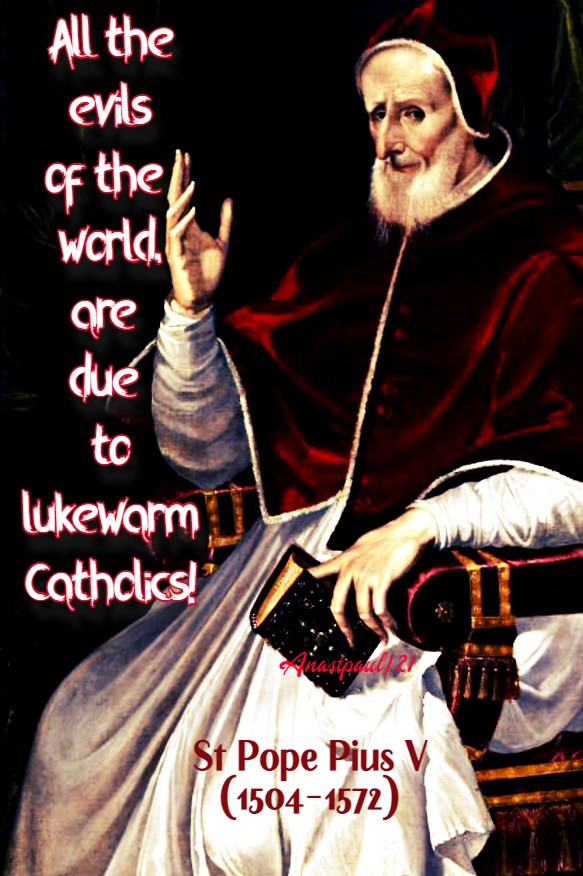
My heart was very sorrowful today as I missed the great St Pius V’s feast day 😪😪😪
Our Morning Offering – 30 April – Friday of the Fourth Week of Easter +2021, Readings: Acts 13:26-33, Psalm 2:6-11, John 14:1-6
Jesus said to his disciples:
“Let not your heart be troubled.
You believe in God, believe also in me. ” – John 14:1
O Christ Jesus,
When All is Darkness
By St Ignatius Loyola (1491-1556)
O Christ Jesus,
when all is darkness
and we feel our weakness
and helplessness,
give us the sense of Your presence,
Your love and Your strength.
Help us to have perfect trust
in Your protecting love
and strengthening power,
so that nothing
may frighten or worry us,
for, living close to You,
we shall see Your hand,
Your purpose,
Your will
through all things.
Amen

Saint of the Day – 30 April – Blessed Benedict Passionei of Urbino OFM Cap (1560– 1625) Priest of the Order of the Friars Minor of St Francis, Capuchin, Missionary, apostle of the poor, renowned preacher, doctor of civil and canon law. Born on 13 September 1560 in Urbino, Duchy of Urbino, Papal States (part of modern Italy) as Marco Passionei and died on 30 April 1625 in Fossombrone, Pesaro-Urbino, Italy of complications following surgery. Also known as – Benedetto da Urbino, Benito of Urbino. Marco Passionei. Patronage – Missionaries.
It is most striking today, to see a scion of one of the richest and noblest families of Umbria give himself to strenuous manual work in various Friaries. He was sensitive to the poor and full of compassion for them, without distinction. He wanted to preach only in insignificant little towns. He abounded in piety and devotion, poverty and penance, humility and simplicity. He was indeed a ‘classic’ Capuchin friar.
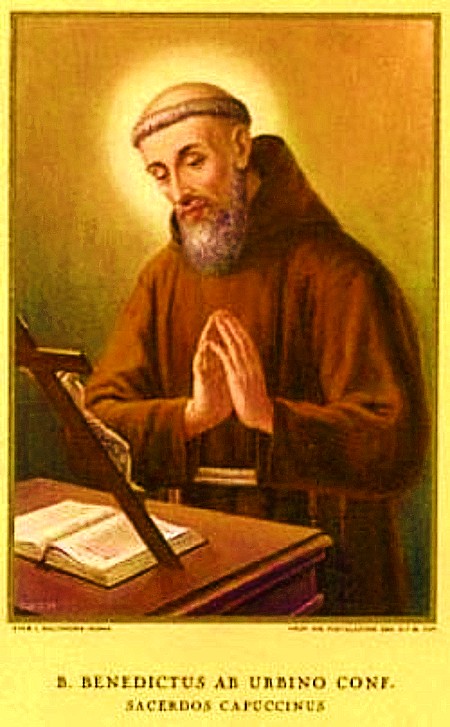
Marco was born into the noble family of the Passioneis in the duchy of Urbino. He was baptised Marco in 1560. He was orphaned by the age of seven and was put into the care of tutors with his ten brothers and sisters. He received the Doctor of Law at the University of Perugia and then rejoined his family, now living at Fossombrone. He made friends with the Capuchin brother questors and was attracted by their charism. Because of his poor health this was opposed by the local superior but, after waiting a year, the newly elected Provincial allowed him to join in 1584. Named Benedict he soon found his place among the preachers and joined St Lawrence of Brindisi in his missionary work in Bohemia. He thrived on it especially when preaching to the poor. He died in Fossombrone in 1625 and was Beatified by Blessed Pius IX on 15 January 1867.
Nearly all the information we have for the life of Blessed Benedict derives from a manuscript biography compiled by Brother Ludovico da Rocca Contrada (†1654) immediately after Benedetto’s death. This biography is the one and only actual contemporary witness and was used in the processes necessary for his Beatification. It is has an enormous documentary value thanks to its reliability and the seriousness of the information gathered, from the most direct sources, whom the author often consulted personally. And the author was, moreover, guardian of the Friary of San Giovanni Battista in Fossombrone. He was present for the happenings at the end of his holy confrere’s life and was present at his deathbed. Therefore, his account is very detailed in its telling of Benedetto’s final sickness and death and of the uninhibited expressions of popular piety regarding Benedetto’s body.
Born on 13 November 1560 in the duchy of Urbino, he was the seventh of the eleven children in the noble family of Domenico Passionei and Maddalena Cibo. He was orphaned while still young and led his life in Cagli where he did his first study at home. At seventeen he then went to Perugia and onto Padua for higher studies. On 28 May 1582, at just twenty two years, he received a degree in Civil and Church law. His career began in the Roman court of Cardinal Pier Girolamo Albani. He found this disagreeable.
Marco Passionei returned to the Marches and settled in Fossombrone where his family had meanwhile taken up residence. He was nourishing a secret call of the spirit and longed for the humble and austere life of the Capuchins. Above Metauro the Capuchins had built a devout hermitage. However, it was not easy for him to get permission both from the family and from the friars until the new provincial minister, Giacomo da Pietrarubbia who, according to the wish of the chapter, admitted him to the novitiate of San Cristina in Fano. His fragile health made his novitiate year difficult. In fact, after a few months, he became ill to the point that his superiors had him leave Fano to go to the friary in Fossombrone. After three months it was considered to send him home but his indomitable will won out in the end. He said that he had been clothed in the habit to live and to die as a Capuchin: “If they had sent him out from one door he would have come back in again through another.” He entrusted himself to prayer and obtained the grace of healing. And so he was able to make his religious profession at the end of May 1585, much to the consolation of the poor who, on the occasion, benefitted economically. He continued his religious formation in Ancona. By 1590 he was already a Priest, a humble preacher, in various Friaries such as Fano and Ostra.
In 1600 the General Minister, Girolamo da Castelferretti, included him in the mission band led by Saint Lorenzo da Brindisi to spread the Order in Bohemia and reinforce there the Catholic faith. Although he had not asked to go he was ready to leave immediately. Exemplary and capable men were needed and the General Minister, also from the Marches, knew him well and considered him suitable for the difficult undertaking. Benedetto confided his difficulties to a letter. However he was very obedient under the guidance of Lorenzo da Brindisi. He had to endure many injuries from heretics who hated him. At the end of the triennium (1602) he was called back to the province where he travelled around various Friaries as preacher, superior and as a simple Friar. He also went questing, both in the city and in the countryside. He said, “It is better to carry the weight of bread rather than sins.” He was so humble, and loved silence so much, that he seemed naïve and uneducated. When he was guardian in the friary in Pesaro the duke of Urbino went to visit him. Accustomed to help in the kitchen after lunch, Benedetto let the illustrious visitor wait until he had finished washing the dishes.
His devotion was carefully organised around night and daylight hours of prayer which extended beyond the pious exercises of the fraternity. As all his biographers relate, he used to begin his day with one or two hours of prayer in the Church before the community recitation of matins. After the office he returned to his cell to rest for half an hour. Then he would be in the church again where he prayed the rosary on his knees. After the rosary he did the discipline and then immersed himself in mental prayer until dawn. He never tired of prayer. Each day he recited the Office of the Blessed Virgin Mary, as well as the seven penitential psalms, the Office of the Holy Spirit and of the Holy Cross, many decades of the rosary and Our Fathers. He spent most of his time in spiritual reading, making the Stations of the Cross, visiting the tabernacle and the Our Lady altar. Frail, emaciated and weak he seemed to derive his strength from prayer. If sometimes he arrived late to meditation, he would turn the hour glass the recoup the time for prayer. In this he was very exacting, even with the others. As superior he never dispensed the Friars from the two hours of mental prayer each day. Even when he was not in the Friary he maintained his strict and austere style.
For his preaching he said he preferred the towns that had a public clock that struck the hours day and night. In this way he was able to organise his practices of prayer and penance as he did in the friary. He was enamoured of the Crucifix, the Passion, the Eucharist and the Blessed Virgin who he affectionately called “mamma.” He invented many gestures of love, such as an hour of prostration on the ground, his “prayer in the garden” with his arms open and face down on the floor. His continuous meditation on the Passion filled his heart with an intense contrition which urged him to go often to confession, as often as three times a week. His confessors however did not see sufficient matter for absolution.

Austere and heroic in his bodily penance he never gave into himself in anything. He was emaciated and weak in appearance, with hunger pangs and kidney stones that prostrated him. His first biographer noted that “he seemed to suck in his breath through his teeth, as they say. But as for his spiritual exercises he seemed like a man of steel.” Always on his feet in his frequent preaching, he had to drag himself along with annoying wounds on his legs. He had to undergo fifteen hernia operations. But he never stopped. He always started up again with courage.
He did not like big cities. If, rarely, he had to preach in Pesaro (1612), and in Urbino and Genoa (1619), he preferred those remote, humble and “little places” hardly mentioned on the general maps. More than once he took on the task of building or restoring churches, as in Barchi and Castelleone. He did not write his talks. He confined himself to brief schemas on scraps of paper. His preaching came from the heart, like a humble exhortation for the humble, but nonetheless all was the word of God, able to move and convert. He preached his last Lent in Saccorvaro.
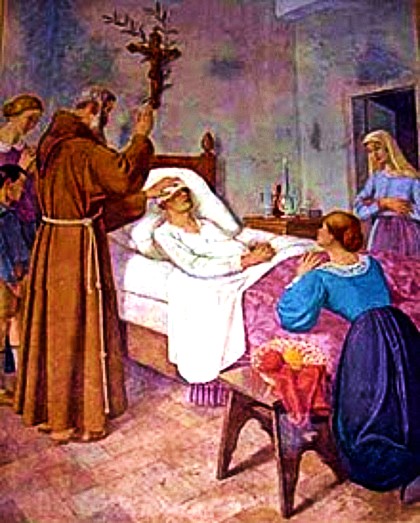
The journey was all on foot and he had to stop in Urbania due to starvation. After about ten sermons in Saccorvaro he had to stop. He was taken to Urbino and then to Fossombrone. He had to undergo yet another hernia operation which this time brought him to the end of his life. He had a crucifix placed on a little table. He kept his gaze fixed on it, his spirit focused there. If anyone blocked his view he immediately gestured that they should move. He remained silent in this way as if he were resting quietly, so much so that the Friars barely realised when his life faded like a gently quenched candle on 30 April 1625 in the light of the Passion which he wanted read to him. He was nearly sixty five years old, and had lived forty one years of religious life with immense love and joy.
Prayer
Holy Father,
the depth of Your love for us,
revealed in the Cross of Jesus,
transformed Benedict
into a warm and loving minister of your Gospel.
May we experience Your love
and be eager to share it with others.
Through our Lord Jesus Christ, Your Son,
who lives and reigns with You and the Holy Spirit,
God, for ver and ever.
Amen
Friday of the Fourth Weekof Easter +2021
Onze Liewe-Vrouw van Afrika / Heilige Maria van Afrika / Notre Dame d’Afrique / Our Lady of Africa , Algiers (1876) (Feast) – 30 April:
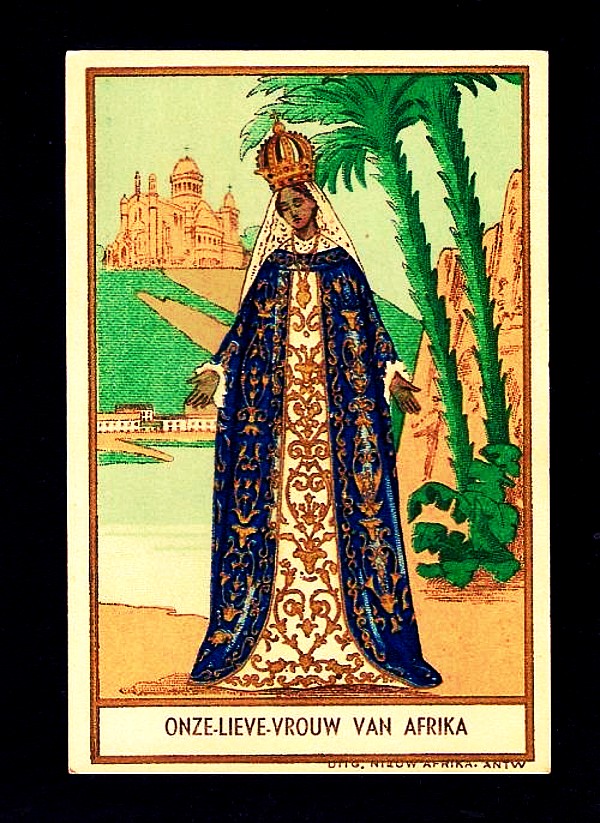
North Africa, the land of Saints Monica, Augustine, among others, as part of Roman Empire began to become Christian in the 3rd century under Emperor Constantine. It remained Christian until the Arab invasions in later centuries. The French re-established themselves early in the 19th century.
The first Bishop, Bishop Dupuch, found it impossible to build a Church because the local population was hostile to the French. He went back to France for assistance. The Sodality of Our Lady in Lyon offered the Bishop a bronze statue of the Immaculate Conception ,with the understanding, that she would be the Protectress of both the Mohammedans and the natives. It was brought from France in 1840 and was entrusted to the Cistercian Monks of Staueli. Later, Cardinal Lavigiers, Founder of the White Sisters, enshrined it in the new Basilica at Algiers, where in 1876 the image was crowned. This bronze statue, very dark in colour, is known as Onze Liewe-Vrouw van Afrika / Heilige Maria van Afrika / Our Lady of Africa.
Pilgrims began to come to venerate the image where the lame, the blind and the crippled were miraculously cured and sailors came also, to beg for protection of their long and perilous voyages.
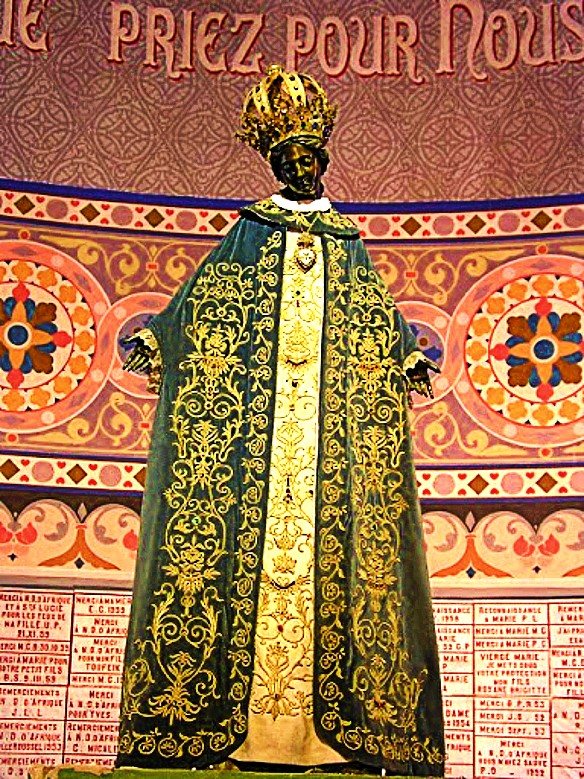
The Basilica of Our Lady of Africa, or Notre Dame d’Afrique, was eventually built, and is situated on a height overlooking the Bay of Algiers. It took fourteen years to construct in an attractive Neo-Byzantine style and was consecrated in the year 1872.


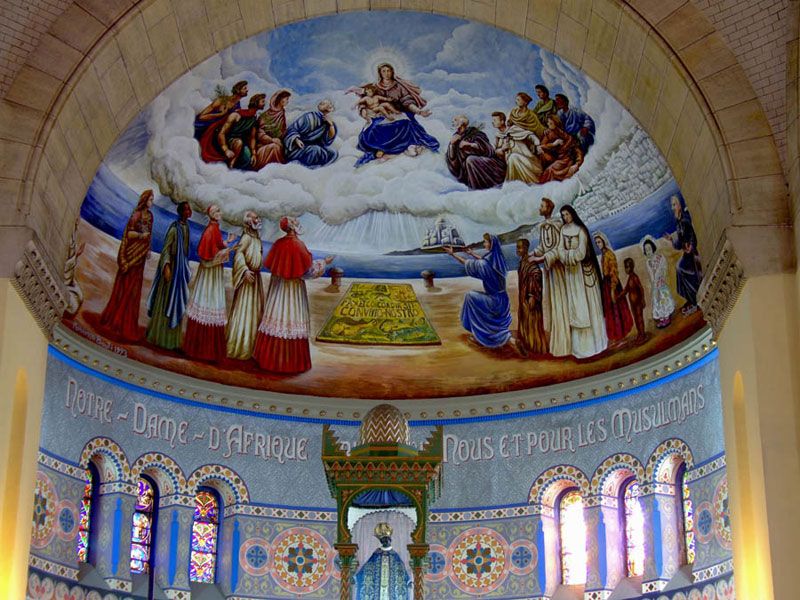
The Statue venerated in Algiers today, is this same bronze image, very dark in colour but with European features. The walls of the basilica are now covered with votive offerings testifying to the assistance the faithful have received from the Mother of Mercy.

At this and other North African Shrines the veneration given to Mary by Mohammedans is very marked. The full name of Cardinal Lavigiers’ congregation of White Sisters is Missionary Sisters of Our Lady of Africa. There is an indulgenced prayer to Mary under that title for the conversion of the Africans on the apse: Notre Dame d’Afrique priez pour nous et pour les Musulmans (Our Lady of Africa, pray for us and for the Muslims.)
This feast commemorates the crowning of the Algiers statue.


St Marie Guyart of the Incarnation OSU (1599-1672) Ursuline Religious and Missionary ( Optional Memorial)
Biography:
https://anastpaul.wordpress.com/2017/04/30/saint-of-the-day-30-april-st-marie-guyart-of-the-incarnation-o-s-u/
St Pope Pius V (1504-1572) Bishop of Rome, Ruler of the Papal States, Pope of the Council of Trent, the Counter-Reformation, the Battle of Lepanto, the Holy Rosary and the Pope who declared St Thomas Aquinas as a Doctor of the Church (Optional Memorial)
Wonderful blessed St Pius V:
https://anastpaul.com/2019/04/30/saint-of-the-day-saint-pope-pius-v-1504-1572/
St Adjutor of Vernon
St Aimo of Savigny
St Amator of Córdoba
St Aphrodisius of Alexandria
Blessed Benedict Passionei of Urbino OFM Cap (1560– 1625) Priest
St Cynwl
St Dedë Plani
St Diodoro of Aphrodisias
St Donatus of Euraea
St Erconwald of London (Died c 693) Bishop, Monk, Abbot, Confessor, “The Light of London”
About this “The Light of London”:
https://anastpaul.com/2020/04/30/saint-of-the-day-30-april-saint-erconwald-of-london-died-c-693-the-light-of-london/
St Eutropius of Saintes
St Forannan
St Genistus of Limoges
St Giuse Tuân
Bl Gualfardus of Augsburg
Bl Hildegard the Empress
St Joseph Benedict Cottolengo (1786-1842) Priest, Founder, Confessor, Apostle of Charity.
About St Joseph Cottolengo:
https://anastpaul.wordpress.com/2018/04/30/saint-of-the-day-30-april-st-joseph-benedict-cottolengo-1786-1842-an-intense-day-of-love/
St Lawrence of Novara
St Louis of Córdoba
St Mariano of Acerenza
St Maximus of Ephesus
St Mercurialis of Forlì
St Peter of Córdoba
St Pomponius of Naples
St Quirinus of Rome
St Rodopiano of Aphrodisias
St Sophia of Fermo
St Swithbert the Younger
Bl Ventura of Spello
Bl William Southerne
Thought for the Day – 29 April – Meditations with Antonio Cardinal Bacci (1881-1971)
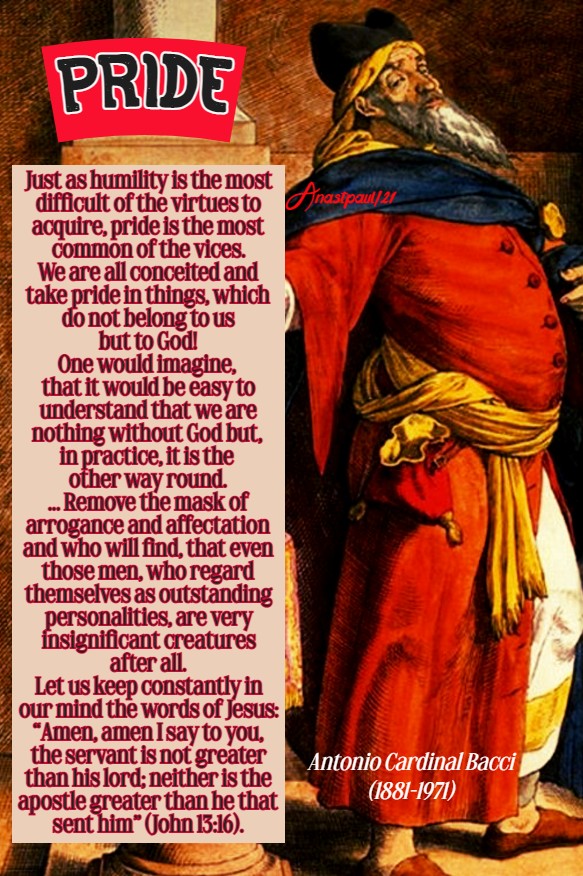
“Just as humility is the most difficult of the virtues to acquire, pride is the most common of the vices.
We are all conceited and take pride in things, which do not belong to us but to God!
One would imagine, that it would be easy to understand that we are nothing without God but, in practice, it is the other way round.
It is not only prominent personalities, noted scientists and men of letters but also the most ordinary men, who believe, that they are unique and superior to their fellows.
Other vices follow pride.
There is a presumption which leads us to believe that we are more important than we really are and attempt things which are beyond the power which God has given us.
There is ambition ,which drives us to make an immoderate quest for honours and responsibilities, our main goal in life, as if our hearts could be satisfied by these things, rather than by God and by our own sanctification.
There is empty vanity, the futile but burning desire to be praised and esteemed, as if our merits (if we have any) were anything else but a gift from God, which we have been able to develop only by His assistance and grace.
Let us examine ourselves in this regard and we shall find many distortions in our own personality.
We shall discover many vain notions, which we ought to dispel and many selfish detractions from God’s glory of which we are and have been, guity.
“Take away pride,” said St Augustine “and what are men but men?”
Remove the mask of arrogance and affectation and who will find, that even those men, who regard themselves as outstanding personalities, are very insignificant creatures after all.
Let us keep constantly in our mind the words of Jesus: “Amen, amen I say to you, the servant is not greater than his lord; neither is the apostle greater than he that sent him” (John 13:16).”
We can learn a great deal from a meditation on this subject.
PART ONE HERE:
https://anastpaul.com/2020/04/20/thought-for-the-day-20-april-pride/
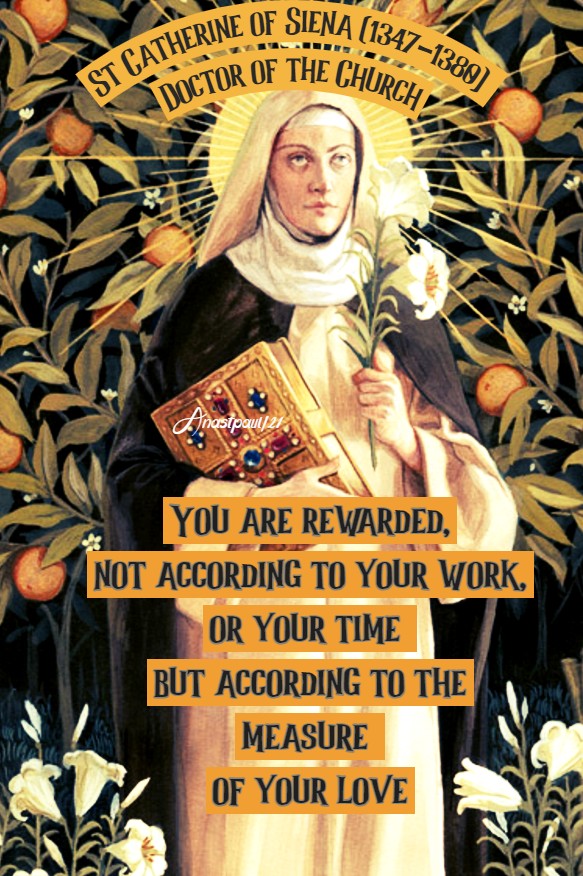
Quote/s of the Day – 29 April – The Memorial of St Catherine of Siena (1347-1380) Doctor of the Church
“Speak the truth in a million voices.
It is silence that kills!”

“Be strong and kill yourself
with the sword of hate and love,
then you will not hear the insults
and abuse. which the enemies
of the Church throw at you.
Your eyes will not see anything,
which seems impossible,
or the sufferings,
which may follow
but only the light of faith
and in that light ,
everything is possible
and remember ,
God never lays greater burdens
on us than we can bear.”

“You are rewarded,
not according to your work,
or your time
but according to the measure
of your love.”
One Minute Reflection – 29 April – Thursday Fourth Week of Easter, Readings: Acts 13:13-25, Psalm 89:2-3, 21-22, 25, 27, John 13:16-20 and the Memorial of St Hugh the Great of Cluny (1024-1109)
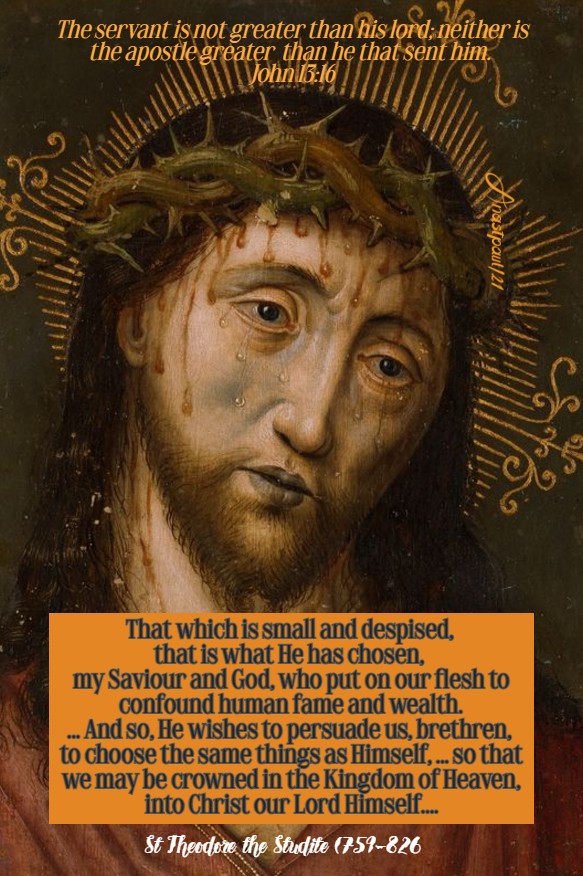
“A servant is not greater than his master, nor is a messenger greater than the one who sent him.” … John 13:16
REFLECTION – “Remember the wonders He has done for us (Ps 104[105]:5) in the past and those he does still. … In response to what He has done for us let us do even more and return what we owe Him, most venerable brethren. And what He wants from us is surely that we should fear Him, love Him with all our heart and all our mind (cf. Mt 22:37) and imitate His life in the flesh insofar as we can?
He made Himself a stranger, by leaving heaven for earth, so that we too might become strangers, to thoughts that come from self-will. He obeyed His Father ,so that you too should unhesitatingly obey …. He humbled Himself even to death (cf. Phil 2:8), so that you too should share this sentiment, abasing and humbling yourselves in thought, deed, word and act. Where is divine and true glory to be found, if not in becoming, without glory amongst men for God’s sake? … That which is small and despised, that is what He has chosen, my Saviour and God, who put on our flesh to confound (1 Cor 1:27-28) human fame and wealth.
This is why He was born in a cave, was laid in a manger, was called the son of a carpenter, called a Nazarene. He was clothed in one poor tunic and a single cloak; He went by foot, suffered, was stoned by the Jews (cf. Jn 10:31), insulted, arrested, crucified, pierced with a lance, placed in the tomb, after which He rose again. And so, He wishes to persuade us, brethren, to choose the same things as Himself before the angels, so that we may be crowned in the Kingdom of Heaven, into Christ our Lord Himself, to whom belongs glory and power, together with the Father and Holy Spirit, now and forever. Amen.” … St Theodore the Studite (759-826) Monk and Theologian at Constantinople – Catechesis 78
PRAYER – Lord God, stand by us in Your saving work and stay with us in Your gifts of grace. You have rescued us from the darkness, keep us ever in Your light. May the ways of truth and life which Jesus Christ Your Son taught us, be our anchor and our light. We ask that You hear the intercession of Mary, the Blessed Virgin Mother and Saint Hugh of Cluny, Your servant, whom we beseech for help as we work to reach our heavenly home. Through Christ our Lord, with the Holy Spirit, God forever, amen
Acts 13: 13-25
13 Now when Paul and they that were with him, had sailed from Paphos, they came to Perge in Pamphylia. And John departing from them, returned to Jerusalem.
14 But they, passing through Perge, came to Antioch in Pisidia and entering into the synagogue on the sabbath day, they sat down.
15 And after the reading of the law and the prophets, the rulers of the synagogue sent to them, saying: Ye men, brethren, if you have any word of exhortation to make to the people, speak.
16 Then Paul rising up and with his hand bespeaking silence, said: Ye men of Israel and you that fear God, give ear.
17 The God of the people of Israel chose our fathers,and exalted the people when they were sojourners in the land of Egypt and with an high arm brought them out from thence,
18 And for the space of forty years endured their manners in the desert.
19 And destroying seven nations in the land of Chanaan, divided their land among them, by lot,
20 As it were, after four hundred and fifty years and after these things, he gave unto them judges, until Samuel the prophet.
21 And after that, they desired a king:and God gave them Saul the son of Cis, a man of the tribe of Benjamin, forty years.
22 And when he had removed him, he raised them up David to be king to whom giving testimony, he said: I have found David, the son of Jesse, a man according to my own heart, who shall do all my wills.
23 Of this man’s seed, God according to his promise, has raised up to Israel a Saviour, Jesus.
24 John first preaching, before his coming, the baptism of penance to all the people of Israel.
25 And when John was fulfilling his course, he said: I am not he, whom you think me to be: but behold, there comes one after me, whose shoes of his feet I am not worthy to loose.
Gospel: John 13: 16-20
16 Amen, amen I say to you: The servant is not greater than his lord; neither is the apostle greater than he that sent him.
17 If you know these things, you shall be blessed if you do them.
18 I speak not of you all, I know whom I have chosen. But that the scripture may be fulfilled, He that eats bread with me, shall lift up his heel against me.
19 At present I tell you, before it come to pass, that when it shall come to pass, you may believe that I am he.
20 Amen, amen I say to you, he that receives whomsoever I send, receives me and he that receives me, receives him that sent me.
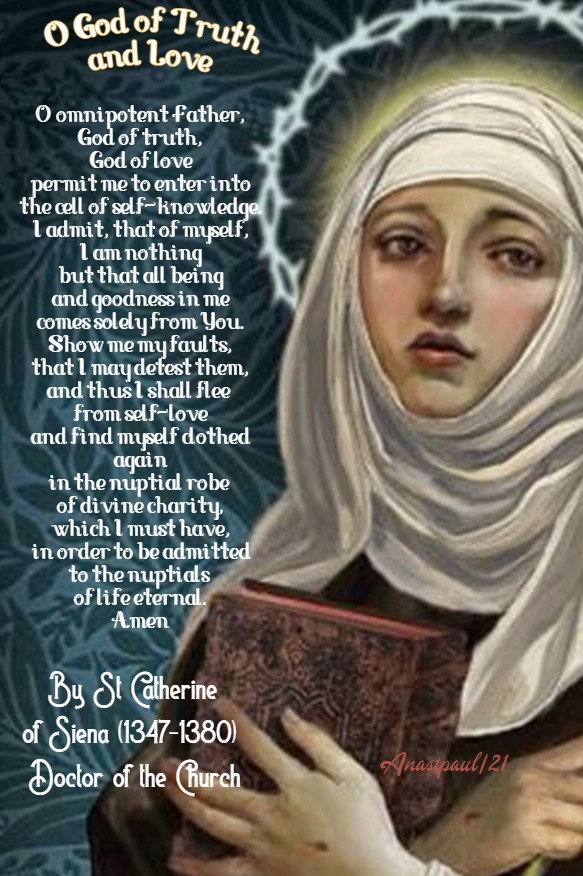
Our Morning Offering – 29 April – Thursday of the Fourth Week of Easter and the Memorial of St Catherine of Siena (1347-1380) Doctor of the Church
O God of Truth and Love
By St Catherine of Siena (1347-1380)
O omnipotent Father,
God of truth,
God of love
permit me to enter into
the cell of self-knowledge.
I admit, that of myself,
I am nothing
but that all being
and goodness in me
comes solely from You.
Show me my faults,
that I may detest them,
and thus I shall flee from self-love
and find myself clothed again
in the nuptial robe of divine charity,
which I must have,
in order to be admitted
to the nuptials of life eternal.
Amen
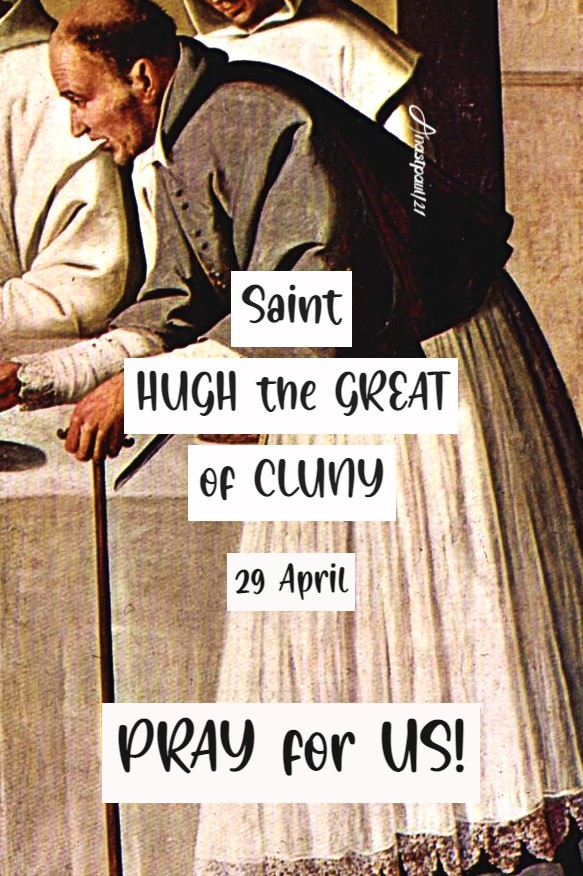
Saint of the Day – 29 April – St Hugh of Cluny (1024-1109) St Hugh the Great, Priest, Abbot of Cluny from 1049 until his death., Founder-builder of numerous Monasteries, Convents , Hospitals and the biggest Church in Europe (the Abbey Church at C luny) prior to the building of St Peter’s, Apostle of the poor, the sick, the marginalised by the feudal system, Ecclesiastical Reformer, holy father to his Monks and servant to all who needed him,. He was one of the most influential leaders of the monastic orders from the Middle Ages. Born on 13 May 1024 at Semur-en-Brionnais, Brionnais (now Saône-et-Loire), in the Diocese of Autun, France as Hugues de Semur and died on 28 April 1109 at Cluny Monastery, Brionnais (now Saône-et-Loire), France. Patronage – aganst fever, bodily ills. Also known as Hugh of Semur.
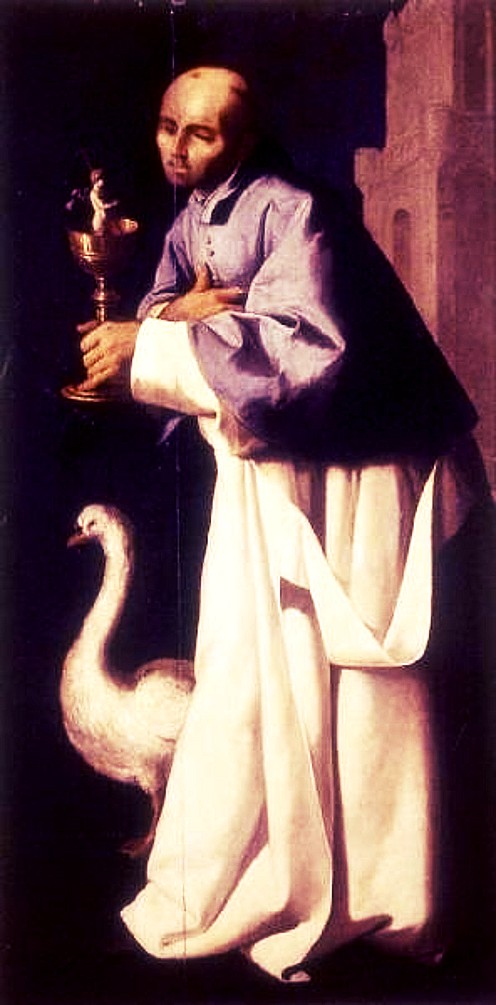
Saint Hugh was a Prince related to the Sovereign House of the Dukes of Burgundy and received his education under the tutelage of his pious mother and by the solicitude of Hugh, Bishop of Auxerre, his great-uncle. From his infancy he was given to prayer and meditation and his life was remarkably innocent and holy.
One day, hearing an account of the wonderful sanctity of the Monks of Cluny under Saint Odilo, he was so moved, that he set out at that moment and going there, he humbly begged the monastic habit. After a rigid novitiate, he made his profession in 1039, at the age of sixteen years. His extraordinary virtue, especially his admirable humility, obedience, charity, sweetness, prudence and zeal, gained him the respect of the entire community.
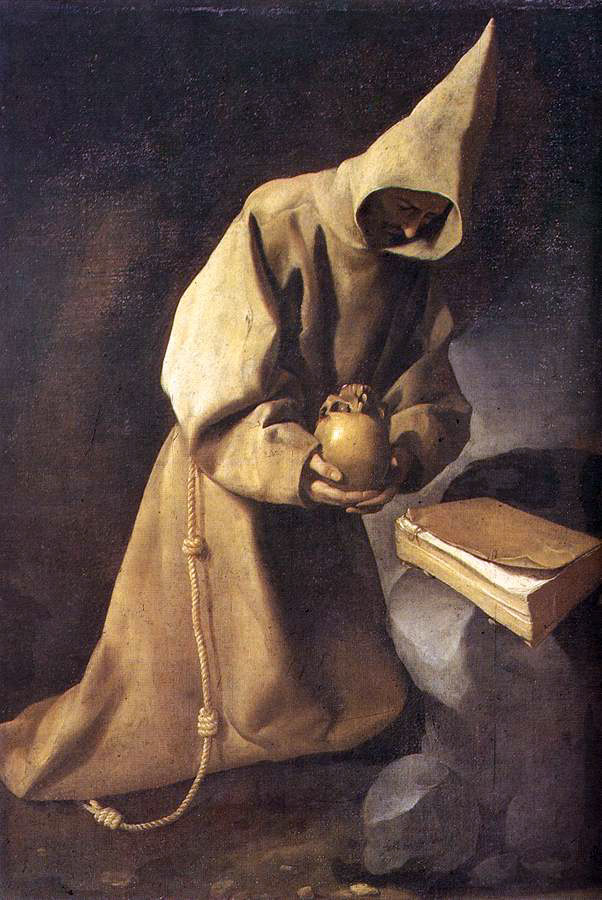
At the death of Saint Odilo in 1049, though Saint Hugh was only twenty-five years old, he succeeded to the government of that great Abbey, which he continued for sixty-two years. During those years, the role of Cluny was immense. From it came four very illustrious Popes, including Pope Urban II and Pope Pascal II, both disciples of Saint Hugh.
The King of Castille, Alphonsus VI, owed his deliverance from an imprisonment to the prayers and intervention of Saint Hugh. A Count of Macon entered the Monastery with thirty knights and a great many servants, while the Countess, his wife, retired to a convent founded by Saint Hugh. Donations of large terrains were made to this Abbey, permitting innumerable foundations. Abbot Hugh built the third Abbey Church at Cluny, the largest structure in Europe for many centuries.
Pope Urban II gave Saint Hugh the right to wear pontifical ornaments for the solemn feast days.
For the Monks under his care, Hugh was a model of fatherly forethought, of devotion to discipline and prayer and of unhesitating obedience to the Holy See. In furtherance of the great objects of his order, the service of God and personal sanctification, he strove to impart the utmost possible splendour and solemnity to the liturgical services at Cluny. Some of his liturgical ordinances, such as the singing of the Veni Creator at Tierce on Pentecost Sunday (subsequently also within the octave), have since been extended to the entire Roman Church. He began the magnificent church at Cluny — now unfortunately entirely disappeared — which was, until the erection of St Peter’s at Rome, the largest Church in Christendom, and was esteemed the finest example of the Romancsque style in France.
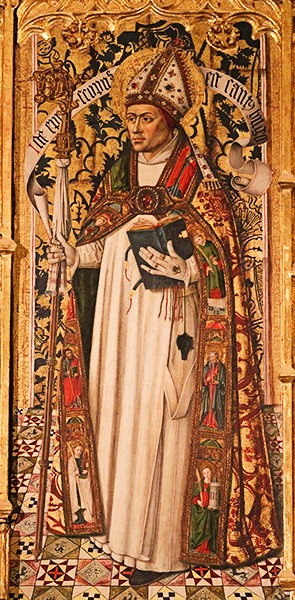
Hugh gave the first impulse to the introduction of the strict cloister into the Convents of nuns, prescribing it first for that of Marcigny, of which his sister became first prioress in 106 and where his mother also took the veil. Renowned for his charity towards the suffering poor, he built a hospital for lepers, where he himself performed the most menial duties. It is impossible to trace here the effect which his granting of personal and civic freedom to the bondsmen and colonists feudatory to Cluny and the fostering of tradesmen’s guilds — the nuclei from which most of the modern Cities of Europe sprang — have had on civilisation.
In the case of comparatively few of our Saints has the decision of their own and subsequent ages, been so unanimous, as in that of St.Hugh. Living in an age of misrepresentation and abuse, when the Church had to contend with far greater domestic and external inimical forces ,than those marshalled by the so-called Reformation, not a single voice was raised against his character — for we disregard the criticism of the French Bishop, who in the heat of a quarrel, pronounced hasty words, afterwards to be recalled and who, was subsequently one of Hugh’s panegyrists.
In one of his letters Pope Gregory declares that he confidently expects the success of ecclesiastical reform in France through God’s mercy and the instrumentality of Hugh, “whom no imprecation, no applause or favours, no personal motives can divert from the path of rectitude” (Gregorii VII Registr., IV, 22). In the “Life of Bishop Arnulf of Soissons,” Arnulf says of Hugh: “Most pure in thought and deed, he is the promoter and perfect guardian of monastic discipline and the regular life, the unfailing support of the true religious and of men of probity, the vigorous champion and defender of the Holy Church” (Mabillon, op. cit. infra, saec. VI, pars II, P. 532). And of his closing years Bishop Bruno of Segni writes: “Now aged and burdened with years, reverenced by all and loved by all, he still governs that venerable Monastery with the same consummate wisdom — a man in all things most laudable, difficult of comparison,and of wonderful sanctity” (Muratori, “Rerum Ital. script.”, III, pt. ii, 347).
Emperors and Kings vied with the sovereign Pontiffs in bestowing on Hugh marks of their veneration and esteem. Henry the Black, in a letter which has come down to us, addresses Hugh as his “very dear father, worthy of every respect,”,declares that he owes his own return to health and the happy birth of his child to the Abbot’s prayers and urges him to come to the Court at Cologne the following Easter to stand sponsor for this son (the future Henry IV).
Hugh was chosen by the Kings and Princes of the various Christian Kingdoms of Spain as arbiter to decide the question of succession. When Robert II of Burgundy refused to attend the Council of Autun (1065), at which his presence was necessary, Hugh was sent to summon the Duke and remonstrated with him, so eloquently, in the interests of peace that Robert accompanied the Abbot unresistingly to the Council, became reconciled with those who had put his son to death and promised to respect ,thenceforth, the property of the Church.
William the Conqueror of England, shortly after the Battle of Hastings (1066), made rich presents to Cluny and begged to be admitted a confrater of the Abbey like the Spanish Kings. St Anselm of Canterbury, was one of the many Bishops, who consulted Hugh in their difficulties and trials and, on three occasions — once during his exile from England — visited the Abbot at Cluny.
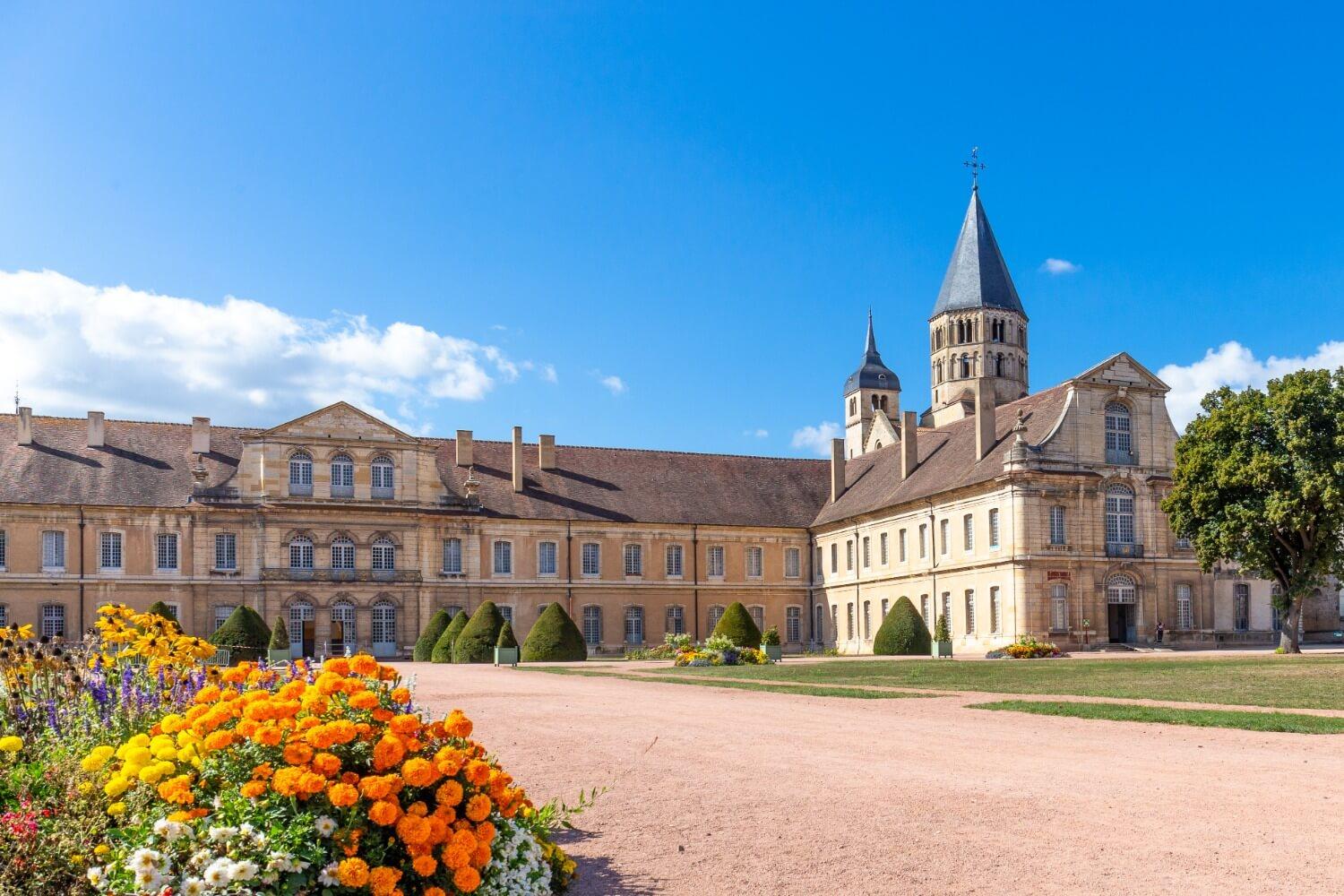
In the spring of 1109, Hugh, worn out with years and labours and feeling his end approaching, asked for the Last Sacraments, summoned around him his spiritual children and, having given each the kiss of peace, dismissed them with the greeting: Benedicite. Then, asking to be conveyed to the Chapel of our Blessed Lady, he laid himself in sackcloth and ashes before her Altar and thus breathed forth his soul to his Creator on the evening of Easter Monday (28 April).
His tomb in the Abbey Church was soon the scene of miracles,and to it Pope Gelasius I made a pilgrimage in 1119, dying at Cluny on 20 January. Elected at the Monastery on 2 February, Callistus II began immediately the process of Canonisation, and, on 6 January, 1120, declared Hugh a saint, appointing 29 April his feast-day.
In honour of St.Hugh ,the Abbot of Cluny was ,henceforth, accorded the title and dignity of a cardinal. At the instance of Honorius III the translation of the Saint’s remains took place on 23 May 1220 but, during the uprising of the Huguenots (1575), the remains and the costly Shrine disappeared with the exception of a few relics.
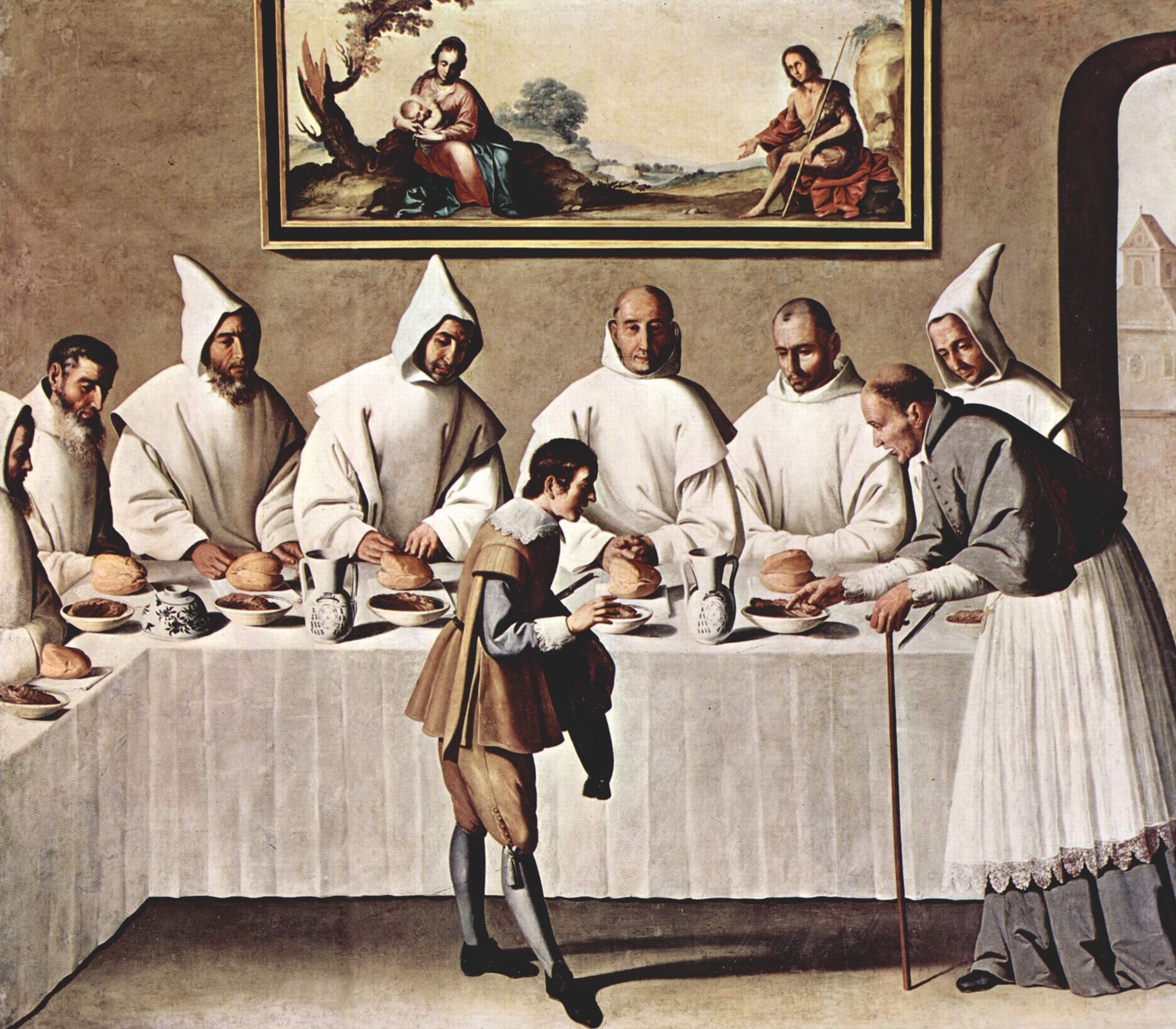
Thursday of the Fourth Week of Easter +2021
Notre-Dame de Amiens / Our Lady of Faith, Amiens, France – 29 April:
Sadly no information available
St Catherine of Siena (1347-1380) Doctor of the Church, Dominican Tertiary, Virgin, Stigmatist, Mystic (Memorial)
St Catherine here:
https://anastpaul.wordpress.com/2018/04/29/saint-of-the-day-29-april-st-catherine-of-siena-1347-1380-doctor-of-the-church/
Abbots of Cluny: A feast that recognises the great and saintly early abbots of Cluny Abbey:
• Saint Aymardus of Cluny
• Saint Berno of Cluny
• Saint Hugh of Cluny
• Saint Mayeul
• Saint Odilo of Cluny
• Saint Odo of Cluny
• Saint Peter the Venerable
—
St Antonius Kim Song-u
St Ava of Denain
St Daniel of Gerona
St Dichu
St Endellion of Tregony
St Fiachan of Lismore
St Hugh of Cluny (1024-1109) St Hugh the Great, Priest, Abbot
St Gundebert of Gumber
Blessed Mary Magdalene of the Incarnation/Caterina Soderini FSPA (1770-1824) Religious Sister and Founder of the Sisters of Perpetual Adoration, Mystic
Her Life:
https://anastpaul.com/2020/04/29/saint-of-the-day-29-april-blessed-mary-magdalene-of-the-incarnation-fspa-1770-1824/
St Paulinus of Brescia
St Peter of Verona OP (1205–1252) – St Peter Martyr, Dominican Priest
His Life:
https://anastpaul.com/2019/04/29/saint-of-the-day-29-april-st-peter-of-verona-op-1205-1252/
Bl Robert Gruthuysen
St Senan of Wales
St Severus of Naples
St Theoger
St Torpes of Pisa
St Tychicus
St Wilfrid the Younger
—
Martyrs of Cirta: A group of clergy and laity martyred together in Cirta, Numidia (in modern Tunisia) in the persecutions of Valerian. They were – Agapius, Antonia, Emilian, Secundinus and Tertula, along with a woman and her twin children whose names have not come down to us.
Martyrs of Corfu: A gang of thieves who converted while in prison, brought to the faith by Saint Jason and Saint Sosipater who were had been imprisoned for evangelizing. When the gang announced their new faith, they were martyred together. They were – Euphrasius, Faustianus, Insischolus, Januarius, Mammius, Marsalius and Saturninus. They were boiled in oil and pitch in the 2nd century on the Island of Corcyra (modern Corfu, Greece.
Also known as:
• Martyrs of Corcyra
• Seven Holy Thieves
• Seven Holy Robbers
• Seven Robber Saints
Thought for the Day – 28 April – Meditations with Antonio Cardinal Bacci (1881-1971)
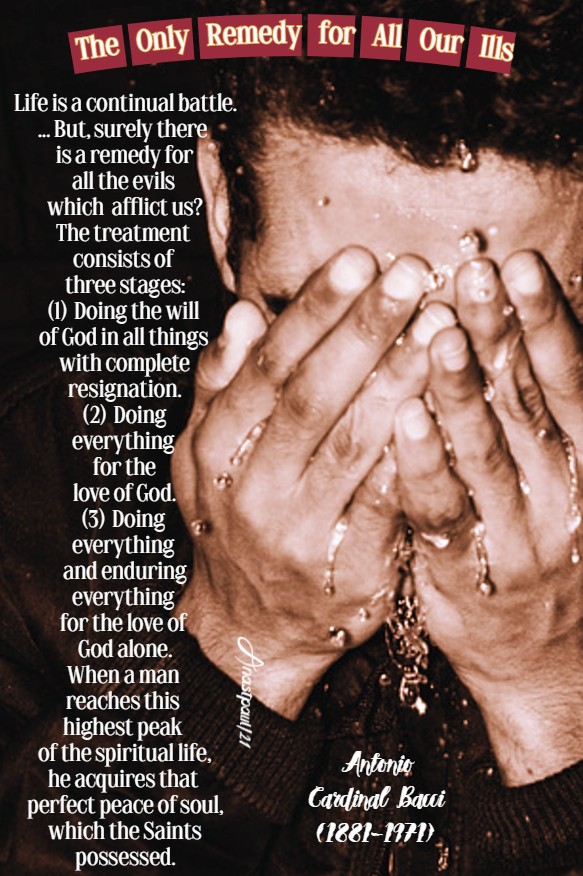
“Life is a continual battle.
“Is not man’s life on earth a drudgery?” (Job 7:1).
If we consider, only the material aspect of this battle, we are all among the vanquished.
Admittedly, there is some joy and some victory.
But, our pleasures are as short-lived as the flowers of the field, they are soon “withered and dried up like grass” (Cf Ps 101:5).
Our conquests are also very insignificant; they can inflate us for a while but they do not last long and cannot satisfy us.
After death, only our triumphs in virtue will persist.
Moreover, whereas the joys of this life are few and fleeting, the physical and moral sufferings, are innumerable.
Sometimes, they are so heavy and overwhelming, that they cause us to despair.
But, surely there is a remedy for all the evils which afflict us?
God is infinitely good and He has permitted suffering.
Will He not give us the means of enduring it and the medicine to cure it?
In fact, Our Lord, has given us a remedy for all our ills, even for the most distressing.
It is a bitter medicine but, it will heal anyone who has the courage to swallow it and, it will give him perfect peace of soul.
The treatment consists of three stages:
(1) Doing the will of God in all things with complete resignation.
(2) Doing everything for the love of God.
(3) Doing everything and enduring everything for the love of God alone.
When a man reaches this highest peak of the spiritual life, he acquires that perfect peace of soul, which the Saints possessed.”
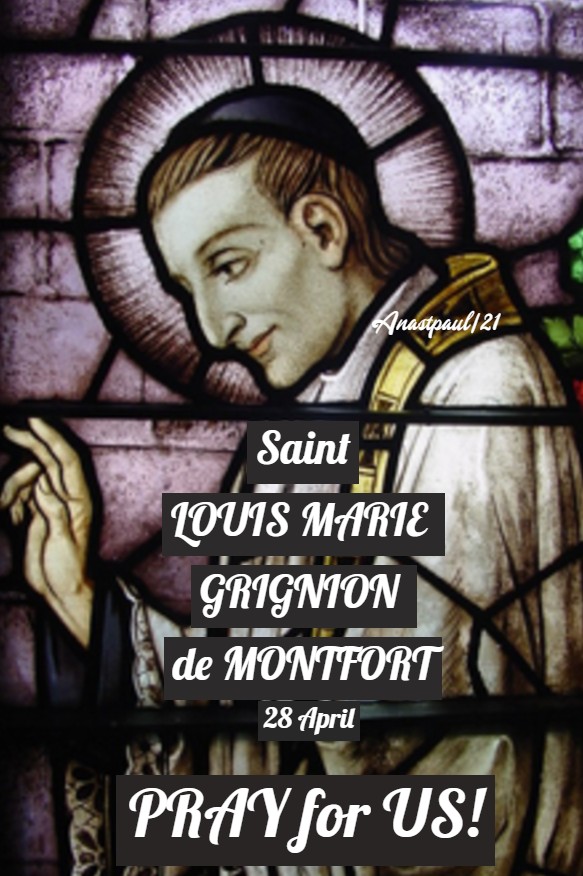
Quote/s of the Day – 28 April – The Memorial of Quote/s of the Day – 28 April – The Memorial of St Louis Marie Grignion de Montfort (1673-1716)
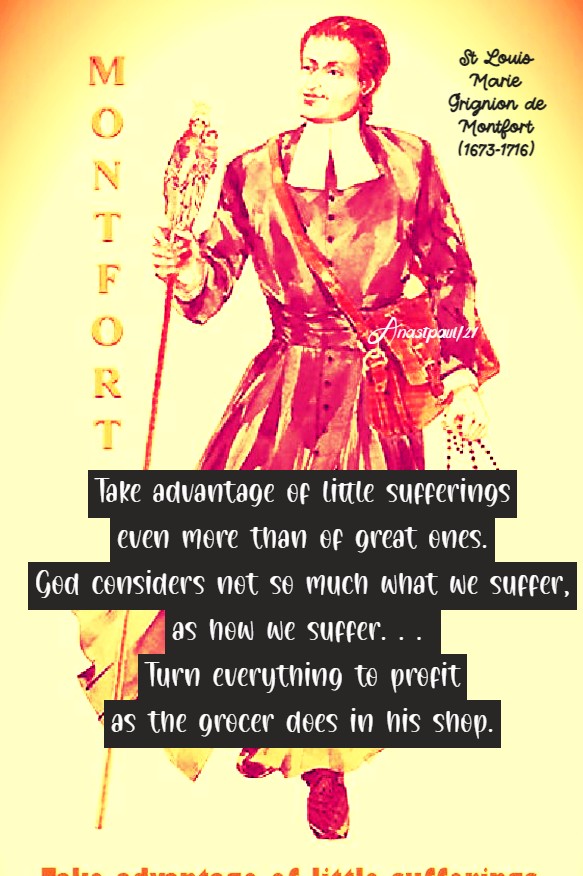
“Take advantage of little sufferings
even more than of great ones.
God considers not so much what we suffer,
as how we suffer. . .
Turn everything to profit
as the grocer does in his shop.”
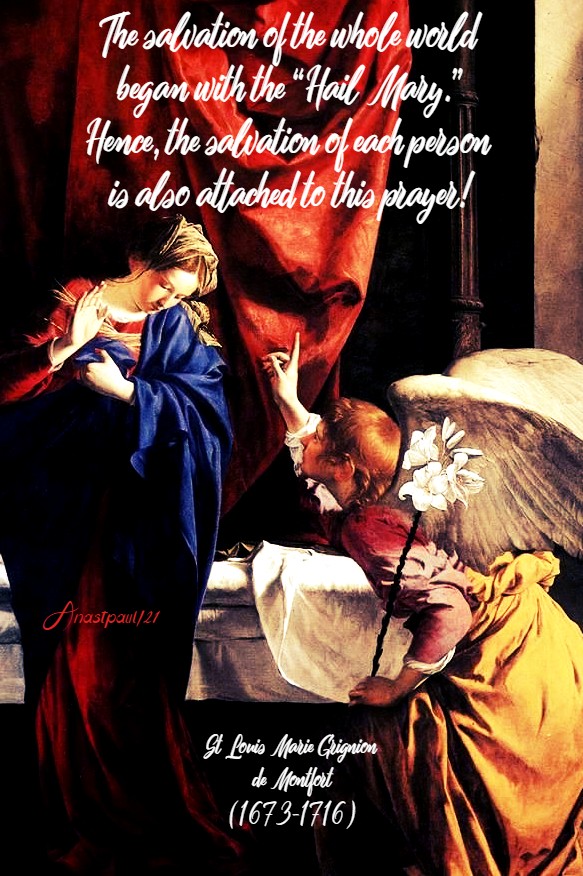
“The salvation of the whole world
began with the “Hail Mary.”
Hence, the salvation of each person
is also attached to this prayer.”
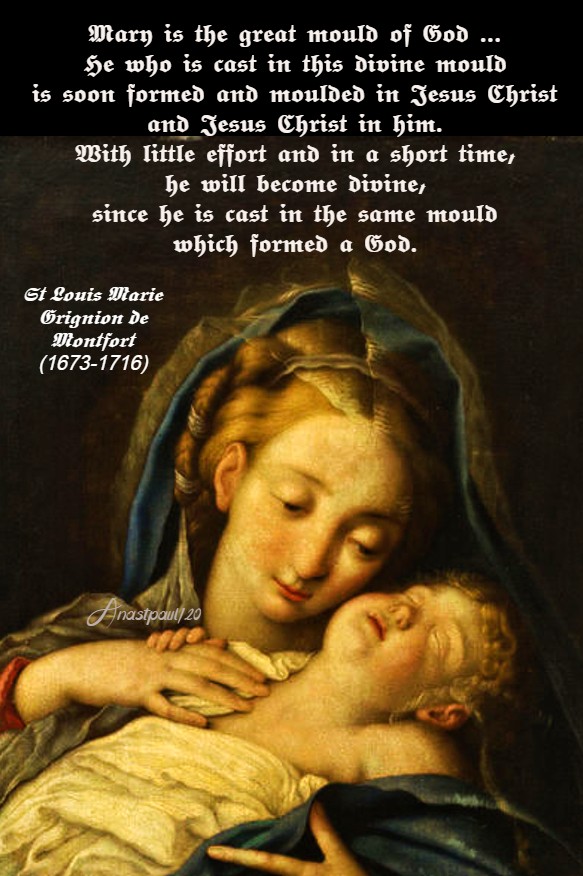
“Mary is the great mould of God …
He who is cast in this divine mould
is soon formed and moulded in Jesus Christ
and Jesus Christ in him.
With little effort and in a short time,
he will become divine,
since he is cast in the same mould
which formed a God.”
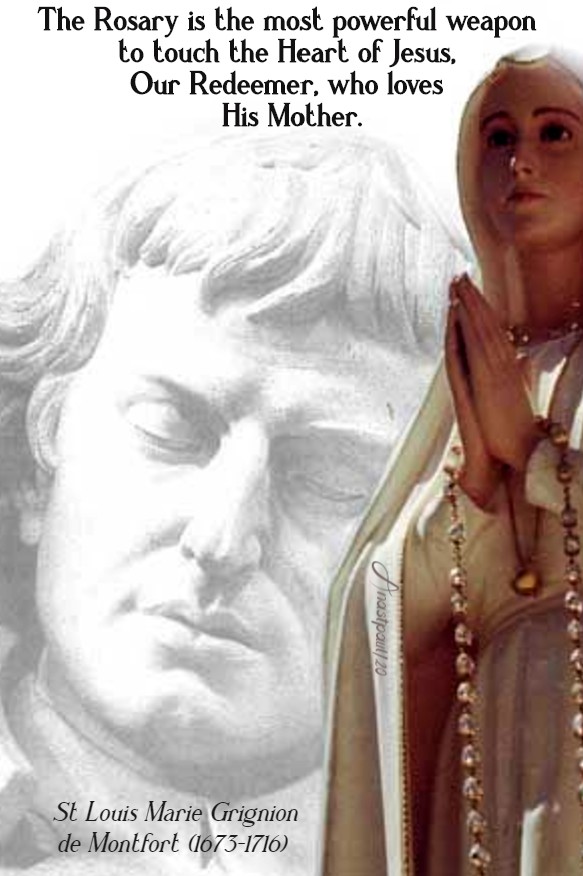
“The Rosary is the most powerful weapon
to touch the Heart of Jesus, Our Redeemer,
who loves His Mother.”
MORE HERE:
https://anastpaul.com/2020/04/28/quote-s-of-the-day-28-may-god-alone
One Minute Reflection – 28 April – Wednesday of the Fourth week of Easter, Readings: Acts 12:24–13:5, Psalm 67:2-3, 5-6, 8, John 12:44-50 and the Memorial of St Louis Marie Grignion de Montfort (1673-1716)
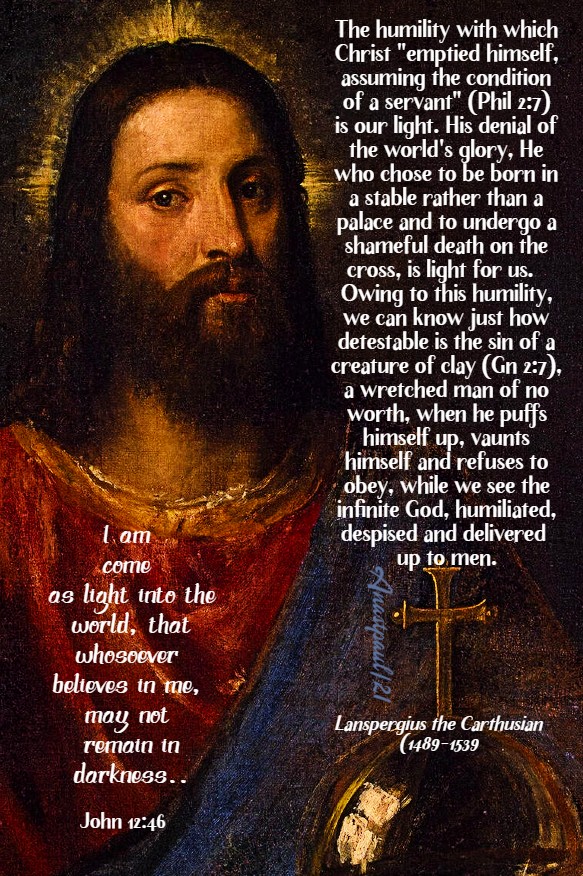
“I am come as light into the world, that whosoever believes in me, may not remain in darkness..” – John 12:46
REFLECTION – “The humility with which Christ “emptied himself, assuming the condition of a servant” (Phil 2:7) is our light. His denial of the world’s glory, He who chose to be born in a stable rather than a palace and to undergo a shameful death on the cross, is light for us. Owing to this humility, we can know just how detestable is the sin of a creature of clay (Gn 2:7), a wretched man of no worth, when he puffs himself up, vaunts himself and refuses to obey, while we see the infinite God, humiliated, despised and delivered up to men.
A light for us, too, is the meekness with which He bore hunger, thirst and cold, insults, blows and wounding, when “like a lamb led to the slaughter and like a sheep before its shearers, he did not open his mouth” (Is 53:7). Indeed, in view of this meekness, we see how pointless anger is, as also threats. Then we consent to suffer and do not serve Christ out of habit. Thanks to this, we learn to pay heed to all that is asked of us, weeping for our sins in submission and silence and patiently bearing the sufferings that come our way. For Christ bore His torments with such great meekness and patience, not for sins He had not committed but for those of others.
From now on, dearest brethren, ponder over all the virtues Christ taught us by the example of His life, that He recommends to us through His preaching and. gives us the strength to imitate, by the aid of His grace.” – Lanspergius the Carthusian (1489-1539) Monk, theologian – Sermon 5
PRAYER – Lord God, life of those who believe in You, glory of the humble and happiness of the Saints, listen kindly to our prayer. We long for what You promises, fill us from Your abundance, give us true faith and obedience. May the Blessed Virgin, Mother of Your Son, be our constant recourse. and may her cliet and Yours, St Louis Marie de Montfort, pray for us all. Through Our Lord, Jesus with the Holy Spirit, God forever, amen.
Acts 12: 24 — 13: 5a
24 But the word of the Lord increased and multiplied.
25 And Barnabas and Saul returned from Jerusalem, having fulfilled their ministry, taking with them John, who was surnamed Mark.
13:1 Now there were in the church which was at Antioch, prophets and doctors, among whom was Barnabas and Simon who was called Niger and Lucius of Cyrene and Manahen, who was the foster brother of Herod the tetrarch, and Saul.
2 And as they were ministering to the Lord and fasting, the Holy Ghost said to them: Separate me Saul and Barnabas, for the work whereunto I have taken them.
3 Then they, fasting and praying and imposing their hands upon them, sent them away.
4 So they being sent by the Holy Ghost, went to Seleucia and from thence they sailed to Cyprus.
5 And when they were come to Salamina, they preached the word of God in the synagogues of the Jews.
Gospel: John 12: 44-50
44 But Jesus cried and said: He that believes in me, does not believe in me but in him that sent me.
45 And he that sees me, sees him that sent me.
46 I am come as light into the worl, that whosoever believes in me, may not remain in darkness.
47 And if any man hears my words and keeps them not, I do not judge him: for I came not to judge the world but to save the world.
48 He that despises me and receives not my words, has one that judges him; the word that I have spoken, the same shall judge him in the last day.
49 For I have not spoken of myself but of the Father who sent me, he gave me commandments what I should say and what I should speak.
50 And I know that his commandment is life everlasting. The things, therefore, that I speak, even as the Father said unto me, so do I speak.
Our Morning Offering – 28 April – Wednesday of the Fourth Week of Easte and the Memorial of St Louis Marie Grignion de Montfort (1673-1716)
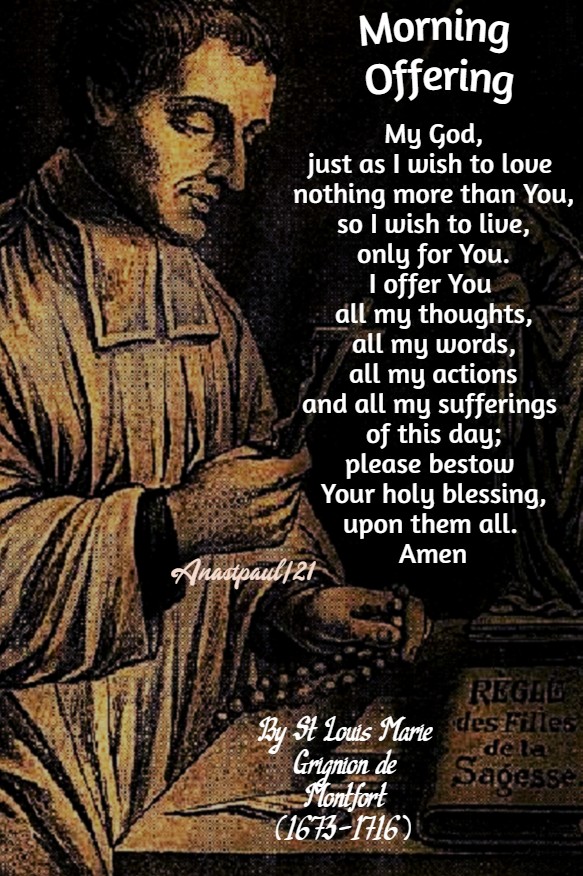
Morning Offering
By St Louis Marie Grignion de Montfort (1673-1716)
My God,
just as I wish to love
nothing more than You,
so I wish to live,
only for You.
I offer You
all my thoughts,
all my words,
all my actions
and all my sufferings of this day;
please bestow
Your holy blessing,
upon them all.
Amen
Saint of the Day – 28 April – Saint Vitalis of Ravenna (Died c 171) – Martyr, Husband and Father , Confessor. Died in c 171 in Ravenna by being buried alive. Patronage – Ravenna, Italy and Thibodeaux, Louisiana. Also known as St Vitalis of Milan,
The Roman Martyrology states of him today: “At Ravenna, the birthday of St Vitalis, Martyr, father of the Saint Gervasius and Protasius. When he had taken up and reverently buried the body of blessed Ursicinus, he was arrested by the ex-consul Paulinus and after being racked and thrown nto a deep pit, was overwhelmed with earth and stones and by this kind of martyrdom, went to Christ.”
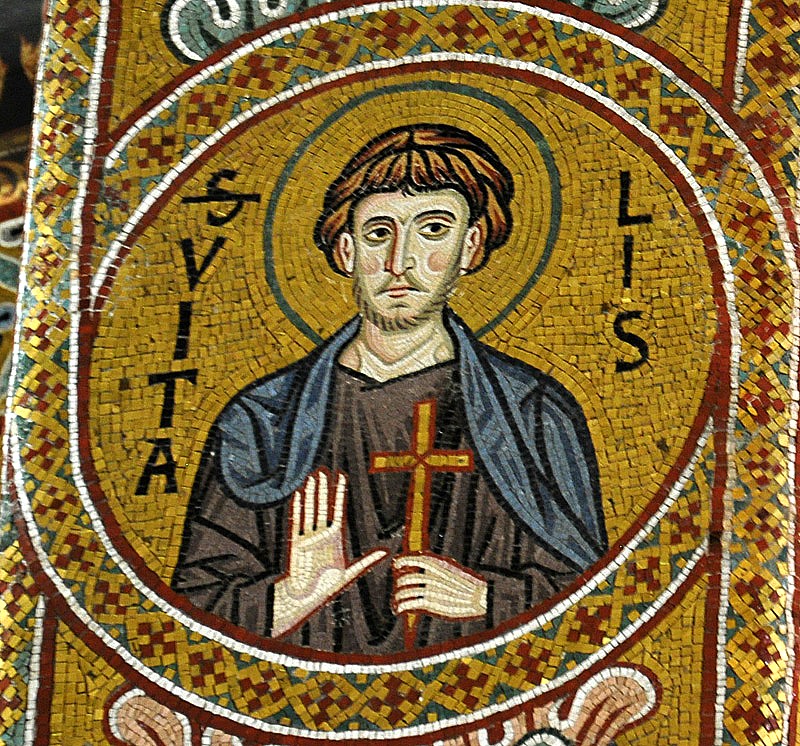
Saint Vitalis was a first century Christian citizen of Milan, a consular knight (miles consularis) in the time of Nero who got into trouble when he publicly exhorted a Christian to stand firm under torture. He was the father of the twin brothers and future Martyrs, Saints Gervasius and Protasius. He is the principal Patron of Ravenna, where he was martyred.
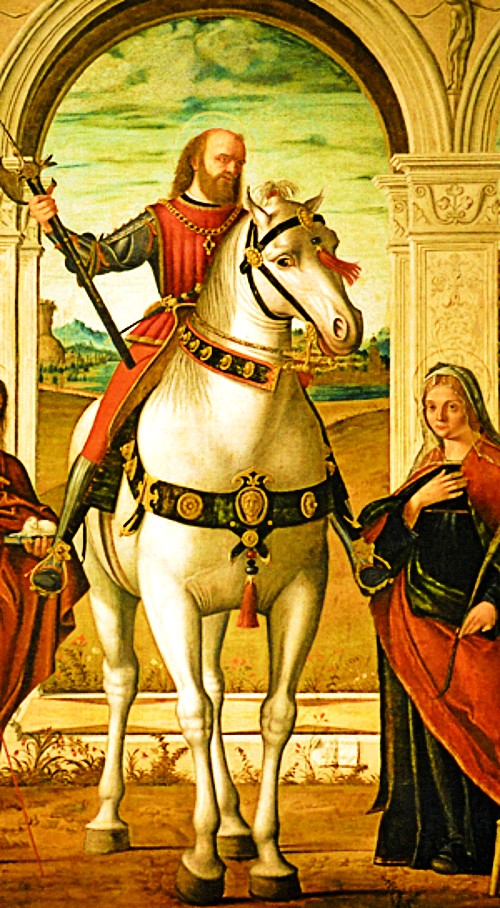
Divine providence had conducted him to that city, where he saw come before the tribunal there, a Christian Physician named Ursicinus, who had been tortured and who then was condemned to lose his head for his faith. Suddenly the captive grew terrified at the thought of death and seemed ready to yield. Vitalis was extremely moved by this spectacle. He knew his double obligation to prefer the glory of God and the eternal salvation of his neighbour to his own corporal life; he, therefore, boldly and successfully encouraged Ursicinus to triumph over death, saying, “Ursicinus, you who cured others would want to drive into your soul the dagger of eternal death? Do not lose the crown the Lord has prepared for you!” Ursicinus was touched and deeply strengthened – he knelt down in prayer and then asked the executioner to strike him. After his martyrdom, Saint Vitalis carried away his body and respectfully interred it.
Saint Vitalis now resigned his post as judiciary and consular assistant to Paulinus, who had been absent on the occasion of the sentence of Ursicinus. Paulinus had his former assistant apprehended,and after having him tortured, commanded that if he refused to sacrifice to the gods, he be buried alive, which sentence was carried out.
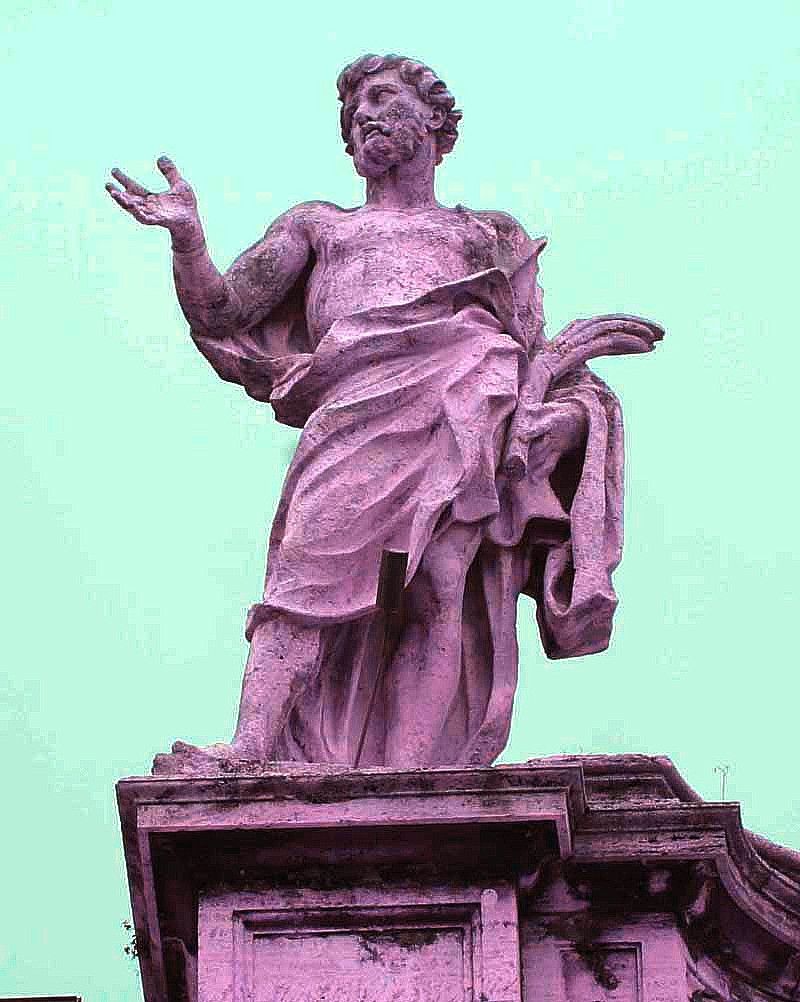
Afterwards, his wife, Valeria, as she was on her way from Ravenna to Milan, was beaten by peasants because she refused to join them in an idolatrous festival and riot. She died two days later in Milan and is also honoured as a Martyr . Their twin sons, Saint. Gervasius and Protasius, sold their heritage and for ten years before their own martyrdom, lived a penitential life of prayer.
We are not all called to the sacrifice of martyrdom; but we are all bound to make our lives a continuing sacrifice of ourselves to God,and to perform every action ,in this spirit of sacrifice. Thus we shall both live and die to God, perfectly resigned to His holy will in all He ordains or permits.
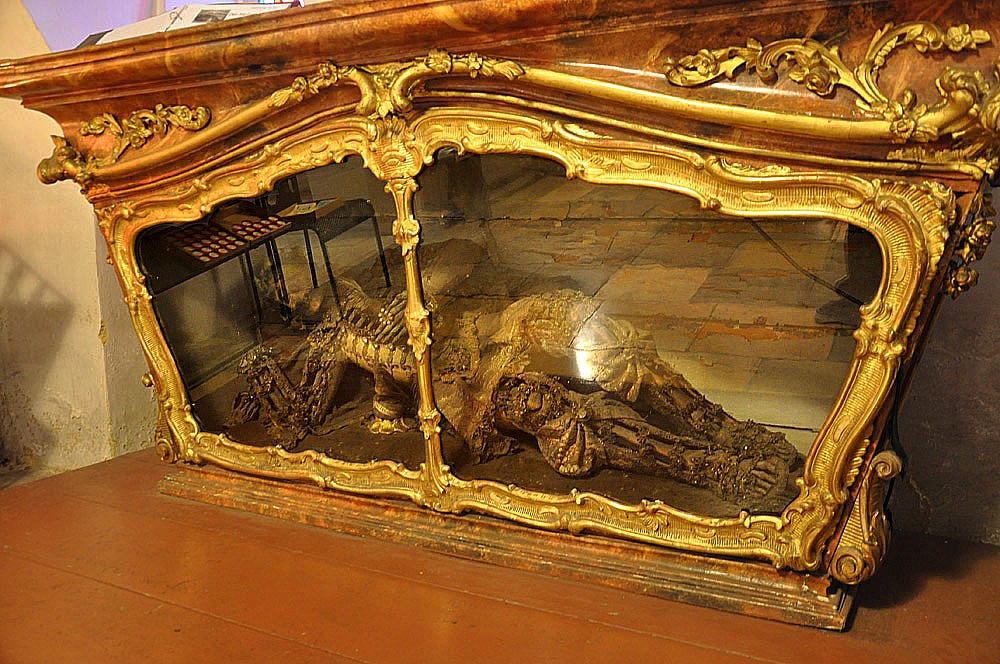
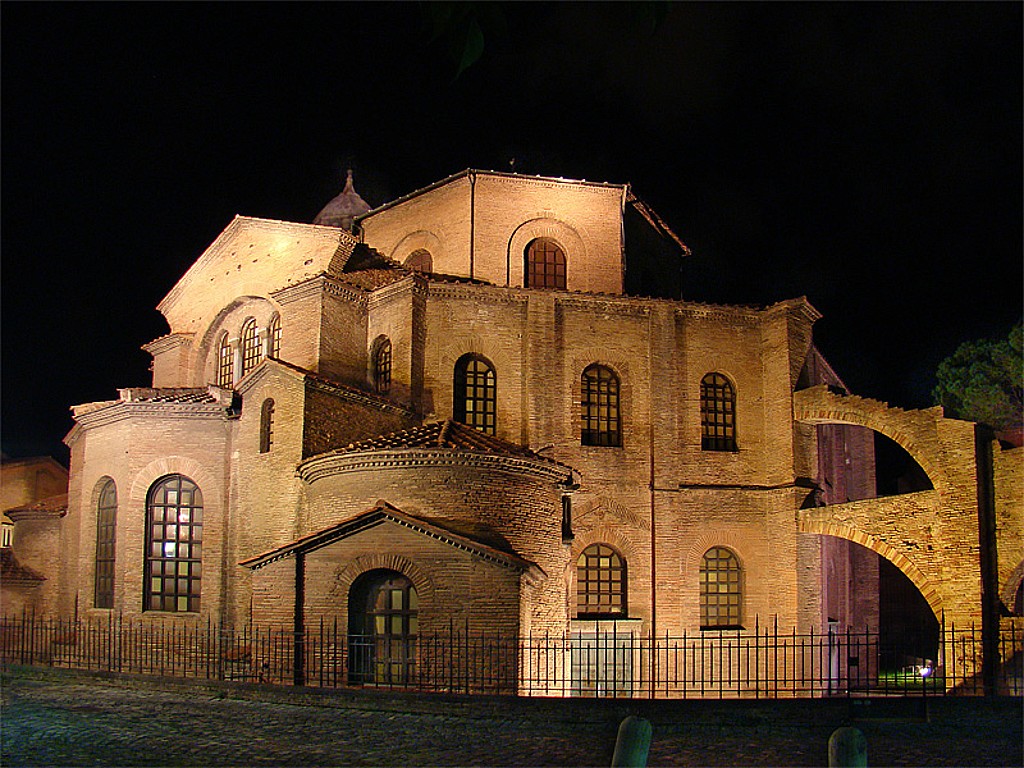
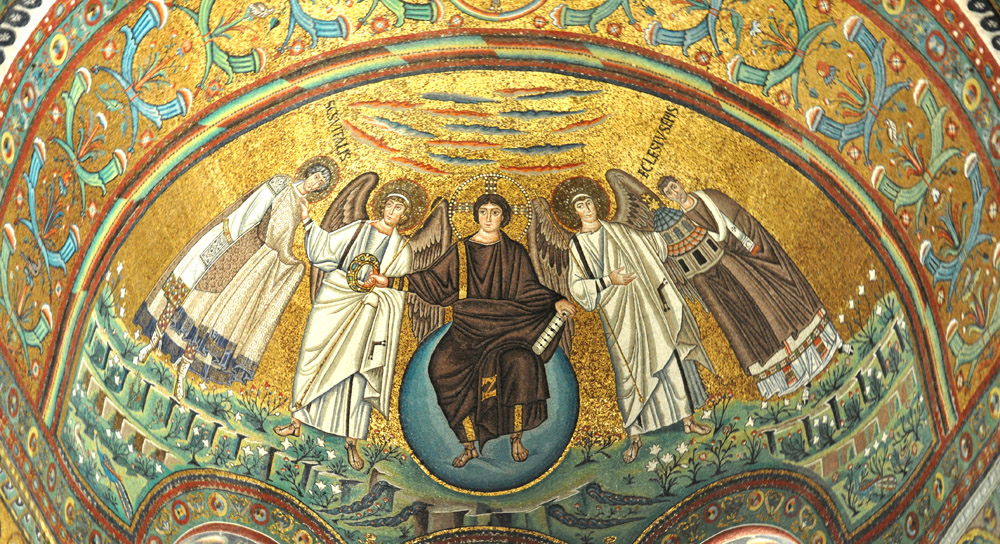
The 6th century Basilica of San Vitalis is dedicated to St Vitalis. The mosaic of him, first image above, is one of the many famous mosaics in this most important surviving example of early Christian Byzantine art and Architecture. It is one of eight structures in Ravenna inscribed on the UNESCO World Heritage List. Its foundational inscription describes the Church as a Basilica, though its centrally-planned design is not typical of the Basilica form. The Vatican has designated the building a “basilica,”,an honorific title bestowed on exceptional Church buildings of historic and ecclesial importance.

Wednesday of the Fourth Week of Easter +2021
Nuestra Señora del / Our Lady of Quito, Ecuador (1534) – 28 April:
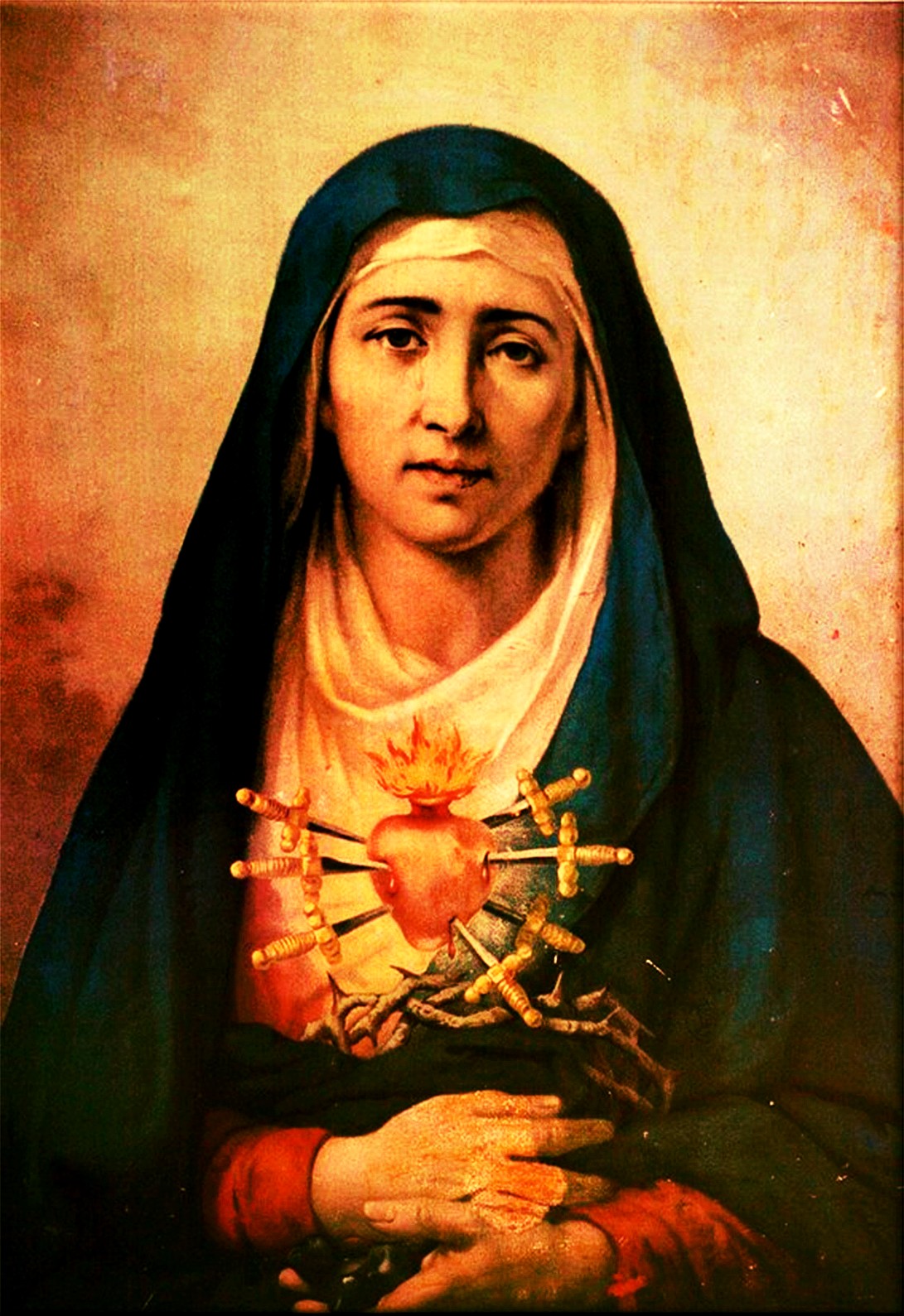
This miraculous image of Our Lady of Quito currently in the Capital City of Ecuador ,is said to date from the first Spanish settlement there in the year 1534. At the very least, it has certainly been venerated there for a long time and is popularly called ,by the people of Quito, Our Lady of the Earthquake. The painting represents the Sorrowful Mother and in the early years of the twentieth century, devotion to Mary under the title of Our Lady of Quito was introduced into England ,by the Servite Friars in London. Saint Pius X accorded them an indulgence for those who should pray before her picture, and the devotion was greatly promoted in England by the Sisters of the Holy Child Jesus, Mother Cornelia Connelly’s congregation. The original image at Quito was solemnly crowned in 1918.
On 20 April 1906, thirty-six boys attending the boarding school of the Jesuit Fathers at Quito, Ecuador, together with Father Andrew Roesch, witnessed a miracle of this famous picture of Our Lady. While in the refectory they all saw the Blessed Mother slowly open and shut her eyes. The same miracle occurred no less than seven times after that, in favour of the boys at the school but this time, in the Chapel to which the picture had been taken.
Ecclesiastical authorities soon investigated these incidents and finally concluded by ordering the picture to be transferred, in procession from the college to the Church of the Jesuit Fathers. Once at the Church, the miracle was repeated several times before large crowds and many, many conversions took place because of these miracles. At one time, the wonder continued for three consecutive days. At Riobamba, before a faithful reproduction of Our Lady of Quito, the same wonder was seen by more than 20 persons, including the president of the City. In Quito this picture is known as the Dolorosa del Colegio.
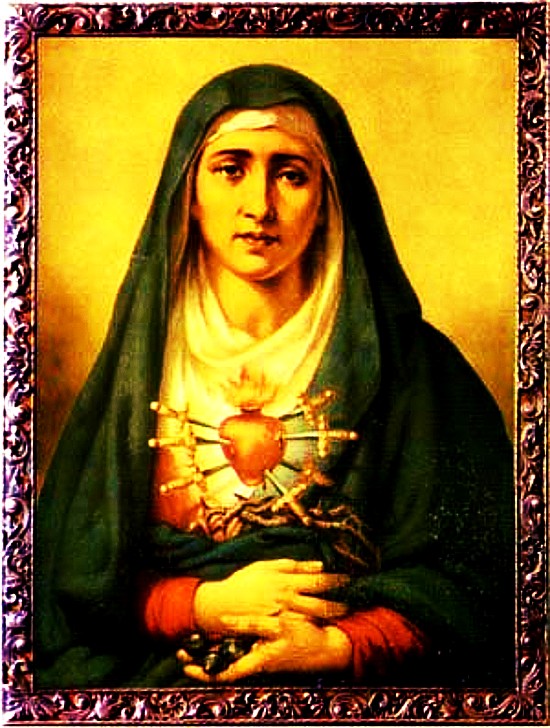
A Conceptionist Sister, named Mother Mariana de Jesús Torres received Marian apparitions under this title from 2 February 1594 to 2 February 1634. In 1611, the local Bishop gave his approval to the apparitions.
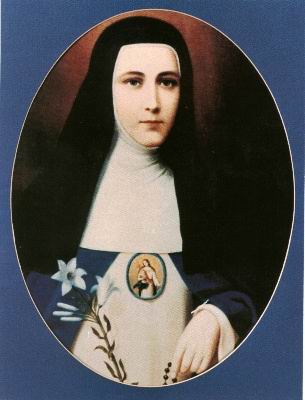
Our Lady appeared to Mother Mariana and predicted many things about our own times. This following, is part of what she told her. We can see for ourselves how it relates directly to our own time.
“…. I make it known to you, that from the end of the 19th century and shortly after the middle of the 20th century…. the passions will erupt and there will be a total corruption of customs (morals)….
“They will focus principally on the children, in order to sustain this general corruption. Woe to the children of these times! It will be difficult to receive the Sacrament of Baptism and also, that of Confirmation…
“As for the Sacrament of Matrimony… it will be attacked and deeply profaned… The Catholic spirit will rapidly decay; the precious light of the Faith will gradually be extinguished… Added to this, will be the effects of secular education, which will be one reason for the dearth of priestly and religious vocations.
“The Sacrament of Holy Orders will be ridiculed, oppressed and despised… The Devil will try to persecute the ministers of the Lord in every possible way; he will labour with cruel and subtle astuteness, to deviate them from the spirit of their vocation and will corrupt many of them. These depraved priests, who will scandalise the Christian people, will make the hatred of bad Catholics and the enemies of the Roman Catholic and Apostolic Church ,fall upon all priests…
“Further, in these unhappy times, there will be unbridled luxury, which will ensnare the rest ,into sin and conquer innumerable frivolous souls, who will be lost. Innocence will almost no longer be found in children, nor modesty in women. In this supreme moment of need of the Church, the one who should speak will fall silent.” In a subsequent apparition, Our Lady told Mother Mariana that these apparitions were not to become generally known until the twentieth century.
On 8 December 1634, the apparition predicted that Papal Infallibility “will be declared a Dogma of the Faith by the same Pope chosen to proclaim the Dogma of the Mystery of My Immaculate Conception.” In 1854, Blessed Pope Pius IX defined the Dogma of the Immaculate Conception and in 1870, he declared the Dogma of Papal Infallibility as defined by the First Vatican Council.
Mother Mariana died on 16 January 1635, shortly after the last apparition. When her tomb was reopened in 1906, her body was found to be perfectly incorrupt, after nearly 300 years in an ordinary, unprotected, wooden coffin. The Archdiocese of Quito opened her cause for Canonisation in 1986 and finished the Diocesan stage of the process ,in 1997.
St Louis Marie Grignion de Montfort (1673-1716) (Optional Memorial)
The Wondrous St Louis!:
https://anastpaul.wordpress.com/2018/04/28/saint-of-the-day-28-april-st-louis-marie-grignion-de-montfort-1673-1716/
St Peter Chanel SM (1803-1841) Priest of the Society of Mary (Marists), Missionary, Martyred aged 37 Protomartyr of Oceania (Optional Memorial)
Biography:
https://anastpaul.wordpress.com/2017/04/28/saint-of-the-day-28-april-st-peter-chanel/
St Adalbero of Augsburg
St Agapio of Cirtha
St Artemius of Sens
Blessed Itala Mela ObSB (1904–1957)
Her life:
https://anastpaul.com/2019/04/28/saint-of-the-day-28-april-blessed-itala-mela-obsb-1904-1957/
St Benedict of the Bridge
St Cronan of Roscrea
St Cyril of Turov
Bl Gerard of Bourgogne
St Gianna Beretta Molla (1922-1962)
Bl Hanna Helena Chrzanowska OSB (1902-1973)
Bl Józef Cebula
Bl Luchesius
Blessed María Felicia of Jesus in the Blessed Sacrament / Guggiari Echeverría OCD (1925-1959)
Her Life:
https://anastpaul.com/2020/04/28/saint-of-the-day-28-april-blessed-maria-felicia-of-jesus-in-the-blessed-sacrament-ocd-1925-1959-the-lily-of-paraguay/
St Mark of Galilee
St Pamphilus of Sulmona
St Prudentius of Tarazona
St Vitalis of Ravenna (Died c 171) Martyr, Layman
—
Martyrs of Alexandia:
Didymus
Theodora
Martyrs of Durostorum:
Dada
Maximus
Quintilian
Martyrs of Languedoc:
Agapius
Aphrodisius
Caralippus
Eusebius
Martyrs of Laon:
Germaine
Probe
Martyrs of Larino:
Alexander
Firmianus
Primianus
Tellurius
Martyrs of Nicomedia:
Caralampo
Eusebius
Martyrs of Prusa:
Acacius
Menander
Patritius
Polyenus
Martyrs of Ravenna:
St Ursicinus
St Valeria
St Vitalis (see above)
Martyrs of Vietnam:
Gioan Baotixta Ðinh Van Thành
Phaolô Pham Khac Khoan
Phêrô Nguyen Van Hien
Pilgrims of Gallinaro:
Arduin
Bernhard
Gerard
Hugh
Thought for the Day – 27 April – Meditations with Antonio Cardinal Bacci (1881-1971)
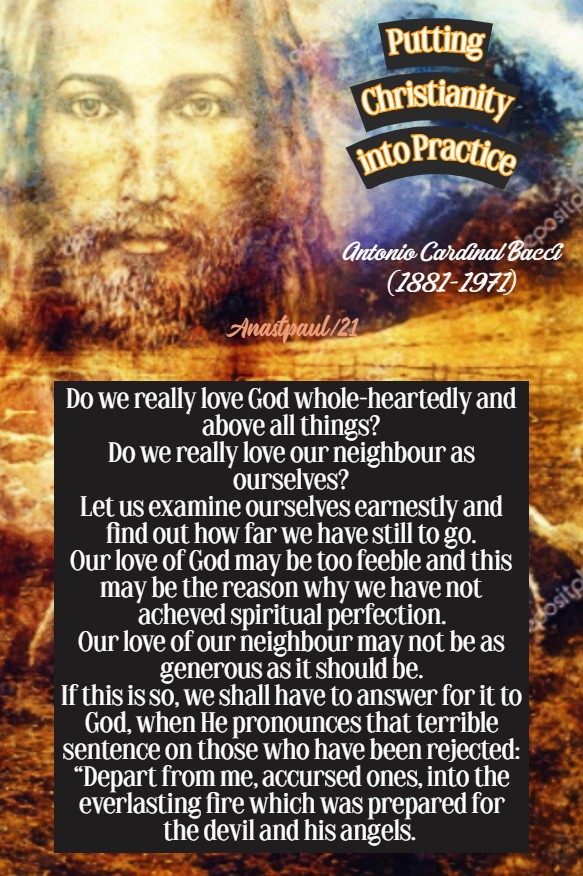
“Only the uiversal practice of Christianity, could change the world.
Even after a period of twenty centuries, it is true to say, that for many Christans, the Gospel is an unexplained book, the principles of which, have yet to be fully realised in their ordinary lives.
None of us can change the world on his own but, each of us can accomplish that part of the task, which depends on himself.
Do we really love God whole-heartedly and above all things?
Do we really love our neighbour as ourselves?
Let us examine ourselves earnestly and find out how far we have still to go.
Our love of God may be too feeble and this may be the reason why we have not acheved spiritual perfection.
Our love of our neighbour may not be as generous as it should be.
If this is so, we shall have to answer for it to God ,when He pronounces that terrible sentence on those who have been rejected: “Depart from me, accursed ones, into the everlasting fire which was prepared for the devil and his angels. For I was hungry and you did not give me to eat, I was thirsty and you gave me no drink, I was a stranger and you did not take me in, naked and you did not clothe me, sick and in prison and you did not visit me” (Mt 26:41-43).
Let us resolve to be charitable and generous to all!”
PART ONE HERE:
https://anastpaul.com/2020/04/18/thought-for-the-day-18-april-putting-christianity-into-practice/
Quote/s of the Day – 27 April – Tuesday of the Fourth Week of Easter, Readings: Acts 11:19-26, Psalm 87:1-7, John 10:22-30
“My sheep hear my voice
and I know them and they follow me.”

“If anyone serves me,
he must follow me
and where I am,
there will my servant be also.
If anyone serves me,
the Father will honour him.”
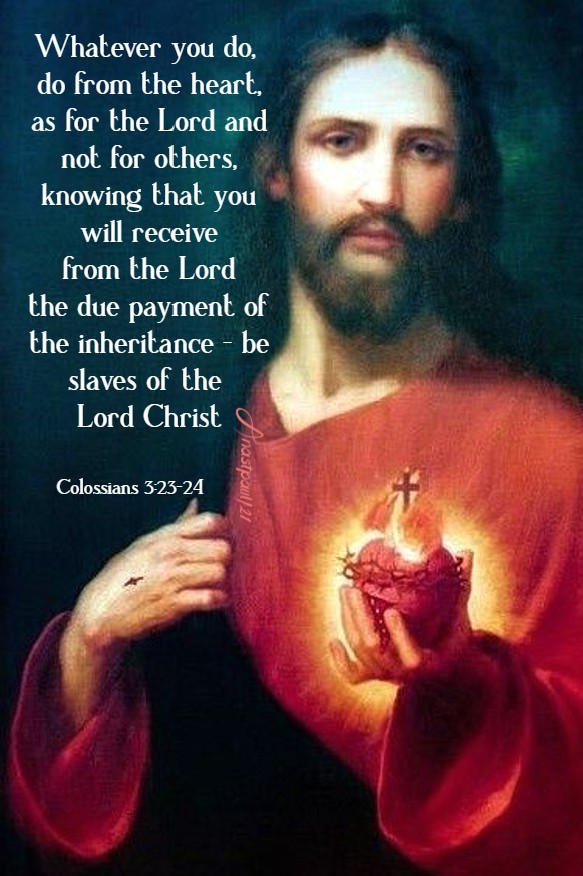
“Whatever you do, do from the heart,
as for the Lord and not for others,
knowing that you will receive
from the Lord
the due payment of the inheritance;
be slaves of the Lord Christ.”
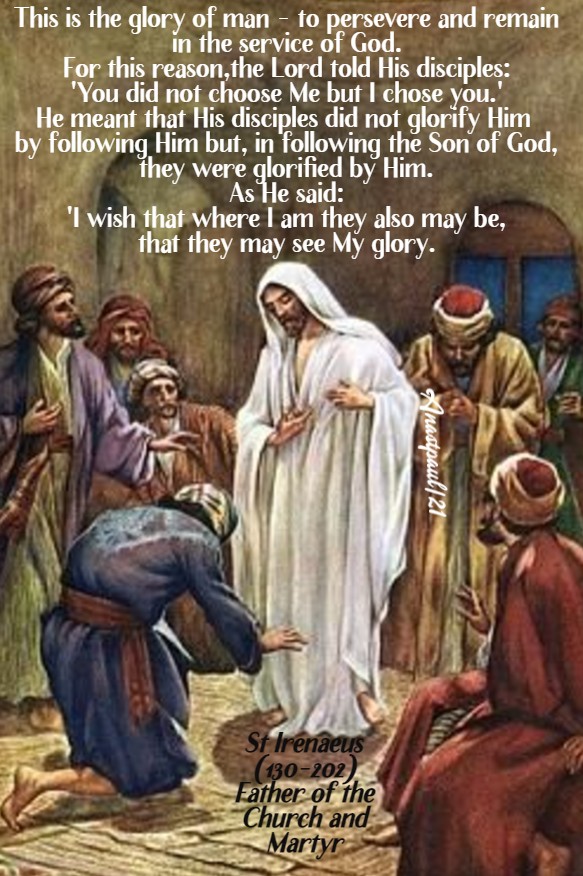
“This is the glory of man –
to persevere and remain
in the service of God.
For this reason,
the Lord told His disciples:
‘You did not choose Me but I chose you.’
He meant that His disciples
did not glorify Him by following Him
but, in following the Son of God,
they were glorified by Him.
As He said:
‘I wish that where I am
they also may be,
that they may see My glory.’”
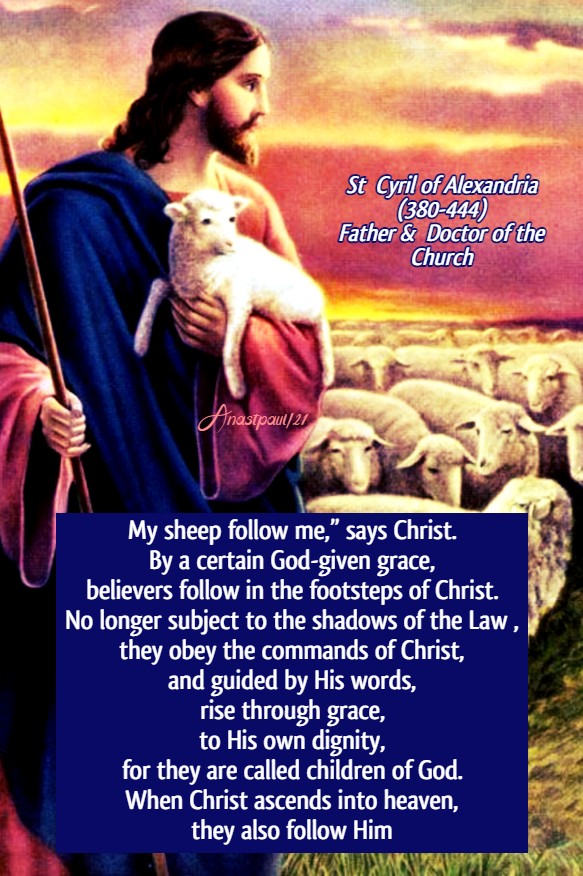
“My sheep follow me,” says Christ.
By a certain God-given grace,
believers follow in the footsteps of Christ.
No longer subject to the shadows of the Law ,
they obey the commands of Christ,
and guided by His words,
rise through grace,
to His own dignity,
for they are called children of God.
When Christ ascends into heaven,
they also follow Him.”
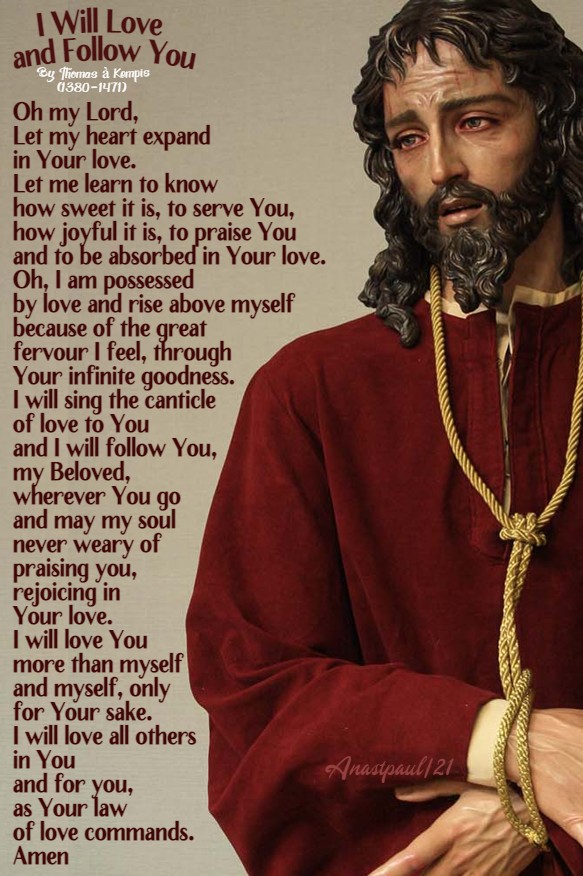
I Will Love and Follow You
By Thomas à Kempis CRSA (1380-1471)
Oh my Lord,
Let my heart expand in Your love.
Let me learn to know
how sweet it is, to serve You,
how joyful it is, to praise You
and to be absorbed in Your love.
Oh, I am possessed by love
and rise above myself
because of the great fervour I feel,
through Your infinite goodness.
I will sing the canticle of love to You
and I will follow You, my Beloved,
wherever You go
and may my soul never weary of praising you,
rejoicing in Your love.
I will love You more than myself
and myself, only for Your sake.
I will love all others in You
and for you,
as Your law of love commands.
Amen
(Book 3 Ch 5:6)
One Minute Reflection – 27 April – Tuesday of the Fourth Week of Easter, Readings: Acts 11:19-26, Psalm 87:1-7, John 10:22-30
“I and the Father are one.” – John 10:30
REFLECTION – “Sent out, issuing from the Father,
the Word came down and dwelt
wholly within the Virgin’s womb.
Wholly in the Father, wholly in that virginal breast,
He, Whom nothing can contain, was wholly in all things.
While remaining what He was, He assumed the form of a slave (Phil 2:7)
and, when He had been sent into the world,
He became a man in every way. …
How are we to state, what to all angels,
archangels and created things,
is impossible to explain?
It can be thought truly, yet not by any means expressed
and indeed our minds cannot understand it perfectly.
God and man and man-God, how can He also be
wholly Son of the Father
in so inseparable a way?
How has He become the Virgin’s Son and come into the world?
And how is it, that He has remained impossible for anything to contain? …
Now you will become silent,
for even if you wished to speak
your spirit would find no words
and your chattering tongue, is reduced to silence. …
Glory to You, Father, Son and Holy Spirit,
divinity impossible to grasp, indivisible in nature.
We worship You in the Holy Spirit, we who possess Your Spirit
because we have received Him from You.
Beholding Your glory, we do not cast about unrestrainedly
but it is in Him, in Your Spirit, that we see You,
O Father unbegotten and Your only-begotten Word
Who comes forth from You.
And we adore the Trinity, without division or confusion,
in His simple divinity, majesty and power.” – Symeon the New Theologian (c 949-1022) Monk – Hymn 21

PRAYER – Lord God, grant Your people constant joy in the renewed vigour of their souls. They rejoice because You have restored them to the glory of Your adopted children, let them look forward gladly to the certain hope of the resurrection. Draw us constantly to Your Son, Jesus, our Lord, teach us to know Him and may the prayers of our Blessed Mother , guide us amidst the storms of this mortal life. We make our prayer through our Resurrected Christ, with the Holy Spirit, one God forever, amen, alleluia!

Acts 11: 19-26
19 Now they who had been dispersed by the persecution that arose on occasion of Stephen, went about as far as Phenice and Cyprus and Antioch, speaking the word to none but to the Jews only.
20 But some of them were men of Cyprus and Cyrene, who, when they were entered into Antioch, spoke also to the Greeks, preaching the Lord Jesus.
21 And the hand of the Lord was with them and a great number believing, were converted to the Lord.
22 And the tidings came to the ears of the church, that was at Jerusalem, touching these things and they sent Barnabas as far as Antioch.
23 Who, when he was come and had seen the grace of God, rejoiced and he exhorted them all, with purpose of heart to continue in the Lord.,
24 For he was a good man, and full of the Holy Ghost and of faith.
And a great multitude was added to the Lord.
25 And Barnabas went to Tarsus to seek Saul, whom, when he had found, him, he brought to Antioch.
26 And they conversed there in the church a whole year and they taught a great multitude, so that at Antioch the disciples were first named Christians.
Gospel: John 10: 22-30
22 And it was the feast of the dedication ,at Jerusalem: and it was winter.
23 And Jesus walked in the temple, in Solomon’s porch.
24 The Jews , therefore, gathered around about him and said to him:
How long dost thou hold our souls in suspense? If thou be the Christ, tell us plainly.
25 Jesus answered them: I speak to you and you believe no,: the works that I do in the name of my Father, they give testimony of me.
26 But you do not believe because you are not of my sheep.
27 My sheep hear my voice: and I know them and they follow me.
28 And I give them life everlasting and they shall not perish forever and no man shall pluck them out of my hand.
29 That which my Father has given me, is greater than all and no-one can snatch them out of the hand of my Father.
30 I and the Father, are one.
Our Morning Offering – 27 April – Tuesday of the Fourth Week of Easter
O the Word of My Lord
Song of a Young Prophet
By Brother Damian Lundy FSC (1944-1997)
O the word of my Lord
Deep within my being,
Oh the word of my Lord,
You have filled my mind.
Before I formed you in the womb
I knew you through and through,
I chose you to be Mine.
Before you left your mother’s side
I called to you, My child, to be My sign.
Refrain
I know that you are very young,
But I will make you strong.
I’ll fill you with My word
And you will travel through the land,
Fulfilling My command
Which you have heard.
Refrain
And everywhere you are to go
My hand will follow you;
You will not be alone.
In all the danger that you fear
You’ll find Me very near,
Your words, My own.
Refrain,
This hymn, based on Jeremiah 1, was composed by English Brother and teacher Brother Damian Lundy of the De La Salle Order. It is sometimes referred to as “Song of a Young Prophet.” It is set to an unnamed tune, also by Bro Damian.
He died in 1997 at the age of 53. He is widely respected as a leading innovator in many forms of Catholic apostolate and education in the UK. He is credited with devising the currently standard form of Catholic Residential Youth Work and for writing many popular hymns and prayers and leading seminars and conferences.
In 1975, Damian founded St Cassian’s Centre, Kintbury, which is still operating today as a widely visited and respected Catholic Youth Retreat Centre.

Saint of the Day – 27 April – Blessed Osanna of Cattaro OP (1493-1565) Virgin, Mystic, Anchoress., Tertiary of the Order of St Dominic, spiritual guide. Born on 25 November 1493 at Kumano, Montenegro as Catherine Cosie and died on 27 April 1565 in Kotor, Montenegro of natural causes, aged 71. Patronage – Kotor, Montenegro. Also known as – Catherine Cosie, Catherine Kosic, Catherine of Montenegro, Hosanna of Kotor, Ossana of Cattaro, Ozana Kotorska, “Teacher of Mysticism,” “Angel of Peace,” “Virgin Reconciler”and “Trumpet of the Holy Spirit.” Her Body is incorrupt.
Over the course of her life, the people of Kotor came to call her “the trumpet of the Holy Spirit” and the “teacher of mysticism.” People from all walks of life came to her for advice and she interceded particularly ,for peace in the town and among feuding families. Therefore, she was also called “the Virgin Reconciler” and the “Angel of Peace.”
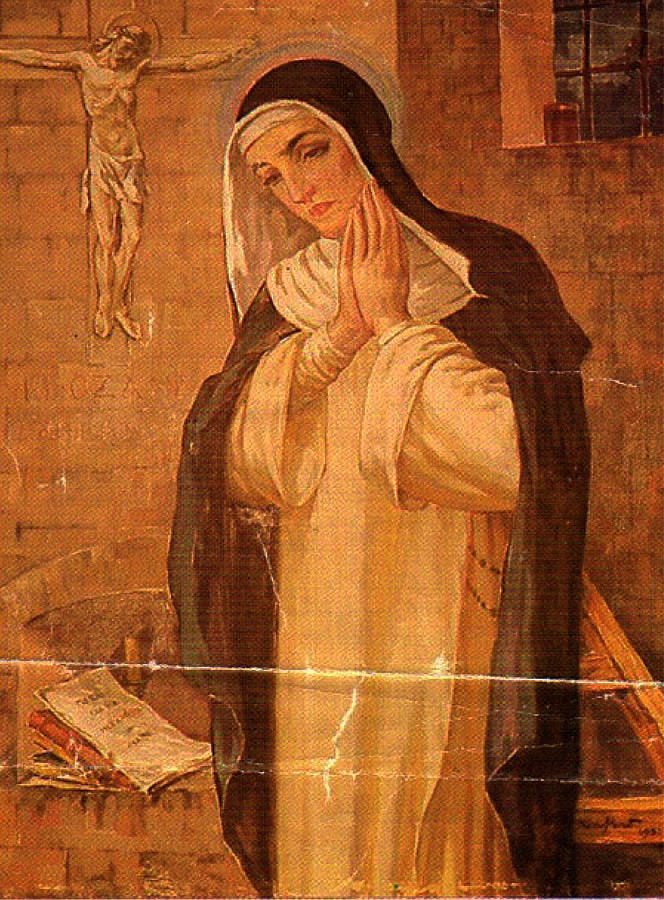
The life of this Blessed has a very special charm. Born in 1493 to very humble Orthodox parents in Kebeza, during the heart of the Greek schism, she was given the name of Catherine at her baptism.
This little shepherdess, enraptured by the beauty of the magnificent views of her Montenegro, she fell in love with the Creator of so many wonders and, with unusual ardour, sheasked Him to show Himself to her. And there, in the solitude of the mountains, Jesus appeared to her first, a tender child and then Crucified, imprinting an indelible seal on her virgin heart.
When she was a little older, she was placed in Kotor as a servant in the family of a Senator, an excellent Catholic. Here, she was able to educate herself in the true faith and to receive the Sacraments. Having known the Dominicans, at the age of twenty-two, she made a heroic decision: -to become a recluse forever, taking up the habit and the Rule of the Third Order of St Dominic.
With the Tertiary Habit, he also took the name of Osanna, in memory of another illustrious Tertiary, Blessed Osanna da Mantova OP (1449-1505) – her life here: https://anastpaul.com/2019/06/18/saint-of-the-day-18-june-blessed-osanna-andreasi-op-1449-1505/ and more here: https://anastpaul.com/2019/06/18/art-dei-18-june-paintings-in-blessed-osanna-andreasis-house/
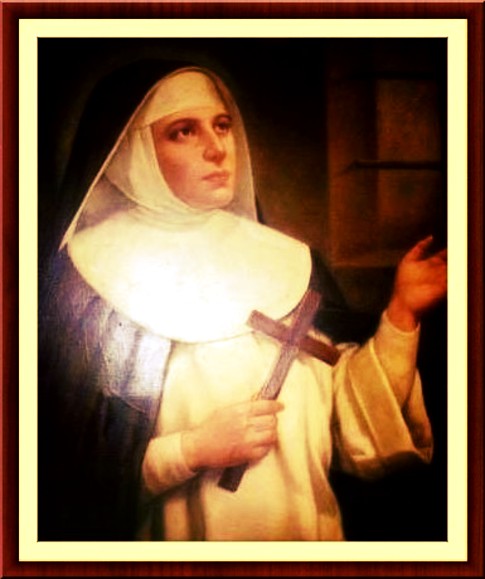
And so, walled up in a cell next to the Church of St Paolo, run by the Dominicans, she lived in the contemplation of the pains of Jesus and in the complete immolation of herself. She was also a teacher of holiness to countless souls but above all she was the guardian angel of Kotor. Although she lived alone, there was nothing selfish about Osanna’s spirituality. A group of her Dominican sisters, who considered her their leader, consulted her frequently and sought her prayers. A convent of sisters founded at Cattaro, regarded her as their foundress,because of her spiritual guidance and prayers, although she never saw the place. When the City was attacked by the Turks, the people ran to her for help and they credited their deliverance to her prayers. Another time, her prayers saved them from the plague.
She died on 27 April 1565. Her body rests in the Church of Santa Maria in Kotor.
The incorrupt body of Osanna was kept in the Church of St Paul until 1807, when the French Army converted the church into a warehouse. Her body was then brought to the Church of St Mary. The people of Kotor venerated her as a saint. In 1905, the process for her Beatification began in Kotor and was successfully completed in Rome. On 21 December 1927, Pope Pius XI approved her cultus, invoking its intercession for Christian unity and in 1934, he formally Beatified her.

Tuesday of the Fourth Week of Easter +2021
La Moreneta / Our Lady of Montserrat, Spain (718) – 27 April:
The one and only “Lady of Spain,” is a black Madonna who reigns from the lofty heights of Montserrat. The Virgin smiles down from her place of honour above the main Altar of the Basilica of Montserrat.
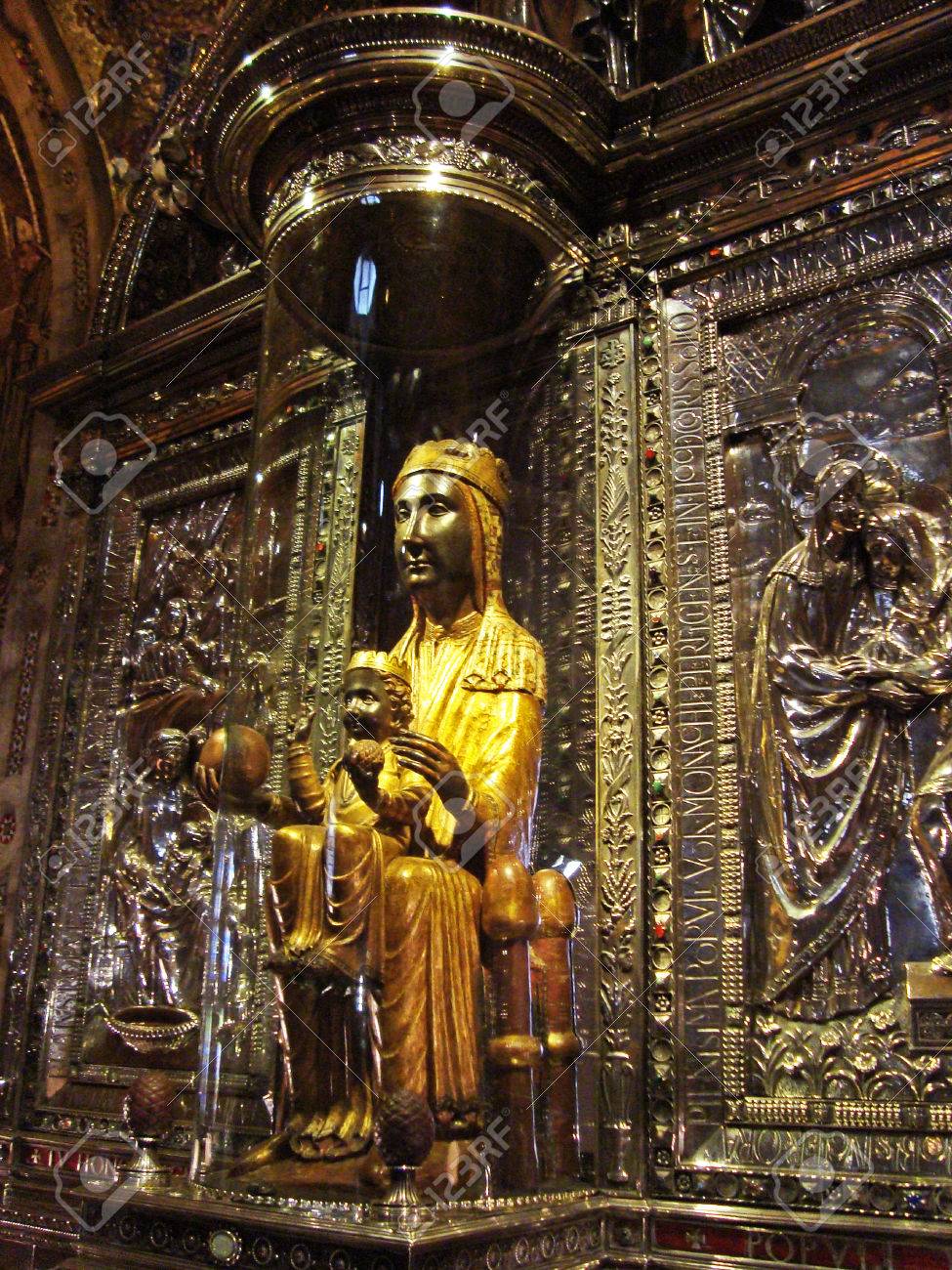
La Moreneta means the “Little Black One.” The Statue is four feet high and made of wood, blackened from the smoke of innumerable candles which have burned before her through the ages. Our Lady of Moreneta is seated upon a chair and holds her Divine Child who has a fir apple in His left hand. Our Queen is clothed in a golden mantle, a tunic and a veil of diverse colours; the Infant wears a simple tunic and He and His Mother wear matching wooden crowns. The miraculous Statue reposes upon a gleaming throne of marble, and over all, the sunlight diffuses a gleaming glow.

The origin of the Statue and the manner in which it first came to a lowly grotto in the mountainside is not known but is told by an uninterrupted folklore describing its descent from heaven. The legends date from the ninth century when it is believed the hermits who dwelt in caves, kept watch over a tiny Chapel known as Santa Maria de Montserrat. Reliable documents have it that a great monastic centre was founded among the same cliffs in the eleventh century and that a small black Statue of the Madonna drew the Kings of Aragon, the Monarchs of Spain, Emperor Charles V, Saints and celebrities, as well as common folks to the difficult mountain. Here arduous pilgrimages terminated, and here wondrous miracles were wrought.

As the fame of La Moreneta spread, her original Chapel underwent many transformations before the Basilica was constructed in the sixteenth century. Now the first Chapel is called the “Holy grotto” and is decorated within with marble, fine tapestries, and two altars; one to Saint Scholastica, the other to Saint Benedict so that Mass can be said on feast-days and other special occasions.
Montserrat, or “Saw-tooth Mountain,” which Our Lady chose for her shrine is believed to have an intrinsic holiness. Its highest peak bears the name. Tradition says this is the place the devil took Christ after His forty days fast; there is possibility of this being true. Legend further says it was the sight of the Holy Grail in Wagner’s opera “Parsifal.” The mountain of the shrine is 4,070 feet high, multicolored and interspersed with lush patches of tropic vegetation.
St Adelelmus of Le Mans
St Asicus of Elphin
St Castor of Tarsus
St Enoder
St Floribert of Liege
Blessed Jakov Varingez OFM (c 1400–1496)
His Life:
https://anastpaul.com/2019/04/27/saint-of-the-day-27-april-blessed-jakov-varingez-ofm-c-1400-1496/
St John of Kathara
St Joseph Outhay Phongphumi
St Laurensô Nguyen Van Huong
St Liberalis of Treviso
St Maughold
Blessed Nicolas Roland (1642-1678) Priest and Founder
About Blessed Nicolas:
https://anastpaul.com/2020/04/27/saint-of-the-day-27-april-blessed-nicolas-roland-1642-1678/
St Noël Tenaud
Blessed Osanna of Cattaro OP (1493-1565) Virgin, Mystic and Anchoress
Bl Peter Armengol
St Pollio of Cybalae
St Simeon of Jerusalem
St Stephen of Tarsus
St Tertullian of Bologna
St Theophilus of Brescia
St Winewald of Beverley
St Zita of Lucca (1212-1272) Laywoman – Her reputation was such that Dante in the Inferno referred to the city of Luccam her birthplace ad home, as “Santa Zita”
Biography:.
https://anastpaul.wordpress.com/2017/04/27/saint-of-the-day-27-april-st-zita-of-lucca/
—
Martyrs of Nicomedia: A group of Christians murdered together for their faith. In most cases all we have are their names – Dioscurus, Evanthia, Felicia, Felix, Germana, Germelina, Johannes, Julius, Laetissima, Nikeforus, Papias, Serapion and Victorinus. They died at Nicomedia, Bithynia, Asia Minor (modern Izmit, Turkey).
Thought for the Day – 26 April – Meditations with Antonio Cardinal Bacci (1881-1971)

“Am I determined to live the Life of Christ, by striving to be indissolubly united with Him, through divine grace?
Am I prepared to say, with St Paul “Who shall separate us from the love of Christ? For I am sure, that neither death, or life, nor angels, nor principalities, nor things present, nor things to come, nor powers, nor height, nor depth, or any other creature, will be able to separate us from the love of God, which is in Christ Jesus, our Lord” (Rom 8:35-39).
But, in order to bring this about, it is necessary for me to fly from every sin and to look for God in all things and in all actions.
I must love God with my whole heart and nurture the divine life within me, by prayer, recollection and frequent Communion.
If I fail to put these resolutions into practice, I shall become a barren branch, fit only for eternal fire!”
PARTS ONE AND TWO HERE:
https://anastpaul.com/2020/09/14/thought-for-the-day-14-september-my-life-is-christ/
https://anastpaul.com/2021/03/07/thought-for-the-day-14-september-my-life-is-christ-2/
Quote/s of the Day – 26 April – Monday of the Fourth Week of Easter, Readings: First: Acts 11: 1-18, Psalm: Psalms 42: 2-3; 43: 3-4, Gospel: John 10: 1-10 and the Memorial of St Raphael Arnaiz Baron (1911-1938)
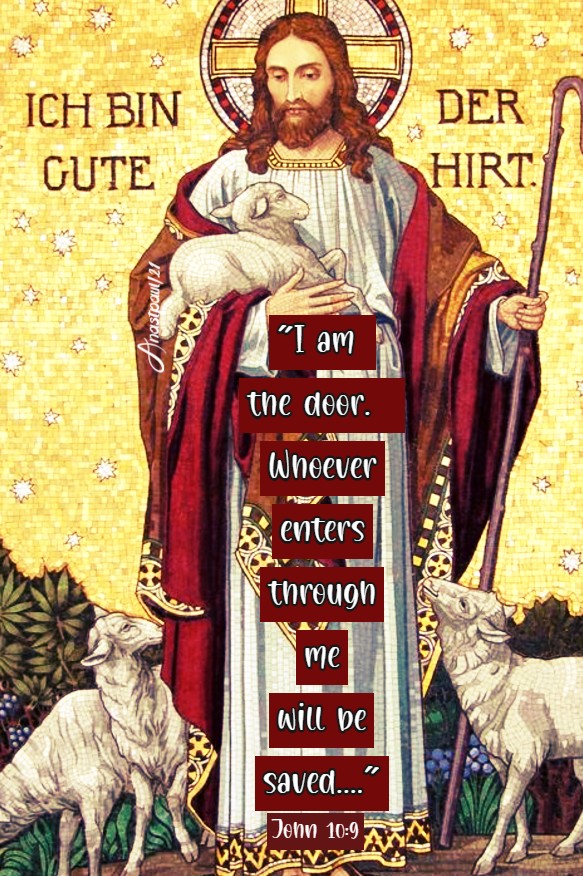
“I am the door.
Whoever enters through me
will be saved…. “
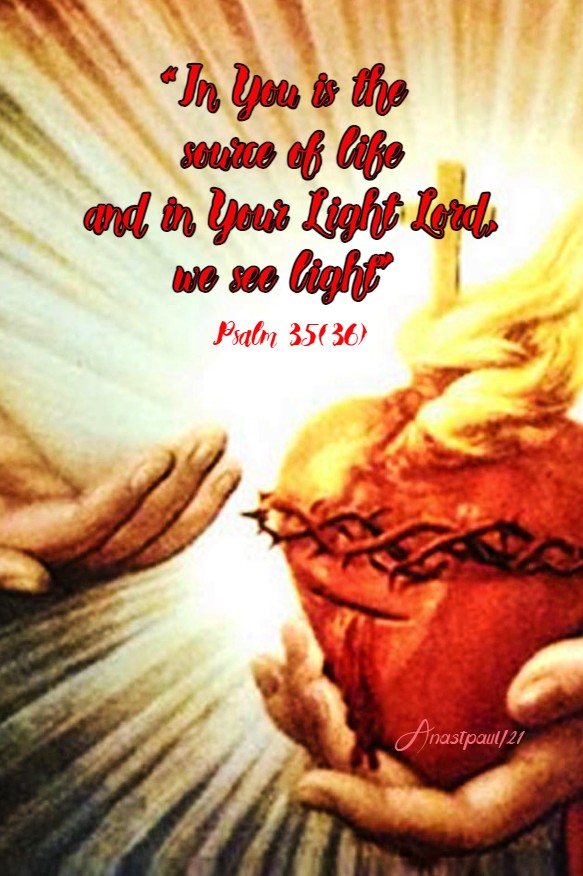
“In You is the source of life
and in Your Light Lord, we see light“
“Now is the time for us to choose! …
Listen to me, you holy seed,
for I have no doubt, that it is here, in abundance…
Listen to me or, rather, listen to Him, in me,
Who was first called a good seed.
Do not love your life in this world!
If you truly love yourselves,
do not thus love your life
and then, you will save your life!”…
“He is the origin of all wisdom.
The Word of God in the heights,
is the source of wisdom.
Christ is the source of all true knowledge,
for He is “the way, the truth and the life.” (Jn 14:6). …
As way, Christ is the teacher
and origin of knowledge …
Without this Light,
which is Christ,
no-one can penetrate
the secrets of faith.”
“Love Him, then, keep Him as a friend.
He will not leave you as others do,
or let you suffer lasting death.
Sometime, whether you will or not,
you will have to part with everything.
Cling, therefore, to Jesus in life and death,
trust yourself to the glory of Him,
Who alone can help you
when all others fail.“
“Where, then, is true freedom?
It is in the heart of one who loves
nothing more than God.
It is in the heart of one who is attached
neither to spirit nor to matter
but only to God.
It is in that soul which is not subject
to the “I” of egoism,
which soars above its own thoughts,
feelings, suffering and enjoyment.
Freedom resides in the soul
whose one reason for existence is God,
whose life is God
and nothing else but God.”
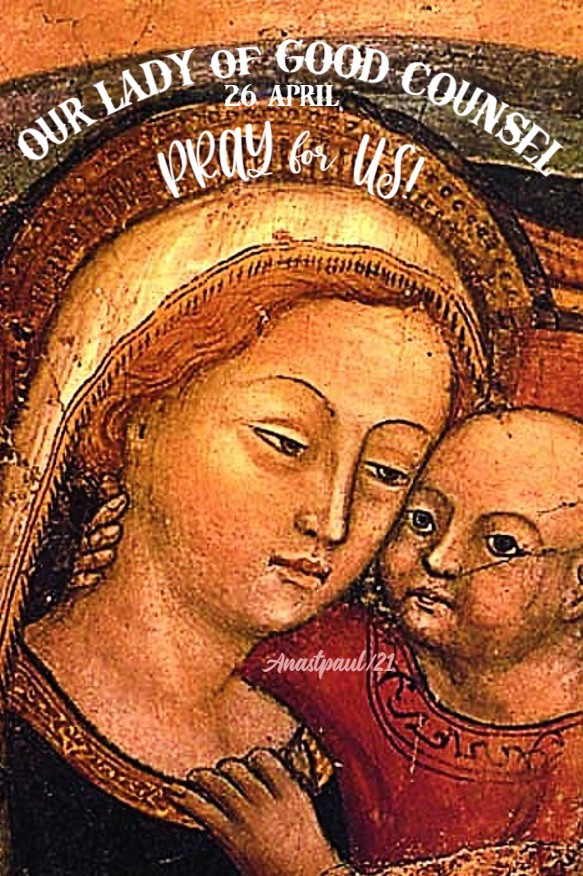
One Minute Reflection – 26 April – Monday of the Fourth Week of Easter, Readings: First: Acts 11: 1-18, Psalm: Psalms 42: 2-3; 43: 3-4, Gospel: John 10: 1-10 and the Memorial of Our Lady of Good Counsel / Our Lady of Genazzano (1467)
“I am the door. Whoever enters through me will be saved….” – John 10:9
REFLECTION – “My solemn word is this: “I am the sheepgate.” Jesus just opened the gate that He had shown us to be closed. He Himself is that gate. Let us recognise Him, let us enter and rejoice to have entered.
“All who came before me were thieves and marauders.” We must understand: “Those who came outside of me.” The prophets came before He arrived; were they thieves and marauders? Not at all, for they did not come outside of Christ; they were with Him. He had sent them as messengers before Him and He held in His hands the heart of these people whom He had sent… He said: “I am the way and the truth and the life.” (Jn 14:6) If He is the truth, those who were in the truth, were with Him. Those who, on the contrary, came outside of Him, are thieves and marauders, for they came only to plunder and kill. Jesus said: “The sheep did not heed them.”…
But the righteous believed that He would come, just as we believe, that He has already come. Times have changed, faith is the same… One single faith unites those who believed that He would come and those, who believe that He has come. We all see Him at different times coming in by the same gate of faith, that is to say, through Christ… Yes, all who believed in the past, at the time of Abraham, of Isaac, of Jacob, or of Moses or the other patriarchs and prophets, who all announced Christ, were already His sheep. They heard Christ Himself through them – they did not hear a strange voice but His own.” – St Augustine (354-430) Bishop of Hippo, Father & Doctor of Grace of the Church – 45th Treatise on the Gospel of Saint John

PRAYER – Almighty God and Father, You have rescued Your faithful from enslavement to sin, by Your Son’s self-abasement. You have raised up the world through His suffering. Fill us now with holy joy at His rising and triumph. Let us hear His voice and follow Him to everlasting life. Our Lady of Good Counsel, pray for us! Through Christ our Lord, with the Holy Spirit, God now and forever, amen.
Acts 11: 1-18
1 And the apostles and brethren, who were in Judea, heard that the Gentiles also had received the word of God.
2 And when Peter was come up to Jerusalem, they that were of the circumcision contended with him,
3 Saying: Why didst thou go in to men uncircumcised and didst eat with them?
4 But Peter began and declared to them the matter in order, saying:
5 I was in the City of Joppe praying and I saw, in an ecstasy of mind, a vision, a certain vessel descending, as it were, a great sheet let down from heaven by four corners and it came even unto me.
6 Into which looking, I considered and saw fourfooted creatures of the earth and beasts and creeping things and fowls of the air:
7 And I heard also a voice saying to me: Arise, Peter – kill and eat.
8 And I said: Not so, Lord = for nothing common or unclean hath ever entered into my mouth.
9 And the voice answered again from heaven: What God hath made clean, do not thou call common.
10 And this was done three times and all were taken up again into heaven.
11 And behold, immediately there were three men come to the house wherein I was, sent to me from Caesarea.
12 And the Spirit said to me, that I should go with them, nothing doubting. And these six brethren went with me also: and we entered into the man’s house.
13 And he told us how he had seen an angel in his house, standing and saying to him: Send to Joppe and call hither Simon, who is surnamed Peter,
14 Who shall speak to thee words, whereby thou shalt be saved and all thy house.
15 And when I had begun to speak, the Holy Ghost fell upon them, as upon us also in the beginning.
16 And I remembered the word of the Lord, how that he said:
John indeed baptised with water but you shall be baptised with the Holy Ghost.
17 If then God gave them the same grace, as to us also, who believed in the Lord Jesus Christ; who was I, that could withstand God?
18 Having heard these things, they held their peace and glorified God, saying – God then hath also, to the Gentiles, given repentance unto life.
Gospel: John 10: 1-10
1 Amen, amen I say to you:
He that enters not by the door into the sheepfold but climbs up another way, the same is a thief and a robber.
2 But he that enters in, by the door, is the shepherd of the sheep.
3 To him the porter opens and the sheep hear his voice and he calls his own sheep by name and leads them out.
4 And when he has let out his own sheep, he goes before them and the sheep follow him because they know his voice.
5 But a stranger they follow not but fly from him because they know not the voice of strangers. This proverb Jesus spoke to them. But they understood not what he spoke to them.
7 Jesus therefore said to them again: Amen, amen I say to you, I am the door of the sheep.
8 All others, as many as have come, are thieves and robbers and the sheep heard them not.
9 I am the door. By me, if any man enter in, he shall be saved and he shall go in and go out and shall find pastures.
10 The thief comes not but for to steal and to kill and to destroy.
I am come, that they may have life and may have it, more abundantly.
Our Morning Offering – 26 April– Monday of the Fourth Week of Easter
Alone With None but Thee, My God
Attri. St Columban (543-615)
Alone with none but Thee, my God
I journey on my way,
what need I fear when Thou art near,
O King of night and day?
More safe am I within Thy hand
than if a host should round me stand.
My destined time is known to Thee,
and death will keep his hour;
did warriors strong around me throng,
they could not stay his power.
No walls of stone can man defend
when Thou Thy messenger dost send.
My life I yield to Thy decree
and bow to Thy control
in peaceful calm, for from Thine arm
no power can wrest my soul,
could earthly omens e’er appal
a man that heeds the heavenly call?
The child of God can fear no ill,
His chosen, dread no foe;
we leave our fate with Thee and wait
Thy bidding when to go,
’tis not from chance our comfort springs,
Thou art our Trust, O King of kings.
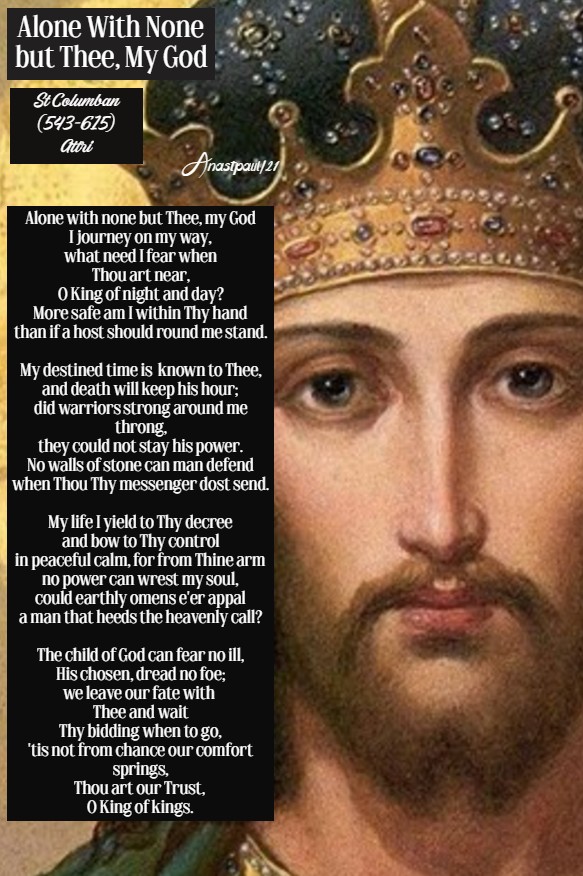
Saint of the Day – 26 April – Saint Peter of Braga (Died c 60) Martyr, the first Bishop of Braga, Portugal between the years 45 and 60. Born as Pedro de Rates on an unknown date and he died in c 60 in norther Portugal. Patronage – Braga. Also known as Peter of Rates and Pedro di Braga.
The Roman Martyrology states: “At Braga, Portugal, St Peter, Martyr, the first Bishop of that City.”

Tradition says he was ordered to preach the Christian faith by Saint James the Greater and that Peter of Rates was martyred while attempting to convert the locals to the Christian faith in northern Portugal. The ancient Breviary of Braga (Breviarium Bracarense) and the Breviary of Evora hold that Peter was a disciple of Saint James and preached at Braga.
The document holds that Saint James, one of the Apostles of Christ, visited the northwest of the Iberian Peninsula in the year 44. One of the places he visited was Serra de Rates, in the current municipality of Póvoa de Varzim, Portugal.
During his visit, the Apostle Ordained and Consecrated the local Peter of Braga as the first Bishop of Braga.
It is believed that Saint Peter was beheaded while converting the local pagans to the Christian faith.

Centuries later, around the 9th century, the discovery of Peter’s body was attributed to Saint Felix the Hermit, a fisherman of Villa Mendo, an ancient Roman villa that existed until the early years of the Kingdom of Portugal and rediscovered in the 20th century under the sand dunes of Rio Alto in Estela, also in Póvoa de Varzim.
Felix had left home and settled in the biggest hill of the area, which is today known as São Félix Hill. Regularly, Saint Félix observed a light in the darkness of the night from the hill. One day, curious about the light’s origins, Felix came upon the body of Saint Peter. On that spot, the Romanesque Monastery of Rates was built and the relics kept there until 1552; in that year the body was transferred to Braga Cathedral, where it is still kept.

In the civil parishes of Balasar and Rates in Póvoa de Varzim, there are two fountains that the population believes are miraculous because they were used by this saint.
In the 18th century, there are descriptions that Saint Peter of Braga was beheaded while drinking the waters of the fountain in Balasar. The faithful believes that two indentations on the fountain are impressions from the saint’s knees. At the fountain of Rates, a stone is believed to cure in cases of sterility. Due to that belief, on 26 April every year, the feast day of Saint Peter, the pregnant women and female animals do not go to work.
Monday of the Fourth Week of Easter +2021
Our Lady of Genazzano (1467) / Our Lady of Good Counsel (Memorial) – 26 April:

George Kastrioti Skanderbeg (1405–1467), also known as Iskander, or by his more colourful title, the Dragon of Albania. He was a great warrior and leader of the people of Albania who fought against the expansion of the Ottoman Empire into his Kingdom. An invincible opponent of Islam, the reason for his successes, was no secret – he “loved the sanctuary of Mary with a devoted, enthusiastic love and Mary in return, not only made him a model of Christian perfection but also gave him, an invincible power, which preserved not only Albania but also Christendom during his reign.”
There was at this time, a miraculous painting located in the town of Scutari, which was the Capital City of Albania. Our Lady of Scutari, now known as Our Lady of Good Counsel and Our Lady of Genazzano, is an image of Our Lady holding her Divine Son which had been painted on a thin sheet of plaster by an unknown hand. This portrait, reputed to date from the time of the Apostles of Christ, was greatly venerated and beloved by the faithful Albanian people. It was Our Lady of Scutari who had consoled and preserved Iskander through all his trials.
After his victories, Iskander went to kneel before the image of Our Lady of Scutari, thanking and publicly praising her for his success. “He was a hero formed in the same school as all those who derive their strength from their devotion to the Blessed Virgin. Like a new Saint Fernando III, King of Castile, Scanderbeg was, under the guidance of Mary, as gentle in peace as he was terrible in war. The good Christian Prince was often seen at her feet to beg the protection of his Lady in his greatest afflictions.”
Pope Nicholas V called Iskander “the champion and shield of Christendom,” which was true, although it was the Blessed Virgin Mary who protected her champion and granted him his victories. The Prince and unvanquished warrior, whose strength of soul gave his compatriots fortitude to throw off their lethargy, courage to rise up against the oppressive infidels, daring to despise death and thus expel them from their country, moved his subjects not only by example but also by his unbreakable faith, his ardent charity and his unshakable hope. Scanderbeg was God’s sword against the enemies of the holy Catholic Faith, the impregnable defensive wall protecting His realm.
At the end of his life, physically exhausted from his labours, Iskander sensed that his death was near. He went one last time to visit Our Lady of Scutari at her Shrine and then retired to the City of Lesh to die. There he won a final battle against the Turks before he laid down and gave up his soul to God. He had ended his life heroically as a powerful defender of the Catholic faith and of Christendom.
Shortly after Iskander’s death, the Ottoman army invaded Albania again. Without their invincible champion, it was only a matter of time before the Capital was taken. The Blessed Virgin revealed to two pious men that her image would not be desecrated and told them to prepare themselves for a long journey to follow the fresco when it left Albania. The picture then moved away from the wall, seemingly of its own accord and floated into the air.
As the pair followed the image of Jesus and Mary, it was hidden in a cloud and went out over the waters of the Adriatic sea. Full of confidence in Our Lady, the men stepped upon the water, which miraculously supported them and so they continued to follow the image until they made land along the coast of Italy. At that point they lost sight of the cloud.
It was not long before they learned where the image had gone. The cloud was seen again by the people of Genazzano, when they looked up into the sky to find the source of the heavenly music, that suddenly reached their ears. They watched dumbfounded as the little cloud descended and came to rest where it can still be seen today, floating before a wall of the Church of the Mother of Good Counsel in Genazzano. The image indeed floats before the wall, for it is not attached or supported in any way.

A hundred years later Pope Paul III had the picture studied and authenticated; Innocent IX had it crowned; many other Popes have granted favours to the Shrine. As late as 1936 a commission formed to study the picture, reported, if struck a slight blow, it reacts as if it were hollow; if set in motion, it oscillates visibly. Pope Leo XIII raised the Sanctuary to the dignity of a Basilica and had the invocation, “Mother of Good Counsel” added to the Litany of Loretto. Blessed Pope Pius IX had a great devotion to Our Lady under this title – he offered his first Mass before its image; in 1864 he made a pilgrimage to Genazzano to have counsel of her who is “Seat of Wisdom.” He kept her image in his study and fostered a cult to Mary under this title; thus he exemplified the filial confidence of all true sons of Mary.*
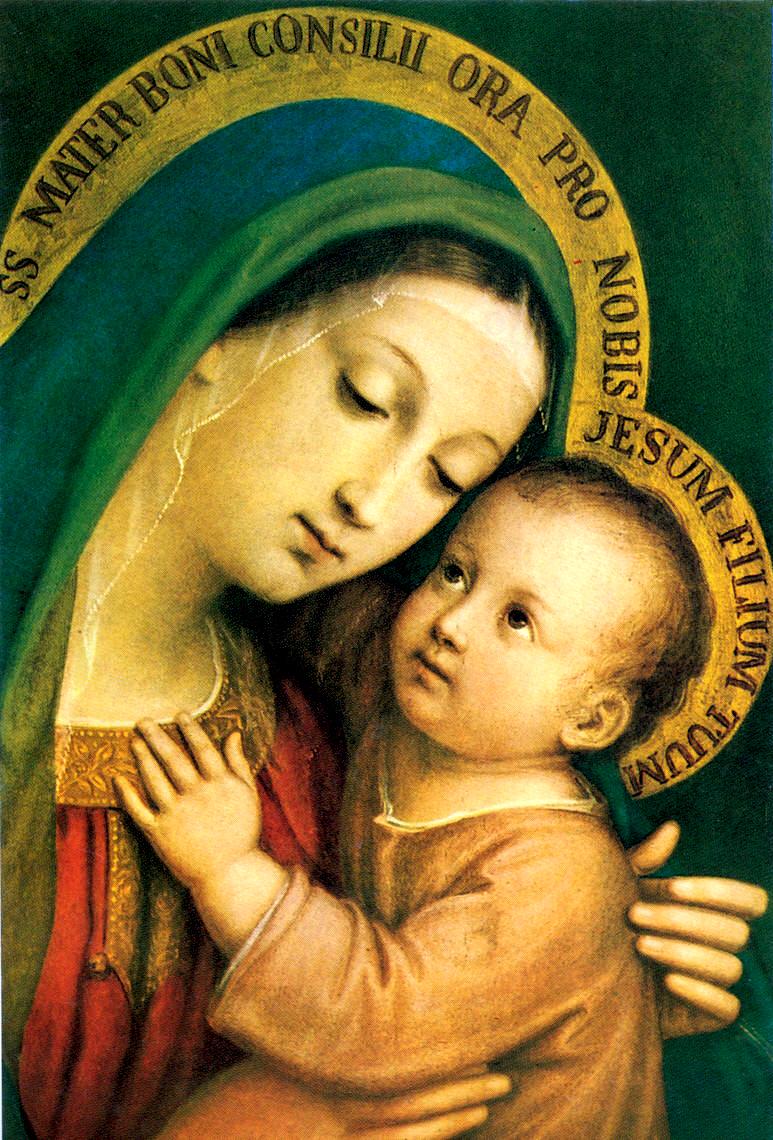
The Augustinian Order contributed to the spread of this devotion internationally. In 1753, Pope Benedict XIV established the Pious Union of Our Lady of Good Counsel. Leo XIII, who was himself a member of the pious union, was deeply attached to this devotion.
Among her noted clients have been St Aloysius Gonzaga, St Alphonsus Liguori, St John Bosco and Blessed Stephen Bellesini.
There have been numerous miracles at the shrine where Mary took refuge after the death of her champion in Albania. Through this image of Our Lady of Genazzano and throughout many long ages, she has been caring for her children on earth. As the Mother of God, she has the ability to truly help us. Indeed, it is her ardent desire to support us and counsel us in our need. Pope Leo XIII instructed us to “follow her counsels!” and, like so many saints and Catholic heroes, we would profit greatly if we did so!
Bl Alda of Siena
St Antoninus of Rome
St Basileus of Amasea
St Clarence of Venice
St Claudius of Rome
St Pope Cletus (c 25-c 89) 3rd Bishop of Rome and Martyr
Biography:
https://anastpaul.wordpress.com/2017/04/26/saint-of-the-day-26-april-st-pope-cletus/
St Cyrinus of Rome
St Exuerantia of Troyes
Bl Gregory of Besians
Bl Juli Junyer Padern
St Lucidius of Verona
St Pope Marcellinus (Died 304) Martyr
St Paschasius Radbertus (785–865) Monk, Spiritual writer
His life:
https://anastpaul.com/2019/04/26/saint-of-the-day-26-april-saint-paschasius-radbertus-785-865/
St Pelligrino of Foggia
St Peter of Braga (Died c 50) Bishop and Martyr
St Primitive of Gabi
St Rafael Arnáiz Barón (1911-1938) Oblate of the Order of Cistercians of the Strict Observance (Trappist)
About this memorable Saint:
https://anastpaul.wordpress.com/2018/04/26/saint-of-the-day-26-april-st-rafael-arnaiz-baron-o-c-s-o-1911-1938/
St Richarius of Celles (c 560-645) Priest and Confessor
St Richarius’ Life:
https://anastpaul.com/2020/04/26/saint-of-the-day-26-april-st-richarius-of-celles-c-560-645/
Bl Stanislaw Kubista
St Trudpert of Munstertal
St William of Foggia
Bl Wladyslaw Goral
Thought for the Day – 25 April – Meditations with Antonio Cardinal Bacci (1881-1971)
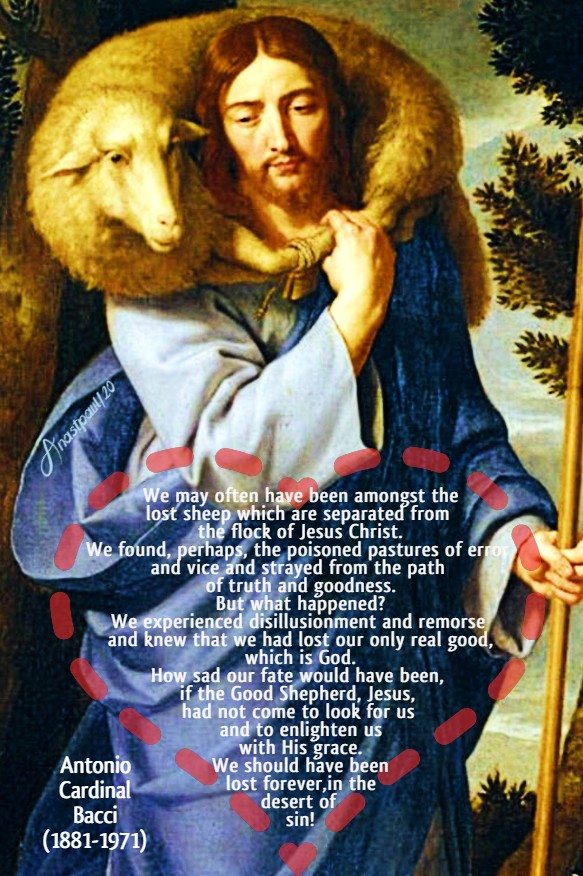
“The Good Shepherd is the theme of two of the most moving passages in the Gospel.
“I am the good shepherd,” Jesus says. “The good shepherd lays down his life for his sheep. But, the hireling, who is not a shepherd, whose own the sheep are not, sees the wolf coming and leaves the sheep and flees. and the wolf snatches and scatters the sheep … I am the good shepherd and I know mine and mine know me, even as the father knows me and I know the Father and I lay down my life for my sheep” (Jn 10:11-15).
“What man of you, having a hundred sheep,” He says elsewhere “and losing one of them, does not leave the ninety-nine in the desert and go after that which is lost, until he finds it? And when he has found it, he lays it upon his shoulders rejoicing. And on coming home, he calls together his friends and neighbours, saying to them, “Rejoice with me because, I have found my sheep that was lost.”
“I say to you that, even so, there will be joy in heaven over one sinner who repents, more than over ninety nine just, who have no need of repentance” (Cf Lk 15:4-7).
These texts vividly describe God’s mercy towards poor sinners.
We may often have been amongst the lost sheep which are separated from the flock of Jesus Christ.
We found, perhaps, the poisoned pastures of error and vice and strayed from the path of truth and goodness.
But what happened?
We experienced disillusionment and remorse and knew that we had lost our only real good, which is God.
How sad our fate would have been, if the Good Shepherd, Jesus, had not come to look for us and to enlighten us with His grace.
We should have been lost forever, in the desert of sin!”
Quote/s of the Day – 25 April – The Fourth Sunday of Easter, Good Shepherd/, Readings: First: Acts 4: 8-12, salm: Psalms 118: 1, 8-9, 21-23, 26, 28, 29 (22), Second: First John 3: 1-2, Gospel: John 10: 11-18
“The mark of Christ’s sheep
is their willingness to hear and obey,
just as disobedience
is the mark of those who are not His.
We take the word ‘hear’
to imply obedience
to what has been said.”
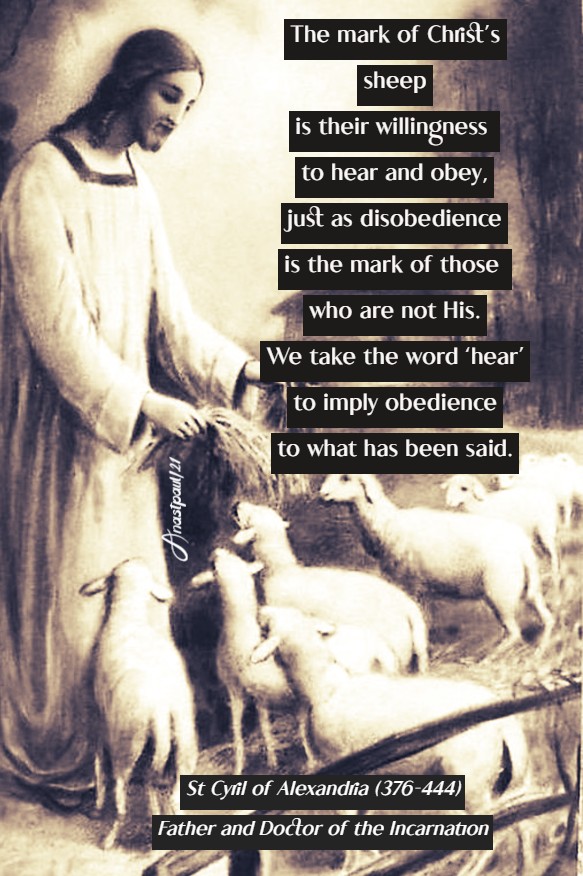
“Like Matthew, therefore,
follow this most devoted shepherd;
like Zacchaeus receive Him with hospitality;
like the sinful woman,
anoint Him with ointment
and wash His feet with your tears,
wipe them with your hair
and caress them with your kisses,
so that finally, with the woman
presented to Him for judgement,
you may deserve to hear the sentence of forgiveness:
“Has no one condemned you?
Neither will I condemn you.
Go, and sin no more” (Jn 8:10-11).”


You must be logged in to post a comment.