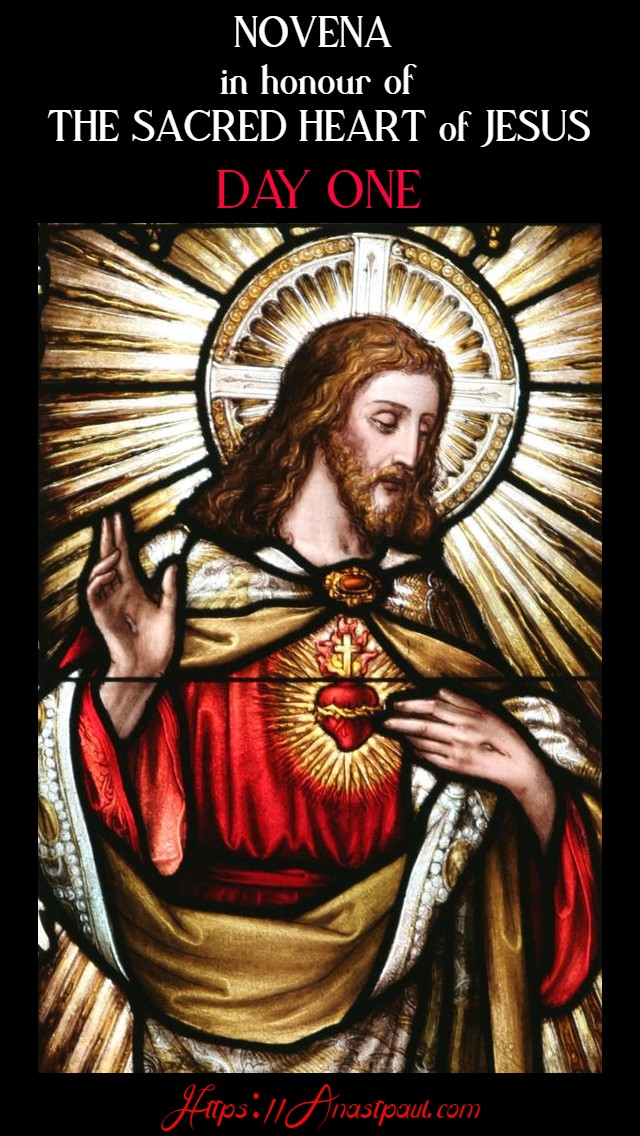
Novena in Honour of the Sacred Heart of Jesus
Day One
What do You Desire?
Today’s Scripture The next day John again was standing with two of his disciples and, as he watched Jesus walk by, he exclaimed, ‘Look, here is the Lamb of God!’ The two disciples heard him say this and they followed Jesus. … John 1: 35-3
Reflection for the First Day
Jesus addresses the same question to you at the beginning of this novena
‘What do you want?’
St Augustine said that all our desires are really a longing for God in disguise, where there is real desire, there is prayer. So, be at peace in your desire, you are already praying!
Today’s Prayer
Lord, I come to You at the start of this Novena
with a muddle of desires.
Give me courage,
to listen to what You want to say to me
and give me the strength
to accept Your loving desires for me and for my loved ones.
Daily Invocation Sacred Heart of Jesus, I place all my trust in You.
Novena Prayer
Lord Jesus,
the needs of Your people open Your heart in love for each of us.
You care for us when we are lost,
sympathise with us in loneliness
and comfort us in mourning.
You are closest to us, when we are weakest.
You love us most, when we love ourselves least.
You forgive us most, when we forgive ourselves least
and You call us to spread Your love, in whatever way we can.
Lord Jesus, Your heart is moved with compassion
when we are suffering,
when we need Your help
and, when we pray for each other.
I ask You to listen to my prayer during this Novena
and grant what I ask.
…………………………. (Mention your intention)
If what I ask, is not for my own good and the good of others,
grant me what is best,
that I may build up Your kingdom of love in our world.
Amen
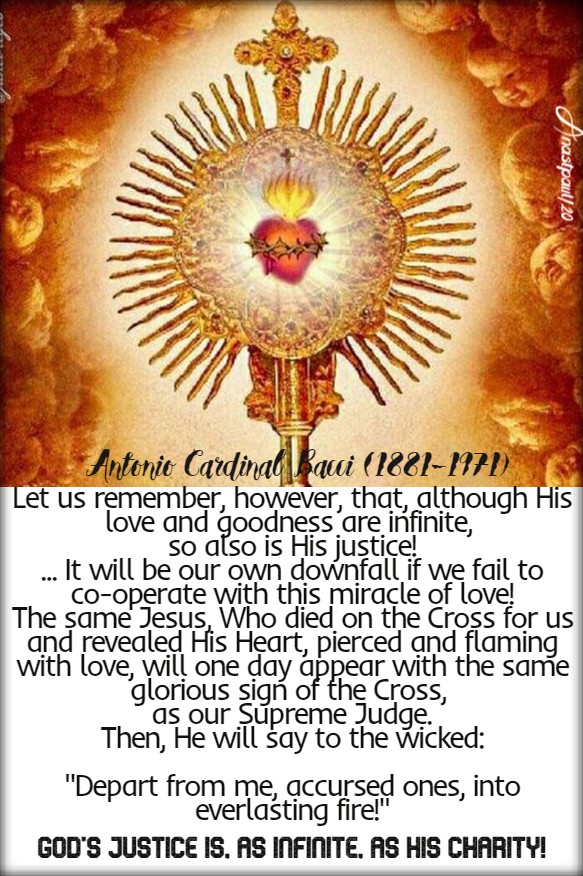
Thought for the Day – 10 June – “Month of the Sacred Heart” – Meditations with Antonio Cardinal Bacci (1881-1971)
The Sacred Heart of Jesus Surmounted by a Flaming Cross
“St Margaret Mary saw the Sacred Heart of Jesus, surmounted by flames in the midst of which, a Cross was raised on high.
These flames and this Cross, were the symbol of the infinite love of Jesus.
Let us reflect a little.
God, immeasurably happy in Himself, wished to communicate a share in His happiness to men, whom He created in a state of earthly happiness.
He was offended by men and, when He saw that they were heading for destruction, He sent His Eternal Word to them.
The Word took a human nature and became our brother; He preached the way to Heaven and gave us the means to achieve it.
More than this, He offered Himself as a divine victim of expiation for our sins.
Having been condemned by those whom He had come to show the way, He died on the Cross and shed all His Blood, for our salvation.
Pagans of all times have called this “the folly of the cross.”
In fact, it is the miracle of the infinite love of God for humanity.
Let us remember, however, that, although His love and goodness are infinite, so also is His justice!
It is an overwhelming miracle of love on the part of God, that He became man and died for us.
It will be our own downfall if we fail to co-operate with this miracle of love!
The same Jesus, Who died on the Cross for us and revealed His Heart, pierced and flaming with love, will one day appear with the same glorious sign of the Cross, as our Supreme Judge.
Then, He will say to the wicked: “Depart from me, accursed ones, into everlasting fire!”
God’s justice is, as infinite as His charity!
We must choose either the way of the Cross, the way of love and goodness to which the Sacred Heart of Jesus invites us, or the way of sin, which leads to the gulf of ruin and the final condemnation of the Supreme Judge.
This is the tremendous choice we have to make.”
Quote/s of the Day – 10 June – “Month of the Sacred Heart” – Wednesday of the Tenth week in Ordinary Time, Year A, Readings: 1 Kings 18:20-39, Psalm 16:1-2, 4-5, 8, 11, Matthew 5:17-19
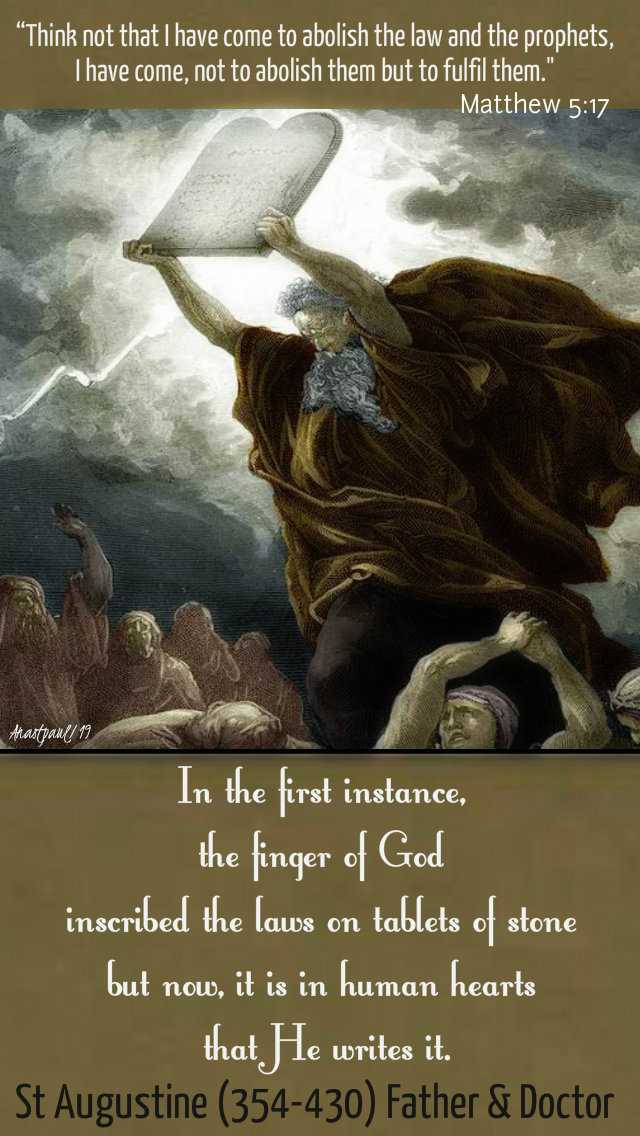
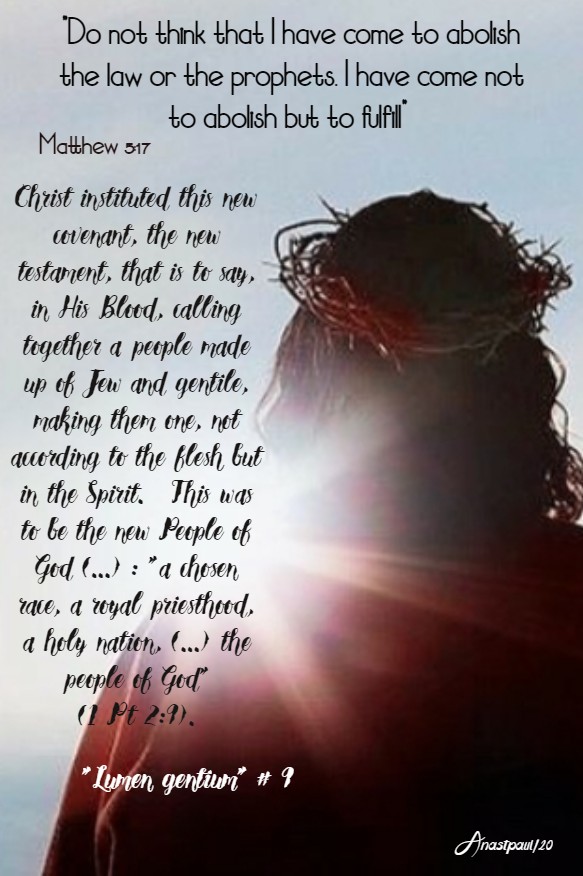
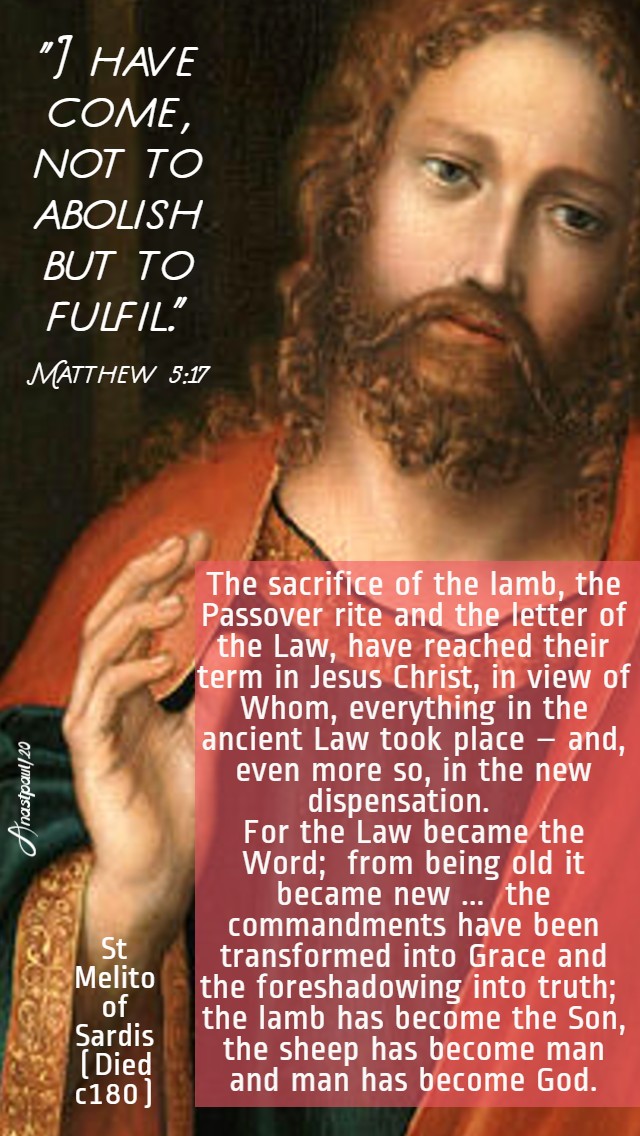
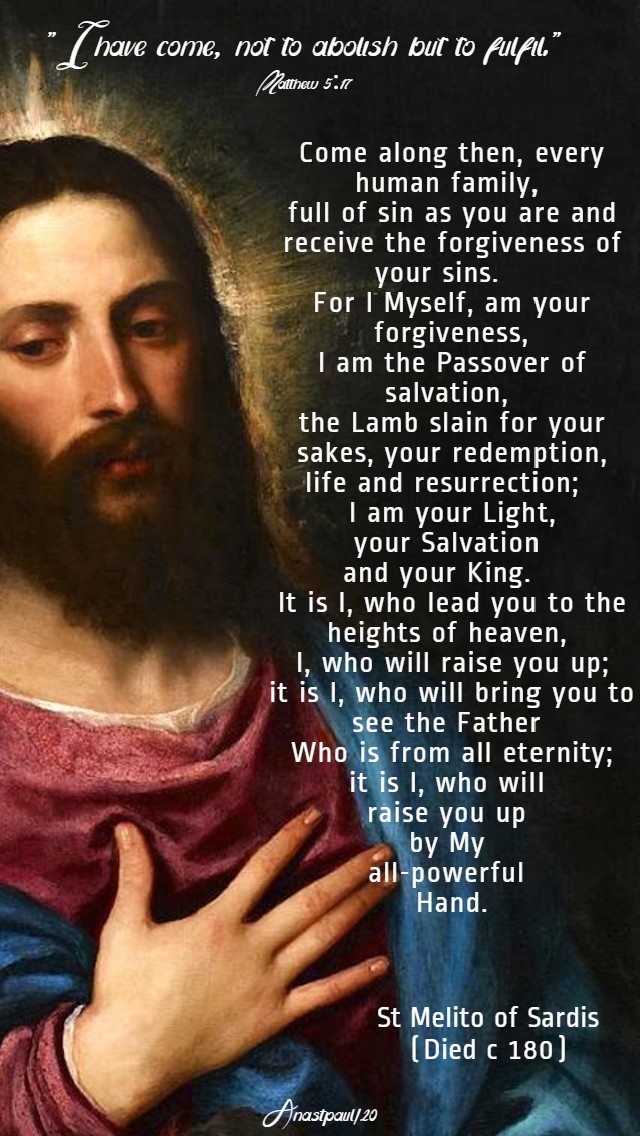
“I have come not to abolish but to fulfil.”
Matthew 5:17
“In the first instance, the finger of God inscribed the laws on tablets of stone but now, it is in human hearts, that He writes it (Ex 31:18; 2 Cor 3:3).“
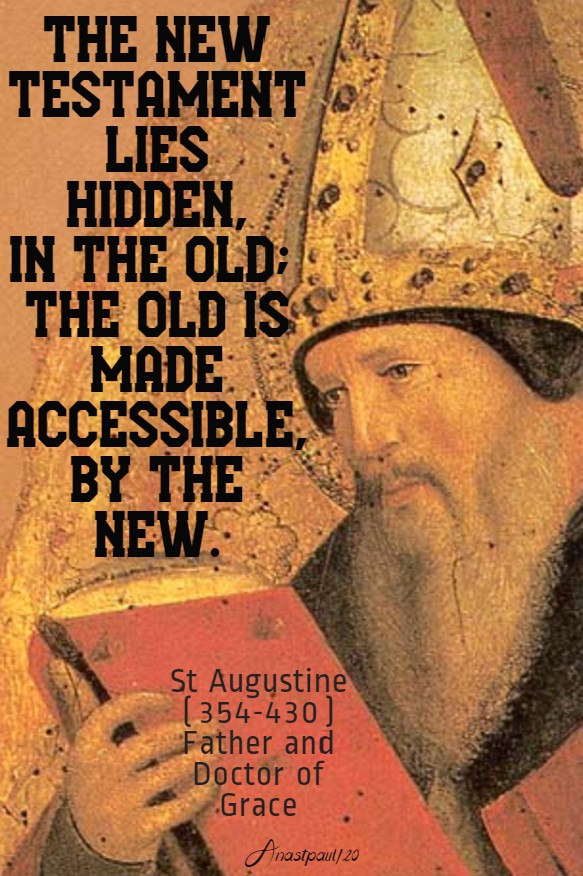
“The New Testament lies hidden, in the Old; the Old is made accessible, by the New.”
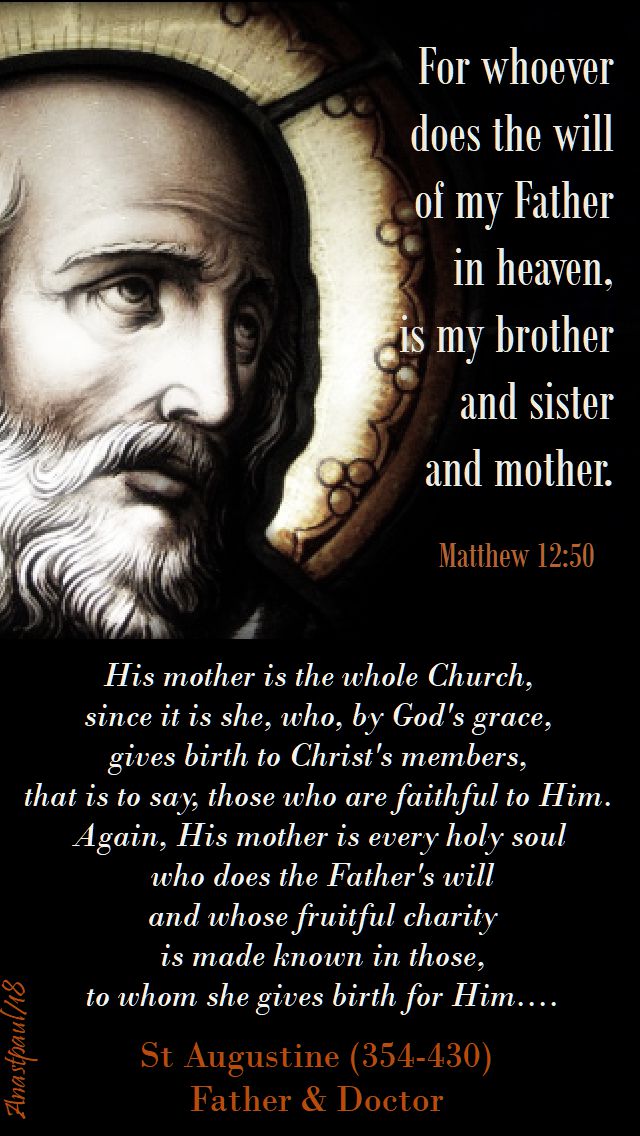
“His mother is the whole Church, since it is she, who, by God’s grace, gives birth to Christ’s members, that is to say, those who are faithful to Him. Again, His mother is every holy soul who does the Father’s will and whose fruitful charity is made known in those, to whom she gives birth for Him, “until he has been formed in them” (cf Gal 4:19)”
St Augustine (354-430)
Father and Doctor of Grace
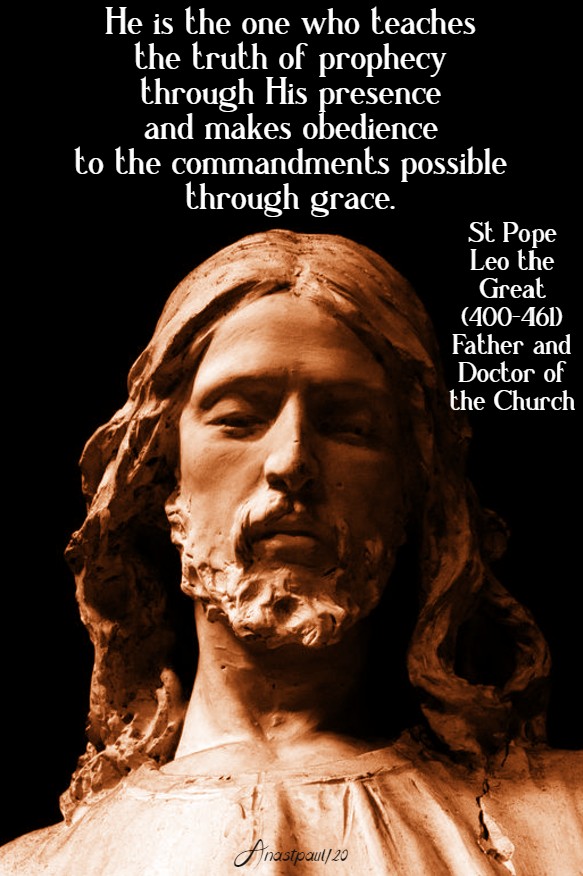
“He is the one who teaches the truth of prophecy through His presence and makes obedience to the commandments possible through grace.”
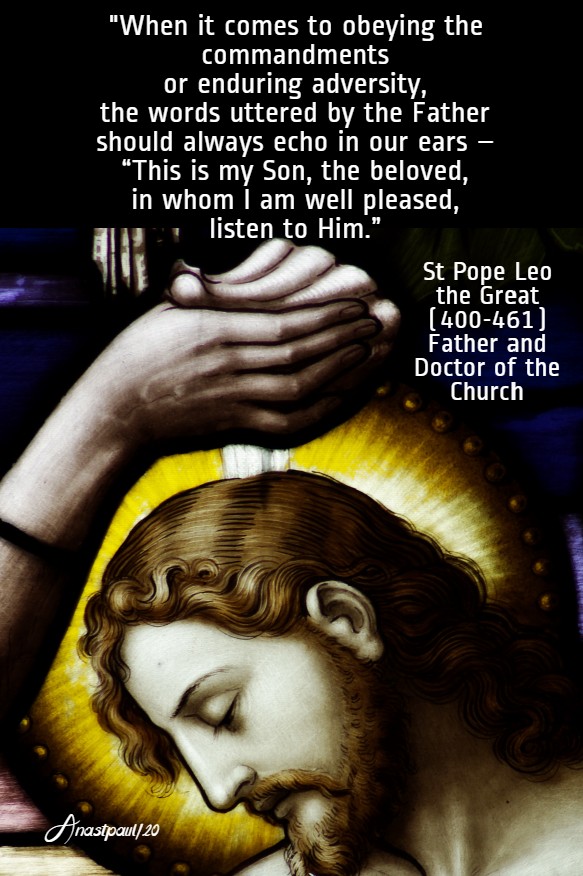
“When it comes to obeying the commandments or enduring adversity, the words uttered by the Father should always echo in our ears – “This is my Son, the beloved, in whom I am well pleased, listen to Him.”
St Pope Leo the Great (400-461)
Father and Doctor of the Church
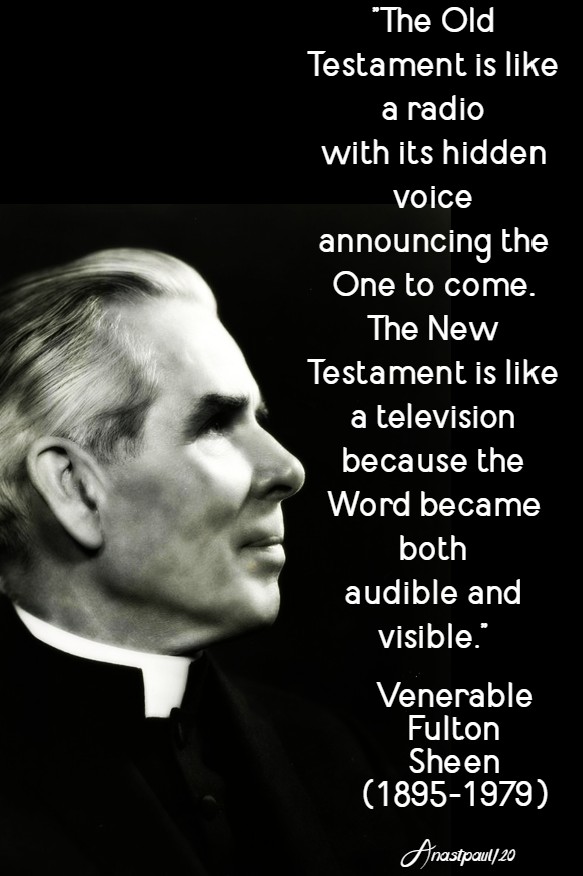
“The Old Testament is like a radio with its hidden voice announcing the One to come. The New Testament is like a television because the Word became both audible and visible.”
Venerable Fulton Sheen (1895-1979)
” Christ instituted this new covenant, the new testament, that is to say, in His Blood, (1 Cor 11:25) c alling together a people made up of Jew and gentile, making them one, not according to the flesh but in the Spirit. This was to be the new People of God … : “a chosen race, a royal priesthood, a holy nation, … the people of God” (1 Pt 2:9).”
Vatican Council II –
Constitution on the Church “Lumen gentium” # 9
One Minute Reflection – 10 June – “Month of the Sacred Heart” – Wednesday of the Tenth week in Ordinary Time, Year A, Readings: 1 Kings 18:20-39, Psalm 16:1-2, 4-5, 8, 11, Matthew 5:17-19
“I have come, not to abolish but to fulfil.” … Matthew 5:17
REFLECTION – “The sacrifice of the lamb, the Passover rite and the letter of the Law, have reached their term in Jesus Christ, in view of Whom, everything in the ancient Law took place – and, even more so, in the new dispensation. For the Law became the Word; from being old it became new … the commandments have been transformed into Grace and the foreshadowing into truth; the lamb has become the Son, the sheep has become man and man has become God. …
God though He was, the Lord put on our humanity; He suffered for him who was suffering, was bound for him who was captive, was judged for the guilty, was buried for him who was buried. He was raised from the dead and cried out in a loud voice: “If anyone wishes to oppose me, let us appear together” (Is 50,8). It is I who delivered the condemned man; I who restored life to the dead; I who raised up those in the grave. “Who disputes my right?” It is I, He says, I, who am the Christ, I, who destroyed death, who triumphed over the enemy, who bound the mighty enemy and carried off man to the heights of heaven; it is I, He says, who am the Christ.
Come along then, every human family, full of sin as you are and receive the forgiveness of your sins. For I Myself, am your forgiveness, I am the Passover of salvation, the Lamb slain for your sakes, your redemption, life and resurrection; I am your Light, your Salvation and your King. It is I, who lead you to the heights of heaven, I, who will raise you up; it is I, who will bring you to see the Father who is from all eternity; it is I, who will raise you up by My all-powerful Hand.” … St Melito of Sardis (Died c 180) Bishop, Apologist – Paschal Homily
PRAYER – Shed your clear light on our hearts, Lord, so that walking continually in the way of Your commandments, we may never be deceived or misled. May your Angels and Saints, pray for us. May the Mother of Our God and our Mother, be at our side and guide our way. We make our prayer through our Lord Jesus Christ in the unity of the Holy Spirit, one God forever and ever, amen.
Our Morning Offering – 10 June – “Month of the Sacred Heart” – Wednesday of the Tenth week in Ordinary Time, Year A
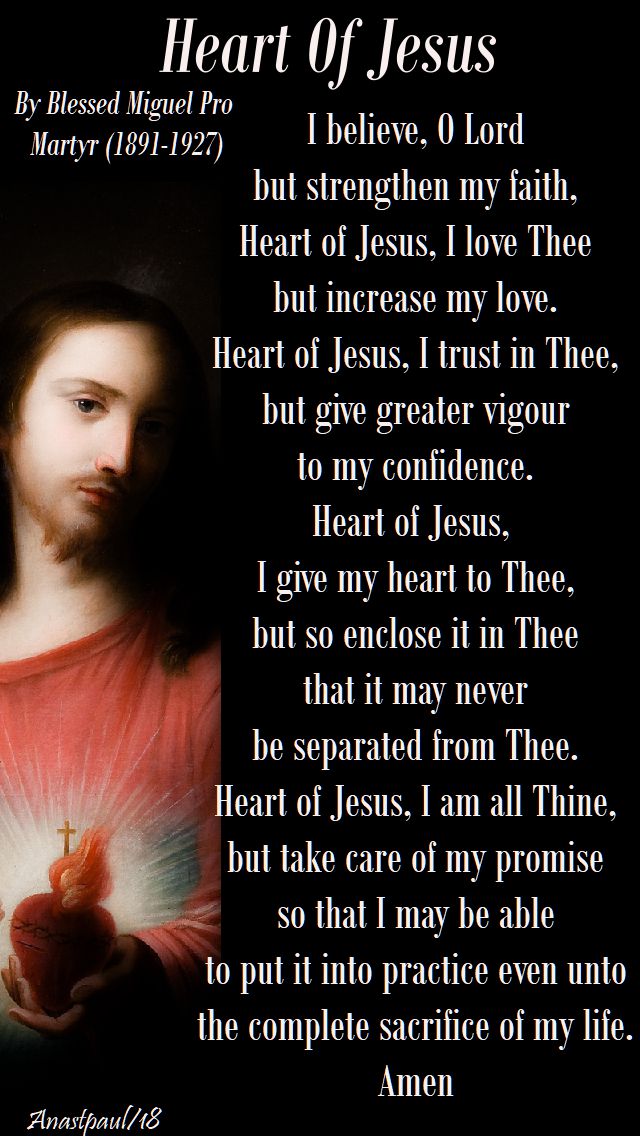
Heart Of Jesus By Blessed Miguel Pro – Martyr (1891-1927)
I believe, O Lord
but strengthen my faith,
Heart of Jesus, I love Thee
but increase my love.
Heart of Jesus, I trust in Thee,
but give greater vigour
to my confidence.
Heart of Jesus,
I give my heart to Thee,
but so enclose it in Thee
that it may never
be separated from Thee.
Heart of Jesus, I am all Thine,
but take care of my promise
so that I may be able
to put it into practice even unto
the complete sacrifice of my life.
Amen
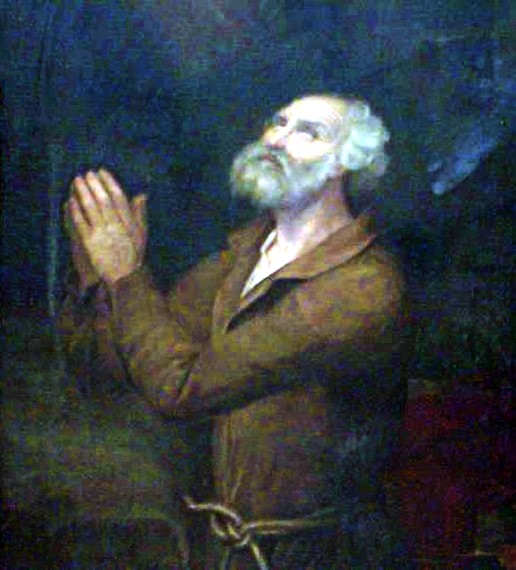
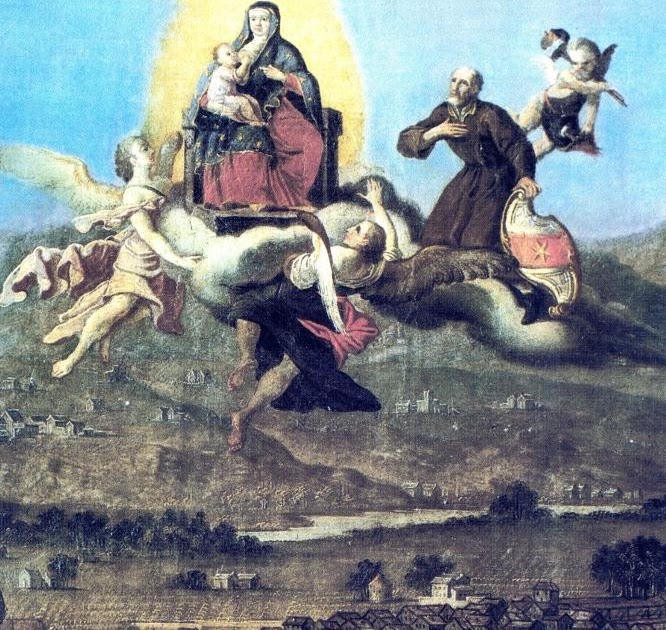
Saint of the Day – 10 June – Blessed Henry of Treviso (1250-1315) Layman, Widower and Father – born in c 1250 at Bolzano, Italy and died on 10 June 1315 in Treviso, Italy of natural causes. He is also known as Henry of Bolzano or Blessed Rigo. Patronage – Treviso.
Henry was born in Bolzano, Italy. He lived during the last part of the thirteenth and early part of the fourteenth centuries. Henry’s family was very poor, so he had no opportunity to learn to read and write. When he was a teenager, he moved to Treviso to find work. He became a day labourer. Few people realised that he gave away most of his earnings to the poor. He went to Mass daily and received Holy Communion as often as was permitted. Henry loved the Sacrament of Confession, too and found this Sacrament, of the forgiving God very encouraging.
People began to notice the kind of Christian Henry was. He made it his penance to be very diligent at his work. And he allowed ample time every day for private prayer, usually in a Church. Henry was known for his calm and gentle ways. Sometimes people teased him because he seemed like such a simple person. As he grew older, he began to look shabby and stooped. Children would comment at times on his peculiar appearance. But Henry didn’t mind. He realised that they did not know they were hurting him.
When Henry was too old and frail to work, a friend James Castagnolis, brought him into his own home. Mr Castagnolis gave Henry a room and food when the old man would accept it. Blessed Henry insisted that he live on the alms of the people of Treviso. They were generous in their donations of food because they knew that he shared their gifts with many people, who were poor and homeless. By the end of his life, Henry could barely walk. People watched with awe as the old man dragged himself to morning Mass. Often, he would visit other local Churches as well, painfully moving toward each destination.
What a mystery this good man was. When he died on 10 June 1315, people crowded into his little room. They wanted a Relic, a keepsake. They found his treasures – a prickly hair-shirt, a log of wood that was his pillow, some straw that was the mattress for his bed. They stripped the straw that served for his bed to keep as a Relic – there was not much else to take.
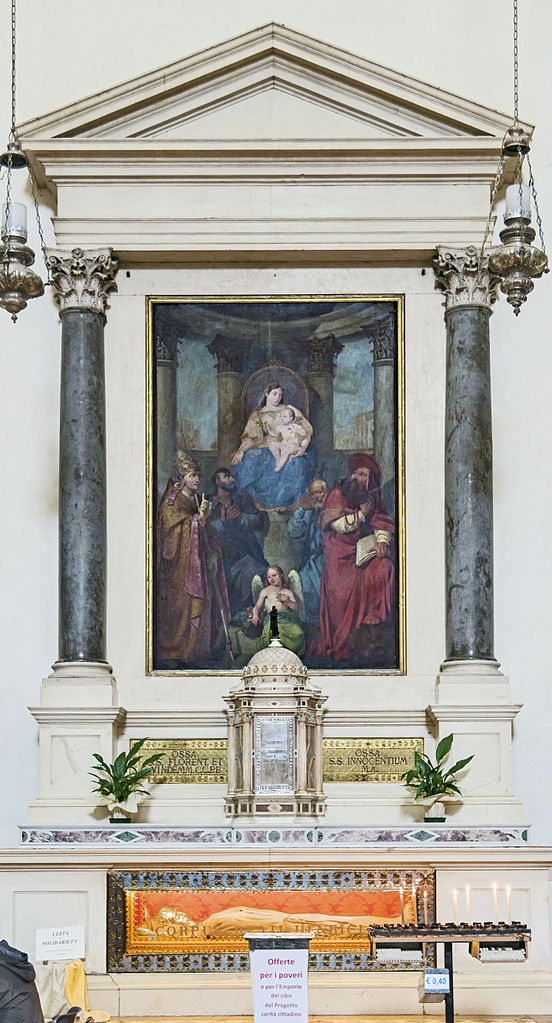
His body was moved to the Cathedral so that all the people could pay their tribute. Over two hundred miracles were reported within a few days after his death. A beautiful Altar was built in a side Chapel of the Cathedral in his honour, see below.
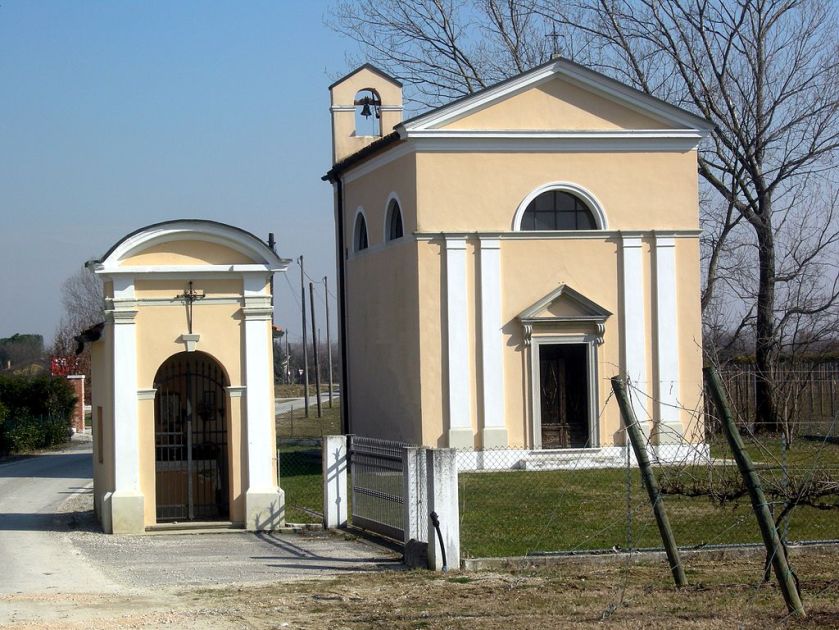
A beautiful Oratory was built in Treviso in honour of Blessed Henry.
Henry of Treviso was declared “Blessed” by Pope Benedict XIV on 23 July 1750 (cultus confirmed).
A Trevisan Priest, Fr Rambaldo degli Azzoni Avogari, published a hagiography of him in 1760.
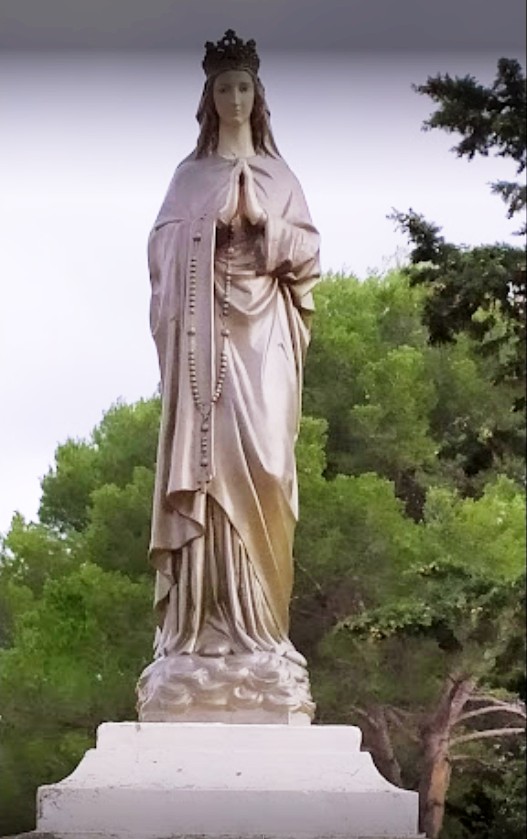
Our Lady of the Grotto, Mellieħa, Malta:
The Sanctuary of Our Lady of Mellieħa is a Marian shrine in the village of Mellieħa in Malta. It was originally constructed in the late 16th century and contains a Byzantine-style fresco, depicting the Blessed Virgin Mary with Christ on her right arm. Tradition has it that the painting was made by St Luke when he was shipwrecked on the island with St Paul. The church expanded several times to accommodate the growing population of the village and the roofed veranda is considered a classic example of 17th century Renaissance architecture. The sanctuary was blessed by St Pope John Paul II during his visit to Malta in May 1990.
This slideshow requires JavaScript.
—
Bl Amata of San Sisto
St Amantius of Tivoli
St Asterius of Petra
St Bardo of Mainz
Bl Bogumilus of Gniezno
St Caerealis of Tivoli
St Censurius of Auxerre
St Crispulus of Rome Blessed Edward Johannes Maria Poppe (1890-1924) Biography: https://anastpaul.com/2017/06/10/saint-of-the-day-10-june-blessed-edward-joannes-maria-poppe/
Bl Elisabeth Hernden
Bl Elizabeth Guillen
St Evermund of Fontenay
St Faustina of Cyzicus
Bl Gerlac of Obermarchtal
St Getulius of Tivoli Blessed Henry of Treviso (1250-1315)
St Illadan of Rathlihen
St Ithamar of Rochester Blessed John Dominici OP (c 1355-1419) His Life: https://anastpaul.com/2018/06/10/saint-of-the-day-10-june-blessed-john-dominici-o-p-c-1355-1419/
Bl José Manuel Claramonte Agut
Bl Joseph Kugler
St Landericus of Novalese
St Landericus of Paris
Bl Mary Magdalene of Carpi
St Maurinus of Cologne
St Primitivus of Tivoli
St Restitutus of Rome
Bl Thomas Green
St Timothy of Prusa
Bl Walter Pierson
St Zachary of Nicomedia
—
Martyrs of North Africa – 17 saints: A group of seventeen Christians martyred together in North Africa; the only surviving details are two of their names – Aresius and Rogatius. Both the precise location in North Africa and the date are unknown.
Martyrs of the Aurelian Way – 23 saints: A group of 23 martyrs who died together in the persecutions of Aurelian. The only details that survive are three of their names – Basilides, Mandal and Tripos. c.270-275 on the Aurelian Way, Rome, Italy.
Martyrs of the Hulks of Rochefort/Martyrs of La Rochelle – 64 beati: In 1790 the French Revolutionary authorities passed a law requiring priests to swear allegience to the civil constitution, which would effectively remove them from the authority of and allegience to, Rome. Many refused and in 1791 the government began deporting them to French Guyana. 827 priests and religious were imprisoned on hulks (old ships no longer sea-worthy and used for storage, jails, hospitals, etc.) at Rochefort, France to await exile, most on the Deux-Associés and the Washington which had previously been used to house slaves or prisoners. There they were basically ignored to death as there was little provision for food and water, less for sanitation and none at all for medical help. 542 of the prisoners died there.
The survivors were freed on 12 February 1795 and allowed to return to their homes. Many of them wrote about their time on the hulks and many of them wrote about the faith and ministry of those who had died. 64 of them have been positively identified and confirmed to have died as martyrs, dying for their faith, they are:
• Antoine Auriel• Antoine Bannassat• Augustin-Joseph Desgardin• Barthélemy Jarrige de La Morelie de Biars• Charles-Antoine-Nicolas Ancel• Charles-Arnould Hanus• Charles-René Collas du Bignon• Claude Beguignot
• Claude Dumonet• Claude Laplace• Claude Richard• Claude-BarnabéLaurent de Mascloux• Claude-Joseph Jouffret de Bonnefont• élie Leymarie de Laroche• Florent Dumontet de Cardaillac• François d’Oudinot de la Boissière
• François François• François Hunot• François Mayaudon• Gabriel Pergaud
• Georges-Edme René• Gervais-Protais Brunel• Jacques Gagnot• Jacques Lombardie• Jacques Retouret• Jacques-Morelle Dupas• Jean Baptiste Guillaume• Jean Bourdon• Jean Hunot• Jean Mopinot• Jean-Baptiste de Bruxelles• Jean-Baptiste Duverneuil• Jean-Baptiste Laborie du Vivier
• Jean-Baptiste Menestrel• Jean-Baptiste Souzy• Jean-Baptiste-Ignace-Pierre Vernoy de Montjournal• Jean-Baptiste-Xavier Loir• Jean-François Jarrige de la Morelie de Breuil• Jean-Georges Rehm• Jean-Nicolas Cordier
• Joseph Imbert• Joseph Juge de Saint-Martin• Joseph Marchandon
• Lazare Tiersot• Louis-Armand-Joseph Adam• Louis-François Lebrun
• Louis-Wulphy Huppy• Marcel-Gaucher Labiche de Reignefort• Michel-Bernard Marchand• Michel-Louis Brulard• Nicolas Savouret• Nicolas Tabouillot• Noël-Hilaire Le Conte• Paul-Jean Charles• Philippe Papon• Pierre Gabilhaud• Pierre Jarrige de la Morelie de Puyredon• Pierre-Joseph le roing de la Romagère• Pierre-Michel Noël• Pierre-Sulpice-Christophe Faverge• Pierre-Yrieix Labrouhe de Laborderie• Raymond Petiniaud de Jourgnac• Scipion-Jérôme Brigeat Lambert• Sébastien-Loup Hunot.
They died between 19 May 1794 and 23 February 1795 aboard prison ships docked at Rochefort, Charente-Maritime, France and were beatified on
1 October 1995 by St Pope John Paul II.
Thought for the Day – 9 June – “Month of the Sacred Heart” – Meditations with Antonio Cardinal Bacci (1881-1971)
The Crown of Thorns Which Surrounds the Sacred Heart
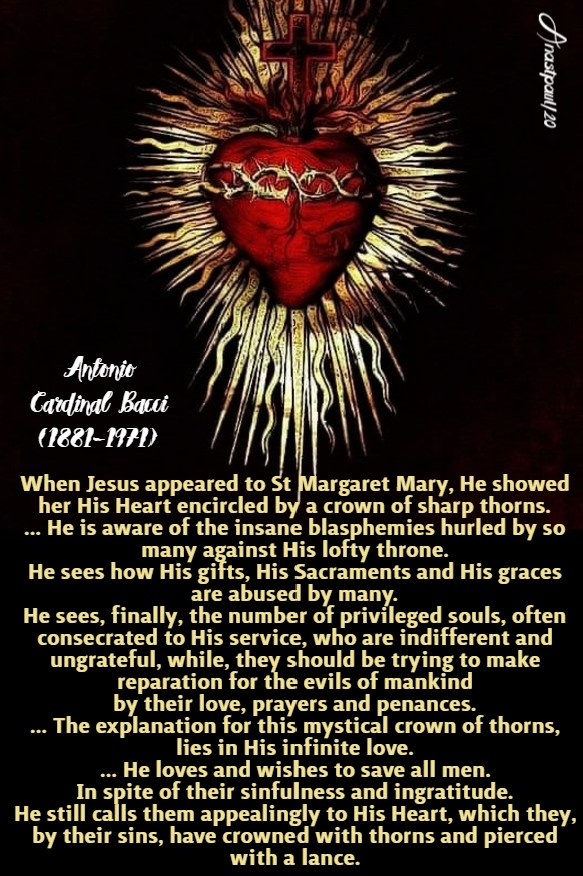
“When Jesus appeared to St Margaret Mary, He showed her His Heart encircled by a crown of sharp thorns.
What is the significance of this?
In Heaven, Jesus is happy and cannot suffer anymore.
The Angels, Saints and the whole of creation, sing a hymn of unceasing praise in His honour.
Nevertheless, He sees the immense tide of sin, which surges forth from the human race which He redeemed by His Precious Blood, a redemption now made futile by many.
He is aware of the insane blasphemies hurled by so many against His lofty throne.
He sees how His gifts, His Sacraments and His graces are abused by many.
He sees, finally, the number of privileged souls, often consecrated to His service, who are indifferent and ungrateful, while, they should be trying to make reparation for the evils of mankind by their love, prayers and penances.
The explanation for this mystical crown of thorns, lies in His infinite love.
He does not suffer anymore because, He cannot suffer but He still has an immense love for all men, even for sinners and for those who are lukewarm and ungrateful.
He loves and wishes to save all men.
In spite of their sinfulness and ingratitude.
He still calls them appealingly to His Heart, which they, by their sins, have crowned with thorns and pierced with a lance.
This is a mystery of love which we cannot properly understand.
Only a man who loves Jesus fervently, can even have the slightest understanding of it.
If we sincerely love the divine Heart of Jesus, we shall realise, that these sharp thorns which once pierced His Heart in Gethsemane and on Calvary, were caused by our sins.
Then, we shall do our best to make a generous return for such love and to make reparation, even with grave sacrifice, for the offences which are still being committed by men against the loving Heart of the Redeemer.”
Quote/s of the Day – 9 June – “Month of the Sacred Heart” – Tuesday of the Tenth Week in Ordinary Time, Year A and the Memorial of St Ephrem of Syria (306-373) Father & Doctor of the Church
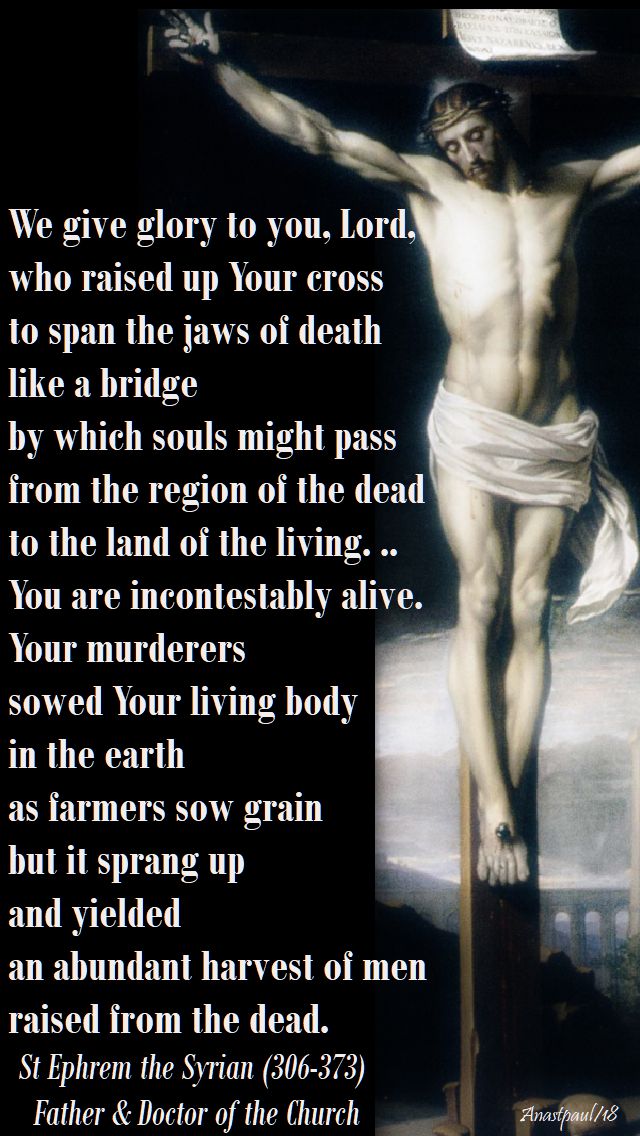
“We give glory to You, Lord, who raised up Your Cross to span the jaws of death like a bridge by which souls might pass from the region of the dead to the land of the living. .. You are incontestably alive. Your murderers sowed Your living body in the earth as farmers sow grain but it sprang up and yielded an abundant harvest of men raised from the dead.”
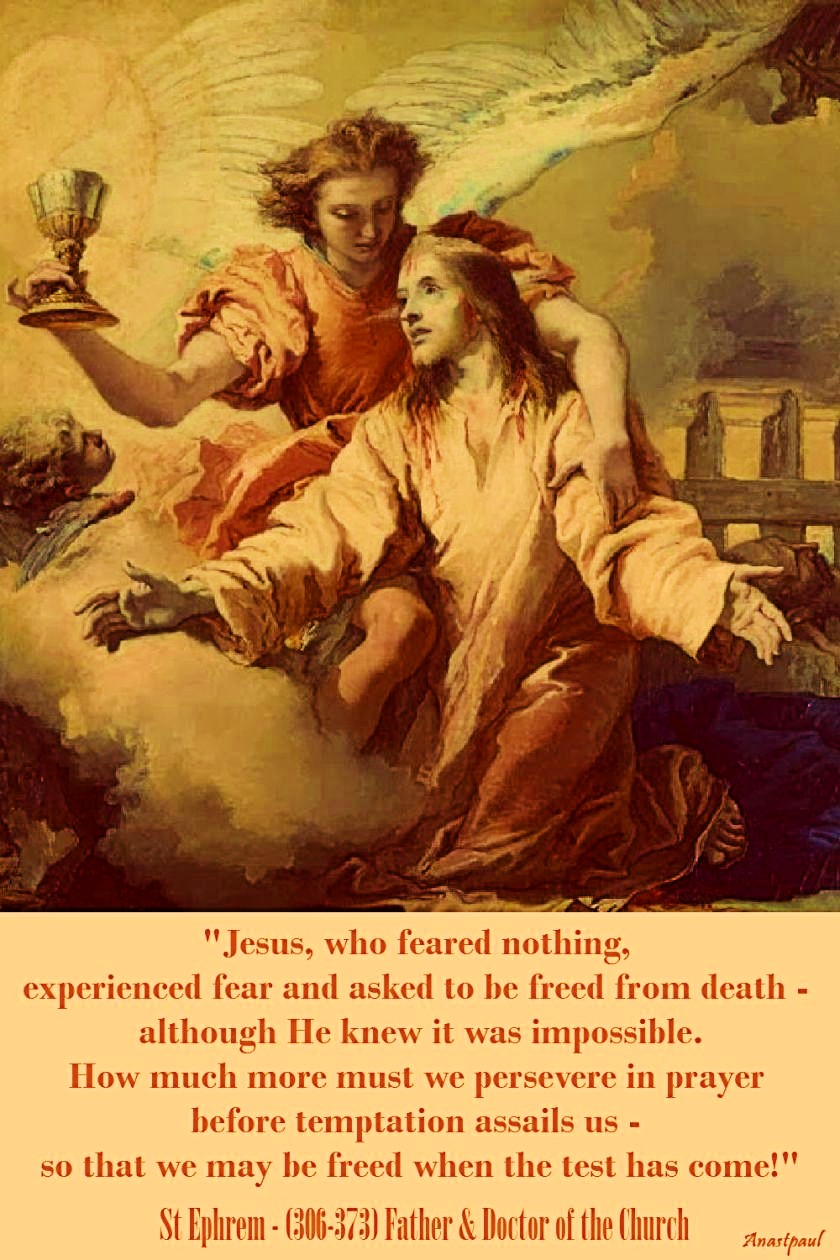
“Jesus, who feared nothing, experienced fear and asked to be freed from death – although He knew it was impossible. How much more, must we persevere in prayer before temptation assails us – so that we may be freed when the test has come!”
“She bore within herself, as a child, Him by whom the world was filled. He descended to become the model that would renew Adam’s ancient image.”
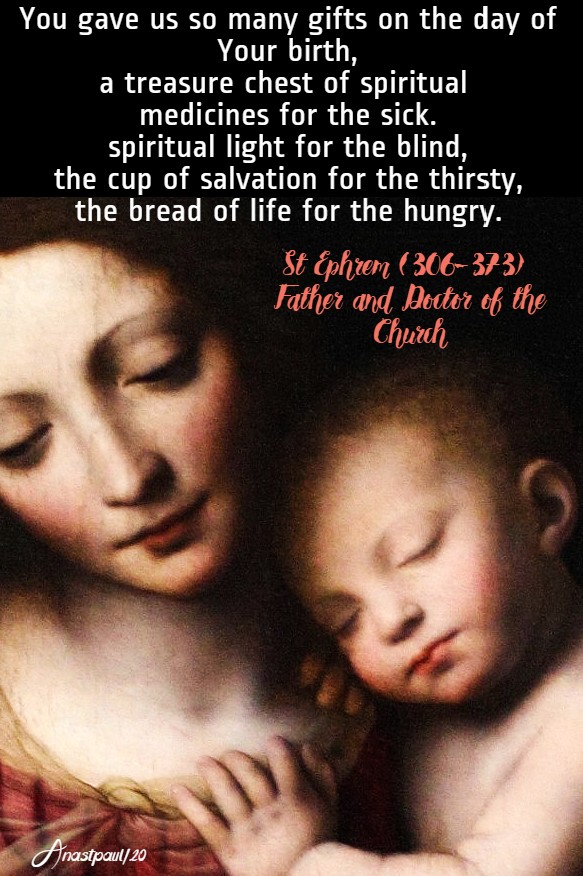
“You gave us so many gifts on the day of Your birth, a treasure chest of spiritual medicines for the sick. spiritual light for the blind, the cup of salvation for the thirsty, the bread of life for the hungry.”
“We have had Your treasure hidden within us, ever since we received baptismal grace, it grows ever richer at Your sacramental table.”
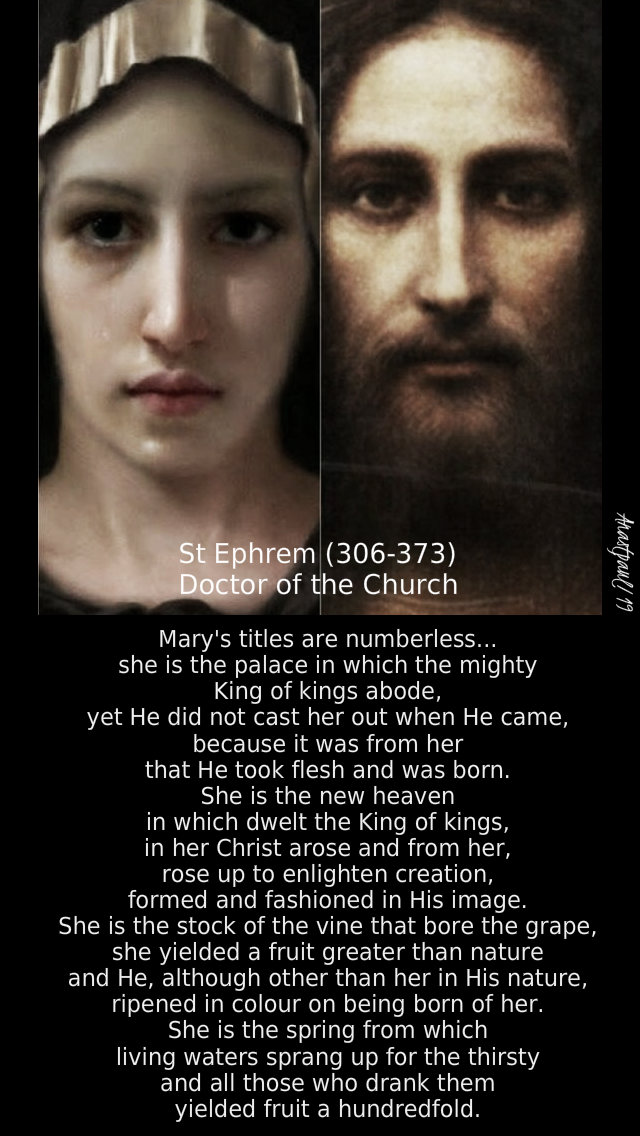
“Mary’s titles are numberless… she is the palace in which the mighty King of kings abode, yet He did not cast her out when He came, because it was from her that He took flesh and was born. She is the new heaven in which dwelt the King of kings, in her, Christ arose and from her, rose up to enlighten creation, formed and fashioned in His image. She is the stock of the vine that bore the grape, she yielded a fruit greater than nature and He, although other than her in His nature, ripened in colour on being born of her. She is the spring from which living waters sprang up for the thirsty and all those who drank them, yielded fruit a hundredfold.”
St Ephrem (306-373)
Father and Doctor of the Church
One Minute Reflection – 9 June – “Month of the Sacred Heart” – Tuesday of the Tenth Week in Ordinary Time, Year A, Readings: 1 Kings 17:7-16, Psalm 4:2-5, 7-8, Matthew 5:13-16 and the Feast of Our Lady of Grace and the Memorial of St Columba of Iona (521-597) Apostle of the Picts, Apostle to Scotland
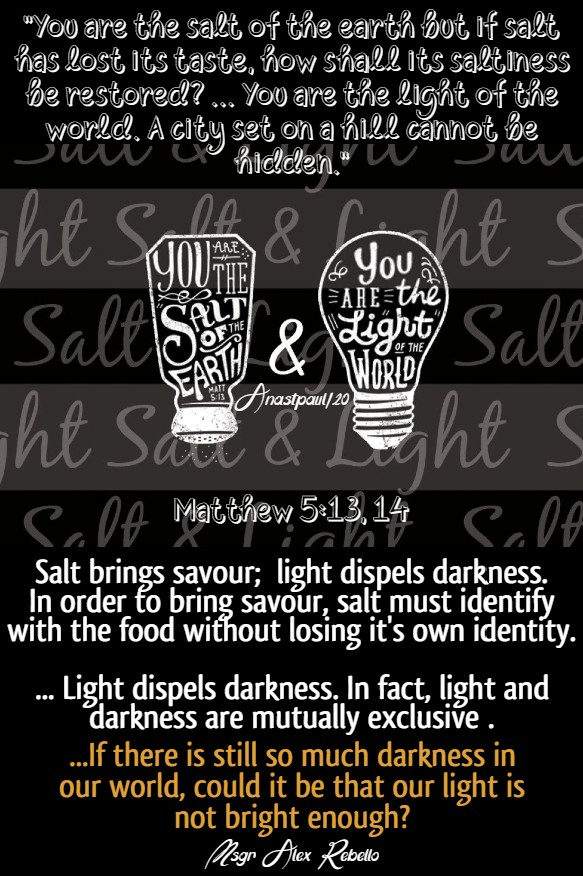
“You are the salt of the earth but if salt has lost its taste, how shall its saltiness be restored? … You are the light of the world. A city set on a hill cannot be hidden.“…Matthew 5:13, 14
REFLECTION – “That is what we are as authentic disciples of Jesus.
Salt bring savour; light dispels darkness.
In order to bring savour, salt must identify with the food without losing it’s own identity. If it loses it’s own identity, it is fit only to be trampled underfoot.
Light dispels darkness. In fact, light and darkness are mutually exclusive because, where there is light there cannot be darkness and where there is darkness, light is absent.
But the light that we, as disciples of Jesus shed, must be mounted high, not for our own glory but that those who are enlightened may glorify and praise the Father.
If there is still so much darkness in our world, could it be that our light is not bright enough?” ,,, Msgr Alex Rebello, Diocese of Wrexham, Wales.
PRAYER – Holy Almighty Father, we pray that we may be the light of Your divine Son and the salt of the earth. Help us, we pray, to ever strive to be both the light and salt of the earth and may the protection of Our Lady of Grace, first disciple of Jesus and model, be of help to believers who live every day their vocation and mission in history. May our Mother help us, to let ourselves always be purified and illumined by the Lord, to become in turn “salt of the earth” and “light of the world. As St Columba of Iona brought both salt and light to the darkness of the pagan Scotland, grant we pray that his prayers may help us in our mission. We make our prayer through Christ our Lord, with the Holy Spirit, one God for all eternity, amen…
Our Morning Offering – 9 June – “Month of the Sacred Heart” – Tuesday of the Tenth Week in Ordinary Time, Year A
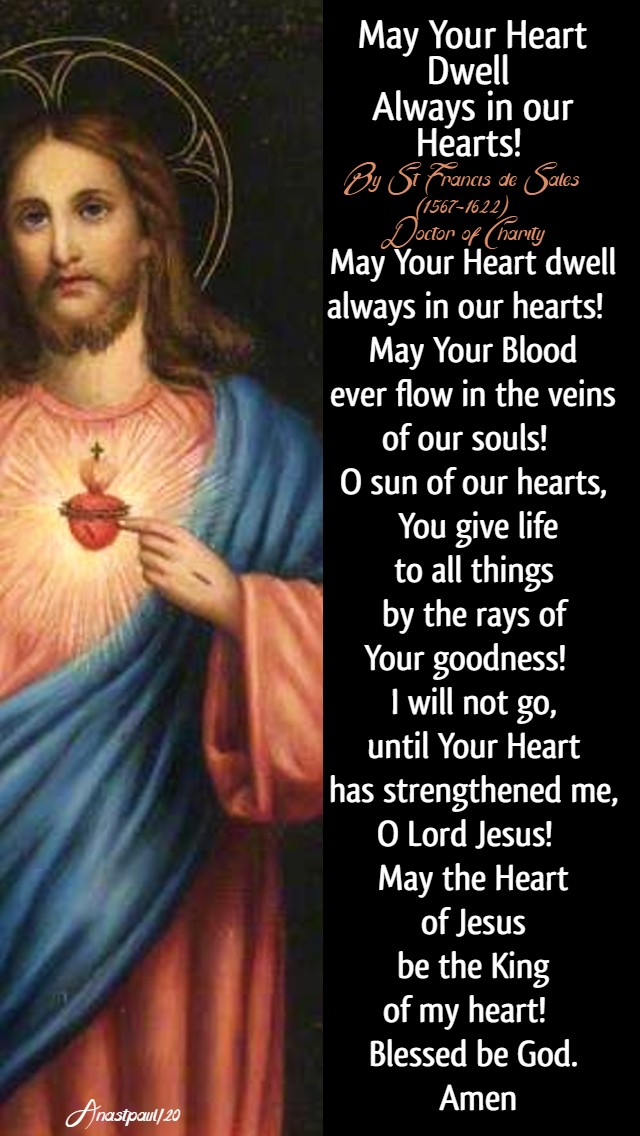
May Your Heart Dwell Always in our Hearts! By St Francis de Sales (1567-1622) Doctor of Charity
May Your Heart dwell
always in our hearts!
May Your Blood
ever flow in the veins
of our souls!
O sun of our hearts,
You give life to all things
by the rays of Your goodness!
I will not go,
until Your Heart
has strengthened me,
O Lord Jesus!
May the Heart of Jesus
be the King of my heart!
Blessed be God.
Amen
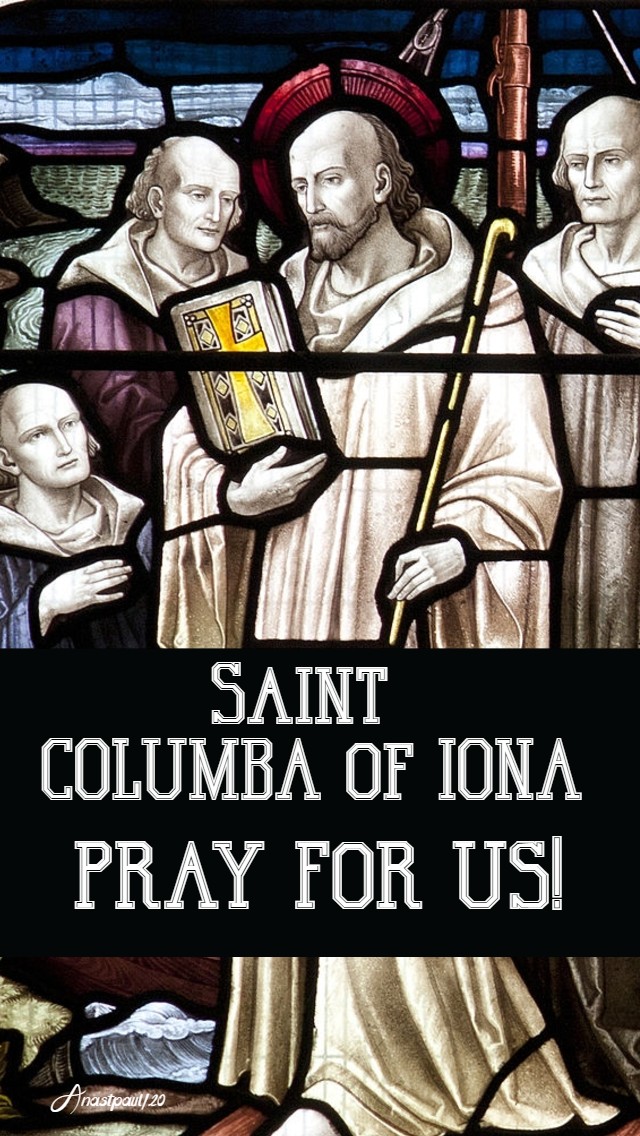
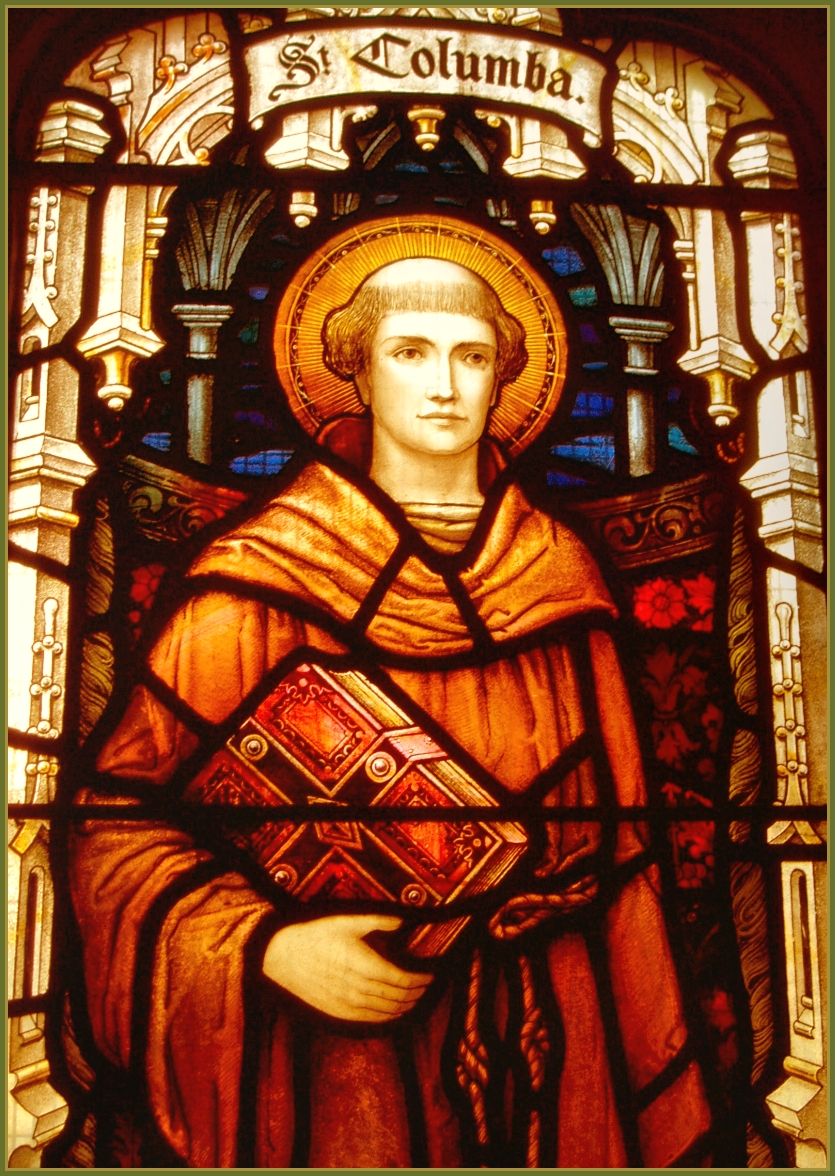
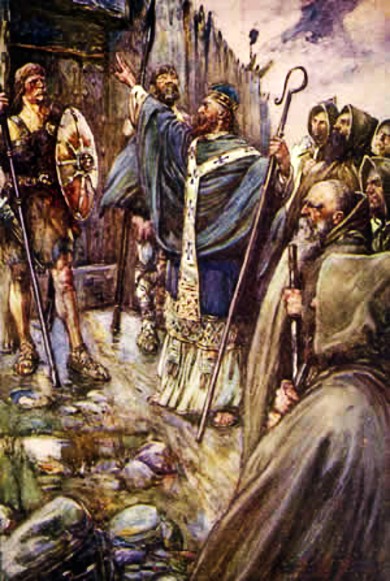
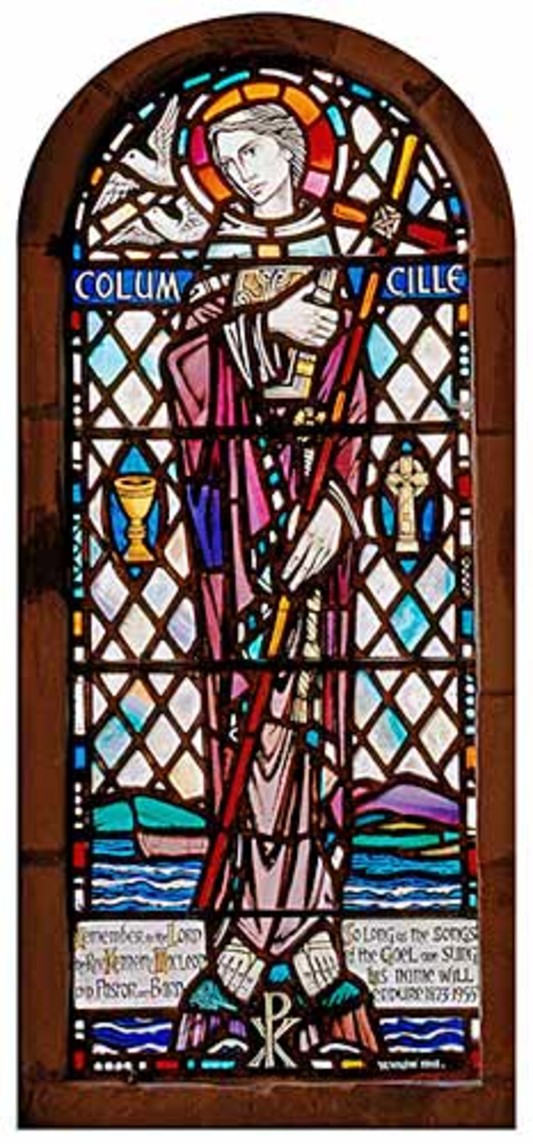
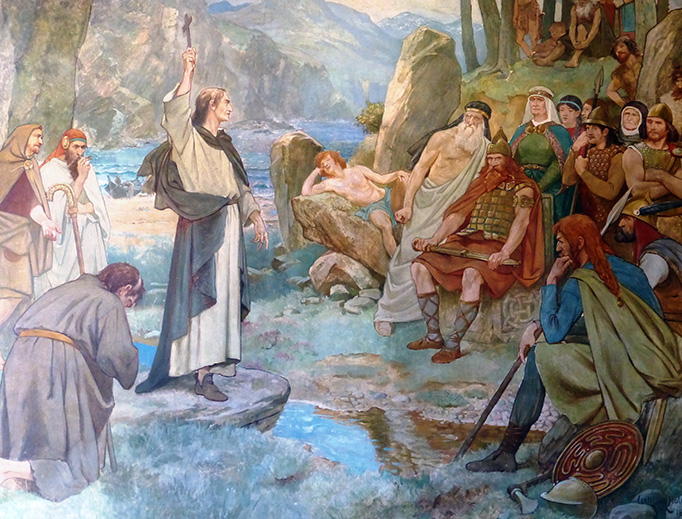
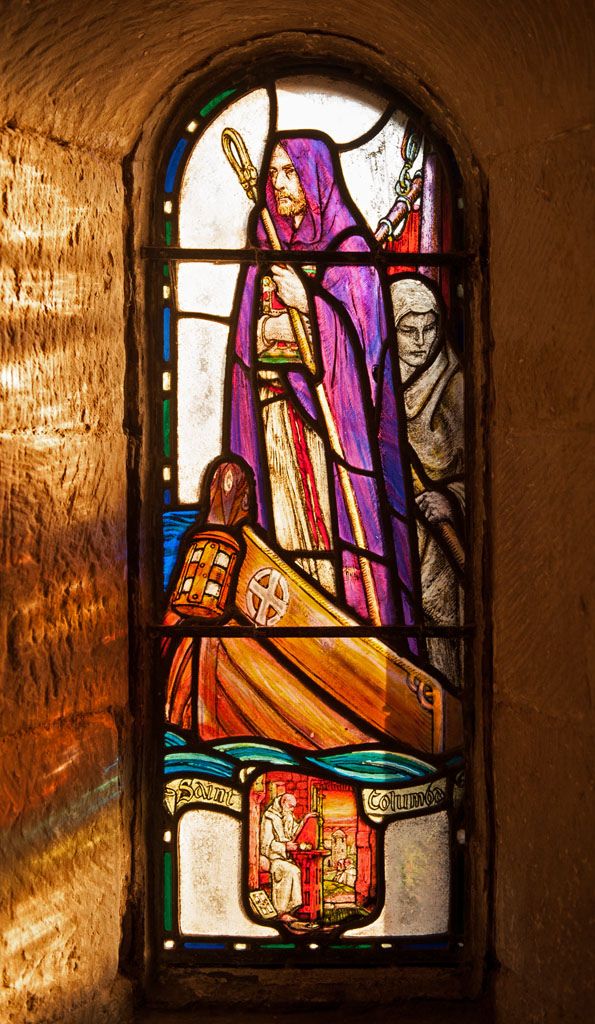
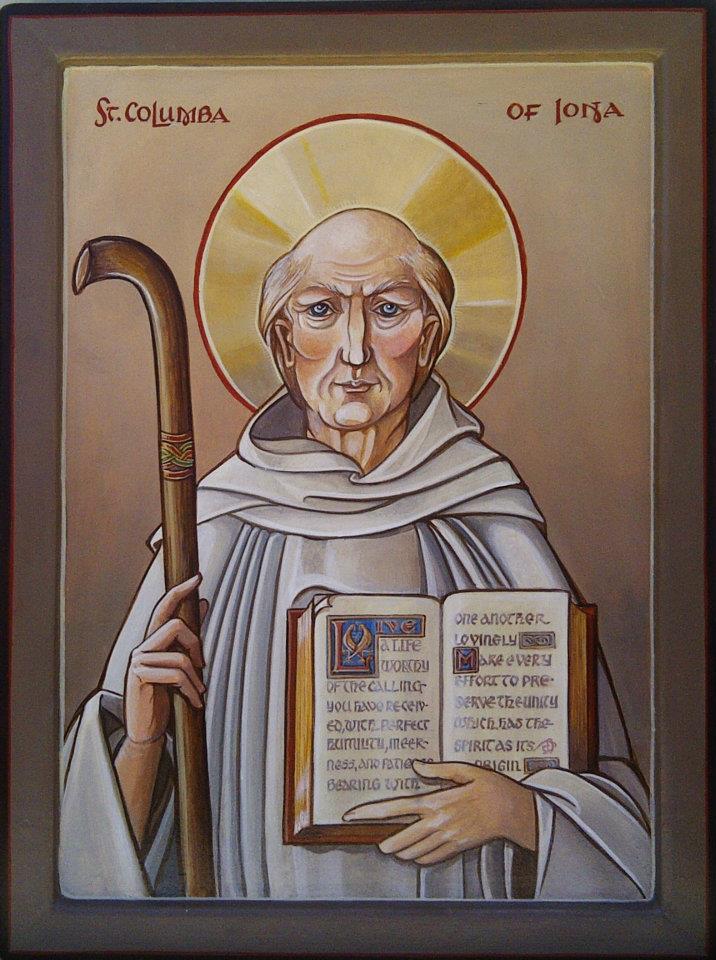
Saint of the Day – 9 June – Saint Columba of Iona (521-597) Apostle of the Picts, Apostle to Scotland, Abbot, Missionary, Evangelist, Poet, Scholar and Writer – born on 7 December 521 at Garton, County Donegal, Ireland and died on 9 June 597 at Iona, Scotland and buried there. Patronages – Derry, against floods, bookbinders, poets, co-patron of Ireland and of Scotland. St Columba is also known as Coim, Colmcille, Colum, Columbkill, Columbkille, Columbus, Columcille, Columkill, Combs. Additional Memorials – 6 January as one of the Twelve Apostles of Ireland, 17 June translation of relics.
His parents named him Crimtham (Pronounced Criffan) meaning “a fox.” This was not an unusual name at the time, as it signifies the type of attributes that a Celtic noble would need throughout his life – those of cunning and stealth. Later on Columba showed such gentleness, sweetness of nature and a desire for things sacred, that those around him called him Colm which means “a dove” and sometimes Colmcille, meaning “dove of the church.” The latter is the name most often given the saint in his native Ireland. More than likely St Columba would have been High King of Ireland had he not devoted his life to the best cause of all – proclaiming the message of Jesus Christ.
The son of a tribal chieftain, Columba was given the name Crimthann when he was Baptised shortly after his birth in Gartan, County Donegal. When he was a boy, he was so often found praying in the town church that his friends called him Colm Cille (Dove of the Church) and it was as Colm, or its Latin form Columba, that he was known for the rest of his life.
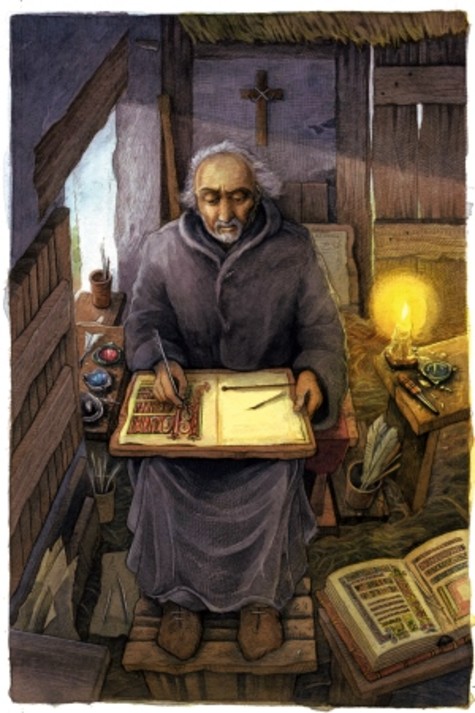
In his early 20s, Columba was strongly influenced by one of his teachers, St Finian of Clonard, and asked to be Ordained a Priest. When a prince cousin gave him some land at Derry, he decided to start a Monastery. Because of his love of nature Columba refused to build the Church facing east, as was the custom, he wanted to spare the lives of as many oak trees as he could. His foundation of another Monastery at Durrow 7 years later, was the beginning of an extraordinary decade during which he travelled through northern Ireland teaching about Christianity and inspiring many people by his personal holiness. He founded some 30 Monasteries in those 10 years.
Columba’s strong personality and forceful preaching aroused considerable antagonism. He was accused in 563 of starting a war between two Irish tribes and was sentenced by the high king never to see Ireland again, to spend the rest of his life in exile. This battle it is believed, resulted over what is today seen, as the first Copyright dispute in history – Columba had become involved in a quarrel with Finnian of Moville of Movilla Abbey over a psalter. Columba copied the manuscript at the Scriptorium under Finnian, intending to keep the copy. Finnian disputed his right to keep it.
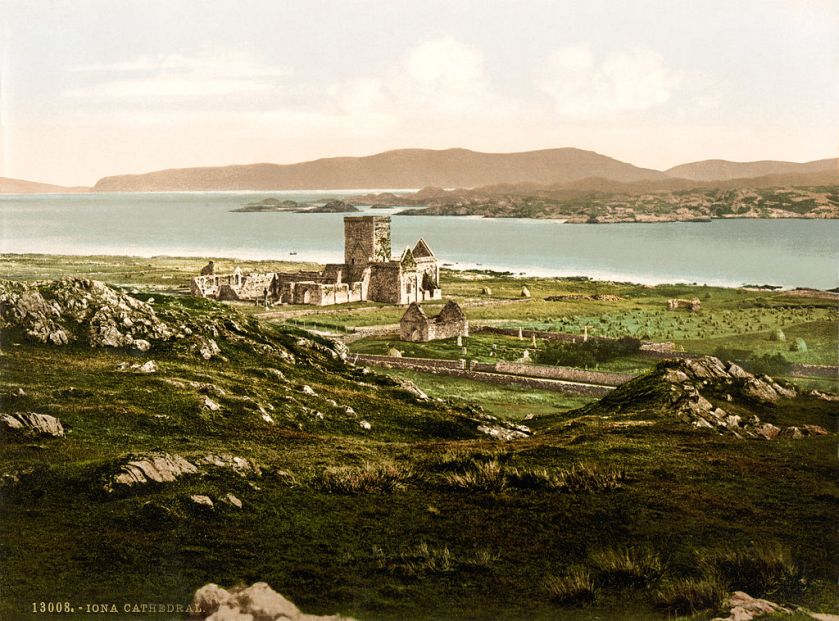
With 12 companions he sailed from the shores he loved and settled on a bleak island called Iona off the coast of Scotland. The monks made occasional visits to the Scottish mainland, where they preached Christianity. Soon their community had 150 members.
In 575, Columba was persuaded to visit Ireland to mediate a dispute between the high king and the league of poets. Insisting on remaining faithful to the terms of his exile, that he never see Ireland again, he travelled blindfolded. Although his sympathies were with the poets, his reputation was respected by everyone. He spoke to the assembled nobles and clergy with such force and authority that the king was persuaded to reverse his original decree and the hostility between the two parties was calmed.
Columba spent the rest of his life on Iona, praying, fasting and teaching his monks to read and copy the Scriptures. He provided inspiration for their Missionary efforts and was influential, in the politics of Scotland. Long before his death in 597 he was regarded as a saint by his fellow monks and is today a beloved figure in Irish tradition.
Columba died on Iona and was buried in 597 by his monks in the Abbey he created. His relics were removed in 849 and divided between Scotland and Ireland. The parts of the relics which went to Ireland are reputed to be buried in Downpatrick, County Down, with Saint Patrick and Brigid of Kildare and at Saul Church neighbouring Downpatrick.
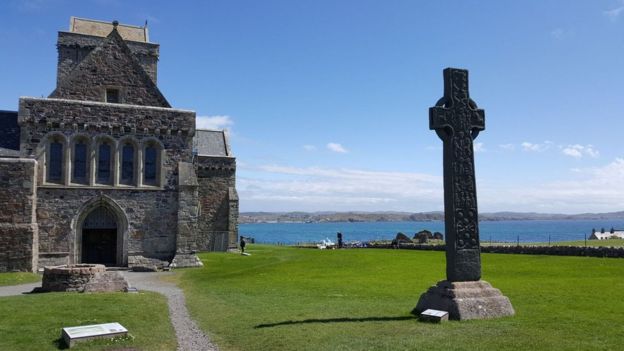
Iona Abbey
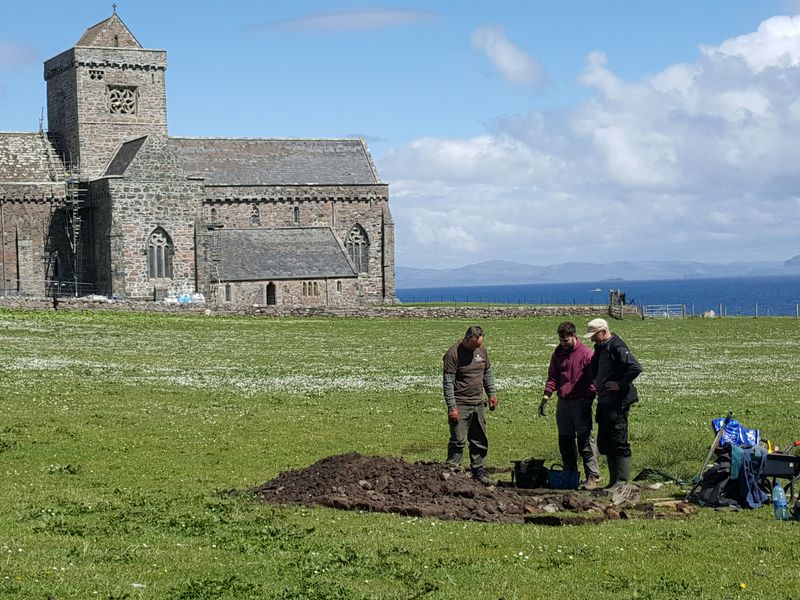
After his death Iona became a place of pilgrimage for kings and commoners. 60,000 of the latter still visit the rebuilt abbey every year. But did Columba leave any physical trace? His successor Adomnán, writing 100 years after the saint’s death, described him working in his cell on a rocky hillock. That knoll is called Tòrr an Aba – “the mound of the Abbot.” In 1957 the site was excavated by a team led by the Cornish historian and archaeologist Charles Thomas. On Tòrr an Aba the diggers found hazel charcoal, apparently the remains of a wattle hut. The site had been deliberately covered with beach pebbles and there was a hole where a post – possibly a cross – had been placed. Were these the remains of Columba’s cell? Charles Thomas thought so. Only 60 years later were carbon tests capable of being done and they have confirmed that this must’ve been St Columba’s cell.
The Dig in 1957
Dr Campbell who did the testing said: “This being St Columba, who is so important as a spiritual figure and as a person who founded this series of Monasteries which cultivated learning which spread throughout Europe, it’s really important. It’s really exciting to be able to touch some of the things that were associated with him.”Sixty years on, some of Prof Thomas’s fellow diggers on Iona are still alive. They were as sure as they could be, that this was the saint’s Scriptorium but lacked the backing of modern radiocarbon dating. Sadly Charles Thomas did not live to see his work vindicated. He died in 2016 a year before the definitive date of his samples could be established.
St Columba’s restored Cell
There is a lovely story, whereby St Columba prophesied his own death. It was the Sabbath and he told his fellow monks that his Sabbath was come, his time of departure, to the Lord.
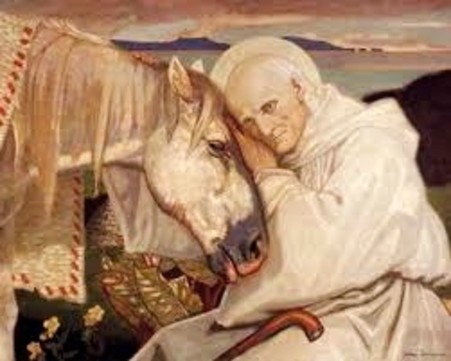
As St Columba sat down, to rest his weary, aching body, the Monastery’s work horse approached him. It lay its head upon the saint’s shoulder, as though to console him and to wish him farewell. They remained there together for a short while.
Seventy-five years of prayer, mortification and fasting were almost at an end. The north of Scotland was converted. Monks, trained by St Columba had travelled southwards, setting up Monasteries and converting the northern English. Iona was becoming the great place of pilgrimage it has remained for centuries, to his day.
He made his way to the chapel, blessed his fellow monks and took his leave, expiring right there at the foot of the altar.
And I think it is extremely fitting at this time, to petition this great saint of Ireland to prayers of intercession, for the rekindling of the Faith in this land.
St Columba, Pray for Ireland.
St Columba, Pray for Scotland.
St Columba, Pray for Holy Mother Church.
St Columba, Pray for Us All!
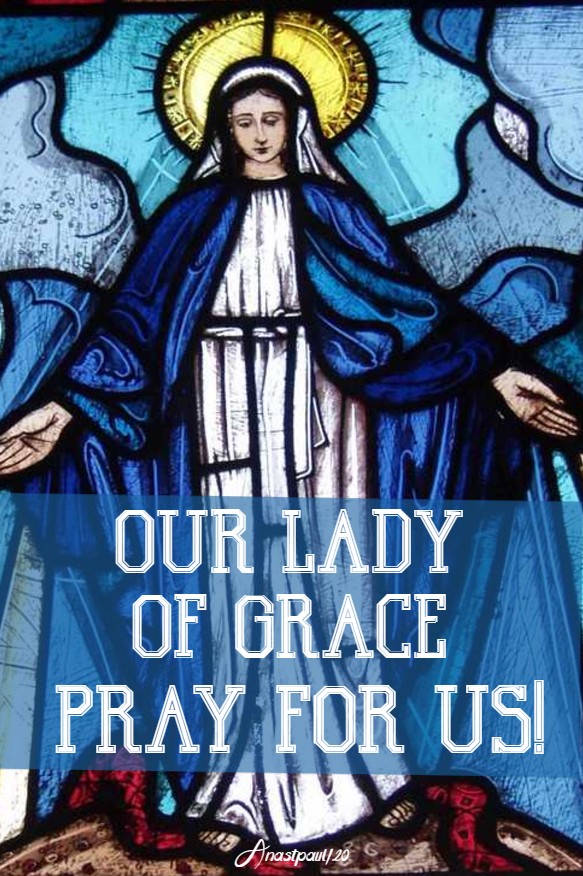
Feast of Our Lady of Grace – 9 June – Tuesday of the Tenth Week in Ordinary Time, Year A
Our Lady of Grace is another of the several titles by which Augustinians have traditionally venerated the Blessed Virgin. In fact it is the oldest among these. From the moment that she received the angel’s greeting and gave her consent to God’s invitation to become the mother of the Word made flesh, Mary became the bearer of Grace in this world.
This title of ‘Our Lady of Grace’ is the oldest with which the Order has shown veneration to Mary. The General Chapter of 1284 prescribed the daily recitation or chant of the ‘Benedicta Tu‘ precisely in honour of Our Lady of Grace. The antiphon ‘Ave Regina Caelorum’, also dating back to the 13th Century, is in honour of this same title as well.
A confraternity with the title ‘Lady of Grace’ was established at least as early as 1401 in Augustinian friaries of Spain and Portugal and, over the subsequent one hundred years, had extended widely throughout the Order. New friaries under this title began to be established in Italy and Latin America. In 1807 Pope Pius VII, at the request of Venerable Joseph Menochio, Papal Sacristan and Confessor to the Pope, granted the Order the right to celebrate this Feast on 1 June (or 9 June in some places).
The Virgin Mary, greeted by the angel as ‘full of grace’ became, from that moment, the Mother of Grace. As Mother of the one and only Mediator Jesus, she is Mother of the Author of Grace and dispenser of Grace.
—
Bl Alexander of Kouchta
St Alexander of Prusa
Bl Anne Marie Taigi
St Arnulf of Velseca
St Baithen of Iona St Columba of Iona (521-597) Apostle of the Picts, Apostle to Scotland
St Comus of Scotland
St Cumian of Bobbio
St Cyrus
Bl Diana d’Andalo
St Diomedes of Tarsus
St Felicianus
Bl Henry the Shoemaker
St Jose de Anchieta
Bl Joseph Imbert
St Julian of Mesopotamia
St Luciano Verdejo Acuña
Bl Luigi Boccardo
St Maximian of Syracuse
St Pelagia of Antioch
St Primus
St Richard of Andria
Bl Robert Salt
Bl Sylvester Ventura
St Valerius of Milan
St Vincent of Agen
—
Martyrs of Arbil – 5 saints: Five nuns who were martyred together in the persecutions of Tamsabur for refusing to renounce Christianity for sun-worship – Amai, Mariamne, Martha, Mary and Tecla. They were beheaded on 31 May 347 at Arbil, Assyria (in modern Kurdistan, Iraq)
ANNOUNCING the NOVENA to the SACRED HEART BEGINS Wednesday 10 JUNE
This devotion to the Sacred Heart of Jesus Christ is nothing more than an exercise of love towards this amiable Saviour.
But as to the principal object of this devotion, the spiritual object is the love with which the Heart of Jesus Christ is inflamed towards men, because love is generally attributed to the heart, as we read in many places of Scripture: My son, give Me thy heart. [Prov. xxiii. 26] My heart and my flesh have rejoiced in the living God. [Ps. lxxxiii. 3] The God of my heart and the God that is my portion forever. [Ps. lxxii. 26] The charity of God is poured forth in our hearts by the Holy Ghost Who is given to us. [Rom. v. 5]
The material or sensible object is the most Sacred Heart of Jesus, not taken separately by Itself but united to His sacred humanity and, consequently, to the Divine Person of the Word.
“How do we serve God faithfully? We serve Him only as faithfully as we serve Him lovingly, by giving ourselves to the needs of everyone whom God puts into our lives. No-one reaches heaven automatically. Heaven must be dearly paid for. The price of reaching heaven is the practice of selfless love here on earth.
… Devotion of the Sacred Heart is the solution to the gravest problem in the modern world today. How can we give ourselves to those who do not love us, who even positively hate us? We can love them, with the help of divine grace, by following the example of Jesus Christ, who died on the Cross out of love for a sin-laden human race.” … Ven Servant of God Fr John A Hardon SJ (1914-2000)
Thought for the Day – 8 June – “Month of the Sacred Heart” – Meditations with Antonio Cardinal Bacci (1881-1971)
Our Response to the Love
of the Sacred Heart
“The Sacred Heart of Jesus is adorable in itself, not only as the living symbol of His human-divine love but, also, as part of His most holy humanity, insofar as it is hypostatically united to the divinity of the Word.
We should, therefore, pay very special homage to the Sacred Heart.
It is the Heart of the God-Man and, as such, is worthy of our highest adoration.
It’s sentiments harmonised mysteriously with the human will and, at the same time, with the divine Will of the Incarnate Word of God.
Every throb, was a token of an infinite love which we could never fully understand, for we cannot properly “know Christ’s love which surpasses knowledge” (Eph 3:19).
But, we should adore this love as represented by the Sacred Heart of Jesus.
The adoration is not an act of idolatory.
On the contrary, it is a fitting act of worship, because, it’s object is the Heart of the God-Man and, of the human-divine love of which it is the symbol.
Moreover, we owe the Sacred Heart of Jesus, all our gratitude and a return of love.
Let us reflect on how much Jesus has done for us and how much He has loved us.
Let us consider, not only the general work of Redemption and the supernatural gifts and graces connected with it but, also, the particular favours which we received from our childhood, up to the present moment.
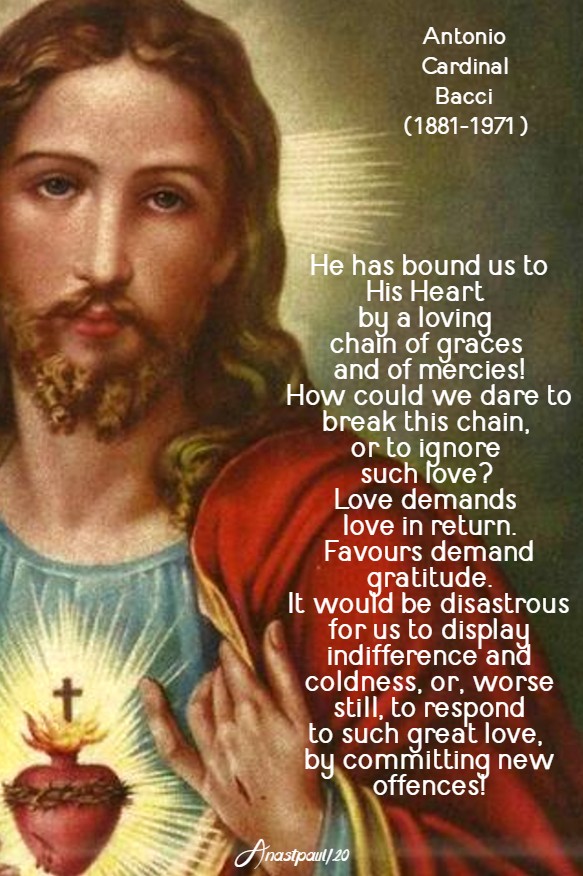
He has bound us to His Heart by a loving chain of graces and of mercies!
How could we dare to break this chain, or to ignore such love?
Love demands love in return.
Favours demand gratitude.
It would be disastrous for us to display indifference and coldness, or, worse still, to respond to such great love, by committing new offences!”
Quote/s of the Day – 8 June – Month of the Sacred Heart” – Monday of the Tenth week in Ordinary Time, Year A, Readings: 1 Kings 17:1-6, Psalm 121:1-8, Matthew 5:1-12
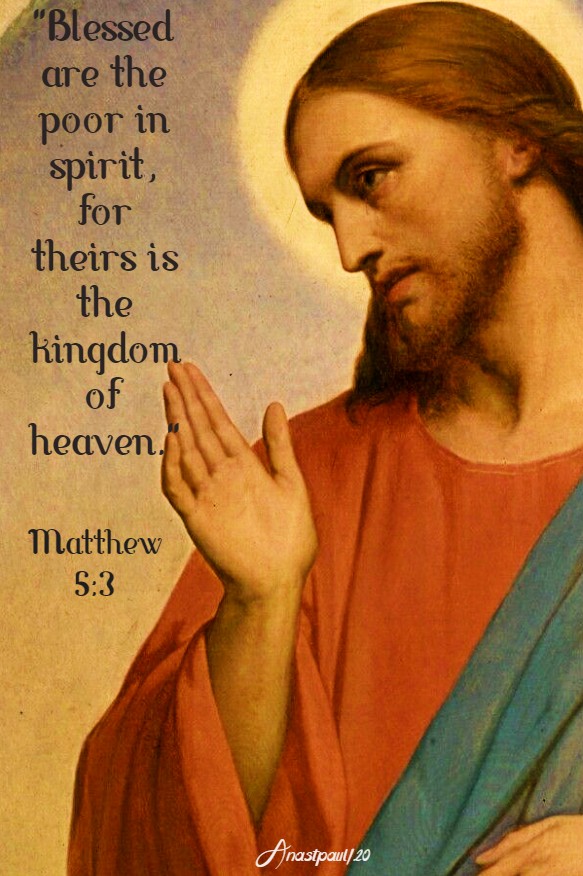
Part One: The Beatitudes (a tiny beginning)
“Blessed are the poor in spirit, for theirs is the kingdom of heaven.”
Matthew 5:3
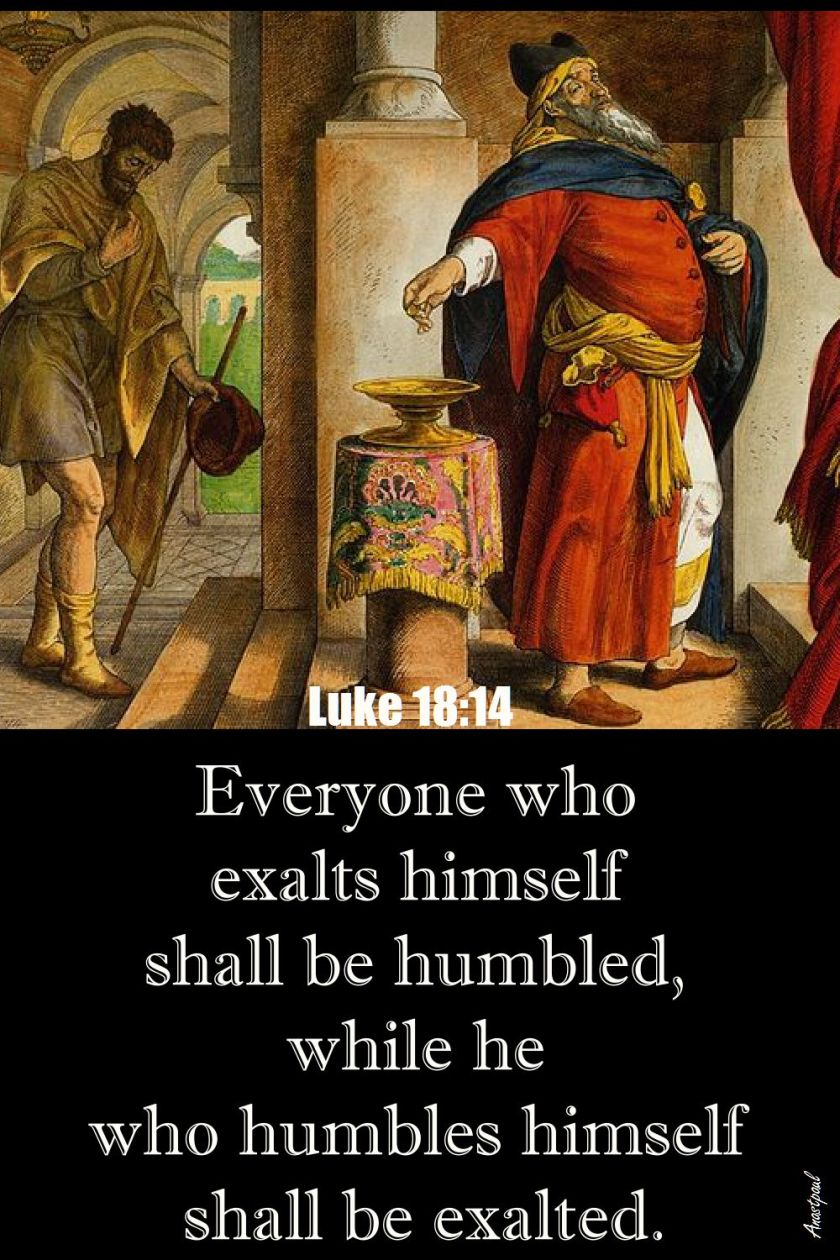
“…For everyone who exalts himself will be humbled but he who humbles himself, will be exalted.”
Luke 18:14
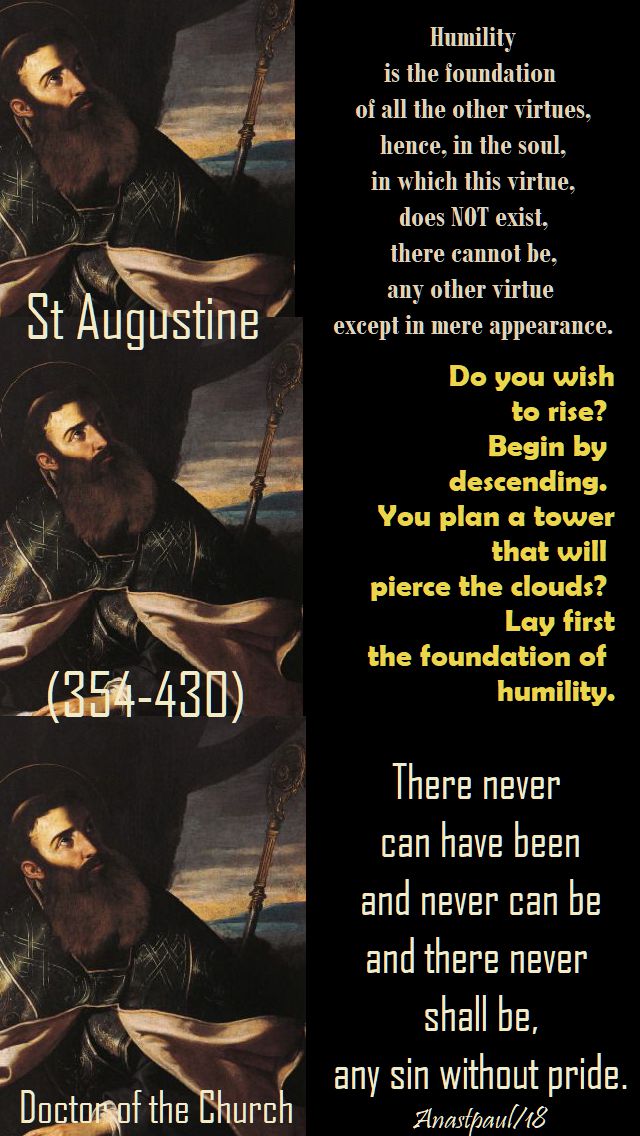
“Humility is the foundation of all the other virtues, hence, in the soul in which this virtue does NOT exist, there cannot be any other virtue except in mere appearance.”
“Do you wish to rise? Begin by descending. You plan a tower, that will pierce the clouds? Lay first, the foundation of humility.”
” There never can have been and never can be and there never shall be, any sin without pride.”
St Augustine (354-430) Doctor of the Church
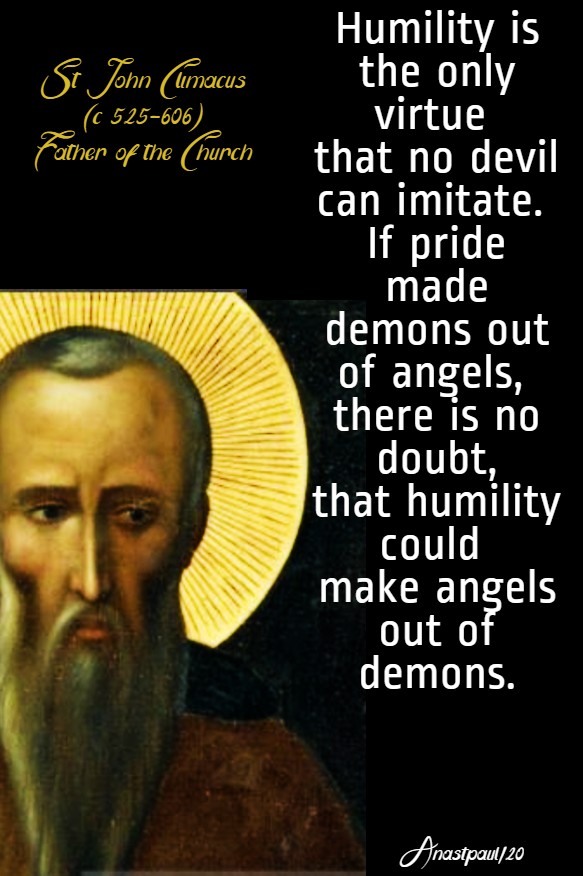
“Humility is the only virtue that no devil can imitate. If pride made demons out of angels, there is no doubt, that humility could make angels out of demons.”
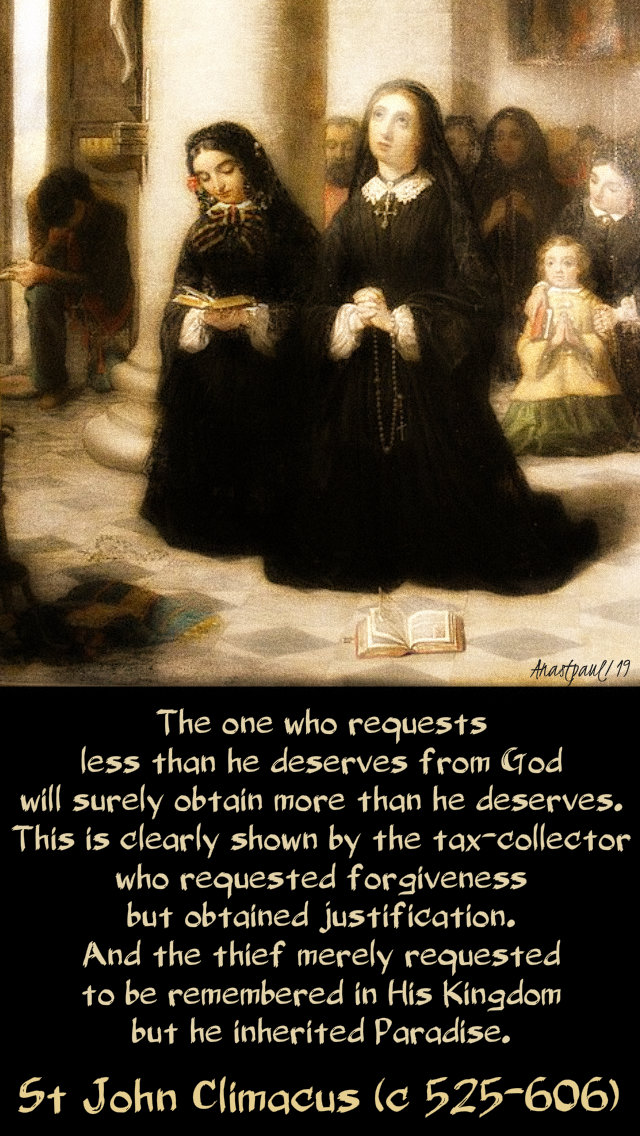
“The one who requests less than he deserves from God will surely obtain more than he deserves. This is clearly shown by the tax-collector who requested forgiveness but obtained justification. And the thief merely requested to be remembered in His Kingdom but he inherited Paradise.”
St John Climacus (c 525-606)
Father of the Church
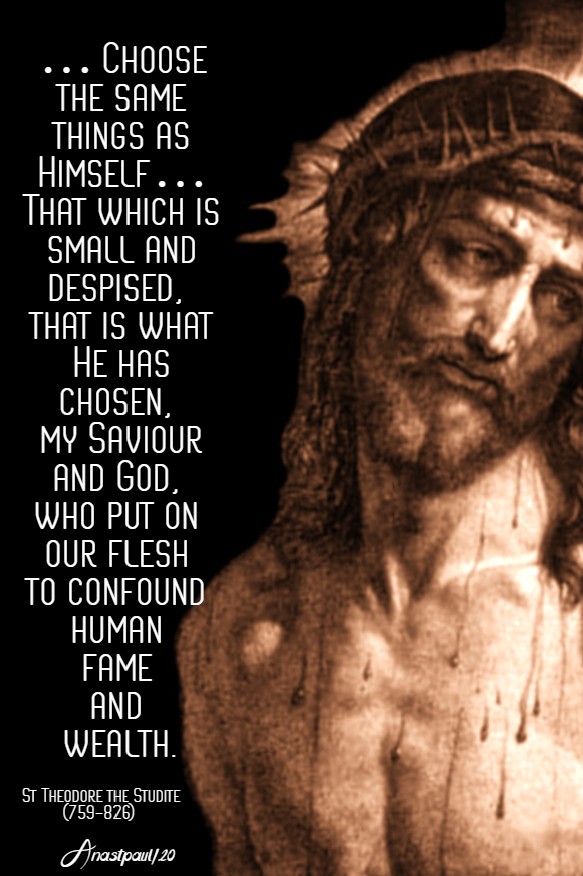
“‘… Choose the same things as Himself…’” That which is small and despised, that is what He has chosen, my Saviour and God, who put on our flesh to confound human fame and wealth.”
St Theodore the Studite (759-826)
Monk and Theologian at Constantinople
Catechesis 78
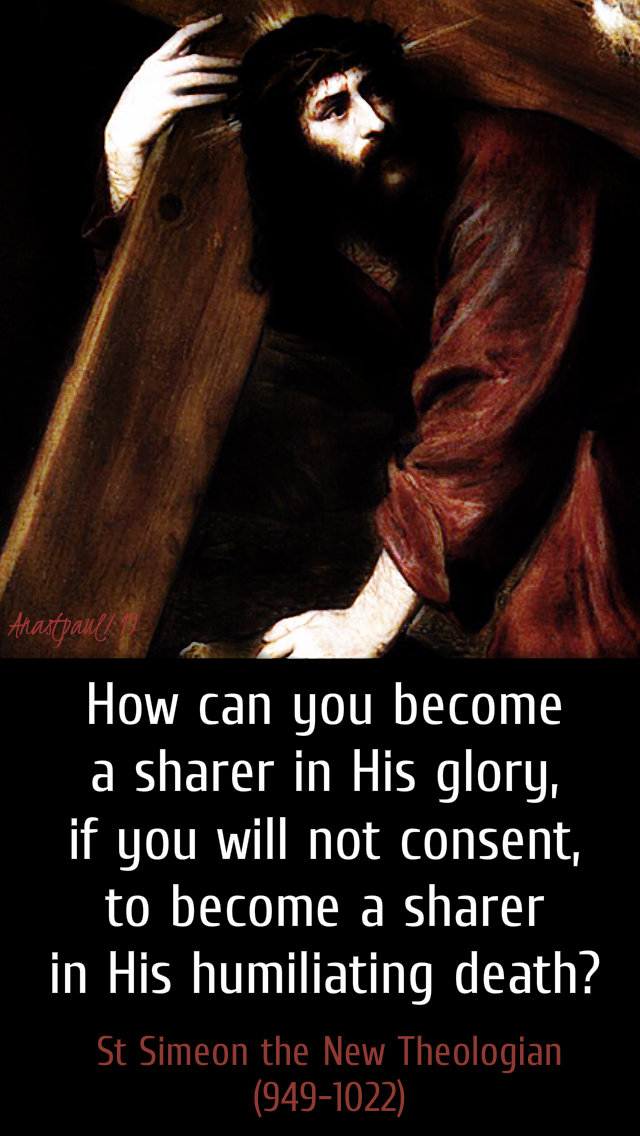
“Your Master is not disturbed by mockery and do you get upset? He bears spittle, blows, strokes of the lash and can you not take a harsh word? He accepts the cross, a humiliating death, the torture of the nails and can you not undertake to carry out the lowliest of tasks? How can you become a sharer in His glory (1 Pt 5:1) if you will not consent to become a sharer in His humiliating death?”
St Simeon the New Theologian (949-1022)
Catechesis 27
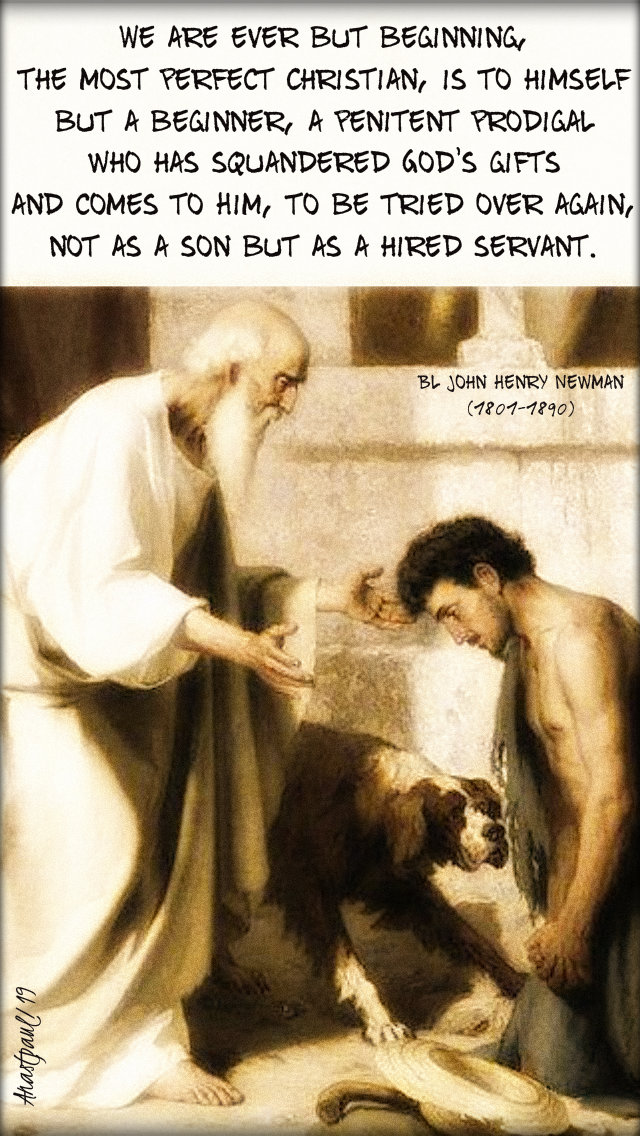
“We are ever but beginning, the most perfect Christian, is to himself but a beginner, a penitent prodigal who has squandered God’s gifts and comes to Him, to be tried over again, not as a son but as a hired servant.”
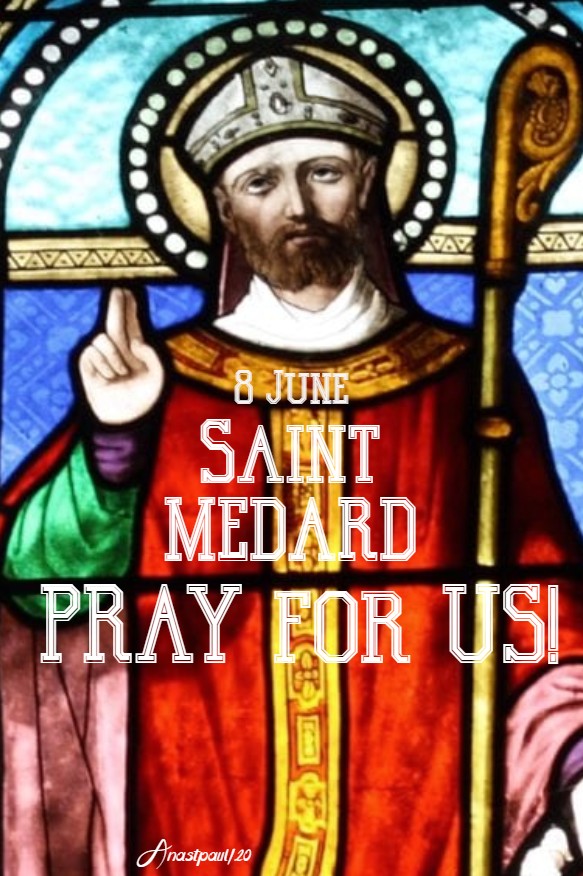
One Minute Reflection – 8 June – Month of the Sacred Heart” – Monday of the Tenth week in Ordinary Time, Year A, Readings: 1 Kings 17:1-6, Psalm 121:1-8, Matthew 5:1-12 and the Memorial of Saint Medard (c 456-545) Bishop
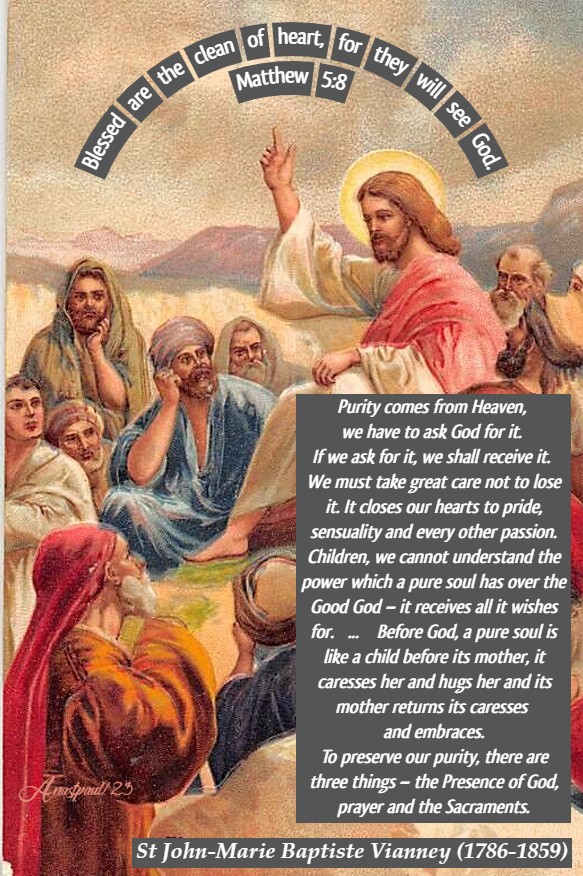
“Blessed are the clean of heart, for they will see God.” … Matthew 5:8
REFLECTION – “There is nothing as beautiful as a soul which is pure. If we understood this, we would be incapable of losing our purity. A pure soul is like a beautiful pearl. As long as it is concealed in a shell, at the bottom of the sea, no-one thinks of admiring it. But if you display it in the sun, then this pearl shines and draws people’s eyes.
Purity comes from Heaven, we have to ask God for it. If we ask for it, we shall receive it. We must take great care not to lose it. It closes our hearts to pride, sensuality and every other passion.
Children, we cannot understand the power which a pure soul has over the Good God – it receives all it wishes for. … Before God, a pure soul is like a child before its mother, it caresses her and hugs her and its mother returns its caresses and embraces.
To preserve our purity, there are three things – the Presence of God, prayer and the Sacraments.” … St John-Marie Baptiste Vianney (1786-1859) Curé d’Ars (Selected Thoughts of the Curé d’Ars).
PRAYER – Lord God and Father, grant us we pray, a heart like Your divine Son’s – His Sacred Heart is our standard and our goal – grant us a heart made of flesh, pure and beautiful in Your sight. May we ever seek Your Face and follow the love with which the Sacred Heart of Jesus guides our way. May the prayers of St Medan today, help us to be Your children, pure in heart. Through Christ our Lord, in the unity of the Holy Spirit, one God forever and ever, amen.
Our Morning Offering – 8 June – Month of the Sacred Heart” – Monday of the Tenth week in Ordinary Time, Year A
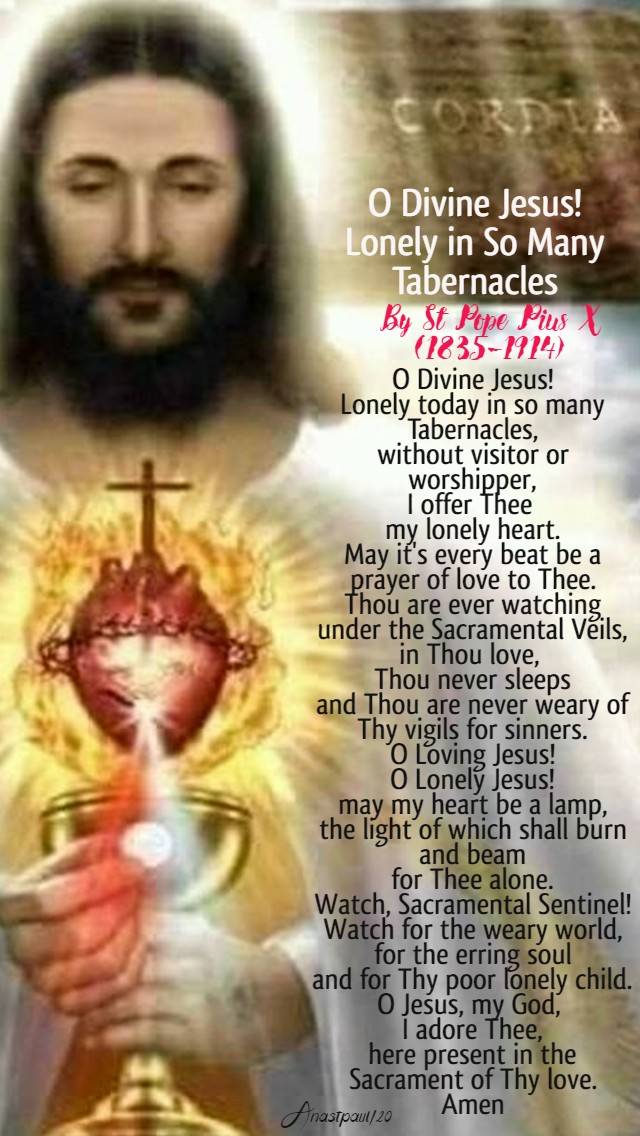
O Divine Jesus! Lonely in So Many Tabernacles By St Pope Pius X (1835-1914) “Pope of the Blessed Sacrament”
O Divine Jesus!
Lonely today in so many Tabernacles,
without visitor or worshipper,
I offer Thee my lonely heart.
May it’s every beat be a prayer of love to Thee.
Thou are ever watching under the Sacramental Veils,
in Thou love, Thou never sleeps
and Thou are never weary of Thy vigils for sinners.
O Loving Jesus!
O Lonely Jesus!
may my heart be a lamp,
the light of which shall burn and beam
for Thee alone.
Watch, Sacramental Sentinel!
Watch for the weary world,
for the erring soul
and for Thy poor lonely child.
O Jesus, my God, I adore Thee,
here present in the Sacrament of Thy love.
Amen
Indulgences: 100 days each time before the Tabernacle 300 days each time before the Blessed Sacrament Exposed (St Pope Pius X – 3 July 1908) Prayers to the Sacred Heart 15th Ed 1936
The Roman Martyrology states of St Medard and his twin brother, St Gildard, today: “At Soissons, in France, the birthday of St Medard, Bishop of Novon, whose life and precios death are illustrated by glorios miracles – at Rouen, St Gildard, Bishop, twin brother of St Medard,who was born with his brother on the same day, Consecrated Bishops at the same time and being taken away from this life, also on the same day, they entered Heaven together!”
Saint of the Day – 8 June – Saint Medard (c 456-545) Bishop and Confessor, Apostle of the poor – born in c 456 at Salency, Picardy, France – died on 8 June 545 at Noyon, France of natural causes. Patronages – the weather, invoked against toothache. St Medard was one of the most honoured Bishops of his time, often depicted laughing, with his mouth wide open and therefore he was invoked against toothache.
Saint Medard, one of the most illustrious prelates of the Church of France in the sixth century, was born of a pious and noble family, at Salency, about the year 457. From his childhood, he displayed the tenderest compassion for the poor. On one occasion he gave his coat to a destitute blind man and when asked why he had done so, he answered, that the misery of a fellow-member in Christ, so affected him that he could not help giving him part of his own clothes.
Being promoted to the Priesthood in the thirty third year of his age, he became a bright ornament of that sacred order. He preached the word of God with an unction which touched the hearts of the most hardened and the influence of his example, by which he enforced the precepts which he delivered from the pulpit, seemed irresistible.
In 530, Alomer, the thirteenth bishop of that country, died. St Medard was unanimously chosen to fill the see and was consecrated by St Remigius, who had Baptised King Clovis in 496, and was then exceeding old. Our Saint’s new dignity did not make him abate any of his austerities and, though at that time, seventy-two years old, he thought himself obliged to redouble his labours. Though his Diocese was very wide, it did not suffice his zeal, which could not be contained, when he saw the opportunity of advancing the honour of God and of abolishing the remains of idolatry. He overcame all obstacles and by his zealous labours and miracles, the rays of the Gospel dispelled the mists of idolatry throughout the whole extent of his Diocese. What rendered this task more difficult and perilous, was the savage and fierce disposition of the ancient inhabitants of Flanders, who were the most barbarous of all the nations of the Gauls and Franks.
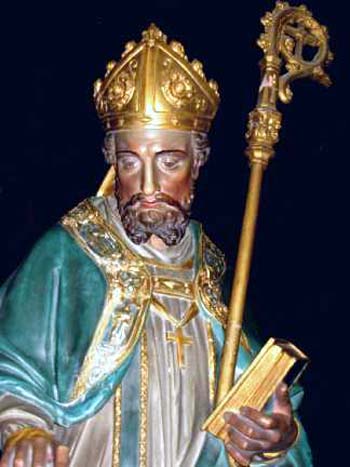
In 545, our Saint, having completed this great work in Flanders, returned to Noyon, where shortly after, he fell ill and soon rested from his labours at an advanced age. The whole kingdom lamented his death as the loss of their common father and protector. His body was buried in his own Cathedral but the many miracles wrought at his tomb so moved King Clotaire that he transferred the precious remains to Soissons. The Statue and the Gospel book below belonged to St Medard and reside at Soissons.
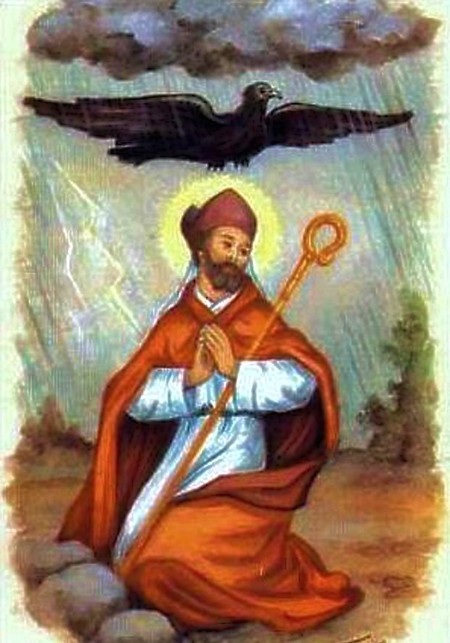
As a child, St Medard was said to have once been sheltered from rain by an eagle which hovered over him. This is how he was most commonly depicted and is why he is associated with weather, good or bad and why he is held to protect those who work in the open air. The French rhyme is: Quand il pleut à la Saint-Medard, il pleut quarante jours plus tard – If it rains on St Medard’s Day, it rains for forty days more.
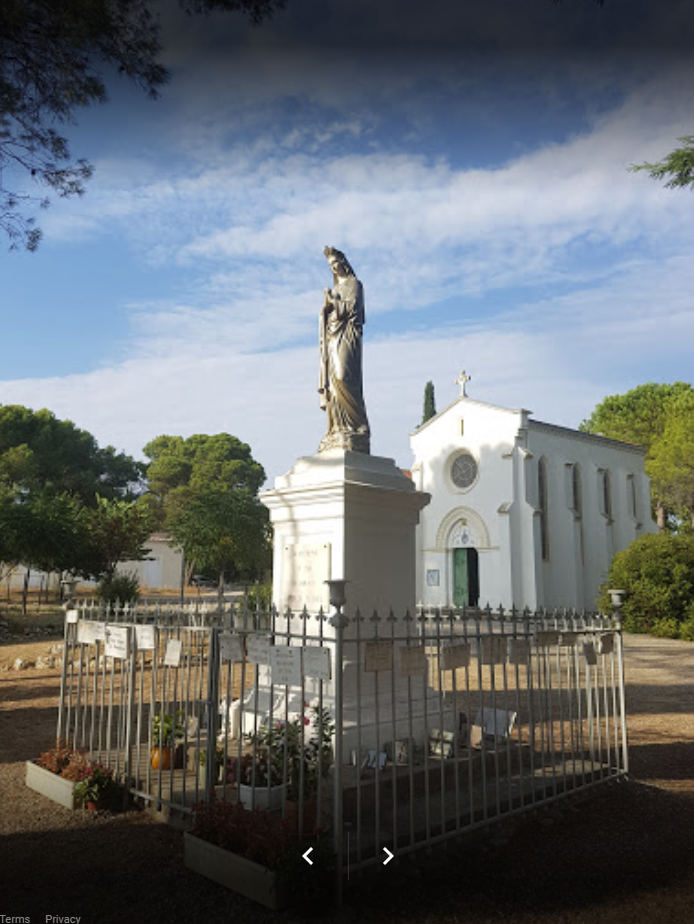
Every year at Salency (Medard’s birthplace) near Noyon, France (and certain other villages) “the most virtuous young girl of the year” of the community is elected the Rosière. The custom is said to have been started by St Médard himself and the first Rosaire is said to have been his sister, Sainte Médrine. Clothed in a long white dress, the Rosière is escorted to Mass by 12 young girls dressed in white and 12 young boys. After Mass, accompanied by two godmothers, she is crowned with a crown of 12 roses, decorated a blue ribbon and a silver ring, at the chapel of St Médard. Then she goes to receive a bouquet of roses from the mayor, who also presents her with two arrows, two tennis balls and a whistle. She blows the whistle three times and throws nuts to the assembled crowd. The procession is followed by a fair with rides, stalls and fireworks.
Our Lady of Sunday: Also known as Notre-Dame du Dimanche
About the Apparition:
An apparition of the Blessed Virgin Mary to Auguste Arnaud on 8 June 1873 and 8 July 1873. Arnaud was married, the father of two, and a winemaker who regularly skipped Sunday Mass to work his vineyards. Our Lady appeared to him in the vineyard on 8 June and reminded him“You must not work on Sundays.” In honour of this blessing, Arnaud placed a Cross and a Statue of Mary at the site in the field. On 8 July Our Lady appeared again, this time to both Auguste and his neighbours who had gathered there and told them, “You must never work on Sunday! Blessed are those who believe.”
Dates: 8 June and 8 July in 1873
Location: vineyard in Saint-Bauzille-de-la-Sylve, l’Hérault, France
Approval: 1876 by Bishop de Cabrières
__
St Anne Mary Taigi
St Bron of Cassel
St Calliope
St Clodulf of Metz
Bl Engelbert of Schäftlarn
St Eustadiola of Moyen-Moutier
St Fortunato of Fano
St Gildard of Rouen
Bl Giorgio Porta
Bl Giselbert of Cappenberg
St Heraclius of Sens
Bl István Sándor St Jacques Berthieu SJ (1838-1896) Biography:
Bl John Davy
Bl John Rainuzzi
Bl Maddallena of the Conception
Bl Mariam Thresia Chiramel Mankidiyan
St Maximinus of Aix St Medard (c 456-545)
St Melania the Elder
St Muirchu
St Pacificus of Cerano
Bl Peter de Amer
Bl Robert of Frassinoro
St Sallustian
St Syra of Troyes
St Victorinus of Camerino
St William of York
Sunday Reflection – 7 June – “Month of the Sacred Heart” – The Solemnity of the Most Holy Trinity
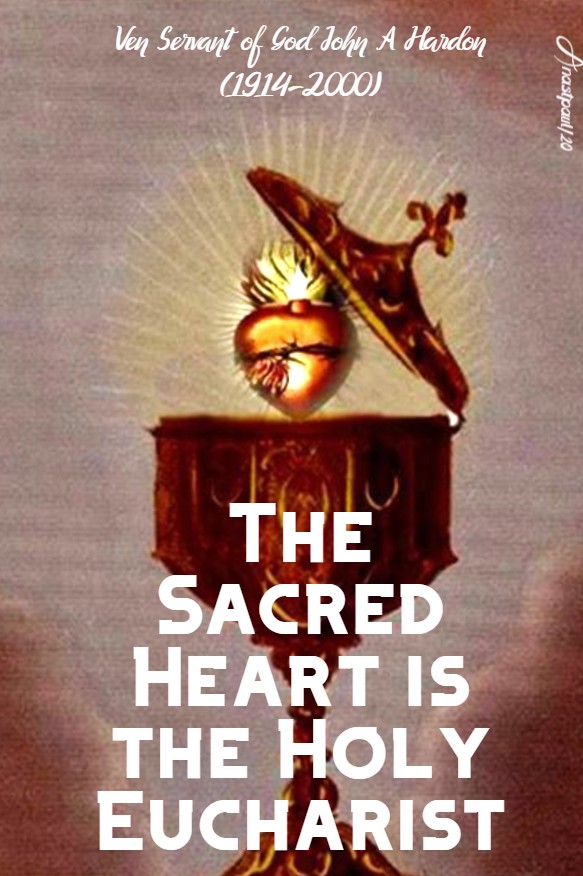
The Sacred Heart is the Holy Eucharist
By Ven Servant of God John A Hardon SJ (1914-2000)
It is impossible to identify the Holy Eucharist too closely with Jesus Christ. We should remember He is in the Holy Eucharist not merely with His substance.
I have corrected many of my students over the years who tell me “Transubstantiation means that the substance of bread and wine become the substance of Jesus Christ.”
I reply, “No, transubstantiation means the substance of bread and wine are no longer there. The substance of bread and wine is replaced, not only by the substance of Christ’s Body and Blood. What replaces the substance of bread and wine is Jesus Christ!”
Everything that makes Christ, Christ replaces what had been the substance of bread and wine.
The substance of bread and wine become the whole Christ.
Therefore, Christ in the Holy Eucharist is there with His human heart.
Is it a living heart? Yes! That is why the revelations our Lord made to St Margaret Mary about promoting devotion to the Sacred Heart were all made from the Holy Eucharist.
Why do we equate the Sacred Heart with the Holy Eucharist?
Because the Holy Eucharist is the whole Christ with His human heart. According to St Margaret Mary, the Sacred Heart is the Holy Eucharist.
So it follows, that devotion to the Sacred Heart is devotion to the Holy Eucharist.
It is infinite Love Incarnate living in our midst in the Blessed Sacrament.
Thought for the Day – 7 June – “Month of the Sacred Heart” – Meditations with Antonio Cardinal Bacci (1881-1971)
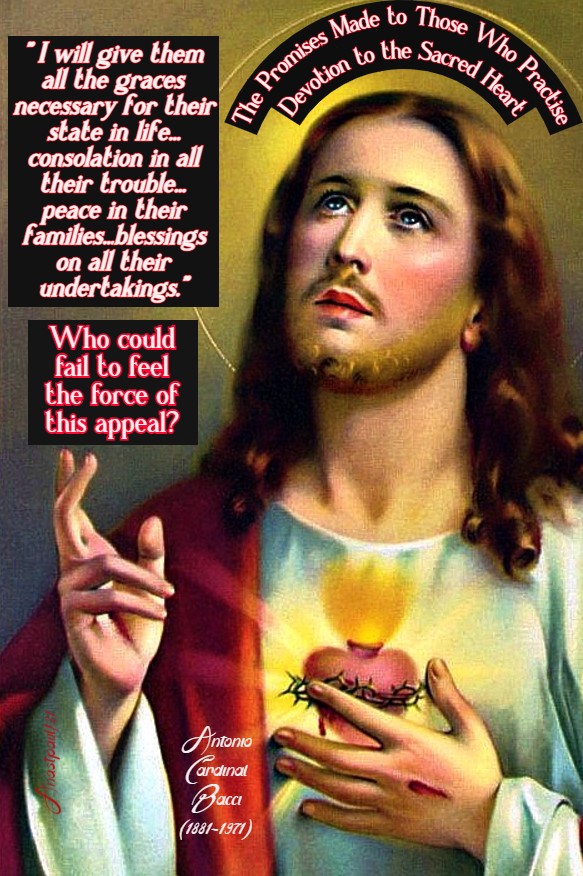
The Promises Made to Those Who Practise Devotion to the Sacred Heart
“When Jesus appeared to St Margaret Mary Alacoque and commanded her to propagate the worship of His Sacred Heart, He promised very special blessings to those who would be truly devoted to His Sacrd Heart and spread this devotion among others. “I will give them all the graces necessary for their state in life…consolation in all their trouble…peace in their families…blessings on all their undertakings.”
These promises are an inducement to us, to love Jesus and to spread devotion to His Sacred Heart.
Our Divine Saviour, is not content with having loved us so much during His mortal life and given us His Precious Blood, the Blessed Eucharist and His most Holy Mother, for our salvation. He sees that His infinite love is not returned as it ought to be and seems to exercise a gentle pressure, in order to compel us to love Him. “Behold this Heart which has so loved men that It spare nothing…to prove to them It’s love. And, in return, I receive from the greater part of men, nothing but ingratitude, by the contempt, irreverence, sacrileges and coldness with which they treat Me in this Sacrament of Love.”
“I thirst, I burn with a consuming desire for men’s love and I find none to quench this thirst, according to My wish, by making any return of love.”
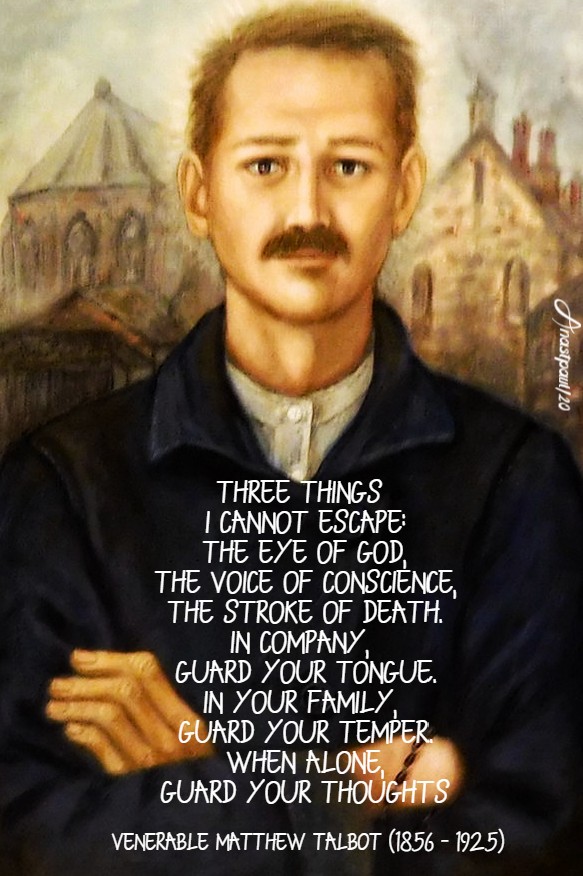
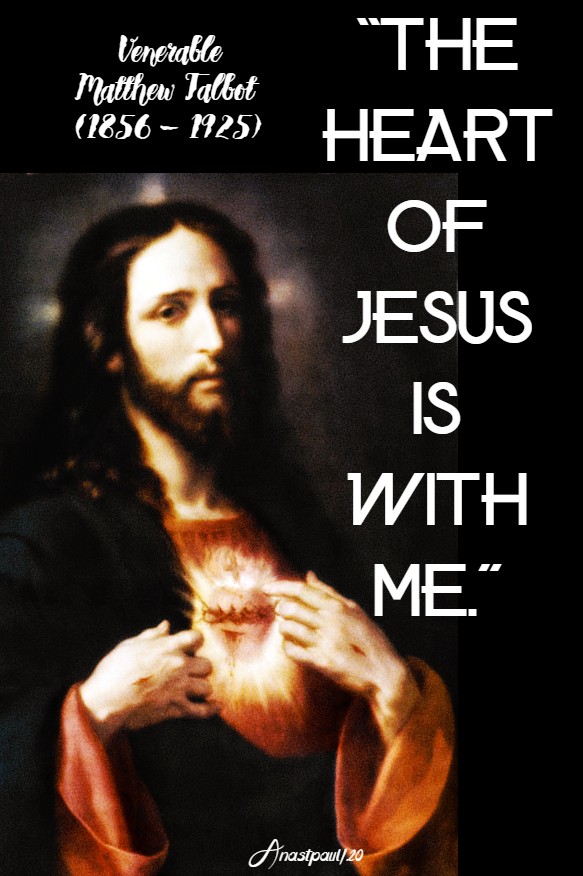
Quote/s of the Day – 7 June – “Month of the Sacred Heart” – The Solemnity of the Most Holy Trinity and The Memorial of Blessed Ana of Saint Bartholomew OCD (1550-1626) and Venerable Matthew Talbot (1856 – 1925)
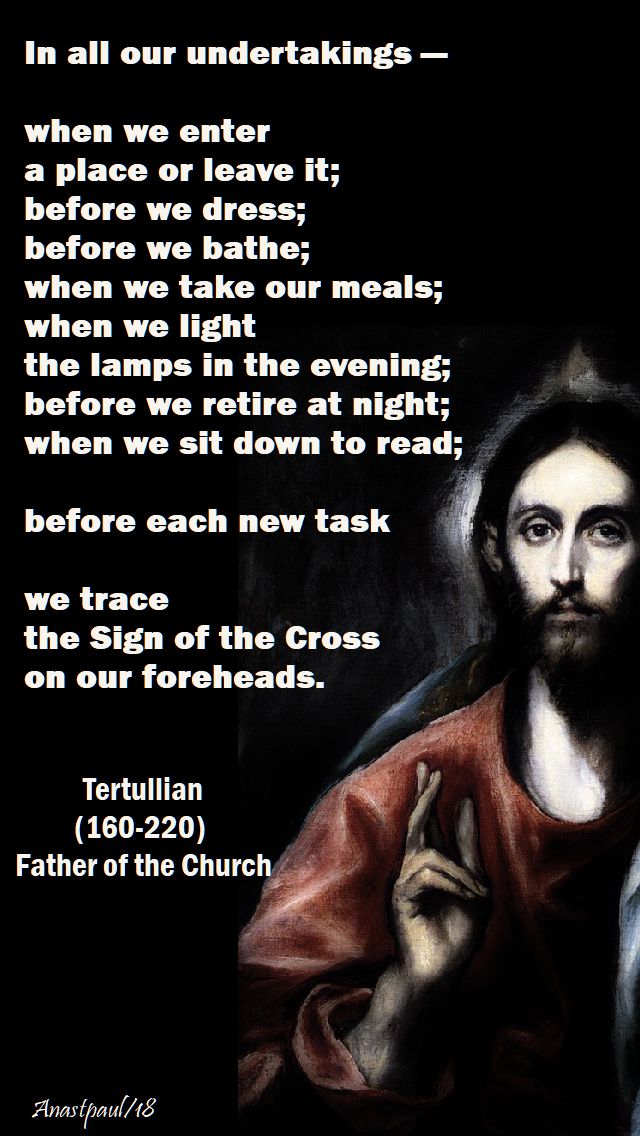
“In all our undertakings — when we enter a place or leave it, before we dress, before we bathe, when we take our meals, when we light the lamps in the evening, before we retire at night, when we sit down to read, before each new task — we trace the Sign of the Cross on our foreheads.”
Tertullian (160-220)
Father of the Church
“O adorable mystery! In the name of God, the Omnipotent Father, who created me! In the name of Jesus Christ, our Lord, Son of the living God, who bled for me! In the name of the Holy Spirit, who has been poured out on me!”
St John Henry Newman (1801-1890)
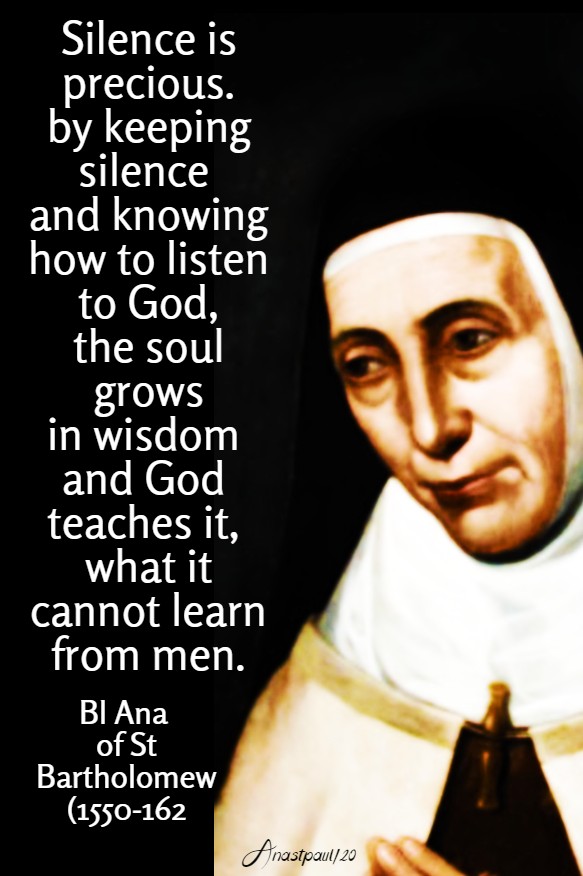
“Silence is precious. by keeping silence and knowing how to listen to God, the soul grows in wisdom and God teaches it, what it cannot learn from men.”
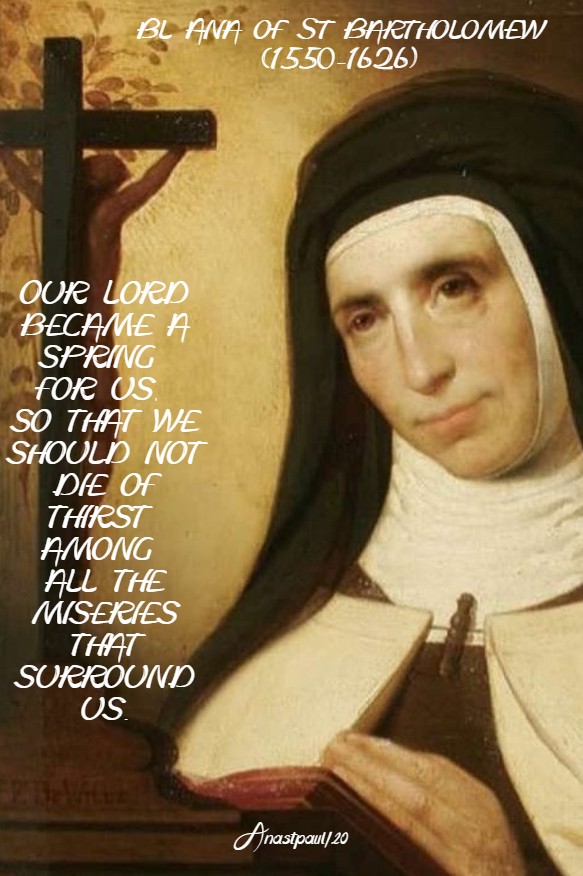
“Our Lord became a spring for us, so that we should not die of thirst among all the miseries that surround us.”
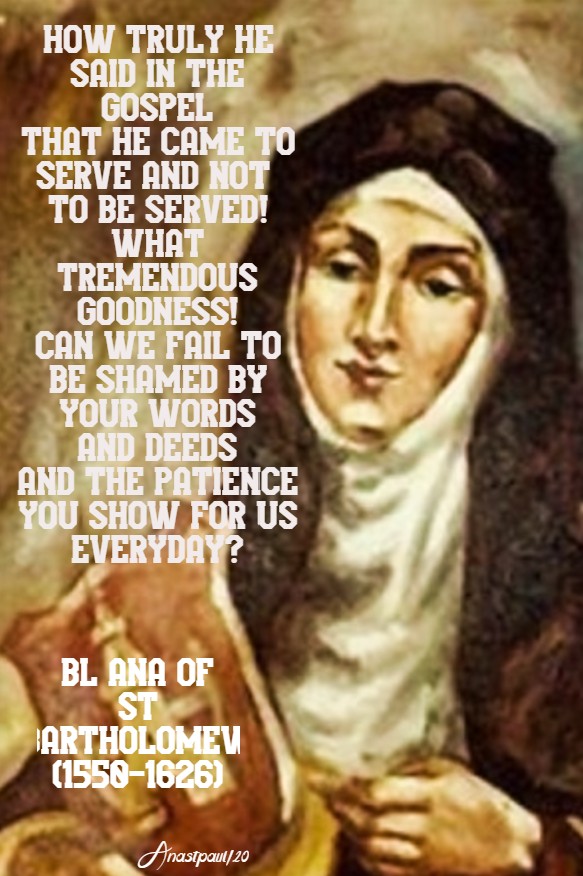
“How truly He said in the Gospel that He came to serve and not to be served! What tremendous goodness! Can we fail to be shamed by Your words and deeds and the patience You show for us everyday?”
Bl Ana of St Bartholomew (1550-1626)
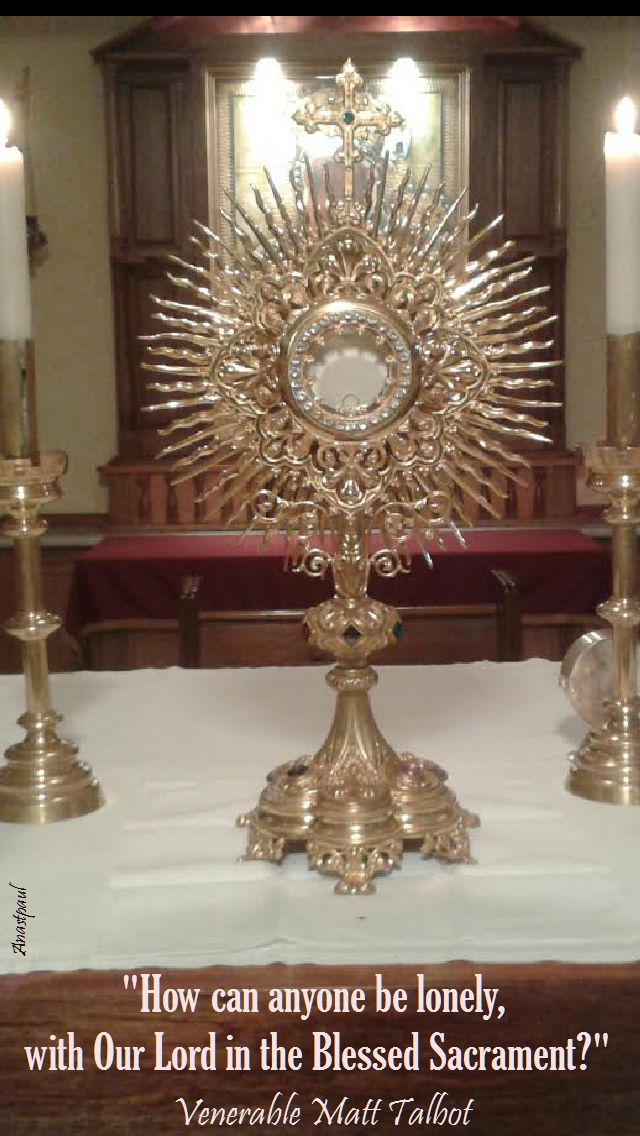
“How can anyone be lonely, with Our Lord in the Blessed Sacrament?”
“As to nobility of blood, true nobility is to be derived only, from the Blood of the Son of God.”
“Three things I cannot escape: the eye of God, the voice of conscience, the stroke of death. In company, guard your tongue. In your family, guard your temper. When alone guard your thoughts.”
One Minute Reflection – 7 June – The Solemnity of the Most Holy Trinity, Readings: Exodus 34:4-6, 8-9, Psalm Daniel 3:52.53.54.55.56, 2 Corinthians 13:11-13, John 3:16-18
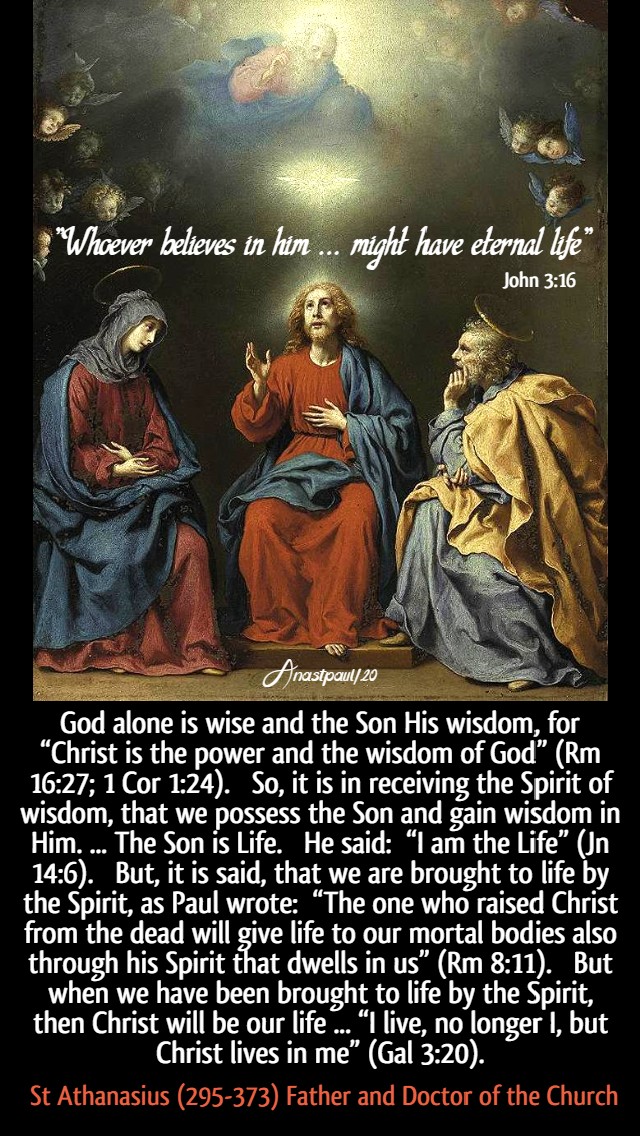
“Whoever believes in him … might have eternal life” … John 3:16
REFLECTION – “Fools! … how is it that you can’t stop your prying investigations into the Trinity or be content to believe it exists, since you have for your guide the apostle who wrote: “Anyone who approaches God must believe that he exists and that he rewards those who seek him” (Heb 11:6). (…) So let no-one put unnecessary questions to himself but, be content with learning what is contained in Scripture.
… Scripture tells us that the Father is both Source and Light: “They have forsaken me, the source of living waters” (Jer 2:13); “You have forsaken the fountain of wisdom” (Ba 3:12) and, according to John, “God is light” (1Jn 1:5). Now the Son, is called a river, in relation to the source for, according to the psalm, “the river of God is full of water” (Ps 65[64]:10). And in relation to the Light, He is called splendour, when Paul says that he is “the refulgence of his glory and the very imprint of his being” (Heb 1:3). Thus the Father is Light, the Son it’s refulgence… and, in the Son, it is by the Spirit that we are illuminated. “May God give you a spirit of wisdom and revelation,” says Paul, “resulting in knowledge of him. May the eyes of your hearts be enlightened” (Eph 1:17-18). But, when we are enlightened, it is Christ who enlightens us in Him, for Scripture says: “He was the true light who enlightens everyone coming into the world” (Jn 1:9). Moreover, since the Father is Source and the Son is called River, we are said to drink of the Spirit: “We were all given to drink of one Spirit” (1Cor 12:13). But, refreshed by the Spirit, we drink Christ since: “They drank from a spiritual rock that followed them and the rock was the Christ” (1Cor 10:4). (…)
God alone is wise and the Son His wisdom, for “Christ is the power and the wisdom of God” (Rm 16:27; 1 Cor 1:24). So, it is in receiving the Spirit of wisdom, that we possess the Son and gain wisdom in Him. … The Son is Life. He said: “I am the Life” (Jn 14:6). But, it is said, that we are brought to life by the Spirit, as Paul wrote: “The one who raised Christ from the dead will give life to our mortal bodies also through his Spirit that dwells in us” (Rm 8:11). But when we have been brought to life by the Spirit, then Christ will be our life … “I live, no longer I, but Christ lives in me” (Gal 2:20).
When such a correspondence and unity exists in the Holy Trinity, who can separate either the Son from the Father, or the Spirit from the Son or the Father? … God’s mystery is not communicated to our minds by demonstrative arguments but, by faith and reverent prayer.” … St Athanasius (295-373) Bishop of Alexandria, Father and Doctor of the Church – Letters to Serapion, no.1, 19
PRAYER – Firmly I Believe and Truly – St John Henry Newman (1801-1890)
Firmly I believe and truly God is three and God is On And I next acknowledge duly Manhood taken by the Son. And I trust and hope most fully In that Manhood crucified And each thought and deed unruly Do to death, as He has died. Simply to His grace and wholly Light and life and strength belong And I love, supremely, solely, Him the holy, Him the strong.
And I hold in veneration, For the love of Him alone, Holy Church, as His creation, And her teachings, as His own. And I take with joy whatever Now besets me, pain or fear And with a strong will I sever All the ties which bind me here. Adoration aye be given, With and through the angelic host, To the God of earth and heaven, Father, Son, and Holy Ghost.
Our Morning Offering – 7 June – The Solemnity of the Most Holy Trinity
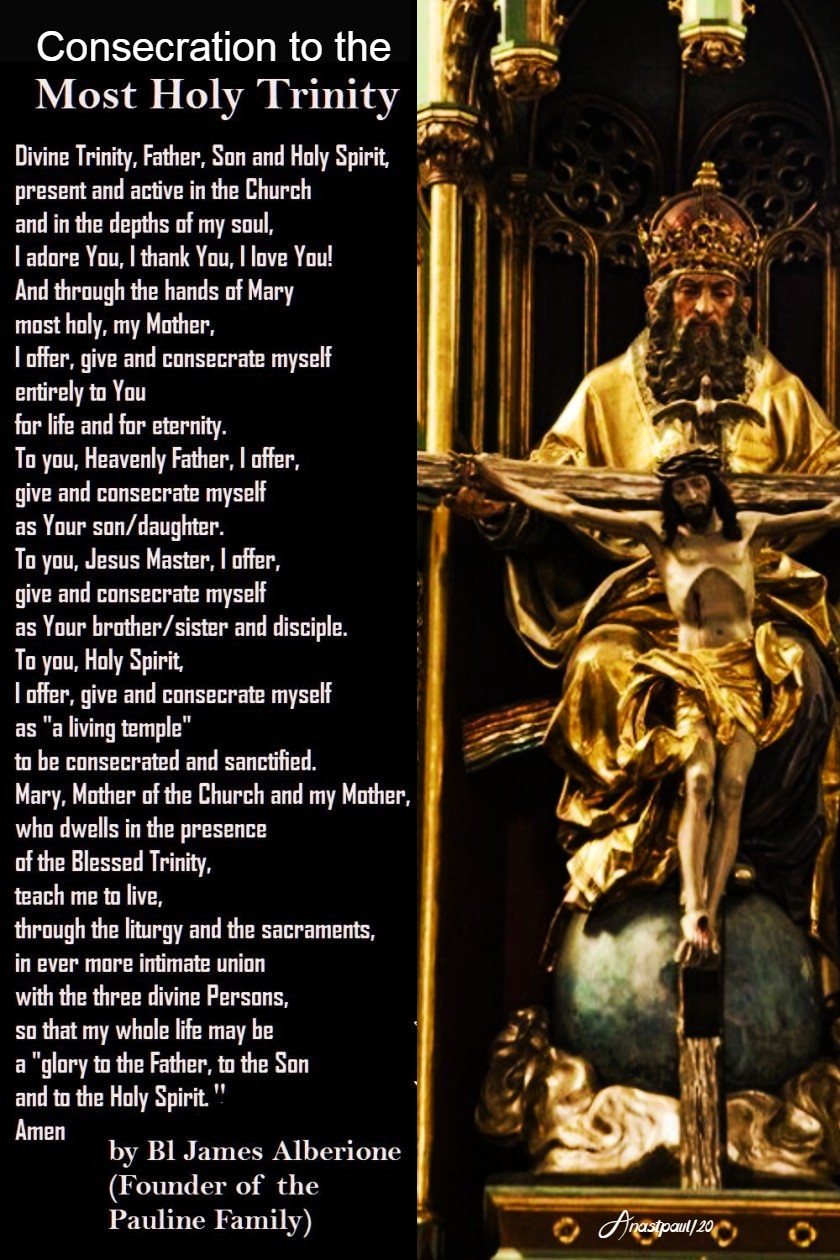
Consecration to the Most Holy Trinity by Blessed James Alberione (1884-1971) Founder of the Pauline Family
Divine Trinity, Father, Son and Holy Spirit,
present and active in the Church
and in the depths of my soul,
I adore You, I thank You, I love You!
And through the hands of Mary most holy, my Mother,
I offer, give and consecrate myself entirely to You,
for life and for eternity.
To you, Heavenly Father, I offer, give and consecrate myself
as Your son/daughter.
To you, Jesus Master, I offer, give and consecrate myself
as Your brother/sister and disciple.
To you, Holy Spirit, I offer, give and consecrate myself
as “a living temple” to be consecrated and sanctified.
Mary, Mother of the Church and my Mother,
who dwells in the presence
of the Blessed Trinity,
teach me to live,
through the liturgy and the sacraments,
in ever more intimate union
with the three divine Persons,
so that my whole life may be
a “glory to the Father, to the Son
and to the Holy Spirit.”
Amen
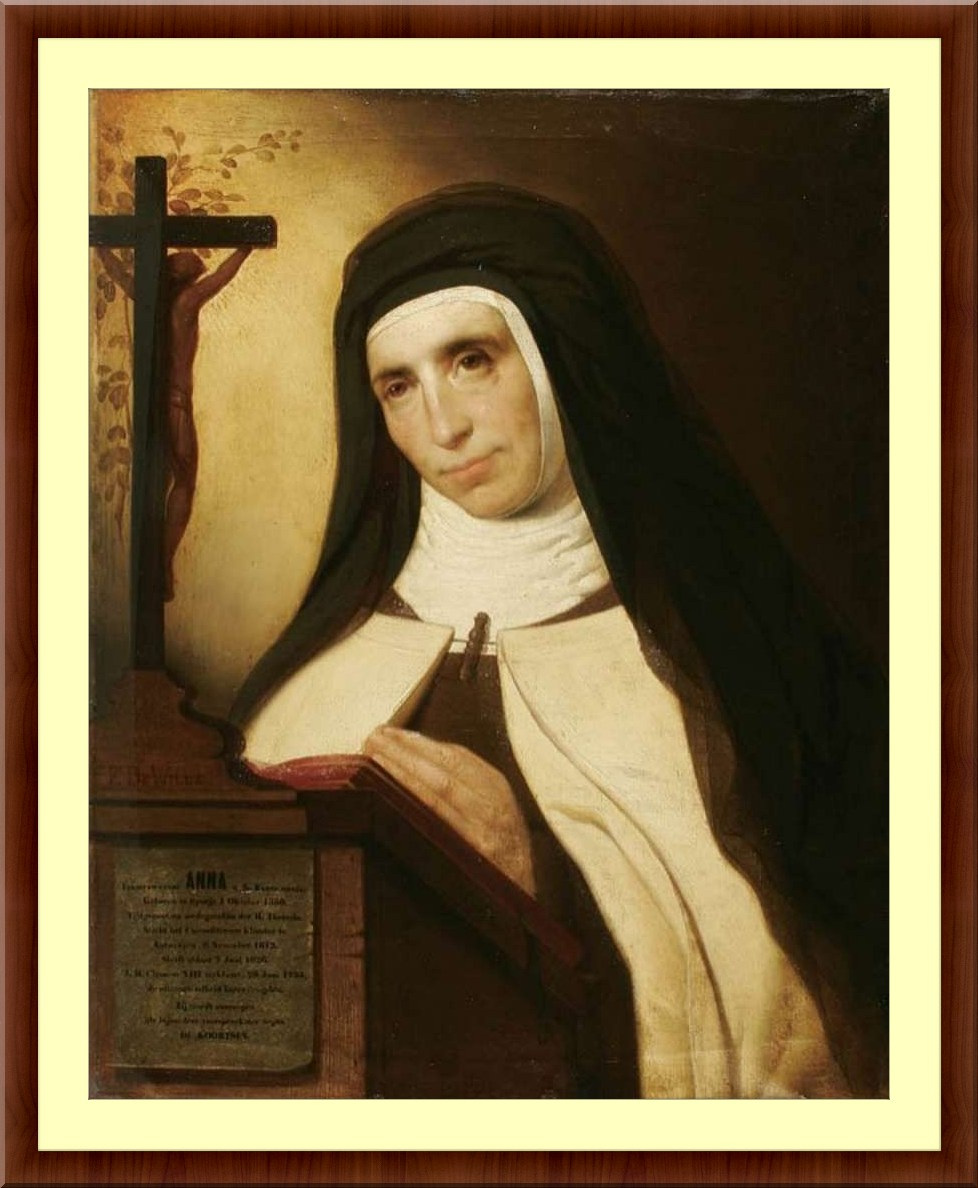
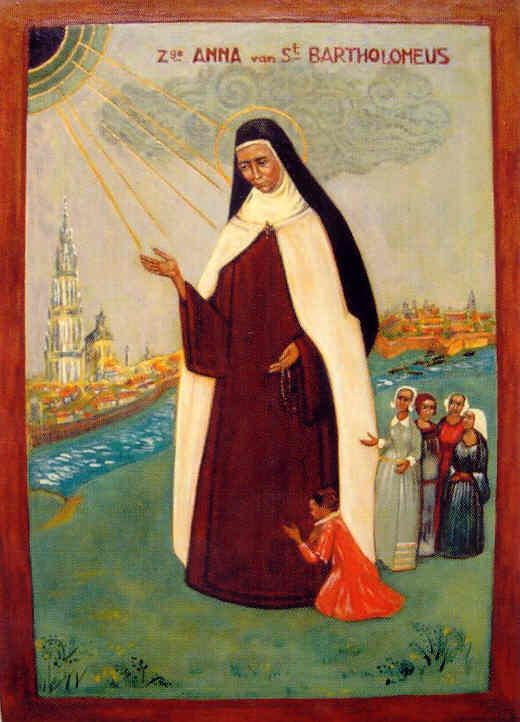
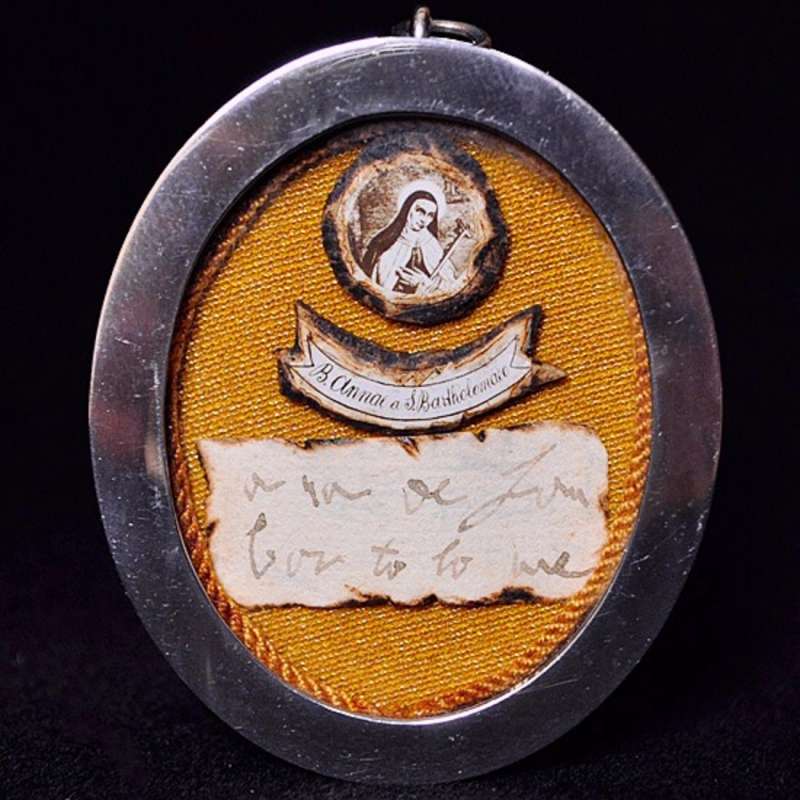
Saint of the Day – 7 June – Blessed Ana of St Bartholomew OCD (1550-1626) – Bl Ana was an early member of St Teresa of Àvila’s Discalced Carmelite Order, Mystic, Spiritual writer, apostle of the poor, Prioress – born Ana García Manzanas on 1 October 1549 at Almendral, Spain and died on 7 June 1626 at Antwerp, Belgium at the time known as the County of Flanders, Spanish Netherlands of natural causes, aged 75. Patronage – Antwerp.
Ana García Manzanas was born in Almendral de la Cañada on 1 October 1550 as the seventh child to Ferdinand García and Maria Mancanas. On the date of her birth she was also Baptised in the Parish Church of His Holiness the Saviour. Together with her three brothers and three sisters she was raised to be close to God by her pious parents. The entire household – on a frequent basis – attended Daily Mass and recited the Holy Rosary together. Her father had a Priest teach the children the doctrine of the faith, while her mother opened their home to the poor and adopted orphans to raise as her own.
In her childhood she loved the paintings that depicted the Passion of the Lord and she wanted to be associated with His suffering – even if in a minor way by giving her food to beggars. She often walked barefoot along stoney paths, in order that she could offer the pain, to her suffering Lord. She said later in this regard:
“I will say here, for the glory of our Lord, that He always gave me consolations when I did good to my neighbour, when the occasion presented itself and when I aided them in their need. I inconvenienced myself, it is true, on these occasions but I found instead of an inconvenience it was a real consolation. It is to the good Master I owe it and it has remained so with me until this day. May His holy Name be blessed!”
In 1559 her mother died and in 1560 her father died. This period turned out to be a time in her life, that she described as being flung into her “deepest affliction.” When she was of the proper age, her older siblings wanted her to enter into marriage, though in her heart she desired to become a religious. Her older brothers tried to test her will, by giving her the difficult task, of sharing the work of the labourers in the fields, in the hope that she would renounce her calling. But once her brothers did this, she refused to speak to them and to any men and thus granting them the opportunity to converse with her, so as to defend herself from marriage, since she wanted to be married to God. The brothers felt that she was too tenderhearted to withstand the austere mode of Monastic life and presumed she would soon leave the Convent life and thus burden the household with dishonour.
Ana experienced visions and apparitions that made her unwilling to give up her dream, though on one occasion had a frightful apparition of a giant demon that scared her to the point of illness. Her relatives became quite concerned for her wellbeing and so took her to a hermitage dedicated to Saint Bartholomew to make a novena. Once she arrived outside the hermitage she was at once seized with paralysis and when her relatives carried her in – and not long after entering – she found herself cured of this extreme affliction.
Finally, on 2 November 1570, Ana entered the Discalced Carmelites as a secular member. She was the first secular that the foundress Teresa of Ávila accepted. She made her religious vows on 15 August 1572. For the next decade she filled the post of a nurse in the Infirmary.
In 1577, when St Teresa broke her left arm, she chose Ana as her personal assistant, nurse and secretary and during the next 5 years Ana was her inseparable companion, travelling with her and assisting in the last four foundations. All of Teresa’s letters in the last few years of her life were dictated to Ana. Teresa died in Ana’s arms in 1582 at the monastery in Alba de Tormes.
Following the death of the Foundress, she returned to Ávila and took part in the foundation of a Convent at Ocana (1595). And she was one of the seven nuns selected for the introduction of the Order into the Kingdom of France on 15 October 1604. In 1605, the French Carmelites appointed Ana the Superior of the Convent in Pontoise. This was a highly unusual step, as Ana was a “secular Carmelite,” meaning she was not part of the choir and removed from the Convent’s life of prayer. She was thus consecrated as a religious sister and took over the Convent at Pontoise. So unusual a step met with the disapproval of her companions but – as the Foundress – had once foretold – she offered no resistance. Ana had also been forewarned that her elevation would cause her great sufferings.
Ana became the prioress of several different Convents: Tours, Flanders, and finally Antwerp, which she governed to the end of her life. Twice she was instrumental in delivering the town from the hands of Protestant forces.
Ana died on 7 June 1626. Soon after her death, miracles were attributed to her intercession and by 1632 over 150 miracles had been approved. She proved herself, like St Teresa, a daughter of the Church in her great zeal for souls. In 1735 Pope Clement XII declared the heroicity of her virtues and Pope Benedict XV Beatified Ana on 6 May 1917.
Her spiritual writings and letters are preserved in Antwerp and Paris.
Father,
rewarder of the humble,
you blessed Your servant Ana of Saint Bartholomew
with outstanding charity and patience.
May her prayers help us
and her example inspire us,
to carry our cross
and be faithful in loving You
and others for your sake.
We ask this through our Lord Jesus Christ, Your Son,
who lives and reigns with You and the Holy Spirit,
one God, forever and ever.
Amen
St Meriadoc I of Vannes
St Meriadoc II of Vannes
St Odo of Massay
St Potamiaena of Alexandria the Younger
St Quirinus of Cluny
St Robert of Newminster
St Sergius of Cluny
St Vulflagius of Abbeville
—
Martyrs of Africa – 7 saints: A group of seven Christians who were martyred together. No details about them have survived except the names – Donata, Evasius, Guirillus, Januaria, Privata, Spisinna, Victurus. The precise location in Africa and date are unknown.
Martyred in Córdoba, Spain:
Habentius of Córdoba
Jeremiah of Córdoba
Peter of Córdoba
Sabinian of Córdoba
Wallabonsus of Córdoba
Wistremundus of Córdoba
Thought for the Day – 6 June – “Month of the Sacred Heart” – Meditations with Antonio Cardinal Bacci (1881-1971)
The Worship of the Sacred Heart
in Relation to the Love of God and of Our Neighbour
“There is nothing sentimental about having devotion to the Sacred Heart of Jesus.
Neither does this devotion consist only in prayers and pious practices.
It is much deeper than this.
It should flood our whole being, enkindle the fire of divine love in our hearts and transform our lives in accordance with the commands of Jesus.
A love which is not active cannot be genuine, it is only a passing emotion.
Our love for the Sacred Heart of Jesus should be real and effective.
As far as possible, it should change us into living replicas of Jesus Christ.
“You are my friends,” He said, “if you do the things I command you” (Jn 15:14).
Which commands does He mean?
All of them, of course. “Learn from me, for I am meek and humble of heart” (Mt 11:29). “If anyone wishes to come after me, let him deny himself and take up his cross and follow me” (Mt 16:24). “Thy shalt love the Lord thy God, with they whole heart and with they whole soul” (Mt 22:37).
Anyone who practises these precepts and all others which are contained in the Gospel, is sincerely devoted to the Sacred Heart.
If anyone neglects to put them into practice but is satisfied with prayers, aspirations and the performance of spiritual exercises, his devotion is empty and has no foundation.
These prayers, aspirations and pious practices have their value, insofar, as they can attract God’s grace.
But, we must co-operate with God’s grace by our good actions.
Then our devotion to the Sacred Heart of Jesus, will be sincere and effective.”
Quote/s of the Day – 6 June – The Memorial of St Norbert (c 1080-1134) and St Marcellin Champagnat FMS (1789-1840)
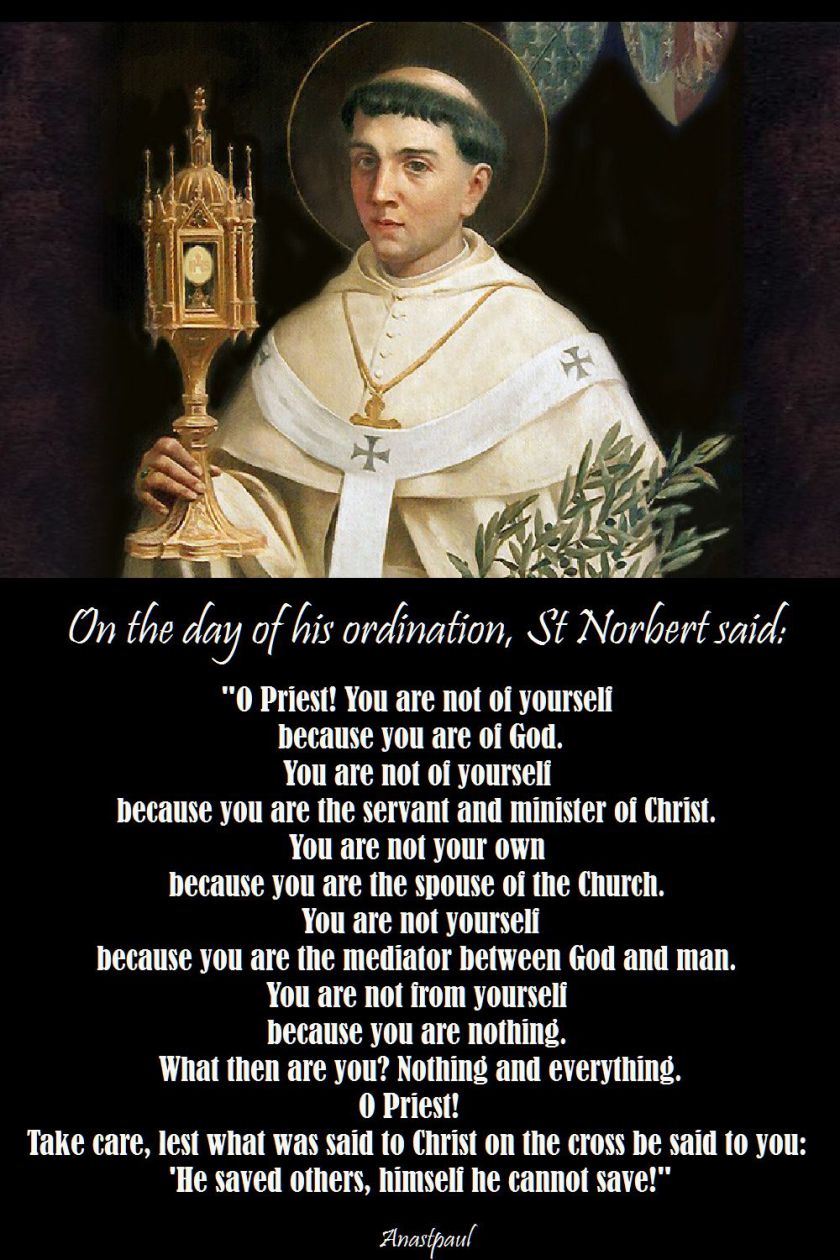
On the day of his ordination, St Norbert said:
“O Priest! You are not of yourself because you are of God. You are not of yourself because you are the servant and minister of Christ. You are not your own because you are the spouse of the Church. You are not yourself because you are the mediator between God and man. You are not from yourself because you are nothing. What then are you? Nothing and everything. O Priest! Take care, lest what was said to Christ on the cross be said to you: ‘He saved others, himself he cannot save!”
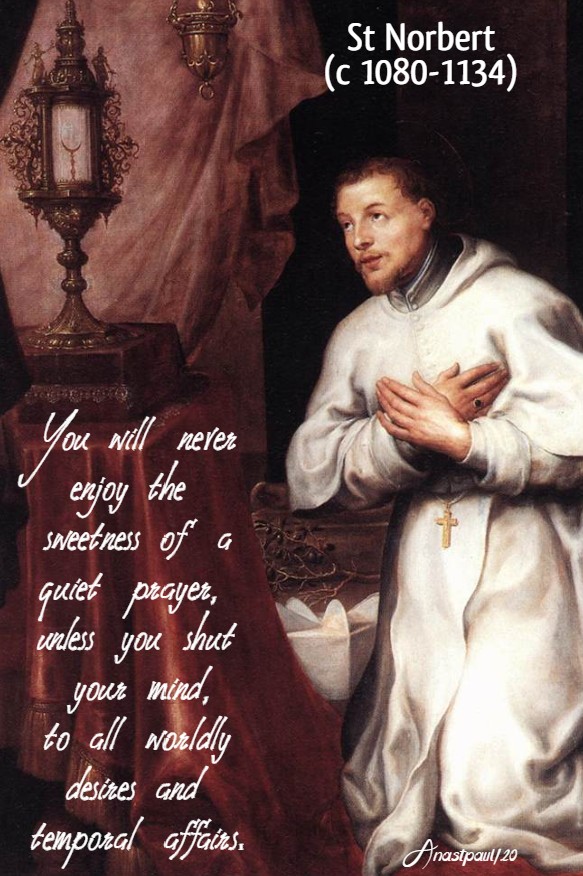
“You will never enjoy the sweetness of a quiet prayer, unless you shut your mind, to all worldly desires and temporal affairs.”
St Norbert (c 1080-1134)
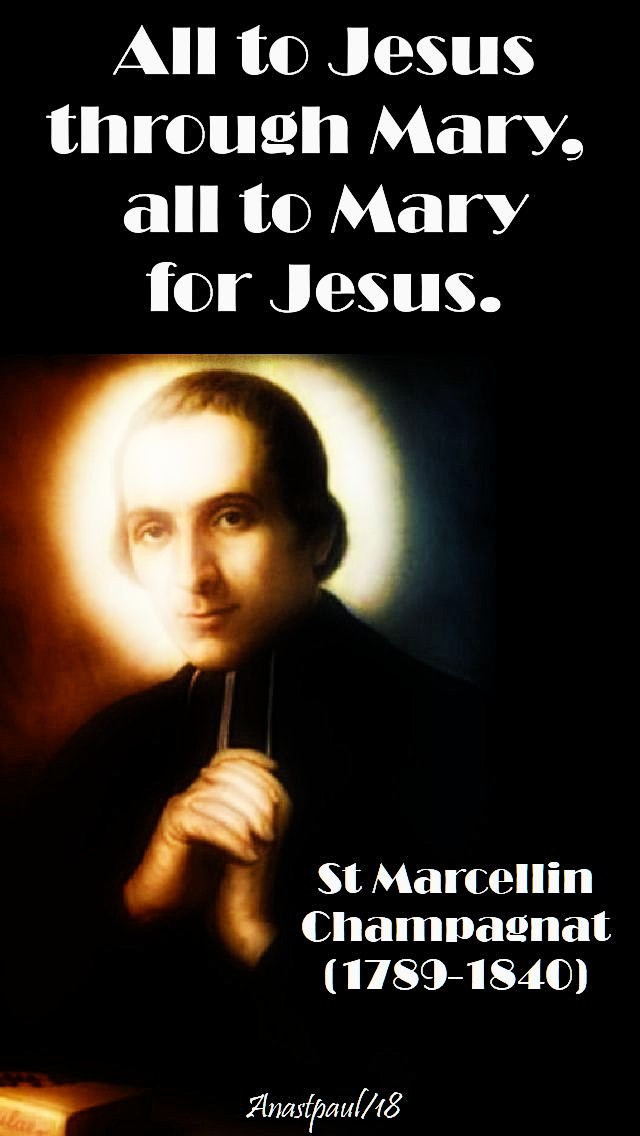
“All to Jesus through Mary, all to Mary for Jesus.”














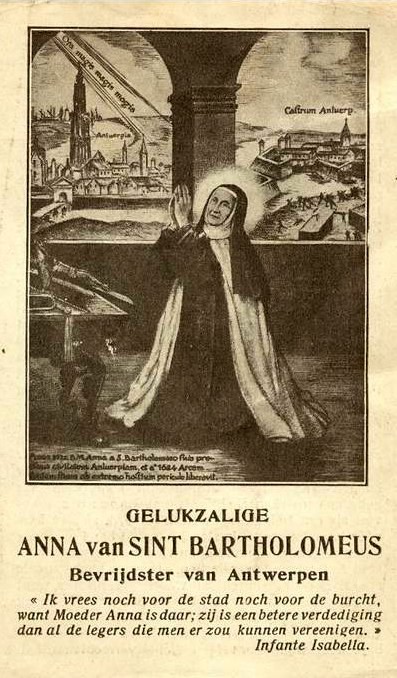 This was a highly unusual step, as Ana was a “secular Carmelite,” meaning she was not part of the choir and removed from the Convent’s life of prayer. She was thus consecrated as a religious sister and took over the Convent at Pontoise. So unusual a step met with the disapproval of her companions but – as the Foundress – had once foretold – she offered no resistance. Ana had also been forewarned that her elevation would cause her great sufferings.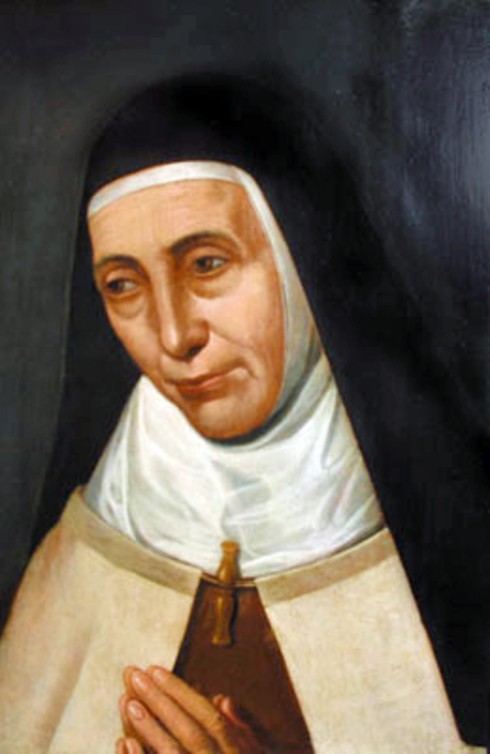




You must be logged in to post a comment.