
St Abundius the Sacristan
St Antony of Vilna
St Ardalion the Actor
St Benezet the Bridge Builder
St Bernhard of Tiron
St Domnina of Terni
St Eustace of Vilna
St Fronto of Nitria
Bl Hadewych
St John of Monte Marano
St John of Vilna
St Lambert of Lyon
Bl Lucien Botovasoa (1908-1947) Martyr
St Lydwina of Schiedam
St Maximus of Rome
St Peter Gonzalez
St Tassach of Raholp
St Thomaides of Alexandria
St Tiburtius of Rome
St Valerian of Trastevere
Thought for the Day – 13 April – Friday of the Second Week of Eastertide
Thought for the Day – 13 April – Friday of the Second Week of Eastertide
“Calls You by Your Name”
Blessed John Henry Newman (1801-1890)
God beholds me individually, whoever I am.
He “calls you by your name”.
He sees me and understands me, as He made me. He knows what is in me, all my own peculiar feelings and thoughts, my dispositions and likings, my strength and my weakness. He views me in my day of rejoicing and my day of sorrow. He sympathises in my hopes and my temptations. He interests Himself in all my anxieties and remembrances, all the risings and fallings of my spirit. He has numbered the very hairs of my head and the cubits of my stature. He compasses me round and bears me in His arms. He takes me up and sets me down.
He notes my very countenance, whether smiling or in tears, whether healthful or sickly. He looks tenderly upon my hands and my feet. He hears my voice, the beating of my heart and my very breathing. I do not love my self better than He loves me. I cannot shrink from pain more than He dislikes my bearing it and if He puts it on me, it is as I will put it on myself, if I am wise, for a greater good afterwards…
I Will Put Myself In Your Hands
O my God, I will put myself
without reserve into Your hands.
Wealth or woe,
joy or sorrow,
friends or bereavement,
honour or humiliation,
good report or ill report,
comfort or discomfort.
Your presence or the
hiding of Your countenance,
all is good
if it comes from You.
You are Wisdom
and You are love –
what can I desire more.
AmenBlessed John Henry Newman (1801-1890)


Quote/s of the Day – 13 April – Friday of the Second Week of Eastertide “Just Random”
Quote/s of the Day – 13 April – Friday of the Second Week of Eastertide “Just Random”
Try to fulfil each day’s task
steadily and cheerfully.
The life of a true Christian
should be a perpetual jubilee,
a prelude to the festivals of eternity.
St Théophane Vénard (1829-1861) Martyr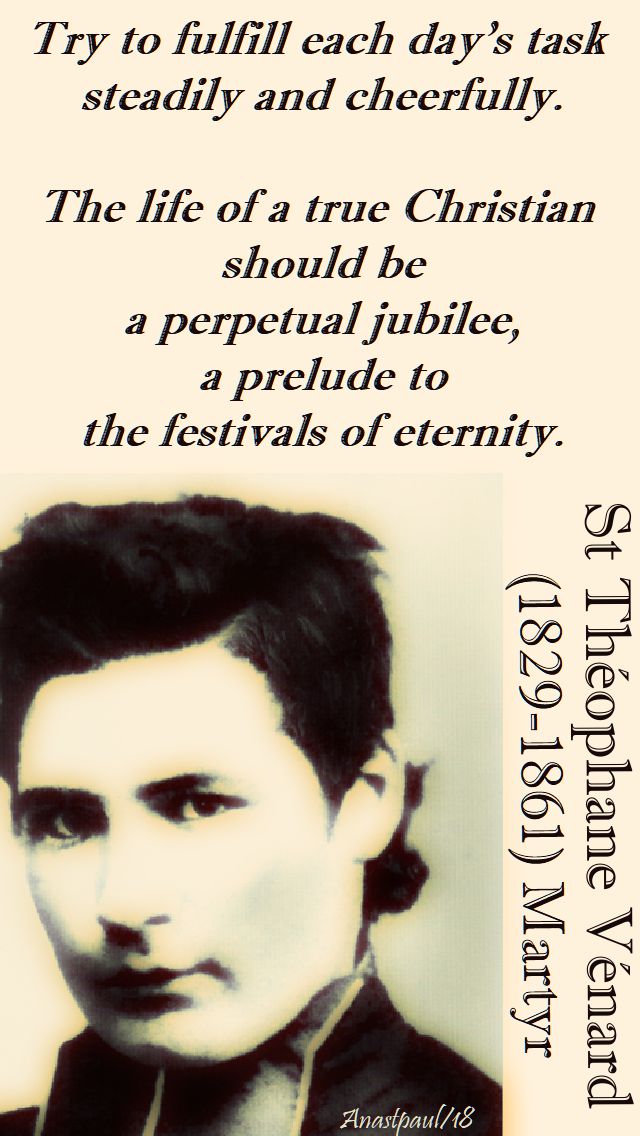
Do not waste time bothering
whether you “love” your neighbour;
act as if you did.
As soon as we do this we find
one of the great secrets.
When you are behaving as if
you loved someone,
you will presently come to love him.
C S Lewis (1898-1963)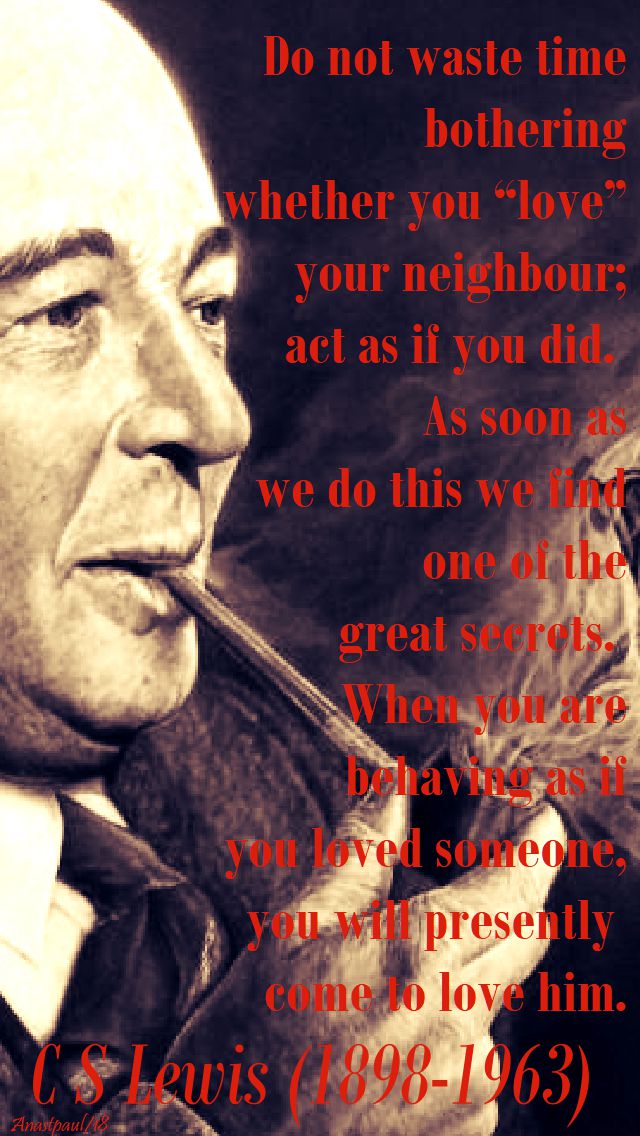
Our solid conviction
is that Jesus is who He said He is
and He can do what He says He can do.
Not only that but if Jesus is,
who He says He is,
then you are, who He says you are.
And if He is who He says He is,
then you can do what He says you can do.
Father Mike Schmitz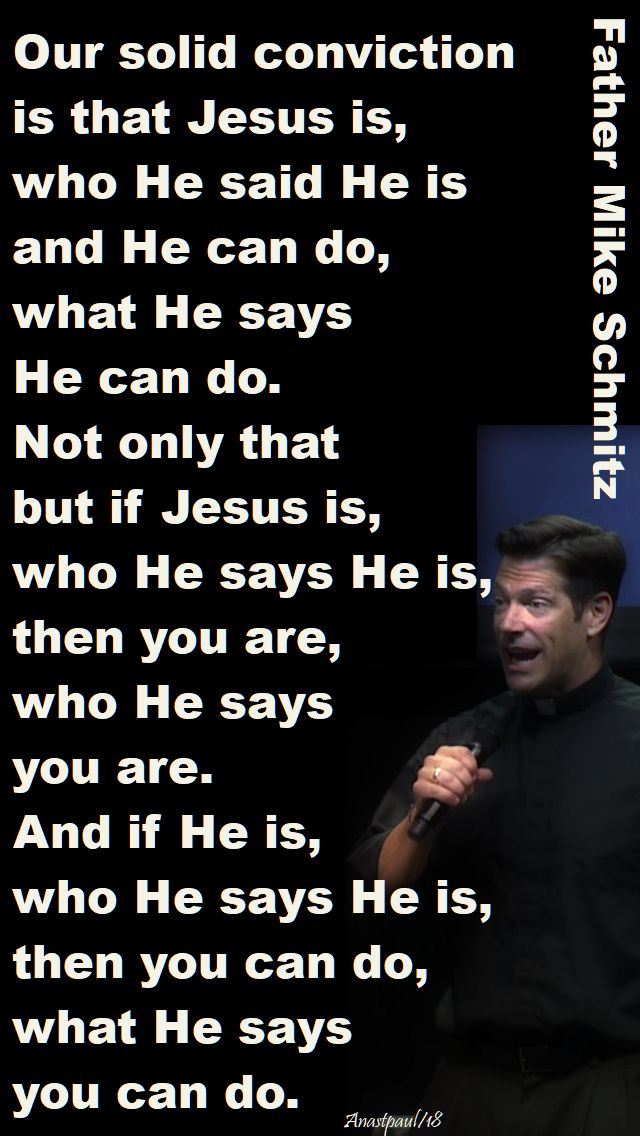
One Minute Reflection – 13 April – Friday of the Second Week of Eastertide
One Minute Reflection – 13 April – Friday of the Second Week of Eastertide
…”for if this plan or this undertaking is of men, it will fail; but if it is of God, you will not be able to overthrow them. You might even be found opposing God!”… Then they left the presence of the council, rejoicing that they were counted worthy to suffer dishonour for the name. And every day in the temple and at home they did not cease teaching and preaching Jesus as the Christ…Acts 5:38,40-42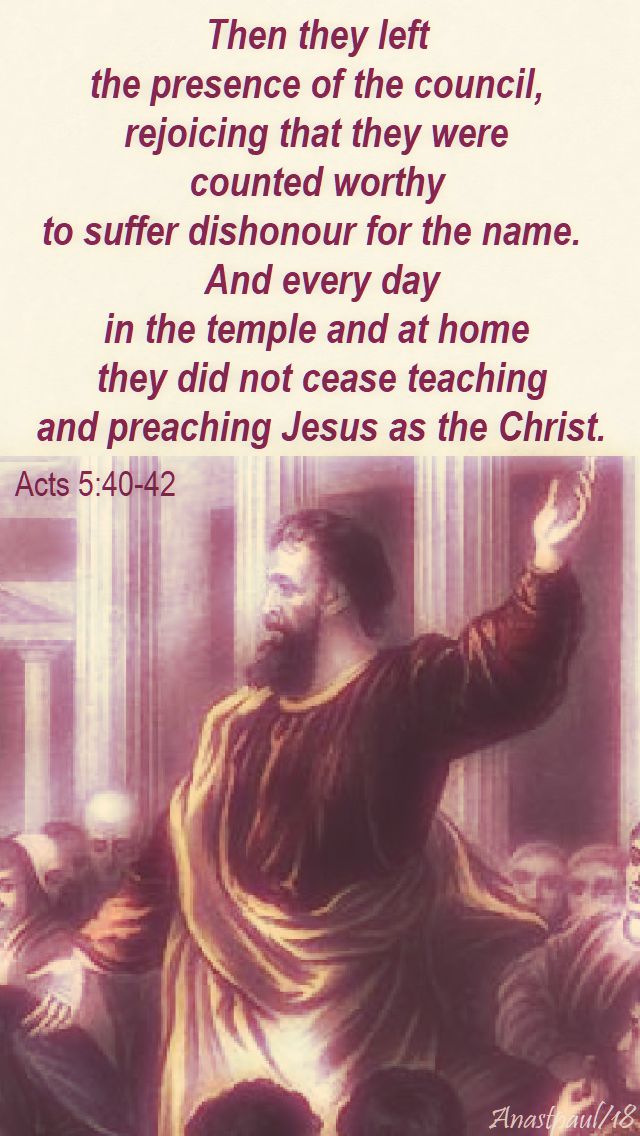
REFLECTION – “We cannot keep ourselves shut up in parishes, in our communities, when so many people are waiting for the Gospel! We cannot be Christians part-time. If Christ is at the centre of our lives, He is present in all that we do.”…Pope Francis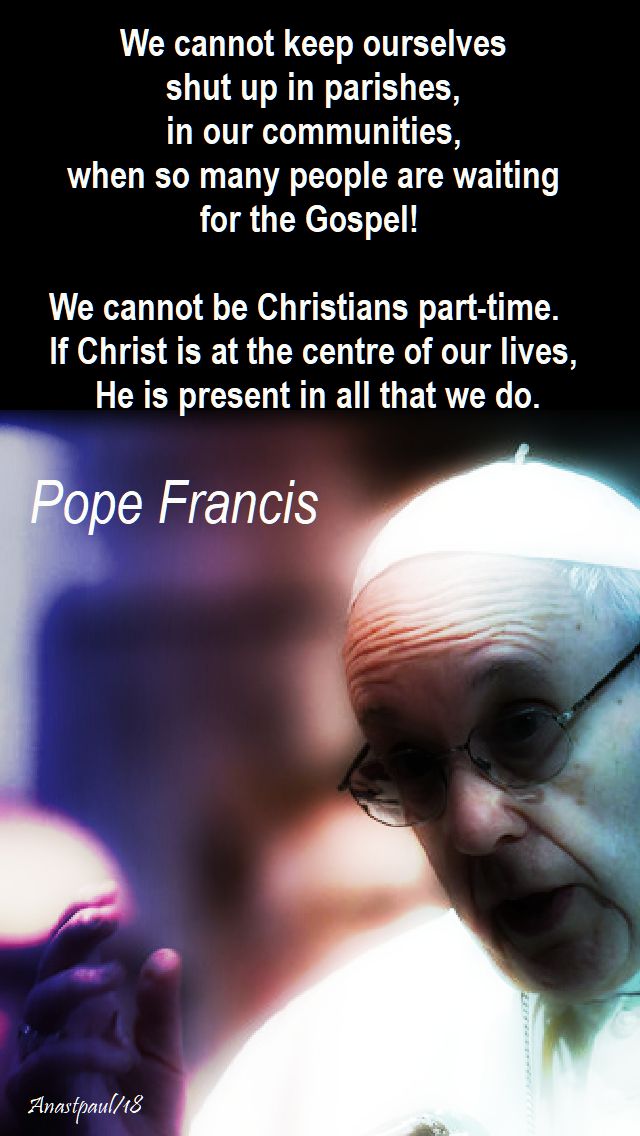
PRAYER – Almighty, ever-living God, grant us the grace to bear the hardships of this life with a steadfast mind, even as You strengthened the Apostles and all the Saints after them, whom no threats could daunt, no pains or penalties break. Dear sweet St Margaret of Castello, you who disregarded your own sufferings to help those who suffer more, pray for us! Through Jesus our Lord, in the unity of the Holy Spirit, one God forever, amen.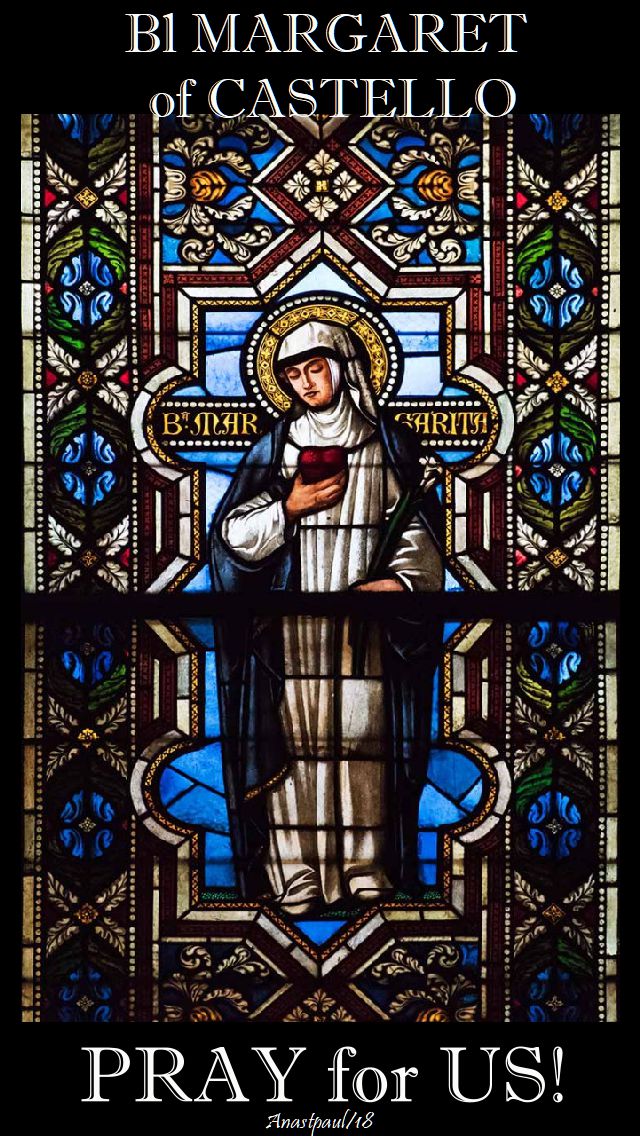
Our Morning Offering – 13 April 2017 – Friday of the Second Week of Eastertide
Our Morning Offering – 13 April 2017 – Friday of the Second Week of Eastertide
O Lord My God
St Anselm of Canterbury (1033-1109) Doctor of the Church
O Lord my God.
Teach my heart this day
where and how to find You.
You have made me and re-made me,
and You have bestowed on me
all the good things I possess,
and still I do not know You.
I have not yet done
that for which I was made.
Teach me to seek You,
for I cannot seek You
unless You teach me,
or find You
unless You show yourself to me.
Let me seek You in my desire;
let me desire You in my seeking.
Let me find You by loving You;
let me love You when I find You.
Amen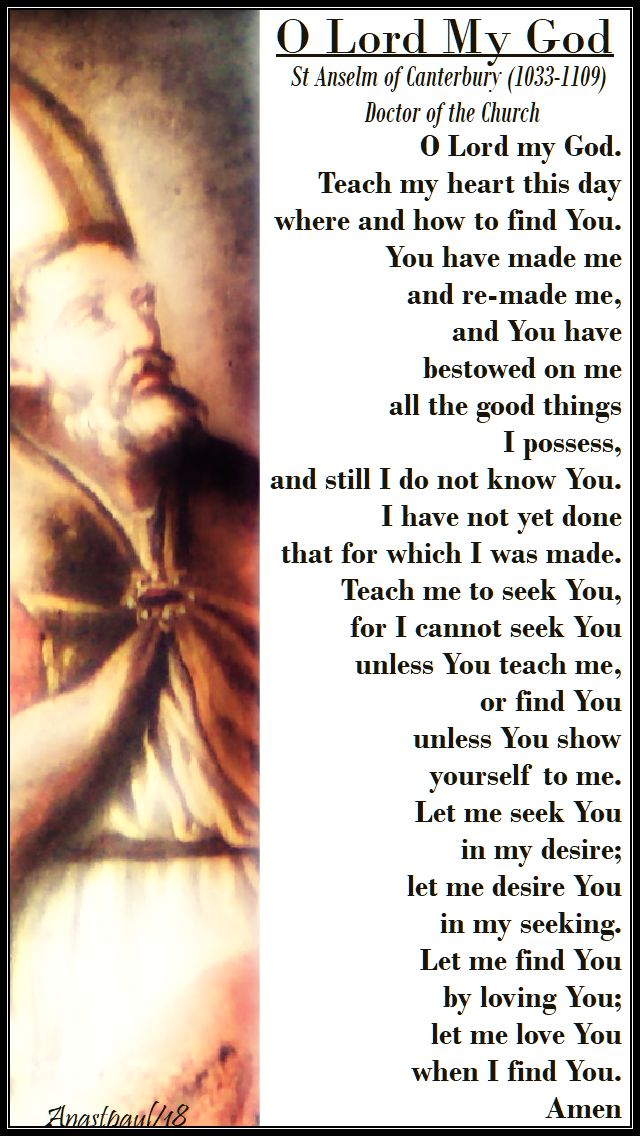
Saint of the Day – 13 April – Blessed Margaret of Castello O.P. (1287-1320)
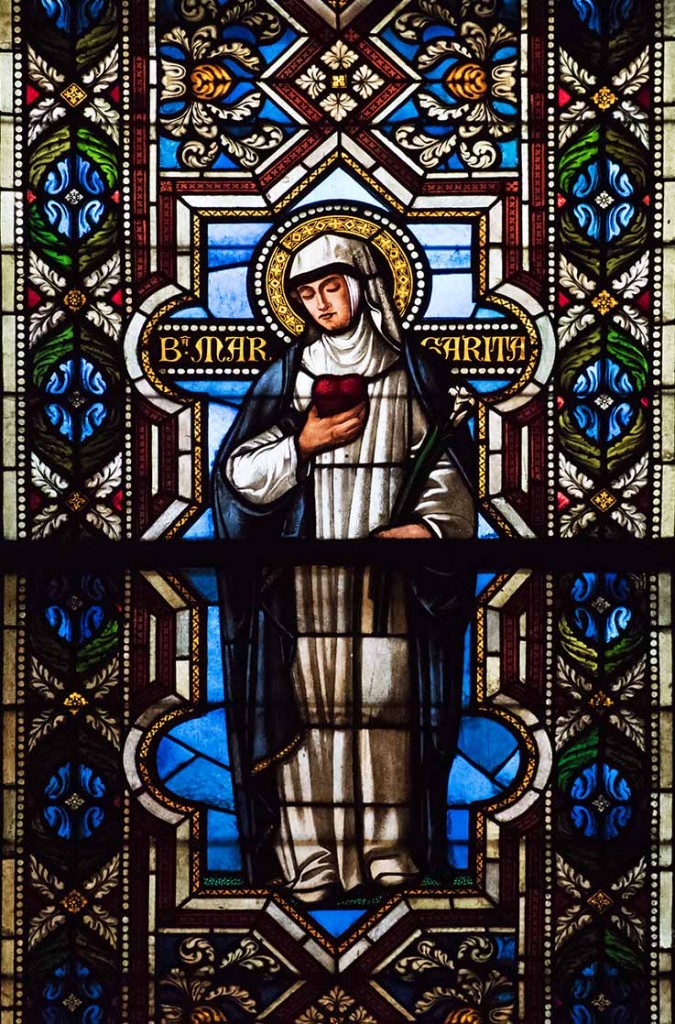
Saint of the Day – 13 April – Blessed Margaret of Castello O.P. (1287-1320) was an Italian professed member from the Third Order of the Order of Preachers of St Dominic. Margaret was disabled and became known for her deep faith and holiness. Patronages – against poverty, disabled people, handicapped people, people rejected by religious orders,Pro-Right Groups. Her body is incorrupt.
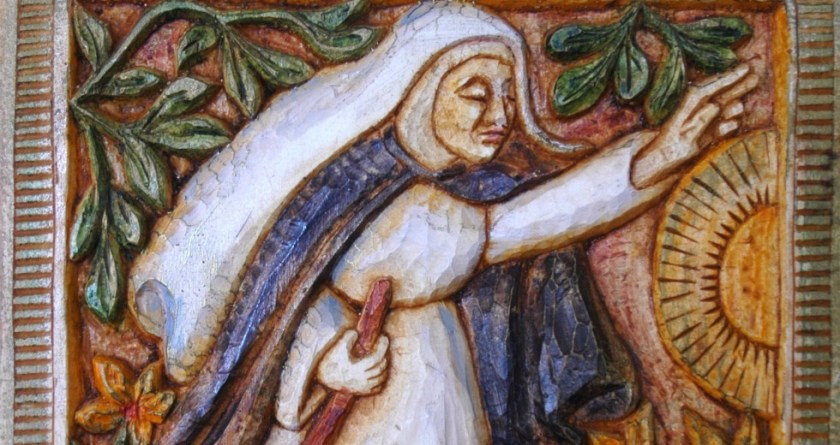
Bl Margaret of Castello was born in the fourteenth century in Metola, Italy to noble parents who wanted a son. When the news was brought to the new mother that her newborn daughter was a blind, hunchbacked dwarf, both parents were horrified. Little Margaret was kept in a secluded section of the family castle in the hopes that her existence would be kept secret. However, when she was about six years old, she accidentally made her presence known to a guest. Determined to keep her out of the public eye, her father had a room without a door built onto the side of the parish church and walled Margaret inside this room. Here she lived until she was sixteen, never being allowed to come out. Her food and other necessities were passed in to her through a window. Another window into the church allowed her to hear Mass and receive Holy Communion. The parish priest became a good friend and took upon himself the duty to educate her. He was amazed at her docility and the depth of her spiritual wisdom.
When Margaret was sixteen years old, her parents heard of a shrine in Citta di Castello, Italy, where many sick people were cured. They made a pilgrimage to the shrine so that she could pray for healing. However, Margaret, open to the will of God, was not healed that day, or the next, so her parents callously abandoned her in the streets of the town and left for home, never to see her again. At the mercy of the passersby, Margaret had to beg her food and eventually sought shelter with some Dominican nuns.
W. R. Bonniwell writes, “Her cheerfulness, based on her trust in God’s love and goodness, was extraordinary. She became a Dominican tertiary and devoted herself to tending the sick and the dying” as well as prisoners in the city jail.
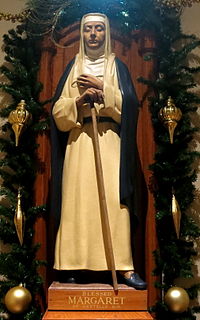
Deprived of all human companionship, Margaret learned to embrace her Lord in solitude. Instead of becoming bitter, she forgave her parents for their ill treatment of her and treated others as well as she could. Her cheerfulness stemmed from her conviction that God loves each person infinitely, for He has made each person in His own image and likeness. This same cheerfulness won the hearts of the poor of Castello and they took her into their homes for as long as their purses could afford. She passed from house to house in this way, “a homeless beggar being practically adopted by the poor of a city” (Bonniwell, 1955).
Bl Margaret died on 13 April 1320 at the age of 33. More than 200 miracles have been credited to her intercession since her death. She was beatified on 19 October 1609 by Pope Paul V (concession of indult for Mass and Office). Thus, the daughter that nobody wanted is now one of the glories of the Church.
Memorials of the Saints – 13 April
St Pope Martin I (Optional Memorial)
—
Agathonica of Pergamus
Agathodorus of Pergamus
Caradoc of Wales
Carpus of Pergamus
Bl Edward Catherick
Bl Francis Dickenson
Guinoc
Hermengild
Ida of Boulogne
Bl Ida of Louvain
Bl Isabel Calduch Rovira
Bl James of Certaldo
Bl John Lockwood
Bl Margaret of Castello O.P. (1287-1320)
Martius of Auvergne
Bl Miles Gerard
Papylus of Pergamus
Proculus of Terni
Bl Rolando Rivi
Sabas Reyes Salazar
Bl Scubilion Rousseau
Ursus of Ravenna
—
Martyrs of Dorostorum – 3 saints: A lector and two students martyred together in the persecutions of Diocletian – Dadas, Maximus and Quinctillianus. Beheaded c303 in Dorostorum, Lower Mysia (modern Sillistria, Bulgaria.
Thought for the Day – 12 April – Thursday of the Second Week of Eastertide
Thought for the Day – 12 April – Thursday of the Second Week of Eastertide
The Resurrection of the Lord is Our Hope
Dear Brothers and Sisters in Rome and throughout the world,
From the depths of my heart, I wish all of you a blessed Easter. To quote Saint Augustine, “Resurrectio Domini, spes nostra – the resurrection of the Lord is our hope” (Sermon 261:1). With these words, the great Bishop explained to the faithful that Jesus rose again so that we, though destined to die, should not despair, worrying that with death life is completely finished; Christ is risen to give us hope (cf. ibid.).
Indeed, one of the questions that most preoccupies men and women is this: what is there after death? To this mystery today´s solemnity allows us to respond that death does not have the last word because Life will be victorious at the end. This certainty of ours is based not on simple human reasoning but on a historical fact of faith: Jesus Christ, crucified and buried, is risen with His glorified body. Jesus is risen so that we too, believing in Him, may have eternal life. This proclamation is at the heart of the Gospel message. As Saint Paul vigorously declares: “If Christ has not been raised, our preaching is in vain and your faith is in vain.” He goes on to say: “If for this life only we have hoped in Christ, we are of all men most to be pitied” (1 Cor 15:14,19). Ever since the dawn of Easter a new Spring of hope has filled the world; from that day forward our resurrection has begun because Easter does not simply signal a moment in history but the beginning of a new condition: Jesus is risen not because His memory remains alive in the hearts of His disciples but because He Himself lives in us and in Him we can already savour the joy of eternal life.
The resurrection, then, is not a theory but a historical reality revealed by the man Jesus Christ by means of His “Passover”, His “passage”, that has opened a “new way” between heaven and earth (cf. Heb 10:20). It is neither a myth nor a dream, it is not a vision or a utopia, it is not a fairy tale but it is a singular and unrepeatable event: Jesus of Nazareth, son of Mary, who at dusk on Friday was taken down from the Cross and buried, has victoriously left the tomb. In fact, at dawn on the first day after the Sabbath, Peter and John found the tomb empty. Mary Magdalene and the other women encountered the risen Jesus. On the way to Emmaus the two disciples recognised Him at the breaking of the bread. The Risen One appeared to the Apostles that evening in the Upper Room and then to many other disciples in Galilee.
If it is true that death no longer has power over man and over the world, there still remain very many, in fact too many signs of its former dominion. Even if through Easter, Christ has destroyed the root of evil, He still wants the assistance of men and women in every time and place who help Him to affirm His victory using His own weapons: the weapons of justice and truth, mercy, forgiveness and love.
Pope Benedict XVI – 13 April 2009 (Excerpt)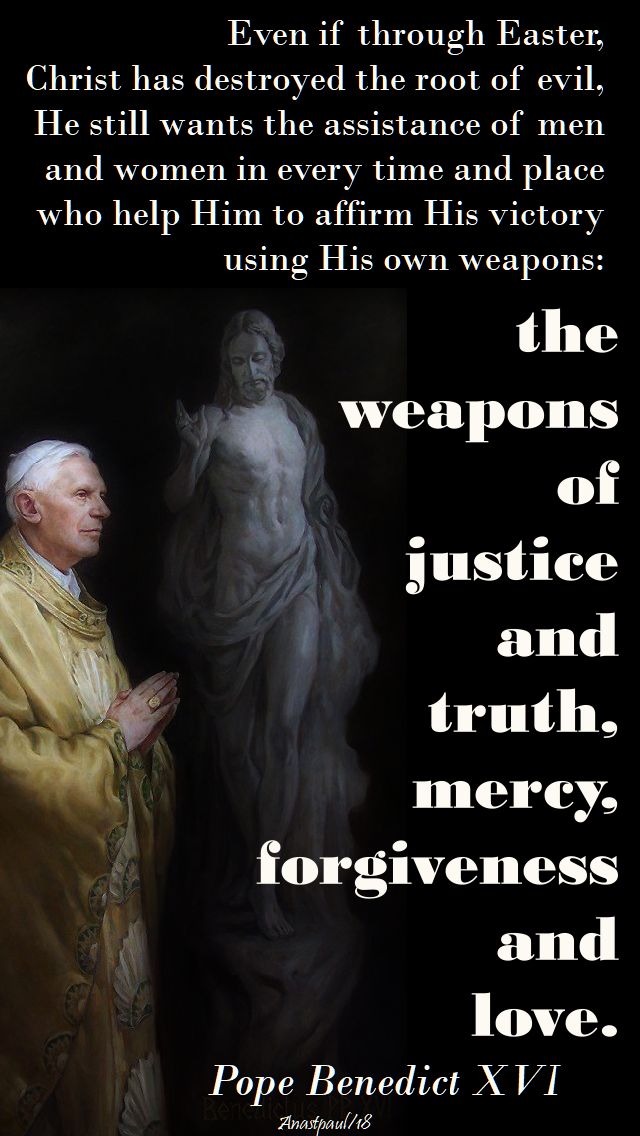
Quote of the Day – 12 April – Thursday of the Second Week of Eastertide & the Memorial of St Zeno of Verona (c 300 – 371)
Quote of the Day – 12 April – Thursday of the Second Week of Eastertide & the Memorial of St Zeno of Verona (c 300 – 371)
“How earnestly do I desire, if I were able, to celebrate you,
O Patience, queen of all things!
But by my life and manners, more than by my words.
For you rest in your own action
and council more than in discourses
and in perfecting, rather than in multiplying virtues.
You are the support of virginity,
the secure harbour of widowhood,
the guide and directress, of the married state,
the unanimity of friendship,
the comfort and joy of slavery,
to which you are often liberty.
By you, poverty enjoys all,
because, content with itself, it bears all.
By you, the prophets, were advanced in virtue
and the apostles united to Christ.
You are the daily crown and mother of the martyrs.
You art the bulwark of faith,
the fruit of hope
and the friend of charity.
Happy, eternally happy, is he
who shall always possess you in his soul.”
St Zeno of Verona (c 300 – 371)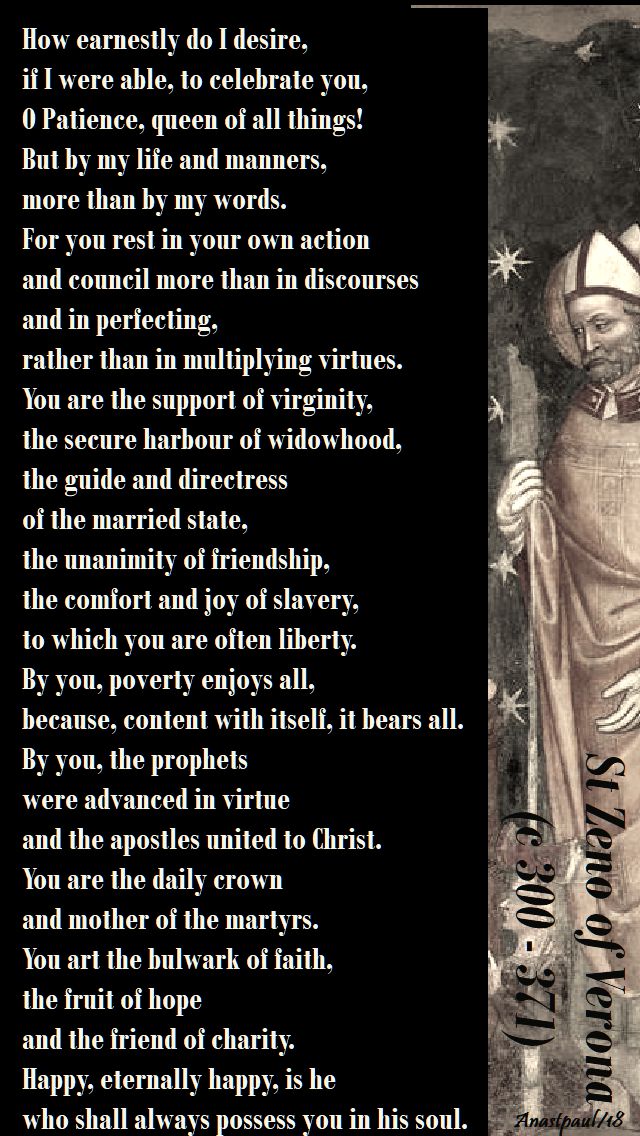
One Minute Reflection – 12 April – Thursday of the Second Week of Eastertide
One Minute Reflection – 12 April – Thursday of the Second Week of Eastertide
But Peter and the apostles answered, “We must obey God rather than men…. we are witnesses to these things and so is the Holy Spirit whom God has given to those who obey him.”…Acts 5:29,32
REFLECTION – “The will of God will never take you to where the grace of God will not protect you. Put your creed in your deed.”…Fr Mike Schmitz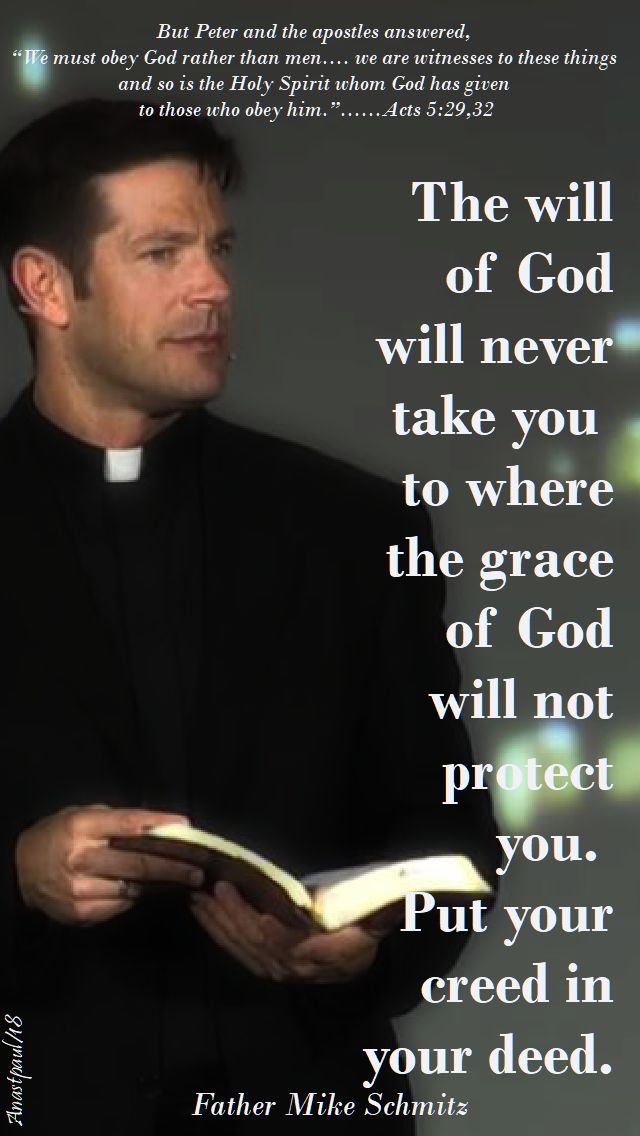
PRAYER – God of mercy, let the mystery we celebrate at Eastertide, bear fruit for us in every season. Let us all be Your beacons to the world around us as St Zeno was, teaching by his life. Grant we pray, that his prayers may assist us. Through our Lord Jesus Christ, in union with the Holy Spirit, one God now and forever, amen.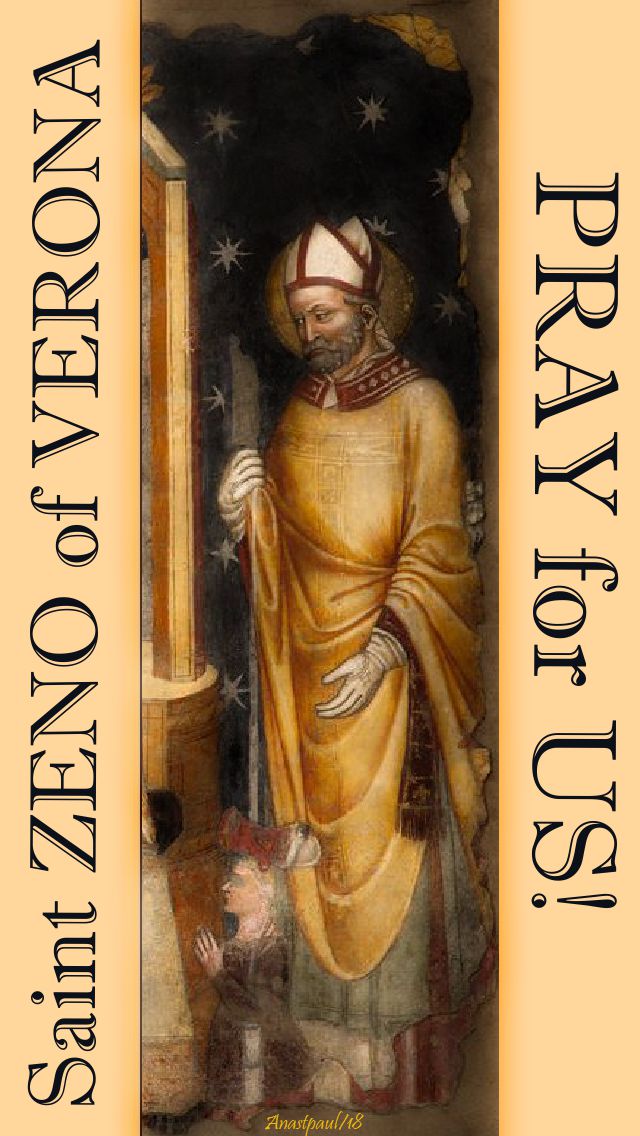
Our Morning Offering – 12 April – Thursday of the Second Week of Eastertide
Our Morning Offering – 12 April – Thursday of the Second Week of Eastertide
You are the King of All
St Albert the Great (1200-1280) Universal Doctor
We pray to You, O Lord,
who are the supreme Truth,
and all truth is from You.
We beseech You, O Lord,
who are the highest Wisdom,
and all the wise depend on You
for their wisdom.
You are the supreme Joy,
and all who are happy owe it to You.
You are the Light of minds,
and all receive their understanding from You.
We love, we love You above all.
We seek You, we follow You,
and we are ready to serve You.
We desire to dwell under Your power
for You are the King of all.
Amen.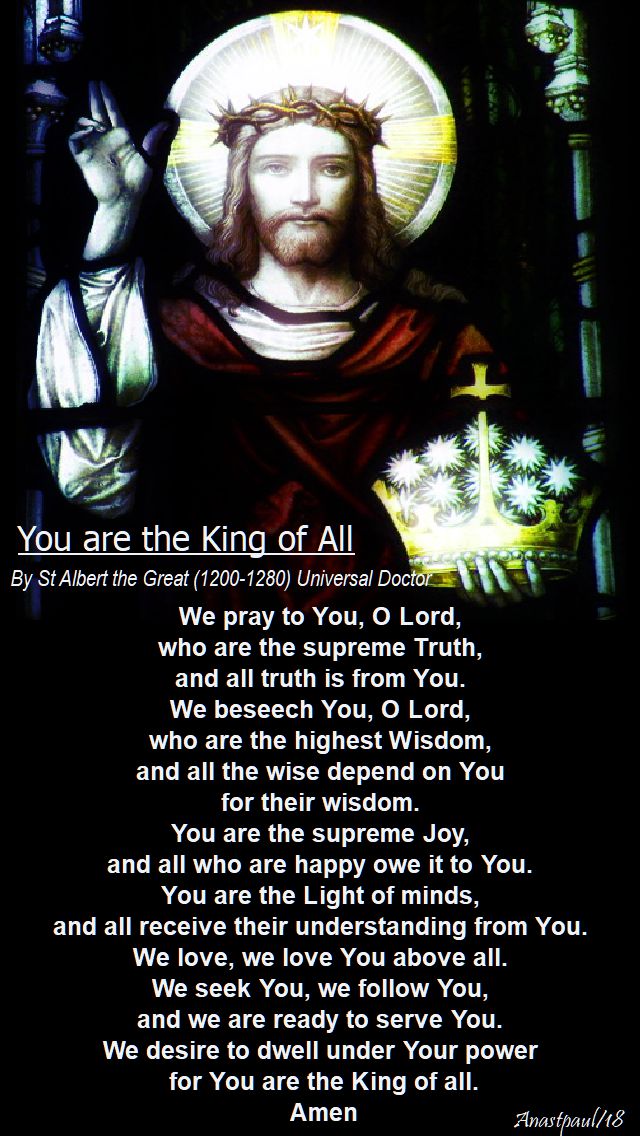
Saint of the Day – 12 April – St Zeno of Verona (c 300 – 371)
Saint of the Day – 12 April – St Zeno of Verona (c 300 – 371) Bishop of Verona, Monk, Confessor, Reformer, believed to be a Martyr the persecutions of Constantius II and Julian the Apostate – Born c 300 at Mauretania near Algiers, North Africa and died on 12 April 371. Patronages – anglers, children learning to speak, children learning to walk, fishermen, newborn babies, Diocese of Verona, Italy, 41 Cities.
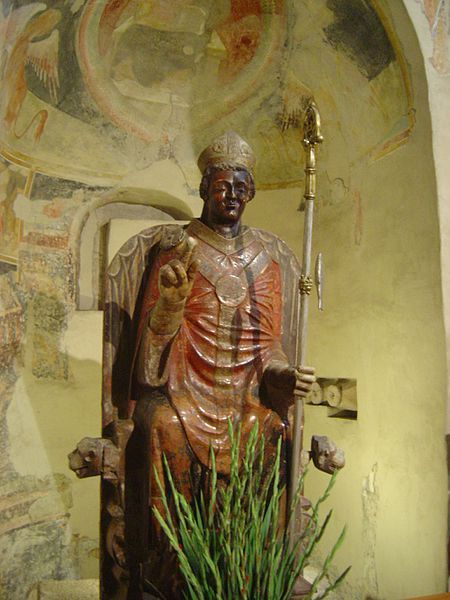
St Zeno of Verona came from Mauretania (Algeria and Morocco) in North Africa, born in the year c 300. He may have been a follower of St Athanasius of Alexandria who followed his master to Verona in about 340. The ancient Sermones texts on Old Testament exegesis have been attributed to St Zeno due to the style of the 90 or so Sermones attributed to Zeno has been considered evidence of his African origins.
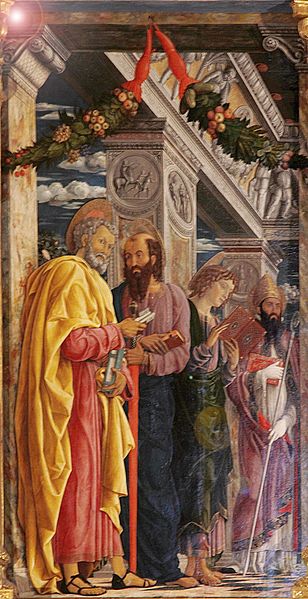
He entered monastic life and would be appointed a bishop, winning converts back from Arianism, setting up a convent for women, living a life of poverty, training priests to work in the diocese and reforming how the Agape feast was celebrated. (The term Agape or Love feast was used for certain religious meals among early Christians that seem to have been originally closely related to the Eucharist.) He would not allow loud groaning and wailing at funerals, supported adult baptism by complete immersion and established a practice of giving medals to the newly baptised.
He was the eighth bishops of Verona for a decade or so and is described as a ‘confessor of the faith’ in early martyrologies, may have suffered persecution under Constantius II and Julian the Apostate — a reference to his ‘happy death’ on 12 April, 371, indicates he may have been martyred. Saint Gregory the Great calls him a martyr in his Dialogues. A contemporary letter from St Ambrose of Milan refers to Zeno’s holiness. He is known to have lived in great poverty.
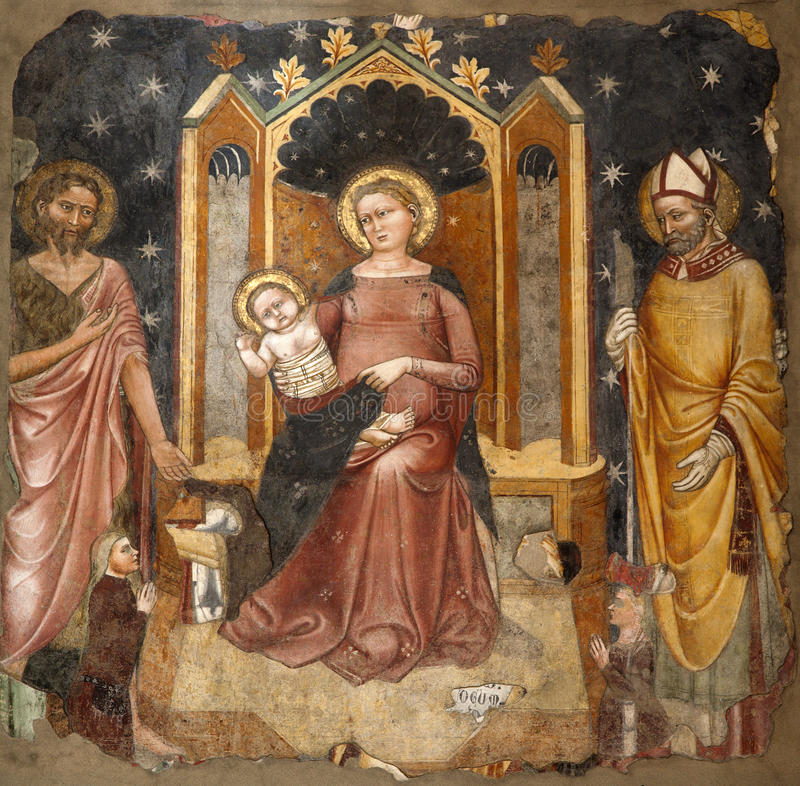
St Zeno is the patron saint of fishermen and anglers, of the city of Verona, of newborn babies as well as children learning to speak and walk. A saint for spiritual toddlers. At least 30 churches and chapels bear his name. He may have been fond of fishing in the River Adige but the depictions of him with a fishing rod are thought to refer to his success in ‘catching converts’ for the faith. A fisher of men and women for Christ.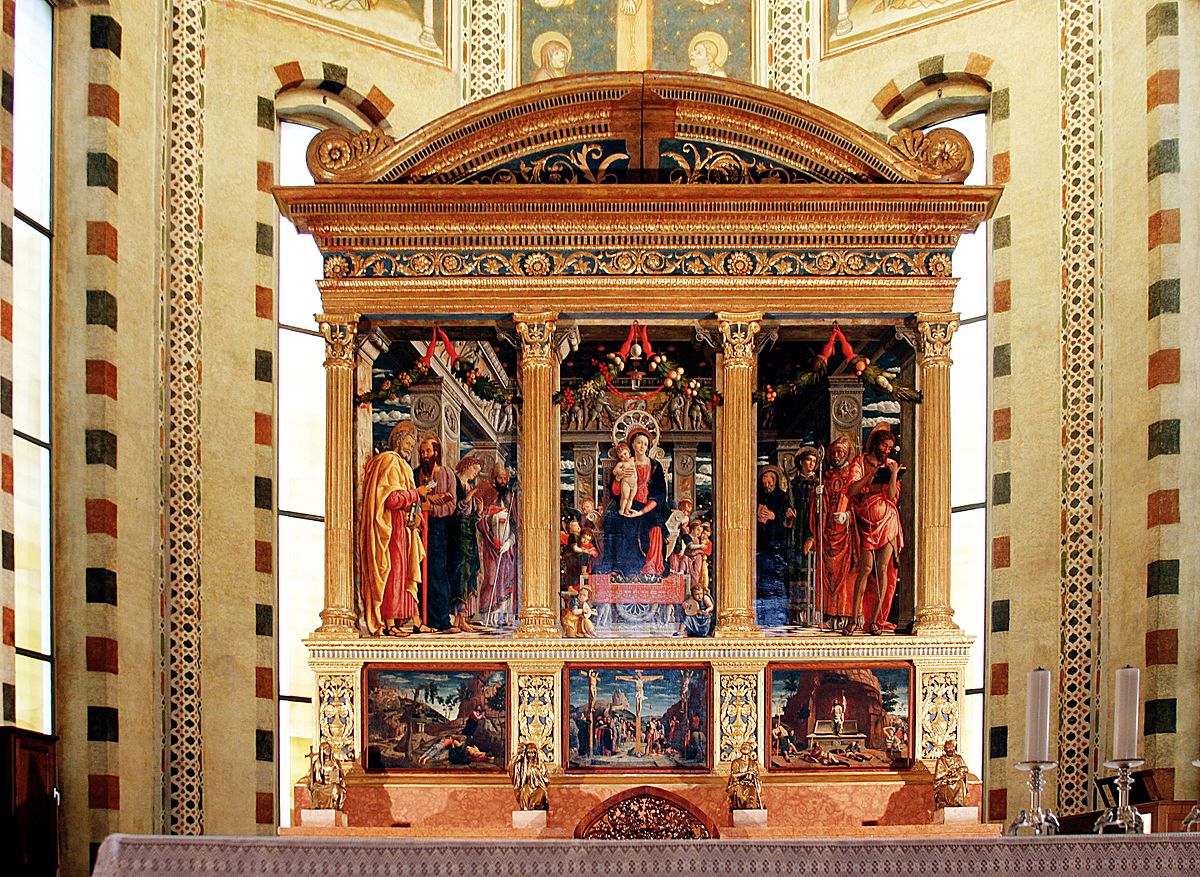
In the year 589, at the same time that the Tiber overflowed a considerable quarter of Rome, and the flood over-topped the walls, the waters of the Adige, which fails from the mountains with excessive rapidity, threatened to drown or submerge a great part of the city of Verona. The people flocked in crowds to the church of their holy patron Zeno: the waters seemed to respect its doors, they gradually swelled as high as the windows, yet the flood never broke into the church but stood like a firm wall, as when the Israelites passed the Jordan; and the people remained there twenty-foul hours in prayer, till the water subsided within the banks of the channel. This miracle had as many witnesses as there were inhabitants of Verona. The devotion of the people to St Zeno was much increased by this and other miracles.
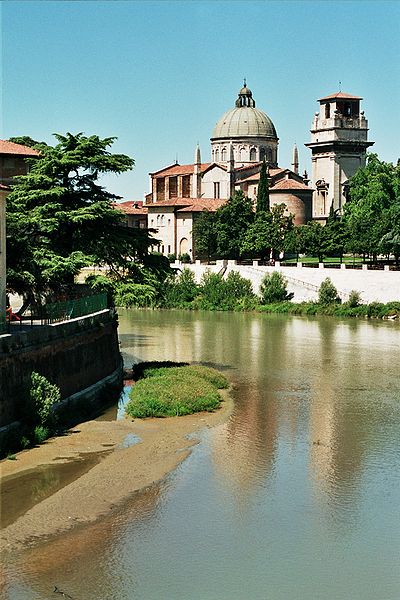
St Zeno’s liturgical feast day is celebrated today, 12 April but in the diocese of Verona, it is also celebrated on 21 May, in honor of the translation of his relics on 21 May 807.
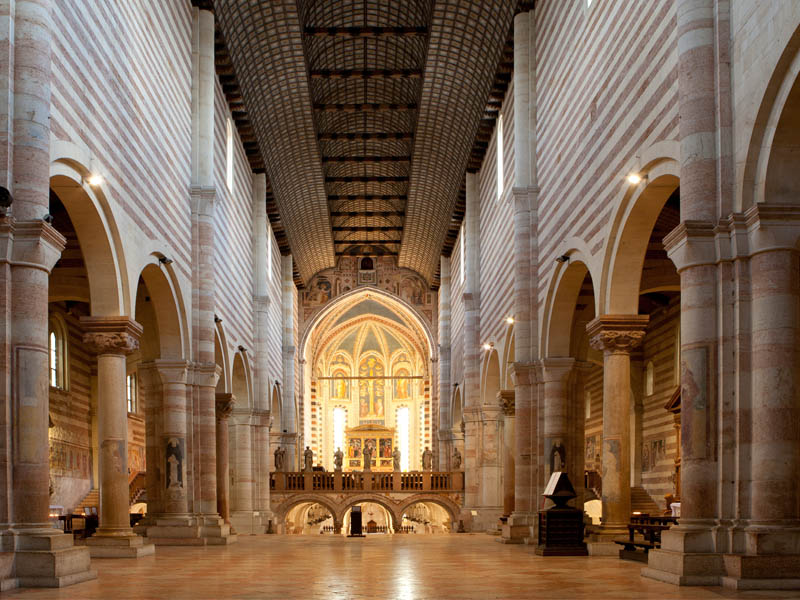
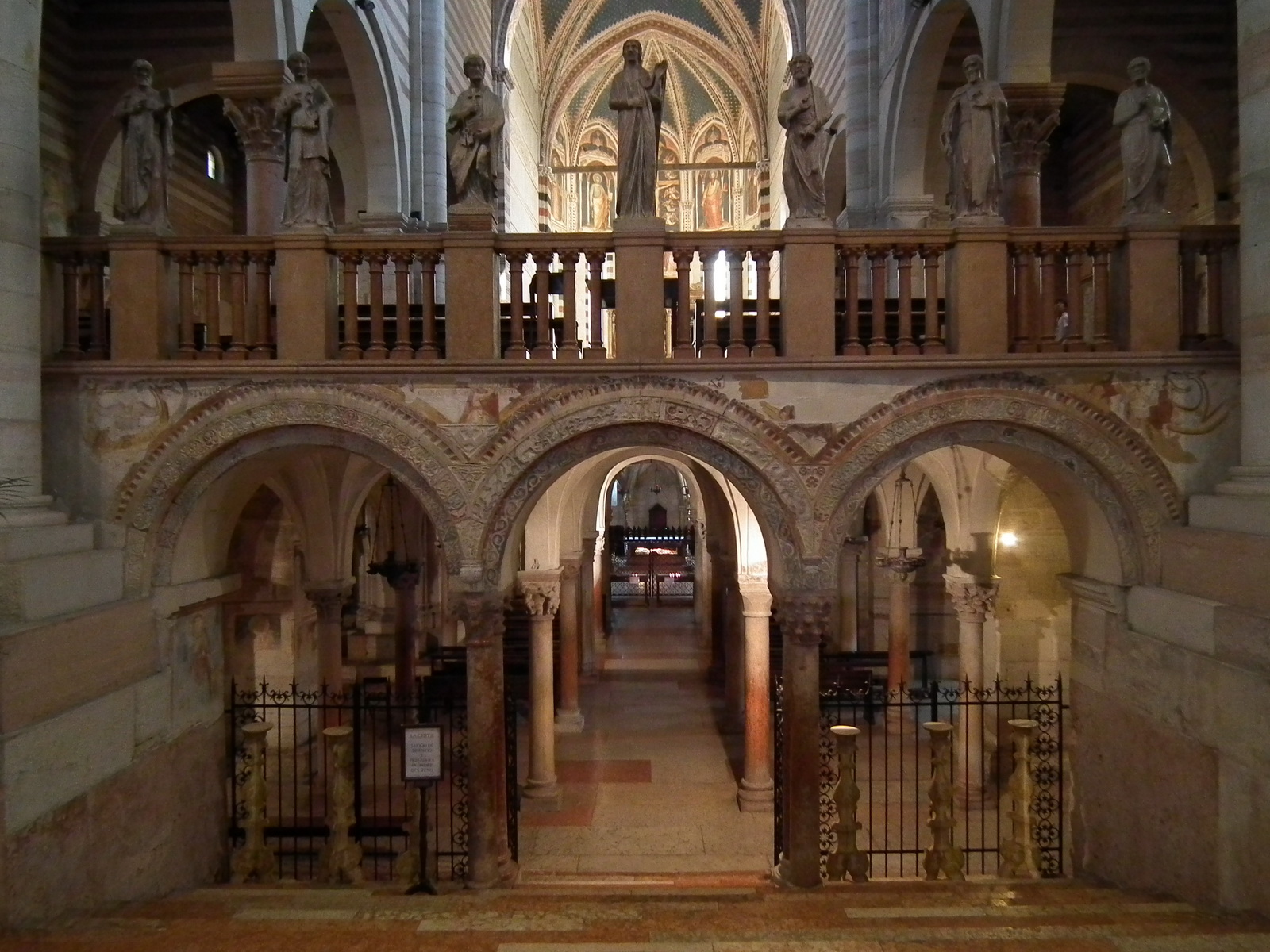
Tradition states that Zeno built the first basilica in Verona, situated in the area probably occupied by the present-day cathedral. His eponymous church in its present location dates to the early ninth century, when it was endowed by Charlemagne and his son Pepin, King of Italy. It was consecrated on 8 December 806; two local hermits, Benignus and Carus, were assigned the task of translating Zeno’s relics to a new marble crypt. King Pepin was present at the ceremony, as were the Bishops of Cremona and Salzburg, as well as an immense crowd of townspeople. The church was damaged at the beginning of the tenth century by Hungarians, though the relics of Zeno remained safe. The basilica was rebuilt again, and made much larger and stronger. Financial support was provided by Otto I, and it was re-consecrated in 967, at a ceremony presided over by the Bishop Ratherius of Verona.
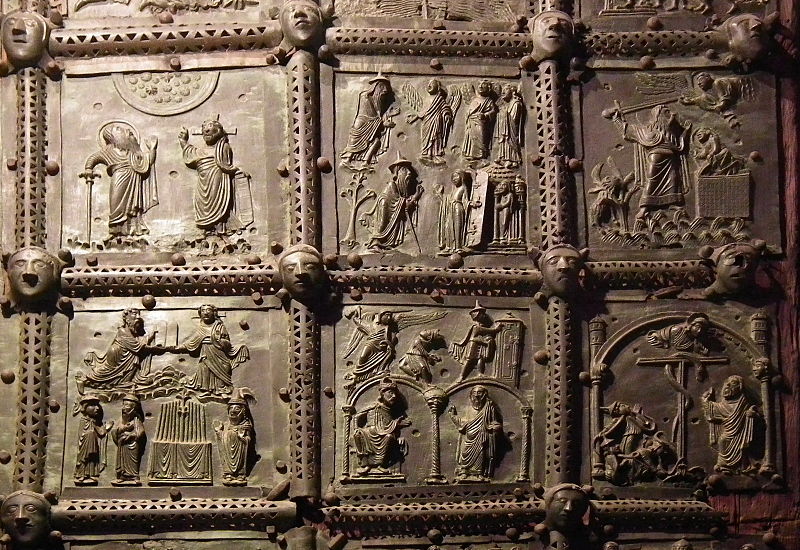
The present church of San Zeno in Verona is a work of the twelfth, thirteenth and early fifteenth centuries for the most part. It is well known for its bronze doors (c 1100 – c 1200) which depict, besides stories from the Bible, the miracles of Saint Zeno, images drawn from stories, including those recorded by the notary Coronato, the facade sculpture signed by Nicholaus and an associate Guglielmus and the rose window (c 1200), which is the work of Brioloto.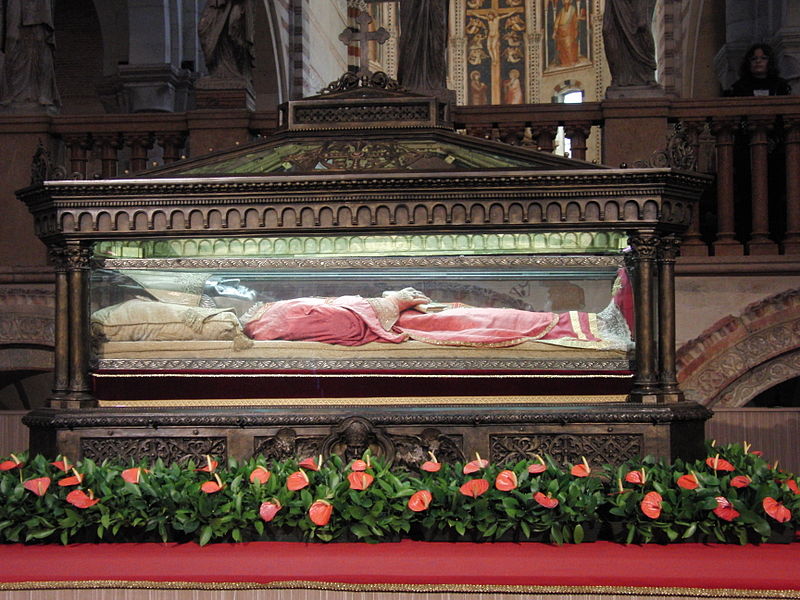
Memorials of the Saints – 12 April
St Acutina
St Alferius of La Cava
Bl Andrew of Montereale
Bl Angelo Carletti di Chivasso
St Artemón of Caesarea
St Basil of Parion
St Constantine of Gap
St Damian of Pavia
St David Uribe Velasco
St Erkemboden of Thérouanne
St Florentin of Arles
St Pope Julius I
St Lorenzo of Belem
St Peter of Montepiano
St Sabas the Lector
St Teresa of the Andes
St Tetricus of Auxerre
St Victor of Braga
St Vissia of Fermo
St Wigbert
St Zeno of Verona (c 300 – 371)
Thought for the Day – 11 April – Wednesday of the Second Week of Eastertide & the Memorial of St Stanislaus (1030-1079) Bishop and Martyr
Thought for the Day – 11 April – Wednesday of the Second Week of Eastertide & the Memorial of St Stanislaus (1030-1079) Bishop and Martyr
Anyone who reads the history of Eastern Europe cannot help but chance on the name of Stanislaus, the saintly but tragic bishop of Kraków, patron of Poland. He is remembered with Saints Thomas More and Thomas Becket for vigorous opposition to the evils of an unjust government.
Born in Szczepanow near Kraków on 26 July 1030, he was ordained a priest after being educated in the cathedral schools of Gniezno, then capital of Poland and at Paris. He was appointed preacher and archdeacon to the bishop of Kraków, where his eloquence and example brought about real conversion in many of his penitents, both clergy and laity. He became bishop of Kraków in 1072.
During an expedition against the Grand Duchy of Kiev, Stanislaus became involved in the political situation of Poland. Known for his outspokenness, he aimed his attacks at the evils of the peasantry and the king, especially the unjust wars and immoral acts of King Boleslaus II.
The king first excused himself, then made a show of penance, then relapsed into his old ways. Stanislaus continued his open opposition in spite of charges of treason and threats of death, finally excommunicating the king. Enraged, the latter ordered soldiers to kill the bishop. When they refused, the king killed Stanislaus with his own hands.
Forced to flee to Hungary, Boleslaus supposedly spent the rest of his life as a penitent in the Benedictine abbey in Osiak.
Saints John the Baptist, Thomas Becket, Thomas More and Stanislaus are a few of the prophets who dared to denounce corruption in high places. They followed in the footsteps of Jesus Himself, who pointed out the moral corruption in the religious leadership of His day. It is a risky business. A risk we HAVE to take.
St Stanislaus, pray for us!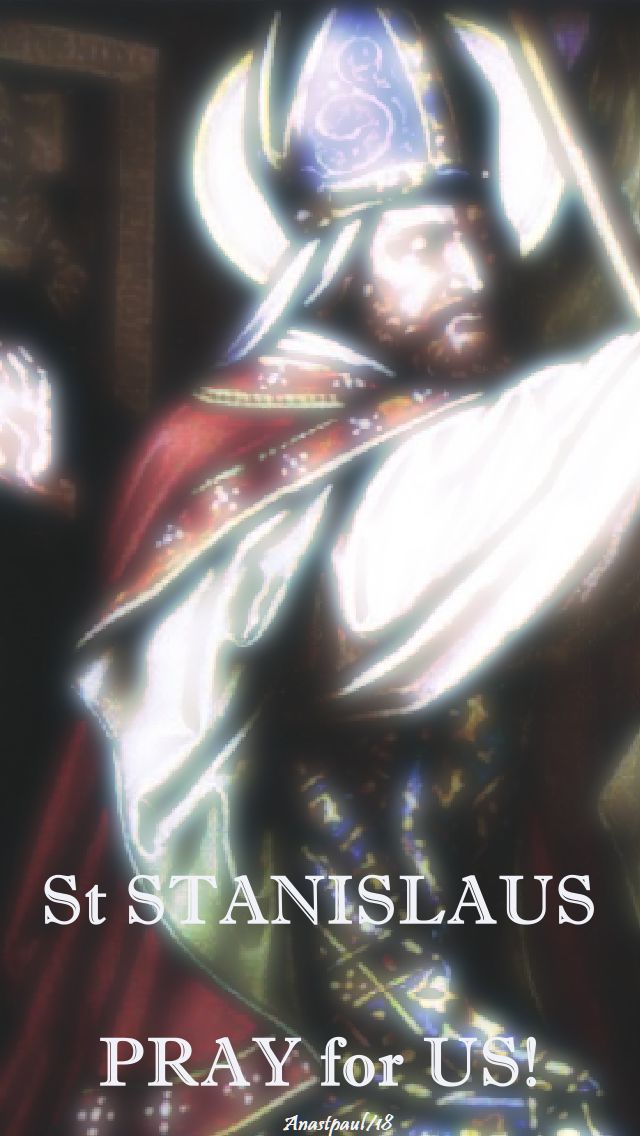
Quote of the Day – 11 April – Wednesday of the Second Week of Eastertide
Quote of the Day – 11 April – Wednesday of the Second Week of Eastertide
“To believe in God – for Christians,
does not mean simply to believe that God exists,
nor merely to believe that He is truth.
It means to believe by loving,
to believe by abandoning oneself to God completely,
uniting and conforming oneself to Him.”
St Anthony of Padua (1195-1231) Doctor of the Church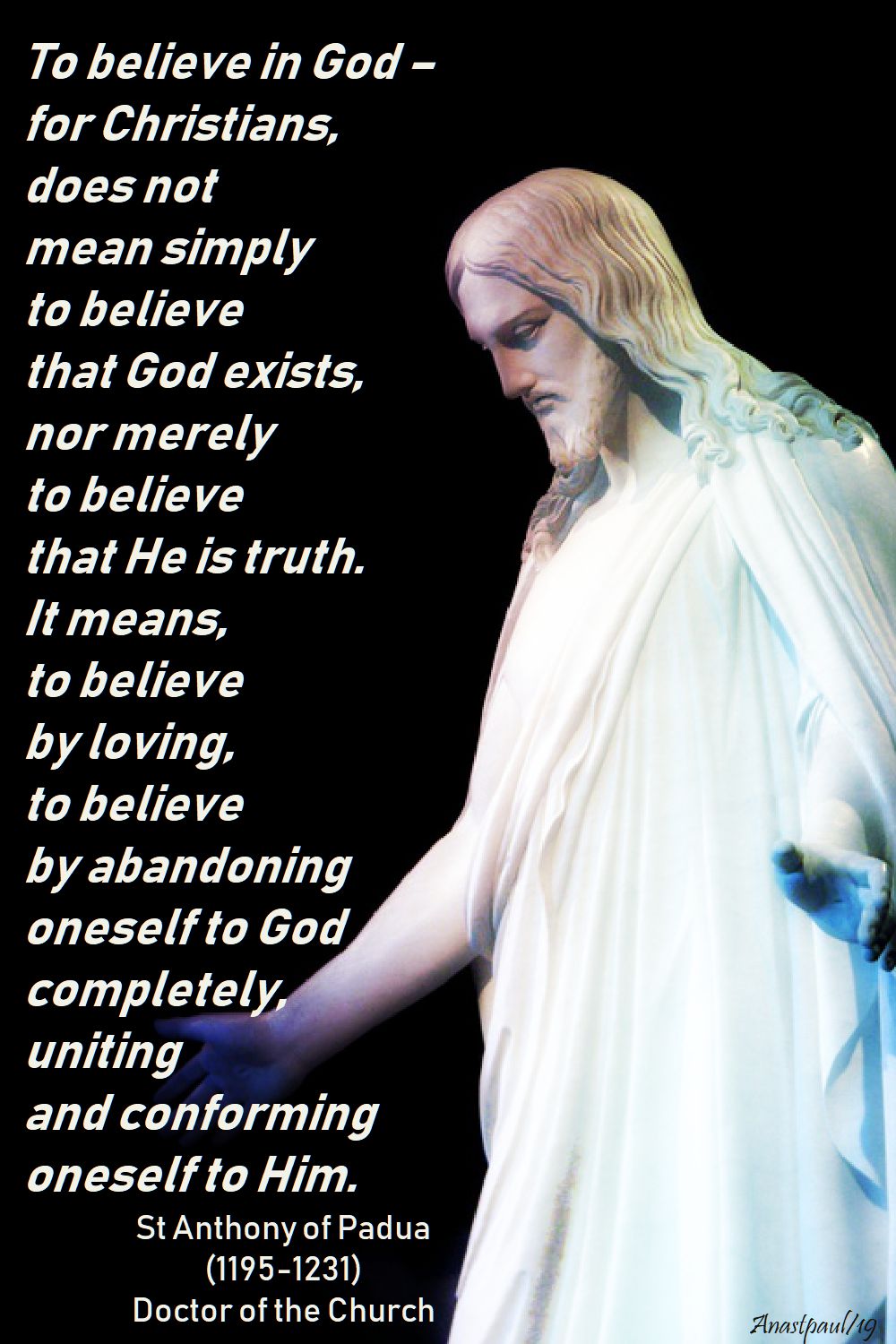
One Minute Reflection – 11 April – Wednesday of the Second Week of Eastertide and the memorial of St Gemma Galgani (1878-1903)
One Minute Reflection – 11 April – Wednesday of the Second Week of Eastertide and the memorial of St Gemma Galgani (1878-1903)
Jesus said to them, “I am the bread of life; he who comes to Me will not hunger and he who believes in Me will never thirst.”…John 6:35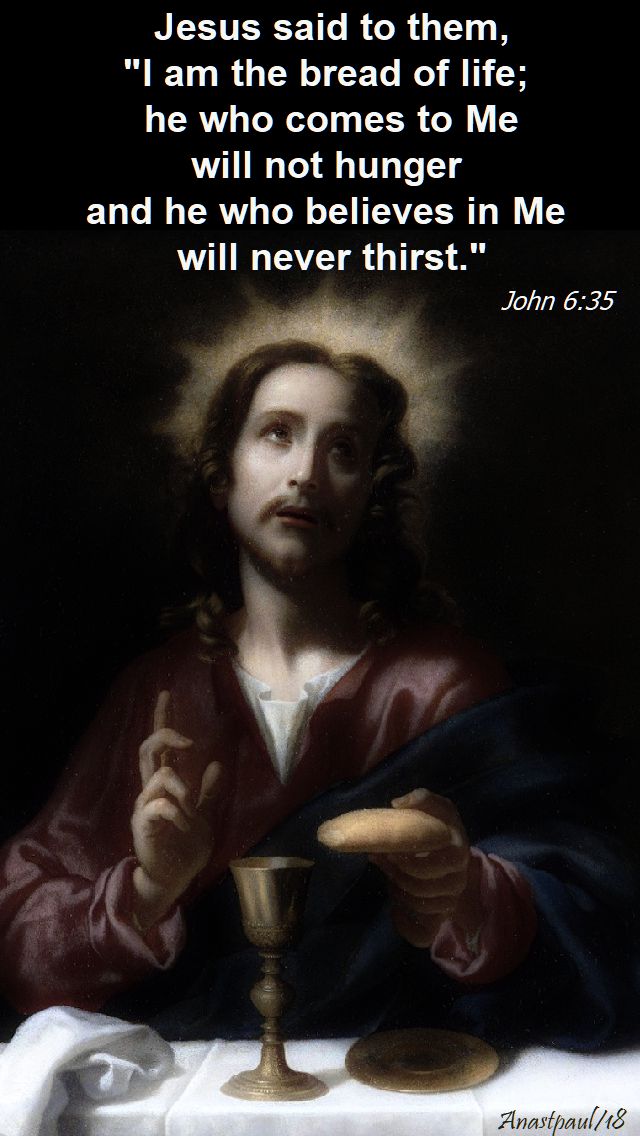
REFLECTION – “Jesus, Food of strong souls, strengthen me, purify me, make me godlike.”…St Gemma Galgani
PRAYER – Oh my Lord, Food of my soul, Food of my life, teach us to fully grow in our love and understanding of the great Mystery of the Holy Eucharist. Help us to participate more fully at each Holy Mass. St Gemma pray for us that we may love the food of our souls and one day join you in our heavenly home. Through our Lord Jesus in unity with the Holy Spirit, one God forever and ever, amen.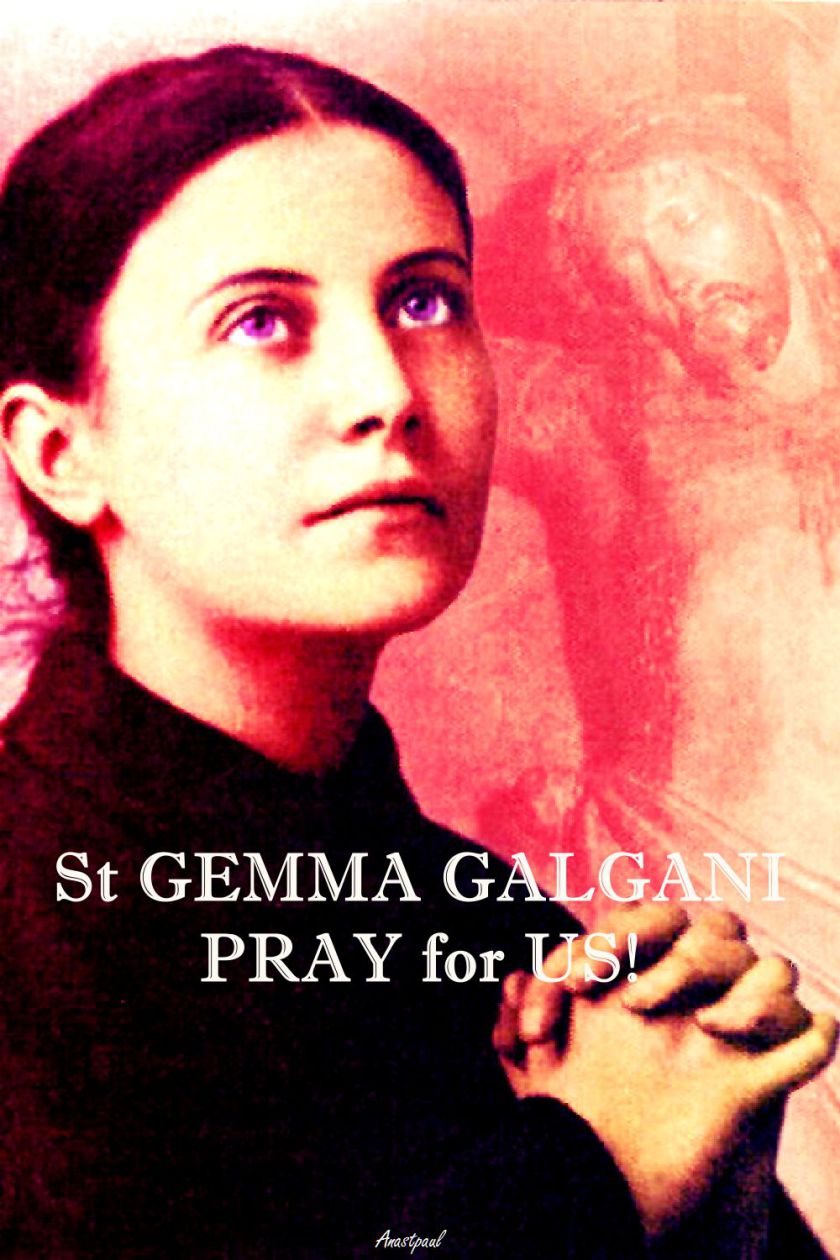
Our Morning Offering – 11 April – Wednesday of the Second Week of Eastertide and the Memorial of St Gemma Galgani (1878-1903)
Our Morning Offering – 11 April – Wednesday of the Second Week of Eastertide and the Memorial of St Gemma Galgani (1878-1903)
Prayer for Forgiveness
By St Gemma Galgani (1878-1903)
My crucified God, behold me at Your feet.
Do not reject me, a poor sinner,
as I appear before You.
I have offended You much in the past, my Jesus
but in the future I resolve to sin no more.
My God, I put all my sins before You.
I have considered them and realise
they do not deserve Your pardon.
But I beg of you to cast one glance upon Your sufferings
and see how great is the worth of that Precious Blood
that flows from your veins.
My God, at this hour,
close Your eyes to my want of merit
and open them to Your infinite merits.
Since You, dear Jesus,
have been pleased to die for my sins,
grant me forgiveness for them all,
that I may no longer feel their heavy burden,
which presses me to the earth.
My Jesus, help me, for I desire to become good,
no matter what it may cost.
Take away, destroy, root out completely,
all that You find in me that may be contrary to Your holy Will.
At the same time I beg You, O Jesus,
to enlighten me, that I may be able to walk in Your holy light.
Amen
Saint of the Day – 11 April – St Gemma Galgani (1878-1903)
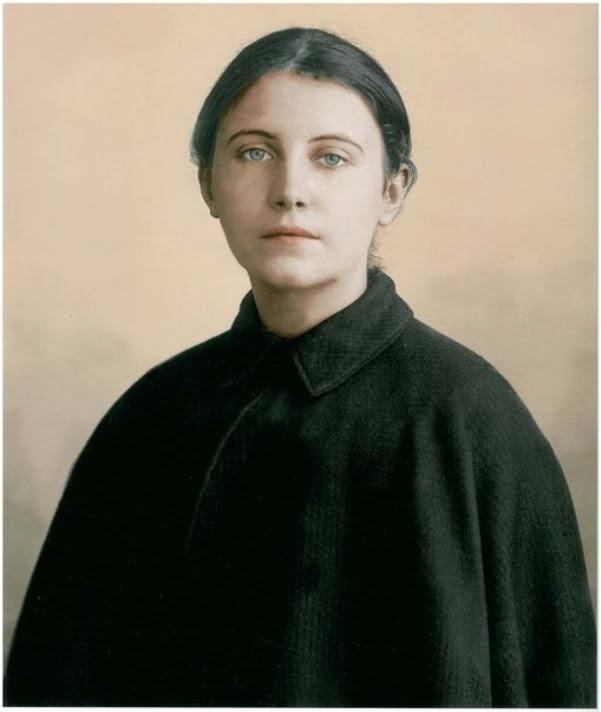
Saint of the Day – 11 April – St Gemma Galgani (1878-1903) known as “The Flower of Lucca,” “The Virgin of Lucca ” and “Daughter of the Passion” – Stigmatist & Mystic – born on 12 March 1878 at Borgo Nuovo di Camigliano, Lucca, Tuscany, Italy and died on Holy Saturday, 11 April 1903 at Borgo Nuovo di Camigliano, Lucca, Italy of tuberculosis., aged 25. Her relics interred in the Passionist monastery, Lucca. Patronages – Students, Pharmacists, Paratroopers and Parachutists, loss of parents, those suffering back injury or back pain, those suffering with headaches/migraines, those struggling with temptations to impurity and those seeking purity of heart. Attributes – Passionist robe, flowers (lilies and roses), guardian angel, stigmata, heavenward gaze.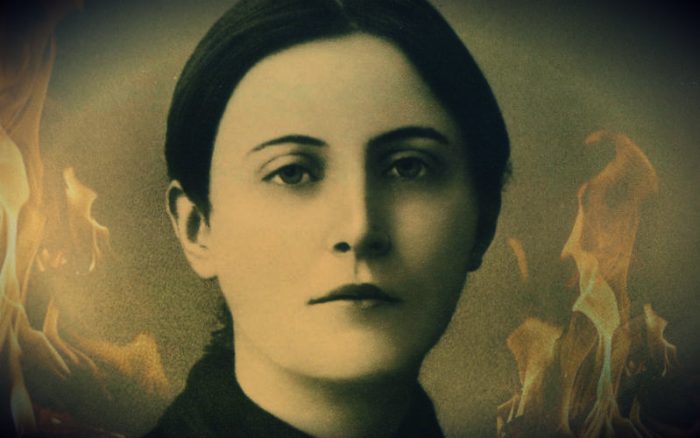
Gemma Galgani was born on 12 March 1878, in a small Italian town near Lucca. Gemma is the Italian word for gem. The child’s mother was worried that this name was not a saint’s name but a priest friend comforted her with the remark that perhaps the child would one day be a “gem of Paradise.”
At a very young age, Gemma developed a love for prayer. She credited her mother, who died when Gemma was very young, with inspiring in her the desire for Heaven and with teaching her about God. Gemma made her First Communion on 17 June 1887. Later, she wrote, “It is impossible for me to describe what passed between Jesus and myself in that moment. He made himself felt so strongly in my soul. I realised in that moment how the delights of Heaven are not like those of the earth and I was seized by a desire to make that union with my God everlasting.”
As a day pupil at the school run by the Sisters of St Zita, Gemma was loved by her teachers and her fellow pupils. Although quiet and reserved, she always had a friendly smile for everyone. Though by nature a bright and lively child, she exercised great self discipline even as a schoolgirl, keeping her feelings under control. The superior of the sisters at the school once asked Gemma’s teacher and her class to pray for a dying man who refused the Sacraments. After the prayer, Gemma arose from her seat and going up to her teacher, whispered in her ear, “The grace is granted.” That evening the news as brought that the man had indeed converted and received the consolations of the Faith before his death.
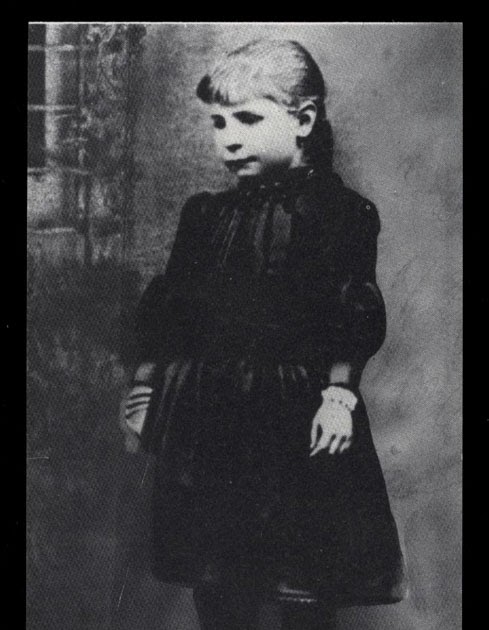
Throughout her life, Gemma was to be favoured with many mystical experiences and special graces. Often these were misunderstood by others, bringing ridicule. A sensitive person, Gemma suffered these heartaches, too, in reparation, remembering that Our Lord Himself had been misunderstood and ridiculed.
Although she was a good student, Gemma had to quit school due to chronic ill heath before completing the course of study. Throughout her life, her frail constitution did not stand up well to several illnesses.
Gemma’s father had been a moderately successful pharmacist. But because of his generosity and his willingness to extend credit to those in need, he began to get into financial trouble. His death in 1897 left Gemma and his other children penniless orphans. Gemma felt the loss of her father keenly but did not appear to be bothered by the poverty of her circumstances. She must have felt desolate when the creditors came and took away the few possessions left to the family on the very day of her father’s funeral but she maintained her cheerful, patient attitude.
Gemma had an immense love for the poor and when she went out, many poor people came to her for help. When she could, she gave them things from home. Later, when she too was a “povera,” or poor girl, she gave them the gift of friendship. She would weep over their misfortunes, completely ignoring her own.
After her father’s death, the nineteen-year-old Gemma became the mother of her seven brothers and sisters. When some were old enough to share this responsibility, she lived briefly with a married aunt. Although she returned the love given by this aunt and uncle, Gemma was unhappy with the busy social life of the couple. They were well off and wanted Gemma to join in the fun which they could afford to provide. At this time, two young men proposed marriage to her. Gemma, however, wanted silence and retirement and more than ever she desired to pray and speak only to God.
Gemma returned home and almost immediately became very ill with meningitis. Gradually she lost her hearing and some of her hair. In addition, she suffered a complete paralysis of her limbs. All earthly remedies proved vain and Gemma was confined to bed for more than a year. Throughout this illness, her one regret was the trouble she caused her relatives in taking care of her. News of the heroic patience of the gentle girl spread about the town and many visitors came to cheer her up. For each visitor, Gemma had a smile and a welcoming comment.
Feeling herself tempted by the devil, she prayed for help to the Venerable Passionist, Gabriel Possenti. (Gabriel was later canonised.) He appeared to her in dreams several times, promising her help and calling her “sister.” Through his intercession, Gemma was miraculously cured. In one of her visions of Gabriel, he placed the badge of the Passionists on Gemma. When she spoke of her desire to enter a convent, he told her to make her vow to be a religious but not to add anything to this vow. Gabriel was telling her that although she might live the life of a nun, she would never enter any particular convent. Later, Gemma was rejected as a candidate for the religious life on the grounds of her health was too delicate. She offered this disappointment to God as a sacrifice.
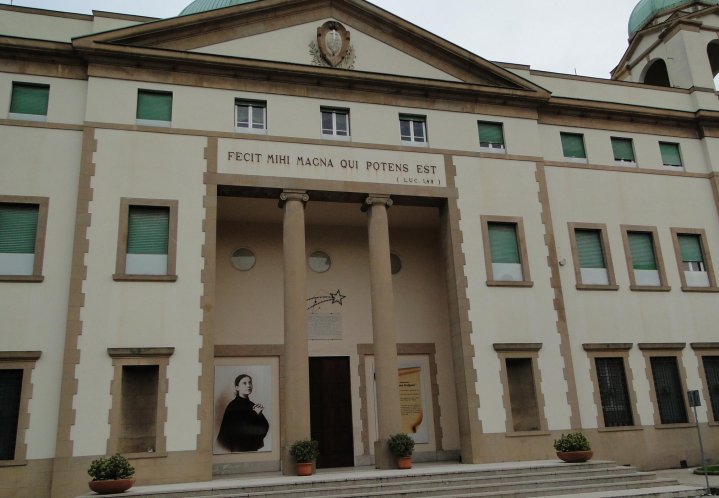
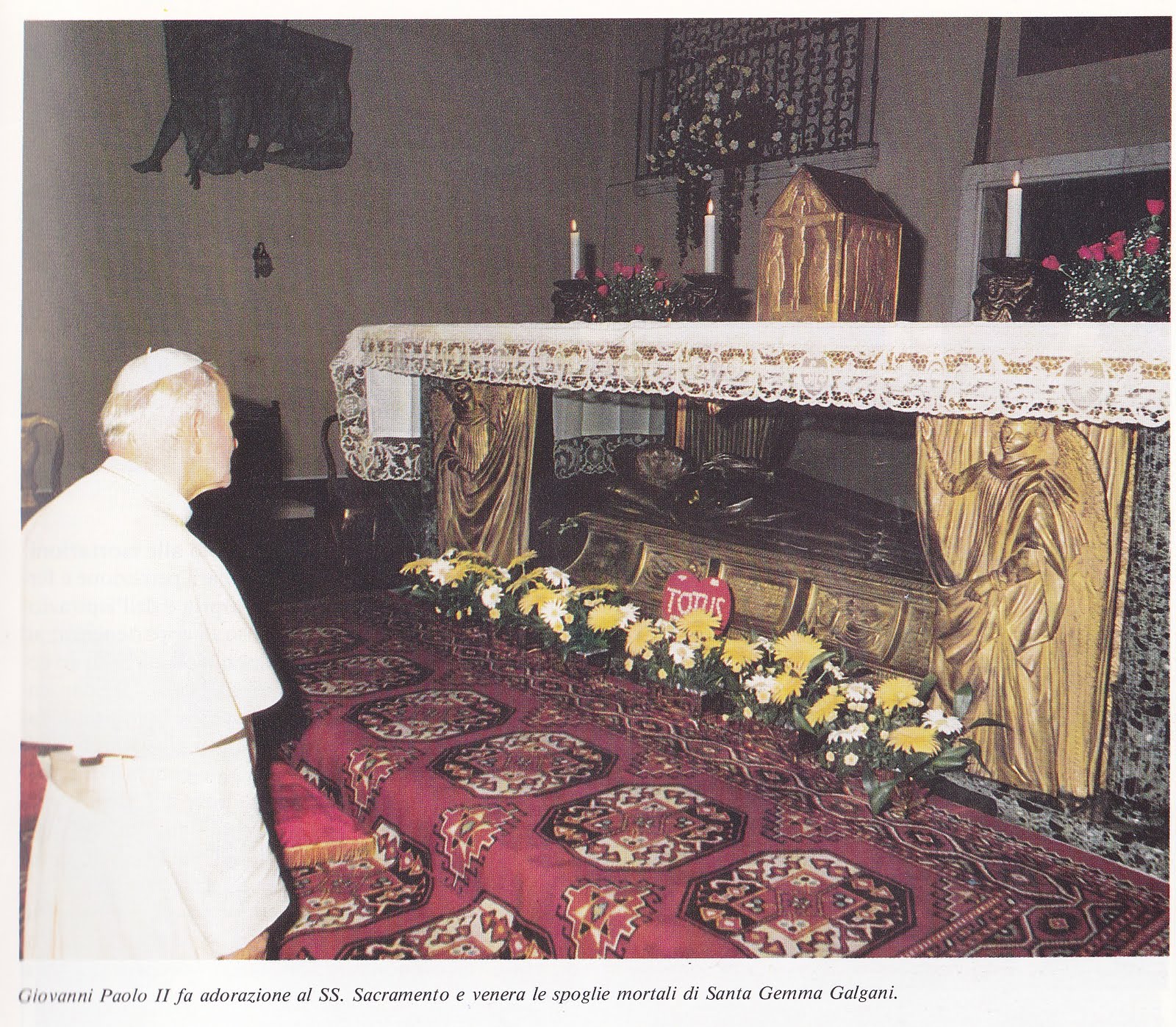
Gifted with an ability for prophecy, Gemma predicted that the Passionists would establish a monastery at Lucca; this came to pass two years after her death. When she understood that she would not be able to enter a Passionist monastery, Gemma said, “The Passionists did not wish to receive me; nevertheless, because I wish to stay with them, I shall when I am dead.” Today, Gemma’s mortal remains are still treasured at the Passionist monastery in Lucca.
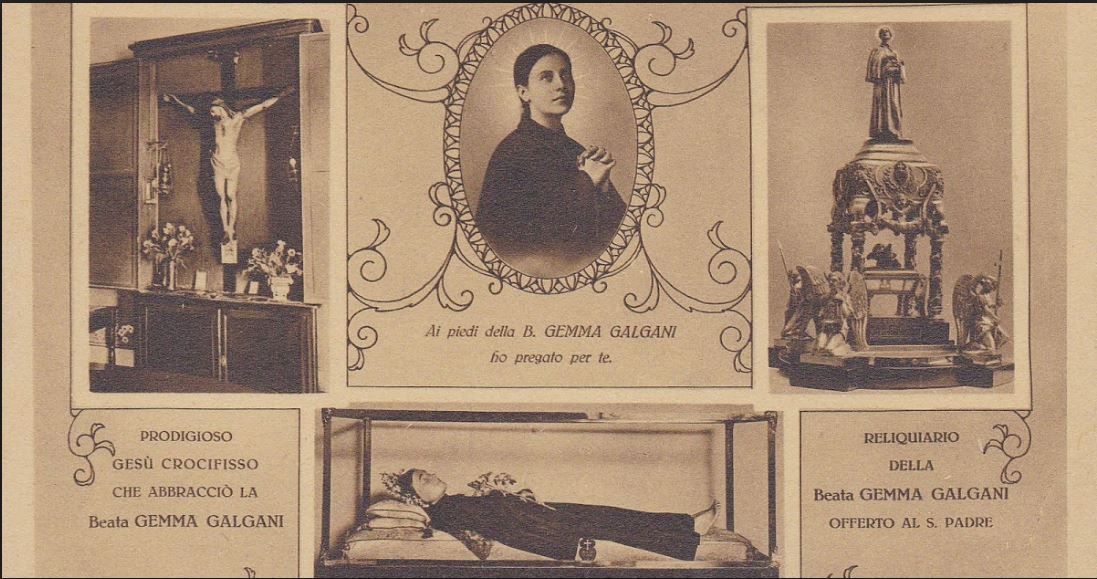
On the 8 June, 1899, Gemma had an interior warning that some unusual grace was to be granted to her. She spoke of this to her confessor and received absolution. She later gave the following account to her spiritual director: “It was Thursday evening, and suddenly I felt an inward sorrow for my sins; but so intense that I have never felt the like again; my sorrow made me feel as if I should die then and there. After that I felt all the powers of my soul in recollection. My intellect seemed to know nothing but my sins and how they offended God . . . Then thoughts crowded thickly within me and they were thoughts of sorrow, love, fear, hope and comfort.”
In rapture, she saw her heavenly Mother, who wrapped Gemma in her mantle. At that moment, according to her own account, “Jesus appeared with His wounds all open; blood was not flowing from them but flames of fire which in one moment came and touched my hands, feet and heart. I felt I was dying and should have fallen down but for my Mother who supported me and kept me under her cloak. Thus I remained for several hours. Then my Mother kissed my forehead, the vision disappeared and I found myself on my knees; but I had still a keen pain in my hands, feet and heart. I got up to get into bed and I saw that blood was coming from the places where I had the pain. I covered them as well as I could and then, helped by my Guardian Angel, got into bed.”
The next day, covering her hands with gloves, Gemma attended Mass as usual. Later, she showed the marks of the stigmata to one of her aunts, saying, “Just look at what Jesus has done to me!”
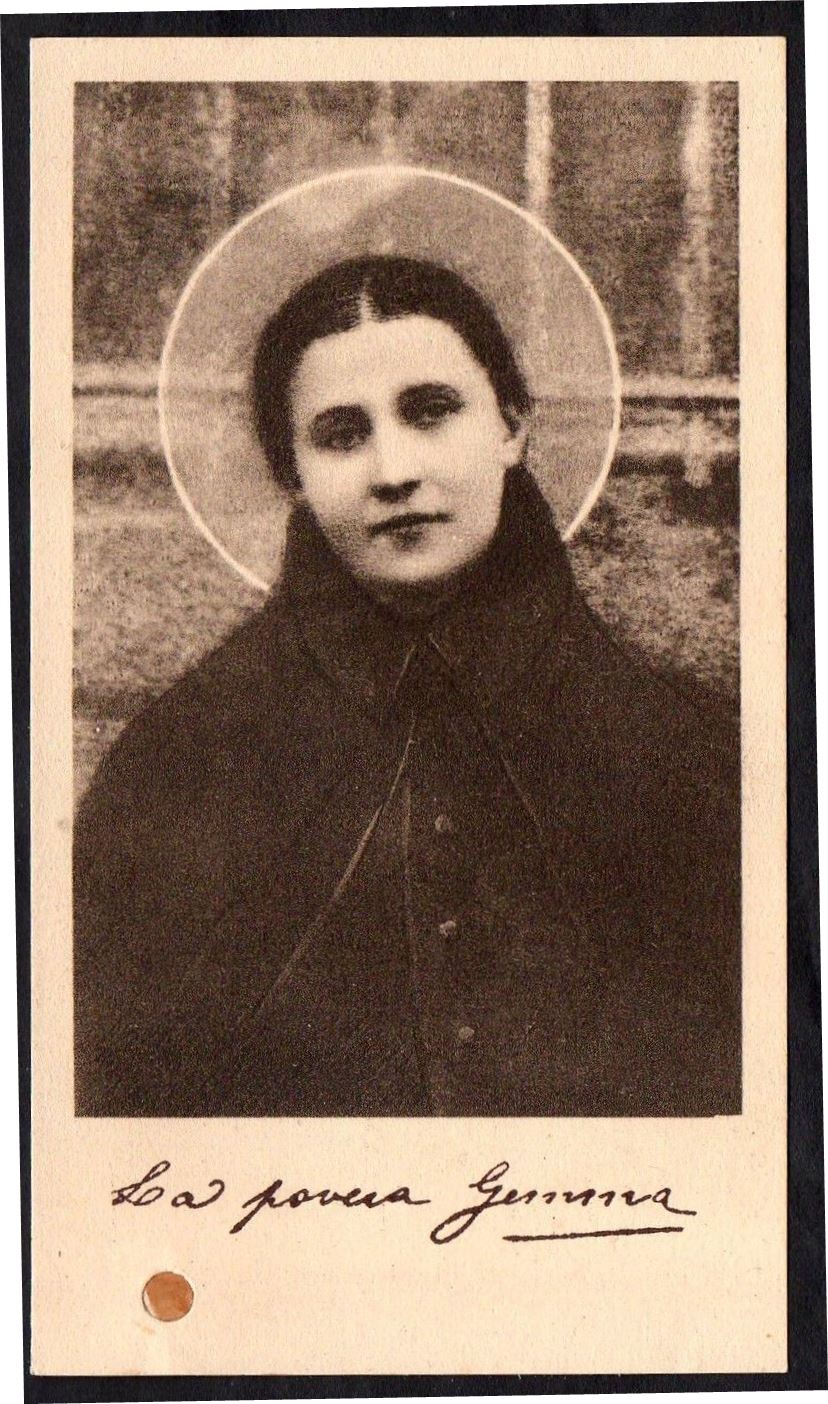
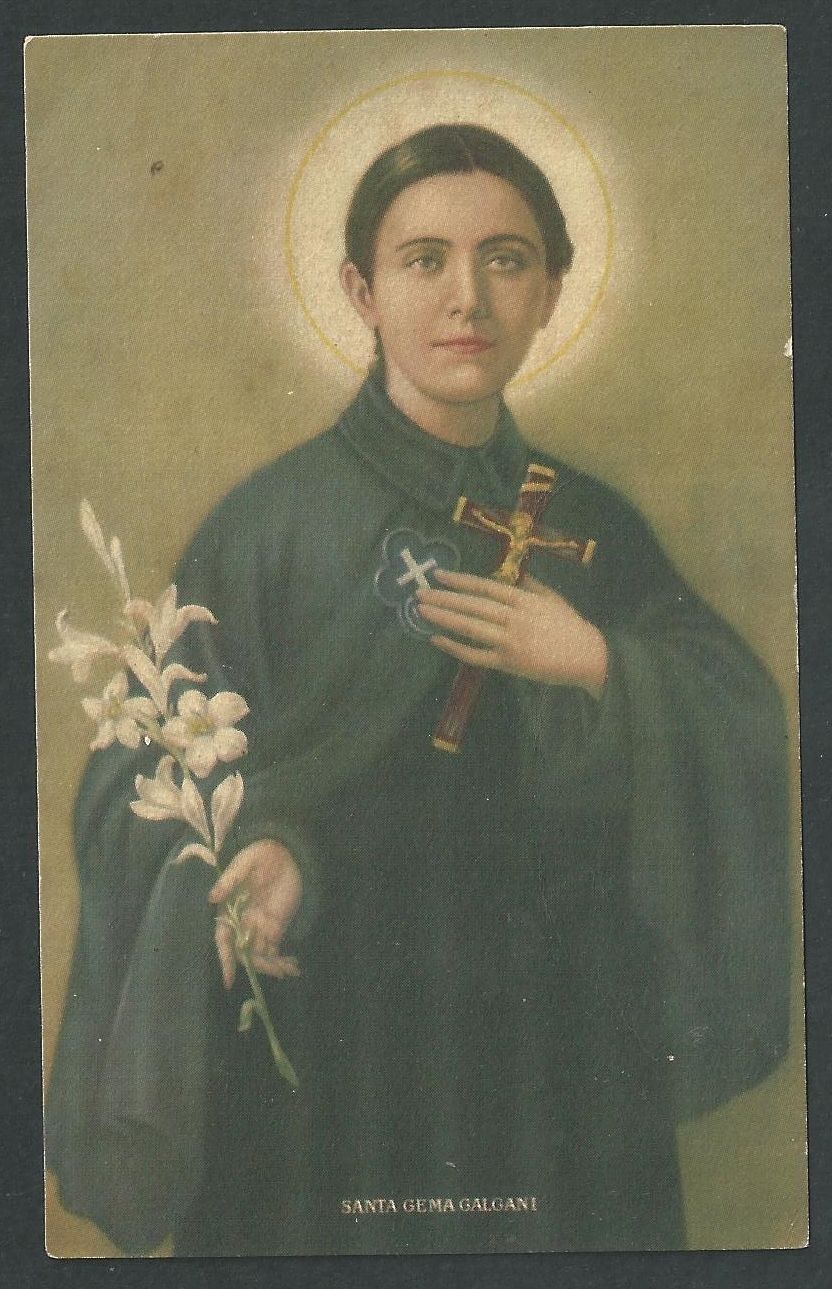
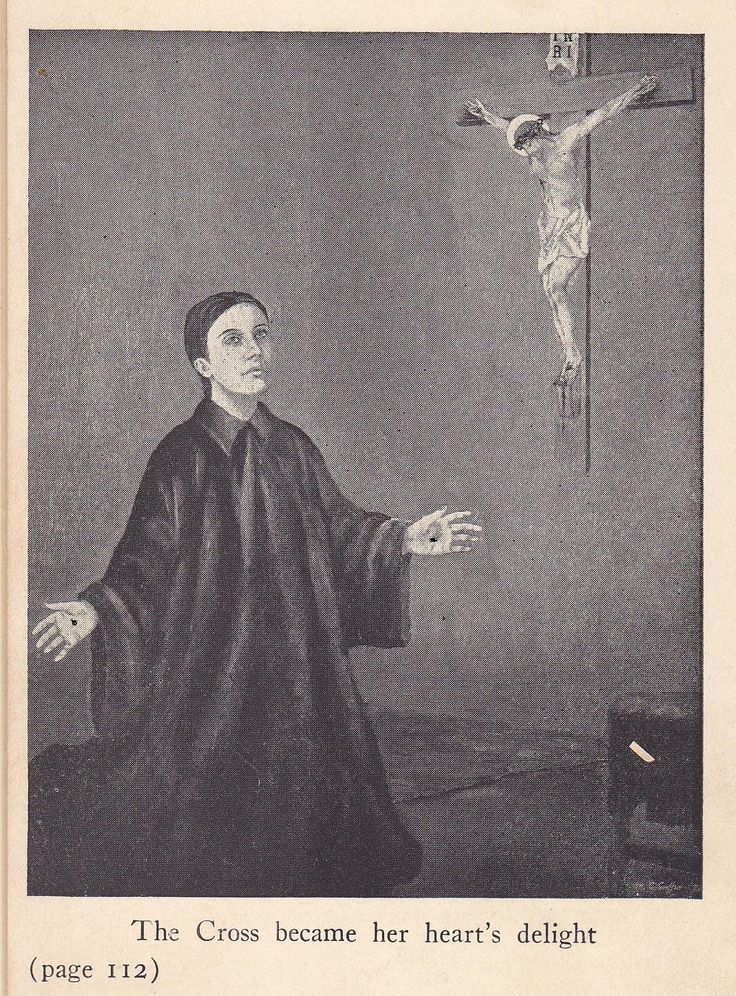
Each Thursday evening, Gemma would fall into rapture and the marks would appear. The stigmata remained until Friday afternoon or Saturday morning when the bleeding would stop, the wounds would close and only white marks would remain in place of the deep gashes. Later, one of Gemma’s directors turned to science and had a doctor examine the stigmata. As Gemma had foreseen, the doctor considered them a manifestation of some form of disease, or the delusions of an overly pious soul. Gemma’s stigmata continued to appear until the last three years before her death. At this time, her director forbade her to accept this phenomenon and through her prayers it ceased, although whitish marks remained on her skin until her death.
Through the help of her confessor, Gemma went to live with a family named Giannini, where she was allowed more freedom than at home for her spiritual life. She was very grateful to this adoptive family and was more than once overheard in ecstasy praying for its members. In this home, Gemma cheerfully did housework and helped in the training and education of the children.
There is a good record of Gemma’s words during ecstasy. In this state of rapture, the soul is so absorbed in God that the normal activity of the senses is suspended. Both her confessor and a relative of the head of her adoptive family, Aunt Cecilia, often overheard Gemma and recorded her conversations.
Father Germano once overheard her arguing with Divine Justice for the salvation of a soul. Some of her words were: “I do not seek Your justice, but for Your mercy. I know, he made You shed tears; but . . . You must not think of his sins; You must think of the Blood You shed. And now answer, Jesus and tell me You have saved my sinner.” Gemma actually named the man she was praying for. Soon afterwards, she broke out joyfully, “He is saved! You have won, Jesus; triumph always thus.” Then she came out of ecstasy.
Father Germano had just left the room when he heard a knock and was told that a stranger wished to speak to him. As soon as the man was before the priest, he fell to his knees weeping and said, “Father, I want to make my confession.” The priest was stunned to realise that it was Gemma’s sinner.
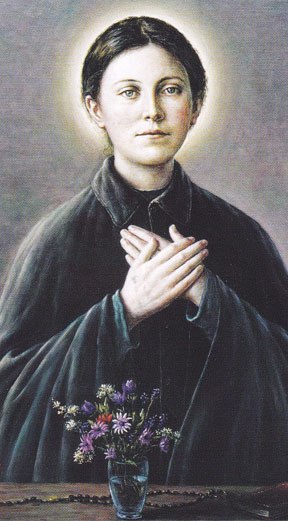
Gemma often saw her guardian angel, with whom she was on familiar terms. Sometimes the angel protected and consoled her, sometimes he counselled her and occasionally he scolded her very severely for her faults. He would say, “I am ashamed of you.” At times Gemma was heard arguing with her guardian angel, so that her spiritual director, Father Germano, had to remind her that she was speaking with a blessed spirit of Heaven and should be very respectful. The angel is mentioned on almost every single page of Gemma’s diary. In one entry, Gemma wrote that the devil had been raining down blows on her shoulder for nearly half an hour. “Then my guardian angel came and asked me what was the matter; I begged him to stay with me all night and he said: ‘But I must sleep.’ ‘No,’ I replied, ‘the Angels of Jesus do not sleep!’ ‘Nevertheless,’ he rejoined, smiling, ‘I ought to rest. Where shall you put me?’ I begged him to remain n ear me. I went to bed; after that he seemed to spread his wings and come over my head. In the morning he was still there.”
One of the most extraordinary things is the fact that Gemma often sent her guardian angel on errands, usually to deliver a letter or oral message to Father Germano in Rome. Often the reply was delivered by the priest’s guardian angel. Realising how unusual this was, Father Germano asked Heaven for a sign that it was in accord with God’s Will. After Gemma’s death, he wrote: “To how many tests didn’t I submit this singular phenomenon in order to convince myself that it took place through a supernatural intervention! And yet none of my tests ever failed; and thus I was convinced again and again that in this, like in many other extraordinary things in her life, Heaven was delighted in amusing itself, as it were, with this innocent and dear maiden.”
During the apostolic investigations into her life, all witnesses testified that there was no artfulness in Gemma’s manner. At the end of each of her ecstasies, she returned to normal and went quietly and serenely about the family life. Most of her severe penances and sacrifices were hidden from most who knew her. Only a few around her privileged to realise that she was exceptionally favoured.
In spite of everything which had happened to her, Gemma understood the true joy of her way of life. She said, “There is neither cross nor sorrow, when we are tightly united to Jesus.”
In January of 1903, Gemma was diagnosed as having tuberculosis. To avoid danger to her adoptive family, she was isolated in a small apartment close to the Giannini house. For four months Gemma suffered uncomplainingly from the disease. She died quietly, in the company of the parish priest, on 11 April. In his testimony he said, “I have been present at many deathbeds but never have I seen anyone die like Gemma, without even a precursor sign, nor a tear, nor a panting breath. She died with a smile which remained upon her lips, so that I could not convince myself that she was really dead.”
The Church authorities began to study Gemma’s life in 1917 and she was beatified in 1933. The decree approving the miracles for canonisation was read 26 March 1939—Passion Sunday. Gemma was canonised on 2 May 1940, only thirty-seven years after her death.
Memorials of the Saints – 11 April
St Stanislaus (1030-1079) Bishop and Martyr (Memorial)
St Agericus of Tours
St Aid of Achard-Finglas
Bl Angelo Carletti di Chivasso
St Antipas of Pergamon
St Barsanuphius of Gaza
St Domnio of Salona
Bl Elena Guerra
St Eustorgius of Nicomedia
St Gemma Galgani (1878-1903)
Bl George Gervase
St Godeberta of Noyon
St Guthlac of Croyland
St Hildebrand of Saint-Gilles
St Isaac of Monteluco
Bl James of Africa
Bl John of Cupramontana
Bl Lanunio
St Machai
St Maedhog of Clonmore
Bl Mechthild of Lappion
Bl Paul of Africa
St Philip of Gortyna
St Raynerius Inclusus
St Sancha of Portugal
St Stephen of Saint-Gilles
Bl Symforian Ducki
Thought for the Day – 10 April – Tuesday of the Second Week of Eastertide
Thought for the Day – 10 April – Tuesday of the Second Week of Eastertide
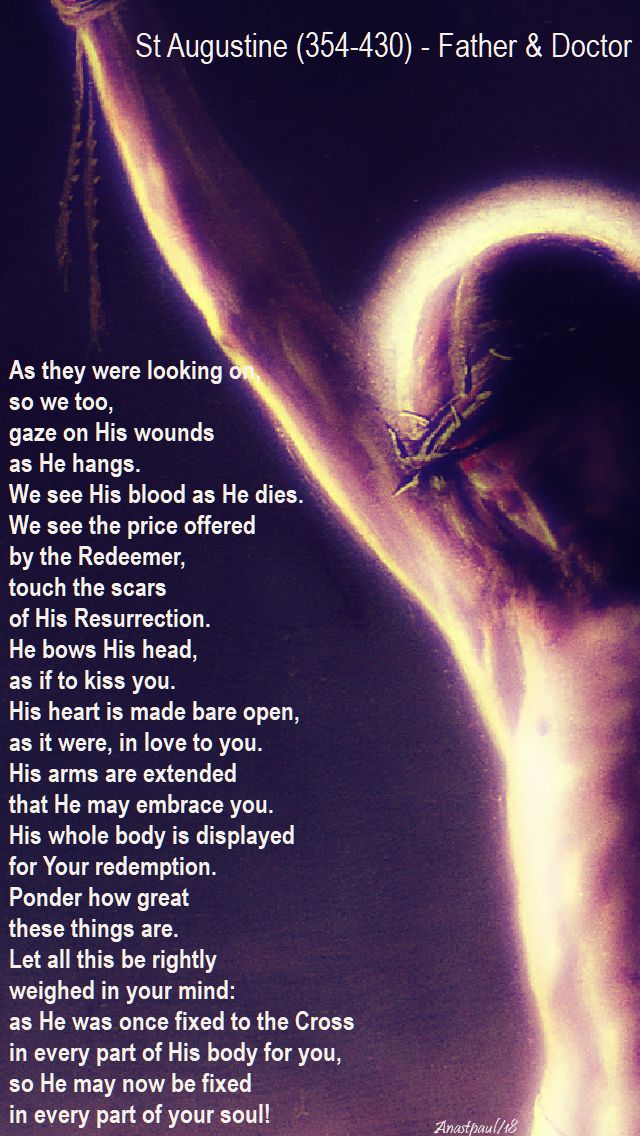
“As they were looking on, so we too,
gaze on His wounds as He hangs.
We see His blood as He dies.
We see the price offered by the Redeemer,
touch the scars of His Resurrection.
He bows His head, as if to kiss you.
His heart is made bare open, as it were, in love to you.
His arms are extended that He may embrace you.
His whole body is displayed for Your redemption.
Ponder how great these things are.
Let all this be rightly weighed in your mind:
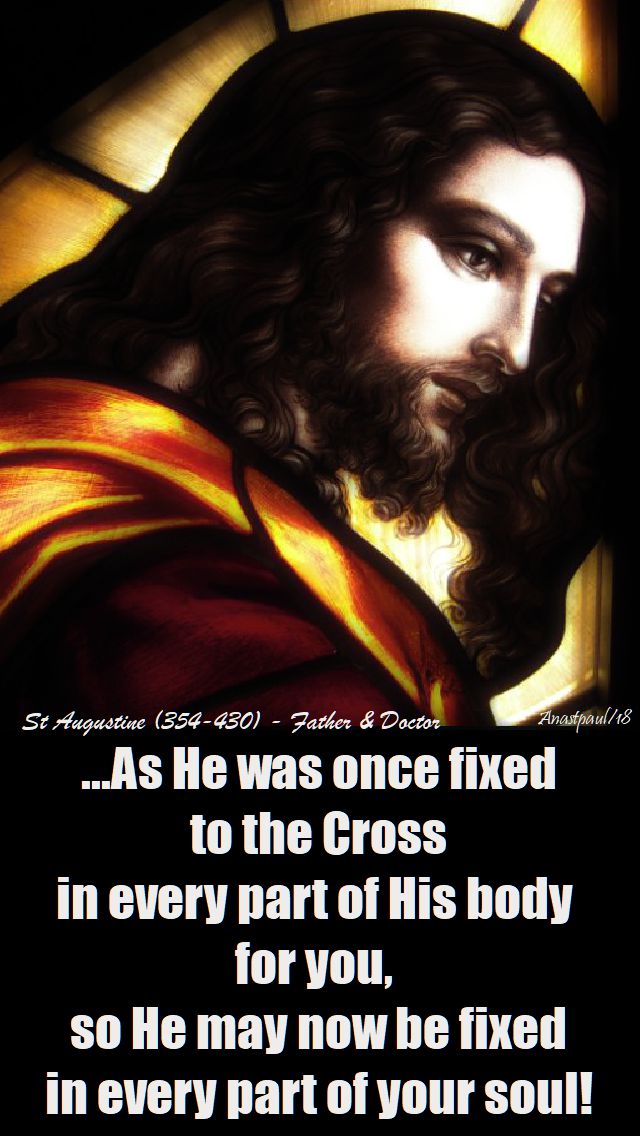
as He was once fixed to the Cross
in every part of His body for you,
so He may now be fixed in every part of your soul!”St Augustine (354-430) – Father & Doctor
Quote/s of the Day – – 10 April – Tuesday of the Second Week of Eastertide Speaking of Evangelisation Living and Preaching the Gospel
Quote/s of the Day — 10 April – Tuesday of the Second Week of Eastertide
Speaking of Evangelisation
Living and Preaching the Gospel
The Christian should be an ‘Alleluia’ from head to foot.
St Augustine (354-430) – Father & Doctor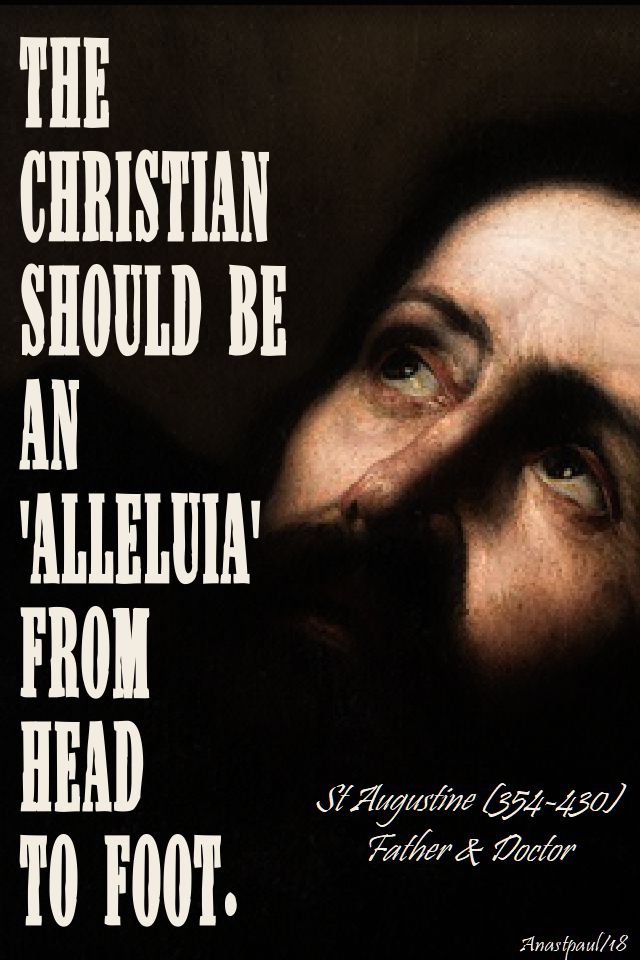
It is no use walking somewhere to preach
unless our walking is our preaching.
St Francis of Assisi (1181/82-1226)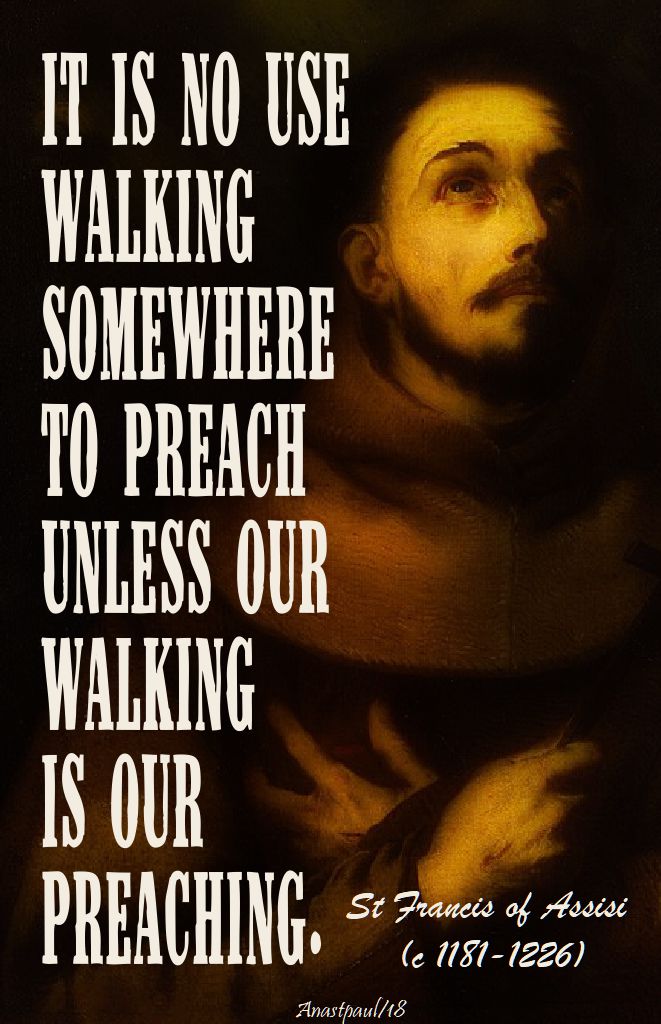
We must speak to them with our hands
before we try to speak with our lips.
St Peter Claver (1580-1654)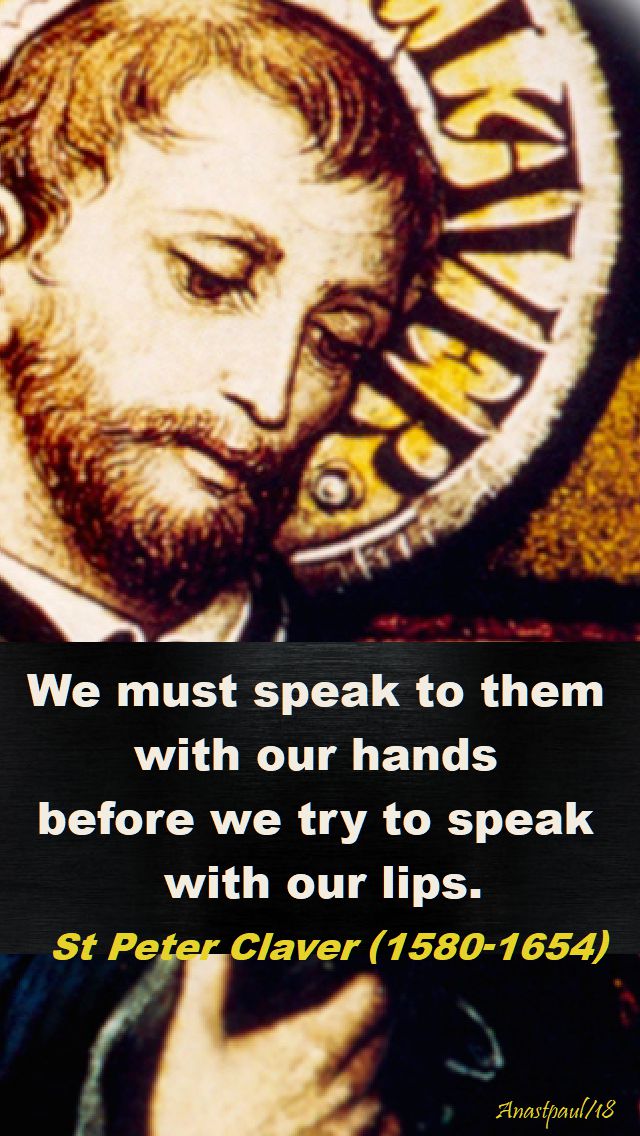
People will remember the faith you had,
not the words you preached.
Cardinal Francis George (1937-2015)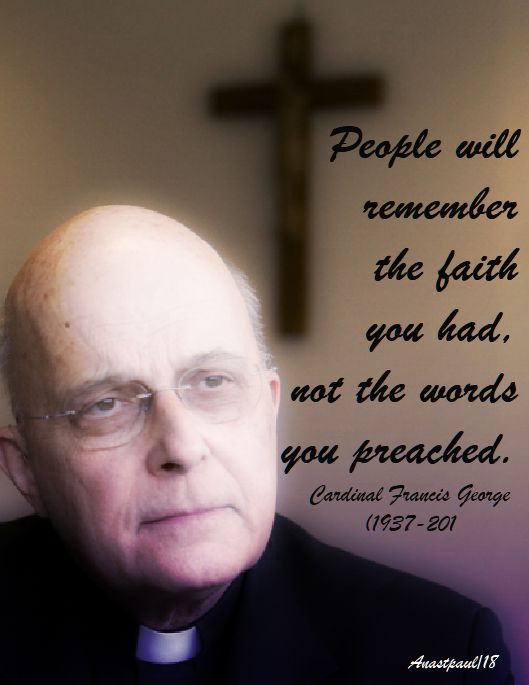
The minute you walk outside of your church
on Sunday you’re in mission territory.
Bishop Robert Barron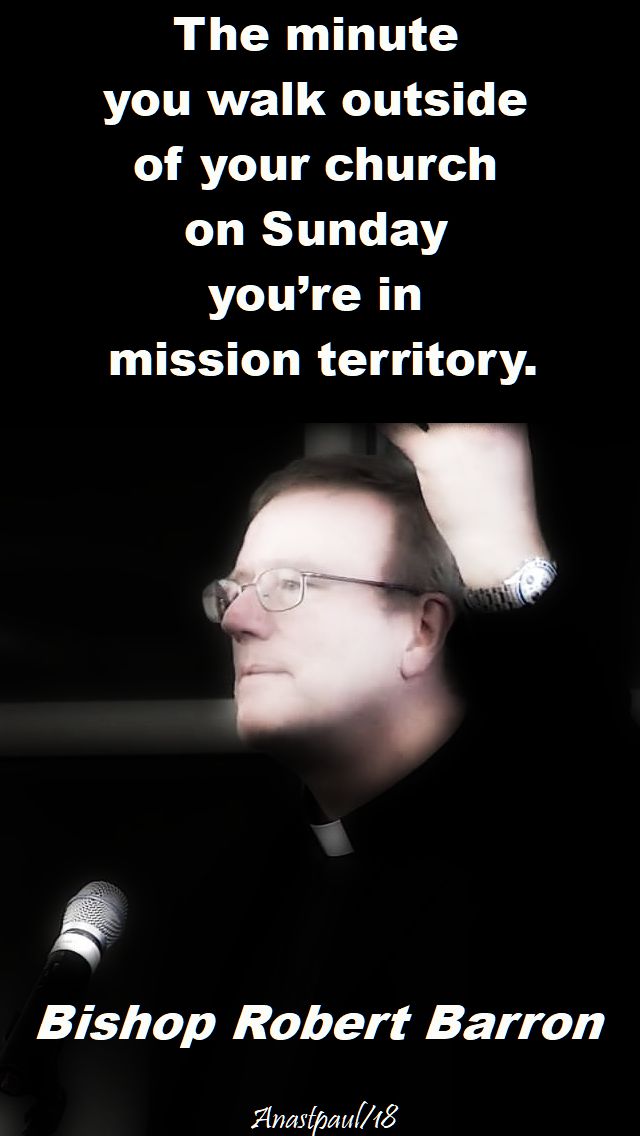
The world was won for Christ
not by arguments but by sanctity:
“What you are speaks so loud,
I can hardly hear what you say.”
Peter Kreeft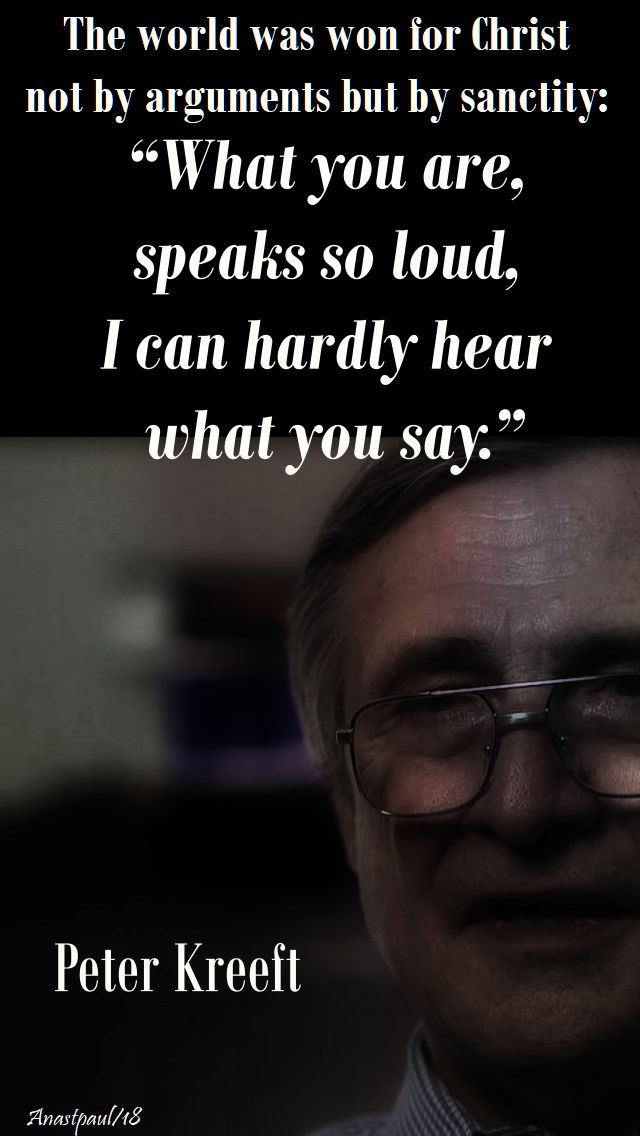
You are a billboard for Christ.
Father Mike Schmitz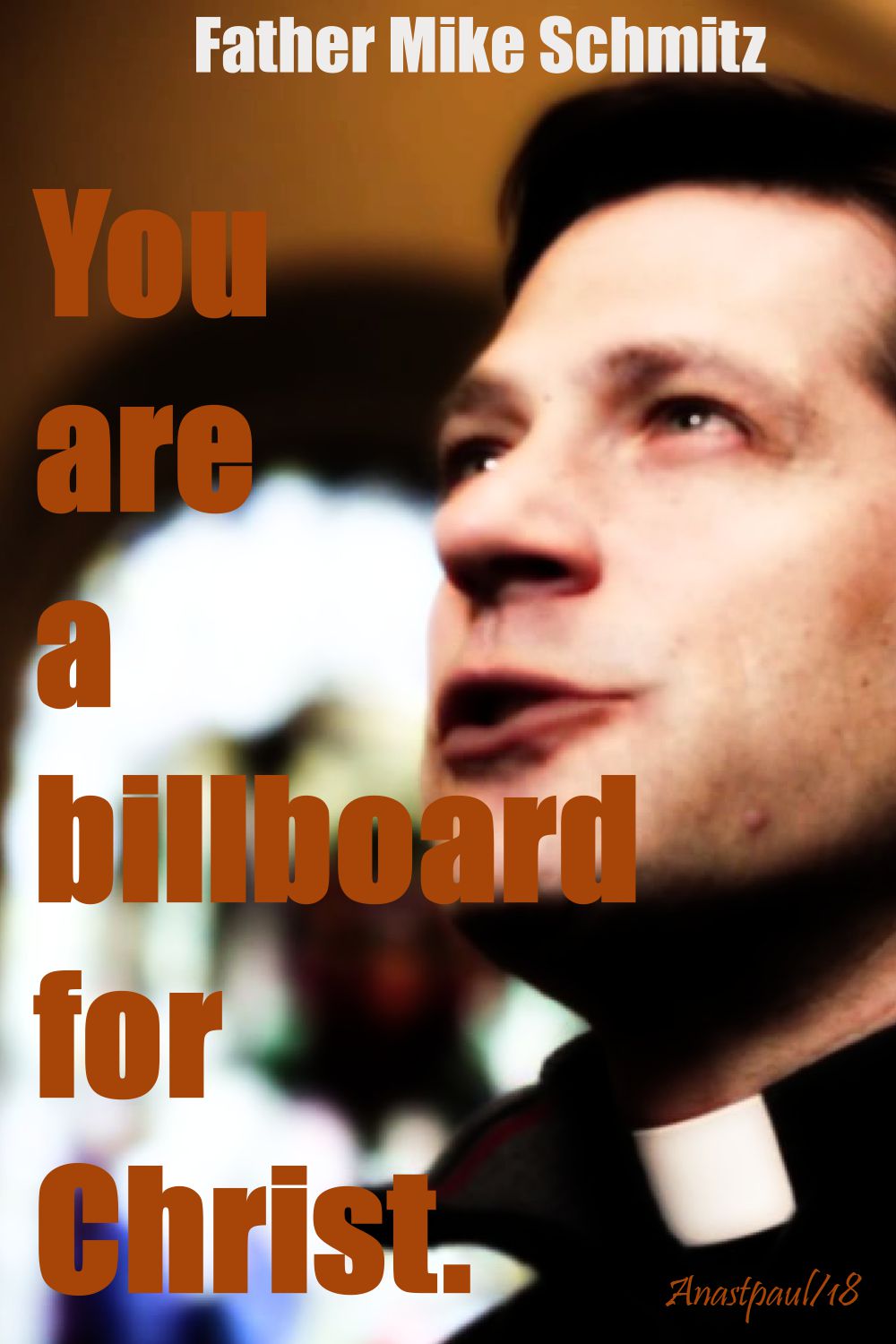
One Minute Reflection – 10 April – Tuesday of the Second Week of Eastertide
One Minute Reflection – 10 April – Tuesday of the Second Week of Eastertide
With great power the Apostles bore witness to the resurrection of the Lord Jesus and great favour was accorded them all…Acts 4:33
REFLECTION – “Modern man listens more willingly to witnesses than to teachers and if he does listen to teachers, it is because they are witnesses.”…Blessed Pope Paul VI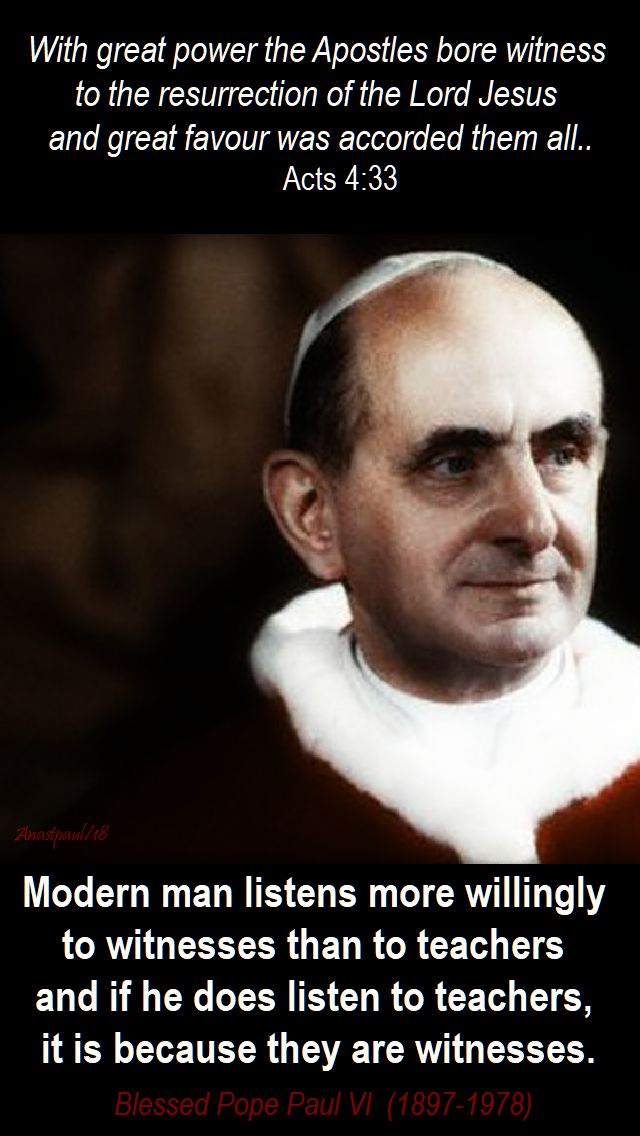
PRAYER – Almighty God, give Your Church the grace to proclaim the power of Jesus, our Risen Lord. We have received the first fruits of His grace, prepare us for the full revelation of His gifts and help us Lord God, to proclaim all we believe both in word and deed. Through our Lord Jesus, in union with the Holy Spirit, one God forever, amen.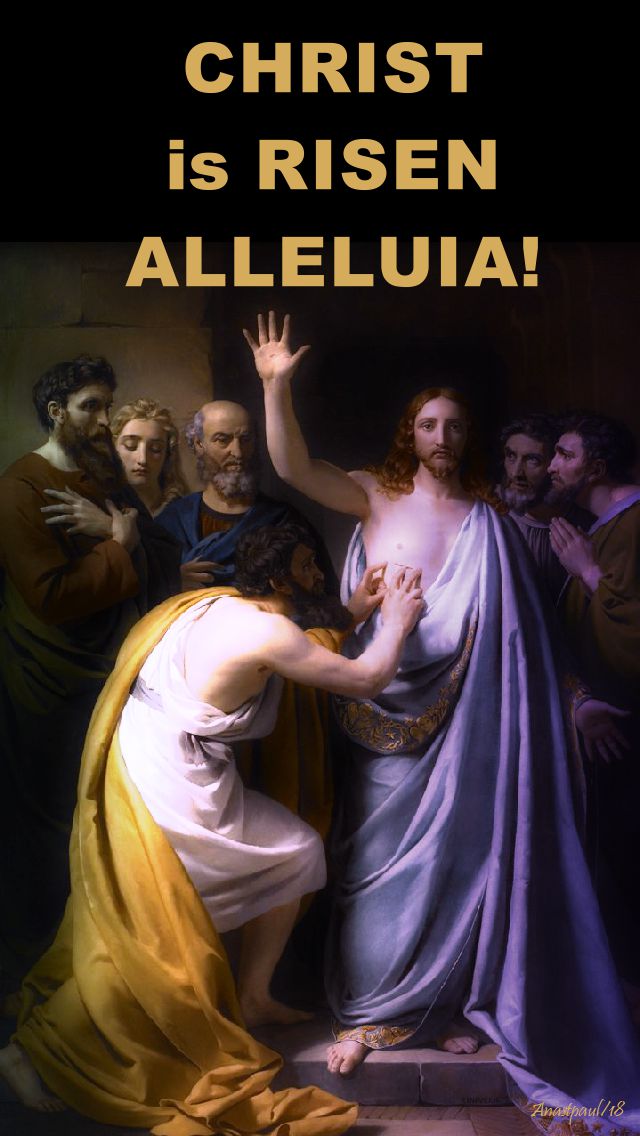
Our Morning Offering – 10 April
Our Morning Offering – 10 April
For Your Mercy’s Sake
By Saint Augustine (354-430) Father & Doctor
For Your mercy’s sake, O Lord my God,
tell me what You are to me.
Say to my soul: “I am your salvation.”
So speak that I may hear, O Lord,
my heart is listening,
open it, that it may hear You,
and say to my soul: “I am your salvation.”
After hearing this word,
may I come in haste to take hold of You.
Hide not Your face from me.
Let me see Your face, even if I die,
lest I die with longing to see it.
The house of my soul
is too small to receive You;
let it be enlarged by You.
It is all in ruins,
do You repair it.
There are thing in it,
I confess and I know,
that must offend Your sight.
But who shall cleanse it?
Or to what others besides You, shall I cry out?
From my secret sins cleanse me, O Lord,
and from those of others, spare Your servant.
Amen
Saint of the Day – 10 April – Blessed Antony Neyrot O.P. (1425-1460) Martyr
Saint of the Day – 10 April – Blessed Antony Neyrot O.P. (1425-1460) Martyr, Dominican Priest, an Apostate who reconverted, Penitent. Bl Anthony was born c 1425 at Rivoli, Diocese of Turin, Italy and died by being stoned to death on 10 April 1460 in Tunis, Tunisia. His body was returned to Rivoli, Italy by merchants travelling through the region. He was Beatified on 22 February 1767 by Pope Clement XIII (cultus confirmation).

Anthony was the only Dominican blessed ever to renounce his faith and yet in the end return to the faith and die a Martyr’s death. Bl Anthony is a reminder to us that nothing is lost which cannot be found again and no-one can stray so far that the Good Shepherd cannot bring him or her home.
Not much is known about the youth of Bl Anthony, only that he was from Rivoli in Italy. He was received into the Order by the great Dominican, Saint Antoninus. After his studies and ordination, Anthony was assigned to the convent of San Marco in Florence. Being somewhat wayward and impatient, Anthony quickly grew tired of this and asked for a change of scenery. He was sent first to Sicily, about which he was not thrilled and then to Naples. While sailing to Naples, Anthony’s ship was captured by pirates and he and the other passengers were taken to the city of Tunis in North Africa.
At first, Anthony was well-liked by the emir in Tunis and was allowed a measure of freedom. His continuing arrogance, though, quickly brought the wrath of his captors and Anthony was put in prison and given only bread and water. Anthony eventually gave in, denying his faith in order to obtain his freedom. Anthony quickly embraced his new faith, even going so far as to attempt a translation of the Qur’an. Soon, he was adopted by the emir and married a high-born Turkish lady.
Anthony’s newfound complacency, though, was quickly shattered. Into his life came the news that his beloved teacher and mentor, Saint Antoninus, had died. Love for his old master stirred in Anthony’s heart a desire for the Truth which he had abandoned. He had a dream in which Antoninus appeared to him; the conversation that transpired caused Anthony to resolve to readopt the faith which he had left behind, although such an action would result in his certain death.
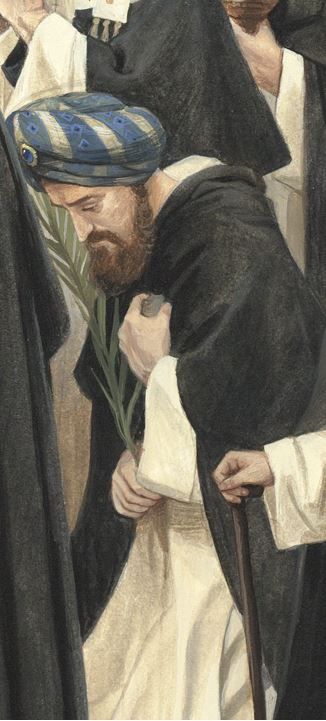
Finding a Dominican priest, Anthony confessed his sins, and on Palm Sunday of 1460, he publicly asked forgiveness from his fellow Catholics and was thereafter readmitted to his order. Wanting his re-conversion to be as public as his denial had been, Anthony waited until the king held a public procession then, Anthony appeared on the palace steps wearing again his Dominican habit and proclaiming his faith in a loud voice and his sorrow at ever having abandoned it. Failing to change Anthony’s mind, the emir ordered his death. Anthony died under a shower of stones, proclaiming his faith and his sorrow on Holy Thursday, 1460. His body was eventually returned to Rivoli, where it soon became a site of pilgrimage and many miracles were attributed to it and an annual procession was held at his shrine.
Holy Mary, Searcher for the Lost, pray for us.
Blessed Anthony Neyrot, pray for us.


Memorials of the Saints – 10 April
Bl Antony Neyrot O.P. (1425-1460) Martyr
Bl Antonio Vallesio
St Apollonius of Alexandria
Bl Archangelus Piacentini
St Bademus
St Bede the Younger
St Beocca of Chertsey
Bl Boniface Zukowski
Bl Eberwin of Helfenstein
St Ethor of Chertsey
St Ezekiel the Prophet
St Fulbert of Chartres
St Gajan
St Hedda of Peterborough
St Macarius of Antioch
St Maddalena of Canossa
St Malchus of Waterford
Bl Marco Mattia
Bl Mark Fantucci
St Michael de Sanctis
St Palladius of Auxerre
St Paternus the Scot
—
Martyrs of Carthage – 50 saints: A group of 50 Christians who were imprisoned in a pen of snakes and scorpions, and then martyred, all during the persecutions of Decius. Only six of their names have come down to us – Africanus, Alessandro, Massimo, Pompeius, Terence and Teodoro. Beheaded in 250 at Carthage.
Martyrs of Georgia: Approximately 6,000 Christian monks and lay people martyred in Georgia in 1616 for their faith by a Muslim army led by Shah Abbas I of Persia.
Martyrs of Ostia: A group of criminals who were brought to the faith by Pope Saint Alexander I while he was in prison with them. Drowned by being taken off shore from Ostia, Italy, in a boat which was then scuttled, c 115.

Thought for the Day – 9 April – Low Monday of Eastertide
Thought for the Day – 9 April – Low Monday of Eastertide
St Augustine of Hippo – The Easter Alleluia
This excerpt on the Easter Alleluia from St Augustine is a wonderful explanation of the joy of the Easter Season. Just as Lent was a season of penance, so the fifty days of Easter is a season of praise and song, an anticipation for the age to come in heavenly glory.
“Our thoughts in this present life, should turn on the praise of God because it is in praising God, that we shall rejoice forever in the life to come and no one can be ready for the next life, unless he trains himself for it now.
So we praise God during our earthly life and at the same time we make our petitions to Him. Our praise is expressed with joy, our petitions with yearning. We have been promised something we do not yet possess and because the promise was made by one who keeps His word, we trust Him and are glad; but insofar as possession is delayed, we can only long and yearn for it. It is good for us to persevere in longing until we receive what was promised and yearning is over, then praise alone will remain.
Because there are these two periods of time – the one that now is, beset with the trials and troubles of this life and the other yet to come, a life of everlasting serenity and joy – we are given two liturgical seasons, one before Easter and the other after. The season before Easter signifies the troubles in which we live here and now, while the time after Easter which we are celebrating at present, signifies the happiness that will be ours in the future. What we commemorate before Easter is what we experience in this life; what we celebrate after Easter points to something we do not yet possess. This is why we keep the first season with fasting and prayer but now the fast is over and we devote the present season to praise. Such is the meaning of the Alleluia we sing.
Both these periods are represented and demonstrated for us in Christ our head. The Lord’s passion depicts for us our present life of trial – shows how we must suffer and be afflicted and finally die. The Lord’s resurrection and glorification show us the life that will be given to us in the future.
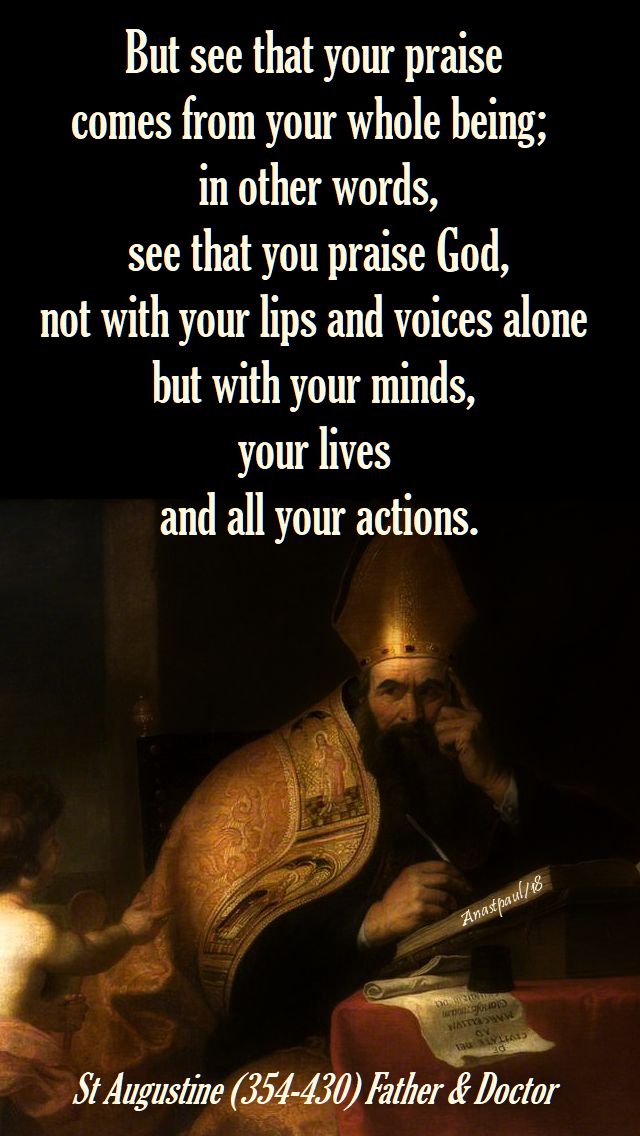
Now therefore, brethren, we urge you to praise God. That is what we are all telling each other when we say Alleluia. You say to your neighbour, “Praise the Lord!” and he says the same to you. We are all urging one another to praise the Lord and all thereby doing what each of us urges the other to do. But see that your praise comes from your whole being; in other words, see that you praise God, not with your lips and voices alone but with your minds, your lives and all your actions.
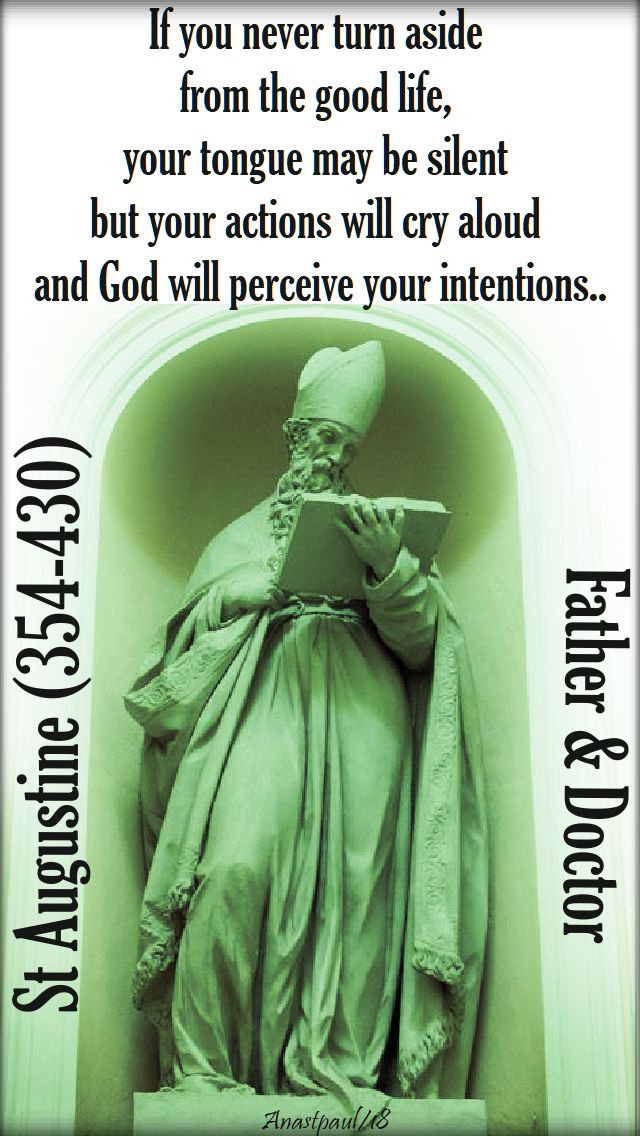
We are praising God now, assembled as we are here in church; but when we go on our various ways again, it seems as if we cease to praise God. But provided we do not cease to live a good life, we shall always be praising God. You cease to praise God only when you swerve from justice and from what is pleasing to God.
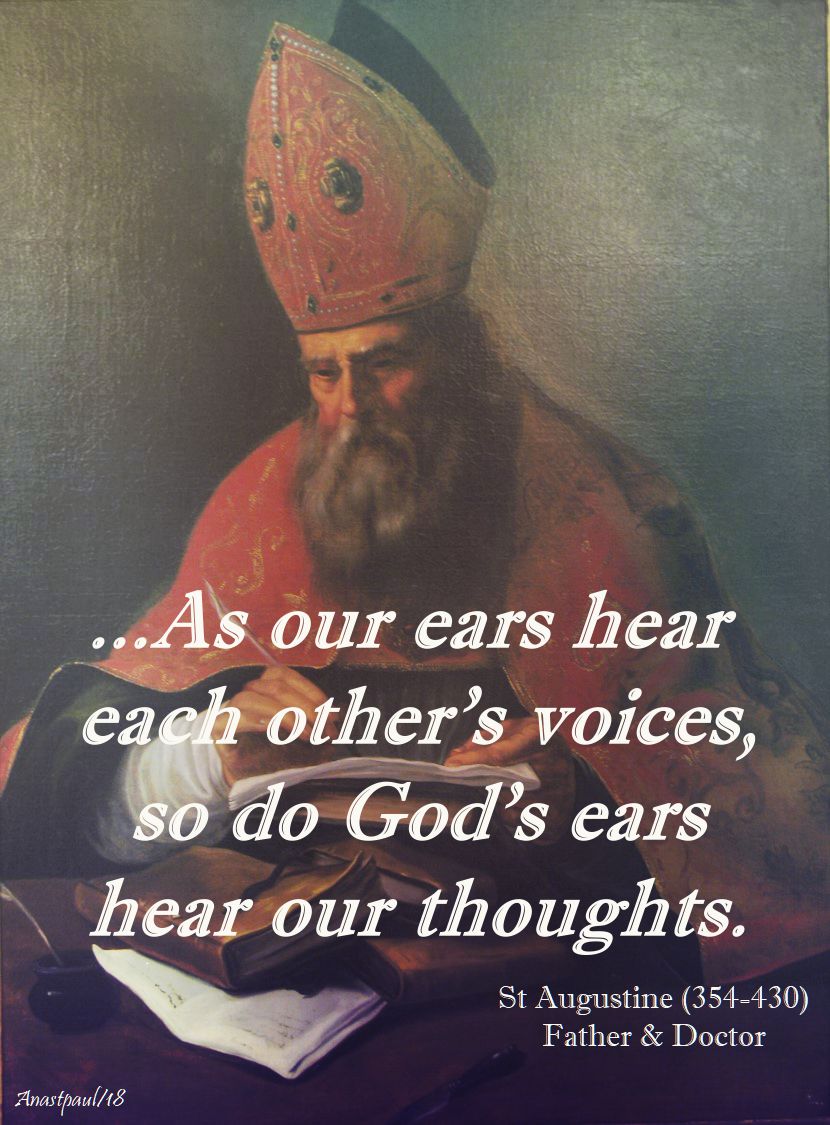
If you never turn aside from the good life, your tongue may be silent but your actions will cry aloud and God will perceive your intentions; for as our ears hear each other’s voices, so do God’s ears hear our thoughts.”
This excerpt on the Alleluia as the song of the Easter Season of praise comes from St. Augustine’s discourse on the Psalms (Ps. 148, 1-2: CCL 40, 2165-2166).
We are the Easter People and Alleluia is our Song!
St Pope John Paul (1920-2005)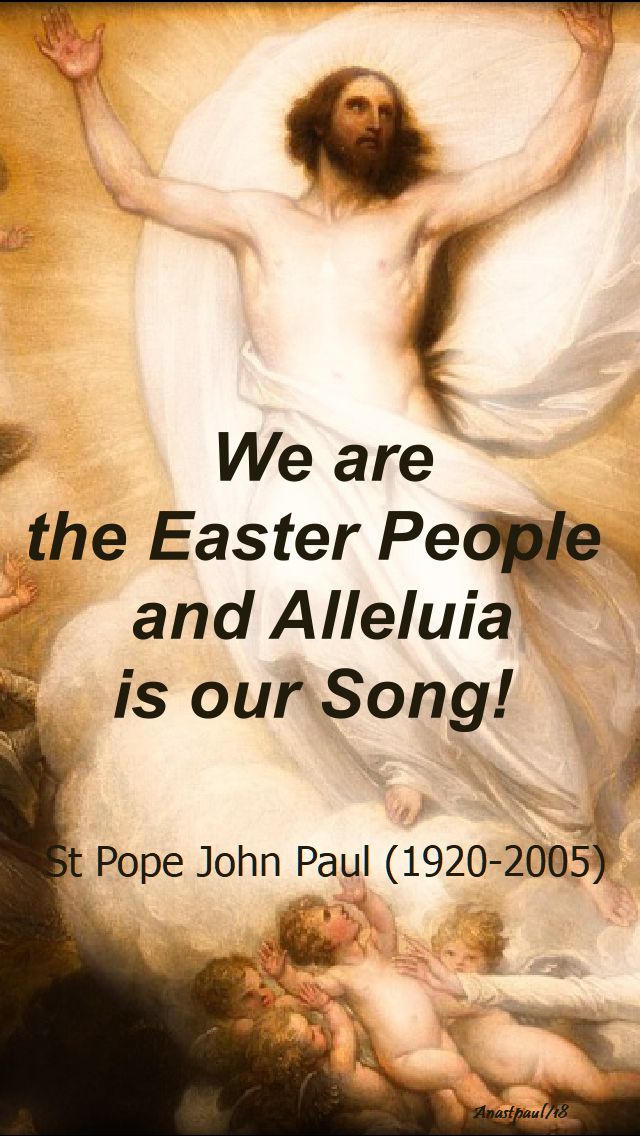
Quote of the Day – 9 April – Low Monday of Eastertide
Quote of the Day – 9 April – Low Monday of Eastertide
“God is always trying to give good things to us
but our hands are too full to receive them.”
St Augustine (354-430) Father & Doctor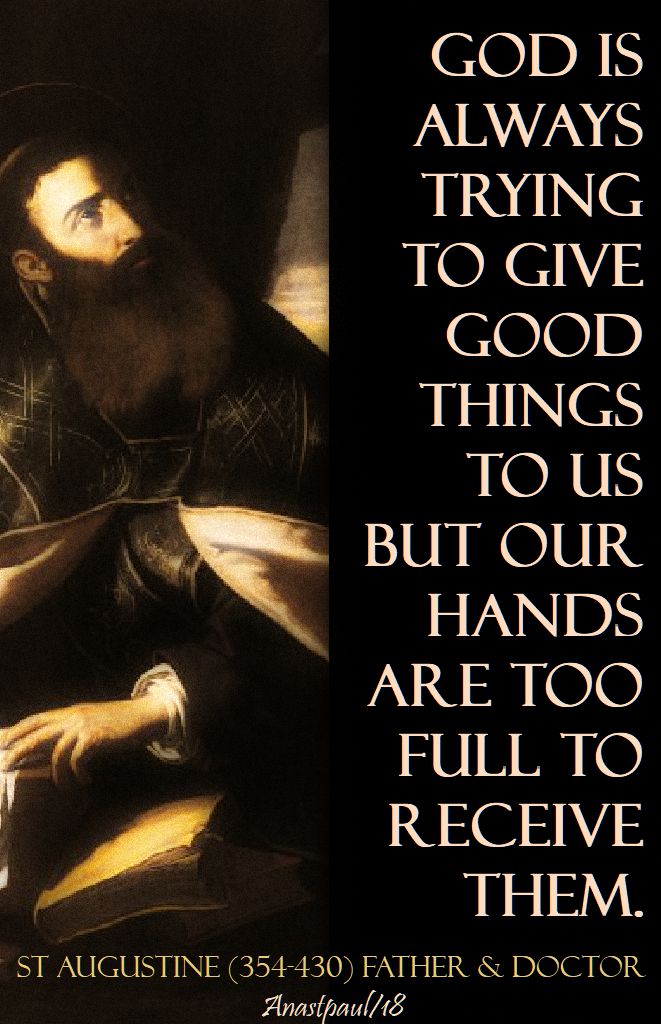
One Minute Reflection – 9 April – Low Monday of Eastertide & the Memorial of St Liborius of le Mans (early 4th century – 397)
One Minute Reflection – 9 April – Low Monday of Eastertide & the Memorial of St Liborius of le Mans (early 4th century – 397)
By his ‘will’ we have been sanctified through the offering of the body of Jesus Christ....Hebrews 10:10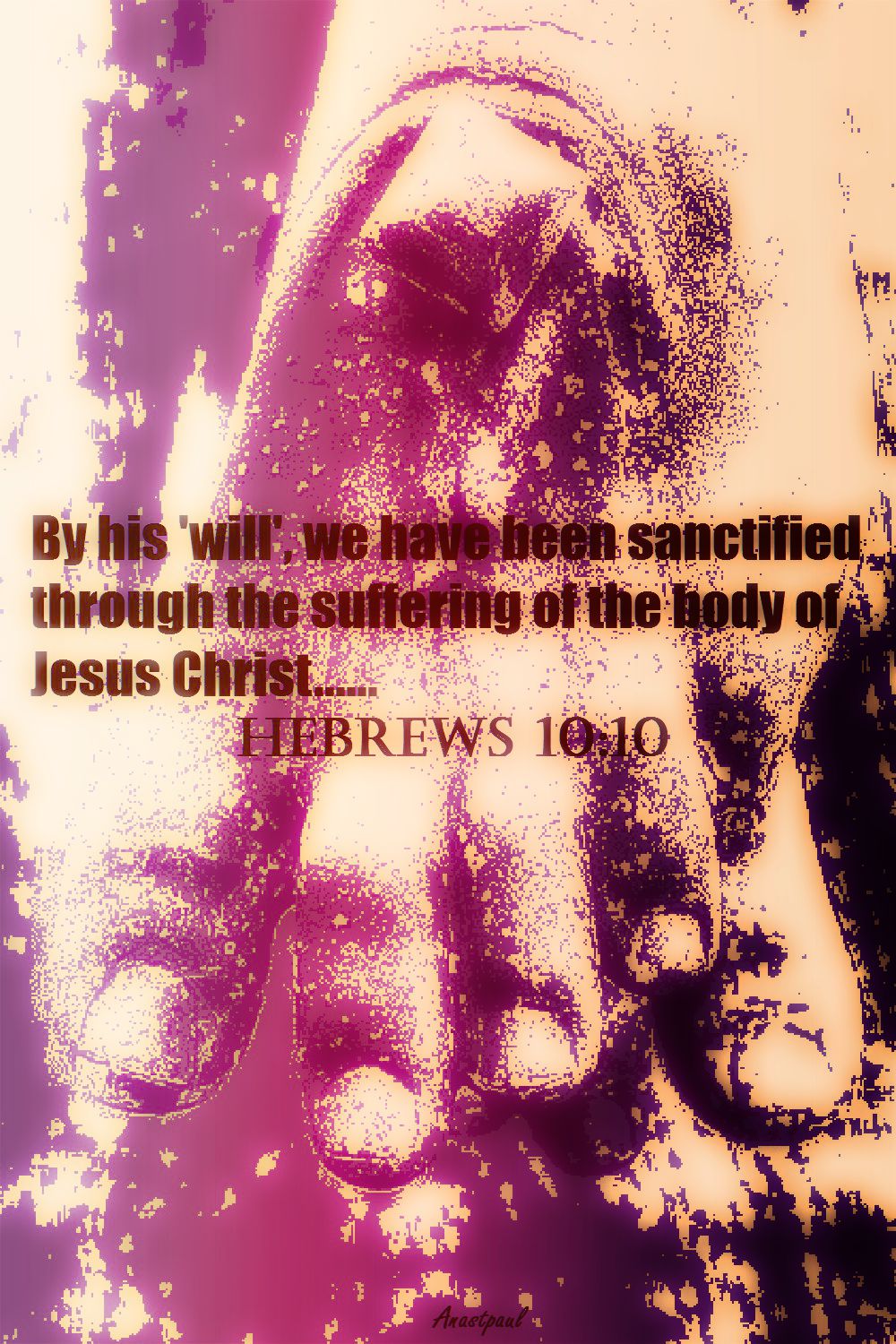
REFLECTION – “God’s infinite power, His profound wisdom and the reign of His justice were known. However, the dimensions of His clemency were not yet known. Jesus came as interpreter of the Divinity.”…St Bernard (1090-1153) Doctor of the Church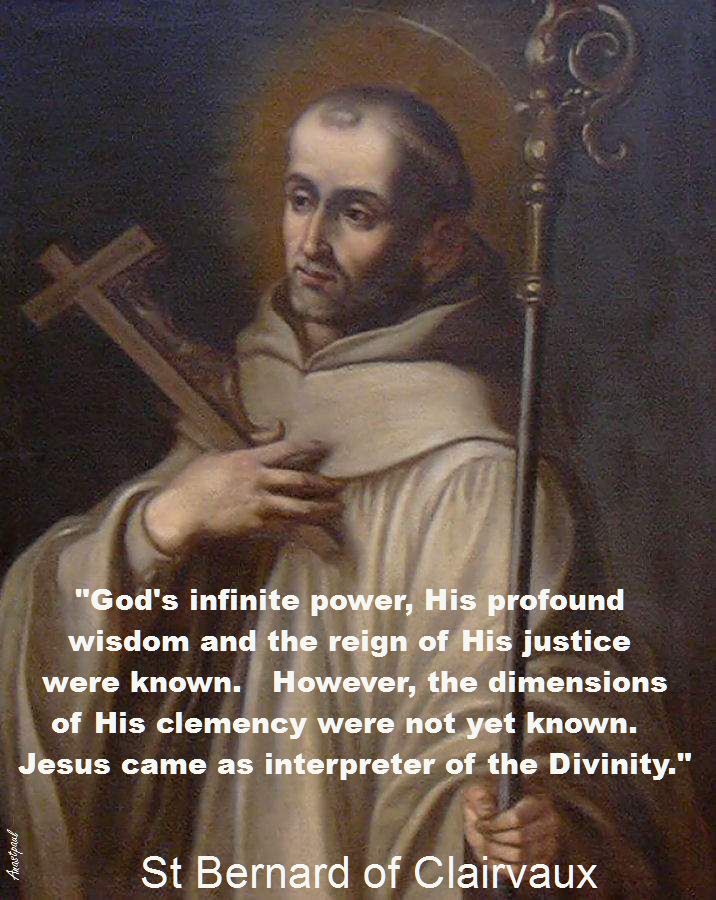
PRAYER – Merciful Father, let us not turn from Your mercy and clemency. In Jesus Your Son, You sent us all Your loving kindness. Grant that Christ’s complete sacrifice may bear fruit in me in accord with Your Will for me. St Liborius, faithfully sought Your will in all things and lovingly gave himself to fulfil it to the best of his ability, grant that by his prayers, we may understand and complete Your will in our lives. Through Jesus our Lord, in the unity of the Holy Spirit, one God forever, amen.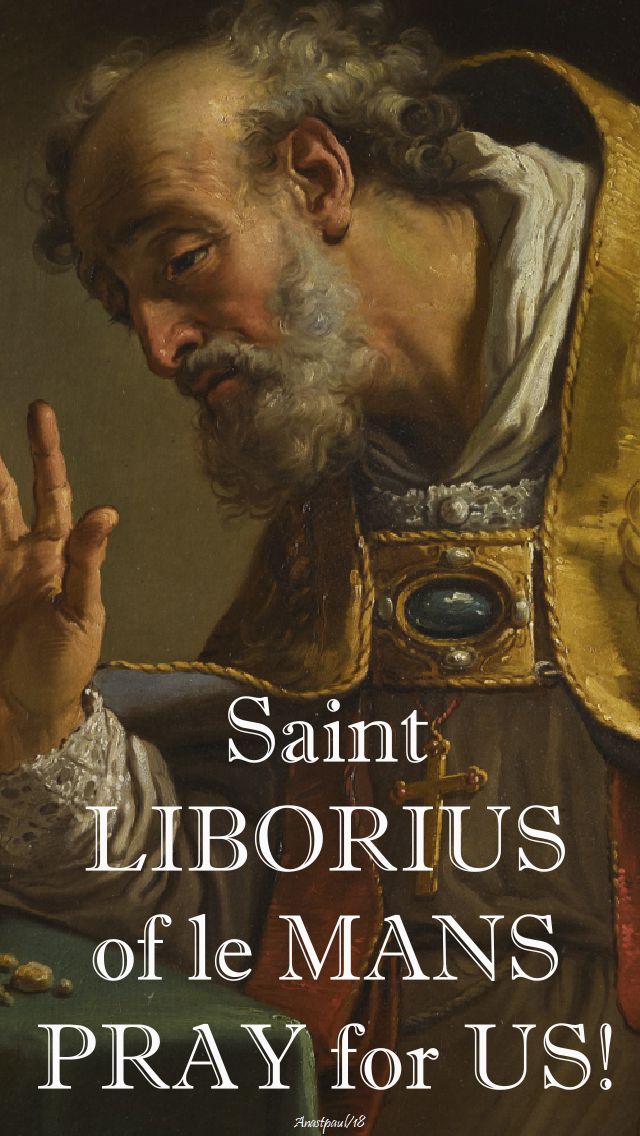
Our Morning Offering – 9 April – Low Monday of Eastertide
Our Morning Offering – 9 April – Low Monday of Eastertide
A Prayer for Confidence and Trust in God’s Mercy
By St Pio of Pietrelcina (1887-1968)
O Lord,
we ask for a boundless confidence and trust
in Your Divine Mercy
and the courage to accept the crosses and suffering
which bring immense goodness to our souls
and that of Your Church.
Help us to love You with a pure and contrite heart
and to humble ourselves beneath Your Cross
as we climb the mountain of holiness,
carrying our cross that leads to heavenly glory.
O Jesus, most adorable Heart
and eternal fountain of Divine Love,
may our prayer find favour
before the Divine Majesty
of Your heavenly Father.
Amen


You must be logged in to post a comment.