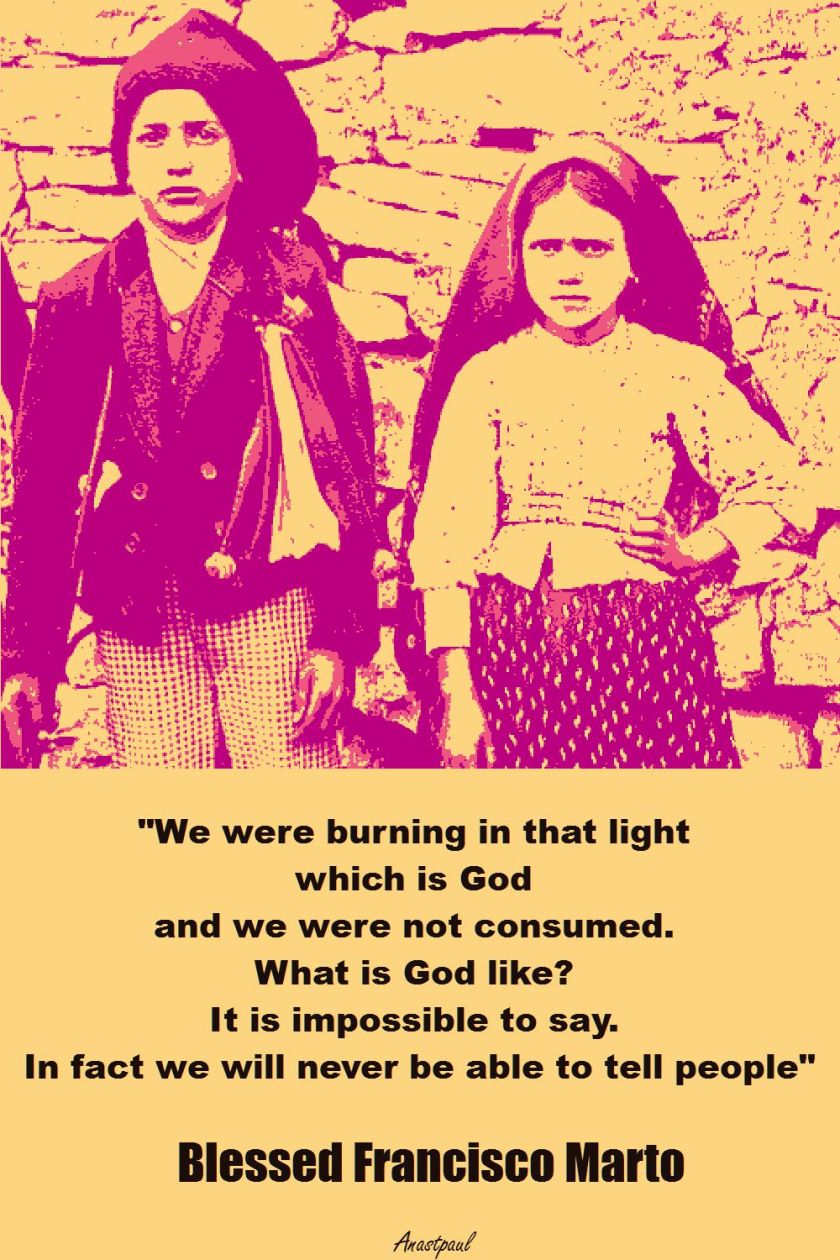
“We were burning in that light
which is God and we were not consumed.
What is God like?
It is impossible to say.
In fact we will never be able to tell people”
~~~~~ Blessed Francisco Marto of Fatima
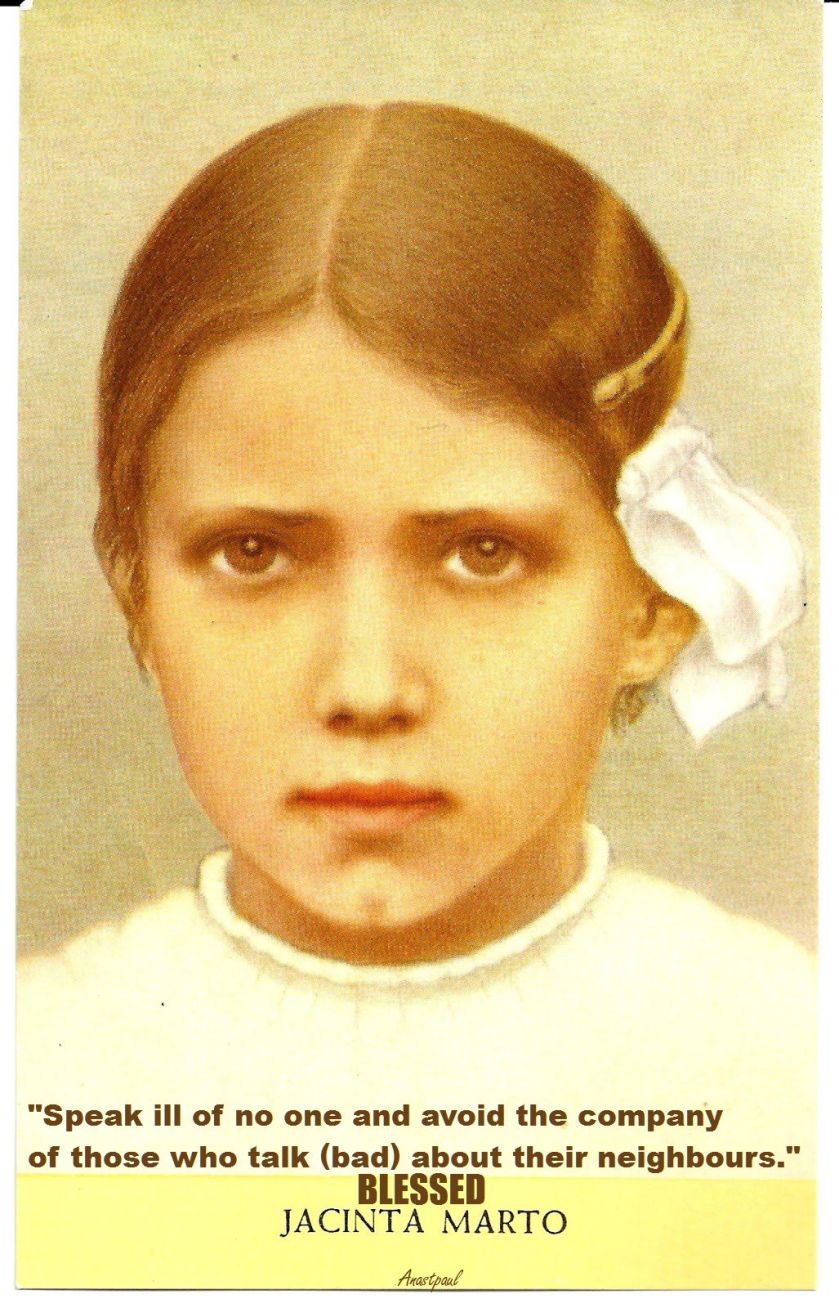
“Speak ill of no one and avoid the company
of those who talk (bad) about their neighbours.”
~~~~~ Blessed Jacinta Marto of Fatima
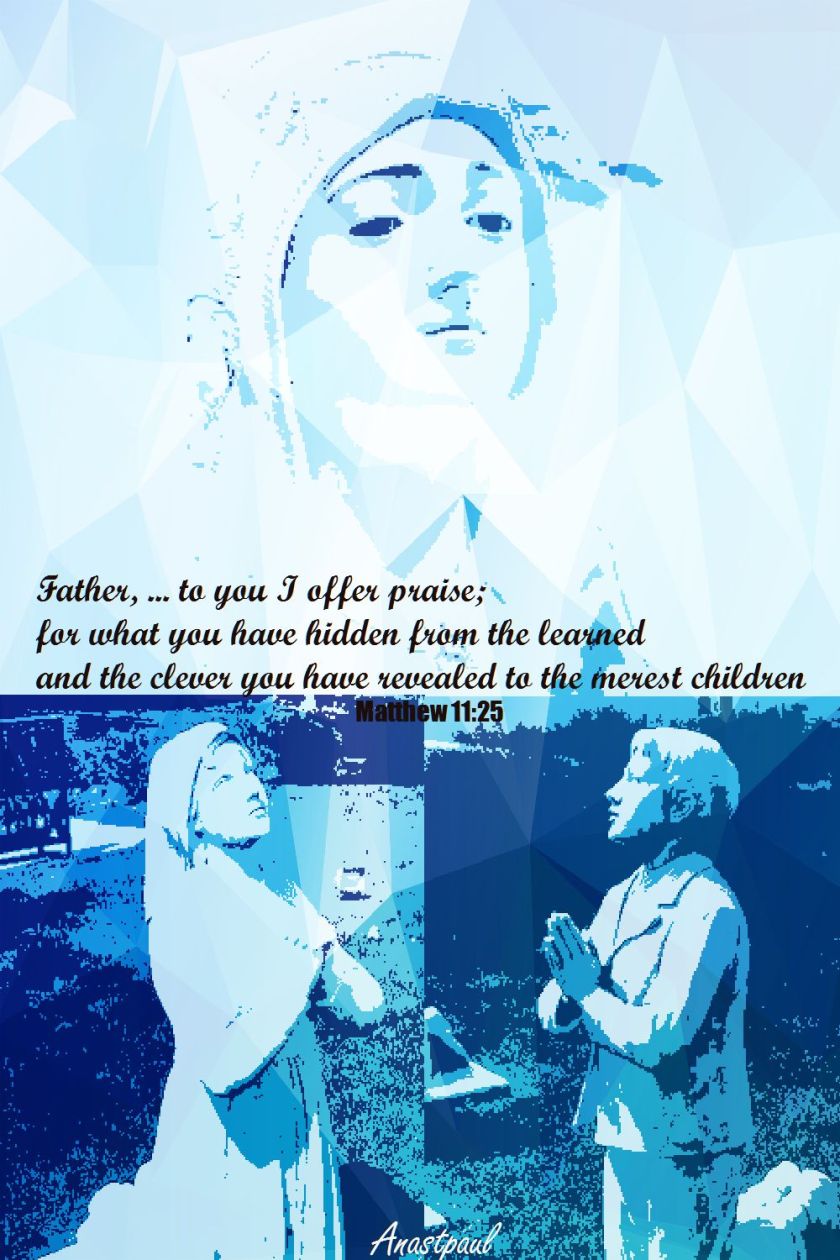
“Father, … to you I offer praise; for what you have hidden from the learned and the clever you have revealed to the merest children” ………….Mt 11: 25
REFLECTION – “Francisco bore without complaining the great sufferings caused by the illness from which he died. It all seemed to him so little to console Jesus: he died with a smile on his lips. Little Francisco had a great desire to atone for the offences of sinners by striving to be good and by offering his sacrifices and prayers.
The life of Jacinta, his younger sister by almost two years, was motivated by these same sentiments……………….In her motherly concern, the Blessed Virgin came here to Fátima to ask men and women “to stop offending God, Our Lord, who is already very offended”. It is a mother’s sorrow that compels her to speak; the destiny of her children is at stake. For this reason she asks the little shepherds: “Pray, pray much and make sacrifices for sinners; many souls go to hell because they have no one to pray and make sacrifices for them”. …St Pope John Paul on the Beatification of the siblings, 13 May 2000
PRAYER – “Father, to You I offer praise, for what You have hidden from the learned and the clever you have revealed to the merest children”.
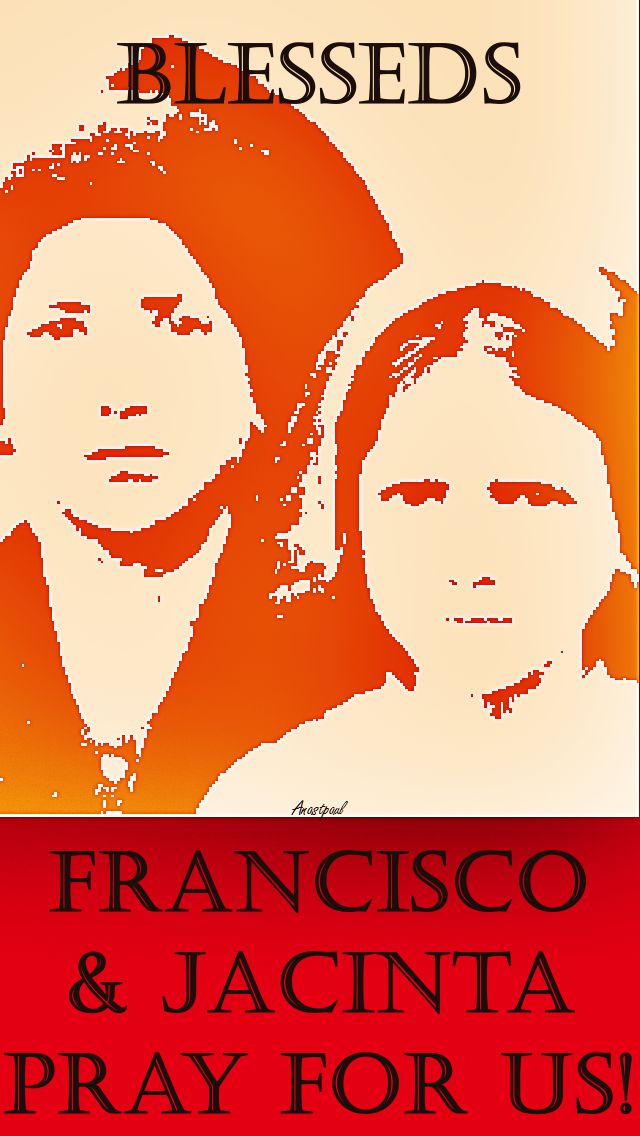
Father, to you I offer praise for all Your children, from the Virgin Mary, Your humble Servant, to the little shepherds, Francisco and Jacinta.
May the message of their lives live on for ever to light humanity’s way! Blessed Francisco and Jacinta, pray for us! Amen. (Prayer by St Pope John Paul)
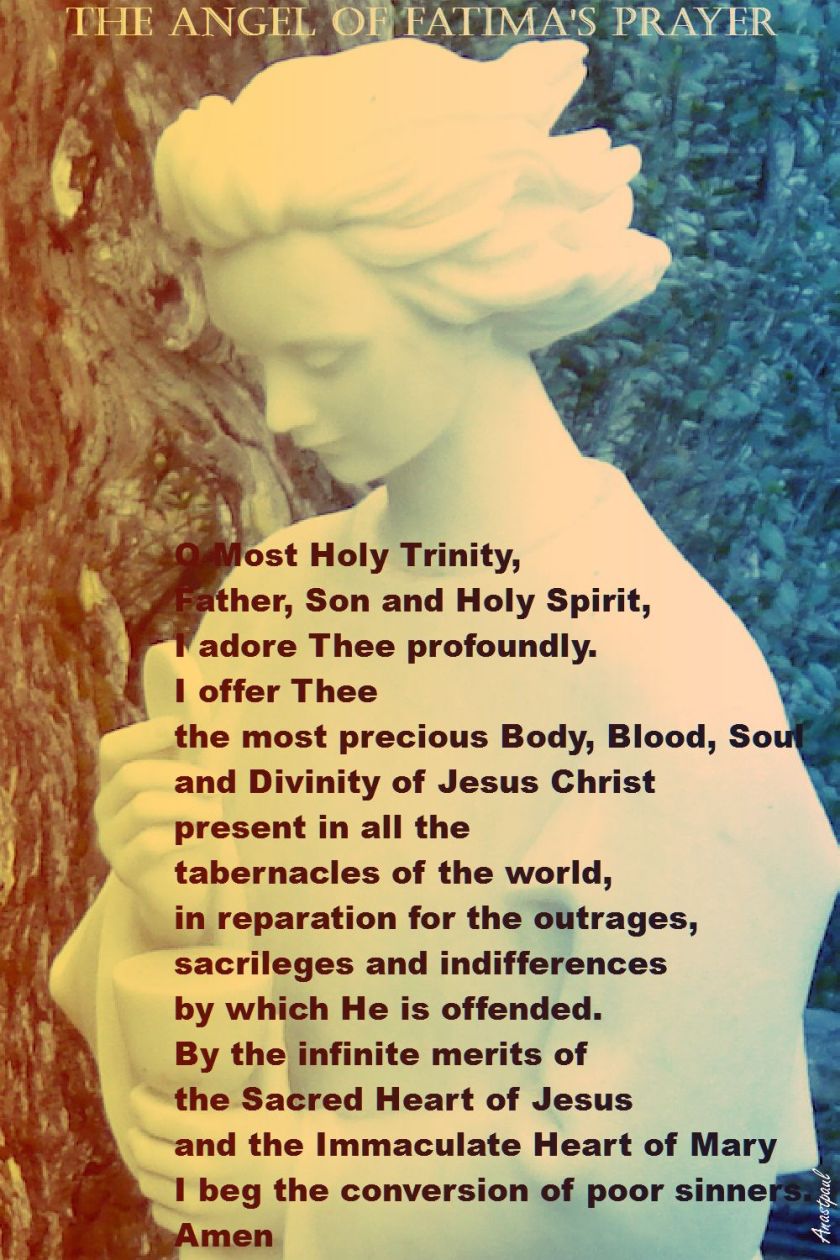
O Most Holy Trinity,
Father, Son and Holy Spirit,
I adore Thee profoundly.
I offer Thee
the most precious Body, Blood, Soul
and Divinity of Jesus Christ
present in all the tabernacles of the world,
in reparation for the outrages,
sacrileges and indifferences
by which He is offended.
By the infinite merits of
the Sacred Heart of Jesus
and the Immaculate Heart of Mary
I beg the conversion of poor sinners.
Amen
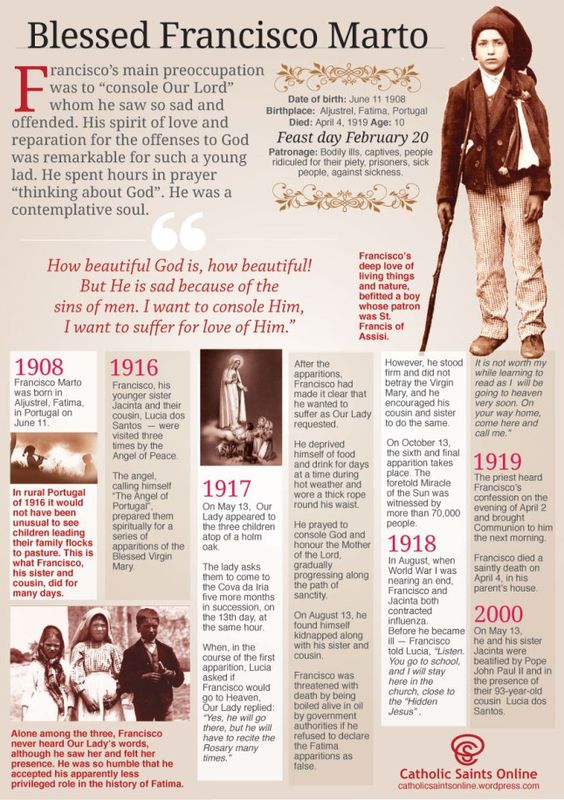
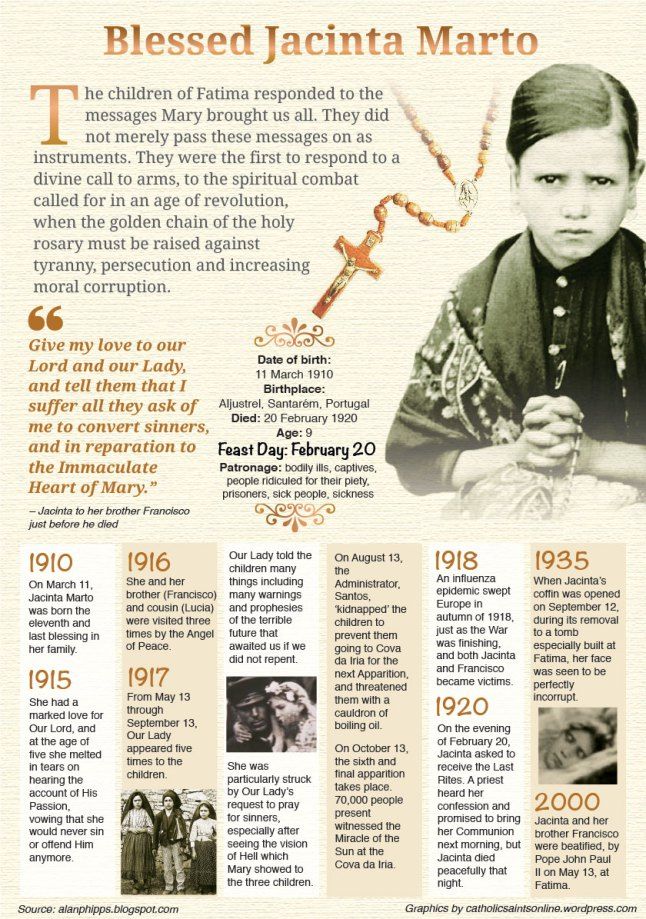
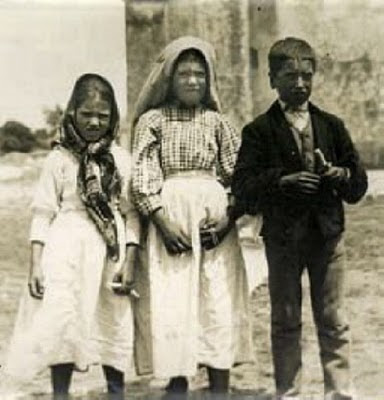
Saint/s of the Day – 20 February – Blessed Francisco (11 June 1908 – 4 April 1919 died aged 10), his sister Jacinta Marto (11 March 1910 – 20 February 1920 died aged 9) and their cousin Lúcia Santos (1907–2005) were children from Aljustrel near Fátima, Portugal, who said they witnessed three apparitions of an angel in 1916 and several apparitions of the Blessed Virgin Mary in 1917. Mary was given the title Our Lady of Fátima as a result and Fátima became a major centre of world Christian pilgrimage. Patrons of Bodily ills, captives, people ridiculed for their piety, prisoners, sick people, against sickness.
The youngest children of Manuel and Olimpia Marto, Francisco and Jacinta were typical of Portuguese village children of that time. They were illiterate but had a rich oral tradition. According to Lúcia’s memoirs, Francisco had a placid disposition, was somewhat musically inclined, and liked to be by himself to think. Jacinta was affectionate if a bit spoiled. She had a sweet singing voice and a gift for dancing. Following their experiences, their fundamental personalities remained the same. Francisco preferred to pray alone, saying that this would “console Jesus for the sins of the world”. Jacinta said she was deeply affected by a terrifying vision of Hell shown to the children at the third apparition and deeply convinced of the need to save sinners through penance and sacrifice as the Virgin had told the children to do. All three children but particularly Francisco and Jacinta, practised stringent self-mortifications to this end.
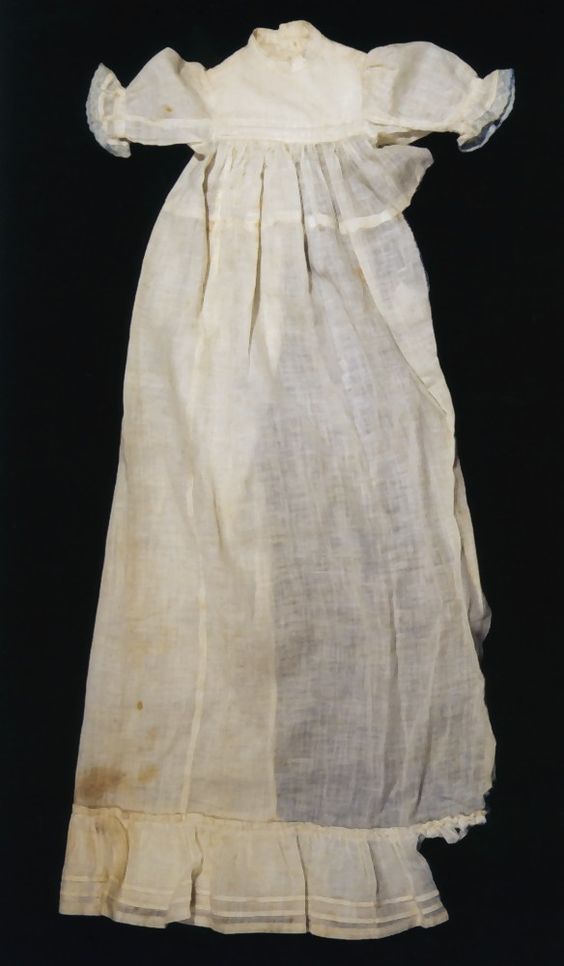
Baptisimal robe of Blesseds Francisco and Jacinta Marto
Apparitions
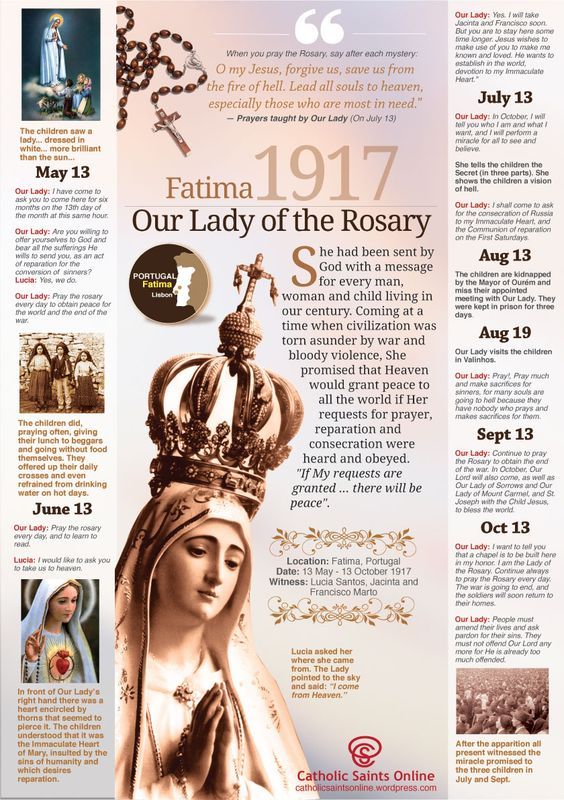
The brother and sister, who tended to their families’ sheep with their cousin Lucia in the fields of Fatima, Portugal, are said to have witnessed several apparitions of an angel in 1916. Lucia later recorded the words of several prayers she said they learned from this angel. Lucia wrote in her memoirs that she and her cousins saw the first apparition of Mary on May 13, 1917. At the time of the apparition, Francisco was 9 years old and Jacinta was 7. During the first apparition, Mary is said to have asked the three children to say the Rosary and to make sacrifices, offering them for the conversion of sinners. She also asked them to return to that spot on the thirteenth of each month for the next six months.
Illness and death
The siblings were victims of the great 1918 influenza epidemic that swept through Europe that year. In October 1918, Mary appeared and said she would take them to heaven soon. Both lingered for many months, insisting on walking to church to make Eucharistic devotions and prostrating themselves to pray for hours, kneeling with their heads on the ground as they said the angel had instructed them to do. Francisco declined hospital treatment on April 3, 1919 and died at home the next day. Jacinta was moved from one hospital to another in an attempt to save her life, which she insisted was futile. She developed purulent pleurisy and endured an operation in which two of her ribs were removed. Because of the condition of her heart, she could not be fully anesthetized only local and later suffered terrible pain, which she said would help to convert many sinners. On February 19, 1920, Jacinta asked the hospital chaplain who heard her confession to bring her Holy Communion and administer Extreme Unction because she was going to die “the next night”. He told her that her condition was not that serious and that he would return the next day. The next day Jacinta was dead; she had died, as she had often said she would, alone. In 1920, shortly before her death at age nine, Jacinta Marto reportedly discussed the Alliance of the Hearts of Jesus and Mary with a then 12-year-old Lúcia Santos and said:
“When you are to say this, don’t go and hide. Tell everybody that God grants us graces through the Immaculate Heart of Mary; that people are to ask her for them; and that the Heart of Jesus wants the Immaculate Heart of Mary to be venerated at His side. Tell them also to pray to the Immaculate Heart of Mary for peace, since God entrusted it to her.”
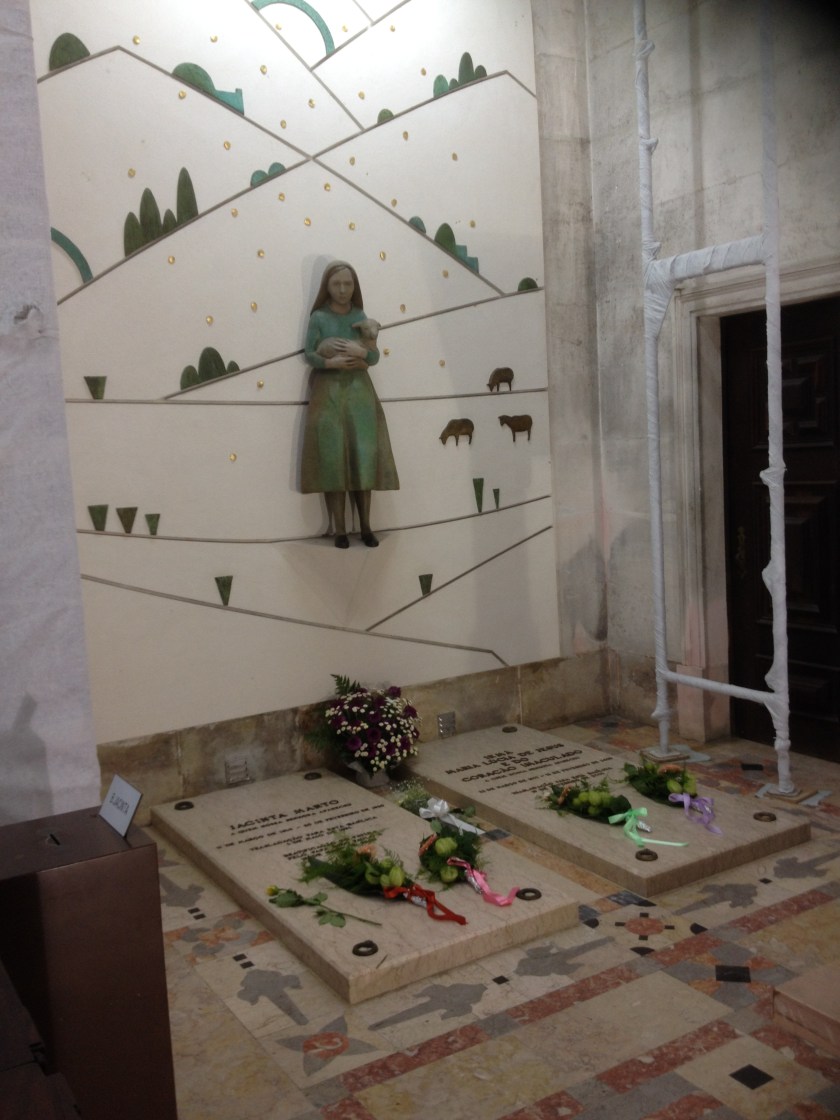
Jacinta and Francisco are both buried at the Our Lady of Fátima Basilica.
Burial Place of Francisco and JacintaShrine of the siblings at Lourdes
Beatification
The cause for the siblings’ canonisation began in 1946. Exhumed in 1935 and again in 1951, Jacinta’s face was found incorrupt; Francisco’s had decomposed.
In 1937 Pope Pius XI decided that causes for minors should not be accepted as they could not fully understand heroic virtue or practice it repeatedly, both of which are essential for canonisation. For the next four decades, no sainthood processes for children were pursued. In 1979 the bishop of Leiria-Fatima asked all the world’s bishops to write to the Pope, petitioning him to make an exception for Francisco, who had died at age 10 and Jacinta, who had died at age 9. More than 300 bishops sent letters to the Pope, writing that “the children were known, admired and attracted people to the way of sanctity. Favours were received through their intercession.” The bishops also said that the children’s canonization was a pastoral necessity for the children and teenagers of the day. In 1979 the Congregation for the Causes of Saints convened a general assembly. Cardinals, bishops, theologians and other experts debated whether it was possible for children to display heroic virtue. Eventually, they decided that, like the very few children who have a genius for music or mathematics, “in some supernatural way, some children could be spiritual prodigies.” They were declared venerable by Pope John Paul II in 1989. On May 13, 2000, they were declared “blessed” in a decree from the Congregation for the Causes of Saints. Jacinta is the youngest non-martyred child ever to be beatified.
In her biography of Jacinta, Lúcia said that Jacinta had told her of having had many personal visions outside of the Marian visitations; one involved a pope who prayed alone in a room while people outside shouted ugly things and threw rocks through the window. At another time, Jacinta said she saw a pope who had gathered a huge number of people together to pray to the Immaculate Heart of Mary.
When Pope John Paul II arrived in Fatima for the first time, in 1982, he said that he had come “because, on this exact date last year in St. Peter’s Square, in Rome, there was an attempt on the life of your Pope, which mysteriously coincided with the anniversary of the first vision at Fatima, that of 13 May 1917. The coincidence of these dates was so great that it seemed to be a special invitation for me to come here.”
Sister Lúcia, when questioned about the Third Secret, said that the three of them had been very sad about the suffering of a Pope and that Jacinta kept saying: Coitadinho do Santo Padre, tenho muita pena dos pecadores! (“Poor Holy Father, I feel a lot of pity for the sinners!”) Another miracle was found to have been attributed to their intercession and the process that investigated the miracle was validated on 8 February 2013. Reports indicate the canonisation could occur on the centenary of the apparitions in 2017, together with Lúcia.
St Amata of Assisi
St Bolcan of Derken
St Colgan
St Eleutherius of Tournai
St Eucherius of Orleans
St Falco of Maastricht
Bl Francisco Marto
Bl Jacinta Marto
St Leo of Catania
St Nemesius of Cyprus
St Pothamius of Cyprus
St Serapion of Alexandria
St Silvanus of Emesa
St Stanislawa Rodzinska
St Valerius of Courserans
St Wulfric of Haselbury
St Zenobius of Antioch
—
Martyrs of Tyre
Nilus
Peleus
Tyrannio
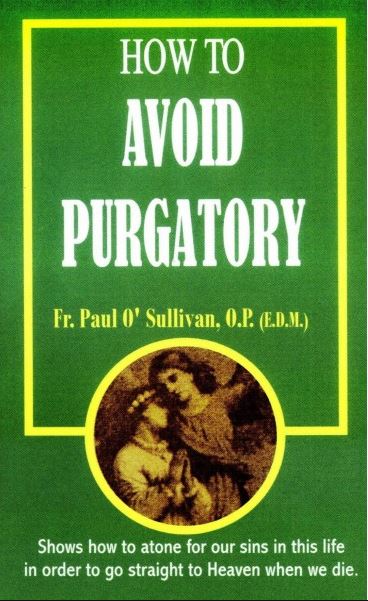
HOW TO AVOID PURGATORY By Fr. Paul O’Sullivan O.P.
For those who have not read this little book and to refresh myself, I will be posting the entire book in daily doses. (To read later find in the Purgatory Category).
Chapter 2
HOW CAN WE AVOID PURGATORY?
The reason why we have to pass through Purgatory after death is that we
have committed sins and have not made satisfaction for them. Every
individual sin must be expiated–in this life or the next! Not even the
slightest shadow of sin or evil can enter the all-holy presence of God.
The graver, the more frequent the sins, the longer will be the period of
expiation and the more intense the pain.
It is not God’s fault, nor God’s wish, that we go to Purgatory! The fault
is all our own.
We have sinned and have not made satisfaction.
Even after our sin, God, in His infinite goodness, places at our disposal
many easy and efficacious means by which we may considerably lessen our
term of expiation, or even entirely cancel it.
Most Christians, with incomprehensible rashness, neglect these means and so
have to pay their debts in the dreadful prison house of Purgatory.
We will briefly enumerate some of the principal means by which we can avoid
Purgatory-or at least lessen its severity and duration.
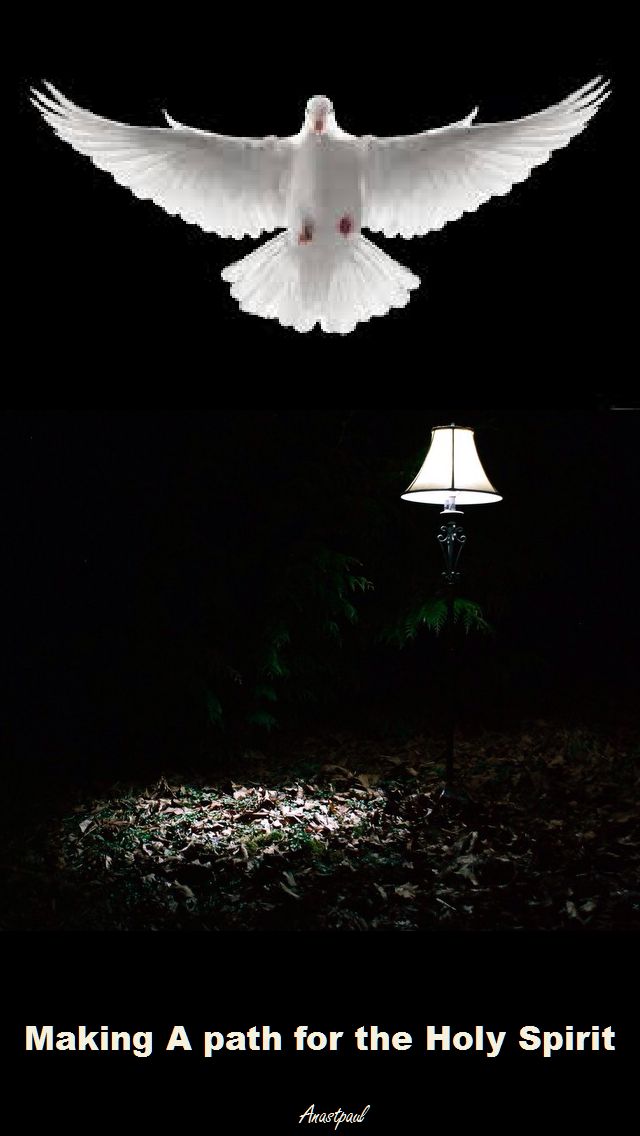
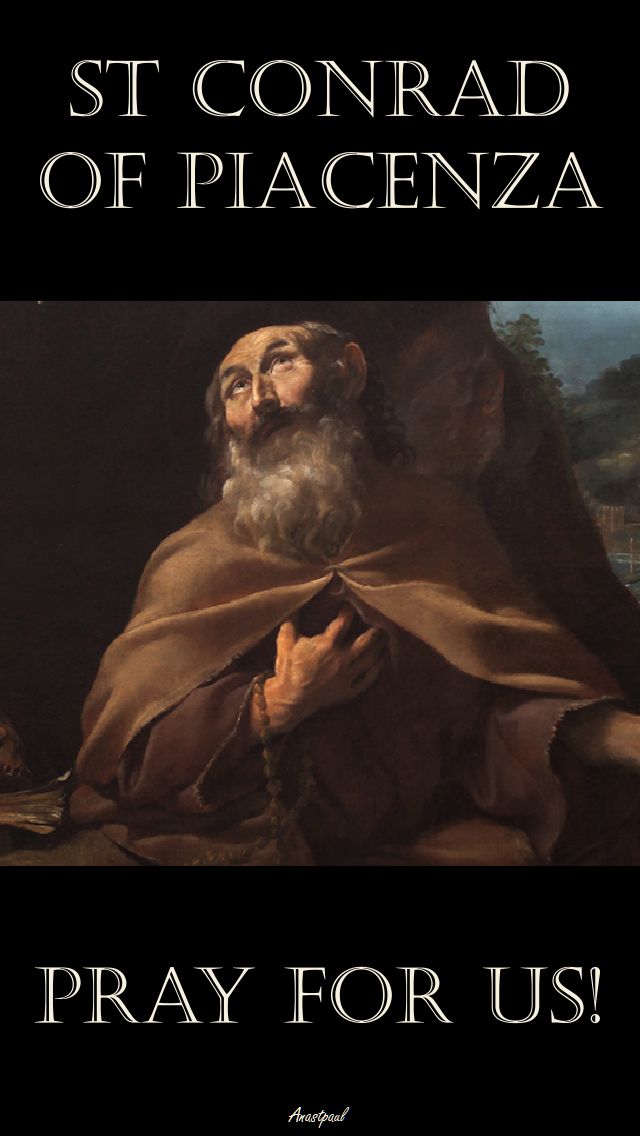
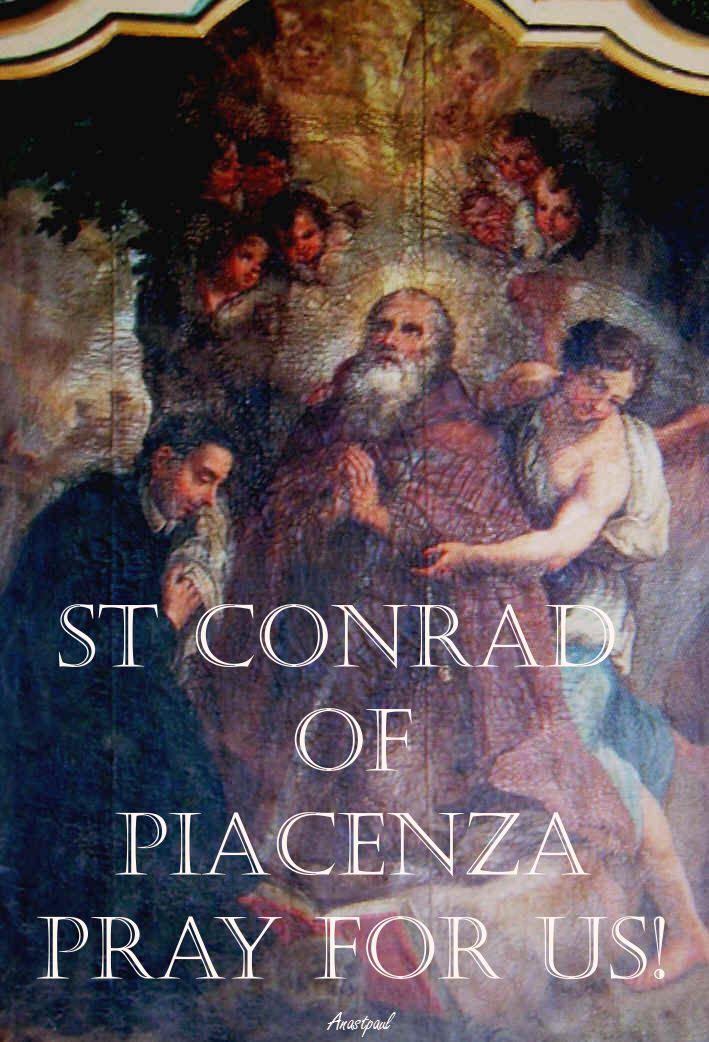
Disaster does not always have to be the ruin of everything and very terrible blows of bad fortune can lead to great blessings. St Conrad of Piacenza’s bad fortune made him reflect on his own way of life. A man was almost executed through his neglect and he realised that God deserved better, in fact God deserved the very best of him. The rest is the story of a man who made way for the Holy Spirit, who cleared the path for His entry and thus found his joy in God and became a delightful friend to all, a conduit of love and miracles. It is a lesson to be pondered.
Conversion has two elements for its completion.
First, we need to rid ourselves of the things that hinder gospel living. That includes not only “stuff” but also habits, attitudes, mindsets, lifestyles etc. that hinder hearing and living the Gospel.
Secondly, conversion calls us to commit our lives to Jesus and His gospel call.
It calls for practising charity, having hope, learning how to love all people.
If we only clean out our lives, we create a vacuum into which all sorts of things can enter (cf. Luke 11:24-26).
Our inner housecleaning ordinarily should open a path for the Holy Spirit to work in our lives.
~ Lester Bach OFM Cap, Seeking a Gospel Life
Today’s Saint of the Day, St Conrad of Piacenza is a perfect example of making the path! St Conrad Pray for us!
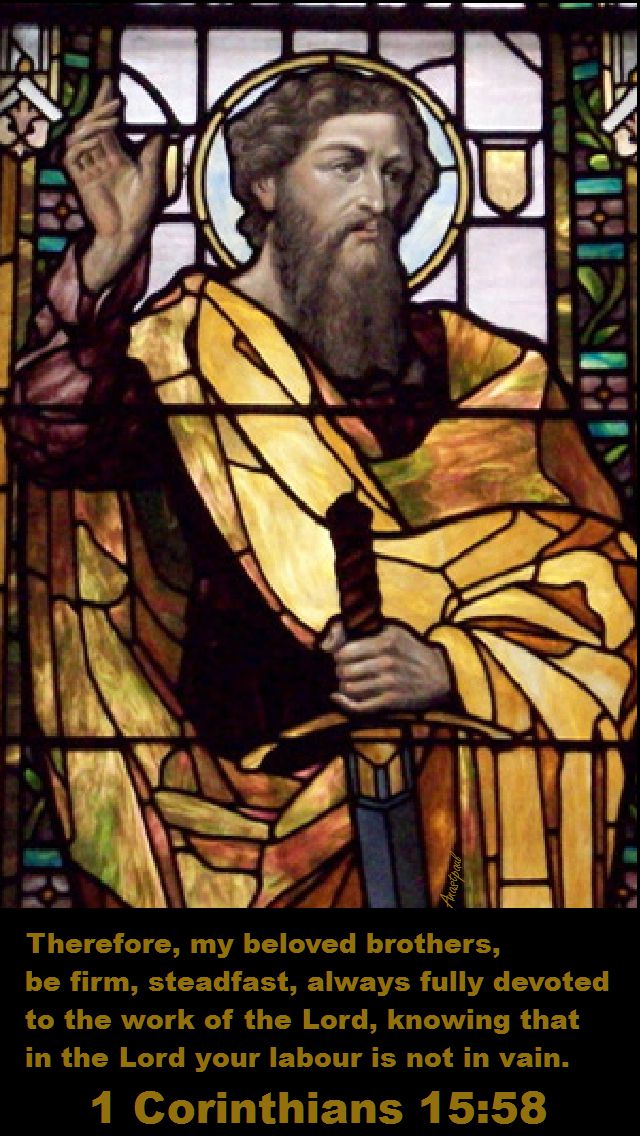
Therefore, my beloved brothers, be firm, steadfast, always fully devoted to the work of the Lord, knowing that in the Lord your labour is not in vain…….1 Cor 15:58
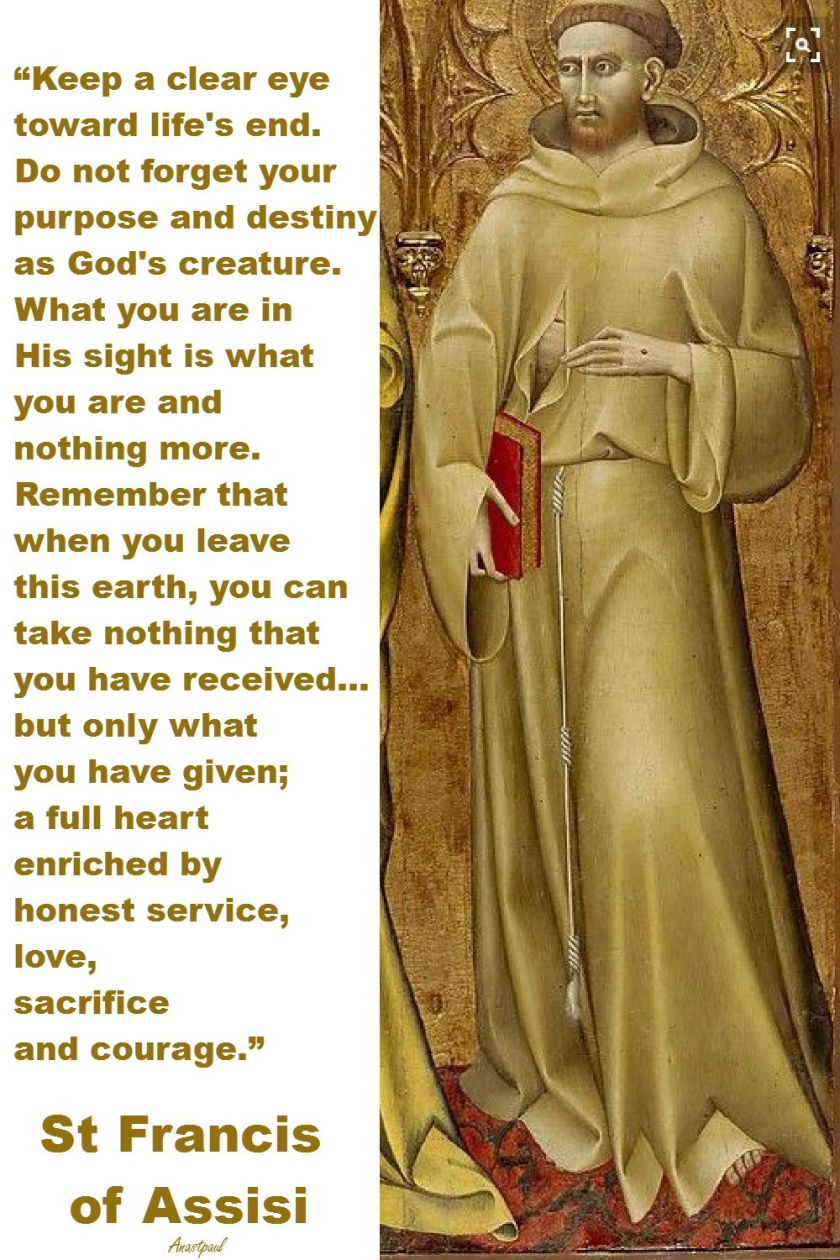
REFLECTION – “Keep a clear eye toward life’s end. Do not forget your purpose and destiny as God’s creature. What you are in His sight is what you are
and nothing more. Remember that when you leave this earth, you can take nothing that you have received…but only what you have given; a full heart enriched by honest service, love, sacrifice and courage.”…………St Francis of Assisi
PRAYER – God of mercy, teach me to live as You have ordained. Help me to follow Your commandments with courage and steadfast devotion. As St Conrad learnt courage through adversity, help me too to use the events of my life, both good and bad, to give only my best to all I meet. St Conrad of Piacenza, pray for us, amen.
Almighty, eternal, just and merciful God,
grant us in our misery the grace to do for You alone
what we know You want us to do
and always to desire what pleases You.
Thus, inwardly cleansed, interiorly enlightened
and inflamed by the fire of the Holy Spirit,
may we be able to follow in the footprints of
Your beloved Son, our Lord Jesus Christ.
And, by Your grace alone, may we make our way to You,
Most High, Who live and rule in perfect Trinity and simple Unity
and are glorified God all-powerful forever and ever.
Amen.
Saint of the Day – 19 February – ST CONRAD OF PIACENZA T.O.S.F – (1290-1351) –
Franciscan tertiary, pilgrim and hermit – Patron of cure of hernias, Cities and Diocese of Noto and Calendasco, Sicily
Born to one of the most noble and wealthy families in the town of Piacenza in Northen Italy, Conrad grew up in a lifestyle marked by privilege and leisure. Among his family and peers, however, he was also noted for deep faith in the Lord, and led a virtuous and God-fearing life. Having married quite young, both he and his wife were recognized for their piety and charity.
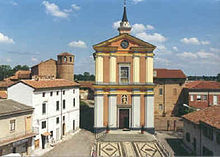
The Church of Calendasco with the castle where St. Conrad was born in the background (left)
As was common in noble families at that time, Saint Conrad spent much of his time hunting. During one such outing, he ordered his attendants to scatter some brush and light it on fire in attempts to smoke out some game hiding there. Without warning, a great wind arose, and mercilessly spread the fire beyond that planned, causing severe damage to neighbours’ homes and land. Authorities mistakenly arrested a mendicant friar living in the area and the man was tried and sentenced to death.
Both Conrad and his wife, seeing the injustice and unable to stand their role in it, agreed to confess. As the friar was being led to execution, Saint Conrad made a public confession of the crime. He sold all his possessions, giving them away to those who had lost property. Now desitute, he and his wife separated, Saint Conrad entering a monastery of the Franciscan Order and his wife entering the Orde of Poor Clares.
Saint Conrad spent the remainder of his life in Rome, and then in Sicily, living a life of repentance, penance and austerity. As news of his piety and holiness spread, he received many visitors which forced him to relocate numerous times, preferring the solitude of penitence. He fled to the valley of Noto, Italy, where he lived as a hermit for 36 years. During his hermitude, he lived a life of extreme austerity, sleeping on the bare ground with a stone for pillow and with dry bread and raw herbs for food.
Numerous miracles have been attributed to him while he lived and subsequently at his tomb in Noto, Italy. Holy legend records, for example, that when the Bishop of Syracuse visited him, the he asked Saint Conrad if he had anything to offer guests. Conrad said he would check in his cell and returned moments later carrying newly baked bread and cakes, which the bishop accepted as a miracle. Saint Conrad was also reported to have traveled surrounded by a cloud of fluttering birds, keeping him company.
Conrad is especially invoked for the cure of hernia. This comes from miracles attributed to him. He was visited at his hermitage by a former friend and companion in arms, Antonio da Stessa, from Daverio. His friend was suffering from the pain of a hernia he had developed. Seeing the pain his old comrade was suffering, Conrad was moved to pity and prayed for him. Stessa was immediately cured of the hernia. The same outcome was accomplished for a local tailor, who suffered severely from several hernias.
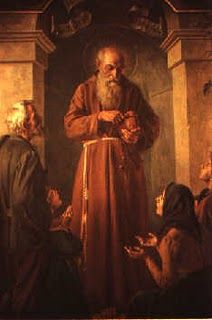
The miracle for which Conrad is best known is the “Miracle of the Bread”. This developed during the aforementioned famine which afflicted Sicily as a result of a severe outbreak of the bubonic plague on the island during 1348-49. During that catastrophe, anyone who approached the hermit for help was given a loaf of bread, still warm, which, it was said, he had received from the angels.
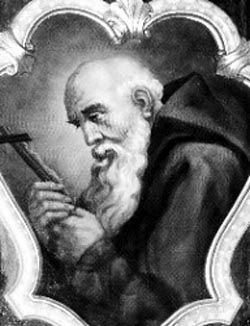
Conrad died while praying before a crucifix in 1350, surrounded by a bright light, in the presence of his confessor, who was unaware for some time of his death because of his position.
Shortly after Conrad’s death, his demonstrably holy life and the large number of miracles attributed to him led the leadership of the city to request that the Bishop of Syracuse, to which diocese Noto belonged, begin the process for his canonization. When the waiting period required by Church law expired in 1485, this process was opened by Bishop Dalmazio Gabriele, O.P., who had himself witnessed the Miracle of the Bread. As part of the process, Conrad’s body was exhumed for examination and was found to be incorrupt, and placed in a silver urn for the veneration of the public.
Pope Leo X beatified Conrad on 12 July 1515 and permitted the town of Noto to celebrate his feast day. On 30 October 1544, Pope Paul III extended permission to the whole island. On 2 June 1625, he was canonised by Cardinal Odoardo Farnese, who was the Duke of Parma and Piacenza in a solemn ceremony at the cathedral of Piacenza, where it was declared an obligatory feast. On 12 September of that same year, permission was granted to the Franciscan Order by Pope Urban VIII for a distinct text for the Divine Office and Mass to be used for his feast; today it is celebrated solely by the Third Order of St. Francis to which he belonged. In Vietnam there is a popular devotion to Conrad.
On his feast day, the Parish Church of San Corrado in Noto commemorates him by the distribution of blessed bread.
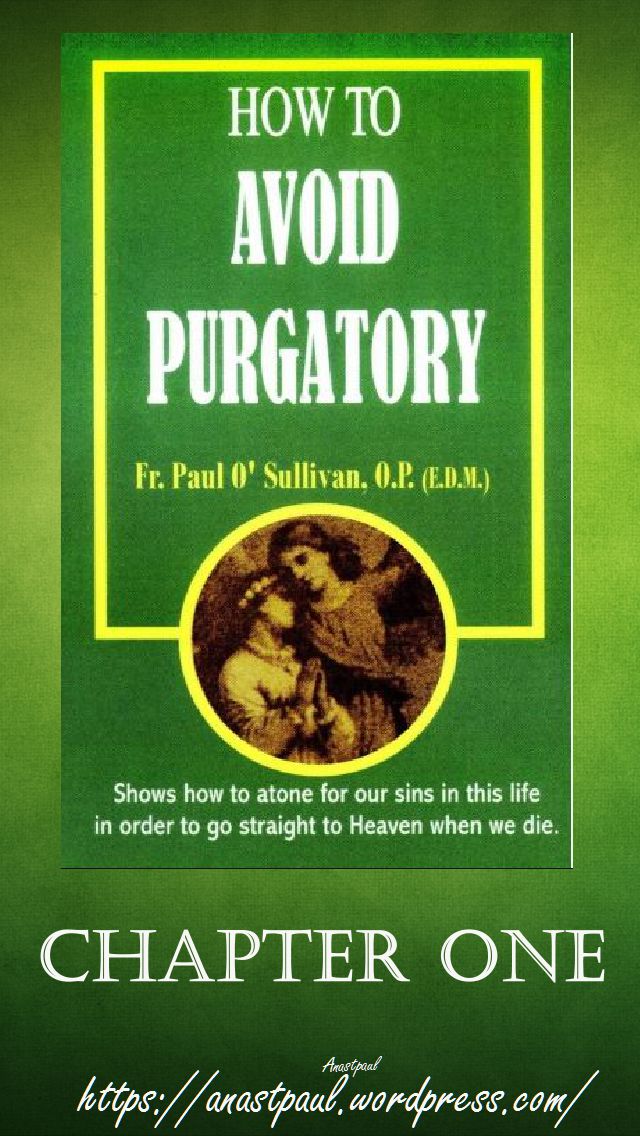
HOW TO AVOID PURGATORY By Fr. Paul O’Sullivan O.P.
For those who have not read this little book and to refresh myself, I will be posting the entire book in daily doses. (To read later find in the Purgatory Category).
Chapter 1
CAN WE AVOID PURGATORY? YES.
Many think that it is practically impossible for the ordinary Christian to
avoid Purgatory. Go there we all must–so they say.
They laughingly remark: “It will be well for us if we ever get there” Alas!
When too late they will recognise how terribly rash their words were. As a
consequence of such fatalistic ideas, many make no serious effort to avoid
Purgatory, or even to lessen the term they may have to pass there. Thank
God all do not hold such gloomy views.
WE SHALL STRIVE IN THE FOLLOWING PAGES TO SHOW
a) How all can notably shorten their period of expiation in Purgatory; b)
And how they may even avoid Purgatory altogether. These pages are well
worth reading and re-reading. The fact is that a great number of souls go
to Purgatory and remain there for long years simply because they had never
been told how they could have avoided it.
The means we suggest are easy, practical and within the reach of all.
Moreover, far from being irksome, the use of these means will only serve to
make our lives on this earth holier and happier and will take away the
exaggerated fear of death which terrifies so many.
We ask you, Dear Reader, to put this little booklet into the hands of all
your friends. You cannot do them a greater service.
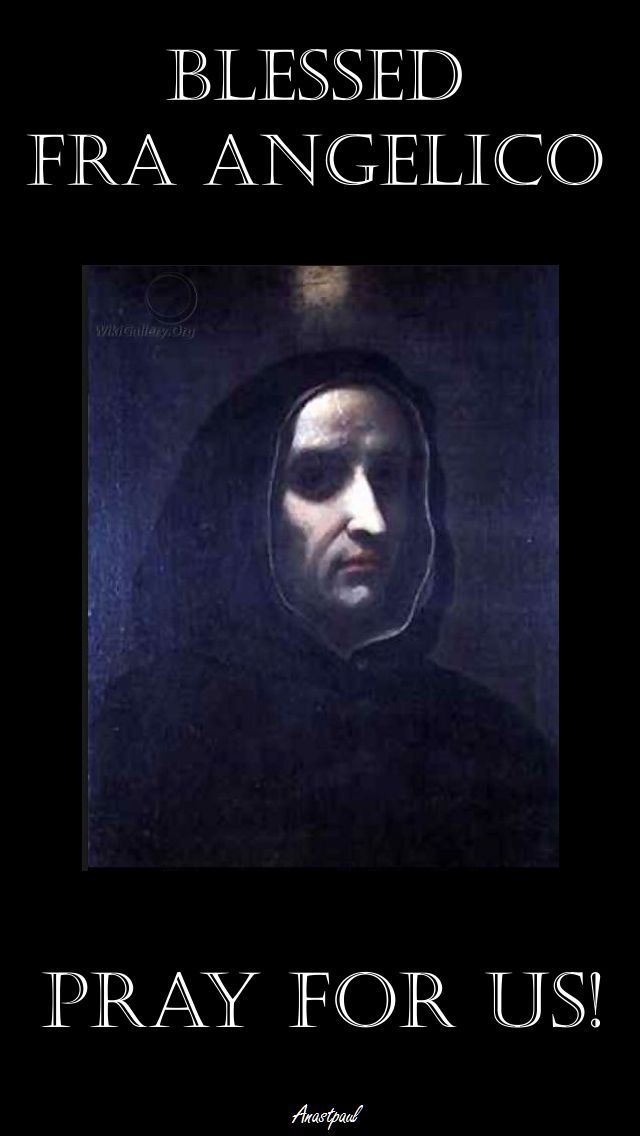
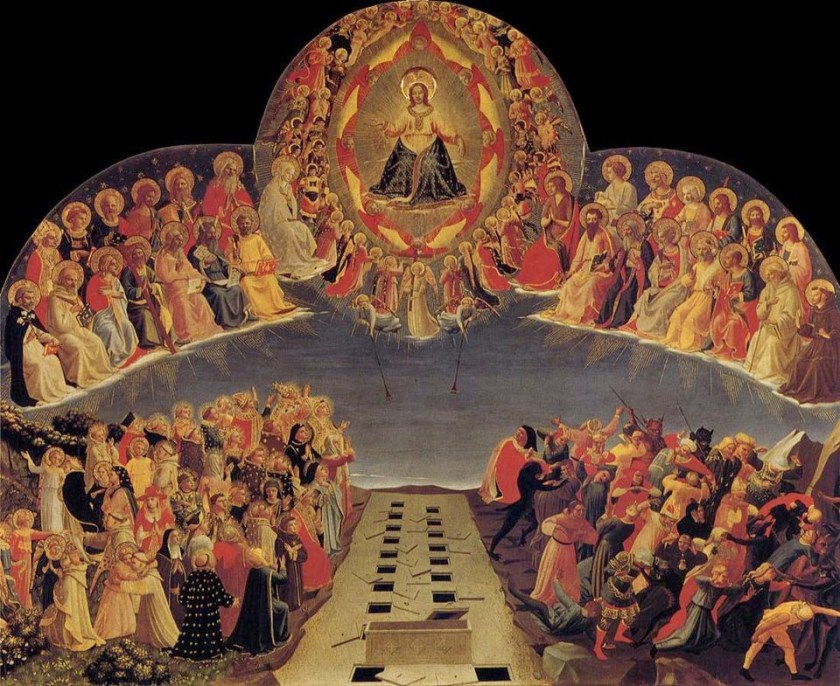
Faithful to the promises he made as a Dominican, to preach the Gospel after having contemplated it in prayer, Fra Angelico put his creativity at the disposal of the Lord. With brush and paint in hand, he used his talents to transmit to all people the sublimity and the redemptive strength of the divine mysteries.
Between 1425 and 1447, Fra Angelico carried out his activity for the Dominican convents and other ecclesiastical institutes at Fiesole, Florence (most especially at the convent of San Marco), Cortona and Orvieto. The fame of his genius merited him the esteem of the Sovereign Pontiffs Eugenio IV and Nicolas V, who contracted him for the task of frescoing several rooms in the Vatican Palace (1445-49).
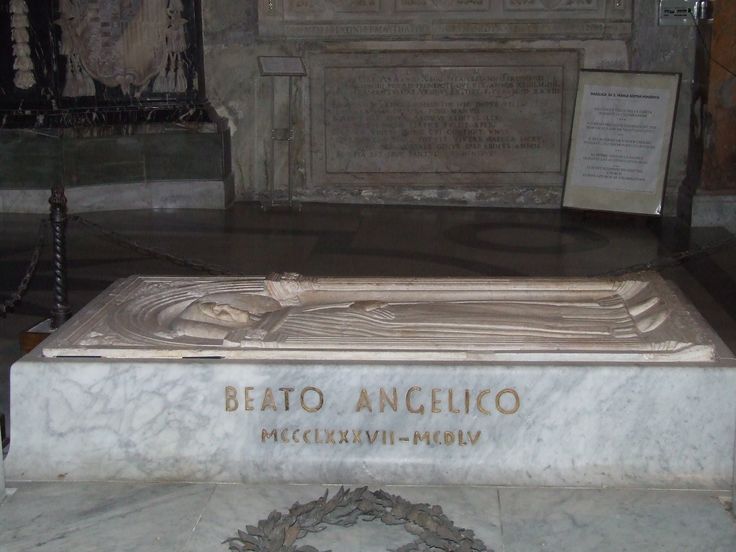
Fra Angelico died on February 18, 1455, in the convent of Santa Maria Sopra Minerva in Rome and was buried in the adjoining Basilica, where his body was covered by a simple slab on which was carved his portrait. With a personality that was uncomplicated and clear, Brother Giovanni had lived a poor and humble life, refusing honours and positions.
The virtue and the profound religious spirit which characterized the life of this artist and Dominican is reflected in his spirituality, his purity and the luminosity of his art. Even before his official recognition as a blessed of the Church, he had been given by the faithful the title “Beato Angelico.” In a moving ceremony on October 18, 1984, Pope John Paul II, on his knees in front of Fra Angelico’s tomb, proclaimed him solemnly to be the universal patron of all artists.
The Incarnation was one of Fra Angelico’s favourite themes and he painted over 25 variations of it. His painted meditations, so needed at the time of the early Renaissance, are still necessary today. God became man to bring us closer to Himself by way of all things human. He makes all things new by fashioning them into possible vehicles of grace for us, so that by visible realities and concrete concepts, we can arrive at an understanding and a love of higher, invisible realities, all leading to God Himself. Without art our lives would be much depleted. L et us pray for artists today, especially those who can lift our hearts and minds to God that the Lord may come to them and guide their hands.
Theologian Hans Urs von Balthasar said Angelico’s art embodies the motto of the Dominican Order contemplata aliis tradere, that is,
“communicating to others the contemplated mysteries”.
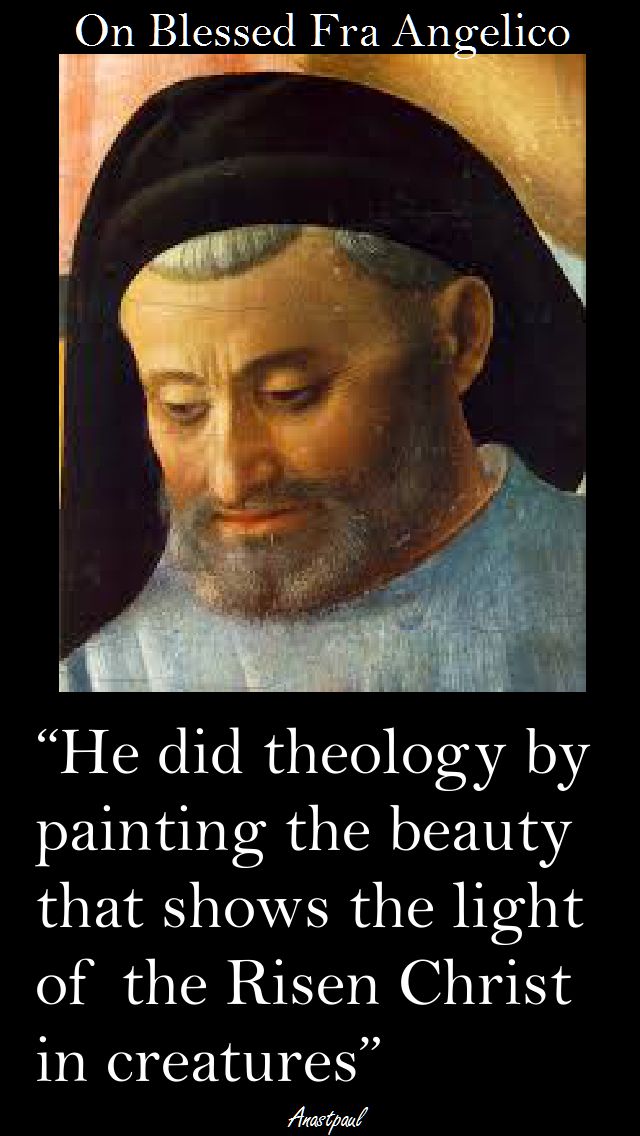
Another writer expressed a similar judgment: fece teologia dipingendo la bellezza, che mostrò la luce del Risorto nelle creature da lui redente: “he did theology by painting the beauty that shows the light of the Risen Christ in creatures”.
Author of the Lives of the Artists – Vasari – wrote of Fra Angelico that “it is impossible to bestow too much praise on this holy father, who was so humble and modest in all that he did and said and whose pictures were painted with such facility and piety.”
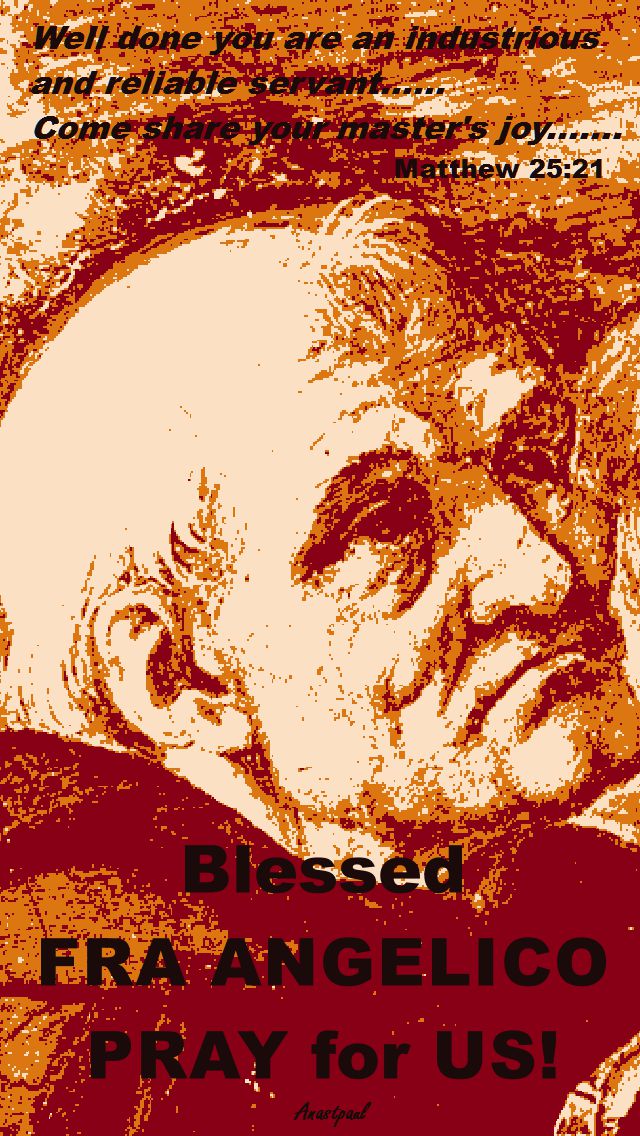
Well done you are an industrious
and reliable servant…… Come share
your master’s joy…………Matthew 25:21
REFLECTION – “In God’s house we must try to
accept whatever job he gives us:
cook, kitchen boy, waiter, stable boy or baker.
For we know that our reward depends not
on the job itself but on the faithfulness
with which we serve God.”……..Pope John Paul I
Fra Angelico’s painting was the fruit of the great harmony between a holy life and the creative power with which he had been endowed………St John Paul
PRAYER – O God, in Your providence You inspired blessed Fra Angelico to portray the beauty and sweetness of heaven. By his prayers and the example of his virtues, grant that we may manifest this splendour to our brothers and sisters. Blessed Angelico, pray for us! Through Christ our Lord, amen.
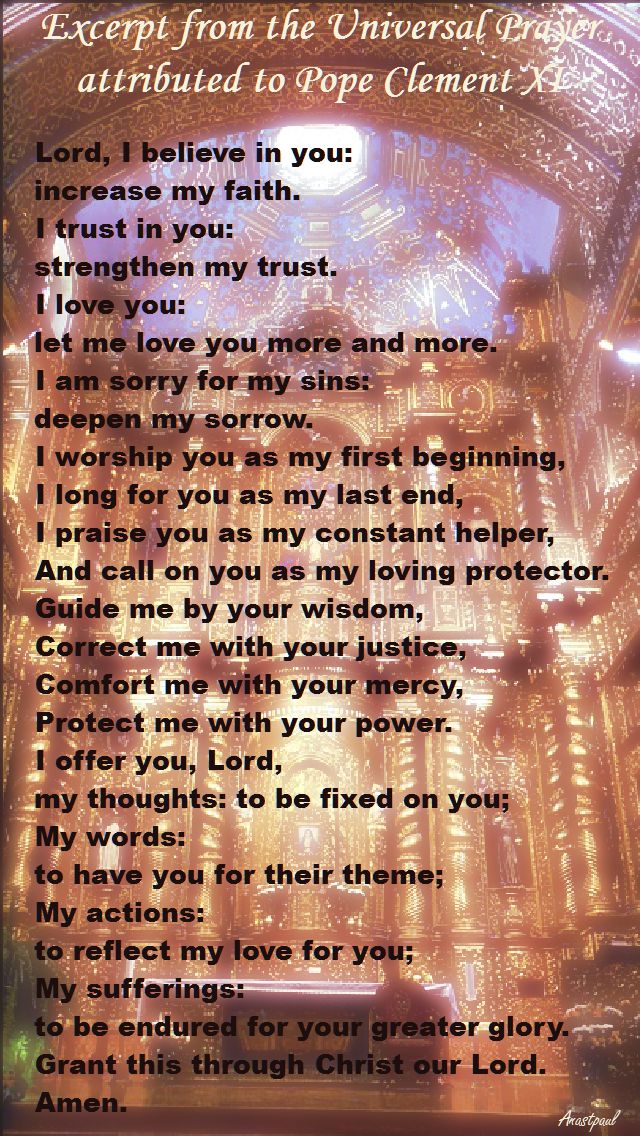
Excerpt from the ‘Universal Prayer’ – attributed to Pope Clement XI
Lord, I believe in You: increase my faith.
I trust in You: strengthen my trust.
I love You: let me love You more and more.
I am sorry for my sins: deepen my sorrow.
I worship You as my first beginning,
I long for You as my last end,
I praise You as my constant helper,
And call on You as my loving protector.
Guide me by Your wisdom,
Correct me with Your justice,
Comfort me with Your mercy,
Protect me with Your power.
I offer You, Lord, my thoughts: to be fixed on You;
My words: to have You for their theme;
My actions: to reflect my love for You;
My sufferings: to be endured for Your greater glory.
Saint of the Day – 18 February – Blessed FRA ANGELICO O.P. (1395-1455 aged 59) – Patron of Artists.
Fra Angelico was an Early Italian Renaissance painter described by Vasari in his Lives of the Artists as having “a rare and perfect talent”.
He was known to contemporaries as Fra Giovanni da Fiesole (Brother John of Fiesole) and Fra Giovanni Angelico (Angelic Brother John). In modern Italian he is called il Beato Angelico (Blessed Angelic One); the common English name Fra Angelico means the “Angelic friar”.
In 1982 Pope John Paul II proclaimed his beatification in recognition of the holiness of his life, thereby making the title of “Blessed” official. Fiesole is sometimes misinterpreted as being part of his formal name, but it was merely the name of the town where he took his vows as a Dominican friar and was used by contemporaries to separate him from others who were also known as Fra Giovanni. He is listed in the Roman Martyrology as Beatus Ioannes Faesulanus, cognomento Angelicus—”Blessed Giovanni of Fiesole, surnamed ‘the Angelic’ “.
Fra Angelico is probably better known as an artist than as a holy man. He was already called “Beato” while he was still alive. Pope John Paul II gave this a new reality when he beatified him in 1982. Patrick Duffy tells his story.
Early life Born Guido di Pietro at Vicchio, 25 kms north-east of Florence, also the birth place of Giotto, in his childhood he was known as Guido da Vicchio or Guido di Pietro. He may have been already a painter before he and his brother Benedetto joined the Dominicans at Fiesole.
At Fiesole 1418-35 After his novitiate at Cortona he went to live at the Dominican convent at Fiesole. As a young friar, he worked at illuminating missals and manuscripts. He became known to his companions as Fra Giovanni da Fiesole but later more popularly – even within his own lifetime in Italy – he was called Il Beato Angelico.
San Marco, Florence (1436-45) In 1436 Fra Angelico was one of a number of the monks from Fiesole who moved into the newly-built monastery of San Marco in Florence. This not only put him in the centre of artistic activity but also engaged the patronage of the wealthy and powerful Cosimo de’ Medici, who often came there himself when he wanted to retreat from the world.
According to his biographer Giorgio Vasari (1511-74), it was at Cosimo’s urging that Fra Angelico undertook the task of decorating the monastery, including the magnificent Chapter House fresco, the often-reproduced Annunciation, the Maesta with Saints Cosmas and Damian, Saint Mark and Saint John, Saint Lawrence and three Dominicans, Saint Dominic, Saint Thomas Aquinas and Saint Peter Martyr.
The Vatican and Orvieto, 1445–1449 In 1445 Pope Eugenius IV (1431-47), who knew the artist’s work in Florence, summoned Angelico to Rome to paint the frescoes of the Chapel of the Holy Sacrament at St Peter’s but this was destroyed a century later when Pope Paul III (Alessandro Farnese 1534-49) wanted to make room for the great staircase of the Vatican Palace. Vasari says that at this time Eugenius offered Fra Angelico the archbishopric of Florence, but that he refused it, recommending another friar for the position.
In 1447 when the papal court moved to the comparative cool of Orvieto Fra Angelico worked with his pupil, Benozzo Gozzoli, on the vault of the chapel of the Madonna of St Brizio in the cathedral.
In 1449 back at the Vatican, he designed the famous fresco scenes from the lives of St. Laurence and St. Stephen for the walls of the Chapel of Nicholas V. From 1449 until 1452, Fra Angelico was back at San Marco in Florence, where he was prior for three years.
The Transfiguration shows the directness, simplicity and restrained palette typical of these frescoes. Located in a monk’s cell at the Convent San’ Marco, its apparent purpose is to encourage private devotion.
Death and influence In 1455 Fra Angelico died while staying at a Dominican Convent in Rome, perhaps working on Pope Nicholas’ Chapel. His tomb can be seen in the Church of Santa Maria sopra Minerva in the centre of Rome. And this is his epitaph:
When singing my praise, do not say I was another Apelles.
But say that, in the name of Christ, I gave all I had to the poor.
Part of my work remains on earth and part is in heaven.
The city that bore me, Giovanni, is the flower of Tuscany.
St Angilbert of Centula
St Colman of Lindisfarne
St Constance of Vercelli
St Esuperia of Vercelli
St Ethelina
Bl Fra Angelico
St Gertrude Caterina Comensoli
St Helladius of Toledo
St Ioannes Chen Xianheng
St Ioannes Zhang Tianshen
St Jean-François-Régis Clet
St Jean-Pierre Néel
Bl Jerzy Kaszyra
Bl John Pibush – one of the Martyrs of Douai
St Leo of Patera
St Martinus Wu Xuesheng
Bl Matthew Malaventino
St Paregorius of Patara
St Sadoth of Seleucia
St Simeon
St Tarasius of Constantinople
St Theotonius
Bl William Harrington
—
Martyrs in North Africa – 7 saints
Martyrs of Rome – 5 saints
HOW TO AVOID PURGATORY By Fr. Paul O’Sullivan O.P.
For those who have not read this little book and to refresh myself, I will be posting the entire book in daily doses. Let us begin with the Foreword. (To read later find in the Purgatory Category).
FOREWORD
Our Lord came on earth expressly to give us a perfect Redemption. He gave
us a Law of Love, a Religion in every way to suit our human hearts,
destined to make us holy and happy. His Commandments, counsels and promises
all breathe peace, joy, mercy and love.
The idea that nearly all of us shall, notwithstanding, have to pass a
period more or less long in the excruciating fires of Purgatory after death
seems to be at variance with this all-merciful and all-loving plan of our
Divine Lord.
It is true that we are weak and fall many times and that God’s justice is
rigorous and exacting but it is equally certain that God’s mercy and love
are above all His works.
It is no less certain that Our Lord has given us abundant grace and
strength to save us from sin and many (and most efficacious) means of
satisfying for any sins that we may have committed. This last fact seems to
be almost entirely overlooked, or imperfectly understood by the majority of
Catholics.
Of course, those who go on deliberately sinning and who make no effort to
correct their faults and refuse to use the many wonderful means God offers
them for satisfying for sin, condemn themselves to Purgatory.
The object of this little book is to show how we can avoid Purgatory by
using the means God has so generously offered us, and, secondly, to show
that the use of these means is within the reach of every ordinary
Christian.
The careful perusal of these pages will be a source of much benefit and
consolation to all who read them.
The author offers them to the loving Heart of Jesus and asks Him to bless
them.
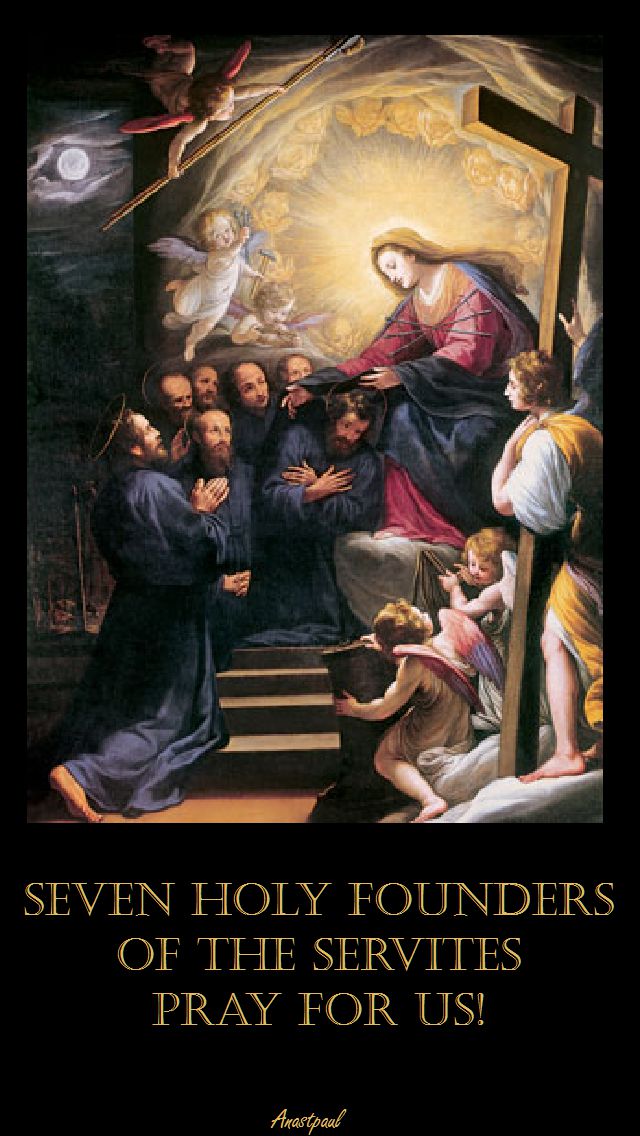
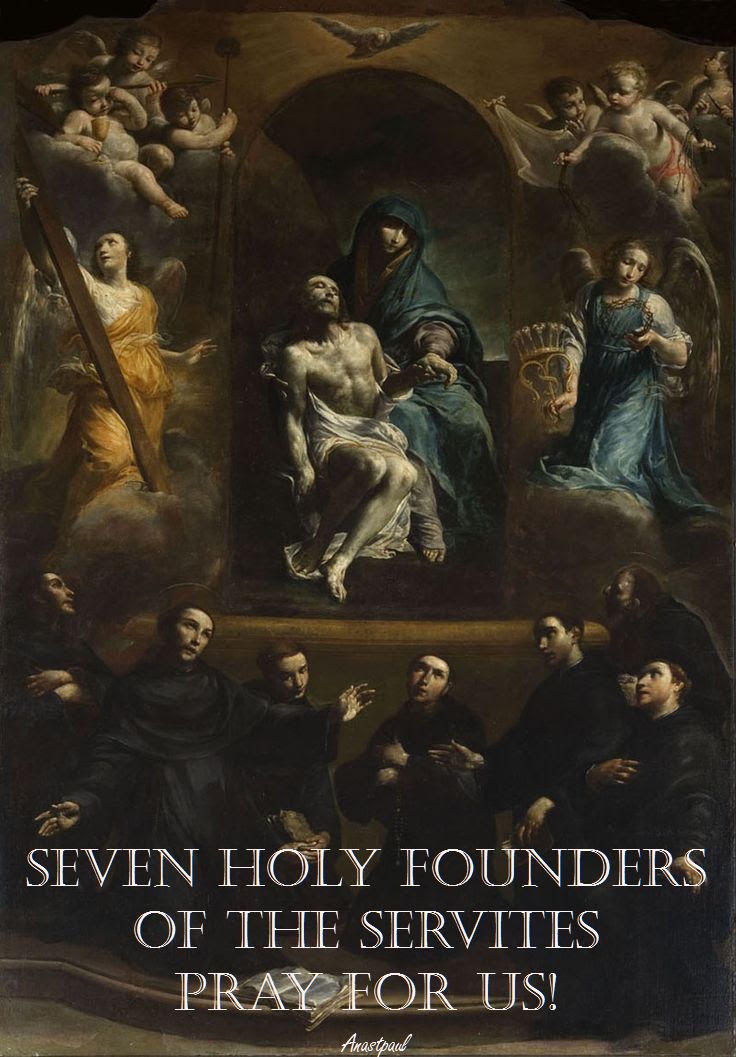
Since criminals and people with evil purposes often band together for their common interests, good people often have to do the same. Faced with the immorality and blood feuds of thirteenth century Florence, the Seven Holy Founders banded together for their own spiritual good and succeeded in founding a whole new religious order. Good companions are on of the most powerful helps toward a holy life, for all of us are faced in a new and urgent way with the challenge to make our lives decisively centred in Christ. In this new day, we often find those ‘good companions’ online, let us too band together and live a holy life amidst the dangers around us!
“Mary means enlightener, because She brought forth the Light of the world. In the Syriac tongue, Mary signifies Lady.”
~~~~~ St Isidore of Seville
“Let me say something concerning this name also, which is interpreted to mean Star of the sea, and admirably suits the Virgin Mother.”
~~~~~ St Bernard
“Mary means Star of the sea, for as mariners are guided to port by the ocean star, so Christians attain to glory through Mary’s maternal intercession.”
~~~~~St Thomas Aquinas
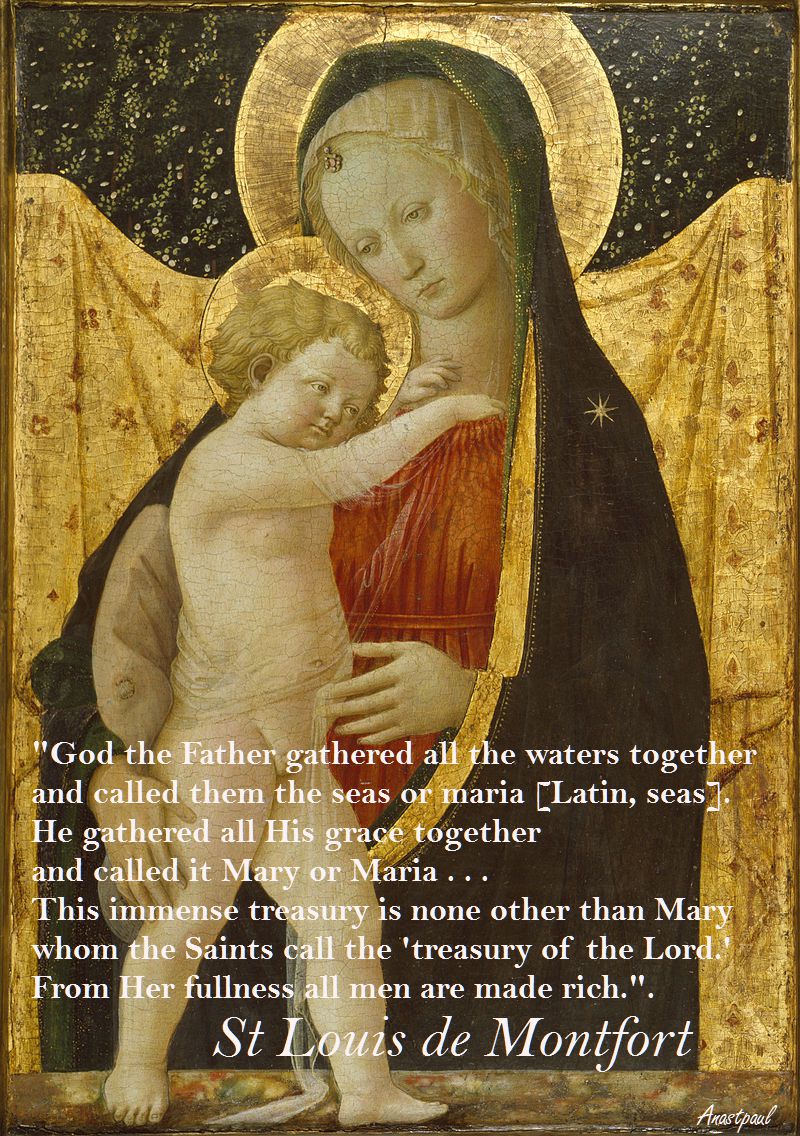
“God the Father gathered all the waters together
and called them the seas or maria [Latin, seas].
He gathered all His grace together
and called it Mary or Maria . . .
This immense treasury is none other than Mary
whom the Saints call the ‘treasury of the Lord.’
From Her fullness all men are made rich.”
~~~~~ St Louis de Montfort
“This most holy, sweet and worthy name was ’eminently fitted to so holy, sweet and worthy a virgin. For Mary means a bitter sea, star of the sea, the illuminated or illuminatrix. Mary is interpreted Lady. Mary is a bitter sea to the demons; to men She is the Star of the sea; to the Angels She is illuminatrix, and to all creatures She is Lady .”
~~~~~St Bonaventure
“When you find yourself tossed by the raging storms on this great sea of life, far from land, keep your eyes fixed on this Star to avoid disaster. When the winds of temptation or the rocks of tribulation threaten, look up to the Star, call upon Mary!”
~~~~~ St Bernard
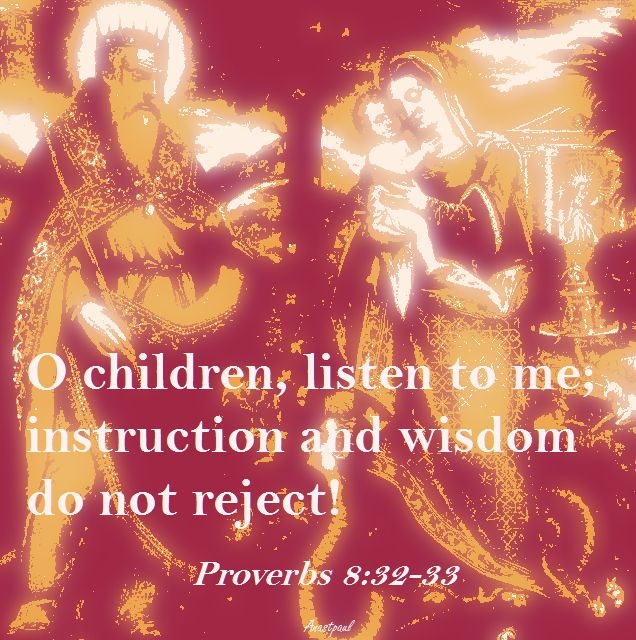
O children, listen to me; instruction and wisdom do not reject!…………Proverbs 8:32-33
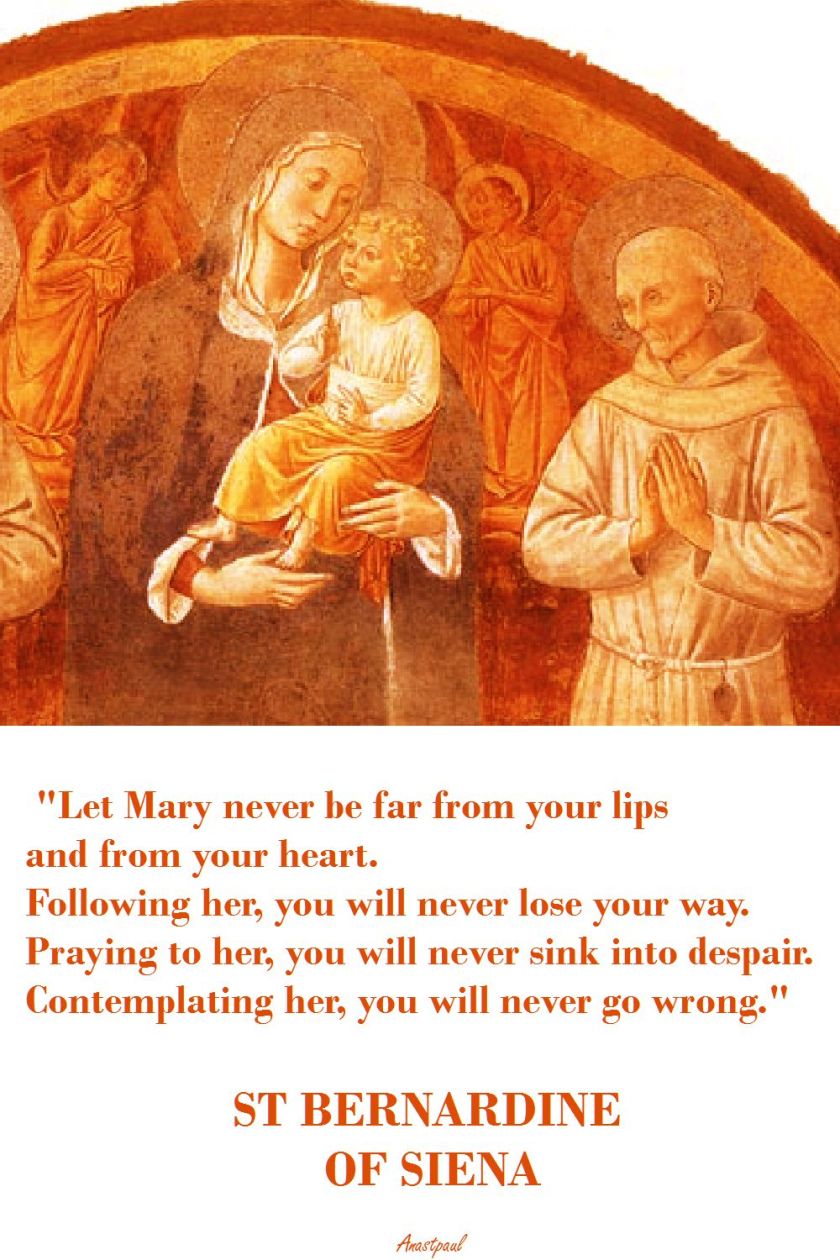
REFLECTION – “Let Mary never be far from your lips
and from your heart.
Following her, you will never lose your way.
Praying to her, you will never sink into despair.
Contemplating her, you will never go wrong.”
……St Bernardine of Siena
PRAYER – Heavenly Father, grant me the grace to have Mary as my constant intercessor. Allow me to reach out to her as my mother, to lead me to her Son, for she is Your beloved Daughter, who carried Your Son to us in order that we might see our way and be able to reach our home in heaven. Holy Founders of the Servites, pray for us all that we may be blessed by the intercession and protection of Mary our Mother and please pray for us all, amen.
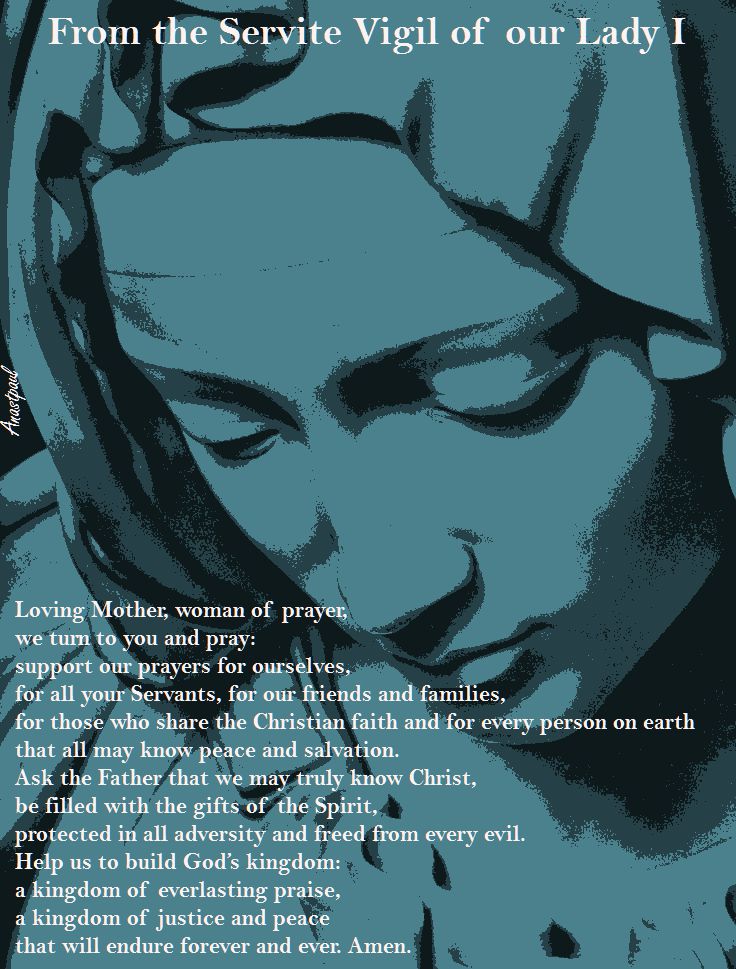
Loving Mother,
woman of prayer,
we turn to you and pray:
support our prayers
for ourselves,
for all your Servants,
for our friends and families,
for those who share the Christian faith
and for every person on earth
that all may know peace and salvation.
Ask the Father that we may truly know Christ,
be filled with the gifts of the Spirit,
protected in all adversity
and freed from every evil.
Help us to build God’s kingdom:
a kingdom of everlasting praise,
a kingdom of justice and peace
that will endure forever and ever.
R. Amen.
Seven Founders of Servants of Mary – OSM – Founded 15 August 1233 – Mendicant Order
• Sts Alexis Falconieri – Founder and Mystic (1200-1310) Patron of city of Orvieto (Italy)
• St Bartholomew degli Amidei
• St Benedict dell’Antella
• St Buonfiglio Monaldi
• St Gherardino Sostegni
• St Hugh dei Lippi-Uguccioni
• St John Buonagiunta Monetti
The Servite Order is one of the five original Catholic mendicant orders. Its objects are the sanctification of its members, preaching the Gospel and the propagation of devotion to the Mother of God, with special reference to her sorrows. The members of the Order use O.S.M. (Ordo Servorum Beatae Mariae Virginis) as their post-nominal letters. The male members are known as Servite Friars or Servants of Mary. The Order of Servants of Mary (The Servites) is a religious family that embraces a membership of friars (priests and brothers), contemplative nuns, a congregation of active sisters and lay groups.
This is the story of seven young men, caught up in the blood feuds of medieval Florence, who set out into the wilderness to live a holy life. They were from prominent families in Florence: two were married, two were widowers and they all belonged to a religious fraternity called the Laudesi. The chaplain of Laudesi was a priests, James Poggibonsi, who later joined them in their wilderness retreat.
After settling their personal affairs and making provision fo the families of those who were married, they began to live a life of prayer and penance, some going to Carfaggio, just outside the city and the others retiring to Mount Senario, deeper in the wilderness. At the suggestion of the Dominican Preacher, St Peter Martyr, they decided to found a community. Taking the rule of St Augustine and a version of the Dominican habit from St Pter, they took the name Servants of Mary, the name of a confraternity founded by St Peter Martyr. The bishop of Florence approved the community and they were taken under the protection of the Holy See in 1249.
They are known as the Seven Holy Founders of the Servite Order, their individual names are above and they were canonised as a group by Pope Leo XIII in 1888.
In 1253, St Philip Benezi entered the Order and during his term of office as Superior General, the order spread throughout Italy and other parts of Europe. At the suggestion of the bishop of Florence, they modified their strict onastic form of life and took on the character of mendicant friars. They now have houses on every continent, including missions in Africa and South America.
Seven Founders of Servants of Mary (Optional Memorial)
• Sts Alexis Falconieri
• St Bartholomew degli Amidei
• St Benedict dell’Antella
• St Buonfiglio Monaldi
• St Gherardino Sostegni
• St Hugh dei Lippi-Uguccioni
• St John Buonagiunta Monetti
—
St Alexis Falconieri – SEVEN HOLY FOUNDERS
St Antoni Leszczewicz
St Bartholomew degli Amidei – SEVEN HOLY FOUNDERS
St Benedict dell’Antella – SEVEN HOLY FOUNDERS
St Benedict of Cagliari
St Buonfiglio Monaldi – SEVEN HOLY FOUNDERS
St Bonosus of Trier
Bl Constabilis of Cava
St Donatus the Martyr
Bl Elisabetta Sanna
St Evermod of Ratzeburg
St Faustinus the Martyr
St Finan of Iona
St Fintan of Clonenagh
St Flavian of Constantinople
St Fortchern of Trim
St Gherardino Sostegni – SEVEN HOLY FOUNDERS
St Guevrock
St Habet-Deus
St Hugh dei Lippi-Uguccioni – SEVEN HOLY FOUNDERS
St John Buonagiunta Monetti – SEVEN HOLY FOUNDERS
St Julian of Caesarea
St Loman of Trim
Bl Luke Belludi
St Lupiano
Bl Martí Tarrés Puigpelat
St Mesrop the Teacher
St Petrus Yu Chong-nyul
St Polychronius of Babylon
St Romulus the Martyr
St Secundian the Martyr
St Silvinus of Auchy
St Theodulus of Caesarea
Bl William Richardson
St Gilbert of Sempringham could have lived a life of ease from the income of his benefices but he chose to give all to the poor and to dedicate his life to teaching. Accidentally (though of course, it was God’s plan all along), he stumbled upon his life’s work and brought many to God. We never know how God is going to use us and by our devotion and fidelity, we have to remain open to whatever task He sets before us. “I come Lord, to do Your Will.”
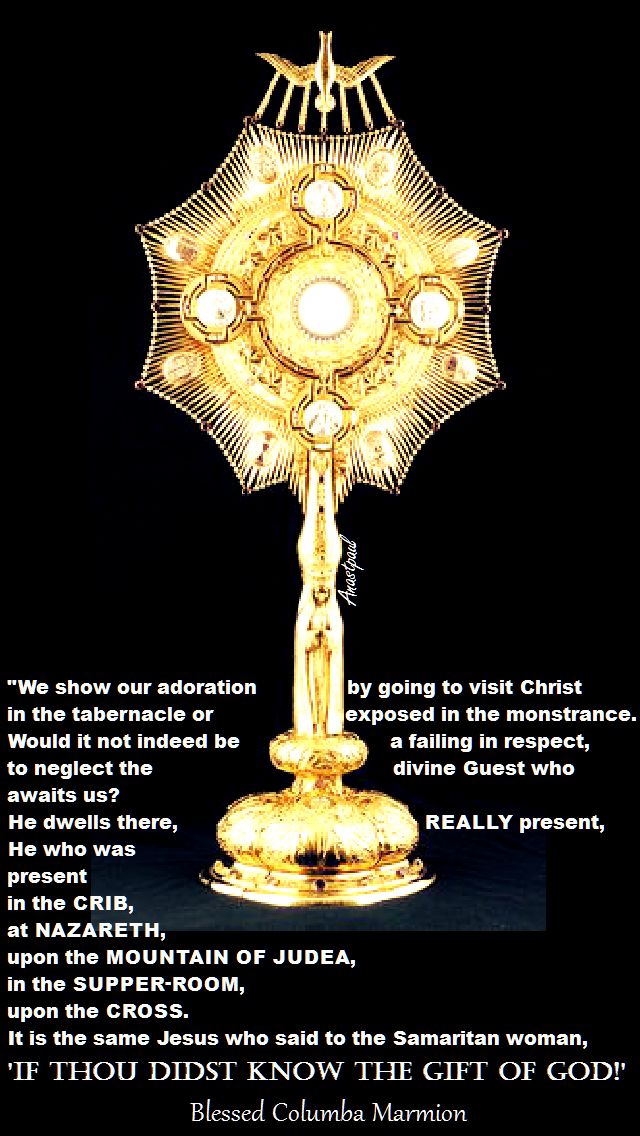
“We show our adoration by going to visit Christ in the tabernacle or exposed in the monstrance. Would it not indeed be a failing in respect to neglect the divine Guest who awaits us? He dwells there, really present, He who was present in the crib, at Nazareth, upon the mountains of Judea, in the supper-room, upon the Cross. It is the same Jesus who said to the Samaritan woman, ‘If thou didst know the gift of God!’
(Jesus) said to Peter,
“Put out into deep waters
and lower your nets for a catch.”……………….Luke 5:4
REFLECTION – “The bark of Peter laughs at the winds and the waves.
She has the Saints as her passengers, the Cross as her mast, the Gospel teachings as her sails, the Angels as her rowers and God as her pilot.” ……………..St John Chrysostom
PRAYER – Heavenly Father, teach me to trust Your Church as the Bark of Salvation in this world. Grant that I may work and pry to remain afloat with her amid the storms of Life. St Gilbert, you experienced great storms and upheavals in every facit of your life but your eyes remained fixed on the pilot, you embraced the Cross and persevered with the saints until you too became one. St Gilbert of Sempringham, please pray for us, that will follow our friends in heaven too, amen!
A Prayer to Seek the Consolation of the Cross
by Saint Alphonsus Rodriguez S.J.
Jesus, love of my soul, centre of my heart!
Why am I not more eager to endure pains
and tribulations for love of You,
when You, my God, have suffered so many for me?
Come, then, every sort of trial in the world,
for this is my delight, to suffer for Jesus.
This is my joy, to follow my Saviour
and to find my consolation
with my Consoler on the Cross.
This is my happiness,
this my pleasure:
to live with Jesus,
to walk with Jesus,
to converse with Jesus,
to suffer with and for Him,
this is my treasure, amen.
Saint of the Day – 16 February -St Gilbert of Sempringham CRSA (c. 1083 – 4 February 1190) – Priest and religious Founder.
St Gilbert was the only Englishman to found a conventual order, mainly because the Abbot of Cîteaux declined his request to assist him in organising a group of women who wanted to live as nuns, living with lay brothers and sisters, in 1148. In the end he founded a double monastery of canons regular and nuns.
Saint Gilbert’s life was quite different than what was expected of him by his parents and society. Born to a Norman knight and a Saxon peasant, he grew up in a time where the memories of the Norman invasion of England were still well preserved. He, like many of mixed heritage at the time, suffered ostracism and disdain from his peers. Compounding his difficulties, Gilbert was apparently born with some form of disability, likely believed to be curvature of the spine. So odd was his appearance as a youth, the servants of the house even refused to eat at the same table as him. However, his mother, a woman of great faith, cared for him without hesitation, having been greeted by a vision prior to his birth, alerting her to the special gifts he would bring to the world.
Given his physical limitations and the fact that he was not a particularly good student, Gilbert was sent to France to study, rather then join the army as was expected of the son of a knight. Surprisingly, he excelled at his studies abroad, returning to the area having earned the title of “Master” and embarking on a mission to educate the children of the area—both male and female, which was relatively unheard of at the time. As the news of his education and piety spread, he was granted the rectories at Sempringham, which would have allowed him to live a comfortable life. However, he instead dedicated his life and his inheritence to serving the poor, while studying and residing with the nearby Bishop of Lincoln.
Despite his holiness and commitment to the Lord, Saint Gilbert did not take his vows and enter the priesthood until his fortieth year, citing his belief that he was unworthy of the position. Similarly, offered the archdeaconship of the largest diocese in Europe at the time, he declined, humbly preferring to stay in Sempringham. It was there that he established a convent for women, attached to the church at Sempringham. He later established monsteries for lay sisters, ministering priests, and lay brothers. Eventually he had a chain of 26 convents, monasteries and missions. The community would come to be known as the Gilbertine Order, approved by Pope Eugenius III, with Saint Gilbert as it’s Master. He travelled from location to location, supervising the Order, as local bishops were not permitted to oversee the community members. He established the Gilbertine Rule—a vow he himself did not take until he was near death, as he professed his belief it would be arrogant to do so, as he had written it. The rule put love of God first and foremost, but also included service to the community and the poor, humility, modesty, and acts of penance and self-denial.
The Gilbertine communities became known for their discipline, fasting and self-denial, and service to the poor. Over the years a special custom was created in the houses of the order called “the plate of the Lord Jesus.” The best portions of dinner were put on a special plate and shared with the poor, reflecting Saint Gilbert’s lifelong concern for less fortunate people. He himself ate little, mainly roots and slept little—taking short rests in a chair. He would instead spend the night in prayer. At one point in his life, he suffered imprisonment on the false accusation of aiding the exiled Saint Thomas a Becket. While he had not sent aid, he refused to make an oath stating as such, as he did not want to appear uncharitable toward the exiled bishop. Rather, he endured prison until his name was cleared. Despite the harshness of his daily penance, Saint Gilbert lived a long life, past age 100. His death was marked with “bright lights, sweet odors and incorrupt clothings.” Numerous miracles and cures have been reported at his tomb.
Gilbert was canonised in 1202 by Pope Innocent III. His liturgical feast day is on 4 February, commemorating his death. According to the order of Hubert Walter, the bishops of England celebrated his feast, and his name was added to the wall of the church of the Four Crowned Martyrs. His Order did not outlast the Reformation, however, and despite being influenced by Continental models, it did not maintain a foothold in Europe.











 In 1445 Pope Eugenius IV (1431-47), who knew the artist’s work in Florence, summoned Angelico to Rome to paint the frescoes of the Chapel of the Holy Sacrament at St Peter’s but this was destroyed a century later when Pope Paul III (Alessandro Farnese 1534-49) wanted to make room for the great staircase of the Vatican Palace. Vasari says that at this time Eugenius offered Fra Angelico the archbishopric of Florence, but that he refused it, recommending another friar for the position.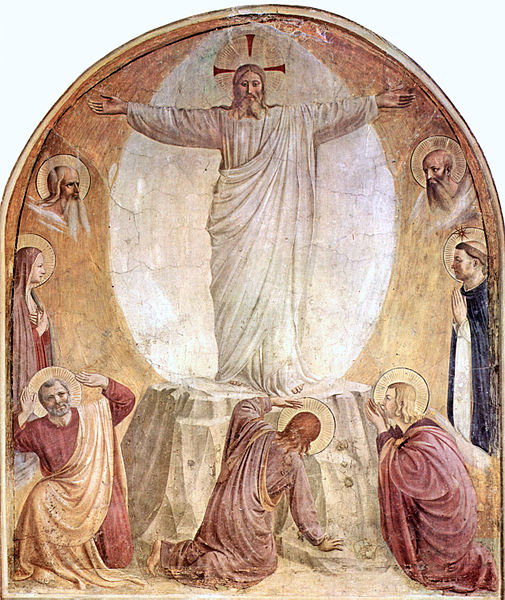







 AnaStpaul
You must be logged in to post a comment.