
St Anselm of Canterbury (Optional Memorial)
Holy Infant of Good Health (Mexico)
—
St Abdechalas
St Anastasius I of Antioch
St Anastasius of Sinai
St Apollo of Nicomedia
St Apollonius the Apologist
St Arator of Alexandria
St Beuno Gasulsych
St Conrad of Parzham
St Crotates of Nicomedia
St Cyprian of Brescia
St Felix of Alexandria
St Fortunatus of Alexandria
St Frodulphus
St Isacius of Nicomedia
Bl John Saziari
St Maelrubba of Applecross
St Roman Adame Rosales
St Silvius of Alexandria
St Simeon of Ctesiphon
St Vitalis of Alexandria
Bl Vitaliy Bayrak
Bl Wolbodó of Liège
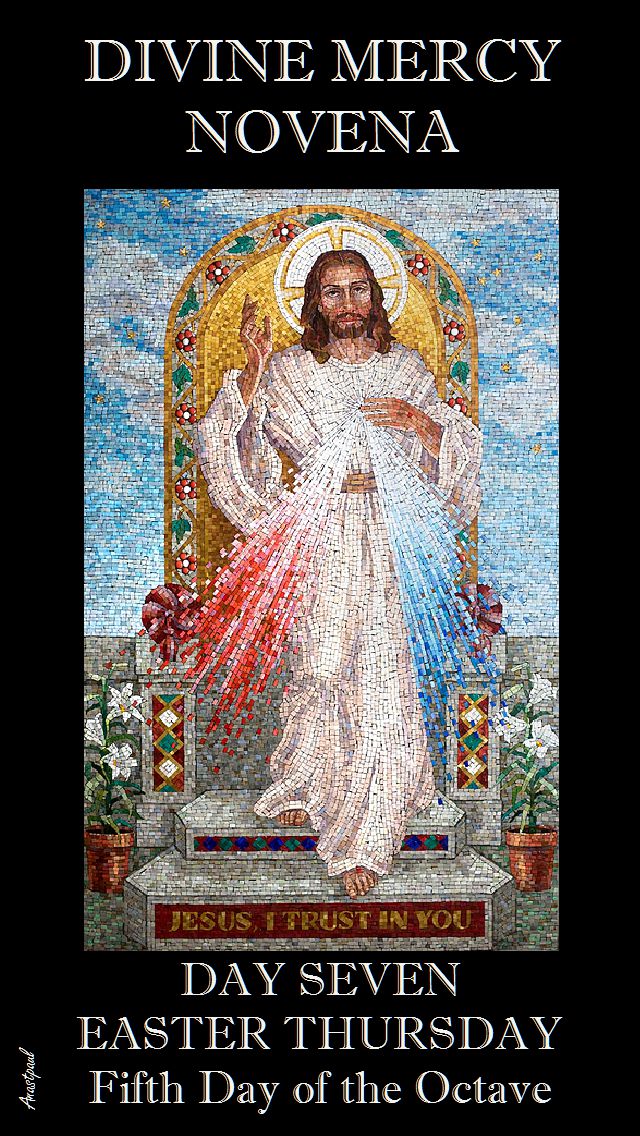
Divine Mercy Novena – 20 April Easter Thursday – Fifth Day of the Octave
Divine Mercy Novena – 20 April
Easter Thursday – Fifth Day of the Octave
DAY SEVEN
Today bring to Me the Souls who especially venerate and glorify My Mercy*,and immerse them in My mercy. These souls sorrowed most over my Passion and entered most deeply into My spirit. They are living images of My Compassionate Heart. These souls will shine with a special brightness in the next life. Not one of them will go into the fire of hell. I shall particularly defend each one of them at the hour of death.
Most Merciful Jesus, whose Heart is Love Itself, receive into the abode of Your Most Compassionate Heart the souls of those who particularly extol and venerate the greatness of Your mercy. These souls are mighty with the very power of God Himself. In the midst of all afflictions and adversities they go forward, confident of Your mercy; and united to You, O Jesus, they carry all mankind on their shoulders. These souls will not be judged severely but Your mercy will embrace them as they depart from this life.
Eternal Father, turn Your merciful gaze upon the souls who glorify and venerate Your greatest attribute, that of Your fathomless mercy and who are enclosed in the Most Compassionate Heart of Jesus. These souls are a living Gospel; their hands are full of deeds of mercy and their hearts, overflowing with joy, sing a canticle of mercy to You, O Most High! I beg You O God:
Show them Your mercy according to the hope and trust they have placed in You. Let there be accomplished in them the promise of Jesus, who said to them that during their life but especially at the hour of death, the souls who will venerate this fathomless mercy of His, He, Himself, will defend as His glory. Amen.
*The text leads one to conclude that in the first prayer directed to Jesus, Who is the Redeemer, it is “victim” souls and contemplatives that are being prayed for; those persons, that is, that voluntarily offered themselves to God for the salvation of their neighbor (see Col 1:24; 2 Cor 4:12). This explains their close union with the Savior and the extraordinary efficacy that their invisible activity has for others. In the second prayer, directed to the Father from whom comes “every worthwhile gift and every genuine benefit,”we recommend the “active” souls, who promote devotion to The Divine Mercy and exercise with it all the other works that lend themselves to the spiritual and material uplifting of their brethren.”
Thought for the Day – 20 April
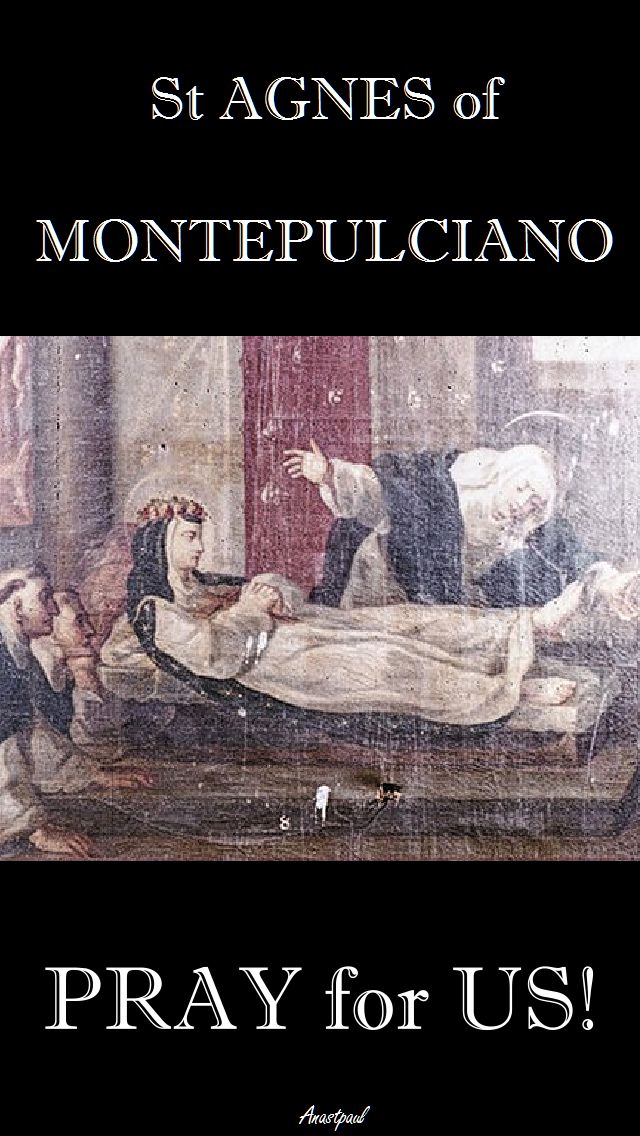
Although St. Agnes of Montepulciano was not in any way a “child saint,” like her little Roman patroness, there is about her something of the same simplicity, which makes her name appropriate. Some of the best known legends about her concern her childhood (see the Saint of the Day here: https://anastpaul.wordpress.com/2017/04/20/saint-of-the-day-20-april-st-agnes-of-montepulciano/)
At the age of forty nine, Agnes’ health began to fail rapidly. She was taken for treatment to the baths at Chianciano – accompanied, as it says in the rule, by “two or three sisters” but the baths did her no good. She did perform a miracle while there, restoring to life a child who had fallen into the baths and drowned. But she returned to Montepulciano to die on the twentieth of April, 1317. She died in the night, and the children of the city wakened and cried out, “Holy Sister Agnes is dead!” She was buried in Montepulciano, and her tomb soon became a place of pilgrimage.
One of the most famous pilgrims to visit her tomb was St. Catherine of Siena, who went to venerate the saint and also, probably, to visit her niece, Eugenia, who was a nun in the convent there. As she bent over the body of St. Agnes to kiss the foot, she was amazed to see Agnes raise her foot so that she did not have to stoop so far. Agnes of Montepulciano was canonised in 1796.
Simplicity and humility – help us Lord to attain these great virtues – St Agnes of Montepulciano pray for us!
Quote of the Day – 20 April – Easter Thursday – Fifth Day in the Octave
Quote of the Day – 20 April – Easter Thursday – Fifth Day in the Octave
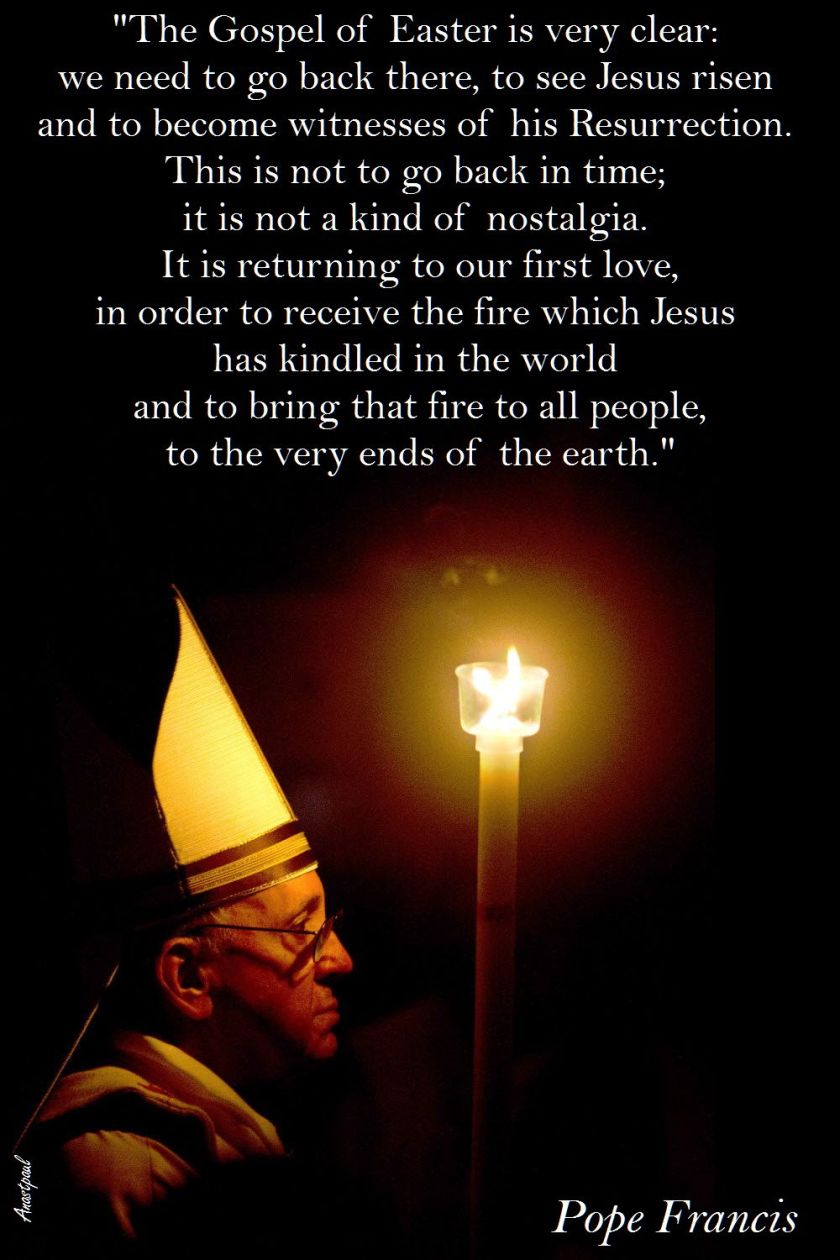
“The Gospel of Easter is very clear:
we need to go back there, to see Jesus risen
and to become witnesses of his Resurrection.
This is not to go back in time;
it is not a kind of nostalgia.
It is returning to our first love,
in order to receive the fire which Jesus
has kindled in the world
and to bring that fire to all people,
to the very ends of the earth.”
Pope Francis (Easter Vigil Homily, 2014)
One Minute Reflection – 20 April – Easter Thursday – Fifth Day of the Octave
One Minute Reflection – 20 April – Easter Thursday – Fifth Day of the Octave
Daily Meditation: May we be one in faith. love and peace through the Eucharist.
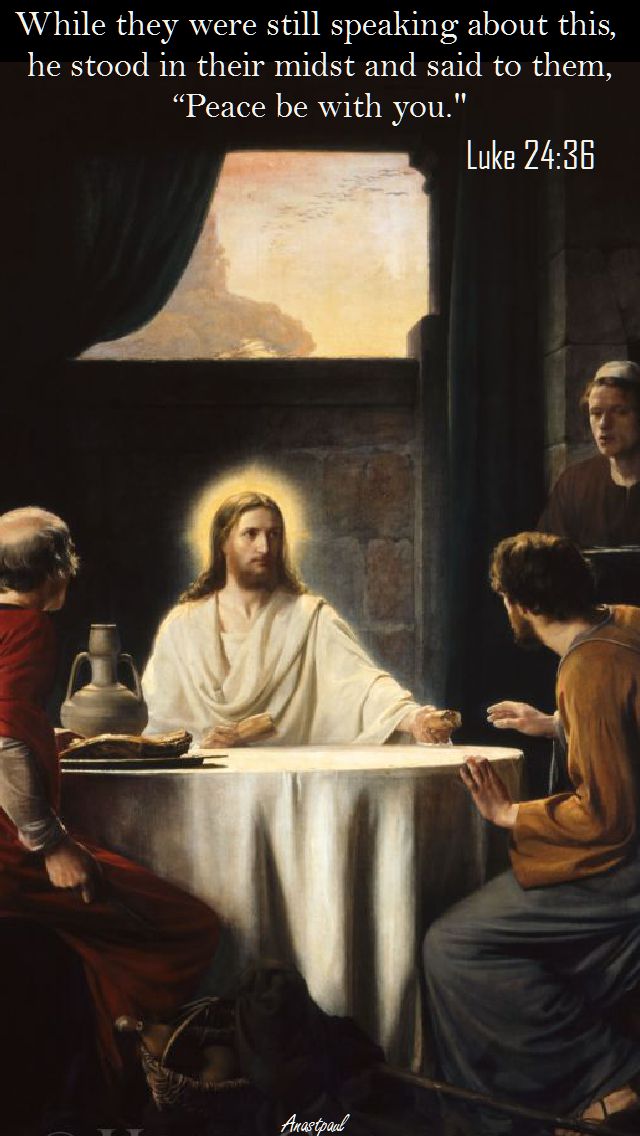
While they were still speaking about this,
he stood in their midst and said to them,
“Peace be with you.”
…..Luke 24:36
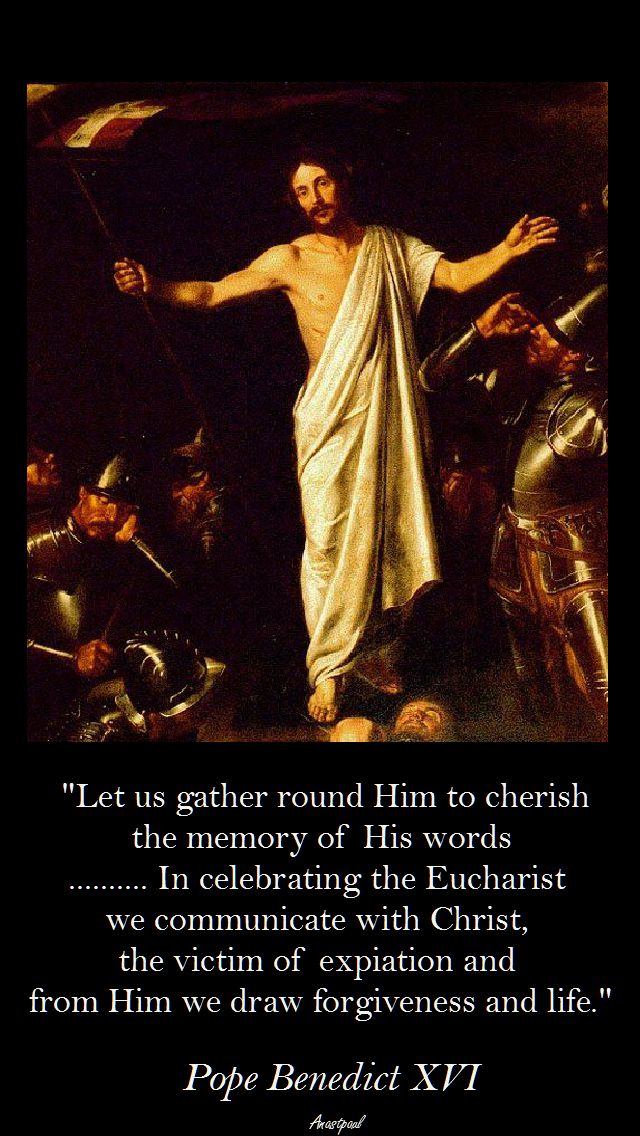
REFLECTION – “Let us gather round Him to cherish the memory of His words and of the events contained in Scripture; let us relive His Passion, death and Resurrection. In celebrating the Eucharist we communicate with Christ, the victim of expiation and from Him we draw forgiveness and life. What would our lives as Christians be without the Eucharist? The Eucharist is the perpetual, living inheritance which the Lord has bequeathed to us in the Sacrament of His Body and His Blood and which we must constantly rethink and deepen so that, as venerable Pope Paul VI said, it may “impress its inexhaustible effectiveness on all the days of our earthly life” (Insegnamenti, V [1967], p. 779).”……..Pope Benedict XVI 2009
PRAYER – Heavenly Father, we are scattered in this world and so easily distracted from seeing You. Help me to communicate in love to those around me
who gather in Your love. Let me praise Your name from my heart and rejoice that I have been given the grace of faith through Your love for me. Lord Jesus, remember Your holy Church, built on the apostles and reaching to the ends of the earth and let Your blessing and peace rest on all who gather to celebrate at Your feast in the most holy Eucharist. Amen
Our Morning Offering – 20 April
Our Morning Offering – 20 April
Prayer of St Ambrose
I beg of you, O Lord,
by this most holy mystery of Your Body and Blood,
with which You daily nourish us in Your Church,
that we may be cleansed and sanctified
and made sharers in Your divinity.
Grant to me Your holy virtues, which will enable
me to approach Your altar with a clean conscience,
so that this heavenly Sacrament may be a means
of salvation and life to me, for You Yourself have said:
“I am the living bread that has come down from heaven.
If anyone eat of this bread, he shall live forever
and the bread that I will give is my flesh for the life of the world.”
Most Sweet Bread, heal my heart, that I may taste the sweetness
of Your love. Heal it from all weakness, that I may enjoy
no sweetness but You. Most pure Bread, containing
every delight which ever refreshes us, may my heart
consume You and may my soul be filled with Your sweetness.
Holy Bread, living Bread, perfect Bread, that has come down
from heaven to give life to the world,
come into my heart and cleanse me from every stain of body
and soul. Enter into my soul; heal and cleanse me completely.
Be the constant safeguard and salvation of my soul and body.
Guard me from the enemies who lie in wait.
May they flee from the protecting presence
of Your power, so that, armed in soul
and body by You, I may safely reach
Your Kingdom.
There we shall see You, not as now
as in mysteries, but face to face,
when You will deliver the Kingdom to God
the Father and will reign as God over all.
Then You, who with the same God the Father
and the Holy Spirit, live and reign forever,
will satisfy the hunger of my soul perfectly
with Yourself, so that I shall neither hunger
nor thirst again. Amen
Saint of the Day – 20 April – St Agnes of Montepulciano
Saint of the Day – 20 April – St Agnes of Montepulciano O.P. (1268-1317) Religious Nun and Abbess “The Miracle Worker” – Attributes – Dominican Nun with a lily and a lamb. Her Body is incorrupt and her major Shrine is Church of St Agnes, Montepulicano, Siena, Italy.


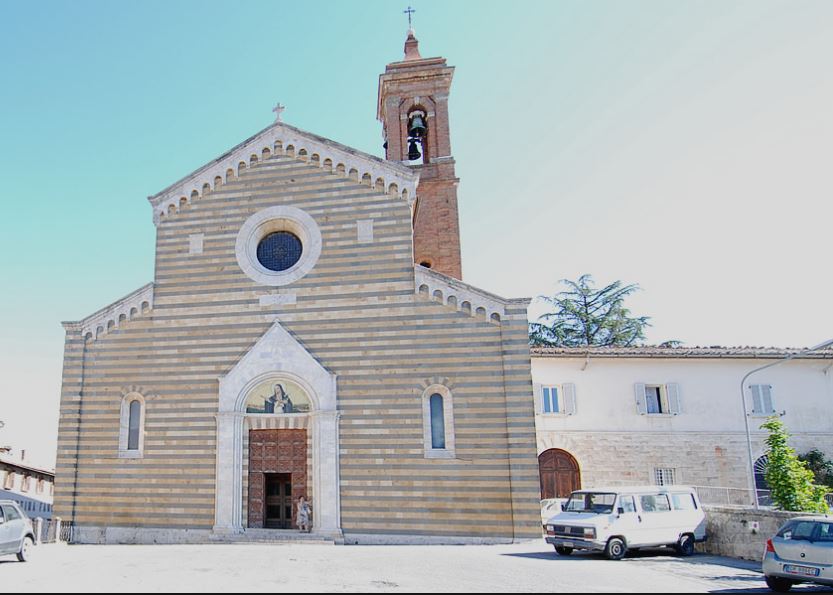
St Agnes was born in 1268 into the noble Segni family in Gracciano, a frazione of Montepulciano – in Siena, Italy, then part of the Papal States. At the age of nine, she convinced her parents to allow her to enter a Franciscan monastery of women in the city known as the “Sisters of the Sack”, after the rough religious habit they wore. they live a simple, contemplative life. She received the permission of the pope to be accepted into this life at such a young age, normally against Church law.
In 1281, the lord of the castle of Proceno, a fief of Orvieto, invited the nuns of Montepulciano to send some of their Sisters to Proceno to found a new monastery. Agnes was among the nuns sent to found this new community. At the age of fourteen, she was appointed bursar.
In 1288 Agnes, despite her youth at only 20 years of age, was noted for her devotion to the Blessed Sacrament and deep life of prayer and was elected as the abbess of the community. There she gained a reputation for performing miracles: people suffering from mental and physical ailments seemed cured by her presence. She was reported to have “multiplied loaves”, creating many from a few on numerous occasions, recalling the Gospel miracle of the loaves and fishes. She herself, however, suffered severe bouts of illness which lasted long periods of time.
In 1306 Agnes was recalled to head the monastery in Montepulciano. Agnes reached a high degree of contemplative prayer and is said to have been favoured with many visions. After her return, she proceeded to build a church, Santa Maria Novella, to honour the Blessed Mother, as she felt she had been commanded to do in a mystical vision several years earlier. She also had a vision of St. Dominic Guzman, under the inspiration of which she led the nuns of her monastery to embrace the Rule of St. Augustine as members of the Dominican Order. She was frequently called upon to bring peace to the warring families of the city.
By 1316, Agnes’ health had declined so greatly that her doctor suggested taking the cure at the thermal springs in the neighboring town of Chianciano Terme. The nuns of the community prevailed upon her to take his recommendation. While many of the other bathers reported being cured of their illnesses, Agnes herself received no benefit from the springs. Her health failed to such a degree that she had to be carried back to the monastery on a stretcher.
Agnes died the following 20 April, at the age of forty-nine. The Dominican friars attempted to obtain balsam (or myrrh) to embalm her body. It was found, however, to be producing a sweet odour on its own and her limbs remained supple. When her body was moved years after her death to the monastery church, it was found to be incorrupt. Her tomb became the site of pilgrimages.
Some fifty years later, a Dominican friar, the Blessed Raymond of Capua, who served as confessor to St. Catherine of Siena, wrote an account of Agnes’ life. He described her body as still appearing as if she were alive. Catherine herself referred to her as “Our mother, the glorious Agnes”. Catherine made a pilgrimage to Montepulciano while visiting her niece, Eugenie, who was a nun there.
Agnes was canonised by Pope Benedict XIII in 1726.


Some of the Miracles attributed to St Agnes:
• Her birth was announced by flying lights surrounding her family’s house.
• As a child, while walking through a field, she was attacked by a large murder of crows; she announced that they were devils, trying to keep her away from the land; years later, it was the site of her convent.
• She was known to levitate up to two feet in the air while praying.
• She received Communion from an angel and had visions of the Virgin Mary.
• She held the infant Jesus in one of these visions; when she woke from her trance she found she was holding the small gold crucifix the Christ child had worn.
• On the day she was chosen abbess as a teenager, small white crosses showered softly onto her and the congregation.
• She could feed the convent with a handful of bread, once she’d prayed over it.
• Where she knelt to pray, violets, lilies and roses would suddenly bloom.
• While being treated for her terminal illness, she brought a drowned child back from the dead.
• At the site of her treatment, a spring welled up that did not help her health but healed many other people.


Saints – 20 April
St Agnes of Montepulciano
Bl Antony Page
St Caedwalla of Wessex
Bl Catwallon
Bl Chiara Bosatta
St Domninus of Digne
Bl Francis Page
Bl Gerald of Salles
Bl Harduin
Bl Hildegun of Schönau
St Hugh of Anzy-le-Duc
Bl James Bell
Bl John Finch
Bl John of Grace-Dieu
St Marcellinus of Embrun
St Marcian of Auxerre
St Margaret of Amelia
Bl Maurice MacKenraghty
St Michel Coquelet
Bl Oda of Rivreulle
Bl Richard Sergeant
St Sara of Antioch
St Secundinus of Córdoba
St Servilian
Bl Simon Rinalducci
St Sulpicius
St Theodore Trichinas
St Theotimus of Tomi
St Vincent of Digne
St Wiho of Osnabrück
Bl William Thomson
Divine Mercy Novena – DAY SIX – Easter Wednesday – 19 April 4th Day of the Octave
Divine Mercy Novena – DAY SIX – Easter Wednesday – 19 April
4th Day of the Octave
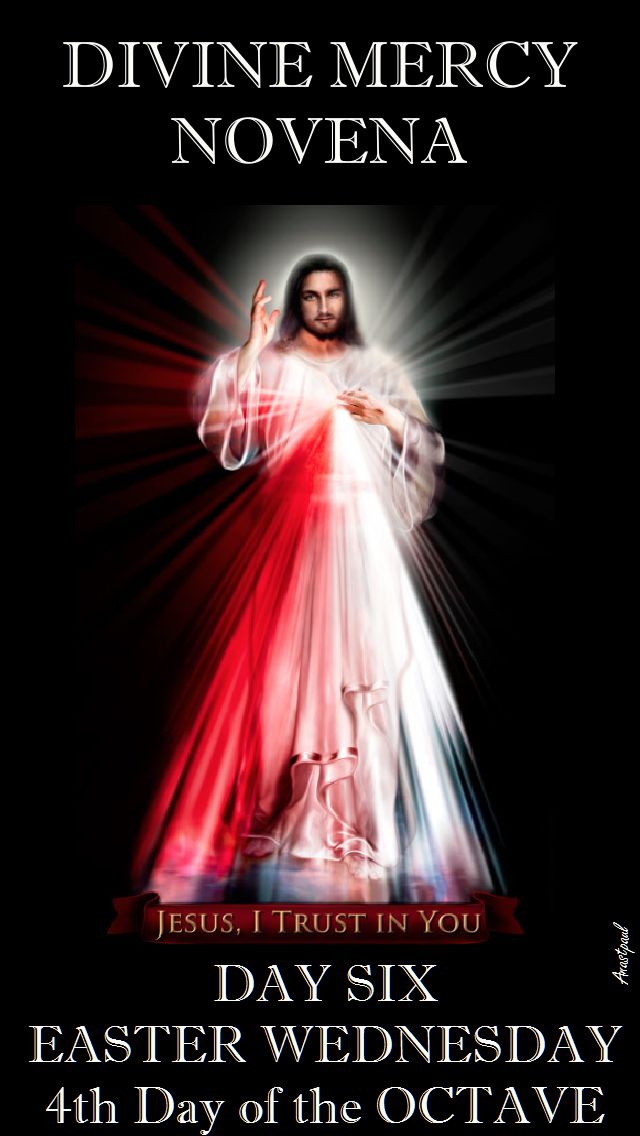
“Today bring to Me the Meek and Humble Souls and the Souls of Little Children,and immerse them in My mercy. These souls most closely resemble My Heart. They strengthened Me during My bitter agony. I saw them as earthly Angels, who will keep vigil at My altars. I pour out upon them whole torrents of grace. I favour humble souls with My confidence.”
Most Merciful Jesus, You Yourself have said, “Learn from Me for I am meek and humble of heart.” Receive into the abode of Your Most Compassionate Heart all meek and humble souls and the souls of little children. These souls send all heaven into ecstasy and they are the heavenly Father’s favorites. They are a sweet-smelling bouquet before the throne of God; God Himself takes delight in their fragrance. These souls have a permanent abode in Your Most Compassionate Heart, O Jesus and they unceasingly sing out a hymn of love and mercy.
Eternal Father, turn Your merciful gaze upon meek souls, upon humble souls and upon little children who are enfolded in the abode which is the Most Compassionate Heart of Jesus. These souls bear the closest resemblance to Your Son. Their fragrance rises from the earth and reaches Your very throne. Father of mercy and of all goodness, I beg You by the love You bear these souls and by the delight You take in them: bless the whole world, that all souls together may sing out the praises of Your mercy for endless ages. Amen.
Thought for the Day – 19 April
Thought for the Day – 19 April
In the middle years of the eleventh century, some prayers for a variety of purposes were added to a splendid Psalter which had been made at Canterbury c.1012-23, which is now British Library, Arundel 155. These prayers, some 44 of them, are in Latin with an interlinear Old English gloss. They’ve been published in two batches, the first group by Ferdinand Holthausen in ‘Altenglische Interlinearversionen lateinischer Gebete und Beichten’, Anglia 65 (1941), 230-54, and the rest by Jackson J. Campbell in ‘Prayers from Ms. Arundel 155’ Anglia 81 (1963), 82-177. Among these prayers are two addressed to Canterbury’s chief saints, Dunstan and Alphege.
I pray also through you, holy father Alphege,
to all the blessed host of saintly martyrs,
who by their steadfast faith and shedding of their blood
have achieved heavenly rewards,
that supported by the protection of so many saints
in this present life. I may leave and shun all things
which are harmful to the body and the soul
and love Christ entirely with a pure mind
and steadfastly endure in the Lord’s commands.
And, thus enduring, intercede for me, holy father Alphege,
that Christ the Lord may grant that I may deserve
to come to eternal bliss, where health, life and joy endure
for all those beloved of God, through all ages of ages. Amen (Excerpt)
By way of comparison, this is the prayer to St Alphege with which the biographer, Osbern concludes his Life of the saint.
Alphege, great soldier of a great King,
who washed your robe in the blood of Almighty God,
accept the prayers of the sons who cry to you
and by your gracious intercession raise up those
whom you have honoured by your holy Passion.
Made strong by divine assistance,
you overcame the prince of death;
father, strengthen us against him
and help us to vanquish him.
You had mercy on those who stoned you;
have mercy on those who pray to you,
that the fury of those who rave.
may not gain more than the devotion of those who love.
Do not let your servants know the gates of death and hell
but bring them to the gates of Paradise
through the power given to you by the Saviour,
who lives and reigns together with the eternal Father
and co-eternal Spirit, the one, only, true God,
through endless ages of ages. Amen.
And the Thought is – let us run to the Saints who are waiting to intercede for us all.
St Alphege, pray for us!

Quote of the Day – 19 April
Quote of the Day – 19 April
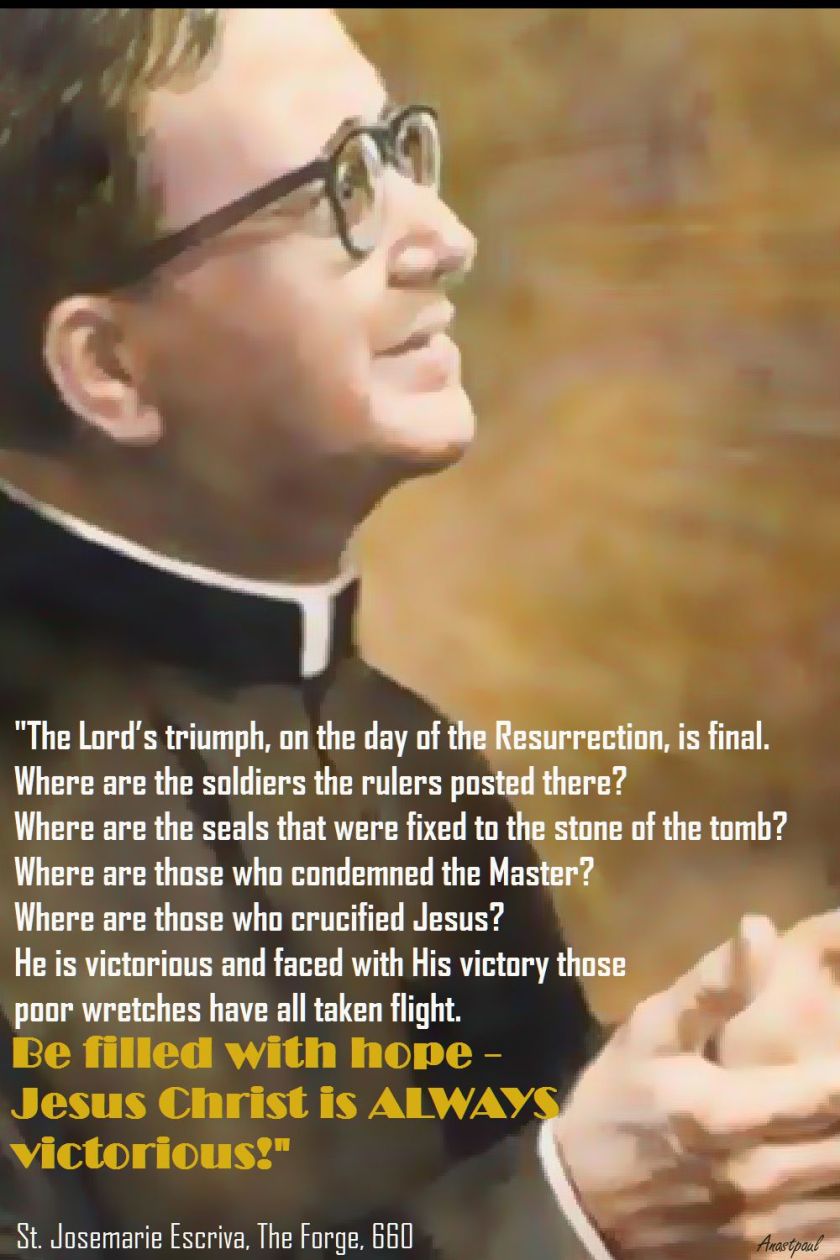
“The Lord’s triumph, on the day of the Resurrection, is final.
Where are the soldiers the rulers posted there?
Where are the seals that were fixed to the stone of the tomb?
Where are those who condemned the Master?
Where are those who crucified Jesus?
He is victorious and faced with His victory those
poor wretches have all taken flight.
Be filled with hope –
Jesus Christ is always victorious!”.
St. Josemarie Escriva, The Forge, 660
One Minute Reflection – 19 April – Wednesday of Easter Octave
One Minute Reflection – 19 April – Wednesday of Easter Octave
Daily Meditation: Give us the joy of this feast.
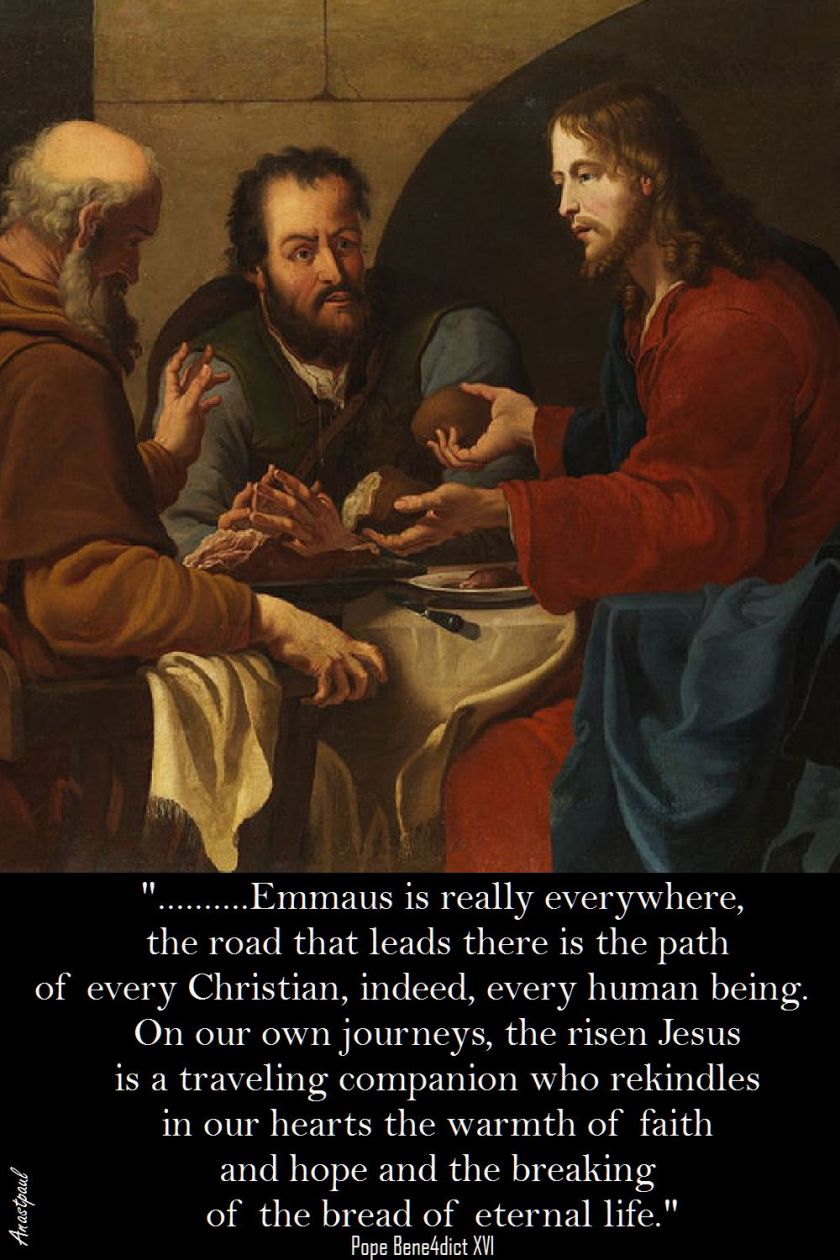
Then the disciples from Emmaus
told what happened on the road
and how they knew he was the Lord
when he broke the bread.
— Luke 24:35
REFLECTION – “The fact that archaeologists have not identified the location of Emmaus with any certainty, holds for me a certain value : it suggests that Emmaus is really everywhere, the road that leads there is the path of every Christian, indeed, every human being. On our own journeys, the risen Jesus is a traveling companion who rekindles in our hearts the warmth of faith and hope and the breaking of the bread of eternal life. This beautiful evangelical text already contains the structure of the Mass: in the first part listening to the Word through the Scriptures; second in the Eucharistic liturgy and communion with Christ present in the sacrament of his Body and his Blood. Nourishing ourselves in this twofold meal, the Church builds itself up and is renewed every day in faith, hope and charity.”……………..Pope Benedict XVI 2008
PRAYER – Loving Father, do I feel this joy so deeply each year? I know how solemn this season is and yet I am overcome by sheer delight. I celebrate this joyful time of remembering how I am brought to new life by the sacrifice Your Son made for me. Help me to delight in the gift He left us, help me to experience the great joy of the feast of the Holy Mass and the Holy Eucharist the food to nourish me on my own road to Emmaus. Amen

Our Morning Offering – 19 April
Our Morning Offering – 19 April
The Anima Christi
By St Thomas Aquinas
Soul of Christ, sanctify me
Body of Christ, save me
Blood of Christ, inebriate me
Water from Christ’s side, wash me
Passion of Christ, strengthen me
O good Jesus, hear me
Within Thy wounds hide me
Suffer me not to be separated from Thee
From the malicious enemy defend me
In the hour of my death call me
And bid me come unto Thee
That I may praise Thee with Thy saints
and with Thy angels
Forever and ever
Amen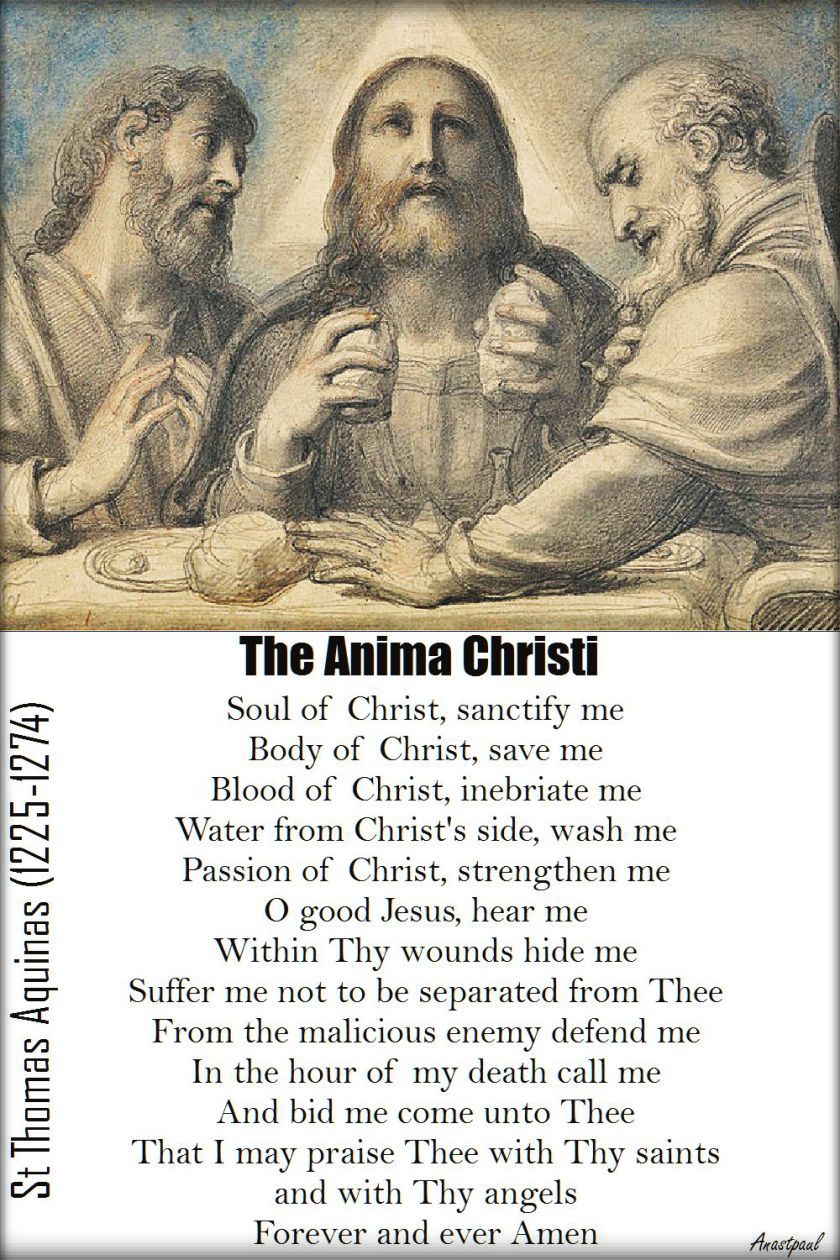
Saint of the Day – 19 April – St Alphege
Saint of the Day – 19 April – St Alphege (c953-1012) also known as St Alphege of Winchester/Canterbury/Bath – MARTYR and Bishop, Monk, Hermit, Abbot, Teacher, Apostle of charity. His body is incorrupt. Patronages – of Greenwich, England, kidnap victims, Solihull, England. Attributes – bishop holding an axe, bishop with an axe in his head, carrying stones in his chasuble.


Alphege was born in 953 and became a monk at the Deerhurst Monastery of Gloucester, England. After a few years, he asked to become a hermit, received permission and retired to a small hut near Somerset, England. In 984, Alphege moved to Bath and became abbot at abbey founded by St. Dunstan. Many of Alpege’s companions from Somerset joined him at Bath. In that same year, Alphege was appointed bishop of Winchester and served there for two decades.
He was famed for his care of the poor and for his own austere life. King Aethelred the Unready used his abilities in 994, sending him to mediate with invading Danes. The Danish chieftain Anlaf converted to Christianity as a result of his meetings with Alphege, although he and the other chief, Swein, demanded tribute from the Anglo-Saxons of the region. Anlaf vowed never to lead his troops against Britain again. In 1005 Alphege became the successor to Aleric as the archbishop of Canterbury, receiving the pallium in Rome from Pope John XVIII. He returned to England in time to be captured by the Danes pillaging the southern regions. The Danes besieged Canterbury and took Alphege captive. The ransom for his release was about three thousand pounds and went unpaid. Alphege refused to give the Danes that much, an act which infuriated them. He was hit with an ax and then beaten to death.

Revered as a martyr, Alphege’s remains were placed in St. Paul’s Church in London. The body, moved to Canterbury in 1023, was discovered to be incorrupt in 1105. Relics of St. Alphege are also in Bath, Glastonbury, Ramsey, Reading, Durham, Yorkminster and in Westminster Abbey. He was canonised by St Pope Gregory VII in 1078.
St Thomas a Becket himself endorsed a parallel between himself and the Anglo-Saxon martyr, when he spoke about Alphege in the sermon he preached on Christmas Day 1170, four days before his own martyrdom: “You already have a martyr here,” he said, “Alphege, beloved of God, a true saint. The Divine Mercy will provide another for you; it will not delay.”


Saints – 19 April
St Alphege of Winchester
St Apollonius the Priest
St Aristonicus of Melitene
St Crescentius of Florence
St Expeditus of Melitene
St Gaius of Melitene
St Galata of Melitene
St George of Antioch
St Gerold of Saxony
St James Duckett
Bl Jaume Llach-Candell
St Leo IX, Pope
St Martha of Persia
Bl Ramon Llach-Candell
St Rufus of Melitene
St Vincent of Collioure
—
Martyrs of Carthage – 17 saints: A group of Christians martyred in the persecutions of Decius. We know little more than the names – Aristo, Basso, Credula, Donato, Ereda, Eremio, Fermo, Fortunata, Fortunio, Frutto, Julia, Mappalicus, Martial, Paul, Venusto, Victorinus and Victor. Died in the year 250 in prison in Carthage, North Africa (modern Tunis, Tunisia).
DIVINE MERCY NOVENA – DAY FIVE – EASTER TUESDAY 3rd Day of the Octave
DIVINE MERCY NOVENA – DAY FIVE – EASTER TUESDAY 3rd Day of the Octave

“Today bring to Me the Souls of those who have separated themselves from My Church*and immerse them in the ocean of My mercy. During My bitter Passion they tore at My Body and Heart, that is, My Church. As they return to unity with the Church My wounds heal and in this way they alleviate My Passion.”
Most Merciful Jesus, Goodness Itself, You do not refuse light to those who seek it of You. Receive into the abode of Your Most Compassionate Heart the souls of those who have separated themselves from Your Church. Draw them by Your light into the unity of the Church and do not let them escape from the abode of Your Most Compassionate Heart; but bring it about that they, too, come to glorify the generosity of Your mercy.
Eternal Father, turn Your merciful gaze upon the souls of those who have separated themselves from Your Son’s Church, who have squandered Your blessings and misused Your graces by obstinately persisting in their errors. Do not look upon their errors but upon the love of Your own Son and upon His bitter Passion, which He underwent for their sake, since they, too, are enclosed in His Most Compassionate Heart. Bring it about that they also may glorify Your great mercy for endless ages. Amen.
*Our Lord’s original words here were “heretics and schismatics,” since He spoke to Saint Faustina within the context of her times. As of the Second Vatican Council, Church authorities have seen fit not to use those designations in accordance with the explanation given in the Council’s Decree on Ecumenism (n.3). Every pope since the Council has reaffirmed that usage. Saint Faustina herself, her heart always in harmony with the mind of the Church, most certainly would have agreed. When at one time, because of the decisions of her superiors and father confessor, she was not able to execute Our Lord’s inspirations and orders, she declared: “I will follow Your will insofar as You will permit me to do so through Your representative. O my Jesus ” I give priority to the voice of the Church over the voice with which You speak to me” (497). The Lord confirmed her action and praised her for it.
Thought for the Day – 18 April
Thought for the Day – 18 April
When we read biographies of the great saints and heroes who sacrificed their lives to build and cultivate Christianity in the far corners of the globe, we might wonder how they ever did it. How could they give up their comfortable place in civilised countries to come to this mostly uncivilized lands? Undoubtedly it was love… love of God, love of man and love for souls. St Marie of the Incarnation well knew her responsibility before God for the souls of others. She was a woman who loved immensely, first God and then her fellow man. She was a wife and mother, a religious and mystic, a teacher and a missionary. But perhaps Bishop Laval (St Marie’s Bishop and Spiritual guide) sums up best, the holy life of Marie of the Incarnation. He wrote: “Having chosen her to establish the Ursulines in New France, God gave her the full spirit of her Institute. She was a perfect Superior, an excellent Mistress of Novices, capable of undertaking any religious enterprise. Her exterior life, simple and well disciplined, was animated by an intense interior life, so that she was a living Rule for all her Community. Her zeal for the salvation of souls, especially for the conversion of the Indians, was great and so universal that she seemed to carry them all in her heart. We cannot doubt that, by her prayers, she greatly called down God’s many blessings upon the newborn Church.”
St Marie lived for God – she put Him first and everything else fell into place – THIS is the way – and we know it!
St Marie of the Incarnation, pray for us.

Quote of the Day – 18 April
Quote of the Day – 18 April
“The saints, are not supermen, nor were they born perfect.
They are like us, like each one of us. They are people who,
before reaching the glory of heaven, lived normal lives
with joys and sorrows, struggles and hopes.
What changed their lives?
When they recognised God’s love, they followed it with all
their heart without reserve or hypocrisy. They spent
their lives serving others, they endured suffering and adversity
without hatred and responded to evil with good,
spreading joy and peace. This is the life of a saint.”
Pope Francis

One Minute Reflection – 18 April – Easter Tuesday 3rd Day of the Octave
One Minute Reflection – 18 April – Easter Tuesday 3rd Day of the Octave
Daily Meditation: You give us the freedom of the children of God.
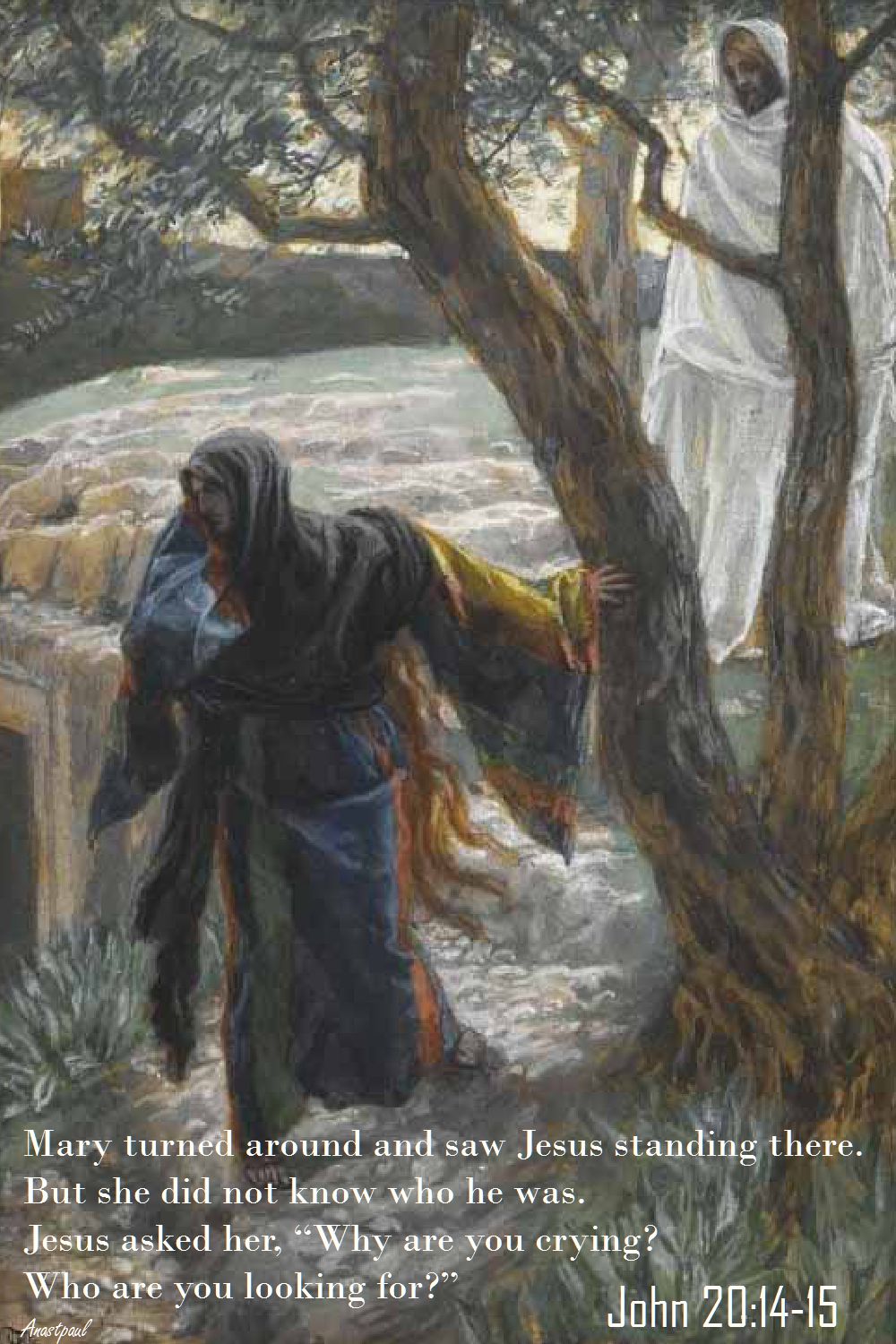
Mary turned around and saw Jesus standing there.
But she did not know who he was.
Jesus asked her, “Why are you crying?
Who are you looking for?” ……………….. John 20:14-15
REFLECTION – “Throughout the history of the living, the origins of anything new have always been small, practically invisible and easily overlooked. The Lord Himself has told us that “heaven” in this world is like a mustard seed, the smallest of all the seeds (Matthew 13:31-32), yet contained within it are the infinite potentialities of God. In terms of world history, Jesus’ Resurrection is improbable; it is the smallest mustard seed of history.
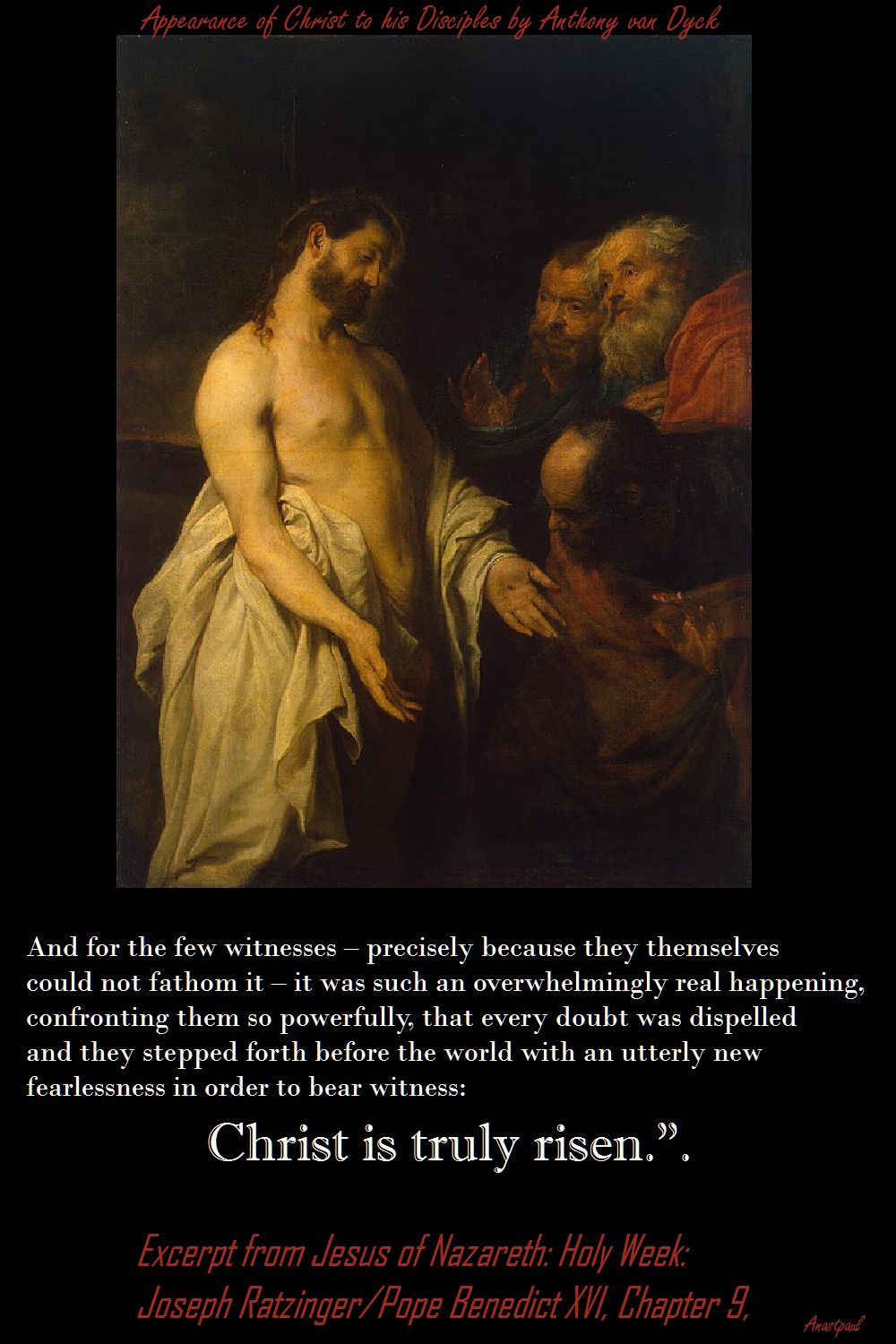
This reversal of proportions is one of God’s mysteries. The great – the mighty – is ultimately the small. And the tiny mustard seed is something truly great. So it is that the Resurrection has entered the world only through certain mysterious appearances to the chosen few. And yet it was truly the new beginning for which the world was silently waiting. And for the few witnesses – precisely because they themselves could not fathom it – it was such an overwhelmingly real happening, confronting them so powerfully, that every doubt was dispelled and they stepped forth before the world with an utterly new fearlessness in order to bear witness: Christ is truly risen.“……………Excerpt from Jesus of Nazareth: Holy Week: From the Entrance Into Jerusalem To The Resurrection, by Joseph Ratzinger/Pope Benedict XVI, Chapter 9,
PRAYER – Lord God, give me the opportunity to recognise the healing power of love that has been offered me and that it really does fill these days with power. Teach me to recognise Jesus alive and Jesus with me now.. Grant me freedom from fear, freedom for courageous love and service. Help me to understand the freedom You give us all as Your children. Amen
Our Morning Offering – 18 April
Our Morning Offering – 18 April
Wash Me With Your Precious Blood
By St. Peter Canisius S.J. (1521-1597)
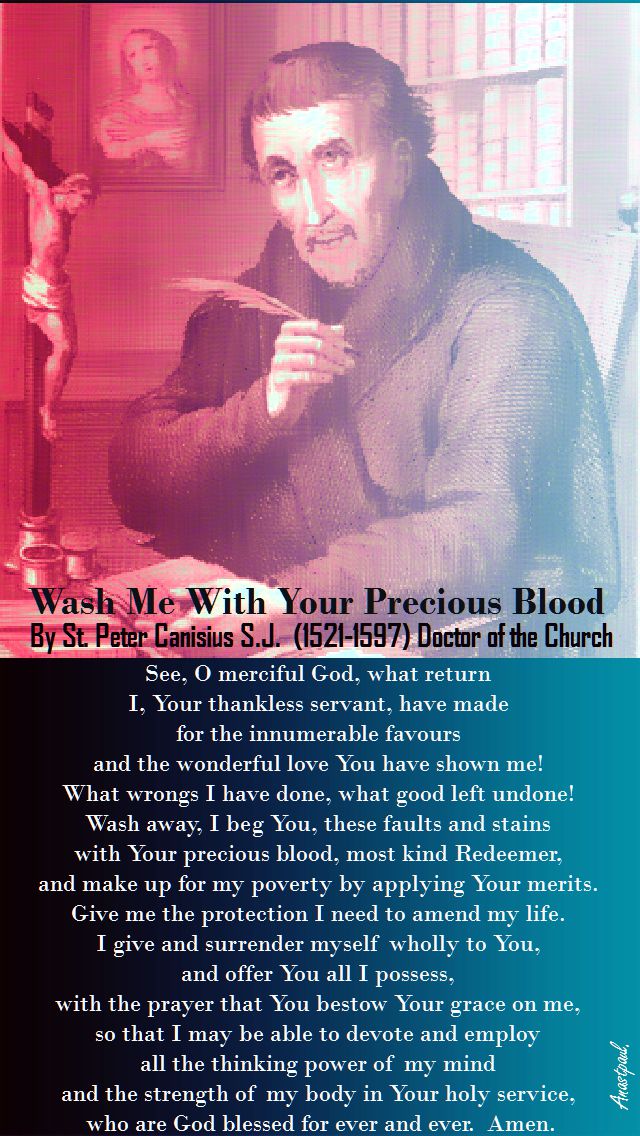
See, O merciful God, what return
I, Your thankless servant, have made
for the innumerable favours
and the wonderful love You have shown me!
What wrongs I have done, what good left undone!
Wash away, I beg You, these faults and stains
with Your precious blood, most kind Redeemer,
and make up for my poverty by applying Your merits.
Give me the protection I need to amend my life.
I give and surrender myself wholly to You,
and offer You all I possess,
with the prayer that You bestow Your grace on me,
so that I may be able to devote and employ
all the thinking power of my mind
and the strength of my body in Your holy service,
who are God blessed for ever and ever. Amen
Saint of the Day – 18 April – St Marie of the Incarnation
Saint of the Day – 18 April – St Marie of the Incarnation O.S.U. (1599-1672) – Also known as Marie Guyard, Marie Guyart of the Incarnation,Marie Guyart, Marie de l’Incarnation, Marie of the Ursulines, Mother of New France, Teresa of the New World
Consecrated religious, widow, mother, Mystic, Missionary, Foundress of the Ursuline Order in Canada and the first school for girls’ in the new world – “The Mother of the Ursulines of New France” – Patron against against impoverishment, against loss of parents, against poverty of parents separated from children, poor people, widows – Beatified – June 1980, Vatican City, by Pope John Paul II – Canonised 2 April 2014 by Pope Francis.


Daughter of a baker, she was raised in a family of craftsmen and tradesmen and was related on her mother‘s side to the noble Barbon de la Bourdaisière family. nnA pious and sometimes mystical child, she would memorise and recite homilies and early wanted to become a nun. Against her wishes, she entered an arranged marriage with Claude Martin, a silk manufacturer, at age seventeen, and was soon the mother of one son. Widowed after two years of marriage, she moved back with her family, and refused to discuss re-marriage. Worked as an embroiderer.
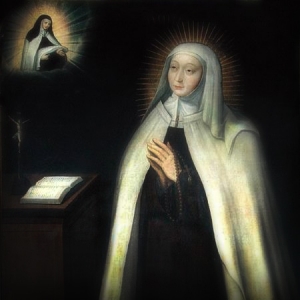
On 25 March 1620 she experienced a vision in which she was shown all her faults and human frailties, then was immersed in Christ’s blood. This event changed her completely and her desire to be involved in religious life translated to prayer, liturgical devotion and charity.
Finally leaving her father‘s house, Marie worked as a bookkeeper in her brother-in-law’s shipping company. Having a gift for administration, Marie was soon the company manager. However, the drive to the religious life never ended and in January 1631 she asked her sister to care for her son Claude and then joined the Ursulines at Tours, France on 25 January 1631. Claude gathered a group of his friends, all 12 or 13 years old, and tried to storm the convent to “free” his mother but they were unable to gain entry. This incident has been often cited by her detractors as indicative of a serious flaw in Marie and even she did not wholly understand why she did what she did. She later explained, however, that she was following God‘s will and Claude apparently came to understand it – he became a Benedictine priest in 1641, the assistant to his Order‘s superior general, and his mother‘s biographer.
Marie took her final vows in 1633 as Marie de l’Incarnation. Assistant mistress of novices for the Order in Tours. Doctrinal instructor. After a few years of this work, Marie received another vision that would change her life. This time it was a huge country of mountains and forests and the message that it was Canada and that she must go there to build a house for Christ. She worked for years to collect the money and support for her mission and in 3 April 1639 she sailed from Dieppe with Marie-Madeleine de la Peltrie, one of her primary supporters.
She landed in New France on 4 July 1639 and arrived in the future Québec, Canada on 1 August 1639. She was the first superior of the Ursulines in Canada. Worked as a missionary to the Natives and other residents in the area. Studied the local languages with the Jesuits who were already in the area; she became so proficient that she later wrote Algonquin, Iroquois, Montagnais and Ouendat dictionaries, and a catechism in Iroquois.
She laid the first stone of the convent in 1641 and took it over in 1642. It formed the base for her work and when it burned on 29 December 1650, she supervised its reconstruction, finishing construction on 29 May 1651. Ever strong-willed, she opposed bishop Blessed Francis de Montmorency Laval‘s attempt to control the Quebec Ursulines. A prolific correspondent, over 12,000 of her letters have survived.
On April 29th, Marie was feeling extremely sick and received the Last Rites but she could not die without again expressing her love for the dear little Indian and French girls, to whom she had devoted so many years of her life. She insisted on having the French and Indian schol-boarders near her so that she might bless them for the last time. The next day she lay unconscious, holding her crucifix in her hands. At about six o’clock in the evening on April 30, 1672, Marie opened her eyes, sighed twice and breathed her last.


Saints – 18 April
St Maria Anna Blondin (Optional Memorial, Canada)
—
St Agia of Hainault
St Anthia of Illyria
St Bitheus
St Calocerus of Brescia
St Cogitosus
St Corebus
St Eleuterius of Illyria
St Eusebius of Fano
St Galdinus of Milan
St Gebuinus of Lyons
St Genocus
Bl Idesbald of Dunes
Bl James Oldo
Bl Joseph Moreau
St Laserian of Leighlin
St Louis Leroy
Bl Luca Passi
Bl Marie of the Incarnation
St Perfecto of Córdoba
St Pusicio
St Wigbert of Augsburg
DIVINE MERCY NOVENA – DAY FOUR -EASTER MONDAY 2nd DAY OF THE OCTAVE
DIVINE MERCY NOVENA – DAY FOUR -EASTER MONDAY 2nd DAY OF THE OCTAVE

“Today bring to Me those who do not believe in God and those who do not know Me, I was thinking also of them during My bitter Passion, and their future zeal comforted My Heart. Immerse them in the ocean of My mercy.”
Most compassionate Jesus, You are the Light of the whole world. Receive into the abode of Your Most Compassionate Heart the souls of those who do not believe in God and of those who as yet do not know You. Let the rays of Your grace enlighten them that they, too, together with us, may extol Your wonderful mercy; and do not let them escape from the abode which is Your Most Compassionate Heart.
Eternal Father, turn Your merciful gaze upon the souls of those who do not believe in You and of those who as yet do not know You but who are enclosed in the Most Compassionate Heart of Jesus. Draw them to the light of the Gospel. These souls do not know what great happiness it is to love You. Grant that they, too, may extol the generosity of Your mercy for endless ages. Amen.
*Our Lord’s original words here were “the pagans.” Since the pontificate of Pope John XXIII, the Church has seen fit to replace this term with clearer and more appropriate terminology
Quote of the Day – 17 April Easter Monday – 2nd Day of the Easter Octave
Quote of the Day – 17 April Easter Monday – 2nd Day of the Easter Octave
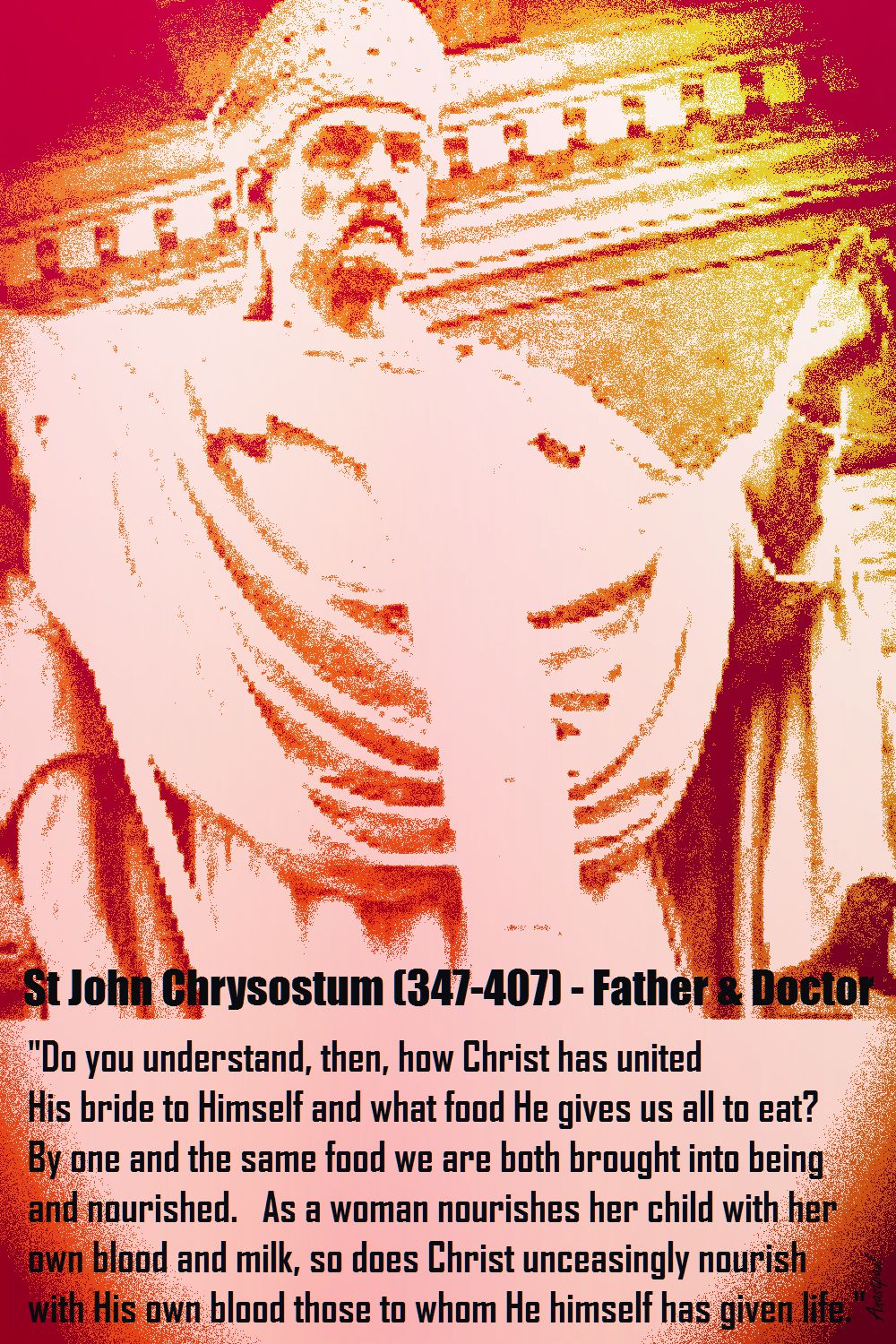
“There flowed from His side water and blood. Beloved, do not pass over this mystery without thought; it has yet another hidden meaning, which I will explain to you. I said that water and blood symbolised baptism and the holy Eucharist. From these two sacraments the Church is born:- from baptism, the cleansing water that gives rebirth and renewal through the Holy Spirit and from the holy Eucharist. Since the symbols of baptism and the Eucharist flowed from His side, it was from His side that Christ fashioned the Church, as He had fashioned Eve from the side of Adam. Moses gives a hint of this when he tells the story of the first man and makes him exclaim:- Bone from my bones and flesh from my flesh! As God then took a rib from Adam’s side to fashion a woman, so Christ has given us blood and water from His side to fashion the Church. God took the rib when Adam was in a deep sleep and in the same way Christ gave us the blood and the water after His own death.
Do you understand, then, how Christ has united His bride to Himself and what food He gives us all to eat? By one and the same food we are both brought into being and nourished. As a woman nourishes her child with her own blood and milk, so does Christ unceasingly nourish with His own blood those to whom He himself has given life.’
St John Chrysostum (347-407) – Father & Doctor
Thought for the Day – 17 April
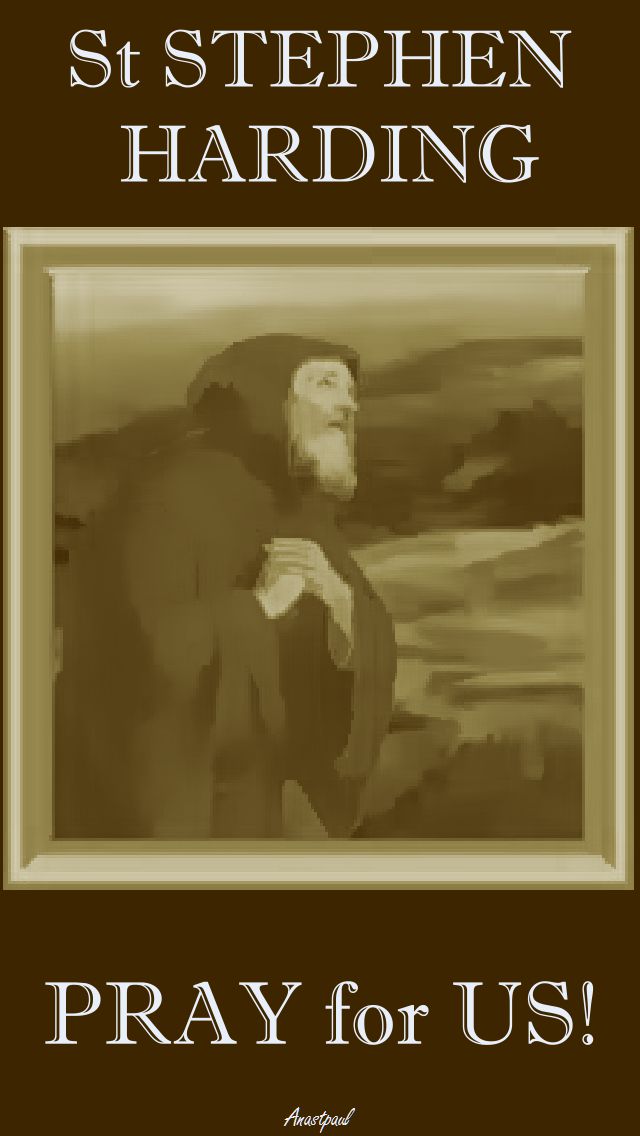
St Stephen Harding had to search long for the kind of life he wished to live for God but he persevered and God rewarded his search. He wanted to live the life of a simple monk but God had other plans. By his fidelity to his chosen vocation, he became the father of a great order, enriching the Church with his own holiness and generations of the Cistercian monks life of prayer. The lesson – don’t give up, keep asking the Lord to show you where you should be, for His glory.
St Stephen Harding, pray for us!
One Minute Reflection – 17 April – Easter Monday 2nd Day of the Octave
One Minute Reflection – 17 April – Easter Monday 2nd Day of the Octave
Meditation for the Day: Help us put our baptism into action.
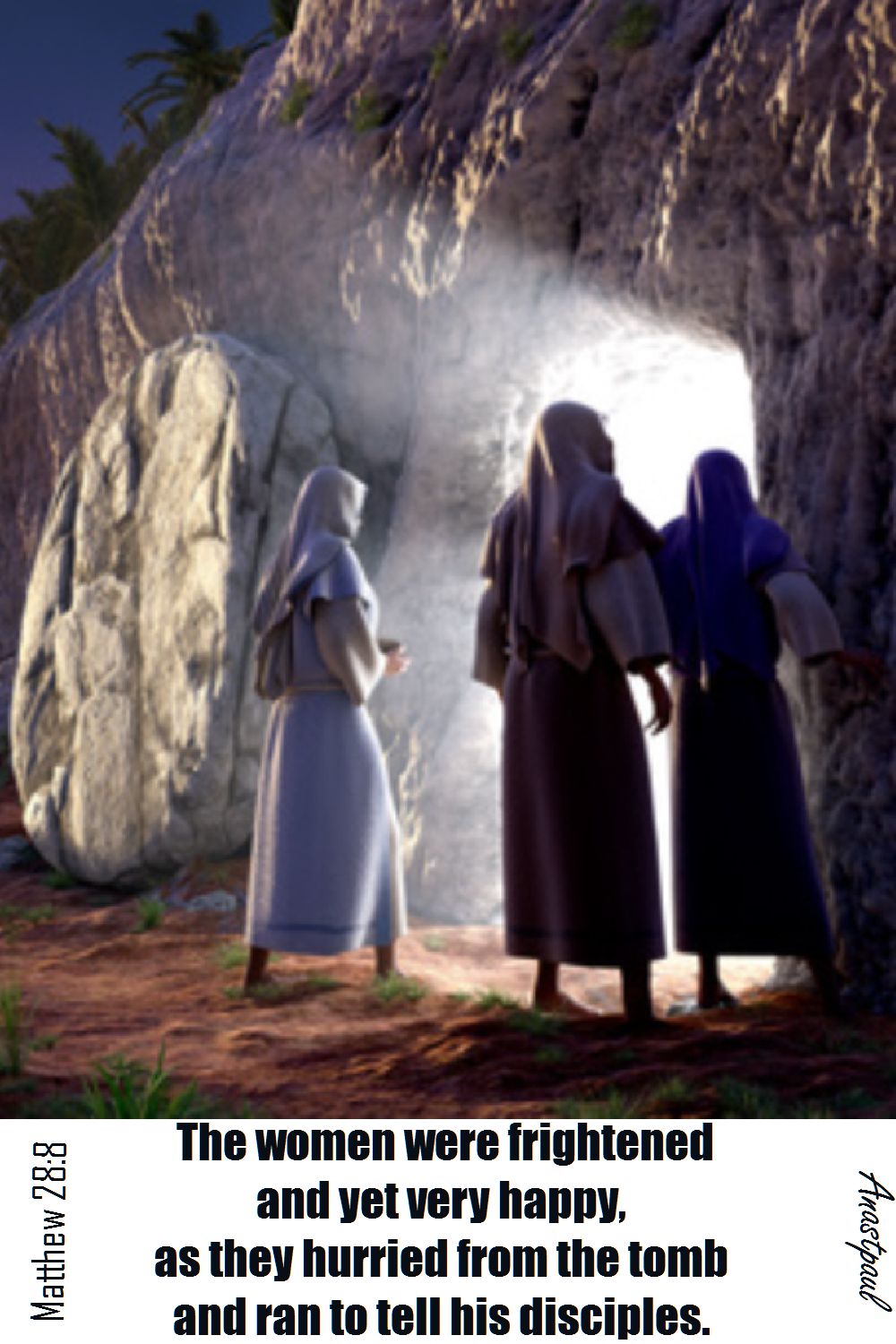
The women were frightened and yet very happy,
as they hurried from the tomb and ran to tell his disciples.
— Matthew 28:8
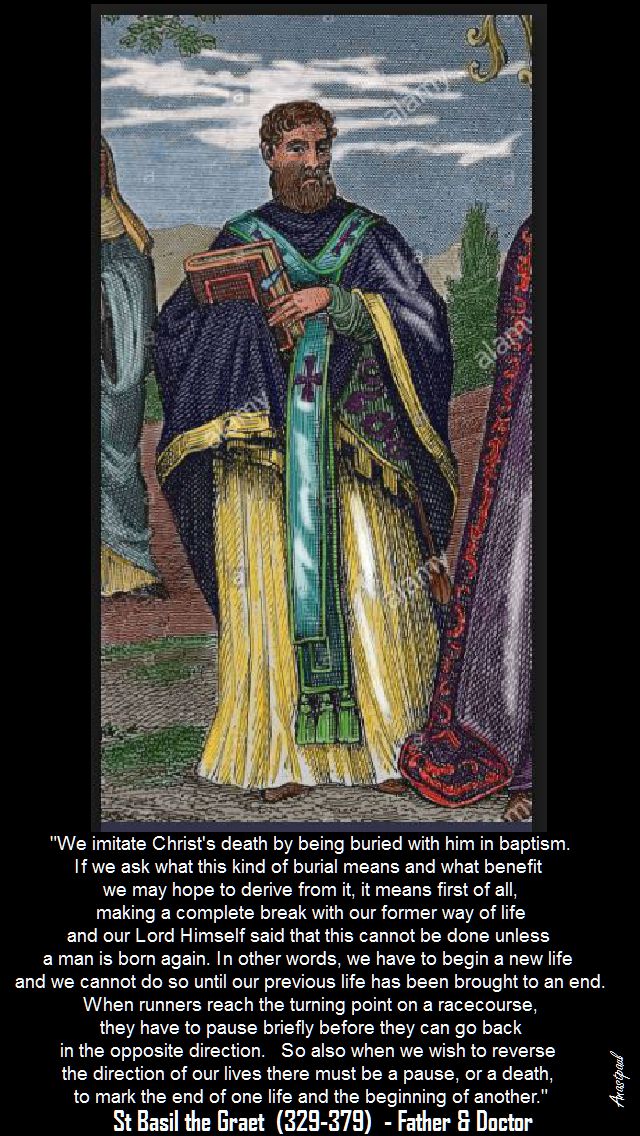
REFLECTION – “We imitate Christ’s death by being buried with him in baptism. If we ask what this kind of burial means and what benefit we may hope to derive from it, it means first of all making a complete break with our former way of life and our Lord Himself said that this cannot be done unless a man is born again. In other words, we have to begin a new life and we cannot do so until our previous life has been brought to an end. When runners reach the turning point on a racecourse, they have to pause briefly before they can go back in the opposite direction. So also when we wish to reverse the direction of our lives there must be a pause, or a death, to mark the end of one life and the beginning of another…….Baptism cleanses the soul from the pollution of worldly thoughts and inclinations: You will wash me, says the psalmist and I shall be whiter than snow. We receive this saving baptism only once because there was only one death and one resurrection for the salvation of the world and baptism is its symbol.”………St Basil the Great
Prayer – Loving Father, How do I live the baptismal promises I made again over the weekend? I want to live my life in service of You.
Help me to carry the gift of faith I received from You. Help me to welcome those who joined the church in baptism.
Guide me and give me the courage to live my faith, to accept Your love. Amen
Our Morning Offering – 17 April
Our Morning Offering – 17 April
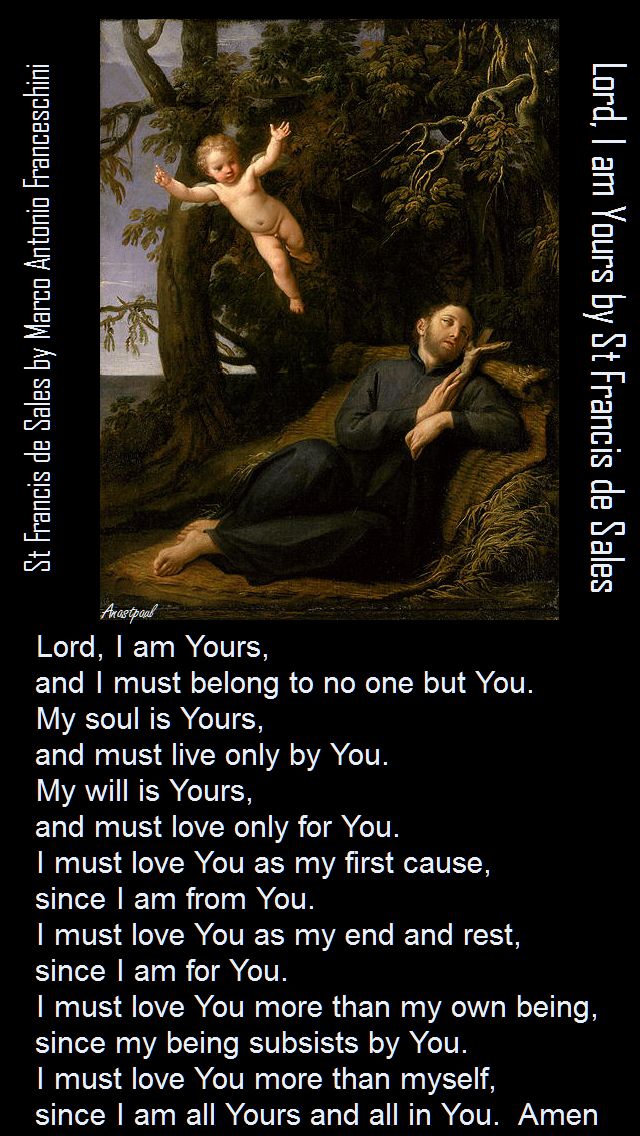
LORD, I AM YOURS
by St Francis de Sales (Doctor of the Church)
Lord, I am Yours,
and I must belong to no one but You.
My soul is Yours,
and must live only by You.
My will is Yours,
and must love only for You.
I must love You as my first cause,
since I am from You.
I must love You as my end and rest,
since I am for You.
I must love You more than my own being,
since my being subsists by You.
I must love You more than myself,
since I am all Yours and all in You.
Amen.
Saint of the Day – 17 April – St Stephen Harding
Saint of the Day – 17 April – St Stephen Harding O.Cist. (1050-1104) Monk, priest, writer, teacher and co-founder of the Cistercian Order – Patron of the Cistercians Attributes: Dressed in the Cistercian habit, abbot’s crozier, holding the Carta caritatis (“Charter of Charity”), a founding document for the Cistercian Order.
Harding was born in Sherborne, Dorset, in the Kingdom of England, and spoke English, Norman, French and Latin. He was placed in Sherborne Abbey at a young age, but eventually left the monastery and became a travelling scholar, journeying with one devout companion, into Scotland and afterwards to Paris and then to Rome. He eventually moved to Molesme Abbey in Burgundy, under the Abbot Robert of Molesme (c. 1027-1111).
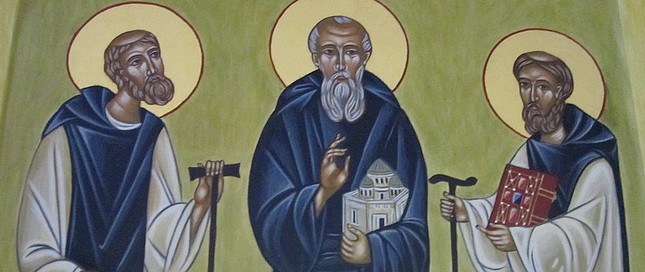
When Robert left Molesme to avoid what he perceived to be the abbey’s increasing wealth and overly strong connections to the aristocracy, Harding and Alberic of Cîteaux went with him. Seeing no hope of a sufficient reformation in Molemse, Robert appointed another abbot for the abbey and then, with Alberic, Harding and twenty-one other monks, received permission from Hugh, the Archbishop of Lyons and legate of the Holy See, to found a new monastery in Citeaux, a marshy wilderness five leagues from Dijon. There, they formed a new, more austere, monastery. Eudes, afterwards Duke of Burgundy, built them a little church, which was placed under the patronage of the Blessed Virgin, as all the churches of the Cistercians from that time have been.
Stephen became the third abbot of Cîteaux. However, very few were joining the community and the monks were suffering from hunger and sickness. In 1112, Bernard of Clairvaux entered the community, bringing with him thirty companions. Between 1112 and 1119, a dozen new Cistercian houses were founded to accommodate those joining the young order. Harding’s organisational skills were exceptional; he instituted the system of general chapters and regular visitations. In 1119, he received official approbation for the Carta Caritatis (Charter of Charity), an important document for the Cistercian Order, establishing its unifying principles.
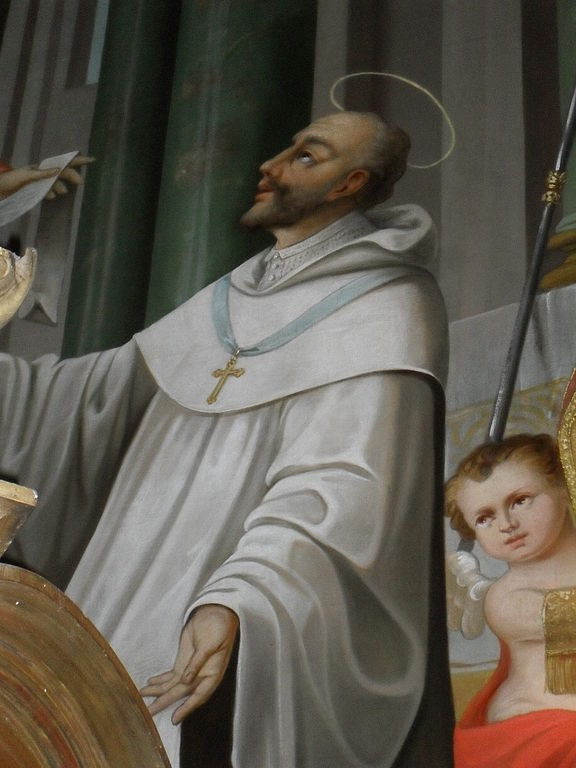
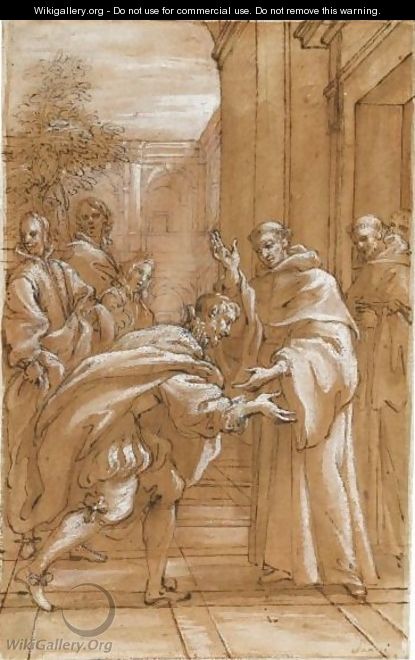
Stephen Harding served Cîteaux Abbey as abbot for twenty-five years. While no single person is considered the founder of the Cistercian Order, the shape of Cistercian thought, and its rapid growth in the 12th century were arguably due to Harding’s leadership. Insisting on simplicity in all aspects of monastic life, he was largely responsible for the severity of Cistercian architecture and the simple beauty of the Order’s liturgy. He was an accomplished scribe for the monastery’s scriptorium; his highest achievement is considered to be the Harding Bible, famous among medieval manuscripts. In 1133, he resigned as head of the order because of age and infirmity. He died on 28 March 1134, and was buried in the tomb of Alberic, his predecessor, in the cloisters at Cîteaux.
In a joint commemoration with Robert of Molesme and Alberic, the first two abbots of Cîteaux, the Roman Catholic Church celebrates Stephen Harding’s in a joint feast day on 26 January too.
The north aisle of the Church of St Sepulchre-without-Newgate in London was formerly a chapel dedicated to him.


Saints – 17 April
Bl Ambrose of Massa
St Anicetus, Pope
St Arnoald of Metz
St Donnan of Eigg
St Elias of Córdoba
St Fortunatus of North Africa
Bl Gervinus of Aldenberg
Bl Henry Heath
St Hermogenes of Melitene
St Innocent of Tortona
St Isidore of Córdoba
Bl James of Cerqueto
St Kateri Tekakwitha
St Landericus of Soignies
St Marcian of North Africa
Bl Mariana of Jesus
St Pantagathus of Vienne
St Paulus of Córdoba
St Peter of Antioch
St Peter of Melitene
St Robert of Chaise Dieu
St Stephen Harding
St Usthazade
St Villicus of Metz
St Wando of Fontenelle
Wishing our Holy Father Emeritus Papa Benedict XVI a Blessed 90th Birthday
Wishing our Holy Father Emeritus Papa Benedict XVI a Blessed 90th Birthday
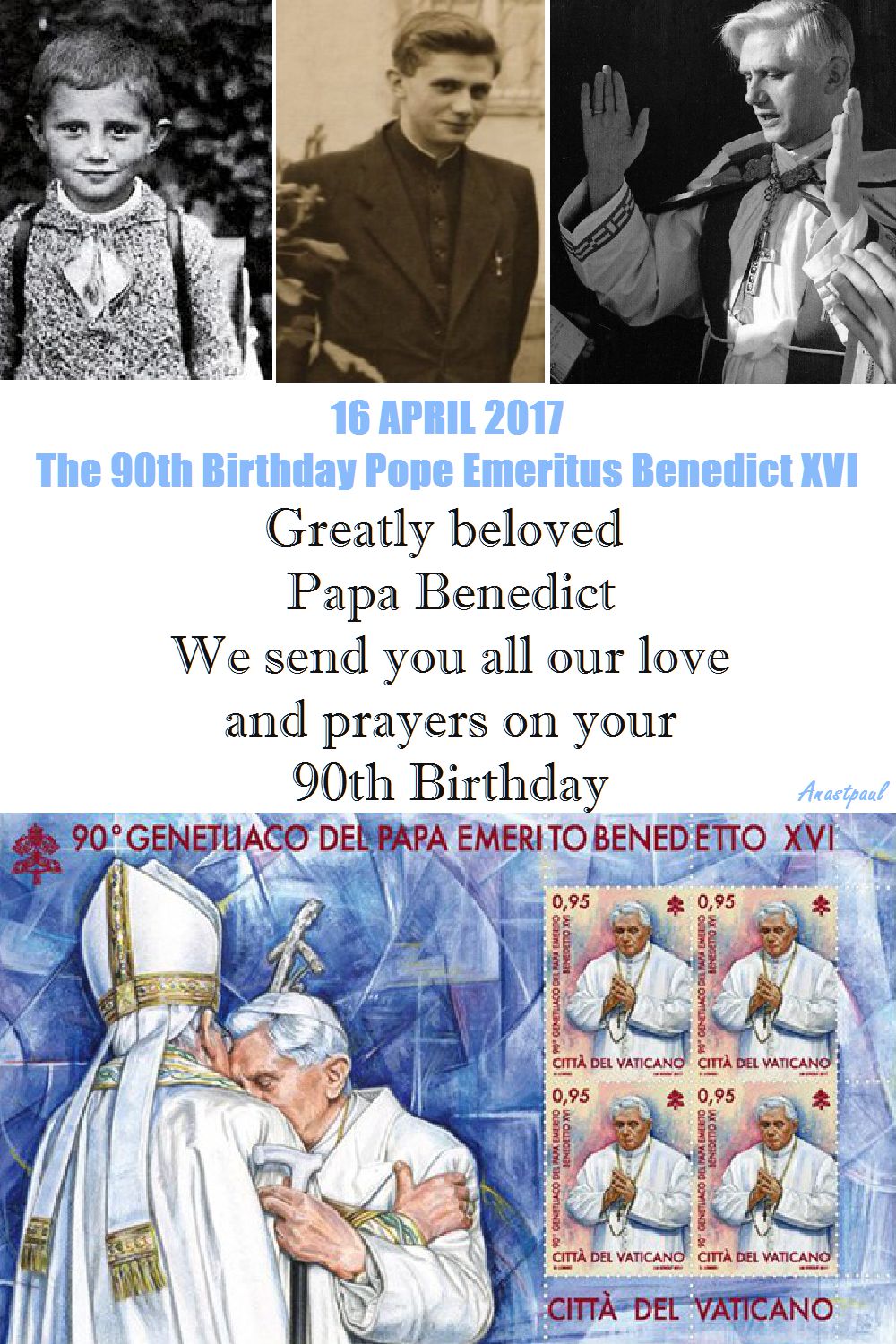
A “modest” 90th birthday party is being planned for Benedict XVI, who stunned the Catholic Church by resigning as pope in 2013.
His personal secretary and long-time aide, Monsignor Georg Gaenswein, told an Italian Catholic news agency Saturday that Benedict’s birthday, which falls on Easter Sunday this year, will be celebrated on Monday in Bavarian style, in keeping with the emeritus pontiff’s roots.
“There will be a small moment of celebration in keeping with his strength,” Gaenswein said about the frail churchman.
Benedict cited fading strength when announcing his decision to become the first pontiff to resign in 600 years.
Attending the party will be a delegation from Bavaria and Benedict’s elder brother, Monsignor Georg Ratzinger. The sibling’s visit will be “the most beautiful” birthday gift, Gaenswein added.
The former Joseph Ratzinger was born on April 16, 1927, in southern Germany. Trained as a theologian, he was a long-time Vatican official in charge of ensuring doctrinal orthodoxy when elected as pontiff in 2005.
Past recent birthdays have seen Benedict celebrate the day with a pint of beer.
Gaenswein told the S.I.R. news agency that Benedict is “serene, in good humor, very lucid.”
“Certainly, his physical strength is lessening. It’s hard for him to walk. However, he uses a walker, which ensures autonomy in movement and safety,” the aide said.
The rhythm of Benedict’s retirement in a monastery on Vatican City grounds consists of “prayer, meditation, reading, study, correspondence,” Gaenswein said. “He has visitors, too. Music certainly still has its place, together with a daily walk.”


You must be logged in to post a comment.