
Quote of the Day – 13 March
“There will never be much perfection without much prayer.”
― Alfonso Maria de Liguori – Doctor of the Church
(Uniformity with God’s Will & The Practice of the Love of Jesus Christ)
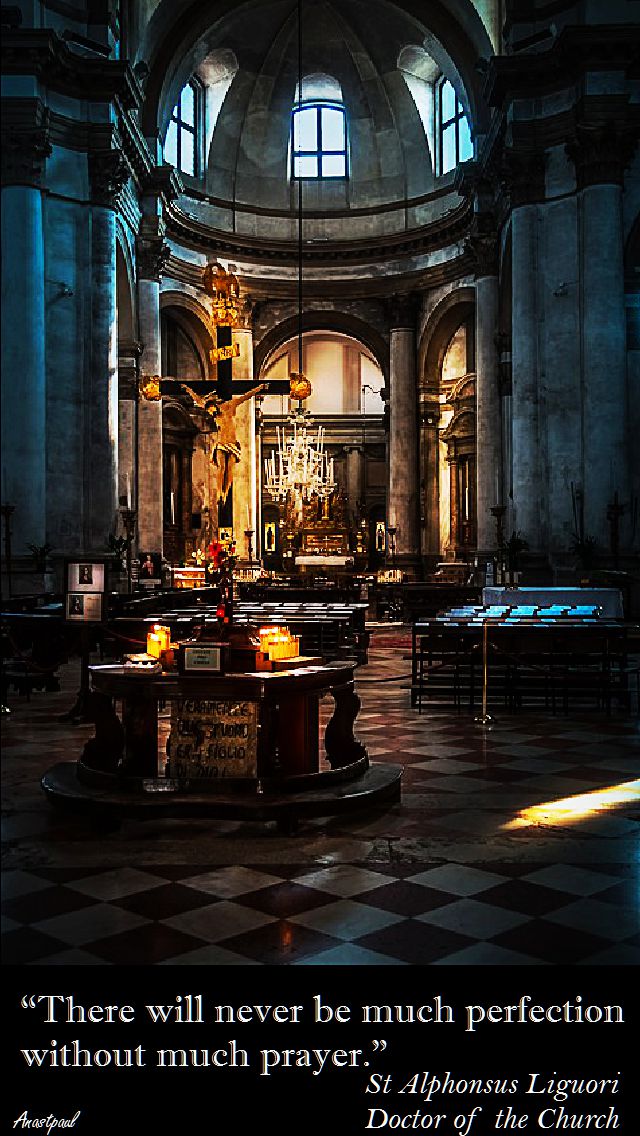
Quote of the Day – 13 March
― Alfonso Maria de Liguori – Doctor of the Church
(Uniformity with God’s Will & The Practice of the Love of Jesus Christ)
One Minute Reflection – 13 March
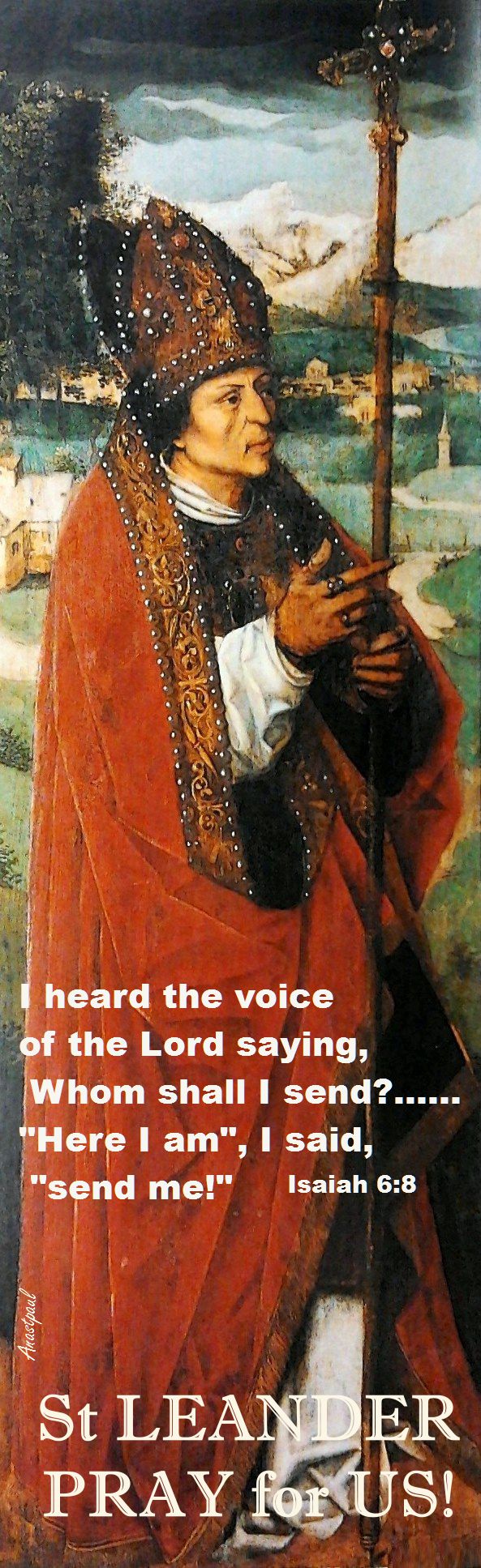
I heard the voice of the Lord saying,
Whom shall I send?……
“Here I am”, I said, “send me!”……….Isaiah 6:8
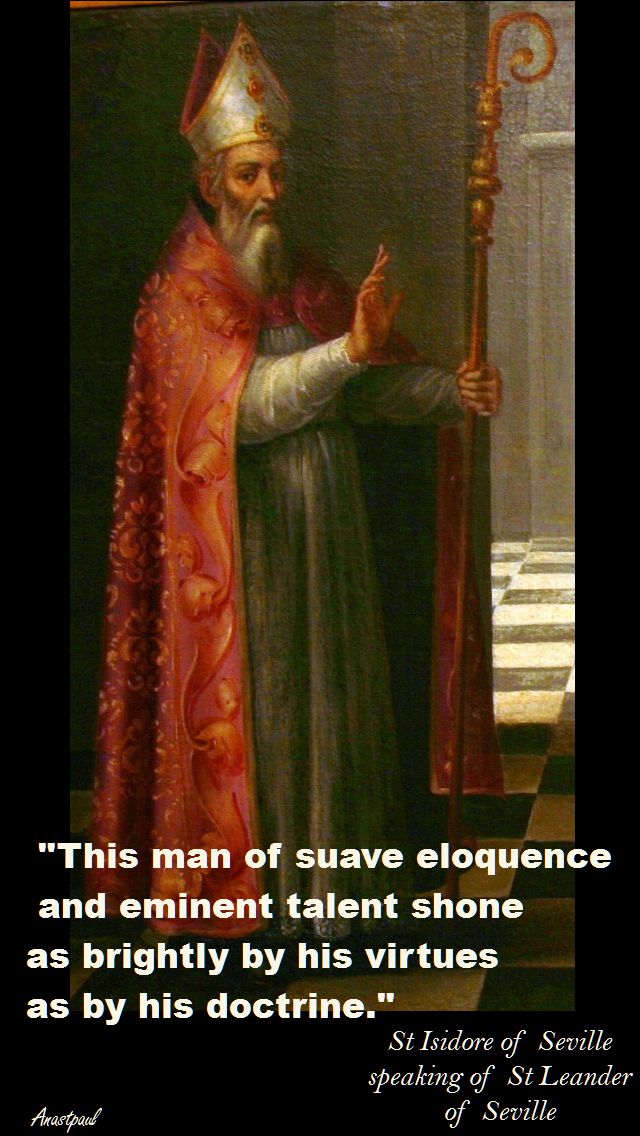
REFLECTION – “This man of suave eloquence and eminent talent shone as brightly by his virtues as by his doctrine. By his faith and zeal the Gothic people have been converted from Arianism to the Catholic faith”…..St Isidore of Seville speaking of his brother St Leander, whom we celebrate today.
PRAYER – Help me to discern through prayer and meditation what You truly want of me. Then enable me to offer it to You – and indeed to offer myself and all I have to You. St Leander, you were and are an example to all around you, please pray for us, amen!
Our Morning Offering – 13 March
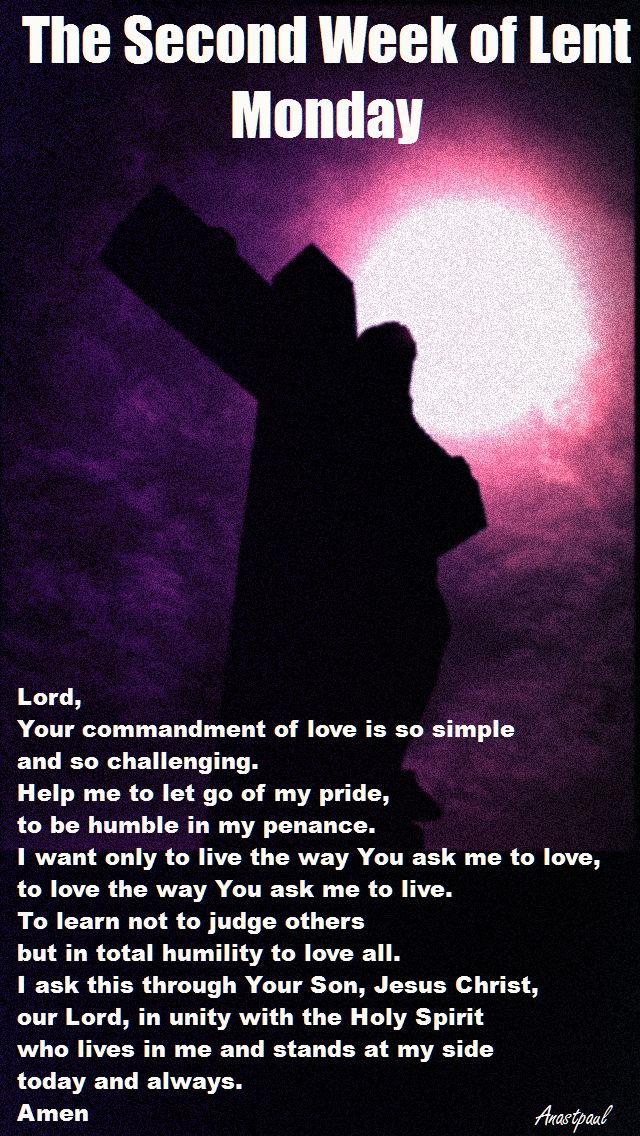
The Second Week of Lent
Monday
Lord,
Your commandment of love is so simple
and so challenging.
Help me to let go of my pride,
to be humble in my penance.
I want only to live the way You ask me to love,
to love the way You ask me to live.
To learn not to judge others
but in total humility to love all.
I ask this through Your Son, Jesus Christ,
our Lord, in unity with the Holy Spirit
who lives in me and stands at my side
today and always.
Amen
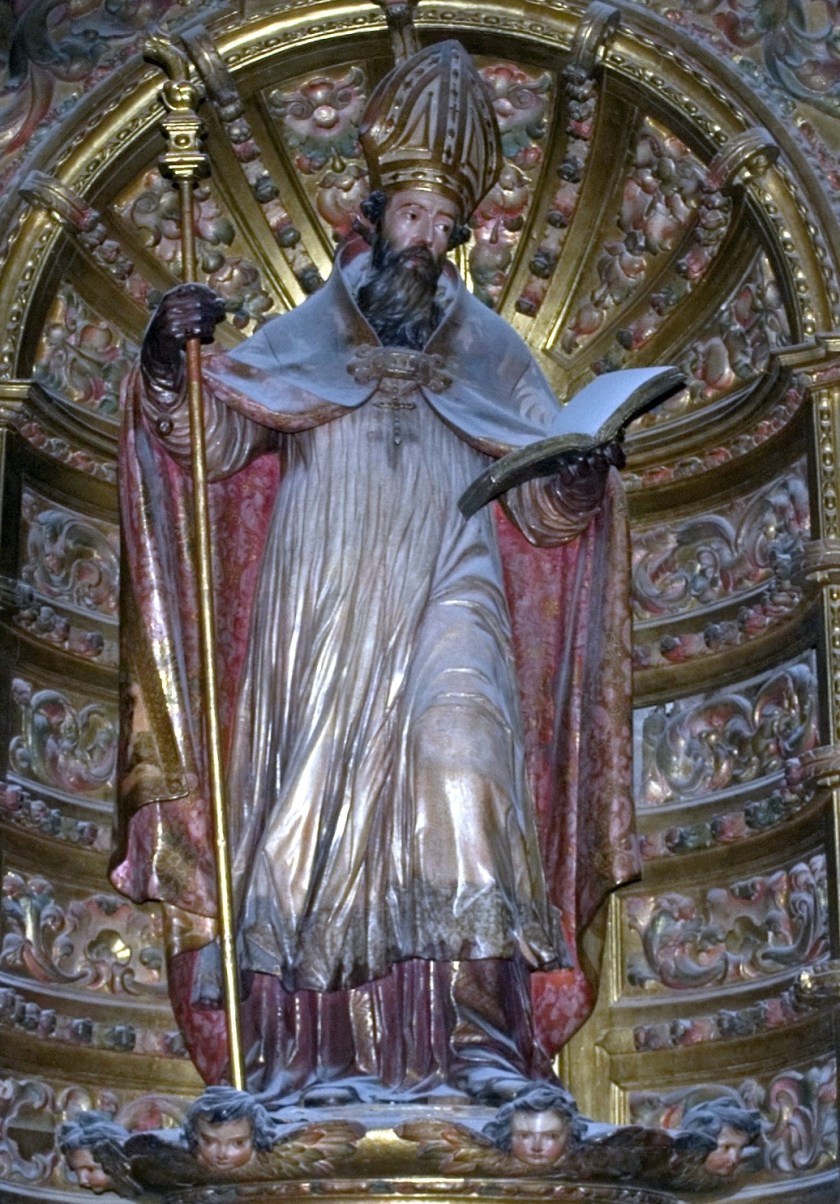
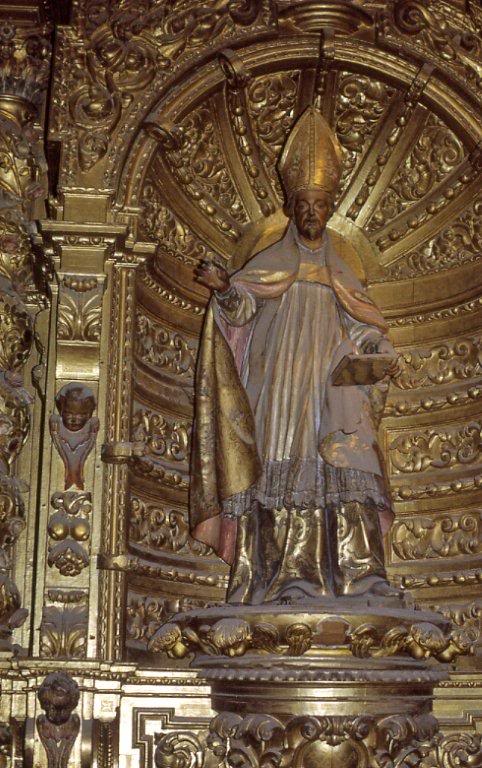
Saint of the Day – 13 March – St Leander of Seville (c 534-600/601) – BIsho, Confessor of the Faith, Teacher, Writer Apostle of Spain and Evangelisation – Patron of Episcopal attire and Liturgical garments. Saint Leander, as Bishop, instituted the practice of praying the Nicene Creed during Mass—a practice which continues today. He viewed the Creed as a manner in which to proclaim the divinity of Christ at a time when the Church suffered attack from various heresies, as well as an opportunity to reinforce the faith of the people. Through his diligent work, Saint Leander saw Catholicism flourish in Spain at a time of great political and religious uncertainty.


Leander and Isidore and their siblings (all sainted) belonged to an elite family of Hispano-Roman stock of Carthago Nova. Their father Severianus is claimed to be, according to their hagiographers, a dux or governor of Cartagena, though this seems more of a fanciful interpretation since Isidore simply states that he was a citizen. The family moved to Seville around 554. The children’s subsequent public careers reflect their distinguished origin: Leander and Isidore both became bishops of Seville and their sister Saint Florentina was an abbess who directed forty convents and one thousand nuns. Even the third brother, Fulgentius, appointed Bishop of Écija at the first triumph of Catholicism over Arianism but of whom little is known, has been canonised as a saint.
The family as a matter of course were staunch Catholics, as were the great majority of the Romanised population, from top to bottom; only the Visigothic nobles and the kings were Arians. It should be stated that there was less Visigothic persecution of Catholics than legend and hagiography have painted. From a modern standpoint, the dangers of Catholic Christianity were more political. Saint Leander, as bishop, instituted the practice of praying the Nicene Creed during Mass—a practice which continues today. He viewed the Creed as a manner in which to proclaim the divinity of Christ at a time when the Church suffered attack from various heresies, as well as an opportunity to reinforce the faith of the people. Through his diligent work, Saint Leander saw Catholicism flourish in Spain at a time of great political and religious uncertainty.
Leander, enjoying an elite position in the secure surroundings of tolerated Catholic culture in Seville, became at first a Benedictine monk and then in 579 he was appointed bishop of Seville. In the meantime he founded a celebrated school, which soon became a centre of Catholic learning. As Bishop he had access to the Catholic Merovingian Princess Ingunthis, who had come as a bride for the kingdom’s heir and he worked tirelessly with her to convert her husband St. Hermenegild, the eldest son of Liuvigild, an act of court intrigue that cannot honestly be divorced from a political context. Leander defended the new convert even when he went to war with his father “against his father’s cruel reprisals,” the Catholic Encyclopedia puts it. “In endeavouring to save his country from Arianism, Leander showed himself an orthodox Christian and a far-sighted patriot.”
This action earned him the king’s wrath and exile to Constantinople, where he met and became close friends of the Papal Legate, the future Pope Gregory the Great. Saint Leander served as a contemporary and advisor to Saint Gregory, encouraging him to write his famous commentary on the Book of Job entitled the “Moralia.”
After some time, King Leovigild summoned Leander back to Seville. Having experienced a change of heart, he wished for Leander to instruct his son Reccared—who would inherit the throne—in the ways of the faith. Through Leander’s instruction and model, the people of Spain were converted. He presided over the third Council of Toledo, which upheld the consubstantiality of the Trinity and brought about many moral reforms in the Church. Saint Leader further wrote an influential Rule for Spanish nuns. He introduced the practice of praying the Nicene Creed at Mass. A prolific writer, unfortunately most of his works have been lost to history, although much of the correspondence written by Gregory the Great to his attention remains extant.
After a long life of fighting heresies and preaching the truth, Saint Leander died around the year 600. He was succeeded by his brother, St Isidore of Seville, who is a Doctor of the Church.

Saint Isidore and Saint leander of Sevilla. Ignacio de Ries


Bl Agnellus of Pisa
St Ansovinus of Camerino
Bl Berengar de Alenys
St Christina of Persia
St Euphrasia
Bl Françoise Tréhet
St Gerald of Mayo
St Grace of Saragossa
St Heldrad of Novalese
Bl Judith of Ringelheim
St Kevoca of Kyle
St Leander of Seville
St Mochoemoc
St Nicephorus of Constantinople
Bl Peter II of La Cava
St Pientius of Poitiers
St Ramirus of Leon
St Sabinus of Egypt
St Sancha of Portugal
—
Martyrs of Cordoba: Roderick, Salomon,
Martyrs of Nicaea:
Arabia
Horres
Marcus
Nymphora
Theodora
Theusitas
Martyrs of Nicomedia
Eufrasia
Macedonius
Modesta
Patricia
Urpasian
LENTEN REFLECTION – THE SECOND WEEK – Sunday 12 March
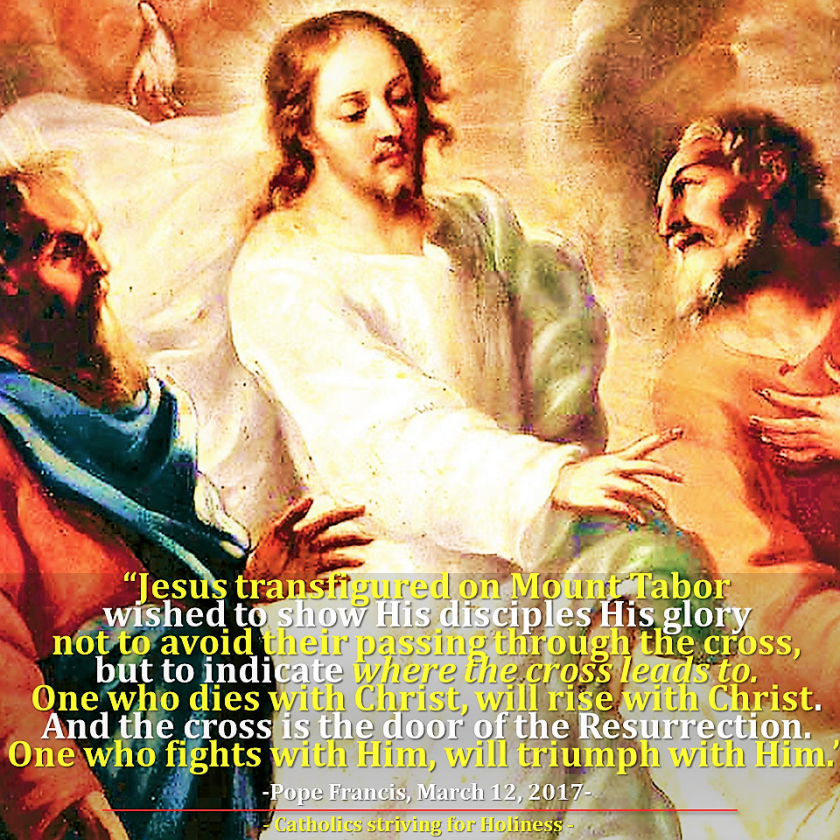
A spontaneous question which can arise in our minds today is ‘why the scene of transfiguration’ – a scene which portrays the glory of Jesus – is inserted during the time of Len, which mainly focuses on the passion and death of Jesus?
The transfiguration scene is presented today to remove the fear and the despair of every believer. This presentation of the glory of Jesus urges us to live the remaining time of Lent with courage and conviction.
The transfiguration is a special and privileged moment, both for Jesus and for His disciples. For Jesus it was a moment of manifestation of His glory, divine confirmation of His status as the Son of God and an affirmation of His mission. With all these extraordinary events confirming Jesus’ true identity, the one true response demanded from us is to listen to Him.
…..Fr Devasia Joseph SSP

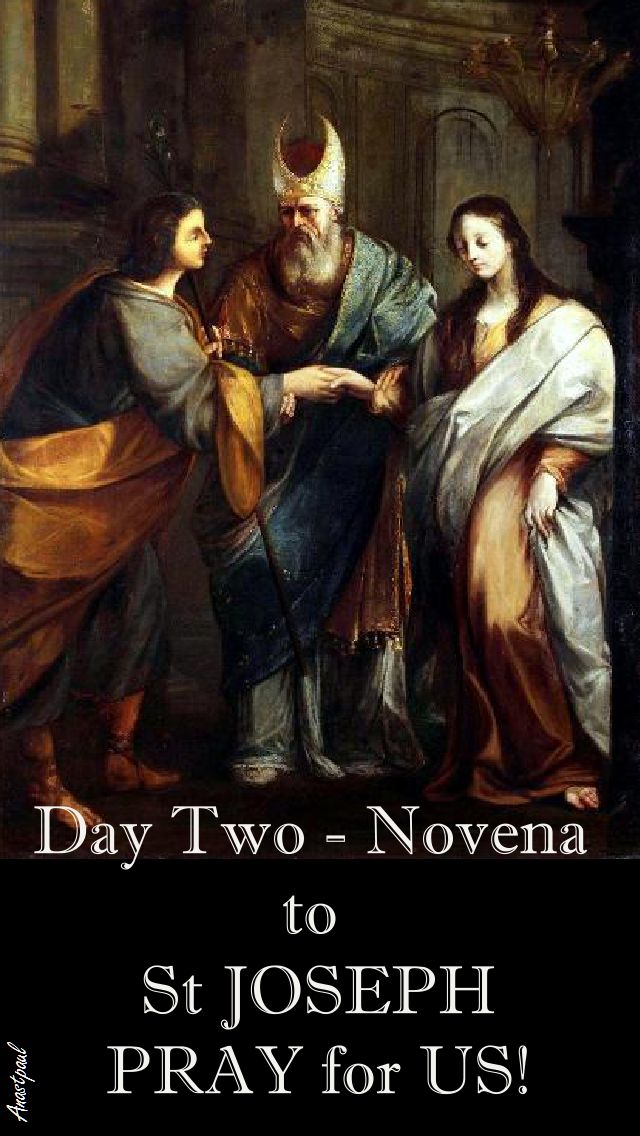
Novena to St Joseph
Saint Joseph, I honour you as the true husband of Mary. Scripture says: “Jacob begot Joseph, the husband of Mary and of her was born Jesus who is called Christ” (Matt. 1:16). Your marriage to Mary was a sacred contract by which you and Mary gave yourselves to each other. Mary really belonged to you with all she was and had. You had a right to her love and obedience and no other person so won her esteem, obedience and love.
You were also the protector and witness of Mary’s virginity. By your marriage you gave to each other your virginity and also the mutual right over it — a right to safeguard the other’s virtue. This mutual virginity also belonged to the divine plan of the Incarnation, for God sent His angel to assure you that motherhood and virginity in Mary could be united.
This union of marriage not only brought you into daily familiar association with Mary, the loveliest of God’s creatures but also enabled you to share with her a mutual exchange of spiritual goods. And Mary found her edification in your calm, humble and deep virtue, purity and sanctity. What a great honour comes to you from this close union with her whom the Son of God calls Mother and whom He declared the Queen of heaven and earth! Whatever Mary had belonged by right to you also and this included her Son, even though He had been given to her by God in a wonderful way. Jesus belonged to you as His legal father. Your marriage was the way which God chose to have Jesus introduced into the world, a great divine mystery from which all benefits have come to us.
God the Son confided the guardianship and the support of His Immaculate Mother to your care. Mary’s life was that of the Mother of the Saviour, who did not come upon earth to enjoy honours and pleasures but to redeem the world by hard work, suffering and the cross. You were the faithful companion, support, and comforter of the Mother of Sorrows. How loyal you were to her in poverty, journeying, work and pain. Your love for Mary was based upon your esteem for her as Mother of God. After God and the Divine Child, you loved no one as much as her. Mary responded to this love. She submitted to your guidance with naturalness and easy grace and childlike confidence. The Holy Spirit Himself was the bond of the great love which united your hearts.
Saint Joseph, I thank God for your privilege of being the virginal husband of Mary. As a token of your own gratitude to God, obtain for me the grace to love Jesus with all my heart, as you did and love Mary with some of the tenderness and loyalty with which you loved her.
*NOVENA PRAYER *(prayer to be said at the end of each day’s devotion)
Saint Joseph, I, your unworthy child, greet you. You are the faithful protector and intercessor of all who love and venerate you. You know that I have special confidence in you and that, after Jesus and Mary, I place all my hope of salvation in you, for you are especially powerful with God and will never abandon your faithful servants. Therefore, I humbly invoke you and commend myself, with all who are dear to me and all that belong to me, to your intercession. I beg of you, by your love for Jesus and Mary, not to abandon me during life and to assist me at the hour of my death.
Glorious Saint Joseph, spouse of the Immaculate Virgin, obtain for me a pure, humble, charitable mind and perfect resignation to the divine Will. Be my guide, my father and my model through life that I may merit to die as you did in the arms of Jesus and Mary.
Loving Saint Joseph, faithful follower of Jesus Christ, I raise my heart to you to implore your powerful intercession in obtaining from the Divine Heart of Jesus all the graces necessary for my spiritual and temporal welfare, particularly the grace of a happy death and the special grace I now implore:
(Mention your request)
Guardian of the Word Incarnate, I feel confident that your prayers on my behalf will be graciously heard before the throne of God. Amen.
MEMORARE
Remember, most pure spouse of Mary, ever Virgin, my loving protector Saint Joseph, that no one ever had recourse to your protection or asked for your aid without obtaining relief. Confiding, therefore, in your goodness, I come before you and humbly implore you. Despise not my petitions, foster-father of the Redeemer but graciously receive them. Amen.
Thought for the Day – 12 March
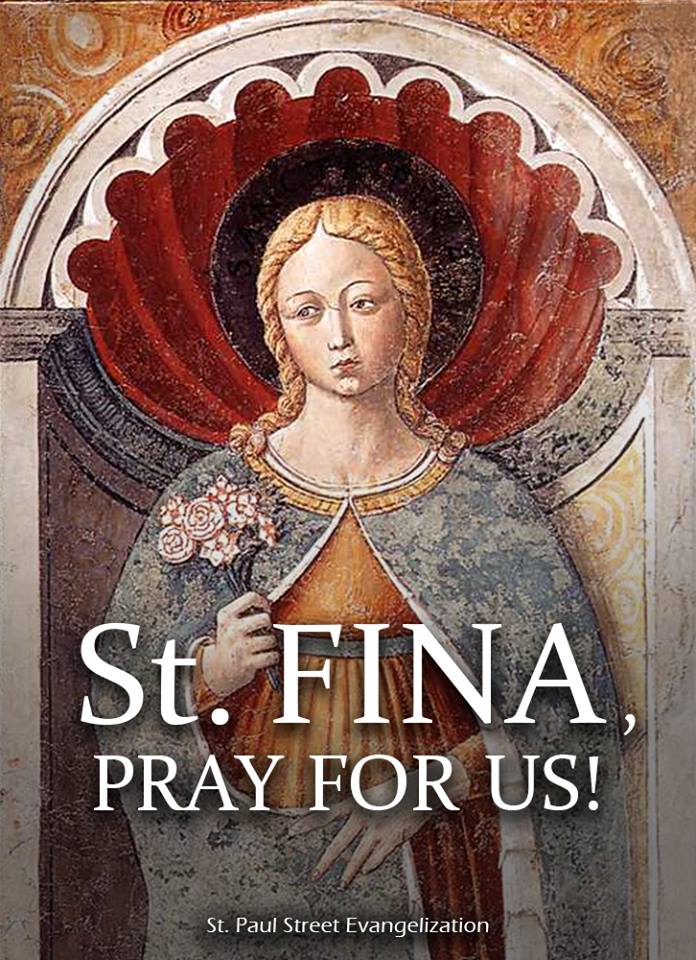
Sufferings and pain are difficult for anyone to bear and in St. Seraphina’s case they were a true martyrdom. Seraphina had to make sense out of it, young as she was. She drew strength from the sufferings of Jesus and found her happiness in God, in spite of her terrible afflictions. We have little reason to complain about our and we have many lessons to learn from her.
St Seraphina Pray for us!
Quote of the Day – 12 March
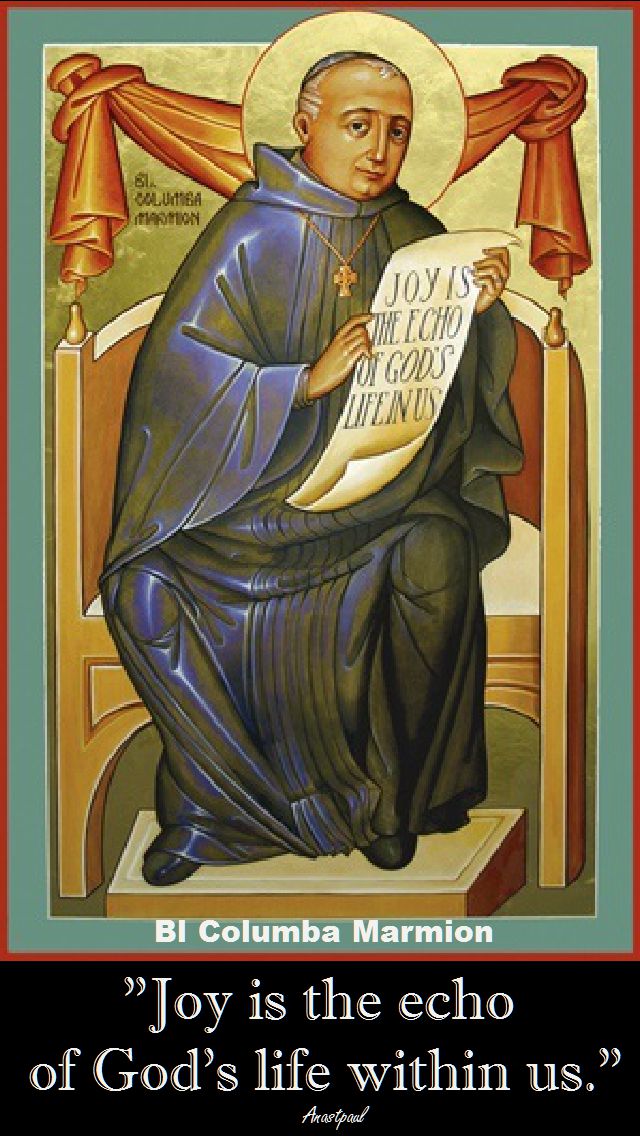
“Joy is the echo of God’s life within us.”
Bl Columba Marmion
One Minute Reflection – 12 March
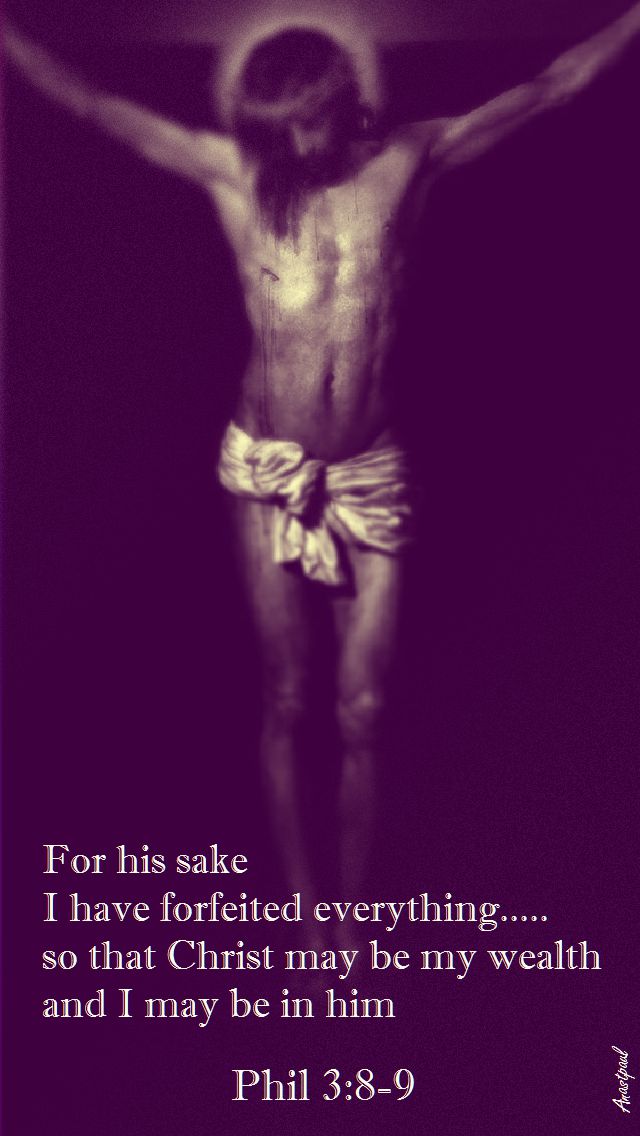
For his sake I have forfeited everything…..
so that Christ may be my wealth and
I may be in him…………Phil 3:8-9
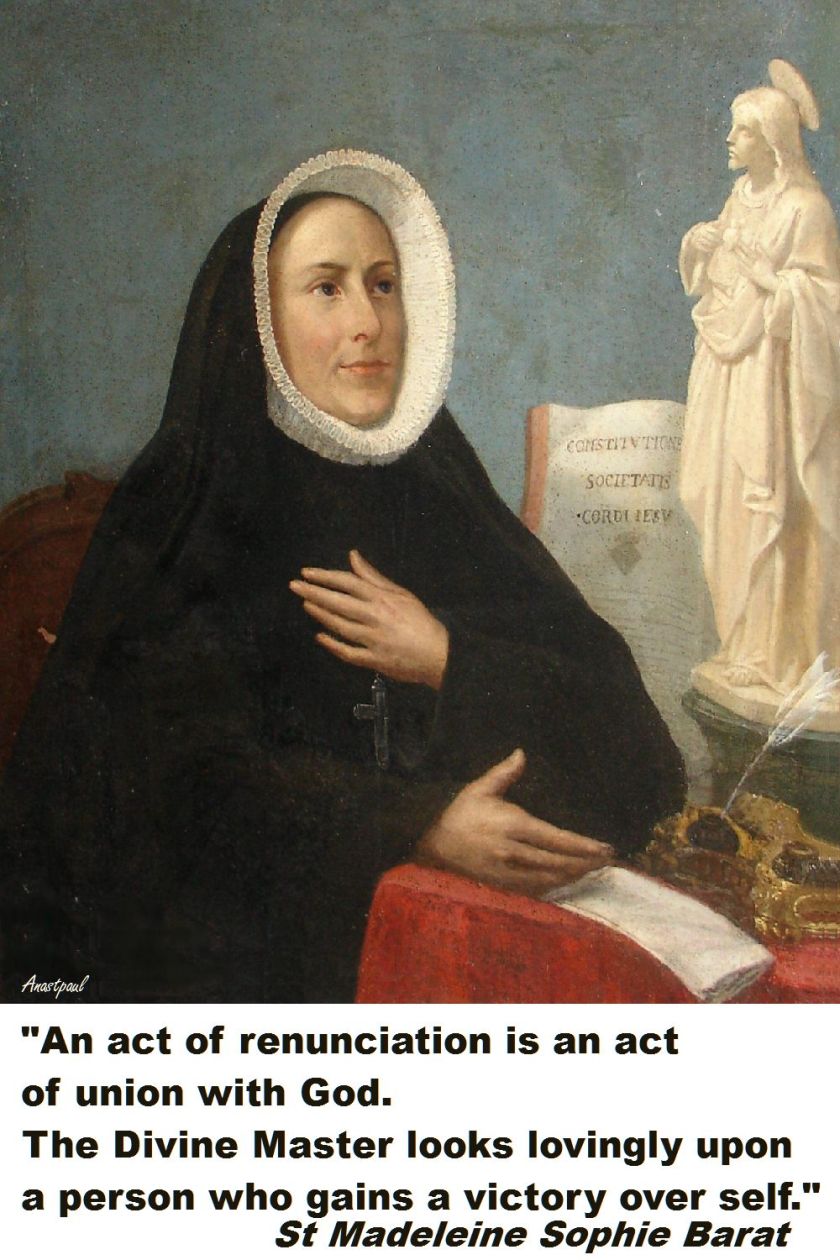
REFLECTION – “An act of renunciation is an act of union with God.
The Divine Master looks lovingly upon a person who gains a victory over self.”……….St Madeleine Sophie Barat
PRAYER – Divine Master, teach me to give up all things so that I may be united closely to You. Let me be willing to lose all things rather than give up my union with You. Dear St Seraphina, so young and innocent, you knew completely serenity in suffering and union with the Father, please pray for us! Amen

Our Morning Offering – 12 March
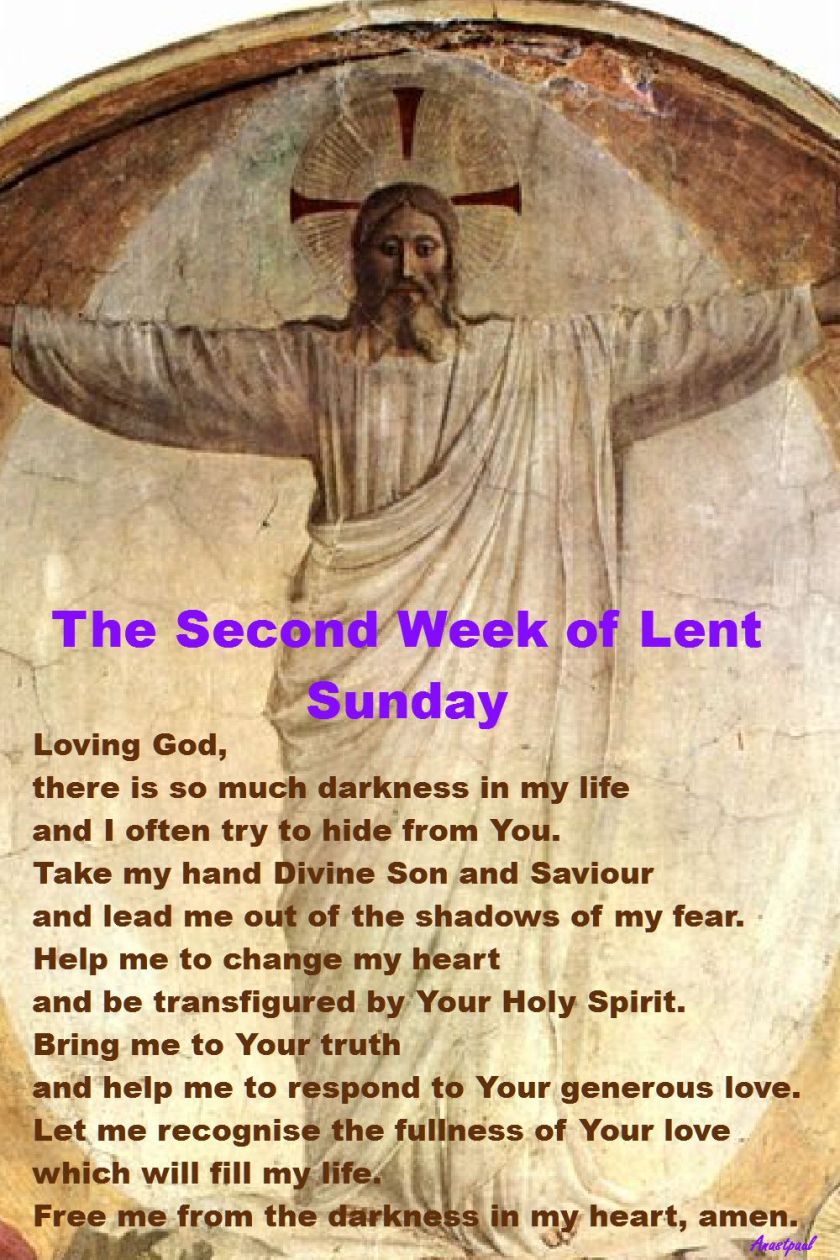
The Second Week of Lent – Sunday
Loving God,
there is so much darkness in my life
and I often try to hide from You.
Take my hand Divine Son and Saviour
and lead me out of the shadows of my fear.
Help me to change my heart
and be transfigured by Your Holy Spirit.
Bring me to Your truth
and help me to respond to Your generous love.
Let me recognise the fullness of Your love
which will fill my life.
Free me from the darkness in my heart. Amen
Saint of the Day – 12 March – St Seraphina/Fina – (1238-1253) – Virgin – Patron of physically challenged people, handicapped people and spinners
She was a little girl, very pretty, born into a very poor family, whose father died when she was very young. As a little girl she learned to sew and spin, spending most of her time at home.
After her father’s death, she was struck with a strange and paralyzing illness. She became misshapen and ugly, in constant pain, unable to get out of bed or even to move. Her mother took care of her but had to leave her for hours at a time to attend to her work. Seraphina’s only consolation was the crucifix and she realized that she was called to imitate the suffering Christ.
So she never complained. She managed to remain serene and something beautiful shone out of her face. Then she was struck another blow. Her mother died and she was left completely destitute, her neighbours repelled by her appearance and her sickness, her only friend a girl named Beldia who visited her and brought her food.
In her reading, St. Seraphina had heard of the great sufferings of Pope St. Gregory the Great and he became her special saint. She prayed to him, drew strength from the sufferings that he had to endure and prayed that he would obtain for her the patience she needed to bear her own sufferings. She was now so weak and helpless that it was clear to everyone she could not live very long.
Eight days before her death, alone and almost completely forsaken, St. Gregory appeared to her and told her: “Dear child, on my feast day, God will give you rest” (in those days his feast day was celebrated on March 12). On that day, she died. The whole city attended her funeral and from that moment everyone began to pray to her. On the place where she had lain, her neighbours found white violets growing and even today in the village of San Geminiano where she lived, the white violets that bloom in March are called Santa Fina flowers. She died on March 12,1253, at the age of fifteen.


2nd Sunday in Lent
—
St Almut of Wetter
St Alphege the Bald
Bl Angela Salawa
St Basilissa of Asia
Bl Beatrix of Engelport
St Bernard of Carinola
Bl Claudius the Minor
St Egdunus
St Fechno
St Girolamo da Recanati
St Heiu of Hartlepool
St Indrecht of Iona
St Innocent I, Pope
St Joseph Zhang Dapeng
St Luigi Orione
St Maximilian of Thebeste
St Mura McFeredach
St Paul Aurelian
St Peter the Deacon
St Seraphina
St Theophanes the Chronographer
—
Martyrs of Nicomedia – 8 saints
Peter of Nicomedia
Doroteo of Nicomedia
Gorgonio of Nicomedia
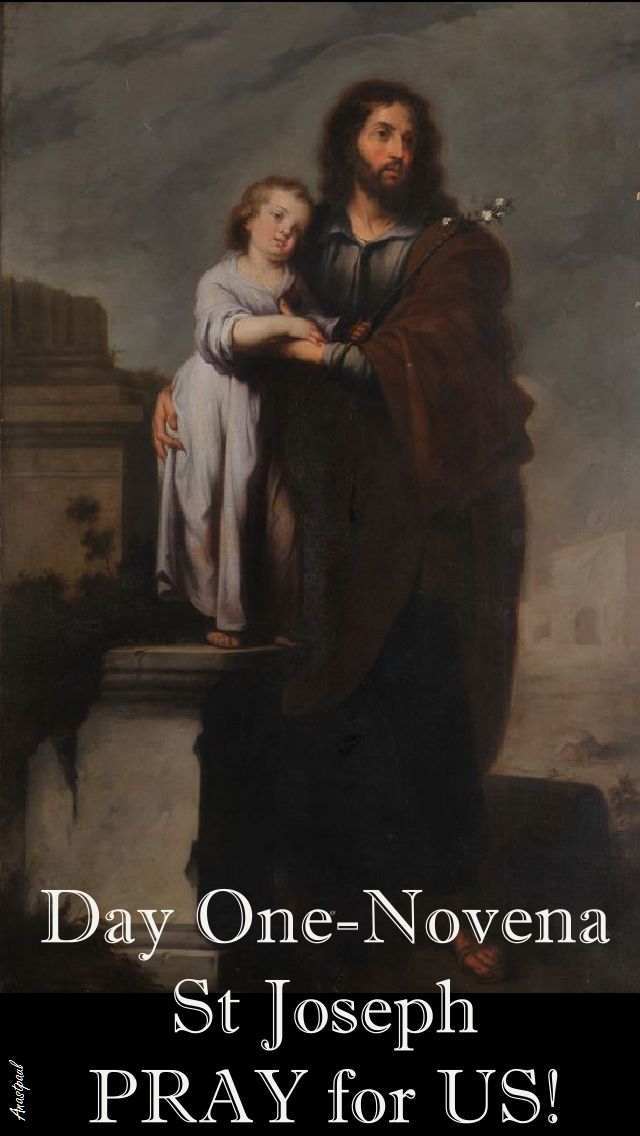
Novena to St Joseph – Day One – 11 March
FOSTER-FATHER OF JESUS
Saint Joseph, you were privileged to share in the mystery of the Incarnation as the foster-father of Jesus. Mary alone was directly connected with the fulfillment of the mystery, in that she gave her consent to Christ’s conception and allowed the Holy Spirit to form the sacred humanity of Jesus from her blood. You had a part in this mystery in an indirect manner, by fulfilling the condition necessary for the Incarnation — the protection of Mary’s virginity before and during your married life with her. You made the virginal marriage possible and this was a part of God’s plan, foreseen, willed, and decreed from all eternity.
In a more direct manner you shared in the support, upbringing and protection of the Divine Child as His foster-father. For this purpose the Heavenly Father gave you a genuine heart of a father — a heart full of love and self-sacrifice. With the toil of your hands you were obliged to offer protection to the Divine Child, to procure for Him food, clothing and a home. You were truly the saint of the holy childhood of Jesus — the living created providence which watched over the Christ-Child.
When Herod sought the Child to put Him to death, the Heavenly Father sent an angel but only as a messenger, giving orders for the flight; the rest He left entirely in your hands. It was that fatherly love which was the only refuge that received and protected the Divine Child. Your fatherly love carried Him through the desert into Egypt until all enemies were removed. Then on your arms the Child returned to Nazareth to be nourished and provided for during many years by the labour of your hands. Whatever a human son owes to a human father for all the benefits of his up-bringing and support, Jesus owed to you, because you were to Him a foster-father, teacher and protector.
You served the Divine Child with a singular love. God gave you a heart filled with heavenly, supernatural love — a love far deeper and more powerful than any natural father’s love could be.
You served the Divine Child with great unselfishness, without any regard to self-interest, but not without sacrifices. You did not toil for yourself but you seemed to be an instrument intended for the benefit of others, to be put aside as soon as it had done its word, for you disappeared from the scene once the childhood of Jesus had passed.
You were the shadow of the Heavenly Father not only as the earthly representative of the authority of the Father but also by means of your fatherhood — which only appeared to be natural — you were to hide for a while the divinity of Jesus. What a wonderfully sublime and divine vocation was yours — the loving Child which you carried in your arms,and loved and served so faithfully, had God in Heaven as Father and was Himself God!
Yours is a very special rank among the saints of the Kingdom of God because you were so much a part of the very life of the Word of God made Man. In your house at Nazareth and under your care the redemption of mankind was prepared. What you accomplished, you did for us. You are not only a powerful and great saint in the Kingdom of God but a benefactor of the whole of Christendom and mankind. Your rank in the Kingdom of God, surpassing far in dignity and honour of all the angels, deserves our very special veneration, love, and gratitude.
Saint Joseph, I thank God for your privilege of having been chosen by God to be the foster-father of His Divine Son. As a token of your own gratitude to God for this your greatest privilege, obtain for me the grace of a very devoted love for Jesus Christ, my God and my Saviour. Help me to serve Him with some of the self-sacrificing love and devotion which you had while on this earth with Him. Grant that through your intercession with Jesus, your foster-Son, I may reach the degree of holiness God has destined for me and save my soul.
*NOVENA PRAYER – *(prayer to be said at the end of each day’s devotion)
Saint Joseph, I, your unworthy child, greet you. You are the faithful protector and intercessor of all who love and venerate you. You know that I have special confidence in you and that, after Jesus and Mary, I place all my hope of salvation in you, for you are especially powerful with God and will never abandon your faithful servants. Therefore, I humbly invoke you and commend myself, with all who are dear to me and all that belong to me, to your intercession. I beg of you, by your love for Jesus and Mary, not to abandon me during life and to assist me at the hour of my death.
Glorious Saint Joseph, spouse of the Immaculate Virgin, obtain for me a pure, humble, charitable mind and perfect resignation to the divine Will. Be my guide, my father and my model through life that I may merit to die as you did in the arms of Jesus and Mary.
Loving Saint Joseph, faithful follower of Jesus Christ, I raise my heart to you to implore your powerful intercession in obtaining from the Divine Heart of Jesus all the graces necessary for my spiritual and temporal welfare, particularly the grace of a happy death and the special grace I now implore:
(Mention your request).
Guardian of the Word Incarnate, I feel confident that your prayers on my behalf will be graciously heard before the throne of God. Amen.
MEMORARE
Remember, most pure spouse of Mary, ever Virgin, my loving protector, Saint Joseph, that no one ever had recourse to your protection or asked for your aid without obtaining relief. Confiding, therefore, in your goodness, I come before you and humbly implore you. Despise not my petitions, foster-father of the Redeemer but graciously receive them. Amen.
St Josdeh Pray for us!
Dear Friends
No posts today. I should be back tomorrow.
God bless your weekend!
Ana
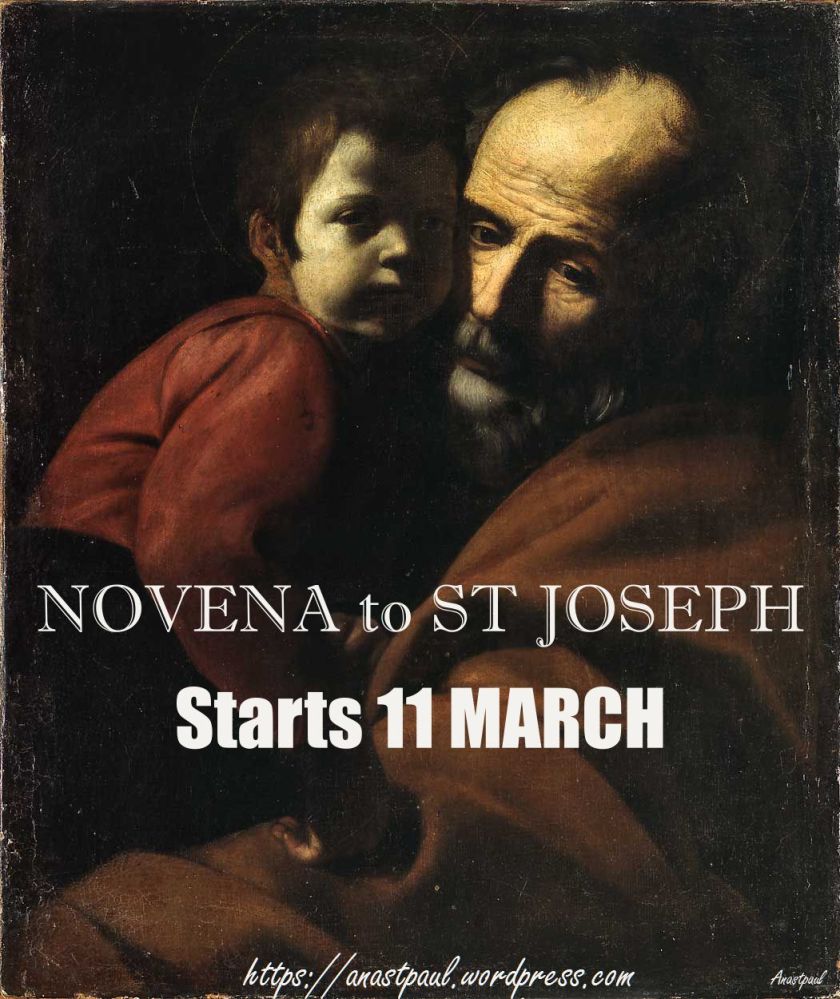
Novena to St Joseph
The primary feast of St Joseph is on 19 March, the husband of the Blessed Virgin Mary and the foster father of Jesus Christ.
Indeed, the Catholic Church dedicates the entire month of March to Saint Joseph and urges us to pay special attention to his life and example.
Fathers, in particular, should cultivate devotion to Saint Joseph, whom God Himself chose to care for His Son. As we learn more about Saint Joseph, we can teach our own boys about the virtues of fatherhood through his example.
“Would that I could persuade all men to be devoted to this glorious Saint [St. Joseph], for I know by long experience what blessings he can obtain for us from God. I have never known anyone who was truly devoted to him and honoured him by particular services who did not advance greatly in virtue: for he helps in a special way those souls who commend themselves to him. It is now very many years since I began asking him for something on his feast and I have always received it. I f the petition was in any way amiss, he rectified it for my greater good . . .
” I ask for the love of God that he who does not believe me will make the trial for himself—then he will find out by experience the great good that results from commending oneself to this glorious Patriarch and in being devoted to him.”
“Since we all must die, we should cherish a special devotion to St. Joseph, that he may obtain for us a happy death. All Christians regard him as the advocate of the dying who had honoured him during their life and they do so for three reasons:
“First, because Jesus Christ loved him not only as a friend but as a father and on this account his mediation is far more efficacious than that of any other Saint.
“Second, because St. Joseph has obtained special power against the evil spirits, who tempt us with redoubled vigour at the hour of death.
“Third, the assistance given St. Joseph at his death by Jesus and Mary obtained for him the right to secure a holy and peaceful death for his servants. Hence, if they invoke him at the hour of death he will not only help them but he will also obtain for them the assistance of Jesus and Mary.”
St Joseph we ask for your assistance in all our needs starting tomorrow, pray for us!
LENTEN REFLECTION – Friday of the First Week of Lent – 10 MARCH
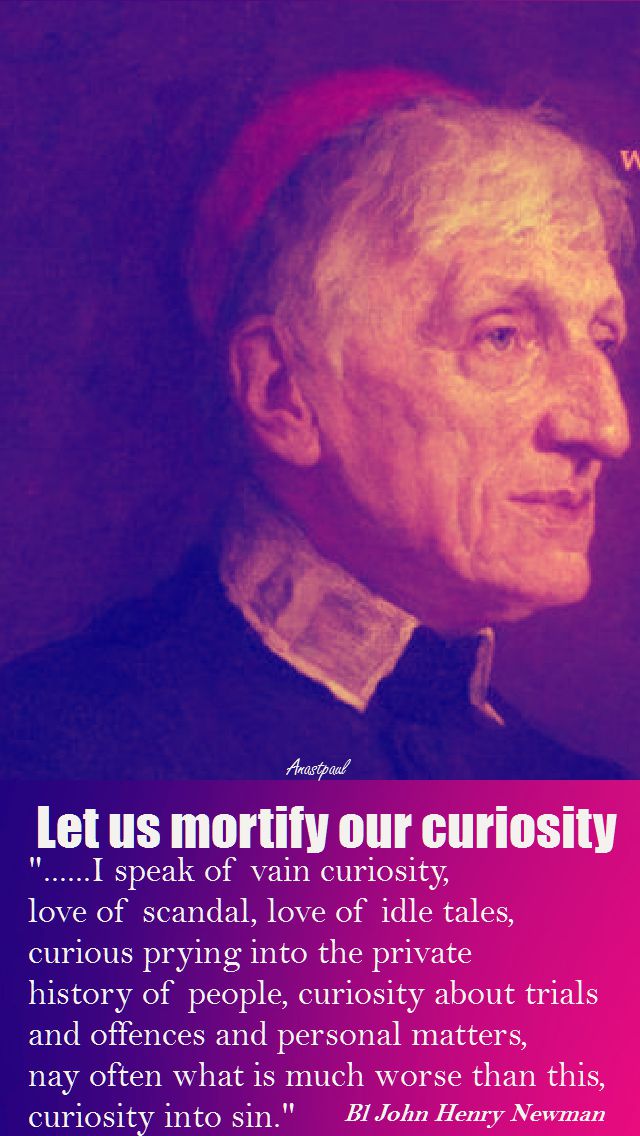
For example, in respect to curiosity. What a deal of time is lost, to say nothing else, in this day by curiosity, about things which in no ways concern us. I am not speaking against interest in the news of the day altogether, for the course of the world must ever be interesting to a Christian from its bearing upon the fortunes of the church but I speak of vain curiosity, love of scandal, love of idle tales, curious prying into the private history of people, curiosity about trials and offences, and personal matters, nay often what is much worse than this, curiosity into sin. What strange diseased curiosity is sometimes felt about the history of murders and of the malefactors themselves! Worse still, it is shocking to say, but there is so much evil curiosity to know about deeds of darkness, of which the Apostle [Paul] says that it is shameful to speak. Many a person, who has no intention of doing the like, from an evil curiosity reads what he ought not to read. This is in one shape or other very much the sin of boys and they suffer for it. The knowledge of what is evil is the first step in their case to the commission of it. Hence this is the way in which we are called upon, with this Lent we now begin, to mortify ourselves. Let us mortify our curiosity.
Thought for the day – 10 March
“Ogilvie typifies what can be overlooked when we reflect the Creed, in the Creed when we say, ‘suffered under Pontius Pilate.’ In other words, Ogilvie typifies the perennial struggle of the Church with the state. It was a civil official who condemned Christ and it is the state over the centuries, which in Augustine’s language, has become the arm of the enemies of God that gave the Church her first martyrs for 300 years and has been placing such a heavy burden on those who wish to remain faithful to Christ. The conflict of Church and state is the final feature of John Ogilvie’s spirituality as a martyr.
Let us ask St. John Ogilvie to obtain, especially for the leaders in the Church today, something of the courage he had to be willing to proclaim the true faith even at the price of their blood. St. John Ogilvie, pray for us.
In the name of the Father and of the Son and of the Holy Spirit. Amen.”
BY VENERABLE SERVANT OF GOD JOHN A HARDON SJ

Quote/s of the Day – 10 March
“In all that concerns the king, I will be slavishly obedient; if any attack his temporal power, I will shed my last drop of blood for him.
But in the things of spiritual jurisdiction which a king unjustly seizes I cannot and must not obey.”
~~ St John Ogilvie at his trial
“willingly and joyfully pour forth even a hundred lives. Snatch away that one
which I have from me and make no delay about it, but my religion you will never snatch
away from me!”
“If there be here any hidden Catholics, let them pray for me but the prayers of heretics I will not have.”— Saint John Ogilvie at his execution
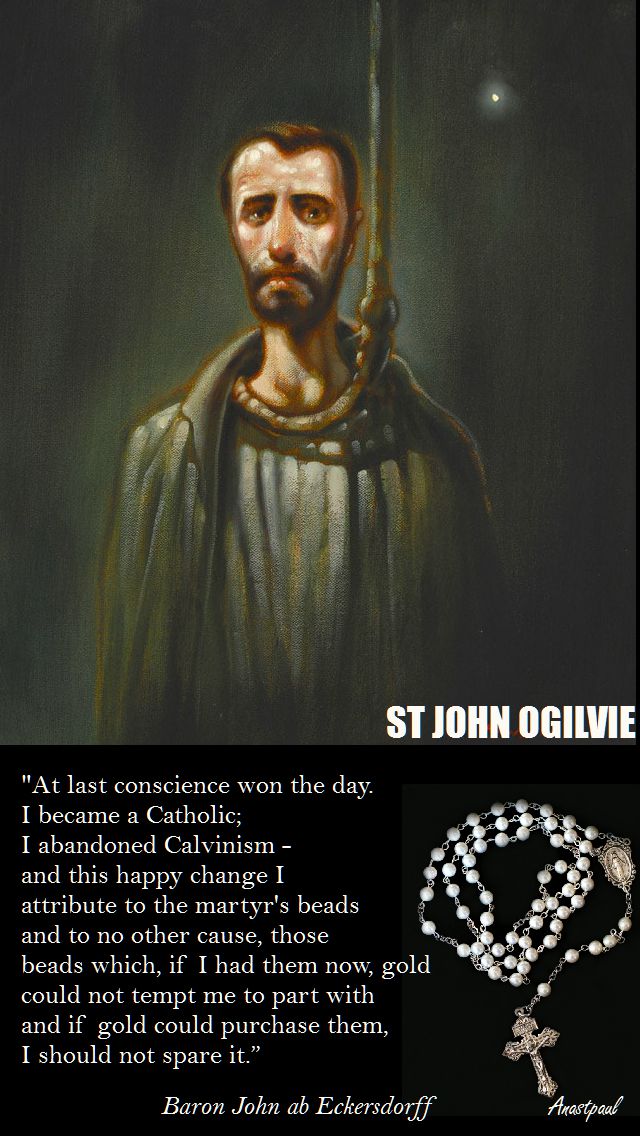
“At last conscience won the day. I became a Catholic;
I abandoned Calvinism – and this happy change I attribute to the martyr’s beads and to no other cause those beads which, if I had them now, gold could not tempt me to part with and if gold could purchase them, I should not spare it.” ~~~ Baron John ab Eckersdorff
(St. John Ogilvie was executed by hanging on March 10, 1615.
A few moments before his hanging, St. John threw his Rosary into the crowd where it
hit Baron John ab Eckersdorff a Calvinist nobleman on the chest – he later converted to
Catholicism, attributing his conversion to witnessing the martyrdom and St. John’s
rosary.)

One Minute Reflection – 10 March
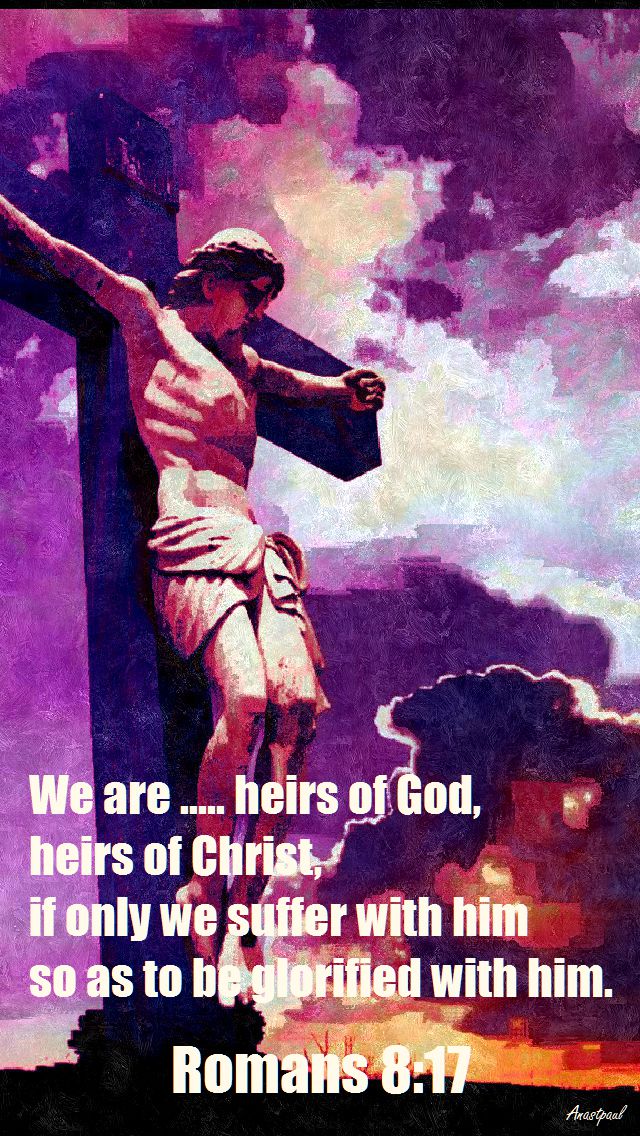
We are ….. heirs of God, heirs of Christ, if only we suffer with him so as to be glorified with him……..Romans 8:17
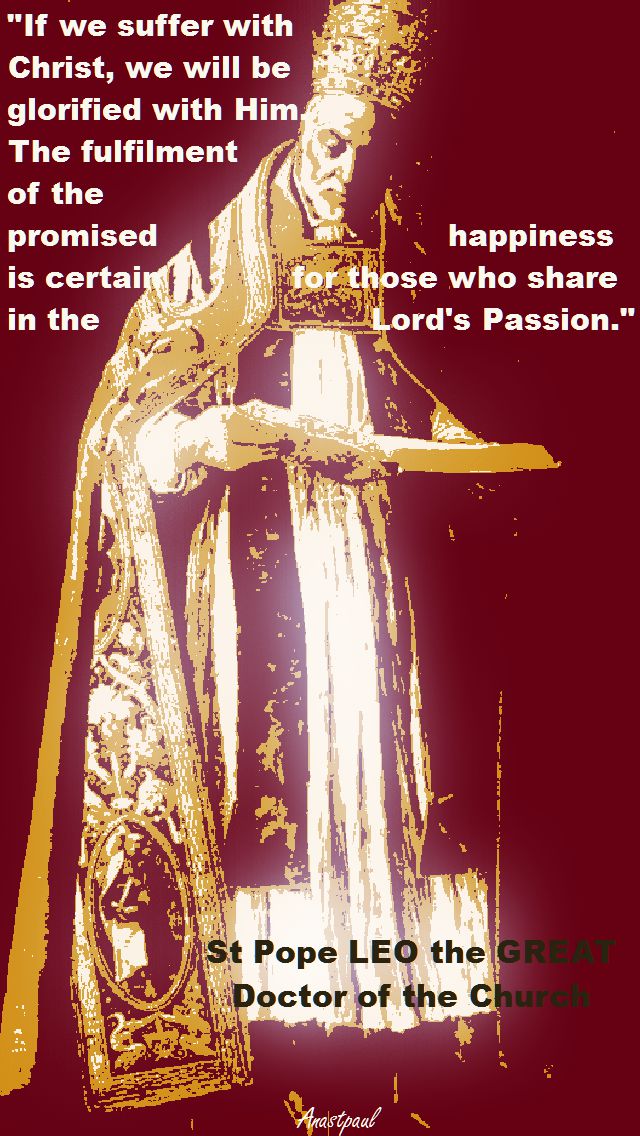
REFLECTION – If we suffer with Christ, we will be glorified with Him. The fulfilment of the promised happiness is certain for those who share in the Lord’s Passion……St Pope Leo the Great
PRAYER – Grant me Your grace to overcome my natural fear of suffering Lord. Strengthen me to bear my sufferings in union with Your sacred Passion, for the salvation of the world. St John Ogilvie you are an example to me, please pray that this Lenten time will assist us all in overcoming our fear of sharing in the Passion of our God. Amen

Our Morning Offering – 10 March
The First Week of Lent
Friday
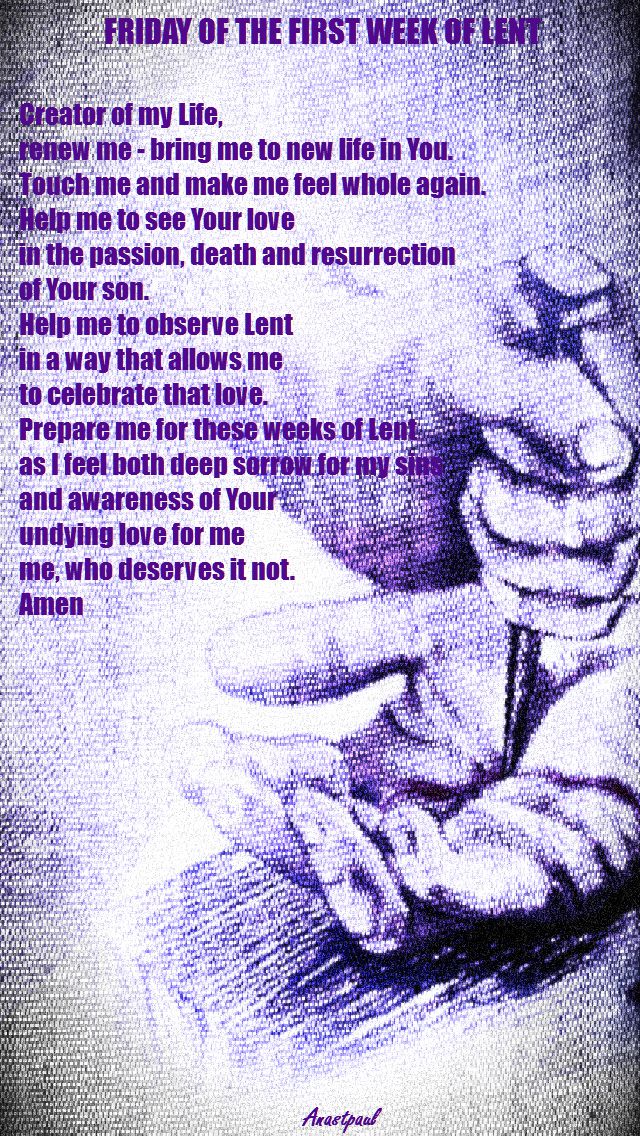
Creator of my Life,
renew me – bring me to new life in You.
Touch me and make me feel whole again.
Help me to see Your love
in the passion, death and resurrection of Your son.
Help me to observe Lent
in a way that allows me to celebrate that love.
Prepare me for these weeks of Lent
as I feel both deep sorrow for my sins
and awareness of Your undying love for me
me, who deserves it not.
Amen
Blessed Memorial of St John Ogilvie SJ – 10 March – St John Ogilvie, his Rosary and the Baron
Although the judge had tried to pin the crime of treason on him, Ogilvie forced him to assert that it was for his Catholic Faith that he was being killed, rather than for treason, which Protestant history alleges. Just as with Saint Thomas More, the heroic Jesuit protested his allegiance to the King saying that he was the King’s loyal subject but God’s servant first. Again, as it was with Thomas More, the executioner begged the martyr’s forgiveness, which he paternally gave.
There were many brave Catholics who came to the execution site to support the saint with prayers and with shouts. They were fearless. John said onthe scaffold “If there be here any hidden Catholics, let them pray for me but the prayers of heretics I will not have.” Then something spontaneous happened, by divine intervention and inspiration. Just before they tied his hands on the scaffold the saint quickly pulled out his rosary and tossed it to the crowd as a token of farewell. There was a Protestant Baron, a traveller, who happened to be in the crowd and the rosary bounced off his chest. The man tried to reach down for the beads but was beaten to them by the surrounding faithful anxious to get such a relic.
This episode of the Protestant gentleman in the crowd was recounted in the records of the trial of the saint because he, the Baron John ab Eckersdorff, was converted by means of the rosary of our Jesuit martyr. Here is how the event is related, in the words of the Baron, as we have them in Father Daniel Conway’s three part history of Venerable John Ogilvie, published in 1878, in a Glasgow diocesan journal “The Month”:
“His Rosary struck the breast of a young noble
man who was on his travels in these kingdoms.
He was a foreigner and a heretic his name, Baron
John ab Eckersdorff. ” I was on my travels
through England and Scotland as it is the custom
of our nobility being a mere stripling, and not
having the faith. I happened to be in Glasgow the
day Father Ogilvie was led forth to the gallows,
and it is impossible for me to describe his lofty
bearing in meeting death. His farewell to the
Catholics was his casting into their midst, from the
scaffold, his rosary beads just before he met his
fate. That rosary, thrown haphazard, struck me
on the breast in such wise that I could have caught
it in the palm of my hand; but there was such a
rush and crush of the Catholics to get hold of it,
that unless I wished to run the risk of being trodden
down, I had to cast it from me. Religion was the
last thing I was then thinking about : it was not in
my mind at all; yet from that moment I had no
rest. Those rosary beads had left a wound in my
soul; go where I would I had no peace of mind.
Conscience was disturbed, and the thought would
haunt me : why did the martyr’s rosary strike me,
and not another? For years I asked myself this
question it followed me about everywhere. At
last conscience won the day. I became a Catholic;
I abandoned Calvinism – and this happy change I
attribute to the martyr’s beads and to no other
cause those beads which, if I had them now, gold
could not tempt me to part with and if gold could
purchase them, I should not spare it.”
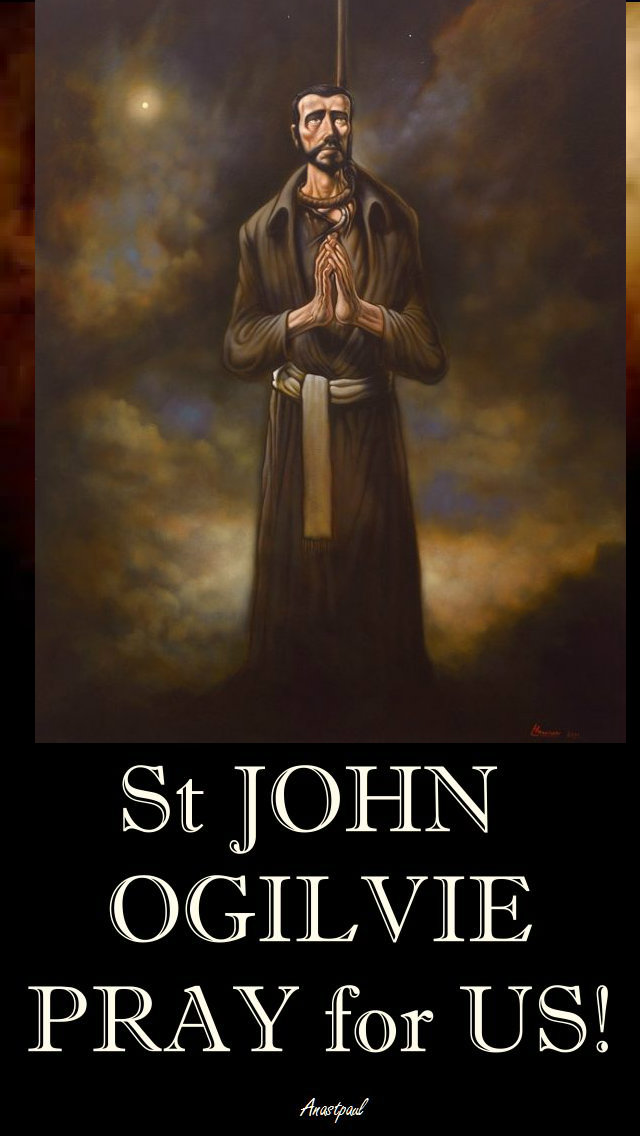
Saint of the Day – 10 March – St John Ogilvie SJ (1579-1615 died aged 36) MARTYR and Jesuit Priest – hanged 10 March 1615 at Glasgow, Scotland but no relic of his body has survived. He was canonised 0n 17 October 1976 by Pope Paul VI.
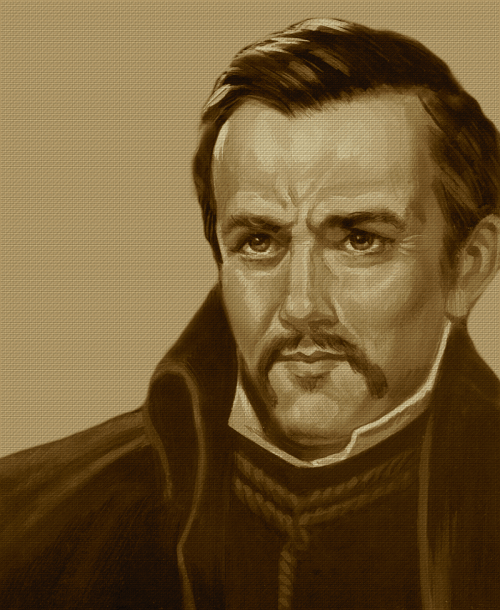
John Ogilvie’s noble Scottish family was partly Catholic and partly Presbyterian. His father raised him as a Calvinist, sending him to the continent to be educated. There John became interested in the popular debates going on between Catholic and Calvinist scholars. Confused by the arguments of Catholic scholars whom he sought out, he turned to Scripture. Two texts particularly struck him: “God wills all men to be saved and come to the knowledge of the truth,” and “Come to me all you who are weary and find life burdensome, and I will refresh you.”
Slowly, John came to see that the Catholic Church could embrace all kinds of people. Among these, he noted, were many martyrs. He decided to become Catholic and was received into the Church at Louvain, Belgium, in 1596 at the age of 17.
John continued his studies, first with the Benedictines, then as a student at the Jesuit College at Olmutz. He joined the Jesuits and for the next 10 years underwent their rigorous intellectual and spiritual training. Ordained a priest in France in 1610, he met two Jesuits who had just returned from Scotland after suffering arrest and imprisonment. They saw little hope for any successful work there in view of the tightening of the penal laws. But a fire had been lit within John. For the next two and a half years he pleaded to be missioned there.
Sent by his superiors, he secretly entered Scotland posing as a horse trader or a soldier returning from the wars in Europe. Unable to do significant work among the relatively few Catholics in Scotland, John made his way back to Paris to consult his superiors. Rebuked for having left his assignment in Scotland, he was sent back. He warmed to the task before him and had some success in making converts and in secretly serving Scottish Catholics. But he was soon betrayed, arrested and brought before the court. His trial dragged on until he had been without food for 26 hours. He was imprisoned and deprived of sleep. For eight days and nights he was dragged around, prodded with sharp sticks, his hair pulled out. Still, he refused to reveal the names of Catholics or to acknowledge the jurisdiction of the king in spiritual affairs. He underwent a second and third trial but held firm. At his final trial he assured his judges: “In all that concerns the king, I will be slavishly obedient; if any attack his temporal power, I will shed my last drop of blood for him. But in the things of spiritual jurisdiction which a king unjustly seizes I cannot and must not obey.”
Condemned to death as a traitor, he was faithful to the end, even when on the scaffold he was offered his freedom and a fine living if he would deny his faith. His courage in prison and in his martyrdom was reported throughout Scotland. This Jesuit loved to laugh. His jokes brightened the dark days of his captivity during which his captors tried to “brainwash” him. “For eight days and nine nights, they kept me awake by using pins, needles and whips.” St. John Ogilvie was executed by hanging on March 10, 1615 and was disembowled. A few moments before his hanging, St. John threw his Rosary into the crowd where it was caught by Baron John ab Eckersdorff a Calvinist nobleman – who later converted to Catholicism, attributing his conversion to witnessing the martyrdom and St. John’s rosary.
John Ogilvie was canonised in 1976, becoming the first Scottish saint since 1250.


St Alexander of Apema
St Anastasia the Patrician
St Andrew of Strumi
St Attalas of Bobbio
St Blanchard of Nesle-la-Réposte
St Caius of Apema
St Cordratus of Nicomedië
St Droctoveus of Paris
Bl Elias del Socorro Nieves
St Emilian of Lagny
St Failbhe the Little
St Gustav the Hermit
St Himelin
Bl Jean-Marie Joseph Lataste
St John Ogilvie
Bl John of Vallombrosa
St Kessog
St Macarius of Jerusalem
St Marie Eugénie de Jésus
St Peter of Veroli
St Rufinus of Nicomedië
St Sannudius of Bagensena
St Saturninus of Nicomedië
St Sedna of Ossory
St Silvester of Ireland
St Simplicius, Pope
St Victor of North Africa
Bl Wirnto of Formbach
—
Anonymous Martyrs of Persia – A group of 42 Christians martyred in Persia in the 4th century.
Forty Martyrs of Armenia – Forty Christian soldiers of the Thunderstruck Legion of the Imperial Roman army who were tortured and murdered for their faith during the persecutions of Emperor Licinius. They were exposed naked on a frozen pond to freeze to death at Sebaste, Armenia in 320 and their bodies afterward were burned.
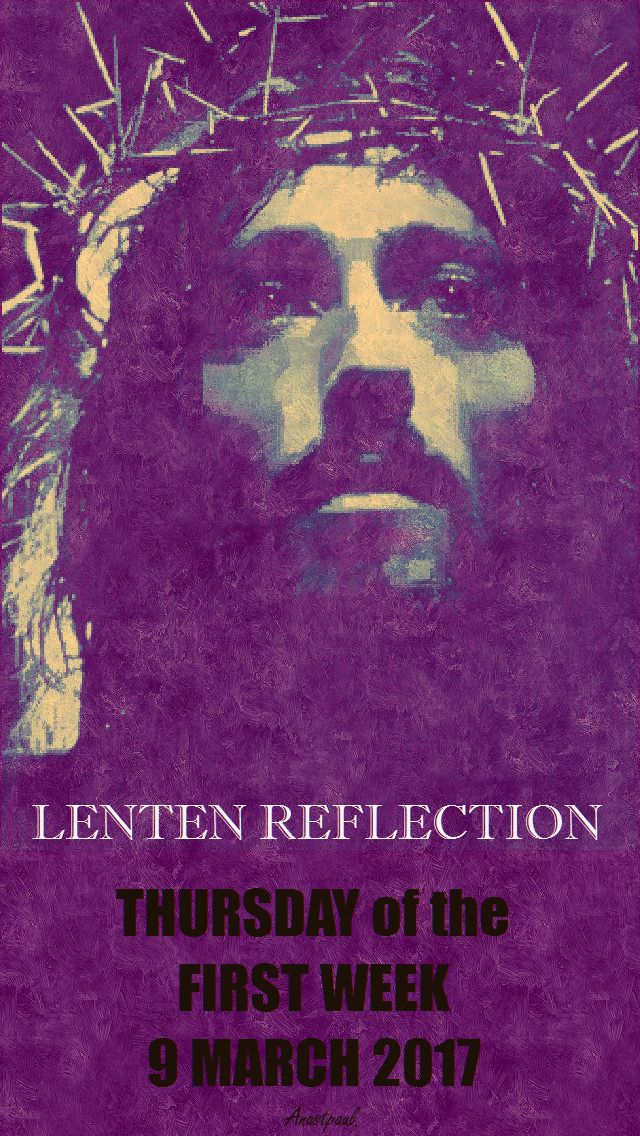
LENTEN REFLECTION – Thursday of the First Week of Lent – 9 MARCH
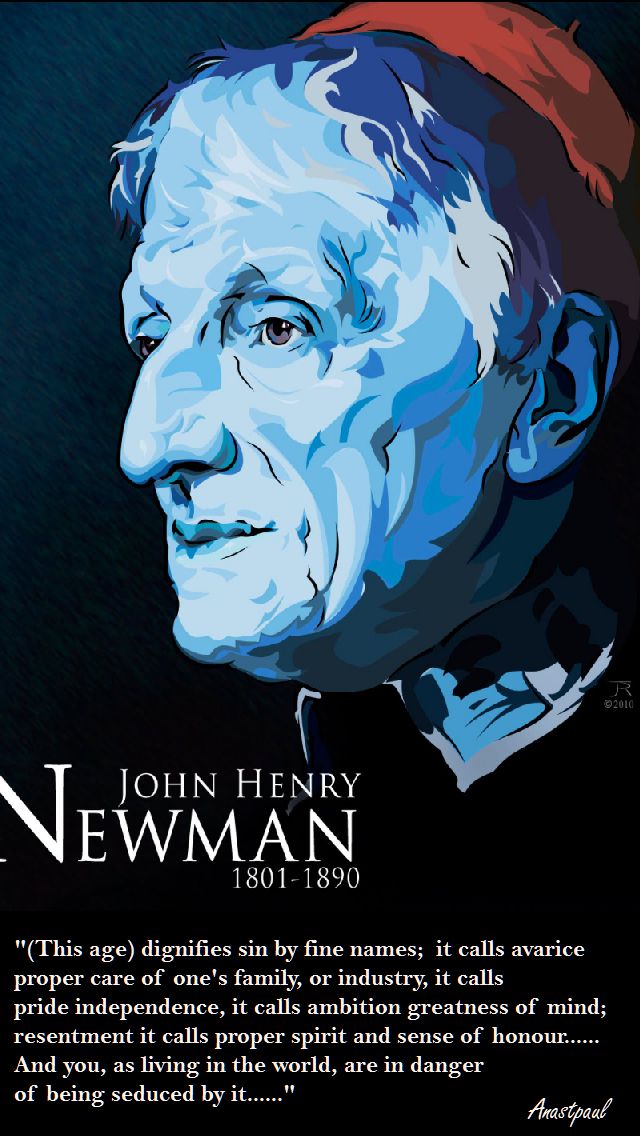
Blessed Cardinal John Henry Newman
Next I observe that a civilized age is more exposed to subtle sins than a rude age. Why? For this simple reason- because it is more fertile in excuses and evasions. It can defend error and hence can blind the eyes of those who have not very careful consciences. It can make error plausible, it can make vice look like virtue. It dignifies sin by fine names; it calls avarice proper care of one’s family, or industry, it calls pride independence, it calls ambition greatness of mind; resentment it calls proper spirit and sense of honour and so on.
…What all of us want more than anything else, what this age wants, is that its intellect and its will should be under a law. At present it is lawless, its will is its own law, its own reason is the standard of all truth. It does not bow to authority, it does not submit to the law of faith. It is wise in its own eyes and it relies on its own resources. And you, as living in the world, are in danger of being seduced by it and being a partner in its sin and so coming in at the end for its punishment.
Thought for the Day – 9 March
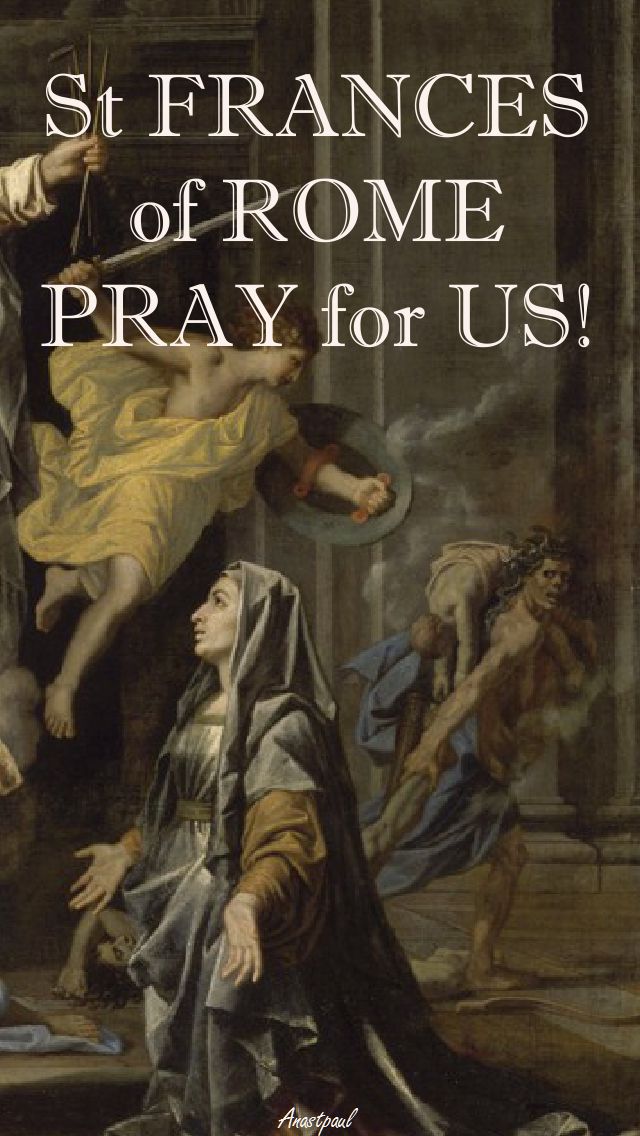
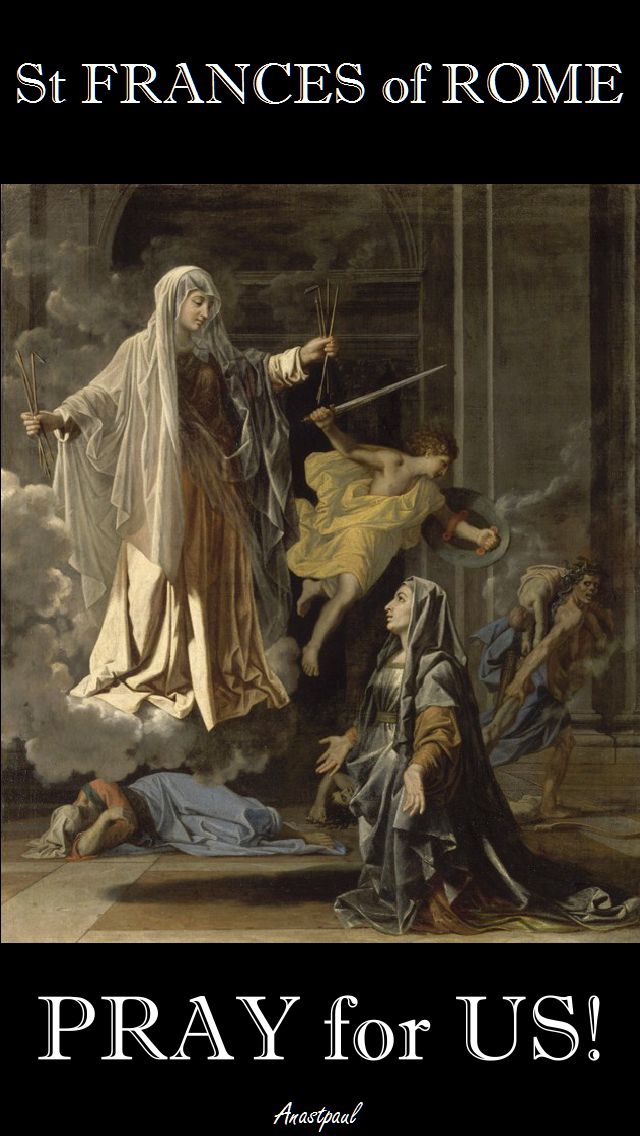
What an amazing lady! St Frances of Rome was an ordinary wife and mother whose love for God and His children knew no bounds and who trusted in God to give her guidance. There was nothing she felt she could not do with God and she let nothing stop her. Looking at her exemplary life of fidelity to God and devotion to her fellow human beings which Frances of Rome was blessed to lead, one cannot help but be reminded of Saint Teresa of Calcutta, who loved Jesus Christ in prayer and also in the poor. The life of Frances of Rome calls each of us not only to look deeply for God in prayer but also to carry our devotion to Jesus living in the suffering of our world. Frances shows us that this life need not be restricted to those bound by vows. We need something of her love and her trust and energy and then we too, can accomplish great things!
St Frances of Rome, pray for us!
Quote/s of the Day – 9 March
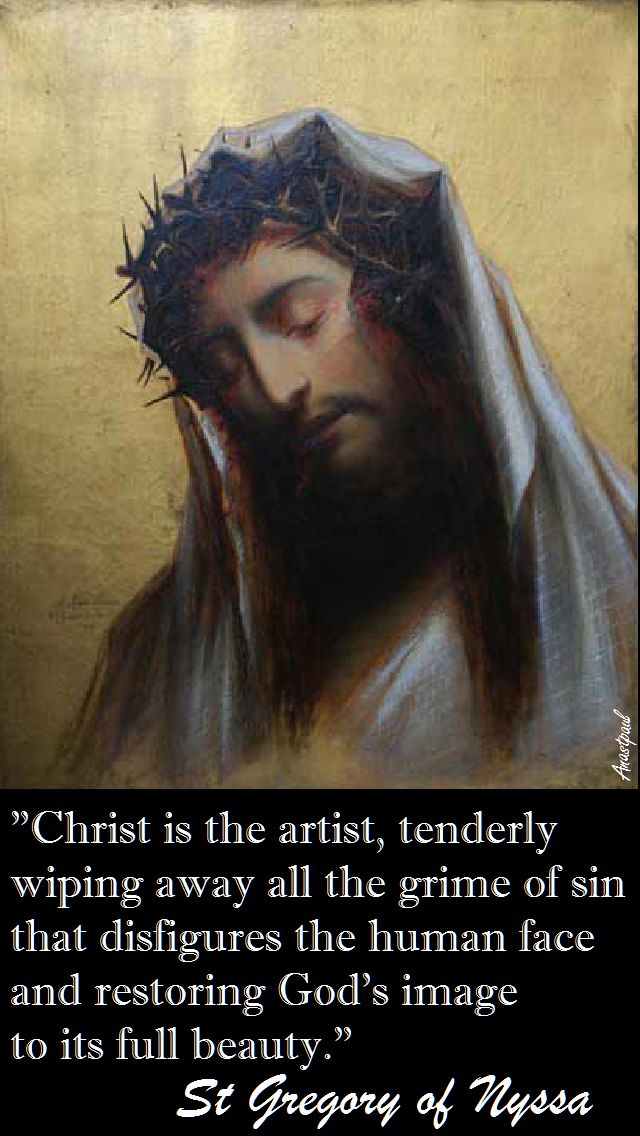
“Christ is the artist, tenderly wiping away
all the grime of sin that disfigures the human face
and restoring God’s image to its full beauty.”
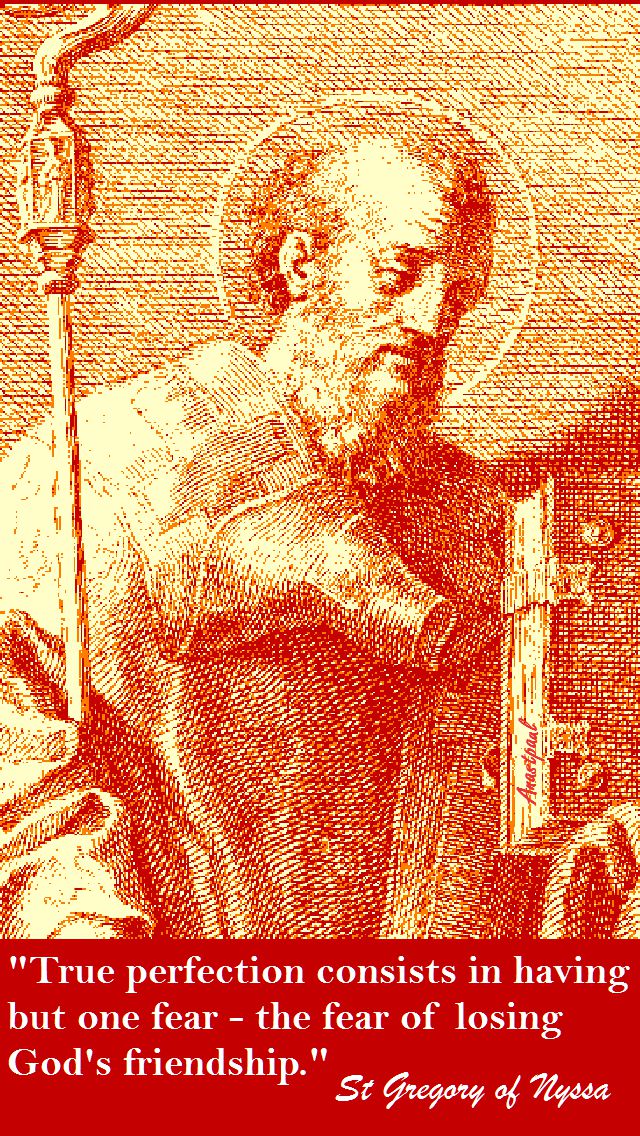
“True perfection consists in having but one fear –
the fear of losing God’s friendship.”
“Do you want many graces?
Go and visit the Blessed Sacrament often.”
“If I do not become a saint, I am doing nothing.”

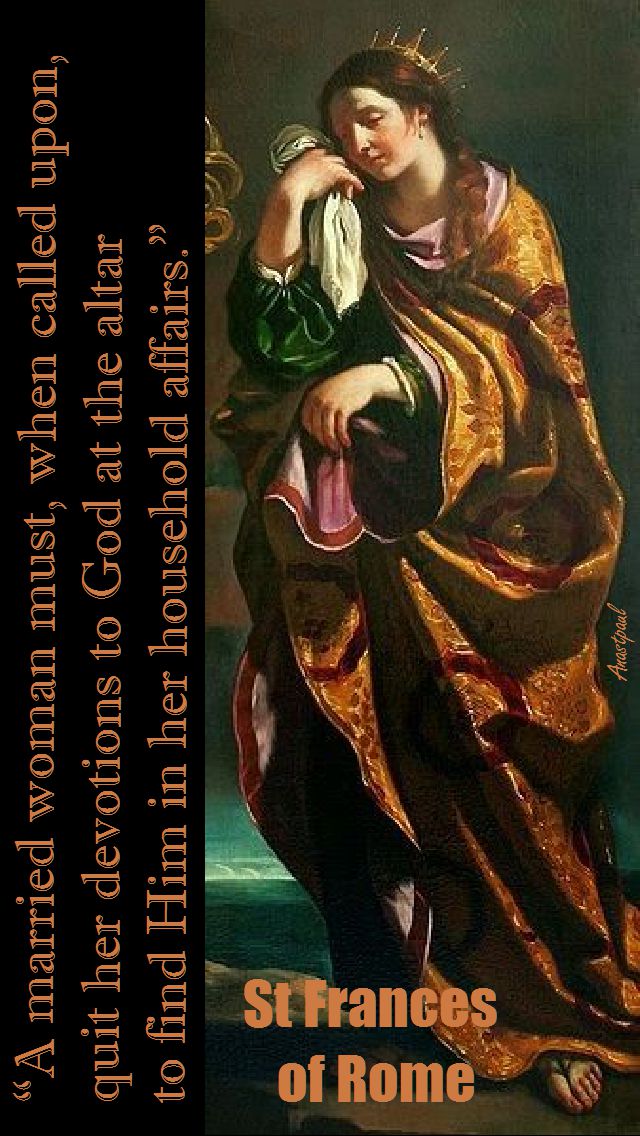
“A married woman must, when called upon,
quit her devotions to God at the altar
to find Him in her household affairs.”
One Minute Reflection – 9 March
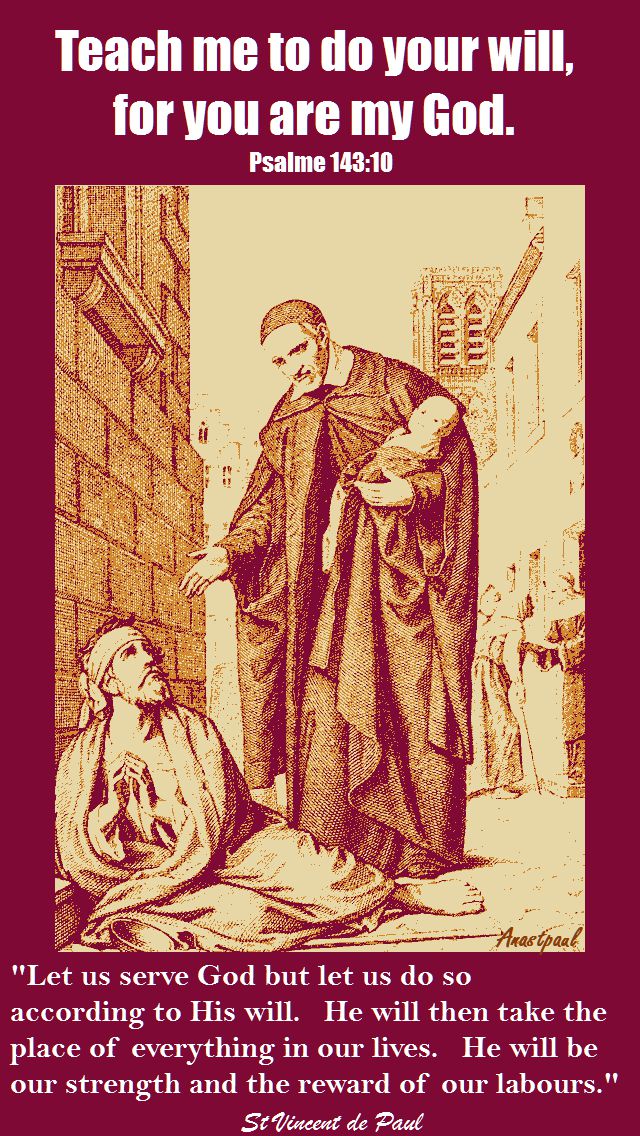
Teach me to do your will, for you are my God………Psalm 143:10
REFLECTION – “Let us serve God but let us do so according to His will. He will then take the place of everything in our lives. He will be our strength and the reward of our labours.”………St Vincent de Paul
PRAYER – Infinite Lord, help me to serve You always in accord with Your holy will. Show me how to make You my Lord and my All. St Frances of Rome, you showed us all the way of holiness within the confines of our lives, always seeking to do the will of God and serve all His children, most especially those in need but remaining always true to the vows of your marriage. Please pray for us all, amen.
Our Morning Offering – 9 March
The First Week of Lent
Thursday
Lord,
I’m not always eager to do Your will.
I’d often much rather do my own will.
Please be with me on this Lenten journey
and help me to remember
that Your own spirit can guide me
in the right direction.
I want to “fix” my weaknesses
but the task seems overwhelming.
But I know that with Your help,
anything can be done.
With a grateful heart,
I acknowledge Your love
and know that without You,
I can do nothing. Amen


You must be logged in to post a comment.