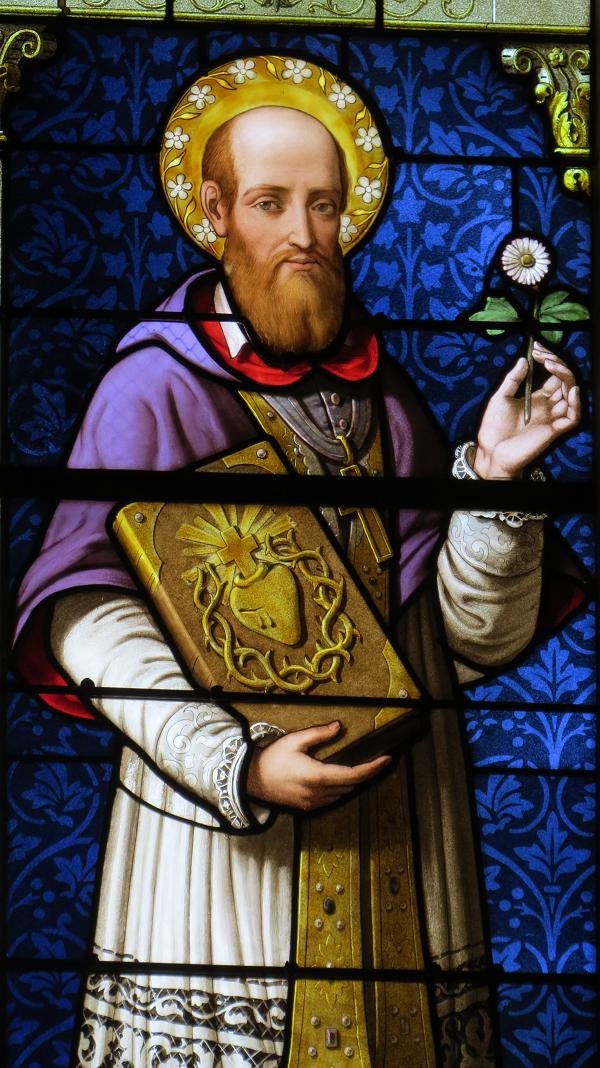
One Minute Reflection – 29 January – “The Month of the Holy Name of Jesus and the Holy Family” – St Francis de Sales (1567-1622), Bishop, Confessor and Doctor of the Church – 2 Timothy 4:1-8; Matthew 5:13-19 – Scripture search here: https://www.drbo.org/
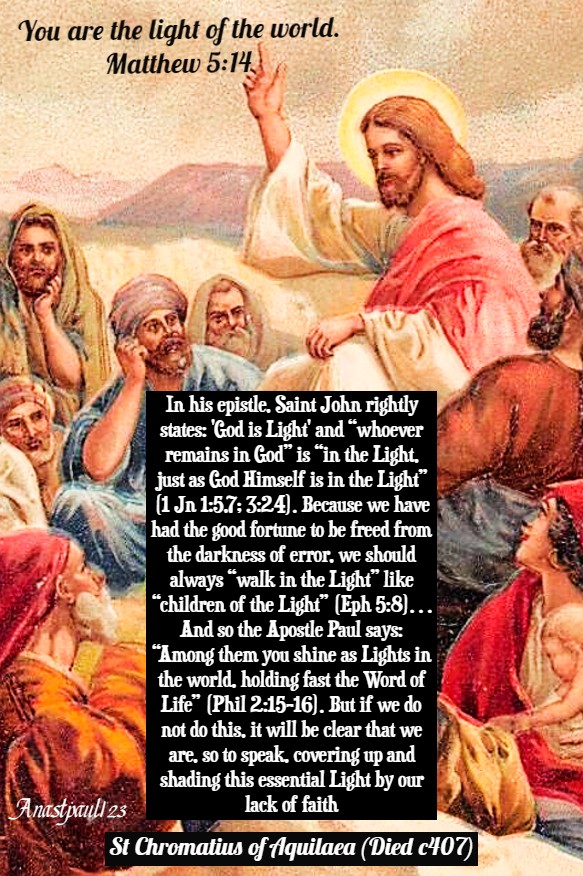
“You are the light of the world.” – Matthew 5:14
REFLECTION – “In his epistle, Saint John rightly states: ‘God is Light‘ and “whoever remains in God” is “in the Light, just as God Himself is in the Light” (1 Jn 1:5,7; 3:24). Because we have had the good fortune to be freed from the darkness of error, we should always “walk in the Light” like “children of the Light” (Eph 5:8) … And so the Apostle Paul says: “Among them you shine as Lights in the world, holding fast the Word of Life” (Phil 2:15-16). But if we do not do this, it will be clear that we are, so to speak, covering up and shading this essential Light by our lack of faith…
Therefore, that shining Light which has been lit, for our salvation, must always shine in us. For we possess the lamp of the heavenly commandments and of the spirit of grace, of which David said: “Thy law is a lamp to my feet and a light to my path” (Ps 118:105)… We must not, then, hide this lamp of the law and of faith but, should always set it up on the Church, as on a lampstand, for the salvation of many. In this way, we too may enjoy the Light of Truth itself and all who believe. may be enlightened.” – St Chromatius of Aquilaea (Died c407) Bishop, Father of the Church (Homilies on Saint Matthew’s Gospel No 5).
PRAYER – O God, Who for the salvation of souls, willed that blessed Francis, Thy Confessor and Bishop, should become all things to all men, mercifully grant that we, inspired by the sweetness of Thy love, guided by his teachings and aided by his merits, may attain the joys of everlasting life. Through Jesus Christ, Thy Son our Lord, Who lives and reigns with Thee, in the unity of the Holy Ghost, God, world without end. Amen (Collect).
Our Morning Offering – 29 January – St Francis Salesius, Bishop, Confessor and Doctor of the Church
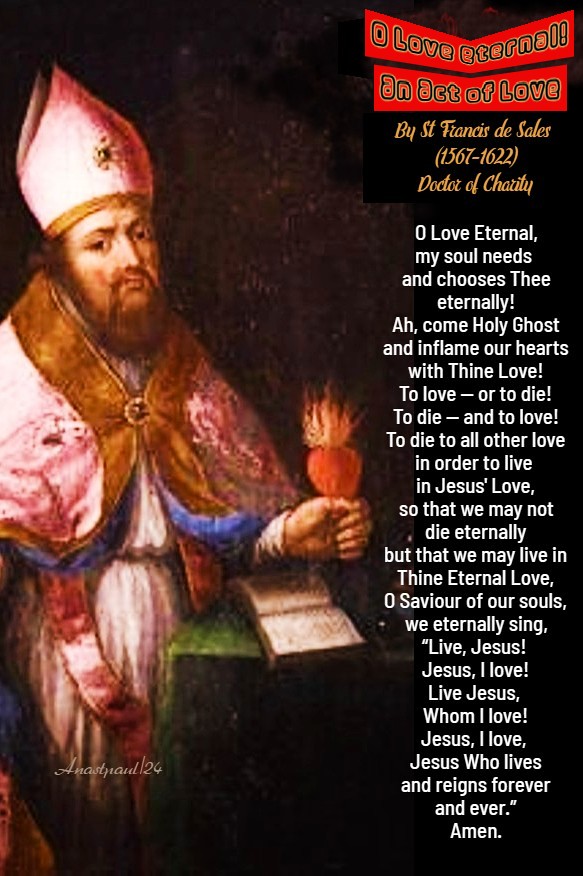
O Love Eternal! An Act of Love By St Francis de Sales (1567-1622) Doctor of the Church (From his “A Treatise on the Love of God”)
O Love Eternal, my soul needs and chooses Thee eternally! Ah, come Holy Ghost and inflame our hearts with Thine Love! To love — or to die! To die — and to love! To die to all other love in order to live in Jesus’ Love, so that we may not die eternally but that we may live in Thine Eternal Love, O Saviour of our souls, we eternally sing, “Live, Jesus! Jesus, I love! Live Jesus, Whom I love! Jesus, I love, Jesus Who lives and reigns forever and ever.” Amen.
Saint of the Day – 29 January – Saint Valerius (Died 2nd-3rd Century) the 2nd Bishop of Trier, in modern Germany of which See he was the Shepherd for 15 years. Also known as – Valery, Valerij, Valerian, Valerijo, Valerin, Valko, Valči.
The Roman Martyrology reads today: “At Treves, the demise of the blessed Bishop St Valerius, disciple of the Apostle St Peter.”
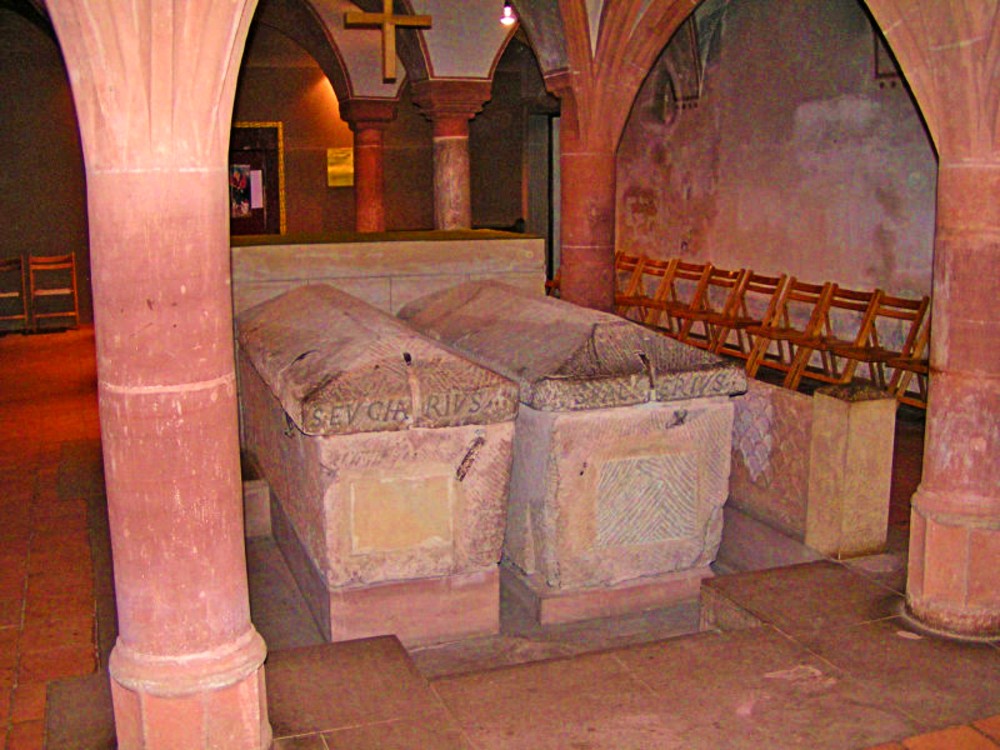
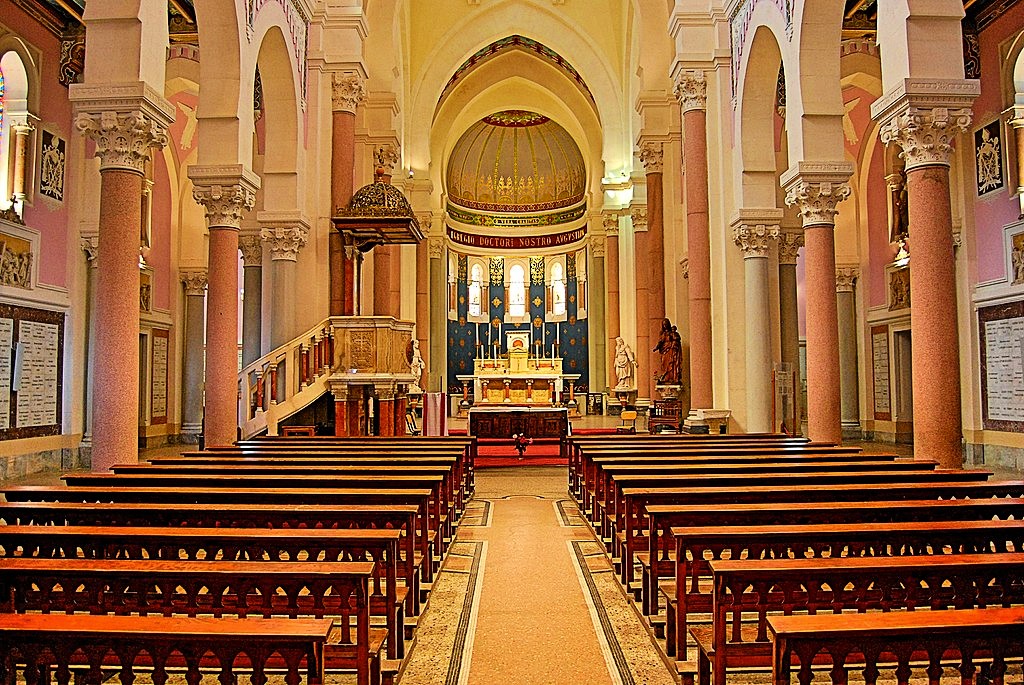
The Tombs of Saints Eucharius and Valerius at St Matthias Abbey, Trier.
According to an ancient legend, St Valerius was a follower of Saint Eucharius, the 1st Bishop of Trier. Eucharius was sent to Gaul by Saint Peter as the Bishop, together with the Deacon Valerius and the Subdeacon Maternus, to preach the Gospel.
They came to the Rhine and to Ellelum in Alsace, where Maternus died. His two companions hastened back to St Peter and begged him to restore the dead man to life. St Peter gave his pastoral staff to Eucharius and, upon being touched with it, Maternus, who had been in his grave for forty days, returned to life. The pagans then converted in large numbers. After founding many Churches, the three companions went to Trier, where evangelising progressed so rapidly that Eucharius chose that City for his Episcopal residence. An Angel announced to him his approaching death and pointed to Valerius as his successor.
Valerius was the Bishop for fifteen years and was succeeded by St Maternus, who had, in the meantime, founded the Diocese of Cologne and Tongeren, remaining the Bishop of the 3 Sees for forty years. The staff of St Peter, with which he had been raised to life, was preserved at Cologne until the end of the 10th Century, when the upper half was presented to Trier and was afterwards taken to Prague by Emperor Charles IV.
Valerius was buried with St Eucharius in Eucharius’ Church, today’s Abbey of St Matthias in Trier.
NOVENA In Preparation for the Feast of the Purification of the Blessed Virgin Mary – LINK to DAY SIX, 29 January: DAY SIX 29 JANUARY:
St Abundantia the Martyr St Aphraates St Aquilinus of Milan St Barbea of Edessa St Blath of Kildare Bl Boleslawa Maria Lament St Caesarius of Angoulême Bl Charles of Sayn
Thought for the Day – 28 January – Meditations on the Hidden Life: From the 1906 Edition of The Heart of Jesus of Nazareth; it has the Imprimatur of Bishop John Baptist Butt, Diocese of Southwark, England, 5 February 1890. Author’s name known simply as Author of “The Voice of the Sacred Heart.” (We return to Fr Clarke for February with his Meditations on The Great Truths.)
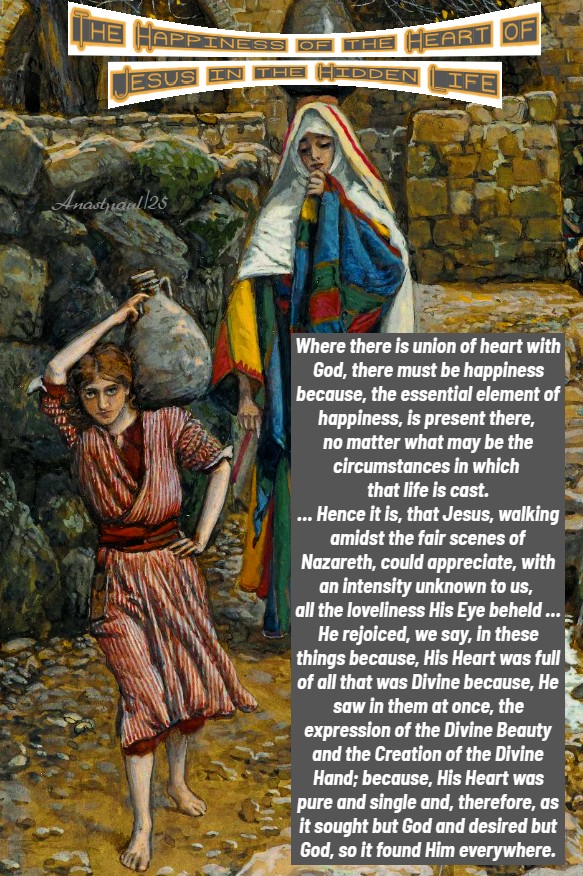
Meditation 5, PART ONE: The Happiness of the Heart of Jesus in the Hidden Life
Where there is union of heart with God, there must be happiness because, the essential element of happiness, is present there, no matter what may be the circumstances in which that life is cast.
We intend in this Meditation to reflect on some of the sources of happiness, wherein we ourselves, may share with the human Heart of God. In the Beginning, when He had finished the Work of Creation, Holy Scripture tells us – “God saw all the things He had made and they were very good.” (Genesis 1:31) These words are suggestive of the Divine complacency in the beautiful Work accomplished and we recognise, a reproduction of this sublime joy of the Creator, in the appreciation, with which, the Heart of Jesus contemplated the works of Nature.
The perception of the beautiful is a Divine lineament which sin has never been able to utterly erase from the human soul but which, is more strikingly developed, in proportion to that purity of heart which imparts judgement, as to the source from whence, all created beauty emanates: “Blessed are the clean of heart, for they shall see God.” Now what heart was ever comparable in purity and singleness to the human Heart of the Man-God?
Hence it is, that Jesus, walking amidst the fair scenes of Nazareth, could appreciate, with an intensity unknown to us, all the loveliness His Eye beheld; just as years afterwards, when, fatigued with the labours of the day, He found refreshment on the shaded slopes of Olivet and holy joy, as His Eye wandered over the blue waters of Genesereth, sparkling in the sunlight.
He rejoiced, we say, in these things because, His Heart was full of all that was Divine because, He saw in them at once, the expression of the Divine Beauty and the Creation of the Divine Hand;because, His Heart was pure and single and, therefore, as it sought but God and desired but God, so it found Him everywhere.
Lastly, He rejoiced in all Creation, inasmuch, as He saw in it, the Work of His Own Hand by reason of His unity of operation with the Father, resulting from the unity of the Divine Nature.
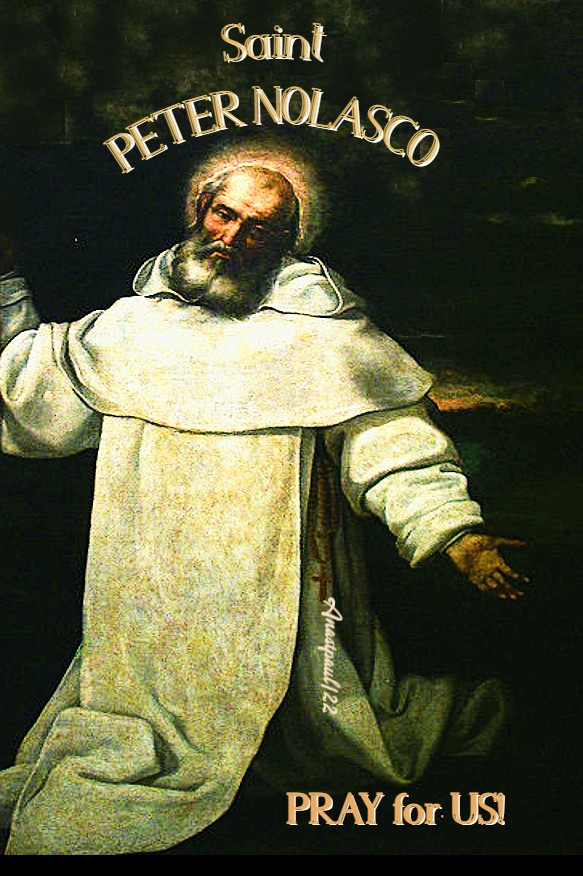
Quote/s of the Day – 28 January – St Peter Nolasco OdeM (c 1182–c 1256) Confessor, Founder – 1 Corinthians 4:9-14, Luke 12:32-34 – Scripture search here: https://www.drbo.org/
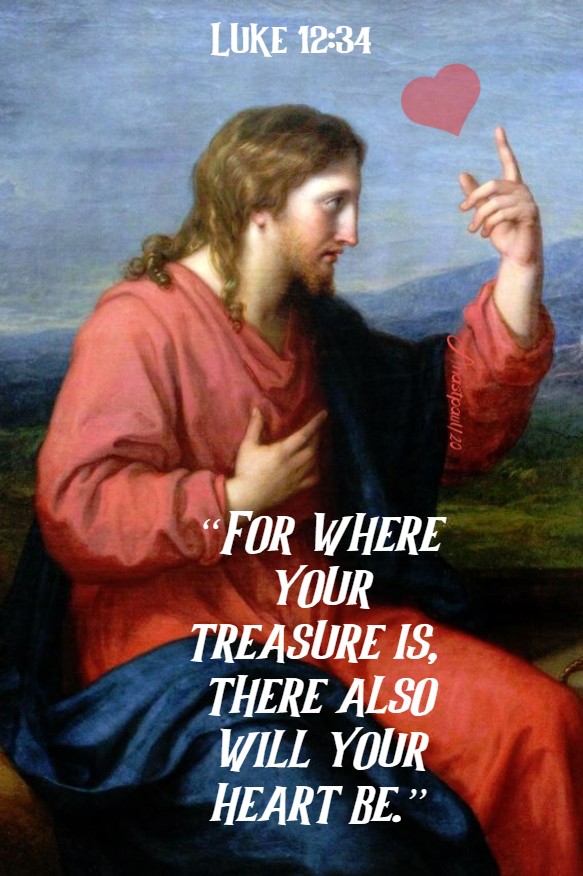
“For where your treasure is, there will your heart be too.”
Luke 12:34
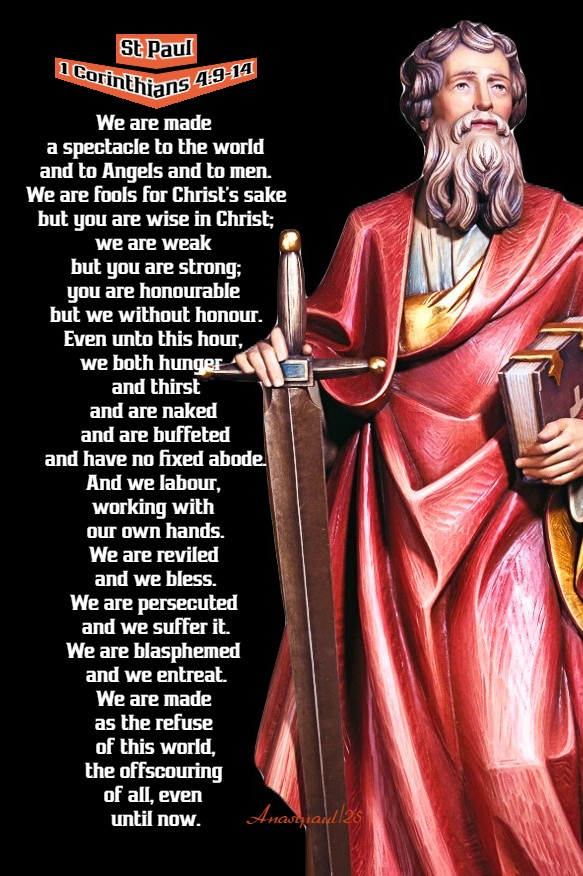
“We are made a spectacle to the world and to Angels and to men. We are fools for Christ’s sake but you are wise in Christ; we are weak but you are strong; you are honourable but we without honour. Even unto this hour, we both hunger and thirst and are naked and are buffeted and have no fixed abode. And we labour, working with our own hands. We are reviled and we bless. We are persecuted and we suffer it. We are blasphemed and we entreat. We are made as the refuse of this world, the offscouring of all, even until now.”
St Paul – 1 Corinthians 4:9-14
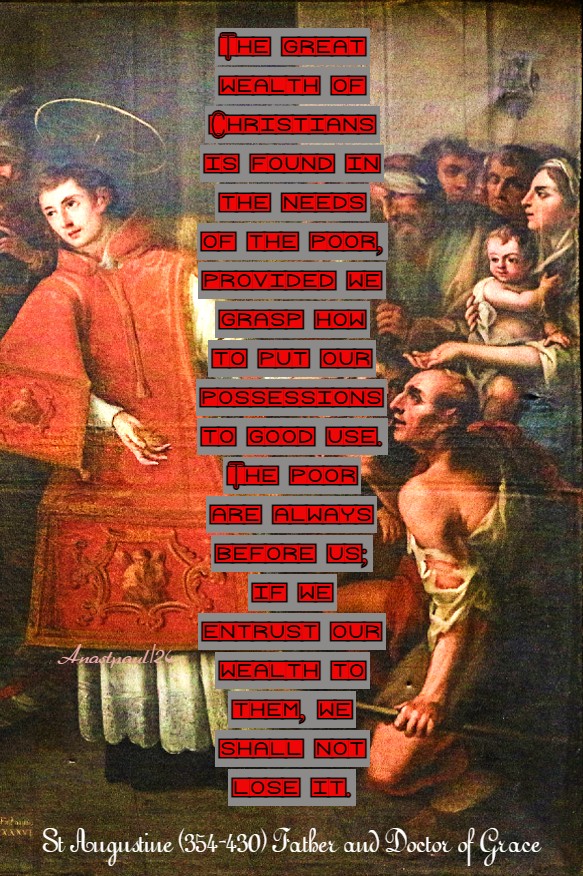
“The great wealth of Christians is found in the needs of the poor, provided we grasp how to put our possessions to good use. The poor are always before us; if we entrust our wealth to them, we shall not lose it.”
St Augustine (354-430) Father and Doctor of Grace
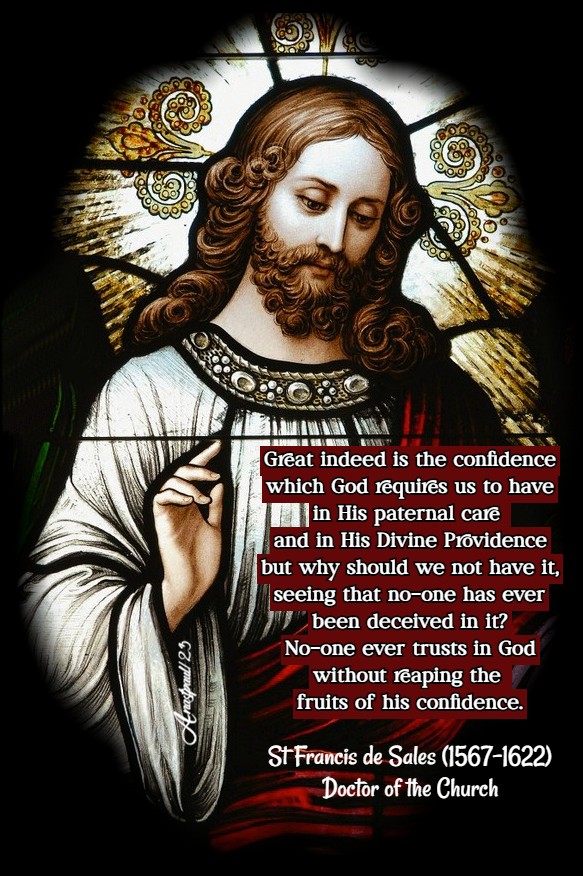
“Great indeed is the confidence which God requires us to have in His paternal care and in His Divine Providence but why should we not have it, seeing that no-one has ever been deceived in it? No-one ever trusts in God without reaping the fruits of his confidence.”
St Francis de Sales (1567-1622) Doctor of the Church
One Minute Reflection – 28 January – “The Month of the Holy Name of Jesus and the Holy Family” – St Peter Nolasco OdeM (c 1182–c1256) Confessor, Founder – 1 Corinthians 4:9-14; Luke 12:32-34 – Scripture search here: https://www.drbo.org/
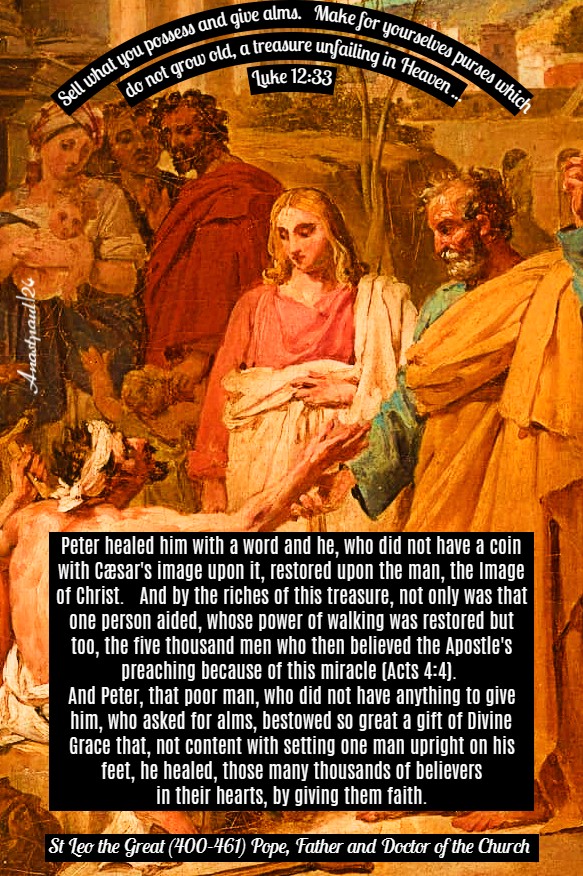
“Sell what you possess and give alms. Make for yourselves purses which do not grow old, a treasure unfailing in Heaven, where neither thief draws near, nor moth destroys.” – Luke 12:33
REFLECTION – “Blessed are the poor in spirit, for theirs is the Kingdom of Heaven” (Mt 5:3) … Of this generous poverty, the Apostles first, after the Lord, have given us example. Unhesitatingly leaving all they had, at the Voice of the Heavenly Master, they were joyfully converted and abandoned the catching of fish, to become fishers of men (Mt 4:18). Among the latter, many became like themselves, by imitating their faith; for with those first children of the Church, “the community of believers was of one heart and mind” (Acts 4:32). Stripped of all their possessions, they were enriched with eternal goods, thanks to holy poverty. Welcoming the Apostles’ preaching, they rejoiced to have nothing in this world and yet, possess all things in Christ. (2 Cor 6:10).
Hence, the blessed Apostle Peter, when he was going up to the temple and was asked for alms by a lame man, said, “I have neither silver nor gold but what I do have I give you; in the Name of Jesus Christ the Nazorean, rise and walk” (Acts 3:6)… Peter healed him with a word and he, who did not have a coin with Cæsar’s image upon it, restored upon the man, the Image of Christ. And by the riches of this treasure, not only was that one person aided, whose power of walking was restored but too, the five thousand men who then believed the Apostle’s preaching because of this miracle (Acts 4:4). And Peter, that poor man, who did not have anything to give him, who asked for alms, bestowed so great a gift of Divine Grace that, not content with setting one man upright on his feet, he healed, those many thousands of believers in their hearts, by giving them faith.” – St Leo the Great (400-461) Pope, Father and Doctor of the Church (Sermon 95 2-3).
PRAYER – O God, Thou Who, as an example of Thy love, divinely taught St Peter to enrich Thy Church with new offspring, a family of Religious devoted to the ransom of the faithful, grant by his intercession that we may be released from the slavery of sin and rejoice in lasting freedom in Heaven. Through Jesus Christ, Thy Son our Lord, Who lives and reigns with Thee, in the unity of the Holy Ghost, God, world without end. Amen (Collect).
Our Morning Offering – 28 January – “The Month of the Holy Name of Jesus and the Holy Family”
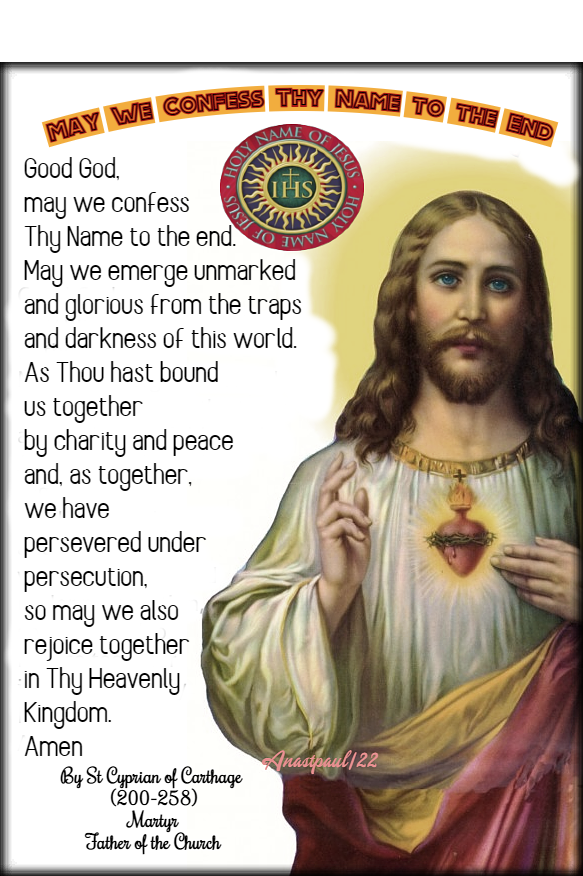
May We Confess Thy Name to the End By St Cyprian of Carthage (200-258) Bishop and Martyr Apostolic Father of the Church
Good God, may we confess Thy Name to the end. May we emerge unmarked and glorious from the traps and darkness of this world. As Thou hast bound us together by charity and peace and, as together, we have persevered under persecution, so may we also rejoice together in Thy Heavenly Kingdom. Amen
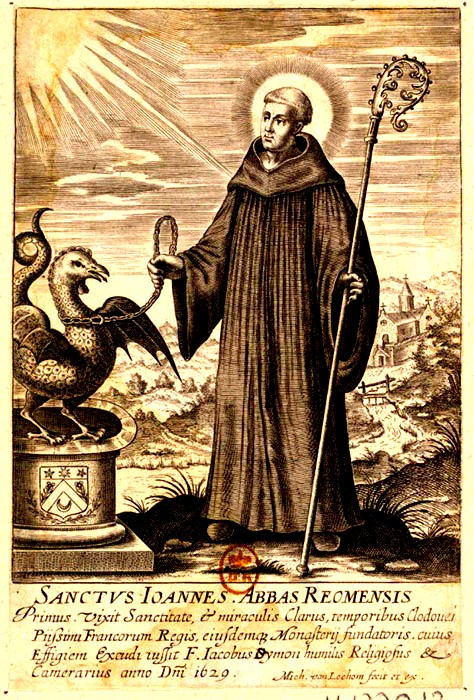
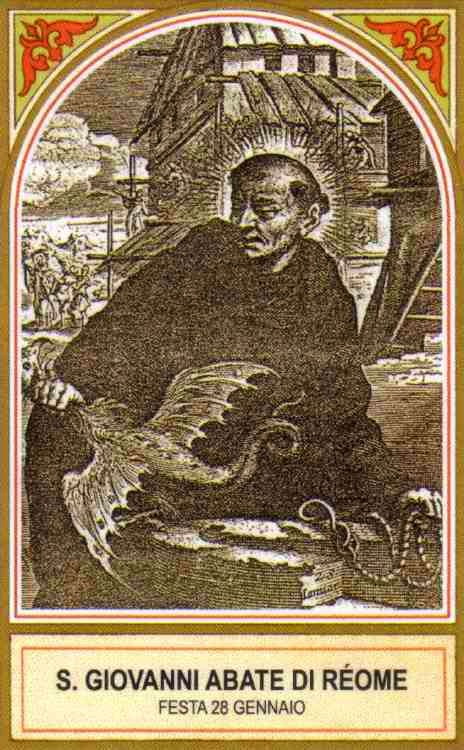
Saint of the Day – 28 January – Saint John of Réomay (c425-c539) Founder Abbot of the Monastery of Réomay, Priest, Hermit, Reformer. Born in Dijon around 425 and died there at his Monastery, of natural causes in c539. Also known as – Jean, Giovanni.
The Roman Martyrology reads today: “In the Monastery of Rheims, the demise of a holy Priest name John, a man of God,”
Son of a senator of Dijon, Hilary and his wife, Quieta, John was born in Courtangy, a family property near Dijon. At the age of twenty, he left his home after having built a Chapel dedicated to Saint Stephen in the family property at Courtangy which later became a Parish. He went into the nearby forest and lived alone among the ruins of Roman buildings. All this happened around the years 460-465.
Soon becoming a popular source of spiritual guidance, John was joined by some disciples, He became the leader of a community and founded the renowned Monastery of Réomay. Then, becoming overwhelmed by the burdens of administration and governing, he fled to Lérins Monastery, at that time, one of the centres of expansion of western monasticism. Without revealing his identity, John enjoyed peace and a prayerful solitude, until a traveller recognised him and he was recalled by the Bishop of Langres, on whom he depended (the Vita calls him Gregory, 507-539).
But sadly he found that the Monks had become lax in their practices and he had to reform it by applying the Rule followed in Lerins (that of St Macarius). The Frankish Kings protected the Monastery of Réomay which became a place of reference and where great and holy figures passed through.
John is credited with several miracles, the best known being that of having returned the water to a necessary well and evicting the resident basilisk dragon which creature you see on the images of our Saint.
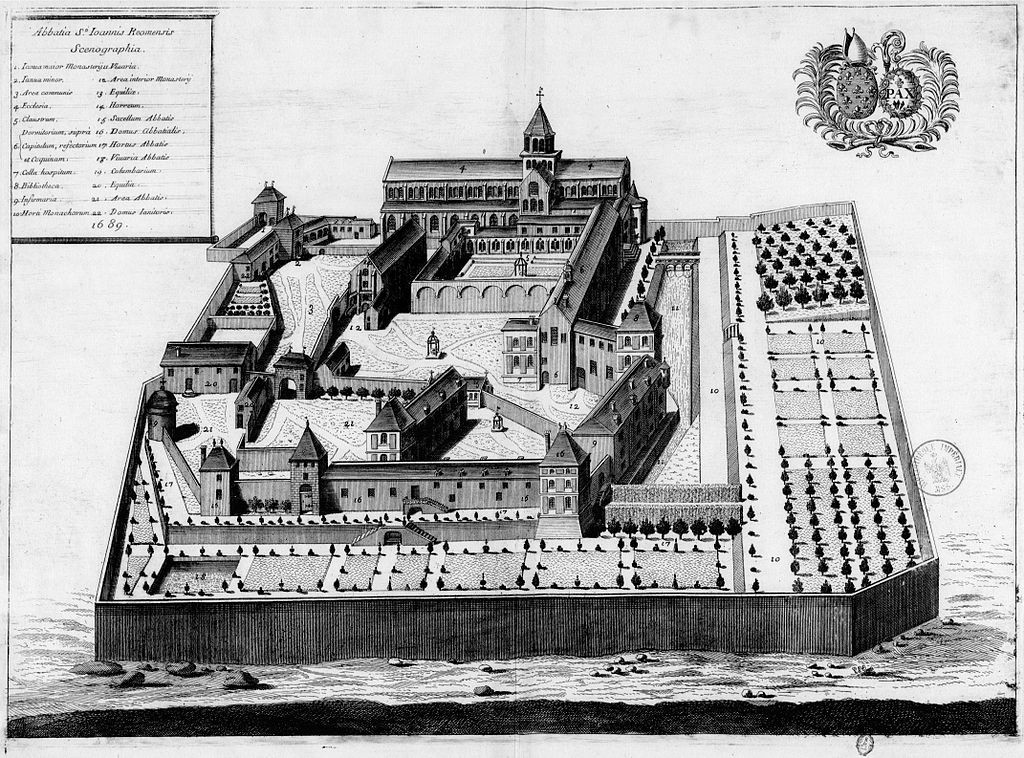
John died a centenarian shortly in 539. Jonah of Bobbio , his biographer, attributes to him one hundred and twenty years. His body, first buried in the territory of the Abbey, was later included within the walls of a Basilica which became a place of burial (the Church of Saint Maurice of Corsaint, corpus sanctum). Around 580, his fourth successor, the Abbot Leopardin, raised John’s body and transferred it to the Altar. Finally, after the reconstruction of the Monastery in the current village of Moutier-Saint-Jean, the Bishop of Langres, Betta (790-820) brought him to the new Abbey a few kilometers from the original burial site. St John’s is celebrated in Réomay today with the rest of the Church.
NOVENA In Preparation for the Feast of the Purification of the Blessed Virgin Mary – LINK to DAY FIVE, 28 January: DAY FIVE, 28 JANUARY
The Second Feast of St Agnes: 28 January is traditionally the day of the “Second Feast of St Agnes,” although this very ancient observance was reduced to a commemoration in 1931 and abolished in the post-Vatican II reform (1969). It is still kept in the TGraditional Church and in some Churches dedicated to St Agnes, most prominent among them, the Basilica built over the site of her burial, less than a mile and a half from the gates of Rome. In liturgical books, the formal name of the feast is “Sanctae Agnetis secundo” which means “the feast of St Agnes for the second time.” This title is found on the calendar of the Tridentine Missal and Breviary, as also seven centuries earlier in the Gregorian Sacramentary. The single Matins lesson in the Breviary of St Pius V tells us, that after her death, Agnes appeared first to her parents to console them and then to the Emperor Constantine’s daughter Constantia, who suffered from an incurable sore, while she was praying at her grave, exhorting Constantia to trust in Christ and receive Baptism. Having done this and been cured, Constantia later built a Basilica in the Saint’s honour.
St Aemilian of Trebi Bl Amadeus of Lausanne St Antimus of Brantôme St Archebran Bl Bartolomé Aiutamicristo St Brigid of Picardy St Callinicus St Cannera of Inis Cathaig Blessed Charlemagne (a decree of Canonisation was issued by the anti-pope Paschal III but this was never ratified by valid authority.) St Constantly St Flavian of Civita Vecchia St Glastian of Kinglassie St James the Almsgiver St James the Hermit St John of Réomay (c425-c539) Abbot
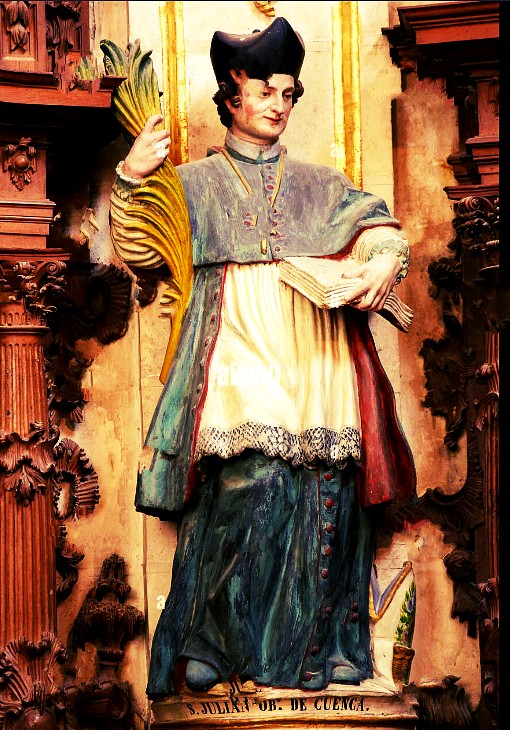
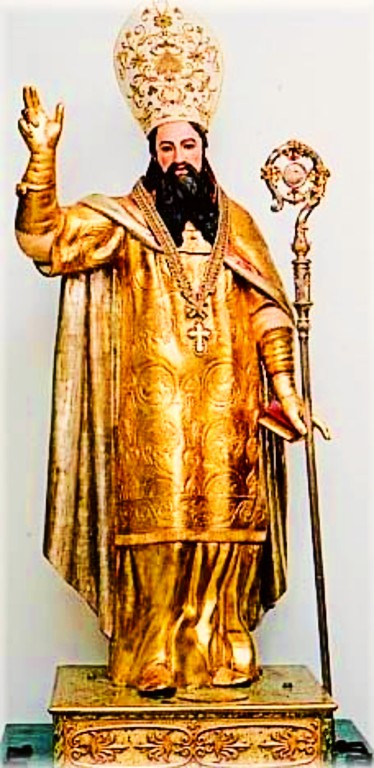
St Julian of Cuenca (c 1127-1208) Bishopof Cuenca (1127-1208) the second Bishop of Cuenca, Spain from c 1196 until his death. Professor, Hermit, Reformer, Miracle-worker, basket-weaver using the money he gained from this trade to support the poor and needy, He was also a regular visitor to prisoners, assisting them spiritually and with material succour. Born as Julián Ben Tauro in c 1127 at Burgos, Spain and died on 28 January 1208 in Cuenca, Spain of natural causes, aged around 80 years. Patronages – basket-weavers, for rain, of the City and Diocese of Cuenca. This Devoted Shepherd: https://anastpaul.com/2023/01/28/saint-of-the-day-28-january-saint-julian-of-cuenca-1127-1208-bishop/
St Leucius of Apollonia St Maura of Picardy Bl Odo of Beauvais St Palladius of Antioch St Paulinus of Aquileia St Richard of Vaucelles St Thyrsus of Apollonia
Martyrs of Alexandria: A group of 4th-century lay faithful in Alexandria, Egypt. During the celebration of Mass one day an Arian officer named Syrianus led a troop of soldiers into their church and proceded to murder all the orthodox Christians in the place. 356 in Alexandria, Egypt.
Thought for the Day – 27 January – Meditations on the Hidden Life: From the 1906 Edition of The Heart of Jesus of Nazareth; it has the Imprimatur of Bishop John Baptist Butt, Diocese of Southwark, England, 5 February 1890. Author’s name known simply as Author of “The Voice of the Sacred Heart.” (We return to Fr Clarke for February with his Meditations on The Great Truths.)
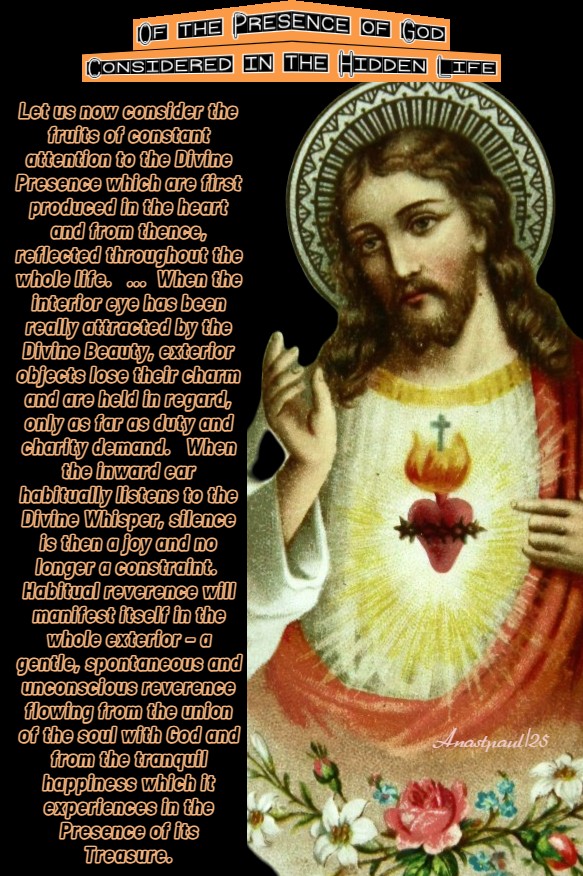
Meditation 4, Part Two – Of the Presence of God Considered in the Hidden Life
Let us now consider the fruits of constant attention to the Divine Presence which are first produced in the heart and from thence, reflected throughout the whole life.
The Soul of Jesus looked ever upon the Father’s Face and, as He looked, the flames of love rose ever higher within His Sacred Heart. This is the testimony which He gives of Himself: “He Who sent Me, is with Me and He hath not left Me alone; for I do always, the things which please Him.” (John 8:29)
If a servant, from the motive of fear, performs with care and attention those things which please his master, when he is conscious of that master’s presence, how much more will the faithful soul, do this from a motive of love in the Presence of our Father in Heaven. Such will be the first result of this holy exercise. The more habitually it is practiced, the more constant too, will be the practice of virtue, since the soul’s first desire will be ,to “do always the things which please” the Divine object of its love, of Whose Presence, it is so conscious.
It must be remarked, however, the actions which flow from this holy recollection in God, have, in them, nothing forced, nothing constrained. “Where the Spirit of the Lord is, there is liberty.” (2 Corinthians 3:17) The heart and mind are really where their treasure is, that is, in God and in those things which refer to His honour and glory and, this is true recollection, widely different from that studied and simply external modesty which is often exaggerated, maintained with effort and which is perhaps, sometimes assumed, through spiritual vanity.
When the interior eye has been really attracted by the Divine Beauty, exterior objects lose their charm and are held in regard, only as far as duty and charity demand. When the inward ear habitually listens to the Divine Whisper, silence is then a joy and no longer a constraint. Habitual reverence will manifest itself in the whole exterior – a gentle, spontaneous and unconscious reverence flowing from the union of the soul with God and from the tranquil happiness which it experiences in the Presence of its Treasure.
Let us, then, beg a lively faith in the Divine Presence and the grace to acquire the sanctifying habit of walking constantly within It, so that, with truth, we may say to God: “I am always with Thee.” Then will virtues flourish in our souls, beneath that genial influence, like flowers beneath the sun. Thus shall we grow in likeness to Jesus and make advance in our union with His Sacred Heart.
Quote/s of the Day – 27 January – St John Chrysostom (347-407) Bishop, Confessor, Father and Doctor of the Church “Golden Mouthed.”
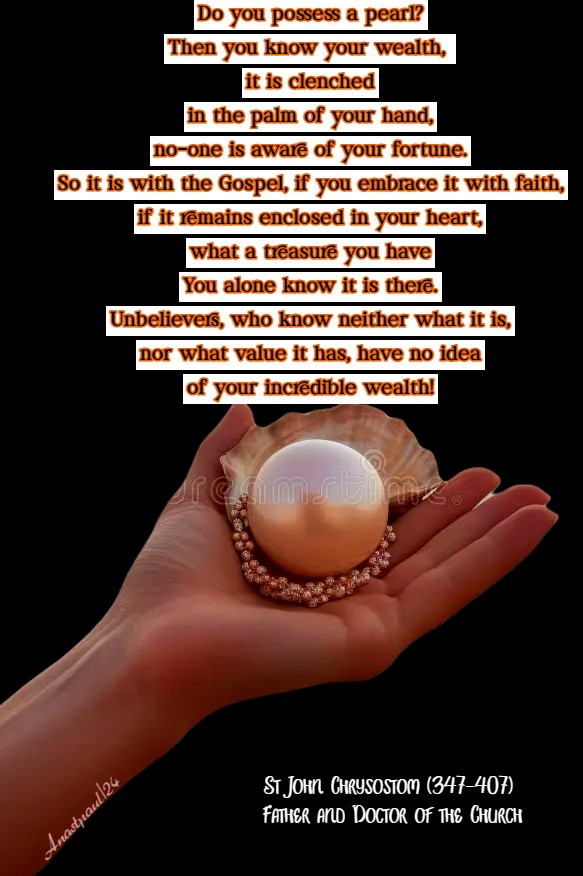
“Do you possess a pearl? Then you know your wealth, it is clenched in the palm of your hand, no-one is aware of your fortune. So it is with the Gospel, if you embrace it with faith, if it remains enclosed in your heart, what a treasure you have You alone know it is there. Unbelievers, who know neither what it is, nor what value it has, have no idea of your incredible wealth!”
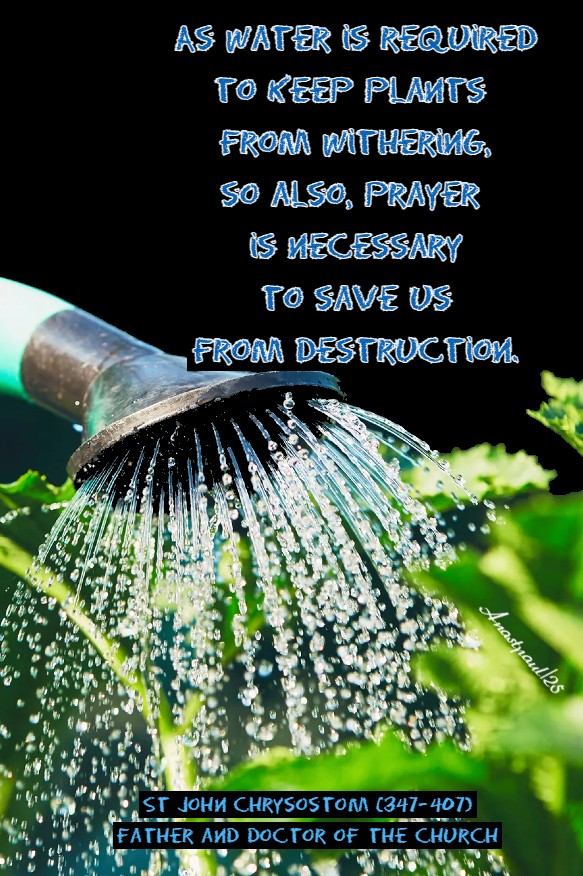
“As water is required to keep plants from withering, so also, prayer is necessary to save us from destruction.”
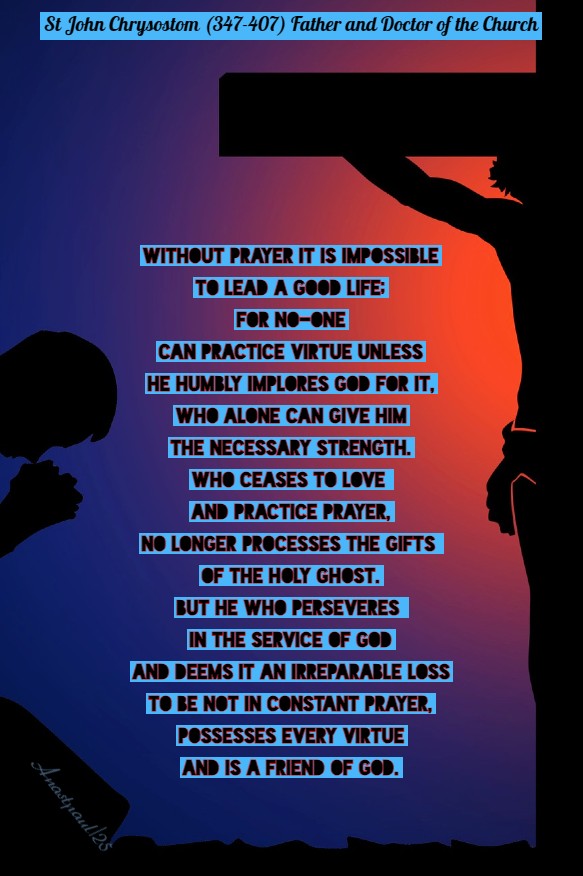
“Without prayer it is impossible to lead a good life; for no-one can practice virtue unless he humbly implores God for it, Who alone can give him the necessary strength. Who ceases to love and practice prayer, no longer processes the gifts of the Holy Ghost. But he who perseveres in the service of God and deems it an irreparable loss to be not in constant prayer, possesses every virtue and is a friend of God.”
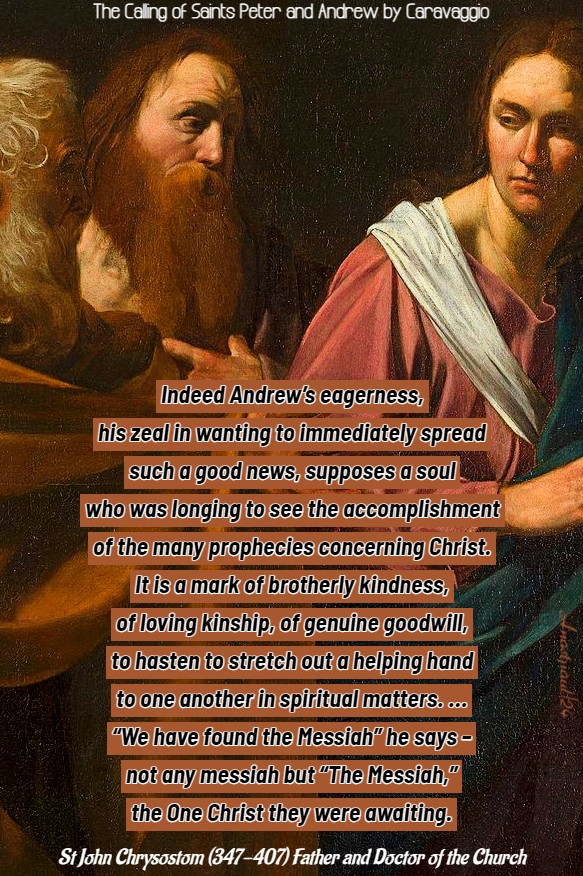
“Indeed Andrew’s eagerness, his zeal in wanting to immediately spread such a good news, supposes a soul who was longing to see the accomplishment of the many prophecies concerning Christ. It is a mark of brotherly kindness, of loving kinship, of genuine goodwill, to hasten to stretch out a helping hand to one another in spiritual matters. … “We have found the Messiah” he says – not any messiah but “The Messiah,” the One Christ they were awaiting.”
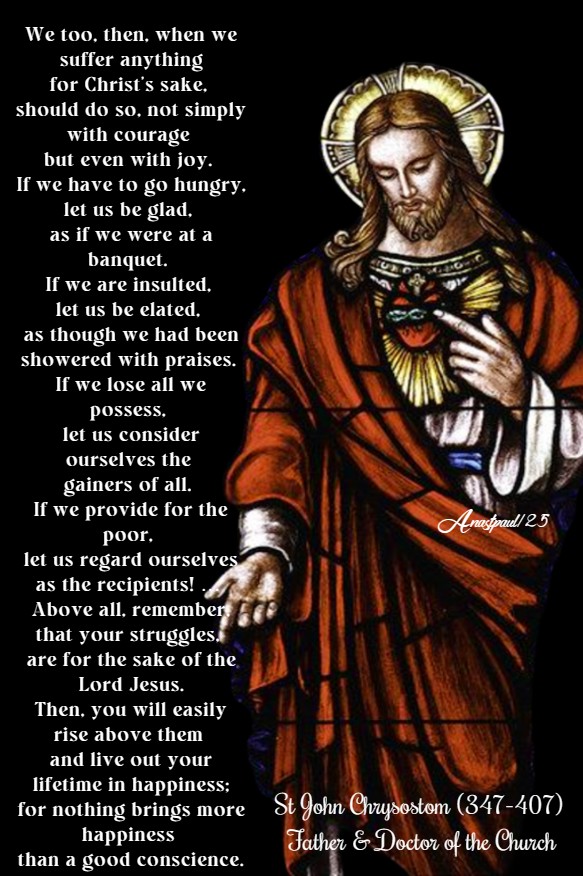
“We too, then, when we suffer anything for Christ’s sake, should do so, not simply with courage but even with joy. If we have to go hungry, let us be glad, as if we were at a banquet. If we are insulted, let us be elated, as though we had been showered with praises. If we lose all we possess, let us consider ourselves the gainers of all. If we provide for the poor, let us regard ourselves as the recipients! … Above all, remember, that your struggles, are for the sake of the Lord Jesus. Then, you will easily rise above them and live out your lifetime in happiness; for nothing brings more happiness than a good conscience.”
“Are we going to neglect our own salvation? Let us show great compassion towards the poor so as to be made worthy of possessing good things to come for all eternity!”
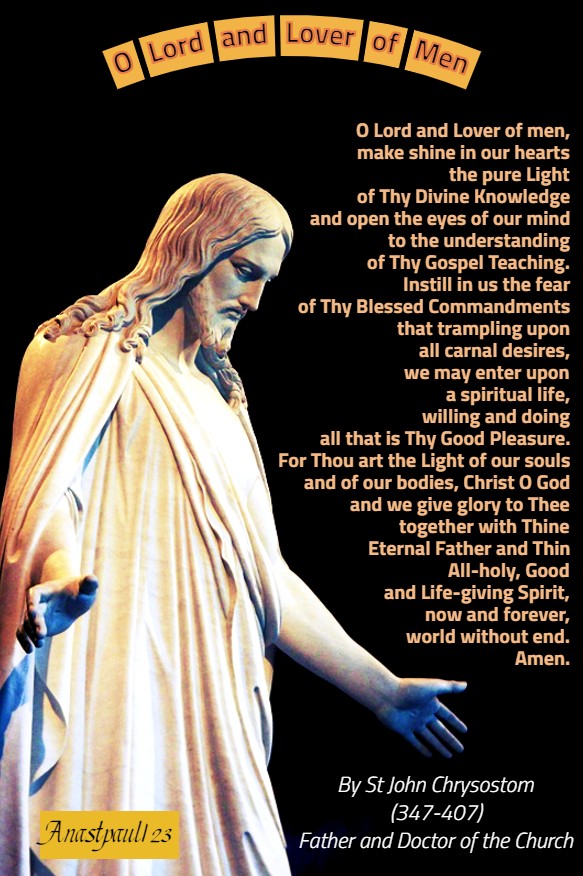
O Lord and Lover of Men By St John Chrysostom (347-407) Father and Doctor of the Church
O Lord and Lover of men, make shine in our hearts the pure Light of Thy Divine Knowledge and open the eyes of our mind to the understanding of Thy Gospel teaching. Instill in us the fear of Thy Blessed Commandments that trampling upon all carnal desires, we may enter upon a spiritual life, willing and doing all that is Thy Good Pleasure. For Thou art the Light of our souls and of our bodies, Christ O God and we give glory to Thee together with Thine Eternal Father and Thine All-holy, Good and Life-giving Spirit, now and forever, world without end. Amen
One Minute Reflection – 27 January – “The Month of the Holy Name of Jesus and the Holy Family” – St John Chrysostom (347-407) Bishop, Confessor, Father and Doctor of the Church “Golden Mouthed” – 2 Timothy 4:1-8, Matthew 5:13-19 – Scripture search here: https://www.drbo.org/
“Jesus said to His disciples: “You are the salt of the earth. … You are the light of the world.” – Matthew 5:13, 14
REFLECTION – “You are the salt of the earth. It is not for your own sake, He says but for the world’s sake that the word is entrusted to you. I am not sending you into two cities only or ten or twenty, not to a single nation, as I sent the Prophets of old but across land and sea, to the whole world. And that world is in a miserable state. For when He says: You are the salt of the earth, He is indicating, that all mankind had lost its savour and had been corrupted by sin. Therefore, He requires of these men, those virtues which are especially useful and even necessary, if they are to bear the burdens of many. For the man who is kindly, modest, merciful and just ,will not keep his good works to himself but will see to it, that these admirable fountains send out their streams, for the good of others. Again, the man who is clean of heart, a peacemaker and ardent for truth, will order his life so as to contribute to the common good. …
Then He passes onto a more exalted comparison – You are the light of the world. Once again, “of the world,” not of one nation or twenty cities but of the whole world. The light He means, is an intelligible light, far superior to the rays of the sun we see, just as the salt is a spiritual salt. First salt, then light, so that you may learn how profitable sharp words may be and how useful, serious doctrine. Such teaching holds in check and prevents, dissipation, it leads to virtue and sharpens the mind’s eye. A City set on a hill cannot be hidden, nor do men light a lamp and put it under a basket. Here again, He is urging them to a careful manner of life and teaching them, to be watchful, for they live under the eyes of all and have the whole world for the arena of their struggles.” – St John Chrysostom (347-407) Archbishop of Constantinople, Father and Doctor of the Church (An excerpt from his Homily on Matthew).
PRAYER – May heavenly grace, we beseech Thee, O Lord, prosper Thy Church, which Thou mercifully enlightened by the blessed virtues and teachings of glorious and blessed John Chrysostom, Thy Confessor and Bishop. Through Jesus Christ, Thy Son our Lord, Who lives and reigns with Thee, in the unity of the Holy Ghost, God, world without end. Amen (Collect).
Our Morning Offering – 27 January – “The Month of the Holy Name of Jesus and the Holy Family” – St John Chrysostom (347-407) Bishop, Confessor, Father and Doctor of the Church “Golden Mouthed.”
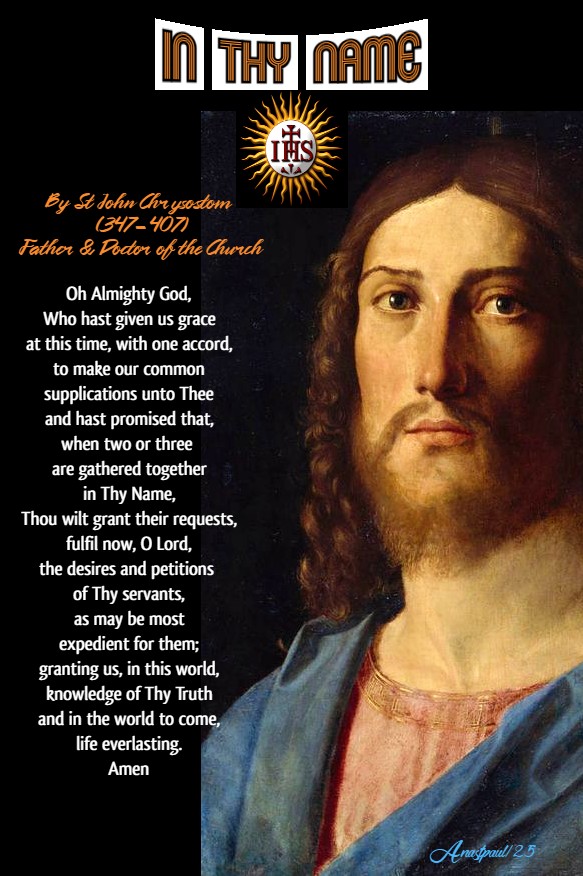
In Thy Name By St John Chrysostom (347-407) Father and Doctor of the Church
Oh Almighty God, Who hast given us grace at this time, with one accord, to make our common supplications unto Thee and hast promised that, when two or three are gathered together in Thy Name, Thou wilt grant their requests, fulfil now, O Lord, the desires and petitions of Thy servants, as may be most expedient for them; granting us, in this world, knowledge of Thy Truth and in the world to come, life everlasting. Amen
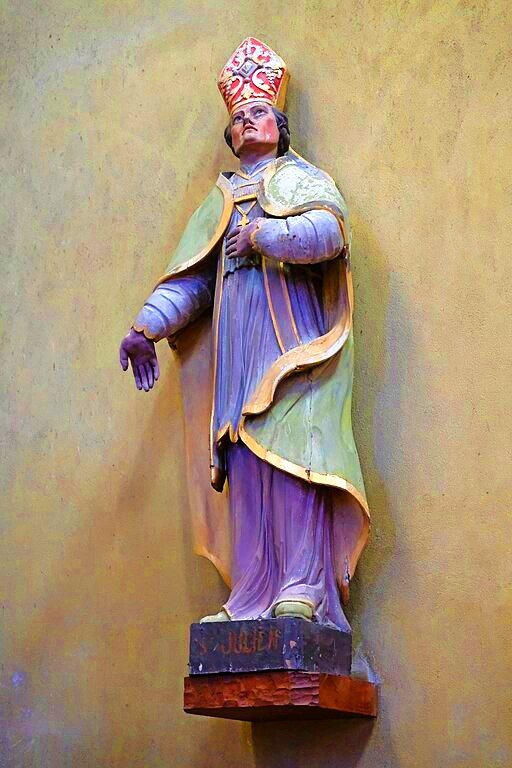
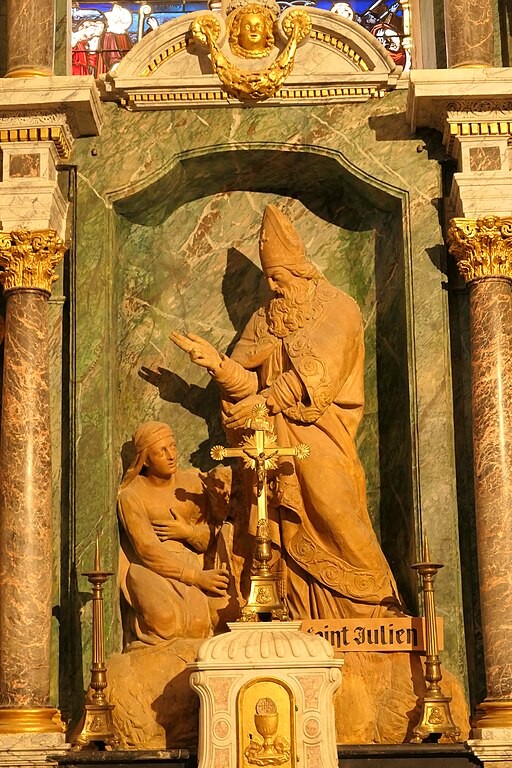
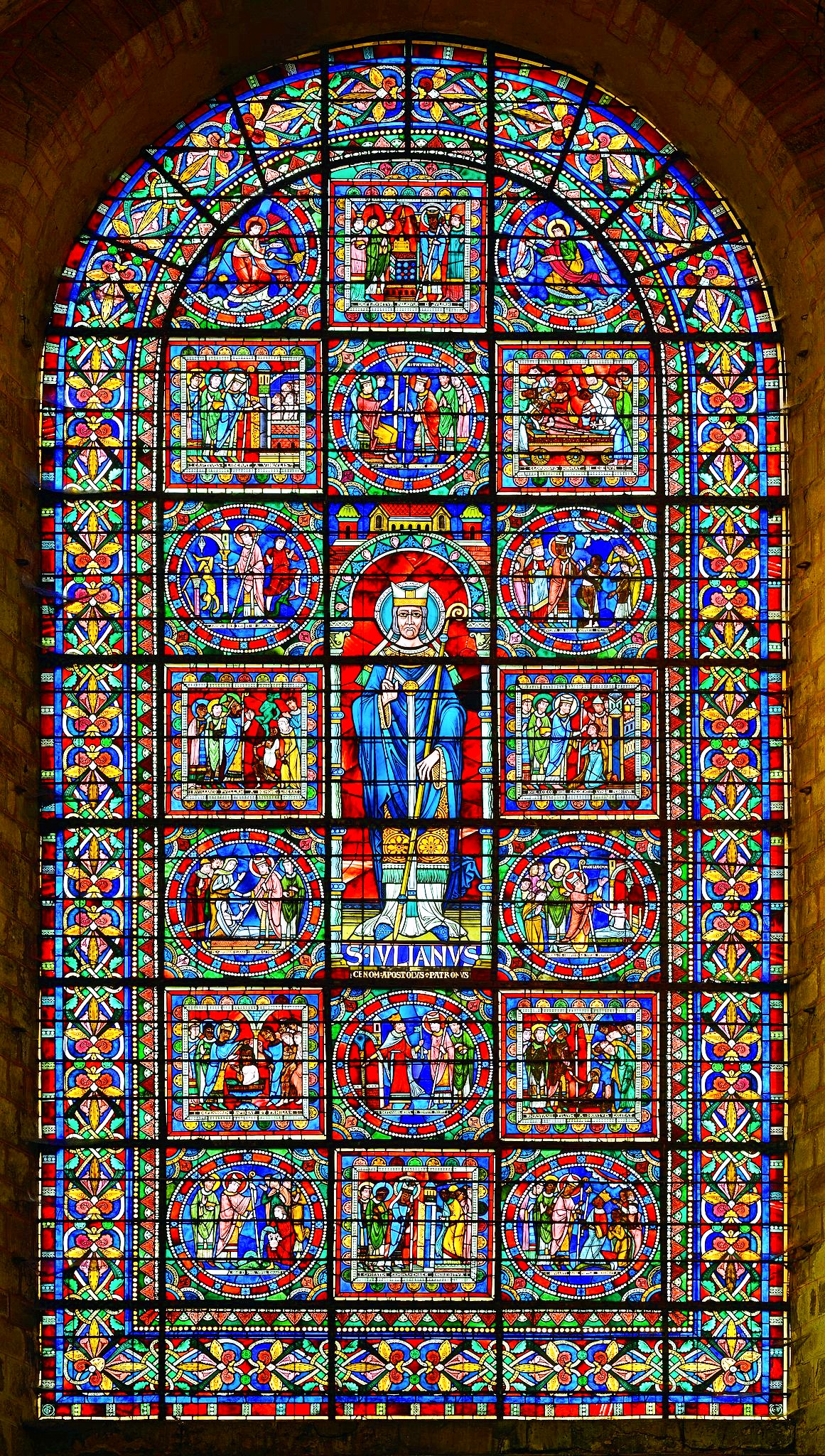
Saint of the Day – 27 January – Saint Julian (Died 3rd or 4th Century) the 1st Bishop of Le Mans. Died in the 3rd or 4th Century at Sarthe, Gaul (modern Sant-Marceaux, France) of natural causes . Patronages – Beaumont, Belgium; Castrovillari, Italy; Le Mans, France; Pollina, Italy. Also known as – Julien du Mans, Iulianus, Juliani.
The Roman Martyrology reads today: “At Le Mans, the demise of St Julian, the first Bishop of that City, who was sent thither by St Peter, to preach the Gospel.”
The oldest account of Julian’s life, the Gesta Domini Juliani, is found in the famous work entitled, Actus Pontificum Cenomannis in Urbe Degentium. Now, these Actus, undoubtedly composed between 840 and 857, are the work of an unscrupulous forger, only concerned with defending the rights and possessions of the Church of Le Mans at the time he wrote which is why, his biography is completely false and discounted.
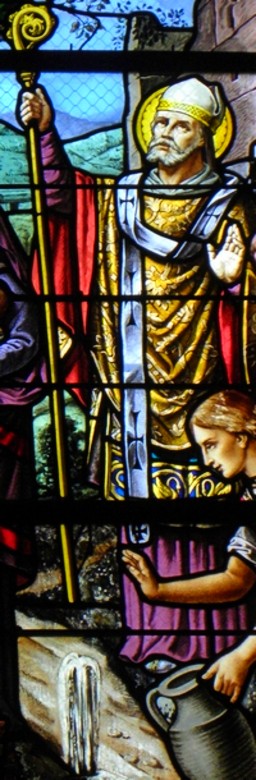
According to this source, Julian, after having been one of the 72 disciples, was Consecrated as Bishop by the Pope St Clement of Rome and sent to Gaul. Arriving at the gates of the City of Le Mans, he miraculously made a fountain gush forth. The inhabitants converted in crowds and, especially the local authorities, who made Julian innumerable donations carefully enumerated in the above-mentioned writing. The Bishop, after 7 years, went on a pilgrimage to Rome, from where he returned laden with Relics. These Relics produced many miracles which, in turn, caused conversions. Julian also created 90 rural Parishes and this was easy for him because, in 27 Ordinations, he Consecrated 176 Priests, 22 Deacons and, as many Sub-deacons. Finally, after an Episcopate of 47 years, he died on 28 January.
None of the above Vita, can be considered reliable. It must be remembered that the claims of the Churches to apostolicity, that is, to have a Founder who can be directly linked to Apostolic times, are a fact of the 8th and 9th Centuries which finds its explanation, without doubt, in local vanity but, at the same time, in the very great prestige the Church of Rome enjoyed at that time.
To know something about Julian, then, we must consult indirect sources. We know from the will of St Bertrand, the Bishop of Le Mans (616), that there existed, at that time, a suburban Church dedicated to St Julian the Bishop. In 832, an imperial charter informs us that the building still existed and that it was served by a small Monastery. This Church has been identified; it is located on the site of the Church of Le Pré which, before the Revolution, had a small Crypt in the form of a confessional which can undoubtedly be dated to the end of the 4th Century, or the beginning of the 5th. This is the Clue which leads us to place Julian in the 4th Century.
The tradition which makes him the 1st Bishop of Le Mans and which attributes the foundation of the Cathedral to him, can also be accepted. The fact of his lengthy and zealous career as a true shepherd of his flock, too must be regarded as authentic. We note, however, that the cult of St Julian developed only later.
In 1254, things changed, when the above-mentioned legend of Julian’s Apostolic mission was born. Between 841 and 850 his body was transported from the Church of Le Pré to the Cathedral, the cult assumed ever more intense proportions, until in the 11th Century, St Julian had by then become famous.
The Feast is fixed on 27 January. The Cathedral of Le Mans, after having borne the name of Our Lady, then of Sts Gervase and Protasus, is currently dedicated to St Julian, whose cult developed greatly in England too, thanks to the Normans.
NOVENA In Preparation for the Feast of the Purification of the Blessed Virgin Mary – LINK to DAY FOUR, 27 January: DAY FOUR, 27 January
St John Chrysostom (347-407) Bishop, Confessor, Father and Doctor of the Church – “Golden Mouthed,” Preacher, Orator, Writer, Theologian, Confessor. Name Meaning – God is gracious; gift of God (John), golden-mouthed (Chrysostom). The Great Golden Mouth: https://anastpaul.com/2023/01/27/saint-of-the-day-27-january-st-john-chrysostom-347-407-bishop-confessor-father-and-doctor-of-the-church/ AND: https://anastpaul.com/2017/09/13/saint-of-the-day-13-september-st-john-chrysostom-347-407-father-and-doctor-of-the-church-golden-mouthed/ (His Feast Day is today (changed in 1969 to 13 September). The Roman Martyrology states of him today: “At Constantinople, St John, Bishop, who was surnamed Chrysostom on account of his golden flow of eloquence. He greatly promoted the interests of the Christian religion by his preaching and exemplary life and, after many toils, closed his life in banishment. His sacred body was brought to Constantinople on this day in the reign of Theodosius the younger and afterwards taken to Rome and placed in the Basilica of the Prince of the Apostles. This illustrious Preacher of the Word of God, Pope Pius X declared and appointed as the Heavenly Patron of Sacred Orators.”
St Domitian of Melitene St Emerius of Bañoles St Gilduin Bl Gonzalo Diaz di Amarante St Henry de Osso y Cervello Bl John of Warneton St Julian (Died 3rd or 4th Century) Bishop St Julian of Sora St Lupus of Châlons
St Marius of Bodon Bl Michael Pini St Natalis of Ulster St Theodoric of Orléans St Pope Vitalian
Martyrs of North Africa – 30 Saints: A group of 30 Christians Martyred together by Arian Vandals. The only details to have survived are four of their names – Datius, Julian, Reatrus and Vincent. c 500 in North Africa.
Thought for the Day – 26 January – Meditations on the Hidden Life: From the 1906 Edition of The Heart of Jesus of Nazareth; it has the Imprimatur of Bishop John Baptist Butt, Diocese of Southwark, England, 5 February 1890. Author’s name known simply as Author of “The Voice of the Sacred Heart.” (We return to Fr Clarke for February with his Meditations on The Great Truths.)
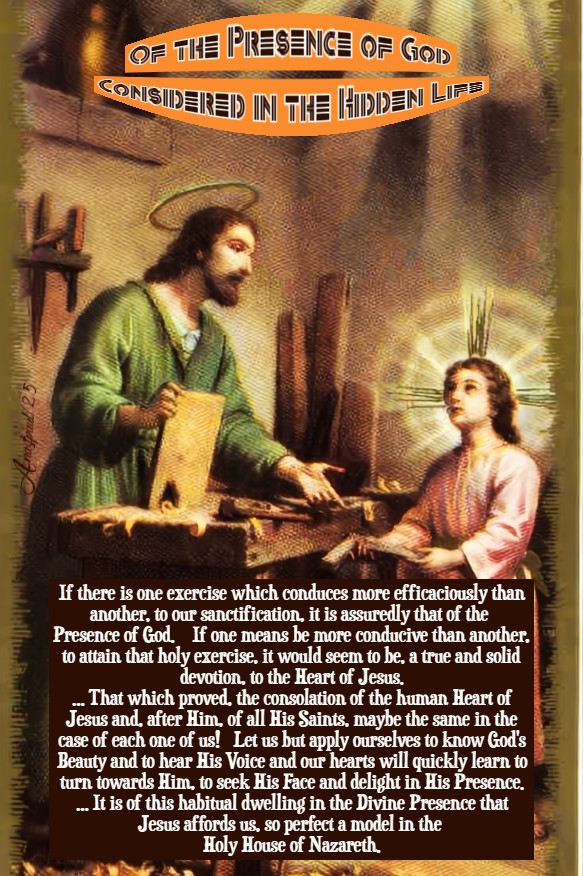
Meditation 4, Part One – Of the Presence of God Considered in the Hidden Life
If there is one exercise which conduces more efficaciously than another, to our sanctification, it is assuredly that of the Presence of God. If one means be more conducive than another, to attain that holy exercise, it would seem to be, a true and solid devotion, to the Heart of Jesus. His most holy Soul, being united to the Word, never lost the view of the Beatific Vision, although, the beatitude and the joy of that Vision, were by a miracle, withheld from overflowing into the lower functions of His Soul, in order that He might be able to suffer, in His Humanity.
The nearest resemblance to our Lord which some of the Saints have attained, in this respect, may be found in such transient glimpses of the Divine Beauty, as we find revealed in their lives. With those extraordinary ways, by which God sometimes vouchsafes to visit a few favoured souls, we have nothing to do at present. When we speak, therefore, in this meditation, of the habitual Presence of God, we refer but to that union of the soul, with Him, which was ordinary in the Saints and which may be attained – in more or less degree – by faithful correspondence with grace.
Our facility in maintaining the Divine Presence, will be measured, by the extent of our knowledge of God, since, in proportion to our knowledge of Him, will be our love and, it is love which keeps us in the recollection of His Presence and that impels us, to think of Him and of all which relates to Him. This the Heart of Jesus teaches us. His Soul saw God. It knew Him with a knowledge which no other soul but His, could have supported. His love equalled His knowledge and it was in the mysterious light of such knowledge and such love, that He walked on earth – never alone, even in the midst of the most cruel abandonment on the part of creatures, (John 16:32) – and, He was never forsaken, even when given up to the pangs of supreme agony and dereliction.
That which proved, the consolation of the human Heart of Jesus and, after Him, of all His Saints, maybe the same in the case of each one of us! Let us but apply ourselves to know God’s Beauty and to hear His Voice and our hearts will quickly learn to turn towards Him, to seek His Face and delight in His Presence. The consciousness of that Presence will then become an abiding source of tranquil devotion and of peace of heart, if not of sensible joy. It will greet us, at our first awakening, with encouragement to commence another day of trial; it will follow us amidst our occupations, console us in our sorrows, support us in our temptations, until we shall sink to rest, when the day is over, in the bosom of that Father Whom we have felt so near to us and Whose Presence will be our last thought, lulling us to sleep in the calm consciousness of His protection.
As the appreciation of the excellence of this holy exercise increases, the soul finds more facility and more charm in occupying itself with God and becomes, by degrees, more familiar with the thought of Him. It will love to recall the Gospel narratives of the Life of our Blessed Lord. It will, in time, learn to feel at home, as it were, amongst them and thus ,it will be enabled, to make for itself a solitude, a hidden life apart from the material life which externally surrounds it. This habit the Sacred Scripture calls “walking with God” for by it we make Him our Companion here below.
It is of this habitual dwelling in the Divine Presence that Jesus affords us, so perfect a model in the Holy House of Nazareth.
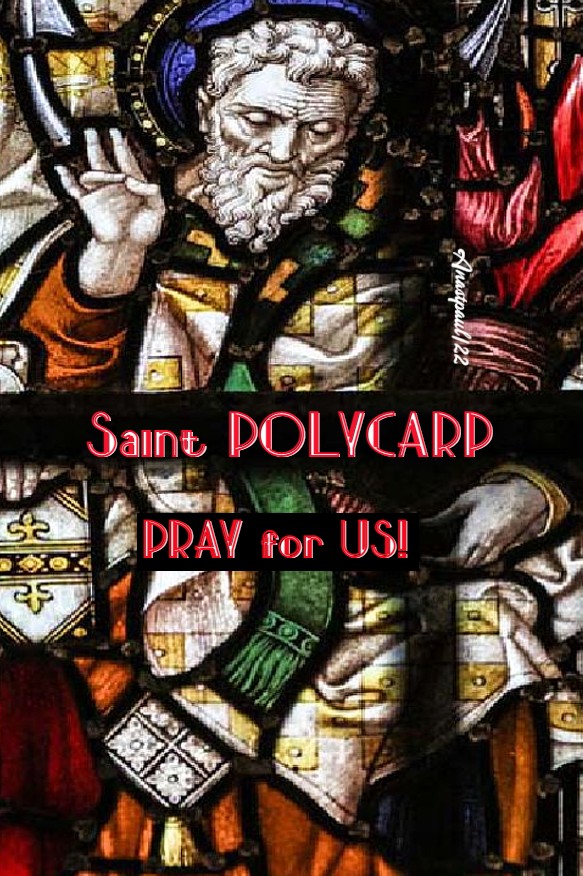
Quote/s of the Day – 26 January – St Polycarp (69-155) Martyr, Bishop of Smyrna, Apostolic Father
The Epistle of St Polycarp
“St Paul, when absent from you, wrote letters to you which, if you study them closely, will enable you to be built up in that faith which has been given to you ‘which is the mother of us all’ (Gal. iv: 29), in hope which follows and, in that love of God, of Christ and of our neighbour which leads the way. If anyone is in these things, then, he has fulfilled the law of justice; for he who has charity is far removed from all sin.”
St Polycarp (69-155) Martyr, Bishop, Apostolic Father
One Minute Reflection – 26 January – “The Month of the Holy Name of Jesus and the Holy Family” – St Polycarp (69-155) Martyr, Bishop of Smyrna (Asia Minor), Apostolic Father – Romans 12:16-21; Matthew 8:1-13 – Scripture search here: https://www.drbo.org/
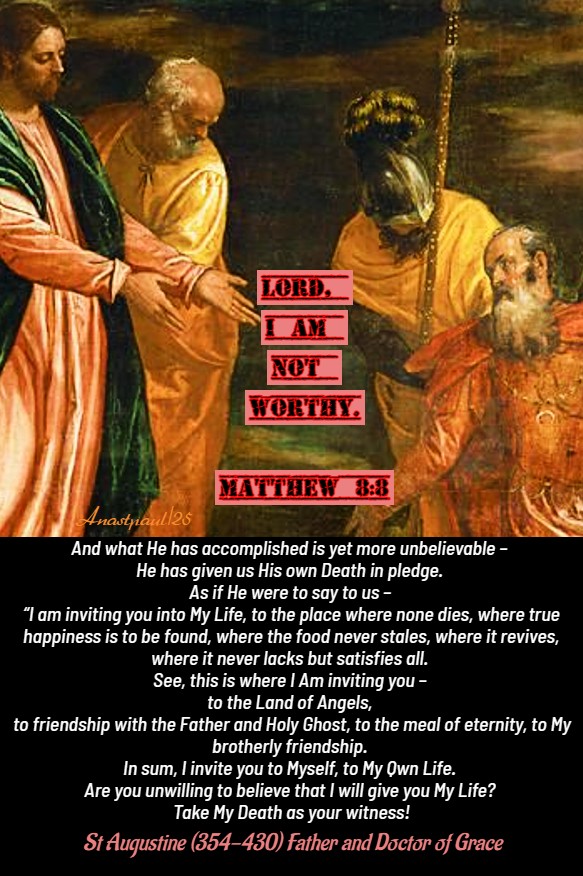
“Lord, I am not worthy … ”- Matthew 8:8
REFLECTION – “When He came here from another country, Christ found nothing here but what there is in abundance – afflictions, sorrows and death. This is what you have here – this is what there is here in abundance. He has eaten with you that which is to be found in abundance, in the poor house of your misfortune. He has drunk vinegar, He has tasted gall (Jn 19:29) – this is what He has found in your poor house.
Yet, He has invited you to His splendid table, His table in Heaven, to the table of Angels, where He Himself is the bread (Jn 6:35). Coming down to be with you and finding misfortune in your poor house, He was not too proud to be seated at your table, such as it was and promised you His own … He has taken away your misfortune; He will give you His own happiness. Yes indeed, He will give it you, He has promised us His Life!
And what He has accomplished is yet more unbelievable – He has given us His own Death in pledge. As if He were to say to us – “I am inviting you into My Life, to the place where none dies, where true happiness is to be found, where the food never stales, where it revives, where it never lacks but satisfies all. See, this is where I Am inviting you – to the Land of Angels, to friendship with the Father and Holy Ghost, to the meal of eternity, to My brotherly friendship. In sum, I invite you to Myself, to My Qwn Life. Are you unwilling to believe that I will give you My Life? Take My Death as your witness!” – St Augustine (354-430) Father and Doctor of Grace (Sermon 231).
PRAYER – O God, Who gave us joy by the annual solemnity of blessed Polycarp, Thy Martyr and Bishop, mercifully grant that we may rejoice in his protection, whose birthday we celebrate. Through Jesus Christ, Thy Son our Lord, Who lives and reigns with Thee, in the unity of the Holy Ghost, God, world without end. Amen (Collect).
Our Morning Offering – 26 January – St Polycarp (69-155) Martyr, Bishop of Smyrna (Asia Minor), Apostolic Father
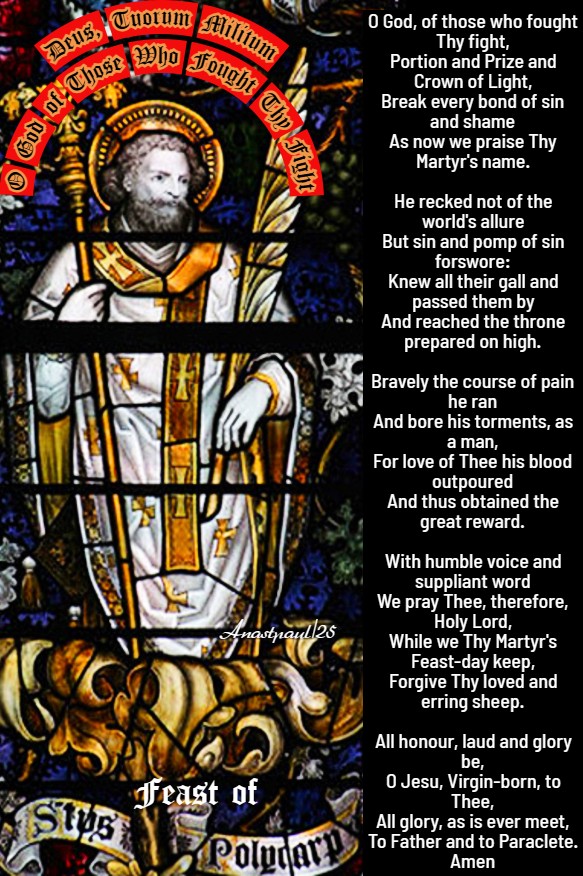
Deus, Tuorum Militum O God of Those Who Fought Thy Fight Unknown Author (6th Century)
O God, of those who fought Thy fight, Portion and Prize and Crown of Light, Break every bond of sin and shame As now we praise Thy Martyr’s name.
He recked not of the world’s allure But sin and pomp of sin forswore: Knew all their gall and passed them by And reached the throne prepared on high.
Bravely the course of pain he ran And bore his torments, as a man, For love of Thee his blood outpoured And thus obtained the great reward.
With humble voice and suppliant word We pray Thee, therefore, Holy Lord, While we Thy Martyr’s Feast-day keep, Forgive Thy loved and erring sheep.
All honour, laud and glory be, O Jesu, Virgin-born, to Thee, All glory, as is ever meet, To Father and to Paraclete. Amen
An Ambrosian Hymn historically assigned for Matins and Vespers for the Common of a Martyr in the Roman Breviary. It dates probably from the s6th Century and is attributed to the unknown Author of Rex gGoriose Martyrum and Jesu, Redemptor Omnium. The Hymn exists in a longer version of eight strophes and a shorter one, of four, which is probably earlier.
Saint of the Day – 26 January – Saint Theogenes (Died c262) Martyr and the 1st Bishop of Hippo in North Africa (present day Algeria) with 36 Companions. St Augustine wrote of him. Also known as – Theogenes of Hippo,… of Bona … of Ippona, Teógene…
The Roman Martyrology reads today: “At Hippo Regius, in Africa, the holy Bishop Theogenes and 36 others, who despising temporal death, obtained the crown of eternal life in the persecution of Valerian.”
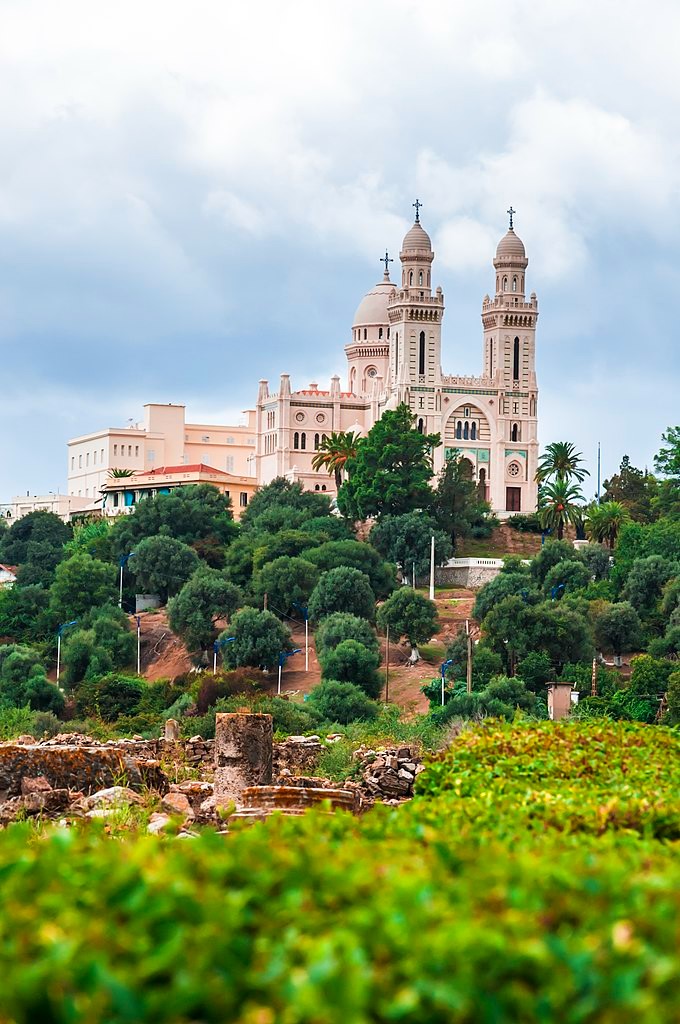
Saint Augustine Basilica overlooking the ruins of Hippo Regius
Very little is known about St Theogenes, as the sources available to us are scarce and fragmentary.
According to the Roman Martyrology, Theogenes was Martyred in Hippo, Numidia, in present-day Algeria. He died during the persecution of Valerian, the Roman Emperor who, in 257, ordered the persecution of Christians.
The Basilica from the ruins of Hippo
Another source, St Augustine’s Sermon 301, provides a little more detail about the life of Theogenes. From this sermon we learn that Theogenes was the Bishop of Hippo, and that he was a man of great faith and devotion. Augustine says that Theogenes was arrested by Roman soldiers and brought before the Prefect of the City. The Prefect tried to convince him to renounce the Christian Faith but Theogenes firmly refused.
Faced with his refusal, the Prefect ordered that Theogenes be tortured. Theogenes endured the torture with courage and patience and was eventually beheaded.
Theogenes’ death was a great sorrow for the Christians of Hippo. However, his testimony of faith and courage, inspired many others to follow in his footsteps. Although not confirmed by St Augustine, some say that 36 of his flock were also Martyred.
St Theogenes was succeeded by Saint Leontius (Died c303). Then came St Fidentius (Martyr c304), alerius who Ordained St Augustine (354– 8 August 430, co-adjutor in 395, Bishop in 396). After St Augustine came Heraclius (co-adjutor in 426, Bishop in 430).
St Theofrid of Corbie St Theogenes (Died c262) and Companions Bishop and Martyr St Tortgith of Barking
Martyred Family of Constantinople: Saint Mary and Saint Xenophon were married and the parents of Saint John and Saint Arcadius. Theirs was a wealthy family of Senatorial rank in 5th century imperial Constantinople but were known as a Christians who lived simple lives. To give their sons a good education, Xenophon and Mary sent them to study in Beirut, Phoenicia. However, their ship wrecked, there was no communication from them, and the couple assumed, naturally, that the young men had died at sea. In reality, John and Arcadius had survived and decided that instead of continuing to Beirut, they were going to follow a calling to religious life and became Monks, eventually living in a Monastery in Jerusalem. Years later, Mary and Xenophon made a pilgrimage to Jerusalem – where they encountered their sons. Grateful to have their family re-united and taking it as a sign, Xenophon and Mary gave up their positions in society in Constantinople and lived the rest of their lives as a Monk and Anchoress in Jerusalem. A few years later, the entire family was Martyred together. They were Martyred in 5th Century Jerusalem.
Thought for the Day – 25 January – – Meditations on the Hidden Life: From the 1906 Edition of The Heart of Jesus of Nazareth; it has the Imprimatur of Bishop John Baptist Butt, Diocese of Southwark, England, 5 February 1890. Author’s name known simply as Author of “The Voice of the Sacred Heart.” (We return to Fr Clarke for February with his Meditations on The Great Truths.)
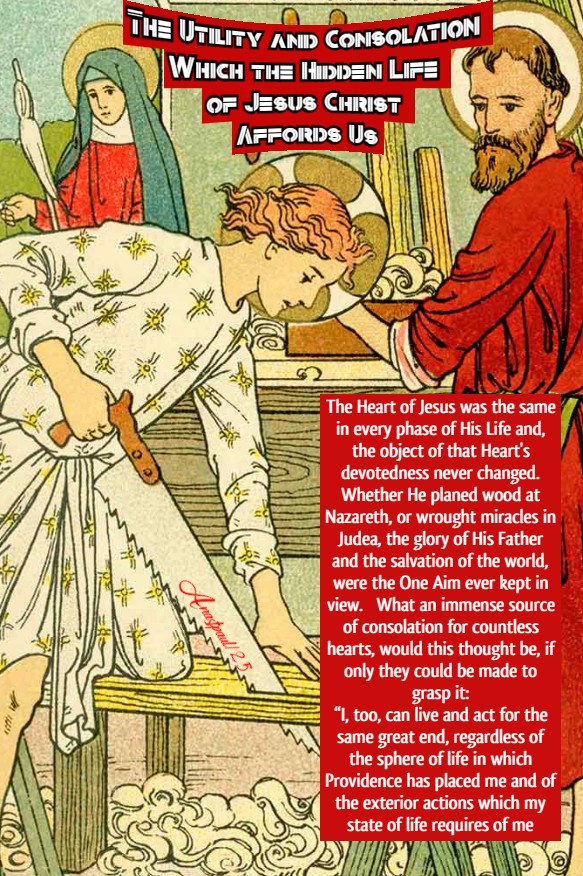
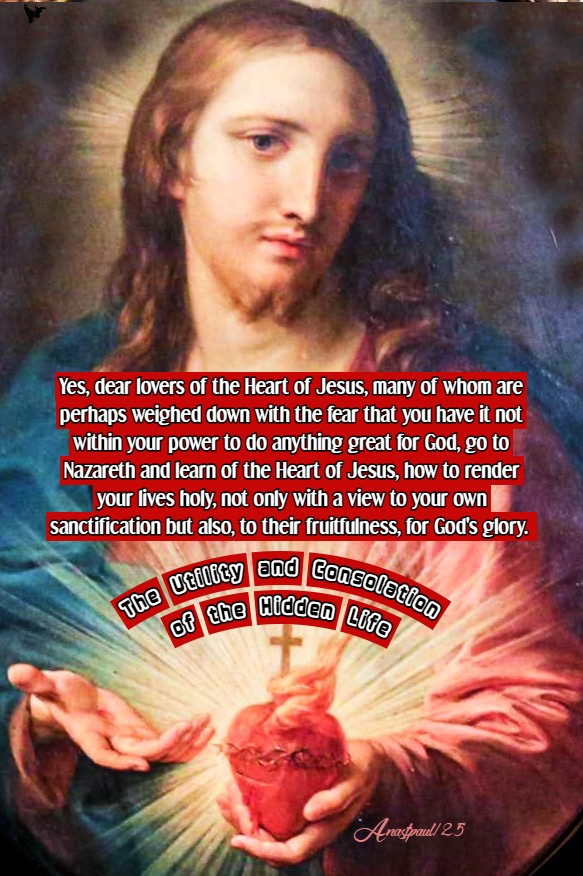
Meditation 3 – The Utility and Consolation Which the Hidden Life of Jesus Christ Affords Us
Notwithstanding the magnitude of the external Work for which our Lord came down upon earth, He led the life of a recluse, up to three short years before He closed His mortal career, exercising the lowly trade of a carpenter in the obscurity of Nazareth. Let us linger longer on this reflection, pregnant with matter for years of meditation and with usefulness and consolation for ourselves.
It discloses to us, in the first place, that no state of life no occupation – no deprivation of those things which the world esteems great and which, the natural man highly values, need form an obstacle to our co-operation with the Divine Mission of Jesus Christ on earth. Had He spent the whole, or the greater part of His Life, in working miracles, in preaching, in bearing testimony to His Divinity, in various ways, during the short time of His Public Ministry, we might indeed have hesitated to associate ourselves with a Work, so far beyond and above us. Had He placed before us but the example of the terrible sufferings of His Passion, we might justly have persuaded ourselves that our frailty could not attain to the imitation of so exalted a model. But, it is Jesus of Nazareth who invites us to contemplate Him, during the long years of His Hidden Life and, to learn of Him the lessons He will so gently teach us. He asks us but to clothe ourselves with His Spirit, to form our hearts on His, in order to enable us to participate in His Mission, whatever may be our state of life.
It is not simply the exterior Life of our Blessed Lord that we are about to consider. It is, above all, the life of His Sacred Heart in the solitude of Nazareth which forms the chief matter for our meditation and, in this lies abundant consolation and instruction.
Our state of life maybe one with which the Actions we behold Jesus performing in Joseph’s workshop, are not compatible but are, for that reason, precluded from the imitation of His virtues, from appropriating to ourselves, the spirit which animated His Sacred Heart, from adopting as our own, the intentions for which He lived and laboured? Not so. The Heart of Jesus was the same in every phase of His Life and, the object of that Heart’s devotedness never changed. Whether He planed wood at Nazareth, or wrought miracles in Judea, the glory of His Father and the salvation of the world, were the One Aim ever kept in view. What an immense source of consolation for countless hearts, would this thought be, if only they could be made to grasp it: “I, too, can live and act for the same great end, regardless of the sphere of life in which Providence has placed me and of the exterior actions which my state of life requires of me.”
We know, it is the spirit which animates our works which renders them precious in the Sight of God, or otherwise. He asks not from us those which are beyond our reach. He does not desire any which would oblige us to do violence to the circumstances with which He has Himself surrounded us. He would fain possess our hearts, He yearns to be the Final End of all their aspirations, of all their intentions, so that His interests may be the main-spring of all our outward acts. This He seeks throughout the world, amongst rich and poor, learned and ignorant, secular and religious alike and the souls, in whom He finds the closest union of sentiment with the Heart of the Great Solitary of Nazareth, will be found best disposed for receiving His choicest benedictions! And they will not deem it the least of these benedictions that they are enabled to sanctify the duties of their state, whatever it may be?
Yes, dear lovers of the Heart of Jesus, many of whom are perhaps weighed down with the fear that you have it not within your power to do anything great for God, go to Nazareth and learn of the Heart of Jesus, how to render your lives holy, not only with a view to your own sanctification but also, to their fruitfulness, for God’s glory. Your actions, even the most indifferent in themselves, will thus become ennobled, made almost Divine because,, by reason of your union with the Heart of Jesus, the sap of true spiritual life, will be infused into the spirit which animates them.
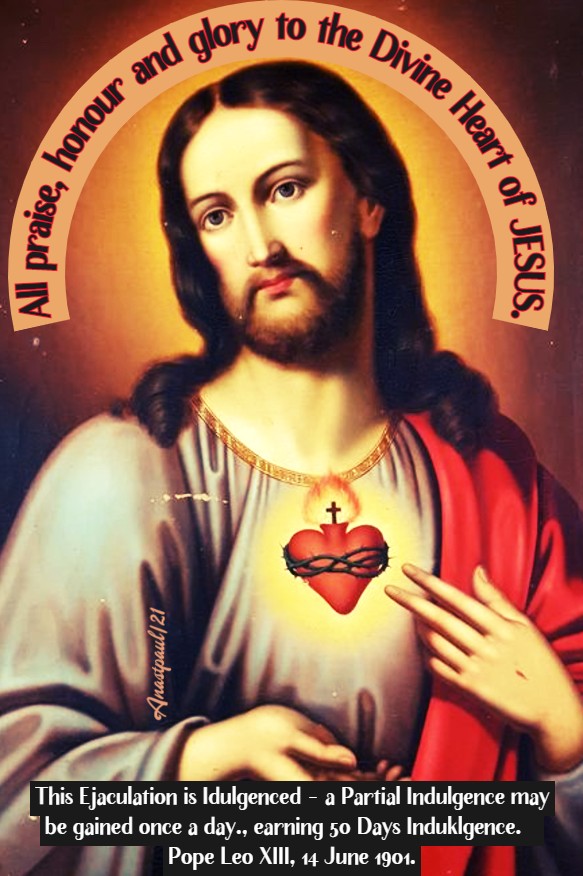
All praise, honour and glory to the Divine Heart of Jesus! (Indulgence 50 Days. Once a day, Pope Leo XIII. 14 June 1901).
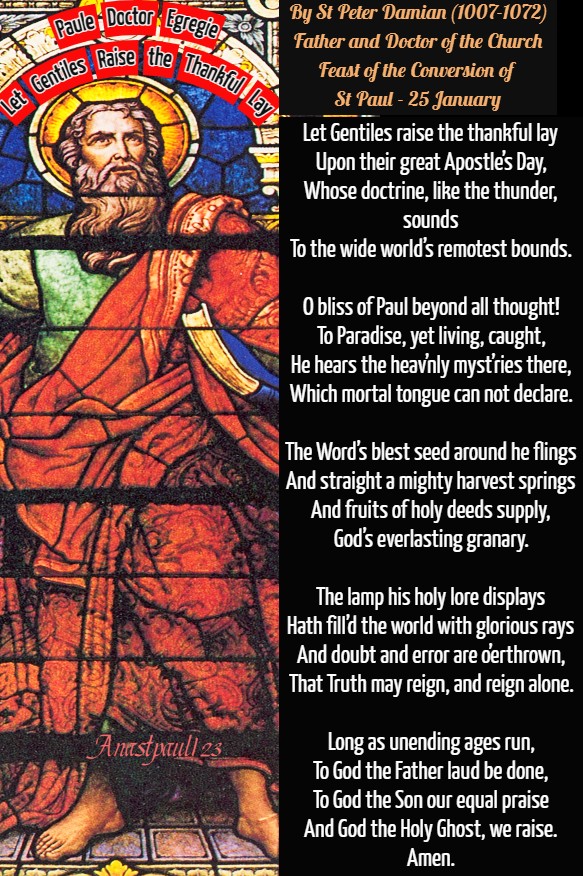
Quote/s of the Day – 25 January – Feast of the Conversion of St Paul, Apostle – Acts 9:1-22, Matthew 19:27-29 – Scripture search here: https://www.drbo.org/
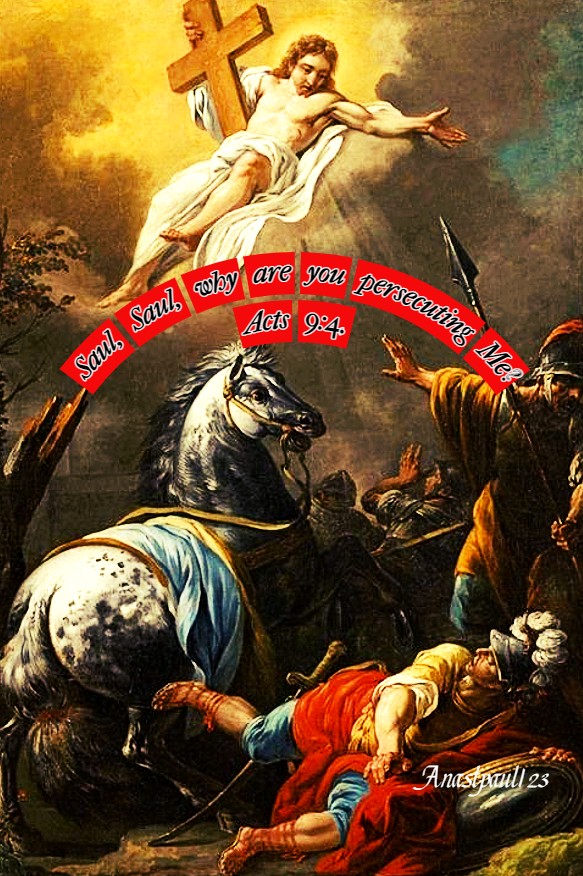
“Saul, Saul, why are you persecuting Me?”
Acts 9:4
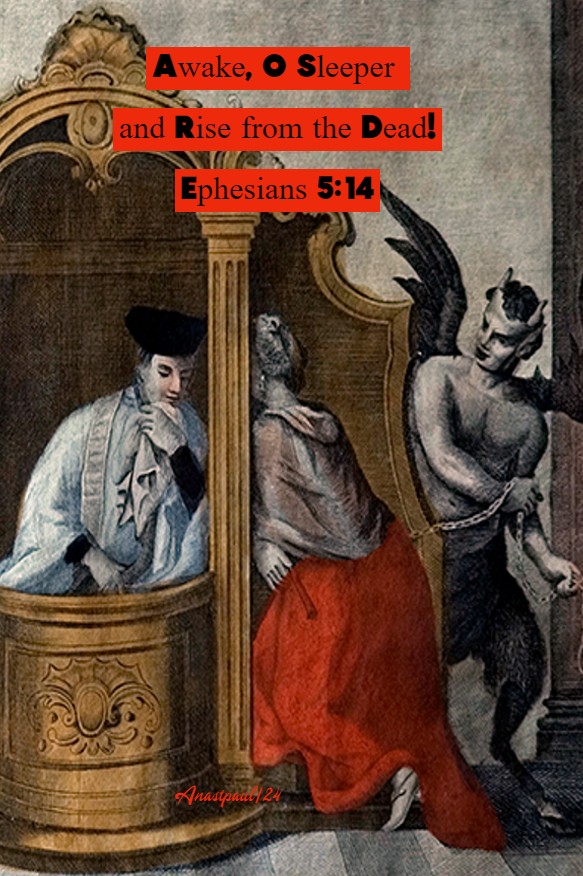
“Awake, O Sleeper and Rise from the Dead”
Ephesians 5:14
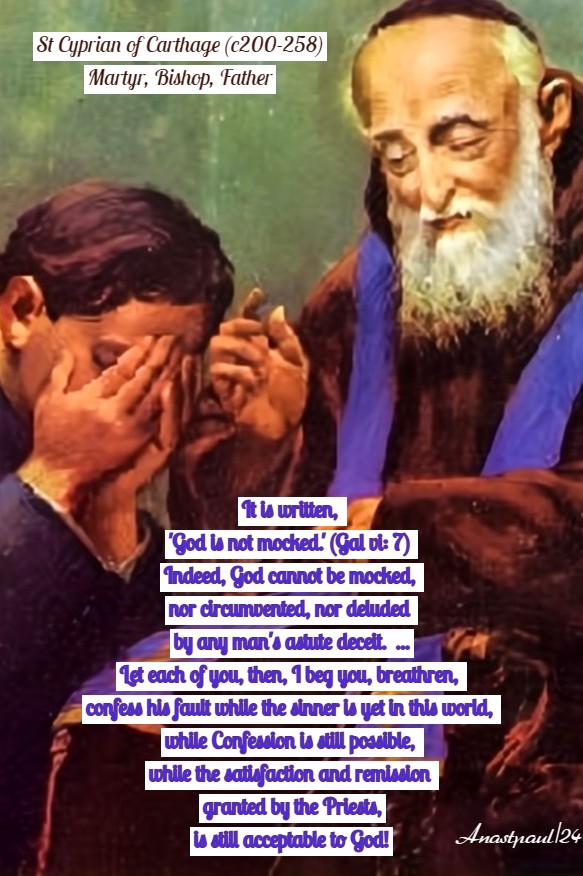
“It is written, ‘God is not mocked.’ (Gal 6: 7) Indeed, God cannot be mocked, nor circumvented, nor deluded by any man’s astute deceit. … Let each of you, then, I beg you, brethren, confess his fault while the sinner is yet in this world, while Confession is still possible, while the satisfaction and remission granted by the Priests, is still acceptable to God!”
St Cyprian of Carthage (c200-258) Martyr, Bishop of Carthage, Father of the Church
“Let us then, my brethren, endure in hope. Let us devote ourselves, side-by-side with our hoping, so that the God of all the universe, as He beholds our intention, may cleanse us from all sins, fill us with high hopes from what we have in hand and grant us the change of heart which saves. God has called you and you have your calling!”
St Cyril of Jerusalem (315-387) Father and Doctor of the Church
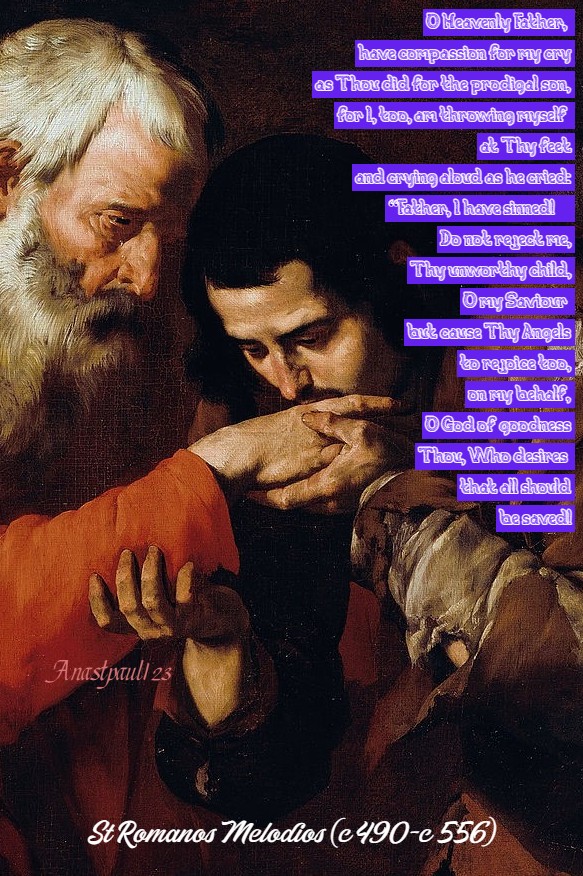
“O Heavenly Father, have compassion for my cry as Thou did for the prodigal son, for I, too, am throwing myself at Thy feet and crying aloud as he cried: “Father, I have sinned!” Do not reject me, Thy unworthy child, O my Saviour but cause Thy Angels to rejoice too, on my behalf, O God of goodness Thou, Who desires that all should be saved.”
St Romanos Melodios (c490-c556) Monk, Composer of hymns, Poet
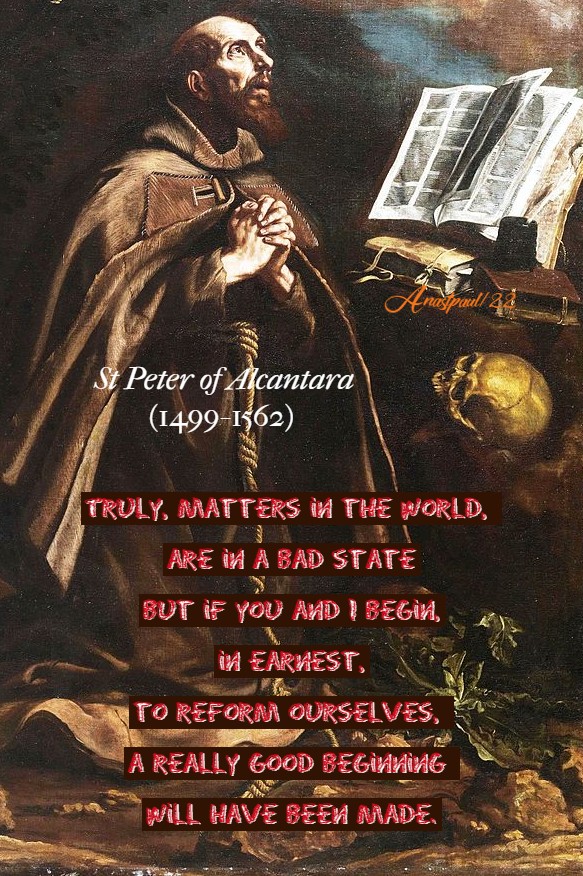
“Truly, matters in the world, are in a bad state but if you and I begin, in earnest, to reform ourselves, a really good beginning will have been made.”
One Minute Reflection – 25 January – The Feast of the Conversion of St Paul, Apostle – Acts 9:1-22, Matthew 19:27-29 – Scripture search here: https://www.drbo.org/
“He fell to the ground and heard a Voice saying to him, “Saul, Saul, why are you persecuting Me?” – Acts 9:4.
REFLECTION – “From Heaven’s height Christ’s Voice overturned Saul. He received a command to carry out his persecutions no more and fell face downwards to the ground. He had first to be knocked down and afterwards raised up – first struck, then healed. For Christ would never have come to live in him, if Saul had not died to his former life of sin. Cast down to the earth in this way, what was it he heard? “Saul, Saul, why are thou persecuting Me? It is hard for thou to kick against the goad” (Acts 9:4-5). And he replied: “Who are You, Lord?” Then the Voice from on high continued: “I am Jesus of Nazareth, Whom thou art persecuting.” The members are still on the ground, while the Head cries out, from the heights of Heaven. He is not saying: “Why art thou persecuting My servants?” but “Why art thou persecuting Me!?”
And Paul, who had put all his energy into his persecutions, is already preparing to obey: “What do Thou want me to do?” The persecutor is already transformed into the preacher, the wolf has become a sheep, the enemy, a defender. Paul learns what he is to do – if he has become blind, if this world’s light is held back from him for a while, it is so as to make the light within shine in his heart. Light is taken away from the persecutor, so that it may be given to the preacher; at the very moment he no longer saw anything of this world, he saw Jesus! This symbolises the believer – those who believe in Christ, must fix the eyes of their soul on Him, without paying attention to outward things…
So Saul was led to Ananias – the ravaging wolf is led to the sheep. But the Shepherd, Who guides everything from Heaven above, reassures him… “Do not fear, I will show him what he will have to suffer, for My Name’s sake” (Acts 9:16). What wonder is this! The wolf is led, a captive, to the sheep… The Lamb who died for the sheep, teaches it not to be afraid any more!” – St Augustine (354-430) Bishop, Father and Doctor of Grace of the Church (Sermon 279).
PRAYER – O God, Who taught the whole world by the preaching of Thy blessed Apostle Paul, grant, we beseech Thee that we, who today celebrate his conversion, may draw closer to Thee, by way of hia example.Through Jesus Christ, Thy Son our Lord, Who lives and reigns with Thee, in the unity of the Holy Ghost, God, world without end. Amen (Collect).
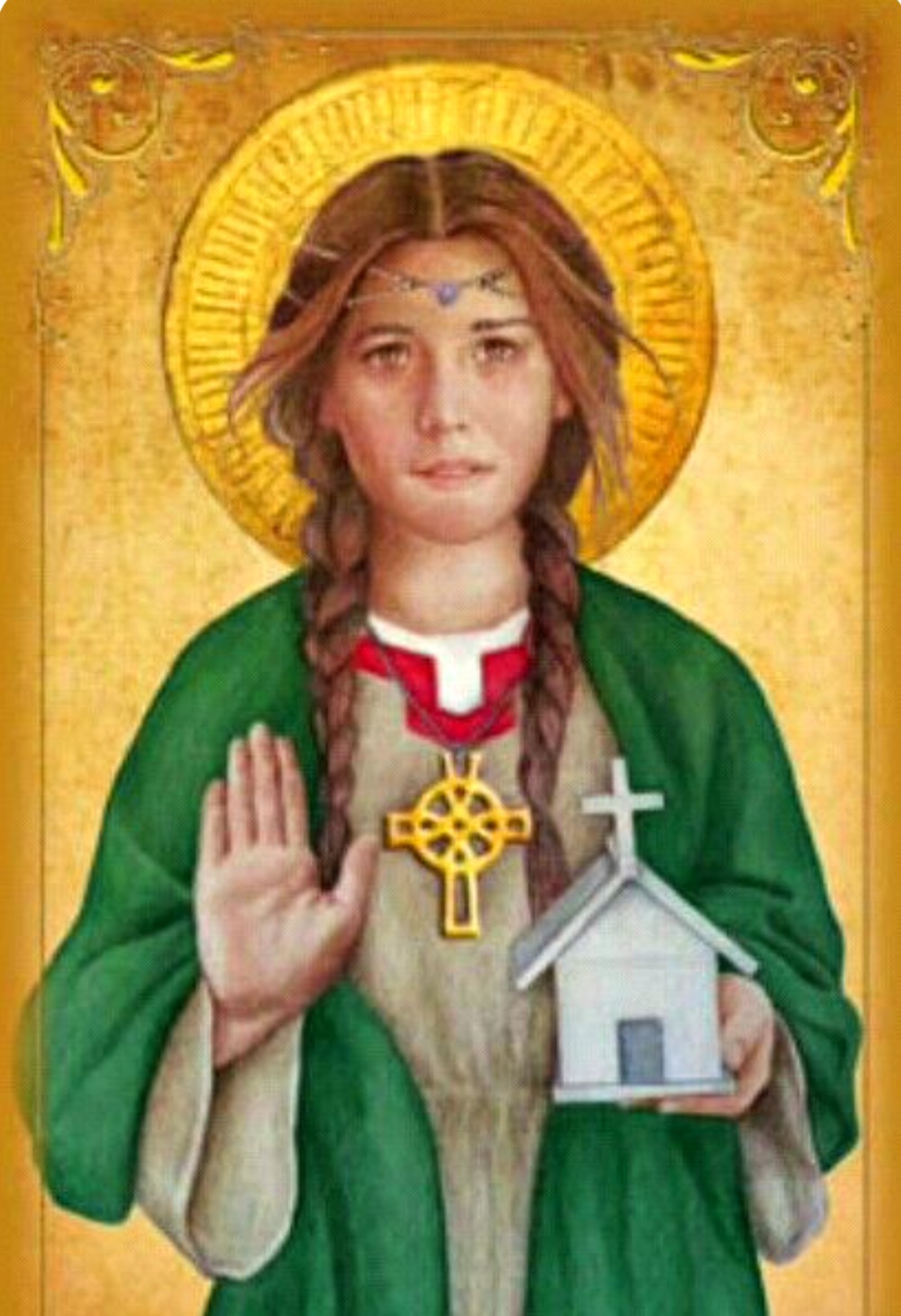
Saint of the Day – 25 January – St Dwynwen (Died c460) Virgin, Princess, Nun. Patronages – lovers (especially in Wales where her Feast today is celebrated in a similar as that of St Valentine’s Feast on 14 February), of the sick and of animals in danger. Also known as – Donwen, Donwenna, Dunwen, Dwyn – this last is the ‘pet’ name of our Saint and the most often used.
Dwynwen lived in the 5th Century, the daughter of Saint Brychan of Brecknock (6 April), a prolific Welsh King who fathered 24 sons and daughters, all venerated as Saints and very famous especially in the Celtic world. Dwynwen, another daughter of the august parent King was then naturally a Princess. She was a beautiful and virtuous girl and fell madly in love with a Welsh Prince, Maelon Dafodrill,but the idea of marriage faded naturally from her heart.
Several legends have attempted to find an explanation for this loss of the romantic fervour – one of them could be that King Brychan had already promised his daughter to another Prince. The Saint, however, understood that her calling was to dedicate her existence to God by undertaking a religious life. She then tried to separate from Maelon but he reacted by drastically changing towards her and becoming unbearable.
Dwynwen took refuge in the woods, raising fervent prayers to God to help her and put an end to her miseries. She fell asleep and when she awoke she had been given a sweet drink which immediately deprived her of Maelon’s attentions and the sadness of her heart. The same drink was given to Maelon but in him, it had the effect of transforming him into an ice statue. Dwynwen then prayed again for three of her requests to be granted – that Maelon be freed from the ice, that she might never wqish to marry again and finally, that all lovers, with the help of God, find happiness through the fulfillment of their love or be healed of their passions.
God granted all her prayers and she did not hesitate to devote her entire existence to Him. She then founded a Convent on the Island of Llanddwyn, just opposite the Island of Anglesey (Yns Mon). She died there around the year 460.
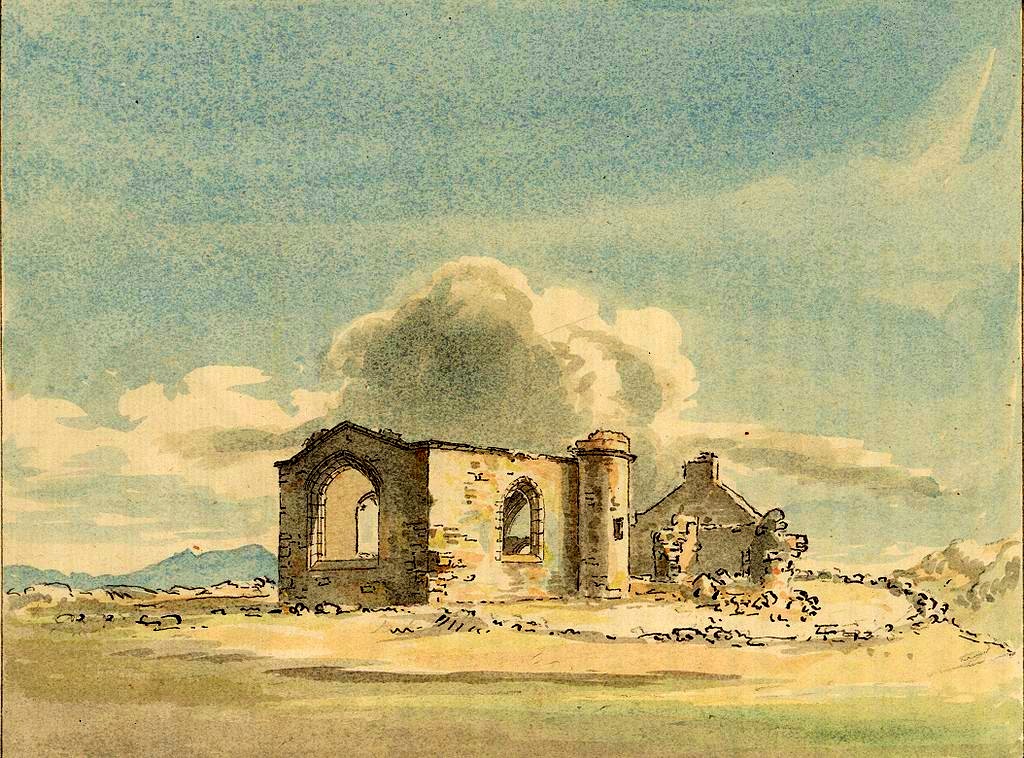
St Dwynwen’s Church, Llanddwyn c1778
Here a fountain of fresh water called Ffynnon Dwynwen was considered a holy spring and soon became a place of pilgrimage. Over time the Saint was also invoked for the healing of the sick and animals in danger, a tradition which has survived to the present day.
The ruins of Llanddwyn Chapel, a 16th Century Tudor Church built on the site of an ancient priory, can still be seen today. St Dwynwen’s name is also invoked in the Town of Porthddwyn and a Church remains dedicated to her in the British peninsula of Cornwall.
St Dwynwen is celebrated especially throughout Wales and by lovers, on 25 January. One of the Dwynwen’s favourite maxims was: “Nothing wins hearts like joy.”
St Apollo of Heliopolis St Artemas of Pozzuoli St Auxentius of Epirus
St Bretannion of Tomi (Died c380) Bisho, Confessor, Defender of the Faith against heresy. The Roman Martyrology reads today: “At Tomi in Scythia, St Bretannion, Bishop, who by his great sanctity and his zeal for the Catholic Faith, shone in the Church under the Arian Emperor Valens,. whom he opposed with fortitude.” His Courageous Life: https://anastpaul.com/2024/01/25/saint-of-the-day-25-january-saint-bretannion-of-tomi-died-c380-bishop-confessor/
St Donatus the Martyr St Dwynwen (Died c460) Virgin Princess, Nun. St Eochod of Galloway St Joel of Pulsano St Juventinus of Antioch St Maximinus of Antioch St Palaemon
Thought for the Day – 24 January – Meditations on the Hidden Life: From the 1906 Edition of The Heart of Jesus of Nazareth; it has the Imprimatur of Bishop John Baptist Butt, Diocese of Southwark, England, 5 February 1890. Author’s name known simply as Author of “The Voice of the Sacred Heart.” (We return to Fr Clarke for February with his Meditations on The Great Truths.)
Meditation 2 – Meaning and Design of the Hidden Life
There are two ways of understanding what is called a hidden life. From one point of view it is simply a life withdrawn from the busy world – from the society of men. In this sense it bears no essential sanctity and is a mode of life, chosen by many ,who have no acquaintance with the nature of holiness, such as the Pagan philosophers and others, who withdrew from the society of their fellow-men merely, as the result of their own natural inclination and, in pursuit of a purely natural object. Under another point of view, a hidden life means distinctly one led by each person in the solitude of. his own heart and, it is this alone which, imparts sanctity and value to that external and material seclusion which, for the most part, the world understands, by the term “hidden life.”
It is under this second aspect we are about to regard our Lord Jesus Christ, in His solitude at Nazareth, learning of Him that the sanctity and merit of our whole outer life, depends on the intentions, the motives – in a word, the life of the Sacred Heart itself. Have we ever asked ourselves, For what do I live, if Placed as I am, in the midst of society, have I at heart any higher aim, or any end more worthy of a Christian, than the gratification of self, or the possession of some temporal interest? “” –
If I am a Religious, do I live for that which is the end and object of the Order, to which I belong? – just as every aspiration, every beat of the Heart of Jesus was directed towards the object which brought Him down from Heaven. Or is it still – perhaps unconsciously – self, who I am seeking under the mask of a religious life?
We know, the sole aim of our Lord in coming down upon earth, was the reparation of the Divine glory and the salvation of the world. We can have no doubt, as to the infallibility of the means He took, for accomplishing this end. Nevertheless, it is with astonishment perhaps, we behold Him passing nearly the whole of His mortal career in solitude, employed in the most ordinary occupations and withholding the manifestation of any of those marvellous deeds which we should imagine, could alone be in proportion, to so sublime an end.
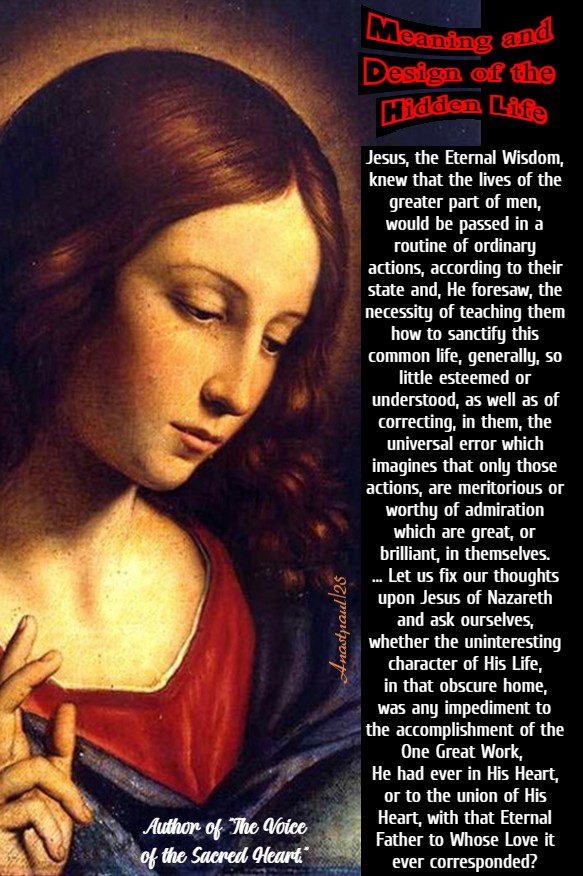
Jesus, the Eternal Wisdom, knew that the lives of the greater part of men, would be passed in a routine of ordinary actions, according to their state and, He foresaw, the necessity of teaching them how to sanctify this common life, generally, so little esteemed or understood, as well as of correcting, in them, the universal error which imagines that only those actions, are meritorious or worthy of admiration which are great, or brilliant, in themselves.
Have we not been sometimes tempted to consider, our state of life, an excuse for doing nothing for God’s glory, or for the promotion of His interests? If we are in Religion, have we not deluded ourselves with the idea that, the material and commonplace nature of the employments confided to us, are an obstacle to our labouring for God and to our union with Him by prayer and recollection?
Let us fix our thoughts upon Jesus of Nazareth and ask ourselves, whether the uninteresting character of His Life, in that obscure home, was any impediment to the accomplishment of the One Great Work, He had ever in His Heart, or to the union of His Heart, with that Eternal Father to Whose Love it ever corresponded?
Quote/s of the Day – 24 January – St Timothy (1st Century) Disciple of St Paul, Bishop and Martyr – 1 Timothy 6:11-16; Luke 14:26-33. – Scripture search here: https://www.drbo.org/
“So likewise, everyone of you, who does not renounce all that he possesses, cannot be My disciple.”
Luke 14:33
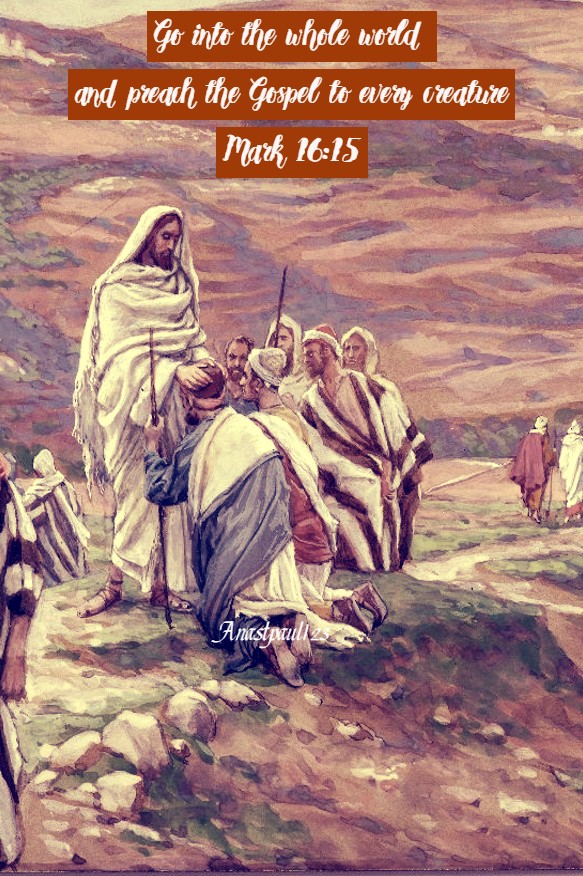
“Go into the whole world and preach the Gospel to every creature.”
Mark 16:15
“I have lit the light of your torch but it is up to you to see it is kept burning, not just to your personal advantage but also, in the interest of all who will see it and who, through it, will be led to the Truth. The worst wickedness would not put a shadow over your light, if you live with the vigilance of those who are called to bring the whole world to good. So, let your life correspond to the holiness of your mission, so that God’s grace may be proclaimed everywhere.”
St John Chrysostom (347-407) Father and Doctor of the Church
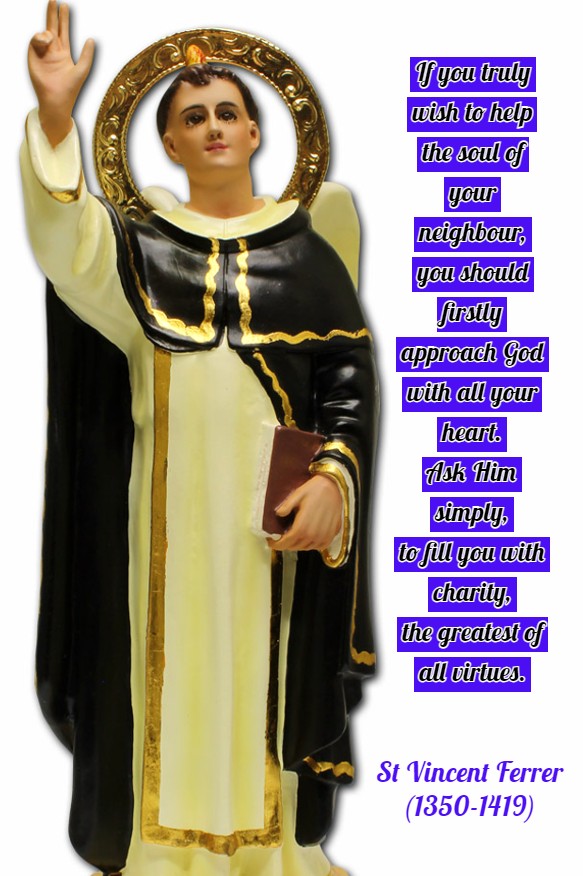
“If you truly wish to help the soul of your neighbour, you should firstly approach God with all your heart. Ask Him simply, to fill you with charity, the greatest of all virtues.”
St Vincent Ferrer OP (1350-1419)
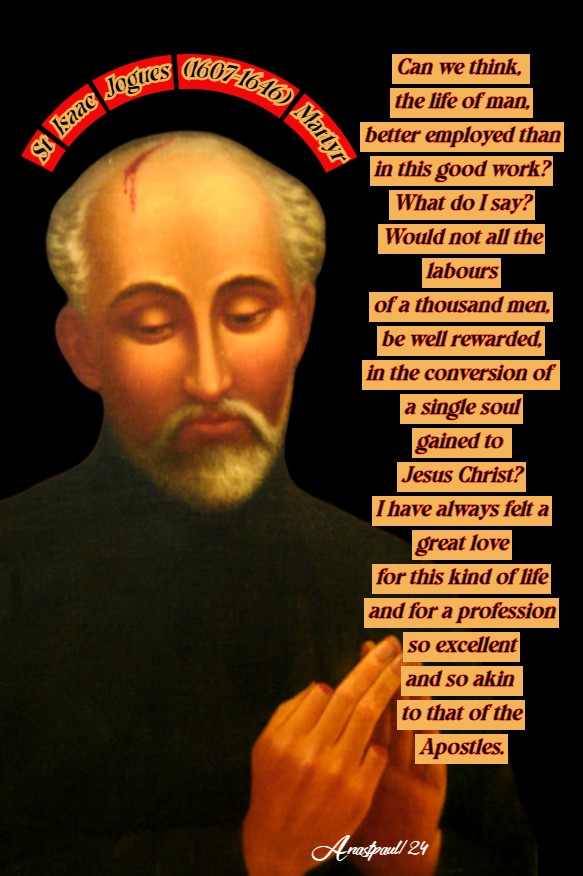
“Can we think, the life of man, better employed than in this good work? What do I say? Would not all the labours of a thousand men, be well rewarded, in the conversion of a single soul gained to Jesus Christ? I have always felt a great love for this kind of life and for a profession so excellent and so akin to that of the Apostles.”


























You must be logged in to post a comment.