St Abigail the Matriarch St Aegidius St Agia St Anea St Arcanus St Arealdo of Brescia Bl Colomba of Mount Brancastello St Constantius the Bishop St Donatus of Sentianum St Felix of Sentianum
St Lythan St Nivard of Rheims (Died 673) Bishop St Priscus St Regulus St Sixtus of Rheims St Terentian St Verena St Victorious St Vincent of Xaintes
Exiles of Campania
Twelve Holy Brothers: Martyrs of the South – A group of Martyrs who died c303 at various places in southern Italy. In 760 their relics were brought together and enshrined in Benevento, Italy as a group. Saint Arontius of Potenza, Saint Donatus of Sentianum, Saint Felix of Sentianum, Saint Felix of Venosa, Saint Fortunatus of Potenza, Saint Honoratus of Potenza, Saint Januarius of Venosa, Saint Repositus of Velleianum, Saint Sabinian of Potenza, Saint Sator of Velleianum, Saint Septiminus of Venosa, Saint Vitalis of Velleianum. One tradition describes Saint Boniface of Hadrumetum and Saint Thecla of Hadrumetum as their parents.
One Minute Reflection – 8 August – “The Month of the Immaculate Heart of Mary” – The Fourteen Holy Helpers – 1 Thessalonians 2:13-16, Mark 16:15-18 – Scripture search here: https://www.drbo.org/
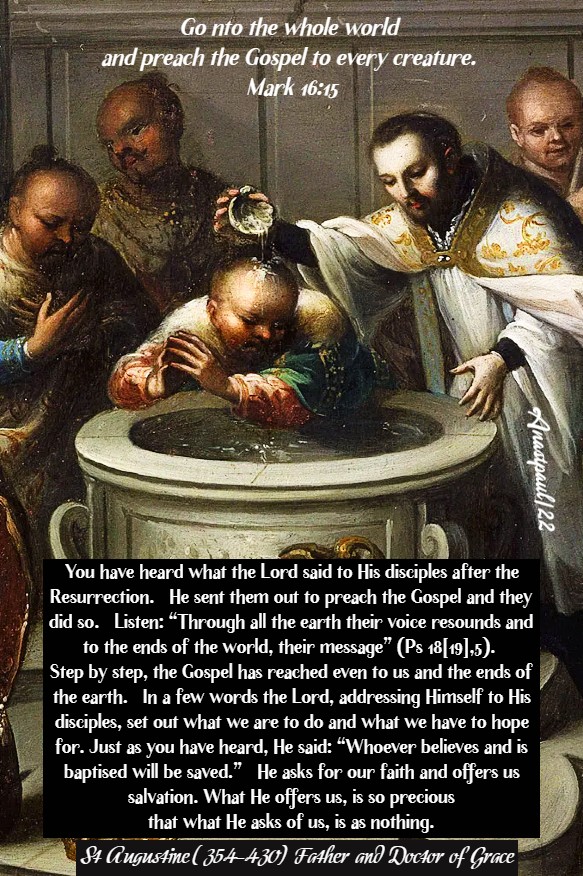
“Go into the whole world and preach the Gospel to every creature.” – Mark 16:15
REFLECTION – “You have heard what the Lord said to His disciples after the Resurrection. He sent them out to preach the Gospel and they did so. Listen: “Through all the earth their voice resounds and to the ends of the world, their message” (Ps 18[19],5). Step by step, the Gospel has reached even to us and the ends of the earth. In a few words the Lord, addressing Himself to His disciples, set out what we are to do and what we have to hope for. Just as you have heard, He said: “Whoever believes and is baptised will be saved.” He asks for our faith and offers us salvation. What He offers us, is so precious that what He asks of us, is as nothing.
“The children of men take refuge in the shadow of Thy wings, O my God… from Thy delightful stream, Thou gives them to drink, for with Thee, is the Fountain of Life” (Ps 35[36],8f.). Jesus Christ is the Fountain of Life. Before the Fountain of Life came to us, we had only a human salvation like that of the beasts, of which the psalm speaks: “Man and beast you save, O Lord” (Ps 35[36],7). But now the Fountain of Life has come even to us, the Fountain of Life died for our sakes. Will He refuse us His Life,Who, for our sakes, gave His Death? He is salvation and this salvation is not worthless, like the other one. Why? Because it does not pass away. The Lord has come. He died but He killed death. In Himself, He brought an end to death. He assumed it and He killed it. Where is death now, then? Look for it in Christ and it is no longer there. It used to be there but there it died. O Life, Death of death! Take heart: it will also die in us. What was fulfilled in the Head will also be fulfilled in the members and death will die in us, too!” – St Augustine (354-430) Father and Doctor of Grace (Sermon 233).
PRAYER – PRAYER – O God, Who gladden us with the annual festival of Thy 14 holy Saints, mercifully grant, that we, who celebrate the anniversary of their death, may also strive to equal the courage of their Martyrdom. Through Jesus Christ, Thy Son our Lord, Who lives and reigns with Thee, in the unity of the Holy Ghost, God, world without end. Amen (Collect).
St Eleutherius of Constantinople St Ellidius St Famianus of Compostela St Gedeon of Besancon St Hormisdas of Persia St Largus St Leobald of Fleury St Leonidas of Constantinople St Marinus of Anzarba St Mummolus of Fleury St Myron the Wonder Worker St Rathard of Diessen St Severus of Vienne St Sigrada St Smaragdus St Ternatius of Besançon St Ultan of Crayke Blessed William of Castellammare di Stabia OFM (Died 1364) Martyr
Martyrs of Albano – 4 Saints: Four Christians who were Martyred together, and about we today know little more than their names – Carpóforo, Secondo, Severiano and Vittorino. They were martyred in Albano, Italy – their remains are interred in the San Senator cemetery, on the Appian Way, 15 miles from Rome, Italy.
Martyrs of Rome – 5 Saints: Five Christians Martyred together; we know nothing else about them but the names – Ciriaco, Crescenziano, Giuliana, Memmia and Smaragdus. They were martyred at the 7 mile marker, on the Via Ostia, Rome, Italy.
Bl Anne Cartier St Ansegisus St Aurelius of Carthage St Bernward of Hildesheim (c960-1022) Bishop St Cassian of Saint Saba St Elijah the Prophet
St Elswith St Frumentius of Ethiopia
Blessed Gregory Lopez (1542-1596) “The Mystery Man” – Hermit, Spiritual Advisor, Writer. Around 1585, word of a “Mystery Man” began to leak into Mexico City, a strange hermit who lived out in the lonely valley of Guesteca, who walked miles to go to Mass, lived totally subject to “Lady Poverty” and had travelled from the Shrine of Our Lady of Guadalupe in Spain (which dates from 712), to her Shrine in Mexico (which dates from 1531). Biography: https://anastpaul.com/2018/07/20/saint-of-the-day-20-july-blessed-gregory-lopez-1542-1596/
St Joseph Barsabbas the Just (1st Century) Disciple of Jesus, Bishop, Martyr. The Roman Martyrology states today: “The birthday of the blessed Joseph, surnamed the Just, whom the Apostles selected with the blessed Matthias, for the Apostleshop in the place of the traitor, Judas. The lot having fallen upon Matthias, Joseph, notwithstanding, continued to preach and advance in virtue and after having sustained from the Jews, many persecutions for the Faith of Christ, happoily ended his life in Judea.” His Life and Death: https://anastpaul.com/2021/07/20/saint-of-the-day-20-july-saint-joseph-barsabbas-the-just-1st-century-disciple-of-jesus/
St Mère St Paul of Saint Zoilus St Rorice of Limoges St Severa of Oehren St Severa of Saint Gemma St Wulmar
Martyrs of Corinth – 22 Saints: 22 Christians who were Martyred together. We know nothing else about them but the names – • Appia • Calorus • Cassius • Celsus • Cyriacus • Donatus • Emilis • Felix • Fructus • Magnus • Maximus • Nestita • Partinus • Pasterus • Paul • Romanus • Spretus • Tertius • Theodolus • Ueratia • Valerian • Victor. They were martyred in Corinth, Greece.
Martyrs of Damascus – 16 Saints: 16 Christians who were Martyred together. We know the names of six of then, but no details about any of them – Cassia, Julian, Macrobius, Maximus, Paul and Sabinus. They were martyred in Damascus, Syria, date unknown.
St Ada of Ethiopia St Adalgis of Thiérarche St Armin of Egypt St Barbarinus St Blandina the Slave St Bodfan of Wales St Daminh Ninh Bl Demetrios of Philadelphia St Dorotheus of Rome
St Eugene I (Died 657) Bishop of Rome elected on 10 Augugust 654, and died at Rome on 2 June 657 of natural causes, aged just 42. St Evasius Bl Giovanni de Barthulono
St Guido of Acqui (c 1004-1070) Bishop of Acqu in north-west Italy from 1034 until his death, zealous Reformer both in the lives of his clergy and his people. He built the Cathedral of Acqui amongst other religious buildings, including a Convent for Nuns. He donated his personal inheritance to the upkeep of the Diocese, the poor and for his building projects. Biography: https://anastpaul.com/2022/06/02/saint-of-the-day-2-june-saint-guido-of-acqui-c-1004-1070-patron-saint-against-famine/
St Honorata St Humatus St John de Ortega St Joseph Tien
St Photinus of Lyons St Rogate Bl Sadoc of Sandomierz St Stephen of Sweden
Martyrs of Lyons and Vienne: A group of 48 Christians from the areas of Vienne and Lyon, France, who were attacked by a pagan mob, arrested and tried for their faith, and murdered in the persecutions of Marcus Aurelius. A letter describing their fate, possibly written by Saint Irenaeus of Lyons, was sent to the churches in the Middle East. Only a few names and details of their lives have survived; some of them have separate entries on this date –
Alexander of Vienne
Attalus of Pergamos
Biblis of Lyons
Blandina the Slave
Cominus of Lugdunum
Epagathus of Lugdunum
Maturus the Novice
Photinus of Lyons
Ponticus of Lugdunum
Sanctius of Vienne
Vettius of Lugdunum They were martyred in assorted ways on on various during 177.
Martyrs of Sandomierz: A group of 49 Dominicans, some of whom received the habit from Saint Dominic de Guzman himself. They worked separately and together to bring the faith and establish the Dominican Order in Poland, basing their operations in and around Sandomierz. In 1260 they were all Martyred by the Tartars as they were singing the Salve Regina at Compline; the custom of singing the Salve Regina at the deathbed of Dominicans, stems from this incident. We know a few details about a few of the martyrs, but most survive only as names –
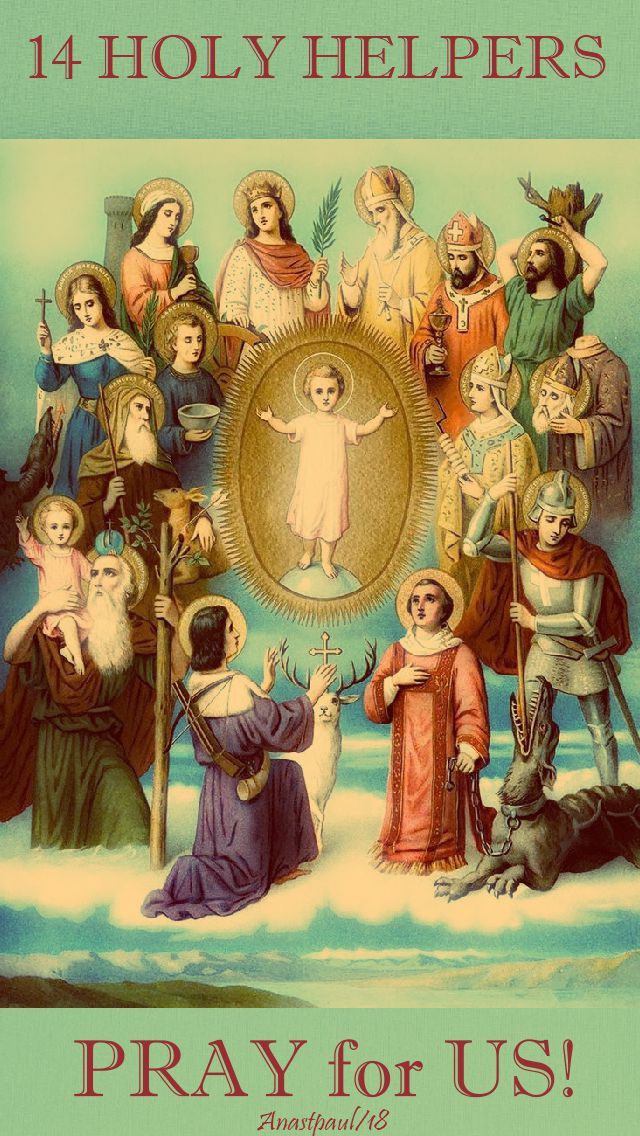
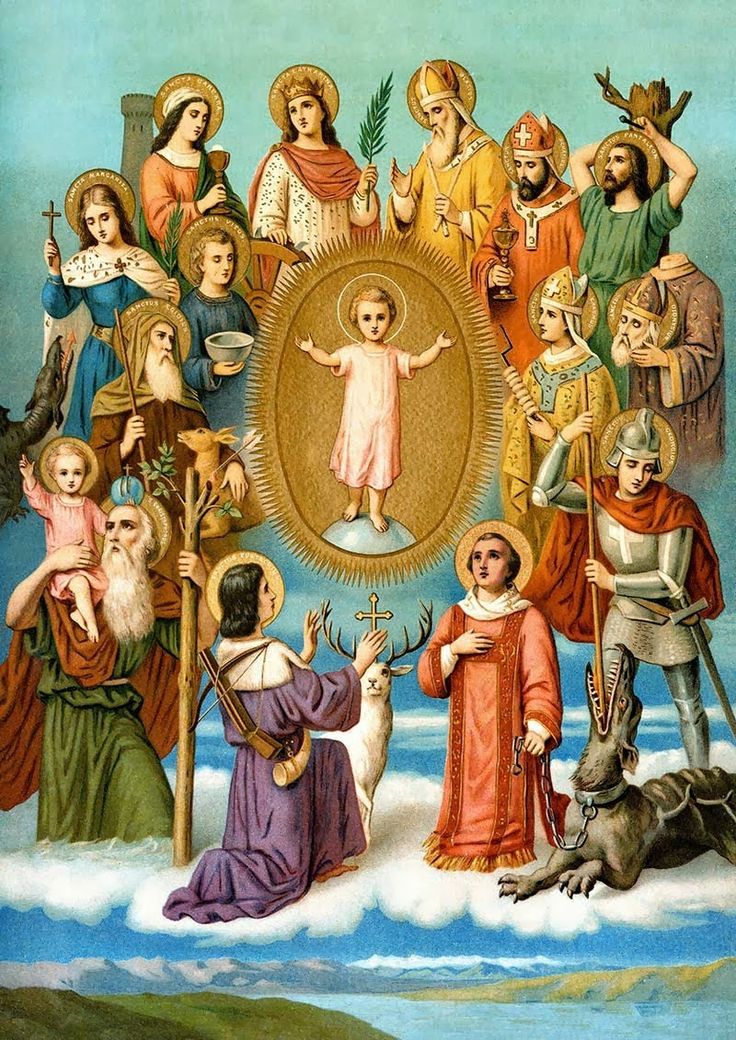
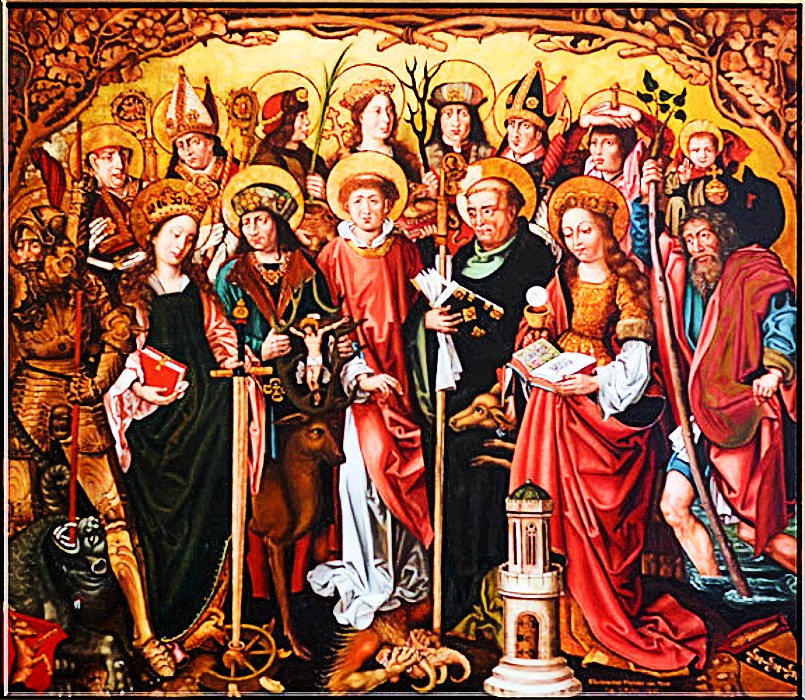
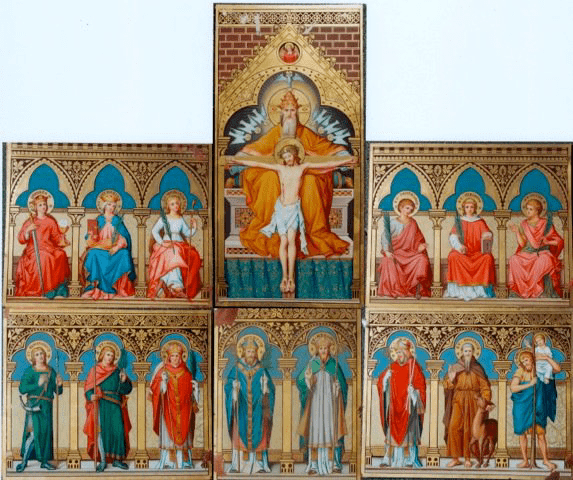
Saint/s of the Day – 8 August – The Fourteen Holy Helpers. A group of Saints invoked with special confidence because they have proven themselves efficacious helpers in adversity and difficulties, are known and venerated under the name Fourteen Holy Helpers.
The Notable Martyrs Saints within the Group are: Acacius, Barbara, Blaise, Christopher, Cyriacus, Catherine of Alexandria, Denis, Erasmus of Formia, Eustace, George, Giles, Margaret of Antioch, Pantaleon and Vitus.
Devotion to these fourteen ,as a group, spread in response to the Black Plague which devastated Europe from 1346 to 1349. Among its symptoms were the tongue turning black, a parched throat, violent headache, fever, and boils on the abdomen. It attacked without warning, robbed its victims of reason and killed within a few hour. Many died without the last Sacraments.
Brigands roamed the streets, people suspected of contagion were attacked, animals died, people starved, whole villages vanished into the grave, social order and family ties broke down and the disease appeared incurable. The pious turned to Heaven, begging the intervention of the Saints, praying to be spared or cured. This group devotion began in Germany–the Diocese of Wurzburg having been renowned for its observance.
Pope Nicholas V attached Indulgences to devotion of the Fourteen Holy Helpers in the 16th century.
Saint Christopher and Saint Giles are nvoked against the plague itself. Saint Denis is prayed to for relief from headache, Saint Blaise for ills of the throat, Saint Elmo for abdominal maladies, Saint Barbara for fever and Saint Vitus against epilepsy. Saint Pantaleon is the Patron of physicians, Saint Cyriacus invoked against temptation on the deathbed and Saints Christopher, Barbara and Catherine, for protection against a sudden and unprovided death. Saint Giles is prayed to for a good Confession and Saint Eustace as healer of family troubles. Domestic animals were also attacked by the plague and so, Saints George, Elmo, Pantaleon and Vitus are invoked for the protection of these animals. Saint Margaret of Antioch is the Patron of safe childbirth.
The legends of the Fourteen Holy Helpers are replete with the most glorious examples of heroic firmness and invincible courage in the profession of the Faith, which ought to incite us to imitate their fidelity in the performance of the Christian and social duties. If they, with the aid of God’s grace, achieved such victories, why should not we, by the same aid, be able to accomplish the very little which is desired of us? God rewarded His victorious champions with eternal bliss – the same crown is prepared for us, if we but render ourselves worthy of it. God placed the seal of miracles on the intrepid confession of His Servants and a mind imbued with the spirit of faith, sees nothing extraordinary therein because our Divine Saviour, Himself said, “Amen, amen I say to you, he that believes in Me, the works that I do, he also shall do and greater than these shall he do” (John 14:12). In all the miraculous events wrought in and by the Saints, there appears only the victorious omnipotent Power of Jesus Christ and the living faith, in which His Servants operated in virtue of this power.
The histories of the Saints are called Legends. This word is derived from the Latin,and signifies something that is to be read, a passage the reading of which is prescribed. Therefore, the Legends of the Saints are the lives of the holy Martyrs and Confessors of the Faith. Some of them occur in the Roman Breviary which the Catholic Clergy is obliged to read everyday. (The corruption of this word has occurred in modern times, giving it a meaning of either “unprovable story or celebrity.”)
St Eleutherius of Constantinople St Ellidius St Famianus of Compostela St Gedeon of Besancon St Hormisdas of Persia Bl John Felton Bl John Fingley St Largus St Leobald of Fleury St Leonidas of Constantinople St Marinus of Anzarba St Mummolus of Fleury St Myron the Wonder Worker St Rathard of Diessen St Severus of Vienne St Sigrada St Smaragdus St Ternatius of Besançon St Ultan of Crayke Bl William of Castellammare di Stabia
Martyrs of Albano – 4 Saints: Four Christians who were Martyred together, and about we today know little more than their names – Carpóforo, Secondo, Severiano and Vittorino. They were martyred in Albano, Italy – their remains are interred in the San Senator cemetery, on the Appian Way, 15 miles from Rome, Italy.
Martyrs of Rome – 5 Saints: Five Christians Martyred together; we know nothing else about them but the names – Ciriaco, Crescenziano, Giuliana, Memmia and Smaragdus. They were martyred at the 7 mile marker, on the Via Ostia, Rome, Italy.
St Photinus of Lyons St Rogate Bl Sadoc of Sandomierz St Stephen of Sweden
Martyrs of Lyons and Vienne: A group of 48 Christians from the areas of Vienne and Lyon, France, who were attacked by a pagan mob, arrested and tried for their faith, and murdered in the persecutions of Marcus Aurelius. A letter describing their fate, possibly written by Saint Irenaeus of Lyons, was sent to the churches in the Middle East. Only a few names and details of their lives have survived; some of them have separate entries on this date – • Alexander of Vienne • Attalus of Pergamos • Biblis of Lyons • Blandina the Slave • Cominus of Lugdunum • Epagathus of Lugdunum • Maturus the Novice • Photinus of Lyons • Ponticus of Lugdunum • Sanctius of Vienne • Vettius of Lugdunum They were martyred in assorted ways on on various during 177.
Martyrs of Sandomierz: A group of 49 Dominicans, some of whom received the habit from Saint Dominic de Guzman himself. They worked separately and together to bring the faith and establish the Dominican Order in Poland, basing their operations in and around Sandomierz. In 1260 they were all Martyred by the Tartars as they were singing the Salve Regina at Compline; the custom of singing the Salve Regina at the deathbed of Dominicans, stems from this incident. We know a few details about a few of the martyrs, but most survive only as names – • Zadok• Andrea, chaplain• James, novice master• Malachi, convent preacher • Paul, vicar• Peter, guardian of the garden• Simone, penitentiaryfriars • Abel, Barnabas, Bartholomew, Clemente, Elia, John, Luke, Matthew, Philip deacons• Giuseppe, Joachim, Stefanosub-deacons• Abraham, Basil, Moses, Taddeoclerics• Aaron, Benedict, David, Dominico, Mattia, Mauro, Michele, Onofrio, Timothyprofessed students• Christopher, Donato, Feliciano, Gervasio, Gordian, John, Mark, Medardo, Valentinonovices• Daniele, Isaiah, Macario, Raffaele, Tobialay brothers• Cyril, tailor• Jeremiah, shoemaker • Thomas, organist They were martyred in 1260 at Sandomierz, Poland and Beatified on 18 October 1807 by Pope Pius VII (cultus confirmation).
Quote of the Day – 25 July – “Month of the Most Precious Blood” – Memorial of St Christopher (died c 251) One of the Fourteen Holy Helpers
The Fourteen Holy Helpers: – Plague Saints for a time of plague!
In the middle of the 14th century, the Plague – also called “The Black Death” and the “The Greatest Catastrophe Ever” – ravaged Europe, killing 50 million people, or about 60% of the population, within a few years (a vastly higher death rate than any ‘pandemic’ since.)
Layering dead bodies in pits, watching loved ones succumb to the ravages of a ghastly illness, people turned to the Almighty and All-powerful Physician for help. It was at this time that the Fourteen Holy Helpers came to be invoked against the Plague and other misfortunes. As we face true death – the death of everything we know and love, even any form of Catholic life and any Catholic lifesigns, let us turn to true FAITH – no mask needed – and revive the assistance of these gracious and efficacious Holy Helpers.
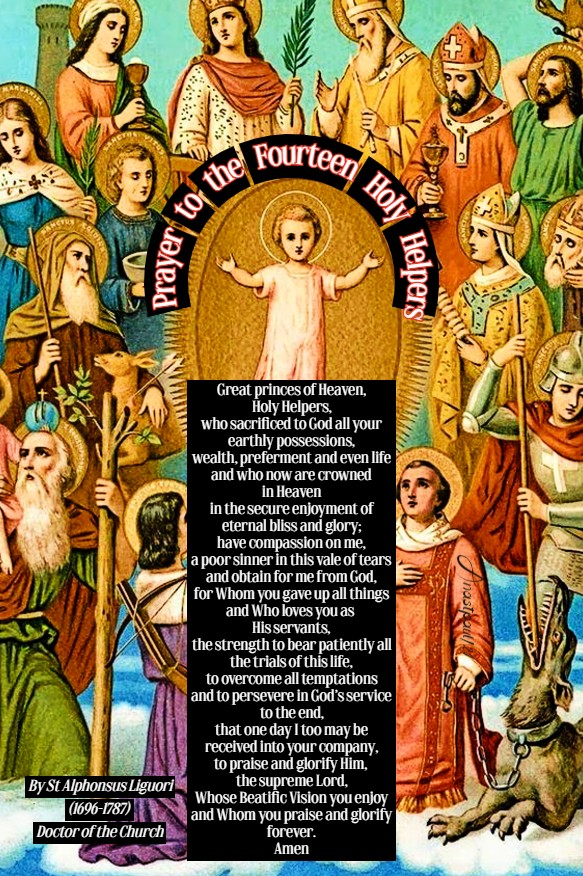
Prayer to the Fourteen Holy Helpers By St Alphonsus Liguori (1696-1787) Doctor of the Church
Great princes of Heaven, Holy Helpers, who sacrificed to God all your earthly possessions, wealth, preferment and even life and who now are crowned in Heaven in the secure enjoyment of eternal bliss and glory; have compassion on me, a poor sinner in this vale of tears and obtain for me from God, for Whom you gave up all things and Who loves you as His servants, the strength to bear patiently all the trials of this life, to overcome all temptations and to persevere in God’s service to the end, that one day I too may be received into your company, to praise and glorify Him, the supreme Lord, Whose Beatific Vision you enjoy and Whom you praise and glorify forever. Amen
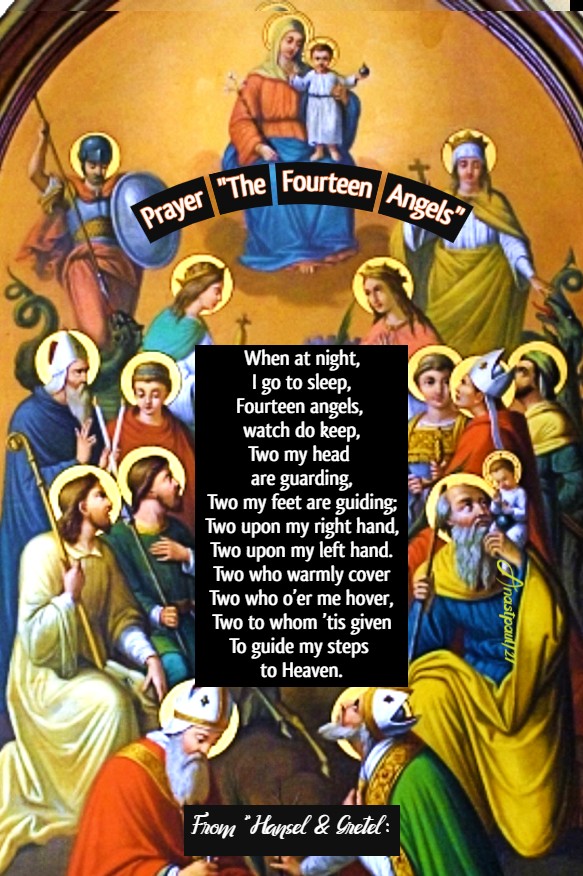
The “fourteen angels” of the lost children’s prayer in the Composer, Engelbert Humperdinck’s (1854-1921) (not the popular Welsh singer) fairy opera, ‘Hansel and Gretel’, are the Fourteen Holy Helpers. The English words are familiar and very beautiful:
When at night, I go to sleep, Fourteen angels, watch do keep, Two my head are guarding, Two my feet are guiding; Two upon my right hand, Two upon my left hand. Two who warmly cover Two who o’er me hover, Two to whom ’tis given To guide my steps to Heaven.
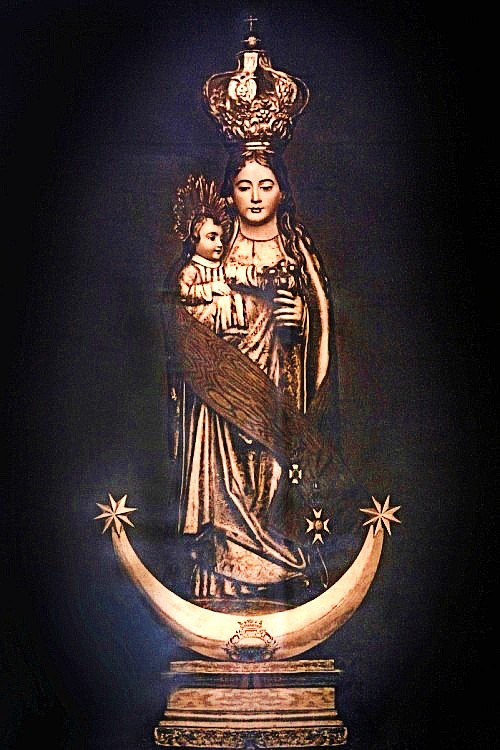
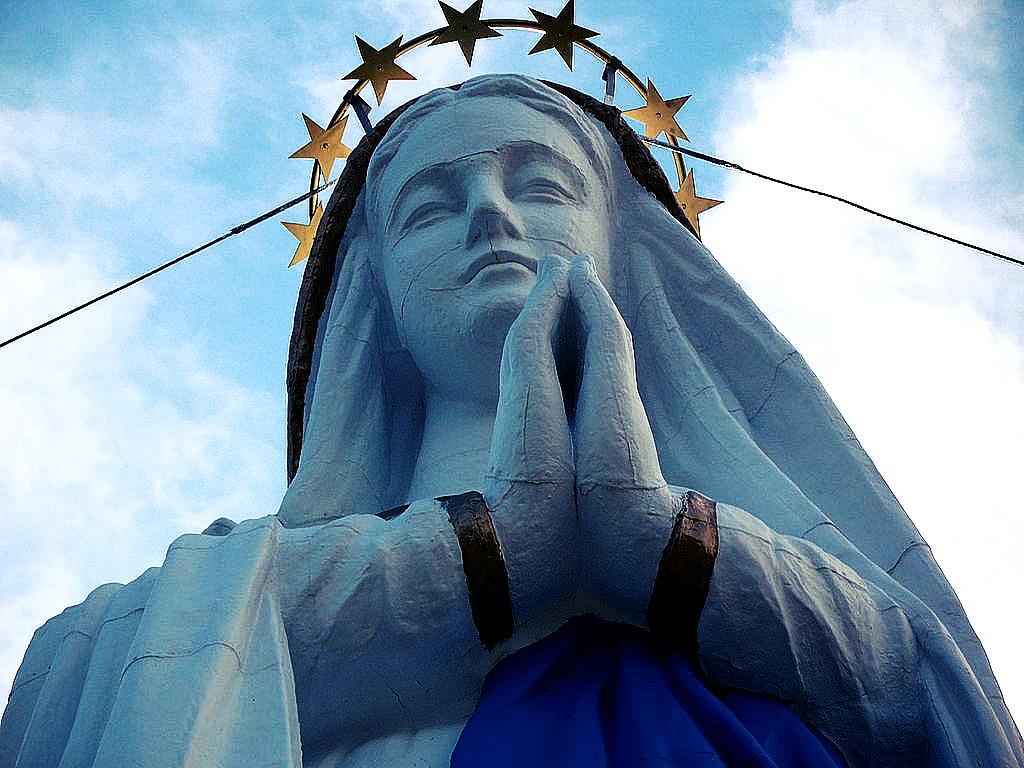
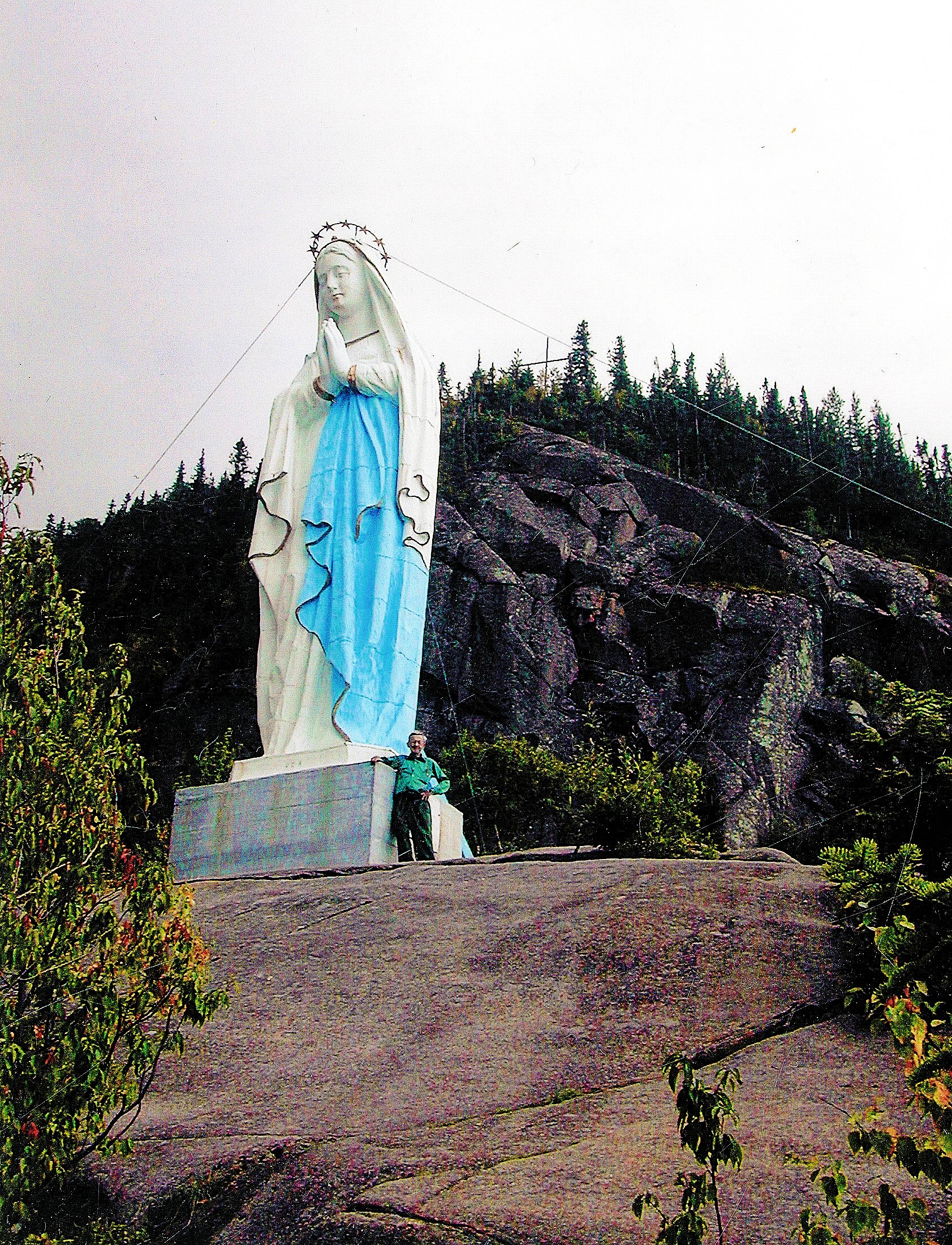
Notre-Dame du Saguenay / Our Lady of Lac Bouchet, Quebec (1920) – 25 July:
The Saguenay Fjord is an ancient glacial valley that has been overrun with sea water. In the year 1828 a surveyor, Joseph Bouchette, ventured into the region for the purpose of collecting data for topographical maps. It was during this expedition that he found a suitable site for a future village, which Pascal Dumais and his family later settled. This marked the founding of the village of Lac-Bouchette, with more and more people coming to settle in the area until the village had 300 inhabitants by 1888. Our story actually begins with a man named Charles Napoleon Robitaille, a salesman who travelled the roads in and around Quebec. During the winters he would have to cross frozen rivers and it was in the winter of 1878 while trying to cross the Saguenay River that the ice broke under the weight of his horse and sleigh. Pulled beneath the surface of the icy waters, Charles was alone and completely helpless. Knowing he was dying, he implored the Blessed Virgin Mary to save him. Charles miraculously survived, and managed to escape from the river with his life. He knew the Virgin had assisted him and so to honour Mary and her recent apparition at Lourdes, he asked Louis Jobin to create a huge Statue of the Blessed Virgin sculpted in the image of Our Lady of Lourdes, the Immaculate Conception. He envisioned the Statue in the heights overlooking the mouth of the river. The Statue Jobin sculpted became known as Notre-Dame du Saguenay.
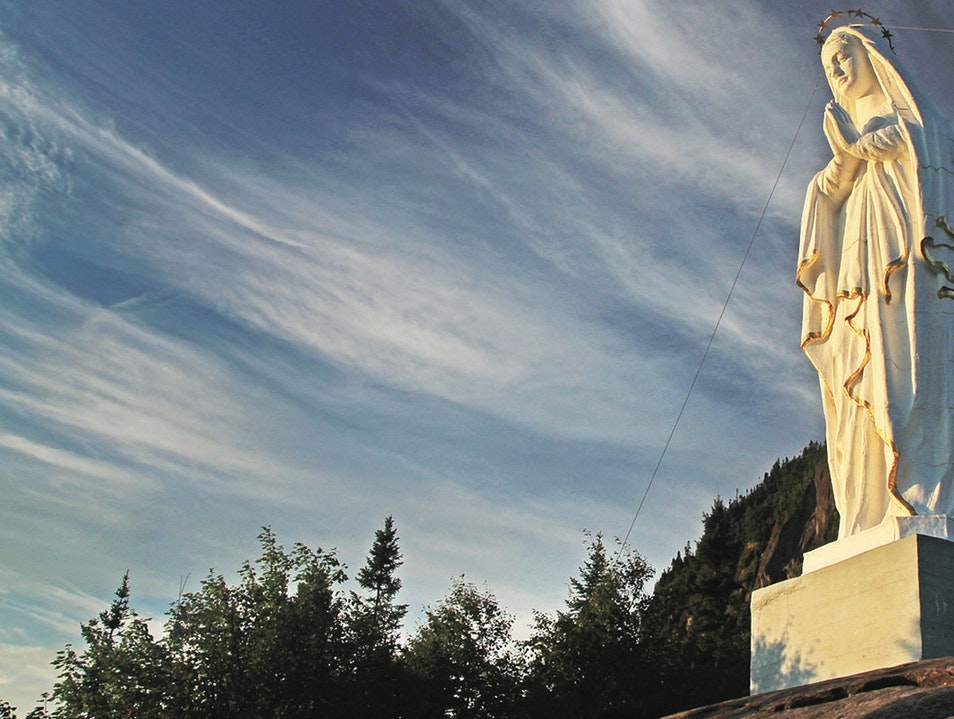
The finished Statue is an impressive more than 10,5 metres high and weighs 3 tons. Sculpted of solid white pine, it was then sheathed in lead to protect it from the harsh weather. Hauling such a huge Statue into place was a difficult task in the late nineteenth century. After being constructed, it was broken down into 14 separate pieces and then hoisted into place and rebuilt. The Statue made Louis Jobin the most famous sculptor of the time,and it has become a regional landmark, with visitors from all over the world assembling at her feet to sing the Ave Maria.
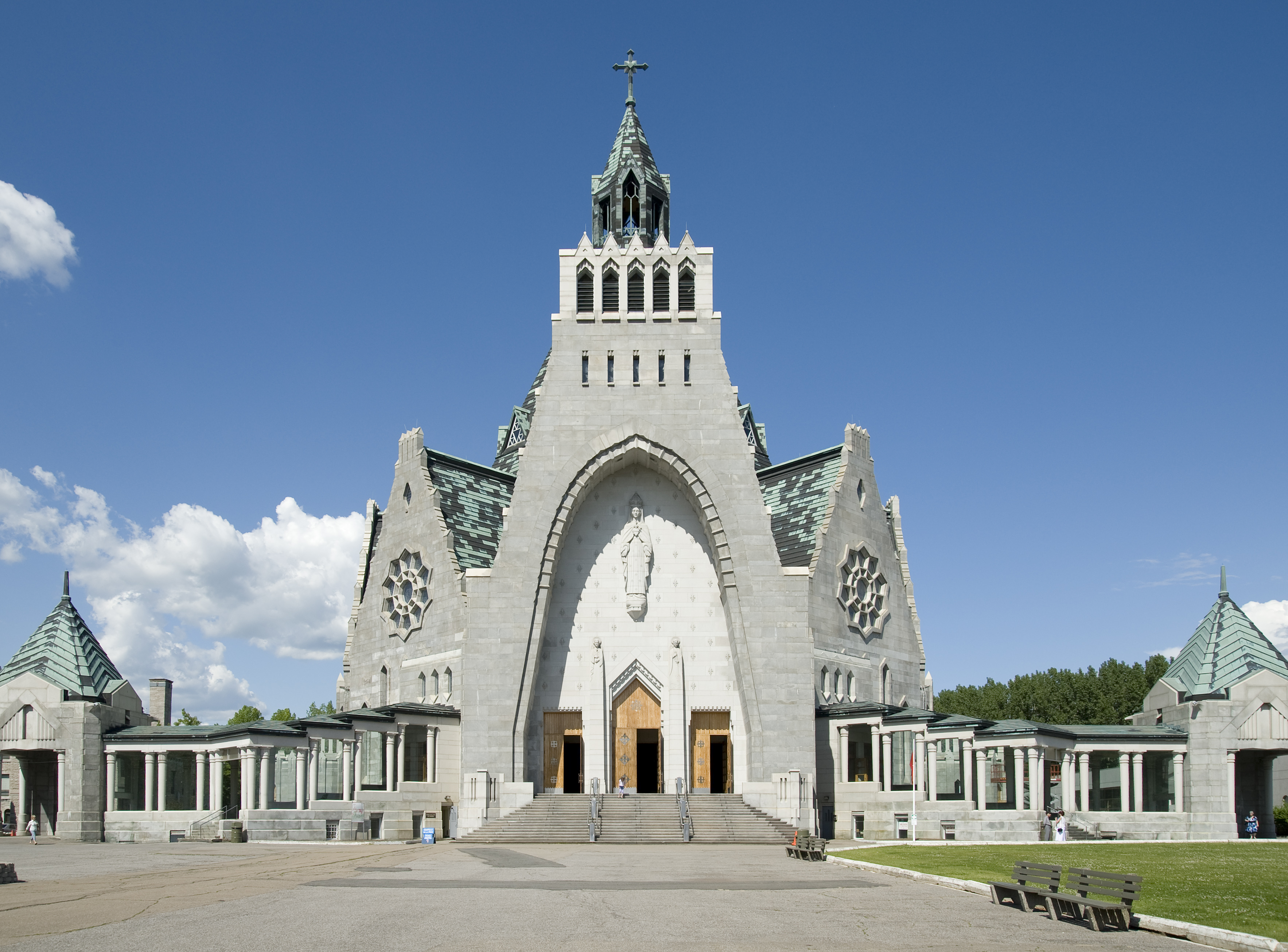
In 1889 the mission Church of Saint Thomas Aquinas was built and the next year Father Joseph Ironwood became the first Priest there A second Church was soon built, in 1898, as the population increased dramatically. Now, on the north shore of Lake Bouchet, in the Province of Quebec, there stand the buildings of a Friary and the Sanctuary of Our Lady of the Saguenay. In 1920, Father Elzear Delamarre built a house and a private Chapel dedicated to Saint Anthony of Padua on the site, which later became known as the hermitage of Saint Anthony and is one of the national Shrines in Quebec. So began the pilgrimage-shrine that has since grown steadily in popularity. After Father de Lamarre’s death in 1925, the Capuchin Franciscans took over the property, built their house and Church there and minister to the thousands of pilgrims who visit the Blessed Mother at her Sanctuary.
St Cugat del Valles Bl Darío Acosta Zurita St Ebrulfus St Fagildo of Santiago St Felix of Furcona St Florentius of Furcona St Glodesind of Metz St Magnericus of Trier (c 520-596) Bishop and Confessor Bl Michel-Louis Brulard Bl Mieczyslawa Kowalska St Mordeyren St Nissen of Wexford St Olympiad of Constantinople St Paul of Palestine
St Theodemir of Cordoba — Martyrs of Caesarea – 3 saints: Three Christians martyred together in the pesecutions of emperor Maximilian and governor Firmilian – Paul, Tea and Valentina. 309 in Caesarea, Palestine.
Martyrs of Cuncolim – 20 saints: On 15 July 1583 the group met at the church of Orlim, and hiked to Cuncolim to erect a cross and choose land for a new church. Local anti-Christian pagans, seeing the unarmed Christians, gathered their weapons and marched on them. One of the parishioners, a Portuguese emigre named Gonçalo Rodrigues, carried a firearm, but Father Alphonsus Pacheco stopped him from using it. The pagans then fell upon them, and killed them all without mercy. They were – • Alphonsus Pacheco • Alphonsus the altar boy • Anthony Francis • Dominic of Cuncolim • Francis Aranha • Francis Rodrigues • Gonçalo Rodrigues • Paul da Costa • Peter Berno • Rudolph Acquaviva • ten other native Christian converts whose names have not come down to us They were martyred on Monday 25 July 1583 at the village of Cuncolim, district of Salcete, territory of Goa, India. Beatified on 30 April 1893 by Pope Leo XIII.
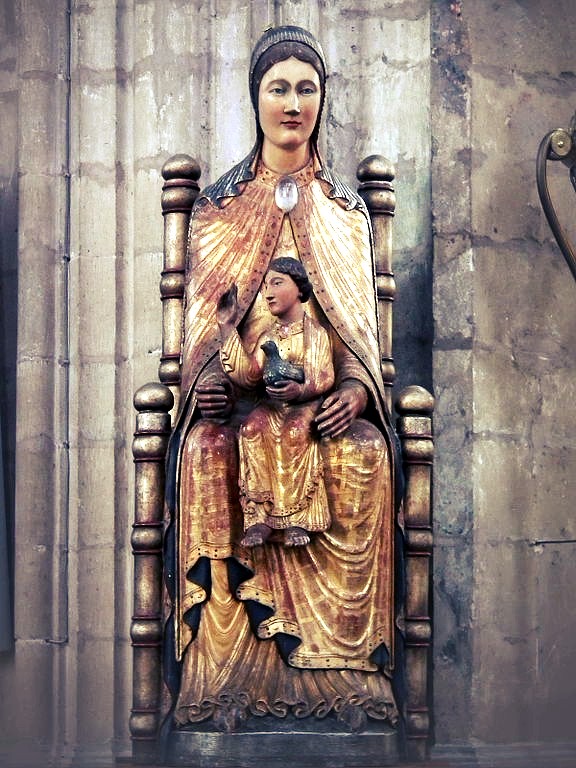
Our Lady of Montevergine: Also known as – • Madonna di Montevergine • Madonna Bruna • Mamma Schiavona One of the so-called Black Madonnas, image of the Blessed Virgin Mary, normally holding the Christ Child, who have been “inculturated”, that is, made the little Jewish girl Mary look more like the people in the area of the artist, or which are actually black in color. This one serves as part of the altar piece of the Sanctuary on Montevergine. This site is the goal of thousands of pilgrims each year. More on Our Lady of Montevergine here: https://anastpaul.com/2018/09/01/1-september-the-memorial-of-our-lady-of-montevergine/
Bl Giustino of Paris Bl Giovanna Soderini St Jane Soderini St Joshua the Patriarch Bl Juliana of Collalto St Laetus of Dax St Lupus of Sens (Died 623) Bishop St Lythan St Nivard of Rheims St Priscus St Regulus St Sixtus of Rheims St Terentian St Verena St Victorious St Vincent of Xaintes — Exiles of Campania Twelve Holy Brothers: Martyrs of the South – A group of Martyrs who died c 303 at various places in southern Italy. In 760 their relics were brought together and enshrined in Benevento, Italy as a group. • Saint Arontius of Potenza • Saint Donatus of Sentianum • Saint Felix of Sentianum • Saint Felix of Venosa • Saint Fortunatus of Potenza • Saint Honoratus of Potenza • Saint Januarius of Venosa • Saint Repositus of Velleianum • Saint Sabinian of Potenza • Saint Sator of Velleianum • Saint Septiminus of Venosa • Saint Vitalis of Velleianum One tradition describes Saint Boniface of Hadrumetum and Saint Thecla of Hadrumetum as their parents.
Martyred in the Spanish Civil War: Martyred Hospitallers of Saint John of God – (12 beati) • Blessed Alejandro Cobos Celada • Blessed Alfonso Sebastiá Viñals • Blessed Amparo Carbonell Muñoz • Blessed Antonio Villanueva Igual • Blessed Carmen Moreno Benítez • Blessed Crescencio Lasheras Aizcorbe • Blessed Enrique López y López • Blessed Francesc Trullen Gilisbarts • Blessed Guillermo Rubio Alonso • Blessed Isidro Gil Arano • Blessed Joaquim Pallerola Feu • Blessed Joaquín Ruiz Cascales • Blessed José Franco Gómez • Blessed José Prats Sanjuán • Blessed Josep Samsó y Elias • Blessed Manuel Mateo Calvo • Blessed Mariano Niño Pérez • Blessed Maximiano Fierro Pérez • Blessed Miquel Roca Huguet • Blessed Nicolás Aramendía García • Blessed Pedro Rivera • Blessed Pio Ruiz De La Torre
Saint of the Day – 20 September -St Eustachius born as Placidas, Wife and Sons – Martyrs (Died c 188) One of the Fourteen Holy Helpers– Patronages – against fire, difficult situations, fire prevention, firefighters, hunters, hunting, huntsmen, Madrid, torture victims, trappers.
The remarkable story of Saint Eustachius, is a lesson given by God Himself on the marvels of His Divine Providence. He was a distinguished and very wealthy officer of the Roman army under the Emperor Trajan, in the beginning of the second century. He practised generous charity to the poor, although he had not yet perceived the errors of idolatry.
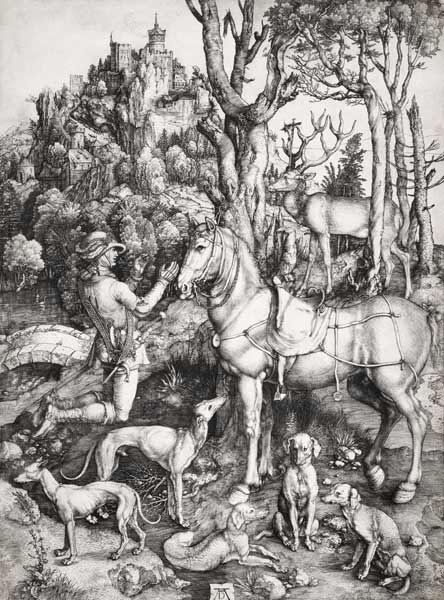
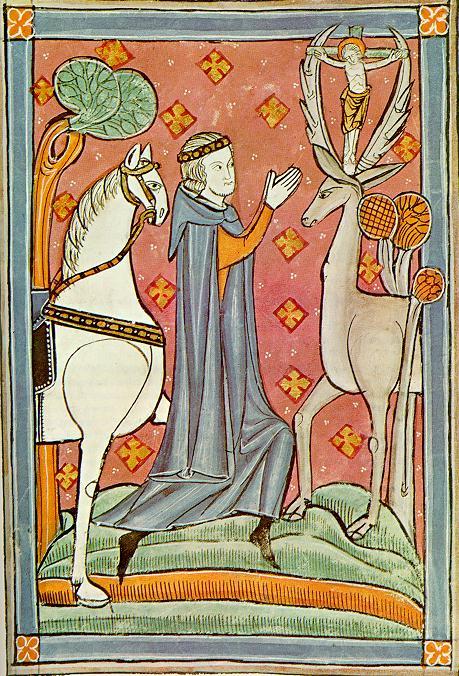
One day, while this distinguished officer was vainly pursuing a deer, the animal suddenly stood immobile before him in the light of a hilltop and he perceived between its horns a luminous cross. On the cross was the image of the crucified Saviour and a voice said to him, ‘I am the Christ whom you honour without knowing it; the alms you give to the poor have reached Me.’ Like Saint Paul, he fell from his horse and remained inert for a time. Coming to himself, he said interiorly, What is this voice I have heard? You who speak to me, who are you, that I may believe in you? And the Lord told him interiorly that He was the Creator of the light, of the seasons, of man and all things visible, that He had suffered to save the human race, died and been buried but had risen the third day.
This was sufficient and the officer went home to fulfil the prescription he had received to be baptised with his wife and two young sons. His spouse had received a similar revelation at the same time as himself and they all went to the Christian authority of the region in secret, to be baptised the same night.
In a short time he lost all his possessions through natural catastrophes and robbers. But he had been advised beforehand that the Lord wanted to make of him another Job, that already the ancient enemy had plotted against him and that he was not to allow any thought of blasphemy to arise in his heart amid the sufferings that were awaiting him. He prayed for strength and retired from the region after the calamities, with his wife and children. When by unforeseeable and extraordinary accidents, his wife and children were also taken from him and he believed the children dead, he was close to despair and wished his life might end but the warning of the Lord returned to his mind and he entered into the service of a land-owner of a village called Badyssus, to tend the fields. He remained for fifteen years in this occupation. During this time his loved ones were well and safe, all spared in the perilous circumstances which had removed them from his sight but separated, each one like himself, from the three others.
In those days the empire was suffering greatly from the ravages of barbarians and was sinking under the assaults. The emperor Trajan had Eustachius sought out and when he was found, had him clothed in splendid garments to give him command over the troops he intended to send against the invaders. During the celebration that accompanied his return, he related to the emperor all that had occurred to him. When the troops were being assembled, his own sons were conscripted. Seeing them, he noticed them as young men taller than most and of great nobility of bearing and countenance and kept them near him without yet recognising them. One of the two, while on bivouac near the very house of his own mother, who like Eustachius had taken employment in the garden of a landowner, related the confused memories of his childhood to his companion. Suddenly, the two brothers recognised one another and embraced in an effusion of joy.
Their mother, by a delicate attention of Providence, had chanced to overhear them and reflecting on what she heard, became certain they were her own sons. She went to the captain of the campaign to inquire about them and immediately recognised him. Not wishing to startle him, she began to relate her story, identifying herself as the wife of a certain Placidus and saying she believed she was now in the presence of her two sons from whom she had been separated and whom she had not seen for long years. One must imagine the sentiments of the captain on hearing this narration, the reunion which followed and the prayers of thanksgiving sent up to God by the family and also the troops, who joined them in their joy and prayers.
Returning to Rome victorious, Eustachius was received in triumph and greatly honoured, but when commanded to sacrifice during the celebration to the false gods, refused. The infuriated emperor Adrian — for Trajan had died — ordered him with his wife and children to be exposed to a starved lion. But instead of harming these servants of God, the beast came up to them, lowered its head as if in homage and left the arena. The emperor, more furious still, caused the martyrs to be shut up inside a brazen bull, under which a fire was to be kindled, that they might be roasted to death. Saint Eustachius prayed aloud and thanked God, asking Him who had reunited them to cause that their lives end at the same time, so they might be received together by Him into the happiness of His presence. They expired but neither their bodies nor even their hair was injured. They were found entire the next day and at first it was believed they were still alive. Many believed in Christ through this final miracle, which to us today seems perhaps less miraculous than the story of their existence while alive. A church in honour of the martyrs still exists in Rome: Saint-Eustachius in Thermis.
Eustachius became known as a patron saint of hunters and firefighters and also of anyone facing adversity; he was traditionally included among the Fourteen Holy Helpers. He is one of the patron saints of Madri d, Spain. The island of Sint Eustatius in the Caribbean Netherlands is named after him. The d’Afflitto, one of the oldest princely families in Italy, claim to be direct descendants of Saint Eustachius.
The novels “The Herb of Grace” (US title: Pilgrim’s Inn) (1948) by British author Elizabeth Goudge and Riddley Walker (1980) by American author Russell Hoban, incorporate the legend into their plot. It has also inspired the film Imagination.
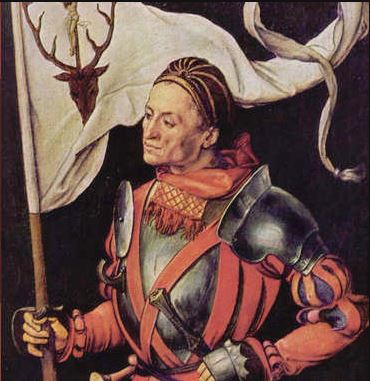
The saint’s cross-and-stag symbol is featured on bottles of Jägermeister, a German alcoholic digestif. This is related to his status as patron of hunters; a Jägermeister was a senior foresters and gamekeeper in the German civil service until 1934, prior to the drink’s introduction in 1935. Jägermeister has a round logo of a shining cross between the antlers of a deer/stag referring to two persons who had seen such a vision: Saint Hubertus and Saint Eustachius.
Saint Eustachius has a church dedicated to him in the southern part of India – he is called Saint Esthak in this part of the world and in County Kildare, Ireland. There is a church dedicated to him on the campus of Newbridge College in Newbridge, County Kildare and the schools’ logo and motto is influenced by the vision of Saint Eustachius; a nearby village is named Ballymore Eustace.
Sant’Eustachio is also honoured in Tocco da Casauria, a town in the Province of Pescara in the Abruzzo region of central Italy. The town’s church, built in the twelfth century, was dedicated to Saint Eustachius. It was rebuilt after being partially destroyed by an earthquake in 1706.
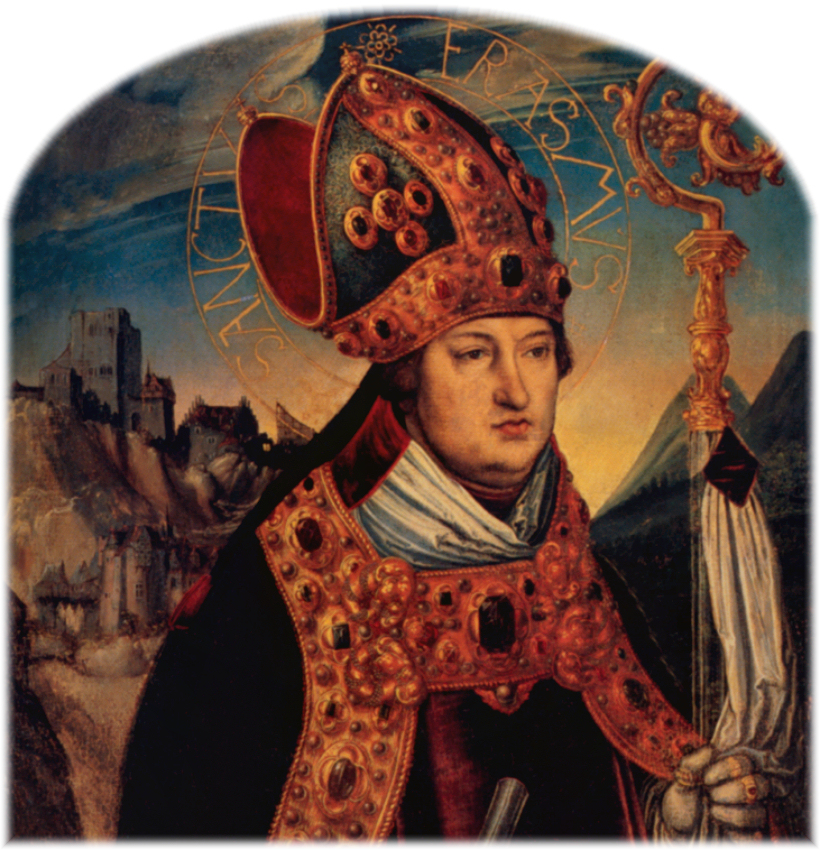
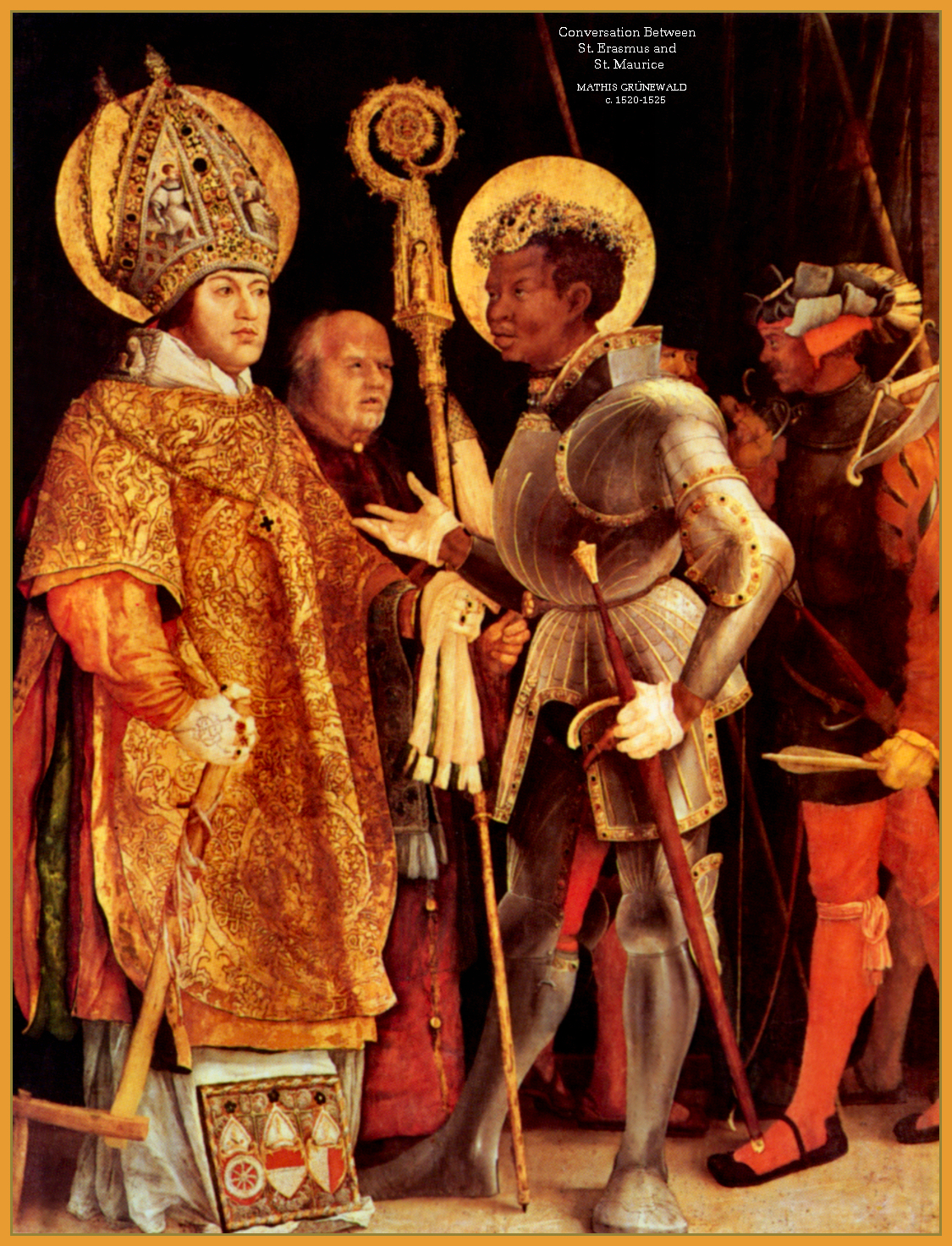
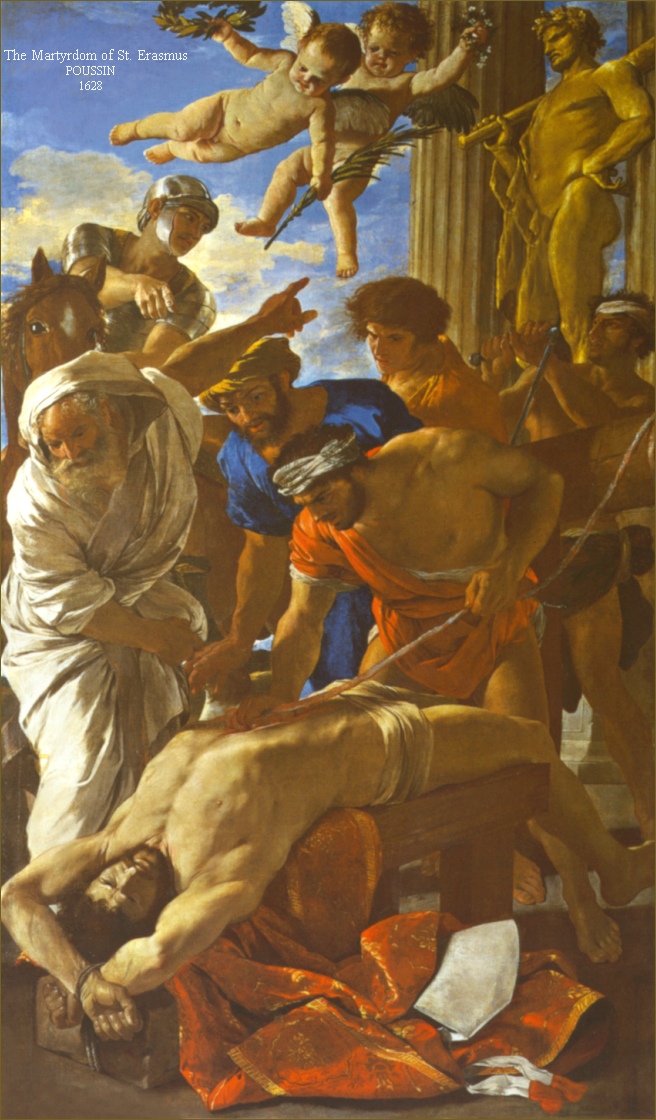
Saint of the Day – 2 June – St Erasmus (Died c 303) Martyr – also known as Saint Elmo (Telmo, Eramo, Erarmo, Ermo, Herasmus, Rasimus, Rasmus), Bishop of Formiae, Campagna, Italy. St Erasmus or Elmo is also one of the Fourteen Holy Helpers, saintly figures of Christian tradition who were venerated especially as intercessors. Patronages – against appendicitis, against birth pains, against abdominal or stomach pains and diseases, against colic, against danger at sea, against seasickness, against storms, ammunition, explosives and ordnance workers, boatmen, mariners, sailors, watermen, childbirth and women in labour, navigators, Gaeta, Italy, Formia, cattle pest, Fort St Elmo, Malta.
As with many Martyrs of the early Church, we know little about their lives and upbringings but much about their pious and courageous deaths, accounts of which were recorded and believed to be more instructive to the faithful than complete biographies.
The childhood and birthplace of Saint Erasmus is lost to history. In the late third century, we do know that he was appointed Bishop of Antioch in Asia Minor, where he led the faithful. When Emperor Diocletian ascended to the throne, widespread persecution of Christians began and Antioch was not overlooked. Saint Erasmus fled into the mountains of Lebanon, where he undertook an austere life of prayer and fasting, going without food for days at a time. Holy legend tells us that a raven brought him food when he deprived himself for too long. Eventually, however, he was discovered by the soldiers of the Emperor and dragged to judgement.
St Erasmus was urged to recant his faith and some respect was offered him. However, when he adamantly stated his belief in Christ and could not be persuaded to make offerings to the gods. He stated, “Almighty God, that made all things, hath wrought heaven and hell and all that is therein, Him will I not forsake for nothing that can or may be done to me, for His goodly grace hath given to me such grace and to other of His chosen friends, that He was made man and hath tasted and suffered the bitter death for me and for all sinners.”Saint Erasmus was viciously tortured. He was at first scourged, had heated hooks jabbed into his intestines and stomach and was finally thrown into a caldron filled with boiling oil. However, despite these horrific tortures, the Lord protected Saint Erasmus from death and many were converted to the faith—including the jailor and his family.
Unable to torture him physically into recanting his faith, the judge ordered him imprisoned in chains, thrown into a pit filled with vipers and worms and forbid the jailor to feed him, insisting that he die of starvation for his crime. However, Erasmus was again delivered, with an angel appearing to him and leading him to freedom. During his escape, the angel proclaimed, ”Erasmus, Follow me! Thou shalt convert a great many.”
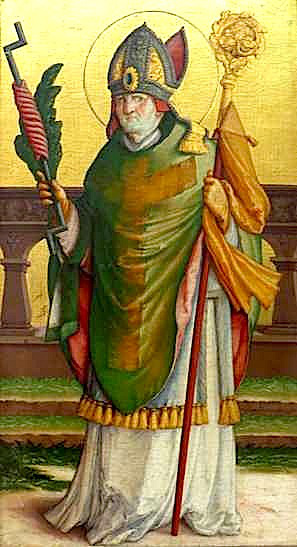
Erasmus fled to Europe, preaching the power of the Lord, performing miracles and converting the multitudes proclaimed by the Angel. Upon his arrival in Italy, however, he was again arrested—this time by Emperor Maximin, who also persecuted Christians. History tells us that the Emperor, enraged by Erasmus’ success in conversions, ordered three hundred of the newly baptised Christians killed as incentive for Erasmus to recant his faith. When he did not, he was cruelly tortured and again imprisoned. During this torture, his intestines were slowly wound around a sailor’s capstan, which is why he is the Patron Saint of sailors today. Eventually, Saint Erasmus died a Martyr’s death due to disembowelling and subsequent beheading, having been summoned by the voice of the Lord.
From the Golden Legend:“And when the hour was come that this holy Bishop and Martyr of God should depart out of this world, then was heard a loud voice perfectly, coming from heaven saying: “Erasmus, my true servant, thou hast done me true service, wherefore come with me and go and enter into the bliss and joy of thy Lord and I promise thee and all people that think upon thy great pain and call upon thy holy name and worship every Sunday, what that they ask of Me in thy name for the wealth of their souls, I shall grant it. Now come, my true and chosen friend, be glad and comforted with Mine ascension . I will that thou arise with Me and come sit upon the right hand of My Father.” Then was this holy man right glad and joyful and he cast his eyes upward to heaven, with lifting up his hands and there he saw, a clear shining crown come from heaven upon his blessed head. Then gave he loving and thanking to Almighty God with bowing his head and kneeling and both his hands upward to heaven, and meekly said: “O Lord in thy hands yield my spirit and this Sunday receive my soul into thy peace and rest.” And with saying these words he yielded up his ghost, which was seen by many men’s eyes, shining clearer than the sun and how that he was received of the holy Angels and was led through the height of heaven into the uppermost plan of heaven – there he standeth with God, with all the holy company and is there a true helper to all them that call truly to Saint Erasmus for ghostly health, which joy and ghostly health let us pray, that he for us, all of our Lord God may obtain.”
Saint Erasmus is one of the 14 Holy Helpers, a group of saints invoked with special confidence because they have proven themselves efficacious helpers in adversity and difficulties . Other saints identified as Holy Helpers are: Saints Blaise, Catherine of Alexandria, George, Christopher and others. Saint Erasmus, due to the manner in which he was tortured, is the Patron Saint of those with stomach or intestinal disorders.
Saint Erasmus, under the name Saint Elmo, is also the patron saint of sailors and the shining lights observed upon his death, continue to be reported by sailors as “Saint Elmo’s fire.” This electrostatic phenomenon has been reported throughout history, from Julius Caesar, to the journals of sailors on Magellan’s voyage around the globe, to the writings of Shakespeare, Melville and Charles Darwin.
A chronicler of Magellan’s voyage to circle the globe, observed: “During those storms the holy body, that is, to say St. Elmo, appeared to us many times in light…on an exceedingly dark night on the maintop where he stayed for about two hours or more for our consolation.” Darwin wrote that one night when the Beagle was anchored in the estuary of the Rio Plata: “Everything was in flames, the sky with lightning, the water with luminous particles, and even the very masts were pointed with a blue flame.” The appearance of St Elmo’s Fire is regarded as a good omen for sailors, as it tends to occur near the end of severe thunderstorms or weather systems, the answer to sailors’ prayers for heavenly intervention. In these moments, the guiding hand of Saint Elmo is present.
The endurance of Saint Erasmus in the face of cruel and horrific torture reminds us that the Lord is always with those who love Him. It is difficult to imagine being in a position of profound physical torture, like that many of the early Church’s Martyrs endured. In our day to day lives, we often find it difficult to withstand the smallest inconveniences and hurts we experience, generally feeling lost and overwhelmed. But the lives of the early Martyrs are not that different from our own. Terminal illnesses, significant financial and vocational struggles, victimisation and trauma fill our lives and the lives of those we love. Our suffering is sometimes great, albeit different from the early Martyrs. Our call is to join that suffering to Christ, to look to the Lord for support and succour, to rely on Our Blessed Mother for grace and intercession. When we are able to do that—when we are able to look beyond our struggles and suffering to see the face of God present within us, we grow closer to the glorious Saints and Martyrs who reflected their faith for all to see, even in the midst of great pain!
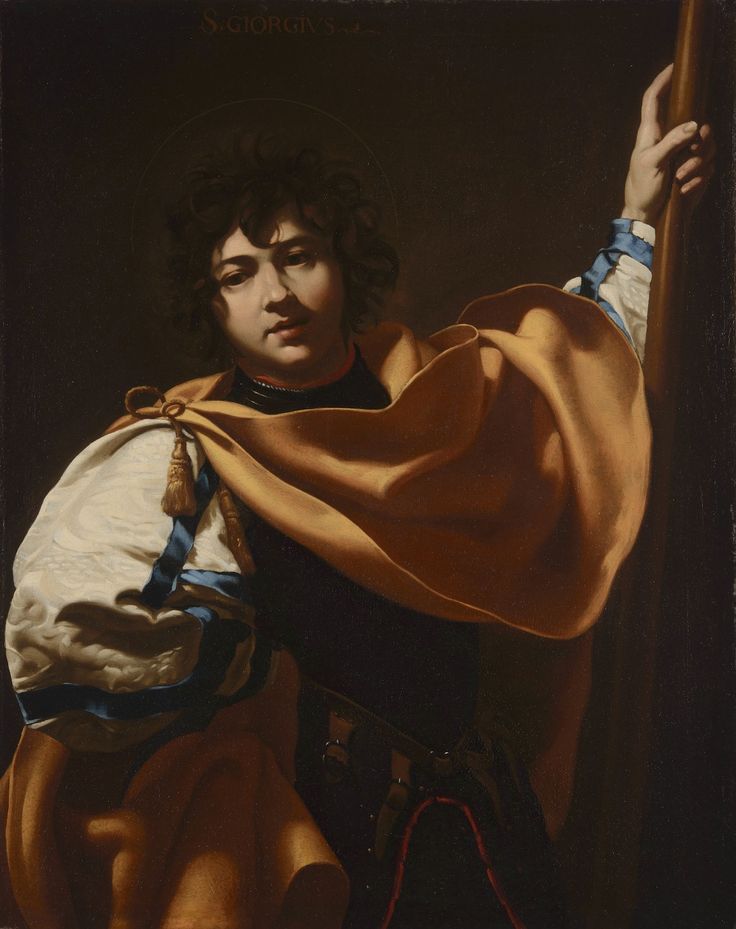
Saint of the Day – 23 April – St George (died c 303) also known as St George of Lydda, Jirí, Jordi, Zorzo, Victory Bringer – Martyr and Soldier. St George was born c 256-285 in Palestine and was tortured and beheaded to death in c 303 in Nicomedia, Bithynia, Roman Empire. Patronages – • against herpes • against leprosy • against plague • against skin diseases • against skin rashes • against syphilis • agricultural workers • Aragon • archers • armourers • Boy Scouts • butchers • Canada • Cappadocia • Catalonia • cavalry • chivalry • Crusaders • England • equestrians • Ethiopia • farmers • field hands • field workers • Georgia • Germany • Greece • halberdiers • horsemen • horses • knights • lepers • Lithuania • Malta • Montenegro • Order of the Garter • Palestine • Palestinian Christians • Portugal • riders • Romanian Army • saddle makers • saddlers • Serbia • sheep • shepherds • soldiers • Teutonic Knights • 2 Dioceses • 181 Cities. He isone of the Fourteen Holy Helpers.
St George was a Roman soldier of Greek origin and officer in the Guard of Roman emperor Diocletian, who was sentenced to death for refusing to recant his Christian faith. As a Christian Martyr, he later became one of the most venerated saints in Christianity and was especially venerated by the Crusaders. George’s parents were Christians of Greek background, his father Gerontius was a Roman army official from Cappadocia and his mother Polychronia was a Christian and a Greek native from Lydda in the Roman province of Syria Palaestina.
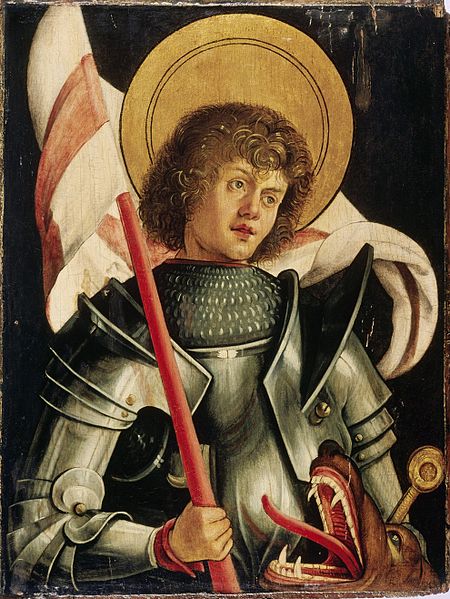
St George is commemorated and remembered as one of the Fourteen Holy Helpers and one of the most prominent military Saints, he is immortalised in the myth of Saint George and the Dragon. Due to his chivalrous behaviour (protecting women, fighting evil, dependence on faith and might of arms, largesse to the poor), devotion to Saint George became popular in the Europe after the 10th century. In the 15th century his feast day was as popular and important as Christmas. Many of his areas of patronage have to do with life as a knight on horseback. The celebrated Knights of the Garter are actually Knights of the Order of Saint George. The shrine built for his relics at Lydda, Palestine was a popular point of pilgrimage for centuries.
There is little information on the early life of Saint George. Herbert Thurston in The Catholic Encyclopedia states that based upon an ancient cultus, narratives of the early pilgrims and the early dedications of churches to Saint George, going back to the fourth century, “there seems, therefore, no ground for doubting the historical existence of St. George”. According to Donald Attwater, “No historical particulars of his life have survived, … The widespread veneration for St George as a soldier saint from early times had its centre in Palestine at Diospolis, now Lydda. St George was apparently martyred there, at the end of the third or the beginning of the fourth century; that is all that can be reasonably surmised about him.”
On 24 February 303, Diocletian, who hated Christians, announced that every Christian the army passed would be arrested and every other soldier should offer a sacrifice to the Roman gods. George refused to abide by the order and told Diocletian, who was angry but greatly valued his friendship with George’s father. When George announced his beliefs before his peers, Diocletian was unable to keep the news to himself. In an effort to save George, Diocletian attempted to convert him to believe in the Roman gods, offered him land, money and slaves in exchange for offering a sacrifice to the Roman gods and made several other offers that George refused.
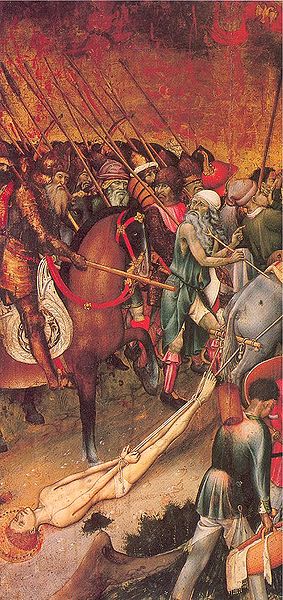
Finally, after exhausting all other options, Diocletian ordered George’s execution. In preparation for his death, George gave his money to the poor and was sent for several torture sessions. He was lacerated on a wheel of swords and required resuscitation three times but still George did not turn from God.
Saint George dragged through the city behind horses – 15th century – Bernardo Martorell
George was decapitated before Nicomedia’s outer wall. His body was sent to Lydda for burial and other Christians went to honour George as a martyr.
Saint George and the Dragon
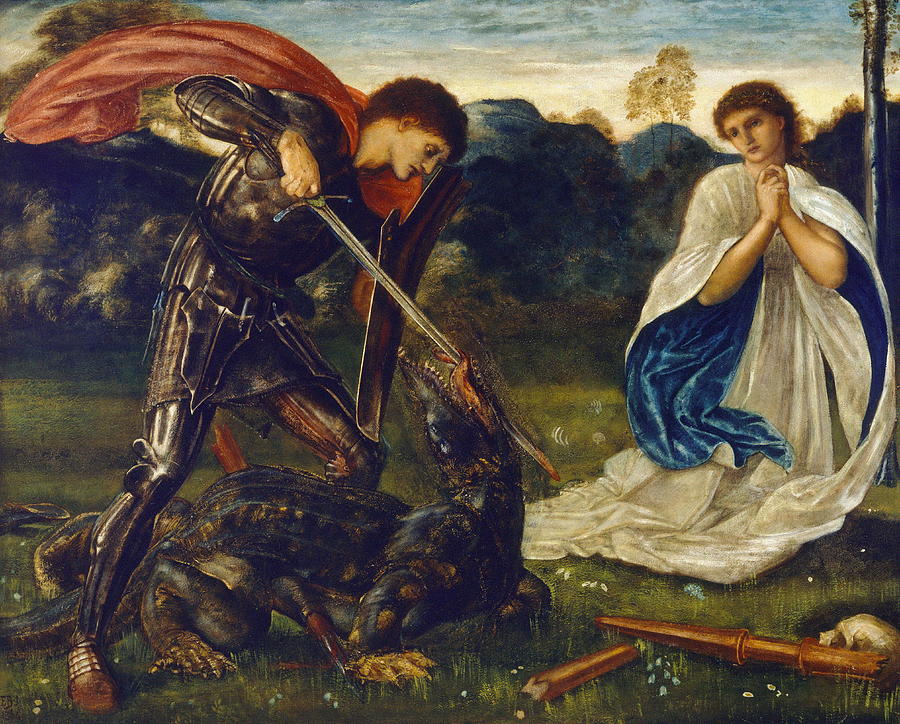
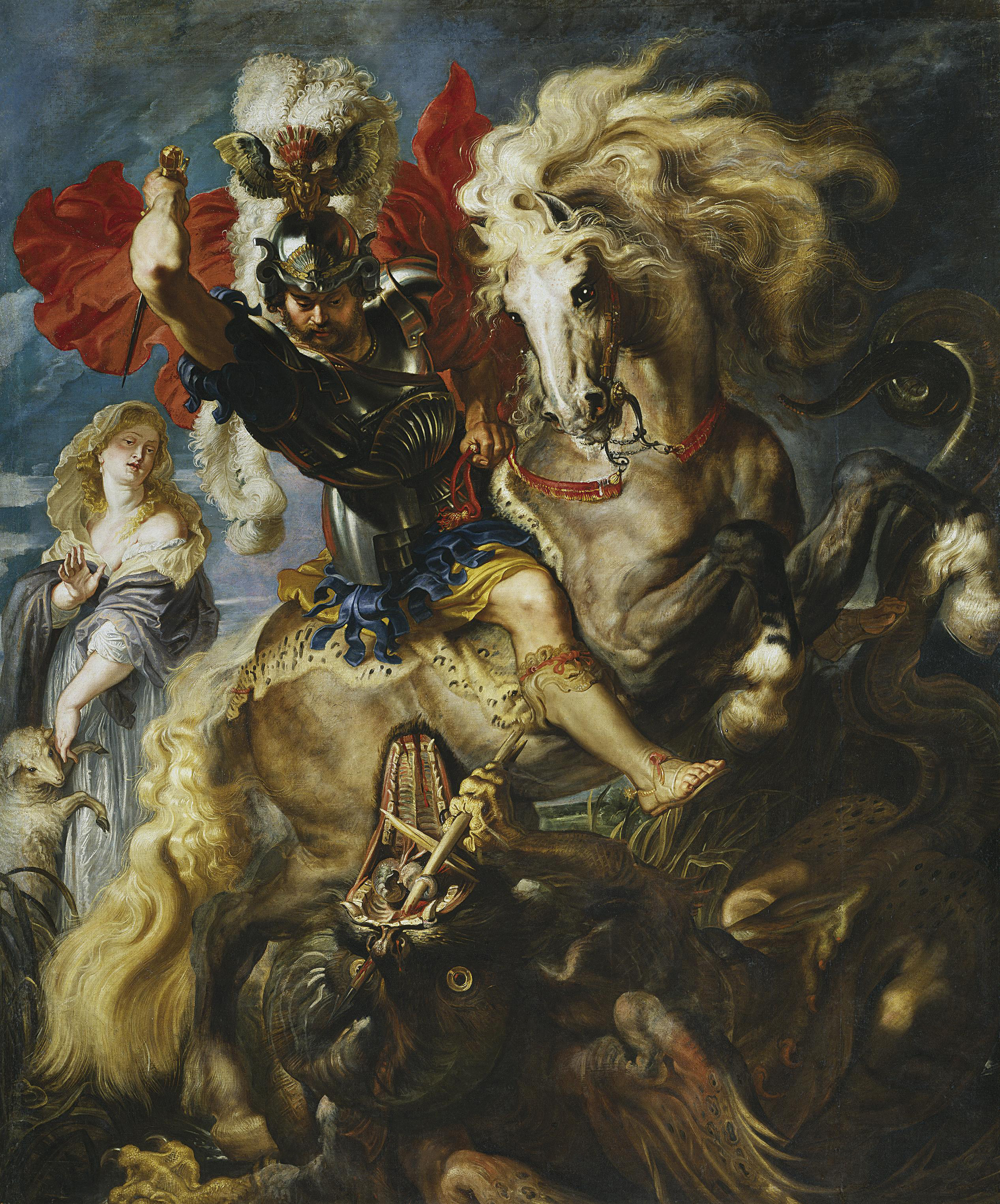
There are several stories about George fighting dragons but in the Western version, a dragon or crocodile made its nest at a spring that provided water to Silene, believed to be modern-day Lcyrene in Libya. The people were unable to collect water and so attempted to remove the dragon from its nest on several occasions. It would temporarily leave its nest when they offered it a sheep each day, until the sheep disappeared and the people were distraught. This was when they decided that a maiden would be just as effective as sending a sheep. The townspeople chose the victim by drawing straws. This continued until one day the princess’ straw was drawn. The monarch begged for her to be spared but the people would not have it. She was offered to the dragon but before she could be devoured, George appeared. He faced the dragon, protected himself with the sign of the Cross and slayed the dragon. After saving the town, the citizens abandoned their paganism and were all converted to Christianity.
Interesting Facts
Saint George stands out among other saints and legends because he is known and revered by both Muslims and Christians.
It is said Saint George killed the dragon near the sea in Beirut, thus Saint George Bay was named in his honour.
Saint George’s feast day is celebrated on 23 April but if it falls before Easter, it is celebrated Easter Monday.
The Russian Orthodox Church celebrates three St George feast days each year -23 April, 3 November, to commemorate the consecration of a cathedral dedicated to him in Lydda, and on 26 November for when a church in Kiev was dedicated to him.
In Bulgaria, his feast day is celebrated 6 May with the slaughter and roasting of a lamb.
In Egypt, the Coptic Orthodox Church of Alexandria calls St George the “Prince of Martyrs” and celebrates on 1 May. There is a second celebration 17 November in honour of the first church dedicated to him.
Saint George is the patron saint of England and Catalonia and his cross can be found throughout England including on the English and other Commonwealth flags.
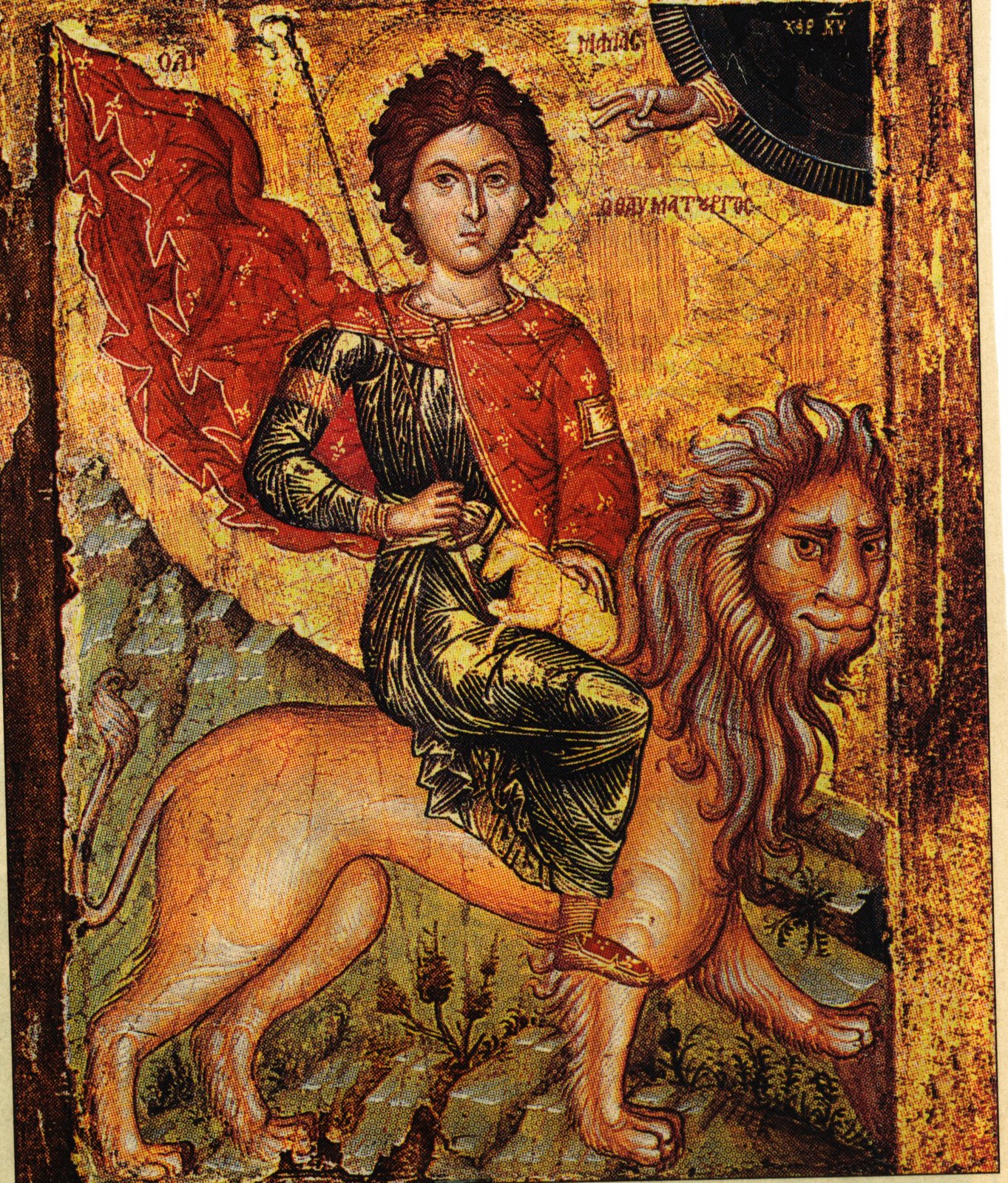
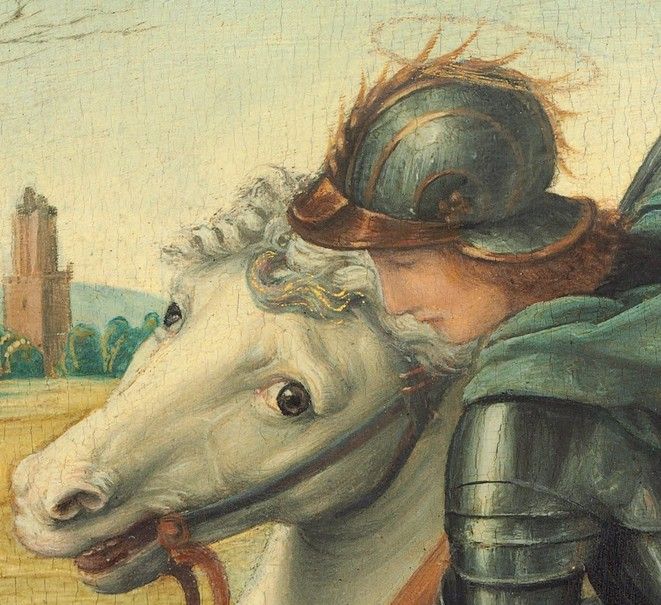
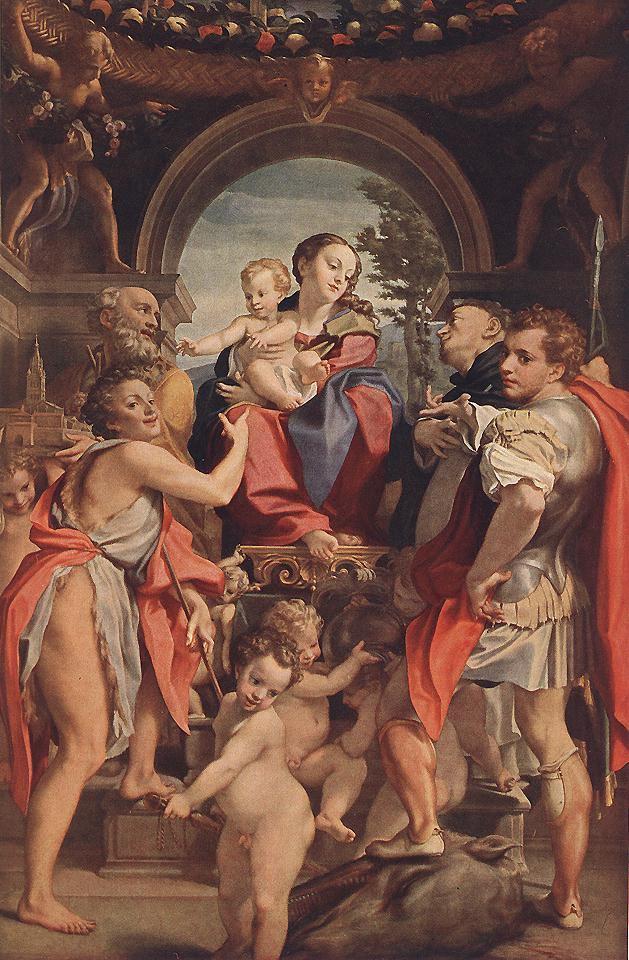
In older works, Saint George is depicted wearing armour and holding a lance or fighting a dragon, which represents Christ’s enemies.
















 AnaStpaul
You must be logged in to post a comment.