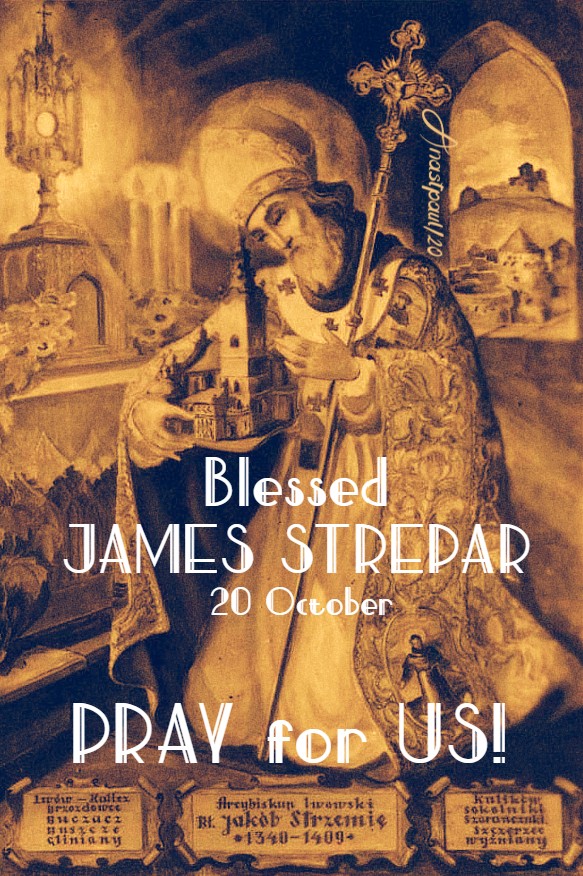
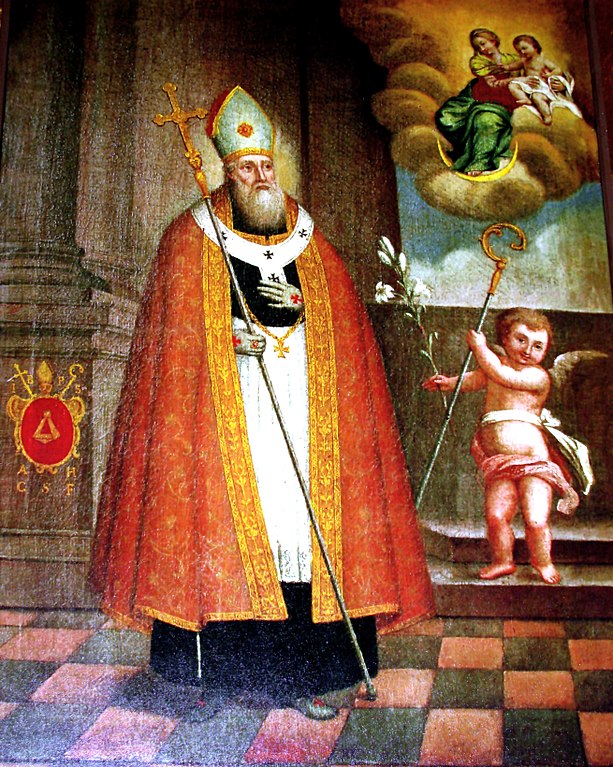
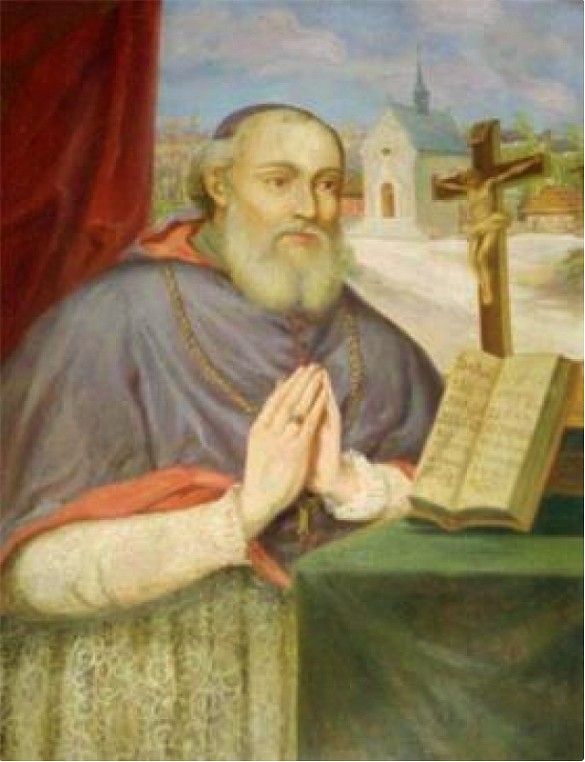
Blessed James Strepar OFM (c 1340-1409) Archbishop of Halicz, Poland from 1392 until his death Religious Priest of the Order of Friars Minor, Missionary. St Pius X proclaimed Blessed James, along with St Anthony of Padua, the Patrons of the Conventual Franciscan Order of Krakow Province. He was given the title of “Protector of the Kingdom, Defender and Guardian of the Homeland,” for his exceptional merits, including civil ones. Such was he considered by all. He was Canonised by by Pope Pius VI on 11 September 1791. His body is incorrupt. His Life: https://anastpaul.com/2020/10/20/saint-of-the-day-20-october-blessed-james-strepar-ofm-c-1340-1409/
St Leopardo of Osimo St Lucas Alonso Gorda St Martha of Cologne + Virgin Martyr St Maximus of Aquila (c228-c250) Deacon Martyr St Orora St Saula of Cologne + Virgin Martyr St Sindulphus of Rheims St Usthazanes St Vitalis of Salzburg
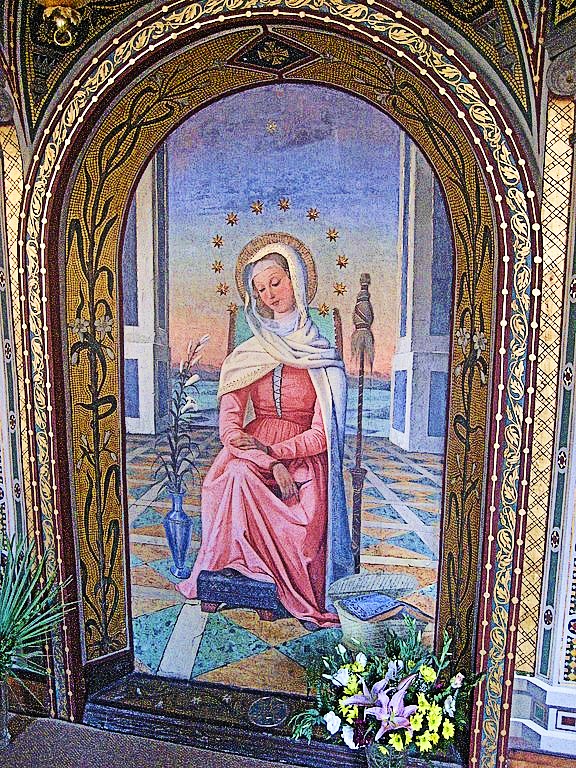
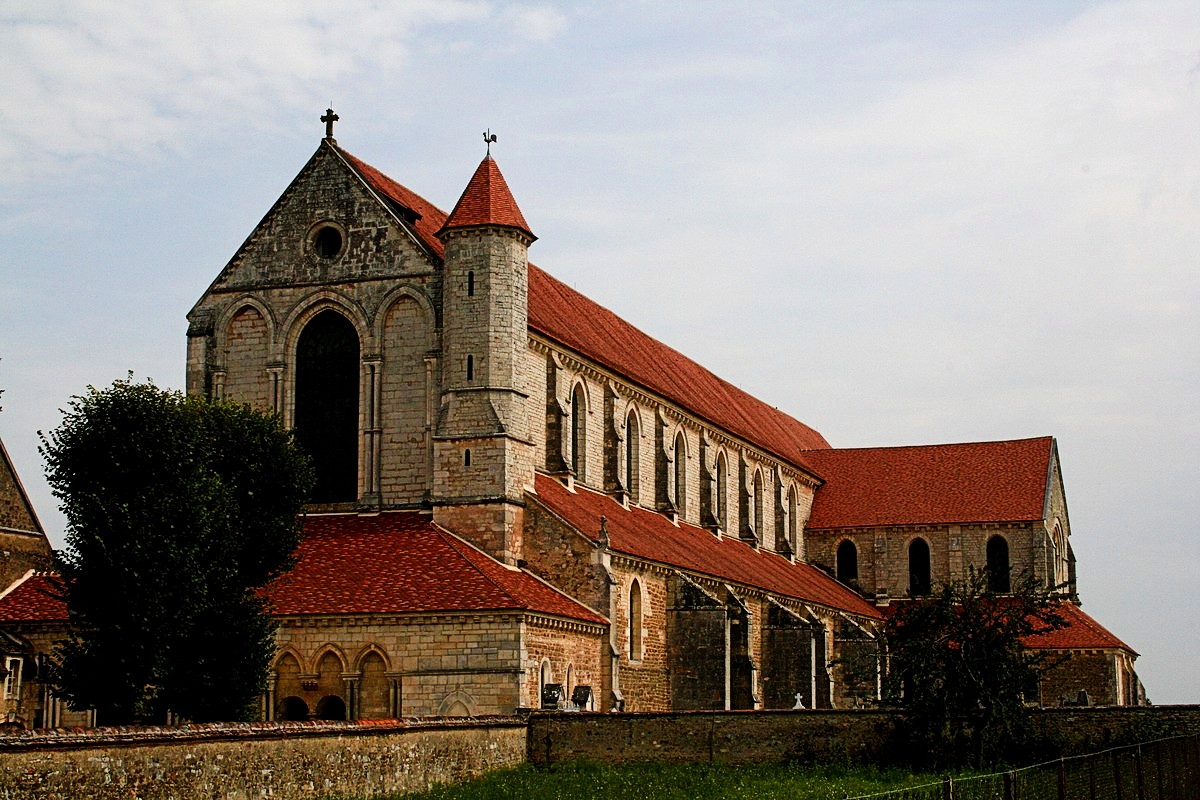
Dedication of the Abbey of Our Lady, Pontigny, France (1114) – 20 October:
The Abbot Orsini wrote: “The Dedication of the Church of Pontigny, four leagues from Auxerre, under the title of Our Lady. This Abbey was founded in 1114 by Thibaud, Count of Champagne.”
The former abbey of Pontigny is nestled in the Serein valley in the north of Burgundy, and is one of the oldest sites of the Cistercian order. Being only the second Cistertian monastery, it was established in the year 1114 by Blessed Hugh of Macon, the companion of Saint Bernard, in this valley north of Auxerre in the French Department of Yonne. It is notable, that Hugh later became the Bishop of Auxerre.
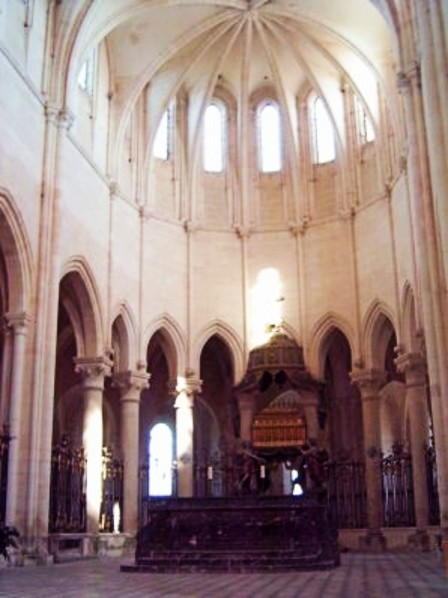
The Monks valued the land, the woods and streams they were surrounded by and cultivated large farms around their Abbey. They raised various crops, bread pigs and sheep and made terracotta bricks. It was that strong economic base that enabled them to construct the great Romanesque style Church that reached an impressive length of 120 metres that still stands intact today. In the year 1164 the Abbey received the Archbishop of Canterbury and Primate of England St Thomas à Becket while he was an exile due to his opposition to King Henry and in 1206 the Queen of France, Alix de Champagne, was buried in the choir of the Abbey. The wealthy Abbey was looted and burned by the Huguenots in about 1529 during the Wars of Religion. During the French Revolution the Abbey was suppressed, and its buildings largely sold or destroyed, save for the Church. Unlike most Churches during the time of the French Revolution, the Abbey of Pontigny is completely preserved and is now thought to be the largest Cistercian Church in France. The Church is notable for its arches and columns with twin bays, its vaults on two columns and portal with tympanum cross and wrought iron hinges. Known as the Church of Notre-Dame-et-Saint-Edme Pontigny, or Our Lady of Saint Edmond of Pontigny, the old Church Abbey monastery became the Parish Church of the village of the same name after the French Revolution. The church of Notre-Dame-et-Saint-Edme Pontigny is now abandoned and it is used simply as a kind of cultural meeting place.
St Adelina St Aderald St Aidan of Mayo St Andrew of Crete St Artemius Megalomartyr St Barsabias St Bernard of Bagnorea St Bradan St Caprasius of Agen St Cornelius the Centurion (1st Century) traditionally believed to have become th First Bishop of Caesarea
Blessed James Strepar OFM (c 1340-1409) Archbishop of Halicz, Poland from 1392 until his death Religious Priest of the Order of Friars Minor, Missionary. St Pius X proclaimed Blessed James, along with St Anthony of Padua, the Patrons of the Conventual Franciscan Order of Krakow Province. He was given the title of “Protector of the Kingdom, Defender and Guardian of the Homeland,” for his exceptional merits, including civil ones. Such was he considered by all. He was Canonised by by Pope Pius VI on 11 September 1791. His body is incorrupt. His Life: https://anastpaul.com/2020/10/20/saint-of-the-day-20-october-blessed-james-strepar-ofm-c-1340-1409/
One Minute Reflection – 20 October – Tuesday of the Twenty Ninth week in Ordinary Time, Readings: Ephesians 2:12-22,Psalms 85:9-10,11-12, 13-14, Luke 12:35-38 and the Memorial of Blessed James Strepar OFM (c 1340-1409)
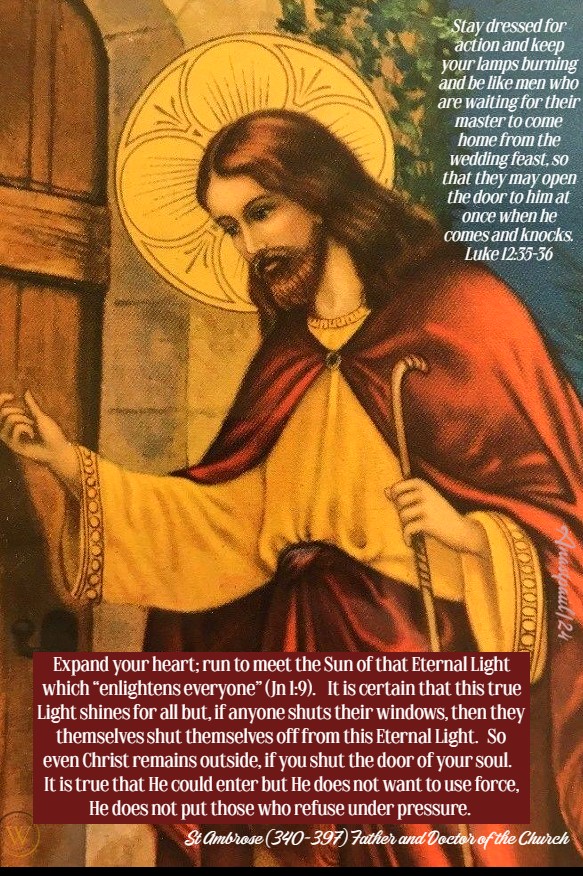
“Stay dressed for action and keep your lamps burning and be like men who are waiting for their master to come home from the wedding feast, so that they may open the door to him at once when he comes and knocks.” – Luke 12:35-36
REFLECTION – “God, the Word, stirs up the lazy and arouses the sleeper. For indeed, someone who comes knocking at the door is always wanting to come in. But it depends on us if He does not always enter or always remain. May your door be open to Him who comes; open your soul, enlarge your spiritual capacities that you may discover the riches of simplicity, the treasures of peace and sweetness of grace. Expand your heart; run to meet the Sun of that Eternal Light which “enlightens everyone” (Jn 1:9). It is certain that this true Light shines for all but, if anyone shuts their windows, then they themselves shut themselves off from this Eternal Light.
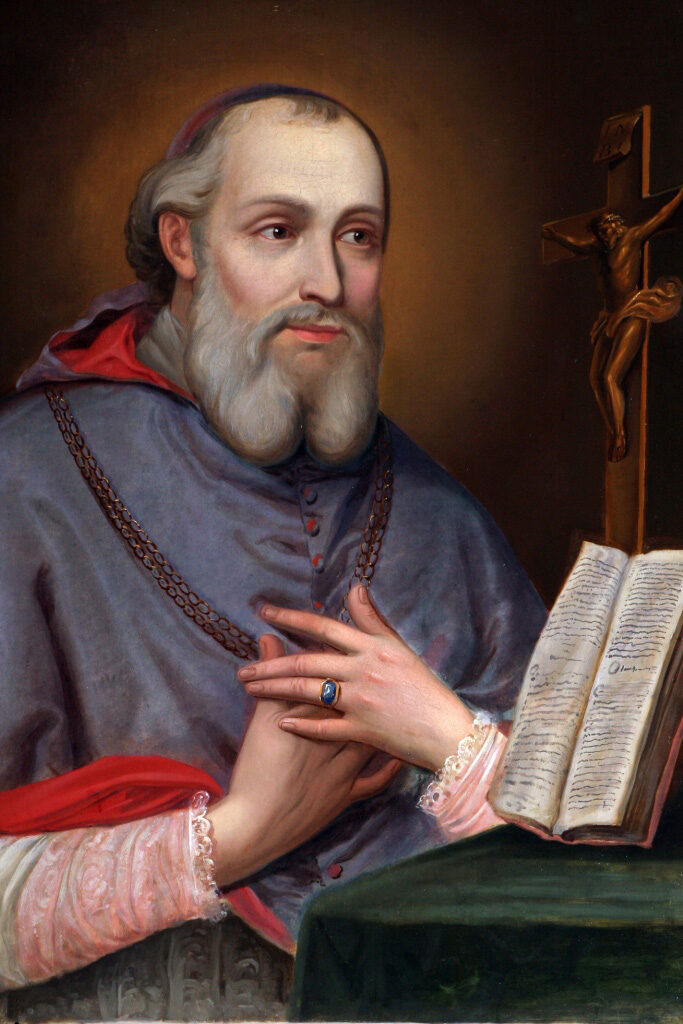
So even Christ remains outside, if you shut the door of your soul. It is true that He could enter but He does not want to use force, He does not put those who refuse under pressure. Descended from the Virgin, born from her womb, He shines throughout the universe to give Light to all. Those who long to receive the Light which shines with an everlasting brightness, open to Him. No night comes to intervene. Indeed, the sun we see each day gives way to night’s darkness but the Sun of Justice (Mal 3:20) knows no setting for Wisdom is not overcome by evil.” – St Ambrose (340-397) Bishop of Milan and Father and Doctor of the Church – 12th Sermon on Psalm 118
PRAYER – All-powerful, eternal God and Father, grant us the grace of Your Spirit and fill us with the light of understanding and love. May we learn to truly pray and by our prayers to entreat You to bless us in Your goodness and lead us to true faith in Your eternal light and Word sent to redeem us. May we always be waiting and prepared to open the door of our hearts to Jesus Christ our Lord, who comes in light, love and peace. Grant that by the prayers of Blessed James Strepar we may be strengthened. Holy Mother, be our protection and our guide. We make our prayer through Jesus Christ, our Lord with the Holy Spirit, God now and forever, amen.
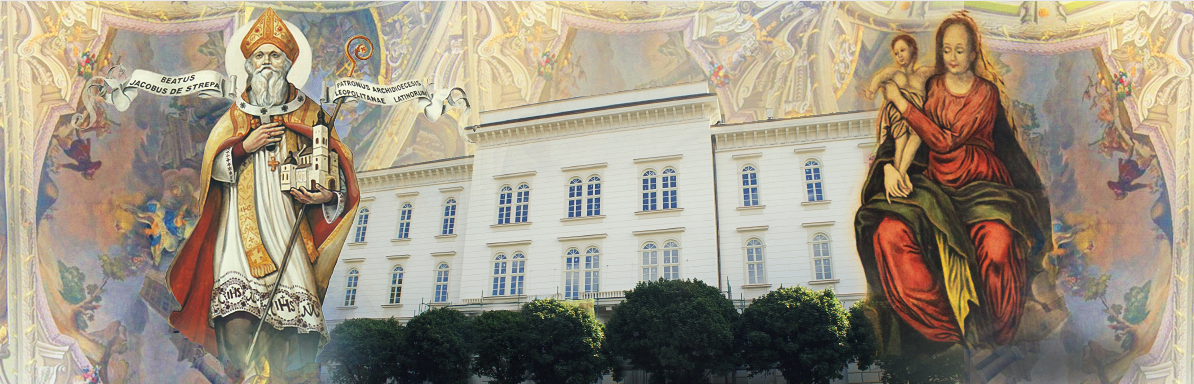
Saint of the Day – 20 October – Blessed James Strepar OFM (c 1340-1409) Archbishop, Religious Priest of the Order of Friars Minor, Missionary, Apostle of the Holy Eucharist, Eucharistic Adoration, the Blessed Virgin and the Holy Rosary. He founded Churches, Monateries, Schools, Hospitals, apostolates of Eucharistic Adoration and promoted the prayer of the Holy Rosary, apostle of the poor and needy. He was given the title of “Protector of the Kingdom, Defender and Guardian of the Homeland” – born as Jakub Strzemię in c 1350 in Galacia, Poland and died on 1 June 1411 (aged 69) at Lviv, Poland (in modern Ukraine) of natural causes. Patronages – Archdiocese of Lviv, Diocese of Zamość-Lubaczów, against headaches and on 16 March 1910, St Pius X proclaimed Blessed James, along with St Anthony of Padua, the Patrons of the Conventual Franciscan Order of Krakow Province. He is also known as Jakob/James Strepa or Strzemie. He served as the Archbishop of Halicz from 1392 until his death, when the Archdiocese was incorporated into that of the Archdiocese of Lviv. He was an indefatigable Apostle of Poland and Russia during the fourteenth century, who, rich by birth, put into practice, the invitation addressed by Jesus to the rich young man of the Gospels – to leave all his possessions and follow Him. His body is incorrupt.
James was born in the Diocese of Krakow, to a Polish noble family, around the year 1340. He was very young when, fascinated by and, devoted to Saint Francis of Assisi and by the Franciscan ideal, he entered a convent of Friars Minor.
He joined the Society of Pilgrim Friars, made up of both Franciscans and Dominicans and, with a strong missionary yearning, set Ukraine as his goal. He was elected Superior of the convent of Lviv (a city founded around 1250) in a troubled moment in the ecclesiastical history of that city. There were in fact, contrasts between the Diocesan clergy and the religious and between Catholics and Orthodox. Furthermore, holding the position of inquisitor of the faith in Ruthenia, for ten years his apostolate was tireless.
At the height of his maturity, a new great mission appeared to him – to preach the Word of Christ in Russia. Such was his success, that he was appointed Vicar General and then Bishop of Halicz, a bishopric that was later transferred to Leopoli. Fr James was fifty-two years old.
Tirelessly, the new Bishop employed all his strength, with an extraordinary commitment, for the good of the Diocese. He built Churches in the most remote places and erected Parishes, entrusting them to Priests of proven virtues, who sometimes came especially from Poland.
Attentive to the needs of the poor and places of worship, he donated the income of the Bishopric to these purposes. He engaged in the construction of Monasteries, schools and hospitals.
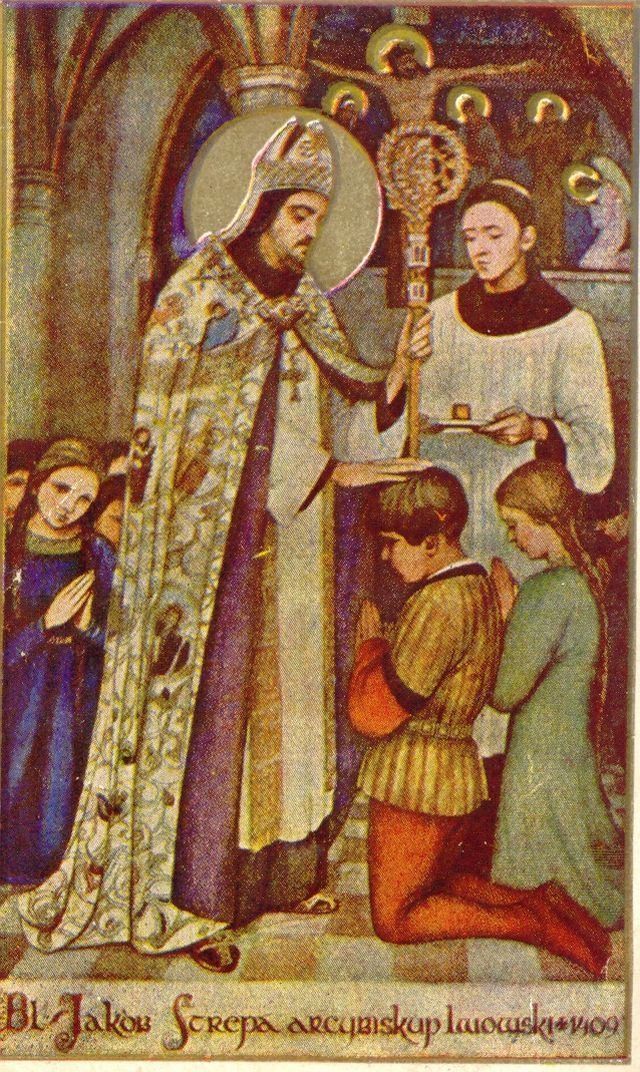
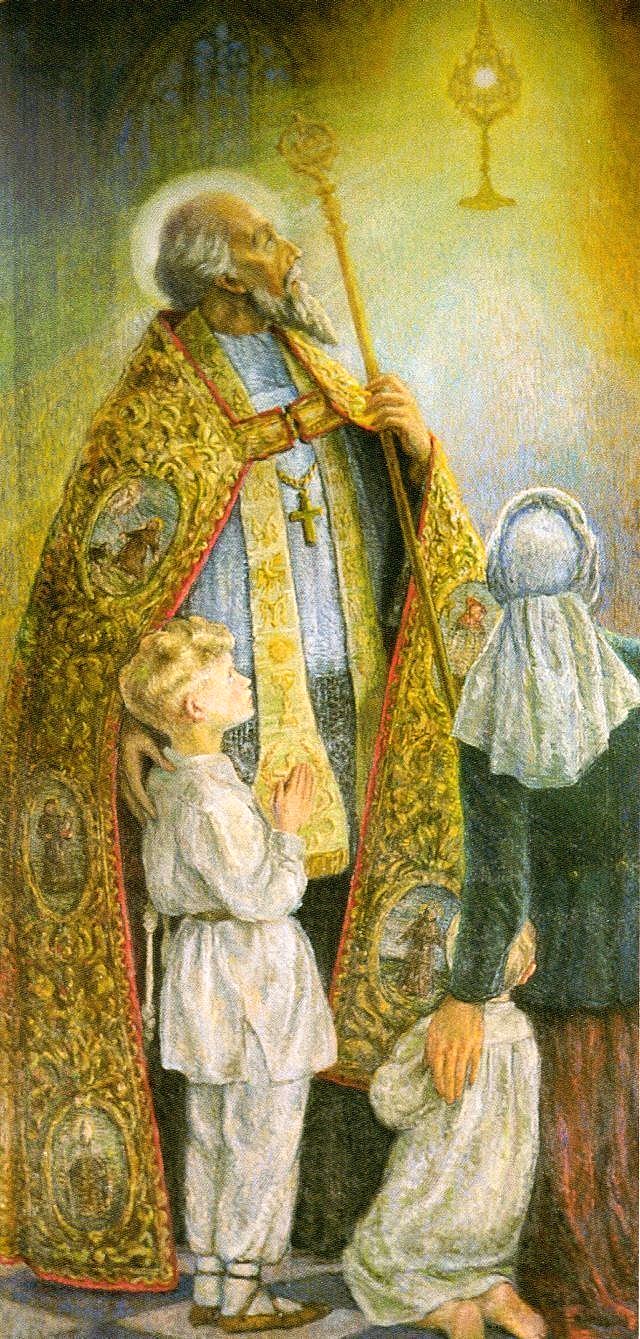
On foot, without any honour, in the simple Franciscan habit, he visited every community. He was an example of humility, accompanying the active apostolate with personal penances. In every action he was driven by a great interior faith, transmitting his devotions to the Blessed Sacrament and to Our Lady. He instituted Perpetual Adoration and depicted the Virgin in the bishop’s coat of arms, inviting people to recite the Rosary everyday. So much zeal bore the fruits of a widespread religious awakening of the people. The Friar Bishop maintained unchanged, his missionary character towards atheists and towards the Orthodox, strongly desiring the unity of Christians while, due to his high moral authority, he was appointed senator of the Council of the Fatherland. In this capacity he gave practical suggestions for the administration of the city, one day finding himself facing even the incursions of the barbarians.
He died on 20 October 1409, receiving the title of “Protector of the Kingdom, Defender and Guardian of the Homeland” for his exceptional merits, including civil ones. Such was he considered by all.
His body, with the Habit and the Bishop’s insignia, was buried in the Church of the Franciscans. The fame of holiness was vast, pilgrimages to his tomb continued endlessly, while miracles occurred through his intercession. Ten years after his death, the body was exhumed and appeared uncorrupted. The cult, widespread in Poland, Lithuania and Russia, was confirmed by Pope Pius VI on 11 September 1791.
Today his relics are venerated in the Cathedral of Lviv (L’viv), the important Ukrainian city rich in history and culture, which has among it’s fathers the noble Friar who came from Poland.
Blessed James encouraged the faithful to donate books, liturgical garments, kitchenware to Monasteries. In everyday life, Bishop James was noted for his simplicity and Franciscan poverty – King Władysław II Jagiełło donated to James an estate in the centre of Lviv but he decided to live in a modest wooden house wearing a Franciscan habit. Bl James was sensitive to the needs of the poor and sick – he donated his episcopal income to the hospital of the Holy Spirit and to a shelter for the poor, sick and pilgrims. In his will he asked to give a mitre, silver ecclesiatical vessels, a Franciscan habit, books and all his belongings to the poor and use them for acts of mercy and for the celebration of Masses for his soul.
PRAYER O God, that with the apostolic labours of Bishop Blessed James Strepar you have placed the seeds of faith in the Church of Poland and Russia, through his intercession grant us to live our Christian vocation in an authentic way . Through Christ our Lord. Amen




 AnaStpaul
You must be logged in to post a comment.