Posted in EUCHARISTIC Adoration, MORNING Prayers, PRACTISING CATHOLIC, QUOTES of the SAINTS, SUNDAY REFLECTIONS, The HOLY EUCHARIST / The HOLY MASS

Sunday Reflection – 27 May – The Solemnity of the Most Holy Trinity

Sunday Reflection – 27 May – The Solemnity of the Most Holy Trinity

Holy Communion
Bl John Henry Newman (1801-1890)

O my God, holiness becomes Your House and yet You dost made Your abode in my breast. My Lord, my Saviour, to me You come, hidden under the semblance of earthly things, yet in that very flesh and blood which You took from Mary. You, who did first inhabit Mary’s breast, come to me.

My God, You see me; I cannot see myself.   Were I ever so good a judge about myself, ever so unbiased and with ever so correct a rule of judging, still, from my very nature, I cannot look at myself and view myself truly and wholly.   But You, as You come to me, contemplates me.

When I say, Domine, non sum dignus—”Lord, I am not worthy”—You whom I am addressing, alone understands in their fullness the words which I use.   You see how unworthy so great a sinner is to receive the One Holy God, whom the Seraphim adore with trembling.   You see, not only the stains and scars of past sins but the mutilations, the deep cavities, the chronic disorders which they have left in my soul.   You see the innumerable living sins, though they be not mortal, living in their power and presence, their guilt and their penalties, which clothe me.   You see all my bad habits, all my mean principles, all wayward lawless thoughts, my multitude of infirmities and miseries, yet You come.   You see most perfectly how little I really feel what I am now saying, yet You come.

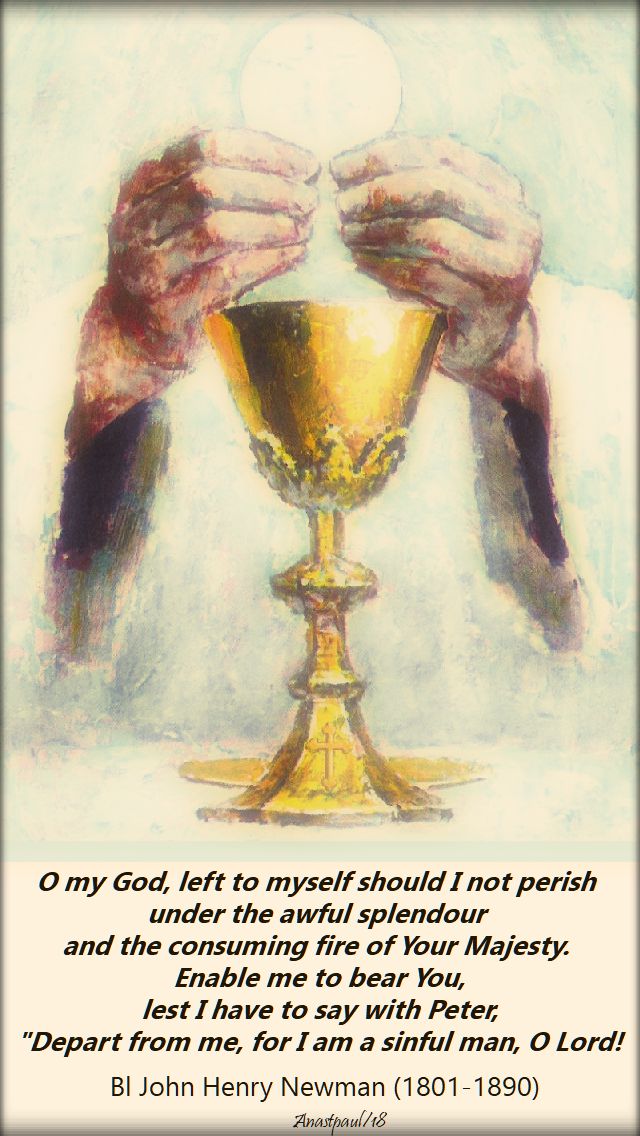
O my God, left to myself should I not perish under the awful splendour and the consuming fire of Your Majesty.   Enable me to bear You, lest I have to say with Peter, “Depart from me, for I am a sinful man, O Lord!”o my god, left to myself - bl john henry newman - 27 may 2018

Posted in BREVIARY Prayers, CATHOLIC-PRAYERS OF THE CHURCH, FEASTS and SOLEMNITIES, MORNING Prayers, QUOTES of the SAINTS, The MOST HOLY & BLESSED TRINITY, The WORD

One Minute Reflection – 27 May – The Solemnity of the Most Holy Trinity

One Minute Reflection – 27 May – The Solemnity of the Most Holy Trinity

“Go therefore and make disciples of all nations, baptising them in the name of the Father and of the Son and of the Holy Spirit…“…Matthew 28:19

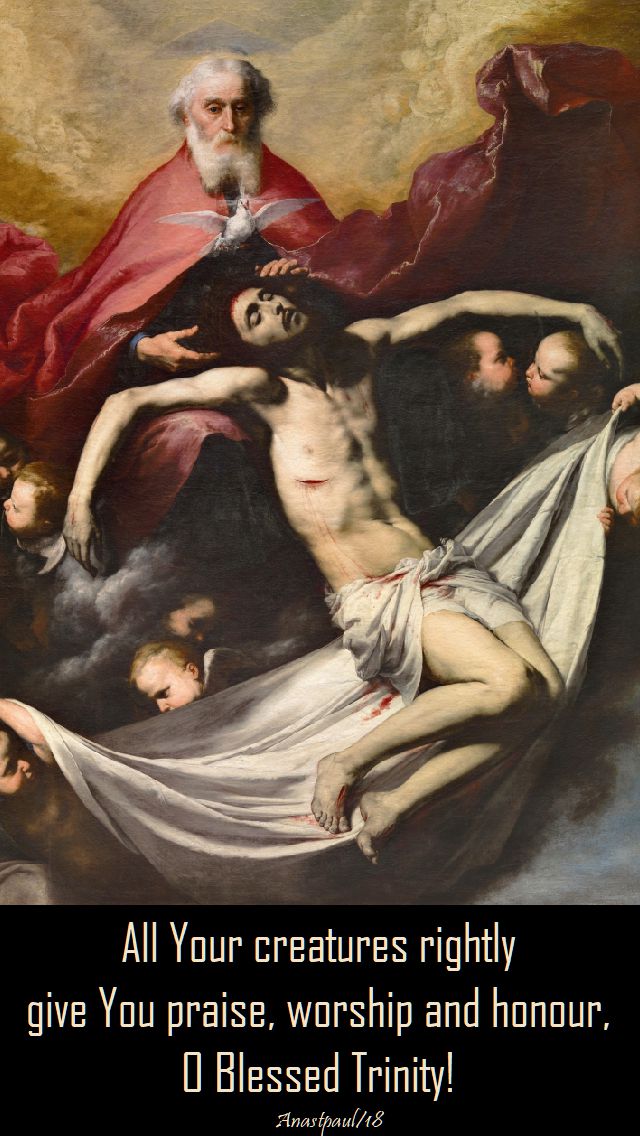
REFLECTION – “The Son is in the Father and the Father in the Son. O adorable mystery which has been from eternity! I adore You.   O my incomprehensible Creator, before whom I am an atom, a being of yesterday or an hour ago!   Go back a few years and I simply did not exist, I was not in being and things went on without me but You are from eternity and nothing whatever from one moment could go on without You.   O adorable mystery!   In the name of God, the Omnipotent Father, who created me!   In the name of Jesus Christ, our Lord, Son of the living God, who bled for me!   In the name of the Holy Spirit, who has been poured out on me!”…Bl John Henry Newman (1801-1890)go therefore - mt 28 19 - bl john henry newman - o adorable mystery - 27 may trinity sunday

PRAYER – God our Father, You revealed the great mystery of Your Godhead to men, when You sent into the world, the Word who is Truth and the Spirit who makes us holy.   Help us to believe in You and worship You, as the true faith teaches, three persons eternal in glory, one God, infinite in mystery.   We make our prayer through Jesus our Lord, in the unity of the Holy Spirit, one God with you forever amen.all your creatures rightly give You praise - 27 may 2018 - trinity sunday

Posted in CATHOLIC DEVOTIONS of the Month, MARIAN PRAYERS, MARIAN QUOTES, MARIAN TITLES, MORNING Prayers, QUOTES of the SAINTS, SAINT of the DAY, The BLESSED VIRGIN MARY

Marian Thought for the Day – 24 May “Mary’s Month” – Feast of Our Lady, Help of Christians

Marian Thought for the Day – 24 May “Mary’s Month” – Feast of Our Lady, Help of Christians

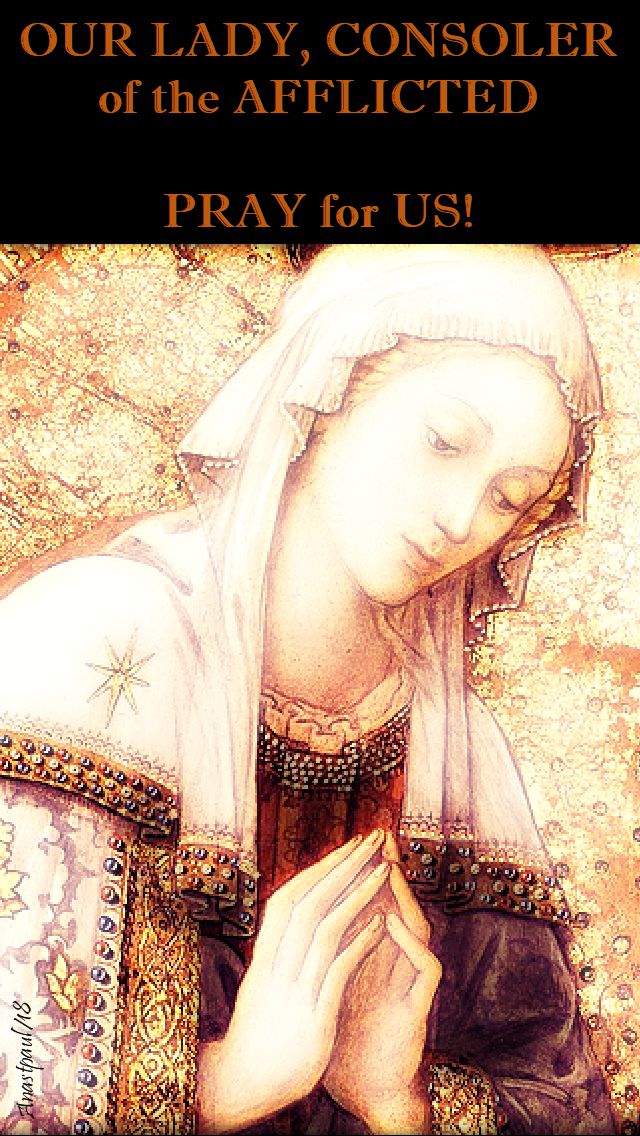
Mary is the “Consolatrix Afflictorum,” the Consoler of the Afflicted
Blessed John Henry Newman (1801-1890)

St PAUL says that his Lord comforted him in all his tribulations, that he also might be able to comfort them who are in distress, by the encouragement which he received from God.   This is the secret of true consolation:  those are able to comfort others who, in their own case, have been much tried and have felt the need of consolation and have received it.   So of our Lord Himself it is said:  “In that He Himself hath suffered and been tempted, He is able to succour those also that are tempted.”

And this, too, is why the Blessed Virgin is the comforter of the afflicted.   We all know how special a mother’s consolation is and we are allowed to call Mary our Mother from the time that our Lord from the Cross established the relation of mother and son between her and St John.   And she especially can console us because she suffered more than mothers in general.   Women, at least delicate women, are commonly shielded from rude experience of the highways of the world but she, after our Lord’s Ascension, was sent out into foreign lands almost as the Apostles were, a sheep among wolves.   In spite of all St John’s care of her, which was as great as was St Joseph’s in her younger days, she, more than all the saints of God, was a stranger and a pilgrim upon earth, in proportion to her greater love of Him who had been on earth, and had gone away.   As, when our Lord was an Infant, she had to flee across the desert to the heathen Egypt, so, when He had ascended on high, she had to go on shipboard to the heathen Ephesus, where she lived and died.

O ye who are in the midst of rude neighbours or scoffing companions, or of wicked acquaintance, or of spiteful enemies and are helpless, invoke the aid of Mary by the memory of her own sufferings among the heathen Greeks and the heathen Egyptians.

Mary “Consolatrix Afflictorum,”Consoler of the Afflicted – Help of Christians

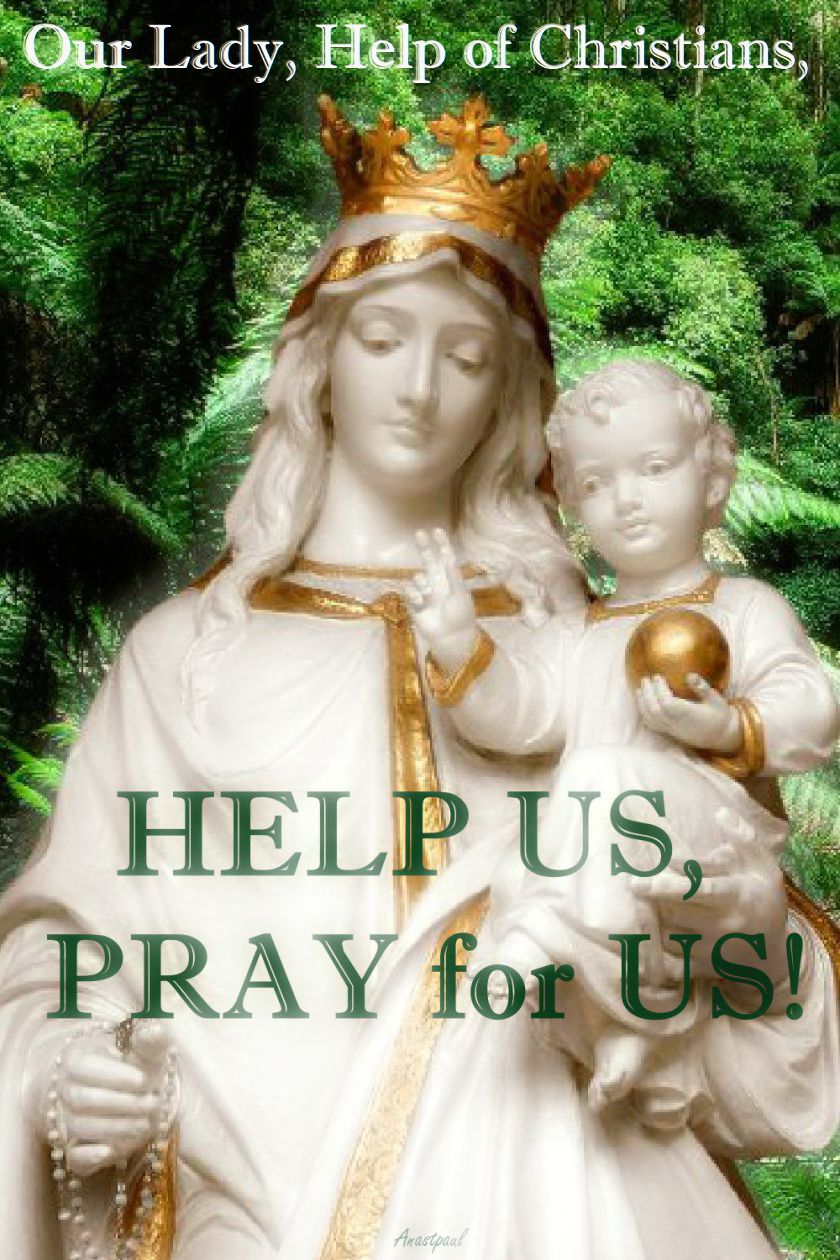
Help us!, Pray for Us!our-lady-help-of-christians-pray-for-us-24 may 2018jpgour lady consoler of the afflicted - pray for us - 24 may 2018


Posted in CATHOLIC DEVOTIONS of the Month, MARIAN QUOTES, MARIAN TITLES, MORNING Prayers, QUOTES of the SAINTS, The BLESSED VIRGIN MARY

Marian Thought for the Day – 19 May “Mary’s Month” – Saturday of the Seventh Week of Eastertide

Marian Thought for the Day – 19 May “Mary’s Month” – Saturday of the Seventh Week of Eastertide

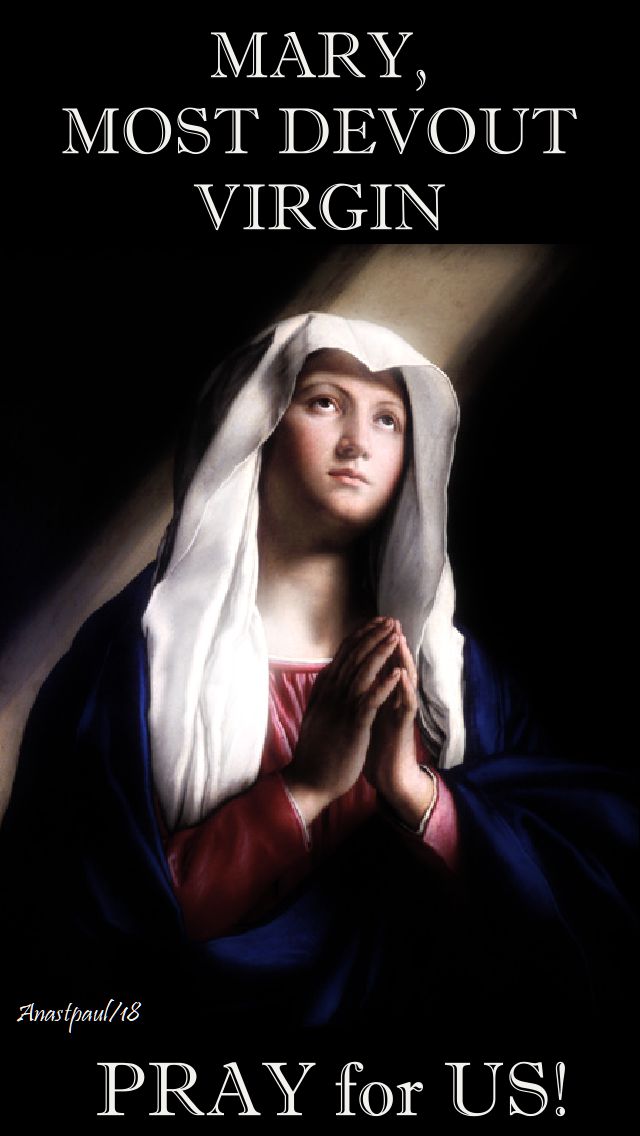
Mary is the “Vas Insigne Devotionis,” The Most Devout Virgin
Blessed John Henry Newman (1801-1890)

TO be devout is to be devoted.   We know what is meant by a devoted wife or daughter.   It is one, whose thoughts centre in the person so deeply loved, so tenderly cherished.,, She follows Him about with her eyes;  she is ever seeking some means of serving Him and, if her services are very small in their character, that only shows, how intimate they are and how incessant.   And especially if the object of her love be weak, or in pain, or near to die, still more intensely does she live in His life and know nothing but Him.

This intense devotion towards our Lord, forgetting self in love for Him, is instanced in St Paul, who says. “I know nothing but Jesus Christ and Him crucified.”   And again, “I live, [yet] now not I, but Christ lives in me;  and [the life] that I now live in the flesh, I live in the faith of the Son of God, who loved me and delivered Himself for me.”

But great as was St Paul’s devotion to our Lord, much greater was that of the Blessed Virgin, because she was His Mother and because she had Him and all His sufferings actually before her eyes and because she had the long intimacy, of thirty years with Him and because she was from her special sanctity, so ineffably near to Him in spirit.   When, then, He was mocked, bruised, scourged and nailed to the Cross, she felt as keenly as if every indignity and torture inflicted on Him, was struck at herself.   She could have cried out in agony at every pang of His.

This is called her compassion, or her suffering with her Son and it arose from this that she was the “Vas insigne devotionis.”

Mary, “Vas Insigne Devotionis,” The Most Devout Virgin

Pray for us!mary most devout virgin - pray for us - 19 may 2018

Posted in CATHOLIC DEVOTIONS of the Month, MARIAN DEVOTIONS, MARIAN PRAYERS, MARIAN QUOTES, MARIAN TITLES, QUOTES of the SAINTS, The BLESSED VIRGIN MARY, The PASSION

Marian Thought for the Day – 17 May “Mary’s Month” – Thursday of the Seventh Week of Eastertide

Marian Thought for the Day – 17 May “Mary’s Month” – Thursday of the Seventh Week of Eastertide

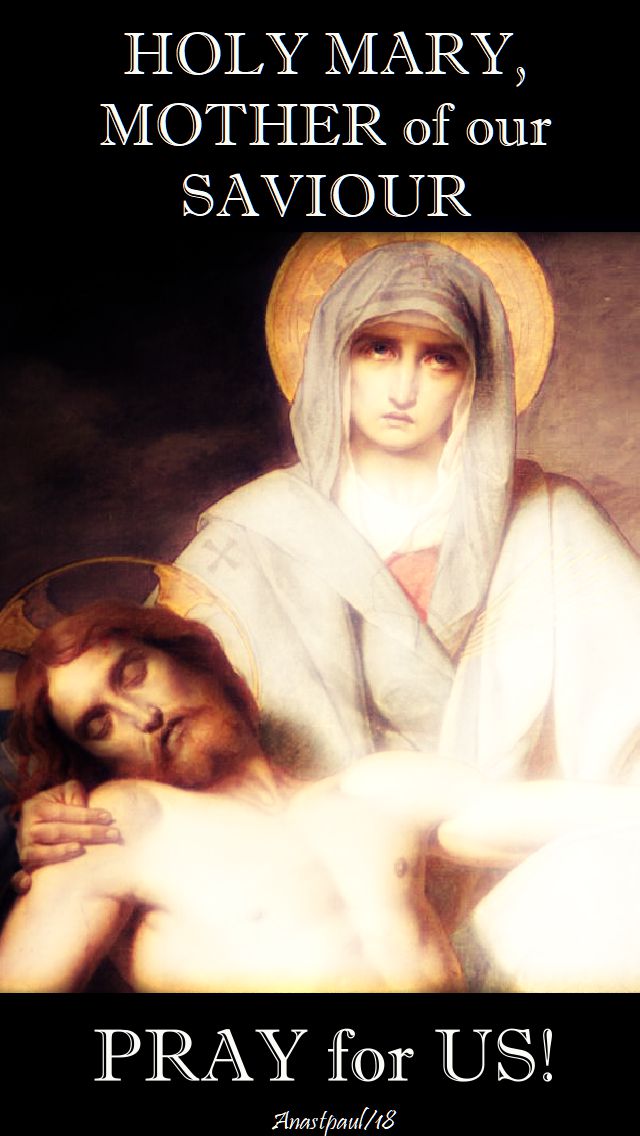
Mary is the “Mater Salvatoris,” the Mother of the Saviour
Blessed John Henry Newman (1801-1890)

HERE again, as in our reflections of yesterday, we must understand what is meant, by calling our Lord a Saviour, in order to understand why it is used, to form one of the titles given to Mary in her Litany.

The special name by which our Lord was known before His coming was, as we found yesterday, that of Messias, or Christ.   Thus He was known to the Jews.   But when He actually showed Himself on earth, He was known by three new titles, the Son of God, the Son of Man and the Saviour; the first expressive of His Divine Nature, the second of His Human, the third of His Personal Office.   Thus the Angel who appeared to Mary, called Him the Son of God;  the angel who appeared to Joseph called Him Jesus, which means in English, Saviour;  and so the Angels, too, called Him a Saviour when they appeared to the shepherds.   But He Himself specially calls Himself the Son of Man.

Not Angels only, call Him Saviour but those two greatest of the Apostles, St Peter and St Paul, in their first preachings.   St Peter says He is “a Prince and a Saviour” and St Paul says, “a Saviour, Jesus.”   And both Angels and Apostles tell us why He is so called—because He has rescued us from the power of the evil spirit and from the guilt and misery of our sins.   Thus the Angel says to Joseph, “Thou shalt call His name Jesus, for He shall save His people from their sins;” and St Peter, “God has exalted Him to be Prince and Saviour, to give repentance to Israel and remission of sins.”   And He says Himself, “The Son of Man is come to seek and to save that which is lost.”

Now let us consider how this affects our thoughts of Mary.   To rescue slaves from the power of the Enemy implies a conflict. Our Lord, because He was a Saviour, was a warrior.   He could not deliver the captives without a fight, nor without personal suffering.   Now, who are they who especially hate wars?   A heathen poet answers. “Wars,” he says, “are hated by Mothers.”   Mothers are just those who especially suffer in a war.   They may glory in the honour gained by their children but still such glorying, does not wipe out, one particle of the long pain, the anxiety, the suspense, the desolation and the anguish which the mother of a soldier feels.   So it was with Mary.

For thirty years she was blessed with the continual presence of her Son—nay, she had Him in subjection.   But the time came when that war called for Him, for which He had come upon earth.   Certainly He came, not simply to be the Son of Mary but to be the Saviour of Man and, therefore, at length He parted from her.   She knew then, what it was to be the mother of a soldier.   He left her side; she saw Him no longer, she tried in vain to get near Him.   He had for years lived in her embrace and after that, at least in her dwelling—but now, in His own words, “The Son of Man had not where to lay His head.”

And then, when years had run out, she heard of His arrest, His mock trial and His passion.   At last she got near Him—when and where?—on the way to Calvary and when He had been lifted upon the Cross.   And at length she held Him again in her arms, yes—when He was dead.   True, He rose from the dead but still she did not thereby gain Him, for He ascended on high and she did not at once follow Him.   No, she remained on earth many years—in the care, indeed, of His dearest Apostle, St John.   But what was even the holiest of men, compared with her own Son and Him the Son of God?

O Holy Mary, Mother of our Saviour, in this meditation we have now suddenly passed from the Joyful Mysteries to the Sorrowful, from Gabriel’s Annunciation to thee, to the Seven Dolours.   That, then, will be the next series of Meditations which we make about thee.

O Holy Mary, Mother of our Saviour, Pray for us!holy mary mother of our saviour, pray for us - 17 may 2018

Posted in CATHOLIC DEVOTIONS of the Month, MARIAN QUOTES, MARIAN TITLES, MORNING Prayers, QUOTES of the SAINTS, The BLESSED VIRGIN MARY, The CHRIST CHILD

Marian Thought for the Day -15 May – “Mary’s Month” – Tuesday of the Seventh Week of Eastertide

Marian Thought for the Day -15 May – “Mary’s Month” – Tuesday of the Seventh Week of Eastertide

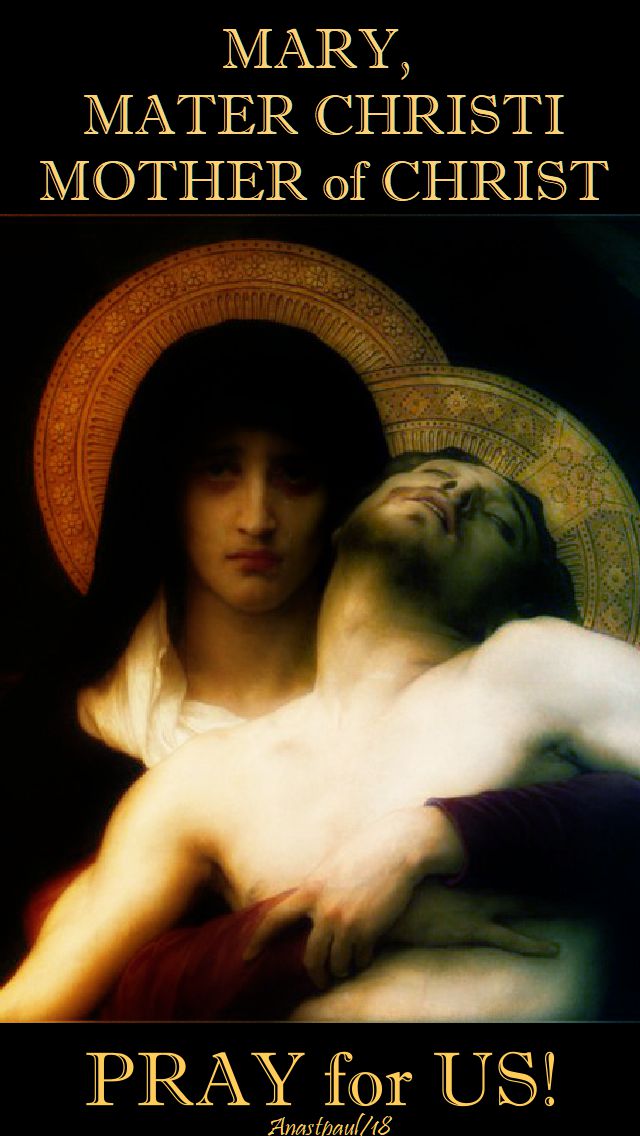
Mary is the “Mater Christi,” the Mother of Christ
Blessed John Henry Newman (1801-1890)

EACH of the titles of Mary has its own special meaning and drift and may be made the subject of a distinct meditation. She is invoked by us as the Mother of Christ.   What is the force of thus addressing her?   It is to bring before us that she it is whom from the first was prophesied of and associated with, the hopes and prayers of all holy men, of all true worshippers of God, of all who “looked for the redemption of Israel” in every age before that redemption came.

Our Lord was called the Christ, or the Messias, by the Jewish prophets and the Jewish people.   The two words Christ and Messias mean the same.   They mean in English, the “Anointed.”   In the old time there were three great ministries or offices by means of which, God spoke to His chosen people, the Israelites, or, as they were afterward called, the Jews, viz., that of Priest, that of King and that of Prophet.   Those who were chosen by God for one or other of these offices, were solemnly anointed with oil—oil signifying the grace of God, which was given to them for the due performance of their high duties.   But our Lord was all three, a Priest, a Prophet and a King—a Priest, because He offered Himself as a sacrifice for our sins; a Prophet, because He revealed to us the Holy Law of God; and a King, because He rules over us. Thus He is the one true Christ.

It was in expectation of this great Messias that the chosen people, the Jews, or Israelites, or Hebrews (for these are different names for the same people), looked out from age to age.   He was to come to set all things right.   And next to this great question which occupied their minds, namely, When was He to come, was the question, Who was to be His Mother?   It had been told them from the first, not that He should come from heaven but that He should be born of a Woman.   At the time of the fall of Adam, God had said, that the seed of the Woman, should bruise the Serpent’s head.   Who, then, was to be that Woman thus significantly pointed out to the fallen race of Adam?   At the end of many centuries, it was further revealed to the Jews that the great Messias, or Christ, the seed of the Woman, should be born of their race and of one particular tribe, of the twelve tribes, into which that race was divided.   From that time every woman of that tribe hoped to have the great privilege of herself, being the Mother of the Messias, or Christ; for it stood to reason, since He was so great, the Mother must be great and good and blessed too. Hence it was, among other reasons, that they thought so highly of the marriage state, because, not knowing the mystery of the miraculous conception of the Christ, when He was actually to come, they thought that the marriage rite was the ordinance necessary for His coming.

Hence it was, if Mary had been as other women, she would have longed for marriage, as opening on her the prospect of bearing the great King.   But she was too humble and too pure for such thoughts.   She had been inspired to choose that better way of serving God, which had not been made known to the Jews—the state of Virginity.   She preferred to be His Spouse, to being His Mother.   Accordingly, when the Angel Gabriel announced to her, her high destiny, she shrank from it, till she was assured, that it would not oblige her, to revoke her purpose, of a virgin life devoted to her God.

Thus was it that she became the Mother of the Christ, not in that way, which pious women for so many ages had expected Him but, declining the grace of such maternity, she gained it by means of a higher grace.   And this is the full meaning of St Elizabeth’s words, when the Blessed Virgin came to visit her, which we use in the Hail Mary: “Blessed art thou among women and blessed is the fruit of thy womb.”   And, therefore, it is that, in the Devotion called the “Crown of Twelve Stars” we give praise to God, the Holy Ghost, through whom she was both, Virgin and Mother.

Mary, “Mater Christi,” the Mother of Christ

Pray for us!mary, mater christi - pray for us - 15 may 2018

Posted in CATHOLIC DEVOTIONS of the Month, DOGMA, MARIAN QUOTES, MARIAN TITLES, MORNING Prayers, QUOTES of the SAINTS, The BLESSED VIRGIN MARY, The INCARNATION

Marian Thought for the Day – 14 May – Mary’s Month!” – Monday of the Seventh Week of Eastertide

Marian Thought for the Day – 14 May – Mary’s Month!” – Monday of the Seventh Week of Eastertide

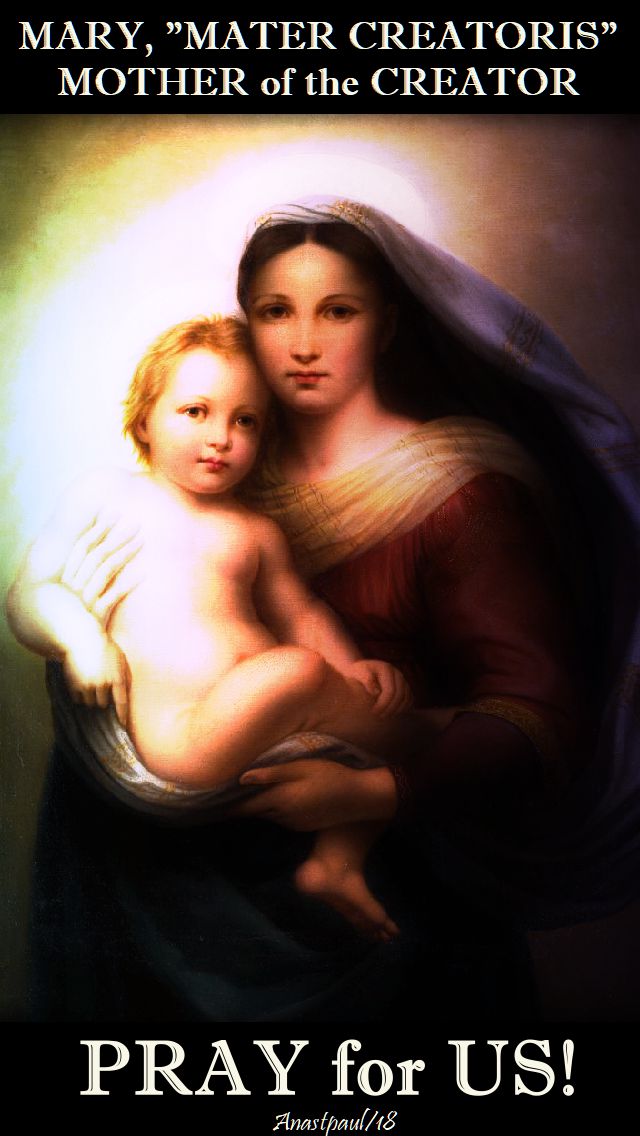
Mary is the “Mater Creatoris,” the Mother of the Creator
Blessed John Henry Newman (1801-1890)

THIS is a title which, of all others, we should have thought it impossible for any creature to possess.   At first sight we might be tempted to say that it throws into confusion our primary ideas of the Creator and the creature, the Eternal and the temporal, the Self-subsisting and the dependent and yet, on further consideration, we shall see that we cannot refuse the title to Mary, without denying the Divine Incarnationthat is, the great and fundamental truth of revelation, that God became man.

And this was seen from the first age of the Church. Christians were accustomed from the first to call the Blessed Virgin “The Mother of God,” because they saw that it was impossible to deny her that title without denying St John’s words, “The Word” (that is, God the Son) “was made flesh.”

And in no long time it was found necessary to proclaim this truth by the voice of an Ecumenical Council of the Church.   For, in consequence of the dislike which men have of a mystery, the error sprang up that our Lord was not really God but a man, differing from us in this merely—that God dwelt in Him, as God dwells in all good men, only in a higher measure; as the Holy Spirit dwelt in Angels and Prophets, as in a sort of Temple, or again, as our Lord now dwells in the Tabernacle in church.   And then, the bishops and faithful people found there was no other way of hindering this false, bad view being taught but by declaring distinctly and making it a point of faith, that Mary was the Mother, not of man only but of God.   And since that time the title of Mary, as Mother of God, has become what is called a dogma, or article of faith, in the Church.

But this leads us to a larger view of the subject.   Is this title as given to Mary more wonderful than the doctrine that God, without ceasing to be God, should become man?  Is it more mysterious that Mary should be Mother of God, than that God should be man? Yet the latter, as I have said, is the elementary truth of revelation, witnessed by Prophets, Evangelists and Apostles all through Scripture.   And what can be more consoling and joyful than the wonderful promises which follow from this truth, that Mary is the Mother of God?—the great wonder, namely, that we become the brethren of our God, that, if we live well and die in the grace of God, we shall all of us hereafter be taken up by our Incarnate God to that place where angels dwel, that our bodies shall be raised from the dust and be taken to Heaven, that we shall be really united to God, that we shall be partakers of the Divine nature, that each of us, soul and body, shall be plunged into the abyss of glory which surrounds the Almighty, that we shall see Him and share His blessedness, according to the text, “Whosoever shall do the will of My Father that is in Heaven, the same is My brother and sister, and mother.”mary mater creatoris, mother of the creator - pray for us - 14 may 2018

Posted in CATHOLIC DEVOTIONS of the Month, MARIAN PRAYERS, MORNING Prayers, PRAYERS of the SAINTS, The BLESSED VIRGIN MARY

Our Morning Offering – 14 May – Mary’s Month!” – Monday of the Seventh Week of Eastertide

Our Morning Offering – 14 May – Mary’s Month!” – Monday of the Seventh Week of Eastertide

Mary Immaculate, My Solace
By Bl John Henry Newman (1801-1890)

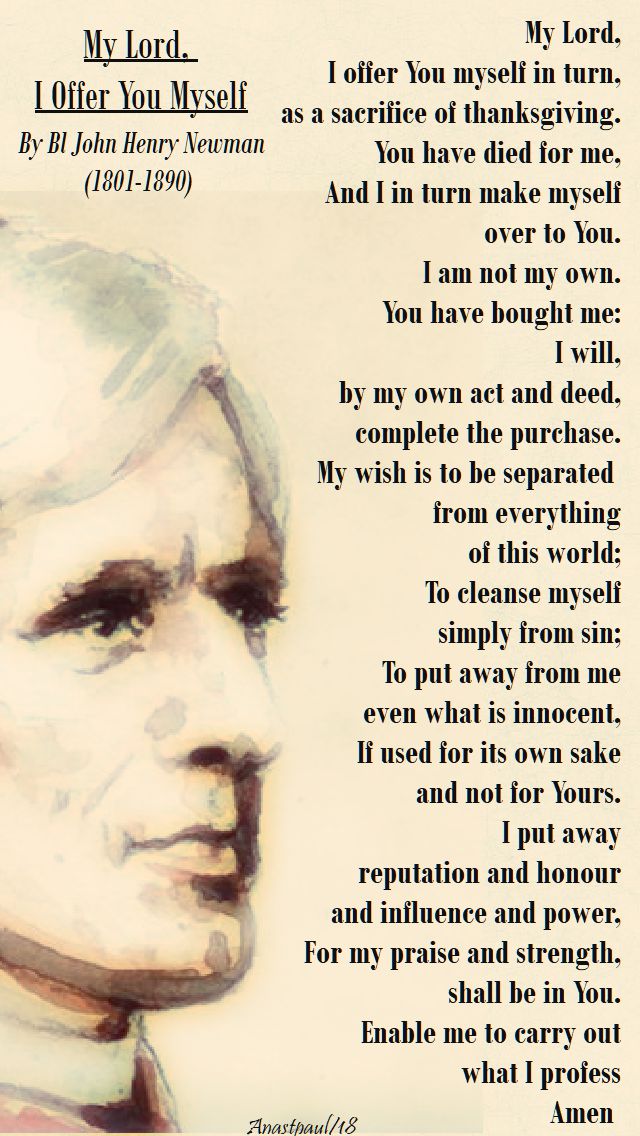
What shall bring me forward in the narrow way,
as I live in the world,
but the thought and patronage of Mary?
What shall seal my senses,
shall tranquilise my heart,
when sights and sounds of danger
are around me but Mary?
What shall give me patience and endurance,
when I am wearied out
with the length of the conflict with evil,
with the unceasing necessity of precautions,
with the irksomeness of observing them,
with the tediousness of their reception,
with the strain upon my mind,
with my forlorn and cheerless condition,
but a loving communion with you!
You will comfort me in my discouragements,
solace me in my fatigues,
raise me after my falls,
reward me for my successes.
You will show me your Son,
my God and my all.
When my spirit within me is excited,
or relaxed,
or depressed,
when it loses its balance,
when it is restless and wayward,
when it is sick of what it has
and hankers after what it has not,
when my eye is solicited with evil
and my mortal frame trembles
under the shadow of the tempter,
what will bring me to myself,
to peace and health,
but the cool breath
of the Immaculate
and the fragrance of the Rose of Sharon?  Amenmary immaculate my solace - bl john henry newman no 2- 14 may 2018

Posted in CATHOLIC DEVOTIONS of the Month, MARIAN QUOTES, MARIAN TITLES, MORNING Prayers, QUOTES of the SAINTS, The BLESSED VIRGIN MARY, The INCARNATION, Thomas a Kempis, Uncategorized

Marian Thought for the Day – 13 May – “Mary’s Month” – The Solemnity of the Ascension of the Lord

Marian Thought for the Day – 13 May – “Mary’s Month” – The Solemnity of the Ascension of the Lord and the Feasts of Our Lady of Fatima, Our Lady of Help, Our Lady of the Most Blessed Sacrament and the Memorial of the Dedication of the Minor Basilica of Saint Mary of the Martyrs (Pantheon)

Mary is the “Janua Cœli,” the Gate of Heaven

Blessed John Henry Newman (1801-1890)MARY JANUA COELI - GATE OF HEAVEN - BL JOHN HENRY NEWMAN - PRAY FOR US - 13 MAY 2018

MARY is called the Gate of Heaven, because it was through her, that our Lord passed from heaven to earth.   The Prophet Ezechiel, prophesying of Mary, says, “the gate shall be closed, it shall not be opened and no man shall pass through it, since the Lord God of Israel has entered through it—and it shall be closed for the Prince, the Prince Himself shall sit in it.”

Now this is fulfilled, not only in our Lord having taken flesh from her and being her Son, but, moreover, in that she had a place in the economy of Redemption;  it is fulfilled in her spirit and will, as well as in her body.   Eve had a part in the fall of man, though it was Adam who was our representative and whose sin made us sinners.   It was Eve who began and who tempted, Adam.   Scripture says: “The woman saw that the tree was good to eat, and fair to the eyes, and delightful to behold; and she took of {37} the fruit thereof, and did eat, and gave to her husband, and he did eat.”   It was fitting then in God’s mercy that, as the woman began the destruction of the world, so woman should also begin its recovery and that, as Eve opened the way for the fatal deed of the first Adam, so Mary should open the way, for the great achievement of the second Adam, even our Lord Jesus Christ, who came to save the world by dying on the cross for it.   Hence Mary is called by the holy Fathers a second and a better Eve, as having taken that first step in the salvation of mankind which Eve took in its ruin.

How, and when, did Mary take part and the initial part, in the world’s restoration?   It was when the Angel Gabriel came to her to announce to her the great dignity which was to be her portion.   St Paul bids us “present our bodies to God as a reasonable service.” We must not only pray with our lips and fast and do outward penance and be chaste in our bodies but we must be obedient and pure in our minds.   And so, as regards the Blessed Virgin, it was God’s will that she should undertake willingly and with full understanding, to be the Mother of our Lord and not to be a mere passive instrument, whose maternity would have no merit and no reward.   The higher our gifts, the heavier our duties.   It was no light lot to be so intimately near to the Redeemer of men, as she experienced afterwards when she suffered with Him.   Therefore, weighing well the Angel’s words before giving her answer to them—first she asked whether so great an office would be a forfeiture of that Virginity which she had vowed.   When the Angel told her no, then, with the full consent of a full heart, full of God’s love to her and her own lowliness, she said, “Behold the handmaid of the Lord; be it done unto me according to thy word.”   It was by this consent that she became the Gate of Heaven.and so, as regards the Blessed Virgin Mary - bl john henry newman - 13 may 2018

Posted in CATHOLIC DEVOTIONS of the Month, MARIAN PRAYERS, MARIAN TITLES, MORNING Prayers, QUOTES of the SAINTS, The BLESSED VIRGIN MARY

Marian Thought for the Day – 11 May – “Mary’s Month!” – Friday of the Sixth Week of Eastertide

Marian Thought for the Day – 11 May – “Mary’s Month!” – Friday of the Sixth Week of Eastertide

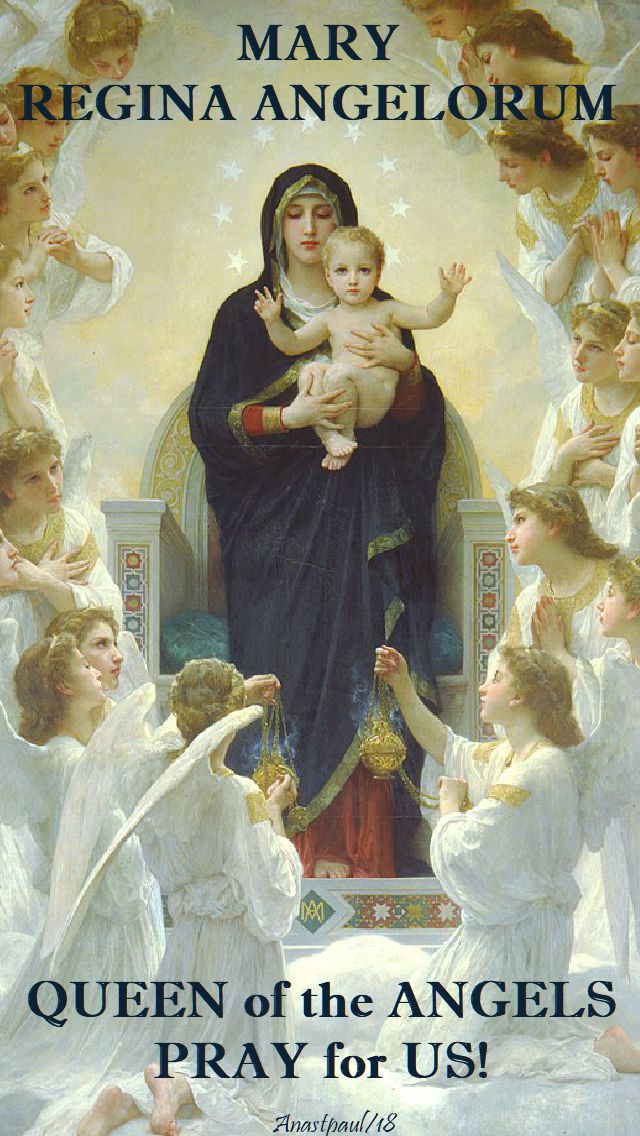
Mary is the “Regina Angelorum,” The Queen of Angels
Blessed John Henry Newman (1801-1890)

THIS great title may be fitly connected with the Maternity of Mary, that is, with the coming upon her of the Holy Ghost at Nazareth after the Angel Gabriel’s annunciation to her and with the consequent birth of our Lord at Bethlehem.   She, as the Mother of our Lord, comes nearer to Him than any angel;  nearer even than the Seraphim who surround Him and cry continually, “Holy, Holy, Holy.”

The two Archangels who have a special office in the Gospel are St Michael and St Gabriel—and they both of them are associated in the history of the Incarnation with Mary:  St Gabriel, when the Holy Ghost came down upon her and St Michael, when the Divine Child was born.

St. Gabriel hailed her as “Full of grace” and as “Blessed among women” and announced to her that the Holy Ghost would come down upon her and that she would bear a Son who would be the Son of the Highest.

Of St Michael’s ministry to her, on the birth of that Divine Son, we learn in the Apocalypse, written by the Apostle St John.   We know our Lord came to set up the Kingdom of Heaven among men and hardly was He born, when He was assaulted by the powers of the world, who wished to destroy Him.   Herod sought to take His life but he was defeated by St Joseph’s carrying His Mother and Him off into Egypt.   But St John in the Apocalypse tells us that Michael and his angels, were the real guardians of Mother and Child, then and on other occasions.

First, St John saw in vision “a great sign in heaven” (meaning by “heaven” the Church, or Kingdom of God), “a woman clothed with the sun and with the moon under her feet and on her head a crown of twelve stars; and when she was about to be delivered of her Child, there appeared “a great red dragon,” that is, the evil spirit, ready “to devour her son” when He should be born.   The Son was preserved by His own Divine power but next the evil spirit persecuted her;  St Michael, however and his angels, came to the rescue and prevailed against him.

“There was a great battle,” says the sacred writer; “Michael and his Angels fought with the dragon and the dragon fought and his angels and that great dragon was cast out, the old serpent, who is called the devil.”

Now, as then, the Blessed Mother of God has hosts of angels, who do her service and she is their Queen.

Mary, Regina Angelorum – The Queen of the Angels, Pray for us!mary regina angelorum - queen of the angels - pray for us - 11 may 2018

Posted in CATHOLIC DEVOTIONS of the Month, MARIAN QUOTES, MARIAN TITLES, QUOTES of the SAINTS, The BLESSED VIRGIN MARY

Marian Thought for the Day – 10 May “Mary’s Month” and Thursday of the Sixth Week of Eastertide

Marian Thought for the Day – 10 May “Mary’s Month” and Thursday of the Sixth Week of Eastertide

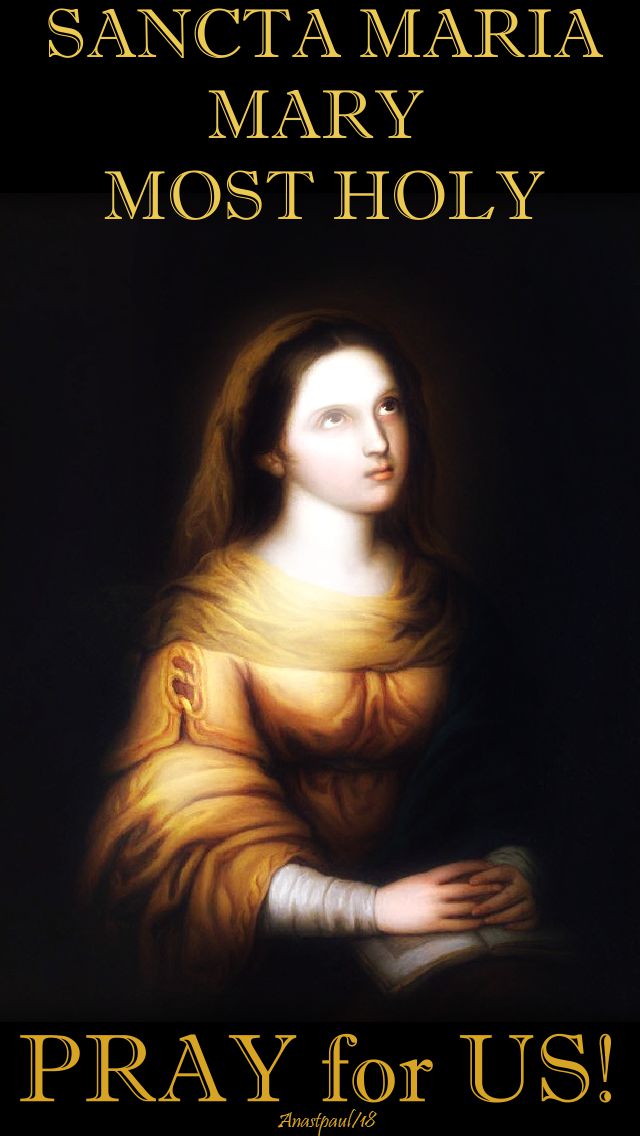
Mary is “Sancta Maria,” the Holy Mary
Blessed John Henry Newman (1801-1890)

GOD alone can claim the attribute of holiness.   Hence we say in the Hymn, “Tu solus sanctus,” “Thou only art holy.”   By holiness we mean the absence of whatever sullies, dims and degrades a rational nature;  all that is most opposite and contrary to sin and guilt.

We say that God alone is holy, though in truth all His high attributes are possessed by Him in that fullness, that it may be truly said that He alone has them.   Thus, as to goodness, our Lord said to the young man, “None is good but God alone.”   He too alone is Power, He alone is Wisdom, He alone is Providence, Love, Mercy, Justice, Truth.   This is true but holiness is singled out as His special prerogative, because it marks more than His other attributes, not only His superiority over all His creature but emphatically, His separation from them.   Hence we read in the Book of Job, “Can man be justified compared with God, or he that is born of a woman appear clean?   Behold, even the moon doth not shine and the stars are not pure, in His sight.”   “Behold, among His saints none is unchangeable and the Heavens arc not pure in His sight.”

This we must receive and understand in the first place but secondly, we know too, that, in His mercy, He has communicated in various measures His great attributes to His rational creatures and, first of all, as being most necessary, holiness.   Thus Adam, from the time of his creation, was gifted, over and above his nature as man, with the grace of God, to unite him to God and to make him holy.   Grace is therefore called holy grace; and, as being holy, it is the connecting principle between God and man.   Adam in Paradise might have had knowledge and skill and many virtues;  but these gifts did not unite him to his Creator.   It was holiness that united him, for it is said by St Paul, “Without holiness no man shall see God.”

And so again, when man fell and lost this holy grace, he had various gifts still adhering to him;  he might be, in a certain measure, true, merciful, lovin, and just but these virtues did not unite him to God.   What he needed was holiness and, therefore, the first act of God’s goodness to us in the Gospel, is to take us out of our unholy state by means of the sacrament of Baptism and by the grace then given u, to re-open the communications, so long closed, between the soul and heaven.

We see then the force of our Lady’s title, when we call her “Holy Mary.”   When God would prepare a human mother for His Son, this was why He began by giving her an immaculate conception.   He began, not by giving her the gift of love, or truthfulness, or gentleness, or devotion, though according to the occasion she had them all.   But He began His great work before she was born, before she could think, speak, or act, by making her holy and thereby, while on earth, a citizen of heaven.   “Tota pulchra es, Maria!”   Nothing of the deformity of sin was ever hers.   Thus she differs from all saints. There have been great missionaries, confessors, bishops, doctors, pastors.   They have done great works and have taken with them numberless converts or penitents to heaven. They have suffered much and have a superabundance of merits to show.   But Mary in this way resembles her Divine Son,  that, as He, being God, is separate by holiness from all creatures, so she is separate from all Saints and Angels, as being “full of grace.”

sancta maria -mary most holy - pray for us - 10 may 2018


Posted in CATHOLIC DEVOTIONS of the Month, MARIAN DEVOTIONS, MARIAN QUOTES, MARIAN TITLES, QUOTES of the SAINTS, The BLESSED VIRGIN MARY, The WORD

Marian Thought for the Day – 9 May “Mary’s Month!” – Wednesday of the Sixth Week of Eastertide

Marian Thought for the Day – 9 May “Mary’s Month!” – Wednesday of the Sixth Week of Eastertide

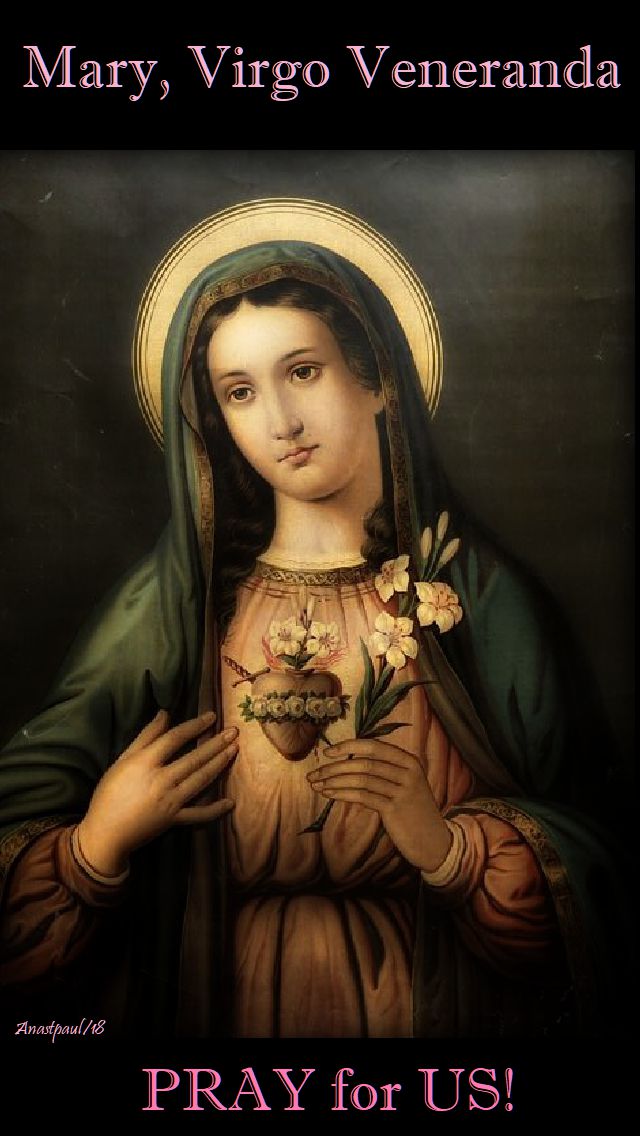
Mary is the “Virgo Veneranda,”

The All-Worshipful Virgin
Blessed John Henry Newman Cong. Orat. (1801-1890)

WE use the word “Venerable” generally of what is old.   That is because only what is old has commonly those qualities which excite reverence or veneration.

It is a great history, a great character, a maturity of virtue, goodness, experience, that excite our reverence and these commonly, cannot belong to the young.

But this is not true when we are considering Saints.   A short life with them is a long one. Thus Holy Scripture says, “Venerable age is not that of long time, nor counted by the number of years but it is the understanding of a man that has gray hairs and a spotless life is old age.   The just man, if he be cut short by death, shall be at rest;  being made perfect in a short time, he fulfilled a long time.” [Wisdom v.]

Nay, there is a heathen writer, who knew nothing of Saints, who lays it down that even to children, to all children, a great reverence should be paid and that on the ground of their being as yet innocent.   And this is a feeling very widely felt and expressed in all countries;  so much so that the sight of those who have not sinned (that is, who are not yet old enough to have fallen into mortal sin) has, on the very score of that innocent, smiling youthfulness, often disturbed and turned the plunderer or the assassin in the midst of his guilty doings, filled him with a sudden fear and brought him, if not to repentance, at least to change of purpose.

And, to pass from the thought of the lowest to the Highest, what shall we say of the Eternal God (if we may safely speak of Him at all) but that He, because He is eternal, is ever young, without a beginning and therefore without change and, in the fullness and perfection of His incomprehensible attributes, now just what He was a million years ago?   He is truly called in Scripture the “Ancient of Days,” and is therefore infinitely venerable;   yet He needs not old age to make him venerable;  He has really nothing of those human attendants on venerableness which the sacred writers are obliged figuratively to ascribe to Him, in order to make us feel that profound abasement and reverential awe which we ought to entertain at the thought of Him.

And so of the great Mother of God, as far as a creature can be like the Creator;  her ineffable purity and utter freedom from any shadow of sin, her Immaculate Conception, her ever-virginity—these her prerogatives (in spite of her extreme youth at the time when Gabriel came to her) are such as to lead us to exclaim in the prophetic words of Scripture both with awe and with exultation, “Thou art the glory of Jerusalem and the joy of Israel;  thou art the honour of our people;  therefore hath the hand of the Lord strengthened thee and therefore art thou blessed forever.”

Mary, Virgo Veneranda, Pray for us!mary virgo veneranda - pray for us - 9 may 2018

Posted in CATHOLIC DEVOTIONS of the Month, MARIAN DEVOTIONS, MARIAN QUOTES, MARIAN TITLES, MORNING Prayers, QUOTES of the SAINTS, The BLESSED VIRGIN MARY

Marian Thought for the Day – 8 May – “Mary’s Month!” – Tuesday of the Sixth Week of Eastertide

Marian Thought for the Day – 8 May – “Mary’s Month!” – Tuesday of the Sixth Week of Eastertide

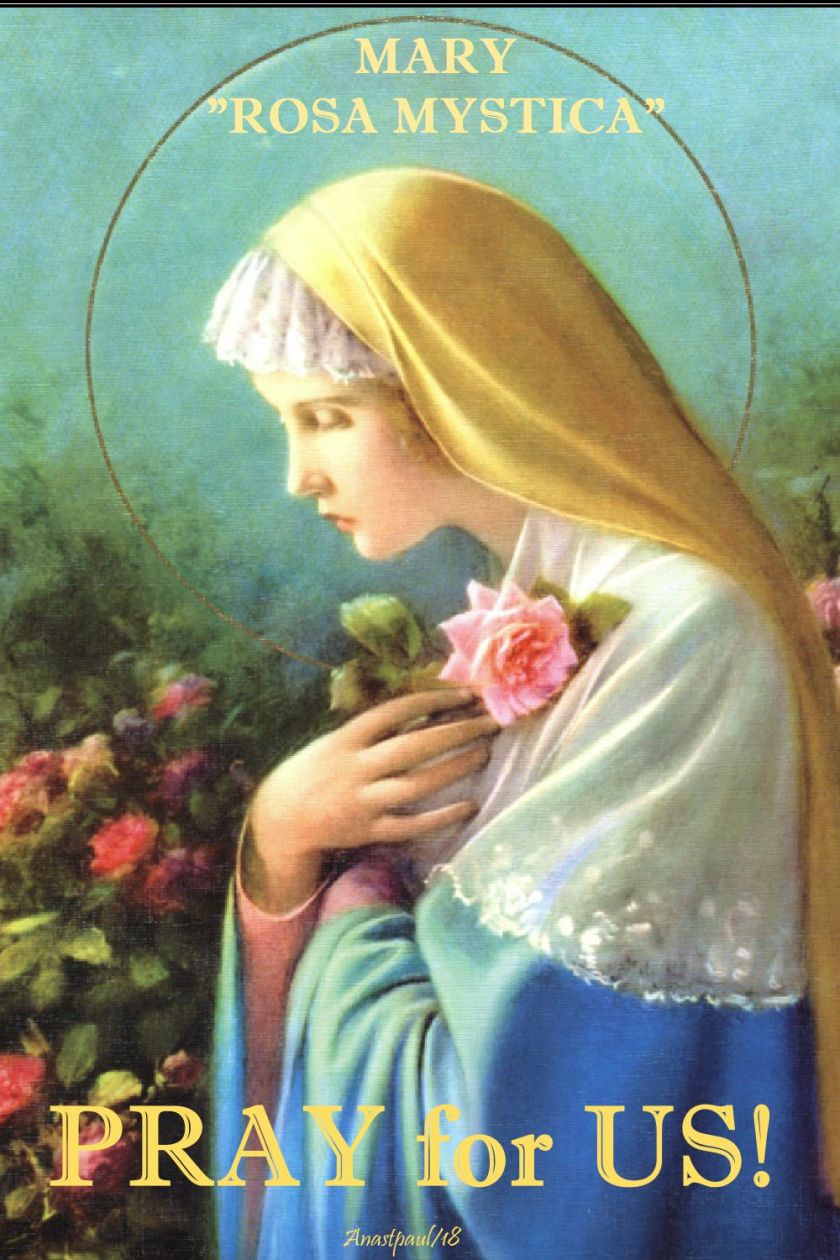
Mary is the “Rosa Mystica,” the Mystical Rose
Blessed John Henry Newman (1801-1890)

HOW did Mary become the Rosa Mystica, the choice, delicate, perfect flower of God’s spiritual creation?   It was by being born, nurtured and sheltered in the mystical garden or Paradise of God.   Scripture makes use of the figure of a garden, when it would speak of heaven and its blessed inhabitants.   A garden is a spot of ground set apart for trees and plants, all good, all various, for things that are sweet to the taste or fragrant in scent, or beautiful to look upon, or useful for nourishment;  and accordingly in its spiritual sense, it means the home of blessed spirits and holy souls dwelling there together, souls with both the flowers and the fruits upon them, which by the careful husbandry of God, they have come to bear, flowers and fruits of grace, flowers more beautiful and more fragrant than those of any garden, fruits more delicious and exquisite than can be matured by earthly husbandman.

All that God has made speaks of its Maker;, the mountains speak of His eternity;, the sun of His immensity and the winds of His Almightiness.   In like manner flowers and fruits speak of His sanctity, His love and His providence;  and such as are flowers and fruits, such must be the place where they are found.   That is to say, since they are found in a garden, therefore a garden has also excellences which speak of God because it is their home.   For instance, it would be out of place if we found beautiful flowers on the mountain-crag, or rich fruit in the sandy desert.   As then by flowers and fruits are meant, in a mystical sense, the gifts and graces of the Holy Ghost, so by a garden is meant mystically, a place of spiritual repose, stillness, peace, refreshment and delight.

Thus our first parents were placed in “a garden of pleasure” shaded by trees, “fair to behold and pleasant to eat of,” with the Tree of Life in the midst and a river to water the ground.   Thus our Lord, speaking from the cross to the penitent robber, calls the blessed place, the heaven to which He was taking him, “paradise,” or a garden of pleasure. Therefore St John, in the Apocalypse, speaks of heaven, the palace of God, as a garden or paradise, in which was the Tree of Life giving forth its fruits every month.

Such was the garden in which the Mystical Rose, the Immaculate Mary, was sheltered and nursed to be the Mother of the All Holy God, from her birth to her espousals to St Joseph, a term of thirteen years.   For three years of it, she was in the arms of her holy mother, St Anne and then for ten years she lived in the temple of God.   In those blessed gardens, as they may be called, she lived by herself, continually visited by the dew of God’s grace and growing up a more and more heavenly flower, till at the end of that period she was meet for the inhabitation in her of the Most Holy.   This was the outcome of the Immaculate Conception.   Excepting her, the fairest rose in the paradise of God has had upon it blight and has had the risk of canker-worm and locust.   All but Mary;  she from the first was perfect in her sweetness and her beautifulness and at length, when the angel Gabriel had to come to her, he found her “full of grace,” which had, from her good use of it, accumulated in her, from the first moment of her being.

Mary, Rosa Mystica, Pray for us!mary - rosa mystica - pray for us - 8 may 2018

Posted in CATHOLIC DEVOTIONS of the Month, MARIAN QUOTES, MARIAN TITLES, MORNING Prayers, QUOTES of the SAINTS, The BLESSED VIRGIN MARY, The HOLY EUCHARIST / The HOLY MASS

Marian Thought for the Day – 6 May “Mary’s Month!” – Sixth Sunday of Eastertide B

Marian Thought for the Day – 6 May “Mary’s Month!” – Sixth Sunday of Eastertide B

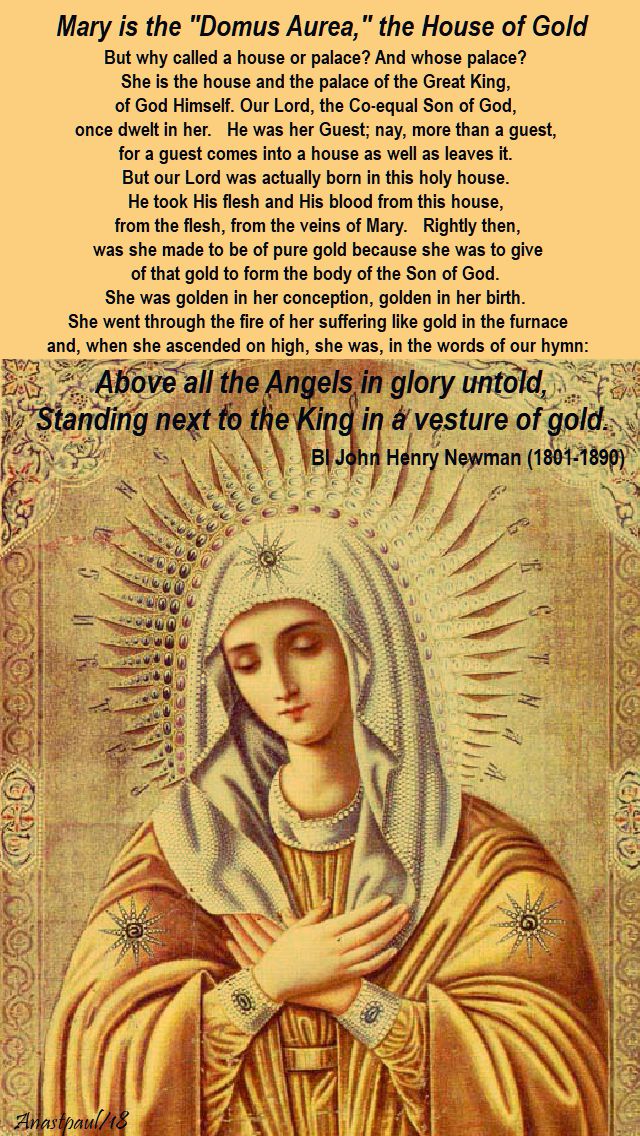
Mary is the “Domus Aurea,” the House of Gold
Blessed John Henry Newman (1801-1890)

WHY is she called a House?   And why is she called Golden?   Gold is the most beautiful, the most valuable, of all metals. Silver, copper and steel may in their way be made good to the eye but nothing is so rich, so splendid, as gold.   We have few opportunities of seeing it in any quantity but anyone who has seen a large number of bright gold coins knows how magnificent is the look of gold.   Hence it is that in Scripture the Holy City is, by a figure of speech, called Golden.   “The City,” says St. John, “was pure gold, as it were transparent glass.”   He means of course to give us a notion of the wondrous beauty of heaven, by comparing it with what is the most beautiful of all the substances which we see on earth.

Therefore, it is that Mary too, is called golden because her graces, her virtues, her innocence, her purity, are of that transcendent brilliancy and dazzling perfection, so costly, so exquisite, that the angels cannot, so to say, keep their eyes off her any more than we could help gazing upon any great work of gold.

But observe further, she is a golden house, or, I will rather say, a golden palace.   Let us imagine we saw a whole palace or large church all made of gold, from the foundations to the roof;  such, in regard to the number, the variety, the extent of her spiritual excellences, is Mary.

But why called a house or palace?   And whose palace?   She is the house and the palace of the Great King, of God Himself.   Our Lord, the Co-equal Son of God, once dwelt in her. He was her Guest, nay, more than a guest, for a guest comes into a house as well as leaves it.   But our Lord was actually born in this holy house.   He took His flesh and His blood from this house, from the flesh, from the veins of Mary.   Rightly then was she made to be of pure gold because she was to give of that gold to form the body of the Son of God.   She was golden in her conception, golden in her birth.   She went through the fire of her suffering like gold in the furnace and when she ascended on high, she was, in the words of our hymn,

Above all the Angels in glory untold,
Standing next to the King in a vesture of gold.mary is the house of gold

Holy Mary, Mother of God, pray for us!HOLY MARY MOTHER OF GOD - PRAY FOR US

Posted in CATHOLIC DEVOTIONS of the Month, MARIAN DEVOTIONS, MARIAN QUOTES, MARIAN TITLES, MORNING Prayers, QUOTES of the SAINTS, The BLESSED VIRGIN MARY

Marian Thought for the Day – 5 May “Mary’s Month!” – Saturday of the Fifth Week of Eastertide

Marian Thought for the Day – 5 May “Mary’s Month!” – Saturday of the Fifth Week of Eastertide

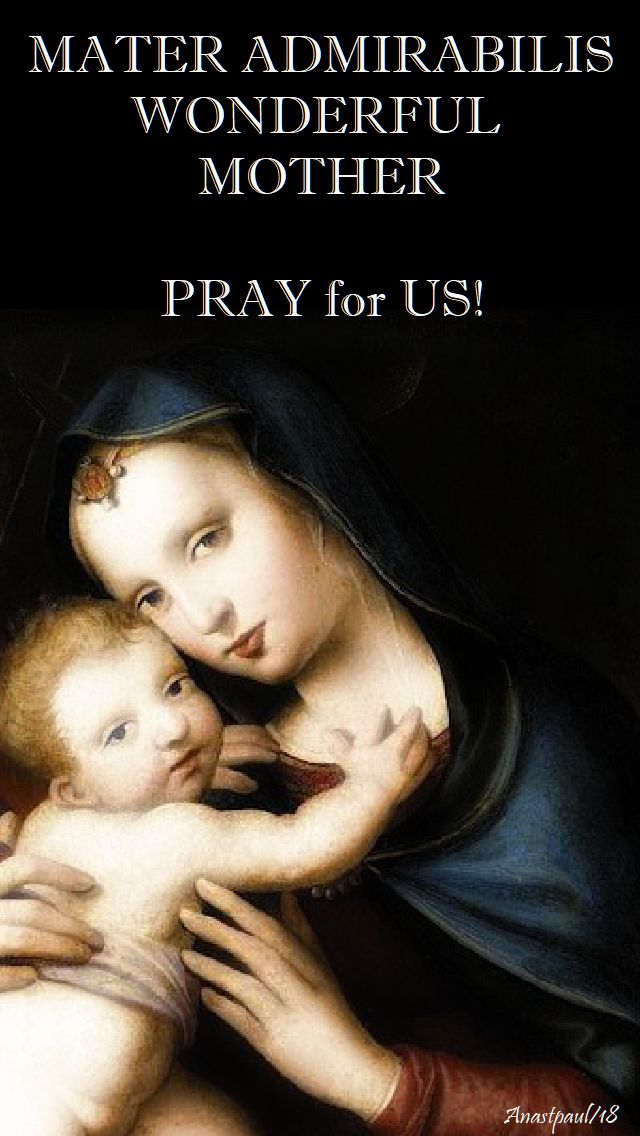
Mary is the “Mater Admirabilis,” the Wonderful Mother
Blessed John Henry Newman (1801-1890)

WHEN Mary, the Virgo Prædicanda, the Virgin who is to be proclaimed aloud, is called by the title of Admirabilis, it is thereby suggested to us what the effect is of the preaching of her as Immaculate in her Conception.  The Holy Church proclaims, preaches her, as conceived without original sin and those who hear, the children of Holy Church, wonder, marvel, are astonished and overcome by the preaching.   It is so great a prerogative.

Even created excellence is fearful to think of when it is so high as Mary’s.  As to the great Creator, when Moses desired to see His glory, He Himself says about Himself, “Thou canst not see My face, for man shall not see Me and live;” and St. Paul says, “Our God is a consuming fire.”   And when St John, holy as he was, saw only the Human Nature of our Lord, as He is in Heaven, “he fell at His feet as dead.”   And so as regards the appearance of angels.   The holy Daniel, when St Gabriel appeared to him, “fainted away and lay in a consternation, with his face close to the ground.”   When this great archangel came to Zacharias, the father of S. John the Baptist, he too was troubled and fear fell upon him. But it was otherwise with Mary when the same St Gabriel came to her  . She was overcome indeed and troubled at his words, because, humble as she was in her own opinion of herself, he addressed her as “Full of grace,” and “Blessed among women” but she was able to bear the sight of him.

Hence we learn two things:  first, how great a holiness was Mary’s, seeing she could endure the presence of an angel, whose brightness smote the holy prophet Daniel even to fainting and almost to death;  and secondly, since she is so much holier than that angel, and we so much less holy than Daniel, what great reason we have to call her the Virgo Admirabilis, the Wonderful, the Awful Virgin, when we think of her ineffable purity!

There are those who are so thoughtless, so blind, so grovelling as to think that Mary is not as much shocked at wilful sin as her Divine Son is and that we can make her our friend and advocate, though we go to her without contrition at heart, without even the wish for true repentance and resolution to amend.   As if Mary could hate sin less and love sinners more, than our Lord does!   No: she feels a sympathy for those only who wish to leave their sins else, how should she be without sin herself?   No, if even to the best of us she is, in the words of Scripture, “fair as the moon, bright as the sun and terrible as an army set in array,” what is she to the impenitent sinner?

Mater Admirabilis, Wonderful Mother, Pray for us!mater admirabilis - pray for us - 5 may 2018

Posted in CATHOLIC DEVOTIONS of the Month, MARIAN DEVOTIONS, MARIAN QUOTES, MARIAN TITLES, MORNING Prayers, The BLESSED VIRGIN MARY, Thomas a Kempis, Uncategorized

Marian Thought for the Day – 4 May – Mary’s Month! – Friday of the Fifth Week of Eastertide

Marian Thought for the Day – 4 May – Mary’s Month! – Friday of the Fifth Week of Eastertide

Mary is the “Virgo Prædicanda,” the Virgin who is to be Proclaimed
Blessed John Henry Newman (1801-1890)

MARY is the Virgo Prædicanda, that is, the Virgin who to be proclaimed, to be heralded, literally, to be preached.

We are accustomed to preach abroad that which is wonderful, strange, rare, novel, important.   Thus, when our Lord was coming, St John the Baptist preached Him;  then, the Apostles went into the wide world and preached Christ.   What is the highest, the rarest, the choicest prerogative of Mary?   It is that she was without sin.   When a woman in the crowd cried out to our Lord, “Blessed is the womb that bare Thee!” He answered, “More blessed are they who hear the word of God and keep it.”   Those words were fulfilled in Mary.   She was filled with grace in order to be the Mother of God.   But it was a higher gift than her maternity to be thus sanctified and thus pure.   Our Lord indeed would not have become her son unless He had first sanctified her but still, the greater blessedness was to have that perfect sanctification.   This then is why she is the Virgo Prædicanda; she is deserving to be preached abroad because she never committed any sin, even the least;  because sin had no part in her;  because, through the fullness of God’s grace, she never thought a thought, or spoke a word, or did an action, which was displeasing, which was not most pleasing, to Almighty God;  because in her was displayed the greatest triumph over the enemy of souls.

Wherefore, when all seemed lost, in order to show what He could do for us all by dying for us;  in order to show what human nature, His work, was capable of becoming;  to show how utterly He could bring to naught the utmost efforts, the most concentrated malice of the foe and reverse all the consequences of the Fall, our Lord began, even before His coming, to do His most wonderful act of redemption, in the person of her who was to be His Mother.   By the merit of that Blood which was to be shed, He interposed to hinder her incurring the sin of Adam, before He had made on the Cross atonement for it. And therefore it is that we preach her who is the subject of this wonderful grace.

But she was the Virgo Prædicanda for another reason.   When, why, what things do we preach?   We preach what is not known, that it may become known.   And hence the Apostles are said in Scripture to “preach Christ.”   To whom?   To those who knew Him not—to the heathen world.   Not to those who knew Him but to those who did not know Him.

Preaching is a gradual work, first one lesson, then another.   Thus were the heathen brought into the Church gradually.   And in like manner, the preaching of Mary to the children of the Church and the devotion paid to her by them, has grown, grown gradually, with successive ages.   Not so much preached about her in early times as in later.   First she was preached as the Virgin of Virgins—then as the Mother of God—then as glorious in her Assumption—then as the Advocate of sinners—then as Immaculate in her Conception.   And this last has been the special preaching of the present century and thus that which was earliest in her own history is the latest in the Church’s recognition of her.

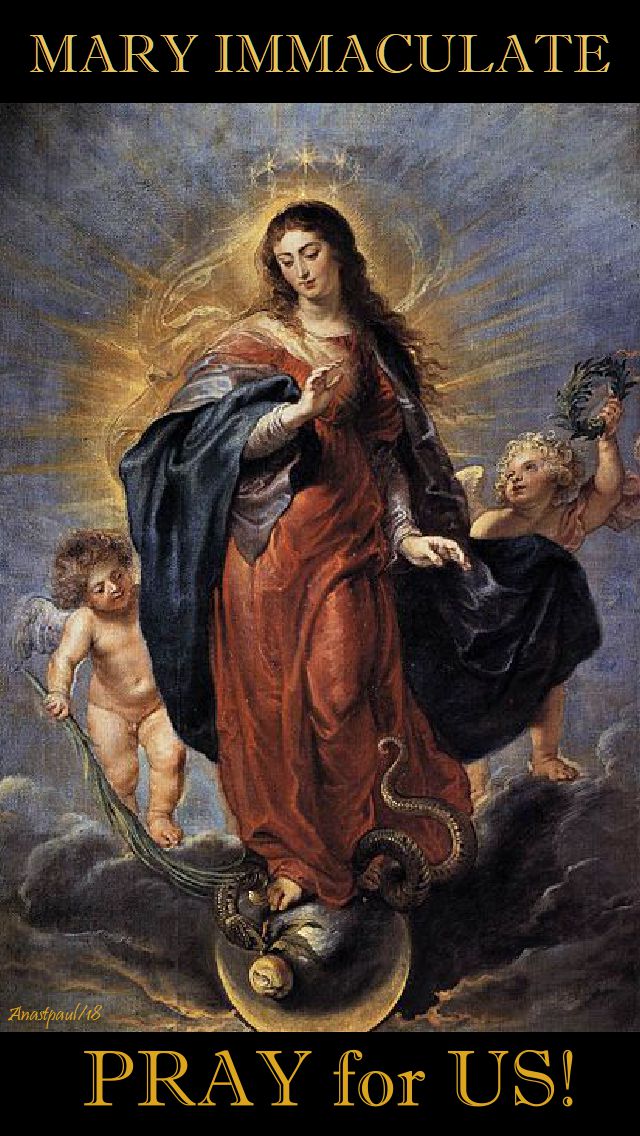
Mary Immaculate, Pray for us!mary immaculate - pray for us - 4 mary 2018.jpg

Posted in CATECHESIS, CATHOLIC DEVOTIONS of the Month, DOGMA, MARIAN QUOTES, MARIAN TITLES, MORNING Prayers, QUOTES of the SAINTS, The BLESSED VIRGIN MARY

Marian Thought for the Day – 3 May – Mary’s Month! – Thursday of the Fifth Week of Eastertide and the Feast of Sts Philip and James Apostles and Martyrs

Marian Thought for the Day – 3 May – Mary’s Month! – Thursday of the Fifth Week of Eastertide and the Feast of Sts Philip and James Apostles and Martyrs

On the Immaculate Conception
Mary is the “Virgo Purissima,” the Most Pure Virgin
By Blessed John Henry Newman (1801-1890)

BY the Immaculate Conception of the Blessed Virgin is meant the great revealed truth that she was conceived in the womb of her mother, St Anne, without original sin.

Since the fall of Adam all mankind, his descendants, are conceived and born in sin. “Behold,” says the inspired writer in the Psalm Miserere—“Behold, I was conceived in iniquity and in sin did my mother conceive me”.   That sin which belongs to every one of us and is ours, from the first moment of our existence, is the sin of unbelief and disobedience, by which Adam lost Paradise.   We, as the children of Adam, are heirs to the consequences of his sin and have forfeited in him, that spiritual robe of grace and holiness, which he had given him by his Creator at the time that he was made.   In this state of forfeiture and disinheritance we are all of us conceived and born and the ordinary way, by which we are taken out of it, is the Sacrament of Baptism.

But Mary never was in this state, she was by the eternal decree of God exempted from it. From eternity, God, the Father, Son and Holy Ghost, decreed to create the race of man and, foreseeing the fall of Adam, decreed to redeem the whole race by the Son’s taking flesh and suffering on the Cross.   In that same incomprehensible, eternal instant, in which the Son of God was born of the Father, was also the decree passed of man’s redemption through Him.   He who was born from Eternity was born by an eternal decree to save us in Time and to redeem the whole race and Mary’s redemption, was determined in that special manner which we call the Immaculate Conception.   It was decreed, not that she should be cleansed from sin but that she should, from the first moment of her being, be preserved from sin, so that the Evil One never had any part in her.   Therefore, she was a child of Adam and Eve as if they had never fallen, she did not share with them their sin, she inherited the gifts and graces (and more than those) which Adam and Eve possessed in Paradise.   This is her prerogative and the foundation of all those salutary truths, which are revealed to us concerning her.

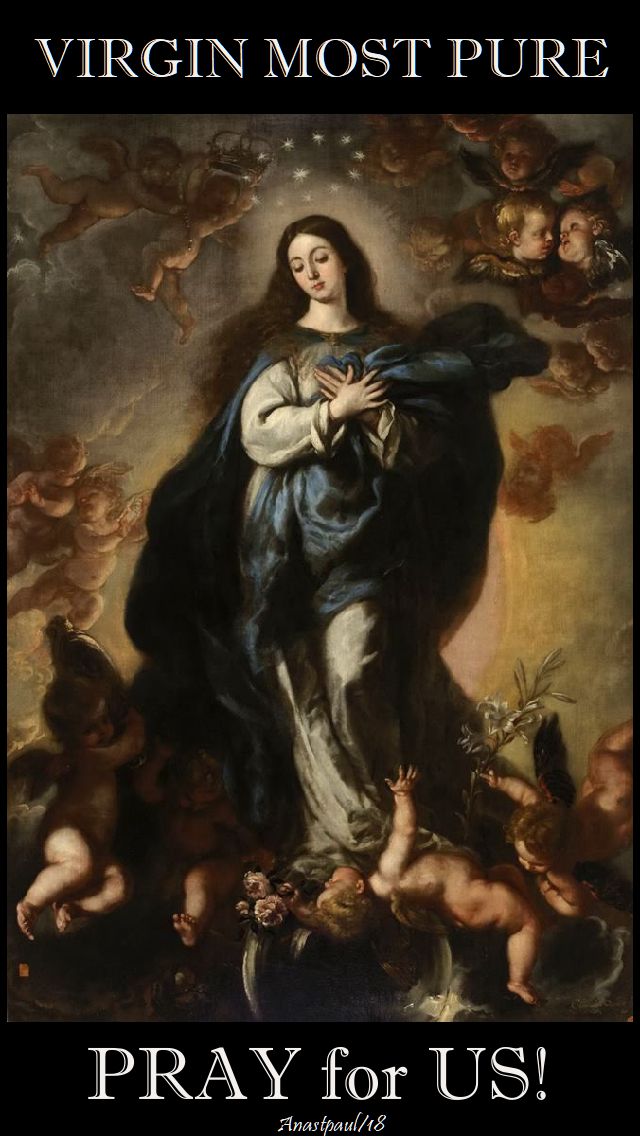
Let us say then with all holy souls, Virgin most pure, conceived without original sin, Mary, pray for us.virgin most pure - pray for us - 3 may 2018

Posted in CATHOLIC DEVOTIONS of the Month, MARIAN DEVOTIONS, MARIAN PRAYERS, PRAYERS of the SAINTS, The BLESSED VIRGIN MARY

Our Morning Offering – 3 May – Mary’s Month! – Thursday of the Fifth Week of Eastertide and the Feast of Sts Philip and James Apostles and Martyrs

Our Morning Offering – 3 May – Mary’s Month! – Thursday of the Fifth Week of Eastertide and the Feast of Sts Philip and James Apostles and Martyrs

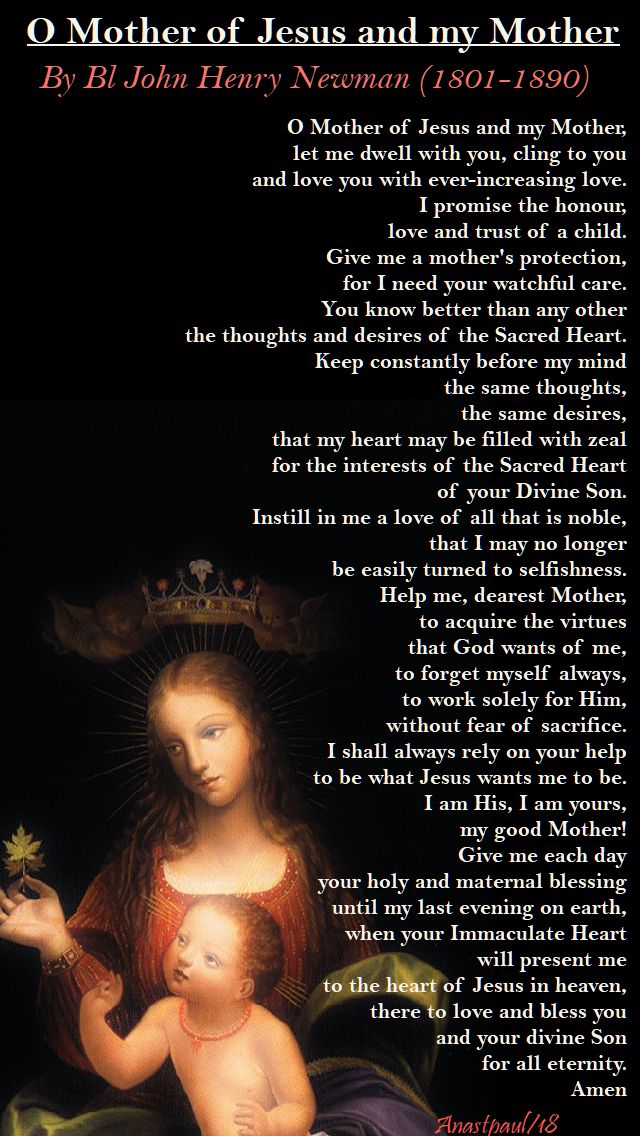
O Mother of Jesus and my Mother
By Bl John Henry Newman (1801-1890)

O Mother of Jesus and my Mother,
let me dwell with you, cling to you
and love you with ever-increasing love.
I promise the honour,
love and trust of a child.
Give me a mother’s protection,
for I need your watchful care.
You know better than any other
the thoughts and desires of the Sacred Heart.
Keep constantly before my mind
the same thoughts,
the same desires,
that my heart may be filled with zeal
for the interests of the Sacred Heart
of your Divine Son.
Instill in me a love of all that is noble,
that I may no longer be easily turned to selfishness.
Help me, dearest Mother,
to acquire the virtues that God wants of me,
to forget myself always,
to work solely for Him,
without fear of sacrifice.
I shall always rely on your help
to be what Jesus wants me to be.
I am His; I am yours, my good Mother!
Give me each day your holy and maternal blessing
until my last evening on earth,
when your Immaculate Heart
will present me to the heart of Jesus in heaven,
there to love and bless you
and your divine Son for all eternity.
Ameno mother of jesus and my mother - bl john henry newman - 3 may 2018

Posted in MARIAN DEVOTIONS, MARIAN QUOTES, MARIAN TITLES, MORNING Prayers, QUOTES of the SAINTS, The BLESSED VIRGIN MARY

Marian Thought for the Day – 2 May – “Mary’s Month” – May the Month of Joy By Blessed John Henry Newman (1801-1890)

Marian Thought for the Day – 2 May – “Mary’s Month”

May 2 – May the Month of Joy
By Blessed John Henry Newman  (1801-1890)

WHY is May called the month of Mary and especially dedicated to her?   Among other reasons there is this, that of the Church’s year, the ecclesiastical year, it is at once the most sacred and the most festive and joyous portion.   Who would wish February, March, or April, to be the month of Mary, considering that it is the time of Lent and penance? Who again would choose December, the Advent season—a time of hope, indeed, because Christmas is coming but a time of fasting too?   Christmas itself does not last for a month; and January has indeed the joyful Epiphany, with its Sundays in succession but these in most years, are cut short ,by the urgent coming of Septuagesima.

May on the contrary belongs to the Easter season, which lasts fifty days and in that season the whole of May commonly falls and the first half always.,, The great Feast of the Ascension of our Lord into heaven is always in May, except once or twice in forty years. Pentecost, called also Whit-Sunday, the Feast of the Holy Ghost, is commonly in May and the Feasts of the Holy Trinity and Corpus Christi are in May not unfrequently.  May, therefore, is the time in which there are such frequent Alleluias, because Christ has risen from the grave, Christ has ascended on high and God the Holy Ghost has come down to take His place.

Here then we have a reason why May is dedicated to the Blessed Mary.   She is the first of creatures, the most acceptable child of God, the dearest and nearest to Him.   It is fitting then that this month should be hers, in which we especially glory and rejoice in His great Providence to us, in our redemption and sanctification in God the Father, God the Son and God the Holy Ghost.

But Mary is not only the acceptable handmaid of the Lord.   She is also Mother of His Son, and the Queen of all Saints and in this month the Church has placed the feasts of some of the greatest of them, as if to bear her company.   St John, the beloved disciple, St Philip, and St James. Seven Popes, two of them especially famous, St Gregory VII. and St Pius V, also two of the greatest Doctors, St Athanasius and St Gregory Nazianzen; two holy Virgins especially favoured by God, St Catherine of Sienna (as her feast is kept in England) and St Mary Magdalen of Pazzi and one holy woman most memorable in the annals of the Church, St Monica, the Mother of St Augustine.   And above all and nearest to us in this Church, our own holy Patron and Father, St Philip Neri, occupies, with his Novena and Octave, fifteen out of the whole thirty-one days of the month.   These are some of the choicest fruits of God’s manifold grace and they form the court of their glorious Queen.

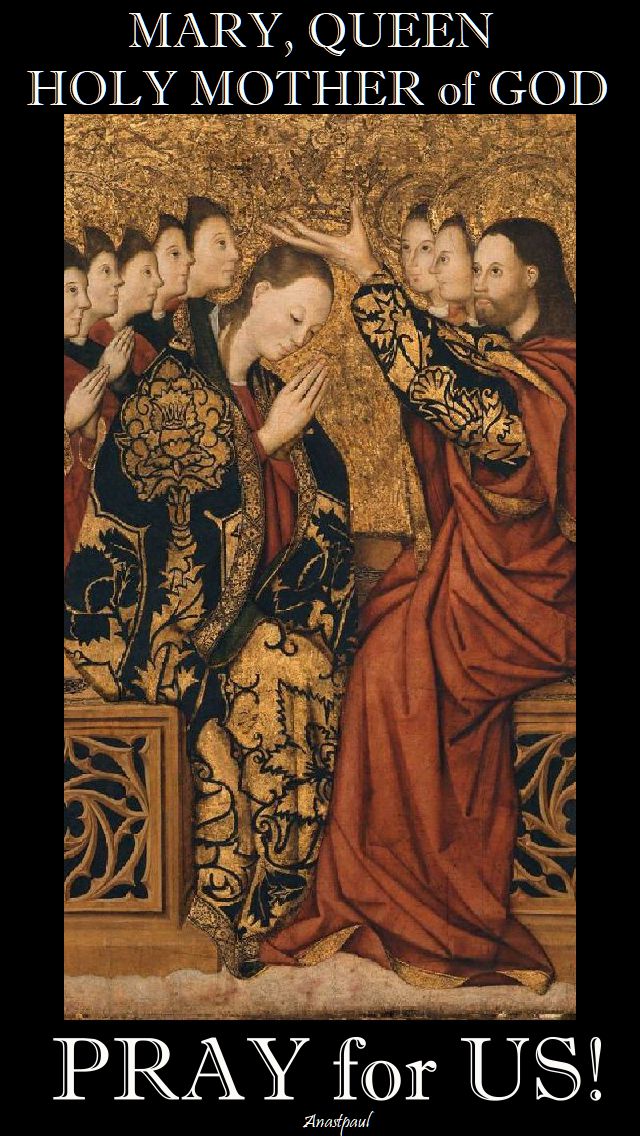
Mary, Queen of Heaven and Earth, Pray for us!mary queen - pray for us

Posted in CATHOLIC DEVOTIONS of the Month, MARIAN QUOTES, MARIAN TITLES, MORNING Prayers, The BLESSED VIRGIN MARY

Thought for the Day – 1 May – Tuesday of the Fifth Week of Eastertide, the Memorial of St Joseph the Worker and the 1st day of the Month of Mary

Thought for the Day – 1 May – Tuesday of the Fifth Week of Eastertide, the Memorial of St Joseph the Worker and the 1st day of the Month of Mary

May, The Month of Promise
Why is May chosen as the month in which we exercise a special devotion to the Blessed Virgin?

The first reason, is because, it is the time when the earth bursts forth into its fresh foliage and its green grass, after the stern frost and snow of winter and the raw atmosphere and the wild wind and rain, of the early spring.   It is because the blossoms are upon the trees and the flowers are in the gardens.   It is because the days have got long and the sun rises early and sets late.   For such gladness and joyousness of external Nature is a fit attendant on our devotion to her, who is the Mystical Rose and the House of Gold.

A man may say, “True but in this climate, we have sometimes a bleak, inclement May.” This cannot be denied;  but still, so much is true that at least it is the month of promise and of hope.   Even though the weather happen to be bad, it is the month that begins and heralds in the summer.   We know, for all that may be unpleasant in it, that fine weather is coming, sooner or later.   “Brightness and beauty shall,” in the Prophet’s words, “appear at the end and shall not lie:  if it make delay, wait for it, for it shall surely come and shall not be slack.”

May then is the month, if not of fulfillment, at least of promise and is not this the very aspect, in which we most suitably regard the Blessed Virgin, Holy Mary, to whom this month is dedicated?

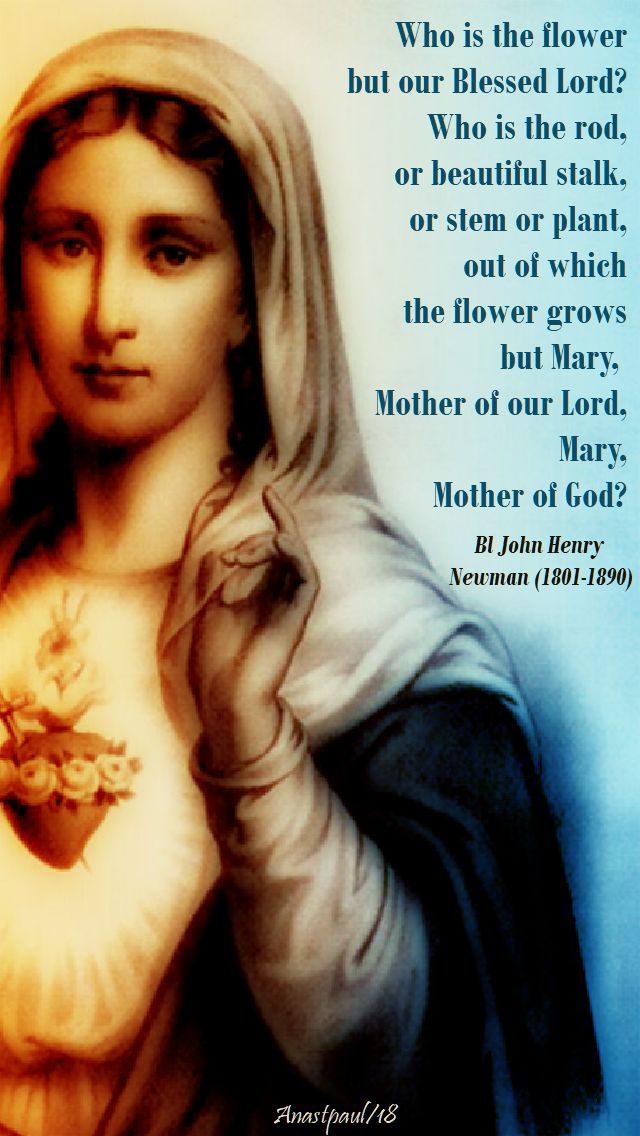
The Prophet says, “There shall come forth a rod out of the root of Jesse and a flower shall rise out of his root.”   Who is the flower but our Blessed Lord?   Who is the rod, or beautiful stalk or stem or plant out of which the flower grows but Mary, Mother of our Lord, Mary, Mother of God?

It was prophesied that God should come upon earth.   When the time was now full, how was it announced?   It was announced by the Angel coming to Mary.   “Hail, full of grace,” said Gabriel, “the Lord is with thee; blessed art thou among women.”   She then was the sure promise of the coming Saviour and, therefore, May is, by a special title her month…. taken from Meditations for the Month of May, by Blessed John Henry Newman  (1801-1890)who is the flower but our blessed lord - bl john henry newman - 1 may 2018

Holy Mary, Mother of God and our Mother, Pray for us!mary mother of god pray for us - 1 jan 2018

Posted in EASTER, MORNING Prayers, QUOTES of the SAINTS, The HOLY EUCHARIST / The HOLY MASS, The WORD

One Minute Reflection – 20 April – Friday of the Third Week of Eastertide

One Minute Reflection – 20 April – Friday of the Third Week of Eastertide

So Jesus said to them, “Truly, truly, I say to you, unless you eat the flesh of the Son of man and drink his blood, you have no life in you;  he who eats my flesh and drinks my blood has eternal life and I will raise him up at the last day.   For my flesh is food indeed and my blood is drink indeed.”...John 6:53-55

REFLECTION – “About these words I observe, first, that they evidently declare on the face of them some very great mystery.   How can they be otherwise taken?   If they do not, they must be a figurative way of declaring something which is not mysterious but plain and intelligible.   But is it conceivable, that He who is the Truth and Love itself, should have used difficult words, when plain words would do?   Why should He have used words, the sole effect of which, in that case, would be to perplex, to startle us needlessly?   Does His mercy delight in creating difficulties?   Does He put stumbling-blocks in our way without cause?   Does He excite hopes and then disappoint them?   It is possible;  He may have some deep purpose in so doing but which is more likely, that His meaning is beyond us, or His words beyond His meaning?
All who read such awful words as those in question will be led by the first impression of them, either with the disciples to go back, as at a hard saying, or with St Peter to welcome what is promised:  they will be excited in one way or the other, with incredulous surprise or with believing hope?   And are the feelings of these opposite witnesses, discordant indeed, yet all of them deep, after all unfounded?   Are they to go for nothing?   Are they no token of our Saviour’s real meaning?   This desire and again this aversion, so naturally raised, are they without a real object and the mere consequence of a general mistake on all hands, of what Christ meant as imagery, for literal truth?   Surely this is very improbable!”…Blessed John Henry Newman (1801-1890)but is it conceivable that he, who is the truth and love itself - bl john henry newman - 20 april 2018 - john chapter 6

PRAYER – Lord God, source of our freedom and our salvation, listen to our humble prayer.   We stand with St Peter and welcome what our divine Saviour, Your Son, our Lord Jesus Christ has promised.   Help us to grow in love and faith at each Holy Sacrifice we attend.   Help us to accept with total commitment this great Mystery and as He gives Himself to and for us, help us to give ourselves to and for the glory of Your Kingdom. Through our Lord Jesus, in the unity of the Holy Spirit, one God, forever and ever, amen.  Peter, the spokesman for the apostles, proclaims, “Lord, to whom shall we go?   You have the words of eternal life and we have believed and have come to know, that you are the Holy One of God” (Jn 6:67-69).john 6 67-69

Posted in EASTER, GOD the FATHER, MORNING Prayers, QUOTES on TRUST and complete CONFIDENCE in GOD

Thought for the Day – 13 April – Friday of the Second Week of Eastertide

Thought for the Day – 13 April – Friday of the Second Week of Eastertide

“Calls You by Your Name”

Blessed John Henry Newman (1801-1890)

God beholds me individually, whoever I am.

He “calls you by your name”.

He sees me and understands me, as He made me.   He knows what is in me, all my own peculiar feelings and thoughts, my dispositions and likings, my strength and my weakness.   He views me in my day of rejoicing and my day of sorrow.   He sympathises in my hopes and my temptations.   He interests Himself in all my anxieties and remembrances, all the risings and fallings of my spirit.   He has numbered the very hairs of my head and the cubits of my stature.   He compasses me round and bears me in His arms.   He takes me up and sets me down. 

he compasses me round - bl john henry newman - 13 april 2018

He notes my very countenance, whether smiling or in tears, whether healthful or sickly.   He looks tenderly upon my hands and my feet.   He hears my voice, the beating of my heart and my very breathing.   I do not love my self better than He loves me.   I cannot shrink from pain more than He dislikes my bearing it and if He puts it on me, it is as I will put it on myself, if I am wise, for a greater good afterwards…

I Will Put Myself In Your Hands

O my God, I will put myself
without reserve into Your hands.
Wealth or woe,
joy or sorrow,
friends or bereavement,
honour or humiliation,
good report or ill report,
comfort or discomfort.
Your presence or the
hiding of Your countenance,
all is good
if it comes from You.
You are Wisdom
and You are love –
what can I desire more.
Amen

Blessed John Henry Newman (1801-1890)

i will put myself in your hands - prayer - bl joh henry newman - 13 april 2018


Posted in EASTER, MORNING Prayers, QUOTES - J R R Tolkien and MORE, QUOTES of the SAINTS, The RESURRECTION, The WORD

Second Thoughts for the Day – 4 April – Easter Wednesday, the Fourth day in the Octave of Easter

Second Thoughts for the Day – 4 April – Easter Wednesday, the Fourth day in the Octave of Easter

“He is not here, he is going before you to Galilee; there you will see him” (Mk 16:6)

“There is another important aspect (in the Resurrection):  Jesus show Himself in the act of departure.

This is clearest in the event of Emmaus and in His meeting with Mary Magdalen.   He summons us to go with Him.

Resurrection is not an indulgence of curiosity – it is MISSION.   It’s intention is to transform the world!   It calls for an active joy, the joy of those who are themselves going along the path of the Risen One.

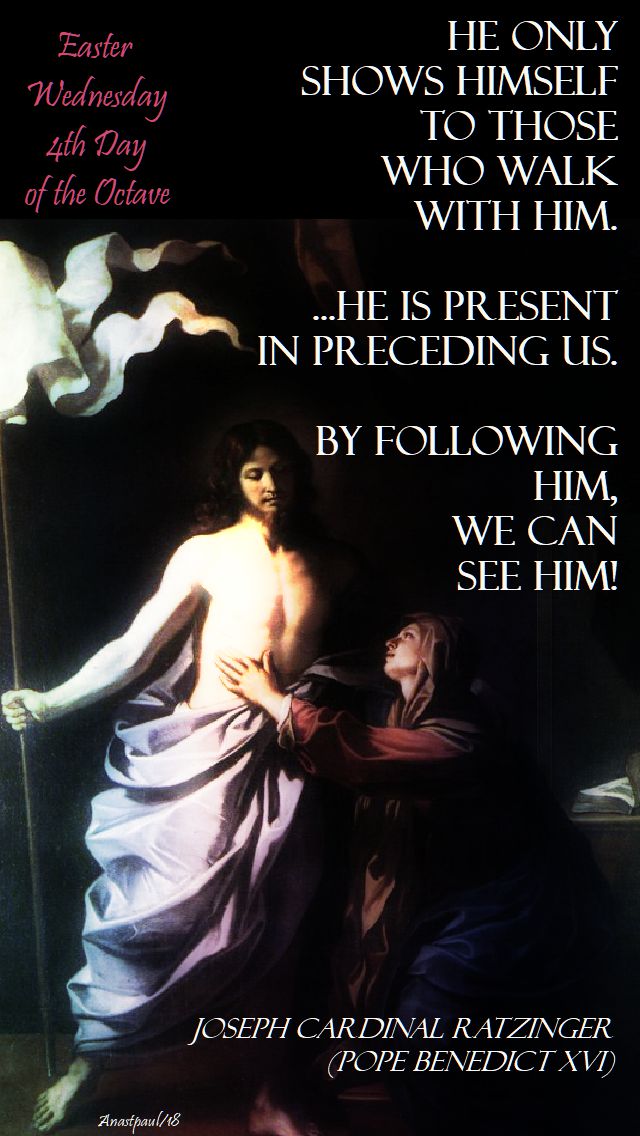
That is true today too – He only shows Himself to those who walk with Him.  The angel’s first word to the women was “He is not here, he is going before you to Galilee; there you will see him” (Mk 16:6).   So once and for all, we are told where the Risen One is to be found and how we are to meet Him – HE GOES BEFORE YOU.   He is present in preceding us.

By following Him, we can see Him!”

Joseph Cardinal Ratzinger (Pope Benedict XVI)
The Word of the Witnesses – Seek that Which is Abovehe only shows himself - pope benedict - joseph ratzinger - easter wed - 4 april 2018 - no 2 with octave note

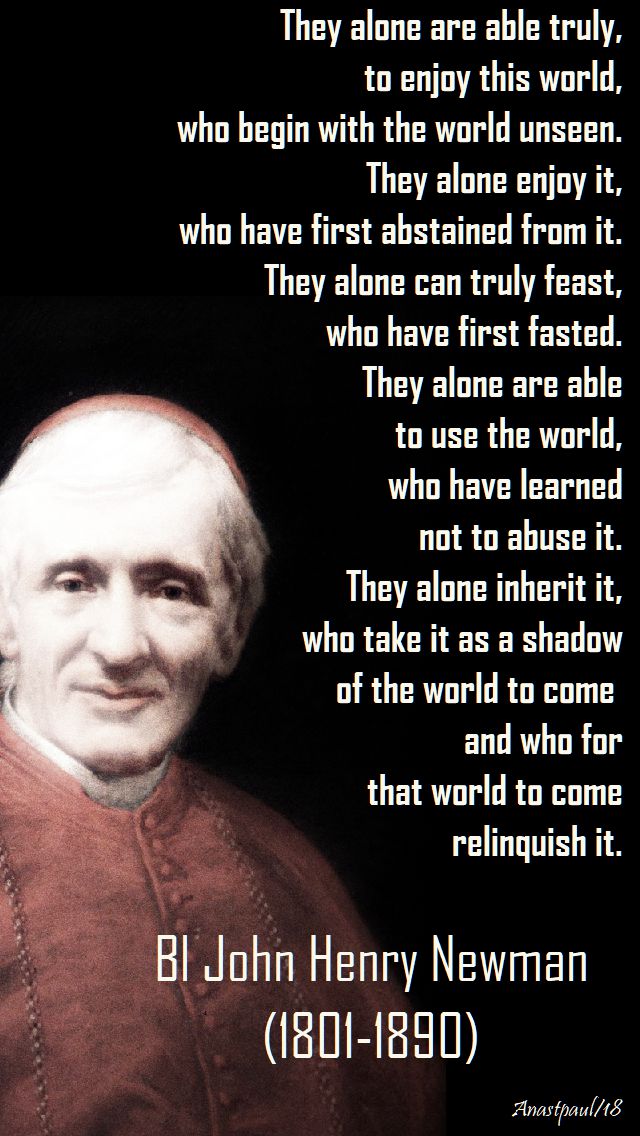
“They alone are able truly, to enjoy this world, who begin with the world unseen. They alone enjoy it, who have first abstained from it.   They alone can truly feast, who have first fasted.   They alone are able, to use the world, who have learned not to abuse it.   They alone inherit it, who take it as a shadow, of the world to come and who for that world to come relinquish it.”

Look at the cross of Christ – Blessed John Henry Newman  (1801-1890)THEY ALONE ARE ABLE TRULY - BL JOHN HENRY NEWMAN 0 4 APRIL EASTER WED 2018

Posted in CATHOLIC DEVOTIONS of the Month, EUCHARISTIC Adoration, PRACTISING CATHOLIC, PRAYERS of the SAINTS, QUOTES of the SAINTS, The HOLY EUCHARIST / The HOLY MASS

Devotion for the Month of April – The Holy Eucharist

Devotion for the Month of April – The Holy Eucharist

The Church has historically encouraged the month of April for increased devotion to Jesus in the Holy Eucharist.  “The Church in the course of the centuries has introduced various forms of this Eucharistic worship which are ever increasing in beauty and helpfulness;  as, for example, visits of devotion to the tabernacles, even every day;  Benediction of the Blessed Sacrament; solemn processions, especially at the time of Eucharistic Congresses, which pass through cities and villages;  and adoration of the Blessed Sacrament publicly exposed . . . These exercises of piety have brought a wonderful increase in faith and supernatural life to the Church militant upon earth and they are re-echoed to a certain extent by the Church triumphant in heaven, which sings continually a hymn of praise to God and to the Lamb ‘Who was slain.'” -Venerable Pope Pius XII (1876-1958) Pope from 1939 to his death in 1958.april devotion - the blessed sacrament - 2 april 2018

Prayer before Holy Communion
By St Peter Julian Eymard (1811-1868)

Oh! Yes, Lord Jesus, come and reign!
Let my body be Your temple,
my heart Your throne,
my will Your devoted servant;
let me be Yours forever,
living only in You and for You!
AmenPrayer before Holy Comm - st peter julian eymard - 2 april 2018

Eucharistic Adoration By:  St Pope John Paul II

“I encourage Christians regularly to visit Christ present in the Blessed Sacrament, for we are all called to abide in the presence of God.   In contemplation, Christians will perceive ever more profoundly the mystery at the heart of Christian life.
I urge priests, religious and lay people to continue and redouble their efforts to teach the younger generations the meaning and value of Eucharistic adoration and devotion.   How will young people be able to know the Lord if they are not introduced to the mystery of His presence?   Like the young Samuel, by learning the words of the prayer of the heart, they will be closer to the Lord, who will accompany them in their spiritual and human growth.   The Eucharistic mystery is in fact the “summit of evangelisation” (Lumen Gentium) for it is the most eminent testimony to Christ’s resurrection.”

Private Eucharistic Adoration
Venerable Fr Benedict Groeschel points out in the book, “In the Presence of Our Lord : The History, Theology and Psychology of Eucharistic Devotion” that there are “four kinds of prayer most appropriate in the presence of the Eucharist, namely adoration and praise, thanksgiving, repentance and trusting intercession.”   Accordingly, here are suggestions for what to do during private Eucharistic adoration.

1. Pray the Psalms or the Liturgy of the Hours
Whether you are praising, giving thanks, asking for forgiveness or seeking an answer, you’ll find an appropriate psalm.   The ancient prayer of the Church called the Liturgy of the Hours presents an excellent way to pray through the Book of Psalms throughout the year.

2. Recite the “Jesus Prayer”
Say “Lord Jesus, have mercy on me, a sinner”, repeatedly as you quiet your heart and mind.

3. Meditate using Scripture
Choose a passage from the Bible. read the words and ask God to let the passage speak to you.   Pay special attention to anything that strikes you and ask God what He wishes for you to draw from that message.

4. Read the life of a saint and pray with him or her
Most holy men and women have had a great devotion to Our Lord in the Eucharist. Therese of Lisieux, Catherine of Siena, Francis of Assisi, Thomas Aquinas, Peter Julian Eymard, Dorothy Day. Mother Teresa of Calcutta and Baroness Catherine de Hueck are just a few.   Read about them and pray their prayers before the Blessed Sacrament.

5. Pour out your heart to Christ and adore Him
Speak to Jesus, aware that you are in His presence and tell Him all that comes to your mind.   Listen for His response.   Pray the prayer that St Francis instructed his brothers to pray whenever they were before the Blessed Sacrament:  “I adore You, O Christ, present here and in all the churches of the world, for by Your holy cross You have redeemed the world.”

6. Ask for forgiveness and intercede for others
Think of those who have hurt you and request a special blessing for them.   Ask God to forgive you for all the times you have neglected or hurt someone else.   Bring before the Blessed Sacrament all those who have asked you to pray for them.   Ask the Lord to address their concerns.

7. Pray the Rosary
St Pope John Paul II reminds us, “…is not the enraptured gaze of Mary as she contemplated the face of the newborn Chris and cradled him in her arms that unparalleled model of love which should inspire us every time we receive Eucharistic communion?” (The Church and the Eucharist, 55)   Ask Mary to join you as you gaze on Christ in the Eucharist and as you pray the Rosary.

8. Sit quietly and just “be” in the presence of God
Think of a visit to the Blessed Sacrament as coming to see your best friend.   Sit quietly and enjoy being in each other’s company.   Instead of talking to the Lord, try listening to what He wants to tell you.

Prayer before the Eucharistic Presence
By Bl John Henry Newman (1801-1890)

I place myself in the presence of Him,
in whose Incarnate Presence I am,
before I place myself there.
I adore You, O my Saviour,
present here as God and man,
in soul and body,
in true flesh and blood.
I acknowledge and confess,
that I kneel before the Sacred Humanity,
which was conceived in Mary’s womb
and lay in Mary’s bosom;
which grew up to man’s estate
and by the Sea of Galilee, called the Twelve,
wrought miracles and spoke words of wisdom and peace;
Who in due season hung on the cross,
lay in the tomb, rose from the dead
and now reigns in heaven.
I praise and bless
and give myself wholly to Him,
Who is the true Bread of my soul
and my everlasting joy. AmenI place myself in the presence - bl john henry - 2 april 2018

Posted in HOLY WEEK, PRAYERS of the SAINTS, QUOTES on DEATH, The LAST THINGS, The PASSION

Our Morning Offering – 31 March – Holy Saturday 2018

Our Morning Offering – 31 March – Holy Saturday 2018

Sabbatum Sanctum
By Blessed John Henry Newman (1801-1890)

I look at You, my Lord Jesus
and think of Your most holy Body
and I keep it before me,
as a pledge of my own resurrection.
Though I die, as die I certainly shall,
nevertheless, I shall not forever die,
for I shall rise again.
O You, who are the Truth,
I know and believe with my whole heart,
that this very flesh of mine will rise again.
I know, base and odious as it is at present,
that it will one day, if I be worthy,
be raised incorruptible
and altogether beautiful and glorious.
This I know,
this by Your grace,
I will ever keep before me.
Ameni look at you my lord jesus - sabbatum sanctum - 31 march 2018 - bl john henry newman

Posted in HOLY WEEK, MORNING Prayers, PRAYERS of the SAINTS, QUOTES on SUFFERING

Our Morning Offering – 27 March – Tuesday of Holy Week 2018

Our Morning Offering – 27 March – Tuesday of Holy Week 2018

The Promise
Blessed John Henry Newman (1801-1890)

And lastly, O my dear Lord,
though I am so very weak
that I am not fit to ask You
for suffering as a gift
and have not strength to do so,
at least I will beg of You,
grace to meet suffering well,
when You, in Your love and wisdom,
brings it upon me,
knowing that in this way,
I shall gain the promise,
both of this life and of the next.
Amenthe promise - and lastly o my dear lord - bl john henry newman - 27 march 2018

Posted in HOLY WEEK, MORNING Prayers, PRAYERS of the SAINTS

Our Morning Offering – 26 March 2018 – Monday of Holy week

Our Morning Offering – 26 March 2018 – Monday of Holy week

Raise My Heart
Blessed John Henry Newman (1801-1890)

O my God,
whatever is nearer to me than You,
things of this earth
and things more naturally pleasing to me,
will be sure to interrupt the sight of You,
unless Your grace interfere.
Keep You my eyes,
my ears,
my heart,
from any such miserable tyranny.
Keep my whole being fixed on You.
Let me never lose sight of You
and while I gaze on You,
let my love of You
grow more and more every day.
Amenraise my heart - bl john henry newman - 26 march - mon of holy week - o my god whatever is nearer

Posted in LENT, MORNING Prayers, QUOTES of the SAINTS, QUOTES on DEATH, QUOTES on ETERNAL LIFE, QUOTES on FAITH, The LAST THINGS

Thought for the Day – 14 March 2018 – Wednesday of the 4th Week of Lent

Thought for the Day – 14 March 2018 – Wednesday of the 4th Week of Lent

Each of us must enter on eternity.
Blessed John Henry Newman (1801-1890)

“Each of us must come to the evening of life.   Each of us must enter on eternity.   Each of us must come to that quiet, awful time, when we will appear before the Lord of the vineyard and answer for the deeds done in the body, whether they be good or bad.  That, my dear brethren, you will have to undergo. … It will be the dread moment of expectation when your fate for eternity is in the balance and when you are about to be sent forth as the companion of either saints or devils, without possibility of change. There can be no change;  there can be no reversal. As that judgement decides it, so it will be for ever and ever.   Such is the particular judgement. … when we find ourselves by ourselves, one by one, in His presence and have brought before us most vividly all the thoughts, words and deeds of this past life.   Who will be able to bear the sight of himself?

And yet we shall be obliged steadily to confront ourselves and to see ourselves.   In this life we shrink from knowing our real selves.   We do not like to know how sinful we are. We love those who prophesy smooth things to us and we are angry with those who tell us of our faults.

But on that day, not one fault only but all the secret, as well as evident, defects of our character will be clearly brought out.   We shall see what we feared to see here and much more.   And then, when the full sight of ourselves comes to us, who will not wish that he had known more of himself here, rather than leaving it for the inevitable day to reveal it all to him! …………………….We can believe what we choose.   We are answerable for what we choose to believe.”we can believe what we choose - bl j h newman - 14 march 2018

Posted in EUCHARISTIC Adoration, MORNING Prayers, PRAYERS of the SAINTS, SACRED and IMMACULATE HEARTS

Our Morning Offering – 26 February 2018 – Monday of the Second Week of Lent

Our Morning Offering – 26 February 2018 – Monday of the Second Week of Lent

O Heart of Jesus, I Offer You All
By Blessed John Henry Newman (1801-1890)

O Heart of Jesus, all love,
I offer You these humble prayers for myself
and for all those who unite themselves
with me in spirit to adore You.
O holiest Heart of Jesus most lovely,
I intend to renew and to offer to You,
these acts of adoration and these prayers,
for myself a wretched sinner
through all moments while I breathe,
even to the end of my life.
I recommend to You, O my Jesus,
Holy Church, Your dear spouse
and our true Mother, all just souls
and all poor sinners, the afflicted,
the dying and all mankind.
Let not Your Blood be shed for them in vain.
Finally, deign to apply it, in relief of the
souls in Purgatory and of these in particular
…………………………………..
Ameno heart of jesus, I offer you all by bl john henry newman - 26 feb 2018

Posted in LENT, MORNING Prayers, POETRY, QUOTES of the SAINTS, QUOTES on CONVERSION, QUOTES on FAITH, QUOTES on LOVE, QUOTES on OBEDIENCE, QUOTES on PERSECUTION, QUOTES on REPENTANCE, QUOTES on SANCTITY, QUOTES on SUFFERING, The HOLY CROSS, The TRANSFIGURATION, The WORD

25 February 2018 – Lenten Reflection – The Second Sunday in Lent, Year B THE GLORY OF THE CRUCIFIED CHRIS

25 February 2018 – Lenten Reflection – The Second Sunday in Lent, Year B
THE GLORY OF THE CRUCIFIED CHRIST

Genesis 22:1-2, 9-13, 15-18, Psalms 116:10, 15-19, Romans 8:31-34, Mark 9:2-10

Mark 9:2-3 – And after six days Jesus took with him Peter and James and John and led them up a high mountain apart by themselves;  and he was transfigured before them and his garments became glistening, intensely white, as no fuller on earth could bleach them.second sunday lenten reflection - mark 9 3
On the second Sunday in Lent we always read the Gospel of the Transfiguration of our Lord.   We do so in order that our focus may be directed towards the glory of Easter and our Lord’s victory over sin and death by His glorious Resurrection.   Our Lenten penance is not an end in itself but a means to an end;  that cleansed of our faults and sanctified in both body and mind we might more fully appreciate and participate in God’s own glory. The word that Sacred Scripture most commonly uses to describe the nature of God is glory.   We associate glory with power, majesty, radiance, awe and wonder.   Yet all the Gospels, especially the Gospel of John, speak of God’s humiliation as His exaltation, His glory.   By faith, we are seized by the beauty and glory of the Crucified Christ.   In this mystery of the Transfiguration a twofold glory is revealed:  the glory which our Lord possesses as the eternal Son of the Father and the glory that is manifested in His sacred Passion;  the glory that is manifested from the unsurpassable torture of Holy Week.   God Himself is “whipped to blood, crowned with thorns, mocked, spat upon, ridiculed, nailed, pierced…   In this consummate ugliness, this unspeakable outrage, shines a picture of divine beauty, of divine glory.   The Gospel of the Transfiguration presents us with a vision of the glory of God on its way to the Passion”… (Cardinal Hans Urs Von Balthasar 1905-1988).

The glory revealed to Peter, James and John is a glimpse of the glory of the Resurrection, a glory that we too are destined to share;  however, it is the Passion that “leads to the glory of the Resurrection” (Preface for the Second Sunday in Lent, The Roman Missal). Consequently, we are ever mindful that “we preach Christ crucified … Christ the power of God and the wisdom of God” (1 Cor 1:23-24).   Our Lord Jesus Christ “is the radiant light of God’s glory and the perfect copy of His nature” (Heb 1:3).   Those who gaze on the Crucified Christ in faith are able to perceive that His hour of highest spiritual beauty—and glory—is a moment of utmost bodily degradation.   In the humiliation of the Cross the Saviour brings near and makes visible the divine glory for we see in Him the ineffable love of God for sinners.   This is a love, a beauty and a glory that can only be perceived by a prayerful, contemplative gaze  . It is only by means of prayer and penance that we can come to some understanding of why our Lord brought about our salvation in such weakness, diminishment and pain.

No human life is exempt from diminishment and pain.   If we are given the grace to grow older, the weight of years alone brings about diminishment.   Why must it be so?   Perhaps our own diminishment is meant to conform us to the self-emptying of the Son of God on the Cross.   This may very well be the grace of old age.   That our redemption has taken place through suffering of the flesh and spilling of blood may mean that it could take place in no other way.   It is for this reason that above all things we must seek simply to be with Jesus and to learn from Him what He alone can teach us in the silence of prayer.   On the Cross we have the ultimate and only adequate answer to the problem of evil, the only solution to the mystery of sin.   The world’s redemption could only be brought about “in the mystery of a love that by suffering understands all the insults inflicted upon it” (Hans Urs Von Balthasar).   Our profession of faith, if taken seriously, is journey into the depth of this Mystery.

What do we discover as we come to know more of this mystery?   Quite simply, that the essence of Christian discipleship is to be with Jesus and to learn from Him who accompanies us on life’s journey and who is never distant from us by means of His grace. We must endeavour to abandon ourselves to the will of the Father as He did and in this is our peace:  not only our peace but also our way to holiness, to glory.   Christians are not immune from suffering.   Indeed, our long history teaches us that often we suffer more precisely because of our Christian faith but as St Paul asks, “who will separate us from the love of Christ? Will hardship, or distress or persecution, or famine, or nakedness, or peril or sword? No, in all these things we are more than conquerors, through him who loved us” (Rom 8:35-37).   These words are more than ever relevant as we witness the persecution of Christians in the Middle East, Africa and elsewhere.   Our faith enables us not only to overcome the trials we suffer but also to be sanctified by them and through them.   We understand these as our means to holiness; a state to which we are called.

“The entire virtue of what we call holiness lies in faithfulness to what God ordains” (Jean Pierre de Caussade, The Joy of Full Surrender, [Paraclete Press], p.17).   Surely, this is what we learn when we contemplate the life and Passion of our Lord.   Fidelity to duty, discipline of life, moral rectitude;  these are the ways in which we are faithful to what God ordains.   They are no less the means by which our lives are so transformed and so transfigured that we come to “live for the praise of his glory” (Eph 1:12).   Anything that contradicts these principles is a path to misery and destruction and a betrayal of the Cross of Christ.

After His glorious resurrection our Lord asked the disciples on the road to Emmaus, “Was it not necessary that the Christ should suffer these things and enter into his glory?” (Lk 24:26).   And so it is with us; we must be willing to recognise what is best for us in what God ordains for us.   Like the disciples on the mountain, the revelation of God’s will for us, whether it be in the suffering that He asks of us or permits us to endure, or simply in the challenges that we face in living; these may confound us and might even cause us to be very much afraid.   Like Peter, James and John, however, we too are privileged to perceive the glory of the Lord;  a glory however that is veiled in the poverty, humility, and vulnerability of the Crucifix that hangs before us and in the Sacrament of the Cross, the Eucharist.   These reveal a love so powerful that neither hate nor death could conquer it.   Because we receive and worship this Sacrament, this same love is at work in the hearts of all who believe.   By its power great deeds of love are done and great evils are faced and overcome.   The Passion of our Lord gives a human face to the love of God for a fallen humanity.   Our own sufferings, mysterious as they may be in both their origin and purpose, place us in the very heart of the Paschal Mystery.   Suffering is not meaningless nor is it without purpose and neither is our life.   “Nothing short of suffering, except in rare cases, makes us what we should be;  gentle instead of harsh, meek instead of violent, conceding instead of arrogant, lowly instead of proud, pure-hearted instead of sensual”   (Bl. John Henry Newman (1801-1890), “The Sweet Yoke of Christ,” 1839).

Transfiguration
By Blessed John Henry Newman (1801-1890)

They were talking to Him about resurrection,
about law, about the suffering ahead.
They were talking as if to remind Him who He was and
who they were. He was not

Like his three friends watching a little way off,
not like the crowd At the foot of the hill.
A grey-green thunderhead massed
from the sea

And God spoke from it and said He was His.
They were talking about how the body, broken or
burned,
could live again, remade.

Only the fiery text of the thunderhead could explain it.
And they were talking
About pain and the need for judgement
and how He would make Himself

A law of pain, both its spirit and its letter in His own
flesh,
and then break it,
That is, transcend it.
His clothes flared like magnesiumtransfiguration by bl john henry newman - 2nd sun lent 25 feb 2018
My Lord, I Offer You Myself
Blessed John Henry Newman (1801-1890)

My Lord,
I offer You myself in turn,
as a sacrifice of thanksgiving.
You have died for me,
And I in turn make myself over to You.
I am not my own.
You have bought me:
I will, by my own act and deed,
complete the purchase.
My wish is to be separated
from everything of this world;
To cleanse myself simply from sin;
To put away from me even what is innocent,
If used for its own sake
and not for Yours.
I put away reputation and honour
and influence and power,
For my praise and strength,
shall be in You.
Enable me to carry out what I profess
Amenmy lord i offer you myself - bl john henry newman - lenten prayer - 25 feb 2018 - 2nd sun lent