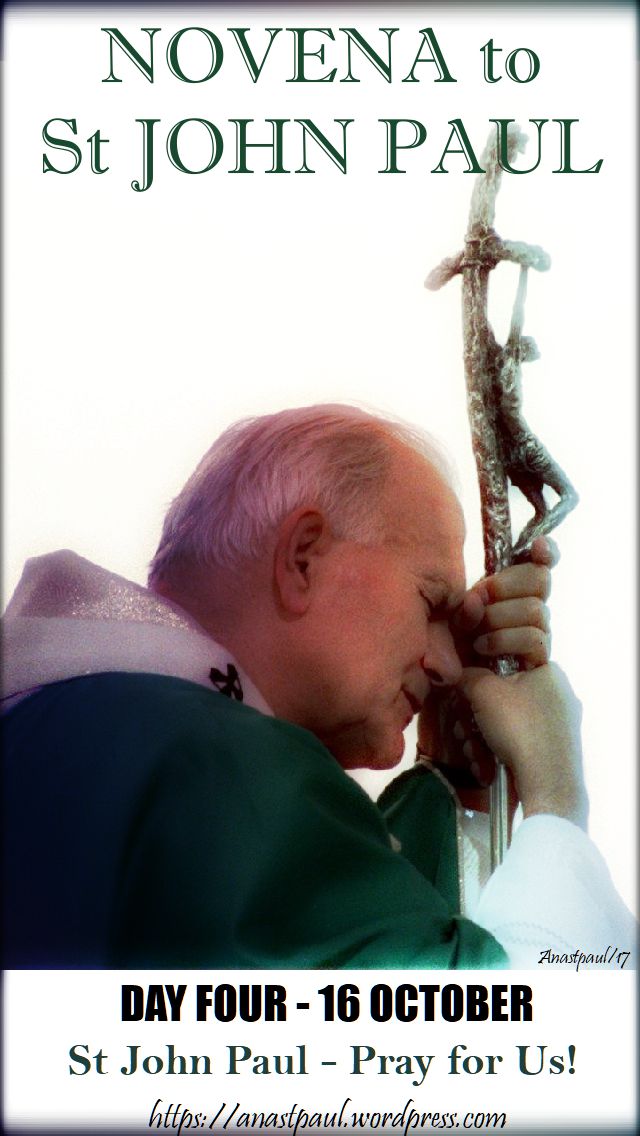
NOVENA to St John Paul the Great: DAY FOUR – 16 OCTOBER
Little Known Fact #4: In his second assignment as a newly ordained priest, Father Karol Wojtyla took a new approach to training altar boys. He would hold frequent evenings of instruction, whereby one priest would give catechesis to the boys while another priest taught the parents educational psychology as well as catechesis in the liturgy. In addition to these meetings, Father Wojtyla and the other parish priests would take the boys on outings. This model proved to be a great success as the number of altar boys went from 10 in 1946 to 100 in 1952.
REFLECTION: ” In the first years of his pontificate, still young and full of energy, the Holy Father went to the very ends of the earth, guided by Christ. But afterwards, he increasingly entered into the communion of Christ’s sufferings; increasingly he understood the truth of the words: “Someone else will fasten a belt around you.” And in this very communion with the suffering Lord, tirelessly and with renewed intensity, he proclaimed the Gospel, the mystery of that love which goes to the end (cf Jn 13:1).” – Pope Benedict
Let us Pray:
O Holy Trinity, we thank You for having given to the Church Pope John Paul II and for having made him shine with Your fatherly tenderness, the glory of the Cross of Christand the splendour of the Spirit of love.
He, trusting completely in Your infinite mercy and in the maternal intercession of Mary, has shown himself in the likeness of Jesus the Good Shepherd and has pointed out to us the way of holiness as the path to reach eternal communion with You Grant us, through his intercession, according to Your will, the grace that we implore,
………………….. [state your intention here].
Continue, beloved St John Paul, we implore you, to sustain from heaven the faith of God’s people. We praise and thank You Father that St John Paul has been numbered among Your saints and make our prayer through our Lord Jesus Christ with the Holy Spirit, one God forever.
Totus Tuus, Amen
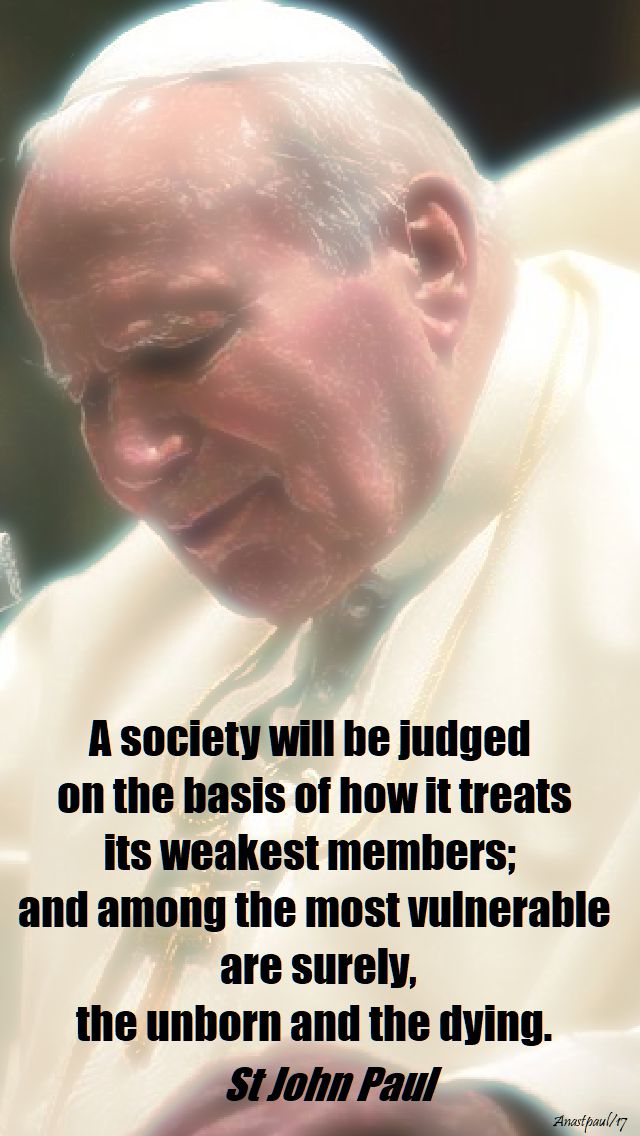
Quote Day Four: “A society will be judged on the basis of how it treats its weakest members; and among the most vulnerable are surely the unborn and the dying.”
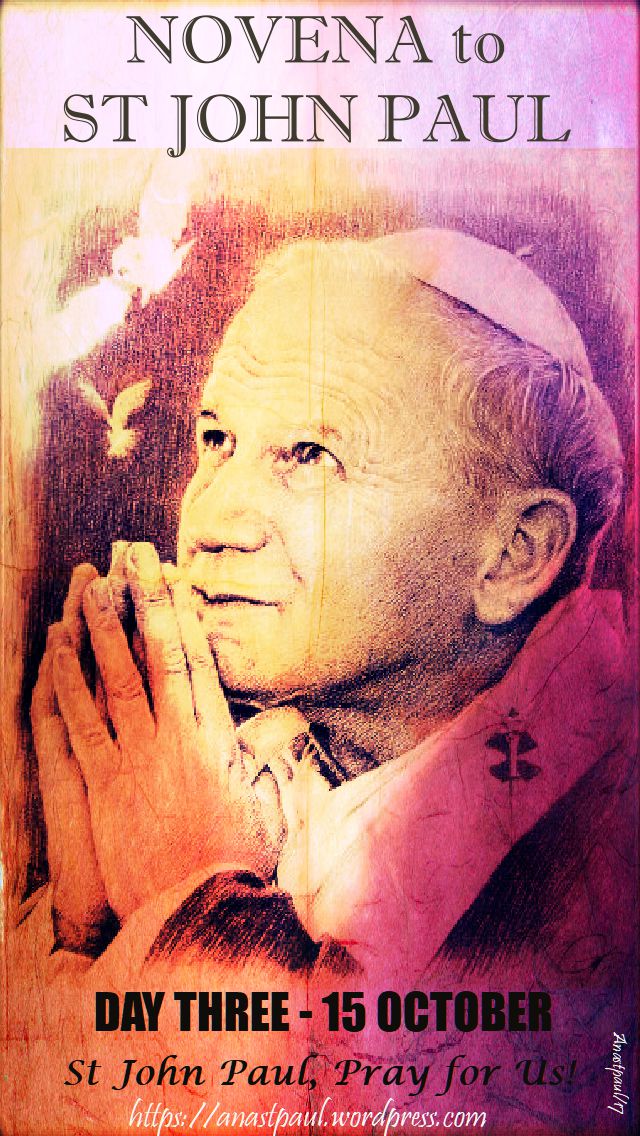
NOVENA to St John Paul the Great: DAY THREE – 15 OCTOBER
Little Known Fact #3: During his fourth year of Theological studies, Karol Wojtyla felt an increasing call to enter a Carmelite monastery. In the same year, one of his good friends, Br Leonard Kowalowka, was appointed Novice Master at a Carmelite monastery. This appointment of his friend prompted Wojtyla to pursue his desire to be a Carmelite. Wojtyla applied to enter the monastery at Czerna but transferring from the Diocesesan seminary to a religious monastery needed the approval of the bishop. Cardinal Sapieha did not give his approval and instead told Wojtyla to “finish what he started.” Wojtyla did exactly that and stayed the path of a Diocesesan priest.
REFLECTION DAY THREE: “In October 1978 Cardinal Wojtyla once again heard the voice of the Lord. Once more there took place that dialogue with Peter reported in the Gospel of this Mass: “Simon, son of John, do you love me? Feed my sheep!” To the Lord’s question, “Karol, do you love me?,” the Archbishop of Krakow answered from the depths of his heart: “Lord you know everything; you know that I love you.” The love of Christ was the dominant force in the life of our beloved Holy Father. Anyone who ever saw him pray, who ever heard him preach, knows that. Thanks to his being profoundly rooted in Christ, he was able to bear a burden which transcends merely human abilities: that of being the shepherd of Christ’s flock, his universal Church.”……..Pope Benedict
Let us Pray:
O Holy Trinity, we thank You for having given to the Church Pope John Paul II and for having made him shine with Your fatherly tenderness, the glory of the Cross of Christand the splendour of the Spirit of love.
He, trusting completely in Your infinite mercy and in the maternal intercession of Mary, has shown himself in the likeness of Jesus the Good Shepherd and has pointed out to us the way of holiness as the path to reach eternal communion with You Grant us, through his intercession, according to Your will, the grace that we implore,
………………….. [state your intention here].
Continue, beloved St John Paul, we implore you, to sustain from heaven the faith of God’s people. We praise and thank You Father that St John Paul has been numbered among Your saints and make our prayer through our Lord Jesus Christ with the Holy Spirit, one God forever. Totus Tuus, Amen.
Quote Day Three: “A person’s rightful due is to be treated as an object of love, not as an object for use.”
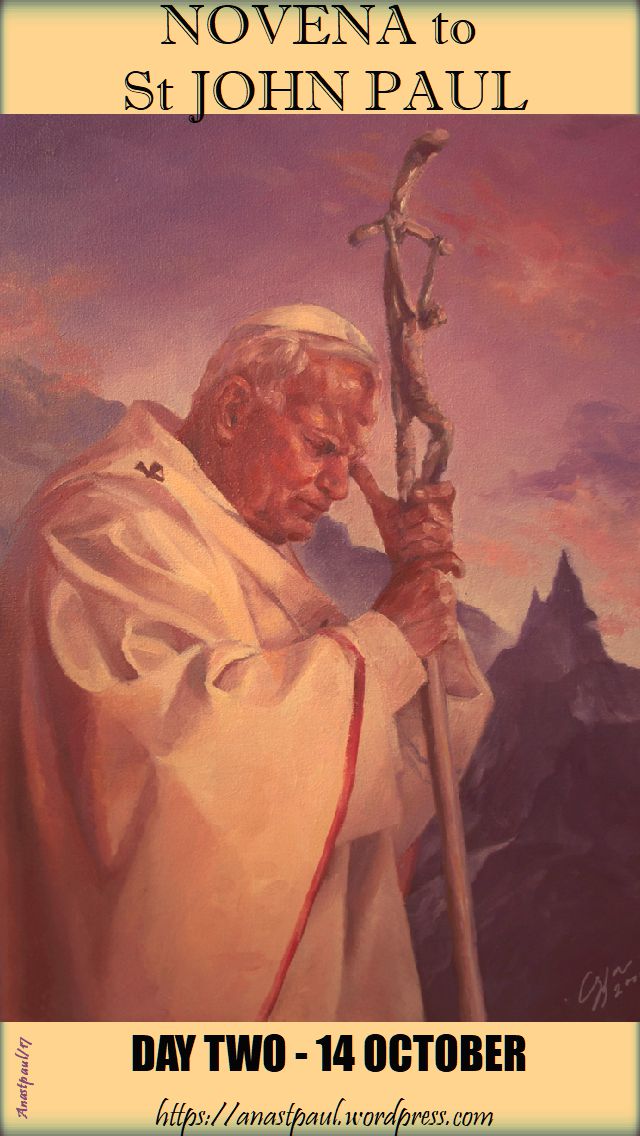
NOVENA to St John Paul the Great DAY TWO – 14 OCTOBER
Little Known Fact #2: While working in a factory during the Nazi Occupation of Poland, Karol Wojtyla heard that one of his co-workers was expecting a child. The man worked the night shift and found out that his wife gave birth to their child. After a full day of work during the day, Karol told his co-worker to go home to be with his family. Karol then worked the entire night shift in place of the new father. He continued to work the night shift after his own shift until his co-worker’s wife regained her strength and he could return to work.
REFLECTION: ”Follow me! In July 1958 the young priest Karol Wojtyla began a new stage in his journey with the Lord and in the footsteps of the Lord. Follow me – Karol Wojtyla accepted the appointment, for he heard in the Church’s call the voice of Christ. And then he realised how true are the Lord’s words: “Those who try to make their life secure will lose it but those who lose their life will keep it” (Lk 17:33). Our Pope – and we all know this – never wanted to make his own life secure, to keep it for himself; he wanted to give of himself unreservedly, to the very last moment, for Christ and thus also for us. And thus he came to experience how everything which he had given over into the Lord’s hands came back to him in a new way. His love of words, of poetry, of literature, became an essential part of his pastoral mission and gave new vitality, new urgency, new attractiveness to the preaching of the Gospel, even when it is a sign of contradiction.”…Pope Benedict
Let us Pray:
O Holy Trinity, we thank You for having given to the Church Pope John Paul II and for having made him shine with Your fatherly tenderness, the glory of the Cross of Christand the splendour of the Spirit of love.
He, trusting completely in Your infinite mercy and in the maternal intercession of Mary, has shown himself in the likeness of Jesus the Good Shepherd and has pointed out to us the way of holiness as the path to reach eternal communion with You Grant us, through his intercession, according to Your will, the grace that we implore,
………………….. [state your intention here].
Continue, beloved St John Paul, we implore you, to sustain from heaven the faith of God’s people. We praise and thank You Father that St John Paul has been numbered among Your saints and make our prayer through our Lord Jesus Christ with the Holy Spirit, one God forever.
Totus Tuus, Amen.
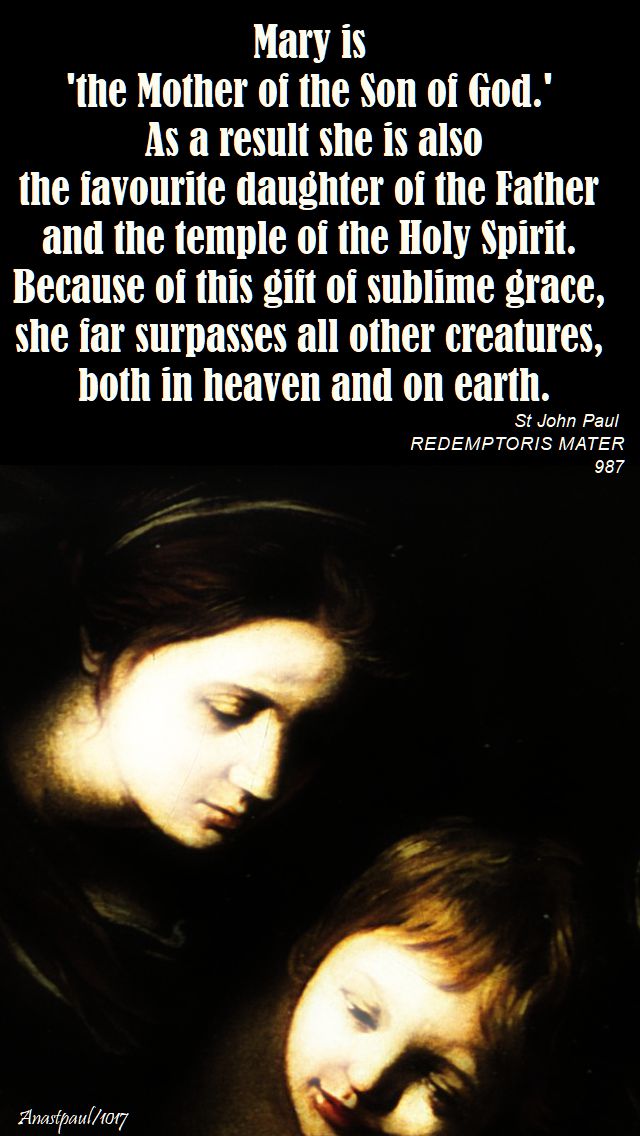
Quote Day Two: “Mary is ‘the Mother of the Son of God.
As a result she is also the favourite daughter of the Father
and the temple of the Holy Spirit.
Because of this gift of sublime grace,
she far surpasses all other creatures,
both in heaven and on earth.”
(REDEMPTORIS MATER – 1987)
Thought for the Day – 9 October – The Memorial of St John Leonardi (1541-1609)
Dear brothers and sisters, St John Leonardi’s existence was always enlightened by the splendour of the “Holy Face” of Jesus, kept and venerated in the Cathedral Church of Lucca, becoming the eloquent symbol and the indisputable synthesis of the faith that animated him. Conquered by Christ like the Apostle Paul, he pointed out to his disciples and continues to point out to all of us, the Christocentric ideal for which “it is necessary to divest oneself of every self interest and only look to the service of God,” having “before the mind’s eye only the honour, service and glory of Christ Jesus Crucified.”
Along with the face of Christ, he fixed his gaze on the maternal face of Mary. She whom he chose patroness of his order, was for him teacher, sister and mother and he felt her constant protection. May the example and intercession of this “fascinating man of God”be, particularly in this Year for Priests, a call and encouragement for priests and for all Christians to live their own vocations with passion and enthusiasm. (Pope Benedict XVI, October 7, 2009)
What can one person do? The answer is plenty! In the life of each saint, one thing stands clear: God and one person are a majority!
What one individual, following God’s will and plan for his or her life, can do is more than our mind could ever hope for or imagine.
Each of us, like John Leonardi, has a mission to fulfill in God’s plan for the world.
Each one of us is unique and has been given talent to use for the service of our brothers and sisters for the building up of God’s kingdom.
Quote/s of the Day – 7 October – The Memorial of Our Lady of the Most Holy Rosary
THE SEVEN BLESSINGS OF THE ROSARY
“The Rosary, recited with meditation on the mysteries, brings about the following marvelous results:
1. It gradually gives us a perfect knowledge of Jesus Christ;
2. It purifies our souls, washing away sin;
3. It gives us victory over all our enemies;
4. It makes it easy for us to practice virtue;
5. It sets us on fire with love of Our Blessed Lord;
6. It enriches us with graces and merits;
7. It supplies us with what is needed to pay,
all our debts to God and to our fellow men
and finally, it obtains all kinds of graces for us from Almighty God.”
St Louis Marie Grignion De Montfort (1673-1716)
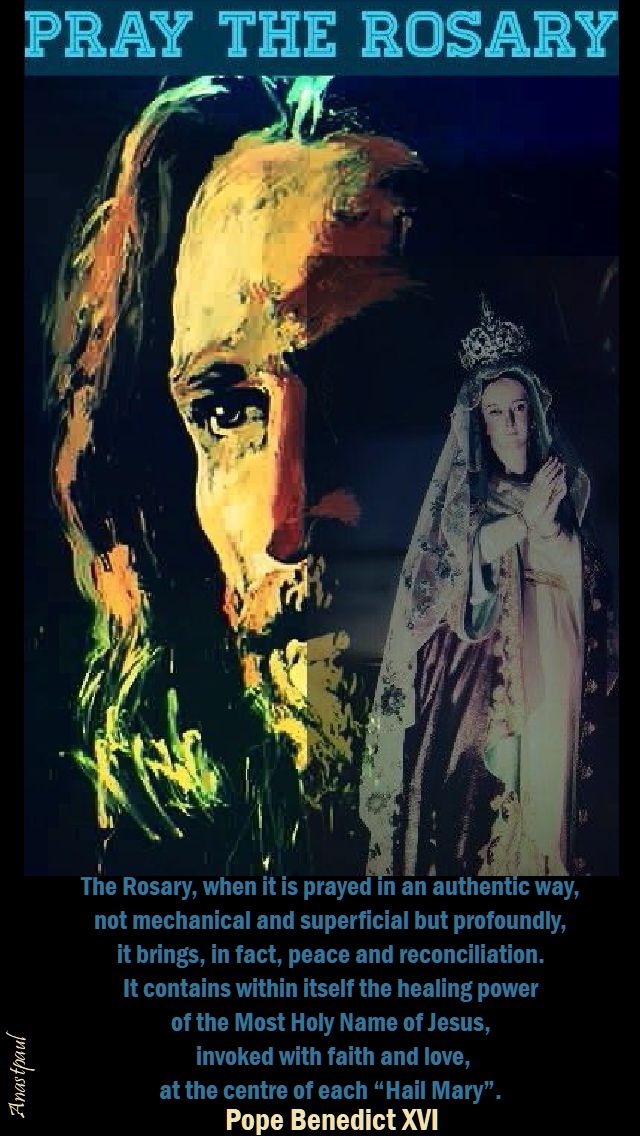
The Rosary, when it is prayed in an authentic way,
not mechanical and superficial but profoundly,
it brings, in fact, peace and reconciliation.
It contains within itself the healing power
of the Most Holy Name of Jesus,
invoked with faith and love,
at the centre of each “Hail Mary”.
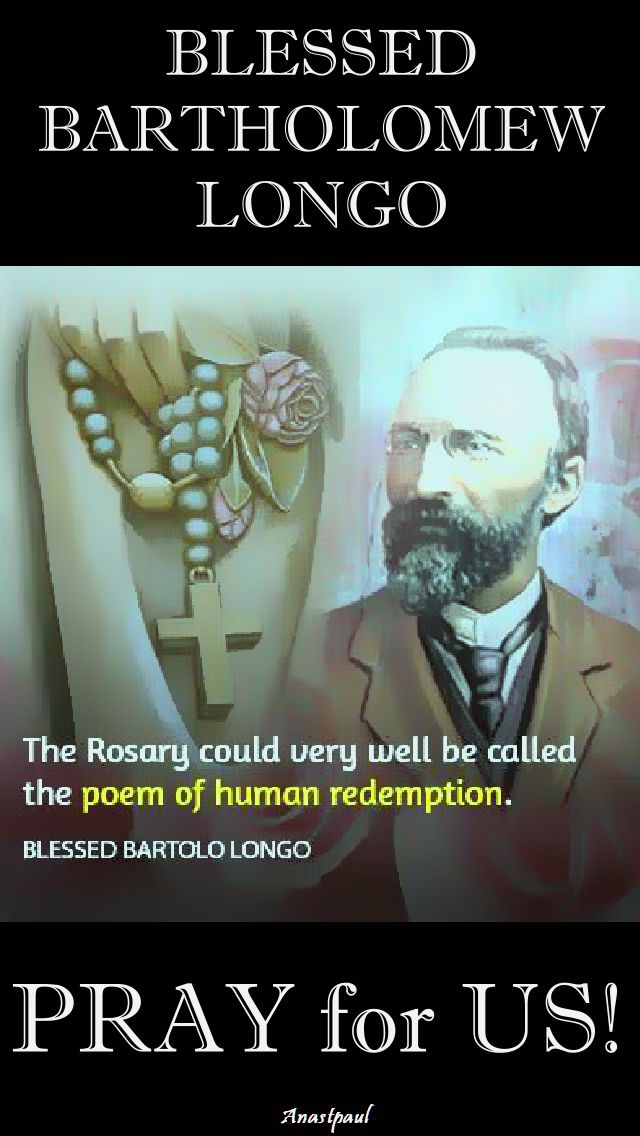
Thought for the Day – 5 October – The Memorial of Blessed Bartholomew Longo – Apostle of the Holy Rosary
Before entering the Shrine to recite the Holy Rosary with you, I paused briefly before the tomb of Bl Bartolo Longo and, praying, I asked myself: “Where did this great apostle of Mary find the energy and perseverance he needed to bring such an impressive work, now known across the world, to completion? Was it not in the Rosary, which he accepted as a true gift from Our Lady’s Heart?” Yes, that truly was how it happened! The experience of the Saints bears witness to it: this popular Marian prayer is a precious spiritual means to grow in intimacy with Jesus and to learn at the school of the Blessed Virgin always to fulfil the divine will. It is contemplation of the mysteries of Christ in spiritual union with Mary as the Servant of God Paul VI stressed in his Apostolic Exhortation Marialis cultus (n. 46) and as my venerable Predecessor John Paul II abundantly illustrated in his Apostolic Letter Rosarium Virginis Mariae that today I once again present in spirit to the Community of Pompeii and to each one of you. You who live and work here in Pompeii, especially you, dear priests, men and women religious and lay people involved in this unique portion of the Church, are all called to make Bl. Bartolo Longo’s charism your own and to become, to the extent and in the way that God grants to each one, authentic apostles of the Rosary.
To be apostles of the Rosary, however, it is necessary to experience personally the beauty and depth of this prayer which is simple and accessible to everyone. It is first of all necessary to let the Blessed Virgin take one by the hand to contemplate the Face of Christ: a joyful, luminous, sorrowful and glorious Face. Those who, like Mary and with her, cherish and ponder the mysteries of Jesus assiduously, increasingly assimilate his sentiments and are conformed to him. In this regard, I would like to quote a beautiful thought of Bl Bartolo Longo: “Just as two friends, frequently in each other’s company, tend to develop similar habits”, he wrote, “so too, by holding familiar converse with Jesus and the Blessed Virgin, by meditating on the mysteries of the Rosary and by living the same life in Holy Communion, we can become, to the extent of our lowliness, similar to them and can learn from these supreme models a life of humility, poverty, hiddenness, patience and perfection” (I Quindici Sabati del Santissimo Rosario, 27th edition, Pompeii, 1916, p. 27: cited in Rosarium Virginis Mariae, n. 15). POPE BENEDICT XVI – 19 October 2008
Father, Your truth is made known in Your Word.
Guide us to seek the truth of the human person.
Teach us the way to love because You are Love.
Jesus, You embody Love and Truth.
Help us to recognise Your face in the poor.
Enable us to live out our vocation to bring love
and justice to Your people.
Holy Spirit, You inspire us to transform our world.
Empower us to seek the common good for all persons.
Give us a spirit of solidarity and make us one human family.
We ask this through Christ our Lord. Amen.
This prayer is based on Pope Benedict XVI’s 2009 encyclical, Caritas in Veritate (Charity in Truth).
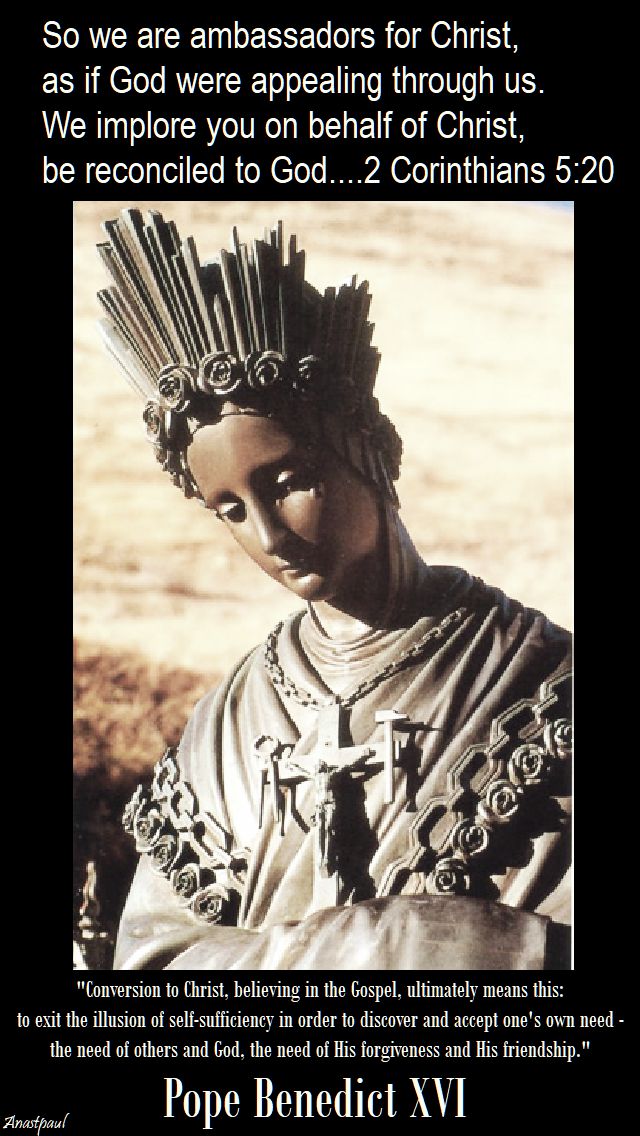
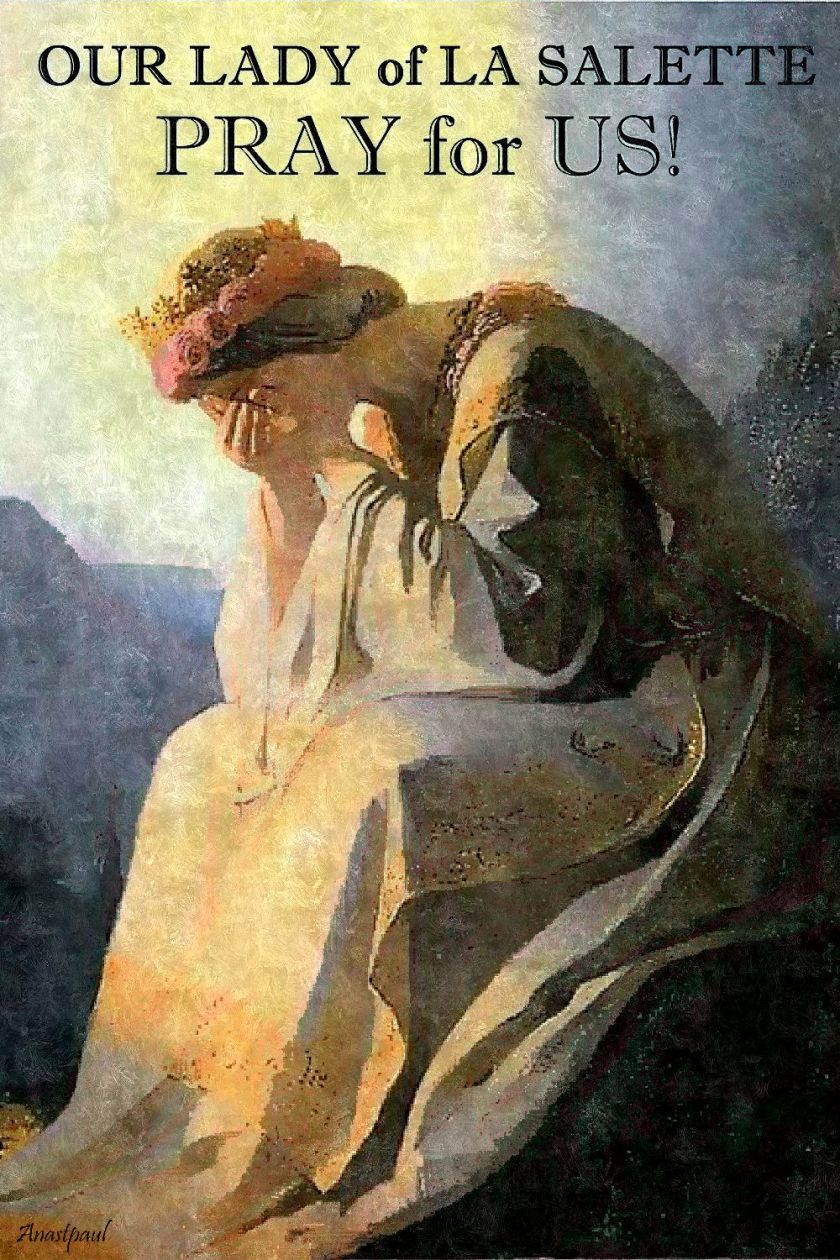
One Minute Reflection – 19 September – The Memorial of Our Lady of La Salette: Special Readings for the Feast of Our Lady of La Salette (First Reading: Ezekiel 37:1-14 Second Reading: 2 Corinthians 5:17-21)
So we are ambassadors for Christ, as if God were appealing through us. We implore you on behalf of Christ, be reconciled to God….2 Corinthians 5:20
REFLECTION – “Conversion to Christ, believing in the Gospel, ultimately means this: to exit the illusion of self-sufficiency in order to discover and accept one’s own need — the need of others and God, the need of His forgiveness and His friendship.”…Pope Benedict XVI (2010)
PRAYER – Holy Virgin of Reconciliation, do not reject our prayers but intercede for us, obtain for us the grace to love our Lord Jesus above all else. May we console you by a holy life and so come to share the eternal life Christ gained by his cross. Our Lady of La Salette, pray for us, amen.
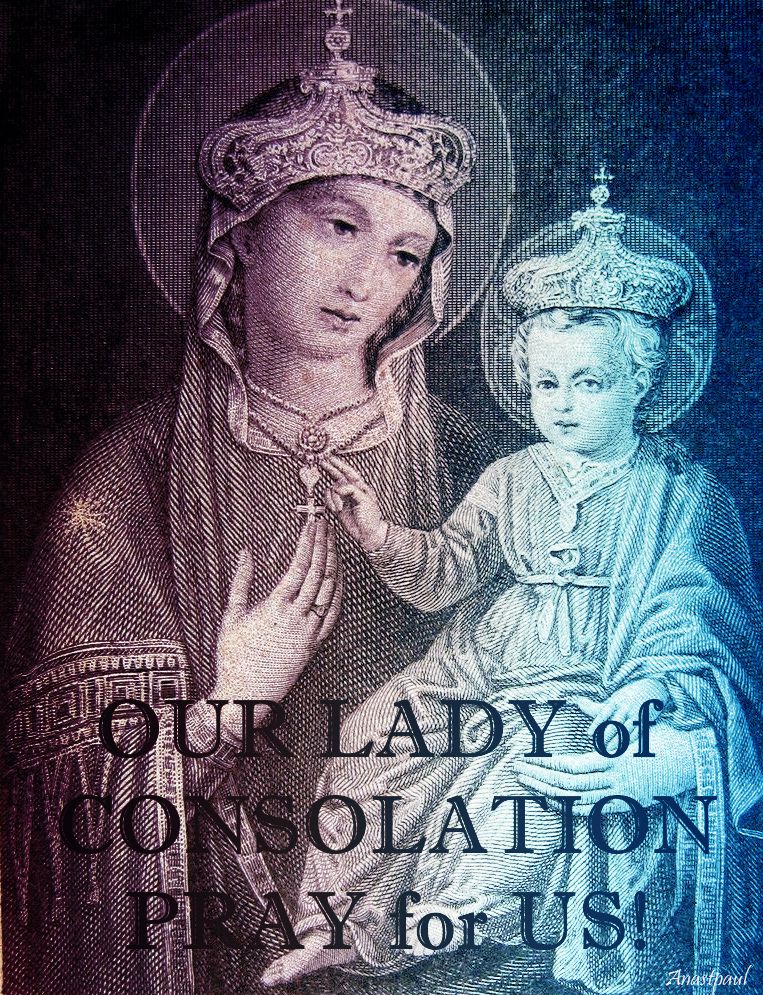
Thought for the Day – 4 September – The Feast of Our Lady of Consolation
Pope Benedict XVI encouraged the faithful to pray to Our Lady of Consolation, stating “From Her We Can Always Learn How to Look Upon Jesus:”
“As we come to the conclusion of this solemn celebration, we offer a prayer to Mary Most Holy, who in Turin is venerated as the principal patroness with the title Blessed Virgin of Consolation. To her I entrust this city and all those who live here. O Mary, watch over the families and the workers; watch over those who have lost faith and hope; comfort the sick, those in prison and all who suffer. O Help of Christians, sustain the young people, the elderly and persons in difficulty. O Mother of the Church, watch over her pastors and the whole community of believers, that they may be “salt and light” in the midst of the world.
The Virgin Mary is she who more than any other contemplated God in the human face of Jesus. She saw him as a newborn when, wrapped in swaddling clothes, he was placed in a manger; she saw him when, just after his death, they took him down from the cross, wrapped him in linen and placed him in the sepulcher. Inside her was impressed the image of her martyred Son; but this image was then transfigured in the light of the Resurrection. Thus in Mary’s heart was carried the mystery of the face of Christ, a mystery of death and of glory. From her we can always learn how to look upon Jesus with a gaze of love and of faith, to recognise in that human countenance, the Countenance of God.”
To our Lord and our God, Jesus Christ, we pray for a greater love of His Mother and to our Blessed Mother, Our Lady of Consolation, we lift our prayers for patience, for support and for comfort in our times of confusion, fear and anxiety. Pray for us, Our Lady of Consolation!
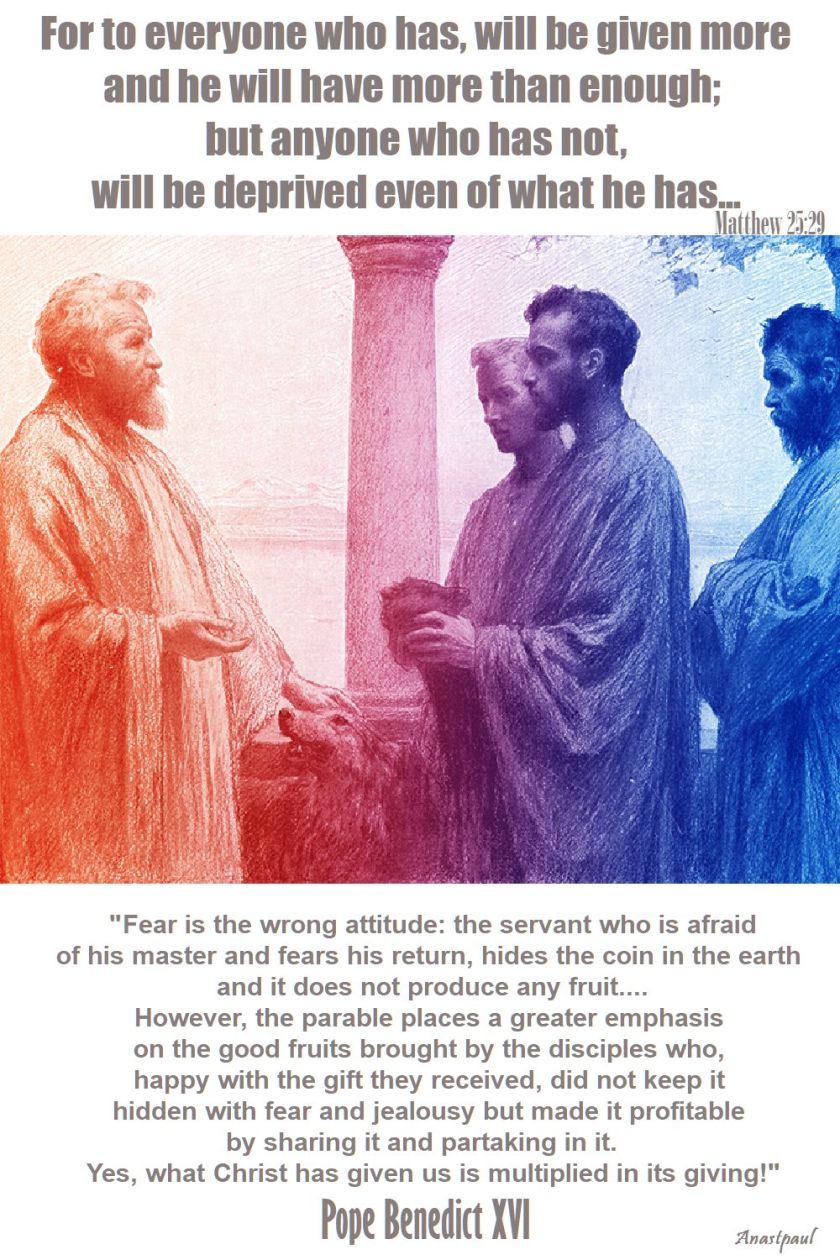
One Minute Reflection – 2 September – Today’s Gospel Matthew 25:14-30
For to everyone who has will be given more, and he will have more than enough; but anyone who has not, will be deprived even of what he has.…Matthew 25:29
REFLECTION – ” Fear is the wrong attitude: the servant who is afraid of his master and fears his return hides the coin in the earth and it does not produce any fruit. This happens, for example, to those who after receiving Baptism, Communion and Confirmation subsequently bury these gifts beneath a blanket of prejudice, beneath a false image of God that paralyses faith and good works, thus betraying the Lord’s expectations. However, the parable places a greater emphasis on the good fruits brought by the disciples who, happy with the gift they received, did not keep it hidden with fear and jealousy but made it profitable by sharing it and partaking in it. Yes, what Christ has given us is multiplied in its giving!” …Pope Benedict XVI ( Angelus address of Sunday, 16 November 2008)
PRAYER – Lord my God, teach me to be unafraid to share the Light of the Gospel with all. Teach me to go out and spread Your gifts with all who enter my life. For You have called me and I must respond without fear but with joy and love. St Solomon Le Clercq – you ‘wanted’ to be all for God! Please pray for us all, amen.
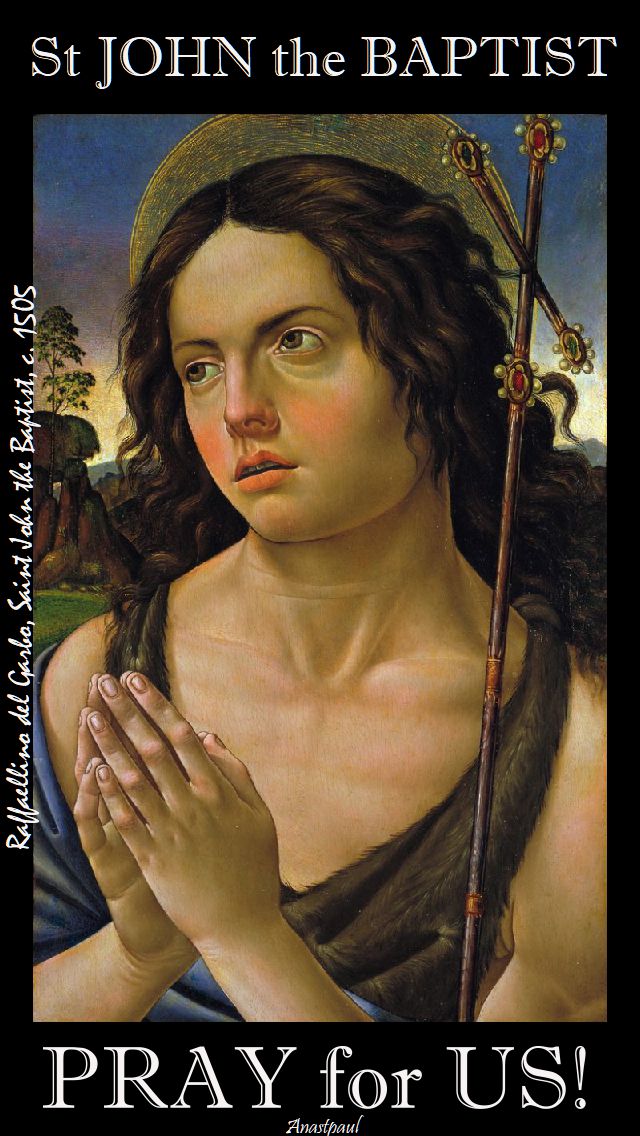
Thought for the Day – 29 August – The Beheading of St John the Baptist
“Dear brothers and sisters, celebrating the martyrdom of St John the Baptist reminds us too, Christians of this time, that with love for Christ, for His words and for the Truth, we cannot stoop to compromises. The Truth is Truth; there are no compromises. Christian life demands, so to speak, the “martyrdom” of daily fidelity to the Gospel, the courage, that is, to let Christ grow within us and let Him be the One who guides our thought and our actions. However, this can happen in our life only if we have a solid relationship with God. Prayer is not time wasted, it does not take away time from our activities, even apostolic activities but exactly the opposite is true: only if we are able to have a faithful, constant and trusting life of prayer will God Himself give us the ability and strength to live happily and serenely, to surmount difficulties and to witness courageously to Him. St John the Baptist, intercede for us, that we may be ever able to preserve the primacy of God in our life. ” (Pope Benedict – Castel Gandolfo, Wednesday, 29 August 2012)
“The vengeance of God fell heavily upon Herod Antipas. Josephus relates how he was overcome by the Arabian Aretas, whose daughter he had repudiated in order to follow his wicked passions; and the Jews attributed the defeat to the murder of Saint John. Herod was deposed by Rome from his tetrarchate and banished to Lyons in Gaul, where the ambitious Herodias shared his disgrace. As to her dancing daughter Salome, there is a tradition gathered from ancient authors, that, having gone out one winter day to dance upon a frozen river, she fell through into the water; the ice, immediately closing round her neck, cut off her head, which bounded upon the surface, thus continuing for some moments the dance of death.” ………..Abbot Gueranger
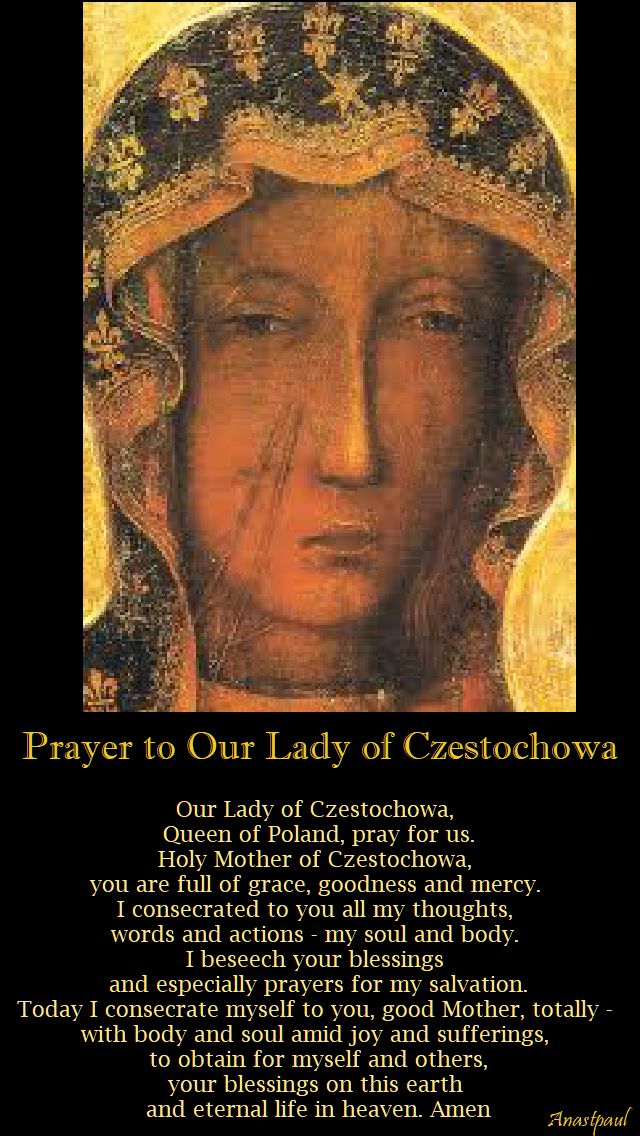
Our Morning Offering – 26 August Prayer to Our Lady of Czestochowa
Our Lady of Czestochowa,
Queen of Poland, pray for us.
Holy Mother of Czestochowa,
you are full of grace, goodness and mercy.
I consecrated to you all my thoughts,
words and actions – my soul and body.
I beseech your blessings
and especially prayers for my salvation.
Today I consecrate myself to you, good Mother, totally –
with body and soul amid joy and sufferings,
to obtain for myself and others,
your blessings on this earth
and eternal life in heaven. Amen
Our Lady of Czestochowa, Queen of Poland, pray for us.
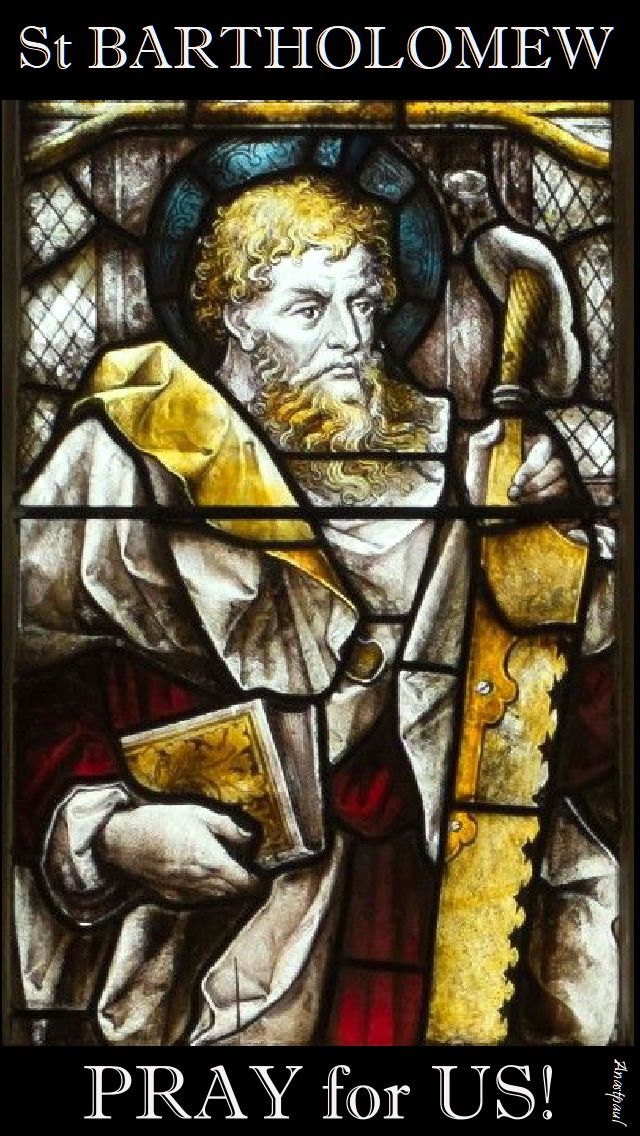
Thought for the Day – 24 August The Feast of St Bartholomew, Apostle
“…Philip told this Nathanael that he had found “him of whom Moses in the law and also the prophets wrote, Jesus of Nazareth, the son of Joseph” (Jn 1: 45). As we know, Nathanael’s retort was rather strongly prejudiced: “Can anything good come out of Nazareth?” (Jn 1: 46). In its own way, this form of protestation is important for us. Indeed, it makes us see that according to Judaic expectations the Messiah could not come from such an obscure village as, precisely, Nazareth (see also Jn 7: 42).
But at the same time Nathanael’s protest highlights God’s freedom, which baffles our expectations by causing Him to be found in the very place where we least expect Him. Moreover, we actually know that Jesus was not exclusively “from Nazareth” but was born in Bethlehem (cf. Mt 2: 1; Lk 2: 4) and came ultimately from Heaven, from the Father who is in Heaven.
Nathanael’s reaction suggests another thought to us: in our relationship with Jesus we must not be satisfied with words alone. In his answer, Philip offers Nathanael a meaningful invitation: “Come and see!” (Jn 1: 46). Our knowledge of Jesus needs above all a first-hand experience: someone else’s testimony is of course important, for normally the whole of our Christian life begins with the proclamation handed down to us by one or more witnesses.
However, we ourselves must then be personally involved in a close and deep relationship with Jesus; in a similar way, when the Samaritans had heard the testimony of their fellow citizen whom Jesus had met at Jacob’s well, they wanted to talk to Him directly and after this conversation they told the woman: “It is no longer because of your words that we believe, for we have heard for ourselves and we know that this is indeed the Saviour of the world” (Jn 4: 42).
…To conclude, we can say that despite the scarcity of information about him, St Bartholomew stands before us to tell us that attachment to Jesus can also be lived and witnessed to without performing sensational deeds. Jesus Himself, to whom each one of us is called to dedicate his or her own life and death, is and remains extraordinary.”
Note: the name “Nathanael” means “God has given”.
Pope Benedict XVI – General Audience 4 October 2006
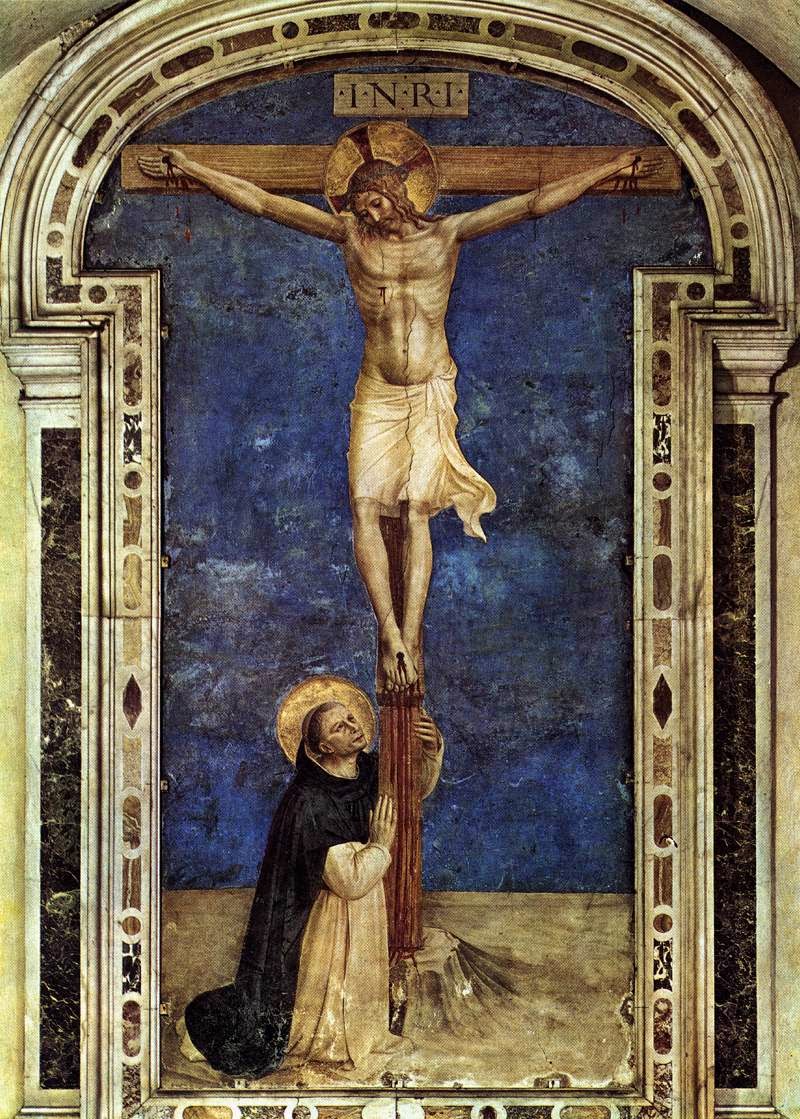
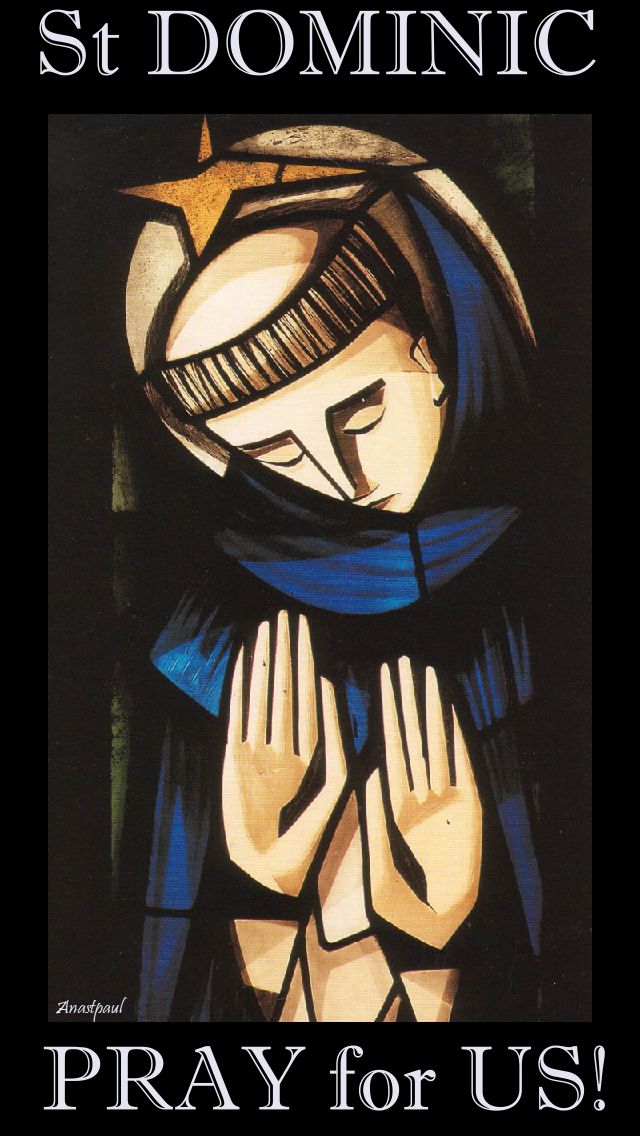
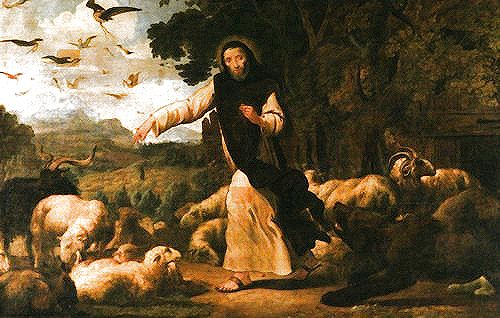
Thought for the Day – 8 August – The Memorial of St Dominic de Guzman
Words of Pope Benedict XVI on St Dominic
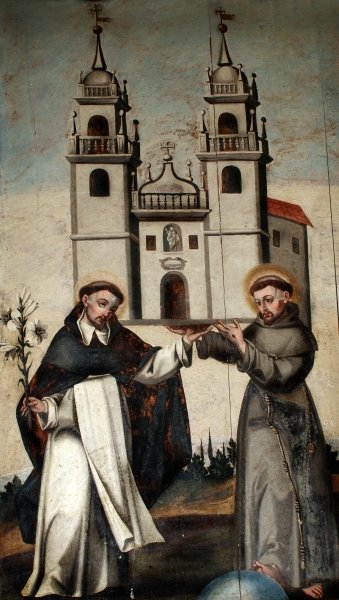
In the second volume of his work “Jesus of Nazareth”, in speaking of the first and last coming of Christ, he introduces a “middle coming”, through his word, the sacraments, events. And he continues: ” But there are also modalities of this coming season. The impact of two great figures -Francisco and Domingo- between the twelfth and thirteenth centuries, has been a way in which Christ has re-entered history, re-enforcing His word and his love; a way with which He has renewed the Church and has driven history to itself. ” In St Dominic’s words: “You are my companion and must walk with me. If we hold together, no earthly power can withstand us.”
Likewise, Benedict XVI, recognising the Marian devotion of Saint Dominic, manifested in his catechesis on February 3, 2010: ” First and foremost, Marian devotion, which he cultivated with tenderness and left his spiritual children as an inheritance, Which in the history of the Church have had the great merit of spreading the prayer of the holy rosary, so rooted in the Christian people and so rich in evangelical values, a true school of faith and piety.
Once, at a difficult point in the preaching ministry, St Dominic had a dream in which he saw heaven. Christ was there, arrayed like a king, with His Mother beside Him cloaked in a magnificent mantle. Around the Blessed Mother were countless souls from all walks of life: clergy, laypersons, and members of every religious order ever founded. Among the religious there were Benedictines, Augustinians, Carmelites, Franciscans, everyone, except the Order of Preachers. Struck to the heart, Dominic said, “Is there not a single one of mine?” The Lord gestured to his Mother, who opened her mantle. There, under it, were hundreds and hundreds of Dominican souls in their black and white habits. The Lord said, “Behold, I have left your Order in the care of My Mother.”
And, in the catechesis of August 8, 2012, he referred to another characteristic of St Dominic, the prayer : “St Dominic was a man of prayer. In love with God, he had no other aspiration than the salvation of souls, especially those who had fallen into the webs of the heresies of his time; Imitator of Christ, incarnated radically the three evangelical counsels joining to the proclamation of the Word the testimony of a poor life; under the guidance of the Holy Spirit, progressed in the path of Christian perfection. At all times prayer was the force that renewed and made more and more fruitful his apostolic works.
St Dominic reminds us that at the origin of the witness of faith, which every Christian should give in family, work, social commitment and also in times of relaxation, is prayer, personal contact with God. Only this real relationship with God gives us the strength to live intensely every event, especially moments of greater suffering. “
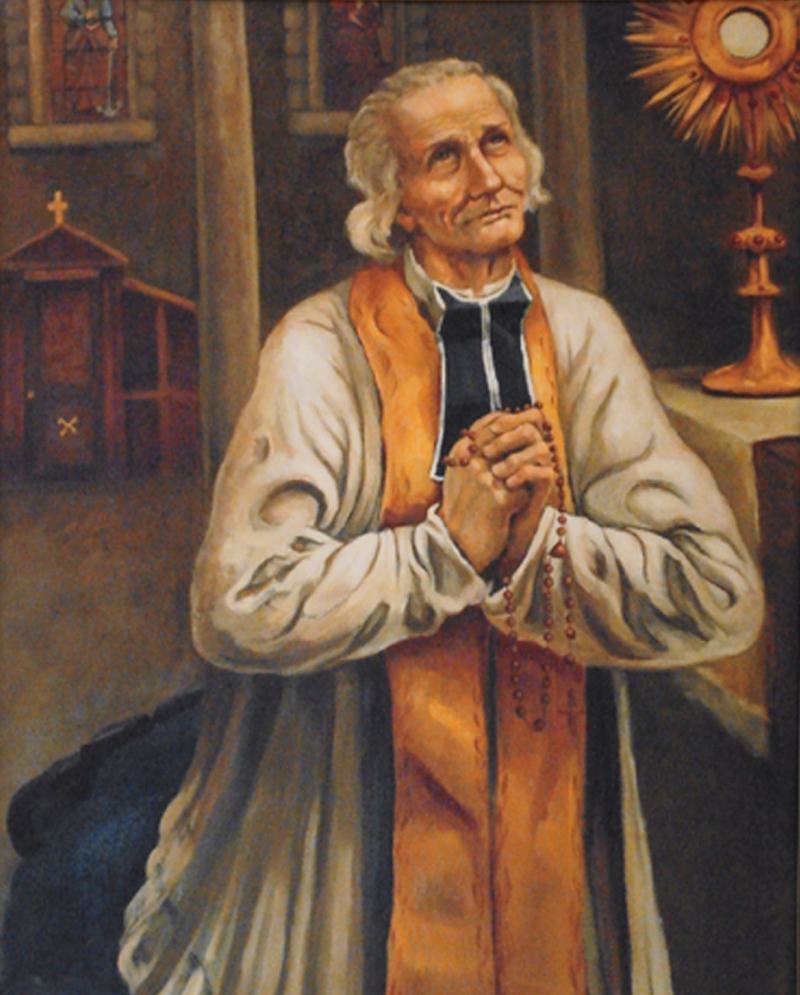
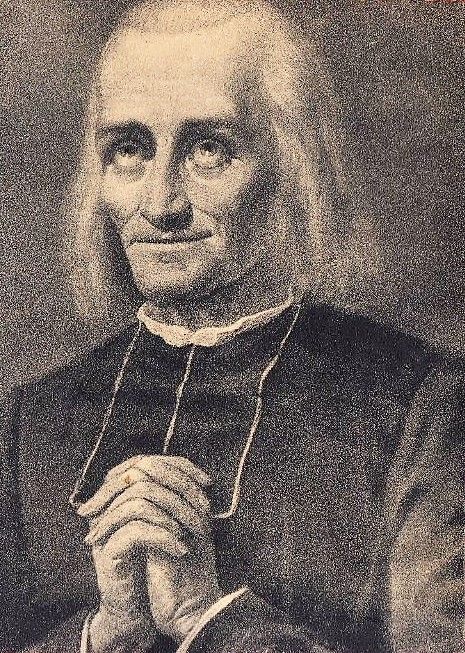
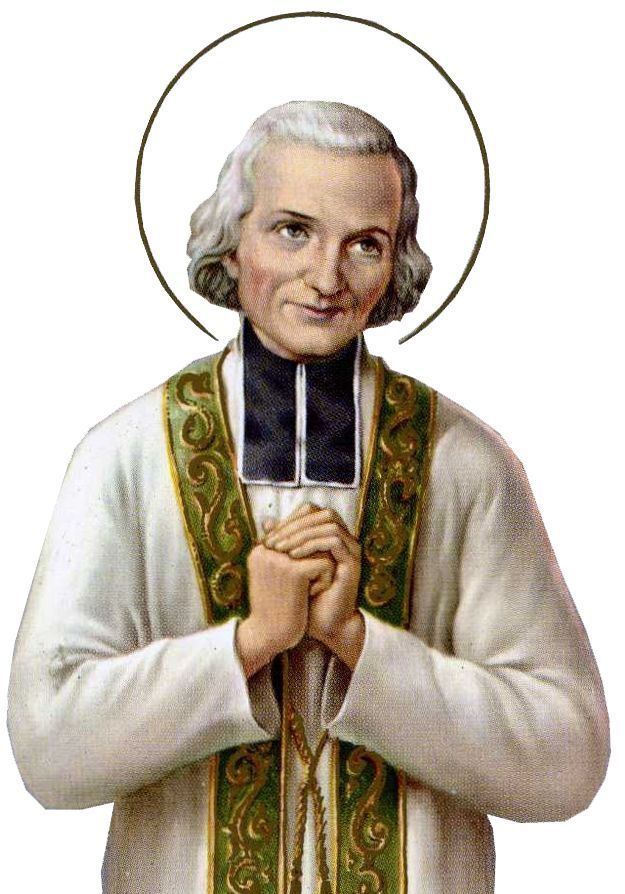
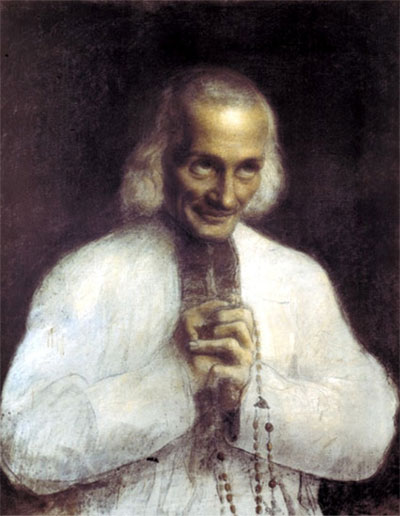
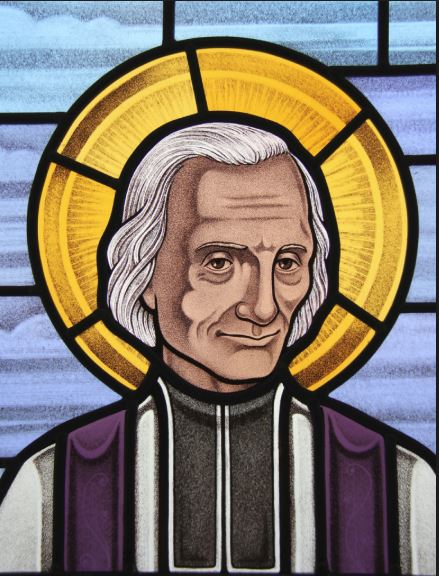
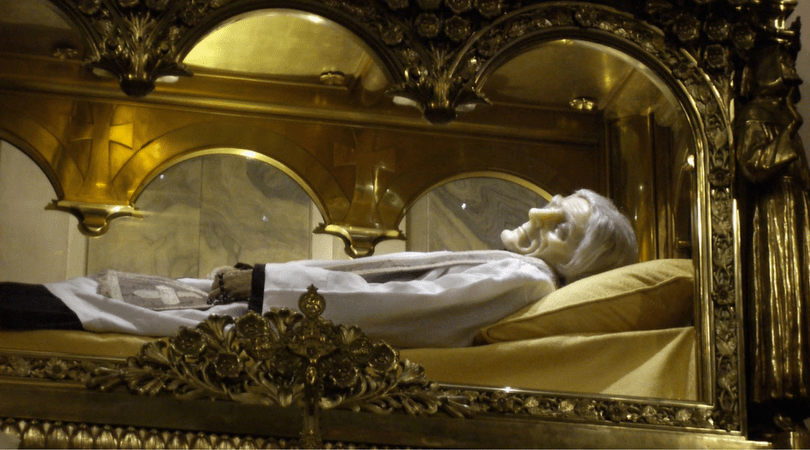
Saint of the Day – 9 August – St Jean-Baptiste Marie Vianney TOSF (1786-1859) – The Curé of Ars (Parish Priest of Ars) – Confessor Priest and Tertiary – (8 May 1786 at Dardilly, Lyons, France – 4 August 1859 at Ars, France of natural causes) His body is interred in the Basilica of Ars. He was Canonised on 31 May 1925 by Pope Pius XI. Patronages – Confessors, Priests (proclaimed on 23 April 1929 by Pope Pius XI), Personal Apostolic Administration of Saint John Mary Vianney, Dubuque, Iowa, Archdiocese of, Kamloops, British Columbia, Diocese of, Kansas City, Kansas, Archdiocese of, Lafayette, Louisiana, Diocese of, Saint Paul and Minneapolis, Minnesota, Archdiocese of. St John Vianney’s body is incorrupt.
St John Vianney was born on 8 May 1786, in the French town of Dardilly, France (near Lyon) and was baptised the same day. His parents, Matthieu Vianney and his wife Marie (Belize), had six children, of whom John was the fourth. The Vianneys were devout Catholics, who helped the poor and gave hospitality to St Benedict Joseph Labre, the patron saint of tramps, who passed through Dardilly on his pilgrimage to Rome.
St Benedict Joseph Labre
By 1790, the anticlerical Terror phase of the French Revolution forced many loyal priests to hide from the regime in order to carry out the sacraments in their parish. Even though to do so had been declared illegal, the Vianneys traveled to distant farms to attend Masses celebrated by priests on the run. Realising that such priests risked their lives day by day, Vianney began to look upon them as heroes. He received his First Communion catechism instructions in a private home by two nuns whose communities had been dissolved during the Revolution. He made his first communion at the age of 13 (normal in those times). During the Mass, the windows were covered so that the light of the candles could not be seen from the outside. His practice of the Faith continued in secret, especially during his preparation for confirmation.
The Catholic Church was re-established in France in 1802 by Napoleon Bonaparte, resulting in religious peace throughout the country, culminating in a Concordat. By this time, Vianney was concerned about his future vocation and longed for an education. He was 20 when his father allowed him to leave the farm to be taught at a “presbytery-school” in the neighbouring village of Écully, conducted by the Abbé Balley. The school taught arithmetic, history, geography and Latin. Vianney struggled with school, especially with Latin, since his past education had been interrupted by the French Revolution. Only because of Vianney’s deepest desire to be a priest—and Balley’s patience—did he persevere.
St Vianney’s studies were interrupted in 1809 when he was drafted into Napoleon’s armies. He would have been exempt, as an ecclesiastical student but Napoleon had withdrawn the exemption in certain dioceses because of his need for soldiers in his fight against Spain. Two days after he had to report at Lyons, he became ill and was hospitalised, during which time his draft left without him. Once released from the hospital, on 5 January, he was sent to Roanne for another draft. He went into a church to pray and fell behind the group. He met a young man who volunteered to guide him back to his group but instead led him deep into the mountains of Le Forez, to the village of Les Noes, where deserters had gathered. St Vianney lived there for fourteen months, hidden in the byre attached to a farmhouse and under the care of Claudine Fayot, a widow with four children. He assumed the name Jerome Vincent and under that name, he opened a school for village children. Since the harsh weather isolated the town during the winter, the deserters were safe from gendarmes. However, after the snow melted, gendarmes came to the town constantly, searching for deserters. During these searches, Vianney hid inside stacks of fermenting hay in Fayot’s barn.
An imperial decree proclaimed in March 1810 granted amnesty to all deserters, which enabled Vianney to go back legally to Ecully, where he resumed his studies. He was tonsured in 1811 and in 1812 he went to the minor seminary at Verrières-en-Forez. In autumn of 1813, he was sent to the major seminary at Lyons. Considered too slow, he was returned to Abbe Balley. However, Balley persuaded the Vicar general that Vianney’s piety was great enough to compensate for his ignorance and the seminarian received minor orders and the subdiaconate on 2 July 1814, was ordained a deacon in June 1815 and was ordained priest on 12 August 1815 in the Couvent des Minimes de Grenoble. He said his first Mass the next day and was appointed the assistant to Balley in Écully.
Curé of Ars
In 1818, shortly after the death of Balley, Jean-Marie Vianney was appointed parish priest of the parish of Ars, a town of 230 inhabitants. As parish priest, he realised that the Revolution’s aftermath had resulted in religious ignorance and indifference, due to the devastation wrought on the Catholic Church in France. At the time, Sundays in rural areas were spent working in the fields, or dancing and drinking in taverns. He spent time in the confessional and gave homilies against blasphemy and paganic dancing. If his parishioners did not give up this dancing, he refused them absolution. Abbe Balley had been St Vianney’s greatest inspiration, since he was a priest who remained loyal to his faith, despite the Revolution. He felt compelled to fulfill the duties of a curé, just as did Balley, even when it was illegal. With Catherine Lassagne and Benedicta Lardet, he established La Providence, a home for girls. Only a man of vision could have such trust that God would provide for the spiritual and material needs of all those who came to make La Providence their home.
Later years
Fr Vianney came to be known internationally and people from distant places began travelling to consult him as early as 1827. “By 1855, the number of pilgrims had reached 20,000 a year. During the last ten years of his life, he spent 16 to 18 hours a day in the confessional. Even the bishop forbade him to attend the annual retreats of the diocesan clergy because of the souls awaiting him yonder”. His work as a confessor is John Vianney’s most remarkable accomplishment. In the winter months he was to spend 11 to 12 hours daily reconciling people with God. In the summer months this time was increased to 16 hours. Unless a man was dedicated to his vision of a priestly vocation, he could not have endured this giving of self day after day.
Many people look forward to retirement and taking it easy, doing the things they always wanted to do but never had the time. But John Vianney had no thoughts of retirement. As his fame spread, more hours were consumed in serving God’s people. Even the few hours he would allow himself for sleep were disturbed frequently by the devil, who physically attacked and tormented St John and kept him from sleeping.
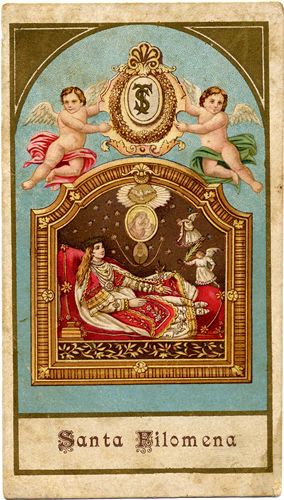
St Vianney had a great devotion to St. Philomena. He regarded her as his guardian and erected a chapel and shrine in honor of the saint. During May 1843, he fell so ill he thought that his life was coming to its end. St John Vianney attributed his cure to her intercession.
He yearned for the contemplative life of a monk and four times ran away from Ars, the last time in 1853. St John Vianney read much and often the lives of the saints, and became so impressed by their holy lives that he wanted for himself and others to follow their wonderful examples. The ideal of holiness enchanted him. This was the theme which underlay his sermons. “We must practice mortification. For this is the path which all the Saints have followed,” he said from the pulpit. He placed himself in that great tradition which leads the way to holiness through personal sacrifice. “If we are not now saints, it is a great misfortune for us: therefore we must be so. As long as we have no love in our hearts, we shall never be Saints.” The Saint, to him, was not an exceptional man before whom we should marvel but a possibility which was open to all Catholics. Unmistakably did he declare in his sermons that “to be a Christian and to live in sin is a monstrous contradiction. A Christian must be holy.” With his Christian simplicity he had clearly thought much on these things and understood them by divine inspiration, while they are usually denied to the understanding of educated men. He was a champion of the poor as a Franciscan tertiary and was a recipient of the coveted French Legion of Honour.
On 4 August 1859, Vianney died at the age of 73. The bishop presided over his funeral with 300 priests and more than 6,000 people in attendance. Before he was buried, Vianney’s body was fitted with a wax mask.
On 3 October 1874 Pope Pius IX proclaimed him “venerable”; on 8 January 1905, Pope Pius X declared him Blessed and proposed him as a model to the parochial clergy. In 1925 John Mary Vianney was canonized by Pope Pius XI, who in 1929 made him patron saint of parish priests.
In 1959, to commemorate the centenary of John Vianney’s death, Pope John XXIII issued the encyclical letter Sacerdotii nostri primordia. St Pope John Paul II visited Ars in person in 1986 in connection with the anniversary of Vianney’s birth and referred to the great saint as a “rare example of a pastor acutely aware of his responsibilities … and a sign of courage for those who today experience the grace of being called to the priesthood.”
In honour of the 150th anniversary of Vianney’s death, Pope Benedict XVI declared a Year of the Priest, running from the Feast of the Sacred Heart 2009–2010. The Vatican Postal Service issued a set of stamps to commemorate the 150th Anniversary. With the following words on 16 June 2009, Benedict XVI officially marked the beginning of the year dedicated to priests, “…On the forthcoming Solemnity of the Most Sacred Heart of Jesus, Friday 19 June 2009 – a day traditionally devoted to prayer for the sanctification of the clergy –, I have decided to inaugurate a ‘Year of the Priest’ in celebration of the 150th anniversary of the dies natalis of John Mary Vianney, the Patron Saint of parish priests worldwide…” In the Holy Father’s words the Curé d’Ars is “a true example of a pastor at the service of Christ’s flock.”
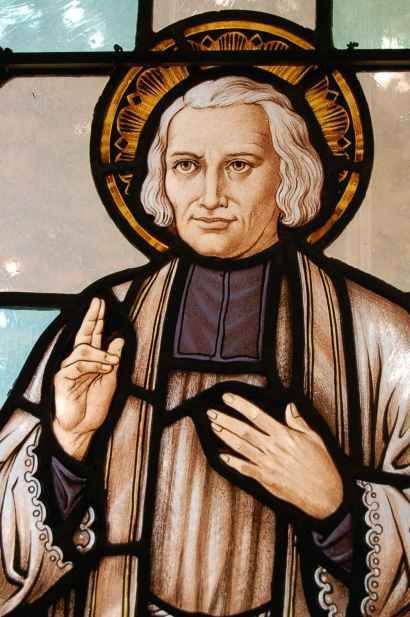
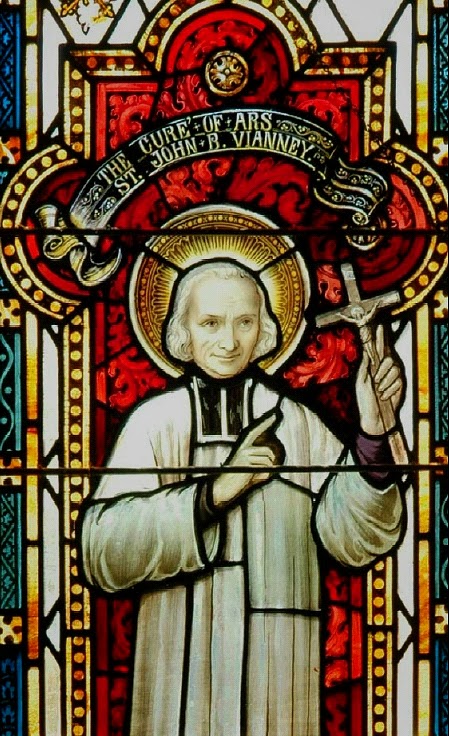
There are statues and stained glass windows of St John Vianney in many French churches and in Catholic churches throughout the world. Also, many parishes founded in the twentieth and twenty-first centuries are named after him. Some relics are kept in the Church of Notre-Dame de la Salette in Paris.
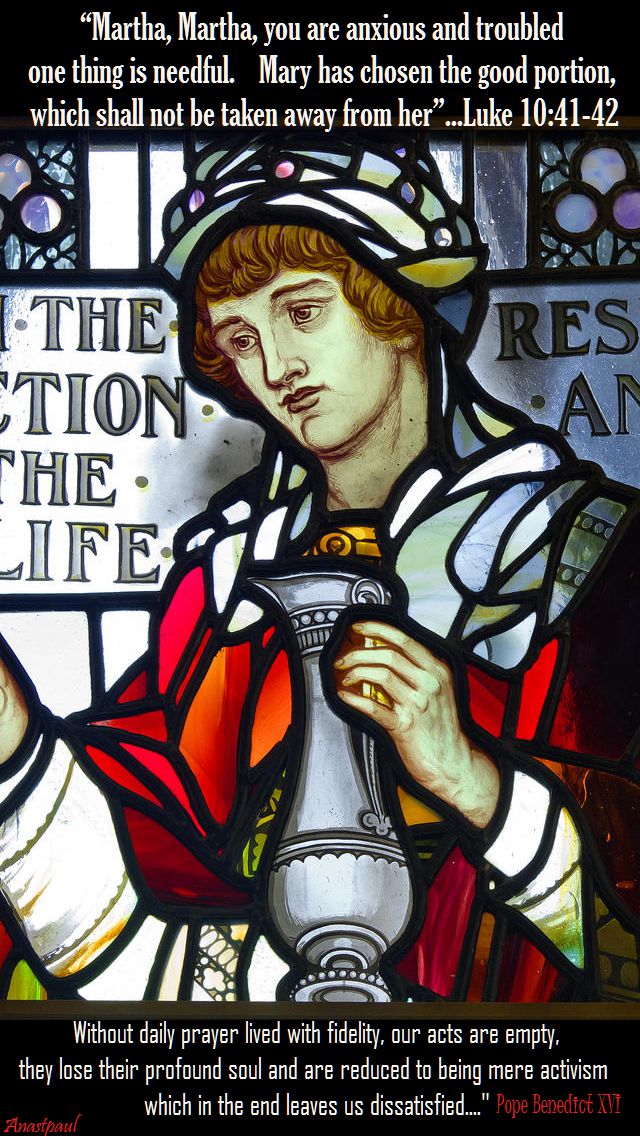
“Martha, Martha, you are anxious and troubled about many things; one thing is needful. Mary has chosen the good portion, which shall not be taken away from her”…..Luke 10:41-42.
REFLECTION – “Without daily prayer lived with fidelity, our acts are empty, they lose their profound soul and are reduced to being mere activism which in the end leaves us dissatisfied. There is a beautiful invocation of the Christian tradition to be recited before any other activity which says : “Inspire our actions, Lord and accompany them with Your help, so that our every word and action may always begin and end in you”. Every step in our life, every action, of the Church too, must be taken before God, in the light of his word.”…….Pope Benedict XVI (General Audience – Saint Peter’s Square,Wednesday, 25 April 2012.)
PRAYER – Almighty ever-living God, Your Son graciously came as a guest to the home of St Martha. By her prayers give us grace to serve Christ faithfully in our brethren and bring us to Your home in heaven. We make our prayer through Christ our Lord, in union with the Holy Spirit, amen.
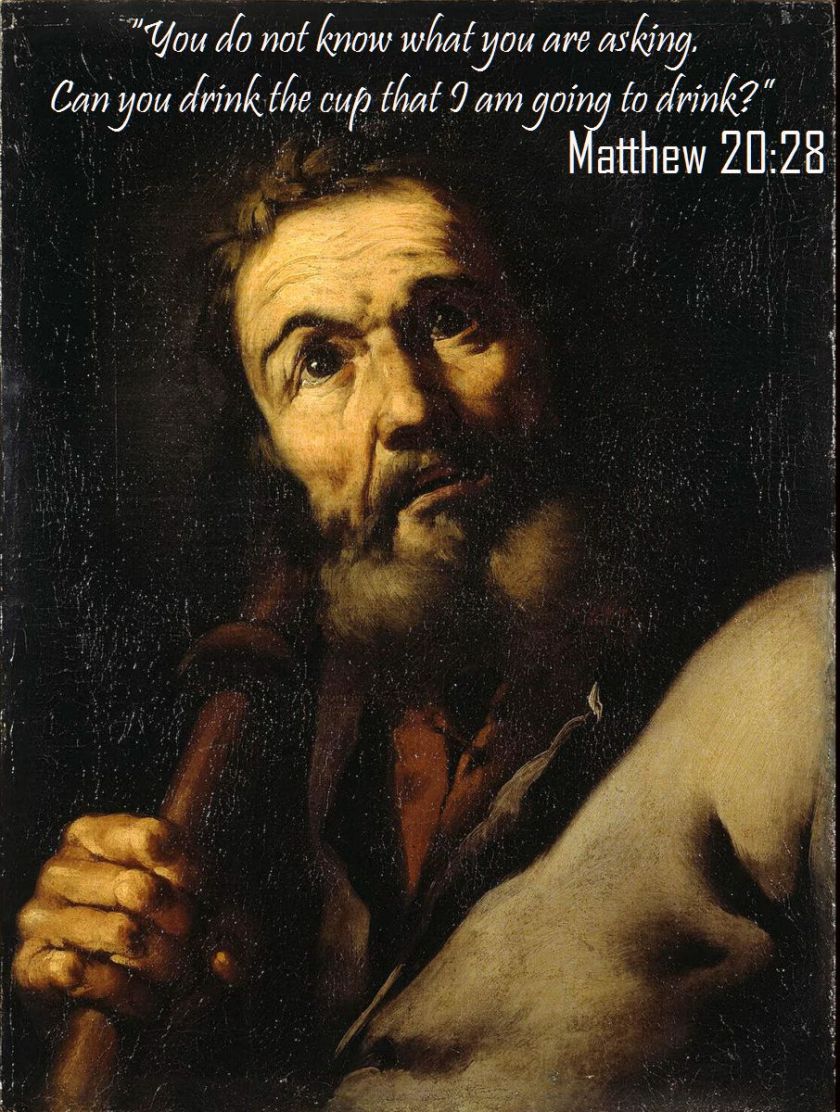
Jesus said in reply, “You do not know what you are asking. Can you drink the cup that I am going to drink?” They said to him, “We can.”……Matthew 20:28
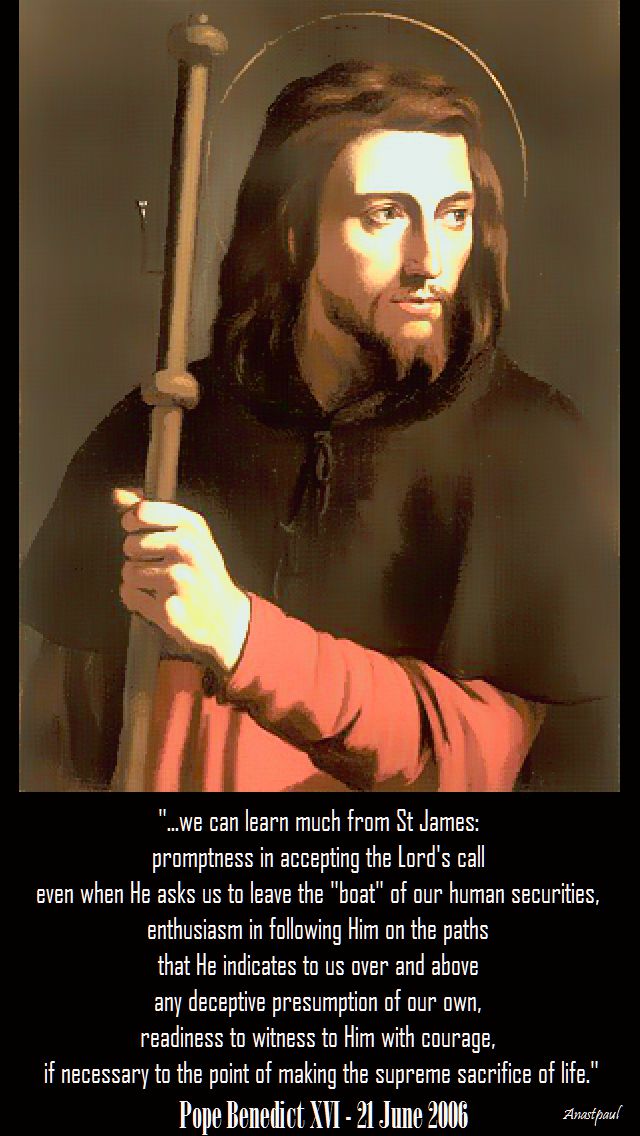
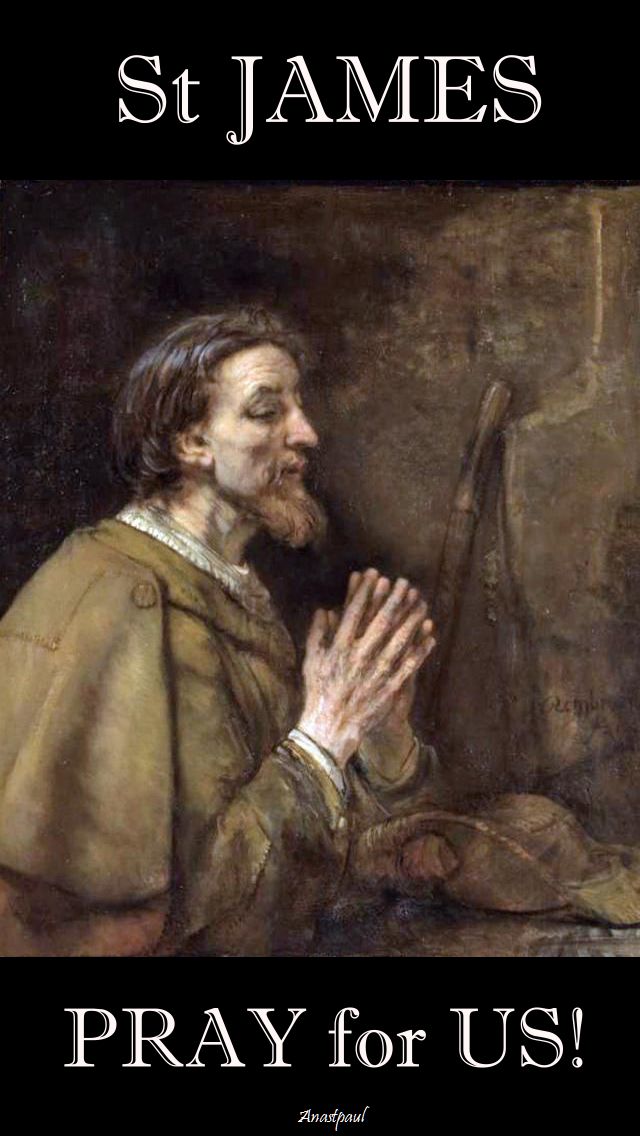
REFLECTION – “…we can learn much from St James: promptness in accepting the Lord’s call even when He asks us to leave the “boat” of our human securities, enthusiasm in following Him on the paths that He indicates to us over and above any deceptive presumption of our own, readiness to witness to Him with courage, if necessary to the point of making the supreme sacrifice of life. Thus James the Greater stands before us as an eloquent example of generous adherence to Christ. He, who initially had requested, through his mother, to be seated with his brother next to the Master in His Kingdom, was precisely the first to drink the chalice of the passion and to share martyrdom with the Apostles.
And, in the end, summarising everything, we can say that the journey, not only exterior but above all interior, from the mount of the Transfiguration to the mount of the Agony, symbolises the entire pilgrimage of Christian life, among the persecutions of the world and the consolations of God, as the Second Vatican Council says. In following Jesus, like St James, we know that even in difficulties we are on the right path.”…..Pope Benedict XVI – General Audience, June 21, 2006
PRAYER – Almighty ever-living God, who consecrated the first fruits of Your Apostles by the blood of Saint James, grant, we pray, that Your Church may be strengthened by his confession of faith and constantly sustained by his protection. Through our Lord Jesus Christ, your Son, who lives and reigns with you in the unity of the Holy Spirit, one God, for ever and ever. St James the Greater, Apostle of Christ, Pray for us! Amen
Thought for the Day – 21 July – The Memorial of St Lawrence of Brindisi (1559-1619) Apostolic Doctor
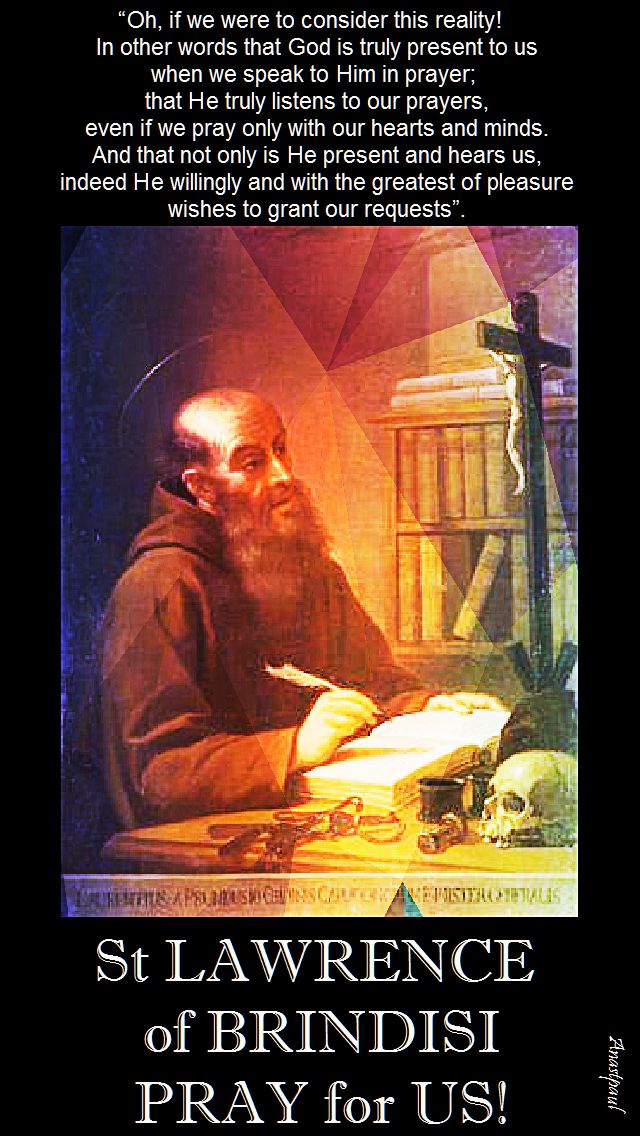
“It is surprising that St Lawrence of Brindisi was able to continue without interruption his work as an appreciated and unflagging preacher in many cities of Italy and in different countries, in spite of holding other burdensome offices of great responsibility. Indeed, within the Order of Capuchins he was professor of theology, novice master, for several mandates minister provincial and definitor general, and finally, from 1602 to 1605, minister general. In the midst of this mountain of work, Lawrence cultivated an exceptionally fervent spiritual life. He devoted much time to prayer and, especially, to the celebration of Holy Mass — often protracted for hours — caught up in and moved by the memorial of the Passion, death and Resurrection of the Lord.
Moreover, with the unmistakable ardour of his style, Lawrence urged everyone and not only priests, to cultivate a life of prayer, for it is through prayer that we speak to God and that God speaks to us: “Oh, if we were to consider this reality!”, he exclaimed. “In other words that God is truly present to us when we speak to Him in prayer; that He truly listens to our prayers, even if we pray only with our hearts and minds. And that not only is He present and hears us, indeed He willingly and with the greatest of pleasure wishes to grant our requests”.
St Lawrence of Brindisi teaches us to love Sacred Scripture, to increase in familiarity with it, to cultivate daily relations of friendship with the Lord in prayer, so that our every action, our every activity, may have its beginning and its fulfilment in Him. This is the source from which to draw so that our Christian witness may be luminous and able to lead the people of our time to God.”…….Pope BENEDICT XVI (General Audience) – St. Peter’s Square, Wednesday, 23 March 2011
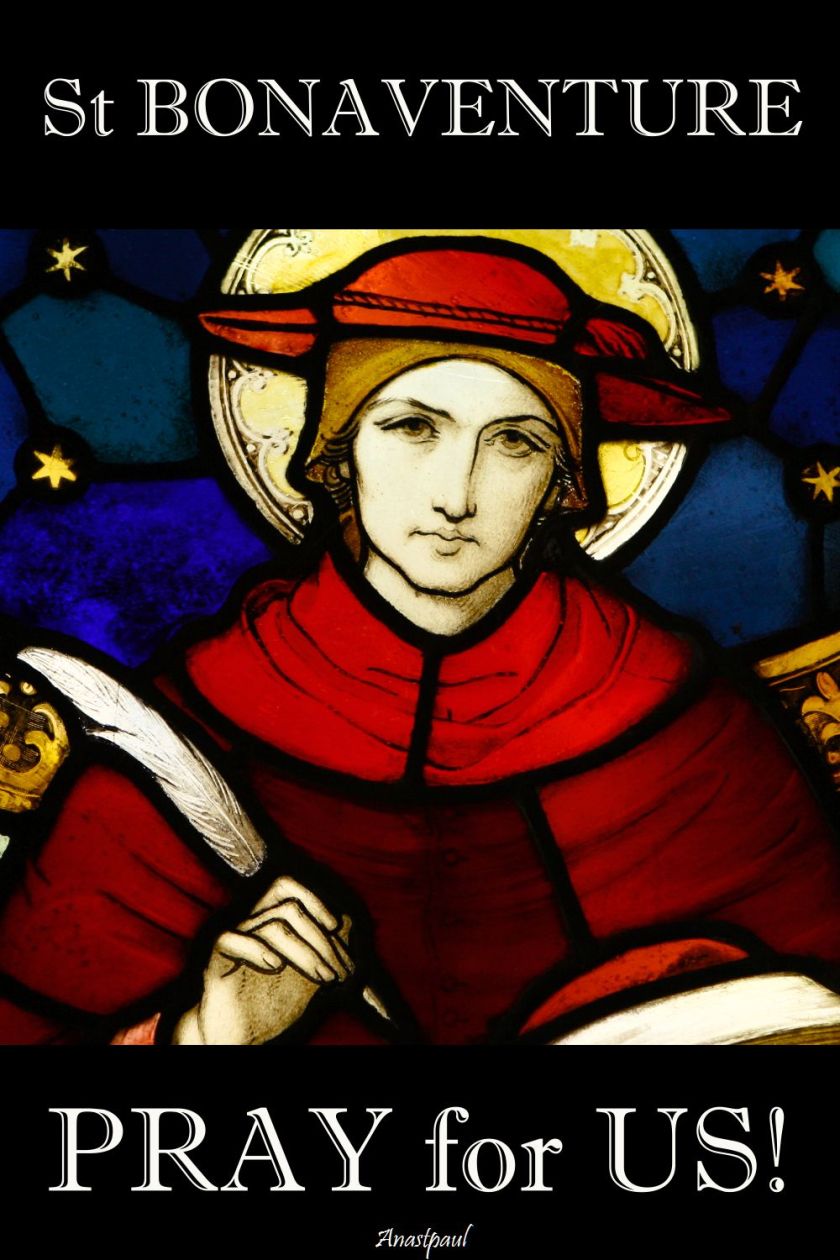
Thought for the Day – 15 July by Pope Benedict XVI – 10 March 2010 on St Bonaventure
“Of these his writings, which are the soul of his government and show the way to follow either as an individual or a community, I would like to mention only one, his masterwork, the “Itinerarium mentis in Deum,” which is a “manual” of mystical contemplation.
This book was conceived in a place of profound spirituality: the hill of La Verna, where St. Francis had received the stigmata. In the introduction, the author illustrates the circumstances that gave origin to his writing:
“While I meditated on the possibility of the soul ascending to God, presented to me, among others, was that wondrous event that occurred in that place to Blessed Francis, namely, the vision of the winged seraphim in the form of a crucifix. And meditating on this, immediately I realised that such a vision offered me the contemplative ecstasy of Father Francis himself and at the same time the way that leads to it” (Journey of the Mind in God, Prologue, 2, in Opere di San Bonaventura. Opuscoli Teologici / 1, Rome, 1993, p. 499).
The six wings of the seraphim thus became the symbol of six stages that lead man progressively to the knowledge of God through observation of the world and of creatures and through the exploration of the soul itself with its faculties, up to the satisfying union with the Trinity through Christ, in imitation of St. Francis of Assisi.
The last words of St. Bonaventure’s “Itinerarium,” which respond to the question of how one can reach this mystical communion with God, would make one descend to the depth of the heart:
“If you now yearn to know how that happens (mystical communion with God), ask grace, not doctrine; desire, not the intellect; the groaning of prayer, not the study of the letter; the spouse, not the teacher; God, not man; darkness not clarity; not light but the fire that inflames everything and transport to God with strong unctions and ardent affections. … We enter therefore into darkness, we silence worries, the passions and illusions; we pass with Christ Crucified from this world to the Father, so that, after having seen him, we say with Philip: that is enough for me” (Ibid., VII, 6).
Dear friends, let us take up the invitation addressed to us by St. Bonaventure, the Seraphic Doctor, and let us enter the school of the divine Teacher. We listen to his Word of life and truth, which resounds in the depth of our soul. Let us purify our thoughts and actions, so that He can dwell in us, and we can hear His divine voice, which draws us toward true happiness”. Pope Benedict XVI – 10 March 2010 on St Bonaventure
You have said, “Seek my face”. My heart says to you, “Your face, Lord, do I seek”. Hide not your face from me. Turn not your servant away in anger, you who have been my help. Cast me not off, forsake me not, O God of my salvation………Psalm 27:8-9
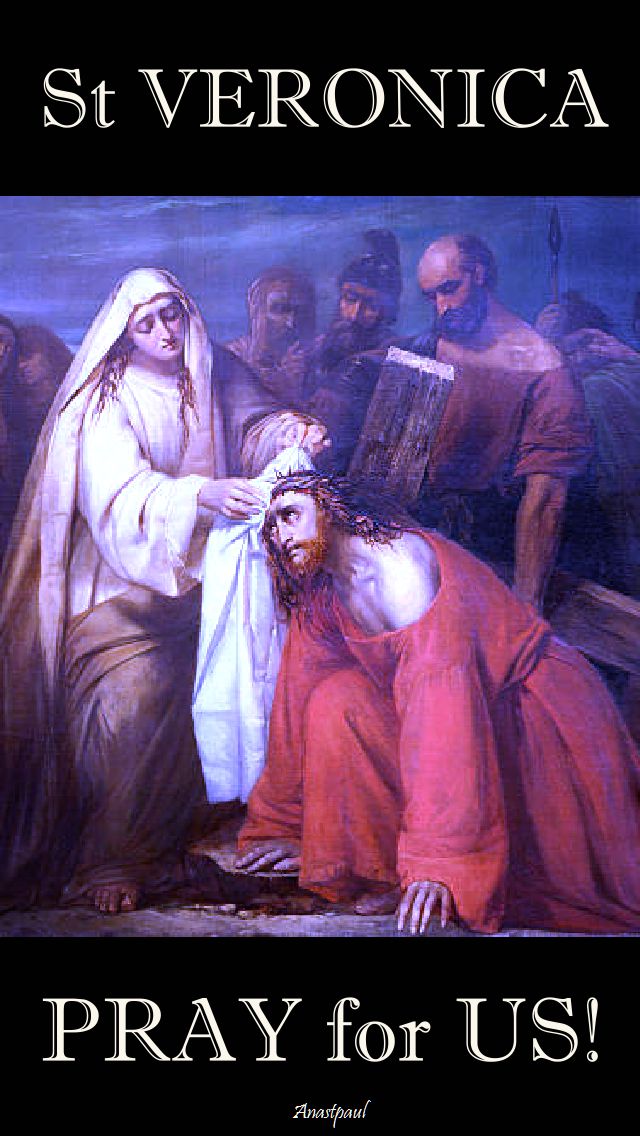
REFLECTION – “Veronica- ‘Bernice’ in the Greek tradition, embodies the universal yearning of the devout men and women of the Old Testament, the yearning of all believers to see the Face of God. On Jesus’ Way of the Cross, though, she at first did nothing more than perform an act of womanly kindness: she held out a facecloth to Jesus. She did not let herself be deterred by the brutality of the soldiers or the fear which gripped the disciples. She is the image of that good woman, who, amid turmoil and dismay, shows the courage born of goodness and does not allow her heart to be bewildered. “Blessed are the pure in heart”, the Lord had said in his Sermon on the Mount, “for they shall see God” (Mt 5:8). At first, Veronica saw only a buffeted and pain-filled Face. Yet her act of love impressed the true image of Jesus on her heart: on His human Face, bloodied and bruised, she saw the Face of God and His goodness, which accompanies us even in our deepest sorrows. Only with the heart can we see Jesus. Only love purifies us and gives us the ability to see. Only love enables us to recognize the God who is love itself.”…………..Joseph Cardinal Ratzinger (24 March 2005)
PRAYER – Lord God, grant us restless hearts, hearts which seek Your Face. Keep us from the blindness of heart which sees only the surface of things. Give us the simplicity and purity which allow us to recognise Your presence in the world. When we are not able to accomplish great things, grant us the courage which is born of humility and goodness. Impress Your Face on our hearts. May we encounter You along the way and show Your image to the world. St Veronica, Pray for us! Amen.
“Saint Veronica, true to the name she took in religion, became a “true image” of Christ crucified; her configuration to the Lord was accompanied by profound mystical experiences such as her crowning with thorns and the stigmata. Veronica’s spirituality, as revealed above all in her Diary, is Christ-centred and spousal: she saw all things in the light of Christ’s love, manifested in His Passion and she united herself to His self-oblation to the Father for the salvation of souls. Her love of the Scriptures was deeply linked to her love of the Church and her strong sense of the communion of the saints.
St. Veronica Giuliani invites us to make our Christian life grow, our union with the Lord in being for others, abandoning ourselves to His will with complete and total trust and to union with the Church, Bride of Christ; she invites us to participate in the suffering love of Jesus Crucified for the salvation of all sinners; she invites us to fix our gaze on Paradise, the goal of our earthly journey, where we will live together with so many brothers and sisters the joy of full communion with God; she invites us to nourish ourselves daily from the Word of God to warm our hearts and give direction to our life. The last words of the saint can be considered the synthesis of her passionate mystical experience: “I have found Love, Love has let Himself be seen!”…. May the life and teaching of Saint Veronica Giuliani inspire us to grow in union with the Lord and His Church and to share in Christ’s loving concern for the salvation of sinners.”
Pope Benedict XVI 15 December 2010
“VERONICA” – Latin alteration of BERENICE, the spelling influenced by the ecclesiastical Latin phrase vera icon meaning “true image”. This was the name of a legendary saint who wiped Jesus’ face with a cloth and miraculously found His image imprinted upon it. It was borne by the 17th-century Italian saint and mystic Veronica Giuliani.
The lack of genuine gratitude we experience within our souls and even the sense of selfishness we can have in our prayers to God for deeper feelings toward Him can fill us with disgust. It doesn’t take much in the way of self reflection to know how unsteady our hearts can be. Are we really sorry for our sins or do we simply want the psychological relief of unburdening ourselves? O’Connor sees both her tendencies towards scruples and utter laxity. Yet, despite these unpleasant truths she can in the end step away from her self concern and self focus and say simply to God “I am thankful.” In the end, we have to let go of self conscious shame and take hold of what is greater than ourselves and worthy of our attention.
“You’ve done so much for me already and I haven’t been particularly grateful. My thanksgiving is never in the form of self sacrifice—a few memorised prayers babbled once over lightly. All this disgusts me in myself but does not fill me with the poignant feeling I should have to adore You with, to be sorry with, or to thank You with. Perhaps the feeling I keep asking for, is something again selfish—something to help me to feel that everything with me is all right. And yet it seems only natural but maybe being thus natural is being thus selfish. My mind is a most insecure thing, not to be depended on. It gives me scruples at one minute and leaves me lax the next. If I must know all these things through the mind, dear Lord, please strengthen mine. Thank you, dear God, I believe I do feel thankful for all You’ve done for me. I want to. I do.”
“Praying actualizes and deepens our communion with God. Our prayer can and should arise above all from our heart, from our needs, our hopes, our joys, our sufferings, from our shame over sin and from our gratitude for the good.”………..Pope Benedict XVI
I call heaven and earth today to witness against you: I have set before you life and death, the blessing and the curse. Choose life, then, that you and your descendants may live by loving the LORD, your God, obeying his voice and holding fast to him…..Deuteronomy 30:19-20
REFLECTION – “The false gods competing for people’s allegiance today, are associated with the worship of material things, possessive and manipulative forms of love and power. The cult of material possessions, the cult of possessive love and the cult of power often lead people to attempt to ‘play God,’ to try to seize total control with no regard for the wisdom of the commandments that God has made known to us. This is the path that leads toward death.” …..Pope Benedict XVI whilst visiting a Rehabilitation Centre in 2008
PRAYER – Lord, in Your servant, Venerable Matt Talbot you have given us a wonderful example of triumph over addiction, of devotion to duty and charity and commitment to daily prayer. May his life of prayer and penance give us courage to take up our crosses and follow in the footsteps of Our Lord and Saviour, Jesus Christ. Venerable Matt Talbot please pray for all those who are slaves to addiction and for the whole world, amen.
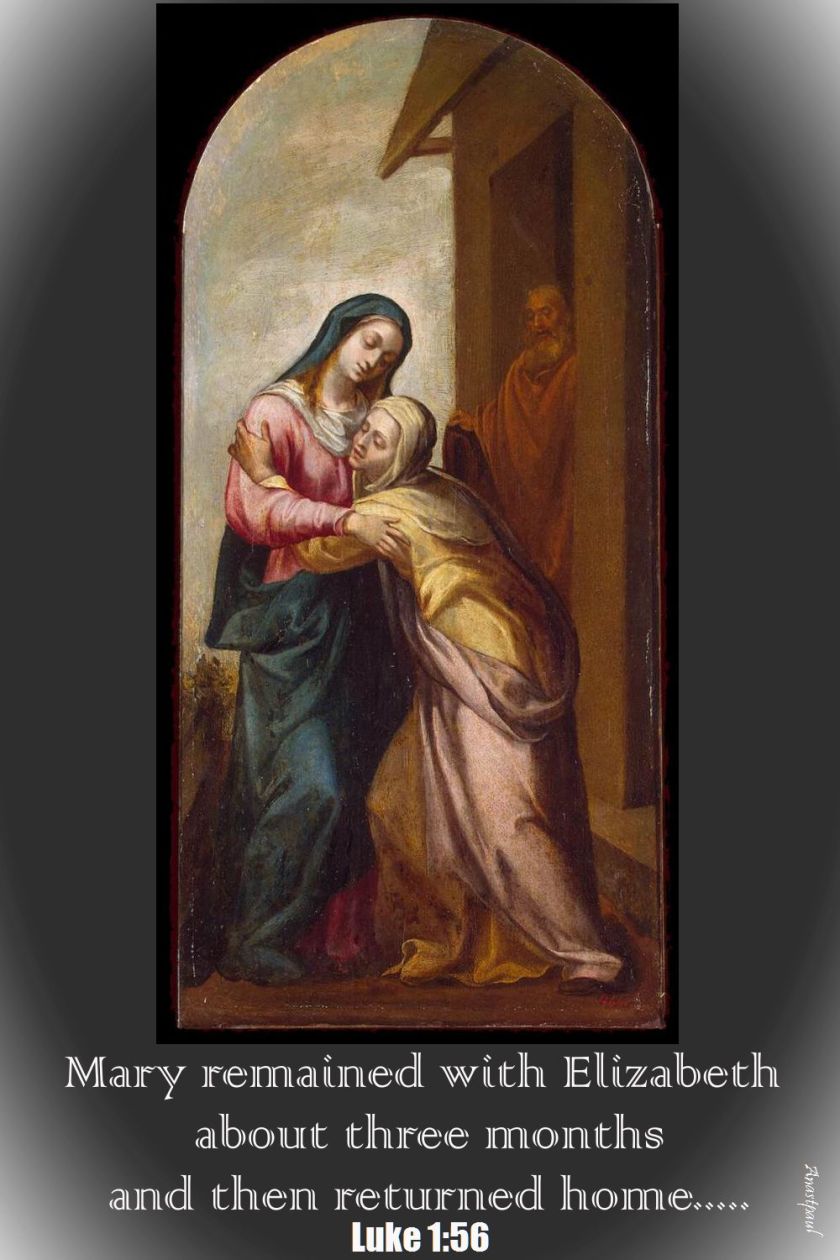
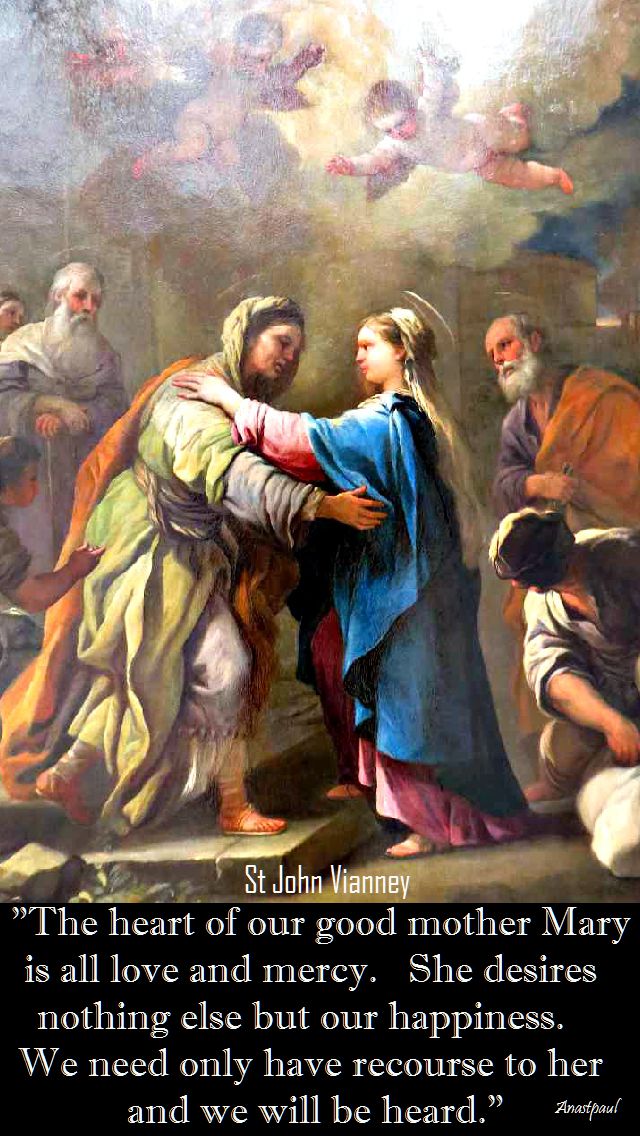
Mary remained with Elizabeth
about three months
and then returned home……….Luke 1:56
REFLECTION – “The heart of our good mother Mary is all love and mercy. She desires nothing else but our happiness. We need only have recourse to her and we will be heard.”………..
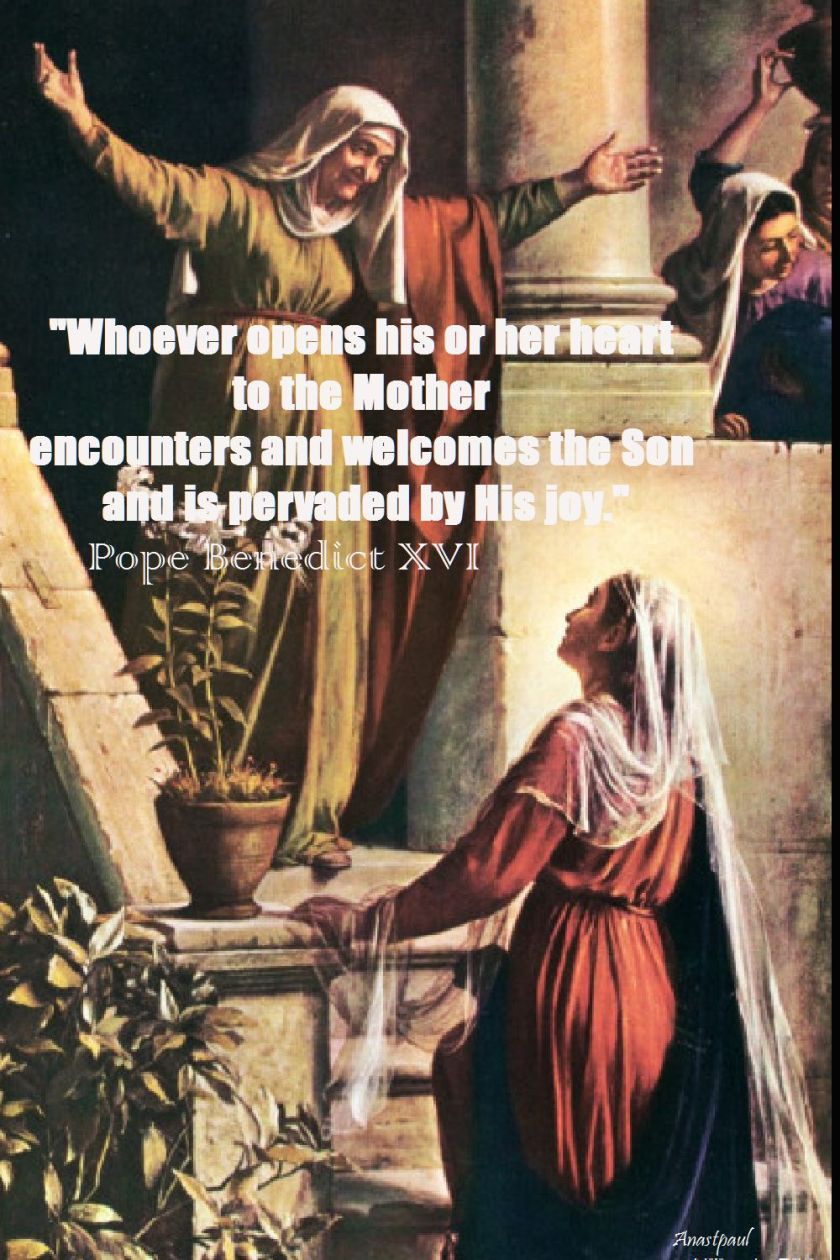
“Whoever opens his or her heart to the Mother encounters and welcomes the Son and is pervaded by His joy. True Marian devotion never obscures or diminishes faith and love for Jesus Christ Our Saviour, the one Mediator between God and humankind. On the contrary, entrustment to Our Lady is a privileged path, tested by numerous saints, for a more faithful following of the Lord. Consequently, let us entrust ourselves to her with filial abandonment!” ……….Pope Benedict XVI (2006)
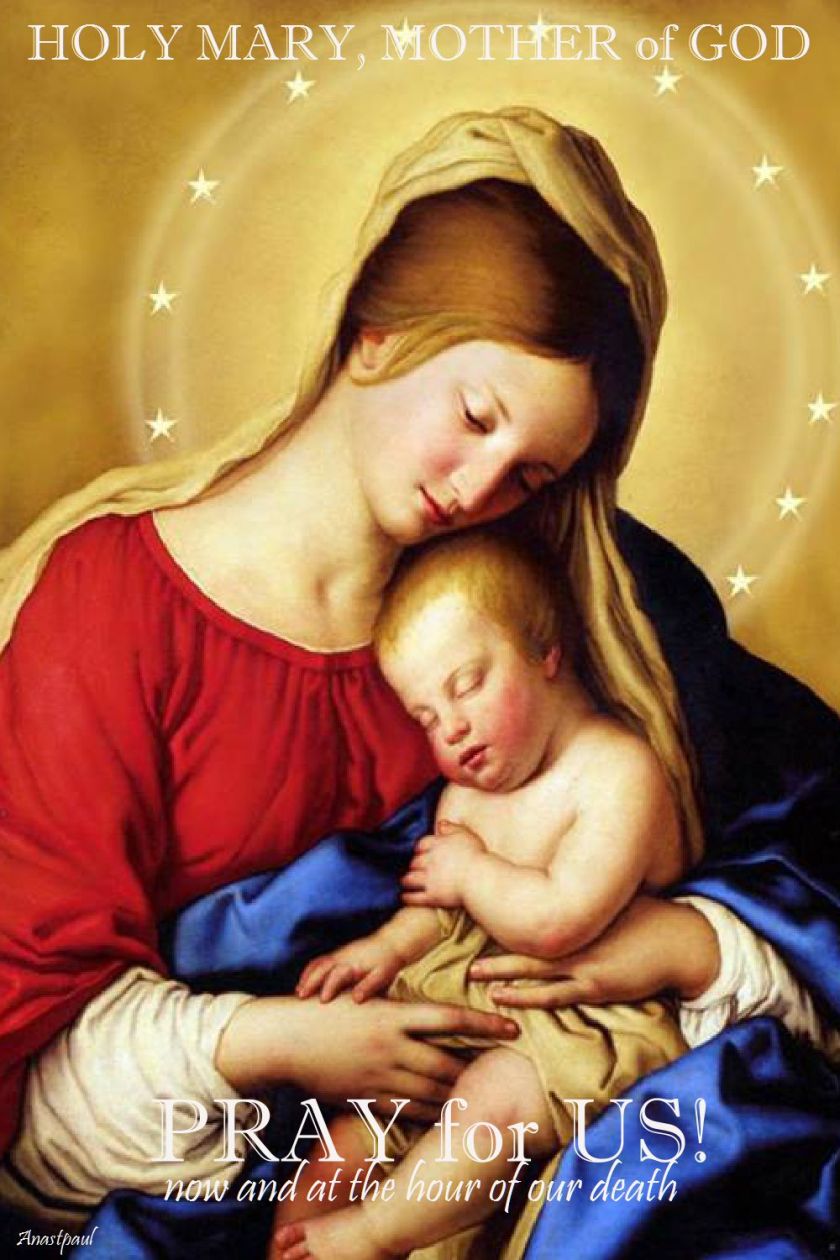
PRAYER – Heavenly Father, let me constantly have recourse to Mary. May she lead me to the happiness of heavenly glory which You shar with Your Son in the unity of the Holy Spirit. Holy Mary, Mother of God, pray for us, lead us, teach us and care for us, now and at the hour of our death, amen.
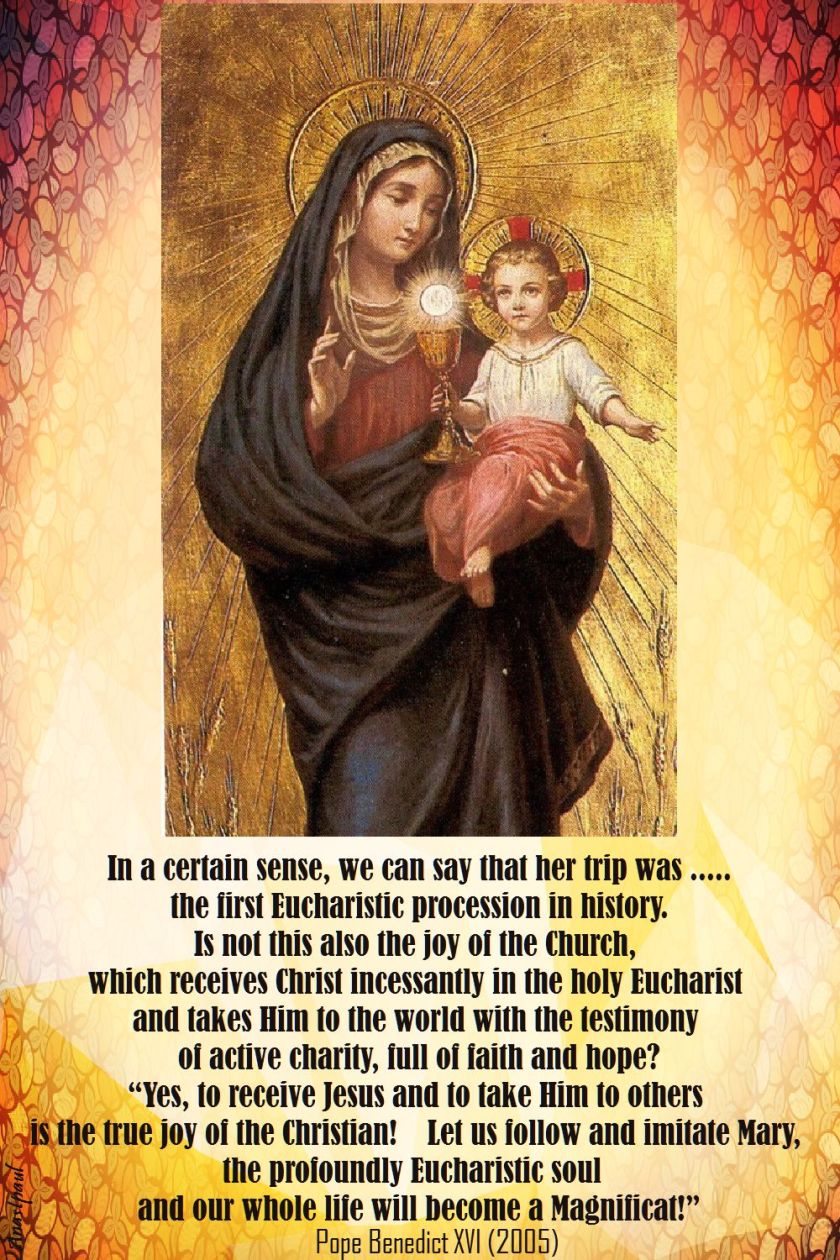
“(Mary) is a young maiden but she is not afraid because God is with her, within her,… In a certain sense, we can say that her trip was ….. the first Eucharistic procession in history. Is not this also the joy of the Church, which receives Christ incessantly in the holy Eucharist and takes Him to the world with the testimony of active charity, full of faith and hope? “Yes, to receive Jesus and to take Him to others is the true joy of the Christian! Let us follow and imitate Mary, the profoundly Eucharistic soul and our whole life will become a Magnificat.”
The spirit of the Lord shall rest upon him:
a spirit of wisdom and understanding……..Is 11:2
REFLECTION – “Those who are led by the Holy Spirit have a right concept of everything.
Hence, many unlettered people enjoy such knowledge more than the wise.”…………St John Vianney
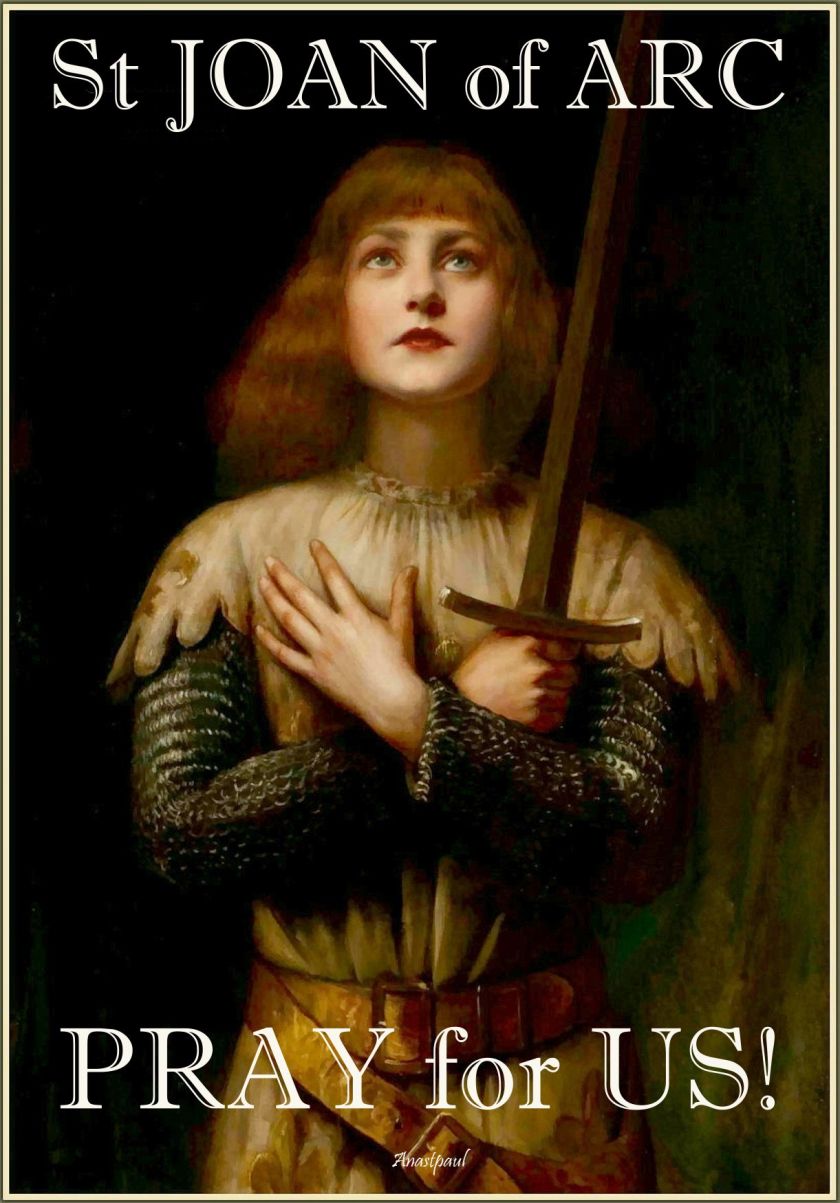
“(St Joan of Arc) our saint lived prayer as a form of continuous dialogue with the Lord, who also enlightened her answers to the judges, giving her peace and security. She prayed with faith: “Sweetest God, in honour of your holy Passion, I ask You, if You love me, to reveal to me how I must answer these men of the Church”. Joan saw Jesus as the “King of Heaven and Earth.” Thus, on her standard, Joan had the image painted of “Our Lord who sustains the world”………..Pope Benedict XVI (2010)
PRAYER – Father if every good gift, send forth Your Spirit upon me with His sevenfold gifts. Grant that through my love for Your Son, I too may like St Joan of Arc, achieve the heights of the Christian life, make prayer the guiding thread of my days; fulfilling the will of God, whatever it is; to live in charity without favouritisms, without limits and have, as she had, in the love of Jesus, a profound love for the Church. St Joan of Arc, pray for us all, amen.
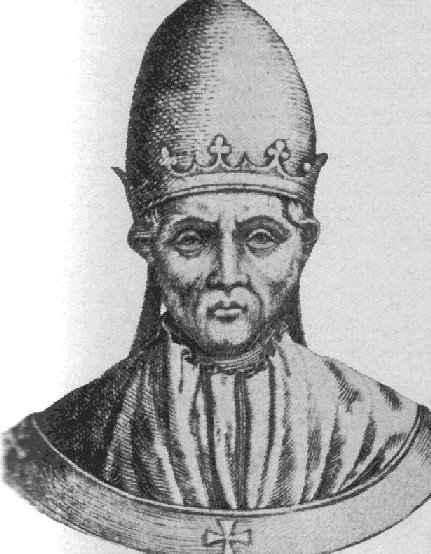
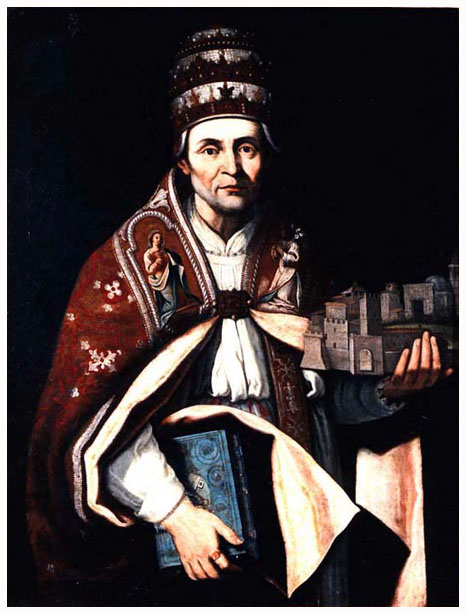
Saint of the Day – 19 May – St Pope Celestine V Born 1210 at Isneria, Abruzzi, Italy as Pietro del Morrone; Papal Ascension – 5 July 1294 – Papal Abdication – 13 December 1294. Died: • 19 May 1296 in Rome, Italy of natural causes. St Celestine is buried in the church of Saint Agatha, Ferentino, Italy and re-interred in the Church of Saint Maria di Collemaggio, Aquila, Italy. Monk, Hermit, Pope, Founder. Patron of Bookbinders,Papal resignations, Aquila, Urbino, Molisem Sant’Angelo Limosano. Attributes – Papal vestments, Papal tiara, Book
Peter Celestine, was Pope for five months from 5 July to 13 December 1294, when he resigned. He was also a monk and hermit who founded the order of the Celestines as a branch of the Benedictine order.
He was elected pope in the Catholic Church’s last non-conclave papal election, ending a two-year impasse. Among the only edicts of his to remain in force was the confirmation of the right of the pope to abdicate; nearly all of his other official acts were annulled by his successor, Boniface VIII. On 13 December 1294, a week after issuing the decree, Celestine resigned, stating his desire to return to his humble, pre-papal life. He was subsequently imprisoned by Boniface in the castle of Fumone in the Campagna region, in order to prevent his potential installation as antipope. He died in prison on 19 May 1296 at the age of 81.
St Celestine was canonized on 5 May 1313 by Pope Clement V. No subsequent pope has taken the name Celestine.
Pietro Angelerio was born to parents Angelo Angelerio and Maria Leone in a town called Sant’Angelo Limosano, in the Kingdom of Sicilia (Sicily). After his father’s death he began working in the fields. His mother Maria was a key figure in Pietro’s spiritual development: she imagined a different future for her deeply beloved son than becoming just a farmer or a shepherd. From the time he was a child, he showed great intelligence and love for others. He became a Benedictine monk at Faifoli in the Diocese of Benevento when he was 17. He showed an extraordinary disposition toward asceticism and solitude and in 1239 retired to a solitary cavern on the mountain Morrone, hence his name (Peter of Morrone). Five years later he left this retreat and went with two companions to a similar cave on the even more remote Mountain of Maiella in the Abruzzi region of central Italy, where he lived as strictly as possible according to the example of St. John the Baptist. Accounts exist of the severity of his penitential practices.
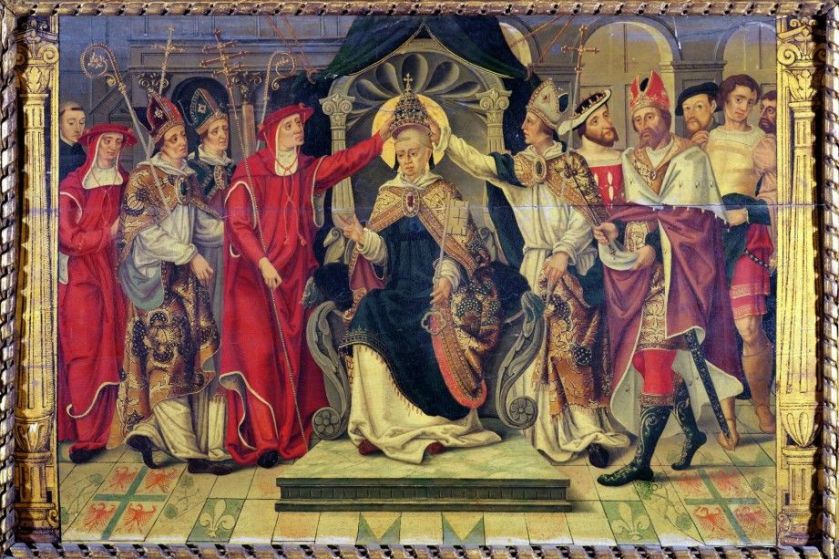
The cardinals assembled at Perugia after the death of Pope Nicholas IV in April 1292. After more than two years, a consensus had still not been reached. Pietro, well known to the cardinals as a Benedictine hermit, sent the cardinals a letter warning them that divine vengeance would fall upon them if they did not quickly elect a pope. Latino Malabranca, the aged and ill dean of the College of Cardinals cried out, “In the name of the Father, the Son, and the Holy Ghost, I elect brother Pietro di Morrone.” The cardinals promptly ratified Malabranca’s desperate decision. When sent for, Pietro obstinately refused to accept the papacy and even, as Petrarch says, tried to flee, until he was finally persuaded by a deputation of cardinals accompanied by the king of Naples and the pretender to the throne of Hungary. Elected on 5 July 1294, at age 79, he was crowned at Santa Maria di Collemaggio in the city of Aquila in the Abruzzo on 29 August, taking the name Celestine V.
Shortly after assuming office, Celestine issued a papal bull granting a rare plenary indulgence to all pilgrims visiting Santa Maria di Collemaggio through its holy door on the anniversary of his papal coronation. The Perdonanza Celestiniana festival is celebrated in L’Aquila every 28–29 August in commemoration of this event.
With no political experience, Celestine proved to be an especially weak and ineffectual pope. He held his office in the Kingdom of Naples, out of contact with the Roman Curia and under the complete power of King Charles II. He appointed the king’s favorites to church offices, sometimes several to the same office. One of these was Louis of Toulouse, whom Celestine ordered given clerical tonsure and minor orders, although this was not carried out. He renewed a decree of Pope Gregory X that had established stringent rules for papal conclaves after a similarly prolonged election. In one decree, he appointed three cardinals to govern the church during Advent while he fasted, which was again refused. Realizing his lack of authority and personal incompatibility with papal duties, he consulted with Cardinal Benedetto Caetani (his eventual successor) about the possibility of resignation. This resulted in one final decree declaring the right of resignation, which he promptly exercised after five months and eight days in office, thus on 13 December 1294, Celestine V resigned. In the formal instrument of renunciation, he recited as the causes moving him to the step: “The desire for humility, for a purer life, for a stainless conscience, the deficiencies of his own physical strength, his ignorance, the perverseness of the people, his longing for the tranquility of his former life”. Having divested himself of every outward symbol of papal dignity, he slipped away from Naples and attempted to retire to his old life of solitude.
The next pope to resign of his own accord was Pope Benedict XVI in 2013, 719 years later.
The former Celestine, now reverted to Pietro Angelerio, was not allowed to become a hermit once again. Various parties had opposed his resignation and the new Pope Boniface VIII had reason to worry that one of them might install him as an antipope. To prevent this he ordered Pietro to accompany him to Rome. Pietro escaped and hid in the woods before attempting to return to Sulmona to resume monastic life. This proved impossible and Pietro was captured after an attempt to flee to Dalmatia was thwarted when a tempest forced his ship to return to port. Boniface imprisoned him in the castle of Fumone near Ferentino in Campagna, attended by two monks of his order, where Pietro died after 10 months at about the age of 81. His supporters spread the allegation that Boniface had treated him harshly and ultimately executed Pietro but the historical evidence is lacking. Pietro was buried at Ferentino but his body was subsequently removed to the Basilica Santa Maria di Collemaggio in Aquila.
Philip IV of France, who had supported Celestine and bitterly opposed Boniface, nominated Celestine for sainthood following the election of Pope Clement V. The latter signed a decree of dispensation on 13 May 1306 to investigate the nomination. He was canonised on 5 May 1313 after a consistory. Most modern interest in Celestine V has focused on his resignation. He was the first pope to formalise the resignation process and is often said to have been the first to resign. In fact he was preceded in this by Pope Pontian (235), John XVIII (1009), Benedict IX (1045) and Gregory VI (1046). As noted above, Celestine’s own decision was brought about by mild pressure from the Church establishment. His reinstitution of Gregory X’s conclave system established by the papal bull Ubi periculum has been respected ever since.
A 1966 visit by Pope Paul VI to Celestine’s place of death in Ferentino along with his speech in homage of Celestine prompted speculation that the Pontiff was considering retirement.
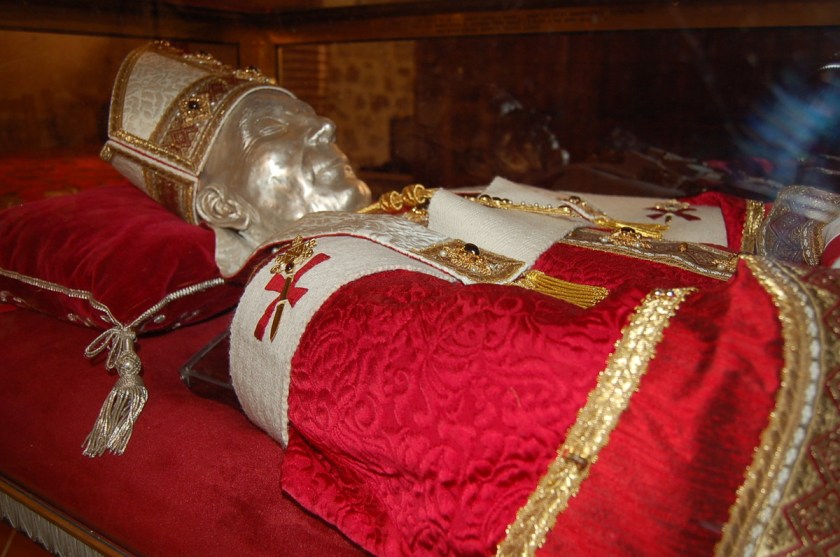
Celestine’s remains survived the 2009 L’Aquila earthquake with one Italian spokesman saying it was “another great miracle by the pope”. They were then recovered from the basilica shortly after the earthquake. While inspecting the earthquake damage during a 28 April 2009 visit to the Aquila, Pope Benedict XVI visited Celestine’s remains in the badly damaged Santa Maria di Collemaggio and left the woolen pallium he wore during his papal inauguration in April 2005 on his glass casket as a gift.
To mark the 800th anniversary of Celestine’s birth, Pope Benedict XVI proclaimed the Celestine year from 28 August 2009 through 29 August 2010. Benedict XVI visited the Sulmona Cathedral, near Aquila, on 4 July 2010 as part of his observance of the Celestine year and prayed before the altar consecrated by Celestine containing his relics, on 10 October 1294.
“We know nothing else about him (St Matthias), if not that he had been a witness to all Jesus’ earthly events (cf. Acts 1: 21-22), remaining faithful to Him to the end. To the greatness of his fidelity was later added the divine call to take the place of Judas, almost compensating for his betrayal.
We draw from this a final lesson: while there is no lack of unworthy and traitorous Christians in the Church, it is up to each of us to counterbalance the evil done by them with our clear witness to Jesus Christ, our Lord and Saviour.” – Pope Benedict GENERAL AUDIENCE, Saint Peter’s Square, Wednesday, 18 October 2006
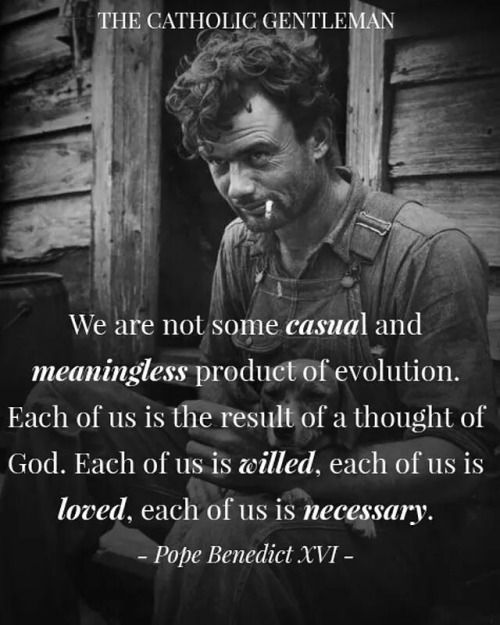
“We are not some casual and meaningless product of evolution.
Each of us is the result of a thought of God. Each of us is willed, each of us is loved, each of us is necessary.”
















 AnaStpaul
You must be logged in to post a comment.