
Saint/s of the Day – 28 February – St Cyra AND St Marana (Circa Mid 5th Century) Virgins and Hermits of Beroea in Syria. Two female Syrian Hermits of noble lineage who led an austere life of fasting, prayer, and silence for 42o years. They also made pilgrimages to holy places in Jerusalem and Isauria.
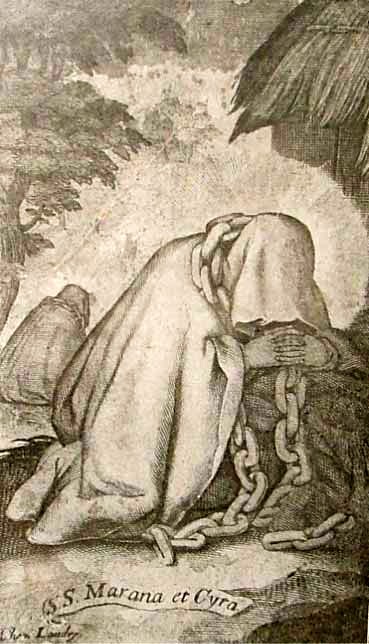
St Theodoret (c393-c457) devotes a Chapter (the 29th) of his Religiosa Historia to Marana and Cyra, who were still alive when he wrote his work in around 440.
In his word:
“Their country is Beroea (modern Aleppo), where they descended from an illustrious race and were educated according to their condition and birth.
But despising all the advantages granted them by nature, they shut themselves up in a small site near the City, having the gate walled up.
Wishing to imitate them in this way of life, some of their female servants built them a small house, adjacent to the hermitage, in which they ordered them to live; observing their actions through a small window, they often made them do prayer exercises and inflamed them with the love of God…
Instead of the door, they had a small window through which they received what was necessary for their life and spoke with the women who came to visit them only during the time of the ‘cinquantin’ (= Easter time), spending the rest of the year in constant silence, I mean with regard to Marana, the only one who speaks to these women. As for Cyra, in fact, no one has ever heard her utter the slightest word.
Cyra, who is of a more delicate constitution than the other, is always bent to the ground, unable to stand up. They wear dresses so long that they cover their feet and in front they have a kind of veil that comes down to the waist and completely covers the face, hands and stomach.”
When Teodoreto wrote these lines, Marana and Cyra had already been leading this life of Hermits for 42 years, making it even more painful by wearing heavy chains and sometimes prolonging the fast up to forty days.
“Driven by the desire to see the holy places whichJesus Christ honoured with His sufferings, they went fasting to Jerusalem, eating only after worshiping God.
On their return, they resumed fasting, even though it would have taken them no less than 20 days to make such a long journey.”
Another time, they similarly travelled to Isauria to visit the Church of Saint Thecla, the first Martyr of that region. As time passed, Marana and Cyra did not slow domn in this way of life; on the contrary, they continued with ever-renewed ardour toward the crown which Christ would place upon their heads after their victory.
We do not know the date of Marana and Cyra’s death, since Theodoret is our only source.



 AnaStpaul
You must be logged in to post a comment.