Posted in MORNING Prayers, PRAYERS of the SAINTS, SAINT of the DAY

Our Morning Offering – 23 February – The Memorial of St Polycarp (c 69 – c 155) Martyr and Father of the Church

Our Morning Offering – 23 February – The Memorial of St Polycarp (c 69 – c 155) Martyr and Father of the Church

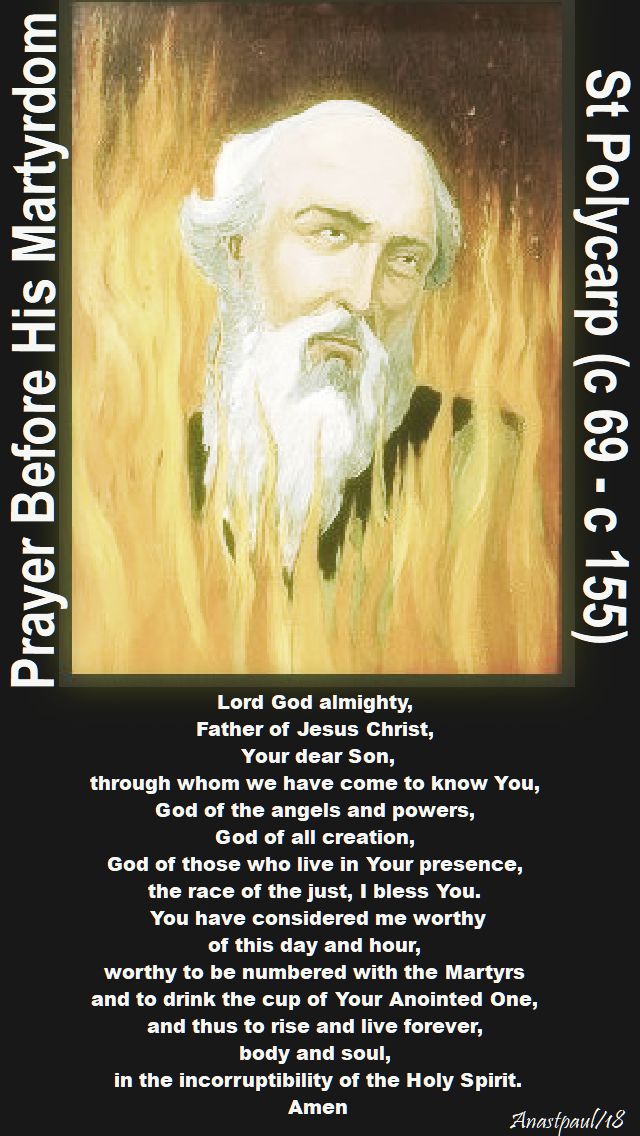
Prayer Before His Martyrdom
St Polycarp

Lord God almighty,
Father of Jesus Christ,
Your dear Son,
through whom we have come to know You,
God of the angels and powers,
God of all creation,
God of those who live in Your presence,
the race of the just, I bless You.
You have considered me worthy
of this day and hour,
worthy to be numbered with the Martyrs
and to drink the cup of Your Anointed One,
and thus to rise and live forever,
body and soul,
in the incorruptibility of the Holy Spirit.
Amenprayer before his martyrdom - st polycarp - 23 feb 2018

Posted in EARACHE, EAR disorders, FATHERS of the Church, SAINT of the DAY

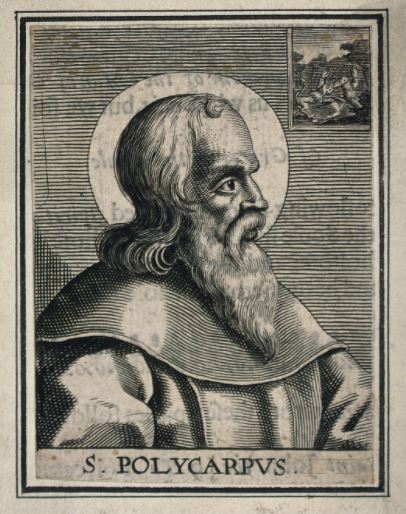
Saint of the Day – 23 February – St Polycarp (c 69 – c 155) Martyr and Father of the Church

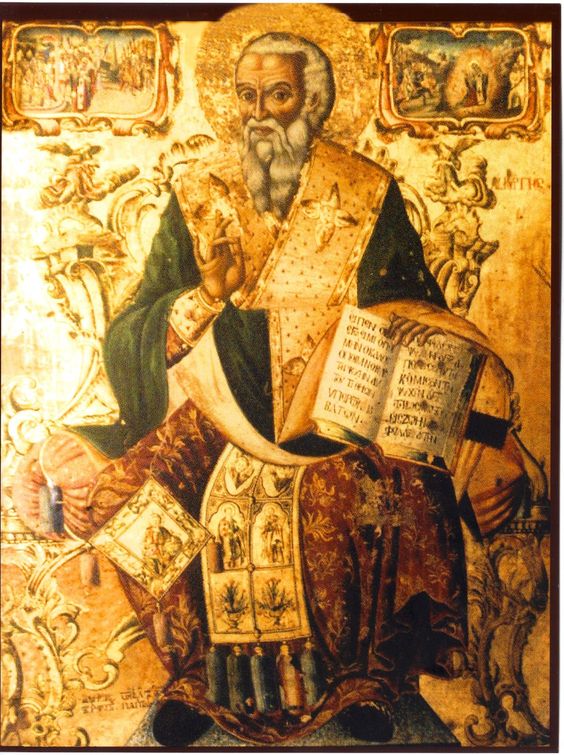
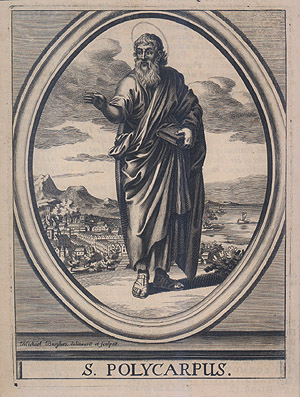
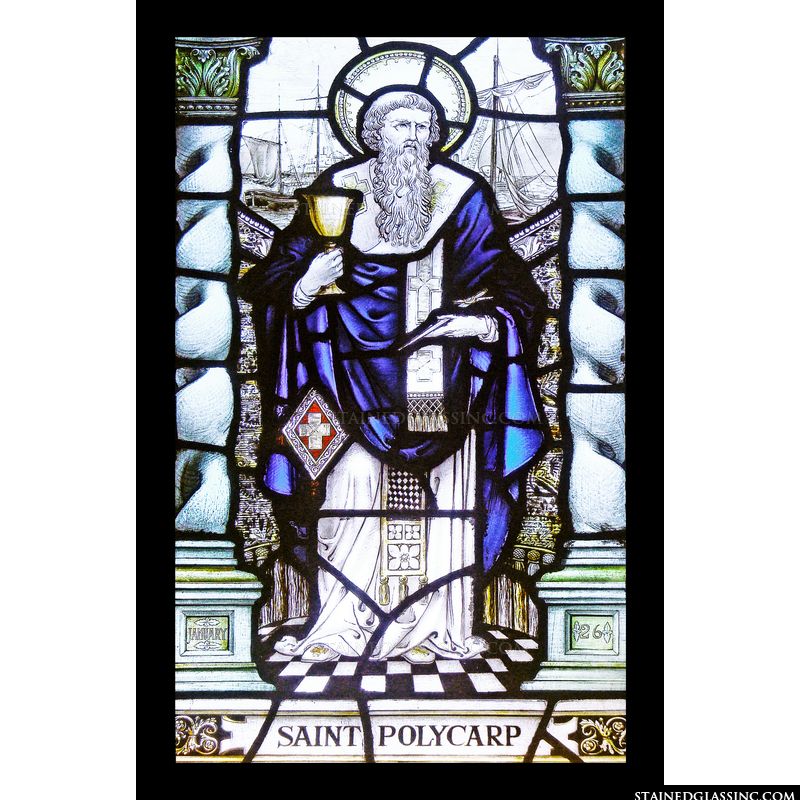
Saint of the Day – 23 February – St Polycarp of Smyrna – (69-155) – Martyr, Apostolic Church Father and Bishop of Smyrna, Writer, Preacher, Theologian – Patron against dysentery and earache.   Bishop of Smyrna (Asia Minor), Polycarp was martyred between 155 and 167.   His name means “much fruit”.HEADER - st polycarp

It is recorded by St Irenaeus, who heard him speak in his youth and by Tertullian, that he had been a disciple of John the Apostle.    Saint Jerome wrote that Polycarp was a disciple of John and that John had ordained him bishop of Smyrna.

With Clement of Rome and Ignatius of Antioch, Polycarp is regarded as one of three chief Apostolic Fathers.   The sole surviving work attributed to his authorship is his Letter to the Philippians and a letter addressed to him by Ignatius of Antioch, he is known especially for the account of his martyrdom, the first such account to be written after the narrative of Stephen’s martyrdom in the Acts of the Apostles.   This extraordinary narrative was composed shortly after Polycarp’s death.   Many passages should be quoted here, like this one, where the governor invites Polycarp to curse Christ.   Here is the bishop’s response:

“For eighty six years I have been His servant and He has done me no wrong.   How can I blaspheme against my king and saviour?”   

This text is also the first one where we find a mention of the cult of relics and of the celebration of the anniversary of the martyrdom:  “Collecting the remains that were dearer to us than precious stones and finer than gold, we buried them in a fitting spot. Gathering there, so far as we can, in joy and gladness, we will be allowed by the Lord to celebrate the anniversary day of his martyrdom, both as a memorial for those who have already fought the contest and for the training and preparation of those who will do so one day.”

Posted in DOCTORS of the Church, FATHERS of the Church, MORNING Prayers, QUOTES of the SAINTS, QUOTES on CHARITY, QUOTES on LOVE, SAINT of the DAY

Quote/s of the Day – 16 January – The memorial of St Joseph Vaz (1651-1711) Apostle of Sri Lanka – “Speaking of Charity”

Quote/s of the Day – 16 January –  The memorial of St Joseph Vaz (1651-1711) Apostle of Sri Lanka – “Speaking of Charity”

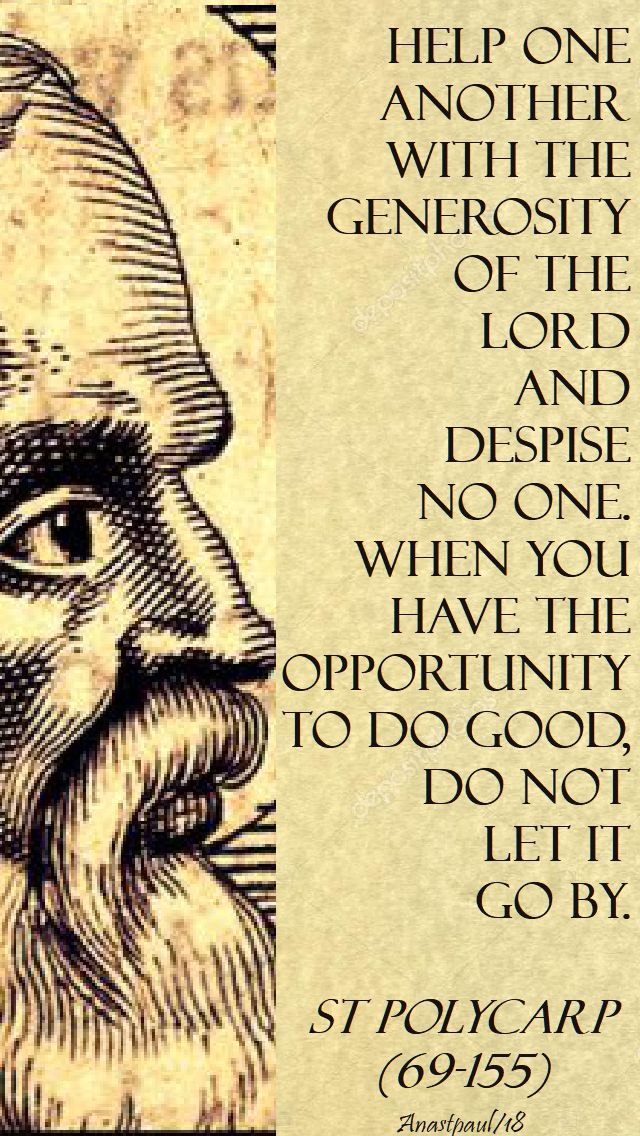
“Help one another
with the generosity
of the Lord
and despise no one.
When you have
the opportunity
to do good,
do not let it go by.”

St Polycarp of Smyrna (69-155) Father of the Churchhelp one another - st polycarp - 16 jan 2018

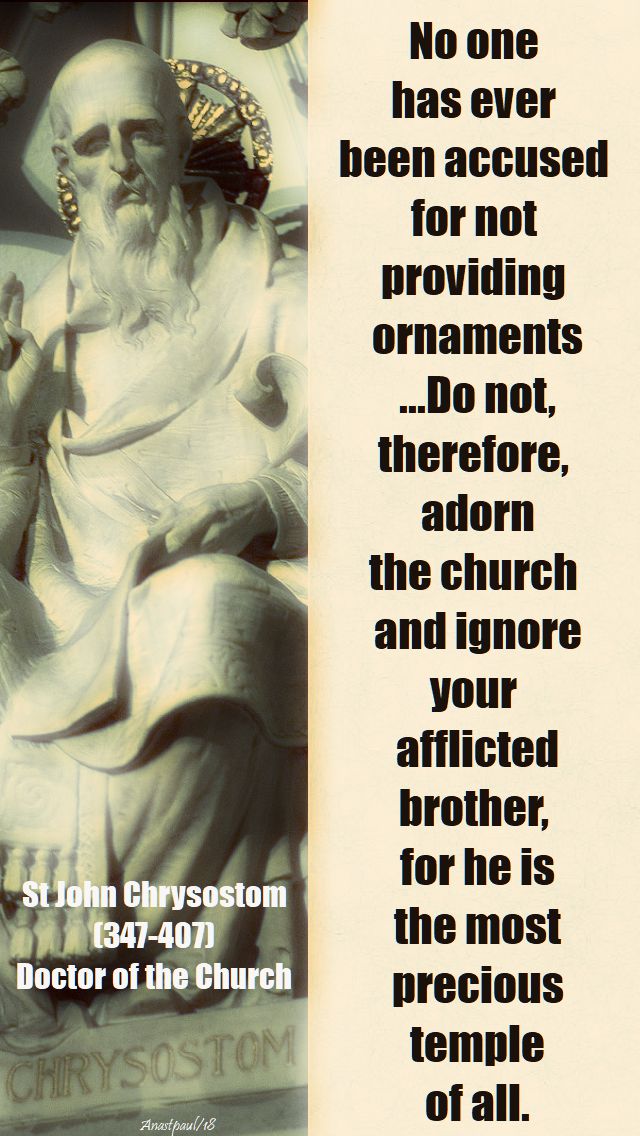
“No one has ever been accused
for not providing ornaments
…Do not, therefore, adorn the church
and ignore your afflicted brother,
for he is the most precious temple of all.”

St John Chrysostom (347-407) Father & Doctor of the Churchno one has ever - st john chrysostom - 16 jan 2018

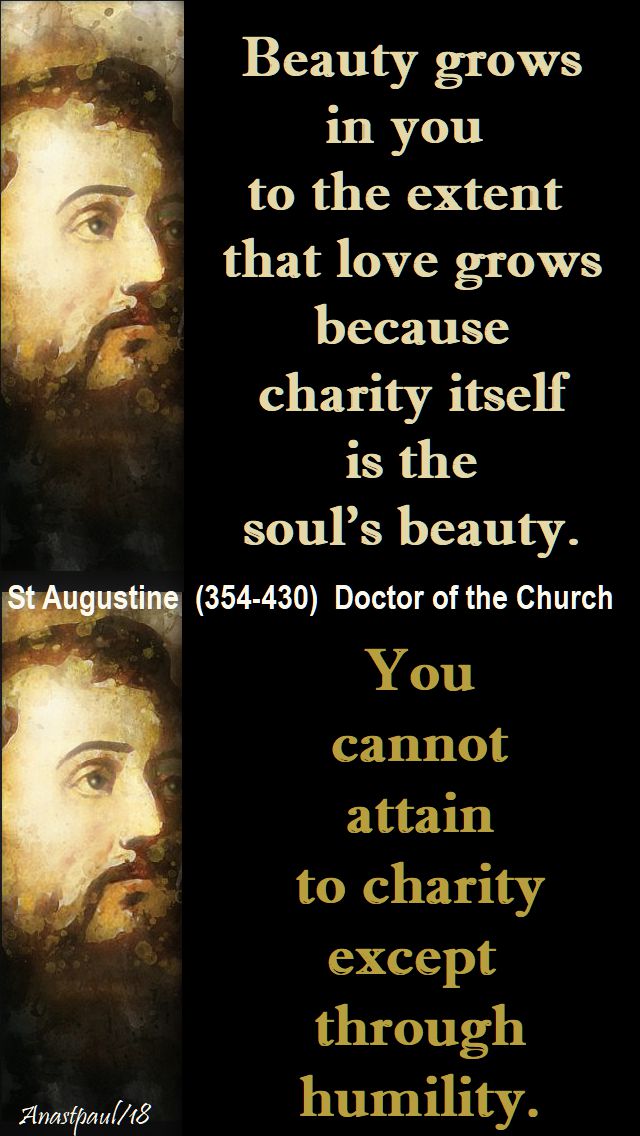
“Beauty grows in you to the extent that love grows
because charity itself is the soul’s beauty.”

“You cannot attain to charity except through humility.”

St Augustine (354-430) Father & Doctor of the Churchbeauty grows in you - st augustine - 16 jan 2018

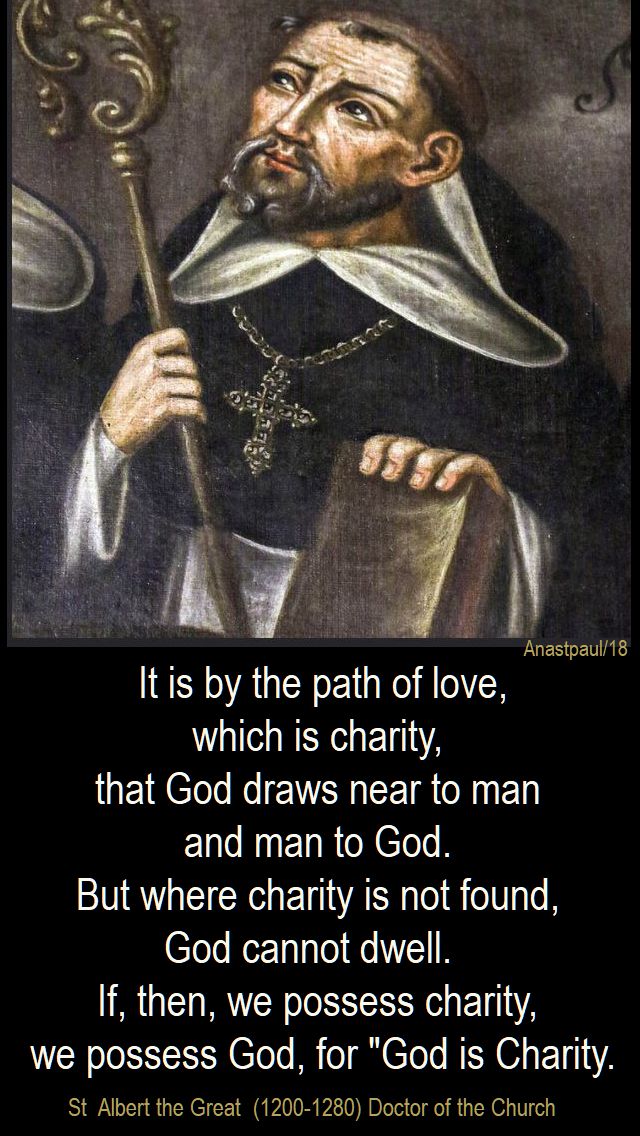
“It is by the path of love, which is charity,
that God draws near to man and man to God.
But where charity is not found,
God cannot dwell.
If, then, we possess charity,
we possess God, for “God is Charity”

St Albert the Great (1200-1280) Doctor of the Churchit is by the path of love - st albert the great - 16 jan 2018

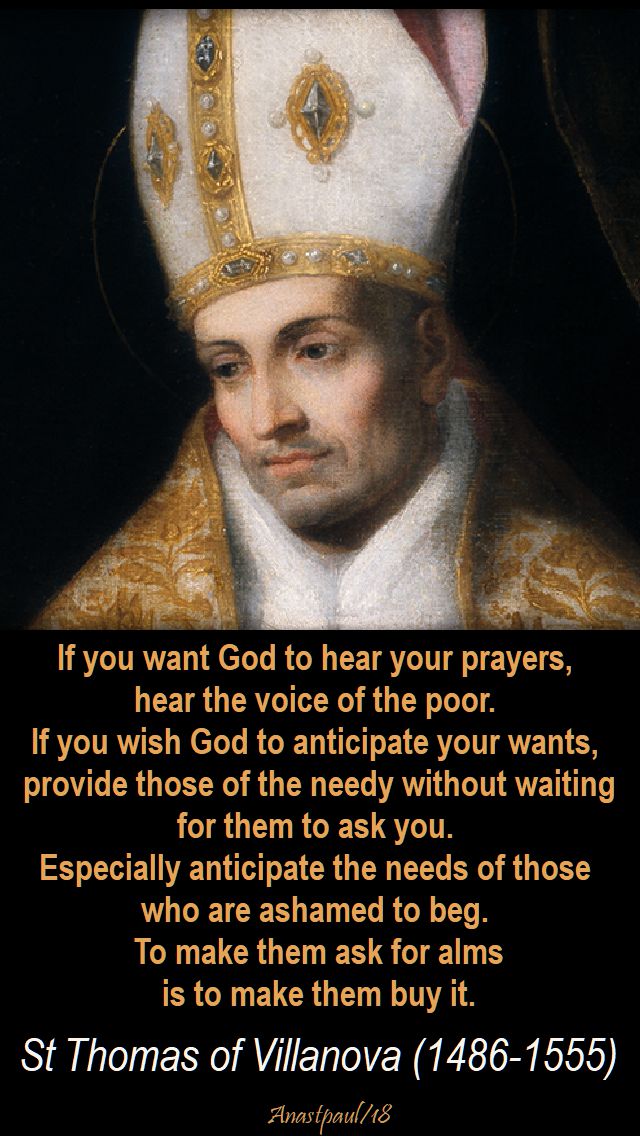
If you want God to hear your prayers,
hear the voice of the poor.
If you wish God to anticipate your wants,
provide those of the needy without waiting
for them to ask you.
Especially anticipate the needs of those
who are ashamed to beg.
To make them ask for alms is to make them buy it.”

St Thomas of Villanova (1486-1555)if you want god to hear your prayers - st homas of villanova - 16 jan 2018

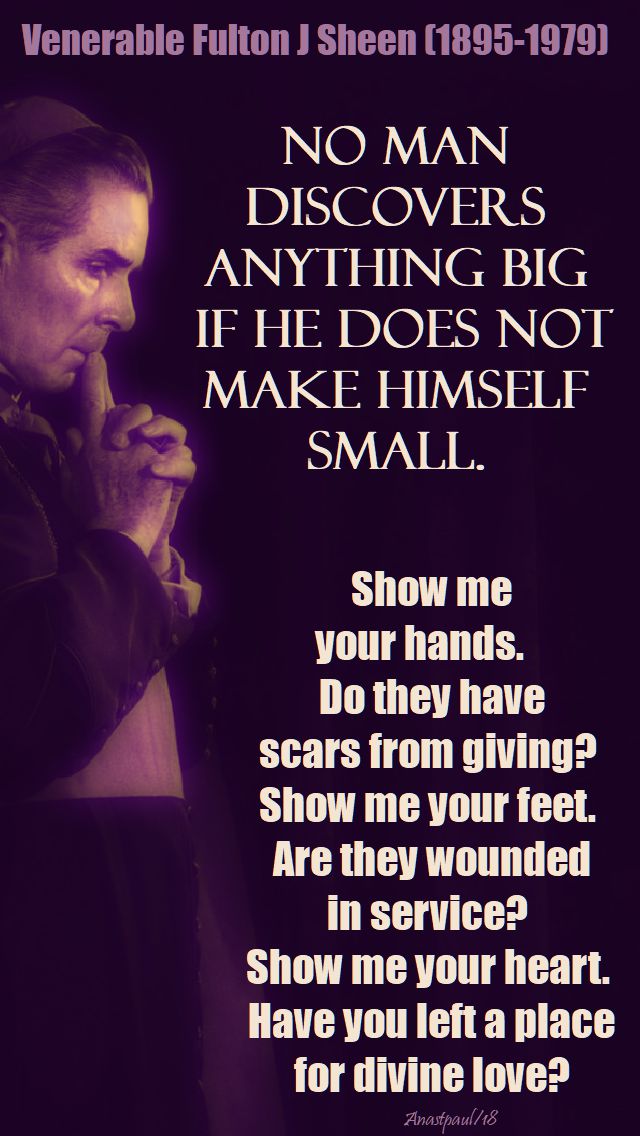
“No man discovers anything big
if he does not make himself small.”

“Show me your hands.
Do they have scars from giving?
Show me your feet.
Are they wounded in service?
Show me your heart.
Have you left a place for divine love?”

Venerable Fulton J Sheen (1895-1979)no man discovers - ven fulton sheen - 16 jan 2018

Posted in FATHERS of the Church, MORNING Prayers, QUOTES of the SAINTS, SAINT of the DAY, Uncategorized

Thought for the Day – 23 February

Thought for the Day – 23 February

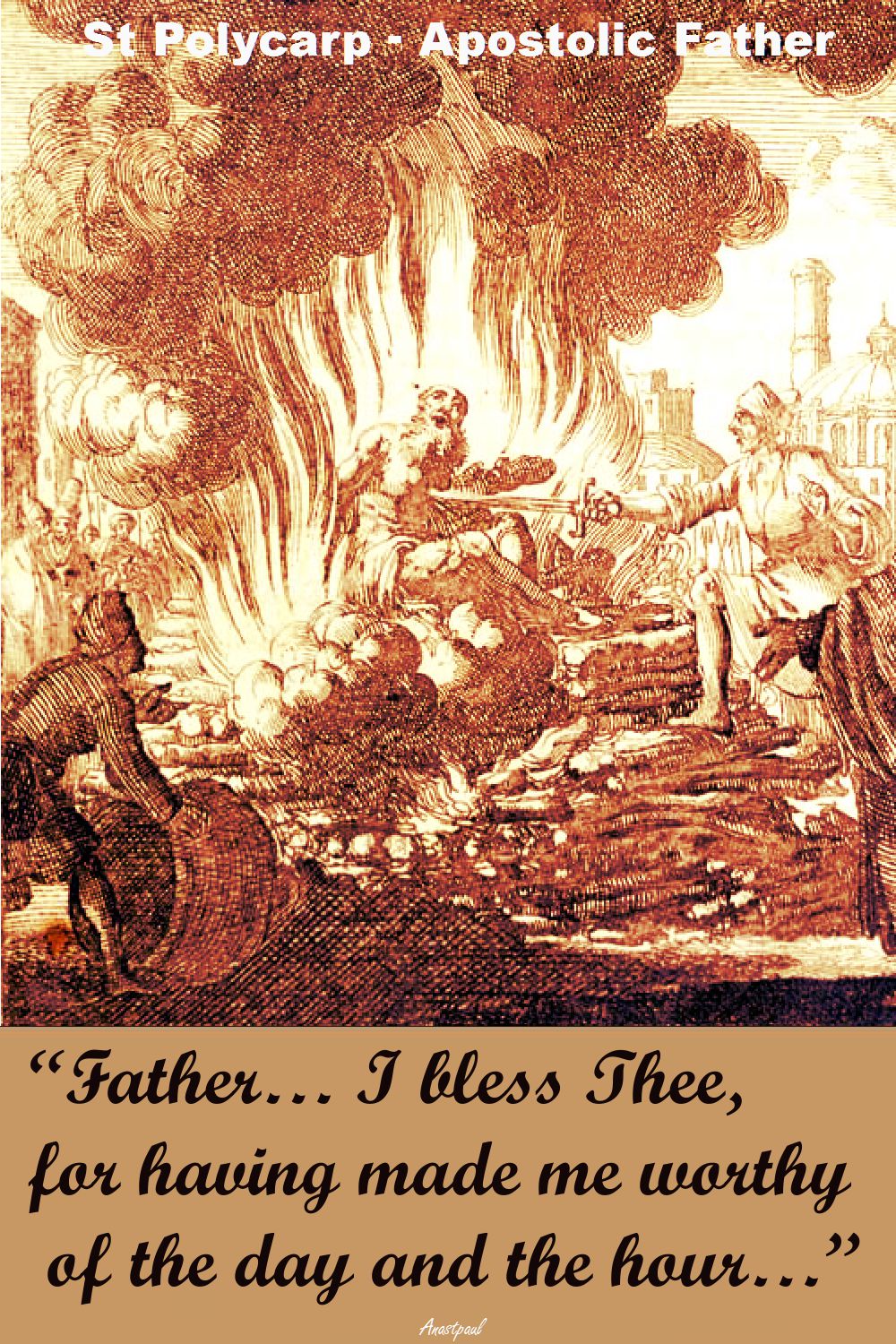
We may not be required to give our lives for our faith but we all have to suffer something for our beliefs and our fidelity. It is when things are difficult that faith is really faith. A faith that is good only in good times is scarcely faith at all. We are all called to witness to our faith in some way.   Polycarp was recognised as a Christian leader by all Asia Minor Christians—a strong fortress of faith and loyalty to Jesus Christ.   His own strength emerged from his trust in God, even when events contradicted this trust.   Living among pagans and under a government opposed to the new religion, he led and fed his flock.   Like the Good Shepherd, he laid down his life for his sheep and kept them from more persecution in Smyrna.   He summarised his trust in God just before he died: “Father… I bless Thee, for having made me worthy of the day and the hour…” (Acts of Martyrdom, Chapter 14).

father-i-bless-thee-stpolycarpst-polycarp-pray-for-us


Posted in FATHERS of the Church, MORNING Prayers, QUOTES of the SAINTS, SAINT of the DAY, Uncategorized

Quote/s of the Day – 23 February

Quote/s of the Day – 23 February

“Eighty and six years have I served Christ,
nor has He ever done me any harm.
How, then, could I blaspheme my King who saved Me?….
I bless Thee for deigning me worthy of this day
and this hour that I may be among Thy martyrs
and drink the cup of my Lord Jesus Christ.”

“Let us, therefore, foresake the vanity of the crowd
and their false teachings and turn back to the word
delivered to us from the beginning.”

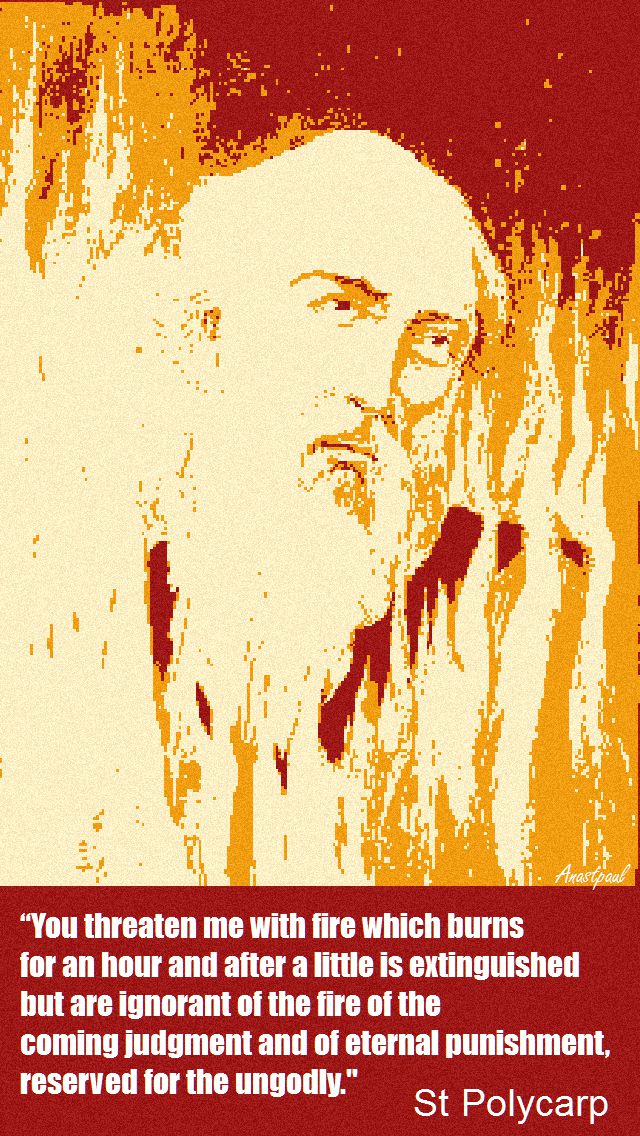
“You threaten me with fire which burns for an hour
and after a little is extinguished
but are ignorant of the fire of the coming judgment
and of eternal punishment, reserved for the ungodly.”

~~~~~ St Polycarp

quotes-of-st-polycarpyou-threaten-me-with-fire-st-polycarp

Posted in FATHERS of the Church, MORNING Prayers, QUOTES of the SAINTS, SAINT of the DAY, The WORD

One Minute Reflection – 23 February

One Minute Reflection – 23 February

There is a time and judgment for everything………Eccl 8:6

REFLECTION – “Stand fast, therefore, in this conduct and follow the example of the Lord, firm and unchangeable in faith, lovers of the brotherhood, loving each other, united in truth,’ helping each other with the mildness of the Lord, despising no man.”…………..St Polycarp

PRAYER – God of goodness, let me never allow an opportunity for good to be wasted. Help me take advantage of every moment at my disposal to do good.   St Polycarp pray for us, amen.

stand-fast-therefore-st-polycarp

Posted in FATHERS of the Church, SAINT of the DAY

Saint of the Day – 23 February – St Polycarp of Smyrna

Saint of the Day – 23 February – St Polycarp of Smyrna – (69-156) – Martyr, Apostolic Church Father and Bishop of Smyrna, Writer, Preacher, Theologian – Patron against dysentery and earache.

Polycarp is regarded as a saint and Church Father in the Eastern Orthodox, Oriental Orthodox, Catholic, Anglican, and Lutheran churches. His name ‘Polycarp’ means ‘much fruit’ in Greek.

It is recorded by Irenaeus, who heard him speak in his youth, and by Tertullian, that he had been a disciple of John the Apostle.    Saint Jerome wrote that Polycarp was a disciple of John and that John had ordained him bishop of Smyrna.

With Clement of Rome and Ignatius of Antioch, Polycarp is regarded as one of three chief Apostolic Fathers.   The sole surviving work attributed to his authorship is his Letter to the Philippians; it is first recorded by Irenaeus of Lyons.

According to St Irenaeus, Polycarp was a companion of Papias, another “hearer of John” as Irenaeus interprets Papias’ testimony and a correspondent of Ignatius of Antioch.   Ignatius addressed a letter to him, and mentions him in his letters to the Ephesians and to the Magnesians.

Irenaeus regarded the memory of Polycarp as a link to the apostolic past. He relates how and when he became a Christian, and in his letter to Florinus stated that he saw and heard Polycarp personally in lower Asia. Irenaeus wrote to Florinus:

“I could tell you the place where the blessed Polycarp sat to preach the Word of God.   It is yet present to my mind with what gravity he everywhere came in and went out;  what was the sanctity of his deportment, the majesty of his countenance;  and what were his holy exhortations to the people.   I seem to hear him now relate how he conversed with John and many others who had seen Jesus Christ, the words he had heard from their mouths.”

In particular, he heard the account of Polycarp’s discussion with John and with others who had seen Jesus.   Irenaeus also reports that Polycarp was converted to Christianity by apostles, was consecrated a bishop and communicated with many who had seen Jesus.   He repeatedly emphasizes the very great age of Polycarp.   Polycarp kissed the chains of Ignatius when he passed by Smyrna on the road to Rome for his martyrdom.

Polycarp occupies an important place in the history of the early Christian Church.   He is among the earliest Christians whose writings survived.   Saint Jerome wrote that Polycarp was a “disciple of the apostle John and by him ordained bishop of Smyrna”.   He was an elder of an important congregation which was a large contributor to the founding of the Christian Church.
Irenaeus, who had heard him preach in his youth, said of him: “a man who was of much greater weight and a more steadfast witness of truth, than Valentinus and Marcion, and the rest of the heretics”. Polycarp had learned from apostle John to flee from those who change the divine truth. One day he met in the streets of Rome the heretic Marcion who, resenting that Polycarp did not greet him, said: “Do you know me?” The saint replied: “Yes, I know you, the first-born of Satan.”    Polycarp lived in an age after the deaths of the apostles, when a variety of interpretations of the sayings of Jesus were being preached.   His role was to authenticate orthodox teachings through his reputed connection with the apostle John: “a high value was attached to the witness Polycarp could give as to the genuine tradition of old apostolic doctrine”, Wace commented, “his testimony condemning as offensive novelties the figments of the heretical teachers”.   Irenaeus states (iii. 3) that on Polycarp’s visit to Rome, his testimony converted many disciples of Marcion and Valentinus.

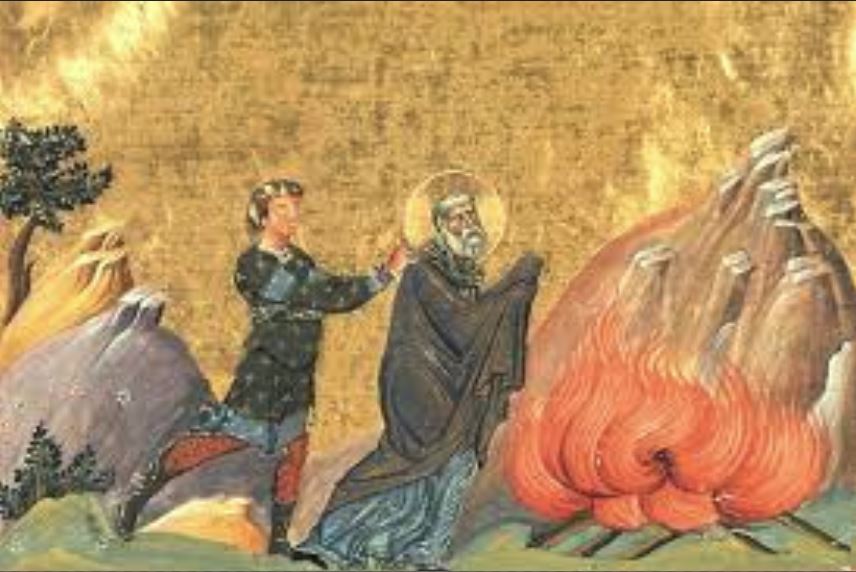
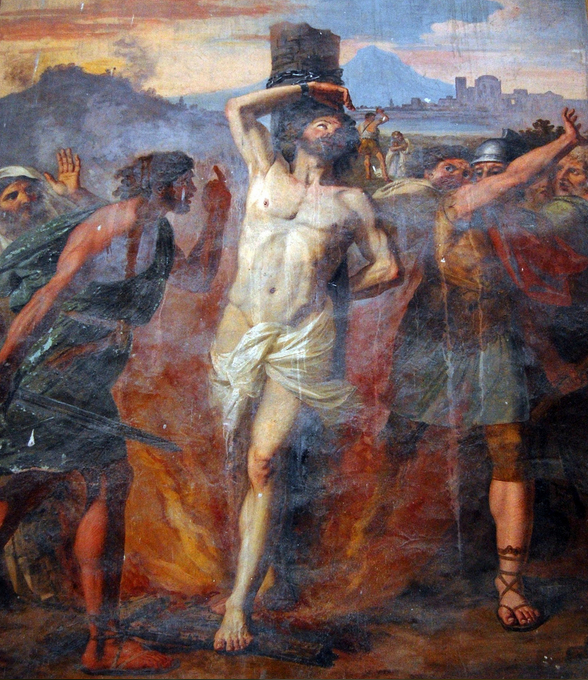
The story of Polycarp’s martyrdom is the earliest recorded account of a Christian martyr. Polycarp was seized for being a Christian.   Persecution and death would not tear him away from Jesus now.   Polycarp was led into the stadium of Smyrna.   The crowd demanded that he be left to the lions, but instead he was sentenced to death by fire.   An eyewitness account claims that the flames didn’t harm him.   He was finally killed by the sword, and his body was burned.

The community of believers celebrated the anniversary of Polycarp’s death with great joy, for in him they had seen an outstanding example of love and patience.   He had held strong and had won the treasure of eternal life.   Polycarp is remembered as an Apostolic Father, one who was a disciple of the apostles.