Blessed James Strepar OFM (c 1340-1409) Archbishop of Halicz, Poland from 1392 until his death Religious Priest of the Order of Friars Minor, Missionary. St Pius X proclaimed Blessed James, along with St Anthony of Padua, the Patrons of the Conventual Franciscan Order of Krakow Province. He was given the title of “Protector of the Kingdom, Defender and Guardian of the Homeland,” for his exceptional merits, including civil ones. Such was he considered by all. He was Canonised by by Pope Pius VI on 11 September 1791. His body is incorrupt. His Life: https://anastpaul.com/2020/10/20/saint-of-the-day-20-october-blessed-james-strepar-ofm-c-1340-1409/
St Leopardo of Osimo St Lucas Alonso Gorda St Martha of Cologne + Virgin Martyr St Maximus of Aquila (c228-c250) Deacon Martyr St Orora St Saula of Cologne + Virgin Martyr St Sindulphus of Rheims St Usthazanes St Vitalis of Salzburg
Mater Admirabilis / Mother Most Admirable (1844) – 20 October:
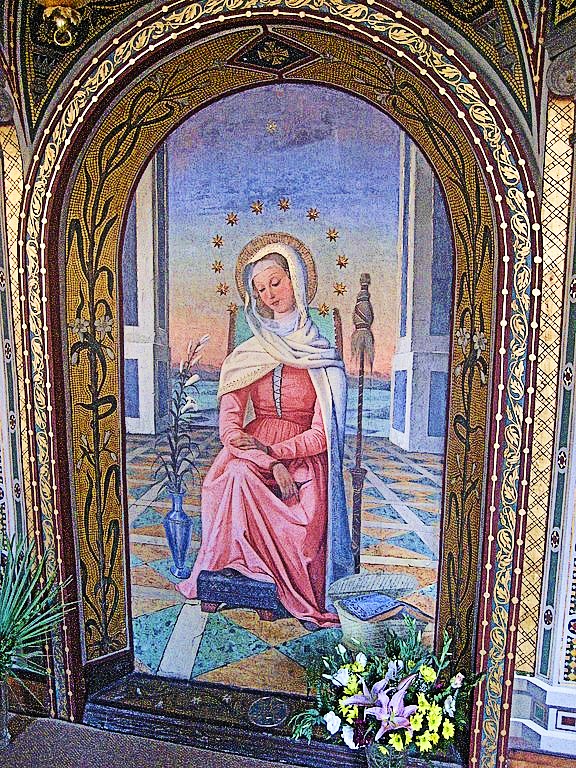
Mater Admirabilis is a fresco depicting the Virgin Mary, in the Monastery of the Trinità dei Monti, in Rome. It was painted by a young French artist, Pauline Perdrau and has been associated with several miracles.
In 1844, a generation after the Society of the Sacred Heart was founded, Pauline Perdrau, a young novice, took it upon herself to produce a fresco of the Virgin Mary on a wall in a recreational area of the convent, Trinità dei Monti in Rome. As a child, Pauline had had a favourite pink dress, so she chose to paint Mary as a young woman in a rose-coloured dress rather than a matronly Madonna in blue. The lily at Mary’s side represented her purity; the distaff and spindle, her love of work; a book, her dedication to study. Unfortunately, although Pauline put herself wholeheartedly into her task, her inexperience with the technique of fresco did not produce the beautiful soft painting for which she had hoped. The too vivid colours, had to be hidden behind a drape. Pope Pius IX, upon visiting the Convent on 20 October 1846, requested that the curtain be removed. Seeing the fresco of our Lady, its colours inexplicably softened, he exclaimed, “Mater Admirabilis!” Miracles soon began with the cure of a missionary Priest who had completely lost the power of speech. Permission was given to offer Mass before the miraculous picture and to celebrate the Feast of Mater Admirabilis on 20 October.
Blessed James Strepar OFM (c 1340-1409) Archbishop of Halicz, Poland from 1392 until his death Religious Priest of the Order of Friars Minor, Missionary. St Pius X proclaimed Blessed James, along with St Anthony of Padua, the Patrons of the Conventual Franciscan Order of Krakow Province. He was given the title of “Protector of the Kingdom, Defender and Guardian of the Homeland,” for his exceptional merits, including civil ones. Such was he considered by all. He was Canonised by by Pope Pius VI on 11 September 1791. His body is incorrupt. His Life: https://anastpaul.com/2020/10/20/saint-of-the-day-20-october-blessed-james-strepar-ofm-c-1340-1409/
St Leopardo of Osimo St Lucas Alonso Gorda St Martha of Cologne St Maximus of Aquila St Orora St Saula of Cologne St Sindulphus of Rheims St Usthazanes St Vitalis of Salzburg
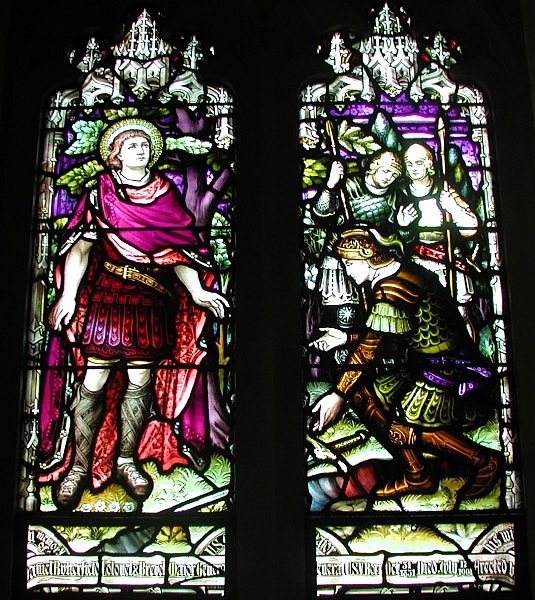
Saint of the Day – 20 October – Saint Cornelius the Centurion (1st Century) traditionally believed to have become the First Bishop of Caesarea, a Roman Centurion who is considered to be the one of first Gentile to convert to the Faith, (along with the conversion and Baptism of the Ethiopian eunuch – Acts 8). as related in Acts of the Apostles 10:1-49. The Baptism of Cornelius and his household, is an important event in the history of the early Church, for it points to the first century use of infant Baptism.
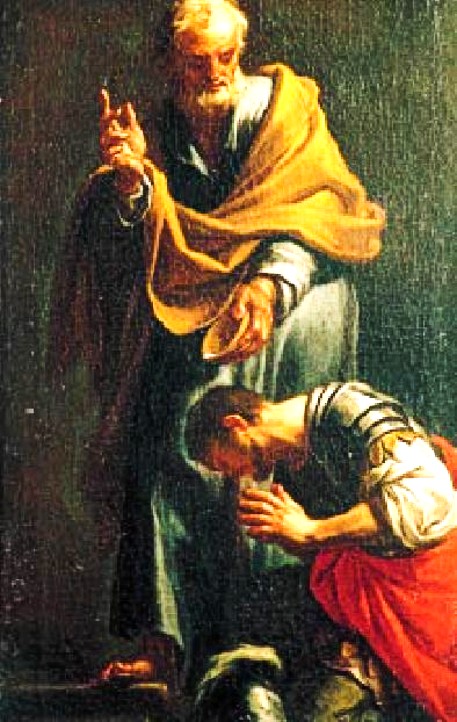
St Peter Baptising Cornelius, the Centurion, by Francesco Trevisani, 1709
“Now in Caesarea there was a man named Cornelius, a Centurion of the Cohort called the Italica, devout and God-fearing along with his whole household, who used to give alms generously to the Jewish people and pray to God constantly. One afternoon about three o’clock, he saw plainly in a vision, an Angel of God come in to him and say to him, “Cornelius.” He looked intently at him and, seized with fear, said, “What is it, sir?” He said to him, “Your prayers and almsgiving have ascended as a memorial offering before God. Now send some men to Joppa and summon one Simon who is called Peter. He is staying with another Simon, a tanner, who has a house by the sea.” When the Angel who spoke to him had left, he called two of his servants and a devout soldier from his staff, explained everything to them and sent them to Joppa.
St Cornelius’ dream
The next day, while they were on their way and nearing the city, Peter went up to the roof terrace to pray at about noontime. He was hungry and wished to eat and while they were making preparations, he fell into a trance. He saw heaven opened and something resembling a large sheet coming down, lowered to the ground by its four corners. In it were all the earth’s four-legged animals and reptiles and the birds of the sky. A voice said to him, “Get up, Peter. Slaughter and eat.” But Peter said, “Certainly not, sir. For never have I eaten anything profane and unclean.” The voice spoke to him again, a second time, “What God has made clean, you are not to call profane.” This happened three times and then the object was taken up into the sky.
Domenico Fetti – St Peter’s vision of a sheet with animals
While Peter was in doubt about the meaning of the vision he had seen, the men sent by Cornelius asked for Simon’s house and arrived at the entrance. They called out inquiring whether Simon, who is called Peter, was staying there. As Peter was pondering the vision, the Spirit said [to him] “There are three men here looking for you. So get up, go downstairs and accompany them without hesitation because I have sent them.” Then Peter went down to the men and said, “I am the one you are looking for. What is the reason for your being here?” They answered, “Cornelius, a centurion, an upright and God-fearing man, respected by the whole Jewish nation, was directed by a holy angel to summon you to his house and to hear what you have to say.” So he invited them in and showed them hospitality. The next day he got up and went with them, and some of the brothers from Joppa went with him.
On the following day he entered Caesarea. Cornelius was expecting them and had called together his relatives and close friends. When Peter entered, Cornelius met him and, falling at his feet, paid him homage. Peter, however, raised him up, saying, “Get up. I myself am also a human being.” While he conversed with him, he went in and found many people gathered together and said to them, “You know that it is unlawful for a Jewish man to associate with, or visit, a Gentile but God has shown me that I should not call any person profane or unclean. And that is why I came without objection when sent for. May I ask, then, why you summoned me?” Cornelius replied, “Four days ago at this hour, three o’clock in the afternoon, I was at prayer in my house when suddenly a man in dazzling robes stood before me and said, ‘Cornelius, your prayer has been heard and your almsgiving remembered before God. Send therefore, to Joppa and summon Simon, who is called Peter. He is a guest in the house of Simon, a tanner, by the sea.‘ So I sent for you immediately and you were kind enough to come. Now, therefore, we are all here in the presence of God to listen to all that you have been commanded by the Lord.”
St Peter at St Cornelius’ house
Then Peter proceeded to speak and said, “In truth, I see that God shows no partiality. Rather, in every nation whoever fears him and acts uprightly is acceptable to him. You know the word [that] he sent to the Israelites as he proclaimed peace through Jesus Christ, who is Lord of all, what has happened all over Judea, beginning in Galilee after the baptism that John preached, how God anointed Jesus of Nazareth with the holy Spirit and power. He went about doing good and healing all those oppressed by the devil, for God was with him.m We are witnesses of all that he did both in the country of the Jews and (in) Jerusalem. They put him to death by hanging him on a tree. This man God raised (on) the third day and granted that he be visible, not to all the people but to us, the witnesses chosen by God in advance, who ate and drank with him after he rose from the dead. He commissioned us to preach to the people and testify, that he is the one appointed by God as judge of the living and the dead. To him all the prophets bear witness, that everyone who believes in him will receive forgiveness of sins through his name.”
While Peter was still speaking these things, the Holy Spirit fell upon all who were listening to the word. The circumcised believers who had accompanied Peter were astounded that the gift of the Holy Spirit should have been poured out on the Gentiles also, for they could hear them speaking in tongues and glorifying God. Then Peter responded, “Can anyone withhold the water for baptising these people, who have received the Holy Spirit even as we have?” He ordered them to be baptised in the name of Jesus Christ. Then they invited him to stay for a few days. ” – Acts 10:1-49
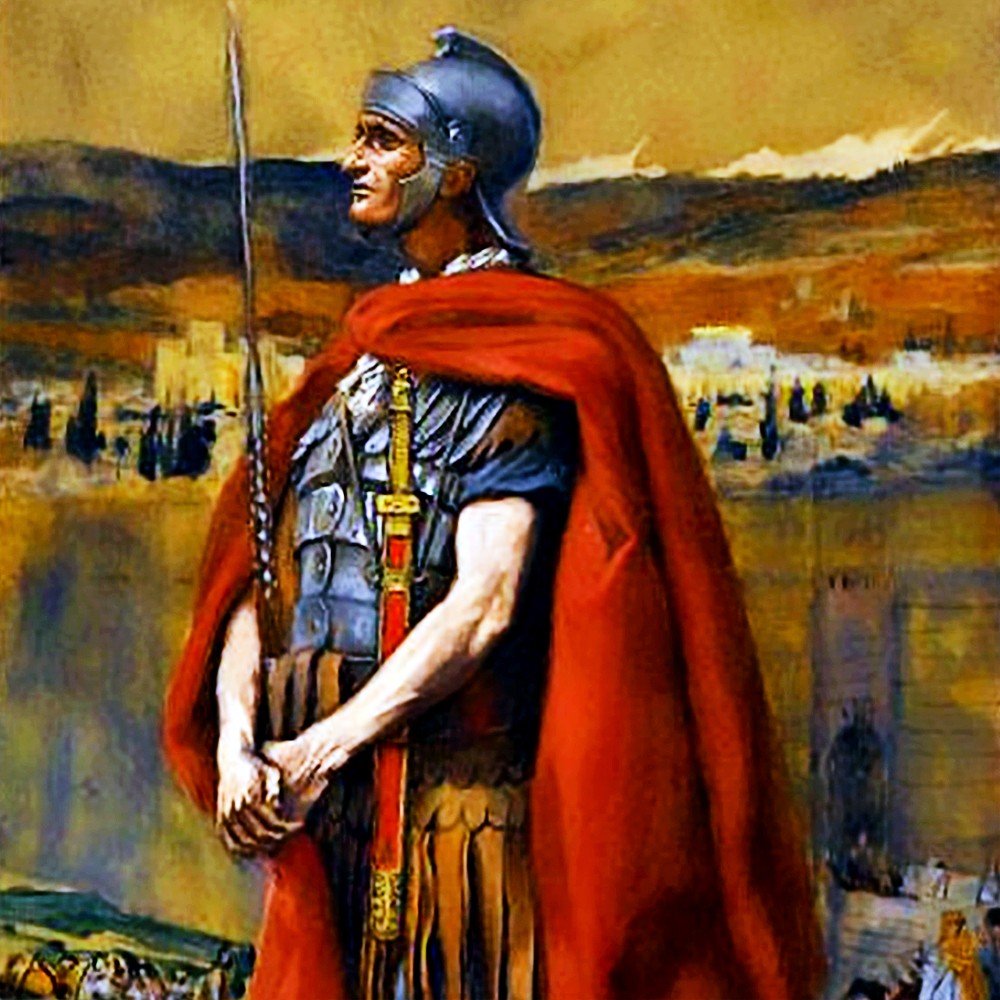
A Centurion by James Tissot (not necesarily St Cornelius)
Dedication of the Abbey of Our Lady, Pontigny, France (1114) – 20 October:
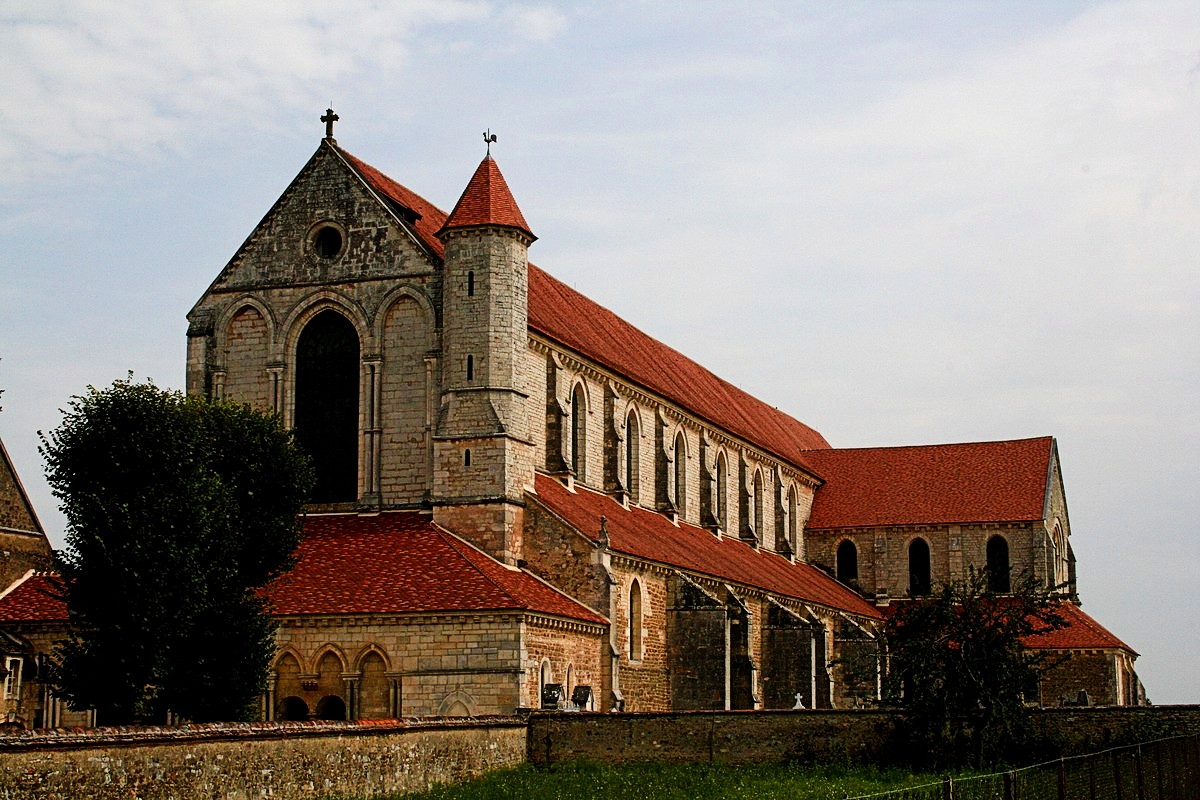
The Abbot Orsini wrote: “The Dedication of the Church of Pontigny, four leagues from Auxerre, under the title of Our Lady. This Abbey was founded in 1114 by Thibaud, Count of Champagne.”
The former abbey of Pontigny is nestled in the Serein valley in the north of Burgundy, and is one of the oldest sites of the Cistercian order. Being only the second Cistertian monastery, it was established in the year 1114 by Blessed Hugh of Macon, the companion of Saint Bernard, in this valley north of Auxerre in the French Department of Yonne. It is notable, that Hugh later became the Bishop of Auxerre.
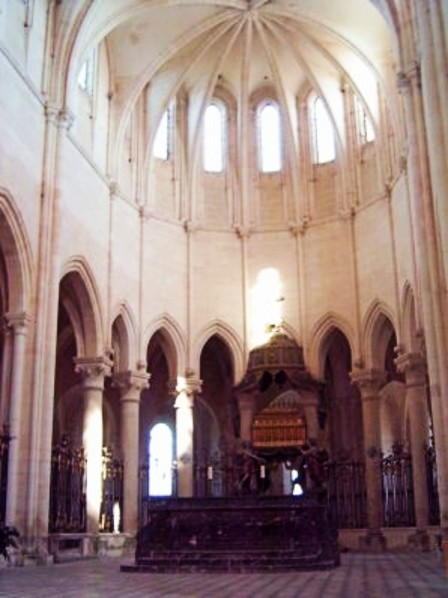
The Monks valued the land, the woods and streams they were surrounded by and cultivated large farms around their Abbey. They raised various crops, bread pigs and sheep and made terracotta bricks. It was that strong economic base that enabled them to construct the great Romanesque style Church that reached an impressive length of 120 metres that still stands intact today. In the year 1164 the Abbey received the Archbishop of Canterbury and Primate of England St Thomas à Becket while he was an exile due to his opposition to King Henry and in 1206 the Queen of France, Alix de Champagne, was buried in the choir of the Abbey. The wealthy Abbey was looted and burned by the Huguenots in about 1529 during the Wars of Religion. During the French Revolution the Abbey was suppressed, and its buildings largely sold or destroyed, save for the Church. Unlike most Churches during the time of the French Revolution, the Abbey of Pontigny is completely preserved and is now thought to be the largest Cistercian Church in France. The Church is notable for its arches and columns with twin bays, its vaults on two columns and portal with tympanum cross and wrought iron hinges. Known as the Church of Notre-Dame-et-Saint-Edme Pontigny, or Our Lady of Saint Edmond of Pontigny, the old Church Abbey monastery became the Parish Church of the village of the same name after the French Revolution. The church of Notre-Dame-et-Saint-Edme Pontigny is now abandoned and it is used simply as a kind of cultural meeting place.
St Adelina St Aderald St Aidan of Mayo St Andrew of Crete St Artemius Megalomartyr St Barsabias St Bernard of Bagnorea St Bradan St Caprasius of Agen St Cornelius the Centurion (1st Century) traditionally believed to have become th First Bishop of Caesarea
Blessed James Strepar OFM (c 1340-1409) Archbishop of Halicz, Poland from 1392 until his death Religious Priest of the Order of Friars Minor, Missionary. St Pius X proclaimed Blessed James, along with St Anthony of Padua, the Patrons of the Conventual Franciscan Order of Krakow Province. He was given the title of “Protector of the Kingdom, Defender and Guardian of the Homeland,” for his exceptional merits, including civil ones. Such was he considered by all. He was Canonised by by Pope Pius VI on 11 September 1791. His body is incorrupt. His Life: https://anastpaul.com/2020/10/20/saint-of-the-day-20-october-blessed-james-strepar-ofm-c-1340-1409/






 AnaStpaul
You must be logged in to post a comment.