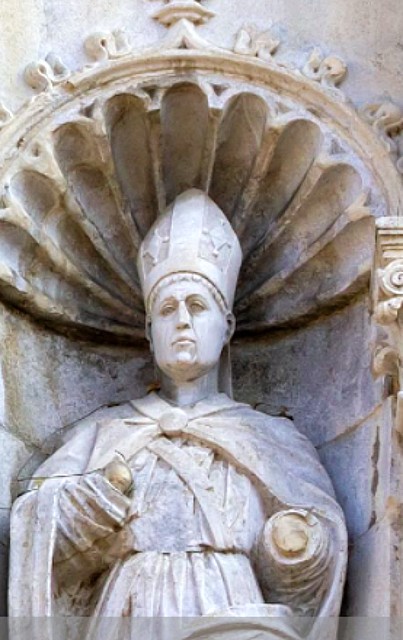
St Felix of Como (Died 390) the first Bishop of Como. Felix was a friend of Saint Ambrose, who praised him for his missionary activity and Ordained him a Priest in 379 and Consecrated him as Bishop in 386. St Ambrose sent him to evangelise the City of Como, as a testimony to the great missionary drive of the Church of Milan. St Felix is honoured as a zealous shepherd of souls. More about St Felix: https://anastpaul.com/2021/10/08/saint-of-the-day-8-october-saint-felix-of-como-died-390/
St Felix of Como (Died 390) the first Bishop of Como. Felix was a friend of Saint Ambrose, who praised him for his missionary activity and Ordained him a Priest in 379 and Consecrated him as Bishop in 386. St Ambrose sent him to evangelise the City of Como, as a testimony to the great missionary drive of the Church of Milan. St Felix is honoured as a zealous shepherd of souls. More about St Felix: https://anastpaul.com/2021/10/08/saint-of-the-day-8-october-saint-felix-of-como-died-390/
Saint of the Day – 8 October – Saint Felix of Como (Died 390) the first Bishop of Como. Felix was a friend of Saint Ambrose, who praised him for his missionary activity and Ordained him a Priest in 379 and Consecrated him as Bishop in 386. St Ambrose sent him to evangelise the City of Como, as a testimony to the great missionary drive of the Church of Milan. When St Bassianus of Lodi (c 320 – 413 – feast day 10 June) built a Church dedicated to the Apostles at Lodi, he Consecrated it in the presence of Saints Ambrose and Felix. St Felix is honoured as a zealous shepherd of souls. Additional Memorials – 31 August in Milan and 14 July on some calendars.
The Roman Martyrology states: “In Como, St Felix, Bishop, who, Ordained by St Ambrose of Milan, was the first to rule the Church of this City.”
The first document that presents Felix, is a letter from St Ambrose of Milan, from which it is noted that the recent evangelisation work of the first Bishop, Felix, although it had led to the conversion of many people, required the indispensable and constant collaboration of some co-operators: “I know well that you do not lack work in the vineyard of the Lord, especially because there are few workers with you, who can help us but, this lament is old and too well known to us: the Hand of God, however, has not shortened; He will help you in your need and will send you new workers to harvest the grain of the Lord. I thank the Lord very much, He, Who favoured you in the conversion of these souls and cordially congratulate you, hearing how many of these citizens of Como have already accepted the Catholic faith.”
From the full text of the letter, which is undated, it appears that Felix enjoyed the familiarity and paternal predilection of Saint Ambrose, who had conferred on him the Episcopal Consecration on Sunday 1 November, almost certainly in 386 and had sent him to the Consecration of the Basilica of the Apostles built by St Bassianus in Lodi, Bishop of that City, who longed for the presence of the Bishop of Como.
In another letter, of exquisitely familiar and friendly tone, commonly ascribed to the year 387, Ambrose thanks Felix for the gift of a basket of truffles but also complains that he visits him too rarely.
According to an ancient tradition, Felix would have erected the first Church of Como on the open slope of the Baradello hill, in honour of the Saints Carpoforo and fellow martyrs and in it buried their bodies.
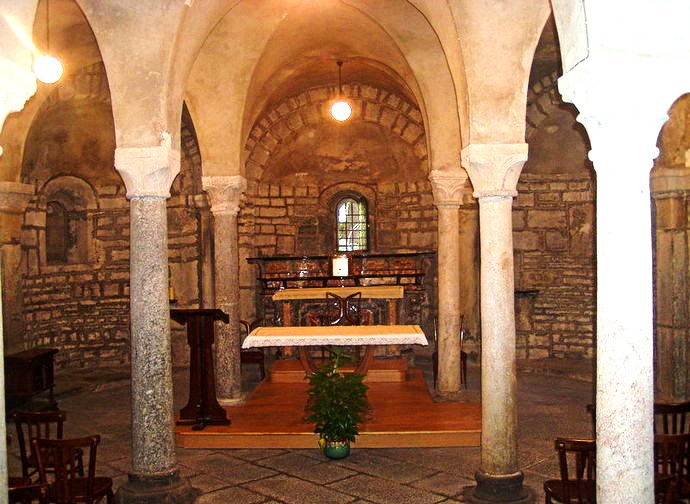
Tradition has handed down 8 October as the date of Felix’s death, also his feast day. He was buried in the primitive Church of San Carpoforo and subsequently in the enlarged Basilica of the same name, until, in 1932, his body was transferred to the new Parish Church of San Brigida, where his cult is still alive and placed under the main Altar.
A very unclear picture but it seems to be the Shrine of St Felix in the Church of St Brigid in Como
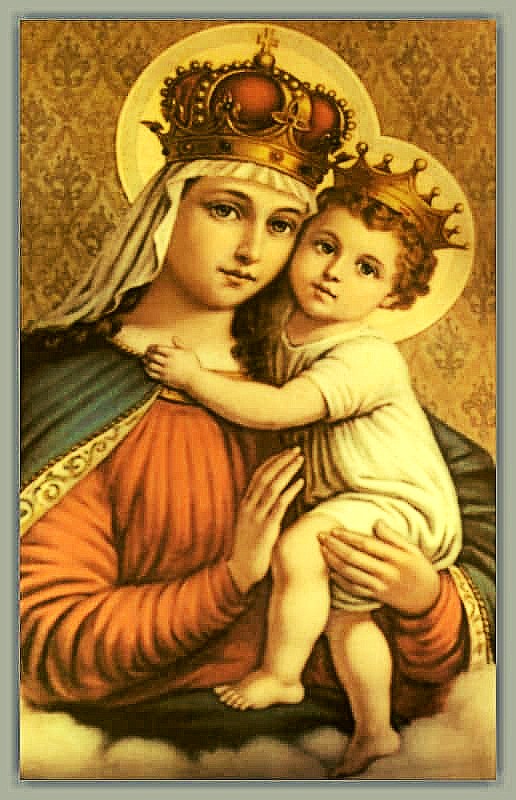
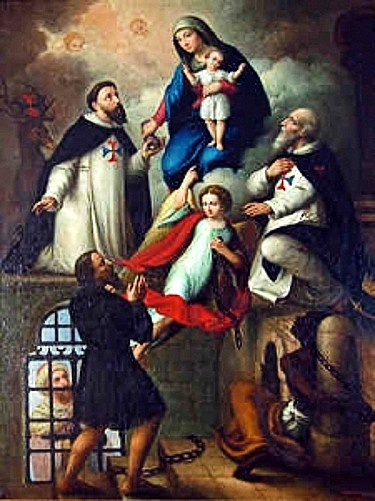
Notre-Dame du Bon Remède / Our Lady of Good Remedy, France (1197) – 8 October:
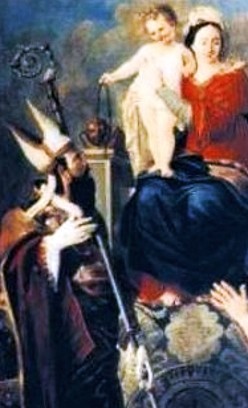
In 1197, a Sorbonne Doctor of Theology and newly Ordained Priest, Jean de Matha, while saying his first Holy Mass, saw a vision of an Angel with a red and blue cross on his chest and his hands resting on the heads of two captives. The following year, St Jean founded a religious order dedicated to the redemption of Christians held as slaves by Moslems — the Hospitaler Order of the Most Holy Trinity and of Captives, commonly called the Trinitarians. On their habit, Jean placed the Cross he had seen on the Angel,and, as their Patron, he gave them Notre-Dame du Bon Remède, a popular devotion in his Provençal homeland. Now devoted largely to education and evangelisation, for three centuries they raised funds and travelled from Europe into Africa to buy thousands of captives’ freedom with Our Lady’s help. A painting (right) in the Trinitarian Motherhouse of Cerfroid in northern France, shows Our Lady of Good Remedy giving a bag of money to St Jean/John of Matha, while a grateful freedman and St Felix of Valois, look on. The Order celebrates her feast day 8 October.
800 years ago Christians were being captured and sold into slavery by the thousands, and nobody knew what to do about it. Then, in the year 1198, a man had an idea. St. John of Matha founded the Trinitarians to go to the slave markets, buy the Christian slaves and set them free. To carry out this plan, the Trinitarians needed large amounts of money. So, they placed their fund-raising efforts under the patronage of Mary. They were so successful that, over the centuries, the Trinitarians were able to free thousands and thousands of people and to return them safely home. In gratitude for her miraculous assistance, St. John of Matha honoured Mary with the title of “Our Lady of Good Remedy.” Devotion to Mary under this ancient title is widely known in Europe and Latin America and the Church celebrates her feast day on 8 October. Our Lady of Good Remedy is often depicted as the Virgin Mary handing a bag of money to St. John of Matha. When in need – for whatever reason but especially where you have had difficulty obtaining help – invoke the aid of Our Lady of Good Remedy and you will surely experience the power of her intercession.
St Amor of Aquitaine St Artemon of Laodicia St Badilo St Benedicta of Laon St Benedicta of Origny-sur-Oise St Evodius of Rouen St Felix of Como (Died 390) Bishop St Gratus of Chalons


 AnaStpaul
You must be logged in to post a comment.