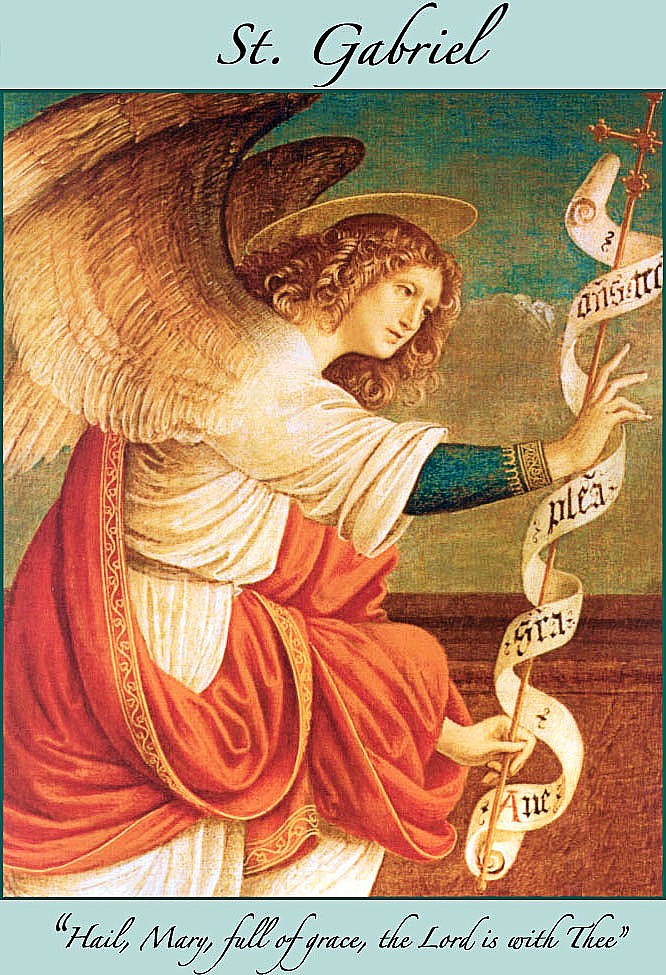
The Archangel Saint Gabriel The Feast of Saint Gabriel was included by Pope Benedict XV in the General Roman Calendar in 1921, for celebration on 24 March. The Archangel Saint Gabriel’s name means “the Power of God” He appeared to the Prophet Daniel (Dan 8:16; 9:21), to the priest Zachary to announce the forthcoming birth of Saint John the Baptist (Luke 1:11, 19) and, most importantly, to the Blessed Virgin Mary to announce the birth of Our Saviour (Luke 1:26). St Gabriel! https://anastpaul.com/2022/03/24/saint-of-the-day-24-march-the-archangel-saint-gabriel/
St Agapitus of Synnada (Died 3rd Century) Bishop of Synnada, Phrygia, in Asia Minor. Its site is now occupied by the modern Turkish Town of Suhut. We have no further information on the life of St Agapitus..
St Bernulf of Mondov Bl Bertha de’Alberti of Cavriglia Blessed Bertrada of Laon (c726-783) Married to King Pepin the Short. Queen of the Franks. Mother of Blessed Charlemagne. St Caimin of Lough Derg St Cairlon of Cashel
St Latinus of Brescia St Macartan of Clogher St Mark of Rome St Pigmenius of Rome St Romulus of North Africa St Secundus of North Africa St Seleucus of Syria St Severo of Catania St Timothy of Rome
Martyrs of Africa – 9 Saints: A group of Christians murdered for their faith in Africa, date unknown. The only details about their that survive are the names – Aprilis, Autus, Catula, Coliondola, Joseph, Rogatus, Salitor, Saturninus and Victorinus. .
Martyrs of Caesarea – 6 Saints: A group of Christians Martyred together in the persecutions of Diocletian. We know little else but six of their names – Agapius, Alexander, Dionysius, Pausis, Romulus and Timolaus. They were martyred by beheading in 303 at Caesarea, Palestine.
Friday of the Fourth Week in Lent – FAST AND ABSTINENCE
FEAST OF THE MOST PRECIOUS BLOOD OF JESUS is a Feast for the Fridays of Lent, which has been in the General Roman Calendar from 1849 to 1969 with the same Office as that of the Solemnity of the Precious Blood in July.. HERE: https://anastpaul.com/2022/07/10/the-solemnity-of-the-most-precious-blood-of-of-our-lord-jesus-christ-and-the-litany/ For many Diocese, there were two days to which the Office of the Precious Blood was assigned, the Office for both being the same. The reason was that the Office was at first granted only to the Fathers of the Most Precious Blood. Later, as one of the Offices of the Fridays of Lent, it was assigned to the Friday after the Fourth Sunday in Lent (Laetare Sunday) in some Diocese, including, by decision of the Fourth Provincial Council of Baltimore (1840), those in the United States.
The Solemnity in July is again the same Office and both Feasts (during Lent and in July) are kept in some Diocese. On 10 August of the same year, (1849) Pope Pius IX officially included the Feast of the Most Precious Blood of Our Lord Jesus Christ in the General Roman Calendar, for celebration on the first Sunday in July, that is the first Sunday after 30 June, which is the anniversary of the liberation of the City of Rome from the insurgents.
In reducing the number of Feasts fixed for Sundays, Pope Pius X assigned the date of 1 July to this Feast. In 1933, Pope Pius XI raised the Feast to the rank of Double of the 1st Class to mark the 1,900th anniversary of the Passion of Our Lord Jesus Christ.
The Archangel Saint Gabriel The Feast of Saint Gabriel was included by Pope Benedict XV in the General Roman Calendar in 1921, for celebration on 24 March. The Archangel Saint Gabriel whose name means “the Power of God. ” He appeared to the prophet Daniel (Dan 8:16; 9:21), to the priest Zachary to announce the forthcoming birth of Saint John the Baptist (Luke 1:11, 19) and to the Blessed Virgin Mary to announce the birth of Our Saviour (Luke 1:26.). St Gabriel! https://anastpaul.com/2022/03/24/saint-of-the-day-24-march-the-archangel-saint-gabriel/
St Agapitus of Synnada St Aldemar the Wise OSB (985-c1080) Priest, Abbot St Bernulf of Mondov Bl Bertha de’Alberti of Cavriglia Bl Bertrada of Laon Bl Brian O’Carolan St Caimin of Lough Derg St Cairlon of Cashel
St Latinus of Brescia St Macartan of Clogher St Mark of Rome St Pigmenius of Rome St Romulus of North Africa St Secundus of North Africa St Seleucus of Syria St Severo of Catania St Timothy of Rome
Martyrs of Africa – 9 Saints: A group of Christians murdered for their faith in Africa, date unknown. The only details about their that survive are the names – Aprilis, Autus, Catula, Coliondola, Joseph, Rogatus, Salitor, Saturninus and Victorinus. .
Martyrs of Caesarea – 6 Saints: A group of Christians Martyred together in the persecutions of Diocletian. We know little else but six of their names – Agapius, Alexander, Dionysius, Pausis, Romulus and Timolaus. They were martyred by beheading in 303 at Caesarea, Palestine.
Saint of the Day – 24 March – The Archangel Saint Gabriel. The name GABRIEL is a Hebrew name generally translated “strength of God” more accurately “my strength is in God” or “God is my strength.” Gabriel appeared to the prophet Daniel (Dan 8:16; 9:21), to the priest Zachary to announce the forthcoming birth of Saint John the Baptist (Luke 1:11, 19) and to the Blessed Virgin Mary to announce the birth of Our Saviour (Luke 1:26.). His Feast Day is celebrated today 24 March. PATRONAGES – Ambassadors, Telecommunication workers, Radio and Television Broadcasters, Messengers and Couriers, Postal workers, Clerical workers, Diplomats, Stamp Collectors, Portugal, Santander in the Cebu Province in the Philippines.
Saint Gabriel, the Archangel Abbot Prosper Guéranger OSB (1805-1875)
So far in the Church’s Calendar, we have not met with any Feast in honour of the Holy Angels. Amidst the ineffable joys of Christmas Night, we mingled our timid but glad voices with the Hymns of these heavenly Spirits, who sang around the Crib of our Emmanuel. The very recollection brings joy to our hearts, saddened as they now are by penitential feelings and by the near approach of the mournful anniversary of our Jesus’ Death. Let us, for a moment, interrupt our sadness, and keep the Feast of the Archangel Gabriel. Later on, we shall have Michael, Raphael, and the countless host of the Angel Guardians but today, it is just that we should honour Gabriel. Yes, a day hence and we shall see this heavenly Ambassador of the Blessed Trinity coming down to the Virgin of Nazareth, let us, therefore, recommend ourselves to him and beseech him to teach us how to celebrate, in a becoming manner, the grand Mystery of which he was the Messenger.
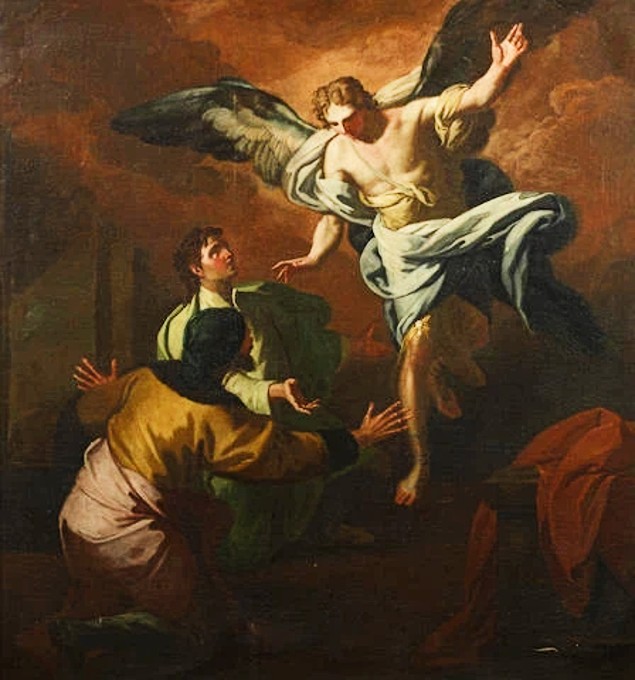
Gabriel is one of the first of the Angelic Kingdom. He tells Zachary, that he stands before the Face of God (St. Luke 1:11,19.). He is the Angel of the Incarnation because it is in this Mystery, which apparently is so humble, that the power of God is principally manifested and, Gabriel signifies the strength of God. We find the Archangel preparing for his sublime office, even in the Old Testament. First of all, he appears to Daniel, after this Prophet had had the vision of the Persian and Grecian Empires and, such was the majesty of his person, that Daniel fell on his face trembling (Dan 7:17). Shortly afterwards, he appears again to the same Prophet, telling him the exact time of the coming of the Messias: Know thou and take notice: that from the going forth of the word to build up Jerusalem again, unto Christ the Prince, there shall be seven weeks and sixty-two weeks (Ibid. 9:25), that is, sixty-nine weeks of years.
Follower Francesco Solimena The Archangel Saint Gabriel appears to the Prophet Daniel
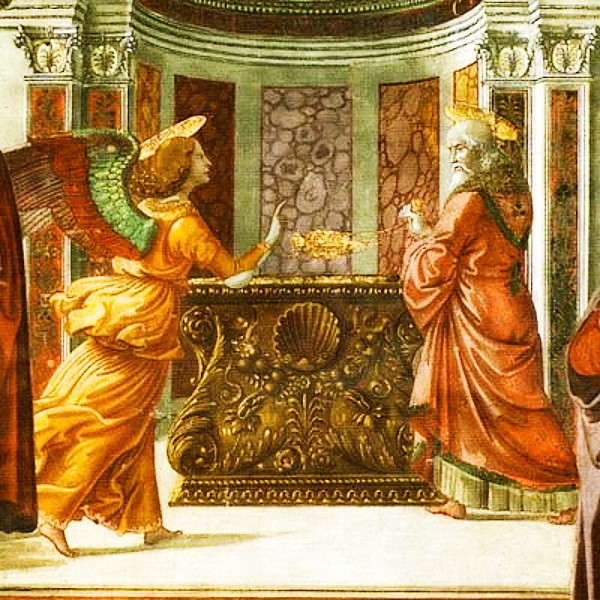
When the fulness of time had come and Heaven was about to send the last of the Prophets, he, who after preaching to men the approach of the Messias, is to show him to the people, saying: Behold the Lamb of God, who taketh away the sins of the world, Gabriel descends from Heaven to the temple of Jerusalem and prophesies to Zachary the birth of John the Baptist (Luke 1:13), which was to be followed by that of Jesus Himself.
St Gabriel appears to Zachary – Fra Angelico
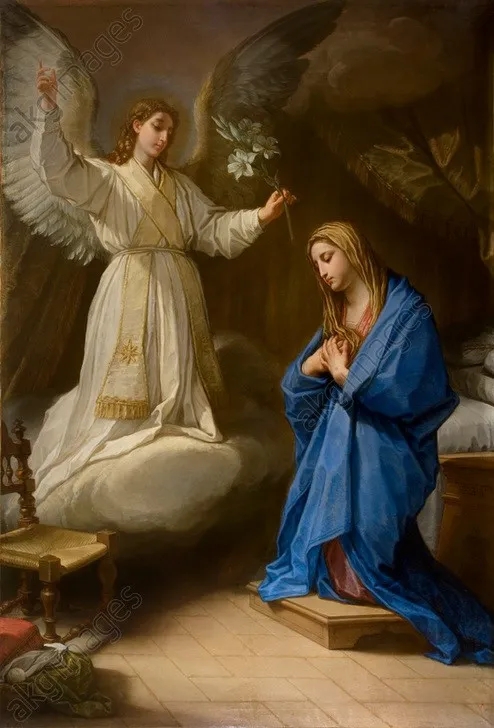
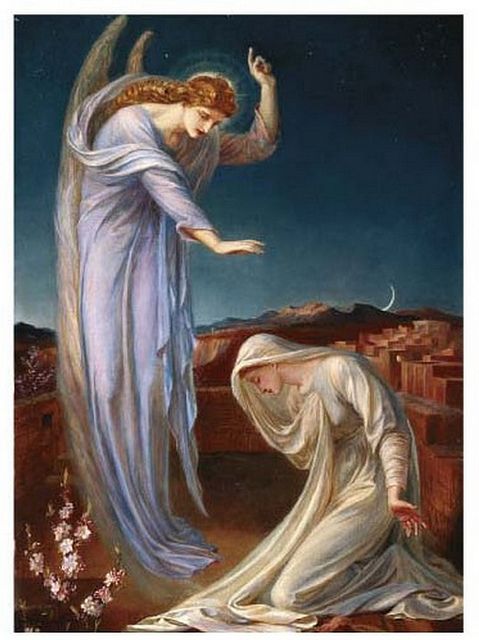
Six months later on, the holy Archangel again appears on the earth and this time it is Nazareth that he visits. He brings the great message from Heaven. Angel as he is, he reveres the humble Maid, whose name is Mary. He has been sent to her by the Most High God, to offer her the immense honour of becoming the Mother of the Eternal Word. It is Gabriel that receives the great Fiat, the consent of Mary and when he leaves this earth, he leaves it in possession of Him, for Whom it had so long prayed, in those words of Isaias: Drop down Dew, O ye Heavens (Is. 14:8.)!
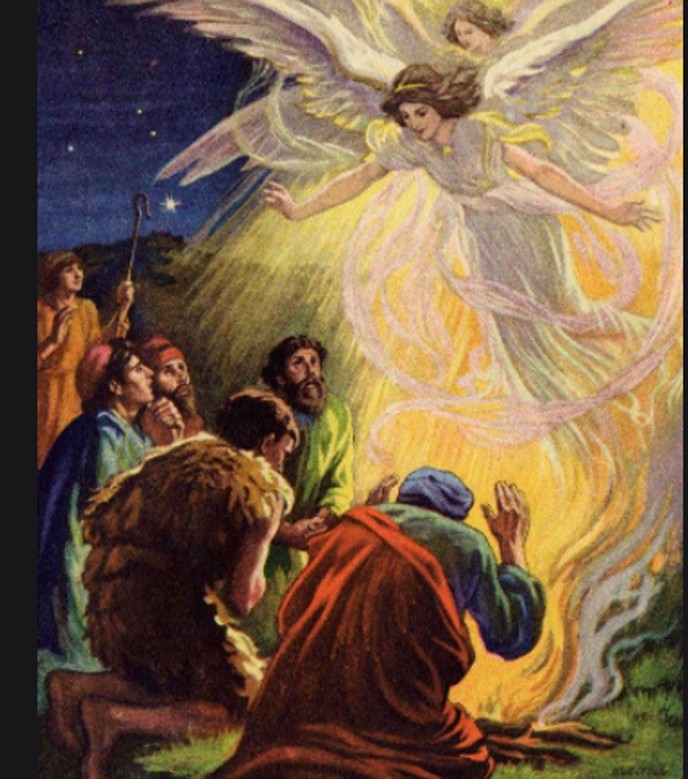
The hour at length came, when the Mother of the Emmanuel was to bring forth the Blessed Fruit of her virginal Womb. Jesus was born amidst poverty but Heaven willed that His Crib should be surrounded by fervent adorers. An Angel appeared to some Shepherds, inviting them to go to the Stable near Bethlehem. He is accompanied by a multitude of the heavenly army, sweetly singing their hymn: Glory to God in the highest and on earth peace to men of good will! Who is this Angel that speaks to the Shepherds and seems, as the chief of the other blessed Spirits that are with him? In the opinion of several learned writers, it is the Archangel Gabriel, who is keeping up his ministry as Messenger of the Good Tidings (St. Luke 2:10).
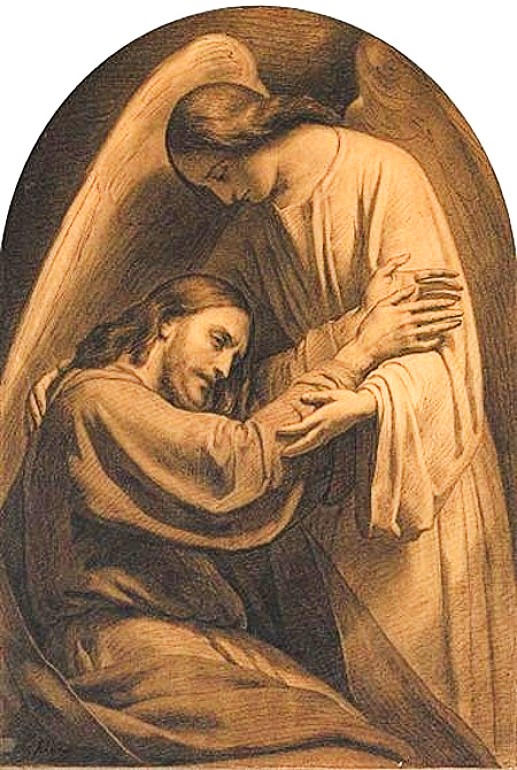
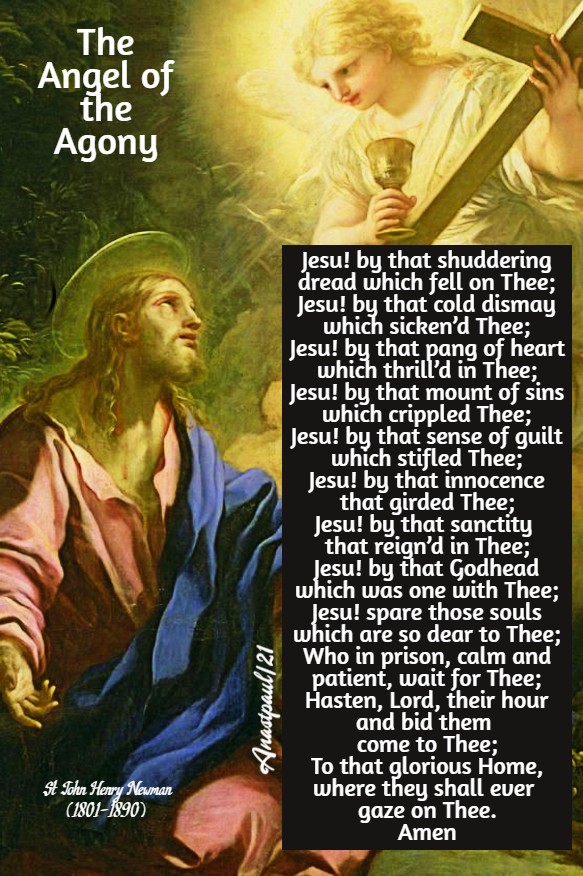
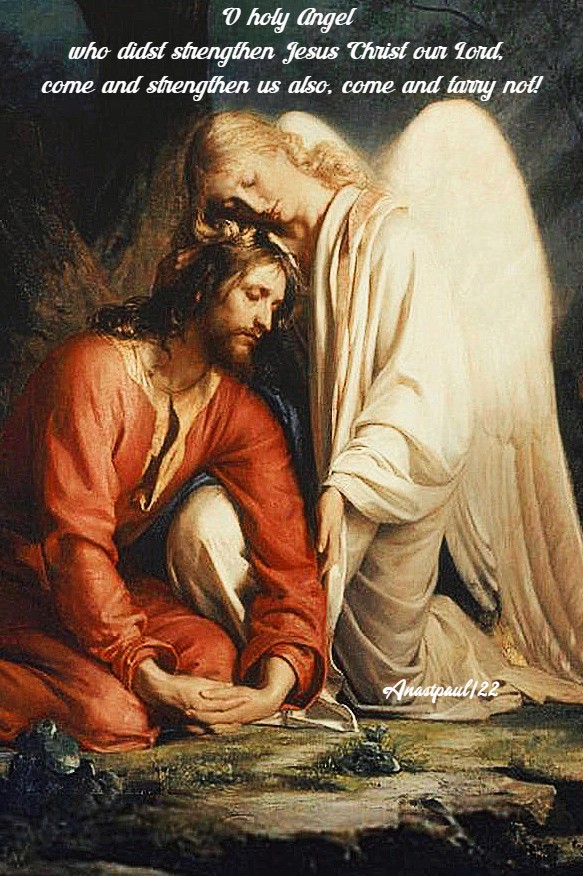
Lastly, when Jesus is suffering His Agony in the Garden of Gethsemani, an Angel appears to Him, not merely as a witness of His suffering but that He might strengthen Him, under the fear his Human Nature felt at the thought of the Chalice of the Passion He was about to drink (Ibid. 22:42, 43.). Who is this Angel? It is Gabriel, as we learn, not only from the writings of several holy and learned authors,but also, from a Hymn which the Holy See has permitted to be used in the Liturgy. …
These are the claims of the great Archangel to our veneration and love; these are the proofs he gives of his deserving his beautiful name, the Strength of God. God has employed him in each stage of the great work, in which he has chiefly manifested his power, for Jesus, even on his Cross, is the Power of God (1 Cor. 1:21.), as the Apostle tells us. Gabriel prepares the way for Jesus. He foretells the precise time of His Coming; He announces the birth of His Precursor; he is present at the solemn moment when the Word is made Flesh; he invites the Shepherds of Bethlehem to come to the Crib and adore the Divine Babe and when Jesus, in his Agony, is to receive Strength from one of His own creatures, Gabriel is found ready in the Garden of Gethsemani, as he had been at Nazareth and Bethlehem.
The Angel of the Agony John Henry Newman (1801-1890)
Jesu! by that shuddering dread which fell on Thee; Jesu! by that cold dismay which sicken’d Thee; Jesu! by that pang of heart which thrill’d in Thee; Jesu! by that mount of sins which crippled Thee; Jesu! by that sense of guilt which stifled Thee; Jesu! by that innocence that girded Thee; Jesu! by that sanctity that reign’d in Thee; Jesu! by that Godhead which was one with Thee; Jesu! spare those souls which are so dear to Thee; Who in prison, calm and patient, wait for Thee; Hasten, Lord, their hour and bid them come to Thee; To that glorious Home, where they shall ever gaze on Thee. Amen
O holy Angel who didst strengthen Jesus Christ our Lord, come and strengthen us also, come and tarry not!
The Archangel Saint Gabriel The Feast of Saint Gabriel was included by Pope Benedict XV in the General Roman Calendar in 1921, for celebration on 24 March.
St Agapitus of Synnada St Aldemar the Wise St Bernulf of Mondovi Bl Bertha de’Alberti of Cavriglia Bl Bertrada of Laon Bl Brian O’Carolan St Caimin of Lough Derg St Cairlon of Cashel
St Pigmenius of Rome St Romulus of North Africa St Secundus of North Africa St Seleucus of Syria St Severo of Catania St Timothy of Rome
Martyrs of Africa – 9 Saints: A group of Christians murdered for their faith in Africa, date unknown. The only details about their that survive are the names – Aprilis, Autus, Catula, Coliondola, Joseph, Rogatus, Salitor, Saturninus and Victorinus. .
Martyrs of Caesarea – 6 Saints: A group of Christians Martyred together in the persecutions of Diocletian. We know little else but six of their names – Agapius, Alexander, Dionysius, Pausis, Romulus and Timolaus. They were martyred by beheading in 303 at Caesarea, Palestine.





 AnaStpaul
You must be logged in to post a comment.