
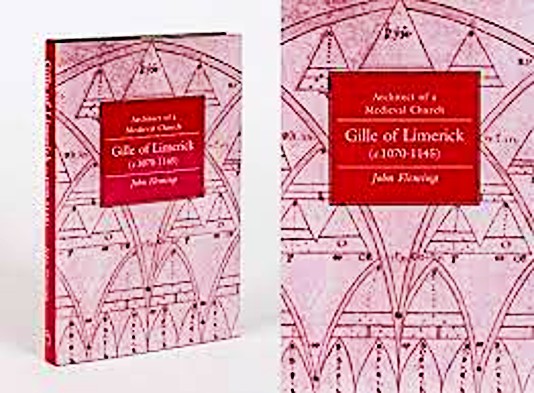
Saint of the Day – 4 February – Saint Gilbert of Limerick (c1070–1145) Bishop, Canon Lawyer, Papal Legate to Ireland appointed by the Papacy of Pope Paschal II in c1106 and also then appointed as the Bishop of Limerick, Scholar and Philsopher, Church Reformer, Unknown date or place of birth and died in Bangor, Ireland in 1145 of natural causes. Also known as – Gille, Gillebertus, Gilla, Gilli.
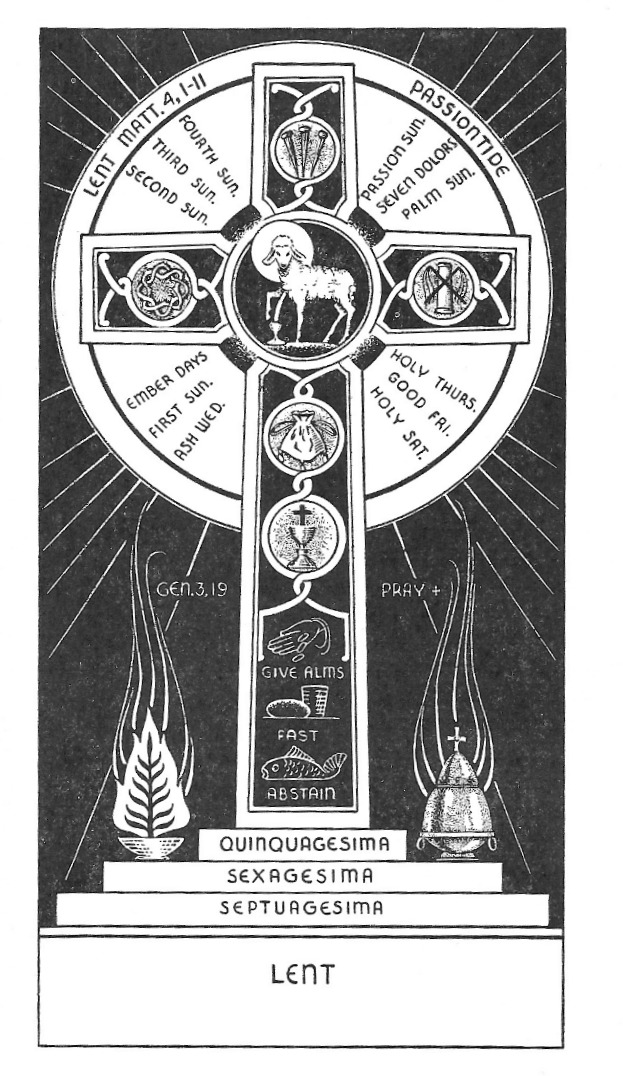
“For the early Irish Lent began on the Sunday after Ash Wednesday. Gilbert of Limerick (†1145) insisted on Ash Wednesday.” This injunction was part of the programme of Church Reform which took place in the 12th Century, reform in which St Gilbert of Limerick was deeply involved.
We know very little about Gilbert’s private history and personal life. He refers to himself both as Gille and Gillebertus. It is not even clear whether he was of Irish or Norse extraction. Is is suggests that his family roots are almost certainly in the Hibero-Norse City of Limerick, Ireland but his choice to retire to Bangor, Co. Down where he died may refer to Bangor as his birthplace.
The first record we have of Gilbert is a letter which he sent in 1106, as the Bishop of Limerick, to St Anselm, at that time the Archbishop of Canterbury, sending a gift of pearls and congratulating him on “the victory of your labours in subduing the indomitable minds of the Normans.” St Anselm’s reply states that the two “have known each other and delighted in friendship, since our time in Normandy.”` This may suggest our Gilbert had been a pupil of St Anselm in north-eastern France.
The balance of evidence suggests that Gilbert was a Papal Legate for almost all his time as the Bishop of Limerick and that he headed the Synod of Raith Bressail in 1111. According to St Bernard of Clairvaux, he was the first to be a Legate “per universam Hiberniam — throughout all Ireland.”
The Synod of Raith Bressail , in 1111,was the second aimed at reforming the Irish Church and the first to include the whole country. The first, held in Cashel in 1101, legislated against the purchase of Church positions and regulated the relationship of Church and State, of marriage laws and, of clerical celibacy.
The Synod of Raith Bressail went further, instituting for the first time, a full system of Diocese in Ireland in a hierarchy subject to a Primate of all Ireland and, through him, to the See of St Peter in Rome and the Sovereign Pontiff. This was the greatest change in the Irish Church since the 5th Century. A document, the Acta, from this Synod, gives further circumstantial evidence for Gilbert’s own origin in Limerick – Limerick is given as a model Diocese (with “St Mary’s Church” as its Cathedral Church) in a level of detail, suggesting local knowledge.
Gilbert records in his treatise ‘De Statu Ecclesiae’ that many Irish Bishops and Priests requested he explain the hierarchy he advocated.

With Saint Malchus of Waterford and Ceallach of Armagh, he helped reorganise the Church in Ireland, replacing monastic rule with that by the Bishops and Diocesan structure and advocating for a uniform Liturgy.
As a Canon Lawyer, Gilbert was working in the Paris tradition which was founded on law based on custom, rather than the compilation and reconciliation of texts as practised by the (later) Gratian. As such his style is very different, “exhortatory rather than prescriptive, encouraging rather than demanding” – very different from what we would regard as a legal text today. The law was based on a common vision of life; an inportant aspect of it was the rights and duties owed to a lord.
The Treatise itself is a commentary on a diagram (the image below) in which the hierarchical structure of the Church is shown as a pyramid, made up of further interlocking pyramids. The Pope is at the apex, balanced by the Emperor and Noah at the other two points. The pyramids below balance the Archbishop with the Duke, then the Bishop, with the Count and finally the Priest with the soldier. 15

In 1115, Gilbert is recorded as being present at the Consecration of a new Bishop of St David’s in Westminster. In 1129, St Bernard of Clairvaux records that Gilbert, along with Maek Isu of Lismore prevailed on St Malachy to accept the vacant See of Armagh and that, in 1140, Malachy became the Papal Legate due to the retirement of St Gilbert having become unwell in his old age.
Gille’s death, his only mention in the Irish annals, is recorded in 1145 in Bangor Co. Down. The ‘De Statu Ecclesiae‘ survived in two manuscripts and a prologue to it, ‘De Uso Ecclesiastico’ in three. The two parts were published by Archbishop James Ussher in 1632.


 AnaStpaul
You must be logged in to post a comment.