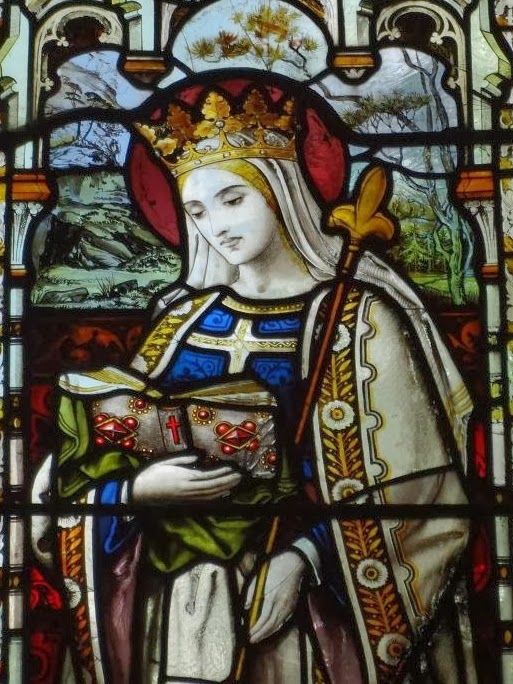
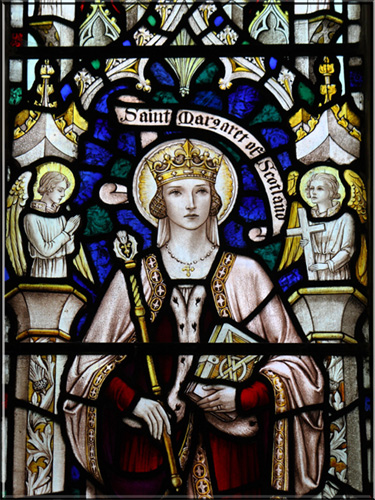
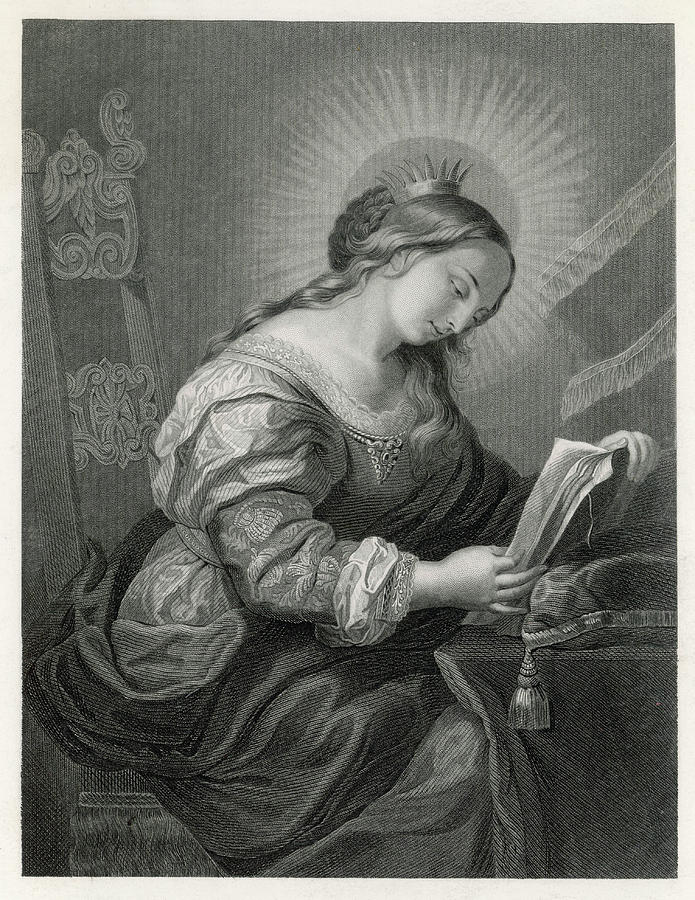
St Margaret of Scotland (1045-1093) Queen consort of Scotland, Wife and Mother, Apostle of the poor, Reformer. Saint Margaret’s name signifies “pearl” “a fitting name,” says Bishop Turgot, her Confessor and her first Biographer, “for one such as she.” Her soul was like a precious pearl. A life spent amidst the luxury of a Royal Court never dimmed its lustre, or stole it away from Him who had bought it with His Blood. Pope Innocent IV Canonised St Margaret in 1250 in recognition of her personal holiness, fidelity to the Roman Catholic Church, work for Ecclesiastical reform and charity. In 1693 Pope Innocent XII moved her feast day to 10 June but it was changed after Vatican II to 16 November. Wonderful St Margaret: https://anastpaul.com/2018/11/16/saint-of-the-day-16-november-st-margaret-of-scotland-1045-1093-queen/ AND: https://anastpaul.com/2022/06/10/saint-of-the-day-10-june-st-margaret-of-scotland-1045-1093/
Bl Amata of San Sisto St Amantius of Tivoli St Asterius of Petra St Bardo of Mainz
St Caerealis of Tivoli St Censurius of Auxerre (Died 486) Bishop St Crispulus of Rome Blessed Diana d’Andalo OP (1201-1236) Nun of the Order of Preachers Beatified on 8 August 1888 by Pope Leo XII. Bl Elisabeth Hernden Bl Elizabeth Guillen St Evermund of Fontenay St Faustina of Cyzicus Bl Gerlac of Obermarchtal St Getulius of Tivoli
St Landericus of Novalese St Landericus of Paris Bl Mary Magdalene of Carpi St Maurinus of Cologne St Primitivus of Tivoli St Restitutus of Rome Bl Thomas Green St Timothy of Prusa Bl Walter Pierson St Zachary of Nicomedia
Martyrs of North Africa – 17 Saints: A group of seventeen Christians Martyred together in North Africa; the only surviving details are two of their names – Aresius and Rogatius. Both the precise location in North Africa and the date are unknown.
Martyrs of the Aurelian Way – 23 Saints: A group of 23 Martyrs who died together in the persecutions of Aurelian. The only details that survive are three of their names – Basilides, Mandal and Tripos. c.270-275 on the Aurelian Way, Rome, Italy.
Saint of the Day – 10 June – St Margaret of Scotland (1045-1093) Queen Consort of Scotland. Born as an English Princess in c 1045 in Hungary and died on 16 November 1093 at Edinburgh Castle, Scotland, four days after her husband and son died in defence of the Castle. Patronages – against the death of children, for students in their studies, parents of large families, queens, widows, of Scotland and of Dunfermline, Scotland. Additional Memorial – 16 June in Scotland. Also known as Margaret of Wessex. Margaret was Canonised in 1251 by Pope Innocent IV.
The Roman Martyrology reads: “In Scotland, St Margaret, Queen, celebrated for her love of the poor and of her own voluntary poverty.”
St Margaret of Scotland By Fr Francis Xavier Weninger SJ (1805-1888)
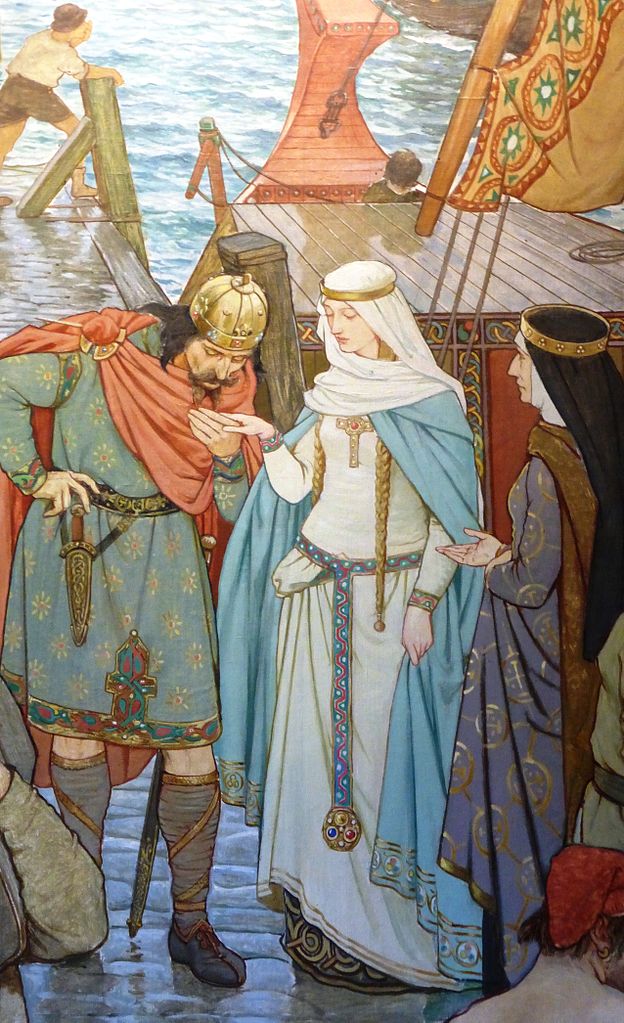
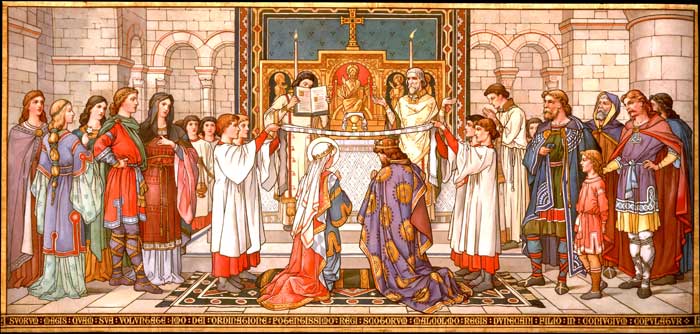
“St Margaret, Queen of Scotland, was descended by her father’s side from royalty, by her mother’s side, from imperial blood. She was born in Hungary at the time of the holy King St Stephen, at whose Court her father, Edward and her mother, Agatha resided. Her after life proved how piously she had been educated. Edward was the rightful heir to the English crown, but the power of his enemies had deprived him of it. After his death, Agatha resolved to go to England with Prince Edgar and the two Princesses Margaret and Christine, as she had been made to hope that Edgar would be placed upon the throne. A heavy storm arose when they were at sea and drove their ship to Scotland. The reigning King Malcolm, received and entertained them most kindly and making the acquaintance of the beautiful and virtuous Princess Margaret, he asked her hand in marriage. Agatha gladly consented and Margaret was obedient to her mother’s wishes. The wedding was celebrated; and Margaret, in the 24th year of her age, was crowned Queen of Scotland.
She reigned for 30 years and became famed for her wisdom and piety. On the spot where she had been crowned, she had a magnificent Church built in honour of the Holy Trinity, in order that her own and her husband’s souls might not be lost and in case she should have male heirs, she might have grace, to educate them in such a manner, that they would not sacrifice eternal life for temporal goods. She also built or restored several other Churches and Monasteries and provided them with all things necessary, She desired to have every article used in Church, most splendid and was, therefore, constantly occupied with her maids of honour, in working for the Churches.
Her conduct towards the King, her husband, was exemplary and by it, she caused him to lead a Christian life. She changed everything at the Court, in such a way, that her husband was royally served and was honoured by his subjects, with increased respect. She exhorted him particularly to be impartial in the administration of justice; to be kind and liberal to the poor but above all, to be zealous for the true faith and to uproot many abuses which had crept into his kingdom. Following her counsel, the King assembled the Bishops and represented to them, those abuses which he wished them to abolish – which was accordingly done. The Queen herself was a bright light of Christian virtues to all.
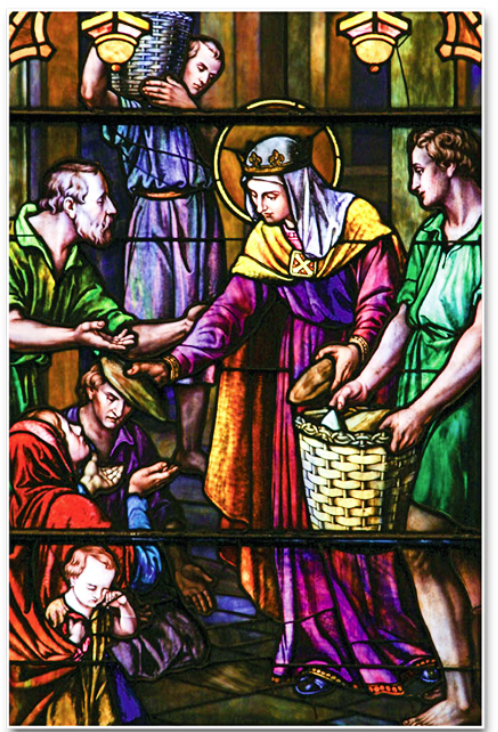
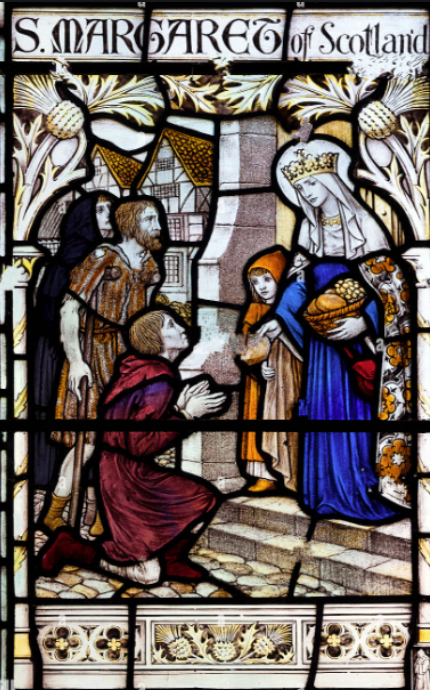
In the midst of regal splendour, she led a very austere life and was so assiduous in her prayers, that she gave to them even a part of the night. The reading of devout books was her greatest delight,and she led others to it also. To the word of God she listened with avidity and joy. She observed the prescribed fasts and besides, kept a strict abstinence of forty days before Christmas, even when she was sick. She evinced a more than motherly heart towards the poor and needy. Incredible is the amount of alms which she gave with her own hands to the poor, for whose benefit she founded many charitable institutions. She valued neither her own clothing, nor her magnificent jewels ,where the poor were concerned. Almost daily did she wash the feet of some and provide them with money Nine little orphans were at her Court, to whom she often gave food with her own hands. Three hundred poor were daily fed in the Royal hall, where she and the King frequently served them at table and at times ,kissed their feet.
The Almighty, who seldom fails to reward such deeds of kindness, even, in this life, blessed the pious Queen with many children, whom she most carefully educated. She was not content with merely giving them to the care of such, as were famed for piety and learning but, she also taught them herself, as well in reading and writing,as in virtue and the fear if God. She reproved them for the smallest faults and never allowed one to pass unpunished. One of the best admonitions which she gave them was as follows: “My children, love and fear God; for they who fear God, have not to fear death and they who love God with their whole heart, will not only be happy for the short space of time we live on this earth but, will be eternally blessed in the life to come.” She also taught them to behave most respectfully and reverentially in Church and was in this, as in all other things, a bright example to them. She would not suffer one to address a single unnecessary word to another in Church: ” For,” said she, “the Church is a place to pray and weep over our sins.”
After the pious Queen had, for many years, taken the utmost care of the education of her children and great solicitude for the welfare of the land, God revealed to her the day of her death. For nearly half a year, she suffered from a very painful sickness, which she bore with perfect submission to the divine will, manifesting an invincible patience. Having cleansed her conscience by a general confession, she told her Confessor, that she would not live much longer but that he would survive her some years. She then requested him, first, that he would remember her in saying Mass as long as he lived and secondly, that he would take all possible pains in the further instruction of her children. Four days before her death, the King was murdered, at the siege of the castle of Allwick. One of the royal Princes arrived to inform his mother of the sad news. She asked him, before he had time to speak, how her husband was but he, seeing how ill she was, would have concealed the fact from her, fearing rightly, that agitation and grief would shorten her days. She, however, said: “My son, I know the worst but request you, by the love you owe me as your mother, to acquaint me with the whole occurrence.“
These words obliged the Prince to speak. Having given her an account of the melancholy event, the Christian heroine raised her heart and eyes to Heaven and exclaimed: “I praise Thee and give thanks to Thee, O great God, that it has pleased Thee to send me this great cross before my end, in order that by patiently bearing it, I may pay the debt I still owe Thee on account of my sins.” Soon after, she repeated the most fervent exercises of virtue and said at last: “Jesus Christ! Thou Who hast given life to the world by Thy death, release me from the bonds of the flesh and take my soul into everlasting joy.”
Having pronounced these words, she ended her holy life. Her face, which from austere fasting and long sickness, was emaciated and pale, shone, soon after her death, with a wonderful beauty. The many and great miracles which God wrought in favour of those who invoked the holy Queen, prove how powerful, is her intercession at the Throne of the Almighty.”
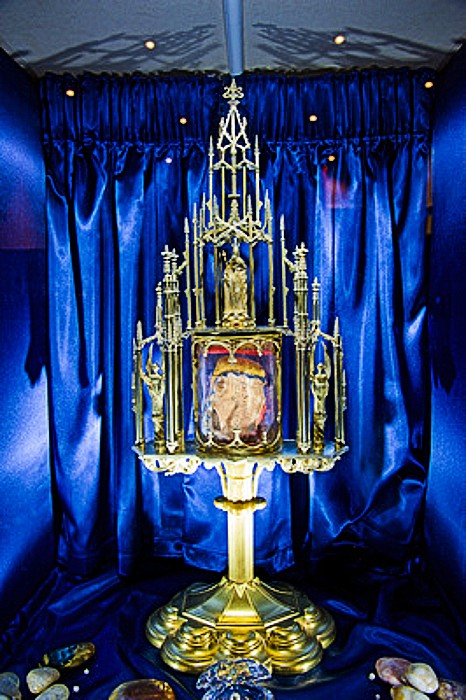
St Margaret’s Memorial Church is the home of a precious first-class Relic of St Margaret of Scotland. This Relic (a shoulder bone of the Saint) was returned to Dunfermline on the Feast Day of St Margaret in 2008 after appropriate negotiation with Church authorities by Father David Barr, Parish Priest at the time. The relic had been in the care of the Ursuline Sisters (based in Edinburgh) for some 145 years prior to this but was now returned home. The transfer of a reliquary holding the relic was made during the solemn celebration of Mass in St Margaret’s by Cardinal Keith O’Brien together with Father Barr.
St Margaret of Scotland (1045-1093) Queen consort of Scotland, Wife and Mother, Apostle of the poor, Reformer. Saint Margaret’s name signifies “pearl” “a fitting name,” says Bishop Turgot, her Confessor and her first Biographer, “for one such as she.” Her soul was like a precious pearl. A life spent amidst the luxury of a Royal Court never dimmed its lustre, or stole it away from Him who had bought it with His Blood. Pope Innocent IV Canonised St Margaret in 1250 in recognition of her personal holiness, fidelity to the Roman Catholic Church, work for Ecclesiastical reform and charity. In 1693 Pope Innocent XII moved her feast day to 10 June but it was changed after Vatican II to 16 November. Wonderful St Margaret: https://anastpaul.com/2018/11/16/saint-of-the-day-16-november-st-margaret-of-scotland-1045-1093-queen/
Bl Amata of San Sisto St Amantius of Tivoli St Asterius of Petra St Bardo of Mainz
St Caerealis of Tivoli St Censurius of Auxerre St Crispulus of Rome Bl Elisabeth Hernden Bl Elizabeth Guillen St Evermund of Fontenay St Faustina of Cyzicus Bl Gerlac of Obermarchtal St Getulius of Tivoli
Bl José Manuel Claramonte Agut St Landericus of Novalese St Landericus of Paris Bl Mary Magdalene of Carpi St Maurinus of Cologne St Primitivus of Tivoli St Restitutus of Rome Bl Thomas Green St Timothy of Prusa Bl Walter Pierson St Zachary of Nicomedia
Martyrs of North Africa – 17 Saints: A group of seventeen Christians Martyred together in North Africa; the only surviving details are two of their names – Aresius and Rogatius. Both the precise location in North Africa and the date are unknown.
Martyrs of the Aurelian Way – 23 Saints: A group of 23 Martyrs who died together in the persecutions of Aurelian. The only details that survive are three of their names – Basilides, Mandal and Tripos. c.270-275 on the Aurelian Way, Rome, Italy.
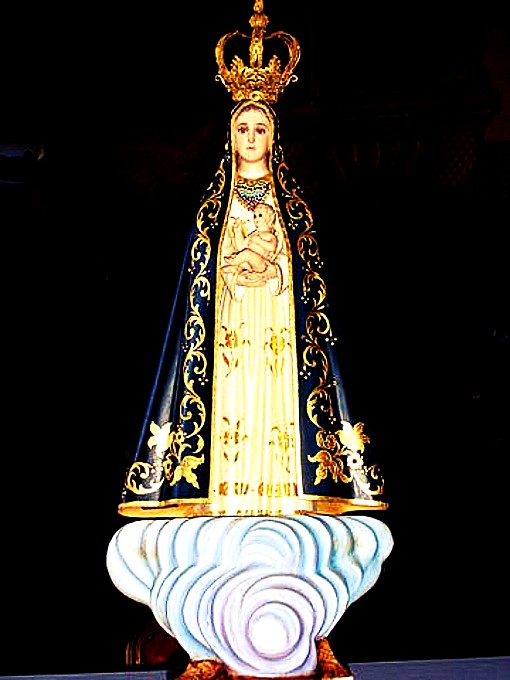
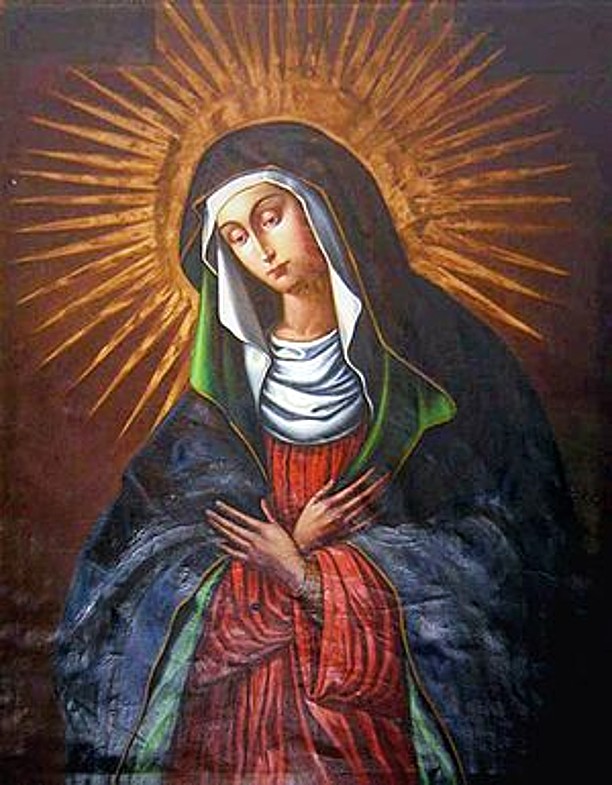
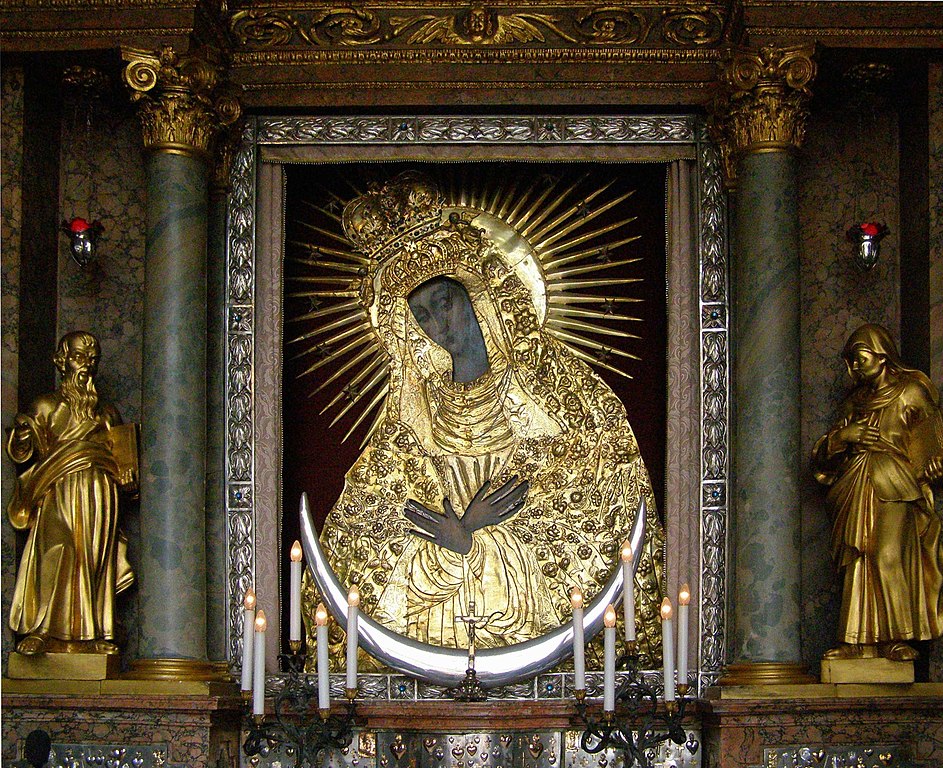
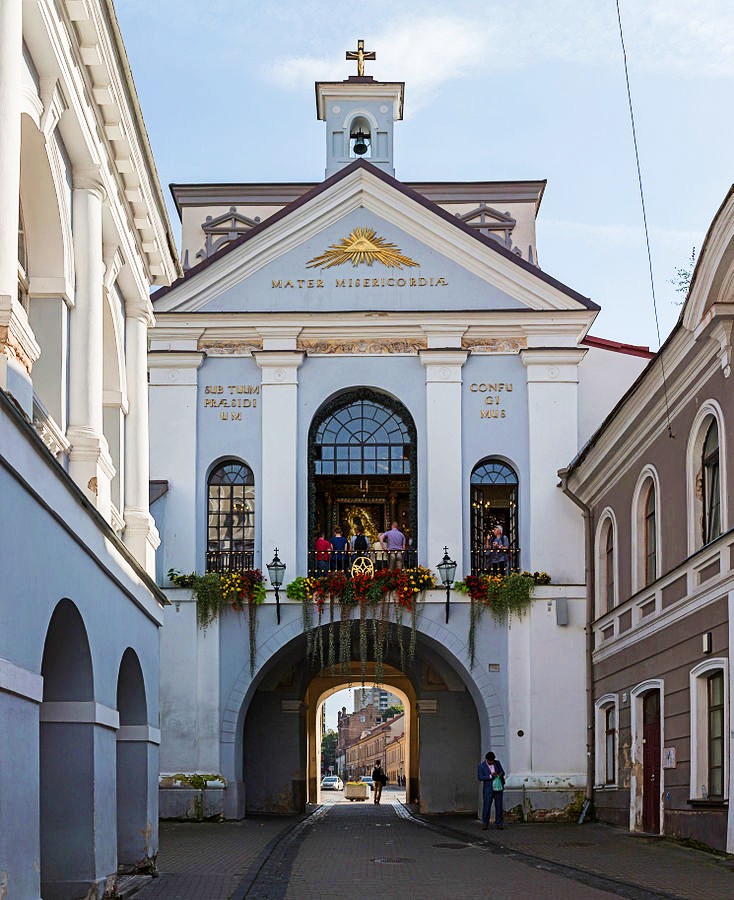
Our Lady of the Gate of Dawn / Our Lady of Ostra, Brama, Vilnius, Lithuania (1363) – 16 November:
This Marian Title is the prominent Catholic painting of the Blessed Virgin Mary venerated by the faithful in the Chapel of the Gate of Dawn in Vilnius, Lithuania. The painting was historically displayed above the Vilnius City Gate; city gates of the time often contained religious artefacts intended to ward off attacks and bless passing travellers. The painting is in the Northern Renaissance style and was completed most likely around 1630. The Virgin Mary is depicted without the infant Jesus. The artwork soon became known as miraculous and inspired a following. A dedicated Chapel was built in 1671 by the Discalced Carmelites. At the same time, the painting was covered in expensive and elaborate silver and gold clothes leaving only the face and hands visible.
In 1702, when Vilnius was captured by the Swedish army during the Great Northern War, Our Lady of the Gate of Dawn came to her people’s rescue. At dawn, the heavy iron of the Gate collapsed, crushing and killing four Swedish soldiers. After this, the Polish-Lithuanian Commonwealth Army successfully counter-attacked near the gate. In the following centuries, the cult grew and Our Lady became an important part of religious life in Vilnius. This inspired many copies in Lithuania, Poland and diaspora communities worldwide. On 5 July 1927, the image was canonically crowned as Mother of Mercy. It is a major site of pilgrimage in Vilnius and attracts many visitors, especially from Poland.
Patronage of Our Lady: Feast permitted by a 1679 Decree of the Sacred Congregation of Rites for all Provinces of Spain, in memory of the victories obtained there over infidels. Pope Benedict XIII granted it to the Papal States and it may now be celebrated with due permission by Churches throughout the world.
Bl Edward Osbaldeston St Elpidius the Martyr St Eucherius of Lyon St Eustochius the Martyr St Felicita of Capua St Fidentius of Padua St Gobrain of Vannes St Ludre St Marcellus the Martyr St Othmar of Saint Gal Bl Simeon of Cava — Martyrs of Africa – (11 saints)
Martyrs of Almeria – (9 saints): Soon after the start of the Spanish Civil War in 1936, the Communist-oriented Popular Front had all clergy and religious arrested and abused as they considered staunch Christians to be enemies of the revolution. Many of these prisoners were executed for having promoted the faith and this memorial remembers several of them killed in the province of Almeria. • Adrián Saiz y Saiz • Bienvenido Villalón Acebrón • Bonifacio Rodríguez González • Diego Ventaja Milán • Eusebio Alonso Uyarra • Isidoro Primo Rodríguez • Justo Zariquiegui Mendoza • Manuel Medina Olmos • Marciano Herrero Martínez
Patronage of Our Lady: Feast permitted by a 1679 decree of the Sacred Congregation of Rites for all provinces of Spain, in memory of the victories obtained there over infidels. Pope Benedict XIII granted it to the Papal States and it may now be celebrated with due permission by churches throughout the world.
Our Lady of the Gate of Dawn/Our Lady of Ostra Brama: is the prominent Catholic painting of the Blessed Virgin Mary venerated by the faithful in the Chapel of the Gate of Dawn in Vilnius, Lithuania. The painting was historically displayed above the Vilnius city gate; city gates of the time often contained religious artefacts intended to ward off attacks and bless passing travellers.
The painting is in the Northern Renaissance style and was completed most likely around 1630. The Virgin Mary is depicted without the infant Jesus. The artwork soon became known as miraculous and inspired a following. A dedicated chapel was built in 1671 by the Discalced Carmelites. At the same time, possibly borrowing from the Eastern Orthodox tradition, the painting was covered inexpensive and elaborate silver and gold clothes leaving only the face and hands visible.
In 1702, when Vilnius was captured by the Swedish army during the Great Northern War, Our Lady of the Gate of Dawn came to her people’s rescue. At dawn, the heavy iron city gates of the gate fell crushing and killing four Swedish soldiers. After this, the Polish-Lithuanian Commonwealth Army successfully counter-attacked near the gate.
In the following centuries, the cult grew and Our Lady became an important part of religious life in Vilnius. This inspired many copies in Lithuania, Poland and diaspora communities worldwide. On 5 July 1927, the image was canonically crowned as Mother of Mercy. The chapel was visited by St Pope John Paul II in 1993. It is a major site of pilgrimage in Vilnius and attracts many visitors, especially from Poland.
St Afan of Wales
St Africus of Comminges
Bl Agnes of Assisi
St Agostino of Capua
St Alfric of Canterbury
St Anianus of Asti
St Céronne St Edmund Rich of Abingdon (1175-1240)
Bl Edward Osbaldeston
St Elpidius the Martyr
St Eucherius of Lyon
St Eustochius the Martyr
St Felicita of Capua
St Fidentius of Padua
St Gobrain of Vannes
St Ludre
St Marcellus the Martyr
St Othmar of Saint Gal
Bl Simeon of Cava
—
Martyrs of Africa – (11 saints)
Martyrs of Almeria – (9 saints): Soon after the start of the Spanish Civil War in 1936, the Communist-oriented Popular Front had all clergy and religious arrested and abused as they considered staunch Christians to be enemies of the revolution. Many of these prisoners were executed for having promoted the faith and this memorial remembers several of them killed in the province of Almeria.
• Adrián Saiz y Saiz
• Bienvenido Villalón Acebrón
• Bonifacio Rodríguez González
• Diego Ventaja Milán
• Eusebio Alonso Uyarra
• Isidoro Primo Rodríguez
• Justo Zariquiegui Mendoza
• Manuel Medina Olmos
• Marciano Herrero Martínez
Beatification – 10 October 1993 by St Pope John Paul II
Thought for the Day – 16 November – The Memorial of St Margaret of Scotland (1045-1093)
Margaret was not only a queen but a mother. She and Malcolm had six sons and two daughters. Margaret personally supervised their religious instruction and other studies.
Although she was very much caught up in the affairs of the household and country, she remained detached from the world. Her private life was austere. She had certain times for prayer and reading Scripture. She ate sparingly and slept little, in order to have time for devotions. She and Malcolm kept two Lents, one before Easter and one before Christmas. During these times, she always rose at midnight for Mass. On the way home, she would wash the feet of six poor persons and give them alms. She was always surrounded by beggars in public and never refused them. It is recorded, that she never sat down to eat without first feeding nine orphans and 24 adults.
There are two ways to be charitable – the “clean way” and the “messy way.” The “clean way” is to give money or clothing to organisations that serve the poor. The “messy way” is dirtying your own hands in personal service to the poor. Margaret’s outstanding virtue, was her love of the poor. Although very generous with material gifts, Margaret also visited the sick and nursed them with her own hands. She and her husband served orphans and the poor on their knees during Advent and Lent. Like Christ, she was charitable the “messy way.”
Saint of the Day – 16 November – St Margaret of Scotland (1045-1093) Queen consort of Scotland – born in c 1045 in Hungary and died on 16 November 1093 at Edinburgh Castle, Scotland, four days after her husband and son died in defense of the castle. Patronages – Scotland, Dunfermline, Fife, Shetland, The Queen’s Ferry, queens, widows, against the death of children and Anglo-Scottish relations. St Margaret was the mother of three kings of Scotland, or four, if Edmund of Scotland, who ruled with his uncle, Donald III, is counted and of a queen consort of England. According to the Vita S. Margaritae (Scotorum) Reginae (Life of St Margaret, Queen (of the Scots), attributed to Turgot of Durham, she died at Edinburgh Castle in Edinburgh, Scotland in 1093, merely days after receiving the news of her husband’s death in battle.
Saint Margaret’s name signifies “pearl” “a fitting name,” says Bishop Turgot, her confessor and her first biographer, “for one such as she.” Her soul was like a precious pearl. A life spent amidst the luxury of a royal court never dimmed its lustre, or stole it away from him who had bought it with his blood. She was the grand-daughter of an English king and in 1070 she became the bride of Malcolm and reigned Queen of Scotland till her death in 1093.
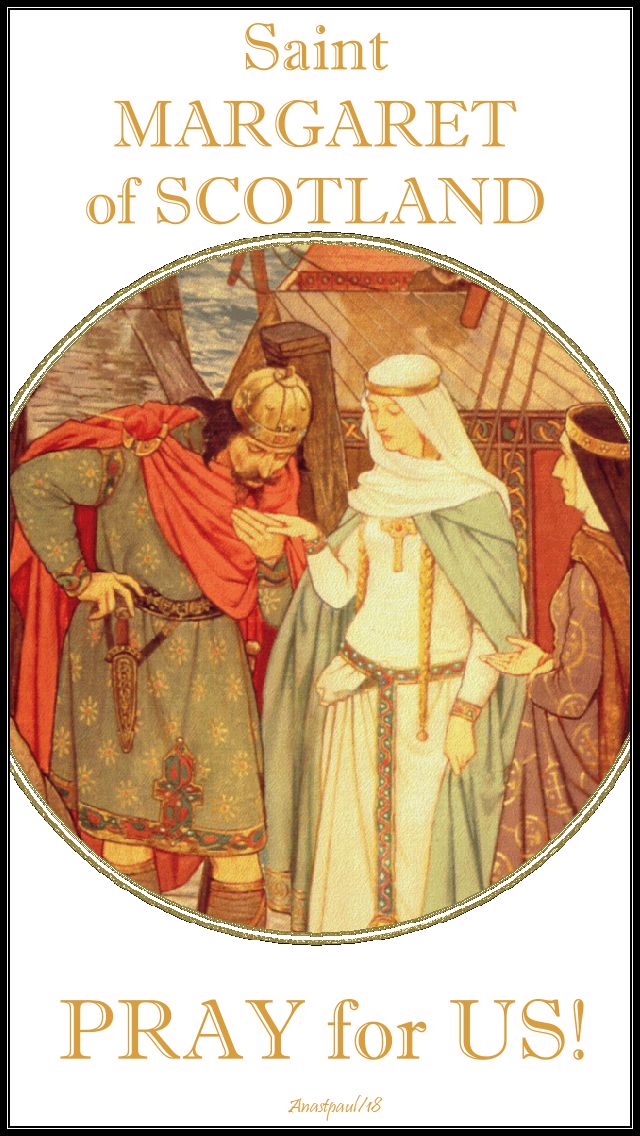
Malcolm greeting Margaret at her arrival in Scotland – detail of a mural by Victorian artist William Hole
How did she become a Saint in a position where sanctity is so difficult?
Margaret’s biographer Turgot of Durham, Bishop of St Andrew’s, credits her with having a civilising influence on her husband Malcolm by reading him narratives from the Bible. She instigated religious reform, striving to conform the worship and practices of the Church in Scotland to those of Rome. This she did on the inspiration and with the guidance of Lanfranc, a future Archbishop of Canterbury. She also worked to conform the practices of the Scottish Church to those of the continental Church, which she experienced in her childhood. Due to these achievements, she was considered an exemplar of the “just ruler” and moreover influenced her husband and children, especially her youngest son, the future King David I of Scotland, to be just and holy rulers.
“The chroniclers all agree in depicting Queen Margaret as a strong, pure, noble character, who had very great influence over her husband and through him over Scottish history, especially in its ecclesiastical aspects. Her religion, which was genuine and intense, was of the newest Roman style and to her are attributed a number of reforms by which the Church [in] Scotland was considerably modified from the insular and primitive type which down to her time it had exhibited. Among those expressly mentioned are a change in the manner of observing Lent, which thenceforward began as elsewhere on Ash Wednesday and not as previously on the following Monday and the abolition of the old practice of observing Saturday (Sabbath), not Sunday, as the day of rest from labour (see Skene’s Celtic Scotland, book ii chap. 8).” The later editions of the Encyclopædia Britannica, however, as an example, the Eleventh Edition, remove Skene’s opinion that Scottish Catholics formerly rested from work on Saturday, something for which there is no historical evidence. Skene’s Celtic Scotland, vol. ii, chap. 8, pp. 348–350, quotes from a contemporary document regarding Margaret’s life but his source says nothing at all of Saturday Sabbath observance but rather says St Margaret exhorted the Scots to cease their tendency “to neglect the due observance of the Lord’s day.”
She attended to charitable works, serving orphans and the poor every day before she ate and washing the feet of the poor in imitation of Christ. She rose at midnight every night to attend the liturgy. She successfully invited the Benedictine Order to establish a monastery in Dunfermline, Fife in 1072 and established ferries at Queensferry and North Berwick to assist pilgrims journeying from south of the Firth of Forth to St Andrew’s in Fife. She used a cave on the banks of the Tower Burn in Dunfermline as a place of devotion and prayer. St Margaret’s Cave, now covered beneath a municipal car park, is open to the public. Among other deeds, Margaret also instigated the restoration of Iona Abbey in Scotland. She is also known to have interceded for the release of fellow English exiles who had been forced into serfdom by the Norman conquest of England.
Margaret was as pious privately, as she was publicly. She spent much of her time in prayer, devotional reading and ecclesiastical embroidery. This apparently had considerable effect on the more uncouth Malcolm, who was illiterate – he so admired her piety that he had her books decorated in gold and silver. One of these, a pocket gospel book with portraits of the Evangelists, is in the Bodleian Library in Oxford, England.[8]
Malcolm was apparently largely ignorant of the long-term effects of Margaret’s endeavours. He was content for her to pursue her reforms as she desired, which was a testament to the strength of and affection in their marriage.
St Margaret did not neglect her duties in the world because she was not of it. Never was a better mother. She spared no pains in the education of her eight children, 6 sons and 2 daughters and their sanctity was the fruit of her prudence and her zeal. Never was a better queen. She was the most trusted counsellor of her husband and she laboured for the material improvement of the country.
Her husband Malcolm III, and their eldest son Edward, were killed in the Battle of Alnwick against the English on 13 November 1093. Her son Edgar was left with the task of informing his mother of their deaths. Not yet 50 years old, Margaret died on 16 November 1093, three days after the deaths of her husband and eldest son. The cause of death was reportedly grief. After receiving Holy Viaticum, she was repeating the prayer from the Missal, “O Lord Jesus Christ, who by thy death didst give life to the world, deliver me.”At the words “deliver me,” says her biographer, she took her departure to Christ, the Author of true liberty.
She was buried before the high altar in Dunfermline Abbey in Fife, Scotland. In 1250, the year of her Canonisation, by Pope Innocent IV, her body and that of her husband were exhumed and placed in a new shrine in the Abbey. Her relics were dispersed after the Scottish Reformation and subsequently lost. Mary, Queen of Scots, at one time owned her head, which was subsequently preserved by Jesuits in the Scottish College, Douai, France, from where it was lost during the French Revolution.





 AnaStpaul
You must be logged in to post a comment.