One Minute Reflection – 25 March – The Solemnity of the Annunciation of the Lord, Readings: Isaiah 7:10-14; 8: 10, Psalms 40:7-8,8-9, 10, 11, Hebrews 10:4-10, Luke 1:26-38
“Hail, full of grace!” – Luke 1:28
REFLECTION – “This woman will be the Mother of God, the door to light, source of life; she will reduce to oblivion the judgement that weighed on Eve. “The rich among the people seek the face” of this woman, “the kings of the nations shall pay her homage,” they shall “offer gifts”… yet the glory of the Mother of God is an interior glory – the fruit of her womb.
O woman, so worthy of love, thrice happy, “blessed are you among women and blessed is the fruit of your womb.” Daughter of David the king and Mother of God, King of the universe, masterpiece in whom the Creator rejoices… you are to be nature’s full achievement. For you, life is not yours; you were not born for yourself alone but your life is to be God’s. You came into the world for Him, you will serve for the salvation of all people, fulfilling God’s design established from the beginning – the incarnation of the Word and our own divinisation. Your whole desire is to feed on the words of God, to be strengthened by their sap, like “a green olive tree in the house of God,” “like a tree planted by running water,” you are the “tree of life” who “yielded its fruit in due season”…
He who is infinite, limitless, came to dwell in your womb, God, the Child Jesus, was nourished by your milk. You are the ever virginal doorway of God; your hands hold your God; your lap is a throne raised up above the cherubim… You are the wedding chamber of the Spirit, the “city of the living God, gladdened by the runlets of the stream,” that is to say, the waves of the Spirit’s gifts. You are “all fair, the Beloved” of God.” – St John Damascene (675-749) Monk, Theologian, Father and Doctor of the Church – Homily on the Nativity of the Virgin, § 9 ; SC 80 ( Biblical references : Ps 44[45],13; 71[72],11.10; Mt 2,11; Lk 1,42; Is 62,5; Ps 51[52],10; 1,3; cf Gn 2,9, Rv 22,2; cf Ez 44,2; Ps 79[80],2; cf Sg 1,4; Ps 45[46],5; Sg 4,7)
PRAYER – Shape us in the likeness of the Divine nature of our Redeemer, whom we believe to be true God and true man, since it was Your will, Lord God, that He, Your Word, should take to Himself, our human nature in the womb of the Blessed Virgin Mary. We make our prayer through our Lord Jesus, in the unity of the Holy Spirit, God for always and forever, amen.
Our Morning Offering – 25 March – The Solemnity of the Annunciation of the Lord
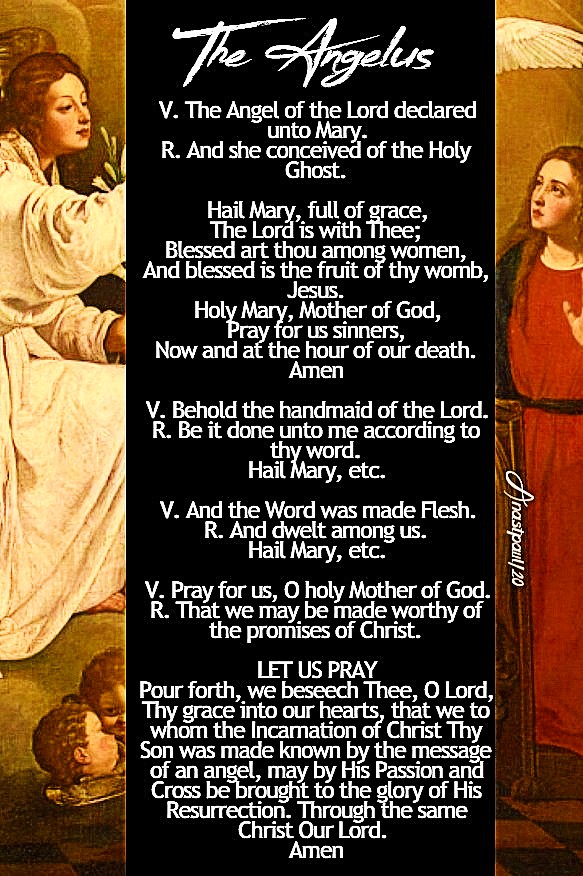
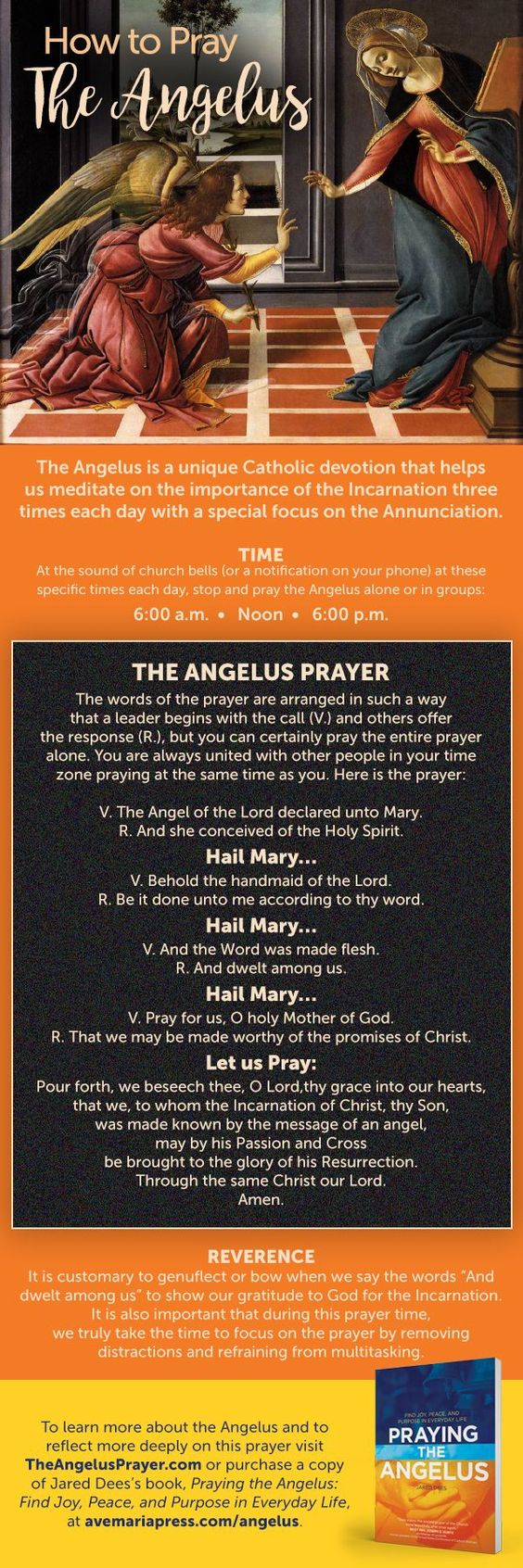
The Angelus
V. The Angel of the Lord declared unto Mary. R. And she conceived of the Holy Spirit. Hail Mary, full of grace, The Lord is with Thee; Blessed art thou among women, And blessed is the fruit of thy womb, Jesus. Holy Mary, Mother of God, Pray for us sinners, Now and at the hour of our death. Amen V. Behold the handmaid of the Lord. R. Be it done unto me according to thy word. Hail Mary, etc. V. And the Word was made Flesh. R. And dwelt among us. Hail Mary, etc. V. Pray for us, O holy Mother of God. R. That we may be made worthy of the promises of Christ. LET US PRAY Pour forth, we beseech Thee, O Lord, Thy grace into our hearts, that we to whom the Incarnation of Christ Thy Son was made known by the message of an angel, may by His Passion and Cross be brought to the glory of His Resurrection. Through the same Christ Our Lord. Amen
A tradition, which has come down from the apostolic ages, tells us that the great mystery of the Incarnation, was achieved on the twenty-fifth day of March. It was at the hour of midnight, when the most holy Virgin was alone and absorbed in prayer, that the Archangel Gabriel appeared before her and asked her, in the name of the Blessed Trinity, to consent to become the Mother of God. Let us assist, in spirit, at this wonderful interview between the angel and the Virgin: and, at the same time, let us think of that other interview which took place between Eve and the serpent. A holy Bishop and Martyr of the second century, Saint Irenaeus, who had received the tradition from the very disciples of the Apostles, shows us that Nazareth, is the counterpart of Eden.
In the garden of delights there is a virgin and an angel and a conversation takes place-between them. At Nazareth a virgin is also addressed by an angel and she answers him but the angel of the earthly paradise, is a spirit of darkness and he of Nazareth, is a spirit of light. In both instances, it is the angel that has the first word. ‘Why,’ said the serpent to Eve, ‘hath God commanded you, that you should not eat of every tree of paradise?’ His question implies impatience and a solicitation to evil, he has contempt for the frail creature to whom he addresses it but he hates the image of God, which is upon her.
See, on the other hand, the angel of light; see with what composure and peacefulness he approaches the Virgin of Nazareth, the new Eve and how respectfully he bows himself down before her: ‘Hail, full of grace! The Lord is with thee! Blessed art thou among women!’ Such language is evidently of heaven, none but an angel could speak thus to Mary.
Scarcely has the wicked spirit finished speaking than Eve casts a longing look at the forbidden fruit, she is impatient to enjoy the independence it is to bring her. She rashly stretches forth her hand, she plucks the fruit, she eats it and death takes possession of her: death of the soul, for sin extinguishes the light of life; and death of the body, which being separated from the source of immortality, becomes an object of shame and horror and finally, crumbles into dust.
But let us turn away our eyes from this sad spectacle and fix them on Nazareth. Mary has heard the angel’s explanation of the mystery, the will of heaven is made known to her and how grand an honour it is to bring upon her! She, the humble maid of Nazareth, is to have the ineffable happiness of becoming the Mother of God and yet, the treasure of her virginity is to be left to her! Mary bows down before this sovereign will and says to the heavenly messenger: ‘Behold the handmaid of the Lord, be it done unto me, according to thy word.’
Thus, as the great St Irenaeus and so many of the holy fathers remark, the obedience of the second Eve, repaired the disobedience of the first, for no sooner does the Virgin of Nazareth speak her fiat, ‘be it done,’ than the eternal Son of God (who, according to the divine decree, awaited this word) is present, by the operation of the Holy Ghost, in the chaste womb of Mary and there, He begins His human life. A Virgin is a Mother and Mother of God and it is this Virgin’s consenting to the divine will, that has made her conceive by the power of the Holy Ghost. This sublime mystery puts between the eternal Word and a mere woman, the relations of Son and Mother, it gives to the almighty God, a means whereby He may, in a manner worthy of His majesty, triumph over satan, who hitherto seemed to have prevailed against the divine plan.
Never was there a more entire or humiliating defeat than that which this day befell satan. The frail creature, over whom he had so easily triumphed at the beginning of the world, now rises and crushes his proud head. Eve conquers in Mary. God would not choose man for the instrument of His vengeance, the humiliation of satan would not have been great enough and, therefore, she who was the first prey of hell, the first victim of the tempter, is selected to give battle to the enemy. The result of so glorious a triumph is, that Mary is to be superior not only to the rebel angels but to the whole human race, yea, to all the angels of heaven. Seated on her exalted throne, she, the Mother of God, is to be the Queen of all creation. Satan, in the depths of the abyss, will eternally bewail his having dared to direct his first attack against the woman, for God has now so gloriously avenged her and, in heaven, the very Cherubim and Seraphim reverently look up to Mary and deem themselves honoured, when she smiles upon them, or employs them in the execution of any of her wishes, for she is the Mother of their God.
Therefore is it that we, the children of Adam, who have been snatched by Mary’s obedience from the power of hell, solemnise this day of the Annunciation. Well may we say of Mary, those words of Debbora, when she sang her song of victory over the enemies of God’s people: ‘The valiant men ceased and rested in Israel, until Debbora arose, a mother arose in Israel. The Lord chose new wars and He Himself, overthrew the gates of the enemies.’ Let us also refer to the holy Mother of Jesus, these words of Judith, who by her victory over the enemy was another type of Mary: ‘Praise ye the Lord our God, who hath not forsaken them that hope in Him. And by me, His handmaid, He hath fulfilled His mercy, which He promised to the house of Israel and He hath killed the enemy of His people, by my hand this night. . . . The almighty Lord hath struck him and hath delivered him into the hands of a woman and hath slain him.’
Our Lady of Betania: The name Betania means Bethany in Spanish. It was originally given this name by Maria Esperanza and was the site of their farm, in Venezuela. Apparitions of the Blessed Virgin Mary were reported and eventually a small Chapel was built there and the faithful began to gather, especially on Feast Days but throughout the year.
St Alfwold of Sherborne St Barontius of Pistoia St Desiderius of Pistoia St Dismas (Crucified with Jesus) “The Good Thief”
Bl Everard of Nellenburg Bl Herman of Zahringen St Hermenland St Humbert of Pelagius Bl James Bird Bl Josaphata Mykhailyna Hordashevska St Kennocha of Fife St Lucia Filippini St Marie-Alphonsine/Mariam Sultaneh Danil Ghattas (1843-1927) About St Marie-Alphonusine: https://anastpaul.com/2020/03/25/saint-of-the-day-25-march-st-marie-alphonsine-danil-ghattas-1843-1927/ St Matrona of Barcelona St Matrona of Thessaloniki St Mona of Milan St Ndre Zadeja Bl Pawel Januszewski St Pelagius of Laodicea Bl Placido Riccardi St Procopius St Quirinus of Rome Bl Tommaso of Costacciaro — 262 Martyrs of Rome: A group 262 Christians martyred together in Rome. We know nothing else about them, not even their names.
Lenten Thoughts – 25 March – The Solemnity of the Annunciation of the Lord
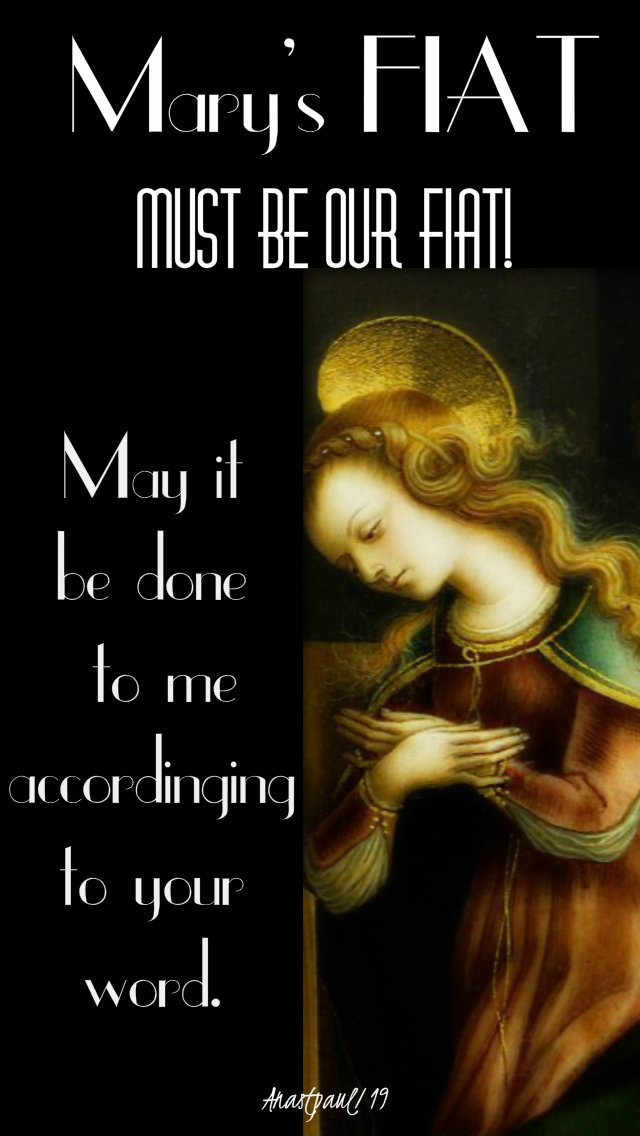
Mary’s Fiat, must be our Fiat
Mary’s fiat– her faithful “Here am I,” which does not replace her perplexity at her conception of God made human but overcomes it– is an announcement in itself. In fact, her announcement, is the most important one of today’s Gospel reading. Let it be our announcement, too, then, for it is appropriate at all times and at any time. And now, our brief, prayerful, announcement: “Here [are we], the servant[s] of the Lord, let it be done to [us] according to your word.”
I delight to do thy will, O my God, thy law is within my heart.
Psalm 40:8
“God Himself is the one Who takes the initiative and chooses to enter, as He did with Mary, into our homes, our daily struggles, filled with anxiety and with desires. And it is within our cities, in our schools and universities, our squares and hospitals, that the most beautiful announcement we can hear is made: “Rejoice, the Lord is with you”. A joy that generates life, that generates hope, that is made flesh in the way we look to the future, in the attitude with which we look at others. A joy that becomes solidarity, hospitality, mercy towards all.”
Pope Francis – Solemnity of the Annunciation of Our Lord, 25 March 2017
Three times daily, at 6 am, noon and 6 pm, we pray the Angelus. It is still accompanied by the ringing of a bell (the Angelus bell) in some places such as Vatican City and parts of Germany, Belgium, France, Spain and Ireland. The Regina Coeli prayer (which may also be sung as a hymn) replaces the Angelus during the Easter season.
V. The Angel of the Lord declared unto Mary.
R. And she conceived of the Holy Spirit.
Hail Mary, full of grace,
The Lord is with Thee;
Blessed art thou among women,
And blessed is the fruit of thy womb, Jesus.
Holy Mary, Mother of God,
Pray for us sinners,
Now and at the hour of our death. Amen
V. Behold the handmaid of the Lord.
R. Be it done unto me according to thy word.
Hail Mary, etc.
V. And the Word was made Flesh.
R. And dwelt among us.
Hail Mary, etc.
V. Pray for us, O holy Mother of God.
R. That we may be made worthy of the promises of Christ. LET US PRAY
Pour forth, we beseech Thee, O Lord, Thy grace into our hearts, that we to whom the Incarnation of Christ Thy Son was made known by the message of an angel, may by His Passion and Cross be brought to the glory of His Resurrection. Through the same Christ Our Lord. Amen.
The Solemnity of the Annunciation of the Lord – 25 March
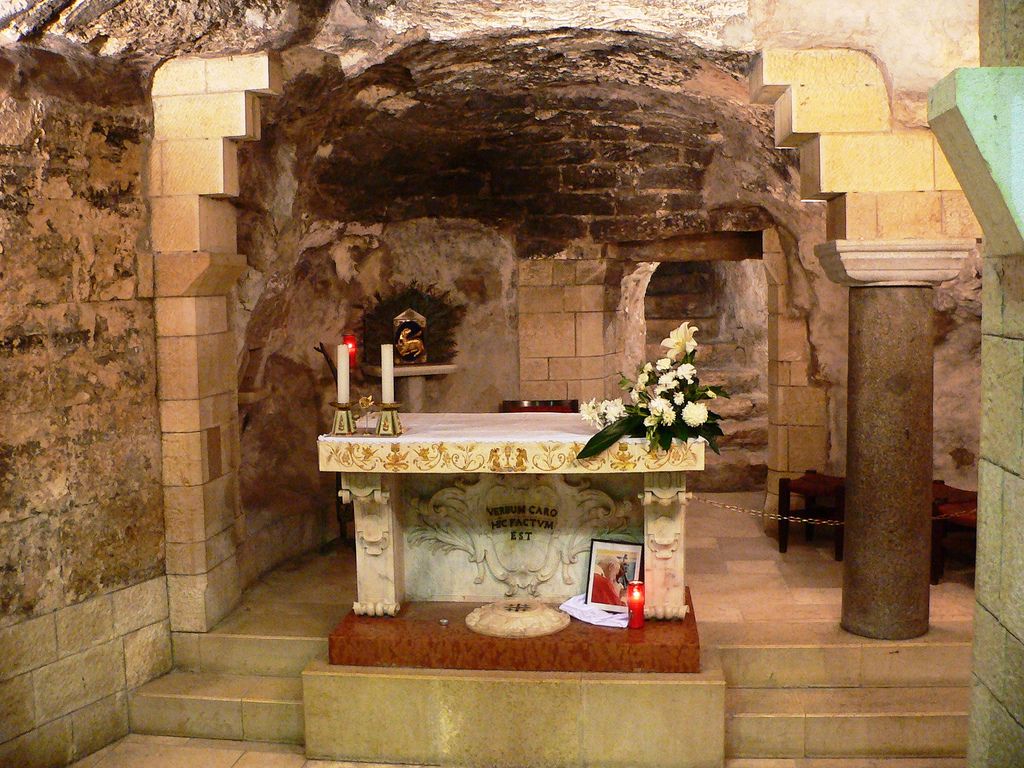
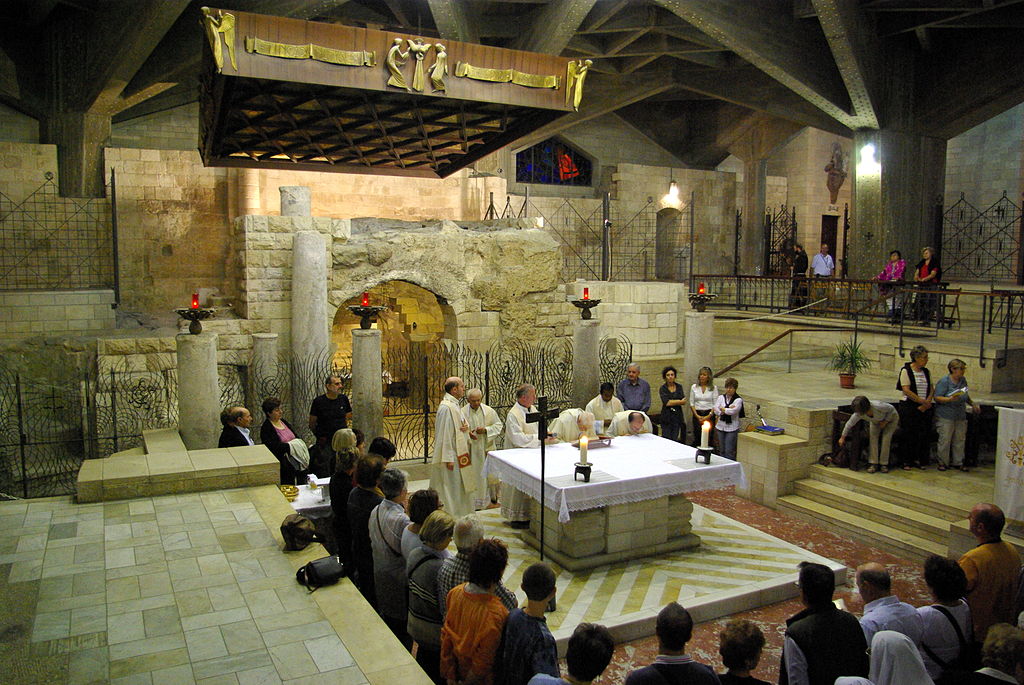
The Grotto of the Annunciation at Nazareth and below Mass being said in front of it
Again Lent’s austerity is interrupted as we solemnly keep a feast in honour of the Annunciation. The Annunciation is a mystery that belongs to the temporal rather than to the sanctoral cycle in the Church’s calendar. For the feast commemorates the most sublime moment in the history of time, the moment when the Second Divine Person of the most Holy Trinity assumed human nature in the womb of the Virgin Mary. Thus it is a feast of our Lord, even as it is of Mary, although the liturgy centres wholly around the Mother of God.
The Church’s Year of Grace, Pius Parsch
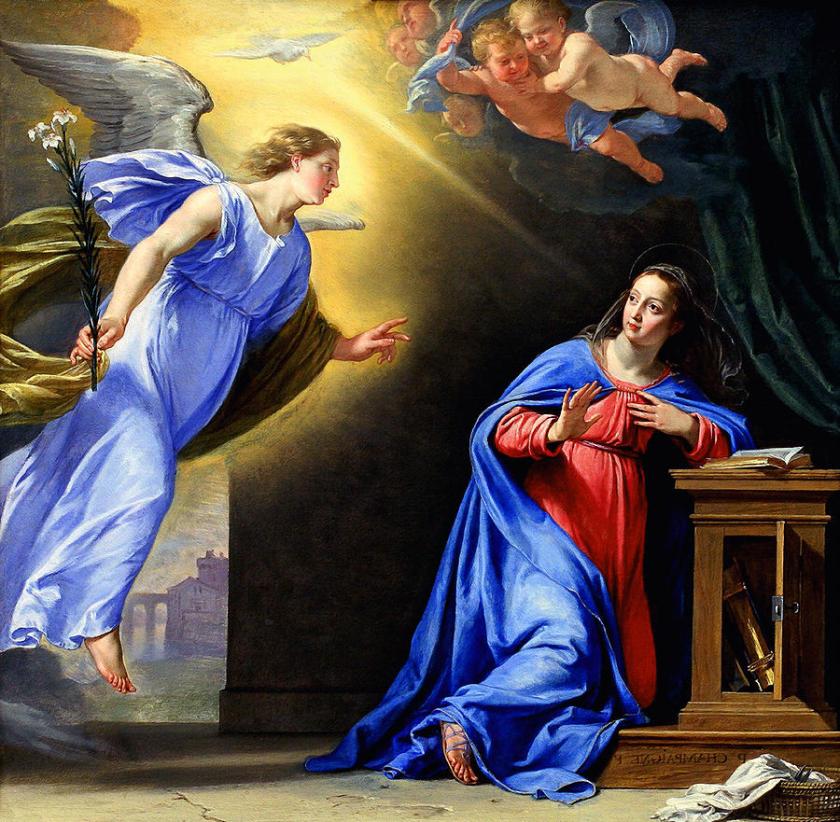
Philippe de Champaigne
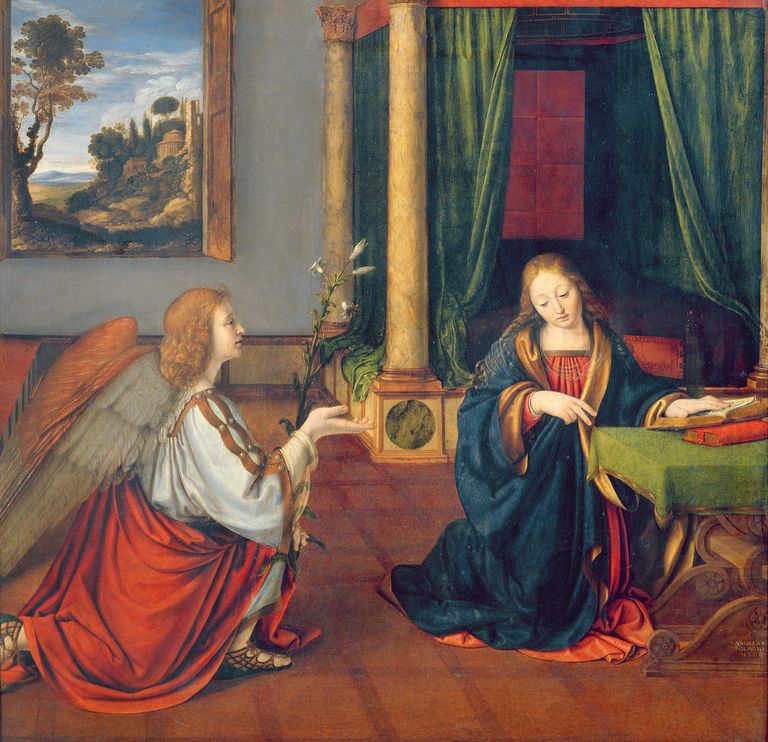
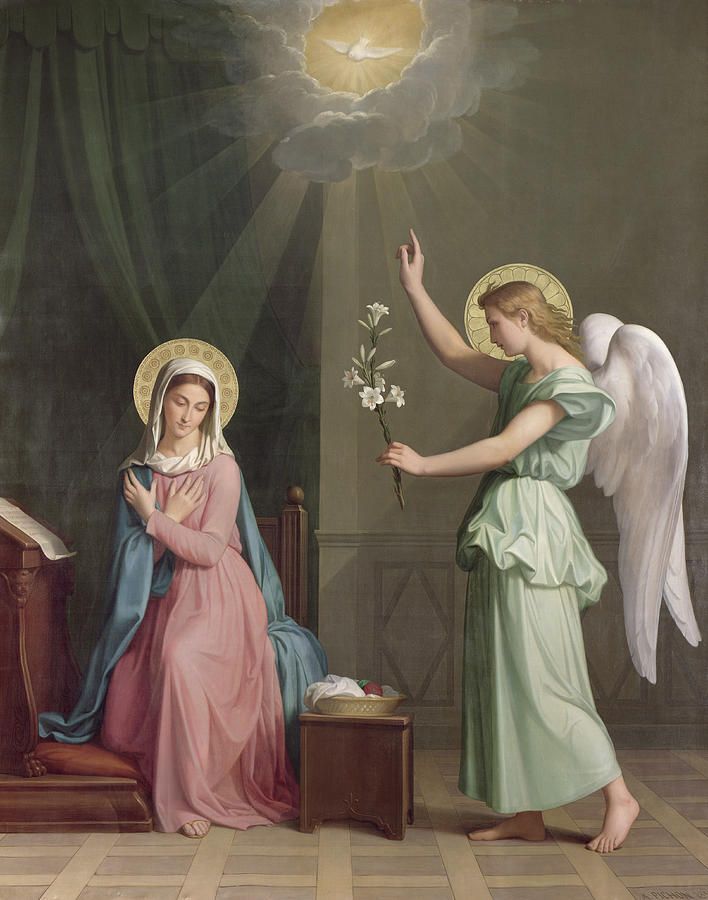
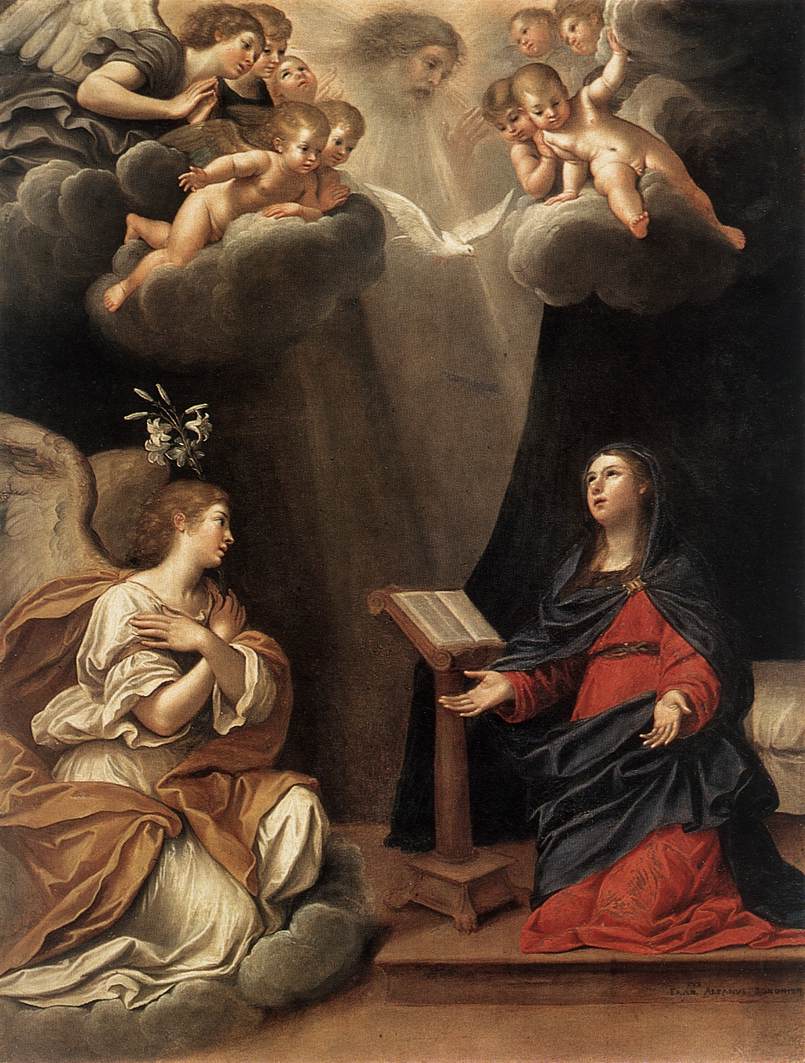
The Annunciation, a tradition which has come down from the apostolic ages, tells us that the great mystery of the Incarnation was achieved on the twenty-fifth day of March. It was at the hour of midnight, when the most holy Virgin was alone and absorbed in prayer, that the Archangel Gabriel appeared before her and asked her, in the name of the blessed Trinity, to consent to become the Mother of God. Let us assist, in spirit, at this wonderful interview between the angel and the Virgin and, at the same time, let us think of that other interview which took place between Eve and the serpent. A holy bishop and martyr of the second century, Saint Irenaeus, who had received the tradition from the very disciples of the apostles, shows us that Nazareth is the counterpart of Eden.
In the garden of delights there is a virgin and an angel and a conversation takes place-between them. At Nazareth a virgin is also addressed by an angel and she answers him but the angel of the earthly paradise is a spirit of darkness and he of Nazareth is a spirit of light. In both instances it is the angel that has the first word. ‘Why,’ said the serpent to Eve, ‘hath God commanded you, that you should not eat of every tree of paradise?’ His question implies impatience and a solicitation to evil, he has contempt for the frail creature to whom he addresses it but he hates the image of God, which is upon her.
See, on the other hand, the angel of light, see with what composure and peacefulness he approaches the Virgin of Nazareth, the new Eve and how respectfully he bows himself down before her: ‘Hail, full of grace! The Lord is with thee! Blessed art thou among women!’ Such language is evidently of heaven, none but an angel could speak thus to Mary.
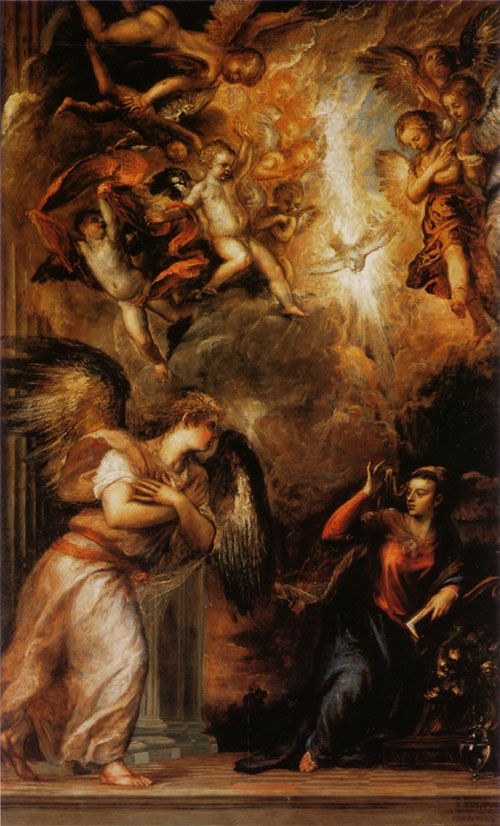
Titian
Scarcely has the wicked spirit finished speaking than Eve casts a longing look at the forbidden fruit, she is impatient to enjoy the independence it is to bring her. She rashly stretches forth her hand, she plucks the fruit, she eats it and death takes possession of her, death of the soul, for sin extinguishes the light of life and death of the body, which being separated from the source of immortality, becomes an object of shame and horror and finally crumbles into dust.
But let us turn away our eyes from this sad spectacle and fix them on Nazareth. Mary has heard the angel’s explanation of the mystery, the will of heaven is made known to her and how grand an honour it is to bring upon her! She, the humble maid of Nazareth, is to have the ineffable happiness of becoming the Mother of God and yet, the treasure of her virginity is to be left to her! Mary bows down before this sovereign will and says to the heavenly messenger: ‘Behold the handmaid of the Lord, be it done to me according to thy word.’
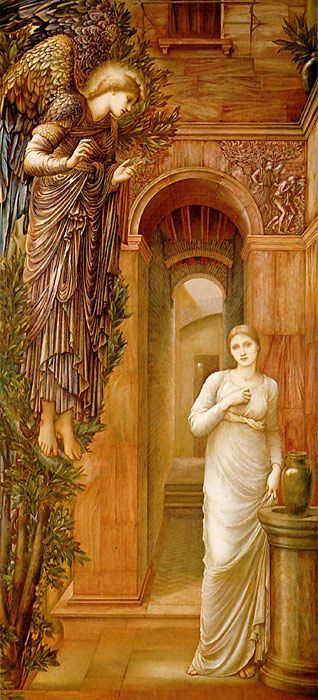
Edward Burne-Jones
Thus, as the great St Irenaeus and so many of the holy fathers remark, the obedience of the second Eve repaired the disobedience of the first, for no sooner does the Virgin of Nazareth speak her fiat, ‘be it done,’ than the eternal Son of God (who, according to the divine decree, awaited this word) is present, by the operation of the Holy Ghost, in the chaste womb of Mary and there, He begins His human life. A Virgin is a Mother and Mother of Go; and it is this Virgin’s consenting to the divine will, that has made her conceive by the power of the Holy Ghost. This sublime mystery puts between the eternal Word and a mere woman the relations of Son and Mother, it gives to the almighty God a means whereby He may, in a manner worthy of His majesty, triumph over satan, who hitherto seemed to have prevailed against the divine plan.
Never was there a more entire or humiliating defeat than that which this day befell satan. The frail creature, over whom he had so easily triumphed at the beginning of the world, now rises and crushes his proud head. Eve conquers in Mary. God would not choose man for the instrument of His vengeance, the humiliation of satan would not have been great enough and, therefore, she who was the first prey of hell, the first victim of the tempter, is selected to give battle to the enemy. The result of so glorious a triumph, is that Mary, is to be superior not only to the rebel angels but to the whole human race, yea, to all the angels of heaven. Seated on her exalted throne, she, the Mother of God, is to be the Queen of all creation. Satan, in the depths of the abyss, will eternally bewail his having dared to direct his first attack against the woman, for God has now so gloriously avenged her and in heaven, the very Cherubim and Seraphim reverently look up to Mary and deem themselves honoured when she smiles upon them, or employs them in the execution of any of her wishes, for she is the Mother of their God.
Therefore, is it that we, the children of Adam, who have been snatched by Mary’s obedience from the power of hell, solemnise this day of the Annunciation. Well may we say of Mary those words of Debbora, when she sang her song of victory over the enemies of God’s people: ‘The valiant men ceased and rested in Israel, until Debbora arose, a mother arose in Israel. The Lord chose new wars, and He Himself overthrew the gates of the enemies.” Let us also refer to the holy Mother of Jesus these words of Judith, who by her victory over the enemy was another type of Mary: ‘Praise ye the Lord our God, who hath not forsaken them that hope in Him. And by me, His handmaid, He hath fulfilled His mercy, which He promised to the house of Israel and He hath killed the enemy of His people by my hand this night. . . . The almighty Lord hath struck him, and hath delivered him into the hands of a woman, and hath slain him.’
–Excerpted from The Liturgical Year, Abbot Gueranger OSB
Actually the name Betania means Bethany in Spanish. It was originally given this name by Maria Esperanza and was the site of their farm, in Venezuela. Apparitions of the Blessed Virgin Mary were reported and eventually a small chapel was built here and the faithful began to gather, especially on Feast Days but throughout the year.
Bl Everard of Nellenburg
Bl Herman of Zahringen
St Hermenland
St Humbert of Pelagius
Bl James Bird
Bl Josaphata Mykhailyna Hordashevska
St Kennocha of Fife
St Lucia Filippini
St Margaret Clitherow
Bl Margaretha Flesch
St Mariam Sultaneh Danil Ghattas
St Matrona of Barcelona
St Matrona of Thessaloniki
St Mona of Milan
St Ndre Zadeja
Bl Pawel Januszewski
St Pelagius of Laodicea
Bl Placido Riccardi
St Procopius
St Quirinus of Rome
Bl Tommaso of Costacciaro
—
262 Martyrs of Rome: A group 262 Christians martyred together in Rome. We know nothing else about them, not even their names.




 AnaStpaul
You must be logged in to post a comment.