Posted in FEASTS and SOLEMNITIES, MORNING Prayers, SAINT of the DAY, The HOLY CROSS

Thought for the Day – 14 September – Feast of the Exaltation of the Holy Cross/Triumph of the Cross

Thought for the Day – 14 September – Feast of the Exaltation of the Holy Cross

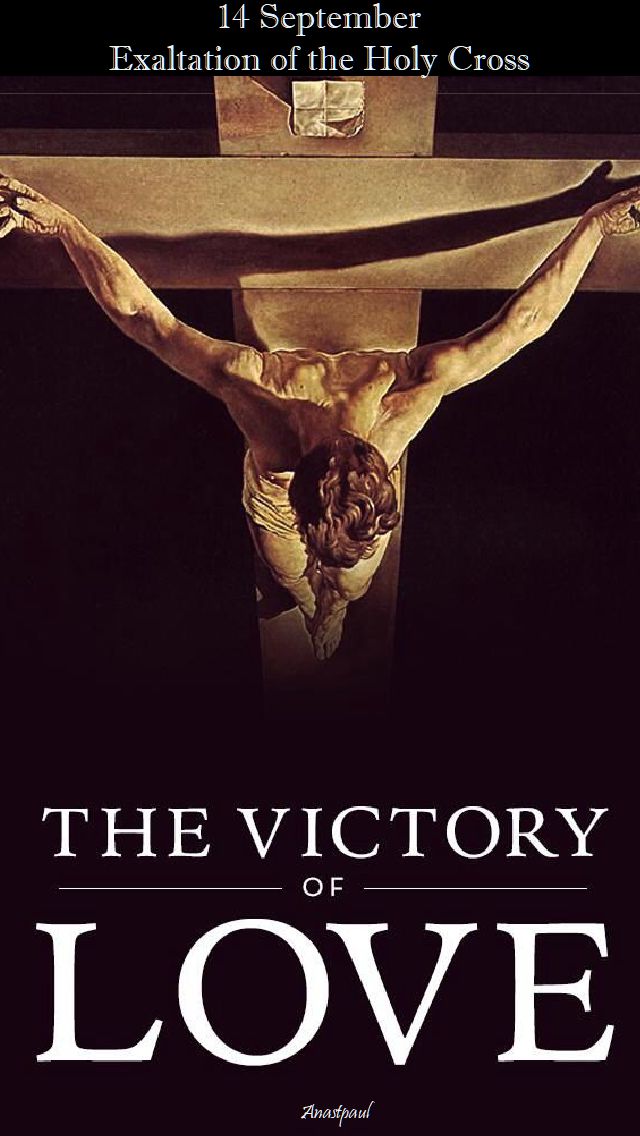
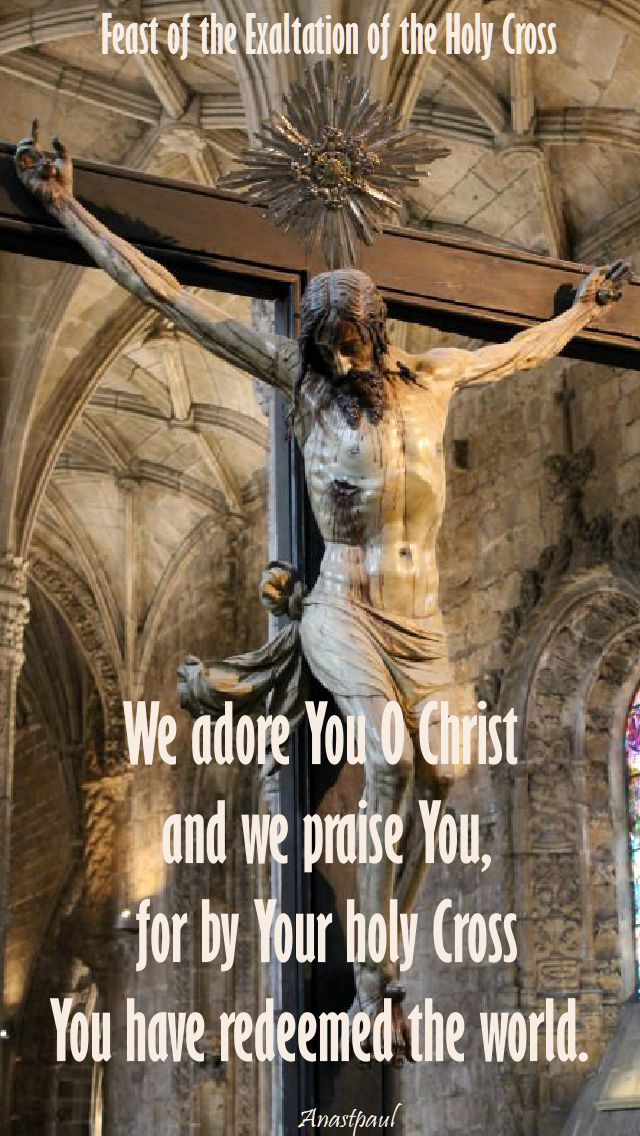
Christians “exalt” (raise on high) the Cross of Christ as the instrument of our salvation. Adoration of the Cross is, thus, adoration of Jesus Christ, the God Man, who suffered and died on this Roman instrument of torture for our redemption from sin and death.   The cross represents the One Sacrifice by which Jesus, obedient even unto death, accomplished our salvation.   The cross is a symbolic summary of the Passion, Crucifixion and Resurrection of Christ — all in one image.

The Cross — because of what it represents — is the most potent and universal symbol of the Christian faith.   It has inspired both liturgical and private devotions: for example, the Sign of the Cross, which is an invocation of the Holy Trinity;  the “little” Sign of the Cross on head, lips and heart at the reading of the Gospel;  praying the Stations (or Way) of the Cross;  and the Veneration of the Cross by the faithful on Good Friday by kissing the feet of the image of Our Saviour crucified.

Placing a crucifix (the cross with an image of Christ’s body upon it) in churches and homes, in classrooms of Catholic schools and in other Catholic institutions, or wearing this image on our persons, is a constant reminder — and witness — of Christ’s ultimate triumph, His victory over sin and death through His suffering and dying on the Cross. (Fr  FRANCISCO NASCIMENTO)

We adore You Christ and we praise You, for by Your holy Cross You have redeemed the world.we adore you - holy cross.jpg


Posted in FEASTS and SOLEMNITIES, QUOTES of the SAINTS, The HOLY CROSS

Quote/s of the Day – 14 September – Feast of the Exaltation of the Holy Cross/Triumph of the Cross

Quote/s of the Day – 14 September – Feast of the Exaltation of the Holy Cross

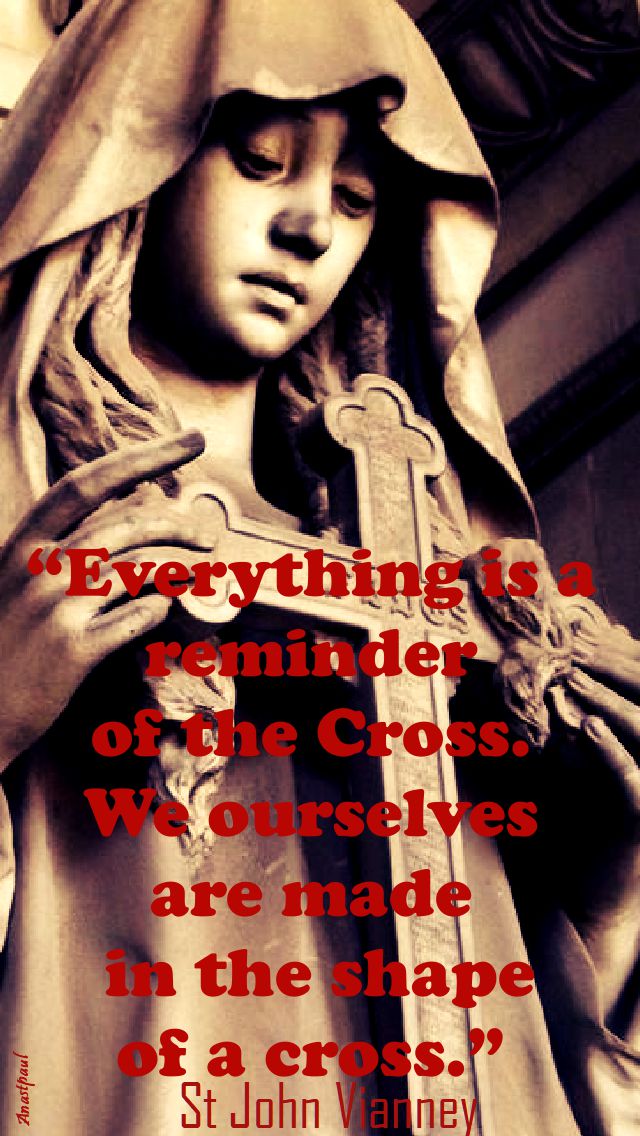
“Everything is a reminder of the Cross.
We ourselves are made in the shape of a cross.”everything is a reminder of the cross - st john vianney

“You must accept your cross.
If you bear it courageously,
it will carry you to heaven.”you-must-accept-your-cross - st john vianney

“The sign of the cross
is the most terrible weapon
against the devil.
Thus the Church wishes not only,
that we have it continually
in front of our minds,
to recall to us
just what our souls are worth
and what they cost Jesus Christ
but also that we should make it
at every juncture ourselves:
when we go to bed,
when we awaken during the night,
when we get up,
when we begin any action,
and, above all,
when we are tempted.”

St John Vianneythe sign of the cross

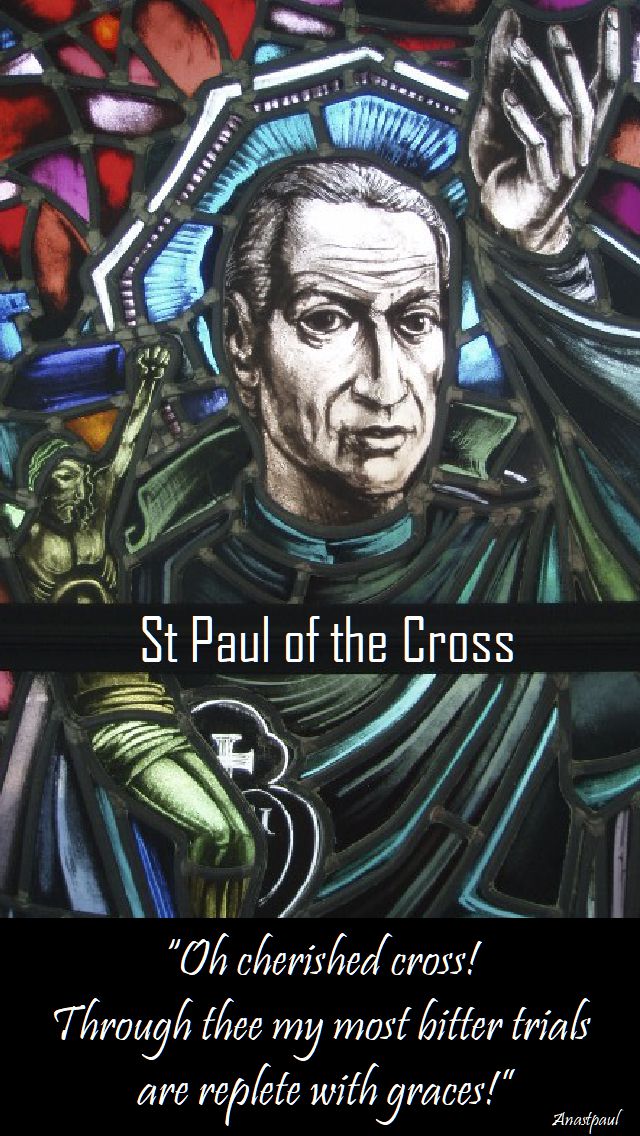
“Oh cherished cross!
Through thee my most bitter trials
are replete with graces!”

St Paul of the Crossoh cherished cross - st paul of the cross

“In the Cross is salvation;
in the Cross is life;
in the Cross is protection against our enemies;
in the Cross is infusion of heavenly sweetness;
in the Cross is strength of mind;
in the Cross is joy of spirit;
in the Cross is excellence of virtue;
in the Cross is perfection of holiness.
There is no salvation of soul,
nor hope of eternal life,
save in the Cross.”

Fr Thomas à Kempis, The Inner Lifein the cross is salvation - thomas a kempis

“The everlasting God has in His wisdom
foreseen from eternity the cross He now
presents to you as a gift from His inmost heart.
The cross He now sends you He has considered
with His all-knowing eyes, understood with His divine mind,
tested with His wise justice, warmed with loving arms
and weighed with His own hands to see that it is not
one inch too large nor one ounce too heavy for you.
He has blessed it with His holy name,
anointed it with His grace,
perfumed it with His consolation,
taken one last glance at you and your courage
and then sent it to you from heaven,
a special greeting from God to you,
an alms of the all-merciful love of God.”

St Francis de Salesthe everlasting god has in his wisdom - st francis de sales

Posted in franciscan OFM, MORNING Prayers, NOVENAS

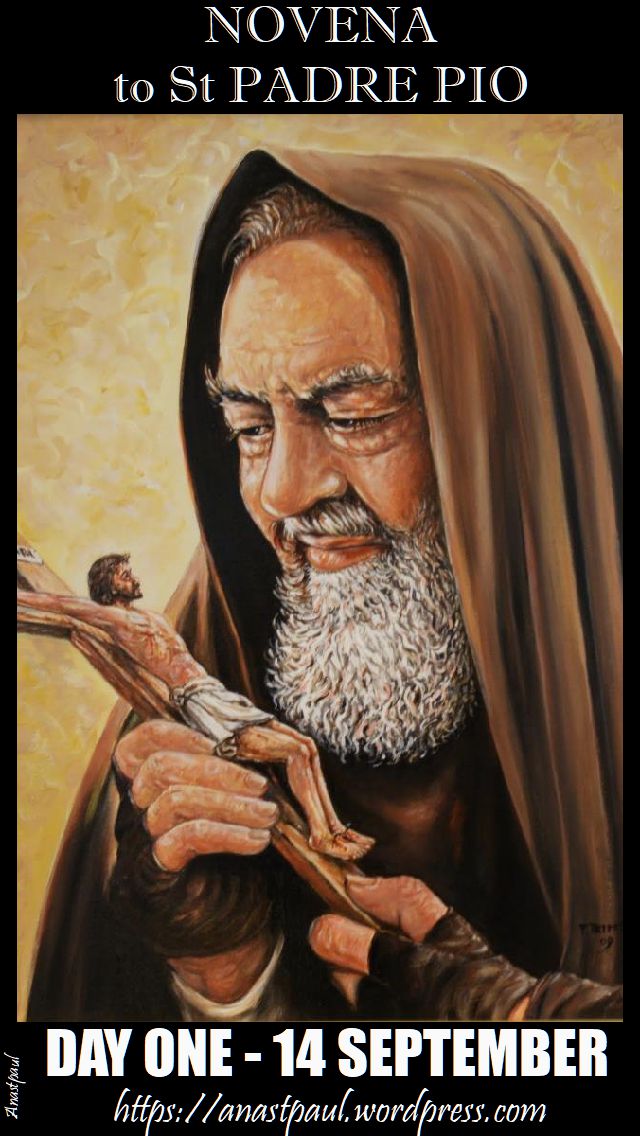
NOVENA to St Padre Pio/St Pius of Pietrelcina – DAY ONE – 14 September

NOVENA to St Padre Pio/St Pius of Pietrelcina – DAY ONE – 14 September

St Padre Pio you have said:

“Jesus keeps nothing for Himself of what is done for love of Him, and He will repay us very lavishly.
Don’t let us make our happiness depend on enjoying wonderful health,
or else we should be just like those foolish worldly people to whom it is not given to know the secrets of heaven….
Continue to love Jesus and make an effort to love Him more and more,
without wanting to know anything else, He alone will steer us to the haven of salvation.”

Let us Pray:

Gracious God,
You generously blessed Your servant, Padre Pio, with the gifts of the Spirit.
You marked his body with the five wounds of Christ Crucified,
as a powerful witness to the saving Passion and Death of Your Son
and as a stirring inspiration to many people of Your infinite mercy, forgiveness and love.
In the confessional, Padre Pio laboured endlessly for the salvation of souls.
Through his powerful intercession, many who suffered were healed of sickness and disease.
Endowed with the gift of discernment, he could read people’s hearts.
With dignity and intense devotion, he celebrated daily Mass,
inviting countless men and women to a greater union with Jesus Christ,
in the Sacrament of the Holy Eucharist.
Through the intercession of Saint Pio,
we confidently beseech You to to grant us the grace of
………………… (state your petition here).
Help us to imitate his example of prayerful holiness and compassion,
so that we, too, may faithfully follow the Risen Lord
and one day rejoice in the Kingdom,
where You live and reign forever and ever. Amenday one - novena st pio - 14 sept

Posted in FEASTS and SOLEMNITIES, MORNING Prayers, QUOTES of the SAINTS, SAINT of the DAY, The HOLY CROSS, The WORD

One Minute Reflection – 14 September – Feast of the Exaltation of the Holy Cross/Triumph of the Cross

One Minute Reflection – 14 September – Feast of the Exaltation of the Holy Cross

We proclaim Christ – yes, Christ nailed to the cross; and though it is a stumbling-block to Jews and folly to Greeks, yet to those who have heard his call, Jews and Greeks alike, he is the power of God and the wisdom of God...1 Corinthians 1:23-241 corinthians 1-23 24

REFLECTION – “We are celebrating the Feast of the Cross which drove away darkness and brought in the light… Had there been no Cross, Christ could not have been Crucified. Had there been no Cross, Life Itself could not have been nailed to the tree.   And if Life had not been nailed to it, there would be no streams of immortality pouring from Christ’s side, blood and water for the world’s cleansing.   The legal bond of our sin would not be cancelled, we should not have obtained our freedom, we should not have enjoyed the fruit of the tree of life and the Gates of Paradise would not stand open.   Had there been no Cross, death would not have been trodden underfoot, nor hell despoiled… The Cross is called Christ’s glory; it is saluted as His triumph!”….St Andrew of Crete (c660-740)

PRAYER – O God, who willed that your Only Begotten Son should undergo the Cross to save the human race, grant, we pray, that we, who have known his mystery on earth, may merit the grace of his redemption in heaven.
For you placed the salvation of the human race on the wood of the Cross, so that, where death arose, life might again spring forth and the evil one, who conquered on a tree, might likewise on a tree be conquered through Christ.  O cross, you are the glorious sign of victory.   Through your power may we share in the triumph of Christ Jesus.
We adore you Christ and we praise you, for by your holy Cross you have redeemed the world. Ameno cross - you are the glorious sign of victory - feast of the exaltation of the holy cross

Posted in CATHOLIC-PRAYERS OF THE CHURCH, MORNING Prayers, PRAYERS of the CHURCH, The HOLY CROSS

Our Morning Offering – 14 September – Feast of the Exaltation of the Holy Cross/Triumph of the Cross

Our Morning Offering – 14 September – Feast of the Exaltation of the Holy Cross

Traditional Prayer to the Holy Cross

Hail, O Holy Cross!
my light and my strength!
Hail, standard of peace empurpled by the Blood of Jesus
and ornamented by His Sacred Members
as with precious stones!
O Venerable Cross, work of the love of God
and the cruelty of men!
O Cross, the terror of Hell and the object of the veneration
of Heaven and earth,
receive the homage of my faith,
my gratitude
and my love!
I consecrate myself entirely to You
and I attach myself to You forever,
as my Saviour was attached to You
for love of me.
I earnestly beseech You, in virtue of the Precious Blood
which empurpled You,
to take me under Your protection,
to be my support in suffering,
my strength in temptation,
my counsel in doubt,
my light in darkness,
my rule of conduct during life,
my confidence and pledge of salvation at the hour of death.
May Jesus, the Incarnate God, Our Saviour,
Who shed His Blood when nailed to You,
protect me through You
and conduct me to my Heavenly home! Amenhail o holy cross - traditional prayer

Posted in FEASTS and SOLEMNITIES, MORNING Prayers, The HOLY CROSS, The WORD

Feast of the Exaltation of the Holy Cross/Triumph of the Holy Cross – 14 September

Feast of the Exaltation of the Holy Cross – 14 September, also called Feast of the Triumph of the Cross and Holy Cross Feast.we adore you o christ - 14 sept - exaltation of the holy cross

This feast was observed in Rome before the end of the seventh century.   It commemorates the recovery of the Holy Cross, which had been placed on Mount Calvary by St Helena and preserved in Jerusalem but then had fallen into the hands of Chosroas, King of the Persians.   The precious relic was recovered and returned to Jerusalem by Emperor Heralius in 629.

The lessons from the Breviary tell us that Emperor Heraclius carried the Cross back to Jerusalem on his shoulders.  He was clothed with costly garments and with ornaments of precious stones.   But at the entrance to Mount Calvary a strange incident occurred.   Try as hard as he would, he could not go forward.   Zacharias, the Bishop of Jerusalem, then said to the astonished monarch:  “Consider, O Emperor, that with these triumphal ornaments you are far from resembling Jesus carrying His Cross.”   The Emperor then put on a penitential garb and continued the journey.

Discovery-of-the-True-Cross-1500-56a108a63df78cafdaa83de9
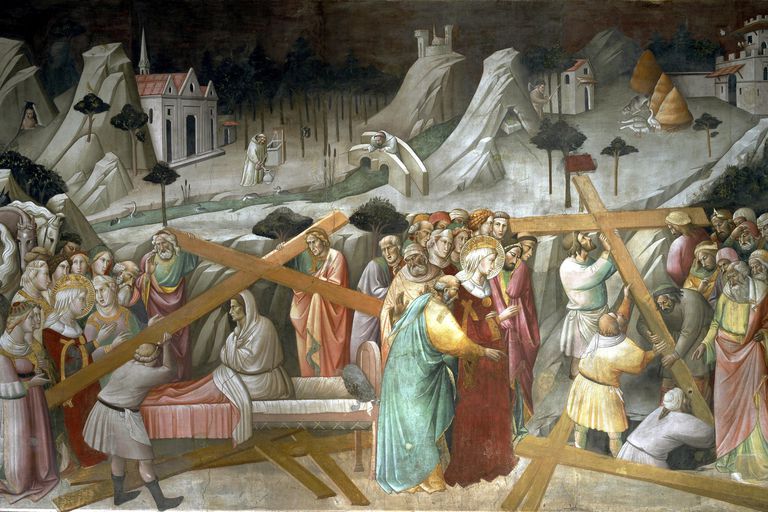
The Discovery of the True Cross, by Italian painter Agnolo Gaddi c.1350-96. Fresco, c.1385. Basilica di Santa Croce, Florence, Italy.

In celebration of the discovery of the Holy Cross, Constantine ordered the construction of churches at the site of the Holy Sepulchre and on Mount Calvary.   Those churches were dedicated on September 13 and 14, 335 and shortly thereafter the Feast of the Exaltation of the Holy Cross began to be celebrated on the latter date.

The feast slowly spread from Jerusalem to other churches, until, by the year 720, the celebration was universal.

The liturgy of the Cross is a triumphant liturgy.  When Moses lifted up the bronze serpent over the people, it was a foreshadowing of the salvation through Jesus when He was lifted up on the Cross.   Our Mother Church sings of the triumph of the Cross, the instrument of our redemption.   To follow Christ we must take up His cross, follow Him and become obedient until death, even if it means death on the cross.   We identify with Christ on the Cross and become co-redeemers, sharing in His suffering and Cross.THE HOLY CROSSthe Holy Cross and the Holy Spirit

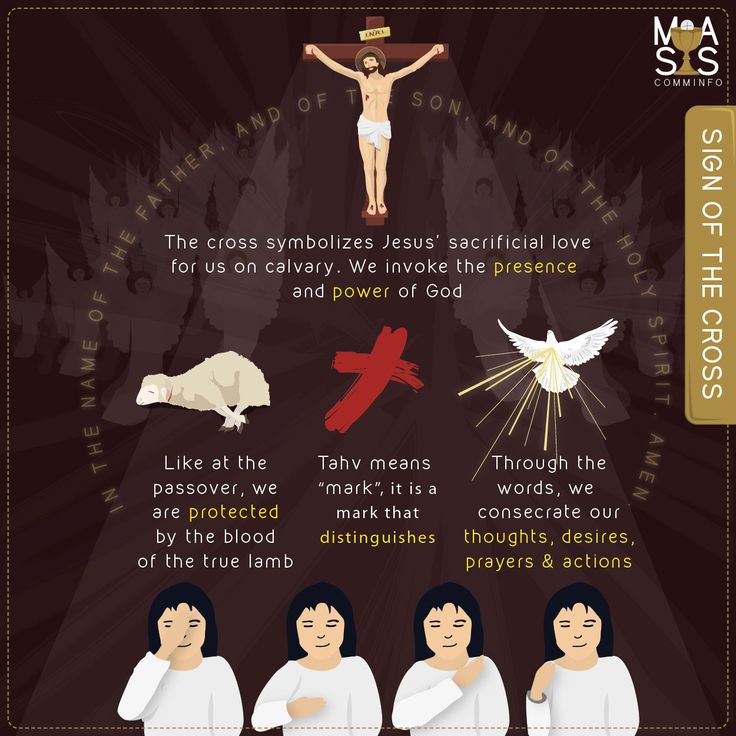
We make the Sign of the Cross before prayer which helps to fix our minds and hearts to God.   After prayer we make the Sign of the Cross to keep close to God.  During trials and temptations our strength and protection is the Sign of the Cross.   At Baptism we are sealed with the Sign of the Cross, signifying the fullness of redemption and that we belong to Christ.   Let us look to the cross frequently, and realize that when we make the Sign of the Cross we give our entire self to God — mind, soul, heart, body, will, thoughts.28465fc62db10f92133e05f7ec6bbb01--shoulder-to-shoulder-sign-of-the-cross

WHY DO WE CELEBRATE THE FEAST OF THE HOLY CROSS?
It’s easy to understand that the Cross is special because Christ used it as the instrument of our salvation.   But after His Resurrection, why would Christians continue to look to the Cross?   Christ Himself offered us the answer:  “If any man will come after me, let him deny himself, and take up his cross daily, and follow me” (Luke 9:23).   The point of taking up our own cross is not simply self-sacrifice;  in doing so, we unite ourselves to the sacrifice of Christ on His Cross.

When we participate in the Mass, the Cross is there, too.  The “unbloody sacrifice” offered on the altar is the re-presentation of Christ’s Sacrifice on the Cross.   When we receive the Sacrament of Holy Communion, we do not simply unite ourselves to Christ; we nail ourselves to the Cross, dying with Christ so that we might rise with Him.

“For the Jews require signs, and the Greeks seek after wisdom:  but we preach Christ crucified, unto the Jews indeed a stumbling block and unto the Gentiles foolishness . . . ” (1 Corinthians 1:22-23).   Today, more than ever, non-Christians see the Cross as foolishness. What kind of Saviour triumphs through death?

For Christians, however, the Cross is the crossroads of history and the Tree of Life. Christianity without the Cross is meaningless:  only by uniting ourselves to Christ’s Sacrifice on the Cross can we enter into eternal life.Tree of Life cross from the ancient Basilica of St. Clemente, Rome.

O cross, you are the glorious sign of victory.
Through your power may we share in the triumph of Christ Jesus.14 sept - exaltation of the holy cross

feast of the exaltation of the holy cross.2

Posted in FEASTS and SOLEMNITIES, SAINT of the DAY, The HOLY CROSS

Feast of the Exaltation of the Holy Cross and Memorials of the Saints – 14 September

Exaltation of the Holy Cross (Feast) – https://www.youtube.com/watch?v=qsiOJkpPk7w

St Aelia Flaccilla
St Albert of Jerusalem
St Caerealis
Bl Claude Laplace
St Cormac of Cashel
St Crescentian of Carthage
St Crescentius of Rome
St Generalis of Carthage
St Giulia Crostarosa
St Jean Gabriel Taurin du Fresse
St Maternus of Cologne
Bl Notburga
Bl Pedro Bruch Cotacáns
St Rosula of Carthage
St Sallustia
St Victor of Carthage

Posted in BREVIARY Prayers, CATHOLIC-PRAYERS OF THE CHURCH, FATHERS of the Church, MORNING Prayers, SAINT of the DAY, The APOSTLES & EVANGELISTS, The WORD

St John Chrysostom and St Paul – 13 September the Memorial of St John Chrysostum (347-407) of the “Golden Mouth”

St John Chrysostom and St Paul – 13 September the Memorial of St John Chrysostum (347-407) of the “Golden Mouth”

St John Chrysostom and St Paul
John Chrysostom here gives eloquent praise to the passionate love of Christ that drove St. Paul to face persecution and hardship with joy and leave behind the honours and benefits of the world.   It is read each year on January 25, the Feast of the Conversion of St. Paul, persecutor turned apostle.st PAUL!!!

Paul, more than anyone else, has shown us what man really is and in what our nobility consists and of what virtue this particular animal is capable.   Each day he aimed ever higher;  each day he rose up with greater ardour and faced with new eagerness the dangers that threatened him.  He summed up his attitude in the words:  “I forget what is behind me and push on to what lies ahead.”   When he saw death imminent, he bade others share his joy:  “Rejoice and be glad with me!”  And when danger, injustice and abuse threatened, he said:  “I am content with weakness, mistreatment and persecution.”   These he called the weapons of righteousness, thus telling us that he derived immense profit from them.

Thus, amid the traps set for him by his enemies, with exultant heart he turned their every attack into a victory for himself;  constantly beaten, abused and cursed, he boasted of it as though he were celebrating a triumphal procession and taking trophies home, and offered thanks to God for it all:  “Thanks be to God who is always victorious in us!”   This is why he was far more eager for the shameful abuse that his zeal in preaching brought upon him than we are for the most pleasing honours, more eager for death than we are for life, for poverty than we are for wealth;   he yearned for toil far more than others yearn for rest after toil.   The one thing he feared, indeed dreaded, was to offend God;   nothing else could sway him.   Therefore, the only thing he really wanted was always to please God.

The most important thing of all to him, however, was that he knew himself to be loved by Christ.   Enjoying this love, he considered himself happier than anyone else;   were he without it, it would be no satisfaction to be the friend of principalities and powers.   He preferred to be thus loved and be the least of all, or even to be among the damned, than to be without that love and be among the great and honoured.

To be separated from that love was, in his eyes, the greatest and most extraordinary of torments  the pain of that loss would alone have been hell and endless, unbearable torture.   So too, in being loved by Christ he thought of himself as possessing life, the world, the angels, present and future, the kingdom, the promise and countless blessings. Apart from that love nothing saddened or delighted him;  for nothing earthly did he regard as bitter or sweet.

Paul set no store by the things that fill our visible world, any more than a man sets value on the withered grass of the field.   As for tyrannical rulers or the people enraged against him, he paid them no more heed than gnats.   Death itself and pain and whatever torments might come were but child’s play to him, provided that thereby he might bear some burden for the sake of Christ.

This excerpt from a homily preached by St. John Chrysostom around c 400 in praise of St. Paul (Hom. 2 de laudibus sancti Pauli: PG 50, 477-480) is used in the Roman Office of Readings for the Feast of the Conversion of Saint Paul on January 25 with the biblical reading taken from Galatians 1, the story of Paul’s Conversion on the road to Damascus.st john chrysostom pray for us.3ST PAUL PRAY FOR US

Posted in MORNING Prayers, NOVENAS, The HOLY CROSS

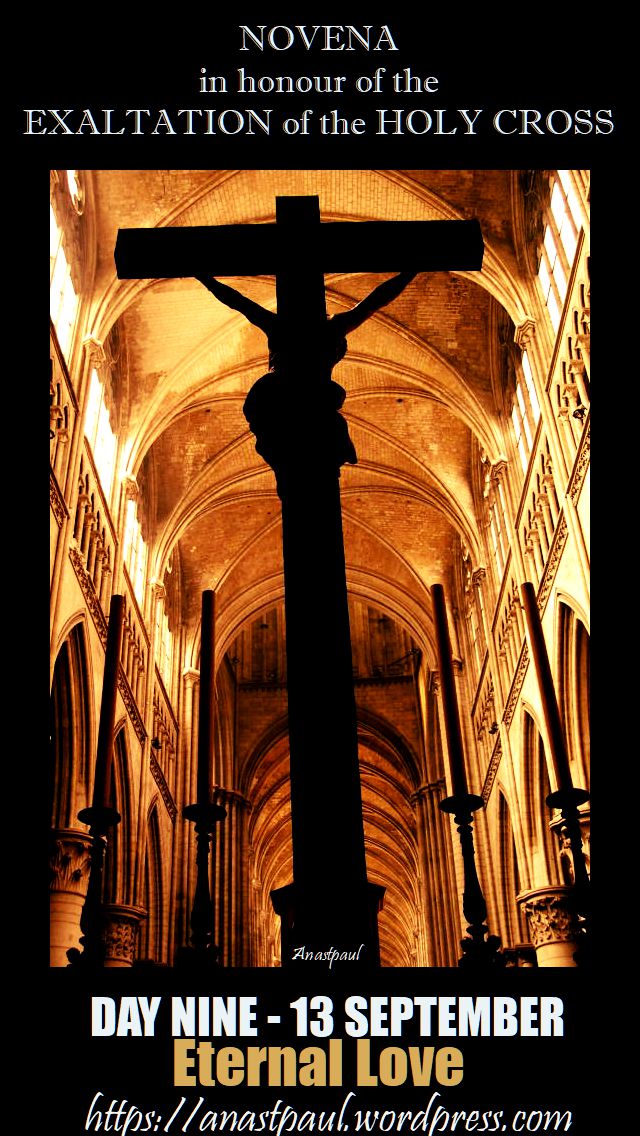
DAY NINE – NOVENA in honour of the EXALTATION of the HOLY CROSS – 13 September

DAY NINE – NOVENA in honour of the EXALTATION of the HOLY CROSS – 13 September

Eternal Love

Lord Jesus, Your cross manifested Your decision
to always do the Father’s will.
That God you revealed shines so resplendently on the Holy Cross.
It is a God who loves because He is pure love.
On the Holy Cross, You gave everything – Your life.
By Your self-giving, we have been redeemed.
May our veneration of Your Holy Cross
enable us to live the challenge of love,
that we, too, may learn to trust, to understand
and to forgive.
That we may remove from our hearts,
hatred, mistrust and resentment
and be like You, a total gift of self.
May Your Holy Cross lead us to life
and communion with our brothers and sisters. Amen.

DAILY PRAYER:

Dear Lord Jesus
Who because of Your burning love for us willed to be crucified
and to shed Your Most Precious Blood for the redemption
and salvation of our souls,
to bear the sins of all the history of humanity,
from Adam to the end of time.
look down upon us and grant the petition we ask
…………….( mention your intention)
We trust completely in Your Mercy.
Cleanse us from sin by Your Grace,
sanctify our work,
give us and all those who are dear to us,
our daily bread, lighten the burden of our sufferings,
bless our families,
and grant to the nations, so sorely afflicted,
Your Peace, which is the only true peace,
so that by obeying Your Commandments
we may come at last to the glory of Heaven.

O Cross, you are the glorious sign of victory.
Through your power may we share
in the triumph of Christ Jesus. Amen
Glory Be. (3x)day nine - novena holy cross - 13 sept - eternal love

Posted in DOCTORS of the Church, FATHERS of the Church, MORNING Prayers, QUOTES of the SAINTS, SAINT of the DAY

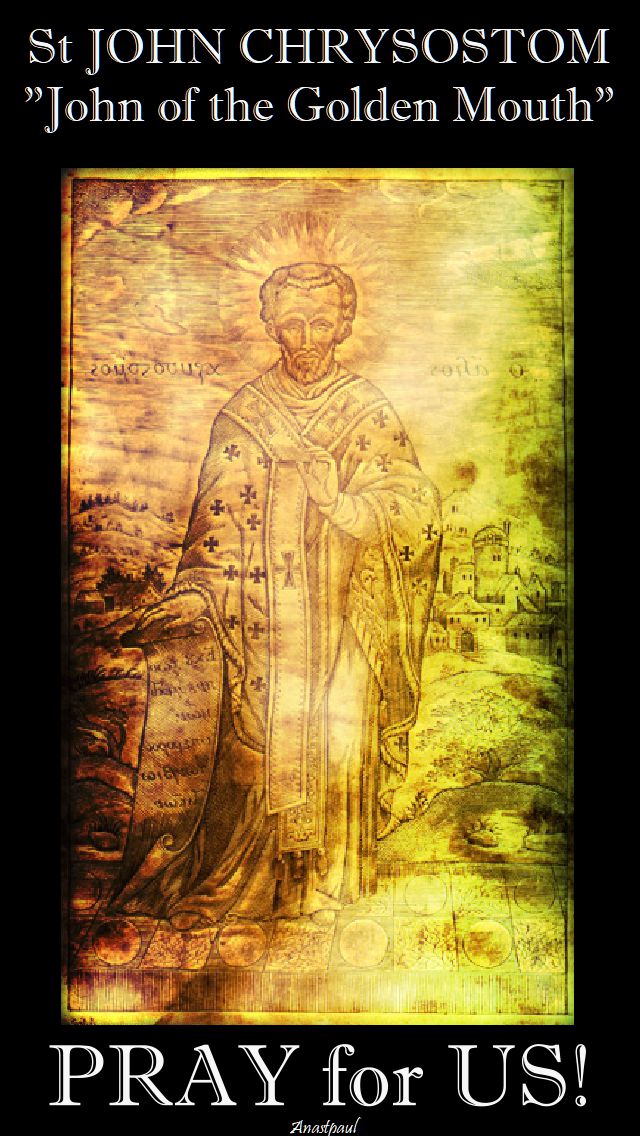
Thought for the Day – 13 September – 13 September – St John Chrysostom (347-407) Doctor – “John of the Golden Mouth”

Thought for the Day – 13 September – 13 September – St John Chrysostom (347-407) Doctor – “John of the Golden Mouth”

What I find interesting is that some people in the Church think Pope Francis is a liberal who is over concerned with social justice issues.   Some of these same people would then hold Chrysostom in high regard, especially being a Doctor of the Church.   Both of these sons of the Church share much in common.

Chrysostom had just as much concern about the relationship of the bishops and priests to the laity as Pope Francis does.   Each showing concern over the laity being treated with respect and dignity, Chrysostom asked,  “How should the church be governed?   Should the patriarchs act like emperors, issuing decrees…Should bishops see themselves as local governors, demanding unquestioning submission of the people?”   Pope Francis has told priests they must be “shepherds living with the smell of the sheep.”   Chrysostom reminded those in authority that they are not rulers but preachers and pastors.  He also stressed that “each individual is answerable not to a priest, bishop, or patriarch but to God.”

Pope Francis has caused quite a stir regarding some of his statements about finances; frankly Chrysostom would not disagree with him.  Actually, I have found Chrysostom to be even more frank then Pope Francis.   He does not mince words when saying, “Lift up and stretch out your hands, not to heaven, but to the poor…if you lift up your hands in prayer without sharing with the poor, it is worth nothing.”   And Pope Francis twice quoted Chrysostom in Evangelii Gaudium, he said, “Ethics — a non-ideological ethics — would make it possible to bring about balance and a more humane social order. With this in mind, I encourage financial experts and political leaders to ponder the words of one of the sages of antiquity: ‘Not to share one’s wealth with the poor is to steal from them and to take away their livelihood.  It is not our own goods which we hold, but theirs.’”   The second quote expressed that we need look at money in a different way, basically through the eyes of Christ.

Both men have a great concern for the poor.   Chrysostom even said if we wish to honour Christ’s body we must first clothe and feed him in our brother. Then, with what we have left, adorn the altar with gold chalices.   He believed “feeding the hungry is a greater work than raising the dead.”   Pope Francis has urged us to not waste food, that throwing it away is like stealing from the poor.   He has also warned us to not, “become starched Christians, those over-educated Christians who speak of theological matters as they calmly sip their tea. No!”   Like Chrysostom, Pope Francis wants us to go out and “care for the flesh of Christ” to seek Him out in the poor.

With great pastoral care they each speak about everyday sins we all need to combat. They do not hesitate to speak out against the pharisaical behavior of keeping rules and laws while not loving our neighbour.   Chrysostom asks us, “For what does it profit if we abstain from fish and fowl and yet bite and devour our brothers and sisters?” Pope Francis tells us we are murdering Christians when we speak badly of them with others.   Reminding us, “There is no such thing as innocent slander.”

I am sure most of us occasionally have moments of “elder brother syndrome.” (Luke 11:32)   We can benefit from a reminder from both men that the Church is a hospital where anyone seeking God can come to be healed.   Chrysostom said the Church is “not a courtroom, for souls. She does not condemn on behalf of sins but grants remission of sins.”

Pope Francis sees the Church as a field hospital after battle.   Saying it is “useless to ask a seriously injured person if he has high cholesterol and about the level of his blood sugars! You have to heal his wounds. Then we can talk about everything else.”   Of course, we are all wounded sinners needing the medicine of the sacraments.   Chrysostom reminds us to not be ashamed when we repent but to have a change of heart and seek God’s love and mercy.   Mercy is a favourite topic of Pope Francis, “there is no limit to the divine mercy, which is offered to everyone…The Lord is always ready to roll away the tombstone of our sins, which separate us from Him, the light of the living.”

These are a few examples showing the similarities between both men.   I believe this shows how Chrysostom’s words are relevant for us today and that there’s nothing novel about Pope Francis’s approach.   Both men challenge us, make us uncomfortable and do not seek to please men with their words but lead them to truth.   The fact that they have so many similar things to say is ultimately a testament of the timelessness of the gospel message itself.   And proof that God is with us and working through his shepherds.”

St John Chrysostom, Pray for the Church, Pray for Pope Francis, Pray for us all!st john chrysostom pray for us.2

(JESSICA ARCHULETA)

Posted in DOCTORS of the Church, EUCHARISTIC Adoration, FATHERS of the Church, MORNING Prayers, QUOTES of the SAINTS, SAINT of the DAY, The HOLY EUCHARIST / The HOLY MASS

Quote/s of the Day- 13 September – The Memorial of St John Chrysostom (347-407) Doctor – “John of the Golden Mouth”

Quote/s of the Day – 13 September –  St John Chrysostom (347-407) Doctor – “John of the Golden Mouth”

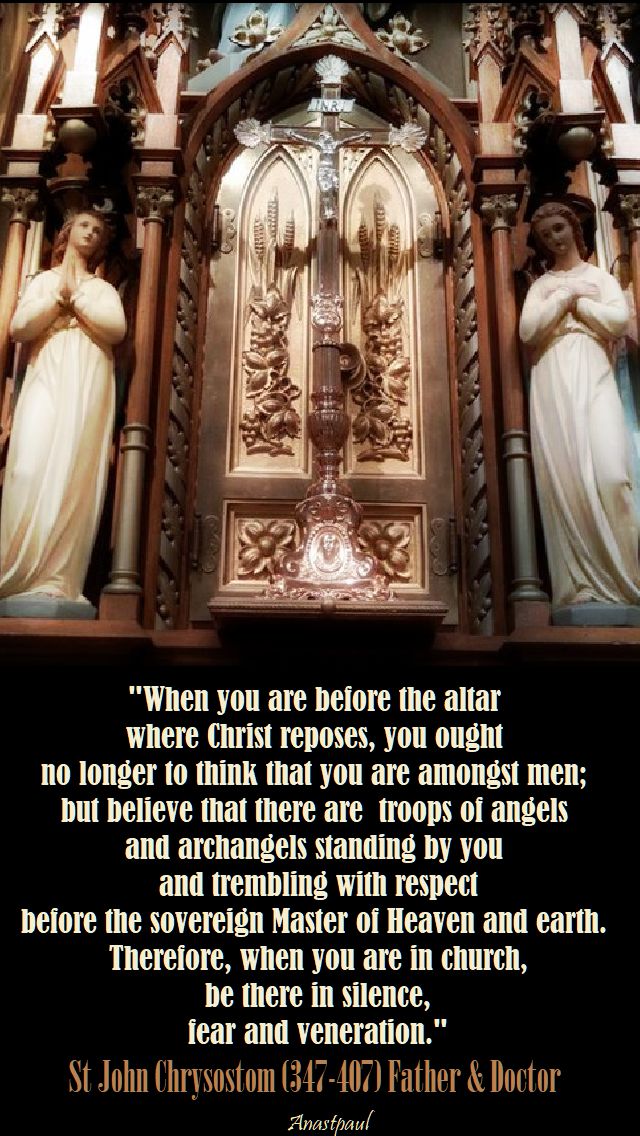
“When you are before the altar where Christ reposes,
you ought no longer to think that you are amongst men;
but believe that there are troops of angels
and archangels standing by you and trembling with respect
before the sovereign Master of Heaven and earth.
Therefore, when you are in church, be there in silence,
fear and veneration.”when you are before the altar - st john chrysostom

“It is not man that causes the things offered to become
the Body and Blood of Christ but He who was crucified for us,
Christ Himself. The priest, in the role of Christ,
pronounces these words, but their Power and Grace are God’s.
This is my body, He says. This word transforms the things offered.”it is not man that causes - st john chrysostom

“Let us, then, come back from that table like lions breathing out fire,
thus becoming terrifying to the Devil and remaining mindful of our Head
and of the love He has shown for us. . .
This Blood, when worthily received, drives away demons and puts them
at a distance from us, and even summons to us angels and the Lord of angels. . .
This Blood, poured out in abundance, has washed the whole world clean. . .
This is the price of the world;  by it Christ purchased the Church. . .
This thought will check in us unruly passions.
How long, in truth, shall we be attached to present things?
How long shall we remain asleep?
How long shall we not take thought for our own salvation?
Let us remember what privileges God has bestowed on us,
let us give thanks,
let us glorify Him,
not only by faith but also by our very works.”let us then come from that table - st john chrysostom

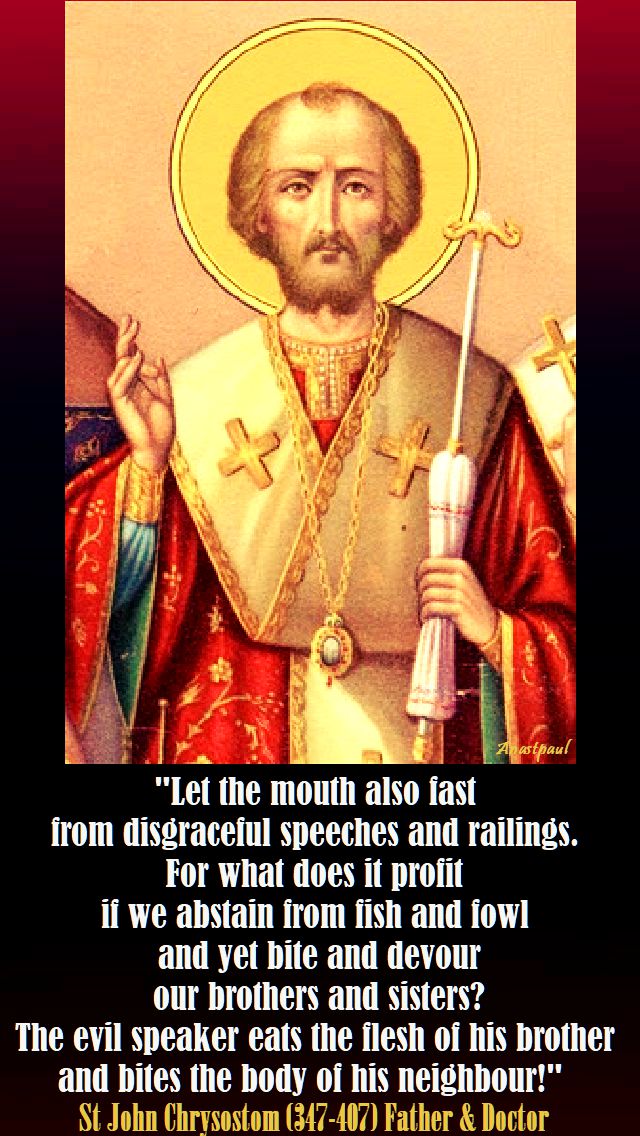
“Let the mouth also fast from disgraceful speeches and railings.
For what does it profit if we abstain from fish and fowl
and yet bite and devour our brothers and sisters?
The evil speaker eats the flesh of his brother
and bites the body of his neighbour!”

St John Chrysostom (347-407) Father & Doctor – “John of the Golden Mouth”let the mouth also fast from disgraceful-st john chrysostom

Posted in DOCTORS of the Church, FATHERS of the Church, MORNING Prayers, QUOTES of the SAINTS, SAINT of the DAY, The WORD

One Minute Reflection – 13 September – St John Chrysostom (347-407) Doctor – “John of the Golden Mouth”

One Minute Reflection – 13 September – St John Chrysostom (347-407) Doctor – “John of the Golden Mouth”

It is (Christ) who is head of the body, the Church….Colossians 1:18

REFLECTION – “Never separate yourself from the Church.
No institution has the power of the Church.
The Church is your hope.
The Church is your salvation.
The Church is your refuge.”..St John Chrysostomnever separate yourself from the church - st john chrysostom

PRAYER – Lord God, strength of those who hope in You, by Your will, St John Chrysostom became renowned in the Church for his astounding eloquence and his forbearance in persecution. Grant that we may be enriched by his teaching and encouraged by the example of his unconquerable fortitude. St John of the Golden Mouth, pray for us, amen.st john chrysostom pray for us

Posted in DOCTORS of the Church, FATHERS of the Church, MORNING Prayers, PRAYERS of the SAINTS, SAINT of the DAY

Our Morning Offering – 13 September – The Memorial of St John Chrysostum (347-407) Father and Doctor of the Church

Our Morning Offering – 13 September (347-407) Father and Doctor of the Church

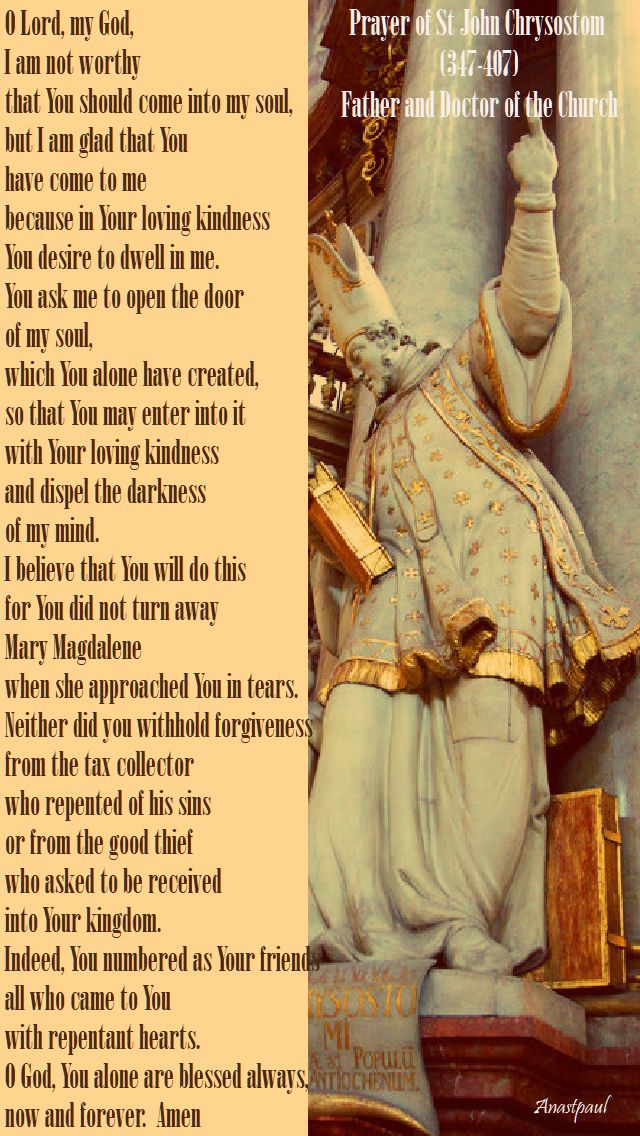
Prayer of St John Chrysostom

O Lord, my God,
I am not worthy
that You should come into my soul,
but I am glad that You have come to me
because in Your loving kindness
You desire to dwell in me.
You ask me to open the door of my soul,
which You alone have created,
so that You may enter into it
with Your loving kindness
and dispel the darkness of my mind.
I believe that You will do this
for You did not turn away Mary Magdalene
when she approached You in tears.
Neither did you withhold forgiveness
from the tax collector
who repented of his sins
or from the good thief
who asked to be received into Your kingdom.
Indeed, You numbered as Your friends
all who came to You with repentant hearts.
O God, You alone are blessed always,
now and forever. Amenprayer of st john chrysostom

Posted in All THEOLOGIANS, Moral Theologians, CONFESSORS, DOCTORS of the Church, EPILEPSY, FATHERS of the Church, PATRONAGE - WRITERS, PRINTERS, PUBLISHERS, EDITORS, etc, PREACHERS, QUOTES of the SAINTS, SAINT of the DAY

Saint of the Day – 13 September – St John Chrysostom (347-407) Father and Doctor of the Church “Golden Mouthed”

Saint of the Day – 13 September – St John Chrysostom (347-407) Father and Doctor of the Church – “Golden Mouthed” – (c 347 at Antioch, Asia Minor – 407 of natural causes) Bishop, Confessor, Father and Doctor, Preacher, Orator, Writer, Theologian,  Name Meaning – • God is gracious; gift of God (John), • golden-mouthed (Chrysostom). Patronages – • epileptics; against epilepsy• Constantinople; Istanbul, Turkey• lecturers, preachers, speakers, orators (proclaimed on 8 July 1908 by St Pope Pius X). St John Chrysostom was the Archbishop of Constantinople and is an important Early Church Father. He is known for his preaching and public speaking, his denunciation of abuse of authority by both ecclesiastical and political leaders, the Divine Liturgy of Saint John Chrysostom and his ascetic sensibilities.  Chrysostom was among the most prolific authors in the early Christian Church, exceeded only by St Augustine in the quantity of his surviving writings.

st john chrysostom 2

John was born in Antioch in 349 to Greek parents from Syria.   John’s father died soon after his birth and he was raised by his mother.   He was baptised in 368 or 373 and tonsured as a reader.   As a result of his mother’s influential connections in the city, John began his education under the pagan teacher Libanius.   From Libanius, John acquired the skills for a career in rhetoric, as well as a love of the Greek language and literature.  As he grew older, however, John became more deeply committed to Christianity and went on to study theology under Diodore of Tarsus, founder of the re-constituted School of Antioch.

John lived in extreme asceticism and became a hermit in about 375;  he spent the next two years continually standing, scarcely sleeping and committing the Bible to memory. As a consequence of these practices, his stomach and kidneys were permanently damaged and poor health forced him to return to Antioch.

Diaconate and service in Antioch:
John was ordained as a deacon in 381 by Saint Meletius of Antioch who was not then in communion with Alexandria and Rome.   After the death of Meletius, John separated himself from the followers of Meletius, without joining Paulinus, the rival of Meletius for the bishopric of Antioch. But after the death of Paulinus he was ordained a presbyter (priest) in 386 by Evagrius, the successor of Paulinus.

In Antioch, over the course of twelve years (386–397), John gained popularity because of the eloquence of his public speaking at the Golden Church, Antioch’s cathedral, especially his insightful expositions of Bible passages and moral teaching.  The most valuable of his works from this period are his Homilies on various books of the Bible.   He emphasised charitable giving and was concerned with the spiritual and temporal needs of the poor.   He spoke against abuse of wealth and personal property:

“Do you wish to honour the body of Christ? Do not ignore him when he is naked. Do not pay him homage in the temple clad in silk, only then to neglect him outside where he is cold and ill-clad. He who said: “This is my body” is the same who said: “You saw me hungry and you gave me no food”, and “Whatever you did to the least of my brothers you did also to me”… What good is it if the Eucharistic table is overloaded with golden chalices when your brother is dying of hunger? Start by satisfying his hunger and then with what is left you may adorn the altar as well.”

His straightforward understanding of the Scriptures – in contrast to the Alexandrian tendency towards allegorical interpretation – meant that the themes of his talks were practical, explaining the Bible’s application to everyday life.   Such straightforward preaching helped Chrysostom to garner popular support.   He founded a series of hospitals in Constantinople to care for the poor.

Archbishop of Constantinople:
In the autumn of 397, John was appointed Archbishop of Constantinople, after having been nominated without his knowledge.   He had to leave Antioch in secret due to fears that the departure of such a popular figure would cause civil unrest.   During his time as Archbishop he adamantly refused to host lavish social gatherings, which made him popular with the common people but unpopular with wealthy citizens and the clergy.   His reforms of the clergy were also unpopular.   He told visiting regional preachers to return to the churches they were meant to be serving—without any payout.

His time in Constantinople was more tumultuous than his time in Antioch.   Theophilus, the Patriarch of Alexandria, wanted to bring Constantinople under his sway and opposed John’s appointment to Constantinople.   Theophilus had disciplined four Egyptian monks (known as “the Tall Brothers”) over their support of Origen’s teachings.   They fled to John and were welcomed by him.   Theophilus therefore accused John of being too partial to the teaching of Origen.   He made another enemy in Aelia Eudoxia, wife of Emperor Arcadius, who assumed that John’s denunciations of extravagance in feminine dress were aimed at herself.   Eudoxia, Theophilus and other of his enemies held a synod in 403 (the Synod of the Oak) to charge John, in which his connection to Origen was used against him.   It resulted in his deposition and banishment.   He was called back by Arcadius almost immediately, as the people became “tumultuous” over his departure, even threatening to burn the royal palace.   There was an earthquake the night of his arrest, which Eudoxia took for a sign of God’s anger, prompting her to ask Arcadius for John’s reinstatement.

Peace was short-lived. A silver statue of Eudoxia was erected in the Augustaion, near his cathedral.   John denounced the dedication ceremonies as pagan and spoke against the Empress in harsh terms:  “Again Herodias raves; again she is troubled; she dances again; and again desires to receive John’s head in a charger”, an allusion to the events surrounding the death of John the Baptist.   Once again he was banished, this time to the Caucasus in Abkhazia.

Exile and death:
Faced with exile, John Chrysostom wrote an appeal for help to three churchmen:  Pope Innocent I, Venerius the Bishop of Milan and the third to Chromatius, the Bishop of Aquileia.   In 1872, church historian William Stephens wrote:

“The Patriarch of the Eastern Rome appeals to the great bishops of the West, as the champions of an ecclesiastical discipline which he confesses himself unable to enforce, or to see any prospect of establishing.   No jealousy is entertained of the Patriarch of the Old Rome by the Patriarch of the New Rome.  The interference of Innocent is courted, a certain primacy is accorded him but at the same time he is not addressed as a supreme arbitrator;  assistance and sympathy are solicited from him as from an elder brother, and two other prelates of Italy are joint recipients with him of the appeal.”

Pope Innocent I protested John’s banishment from Constantinople to the town of Cucusus in Cappadocia, but to no avail.  Innocent sent a delegation to intercede on behalf of John in 405.   It was led by Gaudentius of Brescia; Gaudentius and his companions, two bishops, encountered many difficulties and never reached their goal of entering Constantinople.

John wrote letters which still held great influence in Constantinople.   As a result of this, he was further exiled from Cucusus (where he stayed from 404 to 407) to Pitiunt (Pityus) (in modern Abkhazia) where his tomb is a shrine for pilgrims.   He never reached this destination, as he died at Comana Pontica on 14 September 407 during the journey.   His last words are said to have been “Glory be to God for all things”.

Veneration and canonisation:
John came to be venerated as a saint soon after his death.  Almost immediately after, an anonymous supporter of John (known as pseudo-Martyrius) wrote a funeral oration to reclaim John as a symbol of Christian orthodoxy.   But three decades later, some of his adherents in Constantinople remained in schism.   Saint Proclus, Patriarch of Constantinople (434–446), hoping to bring about the reconciliation of the Johannites, preached a homily praising his predecessor in the Church of Hagia Sophia.   He said, “O John, your life was filled with sorrow but your death was glorious.   Your grave is blessed and reward is great, by the grace and mercy of our Lord Jesus Christ O graced one, having conquered the bounds of time and place!   Love has conquered space, unforgetting memory has annihilated the limits and place does not hinder the miracles of the saint.”

Posted in DOCTORS of the Church, FATHERS of the Church, SAINT of the DAY

Memorials of the Saints – 13 September

St John Chrysostom (Memorial) – https://www.youtube.com/watch?v=a53YGJHmwXc
Dedication of the Basilicas of Jerusalem:  Commemoration of the dedications of the basilicas built on Mount Calvary and the Church of the Holy Sepulchre in Jerusalem.

St Aigulf
St Amatus
St Amatus of Sion
St Barsenorius
Bl Claude Dumonet
St Columbinus of Lure
St Emiliano of Valence
St Evantius of Autun
Bl Gertrude Prosperi
St Gordian of Pontus
Bl Hedwig of Hreford
St Julian of Ankyra
St Ligorius
St Litorius of Tours
St Macrobius
St Marcellinus of Carthage
Bl María López de Rivas Martínez
St Maurilius of Angers
St Nectarius of Autun
St Philip of Rome
St Venerius of Tino

Martyrs of Ireland:
• Blessed Edward Stapleton
• Blessed Elizabeth Kearney
• Blessed James Saul
• Blessed Margaret of Cashel
• Blessed Richard Barry
• Blessed Richard Butler
• Blessed Theobald Stapleton
• Blessed Thomas Morrissey
• Blessed William Boyton

Martyred in the Spanish Civil War including the Martyrs of Pozo de Cantavieja – 11 beati:
• Blessed Bienvenido Villalón Acebrón
• Blessed Emilio Antequera Lupiáñez
• Blessed Florencio Arnáiz Cejudo
• Blessed Francisco Rodríguez Martínez
• Blessed Joaquín Gisbert Aguilera
• Blessed José Álvarez-Benavides de La Torre
• Blessed José Cano García
• Blessed José Román García González
• Blessed Juan Capel Segura
• Blessed Juan Ibáñez Martín
• Blessed Luis Eduardo López Gascón
• Blessed Manuel Alvarez y Alvarez
• Blessed Manuel Martínez Giménez
• Blessed Pío Navarro Moreno
• Blessed Ramiro Argüelles Hevia
• Blessed Sabino Ayastuy Errasti
• Blessed Teófilo Montes Calvo

Posted in MORNING Prayers, NOVENAS

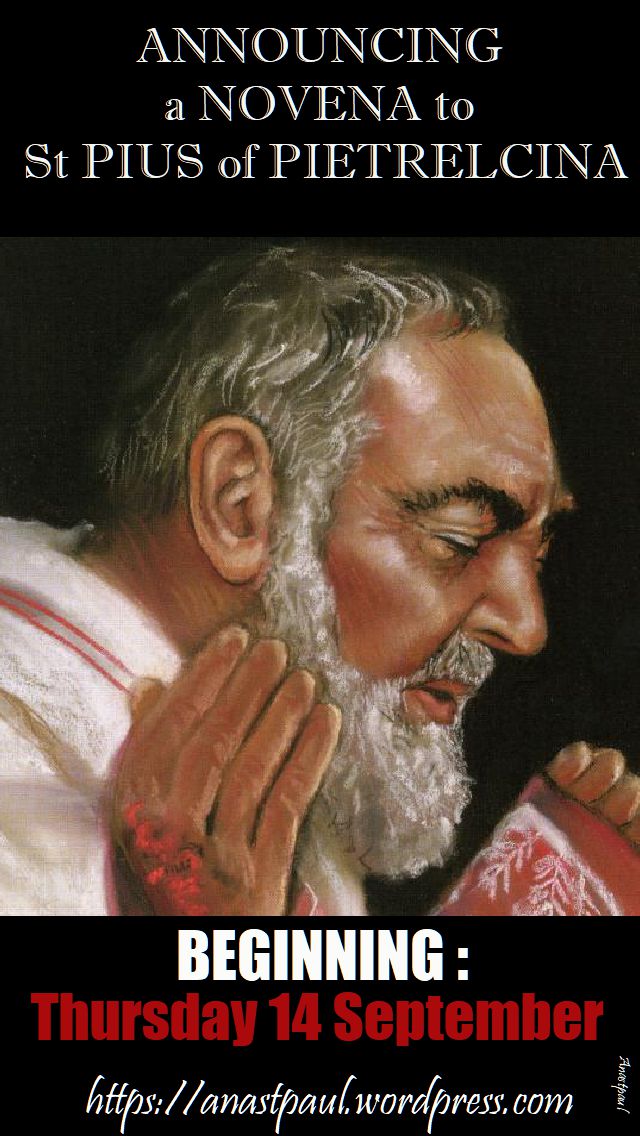
ANNOUNCING a NOVENA to ST PIUS of PIETRELCINA/St Padre Pio – Beginning Thursday 14 September

ANNOUNCING a NOVENA to ST PIUS of PIETRELCINA/St Padre Pio –
Beginning Thursday 14 September

“I want only to be a poor friar who prays… Pray, hope and don’t worry. Worry is useless. God is merciful and will hear your prayer… Prayer is the best weapon we have; it is the key to God’s heart…”

St Pius of Pietrelcina/St Padre Pio

announging a novena to st padre pio - beginning thurs 14 sept

Posted in MORNING Prayers, NOVENAS, The HOLY CROSS

DAY EIGHT – NOVENA in honour of the EXALTATION of the HOLY CROSS – 12 September

DAY EIGHT – NOVENA in honour of the EXALTATION of the HOLY CROSS – 12 September

Death is Vanquished

Lord Jesus, you broke the power of death through the cross.
You are the first born from the dead.
Teach us then to accept our fears, pains and sufferings,
uniting them to your passion and death on the cross.
Give us the grace to believe that You always draw good from evil.
You are a powerful God because even in our most frightening times,
even in our gravest suffering, even death itself,
You have gone before to vanquish all!

DAILY PRAYER:

Dear Lord Jesus
Who because of Your burning love for us willed to be crucified
and to shed Your Most Precious Blood for the redemption
and salvation of our souls,
to bear the sins of all the history of humanity,
from Adam to the end of time.
look down upon us and grant the petition we ask
…………….( mention your intention)
We trust completely in Your Mercy.
Cleanse us from sin by Your Grace,
sanctify our work,
give us and all those who are dear to us,
our daily bread, lighten the burden of our sufferings,
bless our families,
and grant to the nations, so sorely afflicted,
Your Peace, which is the only true peace,
so that by obeying Your Commandments
we may come at last to the glory of Heaven.

O Cross, you are the glorious sign of victory.
Through your power may we share
in the triumph of Christ Jesus. Amen
Glory Be. (3x)

day eight - holy cross novena - death is vanquished - 12 sept

Posted in MARIAN QUOTES, MARIAN TITLES, MORNING Prayers, QUOTES of the SAINTS, SAINT of the DAY, The BLESSED VIRGIN MARY

Thought for the Day – 12 September – Feast of the Most Holy Name of Mary

Thought for the Day – 12 September – Feast of the Most Holy Name of Mary

“The Virgin Mother is constantly present
on this journey of faith of the People of God toward the Light….
All her earthly life was a “pilgrimage of faith”.
For like us, she walked in the shadows and hoped for things unseen.
She knew the contradictions of our earthly life.
She was promised that her Son would be given David’s throne
but, at His birth, there was no room even at the inn.
Mary still believed.
The angel said her child would be called the Son of God
but, she would see Him slandered, betrayed, condemned and left to die as a thief on the Cross.

Even yet, Mary “trusted that the Lord’s words to her would be fulfilled (Luke 1:45)
and that “nothing is impossible wiuth God.” (Luke 1:37)

This woman of faith, Mary of Nazareth, the Mother of God,
has been given to us as a model in our pilgrimage of faith.
From Mary, we learn to surrender to God’s Will in all things.

I entrust you all to Mary, most holy, our Mother in heaven,
the Star of the Sea of our life..pray to her every day..!
Give your hand to Mary most holy, so that she may lead
you to receive Jesus.”
St John Paul (Ingenamenti, 6 October 1979)

Blessed Virgin Mary, Star of the Sea, Holy One, our Queen our Mother, Pray for us!

blessed virgin holy mother pray for us.2

Posted in DOCTORS of the Church, MARIAN QUOTES, MARIAN TITLES, MORNING Prayers, QUOTES of the SAINTS, SAINT of the DAY, The BLESSED VIRGIN MARY

Quote/s of the Day – 12 September – Blessed Feast of the Holy Name of Mary!

Quote/s of the Day – 12 September – Blessed Feast of the Holy Name of Mary!

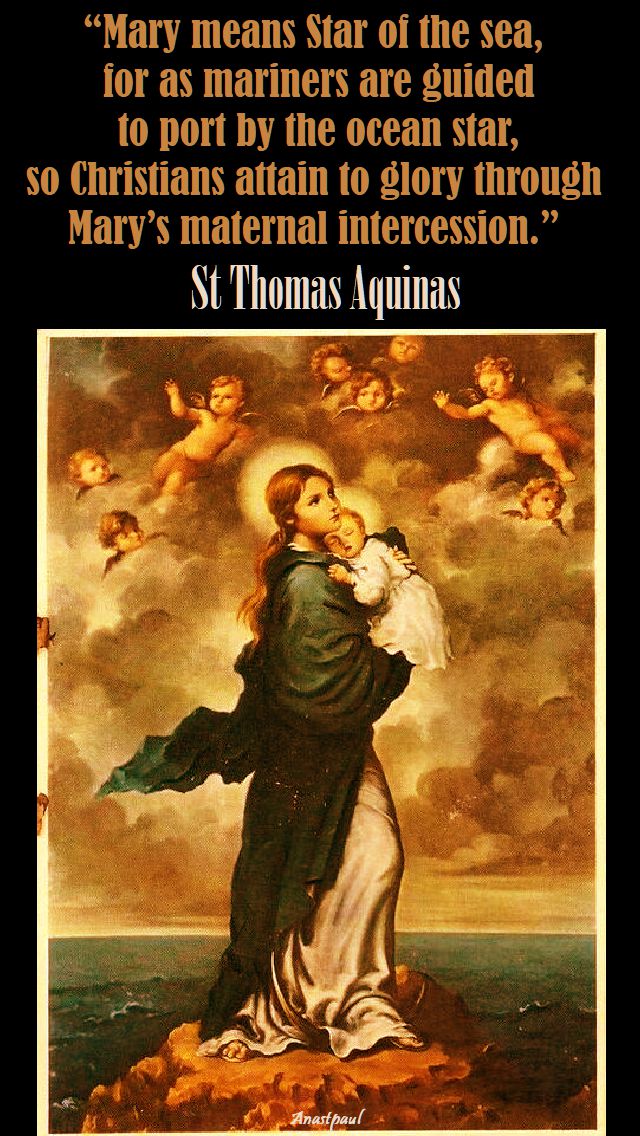
“Mary means Star of the sea, for as mariners are guided to port by the ocean star, so Christians attain to glory through Mary’s maternal intercession.”

St Thomas Aquinasmary means star of the sea - st thomas aquinas

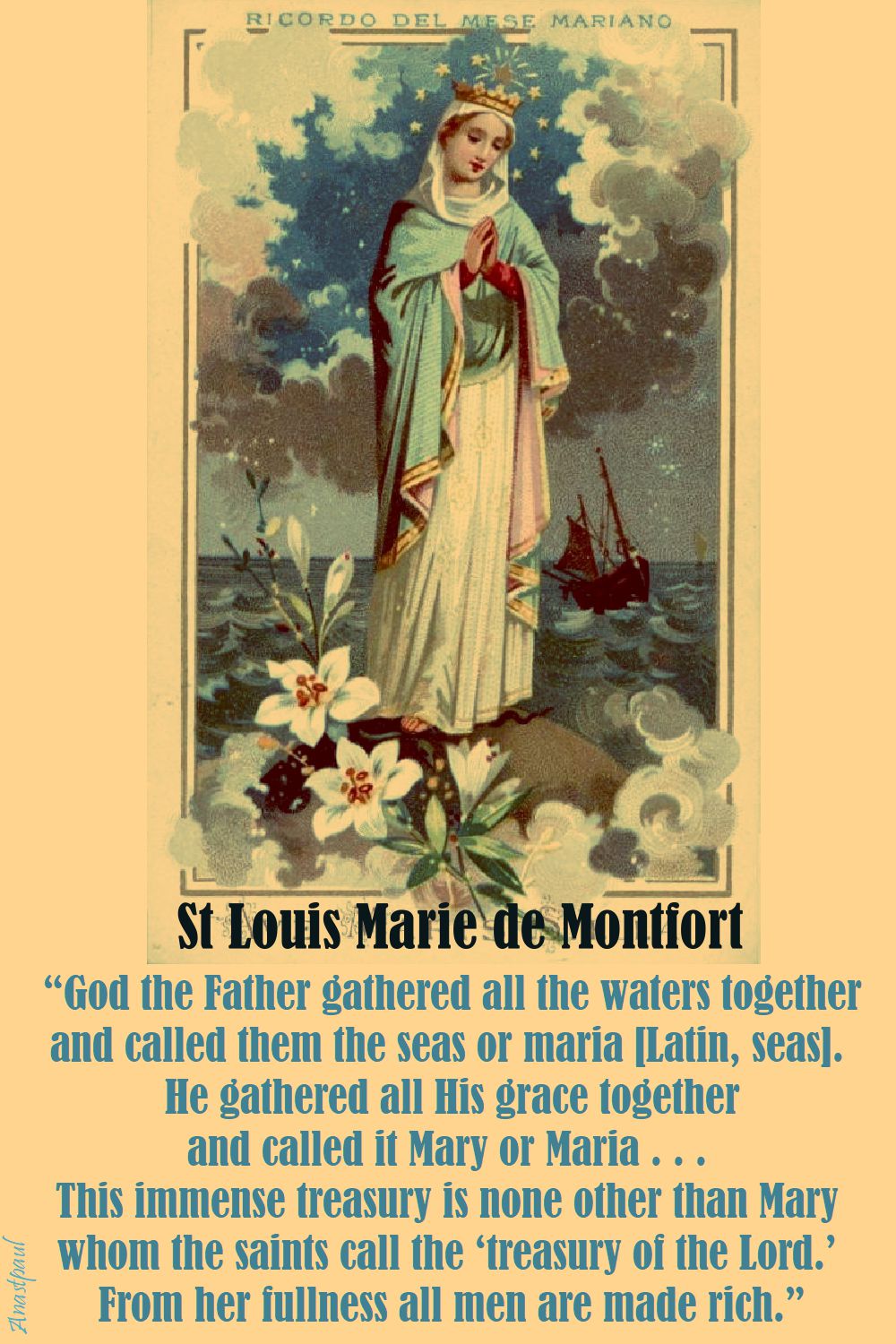
“God the Father gathered all the waters together and called them the seas or maria [Latin, seas]. He gathered all His grace together and called it Mary or Maria . . . This immense treasury is none other than Mary whom the saints call the ‘treasury of the Lord.’ From her fullness all men are made rich.”

St Louis de Montfort

god the father gathered - st louis de montfort

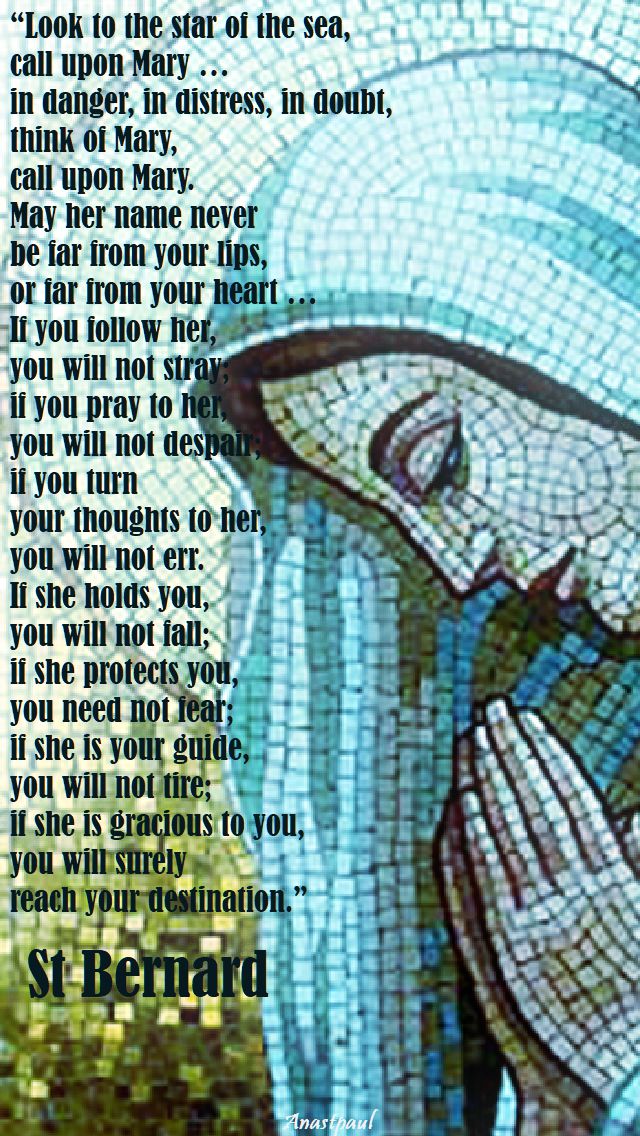
“Look to the star of the sea, call upon Mary … in danger, in distress, in doubt, think of Mary, call upon Mary. May her name never be far from your lips, or far from your heart … If you follow her, you will not stray; if you pray to her, you will not despair; if you turn your thoughts to her, you will not err. If she holds you, you will not fall; if she protects you, you need not fear; if she is your guide, you will not tire; if she is gracious to you, you will surely reach your destination.”

St Bernardlook to the star of the sea - st bernard

Posted in DOCTORS of the Church, franciscan OFM, MORNING Prayers, QUOTES of the SAINTS, The BLESSED VIRGIN MARY, The WORD

One Minute Reflection – 12 September – The Feast of the Most Holy Name of Mary

One Minute Reflection – 12 September – The Feast of the Most Holy Name of Mary

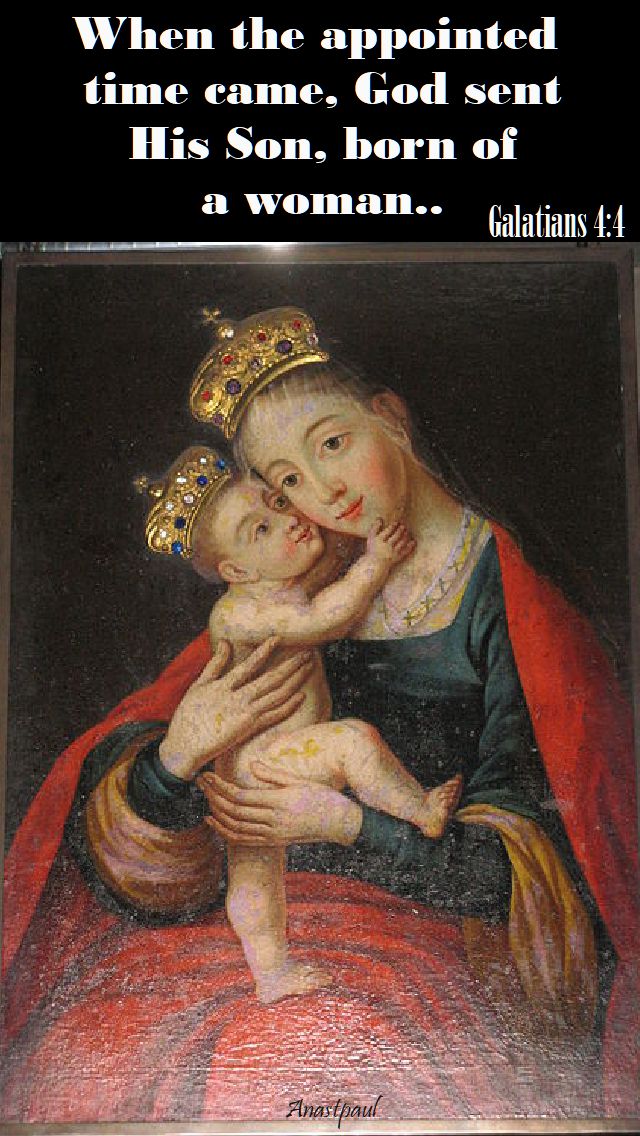
When the appointed time came, God sent His Son, born of a woman.….Galatians 4:4galatians 4 4

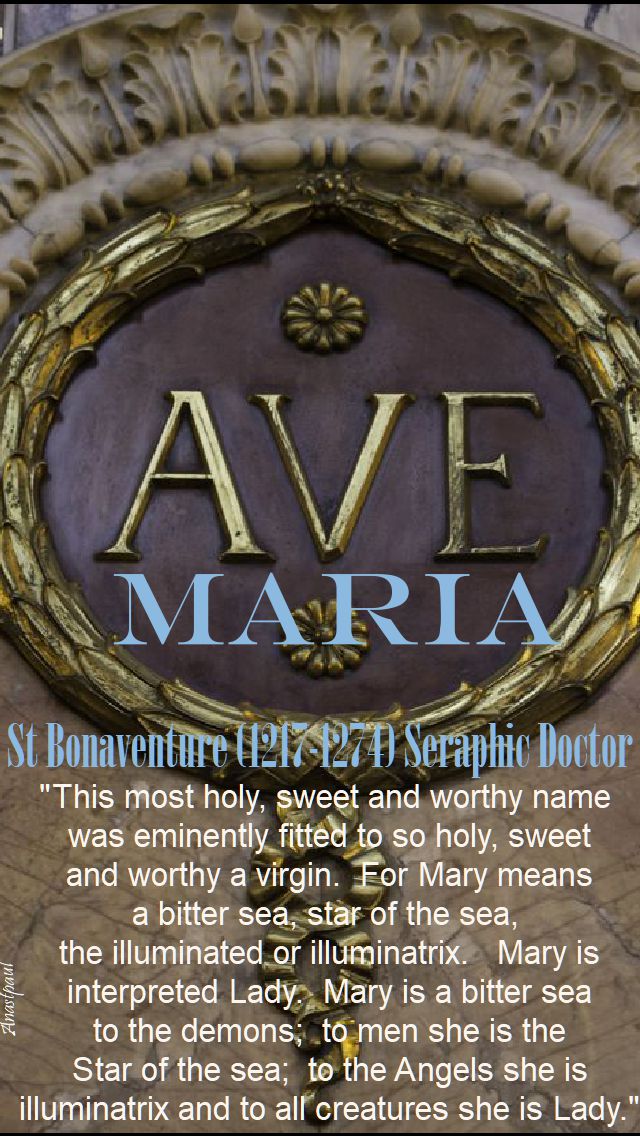
REFLECTION – “This most holy, sweet and worthy name was eminently fitted to so holy, sweet and worthy a virgin.   For Mary means a bitter sea, star of the sea, the illuminated or illuminatrix.   Mary is interpreted Lady.   Mary is a bitter sea to the demons;  to men she is the Star of the sea;  to the Angels she is illuminatrix and to all creatures she is Lady.” … St Bonaventure (1217-1274) Seraphic Doctorthis most holy sweet and worthy name - st bonaventure.2

PRAYER – Heavenly Father, assist us at all times to obtain a spirit of worthy penance, for our sins and that of all the world.   To the invocation of Your Divine Son, Jesus, we call on the intercession of His holy Mother to aid us on our pilgrimage.   With great affection and confidence, we honour the Holy Hearts and invoke the Holy Names of Jesus and Mary, to be our constant source of pure assistance and succour.   Blessed Virgin, Most Holy Mother, pray for us. Amenblessed virgin holy mother pray for us

Posted in DOMINICAN OP, MARIAN PRAYERS, MARIAN TITLES, MORNING Prayers, PRAYERS of the SAINTS, The BLESSED VIRGIN MARY

Our Morning Offering – 12 September – Feast of the Most Holy Name of Mary

Our Morning Offering – 12 September – Feast of the Most Holy Name of Mary

(Hail Mary, the Angelic Salutation)

Whenever I say Hail Mary
By Bl Alan de la Roche (1428-1475)

Whenever I say Hail Mary
The court of heaven rejoices
And the earth is lost in wonderment
And I despise the world
And my heart is brim full
Of the love of God.
When I say Hail Mary;
All my fears wilt and die
And my passions are quelled.
If I say Hail Mary;
Devotion grows within me
And sorrow for sin awakens.
When I say Hail Mary
Hope is made strong
In my breast
And the dew of consolation
Falls on my soul
More and more
Because I say Hail Mary.
And my spirit rejoices
And sorrow fades away
When I say
Hail Mary.


whenever i say hail mary - blessed alan de la roche

Posted in MARIAN PRAYERS, MARIAN QUOTES, MARIAN TITLES, MORNING Prayers, SAINT of the DAY, The BLESSED VIRGIN MARY, Uncategorized

Blessed Memorial of the Most Holy Name of Mary – 12 September

Blessed Memorial of the Most Holy Name of Mary – 12 September

name-of-Mary

On this day dedicated to the Holy Name of Mary let us repeat that wonderful prayer of Saint Bernard, responding to Pope Benedict XVI’s invitation to “invite everyone to become a trusting child before Mary, even as the Son of God did.  Saint Bernard says and we say with him:  ‘Look to the star of the sea, call upon Mary … in danger, in distress, in doubt, think of Mary, call upon Mary. May her name never be far from your lips, or far from your heart … If you follow her, you will not stray; if you pray to her, you will not despair;  if you turn your thoughts to her, you will not err. If she holds you, you will not fall;  if she protects you, you need not fear;  if she is your guide, you will not tire; if she is gracious to you, you will surely reach your destination”’  (Pope Benedict XVI, address at Heiligenkreuz Abbey, September 9, 2007).

Most Holy Name of Mary:
In accordance with Jewish custom our Lady’s parents named her eight days after her birth and were inspired to call her Mary.   The feast of the Holy Name of Mary therefore follows that of her Birthday, as the Feast of the Holy Name of Jesus follows Christmas. The feast originated in Spain and was approved by the Holy See in 1513; Innocent XI extended its observance to the whole Church in 1683 in thanksgiving to our Lady for the victory on September 12, 1683 by John Sobieski, king of Poland, over the Turks, who were besieging Vienna and threatening the West.   This day was commemorated in Vienna by creating a new kind of pastry and shaping it in the form of the Turkish half-moon.   It was eaten along with coffee which was part of the booty from the Turks (this is the origin of the of the croissant).

King_John_III_Sobieski_Sobieski_sending_Message_of_Victory_to_the_Pope,_after_the_Battle_of_Vienna_111-1
Under Mary’s Holy Name: Victory in Vienna – King Sobieski sending a message to Pope Innocent XI

The ancient Onomastica Sacra have preserved the meanings ascribed to Mary’s name by the early Christian writers and perpetuated by the Greek Fathers. “Bitter Sea,” “Myrrh of the Sea,” “The Light Giver,” “The Enlightened One,” “Lady,” “Seal of the Lord” and “Mother of the Lord” are the principal interpretations.   These etymologies suppose that the Hebrew form of the name is Maryãm, not Miryãm.   From the time of St Jerome until the 16th century, preferred interpretations of Mary’s name in the West were “Lady,” “Bitter Sea,” “The Light Giver,” and especially “Star of the Sea.”   tella Maris was by far the favoured interpretation.   The revival of Hebraic studies, which accompanied the Renaissance, led to a more critical appraisal of the meanings assigned to Our Lady’s name.   Miryãm has all the appearance of a genuine Hebrew name and no solid reason has been discovered to warrant rejecting the Semitic origin of the word.   The Hebrew name of Mary, Miryãm, (in Latin Domina) means lady or sovereign;   this Mary is in virtue of her Son’s sovereign authority as Lord of the World.   We call Mary our Lady as we call Jesus our Lord and when we pronounce her name we affirm her power, implore her aid and place ourselves under her protection.holy name of mary.1

“Therefore a certain Star has risen for us today:  Our Lady, Saint Mary.   Her name means Star of the sea;  no doubt the Star of this sea which is the world.   Therefore, we ought to lift up our eyes to this Star that has appeared on earth today in order that she may lead us, in order that she may enlighten us, in order that she may show us these steps so that we shall know them, in order that she may help us so that we may be able to ascend.   And therefore it is a beautiful thing that Mary is placed in this stairway of which we are speaking, there where we must begin to climb.   As the Evangelist says, Jacob begot Joseph, the husband of Mary, so immediately at the very moment of our conversion she appears to us and receives us into her care and enlightens us in her light and accompanies us along this laborious path.” –  St Aelred (110-1167).mary7158c63159cf5693d3029cb3f0be6650--blessed-virgin-mary-hail-mary

Posted in The BLESSED VIRGIN MARY

Feast of the Most Holy Name of Mary and Memorials of the Saints – 12 September

Most Holy Name of Mary (Optional Memorial):   Feast of the entire Latin Church.   It was first observed at Cuenca, Spain in 1513, then extended to the universal Church and assigned to its present place and rank by Pope Innocent XI in 1683 in thanksgiving to God and the Blessed Virgin for the liberation of Vienna, France and the signal victory over the Turks on 12 September 1683.   It is the titular feast of the Society of Mary (Marianists) and of the Congregation of the Oblates of Mary Immaculate.

holy name of mary

St Ailbe
Bl Apolinar Franco
St Autonomous
St Curonotus
St Dominic Magoshichi
St Eanswida
St Francis of Saint Bonaventure
St Franciscus Ch’oe Kyong-Hwan
St Guy of Anderlecht
St Juventius of Pavia
St Mancius of Saint Thomas
St Paul of Saint Clare
Bl Pierre-Sulpice-Christophe Faverge
St Sacerdos of Lyon
St Silvinus of Verona
St Tomás de Zumárraga Lazcano

Martyrs of Alexandria – 6 saints: A group of Christians martyred in the persecutions of Diocletian. We know little more than their names – Hieronides, Leontius, Sarapion, Seleusius, Straton and Valerian. They were drowned c 300 at Alexandria, Egypt.

Martyrs of Phrygia – 3 saints: Three Christians who were martyred for destroying pagan idols. We know little more than their names – Macedonius, Tatian and Theodolus. They were burned to death in 362 in Phrygia (modern Turkey).

Martyred in the Spanish Civil War:
• Blessed Fortunato Arias Sánchez
• Blessed Francisco Maqueda López
• Blessed Jaume Puigferrer Mora
• Blessed Josep Plana Rebugent
• Blessed Julián Delgado Díez

Posted in MORNING Prayers, NOVENAS

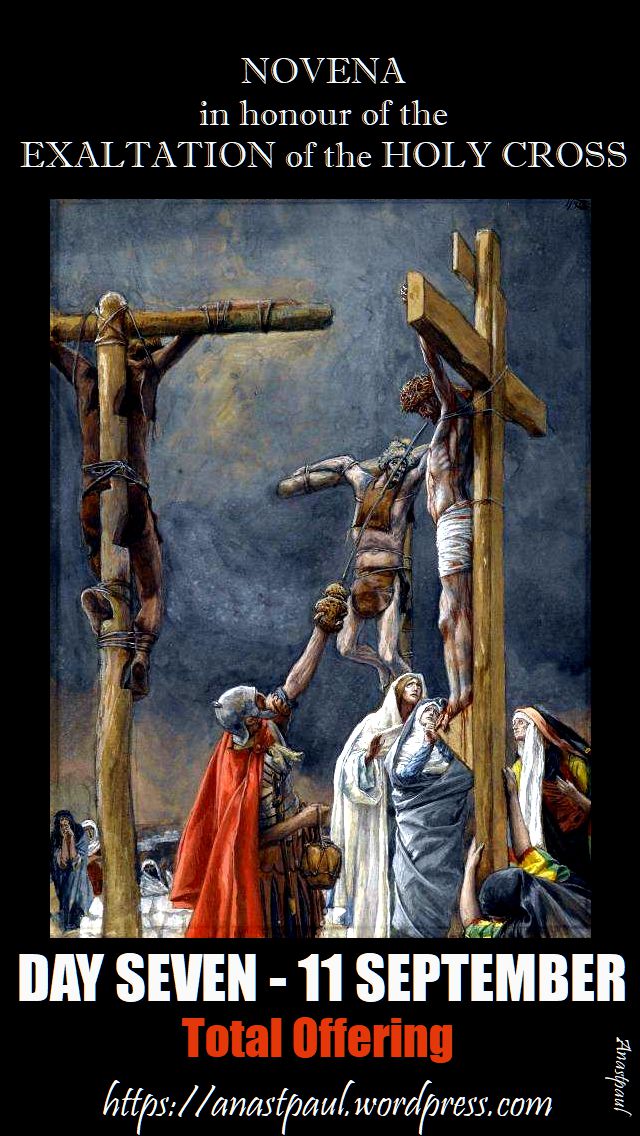
DAY SEVEN – NOVENA in honour of the EXALTATION of the HOLY CROSS – 11 September

DAY SEVEN – NOVENA in honour of the EXALTATION of the HOLY CROSS – 11 September

Total Offering

Jesus our Lord, You refused to drink the vinegar offered by the soldiers.
We know that this offering was to alleviate Your sufferings
because this drink lessens the pain, acting as anesthesia.
You refused as You wanted to feel the pain throughout the time
You hung on the cross.   You did not want to lessen Your sacrifice.
Help us, O Lord, to bear the pains of everyday life.
Let us savour our sufferings so that we may be able to live Your Holy Cross.
Inspire us not to run away but to accept and experience
all our sufferings and pain as proof of our love for You
and as reparation for our sins and the sins of the whole world.
Help us live our pain, help us to live Your Holy Cross. Amen

DAILY PRAYER:

Dear Lord Jesus
Who because of Your burning love for us willed to be crucified
and to shed Your Most Precious Blood for the redemption
and salvation of our souls,
to bear the sins of all the history of humanity,
from Adam to the end of time.
look down upon us and grant the petition we ask
…………….( mention your intention)
We trust completely in Your Mercy.
Cleanse us from sin by Your Grace,
sanctify our work,
give us and all those who are dear to us,
our daily bread, lighten the burden of our sufferings,
bless our families,
and grant to the nations, so sorely afflicted,
Your Peace, which is the only true peace,
so that by obeying Your Commandments
we may come at last to the glory of Heaven.

O Cross, you are the glorious sign of victory.
Through your power may we share
in the triumph of Christ Jesus. Amen
Glory Be. (3x)day seven - novena holy cross - total offering 11 sept

Posted in MORNING Prayers, SAINT of the DAY

Thought for the Day – 11 September – The Memorial of St John Gabriel Perboyre (1802-1840) Martyr for Christ

Thought for the Day – 11 September – The Memorial of St John Gabriel Perboyre (1802-1840) Martyr for Christ

Nothing happens by chance.  Neither life, nor death, nor vocation.   JOHN GABRIEL PERBOYRE was born in Montgesty, near Cahors, in southern France, on 6 January 1802 into a family which gave three missionaries of St Vincent and two Daughters of Charity to the Church.  Such an environment exuded faith, simple and healthy values and the sense of life as gift.

The one who “calls by name” seemed to ignore him as a teenager.   The call came to his younger brother Louis for entrance into the seminary.   John Gabriel was asked to accompany his younger brother for a time, while waiting for him to get adjusted to the surroundings.   John Gabriel’s presence at the seminary, then, happened by chance and he should have left quickly.   But chance revealed to the astonished eyes of the young man unexpected horizons:   that in the seminary he had found his path.

So many saints seem to have lived centuries ago.   Jean-Gabriel is far more recent and we can identify better with his life and circumstances.   His life and death speak to us of living the faith in our own times and places.   It is said we mock Christ again by the timidity of our witness but John Gabriel had one passion:  “Christ and the proclamation of his Gospel.   That loyalty to this passion that he possessed, has been equated with the lowly and the condemned but the Church can now solemnly proclaim his glory in the choir of the saints in heaven.” … St Pope John Paul II, Homily of Canonisation, 2 June 1996, Vatican City, Rome

St John Gabriel Perboyre, pray for us!st john gabriel perboyre - pray for us

Posted in CATHOLIC Quotes, MORNING Prayers, QUOTES of the SAINTS, SAINT of the DAY

Quote/s of the Day – 11 September – The Memorial of St John Gabriel Perboyre (1802-1840)

Quote/s of the Day – 11 September –  The Memorial of St John Gabriel Perboyre (1802-1840)

“One does good for souls only by prayer.
In all that you do, work only to please God,
otherwise you would waste your time and effort.”

one does good for souls - st john gabriel perboyre

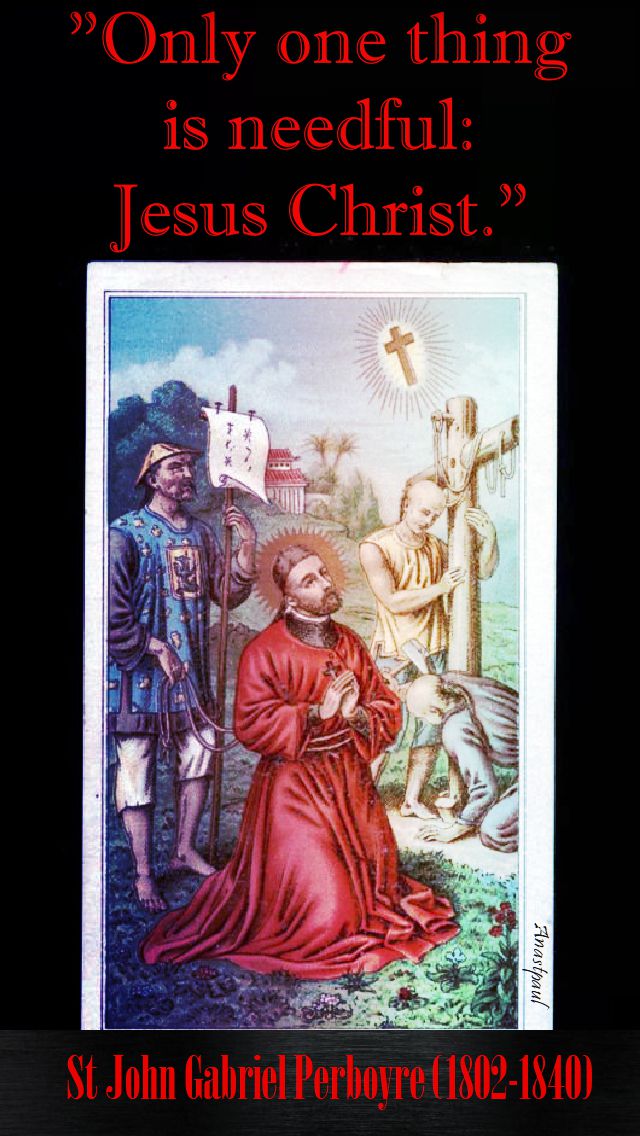
“Only one thing is needful:  Jesus Christ.”

only one thing is needful - st john gabrile perboyre

St John Gabriel Perboyre (1802-1840)

Posted in MORNING Prayers, QUOTES of the SAINTS, SAINT of the DAY, The WORD

One Minute Reflection – 11 September – The Memorial of St John Gabriel Perboyre (1802-1840) Martyr for Christ

One Minute Reflection – 11 September – The Memorial of St John Gabriel Perboyre (1802-1840) Martyr for Christ

Or are you unaware that we who were baptised into Christ Jesus were baptised into his death?…..Romans 6:3

REFLECTION – “I do not know what awaits me in the journey that lies ahead of me,
without a doubt the cross, which is the daily bread of the missionary.
What can we hope for more than this, in going to preach a crucified God?” (Letter No. 70)…St John Gabriel Perboyrei do not know what awaits me - st john gabriel perboyre.2

PRAYER – Lord Jesus, let me love You above all things and ever remain united to You and with Your Holy Cross.   I pray that I will be given the grace of courage and strength, to carry my cross in imitation of You.   St John Gabriel Perboyre, you suffered a passion and death in close imitation of our Lord and Saviour, please pray for us that our timidity might not overpower us, amen.st john gabriel perboyre - pray for us.2


Posted in MORNING Prayers, PRAYERS of the SAINTS, SAINT of the DAY

Our Morning Offering – 11 September – The Memorial of St John Gabriel Perboyre (1802-1840) Martyr for Christ

Our Morning Offering – 11 September – The Memorial of St John Gabriel Perboyre (1802-1840)

Transform me into Yourself
By St John Gabriel Perboyre (1802-1840)

O my Divine Saviour,
Transform me into Yourself.
May my hands be the hands of Jesus.
Grant that every faculty of my body
May serve only to glorify You.

Above all,
Transform my soul and all its powers
So that my memory, will and affection
May be the memory, will and affections
Of Jesus.

I pray You
To destroy in me all that is not of You.
Grant that I may live
but in You, by You and for You,
So that I may truly say, with Saint Paul,
“I live – now not I – But Christ lives in me.”transform-me-into-yourself-by-st-john-gabriel-perboyre-1802-1840-11 sept 2017-2

Posted in SAINT of the DAY

Saint of the Day – 11 September – St John Gabriel Perboyre C.M. (1802-1840) Priest, Martyr of the Congregation of the Mission

Saint of the Day – 11 September – St John Gabriel Perboyre C.M. (1802-1840) – Martyr, Priest, Missionary, Teacher (6 January 1802 at Le Puech, near Mongesty, Cahors diocese, southern France – lashed to a cross on a hill named the “red mountain”, then strangled with a rope on 11 September 1840 at Ou-Tchang-Fou, China).   He was Beatified on 10 November 1889 by Pope Leo XIII and Canonised on 2 June 1996 by St Pope John Paul II.  His Major Shrine is at the Vincentian Motherhouse, Rue du Bac, Paris, France.

CHAPEL OF ST VINCENT DE PAUL.1

The formation years:
The Church of France had at that time just emerged from the throes of the French Revolution with the red-colored garments of martyrdom for some and with the pain of the apostasy of many.  The panorama at the beginning of the 1800’s was desolate: buildings destroyed, convents sacked, people without pastors.   Thus, it was no accident that the ideal of the priesthood appeared to the young man not as a feeble arrangement for life but as the destiny of heroes.

His parents, surprised, accepted the choice of their son and accompanied him with their encouragement.   Not by chance, his paternal uncle Jacques was a missionary of St.Vincent.   This explains why in 1818 the missionary ideal matured in the young John Gabriel.   At that time, the missions meant principally China.   But China was a faraway mirage.   To leave meant never to find again the home milieu, taste its flavours, enjoy its affections.   It was natural for him to choose the Congregation of the Mission founded by St Vincent de Paul in 1625 for the evangelisation of the poor, the formation of the clergy but above all to push those very missionaries toward holiness.   The mission is not propaganda.   The Church has always demanded that the proclaimers of the Word be spiritual persons, mortified, full of God and charity.   In order to illuminate the darkness in people, a lamp is not sufficient if there is no oil.

John Gabriel did not think in half-measures.   If he was a martyr it is because he was a saint.
From 1818 to 1835 he was a missionary in his own country.   First, in his formation period, he was a model novice and student.   After his priestly ordination (1826), he was charged with the formation of seminarians.
19960602_jean-gabriel_perboyre

The missionary attraction:
A new factor, certainly not haphazard, modified John Gabriel’s life.   The protagonist was once again his brother Louis.   He also had entered the Congregation of the Mission and had asked to be sent to China where the sons of St Vincent had had a new martyr in the person of Blessed Francis Regis Clet (18 February 1820).   During the voyage, however, the young Louis, only 24 years of age, was called to the mission in heaven.   All that the young man had hoped for and done would have been useless if John Gabriel had not made the request to replace his brother in the breach.

John Gabriel reached China in August of 1835.   At that time the Occident knew almost nothing about the Celestial Empire and the ignorance was reciprocal.   The two worlds felt a mutual attraction but dialogue was difficult.   In the countries of Europe one did not speak of a Chinese civilization, but only of superstitions, of “ridiculous” ceremonies and customs.   The judgments were thus prejudices.   China’s appreciation of Europe and Christianity was not any better.   There was a dark gap between the two civilizations. Someone had to cross it in order to take on himself the evil of many and to consume it with the fires of charity.

After getting acclimated in Macau, John Gabriel began the long trip in a Chinese junk, on foot and on horseback, which brought him after eight months to Nanyang in Henan, where the obligation to learn the language imposed itself.   After five months, he was able to express himself, though with some trouble, in good Chinese and at once threw himself into the ministry, visiting the small Christian communities.   Then he was transferred to Hubei, which is part of the region of lakes formed by the Yangtze kiang (blue river).   Even though he maintained an intense apostolate, he suffered much in body and spirit.   In a letter he wrote: “No, I am no more of a wonder man here in China than I was in France … ask of Him first of all for my conversion and my sanctification and then the grace that I do not spoil His work too much…” (Letter 94).  For one who looks at things from the outside, it was inconceivable that such a missionary should find himself in a dark night of the soul.  But the Holy Spirit was preparing him in the emptiness of humility and the silence of God for the supreme testimony.

In chains for Christ:
Unexpectedly in 1839 two events, apparently unrelated, clouded the horizon.   The first was the renewed outbreak of persecution which flowed from the decree of the Manchurian emperor, Quinlong (1736-1795), which had proscribed the Christian religion in 1794.

The second was the outbreak of the Chinese-British War, better known as the “Opium War” (1839-1842).   The closure of the Chinese frontier and the pretense of the Chinese government to require an act of dependence from the foreign ambassadors had created an explosive situation.   The spark came from the confiscation of loads of opium stowed in the port of Canton;  this action harmed the merchants, most of whom were English. The British flotilla intervened and the war began.

The missionaries, obviously interested only in the first event dealing with the persecution of Christians, were always on their guard.   As often happens, too many alarms diminished the vigilance.   And that is what happened on 15 September 1839 at Cha-yuen-ken, where Perboyre lived.   On that day he was with two other European missionaries, his confrere, Baldus, and a Franciscan, Rizzolati and a Chinese missionary, Fr Wang.   They were informed of the approach of a column of about one hundred soldiers.   The missionaries underestimated the information.   Perhaps the soldiers were going elsewhere.   Instead of being wary, the missionaries continued enjoying a fraternal conversation.   When there was no longer any doubt about the direction of the soldiers, it was late.  Baldus and Rizzolati decided to flee far away. Perboyre hid himself in the surroundings because the nearby mountains were rich with bamboo forests and hidden caves.   As Fr Baldus has attested for us, however, the soldiers used threats to force a catechumen to reveal the place where the missionary was hiding.   The catechumen was a weak person, but not a Judas.   Thus began the sad Calvary of John Gabriel.  The prisoner had no rights, he was not protected by laws but was at the mercy of the jailers and judges.   Given that he was arrested it was presumed that he was guilty and if guilty, he would be punished.

A series of trials began. The first was held at Kou-Ching-Hien.   The replies of the martyr were heroic:
– Are you a Christian priest?
– Yes, I am a priest and I preach this religion.
– Do you wish to renounce your faith?
– No, I will never renounce the faith of Christ.

They asked him to reveal his companions in the faith and the reasons for which he had transgressed the laws of China.   They wanted, in short, to make the victim the culprit. But a witness to Christ is not an informer.   Therefore, he remained silent.

The prisoner was then transferred to Siang-Yang.   The cross examinations were made close together.   He was held for a number of hours kneeling on rusty iron chains, was hung by his thumbs and hair from a rafter (the hangtze torture), was beaten several times with bamboo canes.   Greater than the physical violence, however, remained the wound of the fact that the values in which he believed were put to ridicule: the hope in eternal life, the sacraments, the faith.

The third trial was held in Wuchang.   He was brought before four different tribunals and subjected to 20 interrogations.   To the questioning were united tortures and the most cruel mockery.  They prosecuted the missionary and abused the man.   They obliged Christians to abjure and one of them even to spit on and strike the missionary who had brought him to the faith.  For not trampling on the crucifix, John Gabriel received 110 strokes of pantse.

Among the various accusations, the most terrible was the accusation that he had had immoral relations with a Chinese girl, Anna Kao, who had made a vow of virginity.   The martyr defended himself.   She was neither his lover nor his servant.   The woman is respected not scorned in Christianity, was the sense of John Gabriel’s reply.   But he remained upset because they made innocents suffer for him.

During one interrogation he was obliged to put on Mass vestments.  They wanted to accuse him of using the privilege of the priesthood for private interests.   But the missionary, clothed in the priestly garments, impressed the bystanders and two Christians drew near to him to ask for absolution.
The cruelest judge was the Viceroy.   The missionary was by this time a shadow.   The rage of this unscrupulous magistrate was vented on a ghost of a man.   Blinded by his omnipotence the Viceroy wanted confessions, admissions and accusations against others. But if the body was weak, the soul was reinforced.   His hope by now rested in his meeting God, which he felt nearer each day.

When John Gabriel told him for the last time:  “I would sooner die than deny my faith!,” the judge pronounced his sentence.   John Gabriel Perboyre was to die by strangulation.

With Christ priest and victim:
Then began a period of waiting for the imperial confirmation.   Perhaps John Gabriel could hope in the clemency of the sovereign.   But the war with the English erased any possible gesture of good-will.   Thus, on 11 September 1840, an imperial envoy arrived at full speed, bearing the decree confirming the condemnation.

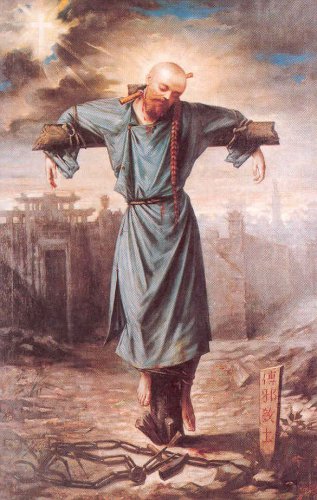
With seven criminals the missionary was led up a height called the “Red Mountain.”   As the criminals were killed first, Perboyre reflected in prayer, to the wonderment of the bystanders.   When his turn came, the executioners stripped him of the purple tunic and tied him to a post in the form of a cross.   They passed a rope around his neck and strangled him.   It was the sixth hour.   Like Jesus, John Gabriel became like a grain of wheat.   He died, or better was born into heaven, in order to make fall on the earth the dew of God’s blessing.

Many circumstances surrounding his last year of life (the betrayal, the arrest, the death on a cross, its day and hour), are similar to the Passion of Christ.   In reality, all his life was that of a witness and a faithful disciple of Christ.   St. Ignatius of Antioch wrote: “I look for him who died for us; I yearn for him who rose for us. Behold, the moment is near in which I will be brought forth!   Have compassion on me, brothers!   Do not prevent me from being born to life!”

John Gabriel “was born to life” on 11 September 1840 because he always had sought “him who died for us.”   His body was brought back to France but his heart remained in his adopted homeland, the land of China.   There he gave his witness to the sons and daughters of St. Vincent who also wait to be born to heaven after a life spent for the gospel and for the poor.

After the then-obligatory waiting period of 50 years after death for seeking a person’s canonization had expired, a cause for him was introduced to the Holy See.   In the meantime, his remains were returned from China to France, where they were entombed for veneration in the chapel of the Vincentian Motherhouse in Paris (see images above).

Posted in SAINT of the DAY, The BLESSED VIRGIN MARY

Our Lady of Coromoto – Patron of Venezuela and Memorials of the Saints – 11 September

Our Lady of Coromoto/Venezuela: Apparition – 8 September 1652 at Guanare, Portuguesa, Venezuela.
Approval – 1950 by Pope Pius XII.
Commemorates the apparition of the Blessed Virgin Mary to Coromoto, leader of the indigenous people in the forests near Guanare, Venezuela. Our Lady told the chief and his wife to go to the Catholic missionaries in the city, learn the faith, and receive Baptism; Coromoto shot an arrow at her, she vanished and left behind a piece of paper with her portrait. The entire tribe, except for Coromoto himself, converted to Christianity; he was afraid of losing his standing in the tribe. Tradition says that he fled from the Baptism ceremony into the forest where he was bitten by a poisonous snake; this could be allegorical.
Patronage: Venezuela (chosen by the bishops of Venezuela on 1 May 1942; approved by Pope Pius XII on 7 October 1944)

Our Lady of Coromoto

St Adelphus of Remiremont
St Almirus
Bl Baldassarre Velasquez
Bl Charles Spinola
St Deiniol of Bangor
St Didymus of Laodicea
St Diodorus of Laodicea
Bl Dominic Dillon
St Emilian of Vercelli
St Essuperanzio of Zurich
St Felix of Zurich
Bl Francesco Giovanni Bonifacio
Bl Franciscus Takeya
Bl François Mayaudon
Bl Gaspar Koteda
St Gusmeo of Gravedona sul Lario
St Hyacinth of Rome
St John Gabriel Perboyre/Jean Gabriel Perboyre
Bl John Bathe
St Leudinus of Toul
St Matthew of Gravedona sul Lario
St Paphnutius of Thebes
St Patiens of Lyon
Bl Peter Taaffe
Bl Petrus Kawano
St Protus of Rome
St Regula of Zurich
Bl Richard Overton
St Sperandea
St Theodora the Penitent
Bl Thomas Bathe

Martyred in the Spanish Civil War:
• Blessed José María Segura Panadés
• Blessed José Piquer Arnáu
• Blessed Josep Pla Arasa
• Blessed Lorenzo Villanueva Larrayoz