Posted in EUCHARISTIC Adoration, JESUIT SJ, MORNING Prayers, SAINT of the DAY

Quote/s of the Day – 8 June

Quote/s of the Day – 8 June

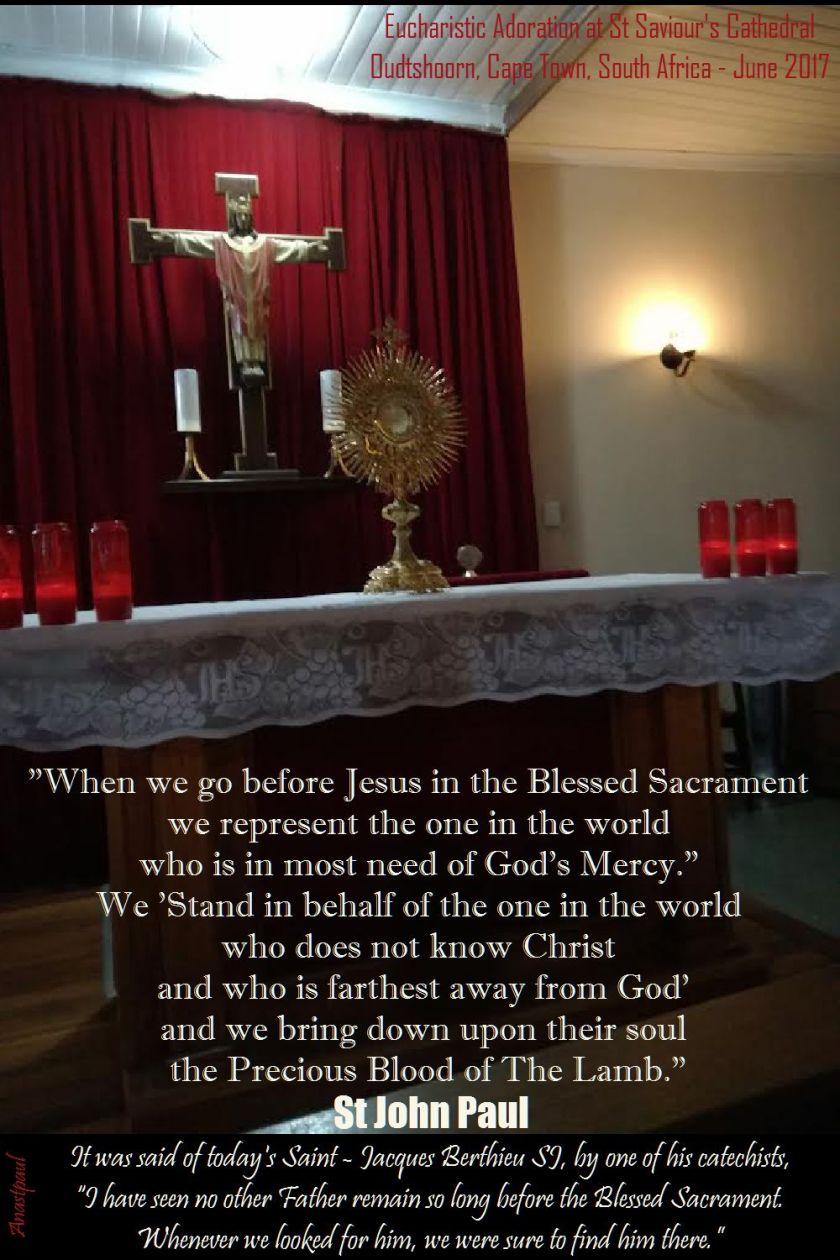
“When we go before Jesus in the Blessed Sacrament
we represent the one in the world
who is in most need of God’s Mercy.”
We “Stand in behalf of the one in the world
who does not know Christ and who is farthest away from God
and we bring down upon their soul the Precious Blood of The Lamb.”
– St Pope John Paul

It was said of today’s Saint – Jacques Berthieu, by one of his catechists,
“I have seen no other Father remain so long before the Blessed Sacrament.
Whenever we looked for him, we were sure to find him there.”

when we go before Jesus-st john paul

Posted in JESUIT SJ, MORNING Prayers, QUOTES of the SAINTS, SAINT of the DAY, The WORD

One Minute Reflection – 8 June

One Minute Reflection – 8 June

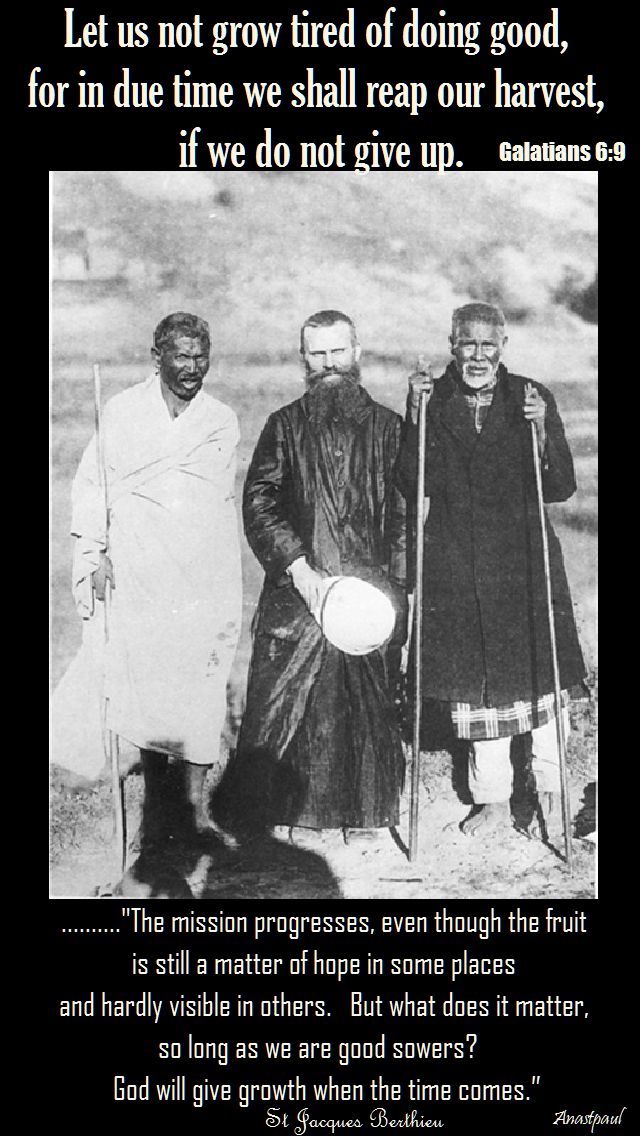
Let us not grow tired of doing good,
for in due time we shall reap our harvest,
if we do not give up……….Galatians 6:9

REFLECTION – ………“how much I still love the soil of my country and the beloved land of the Auvergne.   And yet God has given me the grace to love even more these uncultivated fields of Madagascar, where I can only catch a few souls for our Lord… The mission progresses, even though the fruit is still a matter of hope in some places and hardly visible in others.   But what does it matter, so long as we are good sowers?   God will give growth when the time comes.” …………………St Jacques Berthieu SJ

the mission progresses even though-st jacques berthieu

PRAYER – Heavenly Father, may the intercession of St Jacques Berthieu help us to recognise the strength that is given to us in our weakness, so that we might live our vocation with fidelity and joy and give ourselves totally to the mission received from Your Divine Son, the Lord!   St Jacques Berthieu, pray for us, amen.

ST JACQUES BERTHIEU PRAY FOR US

Posted in MORNING Prayers, PRAYERS of the SAINTS, SACRED and IMMACULATE HEARTS

Our Morning Offering – 8 June

Our Morning Offering – 8 June

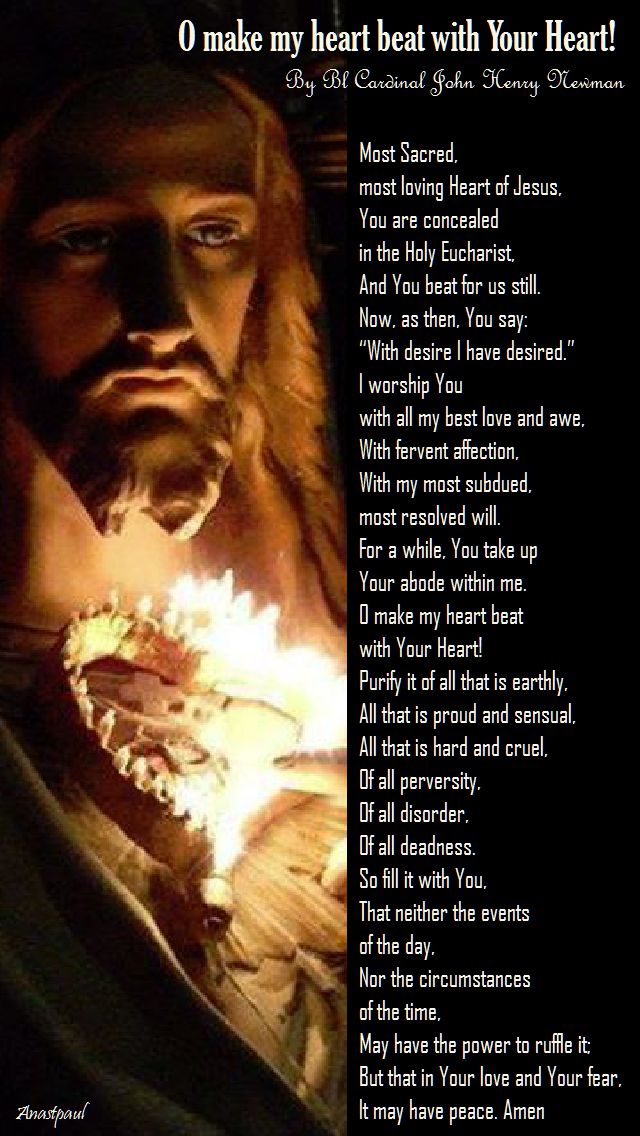
O make my heart beat with Your Heart!
By Bl Cardinal John Henry Newman

Most Sacred,
most loving Heart of Jesus,
You are concealed in the Holy Eucharist,
And You beat for us still.
Now, as then, You say:
“With desire I have desired.”
I worship You
with all my best love and awe,
With fervent affection,
With my most subdued,
most resolved will.
For a while, You take up Your abode within me.
O make my heart beat with Your Heart!
Purify it of all that is earthly,
All that is proud and sensual,
All that is hard and cruel,
Of all perversity,
Of all disorder,
Of all deadness.
So fill it with You,
That neither the events of the day,
Nor the circumstances of the time,
May have the power to ruffle it;
But that in Your love and Your fear,
It may have peace. Amen

o make my heart beat with your heart!-bl john henry newman

Posted in JESUIT SJ, SAINT of the DAY

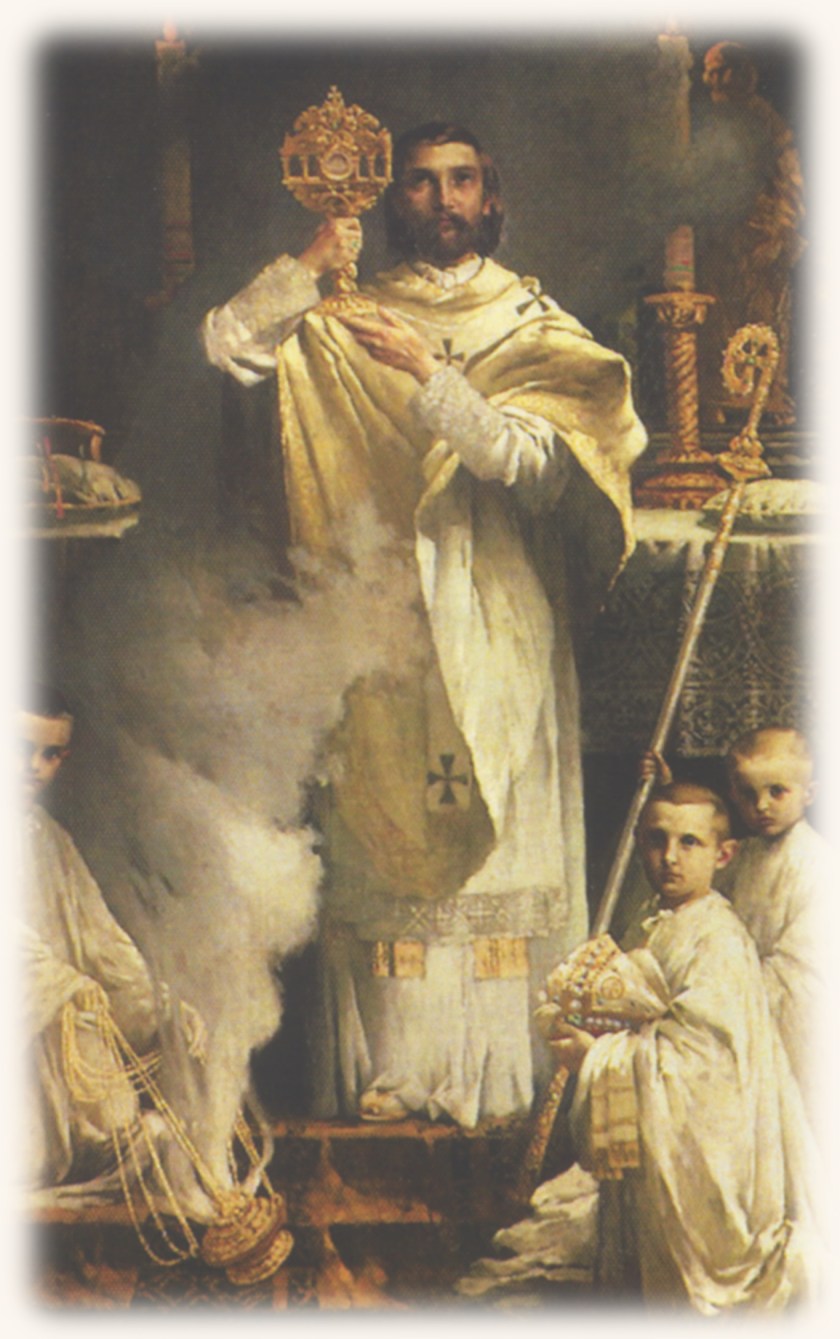
Saint of the Day – 8 June – St Jacques Berthieu SJ (1838-1896) “Martyr of Madasgacar”

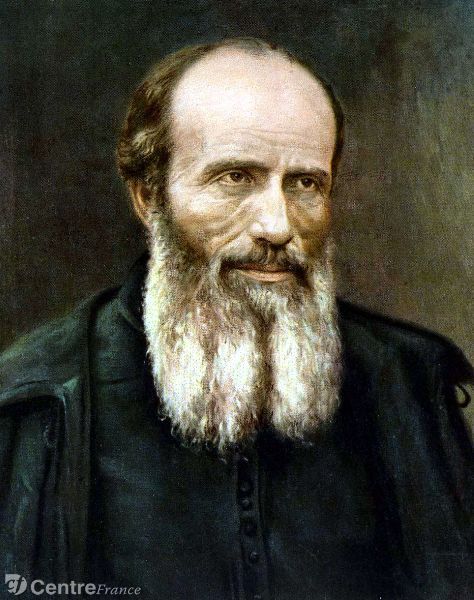
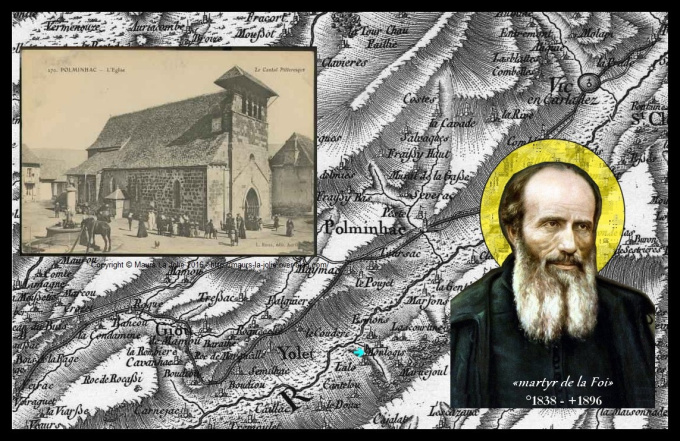
Saint of the Day – 8 June – St Jacques Berthieu SJ (1838-1896) – Martyr, Priest, Missionary known as the “Martyr of Madasgacar” (28 November 1838 in Monlogis, Polminhac, Cantal, France – shot on 8 June 1896 in Madagascar by Menalamba rebels for his work in replacing ancestor worship with Christianity, his body was dumped in the Mananara River).   He was declared venerable in 1964, Beatified on 17 October 1965, at Saint Peter’s Basilica, Vatican City by Pope Paul VI and Canonised on 21 October 2012 by Pope Benedict XVI.

St Jacques Berthieu

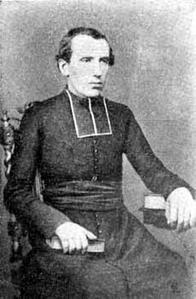
Jacques Berthieu was born on November 27, 1838, in the area of Montlogis, in Polminhac, in the Auvergne in central France, the son of deeply Christian farmers of modest means.   His childhood was spent working and studying, surrounded by his family.   The early death of an older sister made him the oldest of six children.   He studied at the seminary of Saint-Flour and was ordained to the priesthood for this diocese on May 21, 1864.   His bishop, Monseigneur de Pompignac, named him vicar in Roannes-Saint Mary, where he replaced an ill and aged priest.   He served as a diocesan priest for nine years.   Because of his desire to evangelize distant lands and to ground his spiritual life in the Spiritual Exercises of Saint Ignatius, he sought admission to the Society of Jesus and entered the novitiate in Pau on October 31, 1873 at the age of thirty-five.

st jacques berthieu 6

Mission
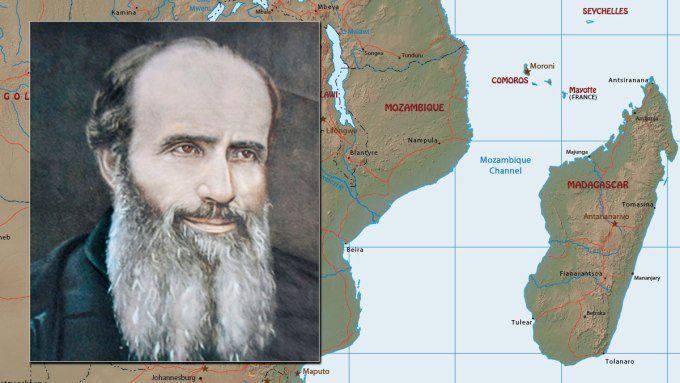
He sailed from the port of Marseilles in 1875 to two islands in the vicinity of Madagascar that were then under French jurisdiction, Réunion and Sainte-Marie, where he studied Malagasy and prepared himself for the mission.  The beginnings of his missionary life were not easy for this 37-year-old Jesuit.   Climate, language, culture were all totally new things which made him exclaim, “My uselessness and my spiritual misery serve to humiliate me but not to discourage me.   I await the hour when I can do something, with the grace of God”.    Mindful of his farming background, he was happy to cultivate the kitchen garden that supplied the station.   He and two other Jesuits and the Sisters of St. Joseph of Cluny formed a missionary team.   There he was engaged in pastoral work for five years, until March 1880.

Madagascar
In 1881, French legislation closed French territories to Jesuits, a measure which compelled Jacques Berthieu to relocate to the large island of Madagascar, an independent kingdom at that time.   Jacques Berthieu went first to Tamatova and then to Tananarive until his superiors sent him to the far-off mission of Ambohimandroso, near Betsileo.   The outbreak of the first French-Malagasy war in 1883 forced him to depart. From 1886 on, he supervised the mission of Ambositra, 250 km south of Antananarivo. After a stay in Ambositra of five years, he went to Andrainarivo in 1891.   This post was northeast of the capital and had 18 mission-stations to look after, situated in the most remote and inaccessible places.st jacques berthieu-01

Insurrection of 1896
France captured the royal palaces in September 1894 and declared Madagascar its possession, sparking the Menalamba (“red shawl”) revolt against European influence. Europeans and Malagasy Christians were targeted by organized and armed Hova units. Jacques Berthieu sought to place the Christians under the protection of French troops. Deprived of this protection by a French colonel whom Berthieu had chastised for his behaviour with the women of the country, Berthieu led a convoy of Christians towards Antananarivo and stopped in the village of Ambohibemasoandro.   On 8 June 1896, Menalamba fighters entered the village and found Jacques Berthieu hiding in the house of a Protestant friend.   They seized him and stripped him of his cassock.   One of them snatched his crucifix from him, saying: “Is this your amulet? Is it thus that you mislead the people? Will you continue to pray for a long time?”   He responded: “I have to pray until I die.” One of them then struck Berthieu’s forehead with a machete; Berthieu fell to his knees, bleeding profusely. The Menalamba then led him away for what would be a long trek.   After about a ten kilometer march, they reached the village of Ambohitra where the church Berthieu had built was located.   They insisted that it would not be possible for Berthieu to enter the camp because he would desecrate the nearby sampy, the idols held sacred by traditional communities at that time.   They threw a stone at him three times and the third time Berthieu fell prostrate.   Not far from the village, since Berthieu was sweating, a Menalamba took Berthieu’s handkerchief, soaked it in mud and dirty water and tied it around Berthieu’s head, as they jeered at him, shouting: “Behold the king of the Vazaha (Europeans).”   Some then went on to emasculate him, which resulted in a fresh loss of blood that exhausted him._st-berthieu-martyr-de-la-foi


Death
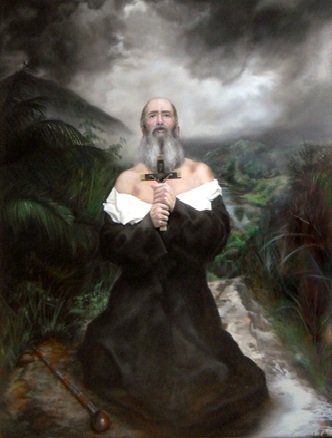
As night drew near, in Ambiatibe, a village 50 kilometers north of Antananarivo, after some deliberation, a decision was made to kill Berthieu.   The chief gathered a platoon of six men armed with guns.   At the sight, Jacques Berthieu knelt down.   Two men fired simultaneously at him but missed.   Berthieu made the sign of the cross and bowed his head.   One of the chiefs approached him and said:  “Give up your hateful religion, do not mislead the people anymore and we will make you our counsellor and our chief and we will spare you.”   He replied:  “I cannot consent to this; I prefer to die.”   Two men fired again. Berthieu bowed his head in prayer once more, and they missed him.   Another fired a fifth shot, which hit Berthieu without killing him.   He remained on his knees.   A last shot, fired at close range, finally killed Jacques Berthieu.   His body was dumped into the Mananara River and was never recovered.


ST-Jacques-Berthieu-SJ02

As a missionary, Jacques Berthieu described his task thus:  “This is what it means to be a missionary:  to make oneself all things to all people, both interiorly and externally;  to be responsible for  everything, people, animals and things and all this in order to gain souls, with a large and generous heart.”   His many efforts to promote education, to construct buildings, irrigation and gardens and to develop agricultural training all give witness to these words.   He was a tireless catechist.   A young school teacher, who was accompanying him on a journey, noticed that even while on horseback, Berthieu still had his catechism open before him.   The teacher asked him: “Father, why are you still studying the Catechism?” He answered: “My son, the Catechism is a book one can never understand deeply enough, since it contains all of Catholic Doctrine.”   In those days, once on foreign mission, there was no question of returning to one’s country of origin.   “God knows,” Berthieu said, “how much I still love the soil of my country and the beloved land of the Auvergne.   And yet God has given me the grace to love even more these uncultivated fields of Madagascar, where I can only catch a few souls for our Lord…   The mission progresses, even though the fruit is still a matter of hope in some places and hardly visible in others.   But what does it matter, so long as we are good sowers?   God will give growth when the time comes.”

A man of prayer, Jacques Berthieu drew his strength from it.   “Whenever I looked for him,” declared one of the catechists, “I found him almost always on his knees in his room.” Another said:  “I have seen no other Father remain so long before the Blessed Sacrament. Whenever we looked for him, we were sure to find him there.”   A brother of his community also gave this testimony:  “While he was convalescing, each time I entered his room, I found him on his knees, praying.”   His love for God was such that they called him “tia vavaka” (the pious one).   He was always seen with the rosary or the breviary in his hands.   His faith expressed itself in his devotion to the Blessed Sacrament, the Eucharist being the source of his spiritual life.   He also professed a special devotion to the Sacred Heart to which he consecrated himself in Paray-le-Monial before departing for mission and he became the apostle of this devotion among the Malagasy Christians.   A fervent devotee of the Virgin Mary, he went on pilgrimage to Lourdes and the rosary was his favorite prayer;   it was this prayer that he recited while he was being led to his death.   He also venerated Saint Joseph.

As a shepherd, he addressed Christians with the very words of Christ:  “my little children” (Jn 13, 33); as for his executioners, he questioned them with gentleness:  “ry zanako, my children.”   His charity was full of respect for others, even when he had to correct an erring believer.   And yet, he knew how to speak strongly and firmly whenever he judged that the interests of God and of the church were at stake.   He did not hide the demands of Christian life, beginning with the unity and the indissolubility of monogamous marriage.   Polygamy being the usual practice at the time, he denounced the injustice and the abuses it generated, thus creating enemies, especially among the powerful.

On the eve of his death, while he was heading towards the capital with the Christians hunted down by the Menalamba, he was moved with compassion at the sight of a young man with a wounded foot.   Berthieu began looking for carriers, offering a large amount of money for this service but all refused.   Descending from his horse, Berthieu lifted the disabled man onto his mount and despite Berthieu’s own weakness, he himself continued the journey on foot, while pulling the animal by the bridle.  “He was gentle,” declared a witness, “patient, zealous in carrying out his ministry whenever he was called, even when someone called him at midnight or when it was raining heavily.”   In the south of Anjozorofady lived two female lepers.   Whenever he returned from his travels, he would visit them, bring them food and clothes and teach them catechism, until he baptised them.   He considered the accompaniment of the dying in their agony a most important ministry:  “Whether I am eating or sleeping,” he would say, “do not be ashamed to call me, for me there is no stricter obligation than to visit the dying.” … Vatican.va

St Jacques Berthieu, pray for us!


Posted in SAINT of the DAY

Saints’ and Feasts – 8 June

Our Lady of Sunday: Also known as Notre-Dame du Dimanche
About the Apparition: An apparition of the Blessed Virgin Mary to Auguste Arnaud on 8 June 1873 and 8 July 1873. Arnaud was married, the father of two, and a winemaker who regularly skipped Sunday Mass to work his vineyards. Our Lady appeared to him in the vineyard on 8 June and reminded him “You must not work on Sundays.” In honour of this blessing, Arnaud placed a cross and a statue of Mary at the site in the field. On 8 July Our Lady appeared again, this time to both Auguste and his neighbors who had gathered there and told them, “You must never work on Sunday! Blessed are those who believe.”
Dates: 8 June and 8 July in 1873
Location: vineyard in Saint-Bauzille-de-la-Sylve, l’Hérault, France
Approval:
1876 by Bishop de Cabrières

St Anne Mary Taigi
St Bron of Cassel
St Calliope
St Clodulf of Metz
Bl Engelbert of Schäftlarn
St Eustadiola of Moyen-Moutier
St Fortunato of Fano
St Gildard of Rouen
Bl Giorgio Porta
Bl Giselbert of Cappenberg
St Heraclius of Sens
Bl István Sándor
St Jacques Berthieu
Bl John Davy
Bl John Rainuzzi
Bl Maddallena of the Conception
Bl Mariam Thresia Chiramel Mankidiyan
St Maximinus of Aix
St Medard of Noyon
St Melania the Elder
St Muirchu
St Pacificus of Cerano
Bl Peter de Amer
Bl Robert of Frassinoro
St Sallustian
St Syra of Troyes
St Victorinus of Camerino
St William of York

Posted in SAINT of the DAY

Thought for the Day – 7 June

Thought for the Day – 7 June

Young Matt Talbot, known as the “saint in overalls,” knelt outside the doors of his church for hours every morning until the doors were opened.
Once inside, he would prostrate himself on the floor in the form of a cross before entering his pew.
Every Sunday, he spent seven hours in Church without moving, (attending all the Masses) – “his arms crossed, his elbows not resting on anything, his body from the knees up as rigid and straight as the candles on the altar,” a biographer writes.   He did this every Sunday for 40 years.
A tremendous son of Our Blessed Mother, in addition to praying the rosary and angelus, one of his favourite little prayers, which he sometimes kept written on his hand, was,
“O Virgin I ask three things from you:
the grace of God,
the presence of God,
the blessing of God”
and
“O blessed Mother, obtain for me from Jesus that I may participate in His folly.”

Most notably, of course, Matt Talbot is known for his total conversion of life away from alcohol addiction, something he described as like “escaping Hell.”
There is evidence that Matt’s first seven years after taking the pledge were especially difficult.   Avoiding his former drinking places was hard.   Only alcoholic men and women who have stopped drinking can fully appreciate how difficult the earliest years of sobriety were for Matt.

He had to take one day at a time.   So do the rest of us BUT as Matt himself said, we can never be lonely on the road for we are not alone!

Venerable Matt Talbot, pray for us.

ven matt talbot pray for us 2

Posted in MORNING Prayers, NOVENAS

St ANTHONY of PADUA NOVENA for all our needs – DAY FOUR – 7 June

St ANTHONY of PADUA NOVENA – DAY FOUR – 7 JUNE

day four st anthony novena

DAY FOUR

I salute and honour you,
O powerful helper, St. Anthony.
The Christian world confidently turns to you
and experiences your tender compassion
and powerful assistance in so many necessities and sufferings
that I am encouraged in my need to seek your help
in obtaining a favourable answer to my request,
for this my special intention in this novena
(State your intention).
O holy St. Anthony, I beseech you,
obtain for me the grace that I desire.

One Our Father, one Hail Mary, and Glory Be to the Father, in honour of Saint Anthony.

Saint Anthony, pray for us!

Posted in EUCHARISTIC Adoration, MORNING Prayers, QUOTES of the SAINTS, SAINT of the DAY

Quote/s of the Day – 7 June

Quote/s of the Day – 7 June

“How can anyone be lonely, with Our Lord in the Blessed Sacrament?”

how can anyone be lonely - ven matt talbot

“Three things I cannot escape:
the eye of God,
the voice of conscience,
the stroke of death.
In company, guard your tongue.
In your family, guard your temper.
When alone guard your thoughts.”

Venerable Matt Talbot – Memorial today 7 June

three things-ven matt talbot


Posted in MORNING Prayers, SAINT of the DAY, The WORD

One Minute Reflection – 7 June

One Minute Reflection – 7 June

I call heaven and earth today to witness against you: I have set before you life and death, the blessing and the curse.   Choose life, then, that you and your descendants may live by loving the LORD, your God, obeying his voice and holding fast to him…..Deuteronomy 30:19-20

deuteronomy 30 19-20

REFLECTION – “The false gods competing for people’s allegiance today, are associated with the worship of material things, possessive and manipulative forms of love and power.   The cult of material possessions, the cult of possessive love and the cult of power often lead people to attempt to ‘play God,’ to try to seize total control with no regard for the wisdom of the commandments that God has made known to us. This is the path that leads toward death.” …..Pope Benedict XVI whilst visiting a Rehabilitation Centre in 2008

the false gods - pope benedict

PRAYER – Lord, in Your servant, Venerable Matt Talbot you have given us a wonderful example of triumph over addiction, of devotion to duty and charity and commitment to daily prayer. May his life of prayer and penance give us courage to take up our crosses and follow in the footsteps of Our Lord and Saviour, Jesus Christ. Venerable Matt Talbot please pray for all those who are slaves to addiction and for the whole world, amen.

ven matt talbot pray for us

Posted in DOCTORS of the Church, MORNING Prayers, PRAYERS of the SAINTS, SACRED and IMMACULATE HEARTS

Our Morning Offering – 7 June

Our Morning Offering – 7 June

Prayer to the Sacred Heart
by Saint Francis De Sales (1567-1622) Doctor of Charity

May Your heart dwell always in our hearts!
May Your blood ever flow in the veins of our souls!
O sun of our hearts, You give life to all things by the rays of Your goodness!
I will not go, until Your heart has strengthened me, O Lord Jesus!
May the heart of Jesus be the king of my heart!
Blessed be God.  Amen

prayer to the sacred heart by st francis de sales

Posted in SAINT of the DAY

Saint of the Day – 7 June Venerable Matt Talbot OFS

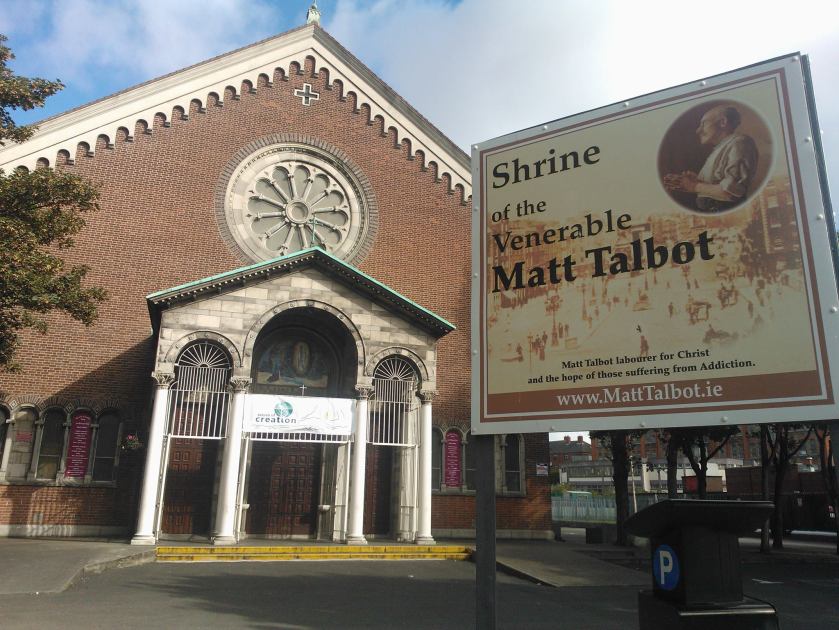
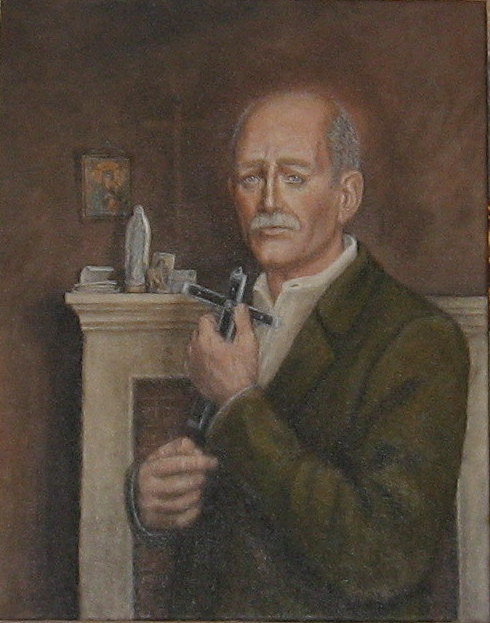
Saint of the Day – 7 June Venerable Matt Talbot OFS (1856 – 1925) (born Matthew Talbot) – Layman, Ascetic, Mystic – known as the “Saint in Overalls” and “the Workers’ Saint”, disciple of Eucharistic Adoration and the Blessed Virgin –  Patron of Struggling and Recovering Addicts and Alcoholics and many addiction treatment programs, retreats and centres throughout the world bear his name.  His grave is at Our Lady of Lourdes Church, Seán McDermott Street, Dublin.
ven matt talbot 6

Ven Matt Talbot lived at an incredibly difficult time.   He and his 13 siblings were born into poverty in Dublin shortly after the Irish Potato Famine.   One million people died from this largely human-made disaster that saw, even while starvation was rampant, the British government’s siphoning off profit from Irish crops and livestock.   Another million people emigrated and alcoholism was rampant among those who stayed behind.

His father beat him, made him change jobs—but nothing could stop Matt’s habit.    After work he and his buddies went straight to the pub.   Matt spent every penny on drink and once pawned his boots for a pint.   Remarkably, his drinking did not prevent his putting in a good day’s work.   And he said that when he was intoxicated he occasionally thought about the Blessed Mother and prayed an off-handed Hail Mary.    Matt believed later that our Holy Mother may have had something to do with his conversion.ven matt talbot and the virgin
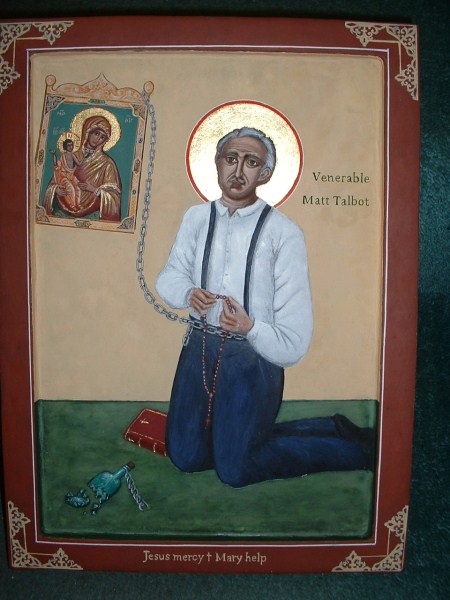
One day in 1884, when Matt was 28 years old, an incident occurred that changed his entire life.   For a week he had stayed away from work, drinking heavily.   Saturday found him sober, thirsty and penniless.   But confident that his workmates, for whom he had often bought drink, would come to his assistance, he stood with his brother near O’Meara’s pub on the North Strand to meet his colleagues coming from Pembertons.   The men passed in twos and threes but none stopped to ask the brothers to have a drink. Matt said later that he was “cut to the heart” by this treatment and went home. Mary Andrews, his sister, reported what happened when Matt came home that day:

My mother said, “You’re home early, Matt, and you’re sober!” He replied, “Yes, mother, I am.” After dinner he remained in the house which was not usual, and finally he remarked to my mother. “I’m going to take the pledge.” She smiled and said, “Go, in God’s name, but don’t take it unless you are going to keep it.” He said, “I’ll go, in God’s name.”

As he was going out mother said, “God give you strength to keep it.”   He went to Clonliffe, made his confession, and took the pledge for three months.   He had been a couple of years away from the sacraments then.   Next morning—Sunday—he went to Holy Communion.   On Monday he went to 5 a.m. Mass in Gardiner Street and was at his work as usual at 6 a.m.   This he made a regular practice from that time on.matt talbot young

But after his work, to keep away from his companions, he used to walk to a distant church, either St Joseph’s, Berkeley Road, or St. Peter’s, Phibsboro and remain there until bedtime.

Once or twice—possibly on a Saturday—he went with the men to the public house but he drank only mineral waters and he usually spent Saturday afternoons away from where he might meet his old companions and generally in a church.   He had a bad time of it at first and sometimes said to my mother, that, when the three months were up, he would drink again.

But Matt extended the three months into forty-one years.   His new behaviour flabbergasted everyone.   Matt supported his sobriety with traditional Catholic disciplines such as prayer, frequent communion, weekly confession, spiritual reading, fasting and charitable works.   He also seems to have taken guidance from a wise spiritual director but the person’s name is not known.   In 1891, Matt found community support by joining the Franciscan Third Order.ven matttalbot
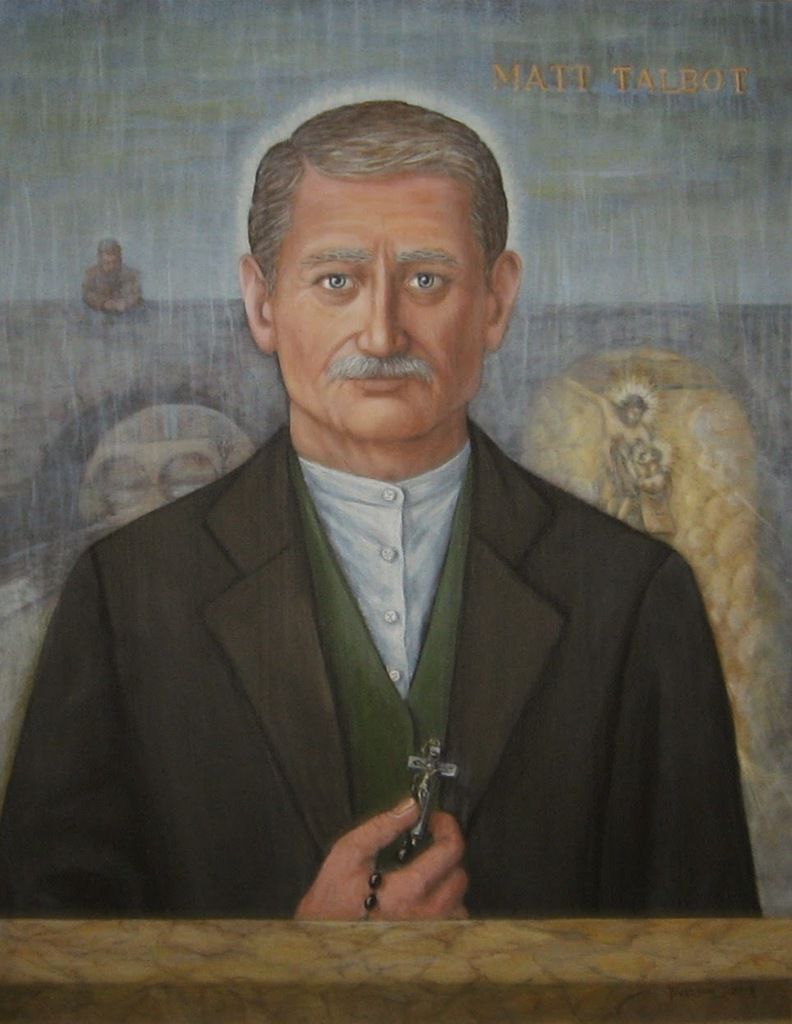
Matt often read the Bible and the lives of saints and he also began reading papal encyclicals on social justice and books on the labour movement.   His faith and his concern for the poor led him to action and in 1900 he joined a strike from the Dublin Port & Docks Board to demand a modest raise of sixpence to their daily pay of four and sixpence.   When management refused, he was one of four workers who held out from returning to work while the rest slowly gave in to the financial pressure.

He became a loyal member of Ireland’s Transport and General Workers Union.   When the Dublin Lockout of 1913 led to sympathy strikes throughout the city, Matt consulted a trusted priest as he discerned joining the strike.   The priest encouraged him and Matt joined the strike also came to quote a phrase from a book the priest gave him: “No man has the right to starve a worker into submission.”   During this strike, he refused the strike pay given by the union to ease financial hardship, saying that he had not earned it. Later he accepted the pay but shared it among the other strikers.   Matt was a vocal supporter of James Larkin, a famous union organizer and major figure in Ireland’s labor movement.   One union leader, Stephen McGonagle, described Matt as “a beacon of light to Irish workers.”ven Matt_Talbot_Pray_4ea962f64f642
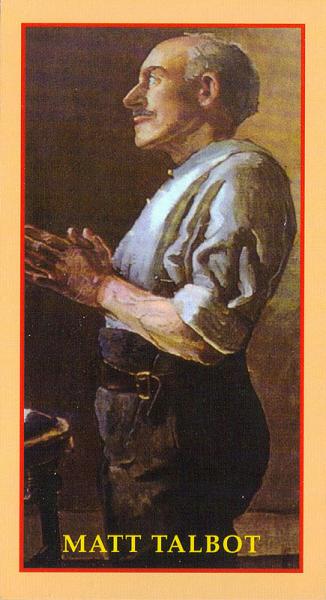
Prayer and mortification
Matt Talbot mortified himself rigorously.   He slept on a plank bed with a piece of timber for a pillow.   This left his face numb in later years.   He slept in chains which he wore for 14 years before his death, round his leg and on his body.

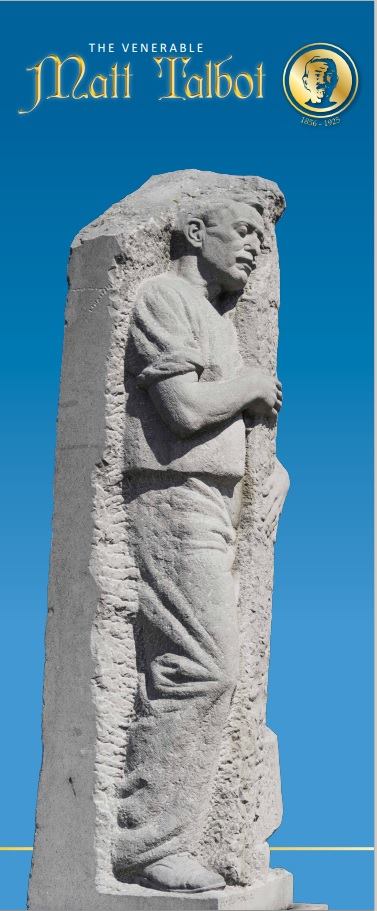
He prayed each night from 2 to 4 a.m., then dressed and prayed again until it was time to leave for Mass in St. Francis Xavier’s Church.   He would arrive at 5am, if not earlier,and would kneel in prayer at the church’s iron railings, waiting for it to open.   On entering he would kneel and kiss the ground, then make the Stations of the Cross.matt_talbot statue

In 1892 Matt took up employment as a bricklayer’s labourer with the firm of T & C Martin, on the North Wall, where he remained until his death.   He fasted constantly.   His breakfast consisted of cocoa prepared the previous evening by his sister, which he often drank cold.   With this he ate some dry bread.   For his midday meal he had cocoa to which he would add a pinch of tea and again drank cold.   With this he took a slice of bread.   His sister would bring him a small evening meal.   If she brought fish he would insist that she take it home with her and would make do with bread soaked in the fish juice.

On Sundays he remained in the church for every Mass.   Only on returning to his room at about 2 p.m. would he break his fast for the first time since 6.30 p.m. the previous day. The remainder of the day was spent in prayer, reading the Scriptures and the lives of the saints. He gave all his money to neighbours in need and to the missions.POS-F1332_Matt_Talbot_info
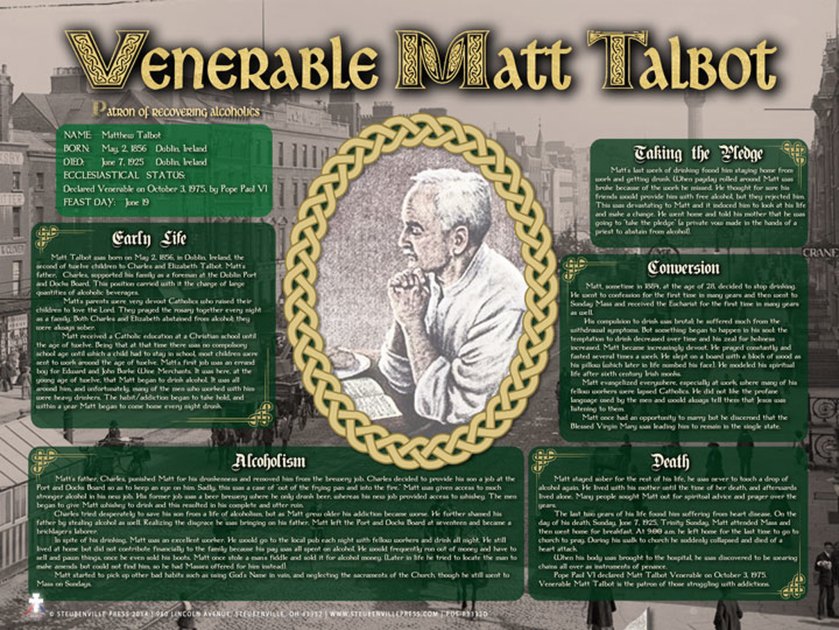
Collapsed and died
Matt was on his way to Mass in St Saviour’s on Trinity Sunday, 7 June 1925, when he collapsed and died on Granby Lane.   A paragraph in The Irish Independent of the following day stated, “An elderly man collapsed in Granby Lane yesterday and, on being taken to Jervis Street Hospital, was found to be dead.   He was wearing a tweed suit, but there was nothing to indicate who he was.”

He was buried the following Thursday, the feast of Corpus Christi, in Glasnevin Cemetery.

In 1952 Matt Talbot’s remains were exhumed and transferred to a double coffin bearing the inscription, ‘The Servant of God, Matthew Talbot.’   The coffin was placed in a vault in the central circle of the cemetery to which pilgrims began to flock from all over the world.

In 1972 Matt Talbot’s remains were removed to the Church of Our Lady of Lourdes in Sean McDermott Street.   The tomb has a glass panel through which the coffin may be seen.ven matt talbot coffin

He was declared Venerable by Blessed Pope Paul VI in 1975.

PRAYER for the CANONISATION OF VENERABLE MATT TALBOT

Lord, in your servant, Matt Talbot
you have given us a wonderful example of triumph over addiction,
of devotion to duty and of lifelong reverence of the Holy Sacrament.
May his life of prayer and penance give us courage
to take up our crosses and follow in the footsteps of Our Lord and Saviour, Jesus Christ.
Father, if it be Your will that Your beloved servant
should be glorified by your Church,
make known by Your heavenly favours
the power he enjoys in your sight.
We ask this through Jesus Christ Our Lord,
in union with the Holy Spirit,
one God forever and ever, Amen.

Anyone who receives a favour through the intercession of Matt Talbot is requested to write to Fr John Flaherty, Vice-Postulator of the Cause, Our Lady 83 Marlborough Street, Dublin 1.shrine ven matt talbot

shrine of matt talbotshrine of matt talbot 1ven matt talbot statue


Posted in SAINT of the DAY

Saints’ Memorials – 7 June

Bl Anne of Saint Bartholomew
St Anthony Mary Gianelli
St Aventinus of Larboust
Bl Basilissa Fernandez
St Colman of Dromore
Bl Demosthenes Ranzi
St Deochar
St Gotteschalk
St Justus of Condat
St Landulf of Yariglia
St Lycarion of Egypt
Venerable Matt Talbot – https://www.youtube.com/watch?v=PlLa7RqoAIw
St Meriadoc I of Vannes
St Meriadoc II of Vannes
St Odo of Massay
St Potamiaena of Alexandria the Younger
St Quirinus of Cluny
St Robert of Newminster
St Sergius of Cluny
St Vulflagius of Abbeville

Martyrs of Africa – 7 saints: A group of seven Christians who were martyred together. No details about them have survived except the names – Donata, Evasius, Guirillus, Januaria, Privata, Spisinna, Victurus. The precise location in Africa and date are unknown.

Martyred in Córdoba, Spain:
Habentius of Córdoba
Jeremiah of Córdoba
Peter of Córdoba
Sabinian of Córdoba
Wallabonsus of Córdoba
Wistremundus of Córdoba

Posted in ART DEI, EUCHARISTIC Adoration

“Art Dei” Series “The Defenders of the Eucharist” by Peter Paul Rubens, Flemish 1577-1640 Issue 1 – 6 June 2017

Art Dei Series

The Defenders of the Eucharist
by Peter Paul Rubens, Flemish 1577-1640
SN 214 Oil on Canvas c1625

Artist:
Peter Paul Rubens, along with the Italian sculptor Gianlorenzo Bernini, was one of the greatest artists of the 17th century.   His canvases can be said to define the scope and style of high baroque painting through their energy, earthy humanity and inventiveness. A devoutly religious man, a man of learning and a connoisseur of art and antiquities, he was also a man of the world who succeeded not only as an artist but as a respected diplomat in the service of Isabella and Albrecht of the Spanish Netherlands.

Travels to Venice where he studied Titian, Veronese & Tintoretto freed his artistic talent from rigid classicism.   While he did incorporate copies of classical statues in his paintings he always avoided the appearance and coldness of stone.   To the contrary, his nudes, for which he became famous, always depicted an ample female form of vitality and good health as well as of sensuousness.   His mastery of color along with his knowledge of antiquity is seen particularly in his mythological paintings.

As court painter and confidant to the Archduchess Isabella Clara Eugenia, Rubens recognized the role art was to play in the Counter Reformation.   His genius found expression in his designs for the Triumph of the Eucharist tapestries which he and his assistants completed between 1625 and 1628.

Knighted by two monarchs and master of a successful workshop, Rubens became rich and famous in his own time. Having executed over 3,000 paintings, woodcuts and engravings of all types, he died the most respected artist of his time in 1640.

Norbert of Xanten, defender of the Holy Eucharist
The Defenders of the Eucharist
by Peter Paul Rubens, Flemish 1577-1640 Including Sts Jerome, Norbert, Thomas Aquinas, Clare, Gregory the Great, Ambrose, Augustine

Subject:
This painting shows seven saints, all of whom were considered to be defenders of the doctrine of Transubstantiation an integral tenet of the Catholic Church.   From the right the figures represent –

(1) St Jerome, (Feast Day 3 September) noted for his translation of the bible from Hebrew into Latin;  

(2) St Norbert, (Feast Day 6 June) a German archbishop and saint, who preached against dissenters who attacked the Christian sacraments and official clergy;  

(3) St Thomas Aquinas, (Feast Day 28 January) a medieval theologian of the Dominican order, whose writings became the basis for much of the doctrine of the Catholic Church;  

(4) St Clare, (Feast Day 11 August) the founder of the Poor Clares, was a Franciscan heroine who repulsed the Saracens at Assisi by confronting them holding the Host in her hands;

(5) Gregory the Great, (Feast Day 3 September) who established, as Pope, the form of the Roman liturgy;

(6) St Ambrose, (Feast Day 7 December) renowned as both theologian and statesman of the Church, who in an age of controversy, was instrumental in crushing Arianism, a doctrine concerning the relationship of God the Father to Christ which was considered heresy and in direct opposition to orthodox teaching about the Trinity; and

(7) St Augustine, (Feast Day 28 August) perhaps the Church’s most celebrated and influential theologian.

Painting:
Seven Saints, including the four Latin Doctors of the Church, progress with great dignity from right to left, their heads seen in different views in a fashion similar to the heads of the Four Evangelists.   The Dove of the Holy Ghost hovers protectively over the saints in the very center of the composition emitting golden light that illuminates the procession. Above the dove, a putti holds two trumpets to herald the message of the Church Fathers.

Leading the procession are Sts. Ambrose, Augustine and Gregory the Great, all wearing elaborate gold copes.   The first two are crowned with bishop’s mitres, while the third wears the papal tiara.   In the center of the procession, St. Clare carries a monstrance and looks directly out at the viewer. Rubens has shown his patroness, the Archduchess Isabella as St. Clare garbed in the black and white habit of the Discalced Carmalites, clothes she wore at the Convent of the Discalzas Reales in Madrid when she was a girl and later as a widow after her husband the Archduke Albert had died in 1621.
St. Thomas Aquinas follows, a large book under his arm wearing a gold chain from which is hung a blazing sun.   Behind Aquinas is a monk in a white habit who is St. Norbert.   Last in line is St. Jerome the fourth Doctor of the Church dressed in red as a cardinal, intensely reading from a large book.   In the centre of the bottom of the composition, below the apron of the “stage” is a burning lamp (the lamp of truth), open books and writing supplies of ink pots and quill pens, all in reference to the writings of the Church Fathers.
All seven saints were known as defenders of the Eucharist, particularly the Four Doctors of the Church who developed the doctrine of transubstantiation and defended it against heretics.

Historical Context:
The cycle of eleven paintings of The Triumph of the Eucharist was commissioned by the Archduchess Isabella who was the daughter of Philip II of Spain and the Governor of the Spanish Netherlands.  It was planned as a gift for the convent of the Descalzas Reales in Madrid in 1625 where it still hangs today.   This Franciscan Order of Poor Clares was one with which Isabella was closely associated.

The series is a mixture of allegory and religious evangelisation intended to promote the worship of the Eucharist, the bread and wine consecrated as the body and blood of Christ and distributed at communion which had been strengthened recently by the Council of Trent and which constituted an important element in Counter Reformation Catholicism.

This was a time of great concern on the part of the Catholic church as it attempted to correct not only the abuses of the clergy but also to reaffirm its tenets / dogma in the face.


Posted in MORNING Prayers, NOVENAS

St Anthony of Padua Novena for all our needs – Day Three 6 June

St Anthony of Padua Novena for all our needs – Day Three 6 June

day three-st anthony novena

DAY THREE

O purest St. Anthony,
who through your angelic virtue
was made worthy to be caressed by the Divine Child Jesus,
to hold him in your arms and press him to your heart.
I entreat you to cast a benevolent glance upon me.
O glorious St. Anthony,
born under the protection of Mary Immaculate,
on the Feast of her Assumption into Heaven
and consecrated to her and now so powerful an intercessor in Heaven,
I beseech you to obtain for me the favour I ask in this novena
(State your intention).
O great wonder-worker, intercede for me that God may grant my request.

One Our Father, one Hail Mary, and Glory Be to the Father, in honour of Saint Anthony.

Saint Anthony, pray for us!

Posted in MORNING Prayers, PRAYERS for PRIESTS, QUOTES of the SAINTS, SAINT of the DAY

Quote of the Day – 6 June

Quote of the Day – 6 June

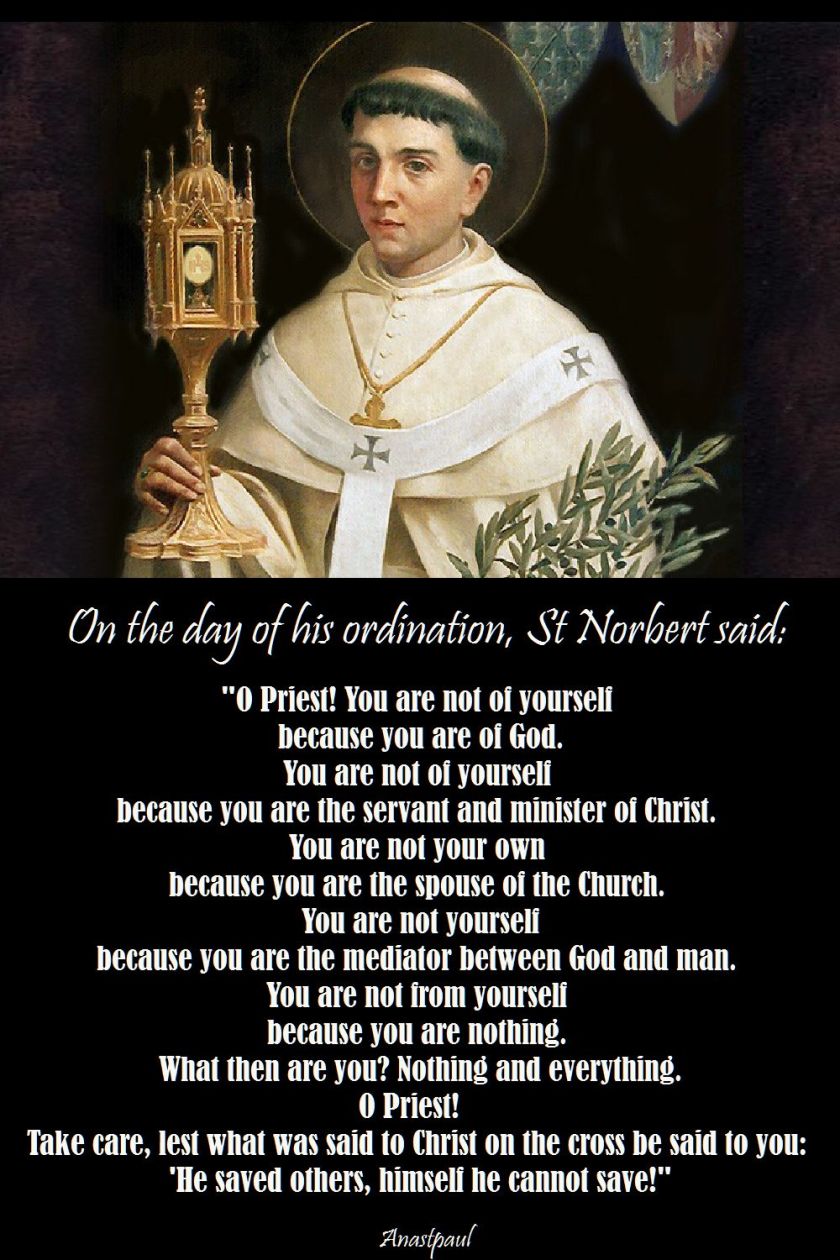
On the day of his ordination, St Norbert said:

“O Priest! You are not of yourself because you are of God.   You are not of yourself because you are the servant and minister of Christ.
You are not your own because you are the spouse of the Church.
You are not yourself because you are the mediator between God and man.
You are not from yourself because you are nothing.
What then are you? Nothing and everything.
O Priest!   Take care, lest what was said to Christ on the cross be said to you:
‘He saved others, himself he cannot save!”

O Priest! - St Norbert

Posted in MORNING Prayers, SAINT of the DAY

Thought for the Day – 6 June

Thought for the Day – 6 June

The name of St Norbert’s order is unfamiliar to most but the Premonstratensians are an ancient order, founded in 1121.   His Canons Regular of Premontre made a huge contribution to the religious culture of Europe and athe world and are as active today as they were when they were founded.    One of it’s members, founded and directs the “Church in Need”, which works quietly to assist Catholics in those countries where the faith is suppressed.
St Norbert showed himself to be a forceful reformer and was almost assassinated several times.   He was a friend of, and highly regarded by St Bernard of Clairvaux, who assisted him wherever he could.   Even with the aid of a goodly number of men who joined his Order, he realised that nothing could be effectively done without God’s power.   Finding this help especially in devotion to the Blessed Sacrament, he and his Norbertines praised God for success in converting heretics, reconciling numerous enemies and rebuilding faith in indifferent believers.
St Norbert was 33 years old before he took God seriously and during the next 20 years he made up for lost time.   He did not stop to bewail lost years but gave everything he had to God.   It is never too late to begin and God is always waiting for our service. We do not need a bolt of lightening to get started.
Unswerving loyalty to the Church and fervent devotion to the Eucharist, as practiced by Norbert, will continue immeasurably toward maintaining the people of God in accord with the heart of Christ.

Let us get going!

St Norbert, pray for us.

st norbert pray for us

Posted in MORNING Prayers, QUOTES of the SAINTS, SAINT of the DAY, The WORD

One Minute Reflection – 6 June

One Minute Reflection – 6 June

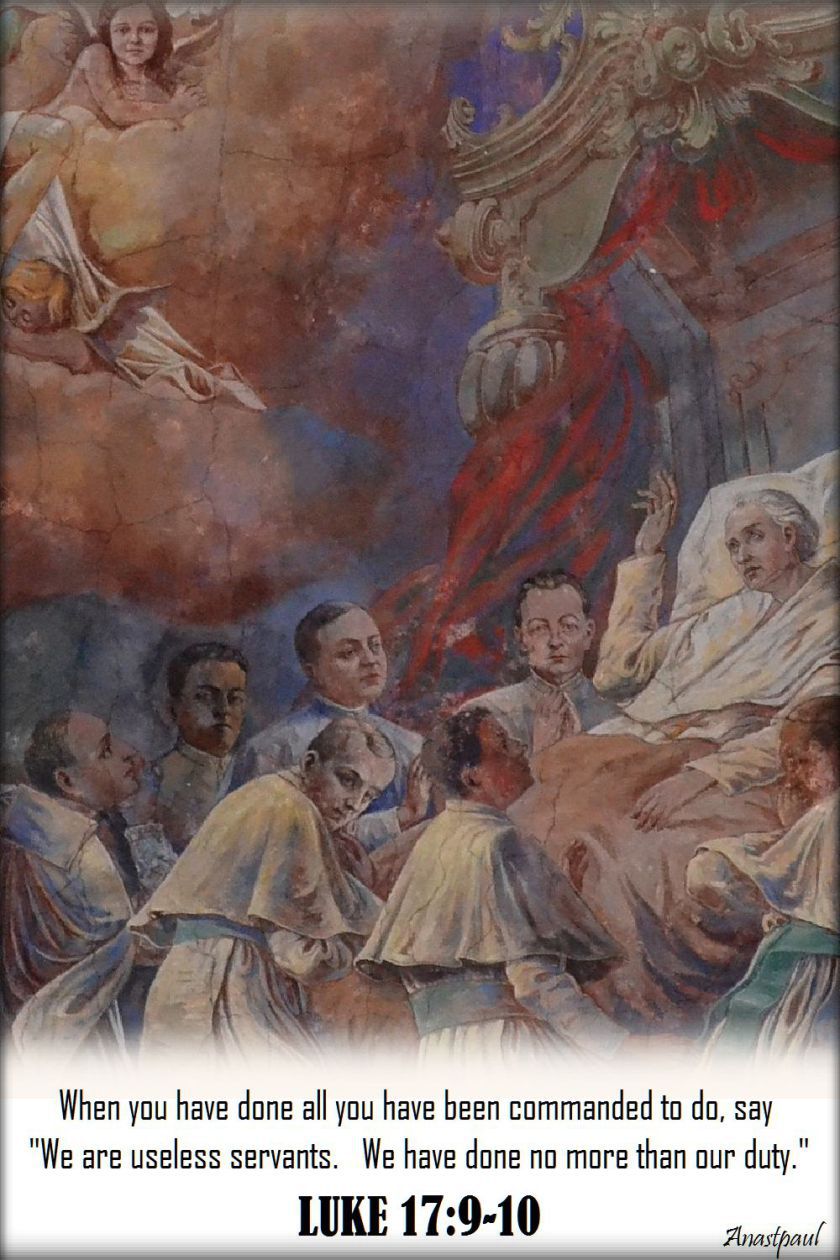
When you have done all you have been commanded to do, say “We are useless servants. We have done no more than our duty.”…………Luke 17:9-10luke-17-9-10.when you have done all you have been - 6 june 2017


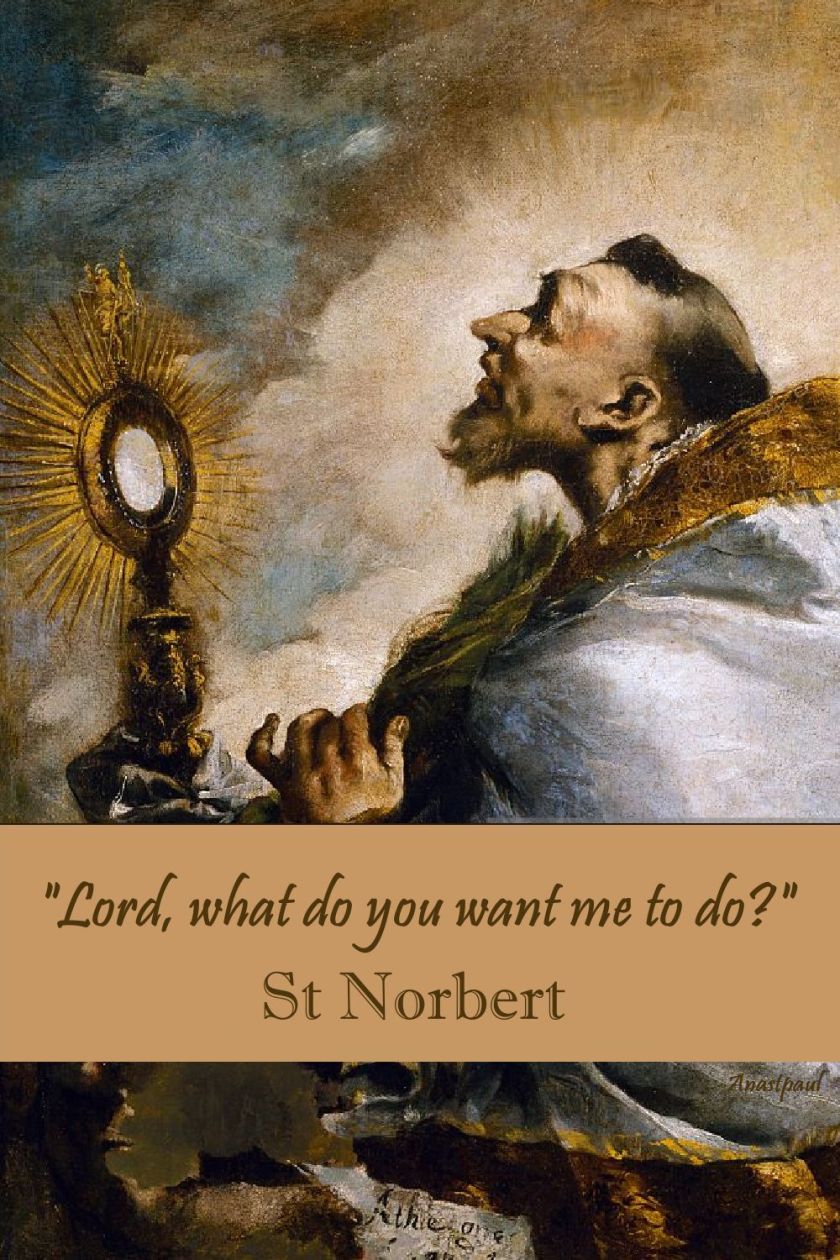
REFLECTION – “Lord, what do you want me to do?” ……St Norbert

lord what do you want me to do - st norbert

PRAYER – Holy Father, you made the Bishop St Norbert, an outstanding minister of Your Church,
renowned for his preaching and pastoral zeal. for his love of the Blessed Sacrament and for his love of the priesthood. Grant to Your Church faithful shepherds to lead your people to eternal salvation.
St Norbert, help us hear the answer to our prayer “Lord what do you want me to do?” and please pray for us and for the whole Church of our Lord Jesus Christ,amen.

st-norbert-pray-for-us-2-6 JUNE 2017.

Posted in CONSECRATION Prayers, MORNING Prayers, PRAYERS of the CHURCH

Our Morning Offering – 6 June

Our Morning Offering – 6 June

Prayer of Consecration to the Holy Spirit

On my knees before the multitude of heavenly witnesses,
I offer myself, soul and body, to You, eternal Spirit of God.
I adore the brightness of Your purity,
the unerring keeness of Your justice,
and the power of Your love.
You are the strength and light of my soul,
In You I live and move and have my being.
I desire never to grieve You by infidelity to Your grace,
and I pray wholeheartedly to be preserved
from the slightest sin against You.
Make me faithful in my every thought,
and grant that I may always listen to Your voice,
watch for Your light
and follow Your gracious inspirations.
I cling to You
and beg You, in Your compassion,
to watch over me in my weakness.
Holding the pierced feet of Jesus,
gazing as His five wounds,
trusting to His Precious Blood
and adoring His open side and stricken Heart,
I implore You, adorable Spirit,
so to keep me in Your grace
that I may never sin against You.
Grant me the grace,
O Holy Spirit of the Father and the Son,
to say to You always and everywhere:
“Speak, Lord, for Your servant is listening.”
Amen.

consecration-to-the-holy-spirit 6 june 2017


Posted in EUCHARISTIC Adoration, Of and For PEACE, PATRONAGE-INFERTILITY & SAFE CHILDBIRTH, PRAYERS for VARIOUS NEEDS, SAINT of the DAY

Saint of the Day – 6 June – St Norbert (c 1080-1134)”Defender of the Eucharist”

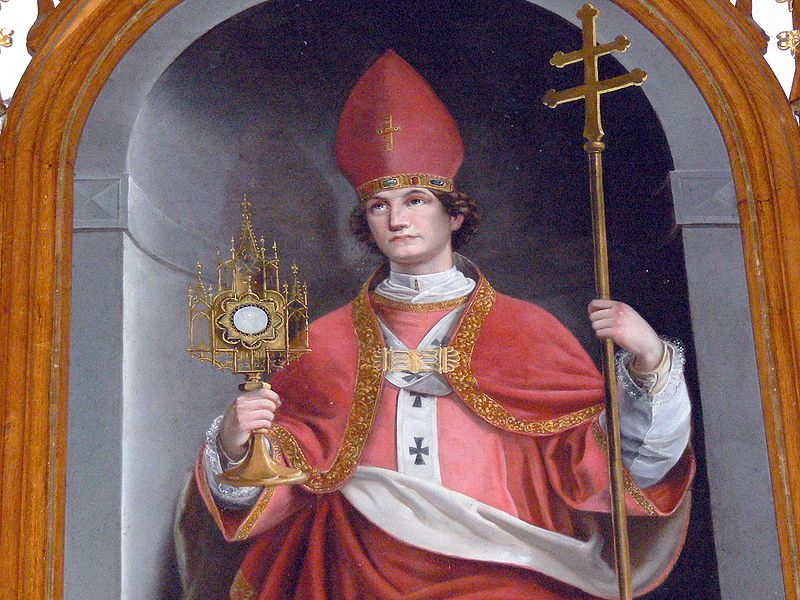
Saint of the Day – 6 June – St Norbert (c 1080-1134) – also known as St Norbert of Xanten – Bishop, Confessor, Founder, “Defender of the Eucharist” and “Apostle of the Eucharist”, Exorcist, Reformer, Preacher – (c1080 at Xanten, Germany – 6 June 1134 at Magdeburg, Germany,  relics in Prague) – Patron for peace, invoked during childbirth for safe delivery, of infertile married couples, Bohemia (Czech Republic), Archdiocese of Magdeburg, Germany – Attributes – monstrance, cross with two cross-bars.St.-Norbertweb

St Norbert was a German from illustrious Frankish and Salic German stock.   Offered as a youth to the collegiate church of St Victor in Xanten, he was educated both in literature and the ways of the court and the world.   At Xanten, he became a Subdeacon and at this period of his life, showed no inclination to pursue the dignity of the Priesthood.   Rather, St Norbert, who was wealthy, handsome, thin and somewhat tall, sought approval in the courts of the great and of the emperor. Known to be an eloquent speaker and possessed of an affability that won him admiration and friendships, St Norbert used these natural gifts, not to seek the glory of God but to gain the love and esteem of men.   His biographer describes him at this period before his conversion as one who “had no time for piety and quiet” and that he “lived his life according to his own desires.”

st norbert 6

But soon life became one of interior strife for St Norbert.   He had witnessed Emperor Henry V’s mistreatment of Pope Paschal II in Rome in 1111, when he travelled there in Frederick of Cologne’s retinue.   These events left St Norbert with a sense of uneasiness he could not dispel.   The man who had been so happy to live at court no longer felt comfortable in that atmosphere of intrigue, where the emperor’s arrogance took the place of law.   He left the court and returned to Xanten, where we find him in 1115.   In late spring of this year, St. Norbert, accompanied by a single servant, was travelling on the road to Freden when a storm suddenly came up.   A bolt of lightning struck the ground before his horse’s feet and he was thrown to the ground.   Shaken, he asked, “Lord what do you want me to do?”   In response, he seemed to hear these words from Psalm 34, “Turn from evil and do good, seek peace and pursue it.”   St Norbert underwent a profound conversion.   Under the influence of grace and led by the Gospel, he became sure of one thing:  he wanted to put on the new man (Eph. 4:24; Col. 3:10) and live a life of perfection in the service of the Church, according to the Gospel of Christ and in the footsteps of the Apostles.

From the beginning of his conversion, St Norbert aimed at a life of priestly perfection through imitation of the Apostles.   He sought ordination to the priesthood and gave his considerable wealth to the poor, in order “that he may follow the naked cross naked”  ( Vita Norberti B, IX 22).   Inflamed with the zeal of divine fervour, St Norbert went about with “no purse, no sandals nor two tunics,” (Mk. 6:8) proclaiming by his words and example the necessity of poverty of spirit in order to enter the kingdom of God.   As Christ had sent out his Apostles not only “to proclaim the message,” but also “to have authority to cast out demons,” (Mk. 3:15)   St Norbert was well known as an exorcist and his biographer records many instances when he was called upon to exercise this office. Regarded as a “minister of peace and concord,” he had the gift of reconciling people and establishing peace between feuding parties.

At the centre of St Norbert’s spiritual life and ministry was the Holy Sacrifice of the Mass.   Contrary to custom of his times, he celebrated Mass every day and it was after offering the Eucharistic sacrifice that he loved to preach, while his heart was overflowing with the love he had drawn from intimate contact with Christ.   The Acts of the Apostles record how the first Christians “devoted themselves to the apostles’ teaching and fellowship, to the breaking of bread and the prayers,” (2:42) and that “the whole group of those who believed were of one heart and soul” (4:32).   St Norbert sought to realise the fullness of this Apostolic ideal in the founding of a new religious family.

st norbert 7

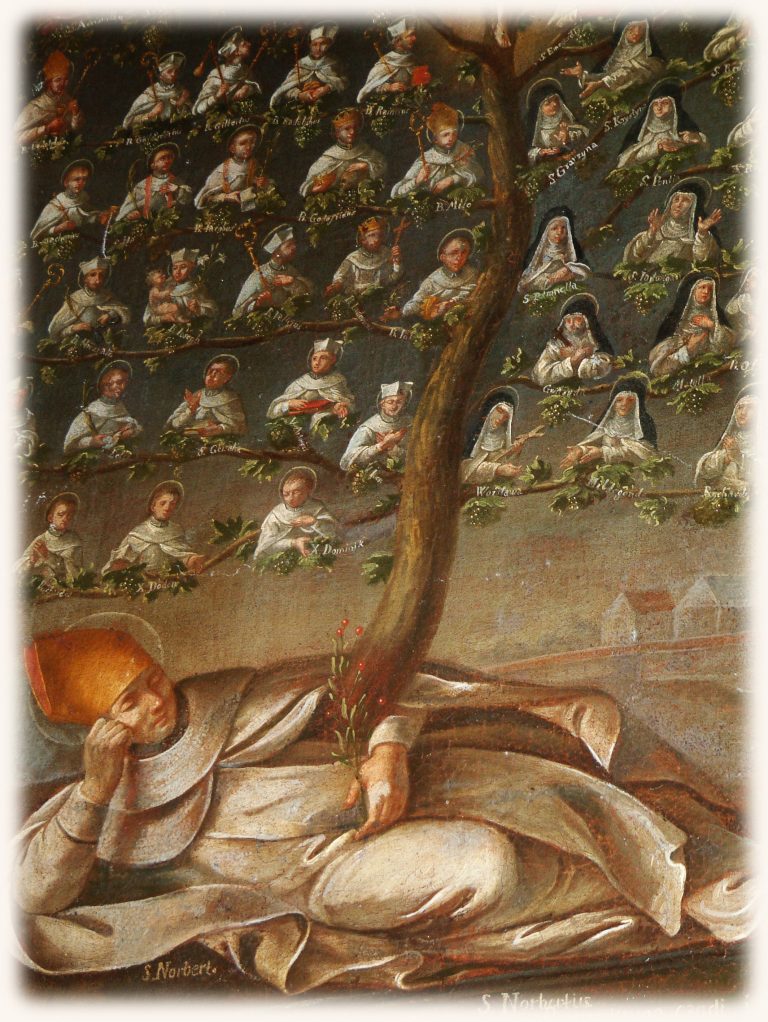
In 1121, St Norbert established the first monastery of our Order in Prémontré, France.   He had a great talent to speak to people, to fill people with enthusiasm for the kingdom of God, so much so that in a short period of time he was able to attract many men and women to the Apostolic Life and to start many foundations of religious communities of this “ordo novus”.   Liturgical prayer held a central place in the life of Norbert and his first companions.   The Eucharist, the heart of liturgical prayer occupied such a place at Prémontré and in the life of St Norbert that later tradition made Norbert the Apostle of the Eucharist.   His order, the Premonstratensian or Norbertine Canons and Sisters are today in Europe, the US, Canada, South America, Zaire, South Africa, India and Australia are involved in education, parochial ministry, university chaplaincy and youth work.

Norbert-Tree-768x1022

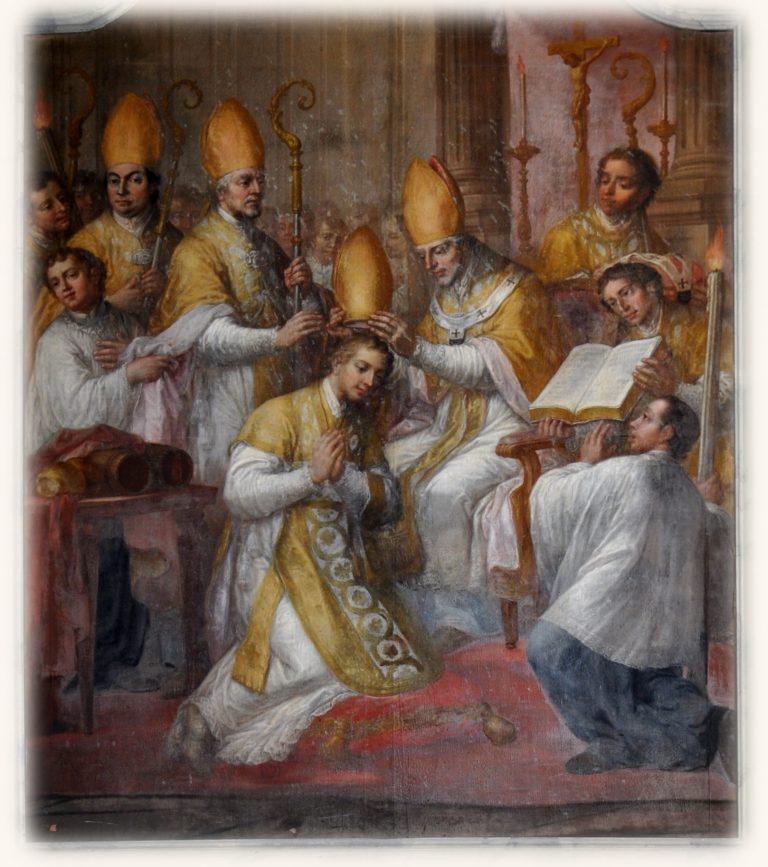
In 1126, St Norbert was elected archbishop of Magdeburg, Germany.   He worked for the kingdom of God on all levels and ready to commit himself to peace and justice, did not shy away from arguments and conflicts, neither in his own diocese nor in the conflict between emperor and pope, as he courageously defended the rights of the Church.800px-Maria_Anger_-_St.Norbert_2

st norbert Episcopal-Ordination-768x867

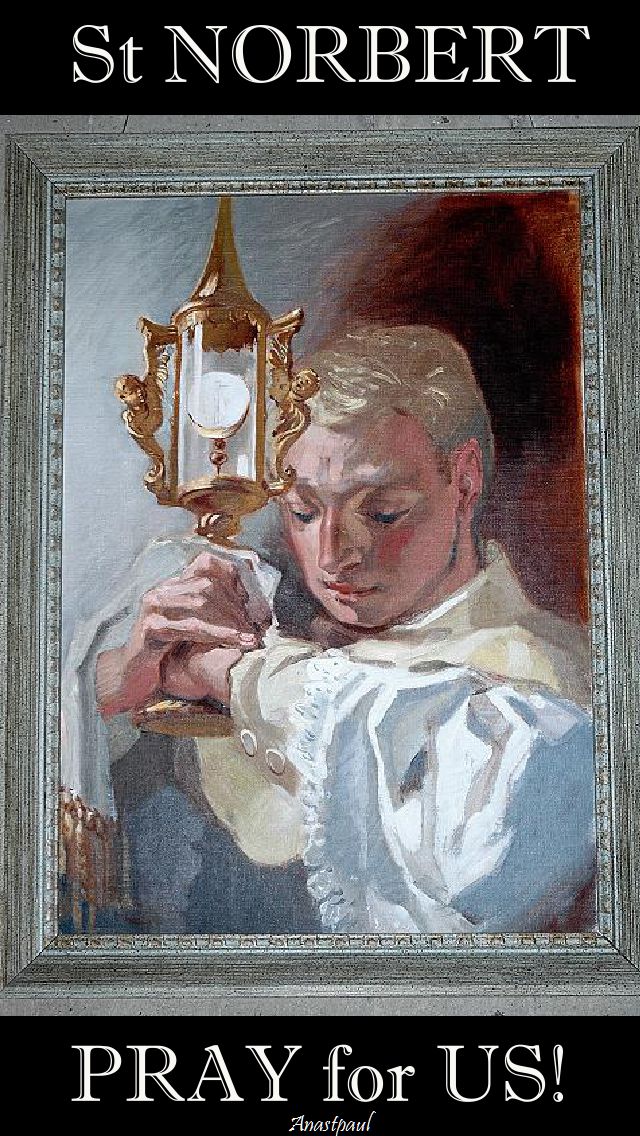
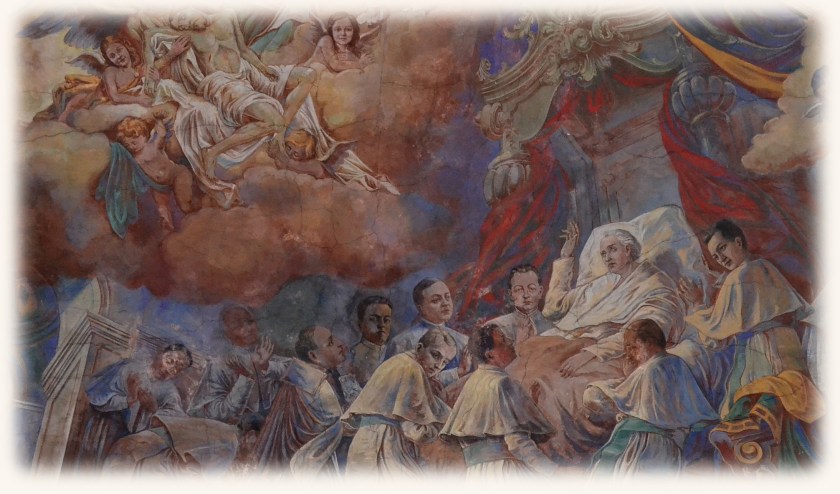
St Norbert died on 6 June 1134, the Wednesday after Pentecost.   By order of the emperor, his body was laid at rest in Abbey Church of St. Mary’s at Magdeburg, where he had installed the confreres of his Order.   St Norbert’s body was transferred to the Norbertine Abbey of Strahov in Prague in 1627 after numerous attempts were made over the centuries by the Abbey of Strahov in Prague to retrieve the saint’s body.   Only after several military defeats at the hand of Emperor Ferdinand II was the abbot of Strahov able to claim the body.   On 2 May 1627 the body was finally brought to Prague where it remains to this day, displayed in a glass-fronted tomb in the Royal Canonry of Strahov, Prague and is venerated by his sons and daughters from all over the world.   As mentioned above, St. Norbert is venerated as the “Apostle and Defender of the Eucharist.”   He is usually depicted with a ciborium or monstrance in his hand on account of his extraordinary devotion to the Most Blessed Sacrament.   St Norbert is also a patron of childbirth/expectant mothers, as well as traditionally invoked by married couples who want to conceive a child, with many favours attributed to his intercession.

Death-of-St.-Norbert-edited

376c6683d8f67b7be6126d2db0e60df1
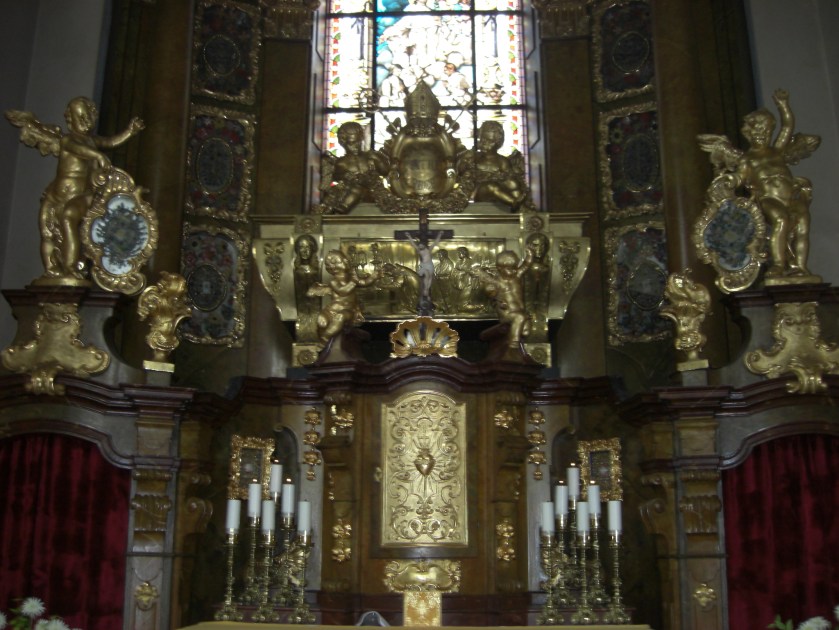
Shrine of St. Norbert, Royal Canonry of Strahov, Prague

Why is St Norbert Patron of Expectant Mothers & Infertile Married Couples?

A pious woman once approached St Norbert asking whether she and her husband ought to separate and enter monasteries because they lived in an infertile marriage.   St Norbert prophesied that they would be blessed with children, the first of whom would be dedicated to God.   This child, Nicholas, did indeed become a Norbertine at Prémontré.    St Norbert is traditionally invoked for a good childbirth. The Norbertine Canonesses at Doksany (Czech Republic) in modern times promote this devotion to St. Norbert as patron of infertile couples or endangered pregnancies and report hundreds of families now blessed with children, the sisters having well over 3,000 spiritual children as of 2012.

healing-768x529

A Prayer to St. Norbert for a Good Childbirth

St. Norbert, great and faithful servant of God!
You venerated the holy and miraculous birth of our Saviour,
Who His Mother, the purest Virgin Mary,
conceived without the loss of her virginity
and gave birth remaining a virgin.
You connected the origin of the Premonstratensian Order
with the day of the birth of Jesus Christ.
I humbly pray to you, St. Norbert,
as a great protector, so that God will give me the grace,
through your intercession,
to give birth to this conceived child.
And so that He will give me also the grace
that this child will join the Church of Christ
through the sacrament of Baptism
and that he/she will serve Him, Our Lord,
the whole of his/her life
so that in the end we both will reach eternal salvation.
Through Jesus Christ, Our Lord, Amen.

(Translated from The Little Hours, 1749, by one of our Norbertine Sisters at Doksany)

Posted in SAINT of the DAY

Saints – 6 June

St Norbert of Magdeburg (Optional Memorial)

St Agobard of Lyon
St Alexander of Fiesole
St Alexander of Noyon
St Amantius of Noyon
St Anoub of Skete
St Artemius of Rome
St Bazalota of Abyssinia
St Bertrand of Aquileia
St Candida of Rome
St Ceratius of Grenoble
St Claudius of Besançon
St Cocca
St Colmán of Orkney
Bl Daniel of Bergamo
St Euphemia of Abyssinia
St Eustorgius II of Milan
Bl Falco of La Cava
Bl Gerard Tintorio
Bl Gilbert of Neufontaines
St Grazia of Germagno
St Gudwall
Bl Gundisalvus of Azebeyro
St Hilarion the Younger
St Jarlath of Tuam
St John of Verona
Bl Józef Wojciech Guz
Bl Lorenzo de Masculis
St Marcelino Champagnat
St Paulina of Rome
St Phêrô Dung
St Phêrô Thuan
St Rafael Guízar y Valencia
St Vincent of Bevagna
St Vinh-Son Duong
Bl William Greenwood

Marytrs of Tarsus: A group of 20 martyrs who were killed together during the persecutions of Diocletian. They were martyred in Tarsus (in modern Turkey).

Posted in MORNING Prayers, NOVENAS

St Anthony of Padua Novena for all our needs – Day Two – 5 June

St Anthony of Padua Novena for all our needs – Day Two – 5 June

day two - st anthony of padua novena

DAY TWO

O miracle-working St. Anthony,
remember that it never has been heard,
that you left without help or relief anyone
who in his need had recourse to you.
Animated now with the most lively confidence,
even with full conviction of not being refused,
I fly for refuge to thee, O most favoured friend of the Infant Jesus.
O eloquent preacher of the divine mercy,
despise not my supplications
but, bringing them before the throne of God,
strengthen them by your intercession
and obtain for me the favour I seek in this novena
(State your intention).

One Our Father, one Hail Mary, and Glory Be to the Father, in honor of Saint Anthony.

Saint Anthony, pray for us!

Posted in MORNING Prayers, QUOTES of the SAINTS, SAINT of the DAY

Quote of the Day – 5 June

Quote of the Day – 5 June

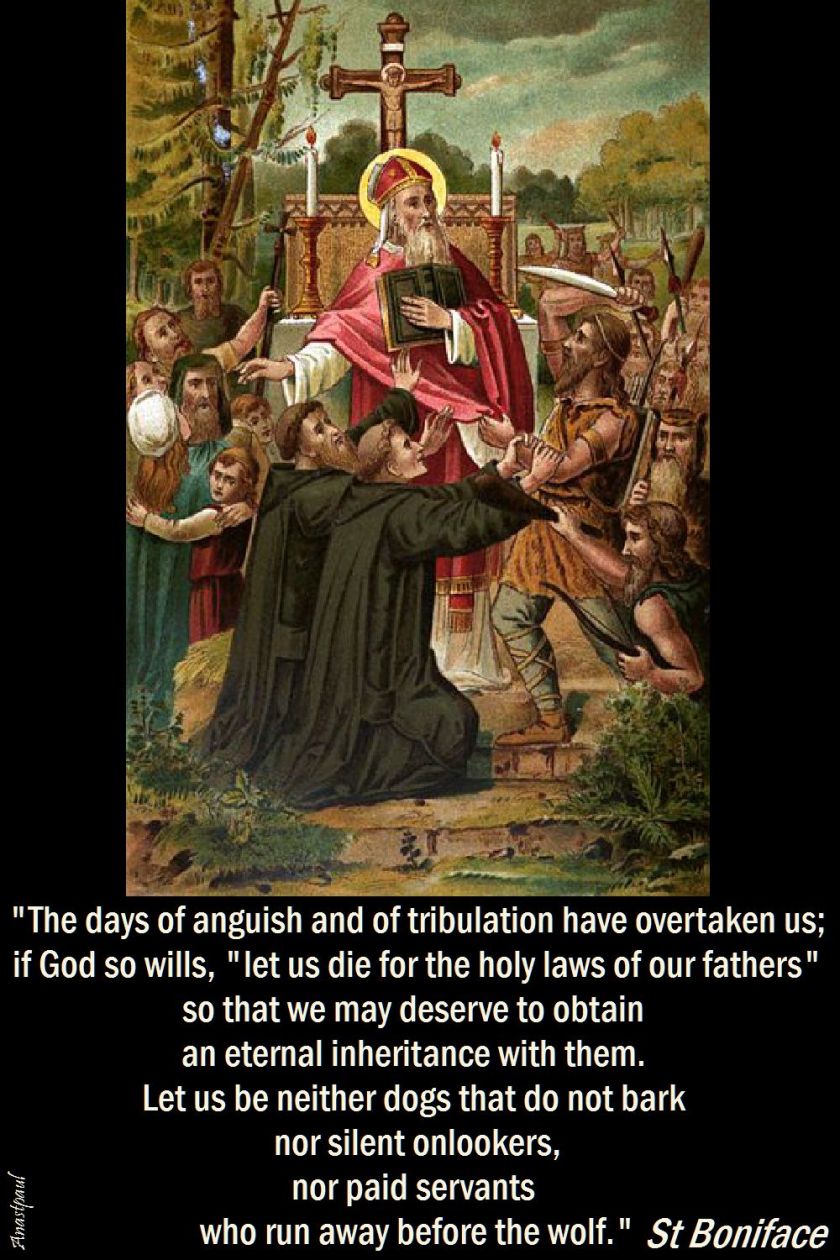
An excerpt from a letter by St. Boniface, bishop and martyr:

“Let us stand fast in what is right and prepare our souls for trial.
Let us wait upon God’s strengthening aid and say to Him:
“O Lord, you have been our refuge in all generations.”
Let us trust in Him who has placed this burden upon us.
What we ourselves cannot bear, let us bear with the help of Christ.
For He is all-powerful and He tells us:
“My yoke is easy and my burden light.”
Let us continue the fight on the day of the Lord.
The days of anguish and of tribulation have overtaken us; if God so wills,
“let us die for the holy laws of our fathers”,
so that we may deserve to obtain an eternal inheritance with them.
Let us be neither dogs that do not bark nor silent onlookers nor paid servants
who run away before the wolf.
Instead let us be careful shepherds watching over Christ’s flock.
Let us preach the whole of God’s plan to the powerful and to the humble,
to rich and to poor, to men of every rank and age,
as far as God gives us the strength, in season and out of season.”

St Boniface, Pray for us!

the days of anguish and of tribulation-st boniface

Posted in MORNING Prayers, SAINT of the DAY

Thought for the Day – 5 June

Thought for the Day – 5 June

“Boniface, known as the apostle of the Germans, was an English Benedictine monk who gave up being elected abbot to devote his life to the conversion of the Germanic tribes. Two characteristics stand out: his Christian orthodoxy and his fidelity to the pope of Rome.

How absolutely necessary this orthodoxy and fidelity were, is borne out by the conditions Boniface found on his first missionary journey in 719 at the request of Pope Gregory II.   Paganism was a way of life.   What Christianity he did find had either lapsed into paganism or was mixed with error.   The clergy were mainly responsible for these latter conditions since they were in many instances uneducated, lax and questionably obedient to their bishops.   In particular instances their very ordinations were questionable.

These are the conditions that Boniface was to report in 722 on his first return visit to Rome.   The Holy Father instructed him to reform the German Church.   The pope sent letters of recommendation to religious and civil leaders.   Boniface later admitted that his work would have been unsuccessful, from a human viewpoint, without a letter of safe-conduct from Charles Martel, the powerful Frankish ruler, grandfather of Charlemagne. Boniface was finally made a regional bishop and authorized to organize the whole German Church. He was eminently successful.

Boniface bears out the Christian rule: To follow Christ is to follow the way of the cross.
For Boniface, it was not only physical suffering or death but the painful, thankless, bewildering task of Church reform.
Missionary glory is often thought of in terms of bringing new persons to Christ”, which he did in the thousands too.
“It seems—but is not—less glorious to heal the household of the faith.” (Fr Don Miller OFM)

So those little deeds we do in our lives and in our ‘online lives’ – they too can be seen – where we remain true to the Church and to the Holy Father and Magisterium – as following St Boniface in orthodoxy and faithfulness and contributing to the teaching of the faith.

St Boniface, pray for us!

st boniface pray for us.jpg 2

Posted in MORNING Prayers, QUOTES of the SAINTS, SAINT of the DAY, The WORD

One Minute Reflection – 5 June

One Minute Reflection – 5 June

“Whoever listens to you listens to me. Whoever rejects you rejects me. And whoever rejects me rejects the one who sent me.”………….Luke 10:16

luke 10 16

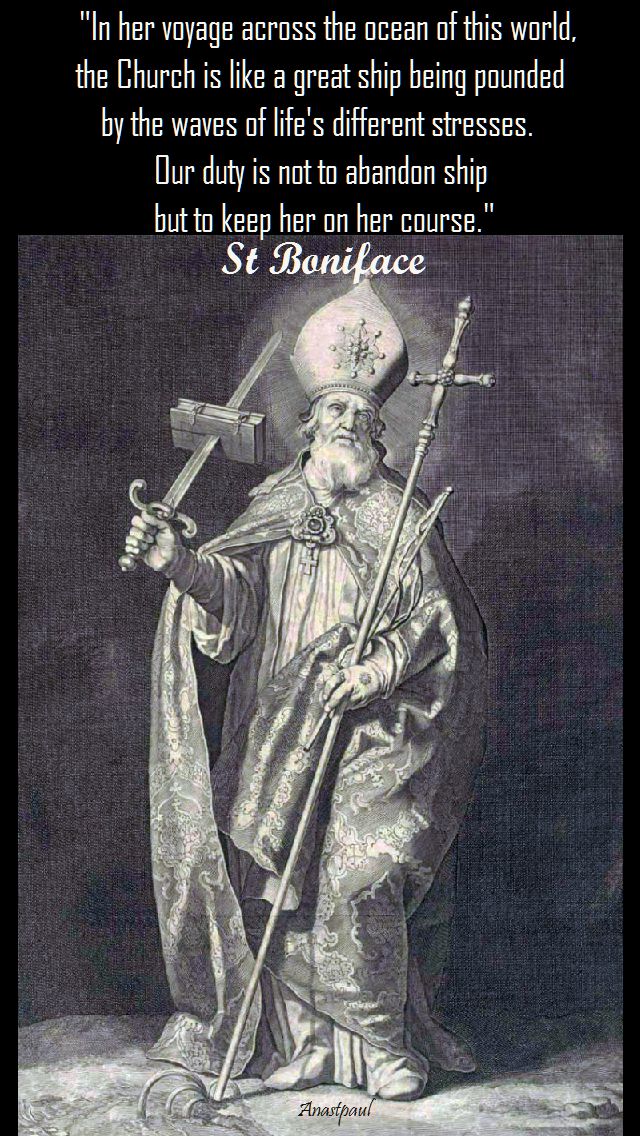
REFLECTION – “In her voyage across the ocean of this world, the Church is like a great ship being pounded by the waves of life’s different stresses. Our duty is not to abandon ship but to keep her on her course.”……….St Boniface

in her voyage across the ocean of this world - st boniface

PRAYER – Lord Jesus, help me to remain ever faithful to Your Church. Let me aid, build up and defend her. Let me never be a cause of division and schism – for in denying the direction we receive, that is exactly what we do. Help me always Lord to remain true to the Your representative in our world. St Boniface, pray for us all and for the whole world, amen.

st boniface pray for us

Posted in MORNING Prayers, PRAYERS of the SAINTS, SAINT of the DAY

Our Morning Offering – 5 June

Our Morning Offering – 5 June

Eternal God, our Refuge
By St Boniface

Eternal God,
the refuge and help of all Your children,
we praise You for all You have given us,
for all You have done for us,
for all that You are to us.
In our weakness, You are strength,
in our darkness, You are light,
in our sorrow, You are comfort and peace.
We cannot number Your blessings,
we cannot declare Your love:
For all Your blessings we bless You.
May we live as in Your presence,
and love the things that You love,
and serve You in our daily lives;
through Jesus Christ our Lord. Amen

eternal god our refuge-st boniface

Posted in FATHERS of the Church, QUOTES of the SAINTS, SAINT of the DAY

Saint of the Day – 5 June – St Boniface -Martyr

Saint of the Day – 5 June – St Boniface – Martyr, Bishop, the “The Apostle of Germany” –  born Winfrid, Wynfrith, or Wynfryth – (c 673-680 at Crediton, Devonshire, England – martyred 5 June 754 at Dokkum, Freisland (modern Nederlands) – relics interred at Monastery at Fulda, Germany).  Bishop/Archbishop, Martyr, Missionary and Evangelist, Teacher, Writer, Preacher, Theologian, Founder of Schools, Convents, Monasteries and Churches – known as “The Apostle of Germany”.   Patron of brewers, file cutters, tailors, Germany, archdiocese of Saint-Boniface, Manitoba, Canada, diocese of Fulda, Germany.   Attributes book, fountain, fox, oak tree, raven, scourge, spring of water, sword, with axe in hand at the foot of an oak tree, book stabbed with a sword, cutting down a tree.

St.-Boniface-cutting-down-tree-of-Thor-1200x450

St Boniface was killed in Frisia in 754, along with 52 others.   His remains were returned to Fulda, where they rest in a sarcophagus which became a site of pilgrimage. Facts about Boniface’s life and death as well as his work became widely known, since there is a wealth of material available—a number of vitae, especially the near-contemporary Vita Bonifatii auctore Willibaldi and legal documents, possibly some sermons, and above all his correspondence.

Norman F. Cantor (Historian) notes the three roles Boniface played that made him “one of the truly outstanding creators of the first Europe, as the apostle of Germania, the reformer of the Frankish church and the chief fomentor of the alliance between the papacy and the Carolingian family.”   Through his efforts to reorganise and regulate the church of the Franks, he helped shape Western Christianity and many of the dioceses he proposed remain today.   After his martyrdom, he was quickly hailed as a saint in Fulda and other areas in Germania and in England.   His cult is still notably strong today.   Boniface is celebrated as a missionary;  he is regarded as a unifier of Europe and he is seen by Catholics as a Germanic national figure.

Born and named Winfrith in Devonshire, England, Boniface grew up in a noble family of some wealth.   As a boy Boniface begged his parents to allow him to enter the nearby monastery at Exeter following a visit by some local monks.  So impressed with their life, Boniface joined the community, learning all he could and proving himself to be an apt and scholarly student. After a short time, he transferred to a larger monastery, in Nursling and there became a well-respected teacher.

He spent the next ten years teaching and was so well respected that students traveled great distances to attend his lectures, circulating their notes throughout the whole of England.   At age thirty, Boniface was ordained a priest and began preaching, as well as teaching, with great impact.   His life, while diligent and obedient, was comfortable and he was assured continued success in the English church.   However, Winfrith felt called to missionary work.   He petitioned his abbot several times, until was finally granted leave to travel to modern-day Netherlands, to assist a missionary there, Willibrord, struggling to bring the Gospel to those there who continued to practice paganism.   Upon arriving in Friesland, Winfrith discovered that the ruler of those parts, Duke Radbold, had virtually declared war on Christianity and without support, their mission would not succeed.   Prudently, Winfrith returned to England where his community welcomed him back, attempting to elect him abbot.   He refused and instead traveled to Rome for a personal audience with the pope, hoping to secure a Papal Commission to return to Friesland.

Hess_Boniface_leaves_England_1 cropped

Pope Gregory II welcomed the adventurous and obedient servant that Winfrith had become, renaming him Boniface and providing him with a general Papal Commission to bring the Word of God “to the heathen.”   Saint Boniface set off with zeal, traveling through modern-day Germany and Bavaria, locating and working with the missionary Willibrord (who by this time was well advanced in years).   Willibrord wished for Boniface to assume his work but Boniface felt called to continue traveling deeper into non-Christian territories, asserting that his commission led him not just to one dioceses, but to all “the heathen.”

St Boniface had amazing success, converting two local chieftains who became zealous Christians, leading to the conversion of their tribes.   He was granted a plot of land, upon which he founded the monastery at Amoeneburg.   His preaching style was direct and easy to understand and he took care to incorporate local traditions—whenever possible—into his teachings.   For example, there was a local game in which they sticks called kegels were thrown at smaller sticks called heides.   Boniface bought religion to the game, having the heides represent demons and knocking them down showing purity of spirit.   However, Saint Boniface was also extremely orthodox in his teaching and would quickly point out any discrepant or pagan practices that crept into the worship of the people.   Such was his success that he was summoned by Pope Gregory II back to Rome. There, Boniface was consecrated a bishop and granted general jurisdiction over “the races in the parts of Germany and east of the Rhine who live in error, in the shadow of death.”   Gregory II also provided Boniface with a Papal Letter to Charles Martel, the duke who ruled Bavaria and had earned himself the nickname “Hammer” due to his swift and authoritarian rule and retribution.   Boniface delivered the letter on his return trip to, and was granted civil protection.   Between the commission of the pope and the support of the duke, Boniface was free to increase his efforts. He decided to drive the pagan beliefs from the region by attacking their source.

st_boniface

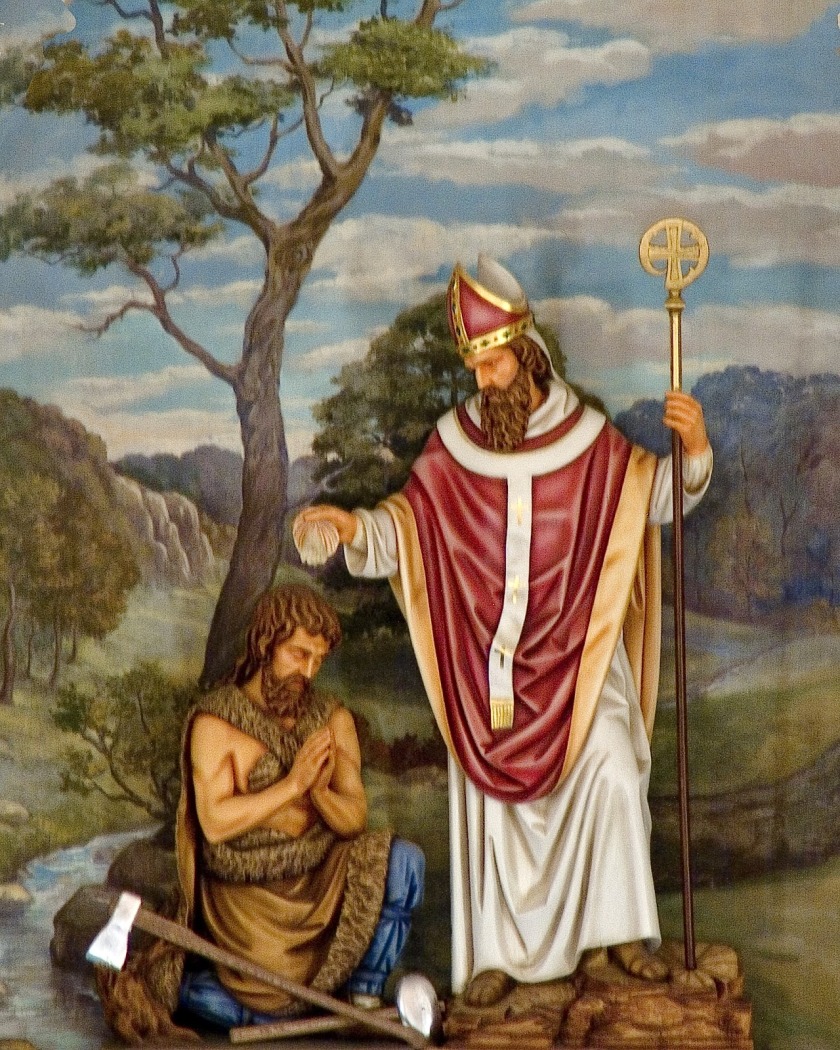
Many in the area continued to worship Norse gods, including Thor, who were believed to reside in the forms of large stately trees.   After announcing his intentions to the tribes, who watched, awaiting the retribution of Thor, Boniface walked up to the tree, removed his shirt, took up an axe and without a word he hacked down the six foot wide wooden god.   The tree fell, splintering into four parts, upon one of which Boniface climbed, addressing the crowd that had gathered. “How stands your mighty god? My God is stronger than he.”   From his perspective, the saint could see that the fallen tree landed in the shape of the cross.   Also, the only tree spared in the area was a small fir tree, which many consider the origin of the Christmas tree.   The crowd’s reaction was amazement and confusion and conversions began.   Using the oak wood from the tree, Boniface had a chapel built on the spot, dedicated to Saint Peter.

Lempertz-1040-1540-Fine-Art-Johann-Michael-Wittmer-Saint-Boniface-Felling-DoSt.-Boniface-cutting-down-tree-of-Thor-1200x450bonifacest_bonifatius

Boniface continued his mission across Bavaria, Germany, and Holland, encountered previous missionaries who had not remained true to the teachings of the Church.   He undertook significant Church reform, instructing the missionaries, priests, and brothers, and re-establishing obedience to the authority of the Church.   In many cases, Boniface worked with the individuals in question, not to defrock them and remove them from service—citing the increased damage that would do to the faithful—but to reform, renew and reconsecrate them to the Lord.   He was both practical and obedient, seeking the will of the Lord, the counsel of respected bishops, and the success of the growth of the one, true Church.   Following successful re-establishment of discipline and communication between these misguided missions and the Church, as well as establishing several new monastic communities, was consecrated Archbishop of the entire region.   Nearing seventy years old but no less zealous in his desire for conversion, Boniface returned to Friesland—the first place of his work in Bavaria—to minister to his first congregation who were slipping back into paganism.   He gave up his archbishopric, dressed again in the simple robes of the monk and carried with him only what he needed, including the text written by Saint Ambrose, “The Advantage of Death”.

Upon arrival at Friesland, he arranged for a group of recent converts to join him, that he might teach and Confirm them.   While waiting in his tent, reading the Bible, a group of pagans appeared in the encampment with intent to harm Boniface and his companions. His companions would have opposed them but he said, “My children, cease your resistance; Spill no useless blood.  The long-expected day is come at last.   Scripture forbids us to resist evil with evil.  Let us put our hope in God:  He will save our souls.”   He and 52 of his followers were killed.   In the moment of his death, Saint Boniface raised the Bible he was reading above his head.   The sword of his slayer passed through the Book before cleaving the blessed saint.

Following the departure of the pagan barbarians, a small group of Christians came to the campsite.   They carried the relics and body of Saint Boniface to the cathedral at Fulda for burial, where it remains today.   The Bible that Boniface was reading can also be found at the cathedral at Fulda.

Posted in FEASTS and SOLEMNITIES, SAINT of the DAY

Saints and Feasts – 5 June

St Boniface and Companions (Memorial)
Beata Vergine dell’Aiuto

St Adalar of Erfurt
Bl Adalbert Radiouski
Bl Adam Arakawa
St Austrebertus of Vienne
St Claudius of Egypt and Companions
St Ðaminh Huyen
St Ðaminh Toai
St Dorotheus of Tyre
St Elleher
St Eoban of Utrecht
St Eutichius of Como
St Evasius of Africa
St Felix of Fritzlar
Bl Ferdinand of Portugal
St Franco of Assergi
St Genesius, Count of Clermont
St Gregory of Lilybaeum
St Gundekar
St Hadulph
St Luke Loan
Bl Malgorzata Lucja Szewczyk
Bl Meinwerk of Paderborn
St Privatus of Africa
St Sanctius of Córdoba
St Tudno of Caernarvon
St Waccar

Posted in NOVENAS, Uncategorized

St ANTHONY of PADUA NOVENA for all our needs – DAY ONE – 4 June

St ANTHONY of PADUA NOVENA for all our needs – DAY ONE – 4 June


DAY ONE - ST ANTHONY OF PADUA NOVENA

DAY ONE

O holy St. Anthony, gentlest of saints, your love for God and charity for His creatures
made you worthy while on earth to possess miraculous powers.
Miracles waited your word, which you were ever ready to speak for those in trouble or anxiety.
Encouraged by this thought, I implore you to obtain for me the favour I seek in this novena
(State your intention).
The answer to my prayer may require a miracle;
even so, you are the saint of miracles.
O gentle and loving Saint Anthony,
whose heart was ever full of human sympathy,
whisper my petition into the ears of the Infant Jesus,
who loved to be folded in your arms
and the gratitude of my heart will always be yours.

One Our Father, one Hail Mary, and Glory Be to the Father, in honoUr of Saint Anthony.

Saint Anthony, pray for us!

Posted in MORNING Prayers, QUOTES of the SAINTS, The HOLY GHOST

Quote/s of the Day – 4 June 2017 – The Solemnity of Pentecost!

Quote/s of the Day – 4 June 2017

“The Church of Christ is always,
so to speak, in a situation of Pentecost:
she is always gathered in the Upper Room in prayer
and at the same time,
driven by the powerful wind of the Spirit,
she is always on the streets preaching”……….St John Paul June 8, 2003

the church of christ-st john paul 2003

“The Pentecost of the Upper Room
in Jerusalem is THE BEGINNING
a beginning which endures.”……………Pope Francis – Pentecost 2013

Pentecost3

“Pentecost is the moment
when a heart of stone is
shattered and a heart of
flesh takes its place.”…………………Fr Raneiro Cantalamessa (Preacher to the Papal Household)

pentecost is the moment - fr raneiro cantalamessa

Posted in CATECHESIS, FEASTS and SOLEMNITIES, MORNING Prayers, QUOTES of the SAINTS, The HOLY GHOST

Thought for the Day – 4 June

Thought for the Day – 4 June

“If the damned were asked: Why are you in Hell? they would answer: ‘For having resisted the Holy Spirit.’
And if the saints were asked: Why are you in Heaven? they would answer: ‘For having listened to the Holy Spirit.’
When good thoughts come into our minds, it is the Holy Spirit who is visiting us.
The Holy Spirit is a power.
The Holy Spirit …. sustained the martyrs.  Without the Holy Spirit, the martyrs would have fallen like the leaves from the trees.  When the fires were lighted under them, the Holy Spirit extinguished the heat of the fire by the heat of divine love.
The good God, in sending us the Holy Spirit, has treated us like a great king who should send his minister to guide one of his subjects, saying,  “You will accompany this man everywhere and you will bring him back to me safe and sound.”
How beautiful it is, my children, to be accompanied by the Holy Spirit!
He is indeed a good Guide; and to think that there are some who will not follow Him!
The Holy Spirit is like a man with a carriage and horse, who should want to take us to Pans. We should only have to say “yes,” and to get into it.  It is indeed an easy matter to say “yes”!… Well, the Holy Spirit wants to take us to Heaven; we have only to say “yes,” and to let Him take us there.“…St John Vianney

“O Divine Spirit, draw us to the highest heaven where Jesus lives forever, interceding for us.   Come, fill our hearts with Your fire, show us the way to the Lord that we may find Him shining with beauty and love. Amen”

o divine spirit