“The Spirit of truth…remain with you and will be within you…….John 14:17
REFLECTION – The Holy Spirit does not remain inactive in us: He wipes away sins, purifies hearts, revivifies the tepid and enlightens the ignorant.
His inspirations suggest to us what we ought and what we ought not to do. There exists an infinite variety of His commandments…….St Anthony of Padua
PRAYER – Come, Holy Spirit, fill the heart of Your servant and kindle in me the fire of Your gifts! Be with me, in me and lead me to the light, amen.
We beg the all-merciful Father through You,
His only-begotten Son made man for our sake,
crucified and glorified for us,
to send upon us from His treasure-house,
the Spirit of sevenfold grace,
who rested upon You in all His fullness:
the spirit of wisdom:
enabling us to relish the fruit of the tree of life,
which is indeed Yourself;
the gift of understanding: to enlighten our perceptions;
the gift of prudence, enabling us to follow in Your footsteps;
the gift of strength: to withstand our adversary’s onslaught;
the gift of knowledge: to distinguish good from evil
by the light of thy holy teaching;
the gift of piety: to clothe ourselves with charity and mercy;
the gift of fear: to withdraw from all ill-doing
and live quietly in awe of Your eternal majesty.
These are the things for which petition.
Grant them for the honour of Your Holy Name,
to which, with the Father and the Holy Spirit,
be all honour and glory,
thanksgiving, renown and lordship for ever and ever. Amen
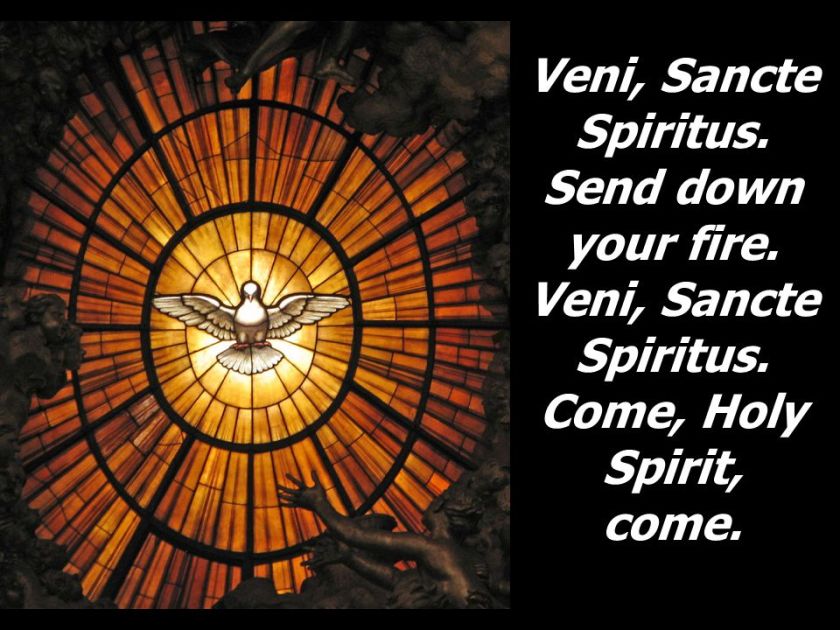
“VENI SANCTE SPIRITUS” (Come, Holy Spirit) – (chant – https://www.youtube.com/watch?v=3pU34vUoO9g)
One of the most widely used hymns in the Church, Veni, Creator Spiritus, is attributed to Blessed Rabanus Maurus (776-856), Archbishop of Mainz. It is commonly sung in the feast of Pentecost liturgy and other occasions when the Holy Spirit is solemnly invoked. The Veni Creator is also the official opening prayer for Church councils and synods. A partial indulgence is granted to the faithful who devoutly recite the hymn and a plenary indulgence if recited publicly in church on the 1st of January and on the feast of Pentecost. There are many translations of this beautiful Hymn which all differ slightly just as the Holy Scriptures do in it’s various translations.
Come, Holy Spirit, Creator blest,
and in our souls take up Thy rest;
come with Thy grace and heavenly aid
to fill the hearts which Thou hast made.
O comforter, to Thee we cry,
O heavenly gift of God Most High,
O fount of life and fire of love,
and sweet anointing from above.
Thou in Thy sevenfold gifts are known;
Thou, finger of God’s hand we own;
Thou, promise of the Father, Thou
Who dost the tongue with power imbue.
Kindle our sense from above,
and make our hearts o’erflow with love;
with patience firm and virtue high
the weakness of our flesh supply.
Far from us drive the foe we dread,
and grant us Thy peace instead;
so shall we not, with Thee for guide,
turn from the path of life aside.
Oh, may Thy grace on us bestow
the Father and the Son to know;
and Thee, through endless times confessed,
of both the eternal Spirit blest.
Now to the Father and the Son,
Who rose from death, be glory given,
with Thou, O Holy Comforter,
henceforth by all in earth and heaven.
Amen
Solemnity of Pentecost – 4 June 2017 – Wishing you all a Holy, Blessed and inspired Pentecost!
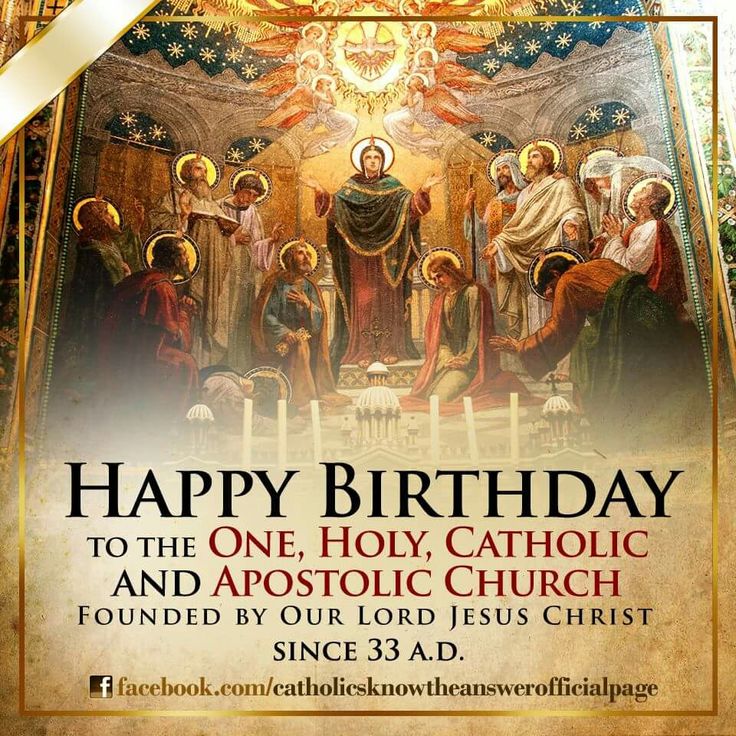
The Solemnity of Pentecost is the birthday of the Church:
The Church was made manifest to the world on the day of Pentecost by the outpouring of the Holy Spirit. The gift of the Spirit ushers in a new era in the “dispensation of the mystery” the age of the Church, during which Christ manifests, makes present, and communicates his work of salvation through the liturgy of His Church, “until he comes.” (CCC, #1076)
Pentecost is not just an isolated feast of the Holy Spirit but an integral feast of the Easter season. Pentecost is also an elementary feast — not as in getting to back to the basics or beginnings of the Catholic Church but can be described elementary as in the four elements of Aristotle: earth, wind, fire and water.
Red Easter: Pentecost closes the Easter season and not in an anticlimactic fashion but in a grand finale. We so often tend to look at this feast as a separate entity for the Holy Spirit but the Church integrates this feast into the Easter season as a whole. there is significance in the number of days and weeks during the Easter season and in the eyes of the Church, the 50 days are viewed as “one feast day.” The Italian name for Pentecost, Pasqua rossa (Red Easter) is a great reminder of this connection.
22. The fifty days from the Sunday of the Resurrection to Pentecost Sunday are celebrated in joy and exultation as one feast day, indeed as one “great Sunday.” These are the days above all others in which the Alleluia is sung.
23. The Sundays of this time of year are considered to be Sundays of Easter and are called, after Easter Sunday itself, the Second, Third, Fourth, Fifth, Sixth, and Seventh Sundays of Easter. This sacred period of fifty days concludes with Pentecost Sunday. (From the General Norms of the Liturgical Year and Calendar).
The Descent of the Holy Spirit at Pentecost is closely linked to the feast of the Resurrection, our Passover Feast:
On the day of Pentecost when the seven weeks of Easter had come to an end, Christ’s Passover is fulfilled in the outpouring of the Holy Spirit, manifested, given and communicated as a divine person: of his fullness, Christ, the Lord, pours out the Spirit in abundance. On that day, the Holy Trinity is fully revealed. (Catechism of the Catholic Church, #731-732)
In reading the account of Pentecost in the Acts of the Apostles, there is very pronounced imagery. It is easy to recognise the wind and fire but all four classic elements of Greek philosopher, Aristotle, are present at Pentecost, earth, wind, fire and water.
Wind
First in the account of Pentecost from Acts 2:1-11 came the wind: “And suddenly there came from the sky a noise like a strong driving wind, and it filled the entire house in which they were.”
Most Biblical renderings of the God or the Holy Spirit is through a gentle breath, such as Jesus breathing on the Apostles in the Resurrection appearance in the Upper Room. At Pentecost it is the same room, but here the Holy Spirit comes as wind of strength and power.
There is nothing subtler than the wind, which manages to penetrate everywhere, even to reach inanimate bodies and give them a life of their own. The rushing wind of the day of Pentecost expresses the new force with which divine love invades the Church and souls (p. 592, In Conversation with God, Volume 2, by Francis Fernandez).
Fire
Next came the fire: “Then there appeared to them tongues as of fire, which parted and came to rest on each one of them.” It is this combination of wind and fire that is the gift of tongues. One of the optional readings for Pentecost is the story of the Tower of Babel. Pius Parsch, as quoted on the Catholic Culture’s Pentecost page, explains that is was the sin of pride that separated and divided those at Babel. The Holy Spirit brings unity and love, which allows those languages to be spoken and understood by all.
The liturgical color for Pentecost is red, the color of fire and blood and the symbol of love. The last time we have seen red vestments outside of the feasts of martyrs or apostles is Palm Sunday and Good Friday. The red for those days recalled the blood of Christ. Today the red recalls the tongues of fire and we ask the Holy Spirit to ignite our hearts, just as we pray:
Come, Holy Spirit, fill the hearts of thy Faithful; and enkindle in them the fire of Thy love….
“In medieval times, many churches had a “Holy Ghost Hole”, a small circular opening in the ceiling of the church. The holes would be decorated on Pentecost, with various items symbolising the Holy Spirit lowered through the hole. This practice calls to mind the elements of wind and fire. Father Francis Weiser describes the tradition (emphasis mine):
In medieval times the figure of a dove was widely used to enact in a dramatic way the descent of the Holy Spirit on Pentecost Sunday. When the priest had arrived at the sequence, he sang the first words in a loud and solemn voice: Veni Sancte Spiritus (Come, Holy Ghost). Immediately there arose in the church a sound “as of a violent wind blowing” (Acts 2, 2). This noise was produced in some countries, like France, by the blowing of trumpets; in others by the choir boys, who hissed, hummed, pressed windbags, and rattled the benches. All eyes turned toward the ceiling of the church where from an opening called the “Holy Ghost Hole” there appeared a disc the size of a cart wheel, which slowly descended in horizontal position, swinging in ever-widening circles. Upon a blue background, broken by bundles of golden rays, it bore on its underside the figure of a white dove.
Meanwhile the choir sang the sequence. At its conclusion the dove came to rest, hanging suspended in the middle of the church. There followed a “rain” of flowers indicating the gifts of the Holy Spirit and of water symbolizing baptism. In some towns of central Europe people even went so far as to drop pieces of burning wick or straw from the Holy Ghost Hole, to represent the flaming tongues of Pentecost. This practice, however, was eventually stopped because it tended to put the people on fire externally, instead of internally as the Holy Spirit had done at Jerusalem. In the thirteenth century in many cathedrals of France real white pigeons were released during the singing of the sequence and new around in the church while roses were dropped from the Holy Ghost Hole (Weiser, Holyday Book).
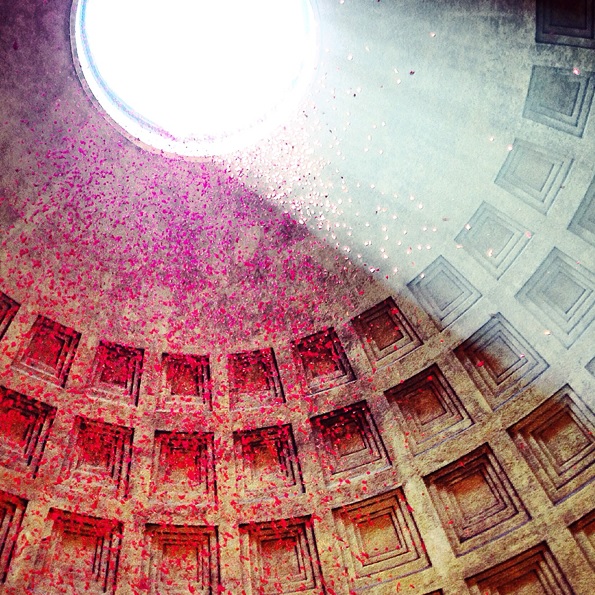
Except for the burning bits, some of these practices have been revived in these older churches. In parts of Italy and Sicily, red rose petals are dropped through the hole. This is an especially spectacular sight in the church in Rome dedicated to St. Mary and the Martyrs that was formerly the Pantheon. There is an opening in the dome and the rose petals are dropped, filling the church and covering the floor.
Rose Petals raining down on Pentecost Sunday in St Mary and the Martyrs (Pantheon), Rome
Red and fire are the dominant images used in Pentecost celebrations. In many places of the Northern Hemisphere, this is height of strawberry season and the red fruits shapes like tongues of fire seem perfect for the feast day that falls in the warmer months.”
Earth
The earth element doesn’t seem to be as obvious with the connection more as it relates to God’s creation. Pentecost, which means “Fiftieth Day” in Greek, was a Jewish festival marking the 7 weeks or 50 days after the Passover. It was a harvest festival, offering the first fruits in thanksgiving to God. Later the feast also commemorated the giving of the Law or Ten Commandments to Moses at Sinai. Our civilization has become less agrarian but this “earth element” should be a universal reminder to us as respect and thanksgiving for creation. Pope Benedict explains and elaborates:
“From its earliest prehistory [Pentecost] has been a feast of harvest. In Palestine the crops were ripe in May; Pentecost was the thanksgiving for the grain harvest. Man sees the fruitfulness which results from the interplay of heaven and earth as the miracle by which he lives and he acknowledges that gratitude is the appropriate response to this miracle….Has this become meaningless today? If we think of “Holy Spirit” only in terms of Christian inwardness and of “harvest” only in terms of technology and commerce, our view of the world has become schizophrenic. At Pentecost the church prays a verse from the psalms which runs: Send forth your Spirit, O Lord, and renew the face of the earth. Initially this refers to the creative Spirit which has called the world into being and maintains it in being. It is important to have a new reality of this at Pentecost: the Holy Spirit who came down upon the apostles is the same Spirit who fashioned the world….”
Against this background we must also understand that, in Israel, Pentecost was the remembrance of the arrival at Sinai and the celebration of the Covenant which had set out a path for Israel to travel in the form of the law. Christians have always seen their Pentecost as a continuation of this idea: the New Law is love, breaking down barriers and uniting people in the New Covenant. Love, too, is not formless or arbitrary; it is a formation from within, a wakefulness of the heart which takes up the rhythm of creation and perfects it. (Seek That Which is Above, 79-81)”
Water
The final element, water, is not an image of the Holy Spirit but a direct result of the coming of the Paraclete upon the Disciples. After they were filled with the Holy Spirit, they left the Upper Room and began to proclaim the Gospel. And on hearing their words, 3000 were baptised that day. The matter of baptism is water.
From the very day of Pentecost the Church has celebrated and administered holy Baptism. Indeed St. Peter declares to the crowd astounded by his preaching: “Repent, and be baptised every one of you in the name of Jesus Christ for the forgiveness of your sins; and you shall receive the gift of the Holy Spirit.”
26. The apostles and their collaborators offer Baptism to anyone who believed in Jesus: Jews, the God-fearing, pagans. 27 Always, Baptism is seen as connected with faith: “Believe in the Lord Jesus and you will be saved, you and your household,” St. Paul declared to his jailer in Philippi. And the narrative continues, the jailer “was baptised at once, with all his family” (CCC, #1226)
With every baptism comes the reminders of the first Pentecost. Today is also a good feast to celebrate our reception of the sacraments of baptism and confirmation. ( Jennifer Gregory Miller)
Pentecost Sunday (2017)
Mary the Planter
—
St Aldegrin of Baume
St Alexander of Verona
St Alonio
Bl Antoni Zawistowski
St Aretius of Rome
Bl Boniface of Villers
St Breaca of Cornwall
St Buriana of Cornwall
St Christa of Sicily
St Clateus of Brescia
St Cornelius McConchailleach
St Croidan
St Cyrinus of Aquileia
St Dacian of Rome
St Degan
St Edfrith of Lindisfarne
St Elsiar of Lavedan
St Ernin of Cluain
St Filippo Smaldone
Bl Francesco Pianzola
St Francis Caracciolo
Bl Francis Ronci
Bl Margaret of Vau-le-Duc
St Medan
Bl Menda Isategui
St Metrophanes of Byzantium
St Nennoc
St Nicolo of Sardinia
St Optatus of Milevis
St Petroc of Cornwall
St Quirinus of Croatia
St Quirinus of Tivoli
St Rutilus of Sabaria
Saturnina of Arras
Bl Stanislaw Kostka Starowieyski
St Trano of Sardinia
St St Walter of Fontenelle
Walter of Serviliano
—
Martyrs of Cilicia – 13 saints: A group of 13 Christians who were martyred together. The only details about them that have survived are their names –
• Cama
• Christa
• Crescentia
• Eiagonus
• Expergentus
• Fortunus
• Italius
• Jucundian
• Julia
• Momna
• Philip
• Rustulus
• Saturnin
They were martyred in in Cilicia, Asia Minor (in modern Turkey), date unknown
Martyrs of Nyon – 41 saints: A group of 41 Christians martyred together for refusing to sacrifice to imperial Roman idols. We know the names of some but no other details.
• Amatus
• Attalus
• Camasus
• Cirinus
• Dinocus
• Ebustus
• Euticus
• Eutychius
• Fortunius
• Galdunus
• Julia
• Quirinus
• Rusticus
• Saturnina
• Saturninus
• Silvius
• Uinnita
• Zoticus
Martyred by being beheaded in Noviodunum (modern Nyon, Switzerland)
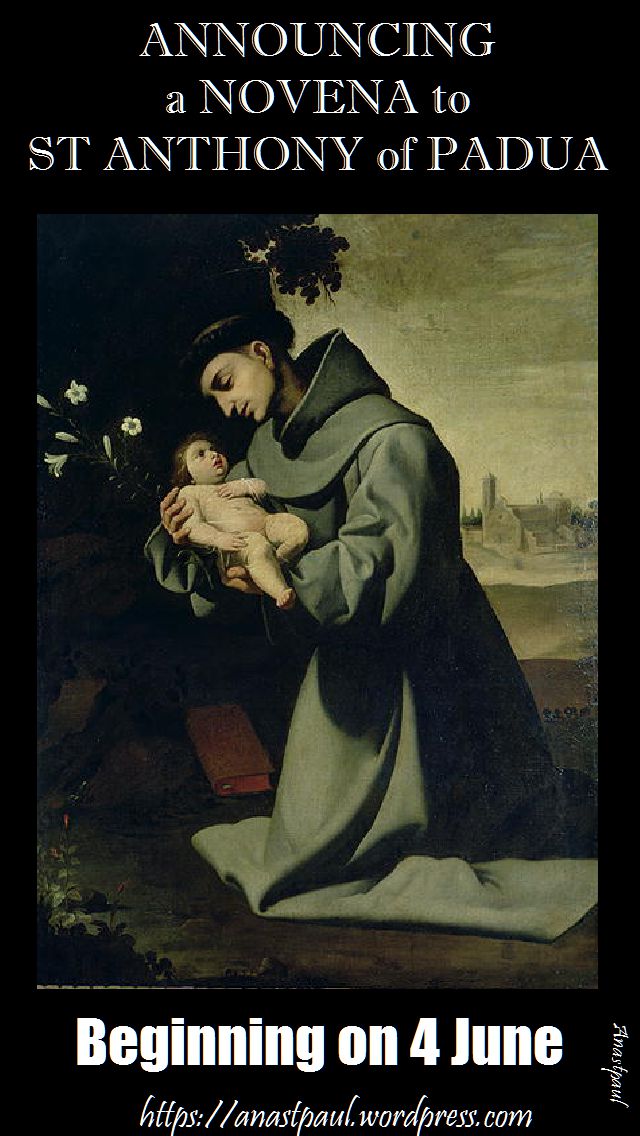
Announcing a Novena to SAINT ANTHONY FOR ALL OUR INTENTIONS
St Anthony of Padua is also known as Saint Anthony the Wonder-Worker and so it is no surprise that Catholics often turn to him with their requests—more often, perhaps, than to any other saint, with the exception of the Blessed Virgin Mary. Best known as the patron saint of lost items, Saint Anthony is invoked for many other needs as well. In this novena, or nine-day prayer, we not only ask for Saint Anthony’s intercession but promise to live more Christian lives.
Saint Anthony received an apparition of the Christ Child, Who, lying in the saint’s arms, kissed him and told St Anthony that He loved him for his preaching. (Saint Anthony was renowned for his zealous preaching of the True Faith against heretics.) In this prayer, we recognise that our greatest need is for grace—the life of God in our souls—which saves us from sin. Our particular need—our request to Saint Anthony—is secondary.
This prayer, however, does not shy away from asking Saint Anthony to intervene in a miraculous fashion to fulfill our particular need. In return for the good that we desire, we promise to live our lives as Saint Anthony did—conforming our actions to the truths taught to us by the Church, living and preaching the Gospel and serving the poor.
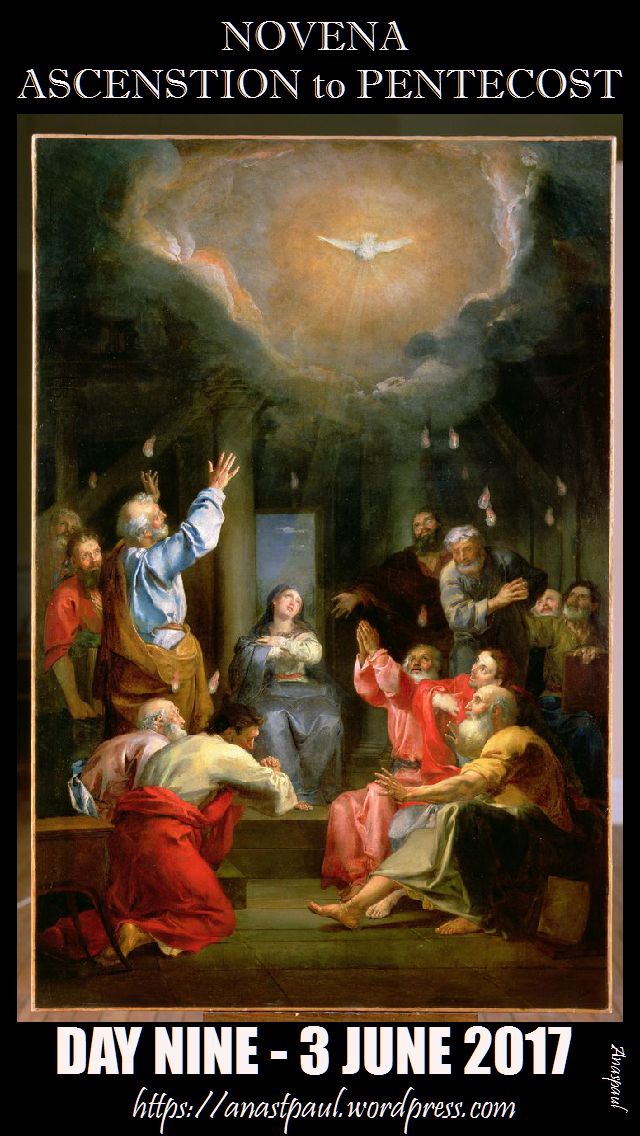
NOVENA from ASCENSION to PENTECOST DAY NINE – SATURDAY 3 June 2017
The Holy Spirit Only one thing is important: eternal salvation. Only one thing, therefore, is to be feared: sin. Sin is the result of ignorance, weakness and indifference. The Holy Spirit is the Spirit of Light, of Strength and of Love. With His sevenfold gifts He enlightens the mind, strengthens the will and inflames the heart with the love of God. To ensure our salvation we ought to invoke the Divine Spirit daily, because the Spirit comes to us in our needs. When we don’t know what to say, it is the Spirit who speaks within us.
The Fruits of the Holy Spirit
The gifts of the Holy Spirit perfect the supernatural virtues by enabling us to practice them with greater docility to divine inspiration. As we grow in the knowledge and love of God under the direction of the Holy Spirit, our service becomes more sincere and generous, the practice of virtue more perfect. Such acts of virtue leave the heart filled with joy and consolation and are known as Fruits of the Holy Spirit. These Fruits in turn render the practice of virtue more attractive and become a powerful incentive for still greater efforts in the service of God, to serve Whom is to reign.
Prayer
Come and fill me, O Divine Spirit. Fill my heart with your heavenly fruits: Your Love for others, Your Joy, Your Peace, Your Kindness, Your Generosity, Your Faithfulness, Your Gentleness and Your temperance for Self-Control, that I may never weary in the service of God. Keep me close to You so that my life produces Your fruits in ever-increasing abundance. Help me to continually and faithfully submit to Your divine inspiration so that I will be united eternally with You in the love of the Father and the Son. Amen.
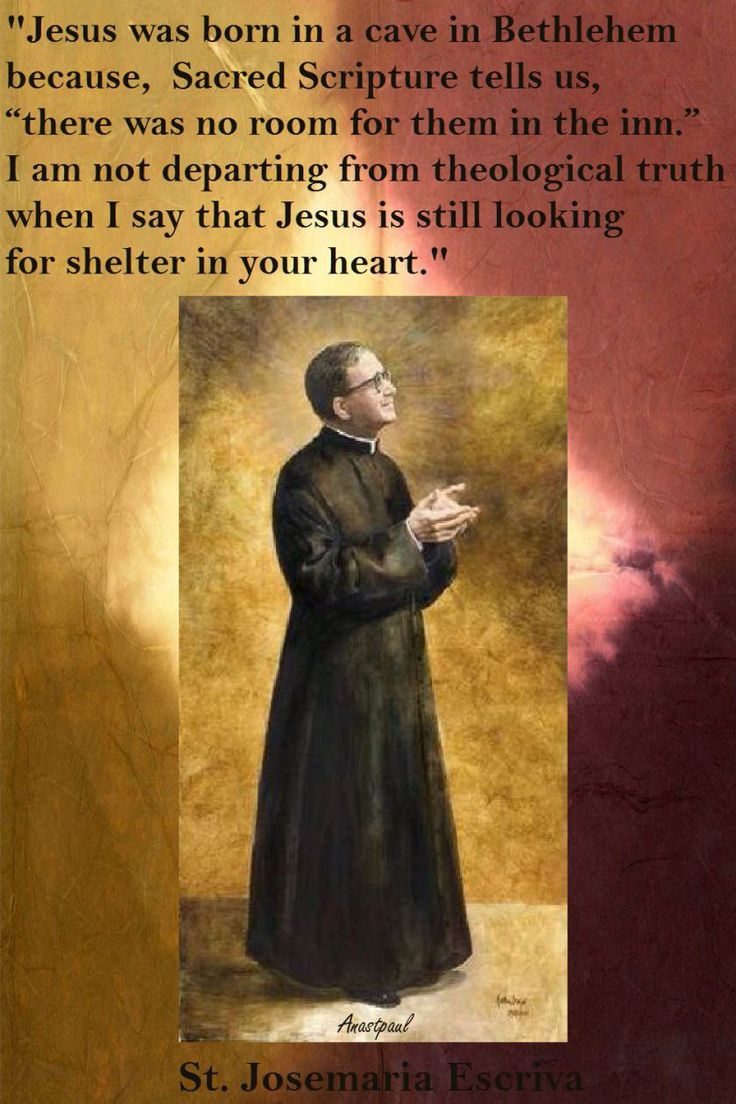
“Jesus was born in cave in Bethlehem because, Sacred Scripture tells us, “there was no room for them in the inn.” I am not departing from theological truth when I say that Jesus is still looking for shelter in your heart.”
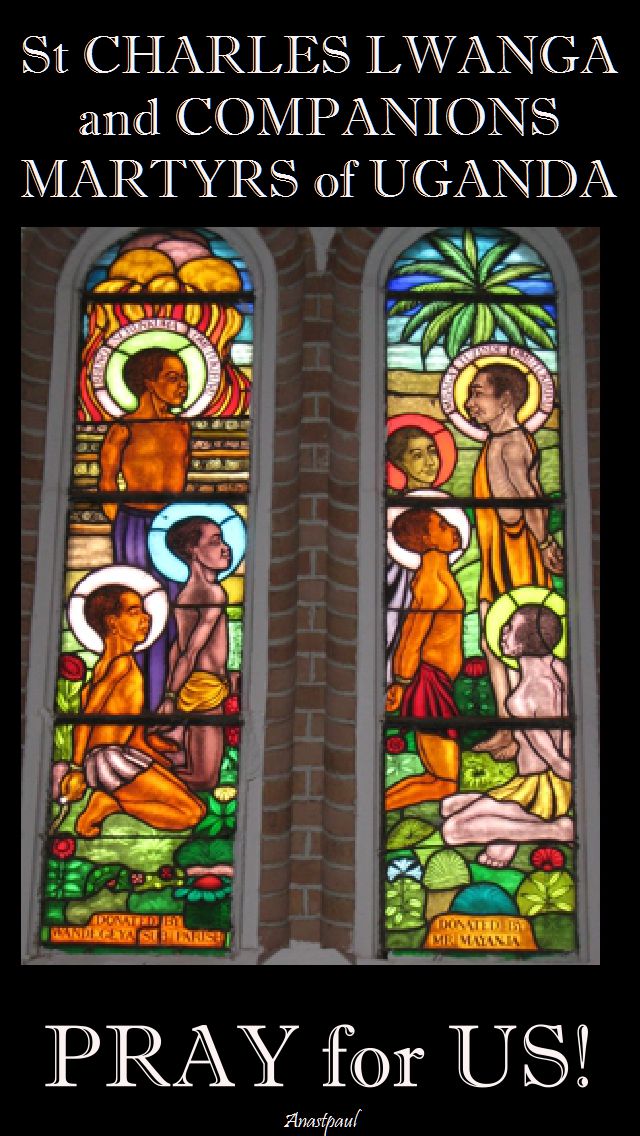
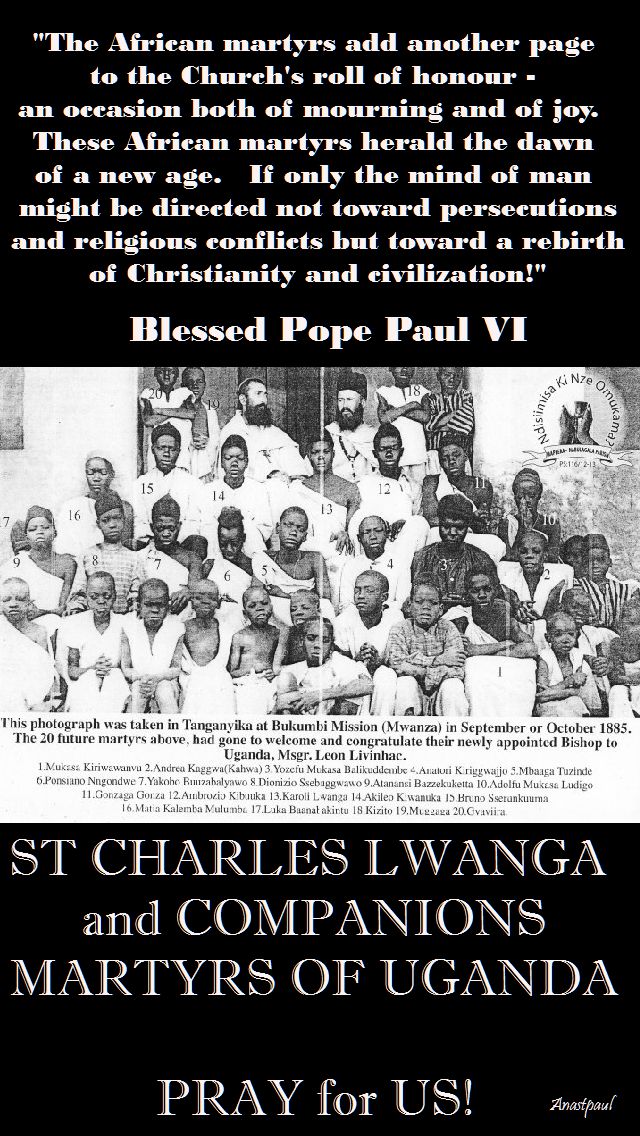
Such courage! These young men went courageously to their deaths, filled with the gifts of the Holy Spirit, so happy in their newfound faith, something completely baffling to the African chief. To St Charles Lwanga and his companions, their faith was the greatest treasure and they were willing and happy to die for it. Would that we too, graced by this great gift of faith, though we may never be called upon to die for it, it should be luminously clear to all that we are witnesses to Christ.
St Charles Lwanga and companions, Martyrs of Uganda, Pray for us!
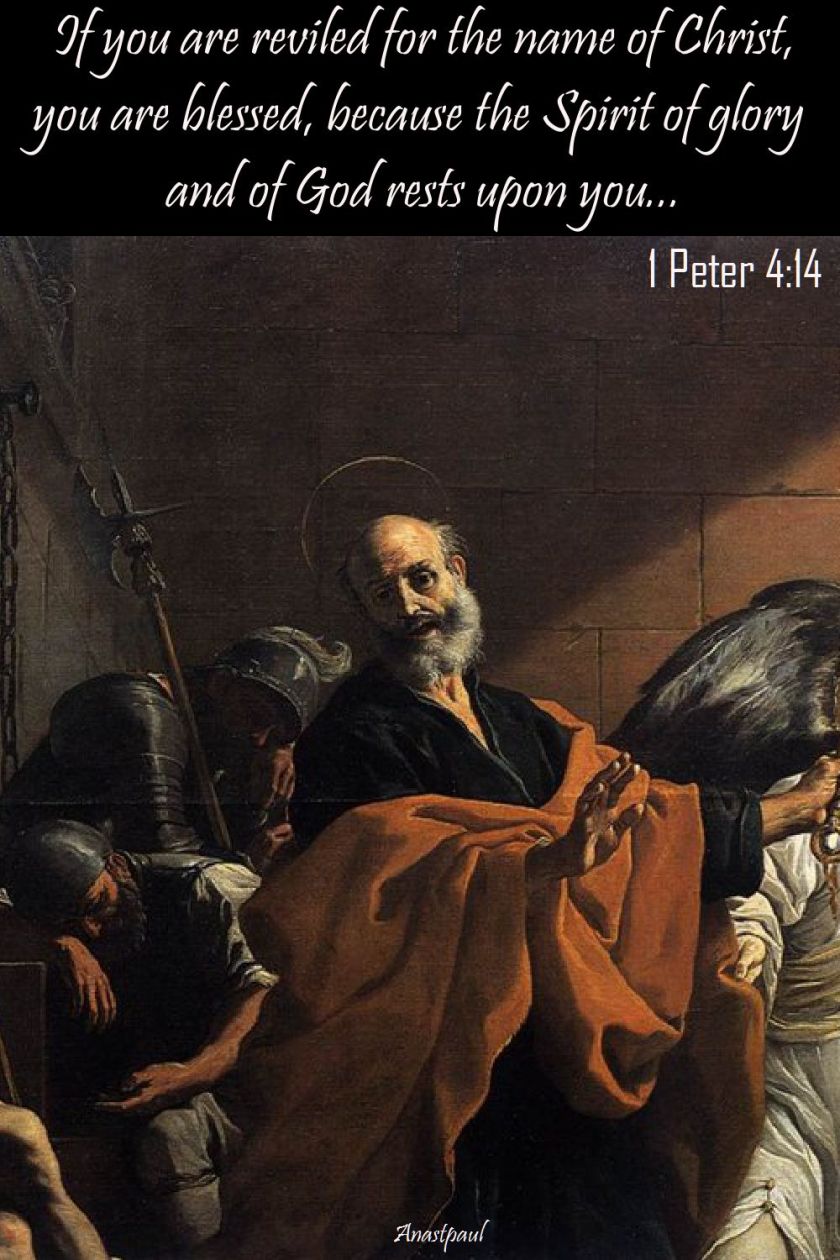
If you are reviled for the name of Christ,
you are blessed, because the Spirit of glory
and of God rests upon you……1 Peter 4:14
REFLECTION – “The African martyrs add another page to the Church’s roll of honour – an occasion both of mourning and of joy. These African martyrs herald the dawn of a new age. If only the mind of man might be directed not toward persecutions and religious conflicts but toward a rebirth of Christianity and civilization! Africa has been washed by the blood of these latest martyrs and first of this new age (and, God willing, let them be the last, although such a holocaust is precious indeed). Africa is reborn free and independent. – Blessed Pope Paul VI from the homily at the canonisation of Saint Charles Lwanga and companions.
PRAYER – Heavenly Father, give us the strength and the courage and fill us with Your Holy Spirit that we may always be faithful to Your Son and His way of the Cross. Blessed and holy Martyrs of Uganda, you St Charles Lwanga and your young companions, are a light to us all! Please pray for us, amen.
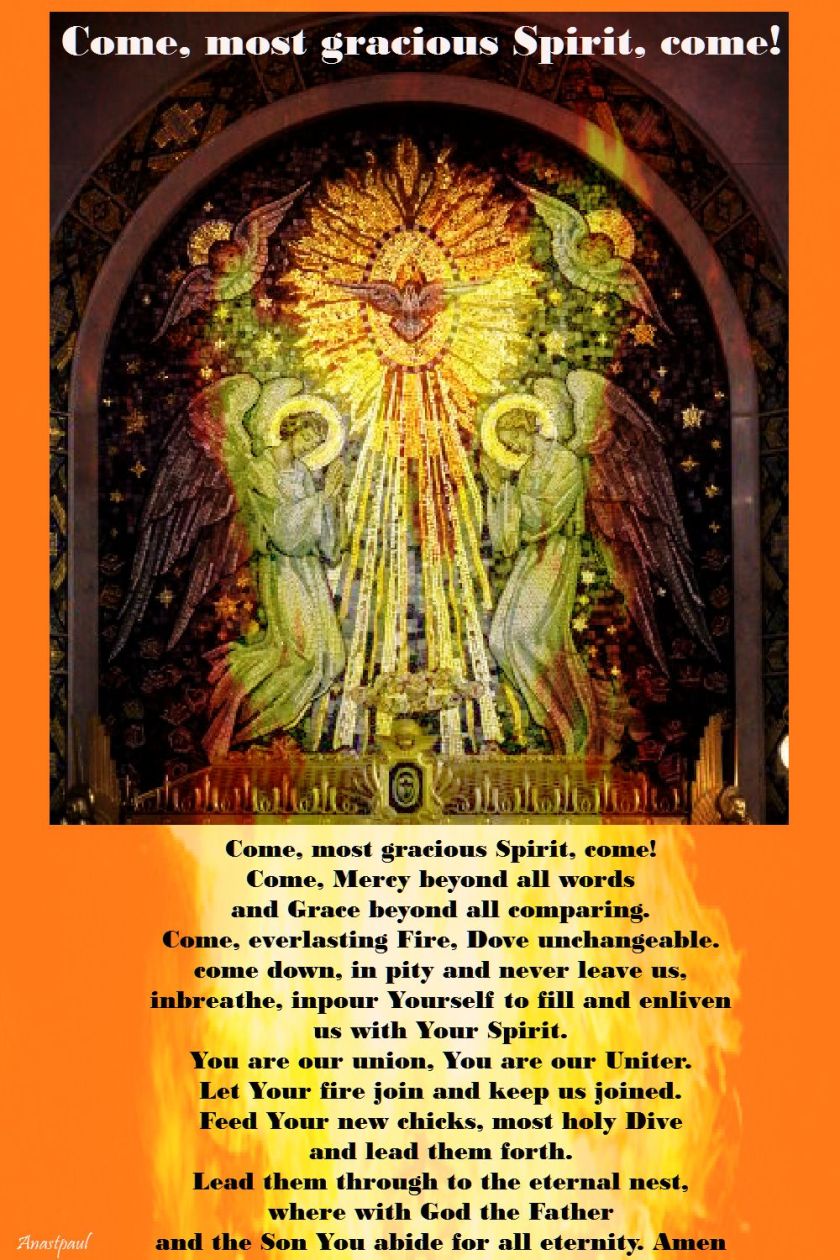
Come, most gracious Spirit, come!
Come, Mercy beyond all words
and Grace beyond all comparing.
Come, everlasting Fire, Dove unchangeable.
come down, in pity and never leave us,
inbreathe, inpour Yourself to fill and enliven
us with Your Spirit.
You are our union, You are our Uniter.
Let Your fire join and keep us joined.
Feed Your new chicks, most holy Dive
and lead them forth.
Lead them through to the eternal nest,
where with God the Father
and the Son You abide for all eternity. Amen
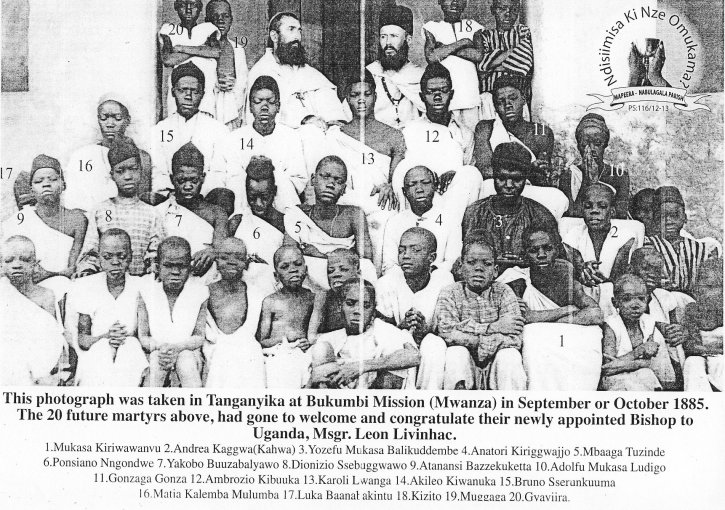
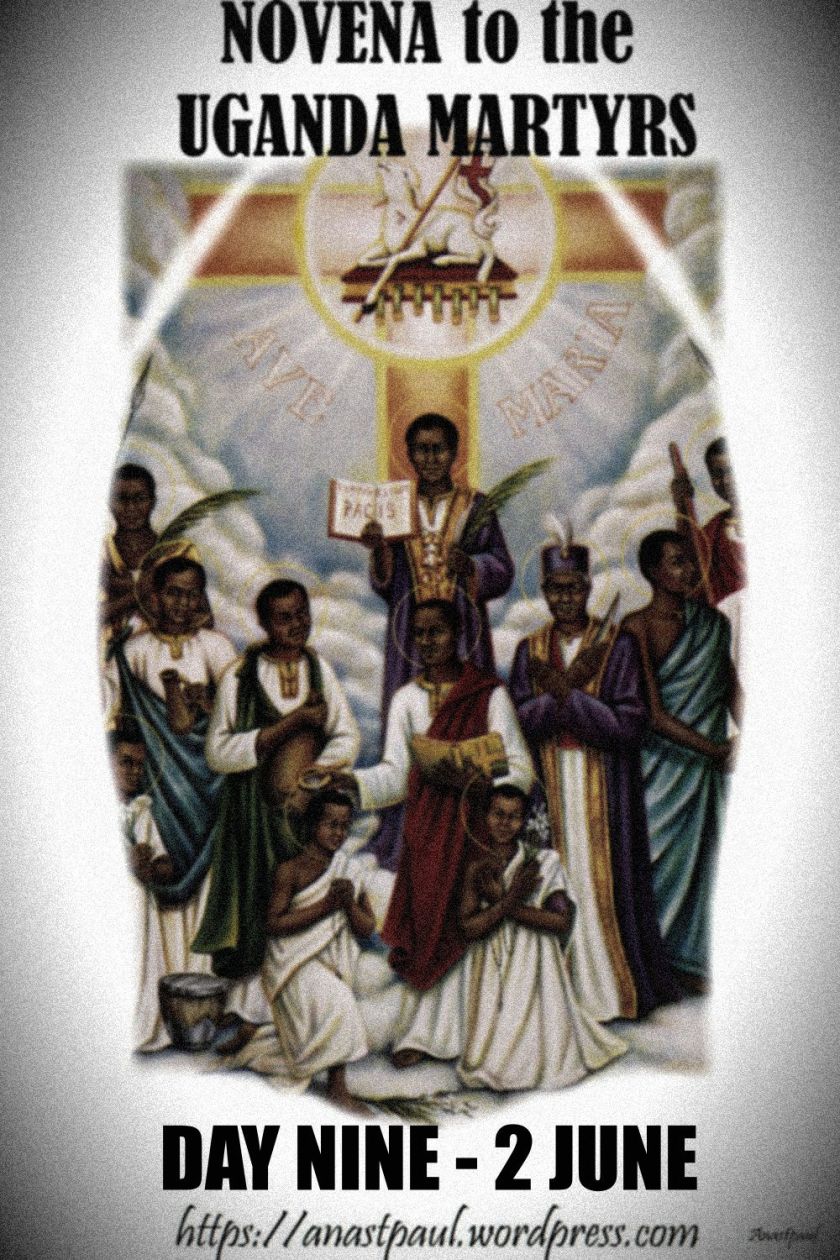
Saint/s of the Day – 3 June – Uganda Martyrs or St Charles Lwanga & Companions – Martyrs – Their names are: • Achileo Kiwanuka • Adolofu Mukasa Ludigo
• Ambrosio Kibuuka • Anatoli Kiriggwajjo
• Anderea Kaggwa • Antanansio Bazzekuketta
• Bruno Sserunkuuma • Charles Lwanga
• Denis Ssebuggwawo • Gonzaga Gonza
• Gyavire • James Buzabaliao
• John Maria Muzeyi • Joseph Mukasa
• Kizito • Lukka Baanabakintu
• Matiya Mulumba • Mbaga Tuzinde
• Mugagga • Mukasa Kiriwawanvu
• Nowa Mawaggali • Ponsiano Ngondwe
They were canonised on 18 October 1964 by Pope Paul VI at Rome, Italy. Patrons of Uganda and the Archdiocese of Accra, Ghana
All martyrs’ stories are inspiring, but the martyrdom of young people really makes us think.
By 1879 the first Catholic missions were started in Uganda and other parts of Central Africa. Under King Mtesa missionaries preached, people studied the faith and many believed in Jesus. Unfortunately King Mtesa was succeeded by King Mwanga, who began persecuting the Christians in Uganda.
Charles Lwanga was a young man, probably in his late teens, who was a page in the court of King Mwanga. After Mkasa, the Christian master of the court pages, criticised the king for his immoral acts and for murdering a group of missionaries, the king had him beheaded. On the same night Mkasa was martyred, Charles, a catechumen, was baptised. Charles replaced Mkasa as head of the pages and continued to encourage the young men to refuse to take part in the pagan customs of the country. Later a young page refused to become involved in the king’s immoral acts and confessed that a page named Denis was instructing him to be a Christian. This angered the king so much that he sent for Denis and thrust a spear through his throat. Then Mwanga summoned all the pages and separated the Christian pages from the rest. He commanded his soldiers to kill Charles Lwanga and his friends. Most of the pages were under the age of twenty-five. The youngest was thirteen years old.
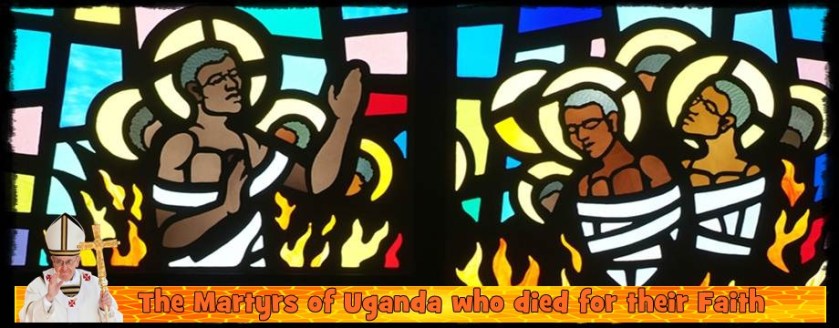
In prison Charles inspired the others to be courageous and faithful. The boys were executed thirty-seven miles away. Three were killed on the road. Charles was burned alive. The others met the same fate or were beheaded. They prayed and sang enthusiastically at their deaths.
After their deaths, many other Christians were persecuted and killed. The example of these teenagers and men inspired other people, and in Africa the faith grew and spread. It has refused to die.
Uganda Martyrs pray for us all, especially for Africa!
Martyrs of Uganda (Memorial) – 22 saints: Twenty-two (22) Ugandan converts martyred in the persecutions of King Mwanga. They are –
• Achileo Kiwanuka • Adolofu Mukasa Ludigo
• Ambrosio Kibuuka • Anatoli Kiriggwajjo
• Anderea Kaggwa • Antanansio Bazzekuketta
• Bruno Sserunkuuma • Charles Lwanga
• Denis Ssebuggwawo • Gonzaga Gonza
• Gyavire • James Buzabaliao
• John Maria Muzeyi • Joseph Mukasa
• Kizito • Lukka Baanabakintu
• Matiya Mulumba • Mbaga Tuzinde
• Mugagga • Mukasa Kiriwawanvu
• Nowa Mawaggali • Ponsiano Ngondwe
They were canonised on 18 October 1964 by Pope Paul VI at Rome, Italy.
—
Bl Adam of Guglionesi
Albert of Como
Athanasius of Traiannos
Auditus of Braga
Bl Beatrice Bicchieri
Caecilius of Carthage
St Charles Lwanga & Companions
Bl Charles-René Collas du Bignon
Clotilde of France
Conus of Lucania
Cronan the Tanner
Davinus of Lucca
Bl Diego Oddi
Bl Francis Ingleby
Gausmarus of Savigny
Genesius of Clermont
Glunshallaich
Hilary of Carcassone
Isaac of Córdoba
John Grande
Kevin of Glendalough
Laurentinus of Arezzo
Liphardus of Orléans
Morand of Cluny
Moses of Arabia
Oliva of Anagni
Paula of Nicomedia
Pergentinus of Arezzo
Phaolô Vu Van Duong
Urbicius
—
Dominicans Martyred in China
Martyrs of Africa – 156 saints: 156 Christians martyred together in Africa, date unknown; the only other information to survive are some of their names –
• Abidianus
• Demetria
• Donatus
• Gagus
• Januaria
• Juliana
• Nepor
• Papocinicus
• Quirinus
• Quirus
Martyrs of Byzantium – 5 saints: A group of Christians, possibly related by marriage, who were martyred together. They were –
• Claudius
• Dionysius
• Hypatius
• Lucillian
• Paul
They were martyred in 273 in Byzantium.
Martyrs of Rome – 8 saints: A group of Christians martyred together. We know nothing else about them but the names –
• Amasius
• Emerita
• Erasmus
• Lucianus
• Orasus
• Satuaucnus
• Septiminus
• Servulus
They were martyred in Rome, Italy, date unknown.
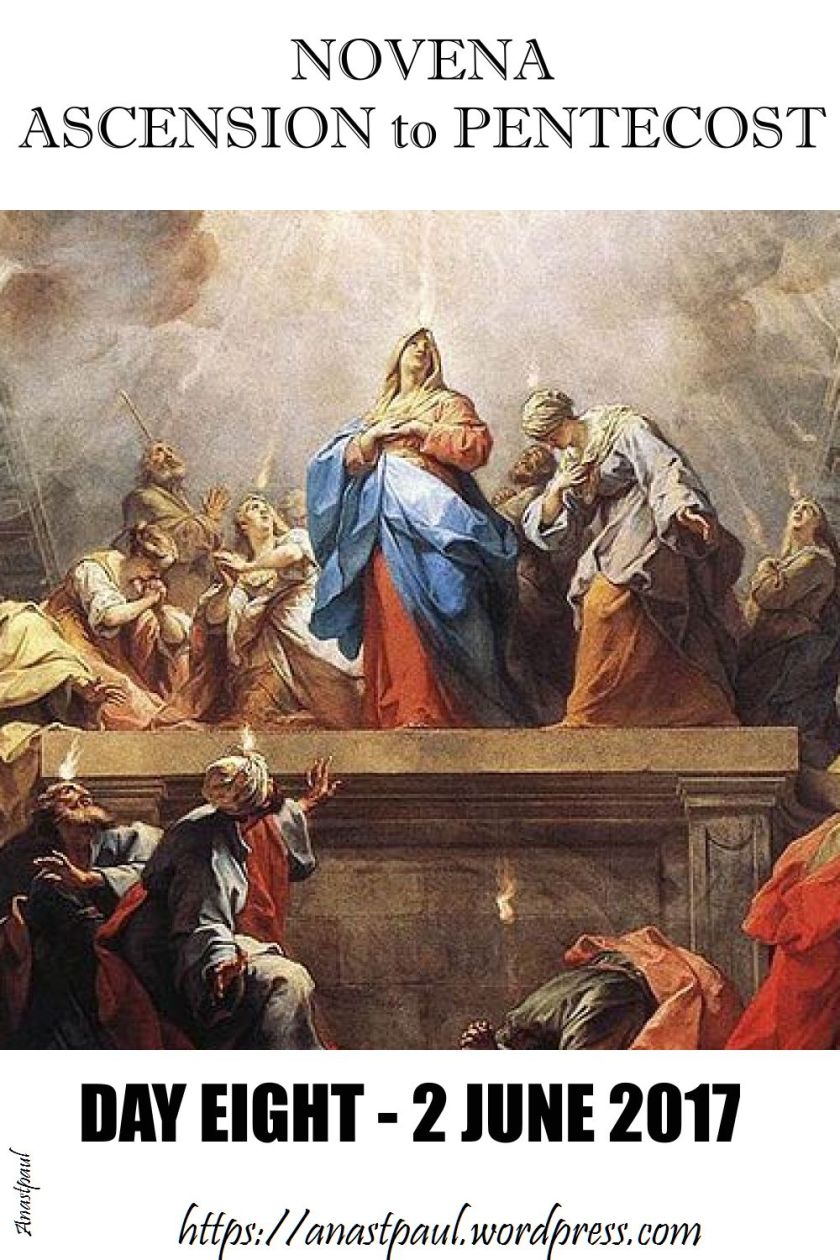
NOVENA from ASCENSION to PENTECOST DAY EIGHT – Friday 2 June 2017
The Holy Spirit Only one thing is important: eternal salvation. Only one thing, therefore, is to be feared: sin. Sin is the result of ignorance, weakness and indifference. The Holy Spirit is the Spirit of Light, of Strength and of Love. With His sevenfold gifts He enlightens the mind, strengthens the will and inflames the heart with the love of God. To ensure our salvation we ought to invoke the Divine Spirit daily, because the Spirit comes to us in our needs. When we don’t know what to say, it is the Spirit who speaks within us.
The Gift of Wisdom
Embodying all the other gifts, as charity embraces all the other virtues, Wisdom is the most perfect of the gifts. Of wisdom it is written “all good things came to me with her, and innumerable riches through her hands.” It is the gift of Wisdom that strengthens our faith, fortifies hope, perfects charity and promotes the practice of virtue in the highest degree. Wisdom enlightens the mind to discern and relish things divine, in the appreciation of which earthly joys loose their attraction, while the Cross of Christ reveals a certain divine attraction according to the words of the Saviour: “Take up your cross and follow me, for my yoke is sweet and my burden light.”
Prayer
Come and fill me, O Spirit of Wisdom and reveal to my soul the mysteries of heavenly things, in their exceeding greatness, power and beauty. Teach me to love them above and beyond all the passing joys and satisfactions of earth and to prefer your wisdom over the so-called wisdom of this world. Help me to grow in your wisdom, especially during temptations, trials and all the daily challenges that I face. Amen.
O God, who in Your love and mercy
was pleased to send missionaries to Uganda
to bring the light of Christ to all the peoples,
we thank You for the gift of the
Holy Martyrs of Uganda, our ancestors in faith,
whom You gave the strength to overcome sin and the
anguish of torture and to bear witness to the truth.
Mary, Mother of Sorrows!
Look with mercy on those who suffer.
Be close to the victims of violence and terror,
and console those who mourn.
May Jesus your Son grant comfort
and peace to all the sick and dying,
and may he strengthen those
devoted to their physical and spiritual care.
To the Holy Martyrs, we beg for intercession,
be pleased to hear our prayer and pray for us that this,
our special request may be granted
(make your intention)
Holy Martyrs of Uganda, we honour and praise you!
Please pray for us!
O heavenly Father, we make our prayer
through our Lord, Jesus Christ, in union with the Holy Spirit,
one God forever and ever, amen.
Why are these men included in our Eucharistic prayer and given their own feast day, in spite of the fact that almost nothing is known about them?
Probably because the Church respects its collective memory. They once sent an impulse of encouragement through the whole Church. They made the ultimate step of faith……Fr. Don Miller, OFM
The foundation of our faith rests on the lives of these holy men and women of the early Church who willingly gave themselves over to the faith, courageous and joyful in their martyrdom. When we consider the struggles of today and our own personal difficulties in daily life, we might pause to consider the sacrifice of these early martyrs and be inspired to greater faith, trust and love and be filled with that impulse of encouragement!
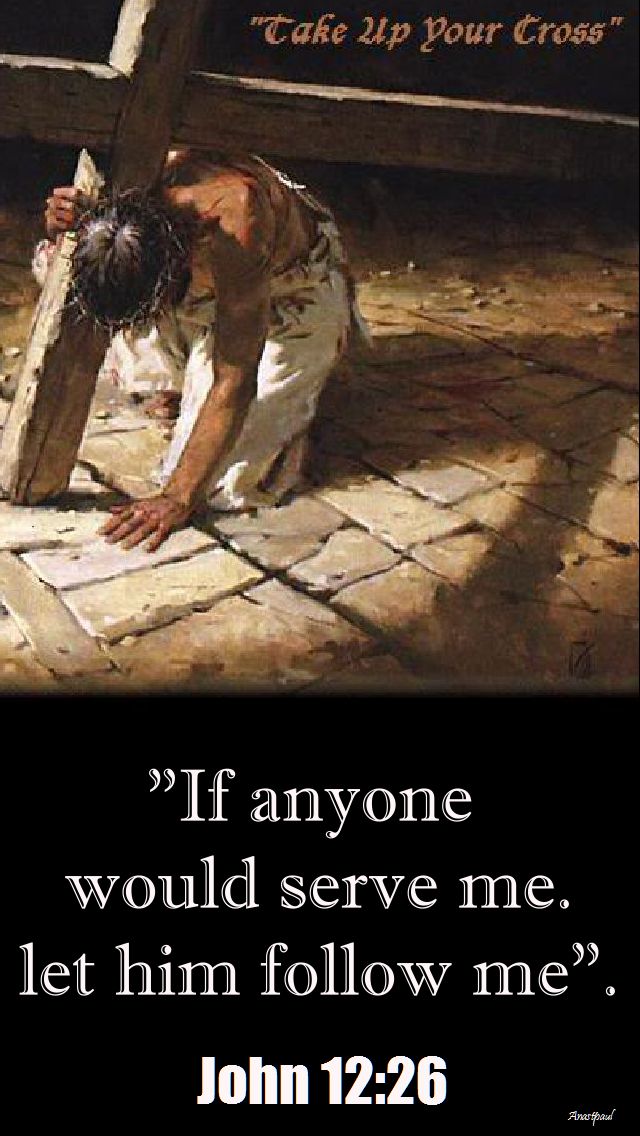
“If anyone would serve me. let him follow me”………John 12:26
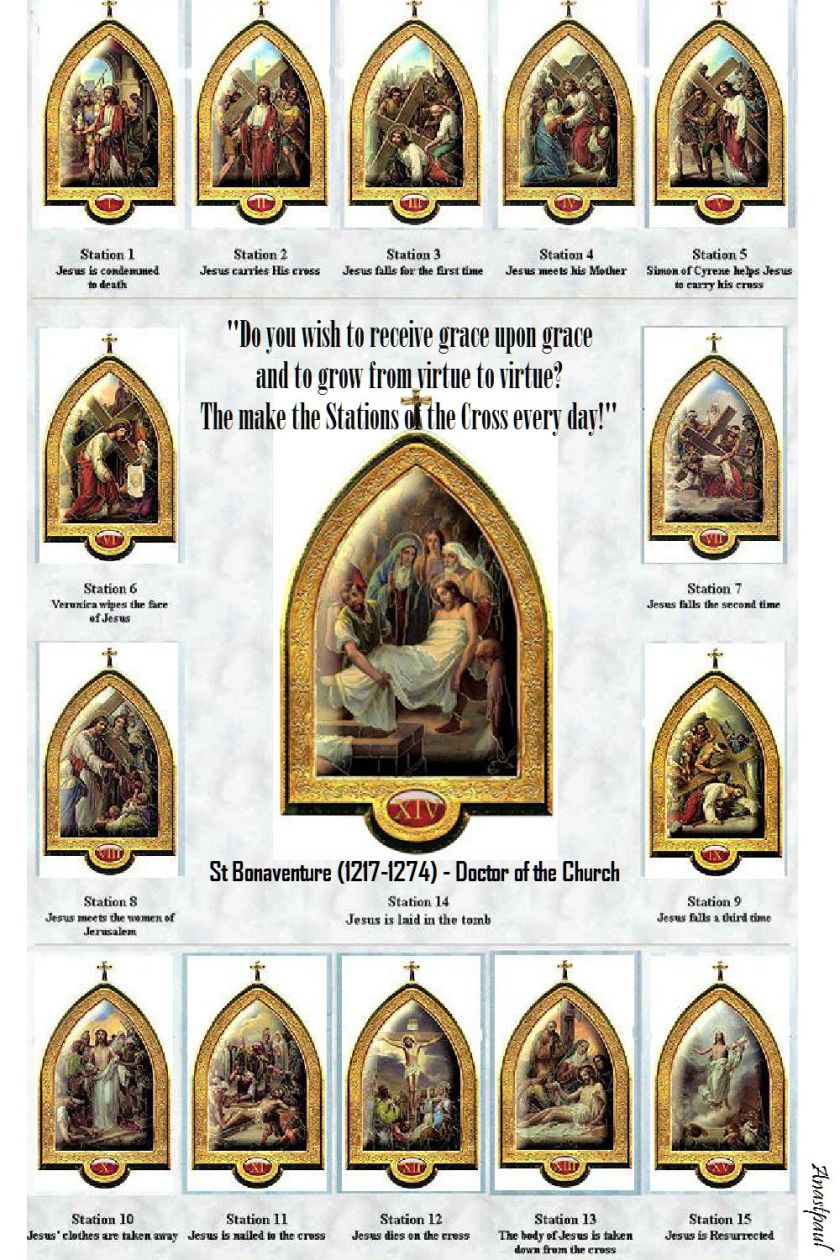
REFLECTION – “Do you wish to receive grace upon grace and to grow from virtue to virtue?
The make the Stations of the Cross every day!”………..St Bonaventure
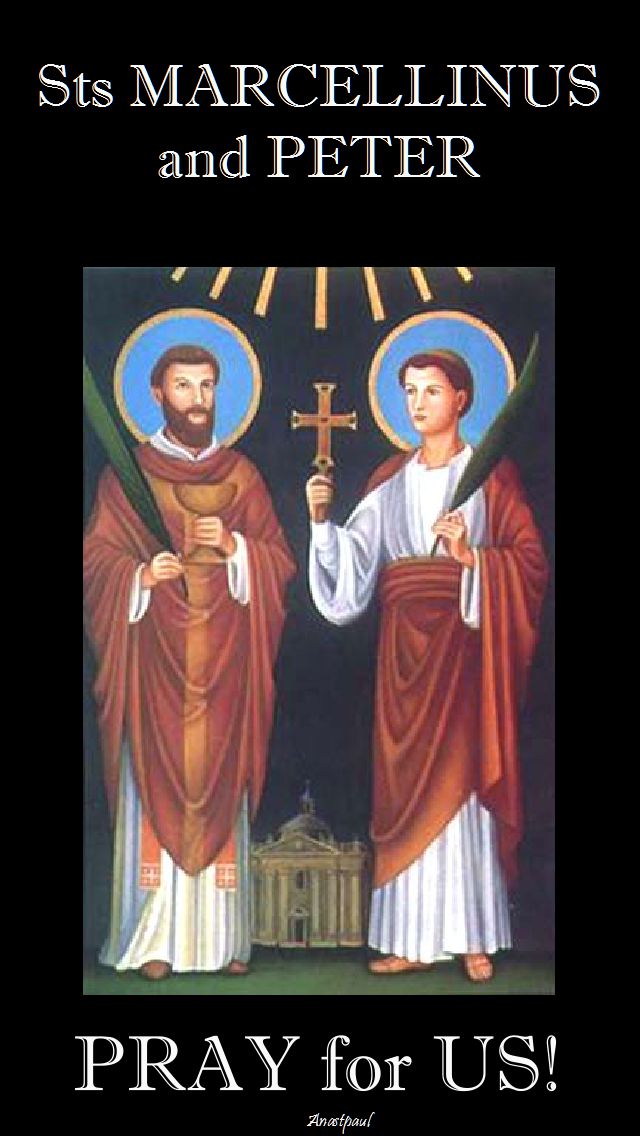
PRAYER – Lord Jesus, help me to make the Stations of the Cross frequently and even everyday if possible. Grant that in following You by this devotion, I may obtain the grace and courage to follow You in all the events of my life. Sts Marcellinus and Peter, you followed Christ in all things, giving your lives for love of Him, please pray for us all, amen!
Breathe in me, O Holy Spirit,
That my thoughts may all be holy.
Act in me, O Holy Spirit,
That my work, too, may be holy.
Draw my heart, O Holy Spirit,
That I love but what is holy.
Strengthen me, O Holy Spirit,
To defend all that is holy.
Guard me, then, O Holy Spirit,
That I always may be holy.
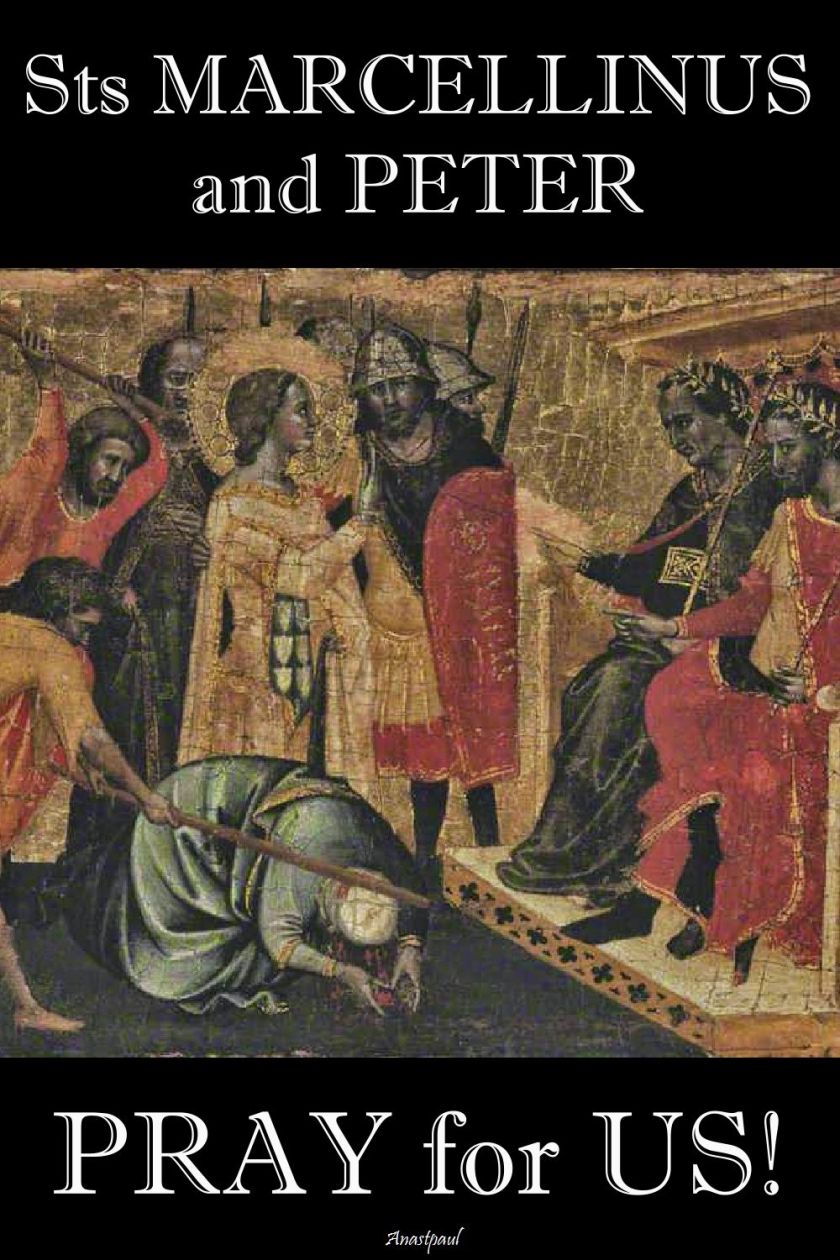
Saints of the Day – Sts Marcellinus and Peter – Martyrs/Priest and Exorcist (martyred in 304).
While very little is known today about the lives of these holy men, Marcellinus and Peter were prominent enough in the early Church to be included amongst the saints of the Roman Canon and their names continue to be mentioned during celebration of the Eucharist. Further evidence of the veneration and respect of the Church lives on in the basilica that Emperor Constantine built over their tombs in Rome.
The story of the lives and martyrdom of Marcellinus and Peter was recorded by Pope Saint Damasus, who learned of their heroic acts directly from their executioner—a man who converted to Christianity shortly after their deaths. According to the saintly pope, the executioner was deeply troubled following his role in the martyrdom and could not shake the feeling that a faith that had given Marcellinus and Peter such peace of mind and steady joy in the face of death must be authentic.
Marcellinus was a priest and Peter was an exorcist (authorised by the Church to work against demonic possession in individuals) who worked alongside him. Imprisoned during the persecution of Christians under the reign of Diocletian, Marcellinus and Peter embraced their suffering, seeing it as an opportunity for evangelisation and quickly had converted the majority of prisoners in jail with them—including the jailor and his entire family. This was accomplished when Peter set the daughter of the jailer free from an evil spirit which possessed her. Shortly thereafter, the jailor, his wife and their other children were baptised into the faith—right in the cell of Peter and Marcellinus.
When Diocletian heard of their activities, he was greatly incensed and had them tortured, stripped naked and thrown into cells filled with only broken shards of glass. When it was observed that this only served to increase their faith and joy in suffering, he had them taken to the forest of Silva Nigra and dig their own graves. Then, he had them beheaded in the forest, so that other Christians would not find their bodies, bury them properly, and then subsequently venerate them. However, that was not to be the case. Shortly following their death, a Christian matron by the name of Lucilla learned of their martyrdom through a dream (or possibly a prophetic vision) and came with some fellow faithful to the gravesite. The relics of the holy martyrs were removed and translated to a more proper burial place, a set of catacombs in Rome. When Christianity was restored as a “legal” faith tradition under Constantine, he had a great basilica built in their honour over their tomb.
Catacombs of Sts Marcellinus & Peter
Catacombs of Sts Marcellinus & Peter
Basilica of Sts Marcellinus & Peter in Romd
Excavation of the Catacombs of Sts Marcellinus & Peter
St Marcellinus (Optional Memorial)
St Peter the Exorcist (Optional Memorial)
Madonna of the Tears
—
St Ada of Ethiopia
St Adalgis of Thiérarche
St Armin of Egypt
St Barbarinus
St Blandina the Slave
St Bodfan of Wales
St Daminh Ninh
Bl Demetrios of Philadelphia
St Dorotheus of Rome
St Erasmus of Formiae
St Pope Eugene I,
St Evasius
Bl Giovanni de Barthulono
Bl Guy of Acqui
St Honorata
St Humatus
St John de Ortega
St Joseph Tien
St Nicholas Peregrinus
St Photinus of Lyons
St Rogate
Bl Sadoc of Sandomierz
St Stephen of Sweden
—
Martyrs of Lyons and Vienne: A group of 48 Christians from the areas of Vienne and Lyon, France, who were attacked by a pagan mob, arrested and tried for their faith, and murdered in the persecutions of Marcus Aurelius. A letter describing their fate, possibly written by Saint Irenaeus of Lyons, was sent to the churches in the Middle East. Only a few names and details of their lives have surived; some of them have separate entries on this date –
• Alexander of Vienne
• Attalus of Pergamos
• Biblis of Lyons
• Blandina the Slave
• Cominus of Lugdunum
• Epagathus of Lugdunum
• Maturus the Novice
• Photinus of Lyons
• Ponticus of Lugdunum
• Sanctius of Vienne
• Vettius of Lugdunum
They were martyred in assorted ways on on various during 177.
Martyrs of Sandomierz: A group of 49 Dominicans, some of whom received the habit from Saint Dominic de Guzman himself. They worked separately and together to bring the faith and establish the Dominican Order in Poland, basing their operations in and around Sandomierz. In 1260 they were all martyred by the Tartars as they were singing the Salve Regina at Compline; the custom of singing the Salve Regina at the deathbed of Dominicans stems from this incident. We know a few details about a few of the martyrs, but most survive only as names –
• Zadok
• Andrea, chaplain
• James, novice master
• Malachi, convent preacher
• Paul, vicar
• Peter, guardian of the garden
• Simone, penitentiary
friars
• Abel, Barnabas, Bartholomew, Clemente, Elia, John, Luke, Matthew, Philip
deacons
• Giuseppe, Joachim, Stefano
sub-deacons
• Abraham, Basil, Moses, Taddeo
clerics
• Aaron, Benedict, David, Dominico, Mattia, Mauro, Michele, Onofrio, Timothy
professed students
• Christopher, Donato, Feliciano, Gervasio, Gordian, John, Mark, Medardo, Valentino
novices
• Daniele, Isaiah, Macario, Raffaele, Tobia
lay brothers
• Cyril, tailor
• Jeremiah, shoemaker
• Thomas, organist
They were martyred in 1260 at Sandomierz, Poland and Beatified on 18 October 1807 by Pope Pius VII (cultus confirmation).
The Month of June is dedicated to the Sacred Heart.
The Church celebrates the Solemnity of the Sacred Heart of Jesus on the Friday following the second Sunday after Pentecost.
In addition to the liturgical celebration, many devotional exercises are connected with the Sacred Heart of Jesus.
Of all devotions, devotion to the Sacred Heart was, and remains, one of the most widespread and popular in the Church.
Understood in the light of the Scriptures, the term “Sacred Heart of Jesus” denotes the entire mystery of Christ, the totality of His being and His person considered in its most intimate essential: Son of God, uncreated wisdom; infinite charity, principal of the salvation and sanctification of mankind. The “Sacred Heart” is Christ, the Word Incarnate, Saviour, intrinsically containing, in the Spirit, an infinite divine-human love for the Father and for His brothers. Excerpted from the Directory on Popular Piety and the Liturgy
Devotion to the Sacred Heart was also an essential component of Pope John Paul II’s hopes for the “new evangelisation” called for by the Church.
“For evangelisation today,” he said, “the Heart of Christ must be recognized as the heart of the Church: It is He who calls us to conversion, to reconciliation. It is He who leads pure hearts and those hungering for justice along the way of the Beatitudes. It is He who achieves the warm communion of the members of the one Body. It is He who enables us to adhere to the Good News and to accept the promise of eternal life . It is He who sends us out on mission. The heart-to-heart with Jesus broadens the human heart on a global scale.”
Here are some of the relevant documents: Leo XIII in his Encyclical Letter Annum sacrum (1889) on the consecration of mankind to the Sacred Heart; Pius XI in Caritate Christi Compulsi (On The Sacred Heart) and Miserentissimus Redemptor (On Reparation To The Sacred Heart); Pius XII in his Encyclical Letter Haurietis aquas; Paul VI in his Apostolic Letter Investigabiles divitias Christi (1965) and John Paul II in Message on the centenary of the consecration of mankind to the Sacred Heart of Jesus (1999), in L’Osservatore Romano, 12 June 1999.
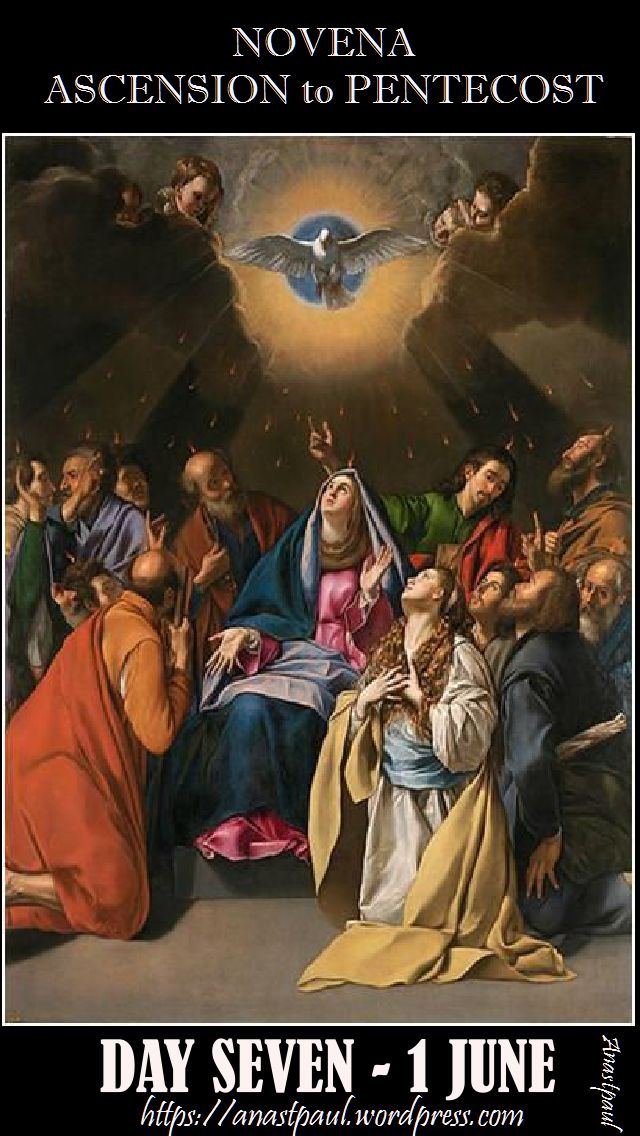
NOVENA from ASCENSION to PENTECOST DAY SEVEN – THURSDAY 1 JUNE
The Holy Spirit Only one thing is important: eternal salvation. Only one thing, therefore, is to be feared: sin. Sin is the result of ignorance, weakness and indifference. The Holy Spirit is the Spirit of Light, of Strength and of Love. With His sevenfold gifts He enlightens the mind, strengthens the will and inflames the heart with the love of God. To ensure our salvation we ought to invoke the Divine Spirit daily, because the Spirit comes to us in our needs. When we don’t know what to say, it is the Spirit who speaks within us.
The Gift of Counsel
The gift of Counsel fills the soul with supernatural prudence, enabling it to judge promptly and rightly what must done, especially in difficult circumstances. Counsel applies the principles furnished by Knowledge and Understanding to the innumerable concrete cases that confront us in the course of our daily duty as parents, teachers, priests, public servants and Christian citizens. Counsel is supernatural common sense, a priceless treasure in the quest of salvation. “Above all these things, pray to the Most High, that He may direct your way in truth.”
Prayer
Come and fill me, O Spirit of Counsel. Help me and guide me in all my ways, that I may always do your holy will. Transform my heart to prefer only what is good; turn it away from all that is evil and direct me by the straight path of your commandments to that goal of eternal life for which I long. Amen.
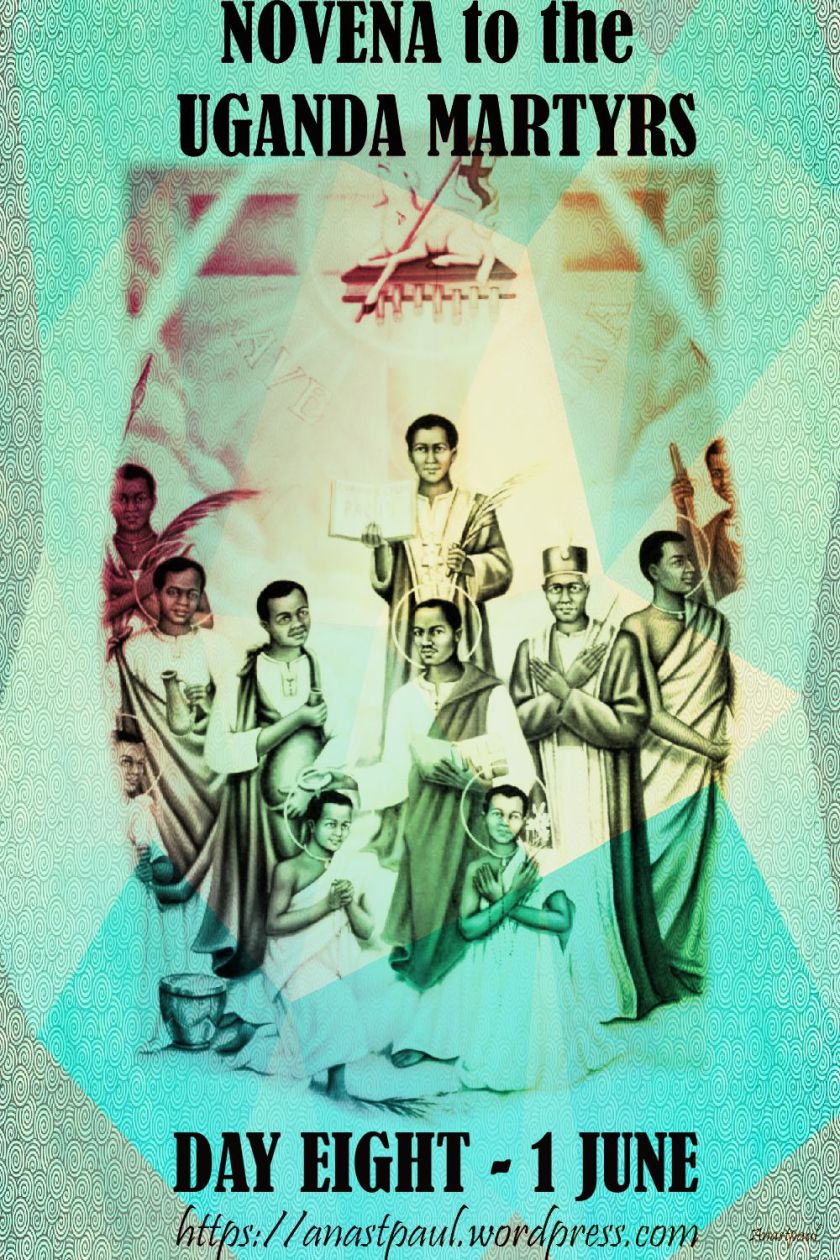
O God, who in Your love and mercy
was pleased to send missionaries to Uganda
to bring the light of Christ to all the peoples,
we thank You for the gift of the
Holy Martyrs of Uganda, our ancestors in faith,
whom You gave the strength to overcome sin and the
anguish of torture and to bear witness to the truth.
Mary, Queen of Peace!
To you we commend the men,
women and children of Uganda.
Through your prayers,
may the Spirit of God grant lasting peace
and prosperity to their nation.
May the light of Christ cast out the spiritual darkness
which breeds selfishness,
violence, hatred for others
and contempt for their rights.
May all hearts be opened to the power of God’s love.
May those divided by ethnic or political antagonisms
learn to work together
in order to build a society of justice,
peace and freedom for their children.
To the Holy Martyrs, we beg for intercession,
be pleased to hear our prayer and pray for us that this,
our special request may be granted
(make your intention)
Holy Martyrs of Uganda, we honour and praise you!
Please pray for us!
O heavenly Father, we make our prayer
through our Lord, Jesus Christ, in union with the Holy Spirit,
one God forever and ever, amen.
In about 165, Justin was arrested for being a Christian but refused to give up his faith. The judge asked him, “Do you have an idea that you will go to heaven and receive some suitable rewards?” Justin answered, “It is not an idea that I have; it is something that I know well and hold to be most certain.” The judge ordered him killed. He was beheaded along with his companions for refusing to offer sacrifice to the Roman gods. St. Justin gave his life for Christ and died for the Saviour whom he loved above all else. St Justin reminds us never to sacrifice to the false gods of our age. That includes the materialism, hedonism and nihilism that are ever present. We have received the gift of faith with little labour of our own. Let us learn how to value it from those who reached it after long search and lived in the misery of a world which did not know God, not much different to our times. Let us fear, as St. Justin did, the account we shall have to render for the gift of God. We have been chosen as St Justin was, to do the work of Christ – to make Him known regardless of the consequences! I am drawn to the thought “would I be open to changing my surname to ‘Martyr’ do I have the courage, the love for God to accept such a change?”
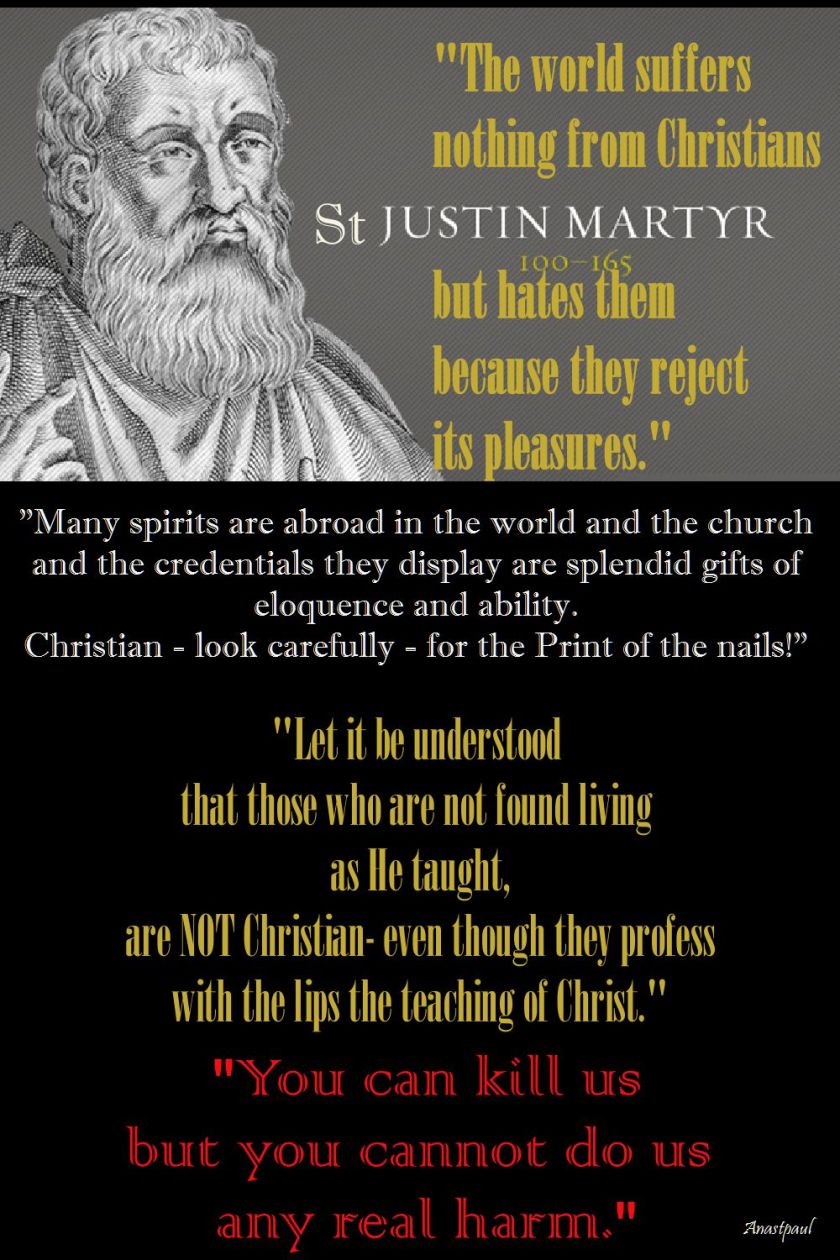
“Many spirits are abroad in the world and the church
and the credentials they display are splendid gifts of
eloquence and ability.
Christian – look carefully – for the Print of the nails!”
“We used to hate and destroy one another
and refused to associate with people
of another race or country.
Now, because of Christ, we live together
with such people and pray for our enemies ”
“Let it be understood
that those who are not found living
as He taught,
are NOT Christian- even though they profess
with the lips the teaching of Christ.”
“Not as common bread or as common drink do we receive these…..
We have been taught that the food that has been Eucharistized
by the word of prayer, that food which by assimilation nourishes
our flesh and blood, is the flesh and blood of the incarnate Jesus.”
“The world suffers nothing from Christians
but hates them because they reject its pleasures.”
“You can kill us
but you cannot do us any real harm.”
St Justin Martyr
St. Justin Martyr on the Eucharist
“No one may share the Eucharist with us unless he believes that what we teach is true, unless he is washed in the regenerating waters of baptism for the remission of his sins, and unless he lives in accordance with the principles given us by Christ.
We do not consume the eucharistic bread and wine as if it were ordinary food and drink, for we have been taught that as Jesus Christ our Saviour became a man of flesh and blood by the power of the Word of God, so also the food that our flesh and blood assimilates for its nourishment becomes the flesh and blood of the incarnate Jesus by the power of his own words contained in the prayer of thanksgiving.
The apostles, in their recollections, which are called gospels, handed down to us what Jesus commanded them to do. They tell us that he took bread, gave thanks and said: Do this in memory of me. This is my body. In the same way he took the cup, he gave thanks and said:This is my blood. The Lord gave this command to them alone. Ever since then we have constantly reminded one another of these things. The rich among us help the poor and we are always united. For all that we receive we praise the Creator of the universe through his Son Jesus Christ and through the Holy Spirit.
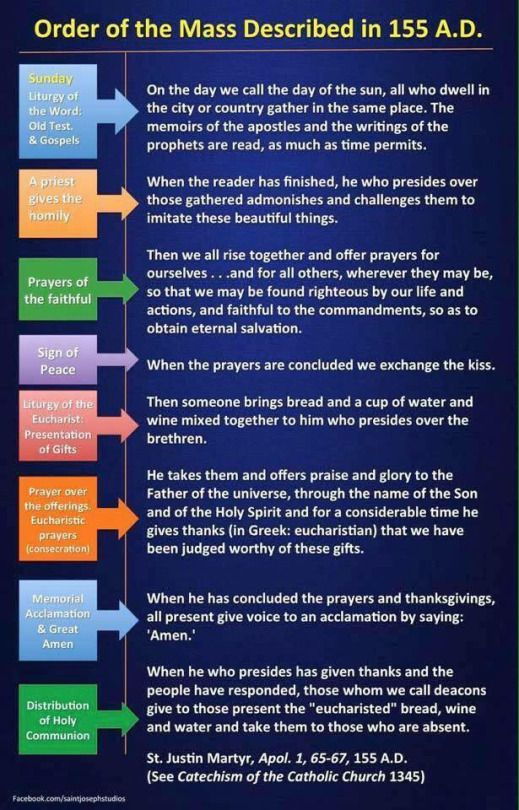
On Sunday we have a common assembly of all our members, whether they live in the city or the outlying districts. The recollections of the apostles or the writings of the prophets are read, as long as there is time. When the reader has finished, the president of the assembly speaks to us; he urges everyone to imitate the examples of virtue we have heard in the readings. Then we all stand up together and pray.
On the conclusion of our prayer, bread and wine and water are brought forward. The president offers prayers and gives thanks to the best of his ability and the people give assent by saying, “Amen”. The eucharist is distributed, everyone present communicates, and the deacons take it to those who are absent.
The wealthy, if they wish, may make a contribution and they themselves decide the amount. The collection is placed in the custody of the president, who uses it to help the orphans and widows and all who for any reason are in distress, whether because they are sick, in prison, or away from home. In a word, he takes care of all who are in need.
We hold our common assembly on Sunday because it is the first day of the week, the day on which God put darkness and chaos to flight and created the world and because on that same day our savior Jesus Christ rose from the dead. For he was crucified on Friday and on Sunday he appeared to his apostles and disciples and taught them the things that we have passed on for your consideration.” Here is a video of the Mass in 155 https://www.youtube.com/watch?v=q-FwgO_s5_A
The words I spoke to you are spirit and life………John 6:64
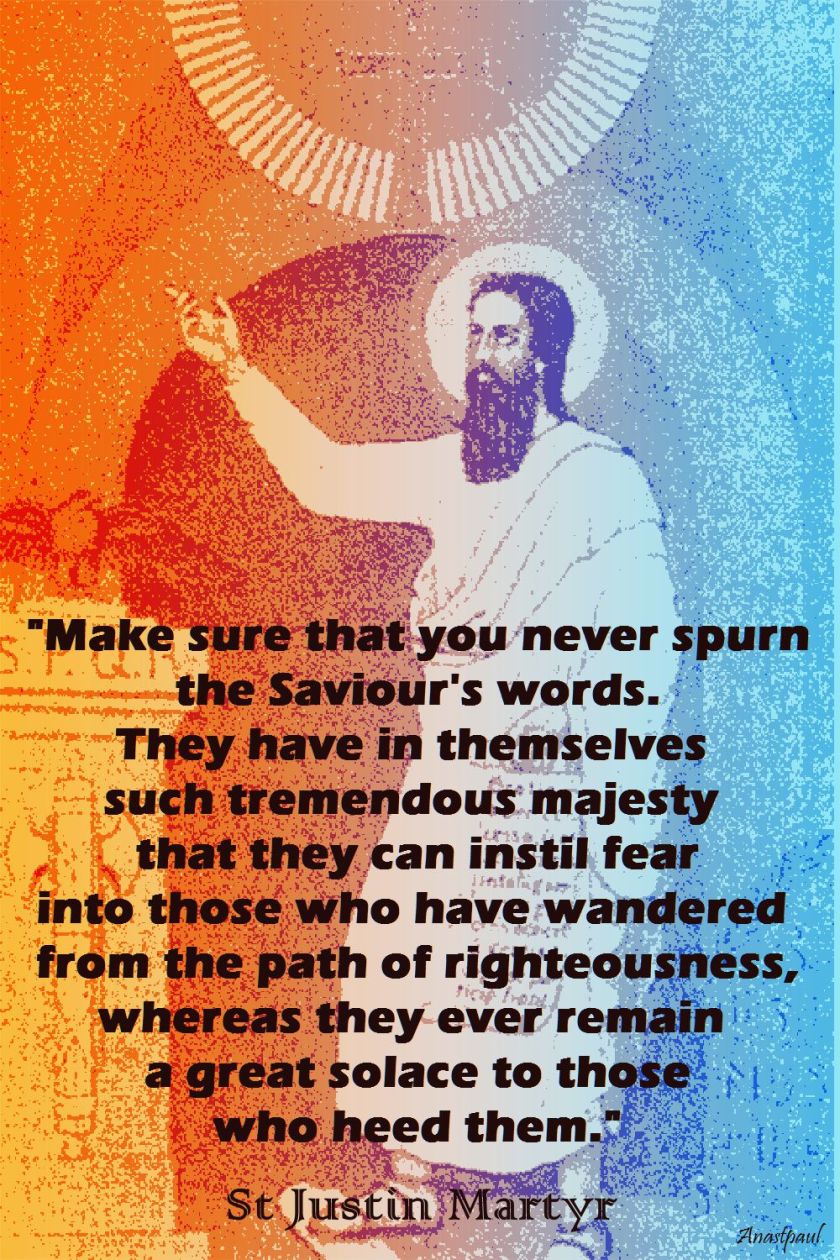
REFLECTION – “Make sure that you never spurn the Saviour’s words.
They have in themselves such tremendous majesty that they can instil fear into those who have wandered from the path of righteousness, whereas they ever remain a great solace to those who heed them.”……..St Justin
PRAYER – Lord Jesus, my Saviour, let me daily take to my heart and my soul Your words. Grant that they may lead me to penance and also provide needed consolation amid the troubles of live St Justin, when you discovered the words of the Lord Jesus Christ, your life was completely changed and given to Him so that you could heed His command to go forth and spread the good news to all. Please pray for us, that we may be inspired with your courage and zeal, amen.
ACT OF LOVE TO THE SACRED HEART By Cardinal Merry del Val
Reveal Your Sacred Heart to me, O Jesus
and show me Its attractions.
Unite me to It for ever.
Grant that all my aspirations
and all the beats of my heart,
which cease not even while I sleep,
may be a testimonial to You of my love for You
and may say to You:
“Yes, Lord, I am all Yours;
pledge of my allegiance to You rests forever in my heart
and will never cease to be there.
May You accept the slight amount of good that I do
and be graciously pleased to repair all my wrong-doing;
so that I may be able to bless You in time and in eternity.” Amen.
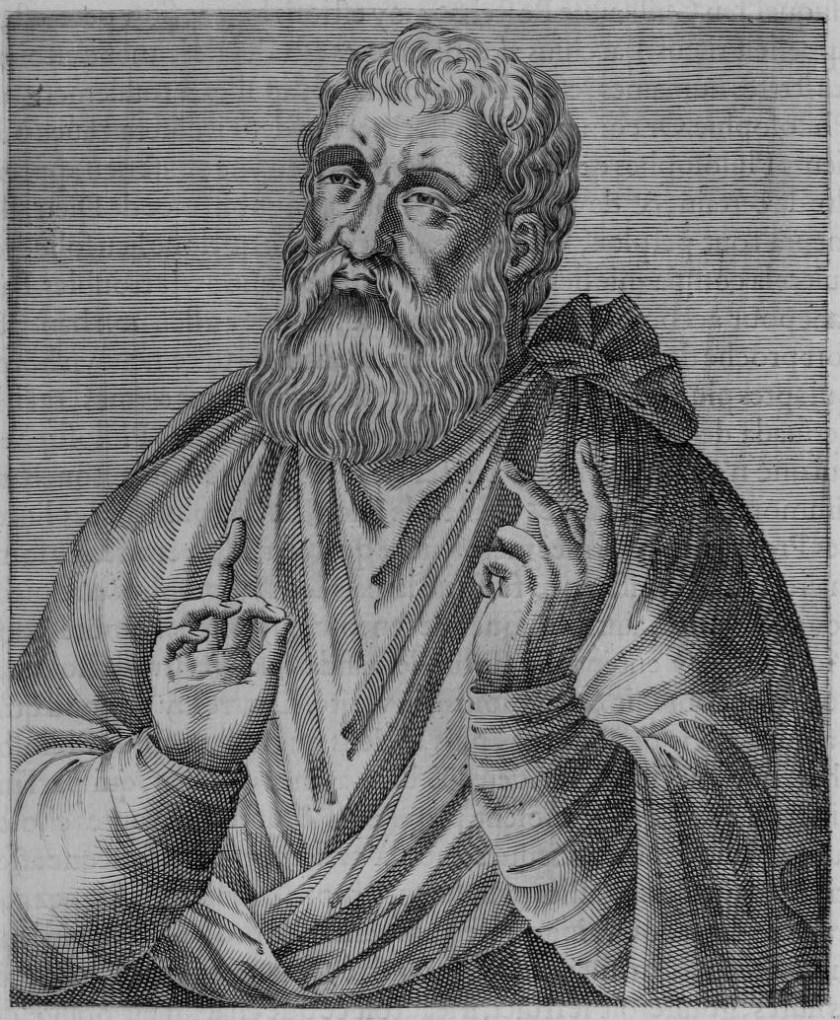
Saint of the Day – 1 June – St Justin Martyr – Martyr, first Christian Philosopher, Apologist, Orator, Teacher, Writer, Missionary (c100 – beheaded in 165 at Rome, Italy. His relics in the Capuchin Church, Romeat Nablus Palestine) – Patronages – of Apologists, Lecturers, Orators, Philosophers.
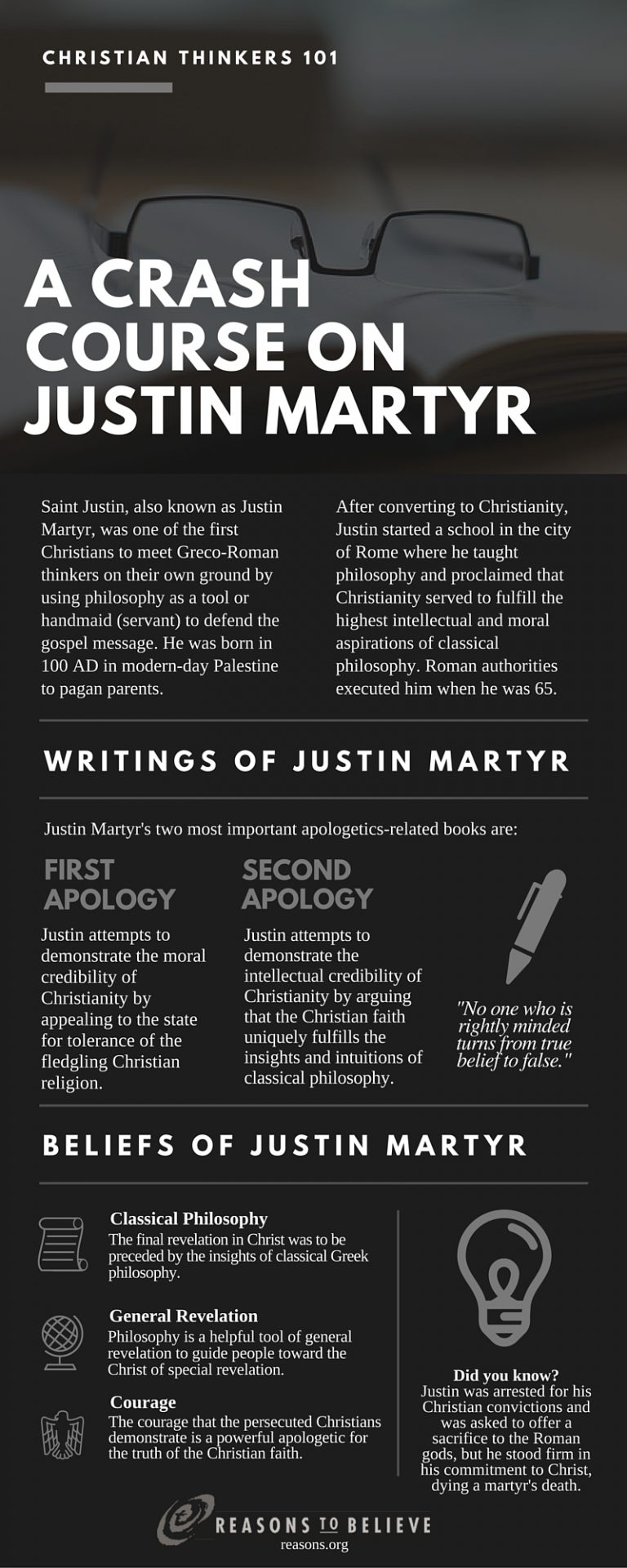
Born at the turn of the second century, Justin grew up under pagan parents and early on began to seek after knowledge. According to Justin himself, he studied under several of the most important philosophical systems of the day but found them all wanting.
Around the age of 30, however, he went out into a field near the sea to be be alone with his thoughts and had an encounter that would change his life. An older man began to follow him at a distance. Justin turned to speak to him and before he really knew what was happening, the man was presenting the gospel. Finally, Justin had found the true philosophy for which he had been searching. Of that moment, he wrote:
“A fire was suddenly kindled in my soul. I fell in love with the prophets and these men who had loved Christ; I reflected on all their words and found that this philosophy alone was true and profitable. That is how and why I became a philosopher. And I wish that everyone felt the same way that I do.”
Justin spent the rest of his life defending this true and profitable philosophy. He even went to Rome itself to found a school at which he taught Christian philosophy. He wrote several defenses of the Christian faith, even writing apologetic works directed to the Roman emperor and the Roman senate. His books give us insight into the early Church. In one of them he described the ceremony of Baptism around the year 160. It was similar to the ceremony today. In another place, he wrote that the Sunday meetings of the Christian community included readings from Scripture, a homily, offering of bread and wine and giving Holy Communion. Two of his so-called apologies have come down to us; they are addressed to the Roman emperor and to the Senate.
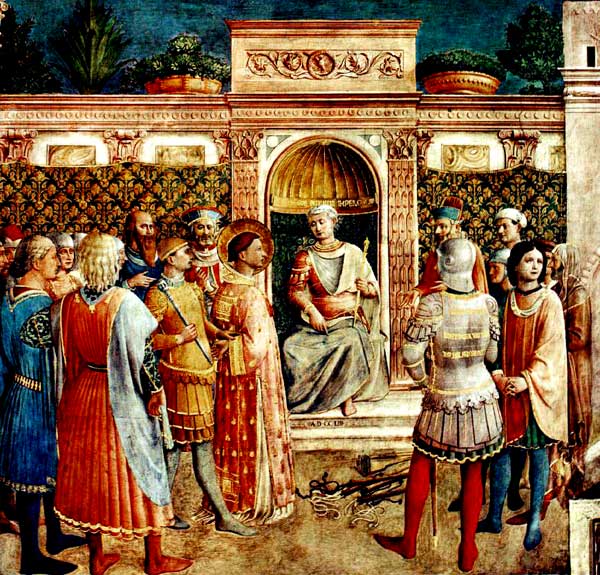
After contending for Christianity with a cynic philosopher, he was turned in to the government as a heretic and false teacher. They arrested him and six of his disciples. When asked to reject Christ and make a sacrifice to the Roman gods, Justin boldly replied:
“No one who is rightly minded turns from true belief to false.”
The Trial of St Justin
In his new found faith, not only did he find truth but Justin found a truth worth living and dying for –– as he was beheaded for his refusal to denounce Jesus. In his life, Justin sought to demonstrate how the Christian faith was consistent with reason and logic. In his death, he earned the surname Martyr.
St Justin Martyr (Memorial)
Comforter of the Afflicted
Notre-Dame du Laus
Our Lady of Grace
—
St Agapetus of Ruthenia
Bl Alfonso Navarrete Benito
Bl Arnald Arench
Bl Arnold of Geertruidenberg
St Atto of Oca
St Candida of Whitchurch
St Caprasius of Lérins
St Clarus of Aquitaine
St Claudius of Vienne
Bl Conrad of Hesse
St Conrad of Trier
St Crescentinus
St Cronan of Lismore
St Damian of Scotland
St Dionysius of Ruthenia
St Donatus of Lucania
St Felinus of Perugia
Bl Ferdinand Ayala
St Firmus
St Fortunatus of Spoleto
Bl Gaius Xeymon
St Gaudentius of Ossero
St Giuse Túc
St Gratian of Perugia
St Hannibal Mary di Francia
Bl Herculanus of Piegare
St Iñigo of Oña
St Ischryrion and Companions
Bl James of Strepar
St Jean-Baptiste-Ignace-Pierre Vernoy de Montjournal
Bl John Baptist Scalabrini
Bl John Pelingotto
Bl John Storey
St Juventius
Bl Leo Tanaka
St Melosa
St Pamphilus of Alexandria
St Peter of Pisa
St Porphyrius of Alexandria
St Proculus of Bologna
St Proculus the Soldier
St Ronan
St Secundus of Amelia
St Seleucus of Alexandria
St Simeon of Syracuse
St Telga of Denbighshire
St Thecla of Antioch
Bl Theobald Roggeri
St Thespesius of Cappadocia
St Wistan of Evesham
St Zosimus of Antioch
—
Martyrs of Alexandria – 5 saints: A group five of imperial Roman soldiers assigned to guard a group of Egyptian Christians who were imprisoned for their faith in the persecutions of Decius. During their trial, they encouraged the prisoners not to apostatize. This exposed them as Christians, were promptly arrested and executed. Martyrs. Their names are – Ammon, Ingen, Ptolomy, Theophilis and Zeno. They were beheaded in 249 at Alexandria, Egypt.
Martyrs of Caesarea – 3 saints: Three Christians martyred together in the persecutions of Galerius. We know little more about them than the name – Paul, Valens and Valerius. They diedf in 309 at Caesarea, Palestine.
Martyrs of Lycopolis – 6 saints: Five foot soldiers and their commander who were martyred for their faith by order of the imperial Roman prefect Arriano during the persecutions of Decius. In Lycopolis, Egypt.
Martyrs of Rome – 6 saints: A group of spiritual students of Saint Justin Martyr who died with him and about whom we know nothing else but their names – Carito, Caritone, Evelpisto, Ierace, Liberiano and Peone. In Rome, Italy.



















 AnaStpaul
You must be logged in to post a comment.