Posted in FATHERS of the Church, SAINT of the DAY

Saint of the Day – 23 February – St Polycarp of Smyrna

Saint of the Day – 23 February – St Polycarp of Smyrna – (69-156) – Martyr, Apostolic Church Father and Bishop of Smyrna, Writer, Preacher, Theologian – Patron against dysentery and earache.

Polycarp is regarded as a saint and Church Father in the Eastern Orthodox, Oriental Orthodox, Catholic, Anglican, and Lutheran churches. His name ‘Polycarp’ means ‘much fruit’ in Greek.

It is recorded by Irenaeus, who heard him speak in his youth, and by Tertullian, that he had been a disciple of John the Apostle.    Saint Jerome wrote that Polycarp was a disciple of John and that John had ordained him bishop of Smyrna.

With Clement of Rome and Ignatius of Antioch, Polycarp is regarded as one of three chief Apostolic Fathers.   The sole surviving work attributed to his authorship is his Letter to the Philippians; it is first recorded by Irenaeus of Lyons.

According to St Irenaeus, Polycarp was a companion of Papias, another “hearer of John” as Irenaeus interprets Papias’ testimony and a correspondent of Ignatius of Antioch.   Ignatius addressed a letter to him, and mentions him in his letters to the Ephesians and to the Magnesians.

Irenaeus regarded the memory of Polycarp as a link to the apostolic past. He relates how and when he became a Christian, and in his letter to Florinus stated that he saw and heard Polycarp personally in lower Asia. Irenaeus wrote to Florinus:

“I could tell you the place where the blessed Polycarp sat to preach the Word of God.   It is yet present to my mind with what gravity he everywhere came in and went out;  what was the sanctity of his deportment, the majesty of his countenance;  and what were his holy exhortations to the people.   I seem to hear him now relate how he conversed with John and many others who had seen Jesus Christ, the words he had heard from their mouths.”

In particular, he heard the account of Polycarp’s discussion with John and with others who had seen Jesus.   Irenaeus also reports that Polycarp was converted to Christianity by apostles, was consecrated a bishop and communicated with many who had seen Jesus.   He repeatedly emphasizes the very great age of Polycarp.   Polycarp kissed the chains of Ignatius when he passed by Smyrna on the road to Rome for his martyrdom.

Polycarp occupies an important place in the history of the early Christian Church.   He is among the earliest Christians whose writings survived.   Saint Jerome wrote that Polycarp was a “disciple of the apostle John and by him ordained bishop of Smyrna”.   He was an elder of an important congregation which was a large contributor to the founding of the Christian Church.
Irenaeus, who had heard him preach in his youth, said of him: “a man who was of much greater weight and a more steadfast witness of truth, than Valentinus and Marcion, and the rest of the heretics”. Polycarp had learned from apostle John to flee from those who change the divine truth. One day he met in the streets of Rome the heretic Marcion who, resenting that Polycarp did not greet him, said: “Do you know me?” The saint replied: “Yes, I know you, the first-born of Satan.”    Polycarp lived in an age after the deaths of the apostles, when a variety of interpretations of the sayings of Jesus were being preached.   His role was to authenticate orthodox teachings through his reputed connection with the apostle John: “a high value was attached to the witness Polycarp could give as to the genuine tradition of old apostolic doctrine”, Wace commented, “his testimony condemning as offensive novelties the figments of the heretical teachers”.   Irenaeus states (iii. 3) that on Polycarp’s visit to Rome, his testimony converted many disciples of Marcion and Valentinus.

The story of Polycarp’s martyrdom is the earliest recorded account of a Christian martyr. Polycarp was seized for being a Christian.   Persecution and death would not tear him away from Jesus now.   Polycarp was led into the stadium of Smyrna.   The crowd demanded that he be left to the lions, but instead he was sentenced to death by fire.   An eyewitness account claims that the flames didn’t harm him.   He was finally killed by the sword, and his body was burned.

The community of believers celebrated the anniversary of Polycarp’s death with great joy, for in him they had seen an outstanding example of love and patience.   He had held strong and had won the treasure of eternal life.   Polycarp is remembered as an Apostolic Father, one who was a disciple of the apostles.


Posted in SAINT of the DAY

Saints – 23 February

St Polycarp of Smyrna (Memorial)

St Alexander Akimetes
St Boswell
St Dositheus of Egypt
St Felix of Brescia
St Florentius of Seville
St Giovanni Theristi
Bl Giovannina Franchi
Bl John of Hungary
Bl Josephine Vannini
Bl Juan Lucas Manzanares
Bl Ludwik Mzyk
St Martha of Astorga
St Medrald
St Milburga
Bl Nicolas Tabouillot
St Ordonius
St Polycarp of Rome
Bl Rafaela Ybarra de Villalongo
St Romana
St Serenus the Gardener
Bl Stefan Wincenty Frelichowski
St Willigis of Mainz
St Zebinus of Syria

Martyrs of Syrmium – 73 Christians who were martyred together in the persecutions of Diocletian. We know no details about them, and only six of their names – Antigonus, Libius, Rogatianus, Rutilus, Senerotas and Syncrotas.

Posted in LENT, MORNING Prayers, NOVENAS, QUOTES of the SAINTS, QUOTES on CONVERSION, QUOTES on REPENTANCE

Lenten Preparation Novena

Reflection – “He thought he was as sure of the blessing as if he had not sold the birthright.”

And then, when all is done and over and their souls sold to Satan, they never seem to understand that they have parted with their birthright.   They think that they stand just where they did, before they followed the world, the flesh, and the devil; they take for granted that when they choose to become more decent, or more religious, they have all their privileges just as before.   Like Samson, they propose to go out as at other times before, and shake themselves.   And like Esau, instead of repenting for the loss of the birthright, they come, as a matter of course, for the blessing.    Esau went out to hunt for venison gaily and promptly brought it to his father.   His spirits were high, his voice was cheerful.   It did not strike him that God was angry with him for what had past years ago. He thought he was as sure of the blessing as if he had not sold the birthright.     (Blessed Cardinal John Henry Newman)

and-then-when-all-is-done-and-over-j-h-newman

Lenten Preparation Novena

DAY THREE

Today Lord I choose life,
I choose Your love and the challenge to live it and share it,
I choose hope, even in moments of darkness,
I choose faith, accepting You as Lord and God,
I choose to let go of some part of my burdens, day by day handing them over to You,
I choose to take hold of Your strength and power ever more deeply in my life.
I choose repentance and reparation and suffering, for all my sins
and those of all the world.
Forgive me my Lord!
May this truly be for me a time of new life, of change, challenge and growth.
May I come to Easter with a heart open to dying with You
and rising to Your new life, day by day.   Help me to repent of my sins now and make reparation throughout
this Lenten season and each day thereafter.
United with your Son,
who makes His way to Calvary,
I offer You my intentions
(Mention your special intention)
Amen.

day-three-novena-prep-lent

Posted in PURGATORY

HOW TO AVOID PURGATORY By Fr. Paul O’Sullivan O.P.

HOW TO AVOID PURGATORY By Fr. Paul O’Sullivan O.P.

For those who have not read this little book and to refresh myself, I will be posting the entire book in daily doses.  (To read later find in the Purgatory Category).

Chapter 5

THE THIRD MEANS: SUFFERING

The Third Means of avoiding Purgatory is very easy.   It consists in making a
virtue of necessity, by bearing patiently what we cannot avoid and all the
more since suffering, borne patiently, becomes easy and light.    Suffering,
if accepted with calmness and for God’s sake, loses all its sting.    If
received badly, in the spirit of revolt and with repugnance, it is
intensified a hundredfold and becomes almost intolerable.

Everyone in this vale of tears has to face sorrows innumerable and infinite
in variety.    Crosses light and crosses heavy are the lot of us all.    Strange
as it may seem, these sorrows, which most of us would gladly dispense with,
are in truth God’s greatest graces.   They are the little share He offers us
of His Passion and which He asks us to bear for love of Him and as penance
for our sins.

Borne in this spirit they will lessen considerably our time in Purgatory
and very possibly completely remove it–with this difference, that
Purgatory, even a Purgatory of 50 or 100 years, will in no wise increase
our merits in Heaven; whereas, every pain and sorrow and disappointment in
this life will lessen our suffering in Purgatory and also bring us more
happiness and glory in Heaven.

How sad it is that so many Christians, for want of thought, make their
sufferings a thousand times worse than they are and lose all the immense
merits that they could so easily gain.

RESOLUTION

Let us suffer with calmness and serenity for the love of God. We shall thus
save ourselves from Purgatory.

chapter-five

Posted in FEASTS and SOLEMNITIES, MORNING Prayers, SAINT of the DAY

Thought for the Day – 22 February

Thought for the Day – 22 February

From the beginning, the specialness, or primacy, of Peter has been recognized.   On the feast of the Chair of Peter, we celebrate our unity as a Church.   We celebrate the love, presence and protection of Christ for us, the Church.    The title Chair of Peter refers to the chair from which a bishop presided, a symbol of his authority.   When the title refers to Saint Peter, it recalls the supreme teaching power of Peter and his successors.  Its first occupant stumbled a bit some of its later occupants have also stumbled a bit, sometimes even failed scandalously.   As individuals, we may sometimes think a particular pope has let us down.    Still, the office endures as a sign of the long tradition we cherish and as a focus for the universal Church.   It is from the chair, from the pastoral power given him, that the pope shepherds Christ’s flock.   When the pope cautions world leaders, pleads for peace, or condemns social injustice, people listen and respond.   What makes the world listen to this man?  The answer lies in Scripture and in Tradition.  Peter is named first among the apostles of Jesus; he was often their spokesman and leader; he was the first to preach after Pentecost and he was the leader in defending Christ and his message AND THE OCCUPANT OF THE CHAIR STILL IS!

Holy Father St Peter and all the Saints and Popes in Heaven, Pray for us!

st-peter-saints-and-popes


Posted in FEASTS and SOLEMNITIES, MORNING Prayers, QUOTES of the SAINTS, SAINT of the DAY

Quote of the Day – 22 February

Quote of the Day – 22 February

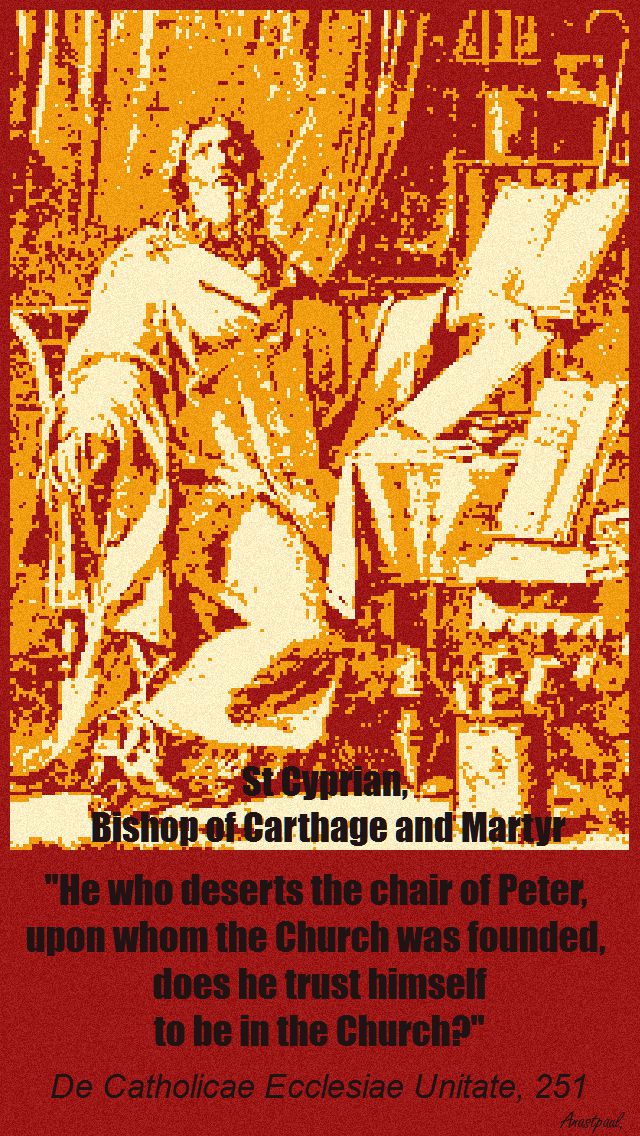
“He who deserts the chair of Peter,
upon whom the Church was founded,
does he trust himself to be in the Church?”

~~~~~ Saint Cyprian, Bishop of Carthage and Martyr

De Catholicae Ecclesiae Unitate, 251

he-who-deserts-sty-cyprian

Posted in DOCTORS of the Church, MORNING Prayers, QUOTES of the SAINTS, The WORD

One Minute Reflection – 22 February

One Minute Reflection – 22 February

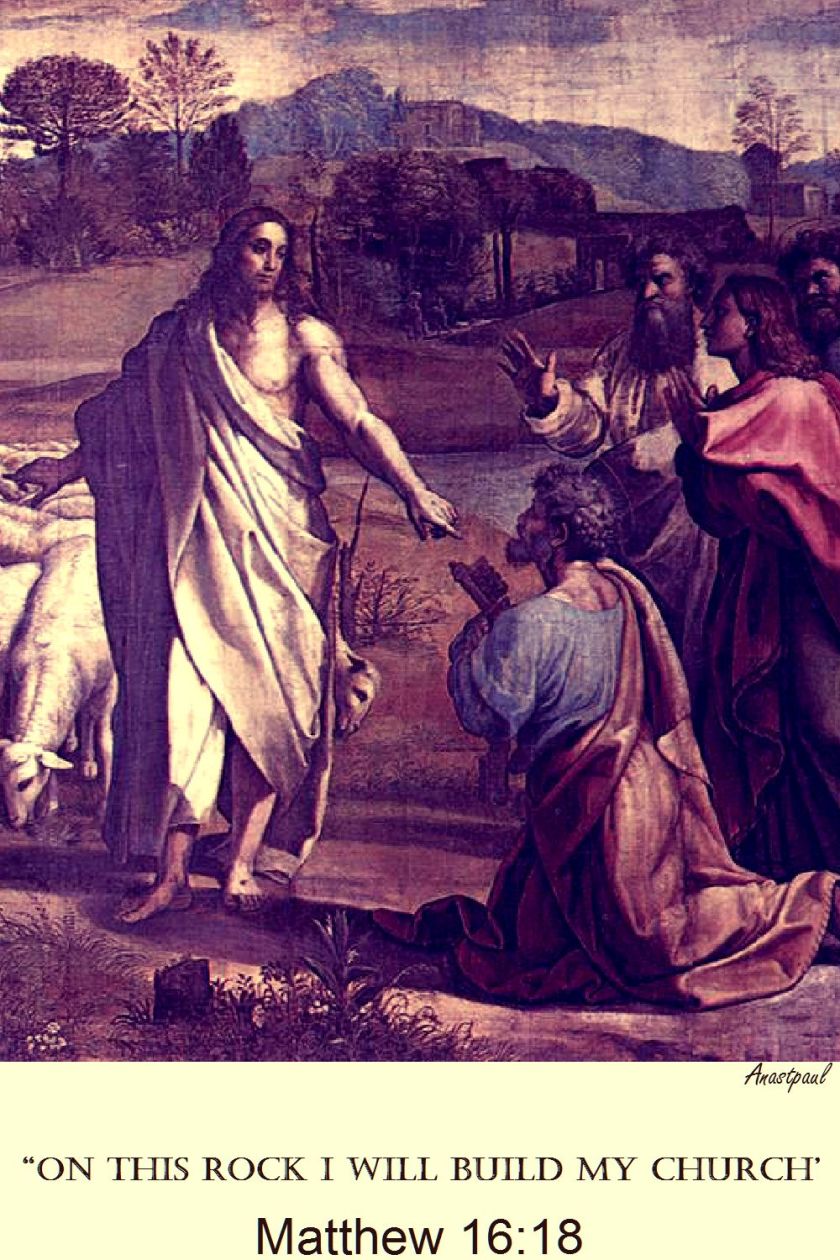
“On this rock I will build my Church’,,,,,,,,,,Matthew 16:18

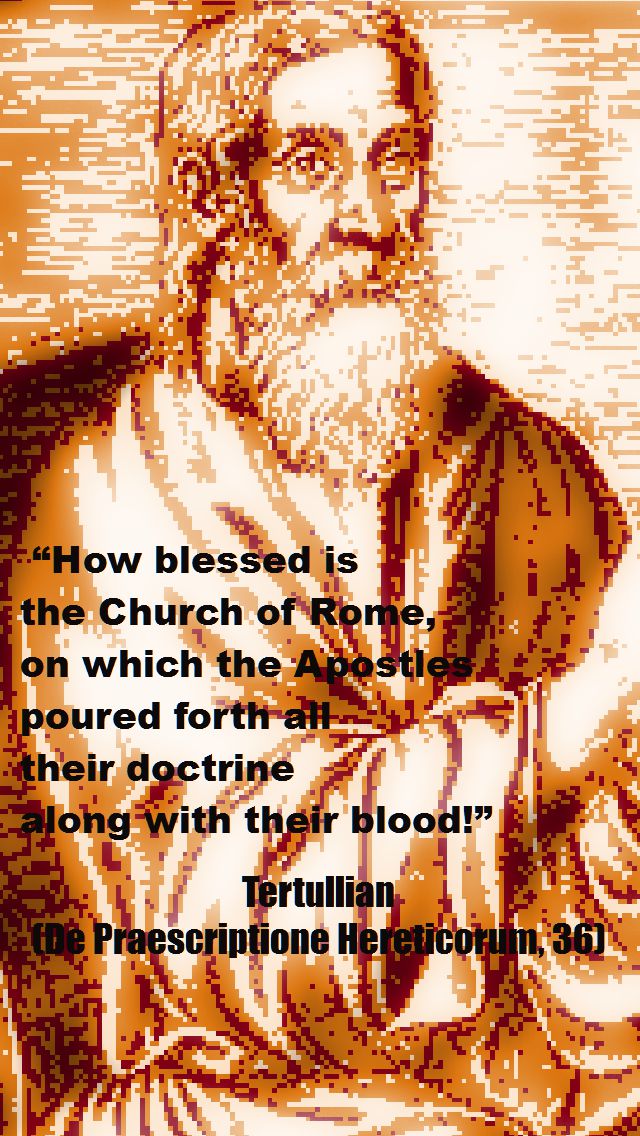
REFLECTION – “How blessed is the Church of Rome, on which the Apostles poured forth all their doctrine along with their blood!” (De Praescriptione Hereticorum, 36)…….Tertullian
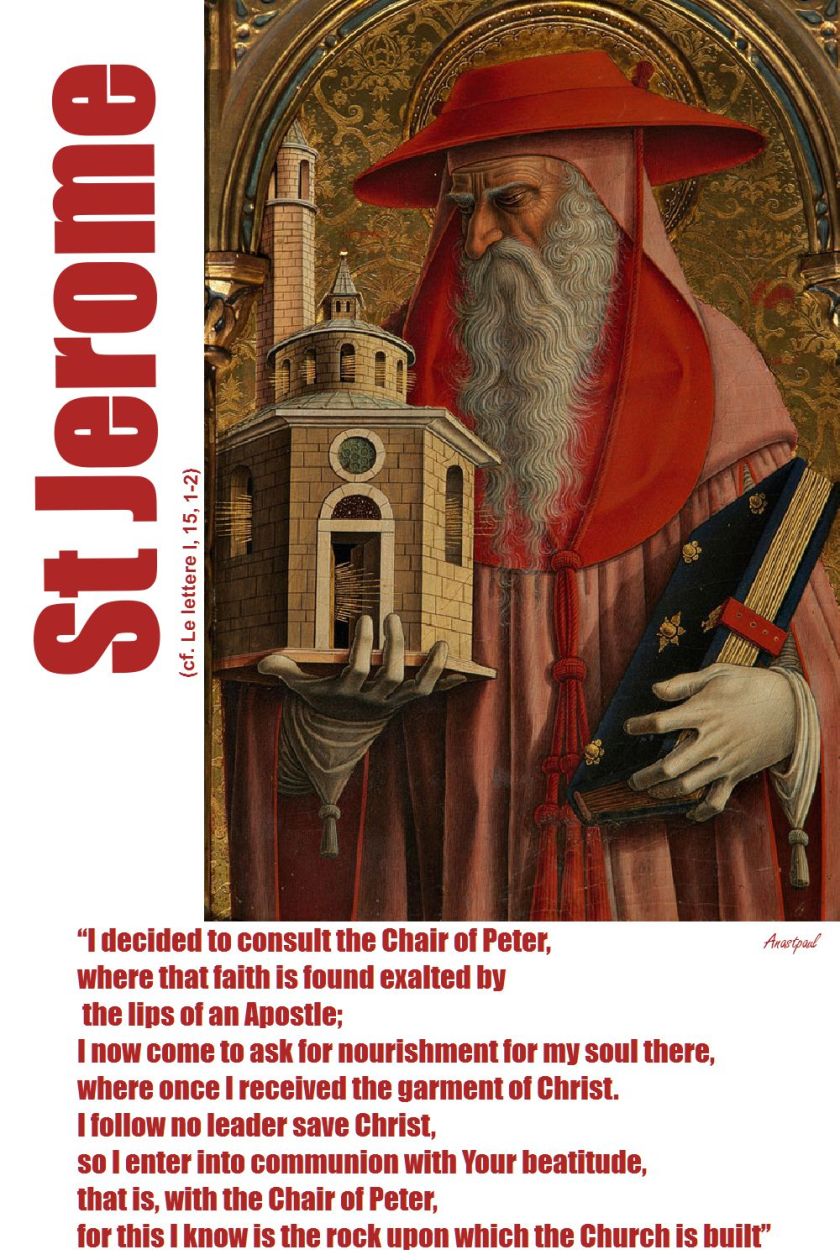
“I decided to consult the Chair of Peter,
where that faith is found exalted by
the lips of an Apostle;
I now come to ask for nourishment for my soul there,
where once I received the garment of Christ.
I follow no leader save Christ,
so I enter into communion with Your beatitude,
that is, with the Chair of Peter,
for this I know is the rock upon which the Church is built”
(cf. Le lettere I, 15, 1-2)…………..St Jerome

PRAYER – Holy Father, send Your Divine Enlightener into the hearts of all Your faithful, filling us with the strength to fulfil our mission as the followers of the Chair of St Peter. And most of all, we pray Lord Holy God to inspire and light the way of our Holy Father, Francis. Sustain and guide him, keep him in health and strength, to lead Your people by the Light of the Way and the Truth. Holy Father, have mercy on us, Holy Spirit guide and lead us, Lord Jesus Christ be our intercessor and teacher, amen.

on-this-rock-matthew-16-18on-this-rock-i-willbuild-my-church-matthew-16-18how-blessed-is-the-church-of-rome-tertulliani-decided-to-consult-the-chair-of-peter-st-jerome


Posted in MORNING Prayers, PRAYERS of the SAINTS

Our Morning Offering – 22 February

Our Morning Offering – 22 February

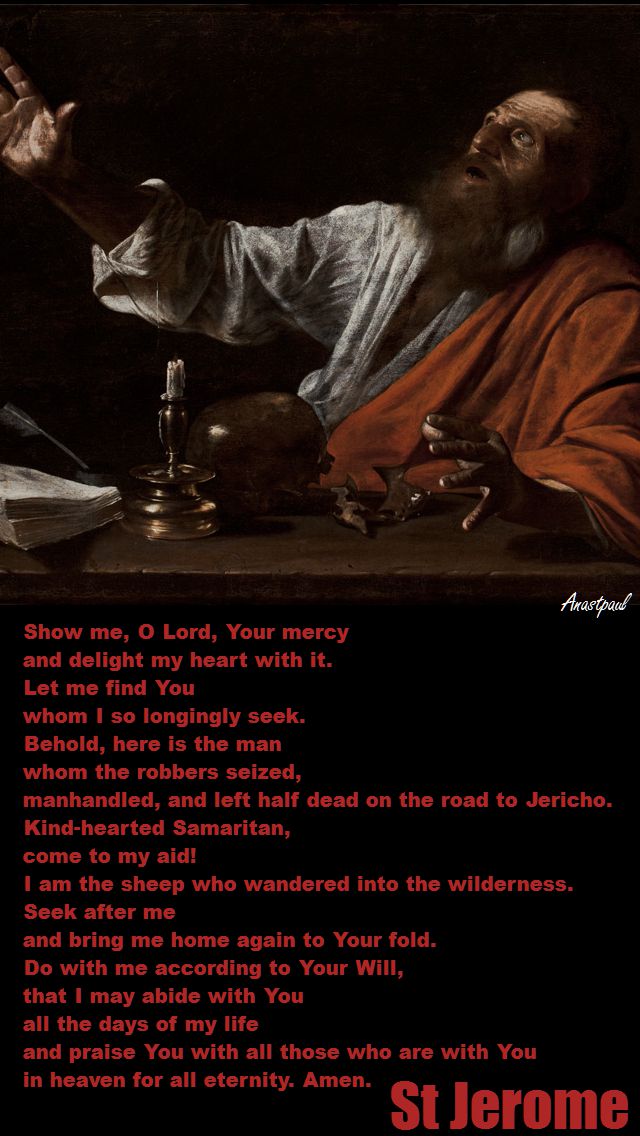
Show me, O Lord, Your mercy
and delight my heart with it.
Let me find You whom I so longingly seek.
Behold, here is the man whom the robbers seized,
manhandled, and left half dead on the road to Jericho.
Kind-hearted Samaritan, come to my aid!
I am the sheep who wandered into the wilderness.
Seek after me and bring me home again to Your fold.
Do with me according to Your Will,
that I may abide with You all the days of my life
and praise You with all those who are with You
in heaven for all eternity. Amen
By St Jerome

show-me-o-lord-your-mercy-st-jerome

Posted in CATHOLIC Quotes, FEASTS and SOLEMNITIES, SAINT of the DAY

Feast of the Chair of St Peter – 22 February

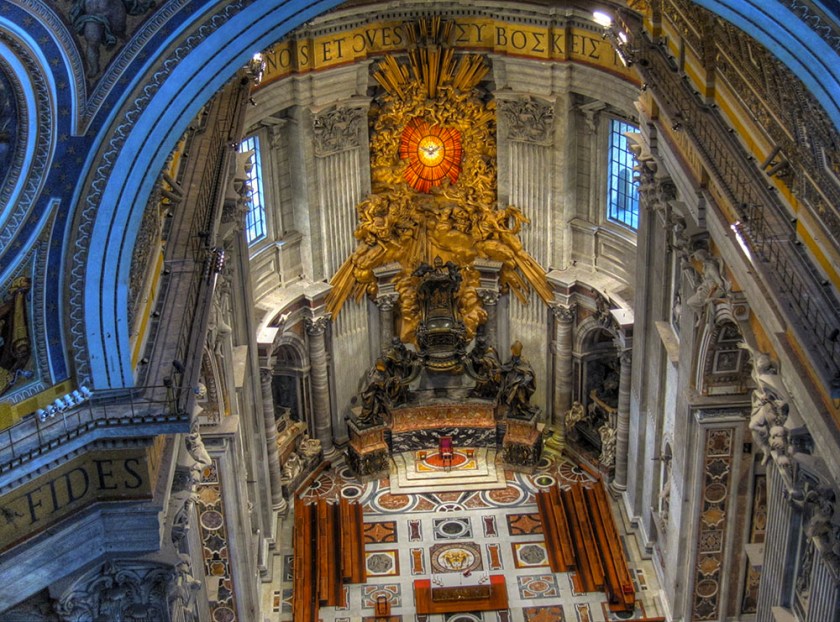
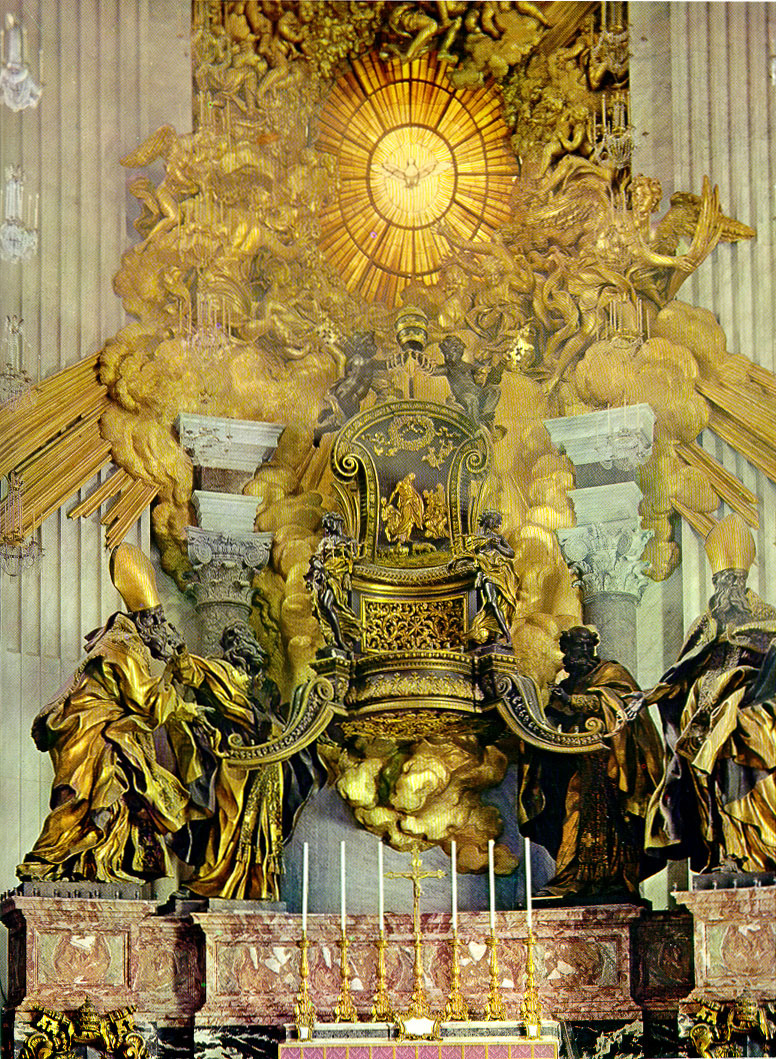
Feast of the Chair of St Peter – 22 February – Cathedra Petri), also known as the Throne of Saint Peter, is a relic conserved in St. Peter’s Basilica in Vatican City.    The relic is a wooden throne that tradition claims the Apostle Saint Peter, the leader of the Early Christians in Rome and first Pope, used as Bishop of Rome.    The relic is enclosed in a sculpted gilt bronze casing designed by Gian Lorenzo Bernini and executed between 1647 and 1653.    In 2012, Pope Benedict XVI described the chair as “a symbol of the special mission of Peter and his Successors to tend Christ’s flock, keeping it united in faith and in charity.”

The wooden throne was a gift from Holy Roman Emperor Charles the Bald to Pope John VIII in 875.    It has been studied many times over the years, the last being from 1968 to 1974, when it was last removed from the Bernini altar.    That study concluded that it was not a double, but rather a single, chair with a covering and that no part of the chair dated earlier than the sixth century.   Below – The Pope’s throne in St. Peter’s Basilica, Vatican City, last publicly exposed in 1867.

The Chair is the cathedra of St. Peter’s Basilica. Cathedra is Latin for “chair” or “throne”, and denominates the chair or seat of a bishop, hence “cathedral” denominates the Bishop’s church in an episcopal see.    The Popes formerly used the Chair.    It is distinct from the Papal Cathedra in St. John Lateran Archbasilica, also in Rome, which is the actual cathedral church of the Pope, because the Cathedra he currently and officially sits upon is in its apse.

“Dear Brothers and Sisters,

Today, the Latin-rite liturgy celebrates the Feast of the Chair of St Peter.   This is a very ancient tradition, proven to have existed in Rome since the fourth century. On it we give thanks to God for the mission he entrusted to the Apostle Peter and his Successors.

“Cathedra” literally means the established seat of the Bishop, placed in the mother church of a diocese which for this reason is known as a “cathedral”; it is the symbol of the Bishop’s authority and in particular, of his “magisterium”, that is, the evangelical teaching which, as a successor of the Apostles, he is called to safeguard and to transmit to the Christian Community.

When a Bishop takes possession of the particular Church that has been entrusted to him, wearing his mitre and holding the pastoral staff, he sits on the cathedra. From this seat, as teacher and pastor, he will guide the journey of the faithful in faith, hope and charity.

So what was the “Chair” of St Peter? Chosen by Christ as the “rock” on which to build the Church (cf. Mt 16: 18), he began his ministry in Jerusalem, after the Ascension of the Lord and Pentecost.   The Church’s first “seat” was the Upper Room, and it is likely that a special place was reserved for Simon Peter in that room where Mary, Mother of Jesus, also prayed with the disciples.   Therefore, we have the journey from Jerusalem, the newly born Church, to Antioch, the first centre of the Church formed from pagans and also still united with the Church that came from the Jews.   Then Peter went to Rome, the centre of the Empire, the symbol of the “Orbis” – the “Urbs”, which expresses “Orbis”, the earth, where he ended his race at the service of the Gospel with martyrdom.

…This is testified by the most ancient Fathers of the Church, such as, for example, St Irenaeus, Bishop of Lyons, but who came from Asia Minor, who in his treatise Adversus Haereses, describes the Church of Rome as the “greatest and most ancient, known by all… founded and established in Rome by the two most glorious Apostles, Peter and Paul”; and he added: “The universal Church, that is, the faithful everywhere, must be in agreement with this Church because of her outstanding superiority” (III, 3, 2-3)….

Tertullian, a little later, said for his part: “How blessed is the Church of Rome, on which the Apostles poured forth all their doctrine along with their blood!” (De Praescriptione Hereticorum, 36).
Consequently, the Chair of the Bishop of Rome represents not only his service to the Roman community but also his mission as guide of the entire People of God.

Celebrating the “Chair” of Peter, therefore, as we are doing today, means attributing a strong spiritual significance to it and recognizing it as a privileged sign of the love of God, the eternal Good Shepherd, who wanted to gather his whole Church and lead her on the path of salvation.

Among the numerous testimonies of the Fathers, I would like to quote St Jerome’s. It is an extract from one of his letters, addressed to the Bishop of Rome. It is especially interesting precisely because it makes an explicit reference to the “Chair” of Peter, presenting it as a safe harbour of truth and peace.

This is what Jerome wrote:   “I decided to consult the Chair of Peter, where that faith is found exalted by the lips of an Apostle; I now come to ask for nourishment for my soul there, where once I received the garment of Christ. I follow no leader save Christ, so I enter into communion with your beatitude, that is, with the Chair of Peter, for this I know is the rock upon which the Church is built” (cf. Le lettere I, 15, 1-2).

Dear brothers and sisters, in the apse of St Peter’s Basilica, as you know, is the monument to the Chair of the Apostle, a mature work of Bernini.    It is in the form of a great bronze throne supported by the statues of four Doctors of the Church: two from the West, St Augustine and St Ambrose and two from the East: St John Chrysostom and St Athanasius.

I invite you to pause before this evocative work which today can be admired, decorated with myriads of candles and to say a special prayer for the ministry that God has entrusted to me.    Raise your eyes to the alabaster glass window located directly above the Chair and call upon the Holy Spirit, so that with his enlightenment and power, He will always sustain my daily service to the entire Church.   For this, as for your devoted attention, I thank you from my heart.”…………….. Pope Benedict XVI Wednesday, 22 February 2006

43abb21fa88456beb01516a6554a2156cathedra-altar

arnolfo_di_cambio_the_statue_of_saint_peter


Posted in FEASTS and SOLEMNITIES, SAINT of the DAY

Saints and Feasts 22 February

Chair of Saint Peter (Feast)

St Ailius of Alexandria
St Angelus Portasole
St Aristion of Salamis
St Athanasius of Nicomedia
St Baradates of Cyrrhus
Bl Diego Carvalho
St Elwin
Bl Émilie d’Oultremont d’Hoogvorst
Bl Isabella of France
St John the Saxon
St Limnaeus
St Margaret of Cortona
St Maximian of Ravenna
St Miguel Facerías Garcés
St Mohammed Abdalla
St Papias of Heirapolis
St Paschasius of Vienne
St Raynerius of Beaulieu
St Thalassius

Martyrs of Arabia – A memorial for all the unnamed Christians martyred in the desert and mountainous areas south of the Dead Sea during the persecutions of Emperor Valerius Maximianus Galerius.

Posted in PURGATORY

HOW TO AVOID PURGATORY By Fr Paul O’Sullivan O.P.

HOW TO AVOID PURGATORY By Fr. Paul O’Sullivan O.P.

For those who have not read this little book and to refresh myself, I will be posting the entire book in daily doses.  (To read later find in the Purgatory Category).
Chapter 4

THE SECOND MEANS: PENANCE

The Second Means of avoiding Purgatory is to satisfy for our sins in this
life by doing penance. “Do penance or you shall all likewise perish”.   Do
penance, or you will burn long years in Purgatory, is a fact that there is
no getting away from.

This is a terrifying thought and one that makes the bravest man shudder.
Which of us does not tremble when he thinks of those who have been burnt to
death in a slow fire?    What fear would not be ours if we had to face a
similar death?    Yet their suffering was of relatively short duration.   The
incomparably fiercer fire of Purgatory, which we may have to face, may last
20, or 50 or 100 years!

Many people have such a horror of penance that they never even dream of
practicing it.    It is like the fear that children have of ghosts, a very
great but a very unfounded fear.    Their idea is that penance is something
awful.    They think perhaps of the severe penances of the great Saints and of
course are afraid to attempt anything of a like kind.

The Second Means: Penance

God does not ask us, as a rule, to do what is heroic.    When He does, He
gives us all the strength necessary, as in the case of the Saints.    He asks
each one to do a little.    If we are afraid of doing much and it is only
natural that some should be, let us do at least a little.    No one but a
coward is afraid to do a little, especially if he gets much in exchange.

The easy road to Heaven of Saint Therese, the Little Flower, is to do many
little things.    God was infinitely pleased with the widow’s mite; He will be
equally pleased with our little penances.

As a result of little mortifications, we can deliver ourselves from the
awful fires of Purgatory and amass rich merits for Heaven.    To go into the
matter further, there is not much difficulty about mortification or
penance, notwithstanding the absurd fear that people have of it.

Penance is not only easy, it is useful and necessary and it will bring us
very great happiness.   Not to do penance is the greatest penance of all.    As
a matter of fact, every man of the world naturally, spontaneously mortifies
himself. The first principle, for instance, of politeness and good breeding
is to sacrifice our whims and tastes for the sake of others.    The selfish
man is a boor; the generous man is the idol of all.

Again, the only way of securing good health is to eschew the most
appetising viands when they do us harm and to make use of plain foods when
they do us good.    Overeating is the cause of the vast majority of sickness
and premature deaths.

To take another example. The secret of success is strenuous, methodical,
regular work.   Now generosity, self-denial, method, regularity are other
forms of very genuine but practical mortification.   Yet no man can get on
without them.   To insist on our own likes and dislikes, to do only as we
please, is to lead a life bristling with difficulties, in which every duty
is a burden, every good act an effort and a labor

Boy scouts and girl scouts are bound to do a kind act every day, even
though it costs them a big effort.   Christians should surely do more.   Daily
acts of self-restraint, of patience with others, of kindness to others, the
exact fulfilment of duty are splendid penances and a great aid to
happiness.

RESOLUTION

If we are afraid to do much, let us do many little things.

chapter-four-howtoavoid-purgatory

Posted in LENT, MORNING Prayers, NOVENAS, QUOTES of the SAINTS, QUOTES on CONVERSION

Lenten Preparation Novena

Reflection – Do I despise the great gift of God’s Love?

“Is it not, I say, quite a common case for men and for women to neglect religion in their best days? They have been baptised, they have been taught their duty, they have been taught to pray, they know their Creed, their conscience has been enlightened, they have opportunity to come to Church.   This is their birthright, the privileges of their birth of water and of the Spirit;  but they sell it, as Esau did.    They are tempted by Satan with some bribe of this world and they give up their birthright in exchange for what is sure to perish and to make them perish with it.    Esau was tempted by the mess of pottage which he saw in Jacob’s hands.    Satan arrested the eyes of his lust and he gazed on the pottage, as Eve gazed on the fruit of the tree of knowledge  of good and evil.    Adam and Eve sold their birthright for the fruit of a tree—that was their bargain.    Esau sold his for a mess of lentils—that was his.   And men now-a-days often sell theirs, not indeed for any thing so simple as fruit or herb but for some evil gain or other, which at the time they think worth purchasing at any price; perhaps for the enjoyment of some particular sin, or more commonly for the indulgence of general carelessness and spiritual sloth because they do not like a strict life and have no heart for God’s service.    And thus they are profane persons, for they despise the great gift of God.”  –    (Blessed Cardinal John Henry Newman)

is-it-not-i-say-quite-a-common-case-bl-john-henry-newman

Lenten Preparation Novena

DAY TWO

Lord, during this Lenten Season,
nourish me with Your Word of life
and make me one
with You in love and prayer.

Fill my heart with Your love
and keep me faithful to the Gospel of Christ.
Give me the grace to rise above my human weakness.
Give me new life by Your Sacraments, especially the Mass.

Father, our source of life,
I reach out with joy to grasp Your hand;
let me walk more readily in Your ways.
Guide me in Your gentle mercy,
for left to myself I cannot do Your Will.

Father of love, source of all blessings,
help me to pass from my old life of sin
to the new life of grace.

Help me to repent of my sins now and make reparation throughout
this Lenten season and each day thereafter.
United with your Son,
who makes His way to Calvary,
I offer You my intentions
(Mention your special intention)

Prepare me for the glory of Your Kingdom.
I ask this through our Lord Jesus Christ, Your Son,
Who lives and reigns with You
and the Holy Spirit, one God, forever.  Amen

day-two-21-feb

Posted in DOCTORS of the Church, MORNING Prayers, SAINT of the DAY

Thought for the Day – 21 February

Thought for the Day – 21 February

St Peter Damian was a reformer but he reformed his own life before he tried to reform others.   Example is still the most powerful influence in changing others and preaching is useless if it is not joined to a holy life.   Before we can change others, we have to change ourselves.   Lent is nearly here – a great place to work on our progress or to begin all over again.

St Peter Damian, pray for us!

st-peter-damian-pray-for-us-2st-peter-damian-21-feb

Posted in DOCTORS of the Church, MORNING Prayers, QUOTES of the SAINTS, SAINT of the DAY

Quote/s of the Day

Quote/s of the Day

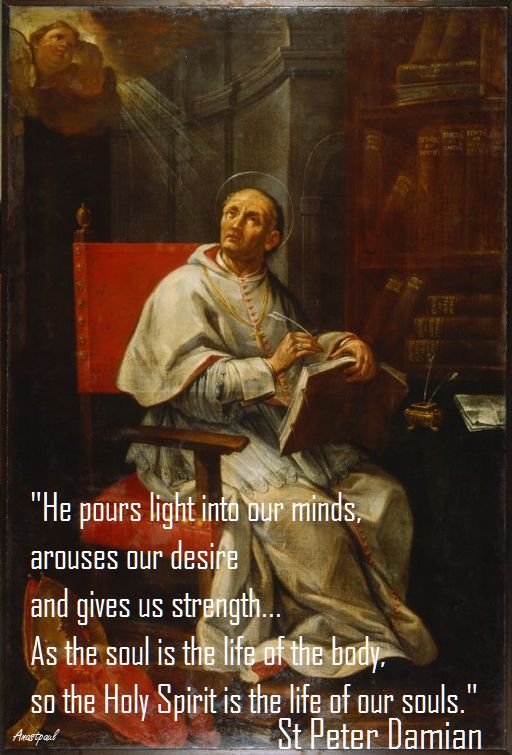
“He pours light into our minds, arouses our desire and gives us strength…
As the soul is the life of the body, so the Holy Spirit is the life of our souls.”

“The best penance is to have patience with the sorrows God permits.
A very good penance is to dedicate oneself to fulfill the duties of everyday
with exactitude and to study and work with all our strength.”

“Through a woman [Eve] a curse fell upon the earth;
through a woman [Mary] as well there returned
to the earth, a blessing.”

St Peter Damian

he-pours-light-into-our-minds-st-peter-damian84791e84504fcc717afbaafbf2d0eb9ethrough-a-woman-st-peter-damian

Posted in DOCTORS of the Church, MORNING Prayers, QUOTES of the SAINTS, SAINT of the DAY, The WORD

One Minute Reflection – 21 February

One Minute Reflection – 21 February

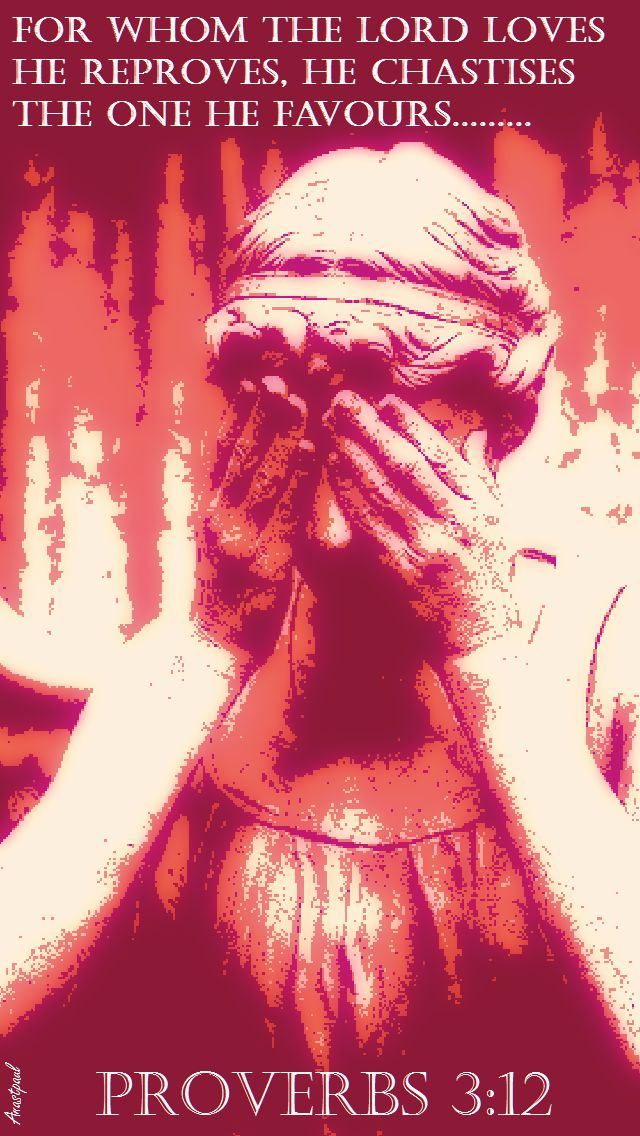
For whom the Lord loves he reproves,
he chastises the one he favours………….Proverbs 3:12

REFLECTION – “When you are scorned by others and lashed by God, do not despair.
God lashes us in this life to shield us from the eternal lash in the next.”………..St Peter Damian

PRAYER – Infinitely just God, help me to accept Your corrections and turn them to my benefit. Let me never despair about my weaknesses but entrust myself to Your goodness and mercy. Help me Lord! St Peter Damian, pray for us, amen.

proverbs-3-12when-you-are-scorned-by-others-st-peter-damianst-peter-damian-pray-for-us

Posted in MORNING Prayers, PRAYERS of the SAINTS

Our Morning Offering – 21 February

Our Morning Offering – 21 February

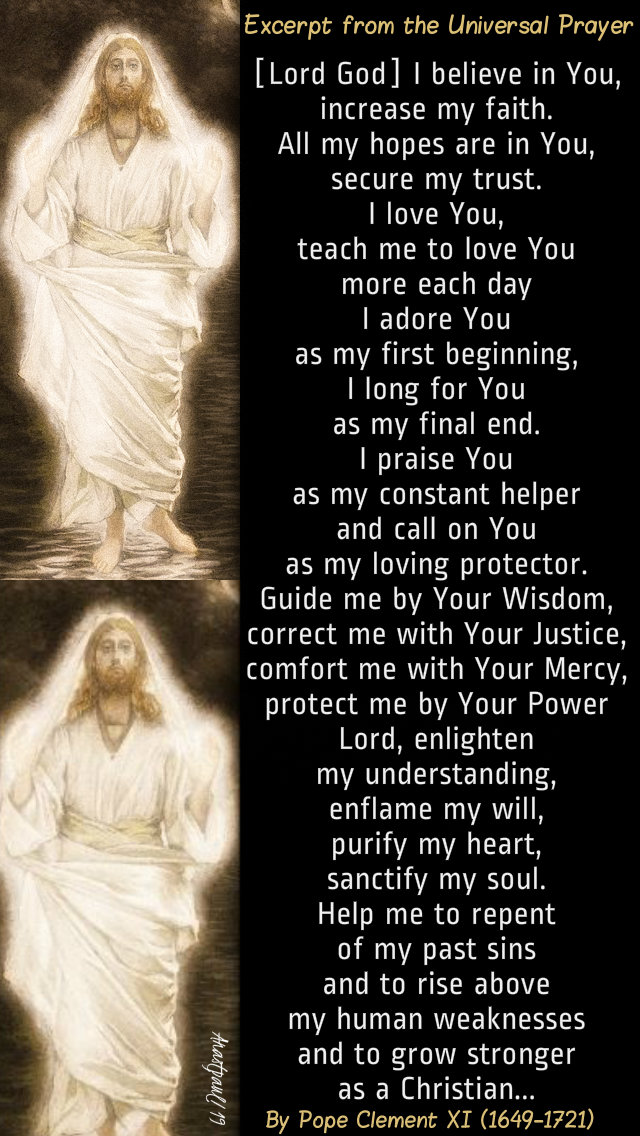
(Excerpt 2 from the Universal Prayer
attributed to Pope Clement XI)

I pray to You, Lord,
enlighten my understanding,
strengthen my will,
make clean my heart,
make holy my inward being.
Give me sorrow for my past sins
and let me not fall into temptation.
Help me to rise above my natural weaknesses,
let me grow stronger in all that is good and true.
Grant me, O good and loving God,
to love You as You deserve,
to turn away from all that is self-centred.
Let me seek Your Kingdom above all,
let me live as a pilgrim in this world,
give me right respect for all who have claim on me.
Give me a tender care for any who depend on me.
Let me cherish my friends
and let me forgive my enemies from my heart.
Grant me all this, my heavenly Father
for I give You all of myself
through Christ our Lord, amen.

Posted in DOCTORS of the Church, SAINT of the DAY

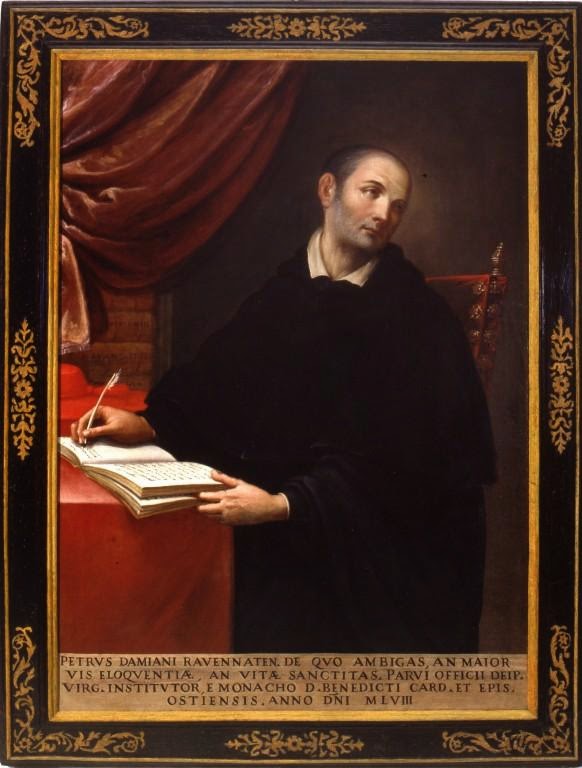
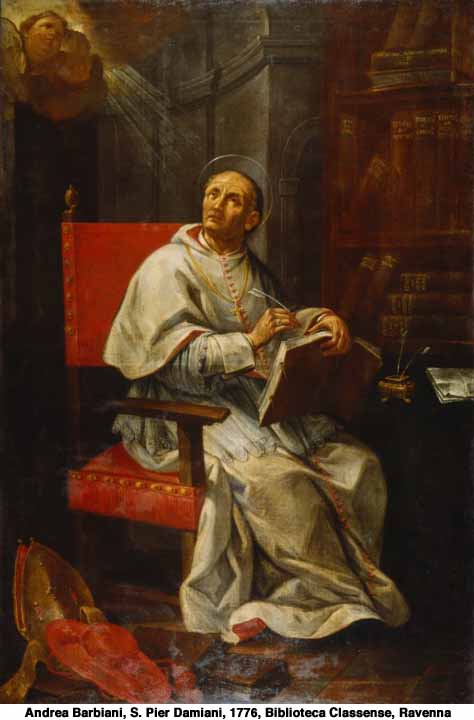
Saint of the Day – 21 February – St Peter Damian (c 1007-1072)

Saint of the Day – 21 February – St Peter Damian (c 1007-1072) Bishop, Confessor, Benedictine Monk, Cardinal, Theologian, Reformer, Writer, Teacher, Preacher, Poet and Doctor of the Church.   Also known as – Petrus Damianus; Italian: Pietro or Pier Damiani was a reforming Benedictine Monk and Cardinal in the circle of Pope Leo IX.    Dante placed him in one of the highest circles of Paradiso as a great predecessor of Saint Francis of Assisi. He was declared a Doctor of the Church in 1828 by Patronages – Spiritual warfare, Church Reformers and of Faenza, Italy.

Peter was born in Ravenna, Italy, around 1007, the youngest of a large noble but poor family.    Orphaned early, he was at first adopted by an elder brother, who ill-treated and underfed him while employing him as a swineherd.    After some years, another brother, Damianus, who was Archpriest at Ravenna, had pity on him and took him away to be educated.    Adding his brother’s name to his own, Peter made such rapid progress in his studies of Theology and Canon Law, first at Ravenna, then at Faenza and finally at the University of Parma, that when about twenty-five years old he was already a famous teacher at Parma and Ravenna.   As well as a good grounding in the field of law, he acquired a refined expertise in the art of writing the ars scribendi and, thanks to his knowledge of the great Latin classics, became “one of the most accomplished Latinists of his time, one of the greatest writers of medieval Latin” (J. Leclercq, Pierre Damien, ermite et homme d’Église, Rome, 1960, p. 172).

About 1035, however, he gave up his secular calling and, avoiding the compromised luxury of Cluniac Monasteries, entered the isolated hermitage of Fonte Avellana, near Gubbio. Both as a Novice and as a Monk, his fervour was remarkable but led him to such extremes of self-mortification in penance that his health was affected and he developed severe insomnia.    On his recovery, he was appointed to lecture to his fellow Monks.    Then, at the request of St Guy of Pomposa (Guido d’Arezzo) and other heads of neighbouring Monasteries, for two or three years he lectured to their brethren too and (about 1042) wrote the Vita of St. Romuald for the monks of Pietrapertosa.    Soon after his return to Fonte Avellan, he was appointed Economus (manager or administrator) of the house by the Prior, who designated him as his successor.    In 1043 he became Prior of Fonte Avellana and remained so until his death in February 1072.

Subject-hermitages were founded at San Severino, Gamogna, Acerreta, Murciana, San Salvatore, Sitria and Ocri. A zealot for monastic and clerical reform, he introduced a more-severe discipline, including the practice of flagellation (“the disciplina”), into the house, which, under his rule, quickly attained celebrity and became a model for other foundations, even the great abbey of Monte Cassino.    There was much opposition outside his own circle to such extreme forms of penitence, but Peter’s persistent advocacy ensured its acceptance, to such an extent that he was obliged later to moderate the imprudent zeal of some of his own hermits.   Another innovation was that of the daily siesta, to make up for the fatigue of the night office.    During his tenure of the priorate a cloister was built, silver chalices and a silver processional cross were purchased, and many books were added to the library.

Reformer
Although living in the seclusion of the cloister, Peter Damian closely watched the fortunes of the Church and like his friend Hildebrand, the future Pope Gregory VII, he strove for reforms in a deplorable time.    When Benedict IX resigned the pontificate into the hands of the archpriest John Gratian (Gregory VI) in 1045, Peter hailed the change with joy and wrote to the new pope, urging him to deal with the scandals of the church in Italy, singling out the wicked bishops of Pesaro, of Città di Castello and of Fano.    Extending the area of his activities, he entered into communication with the Emperor Henry III.    He was present in Rome when Clement II crowned Henry III and his consort Agnes and he also attended a synod held at the Lateran in the first days of 1047, in which decrees were passed against simony.    After this he returned to his hermitage.

Pope Benedict XVI described him as “one of the most significant figures of the 11th century … a lover of solitude and at the same time a fearless man of the Church, committed personally to the task of reform.”

Philosophy
Peter often condemned philosophy.    He claimed that the first grammarian was the Devil, who taught Adam to decline deus in the plural.    He argued that monks should not have to study philosophy, because Jesus did not choose philosophers as disciples and so philosophy is not necessary for salvation.    But the idea (later attributed to Thomas Aquinas) that philosophy should serve theology as a servant serves her mistress originated with him.

Papal envoy and Cardinal
During his illness the pope died, and Frédéric, abbot of Monte Cassino, was elected pope as Stephen IX.    In the autumn of 1057, Stephen IX determined to make Damian a cardinal. For a long time Damian resisted the offer, for he was more at ease as an itinerant hermit-preacher than a reformer from within the Curia but was finally forced to accept and was consecrated Cardinal Bishop of Ostia on 30 November 1057.    In addition he was appointed administrator of the Diocese of Gubbio.    The new cardinal was impressed with the great responsibilities of his office and wrote a stirring letter to his brother-cardinals, exhorting them to shine by their example before all.    Four months later Pope Stephen died at Florence and the Church was once more distracted by schism.    Peter was vigorous in his opposition to the antipope Benedict X but force was on the side of the intruder and Damian retired temporarily to Fonte Avallana.

Milan
About the end of the year 1059 Peter was sent as legate to Milan by Pope Nicholas II.   So bad was the state of things at Milan, that benefices (a reward received in exchange for services rendered and as a retainer for future services) were openly bought and sold and the clergy publicly married the women with whom they lived.    The resistance of the clergy of Milan to the reform of Ariald the Deacon and Anselm, Bishop of Lucca rendered a contest so bitter that an appeal was made to the Holy See.   Nicholas II sent Damian and the Bishop of Lucca as his legates.    The party of the irregular clerics took alarm and raised the cry that Rome had no authority over Milan.    Peter boldly confronted the rioters in the cathedral, he proved to them the authority of the Holy See with such effect that all parties submitted to his decision.   He exacted first a solemn oath from the archbishop and all his clergy that for the future no preferment should be paid for; then, imposing a penance on all who had been guilty, he reinstated in their benefices all who undertook to live in celibacy.    This prudent decision was attacked by some of the rigorists at Rome but was not reversed.   Meanwhile, Peter was pleading in vain to be released from the cares of his office. Neither Nicholas II nor Hildebrand would consent to spare him.

Later career
He rendered valuable assistance to Pope Alexander II in his struggle with the antipope, Honorius II.    In July 1061 the pope died and once more a schism ensued.    Peter Damian used all his powers to persuade the antipope Cadalous to withdraw but to no purpose. Finally Anno II, Archbishop of Cologne and acting regent in Germany, summoned a council at Augsburg at which a long argument by Peter Damian was read and greatly contributed to the decision in favour of Alexander II.

In 1063 the pope held a synod at Rome, at which Peter Damian was appointed legate to settle the dispute between the Abbey of Cluny and the Bishop of Mâcon.   He proceeded to France, summoned a council at Chalon-sur-Saône, proved the justice of the contentions of Cluny, settled other questions at issue in the Church of France and returned in the autumn to Fonte Avellana.    Having served the papacy as legate to France and to Florence, he was allowed to resign his bishopric in 1067.    Early in 1072 or 1073 he was sent to Ravenna to reconcile its inhabitants to the Holy See, they having been excommunicated for supporting their archbishop in his adhesion to the schism of Cadalous.    On his return thence he was seized with fever near Faenza.    He lay ill for a week at the monastery of Santa Maria degl’Angeli, now Santa Maria Vecchia.    On the night preceding the feast of the Chair of St. Peter at Antioch, he ordered the office of the feast to be recited and at the end of the Lauds he died.    He was at once buried in the monastery church, lest others should claim his relics.

Posted in SAINT of the DAY

Saints for 21 February

St Peter Damian (Optional Memorial)

St Avitus II of Clermont
Bl Caterina Dominici
Bl Claudio di Portaceli
St Daniel of Persia
Bl Eleanora
St Ercongotha
St Eustathius of Antioch
St Felix of Metz
St George of Amastris
St Germanus of Granfield
St Gundebert of Sens
Bl Noel Pinot
St Paterius of Brescia
St Pepin of Landen
St Peter Mavimenus
St Randoald of Granfield
St Robert Southwell
St Severian of Scythopolis
St Severus of Syrmium
Bl Thomas Pormort
St Valerius of San Pedro de Montes
St Verda of Persia

Martyrs of Sicily – 79 saints – Seventy-nine Christians martyred together in the persecutions of Diocletian. c.303 on Sicily

Martyrs of Hadrumetum – A group of 26 Christians martyred together by Vandals. We know little more than eight of their names – Alexander, Felix, Fortunatus, Saturninus, Secundinus, Servulus, Siricius and Verulus. c.434 at Hadrumetum (modern Sousse, Tunisia)
Alexander
Felix
Fortunatus
Saturninus
Secundinus
Servulus
Siricius
Verulus

Martyrs Uchibori – Three Japanese laymen, all brothers, all sons of Paulus Uchibori Sakuemon, one a teenager, one only five years old, and all martyred for their faith in the persecutions in Japan. 21 February 1627 in Shimabara, Nagasaki, Japan. Beatified 24 November 2008 by Pope Benedict XVI.
Antonius
Balthasar
Ignatius

Posted in LENT, MORNING Prayers, NOVENAS, QUOTES on CONVERSION, QUOTES on REPENTANCE

Lenten Preparation Novena

A Meditation for this ‘Prelude to Lent’

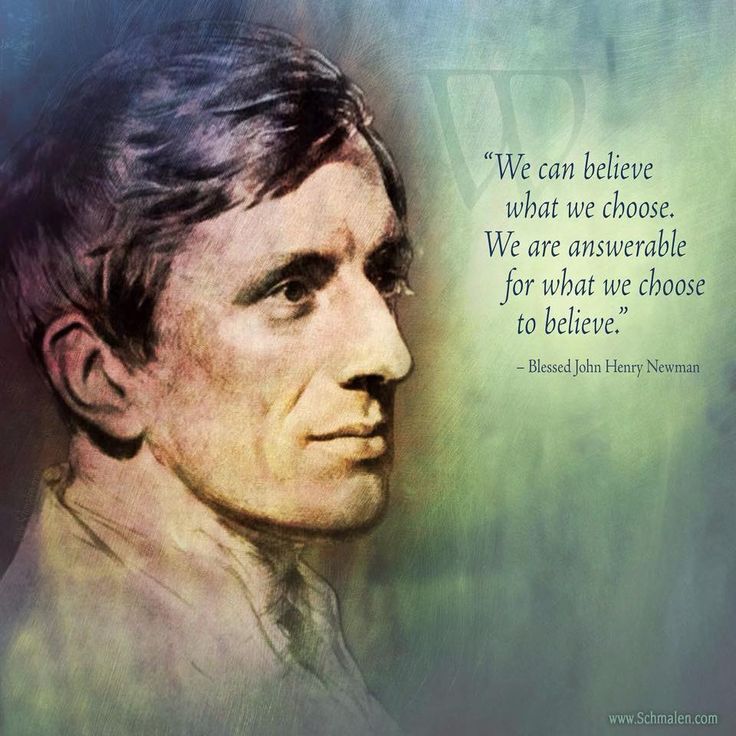
“Each of us must come to the evening of life.   Each of us must enter on eternity.   Each of us must come to that quiet, awful time, when we will appear before the Lord of the vineyard and answer for the deeds done in the body, whether they be good or bad.   That, my dear brethren, you will have to undergo. … It will be the dread moment of expectation when your fate for eternity is in the balance and when you are about to be sent forth as the companion of either saints or devils, without possibility of change.   There can be no change; there can be no reversal.   As that judgment decides it, so it will be for ever and ever.   Such is the particular judgment. … when we find ourselves by ourselves, one by one, in His presence and have brought before us most vividly all the thoughts, words and deeds of this past life.   Who will be able to bear the sight of himself?   And yet we shall be obliged steadily to confront ourselves and to see ourselves.   In this life we shrink from knowing our real selves.   We do not like to know how sinful we are.   We love those who prophecy smooth things to us and we are angry with those who tell us of our faults.   But on that day, not one fault only but all the secret, as well as evident, defects of our character will be clearly brought out.   We shall see what we feared to see here and much more.   And then, when the full sight of ourselves comes to us, who will not wish that he had known more of himself here, rather than leaving it for the inevitable day to reveal it all to him! …………………….We can believe what we choose.   We are answerable for what we choose to believe.”– (Blessed Card. John Henry Newman)

b716a2be8e822bdea507ff9765916990

Lenten Preparation Novena

DAY ONE

Lord, during this Lenten Season,
nourish me with Your Word of life
and make me one
with You in love and prayer.

Fill my heart with Your love
and keep me faithful to the Gospel of Christ.
Give me the grace to rise above my human weakness.
Give me new life by Your Sacraments, especially the Mass.

Father, our source of life,
I reach out with joy to grasp Your hand;
let me walk more readily in Your ways.
Guide me in Your gentle mercy,
for left to myself I cannot do Your Will.

Father of love, source of all blessings,
help me to pass from my old life of sin
to the new life of grace.

Help me to repent of my sins now and make reparation throughout
this Lenten season and each day thereafter.
United with your Son,
who makes His way to Calvary,
I offer You my intentions
(Mention your special intention)

Prepare me for the glory of Your Kingdom.
I ask this through our Lord Jesus Christ, Your Son,
Who lives and reigns with You
and the Holy Spirit, one God, forever.

Amen.

day-one-20-feb

Posted in PURGATORY

HOW TO AVOID PURGATORY By Fr Paul O’Sullivan O.P.

HOW TO AVOID PURGATORY By Fr. Paul O’Sullivan O.P.

For those who have not read this little book and to refresh myself, I will be posting the entire book in daily doses.  (To read later find in the Purgatory Category).

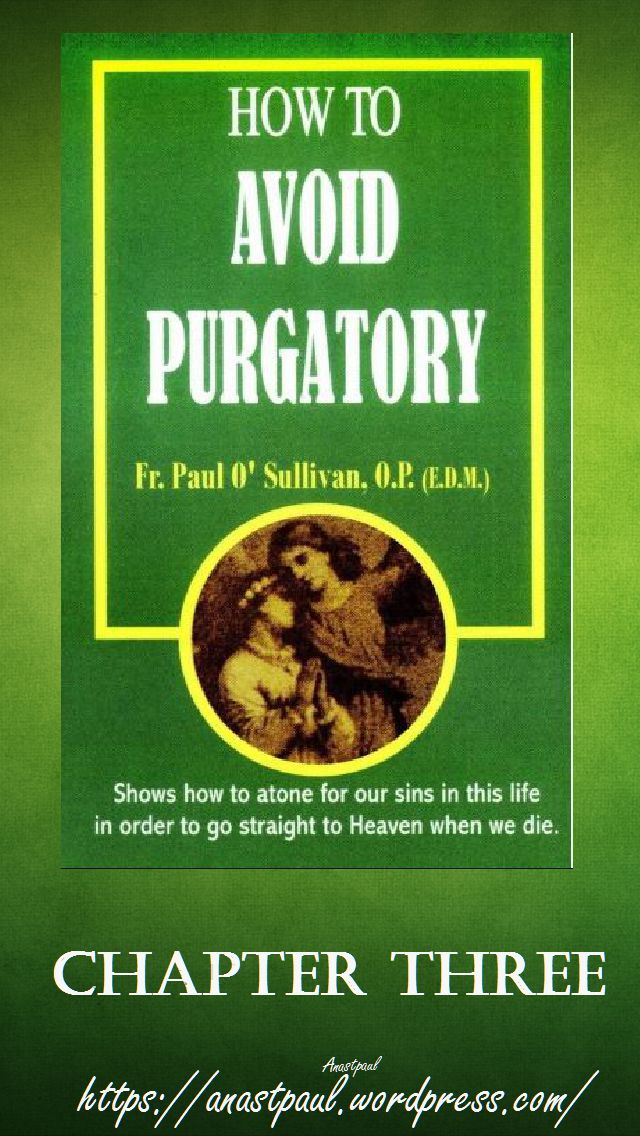
Chapter 3

THE FIRST MEANS: REMOVING THE CAUSE

The First Means of avoiding Purgatory is manifestly to remove the cause
which sends us there, which is sin.

It may not be easy to refrain from all sin, even the smaller sins but
every ordinary Christian can, by the frequent use of the Sacraments, easily
abstain from mortal sin.

Secondly, we can all avoid deliberate and grave venial sin.   It is an awful
thing to offend the good God deliberately.    Deliberation intensifies
enormously the malice of sin and offends God much more than faults of
weakness, or sins committed when we are off our guard.

Lastly, we must use our best endeavours to break off bad habits.    Habits,
like deliberation, add seriously to the malice of sin

A deliberate falsehood is very much worse than a hasty lie of excuse and a
lie resulting from the inveterate habit of lying is very much worse than a
casual lie.

A lady once told us how she had, when younger, the habit of constantly
speaking ill of her neighbours.

Having heard a sermon on the subject, she made a strong resolution never to
do so again and kept it.

That simple, strong resolution changed the whole trend of her life and
saved her from thousands of sins, and most surely from a long and painful
Purgatory.

Who cannot make a like resolution and keep it?

If a Christian avoids, as he easily can, these three classes of sin, viz.,
mortal sins, deliberate and grave venial sins and habits of sin, it will
be relatively easy for him to atone for faults of frailty, as we shall
presently see.

RESOLUTION

We would be well advised to pronounce with special emphasis and fervour,
every time we say the Our Father, the words:

“Forgive us our trespasses as we forgive those who trespass against us”

These are the very words of God Himself and repeated frequently and
fervently will certainly obtain for us pardon of our sins.

chapter-three

Posted in MORNING Prayers, SAINT of the DAY, The BLESSED VIRGIN MARY

Thought for the Day – 20 February

You might think that if the Blessed Mother of God appears to you and speaks to you, you are a saint.    But that is not necessarily true.    What is true is that Mary chose to come to children who the year before had been visited by the Angel of Peace, children who had listened to the angel’s message and prayed the prayer the angel taught them.    They responded to Mary in the same way and prayed the Rosary and offered sacrifices for sinners and for the conversion of the world.    They were children who wanted to please God and that is why the Church has declared them Blessed.

Francisco and Jacinta died within a short time, as the Lady had said they would. They were beatified on May 13, 2000.    At that time Lucia los Santos was a Carmelite nun in Portugal. Sister Lucia died February 13, 2005 at age 97.   The shrine of Our Lady of Fatima is visited by up to 20 million people a year and is the source of many conversions and miracles.

Blesseds Francisco and Jacinta Pray for us!

bl-francisco-jacinta-pray-for-us-2

Posted in MORNING Prayers, QUOTES of the SAINTS, SAINT of the DAY, The BLESSED VIRGIN MARY

Quote/s of the Day – 20 February

Quote/s of the Day – 20 February

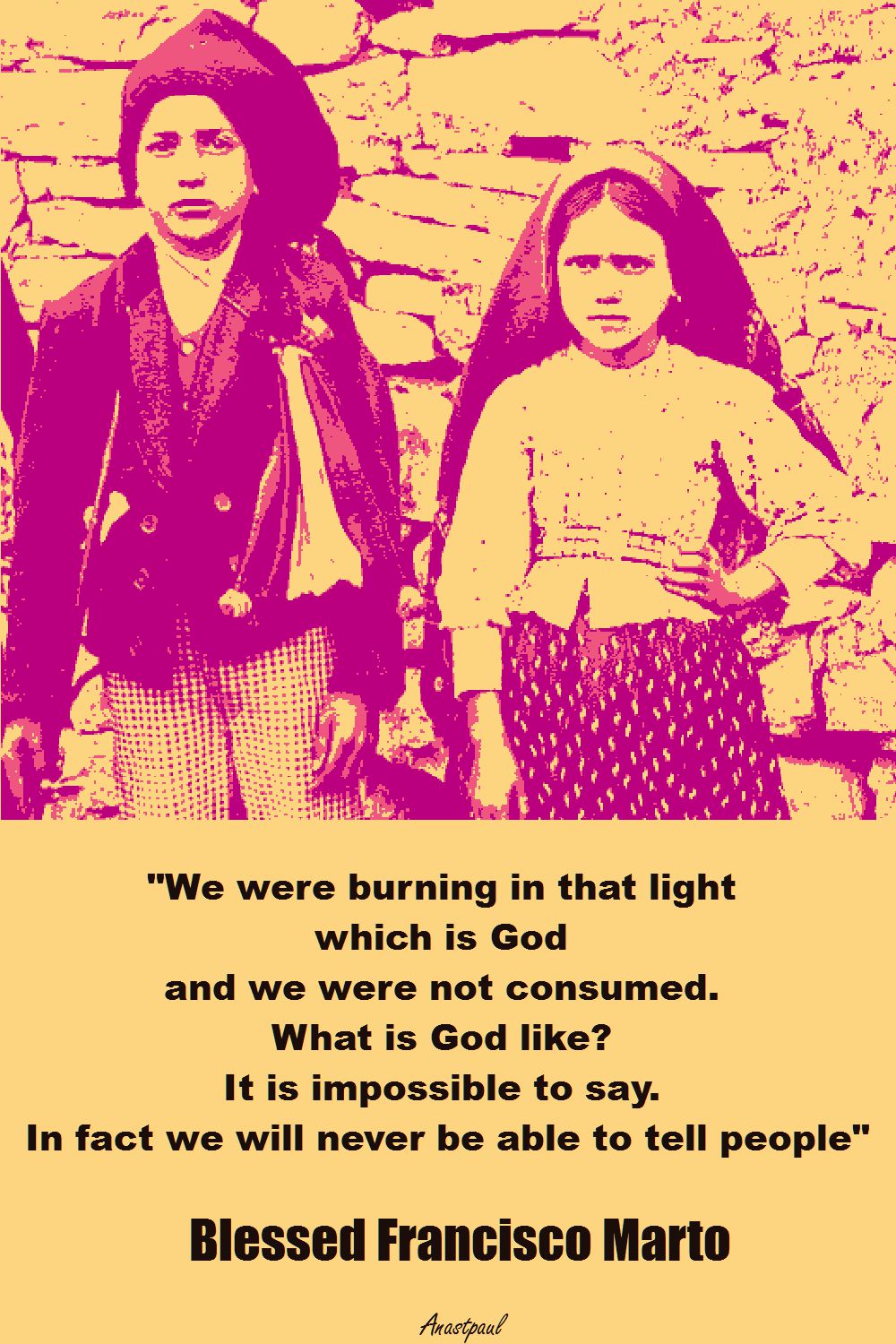
“We were burning in that light
which is God and we were not consumed.
What is God like?
It is impossible to say.
In fact we will never be able to tell people”

~~~~~ Blessed Francisco Marto of Fatima

we-were-burning-in-that-light-bl-francisco-marto

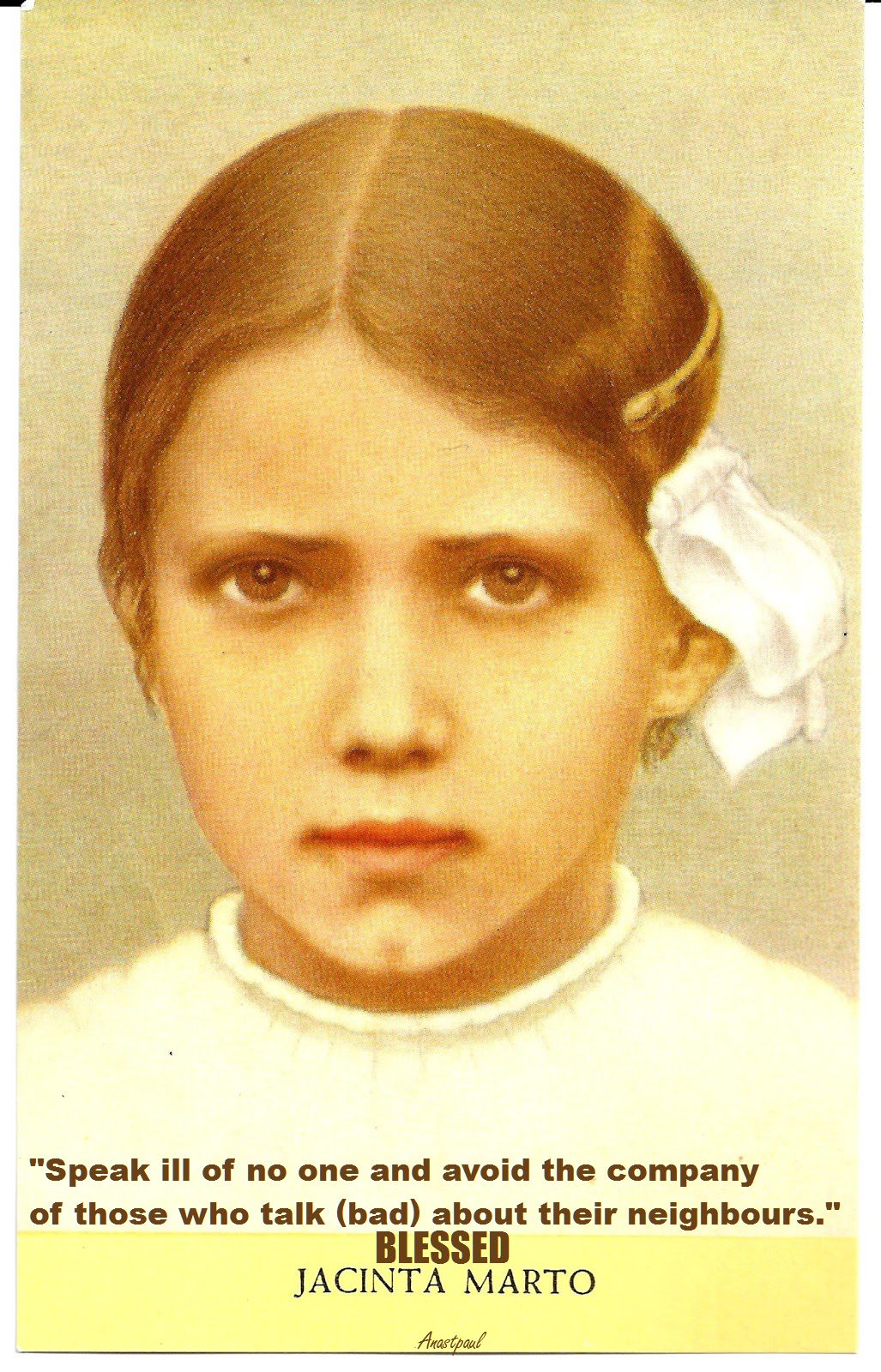
“Speak ill of no one and avoid the company
of those who talk (bad) about their neighbours.”
~~~~~ Blessed Jacinta Marto of Fatima

speak-ill-of-no-one-bl-jacinta

Posted in QUOTES of the SAINTS, SAINT of the DAY, The BLESSED VIRGIN MARY, The WORD

One Minute Reflection – 20 February

One Minute Reflection – 20 February

“Father, … to you I offer praise; for what you have hidden from the learned and the clever you have revealed to the merest children” ………….Mt 11: 25

REFLECTION – “Francisco bore without complaining the great sufferings caused by the illness from which he died.    It all seemed to him so little to console Jesus: he died with a smile on his lips.    Little Francisco had a great desire to atone for the offences of sinners by striving to be good and by offering his sacrifices and prayers.

The life of Jacinta, his younger sister by almost two years, was motivated by these same sentiments……………….In her motherly concern, the Blessed Virgin came here to Fátima to ask men and women “to stop offending God, Our Lord, who is already very offended”.   It is a mother’s sorrow that compels her to speak; the destiny of her children is at stake. For this reason she asks the little shepherds: “Pray, pray much and make sacrifices for sinners; many souls go to hell because they have no one to pray and make sacrifices for them”. …St Pope John Paul on the Beatification of the siblings, 13 May 2000

PRAYER – “Father, to You I offer praise, for what You have hidden from the learned and the clever you have revealed to the merest children”.
Father, to you I offer praise for all Your children, from the Virgin Mary, Your humble Servant, to the little shepherds, Francisco and Jacinta.
May the message of their lives live on for ever to light humanity’s way! Blessed Francisco and Jacinta, pray for us! Amen. (Prayer by St Pope John Paul)

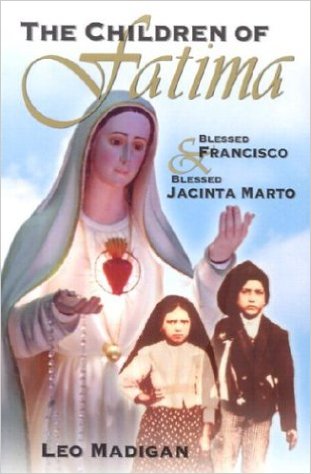
matthew-11-25-fatima-bl-francisco-and-jacinta51whct6rrql-_sx309_bo1204203200_bls-francisco-jacinta-pray-for-us


Posted in MORNING Prayers, PRAYERS of the CHURCH, PRAYERS of the SAINTS, SAINT of the DAY, The BLESSED VIRGIN MARY

Our Morning Offering – 20 February

Our Morning Offering – 20 February

The Angel of Fatima’s Prayer

O Most Holy Trinity,
Father, Son and Holy Spirit,
I adore Thee profoundly.
I offer Thee
the most precious Body, Blood, Soul
and Divinity of Jesus Christ
present in all the tabernacles of the world,
in reparation for the outrages,
sacrileges and indifferences
by which He is offended.
By the infinite merits of
the Sacred Heart of Jesus
and the Immaculate Heart of Mary
I beg the conversion of poor sinners.
Amen

the-angel-of-fatimas-prayer

Posted in SAINT of the DAY, The BLESSED VIRGIN MARY

Saint/s of the Day – 20 February – Blessed Francisco and Jacinta Marto

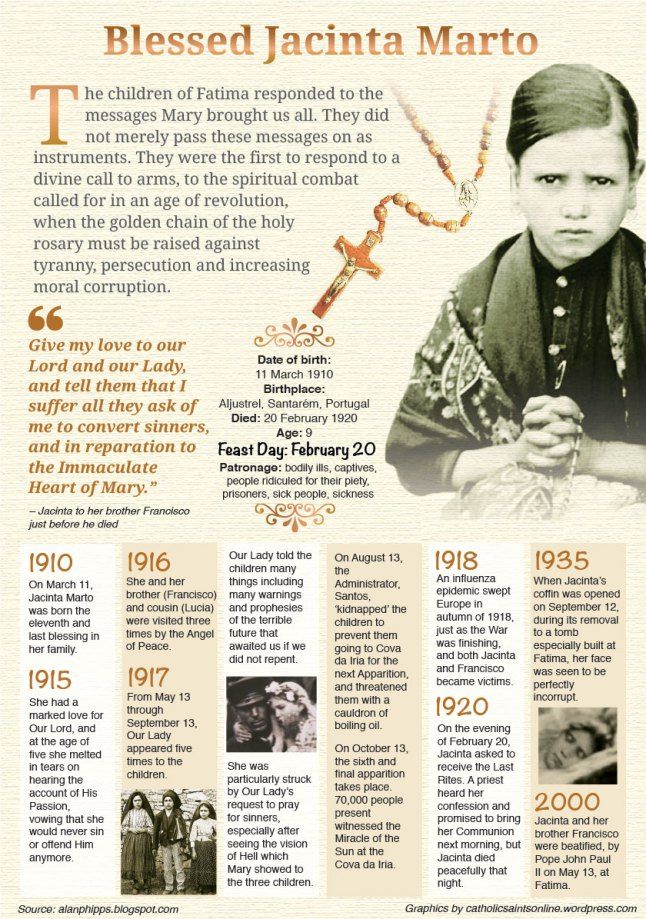
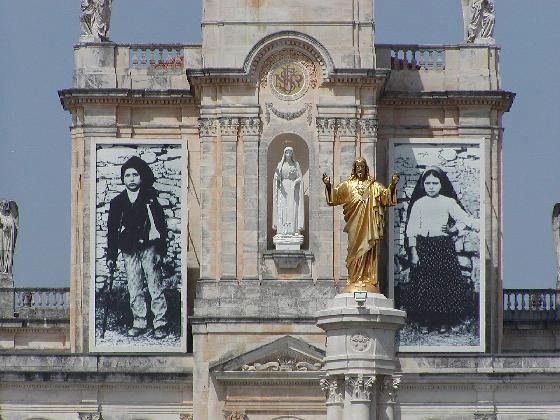
Saint/s of the Day – 20 February – Blessed Francisco (11 June 1908 – 4 April 1919 died aged 10), his sister Jacinta Marto (11 March 1910 – 20 February 1920 died aged 9) and their cousin Lúcia Santos (1907–2005) were children from Aljustrel near Fátima, Portugal, who said they witnessed three apparitions of an angel in 1916 and several apparitions of the Blessed Virgin Mary in 1917.    Mary was given the title Our Lady of Fátima as a result and Fátima became a major centre of world Christian pilgrimage.  Patrons of Bodily ills, captives, people ridiculed for their piety, prisoners, sick people, against sickness.

b04c6e1092f0b93aea3ce3cc9bd4c406

e7634f397682feb8bc3e4370e290bc38

cf49340b1b943ffb5f790cf1eb0febbd

The youngest children of Manuel and Olimpia Marto, Francisco and Jacinta were typical of Portuguese village children of that time.    They were illiterate but had a rich oral tradition.  According to Lúcia’s memoirs, Francisco had a placid disposition, was somewhat musically inclined, and liked to be by himself to think.    Jacinta was affectionate if a bit spoiled.    She had a sweet singing voice and a gift for dancing.    Following their experiences, their fundamental personalities remained the same.    Francisco preferred to pray alone, saying that this would “console Jesus for the sins of the world”.    Jacinta said she was deeply affected by a terrifying vision of Hell shown to the children at the third apparition and deeply convinced of the need to save sinners through penance and sacrifice as the Virgin had told the children to do.    All three children but particularly Francisco and Jacinta, practised stringent self-mortifications to this end.

3e0d37302221376a5b87f679e64c8409
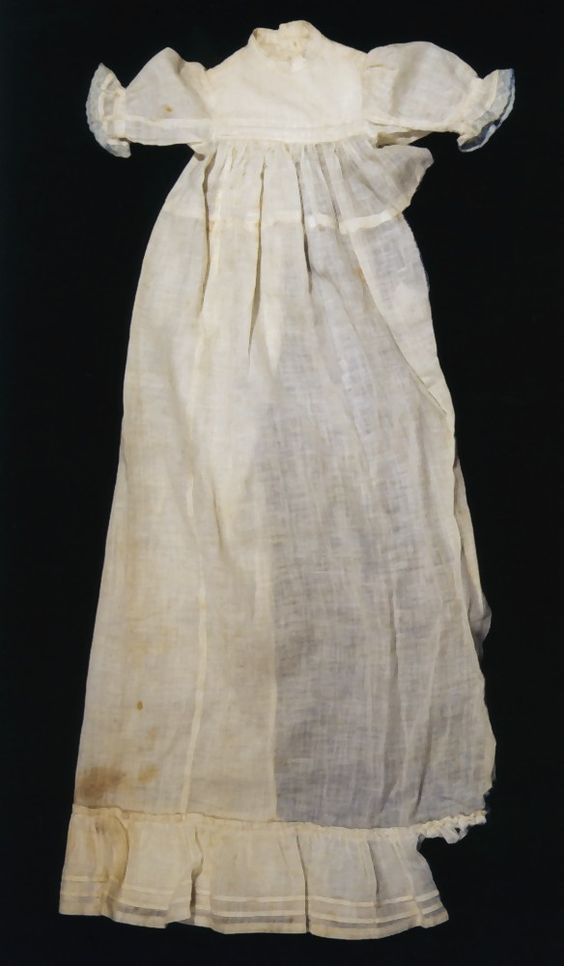
Baptisimal robe of Blesseds Francisco and Jacinta Marto

Apparitions
The brother and sister, who tended to their families’ sheep with their cousin Lucia in the fields of Fatima, Portugal, are said to have witnessed several apparitions of an angel in 1916.    Lucia later recorded the words of several prayers she said they learned from this angel.   Lucia wrote in her memoirs that she and her cousins saw the first apparition of Mary on May 13, 1917.    At the time of the apparition, Francisco was 9 years old and Jacinta was 7.   During the first apparition, Mary is said to have asked the three children to say the Rosary and to make sacrifices, offering them for the conversion of sinners.    She also asked them to return to that spot on the thirteenth of each month for the next six months.Children July.jpg

Illness and death
The siblings were victims of the great 1918 influenza epidemic that swept through Europe that year.    In October 1918, Mary appeared and said she would take them to heaven soon.  Both lingered for many months, insisting on walking to church to make Eucharistic devotions and prostrating themselves to pray for hours, kneeling with their heads on the ground as they said the angel had instructed them to do.   Francisco declined hospital treatment on April 3, 1919 and died at home the next day.    Jacinta was moved from one hospital to another in an attempt to save her life, which she insisted was futile.   She developed purulent pleurisy and endured an operation in which two of her ribs were removed.    Because of the condition of her heart, she could not be fully anesthetized only local and later suffered terrible pain, which she said would help to convert many sinners. On February 19, 1920, Jacinta asked the hospital chaplain who heard her confession to bring her Holy Communion and administer Extreme Unction because she was going to die “the next night”.    He told her that her condition was not that serious and that he would return the next day.    The next day Jacinta was dead; she had died, as she had often said she would, alone.   In 1920, shortly before her death at age nine, Jacinta Marto reportedly discussed the Alliance of the Hearts of Jesus and Mary with a then 12-year-old Lúcia Santos and said:

“When you are to say this, don’t go and hide.    Tell everybody that God grants us graces through the Immaculate Heart of Mary;   that people are to ask her for them;   and that the Heart of Jesus wants the Immaculate Heart of Mary to be venerated at His side.    Tell them also to pray to the Immaculate Heart of Mary for peace, since God entrusted it to her.”

Jacinta and Francisco are both buried at the Our Lady of Fátima Basilica.

lma-021
Burial Place of Francisco and Jacinta

58cf6babe1c97daad0ed22e1ebf0059f
Shrine of the siblings at Lourdes

Beatification
The cause for the siblings’ canonisation began in 1946.    Exhumed in 1935 and again in 1951, Jacinta’s face was found incorrupt;   Francisco’s had decomposed.

In 1937 Pope Pius XI decided that causes for minors should not be accepted as they could not fully understand heroic virtue or practice it repeatedly, both of which are essential for canonisation.    For the next four decades, no sainthood processes for children were pursued.    In 1979 the bishop of Leiria-Fatima asked all the world’s bishops to write to the Pope, petitioning him to make an exception for Francisco, who had died at age 10 and Jacinta, who had died at age 9.    More than 300 bishops sent letters to the Pope, writing that “the children were known, admired and attracted people to the way of sanctity. Favours were received through their intercession.”    The bishops also said that the children’s canonization was a pastoral necessity for the children and teenagers of the day.  In 1979 the Congregation for the Causes of Saints convened a general assembly.  Cardinals, bishops, theologians and other experts debated whether it was possible for children to display heroic virtue.    Eventually, they decided that, like the very few children who have a genius for music or mathematics, “in some supernatural way, some children could be spiritual prodigies.”  They were declared venerable by Pope John Paul II in 1989.   On May 13, 2000, they were declared “blessed” in a decree from the Congregation for the Causes of Saints.    Jacinta is the youngest non-martyred child ever to be beatified.

In her biography of Jacinta, Lúcia said that Jacinta had told her of having had many personal visions outside of the Marian visitations;   one involved a pope who prayed alone in a room while people outside shouted ugly things and threw rocks through the window. At another time, Jacinta said she saw a pope who had gathered a huge number of people together to pray to the Immaculate Heart of Mary.

When Pope John Paul II arrived in Fatima for the first time, in 1982, he said that he had come “because, on this exact date last year in St. Peter’s Square, in Rome, there was an attempt on the life of your Pope, which mysteriously coincided with the anniversary of the first vision at Fatima, that of 13 May 1917. The coincidence of these dates was so great that it seemed to be a special invitation for me to come here.

Sister Lúcia, when questioned about the Third Secret, said that the three of them had been very sad about the suffering of a Pope and that Jacinta kept saying:  Coitadinho do Santo Padre, tenho muita pena dos pecadores! (“Poor Holy Father, I feel a lot of pity for the sinners!”)   Another miracle was found to have been attributed to their intercession and the process that investigated the miracle was validated on 8 February 2013. Reports indicate the canonisation could occur on the centenary of the apparitions in 2017, together with Lúcia.

Posted in SAINT of the DAY

Saints 20 February

St Amata of Assisi
St Bolcan of Derken
St Colgan
St Eleutherius of Tournai
St Eucherius of Orleans
St Falco of Maastricht
Bl Francisco Marto
Bl Jacinta Marto
St Leo of Catania
St Nemesius of Cyprus
St Pothamius of Cyprus
St Serapion of Alexandria
St Silvanus of Emesa
St Stanislawa Rodzinska
St Valerius of Courserans
St Wulfric of Haselbury
St Zenobius of Antioch

Martyrs of Tyre
Nilus
Peleus
Tyrannio

Posted in PURGATORY

HOW TO AVOID PURGATORY By Fr Paul O’Sullivan O.P.

HOW TO AVOID PURGATORY By Fr. Paul O’Sullivan O.P.

For those who have not read this little book and to refresh myself, I will be posting the entire book in daily doses.  (To read later find in the Purgatory Category).

Chapter 2

HOW CAN WE AVOID PURGATORY?

The reason why we have to pass through Purgatory after death is that we
have committed sins and have not made satisfaction for them.    Every
individual sin must be expiated–in this life or the next!    Not even the
slightest shadow of sin or evil can enter the all-holy presence of God.

The graver, the more frequent the sins, the longer will be the period of
expiation and the more intense the pain.

It is not God’s fault, nor God’s wish, that we go to Purgatory! The fault
is all our own.

We have sinned and have not made satisfaction.

Even after our sin, God, in His infinite goodness, places at our disposal
many easy and efficacious means by which we may considerably lessen our
term of expiation, or even entirely cancel it.

Most Christians, with incomprehensible rashness, neglect these means and so
have to pay their debts in the dreadful prison house of Purgatory.

We will briefly enumerate some of the principal means by which we can avoid
Purgatory-or at least lessen its severity and duration.

chapter-two

Posted in MORNING Prayers, SAINT of the DAY

Thought for the Day – 19 February

Thought for the Day – 19 February

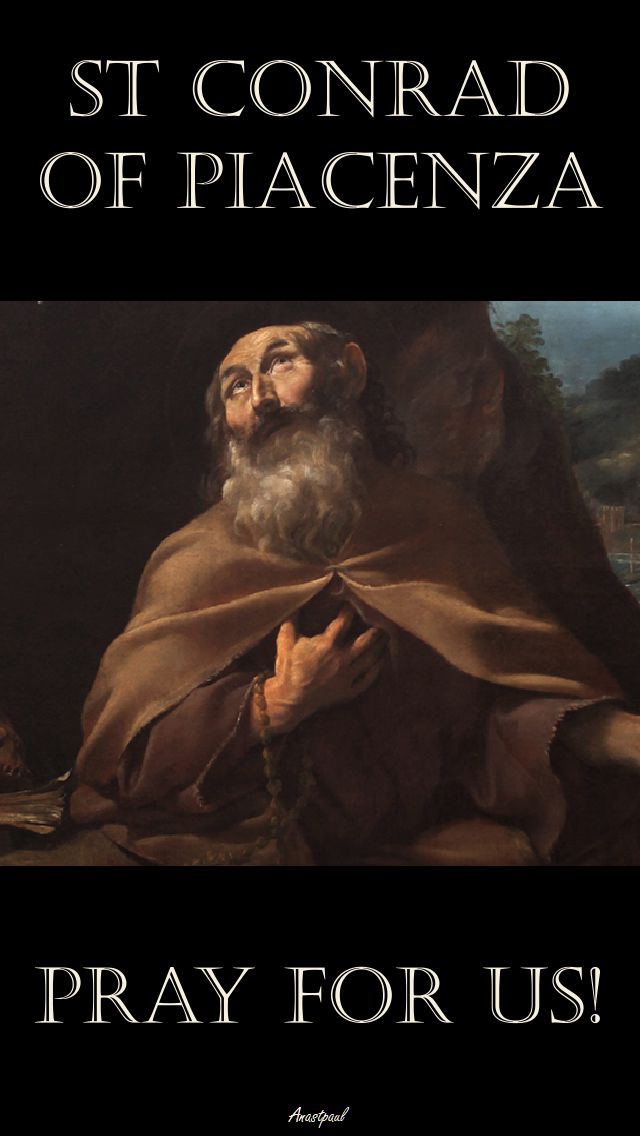
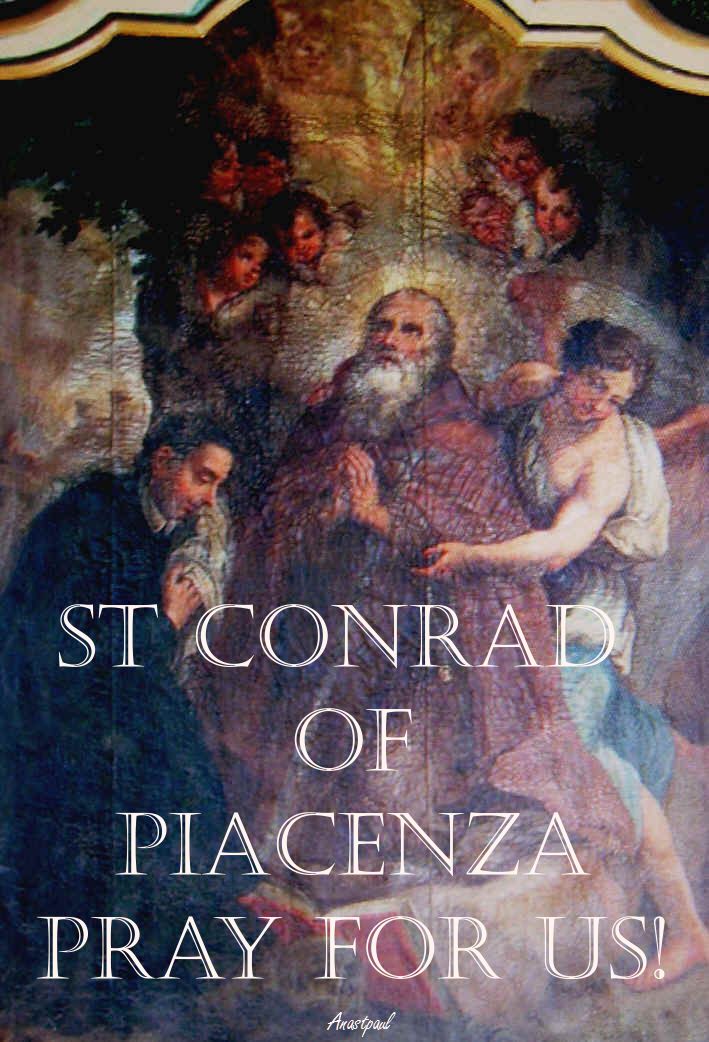
Disaster does not always have to be the ruin of everything and very terrible blows of bad fortune can lead to great blessings.   St Conrad of Piacenza’s bad fortune made him reflect on his own way of life.   A man was almost executed through his neglect and he realised that God deserved better, in fact God deserved the very best of him.   The rest is the story of a man who made way for the Holy Spirit, who cleared the path for His entry and thus found his joy in God and became a delightful friend to all, a conduit of love and miracles.   It is a lesson to be pondered.

St Conrad of Piacenza, Pray for us!

st-conrad-of-piacenza-pray-for-us-3

Posted in CATHOLIC Quotes, MORNING Prayers, SAINT of the DAY

Quote of the Day – 19 February

Quote of the Day – 19 February

Making a path for the Holy Spirit

Conversion has two elements for its completion.
First, we need to rid ourselves of the things that hinder gospel living. That includes not only “stuff” but also habits, attitudes, mindsets, lifestyles etc. that hinder hearing and living the Gospel.
Secondly, conversion calls us to commit our lives to Jesus and His gospel call.
It calls for practising charity, having hope, learning how to love all people.
If we only clean out our lives, we create a vacuum into which all sorts of things can enter (cf. Luke 11:24-26).
Our inner housecleaning ordinarily should open a path for the Holy Spirit to work in our lives.

~ Lester Bach OFM Cap, Seeking a Gospel Life

Today’s Saint of the Day, St Conrad of Piacenza is a perfect example of making the path!   St Conrad Pray for us!

making-a-path-for-the-holy-spiritst-conrad-of-pacenza-pray-for-us-2


Posted in MORNING Prayers, QUOTES of the SAINTS, SAINT of the DAY, The WORD

One Minute Reflection – 19 February

One Minute Reflection – 19 February

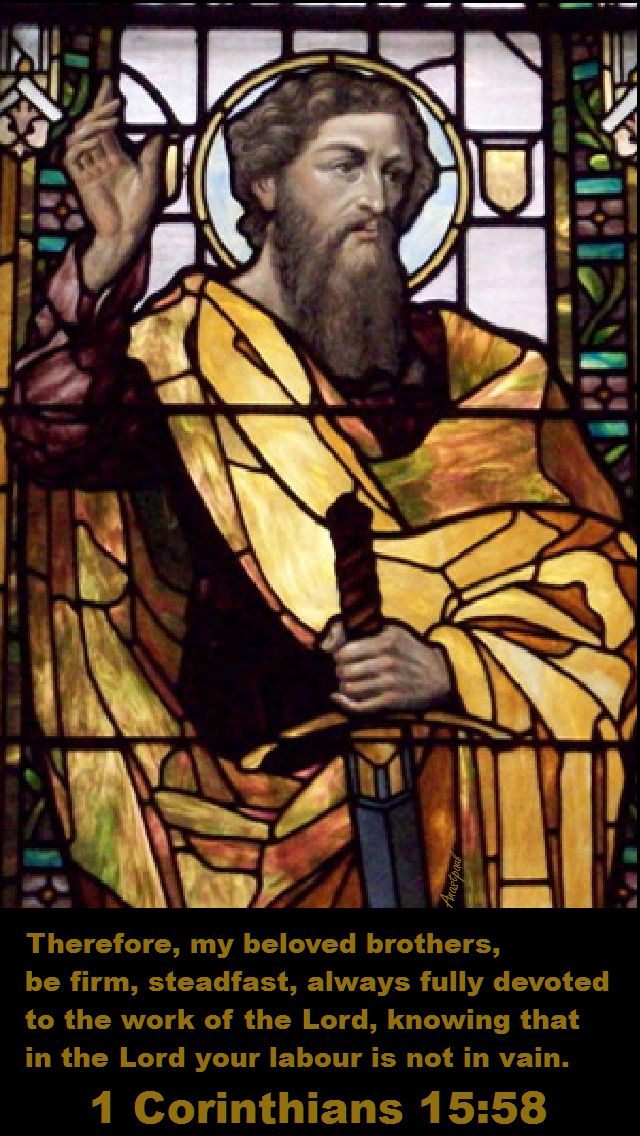
Therefore, my beloved brothers, be firm, steadfast, always fully devoted to the work of the Lord, knowing that in the Lord your labour is not in vain…….1 Cor 15:58

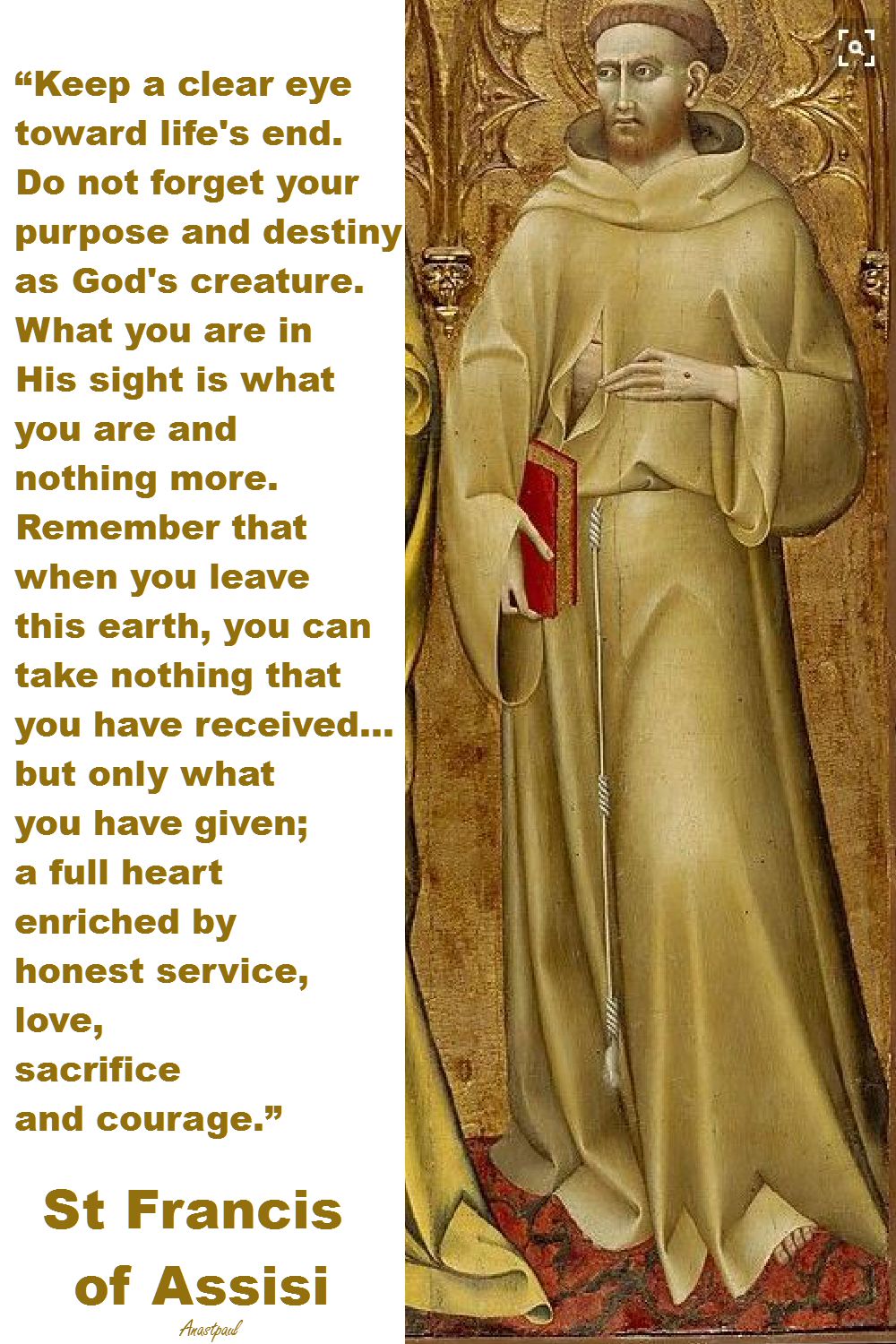
REFLECTION – “Keep a clear eye toward life’s end. Do not forget your purpose and destiny as God’s creature. What you are in His sight is what you are
and nothing more. Remember that when you leave this earth, you can take nothing that you have received…but only what you have given; a full heart enriched by honest service, love, sacrifice and courage.”…………St Francis of Assisi

PRAYER – God of mercy, teach me to live as You have ordained. Help me to follow Your commandments with courage and steadfast devotion. As St Conrad learnt courage through adversity, help me too to use the events of my life, both good and bad, to give only my best to all I meet. St Conrad of Piacenza, pray for us, amen.

1-corinthians-15-58

keep-a-clear-eye-st-francis-of-assisist-conrad-of-piacenza-pray-for-us