Posted in EASTER, FEASTS and SOLEMNITIES, MORNING Prayers, QUOTES of the SAINTS, QUOTES on LOVE, SAINT of the DAY

One Minute Reflection – 6 April – Easter Friday & The Memorial of Bl Maria Karlowska (1865-1935)

One Minute Reflection – 6 April – Easter Friday & The Memorial of Bl Maria Karlowska (1865-1935)

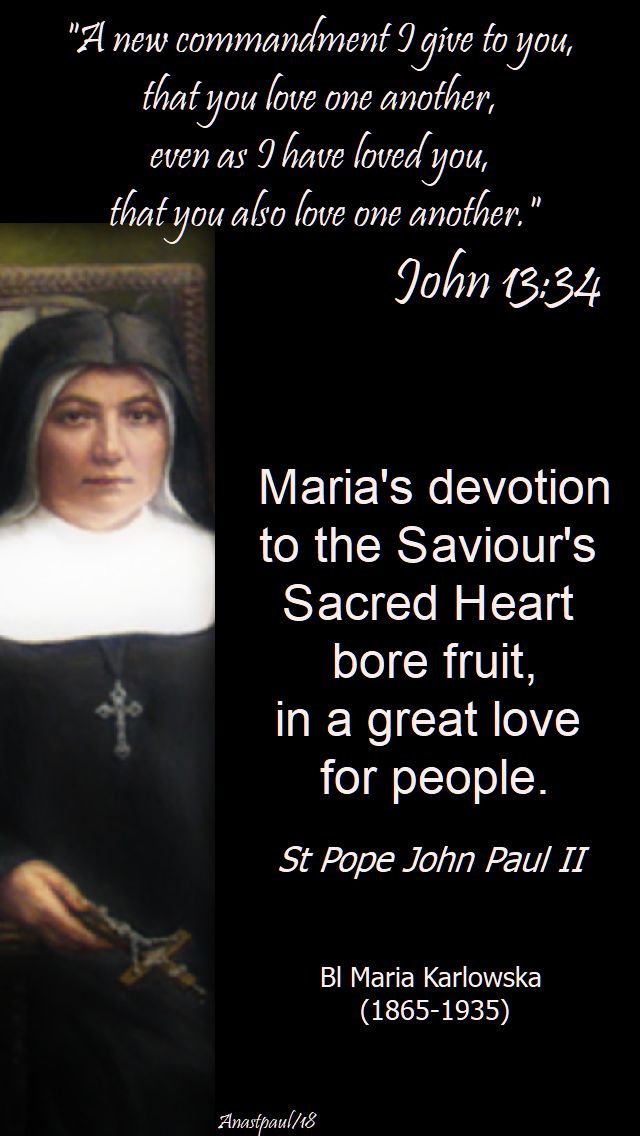
“A new commandment I give to you, that you love one another, even as I have loved you, that you also love one another.”…John 13:34

REFLECTION – “[She] worked as a true Samaritan among women, suffering great material and moral deprivation.   Her devotion to the Saviour’s Sacred Heart bore fruit, in a great love for people.   Thanks to this love she restored to many souls the light of Christ and helped them to retain their lost dignity.” … St Pope John Paul II at the Beatification on 6 June 1997her devotion to the saviour's sacred heart - st john paul on bl maria karlowska - 6 april 2018

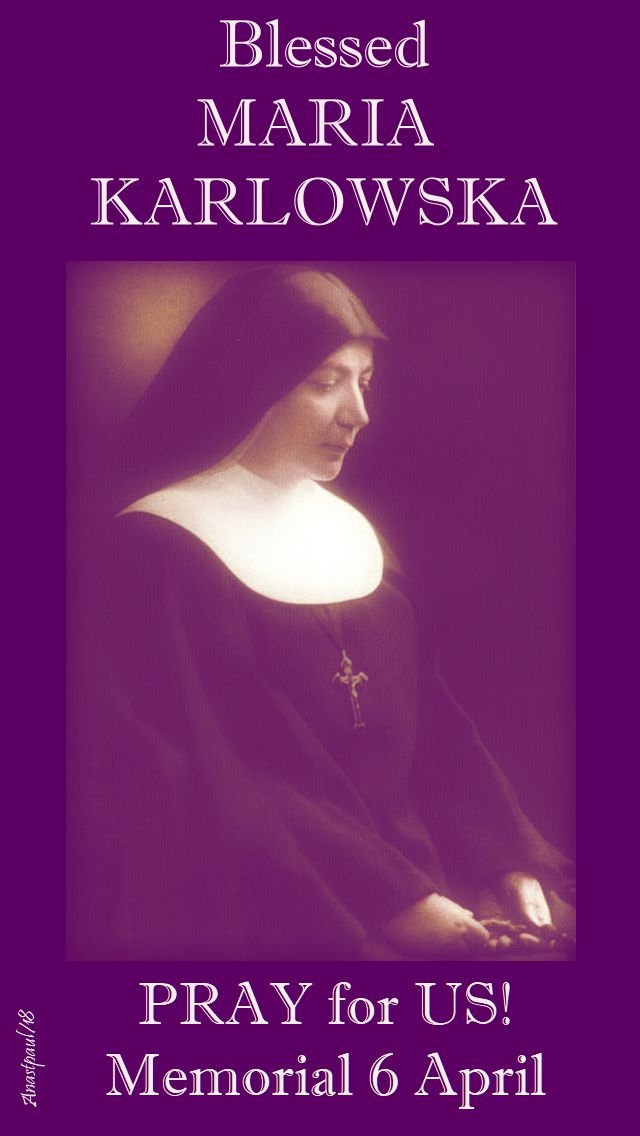
PRAYER – Dear Jesus, take away our hearts of stone and replace them with Your loving heart.   Help us to radiate You to all we meet. Blessed Maria Karlowska, your heart was the heart of Christ, please pray for us, amen.bl maria karlowska pray for us - 6 april 2018

Posted in EASTER, FEASTS and SOLEMNITIES, MORNING Prayers, PRAYERS of the SAINTS

Our Morning Offering – 6 April – Easter Friday

Our Morning Offering – 6 April – Easter Friday

Radiating Christ
St Mother Teresa (1910-1997)

Dear Jesus,
help us to spread Your fragrance everywhere we go.
Flood our souls with Your spirit and life.
Penetrate and possess our whole being so utterly
that our lives may only be a radiance of Yours.
Shine through us and be so in us
that every soul we come in contact with
may feel Your presence in our soul.
Let them look up and see no longer us,
but only Jesus.
Stay with us
and then we shall begin to shine as You shine,
so to shine as to be light to others.
The light, O Jesus, will be all from You.
None of it will be ours.
It will be You shining on others through us.
Let us thus praise You in the way You love best,
by shining on those around us.
Let us preach You without preaching,
not by words but by our example;
by the catching force –
the sympathetic influence of what we do,
the evident fullness of the love our hearts bear to You.
Amenradiating christ by st mother teresa - 6 april 2018

Posted in SAINT of the DAY

Saint of the Day – 6 April – Blessed Maria Karlowska (1865-1935)

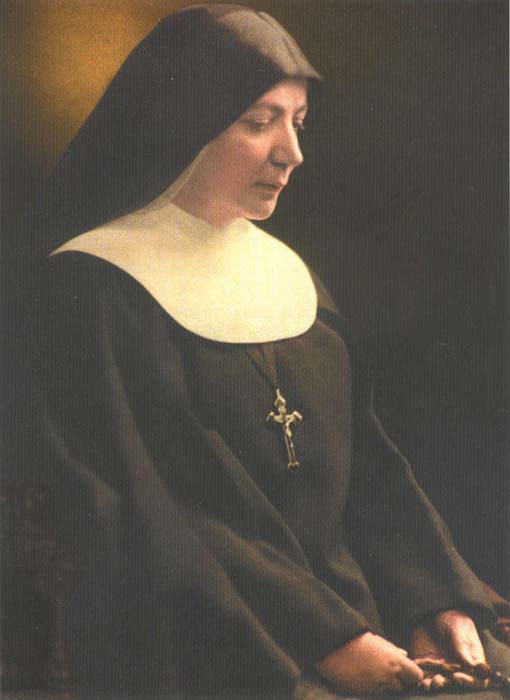
Saint of the Day – 6 April – Blessed Maria Karlowska (1865-1935) Religious sister and Founder of the Sisters of the Divine Shepherd of Divine Providence.   Blessed Maria Karłowska worked with poor and abandoned people with an emphasis on girls and also tried to aid prostitutes avoid such a life and build another kind of life so used her order to reach out to such people to render assistance.   Her beatification cause culminated in St Pope John Paul II presiding over her beatification on 6 June 1997 while on his apostolic visitation to Poland.   Bl Maria was born on 4 September 1865 in Karlowo, Kujawsko-Pomorskie, Poland and died on 24 March 1935 in Pniewite, Kujawsko-Pomorskie, Poland of natural causes.   She is the patron of the Order she founded.Bł._Maria_Angela_Karłowska

Maria Karłowska was born on 4 September 1865 in Poland as the eleventh child to Mateusz Karłowska and Eugenia Dembińska;  she was baptised that same month and her godmother was Wanda.   She made her First Communion in 1875 and in 1882 made a private vow – with the permission of her confessor – to remain chaste.   Her parents both died in 1882 within the striking space of two months leaving her orphaned and alone. Her paternal cousin Stanisław Karłowski was a Discalced Carmelite priest.   A second cousin was the artist Stanisława de Karłowska.

Karłowska became an apprentice seamstress in Berlin and started to collaborate with her elder sister as well as ill people in the area even after she had returned to Poland.   In November 1892 she met a poor girl named Franke and this encounter inspired her to aid the neglected and abandoned after hearing her talk about her life.   Bl Maria had an  intense devotion to the Sacred Heart.   Her religious congregation was established on 8 September 1896 and she – as well as several others – made her solemn profession as a nun on 20 June 1902;   she served as the Superior General from the founding until her death.   Her order received diocesan approval on 13 April 1909.    She received the Cross of Merit for her work in 1928.Beata_Maria_Karlowska_C

Karłowska died on 24 March 1935 after being ill for some time and her remains were interred in the order’s motherhouse after her funeral on 28 March;  her remains were relocated on 31 August 1935.   Her order received the decree of praise from Pope Paul VI on 24 May 1967.   In 2005 there were 221 religious in 24 places across Poland and Kazakhstan.

bl maria karlowska

The beatification process opened under Pope Paul VI on 17 March 1965 and she became titled as a Servant of God while the informative process commenced from 17 March 1965 until October 1982 in Toruń;  the Congregation for the Causes of Saints validated the process on 27 March 1987 and then received the Positio in 1991.   Theologians approved the dossier on 20 December 1994 as did the C.C.S. on 25 April 1995 before Pope John Paul II confirmed her heroic virtue and named her as Venerable on 11 July 1995.

The miracle for beatification was investigated and then received C.C.S. validation on 6 October 1995 before a medical board approved it on 27 June 1996.   Theologians approved it on 6 December 1996 as did the C.C.S. on 25 February 1997;   St John Paul II approved this miracle on 8 April 1997 and beatified her two months later on 6 June while on his apostolic visit to Poland.

Posted in SAINT of the DAY

Memorials of the Saints – 6 April

St Agrarius the Martyr
St Amand of Grisalba
St Berthanc of Kirkwall
St Brychan of Brycheiniog
Bl Catherine of Pallanza
St Diogenes of Philippi
St Elstan of Abingdon
St Galla of Rome
St Gennard
St Irenaeus of Sirmium
Bl Jan Franciszek Czartoryski
St Marcellinus the Martyr
Bl Maria Karlowska (1865-1935)
Bl Michele Rua
Bl Notker Balbulus
St Phaolô Lê Bao Tinh
St Philaret of Calabria
Bl Pierina Morosini
St Platonides of Ashkelon
St Prudentius of Troyes
St Pope Sixtus I
St Timothy of Philippi
St Ulched
St Urban of Peñalba
St William of Eskilsoe
St Winebald
Bl Zefirino Agostini

Martyrs of Sirmium : 7 saints – A group of fourth century martyrs at Sirmium, Pannonia (modern Sremska Mitrovica, Serbia). We know little more than seven of their names – Florentius, Geminianus, Moderata, Romana, Rufina, Saturus and Secundus.

Martyred in the Spanish Civil War:
Bl Enric Gispert Domenech
Bl Josep Gomis Martorell

Posted in DOCTORS of the Church, EASTER, FATHERS of the Church, MORNING Prayers, PAPAL MESSAGES, PAPAL SERMONS, QUOTES of the SAINTS, The RESURRECTION, The WORD

Thought for the Day – 5 April – Easter Thursday Fifth Day in the Easter Octave

Thought for the Day – 5 April – Easter Thursday Fifth Day in the Easter Octave

Christ’s Resurrection – Our Sure Hope
St Cyril of Alexandria (376-444) Father & Doctor of the Church

“And he said to them, “Why are you troubled and why do questionings rise in your hearts? See my hands and my feet, that it is I myself; handle me and see; for a spirit has not flesh and bones as you see that I have.” And when he had said this he showed them his hands and his feet. And while they still disbelieved for joy, and wondered, he said to them, “Have you anything here to eat?” They gave him a piece of broiled fish and he took it and ate before them..”..Luke 24:36-43

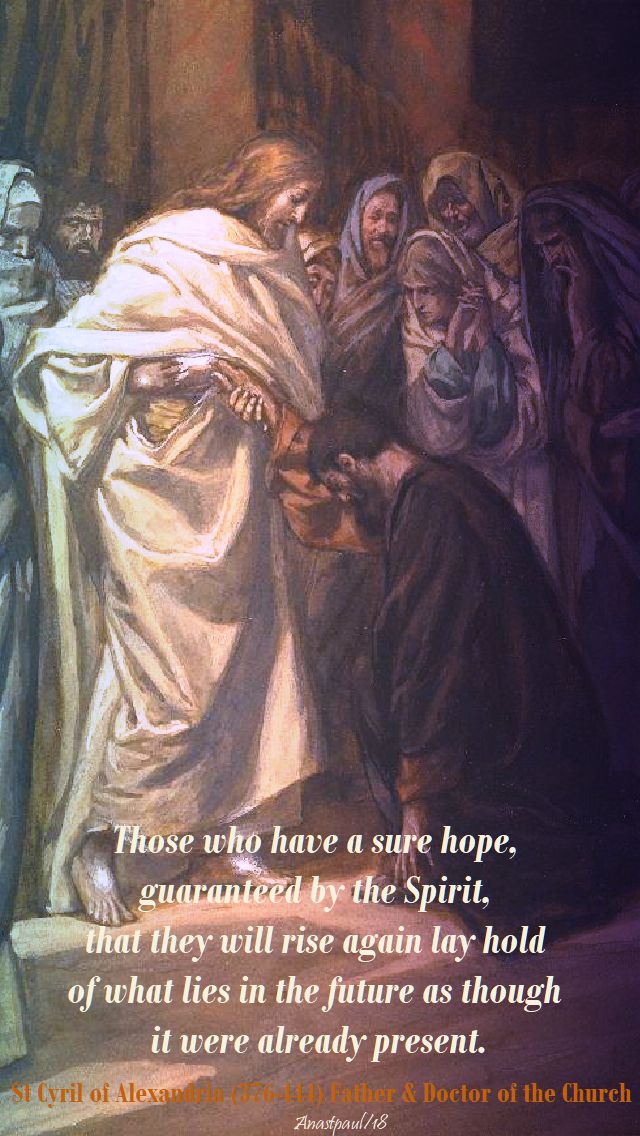
“Those who have a sure hope, guaranteed by the Spirit, that they will rise again lay hold of what lies in the future as though it were already present.

They say: “Outward appearances will no longer be our standard in judging other men. Our lives are all controlled by the Spirit now and are not confined to this physical world that is subject to corruption.   The light of the Only-begotten has shone on us and we have been transformed into the Word, the source of all life.   While sin was still our master, the bonds of death had a firm hold on us but now, that the righteousness of Christ has found a place in our hearts, we have freed ourselves from our former condition of corruptibility”.

This means that none of us lives in the flesh anymore, at least not in so far as living in the flesh means being subject to the weaknesses of the flesh, which include corruptibility.   Once we thought of Christ as being in the flesh but we do not do so any longer, says Saint Paul [2 Corinthians 5:16].   By this he meant that the Word became flesh and dwelt among us;  He suffered death in the flesh in order to give all men life.

It was in this flesh that we knew Him before but we do so no longer.   Even though He remains in the flesh, since He came to life again on the third day and is now with His Father in heaven, we know that He has passed beyond the life of the flesh, for having died once, He will never die again, death has no power over Him any more.   His death was a death to sin, which He died once for all;  His life is life with God [Romans 6:9].

Since Christ has in this way become the source of life for us, we who follow in His footsteps must not think of ourselves as living in the flesh any longer but as having passed beyond it.   Saint Paul’s saying is absolutely true that when anyone is in Christ he becomes a completely different person:  his old life is over and a new life has begun [2 Cor. 5:17].

We have been justified by our faith in Christ and the power of the curse has been broken. Christ’s coming to life again for our sake has put an end to the sovereignty of death.   We have come to know the true God and to worship Him in spirit and in truth, through the Son, our mediator, who sends down upon the world the Father’s blessings.

And so Saint Paul shows deep insight when He says:  This is all God’s doing:  it is He who has reconciled us to Himself through Christ.   For the mystery of the incarnation and the renewal it accomplished could not have taken place without the Father’s will.   Through Christ we have gained access to the Father, for as Christ himself says, no one comes to the Father except through Him.   This is all God’s doing, then.   It is He who has reconciled us to Himself through Christ and who has given us, the ministry of reconciliation.”those who have sure hope - st cyril of alexandria - easter thursday - 5 april 2018

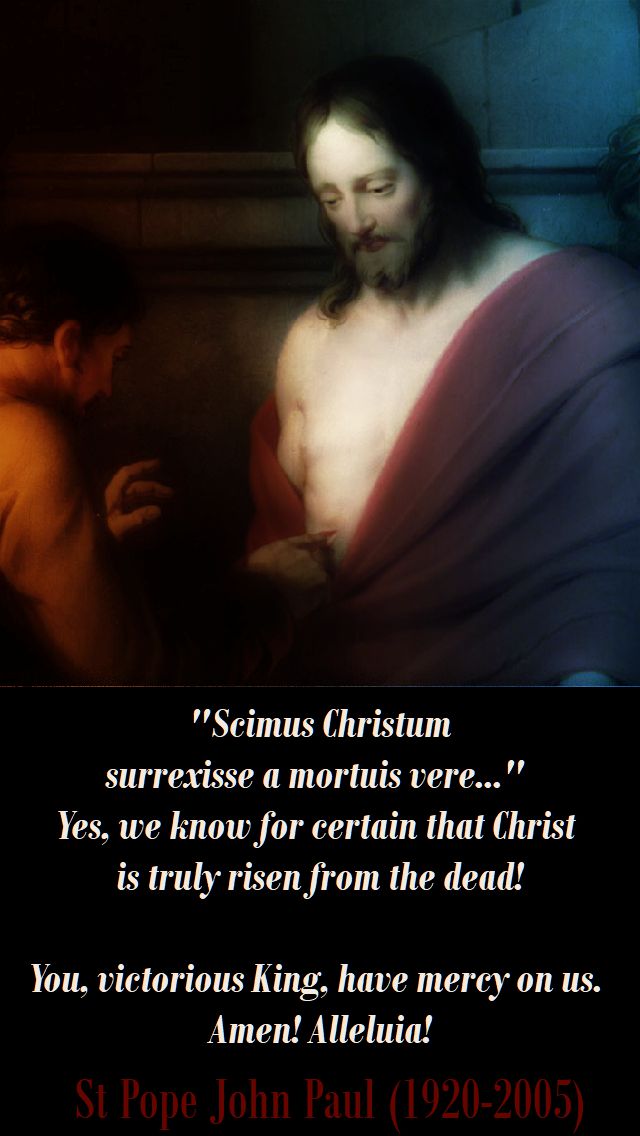
“The One who from nothingness had called the world into existence, only He could break the seals of the tomb, only He could become the source of New Life for us, who are subject to the universal law of death.   “Who will roll away the stone for us from the door of the tomb?” (Mk 16:3), the women were asking one another, when very early they were going to the tomb where the Lord had been laid.   To this question, asked by the people of every age, of every country, culture and continent, the Bishop of Rome replies, this year too, with the message “Urbi et Orbi”:

“Scimus Christum surrexisse a mortuis vere…”   Yes, we know for certain that Christ is truly risen from the dead.   You, victorious King, have mercy on us.   Amen! Alleluia!”

St Pope John Paul – 10 April 1996

yes we know for certain that christ is truly risen - st john paul - easter thursday - 5 april 2018


Posted in DOCTORS of the Church, EASTER, FATHERS of the Church, FEASTS and SOLEMNITIES, MORNING Prayers, PAPAL SERMONS, QUOTES - J R R Tolkien and MORE, QUOTES of the SAINTS, SPEAKING of ....., The RESURRECTION

Quote/s of the Day – 5 April – Easter Thursday Fifth Day in the Easter Octave

Quote/s of the Day – 5 April – Easter Thursday Fifth Day in the Easter Octave

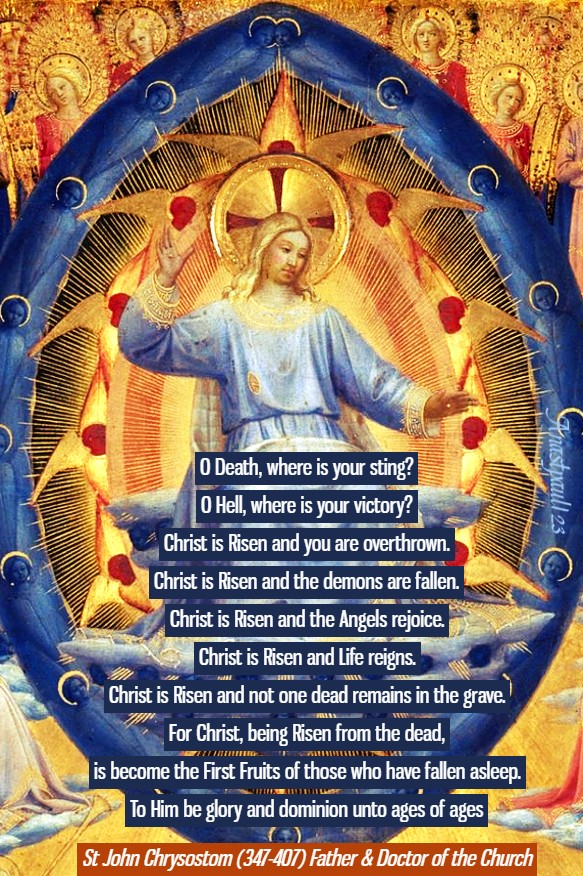
O Death, where is your sting?
O Hell, where is your victory?
Christ is Risen and you are overthrown.
Christ is Risen and the demons are fallen.
Christ is Risen and the Angels rejoice.
Christ is Risen and Life reigns.
Christ is Risen and not one dead remains in the grave.
For Christ, being Risen from the dead,
is become the First Fruits of those who have fallen asleep.
To Him be glory and dominion unto ages of ages.

St John Chrysostom (347-407)
Father & Doctor of the Church

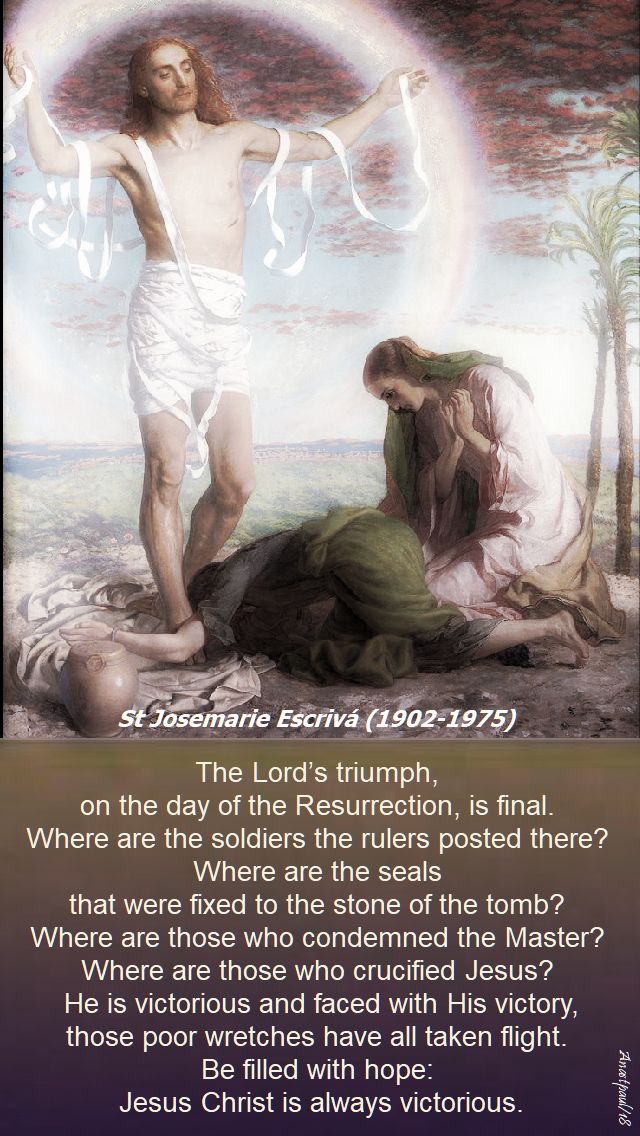
The Lord’s triumph, on the day of the Resurrection, is final.
Where are the soldiers the rulers posted there?
Where are the seals that were fixed to the stone of the tomb?
Where are those who condemned the Master?
Where are those who crucified Jesus?
He is victorious and faced with His victory,
those poor wretches have all taken flight.
Be filled with hope:
Jesus Christ is always victorious.”

St Josemarie Escrivá (1902-1975), The Forge, 660the lord triumph on the day of the resurrection is final - st josemaria - easter thursday 5 april 2018

Posted in DOMINICAN OP, EASTER, MORNING Prayers, QUOTES of the SAINTS, QUOTES on CHARITY, QUOTES on HUMILITY, SAINT of the DAY, The WORD

One Minute Reflection – 5 April – Easter Thursday and the Memorial of St Vincent Ferrer (1350-1419)

One Minute Reflection – 5 April – Easter Thursday and the Memorial of St Vincent Ferrer (1350-1419)

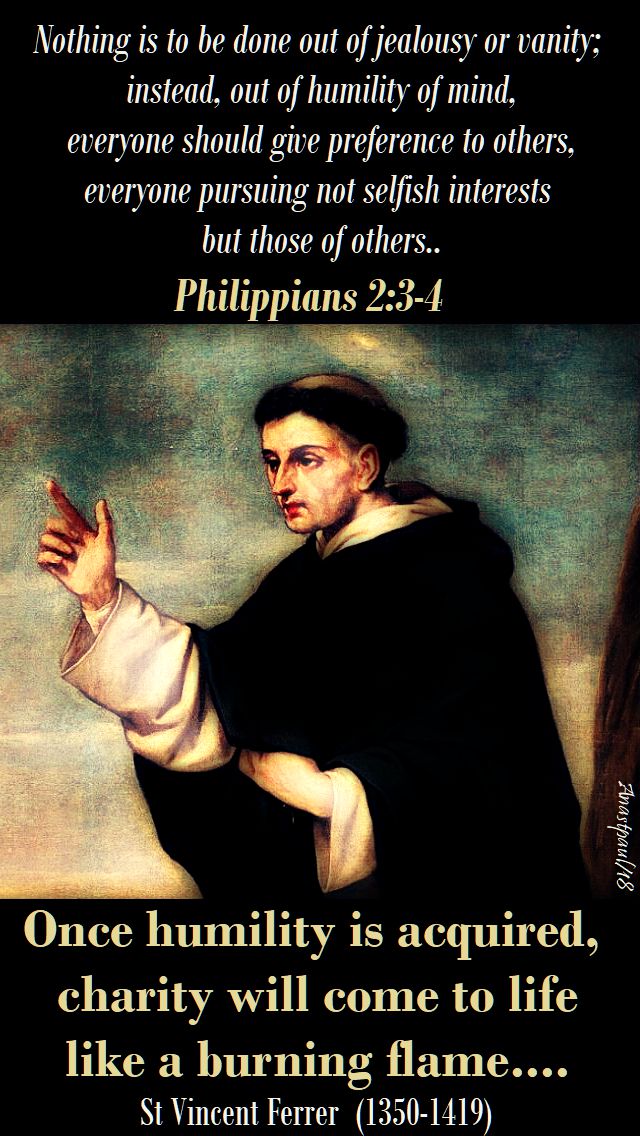
Nothing is to be done out of jealousy or vanity; instead, out of humility of mind everyone should give preference to others, everyone pursuing not selfish interests but those of others...Philippians 2:3-4

REFLECTION – “Once humility is acquired, charity will come to life like a burning flame devouring the corruption of vice and filling the heart so full, that there is no place for vanity.”…once humility is acquired - st vincent ferrer - 5 april 2018

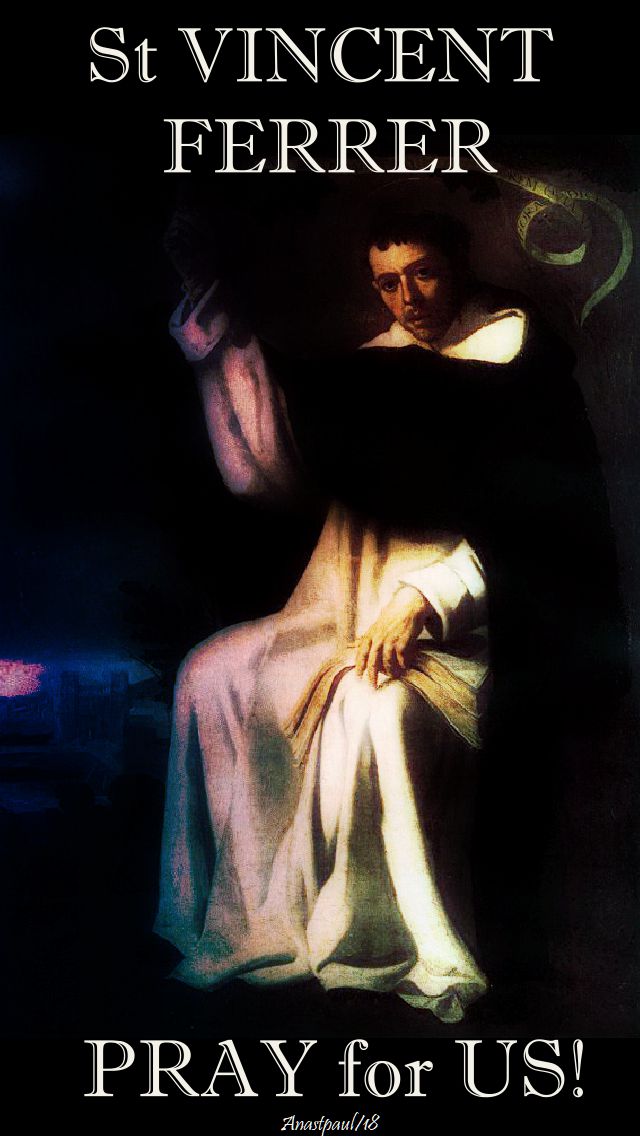
PRAYER – Lord God, who sent St Vincent Ferrer to preach the Gospel of Christ, grant that we may see the Son of Man reigning in heaven, whom he proclaimed as Judge of Mankind. Grant that by the prayers of St Vincent, we may attain true humility and charity to all we meet. We make our prayer through our Lord, Jesus in unity with the Holy Spirit, one God, forever amen.st vincent ferrer - pray for us - 5 APRIL 2018

Posted in DOMINICAN OP, EASTER, MORNING Prayers, PRAYERS of the SAINTS, SAINT of the DAY

Our Morning Offering – 5 April – Easter Thursday and the Memorial of St Vincent Ferrer (1350-1419)

Our Morning Offering – 5 April – Easter Thursday and the Memorial of St Vincent Ferrer (1350-1419)

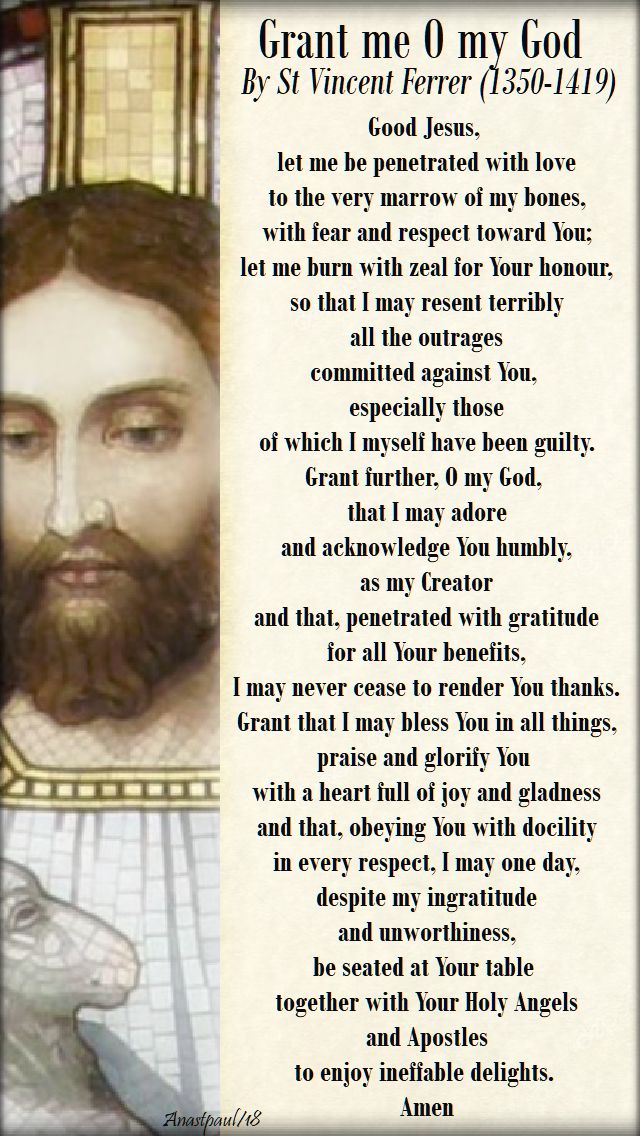
Grant me O my God
By St Vincent Ferrer

Good Jesus,
let me be penetrated with love
to the very marrow of my bones,
with fear and respect toward You;
let me burn with zeal for Your honour,
so that I may resent terribly all the outrages
committed against You, especially those
of which I myself have been guilty.
Grant further, O my God,
that I may adore
and acknowledge You humbly, as my Creator
and that, penetrated with gratitude
for all Your benefits,
I may never cease to render You thanks.
Grant that I may bless You in all things,
praise and glorify You
with a heart full of joy and gladness
and that, obeying You with docility
in every respect, I may one day,
despite my ingratitude and unworthiness,
be seated at Your table
together with Your Holy Angels and Apostles
to enjoy ineffable delights.
Amengood jesus let me be penetrated with love - st vincent ferrer - 5 april 2018

Posted in DOMINICAN OP, Of BUILDERS, CONSTRUCTION WORKERS, Of FISHERMEN, FISHMONGERS, PATRONAGE - PRISONERS, SAINT of the DAY

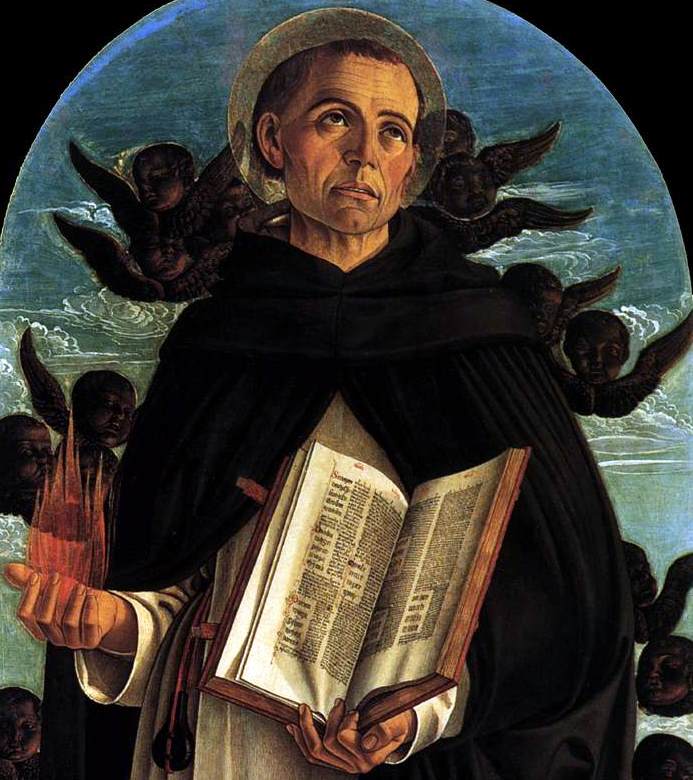
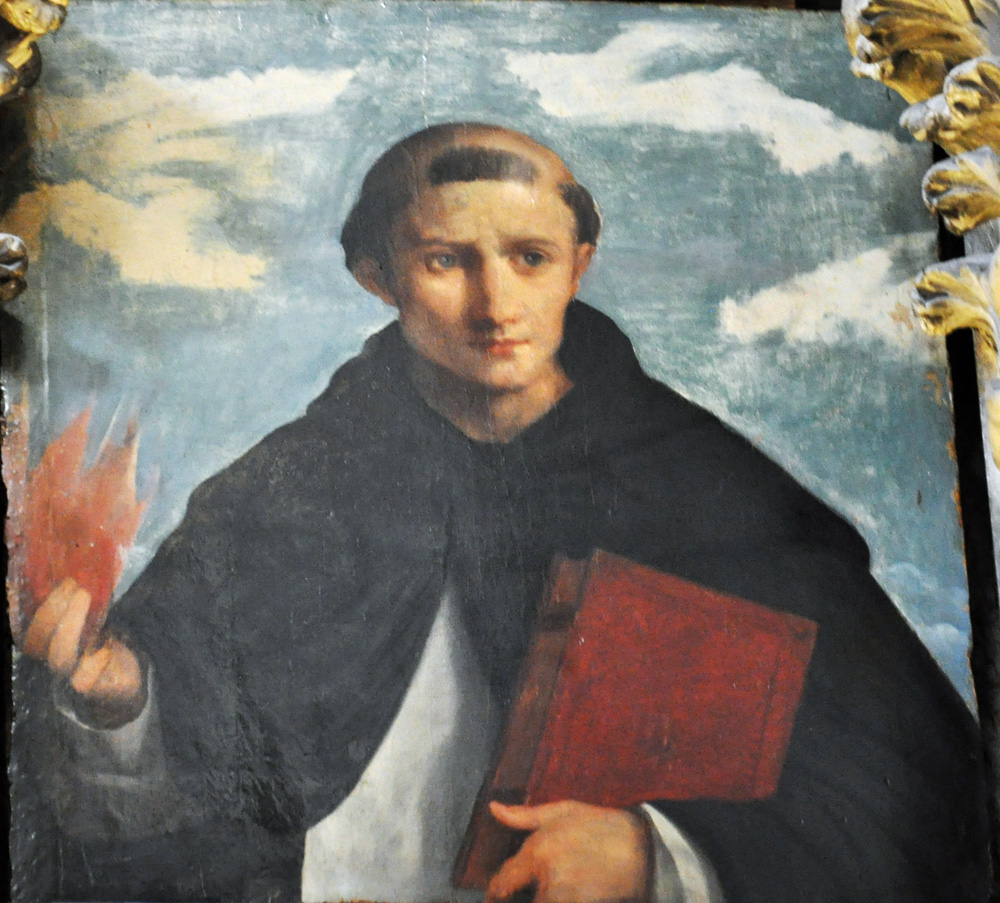
Saint of the Day – 5 April – St Vincent Ferrer O.P. (1350-1419)

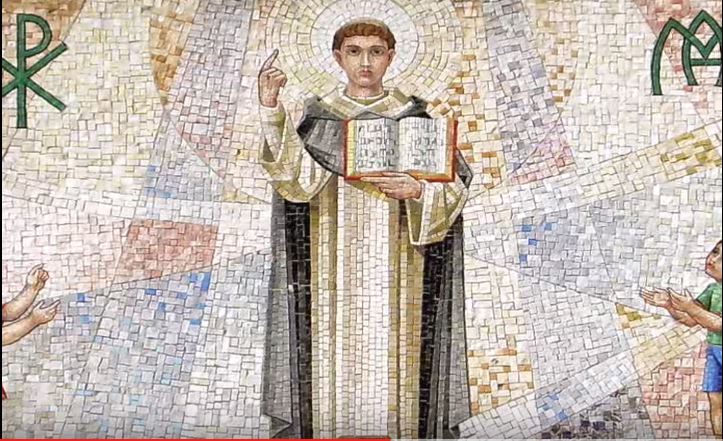
Saint of the Day – 5 April – St Vincent Ferrer O.P. (1350-1419), called the “Angel of the Apocalypse/The Last Judgement” and the “The Mouthpiece of God.”- Dominican Priest, Missionary, Master of Sacred Theology, Philosopher, Teacher, Preacher, Logician, Apostle of Charity – born on 23 January 1350 in Valencia (part of modern Spain) and died on 5 April 1419 at Vannes, Brittany, France of natural causes.   His remains are interred in the Cathedral of Vannes.   Patronages – Archdiocese of Valencia, Builders, Prisoners, Construction workers, Plumbers, Fishermen, Spanish orphanages, Calamonaci, Italy, Casteltermini, Agrigento, Italy, Leganes, Philippines, Orihuela-Alicante, Spain, diocese of.   st vincent ferrer - header

St Vincent was born in Valencia, Spain.   However, even in utero he was performing miracles.   His mother visited a blind woman she often helped.   The lady placed her head on the mother’s womb to hear the baby’s heart beat and was instantly healed of her blindness.   The entire city was quite animated at his birth and their town square argument over his name had to be settled by the local bishop who recommended he share the name of the city’s patron saint (St Vincent of Zaragosa, a third century martyr, died 304).   Before St Vincent was three months old, Valencia was struck by a terrible famine.   The infant spoke in a perfectly intelligible manner to his mother, informing her that all the townspeople needed to carry a venerated statue in procession about the city to end the famine.   No sooner had the procession begun than rain began to fall and the famine was broken.

From his tenderest years, it was clear that God was calling St Vincent to serve Him at His Altar.   The boy was gifted with great intelligence and even more profound piety.   When Vincent joined the Dominicans, he zealously practiced penance, study and prayer.   He was a teacher of philosophy and a naturally gifted preacher called the “Mouthpiece of God.”   His saintly life was what made his preaching so effective.   Vincent’s subjects were judgement, heaven, hell and the need for repentance.  Soon he was teaching and preaching all over Spain.

But at this time, three men claimed to be pope in the 1300s and 1400s.   Kings, princes, priests and laypeople fought one another to support the different claimants for the Chair of Peter.   This chaos led to the Western Schism and then God raised up Vincent Ferrer.saint-vincent-ferrer-large

Even the holiest people can be misled.   Pope Urban VI was the real pope and lived in Rome but Vincent and many others thought that Clement VII and his successor Benedict XIII, who lived in Avignon, France, were the true popes.   Vincent convinced kings, princes, clergy and almost all of Spain to give loyalty to them.   After Clement VII died, Vincent tried to get both Benedict and the pope in Rome to abdicate so that a new election could be held.  Vincent returned to Benedict in Avignon and asked him to resign.   Benedict refused.

Vincent came to see the error in Benedict’s claim to the papacy.   Discouraged and ill, Vincent begged Christ to show him the truth.   In a vision, he saw Jesus with Saint Dominic and Saint Francis, commanding him to “go through the world preaching Christ.” For the next twenty years he travelled to England, Scotland, Ireland, Aragon, Castile, France, Switzerland and Italy, preaching the Gospel and converting many.   Many biographers believe that he could speak only Valencian but was endowed with the gift of tongues.   St Vincent also had great success in preaching to the Moors and Jews.   Countless converts came into the Church and on one single day he converted more than five thousand Jews.   His spiritual success was even more fruitful among Catholics. Hatreds, envies, wars and other divisions were all brought to an abrupt end under his guidance.   Once he raised a woman from the dead so that she could testify to all present that he was indeed the Angel of the Apocalypse (cf. Apco 14:6), sent by God to call a world seeped in sin to repentance.  He preached to St Colette of Corbie and to her nuns and it was she who told him that he would die in France.   Too ill to return home to Spain, he did, indeed, die in Brittany in 1419, at the age of sixty-nine.   Breton fishermen still invoke his aid in storms.   Vincent spread the Good News throughout Europe.   He fasted, preached, worked miracles and drew many people to become faithful Christians.

One day while Benedict was presiding over an enormous assembly, Vincent, though close to death, mounted the pulpit and denounced him as the false pope.   He encouraged everyone to be faithful to the one, true Catholic Church in Rome.   Benedict fled, knowing his supporters had deserted him.    The Great Western Schism was finally ended in 1417 when all the world universally acknowledged Martin V as rightful pope.

St Vincent was canonised by Pope Calixtus III on 3 June 1455.Palma il Vecchio, St. Vincent Ferrer, ca. 1523

Posted in DOMINICAN OP, SAINT of the DAY

Memorials of the Saints – 5 April

St Vincent Ferrer O.P. (1350-1419) (Optional Memorial)

St Albert of Montecorvino
Bl Antonius Fuster
St Becan
Bl Blasius of Auvergne
St Claudius of Mesopotamia
St Derferl Gadarn
St Gerald of Sauve-Majeure
St Irene of Thessalonica
St Maria Crescentia Hoss
St Mariano de la Mata Aparicio
St Pausilippus
Bl Peter Cerdan
St Theodore the Martyr
St Zeno the Martyr

Martyrs of Lesbos: 5 saints – Five young Christian women martyred together for their faith. We don’t even know their names. island of Lesbos, Greece.

Martyrs of North-West Africa: Large group of Christians murdered while celebrating Easter Mass during the persecutions of Genseric, the Arian king of the Vandals. They were martyred in 459 at Arbal (in modern Algeria).

Martyrs of Seleucia: 120 saints – One-hundred and eleven (111) men and nine (9) women who, because they were Christians, were dragged to Seleucia and martyred for refusing to worship the sun or fire or other pagan idols during the persecutions of King Shapur II. They were burned alive in 344 in Seleucia, Persia.

Posted in EASTER, MORNING Prayers, QUOTES - J R R Tolkien and MORE, QUOTES of the SAINTS, The RESURRECTION, The WORD

Second Thoughts for the Day – 4 April – Easter Wednesday, the Fourth day in the Octave of Easter

Second Thoughts for the Day – 4 April – Easter Wednesday, the Fourth day in the Octave of Easter

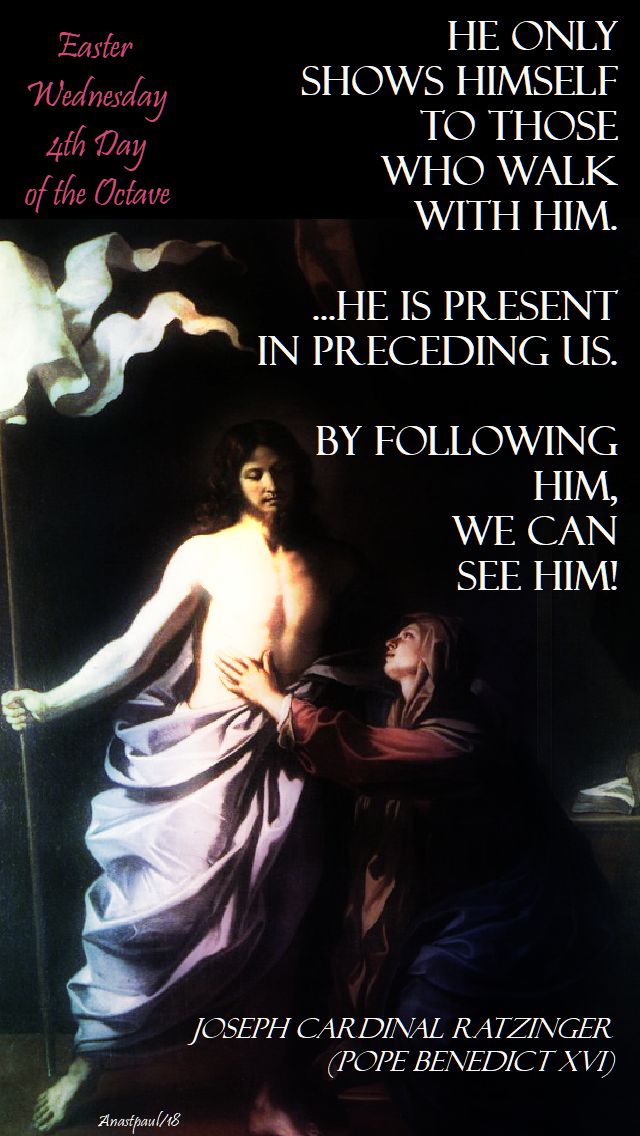
“He is not here, he is going before you to Galilee; there you will see him” (Mk 16:6)

“There is another important aspect (in the Resurrection):  Jesus show Himself in the act of departure.

This is clearest in the event of Emmaus and in His meeting with Mary Magdalen.   He summons us to go with Him.

Resurrection is not an indulgence of curiosity – it is MISSION.   It’s intention is to transform the world!   It calls for an active joy, the joy of those who are themselves going along the path of the Risen One.

That is true today too – He only shows Himself to those who walk with Him.  The angel’s first word to the women was “He is not here, he is going before you to Galilee; there you will see him” (Mk 16:6).   So once and for all, we are told where the Risen One is to be found and how we are to meet Him – HE GOES BEFORE YOU.   He is present in preceding us.

By following Him, we can see Him!”

Joseph Cardinal Ratzinger (Pope Benedict XVI)
The Word of the Witnesses – Seek that Which is Abovehe only shows himself - pope benedict - joseph ratzinger - easter wed - 4 april 2018 - no 2 with octave note

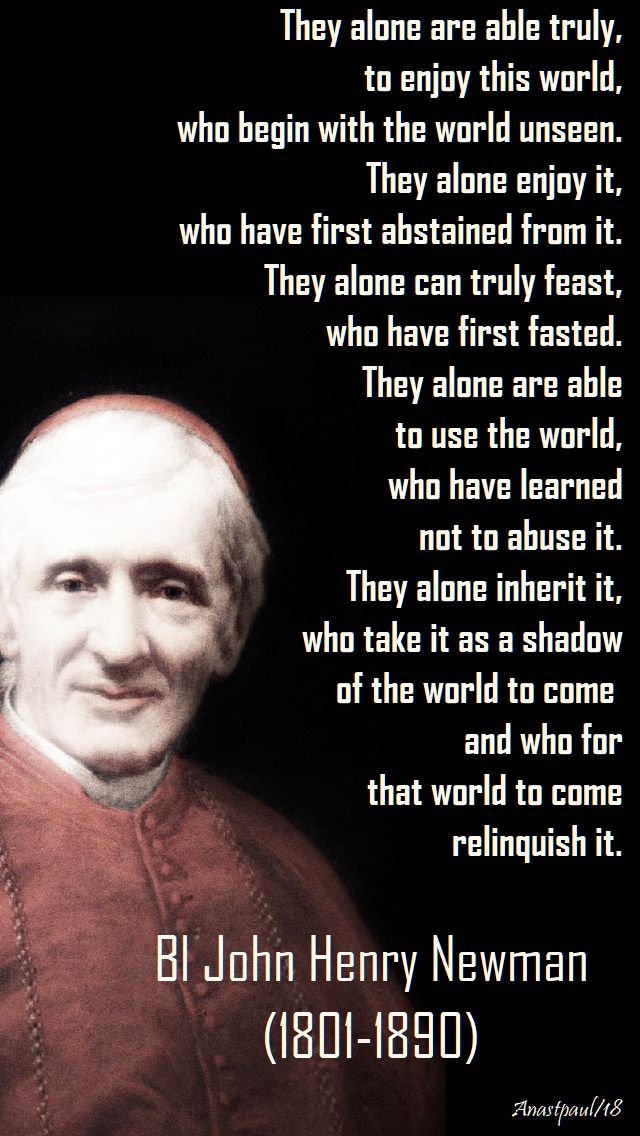
“They alone are able truly, to enjoy this world, who begin with the world unseen. They alone enjoy it, who have first abstained from it.   They alone can truly feast, who have first fasted.   They alone are able, to use the world, who have learned not to abuse it.   They alone inherit it, who take it as a shadow, of the world to come and who for that world to come relinquish it.”

Look at the cross of Christ – Blessed John Henry Newman  (1801-1890)THEY ALONE ARE ABLE TRULY - BL JOHN HENRY NEWMAN 0 4 APRIL EASTER WED 2018

Posted in EASTER, MORNING Prayers, QUOTES of the SAINTS, QUOTES on CHARITY, QUOTES on JUSTICE, QUOTES on the DEVIL/EVIL, SAINT of the DAY

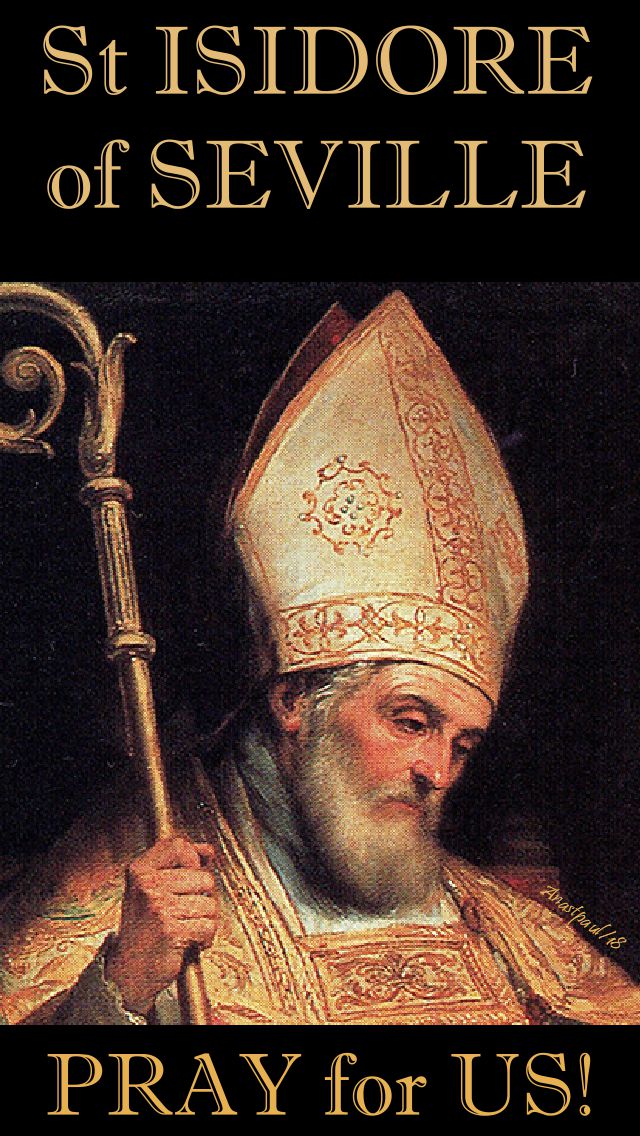
Thought for the Day – 4 April – Easter Wednesday and the Memorial of St Isidore of Seville (560-636) Father & Doctor of the Church

Thought for the Day – 4 April – Easter Wednesday and the Memorial of St Isidore of Seville (560-636) Father & Doctor of the Church

The 76 years of Isidore’s life were a time of conflict and growth for the Church in Spain. The Visigoths had invaded the land a century and a half earlier and shortly before Isidore’s birth they set up their own capital.   They were Arians—Christians who said Christ was not God.   Thus, Spain was split in two:  one people (Catholic Romans) struggled with another (Arian Goths).   Isidore reunited Spain, making it a centre of culture and learning.   The country served as a teacher and guide for other European countries whose culture was also threatened by barbarian invaders.

In 599, Isidore became bishop of Seville and for thirty-seven years led the Spanish church through a period of intense religious development..  Isidore also organised representative councils that established the structure and discipline of the church in Spain.   At the Council of Toledo in 633 he obtained a decree that required the establishment of a school in every diocese.   Reflecting the saint’s broad interests, the schools taught every branch of knowledge, including the liberal arts, medicine, law, Hebrew, and Greek.    Isidore was an amazingly learned man and is called “The Schoolmaster of the Middle Ages.”   The encyclopedia he wrote was used as a textbook for nine centuries in so many schools which he had founded.   AND he required seminaries to be built in every diocese, wrote a Rule for religious orders and founded schools that taught every branch of learning.   Isidore wrote numerous books, including a dictionary, an encyclopedia, a history of Goths and a history of the world—beginning with creation!   He also wrote a dictionary of synonyms, brief biographies of illustrious men, treatises on theological and philosophical subjects.  He completed the Mozarabic liturgy, which is still in use in Toledo, Spain.   For all these reasons, Isidore has been suggested as patron of the Internet.    Several others—including Anthony of Padua—also have been suggested.

Throughout his long life, Isidore lived austerely so that he could give to the poor and he continued his austerities even as he approached age 80.   During the last six months of his life, he increased his charities so much that his house was crowded from morning till night with the poor of the countryside.  But while Isidore had compassion for needy, he thought they were better off than their oppressors, as he explains in this selection:

“We ought to sorrow for people who do evil rather than for people who suffer it.   The wrongdoing of the first leads them further into evil.   The others’ suffering corrects them from evil.   Through the evil wills of some, God works much good in others.   Some people, resisting the will of God, unwittingly do His purpose.   Understand then that so truly are all things subject to God that even those who oppose His law nevertheless fulfil His will.

Evil men are necessary so that through them the good may be scourged when they do wrong…Some simple men, not understanding the dispensation of God, are scandalised by the success of evil men.   They say with the prophet:  “Why does the way of the wicked prosper?”   Those who speak thus should not wonder to see the frail temporal happiness of the wicked.   Rather they should consider the final end of evil men and the everlasting torments prepared for them.   As the prophet says:  “They spend their days in wealth and in a moment they go down to hell.”

Shortly before his death, Isidore had two friends clothe him in sackcloth and rub ashes on his head so that he could come before God as a poor penitent.   He died peacefully at Seville in 636.

Our society can well use Isidore’s spirit of combining learning and holiness.   Loving, understanding and knowledge can heal and bring a broken people back together.   We are not barbarians like the invaders of Isidore’s Spain.   But people who are swamped by riches and overwhelmed by scientific and technological advances can lose much of their understanding love for one another.

St Isidore, pray for the whole Church, the whole world, for us all, amen!st isidore - pray for us no 2 - 4 april 2018

Posted in CONFESSION/PENANCE, DOCTORS of the Church, EASTER, FATHERS of the Church, FEASTS and SOLEMNITIES, MORNING Prayers, QUOTES of the SAINTS, QUOTES on FAITH, QUOTES on FORGIVENESS, QUOTES on the CHURCH, SAINT of the DAY

Quote/s of the Day – 4 April – Easter Wednesday and the Memorial of St Isidore of Seville (560-636) Father & Doctor of the Church

Quote/s of the Day – 4 April – Easter Wednesday and the Memorial of St Isidore of Seville (560-636) Father & Doctor of the Church

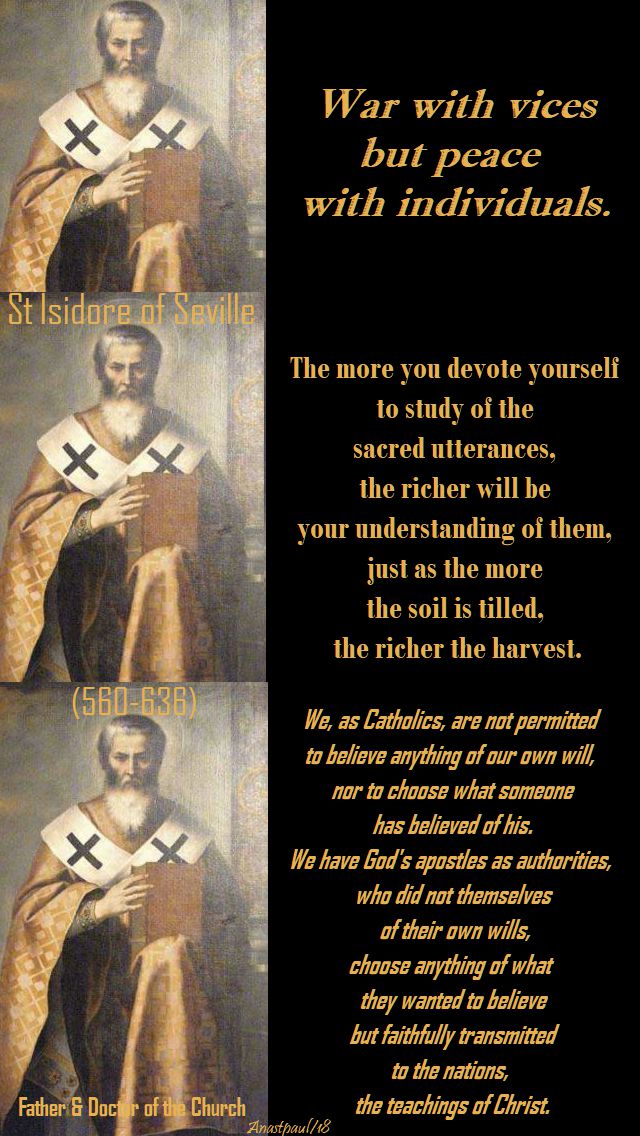
“War with vices
but peace with individuals.”

“The more you devote yourself
to study of the sacred utterances,
the richer will be your understanding of them,
just as the more the soil is tilled,
the richer the harvest.”

“We, as Catholics, are not permitted
to believe anything of our own will,
nor to choose what someone has believed of his.
We have God’s apostles as authorities,
who did not themselves of their own wills,
choose anything of what they wanted to believe
but faithfully transmitted to the nations,
the teachings of Christ.”war with vices...the more you devote yourself...we, as catholics - st isidore - 4 april 2018

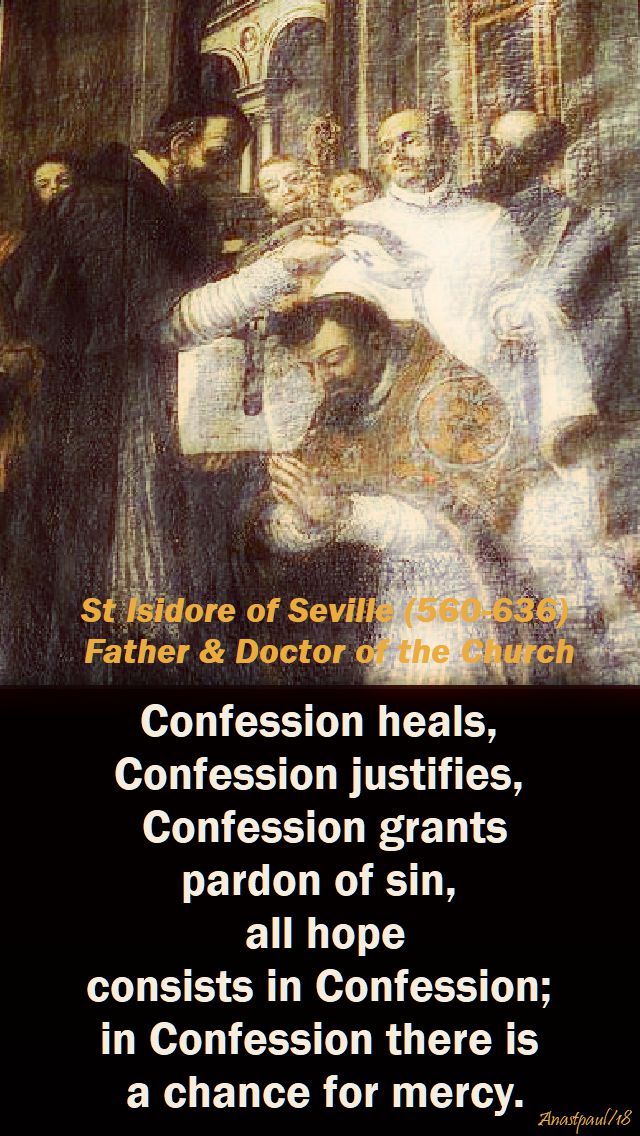
“Confession heals,
Confession justifies,
Confession grants pardon of sin,
all hope consists in Confession;
in Confession there is
a chance for mercy.”

St Isidore of Seville (560-636) Father & Doctor of the Churchconfession heals - st isidore - 4 april 2018

Posted in EASTER, MORNING Prayers, QUOTES on SUFFERING, The WORD

One Minute Reflection – 4 April – Easter Wednesday and the Memorial of St Isidore of Seville (560-636) Father & Doctor of the Church

One Minute Reflection – 4 April – Easter Wednesday and the Memorial of St Isidore of Seville (560-636) Father & Doctor of the Church

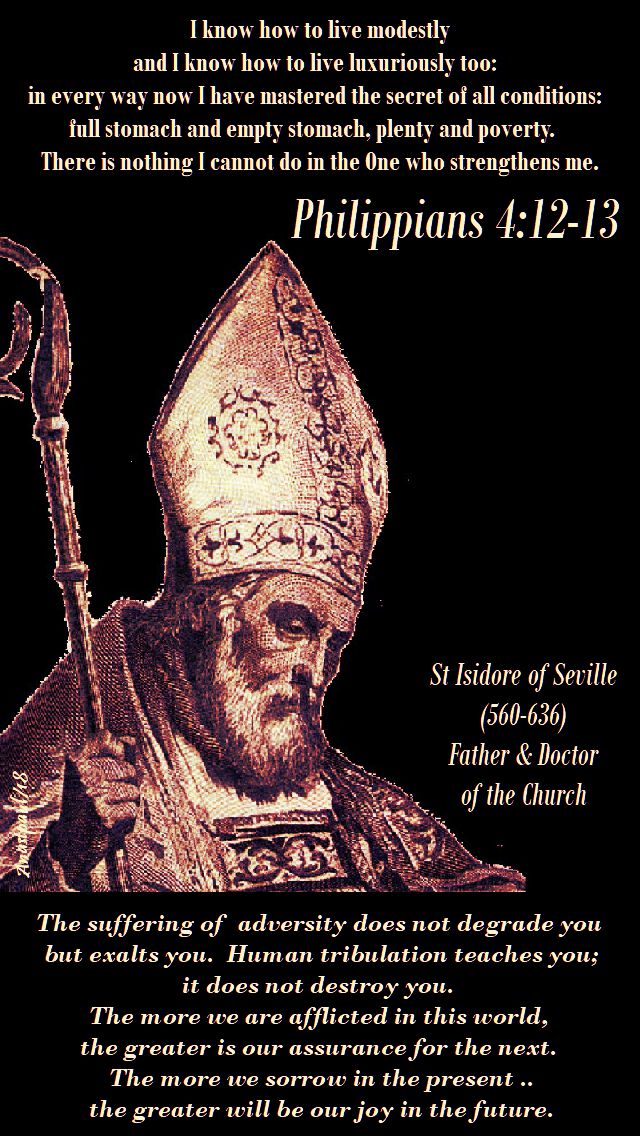
I know how to live modestly and I know how to live luxuriously too:  in every way now I have mastered the secret of all conditions:  full stomach and empty stomach, plenty and poverty.   There is nothing I cannot do in the One who strengthens me…Philippians 4:12-13

REFLECTION – “The suffering of adversity does not degrade you but exalts you.   Human tribulation teaches you, it does not destroy you.   The more we are afflicted in this world, the greater is our assurance for the next.   The more we sorrow in the present, ..the greater will be our joy in the future.”…St Isidore of Seville (560-636) Father & Doctor of the Churchthe suffering of adversity - st isidore - 4 april 2018the more we are afflicted in this world - st isidore - 2017

PRAYER – Graciously hear the prayers, O Lord, which we make in commemoration of Saint Isidore, that we and Your Church may be aided by his intercession, just as she has been instructed by his heavenly teaching. Through our Lord Jesus Christ, your Son, who lives and reigns with you in the unity of the Holy Spirit, one God, for ever and ever. Amen.st isidore - pray for us - 4 april 2018

Posted in DOCTORS of the Church, EASTER, FATHERS of the Church, MORNING Prayers, PRAYERS for VARIOUS NEEDS, PRAYERS of the SAINTS

Our Morning Offering – 4 April – Easter Wednesday

Our Morning Offering – 4 April – Easter Wednesday

O God of Our Life
St Augustine (354-430)
Father & Doctor of the Church

God of our life,
there are days when the burdens we carry
chafe our shoulders and weigh us down;
when the road seems dreary and endless,
the skies gray and threatening;
when our lives have no music in them
and our hearts are lonely
and our souls have lost their courage.
Flood the path with light,
run our eyes to where the skies are full of promise;
tune our hearts to brave music;
give us the sense of comradeship
with heroes and saints of every age;
and so quicken our spirits
that we may be able to encourage the souls of all
who journey with us on the road of life,
to your honour and glory.
Amengod of our life there are days when the burdens - st augustine - 4 april 2018

Posted in franciscan OFM, INCORRUPTIBLES, SAINT of the DAY

Saint of the Day – 4 April – St Benedict of Sicily O.F.M. (1526-1589)

Saint of the Day – 4 April – St Benedict of Sicily O.F.M. (1526-1589) Religious Friar, Confessor, apostle of charity – also known as Benedict of Palermo, Benedict the Moor – born in 1526 at Messina, Italy on the estate of Chevalier de Lanza a San Fratello – died in 1589 of natural causes.   His body was reported incorrupt when exhumed several years later.   Patronages – African missions;  African Americans; black missions; black people; Palermo;  San Fratello; Sicily.SOD-0403-SaintBenedicttheMoor-790x480

St Benedict was born of Moorish parents who were slaves on an estate near Messina, Sicily.   Though of the lowest social rank, they possessed true nobility of heart and mind. As a baby Benedict was freed by his master and as a young boy he showed such a devout and gentle disposition that he was called the “holy Moor.”

While working in the fields one day some neighbours taunted him on account of his race and parentage.   His meek demeanour greatly impressed a Franciscan hermit who was passing by and who uttered the prophetic words: “You ridicule a poor Moor now;  before long you will hear great things of him.”

Wishing to join these hermits Benedict sold his meagre belongings and gave the proceeds to the poor and then entered the community.   After the death of the superior, Benedict was chosen his successor, though greatly against his will.   When Pope Pius IV ordered all hermits to disband or join some Order, Benedict became a Friar Minor of the Observance at Palermo and was made a cook.   He was happy in this work since it enabled him to perform many little acts of kindness toward the others.   His brethren were greatly edified by the saintly cook, especially when they saw angels at times helping him in his work.   The Chapter of 1578 made him guardian, or superior, of the friary, though he protested that he was not a priest, in fact could neither read nor write.   He was a model superior, however, and won the esteem and obedience as well as the love of his subjects.ST BENEDICT OF SICILY.2

As superior he gave free rein to his love for the poor and no matter how openhanded he was, the food never seemed to give out.   After serving as superior he was made novice master and to this difficult post he brought gifts that were evidently infused:  he was able to instruct with an amazing knowledge of theology and to read the hearts of others.   Benedict corrected the friars with humility and charity.   Once he corrected a novice and assigned him a penance only to learn that the novice was not the guilty party.   Benedict immediately knelt down before the novice and asked his pardon.

In later life, Benedict was not possessive of the few things he used.   He never referred to them as “mine,” but always called them “ours.”   His gifts for prayer and the guidance of souls earned him throughout Sicily a reputation for holiness.   Following the example of St Francis, Benedict kept seven 40-day fasts throughout the year; he also slept only a few hours each night.

Capela_do_Divino_Espírito_Santo_em_Porto_Alegre_011-aa

At his request he was relieved of his office and again made cook but he was no longer an obscure Brother, for thousands flocked to the friary, seeking cures or alms or counsel and help.

He died after a brief illness, having foretold the hour of his death.   After Benedict’s death, King Philip III of Spain paid for a special tomb for this holy friar.  His veneration has spread throughout the world, and the African Americans of North America have chosen him their patron.   He was Beatified on 15 May 1743 by Pope Benedict XIV and Canonised on 24 May 1807 by Pope Pius VIII.ST BENEDICT OF SICILY

Posted in SAINT of the DAY

Memorials of the Saints – 4 April

St Isidore of Seville (c 560-636) (Optional Memorial) Father & Doctor of the Church

https://www.youtube.com/watch?v=cpZjdNDUYjY

Bl Abraham of Strelna
St Agathopus of Thessalonica
St Aleth of Dijon
St Benedict of Sicily O.F.M. (1526-1589)

St Gaetano Catanoso
Bl Giuseppe Benedetto Dusmet
St Gwerir of Liskeard
St Henry of Gheest
St Hildebert of Ghent
St Peter of Poitiers
St Plato
St Theodulus of Thessalonica
St Theonas of Egypt
St Tigernach of Clogher
St Zosimus of Palestine

Posted in EASTER, MORNING Prayers, QUOTES - J R R Tolkien and MORE, QUOTES on DEATH, QUOTES on ETERNAL LIFE, QUOTES on LOVE, The RESURRECTION

Thought for the Day – 3 April – Easter Tuesday in the Easter Octave 

Thought for the Day – 3 April – Easter Tuesday in the Easter Octave

On the Spiritual Resurrection of the Children of God

If you be risen with Christ, mind the things that are above, not the things that are upon the earth. – Colossians 3

Let us represent to ourselves Jesus Christ, rising glorious from the Sepulchre.

“Faith in the Risen One is faith in something that has really taken place.   Today, it is still true, that Christianity is neither legend nor fiction, not mere exhortation nor mere solution.   Faith stands on the firm basis of reality that has actually taken place.   Today too, in the words of Scripture, we can as it were, touch the Lord’s glorified wounds and say, with Thomas, in gratitude and joy – My Lord and my God! (Jn 20:28)

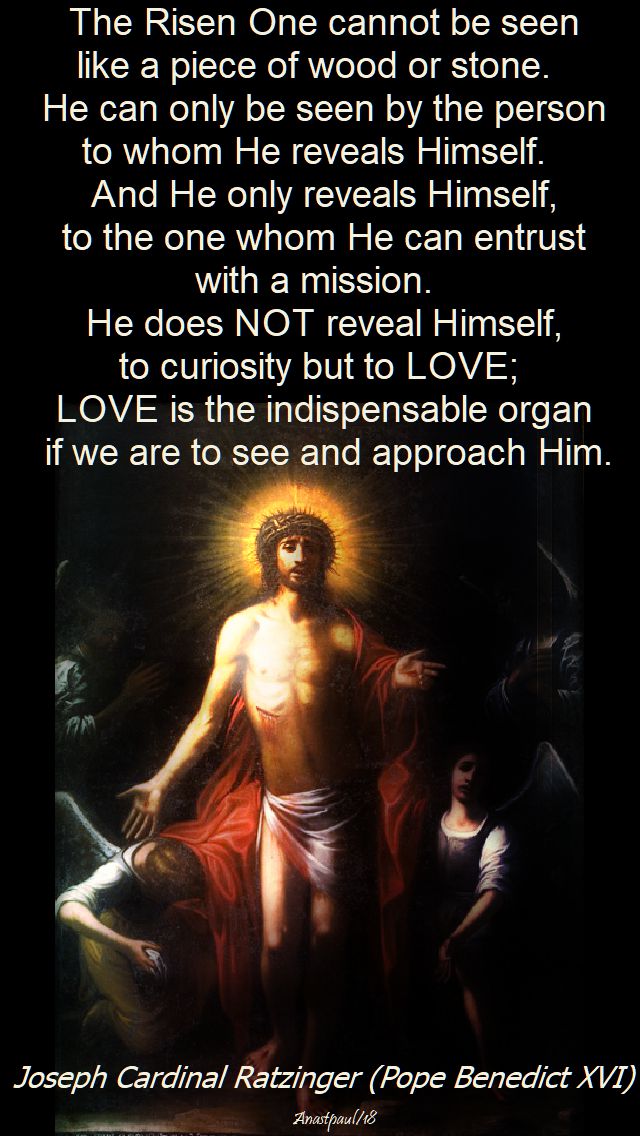
One question, however, continually arises at this point.   Not everyone saw the Risen Jesus.   Why not?   Why did He not go in triumph to the Pharisees and Pilate to show them that He was alive and to let them touch His scars?   But in asking such a question, we are forgetting that Jesus was not a resuscitated corpse like Lazarus and the boy of Naim.   They were allowed to return once more, to their erstwhile biological life, which sooner or later, would have to end, after all, with death.   What happened in Jesus’ case, was quite different – He did not return to the old life but began a new one, a life that is ultimate, no longer subject to nature’s law of death but standing in God’s freedom and hence final and absolute.   A life, therefore, that is no longer part of the realm of physics and biology, although it has integrated matter and nature into itself on a higher plane.  And that is why it is no longer within the ambit of our senses of touch and sight.   The Risen One cannot be seen like a piece of wood or stone.   He can only be seen by the person to whom He reveals Himself.   And He only reveals Himself, to the one whom He can entrust with a mission.   He does NOT reveal Himself, to curiosity but to LOVE;  LOVE is the indispensable organ if we are to see and approach Him.”

Joseph Cardinal Ratzinger (Pope Benedict XVI)

The Word of the Witnesses – Seek that Which is Above (1985)

the risen one cannot be seen like a piece of wood or a stone - ratzinger - benedict - 3 april 2018

Posted in DOCTORS of the Church, EASTER, FATHERS of the Church, FEASTS and SOLEMNITIES, MORNING Prayers, QUOTES of the SAINTS, QUOTES on CONVERSION, QUOTES on FAITH, QUOTES on LOVE, QUOTES on PRAYER, QUOTES on REPENTANCE, QUOTES on SANCTITY, QUOTES on TRUST and complete CONFIDENCE in GOD, SPEAKING of .....

Quote/s of the Day – 3 April – Tuesday in the Easter Octave – Speaking of….. Seeking Sanctity from the Wisdom St Augustine

Quote/s of the Day – 3 April – Tuesday in the Easter Octave 
Speaking of ….. Seeking Sanctity from the Wisdom of St Augustine

Lord, teach me to know You
and to know myself.lord, teach me to know you and to know myself - st augustine - 3 april 2018

A Christian is:
a mind through which Christ thinks,
a heart through which Christ loves,
a voice through which Christ speaks
and a hand through which Christ helps.a cchristian is a mind through which christ thinks - st augustine - 3 april 2018

As the soul is the life of the body,
so God is the life of the soul.
As, therefore, the body perishes
when the soul leaves it,
so the soul dies
when God departs from it.as the soul is the life of the body - st augustine - 3 april 2018

For grace is given not because
we have done good works
but in order that,
we may be able,
to do them.for grace is given - st augustine - 3 april 2018

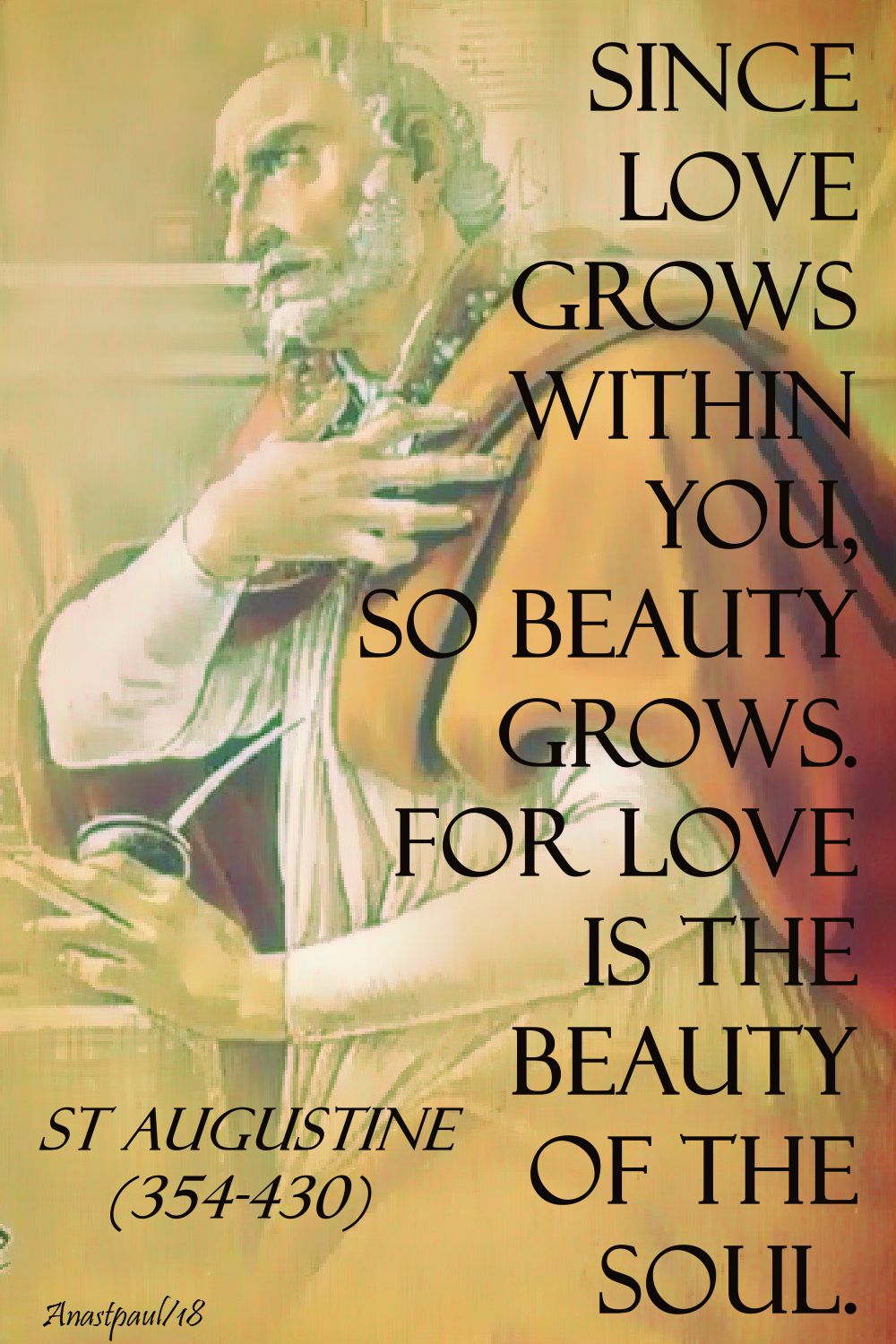
Since love grows within you,
so beauty grows.
For love is the beauty of the soul.

St Augustine (354-430) Father & Doctor of the Churchsince love grows within you - st augustine - 3 april 2018

Posted in EASTER, MORNING Prayers, QUOTES of the SAINTS, QUOTES on CHARITY, QUOTES on CONVERSION, QUOTES on FASTING, QUOTES on PRAYER, QUOTES on REPENTANCE, SAINT of the DAY, The APOSTLES & EVANGELISTS, The WORD

One Minute Reflection – 3 April – Easter Tuesday and The Memorial of St Richard of Chichester (1197-1253)

One Minute Reflection – 3 April – Easter Tuesday and The Memorial of St Richard of Chichester (1197-1253)

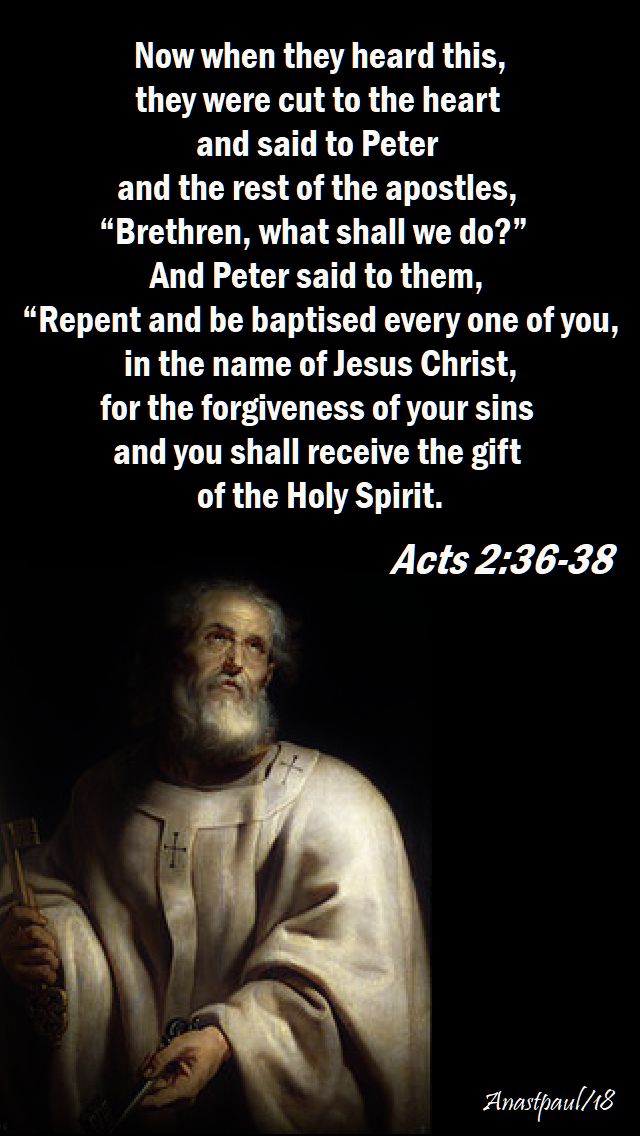
Now when they heard this, they were cut to the heart and said to Peter and the rest of the apostles, “Brethren, what shall we do?”   And Peter said to them, “Repent and be baptised every one of you, in the name of Jesus Christ, for the forgiveness of your sins and you shall receive the gift of the Holy Spirit...Acts 2:36-38acts 2 36-38

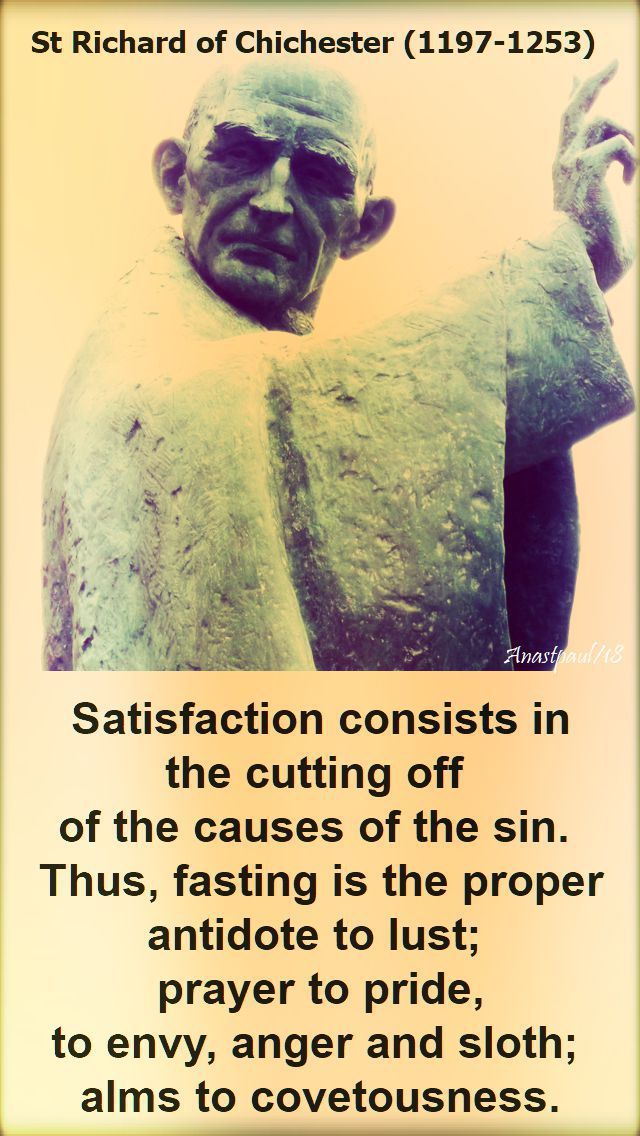
REFLECTION – “Satisfaction consists in the cutting off of the causes of the sin.   Thus, fasting is the proper antidote to lust; prayer to pride, to envy, anger and sloth; alms to covetousness.”…St Richard of Chichestersatisfaction consists in cutting off - st richard of chichester - 2017

PRAYER – Grant us O God, our Father, Your grace, that we may constantly work to repair the damage caused by our sin that we may seek forgiveness and then go forth to sin no more, always amending what earthly damage we have caused.   St Richard of Chichester, may your prayers, assist us on our journey to our heavenly home.   We make our prayer through our Lord Jesus Christ, in unity with the Holy Spirit, one God forever and ever, amen.st richard of chichester pray for us - 3 april 2018

Posted in MORNING Prayers, PRAYERS of the SAINTS, SAINT of the DAY

Our Morning Offering – 3 April – Easter Tuesday & The Memorial of St Richard of Chichester (1197-1253)

Our Morning Offering – 3 April – Easter Tuesday & The Memorial of St Richard of Chichester (1197-1253)

May I Love You More Dearly
St Richard of Chichester (1197-1253)

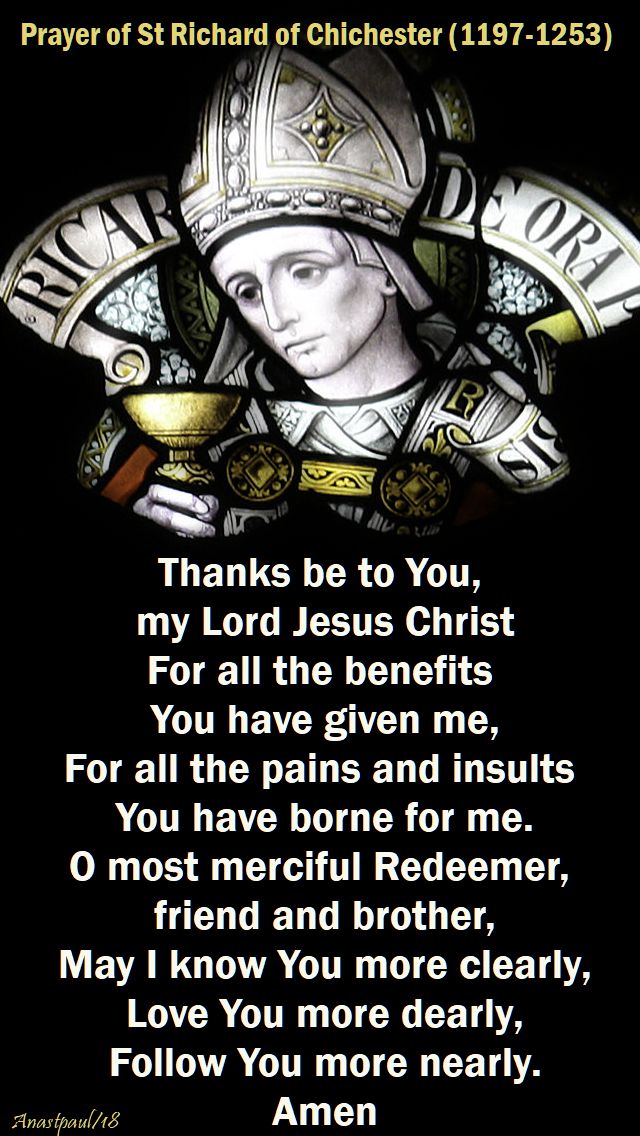
Thanks be to You,
my Lord Jesus Christ
For all the benefits
You have given me,
For all the pains and insults
You have borne for me.
O most merciful Redeemer,
friend and brother,
May I know You more clearly,
Love You more dearly,
Follow You more nearly.
Amen

St Richard recited this prayer on his deathbed, surrounded by the clergy of the diocese. The words were transcribed, in Latin, by his confessor Ralph Bocking, a Dominican friar and were eventually published in the Acta Sanctorum, an encyclopedic text in 68 folio volumes of documents examining the lives of Christian saints.   The British Library copy, contains what is believed to be Bockings transcription of the prayer:

Gratias tibi ago, Domine Jesu Christe, de omnibus beneficiis quae mihi praestitisti;
pro poenis et opprobriis, quae pro me pertulisti;
propter quae planctus ille lamentabilis vere tibi competebat.
Non est dolor similis sicut dolor meusthanks be to you my lord jesus christ - st richard of chichester - 3 april 2018

Posted in SAINT of the DAY

Saint of the Day – 3 April – St Richard of Chichester (1197-1253)

Saint of the Day – 3 April – St Richard of Chichester (1197-1253) also known as Richard de Wych – born in 1197 at Droitwich, Worcestershire, England as Richard de Wych – 3 April 1253 at Dover, Kent, England of natural causes.   Bishop, Teacher, Reformer, apostle of charity, Writer, Miracle Worker.   Patronages – coachmen, diocese of Chichester, England, Sussex, England.   Attributes – Bishop with a chalice on its side at his feet because he once dropped the chalice during a Mass and nothing spilled from it;  kneeling with the chalice before him;  ploughing his brother’s fields; a bishop blessing his flock with a chalice nearby.HEADER - ST RICHARD OF CHICHESTER
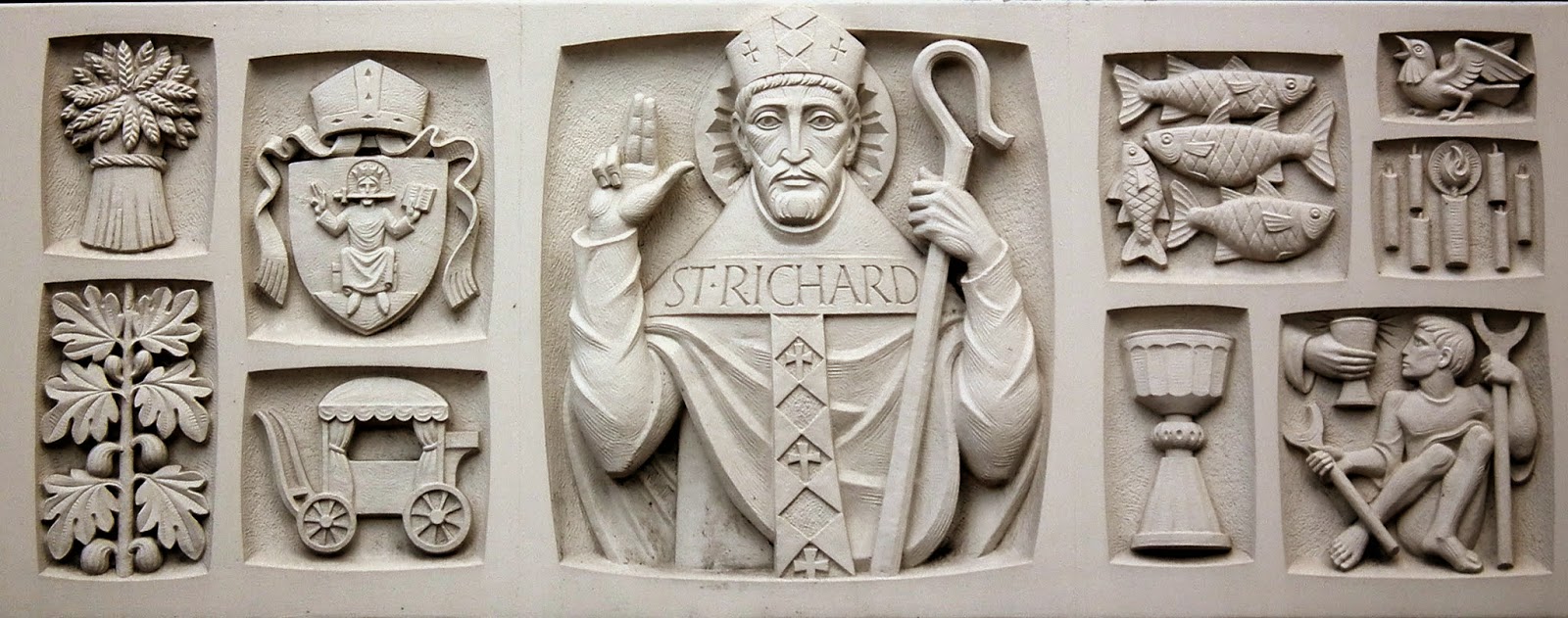
Richard was born, c 1197, in the little town of Wyche, eight miles from Worcester, England.   He and his elder brother were left orphans when young and Richard gave up the studies which he loved, to farm his brother’s impoverished estate.   His brother, in gratitude for Richard’s successful care, proposed to make over to him all his lands but he refused both the estate and the offer of a brilliant marriage, to study for the priesthood at Oxford.

In 1235 he was appointed, for his learning and piety, chancellor of that University and afterwards, by St Edmund of Canterbury, chancellor of his diocese.   He stood by that Saint in his long contest with the king and accompanied him into exile.   After St. Edmund’s death Richard returned to England to toil as a simple curate but was soon elected Bishop of Chichester in preference to the worthless nominee of Henry III.   The king in revenge refused to recognise the election and seized the revenues of the see.  Thus Richard found himself fighting the same battle in which St Edmund had died.   He went to Lyons, was there consecrated as Bishop by Innocent IV in 1245 and returning to England, in spite of his poverty and the king’s hostility, exercised fully his episcopal rights and thoroughly reformed his see. After two years his revenues were restored.

Young and old loved St Richard.   He gave all he had, and worked miracles, to feed the poor and heal the sick but when the rights or purity of the Church were concerned he was inexorable.   When a priest of noble blood polluted his office by sin, Richard deprived him of his benefice and refused the king’s petition in his favour.   On the other hand, when a knight violently put a priest in prison, Richard compelled the knight to walk round the priest’s church with the same log of wood on his neck to which he had chained the priest and when the burgesses of Lewes tore a criminal from the church and hanged him, Richard made them dig up the body from its unconsecrated grave and bear it back to the sanctuary they had violated.

Richard died in 1253, while preaching, at the Pope’s command, a crusade against the Saracens.   He was Canonised in 1262 by Pope Urban IV at Viterbo, Papal States (part of modern Italy).large - st richard of chichester
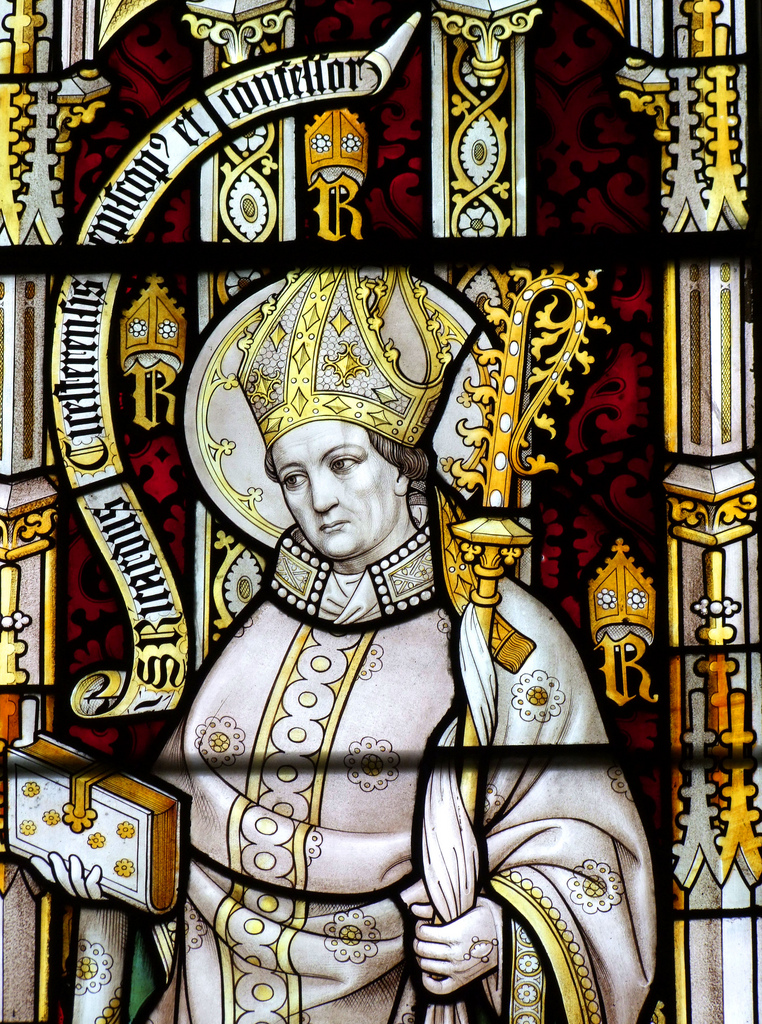
Richard is widely remembered today for the popular prayer ascribed to him:

Thanks be to Thee, my Lord Jesus Christ

For all the benefits Thou hast given me,
For all the pains and insults Thou hast borne for me.
O most merciful Redeemer, friend and brother,
May I know Thee more clearly,
Love Thee more dearly,
Follow Thee more nearly.

Richard recited this prayer on his deathbed, surrounded by the clergy of the diocese. The words were transcribed, in Latin, by his confessor Ralph Bocking, a Dominican friar and were eventually published in the Acta Sanctorum, an encyclopedic text in 68 folio volumes of documents examining the lives of Christian saints. The British Library copy, contains what is believed to be Bockings transcription of the prayer:

Gratias tibi ago, Domine Jesu Christe, de omnibus beneficiis quae mihi praestitisti;
pro poenis et opprobriis, quae pro me pertulisti;
propter quae planctus ille lamentabilis vere tibi competebat.
Non est dolor similis sicut dolor meusheader 2 - st richard
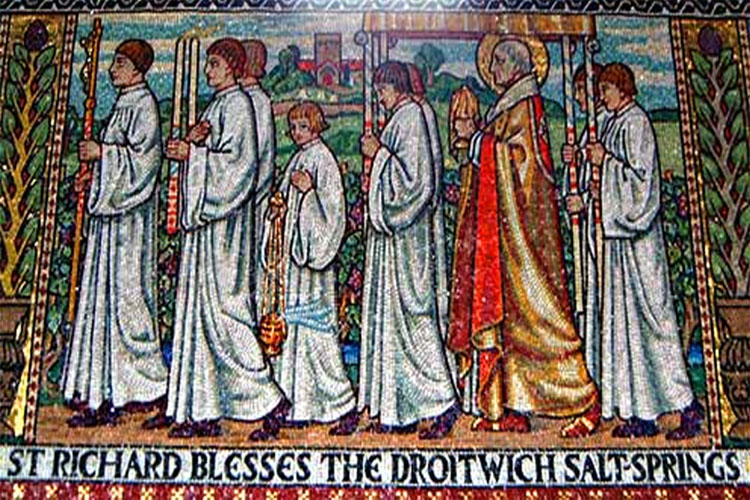
Shrine
Many miracles were wrought at Richard’s tomb in Chichester cathedral, which was long a popular place of pilgrimage and in 1262, just 9 years after his death, he was canonizsed at Viterbo by Pope Urban IV.    During the episcopate of the first Anglican bishop of Chichester, Richard Sampson, King Henry VIII of England, through his Vicar-General, Thomas Cromwell ordered the destruction of the Shrine of St Richard in Chichester cathedral in 1538.

“Forasmuch as we have lately been informed that in our cathedral church of Chichester there hath been used long heretoforeand yet at this day is used, much superstition and a certain kind of idolatry about the shrine and bones of a certain bishop of the same, whom they call Saint Richard and a certain resort there of common people, which being men of simplicity are seduced by the instigation of some of the clergy, who take advantage of their credulity to ascribe miracles of healing and other virtues to the said bones, that God only hath authority to grant. . . . . We have appointed you, with all convenient diligence to repair unto the said cathedral church and to take away the shrine and bones of that bishop called Saint Richard, with all ornaments to the said shrine belonging, and all other the reliques and reliquaries, the silver, the gold and all the jewels belonging to said shrine and that not only shall you see them to be safely and surely conveyed unto our Tower of London there to be bestowed and placed at your arrival but also ye shall see both the place where the shrine was kept, destroyed even to the ground and all such other images of the said church, where about any notable superstition is used, to be carried and conveyed away, so that our subjects shall by them in no ways be deceived hereafter but that they pay to Almighty God and to no earthly creature such honour as is due unto him the Creator. . . . . Given under our privy seal at our manor of Hampton Court, the 14th day of Dec., in the 30th year of our reign (1538).   Document issued by Thomas Cromwell on behalf of Henry VIII.”

The document ordering the destruction of the shrine was issued to a Sir William Goring of Burton and a William Ernley.   They received £40 for carrying out the commission on 20 December 1538.   The Shrine of St. Richard had, up to this point, enjoyed a level of popularity approaching that accorded to Thomas Becket at Canterbury.   It seems that someone associated with the parish of West Wittering in Sussex, possibly William Ernley, using his position as royal commissioner for the destruction of St Richard’s Shrine, may have spirited away the relics and bones of St Richard and hidden them in their own parish church, as there are persistent legends of the presence there, of the remains of the saint:

The Lady Chapel not only contains the Saxon Cross but also an ancient broken marble slab engraved with a Bishop’s pastoral staff and a Greek cross believed to have come from a reliquary containing the relics of St Richard of Chichester, a 13th century bishop who often visited West Wittering.  Part of his story is shown in the beautiful red, white and gold altar frontal presented by Yvonne Rusbridge in 1976.   On the left St Richard is shown feeding the hungry in Cakeham and on the right leading his followers from the church, his candle miraculously alight despite the gust of wind which blew out all the other candles.

st richard statue 2

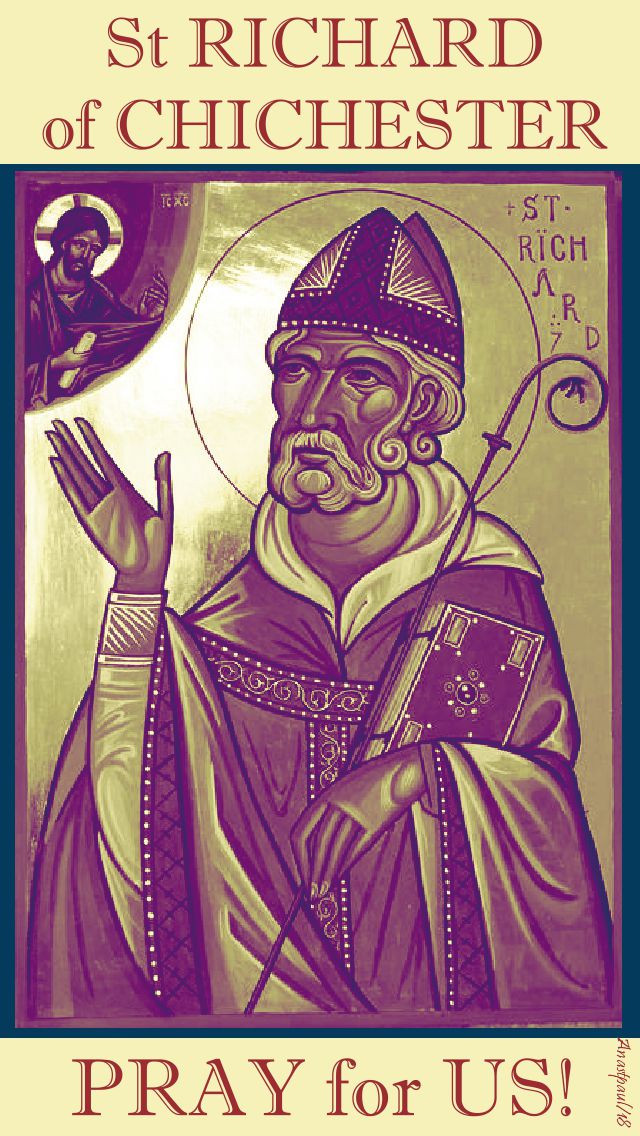
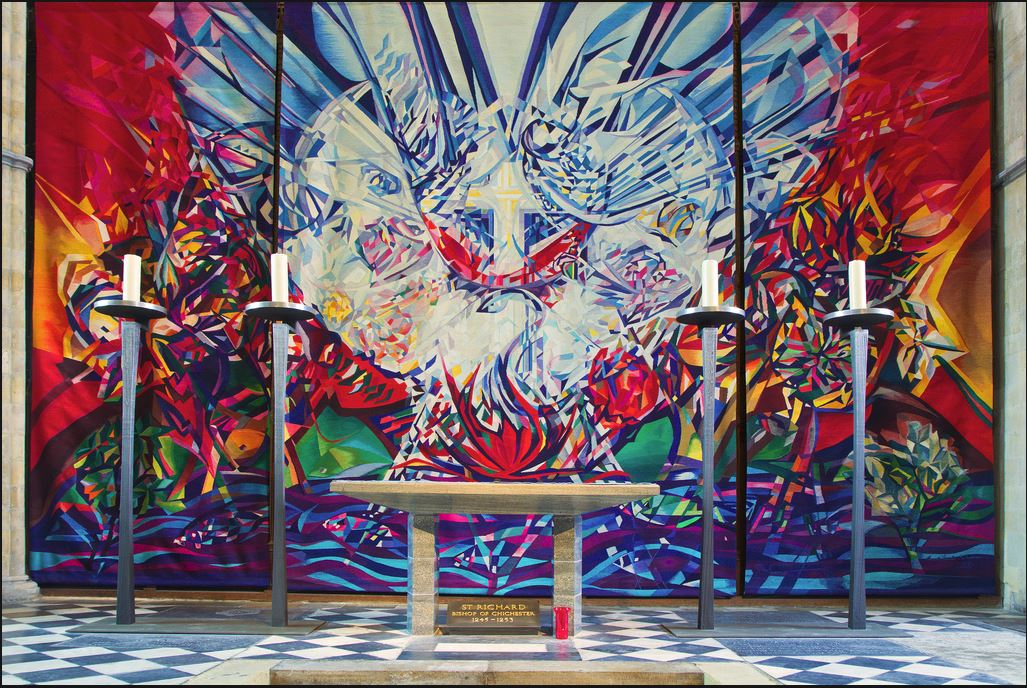
The modern St Richard’s Shrine is located in the retro-quire of Chichester cathedral and was re-established in 1930 by Dean Duncan Jones.   In 1987 during the restoration of the Abbey of La Lucerne, in Normandy, the lower part of a man’s arm was discovered in a reliquary, the relic was thought to be Richard’s.  After examination, to establish its provenance, the relic was offered to Bishop Eric Kemp and received into the cathedral on 15 June 1990.   The relic was buried in 1991 below the St Richard altar.   A further relic, together with an authentication certificate, was offered from Rome at the same time and is now housed at the bishops chapel in Chichester.   The modern shrine of Richard contains an altar that was designed by Robert Potter, a tapestry designed by Ursula Benker-Schirmer (partly woven in her studio in Bavaria and partly at the West Dean College) and an icon designed by Sergei Fyodorov (image below) that shows St Richard in episcopal vestments, his hand raised in blessing towards the viewer but also in supplication to the figure of Christ who appears to him from heaven.shrine of st richardst richard of chichester 3
Posted in SAINT of the DAY

Memorials of the Saints – 3 April

Bl Alexandrina di Letto
St Attala of Taormina
St Benatius of Kilcooley
St Benignus of Tomi
St Burgundofara
St Chrestus
St Comman
St Evagrius of Tomi
Bl Francisco Solís Pedrajas
Bl Gandulphus of Binasco
Bl Iacobus Won Si-bo
St John I of Naples
Bl John of Penna
St Joseph the Hymnographer
Bl Juan Otazua Madariaga
Bl Lawrence Pak Chwi-deuk
St Luigi Scrosoppi of Udine
Bl Maria Teresa Casini
St Nicetas of Medicion
St Papo
Bl Piotr Edward Dankowski
St Richard of Chichester (1197-1253)

Bl Robert Middleton
St Sixtus I, Pope
Bl Thurstan Hunt
St Vulpian of Tyre

Posted in EASTER, FEASTS and SOLEMNITIES, MORNING Prayers, QUOTES - J R R Tolkien and MORE, QUOTES on CONVERSION, QUOTES on LOVE, The RESURRECTION, The WORD, Thomas a Kempis

Thought for the Day – Easter Monday of the Easter Octave – 2 April 2018

Thought for the Day – Easter Monday of the Easter Octave – 2 April 2018

The Resurrection of Jesus Christ is the Figure of our spiritual resurrection.

“So they departed quickly from the tomb with fear and great joy, and ran to tell his disciples. And behold, Jesus met them and said, “Hail!” And they came up and took hold of his feet and worshiped him. Then Jesus said to them, “Do not be afraid; go and tell my brethren to go to Galilee, and there they will see me.”… Matthew 28:8-10

Let us represent to ourselves anew, the glory of the Sepulchre of Jesus.

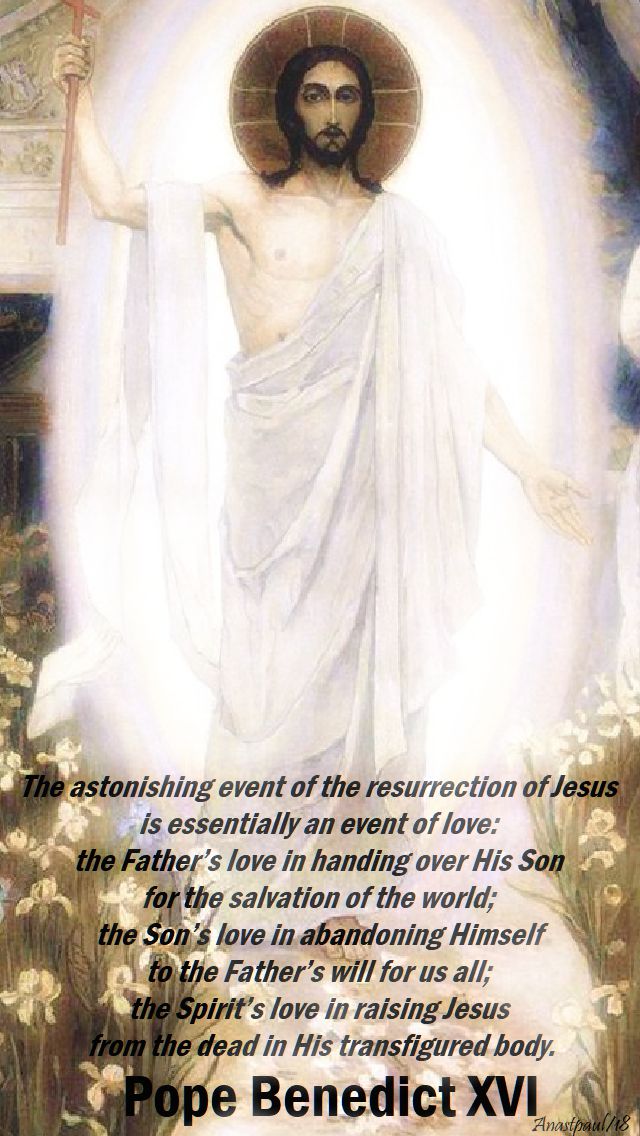
“In this way we enter the depths of the Paschal mystery.   The astonishing event of the resurrection of Jesus is essentially an event of love:  the Father’s love in handing over His Son for the salvation of the world;  the Son’s love in abandoning Himself to the Father’s will for us all;  the Spirit’s love in raising Jesus from the dead in His transfigured body.   And there is more: the Father’s love which “newly embraces” the Son, enfolding Him in glory;  the Son’s love returning to the Father in the power of the Spirit, robed in our transfigured humanity.   From today’s solemnity, in which we relive the absolute, once-and-for-all experience of Jesus’s Resurrection, we receive an appeal to be converted to Love;   we receive an invitation to live by rejecting hatred and selfishness and to follow with docility in the footsteps of the Lamb that was slain for our salvation, to imitate the Redeemer who is “gentle and lowly in heart”, who is “rest for our souls” (cf. Mt 11:29).”

Pope Benedict 23 March 2008

easter monday - 2 april 2018 - the astonishing even of the resurrection - pope benedict

Adorable Lord, bestow on us grace to rise spiritually, by leaving the tomb of indifference, to lead a life of fervour.

At Easter we recall the words God spoke to Moses concerning the Paschal solemnity:  For it is the Phase – that is, the Passage – of the Lord.  Now we celebrate the Passage of our Lord from Death to Life and think upon our own passage from a life of tepidity to one of fervour, from an imperfect to a holy life.   Jesus, in leaving the Tomb, disengaged Himself from the winding-sheet in which His Sacred Body had been wrapped;  this should make us understand that we must extricate ourselves from the imperfections and bad habits, which for so long a time have kept out souls bound and motionless for good.   If we rise with Jesus and set ourselves free from the paralysed state in which our evil inclinations have retained us, they will infallibly disappear.   Our Risen Lord was clothed with the power of agility to teach us to despise all resistance of nature, to pass quickly out of its reach, to triumph over every obstacle and that our souls should tend upwards to Him alone.   If we are indeed risen with Christ we shall seek the things that are above and our whole being will be spiritualised, responding with agility to the promptings not of nature, but of grace.   May we be enabled fully to enter into the Mystery of the Resurrection-Life of Jesus and to receive the plenitude of His favours, offered to us at this time especially.

Jesus, in rising from the Sepulchre, clothed in light, wills that we should understand what is the beauty of a soul disengaged from the ties of nature and renewed in the spiritual life.   The soul, like Jesus, becomes luminous, the Holy Spirit enlightens it interiorly, by filling it with the knowledge of divine things;  it is possessed of a lustrous beauty and its virtues shine visibly, contributing to the edification of others.   By the impassibility of the Body of Jesus, we comprehend that grace raises the soul, by means of holy courage, above temptations;  it renders it invulnerable against the darts of the enemies of its salvation and gives it the power of mastering its downward tendencies. Such are the happy privileges granted to His faithful ones, who lovingly enter into the spirit of the Mystery of Easter.   Sufferings indeed we must still endure, for we are still on this side of the grave but if they serve only to raise us near to Jesus, we may be said to share already in the effects of His impassibility.   We range ourselves therefore around Him, to rejoice at the sight of the glory He received in His Resurrection and to honour the marvellous capabilities of His Adorable Body, by rendering ourselves worthy, by our fervour, to participate in them spiritually.

O my Saviour, I thank You for the favour You accord me, permitting me to partake in the glorious privileges of the new life You began.   Make me to be entirely renewed in the spirit of my mind so that, freed from the servitude of sense and natural affections, I may rise constantly towards You, with a pure and generous heart.

Aided by the grace Jesus bestows, I will endeavour to reproduce spiritually in myself, the capabilities observable in His Sacred Humanity after the Resurrection.

If by the Spirit, you mortify the deeds of the flesh, you shall live.

Father de Brant, Growth in the Knowledge of Our Lord volume 2, 1882

Posted in Against EPIDEMICS, Against STORMS, EARTHQUAKES, THUNDER & LIGHTENING, FIRES, DROUGHT / NATURAL DISASTERS, franciscan OFM, INCORRUPTIBLES, Of TRAVELLERS / MOTORISTS, PATRONAGE-INFERTILITY & SAFE CHILDBIRTH, SAILORS, MARINERS, NAVIGATORS, SAINT of the DAY

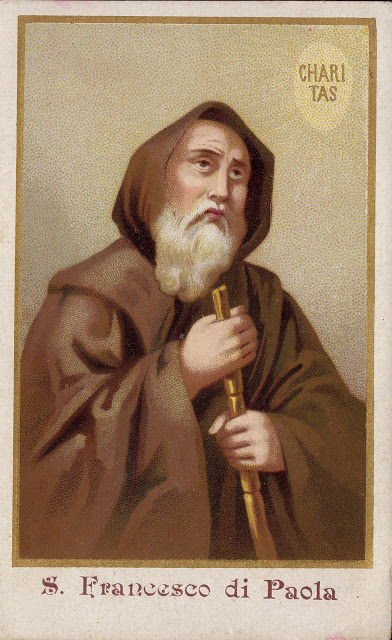
Saint of the Day – 2 April – St Francis of Paola O.M. (1416-1507)

Saint of the Day – 2 April – St Francis of Paola O.M. (1416-1507) also known as “Saint Francis the Fire Handler” – Monk and Founder, inspired with the Gift of Prophecy and still called the “Miracle-Worker“, Apostle of the poor, Peacemaker – born on 27 March 1416 at Paola, Calabria, Kingdom of Italy (part of modern Italy) and died on 2 April 1507 (Good Friday) at Plessis, France of natural causes.   He was an Italian mendicant Friar and the Founder of the Order of Minims.   Unlike the majority of founders of men’s religious orders and like his Patron Saint, Francis was never Ordained a Priest  In 1562 Huguenots broke open his tomb, found his body incorrupt and burned it. The bones were salvaged by Catholics and distributed as relics to various churches.    Patronages – against fire, against plague/epidemics, against sterility,  mariners, sailors,  naval officers, travellers, 7 Cities.

Festa di S. Francesco di Paola 1
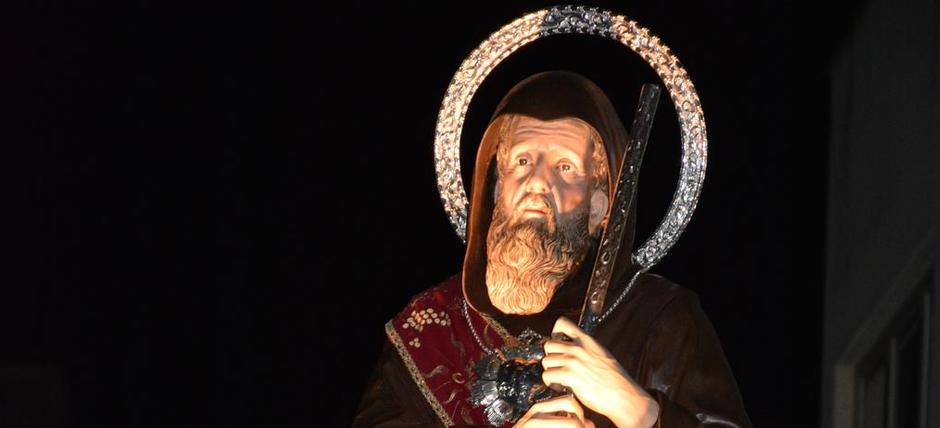
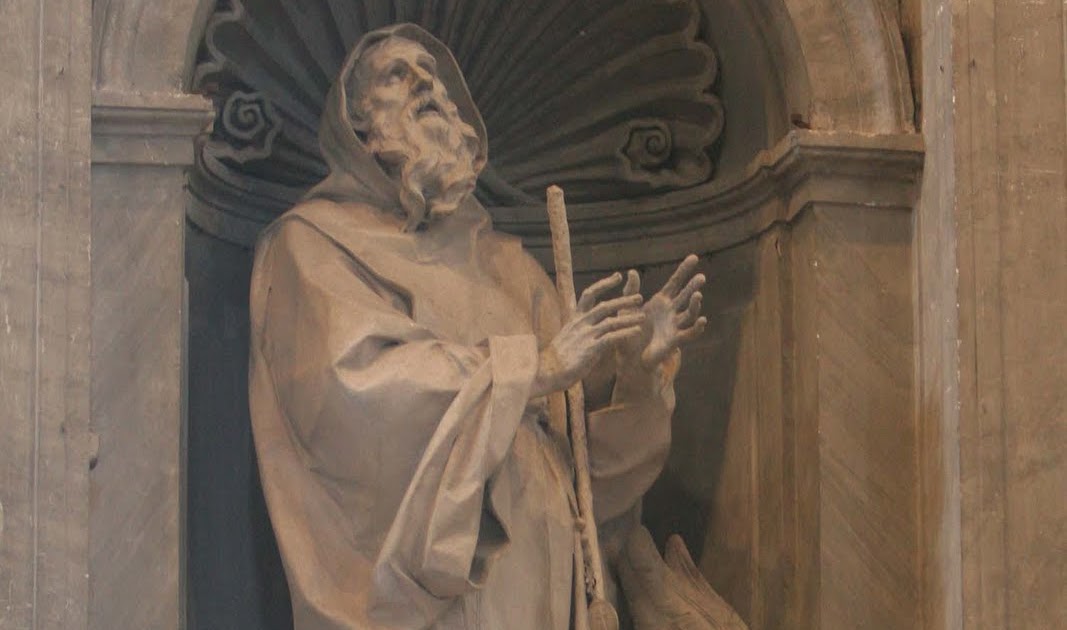
St Francis founded the Hermits of St Francis which Rule was formally approved by Pope Alexander VI, who, however, changed their title into that of “Minims”.   Their name refers to their role as the “least of all the faithful”.   Humility was to be the hallmark of the brothers as it had been in Francis’s personal life.   bstinence from meat and other animal products became a “fourth vow” of his religious order, along with the traditional vows of poverty, chastity and obedience.   Francis instituted the continual, year-round observance of this diet in an effort to revive the tradition of fasting during Lent, which many Roman Catholics had ceased to practice by the 15th century.   The rule of life adopted by Francis and his religious was one of extraordinary severity.   He felt that heroic mortification was necessary as a means for spiritual growth.   They were to seek to live unknown and hidden from the world.   After the approbation of the order, Francis founded several new monasteries in Calabria and Sicily.   He also established monasteries of nuns and a third order for people living in the world, after the example of St Francis of Assisi.HEADER - StFrancisdePaola-FounderStatue

Francis was born in the town of Paola, which lies in the southern Italian Province of Cosenza, Calabria.   In his youth he was educated by the Franciscan friars in Paola.   His parents were remarkable for the holiness of their lives, having remained childless for some years after their marriage, they had recourse to prayer and especially commended themselves to the intercession of St Francis of Assisi, after whom they named their first-born son.   Two other children were eventually born to them.

When still in the cradle, Francis suffered from a swelling which endangered the sight of one of his eyes.   His parents again had recourse to Francis of Assisi and made a vow that their son should pass an entire year wearing the “little habit” of St Francis in one of the friaries of his Order, a not-uncommon practice in the Middle Ages.   The child was immediately cured.

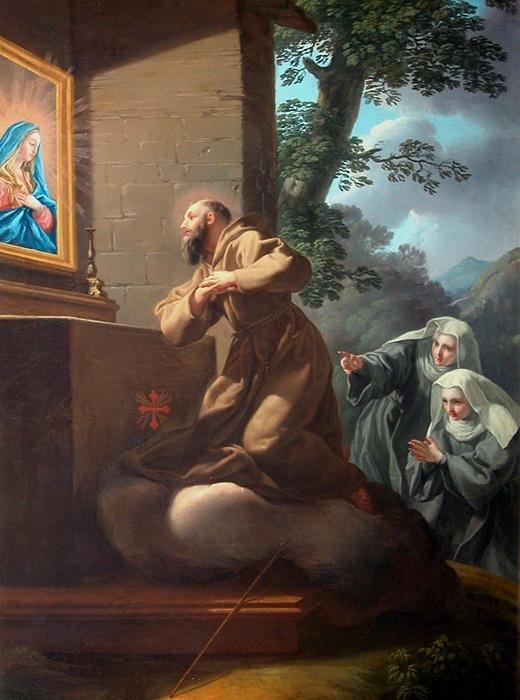
From his early years Francis showed signs of extraordinary sanctity and at the age of 13, being admonished by a vision of a Franciscan friar, he entered a friary of the Franciscan Order to fulfil the vow made by his parents.   Here he gave great edification by his love of prayer and mortification, his profound humility and his prompt obedience.   At the completion of the year he went with his parents on a pilgrimage to Assisi, Rome, and other places of devotion.   Returning to Paola, he selected a secluded cave on his father’s estate and there lived in solitude;  but later on he found an even-more secluded cave on the sea coast.   Here he remained alone for about six years, giving himself to prayer and mortification.

st francis of paola 2

Soon others joined him and they took the name Hermits of Saint Francis of Assisi and followed the practices of the Franciscans, or the Franciscan Minim Friars.   The order attracted many candidates within a sort space of time.

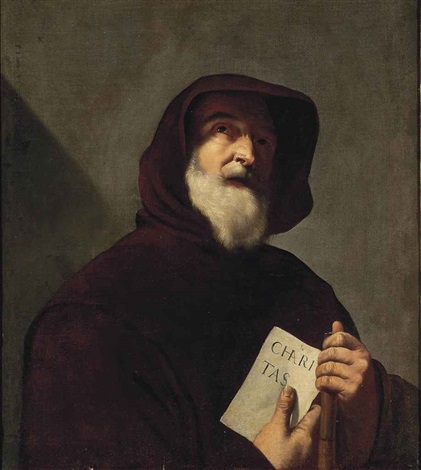
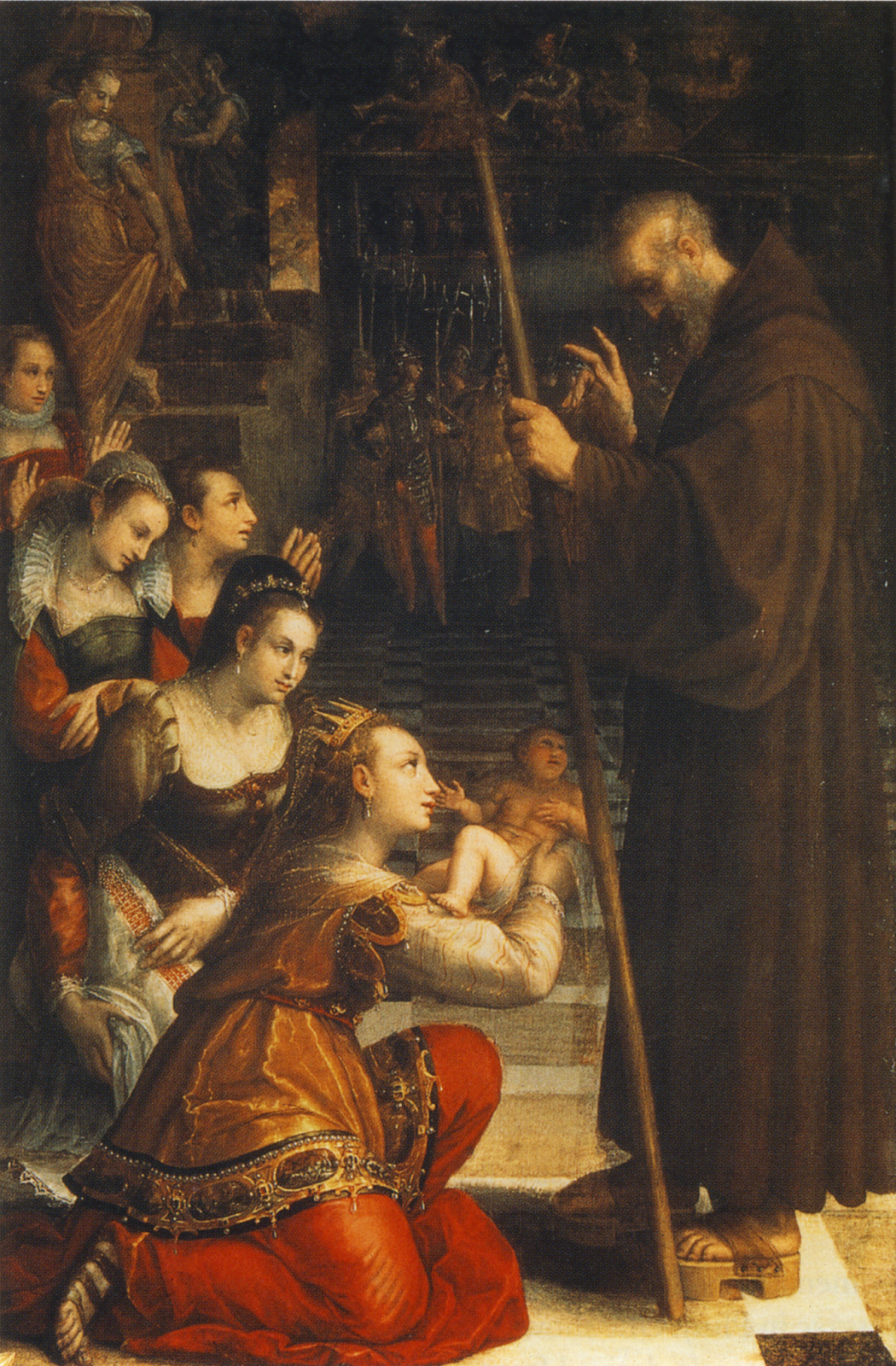
Francis later felt God calling him to defend those who were poor and oppressed.   He scolded King Ferdinand of Naples and his sons for their wrongdoing.   In 1482, when King Louis XI of France was dying, he begged that Francis come to cure him.   Francis at first refused but Pope Sixtus IV ordered him to care for the king and prepare him for death.   When the king saw Francis, he pleaded for a miracle.   Francis rebuked him, saying that the lives of kings are in the hands of God.   Francis restored peace between France and Great Britain and between France and Spain.jusepe-de-ribera-saint-francis-of-paolast francis of paola

Famous Miracles:

According to a famous story, in the year 1464, he was refused passage by a boatman while trying to cross the Strait of Messina to Sicily.   He reportedly laid his cloak on the water, tied one end to his staff as a sail and sailed across the strait with his companions following in the boat.   The second of Franz Liszt’s “Legendes” (for solo piano) describes this story in music.

After his nephew died, the boy’s mother—the saint’s own sister—appealed to Francis for comfort and filled his apartment with lamentations.   After the Mass and divine office had been said for the repose of his soul, St Francis ordered the corpse to be carried from the church into his cell, where he continued praying until, to her great astonishment, the boy’s life was restored and Francis presented him to his mother in perfect health.   The young man entered his order and is the celebrated Nicholas Alesso who afterwards followed his uncle into France and was famous for sanctity and many great actions.St_Francis_of_Paola_Blessing_the_Son_of_Louisa_of_Savoy

St Francis also raised his pet lamb, Martinello, from the dead after it had been eaten by workmen. “Being in need of food, the workmen caught and slaughtered Francis’ pet lamb, Martinello, roasting it in their lime kiln.   They were eating when the Saint approached them, looking for his lamb.   They told him they had eaten it, having no other food.   He asked what they had done with the fleece and the bones.   They told him they had thrown them into the furnace.   Francis walked over to the furnace, looked into the fire and called ‘Martinello, come out!’   The lamb jumped out, completely untouched, bleating happily on seeing his master.”

Pope Leo X canonised him in 1519.   He is considered to be a patron saint of boatmen, mariners and naval officers.   His liturgical feast day is celebrated by the universal Church today, the day on which he died. In 1963, Pope John XXIII designated him as the patron saint of Calabria.   Though his miracles were numerous, he was canonised for his humility and discernment in blending the contemplative life with the active one.

Devotion of the Thirteen Fridays:
Pope Clement XII, in the brief “Coelestium Munerum Dispensatio” of 2 December 1738, promulgated an indulgence to all the faithful who, upon 13 Fridays continuously preceding the Feast of St Francis of Paola (2 April), or at any other time of the year, shall, in honour of this Saint, visit a church of the Minims and pray there for the Church.   In this brief, mention is made of a devotion which originated with St Francis himself, who, on each of 13 Fridays, used to recite 13 Pater Nosters (Our Fathers) and as many Ave Marias (Hail Marys) and this devotion he promulgated by word of mouth and by letter to his own devout followers, as an efficacious means of obtaining from God the graces they desired, provided they were for the greater good of their souls

Posted in BREVIARY Prayers, CATHOLIC-PRAYERS OF THE CHURCH, DEVOTIO, EASTER, FEASTS and SOLEMNITIES, HYMNS, PRACTISING CATHOLIC, PRAYERS of the CHURCH

Our Morning Offering – 2 April – Easter Monday

Our Morning Offering – 2 April – Easter Monday

The beautiful ancient Easter sequence Victimae Paschali Laudes can be said or sung before the Gospel every day during the Octave:

Victimae Paschali Laudes

Christians, to the Paschal Victim
Offer your thankful praises!
A Lamb the sheep redeems;
Christ, who only is sinless,
Reconciles sinners to the Father.

Death and life have contended
in that combat stupendous:
The Prince of Life, who died, reigns immortal.

Speak, Mary, declaring
What you saw, wayfaring.
“The tomb of Christ, who is living,
The glory of Jesus’ resurrection;

Bright angels attesting,
The shroud and napkin resting.
Yes, Christ my hope is arisen;
To Galilee He goes before you.”

Christ indeed from death is risen,
our new life obtaining.
Have mercy, victor King, ever reigning!
Amen. Alleluia!++eater monday 2 april 2018 - Victimae Paschali Laudes - easter sequence

Posted in franciscan OFM, SAINT of the DAY

Memorials of the Saints – 2 April

St Francis of Paola O.M. (1416-1507) (Optional Memorial)

St Abundius of Como
St Agnofleda of Maine
St Appian of Caesarea
St Bronach of Glen-Seichis
St Constantine of Scotland
St Ðaminh Tuoc
Bl Diego Luis de San Vitores-Alonso
St Ebbe the Younger
St Eustace of Luxeuil
St Francis Coll Guitart
St John Payne
Bl Leopold of Gaiche
St Lonochilus of Maine
St Musa of Rome
Bl Mykolai Charnetsky
St Nicetius of Lyon
St Pedro Calungsod
St Rufus of Glendalough
St Theodora of Tiria
St Urban of Langres
St Victor of Capua
Bl Vilmos Apor

Posted in CATHOLIC DEVOTIONS of the Month, CATHOLIC-PRAYERS OF THE CHURCH, DEVOTIO, MORNING Prayers, PRACTISING CATHOLIC

The Holy Father’s Prayer Intentions April 2018

The Holy Father’s Prayer Intentions
April 2018

For Those who have Responsibility in Economic Matters

That economists may have the courage
to reject, any economy of exclusion
and know how to open new paths.HOLY FATHER'S PRAYER INTENTIONS APRIL 2018

Posted in CATHOLIC DEVOTIONS of the Month, EUCHARISTIC Adoration, PRACTISING CATHOLIC, PRAYERS of the SAINTS, QUOTES of the SAINTS, The HOLY EUCHARIST / The HOLY MASS

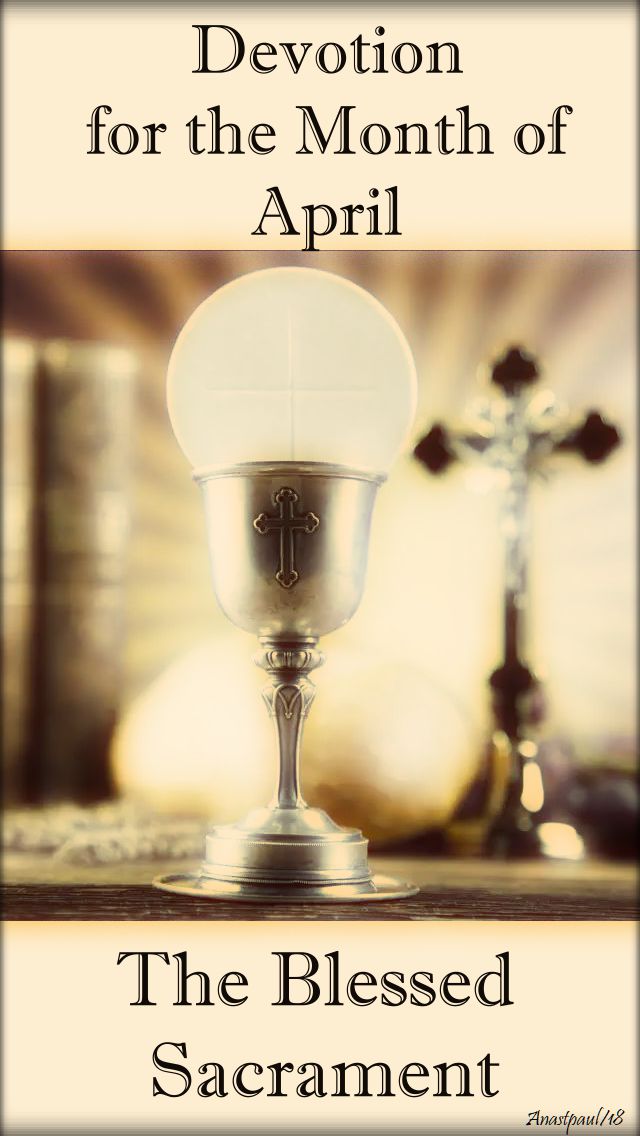
Devotion for the Month of April – The Holy Eucharist

Devotion for the Month of April – The Holy Eucharist

The Church has historically encouraged the month of April for increased devotion to Jesus in the Holy Eucharist.  “The Church in the course of the centuries has introduced various forms of this Eucharistic worship which are ever increasing in beauty and helpfulness;  as, for example, visits of devotion to the tabernacles, even every day;  Benediction of the Blessed Sacrament; solemn processions, especially at the time of Eucharistic Congresses, which pass through cities and villages;  and adoration of the Blessed Sacrament publicly exposed . . . These exercises of piety have brought a wonderful increase in faith and supernatural life to the Church militant upon earth and they are re-echoed to a certain extent by the Church triumphant in heaven, which sings continually a hymn of praise to God and to the Lamb ‘Who was slain.'” -Venerable Pope Pius XII (1876-1958) Pope from 1939 to his death in 1958.april devotion - the blessed sacrament - 2 april 2018

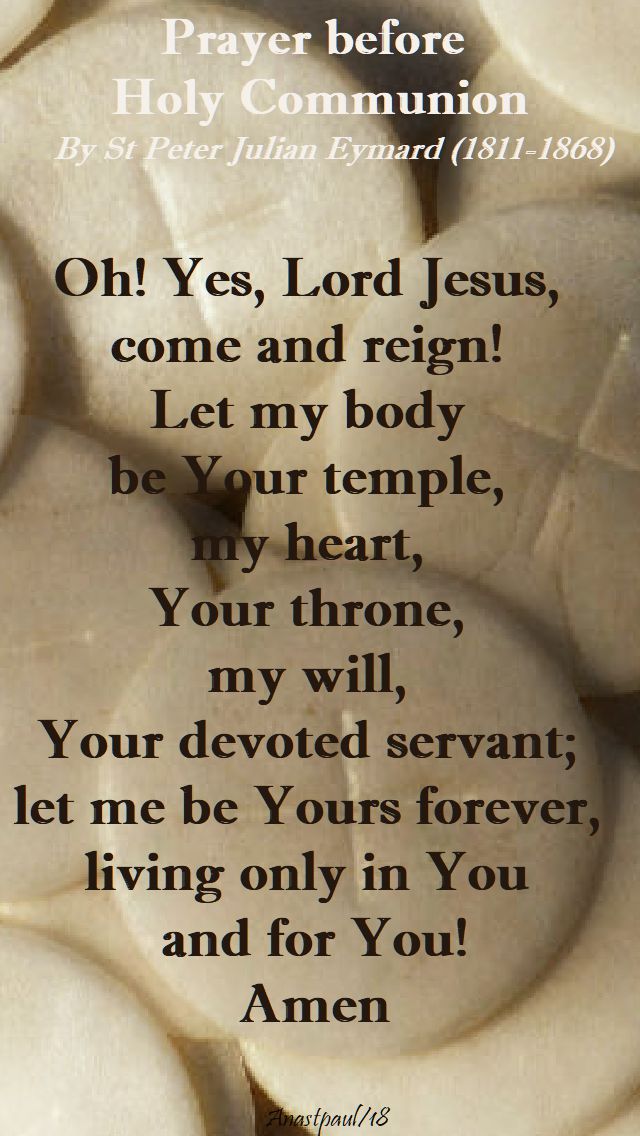
Prayer before Holy Communion
By St Peter Julian Eymard (1811-1868)

Oh! Yes, Lord Jesus, come and reign!
Let my body be Your temple,
my heart Your throne,
my will Your devoted servant;
let me be Yours forever,
living only in You and for You!
AmenPrayer before Holy Comm - st peter julian eymard - 2 april 2018

Eucharistic Adoration By:  St Pope John Paul II

“I encourage Christians regularly to visit Christ present in the Blessed Sacrament, for we are all called to abide in the presence of God.   In contemplation, Christians will perceive ever more profoundly the mystery at the heart of Christian life.
I urge priests, religious and lay people to continue and redouble their efforts to teach the younger generations the meaning and value of Eucharistic adoration and devotion.   How will young people be able to know the Lord if they are not introduced to the mystery of His presence?   Like the young Samuel, by learning the words of the prayer of the heart, they will be closer to the Lord, who will accompany them in their spiritual and human growth.   The Eucharistic mystery is in fact the “summit of evangelisation” (Lumen Gentium) for it is the most eminent testimony to Christ’s resurrection.”

Private Eucharistic Adoration
Venerable Fr Benedict Groeschel points out in the book, “In the Presence of Our Lord : The History, Theology and Psychology of Eucharistic Devotion” that there are “four kinds of prayer most appropriate in the presence of the Eucharist, namely adoration and praise, thanksgiving, repentance and trusting intercession.”   Accordingly, here are suggestions for what to do during private Eucharistic adoration.

1. Pray the Psalms or the Liturgy of the Hours
Whether you are praising, giving thanks, asking for forgiveness or seeking an answer, you’ll find an appropriate psalm.   The ancient prayer of the Church called the Liturgy of the Hours presents an excellent way to pray through the Book of Psalms throughout the year.

2. Recite the “Jesus Prayer”
Say “Lord Jesus, have mercy on me, a sinner”, repeatedly as you quiet your heart and mind.

3. Meditate using Scripture
Choose a passage from the Bible. read the words and ask God to let the passage speak to you.   Pay special attention to anything that strikes you and ask God what He wishes for you to draw from that message.

4. Read the life of a saint and pray with him or her
Most holy men and women have had a great devotion to Our Lord in the Eucharist. Therese of Lisieux, Catherine of Siena, Francis of Assisi, Thomas Aquinas, Peter Julian Eymard, Dorothy Day. Mother Teresa of Calcutta and Baroness Catherine de Hueck are just a few.   Read about them and pray their prayers before the Blessed Sacrament.

5. Pour out your heart to Christ and adore Him
Speak to Jesus, aware that you are in His presence and tell Him all that comes to your mind.   Listen for His response.   Pray the prayer that St Francis instructed his brothers to pray whenever they were before the Blessed Sacrament:  “I adore You, O Christ, present here and in all the churches of the world, for by Your holy cross You have redeemed the world.”

6. Ask for forgiveness and intercede for others
Think of those who have hurt you and request a special blessing for them.   Ask God to forgive you for all the times you have neglected or hurt someone else.   Bring before the Blessed Sacrament all those who have asked you to pray for them.   Ask the Lord to address their concerns.

7. Pray the Rosary
St Pope John Paul II reminds us, “…is not the enraptured gaze of Mary as she contemplated the face of the newborn Chris and cradled him in her arms that unparalleled model of love which should inspire us every time we receive Eucharistic communion?” (The Church and the Eucharist, 55)   Ask Mary to join you as you gaze on Christ in the Eucharist and as you pray the Rosary.

8. Sit quietly and just “be” in the presence of God
Think of a visit to the Blessed Sacrament as coming to see your best friend.   Sit quietly and enjoy being in each other’s company.   Instead of talking to the Lord, try listening to what He wants to tell you.

Prayer before the Eucharistic Presence
By Bl John Henry Newman (1801-1890)

I place myself in the presence of Him,
in whose Incarnate Presence I am,
before I place myself there.
I adore You, O my Saviour,
present here as God and man,
in soul and body,
in true flesh and blood.
I acknowledge and confess,
that I kneel before the Sacred Humanity,
which was conceived in Mary’s womb
and lay in Mary’s bosom;
which grew up to man’s estate
and by the Sea of Galilee, called the Twelve,
wrought miracles and spoke words of wisdom and peace;
Who in due season hung on the cross,
lay in the tomb, rose from the dead
and now reigns in heaven.
I praise and bless
and give myself wholly to Him,
Who is the true Bread of my soul
and my everlasting joy. AmenI place myself in the presence - bl john henry - 2 april 2018

Posted in EASTER, NOTES to Followers, QUOTES - J R R Tolkien and MORE, The RESURRECTION

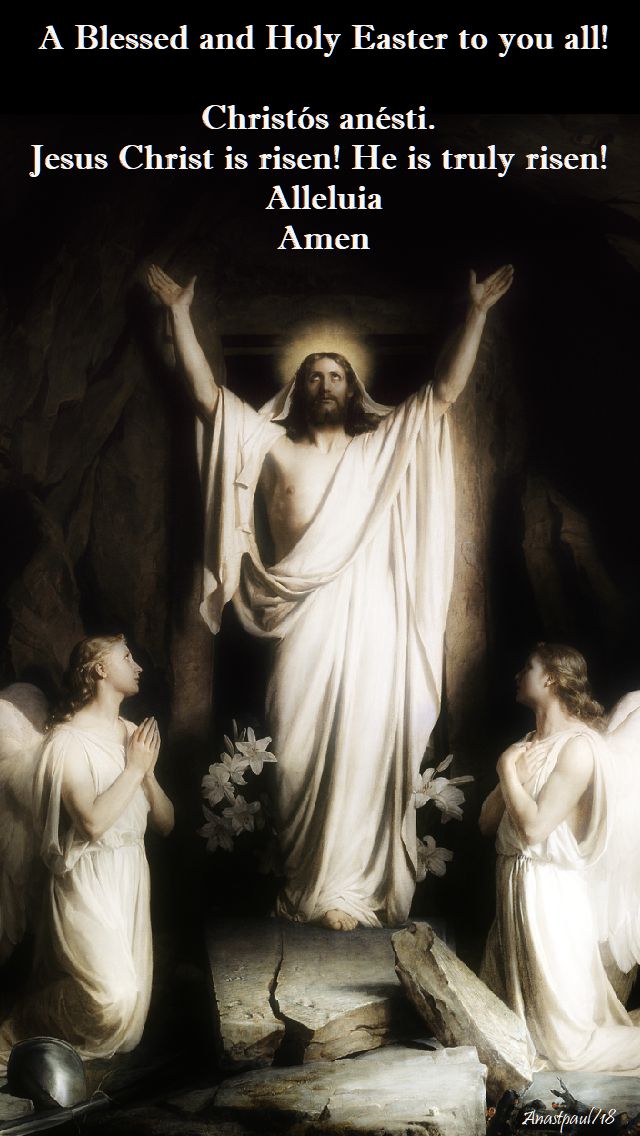
Thought for the Day – 1 April 2018 – Easter Sunday – A Blessed and Holy Easter to you all!

Thought for the Day – 1 April 2018 – Easter Sunday

A Blessed and Holy Easter to you all!

“Be Lifted Up, O Ancient Door”

It seems as the human world has no doors opening toward God.   It is locked in upon itself. It is a prison, a house of the dead.
People of the Old Testament and of other early civilizations initially applied the idea of the prison only to the world of the dead – the man who dies will not return.   They imagined the underworld as a vast dark prison in which death reigns, a ruthless tyrant. It is a place of no return.   Gradually, however, the feeling grew that, if all our paths lead to the prison which has entrances but no exit, then we are all prisoners.   In that case, even this present world is a house of the dead, the antechamber leading to a dungeon of horrors!   And it is a fact, if death has the last world – the world is a waiting room leading to the void (as manifested in many Eastern religions – my note).
Poets of our century have set down this feeling in terrifying visions.   The Jewish poet Franz Kafka has probably gone farthest into this abyss of ANGST.   His portrayal of a world of totalitarian control is intended as an interpretation of human life as such. In “The Castle”, life appears to be a futile waiting, a doomed attempt to penetrate the maze of bureaucracy and reach some competent authority and hence freedom.   In “The Trial”, life itself is present as a trial ending in execution.   The story ends with the parable of a man who waits all his life outside a door and cannot get in, in spite of the fact that it was made especially for him.
If Christ is not risen, there is nothing more to be said about man than this – all else, is merely an endeavour to deaden the pain.   The cries of despair we hear and the cruel attempts at liberation we see, are the necessary consequences of a world that will not accept Christ, its hope.
“Be lifted up, O ancient doors!” – these words of the psalm (24:7) are not liturgical symbolism, the gate liturgy of a long-past age.   They are the cry of man in a world that is far too narrow, even if he can travel in spaceships to the moon and beyond.
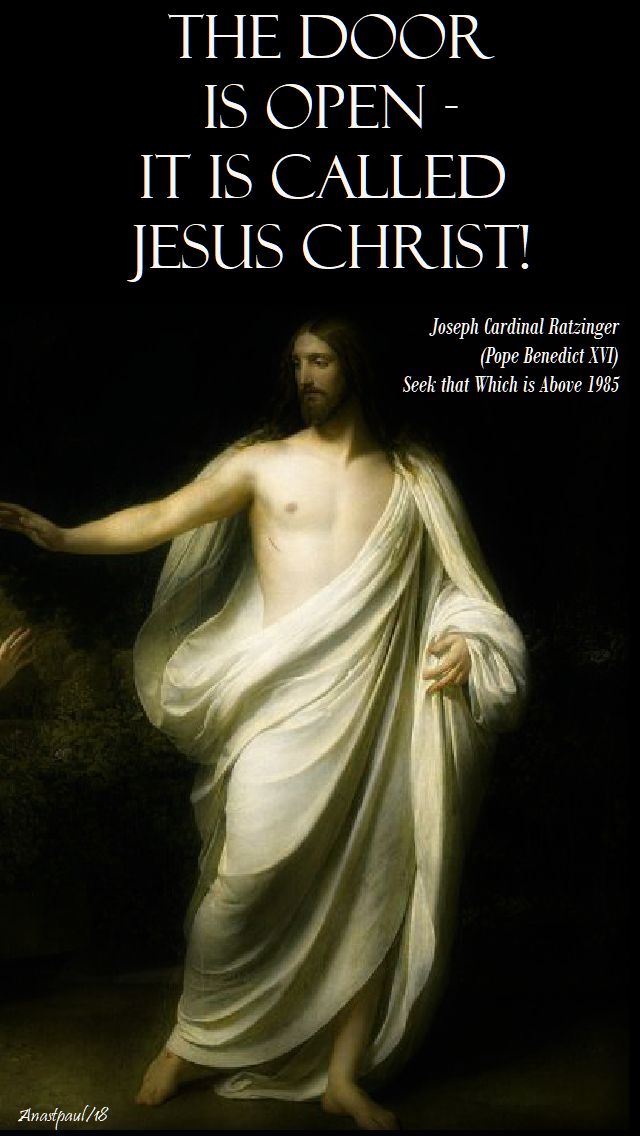
Christmas is only the first half of the Christian answer to this cry.   Christmas tells us that there is not only the tyrant, Death – there is God, who is Life and this God can and will reach us – He has broken a way into us.   He has found the door that was big enough for Him, or rather, He has made such a door for Himself.
But this answer is only complete if there is not only an entrance by which God can reach us but also an exit for us.   It is only satisfying, if death is no longer a prison from which no-one returns.   AND THIS IS THE CONTENT OF THE MESSAGE OF EASTER.   Not only is there a door in, there is also, a door out.   Death is no longer a house with no exits, a place of no return.
The ancient Church saw in this verse (ps 24:7) an interpretation of the article of faith “descended into hell”, referring particularly to Holy Saturday, not as a word of mourning but as a word of victory.   The Church expressed this word in poetic form – the bolts of death’s dungeon, of the world’s dungeon, are wrenched off – the ramparts are thrown down – the gates are torn from their hinges.   The one who has done this, Jesus, takes the long-imprisoned Adam and Eve, i.e. humanity, by the hand and leads them to freedom. Life is not a waiting room leading to the void but the beginning of eternity!   The world is not the universal concentration camp but the garden of hope!   Life is not the futile search for meaning, mirrored in the tangle of bureaucracy.   God is not a bureaucrat – He does not live in a distant castle, nor does He hide Himself behind impenetrable anterooms.   The door is open – it is called Jesus Christ!the door is open - pope benedict - 1 april 2018

The celebration of Easter is intended to show us the radiant light which streams from this door.   It challenges us steadfastly to follow this radiance, which is no will-o’-the-wisp but the brilliance of saving truth….Joseph Cardinal Ratzinger (Pope Benedict XVI) Seek that Which is Above 1985

A Blessed and Holy Easter to you all!

Christós anésti.
Jesus Christ is risen! He is truly risen!
Alleluia
Amena blessed and holy easter to you all - 1 april 2018