Posted in CHILDREN / YOUTH, EYES - Diseases, of the BLIND, JESUIT SJ, SAINT of the DAY

Saint of the Day – 21 June – St Aloysius de Gonzaga S.J. (1568-1591)

Saint of the Day – 21 June – St Aloysius de Gonzaga S.J. (1568-1591) Jesuit Seminarian, Mystic, Marian devotee, Apostle of Charity – born as Luigi de Gonzaga on 9 March 1568 in the family castle of Castiglione delle Stivieri in Montua, Lombardy, Italy and died on 21 June 1591 at Rome, Italy of plague, fever and desire to see God.   His relics are entombed under the Altar of Saint Ignatius Church, Rome.  Patronages – Catholic youth, Jesuit scholastics, the blind, eye ailments, AIDS patients, care-givers, Jesuit students, for relief from pestilence, young people, Castiglione delle Stiviere, Italy, Valmonte, Italy.   His attributes are a lily, referring to innocence;  a cross, referring to piety and sacrifice;  a skull, referring to his early death  and a Rosary, referring to his devotion to the Blessed Virgin Mary.st aloysius infoaloysius info 2

Aloysius de Gonzaga was born the eldest of seven children, at his family’s castle in Castiglione delle Stiviere, between Brescia and Mantua in northern Italy in what was then part of the Duchy of Mantua, into the illustrious House of Gonzaga.   “Aloysius” is the Latin form of Aloysius de Gonzaga’s given name in Italian, Luigi.   He was the son of Ferrante de Gonzaga (1544–1586), Marquis of Castiglione, and Marta Tana di Santena, daughter of a baron of the Piedmontese Della Rovere family.   His mother was a lady-in-waiting to Isabel, the wife of Philip II of Spain.beautiful lg - st aloysius

As the first-born son, he was in line to inherit his father’s title and status of Marquis.   His father assumed that Aloysius would become a soldier, as that was the norm for sons of the aristocracy and the family was often involved in the minor wars of the period.   His military training started at an early age but he also received an education in languages and the arts.   As early as age four, Luigi was given a set of miniature guns and accompanied his father on training expeditions so that the boy might learn “the art of arms.”   At age five, Aloysius was sent to a military camp to get started on his training. His father was pleased to see his son marching around camp at the head of a platoon of soldiers.   His mother and his tutor were less pleased with the vocabulary he picked up there.

He grew up amid the violence and brutality of Renaissance Italy and witnessed the murder of two of his brothers.   In 1576, at age 8, he was sent to Florence along with his younger brother, Rodolfo, to serve at the court of the Grand Duke Francesco I de’ Medici and to receive further education.   While there, he fell ill with a disease of the kidneys, which troubled him throughout his life.   While he was ill, he took the opportunity to read about the saints and to spend much of his time in prayer.   He is said to have taken a private vow of chastity at age 9.    In November 1579, the brothers were sent to the Duke of Mantua.   Aloysius was shocked by the violent and frivolous lifestyle he encountered there.

Aloysius returned to Castiglione where he met St Cardinal Charles Borromeo (1538-1584 – feast day 4 November) and from him received First Communion on 22 July 1580.   After reading a book about Jesuit missionaries in India, Aloysius felt strongly that he wanted to become a missionary.   He started practising by teaching catechism classes to young boys in Castiglione in the summers.   He also repeatedly visited the houses of the Capuchin friars and the Barnabites located in Casale Monferrato, the capital of the Gonzaga-ruled Duchy of Montferrat where the family spent the winter.   He also adopted an ascetic lifestyle.

aloysius and charles borromeo
St Aloysius receives his First Holy Communion from St Charles Borromeo

The family was called to Spain in 1581 to assist the Holy Roman Empress Maria of Austria.   They arrived in Madrid in March 1582, where Aloysius and Rodolfo became pages for the young Infante Diego.   Aloysius started thinking in earnest about joining a religious order.   He had considered joining the Capuchins but he had a Jesuit confessor in Madrid and decided instead to join that order.   His mother agreed to his request but his father was furious and prevented him from doing so.

In July 1584, a year and a half after the Infante’s death, the family returned to Italy. Aloysius still wanted to become a priest but several members of his family worked hard to persuade him to change his mind.   When they realised there was no way to make him give up his plan, they tried to persuade him to become a secular priest and offered to arrange for a bishopric for him.   If he were to become a Jesuit he would renounce any right to his inheritance or status in society.   His family’s attempts to dissuade him failed, Aloysius was not interested in higher office and still wanted to become a missionary.

In November 1585, Aloysius gave up all rights of inheritance, which was confirmed by the emperor.   He went to Rome and, because of his noble birth, gained an audience with Pope Sixtus V.   Following a brief stay at the Palazzo Aragona Gonzaga, the Roman home of his cousin, Cardinal Scipione Gonzaga, on 25 November 1585, he was accepted into the novitiate of the Society of Jesus in Rome.   During this period, he was asked to moderate his asceticism somewhat and to be more social with the other novices.

Aloysius’ health continued to cause problems.   In addition to the kidney disease, he also suffered from a skin disease, chronic headaches and insomnia.   He was sent to Milan for studies but after some time he was sent back to Rome because of his health.   On 25 November 1587, he took the three religious vows of chastity, poverty and obedience.   In February and March 1588, he received minor orders and started studying theology to prepare for ordination.   In 1589, he was called to Mantua to mediate between his brother Rodolfo and the Duke of Mantua.   He returned to Rome in May 1590.   It is said that later that year, he had a vision in which the Archangel Gabriel told him that he would die within a year.

In 1591, a plague broke out in Rome.   The Jesuits opened a hospital for the stricken and Aloysius volunteered to work there.   After begging alms for the victims, Aloysius began working with the sick, carrying the dying from the streets into a hospital founded by the Jesuits.   There he washed and fed the plague victims, preparing them as best he could to receive the sacraments.   But though he threw himself into his tasks, he privately confessed to his spiritual director, Fr Robert Bellarmine (St Robert Bellarmine (1542-1621) Doctor of the Church), that his constitution was revolted by the sights and smells of the work;  he had to work hard to overcome his physical repulsion.

At the time, many of the younger Jesuits had become infected with the disease, and so Aloysius’s superiors forbade him from returning to the hospital.   But Aloysius—long accustomed to refusals from his father—persisted and requested permission to return, which was granted.   Eventually he was allowed to care for the sick but only at another hospital, called Our Lady of Consolation, where those with contagious diseases were not admitted.   While there, Aloysius lifted a man out of his sickbed, tended to him, and brought him back to his bed.   But the man was infected with the plague.   Aloysius grew ill and was bedridden by 3 March 1591, a few days before his 23rd birthday.Gonzaga3

Aloysius rallied for a time but as fever and a cough set in, he declined for many weeks.   It seemed certain that he would die in a short tie, and he was given Extreme Unction. While he was ill, he spoke several times with his confessor, the cardinal and later saint, Robert Bellarmine.   Aloysius had another vision and told several people that he would die on the Octave of the feast of Corpus Christi.   On that day, 21 June 1591, he seemed very well in the morning but insisted that he would die before the day was over.   As he began to grow weak, Bellarmine gave him the last rites and recited the prayers for the dying.   He died just before midnight.   As Fr Tylenda tells the story, “When the two Jesuits came to his side, they noticed a change in his face and realised that their young Aloysius was dying.   His eyes were fixed on the crucifix he held in his hands and as he tried to pronounce the name of Jesus he died.”San_Luigi_Gonzaga_AU

Aloysius was buried in the Church of the Most Holy Annunciation, which later became the church of Saint Ignatius of Loyola (Sant’Ignazio) in Rome.   His name was changed to “Robert” before his death, in honour of his confessor.   Many people considered him to be a saint soon after his death and his remains were moved into the Sant’Ignazio church, where they now rest in an urn of lapis lazuli in the Lancellotti Chapel.   His head was later translated to the basilica bearing his name in Castiglione delle Stiviere.   He was beatified only fourteen years after his death by Pope Paul V, on 19 October 1605.   On 31 December 1726, he was canonised together with another young Jesuit novice, Stanislaus Kostka, by Pope Benedict XIII.

Purity was his notable virtue.   The Carmelite mystic St Maria Magdalena de Pazzi had a vision of him on 4 April 1600.   She described him as radiant in glory because of his “interior works,” a hidden martyr for his great love of God.The Life and Miracles of St. Aloysius Gonzagast aloysius by Fr Lawrence OPv lg - st aloysius gonzaga

Posted in FEASTS and SOLEMNITIES, MARIAN TITLES, MIRACLES, SAINT of the DAY, The BLESSED VIRGIN MARY

Feast of Our Lady of Miracles – 21 June

Feast of Our Lady of Miracles – 21 June – the patron of the town of Alcamo, Sicily.header - Maria_SS_dei_Miracoli_-_ALCAMO_processione_2010_198

The cult of Madonna of Miracles in Alcamo dates back to 21 June 1547, the day people remember the Madonna’s apparition to some women near a stream running north of Alcamo.   According to tradition while washing their clothes in the stream, the women, with a blind and a deaf one among them, saw the apparition of a woman with a child and were hit by a gust of pebbles, during the apparition but without receiving any injury or pain;   on the contrary, after being hit by the pebbles, they strangely felt a certain sense of wellbeing and recovered their health.   After learning the news, the women’s husbands, thinking that it was a joke, went to investigate, thinking that someone was hidden among the bushes around there but they didn’t find anybody.

Then the local authorities inquired on the spot, cut down the near grove and found the ruins of a “cuba”, an old arc of a mill that nobody remembered any longer and inside there was a fresco on a stone made by an anonymous painter of the 13th century representing Our Lady with the Child Jesus, which at first the believers called “Madonna Fons Misericordiae” (that is Our Lady Source of Mercy).

Chiesa_Basilica_S_Maria_Assunta_Alcamo_128
A representation of the discovery of Our Lady of Miracles’ image (inside its chapel in the Basilica of Our Lady of the Assumption in Alcamo).

After this discovery all the people started praying before the rediscovered image and in the following days there were several miracles.7, Our Lady of Miracles became the patron saint of Alcamo, in substitution of the Holy Crucified, who was the patron saint of Alcamo and other near small towns (among which Calatafimi and Salemi).   The old patron saint’s memory however remains in Alcamo people’s mind:  in fact they call San Francesco di Paola “santu patri” (whose translation means “patron saint”) as the Church named after him was called the Holy Crucified Church.

The Madonna’s discovered image was first called “Our Lady Source of Mercy” but thanks to the high number of subsequent miracles, in 1583 the name was changed into “Our Lady of Miracles”.

Further to these events, Don Fernando Vega, Alcamo’s governor, ordered the construction of the Sanctuary of Our Lady of Miracles, which hosts the Madonna’s image. Inside the Church there is a white marble sarcophagus containing the mortal remains of the governor Don Fernando Vega, according to his will.

Calata_al_Santuario_della_Madonna_dei_Miracoli_di_Alcamo_-_14
The Crowned Painting of the Madonna of Miracles in the Sanctuary at Alcamo
Calata_al_Santuario_della_Madonna_dei_Miracoli_di_Alcamo_-_11
Dome fresco “The Madonna of Miracles’ Glorification”

Celebrations:
Every year in Alcamo there are the celebrations in honour of Our Lady of Miracles from 19 June until 21 of June.   This is the most important religious festivity in Alcamo.   The real celebrations are often anticipated by other events, so extending the feast to about two weeks, in this way the beginning of the celebrations changes every year, while the last day is always the 21 June.

The celebrations include:
“The pealing of church bells” which opens the celebrations together with the burst of fireworks and the passing of the band through the town streets;  in the past Alcamo’s band also joined the musical band of Partinico (a neighbouring small town).
The holy Mass in honour of Our Lady of Miracles in the Basilica di Santa Maria Assunta (also called “mother church”), in which all confraternities and laity groups in Alcamo take part.
The procession to the Sanctuary of Madonna of Miracles (called “calata”), in which all civil and religious authorities of the town (together with the Mayor) take part;  they are preceded by the band of the town.   In old times people took also the animals that had recovered from an illness.   Inside the sanctuary they sing Vespers and then there is the Eucharistic Blessing/Benediction.

Calata_al_Santuario_della_Madonna_dei_Miracoli_di_Alcamo_-_04
Façade of the sanctuary of Madonna of Miracles
Santuario_della_Madonna_dei_Miracoli_(Alcamo)_-_Discesa_al_Santuario
Route to the Sanctuary

Dance, music and theatrical performances.
Sport events.
Exhibitions of various kinds, including one about local Craftmanship.
“The Market Fair” at Piazza della Repubblica.
The Streets entertainers (called “Madonnari”).
The Procession of Our Lady of Miracles’ statue along the town streets and return to the mother church. Before this solemn procession, the statue of Our Lady of Miracles, createdin 1720 by Lorenzo Curti from Castelvetrano (see the image of the statue above and the back below), is adorned with a silver 12 star crown (“stellario” in Italian), a crown and a hairpin embellished by precious stones (called “tuppu di la Maronna”) which is placed behind the Madonna’s nape.   After that, the statue goes out from the Church, taken along the streets by a group of believers on their shoulders and accompanied by the band and it comes back to the mother church at the end of the procession.

Maria_SS_dei_Miracoli_-_ALCAMO_preparazione_2010_032Maria_SS_dei_Miracoli_-_ALCAMO_processione_2010_042
Fireworks near the “bastione” in Piazza Bagolino.   They take place at the end of the feast, soon after the statue’s return into the church, at about midnight.
The traditional descent to the sanctuary takes place during the so-called “Historical Cortege” with period costumes.   This cortege, which anticipates the real “calata”, passes through Corso 6 Aprile and Piazza Ciullo and finally ends at the Castle of the Counts of Modica (also called “Castle of Alcamo”).   The workmen of the association “I Cavalieri di San Giorgio” (San Giorgio’s knights) and the Civil Authorities take part in the cortege too.  Translated from the Italian).I_Cavalieri_di_San_Giorgio_-_AlcamoCalata_al_Santuario_della_Madonna_dei_Miracoli_di_Alcamo_-_06

Posted in FEASTS and SOLEMNITIES, MARIAN TITLES, MORNING Prayers, SAINT of the DAY, The BLESSED VIRGIN MARY, Uncategorized

Feast of Our Lady of Miracles and Memorials of the Saints – 21 June

St Aloysius Gonzaga S.J. (1568-1591) (Memorial)

Madonna of Miracles – Our Lady of Miracles (or Madonna of Miracles) is the patron saint of the town of Alcamo, Italy.

Calata_al_Santuario_della_Madonna_dei_Miracoli_di_Alcamo_-_14

St Agofredus of La-Croix
St Alban of Mainz
St Apollinaris of Africa
Bl Colagia
St Corbmac
St Cyriacus of Africa
St Demetria of Rome
St Dominic of Comacchio
St Engelmund
Bl Jacques-Morelle Dupas
St John Rigby
St José Isabel Flores Varela
Bl Juan of Jesus
St Lazarus
St Leutfridus
St Martia of Syracuse
St Martin of Tongres
Bl Melchiorre della Pace
St Mewan of Bretagne
Bl Nicholas Plutzer
St Ralph of Bourges
St Raymond of Barbastro
St Rufinus of Syracuse
St Suibhne the Sage
St Terence
St Ursicenus of Pavia

Martyrs of Taw – 3+ saints: Three Christians of different backgrounds who were martyred together – Moses, Paphnutius, Thomas. They were beheaded in Taw, Egypt, date unknown.

Posted in MORNING Prayers, QUOTES of the SAINTS, QUOTES on HUMILITY, QUOTES on REPENTANCE

Thought for the Day – 20 June – Wednesday Eleventh Week of Ord Time Year B – Today’s Gospel Matthew 6:1-6.16-18

Thought for the Day – 20 June – Wednesday Eleventh Week of Ord Time Year B – Today’s Gospel Matthew 6:1-6.16-18

“We are Nothing in Ourselves”
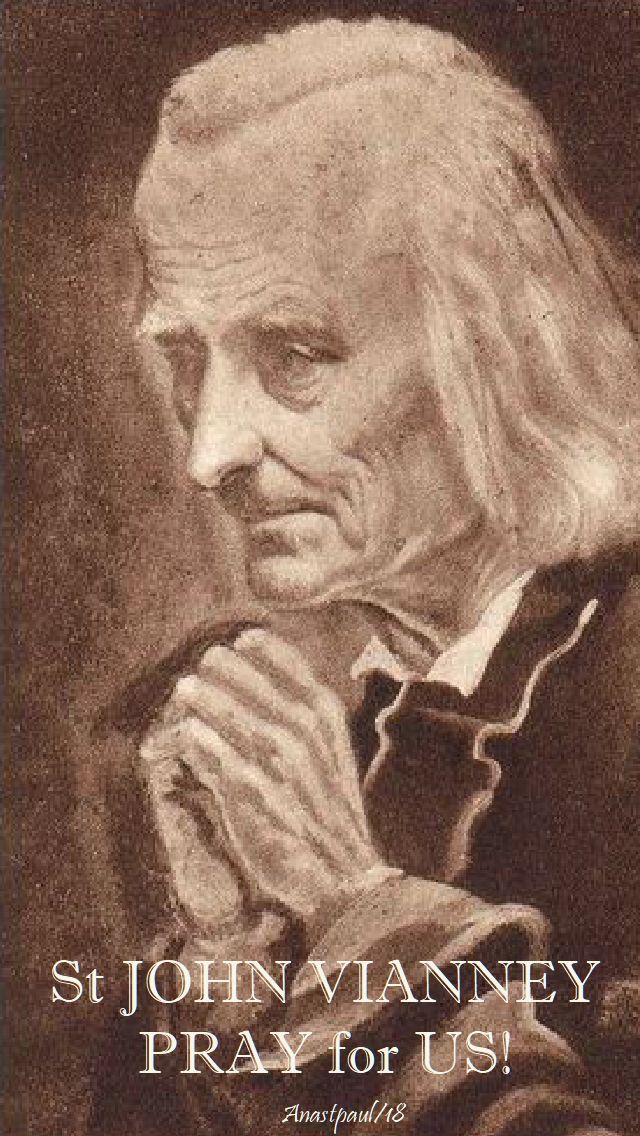
St John Marie Baptiste Vianney (1786-1859)

“When we do nothing to be ashamed of, when everything is going along according to our wishes, we dare to believe that nothing could make us fall.   We forget our own nothingness and our utter weakness.   We make the most delightful protestations that we are ready to die rather than to allow ourselves to be conquered.   We see a splendid example of this in St Peter, who told our Lord that although all others might be scandalised in Him, yet he would never deny Him.

Alas!   To show him how man, left to himself, is nothing at all, God made use, not of kings or princes or weapons but simply of the voice of a maidservant, who even appeared to speak to him in a very indifferent sort of way.   A moment ago, he was ready to die for Him and now Peter protests, that he does not even know Him, that he does not know about whom they are speaking.   To assure them even more vehemently that he does not know Him, he swears an oath about it.

Dear Lord, what we are capable of when we are left to ourselves!   There are some who, in their own words, are envious of the saints who did great penances.   They believe that they could do as well.   When we read the lives of some of the martyrs, we would, we think, be ready to suffer all that they suffered for God;  the moment is short lived, we say, for an eternity of reward.   But what does God do to teach us to know ourselves or, rather, to know that we are nothing?   This is all He does:   He allows the Devil to come a little closer to us.   Look at this Christian who a moment ago was quite envious of the hermit who lived solely on roots and herbs and who made the stern resolution to treat his body as harshly.   Alas!   A slight headache, a prick of a pin, makes him, as big and strong is he is, sorry for himself.   He is very upset.   He cries with pain.   A moment ago he would have been willing to do all the penances of the anchorites — and the merest trifle makes him despair!

Look at this other one, who seems to want to give his whole life for God, whose ardour all the torments there are cannot damp.   A tiny bit of scandalmongering …. a word of calumny …. even a slightly cold reception or a small injustice done to him …. a kindness returned by ingratitude …. immediately gives birth in him to feelings of hatred, of revenge, of dislike, to the point, often, of his never wishing to see his neighbour again or at least of treating him coldly with an air which shows very plainly what is going on in his heart.   And how many times is this his waking thought, just as it was the thought that almost prevented him from sleeping?   Alas, my dear brethren, we are poor stuff and we should count very little upon our good resolutions!”

St John Vianney, Pray for us!

st john vianney pray for us - 20 june 2018

Posted in DOCTORS of the Church, FATHERS of the Church, MORNING Prayers, QUOTES of the SAINTS, QUOTES on HUMILITY, SPEAKING of ....., The WORD

Quote/s of the Day – – 20 June – Wednesday Eleventh Week of Ord Time Year B – Today’s Gospel Matthew 6:1-6.16-18

Quote/s of the Day – 20 June – Wednesday Eleventh Week of Ord Time Year B – Today’s Gospel Matthew 6:1-6.16-18

“Speaking of:  Humility”

“God resists the proud
but gives grace to the humble”

James 4:6god resists the proud - james 4 - 6

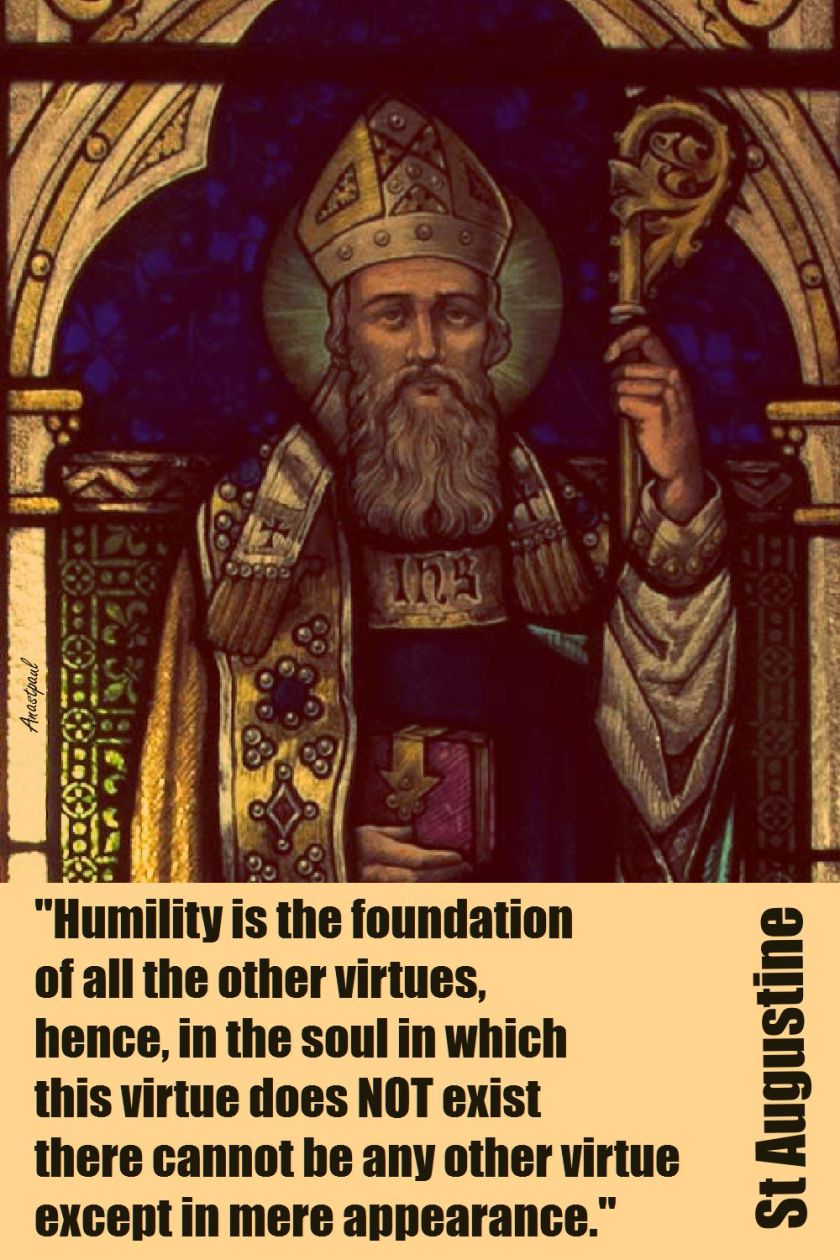
“Humility is the foundation of all the other virtues,
hence, in the soul in which this virtue does not exist,
there cannot be any other virtue,
except in mere appearance.”HUMILITY IS THE FOUNDATION-STAUGUSTINE

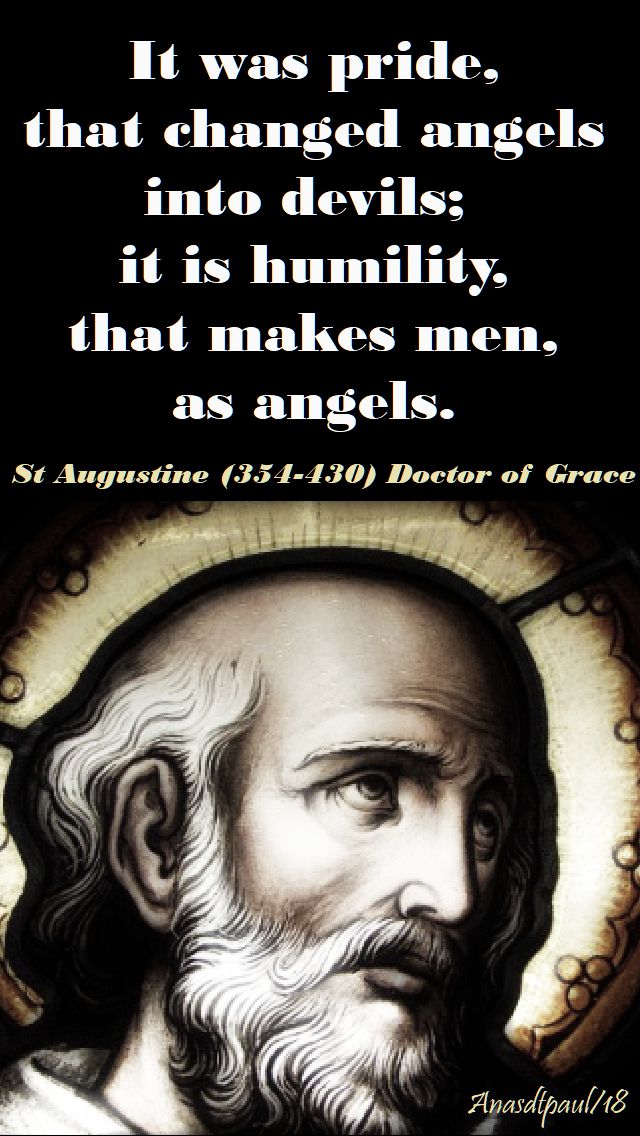
“It was pride that changed angels into devils;
it is humility that makes men as angels.”

St Augustine (354-430) Doctor of Graceit was pride - st augustine - 20 june 2018

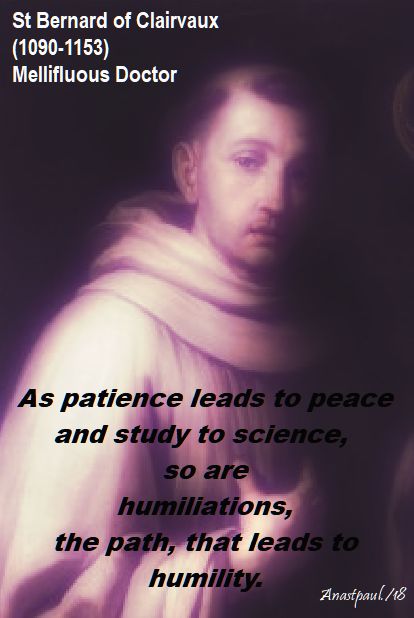
“As patience leads to peace
and study to science,
so are humiliations,
the path that leads to humility.”

St Bernard of Clairvaux (1090-1153) Mellifluous Doctor

as patience leads to peace - st bernard - 20 june 2018

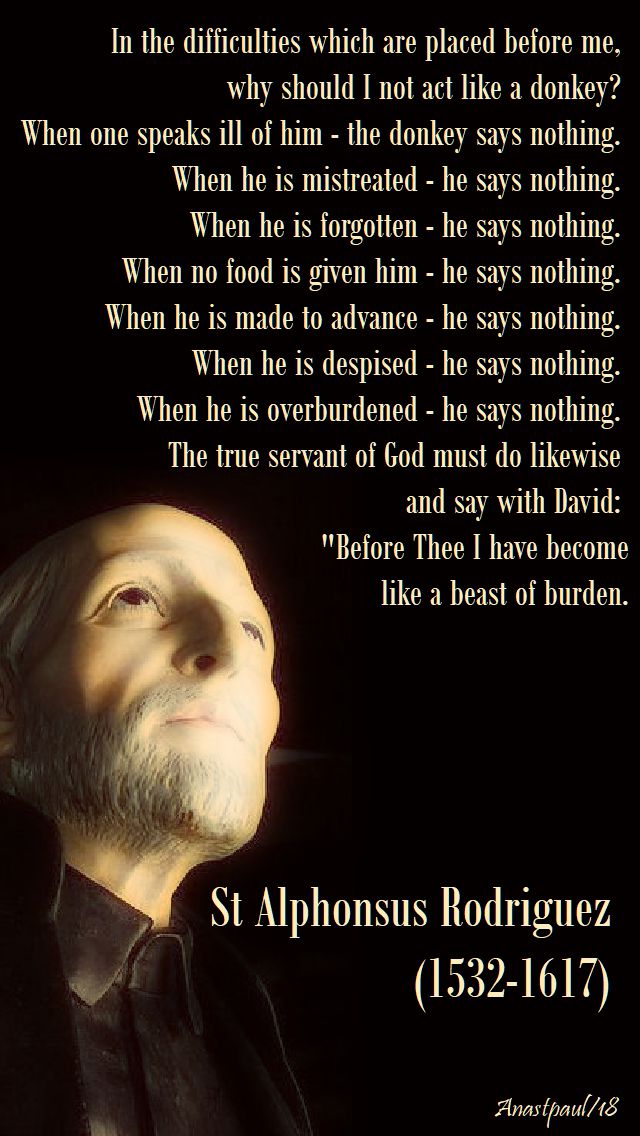
“In the difficulties which are placed before me,
why should I not act like a donkey?
When one speaks ill of him – the donkey says nothing.
When he is mistreated – he says nothing.
When he is forgotten – he says nothing.
When no food is given him – he says nothing.
When he is made to advance – he says nothing.
When he is despised – he says nothing.
When he is overburdened – he says nothing.
The true servant of God must do likewise
and say with David:
“Before Thee I have become like a beast of burden.”

St Alphonsus Rodriguez (1532-1617)in the difficulties which are placed before me - st alphonsus rodriguez - 20 june 2018

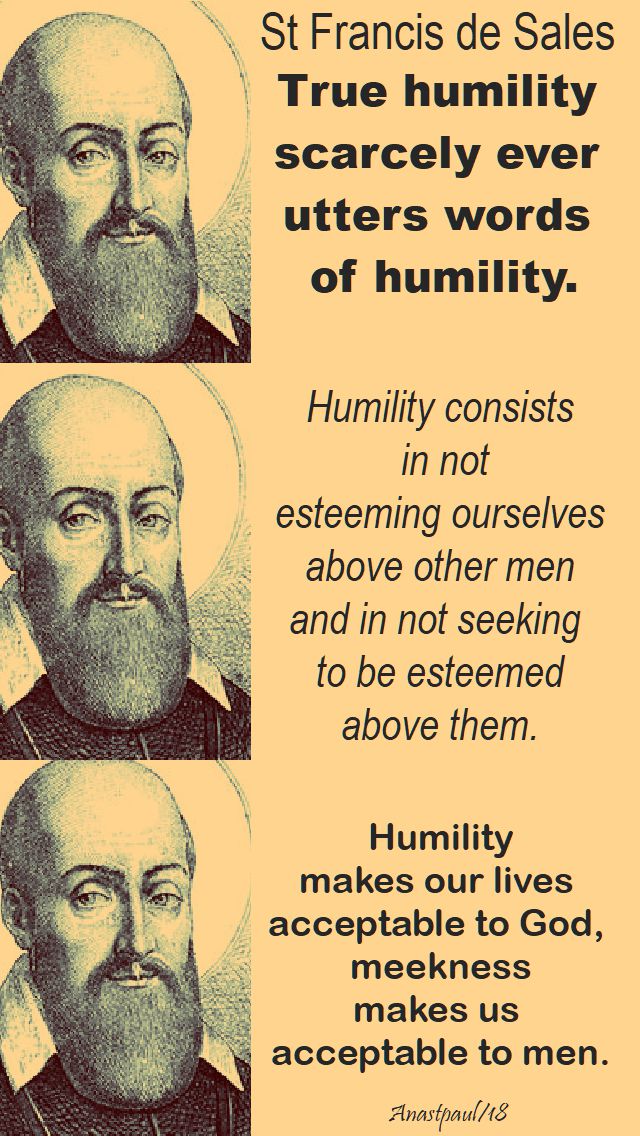
“True humility
scarcely ever
utters words
of humility.”

“Humility consists
in not esteeming ourselves above other men
and in not seeking
to be esteemed above them.”

“Humility makes our lives
acceptable to God,
meekness makes us
acceptable to men.”true humility - humility consists - humility makes our lives - st francis de sales - 20 june 2018

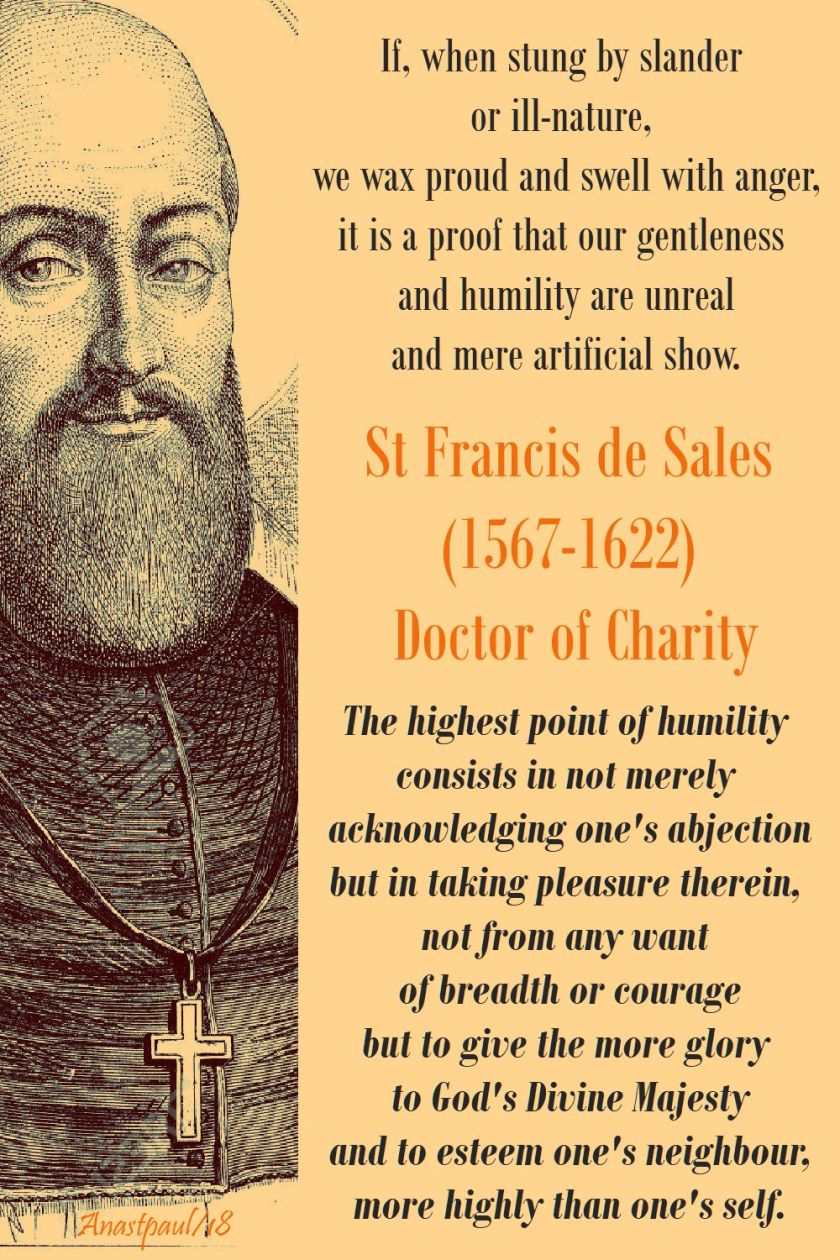
“If, when stung by slander or ill-nature,
we wax proud and swell with anger,
it is a proof that our gentleness
and humility are unreal
and mere artificial show.”

“The highest point of humility
consists in not merely acknowledging one’s abjection
but in taking pleasure therein,
not from any want of breadth or courage
but to give the more glory to God’s Divine Majesty
and to esteem one’s neighbour,
more highly than one’s self.”

St Francis de Sales (1567-1622) Doctor of Charityif when stung by slander - the highest point of humility - st francis de sales - 20 june 2018

“The truly humble
reject all praise for themselves
and refer it all to God.”

St Alphonsus Maria de Liguori (1696-1787) Most Zealous Doctorthe truly humble reject - st alphonsus liguori - 20 june 2018

Posted in DOCTORS of the Church, FATHERS of the Church, MORNING Prayers, QUOTES of the SAINTS, QUOTES on HUMILITY, QUOTES on PRAYER

One Minute Reflection – 20 June – Wednesday Eleventh Week of Ord Time Year B – Today’s Gospel Matthew 6:1-6.16-18

One Minute Reflection – 20 June – Wednesday Eleventh Week of Ord Time Year B – Today’s Gospel Matthew 6:1-6.16-18

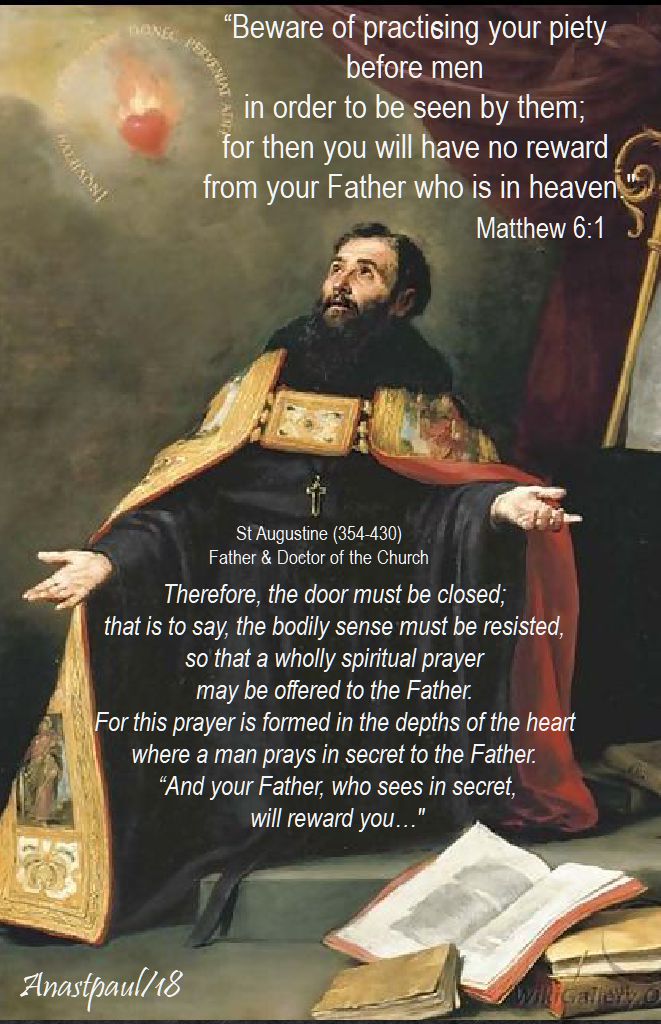
Jesus said to his disciples: ” “Beware of practicing your piety before men in order to be seen by them; for then you will have no reward from your Father who is in heaven.”…Matthew 6:1

REFLECTION – “Jesus says, “When you pray, go into your chamber.”   Now, what are these chambers but the heart signified in the Psalm where it is said:  “The things you say in your hearts, be sorry for in your room.”   He then continues: “And closing the doors, pray in secret to our Father.”   Our entering the room is not enough if the door is left open to the importunate, for external things enter brazenly in through this door and lay hold on our interior affections.   Temporal and visible penetrate through this door, that is, one of the senses, they enter our thoughts and by a swarm of fancies noisily disturb us while engaged in prayer.   Therefore, the door must be closed;  that is to say, the bodily sense must be resisted, so that a wholly spiritual prayer may be offered to the Father.   For this prayer is formed in the depths of the heart where a man prays in secret to the Father.   “And your Father, who sees in secret, will reward you…”

The Lord does not admonish us to pray but teaches us how to pray, just as the preceding passage does not admonish us to give alms but tells us what our intention ought to be when we are giving them.   This is due to the fact that He demands the purity of heart that one can only obtain by a continuous and undivided striving for eternal life through no other motive than a pure love of wisdom…St Augustine (354-430), Father & Doctor of the Church – Commentary on the Sermon on the Mount, Bk. II, 3, 11beware of practising your piety - therefore the door must be closed - st augustine - 20 june 2018

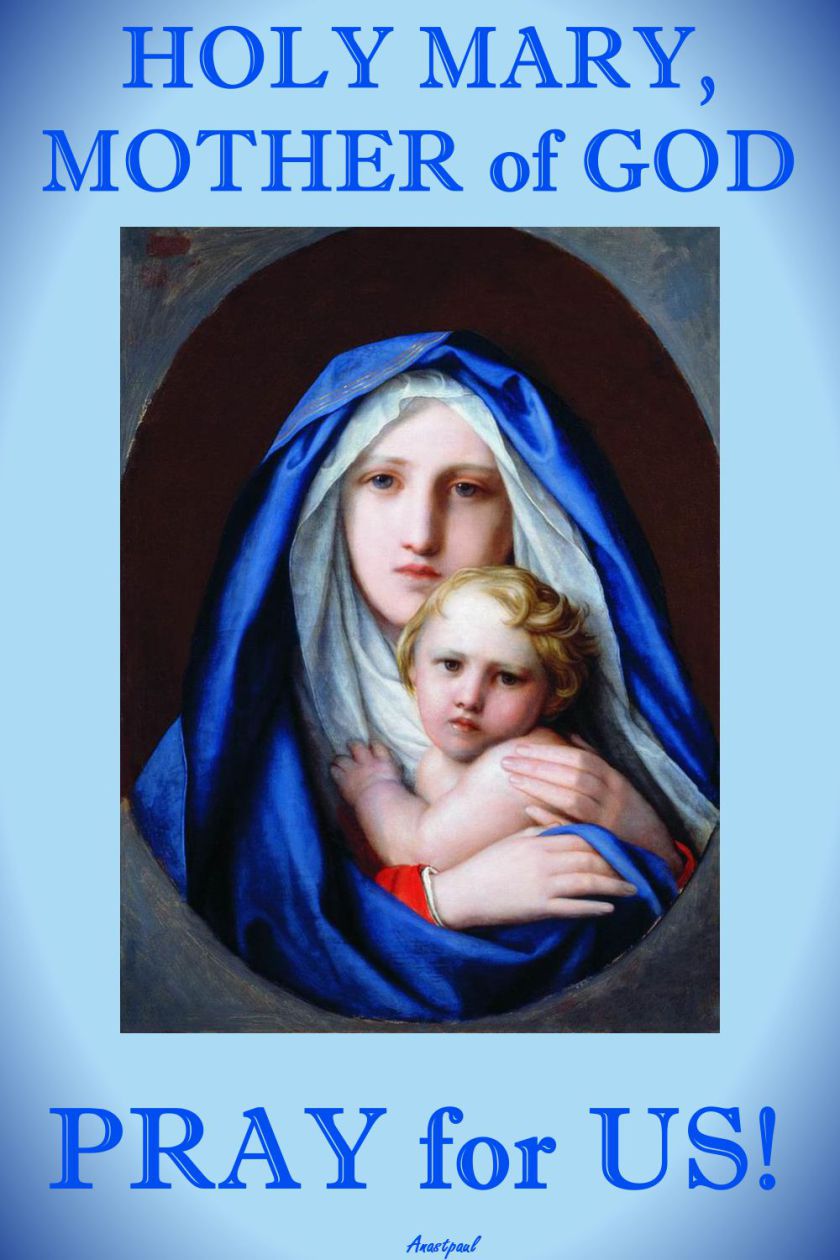
PRAYER – Lord God, in Your wisdom, You created us, by Your providence You rule us, penetrate our inmost being with Your light, so that our way of life may always be one of faithful service to You, as we follow the way of Your Son.   Holy Mother, guide us as you guided Your Son. Through Christ our Lord, with the Holy Spirit, one God, amen.holy mary-mother of god - pray-for-us.- 1 may 2017 and 2018

Posted in MORNING Prayers, PRAYERS of the SAINTS, QUOTES on HUMILITY

Our Morning Offering – 20 June – Wednesday Eleventh Week of Ord Time Year B – Today’s Gospel Matthew 6:1-6.16-18

Our Morning Offering – 20 June – Wednesday Eleventh Week of Ord Time Year B – Today’s Gospel Matthew 6:1-6.16-18

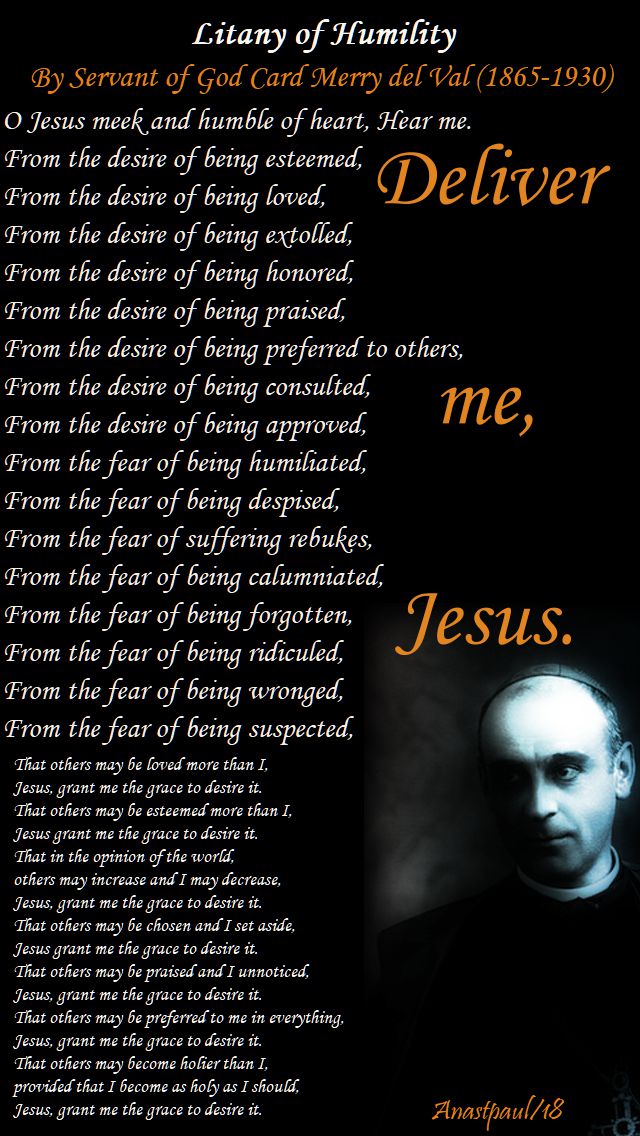
Litany of Humility
By Servant of God Cardinal Merry del Val (1865-1930)

He was accustomed to recite this prayer daily after the celebration of Holy Mass.

O Jesus meek and humble of heart, Hear me.
From the desire of being esteemed, Deliver me, Jesus.
From the desire of being loved, Deliver me, Jesus.
From the desire of being extolled, Deliver me, Jesus.
From the desire of being honored, Deliver me, Jesus.
From the desire of being praised, Deliver me, Jesus.
From the desire of being preferred to others, Deliver me Jesus.
From the desire of being consulted, Deliver me, Jesus.
From the desire of being approved, Deliver me, Jesus.
From the fear of being humiliated, Deliver me, Jesus.
From the fear of being despised, Deliver me, Jesus.
From the fear of suffering rebukes, Deliver me, Jesus.
From the fear of being calumniated, Deliver, me, Jesus.
From the fear of being forgotten, Deliver me, Jesus.
From the fear of being ridiculed, Deliver me, Jesus.
From the fear of being wronged, Deliver me, Jesus.
From the fear of being suspected, Deliver me, Jesus.

That others may be loved more than I,
Jesus, grant me the grace to desire it.
That others may be esteemed more than I,
Jesus, grant me the grace to desire it.
That in the opinion of the world, others may increase
and I may decrease,
Jesus, grant me the grace to desire it.
That others may be chosen and I set aside,
Jesus, grant me the grace to desire it.
That others may be praised and I unnoticed,
Jesus, grant me the grace to desire it.
That others may be preferred to me in everything,
Jesus, grant me the grace to desire it.
That others may become holier than I,
provided that I become as holy as I should,
Jesus, grant me the grace to desire it.
Amenlitany of humility - card merry del val - 20 june 2018

Posted in SAINT of the DAY

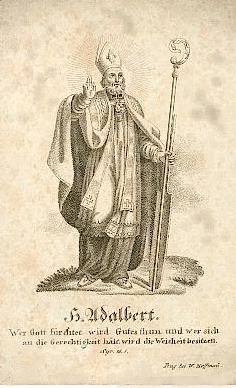
Saint of the Day – 20 June – St Adalbert of Magdeburg (910-981) “Apostle of the Slavs”

Saint of the Day – 20 June – St Adalbert of Magdeburg (910-981) Apostle of the Slavs” – Bishop, Monk, Missionary – born in 910 at Lorraine region and died on 20 June 981 at Merseburg, Germany of natural causes.   St Adalbert was the first Archbishop of Magdeburg (from 968) and a successful missionary to the Polabian Slavs to the east of what is contemporarily Germany.

Adalbert_of_Magdeburg

Adalbert was a monk at the Benedictine Monastery of St Maximinus in Trier, Germany. He was consecrated a Roman Catholic bishop and in 961 was sent to Kievan Rus – (was a loose federation of East Slavic tribes in Europe from the late 9th to the mid-13th century, under the reign of the Rurik dynasty.   The modern peoples of Belarus, Russia and Ukraine all claim Kievan Rus’ as their cultural ancestors, with Belarus and Russia deriving their names from it.).

Princess Olga of Kiev had asked Emperor Otto I (the Great) to provide her a missionary from the Roman Catholic Church.   Her son, Svyatoslav opposed her and stole her crown as soon as Adalbert arrived in Kievan Rus.   Adalbert’s missionary companions were slain and Adalbert barely escaped.   Kievan Rus subsequently was converted by missionaries from Constantinople and became part of Byzantine Christianity.

Upon escaping Kievan Rus, Adalbert traveled to Mainz, Germany, where he became the Abbot of Wissembourg in Alsace.   There he worked to improve the education of the monks.   He later became the first Archbishop of Magdeburg, Saxony-Anhalt, in contemporary Germany.

The Archepiscopacies of Hamburg and Bremen had been established with the intention that they would serve as bases for missions in northern and eastern Europe.   The Archdiocese of Magdeburg was designated to provide missionaries to the eastern European Slavs.   Adalbert also established dioceses for Naumburg, Meissen, Merseburg, Brandenburg; Havelberg and Poznań, Poland.   He died on 20 June 981 in Zscherben (contemporarily in (former) Geusa, in Merseburg, Saxony-Anhalt, Germany).

A student of Adalbert for some years named Wojciech Sławnikowic, who at his Confirmation took the very name of his tutor, went on from Adalbert’s tutelage to successfully evangelise many Slavic peoples, receive the crown of martyrdom in Prussia and was canonisded as St Adalbert of Prague (c 956 – 23 April 997).   Evidently St Adalbert of Magdeburg transmitted something of his wisdom, zeal and own mission to his student, the younger St Adalbert (of Prague)

Posted in SAINT of the DAY

Memorials of the Saints – 20 June

St Adalbert of Magdeburg (910-981)
St Bagne of Thérouanne
St Edburga of Caistor
St Gemma of Saintonge
St Goban of Picardie
St Helen of Öehren
St John of Pulsano
St Macarius of Petra
Bl Margareta Ebner
St Methodius of Olympus
Bl Michelina of Pesaro
St Novatus of Rome

Irish Martyrs – 17 beati – This is the collective title given to the 260 or more persons who are credited with dying for the faith in Ireland between 1537 and 1714. Seventeen of them were beatified together on 27 September 1992 by St Pope John Paul II.

• Blessed Conn O’Rourke
• Blessed Conor O’Devany
• Blessed Dermot O’Hurley
• Blessed Dominic Collins
• Blessed Edward Cheevers
• Blessed Francis Taylor
• Blessed George Halley
• Blessed John Kearney
• Blessed Matthew Lambert
• Blessed Maurice Eustace
• Blessed Patrick Cavanagh
• Blessed Patrick O’Healy
• Blessed Patrick O’Loughran
• Blessed Peter Higgins
• Blessed Robert Meyler
• Blessed Terrence Albert O’Brien
• Blessed William Tirry

Martyrs of Lower Moesia: Martyred on the Black Sea at Lower Moesia (in modern Bulgaria), date unknown.
St Cyriacus
St Paul

Martyred in Nagasaki: 9 Beati : burned alive on 20 June 1626 in Nagasaki, Japan. Their ashes were thrown into the sea and no relics remain. They were Beatified on 7 May 1867 by Pope Pius IX.
• Blessed Baltasar de Torres Arias
• Blessed Francisco Pacheco
• Blessed Gaspar Sadamatsu
• Blessed Giovanni Battista Zola
• Blessed Ioannes Kisaku
• Blessed Michaël Tozo
• Blessed Paulus Shinsuke
• Blessed Petrus Rinsei
• Blessed Vincentius Kaun

Posted in MORNING Prayers, QUOTES of the SAINTS, SAINT of the DAY

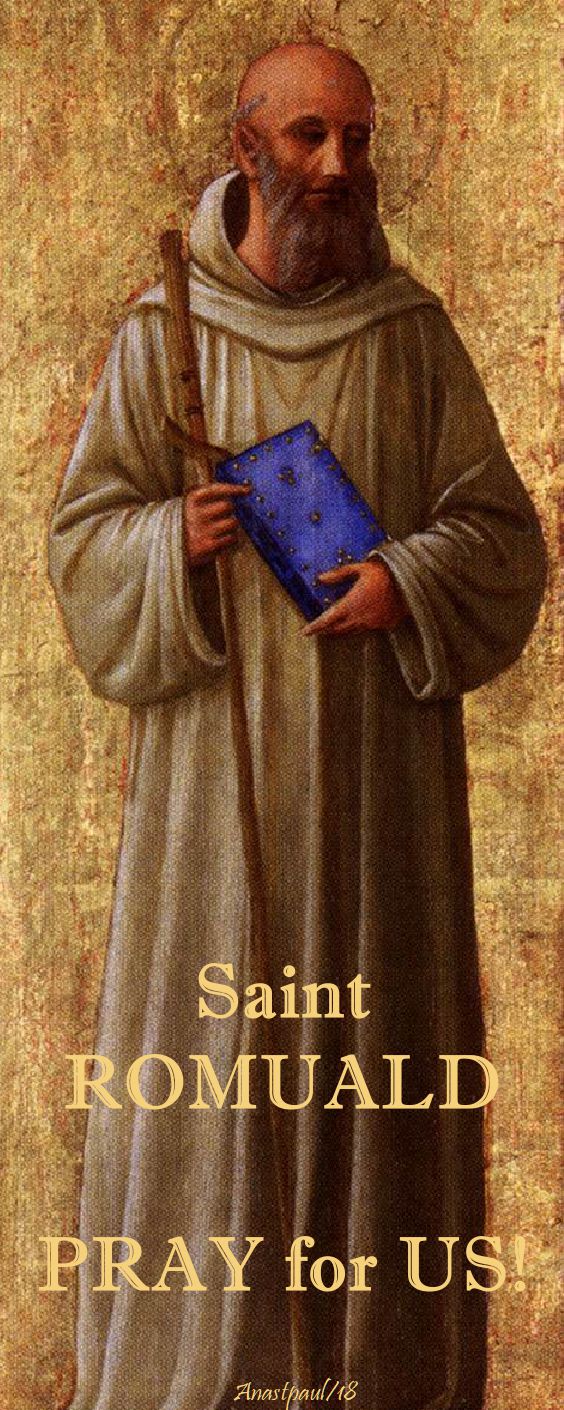
Thought for the Day – 19 June – The Memorial of St Romuald (c 951-1027)

Thought for the Day – 19 June – The Memorial of St Romuald (c 951-1027)

Saint Romuald’s body was buried at the monastery in Paranzo.   Three decades later, his incorrupt body was transferred to Fabriano in 1481.   Many miracles have been reported at his tombside in the great Cathedral of Fabriano.   The Order he founded continues to operate today, with five distinct congregations.   The most austere of those, the hermits, continue to live in a manner much like that of Saint Romuald—strict adherence to silence and prayer for the reparation of the sins of mankind.

The quiet and contemplative life of Saint Romuald reminds us, that humility, meekness and a deep desire for the Lord are the hallmarks of our faith.   These simple tenets, lived as model for others, are a powerful witness to the depth of our hope and confidence in the Lord, a reminder of our obedience to Him and a powerful call to prayer.   When we pray, as Saint Romuald said, our bodies, hearts, souls and minds should be focused solely on God:  “Better to pray one psalm with devotion and compunction than a hundred with distraction.”

Prayer is the gauge of our love for God.   If we pray, we love Him but if we don’t pray, we do not love Him.   It is as simple as that, for surely we want always to speak to the one we love?   Let us ask Saint Romuald to obtain for us the grace of prayer and perseverance in prayer, particularly when we find the going hard.

St Romuald, pray for usst romuald - pray for us - 19 june 2018

Posted in DOCTORS of the Church, EUCHARISTIC Adoration, MORNING Prayers, QUOTES - J R R Tolkien and MORE, QUOTES of the SAINTS, QUOTES on PRAYER, SPEAKING of ....., The HOLY EUCHARIST / The HOLY MASS

Quote/s of the Day – 18 June – The Memorial of St Romuald (c 951-1027)

Quote/s of the Day – 18 June – The Memorial of St Romuald (c 951-1027)

Speaking of: Prayer

“It is better to say
one Our Father fervently
and devoutly
than a thousand,
with no devotion
and full of distraction.”

St Edmund (841-869)it is better to say one our father - st edmund - king and martyr - 18 june 2018

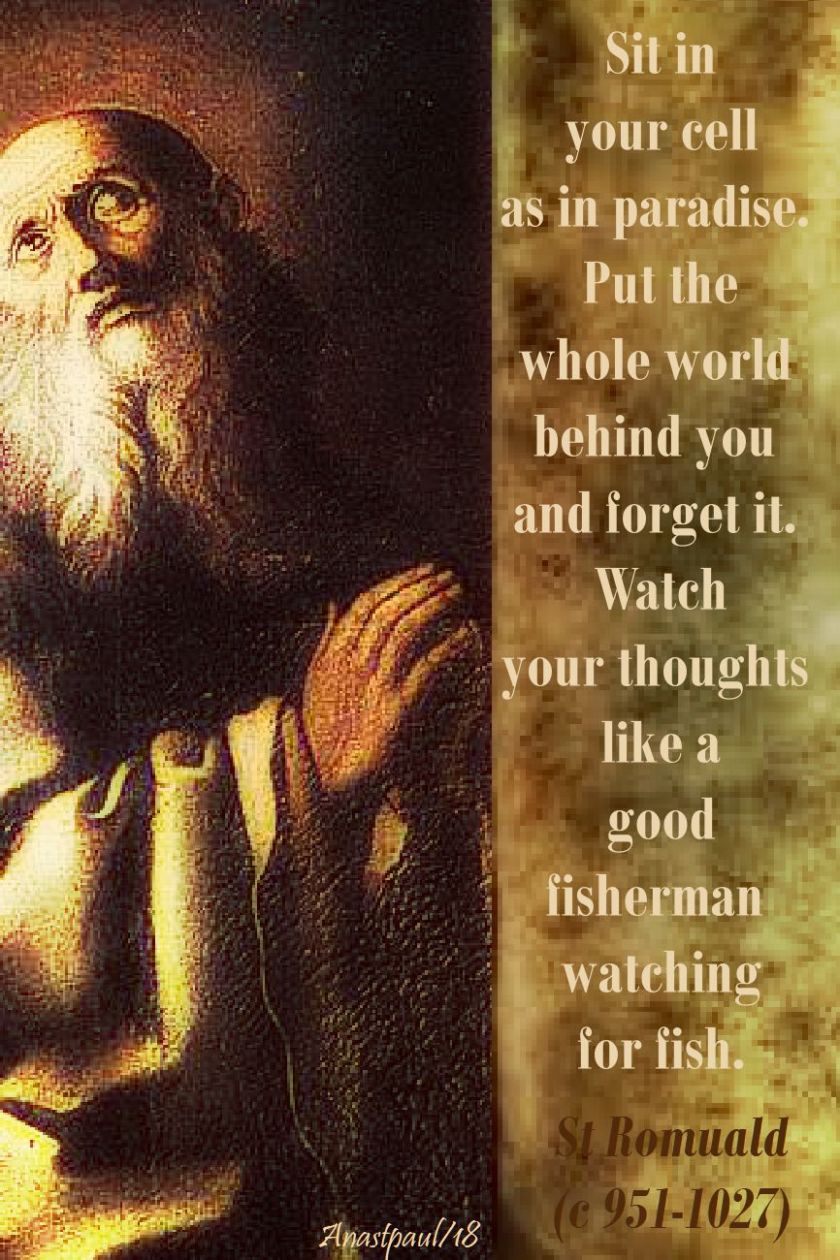
“Sit in your cell as in paradise.
Put the whole world
behind you and forget it.
Watch your thoughts
like a good fisherman
watching for fish.”

St Romuald (c 951-1027)sit in your cell as in paradise - st romuald - 18 june 2018

“Were you to ask,
‘what are the means
of overcoming temptations’,
I would answer:
The first means is prayer;
the second is prayer;
the third is prayer;
and should you ask me,
a thousand times,
I would repeat the same.”

St Alphonsus Liguori (1696-1787)
Most Zealous Doctorwere you to ask - st alphonsus - 18 june 2018

“When we speak to Jesus
with simplicity and with all our heart,
He does like a mother
who holds her child’s head with her hands
and covers it with kisses and caresses.”

St John Vianney (1786-1859)when we speak to jesus - st john vianney - 19 june 2018

“Jesus is waiting
for you
in the chapel.
Go and find Him.”

St Jeanne Jugan (1792-1879) 30 Augustjesus is waiting for you in the chapel - st jeanne jugan - 19 june 2018

“To clasp the hands in prayer
is a beginning of an uprising
against the disorder of the world.”

Karl Barth (1886-1968)to clasp the hands in prayer - karl barth - 19 june 2018

“Friends,
do not be afraid
of silence or stillness.
Listen to God.
Adore Him in the Eucharist.”

Pope Benedict XVIfriends, do not be afraid - pope benedict - 18 june 2018

“Turn your car into a monastery.”

Bishop Robert Barronturn your car into a monastery - bishop robert barron - 18 june 2018

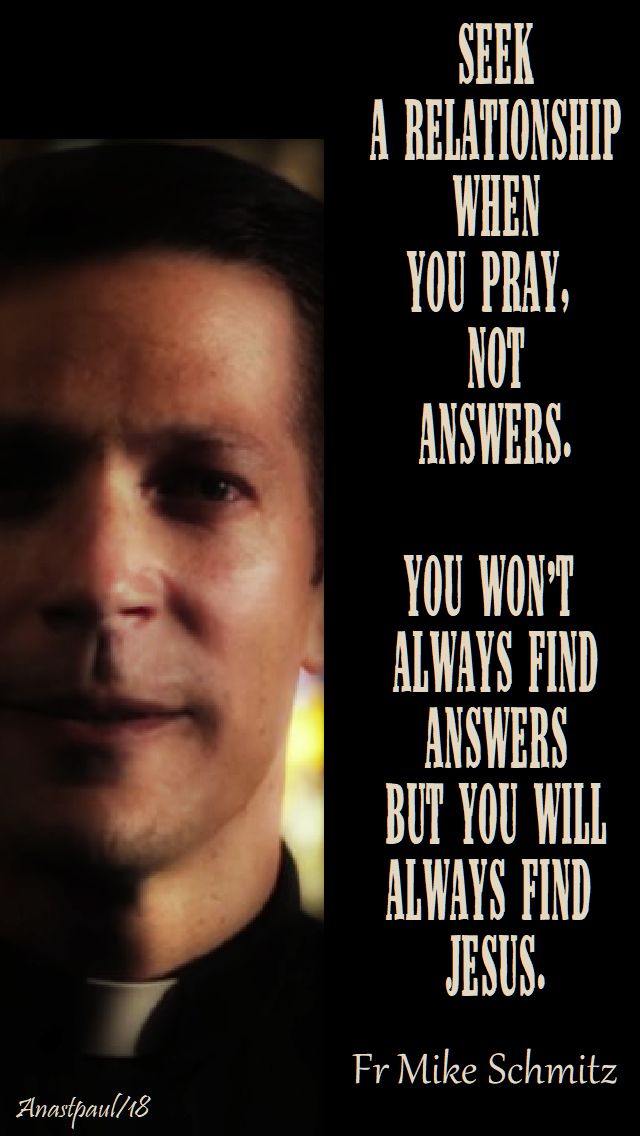
“Seek a relationship
when you pray, not answers.
You won’t always find answers
but you will always find Jesus.”

Father Mike Schmitzseek a relationship when you pray - fr mike schmitz - 18 june 2018

Posted in MORNING Prayers, QUOTES of the SAINTS, QUOTES on PRAYER, SAINT of the DAY, The WORD

One Minute Reflection – 19 June – The Memorial of St Romuald (c 951-1027)

One Minute Reflection – 19 June – The Memorial of St Romuald (c 951-1027)

And we have this confidence in him, that if we ask anything according to his will, he hears us.   And if we know that he hears us, in regard to whatever we ask, we know that, what we have asked him for, is ours...1 John 5:14-15and we have this confidence in him - 1 john 5-14-15 - 19 june 2018

REFLECTION – “Better to pray one psalm with devotion and compunction than a hundred with distraction.”…St Romualdbetter to pray one psalm with devotion - st romuald - 19 june 2018

PRAYER – Father, through St Romuald You renewed the life of solitude and prayer in your Church.   By our prayer and self-denial as we follow Christ our Lord, bring us the joy of heaven.   Kindly receive the intercession of St Romuald still, as we beg his prayers for all of your Church.   We ask this through our Lord Jesus Christ, your Son, who lives and reigns with you and the Holy Spirit, one God, forever and ever.  Amenst romuald - pray for us no 2 - 19 june 2018

Posted in CATHOLIC DEVOTIONS of the Month, MORNING Prayers, PRAYERS of the SAINTS, SACRED and IMMACULATE HEARTS

Our Morning Offering – 19 June – Month of the Sacred Heart of Jesus

Our Morning Offering – 19 June – Month of the Sacred Heart of Jesus

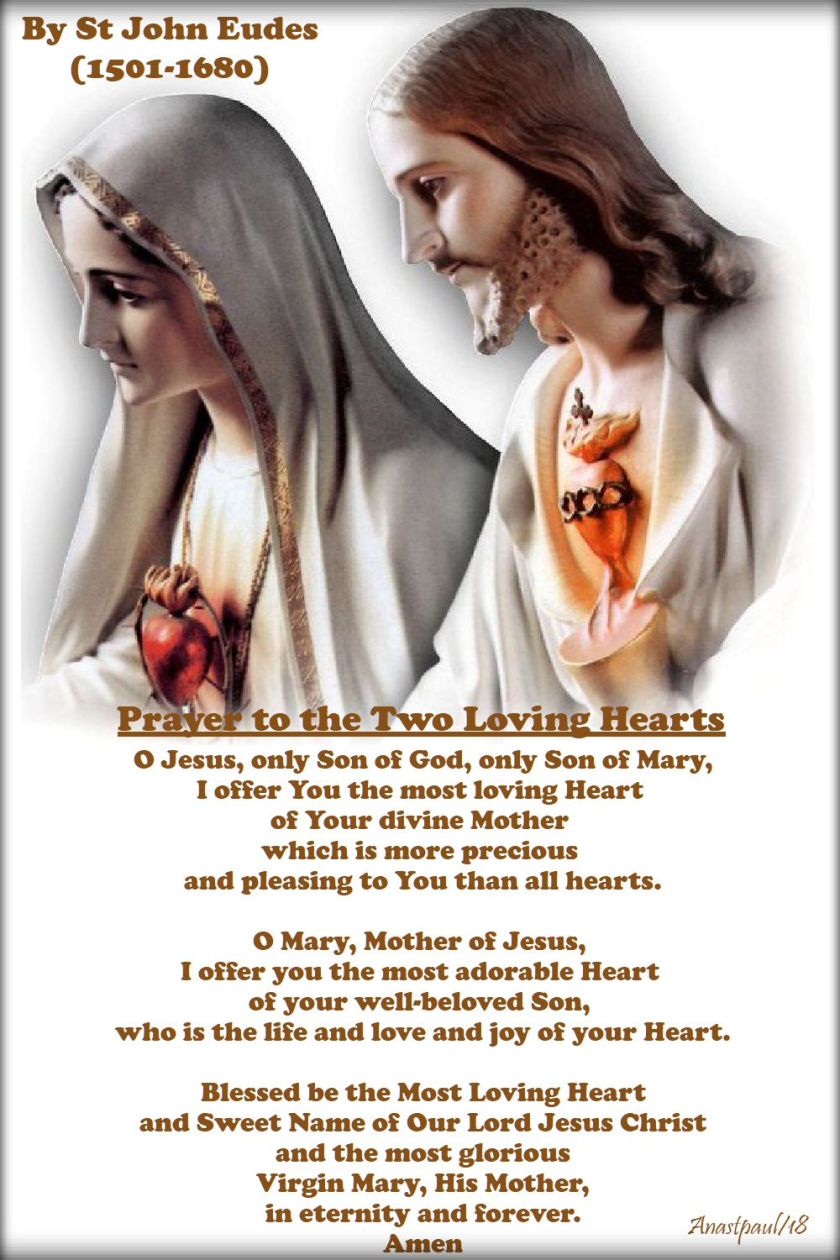
Prayer to the Two Loving Hearts
By St John Eudes (1501-1680)

O Jesus, only Son of God, only Son of Mary,
I offer You the most loving Heart
of Your divine Mother
which is more precious
and pleasing to You than all hearts.

O Mary, Mother of Jesus,
I offer you the most adorable Heart
of your well-beloved Son,
who is the life and love and joy of your Heart.

Blessed be the Most Loving Heart
and Sweet Name of Our Lord Jesus Christ
and the most glorious
Virgin Mary, His Mother,
in eternity and forever.
Amenprayer to the two loving hearts by st john eudes - 18 june 2018

Posted in INCORRUPTIBLES, SAINT of the DAY

Saint of the Day – 19 June – St Romuald (c 951-1027)

Saint of the Day – 19 June – St Romuald (c 951-1027) – Monk, Abbot, Ascetic, Founder of the Camaldolese order and a major figure in the eleventh-century “Renaissance of eremitical asceticism”.    St Romuald was born in c 951 at Ravenna, Italy and died on 19 June 1027 at Val-di-Castro, Italy of natural causes.   Patronages – the Camaldolese order and Suwalki, Poland.   St Romuald’s body is incorrupt.

619romuald5

According to the vita (life) by St Peter Damian O.S.B. (1007-1072), himself a Benedictine and Doctor of the Church , written about fifteen years after Romuald’s death, Romuald was born in Ravenna, in northeastern Italy, to the aristocratic Onesti family.    As a youth, according to early accounts, Romuald indulged in the pleasures and sins of the world common to a tenth-century nobleman.   At the age of twenty he served as second to his father, who killed a relative in a duel over property.   Romuald was devastated and went to the Basilica of Sant’Apollinare in Classe to do 40 days of penance.   After some indecision, Romuald became a monk there.   San Apollinare had recently been reformed by St Maieul of Cluny Abbey (906-994) but still was not strict enough in its observance to satisfy Romuald.   His injudicious correction of the less zealous aroused such enmity against him that he applied for and was readily granted, permission to retire to Venice, where he placed himself under the direction of a hermit named Marinus and lived a life of extraordinary severity.

Saint_Romuald

About 978, Pietro Orseolo I, Doge of Venice, who had obtained his office by acquiescence in the murder of his predecessor, began to suffer remorse for his crime.   On the advice of Guarinus, Abbot of San Miguel-de-Cuxa, in Catalonia and of Marinus and Romuald, he abandoned his office and relations and fled to Cuxa, where he took the habit of St Benedict, while Romuald and Marinus erected a hermitage close to the monastery. Romuald lived there for about ten years, taking advantage of the library of Cuxa to refine his ideas regarding monasticism.

Giovanni da Brescia, Orseolo vor Romuald - Giovanni da Brescia, Orseolo and Romuald -
Pietro Orseolo I, Doge of Venice before St Romuald

After that he spent the next 30 years going about Italy, founding and reforming monasteries and hermitages.   His reputation being known to advisers of the Holy Roman Emperor Otto III, Romuald was persuaded by him to take the vacant office of abbot at Sant’Apollinare to help bring about a more dedicated way of life there.   The monks, however, resisted his reforms and after a year, Romuald resigned, hurling his abbot’s staff at Otto’s feet in total frustration.   He then again withdrew to the hermetical life.romuald with church-2

In 1012 he arrived at the Diocese of Arezzo.   Here, according to the legend, a certain Maldolus, who had seen a vision of monks in white garments ascending into Heaven, gave him some land, afterwards known as the Campus Maldoli, or Camaldoli.   St Romuald built on this land five cells for hermits, which, with the monastery at Fontebuono, built two years later, became the famous motherhouse of the Camaldolese Order.   Romuald’s daunting charisma awed Rainier of Tuscany, who was neither able to face Romuald nor to send him away.   Romuald founded several other monasteries, including the monastery of Val di Castro, where he died in 1027.

Camaldoli_Church
The church in Eremo di Camaldoli, the famous motherhouse of the Camaldolese

St Romuald’s feast day was added to the Liturgical Calendar in 1594, today, the day of his death and entry into life.

St Romuald’s Rule:
Romuald was able to integrate these different traditions in establishing his own monastic order.   The admonition in his rule Empty yourself completely and sit waiting places him in relation to the long Christian history of intellectual stillness and interior passivity in meditation also reflected in the nearly contemporary Byzantine ascetic practice known as Hesychasm.

Romuald (FaceBk)

Sit in your cell as in paradise.   Put the whole world behind you and forget it. Watch your thoughts like a good fisherman watching for fish.   The path you must follow is in the Psalms — never leave it.

If you have just come to the monastery and in spite of your good will, you cannot accomplish what you want, take every opportunity you can to sing the Psalms in your heart and to understand them with your mind.   And if your mind wanders as you read, do not give up; hurry back and apply your mind to the words once more.

Archbishop Cosmo Francesco Ruppi noted that, “Interiorisation of the spiritual dimension, the primacy of solitude and contemplation, slow penetration of the Word of God and calm meditation on the Psalms are the pillars of Camaldolese spirituality, which St Romuald gives as the essential core of his Rule.”

Romuald’s reforms provided a structural context to accommodate both the eremitic and cenobitic aspects of monastic life.

San Romualdo, from the San Marco altarpiece by Fra Angelico
St Romuald, from the San Marco altarpiece by Fra Angelico
Posted in SAINT of the DAY

Memorials of the Saints – 19 June

St Romuald (c 951-1027) (Optional Memorial)

St Adleida of Bergamo
Bl Arnaldo of Liniberio
St Culmatius of Arezzo
St Deodatus of Jointures
St Deodatus of Nevers
St Gaudentius of Arezzo
St Gervase
St Hildegrin of Châlons-sur-Marne
Bl Humphrey Middlemore
St Innocent of Le Mans
St Julia Falconieri
St Lambert of Saragossa
St Lupo of Bergamo
St Modeste Andlauer
St Nazario of Koper
Bl Odo of Cambrai
St Protase
St Rémi Isoré
Bl Sebastian Newdigate
Bl Thomas Woodhouse
Bl William Exmew
St Zosimus of Umbria

Posted in MORNING Prayers, PAPAL SERMONS, QUOTES - J R R Tolkien and MORE, QUOTES on LOVE, QUOTES on PERSECUTION, QUOTES on PRAYER, QUOTES on the DEVIL/EVIL

Thought for the Day – 18 June – Pope Francis: to love your enemies, prayer is the way

Thought for the Day – 18 June – Monday of the Eleventh Week in Ordinary Time, Year B – Today’s Gospel Matthew 5:38-42

Pope Francis: to love your enemies, prayer is the way

“Love your enemies and pray for those who persecute you.”

“Pray for the one who hurt me?” the Pope asked. “Yes,” he answered, “because it changes lives.”   If we think it is impossible, then pray, the Pope said.   Pray every day for the grace to forgive and the grace to love.

“This advice: ‘Be holy, for I the Lord your God, am holy.’   And then: ‘You shall be perfect as your heavenly Father is perfect’,” the Pope remarked.   Forgiveness and prayer are the way to do this.   “This is the way of holiness,” he said. “If all men and women of the world learned this, there would be no wars, there would not be.”

Wars begin “in bitterness, rancour, the desire for revenge, to make someone pay.   But that destroys families, destroys friendships, destroys neighbourhoods, destroys so much,” he said.   For Pope Francis, this is why we must pray always for the grace not to hold grudges and for “the grace to pray for our enemies, to pray for the people that do not love us, the grace of peace.”

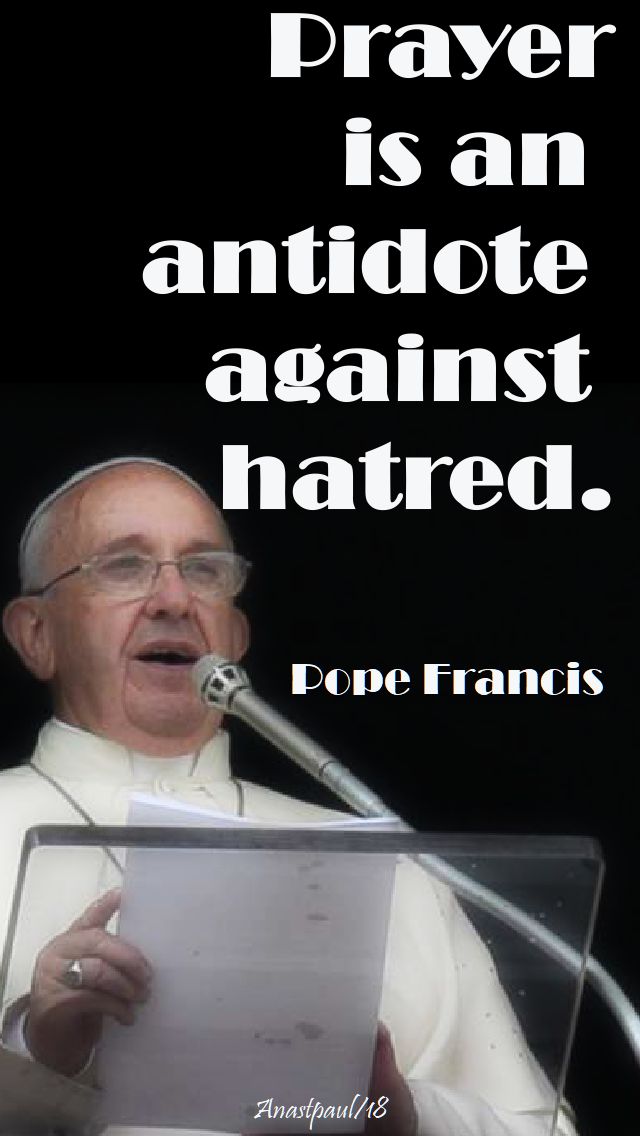
If we make this our daily prayer, the Pope continued, even just praying one prayer a day for our enemies, this is how we will “win” and make progress “on the path of holiness and perfection.”   In the end, “evil is overcome by good,” he said, and “sin is won with generosity.”   “Prayer is an antidote against hatred, against wars, these wars that start at home, which start in the neighbourhood, which begin in families,” he said.

The Pope said if he knows that someone wants to hurt him and does not love him, “I pray especially for him.”

“Pray for there to be peace.”

“Prayer is an antidote against hatred.”

Pope Francis 19 February 2017prayer is an antidote against hatred - pope francis - 18 June 2018

Posted in DOCTORS of the Church, FATHERS of the Church, MORNING Prayers, QUOTES of the SAINTS, QUOTES on LOVE, QUOTES on PRAYER

Quote of the Day – 18 June

Quote of the Day – 18 June – Monday of the Eleventh Week in Ordinary Time, Year B – Today’s Gospel Matthew 5:38-42

“You don’t love in your enemies
what they are
but what you would have them become,
by your prayers!”

St Augustine (354-430) Father & Doctoryou don't love in your enemies what they are but what you would have them become by your prayers - st augustine - 18 june 2018

Posted in MORNING Prayers, QUOTES of the SAINTS, QUOTES on CHARITY, QUOTES on LOVE, The WORD

One Minute Reflection – 18 June

One Minute Reflection – 18 June – Monday of the Eleventh Week in Ordinary Time, Year B – Today’s Gospel Matthew 5:38-42

“You have heard that it was said, ‘An eye for an eye and a tooth for a tooth.’ But I say to you, Do not resist one who is evil.   But if any one strikes you on the right cheek, turn to him the other also...”Matthew 5:38-39

REFLECTION – “Whoever keeps the whole Law but falls short in one particular has become guilty in respect to all of it” (Jas 2:10).   What is this one law if not true love, perfect charity?   It is of this that Saint Paul also said : “For the whole Law is fulfilled in one statement, namely:  ‘You shall love your neighbour as yourself’” (Gal 5:14)…

For true charity is patient in adversity and moderate in prosperity;  strong in painful suffering, joyful in good works;  completely safe in temptation.   It is very gentle among genuine brothers, very patient among the false.   It is innocent in the midst of snares, groans in the midst evildoing and breathes naturally in the truth.   It is chaste in the married woman, Susannah, in the widow, Anna, in the virgin, Mary (Dn 13:1f.;  Lk 2:36). It is humble in Peter’s obedience and free in Paul’s arguments.   It is human in the witness of Christians, divine in the forgiveness of Christ.   For true charity, beloved brethren, is the soul of the whole of Scripture, the strength of prophecy, the structure of knowledge, the fruit of faith, the wealth of the poor, the life of the dying.   So keep it faithfully;  cherish it with all your heart and all the strength of your soul (cf Mk 12:30).”…St Caesarius of Arles (470-543), monk and Bishop (Sermons to the people, no. 23, 4-5, which draws its inspiration from Saint Augustine)mt 5-38-39 - an eye for an eye discourse - for true charity dear brethren - st caesarius of arles - 18 june 2018

PRAYER – King of heaven and earth, Lord God, rule over our hearts this day.   Sanctify us and guide our every thought, word and deed according to Your commandments.   That we may grow in love, patience, strength, gentleness, forgiveness and all the ways of our guide, Your Son, Jesus Christ our Saviour.   Holy Mother Mary, pray for us and keep us ever in your care that we may not go astray.   We make our prayer through our Lord Jesus Christ, one God with You and the Holy Spirit, forever, amen.holy mother mary - pray for us - 18 june 2018

Posted in JESUIT SJ, MORNING Prayers, PRAYERS of the SAINTS

Our Morning Offering 18 June – Monday of the Eleventh Week in Ordinary Time, Year B

Our Morning Offering 18 June – Monday of the Eleventh Week in Ordinary Time, Year B

Excerpt from Jesus, My Friend
By St Claude de la Colombiere (1641-1682)

O Jesus!
You are my true Friend,
my only Friend.
You take a part in all my misfortunes;
You take them on Yourself;
You know how to change them into blessings.
You listen to me with the greatest kindness
when I relate my troubles to You,
and You have always balm to pour on my wounds.
I find You at all times;
I find You everywhere;
You never go away;
if I have to change my dwelling,
I find You wherever I go.
You are never weary of listening to me;
You are never tired of doing me good.
O Jesus!
Grant that I may die praising You,
that I may die loving You,
that I may die for the love of You.
Amenjesus my friend by st claude de la colombiere - 18 june 2018

Posted in INCORRUPTIBLES, SAINT of the DAY

Saint of the Day – 18 June – St Gregory Barbarigo (1625-1697)

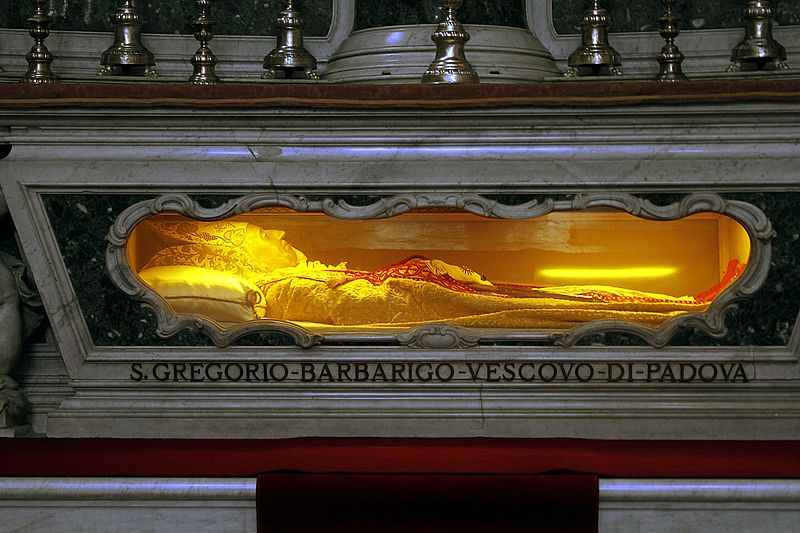
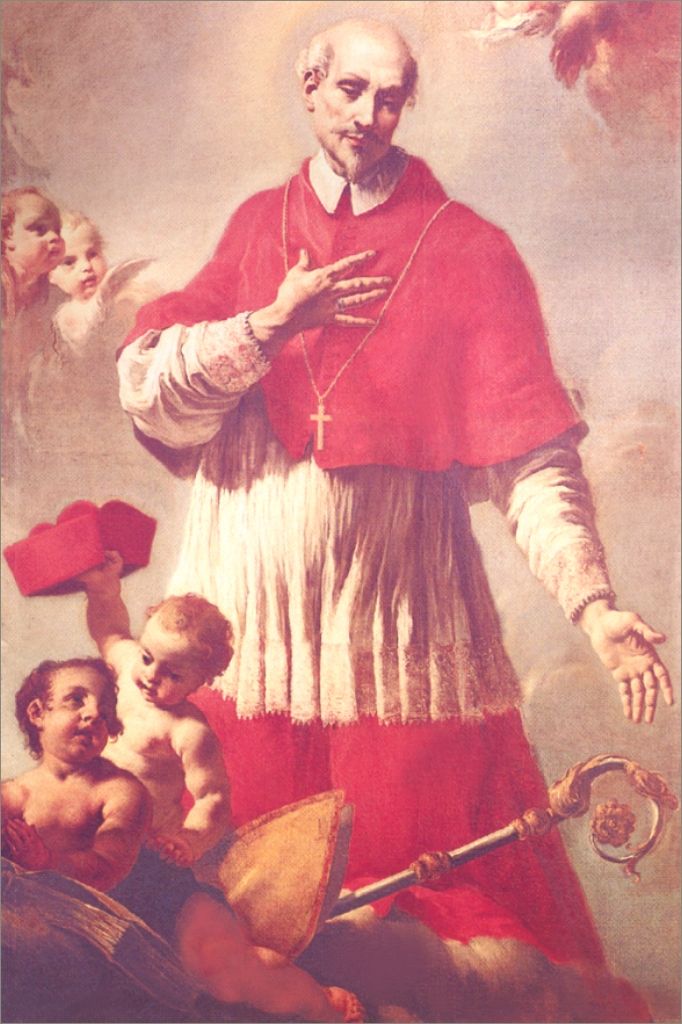
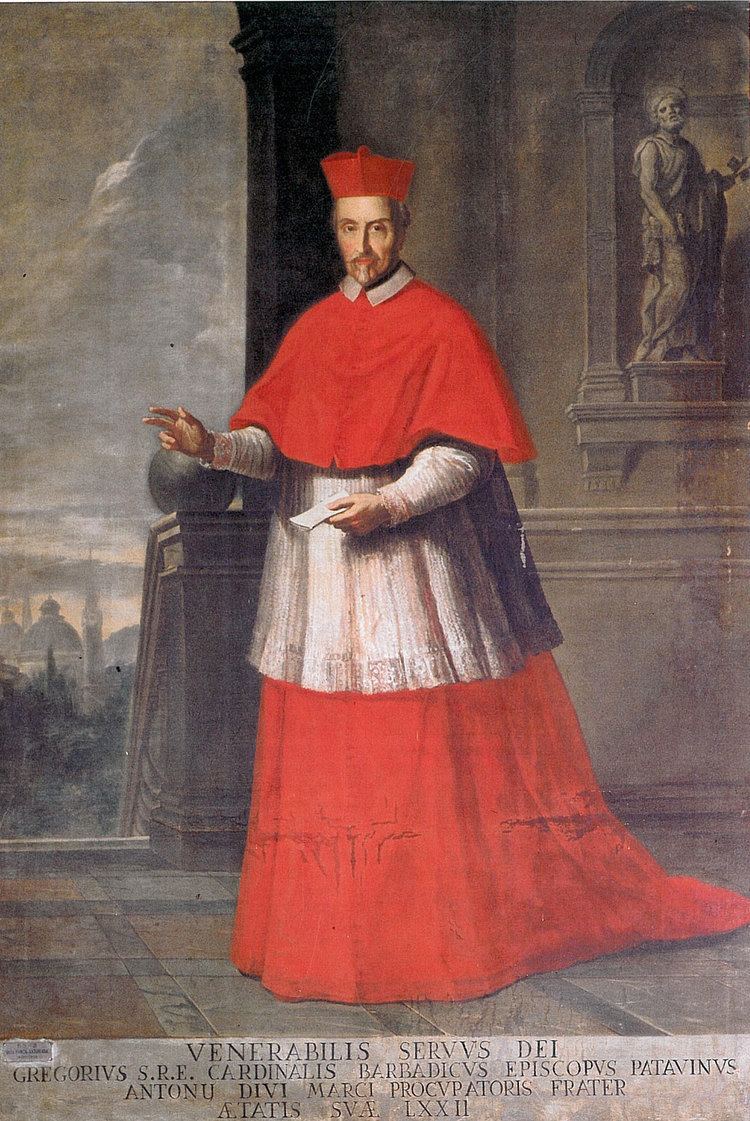
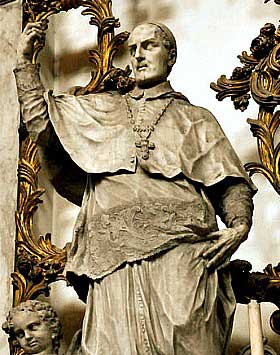
Saint of the Day – 18 June – St Gregory Barbarigo (1625-1697) Cardinal who served as the Bishop of Bergamo and later as the Bishop of Padua, Canon and Civil lawyer, Vatican prelate, Apostle of Charity and the Sick, Reformer, Teacher – born on 16 September 1625 at Venice, Italy as Gregorio Giovanni Gasparo Barbarigo and died on 18 June 1697 at Padua, Italy of natural causes.   Patronages – Diocese of Bergamo, Diocese of Padua.   His body is incorrupt.Body_of_St._Gregorio_Barbarigo_-_Altar_of_St._Gregorio_Barbarigo_-_Duomo_-_Padua_2016

He was a front-runner in both the 1689 and 1691 papal conclaves for his diplomatic and scholastic nature whereby he distinguished himself.   He was a noted scholar and was an able pastor who displayed careful attention to pastoral initiatives and frequent parish visitations.

St Gregory was born on 16 September 1625 in Venice as the eldest of four children to the nobles Giovanni Francesco Barbarigo (a senator) and Lucrezia Leoni.   His father instructed him in philosophical studies and in mathematics while tutors taught him Latin and Greek;  he also received the rudiments of music.

In 1643 he accompanied the Venetian ambassador Aloise Contarini to Münster for the negotiations to prepare for the Peace of Westphalia which was signed on 24 October 1648.   There he became acquainted with Archbishop Fabio Chigi (the future Pope Alexander VII) – the nuncio to Cologne and a participant in the negotiations.   In July 1648 he returned to Venice and continued his studies in Padua.   In the winter in 1653, he went to Rome to ask the advice of Cardinal Chigi who recommended that he not retire as a hermit but follow the ecclesiastical career and begin obtaining a doctorate in law and theology.   He obtained doctorates in both canon law and civil law, as well as theology, on 25 September 1655 and received his ordination to the priesthood on 21 December 1655.HEADER ST GREGORY BARBARIGO

He left for Rome at in late February 1656 for Chigi – now Pope Alexander VII – initiated him into the papal service.  In 1655 he was given a Canonicate in the cathedral chapter of Padua without the requirement of residence and in 1656 – at the request of the pope – he organised the assistance to the Romans in the Trastevere area who had been stricken with the plague.   He oversaw the care of the mothers and their children and the funerals of the deceased in this work.

On 9 July 1657 the pope appointed him as the newest Bishop of Bergamo (* see note below) and he received his episcopal consecration as such on 29 July 1657.   When he arrived in Bergamo, he proceeded to visit each of the 390 parishes of the diocese.gregorio-barbarigo-2f262a6b-ca7b-488a-bd65-72253bb1af4-resize-750

He was a successful bishop and his fame spread through the ranks so much to the point that his old friend Alexander VII elevated him into the cardinalate on 5 April 1660.   In 1664 he was made the newest Bishop of Padua and upon entrance into his new diocese he strove to model himself upon the example of Saint Charles Borromeo (1538-1584).

He was a strong supporter of the work of the Council of Trent.  He made the seminaries of Padua and of Bergamo larger and added an archive and printing press in Padua.   He celebrated a diocesan synod from 1–3 September 1683 and wrote the “Regulae Studiorum” in 1690 for ecclesial studies  . He also visited all 320 parishes in his diocese.

Cardinal Barbarigo fostered catechetical instruction and he travelled across to each village in his diocese in order to teach and to preach to the people.   His compassion to the poor was well known for he gave his household goods and his clothes to the poor.   He even sold his bed to help them.

Barbarigo died after a brief illness on 18 June 1697 in Padua where he was interred in the diocesan cathedral.   His remains were exhumed on 25 May 1725 and found to be incorrupt.

Barbarigo’s Beatification was celebrated under Pope Clement XIII while Pope John XXIII Canonised him in 1960;  the latter Pope held Barbarigo as a great role model and fostered a great devotion to him.

Jun+18+Gregory+Barbarigo+1

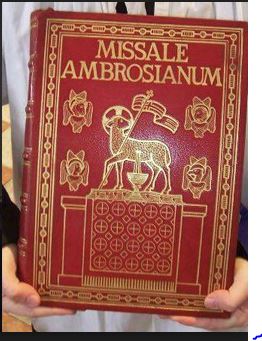
*Note:   An unusual feature of diocesan life in Bergamo is that for historical reasons, a number of the parishes in the diocese, even if a minority, celebrate the liturgy not according to the Roman Rite but according to the Ambrosian Rite.   The Ambrosian Rite, also called the Milanese Rite, is a Catholic liturgical Western rite.   The rite is named after Saint Ambrose, a bishop of Milan in the fourth century.   The Ambrosian Rite, which differs from the Roman Rite, is used by some five million Catholics in the greater part of the Archdiocese of Milan, Italy, in some parishes of the Diocese of Como, Bergamo, Novara, Lodi and in about fifty parishes of the Diocese of Lugano, in the Canton Ticino, Switzerland.

Although at various points in its history the distinctive Ambrosian Rite has risked suppression, it survived and was reformed after the Second Vatican Council partly because Blessed Pope Paul VI belonged to the Ambrosian Rite, having previously been Archbishop of Milan.   In the 20th century, it also gained prominence and prestige from the attentions of two other scholarly Archbishops of Milan:  Achille Ratti, later Pope Pius XI and the Blessed Ildefonso Schuster O.S.B. (1880-1954), both of whom had been involved in studies and publications on the rite before their respective appointments.
Differences from the Roman Rite
Some features of the Ambrosian Rite distinguish it from the Roman Rite liturgy.

https://youtu.be/nI5VZPwtI3s

Mass – the main differences in the Mass are:

The principal celebrant blesses all the readers, not only the deacon.
The Gospel is followed by a short antiphon.
The General Intercessions or “Prayers of the Faithful” immediately follow the homily
The Rite of Peace comes at the beginning of the Liturgy of the Eucharist, before the Offertory (Presentation of the Gifts)
The Creed follows the Offertory, before the Prayer over the Gifts
There are some differences between the First Eucharistic Prayer of the Ambrosian Missal and the Roman Canon, the first in the Roman Missal;  but its Eucharistic Prayers II, III, and IV are the same as in the Roman Rite.   In addition, the Ambrosian Rite has two proper Eucharistic Prayers, used mainly on Easter and Holy Thursday.
The priest breaks the Host and places a piece in the main chalice before the Lord’s Prayer, while an antiphon (the Confractorium) is sung or recited.
The Agnus Dei is not said.
Before the final blessing, the people say three times Kyrie, eleison (Lord have mercy).
The Ambrosian Rite has its own cycle of readings at Mass.
Many of the prayers said by the priest during Mass are peculiar to the Ambrosian Rite, which has a particularly rich variety of prefaces.

Liturgical year – The main differences in the liturgical year are:

Advent has six weeks, not four.
Lent starts four days later than in the Roman Rite, so that Ash Wednesday is postponed to a week later than in the Roman Rite, and Carnival continues until “sabato grasso” (“Fat Saturday” in Italian), corresponding to Shrove Tuesday (called “mardi gras”, i.e. “Fat Tuesday”, in French) in areas where the Roman Rite is used.
On Fridays in Lent, Mass is not celebrated and, with a few exceptions, Communion is not distributed.
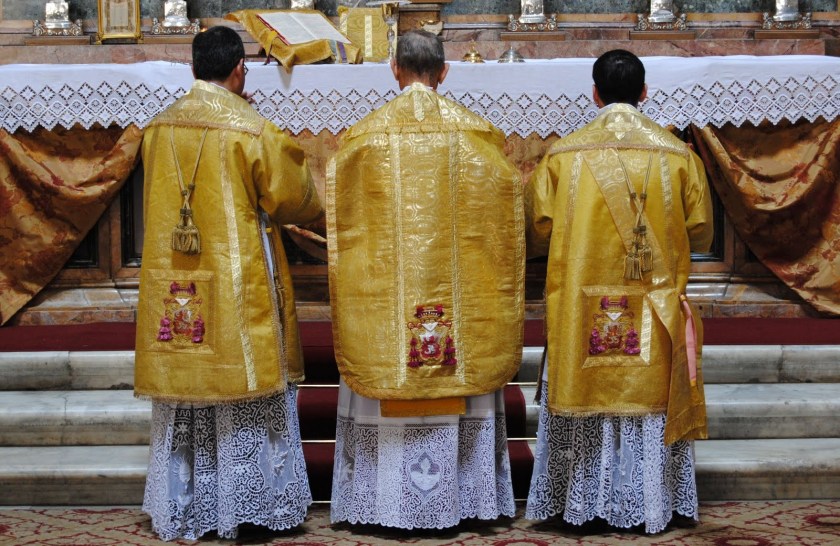
Red, not the Roman-Rite green, is the standard colour of vestments from Pentecost to the third Sunday of October and there are other differences in liturgical colours throughout the year.

Other differences are:

The Liturgy of the Hours (Divine Office or Breviary) is different in structure and in various features.
The liturgical rites of the Holy Week are quite different.
The rite of funerals is different.
Baptism of infants is done by triple immersion of the head.
The thurible has no top cover, and is swung clockwise before the censing of a person or object.
Ambrosian deacons wear the stole over the dalmatic and not under it.
The Ambrosian cassock, buttoned with only five buttons below the neck, is held with a fascia at the waist, and is worn with a round white collar.
Ambrosian chant is distinct from Gregorian chant.

ambrosian missal - snipambrosian vestments

https://youtu.be/QT5nMjcGRNc

Posted in SAINT of the DAY

Memorials of the Saints – 18 June

St Abraham of Clermont
St Alena of Dilbeek
St Amandus of Bordeaux
St Arcontius of Brioude
St Athenogenes of Pontus
St Calogero of Sicily
St Calogerus of Fragalata
St Calogerus the Anchorite
St Colman mac Mici
St Cyriacus of Malaga
St Demetrius of Fragalata
St Edith of Aylesbury
St Elizabeth of Schonau
St Elpidius of Brioude
St Equizio of Telese
St Erasmo
St Etherius of Nicomedia
Bl Euphemia of Altenmünster
St Fortunatus the Philosopher
St Gerland of Caltagirone
St Gregory Barbarigo (1625-1697)
St Gregory of Fragalata
St Guy of Baume
St Jerome of Vallumbrosa
St Marcellian
St Marina of Alexandria
St Marina of Bithynia
Bl Marina of Spoleto
St Mark
Bl Osanna Andreasi
St Osanna of Northumberland
St Osmanna of Jouarre
St Paula of Malaga
Bl Peter Sanchez

Hermits of Karden: A father (Felicio) and his two sons (Simplicio and Potentino)who became pilgrim to various European holy places and then hermits at Karden (modern Treis-Karden, Germany). (Born in Aquitaine (in modern France) Their relics transferred to places in the Eifel region of western Germany at some point prior to 930. They were canonised on 12 August 1908 by Pope Pius X (cultus confirmation).

Martyrs of Ravenna – 4 saints: A group of four Christians martyred together. We have no details but their names – Crispin, Cruciatus, Emilius and Felix. They were martyred in Ravenna, Italy, date unknown.

Martyrs of Rome – 3 saints: Three Christians martyred together . We have no details but their names – Cyriacus, Paul and Thomas. In Rome, Italy, date unknown.

Martyrs of Tripoli – 3 saints: Three imperial Roman soldiers, at last two of them recent converts, who were imprisoned, tortured and executed for their faith. Martyrs – Hypatius, Leontius and Theodulus. They were Greek born and they died c135 at Tripoli, Phoenicia (in modern Lebanon).

Posted in MORNING Prayers, NOTES to Followers, PRAYERS for VARIOUS NEEDS

Wishing all Dads a Blessed and Happy Father’s Day! – 17 June

Wishing all Dads a Blessed and Happy Father’s Day! – 17 June

Strength of a Mountain
Unknown Author

God took the strength of a mountain,
The majesty of a tree,
The warmth of a summer sun,
The calm of a quiet sea,
The generous soul of nature,
The comforting arm of night,
The wisdom of the ages,
The power of the eagle’s flight,
The joy of a morning in spring,
The faith of a mustard seed,
The patience of eternity,
The depth of a family need,
Then God combined these qualities,
When there was nothing more to add,
He knew His masterpiece was complete,
And so, He called it … Dad!strength of a mountain - fathers' day - 17 june 2018

Don’t Forget to Say ‘Happy Father’s Day’ to a Priest this Weekend — and Pray for Him!

A Prayer for All our Fathers and our Priests

God our Father,
we give you thanks and praise
for fathers young and old.
We pray for young fathers,
newly embracing their vocation;
may they find the courage and perseverance
to balance work, family and faith in joy and sacrifice.
We pray for our own fathers,
who have supported and challenged us;
may they continue to lead in strong and gentle ways.
We remember fathers around the world,
whose children are lost or suffering;
may they know that the God of compassion,
walks with them in their sorrow.
We pray for men who are not fathers
but still mentor and guide us,
with fatherly love and advice.
Most importantly, all our Priests,
our spiritual Fathers, who guide,
teach us and lead us to You
and who feed and nourish us
with Your Sacraments.
We remember fathers, grandfathers
and great-grandfathers,
who are no longer with us
but who live forever in our memory
and nurture us with their love.
Amenprayer for all fathers and priests - father's day - 17 june 2018

Posted in franciscan OFM, MORNING Prayers, QUOTES of the SAINTS, SAINT of the DAY, The HOLY EUCHARIST / The HOLY MASS

Thought for the Day – 17 June – The Memorial of St Albert Chmielowski (1845-1916)

Thought for the Day – 17 June – The Memorial of St Albert Chmielowski (1845-1916)

At the beatification on 22 June 1983, St Pope John Paul II said:
“Brother Albert…reached [the] heights of holiness…by way of love… Adam Chmielowski studied painting and for a number of years engaged in artistic activities before following his vocation, which, after a first attempt in the Society of Jesus, led him to the Third Order Franciscans, from where his Albertine vocation took shape… Brother Albert laid down his life in the service of the very poor and of social outcasts.   [He] gave his life completely to Christ.   And in Christ [he] discovered the fullness of knowledge, of love and of service….”

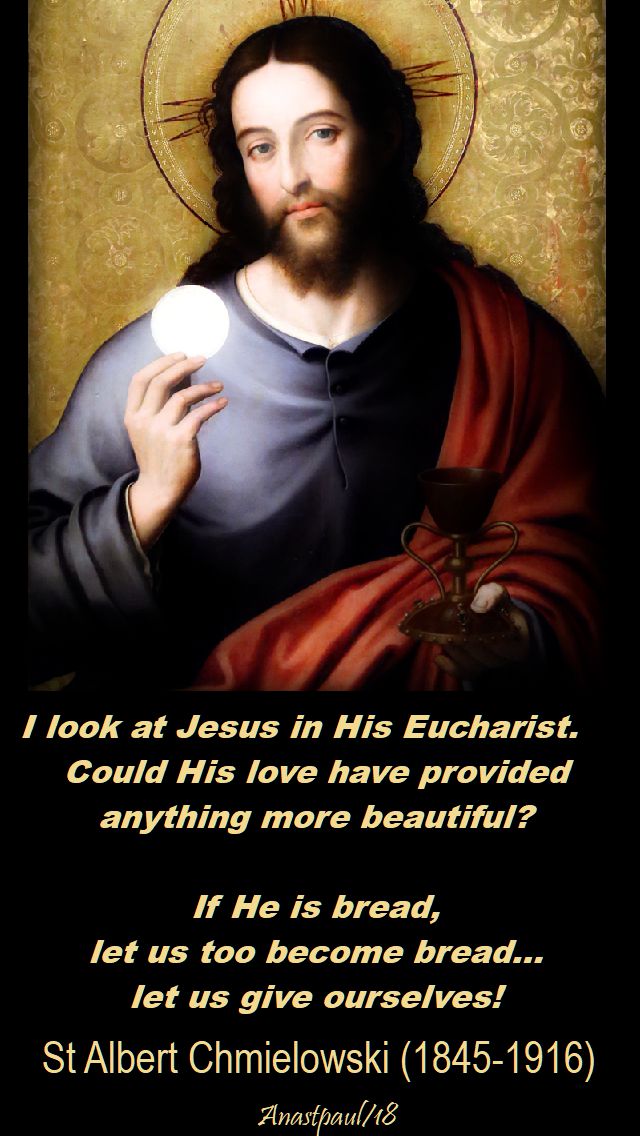
Brother Albert confessed:  “I look at Jesus in His Eucharist.   Could His love have provided anything more beautiful?   If He is bread, let us too become bread…let us give ourselves.”   Brother Albert did this to the very end, until he died in his “beggars’ refuge” in Krakow in 1916.

On the basis of a new miracle worked by God through the intercession of Brother Albert (beatified 22 June 1983), St Pope John Paul II canonised him only six years later, on 12 November 1989, to the joy of the Polish people and for the consolation of all homeless people, for whom this Polish saint can be a powerful intercessor, just as he was a generous helper to them while on earth.

St Albert Chmielowski, Pray for us!st albert chmielowski - pray for us - 17 june 2018

Posted in franciscan OFM, MORNING Prayers, QUOTES of the SAINTS, QUOTES on CHARITY, QUOTES on LOVE, SAINT of the DAY, The HOLY EUCHARIST / The HOLY MASS

Quote of the Day – 17 June – The Memorial of St Albert Chmielowski (1845-1916)

Quote of the Day – 17 June – The Memorial of St Albert Chmielowski (1845-1916)

“I look at Jesus in His Eucharist.   
Could His love have provided
anything more beautiful?   
If He is bread, let us too become bread…
let us give ourselves.” 

St Albert Chmielowski (1845-1916)i look at jesus in his eucharist - st albert chmielowski - 17 june 2018

Posted in CATECHESIS, MORNING Prayers, PAPAL SERMONS, SUNDAY REFLECTIONS, The HOLY EUCHARIST / The HOLY MASS

Sunday Reflection – 17 June – Eleventh Sunday in Ordinary Time Year B

Sunday Reflection – 17 June – Eleventh Sunday in Ordinary Time Year B

….What happens in Spring?   Plants blossom, trees flower.   I will ask you some questions. Can a sick tree or plant fully blossom if it is sick?   No!   Can a tree, a plant which is not watered by rain or artificially, blossom nicely?   No.   And can a tree and a plant whose roots have been removed or which have no roots flower?   No.   Without roots, can they flower?   No!   And this is a message:  Christian life has to be a life that must blossom in works of charity, in doing what is good.   But if you have no roots, you cannot blossom, and who is the root?   Jesus  ! If you are not with Jesus, there in the roots, you will not blossom.   If you do not water your life with prayer and the sacraments, will you bear Christian flowers?   No!   Because prayer and the sacraments water the roots and our life blossoms.   I hope that your Spring may be bloom beautifully, as blooming as Easter will be;  blossoming with good works, virtue and doing good to others.   Remember this, this is a very beautiful verse from my country:   “What blossoms a tree bears come from what lies underneath it”.   Never cut off Jesus’ roots.

During Mass, after breaking the consecrated Bread, that is the Body of Christ, the priest shows it to the faithful, inviting them to participate in the Eucharistic banquet.   We know the words that ring out from the sacred altar:  “Happy are those who are called to his Supper.   This is the Lamb of God who takes away the sin of the world”.   Inspired by a passage in the Book of Revelation — “Blessed are those who are invited to the marriage supper of the Lamb” (Rev 19:9): it says “marriage” because Jesus is the Spouse of the Church — this invitation calls us to experience intimate union with Christ, the source of joy and holiness.   It is an invitation which brings happiness and at the same time spurs us to an examination of conscience enlightened by faith.

Although we are the ones who stand in procession to receive Communion;  we approach the altar in a procession to receive communion, in reality it is Christ who comes towards us to assimilate us in Him.   There is an encounter with Jesus!   To nourish oneself of the Eucharist means to allow oneself to be changed by what we receive.   Saint Augustine helps us understand this when he talks about the light he received when he heard Christ say to him:   “I am the food of strong men;  grow and you shall feed upon me;  nor shall you convert me, like the food of your flesh, into you but you shall be converted into me” (Confessions VII, 10, 16: pl 32, 742).

Each time we receive Communion, we resemble Jesus more;  we transform ourselves more fully into Jesus.   As the Bread and the Wine are converted into the Body and Blood of the Lord, so too those who receive it with faith, are transformed into a living Eucharist.

You reply “Amen” to the priest who distributes the Eucharist saying “the Body of Christ”; that is, you recognise the grace and the commitment involved in becoming the Body of Christ.   Because when you receive the Eucharist, you become the Body of Christ.  This is beautiful;  it is very beautiful.   As it unites us to Christ, tearing us away from our selfishness, Communion opens us and unites us to all those who are a single thing in Him.   This is the wonder of Communion:  we become what we receive!

Let us approach the Eucharist:  receiving Jesus who transforms us into Him makes us stronger.   The Lord is so good and so great!

Pope Francis, General Audience, 21 March 2018each time we receive communion - pope francis - 17 june 2018

Posted in MORNING Prayers, QUOTES of the SAINTS, SAINT of the DAY, The WORD

One Minute Reflection – 17 June – The Memorial of St Albert Chmielowski (1845-1916)

One Minute Reflection – 17 June – The Memorial of St Albert Chmielowski (1845-1916)

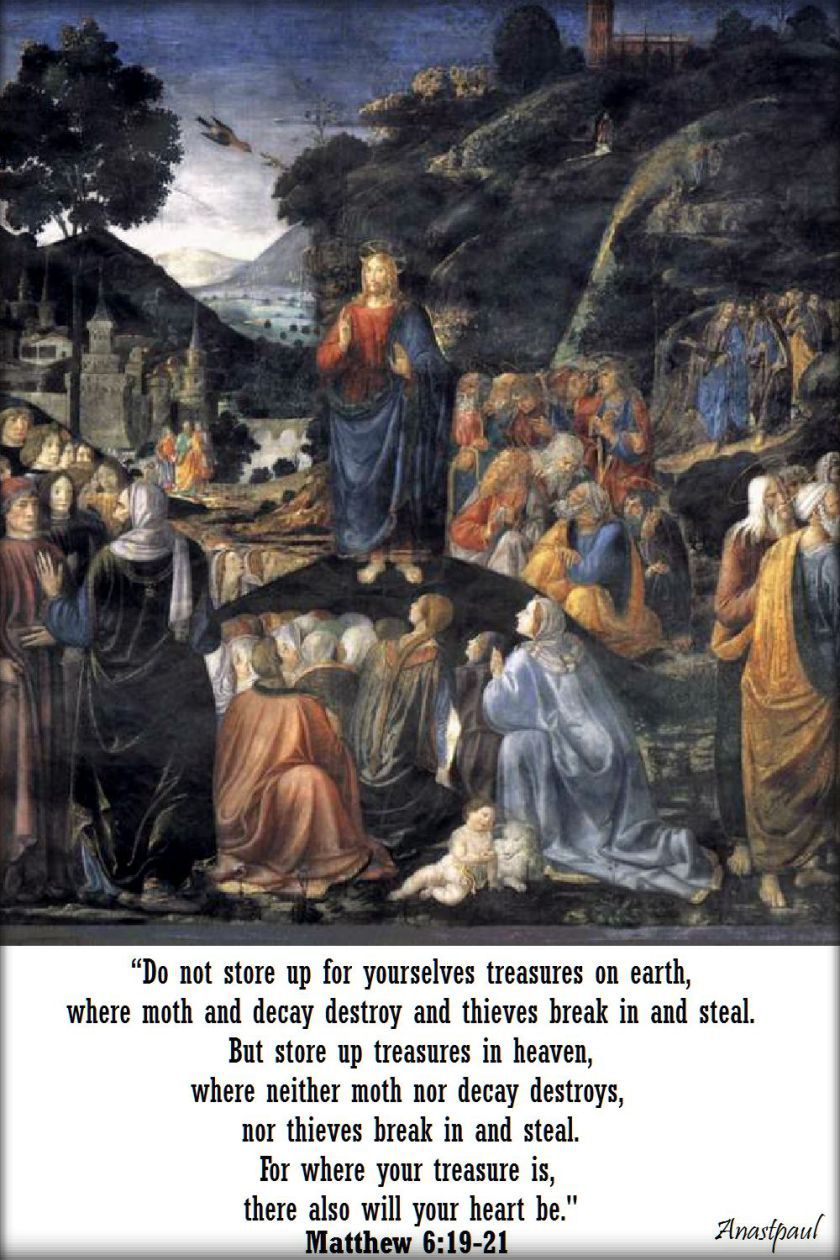
Do not store up for yourselves treasures on earth, where moth and decay destroy and thieves break in and steal. But store up treasures in heaven, where neither moth nor decay destroys, nor thieves break in and steal. For where your treasure is,
there also will your heart be.”….Matthew 6:19-21matthew-6-19-21-17 june 2017

REFLECTION – Reflecting on his own priestly vocation, St Pope John Paul II wrote in 1996 that Brother Albert had played a role in its formation …..“because I found in him a real spiritual support and example in leaving behind the world of art, literature and the theatre and in making the radical choice of a vocation to the charity” ………..St John Paul speaking of St Albert Chmielowski (Gift and Mystery: On the Fiftieth Anniversary of My Priestly Ordination)I found in him a real - st john paul speaking of st albert chmielowski - 17 june 2018

PRAYER – Father of goodness, make me realise and understand that each and all of my brothers represent the face of Jesus and that He is the only way to You for us all!   Help me to extend all of myself to my neighbour in loving imitation of Your Son.   St Albert Chmielowski, pray for us that we too may be a light in the darkness of this world, to all who call out to us in their pain and suffering.   And please pray for us!  Amenst-albert-chmielowski-pray-for-us-17 june 2017

Posted in CATHOLIC DEVOTIONS of the Month, MORNING Prayers, PRAYERS of the SAINTS, SACRED and IMMACULATE HEARTS, The HOLY EUCHARIST / The HOLY MASS

Our Morning Offering – 17 June – The Month of the Sacred Heart, Eleventh Sunday in Ordinary Time Year B

Our Morning Offering – 17 June – The Month of the Sacred Heart, Eleventh Sunday in Ordinary Time Year B

I Pray You Lord
Blessed John Henry Newman (1801-1890)

I pray You Lord,
in Holy Communion,
to give me the grace
of a cheerful heart,
an even temper,
sweetness, gentleness
and brightness of mind,
as walking in Your light
and by Your grace.
I pray You to give me the spirit
of overabundant, ever-springing love,
which empowers and sweeps away,
the vexations of life
by its own richness and strength
and which, above all things,
unites me to You,
who are the fountain
and the centre of all mercy,
loving kindness and joy.
AmenI pray you lord - bl john henry newman - 17 june 2018 - prayer before holy communion

Posted in franciscan OFM, SAINT of the DAY

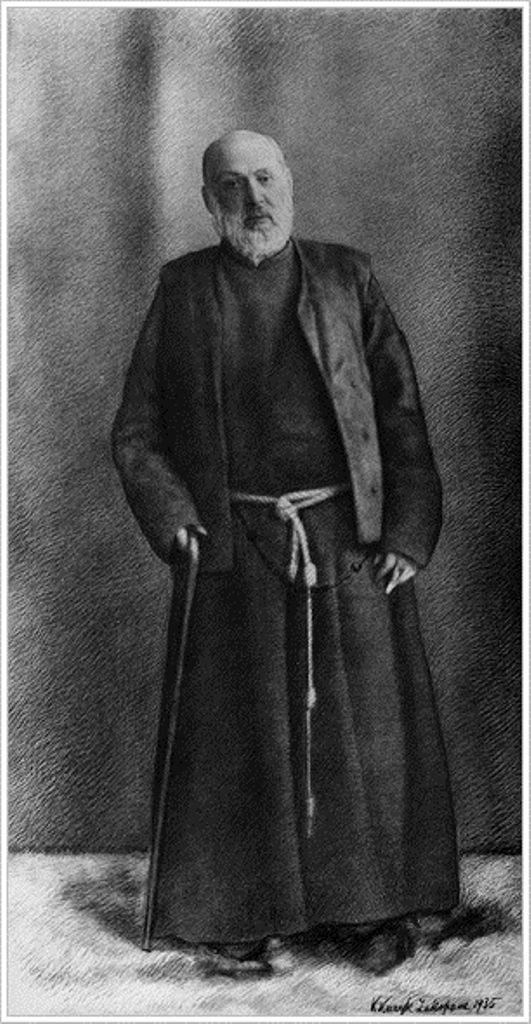
Saint of the Day – 17 June – St Albert Chmielowski T.O.S.F. (1845-1916)

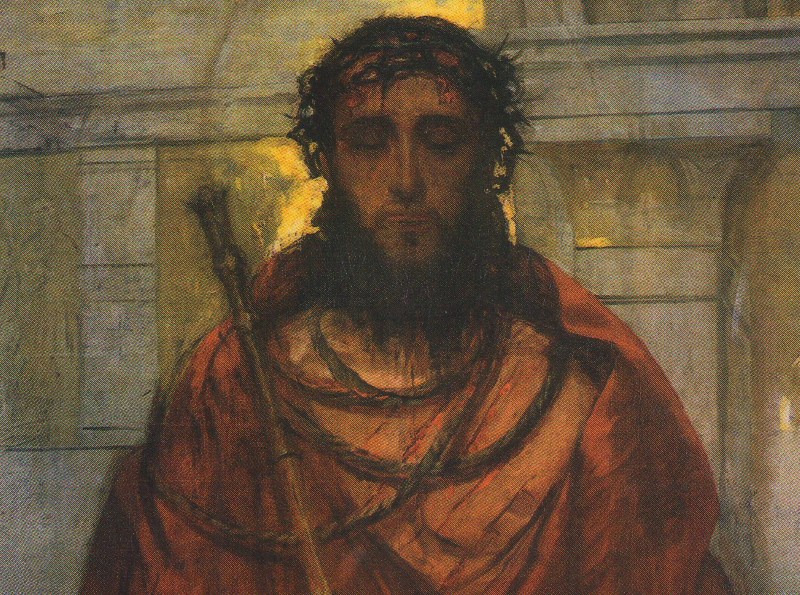
Saint of the Day – 17 June – St Albert Chmielowski T.O.S.F. (1845-1916) – The Painter Who Became an Advocate for the Poor and then a Saint!   Artist, Founder, Tertiary Franciscan, Apostle of Charity.  albert chmielowski - headerheader 2 - eccehomo-600dpi

This Krakow native’s experience of the Church was remarkably similar to that of Pope Francis.   He strove to emulate the example of St Francis of Assisi, after whom Pope Francis took his papal name and was the living embodiment of the Church of the poor Francis has spoken so much about.

Adam Chmielowski was born into an aristocratic family in Igołomia, a village outside of Krakow, in 1845.   Then, Poland formally didn’t exist:   The once-mighty Polish state was partitioned between Austria, Prussia and Russia in 1772, 1773 and 1795.   Yet the Polish people refused to accept this and many rebelled against the oppressors.

One such upheaval was the January Insurrection of 1863-1864, directed against the Russian Empire, in which the Poles fought bravely yet were brutally suppressed.   Not yet 18, Adam took part.   During one battle, a Russian grenade killed Adam’s horse and badly damaged his leg, which was amputated.   Adam, however, didn’t take pity on himself;  he stoically taught himself to function with a wooden limb and offered up the dismemberment to God for the cause of Polish independence.

After the uprising, Adam decided to pursue a career in painting and was accepted at the prestigious Academy of Fine Arts in Munich, where he studied with many famous Polish painters.   Upon returning to Poland, Adam worked as a painter 1870-1885.   In total, he produced 61 paintings  . He quickly became one of the most feted Polish artists, living briefly in Warsaw and then in artsy, intellectual Krakow.   Adam’s social circle consisted of the best-known Polish artists, actors and writers.albert and jesus painting

Yet Adam Chmielowski wasn’t happy with this glitzy life of celebrity.   At one point, he was even hospitalised for depression.   Adam remained a devout Catholic,and his paintings — including his masterpiece, the unfinished Ecce Homo, which depicts the mocked Christ — often dealt with religious themes.

He knew that he needed to grow closer to God.   Adam briefly thought of becoming a Jesuit, but his enthusiasm fizzled after entering the novitiate.   He kept asking God what He wanted of him.

Nineteenth-century Krakow was a city of social inequality.   In Adam’s day, more than a fifth of its population consisted of the unemployed, who were frequently homeless.   The filthy, lice-infested city homeless shelter had terrible sanitary conditions  . The Church in Krakow, especially the Vincentians and other orders, aided the poor.   However, this was insufficient.

At this time, Adam became increasingly attracted to St Francis of Assisi.  This medieval champion of the poor’s ministry resonated with Krakow’s socioeconomic problems. Eventually, Adam welcomed the homeless into his own apartment.   In 1887, Adam Chmielowski became a Third Order Franciscan and took vows at the hands of Krakow Archbishop Cardinal Albin Dunajewski.   He began to call himself “Brother Albert” and wore a gray habit.

st albert

The following year, Brother Albert realised that to bring Krakow’s poor lasting change, the city’s homeless shelter would need reform.   He negotiated an agreement with the city government, making him the institution’s caretaker.   To finance the improvements, Brother Albert auctioned off his paintings.   In addition to improving the material conditions, he banned alcohol in the shelter.   He asked the poor to work (making exceptions for the elderly and those with disabilities), teaching them practical skills and lectured on the Catechism and the Gospels.St Albert Chmielowski

Eventually, Brother Albert founded two religious orders, the Albertine Brothers and Sisters, devoted to the poor.   They set up homes for the poor, sick and elderly in 20 Polish cities.   Brother Albert worked to help as many poor persons as possible until his death in 1916, amidst World War I.   During that bloody conflict, he sent Albertine Brothers and Sisters to the trenches to aid war invalids.   After his death, thousands of Kracovians visited his tomb, convinced that he died a saint.

Today, the Albertines run homes for the poor and sick all over the world.   Visitors to Krakow can make a pilgrimage to the Albertine-run Ecce Homo Shrine, which features a museum devoted to St Albert and the famous titular painting. (NC Register) – For more details and images here:  https://anastpaul.wordpress.com/2017/06/17/saint-of-the-day-17-june-st-albert-chmielowski-t-o-s-f-the-19th-century-polish-saint-who-was-influenced-by-st-francis-of-assisi-later-influenced-pope-st-john-paul-ii/brat_albert-world

Posted in MARIAN TITLES, SAINT of the DAY, The BLESSED VIRGIN MARY

Feast of Maria in the Forest and Memorials of the Saints – 17 June

Maria in the Forest: Also known as:
• Holy Mary in the Forest
• Maria im Walde
The Apparitions occurred in a wooded area near Dolina, Grafenstein, Carinthia, Austria on the 17, 18 and 19 June 1849 to three young shepherdesses.680px-Grafenstein_Dolina_Autobahnkirche_Maria_im_Walde_Altarbild_22092011_126

St Adolph of Utrecht
St Agrippinus of Como
St Albert Chmielowski (1845-1916)

https://www.youtube.com/watch?v=0B-GU8YKpD8

St Antidius of Besançon
Bl Arnold of Foligno
St Avitus of Perche
St Blasto of Rome
St Botolph of Ikanhoe
St Briavel of Gloucestershire
St David of Bourges
St Dignamerita of Brescia
St Diogenes of Rome
St Emily de Vialar
St Gundulphus of Bourges
St Herveus of Bretagne
St Himerius of Amelia
St Hypatius of Chalcedon
St Molling of Wexford
St Montanus of Gaeta
St Nectan of Hartland
Bl Paul Burali d’Arezzo
Bl Peter Gambacorta
St Phêrô Ða
Bl Philippe Papon
Bl Pierre-Joseph Cassant
St Prior
St Rambold of Ratisbon
Bl Ranieri Scaccero
St Theresa of Portugal

Martyrs of Apollonia – 7 saints: A group of Christians who fled to a cave near Apollonia, Macedonia to escape persecution for his faith, but were caught and executed. The names we know are – Basil, Ermia, Felix, Innocent, Isaurus, Jeremias and Peregrinus. They were beheaded at Apollonia, Macedonia.

Martyrs of Aquileia – 4 saints: Four Christian martyrs memorialised together. No details about them have survived, not even if they died together – Ciria, Maria, Musca and Valerian. c.100 in Aquileia, Italy.

Martyrs of Chalcedon – 3 saints: Three well-educated Christian men who were sent as ambassadors from King Baltan of Persia to the court of emperor Julian the Apostate to negotiate peace between the two states, and an end of Julian’s persecutions of Christians. Instead of negotiating, Julian imprisoned them, ordered them to make a sacrifice to pagan idols and when they refused, had them executed. Their names were Manuel, Sabel and Ismael. They were beheaded in 362 in Chalcedon (part of modern Istanbul, Turkey) and their bodies burned and no relics survive.

Martyrs of Fez – 4 beati: A group of Mercedarians sent to Fez, Morocco to ransom Christians imprisoned and enslaved by Muslims. For being openly Christian they were imprisoned, tortured, mutilated and executed. Martyrs – Egidio, John, Louis and Paul. They were martyred in Fez, Morocco.

Martyrs of Rome – 262 saints: A group of 262 Christians martyred in the persecutions of Diocletian. In c303 in Rome, Italy. They were buried on the old Via Salaria in Rome.

Martyrs of Venafro – 3 saints: Three Christian lay people, two of them imperial Roman soldiers, who were converts to Christianity and were martyred together in the persecutions of Maximian and Diocletian – Daria, Marcian and Nicander. They were beheaded c.303 in Venafro, Italy. By 313 a basilica had been built over their graves which were re-discovered in 1930. They are patrons of Venafro, Italy.

Posted in MORNING Prayers, SAINT of the DAY

Thought for the Day – 16 June – The Memorial of St Benno of Meissen (1010-1106)

Thought for the Day – 16 June – The Memorial of St Benno of Meissen (1010-1106)

Saint Benno lived during a difficult political time and managed—despite threat, imprisonment and punishment—to remain true to the teachings of the Church and his role as priest and bishop, servant of his people.
At a time when the Church is criticised and attacked from both the inside and outside, we look to saints like St Benno as inspiration.   His witness provides example to each of us, inspiring fidelity to our Holy Father and to the Magisterium, in all things and truth, even when these are the “hard decisions” to make.

St Benno, Pray for us!st benno of meissen pray for us no 2 - 16 june 2018