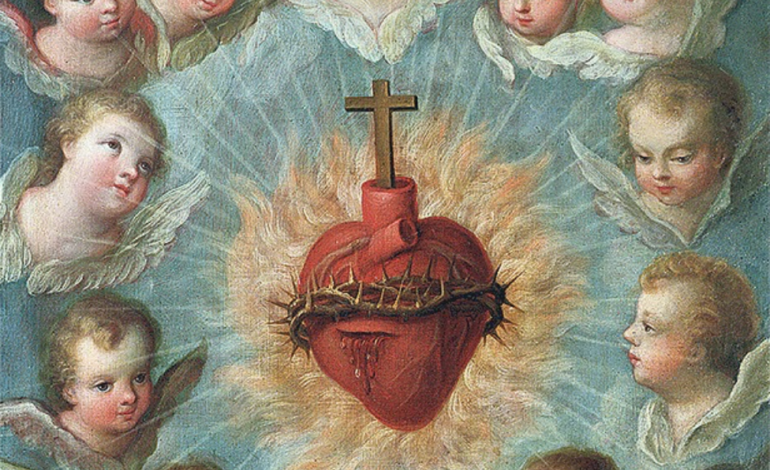
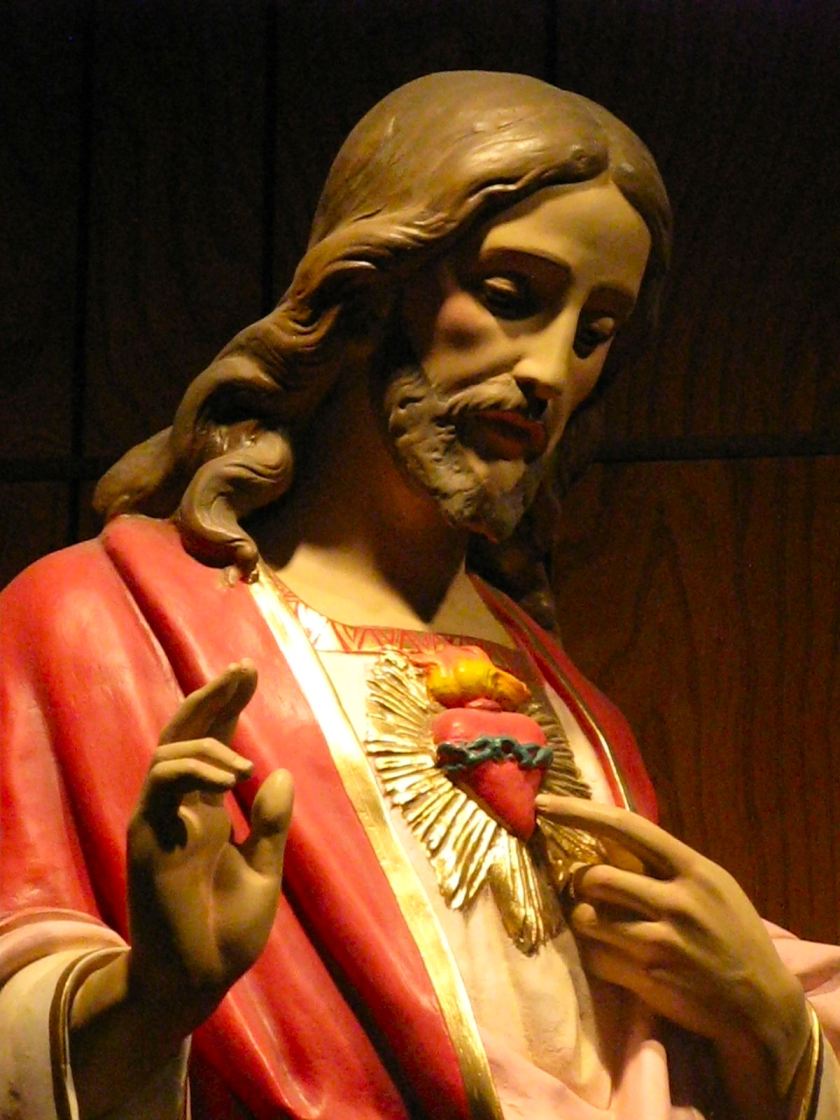
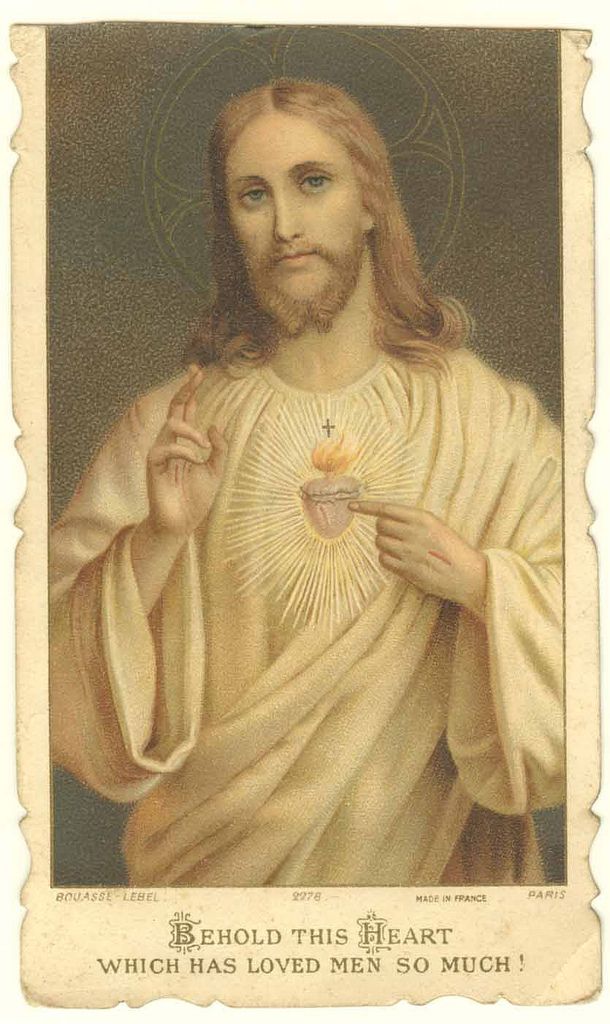
Our Morning Offering – 8 June – The Solemnity of The Most Sacred Heart of Jesus
Prayer of Consecration to The Most Sacred Heart of Jesus By Pope Leo XIII (1810-1903)
Most sweet Jesus,
Redeemer of the human race,
look down upon us,
humbly prostrate before Your altar.
We are Yours and Yours we wish to be
but to be more surely united with You,
behold, each one of us,
freely consecrates himself today
to Your most sacred heart.
Many, indeed, have never known You, many too,
despising your precepts, have rejected You.
Have mercy on them all, most merciful Jesus
and draw them to Your sacred heart.
Be You king, O Lord, not only of the faithful
who have never forsaken You
but also of the prodigal children who have abandoned You;
grant that they may quickly return to their father’s house,
lest they die of wretchedness and hunger.
Be You king, of those who are deceived
by erroneous opinions,
or whom discord keeps aloof
and call them back to the harbour of truth and unity of faith,
so that soon there may be but one flock and one shepherd.
Be you king also, of all those who sit
in the ancient superstition of the Gentiles
and refuse not You to deliver them out of darkness
into the light and kingdom of God.
Grant, O Lord, to Your Church,
assurance of freedom and immunity from harm;
give peace and order to all nations
and make the earth resound from pole to pole with one cry:
Praise to the divine heart that wrought our salvation;
to it be glory and honour forever.
Amen.
and
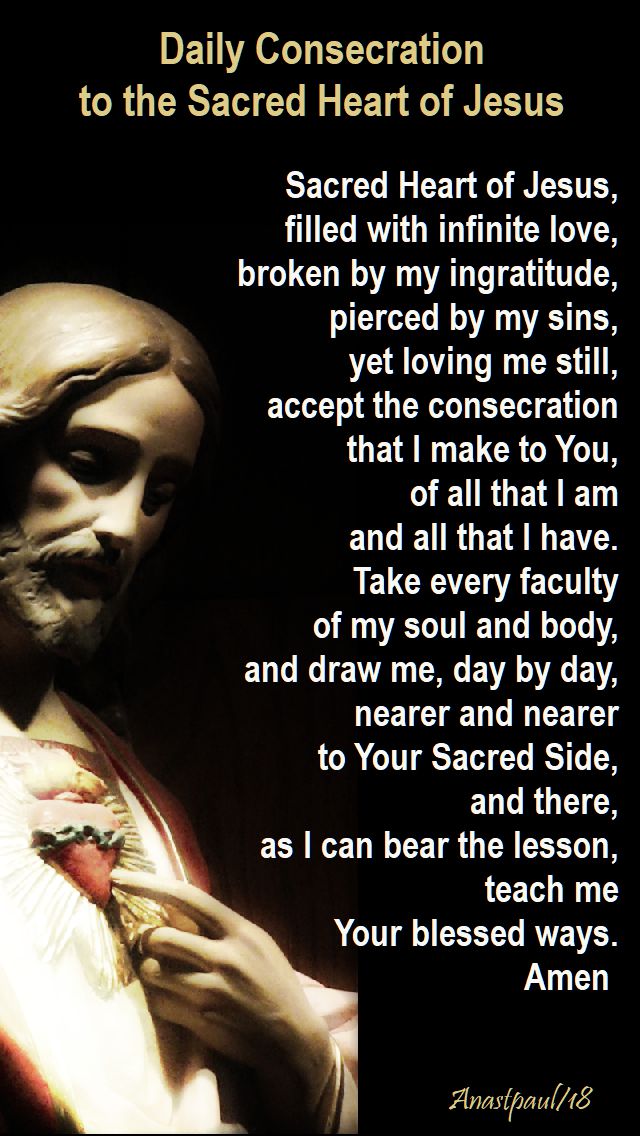
Daily Consecration to the Sacred Heart of Jesus
Sacred Heart of Jesus,
filled with infinite love,
broken by my ingratitude,
pierced by my sins,
yet loving me still,
accept the consecration that I make to You,
of all that I am and all that I have.
Take every faculty of my soul and body,
and draw me, day by day,
nearer and nearer to Your Sacred Side,
and there, as I can bear the lesson,
teach me Your blessed ways.
Amen
8 June – Blessed and Holy Solemnity of the Most Sacred Heart of Jesus – (Friday after the Second Sunday after Pentecost) and The World Day of Prayer for the Sanctification of Priests.
Excerpt from ENCYCLICAL of Pope Pius XII HAURIETIS AQUAS – on DEVOTION TO The SACRED HEART
15 May 1956
Venerable Brethren: Health and Apostolic Benediction.
1. “You shall draw waters with joy out of the Saviour’s fountain.” These words by which the prophet Isaias, using highly significant imagery, foretold the manifold and abundant gifts of God which the Christian era was to bring forth, come naturally to Our mind when We reflect on the centenary of that year when Our predecessor of immortal memory, Pius IX, gladly yielding to the prayers from the whole Catholic world, ordered the celebration of the feast of the Most Sacred Heart of Jesus in the Universal Church.
2. It is altogether impossible to enumerate the heavenly gifts which devotion to the Sacred Heart of Jesus has poured out on the souls of the faithful, purifying them, offering them heavenly strength, rousing them to the attainment of all virtues. Therefore, recalling those wise words of the Apostle S. James, “Every best gift and every perfect gift is from above, coming down from the Father of Lights,” We are perfectly justified in seeing in this same devotion, which flourishes with increasing fervour throughout the world, a gift without price, which our divine Saviour the Incarnate Word, as the one Mediator of grace and truth between the heavenly Father and the human race imparted to the Church, His mystical Spouse, in recent centuries when she had to endure such trials and surmount so many difficulties.
3. The Church, rejoicing in this inestimable gift, can show forth a more ardent love of her divine Founder and can, in a more generous and effective manner, respond to that invitation which St John the Evangelist relates as having come from Christ Himself: “And on the last and great day of the festivity, Jesus stood and cried out, saying, ‘If any man thirst, let him come to Me and let him drink that believeth in Me. As the Scripture saith: Out of his heart there shall flow rivers of living waters.’ Now this He said of the Spirit which they should receive who believed in Him.”
8. The Church has always valued and still does, the devotion to the Most Sacred Heart of Jesus so highly, that she provides for the spread of it among Christian peoples everywhere and by every means. At the same time she uses every effort to protect it against the charges of so-called “naturalism” and “sentimentalism.” In spite of this it is much to be regretted that, both in the past and in our own times, this most noble devotion does not find a place of honour and esteem among certain Christians and, even occasionally, not among those who profess themselves moved by zeal for the Catholic religion and the attainment of holiness.
17. Through the years of Our pontificate–years filled not only with bitter hardships but also with ineffable consolations, these effects have not diminished in number or power or beauty but, on the contrary, have increased. Indeed, happily there has begun a variety of projects which are conducive to a rekindling of this devotion. We refer to the formation of cultural associations for the advancement of religion and of charitable works, publications setting forth the true historical, ascetical and mystical doctrine concerning this entire subject, pious works of atonement and, in particular, those manifestations of most ardent piety which the Apostleship of Prayer has brought about, under whose auspices and direction local gatherings – families, colleges, institutions – and sometimes nations have been consecrated to the Sacred Heart of Jesus. To all these We have offered paternal congratulations on many occasions, whether in letters written on the subject, in personal addresses, or even in messages delivered over the radio.
18. Therefore when We perceive so fruitful an abundance of healing waters, that is, heavenly gifts of divine love, issuing from the Sacred Heart of our Redeemer, spreading among countless children of the Catholic Church by the inspiration and action of the divine Spirit, We can only exhort you, venerable brethren, with fatherly affection to join Us in giving tribute of praise and heartfelt thanks to God, the Giver of all good gifts. We make Our own these words of the Apostle of the Gentiles: “Now to Him Who is able to do all things more abundantly than we desire or understand, according to the power that worketh in us, to Him be glory in the Church and in Christ Jesus unto all generations world without end. Amen.”
And the Twelve Promises here: https://anastpaul.wordpress.com/2017/06/23/friday-23-june-2017-blessed-and-holy-solemnity-of-the-most-sacred-heart-of-jesus-friday-after-the-second-sunday-after-pentecost/
The World Day of Prayer for the Sanctification of Priests
This celebration offers an opportunity to lift up our priests in prayer and thanksgiving, asking God, that they might continually rediscover the gift of their ordination and experience the joy of the mission entrusted to them, while always growing in sanctity.
Let us Pray:
“Our Father for Priests”
Our Father who art in heaven,
Give us priests according to Your Heart.
That Thy name be hallowed,
Give us priests according to Your Heart.
That Thy kingdom come,
Give us priests according to Your Heart.
That Thy will be done on earth as it is in heaven,
Give us priests according to Your Heart.
To give us each day the Bread of life,
Give us priests according to Your Heart.
To forgive us our trespasses,
Give us priests according to Your Heart.
That we be not led into temptation,
Give us priests according to Your Heart.
And deliver us
And all of Your priests from evil. Amen.
(Anonymous)
Issued by the Congregation for the Clergy (vatican.va)
The Solemnity of the Most Sacred Heart of Jesus (2018)
Our Lady of Sunday: Also known as Notre-Dame du Dimanche
About the Apparition: An apparition of the Blessed Virgin Mary to Auguste Arnaud on 8 June 1873 and 8 July 1873. Arnaud was married, the father of two, and a winemaker who regularly skipped Sunday Mass to work his vineyards. Our Lady appeared to him in the vineyard on 8 June and reminded him “You must not work on Sundays.” In honour of this blessing, Arnaud placed a cross and a statue of Mary at the site in the field. On 8 July Our Lady appeared again, this time to both Auguste and his neighbors who had gathered there and told them, “You must never work on Sunday! Blessed are those who believe.”
Dates: 8 June and 8 July in 1873
Location: vineyard in Saint-Bauzille-de-la-Sylve, l’Hérault, France
Approval:
1876 by Bishop de Cabrières
—
St Anne Mary Taigi
St Bron of Cassel
St Calliope
St Clodulf of Metz
Bl Engelbert of Schäftlarn
St Eustadiola of Moyen-Moutier
St Fortunato of Fano
St Gildard of Rouen
Bl Giorgio Porta
Bl Giselbert of Cappenberg
St Heraclius of Sens
Bl István Sándor
St Jacques Berthieu
Bl John Davy
Bl John Rainuzzi
Bl Maddallena of the Conception
Bl Mariam Thresia Chiramel Mankidiyan
St Maximinus of Aix
St Medard of Noyon
St Melania the Elder
St Muirchu
St Pacificus of Cerano
Bl Peter de Amer
Bl Robert of Frassinoro
St Sallustian
St Syra of Troyes
St Victorinus of Camerino
St William of York
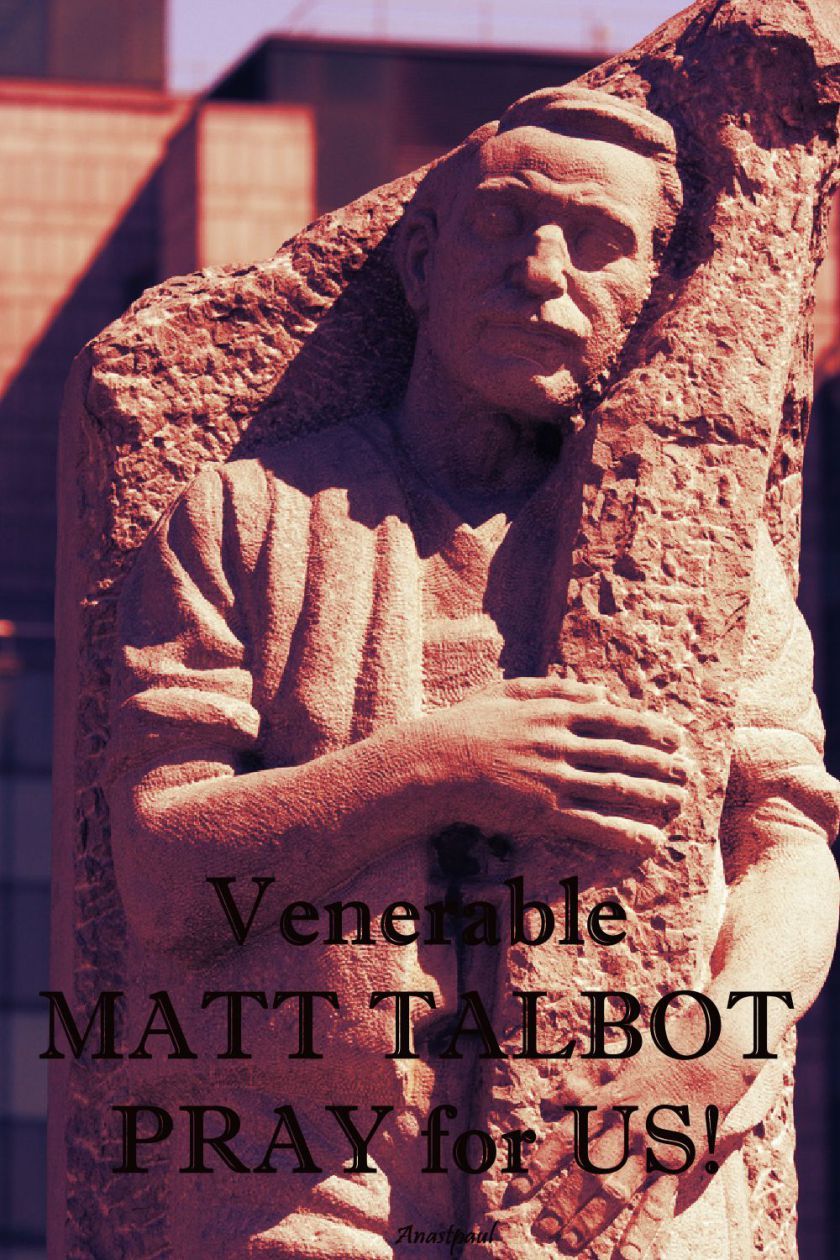
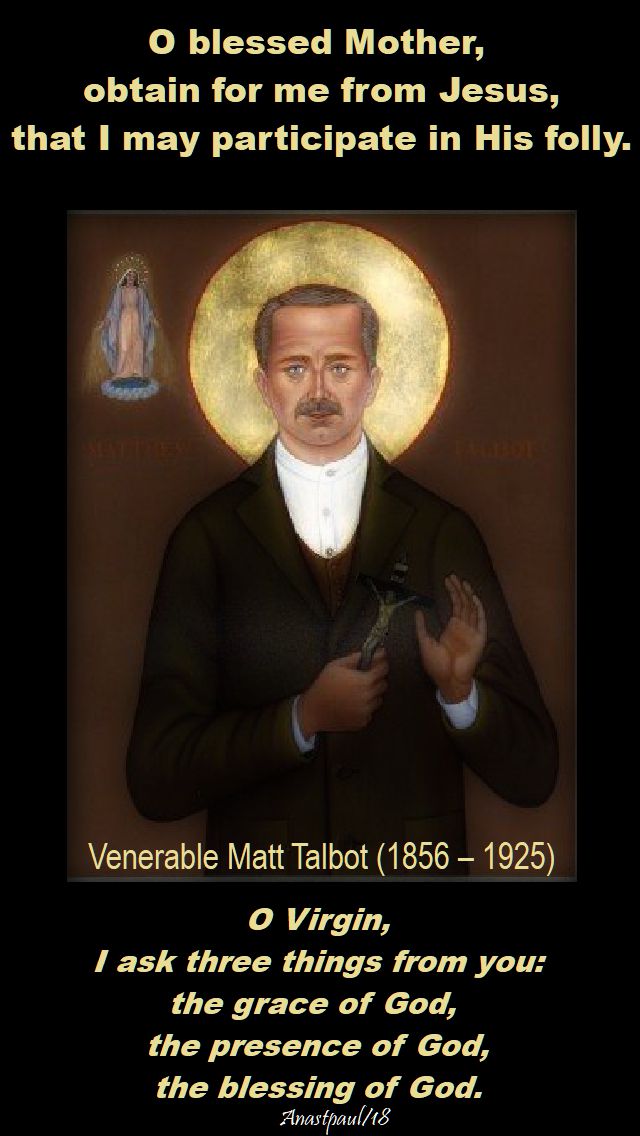
Thought for the Day – 7 June – The Memorial of Venerable Matt Talbot (1856 – 1925)
He was a drunk and now he is on the path to Sainthood!
Matt can be considered the patron of men and women struggling with alcoholism. He was born in Dublin, where his father worked on the docks and had a difficult time supporting his family. After a few years of schooling, Matt obtained work as a messenger for some liquor merchants; there he began to drink excessively. For 15 years—until he was almost 30—Matt was an active alcoholic.
One day he decided to take “the pledge” for three months, make a general confession and begin to attend daily Mass. There is evidence that Matt’s first seven years after taking the pledge were especially difficult. Avoiding his former drinking places was hard. He began to pray, as intensely as he used to drink. He also tried to pay back people from whom he had borrowed or stolen money while he was drinking.
Most of his life Matt worked as a builder’s labourer. He joined the Secular Franciscan Order and began a life of strict penance; he abstained from meat nine months a year. Matt spent hours every night avidly reading Scripture and the lives of the saints. He prayed the rosary conscientiously. Though his job did not make him rich, Matt contributed generously to the missions.
After 1923, his health failed and Matt was forced to quit work. He died on his way to Mass on Trinity Sunday. Fifty years later, Pope Paul VI gave him the title Venerable.
In looking at the life of Matt Talbot, we may easily focus on the later years when he had stopped drinking for some time and was leading a penitential life. Only alcoholic men and women who have stopped drinking, can fully appreciate, how difficult the earliest years of sobriety were for Matt.
He had to take one day at a time. So do the rest of us.
More about Venerable Matt here: https://anastpaul.wordpress.com/2017/06/07/saint-of-the-day-7-june-venerable-matt-talbot-ofs/
One Minute Reflection – 7 June – Thursday of the Ninth Week of Ordinary Time, Year B – Today’s Gospel Mark 12:28-34.
Jesus replied, “The first is this: ‘Hear, O Israel! The Lord our God is Lord alone! You shall love the Lord your God with all your heart, with all your soul, with all your mind and with all your strength.’ The second is this: ‘You shall love your neighbour as yourself.’ There is no other commandment greater than these.” …Mark 12:29-31
REFLECTION – “We cannot truly love God without loving our neighbour, nor can we truly love our neighbour, without loving God. This is why… the Holy Spirit was given a second time to the disciples. First it was given by the Lord, while He was still dwelling on earth and later, while He was watching over us in heaven (Jn 20:22; Acts 2). He was given to us on earth, that we may love our neighbours, from heaven that we may love God. Why first on earth and later from heaven, except for the reason, given us openly by John: “How can anyone who does not love his brother whom he sees, love God whom he does not see?” So let us love our neighbours, my friends, let us love the one who is near us, so that we may be able to attain the love of the one, who is above us.”…St Gregory the Great (c 540-604), Pope, Doctor of the Church (Homilies on the Gospel, no 30)
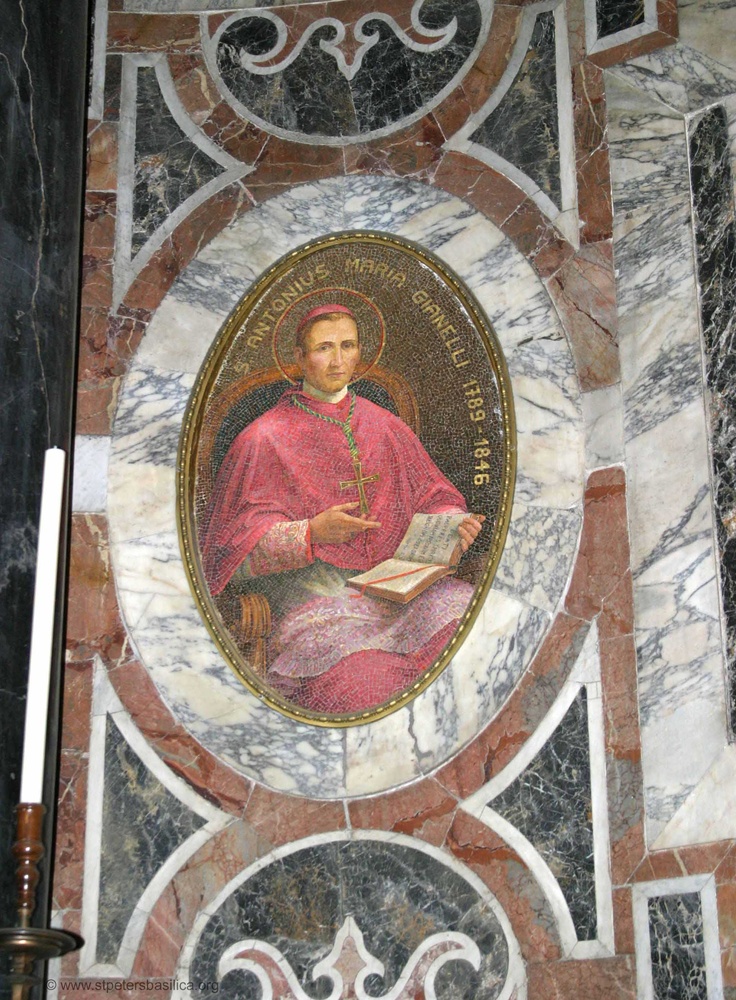
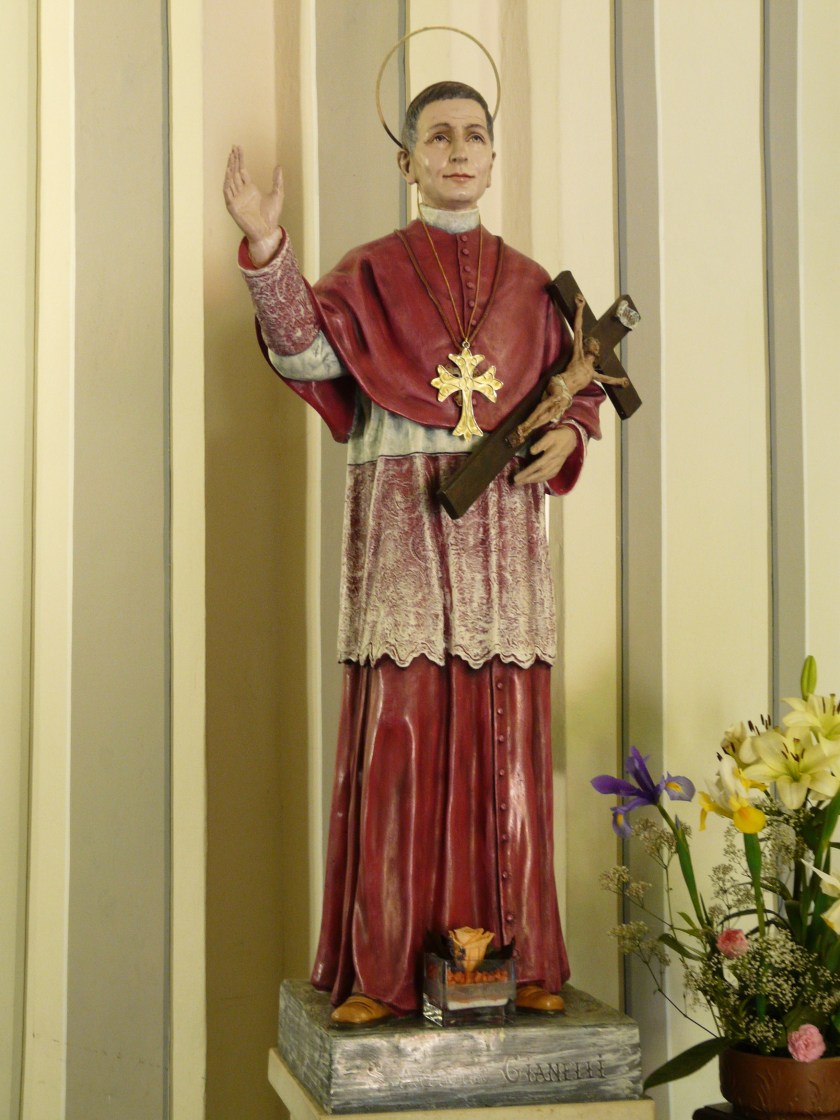
PRAYER – Lord Almighty God, You sanctify Your Church, by the gifts of the Holy Spirit. Fulfil in us the words of Your Son that our love for You and Your children may be come to perfection. Grant that by the prayers of St Anthony Mary Gianelli, who served You through his neighbour, with love and zeal, we too may attain our heavenly home. Through Christ our Lord, in union with You and the Holy Spirit, one God, amen.
Our Morning Offering – 7 June – Thursday of the Ninth Week of Ordinary Time, Year B
Give me Yourself, O my God, St Augustine (354-430) Doctor of Grace
Give me Yourself, O my God,
give Yourself to me.
Behold I love You,
and if my love is too weak a thing,
grant me to love You more strongly.
I cannot measure my love to know how much
it falls short, of being sufficient
but let my soul hasten to Your embrace
and never be turned away, until it is hidden,
in the secret shelter, of Your presence.
This only do I know,
that it is not good for me
when You are not with me,
when You are only outside me.
I want You in my very self.
All the plenty in the world
which is not my God is utter want.
Amen
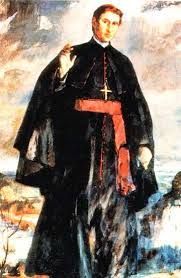
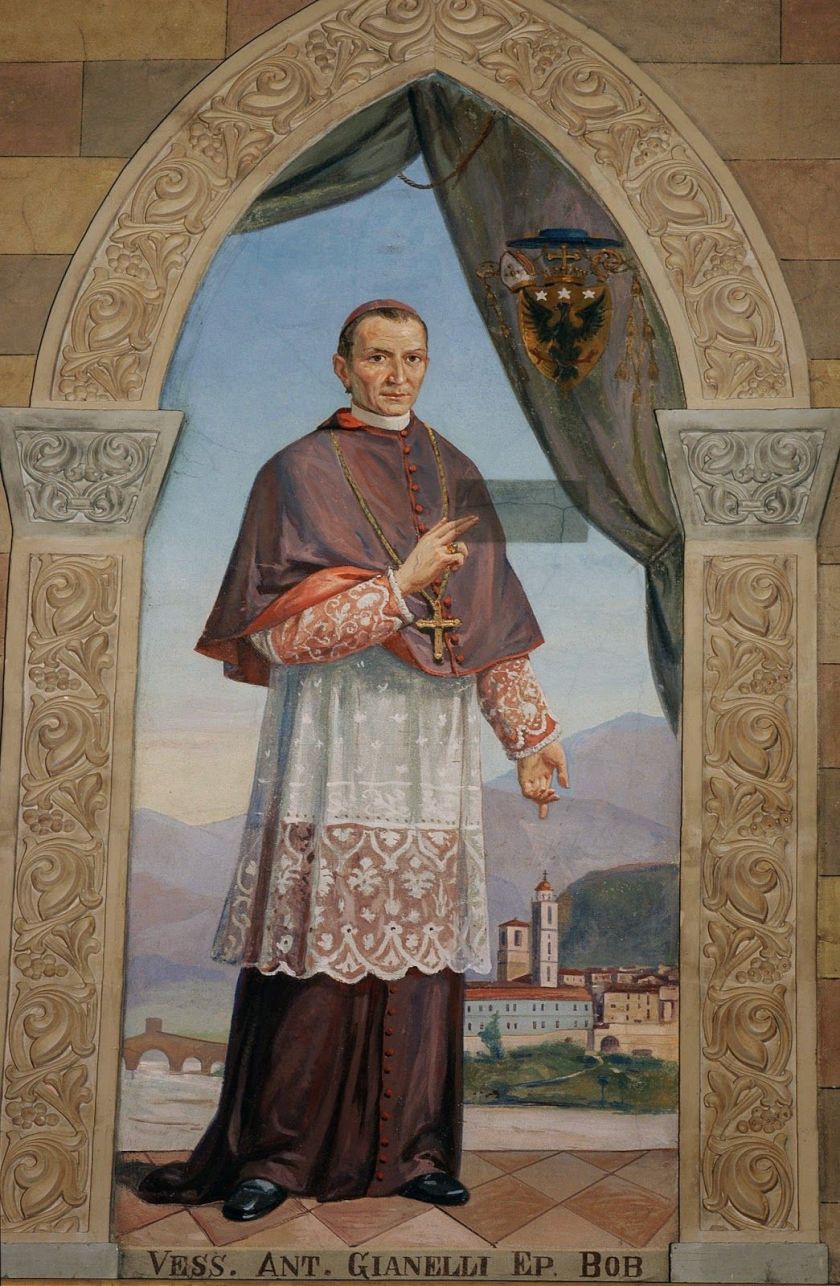
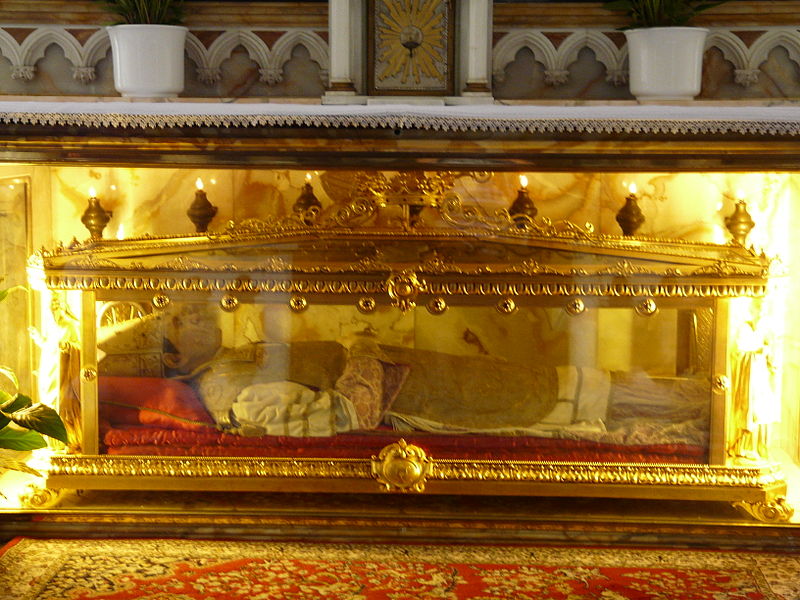
Saint of the Day – 7 June – St Anthony Mary Gianelli (1789-1846) Bishop, Founder, eloquent Preacher, Apostle of Charity and evangelisation – born Antonio Maria Gianelli on 12 April 1789 at Cerreto, Italy – died on 7 June 1846 of a serious fever. Patronages – Bobbio, Val di Vara, Sisters of Our Lady of the Garden. St Anthony Mary was also the founder of the Missionaries of St Alphonsus, the Oblates of St Alphonsus and the Sisters of Our Lady of the Garden. Gianelli was dedicated to the educational needs of his people and catered to their spiritual and material needs as well; he was on hand to aid the ill and the poor and made evangelisation a focus to his episcopal mission. He likewise preached missions and became known for his charisma and his eloquence.
Anthony Maria Gianelli was born in 1789 into a middle-class family living near Genoa in the north of Italy. As a child, people were often struck by his gentle nature, industriousness and extraordinary intelligence. When he came of age, the lady who owned the farm his family lived on, became his generous benefactress and financed his schooling and entry into the ecclesiastical seminary in Genoa.
He quickly distinguished himself by his virtue and exceptional eloquence, thus earning him the unusual privilege of being allowed to preach while still a subdeacon. In 1812, when he was twenty-three years old, he was granted special dispensation to be ordained a priest two years before the required canonical age.
Although Fr Anthony was dedicated to his educational work, he also devoted himself to the work of preaching and hosting missions which resulted in a great harvest of souls. All this was in addition to all his ordinary duties and functions as a parish priest – indeed, he was often confined to his confessional for long stretches of time in order to accommodate the endless stream of penitents who flocked to him for spiritual aid.
He was ordained a bishop in 1838 and appointed to the diocese of Bobbio, where he led his flock by his extraordinary example of virtue, prudence and firm government. He organised the Society of Saint Raphael and Society of Saint Dorothea to instruct the faithful in his diocese and restored devotion to Saint Columbanus in his diocese. He conducted two synods and was constantly on the road from parish to parish, visiting his flock.
Before his death from a fever in 1846, at the age of fifty-seven, Bishop Gianelli founded three religious orders – two for men and one for women. The Missionaries of St Alphonsus and the Oblates of St Alphonsus were established in 1827-1828 but sadly, both lasted only twenty years.
The Sisters of Our Lady of the Garden were founded in 1829 and dedicated their lives to teaching poor children and caring for the ill and infirm. They are still active and well known today in Italy and in other parts of the world as well.
Anthony Gianelli was canonised in on 25 October 1951 by Pope Pius XII.
Bl Anne of Saint Bartholomew
St Anthony Mary Gianelli (1789-1846)
St Aventinus of Larboust
Bl Basilissa Fernandez
St Colman of Dromore
Bl Demosthenes Ranzi
St Deochar
St Gotteschalk
St Justus of Condat
St Landulf of Yariglia
St Lycarion of Egypt
Venerable Matt Talbot (1856 – 1925)
St Meriadoc I of Vannes
St Meriadoc II of Vannes
St Odo of Massay
St Potamiaena of Alexandria the Younger
St Quirinus of Cluny
St Robert of Newminster
St Sergius of Cluny
St Vulflagius of Abbeville
—
Martyrs of Africa – 7 saints: A group of seven Christians who were martyred together. No details about them have survived except the names – Donata, Evasius, Guirillus, Januaria, Privata, Spisinna, Victurus. The precise location in Africa and date are unknown.
Martyred in Córdoba, Spain:
Habentius of Córdoba
Jeremiah of Córdoba
Peter of Córdoba
Sabinian of Córdoba
Wallabonsus of Córdoba
Wistremundus of Córdoba
Thought for the Day – 6 June – The Memorial of St Marcellin Champagnat (1789-1840) Founder of the Marist Brothers and St Norbert (c 1080-1134)
Today’s 2 Saints certainly confirm, once again, that there are two sure ways to sanctity – through the Holy Eucharist and the Mother of God. These are the absolute totality of our Faith, these are the Source and the Heart, these are the only ways we will achieve our goal!
The relationship of Marcellin to Mary was deeply marked by an affective and total trust in her, as the “Good Mother” because it was her work that he undertook.
He wrote once: “Without Mary we are nothing and with Mary we have everything because Mary always has her adorable Son within her arms or in her heart.”
This belief remained constant all through his life. Jesus and Mary were the treasure on which Marcellin had learned to place his own heart. This intimate relationship helped shape the Marian dimension of the Marist spirituality. In the Marist tradition, the phrase “Ordinary Resource” has come to encapsulate our constant reliance on Mary. The motto attributed to Champagnat by his biographer, All to Jesus through Mary, all to Mary for Jesus, captures this close relationship between the Son and the Mother and our Founder’s attitude of confidence in Mary, which we are invited to live.
Mary, Mother, Intercede for us!
St Marcellin, Pray for us!
Excerpt from the Thought for the Day last year:
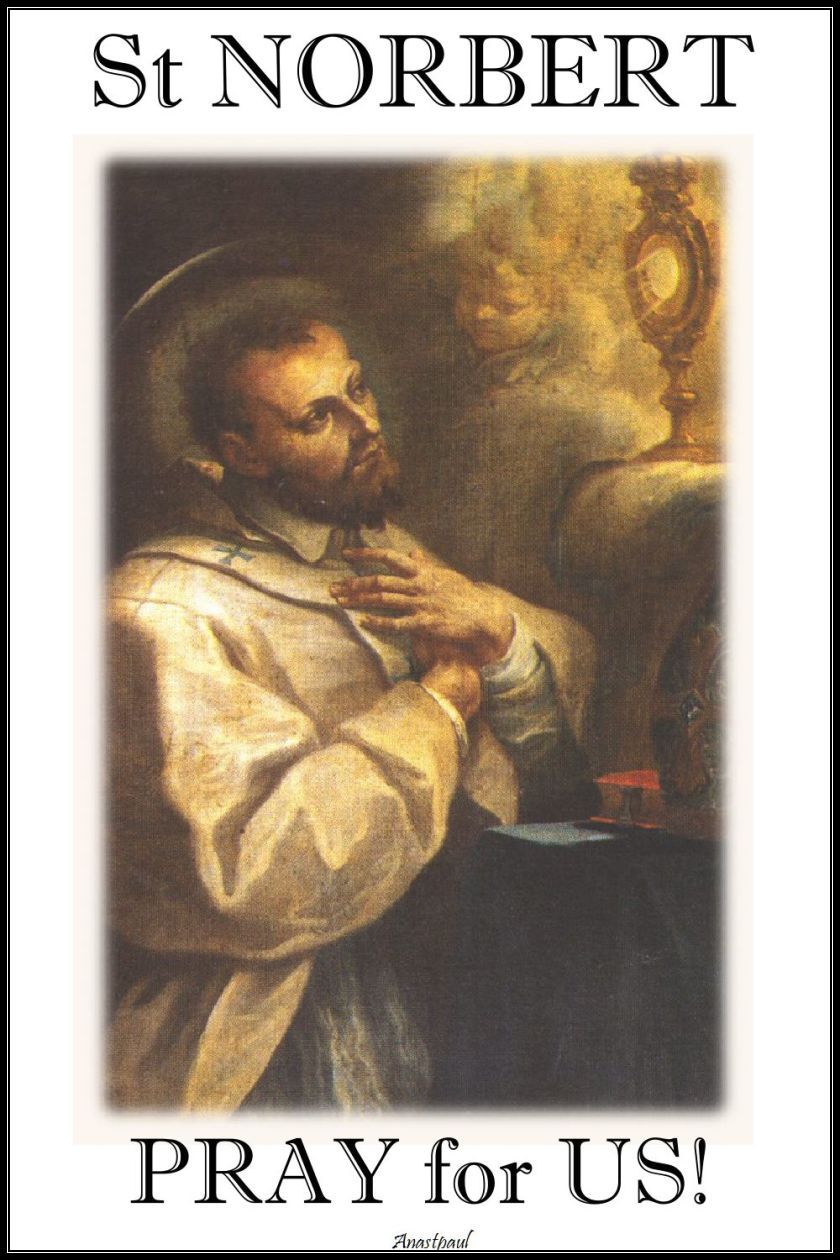
St Norbert was 33 years old before he took God seriously and during the next 20 years he made up for lost time. He did not stop to bewail lost years but gave everything he had to God. It is never too late to begin and God is always waiting for our service. We do not need a bolt of lightening to get started.
Unswerving loyalty to the Church and fervent devotion to the Eucharist, as practiced by Norbert, will continue immeasurably toward maintaining the people of God in accord with the heart of Christ.
Quote/s of the Day – 6 June – The Memorial of St Norbert (c 1080-1134)
On the day of his ordination, St Norbert said:
“O Priest! You are not of yourself because you are of God. You are not of yourself because you are the servant and minister of Christ. You are not your own because you are the spouse of the Church. You are not yourself because you are the mediator between God and man. You are not from yourself because you are nothing. What then are you? Nothing and everything. O Priest! Take care, lest what was said to Christ on the cross be said to you: ‘He saved others, himself he cannot save!”
St Norbert (c 1080-1134)
“All to Jesus through Mary, all to Mary for Jesus.”
One Minute Reflection – 6 June – Wednesday of the Ninth Week of Ordinary Time, Year B – Today’s Gospel Mark 12:18-27 and The Memorial of St Norbert (c 1080-1134) and St Marcellin Champagnat (1789-1840)
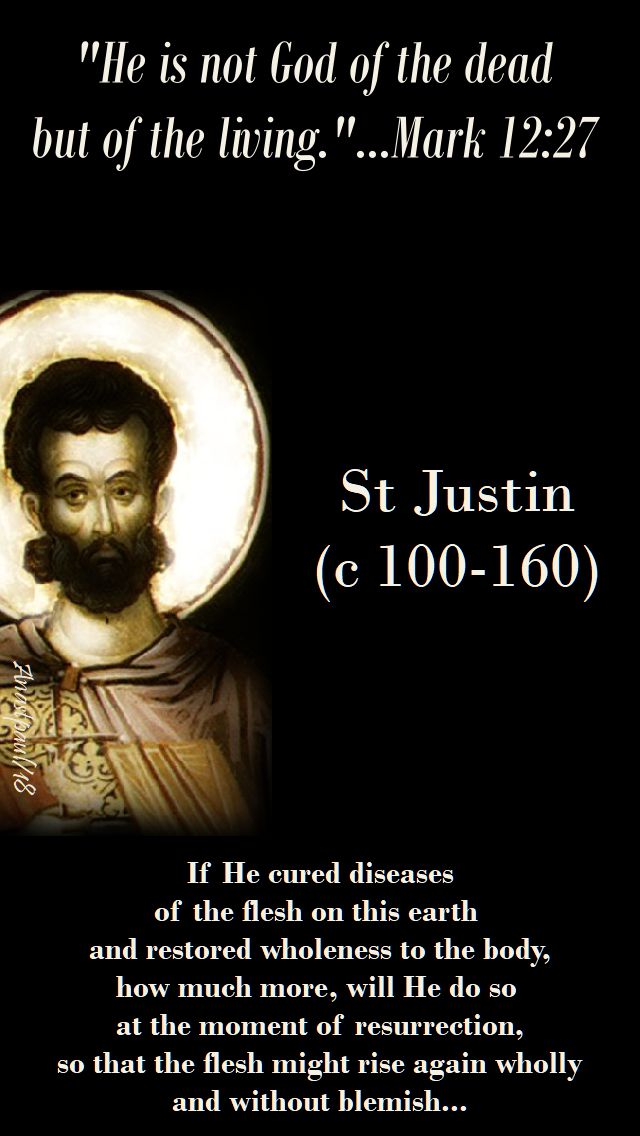
“As for the dead being raised, have you not read in the Book of Moses, in the passage about the bush, how God told him, ‘I am the God of Abraham, (the) God of Isaac and (the) God of Jacob’? He is not God of the dead but of the living. You are greatly misled.” …Mark 12:26-27
REFLECTION – “How blind are the eyes of the intellect on its own! For they have not noticed that “the blind see, the lame walk” (Mt 11:5) on earth at the Saviour’s word… so that we might believe that the flesh in its entirety will rise again at the resurrection. If He cured diseases of the flesh on this earth and restored wholeness to the body, how much more, will He do so at the moment of resurrection, so that the flesh might rise again wholly and without blemish… It seems to me that such people fail to look, at the divine action in its totality, at the beginning of creation, in the forming of man. They don’t attend to the reason why earthly things were made.
The Word said: “Let us make man in our image and likeness” (Gn 1:26)… Obviously man, formed in the image of God, was flesh. Therefore how absurd it is to claim that flesh formed by God in his own image is despicable and worthless! Clearly flesh must be precious in God’s eyes since it is His creation. And since the culmination of His plan for all the rest of creation is to be found in it, this is what has the greatest worth in the eyes of the Creator.”…St Justin (c 100-160), Martyr, Apologist, Philosopher, Father of the Church (Treatise on the resurrection, 2.4.7-9)
PRAYER – Holy Father, You made us, we belong to You. Grant that by the prayers of all your holy saints, we may attain eternal life with You to praise and worship You for all eternity. May the prayers of St Norbert and St Marcellin, assist us our earthly pilgrimage. We make our prayer through our Lord, Jesus, with You and in the unity of the Holy Spirit, one God forever, amen.
Our Morning Offering – 6 June – Wednesday of the Ninth Week of Ordinary Time, Year B
Excerpt of the Lorica St Patrick (c 385-461)
I arise today
Through God’s strength
to pilot me;
God’s might to uphold me,
God’s wisdom to guide me,
God’s eye to look before me,
God’s ear to hear me,
God’s word to speak for me,
God’s hand to guard me,
God’s way to lie before me,
God’s shield to protect me,
God’s hosts to save me
From snares of the devil,
From temptations of vices,
From every one who desires me ill,
Afar and anear,
Alone or in a mulitude.
I arise today
Through a mighty strength,
the invocation of the Trinity,
Through a belief in the Threeness,
Through a confession of the Oneness
Of the Creator of creation,
Amen
It is believed that St Patrick composed the prayer in 433, before he was about to convert High King of Ireland Lóegaire mac Néill. It is called a “lorica,” which literally means “deer leap” but is usually translated as “breastplate” and is a prayer of one who is going into battle, a prayer for protection. In this case, it was a spiritual battle against the paganism and evil spirits of the Emerald Isle.
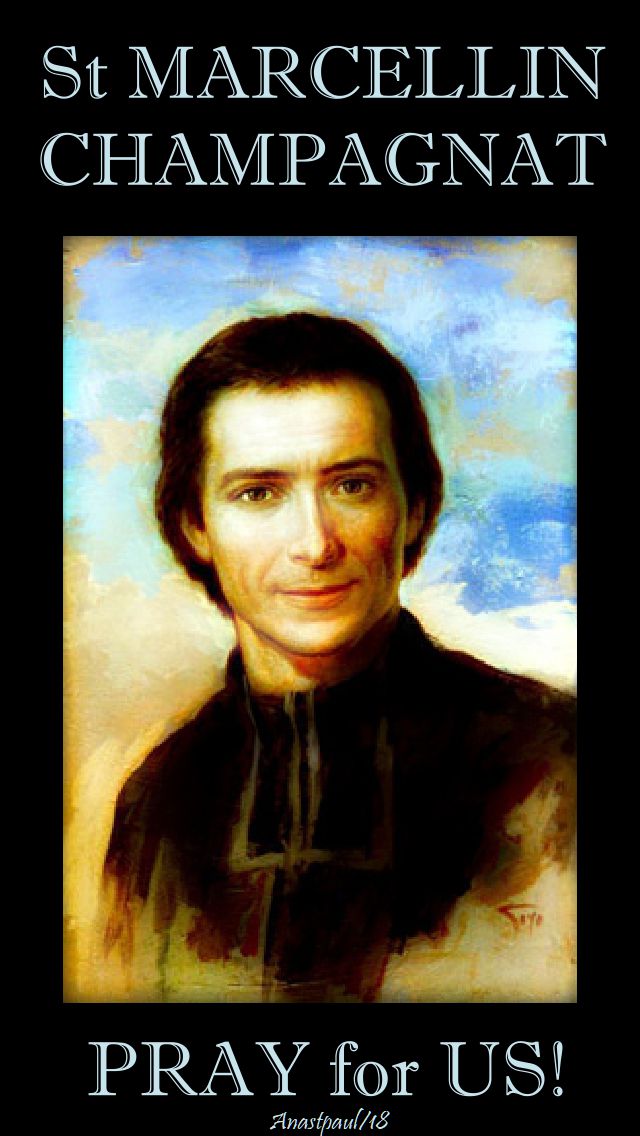
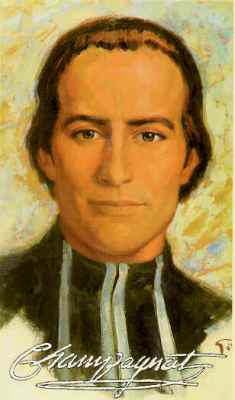
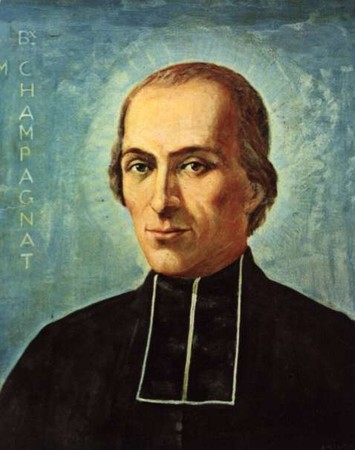
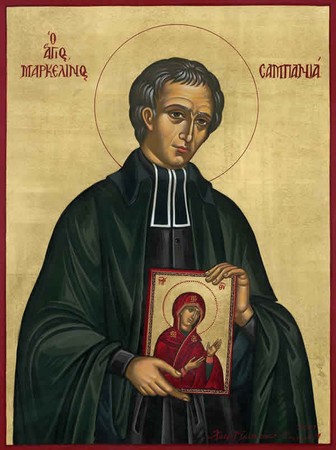
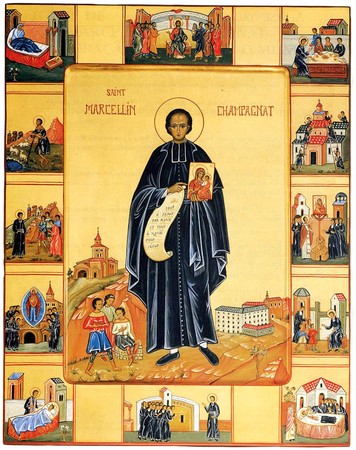
Saint of the Day – 6 June – Saint Marcellin Champagnat (1789-1840) – Priest of the Society of Mary and Founder of the the Institute of the Little Brothers of Mary (Marist Brothers) ‘FMS’, a religious congregation of brothers devoted to Mary and dedicated to education. St Marcellin was born as Marcellin-Joseph-Benoît Champagnat on 20 May 1789 at Hameau du Rosey, Lyon, France and died on 6 June 1840 in in Saint-Chamond, Loire, France of natural causes.
MARCELLIN CHAMPAGNAT was born on 20th May 1789, in Marlhes, a village in the mountains of east-central France. The Revolution was about to burst upon the scene. He was the ninth child of a very Christian family, from whom he received his basic education. His mother and his aunt, a religious driven from her convent, awoke in him a solid faith and deep devotion to Mary. His father, who was a farmer and merchant, possessed an above-average education and played a significant role in the politics of the village and the region. He imparted to Marcellin his aptitude for manual work, a penchant for direct action, a sense of responsibility and openness to new ideas.
When Marcellin was 14, a priest passing through the village helped him to see that God was calling him to the priesthood. Marcellin, whose formal schooling was practically non-existent, began to study because “God wills it!”, even while those around him, aware of his limitations, tried to dissuade him. The difficult years he spent in the minor seminary in Verrieres (1805-1813) were for him a time of real human and spiritual growth.
Among his companions in the major seminary in Lyons were Jean-Marie Vianney, the future Cure of Ars and Jean-Claude Colin who was to become the founder of the Marist Fathers. He joined a group of seminarians whose goal was to found a congregation bearing Mary’s name and including priests, sisters and a lay third order the “Society of Mary” for the re-Christianisation of society. Deeply aware of the cultural and spiritual poverty of the children of the countryside, Marcellin felt a strong urge to include a branch of brothers for the Christian education of young people. “I cannot see a child without wanting to tell him how much Jesus loves him.” The day after their ordination on 22nd July 1816, these young priests went to consecrate themselves to Mary and to place their project under her protection at the shrine of Our Lady of Fourviere.
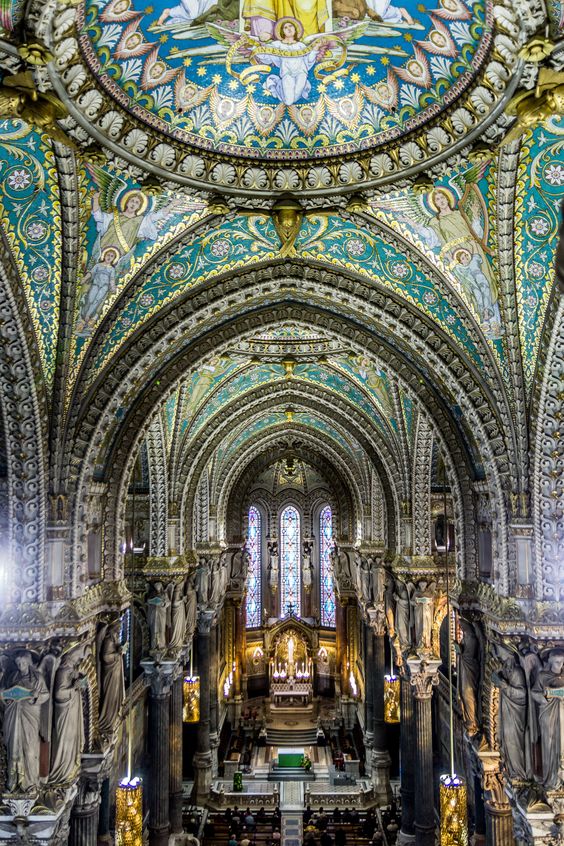
Basilica of Our Lady of Fourviere
Marcellin was sent as curate to the parish of La Valla. His ministry there included visiting the sick, catechising the children, helping the poor and helping families to live the Christian life. His simple, direct style of preaching, his deep devotion to Mary and his apostolic zeal, made a profound impression on his parishioners. His encounter with a dying 17-year-old boy, who had absolutely no religious instruction, shook him to his depths and moved him not to delay any longer in putting his plans into action.
On 2nd January 1817, only six months after his arrival in La Valla, Marcellin, a 27-year-old curate, brought together his first two disciples; the congregation of the Little Brothers of Mary, or Marist Brothers, was born in poverty, humility and total trust in God under Mary’s protection. While still carrying on his parish ministry, he went to live with his brothers, whom he trained and prepared for their mission as Christian teachers, catechists and educators of young people. Passionately devoted to the Kingdom of God, conscious of the tremendous needs of young people and an instinctive educator, Marcellin turned these uncultured young country lads into generous apostles. He lost no time in opening schools. Vocations arrived and the first little house, even though enlarged by Marcellin himself, was soon too small. There were many difficulties. The clergy in general did not understand what this inexperienced young priest with no material resources was trying to accomplish. However, the nearby villages continually requested brothers to see to the Christian education of their children.
Marcellin and his brothers shared in the construction of their new house, which could hold more than 100 persons and which would bear the name of “Our Lady of the Hermitage”. Freed from his parish duties in 1825, he thenceforth devoted himself totally to his congregation: the spiritual, pedagogical and apostolic formation and accompaniment of his brothers, visits to the schools and the opening of new ones.
Marcellin, a man of deep faith, never ceased to seek the will of God through prayer and dialogue with the religious authorities and with his brothers . Very conscious of his own limitations, he counted only on God and on the protection of Mary, his “Good Mother”, “Ordinary Resource” and “First Superior”. His deep humility and his acute awareness of the presence of God, helped him to live through many severe trials with great inner peace. He often prayed psalm 126: “If the Lord does not build the house”, convinced that this congregation of brothers was the work of God and Mary. His motto was, “All to Jesus through Mary and all to Mary for Jesus”.
“To make Jesus Christ known and loved” is the brothers’ mission. The school is the privileged setting for this mission of evangelisation. Marcellin taught his disciples to love and respect children and to give special attention to the poor, the most ungrateful and the most neglected, especially orphans. Spending a great deal of time with young people, with simplicity, family spirit and love of work and all of this carried out as Mary would have, were the essential points of his vision of education.
In 1836, the Church recognised the Society of Mary and entrusted to it the missions of Oceania. Marcellin took his vows as a member of the Society of Mary and sent three brothers with the first missionary Marist Fathers to the islands of the Pacific. “Every diocese of the world figures in our plans”, he had written.
Steps for obtaining legal recognition of his congregation made great demands on his time, energy and spirit of faith. He never stopped repeating, “When God is on your side and you rely only on Him, nothing is impossible!”
A lengthy illness gradually wore down his robust constitution. Worn out by his labours, he died at the age of 51 on 6th June 1840, leaving this message with his brothers: “May you be of one heart and one mind. May it be said of the Little Brothers of Mary as of the first Christians: see how they love one another!”…Vatican.va
St Marcellin Champagnat was declared Venerable in 1920 by Pope Benedict XV, Beatified by Pope Pius XII on 29 May 1955 and Canonised by St Pope John Paul II on 18 April 1999.
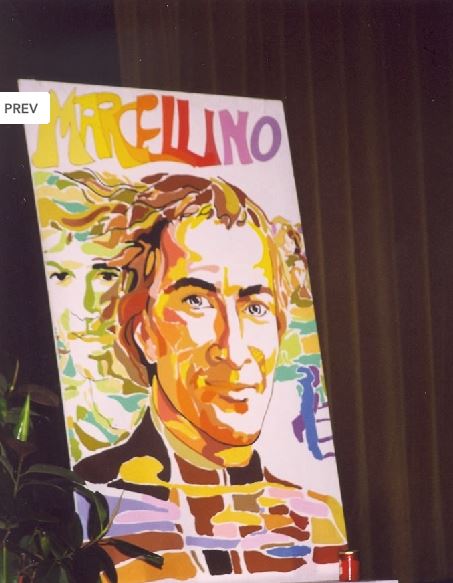
Canonisation Mass at the General HouseCaonisation celebration poster
Today there are about 5,000 Marist Brothers in 72 countries; their sloganA Heart Without Borders.
—
St Agobard of Lyon
St Alexander of Fiesole
St Alexander of Noyon
St Amantius of Noyon
St Anoub of Skete
St Artemius of Rome
St Bazalota of Abyssinia
St Bertrand of Aquileia
St Candida of Rome
St Ceratius of Grenoble
St Claudius of Besançon
St Cocca
St Colmán of Orkney
Bl Daniel of Bergamo
St Euphemia of Abyssinia
St Eustorgius II of Milan
Bl Falco of La Cava
Bl Gerard Tintorio
Bl Gilbert of Neufontaines
St Grazia of Germagno
St Gudwall
Bl Gundisalvus of Azebeyro
St Hilarion the Younger
St Jarlath of Tuam
St John of Verona
Bl Józef Wojciech Guz
Bl Lorenzo de Masculis
St Marcellin Champagnat (1789-1840)
St Paulina of Rome
St Phêrô Dung
St Phêrô Thuan
St Rafael Guízar y Valencia
St Vincent of Bevagna
St Vinh-Son Duong
Bl William Greenwood
—
Marytrs of Tarsus: A group of 20 martyrs who were killed together during the persecutions of Diocletian. They were martyred in Tarsus (in modern Turkey).
Mercedarian Fathers of Avignon: Several Mercedarians from the Santa Maria convent of Avignon, France who worked with plague victims in that city and died of the disease themselves. They died in Avignon, France of plague.
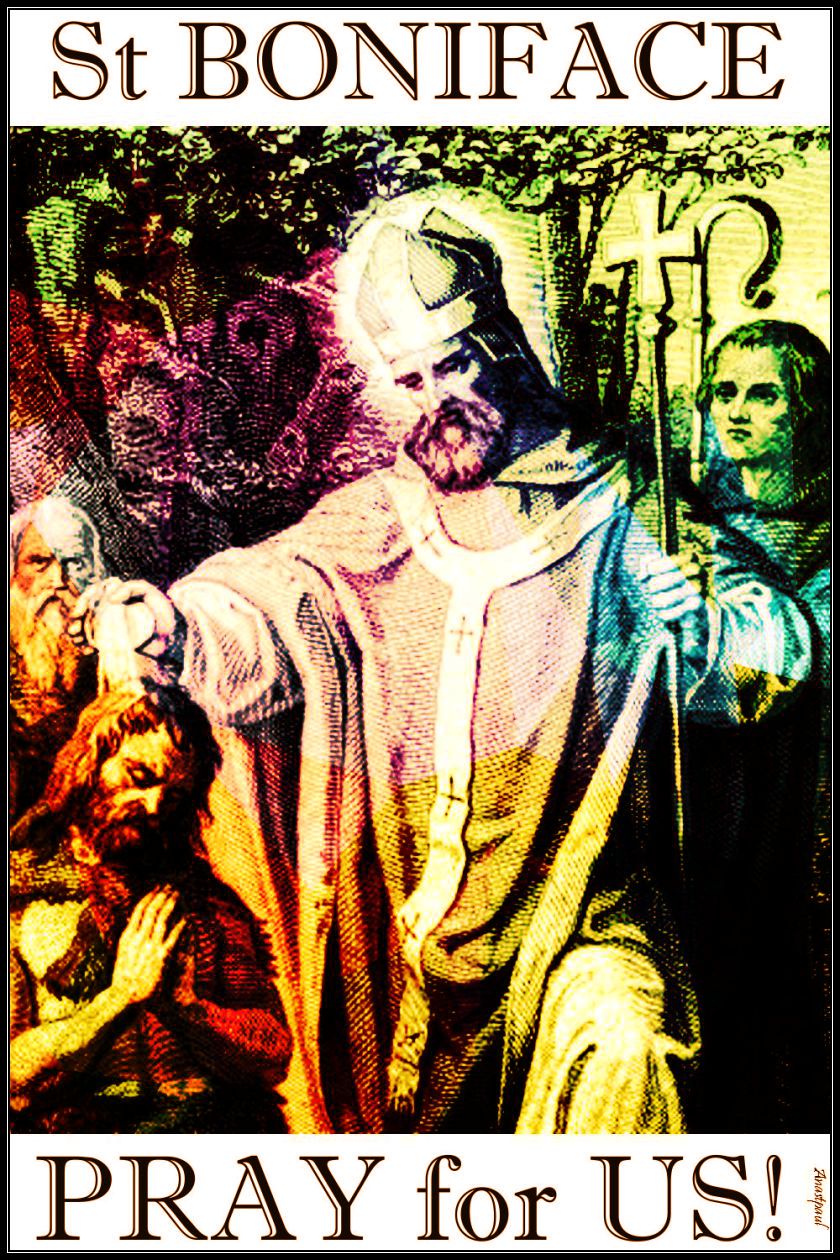
Thought for the Day – 5 June – The Memorial of St Boniface (672-754) “The Apostle of Germany” – Martyr
An excerpt from a letter by St Boniface (672-754) “The Apostle of Germany”, Bishop and Martyr:
“Let us stand fast in what is right and prepare our souls for trial. Let us wait upon God’s strengthening aid and say to Him: “O Lord, you have been our refuge in all generations.” Let us trust in Him, who has placed this burden upon us. What we ourselves cannot bear, let us bear with the help of Christ. For He is all-powerful and He tells us: “My yoke is easy and my burden light.” Let us continue the fight, on the day of the Lord. The days of anguish and of tribulation have overtaken us. If God so wills, “let us die for the holy laws of our fathers,” so that we may deserve, to obtain an eternal inheritance with them. Let us be neither dogs that do not bark, nor silent onlookers, nor paid servants, who run away before the wolf. Instead, let us be careful shepherds, watching over Christ’s flock. Let us preach the whole of God’s plan, to the powerful and to the humble, to rich and to poor, to men of every rank and age, as far as God gives us the strength, in season and out of season.”
One Minute Reflection – 5 June – Tuesday of the Ninth Week of Ordinary Time, Year B and the Memorial of St Boniface (672-754) “The Apostle of Germany” – Martyr
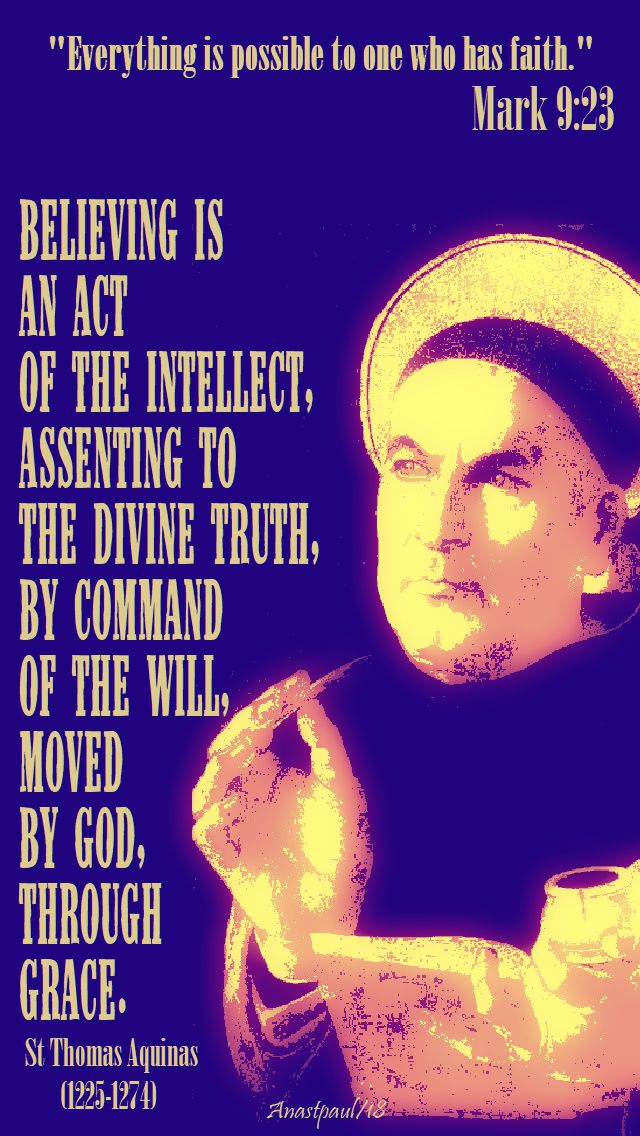
“Everything is possible to one who has faith.” Then the boy’s father cried out, “I do believe, help my unbelief!”…Mark 9:23-24
REFLECTION – “Faith is a grace: When St Peter confessed that Jesus is the Christ, the Son of the living God, Jesus declared to him that this revelation did not come “from flesh and blood” but from “my Father who is in heaven.” (Mt 16:17) Faith is a gift of God, a supernatural virtue infused by him. “Before this faith can be exercised, man must have the grace of God to move and assist him; he must have the interior helps of the Holy Spirit, who moves the heart and converts it to God, who opens the eyes of the mind and ‘makes it easy for all to accept and believe the truth.’” (Vatican II, DV 5)
Faith is a human act: Believing is possible only by grace and the interior helps of the Holy Spirit. But it is no less true, that believing is an authentically human act. Trusting in God and cleaving to the truths He has revealed are contrary neither to human freedom nor to human reason. Even in human relations it is not contrary to our dignity to believe what other persons tell us about themselves and their intentions or to trust their promises (for example when a man and a woman marry) to share a communion of life with one another. If this is so, still less is it contrary to our dignity, to “yield by faith the full submission of … intellect and will to God who reveals,” (Vatican I) and to share in an interior communion with Him.
In faith, the human intellect and will, cooperate with divine grace: “Believing is an act of the intellect, assenting to the divine truth, by command of the will, moved by God, through grace.”…St Thomas Aquinas
PRAYER – Lord, Your martyr Boniface, spread the faith by his teaching and witnessed to it with his blood. By the help of his prayers keep us loyal to our faith and give us courage to profess it in our lives. Grant this through our Lord Jesus Christ, Your Son, who lives and reigns with You and the Holy Spirit, one God, for ever and ever, amen.
Our Morning Offering – 5 June – The Memorial of St Boniface (672-754) “The Apostle of Germany”
Eternal God, our Refuge By St Boniface (672-754)
Eternal God,
the refuge and help of all Your children,
we praise You
for all You have given us,
for all You have done for us,
for all that You are to us.
In our weakness,
You are strength,
in our darkness,
You are light,
in our sorrow,
You are comfort and peace.
We cannot number Your blessings,
we cannot declare Your love
For all Your blessings,
we bless You.
May we live as in Your presence,
and love the things that You love,
and serve You in our daily lives;
through Jesus Christ our Lord.
Amen
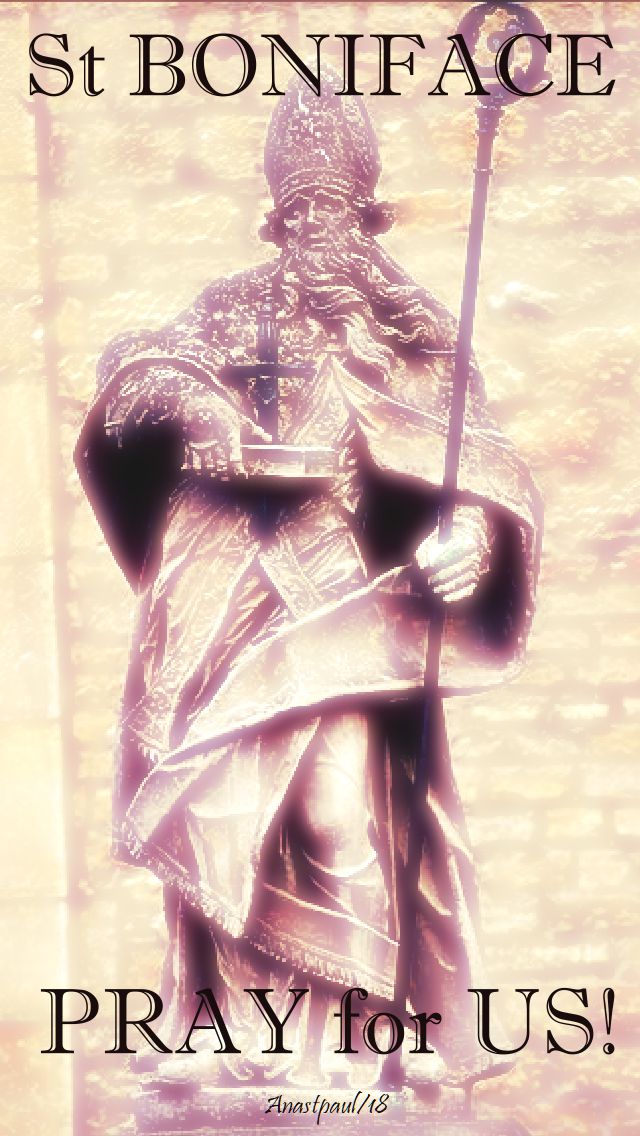
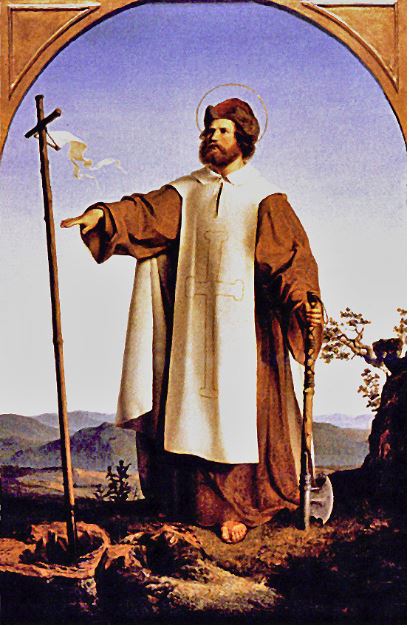
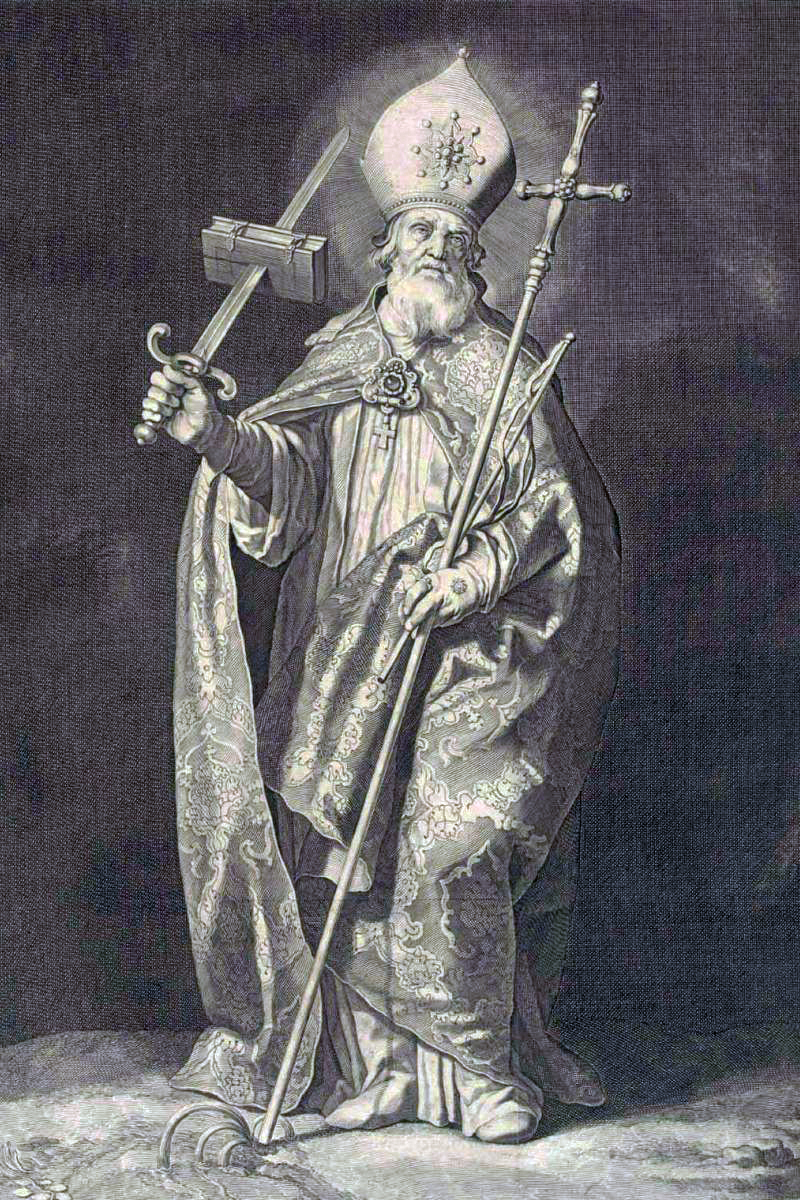
Saint of the Day – 5 June – St Boniface (672-754) Martyr – Bishop/Archbishop, Missionary and Evangelist, Teacher, Writer, Preacher, Theologian, Founder of Schools, Convents, Monasteries and Churches – known as “The Apostle of Germany.” Patron of brewers, file cutters, tailors, Germany, Archdiocese of Saint-Boniface, Manitoba, Canada, diocese of Fulda, Germany.
Boniface, known as the Apostle of the Germans, was an English Benedictine Monk who gave up being elected Abbot to devote his life to the conversion of the Germanic tribes. Two characteristics stand out: his Christian orthodoxy and his fidelity to the Pope of Rome.
How absolutely necessary this orthodoxy and fidelity were, is borne out by the conditions Boniface found on his first missionary journey in 719 at the request of Pope Gregory II. Paganism was a way of life. What Christianity he did find, had either lapsed into paganism or was mixed with error. The clergy were mainly responsible for these latter conditions since they were in many instances uneducated, lax and questionably obedient to their bishops. In particular instances their very ordinations were questionable.
These are the conditions that Boniface was to report in 722 on his first return visit to Rome. The Holy Father instructed him to reform the German Church. The pope sent letters of recommendation to religious and civil leaders. Boniface later admitted that his work would have been unsuccessful, from a human viewpoint, without a letter of safe-conduct from Charles Martel, the powerful Frankish ruler, grandfather of Charlemagne. Boniface was finally made a regional bishop and authorised to organise the whole German Church. He was eminently successful.
In the Frankish kingdom, he met great problems because of lay interference in bishops’ elections, the worldliness of the clergy and lack of papal control.
In order to restore the Germanic Church to its fidelity to Rome and to convert the pagans, Boniface had been guided by two principles. The first was to restore the obedience of the clergy to their bishops in union with the pope of Rome. The second, was the establishment of many houses of prayer which took the form of Benedictine monasteries. A great number of Anglo-Saxon monks and nuns followed him to the continent, where he introduced the Benedictine nuns to the active apostolate of education.
For nearly 35 years, Boniface traveled all over Germany, preaching, teaching, and building schools, monasteries, and convents. He went to Rome to report to the pope about his work. There, the pope ordained him bishop and told him to return to Germany to continue missionary work. Boniface invited monks and sisters from England to come and help him. The monastery at Fulda is probably the most famous one started by Boniface, below is the Cathedral and a Statue of him there.
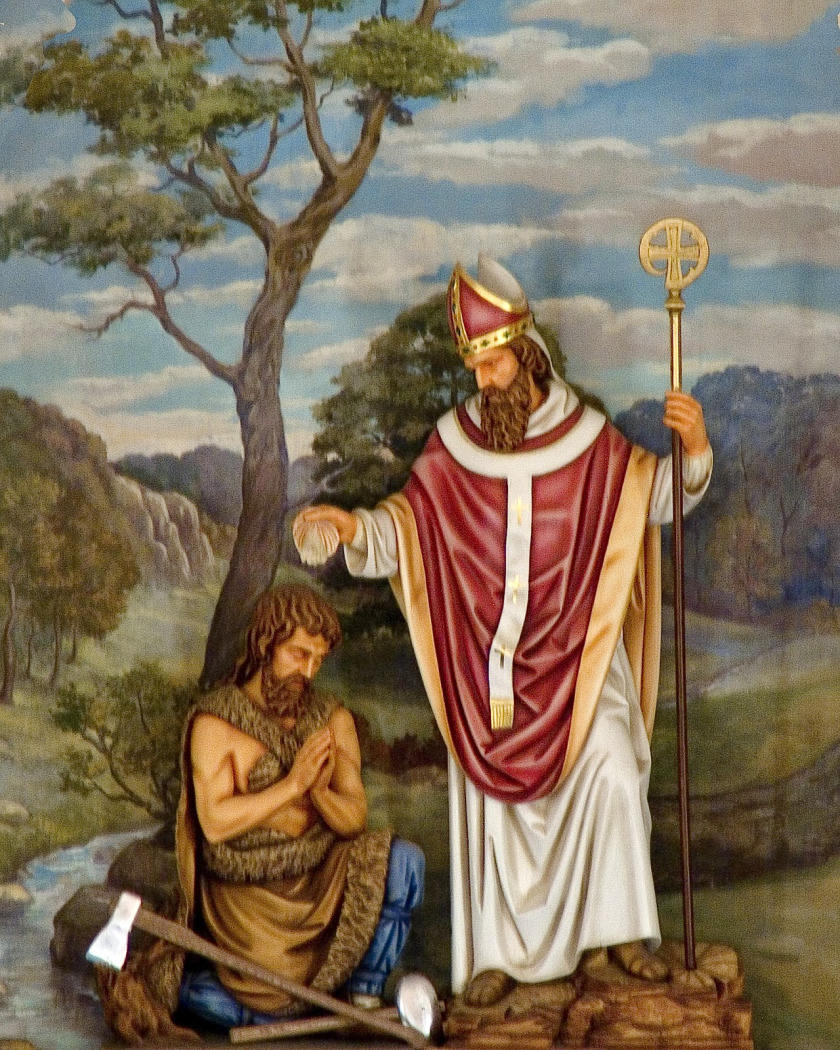
During a final mission to the Frisians, Boniface and 53 companions were massacred while he was preparing converts for confirmation by a band of angry natives. who rushed into the church and murdered them. Today Saint Boniface is the patron of Germany.
Martyrdom of St Boniface and Companions
St Boniface & the Christmas Tree
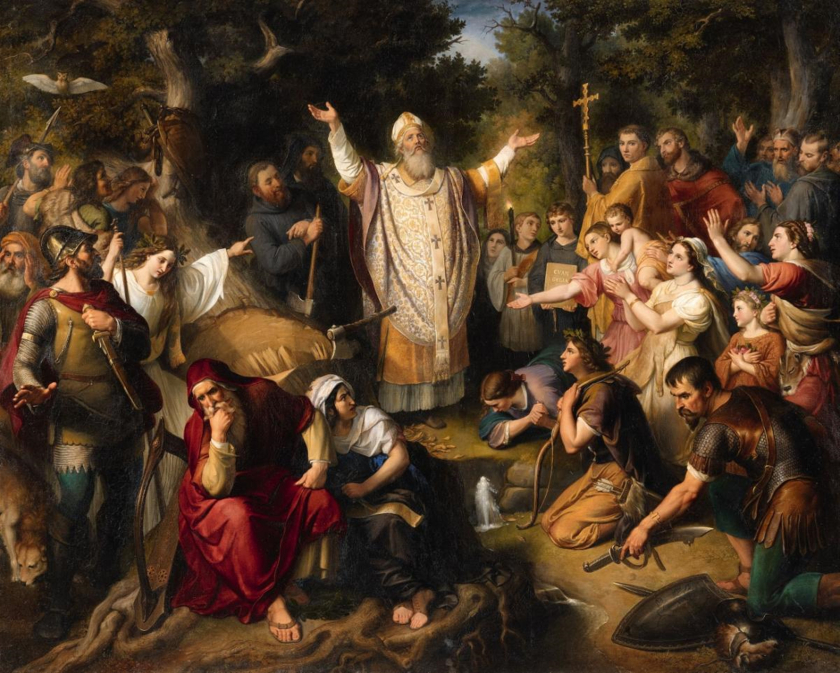
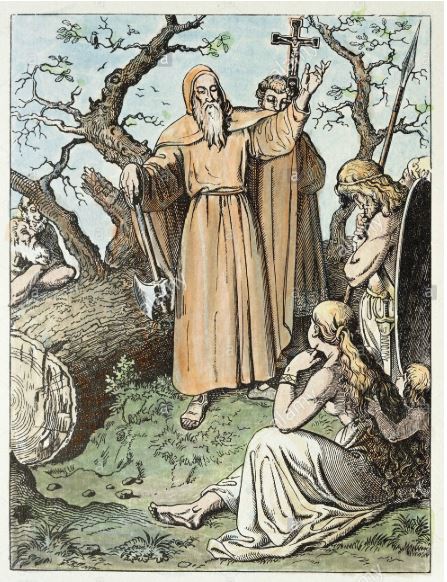
It is told that Saint Boniface, one day came upon a group of pagans gathered around a big oak tree about to sacrifice a child to the god Thor, which was represented by the tree. To stop the sacrifice and save the child’s life Boniface felled the tree with one mighty blow of his fist. Nearby grew a small fir tree. The saint told the pagan worshippers that the tiny fir was the Tree of Life and stood for the eternal life of Christ . Saint Boniface also used the triangular shape of the fir tree to describe the Holy Trinity of God the Father, Son and Holy Ghost. By the 12th Century, Christmas trees were used all over Europe as a symbol of Christianity.
More info on St Boniface here: https://anastpaul.wordpress.com/2017/06/05/saint-of-the-day-5-june-st-boniface/
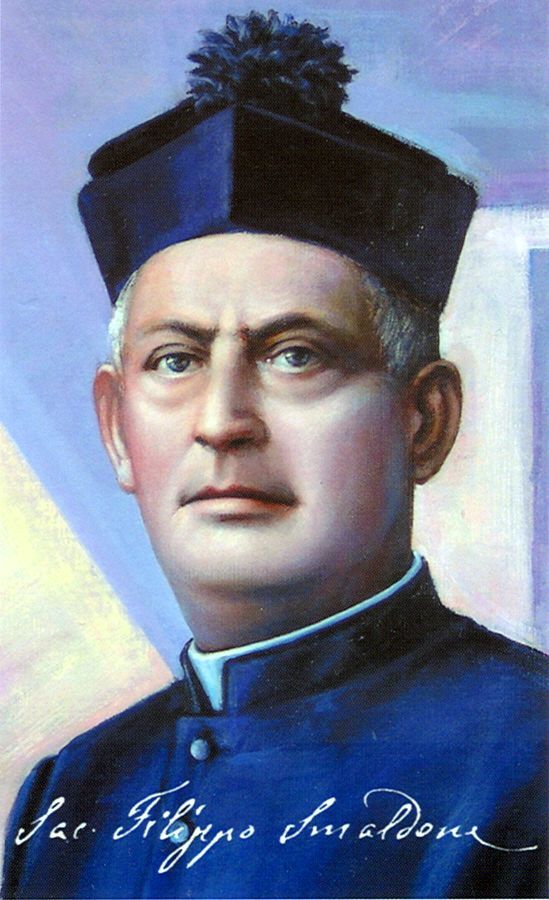
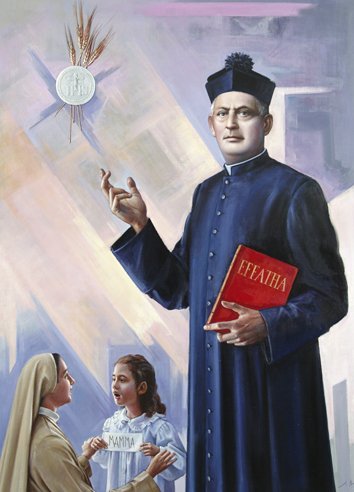
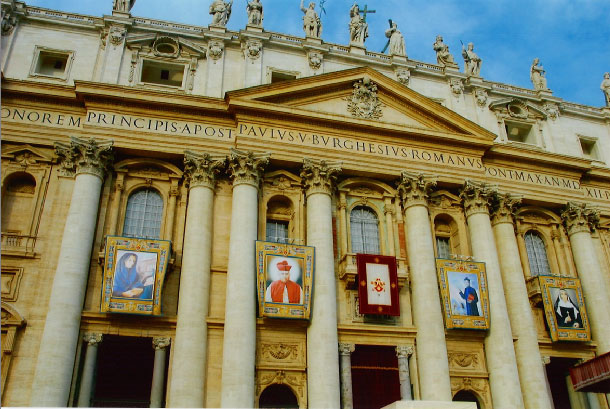
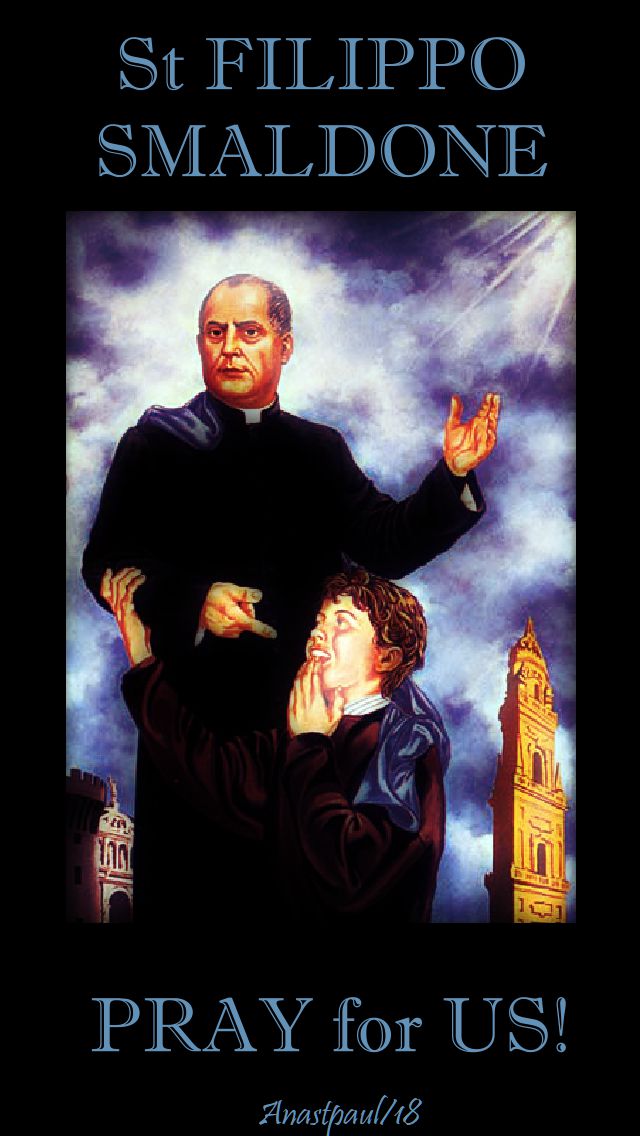
Saint of the Day – 4 June – St Filippo Smaldone (1848-1923) Priest and Founder of the Salesian Sisters of the Sacred Hearts, Preacher, Catechist, Apostle of Eucharistic Adoration and Our Lady, Apostle of Charity and especially of orphans, the blind and the deaf, Spiritual Advisor and Director – Born on 27 July 1848 in Naples, Italy and died on 4 June 1923 in Lecce, Italy from a combination of diabetes and a heart condition. St Filippo is best known for his extensive work with the deaf, the blind and orphans, during his lifetime. Father Smaldone was a gifted preacher known for his commitment to proper Catechesis and to the care of orphans and the mute, which earned him civic recognition. Patronages: Salesian Sisters of the Sacred Hearts, Deaf people, Mute people. He was Beatified in 1996 by St John Paul and Canonised by Pope Benedict XVI on 15 October 2006 in St Peter’s Square.
Filippo Smaldone was born in Naples on 27 July 1848, at a time of political and social turmoil in Italy as well as for the Church. Notwithstanding the social, political and religious unrest that surrounded him, he decided to dedicate himself to the service of the Church and become a priest.
While he was still a philosophy and theology student, he became involved in helping the many marginalised people and deaf-mutes in Naples, who at the time were without appropriate forms of assistance. His dedication to the apostolate did not leave him much time to study and it was with difficulty that he passed the examination for Minor Orders.
After a period of time in what is today known as the Archdiocese of Rossano-Cariati, where he could concentrate on his studies, he returned to the Archdiocese of Naples in 1876. There he continued to study and to work with deaf-mutes and was ordained a priest on 23 September 1871.
Fr Smaldone dedicated himself to the priestly ministry through evening catechism classes and visiting the hospitalised and homebound sick. During a plague epidemic he too caught the contagion but he was miraculously cured through intercession to Our Lady of Pompeii, for whom he cherished a special, lifelong devotion.
In addition to his parish ministry he continued his pioneer work in the education of deaf-mutes; however, he met many obstacles during his work and became discouraged, at one point wanting to change ministries and head for the foreign missions.
But it was his wise confessor who convinced him that his true mission was in Naples among the people who needed him most. Thus, he gave himself without reserve to this apostolate and made it the principle object of his mission.
Armed with the great experience he had acquired through the years, Fr Smaldone went to Lecce, Italy, on 25 March 1885, where he founded an institute for deaf-mutes with Fr Lorenzo Apicella and a group of Sisters, he had specially trained. This was the basis for the Congregation of the Salesian Sisters of the Sacred Hearts, which rapidly took root and flourished.
After founding the Lecce institute, which became the Motherhouse of the Congregation he founded, in 1897 Fr Smaldone opened other institutes in Rome and Bari, Italy. Due to the great need, Fr Smaldone soon expanded his work to include blind children, orphans and the abandoned in his institutes.
Signs of the great work he accomplished for love of God and neighbour were both external and internal trials. In fact, one of his favourite sayings was: “The Lord sends us trials and tribulations to settle our debt to Him”.
From without he had to defend himself against the anti-Church municipal council; from within, he had to deal with the departure of the first superior of the new Congregation he founded, which provoked a long apostolic visit on the part of the Holy See.
The crucible of trials thus tried this holy man of God and found him and his works worthy. He continued to strive, with fatherly affection, to educate his deaf-mute students and to give the Salesian Sisters a complete religious formation.
Fr Smaldone also served as confessor and spiritual director to priests, seminarians and various religious communities. He founded the Eucharistic League of Priest Adorers and Women Adorers, and was superior of the Congregation of the Missionaries of St Francis de Sales.
He was appointed a canon of Lecce Cathedral and at one point was awarded a commendation by the civil Authorities.
Fr Filippo Smaldone died of a serious diabetic condition with heart complications on 4 June 1923 at the age of 75; he was in Lecce and surrounded by the affection of the Sisters and many of the needy whom he had served throughout his life.
St Filippo’s Ccanonisation cause commenced in an informative process that opened in 1964 under Pope Paul VI and concluded its business sometime after this. The introduction to this process titled him as a Servant of God. The Congregation for the Causes of Saints validated this process in Rome on 23 May 1989 and received the Positio in 1989 which allowed for theologians to approve it on 3 February 1995 and the C.C.S. to likewise approve the cause on 16 May 1995. St Pope John Paul II declared Smaldone to be Venerable on 11 July 1995 after the pope confirmed that the priest had indeed lived a model Christian life of heroic virtue.
The miracle needed for beatification was investigated and then validated on 7 May 1993 while a medical board later approved it on 1 June 1995. Theologians also assented to this miracle on 27 October 1995 as did the C.C.S. on 12 December 1995. St John Paul II issued formal assent needed and deemed that the healing was a miracle attributed to Smaldone’s intercession on 12 January 1996 while later presiding over Smaldone’s Beatification on 12 May 1996.
The process for a second miracle spanned from 2000 to 2002 at which point it received validation on 4 April 2003 before receiving the assent of the medical board on 3 February 2005; theologians assented to it on 17 May 2005 as did the C.C.S. on 17 January 2006. Pope Benedict XVI approved this on 28 April 2006 and Canonised Smaldone in Saint Peter’s Square on 15 October 2006.
Thought for the Day – 4 June – Ninth Week in Ordinary Time, Year B and the Memorial of St Filippo Smaldone (1848-1923) – Apostle of Eucharistic Adoration and of Charity
Speaking of: Eucharistic Adoration
“St Filippo Smaldone, son of South Italy, knew how to instil in his life the higher virtues characteristic of his land.
A priest with a great heart nourished continuously on prayer and Eucharistic Adoration, he was above all, a witness and servant of charity, which he manifested in an eminent way through service to the poor, in particular to deaf-mutes, to whom he dedicated himself entirely.
The work that he began developed thanks to the Congregation of the Salesian Sisters of the Sacred Hearts, founded by him and which spread to various parts of Italy and the world.
St Filippo Smaldone saw the image of God reflected in deaf-mutes and he used to repeat that, just as we prostrate before the Blessed Sacrament, so we should kneel before a deaf-mute.
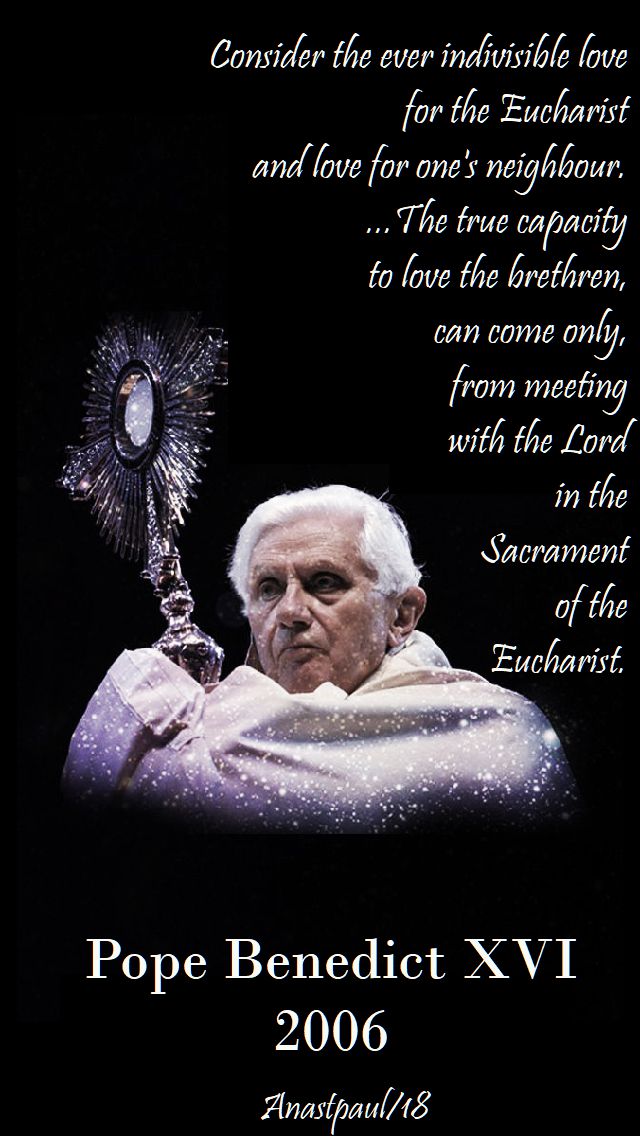
From his example we welcome the invitation to consider the ever indivisible love for the Eucharist and love for one’s neighbour. But the true capacity to love the brethren, can come only, from meeting with the Lord in the Sacrament of the Eucharist.”
Pope Benedict XVI on the Canonisation of St Filippo Smaldone, St Peter’s Square, Sunday, 15 October 2006
Quote/s of the Day – 4 June – Ninth Week in Ordinary Time, Year B
Speaking of: “The Most Holy Eucharist/The Holy Mass”
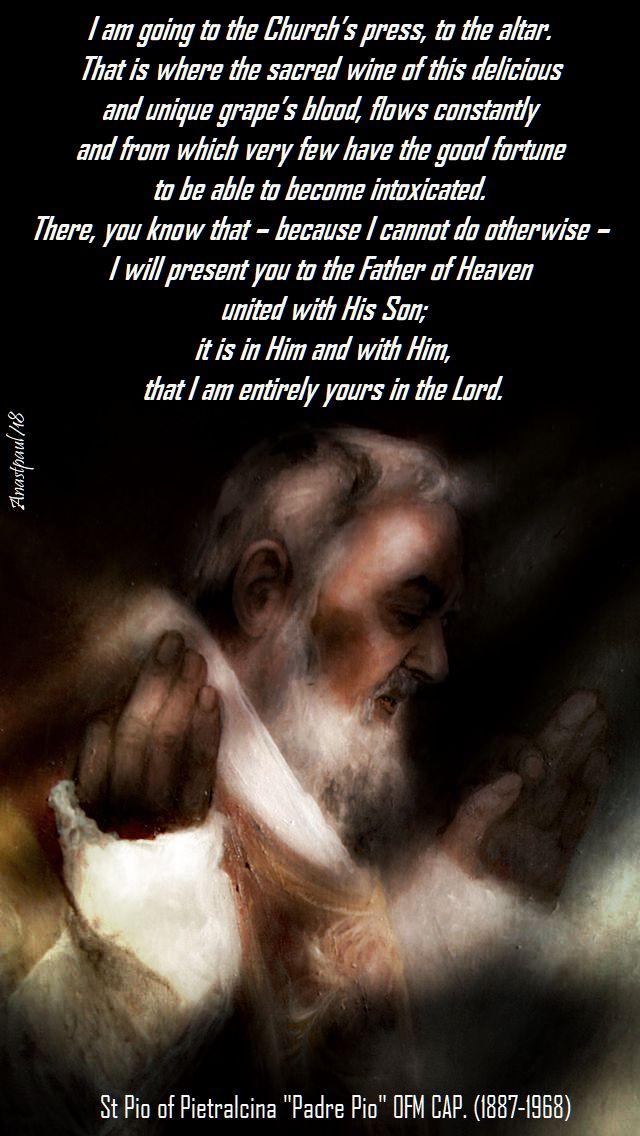
“I am going to the Church’s press, to the altar. That is where the sacred wine of this delicious and unique grape’s blood, flows constantly and from which very few have the good fortune, to be able to become intoxicated. There, you know that – because I cannot do otherwise – I will present you, to the Father of Heaven united with His Son, it is in Him and with Him, that I am entirely yours in the Lord.”
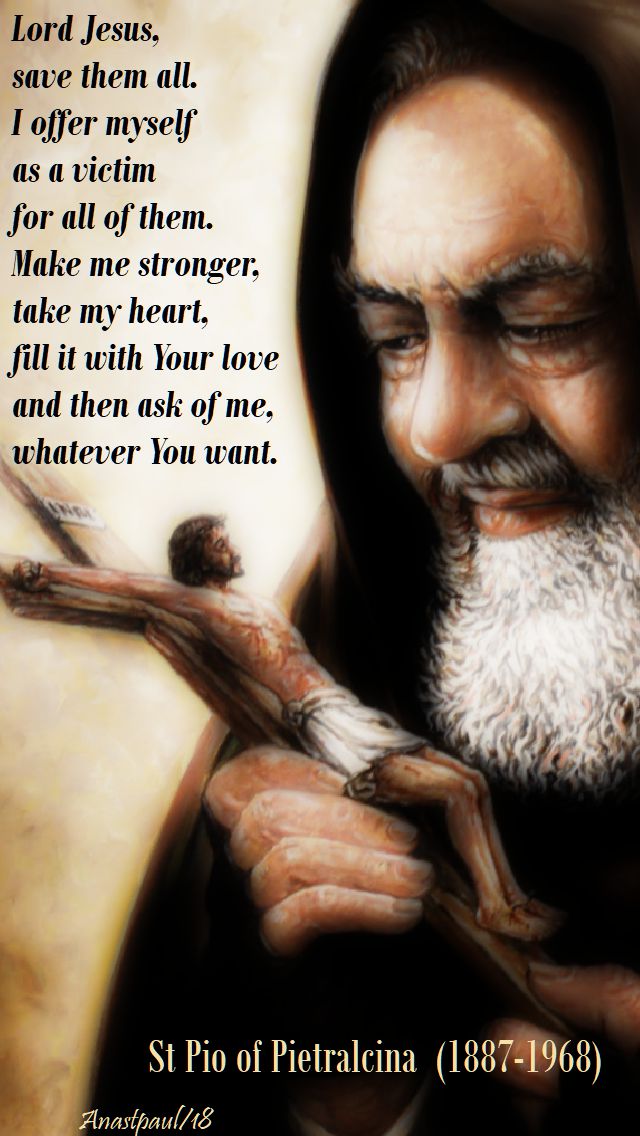
“Lord Jesus, save them all. I offer myself as a victim for all of them. Make me stronger, take my heart, fill it with Your love and then ask of me, whatever You want.”
St Pio of Pietrelcina “Padre Pio” OFM CAP. (1887-1968)
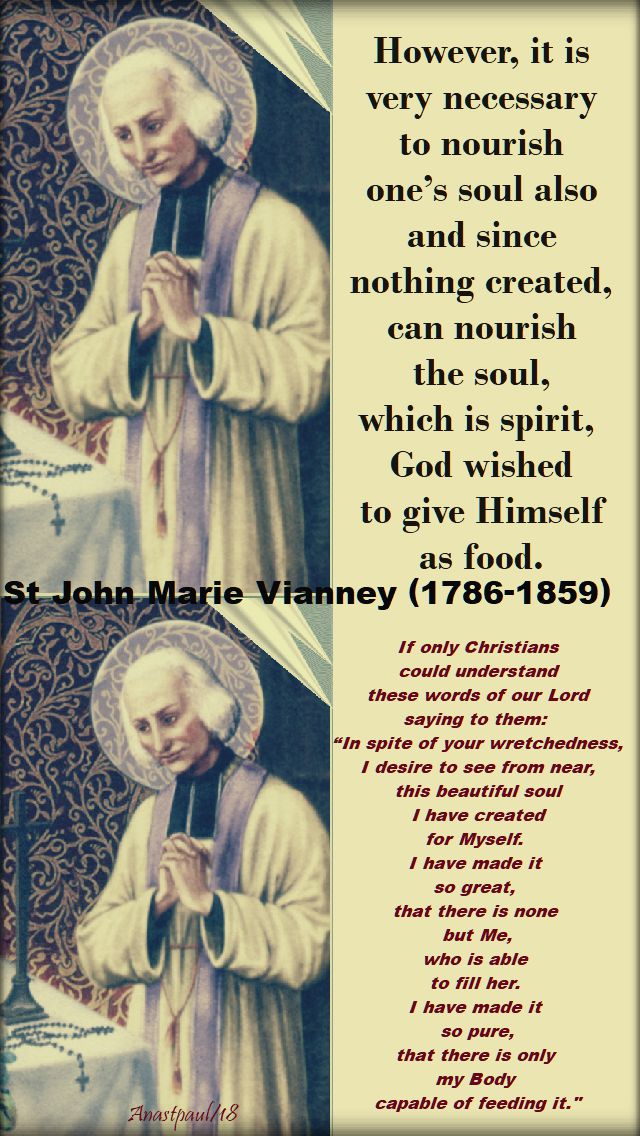
“However it is very necessary to nourish one’s soul also and since nothing created, can nourish the soul, which is spirit, God wished to give Himself as food.”
“If only Christians could understand these words of our Lord saying to them: “In spite of your wretchedness, I desire to see from near, this beautiful soul I have created for Myself. I have made it so great, that there is none but Me, who is able to fill her. I have made it so pure, that there is only my Body capable of feeding it.”
One Minute Reflection – 4 June – Ninth Week in Ordinary Time, Year B – Today’s Readings: 2 Peter 1:2-7, Psalms 91(90):1-2.14-15ab.15c-16, Mark 12:1-12
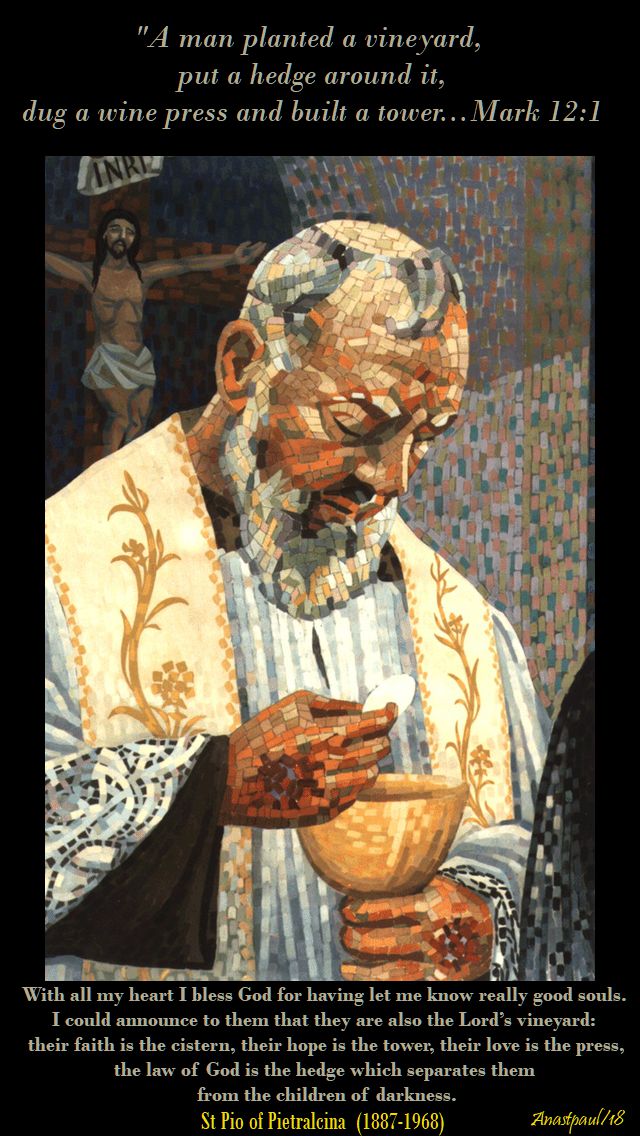
Jesus began to speak to the chief priests, the scribes and the elders in parables. “A man planted a vineyard, put a hedge around it, dug a wine press and built a tower. Then he leased it to tenant farmers and left on a journey...Mark 12:1-2
REFLECTION – “With all my heart I bless God for having let me know really good souls. I could announce to them that they are also the Lord’s vineyard: their faith is the cistern, their hope is the tower, their love is the press, the law of God is the hedge which separates them from the children of darkness.”…St Pio of Pietrelcina “Padre Pio” OFM CAP. (1887-1968)
PRAYER – Lord, be the beginning and the end of all that we do and say. Prompt our actions with Your grace and complete them with Your all powerful help. St Filippo Smaldone, you shone the light of Christ on all around you, strengthened by love of Christ in the most Blessed Sacrament and by His Holy Mother. Pray for us, that we may be little lanterns in the darkness and ‘good vines’ pruned to perfection. Through Jesus Christ, our Lord and Saviour, with You and the Holy Spirit, one God forever, amen.
St Aldegrin of Baume
St Alexander of Verona
St Alonio
Bl Antoni Zawistowski
St Aretius of Rome
Bl Boniface of Villers
St Breaca of Cornwall
St Buriana of Cornwall
St Christa of Sicily
St Clateus of Brescia
St Cornelius McConchailleach
St Croidan
St Cyrinus of Aquileia
St Dacian of Rome
St Degan
St Edfrith of Lindisfarne
St Elsiar of Lavedan
St Ernin of Cluain
St Filippo Smaldone (1848-1923)
Bl Francesco Pianzola
St Francis Caracciolo
Bl Francis Ronci
Bl Margaret of Vau-le-Duc
St Medan
Bl Menda Isategui
St Metrophanes of Byzantium
St Nennoc
St Nicolo of Sardinia
St Optatus of Milevis
St Petroc of Cornwall
St Quirinus of Croatia
St Quirinus of Tivoli
St Rutilus of Sabaria
Saturnina of Arras
Bl Stanislaw Kostka Starowieyski
St Trano of Sardinia
St St Walter of Fontenelle
Walter of Serviliano
—
Martyrs of Cilicia – 13 saints: A group of 13 Christians who were martyred together. The only details about them that have survived are their names –
• Cama
• Christa
• Crescentia
• Eiagonus
• Expergentus
• Fortunus
• Italius
• Jucundian
• Julia
• Momna
• Philip
• Rustulus
• Saturnin
They were martyred in in Cilicia, Asia Minor (in modern Turkey), date unknown
Martyrs of Nyon – 41 saints: A group of 41 Christians martyred together for refusing to sacrifice to imperial Roman idols. We know the names of some but no other details.
• Amatus
• Attalus
• Camasus
• Cirinus
• Dinocus
• Ebustus
• Euticus
• Eutychius
• Fortunius
• Galdunus
• Julia
• Quirinus
• Rusticus
• Saturnina
• Saturninus
• Silvius
• Uinnita
• Zoticus
Martyred by being beheaded in Noviodunum (modern Nyon, Switzerland)
Sunday Reflection – 3 June 2018 – The Solemnity of Corpus Christi
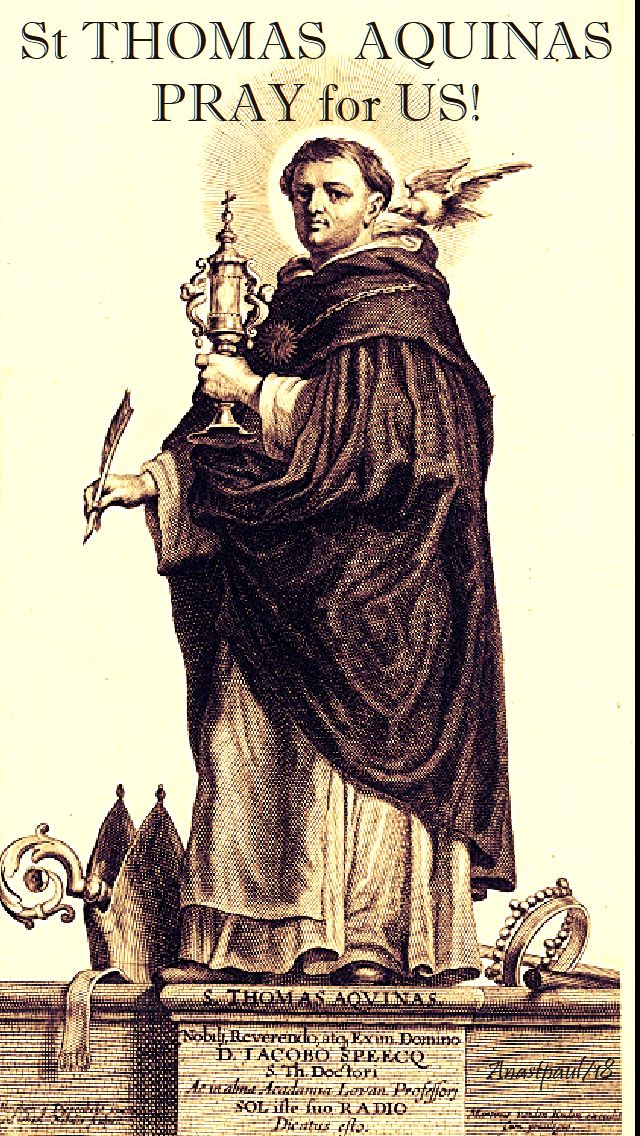
There is a claim that the Adoro Te Devote, our morning offering today, was the prayer that St Thomas Aquinas addressed to Christ as he was dying. The claim remains doubtful, (in the sense that it is a highly intricate prayer and it would be difficult to write whilst very ill) but the account that his biographer, William of Tocco, gives of the holy Doctor’s last moments of life is, in itself, an extraordinary testimony of Eucharistic devotion and reveals the source of the doctrine that, directly or indirectly, inspired the most beautiful Eucharistic texts of the Latin Church, including the Adoro Te Devote.
“Feeling his strength failing and sensing the nearness of his departure from this world, the holy Doctor, with great devotion, requested the viaticum of the Christian pilgrimage, the Most Holy Body and Blood of Christ.
After the abbot and the monks had brought the Eucharist to him, he prostrated himself on the ground, weak in body but strong in spirit and went, with tears, to meet his Lord.
Then, in the presence of the Sacrament of the Body of Christ, as is the custom with every Christian at the moment of death, he was asked if he believed that in that consecrated host was the true Son of God, born of the womb of the Virgin, suspended from the scaffold of the Cross, who died and rose for us on the third day. With a free voice and great devotion, mingled with tears, he replied: “I truly believe and hold as certain that He is true God and true man, Son of God and of the Virgin Mother and I believe with my heart and profess with my lips, that which the priest has asked me of this most Holy Sacrament.”
And after some words of devotion (at this point it is believed St Thomas quoted the Adoro), receiving the Sacrament, he exclaimed: “I receive You, price of the Redemption of my soul, for love of which I have studied, watched and worked, I have preached and taught You, I have said nothing against You nor am I obstinate in my opinion, if in some part I have spoken poorly of this Sacrament, I submit all to the correction of the Holy Roman Church, in who obedience, I pass from this life.”
May we also, at the end of life, be able to say the same as St Thomas Aquinas!
Let us be transported to the same climate of expectation and joyful hope as we feel in the Adoro Te Devote with these last words of the Lauda Sion, the Eucharistic hymn/sequence also written by St Thomas Aquinas. (Fr Raneiro Cantalamessa O.F.M. “This is My Body”)
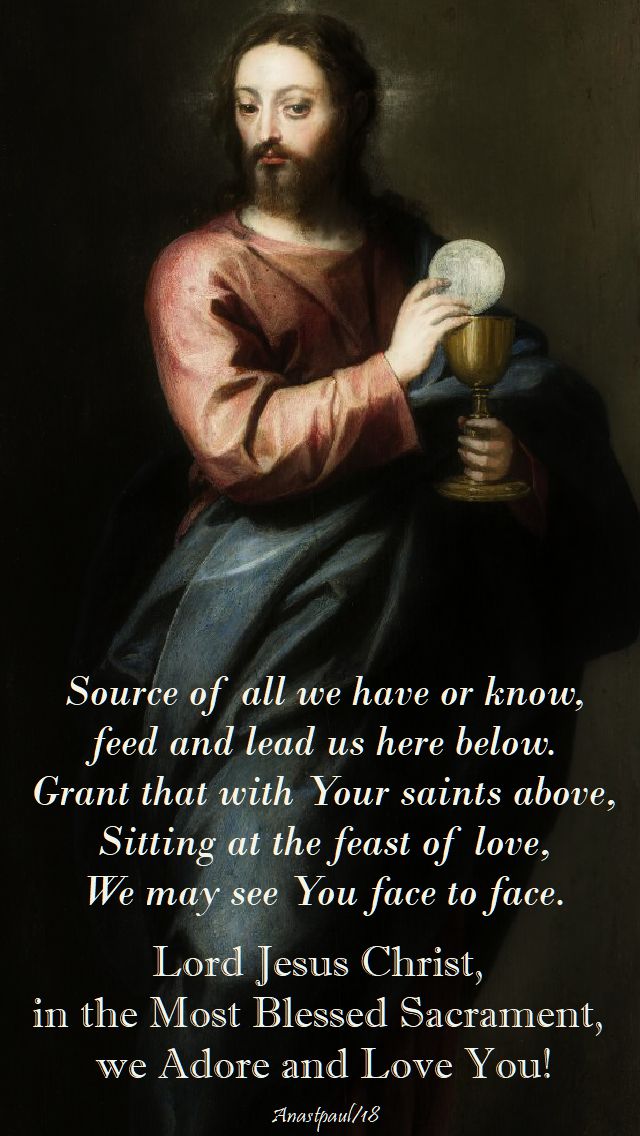
Source of all we have or know, feed and lead us here below. Grant that with Your saints above, Sitting at the feast of love, We may see You face to face.
Amen Alleluia!
Lord Jesus Christ, in the Most Blessed Sacrament, we Adore and Love You!
Thought for the Day – 3 June 2018 – The Solemnity of Corpus Christi
Excerpts from a homily given by Saint Josemaria Escrivá (1902-1975) on 28 May 1964, the feast of Corpus Christi and published in “Christ is Passing By.”
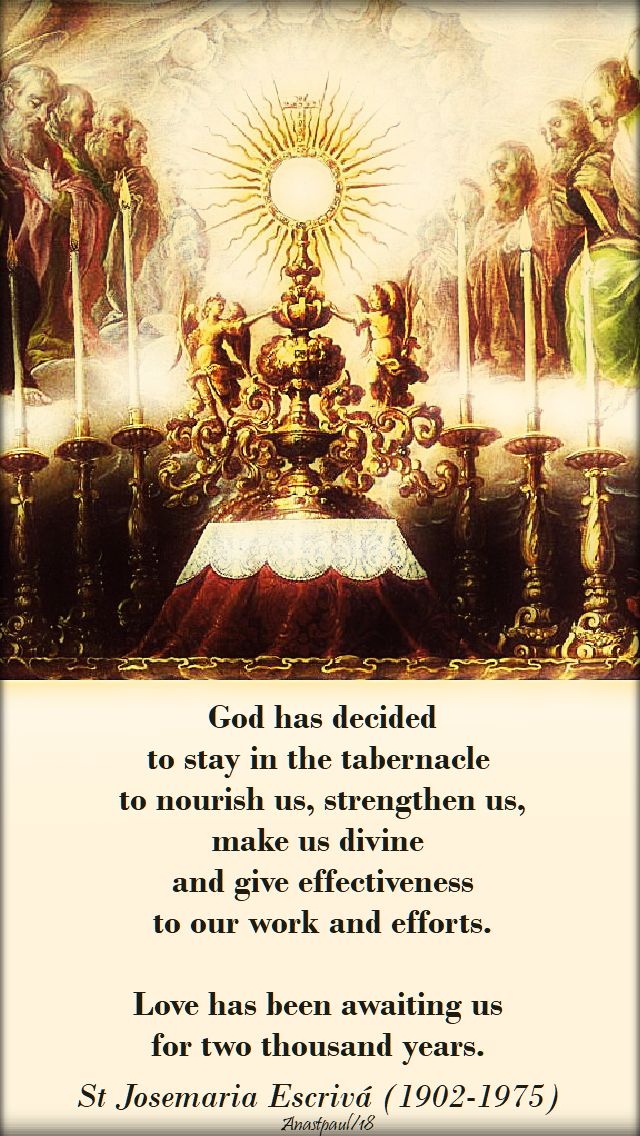
“Let’s turn our eyes to the holy Eucharist, toward Jesus. He is here with us. He has made us a part of Himself: “Now you are the body of Christ and individually members of it.” God has decided to stay in the tabernacle to nourish us, strengthen us, make us divine and give effectiveness to our work and efforts. Jesus is at one and the same time the sower, the seed and the final result of the sowing: the bread of eternal life.
The miracle of the holy Eucharist is being continually renewed and it has all Jesus’ personal traits. Perfect God and perfect man, Lord of heaven and earth, He offers Himself to us as nourishment in the most natural and ordinary way. Love has been awaiting us for two thousand years. That’s a long time and yet it’s not, for when you are in love time flies.
When we meet together around the altar to celebrate the holy Sacrifice of the Mass, when we contemplate the sacred host in the monstrance or adore it hidden in the tabernacle, our faith should be strengthened; we should reflect on this new life which we are receiving and be moved by God’s affection and tenderness.
In the Eucharist, Jesus gives us a sure pledge of His presence in our souls; of His power, which supports the whole world; of His promises of salvation, which will help the human family to dwell forever in the house in heaven, when time comes to an end. There we shall find God the Father, God the Son, God the Holy Spirit – the Blessed Trinity, the one and only God. Our whole faith is brought into play when we believe in Jesus, really present under the appearances of bread and wine.
On this feast of Corpus Christi in cities and towns throughout the world, Christians accompany our Lord in procession. Hidden in the host He moves through the streets and squares—just as during His earthly life—going to meet those who want to see Him, making Himself available to those who are not looking for Him. And so, once more, He comes among His own people. How are we to respond to this call of His?
The external signs of love should come from the heart and find expression in the testimony of a Christian life. If we have been renewed by receiving our Lord’s body, we should show it. Let us pray that our thoughts be sincere, full of peace, self-giving and service. Let us pray that we be true and clear in what we say—the right thing at the right time—so as to console and help and especially bring God’s light to others. Let us pray that our actions be consistent and effective and right, so that they give off “the good fragrance of Christ,” evoking is way of doing things.
The Corpus Christi procession makes Christ present in towns and cities throughout the world. But His presence cannot be limited to just one day, a noise you hear and then forget. It should remind us that we have to discover our Lord in our ordinary everyday activity. Side by side with this solemn procession, there is the simple, silent procession of the ordinary life of each Christian. He is a man among men, who by good fortune has received the faith and the divine commission to act so that he renews the message of our Lord on earth. We are not without defects; we make mistakes and commit sins. But God is with us and we must make ourselves ready to be used by Him, so that He can continue to walk among men.
Let us ask our Lord then to make us souls devoted to the Blessed Eucharist, so that our relationship with Him brings forth joy and serenity and a desire for justice. In this way we will make it easier for others to recognise Christ; we will put Christ at the centre of all human activities. And Jesus’ promise will be fulfilled: “I, when I am lifted up from the earth, will draw all men to myself.”
Comforted by Christ’s presence and nourished by His Body, we will be faithful during our life on earth and then we will be victors with Jesus and His Mother in heaven. “O death, where is your victory? O death, where is your sting?… Thanks be to God, who gives us the victory through our Lord Jesus Christ.”
Quote of the Day – 3 June 2018 – The Solemnity of Corpus Christi
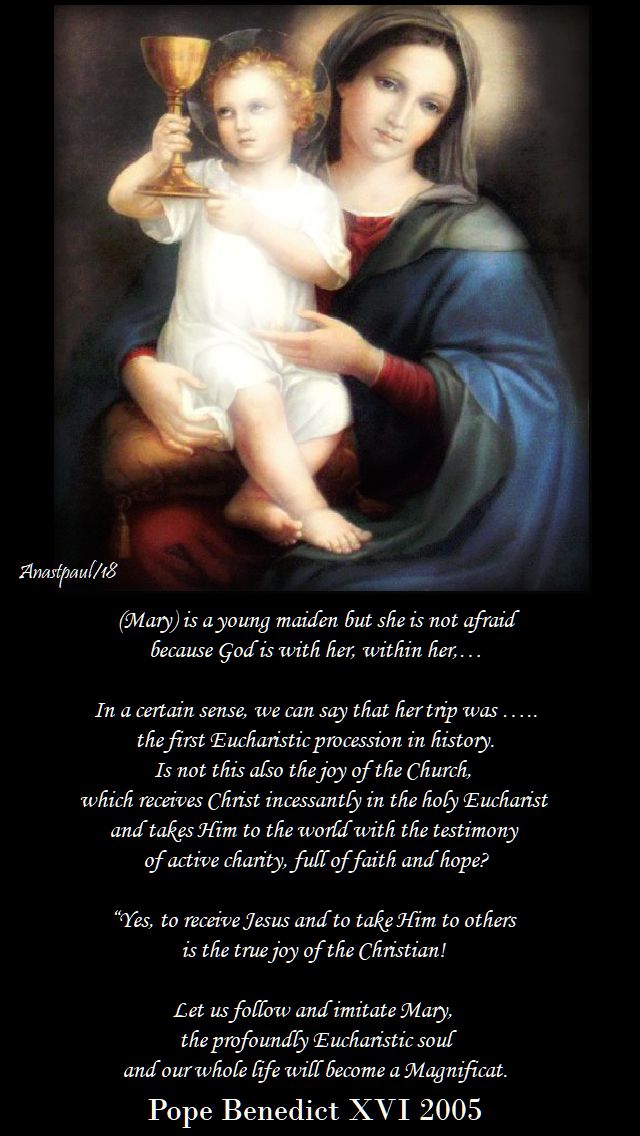
“(Mary) is a young maiden but she is not afraid because God is with her, within her,… In a certain sense, we can say that her trip was ….. the first Eucharistic procession in history. Is not this also the joy of the Church, which receives Christ incessantly in the holy Eucharist and takes Him to the world with the testimony of active charity, full of faith and hope?
“Yes, to receive Jesus and to take Him to others is the true joy of the Christian!
Let us follow and imitate Mary, the profoundly Eucharistic soul and our whole life will become a Magnificat.”
One Minute Reflection – 3 June 2018 – The Solemnity of Corpus Christi Year B
And as they were eating, he took bread and blessed and broke it and gave it to them and said, “Take; this is my body.” And he took a cup and when he had given thanks, he gave it to them and they all drank of it. And he said to them, “This is my blood of thec covenant, which is poured out for many...Mark 14:22-24
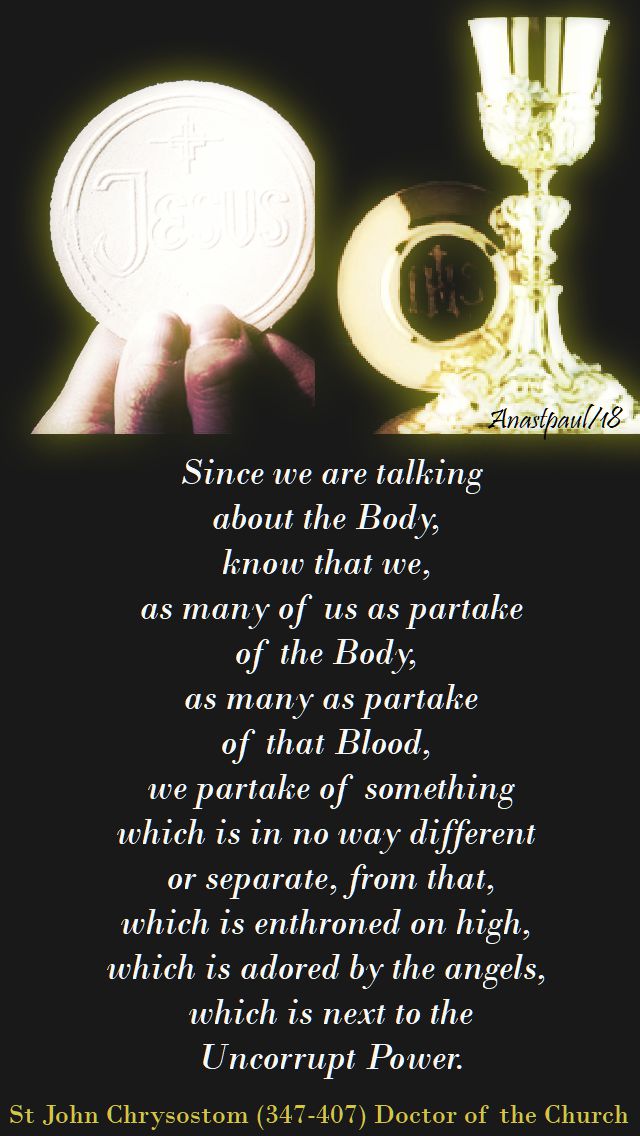
REFLECTION – “Since we are talking about the Body, know that we, as many of us as partake of the Body, as many as partake of that Blood, we partake of something which is in no way different or separate from that which is enthroned on high, which is adored by the angels, which is next to Uncorrupt Power.”…St John Chrysostom (347-407) Doctor of the Church
PRAYER – Lord Jesus Christ, You gave Your Church, an admirable Sacrament as the abiding memorial of Your Passion. Teach us to worship the sacred mystery of Your Body and Blood, that it’s redeeming power may sanctify us always. Who live and reign with the Father and the Holy Spirit, God, forever, amen.
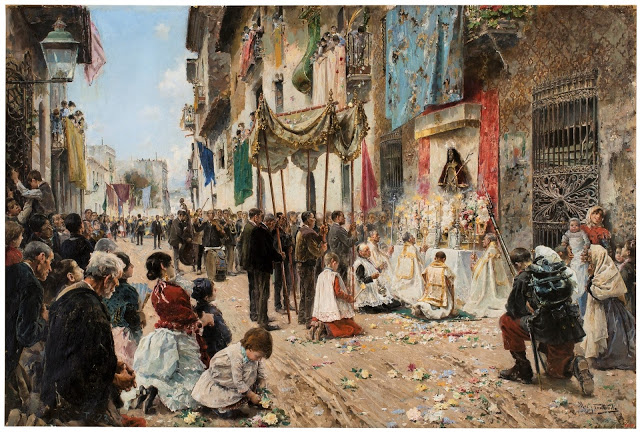
Arcadio Mas y Fondevila, Corpus Christi Spanish, 1887 Madrid, Museo Nacional del Prado This picture depicts priest and people in adoration at one of the street altars that are a part of the traditional Corpus Christi procession through a town.

























 AnaStpaul
You must be logged in to post a comment.