Posted in CATHOLIC-PRAYERS OF THE CHURCH, DOCTORS of the Church, FEASTS and SOLEMNITIES, HYMNS, JESUIT SJ, MORNING Prayers, PRAYERS of the CHURCH, PRAYERS of the SAINTS, The HOLY EUCHARIST / The HOLY MASS

Our Morning Offering – 3 June 2018 – The Solemnity of Corpus Christi

Our Morning Offering – 3 June 2018 – The Solemnity of Corpus Christi

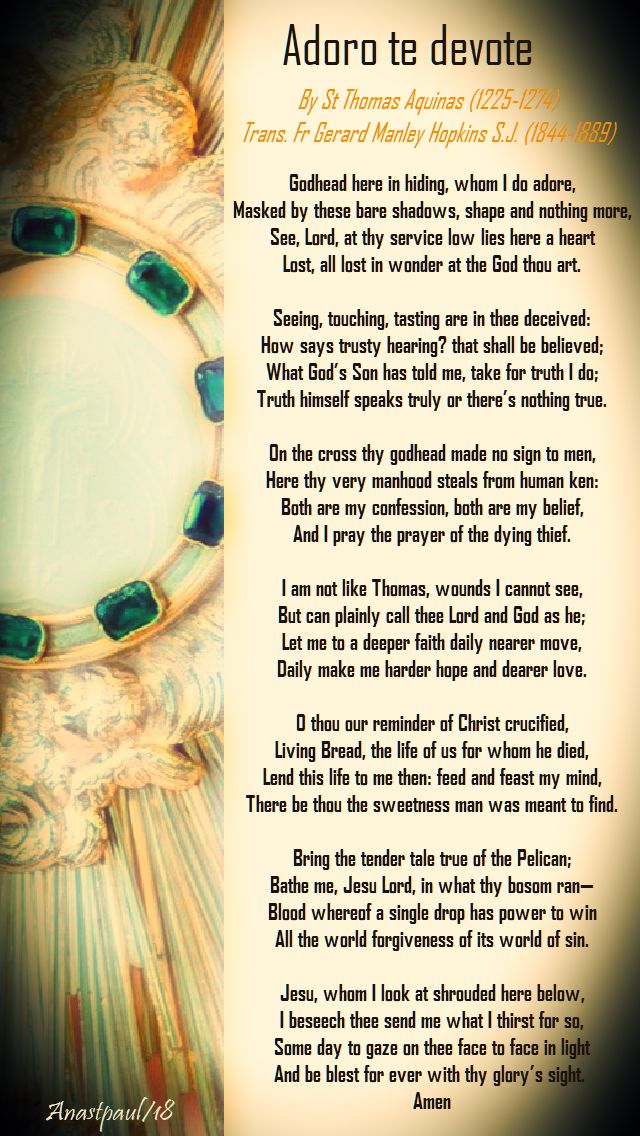
Adoro te devote
By St Thomas Aquinas (1225-1274) Doctor of the Church
Trans. Fr Gerard Manley Hopkins S.J. (1844-1889)

Godhead here in hiding, whom I do adore,
Masked by these bare shadows, shape and nothing more,
See, Lord, at thy service low lies here a heart
Lost, all lost in wonder at the God thou art.

Seeing, touching, tasting are in thee deceived:
How says trusty hearing? that shall be believed;
What God’s Son has told me, take for truth I do;
Truth himself speaks truly or there’s nothing true.

On the cross thy godhead made no sign to men,
Here thy very manhood steals from human ken:
Both are my confession, both are my belief,
And I pray the prayer of the dying thief.

I am not like Thomas, wounds I cannot see,
But can plainly call thee Lord and God as he;
Let me to a deeper faith daily nearer move,
Daily make me harder hope and dearer love.

O thou our reminder of Christ crucified,
Living Bread, the life of us for whom he died,
Lend this life to me then: feed and feast my mind,
There be thou the sweetness man was meant to find.

Bring the tender tale true of the Pelican;
Bathe me, Jesu Lord, in what thy bosom ran—
Blood whereof a single drop has power to win
All the world forgiveness of its world of sin.

Jesu, whom I look at shrouded here below,
I beseech thee send me what I thirst for so,
Some day to gaze on thee face to face in light
And be blest for ever with thy glory’s sight.
Amenadoro te devote - st thomas aquinas - corpus christi - 3 june 2018.jpg

Original Latin

Adoro te devote, latens Deitas,
Quæ sub his figuris vere latitas;
Tibi se cor meum totum subjicit,
Quia te contemplans totum deficit.

Visus, tactus, gustus in te fallitur,
Sed auditu solo tuto creditur.
Credo quidquid dixit Dei Filius;
Nil hoc verbo veritátis verius.

In cruce latebat sola Deitas,
At hic latet simul et Humanitas,
Ambo tamen credens atque confitens,
Peto quod petivit latro pœnitens.

Plagas, sicut Thomas, non intueor:
Deum tamen meum te confiteor.
Fac me tibi semper magis credere,
In te spem habere, te diligere.

O memoriale mortis Domini,
Panis vivus, vitam præstans homini,
Præsta meæ menti de te vívere,
Et te illi semper dulce sapere.

Pie Pelicane, Jesu Domine,
Me immundum munda tuo sanguine:
Cujus una stilla salvum facere
Totum mundum quit ab omni scelere.

Jesu, quem velatum nunc aspicio,
Oro, fiat illud quod tam sitio:
Ut te revelata cernens facie,
Visu sim beátus tuæ gloriæ.
Amen

Posted in CATHOLIC-PRAYERS OF THE CHURCH, DOCTORS of the Church, EUCHARISTIC Adoration, FEASTS and SOLEMNITIES, MORNING Prayers, PAPAL SERMONS, PRACTISING CATHOLIC, PRAYERS of the CHURCH, PRAYERS of the SAINTS, SAINT of the DAY, The HOLY EUCHARIST / The HOLY MASS

The Solemnity of The Body and Blood of Christ “Corpus Christi” – 3 June

The Solemnity of The Body and Blood of Christ “Corpus Christi” – 3 June

Happy Solemnity of the Most Holy Body and Blood, Soul and Divinity of Jesus Christ, our Lord and God!  What a Gift we celebrate today!

The Eucharist is the source and summit of the whole Christian life.   The feast of Corpus Christi is a celebration of Christ’s Real Presence in the Eucharist.   It parallels the celebration on Holy Thursday in commemoration of the institution of this Aacrament. When the Eucharist is carried through the streets in solemn procession, the Christian people give public witness of their faith and devotion toward the Sacrament of the Eucharist

In 1246, Bishop Robert de Thorete of the Belgian diocese of Liège, at the suggestion of St Juliana of Mont Cornillon (also in Belgium), convened a synod and instituted the celebration of the feast.

From Liège, the celebration began to spread and, on 8 September 1264, Pope Urban IV issued the papal bull “Transiturus,” which established the Feast of Corpus Christi as a universal feast of the Church, to be celebrated on the Thursday following Trinity Sunday.

At the request of Pope Urban IV, St Thomas Aquinas (1225-1274), Doctor of the Church, composed the office, the official prayers of the Churc, for the feast.   This office is widely considered one of the most beautiful in the traditional Roman Breviary and it is the source of the famous Eucharistic hymns Pange Lingua Gloriosi and Tantum Ergo Sacramentum.

The feast is also celebrated with a Eucharistic procession, in which the Sacred Host is carried throughout the town, accompanied by hymns and litanies.   There the Eucharistic Lord, held in the monstrance by the priest, is escorted by candles, canopies, incense, choirs, altar servers, and worshipers.   The faithful venerate the Body of Christ as the procession passed by, with Benediction celebrated along the way.

The feast of Corpus Christi is one time when our Lord in the Blessed Sacrament is exposed not just to faithful Catholics but to all the world.   This is a time when Catholics can show their love for Christ in the Real Presence by honouring Him in a very public way.   It is also a wonderful way in which we can show our love for our neighbors by bringing Our Lord and Savior closer to them.   So many conversions are a result of Eucharistic Adoration experienced from inside the Church.   How many more there would be if we could reach those who only drive by the church in worldly pursuits.

“Corpus Christi reminds us first of all of this:, that being Christian means coming together from all parts of the world to be in the presence of the one Lord and to become one with him and in him.
The second constitutive aspect, is walking with the Lord. ,This is the reality manifested by the procession that we shall experience together after Holy Mass, almost as if it were naturally prolonged by moving behind the One who is the Way, the Journey. With the gift of Himself in the Eucharist, the Lord Jesus sets us free from our “paralyses”, He helps us up and enables us to “proceed “, that is, He makes us take a step ahead and then another step and thus sets us going with the power of the Bread of Life.”

Pope Benedict XVI, Corpus Christ 2008

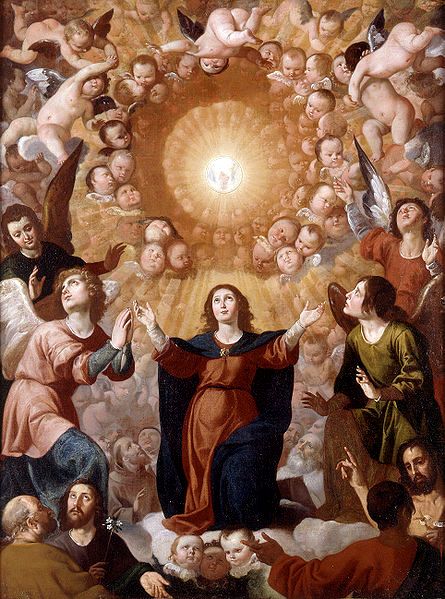
Throughout our lives, if we were raised Catholic, we were taught reverence for the Eucharist.    But “reverence” is not enough.  Most Catholics reverence the Eucharist, meaning, we genuflect, kneel and treat the Sacred Host with respect.    But it’s important to ponder a question in your heart.    Do you believe the Eucharist is God Almighty, the Saviour of the world, the second Person of the Most Holy Trinity?  Do you believe deeply enough to have your heart moved with love and profound devotion every time you are before our divine Lord present before us under the veil of the Eucharist?   When you kneel do you fall down prostrate in your heart, loving God with your whole being?5 - Adoration of the Eucharist, by Jeronimo Jacinto Espinosa, 1650

Perhaps this sounds like it’s a bit excessive.  Perhaps simple reverence and respect is enough for you.   But it’s not.   Since the Eucharist is God Almighty, we must see Him there with the eyes of faith in our soul.   We must profoundly adore Him as the angels do in Heaven.   We must cry out, “Holy, Holy, Holy is the Lord God Almighty.”  We must be moved to the deepest of worship as we enter into His divine presence.

Ponder the depth of your faith in the Eucharist today and strive to renew it, worshiping God as one who believes with your whole being.

I devoutly adore You, O hidden Deity, truly hidden beneath these appearances.  My whole heart submits to You and in contemplating You, it surrenders itself completely.  Sight, touch, taste are all deceived in their judgement of You but hearing suffices firmly to believe.  Jesus, I trust in You.

Posted in EUCHARISTIC Adoration, FEASTS and SOLEMNITIES, MORNING Prayers, PRACTISING CATHOLIC, SAINT of the DAY, The HOLY EUCHARIST / The HOLY MASS

The Solemnity of the Body and Blood of our Lord Jesus Christ – Corpus Christ – 3 June and Memorials of the Saints

The Solemnity of Corpus Christi (2018)

Be abundantly blessed today, 3 June 2018, on the Solemnity of the Body and Blood of our Lord Jesus Christ aka Corpus Christi!   The Source and the Summit of our faith.

Martyrs of Uganda (Memorial) – 22 saints: Twenty-two (22) Ugandan converts martyred in the persecutions of King Mwanga. They are –
• Achileo Kiwanuka • Adolofu Mukasa Ludigo
• Ambrosio Kibuuka • Anatoli Kiriggwajjo
• Anderea Kaggwa • Antanansio Bazzekuketta
• Bruno Sserunkuuma • Charles Lwanga
• Denis Ssebuggwawo • Gonzaga Gonza
• Gyavire • James Buzabaliao
• John Maria Muzeyi • Joseph Mukasa
• Kizito • Lukka Baanabakintu
• Matiya Mulumba • Mbaga Tuzinde
• Mugagga • Mukasa Kiriwawanvu
• Nowa Mawaggali • Ponsiano Ngondwe
They were canonised on 18 October 1964 by Pope Paul VI at Rome, Italy.

Bl Adam of Guglionesi
Albert of Como
Athanasius of Traiannos
Auditus of Braga
Bl Beatrice Bicchieri
Caecilius of Carthage
St Charles Lwanga & Companions
Bl Charles-René Collas du Bignon
Clotilde of France
Conus of Lucania
Cronan the Tanner
Davinus of Lucca
Bl Diego Oddi
Bl Francis Ingleby
Gausmarus of Savigny
Genesius of Clermont
Glunshallaich
Hilary of Carcassone
Isaac of Córdoba
John Grande
Kevin of Glendalough
Laurentinus of Arezzo
Liphardus of Orléans
Morand of Cluny
Moses of Arabia
Oliva of Anagni
Paula of Nicomedia
Pergentinus of Arezzo
Phaolô Vu Van Duong
Urbicius

Dominicans Martyred in China

Martyrs of Africa – 156 saints: 156 Christians martyred together in Africa, date unknown; the only other information to survive are some of their names –
• Abidianus
• Demetria
• Donatus
• Gagus
• Januaria
• Juliana
• Nepor
• Papocinicus
• Quirinus
• Quirus
Martyrs of Byzantium – 5 saints: A group of Christians, possibly related by marriage, who were martyred together. They were –
• Claudius
• Dionysius
• Hypatius
• Lucillian
• Paul
They were martyred in 273 in Byzantium.

Martyrs of Rome – 8 saints: A group of Christians martyred together. We know nothing else about them but the names –
• Amasius
• Emerita
• Erasmus
• Lucianus
• Orasus
• Satuaucnus
• Septiminus
• Servulus
They were martyred in Rome, Italy, date unknown.

Martyrs of Rome – 86 saints: 85+ Christians martyred together in Rome, Italy, date unknown. The only details that have survived are some of their names –

• Apinus • Apronus • Aurelius • Avidus • Cassianus • Criscens • Cyprus • Domitius • Donata • Donatus • Emeritus • Extricatus • Exuperia • Faustina • Felicitas • Felix • Flavia • Florus • Fortunata • Fortunatus • Fructus • Gagia • Gagus • Gallicia • Gorgonia • Honorata • Januaria • Januarius • Justa • Justus • Libosus • Luca • Lucia • Matrona • Matura • Mesomus • Metuana • Nabor • Neptunalis • Obercus • Paula • Peter • Pompanus • Possemus • Prisca • Procula • Publius • Quintus • Rogatian • Romanus • Rufina • Saturnin • Saturnus • Secundus • Severa • Severus • Sextus • Silvana • Silvanus • Sinereus • Tertula • Titonia • Toga • Urban • Valeria • Veneria • Veranus • Victor • Victoria • Victorinus • Victuria • Victurina • Virianus • Weneria • Zetula.
They were martyred in Rome, Italy, date unknown.


Posted in MORNING Prayers, SAINT of the DAY

Thought for the Day – 2 June – The Memorial of Sts Marcellinus and Peter – Martyrs (martyred in 304).

Thought for the Day – 2 June – The Memorial of Sts Marcellinus and Peter – Martyrs (martyred in 304).

Why are these men included in our Eucharistic prayer and given their own feast day, in spite of the fact that almost nothing is known about them?
Probably because the Church respects its collective memory.   They once sent an impulse of encouragement through the whole Church.   They made the ultimate step of faith……Fr. Don Miller, OFM
The foundation of our faith rests on the lives of these holy men and women of the early Church who willingly gave themselves over to the faith, courageous and joyful in their martyrdom.   When we consider the struggles of today and our own personal difficulties in daily life, we might pause to consider the sacrifice of these early martyrs and be inspired to greater faith, trust and love and be filled with that impulse of encouragement!

Sts Marcellinus and Peter, pray for us!sts-marcellinus-and-peter-pray-for-us - 2june 2017.

Posted in MORNING Prayers, QUOTES of the SAINTS, QUOTES on SUFFERING, SAINT of the DAY

Quote of the Day – 2 June – Martyrs – The Memorial of Sts Erasmus (martyred in c 303 and Marcellinus and Peter – Martyrs (martyred in 304)

Quote of the Day – 2 June – Martyrs – The Memorial of Sts Erasmus (martyred in c 303 and Marcellinus and Peter – Martyrs (martyred in 304)

“He who wants to win the world for Christ
must have the courage
to come in conflict with it.”

Blessed Titus Brandsma (1881-1942) Martyrhe who wants to win the world for christ - bl titus brandsma - 2 june 2018


Posted in QUOTES on SANCTITY, QUOTES on SUFFERING, Uncategorized

One Minute Reflection – 2 June – Martyrs – The Memorial of Sts Erasmus (martyred in c 303 and Marcellinus and Peter (martyred in 304).

One Minute Reflection – 2 June – Martyrs – The Memorial of Sts Erasmus (martyred in c 303 and Marcellinus and Peter – (martyred in 304).

My dear friends, do not be taken aback at the testing by fire which is taking place among you, as though something strange were happening to you; but in so far as you share in the sufferings of Christ, be glad, so that you may enjoy a much greater gladness when his glory is revealed….1 Peter 4:12-131-peter-4-12-13.16 Nov 2017. jpg

REFLECTION – “Bodily and spiritual affliction are the surest sign of Divine predilection. Gratitude for suffering is a precious jewel for our heavenly crown… Man should always firmly believe that God sends just that trial which is most beneficial for him.”…St Gertrude the Greatbodily-and-spiritual-affliction-st-gertrude-16-nov-2017 (1)

PRAYER – O GOD, who dost give us joy through the memory of Thy holy Martyrs, graciously grant that we may be inflamed by their example, in whose merits we rejoice. Sts Erasmus, Marcellinus and Peter, Pray for us! Through Christ our Lord. Amen.

Posted in CATHOLIC DEVOTIONS of the Month, CATHOLIC-PRAYERS OF THE CHURCH, MORNING Prayers, PRAYERS of the SAINTS, SACRED and IMMACULATE HEARTS

Our Morning Offering – 2 June – Month of the Sacred Heart – Saturday of the Eighth Week in Ordinary Time, Year B.

Our Morning Offering – 2 June – Month of the Sacred Heart – Saturday of the Eighth Week in Ordinary Time, Year B.

O Sacred Heart of Jesus
By St Gertrude the Great

O Sacred Heart of Jesus,
fountain of eternal life,
Your Heart is a glowing furnace of Love.
You are my refuge and my sanctuary.
O my adorable and loving Saviour,
consume my heart with the burning fire
with which Yours is aflamed.
Pour down on my soul those graces
which flow from Your love.
Let my heart be united with Yours.
Let my will be conformed to Yours in all things.
May Your Will be the rule of all my desires and actions.
Ameno sacred heart of jesus by st gertrude the great - 2 june 2018

Posted in QUOTES of the SAINTS, SAINT of the DAY, Thomas a Kempis, Uncategorized

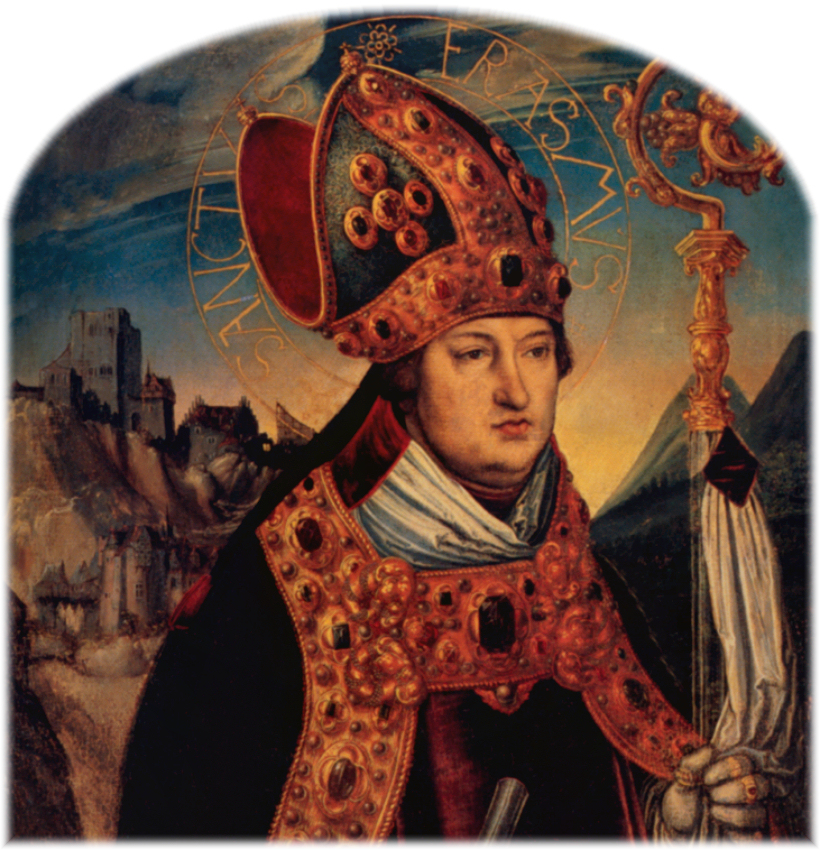
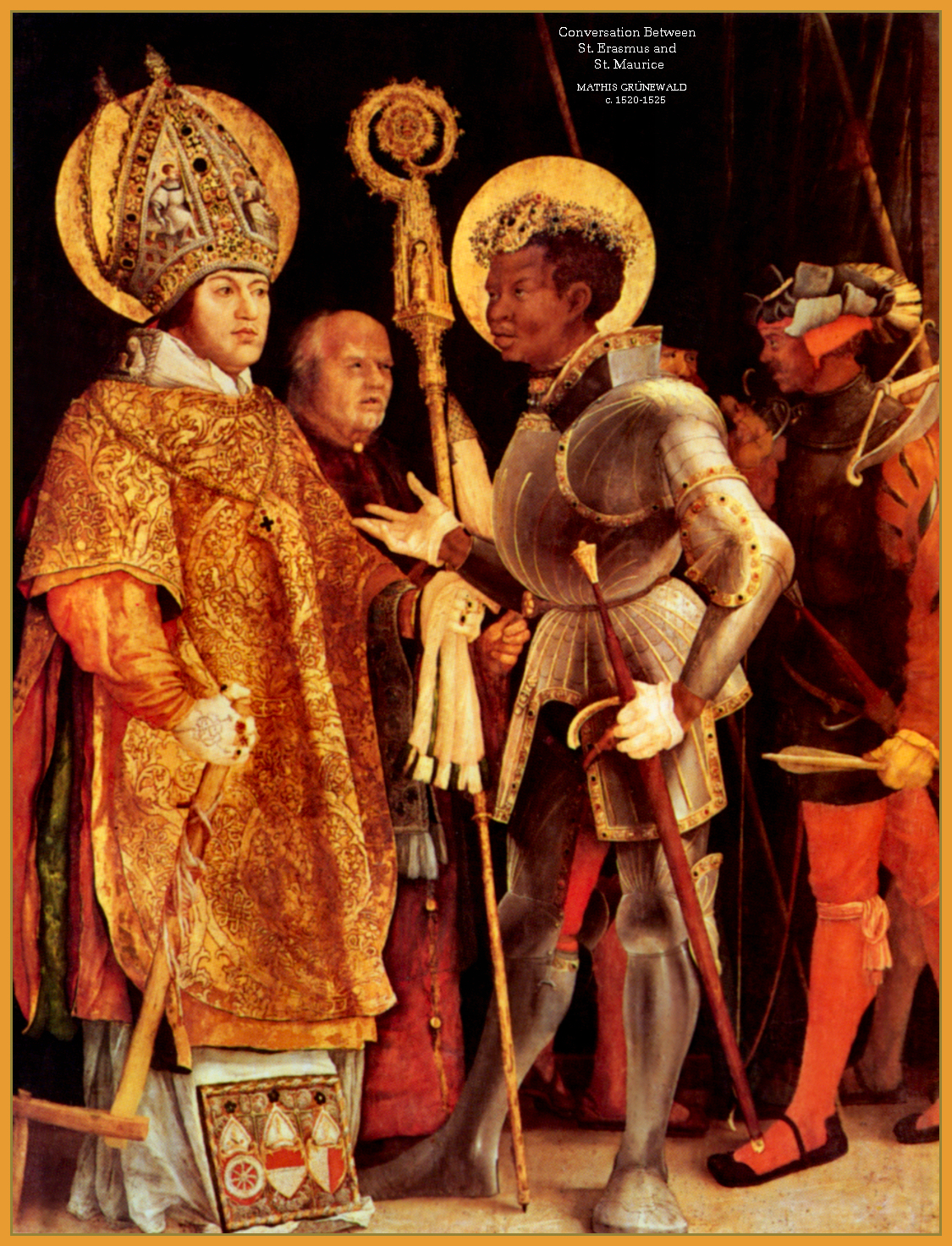
Saint of the Day – 2 June – St Erasmus (Died c 303) Martyr

Saint of the Day – 2 June – St Erasmus (Died c 303) Martyr – also known as Saint Elmo (Telmo, Eramo, Erarmo, Ermo, Herasmus, Rasimus, Rasmus), Bishop of Formiae, Campagna, Italy.   St Erasmus or Elmo is also one of the Fourteen Holy Helpers, saintly figures of Christian tradition who were venerated especially as intercessors.   Patronages – against appendicitis, against birth pains, against abdominal or stomach pains and diseases, against colic, against danger at sea, against seasickness, against storms, ammunition, explosives and ordnance workers, boatmen, mariners, sailors, watermen, childbirth and women in labour, navigators, Gaeta, Italy, Formia, cattle pest, Fort St Elmo, Malta.erasmus

As with many Martyrs of the early Church, we know little about their lives and upbringings but much about their pious and courageous deaths, accounts of which were recorded and believed to be more instructive to the faithful than complete biographies.

saint-elmo

The childhood and birthplace of Saint Erasmus is lost to history.   In the late third century, we do know that he was appointed Bishop of Antioch in Asia Minor, where he led the faithful.   When Emperor Diocletian ascended to the throne, widespread persecution of Christians began and Antioch was not overlooked.   Saint Erasmus fled into the mountains of Lebanon, where he undertook an austere life of prayer and fasting, going without food for days at a time.   Holy legend tells us that a raven brought him food when he deprived himself for too long.   Eventually, however, he was discovered by the soldiers of the Emperor and dragged to judgement.

St Erasmus was urged to recant his faith and some respect was offered him.   However, when he adamantly stated his belief in Christ and could not be persuaded to make offerings to the gods.   He stated, “Almighty God, that made all things, hath wrought heaven and hell and all that is therein, Him will I not forsake for nothing that can or may be done to me, for His goodly grace hath given to me such grace and to other of His chosen friends, that He was made man and hath tasted and suffered the bitter death for me and for all sinners.”   Saint Erasmus was viciously tortured.   He was at first scourged, had heated hooks jabbed into his intestines and stomach and was finally thrown into a caldron filled with boiling oil.   However, despite these horrific tortures, the Lord protected Saint Erasmus from death and many were converted to the faith—including the jailor and his family.

Unable to torture him physically into recanting his faith, the judge ordered him imprisoned in chains, thrown into a pit filled with vipers and worms and forbid the jailor to feed him, insisting that he die of starvation for his crime.   However, Erasmus was again delivered, with an angel appearing to him and leading him to freedom.  During his escape, the angel proclaimed, Erasmus, Follow me! Thou shalt convert a great many.”erasmus2

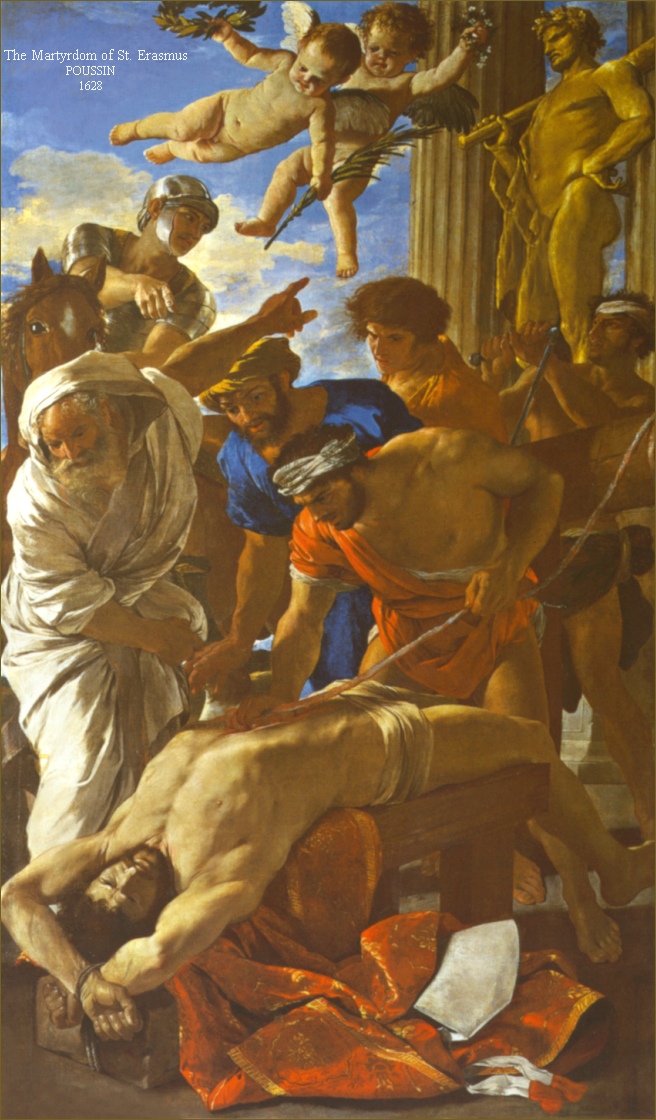
THE MARTYRDOM OF ST ERASMUS

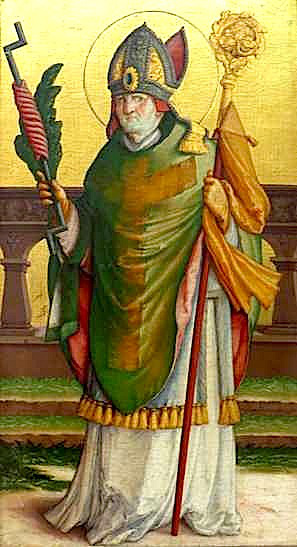
Erasmus fled to Europe, preaching the power of the Lord, performing miracles and converting the multitudes proclaimed by the Angel.   Upon his arrival in Italy, however, he was again arrested—this time by Emperor Maximin, who also persecuted Christians. History tells us that the Emperor, enraged by Erasmus’ success in conversions, ordered three hundred of the newly baptised Christians killed as incentive for Erasmus to recant his faith.   When he did not, he was cruelly tortured and again imprisoned.   During this torture, his intestines were slowly wound around a sailor’s capstan, which is why he is the Patron Saint of sailors today.   Eventually, Saint Erasmus died a Martyr’s death due to disembowelling and subsequent beheading, having been summoned by the voice of the Lord.

From the Golden Legend:  “And when the hour was come that this holy Bishop and Martyr of God should depart out of this world, then was heard a loud voice perfectly, coming from heaven saying:  “Erasmus, my true servant, thou hast done me true service, wherefore come with me and go and enter into the bliss and joy of thy Lord and I promise thee and all people that think upon thy great pain and call upon thy holy name and worship every Sunday, what that they ask of Me in thy name for the wealth of their souls, I shall grant it.   Now come, my true and chosen friend, be glad and comforted with Mine ascension  . I will that thou arise with Me and come sit upon the right hand of My Father.” Then was this holy man right glad and joyful and he cast his eyes upward to heaven, with lifting up his hands and there he saw, a clear shining crown come from heaven upon his blessed head.   Then gave he loving and thanking to Almighty God with bowing his head and kneeling and both his hands upward to heaven, and meekly said:  “O Lord in thy hands yield my spirit and this Sunday receive my soul into thy peace and rest.”   And with saying these words he yielded up his ghost, which was seen by many men’s eyes, shining clearer than the sun and how that he was received of the holy Angels and was led through the height of heaven into the uppermost plan of heaven – there he standeth with God, with all the holy company and is there a true helper to all them that call truly to Saint Erasmus for ghostly health, which joy and ghostly health let us pray, that he for us, all of our Lord God may obtain.”

Saint Erasmus is one of the 14 Holy Helpers, a group of saints invoked with special confidence because they have proven themselves efficacious helpers in adversity and difficulties  . Other saints identified as Holy Helpers are: Saints Blaise, Catherine of Alexandria, George, Christopher and others.   Saint Erasmus, due to the manner in which he was tortured, is the Patron Saint of those with stomach or intestinal disorders.

A little more about the 14 Holy Helpers and a prayer to them by St Alphonsus Liguori here: https://anastpaul.com/2018/07/25/thought-for-the-day-25-july-the-memorial-of-st-christopher-died-c-251-one-of-the-fourteen-holy-helpers/

Saint Erasmus, under the name Saint Elmo, is also the patron saint of sailors and the shining lights observed upon his death, continue to be reported by sailors as “Saint Elmo’s fire.”   This electrostatic phenomenon has been reported throughout history, from Julius Caesar, to the journals of sailors on Magellan’s voyage around the globe, to the writings of Shakespeare, Melville and Charles Darwin.

A chronicler of Magellan’s voyage to circle the globe, observed:  “During those storms the holy body, that is, to say St. Elmo, appeared to us many times in light…on an exceedingly dark night on the maintop where he stayed for about two hours or more for our consolation.”   Darwin wrote that one night when the Beagle was anchored in the estuary of the Rio Plata:  “Everything was in flames, the sky with lightning, the water with luminous particles, and even the very masts were pointed with a blue flame.”   The appearance of St Elmo’s Fire is regarded as a good omen for sailors, as it tends to occur near the end of severe thunderstorms or weather systems, the answer to sailors’ prayers for heavenly intervention. In these moments, the guiding hand of Saint Elmo is present.

The endurance of Saint Erasmus in the face of cruel and horrific torture reminds us that the Lord is always with those who love Him.   It is difficult to imagine being in a position of profound physical torture, like that many of the early Church’s Martyrs endured.   In our day to day lives, we often find it difficult to withstand the smallest inconveniences and hurts we experience, generally feeling lost and overwhelmed.   But the lives of the early Martyrs are not that different from our own.   Terminal illnesses, significant financial and vocational struggles, victimisation and trauma fill our lives and the lives of those we love.   Our suffering is sometimes great, albeit different from the early Martyrs. Our call is to join that suffering to Christ, to look to the Lord for support and succour, to rely on Our Blessed Mother for grace and intercession.   When we are able to do that—when we are able to look beyond our struggles and suffering to see the face of God present within us, we grow closer to the glorious Saints and Martyrs who reflected their faith for all to see, even in the midst of great pain!

St Erasmus, pray for us!

Posted in Uncategorized

Memorials of the Saints – 2 June

St Marcellinus (Optional Memorial)
St Peter the Exorcist (Optional Memorial)

St Ada of Ethiopia
St Adalgis of Thiérarche
St Armin of Egypt
St Barbarinus
St Blandina the Slave
St Bodfan of Wales
St Daminh Ninh
Bl Demetrios of Philadelphia
St Dorotheus of Rome
St Erasmus (Died c 303)
St Pope Eugene I,
St Evasius
Bl Giovanni de Barthulono
Bl Guy of Acqui
St Honorata
St Humatus
St John de Ortega
St Joseph Tien
St Nicholas Peregrinus
St Photinus of Lyons
St Rogate
Bl Sadoc of Sandomierz
St Stephen of Sweden

Martyrs of Lyons and Vienne: A group of 48 Christians from the areas of Vienne and Lyon, France, who were attacked by a pagan mob, arrested and tried for their faith, and murdered in the persecutions of Marcus Aurelius. A letter describing their fate, possibly written by Saint Irenaeus of Lyons, was sent to the churches in the Middle East. Only a few names and details of their lives have surived; some of them have separate entries on this date –
• Alexander of Vienne
• Attalus of Pergamos
• Biblis of Lyons
• Blandina the Slave
• Cominus of Lugdunum
• Epagathus of Lugdunum
• Maturus the Novice
• Photinus of Lyons
• Ponticus of Lugdunum
• Sanctius of Vienne
• Vettius of Lugdunum
They were martyred in assorted ways on on various during 177.

Martyrs of Sandomierz: A group of 49 Dominicans, some of whom received the habit from Saint Dominic de Guzman himself. They worked separately and together to bring the faith and establish the Dominican Order in Poland, basing their operations in and around Sandomierz. In 1260 they were all martyred by the Tartars as they were singing the Salve Regina at Compline; the custom of singing the Salve Regina at the deathbed of Dominicans stems from this incident. We know a few details about a few of the martyrs, but most survive only as names –
• Zadok
• Andrea, chaplain
• James, novice master
• Malachi, convent preacher
• Paul, vicar
• Peter, guardian of the garden
• Simone, penitentiary
friars
• Abel, Barnabas, Bartholomew, Clemente, Elia, John, Luke, Matthew, Philip
deacons
• Giuseppe, Joachim, Stefano
sub-deacons
• Abraham, Basil, Moses, Taddeo
clerics
• Aaron, Benedict, David, Dominico, Mattia, Mauro, Michele, Onofrio, Timothy
professed students
• Christopher, Donato, Feliciano, Gervasio, Gordian, John, Mark, Medardo, Valentino
novices
• Daniele, Isaiah, Macario, Raffaele, Tobia
lay brothers
• Cyril, tailor
• Jeremiah, shoemaker
• Thomas, organist
They were martyred in 1260 at Sandomierz, Poland and Beatified on 18 October 1807 by Pope Pius VII (cultus confirmation).

Posted in CATHOLIC DEVOTIONS of the Month, MORNING Prayers, PRACTISING CATHOLIC, PRAYERS for VARIOUS NEEDS, PRAYERS of the CHURCH

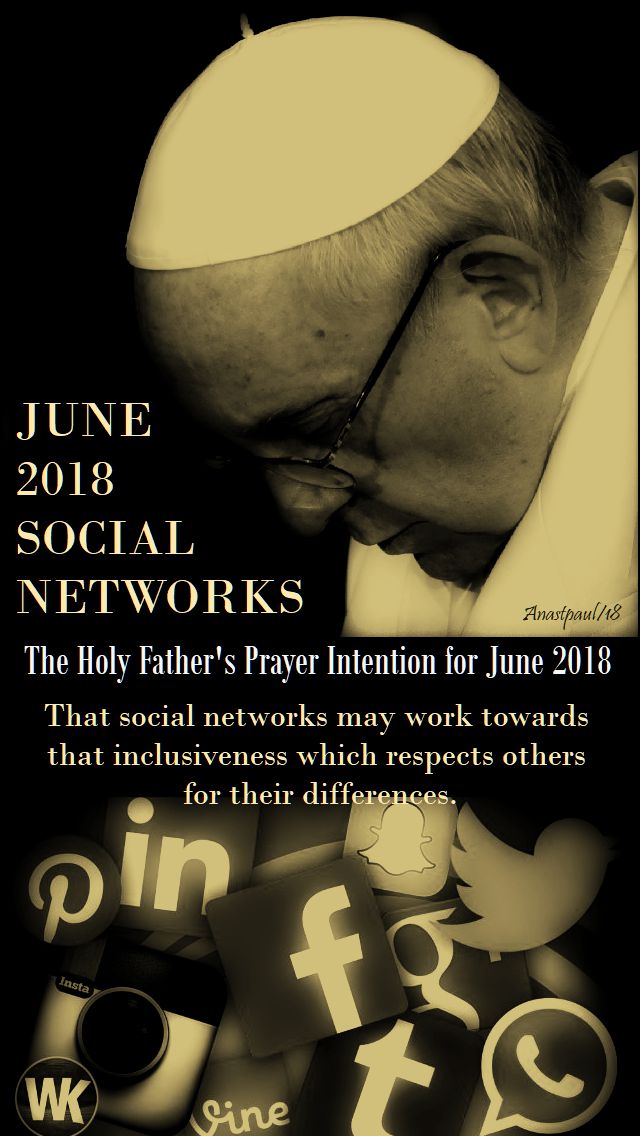
The Holy Father’s Prayer Intention for June 2018

The Holy Father’s Prayer Intention for June 2018

JUNE 2018

Universal:  Social Networks

That social networks may work towards
that inclusiveness which respects others
for their differences.holy father's prayer intention june 2018 - 1 june 2018

Posted in CATHOLIC DEVOTIONS of the Month, MORNING Prayers, SACRED and IMMACULATE HEARTS

JUNE – MONTH OF THE SACRED HEART

JUNE – MONTH OF THE SACRED HEART

The Month of June is dedicated to the Sacred Heart.
The Church celebrates the Solemnity of the Sacred Heart of Jesus on the Friday following the second Sunday after Pentecost.
In addition to the liturgical celebration, many devotional exercises are connected with the Sacred Heart of Jesus.
Of all devotions, devotion to the Sacred Heart was, and remains, one of the most widespread and popular in the Church.

Understood in the light of the Scriptures, the term “Sacred Heart of Jesus” denotes the entire mystery of Christ, the totality of His being and His person considered in its most intimate essential:  Son of God, uncreated wisdom;  infinite charity, principal of the salvation and sanctification of mankind.   The “Sacred Heart” is Christ, the Word Incarnate, Saviour, intrinsically containing, in the Spirit, an infinite divine-human love for the Father and for His brothers.   Excerpted from the Directory on Popular Piety and the Liturgyjune-devotion- the sacred heart - 1 june 2018

Posted in MORNING Prayers, ON the SAINTS, PAPAL SERMONS, QUOTES of the SAINTS, SAINT of the DAY

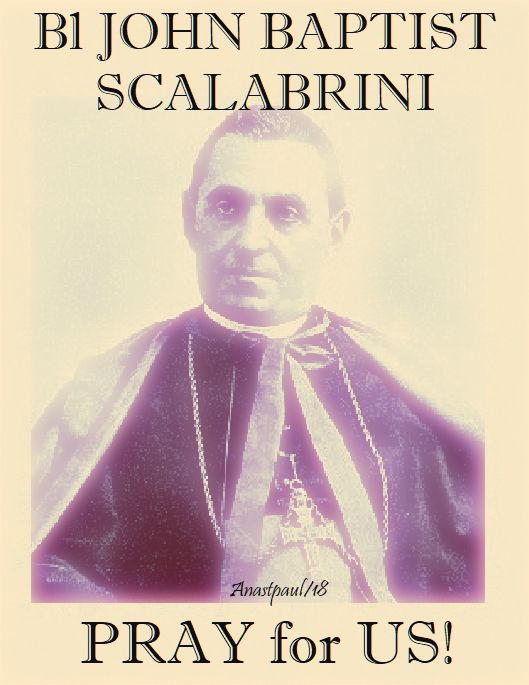
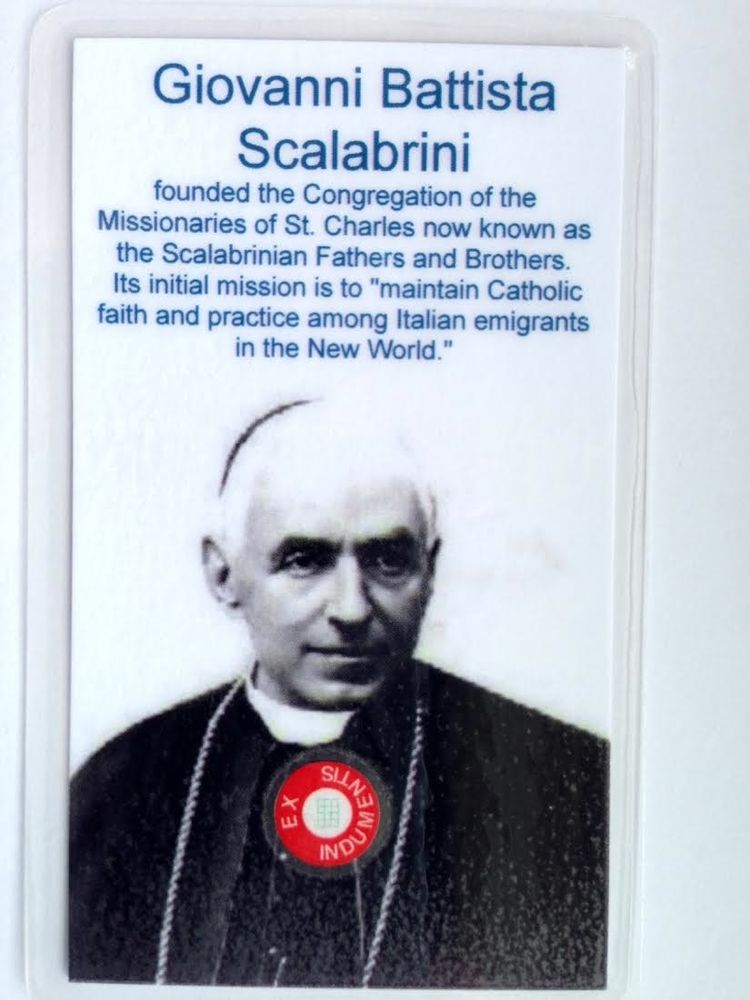
Thought for the Day – 1 June – The Memorial of Blessed John Baptist Scalabrini (1839-1905)

Thought for the Day – 1 June – The Memorial of Blessed John Baptist Scalabrini (1839-1905)

“God’s temple is holy, and that temple you are” (1 Cor 3:17).   The universal call to holiness was constantly felt and personally lived by John Baptist Scalabrini.   He loved to say over and over: “Would that I could sanctify myself and all the souls entrusted to me!”. Striving for holiness and proposing it to everyone he met, was always his first concern.

Deeply in love with God and extraordinarily devoted to the Eucharist, he knew how to translate the contemplation of God and his mystery into intense apostolic and missionary activity, making himself all things to all men in order to proclaim the Gospel. This ardent passion of his for the kingdom of God made him zealous in catechesis, pastoral activities and charitable work, especially for those most in need.   Pope Pius IX called him the “Apostle of the Catechism” because of his efforts to promote the systematic teaching of the Church’s doctrine to children and adults in every parish.

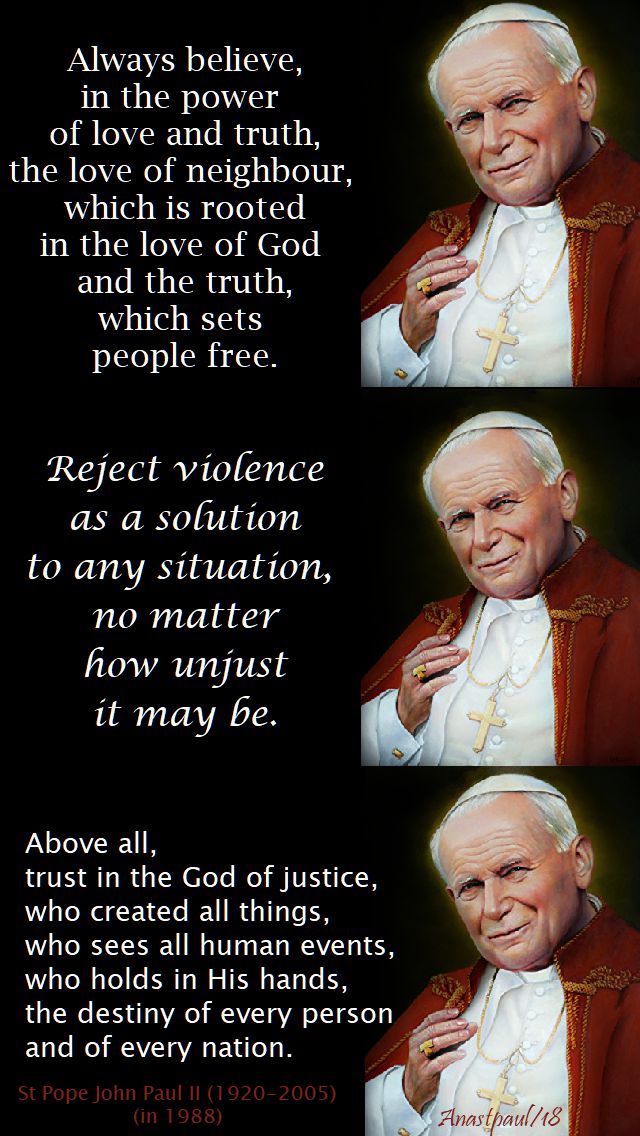
Out of his love for the poor, particularly for emigrants, he became the apostle of his many compatriots compelled to leave their country, often under difficult conditions and in concrete danger of losing their faith: for them he was a father and sure guide.   We can say that Bl John Baptist Scalabrini intensely lived the paschal mystery, not through martyrdom but by serving the poor and crucified Christ, in the many needy and suffering people, whom he loved, with the heart of a true Shepherd in solidarity with his flock….St Pope John Paul (1920-2005) on the Beatification of Bl Scalabrini – Sunday, 9 November 1997.

Oh if we could gain just a grain of such zeal, we would all become saints.

Blessed John Baptist Scalabrini, Pray for us!

bl john baptist scalabrini - pray for us - 1 june 2018

Posted in FATHERS of the Church, MORNING Prayers, QUOTES of the SAINTS, QUOTES on FAITH, QUOTES on OBEDIENCE, QUOTES on SANCTITY, QUOTES on SIN, QUOTES on the CHURCH, QUOTES on the DEVIL/EVIL, QUOTES on TRUTH, SAINT of the DAY, The HOLY EUCHARIST / The HOLY MASS

Quote/s of the Day- 1 June – The Memorial of St Justin Martyr (c 100-165) Father of the Church

Quote/s of the Day- 1 June – The Memorial of St Justin Martyr (c 100-165)

Father of the Church

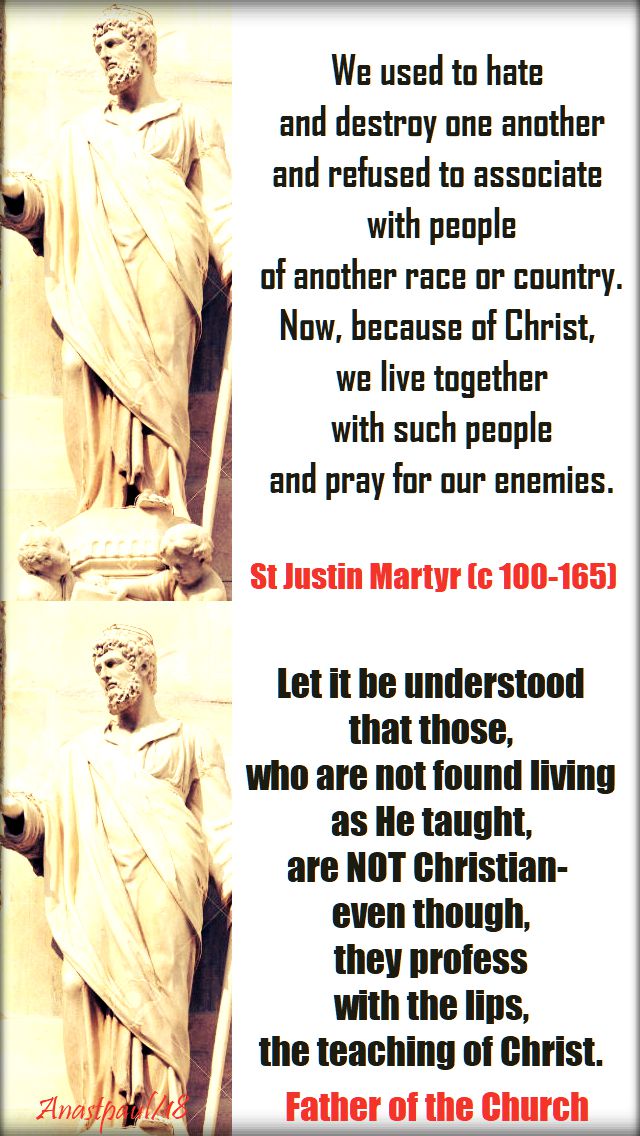
“We used to hate and destroy one another
and refused, to associate with people
of another race or country.
Now, because of Christ, we live together
with such people and pray for our enemies ”

“Let it be understood,
that those who are not found living
as He taught,
are NOT Christian- even though they profess
with the lips, the teaching of Christ.”we used to hate one another - let it be understood that those - st justin martyr - 1 june 2018

“Not as common bread
or as common drink,
do we receive these…..
We have been taught,
that the food,
that has been Eucharistised,
by the word of prayer,
that food, which by assimilation,
nourishes our flesh and blood,
is the flesh and blood
of the incarnate Jesus.”not-as-common-bread-st-justin-martyr-1-june-2018.jpg

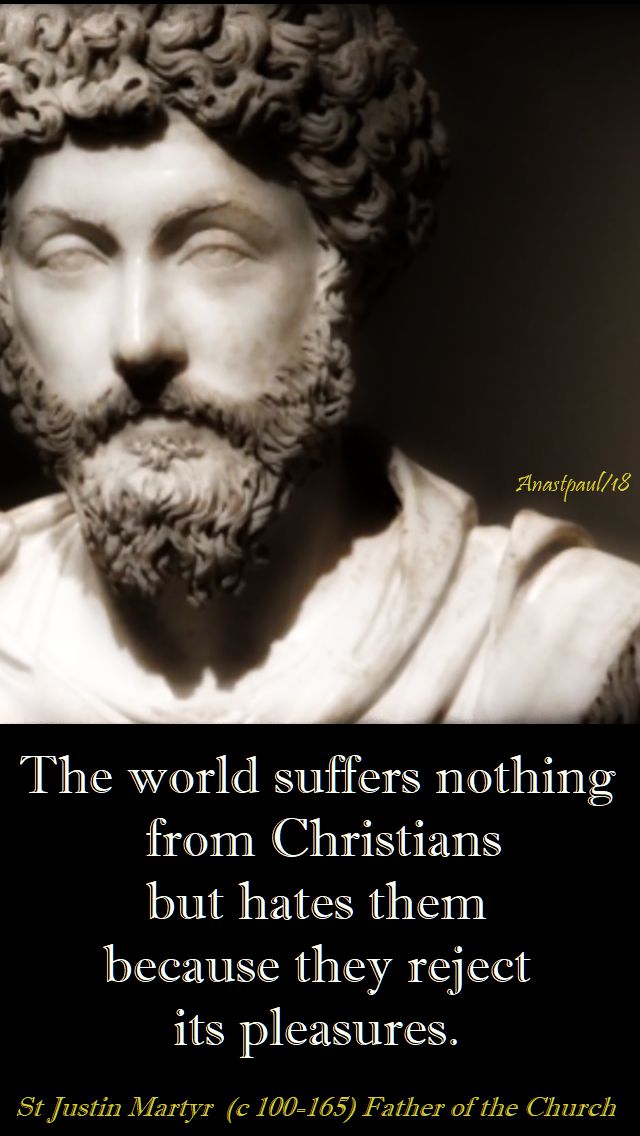
“The world suffers nothing from Christians
but hates them, because they reject its pleasures.”the world suffers nothing from Christians - 1 june 2018.jpg

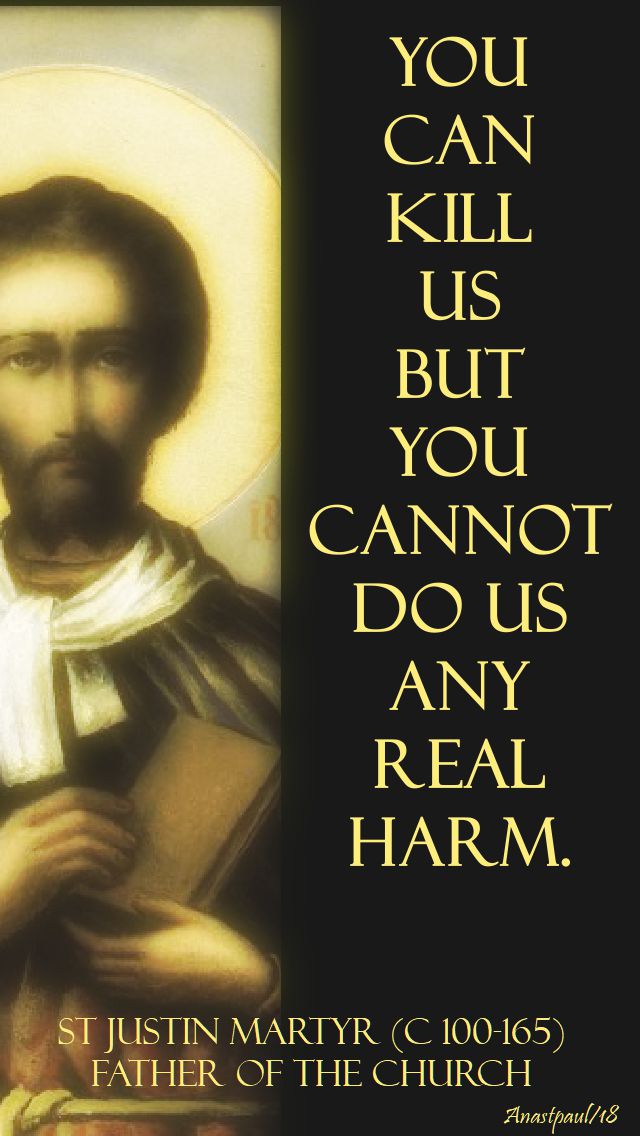
“You can kill us
but you cannot do us
any real harm.”you can kill us - st justin martyr - 1 june 2018

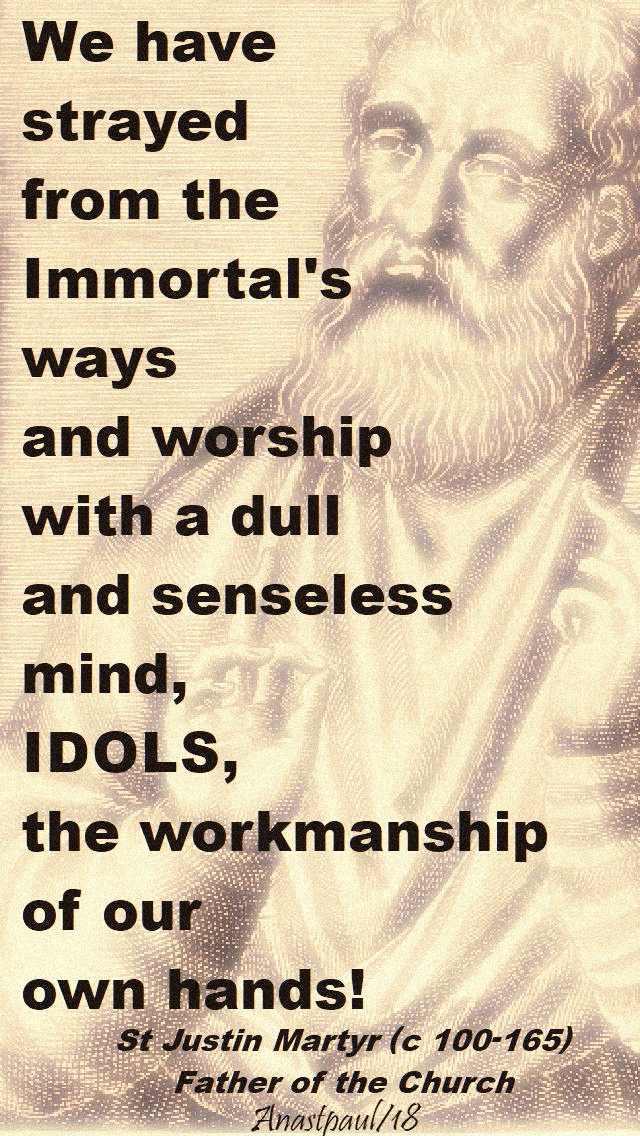
“We have strayed from the Immortal’s ways
and worship with a dull and senseless mind, Idols,
the workmanship of our own hands!”

St Justin Martyr (c 100-165) Father of the Churchwe-have-strayed-st-justin-martyr-1-june-2018.jpg

Posted in CATHOLIC Quotes, FATHERS of the Church, MORNING Prayers, SAINT of the DAY, The WORD

One Minute Reflection – 1 June – The Memorial of St Justin Martyr (c 100-165)

One Minute Reflection – 1 June – The Memorial of St Justin Martyr (c 100-165)

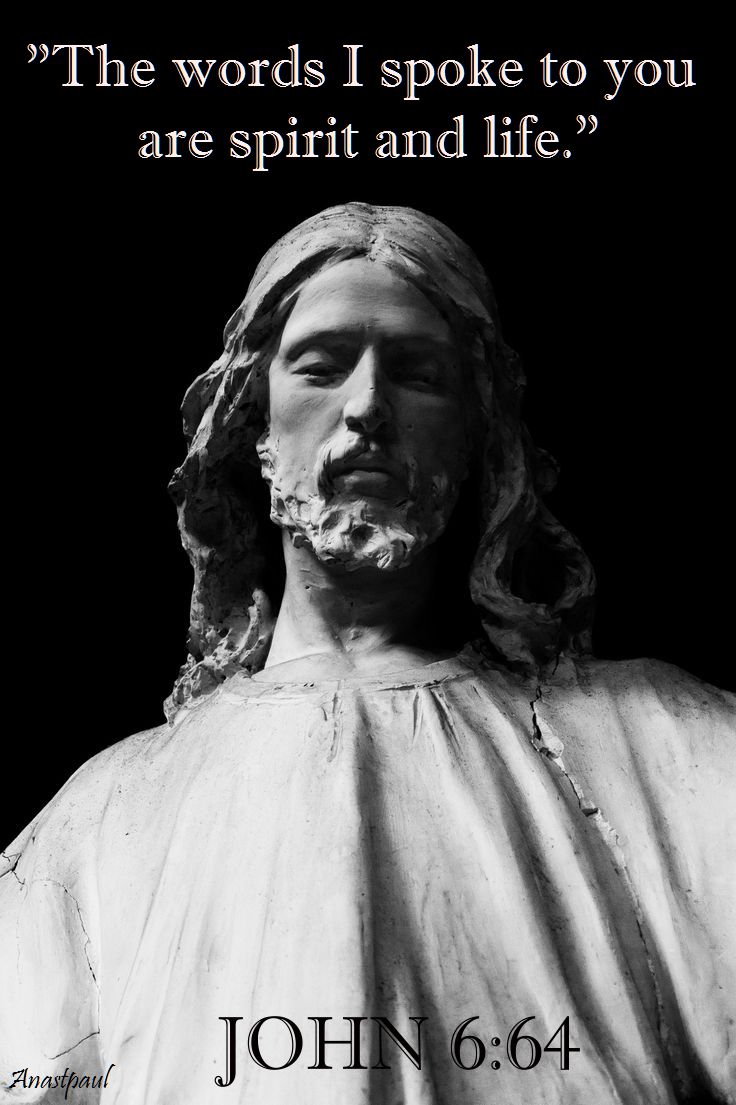
The words I spoke to you are spirit and life………John 6:64john-6-64 - 1 june 2017

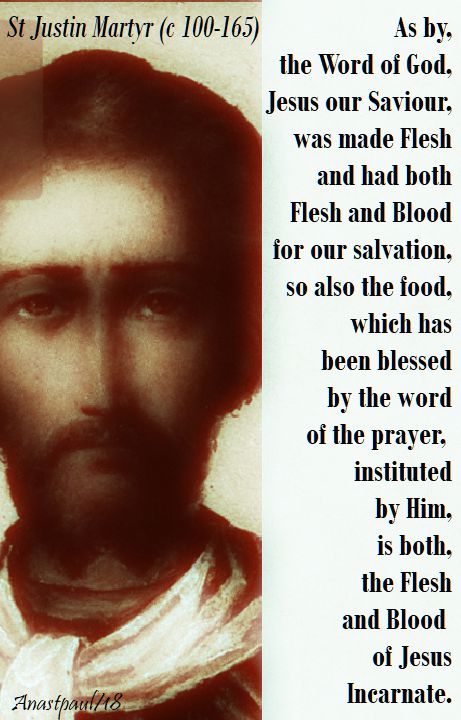
REFLECTION – “As by, the Word of God, Jesus our Saviour was made Flesh and had both Flesh and Blood for our salvation, so also the food, which has been blessed by the word of the prayer, instituted by Him, is both the Flesh and Blood of Jesus Incarnate.”…St Justin Martyr (c 100-165)

as by the word of god - st justin martyr - 1 june 2018

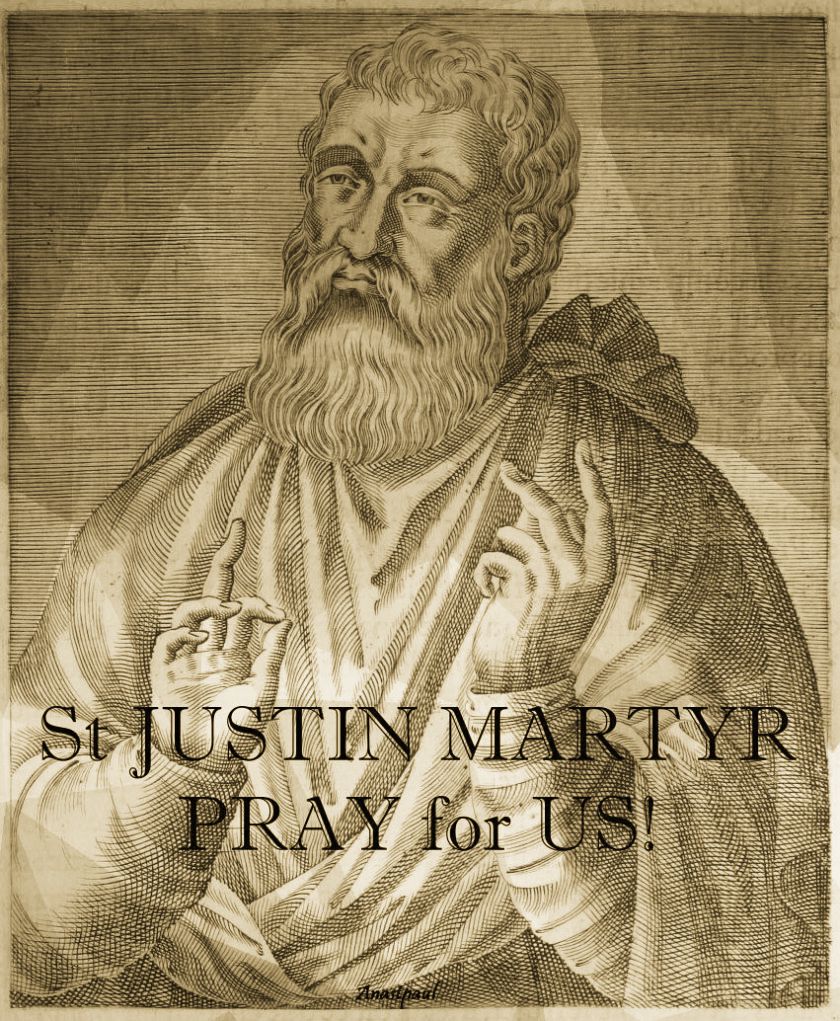
PRAYER – Lord Jesus, my Saviour, let me daily take to my heart and my soul, Your words. Grant that they may lead me to penance and also provide needed consolation amid the troubles of life.   St Justin, when you discovered the words of the Lord Jesus Christ, your life was completely changed and given to Him, so that you could heed His command to go forth and spread the good news to all.   Please pray for us, that we may be inspired to imitate your courage and zeal, even as we struggle on our pilgrim path.   Through our Lord Jesus Christ, with almighty God, our Father and in the unity of the Holy Spirit, one God forever, amen.st-justin-martyr-pray-for-us.- 1 june 2018

Posted in CATHOLIC DEVOTIONS of the Month, MORNING Prayers, SACRED and IMMACULATE HEARTS

Our Morning Offering – 1 June – The Month of the Sacred Heart of Jesus – Friday of the Eighth Week of Ordinary Time Year B

Our Morning Offering – 1 June – The Month of the Sacred Heart of Jesus – Friday of the Eighth Week of Ordinary Time Year B

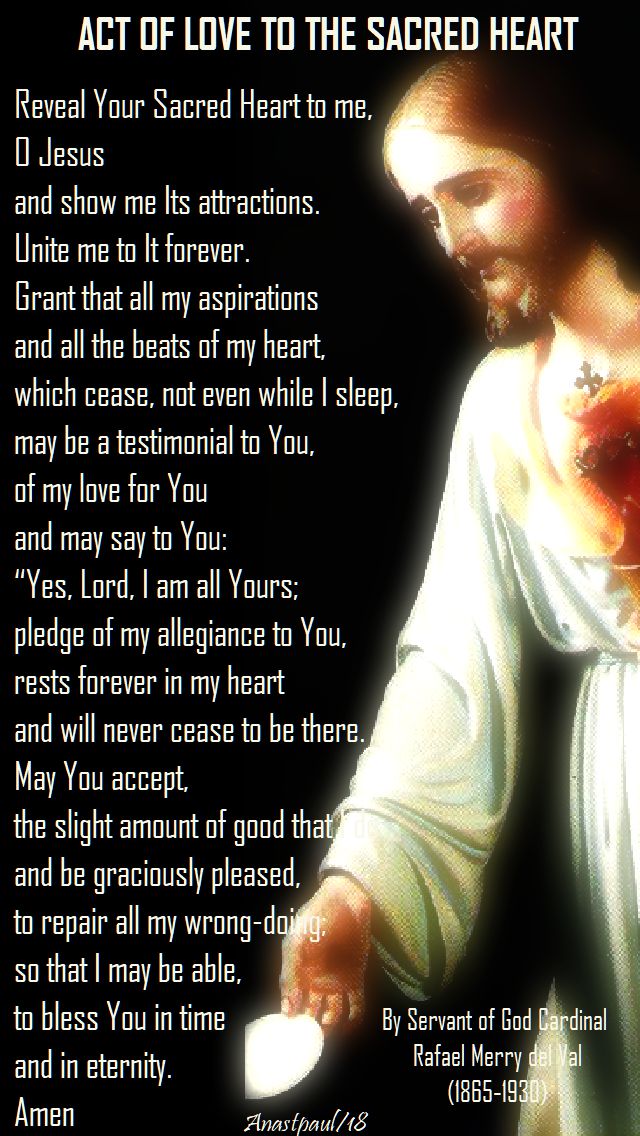
ACT OF LOVE TO THE SACRED HEART
By Servant of God Cardinal Rafael Merry del Val (1865-1930)

Reveal Your Sacred Heart to me, O Jesus
and show me Its attractions.
Unite me to It forever.
Grant that all my aspirations
and all the beats of my heart,
which cease, not even while I sleep,
may be a testimonial to You,
of my love for You
and may say to You:
“Yes, Lord, I am all Yours;
pledge of my allegiance to You,
rests forever in my heart
and will never cease to be there.
May You accept,
the slight amount of good that I do
and be graciously pleased,
to repair all my wrong-doing;
so that I may be able,
to bless You in time
and in eternity.
Amenact of love to the sacred heart by servant of god card rafael merry del val - 1 june 2018

Posted in QUOTES of the SAINTS, SAINT of the DAY

Saint of the Day – 1 June – Blessed John Baptist Scalabrini (1839-1905) “The Apostle of the Catechism” and “The Father of Migrants”

Saint of the Day – 1 June – Blessed John Baptist Scalabrini (1839-1905) “The Apostle of the Catechism” – Bishop, Prelate, Founder, Advisor, Apostle of Charity and the Suffering, Writer, Teacher, known as “The Apostle of the Catechism” and “The Father of Migrants”, Founder of both the Missionaries of St Charles and the Mission Sisters of Saint Charles.  Born Giovanni Battista Scalabrini on 8 July 1839 at Fino Mornasco, Como, Italy and died at dawn on 1 June 1905, the feast of the Ascension of the Lord.   He was Beatified on 9 November 1997 by Pope John Paul II.

bl john scalabrini.info

He is an unknown figure to almost everyone.   Yet John Baptist Scalabrini, a seemingly obscure Roman Catholic Bishop of a rural northern Italian diocese, Piacenza, from 1876 to his death in 1905, is perhaps more than anyone else the single-most important architect of a global outreach on the part of the Catholic Church in the ever-increasing fields of migration and refugee flows.   His innovative thinking, analysis of the migrants’ and refugees’ plights and efforts on their behalf continue to inform and even inspire the Church’s efforts in this field down to this day.

Giovanni Battista Scalabrini was born in Fino Mornasco (in the province of Como in northern Italy) on July 8, 1839.  The third of eight children, he attended the local State High School, where, from his first year, his remarkable intelligence and consistent efforts made him a top student. He was ordained a priest in 1863 at the age of 24, after which he expressed the desire to become a missionary. Instead, he was assigned by his Bishop to teach at the minor seminary and also to act as Vice Rector and later Rector.

In his adolescence he wrote a poem in praise of the life of Saint Aloysius Gonzaga and in his childhood often recited the Angelus while each October reciting it in the Como Cathedral.   He had a devotion to Saint Joseph and Saint Francis de Sales as well as Saint Charles Borromeo which extended for the remainder of his life.

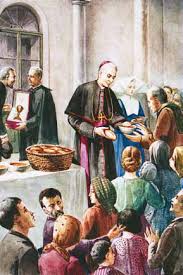
He distinguished himself during a cholera epidemic in 1867 through his tireless efforts to alleviate the suffering of the victims.   As the pastor of the parish he opened a kindergarten in the area and wrote the “Little Catechism for Kindergartens” to go with it.   In 1872 he delivered a series of eleven addresses on the First Vatican Council – something that Saint John Bosco (1815-1888) appreciated – and these addresses were printed in 1873 and even reached Rome which was a considerable factor in his later episcopal appointment.   These were reprinted in a reduced form at the behest of Bosco himself.

scalabrini - feed the poor

Giovanni Battista Scalabrini was born in Fino Mornasco (in the province of Como in northern Italy) on July 8, 1839.  The third of eight children, he attended the local State High School, where, from his first year, his remarkable intelligence and consistent efforts made him a top student. He was ordained a priest in 1863 at the age of 24, after which he expressed the desire to become a missionary.   Instead, he was assigned by his Bishop to teach at the minor seminary and also to act as Vice Rector and later Rector.

His pioneering firsts, winning ideas:

– Five pastoral visitations accomplished in person of a vast diocese with many places difficult to reach
– Three Synods
– The first Catechetical Congress in the world and the first Journal on Catechetics in Italy (and second in the world)
– The proposal for the first unified Catechism for Italians, including emigrants
– The Institution of the first Chair of Catechetics
– The first Missionary Religious Congregation for Italian emigrants
– The first proposal for a specific pastoral plan for them
– The first to found a Lay Order for the assistance of migrants.

Scalabrini’s practicality, readiness for action and gifts as a fine religious administrator served him brilliantly as an untiring pastor.   He needed such gifts, as noted by one of the official examiners of his heroic virtues – the first step in the road to official canonisation of an individual in the Church – noted, he had “such an imposing quantity of work that it leaves any ordinary person not only edified, but thoroughly daunted”.

Another feature of of his pastoral work was his surprising ability to infuse all his people with an insight into their vocation as disciples of Christ so that their faith led them from the cradle to the grave.

For him, everything was sanctified and helped to sanctify, assisting the ever-deepening personal friendship with God that the Second Vatican Council was to declare more than 50 years after his death to be the universal call to holiness, the basis for every human life.

Interestingly, unlike other contemporary saints, Scalabrini’s life was not surrounded by miraculous events.   What was miraculous, in a sense, was his immense confidence in Providence.   Scalabrini is not a saint and a bishop but a saint because he was a bishop who lived his vocation to the best of his ability.

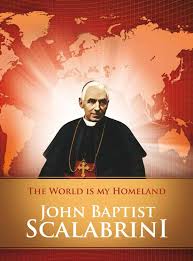
Today, Bishop Scalabrini stands out as ideal pastor for the modern era. His motto as pastor was St Paul’s “make yourself everything to everyone”, and what is clearly special about his life is the intensity and breadth of his commitment in whatever field he entered.

scalabrini - the world

Those who knew him regarded him as sociable and accessible, direct and open, sensitive and vulnerable.   Yet he was also lucid, vigorous and had a deep trust in ascetic practice. He may have been sensitive but was also resolute as a leader and decisive in control of spontaneous impulses, refusing to succumb to emotional pressure or transitory whims of the moment.

Finally, Scalabrini was also a pioneering bishop, an explorer able to step outside the accepted boundaries and thinking of his day to go further, to confront obstacle and use them as opportunities to advance.   “Without doubt”, he once said, “we are in the hands of God, but we must not sit there idly.”

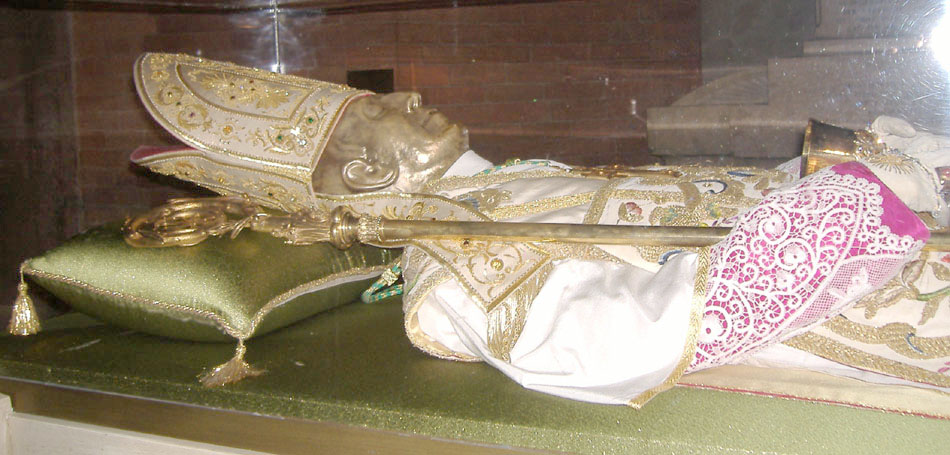
John Baptist Scalabrini, lived the drama of the exodus of migrants who,during the last decades of the nineteenth century, travelled in great numbers from Europe to the countries in the New World.   He clearly saw the need for a specific pastoral care of migrants, through a suitable network of spiritual assistance.    He strongly supported the need for legislative and institutional instruments for the human and juridical protection of the migrants, against all forms of exploitation.   Today, in different situations, the spiritual sons and daughters of Blessed Scalabrini, who were later joined by the “Secular Institute of the Scalabrinian Missionary Women”, continue to give witness to Christ’s love for migrants and to offer them the Gospel.   In 1998, John Paul II declared him Blessed and defined him as the “Father of Migrants”.Body-of-scalabrini

Posted in SAINT of the DAY

Memorials of the Saints – 1 June

St Justin Martyr (Memorial) (c 100-165)


St Agapetus of Ruthenia
Bl Alfonso Navarrete Benito
Bl Arnald Arench
Bl Arnold of Geertruidenberg
St Atto of Oca
St Candida of Whitchurch
St Caprasius of Lérins
St Clarus of Aquitaine
St Claudius of Vienne
Bl Conrad of Hesse
St Conrad of Trier
St Crescentinus
St Cronan of Lismore
St Damian of Scotland
St Dionysius of Ruthenia
St Donatus of Lucania
St Felinus of Perugia
Bl Ferdinand Ayala
St Firmus
St Fortunatus of Spoleto
Bl Gaius Xeymon
St Gaudentius of Ossero
St Giuse Túc
St Gratian of Perugia
St Hannibal Mary di Francia
Bl Herculanus of Piegare
St Iñigo of Oña
St Ischryrion and Companions
Bl James of Strepar
St Jean-Baptiste-Ignace-Pierre Vernoy de Montjournal
Bl John Baptist Scalabrini (1839-1905)

Bl John Pelingotto
Bl John Storey
St Juventius
Bl Leo Tanaka
St Melosa
St Pamphilus of Alexandria
St Peter of Pisa
St Porphyrius of Alexandria
St Proculus of Bologna
St Proculus the Soldier
St Ronan
St Secundus of Amelia
St Seleucus of Alexandria
St Simeon of Syracuse
St Telga of Denbighshire
St Thecla of Antioch
Bl Theobald Roggeri
St Thespesius of Cappadocia
St Wistan of Evesham
St Zosimus of Antioch

Martyrs of Alexandria – 5 saints: A group five of imperial Roman soldiers assigned to guard a group of Egyptian Christians who were imprisoned for their faith in the persecutions of Decius. During their trial, they encouraged the prisoners not to apostatize. This exposed them as Christians, were promptly arrested and executed. Martyrs. Their names are – Ammon, Ingen, Ptolomy, Theophilis and Zeno. They were beheaded in 249 at Alexandria, Egypt.

Martyrs of Caesarea – 3 saints: Three Christians martyred together in the persecutions of Galerius. We know little more about them than the name – Paul, Valens and Valerius. They diedf in 309 at Caesarea, Palestine.

Martyrs of Lycopolis – 6 saints: Five foot soldiers and their commander who were martyred for their faith by order of the imperial Roman prefect Arriano during the persecutions of Decius. In Lycopolis, Egypt.

Martyrs of Rome – 6 saints: A group of spiritual students of Saint Justin Martyr who died with him and about whom we know nothing else but their names – Carito, Caritone, Evelpisto, Ierace, Liberiano and Peone. In Rome, Italy.

Posted in BREVIARY Prayers, CATHOLIC DEVOTIONS of the Month, CATHOLIC-PRAYERS OF THE CHURCH, DEVOTIO, DOCTORS of the Church, FATHERS of the Church, FEASTS and SOLEMNITIES, MARIAN DEVOTIONS, MARIAN PRAYERS, MARIAN QUOTES, MORNING Prayers, PRACTISING CATHOLIC, PRAYERS of the CHURCH, QUOTES of the SAINTS, SAINT of the DAY, The BLESSED VIRGIN MARY, The WORD

Thought for the Day – 31 May – The Last Day of Mary’s Month and the Feast of the Visitation of the Blessed Virgin Mary from St Bede the Venerable

Thought for the Day – 31 May – The Last Day of Mary’s Month and the Feast of the Visitation of the Blessed Virgin Mary from St Bede the Venerable

Writing in the early 8th century, St Bede explains why the Magnificat, Mary’s prayer on the occasion of her Visitation of Elizabeth, is used daily in the liturgy of the hours (a.k.a the divine office) for Vespers or evening prayer.   With Mary’s soul, our souls magnify the Lord and rejoice in God our Saviour.

My soul glorifies the Lord and my spirit rejoices in God my saviour.
With these words Mary first acknowledges the special gifts she has been given.   Then she recalls God’s universal favours, bestowed unceasingly on the human race.

REJOICE IN GOD’S GREATNESS
When a man devotes all his thoughts to the praise and service of the Lord, he proclaims God’s greatness.   His observance of God’s commands, moreover, shows that he has God’s power and greatness always at heart.   His spirit rejoices in God his saviour and delights in the mere recollection of his creator who gives him hope for eternal salvation.

These words are offered for all God’s creations but especially for the Mother of God.   She alone was chosen and she burned with spiritual love for the son she so joyously conceived.   Above all other saints, she alone could truly rejoice in Jesus, her saviour, for she knew that He, who was the source of eternal salvation, would be born in time in her body, in one person both her own son and her Lord.

HOLY IS HIS NAME
For the Almighty has done great things for me, and holy is his name.
Mary attributes nothing to her own merits.   She refers all her greatness to the gift of the one whose essence is power and whose nature is greatness, for He fills with greatness and strength the small and the weak who believe in Him.

She did well to add:  and holy is his name, to warn those who heard and indeed all who would receive His words, that they must believe and call upon His name.   For they too could share in everlasting holiness and true salvation, according to the words of the prophet – and it will come to pass, that everyone who calls on the name of the Lord will be saved.   This is the name she spoke of earlier – and my spirit rejoices in God my saviour.

VESPERS & THE MAGNIFICAT:  AN EVENING CANTICLE
Therefore it is an excellent and fruitful custom of holy Church that we should sing Mary’s hymn at the time of evening prayer.   By meditating upon the incarnation, our devotion is kindled and by remembering the example of God’s Mother, we are encouraged to lead a life of virtue.   Such virtues are best achieved in the evening.  We are weary after the day’s work and worn out by our distractions.   The time for rest is near and our minds are ready for contemplation.

The great canticle by the Blessed Virgin Mary, the Magnificat, proclaimed by Mary during her Visitation to St Elizabeth,  is celebrated and explained in this excerpt from a homily by Saint Bede the Venerable (Lib 1,4:CCL 122, 25-26, 30) which is used in the Roman Catholic Liturgy’s Divine Office of Readings for the Feast of the Visitation, 31 May, with the accompanying biblical reading being from Song of Songs 2:8-14 and 8:6-7.   With Mary’s soul, we proclaim the greatness of the Lord and rejoice in God, her Saviour and ours, each evening in Vespers prayer.

St Bede the Venerable (673-735) Father & Doctor of the Church

Mary, Mother of God, Pray for us!

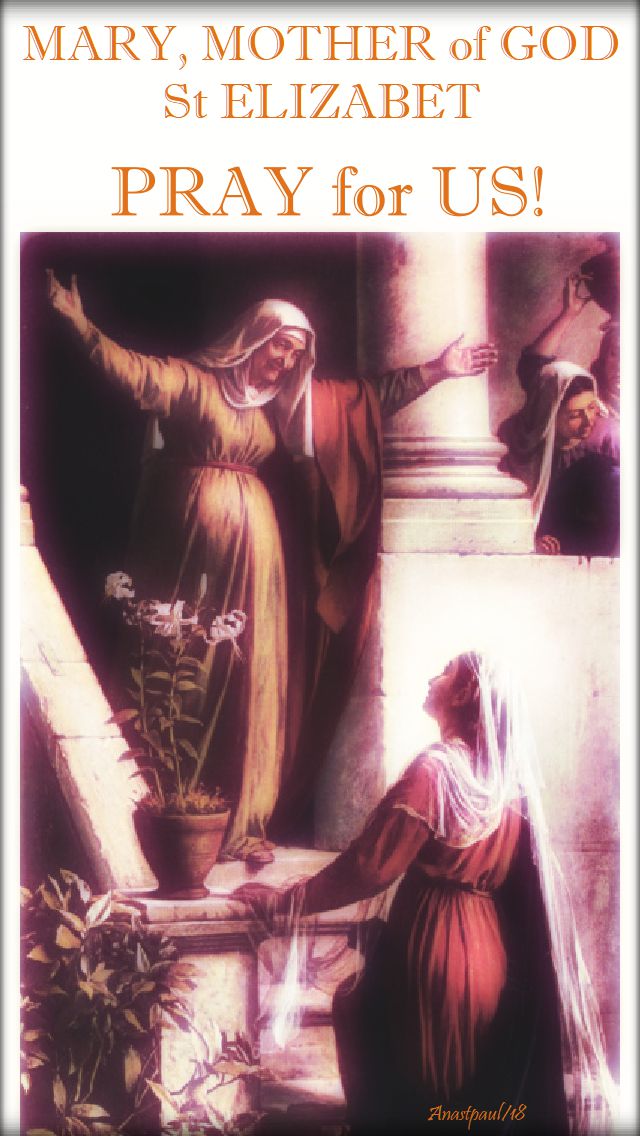
St Elizabeth, Pray for us!mary mother of god, st elizabeth, pray for us - 31 may 2018 - the visitation

Posted in CATHOLIC DEVOTIONS of the Month, CATHOLIC-PRAYERS OF THE CHURCH, MARIAN DEVOTIONS, MARIAN PRAYERS, MARIAN QUOTES, MORNING Prayers, PRACTISING CATHOLIC, PRAYERS of the CHURCH, QUOTES of the SAINTS, SAINT of the DAY, The BLESSED VIRGIN MARY, The WORD

One Minute Marian Reflection – 31 May – The Last Day of Mary’s Month and the Feast of the Feast of the Visitation of the Blessed Virgin Mary

One Minute Marian Reflection – 31 May – The Last Day of Mary’s Month and the Feast of the Feast of the Visitation of the Blessed Virgin Mary

And Mary said, “My soul glorifies the Lord, my spirit rejoices in God, my Saviour”…Luke 1:46

luke 1 46 - and mary said, my soul glorifies the Lord - 31 may 2018

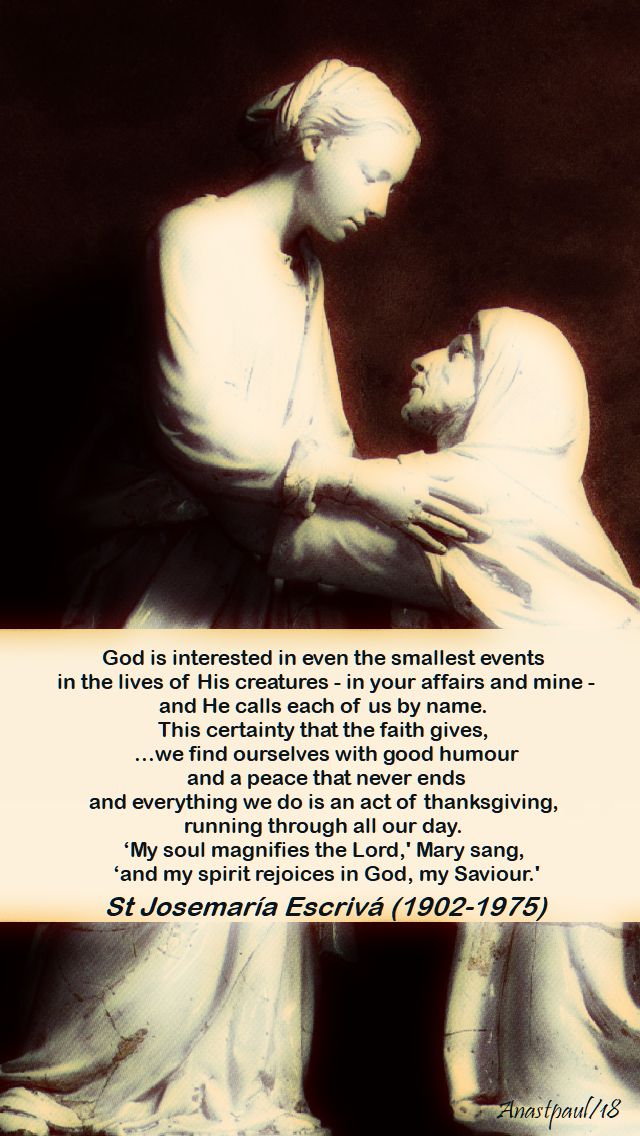
REFLECTION – “THE VISITATION:  MARY SINGS OF THE LOVE OF GOD – “God is interested in even the smallest events in the lives of His creatures – in your affairs and mine — and He calls each of us by name.   This certainty that the faith gives, enables us to look at everything in a new light.   And everything, while remaining exactly the same, becomes different, because it is an expression of God’s love.   Our life is turned into a continuous prayer, we find ourselves with good humour and a peace that never ends and everything we do is an act of thanksgiving, running through all our day.   ‘My soul magnifies the Lord,’ Mary sang, ‘and my spirit re­joices in God, my Saviour.'” …St Josemaría Escrivá (1902-1975) – “To Jesus through Mary,” Christ is Passing By, 144
Let us offer to our Mother today:
The Holy Rosary said with concentration and affection.god is interested in even the smallest events in the lives of His creatures - st josemaria - 31 may 2018 - the visitation

PRAYER – Almighty, ever-living God, You inspired the Blessed Virgin Mary, when she carrying Your Son, to visit Elizabeth.   Grant that, always docile to the voice of the Holy Spirit, we may, together with our Lady, glorify Your Name and offer You our constant praise and thanksgiving.   Through Christ, our Lord, with You and the Holy Spirit, one God forever, amen.mary, mother of our lord pray for us - 31 may 2018 - the visitation

Posted in BREVIARY Prayers, CATHOLIC DEVOTIONS of the Month, CATHOLIC-PRAYERS OF THE CHURCH, DEVOTIO, FEASTS and SOLEMNITIES, MARIAN DEVOTIONS, MARIAN PRAYERS, MARIAN QUOTES, MORNING Prayers, PAPAL MESSAGES, PRAYERS of the CHURCH, QUOTES of the SAINTS, SAINT of the DAY, The BLESSED VIRGIN MARY, The WORD, VATICAN Resources

Our Morning Offering – 31 May – The Last Day of Mary’s Month and the Feast of the Visitation of the Blessed Virgin Mary

Our Morning Offering – 31 May – The Last Day of Mary’s Month and the Feast of the Visitation of the Blessed Virgin Mary

The Magnificat, is Mary’s great gift to scripture, one of its most beautiful prayers.   It is prayed every evening in the Liturgy of the Hours by millions around the world.   With that, Mary’s great acclamation becomes the Church’s.

The Magnificat
The Canticle of Mary
Luke 1:46-55

My soul glorifies the Lord,
my spirit rejoices in God, my Saviour
He looks on His servant in her lowliness
Henceforth all ages will call me blessed:
The Almighty works marvels for me,
holy is his Name!
His mercy is from age to age,
on those who fear Him.
He puts forth His arm in strength
and scatters the proud-hearted.
He casts the mighty from their thrones
and raises the lowly.
He fills the starving with good things,
sends the rich away empty.
He protects Israel, His servant,
remembering His mercy,
the mercy promised to our fathers,
to Abraham and his sons forever.

Excerpt (18) from the Apostolic Exhortation “Marialis Cultus”

 Blessed Pope Paul VI – 2 February 1974

“18.   Mary is also the Virgin in prayer.   She appears as such in the visit to the mother of the precursor, when she pours out her soul in expressions glorifying God and expressions of humility, faith and hope.   This prayer is the Magnificat (cf. Lk. 1:46-55), Mary’s prayer par excellence, the song of the messianic times in which there mingles the joy of the ancient and the new Israel.   As St Irenaeus seems to suggest, it is in Mary’s canticle, that there was heard once more, the rejoicing of Abraham who foresaw the Messiah (cf. Jn. 8:56)(48) and there rang out in prophetic anticipation the voice of the Church:  “In her exultation Mary prophetically declared in the name of the Church:  ‘My soul proclaims the glory of the Lord….'”

 And in fact Mary’s hymn has spread far and wide and has become the prayer of the whole Church in all ages.”

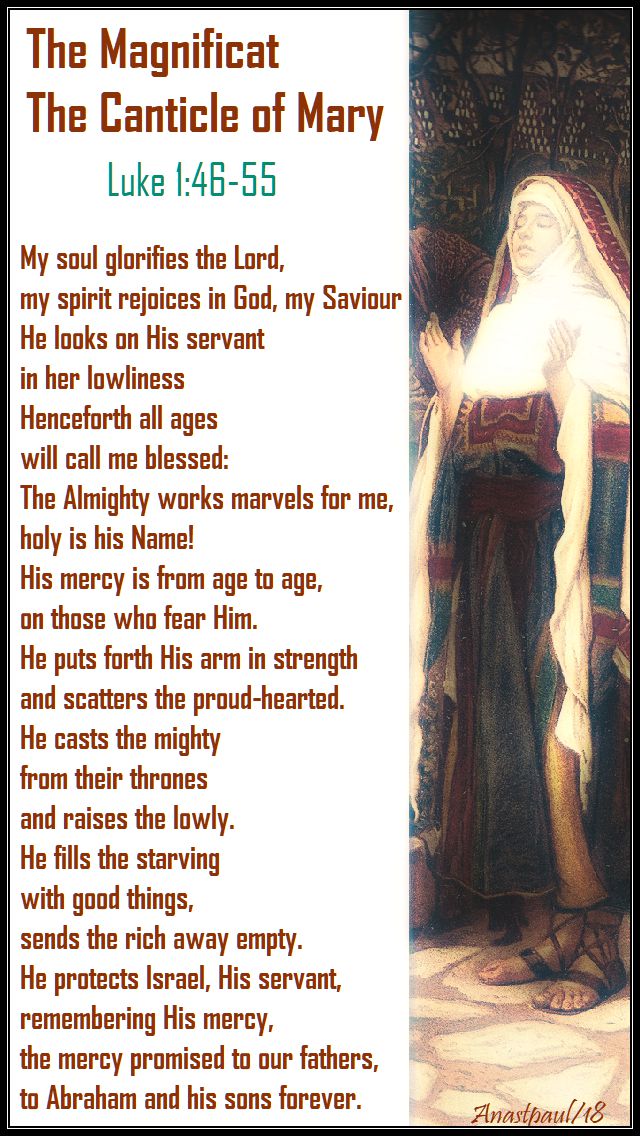
the magnificat - luke 1 46-55 - 31 may 2018 - feast of the visitation.jpg


Posted in CATHOLIC DEVOTIONS of the Month, FEASTS and SOLEMNITIES, MARIAN DEVOTIONS, MARIAN QUOTES, MORNING Prayers, SAINT of the DAY, The BLESSED VIRGIN MARY, The WORD

The Feast of the Visitation of the Blessed Virgin Mary – 31 May

The Feast of the Visitation of the Blessed Virgin Mary – 31 May

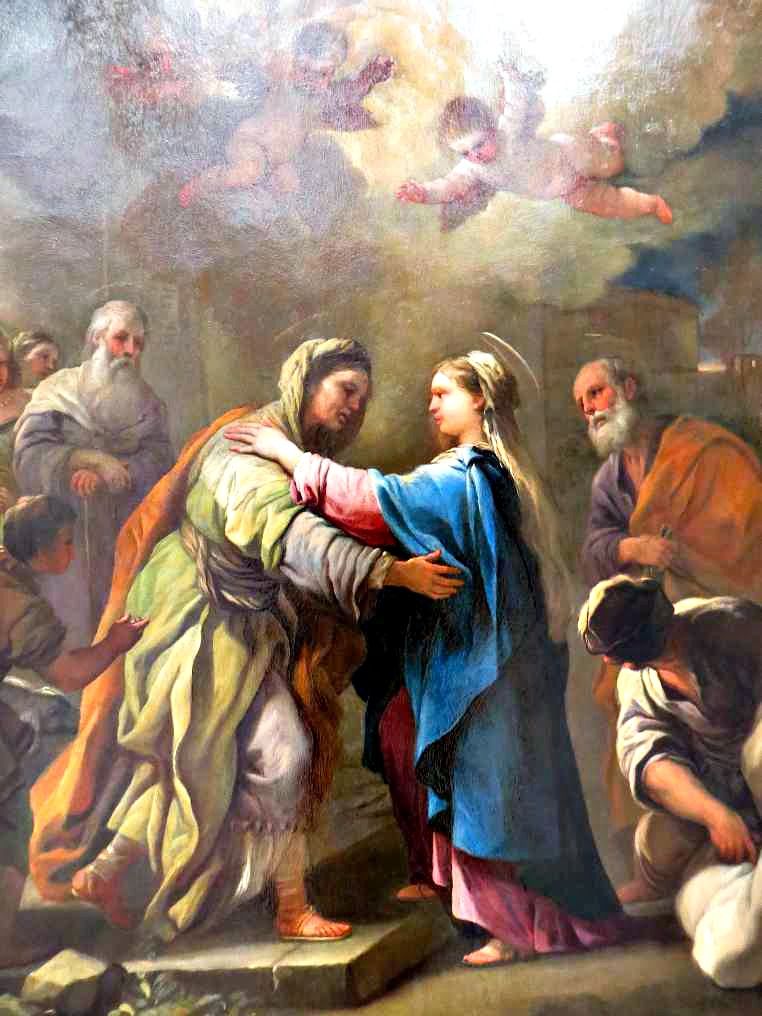
As we say goodbye to Mary’s Month of May, we celebrate today the feast of the Visitation of the Blessed Virgin Mary.   This feast celebrates the visit of Mary, the Mother of God, with the child Jesus in her womb, to her cousin Elizabeth.   The visit took place when Elizabeth was herself, six months’ pregnant, with the forerunner of Christ, Saint John the Baptist.   At the Annunciation of the Lord, the angel Gabriel, in response to Mary’s question “How shall this be done, because I know not man?” (Luke 1:34 ), had told her that “thy cousin Elizabeth, she also hath conceived a son in her old age; and this is the sixth month with her that is called barren: Because no word shall be impossible with God” (Luke 1:36-27).

header - visitation

The evidence of her cousin’s own near-miraculous conception had called forth Mary’s fiat:  “Behold the handmaid of the Lord; be it done to me according to thy word.”   It is thus appropriate, that the very next action of the Blessed Virgin, that Saint Luke the Evangelist records, is Mary’s “making haste” to visit her cousin.

The Significance of the Visitation
Arriving at the house of Zachariah and Elizabeth, Mary greets her cousin and something wonderful happens:  John the Baptist leaps in Elizabeth’s womb (Luke 1:41).   As the Catholic Encyclopedia of 1913 puts it in its entry on the Visitation, the Virgin Mary’s “presence and much more the presence of the Divine Child in her womb, according to the will of God, was to be the source of very great graces to the Blessed John, Christ’s Forerunner.”visitation 3


The Cleansing of John the Baptist From Original Sin
John’s leap was no ordinary movement of an unborn child, for as Elizabeth tells Mary, “as soon as the voice of thy salutation sounded in my ears, the infant in my womb leaped for joy” (Luke 1:44).   The joy of John the Baptist, the Church has held from the time of the early Church Fathers, came from his cleansing at that moment of Original Sin, in accordance with the angel Gabriel’s prophecy to Zachariah, before John’s conception, that “he shall be filled with the Holy Ghost, even from his mother’s womb” (Luke 1:15).   As the Catholic Encyclopedia notes in its entry on St John the Baptist, “as the presence of any sin whatever is incompatible with the indwelling of the Holy Ghost in the soul, it follows that at this moment John was cleansed from the stain of original sin.”

The Origin of Two Great Catholic Prayers
Elizabeth, too, is filled with joy and cries out in words that would become part of the chief Marian prayer, the Hail Mary:  “Blessed art thou among women, and blessed is the fruit of thy womb.”   Elizabeth then acknowledges her cousin Mary as “the mother of my Lord” (Luke 1:42-43).   Mary responds with the Magnificat (Luke 1:46-55), a canticle or biblical hymn that has become an essential part of the Church’s evening prayer (vespers). It is a beautiful hymn of thanksgiving, glorifying God for choosing her to be the mother of His Son, as well as for His mercy “from generation until generations, to them that fear Him.”


The History of the Feast of the Visitation of the Blessed Virgin Mary
The Visitation is mentioned only in Luke’s Gospel and Luke tells us that Mary stayed with her cousin about three months.   The angel Gabriel, as we have seen, told Mary at the Annunciation that Elizabeth was six months pregnant and Luke seems to indicate that the Blessed Virgin departed for her cousin’s home very soon after the Annunciation.

While many Marian feasts are among the first feasts to have been celebrated universally by the Church, East and West, the celebration of the Visitation, even though it is found in Luke’s Gospel, is a relatively late development.   It was championed by Saint Bonaventure and adopted by the Franciscans in 1263.   When it was extended to the universal Church by Pope Urban VI in 1389, the date of the feast was set as July 2, the day after the octave (eighth) day of the feast of the Birth of Saint John the Baptist.   The idea was to tie the celebration of the Visitation, at which Saint John had been cleansed of Original Sin, to the celebration of his birth, even though the placement of the feast in the liturgical calendar was out of sync with the account given by Luke.   In other words, symbolism, rather than chronology, was the deciding factor in choosing when to commemorate this important event.

For close to six centuries, the Visitation was celebrated on July 2, but with his revision of the Roman calendar in 1969, Pope Paul VI moved the celebration of the Visitation of the Blessed Virgin Mary to the last day of the Marian month of May so that it would fall between the feasts of the Annunciation and the Birth of Saint John the Baptist—a time when Luke tells us that Mary would certainly have been with Elizabeth, taking care of her cousin in her time of need.

Posted in CATHOLIC DEVOTIONS of the Month, FEASTS and SOLEMNITIES, MARIAN DEVOTIONS, MARIAN TITLES, SAINT of the DAY, The BLESSED VIRGIN MARY

Feast of the Visitation of the Blessed Virgin Mary and Memorials of the Saints – 31 May

Visitation of the Blessed Virgin Mary (Feast)


St Alexander of Auvergne
St Camilla Battista Varano
St Crescentian of Sassari
St Donatian of Cirta
St Felice of Nicosia
St Galla of Auvergne
St Hermias of Comana
Bl Jacob Chu Mun-mo
Bl James Salomone
St Juan Moya Collado
Bl Kasper Gerarz
St Lupicinus of Verona
St Mancus of Cornwall
Bl Mariano of Roccacasale
St Mechtildis of Edelstetten
St Myrbad of Cornwall
Bl Nicolas Barré
Bl Nicholaus of Vangadizza
Bl Nicholaus of Vaucelles
St Nowa Mawaggali
St Paschasius of Rome
St Petronilla of Rome
Bl Robert Thorpe
St Silvio of Toulouse
Bl Thomas Watkinson
Bl Vitalis of Assisi
St Winnow of Cornwall

Martyrs of Aquileia – 3 saints: Three young members of the imperial Roman nobility and who were raised in a palace and had Saint Protus of Aquileia as tutor and catechist.   To escape the persecutions of Diocletian, the family sold their property and moved to Aquileia, Italy.   However, the authorities there quickly ordered them to sacrifice to idols; they refused. Martyrs all – Cantianilla, Cantian and Cantius.   They were beheaded in 304 at Aquae-Gradatae (modern San-Cantiano) just outside Aquileia, Italy.

Martyrs of Gerona – 29 saints: A group of Christians martyred together in Gerona, Catalonia, Spain, date unknown. No details about them have survived but the names –
• Agapia
• Amelia
• Castula
• Cicilia
• Donatus
• Firmus
• Fortunata
• Gaullenus
• Germanus
• Honorius
• Istialus
• Justus
• Lautica
• Lupus
• Maxima
• Paulica
• Rogate
• Rogatus
• Silvanus
• Tecla
• Teleforus
• Tertula
• Tertus
• Victoria
• Victurinus
• Victurus

Martyrs of the Via Aurelia – 4 saints: Four Christians martyred together. No information about them has survived except their names – Justa, Lupus, Tertulla and Thecla.   The martyrdom occurred in 69 on the Via Aurelia near Rome, Italy.

Posted in MORNING Prayers, QUOTES of the SAINTS, SAINT of the DAY

Thought for the Day – 30 May – The Memorial of St Joan of Arc (1412-1431)

Thought for the Day – 30 May – The Memorial of St Joan of Arc (1412-1431)

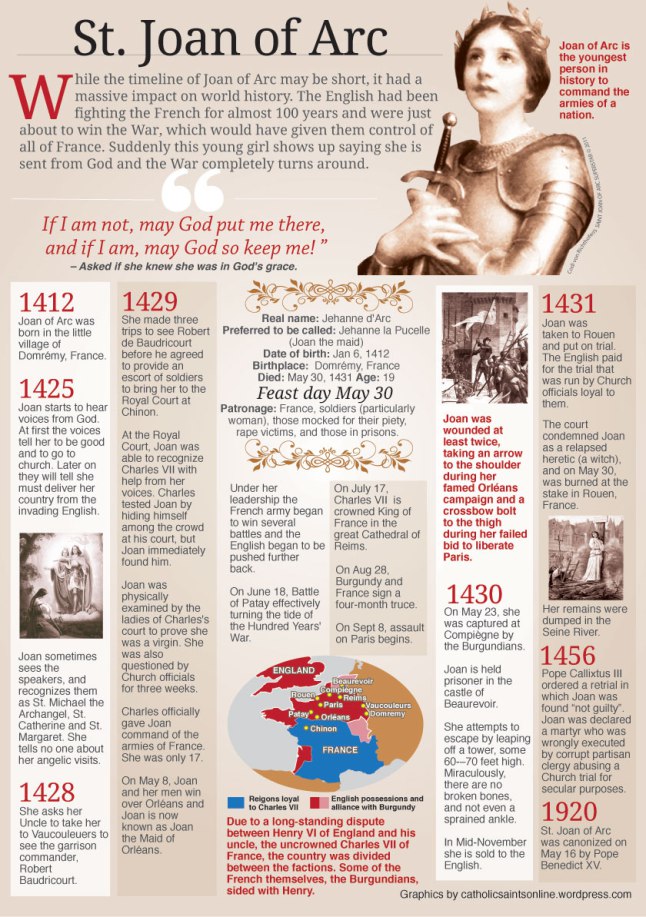
Like Jesus’ life, Joan of Arc’s life seemed to end in failure.   But like Jesus, to love God means to always obey His will.   She said with total confidence and abandonment:  “I entrust myself to my Creator God, I love Him with my whole heart”.   One of the best known texts of the first trial has to do with this:  “Asked if she knew that she was in God’s grace, she replied: ‘If I am not, may it please God to put me in it; if I am, may it please God to keep me there’”   It is this fidelity we should seek – this mission which Joan seemed to know would destroy her, still for her it was to carry out God’s work, regardless of the effects on her life.   May we too seek this total fidelity and self-giving to God for this life of ours, it is not ours but has been given to us by grace of His love.

Few Christians hear heaven-sent voices.   I know I don’t.   Joan was one of those rare exceptions who did.   She obeyed what she perceived to be God’s directions and against all odds she achieved the purpose she was given.   Though I’ve never heard a heaven-sent voice, now and then I sense something God wants of me.   Perhaps Joan’s example will reach down through the centuries to encourage us to listen closely for and then to obey, God’s message to us.

St Joan of Arc, pray for us!st-joan-pray-for-us-30 may 2018

Posted in QUOTES of the SAINTS, QUOTES on DIVINE PROVIDENCE, QUOTES on FAITH, QUOTES on LOVE, QUOTES on PRAYER, QUOTES on TRUST and complete CONFIDENCE in GOD, SAINT of the DAY

Quote/s of the Day – 30 May – The Memorial of St Joan of Arc (1412-1431)

Quote/s of the Day – 30 May – The Memorial of St Joan of Arc (1412-1431)

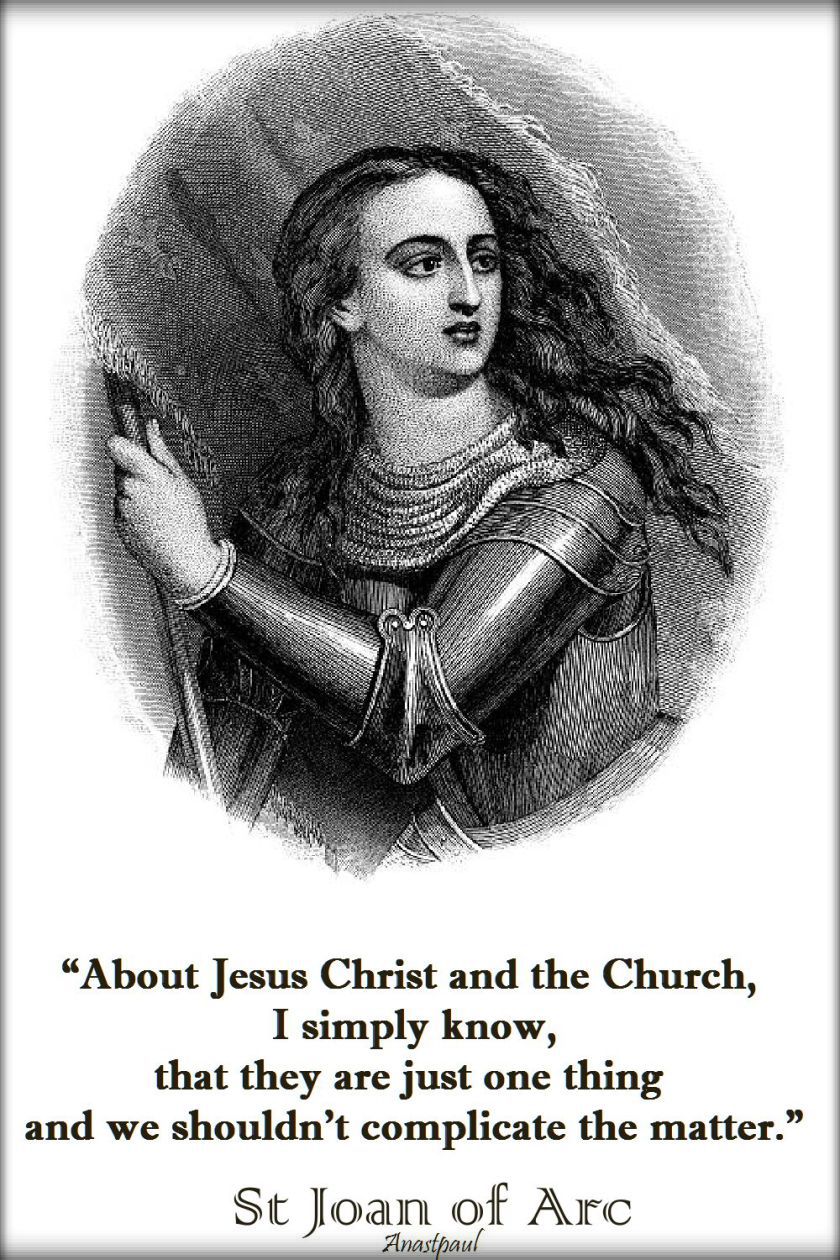
“About Jesus Christ and the Church,
I simply know, that they are just one thing
and we shouldn’t complicate the matter.”

about-jesus-christ-and-the-church-st-joan-of-arc-30 may 2018

“Help yourself and God will help you.”

help yourself and god will help you - st joan - 30 may 2018

“I am the drum on which God
is beating out His message.”

i am the drum - st joan of arc - 30 may 2020

“If I be not in a state of grace,
I pray God place me in it,
if I be in it, I pray God keep me so.”

if i be not in a state of grace st joan of arc - 30 may 2018

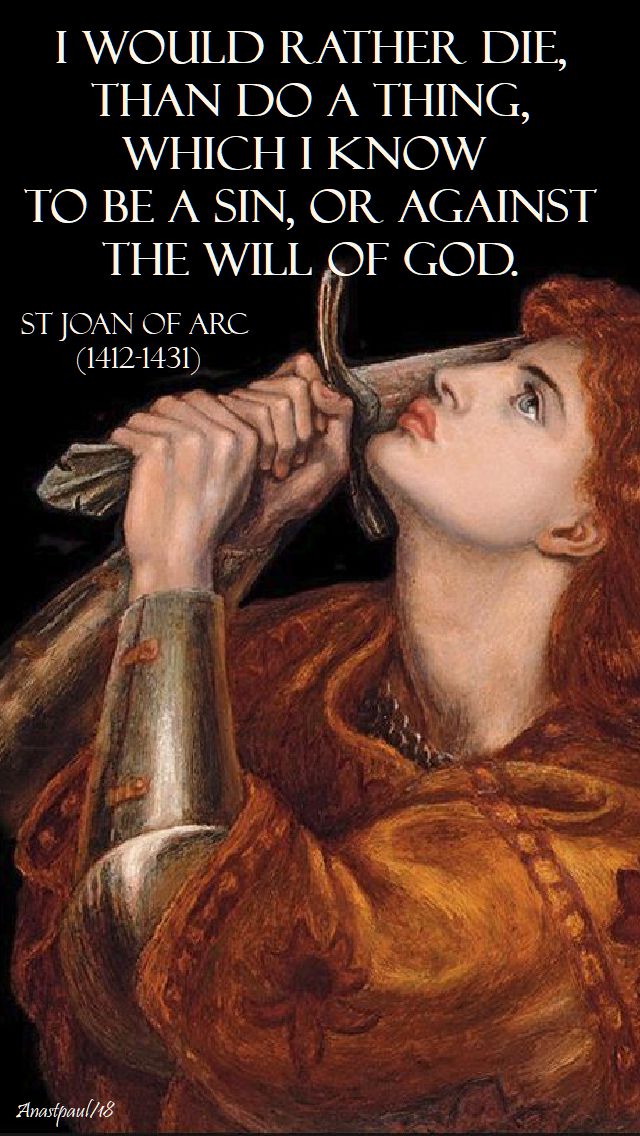
“I would rather die, than do a thing,
which I know to be a sin,
or against the will of God.”

i would rather die =st joan of arc - 30 may 2018

“Every man gives his life, for what he believes.
Every woman gives her life, for what she believes.
Sometimes people believe, in little or nothing
and so they give their lives, to little or nothing.
One life is all we have and we live it, as we believe in living it…
and then it’s gone.
But to surrender, who you are and to live without belief,
is more terrible than dying – even more terrible than dying young.”

every man gives his life - st joan of arc - 30 may 2018

“All battles are first won or lost, in the mind.”

all battles are first won - st joan of arc - 30 mary 2018

St Joan of Arc (1412-1431)

Posted in CATHOLIC DEVOTIONS of the Month, MARIAN PRAYERS, MARIAN QUOTES, MARIAN TITLES, QUOTES of the SAINTS, The BLESSED VIRGIN MARY, The WORD

One Minute Marian Reflection – 30 May “Mary’s Month”

One Minute Marian Reflection – 30 May “Mary’s Month”

And coming to her, he said, “Hail, favoured one! The Lord is with you.”…Luke 1:28

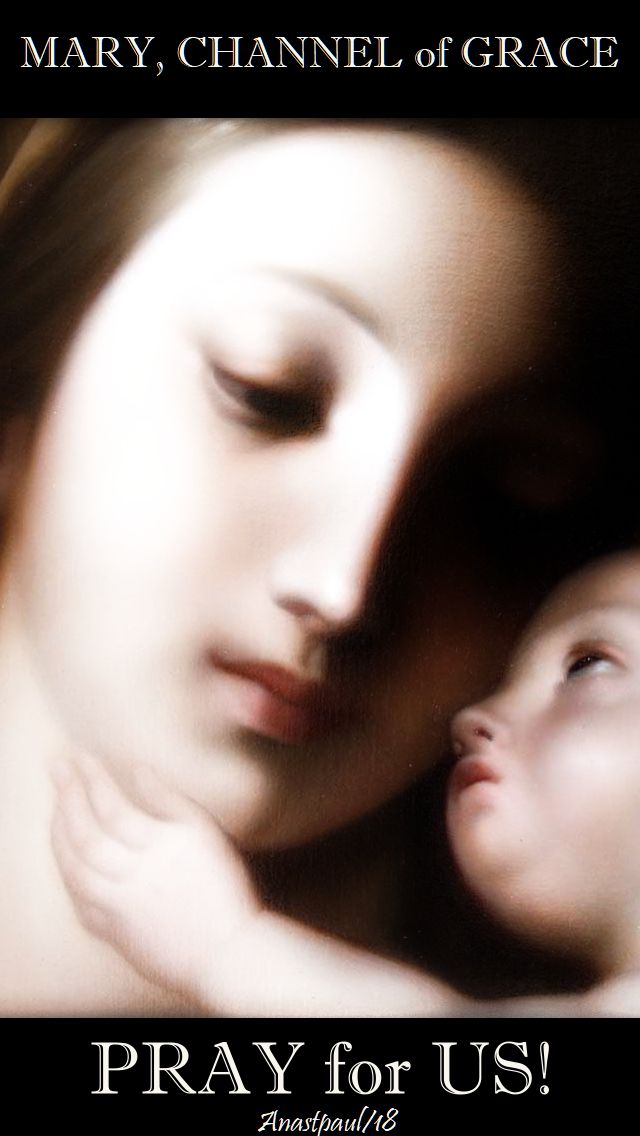
REFLECTION“MARY:  THE CHANNEL OF GRACE – “Her power before God is such that she can obtain anything that we ask for and, like any mother, she wants to answer our prayers.   Like any mother, also, she knows and understands our weaknesses.   She encourages us and makes excuses for us.   She makes the way easy for us and, even when we think there is no possible solution for our worry, she always has one ready to offer us.”…St Josemaría Escrivá (1902-1975) “Mother of God and Our Mother,” Friends of God, 292.
Let us offer to our Mother today:
A visit or a conversation with a friend or relative whom we want to encourage to go to Confession.luke 1 28 - hail favoured one - like any mother also, she knows - st josemaria - 30 may 2018

PRAYER – Almighty God, Your incarnate Word fills us with the new light He brought to men.   Let the light of faith in our hearts shine through all that we do and say. Grant that through Mary, mother of Christ and our mother and protector, by her prayers and solace, we may learn humility and true faith.   We make our prayer through Jesus, our Lord, who is with You and the Holy Spirit, one God forever, amen.mary channel of grace - pray for us - 30 may 2018

Posted in CATHOLIC DEVOTIONS of the Month, DOCTORS of the Church, MARIAN PRAYERS, MORNING Prayers, The BLESSED VIRGIN MARY

Our Morning Offering – 30 May “Mary’s Month”

Our Morning Offering – 30 May “Mary’s Month”

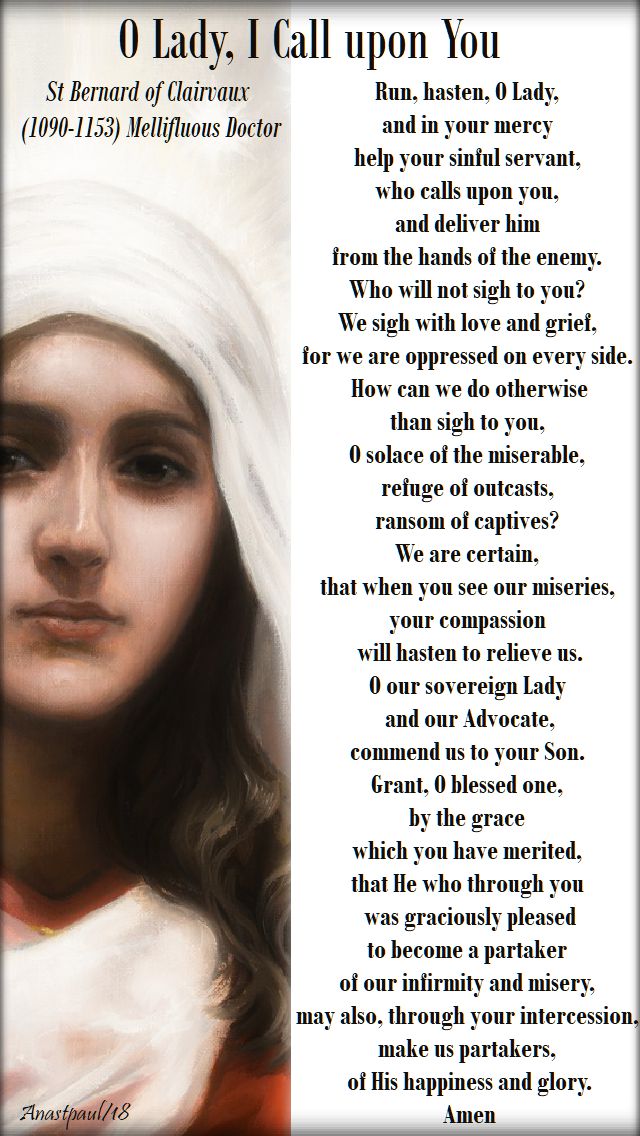
O Lady, I Call upon You
St Bernard of Clairvaux (1090-1153) Mellifluous Doctor

Run, hasten, O Lady,
and in your mercy help your sinful servant,
who calls upon you,
and deliver him from the hands of the enemy.
Who will not sigh to you?
We sigh with love and grief,
for we are oppressed on every side.
How can we do otherwise than sigh to you,
O solace of the miserable,
refuge of outcasts,
ransom of captives?
We are certain that when you see our miseries,
your compassion will hasten to relieve us.
O our sovereign Lady and our Advocate,
commend us to your Son.
Grant, O blessed one,
by the grace which you have merited,
that He who through you
was graciously pleased to become a partaker
of our infirmity and misery,
may also, through your intercession,
make us partakers, of His happiness and glory.
Ameno lady i call upon you - st bernard, run hasten o lady - 30 may 2018

Posted in PAPAL SERMONS, SAINT of the DAY

Saint of the Day – 30 May – St Joan of Arc (1412-1431)

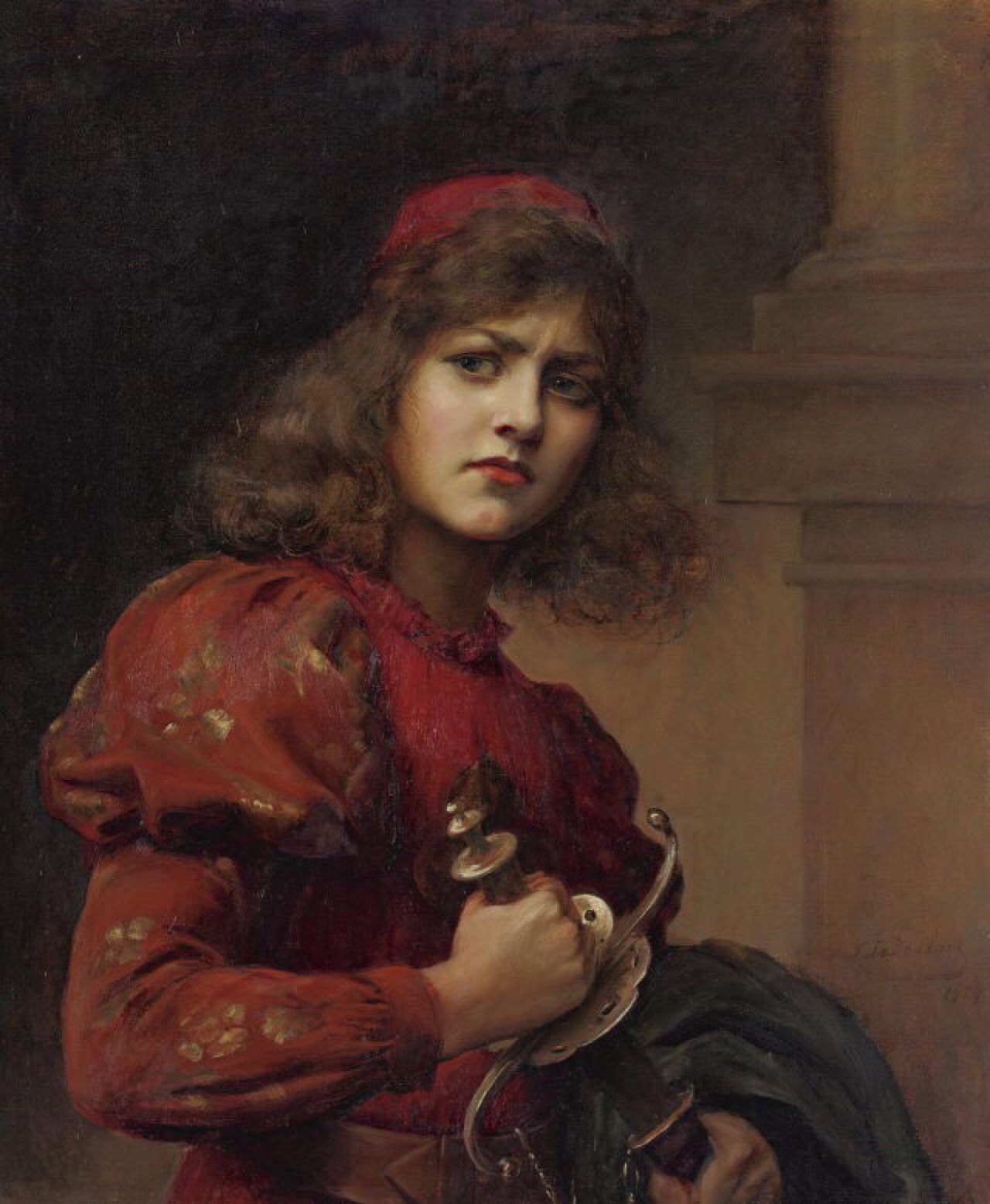
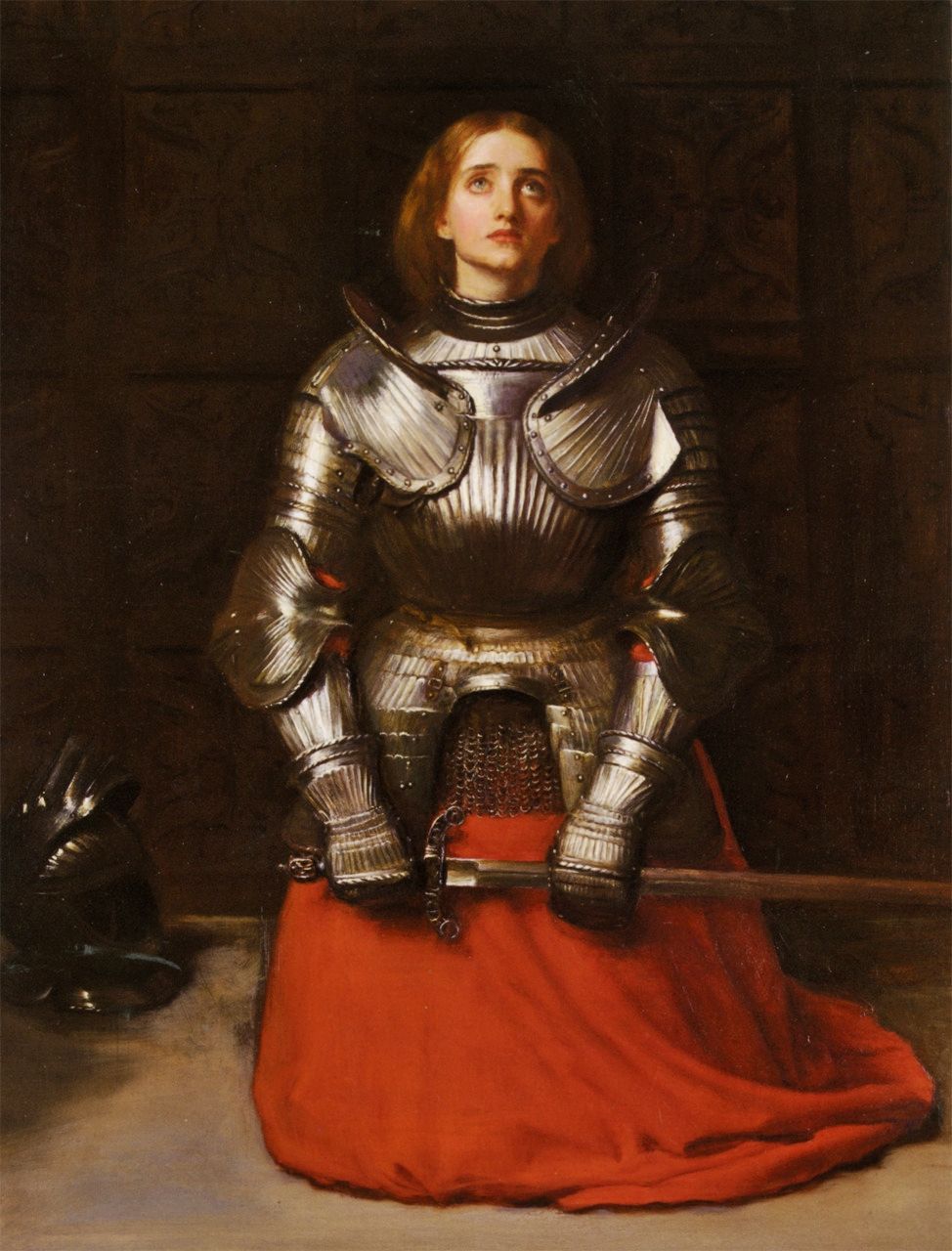
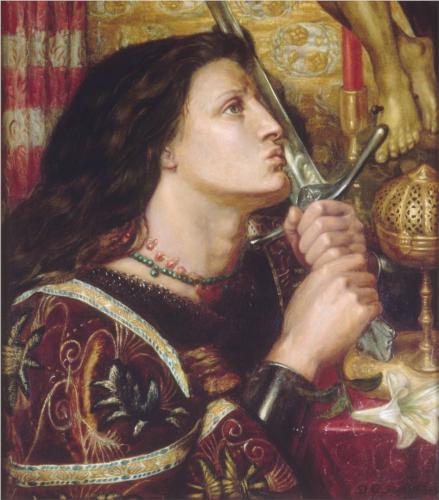
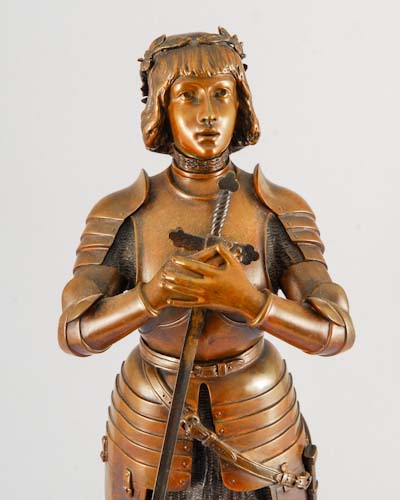
Saint of the Day – 30 May – St Joan of Arc (1412-1431) Jeanne d’Arc “The Maid of Orléans” Holy Virgin.   Biography and details of St Joan’s life here – https://anastpaul.wordpress.com/2017/05/30/saint-of-the-day-30-may-st-joan-of-arc/joan-11joan of arc

BENEDICT XVI

GENERAL AUDIENCE

Paul VI Audience Hall
Wednesday, 26 January 2011

Dear Brothers and Sisters,

Today I would like to talk to you about Joan of Arc, a young Saint who lived at the end of the Middle Ages who died at the age of 19, in 1431.   This French Saint, mentioned several times in the Catechism of the Catholic Church, is particularly close to St Catherine of Siena, Patroness of Italy and of Europe, of whom I spoke in a recent Catechesis.   They were in fact two young women of the people, lay women consecrated in virginity, two committed mystics, not in the cloister, but in the midst of the most dramatic reality of the Church and the world of their time.   They are perhaps the most representative of those “strong women” who, at the end of the Middle Ages, fearlessly bore the great light of the Gospel in the complex events of history.   We could liken them to the holy women who stayed on Calvary, close to the Crucified Jesus and to Mary his Mother, while the Apostles had fled and Peter himself had denied him three times.

The Church in that period was going through the profound crisis of the great schism of the West, which lasted almost 40 years.   In 1380, when Catherine of Siena died, there was not only a Pope but also an antipope; when Joan was born, in 1412, there was a Pope as well as two antipopes.   In addition to this internal laceration in the Church, were the continuous fratricidal wars among the Christian peoples of Europe, the most dramatic of which was the protracted Hundred Years’ War between France and England.

Joan of Arc did not know how to read or write but the depths of her soul can be known thanks to two sources of exceptional historical value: the two Trials that concern her. The first, the Trial of Condemnation (PCon), contains the transcription of the long and numerous interrogations to which Joan was subjected in the last months of her life (February-May 1431) and reports the Saint’s own words.   The second, the Trial of Nullity of the Condemnation or of “rehabilitation” (PNul), contains the depositions of about 120 eyewitnesses of all the periods of her life (cfProcès de Condamnation de Jeanne d’Arc, 3 vol. and Procès en Nullité de la Condamnation de Jeanne d’Arc, 5 vol., ed. Klincksieck, Paris, 1960-1989).

Joan was born at Domremy, a little village on the border between France and Lorraine. Her parents were well-off peasants, known to all as good Christians.   From them she received a sound religious upbringing, considerably influenced by the spirituality of the Name of Jesus, taught by St Bernardine of Siena and spread in Europe by the Franciscans.

The Name of Mary was always associated with the Name of Jesus and thus, against the background of popular piety, Joan’s spirituality was profoundly Christocentric and Marian.   From childhood, she showed great love and compassion for the poorest, the sick and all the suffering, in the dramatic context of the war.

We know from Joan’s own words that her religious life developed as a mystical experience from the time when she was 13 (PCon, I, p. 47-48).   Through the “voice” of St Michael the Archangel, Joan felt called by the Lord to intensify her Christian life and also to commit herself in the first person to the liberation of her people.   Her immediate response, her “yes”, was her vow of virginity, with a new commitment to sacramental life and to prayer: daily participation in Mass, frequent Confession and Communion and long periods of silent prayer before the Crucified One or the image of Our Lady.

The young French peasant girl’s compassion and dedication in the face of her people’s suffering were intensified by her mystical relationship with God.   One of the most original aspects of this young woman’s holiness was precisely this link between mystical experience and political mission.   The years of her hidden life and her interior development were followed by the brief but intense two years of her public life: a year of action and a year of passion.

At the beginning of 1429, Joan began her work of liberation.   The many witnesses show us this young woman who was only 17 years old as a very strong and determined person, able to convince people who felt insecure and discouraged.   Overcoming all obstacles, she met the Dauphin of France, the future King Charles VII, who subjected her to an examination in Poitiers by some theologians of the university.   Their opinion was positive:  they saw in her nothing evil, only a good Christian.

On 22 March 1429 Joan dictated an important letter to the King of England and to his men at arms who were besieging the city of Orléans (ibid., pp. 221-222).   Hers was a true proposal of peace in justice between the two Christian peoples in light of the Name of Jesus and Mary, but it was rejected and Joan had to gird herself to fight for the city’s liberation which took place on 8 May. The other culminating moment of her political action was the coronation of King Charles VII in Rheims on 17 July 1429.   For a whole year, Joan lived with the soldiers, carrying out among them a true mission of evangelization.   Many of them testified to her goodness, her courage and her extraordinary purity.   She was called by all and by herself “La pucelle” (“the Maid”), that is, virgin.

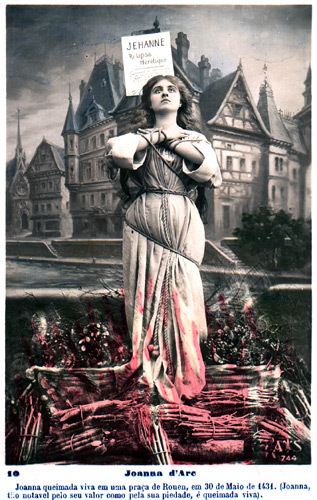
Joan’s passion began on 23 May 1430, when she fell into enemy hands and was taken prisoner.   On 23 December she was led to the city of Rouen.   There the long and dramatic Trial of Condemnation took place, that began in February 1431 and ended on 30 May with her being burned at the stake.

It was a great and solemn Trial, at which two ecclesiastical judges presided, Bishop Pierre Cauchon and the Inquisitor Jean le Maistre, but in fact it was conducted entirely by a large group of theologians from the renowned University of Paris, who took part in the Trial as assessors.   They were French clerics, who, on the side politically opposed to Joan’s, had a priori a negative opinion of both her and her mission.   This Trial is a distressing page in the history of holiness and also an illuminating page on the mystery of the Church which, according to the words of the Second Vatican Council, is “at once holy and always in need of purification” (Lumen Gentium, n. 8).

The Trial was the dramatic encounter between this Saint and her judges, who were clerics.   Joan was accused and convicted by them, even condemned as a heretic and sent to the terrible death of being burned at the stake.   Unlike the holy theologians who had illuminated the University of Paris, such as St Bonaventure, St Thomas Aquinas and Bl Duns Scotus, of whom I have spoken in several Catecheses, these judges were theologians who lacked charity and the humility to see God’s action in this young woman.

The words of Jesus, who said that God’s mysteries are revealed to those who have a child’s heart while they remain hidden to the learned and the wise who have no humility (cf. Lk 10:21), spring to mind.   Thus, Joan’s judges were radically incapable of understanding her or of perceiving the beauty of her soul.   They did not know that they were condemning a Saint.

Joan’s appeal to the Pope, on 24 May, was rejected by the tribunal.   On the morning of 30 May, in prison, she received Holy Communion for the last time and was immediately led to her torture in the Old Market Square.   She asked one of the priests to hold up a processional Cross in front of the stake.   Thus she died, her gaze fixed upon the Crucified Jesus and crying out several times the Name of Jesus (PNul, I, p. 457; cf. Catechism of the Catholic Church, n. 435).   About 25 years later the Trial of Nullity, which opened under the authority of Pope Calixtus III, ended with a solemn sentence that declared the condemnation null and void (7 July 1456; PNul, II, pp. 604-610).  This long trial, which collected the evidence of witnesses and the opinions of many theologians, all favourable to Joan, sheds light on her innocence and on her perfect fidelity to the Church.   Joan of Arc was subsequently canonised by Benedict XV in 1920.

Dear brothers and sisters, the Name of Jesus, invoked by our Saint until the very last moments of her earthly life was like the continuous breathing of her soul, like the beating of her heart, the centre of her whole life.   The Mystery of the Charity of Joan of Arcwhich so fascinated the poet Charles Péguy was this total love for Jesus and for her neighbour in Jesus and for Jesus.   This Saint had understood that Love embraces the whole of the reality of God and of the human being, of Heaven and of earth, of the Church and of the world.   Jesus always had pride of place in her life, in accordance to her beautiful affirmation:  “We must serve God first” (PCon, I, p. 288; cf. Catechismo della Chiesa Cattolica, n. 223). Loving him means always doing his will.   She declared with total surrender and trust:  “I entrust myself to God my Creator, I love him with my whole my heart” (PCon, I, p. 337).   With the vow of virginity, Joan consecrated her whole being exclusively to the one Love of Jesus:  “it was the promise that she made to Our Lord to preserve the virginity of her body and her mind well” (PCon, I, pp. 149-150).

Virginity of soul is the state of grace, a supreme value, for her more precious than life. It is a gift of God which is to be received and preserved with humility and trust.   One of the best known texts of the first Trial concerns precisely this:  “Asked if she knew that she was in God’s grace, she replied:  ‘If I am not, may it please God to put me in it; if I am, may it please God to keep me there’” (ibid., p. 62; cf. Catechism of the Catholic Church, n. 2005).

Our Saint lived prayer in the form of a continuous dialogue with the Lord who also illuminated her dialogue with the judges and gave her peace and security.   She asked him with trust:  “Sweetest God, in honour of your holy Passion, I ask you, if you love me, to show me how I must answer these men of the Church” (PCon, I, p. 252).   Joan saw Jesus as the “King of Heaven and of the earth”.   She therefore had painted on her standard the image of “Our Lord holding the world” (ibid., p. 172):  the emblem of her political mission.   The liberation of her people was a work of human justice which Joan carried out in charity, for love of Jesus.   Her holiness is a beautiful example for lay people engaged in politics, especially in the most difficult situations.   Faith is the light that guides every decision, as a century later another great Saint, the Englishman Thomas More, was to testify.

In Jesus Joan contemplated the whole reality of the Church, the “Church triumphant” of Heaven, as well as the “Church militant” on earth.   According to her words, “About Jesus Christ and the Church, I simply know they’re just one thing” (ibid., p. 166). This affirmation, cited in the Catechism of the Catholic Church (n. 795), has a truly heroic character in the context of the Trial of Condemnation, before her judges, men of the Church who were persecuting and condemning her. In the Love of Jesus Joan found the strength to love the Church to the very end, even at the moment she was sentenced.

I like to recall that St Joan of Arc had a profound influence on a young Saint of the modern age:  Thérèse of the Child Jesus. In the context of a completely different life, spent in the cloister, the Carmelite of Lisieux felt very close to Joan, living in the heart of the Church and participating in Christ’s suffering for the world’s salvation.   The Church has brought them together as Patronesses of France, after the Virgin Mary.

St Thérèse expressed her desire to die, like Joan, with the Name of Jesus on her lips (Manoscritto B, 3r), and she was motivated by the same great love for Jesus and her neighbour, lived in consecrated virginity.

Dear brothers and sisters, with her luminous witness St Joan of Arc invites us to a high standard of Christian living, to make prayer the guiding motive of our days, to have full trust in doing God’s will, whatever it may be, to live charity without favouritism, without limits and drawing, like her, from the Love of Jesus a profound love for the Church. Thank you.

joan Ajoan john everett millaisRossetti, Dante Gabriel, joan-of-arc-kisses-the-sword-of-liberation-1863.jpg!Blogbronze statue st joanjoan-16

Posted in SAINT of the DAY

Memorials of the Saints – 30 May

St Anastasius II of Pavia
St Basil the Elder
Bl Carlo Liviero
St Crispulus of Sardinia

Bl Elisabeth Stagel
St Emmelia
St Euplius
St Exuperantius of Ravenna
St Pope Felix ISt
Ferdinand III of Castille
St Gamo of Brittany
St Gavino of Sardinia
St Issac of Constantinople
St Joan of Arc (1412-1431)

St Joseph Marello
Bl Lawrence Richardson
St Luke Kirby
St Madelgisilus
Bl Marie-Céline of the Presentation
Bl Otto Neururer
St Reinhildis of Riesenbeck
St Restitutus of Cagliari
Bl Richard Newport
Bl Thomas Cottam
St Venantius of Lérins
St Walstan of Bawburgh
Bl William Filby
Bl Willilam Scott

Martyrs of Aquileia – 3 saints: Three Christians martyr together. We have no other details than their names – Cantianus, Euthymius and Eutychius. Aquileia, Italy

Posted in CATHOLIC DEVOTIONS of the Month, MARIAN PRAYERS, MARIAN QUOTES, MARIAN TITLES, MORNING Prayers, PAPAL SERMONS, PRAYERS of the SAINTS, QUOTES of the SAINTS, SAINT of the DAY, The BLESSED VIRGIN MARY, VATICAN Resources

Thought for the Day and it’s Marian too – 29 May “Mary’s Month!” – The Memorial of Blessed Joseph Gerard O.M.I. (1831-1914)

Thought for the Day and it’s Marian too – 29 May “Mary’s Month!” – The Memorial of Blessed Joseph Gerard O.M.I. (1831-1914)

BEATIFICATION OF FATHER JOSEPH GÉRARD

HOMILY OF JOHN PAUL II

Maseru Race Course (Lesotho)
Thursday, 15 September 1988

“My soul proclaims the greatness of the Lord” (Luc. 1, 46).

Dear Brothers and Sisters in Christ,

1. On the day after the feast of the Triumph of the Cross of Christ, the liturgy of the Church, directs our attention towards her, who is found at the foot of the Cross, to the Mother of Christ, Mary.

She stood at the foot of the Cross, together with three other women and with John, the disciple whom Christ loved.   The Second Vatican Council, teaches us that Mary is found there, at the foot of the Cross, “in keeping with the divine plan” (Lumen Gentium, 58).

Indeed in a certain sense this was the climax in her life’s pilgrimage, the moment for which the Holy Spirit had been preparing her throughout her entire existence and especially from the time of the Annunciation.   It was the culmination of her pilgrimage of faith, of hope and of that special union with Jesus, her Son, the Redeemer of the world.

At the beginning of this pilgrimage, we hear Mary say in the house of her kinswoman Elizabeth, when she speaks of the great things the Almighty has done for her:  “My soul proclaims the greatness of the Lord”.   At the foot of the Cross, “a sword pierces Mary’s soul”, fulfilling the words of Simeon (Cfr. Luc. 2, 35).

And yet, Mary does not cease to believe.   The great works of God are accomplished precisely through this Cross, through the Sacrifice of the life of her Son.   And united to the redemptive Sacrifice of her Son is the maternal sacrifice of her heart.

2. The Church leads us today into the very centre of the Heart of Mary, into the intimate mystery of her union with her Son, a union which here, at the foot of the Cross, reaches its particular fullness.

In the Letter to the Hebrews we read that Christ, while being Son of God, one in being with the Father, “learned to obey through suffering” (Hebr 5, 8).   And precisely through this obedience, even to death on the Cross “he became for all who obey him the source of eternal salvation” (Ibid 5, 9).

At the moment of the Annunciation Mary first spoke her “fiat”.

She said:  “Let what you have said be done to me”.   And, with new strength of faith and trust in God, she repeated this “fiat” at the foot of the Cross!   This was her maternal sharing in the redemptive obedience of her Son as he offered his life on the Cross for the sins of the world.

At the foot of the Cross, Mary never ceased to praise the wondrous mercy of God, the mercy which endures “from generation to generation”.     And she did not cease to proclaim the saving “power of his arm”, which puts down the proud and raises the lowly. Like no other person on earth, Mary was able to penetrate the Paschal Mystery of Christ; she understood it with her heart.

3. And therefore the Church sees the Mother of God, as the one who “preceded in the pilgrimage of faith” all the People of God on earth.  In this faith, she became a true daughter of Abraham; indeed she even surpassed him whom Saint Paul calls “the Father of all believers” (Rom. 4, 11).   Her pilgrimage of faith, has done something even greater:  it has enabled us to enter, ever more profoundly, into the inscrutable mysteries of God.

The Church in your country, in Lesotho, here in Maseru, as does the Church throughout the earth, goes forward on this same pilgrimage of faith, the pilgrimage on which the Mother of God has gone before us.   Today the Bishop of Rome meets you on this pilgrimage.   He stands in your midst and celebrates with you the Eucharistic Sacrifice on the Feast of Our Lady of Sorrows.

4. It is with great joy, that I join you in prayer today, my brothers and sisters of the Church in Lesotho.   I know that many of you have had to make many sacrifices in order to be here and I assure you of my happiness and gratitude that you have come.   Your presence at this Liturgy is a sign of your love for the Church and an expression of your willingness to bear witness to the Kingdom of Christ.

I am also aware that many people would have liked to be with us but have been unable to do so:  the sick and suffering, those who live too far away, those who are too young or too old.   To all of them, I say with deep affection, the Pope embraces you and loves you in the Sacred Heart of Jesus Christ our Redeemer.

My fraternal greetings go to Archbishop Morapeli of Maseru and to the bishops of the other dioceses of Lesotho.   With them, I greet all your dedicated priests and religious, your catechists and all the members of your Christian families.

I greet our non-Catholic brothers and sisters in Christ and all people of good will and I thank you for joining us on this historic occasion.   I offer very cordial greetings, to those who have come from beyond the borders of this country.

In a very special way, I greet the people of South Africa where Blessed Joseph Gérard laboured in Natal and the eastern Free State.

As members of one family, united in the love of Jesus, we rejoice today in the everlasting mercy of God who has granted us the gift of faith and made us a people of hope, a people on pilgrimage to the eternal Kingdom of God.

5. This day has a particular significance for the journey of faith which the Church in Lesotho is making.   For today we celebrate the Beatification of the Servant of God, Joseph Gérard.

In the First Reading of the Liturgy, taken from the book of Genesis, we hear God calling Abraham to set out on a journey of faith, to set out on a road that will take him away from all that he has ever known and loved, to put all his trust in the promise of the Lord.

Father Gérard heard God addressing to him a similar call of faith.   As in the case of Abraham, the Lord said to the young Frenchman named Joseph, “Leave your country, your family and your father’s house, for the land I will show you” (Gen. 12, 1).   And he went promptly, as the Lord told him.   He followed God’s call.   He placed all his trust in the promise he had heard from on high.

The land that God showed Blessed Joseph was Africa, more precisely the land of South Africa and then some years laser the land of the Basotho people.   To this land, this Kingdom of Lesotho, he came as a man of faith.   He came because he had been called and sent to proclaim the Kingdom of God.

6. From an early age, Joseph Gérard had been convinced that God was calling him to be a missionary.   His heart overflowed with gratitude for the gift of the Christian life and he longed to share with others this treasure, this priceless pearl, the infinite riches of knowing Jesus Christ.   And it was this constant zeal for evangelisation that shaped every stage of his long life.

Upon his arrival in Lesotho, together with Bishop Allard and Brother Bernard, he at once set about learning the language and customs of the Basotho people.   He tried to understand their way of thinking, their sensitivities, their hopes and desires.   He was eager to understand their very souls, so that he could decide on the best methods to use in preaching to them the Good News of salvation.

Father Gérard and his companions began their apostolic work at the mission called Roma.   They gave themselves wholeheartedly and sacrificially to the task, relying completely on the grace of the Holy Spirit.   And the Spirit of God soon brought forth fruit.   Only a few years later, in 1866, a second mission at Korokoro was established.   And in 1868 yet a third mission dedicated to Saint Michael was begun.

In obedience to his superior, Father Gérard went to the northern part of the country in 1876, where he founded the mission of Saint Monica.   For the next twenty years and more, he laboured there untiringly, establishing a convent and school and building other missions in the surrounding area.   In all his pastoral endeavours and plans, he placed all his hope in God, remembering the words spoken at his priestly ordination, namely that God who began the good work in him would bring it to completion.

Wherever Blessed Joseph Gérard went, he lived his missionary vocation with extraordinary apostolic fervour.   His love for God, which burned ever more ardently in his heart, showed itself in practical love of neighbour.   Above all he is remembered for his special care for the sick and suffering.   Through frequent visits and his gentle manner, he always seemed to bring them fresh courage and hope.   For those near the hour of death he found the right words to prepare them to meet God peacefully, face to face.

The secret of his holiness, the key to his joy and zeal, was the simple fact that he lived continually in the presence of God.   Blessed Joseph’s whole life was caught up in the love of the Holy Trinity.   People wanted to be near to Father Gérard because he always seemed near to God.   He was filled with a spirit of prayer, nourished daily by the Liturgy of the Hours and by frequent visits to the Blessed Sacrament.   He had a fervent devotion to the Mother of God and the Saints.   During his long and difficult journeys to outlying missions and the homes of the sick, he conversed continually with his beloved Lord.   It is undoubtedly, this vivid sense of being always in the presence of God, that explains his lifelong fidelity to his religious vows of chastity, poverty and obedience and to his obligations as a priest.

God blessed Father Gérard with a long life of apostolic service.   He granted him the grace to see over half a century of the unfolding evangelisation of Lesotho.   Father Gérard is certainly rejoicing today at the vitality of the Church in this country which was so dear to his heart:  its bishops are native sons, there is an increasing number of vocations to the priesthood and religious life, the active laity numbers more than six hundred thousand people, including a hundred and forty thousand studying in Catholic schools.   But with his missionary spirit, would he not still encourage us today to carry on with fresh enthusiasm the many-sided task of proclaiming the Gospel of Christ?

7. Here in Lesotho you have a traditional greeting:  Khotso, Pula, Nala, – peace, rain and abundance.   Blessed Joseph Gérard must have often prayed for these same blessings, he must have often uttered this same greeting in this land.   Above all, he always tried to be a servant of reconciliation and peace, for this is an essential part of evangelisation.

To evangelise means to proclaim the Good News of our Lord Jesus Christ, the Saviour of the whole world, to tell the story of how “God wanted all perfection to be found in him and all things to be reconciled through him and for him, everything in heaven and everything on earth, by his death on the Cross” (Col. 1, 19-20).   The first step of evangelisation is to accept the grace of conversion into our own minds and hearts, to let ourselves be reconciled to God.   We must first experience God’s gracious mercy, the love of Christ which has “reconciled us to himself” and given us “the work of handing on this reconciliation” (2Cor. 5-18).

As the twentieth century draws to a close and as your country looks to the future, this is the special gift and the greatest responsibility which the members of the Church offer to their fellow citizens, to be servants of reconciliation and peace, after the example of Blessed Joseph Gérard.

Always believe in the power of love and truth, the love of neighbour which is rooted in the love of God and the truth which sets people free.    Reject violence as a solution to any situation, no matter how unjust it may be.   Put your trust in the methods that respect the rights of all and that are fully in accordance with the Gospel.   Above all, trust in the God of justice, who created all things, who sees all human events, who holds in his hands the destiny of every person and of every nation.

8. Dear brothers and sisters:  I rejoice with you on this solemn day of celebration.   It is a day of great importance in your pilgrimage of faith and hope, a day of jubilation on the journey to union with Christ which the People of God in this land are making.   Let us give thanks to the most holy God for this day.   Let us sing, together with Mary:  “My soul proclaims the greatness of the Lord and my spirit exults in God my Saviour” (Luc. 1, 46-47).

Together with Mary and with Blessed Joseph Gérard, let all the people of Lesotho exult in God our Saviour.   Yes, all of you: young and old, children and parents, workers and teachers, priests and religious, the handicapped and the sick.   Let us all praise the Lord with grateful voices, for the Almighty has done great things for us.   Holy is his name!

9. Yet, at the same time, let the eyes of our faith never wander from the Cross of Calvary.

We read in the Gospel: “Seeing his mother and the disciple he loved standing near her, Jesus said to his mother, ‘Woman, this is your son’. Then to the disciple he said, ‘This is your mother’. And from that moment the disciple made a place for her in his home” (Io. 19, 26-27).

My fervent wish for all of you, dear brothers and sisters, is that the word of John’s Gospel may be fulfilled in you.

May each of you discover Mary as your Mother.

May each of you seek to be a son, a daughter, of Mary, who at the foot of the Cross becomes in a particular way for us the “Mother of Divine Grace”.

May each of you “make a place for her in your home”, and even more so in your heart, every day and throughout your life, especially at those times of trial and suffering.

May the memory of this blessed day be inscribed for ever in the history of this city and this country, in the history of the whole continent of Africa.

Blessed Joseph Gérard, pray for us, lead us to Jesus through the Immaculate Heart of Mary, our Mother in faith. Amenbl joseph gerard - pray for us - 29 may 2018
Act of entrustment to Mary

O Mary, Mother of our Redeemer, Mother of the Church, at the end of this celebration of the Eucharist, we turn to you with confidence and love.   On this feast of Our Lady of Sorrows, we remember your own sharing in the suffering and death of Christ your Son.

O Mother of Sorrows, it was precisely at the hour of your Son’s death that you became by a new title our Mother, Mother of all the faithful.   For your loving Son said to you, as you stood at the foot of the Cross, “Woman, this is your son!”.

From that moment onwards and throughout the course of human history, you are the Mother not only of the beloved disciple but of every member of the Church.   You are our gentle Mother.   You care for us all as your dear children.   In fact, you see in each of us the face of your beloved Jesus and you intercede with Him on our behalf, for our good and the Redemption of the world.

Today, dearest Mother, I entrust to you all those present at this Holy Sacrifice of the Mass, and all the people living in this mountain Kingdom.   I entrust them to you with complete confidence and love.

O Mother of Sorrows, I bring before you the sick and the elderly and all who are burdened by sin.   I know they will find in you a safe harbour and a consoling help.   You will bring them tenderly but surely, to the foot of the Triumphant Cross.

O Immaculate Heart of Mary, so filled with love for your Son, I entrust to you the youth of Lesotho in whose eyes the future shines.   Protect them from the evil one.   Enable them to see that only your Son is “the Way and the Truth and the Life”, only in Him is there a future full of hope and a life truly founded on love.

O Blessed Virgin of Nazareth, I place before you the families of the Basotho people, all married couples who with their children are called to form a lifelong communion of love.   Keep them pure and chaste, ever faithful to one another, always faithful, as you were, to the life-giving word of God.

O Mary, Model of holiness and first disciple of your Son, I entrust to your gentle care the Church in Lesotho.   As it rejoices in a century and a quarter of evangelisation and in the beatification of Father Joseph Gérard, lead your sons and daughters in the way of constant conversion, along the path of spiritual renewal.   Pray for this local Church, so dear to the Successor of Peter, so dear to your own Immaculate Heart.   Help our brothers and sisters to come to believe with conviction what you believed at the foot of the Cross. that human death is not the final word, for the final word belongs to God, the God of love and mercy, the God who has saved the world through the victorious Cross of your Son.   Amen.

Immaculate Heart of Mary, Pray for us!

O Mother of Sorrows, Pray for us!

 

Posted in CATHOLIC DEVOTIONS of the Month, CONSECRATION Prayers, MARIAN DEVOTIONS, MARIAN PRAYERS, MARIAN QUOTES, MORNING Prayers, PAPAL PRAYERS, PAPAL SERMONS, PRAYERS of the SAINTS, QUOTES of the SAINTS, QUOTES on CHARITY, QUOTES on DIVINE PROVIDENCE, QUOTES on EVANGELISATION, QUOTES on FAITH, QUOTES on JOY, QUOTES on LOVE, QUOTES on PEACE, QUOTES on PERSECUTION, QUOTES on SANCTITY, QUOTES on SUFFERING, QUOTES on TRUST and complete CONFIDENCE in GOD, QUOTES on TRUTH, QUOTES on VIOLENCE, The BLESSED VIRGIN MARY, The HOLY CROSS, VATICAN Resources

Quote/s of the Day – and Marian too – 29 May “Mary’s Month!” – The Memorial of Blessed Joseph Gerard O.M.I. (1831-1914)

Quote/s of the Day – and Marian too – 29 May “Mary’s Month!” – The Memorial of Blessed Joseph Gerard O.M.I. (1831-1914)

“Always believe, in the power of love and truth,
the love of neighbour, which is rooted in the love of God
and the truth, which sets people free.”

“Reject violence as a solution to any situation,
no matter how unjust it may be.”

“Above all, trust in the God of justice,
who created all things,
who sees all human events,
who holds in His hands,
the destiny of every person and of every nation.”always believe in the power of love - above all trust in the god of justice - reject violence - st pope john paul - 29 may 2018

“Let the eyes of our faith
never wander
from the Cross of Calvary.”let the eyes of our faith - st pope john paul - 29 may 2018- no 2

“May each of you, discover Mary, as your Mother.”

“May each of you, seek to be a son, a daughter, of Mary,
who at the foot of the Cross,
becomes in a particular way for us,
the “Mother of Divine Grace”.”

May each of you, “make a place for her in your home”
and even more so in your heart,
every day and throughout your life,
especially at those times, of trial and suffering.”may each of you (on mary) - st pope john paul - 29 may 2018

Maseru Race Course (Lesotho)
Thursday, 15 September 1988

St Pope John Paul II (1920-2005)

Taken from the Beatification Homily of St Pope John Paul II
(See today’s thought for the Day)