Posted in JESUIT SJ, SAINT of the DAY

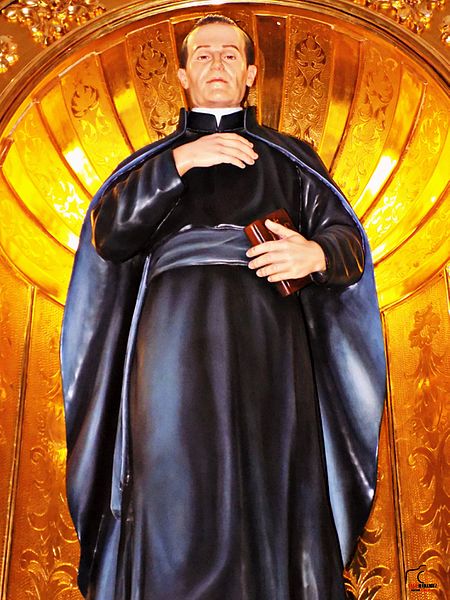
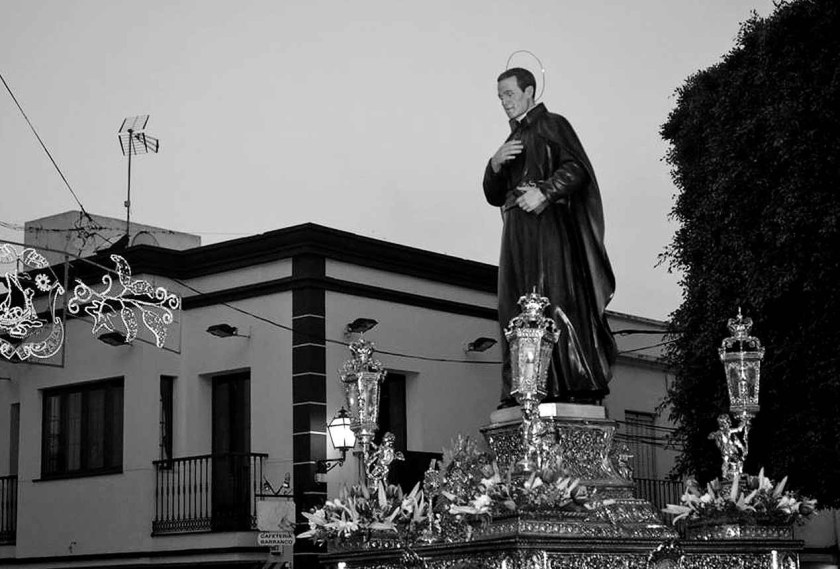
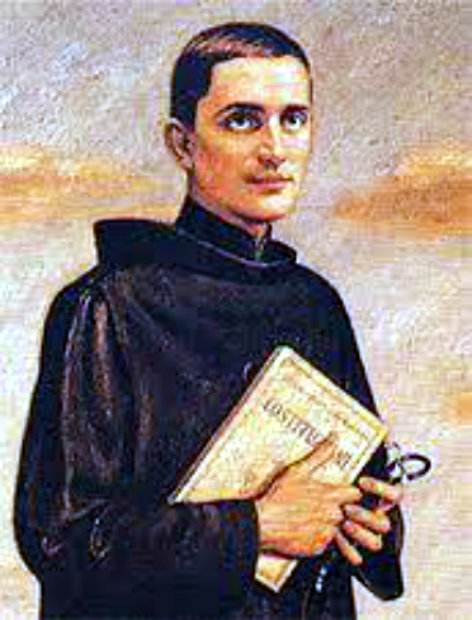
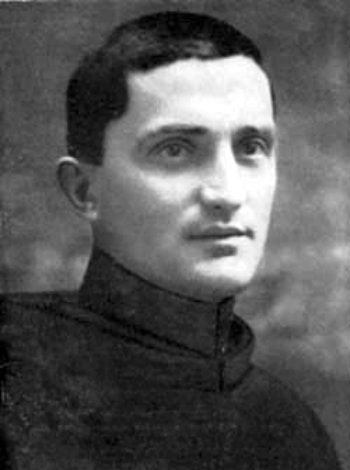
Saint of the Day – 4 May – Saint Jose Maria Rubio y Peralta SJ (1864-1929) “the Apostle of Madrid” and “Father of the Poor”

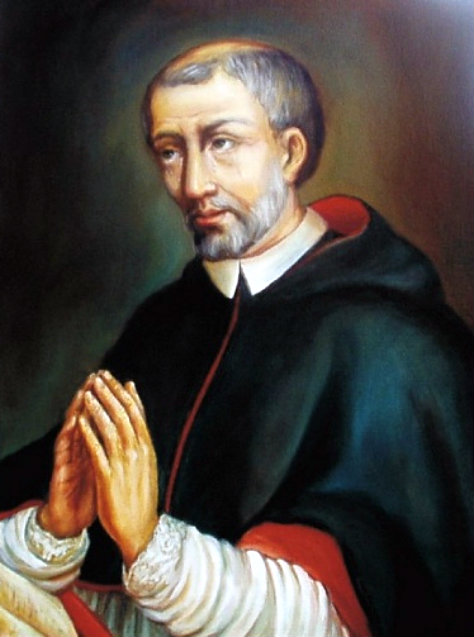
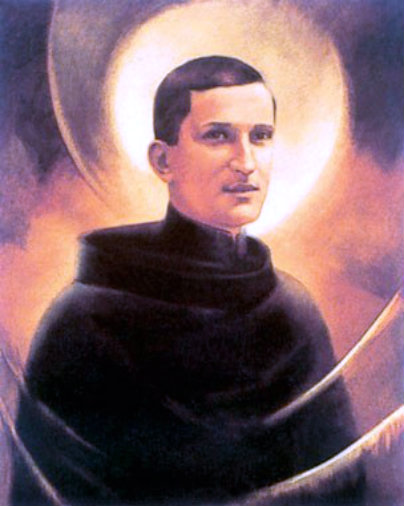
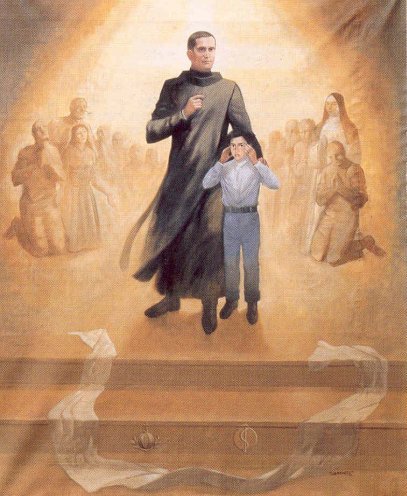
Saint of the Day – 4 May – Saint Jose Maria Rubio y Peralta SJ (1864-1929) aged 64 “the Apostle of Madrid” and “Father of the Poor” – Professed Jesuit Priest, Confessor, Professor, Preacher, Spiritual Director, Apostle of Eucharistic Adoration, Prayer and the Poor, endowed with the gifts of miracles, prophesy and bilocation.   Born on 22 July 1864 in Dallas, Spain and died on 2 May 1929 in Aranjuez, Spain.st jose maria rubio snip 2
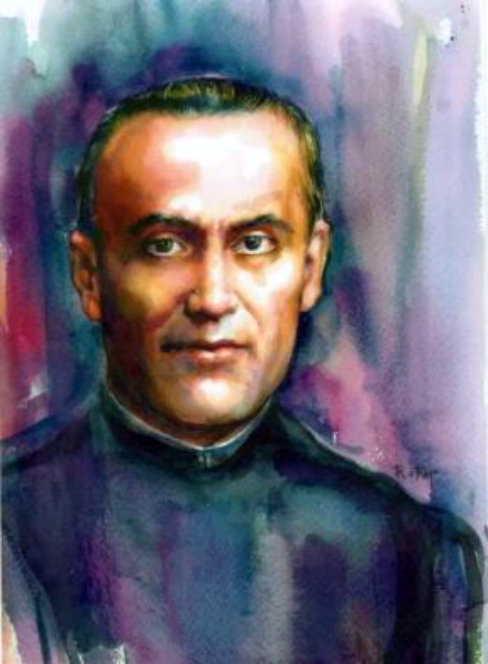
José María Rubio was born on 22 July 1864 in Dalías, Spain.   His parents were farmers and he was one of 12 children, six of whom died at a young age.   He was given a Christian upbringing and in 1875, began secondary school in Almería.   As José María felt called to become a priest, he transferred to the diocesan seminary in 1876 to continue his academic pursuits.   In 1878 he moved to the major seminary of Granada, where over the years he completed studies in philosophy, theology and canon law.   On 24 September 1887 he was ordained a priest.San-Jose-Maria-Rubio-Peralta-Jesuit-founder
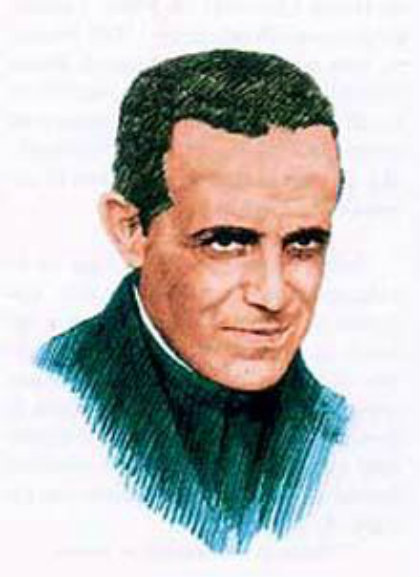
At this time, he also felt called to become a Jesuit but since he was impeded by circumstances – he took care of an elderly priest who needed assistance – he could not fulfil this wish for 19 years.    In the years after his ordination, Fr Rubio was also busy as a vice-parish priest in Chinchón and then as parish priest in Estremera.   In 1890, the Bishop called him to Madrid, where he was given the responsibility of synodal examiner.   He also taught metaphysics, Latin and pastoral theology at the seminary in Madrid and was chaplain to the nuns of St Bernard.

In 1906, after a pilgrimage to the Holy Land the previous year, he entered the Jesuit novitiate in Granada.   On 12 October 1908 he made his religious profession.

Fr Rubio was exemplary in his pastoral ministry, sustained and nurtured by his profound spiritual life.   The Bishop of Madrid called him “The Apostle of Madrid” and the faithful sought him out from the early morning hours for confession and to receive spiritual direction.josemariarubio
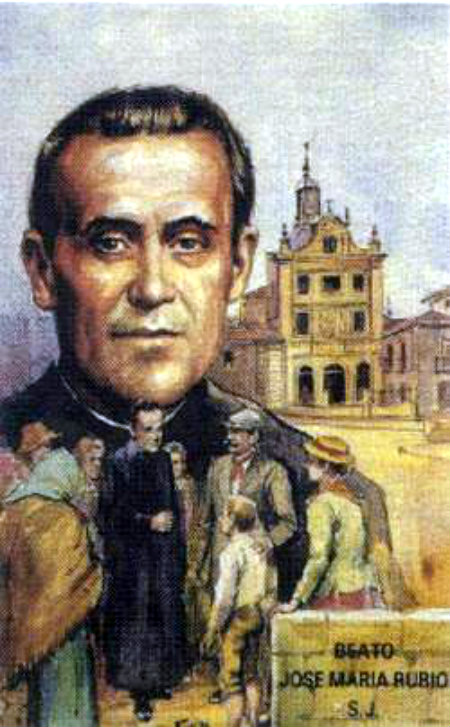
He was known for his incisive, simple preaching that moved many to conversion  . He also had particular devotion to the poor, always providing them with the material and spiritual assistance they needed.

Through his preaching and spiritual direction, Fr Rubio was able to attract and guide many lay people who wanted to live their Christian faith authentically and assist him in the mission of helping the poor.   Under his guidance, they opened tuition-free schools which offered academic formation as well as instruction in various trades  . They also assisted the sick and disabled and tried to find work for the unemployed.

Fr Rubio was always the heart and soul of all of these works but he remained in the background, preferring to let his collaborators take centre stage.   For this reason and to help them develop well, the gifts that God had given them, he gave the laity the main responsibility and taught them to live and act like the Apostles of the Lord Jesus.

Fr Rubio also organised popular missions and spiritual exercises in the poorest zones of the city, because he believed the poor must be helped fully, both spiritually and materially and that they must be encouraged and loved for who they are – for their own human dignity.

The most important aspect of the apostolate for Fr Rubio was prayer, adoration of Jesus in the Blessed Sacrament was the centre of his entire life.   The love of Christ was what Fr Rubio wanted to give to the poor.   For him and his collaborators, prayer came first and it was through this intense prayer life that they received the strength to minister in the poorest and most abandoned areas of Madrid and to assist the people spiritually.

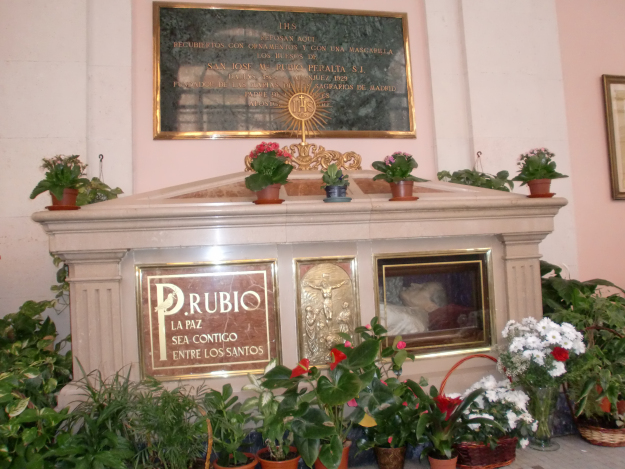
Fr José María Rubio died on 2 May 1929 in Aranjuez. He was beatified on 6 October 1985 and Canonised on 4 May 2003 on both occasions by St John Paul II….Vatican.vaSan José María Rubio. 4 Mayo
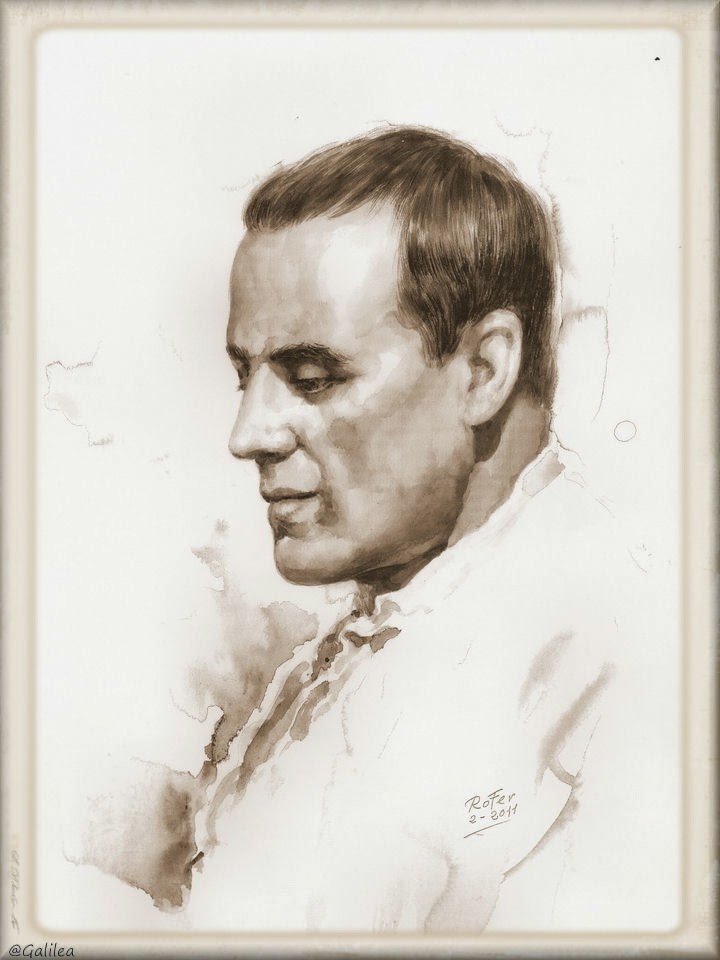
St Jose Maria was a withdrawn and a modest man, of great charity and tireless devotion to work.   He excelled as a preachre and as a regular confessor, which caused long lines of faithful who were looking into it further support and spiritual help.   His effectiveness and reputation grew quickly throughout the city.   He was noted for his love of the poor, who came forward for help.   He developed his evangelical work in towns and suburbs and founded and organised several associations such as the “Guard of Honour of the Sacred Heart,” the work of the “Marys of the Tabernacles” and social schools in Ventilla neighbourhoods, aided by young teachers Juan and Demetrio de Andrés, known as “Ventilla Martyrs” killed during the Civil War, 1936.

Miracles of St José María Rubio
VISIT TO A DYING MAN
While confessing, a lady came and gave him the directions to a man who had to confess soon, as he was dying.   That evening, Father Rubio went to visit the dying man and following the directions, he had to go to a third floor without a lift.   When he finally arrived, knocked and asked for the gentleman, “It’s me” the gentleman said “but I think that someone has played a practical joke on you, as you see I’m in perfect health.   Come on, man! have a drink and relax after you have had to climb so many stairs.”   Entering the room, Rubio saw a portrait on the wall and while the man served him a drink.  Father Rubio said that the lady was the one who sent him.   The man laughed and said that the lady was his mother who died some years ago.   Then, the gentleman said; “Look, anyway, as you are here, I’m going to confess because it’s been years since I entered a church and so your journey will not have been in vain”.   He confessed and died that night.PADRE RUBIO 3
THE SEAMSTRESS
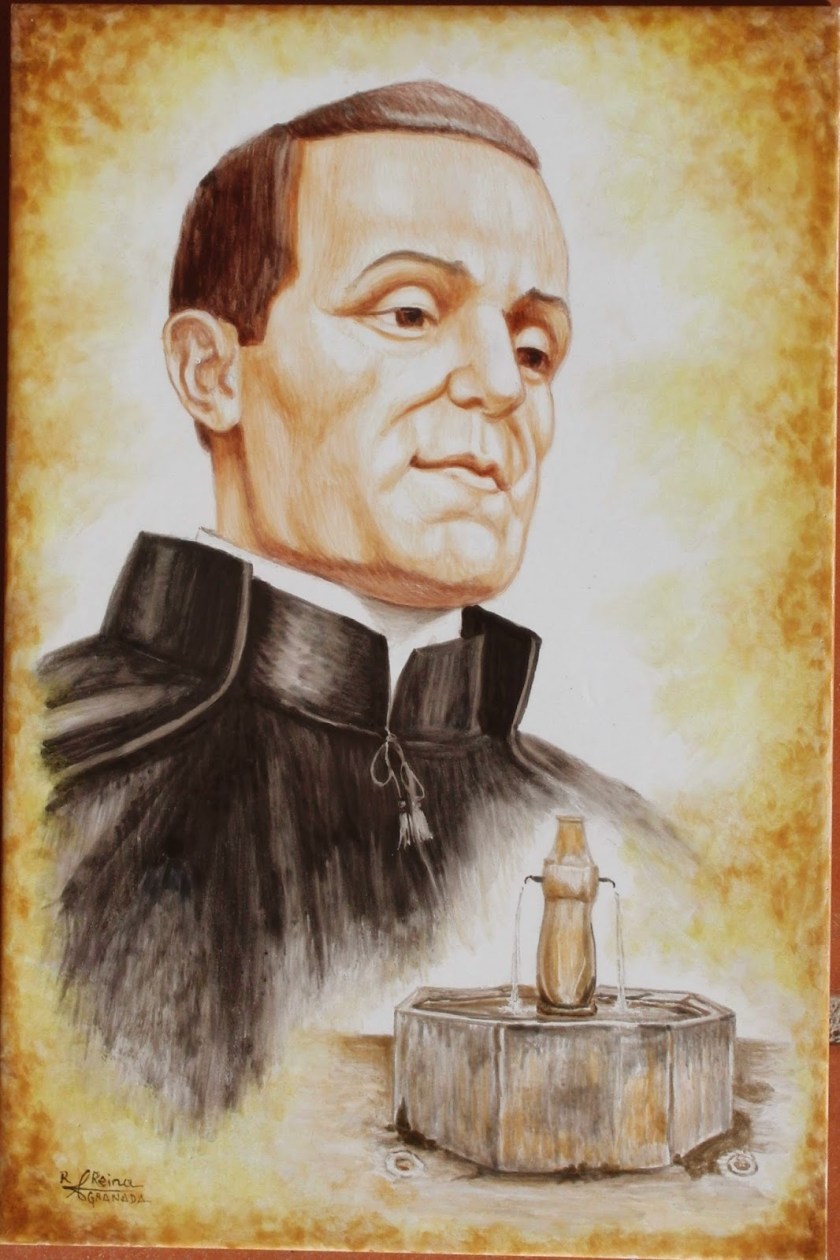
A seamstress from Madrid confessed that her father hated the faith and considered the Christian religion a swindle and a lie.   Thus, she was afraid of the eternal damnation of her father.   Father Rubio said that she should not be worried, as her father would be saved.

Some days after the confession, during a retreat and preaching, this seamstress came late.   At the moment when she arrived, Father Rubio paused for a moment in his speech and said in loud voice:   “At this very moment one of you just received a very special grace.   Really very, very big.   In a few days you will know what it is and whoever of you has received this, that lucky person has to thank our Lord Jesus Christ”.

All women who were there present took note of the time and day, as he was already famous for these prophecies that were fulfilled.   The seamstress in a few days noticed that her father died holy and just at that time when Father Rubio was preaching, her father was confessing and receiving the last sacraments.

During his life miraculous events were reported, such as bilocation, healings, prophecy  some, perhaps legendary but others ratified by numerous witnesses.   What dominates is the testimony of his example and his word, next to the message that holiness is available to all who simply surrender to the will of God.   His ultimate favourite and motto was: “Do what God wants and want what God does.”shrine st jose maria rubioSan_José_María_Rubio_S.Jst jose maria prubio-dcerca
Posted in franciscan OFM, JESUIT SJ, SAINT of the DAY

Memorials of the Saints – 4 May

St Albian of Albée
Bl Angela Bartolomea dei Ranzi
Bl Angela Isabella dei Ranzi
St Antonia of Constantinople
St Antonina of Nicaea
St Antonia of Nicomedia
St Antonius of Rocher
St Arbeo of Freising
St Augustine Webster
St Cunegund of Regensburg
St Curcodomus of Auxerre
St Cyriacus of Ancona
St Enéour
St Ethelred of Bardney
St Florian of Lorch
Bl Hilsindis
Bl Jean-Martin Moyë (1730-1793)
Biography:  https://anastpaul.wordpress.com/2018/05/04/saint-of-the-day-4-may-blessed-jean-martin-moye-1730-1793/
St Jose Maria Rubio y Peralta SJ (1864-1929)

St Judas Cyriacus
Bl Ladislas of Gielniów
St Luca da Toro
Bl Margareta Kratz
Bl Michal Giedroyc
St Nepotian of Altino
Bl Paolino Bigazzini
St Paulinus of Cologne
St Paulinus of Senigallia
St Pelagia of Tarsus
St Porphyrius of Camerino Rino
St Richard Reynolds
St Robert Lawrence
St Silvanus of Gaza
Bl Tommaso da Olera/Acerbis OFM Cap (1563-1631)

Carthusian Martyrs: A group of Carthusian monks who were hanged, drawn and quartered between 19 June 1535 and 20 September 1537 for refusing to acknowledge the English royalty as head of the Church:
• Blessed Humphrey Middlemore
• Blessed James Walworth
• Blessed John Davy
• Blessed John Rochester
• Blessed Richard Bere
• Blessed Robert Salt
• Blessed Sebastian Newdigate
• Blessed Thomas Green
• Blessed Thomas Johnson
• Blessed Thomas Redyng
• Blessed Thomas Scryven
• Blessed Walter Pierson
• Blessed William Exmew
• Blessed William Greenwood
• Blessed William Horne
• Saint Augustine Webster
• Saint John Houghton
• Saint Robert Lawrence

Martyrs of Cirta:  Also known as
• Martyrs of Cirtha
• Martyrs of Tzirta
A group of clergy and laity martyred together in Cirta, Numidia (in modern Tunisia) in the persecutions of Valerian. They were – Agapius, Antonia, Emilian, Secundinus and Tertula, along with a woman and her twin children whose names have not come down to us.

Martyrs of England:  85 English, Scottish and Welsh Catholics who were martyred during the persecutions by Protestants in the 16th and 17th centuries. They are commemorated together on 22 November.
• Blessed Alexander Blake • Blessed Alexander Crow • Blessed Antony Page • Blessed Arthur Bell • Blessed Charles Meehan • Blessed Christopher Robinson • Blessed Christopher Wharton • Blessed Edmund Duke • Blessed Edmund Sykes • Blessed Edward Bamber • Blessed Edward Burden • Blessed Edward Osbaldeston • Blessed Edward Thwing • Blessed Francis Ingleby • Blessed George Beesley • Blessed George Douglas • Blessed George Errington • Blessed George Haydock • Blessed George Nichols • Blessed Henry Heath • Blessed Henry Webley • Blessed Hugh Taylor • Blessed Humphrey Pritchard • Blessed John Adams • Blessed John Bretton • Blessed John Fingley • Blessed John Hambley • Blessed John Hogg • Blessed John Lowe • Blessed John Norton • Blessed John Sandys • Blessed John Sugar • Blessed John Talbot • Blessed John Thules • Blessed John Woodcock • Blessed Joseph Lambton • Blessed Marmaduke Bowes • Blessed Matthew Flathers • Blessed Montfort Scott • Blessed Nicholas Garlick • Blessed Nicholas Horner • Blessed Nicholas Postgate • Blessed Nicholas Woodfen • Blessed Peter Snow • Blessed Ralph Grimston • Blessed Richard Flower • Blessed Richard Hill • Blessed Richard Holiday • Blessed Richard Sergeant • Blessed Richard Simpson • Blessed Richard Yaxley • Blessed Robert Bickerdike • Blessed Robert Dibdale • Blessed Robert Drury • Blessed Robert Grissold • Blessed Robert Hardesty • Blessed Robert Ludlam • Blessed Robert Middleton • Blessed Robert Nutter • Blessed Robert Sutton • Blessed Robert Sutton • Blessed Robert Thorpe • Blessed Roger Cadwallador • Blessed Roger Filcock • Blessed Roger Wrenno • Blessed Stephen Rowsham • Blessed Thomas Atkinson • Blessed Thomas Belson • Blessed Thomas Bullaker • Blessed Thomas Hunt • Blessed Thomas Palaser • Blessed Thomas Pilcher • Blessed Thomas Pormort • Blessed Thomas Sprott • Blessed Thomas Watkinson • Blessed Thomas Whitaker • Blessed Thurstan Hunt • Blessed William Carter • Blessed William Davies • Blessed William Gibson • Blessed William Knight • Blessed William Lampley • Blessed William Pike • Blessed William Southerne • Blessed William Spenser • Blessed William Thomson •
They were Beatified on 22 November 1987 by Pope John Paul II.

Martyrs of Novellara:  A bishop and several his flock who were martyred together in the persecutions of Diocletian and whose relics were kept and enshrined together. We know nothing else about them but the names – Apollo, Bono, Cassiano, Castoro, Damiano, Dionisio, Leonida, Lucilla, Poliano, Tecla, Teodora and Vespasiano. They were Martyred on 26 March 303. Their relics were enshrined in the parish of Saint Stephen in Novellara, Italy in 1603.

Posted in CATHOLIC DEVOTIONS of the Month, MARIAN QUOTES, MARIAN REFLECTIONS, PAPAL Apostolic EXHORTATIONS, The BLESSED VIRGIN MARY, The LITTLE OFFICE of MARY

Marian Thought – 3 May – “These virtues of the Mother will also adorn her children…”

Marian Thoughts – May, the Month of Mary – 3 May 2019

Apostolic Exhortation of St Pope Paul VI (1897-1978)
Marialis Cultus – 2 February 1974
To Honour Mary

The Blessed Virgin’s role as Mother leads the People of God to turn with filial confidence to her who is ever ready to listen with a mother’s affection and efficacious assistance. Thus the People of God have learned to call on her as the Consoler of the afflicted, the Health of the sick and the Refuge of sinners, that they may find comfort in tribulation, relief in sickness and liberating strength in guilt.

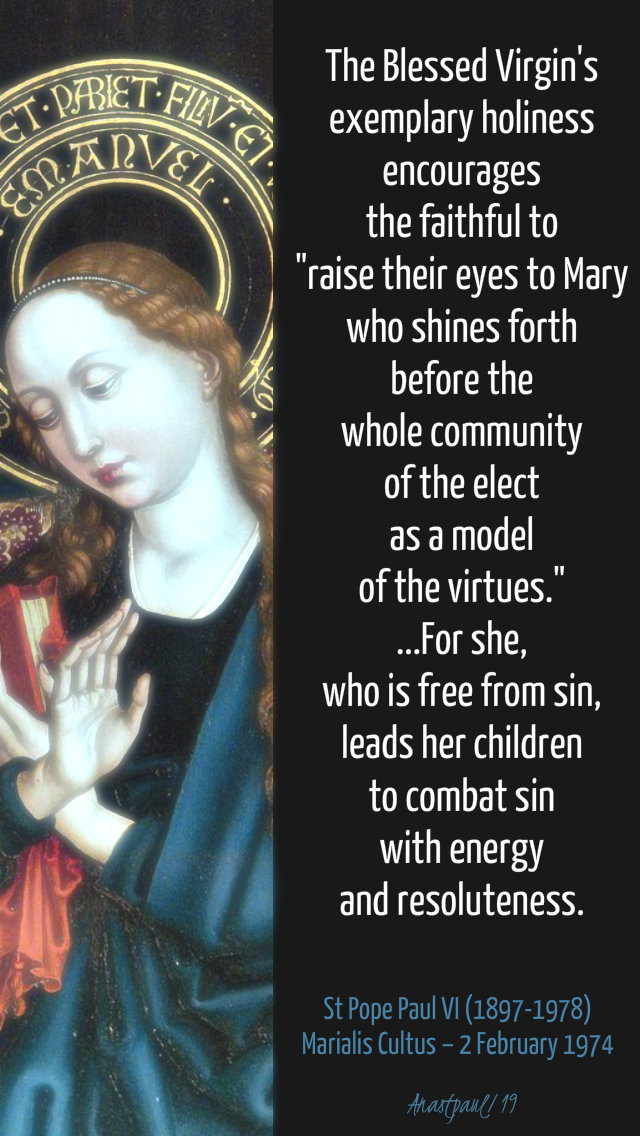
For she, who is free from sin, leads her children to combat sin with energy and resoluteness.   This liberation from sin and evil (cf. Mt. 6:13)-it must be repeated-is the necessary premise for any renewal of Christian living.

The Blessed Virgin’s exemplary holiness encourages the faithful to “raise their eyes to Mary who shines forth before the whole community of the elect as a model of the virtues.”   It is a question of solid, evangelical virtues – faith and the docile acceptance of the Word of God, generous obedience (cf Lk. 1:38), genuine humility (cf. Lk. 1:48), solicitous charity (cf. Lk. 1:39-56), profound wisdom (cf. Lk. 1:29, 34; 2:19, 33:51), worship of God manifested in alacrity in the fulfillment of religious duties (cf. Lk. 2:21-41), in gratitude for gifts received (cf Lk. 1:46-49), in her offering in the Temple (cf. Lk. 2:22-24) and in her prayer in the midst of the apostolic community (cf. Acts 1:12-14), her fortitude in exile (cf. Mt. 2:13-23) and in suffering (cf. Lk. 2:34-35, 49; Jn. 19 25), her poverty reflecting dignity and trust in God (cf. Lk. 1:48, 2:24) her attentive care for her Son, from His humble birth to the ignominy of the cross (cf. Lk. 2:1-7; Jn. 19:25-27), her delicate forethought (cf. Jn. 2:1-11), her virginal purity (cf. Mt. 1:18-25; Lk. 1:26-38), her strong and chaste married love.
These virtues of the Mother will also adorn her children who steadfastly study her example in order to reflect it in their own lives.   And this progress in virtue, will appear as the consequence and the already mature fruit, of that pastoral zeal which springs from devotion to the Blessed Virgin.

Second Reading
The Little Office of Mary
Monday, Wednesday, Friday
=================the blessed virgin's exemplary holiness - marialis cultus stpope paul VI 3 may 2019.jpg

Posted in FATHERS of the Church, FEASTS and SOLEMNITIES, ON the SAINTS, PRACTISING CATHOLIC, QUOTES - J R R Tolkien and MORE, QUOTES on the CHURCH, SAINT of the DAY, The APOSTLES & EVANGELISTS

Thought for the Day – 3 May – The Preaching of the Apostles

Thought for the Day – 3 May – The Feast of Saints Philip and James, Apostles

The Preaching of the Apostles

Tertullian (c 155- c 240)
Priest, Father and Ancient Christian Writer

An excerpt from his On the Prescription of Heretics

Our Lord Jesus Christ Himself declared what He was, what He had been, how He was carrying out His Father’s will, what obligations He demanded of men.    This He did during His earthly life, either publicly to the crowds, or privately to His disciples.  Twelve of these He picked out, to be His special companions, appointed to teach the nations.

One of them fell from His place.   The remaining eleven were commanded by Christ, as He was leaving the earth to return to the Father after His resurrection, to go and teach the nations and to baptise them into the Father, the Son and the Holy Spirit.
The apostles cast lots and added Matthias to their number, in place of Judas, as the twelfth apostle.   The authority for this action is to be found in a prophetic psalm of David.   After receiving the power of the Holy Spirit which had been promised to them, so that they could work miracles and proclaim the truth, they first bore witness to their faith in Jesus Christ and established churches throughout Judea.   They then went out into the whole world and proclaimed to the nations the same doctrinal faith.

They set up churches in every city.   Other churches received from them a living transplant of faith and the seed of doctrine and through this daily process of transplanting they became churches.   They therefore qualify as apostolic churches by being the offspring of churches that are apostolic.

Every family has to be traced back to its origins.   That is why we can say that all these great churches constitute that one original Church of the apostles, for it is from them that they all come.   They are all primitive, all apostolic, because they are all one.   They bear witness to this unity by the peace in which they all live, the brotherhood which is their name, the fellowship to which they are pledged.   The principle on which these associations are based is common tradition by which they share the same sacramental bond.

The only way in which we can prove what the apostles taught—that is to say, what Christ revealed to them — is through those same churches.   They were founded by the apostles themselves, who first preached to them by what is called the living voice and later by means of letters.

The Lord had said clearly in former times – I have many more things to tell you but you cannot endure them now.   But He went on to say – When the Spirit of truth comes, He will lead you into the whole truth.   Thus Christ shows us that the apostles had full knowledge of the truth, for He had promised that they would receive the whole truth through the Spirit of truth.   His promise was certainly fulfilled, since the Acts of the Apostles prove, that the Holy Spirit came down on them.

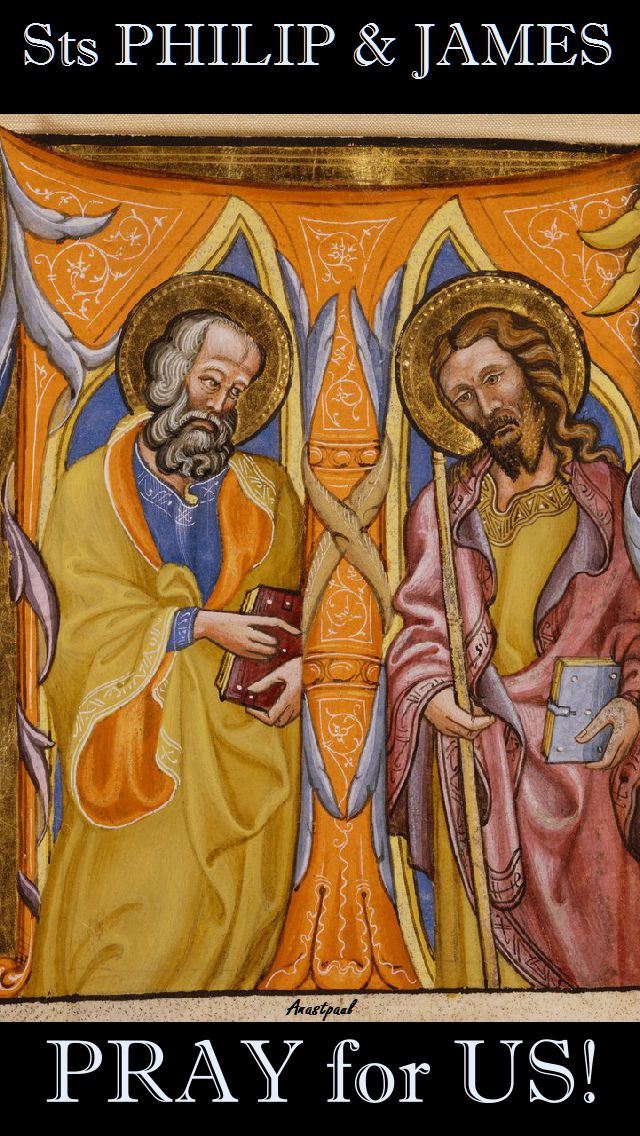
Saints James and Philip, Pray for us!sts-philip-and-james-pray-for-us-3-may-2017.jpg

Posted in GOD the FATHER, QUOTES - J R R Tolkien and MORE, QUOTES on FREEDOM

Quote of the Day – 3 May – Perhaps, we feel inclined to disagree with Him?

Quote of the Day – 3 May – Friday of the Second Week of Easter

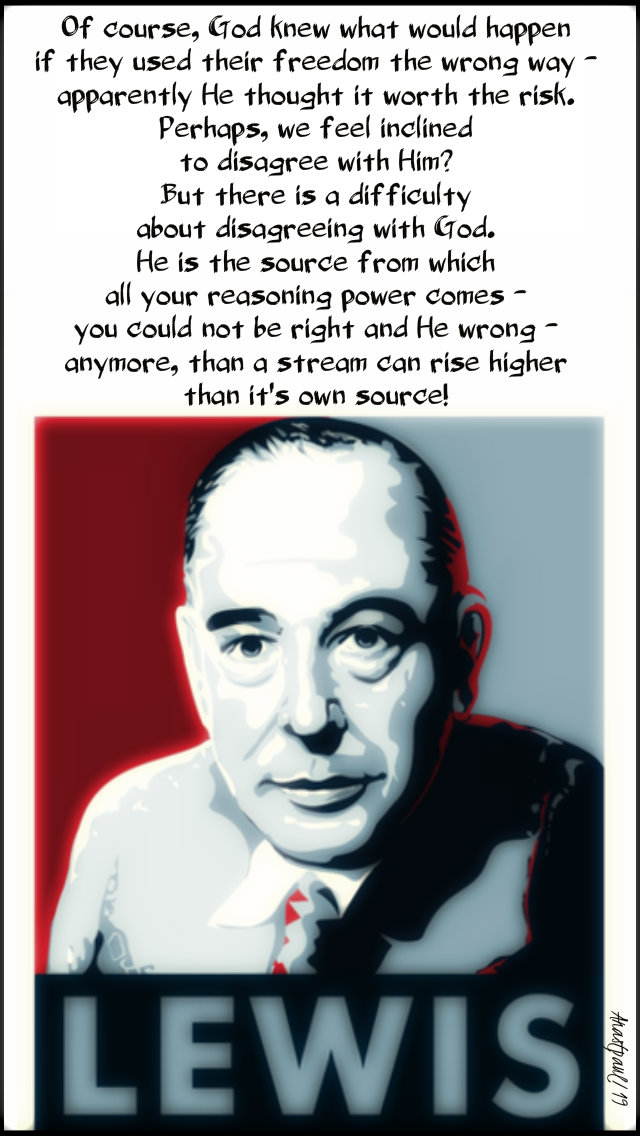
“The happiness that God designs for His higher creatures, is the happiness of being freely, voluntarily united to Him and to each other, in an ecstasy of love and delight, compared with which, the most rapturous love between a man and woman, on this earth, is mere milk and water.   And for that, they must be free.

Of course, God knew what would happen if they used their freedom the wrong way – apparently He thought it worth the risk.   Perhaps, we feel inclined to disagree with Him?   But there is a difficulty about disagreeing with God.   He is the source from which all your reasoning power comes – you could not be right and He wrong – anymore, than a stream can rise higher than it’s own source!”

C S Lewis (1898-1963)god knew what would happen - c s lewis - 3 may 2019.jpg

Posted in CATHOLIC Quotes, FEASTS and SOLEMNITIES, MORNING Prayers, QUOTES on the CHURCH, SAINT of the DAY, The APOSTLES & EVANGELISTS, The WORD

One Minute Reflection – 3 May – I believe

One Minute Reflection – 3 May – Friday of the Second Week of Easter, Gospel: John 14:6–14 and the Feast of Sts James and Philip and the Memorial of Saint Stanislaw Kazimierczyk CRL (1433–1489)

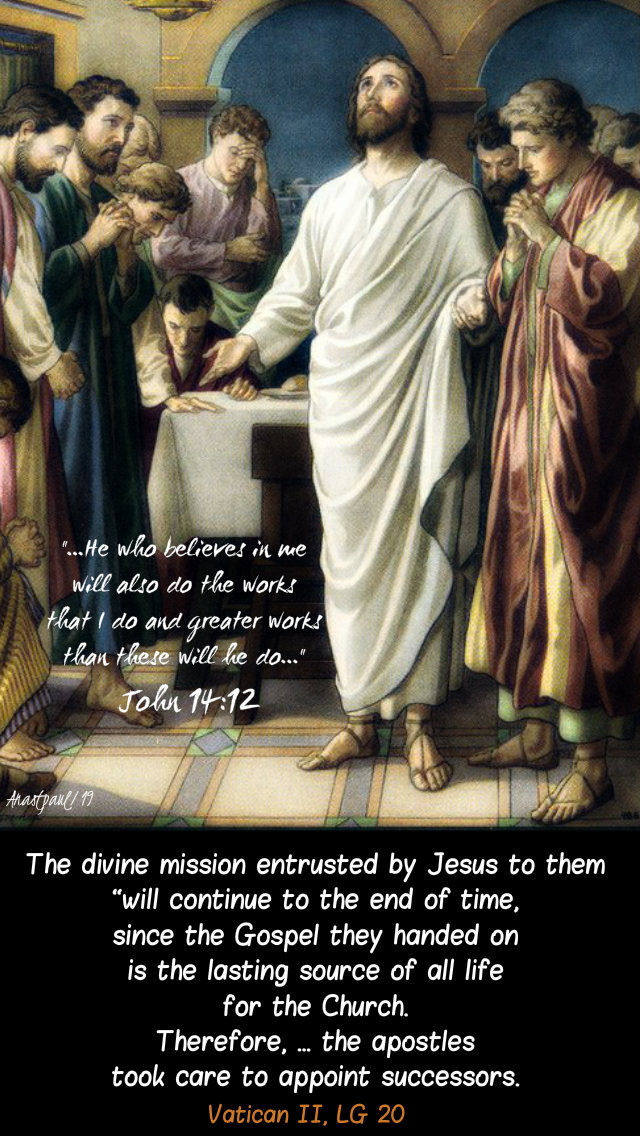
“Truly, truly, I say to you, he who believes in me will also do the works that I do and greater works than these will he do, because I go to the Father…”...John 14:12

REFLECTION – “Jesus is the Father’s Emissary.   From the beginning of His ministry, He “called to him those whom he desired … And he appointed twelve, whom also He named apostles, to be with Him and to be sent out to preach.” (Mk 3:13-14)   From then on, they would also be His “emissaries” (Greek apostoloi).   In them, Christ continues His own mission = “As the Father has sent me, even so I send you.” (Jn 20:21)   The apostles’ ministry is the continuation of His mission, Jesus said to the Twelve: “he who receives you receives me.” (Mt 10:40)

Jesus unites them to the mission He received from the Father.   As “the Son can do nothing of his own accord” but receives everything from the Father who sent Him, so those whom Jesus sends can do nothing apart from Him (Jn 5:19.30), from whom they received both the mandate for their mission and the power to carry it out.   Christ’s apostles knew that they were called by God as “ministers of a new covenant,” “servants of God,” “ambassadors for Christ,” “servants of Christ and stewards of the mysteries of God” (1 Cor 4:1).

In the office of the apostles, there is one aspect that cannot be transmitted – to be the chosen witnesses of the Lord’s Resurrection and so the foundation stones of the Church. But their office also has a permanent aspect.   Christ promised to remain with them always.   The divine mission entrusted by Jesus to them “will continue to the end of time, since the Gospel they handed on is the lasting source of all life for the Church.  Therefore, … the apostles took care to appoint successors.” (Vatican II, LG 20) Catechism of the Catholic Church- #858-860the divene mission - vatican LG 20 - he who believes in me - john 14 12 - 3 may 2019.jpg
PRAYER – Almighty Father, we believe, strengthen our faith.   Divine Son, we follow You, remain with us.   Holy Spirit, come, guide our steps.   Glory be to the Father and to the So and to the Holy Spirit, as it was in the beginning is now and ever shall be, amen. Saints James and Philip, Saint Stanislaw, pray for us!st james and philip pray for us 3 may 2019- no 4jpg.jpg

st stanislaw kazimierczyk pray for us 3 may 2019.jpg

Posted in CATHOLIC DEVOTIONS of the Month, MARIAN PRAYERS, Our MORNING Offering, PRAYERS of the SAINTS

Our Morning Offering – 3 May – ‘O Mary’

Our Morning Offering – 3 May – ‘Mary’s Month’ – Friday of the Second Week of Easter

O Mary
By St John Paul II (1920-2005)

O Mary, sorrowful Mother,
you are a silent witness
of these decisive moments
for the history of salvation.
Give us your eyes
so that on the face
of the crucified One,
disfigured by pain,
we may recognise
the image of
the glorious Risen One.
Help us to embrace Him
and entrust ourselves to Him,
so that we be made worthy
of His promises.
Help us to be faithful today
and throughout our lives.
Amen!o mary by st john paul - 3 may 2019 no 2.jpg

Posted in SAINT of the DAY

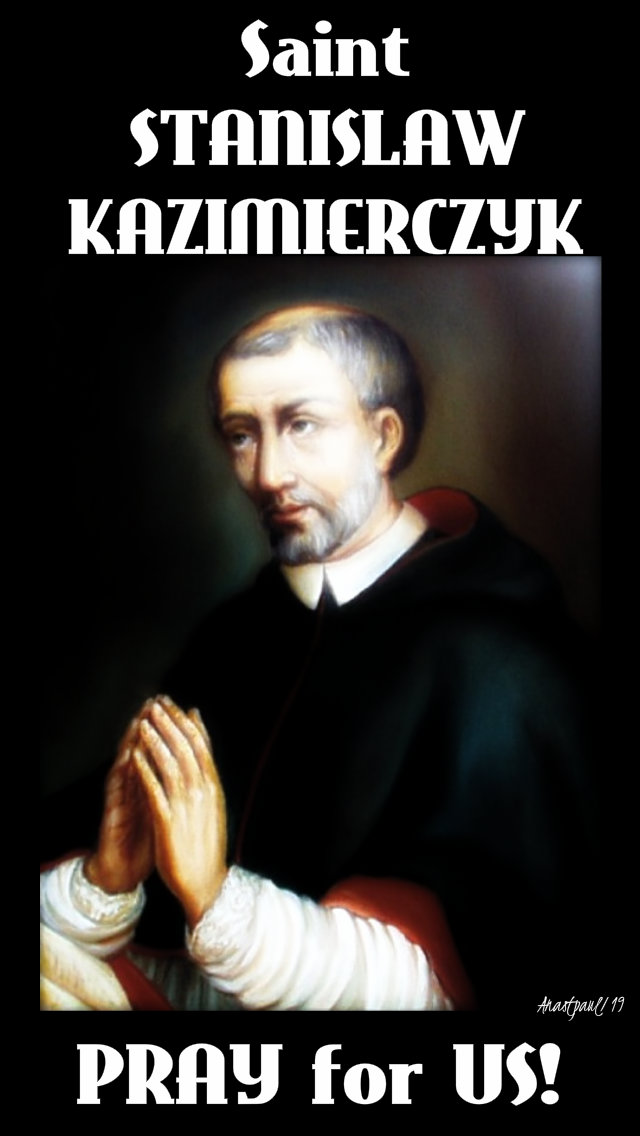
Saint of the Day – 3 May – Saint Stanislaw Kazimierczyk CRL (1433–1489)

Saint of the Day – 3 May – Saint Stanislaw Kazimierczyk CRL (1433–1489) aged 55, Priest of the Canons Regular of the Lateran – Apostle of the Holy Eucharist and of the poor, of Confession, famed Preacher, ascetic, mystic.   Born on 27 September as Stanisław (Louis) Sołtys and died on 3 May 1489 in Kazimierz, Lubelskie, Poland of natural causes.   Patronage – of Preachers.Stanislaw_Kazimierczyk_painting

Stanisław Sołtys was born 27 September 1433 in Kraków to Maciej Sołtys and Jadwiga. His parents had long wanted a child and he was born on exactly the same date that the remains of Saint Stanisłaus  (1030– 1079), Patron of Poland, were being moved.   His parents were members of the Brotherhood of the Blessed Sacrament.

He received his education from the Canons Regular of the Lateran at their school, not far from his home, which was attached to their convent and to the local parish church of the Corpus Christi, that the order administered.   He went onto receive doctorates in theological studies and in his philosophical studies from the Jagiellonian University in Kraków.   He received a bachelor’s degree in 1451.

The successful completion of his studies in 1456 saw him enter the Canons Regular of the Lateran and thus became a novice.   He took the religious name of Stanisław Kazimierczyk after the patron of Poland. bl stanislaus.JPG

He was ordained as a priest in 1456 and was then named as the vice-prior of the order despite being a new priest and not having experience.   He was also made the novice master in charge of new candidates to the order.   He dedicated himself to the care of the ill and the poor and was noted for the deep devotion of the Holy Mass.   He developed a reputation for great spiritual insight as a confessor.   It was his allure as a preacher and confessor that saw people seek him out to preach and hear their confessions.   He preached in strong defence of the doctrine of the Real Presence in the Eucharist against the preachings of the Polish followers of John Wycliffe and Jan Hus.   It was due to this, that he gained the title “Apostle of the Blessed Sacrament”.   Saint John Cantius (1390-1473) – a colleague of his at the Jagiellonian and a major scientist of the period, was a close friend of his.

He slept little and often slept on the ground more as a penitential act.   On one occasion he went to visit the tomb of his patron when he saw the Mother of God with the Infant Jesus in her arms, Saint Stanisław and other saints were around her.   He often delivered his sermons in German as well as his native Polish.   King John I Albert once attributed an 8 September 1487 battle win against the Ottoman Empire to him.Saint Stanislaus of Kazimierz

He died  on 3 May 1489 and immediately was acclaimed a saint by all who knew him and those to whom he ministered.   He had fallen quite ill during Lent and requested anointing.   He put his hands on his conferees’ heads to bless them and to bid them farewell and died with his hands upraised to entrust his soul to God.

The faithful referred to him often as “Blessed” despite the fact that he had not been beatified but was called this due to his great reputation for personal holiness – in the 1500s this title was recorded as being given.   His remains were moved in 1632 after the priest Martin Kłoczyński commissioned a splendid altar in his honour to house the remains – a total of 176 purported miracles were reported to have taken place in the first year since his death.

The Canons Regular of the Lateran made several requests to the pope to seek beatification in 1773 but no cause was ever initiated  . The Cardinal Archbishop of Kraków Karol Józef Wojtyła (the future St Pope John Paul II) asked the order, in 1971, to collect existing documents and evidence on the life of the late priest and set up a historical commission to aid them in this on 15 December 1972.   The beatification process launched under Pope John Paul II on 14 October 1986 and the priest was titled as a Servant of God once the Congregation for the Causes of Saints (CCS) issued the official nihil obstat to the cause.   St John Paul II both named him as Venerable upon the confirmation of his heroic virtue and approved his longstanding “cultus” which allowed for the pope to preside over the Beatification on 18 June 1993 as a solemnisation of that “cultus”.

Pope Benedict XVI approved a miracle on 19 December 2009 and on 19 February 2010 confirmed the date for Canonisation.   He Canonised him on 17 October 2010 in Saint Peter’s Square.76. Saint Stanislas Soltys Kazimierczyk - phili

Posted in franciscan OFM, SAINT of the DAY, The APOSTLES & EVANGELISTS

Feast of St James and St Philip – Memorials of the Saints – 3 May


St James the Lesser Apostle (Feast)
St Philip the Apostle (Feast)
Sts James and Philip:   https://anastpaul.wordpress.com/2018/05/03/3-may-feast-of-sts-philip-and-james-apostles-and-martyrs/

https://youtu.be/12uxvviqczQ

St Adalsindis of Bèze
Bl Adam of Cantalupo in Sabina
St Ahmed the Calligrapher
St Aldwine of Peartney
St Pope Alexander I
St Alexander of Constantinople
Bl Alexander of Foigny
St Alexander of Rome
Bl Alexander Vincioli
St Ansfrid of Utrecht
St Antonina of Constantinople
St Diodorus the Deacon
Bl Edoardo Giuseppe Rosaz
St Ethelwin of Lindsey
St Eventius of Rome
St Fumac
St Gabriel Gowdel
St Juvenal of Narni
Bl Maria Leonia Paradis
St Maura of Antinoe
St Peter of Argos
St Philip of Zell
Bl Ramon Oromí Sullà
St Rhodopianus the Deacon
St Scannal of Cell-Coleraine
Bl Sostenaeus
St Stanislas Kazimierczyk CRL (1433–1489)
St Theodolus of Rome
St Timothy of Antinoe
Bl Uguccio
Bl Zechariah

Posted in CATHOLIC DEVOTIONS of the Month, MARIAN DEVOTIONS, MARIAN QUOTES, MARIAN REFLECTIONS, PAPAL Apostolic EXHORTATIONS, QUOTES of the SAINTS, QUOTES on OBEDIENCE, QUOTES on SANCTITY, The BLESSED VIRGIN MARY, The LITTLE OFFICE of MARY

Marian Thoughts – “To Honour Mary” St Paul VI – 2 May 2019

Marian Thoughts – May, the Month of Mary – 2 May 2019

Apostolic Exhortation of St Pope Paul VI (1897-1978) 
Marialis Cultus – 2 February 1974

To Honour Mary

Finally, insofar as it may be necessary, we would like to repeat that the ultimate purpose of devotion to the Blessed Virgin is to glorify God and to lead Christians, to commit themselves, to a life which is in absolute conformity with His will.   When the children of the Church unite their voices, with the voice of the unknown woman, in the Gospel and glorify the Mother of Jesus, by saying to Him:  “Blessed is the womb that bore you and the breasts that you sucked” (Lk. 11:27), they will be led to ponder the Divine Master’s serious reply:  “Blessed rather are those who hear the word of God and keep it!” (Lk. 11:28)   While it is true, that this reply is, in itself, lively praise of Mary, as various Fathers of the Church interpreted it and the Second Vatican Council has confirmed, it is also an admonition to us, to live our lives in accordance with God’s commandments.   It is also an echo of other words of the Saviour:   “Not everyone who says to me ‘Lord, Lord,’ will enter the kingdom of heaven but he who does the will of my Father who is in heaven” (Mt. 7:21); and again: “You are my friends if you do what I command you” (Jn. 15:14).

Christ is the only way to the Father (cf. Jn. 14:4-11) and the ultimate example to whom the disciple must conform his own conduct (cf. Jn. 13:15), to the extent of sharing Christ’s sentiments (cf. Phil. 2:5), living His life and possessing His Spirit (cf. Gal. 2:20; Rom. 8:10-11).   The Church has always taught this and nothing in pastoral activity should obscure this doctrine.    But the Church, taught by the Holy Spirit and benefiting from centuries of experience, recognises, that devotion to the Blessed Virgin, subordinated to worship of the divine Saviour and in connection with it, also has a great pastoral effectiveness and constitutes, a force, for renewing Christian living.

It is easy to see the reason for this effectiveness.   Mary’s many-sided mission to the People of God is a supernatural reality which operates and bears fruit within the body of the Church.   One finds cause for joy, in considering, the different aspects of this mission and seeing how each of these aspects, with its individual effectiveness, is directed towards the same end, namely, producing in the children the spiritual characteristics of the first-born Son.   The Virgin’s maternal intercession, her exemplary holiness and the divine grace which is in her, become, for the human race, a reason for divine hope.

Second Reading
The Little Office of Mary
Sunday, Tuesday, Thursday
=================the virgin's maternal intercession - st paul VI - marialis cultus 1974-2 may 2019.jpg

Posted in CATECHESIS, DOCTORS of the Church, EASTER, FATHERS of the Church, HOLY WEEK 2019, QUOTES of the SAINTS, QUOTES on DEATH, SAINT of the DAY, The INCARNATION, The PASSION, The RESURRECTION

Thought for the Day – 2 May – On the Incarnation of the Word

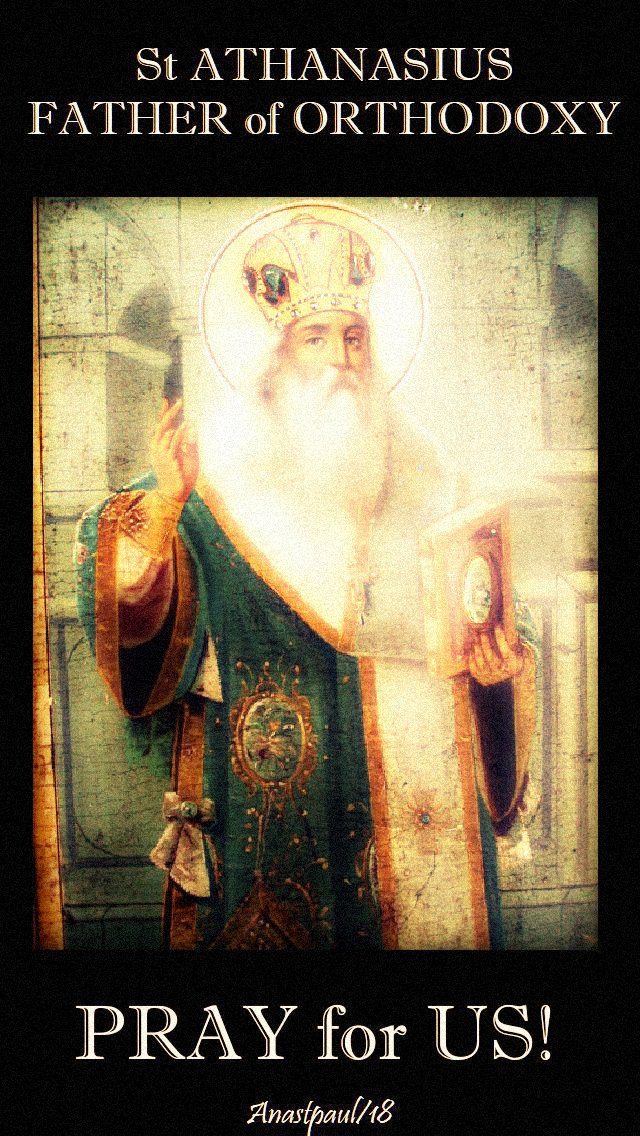
Thought for the Day – 2 May – Thursday of the Second week of Easter, Gospel: John 3:31–36 and the Memorial of St Athanasius (297-373)

On the Incarnation of the Word

Saint Athanasius (297-373)
Bishop, Great Eastern Father & Doctor of the Church
Known as “The Father of Orthodoxy”

An excerpt from On the Incarnation of the Word

The Word of God, incorporeal, incorruptible and immaterial, entered our world.   Yet it was not as if He had been remote from it up to that time.   For there is no part of the world that was ever without His Presence; together with His Father, He continually filled all things and places.

Out of His loving-kindness for us, He came to us and we see this in the way He revealed Himself openly to us.   Taking pity on mankind’s weakness and moved by our corruption, He could not stand aside and see death have the mastery over us, He did not want creation to perish and His Father’s work in fashioning man, to be in vain.   He, therefore, took to Himself a body, no different from our own, for He did not wish simply to be in a body or only to be seen.

If He had wanted simply to be seen, He could indeed have taken another and nobler, body.   Instead, He took our body in its reality.

Within the Virgin, He built himself a temple, that is, a body, He made it His own instrument in which to dwell and to reveal Himself.   In this way, He received from mankind, a body like our own and, since all were subject to the corruption of death, He delivered this body over to death for all and with supreme love, offered it to the Father. He did so, to destroy the law of corruption, passed against all men, since all died in Him. The law, which had spent its force on the body of the Lord, could no longer have any power over His fellowmen.   Moreover, this was the way in which the Word was to restore mankind to immortality, after it had fallen into corruption and summon it back, from death to life.   He utterly destroyed the power death had against mankind—as fire consumes chaff—by means of the body He had taken and the grace of the Resurrection.

This is the reason why the Word assumed a body that could die, so that this body, sharing in the Word who is above all, might satisfy death’s requirement in place of all.  Because of the Word dwelling in that body, it would remain incorruptible and all would be freed forever from corruption, by the grace of the Resurrection.

In death, the Word made a spotless sacrifice and oblation of the body He had taken.   By dying for others, He immediately banished death for all mankind.in death the word made a spotless - st athanasius - 2 may 2019

In this way the Word of God, who is above all, dedicated and offered His temple, the instrument that was His body, for us all, as He said and so paid, by His own death the debt that was owed.   The immortal Son of God, united with all men by likeness of nature, thus fulfilled all justice, in restoring mankind to immortality, by the promise of the resurrection.

The corruption of death, no longer holds any power over mankind, thanks to the Word, who has come to dwell among them through His one body.

St Athanasius, Pray for Us!st athanasius pray for us no 2 - 2 may 2019 adapted.jpg


Posted in DOCTORS of the Church, FATHERS of the Church, MARIAN QUOTES, QUOTES of the SAINTS, QUOTES on FAITH, QUOTES on FORGIVENESS, QUOTES on MARTYRDOM, QUOTES on PRAYER, QUOTES on the CHURCH, SAINT of the DAY, The BLESSED VIRGIN MARY

Quote/s of the Day – 2 May – Athanasius and Antoninus

Quote/s of the Day – 2 May – Thursday of the Second week of Easter, Gospel: John 3:31–36 and the Memorial of St Athanasius (297-373) – Father and Doctor of the Church and St Antoninus of Florence OP (1389-1459)

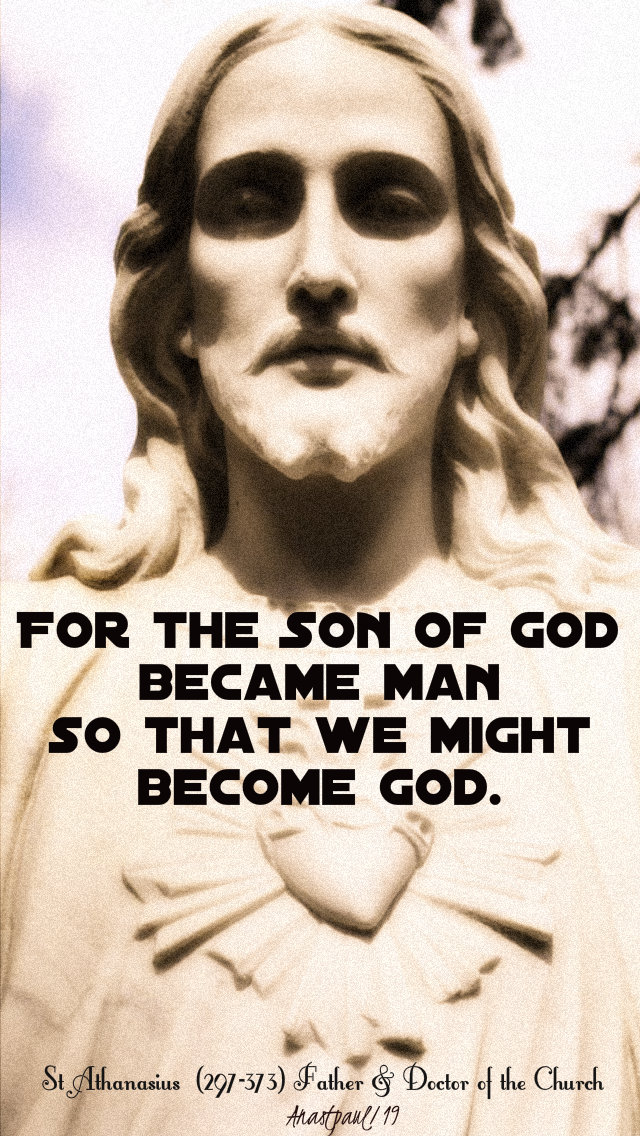
“For the Son of God became man
so that we might become God.”for the son of god became man - st athanasius - 2 may 2019

“Christians, instead of arming themselves with swords,
extend their hands in prayer.”christians instead of arming themselves with swords - st athanasius 2 may 2019

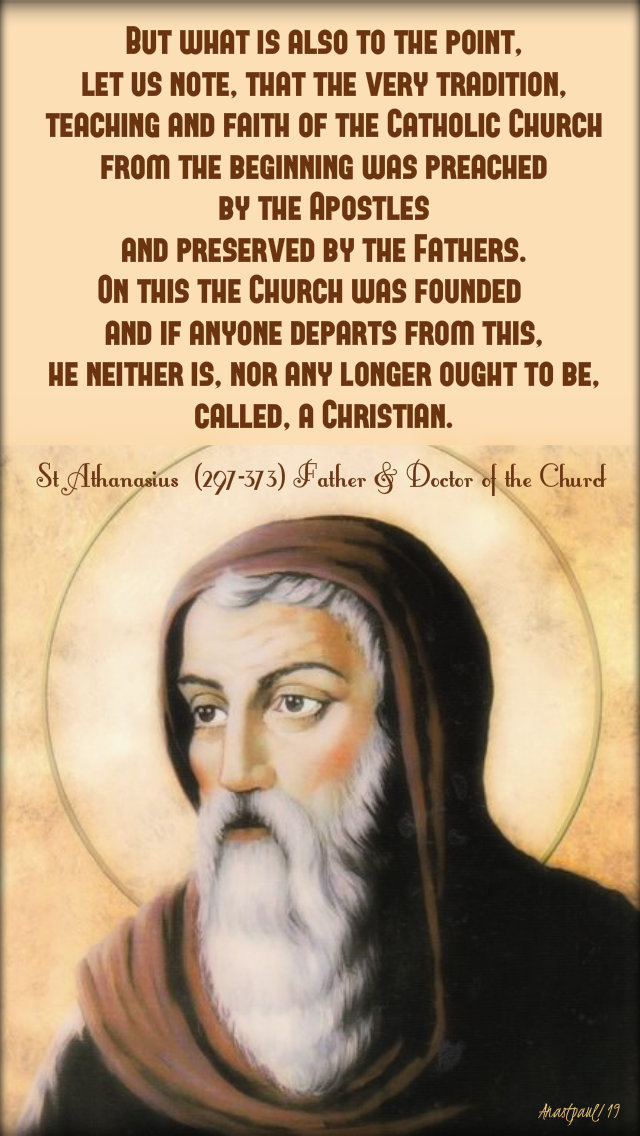
“But what is also to the point, let us note that the very tradition, teaching and faith of the Catholic Church from the beginning was preached by the Apostles and preserved by the Fathers. On this the Church was founded – and if anyone departs from this, he neither is, nor any longer ought to be called, a Christian.”
St Athanasius (297-373) Father & Doctor of the Churchbut what is also to the point let us note - st athanasius 2 may 2019

“While other martyrs suffered
by sacrificing their own lives,
the Blessed Virgin suffered,
by sacrificing her Son’s life.”
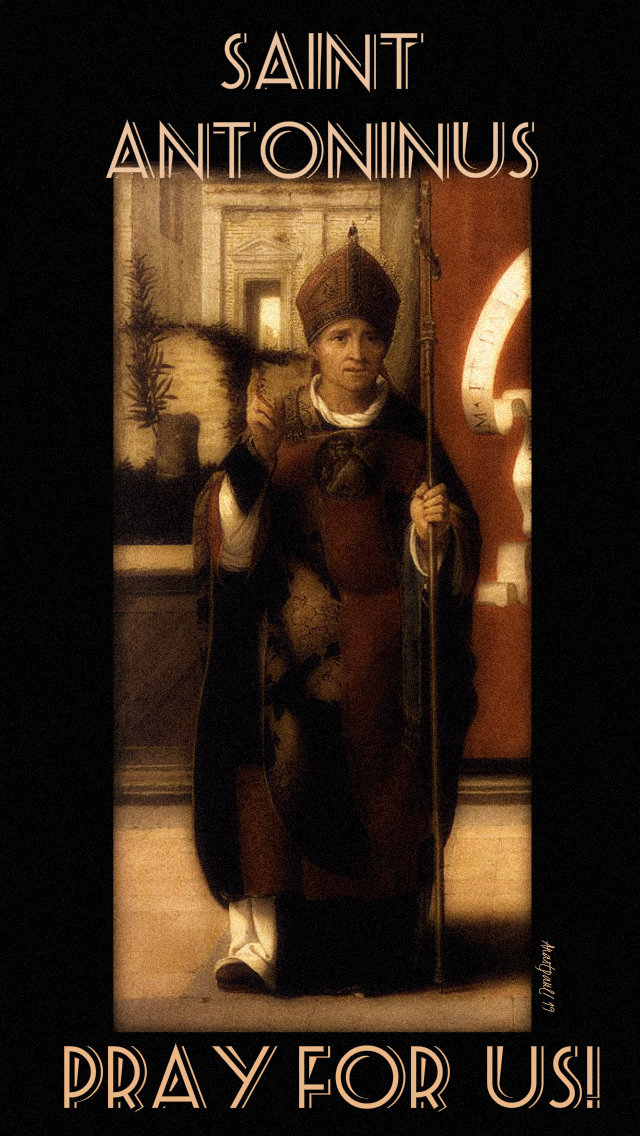
St Antoninus OP (1389-1459)while other martyrs suffered - st antoninus 2 may 2019

Posted in DOCTORS of the Church, DOMINICAN OP, FATHERS of the Church, MORNING Prayers, QUOTES of the SAINTS, SAINT of the DAY, The HOLY GHOST, The WORD

One Minute Reflection – 2 May – He is in them by the Presence of His Spirit and in them He is seen.

One Minute Reflection – 2 May – Thursday of the Second week of Easter, Gospel: John 3:31–36 and the Memorial of St Athanasius (297-373) – Father and Doctor of the Church and St Antoninus OP (1389-1459), Gospel:  John 3:31–36

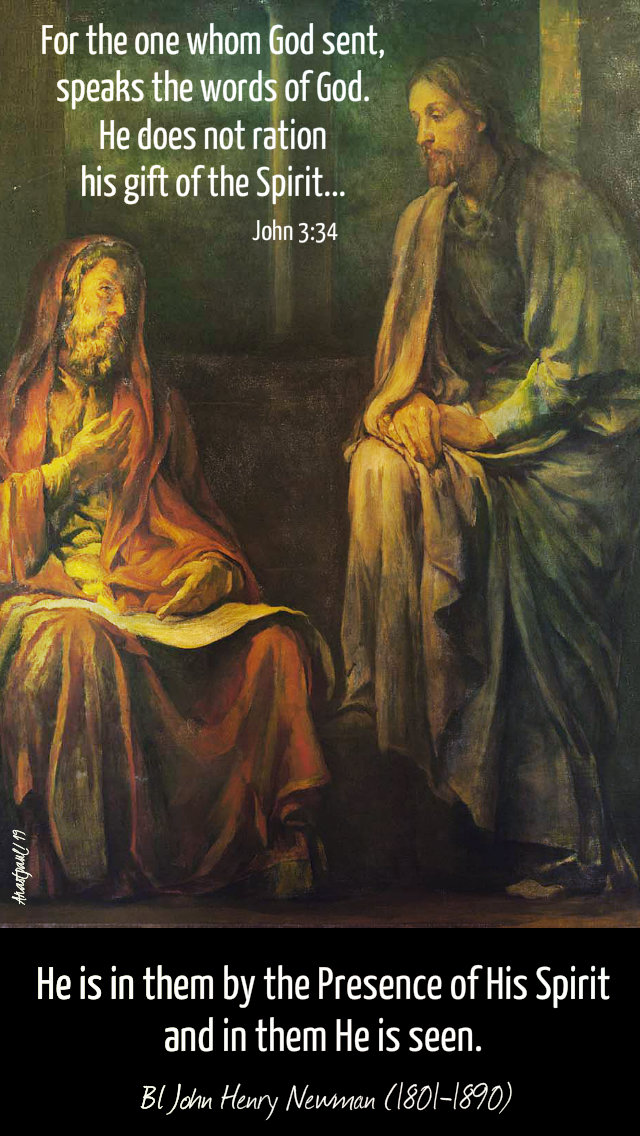
For the one whom God sent speaks the words of God.   He does not ration his gift of the Spirit…he who does not obey the Son shall not see life…John 3:34,36

REFLECTION – “The sanctification or, rather, the deification of the nature of man, is one main subject of St Athanasius’s theology.   Christ, in rising, raises His Saints with Him to the right hand of power.   They become instinct with His life, of one body with His flesh, divine sons, immortal kings, gods.   He is in them, because He is in human nature and He communicates in them that nature, deified by becoming His, that them It may deify.   He is in them by the Presence of His Spirit and in them He is seen.”…Bl John Henry Newman (1801-1890)he does not ration his gift john 3 34 - he is in them by the presence - bl john henry newman 2 may 2019.jpg

PRAYER – Lord God, whose name is holy and whose mercy is proclaimed in every generation, send forth Your Spirit into our hearts and grant that, faithfully pondering on all that is holy, we may ever live in the splendour of Your presence.   Listen we beseech You, to the prayers we request from St Athanasius and St Antoninus, to help us on this earthly journey.   We make our prayer through Christ, Your Son our Lord and Saviour, with the Holy Spirit, one God forever amen.st-athanasius-pray-for-us-2-may-2019

st antoninus - pray for us 2 may 2019


Posted in CATHOLIC DEVOTIONS of the Month, CATHOLIC-PRAYERS OF THE CHURCH, HYMNS, MARIAN DEVOTIONS, MARIAN PRAYERS, Our MORNING Offering, PRAYERS of the CHURCH, The BLESSED VIRGIN MARY, The LITTLE OFFICE of MARY

Our Morning Offering – 2 May – ‘O Mary of all women’

Our Morning Offering – 2 May “Mary’s Month” – Thursday of the Second week of Easter

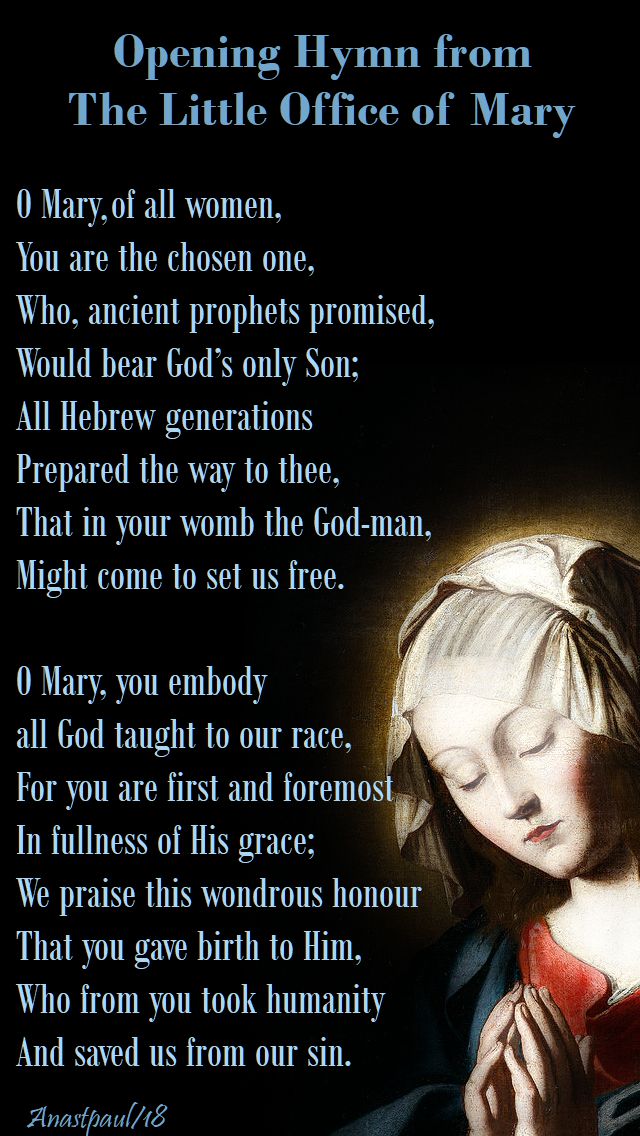
Opening Hymn from the Little Office of Mary

O Mary of all women,
You are the chosen one,
Who, ancient prophets promised,
Would bear God’s only Son;
All Hebrew generations
Prepared the way to thee,
That in your womb the God-man,
Might come to set us free.

O Mary, you embody
all God taught to our race,
For you are first and foremost
In fullness of His grace;
We praise this wondrous honour
That you gave birth to Him,
Who from you took humanity
And saved us from our sin.opening-hymn-from-the-little-office-of-mary-of-mary-of-all-women-1-may-2018 (1).jpg

Posted in DOMINICAN OP, SAINT of the DAY

Saint of the Day – 2 May – Saint Antoninus of Florence OP (1389-1459) “Antoninus the Counsellor”

Saint of the Day – 2 May – Saint Antoninus of Florence OP (1389-1459) Archbishop of Florence, Dominican Priest and Friar, Confessor, spiritual director, apostle of mercy, theologian, writer, reformer, Prior of the Order. Born as Antonio Pierozzi (also called de Forciglioni) on 1 March 1389 in the city of Florence and died on 2 May 1459 at Florence, Italy.   Known as “Antoninus the Counsellor”.   Patronages – Moncalvo, Turin, Italy, University of Santo Tomas Graduate School, Manila, Philippines, Saint Antoninus Parish, Municipality of Pura, Tarlac Philippines.header snip st antoninus.JPG

Anthony Pierozzi, born on 1 March 1389, was soon nicknamed “Antoninus” (“Little Anthony”), either because of his small stature or his weak health.   Thus began the life of the future Saint Antoninus born to noble parents in Florence, Italy.

The influence of the Dominicans on Antoninus’ early life led him to seek admittance to the Dominican Order at the age of 15.   Antoninus approached the prior of the convent in Fiesole, Blessed Brother John Dominic (c 1355–1419, with his request to be admitted to the Order.   Perhaps noticing the weak health of the aspirant and not wishing to give an outright refusal to Antoninus’ request, Brother John Dominic told him to come back once he had memorised the Decretum of Gratian, or the Code of Canon Law at the time.   To the prior’s surprise, the youth returned within the year having accomplished the task required of him.   He was thus admitted to the Order.

The love and zeal he had as a novice never left Antoninus.   He became a great reformer more by example than by word.   Elected prior at a young age, Antoninus served as superior for many years.   He, like his brothers in St Dominic and St Thomas Aquinas, was concerned with the formation of the friars of the Order of Preachers.   Hence he prepared the Summa Moralis, a systematic and comprehensive presentation of Christian Moral Theology, which he wrote, as he said, during the summer and the winter of his life. Antoninus’ writings treated the practical aspects of living the faith.   His writings were a major development in the field of moral theology.   St Antoninus also wrote a biography of Blessed John Dominic and a history of the world.st antoninus bishop of florence op.jpg

Antoninus’ devotion to the Sacrament of Penance and spiritual counsel earned him the title of Antoninus the Counsellor.   Such was his ability to instruct and to guide others.

Antoninus accepted into the Order Brother John of Fiesole, the future artist, Fra Angelico (c 1395–1455).   Having an eye for recognising the gifts of others, Antoninus instructed Fra Angelico to prepare his own Summa Moralis, not in words but through his painting. Hence when the new convent of San Marco was built, Prior Antoninus had Fra Angelico grace each of the friar’s cells with a painting based on a scene from the life of Christ.

After he was appointed Archbishop of Florence, Antoninus’ residence became known as the hostel for the poor, such was his generosity and service for victims of poverty.   His sensitivity to the needs of others led him to found the “Men of St Martin,” in order to offer quiet support to the wealthy who had become indigent.   Hence, the Archbishop lived out the works of mercy.

THE ALMS OF ST ANTONINUS OF FLORENCE.jpg
The Alms of St Antoninus by Lorenzo Lotto

He came to win the esteem and love of his people, especially by his energy and resource in combating the effects of the plague and earthquake in 1448 and 1453.    Antoninus lived a life of austerity as archbishop, continuing to follow the Dominican Rule.   His relations with the Medici regime were close but not always harmonious, with his serving several times as an ambassador for the Republic to the Holy See during the 1450s.ST ANTONINUS ARCHBISHOP OF FLORENCE.jpg

St Antoninus died on 2 May 1459 and Pope Pius II conducted his funeral.   The Pope happened to be on his way to the Council of Mantua when he heard of the Archbishop’s death.   The Archbishop’s wish was that he be buried at the priory which he had founded in the City.  st sntoninus incorrupt body.JPG

He was Canonised on Trinity Sunday, 31 May 1523 by Pope Adrian VI, who himself held ideas of radical and drastic church reform similar to those of Antoninus.

Eternal God, you blessed Saint Antoninus with a marvellous gift of counsel.   By the help of his prayers, while we walk in the darkness of this life, may we learn from the light of Christ all that we ought to do.   We ask this through our Lord Jesus Christ, your Son, who lives and reigns with you and the Holy Spirit, one God, forever and ever. Amen800px-Collezione_loeser,_busto_di_sant'antonino,_stucco_dipinto,_xv_sec.

Posted in DOCTORS of the Church, DOMINICAN OP, FATHERS of the Church, SAINT of the DAY

Memorials of the Saints – 2 May

St Athanasius (c295-373) – Father and Doctor of the Church (Memorial)
Biography:   https://anastpaul.wordpress.com/2018/05/02/saint-of-the-day-2-may-st-athanasius-c295-373-father-and-doctor-of-the-church-father-of-orthodoxy/

St Alpin de Châlons
St Antoninus of Florence OP (1389-1459)

Bl Bernard of Seville
St Bertinus the Younger
Bl Boleslas Strzelecki
Bl Conrad of Seldenbüren
St Cyriacus of Pamphylia
St Eugenius of Africa
St Exsuperius of Pamphylia
St Felix of Seville
St Fiorenzo of Algeria
St Gennys of Cornwall
St Germanus of Normandy
St Gluvias
St Guistano of Sardinia
St Joseph Luu
Bl Juan de Verdegallo
St Longinus of Africa
St Neachtain of Cill-Uinche
St Theodulus of Pamphylia
St Ultan of Péronne
St Vindemialis of Africa
St Waldebert of Luxeuil
St Wiborada of Saint Gall
Bl William Tirry
St Zoe of Pamphylia

Martyrs of Alexandria – 4 saints: A group of Christians marytred together in the persecutions of Diocletian. We know little more than their names – Celestine, Germanus, Neopolus and Saturninus. 304 in Alexandria, Egypt

Posted in CATHOLIC DEVOTIONS of the Month, PRACTISING CATHOLIC

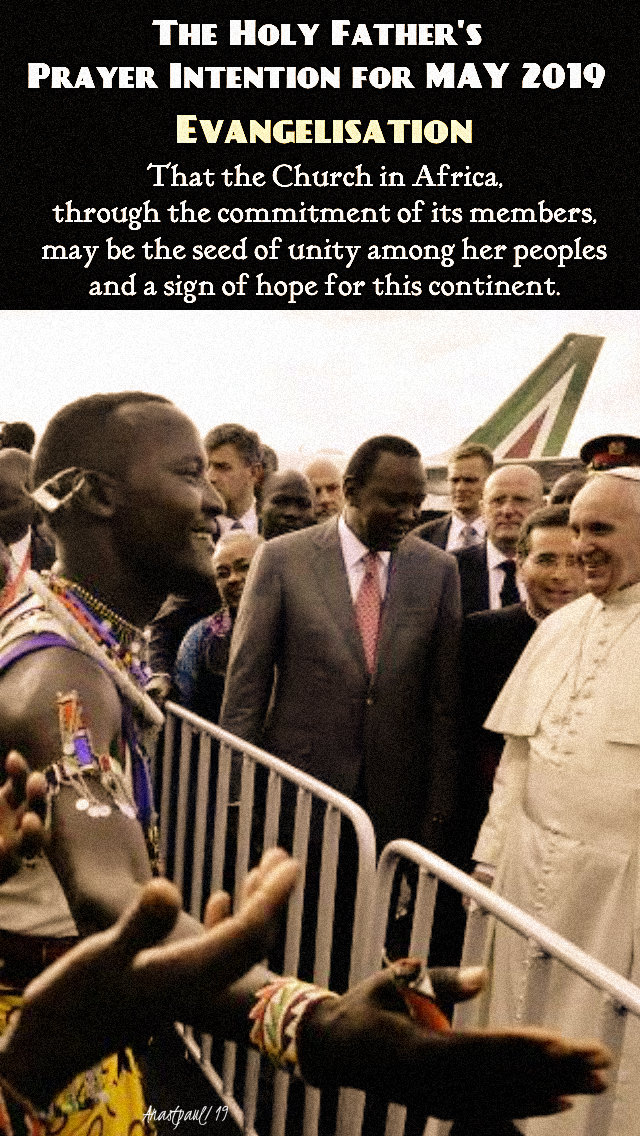
The Holy Father’s Prayer Intention for MAY 2019

The Holy Father’s
Prayer Intention for MAY 2019

Evangelisation

That the Church in Africa,
through the commitment of its members,
may be the seed of unity among her peoples
and a sign of hope for this continent.


holy father's prayer inetnion may 2019 1 may 2019 no 2.jpg

Posted in CATHOLIC DEVOTIONS of the Month, JESUIT SJ, MARIAN DEVOTIONS, MARIAN PRAYERS, MARIAN QUOTES, POETRY, QUOTES of the SAINTS, The BLESSED VIRGIN MARY

Thought for the Day – 1 May – Devotion for May – the Month of Mary

Thought for the Day – 1 May – Devotion for May – the Month of Mary

“God wills that all his gifts should come to us through Mary” (St Bernard)

It was in Rome, towards the end of the eighteenth century, one fine evening in May.   A child of the poor gathered his companions around him and led them to a statue of Mary, before which a lamp was burning, as is the custom in that holy city.   There, these fresh young voices sang the Litany of our Lady.   The next day, the little group, followed by other children, again gathered at the feet of the Mother of God. Next came their mothers, to join the little assembly.   Soon, other groups were formed and the devotion rapidly became popular.   Holy souls, troubled by the disorderly conduct which always increases and becomes graver at the return of the pleasant springtime, saw in these growing practices the hand of God and they co-operated with the designs of Providence by approving and promoting this new devotion, as a public and solemn act of reparation. The Month of Mary was founded….A Carthusian, A Month with Mary

“This is the month in which, in the churches and individual homes, the most affectionate and fervent homage of prayers and devotions from the hearts of Christians are raised to Mary.   It is also the month in which from His throne descend upon us the most generous and abundant gifts of the Divine Mercy.”….St Pope Paul VI, The Month of Mary,1967.

In our own times, we Catholics, wanting to be close to her always, offer her special presents in May – pilgrimages, visits to churches dedicated to her, little sacrifices in her honour, periods of study and well-finished work offered up to her and a more attentive recitation of the rosary….may-the-month-of-the-blessed-virgin-mary-1-may-2018

MARY:  THE MOTHER OF GOD
“When the Blessed Virgin said yes, freely, to the plans revealed to her by the Creator, the divine Word assumed a human nature — a rational soul and a body — which was formed in the most pure womb of Mary.   The divine nature and the human were united in a single Person – Jesus Christ, true God and, thenceforth, true man, the only begotten and eternal son of the Father and from that mo­ment on, as man, the true son of Mary.   This is why our Lady is the mother of the Incarnate Word, of the second person of the Blessed Trinity, who has united our human nature to Himself forever, without any confusion of the two natures.   The greatest praise we can give to the Blessed Virgin is to address her loudly and clearly by the name that expresses her very highest dignity: ‘Mother of God’.”

Let us offer to our Mother today:

Brief but frequent prayers of love, such as:

“Mother of God, your petitions are most powerful.”

St Josemaria Escriva – “Mother of God and Our Mother,” Friends of God, 274.


May Magnificat
Poem by Fr Gerard Manley Hopkins SJ (1844-1889)

May is Mary’s month and I
Muse at that and wonder why:
Her feasts follow reason,
Dated due to season—

Candlemas, Lady Day
But the Lady Month, May,
Why fasten that upon her,
With a feasting in her honour?

Is it only its being brighter
Than the most are must delight her?
Is it opportunest
And flowers finds soonest?

Ask of her, the mighty mother:
Her reply puts this other
Question: What is Spring?—
Growth in every thing—

Flesh and fleece, fur and feather,
Grass and greenworld all together,
Star-eyed strawberry-breasted
Throstle above her nested

Cluster of bugle blue eggs thin
Forms and warms the life within,
And bird and blossom swell
In sod or sheath or shell.

All things rising, all things sizing
Mary sees, sympathising
With that world of good,
Nature’s motherhood.

Their magnifying of each its kind
With delight calls to mind
How she did in her stored
Magnify the Lord.

Well but there was more than this:
Spring’s universal bliss
Much, had much to say
To offering Mary May.

When drop-of-blood-and-foam-dapple
Bloom lights the orchard-apple
And thicket and thorp are merry
With silver-surfed cherry

And azuring-over greybell makes
Wood banks and brakes wash wet like lakes
And magic cuckoocall
Caps, clears, and clinches all—

This ecstasy all through mothering earth
Tells Mary her mirth till Christ’s birth
To remember and exultation
In God who was her salvation.


Posted in QUOTES - J R R Tolkien and MORE, QUOTES of the SAINTS, QUOTES on WORK/LABOUR, SAINT of the DAY, St JOSEPH

Quote/s of the Day – 1 May – Sanctification through work

Quote/s of the Day – 1 May – Wednesday of the Second week of Easter, the first day of Mary’s Month and the Memorial of St Joseph the Worker, Gospel: John 3:16–21

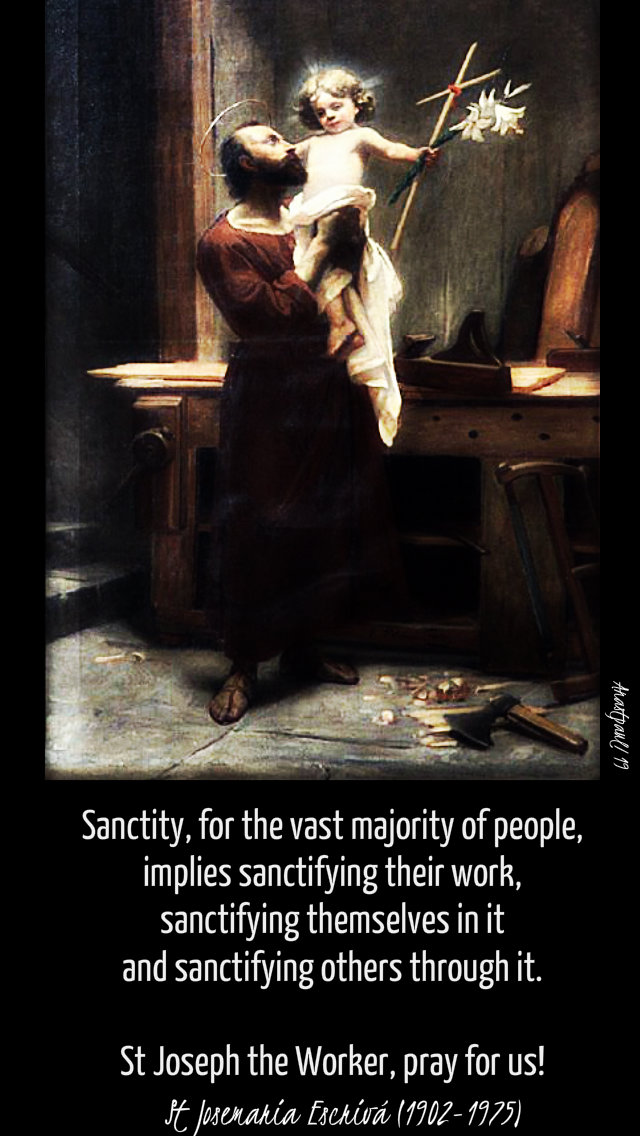
“Sanctity, for the vast majority of people,
implies sanctifying their work,
sanctifying themselves in it
and sanctifying others through it.”sanctity for the vast majority - st joseph worker - st josemaria escriva 1 may 2019.jpg

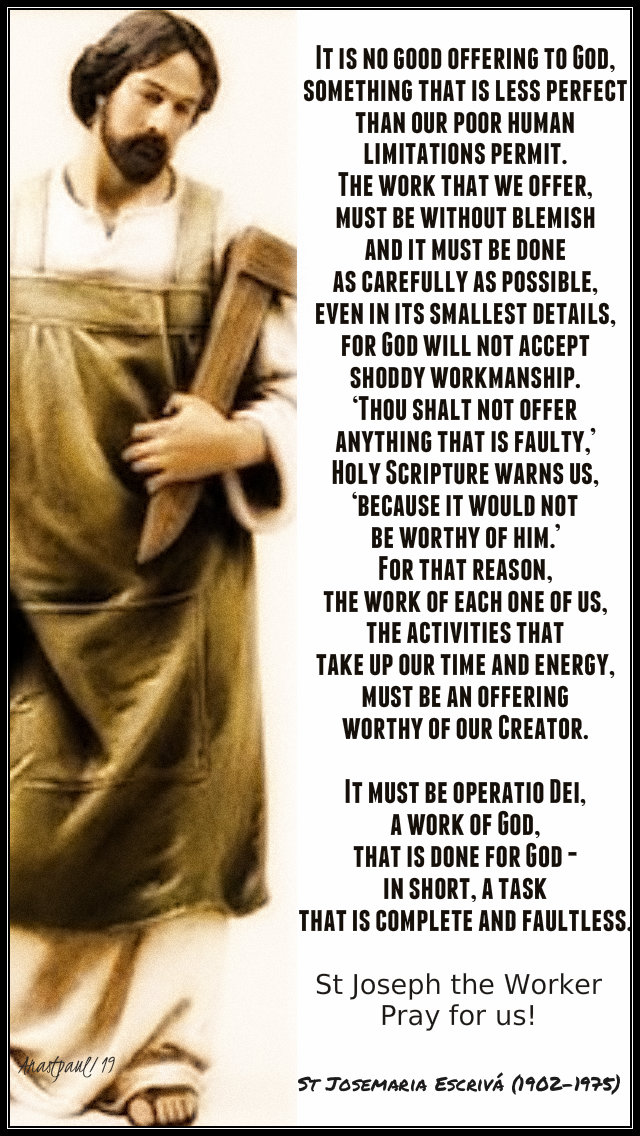
“It is no good offering to God,
something that is less perfect
than our poor human limitations permit.
The work that we offer, must be without blemish
and it must be done as carefully as possible,
even in its smallest details,
for God will not accept shoddy workmanship.
‘Thou shalt not offer anything that is faulty,’
Holy Scripture warns us,
‘because it would not be worthy of him.’
For that reason, the work of each one of us,
the activities that take up our time and energy,
must be an offering worthy of our Creator.
It must be operatio Dei, a work of God,
that is done for God –
in short, a task that is complete and faultless.”

St Josemaria Escrivá (1902-1975)it is no good offering to god - on work - st josemaria escriva 1 may 2019.jpg

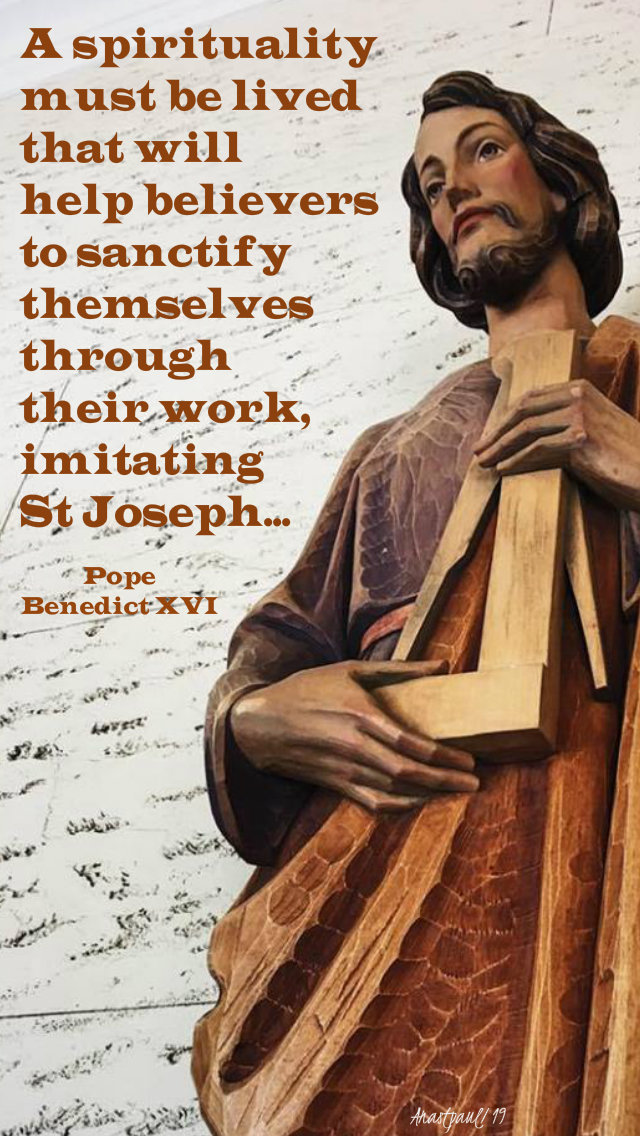
“A spirituality must be lived that will help believers
to sanctify themselves through their work,
imitating St Joseph, who everyday,
had to provide for the needs of the Holy Family
with his hands and who because of this,
the Church indicates as patron of workers.”

Pope Benedict XVIa spirituality must be lived - pope benedict 1 may 2019.jpg

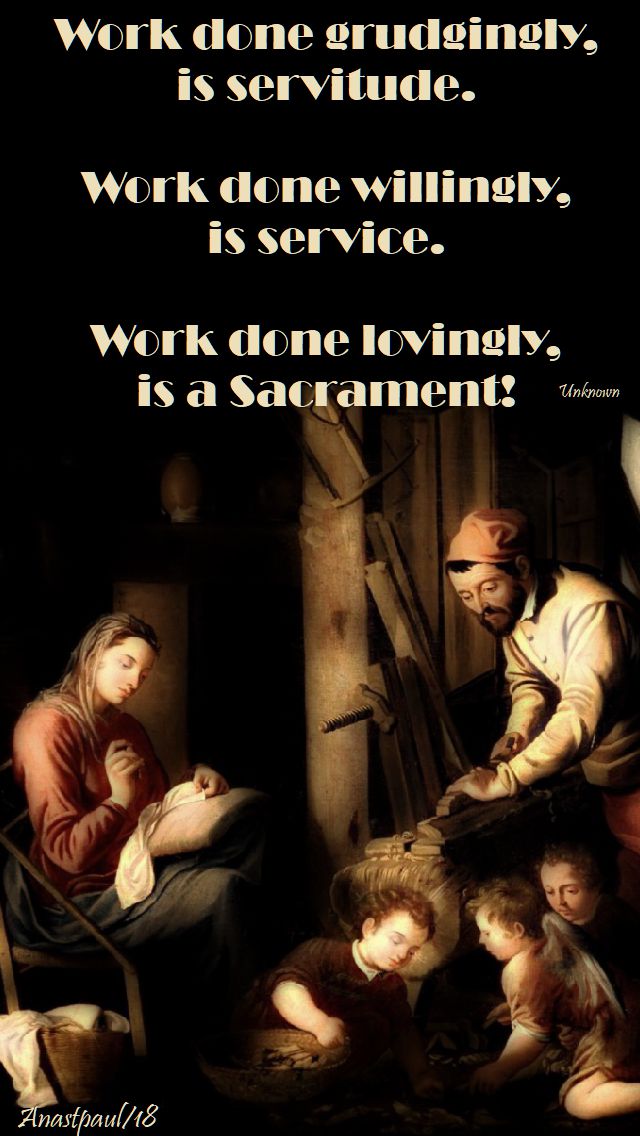
“Work done grudgingly, is servitude.

Work done willingly, is service.

Work done lovingly, is a Sacrament!”

Unknownwork-done-grudgingly-1-may-2018-st-joseph-the-worker-unknown-author.jpg

Posted in CATHOLIC-PRAYERS OF THE CHURCH, CHRIST, the WAY,TRUTH,LIFE, FATHERS of the Church, MORNING Prayers, PRAYERS of the CHURCH, QUOTES of the SAINTS, SAINT of the DAY, St JOSEPH, The WORD

One Minute Reflection – 1 May – “The light that never dims”

One Minute Reflection – 1 May – Wednesday of the Second week of Easter, the first day of Mary’s Month and the Memorial of St Joseph the Worker, Gospel: John 3:16–21

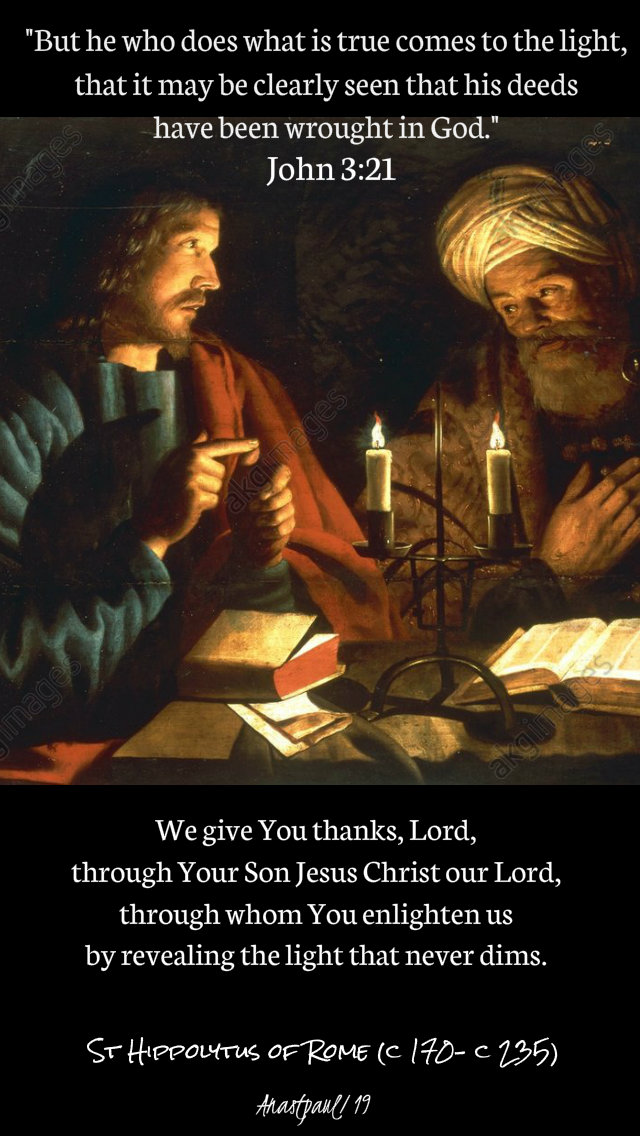
“But he who does what is true comes to the light, that it may be clearly seen that his deeds have been wrought in God.”…John 3:21

REFLECTION – “In the evening, when the Bishop is present, the deacon carries in the lamp.   And standing in the midst of all the faithful who are there, he will offer thanksgiving.   First of all he says the greeting:  “The Lord be with you,” and the people respond:  “And with your spirit.” – Then he says: “Let us give thanks to the Lord” and they reply: “It is right and just.   To Him be the greatness and supremacy together with the glory”… Then he will pray thus, saying:
“We give you thanks, Lord, through your Son Jesus Christ our Lord, through whom you enlighten us by revealing the light that never dims.   Since day is spent and we have now reached evening, filled with the light of the day you created for our joy and since, through your grace, we do not now lack the light of evening, we praise and glorify you through your Son, Jesus Christ our Lord, through whom to you be glory and power and honour, with the Holy Spirit, now and for ever and through all ages. Amen.”   And everyone will say: “Amen.”
In this way, after the meal, all will stand in prayer.   The children say psalms as also the virgins.”…St Hippolytus of Rome (c 170– c 235) Priest and Martyr – Apostolic Tradition, 25john 3 21 but he who does what is true - we give you thanks Lord - st hippolytus 1 may 2019.jpg

PRAYER – Shed your clear light on our hearts, Lord, so that walking continually in the way of Your commandments, we may never be deceived or misled.   Your ways are not our ways, teach us to willingly agree to them, for You know which way we should go. Help us to say “yes” always to Your plan and to render ourselves as a sacrament of Your divine love to all we meet.   Fill us with the grace to be your tools to bring glory to Your kingdom.   St Joseph, silent and loving husband and father, as you worked for and protected your family on earth, protect us all now in the Church of Your adopted son. Through Him, our Our Lord Jesus Christ with You, in the union of the Holy Spirit, one God forever, amen.st joseph the worker pray for us 1 may 2019.jpg


Posted in CATHOLIC-PRAYERS OF THE CHURCH, Our MORNING Offering, PRAYERS for VARIOUS NEEDS, PRAYERS of the CHURCH, PRAYERS of the SAINTS, PRAYERS to the SAINTS, St JOSEPH

Our Morning Offering – 1 May – Transforming our daily work into something beautiful for God

Our Morning Offering – 1 May – Wednesday of the Second week of Easter, the first day of Mary’s Month and the Memorial of St Joseph the Worker

Transforming our daily work into something beautiful for God.

On 1 May 1955, Venerable Servant of God Pope Pius XII (1876-1958) established a new Memorial in the Church’s calendar, dedicating 1 May to “St Joseph the Worker.”   He sought to affirm the rights of workers and to put forth St Joseph as the supreme model.

“As the Vicar of Christ, we wish to reaffirm highly, on this day of 1 May… the dignity of work and [to] inspire social life and laws, based on a fair share of rights and duties … We have determined to establish the liturgical feast of St Joseph the Worker, assigning it precisely on the 1st of May … because the humble craftsman of Nazareth not only embodies the dignity of the arm of the worker … he is also always the guardian of you and your families.”

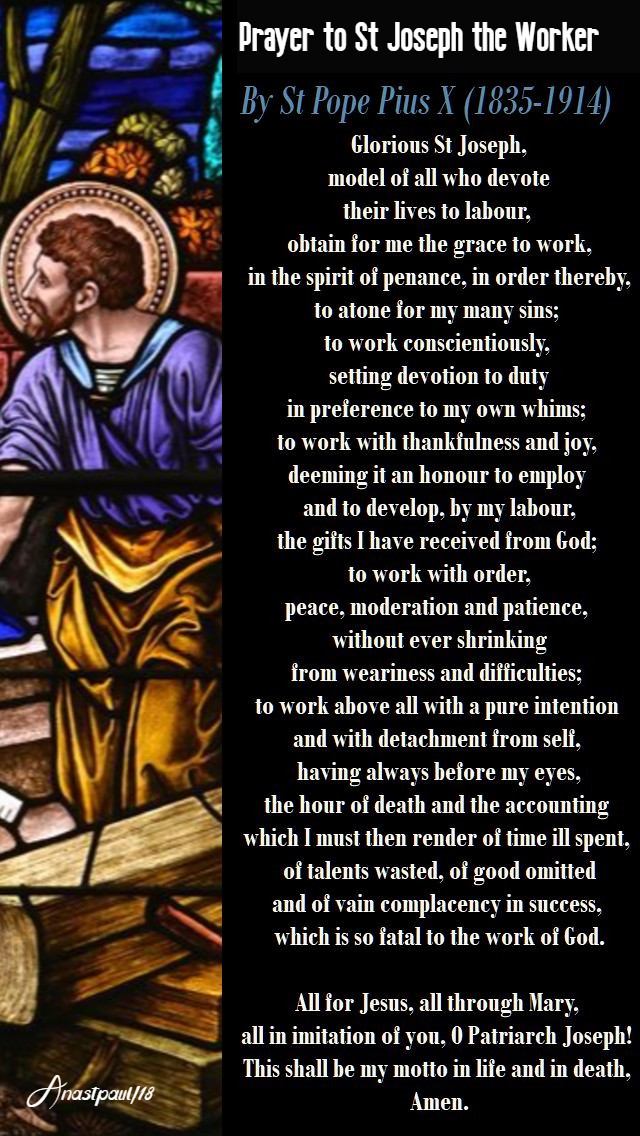
St Pope Pius X (1835-1914) had similar desires when he composed a prayer to “St Joseph the Worker.”   It is a prayer that recognises the great dignity of work and how it can be offered to God as a sacrifice, pleasing in His sight.   St Joseph has always been the supreme example of this type of holy work, teaching his son, Jesus, how to work with great care and precision, giving to God His best work possible.

O Glorious St Joseph,
model of all those who are devoted to labour,
obtain for me the grace to work conscientiously,
putting the call of duty above my natural inclinations,
to work with gratitude and joy,
in a spirit of penance for the remission of my sins,
considering it an honour to employ
and develop by means of labour,
the gifts received from God,
to work with order, peace, moderation and patience,
without ever shrinking from weariness
and difficulties, to work above all,
with purity of intention
and detachment from self,
having always death before my eyes
and the account that I must render of time lost,
of talents wasted, of good omitted,
of vain complacency in success,
so fatal to the work of God.
All for Jesus,
all through Mary,
all after thine example,
O Patriarch, St Joseph.
Such shall be my motto in life and in death.
Amenprayer-to-st-joseph-the-worker-st-pope-pius-x-1-may-2018

Posted in SAINT of the DAY

Saint of the Day – 1 May – Saint Richard Pampuri OH (1897-1930)

Saint of the Day – 1 May – Saint Richard Pampuri OH (1897-1930) aged 33- professed Religious of the Hospitallers of St John of God, medical doctor, founder of the Band of Pius X (a Youth movement) which he dedicated to the medical care of poor people, Third Order Franciscan.     Patronages – Trivolzio, Military chaplains, Nurses, Doctors.  He was an outstanding lover of the Holy Eucharist in Adoration and an avid Marian devotee, as well as living out his short but faith-filled life in total charity to all the needy and poor.header-3-saint-richard-pampuri.jpg

ERMINIO FILIPPO PAMPURI, Brother Richard in religion, was the tenth of the eleven children of Innocenzo and Angela (nee Campari) Pampuri.   He was born at Trivolzio (Pavia, Italy), on 12 August 1897 and was baptised the following day.

When he was three years of age his mother died and he was then taken into the home of his mother’s sister, at Torrino, a village near Trivolzio.   In 1907 also his father is expired at Milan.   He went to two primary schools at nearby villages and then went to Milan where he attended a junior high school.   He completed his high school studies as a boarder at Augustine’s College, Pavia, where after graduation, he enrolled in the Medical Faculty of Pavia University.

Between the years 1915 and 1920, he was in the fighting zone of World War I.   He served firstly as a sergeant and later went into training as an officer in the Medical Corps.ST RICHARD PAMPURI 3.jpg

On 6 July 1921, he graduated top of his class in Medicine and Surgery at the above mentioned university.   After a three years practical experience with this doctor uncle and for a short time as temporary assistant in the medical practice at Vernate, he was appointed to the practice of Morimondo (Milan).   In 1922 he passed his internship with high honours at the Milan Institute of Obstetrics and Gynaecology.   In 1923 he was registered at Pavia University as a General Practitioner of Medicine and Surgery.

Very soon his heart and mind began opening up to the Christian ideals of medicine and the apostolate.   Even as a young boy he wanted to become a missionary priest but was dissuaded from this on account of his delicate health.   From his youth he was always a shining example of Christian virtue everywhere he went.   Whilst living in the midst of the world, he openly and consistently professed the Gospel message and practised works of charity with generosity and devotion.   He loved prayer and kept himself constantly in close union with God, even when he was kept very busy.   He assiduously attended the Eucharistic table and spent long periods in profound adoration before the Tabernacle.  He had a tremendous devotion to the Blessed Virgin Mary and prayed the Rosary often more than once a day.

He was an active and diligent member of Pavia University’s Severino Boezio Club for Catholic Action.   He also belonged to the St Vincent de Paul Society and the Third Orden of St Francis.   Since his boyhood he was involved in Catholic Action so when he arrived at Morimondo to practice medicine, he gave valuable assistance to the parish priest and helped him to set up a musical band and a Catholic Action Youth Club of which he was the first president.   Both of these under the patronage of St Pius X.   He was also secretary of the Parish Missionary Aid Society.   He organised regular retreats for the Youth Club, farm labourers and local workers, at the Jesuit Fathers’ “Villa del Sacro Cuore” at Triuggio, generally paying their expenses.   He used to invite his colleagues and friends to come along as well.19891101_riccardo_pampuri.jpg

As well as being studious and competent in practising his profession, he was generous, charitable and very concerned for his patients.  Throughout his practice he visited them both by day and night, never sparing himself no matter wherever they lived, even in places difficult to find.   Since most of his patients were poor, he gave them medicines, money, food, clothing and blankets.   His charity extended to the poor rural workers and needy folk in and around Morimondo and even going further afield to other towns and districts.

When eventually he was to leave his practice in six years time, to become a religious, the grief at having lost the “holy doctor” was so greatly felt everywhere, that even the daily press took up the story.

Dr Pampuri joined the Hospitaller Order of St John of God so as to follow the way of evangelical holiness more closely and at the same time to be able to carry on his medical profession so as to alleviate the suffering of his neighbour.   He joined the St John of God Brothers at Milan on 22 June 1927.   He did his novitiate year at Brescia and when it was over, made his profession of religious vows on 24 October 1928.   He was then appointed Director of the dental clinic attached to the St John of God Brothers’ Hospital at Brescia. This was mostly frequented by working people and the poor.   Brother Richard untiringly gave himself fully to serving them with such wonderful charity that he was admired by all.ST RICHARD PAMPURI 2.jpg

Throughout his life as a religious, Brother Richard was, as he had always been before he became a St John of God Brother, a model of virtue and charity – to his Brothers in the Order, the patients, the doctors, the paramedics, the nurses and all who came into contact with him.   Everybody agreed upon his sanctity.

He suffered a fresh outbreak of pleurisy, which he first contracted during his military service and this degenerated into specific bronco-pneumonia.   On 18 April 1930 he was taken from Brescia to Milan, where he died in sanctity on 1 May at the age of 33 years: “leaving behind, the memory of a doctor who knew how to transform his own profession into a mission of charity and a religious brother, who reproduced within himself, the charism of a true son of St John of God” (Decree of heroic virtue, 12 June 1978).

After his death, his reputation of sanctity which he demonstrated throughout his life, greatly expanded throughout Italy, Europe and the entire world.   Many of the faithful received significant graces from God, even miraculous ones, through his intercession.

The two required miracles were accepted and he was Beatified by His Holiness St John Paul II on 4 October 1981.   Later on, a miraculous healing through the intercession of Blessed Richard Pampuri, took place on 5 January 1982 at Alcadozo (Albacete, Spain). This was approved as a miracle and so, on the feast of All Saints, 1 November 1989, he was solemnly Canonised.Saint Richard Pampuri 2.jpg

“The brief, but intense life, of Brother Richard Pampuri is a stimulus for the entire People of God but especially so for youth, doctors and religious brothers and sisters.   He invites the youth of today, to live joyfully and courageously in the Christian faith, to always listen to the Word of God, generously follow the teachings of Christ’s message and give themselves to the service of others.   He appeals to his colleagues, the doctors, to responsibly carry out their delicate art of healing, vivifying it with Christian, human and professional ideals, because theirs is a real mission of service to others, of fraternal charity and a real promotion of human life.

Brother Richard recommends to religious brothers and sisters, especially those who quietly and humbly go about their consecrated work in hospital wards and other centres, to hold fast to the original charism of their Institute in their lives, loving both God and their neighbour who is in need” (Homily, 4 October 1981).

St Richard Pampuri’s body is conserved and venerated in the Parish Church of Trivolzio (Pavia, Italy).   His feastday is celebrated on 1 May.

Posted in MARIAN TITLES, SAINT of the DAY, St JOSEPH

St Joseph the Worker, Madonna of Giubino and Memorials of the Saints – 1 May

St Joseph the Worker (Optional Memorial)
About this Memorial:   https://anastpaul.wordpress.com/2018/05/01/memorial-of-st-joseph-the-worker-1-may/

Madonna of Giubino:
Read about this Marian Feast here: https://anastpaul.wordpress.com/2018/05/01/memorial-of-st-joseph-the-worker-feast-of-the-madonna-of-giubino-and-memorials-of-the-saints-1-may/

St Aceolus of Amiens
St Acius of Amiens
St Aldebrandus of Fossombrone
St Amator of Auxerre
St Ambrose of Ferentino
St Andeolus of Smyrna
Bl Arigius of Gap
St Arnold of Hiltensweiler
St Asaph of Llanelwy
St Augustine Schöffler
St Benedict of Szkalka
St Bertha of Avenay
St Bertha of Kent
St Brieuc of Brittany
St Ceallach of Killala
St Cominus of Catania
Evermarus of Rousson
Bl Felim O’Hara
St Grata of Bergamo
St Isidora of Egypt
St Jeremiah the Prophet
St John-Louis Bonnard
Bl Klymentii Sheptytskyi
St Marculf
St Orentius of Auch
St Orentius of Loret
St Patientia of Loret
St Peregrine Laziosi (1260-1345) Incorrupt
Bl Petronilla of Moncel
St Richard Pampuri OH (1897-1930) aged 33
St Romanus of Baghdad
St Sigismund of Burgundy
St Theodard of Narbonne
St Thorette
St Torquatus of Guadix
Bl Vivald of Gimignano