Thought for the Day – 20 April – Meditations with Antonio Cardinal Bacci (1881-1971)
Pride
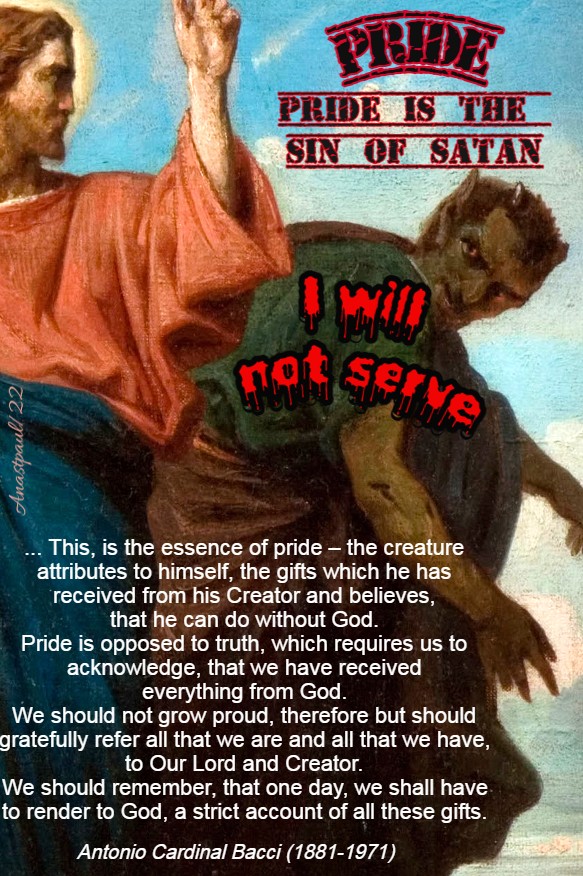
“Pride is the sin of Satan. Being a pure spirit, he could not commit sins which have material things as their object, such as sins of impurity or of avarice. The one sin of which a spirit is capable, is pride. Satan had been created by God and had been endowed with the loftiest gifts but, he was obliged to undergo a trial, in order that he could merit the reward reserved for him by God, namely, the everlasting happiness of the Beatific Vision. It is generally held, that God revealed to Satan and to all the legions of Angels, the Eternal Word made man, Jesus Christ and commanded them to adore Him. But when Satan and the other rebellious Angels saw in Jesus Christ, a nature far inferior to their own, they were indignant, because, the Divine Word had not been united to the angelic, instead of the human nature. They refused to bow their haughty heads and flung back at God, the arrogant and blasphemous ultimatum: “I will not serve.”
This, is the essence of pride – the creature attributes to himself, the gifts which he has received from his Creator and believes, that he can do without God. Pride is opposed to truth, which requires us to acknowledge, that we have received everything from God. We should not grow proud, therefore but should gratefully refer all that we are and all that we have, to Our Lord and Creator. We should remember, that one day, we shall have to render to God, a strict account of all these gifts.”
Quote/s of the Day – 20 April – Monday of the Second week of Easter, Readings: Acts 4:23-31, Psalm 2:1-9, John 3:1-8
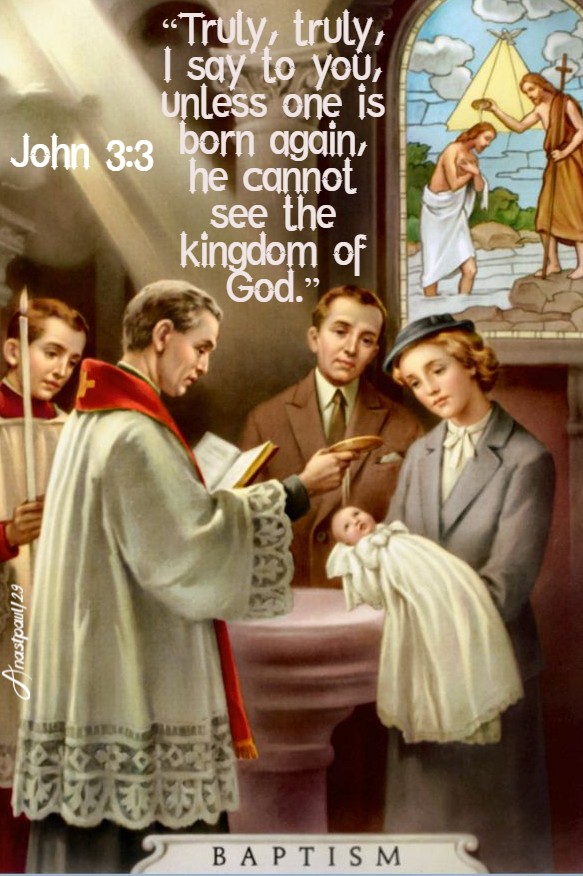
“Truly, truly, I say to you, unless one is born again, he cannot see the kingdom of God.”
John 3:3
“We read in Saint John – No-one can enter the Kingdom of God without being born of water and Spirit. To be reborn in the Holy Spirit during this life is to become most like God in purity, without any mixture of imperfection. Accordingly, pure transformation can be effected – although not essentially – through the participation of union.
Here is an example that will provide a better understanding of this explanation. A ray of sunlight shining on a smudgy window, is unable to illumine that window completely and transform it into its own light. It could do this, if the window were cleaned and polished… The extent of illumination is not dependent on the ray of sunlight but on the window. If the window is totally clean and pure, the sunlight will so transform and illumine it, that to all appearances the window will be identical with the ray of sunlight and shine just as the sun’s ray. Although, obviously, the nature of the window is distinct from that of the sun’s ray, even if the two seem identical, we can assert, that the window is the ray or light of the sun by participation.
The soul on which the divine light of God’s being is ever shining, or better, in which it is ever dwelling by nature, is like this window. A soul makes room for God by wiping away all the smudges and smears of creatures, by uniting its will perfectly to God’s, for to love is to labour, to divest and deprive oneself for God, of all that is not God When this is done, the soul will be illumined by and transformed in God.”
St John of the Cross (1542-1591)
Doctor of the Church
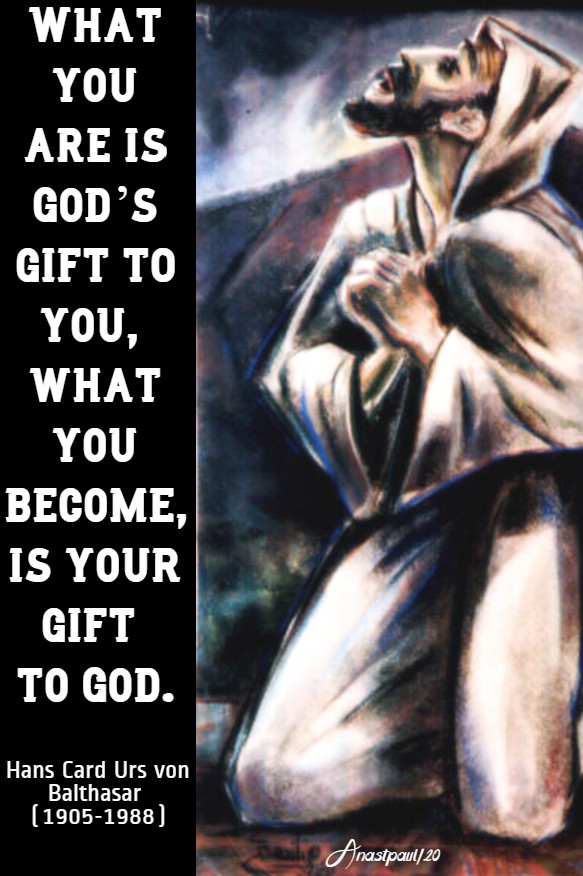
“What you are is God’s gift to you, what you become, is your gift to God.”
Hans Cardinal Urs von Balthasar (1905-1988)
“If God is your co-pilot, switch seats!”
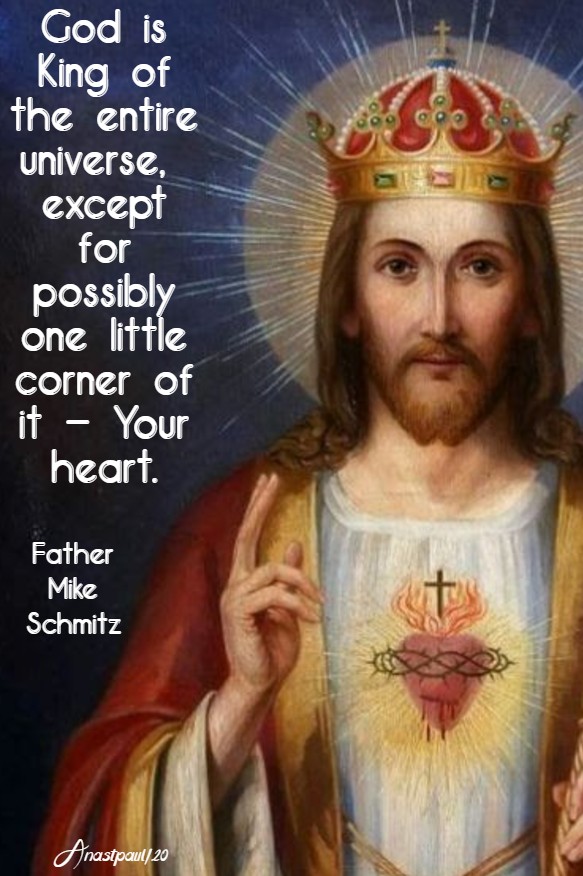
“God is King of the entire universe, except for possibly one little corner of it – Your heart.”
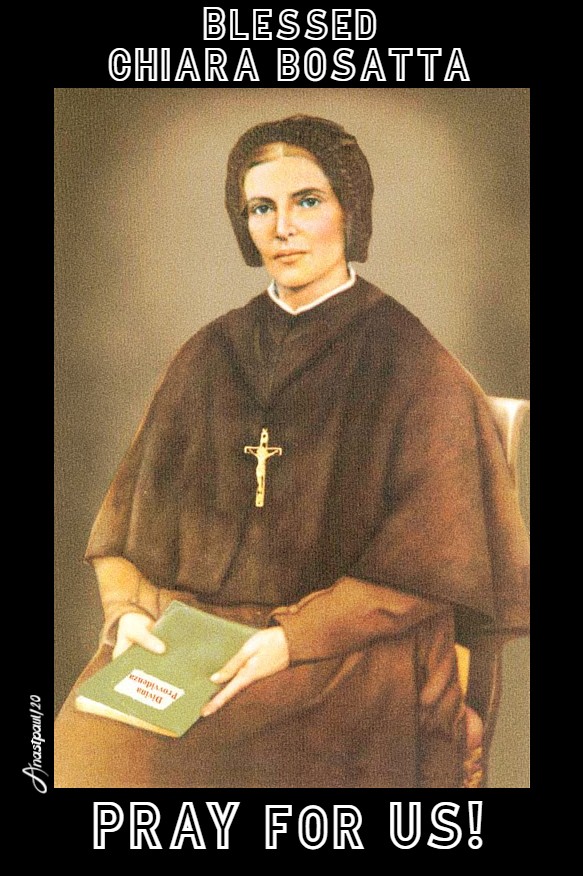
One Minute Reflection – 20 April – Monday of the Second week of Easter, Readings: Acts 4:23-31, Psalm 2:1-9, John 3:1-8 and the Memorial of Blessed Chiara Bosatta (1858-1887)
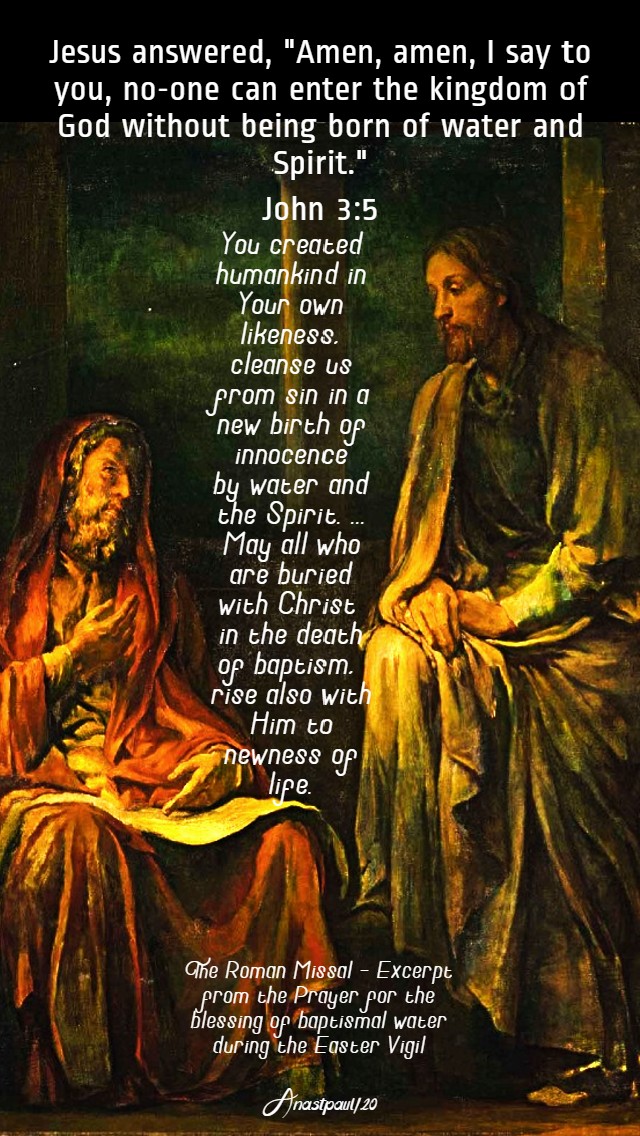
Jesus answered, “Amen, amen, I say to you, no-one can enter the kingdom of God without being born of water and Spirit.” … John 3:5
REFLECTION – The Roman Missal – Prayer for the blessing of baptismal water during the Easter Vigil
Father, You give us grace through sacramental signs,
which tell us of the wonders of Your unseen power.
In baptism we use Your gift of water,
which You have made a rich symbol
of the grace You give us in this sacrament.
At the very dawn of creation
Your Spirit breathed on the waters,
making them the wellspring of all holiness.
The waters of the great flood
You made a sign of the waters of baptism,
that make an end of sin and a new beginning of goodness.
Through the waters of the Red Sea
You led Israel out of slavery,
to be an image of God’s holy people,
set free from sin by baptism.
By the waters of the Jordan
Your Son was baptised by John
and anointed with the Spirit.
Your Son willed that water and blood
should flow from His side
as He hung upon the cross.
After His resurrection, He told his disciples,
‘Go out and teach all nations,
baptising them in the name of the Father
and of the Son and of the Holy Spirit.’
Father, look now with love upon Your Church,
and unseal for her the fountain of baptism.
By the power of the Spirit
give to the water of this font
the grace of Your Son.
You created humankind in Your own likeness:
cleanse us from sin in a new birth of innocence
by water and the Spirit.
We ask You, Father, with Your Son,
to send the Holy Spirit upon the waters of this font.
May all who are buried with Christ
in the death of baptism
rise also with Him to newness of life.
PRAYER – Almighty God and Father, grant that Your faithful people who were buried with Your Son in baptism, may by His Resurrection and intercession at Your right hand, obtain for us eternal life. Send Your Spirit upon Your adopted children and lead us in Your way. Grant that by the intercession of Blessed Chiara Bosatta, our path may be straightened and glow with Your light. Through Christ our Lord, with the Holy Spirit, God forever, amen.
Our Morning Offering – 20 April – Monday of the Second week of Easter
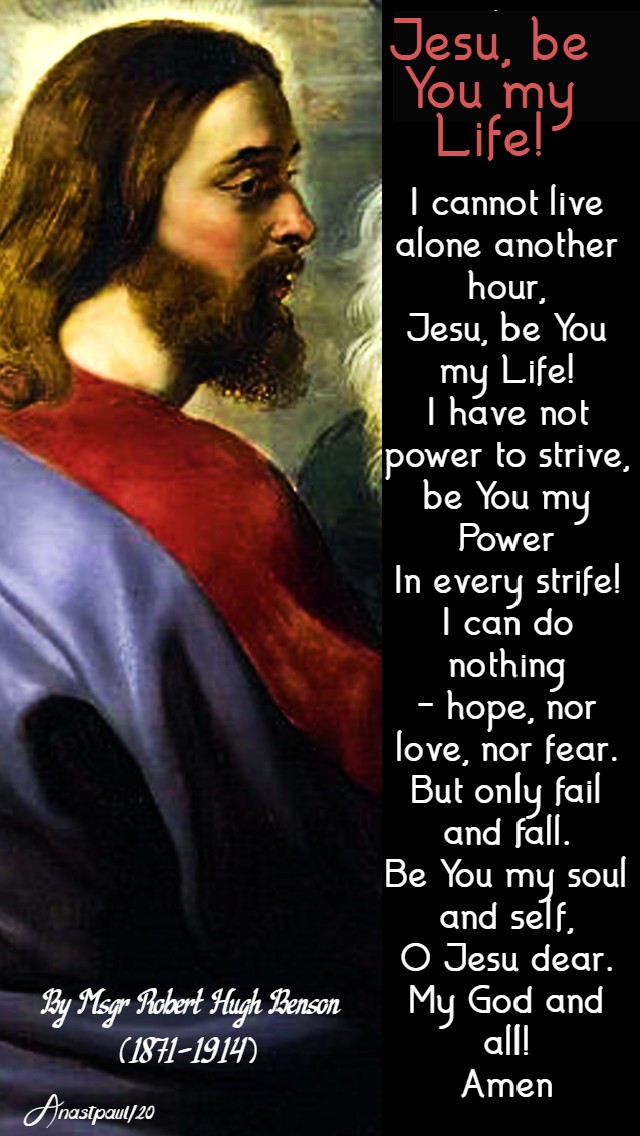
Jesu, be You my Life! Msgr Robert Hugh Benson (1871-1914)
I cannot live alone another hour,
Jesu, be You my Life!
I have not power to strive,
be You my Power
In every strife!
I can do nothing
– hope, nor love, nor fear.
But only fail and fall.
Be You my soul and self,
O Jesu dear.
My God and all!
Amen
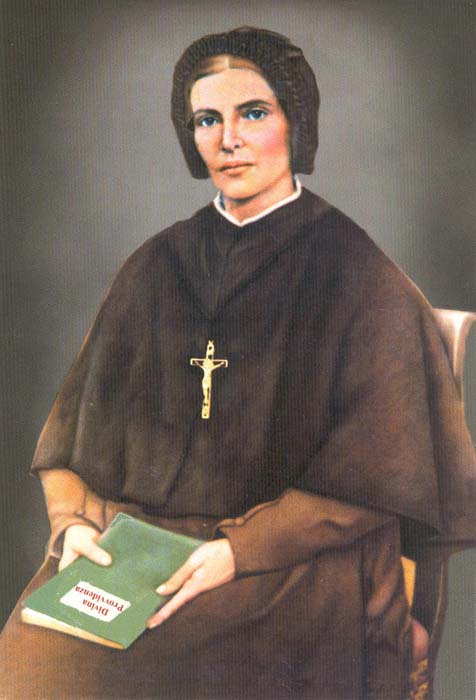
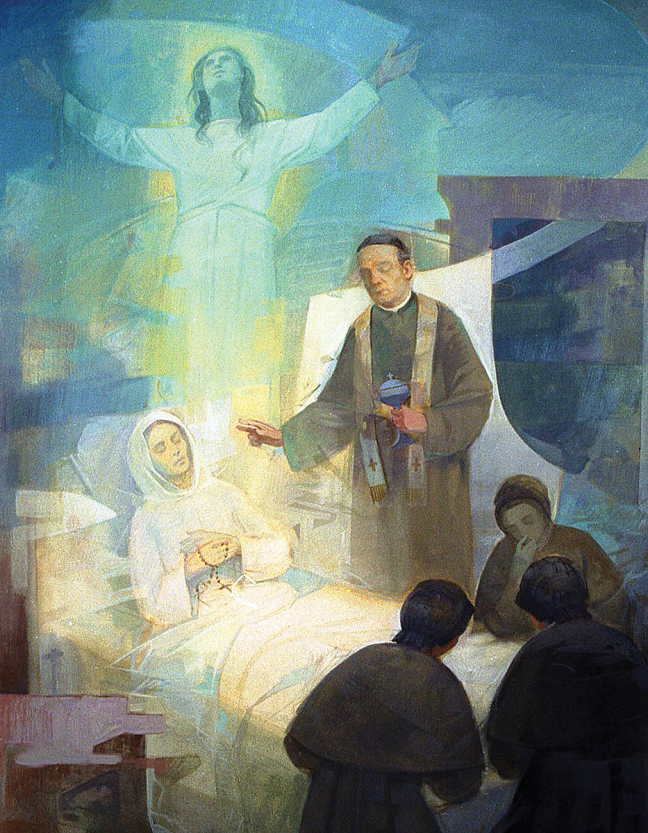
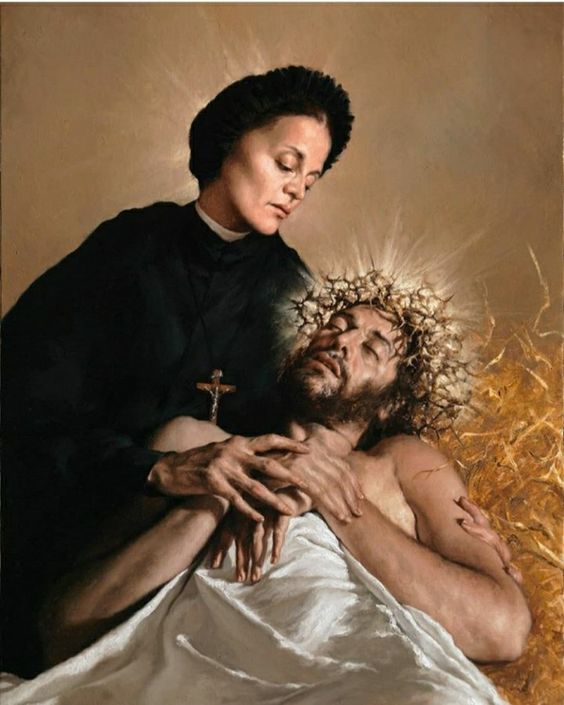
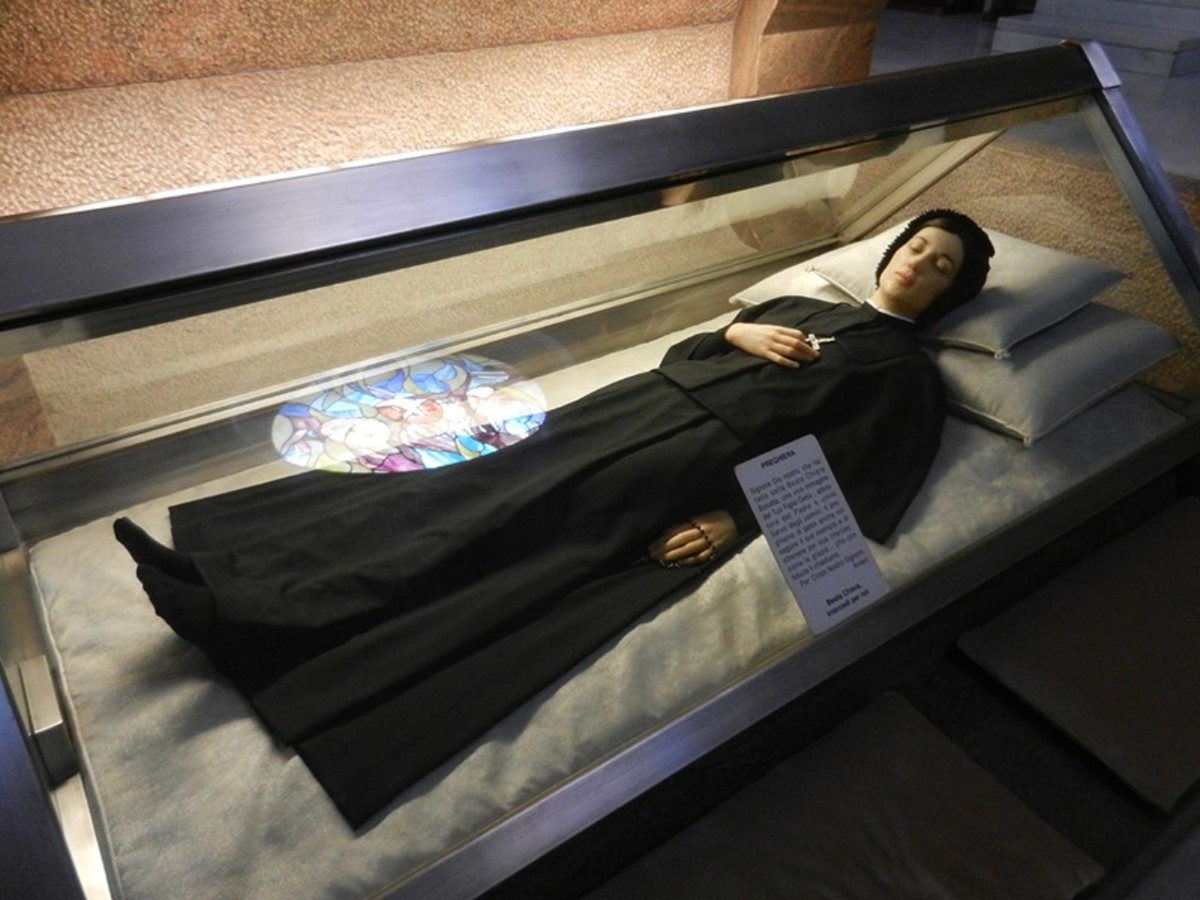
Saint of the Day – 20 April – Blessed Chiara Bosatta DSMP (1858-1887) Virgin Religious, Mystic, Apostle of Charity, co-Founder alongside her sister and Saint Luigi Guanella (1842-1915) – the Daughters of Saint Mary of Providence – born on 27 May 1858 in Pianello del Lario, Como, Italy as Dina Bosatta and died on 20 April 1887 in Pianello del Lario, Como, Italy of natural causes, aged 28. Patronage – Daughters of Saint Mary of Providence. Her body is incorrupt.
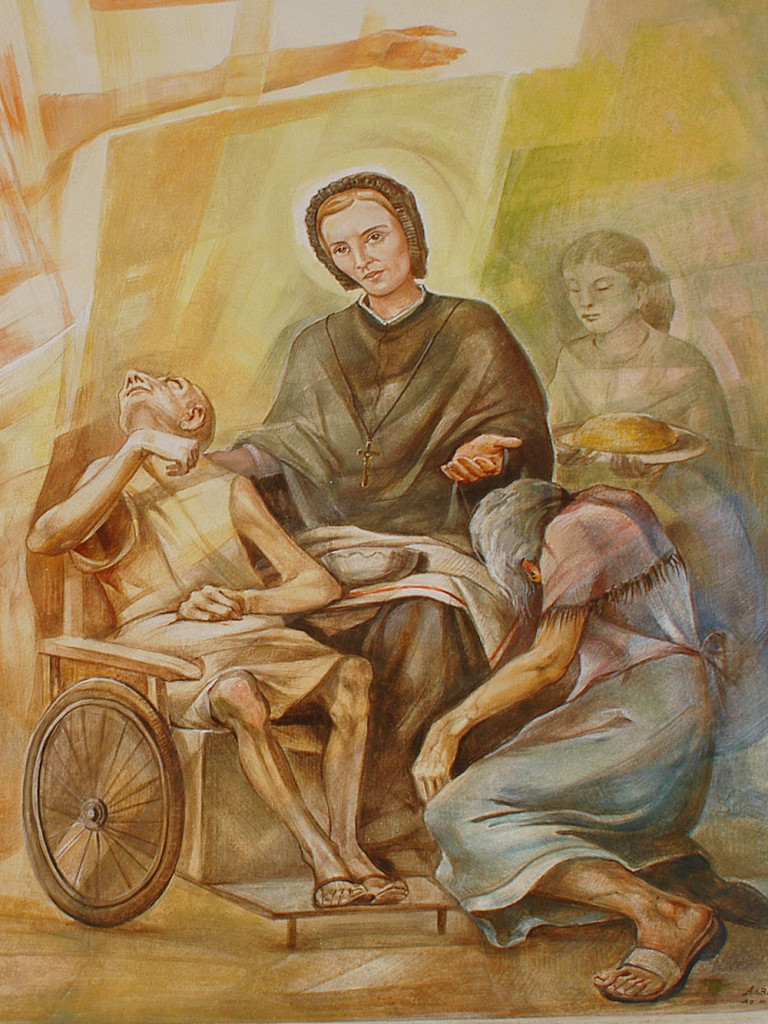
Blessed Chiara managed the new order of the Daughters of St Mary, in her hometown and the surrounding areas. In her service to the poor she contracted tuberculosis which caused her death at such a young age, in 1887.
Dina Bosatta was born in 1858 in Como to Alessandro Bosatta and Rosa Mazzocchi – her father worked as a silk manufacturer who died in 1861 when she was but a toddler. She was the last of eleven siblings, 9 brothers and one sister, Marcellina.
She studied with the Daughters of Charity at the age of thirteen in 1871. She decided to consecrate her life to God and made the decision to become a nun and so entered into the period of novitiate with the Canossians from 1871 to 1878. However, after a while, she descerned that their charism was not that, of which she felt she was being called and so left that congregation to pursue her vocation elsewhere. Despite this, she was enthralled with their charism and admired their spirit and strong dedication to their rules of life.
Dina returned to her home and joined with her sister Marcellina and the two joined the Daughters of Mary that Father Carlo Copponi had established. Marcellina would later become the superior of the order. The pair also worked at a hospice to tend to neglected children and older people as well as teaching children.
The sisters then co-ordinated their efforts in establishing a new religious congregation – the Daughters of Saint Mary of Providence – together with Saint Luigi Guanella. It was at this point that she took the religious name of “Chiara.” She was professed as a nun on 27 October 1878.
Tending to the poor bought unwanted consequences for Bosatta when she contracted tuberculosis – this disease would the the cause of her very young death. She initially went back to her home town in an attempt to stall the illness by a change of climate but she died, not long after, on 20 April 1887. Her Shrine rests at the Shrine of the Sacred Heart in Como.
Blessed Chiara was Beatified after the approval of a miracle by St Pope John Paul on 21 April 1991 at the Vatican.
From the Sisters of the Daughters of St Mary of Providence:
“There is no doubt, that Blessed Chiara contributed with her prayers from heaven, to ensure that Fr Guanella was declared a Saint. We know that Blessed Chiara had a crucial influence on the Founder’s journey to sainthood. Still today, those who kneel before their urns at the Shrine of the Sacred Heart in Como, cannot but receive that holy incentive, to integrate hard-working charity, with the contemplation of the sources, from which the grace of our activity comes.
May the memory of Sr Chiara’s Beatification revive in all of us, gratitude to the Lord for our holy origins. Faithfulness to living their spirit and putting it into practice will increase our faith and love.
Walking towards holiness together, as Fr Guanella, Sr Chiara and all the good people of God did, will reinforce communion and collaboration among the people of God.
We also want to renew our commitment of spreading the devotion to Blessed Chiara and to ask our Blessed for her intercession, so that her holiness may be proposed to the entire Christian world with her Canonisation.
St Luigi Guanella loved Sr Chiara.
In the beginning he was puzzled by her religious life-style. He had an inspiration that Sr Chiara was a mystic and was, therefore, moved to intensely study the works of St Theresa of Avila. From then on, he understood that Sr Chiara was a saint and a mystic. She was the “little flower” of Guanellian spirituality.
Fr Guanella wrote a biography of Blessed Chiara. It is available at the St Louis Centre upon request.”
Prayer for the Intercession of Blessed Chiara Bosatta
O Jesus, Saviour of the lowly,
who made Blessed Chiara Bosatta shine
through the spirit of sacrifice,
by rendering her an untiring apostle of Your Gospel among the poor.
Teach us her total abandonment to Divine Providence,
her love of prayer,
her patience in suffering
and her spirit of dedication to the most needy.
Grant us, through her intercession,
the grace ………………………
that we ask You trustingly,
through Christ our Lord.
Amen!
Our Father … Hail Mary … Glory Be … Blessed Chiara, intercede for us!
Bl Antony Page
St Caedwalla of Wessex
Bl Catwallon Blessed Chiara Bosatta DSMP (1858-1887)
St Domninus of Digne
Bl Francis Page
Bl Gerald of Salles
Bl Harduin
Bl Hildegun of Schönau
St Hugh of Anzy-le-Duc
Bl James Bell
Bl John Finch
Bl John of Grace-Dieu St Marcellinus – Bishop of Embrun (born in North Africa- died 374) Biography: https://anastpaul.wordpress.com/2018/04/20/saint-of-the-day-20-april-st-marcellinus-of-embrun-born-in-north-africa-died-374/
St Marcian of Auxerre
St Margaret of Amelia
Bl Maurice MacKenraghty
St Michel Coquelet
Bl Oda of Rivreulle
Bl Richard Sergeant
St Sara of Antioch
St Secundinus of Córdoba
St Servilian
Bl Simon Rinalducci
St Sulpicius
St Theodore Trichinas
St Theotimus of Tomi
St Vincent of Digne
St Wiho of Osnabrück
Bl William Thomson
Sunday Reflection – 19 April – Low Sunday the Octave Day of Easter and the 20th Divine Mercy Sunday
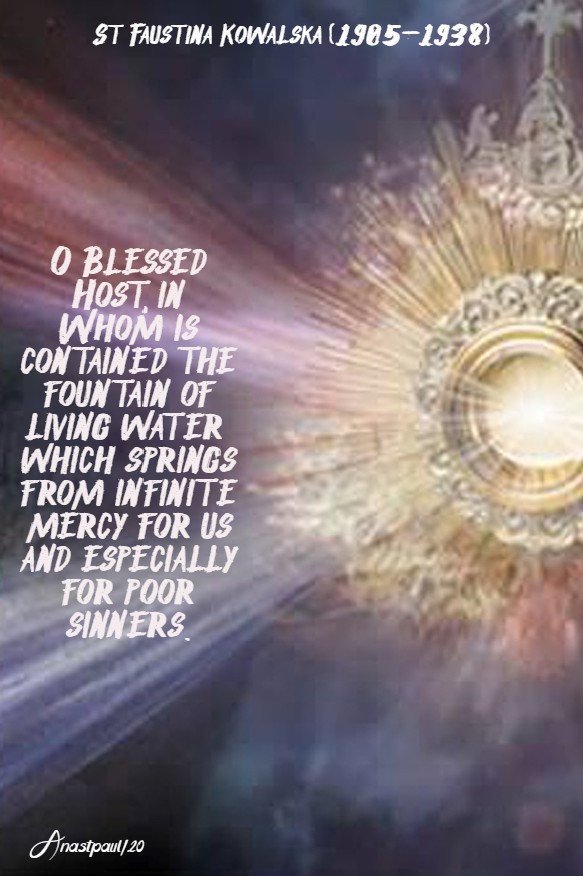
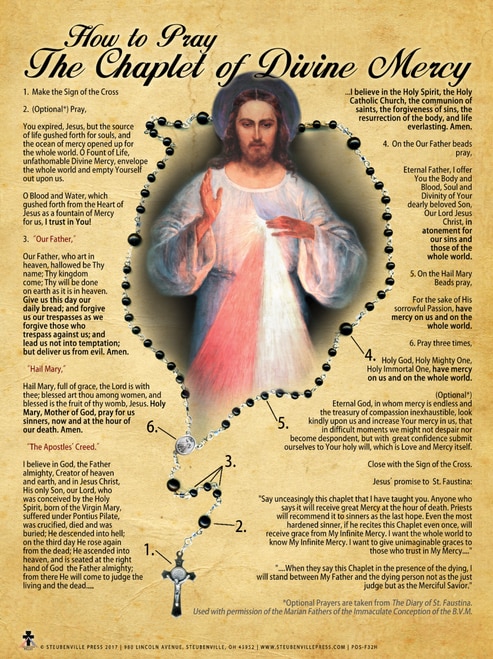
The Blessed Sacrament is the Throne of Mercy, Jesus told Sister Faustina.
“O Blessed Host, in Whom is contained the fountain of living water which springs from infinite mercy for us and especially for poor sinners.”
St Faustina Kowalska (1905–1938)
The Eucharist is central to devotion to The Divine Mercy and many of the elements of the devotion are essentially Eucharistic–especially the image, the chaplet and the Feast of Mercy. The image, with its red and pale rays, presents the Eucharistic Lord Jesus, whose Heart has been pierced and now pours forth blood and water as a fountain of mercy for us. It is the image of God’s sacrificial gift of mercy made present in every Mass.
Several times in her Diary, Blessed Faustina writes of seeing the red and pale rays coming, not from the image but from the Sacred Host and once, as the Priest exposed the Blessed Sacrament, she saw the rays from the image pierce the Host and spread out from it all over the world (see 441). So too, with the eyes of faith, we should see in every Host the merciful Saviour pouring Himself out as a fountain of mercy for us.
The concept of the Eucharist as a fountain of grace and mercy is not only found in the Diary but also in Church teaching . The Church clearly teaches that all the other Sacraments are directed towards the Eucharist and draw their power from it.
In the Constitution on the Sacred Liturgy (#10), for example, we read: “Especially from the Eucharist, grace is poured forth upon us as from a fountain.” And, in a note in the Catechism of the Council of Trent, pastors are urged to “compare the Eucharist to a fountain and the other Sacraments to rivulets. For the Holy Eucharist is truly and necessarily the fountain of all graces, containing, as it does, after an admirable manner, the fountain itself of celestial gifts and graces, the Author of all the Sacraments, Christ our Lord, from whom, as from its source, is derived whatever of goodness and perfection the other Sacraments possess.”
No wonder, then, that Saint Faustina was so devoted to the Eucharist and wrote so powerfully about it in her Diary:
“O what awesome mysteries take place during Mass! … One day we will know what God is doing for us in each Mass and what sort of gift He is preparing in it for us. Only His divine love could permit that such a gift be provided for us … this fountain of life gushing forth with such sweetness and power” (914) …
“All the good that is in me is due to Holy Communion (1392) … Herein lies the whole secret of my sanctity (1489) … one thing alone sustains me and that is Holy Communion. From it I draw all my strength, in it is all my comfort … Jesus concealed in the Host, is everything to me … I would not know how to give glory to God, if I did not have the Eucharist in my heart” (1037) …
“O living Host, my one and only strength, fountain of love and mercy, embrace the whole world, fortify faint souls. Oh, blessed be the instant and the moment when Jesus left us His most merciful Heart!”(223).
(From the booklet “The Divine Mercy Message and Devotion”, by Fr. Seraphim Michalenko, MIC and Vinny Flynn)
Let us Pray the Divine Mercy Chaplet today,
for the OPENING OF OUR CHURCHES AND THE RETURN OF DAILY MASS!
Thought for the Day – 19 April – Meditations with Antonio Cardinal Bacci (1881-1971)
The Mercy of God
“God is the Being, Who is infinitely true, beautiful and good.
His goodness is manifested in His infinite love for all the creatures which He has made but, it is in His relations with sinners, in particular, that we call Him merciful.
He loves all things which He has created and directs them towards Himself, their beginning and their end.
When He is dealing, however, with beings endowed with free will, who can separate themselves from Him and even offend Him, He tries, while respecting the liberty which He has given them, to recall them to Himself, by the influence of His love and of His grace.
It is this supernatural outpouring of love towards sinners, which we call mercy.
The mercy of God shines forth in all the pages of Sacred Scripture.
In the Old Testament, there is promised and foreshadowed, in many ways, the coming of the Saviour of the sinful human race.
In the New Testament, Jesus appears, made man for our salvation, meek and humble of heart and merciful towards the unfortunate, especially towards sinners.
For them, He offers His life and His Precious Blood, dying on the Cross with His arms outstretched, as if in an embrace of forgiveness.
He tells us that He has not come to call the just but sinners, (Lk 5:32) and, that He has not come to those who are in health but to those who are sick (Mk 2:17); He assures us that, if we ask the Father for anything in His name, it will be given to us (Jn 16:23).
So much goodness should move and soften our hearts.
Even if we are unfaithful servants and are covered with the leprosy of sin, let us go to Him and He will heal us.
Even if we have deserved Hell a thousand times, let us shed tears of repentance at His feet as Magdalen did and, He will give us His forgiveness and His peace.”
Quote of the Day – 19 April – Low Sunday the Octave Day of Easter and Divine Mercy Sunday
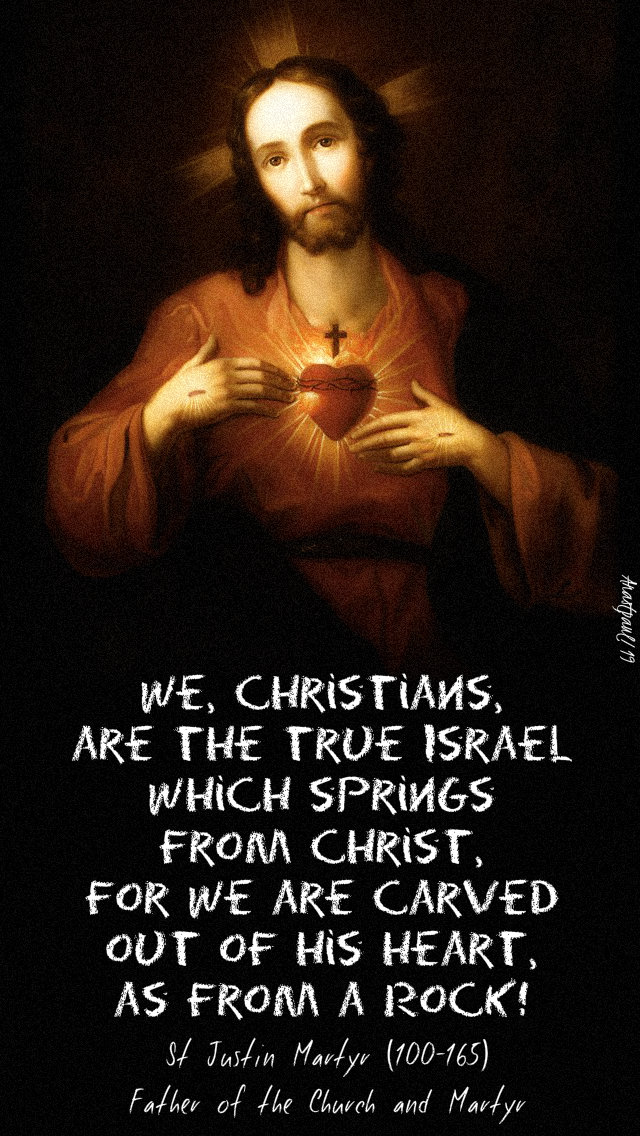
“We, Christians, are the true Israel which springs from Christ, for we are carved out of His Heart, as from a Rock!”
St Justin Martyr (100-165)
Father of the Church and Martyr
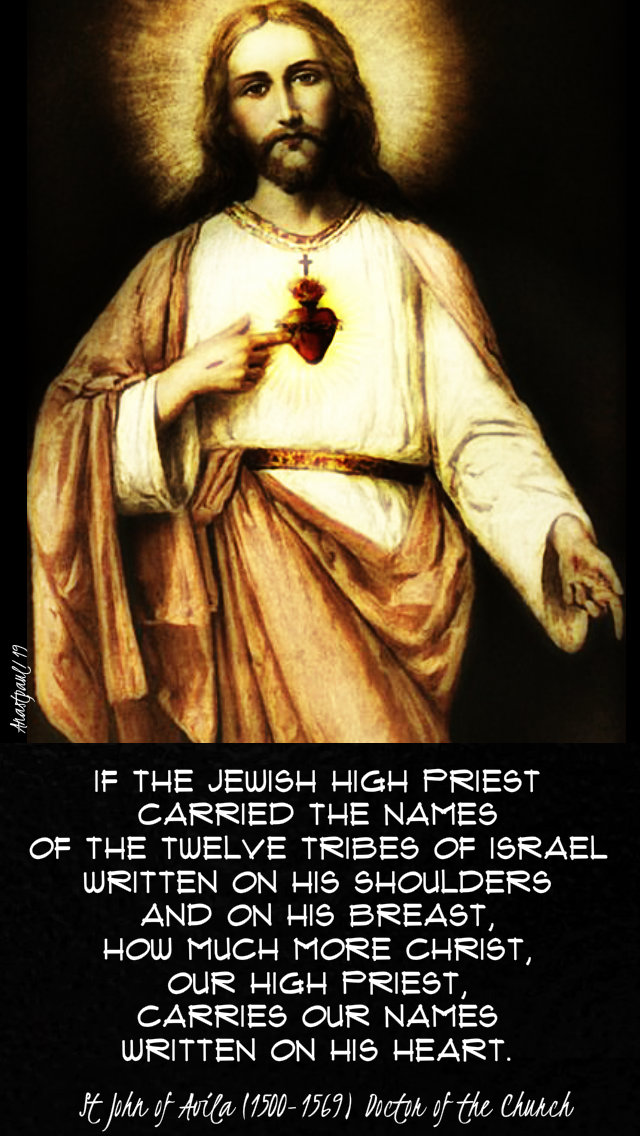
“If the Jewish High priest carried the names of the twelve tribes of Israel written on his shoulders and on his breast, how much more Christ, our High Priest, carries our names written on His Heart”
St John of Avila (1500-1569)
Doctor of the Church
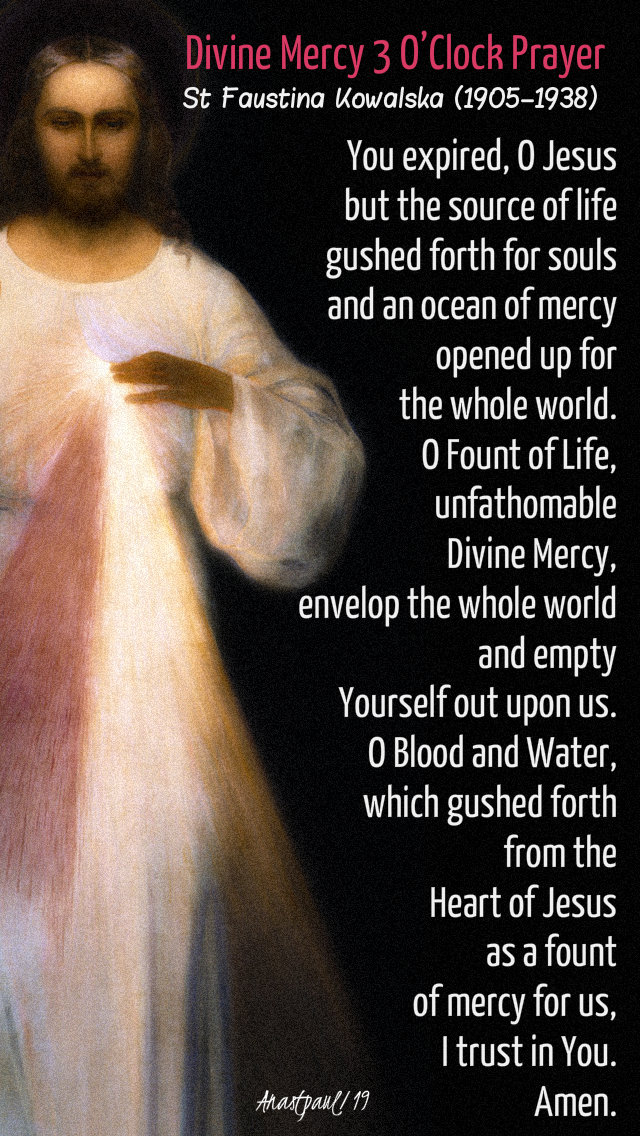
Divine Mercy 3 O’Clock Prayer St Faustina Kowalska (1905–1938)
You expired, O Jesus, but the source of life gushed forth for souls and an ocean of mercy opened up for the whole world. O Fount of Life, unfathomable Divine Mercy, envelop the whole world and empty Yourself out upon us. O Blood and Water, which gushed forth from the Heart of Jesus as a fount of mercy for us, I trust in You. Amen
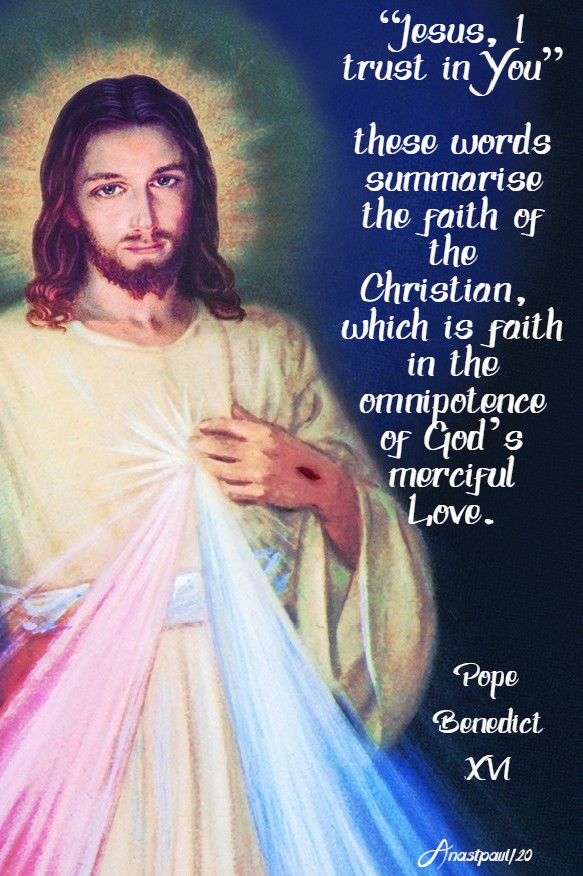
“Jesus, I trust in You” these words summarise the faith of the Christian, which is faith in the omnipotence of God’s merciful Love.”
Pope Benedict XVI
REGINA CÆLI
Second Sunday of Easter, 15 April 2007
One Minute Reflection – 19 April – Low Sunday the Octave Day of Easter and Divine Mercy Sunday, Readings: Acts 2:42-47, Psalm 118:2-4, 13-15, 22-24, 1 Peter 1:3-9, John 20:19-31
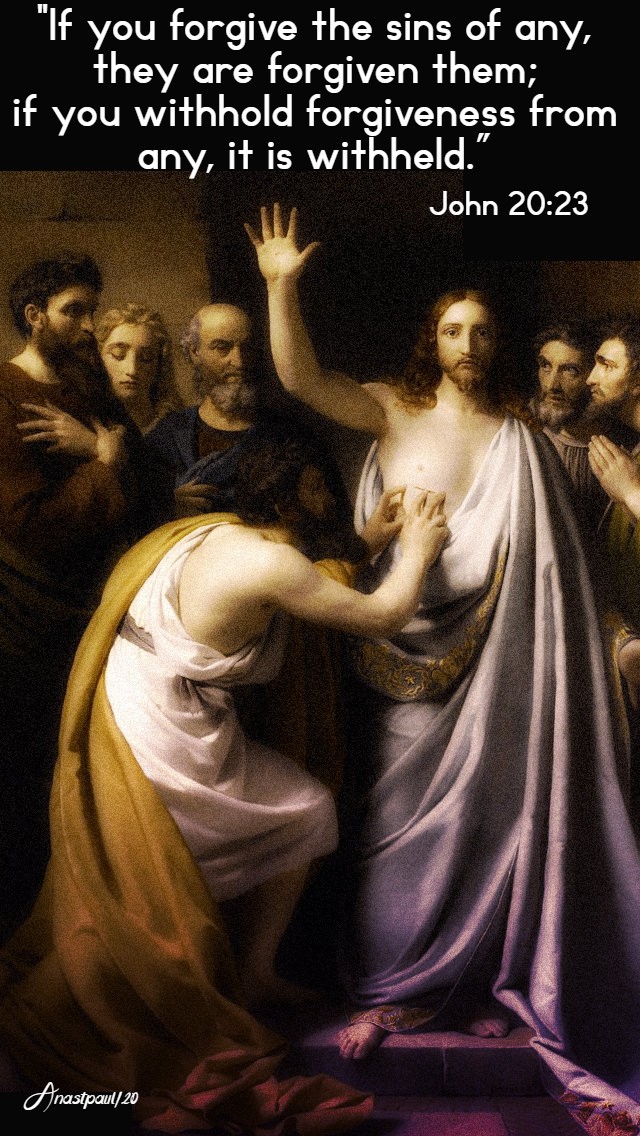
“If you forgive the sins of any, they are forgiven them; if you withhold forgiveness from any, it is withheld.” … John 20:23
REFLECTION – “Jesus entrusted to [the fearful, astounded disciples] the gift of “forgiving sins”, a gift that flows from the wounds in His hands, His feet, and especially from His pierced side. From there a wave of mercy is poured out over all humanity.
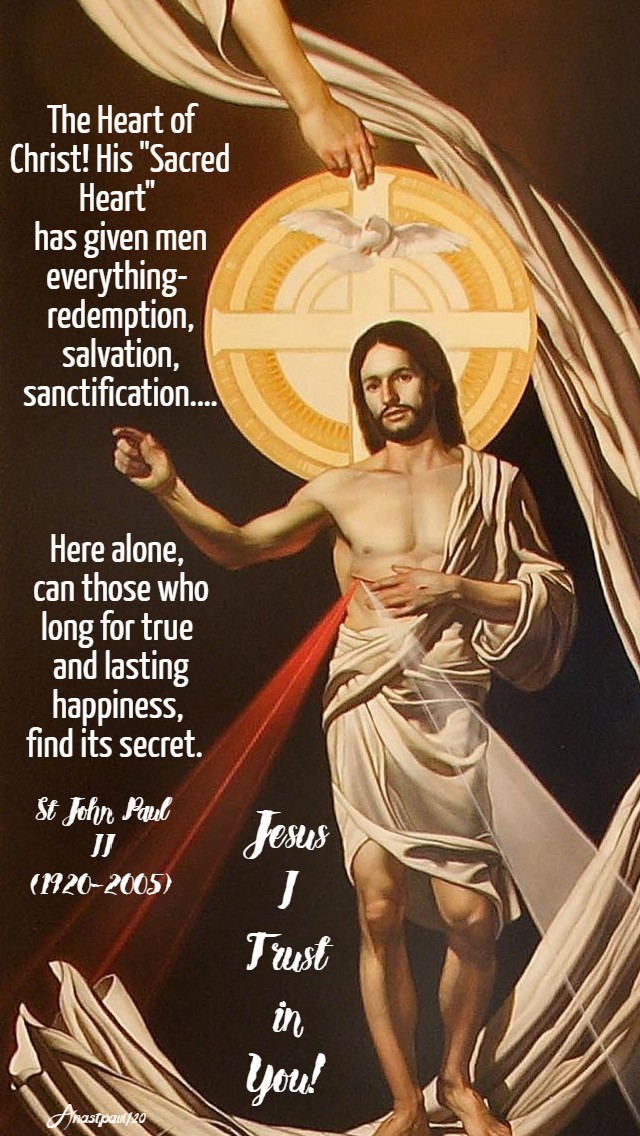
Let us relive this moment with great spiritual intensity. Today the Lord also shows us His glorious wounds and His Heart, an inexhaustible source of light and truth, of love and forgiveness. The Heart of Christ! His “Sacred Heart” has given men everything- redemption, salvation, sanctification.…
Through the mystery of this wounded heart, the restorative tide of God’s merciful love continues to spread over the men and women of our time. Here alone, can those who long for true and lasting happiness, find its secret. “Jesus, I trust in You.” This prayer, dear to so many of the faithful, clearly expresses the attitude with which we too would like to abandon ourselves trustfully into your hands, O Lord, our only Saviour.
You are burning with the desire to be loved, O Jesus and those in tune with the sentiments of your Heart learn how to build the new civilisation of love. A simple act of abandonment is enough to overcome the barriers of darkness and sorrow, of doubt and desperation. The rays of Your divine mercy restore hope, in a special way, to those who feel overwhelmed by the burden of sin.” … St John Paul II (1920-2005) Homily for Divine Mercy Sunday, 22 April 2001
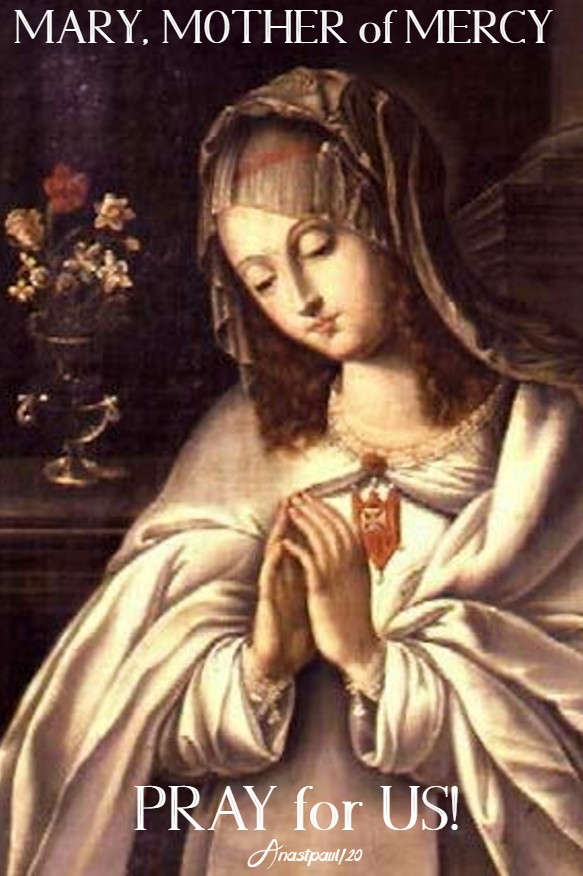
PRAYER – Almighty Father, grant we pray that with Mary’s help, Mater Misericordiae, Mother of Jesus who is the incarnation of Divine Mercy, that we become renewed in the Spirit, in order to co-operate in the work of peace which You are accomplishing in the world and which is not just talk but which is actualised, in the countless gestures of charity by all his sons and daughters. Grant we pray, that we taste the beauty of the encounter with the Risen Lord and draw from the source of His merciful love, to be apostles of His peace. Through Christ, Redeemer and Merciful Lord, with the Holy Spirit, God for always and forever, amen.
Our Morning Offering – 19 April – Low Sunday the Octave Day of Easter and Divine Mercy Sunday
O Spirit of God, Spirit of Love and of Mercy By St Faustina Kowalska (1905-1938)
O Spirit of God, Spirit of love and of mercy,
Who pours into my heart the balm of trust,
Your grace confirms my soul in what is good,
Giving it an invincible strength – constancy!
O Spirit of God, Spirit of peace and of joy,
Who comforts my thirsting heart,
Pour into it the living spring of divine love
And make it dauntless in battle.
O Spirit of God, my soul’s most lovable guest,
I, for my part, desire to be faithful to You
In days of joy, as much as in days of suffering.
Spirit of God, I desire to live always in Your presence.
O Spirit of God who penetrates my being
And lets me know Your divine and Trinitarian life,
You initiate me to Your divine Being;
Thus united with You, I have eternal life.
Amen
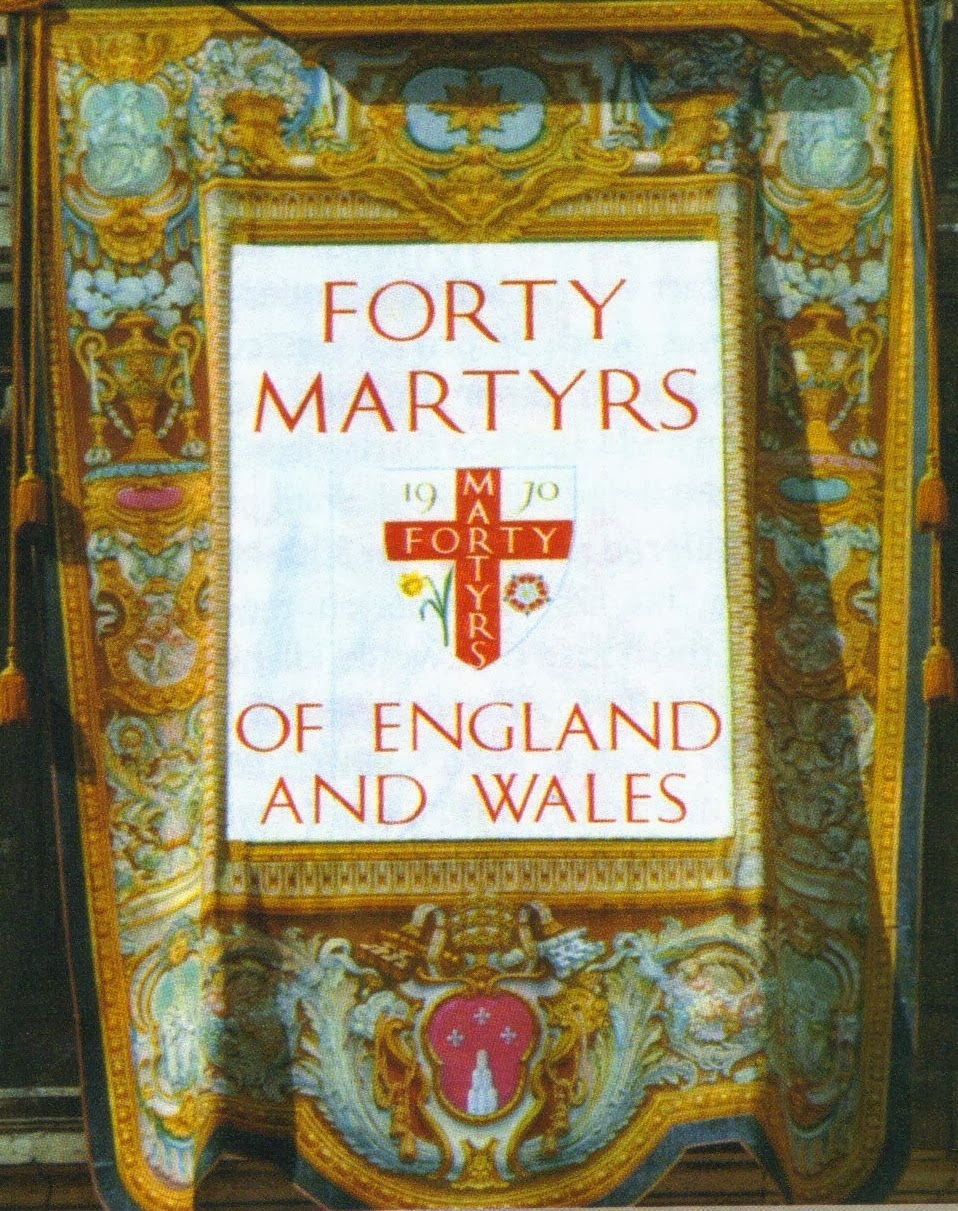
Saint of the Day – 19 April – Blessed James Duckett (Died 1602) Layman Martyr, Bookseller and Publisher – born at Gilfortrigs, Skelsmergh, Westmorland, England and died by hanging on 19 April 1602 at Tyburn, London, England. Patronages – booksellers and publishers. Blessed James is also celebrated with the 40 Martyrs of England and Wales on 4 May.
James became a bookseller and publisher in London. Brought up a Protestant, he was converted by a book, a friend of his, Peter Mauson lent him The Foundation of the Catholic Religion while Duckett was serving his apprenticeship in London. After reading it he became convinced of the truths of the faith and he decided to become a Catholic. Earlier he had twice been imprisoned in Bridewell for not attending the Protestant services. Both times, his employer interceded arranged for him to be freed, presumably paying the required bail. However, it seems his employer was concerned for his own safety and requested James to find a job elsewhere.
He was received into the Catholic Church by an old priest named Weekes who was imprisoned in the Gatehouse at Westminster. Two or three years later, about 1590, he married a Catholic widow but out of his twelve years of married life, nine were spent in prison for his new faith. Their son later became a Carthusian monk and recorded much of what we know about his father.
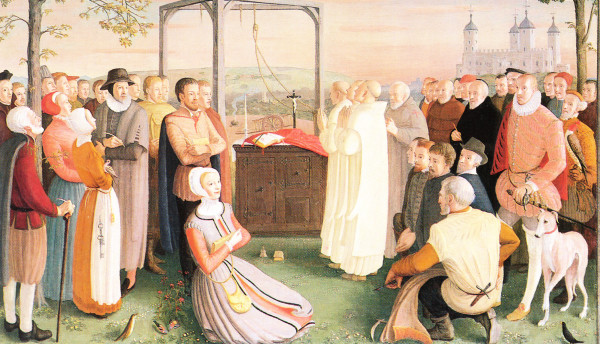
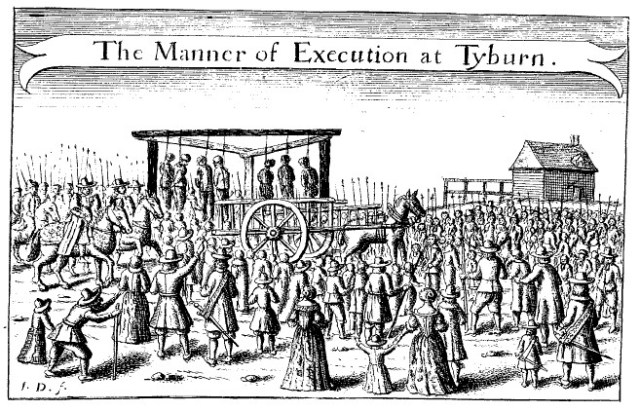
Tyburn – Martyrs of England and Wales including three Carthusians
He was active in propagating Catholic literature. He was finally betrayed by Peter Bullock, a bookbinder, who in order to obtain his own release from prison, betrayed James. Duckett’s house was searched on 4 March 1601 and he was arrested on a charge of having 25 copies of Fr Southwell’s [the Martyr St Robert Southwell (1561-1595)] books on his premises. For this he was at once thrown into Newgate.
At the trial, Bullock testified that he had bound various Catholic books for Duckett, who admitted this but denied other false accusations in a self-possessed manner. The jury found him not guilty but the judge, Sir John Popham, the Lord Chief Justice, browbeat the jury, which reversed its verdict and Duckett was found guilty of felony. Despite the betrayal of Duckett, Bullock was taken to his death at Tyburn in the same cart as Duckett on 19 April 1601.
James Duckett’s son was the John Duckett who later became Prior of the English Carthusians at Nieuwpoort in Flanders. He related that on the way to Tyburn his father was handed a cup of wine, which he drank and told his wife to drink to Peter Bullock and to forgive him. When she declined, he chided her gently until she did. On arrival at Tyburn Tree, James kissed and embraced Bullock, beseeching him to die in the Catholic faith, without success.
At the same trial, three priests, Thomas Tichborne, Robert Watkinson, and Francis Page, were condemned to death. For some reason their execution was remanded to the following day.
James Duckett was Beatified by Pope Pius XI on 15 December 1929.
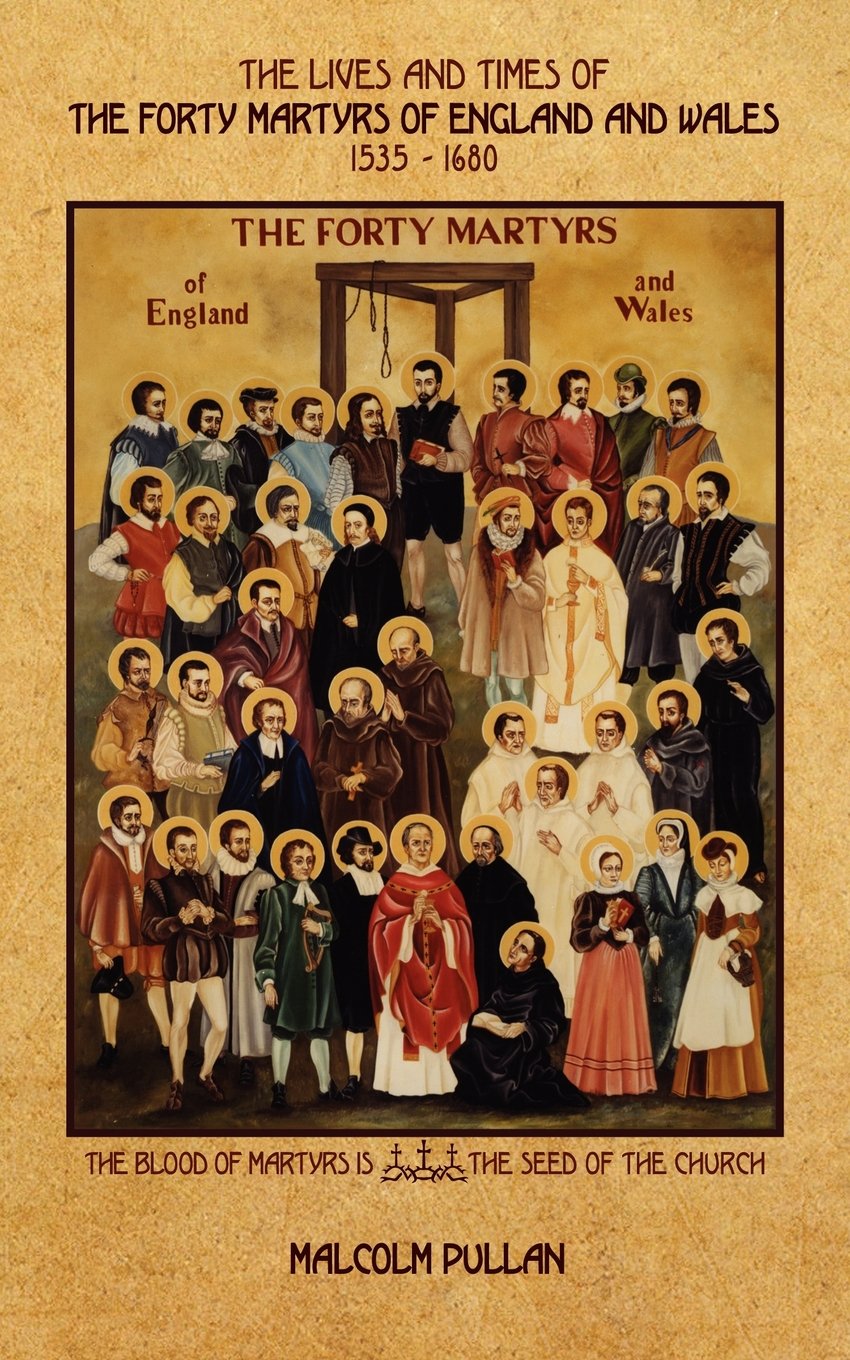
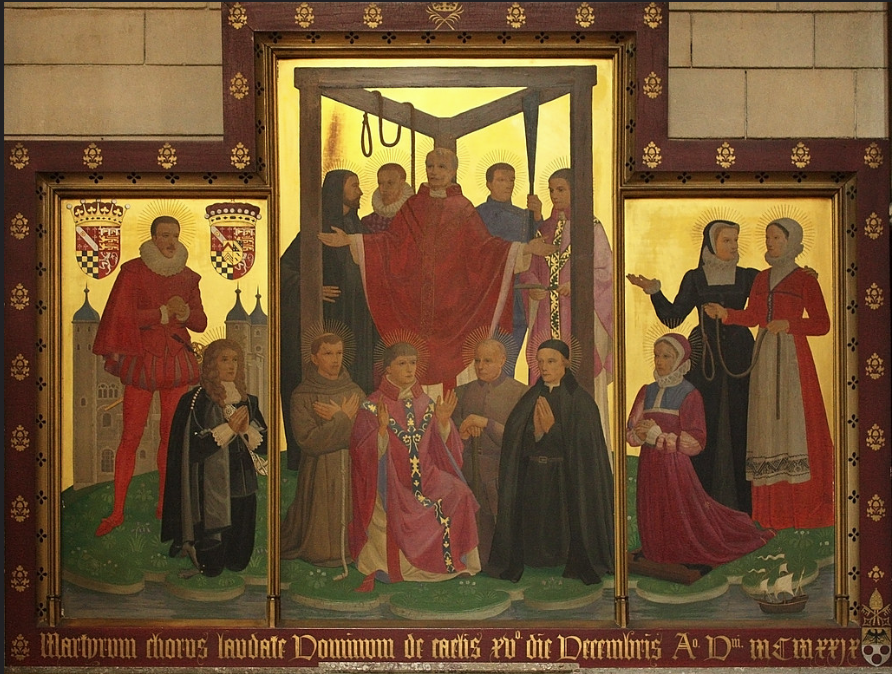
The Triptych above, with the following quote is from Fr Lawrence Lew OP:
“A tryptich in St James’ church, Spanish Place in London showing some of the martyrs who died for the Catholic faith from 1535 – 1680 and whose memory is kept collectively on 4 May. In the centre is the triple gallows known as the ‘Tyburn Tree’.
Below is a citation from the Tudor Stuff blog.
From 1535 to 1681 Tyburn was transformed into a place of cruelty, torture and execution for men and women because of their religious belief. It had become an act of high treason to be a Catholic priest, or to associate with Catholic priests . It was also legal treason to refuse to accept the monarch as “the only Supreme Head on earth of the Church of England”, in the reign of King Henry VIII, from 1534 onwards under Elizabeth I, Charles I and Charles II.
Tyburn had been a place of public spectacle where crowds gathered for entertainment. The martyrs, however, brought a new spirit into the barbarities and butchery of Tyburn. This new spirit was one of joy, spontaneous humour and wholehearted forgiveness of those who had brought them to their life’s end at Tyburn. This spirit flowed over into the crowds around the Tyburn Gallows.
“Thus”, write the nuns at Tyburn Convent, dedicated to those who died, “the holy Martyrs transformed Tyburn’s Deadly Nevergreen Tree into the Tree of Life and the Gate of Heaven, which it remains to this very day”.”
St Martha of Persia
Bl Ramon Llach-Candell
St Rufus of Melitene
St Vincent of Collioure
—
Martyrs of Carthage – 17 saints: A group of Christians martyred in the persecutions of Decius. We know little more than the names – Aristo, Basso, Credula, Donato, Ereda, Eremio, Fermo, Fortunata, Fortunio, Frutto, Julia, Mappalicus, Martial, Paul, Venusto, Victorinus and Victor. Died in the year 250 in prison in Carthage, North Africa (modern Tunis, Tunisia).
Thought for the Day – 18 April – Meditations with Antonio Cardinal Bacci (1881-1971)
Putting Christianity into Practice
“Imagine what the world would be like, if the Gospel of Christ, were practised in it’s entirety, everywhere and by everybody.
It would not, of course, become another earthly Paradise, because suffering and death are the legacy of sin and Our Lord, did not remove these when He redeemed us but made them a necessary element, in our purification and spiritual elevation.
Nevertheless, the full practice of Christianity would transform the world.
A little reflection will convince us of this.
Men would love God above all things and their neighbours as themselves.
The sincere and ardent love of God, would cause wickedness, brutality and every kind of immorality to disappear.
Love of their neighbour, would make men brothers in reality, so that there would be no more wars nor threats of conflict.
The enormous wealth which is squandered on weapons of destruction, could then be diverted to good works.
There would be no more poverty, because, if men loved one another, those who had more than enough, would give to those in want.
There would be no more prisons, because, there would be no more criminals.
There would be no need for a police force, because, everyone would do his duty of his own accord.
The reign of love, which is the reign of Jesus Christ, would triumph upon earth.
Excessive wealth and the selfish love of ease and pleasure, would disappear on one hand, while, on the other, the extreme need of those who can never be sure of a meal, nor of a roof over their heads, would be palliated, until they had been raised to a standard of living, consistent with the laws of God and with the dignity of men.
The love of our neighbour as ourselves, would solve every individual and social problem in this life.
Men would grow into a vast community of brothers devoid of all barriers of hate, selfishness and greed.
This is not a Utopian dream, because it is the clear teaching of the Gospel.
Jesus did not preach the impossible.
He taught us the standards of the perfect life, which we are all obliged to try and lead.”
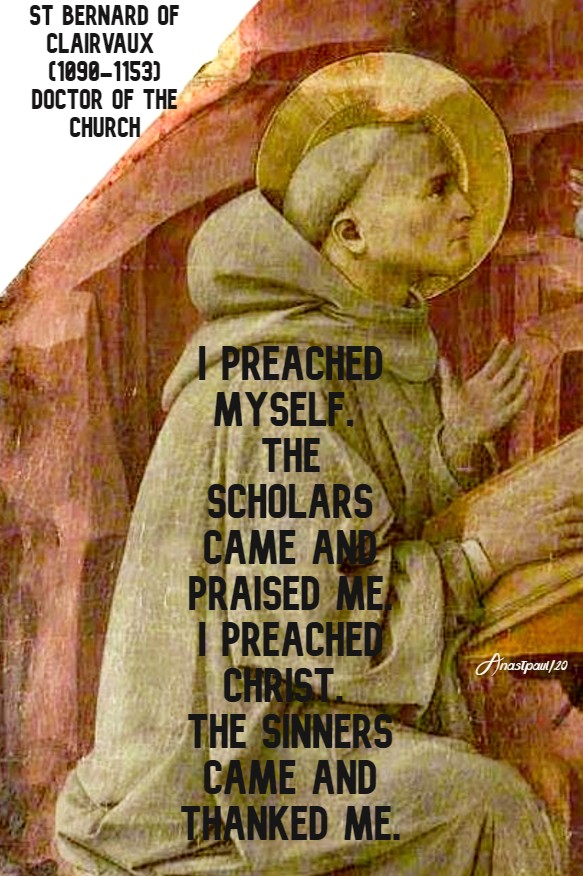
“I preached myself, the scholars came and praised me. I preached Christ, the sinners came and thanked me.”
St Bernard of Clairvaux (1090-1153)
Doctor of the Church
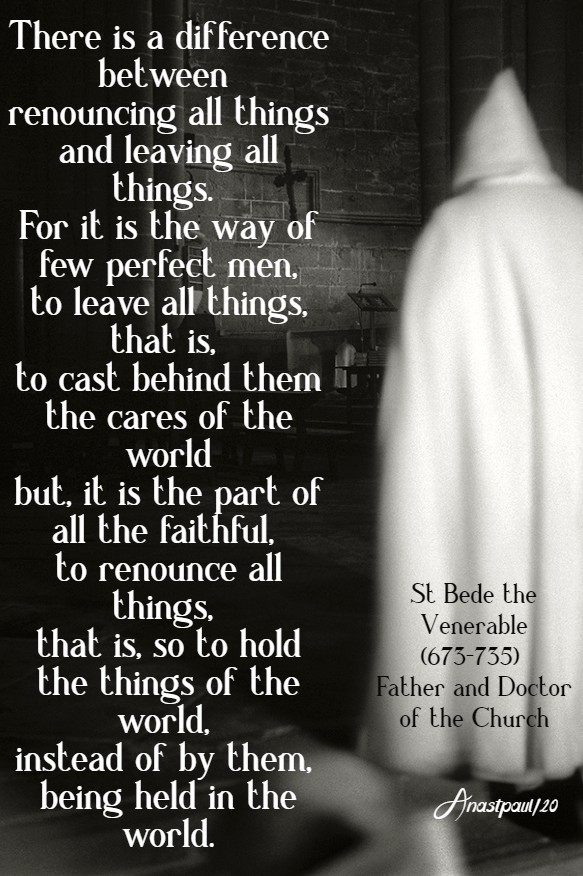
“There is a difference between renouncing all things and leaving all things. For it is the way of few perfect men, to leave all things, that is, to cast behind them the cares of the world but, it is the part of all the faithful, to renounce all things, that is, so to hold the things of the world, instead of by them, being held in the world.”
St Bede the Venerable (673-735)
Father and Doctor of the Church
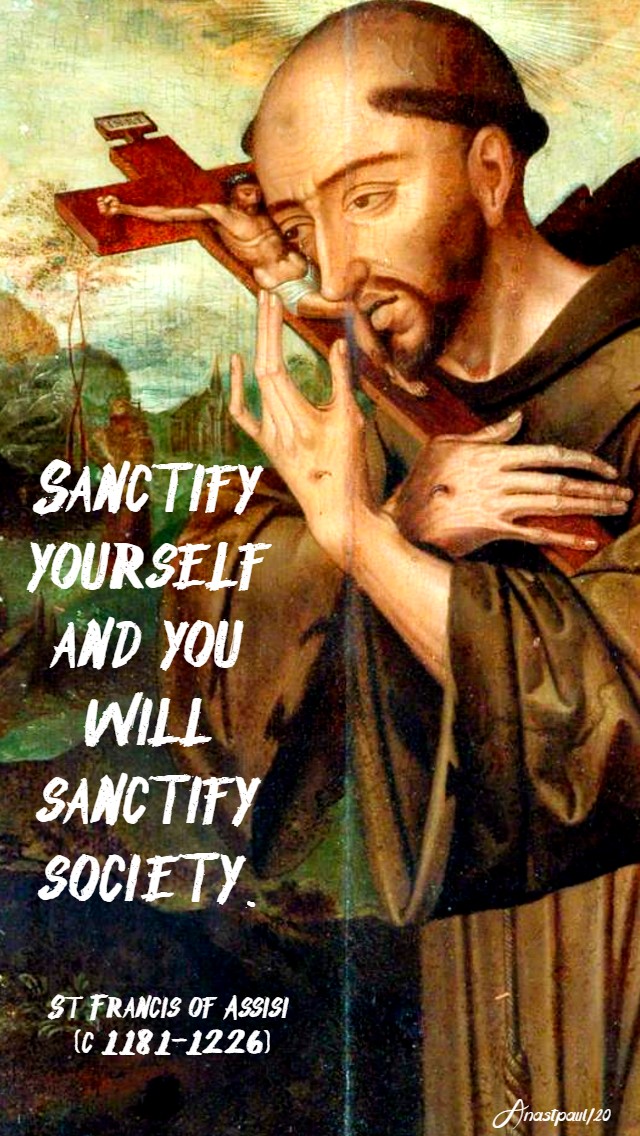
“Sanctify yourself and you will sanctify society.”
St Francis of Assisi (c 1181-1226)
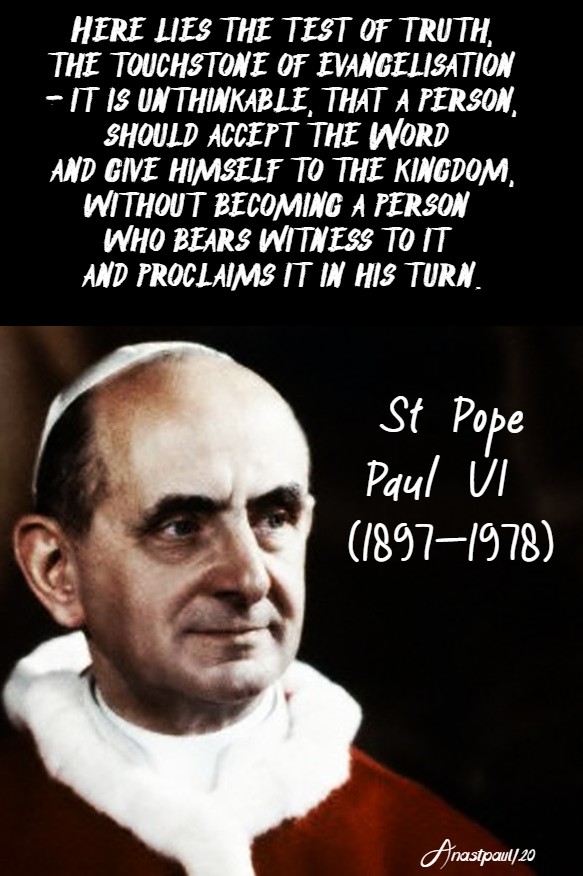
“Here lies the test of truth, the touchstone of evangelisation – it is unthinkable, that a person, should accept the Word and give himself to the kingdom, without becoming a person who bears witness to it and proclaims it in his turn.”
St Pope Paul VI (1897-1978)
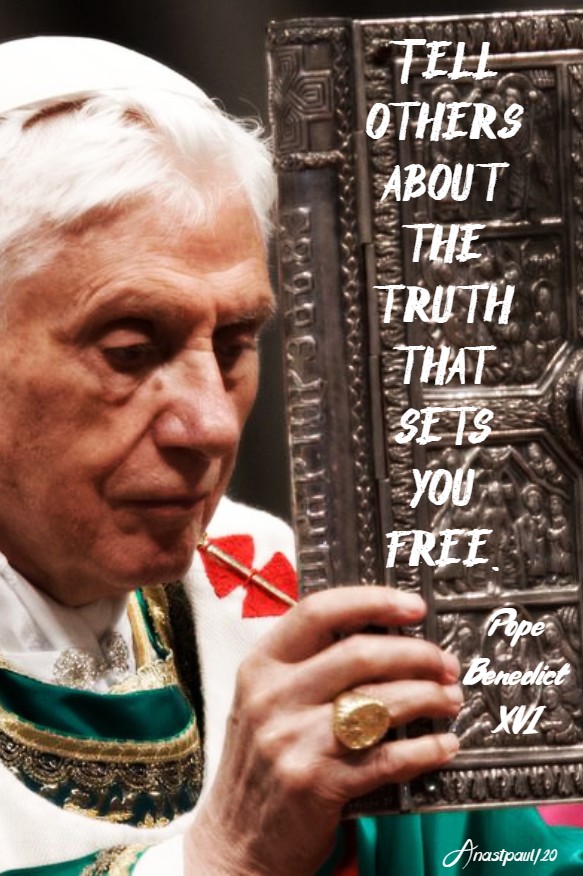
“Tell others about the truth that sets you free.”
Pope Benedict XVI
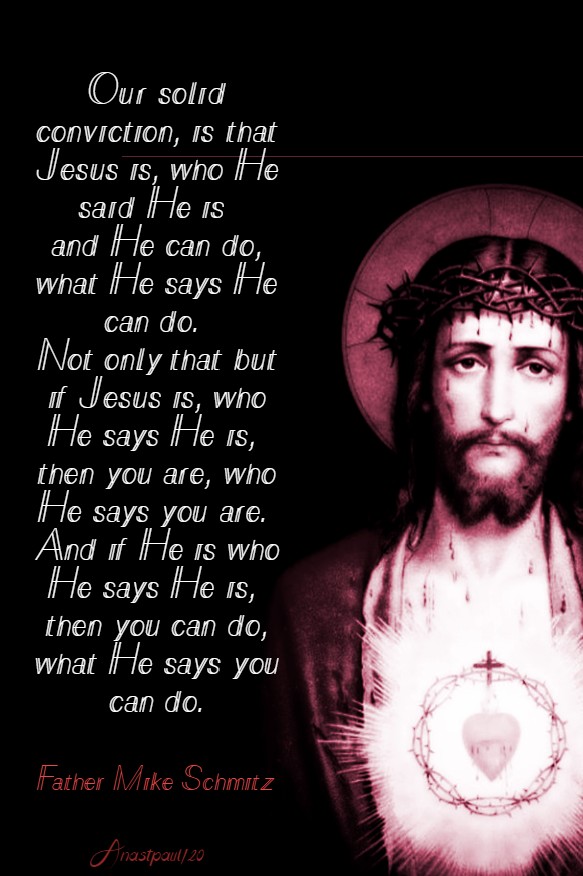
“Our solid conviction, is that Jesus is, who He said He is and He can do, what He says He can do. Not only that but if Jesus is, who He says He is, then you are, who He says you are. And if He is who He says He is, then you can do, what He says you can do.”
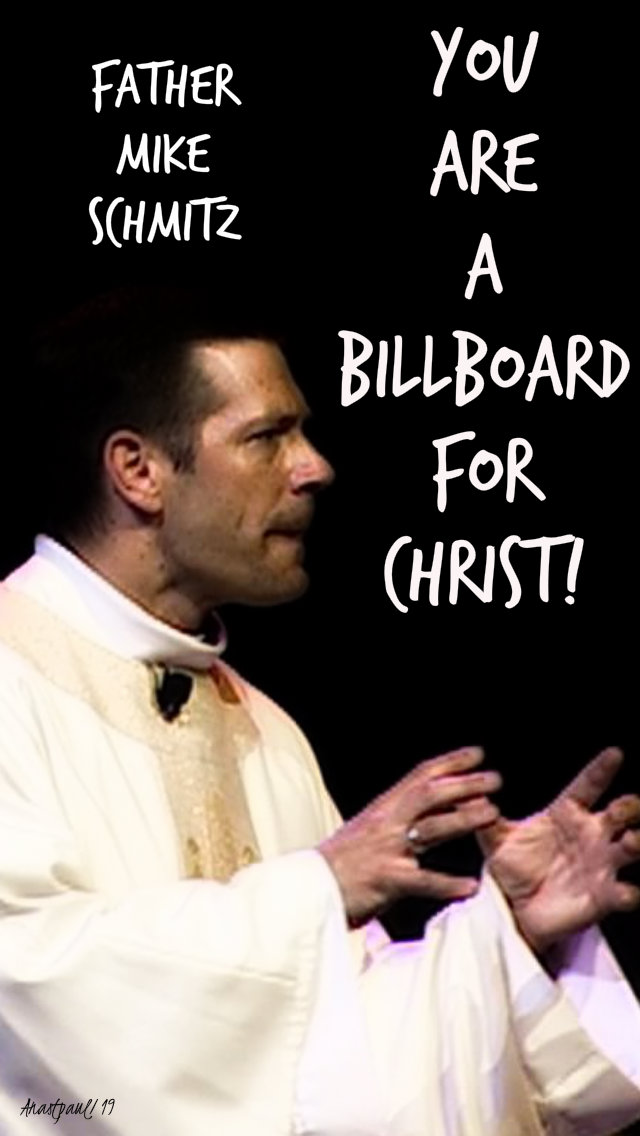
“You are a billboard for Christ!”
Father Mike Schmitz
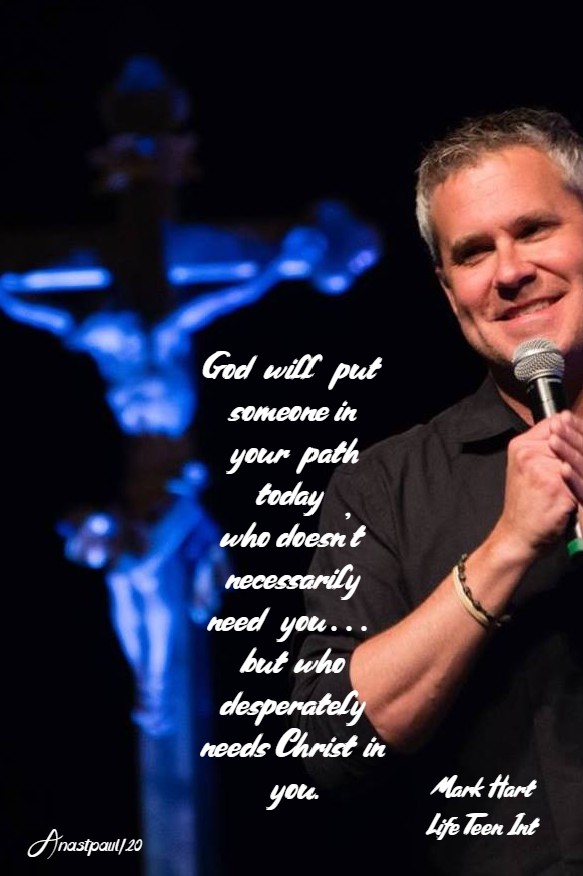
“God will put someone in your path today who doesn’t necessarily need you… but who desperately needs Christ in you.”
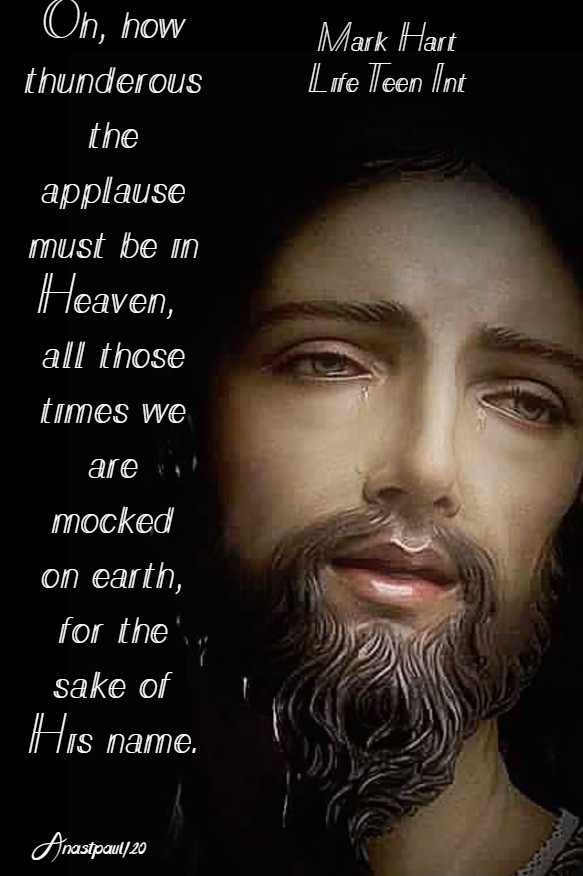
“Oh, how thunderous the applause must be in Heaven, all those times we are mocked on earth for the sake of His name.”
Mark Hart
Mark Hart serves as Executive Vice President for Life Teen International. A graduate from the University of Notre Dame, Mark is a best-selling and award-winning author (or co-author) of over a dozen books. His wildly popular DVD Bible Study Series,”T3″ is revolutionizing Catholic youth/young adult Scripture Study. He is the “Bible Geek.”
“Withholding the truth of Christianity would be even more uncharitable, than withholding a cure for cancer.”
One Minute Reflection – 18 April – Easter Saturday, Readings: Acts 4:13-21, Psalm 118:1, 14-21, Mark 16:9-15
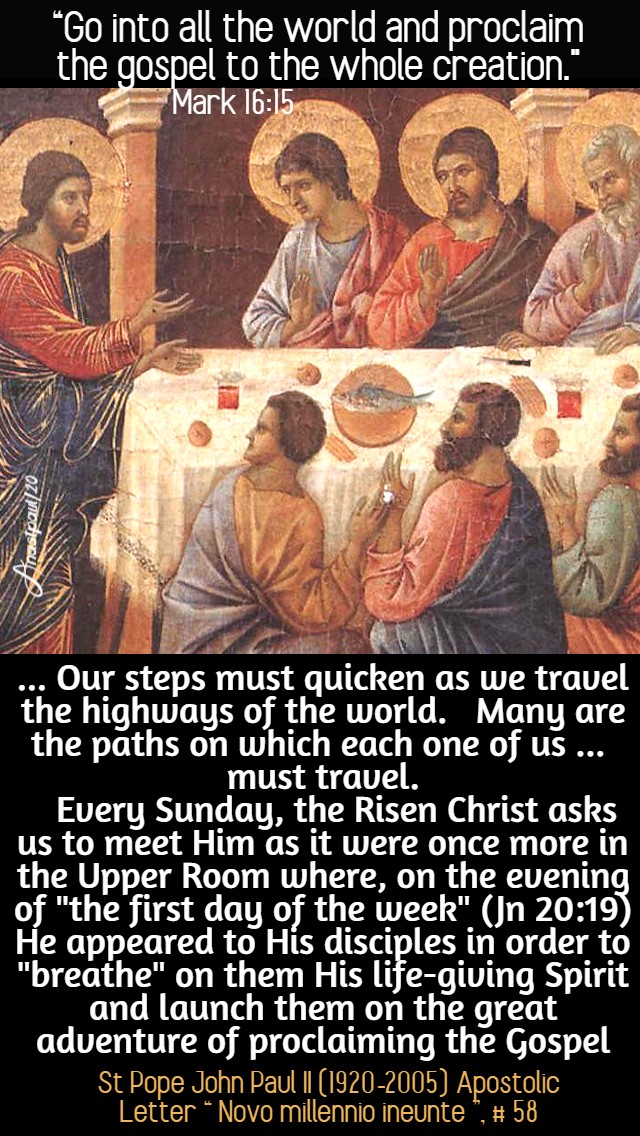
And he said to them, “Go into all the world and proclaim the gospel to the whole creation.” … Mark 16:15
REFLECTION – “Duc in altum! “let us cast out into deep waters!” (Lk 5:4). Let us go forward in hope! …. The Son of God, who became incarnate two thousand years ago out of love for humanity, is at work even toda -: we need discerning eyes to see this and, above all, a generous heart to become the instruments of His work. (…) “Go therefore and make disciples of all nations, baptising them in the name of the Father and of the Son and of the Holy Spirit” (Mt 28:19). The missionary mandate accompanies us into the Third Millennium and urges us to share the enthusiasm of the very first Christians – we can count on the power of the same Spirit who was poured out at Pentecost and who impels us still today to start out anew, sustained by the hope “which does not disappoint” (Rom 5:5).
At the beginning of this new century, our steps must quicken as we travel the highways of the world. Many are the paths on which each one of us and each of our Churches must travel but there is no distance between those who are united in the same communion, the communion which is daily nourished at the table of the Eucharistic Bread and the Word of Life. Every Sunday, the Risen Christ asks us to meet Him as it were once more in the Upper Room where, on the evening of “the first day of the week” (Jn 20:19) He appeared to His disciples in order to “breathe” on them His life-giving Spirit and launch them on the great adventure of proclaiming the Gospel.” … St Pope John Paul II (1920-2005) Apostolic Letter “ Novo millennio ineunte ”, # 58
PRAYER – Lord our God, You increase and multiply Your faithful by Your abundant gift of grace. Look now on Your chosen people and clothe them forever in the garment of eternal life. May we, in confident love of You, go forth and live our lives in witness and speak with joy of the ways of truth. Grant that the intercession of the Blessed Virgin, the saints and angels, may accompany us on our journey. Through our Lord Jesus and the Holy Spirit, God forever, amen.
Remember to exchange your Angelus prayer for the Regina Coeli as from Easter Sunday for the next 50 days of Eastertide.
According to Catholic tradition, St Gregory the Great (540-604) heard angels chanting the first three lines one Easter morning in Rome, while following barefoot in a great religious procession of the icon of the Virgin painted by St Luke the Evangelist. He was thereupon inspired to add the fourth line.
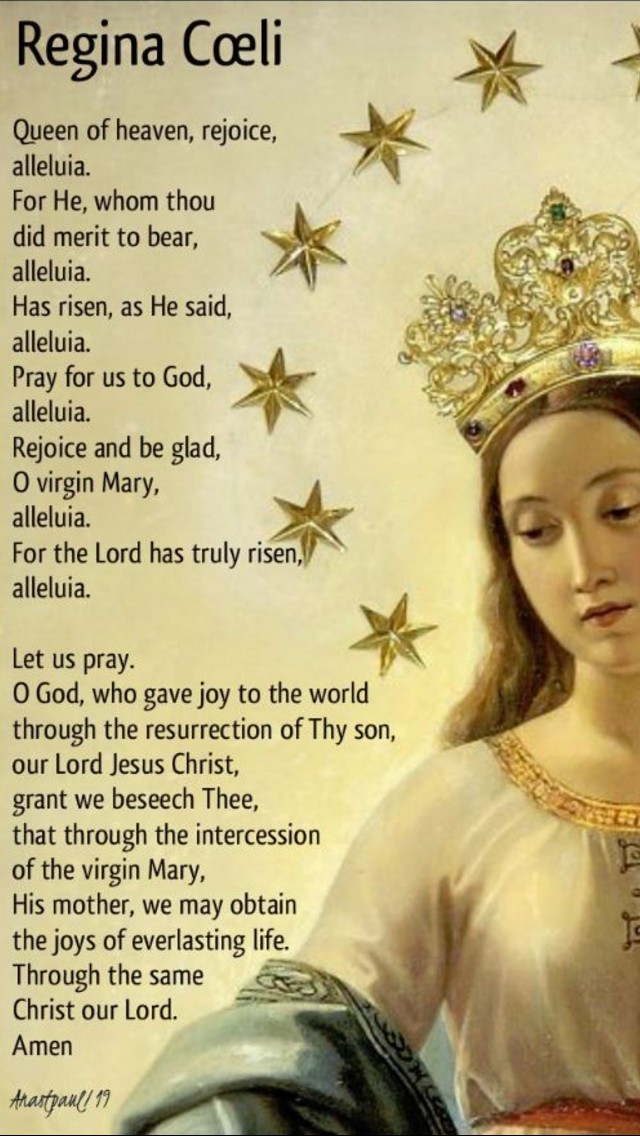
The Regina Coeli
Queen of heaven, rejoice, alleluia.
For He whom thou did merit to bear, alleluia.
Has risen, as He said, alleluia.
Pray for us to God, alleluia.
Rejoice and be glad, O virgin Mary, alleluia.
For the Lord has truly risen, alleluia.
Let us pray.
O God, who gave joy to the world
through the resurrection of Thy son,
our Lord Jesus Christ,
grant we beseech Thee,
that through the intercession
of the virgin Mary,
His mother, we may obtain
the joys of everlasting life.
Through the same Christ our Lord.
Amen
Saint of the Day – 18 April – Blessed Luca Passi (1789-1866) Priest, Founder of the Teaching Sisters of Saint Dorothy, Apostle of the poor and of education of the young unde the Papal title of “Apostolic Missionary” – born on 22 January 1789 in Bergamo, Italy and died on 18 April 1866 in Venice, Italy of natural causes, aged 77. Patronage – the Teaching Sisters of Saint Dorothy. Following the example of their paternal uncle, two of his brothers became Priests and Passi himself, moved to Venice in order to dedicate himself to both his preaching and educational missions.
Luca was born in 1789 in Bergamo as the first of eleven children to the nobles Enrico Passi (a teacher) and Caterina Corner. Two brothers were the priests Giuseppe Celio and Marco. His paternal uncle was the priest Marco Celio Passi. During his childhood, the volatile political circumstances, forced the family to relocate to a villa in Calcinate.
In 1810 he became the Director of the Confraternity of the Blessed Sacrament at Calcinate and in 1811 became the Director of the Confraternity of the Christian Doctrine.
He began his studies for the priesthood in 1811 and was ordained as such on 13 March 1813.
His brother Marco aided him in founding the Pious Society of Saint Dorothy in 1815 for the education of both children and adolescents. This was an establishment that Pope Pius VII praised and who also encouraged that the organisation expand and spread to other towns in the region. In 1838 he founded the Teaching Sisters of Saint Dorothy. Pope Gregory XVI granted him the title of “Apostolic Missionary.”
Blessed Luca died on 18 April 1866. He is buried at the Motherhouse of the Institute of the Teaching Sisters of Saint Dorothy in Venice.
Pope Benedict XVI approved a miracle on 28 June 2012 and confirmed that Fr Luca could now be Beatified. Cardinal Angelo Amato Beatified him on 13 April 2013 on behalf of Pope Francis at the Basilica of San Marco, Venice.
During the homily of the Beatification Mass of Fr Luca Passi, Cardinal Angelo Amato, prefect for the Congregation for the Causes of Saints, described the now Blessed Passi, as “a great witness to God for the young and the poor.”
St Agia of Hainault
St Anthia of Illyria
St Athanasia of Aegina
St Bitheus
St Calocerus of Brescia
St Cogitosus
St Corebus
St Eleuterius of Illyria
St Elpidius of Melitene
St Eusebius of Fano
St Galdinus of Milan
St Gebuinus of Lyons
St Genocus
St Hermogenes of Melitene
Bl Idesbald of Dunes Bl James Oldo OFS (1364-1404) Biography: https://anastpaul.com/2019/04/18/saint-of-the-day-18-april-blessed-james-oldo-ofs-1364-1404/
Bl Joseph Moreau
St Laserian of Leighlin
Bl Louis Leroy Blessed Luca Passi (1789-1866)
St Perfecto of Córdoba
St Pusicio
Bl Roman Archutowski
Bl Savina Petrilli
St Ursmar of Lobbes
St Wigbert of Augsburg
Thought for the Day – 17 April – Meditations with Antonio Cardinal Bacci (1881-1971)
Peter Denies Jesus
“Peter was by nature impetuous and generous. He loved Jesus sincerely. Even after the other Apostles had run away when Jesus was arrested in Gethsemane (Cf Mt 26:56), he followed Him at a distance, as far as the courtyard of the High Priest’s house. “Peter was following at a distance” (Lk 22:54). In his generous enthusiasm, however, he depended too much on himself. During the last supper, Jesus had foretold to His Apostles, His approaching passion and death and their desertion. Immediately, Peter had solemnly declared that, even if all the others would scandalised on the night of the passion, he would never be scandalised. He would, he said, be ready to go with Jesus to prison and to death (Cf Mt 24:33, Lk 22:33). But Jesus, tried to put him on his guard against presumption. “I tell thee, Peter, a cock will not crow this day, until thou hast denied three times, that thou knowest me” (Cf Lk 22:34). In spite of this prophecy, the impetuous Apostle went as far as the courtyard of the High Priest. While the divine Redeemer was brought in chains before the judgement seat of the High Priest, where He was calumniated, struck and condemned to death, Peter was asked if he was a follower of the Galilean. Three times, He denied his Master with oaths and protests. Unfortunately, this is what happens to anyone who trusts presumptuously in his own strength. This is what happens when we forget that we can do nothing, as St Paul points out, without the help and the grace of God. “Not that we are sufficient of ourselves to think anything, as from ourselves but our sufficiency is from God” (2 Cor 3:5). Anyone is courting disaster if he foolishly places all his confidence in himself and neglects to seek the help of God, when he is danger. He is certain to fall!“
Quote/s of the Day – 17 April – Easter Friday, Readings: Acts 4:1-12, Psalm 118:1-2, 4, 22-27, John 21:1-14
Just as day was breaking, Jesus stood on the shore ..
John 21:4
“In her voyage across the ocean of this world, the Church is like a great ship being pounded by the waves of life’s different stresses. Our duty is not to abandon ship but to keep her on her course.”
St Boniface (672-754)
“Jesus is with me. I have nothing to fear.”
Bl Pier Giorgio Frassati (1901-1925)
“Enemy-occupied territory – that is what this world is. Christianity is the story of how the rightful king has landed, you might say landed in disguise and is calling us all, to take part in a great campaign of sabotage.”
C S Lewis (1898-1963)
Never forget that only dead fish swim with the stream.
Malcolm Muggeridge (1903-1990)
Thomas Malcolm Muggeridge (24 March 1903 – 14 November 1990) was an English journalist and satirist. His father was a prominent socialist politician and one of the early Labour Party Members of Parliament. In his twenties, Muggeridge was attracted to communism but after living in the Soviet Union in the 1930s, he became a forceful anti-communist. In 1982, aged 79, Muggeridge was received into the Catholic Church along with his wife, Kitty. This was largely under the influence of Mother Teresa, about whom he had written a book, ‘Something Beautiful for God,’ setting out and interpreting her life.
One Minute Reflection – 17 April – Easter Friday, Readings: Acts 4:1-12, Psalm 118:1-2, 4, 22-27, John 21:1-14
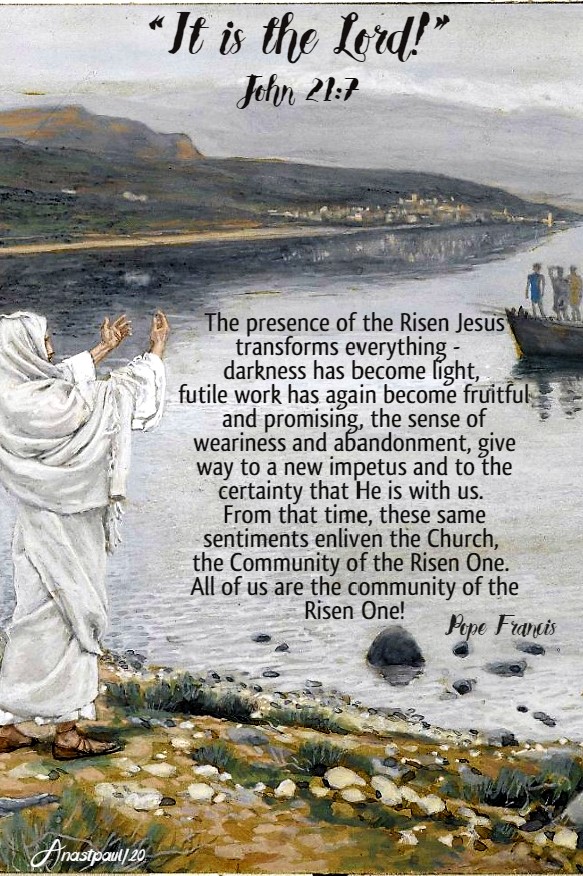
“It is the Lord!” … John 21:7
REFLECTION – “The Lord says to those tired and disappointed fishermen: “Cast the net on the right side of the boat and you will find some” (v. 6). The disciples trust in Jesus and the result is an incredibly abundant catch. In that exclamation: “It is the Lord!” there is all the enthusiasm of the Paschal faith, full of joy and wonder, which sharply contrasts with the disappearance, the dejection, the sense of powerlessness that had accumulated in the disciples’ hearts.
The presence of the Risen Jesus transforms everything – darkness has become light, futile work has again become fruitful and promising, the sense of weariness and abandonment, give way to a new impetus and to the certainty that He is with us. From that time, these same sentiments enliven the Church, the Community of the Risen One. All of us are the community of the Risen One!” … Pope Francis – Regina Coeli, 10 April 2016
PRAYER – Almighty, ever-living God, You offer the covenant of reconciliation to mankind in the mystery of Easter. Cleanse our hearts by Your truth and guide our lives by Your holiness, may we do what is right and pleasing to You. Open our eyes to see You and our ears to Hear You, that we may follow your commandments and Your Way. Grant that what we celebrate in worship, we may carry out in our lives. May our Holy Mother, ever keep us in her prayers and care. Through Christ, our Lord in the unity of the Holy Spirit, all glory and honour to You, forever, amen
To Jesus, the Way By Bl James Alberione (1884-1971)
O Jesus,
You are the Way secure,
You guide us on life’s troubled ways,
amid the errors of each age,
while we gaze toward our fatherland.
taking to Yourself our nature,
You came to us in flesh and blood
and as our model and our mould,
You call us to tread the way You trod.
A stable You chose at birth,
long years You laboured tirelessly,
the bitter Cross You did embrace
and so You tell us,
“Learn of me.”
Jesus, our everlasting Way, Truth and Life,
by You we are led,
by You we live,
to Father, You and the Spirit,
may all peoples praise and glory give.
Amen.
Blessed Fr James Alberione (1884-1971) the Founder of the Pauline Family, composed various Prayers to Jesus Master, The Way, the Truth and the Life, specifically directed to honour Jesus, the Master – to sanctify the whole person, mind, will and heart. These prayers are prayed by his Orders everyday.
Saint of the Day – 17 April – Saint Donan of Eigg (Died 617) Priest and Martyr, Monk, Missionary – Patronages – the Island of Eigg, an island in the Inner Hebrides where he was Martyred. He is also known as Dounan, Donnan and Donnanus.
Saint Donan, also known as Saint Donnán of Eigg, lived from about 550 to 17 April 617. He was probably Irish in origin and probably of noble birth. He is known for his efforts to introduce Christianity to the Picts of north west Scotland. Very little remains of him in the written record but, he is remembered in the quite remarkable number of places named after him, across large parts of modern Scotland. The only part of his life to have made it into the annals in any detail was his death, when he and 52 of his monks were murdered at their Monastery on the Isle of Eigg.
The Isle of Eigg
Donan’s birth date of 550 is a supposition, deriving largely from a comment in a document that he was contemporary of but younger than, St Columba. He seems to have crossed to south western Scotland early in his adult life, possibly in company with a number of followers. His progress can then be traced by a series of places named “Kildonan”, “Kildonnan”, “Chapel Donan” and “Eilean Donan” stretching up the western seaboard of Scotland from Ayrshire and the Isle of Arran via the Western Isles to Sutherland. Additionally, it is said, that at least eleven churches in Scotland are dedicated to St Donan.
It is said that Donan went to visit St Columbanus, asking him to be his anamchara or soul-friend, a spiritual director and that Columbanus refused. This may have been because Donan was welcomed by the Picts while Columba may have had his difficulties with them. But another story records that Columba said: “I will not be anamchara to one, who will inherit red martyrdom along with your people.”
It is interesting, that in the centuries during which Celtic missionaries were spreading the Christian faith across Scotland, there are very few examples of any of them coming to any harm, from those whose faiths they were trying to replace. St Donan is the most notable exception. He and his followers had established a Monastery on the east side of the Isle of Eigg, facing the Scottish mainland. It is said that Donan got into a dispute with a local noblewoman over the grazing of sheep on the island. It seems she chose to resolve the dispute by commissioning a raiding party to remove the Monks from the island in the most permanent and brutal way possible. On 17 April 617 the raiding party arrived. They allowed Donan to complete the liturgy before herding him and all his fifty two monks into the refectory and setting it on fire, or beheaded, depending on the source.
St Donan was Canonised on 11 July 1898 by Pope Leo XIII (cultus confirmed).
St Agia of Hainault
St Anthia of Illyria
St Athanasia of Aegina
St Bitheus
St Calocerus of Brescia
St Cogitosus
St Corebus St Donan of Eigg (Died 617) Priest and Martyr
St Eleuterius of Illyria
St Elpidius of Melitene
St Eusebius of Fano
St Galdinus of Milan
St Gebuinus of Lyons
St Genocus
St Hermogenes of Melitene
Bl Idesbald of Dunes
Bl James Oldo
Bl Joseph Moreau
St Laserian of Leighlin
Bl Louis Leroy
Bl Luca Passi
St Perfecto of Córdoba
St Pusicio St Robert de Turlande/Chaise-Dieu OSB (c 1000-1067) His Life: https://anastpaul.com/2019/04/17/saint-of-the-day-17-april-st-robert-de-chaise-dieu-osb-c-1000-1067/
Bl Roman Archutowski
Bl Savina Petrilli St Stephen Harding O.Cist. (1050-1104) Co-Founder of the Cistercian Order
About St Stephen: https://anastpaul.wordpress.com/2017/04/17/saint-of-the-day-17-april-st-stephen-harding/
St Ursmar of Lobbes
St Wigbert of Augsburg
Please join me in wishing our beloved Pope Emeritus on his Birthday.
On Holy Saturday, 93 years ago today, Joseph Aloisius Ratzinger was born and Baptised. This baby was destined to be our Holy Father from 19 April 2005 to 26 February 2013.
This year’s birthday will be different given the restrictions and lockdowns in place, across Italy, Europe and the world, which will not permit his brother, Msgr. Georg Ratzinger, to join him this year.
Yet, “we are doing well,” Benedict’s personal secretary, Archbishop Georg Ganswein says.
Let us all pray a Rosary for beloved Pope Benedict today!
Thought for the Day – 16 April – Meditations with Antonio Cardinal Bacci (1881-1971)
The Road to Calvary
After having been condemned to death, Jesus is delivered into the hands of the Jews to be crucified as a malefactor.
Two rough beams of wood are fixed together, in the form of a cross and placed upon His shoulders.
He is already worn out with suffering and has lost large quantities of blood as a result of the scourging and of the crowing with thorns.
Jesus does not reject the Cross, but embraces it.
He has come into this world to show forth His infinite love and to redeem us from our sins by His suffering and death.
In the garden of Gethsemane, He has said with sublime resignation to the Heavenly Father: “Not my will but thine be done” (Lk 22:42).
The Cross is too heavy for His human strength but what does that matter?
He embraces it, takes it upon His weary shoulders and sets out for Calvary.
Perhaps we have often kissed the Crucifix with reverence and affection.
Let us keep it hanging upon the walls of our home where we can gaze on it, with love and hope.
Let us pray before it in our moments of need.
But what about our own cross?
Do we love our cross as Jesus loved His?
Do we embrace it as Jesus did?
Do we bow willingly beneath the load as He did and, do we carry it, with resignation and without useless complaints?
It is not enough to love the Crucifix.
We must love our own cross as well, in silence and in prayer, knowing, that only in this way, can we imitate Jesus, Who has said to us: “If anyone wishes to come after me, let him deny himself and take up his cross daily and follow me” (Lk 9:23).
Quote/s of the Day – 16 April – Easter Thursday, Readings: Acts 3:11-26, Psalm 8:2, 5-9, Luke 24:35-48 and the Memorial of St Benedict Joseph Labre (1748-1783)
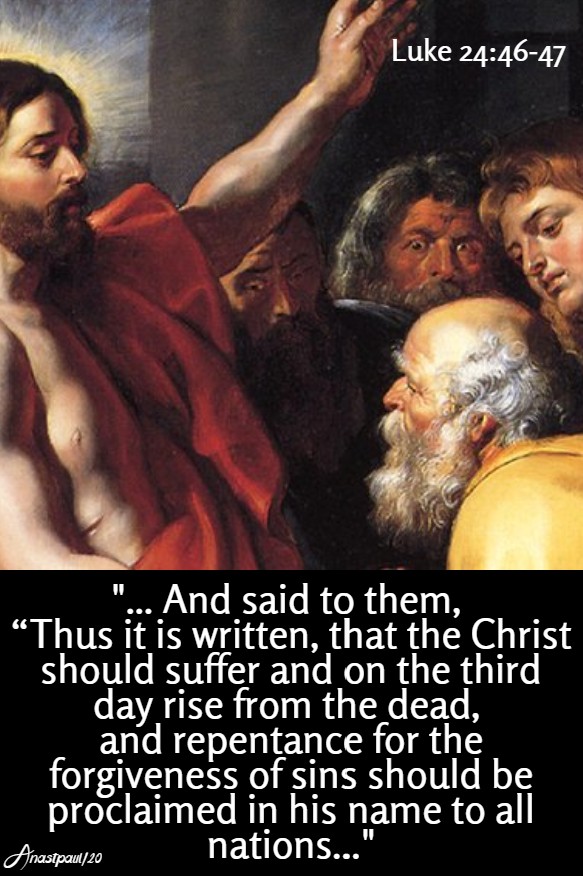
“… And said to them, “Thus it is written, that the Christ should suffer and on the third day rise from the dead and repentance for the forgiveness of sins should be proclaimed in his name to all nations…”
Luke 24:46-47
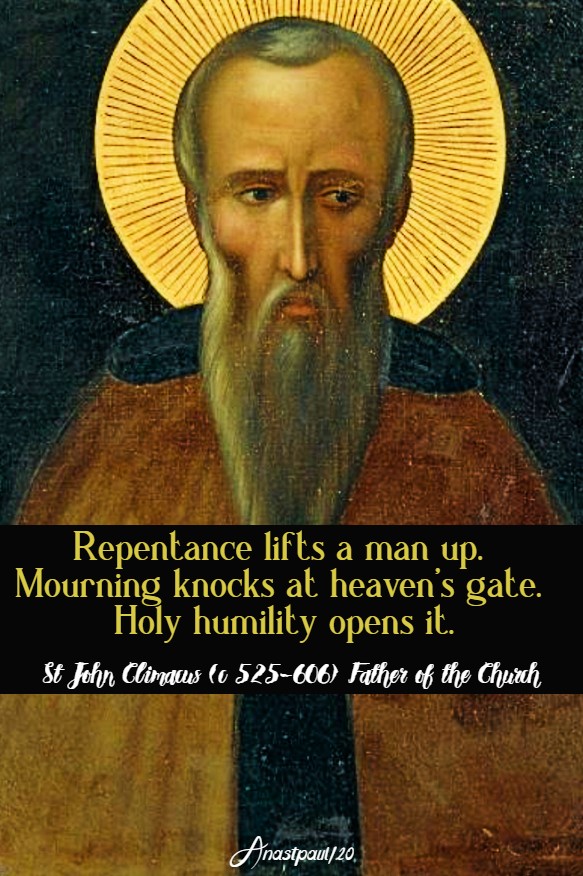
“Repentance lifts a man up. Mourning knocks at heaven’s gate. Holy humility opens it.”
St John Climacus (579-649)
“The Ladder of Divine Ascent” (Step 25)
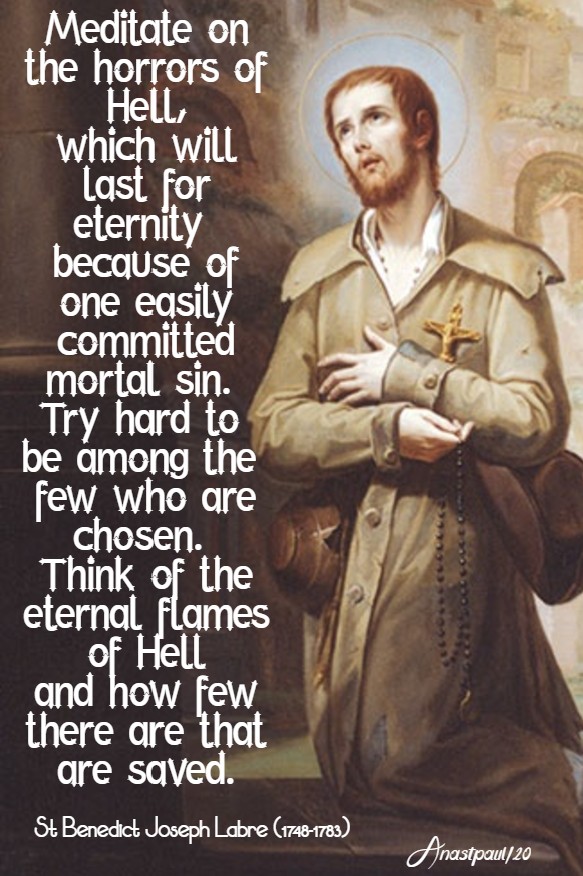
“Meditate on the horrors of Hell, which will last for eternity because of one easily-committed mortal sin. Try hard to be among the few who are chosen. Think of the eternal flames of Hell and how few there are that are saved.”
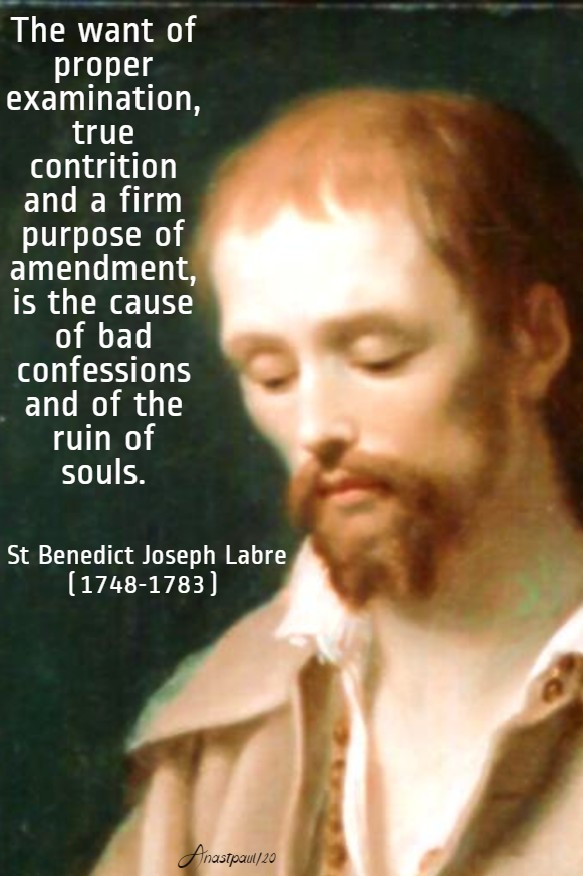
“The want of proper examination, true contrition and a firm purpose of amendment, is the cause of bad confessions and of the ruin of souls.”
St Benedict Joseph Labre (1748-1783)
“The Beggar of Perpetual Adoration”
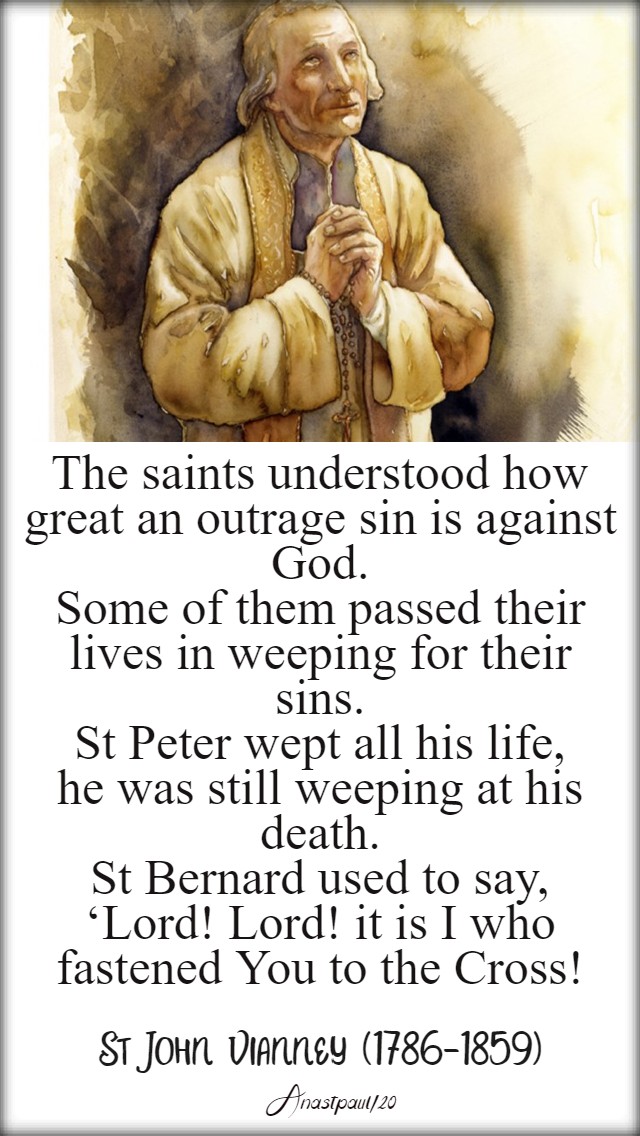
“The saints understood how great an outrage sin is against God. Some of them passed their lives in weeping for their sins. St Peter wept all his life; he was still weeping at his death. St Bernard used to say, ‘Lord! Lord! it is I who fastened You to the Cross!’”
One Minute Reflection -– 16 April – Easter Thursday, Readings: Acts 3:11-26, Psalm 8:2, 5-9, Luke 24:35-48
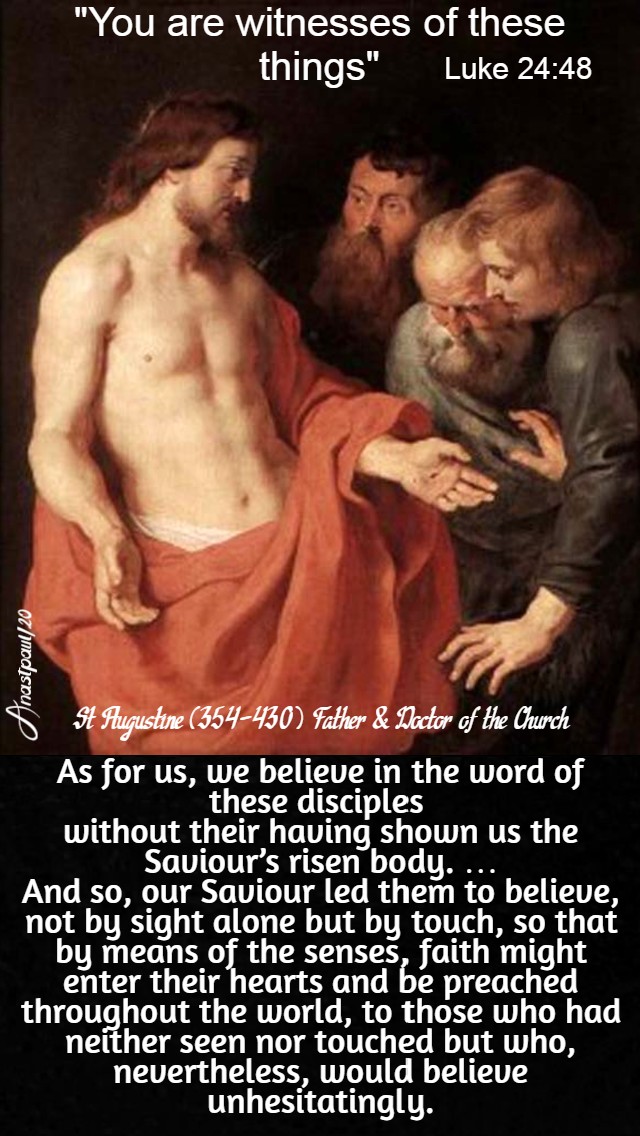
“You are witnesses of these things” ... Luke 24:48
REFLECTION – “After His Resurrection, the Lord appeared to His disciples and greeted them, saying: “Peace be with you!” Peace is what this saving salutation truly is, since the word “salutation” derives from the word for “salvation.” What more could one hope for? Man receives greetings of salvation in person, for our salvation is Christ. Yes, He is our salvation, He who was wounded for our sake and nailed to the tree, then descended from the tree and placed in a tomb. But He is risen from the tomb and His wounds are healed, although still keeping their scars. That His scars remain, is a help to His disciples, so that the wounds in their hearts, might be healed. What wounds are these? The wounds of their unbelief. He appeared before their eyes in a genuine bodily form and “they thought they were seeing a ghost.” This is no light wound to their heart. (…)
But what does the Lord Jesus say? “Why are you troubled? And why do questions arise in your hearts?” It is good for man, not that thoughts should arise in his heart but that his heart should arise – arise, that is to say, to where the apostle Paul wanted to set the hearts of the faithful, when he said to them: “If you were raised with Christ, seek what is above, where Christ is seated at the right hand of God. Think of what is above, not of what is on earth. For you have died and your life is hidden with Christ in God. When Christ, your life appears, then you too will appear with him in glory” (Col 3:1-4). What glory is this? The glory of the resurrection. (…)
As for us, we believe in the word of these disciples without their having shown us the Saviour’s risen body. (…) But at that time, such an event seemed unbelievable. And so, our Saviour led them to believe, not by sight alone but by touch, so that by means of the senses, faith might enter their hearts and be preached throughout the world, to those who had neither seen nor touched but who, nevertheless, would believe unhesitatingly (cf. Jn 20:29).” … St Augustine (354-430) Father & Doctor of the Church – Sermon 116; PL 38, 657
PRAYER – Lord God, let there be one faith in our hearts, one love for You, one Way in You, for You are the One Truth and the only Way. We linger in Your light and beg Your unending kindness. Grant that by the prayers of Your saints we may obtain Your strength and may Your Mother and ours, walk by our side and hold fast to our hand. Through Christ our Lord, with the Holy Spirit, God for always and forever, amen.
Our Morning Offering – 15 April – Thursday of Easter week
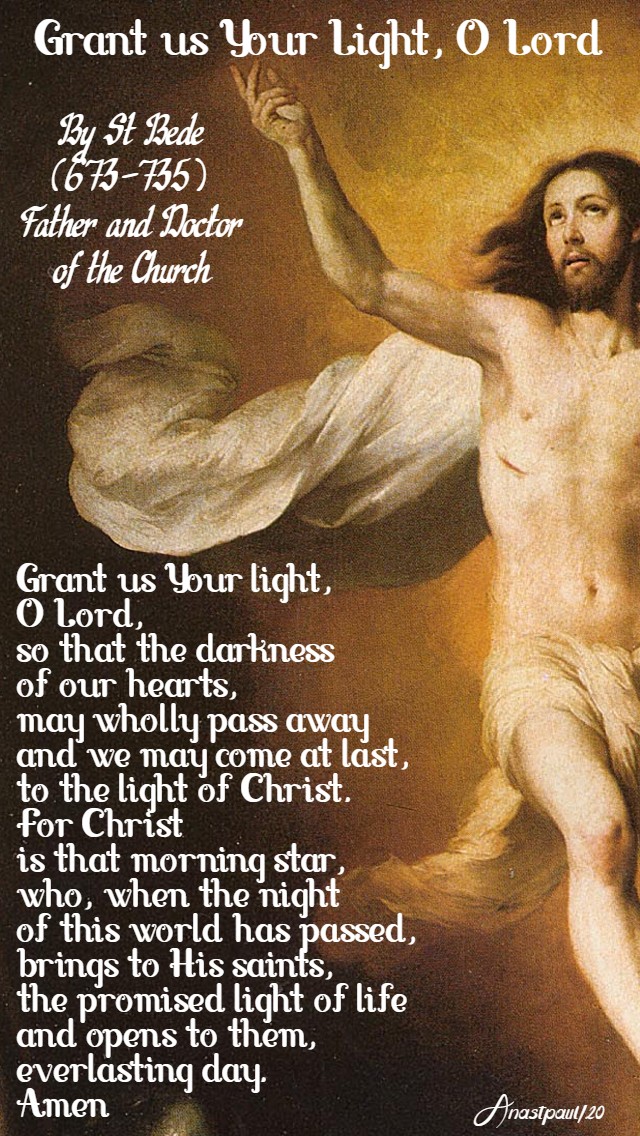
Grant us Your Light, O Lord By St Bede (673-735) Father and Doctor of the Church
Grant us Your light, O Lord,
so that the darkness of our hearts,
may wholly pass away
and we may come at last,
to the light of Christ.
For Christ is that morning star,
who, when the night of this world has passed,
brings to His saints,
the promised light of life
and opens to them,
everlasting day.
Amen









 AnaStpaul
You must be logged in to post a comment.