One Minute Reflection – 22 August – Saturday of the Twentieth week in Ordinary Time, Readings: Ezekiel 43: 1-7ab, Psalms 85: 9ab,10, 11-12, 13-14, Matthew 23:1-12 and The Memorial of the Queenship of Mary
“Whoever exalts himself will be humbled and whoever humbles himself will be exalted.” … Matthew 23:12
REFLECTION – “Humility is a secret power the saints receive when they bring all their life’s ascetical practices to a successful conclusion. For indeed, this power is only bestowed on those who attain to the perfection of virtue through the strength of grace … It is the same power the blessed Apostles received in the form of fire. Our Saviour commanded them, in fact, not to leave Jerusalem until they had received the power from on high (Acts 2:3; 1:4). Here Jerusalem stands for virtue; the power is humility and the power from on high, is the Paraclete, in other words the Consoler Spirit.
Now this is exactly what Sacred Scripture had said – these mysteries are revealed to the humble (Lk 10:21). To the humble it is given to receive within themselves that Spirit of revelation that uncovers mysteries. That is why certain saints have said that humility is what brings the soul to fulfilment in divine contemplation. So let no-one start thinking they have attained complete humility because at some moment a thought of compunction came to them or because they shed a few tears …. But if someone has overcome every contrary spirit …, if he has overturned and subjected all the strongholds of the enemy and if he then feels that he has received that grace in which “the Spirit bears witness to our spirit” (Rom 8:16), in the apostle Paul’s words, then there is the perfection of humility. Blessed are they who possess it. For they continually embrace the breast of Jesus (cf. Jn 13,25).” … St Isaac the Syrian of Nineveh (c 613-c 700) Bishop of Nineveh, Monk at Mosul – Ascetical discourses, 1st series, no 20
PRAYER – Almighty God, our Father, You have given us Mary, the Mother of Your Son, to be our Mother and our Queen. Grant that, supported by her example and her prayers, we may learn true humility and come to the kingdom of heaven and to the glory destined for Your children. We make our prayer through our Lord Jesus Christ, in the unity of the Holy Spirit, one God forever, amen.
Our Morning Offering – 22 August – Saturday of the Twentieth week in Ordinary Time and The Memorial of the Queenship of Mary
Salve Regina Hail Holy Queen By Blessed Herman the Cripple (1013–1054)
Hail, holy Queen, Mother of Mercy Hail our life, our sweetness and our hope. To thee do we cry, Poor banished children of Eve, To thee do we send up our sighs, Mourning and weeping in this vale of tears. Turn then, most gracious advocate, Thine eyes of mercy toward us And after this our exile, Show unto us the blessed fruit of thy womb, Jesus
This line, below, by St Bernard (1090-1153) Doctor of the Church O clement, O loving, O sweet Virgin Mary.
℣ Pray for us, O holy Mother of God, ℟ that we may be made worthy of the promises of Christ.
Saint of the Day – 22 August – Blessed Timoteo da Monticchio OFM (1444-1503) Priest and Friar of the Franciscan Order,he ws endowed with mystical gifts, especially of the Blessed Virgin and of St Francis of Assisi – born in 1444 in Monticchio, L’Aquila and died on 22 August 1504 in the San Angelo convent in Ocra, L’Aquila, Abruzzo, Italy of natural causes. He was distinguished for his austerity of life, his visions and his fervour of prayer. His body is incorrupt.
Blessed Timoteo was born in 1444 in Monticchio, therefore, in a period of great affirmation of the Franciscan Order, so much so, that in the same L’Aquila, not far away, the reformer St Bernardine of Siena, the great Franciscan preacher, preached and lived.
He was born into a peasant family and while growing up poor, he was completely absorbed by the spirit of prayer. As a young man he entered the Franciscan Order of Friars Minor, where he studied and was Ordained a Priest.
After his Ordination he was sent to Campli in the province of Teramo as the Master of Novices. His life was a succession of mystical phenomena – he had frequent visions of the Blessed Virgin and the holy founder Francis of Assisi. It was said that Timoteo’s life was more celestial than earthly.
He faithfully adhered to the spirit of those Franciscan saints, who restored observance in the Order, such as the aforementioned St Bernardine of Siena, St Giacomo della Marca, St John da Capestrano and the Blessed Bernardino da Fossa.
From Campli, he was transferred to the small Convent of St Angelo d’Ocre, here too, he led a life interwoven with prayer and contemplation, becoming for his brothers an example of the active and contemplative Priesthood and of heroic fidelity to the Franciscan Rule.
He died holy in the latter convent on 22 August 1504. For his reputation for holiness, already known in life and continued after his death, in the lands of Abruzzo, especially in the Aquila and Teramo area, he was given a cult of blessed, which continued uninterruptedly over the centuries, until on 10 March 1870, his Beatification was confirmed by Pope Pius IX. His feast is celebrated today, 22 August.
Queenship of Mary (Memorial): On 22 August, the Roman Catholic Church celebrates a memorial in honour of the Queenship of Mary. This memorial is placed an octave, that is, eight days after celebrating Mary’s Assumption into Heaven. The Queenship can be considered a prolongation of the celebration of the Assumption. The Memorial of the Queenship of Mary – 22 August – A Marian feast day decreed by Pope Pius XII on 11 October 1954, in his encyclical Ad caeli reginam to recognise and celebrate the Blessed Virgin Mary as Queen of the world, of the universe, of the angels, of heaven, Prophets, Apostles, Martyrs, Confessors, Virgins, all Saints,of Families, Queen conceived without original sin Queen assumed into Heaven, Queen of the Most Holy Rosary, Queen of Mercy, Queen of Peace. Amen, Holy Queen and Mother!
St Andrew of Fiesole St Anthusa of Seleucia St Antoninus of Rome St Arnulf of Eynesbury St Athanasius of Tarsus Bl Bernard Perani St Dalmau Llebaría Torné Bl Élie Leymarie de Laroche St Epictetus of Ostia St Ethelgitha of Northumbria St Fabrician of Toledo St Felix of Ostia Bl Giacomo/James Bianconi OP (1220–1301) Biography: https://anastpaul.com/2019/08/22/saint-of-the-day-22-august-blessed-giacomo-bianconi-op-1220-1301/ St Gunifort St Joan Farriol Sabaté St John Kemble (1599 – 1679) Martyr Biography: https://anastpaul.com/2018/08/22/saint-of-the-day-22-august-st-john-kemble-1599-1679-martyr/ St John Wall St Josep Roselló Sans St Julio Melgar Salgado St Maprilis of Ostia St Martial of Ostia St Maurus of Rheims St Narciso de Esténaga y Echevarría St Philibert of Toledo Bl Richard Kirkman St Saturninus of Ostia Bl Simeon Lukach St Sigfrid of Wearmouth St Symphorian of Autun Blessed Timoteo da Monticchio OFM (1444-1503) Priest St Thomas Percy St Timothy of Rome Bl William Lacey _ Martyred in the Spanish Civil War: • Blessed Dalmau Llebaría Torné • Blessed Joan Farriol Sabaté • Blessed Josep Roselló Sans • Blessed Julio Melgar Salgado • Blessed Narciso de Esténaga y Echevarría
Thought for the Day – 21 August – Meditations with Antonio Cardinal Bacci (1881-1971)
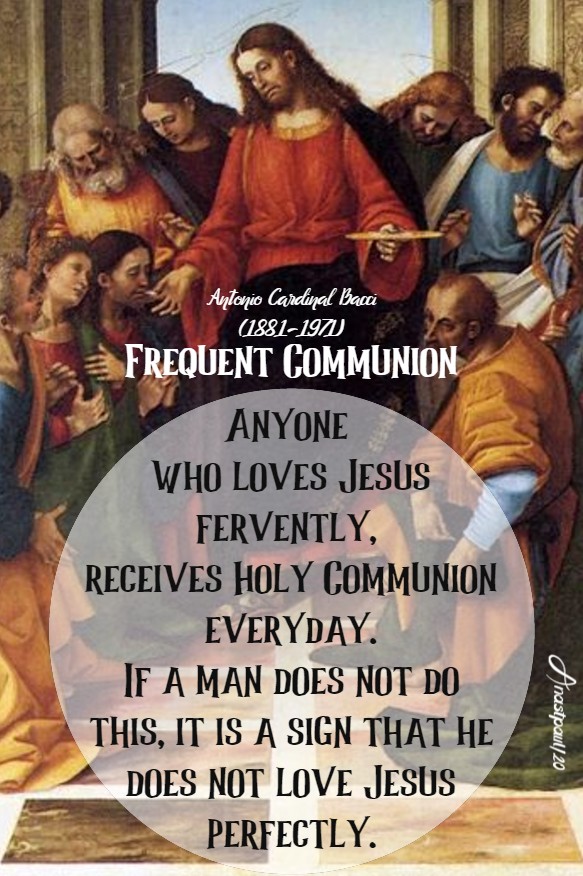
Frequent Communion
“Even as our bodies need their daily sustenance of good to restore the energy which they have lost, so it is with out souls. The nourishment of the soul, is the grace of God. There is no better way of acquiring and increasing this grace, than by Holy Communion because, Communion gives us Jesus Himself, Who is the origin of grace. Spiritual perfection consists in union with God. We can achieve perfect union with God in Holy Communion, by means of which, we live the life of Jesus. “He who eats me, he also shall live because of me.” (Jn 6:58)
Anyone who loves Jesus fervently, receives Holy Communion everyday. If a man does not do this, it is a sign that he does not love Jesus perfectly.
The early Christians were “continuing daily with one accord in the temple and breaking bread in their houses;” (Cf Acts 2:46) in other words, they received Communion everyday. It was Jesus, in the Blessed Eucharist Who nourished their faith and gave them the strength to endure Martyrdom. This custom prevailed in many places up to the time of St Jerome and St Augustine, who wrote “This is your daily bread; receive it daily in order to benefit daily from it” (De Verbo Domini, Serm 28). To those who believe that they were unworthy to receive everyday, St Ambrose said: “A man who is unworthy to receive everyday, will still be unworthy in a year’s time” (Bk 5, De Sacramentis, c 4).
We should not stay away from daily Communion because of our unworthiness, nor because of our lapses into sin. “Because I am always sinning,” said St Ambrose, “I am always in need of medicine” (Ibid). Humility is the basic virtue necessary in a Christian but it should not be a reason for abstaining from Holy Communion. St Thomas Aquinas commented that, although it may be pleasing to God to stay away from Holy Communion out of humility, He is far better pleased with the love and confidence of a soul, which receives Him. (Cf Summa Theologiae, III, q 8, a 10 ad 3).
The Church, like Jesus, desires us to receive Communion daily, although it only binds us under pain of sin, to receive once a year during Paschaltide, in accordance with the decree of Innocent III, which was confirmed by the Council of Trent. We are also required to receive the Blessed Eucharist, if we are in danger of death.”
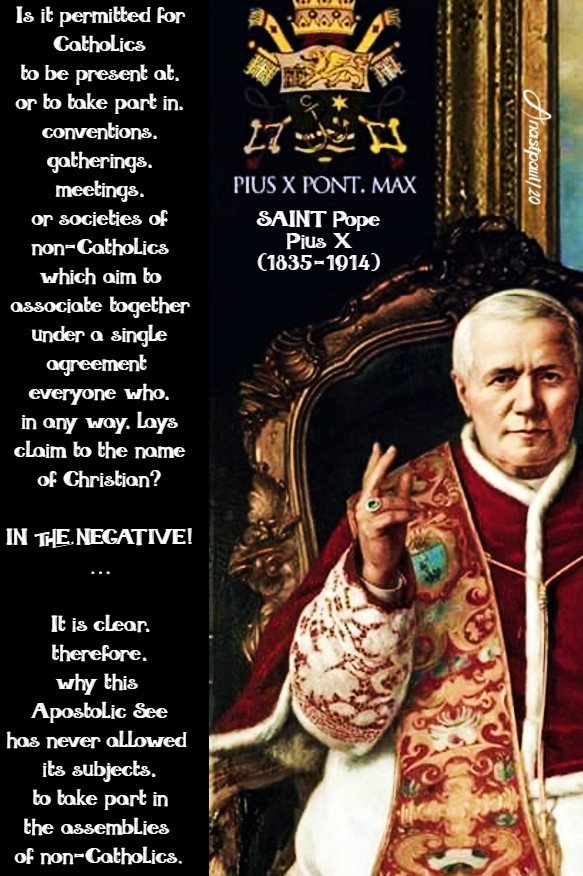
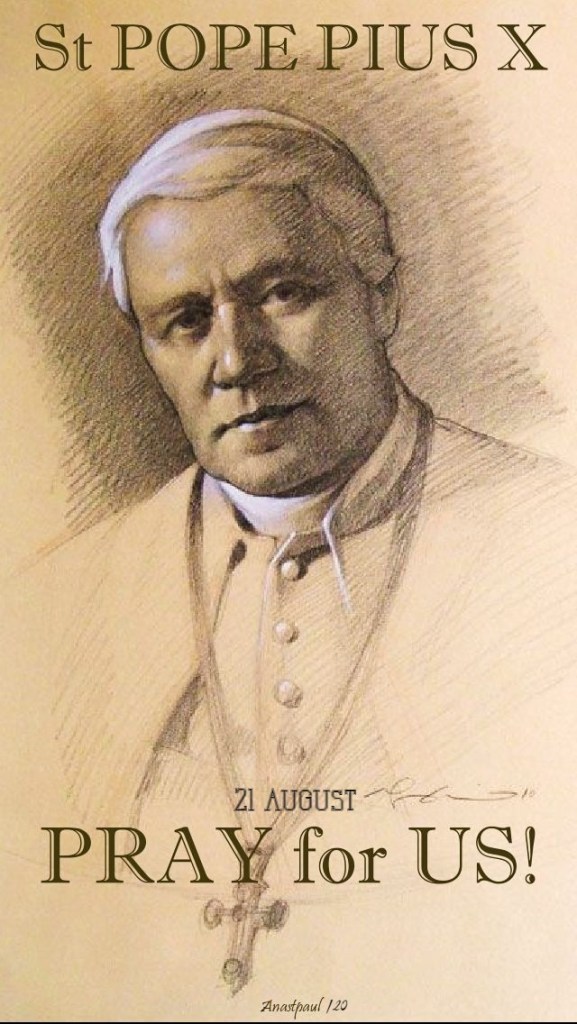
Quote/s of the Day – 21 August – The Memorial of St Pope Pius X (1835-1914) (Pontiff 1903-1914)
“Is it permitted for Catholics to be present at, or to take part in, conventions, gatherings, meetings, or societies of non-Catholics which aim to associate together under a single agreement everyone who, in any way, lays claim to the name of Christian? IN THE NEGATIVE! … It is clear, therefore, why this Apostolic See has never allowed its subjects, to take part in the assemblies of non-Catholics.”
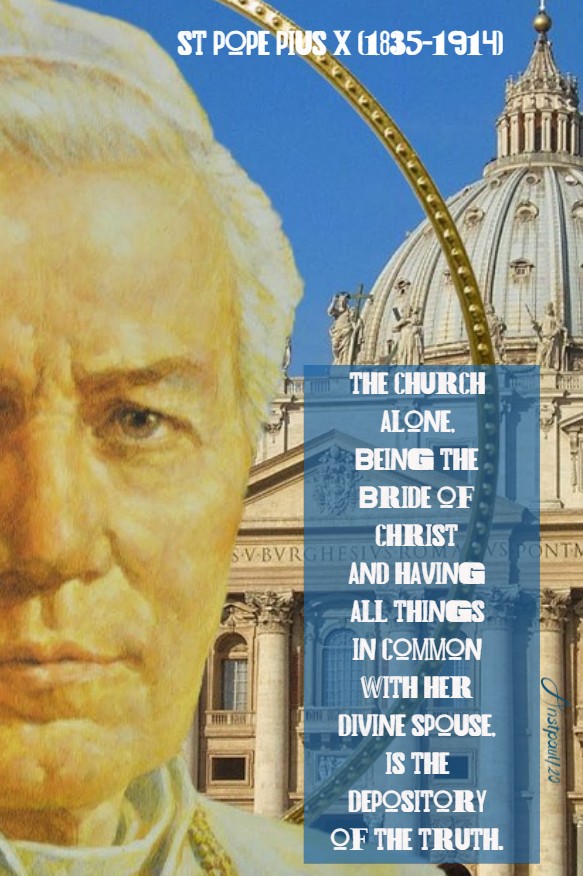
“The Church alone, being the Bride of Christ and having all things in common with her Divine Spouse, is the depository of the truth.”
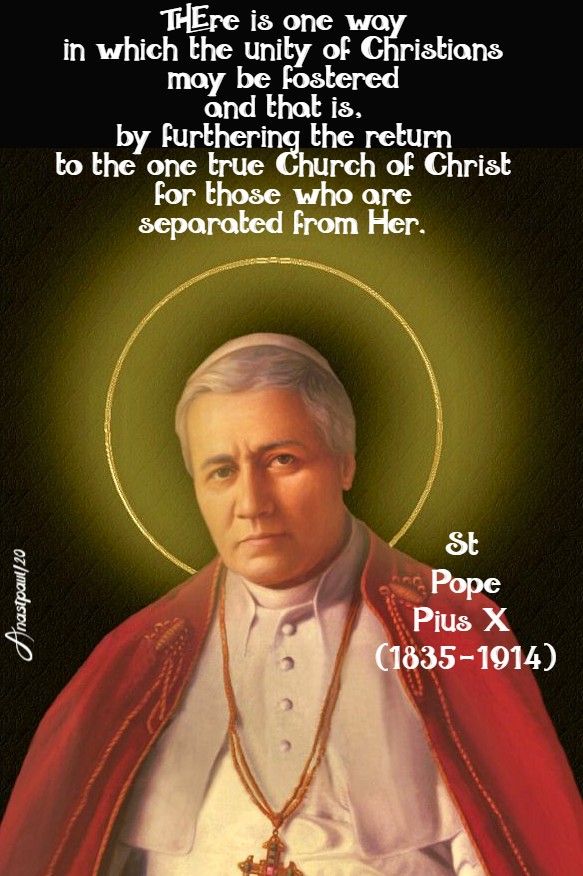
“There is one way in which the unity of Christians may be fostered and that is, by furthering the return to the one true Church of Christ for those who are separated from Her.”
“The daily Adoration or visit to the Blessed Sacrament, is the practice which is the fountainhead of all devotional works.”
“The ROSARY is the most beautiful and the most rich in graces of all prayer. It is the prayer that touches most, the Heart of the Mother of God… and if you wish peace to reign in your homes, recite the FAMILY ROSARY.”
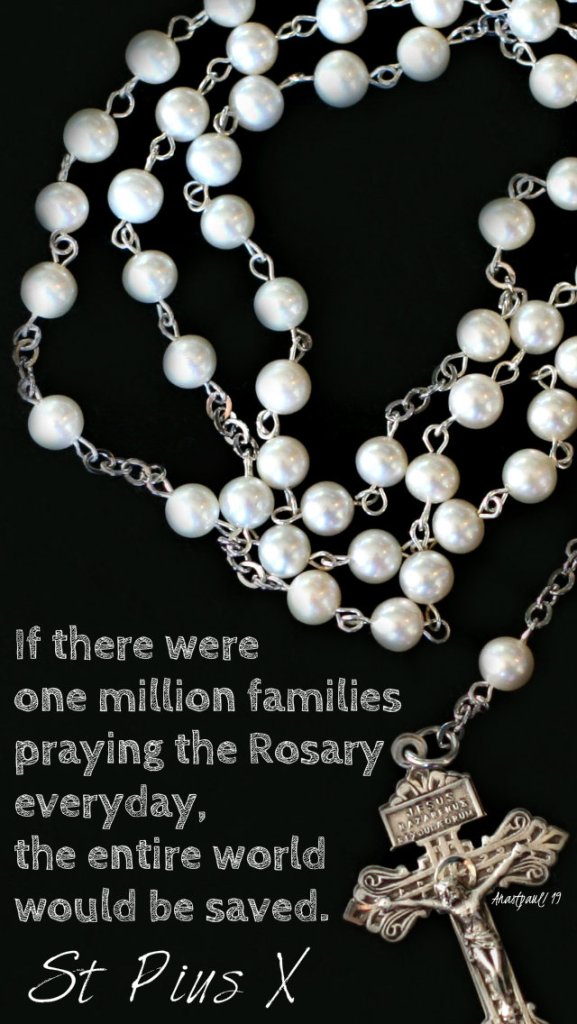
“If there were one million families praying the Rosary every day, the entire world would be saved.”
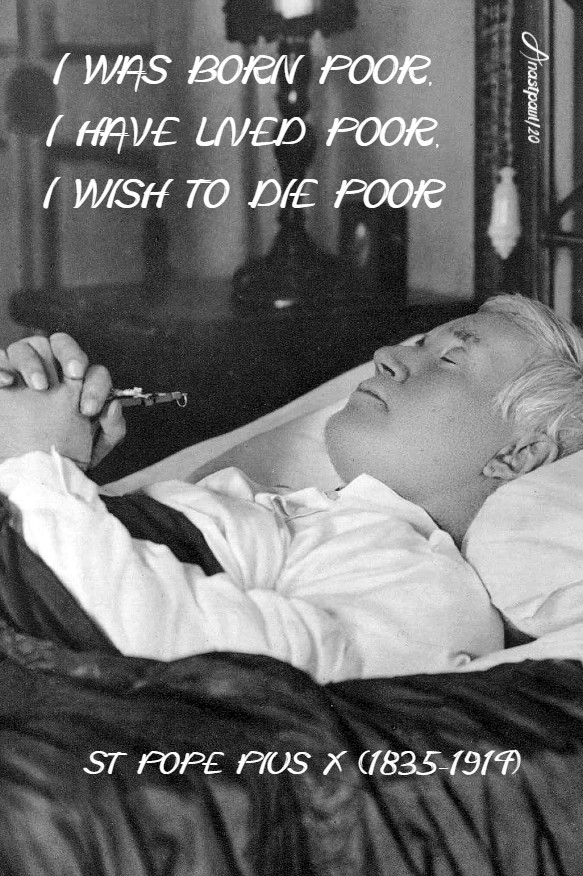
“I was born poor, I have lived poor, I wish to die poor.”
One Minute Reflection – 21 August – “Month of the Immaculate Heart of Mary” – Friday of the Twentieth week in Ordinary Time, Readings: Ezekiel 37: 1-14, Psalms 107:2-3, 4-5, 6-7, 8-9, Matthew 22:34-40 and the Memorial of St Pope Pius X (1835-1914) (Pontiff 1903-1914)
“On these two commandments depend all the Law and the Prophets.” … Matthew 22:40
REFLECTION – “When our Master was asked which was the greatest of the commandments, He replied: “You shall love the Lord your God with all your heart and with all your strength. There is no other commandment greater than this” (Mk 12:30-31). I think so, too, since it concerns primary and essential Being, God our Father, through whom all things were made, all things remain in being and to whom all who are saved will return. He it is who loved us the first, who gave birth to us. It would be sacrilege to think there exists any being more ancient or more wise. Our thanksgiving may be insignificant compared to his great gifts, yet we cannot offer him any other recognition, he who is perfection itself and has no need of anything. Let us love our Father with all our strength and ardor of soul and we shall win immortality. The more we love God, the more is our nature incorporated and mingled with his own.
The second commandment, Jesus says, yields in nothing to the first: “You shall love your neighbour as yourself” (…) When the scholar of the Law asks Jesus: “And who is my neighbour?” (Lk 10:29), he does not reply by giving the Jewish definition of neighbour – family, fellow Jews, proselytes, those who live according to the same Law – but tells the story of a traveller who was going down from Jerusalem to Jericho. Wounded by robbers (…), the man was cared for by a Samaritan who “showed himself a neighbour” (v. 36).
And who is even more of a neighbour to me than our Saviour? Who showed more compassion to us when the powers of darkness had left us battered by blows? (…) Jesus alone knew how to heal our wounds and root out the evils planted in our hearts (…). That is why we should love Him just as much as we love God our Father. And loving Christ Jesus, is to carry out His will and keep His commandments.” … St Clement of Alexandria (150-215) Theologian and Father of the Church – Homily “Can the rich be saved?”
PRAYER – Lord God, You filled the saints with strength and courage and gave them the knowledge of unity with You. Grant, we pray, that in imitation of St Pope Pius X, we may defend the Catholic faith and renew all things in Christ, Your Son. Help us Holy Father, to follow the example of St Pius and finally inherit eternal life, with You and all the saints. We make our prayer through Christ, our Lord with the Holy Spirit, one God forever, amen.
Our Morning Offering – 21 August – “Month of the Immaculate Heart of Mary” – Friday of the Twentieth week in Ordinary Time and the Memorial of St Pope Pius X (1835-1914) (Pontiff 1903-1914)
O Most Holy Virgin By St Pope Pius X (1835-1914)
Most holy Virgin, who pleased our Lord and became His Mother, Virgin Immaculate in your body and soul, in your faith and love, at this solemn jubilee of the promulgation of the dogma which proclaimed you to the entire world as conceived without sin, look kindly on us, unfortunate ones, who implore your powerful protection. The infernal serpent, upon whom the primeval curse was laid, continues, alas, to attack and tempt the hapless children of Eve. Ah! Do you, our blessed Mother, our Queen and Advocate, who at the first moment of your conception did crush the enemy’s head, do you gather together our prayers and we beseech you (our hearts one with yours), present them before God’s throne, that we may never allow ourselves to be caught in the snares laid for us but that we may reach the portal of salvation and that the Church and Christian society may once more chant the hymn of deliverance, of victory and of peace. Amen
Composed for the fiftieth anniversary of the definition of the Immaculate Conception, 8 September 1903.
Saint of the Day – 21 August – Saint Sidonius Apollinaris (c 430 – 489) Bishop, Copnfessor, Poet, Diplomat, Writer, Scholar, Apostle of the poor and of exiles – Sidonius is “the single most important surviving author of 5th Century Gaul.” Also known as Caius Sollius Apollinaris Sidonius – Born in c 420 in Lugdunum, Gaul (modern Lyon, France) and died in 489 at Clermont, France. He is one of four Gallo-Roman aristocrats of the fifth- to sixth-century whose letters survive in quantity. The others are St Ruricius, Bishop of Limoges (died 507),St Alcimus Ecdicius Avitus, Bishop of Vienne (died 518) and St Magnus Felix Ennodius of Arles, Bishop of Ticinum (died 534). All of them were linked in the tightly bound aristocratic Gallo-Roman network that provided the Bishops of Catholic Gaul.
Sidonius Apollinaris was born at Lyons about the year 431, and was of one of the most noble families in Gaul, where his father and grandfather, both named Apollinaris, had commanded successively in quality of prefects of the prætorium.
He was educated in arts and learning under the best master, and was one of the most celebrated orators and poets of the age in which he lived. From his epistles, it is manifest that he was always religious, pious, humble, affable, extremely affectionate, beneficent and compassionate and no lover of the world, even whilst he lived in it.
For some time he had a command in the imperial army and he married Papianilla, by whom he had a son called Apollinaris and two daughters. Papianilla was daughter of Avitus, who after having been thrice prefect of the prætorium in Gaul, was raised to the imperial throne at Rome in 455 but being obliged to quit the purple after a reign of ten months, died on the road to Auvergne. Majorian, his successor, prosecuted his relations, and coming to Lyons, caused Sidonius to be apprehended but, admiring the constancy with which he bore his disgrace and becoming acquainted with his extraordinary qualifications and virtue, restored his estates to him and created him Count. Majorian was a good soldier and began to curb the barbarians who laid waste the fairest provinces of the empire, but was slain in 461, by Ricimer the Goth, his own general, who placed the diadem upon the head of Severus. Upon this revolution Sidonius left the court, and led a retired life in Auvergne, where he protected his Province from the Goths and divided his time between studies and the exercises of piety. Severus was poisoned by Ricimer after a reign of four years, and Anthemius chosen Emperor in 467, who immediately called Sidonius again to Rome and created him prince of the Senate, Patrician and Prefect of the City. His piety and devotion suffered no prejudice in his elevation and amidst the distraction of his secular employments, in which he made use of his authority only to promote the divine honour and to render himself the servant of others in studying to advance every one’s happiness and comfort.
God soon called him from these secular dignities to the government of His Church. The Bishopric of Arvernum, since called Clermont, in Auvergne, falling vacant in 471, the people of that extensive Dioces, and the Bishops of the whole country, who had long regretted his absence whilst he was detained in the capital of the world, unanimously demanded that he should be restored to them in order to fill the episcopal chair.
Sidonius was then a layman, and his wife was yet living he, therefore, urged the authority of Canons against such an election and opposed it with all his might, till, fearing at length to resist the will of heaven, he acquiesced; it having been customary on extraordinary occasions to dispense with the canons which forbid laymen to be chosen Bishops. He, therefore and his wife, agreed to a perpetual separation and from that moment, he renounced poetry, which till then had been his delight, to apply himself only to those studies which were most agreeable to his ministry. He was no stranger to them whilst a layman and he soon became an oracle whom other Bishops consulted in their difficulties; though he was always reserved and unwilling to decide for them and usually referred them to others, alleging that he was not capable of acting the part of a doctor among his brethren, whose direction and science he stood himself infinitely in need of.
St Lupus, Bishop of Troyes, who had loved and honoured him whilst he was yet wandering in the dry deserts of the world, found his affection for him redoubled when he beheld him become a guide of souls in the paths of religion and virtue. Upon his promotion to the Episcopal dignity, he wrote him an excellent letter of congratulation and advice, in which, among other things, he told him: “It is no longer by pomp and an equipage that you are to keep up your rank but by the most profound humility of heart. You are placed above others but must consider yourself as below the meanest and last in your flock. Be ready to kiss the feet of those whom formerly you would not have thought worthy to sit under your feet. You must render yourself the servant of all.” This Sidonius made the rule of his conduct. He kept always a very frugal table, fasted every second day, prayed much and though of a tender constitution, often seemed to carry his penitential austerities to excess. He was frequently in want of necessaries, because he had given all away to the poor. His love and compassion for them, even whilst he lived in the world, was such, that he sometimes had sold all his plate for their relief.
After he was Bishop, he looked upon it as his principal duty to provide for the instruction, comfort and assistance of the poor. In the time of a great famine he maintained, at his own charge, with the charitable succours which Ecdicius, his wife’s brother, put into his hands, more than four thousand Burgundians and other strangers, who had been driven from their own country by misery and necessity and, when the scarcity was over, he furnished them with carriages and sent them to their respective homes. St Sidonius made frequent visitations of his Diocese, and performed every office of his ministry with all the care and prudence possible.
The city of Clermont being besieged, in 475, by Alaric, king of the Visigoths, who then reigned in the southern provinces of France, the zealous Bishop encouraged the people to stand upon their defence, by which he exposed himself to the rage of the conquerers after they were masters of the place. He entreated the Arian king to grant several articles in favour of the Catholics, which the barbarian was so far from allowing, that he sent the holy prelate prisoner to Liviane, a castle near Carcassone, where he suffered much. However, Alaric some time after, restored him to his Se, and he continued to be the comfort and support of the distressed Catholics in that country.
He was again expelled by two factious wicked priests, but some time after recovered the government of his Church and died in peace in the year 482, on the 21 August. His festival was kept soon after his death with solemnity at Clermont, where his memory is in great veneration. His body lay first in the old church of St Saturninus, but was afterwards translated into that of St Genesius.
St Gregory of Tours speaks of Sidonius as a man who could celebrate Mass from memory (without a sacramentary) and give unprepared speeches without any hesitation.
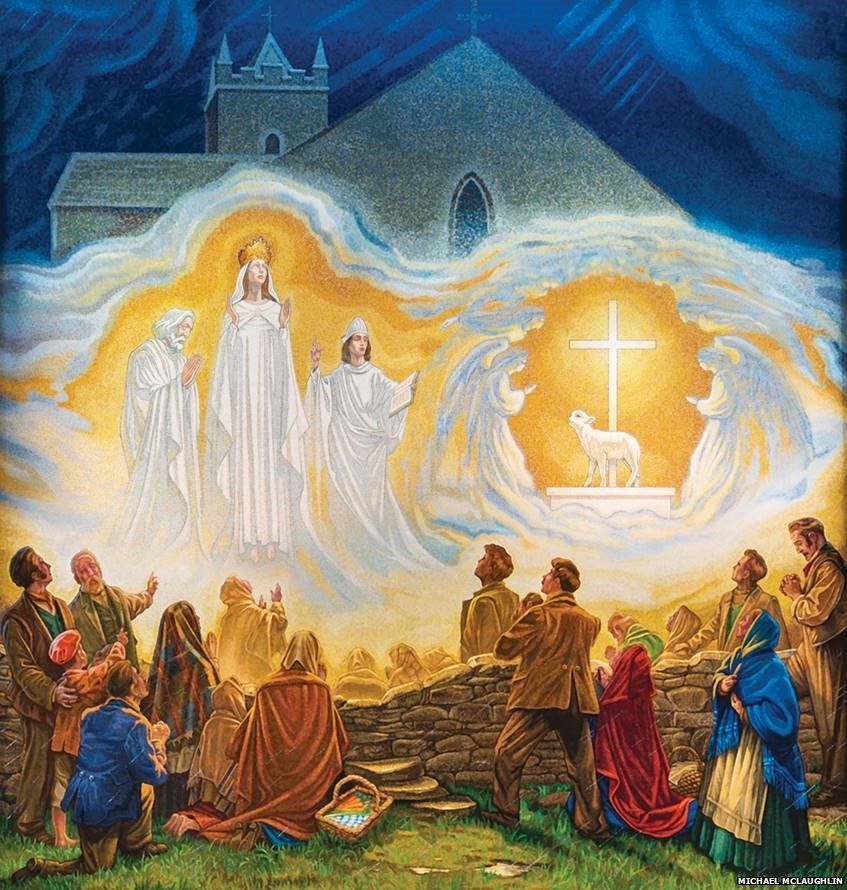
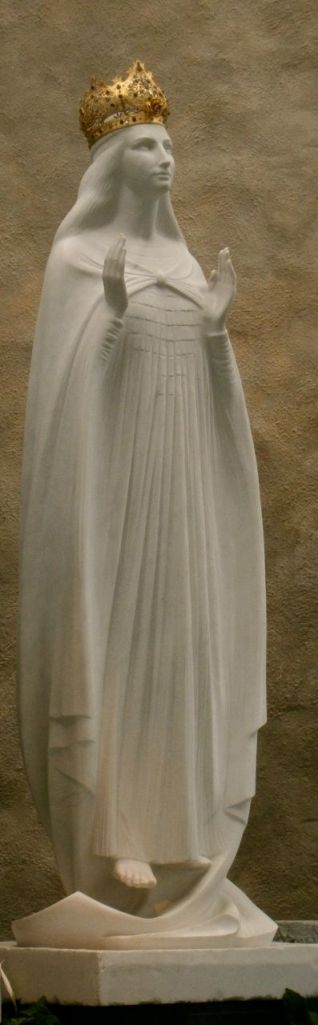
Our Lady of Knock: Our Lady, Saint Joseph and Saint John the Evangelist appeared in a blaze of light at the south gable of Saint John the Baptist Church, Knock, County Mayo, Ireland, on 21 August 1879. They appeared to float about two feet above the ground and each would occasionally move toward the visionaries and then away from them. The Blessed Virgin Mary was clothed in white robes with a brilliant crown on her head. Where the crown fitted to her brow, she wore a beautiful full-bloom golden rose. She was praying with her eyes and hands raised towards Heaven. Saint Joseph wore white robes, stood on Our Lady’s right and was turned towards her in an attitude of respect. Saint John was dressed in white vestment, stood was on Mary’s left and resembled a Bishop, with a small mitre. He appeared to be preaching and he held an open book in his left hand. Behind them and a little to the left of Saint John was a plain altar on which was a cross and a lamb with adoring angels. The apparition was witnessed by fifteen people. Miraculous cures were reported soon after in the area and it is now a major pilgrimage destination. Patronage – Ireland.
St Abraham of Smolensk (Died c 1222) His Life: https://anastpaul.com/2019/08/21/saint-of-the-day-21-august-saint-abraham-of-smolensk-died-c-1222/ St Agapius of Edessa St Agathonicus of Constantinople St Anastasius Cornicularius St Aria of Rome St Avitus I of Clermont St Bassa of Edessa Bl Beatrice de Roelas St Bernhard of Lérida St Bernard de Alziva St Bonosus Bl Bruno Zembol St Camerinus of Sardinia St Cameron St Cisellus of Sardinia St Cyriaca St Euprepius of Verona St Fidelis of Edessa Bl Gilbert of Valenciennes St Gracia of Lérida St Hardulph St Joseph Nien Vien Bl Ladislaus Findysz St Leontius the Elder St Luxorius of Sardinia St Maria of Lérida St Maximianus the Soldier St Maximilian of Antioch St Natale of Casale Monferrato St Paternus of Fondi St Privatus of Mende St Quadratus of Utica St Sidonius Apollinaris (c 430 – 489) Bishop St Theogonius of Edessa Bl Victoire Rasoamanarivo St Zoticus the Philosopher
Martyred in the Spanish Civil War: • Blessed Joan Cuscó Oliver • Blessed Joan Vernet Masip • Blessed Pedro Mesonero Rodríguez • Blessed Pere Sadurní Raventós • Blessed Ramon Peiró Victori • Blessed Salvador Estrugo Salves
Thought for the Day – 20 August – Meditations with Antonio Cardinal Bacci (1881-1971)
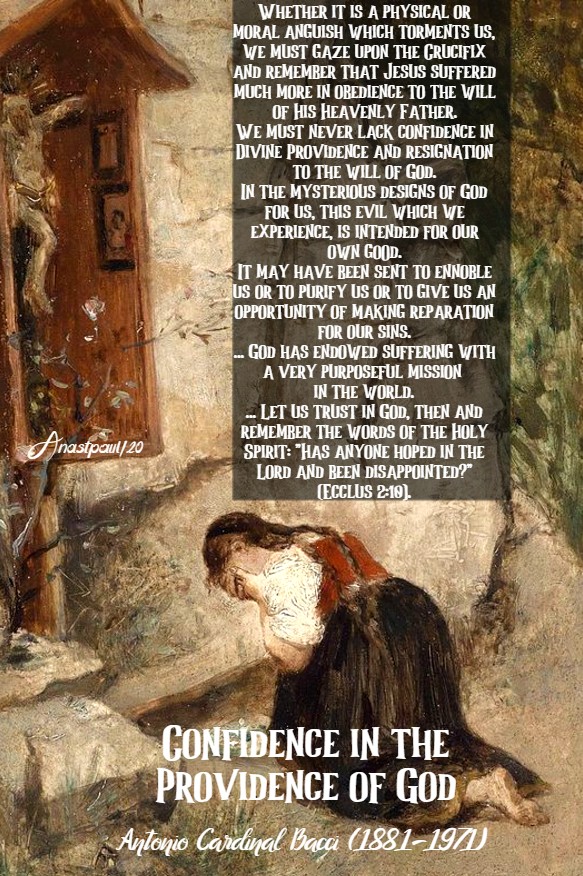
Confidence in the Providence of God
“Sometimes we grow discouraged and lose confidence in God. This may be the result of sickness, or of misfortune, or of misundstanding on the part of others. At any rate, on such occasions, we may feel as if we have been forgotten by God.
Jesus Christ willed to endure a trial of this nature when He was hanging upon the Cross, derided and jeered at by those whom He had come to redeem. “My God. my God,” He cried, “why hast thou forsaken me?” (Mt 27:46). In the Garden of Gethsemane, however, He had already seen, in a terrifying vision, the sins and acts of ingratitude of the human race. He had begged His Father, to take away from Him, the chalice of suffering which had ben offered to Him but, He had added immediately: “Yet not my will but thine be done” (Lk 22:62).
We must behave in the same manner. Whether it is a physical or moral anguish which torments us, we must gaze upon the Crucifix and remember that Jesus suffered much more in obedience to the will of His Heavenly Father. We must never lack confidence in Divine Providence and resignation to the will of God. In the mysterious designs of God for us, this evil which we experience, is intended for our own good. It may have been sent to ennoble us or to purify us or to give us an opportunity of making reparation for our sins.
God has endowed suffering with a very purposeful mission n the world. It should have the effect of making us detached from earthly things and more preoccupied with spiritual matters. Let us trust in God, then and remember the words of the Holy Spirit: “Has anyone hoped in the Lord and been disappointed?” (Ecclus 2:10).
Quote/s of the Day – 20 August – The Memorial of St Bernard of Clairvaux (1090-1153) Mellifluous Docotr, “Doctor of Light”
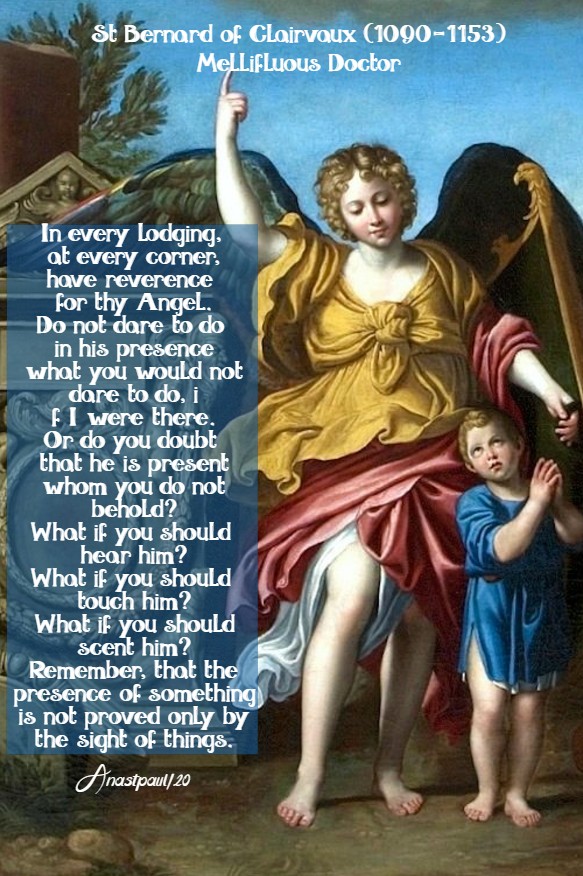
“In every lodging, at every corner, have reverence for thy Angel. Do not dare to do in his presence what you would not dare to do, if I were there. Or do you doubt that he is present whom you do not behold? What if you should hear him? What if you should touch him? What if you should scent him? Remember, that the presence of something is not proved only by the sight of things.”
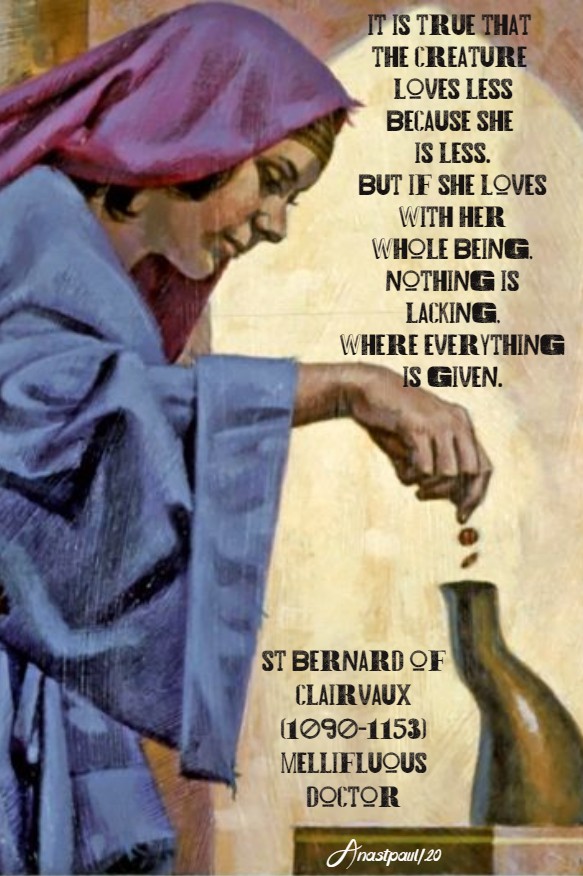
” It is true that the creature loves less because she is less. But if she loves with her whole being, nothing is lacking, where everything is given.”
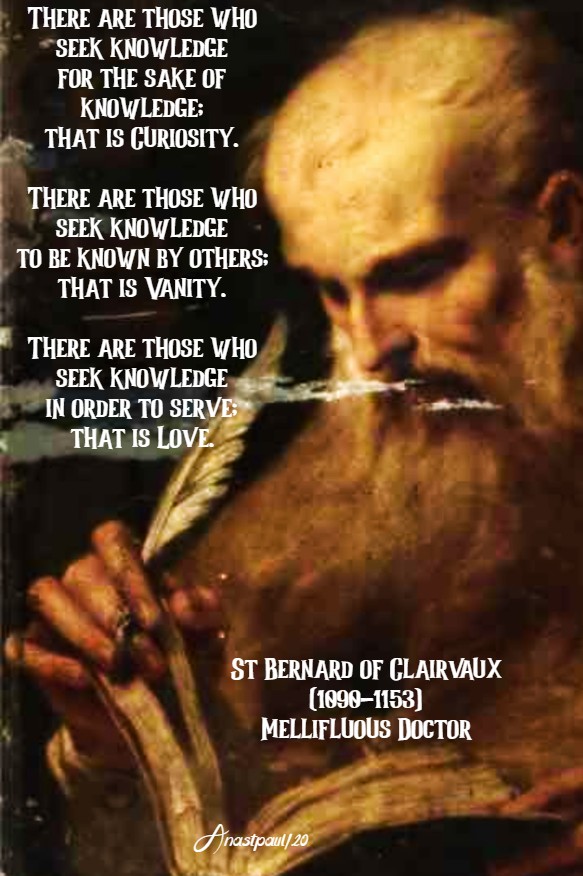
“There are those who seek knowledge for the sake of knowledge; that is Curiosity. There are those who seek knowledge to be known by others; that is Vanity. There are those who seek knowledge in order to serve; that is Love.”
“The road to hell is paved with good intentions.”
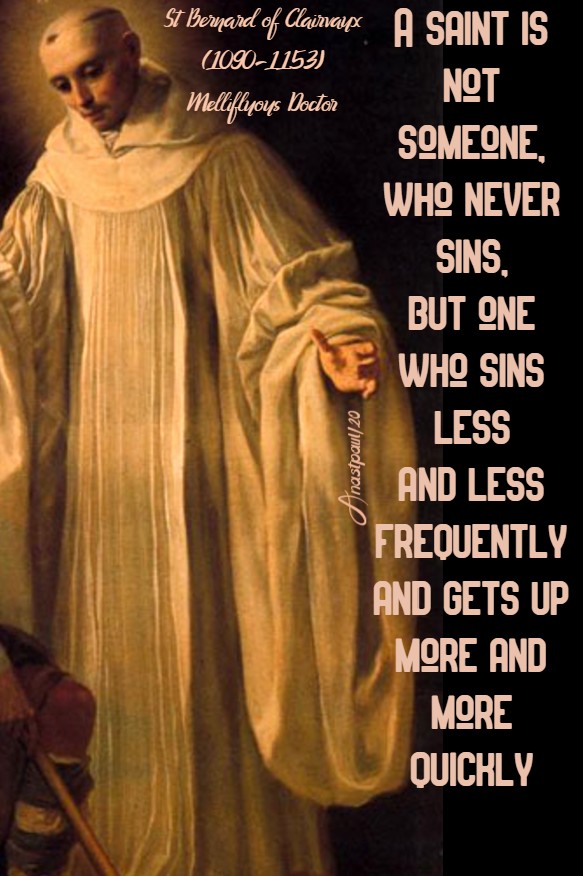
“A saint is not someone, who never sins, but one who sins less and less frequently and gets up more and more quickly.”
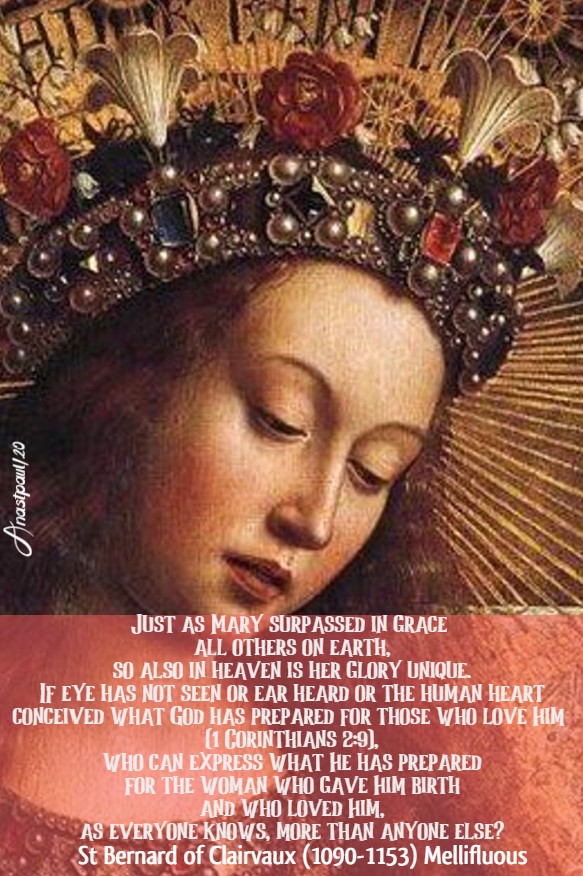
“Just as Mary surpassed in grace all others on earth, so also in heaven is her glory unique. If eye has not seen or ear heard or the human heart conceived what God has prepared for those who love Him (1 Corinthians 2:9), who can express what He has prepared for the woman who gave Him birth and who loved Him, as everyone knows, more than anyone else?”
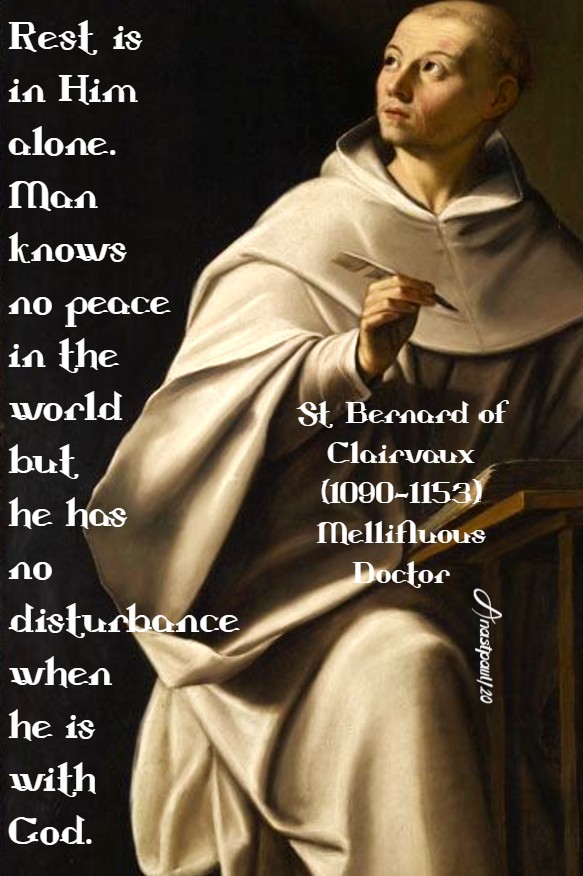
“Rest is in Him alone. Man knows no peace in the world but he has no disturbance when he is with God.”
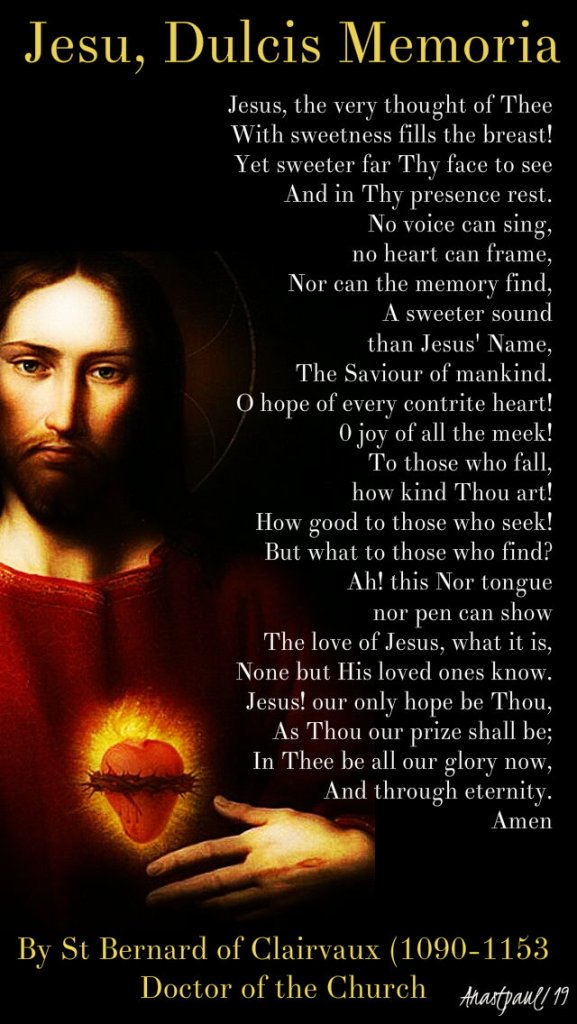
Jesu Dulcis Memori
Jesus, the very thought of Thee with sweetness fills my breast, But sweeter far Thy face to see and in Thy presence rest.
Nor voice can sing nor heart can frame, Nor can the memory find a sweeter sound than Jesus’ name, O Saviour of mankind.
O hope of every contrite heart, O joy of all the meek to those who fall, how kind Thou art, how good to those who seek!
But what to those who find? Ah this nor tongue nor pen can show, the love of Jesus, what it is none but His loved ones know.
Jesus our only joy be Thou as Thou our prize wilt be. Jesus, be Thou our glory now and through eternity. Amen
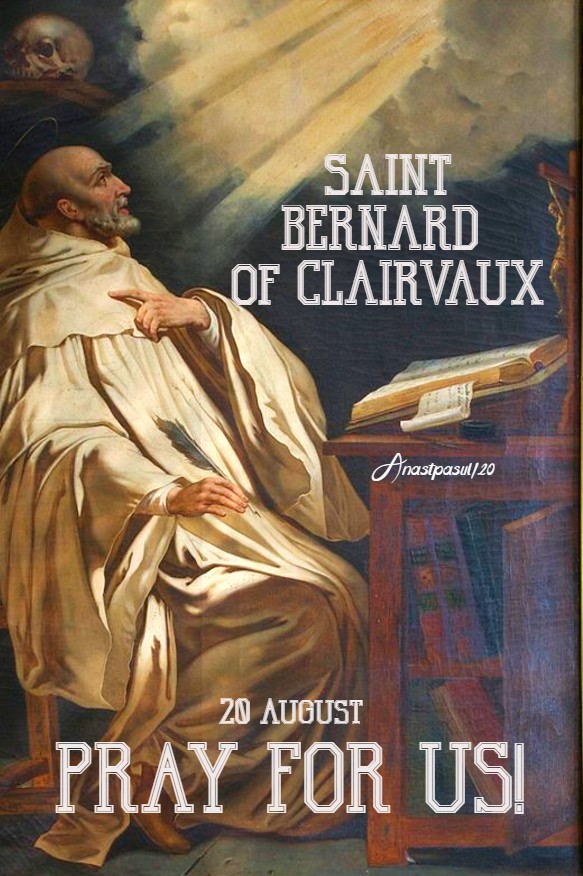
One Minute Reflection – 20 August – “Month of the Immaculate Heart of Mary” – Thursday of the Twentieth week in Ordinary Time, Readings: Ezekiel 36: 23-28, Psalms 51:12-13, 14-15, 18-19, Matthew 22:1-14 and the Memorial of St Bernard of Clairvaux (1090-1153) “Doctor of Light”
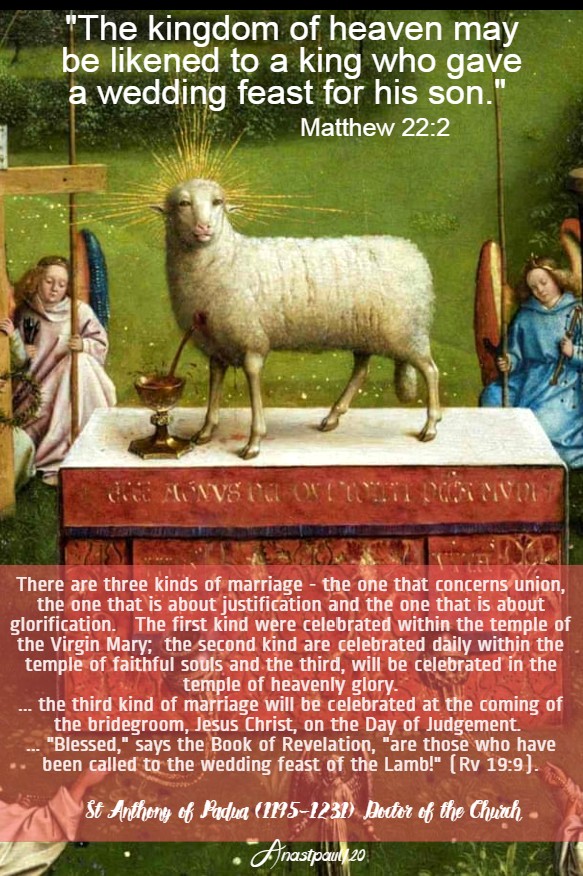
“The kingdom of heaven may be likened to a king who gave a wedding feast for his son.” – Matthew 22:2
REFLECTION – “There are three kinds of marriage – the one that concerns union, the one that is about justification and the one that is about glorification. The first kind were celebrated within the temple of the Virgin Mary; the second kind are celebrated daily within the temple of faithful souls and the third, will be celebrated in the temple of heavenly glory. The purpose of a wedding is to unite two people, the bridegroom and the bride. If two families are against each other, marriage usually unites them, when a man from one side marries a woman from the other. Between ourselves and God, there used to be a great division – to wipe it out and establish peace, the Son of God had to take His bride from someone of our lineage. To realise this marriage, numerous intermediaries and peacemakers intervened who, through their insistent prayers, were able to win it, at great cost. Finally, the Father Himself gave His consent and sent His Son, who joined Himself to our nature in the marriage chamber of the Virgin Mary’s womb. Thus the Father “gave a marriage feast for his Son.” In the same way, the second kind of marriage is celebrated when the grace of the Holy Spirit intervenes and the soul is converted (…) The grace of the Holy Spirit is the bridegroom of the soul. When He calls it to repentance with His interior inspiration, all appeal from the vices is without effect. Finally, the third kind of marriage will be celebrated at the coming of the bridegroom, Jesus Christ, on the Day of Judgement. Of Him it is written: “Behold, the bridegroom is coming! Go out to meet him” (Mt 25:6). He will take the Church itself as bride, as John says in the Book of Revelation: “Come here. I will show you the Bride, Jerusalem, coming down out of heaven from God, gleaming with the splendour of God” (cf. Rv 21:9-11). The Church of the Faithful comes down from heaven, from beside God, for it has obtained from God that it’s dwelling should be in the heavens. And so, at present, it lives by faith and hope but very soon it will celebrate it’s espousals with it’s bridegroom: “Blessed,” says the Book of Revelation, “are those who have been called to the wedding feast of the Lamb!” (Rv 19:9).” … St Anthony of Padua OFM (1195-1231) Doctor of the Church
PRAYER – All-knowing God, let me be able to stand in Your presence with a good conscience. Send Your Holy Spirit to fill my soul with the enlightenment of repentance and then to guide my steps towards the wedding feast You have prepared for Your Son. You made St Bernard burn with zeal for Your house and gave him the grace to enkindle and enlighten others in Your Church. Grant that by his prayer, we may be filled with the same spirit and always live as children of the Light. Through Christ our Lord, in the unity of the Holy Spirit, God forever, amen.
Our Morning Offering – 20 August – “Month of the Immaculate Heart of Mary” – Thursday of the Twentieth week in Ordinary Time and the Memorial of St Bernard of Clairvaux (1090-1153) “Doctor of Light”
Run, hasten, O Lady, I Call upon You By St Bernard of Clairvaux (1090-1153) Mellifluous Doctor
Run, hasten, O Lady, and in your mercy help your sinful servant, who calls upon you, and deliver him from the hands of the enemy. Who will not sigh to you? We sigh with love and grief, for we are oppressed on every side. How can we do otherwise than sigh to you, O solace of the miserable, refuge of outcasts, ransom of captives? We are certain that when you see our miseries, your compassion will hasten to relieve us. O our sovereign Lady and our Advocate, commend us to your Son. Grant, O blessed one, by the grace which you have merited, that He who through you was graciously pleased to become a partaker of our infirmity and misery, may also, through your intercession, make us partakers, of His happiness and glory. Amen
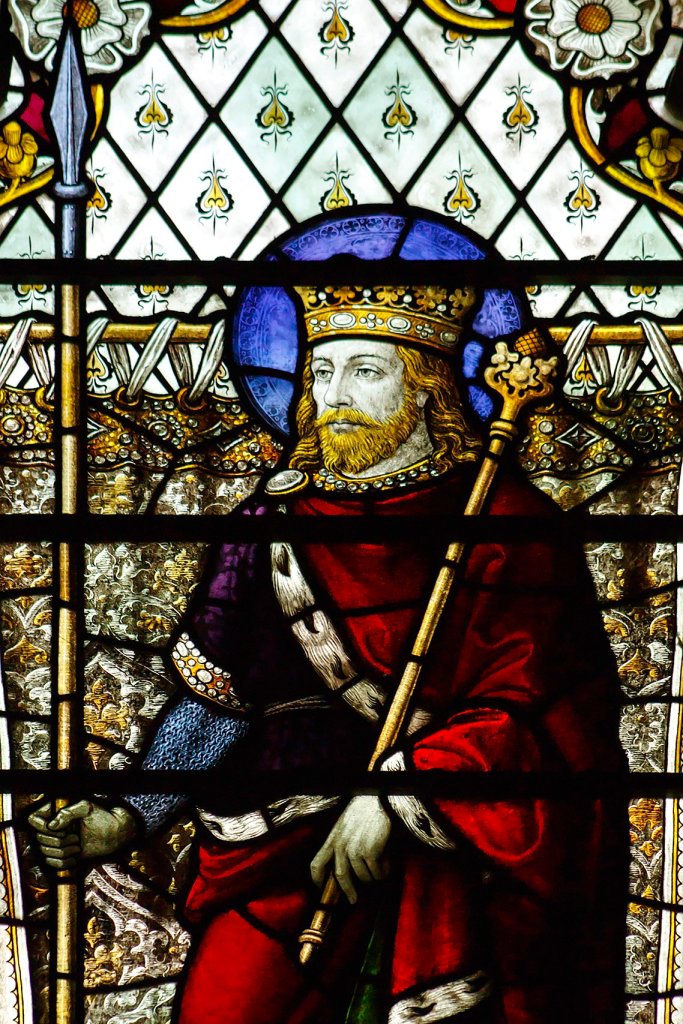
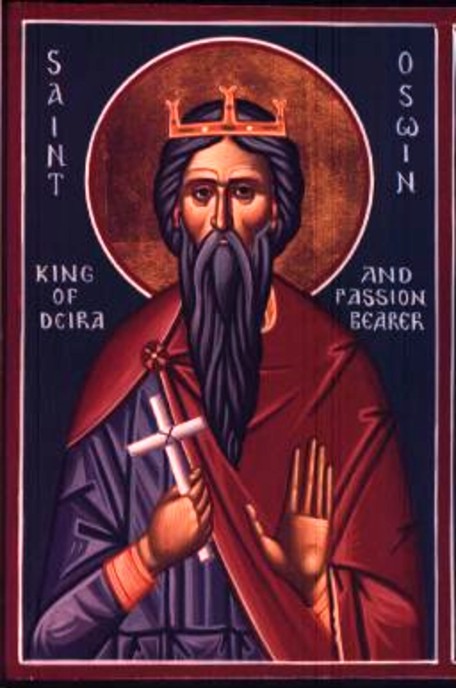
Saint of the Day – 20 August – Saint Oswine of Deira (Died 651) King, Martyr, King of Deira in northern England. Also known as Osuine, Oswin. Born a Prince, the son of King Osric of Deira in Northumbria and died by being murdered on 20 August 651 at Gilling, Yorkshire, England on the orders of his cousin Oswy. Patronage – betrayal victims (his location was betrayed to his murders by a one of his supposedly loyal nobles).
“King Oswine was of a goodly countenance and tall of stature, pleasant in discourse and courteous in behaviour; and bountiful to all, gentle and simple alike.
[…] He had given a beautiful horse to Bishop Aidan, to use either in crossing rivers, or in performing a journey upon any urgent necessity, though the Bishop was wont to travel ordinarily on foot. Some short time after, a poor man meeting the Bishop and asking alms, he immediately dismounted and ordered the horse, with all his royal trappings, to be given to the beggar; for he was very compassionate, a great friend to the poor and, in a manner, the father of the wretched.
This being told to the King, when they were going in to dinner, he said to the Bishop, “What did you mean, my lord Bishop, by giving the poor man that royal horse, which it was fitting that you should have for your own use? Had not we many other horses of less value, or things of other sorts, which would have been good enough to give to the poor, instead of giving that horse, which I had chosen and set apart for your own use?”
Thereupon the Bishop answered, “What do you say, O King? Is that son of a mare more dear to you than that son of God?”
Upon this they went in to dinner and the Bishop sat in his place but the King, who had come in from hunting, stood warming himself, with his attendants, at the fire. Then, on a sudden, whilst he was warming himself, calling to mind what the Bishop had said to him, he ungirt his sword and gave it to a servant and hastened to the Bishop and fell down at his feet’ beseeching him to forgive him:
“For from this time forward,” said he, “I will never speak anymore of this, nor will I judge of what or how much of our money you shall give to the sons of God.” […] The King, at the Bishop’s command and request, was comforted but the Bishop, on the other hand, grew sad and was moved even to tears. His Priest then asking him, in the language of his country, which the King and his servants did not understand, why he wept.
“I know,” said he, “that the King will not live long, for I never before saw a humble King, whence I perceive that he will soon be snatched out of this life, because this nation is not worthy of such a ruler.” Not long after, the Bishop’s gloomy foreboding was fulfilled by the King’s sad death….”
The Venerable Bede (673-735): Ecclesiastical History of England, 3
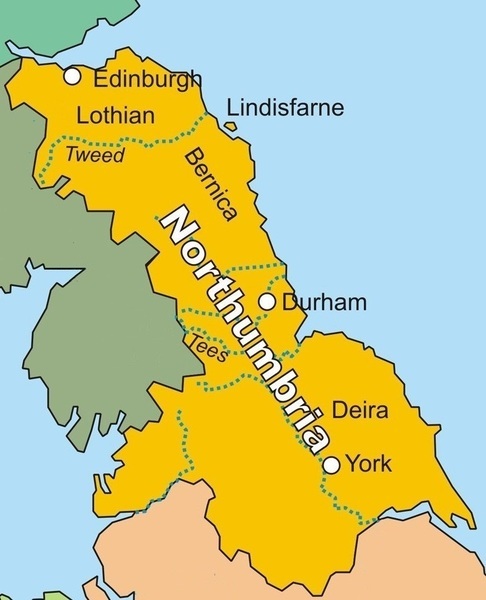
St Oswine ruled as King of Deira (southern Northumbria) from 644-651, in the second generation after England’s conversion to Christianity by St Augustine of Canterbury. His father had been murdered by the warlord Cadwalla and young Oswine had been spirited away to safety in Wessex shortly afterwards. Following the death of his kinsman, Oswald, at the hands of King Penda of Mercia in 642, he returned to Deira and became King around 644 . His kinsman Oswy ruled Bernicia, the northern part of Northumbria.
Oswine had a great reputation for sanctity and justice and for seven years the kingdom of Deira enjoyed great happiness and prosperity. But his kinsmen Oswy, jealous of his power, made war upon Oswine. Oswine found himself unable to best the armies of Oswy and so he disbanded them and fled to Humwald of Gilling, whom had recently pledged allegiance to Oswine. But the unscrupulous Humwald quickly betrayed the saintly King Oswin to some of Oswy’s officers who murdered him at Gilling in 651. The slain king was immediately venerated as a Saint as St Bede explained above.
He was buried at Gilling, but his remains were lost during the Danish troubles. Only one year before the Norman Conquest (1065), St Oswine appeared in a vision to a monk named Edmund and revealed the location of his body. On 20 August 1103 his body was transferred solemnly to its final resting place. During the Dissolution of the Monasteries during Henry VIII’s reign, his body was found to be intact in the tomb but it was sacrilegiously destroyed. Only a fragment remained, which is now kept at Durham Cathedral.
As a side note, Eanfleda, the wife of Oswine’s murderer Oswy and daughter of St Edwin, persuaded her husband to do penance for Oswine’s murder by endowing a Monastery at Gilling, which he promptly did. Some remains of the Monastery can still be seen today, though it was destroyed by the Danes in the 11th century.
St Brogan St Burchard of Worms St Christopher of Cordoba St Cristòfol Baqués Almirall St Edbert of Northumbria Bl Georg Hafner Bl Gervais-Protais Brunel St Gobert of Apremont St Haduin of Le Mans St Heliodorus of Persia St Herbert Hoscam St Leovigild of Cordoba Bl Louis-François Lebrun St Lucius of Cyprus Bl Maria de Mattias ASC (1805-1866) Biography: https://anastpaul.com/2018/08/20/saint-of-the-day-20-august-st-maria-de-mattias-a-s-c-1805-1866/
St Maximus of Chinon St Oswine of Deira (Died 651) King, Martyr St Philibert of Jumièges (c 608–684) About St Philibert: https://anastpaul.com/2019/08/20/saint-of-the-day-20-august-saint-philibert-of-jumieges-c-608-684/ St Porphyrius of Palestrina St Ronald of Orkney St Samuel the Patriarch Bl Wladyslaw Maczkowski St Zacchaeus the Publican — Martyred in the Spanish Civil War: 8 Beati Enrique Rodríguez Tortosa Francesc Llagostera Bonet Ismael Barrio Marquilla José Tapia Díaz Magí Albaigés Escoda Manuel López Álvarez María Climent Mateu Serapio Sanz Iranzo Tomás Campo Marín
Thought for the Day – 19 August – Meditations with Antonio Cardinal Bacci (1881-1971)
Divine Providence
“The Book of Wisdom, speaks to us of Divine Providence. “Your providence, O Father, guides… (14:3). You love all things that are and loathe nothing that you have made; for what you hated, you would not have fashioned (11:24). God … is the guide of Wisdom and the director of the wise. For both we and our words, are in his hand …” (7:16). Wisdom “reaches from end to end mightily and governs all things well” (Wisd 8:1). The Lord of all, shows not partiality … because he, himself, made the great, as well as the small and he provides for all alike (Wisd 6:8). You have disposed of all things by measure and number and weight” (Wis 11:21).
We have only to look around us and to think about ourselves, in order to understand the truth of these words from Sacred Scripture. We need only consider a few of the outstanding elements in the universe – the sun, which rises and sets with such perfect regularity and the myriads of the stars, clusters of planets and solar systems, ranging the vast spaces of the firmament. Then there are the smaller objects of creation which nonetheless, proclaim the greatness of Divine Providence – from the invisibly tiny insects, each with it’s own independent existence, to the flowers which draw their nourishment from the earth and the birds, for whose sustenance, God provides all that is necessary.
Lastly, there is the human body, that masterpiece of harmony. The eyes, ears and other organs, display, in a marvellous manner, the wisdom of the Creator. The soul, too, is the living image of God. It transcends the limits of space and time by the speed of it’s thought, continually discovers new secrets of the universe by means of it’s intellectual power and is capable of willing, commanding and loving.
When confronted with so much order and beauty and goodness, we can only bow down and adore, the Providence of God!“
Quote/s of the Day – 19 August – The Memorial of St John Eudes Orat. (1601-1680) “Apostle of Two Hearts”
“I ask you to consider, that our Lord Jesus Christ is your true head and that you are a member of His body. He belongs to you as the head belongs to the body. All that is His is yours – breath, heart, body, soul and all His faculties. All of these you must use, as if they belonged to you, so that in serving Him, you may give Him praise, love and glory.”
“A man is no true Christian if he has no devotion to the Mother of Jesus Christ.
“Every Saint belongs to the Court of the Queen of All Saints.”
One Minute Reflection -19 August – Wednesday of the Twentieth week in Ordinary Time, Readings: Ezekiel 34: 1-11, Psalms 23:1-3a, 3b-4, 5, 6, Matthew 20:1-16 and The Memorial of St John Eudes Orat. (1601-1680) “Apostle of Two Hearts” and St Louis of Toulouse OFM (1274-1297)
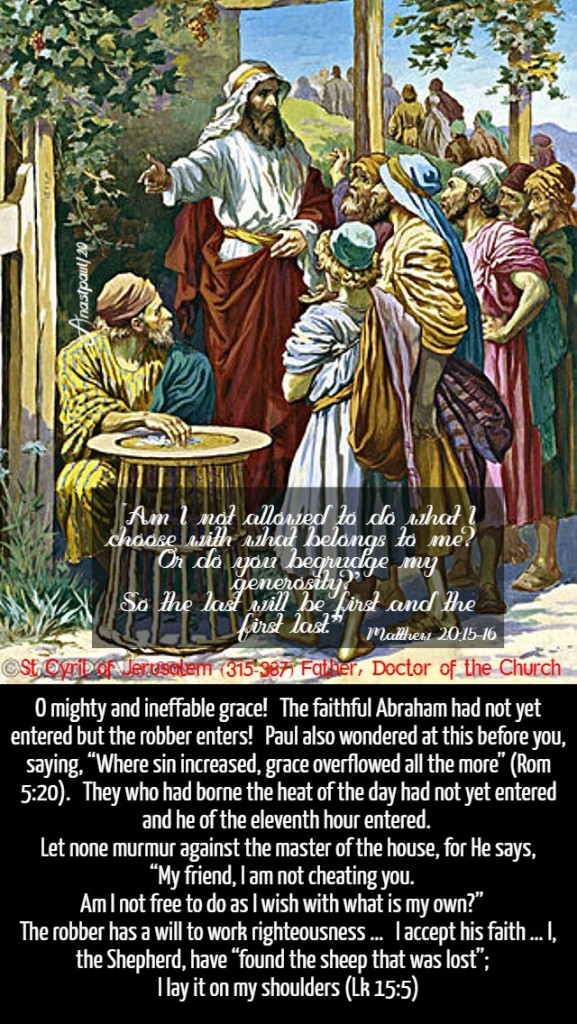
“Am I not allowed to do what I choose with what belongs to me? Or do you begrudge my generosity?’ So the last will be first and the first last.” … Matthew 20:15-16
REFLECTION – “One of the robbers crucified with Jesus cried out: “Lord, remember me; it is to you I now turn (…). Remember not my works, for of these I am afraid. Every man has a feeling for his fellow-traveller; I am travelling with you towards death; remember me, your fellow-wayfarer. I do not say, Remember me now, but, “when you come in your kingdom” (Lk 23:42).
What power, O robber, led you to the Light? Who taught you to worship that despised Man, your companion on the cross? O Light Eternal, which gives light to them that are in darkness! (Lk 1:79) “Take courage! Amen, I say to you, today you will be with me in paradise” because “today you have heard my voice, and have not hardened your heart” (Ps 95[94]:8). Very speedily I passed sentence upon Adam (…) but you, who today have obeyed the faith, today is your salvation. By the tree Adam fell away; by the tree you are brought into paradise (…)
O mighty and ineffable grace! The faithful Abraham had not yet entered but the robber enters! Paul also wondered at this before you, saying, “Where sin increased, grace overflowed all the more” (Rom 5:20). They who had borne the heat of the day had not yet entered and he of the eleventh hour entered. Let none murmur against the Master of the House, for He says, “My friend, I am not cheating you. Am I not free to do as I wish with what is my own?” The robber has a will to work righteousness … I accept his faith … I, the Shepherd, have “found the sheep that was lost”; I lay it on my shoulders (Lk 15:5); since he himself has said, “I have gone astray like a lost sheep; Lord, remember me when You come in Your kingdom.” … St Cyril of Jerusalem (315-387) Bishop of Jerusalem, Father, Doctor of the Church
PRAYER – Father of mercies and God of all consolation, You gave us the loving Heart of Your own beloved Son, because of the boundless love by which You have loved us, which no tongue can describe. May we render You a love that is perfect with hearts made one with His. Grant, we pray, that our hearts may be brought to perfect unity, each heart with the other and all hearts with the Heart of Jesus….and may the rightful yearnings of our hearts find fulfilment through Him, Our Lord Jesus Christ, Your Son, who lives and reigns with You, in the unity of the Holy Spirit, one God, forever and ever. – Collect from Saint John Eudes’ Mass, Gaudeamus, 1668 St John Eudes and St Louis of Toulouse, Pray for us! amen.
Our Morning Offering – 19 August – Monday of the Twentieth week in Ordinary Time and The Memorial of St John Eudes Orat. (1601-1680) “Apostle of Two Hearts”
Be the Heart of My Heart By St John Eudes (1501-1680)
O Heart all lovable and all loving of my Saviour, be the Heart of my heart, the Soul of my soul, the Spirit of my spirit, the Life of my life and the sole principle of all my thoughts, words and actions, of all the faculties of my soul and of all my senses, both interior and exterior. Amen
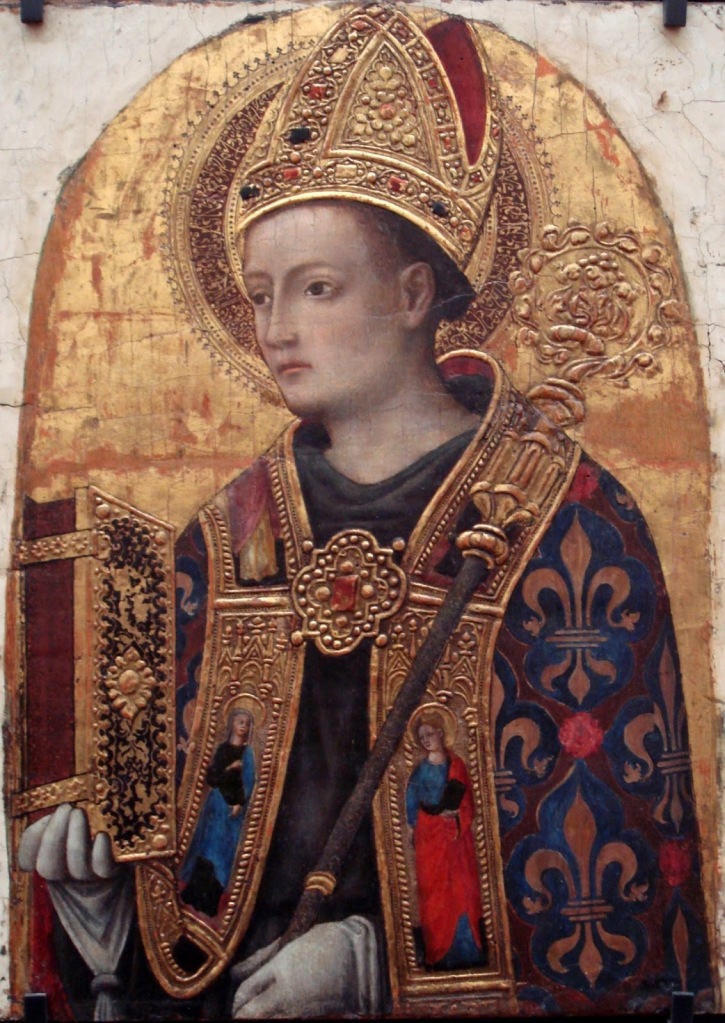
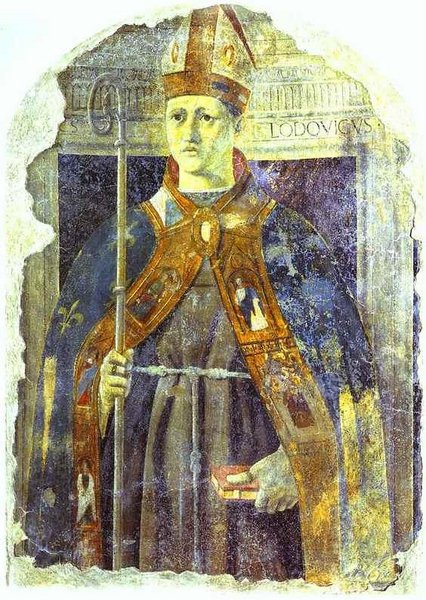
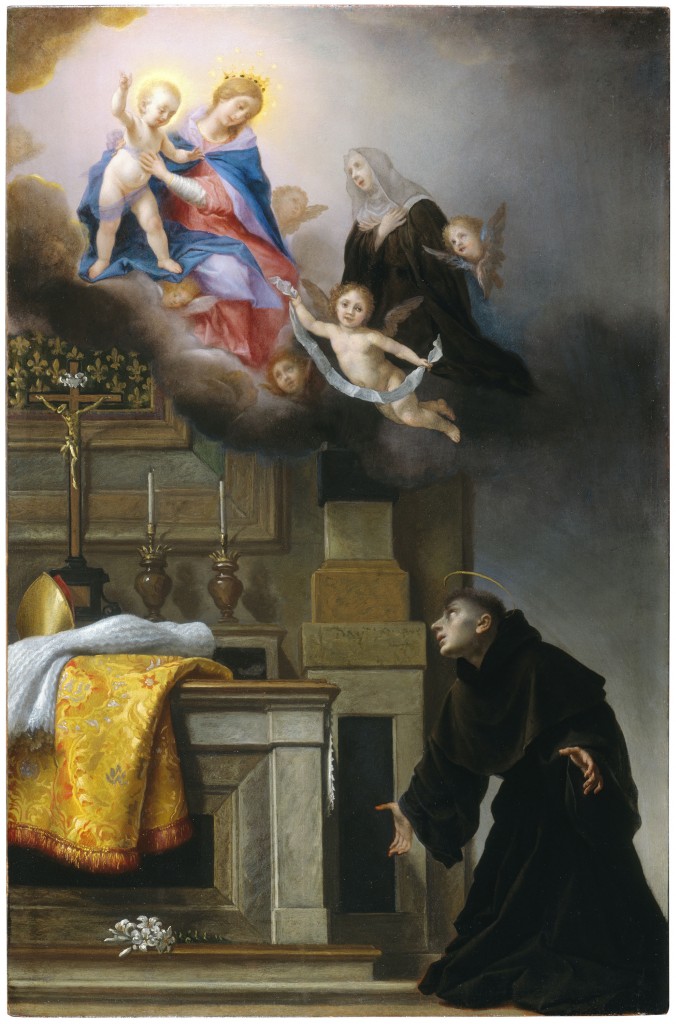
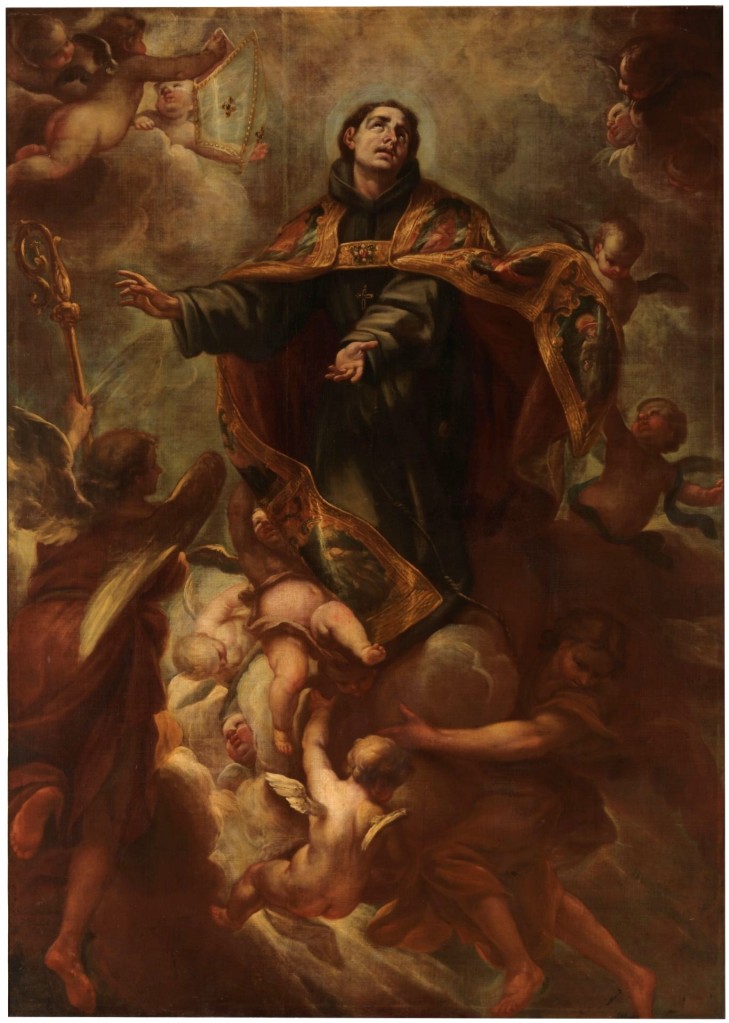
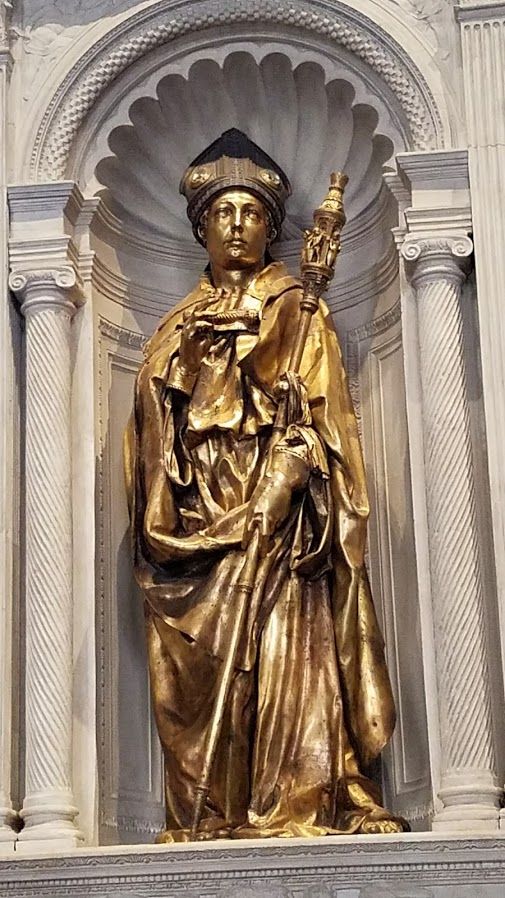
Saint of the Day – 19 August – Saint Louis of Toulouse OFM (1274-1297) Prince and Bishop, Neapolitan prince of the Capetian House of Anjou, Franciscan Friar and Priest, Apostle of prayer, of penance and of the poor and the sick – born in February 1274 at Nocera, Italy and died on 19 August 1297 at Brignolles, Italy of natural causes, aged just 23. Also known as Louis of Anjou. Patronages – Valencia (Spain), Mission San Luis Obispo de Tolosa, Baler (Philippines).
Louis was the son of Charles II of Naples and Sicily and was born in 1274 and named after his uncle, the holy St Louis IX (1214-1270), King of France. (His life here https://anastpaul.com/2017/08/25/saint-of-the-day-25-august-st-louis-king-of-france/). It was the great concern of his mother, the niece of St Elizabeth, to rear her many children as true servants of the King of Kings.
The devout queen observed in her son, Louis, particularly blessed results of her maternal solicitude. He loved prayer, was reserved and gentle and his whole conduct radiated angelic purity. Even as a child he practised mortification. On a certain occasion, after he had retired, his mother found him sleeping on a rug on the floor of his room instead of in his comfortable bed.
Sweets and delicious foods he carried to the poor and sick with his mother’s permission. It is related that once he was leaving the dining room with a roasted pullet under his mantle and so met his father. The King wished to see what he was carrying. Timidly the boy laid back his mantle and lo, it was a beautiful bouquet of flowers!
When he was 14, Louis was taken to Barcelona with two of his brothers, as a hostage for the release of his father, who had been taken a prisoner of war. Gladly did Louis accept this misfortune to obtain his father’s freedom but, at the same time, the disposition with which he accepted it was astonishing in a boy of his age.
“Misfortune,” he said, “is more useful to the friends of God than good fortune, for on such occasions they can prove their loyalty to their Lord.”
Under the guidance of several excellent Franciscan friars who were appointed teachers to the young princes, Louis made remarkable progress in virtue as well as in secular knowledge. In public debates he manifested his mastery of the various branches of knowledge, both sacred and secular. Theology was his favourite subject. So devoid was he of ambition, that he planned to renounce his claims to the throne in order to devote himself entirely to the service of God.
About this time he became seriously ill. He made a vow that if he recovered, he would join the Order of Friars Minor. The sickness immediately took a turn for the better but the Superiors of the Order hesitated to receive the young prince without the consent of the king, his father. Louis was thus obliged to defer his pious design.
At the end of six years his captivity ended. On returning home, after much pleading, he finally obtained the permission of his father to settle his claims on his brother Robert and to become a Priest.
Not very long after his Ordination and although he was only 21 years old, he was selected by Pope Boniface VIII for the Bishopric of Toulouse.
“Whatever is lacking to the young Priest in age and experience,” said the Pope, “his extraordinary knowledge, his maturity of mind and his holiness of life will amply supply.”
Saint Louis had to yield to the Pope’s wishes but he requested that he might first be admitted into the Order of Friars Minor. That request was granted. The royal Prince was overjoyed to be permitted, for a time at least, to perform the humblest exercises in the garb of a son of St Francis; in Rome he went from door to door gathering alms.
The Pope himself, officiated at the ceremony of Episcopal Consecration and shortly afterward, Saint Louis left to assume the government of his Diocese His noble birth and above all the fame of his sanctity, caused him to be received at Toulouse like a messenger from heaven. The entire city went out to meet him and everybody was enchanted with his modesty, sweetness and angelic virtue which radiated from his face and bearing.
A sinner who for many years had lived a wicked life, cried out at the sight of him: “Truly, this man is a saint!” and then turned away from his sinful habits and led a better life.
A woman who doubted the sanctity of the young man went to church one morning to attend the Mass which the Bishop was celebrating. Then she, too, cried out: “Ah, yes, our Bishop is a saint!”
Bishop Louis led the poor and rigorous life of a Friar Minor and devoted himself with all solicitude to the welfare of his Diocese. The poor were his best friend, and he fed 25 of them daily at his own table. His ministry, however, was destined to be short-lived.
Saint Louis died in the 24th year of his life, having been Bishop no longer than a year and a half.
He had received the last sacraments on the Feast of the Assumption of Our Lady and on the 19th of August, 1297, while pronouncing the holy name of Mary, he yielded his soul to God. Because of the many miracles that were wrought at his tomb, he was Canonised as early as 1317, during the lifetime of his mother.
St Andrew the Tribune St Badulf of Ainay St Bertulf of Luxeuil St Calminius St Credan of Evesham St Donatus of Mount Jura St Elaphius of Châlons St Ezekiel Moreno Y Diaz St Guenninus Bl Guerricus Bl Hugh Green Blessed Jordan of Pisa OP (c 1255–1311) His Life: https://anastpaul.com/2019/08/19/saint-of-the-day-blessed-jordan-of-pisa-op-c-1255-1311/ St Julius of Rome St Louis of Toulouse OFM (1274-1297) Prince and Bishop
St Magnus of Anagni St Magnus of Avignon St Magnus of Cuneo St Marianus of Entreaigues St Marinus of Besalu St Magino of Tarragona St Mochta St Namadia of Marsat St Rufinus of Mantua St Sarah the Matriarch St Sebaldus St Thecla of Caesarea St Timothy of Gaza — Martyrs of Nagasaki – 15 beati: A group of missionaries and their laymen supporters who were executed for spreading Christianity in Japan. • Antonius Yamada • Bartholomaeus Mohyoe • Iacobus Matsuo Denji • Ioachim Díaz Hirayama • Ioannes Miyazaki Soemon • Ioannes Nagata Matashichi • Ioannes Yago • Laurentius Ikegami Rokusuke • Leo Sukeemon • Ludovic Frarijn • Marcus Takenoshita Shin’emon • Michaël Díaz Hori • Paulus Sankichi • Pedro de Zúñiga • Thomas Koyanagi They were beheaded on 19 August 1622 at Nagasaki, Japan and Beatified on 7 May 1867 by Pope Pius IX.
Martyred in the Spanish Civil War Martyred Carmelite Sisters of Charity – 9 beati Martyred Salesians of Ciudad Real – 8 beati Martyred Subiaco Benedictines of Barcelona – 7 beati • Blessed Agueda Hernández Amorós • Blessed Agustí Busquets Creixell • Blessed Andrés Pradas Lahoz • Blessed Antolín Martínez y Martínez • Blessed Antoni Pedró Minguella • Blessed Càndid Feliu Soler • Blessed Cipriano González Millán • Blessed Damián Gómez Jiménez • Blessed Elvira Torrentallé Paraire • Blessed Félix González Bustos • Blessed Francisca de Amézua Ibaibarriaga • Blessed Francisco de Paula Ibáñez y Ibáñez • Blessed Ignasi Guilà Ximenes • Blessed Isidro Muñoz Antolín • Blessed Joan Roca Bosch
Thought for the Day – 18 August – Meditations with Antonio Cardinal Bacci (1881-1971)
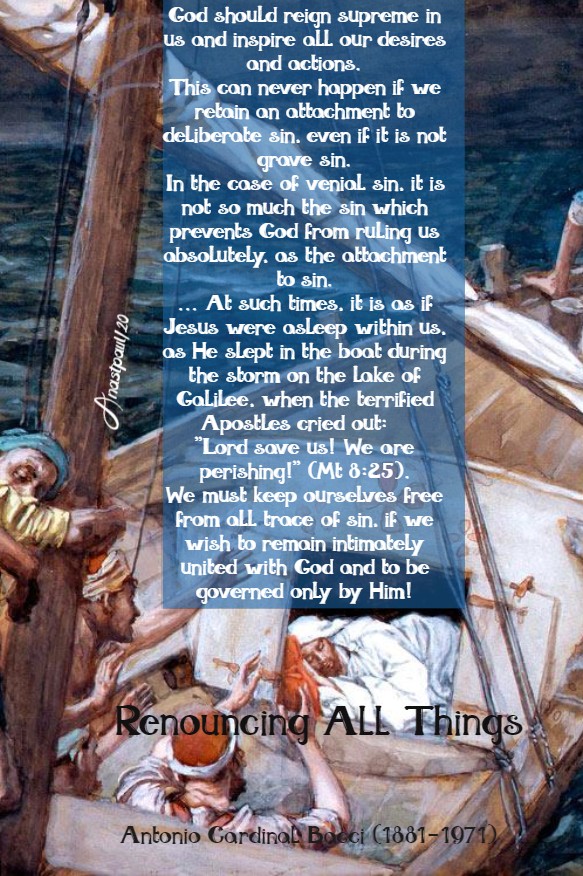
Renouncing All Things
“If we want God to take possession of our souls, we must drive out every inordinate affection to earthly things.
It is not possible for God to dwell within us, if we are still attached to sin or preoccupied with worldly aims.
God should reign supreme in us and inspire all our desires and actions.
This can never happen if we retain an attachment to deliberate sin, even if it is not grave sin.
In the case of venial sin, it is not so much the sin which prevents God from ruling us absolutely, as the attachment to sin.
It is possible for anybody to fall through human weakness, “for the just man falls seven times and rises again” (Prov 24:16).
It is when we remain willingly in the state of sin, that we offend God and weaken our faith and charity.
At such times, it is as if Jesus were asleep within us, as He slept in the boat during the storm on the lake of Galilee, when the terrified Apostles cried out: “Lord save us! We are perishing!” (Mt 8:25).
We must keep ourselves free from all trace of sin, if we wish to remain intimately united with God and to be governed only by Him!”
Quote/s of the Day – 18 August – Tuesday of the Twentieth week in Ordinary Time, Readings: Ezekiel 28: 1-10, Responsorial Psalm Deuteronomy 32:26-27ab, 27cd-28, 30, 35cd-36ab, Matthew 19:23-30
“I am the Way, the Truth and the Life”
John 14:6
“Through Him, our gaze penetrates the heights of heaven and we see, as in a mirror, the most holy face of God. Through Christ, the eyes of our hearts are opened and our weak and clouded understanding, reaches up toward the light.”
Saint Pope Clement I (c 35-99)
Apostolic Father, Bishop of Rome and Martyr
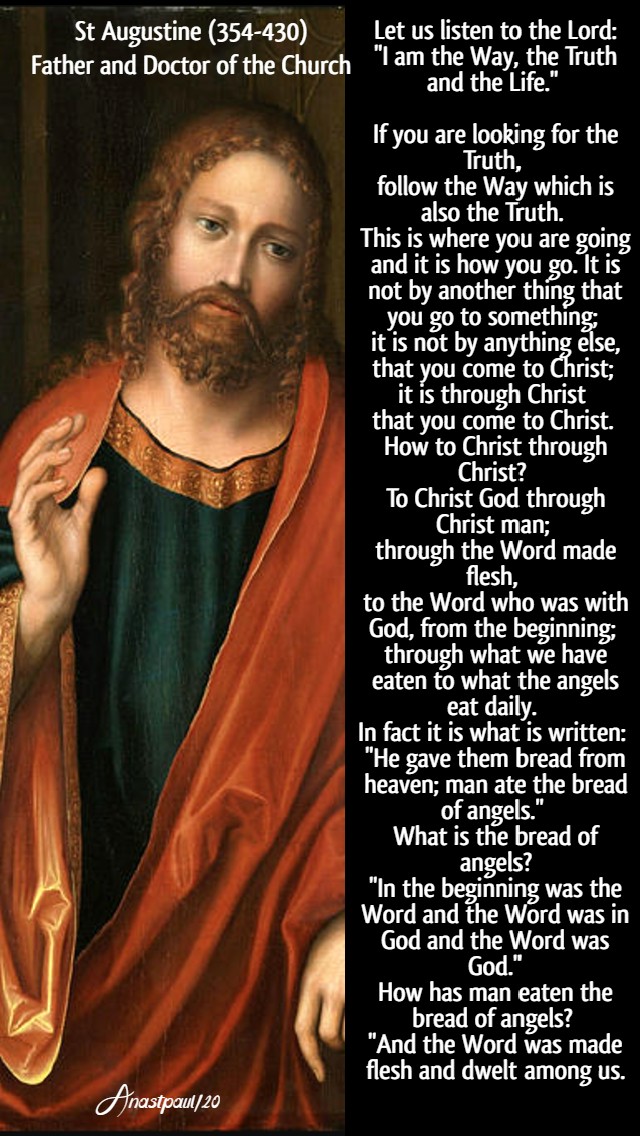
“Let us listen to the Lord: “I am the Way, the Truth and the Life” (Jn 14:6). If you are looking for the Truth, follow the Way which is also the Truth. This is where you are going and it is how you go. It is not by another thing that you go to something; it is not by anything else that you come to Christ; it is through Christ that you come to Christ. How to Christ through Christ? To Christ God through Christ man; through the Word made flesh, to the Word who was with God, from the beginning; through what we have eaten to what the angels eat daily. In fact it is what is written: “He gave them bread from heaven; man ate the bread of angels” (Ps 77[78]:24-25). What is the bread of angels? “In the beginning was the Word and the Word was in God and the Word was God” (Jn 1:1-3). How has man eaten the bread of angels? “And the Word was made flesh and dwelt among us.”
Saint Augustine (354-430)
Father and Doctor of Grace
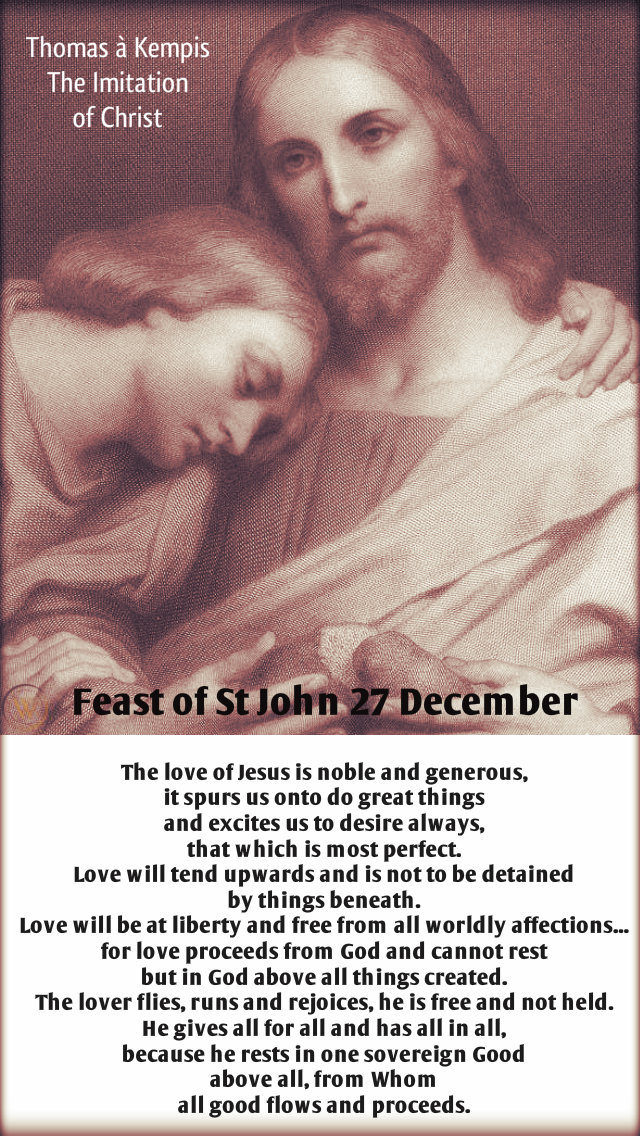
“The love of Jesus is noble and generous, it spurs us onto do great things and excites us to desire always, that which is most perfect. Love will tend upwards and is not to be detained by things beneath. Love will be at liberty and free from all worldly affections… for love proceeds from God and cannot rest but in God above all things created. The lover flies, runs and rejoices, he is free and not held. He gives all for all and has all in all, because he rests in one sovereign Good above all, from Whom all good flows and proceeds”
Thomas à Kempis,
The Imitation of Christ,
Book III, Chapter V, 3-4
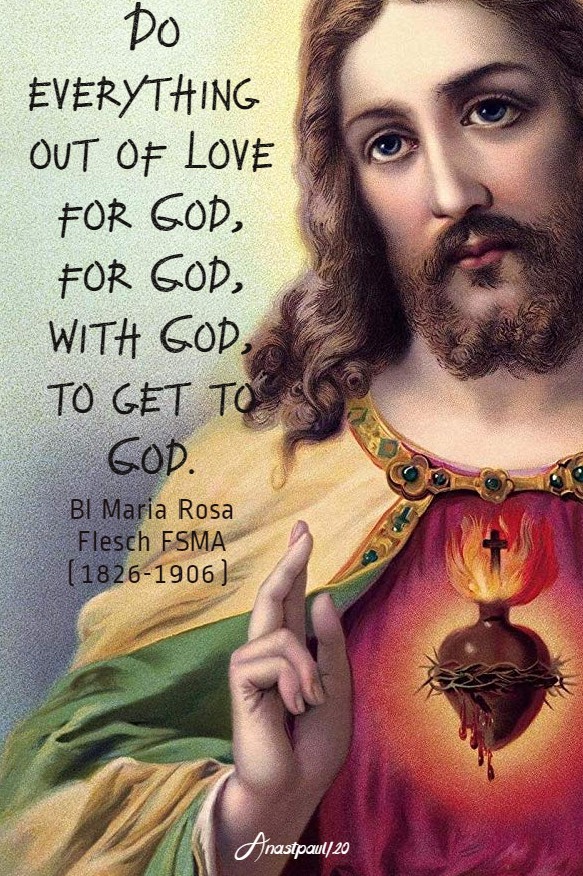
“Do everything out of love for God, for God, with God, to get to God.”
Blessed Maria Rosa Flesch (1826-1906)
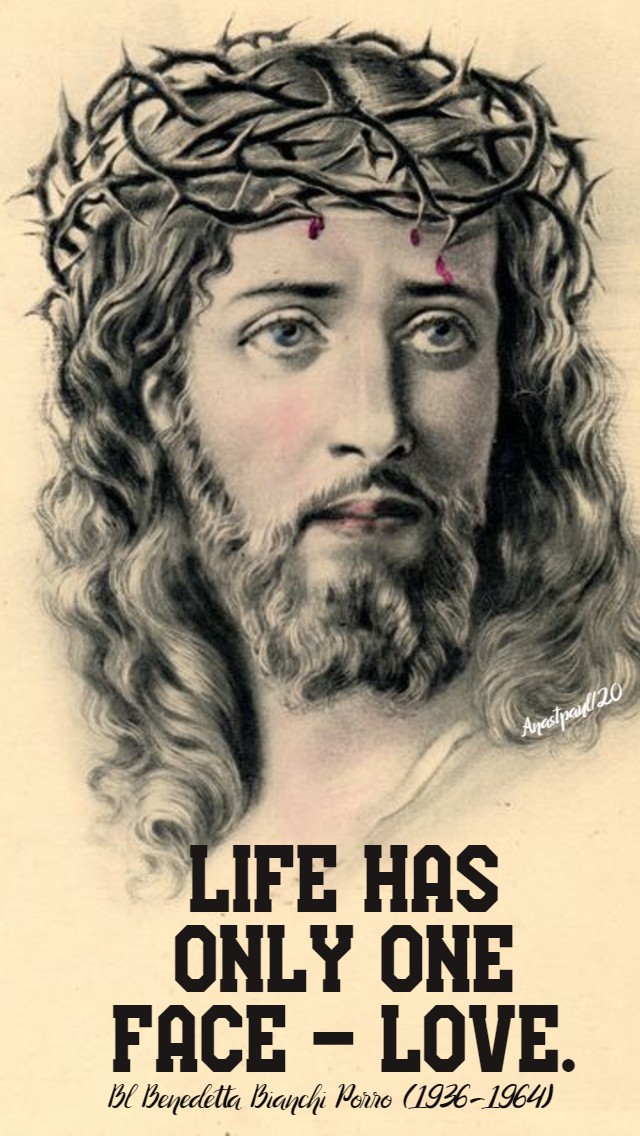
“Life has only one face – LOVE.”
Blessed Benedetta Bianchi Porro (1936-1964)
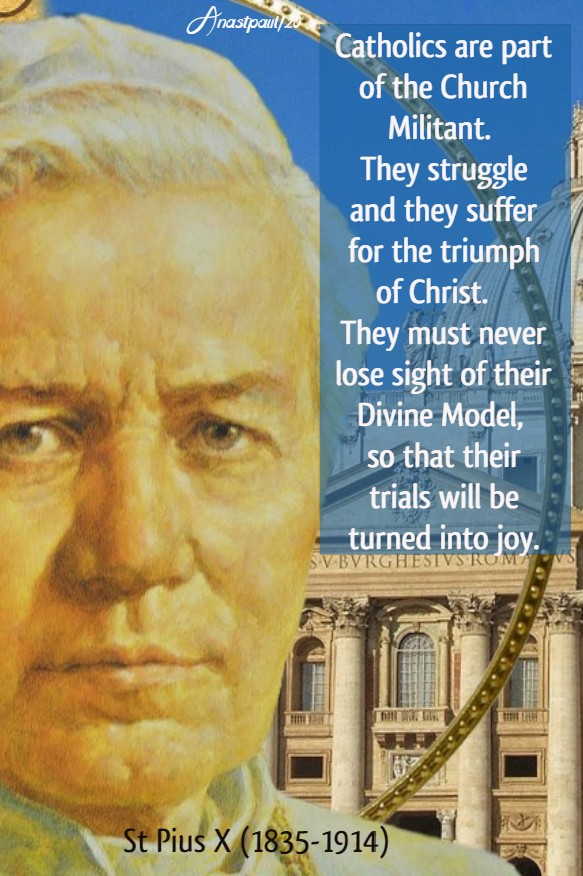
“Catholics are part of the Church Militant. They struggle and they suffer for the triumph of Christ. They must never lose sight of their Divine Model, so that their trials will be turned into joy.”
Saint Pius X (1835-1914)
“Love infinitely, the most sweet Lord Jesus Christ, do everything for Him alone and spend your life, in works of mercy and of love.”
Blessed Marija of Jesus Crucified Petković (1892-1966)
“Since the death of Christ, almost every century has seen the persecution of Christians, there have always been heroes and martyrs who gave their lives – often in horrible ways – for Christ and their faith. If we hope to reach our goal some day, then we, too, must become heroes of the faith.”
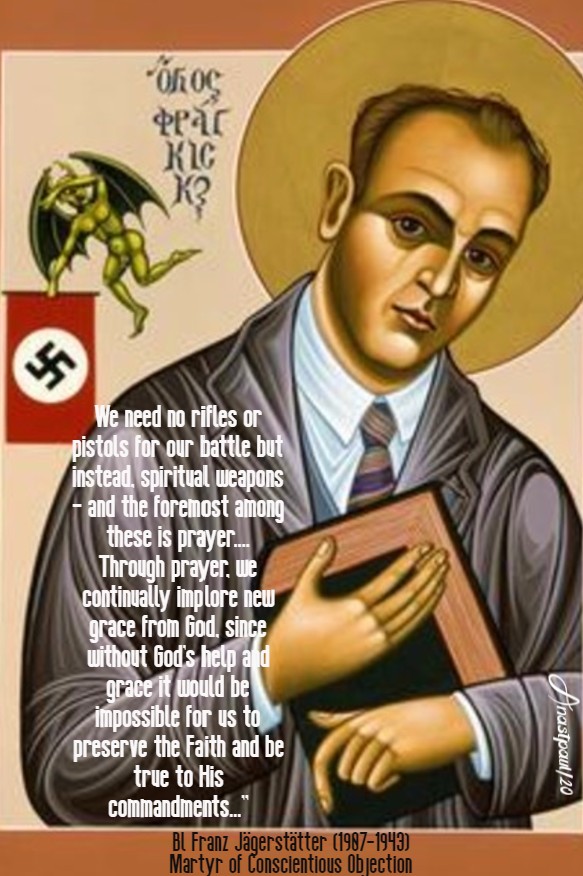
Blessed Franz Jägerstätter (1907-1943)
Martyr of Conscientious Objection
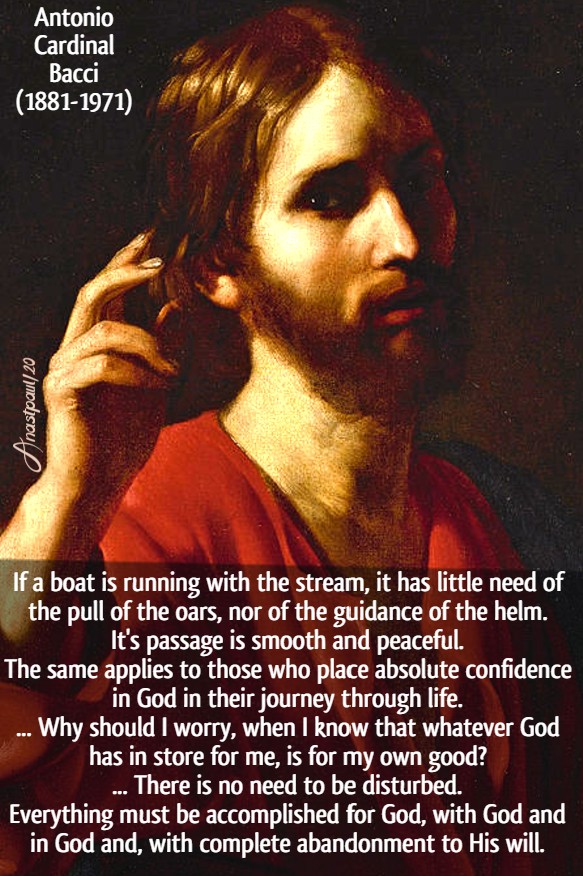
“If a boat is running with the stream, it has little need of the pull of the oars, nor of the guidance of the helm. It’s passage is smooth and peaceful. The same applies to those who place absolute confidence in God in their journey through life. … Why should I worry, when I know that whatever God has in store for me, is for my own good? … There is no need to be disturbed. Everything must be accomplished for God, with God and in God and, with complete abandonment to His will.”
“… Jesus said to them, “Amen, I say to you that you who have followed me, in the new age, when the Son of Man is seated on his throne of glory, will yourselves sit on twelve thrones, judging the twelve tribes of Israel.” … Matthew 19:28
REFLECTION – “In gift-giving it is not the gift itself, that God praises and approves but the will and sincerity of the giver. He excuses and holds more acceptable, the one who gave less but gave it with more perfect sincerity, than the one who gave more, from a fuller store but with less pure affection. Thus, from what is written about the gifts of the wealthy and from the two mites which the widow in the treasury sent for the poor, it is clear that the same also happens to those who leave everything that they possess, for the love of God, so as to follow undistractedly the Christ of God. They will do everything according to His word.
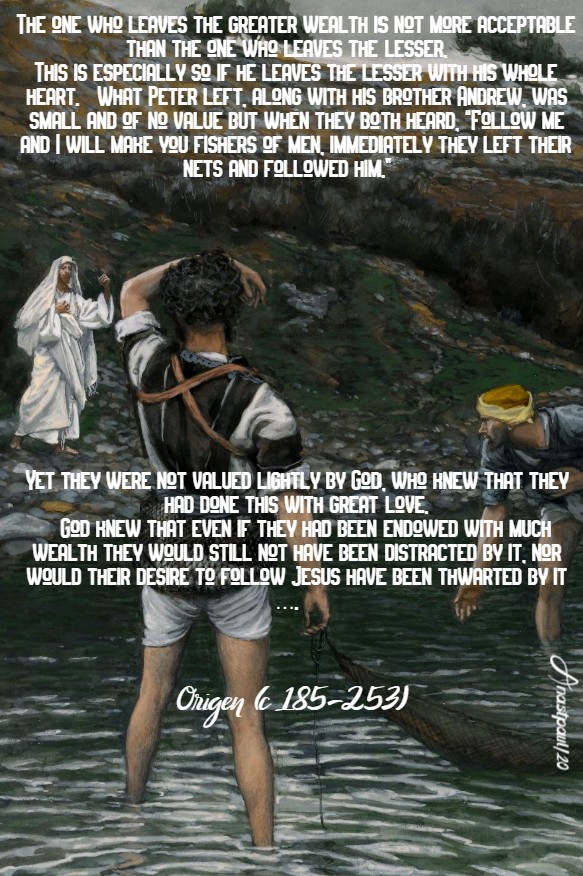
The one who leaves the greater wealth is not more acceptable than the one who leaves the lesser. This is especially so if he leaves the lesser with his whole heart. What Peter left, along with his brother Andrew, was small and of no value but when they both heard, “Follow me and I will make you fishers of men, immediately they left their nets and followed him.” Yet they were not valued lightly by God, who knew that they had done this with great love. God knew that even if they had been endowed with much wealth they would still not have been distracted by it, nor would their desire to follow Jesus have been thwarted by it ….
Those who follow the Saviour, therefore, will sit on the twelve thrones judging the twelve tribes of Israel and will receive this power in the resurrection of the dead. For this is the regeneration, a new birth, when the new heaven and the new earth are established for those who renew themselves and a New Testament with it’s chalice is given.” … Origen (c 185-253) – Commentary on Matthew, 15
PRAYER – Father of might and power, every good and perfect gift comes to us from You. Implant in our hearts the love of Your name and Your creatures. Increase our zeal for Your service by following behind Your Son with determination and joy. Nourish in us what good and tend it with watchful care. Grant that the prayers and caring love of the Blessed Virgin, our Mother, may help us to follow Jesus our Saviour unreservedly and thus attain eternal life. We make our prayer through Christ, our Lord in the union of the Holy Spirit, one God for all eternity, amen.
Our Morning Offering – 18 August – Tuesday of the Twentieth week in Ordinary Time and the Memorial of Saint Macarius the Wonder-Worker (Died 850) Monk, Abbot, Defender of Icons, miracle worker
To You, O Master By St Macarius the Wonder-Worker (Died 850)
To You, O Master,
who loves all mankind
I hasten on rising from sleep.
By Your mercy,
I go out to do Your work
and I make my prayer to You.
Help me at all times and in all things.
Deliver me from every evil thing of this world
and from pursuit by the devil.
Save me and bring me to Your eternal kingdom,
For You are my Creator,
You inspire all good thoughts in me.
In You is all my hope
and to You I give glory,
now and forever.
Amen
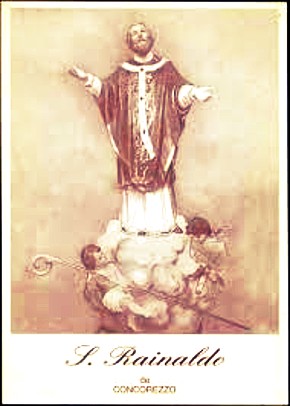
Saint of the Day – 18 August – Blessed Rinaldo of Concorezzo (c 1245 – 1321) Bishop of Vicenza from 1296 until his 1303 appointment as the Archbishop of Ravenna-Cervia holding that until his death, Doctor of Canon Law, Papal envoy, Arbitrator and peace-maker. Rinaldo served as a close confidante to Pope Boniface VIII before the latter was elected as Pontiff and is known for attempting to secure the rehabilitation of the Knights Templar. Archbishop Rinaldo was also a close friend of Dante Alighieri.
Rinaldo was a son of the noble Da Concoregio family, he was born in Milan between 1240 and 1250. Nothing is known about his youth, we have first knowledge of him in Bologna at the University. In his adolescence he completed his studies in Bologna and began to teach Canon law in Lodi from October 1286. In May 1287, the Bishop of Lodi asked him for legal opinions, this makes us understand that he enjoyed a reputation as a jurist and in fact had the academic title of ‘Doctor’ in 1295. We presume that during this time he completed his theological studies and was Ordained.
In 1289 he entered the staff of the Vice Chancellor of the Roman Curia Cardinal Pietro Peregrosso and he became an heir of the Cardinal in the latter’s will after he died in 1295. Rinaldo became a private aide and later the Chaplain to Cardinal Benedetto Caetani who became Pope Boniface VIII in 1294.
On 13 October 1296 the Pope appointed him Bishop of Vicenza, a See which he reached in a stormy way because in the meantime, the Vicentines had elected another bishop. In the end, the Pope’s authority prevailed and Rinaldo received his Episcopal Consecration and was installed as Bishop.
In that period he had special diplomatic and arbitration posts in the disputes that stirred between France and England. He was appointed by King Charles of Valois (1270-1325), called by the Pope to Florence to act as Arbirtrator and as Papal Nuncio (1302) in Romagna, later becoming the spiritual and temporal rector of the Region.
And in this function he found himself involved in the known turbulence of the area in continuous guerrilla warfare, in Forlì his headquarters, he took to the streets to bring peace but was attacked and seriously wounded, miraculously healed from deep wounds and continued his mission but sadly, without success.
The death of Boniface VIII came as a slight blow to the Bishop though Pope Benedict XI appointed him on 19 November 1303 as the Archbishop of Ravenna-Cervia and Rinaldo was installed in his new Archdiocese in October 1305.
He convoked a provincial council in 1307 and then resumed the old practice of visiting all parishes contained within the Archdiocese. He held a second in 1309 and another in 1311 all in Ravenna. He visited northern Italian cities in tumult to reconcile them with the empire’s monarch Henry VII. In 1314 he called the fourth council in Argenta in order to restore discipline to priests and liturgical matters. He called for the fifth and last in Bologna in 1317.
He attempted to defend and secure the rehabilitation of the Knights Templar at the Council of Ravenna. He was the architect of the acquittal of the Italian Templars in the Council of Ravenna, which was under investigation and threatened with the dissolution of the Order at the behest of Philip the Beautiful. Together with his suffragan Bishops. He condemned torture and terror as a means of obtaining confessions, not accepting them if extorted with these methods and in this he also opposed the will of Pope Clement V who wanted them to be dissolved.
Moreover, in the Council of Vienne (1311-1312) while dissolving the Order of the Templars by authority, Pope Clement V, together with the King of France, had to admit, that none of the accusations had been proven and Rinaldo who participated in the Council, had thus a total and complete confirmation to his right action.
He travelled a great deal due to the heavy assignments he received from both the Pope and the King of France. He travelled around the various Lombard cities to try to make peace on behalf of Henry VII, King of Germany.
In 1314, he convened the fourth provincial council in Argenta, with the aim of recovering the assets of the Church, restoring the discipline of the clergy, the faithful and worship. A fifth and last Provincial Council was held in Bologna in 1317.
With impressive works he restored the Cathedral of St Bear, increasing preaching in the vernacular. From 1314, now ill in health, he settled in the castle of Argenta and governed the Episcopal See of Ravenna through Vicars, gradually estranging himself from political action and limiting himself to the care of the Diocese.
He died in that castle on 18 August 1321 and was interred in the Ravenna Cathedral. He was exhumed in 1566 and found incorrupt with his long beard still intact.
The cult of Rinaldo has always been a constant tradition of the Ravenna Church – in a document of 1340 he was given the title of ‘blessed’; in 1413 the Franciscan Niccolò da Rimini wrote his ‘Acts and miracles’.
His relics are in Lodi, Concorezzo and Vicenza, places where he is also venerated. The official cult was granted to the Diocese of Ravenna on 15 January 1852. Pope Pius IX approved his Beatification on 18 August 1852.
Blessed Rinaldo’s Sarcophagus in Ravenna Cathedral
Bl Antoine Bannassat
St Crispus of Rome
St Daig Maccairaill
Bl Domenico de Molinar
St Eonus of Arles
St Ernan
St Evan of Ayrshire
St Firminus of Metz
St Florus of Illyria
Bl Francus of Francavilla
Bl Gaspar di Salamanca St Helena (c 250 – c 330) Mother of Constantine the Great St Helena’s Story: https://anastpaul.com/2018/08/18/saint-of-the-day-18-august-st-helena-c%e2%80%89250-c-%e2%80%89330/
St Hermas of Rome
St John of Rome
St Juliana of Myra
St Juliana of Stobylum
St Laurus of Illyria
St Leo of Myra
Bl Leonard of Cava St Macarius the Wonder-Worker (Died 850) Biography: https://anastpaul.com/2019/08/18/saint-of-the-day-18-august-saint-macarius-the-wonder-worker-died-850/
Bl Martín Martínez Pascual (1910-1936) Martyr
St Maximus of Illyria
Bl Milo of Fontenelle
St Polyaenus of Rome
St Proculus of Illyria Blessed Rinaldo of Concorezzo (c 1245 – 1321) Bishop
St Ronan of Iona
St Serapion of Rome
—
Massa Candida: Also known as –
• Martyrs of Utica
• White Company
Three hundred 3rd century Christians at Carthage who were ordered to burn incense to Jupiter or face death by fire. Martyrs. Saint Augustine of Hippo and the poet Prudentius wrote about them. They jumped into a pit of burning lime c 253 at Carthage, North Africa.
Martyred in the Spanish Civil War:
Martyred Carmelites of Carabanchel Bajo – 8 beati:
Martyrs of La Tejera – 4 beati:
• Blessed Adalberto Vicente y Vicente
• Blessed Agustín Pedro Calvo
• Blessed Angelo Reguilón Lobato
• Blessed Atanasio Vidaurreta Labra
• Blessed Aurelio García Anton
• Blessed Celestino José Alonso Villar
• Blessed Daniel García Antón
• Blessed Eliseo María Camargo Montes
• Blessed Eudald Rodas Saurina
• Blessed Fermín Gellida Cornelles
• Blessed Francisco Arias Martín
• Blessed Francisco Pérez y Pérez
• Blessed Gregorio Díez Pérez
• Blessed Jaume Falgarona Vilanova
• Blessed José María Ruiz Cardeñosa
• Blessed José Sánchez Rodríguez
• Blessed Joseph Chamayoux Auclés
• Blessed Liberio González Nombela
• Blessed María Luisa Bermúdez Ruiz
• Blessed Micaela Hernán Martínez
• Blessed Nicomedes Andrés Vecilla
• Blessed Patricio Gellida Llorach
• Blessed Rosario Ciércoles Gascón
• Blessed Santiago Franco Mayo
• Blessed Silvano Villanueva González
• Blessed Vicente María Izquierdo Alcón
Our Morning Offering – 17 August – Monday of the 20th week in Ordinary Time
Give to Me or Take from Me By Blaise Pascal (1623-1662)
O Lord,
let me not henceforth desire health or life,
except to spend them for You
and with You.
You alone know what is good for me,
do, therefore, what seems best.
Give to me or take from me,
conform my will to Yours
and grant that,
with humble and perfect submission
and in holy confidence,
I may receive the orders
of Your eternal providence
and may equally adore,
all that comes to me from You,
through Jesus Christ our Lord.
Amen
Saint of the Day – 17 August – St Nicolò Politi (1117-1167) Basilian Monk and Hermit, He was known for his miracles even during his childhood and was Venerated as a saint even before his death. Born on 6 September in 1117 in Adranò, Catania, Sicily, Italy and died at dawn on 17 August 1167 in Arcaria, Sicily, Italy. Patronages – Adrano, Alcara li Fusi, Sicily, Italy.
In Adranò, in the 12th Century, lived the noble and historic family of the Politi, represented mainly by Almidoro and his wife Alpina. This couple, living a pure and Christian faith, was very wealthy and yearned for a child to inherit their many riches. Almidoro and Alpina incessantly prayed to the Lord to grant them the grace of having a child. As the story is told, following a devout tradition that on 1 December 1116, the Politi couple travelled to Alcara in order to help with the huge festivities which followed for the celebration in honour of Saint Nicola Vescovo, Bishop. Many foreigners came to the festival to honour of his many miracles. With love and deep devotion, Almidoro and Alpina prayed to Saint Nicola Vescovo for the Lord to grant them the grace of having a child, promising that they would name him Nicola. After nine months, on 6 September 1117, the Politi Palace was blessed with the joy of a new baby boy whom they, as promised, named Nicola. The historians narrate that the water of the first tear that he cried, miraculously forged a fountain of fresh spring water. They also write that from the tender age fof three days to one week old, he refused to eat.
As he grew older, he revealed the goodness of his mind, the purity of his soul, his charity for the poor and the sufferers, his mercy, vivid intelligence and his love of study. His teacher, Fr Andrea, was amazed by his intelligence and by the way that Nicola learned several disciplines, particularly the languages Greek and Latin and the works of the Byzantine Fathers.
At the age of 17, Nicola was already a sturdy, prudent young person, admired by all for its exemplary gifts, his works of beneficence and his devotional life. In the year 1134, his proud parents, decided he should marry. Nicola, as soon as he heard the news, opposed their decision and refused his parents’ wishes. Even though he was a very devoted son, he told them he planned only to serve the Lord with purity of spirit and body for the remainder of his life. Hoping that Nicola would change his mind, his parents found a beautiful, rich and noble young woman. They spoke to her family and arranged the wedding. But Nicola, the night before the wedding, escaped from his parents’ home and settled on a life of solitude, sheltered in a cave on the outskirts of the city of Etna, in Sicily.
Three years later, in 1137, Almidoro was coming close to finding his son. Nicola, receiving a warning from the Heavens and with the guide of an Eagle, left Etna and headed towards Alcara. In the evening, he reached Maniace and stayed overnight in the Monastery of the Bassilian Monks where he met young Lorenzo from Frazzanò. The next morning, he went to confession, attended the Mass and afterwards, together with Lorenzo, set out again on foot. At the top of the mountain of Moele, the two young men separated – Lorenzo continued towards Frazzanò and Nicola followed the Eagle that would guide him to his new home.
Reaching the western areas of Monte Calanna, tired and thirsty, he implored the Heavens for divine intervention. He poked a cross-shaped stick at a pebble and a gush a fresh water sprang forth, which still exists today and is named “Aqua Santa.” A little later that day, the Eagle landed on top of a grotto where Nicola would then live. The day after, according to Lorenzo, Nicola came upon the Monastery of the Rogato, where he knew Father Cusmano d’ Alcara, the most scholarly clergyman, theologian and holyman. He became Nicola’s spiritual father and the Monastery the place in which, for thirty years, he would go to Mass every Saturday at the Vigil he would confess and receive Holy Communion from him.
In his grotto, Nicola lived in prayer, meditation and penance, feeding himself off the grass and the bread that every day the protective Eagle carried to him. In 1162 at the Monastery, he found his friend Lorenzo, now a member of the Convent of Fragalà. He wanted to accompany Nicola to his grotto where he was astonished at the serious state of poverty in which Nicola lived. That day the Eagle carried an entire loaf of bread and not the usual half. In the morning Lorenzo left for the Monastery. On the 14 August 1167 Nicola, received another warning from the heavens and learned that in 3 days he would die.
The next morning, Feast of Assumption, he went to the Monastery where he confided with joy, to Fr Cusmano, that on the 17th he would render his spirit to God. After Holy Mass he said his farewells to the Monks and returned to the grotto. Before arriving, he stopped beside the road, tired and thirsty. Two women with baskets full of fruit passed by. Nicola asked the women, in the name of God, for the charity of one fruit. The first one refused and made fun of him and her fruit turned rotten and full of worms. The second one kindly offered the fruit and her basket was filled with roses and calla lilies.
Finally reaching the grotto, exhausted, Nicola prepared for his death with fervent prayers to the Lord and with supplication to the Virgin Mary, the Angels and the Saints. On Thursday, 17 August 1167, the pure and Holy Spirit of Nicola left his body and ascended to Heaven. At the moment of his blessed passing, the bells of Alcara and the Monastery, began to ring festively for about an hour, without the aid of any human hand. The clergy, the town’s governors and the people ran into church but nobody could offer an explanation of the blessed event. A message arrived that Fr Cusmano had died but instead, Fr Cusmano realised Nicola had died. He, of course, did not know where the grotto was in which Nicola lived. Many in Alcara and at the Monastery began a novena of prayer to the Virgin Mary, the protector of the town, asking for confirmation of the death of the Saint and therefore, the miraculous ringing of the bells.
At the end of the novena, Saturday, 26 August, the bells began ringing again on their own, just as Leone Rancuglia reached Alcara and reportsed to the clergy and the people re-united in church, of having recovered, in a grotto, the body of a hermit and to have touched it with a stick which left his arm paralysed. The clergy, the magistrates and the people left immediately and met up with the nuns of Rogato at the Canale. Together, going to the grotto, Rancuglia pointed to the body of the Saint and his affected arm returned to normal functioning. The Body, still kneeling, with the cross and the book opened on his hands, was carried outside and placed in open arch. Then Fr Cusmano stood on a rock and was inspired to narrate the story of the blessed life of St Nicola, to whom for thirty years he had been a confidante and spiritual father. While numerous miracles happened – the crippled walked normally and the people that were blind, deaf and the dumb received their sight, their hearing and their senses.
The people shouted: “Our Patron lives! Nicolò Politi!” The townspeople gathered to take him to Alcara but as they arrived near the bearers had to stop to rest.
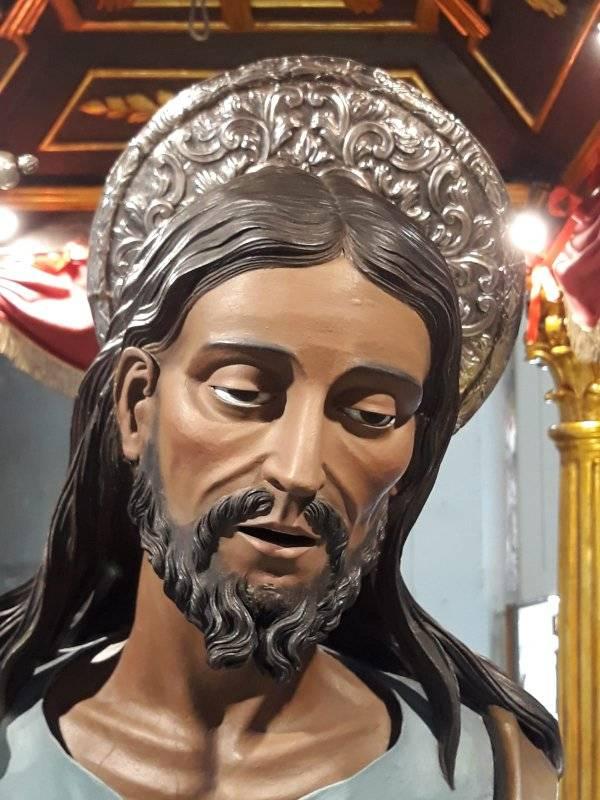
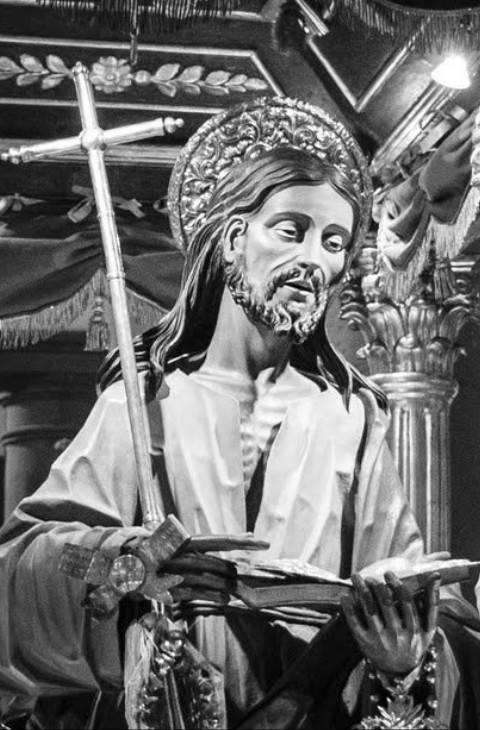
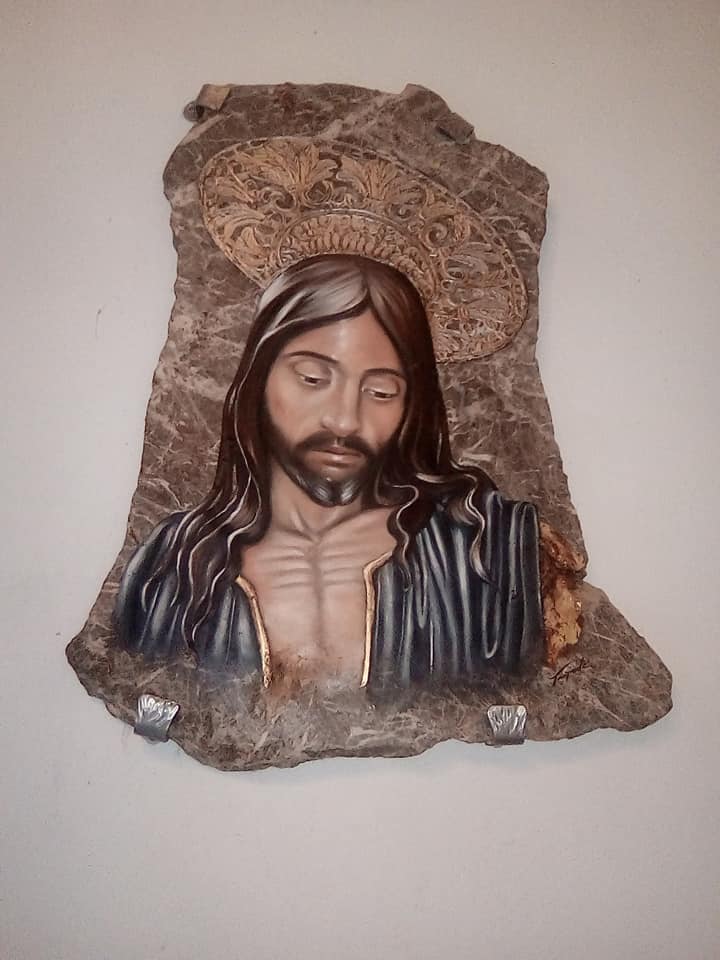
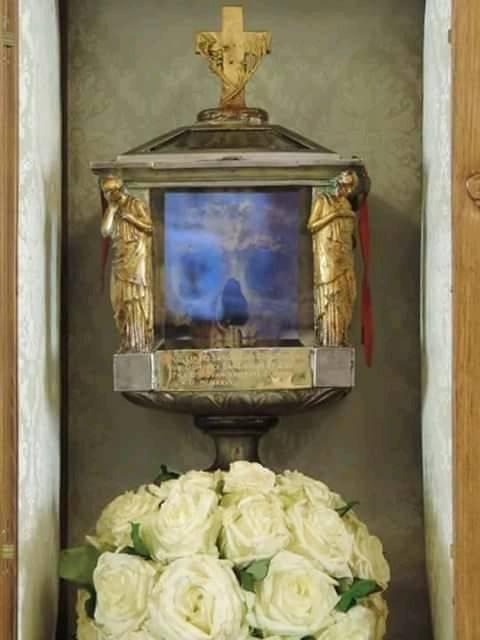
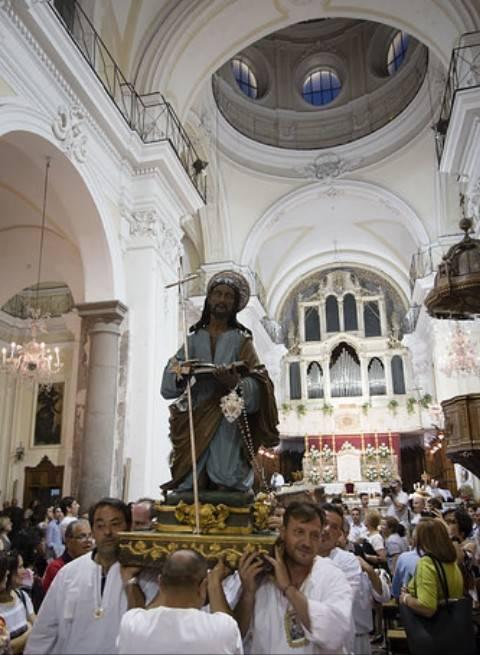
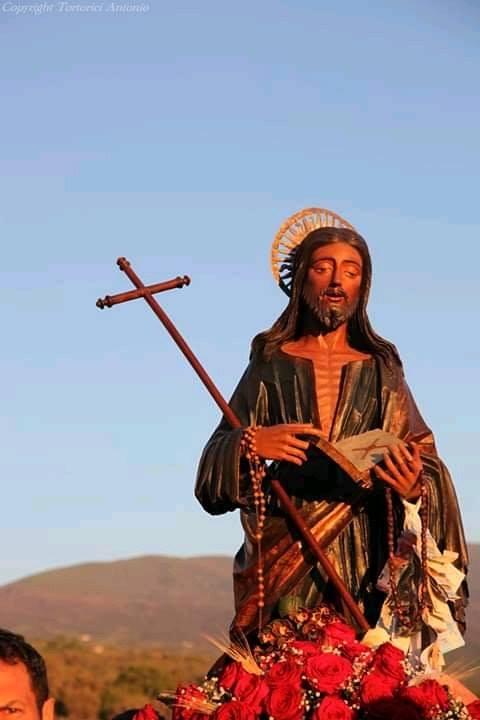
Amazed at what was happening, the clergy and the faithful asked for God’s help. That is when a baby wrapped in cloth, son of the woman who had offered the fruit to Nicola, sat up in his mother’s arms and yelled in a strong and clear voice: “To the Rogato!! To the Rogato!!” Fr Cusmano cried out to all in the commotion, that he had promised Nicola, during his last visit, that alive or dead he would be returned to the Rogato. The Bier became light again and he was brought to the Monastery and placed to rest in the Monastary Church of Rogato. His remains are now behind gates in the main church, Chiesa Madre, in Alcara Li Fusi. Below is his Shrine and relics.
St Nicolò was Canonised on 7 June 1507, at Saint Peter’s Basilica, Rome, by Pope Julius II.
Feast day of St Nicolò in Alcara
Miracles Do Still Happen! Believe it not!
On Thursday 28 May 2009 all of Alcara li Fusi, Sicily, Italy was abuzz with spectacular news of an event involving San Nicolo`Politi. Television camera crews from all over descended on the town with long lines of followers walking to the L’Aqua Santa location carrying jugs and bottles to fill with Holy water.
A group of school children, on a field trip with their teacher, witnessed the miracle of a statue of St Nicolò opening and closing his eyes. One child recorded the event on his cell phone. They excitedly started screaming and the teacher fainted. Afterward they all began to cry and pray.
As of yet, it has not recurred again nor has it been verified by the Catholic Church, although they are in the process of investigating the event. This is the biggest news to hit our town in centuries! The video, news reports and articles are all over the Internet. Do a search on Google, YouTube, etc. using the search words:
san nicolo politi miracolo alcara
St Nicolò was born in the town of Adrano but chose to live his life in Alcara. He spent the last 30 years of his life there. We should all feel blessed knowing that we were either born there or are direct descendants of people that were and that is where San Nicolò now rests in peace.
His message is loud and clear – Open Your Eyes!
The video below is of St Nicolò visit to his home town of Adrano after 880 years.























 AnaStpaul
You must be logged in to post a comment.