Martyrs of Ostia – (3 saints): A group of Christians martyred together. The only details about them to survive are three names – Demetrius, Florus and Honoratus. They were martyred at Ostia, Italy.
Martyrs of Rhaitu – (43 saints): 43 monks martyred by Blemmyes, in Raíthu, Egypt, date unknown.
Martyrs of Via Lavicana – (30 saints): A group of 30 Christians martyred together in the persecutions of Diocletian. c 303 in Rome, Italy and were buried between two bay trees on the Via Lavicana outside Rome.
Thought for the Day – 21 December – Meditations with Antonio Cardinal Bacci (1881-1971)
The Silence of the Divine Infant
Jesus Christ is the Eternal Word of God, made man, the infinite and substantial image of the Divine Intellect. Nevertheless, the Divine Infant, Whom we adore in the stable at Bethlehem, is mute and silent. The voluntary humiliation of the Son of God is such, that He, the Word of God, cannot utter a single human syllable. By this chosen silence, however, He teaches us many things. In the first place, He teaches us humility and self-denial. He teaches us, moreover, to recollect ourselves in the Presence of God, so that it may be easier for us to speak with Him and for Him, to make known what He requires of us. The silence of prayer brings forth divine consolations and inspirations to holiness,
Do we love to be silent? It is not necessary to become hermits but, it is essential, from time to time, to place ourselves quietyly in the Presence of God. God cannot be heard through the noise and confusion of the world, whereas, He speaks clearly to the soul, which seeks the silence of prayer. In any case, if we go about looking for the gossip and idle chatter of the world, it is almost impossible not to offend God. “Avoid profane and empty babblings,” St Paul urges us, “for they contribute much to ungodliness” (2 Tim 2:16). “If anyone does not offend in word,” adds St James, “he is a perfect man” (Js 3:2). “The tongue is a little member,” he continues but, goes onto emphasis that it is capable of doing either a great deal of good or a great deal of harm. “With it, we bless God the Father and, with it, we curse men, who have been made after the likeness of God. Out of the same mouth proceed blessing and cursing. These things, my brethren ought not to be so” (Js 3:5-10).
There are two main lessons which we should learn, therefore, from the silence of the Divine Infant. We should learn to love recollection and, we should learn to make proper use of the gift of speech, which can be an equally powerful weapon, in the cause of good, or, in the cause of evil!”
Quote/s of the Day – 21 December – O Oriens/O Radiant Dawn – Weekdays of Advent and The Memorial of St Peter Canisius (1521-1597) Doctor of the Church
“Better that only a few Catholics should be left, staunch and sincere in their religion, than that they should, remaining many, desire as it were, to be in collusion with the Church’s enemies and in conformity with the open foes of our faith.”
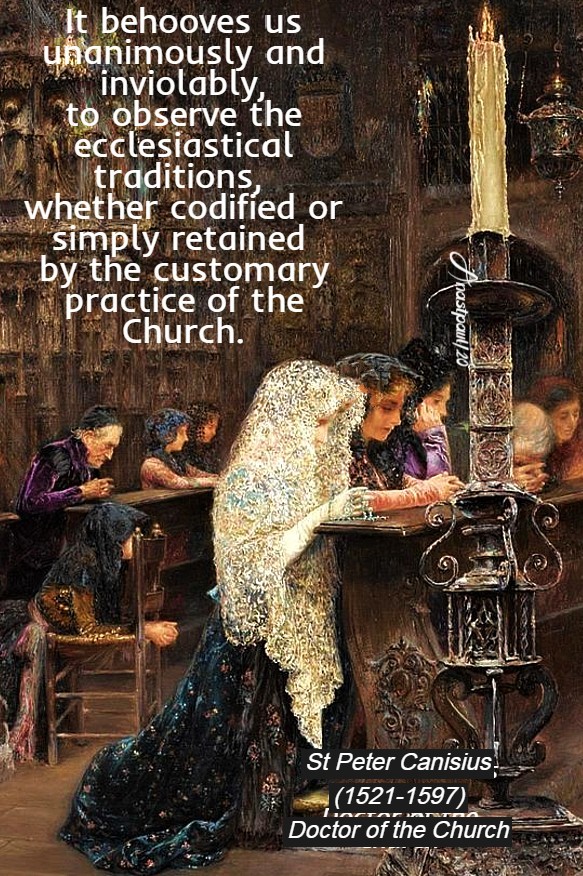
“It behooves us unanimously and inviolably, to observe the ecclesiastical traditions, whether codified or simply retained by the customary practice of the Church.”
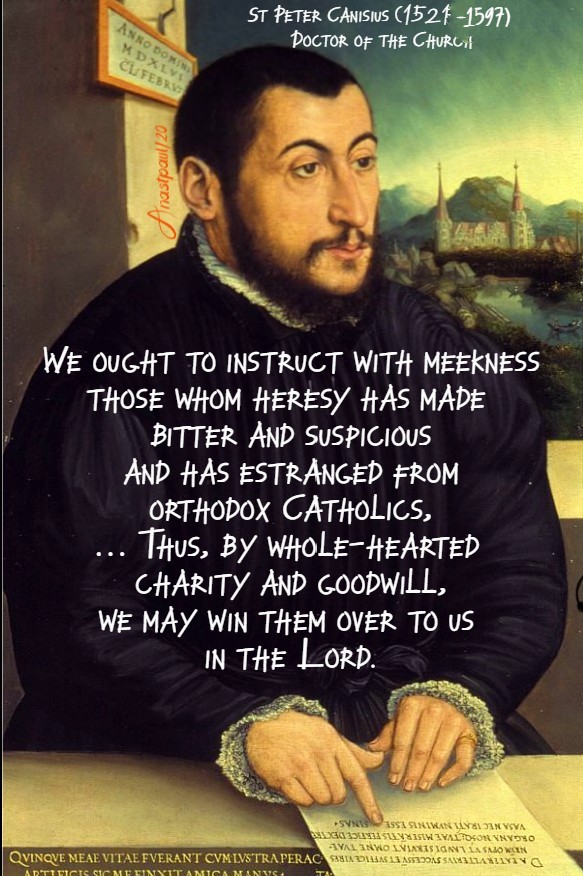
“We ought to instruct with meekness those whom heresy has made bitter and suspicious and has estranged from orthodox Catholics, … Thus, by whole-hearted charity and goodwill, we may win them over to us in the Lord.”
St Peter Canisius (1521-1597) Doctor of the Church
Advent Reflection – 21 December – O Oriens/O Radiant Dawn – Weekdays of Advent, Readings: Songs 2:8-14 or Zephaniah 3:14-18, Psalms 33:2-3, 11-12, 20-21, Luke 1:39-45
The Lord is at hand, come let us adore Him.
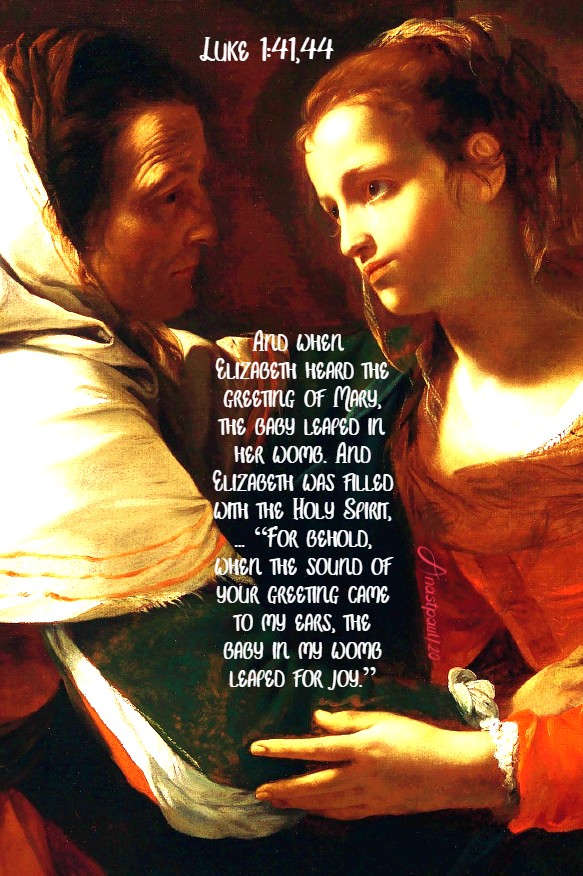
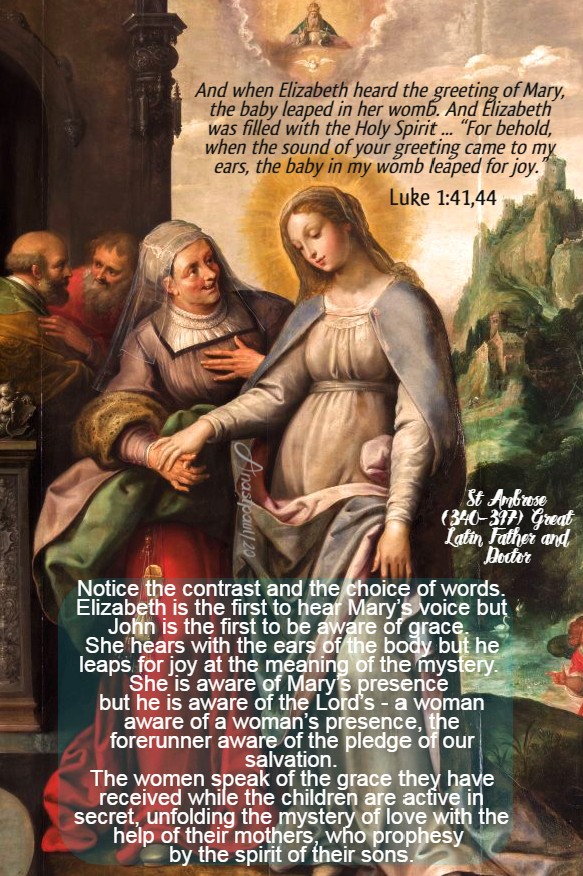
And when Elizabeth heard the greeting of Mary, the baby leaped in her womb. And Elizabeth was filled with the Holy Spirit … “For behold, when the sound of your greeting came to my ears, the baby in my womb leaped for joy.” – Luke 1:41,44
REFLECTION – “When the angel revealed his message to the Virgin Mary he gave her a sign to win her trust. He told her of the motherhood of an old and barren woman to show that God is able to do all that he wills. When she hears this Mary sets out for the hill country. She does not disbelieve God’s word; she feels no uncertainty over the message or doubt about the sign. She goes eager in purpose, dutiful in conscience, hastening for joy. Filled with God, where would she hasten but to the heights? The Holy Spirit does not proceed by slow, labourious efforts. Quickly, too, the blessings of her coming and the Lord’s presence are made clear – as soon as Elizabeth heard Mary’s greeting the child leapt in her womb and she was filled with the Holy Spirit. Notice the contrast and the choice of words. Elizabeth is the first to hear Mary’s voice but John is the first to be aware of grace. She hears with the ears of the body but he leaps for joy at the meaning of the mystery. She is aware of Mary’s presence but he is aware of the Lord’s – a woman aware of a woman’s presence, the forerunner aware of the pledge of our salvation. The women speak of the grace they have received while the children are active in secret, unfolding the mystery of love with the help of their mothers, who prophesy by the spirit of their sons. The child leaps in the womb; the mother is filled with the Holy Spirit, he fills his mother with the same Spirit. John leaps for you and the spirit of Mary rejoices in her turn. When John leaps for joy, Elizabeth is filled with the Holy Spirit but we know, that though Mary’s spirit rejoices, she does not need to be filled with the Holy Spirit. Her Son, who is beyond our understanding, is active in His mother in a way beyond our understanding. Elizabeth is filled with the Holy Spirit after conceiving John, while Mary is filled with the Holy Spirit before conceiving the Lord. Elizabeth says – Blessed are you because you have believed. You also are blessed because you have heard and believed. A soul that believes both conceives and brings forth the Word of God and acknowledges His works. Let Mary’s soul be in each of you to proclaim the greatness of the Lord. Let her spirit be in each to rejoice in the Lord. Christ has only one mother in the flesh but, we all bring forth Christ in faith. Every soul receives the Word of God if only it keeps chaste, remaining pure and free from sin, its modesty undefiled. The soul that succeeds in this proclaims the greatness of the Lord, just as Mary’s soul magnified the Lord and her spirit rejoiced in God her Saviour. In another place we read – Magnify the Lord with me. The Lord is magnified, not because the human voice can add anything to God but because he is magnified within us. Christ is the image of God and if the soul does what is right and holy, it magnifies that image of God, in whose likeness it was created and, in magnifying the image of God, the soul has a share in its greatness and is exalted.” – St Ambrose (340-397) Bishop, Father and Great Latin Doctor – An excerpt from A Commentary on Luke, Book 2
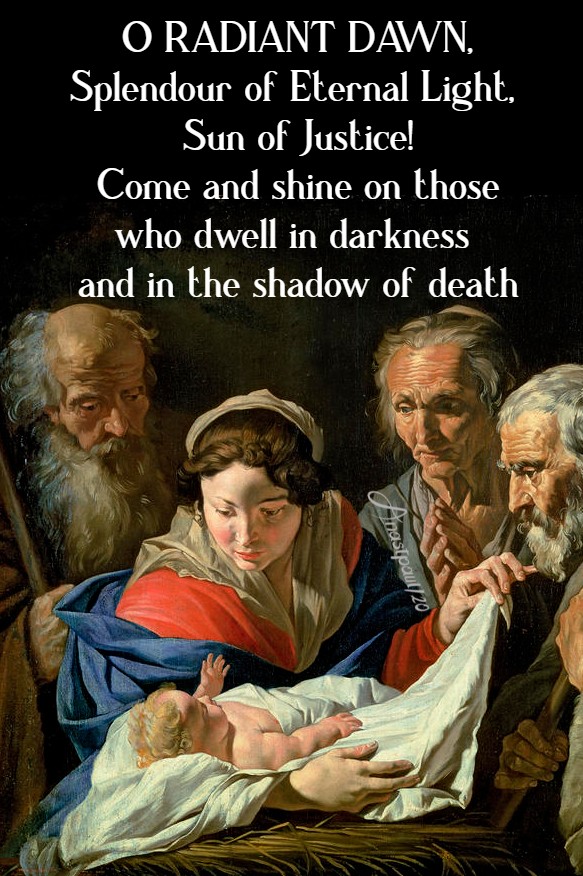
PRAYER – O Radiant Dawn, Splendour of Eternal Light, Sun of Justice! Come and shine on those who dwell in darkness and in the shadow of death.
Our Morning Offering – 21 December and the Memorial of St Peter Canisius (1521-1397) Doctor of the Church
Hail Mary, the Angelic Salutation
The Hail Mary/Ave Maria
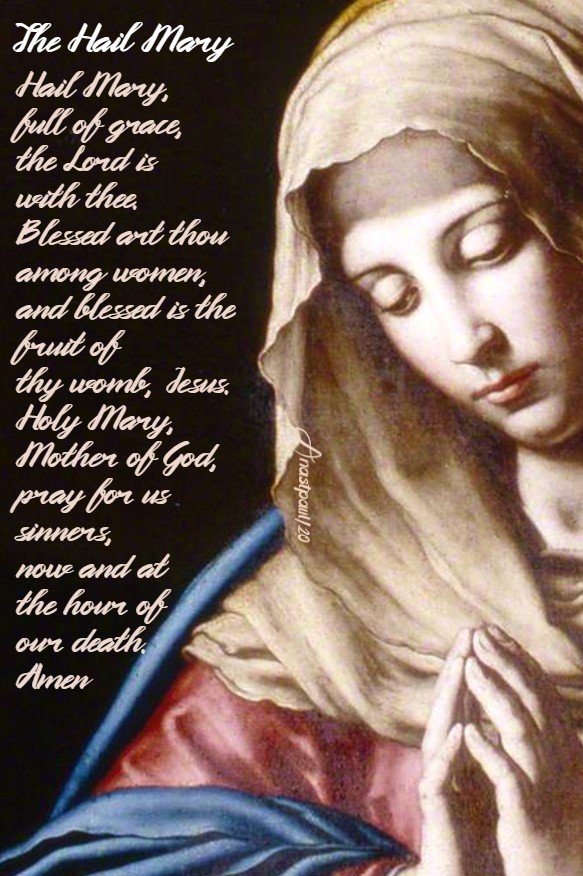
Hail Mary, full of grace, the Lord is with thee. Blessed art thou among women, and blessed is the fruit of thy womb, Jesus. Holy Mary, Mother of God, pray for us sinners, now and at the hour of our death. Amen.
Áve María, grátia pléna, Dóminus técum. Benedícta tū in muliéribus, et benedíctus frúctus véntris túi, Iésus. Sáncta María, Máter Déi, óra pro nóbis peccatóribus, nunc et in hóra mórtis nóstrae. Ámen.
On today’s Memorial of St Peter Canisius, Catholics may wish to thank this Doctor of the Church for giving us the second half of the Hail Mary prayer.
This 16th-century saint, known as the second Apostle of Germany, followed in the giant footsteps of St Boniface, who evangelised Germany a thousand years earlier. He was also active at the Council of Trent and wrote much on the Blessed Virgin Mary.
The first half of the Hail Mary, of course, comes from Scripture. What many Catholics don’t know, is that the second half of this Catholic prayer is due to the intervention of St Peter Canisius at the Council of Trent. St Peter began adding on to the scriptural part of the Hail Mary, the “Holy Mary Mother of God pray for us sinners, now and at the hour of our death.” It was Trent that officially accepted this addition to the prayer and included it in their famous Catechism of the Council of Trent in 1566.
Saint of the Day – 21 December – Saint Anastasius II of Antioch (Died 609) Bishop and Martyr, Confessor, Defender of the Faith – also known as Anastasius the Younger. Anatasius II succeeded St Anastasius [the first] and was the Bishop of Antioch from 599 until his death by martyrdom in 609. He is known for his opposition and suppression of simony in his Diocese, with the support of St Pope Gregory the Great. He also supported the Emperor Phocas in Phocas’ efforts against the Monophysites.
The Martyrdom of St Anastasius II
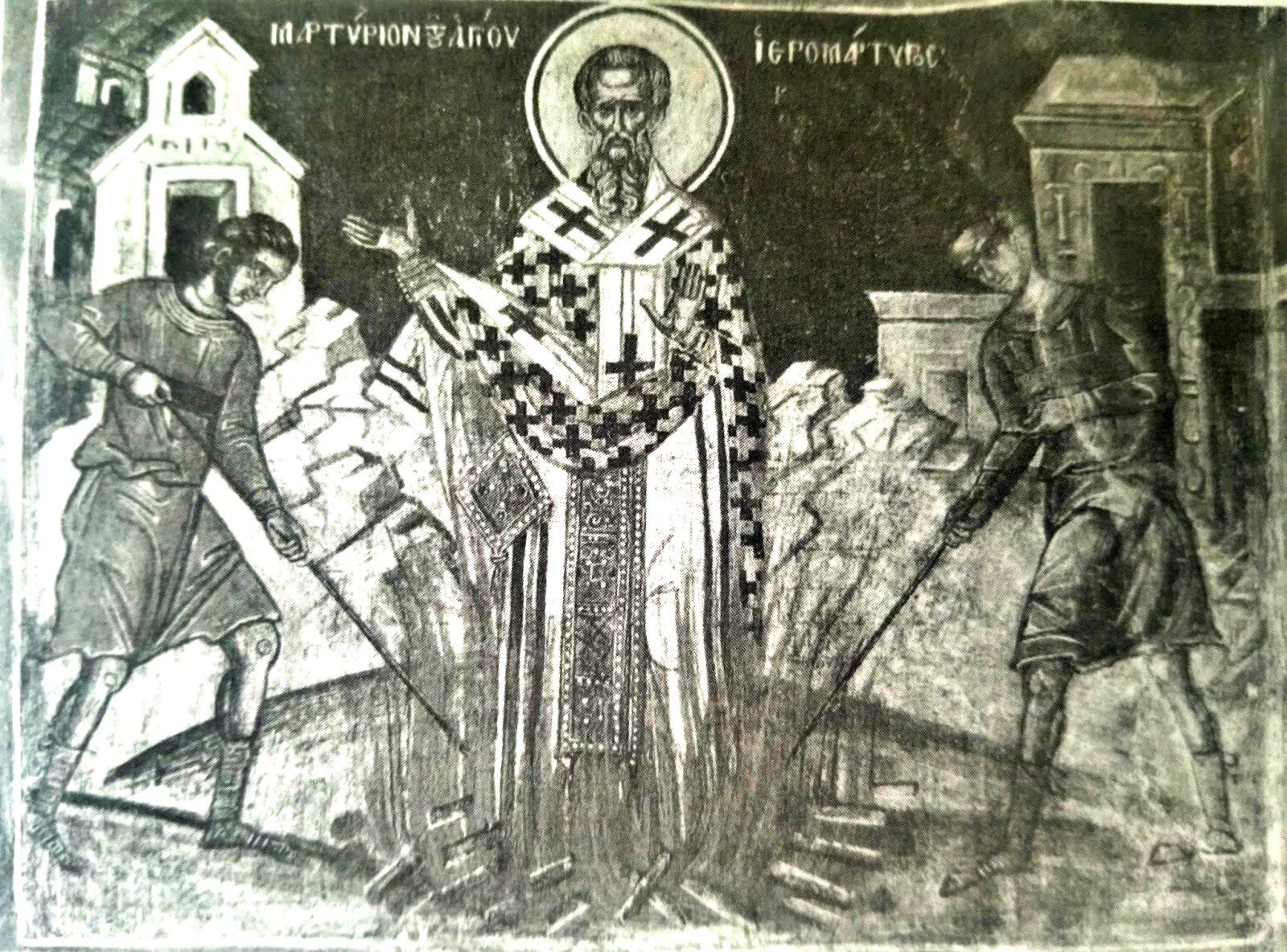
In 609 the Syrian Jews revolted as they believed that they were being forcibly converted to Christianity by Emperor Phocas (reign 602-610). It was during these riots that Bishop Anastasius was abducted due to his support of Phocas. He was mutilated and then dragged through the streets, after which he was burnt to death in the marketplace of Antioch.
Emperor Phocas retaliated via military action which, in turn, led to a reverse persecution of the Jews of the area, when many were killed or exiled.
St Anastasius I and our Saint today, Anastasius II, are both venerated on the Colonnade of St Peter’s Square.
Bl Adrian of Dalmatia St Anastasius II of Antioch (Died 609) Bishop and Martyr St Anrê Tran An Dung St Baudacarius of Bobbio St Beornwald of Bampton Bl Bezela of Göda Bl Daniel of the Annunciation St Dioscorus Blessed Dominic Spadafora OP (1450-1521) Biography: https://anastpaul.com/2019/12/21/saint-of-the-day-21-december-blessed-dominic-spadafora-op-1450-1521/ St Festus of Tuscany St Glycerius of Nicomedia St James of Valencia St John of Tuscany St John Vincent St Micah the Prophet St Phêrô Truong Van Thi St Severinus of Trèves Bl Sibrand of Marigård St Themistocles of Lycia
Thought for the Day – 20 December – Meditations with Antonio Cardinal Bacci (1881-1971)
The Swaddling Clothes of the Divine Infant
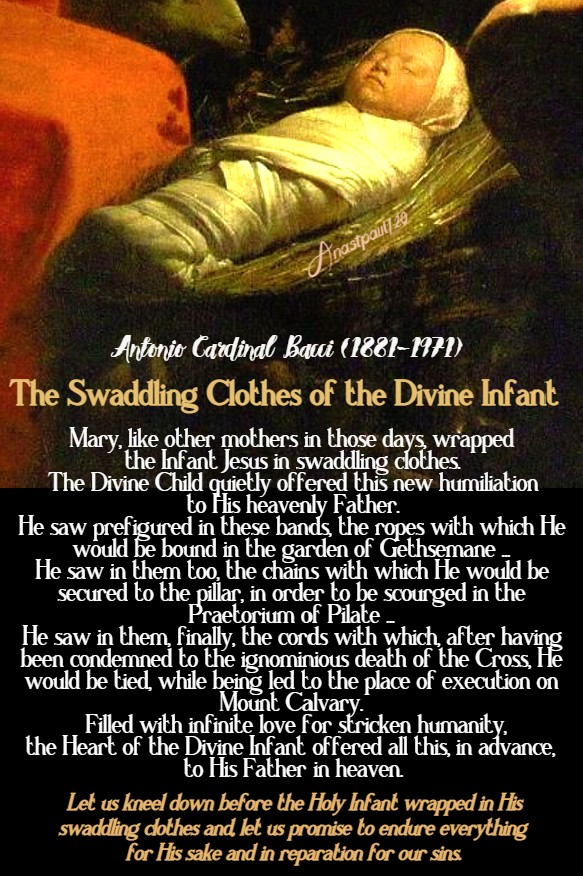
“Mary, like other mothers in those days, wrapped the Infant Jesus in swaddling clothes. The Divine Child quietly offered this new humiliation to His heavenly Father. He saw prefigured in these bands, the ropes with which He would be bound in the garden of Gethsemane, even after He had given sinful humanity, His celestial teaching, example and miracles and finally, His own Body inthe Sacrament of the Eucharist. He saw in them too, the chains with which He would be secured to the pillar, in order to be scourged in the Praetorium of Pilate among the jeers and insults of the onlookers. He saw in them, finally, the cords with which, after having been condemned to the ignominious death of the Cross, He would be tied, while being led to the place of execution on Mount Calvary. Filled with infinite love for stricken humanity, the Heart of the Divine Infant offered all this, in advance, to His Father in heaven.
Are we making any effort to return such great love? Like Jesus, we are often obliged to endure, both physical and moral anguish. Have we the resignation to offer it all to Jesus, or do we squander our opportunities in useless complaining or in acts of impatience and rebellion? We shall have to go on suffering anyway but, in the latter case, we may have to suffer even more and shall lose all merit in the sight of God.
Let us kneel down before the Holy Infant wrapped in His swaddling clothes and, let us promise to endure everything for His sake and in reparation for our sins.”
Quote/s of the Day – 20 December – The Fourth Sunday of Advent – O Clavis David/O Key of David – Readings: 2 Samuel 7:1-5,8-12, 14, 16, Psalms 89:2-3, 4-5, 27, 29, Romans 16:25-27, Luke 1:26-38
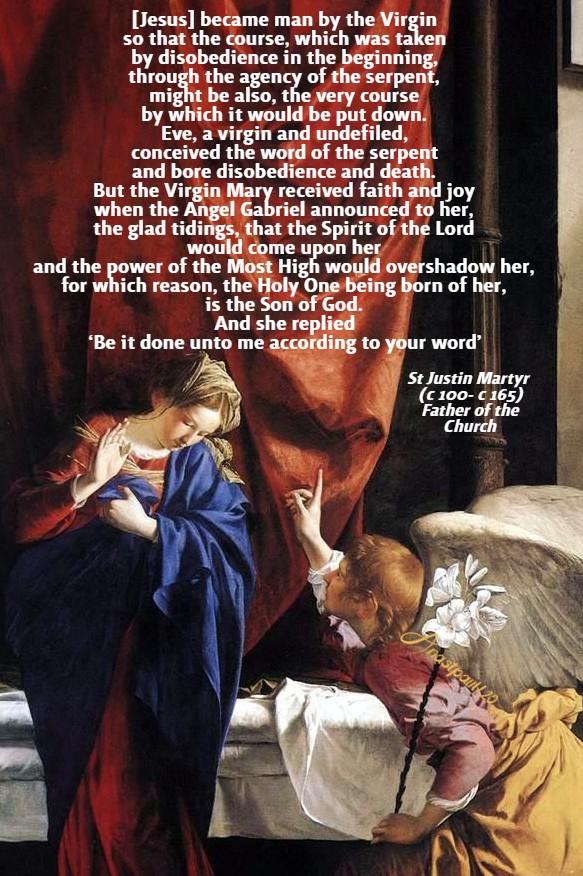
“[Jesus] became man by the Virgin so that the course, which was taken by disobedience in the beginning, through the agency of the serpent, might be also, the very course by which it would be put down. Eve, a virgin and undefiled, conceived the word of the serpent and bore disobedience and death. But the Virgin Mary received faith and joy when the Angel Gabriel announced to her, the glad tidings, that the Spirit of the Lord would come upon her and the power of the Most High would overshadow her, for which reason, the Holy One being born of her, is the Son of God. And she replied ‘Be it done unto me according to your word’ [Luke 1:38]”
St Justin Martyr (c 100- c 165) Apologist, Theologian, Philosopher, Father of the Church and Martyr
“The angel greeted Mary with a new address, which I could not find anywhere else in Scripture. I ought to explain this expression briefly. The angel says, “Hail, full of grace.” … I do not remember having read these words elsewhere in Scripture. An expression of this kind, “Hail, full of grace,” is not addressed to a male. This greeting was reserved for Mary alone.”
Origen (c 185-253) Priest, Theologian, Father
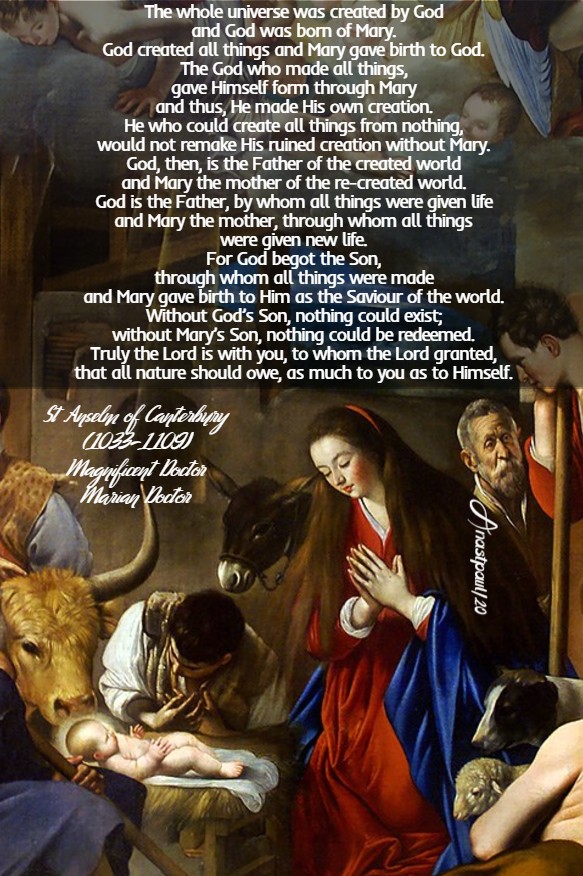
“The whole universe was created by God and God was born of Mary. God created all things and Mary gave birth to God. The God who made all things, gave Himself form through Mary and thus, He made His own creation. He who could create all things from nothing, would not remake His ruined creation without Mary. God, then, is the Father of the created world and Mary the mother of the re-created world. God is the Father, by whom all things were given life and Mary the mother, through whom all things were given new life. For God begot the Son, through whom all things were made and Mary gave birth to Him as the Saviour of the world. Without God’s Son, nothing could exist; without Mary’s Son, nothing could be redeemed. Truly the Lord is with you, to whom the Lord granted, that all nature should owe, as much to you as to Himself.”
St Anselm (1033-1109) Magnificent Doctor Marian Doctor
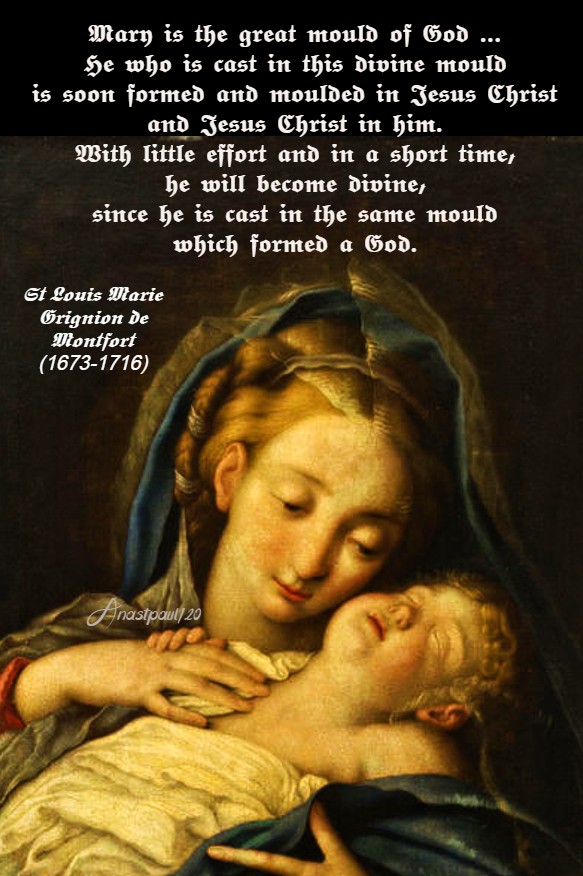
“Mary is the great mould of God … He who is cast in this divine mould is soon formed and moulded in Jesus Christ and Jesus Christ in him. With little effort and in a short time, he will become divine, since he is cast in the same mould which formed a God.”
Advent Reflection – 20 December – The Fourth Sunday of Advent, Readings: 2 Samuel 7:1-5,8-12, 14, 16, Psalms 89:2-3, 4-5, 27, 29, Romans 16:25-27, Luke 1:26-38
The Lord is at hand, come let us adore Him.
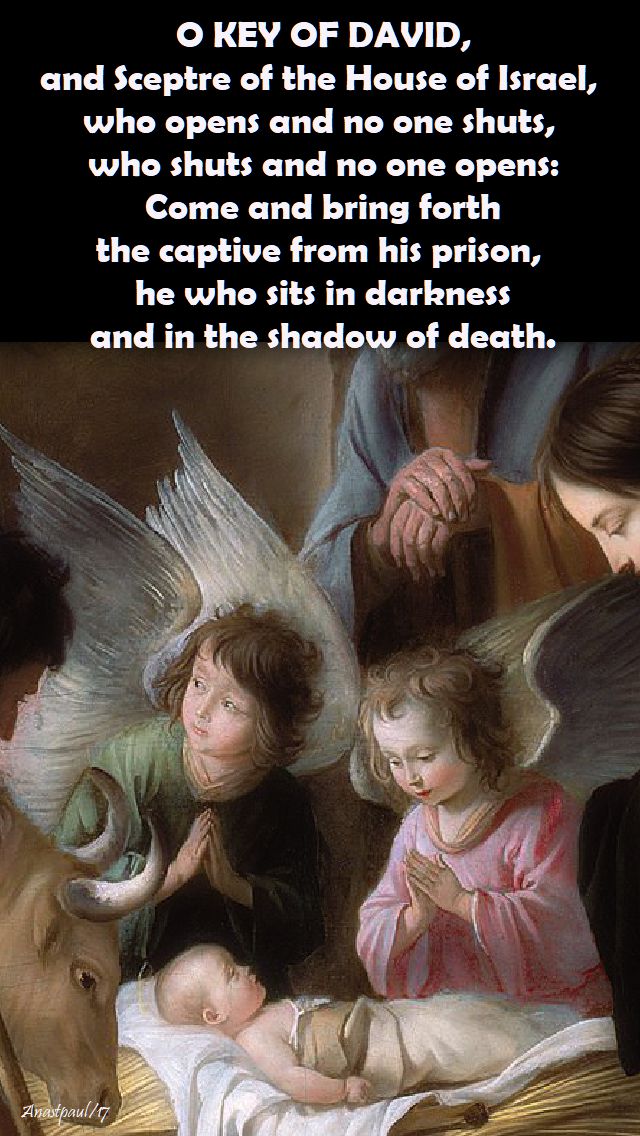
O KEY OF DAVID, and Sceptre of the House of Israel, who opens and no-one shuts, who shuts and no-one opens. Come and bring forth the captive from his prison, he who sits in darkness and in the shadow of death.
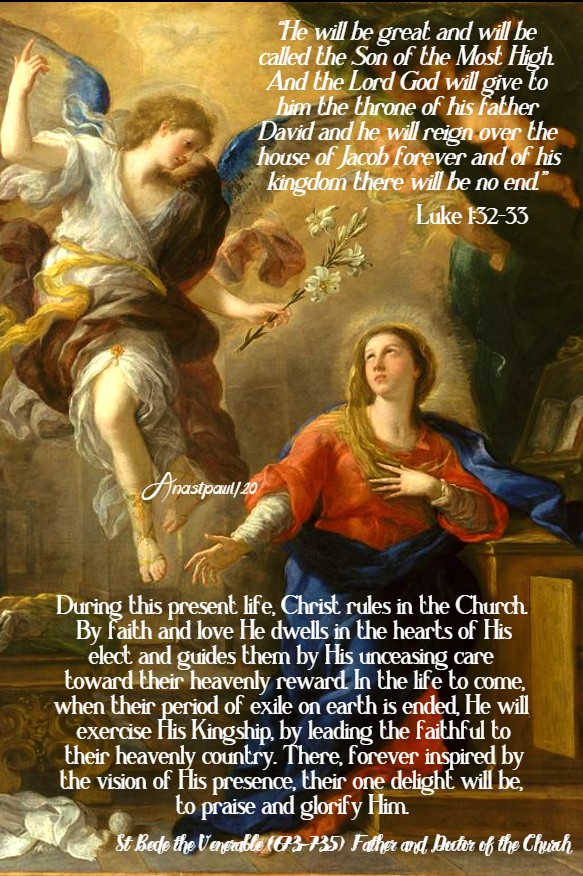
“He will be great and will be called the Son of the Most High. And the Lord God will give to him the throne of his father David and he will reign over the house of Jacob forever and of his kingdom there will be no end.” – Luke 1:32-33
REFLECTION – “The angel Gabriel was sent from God to a city of Galilee named Nazareth, to a virgin betrothed to a man whose name was Joseph of the house of David and the virgin’s name was Mary.” What is said of the house of David applies not only to Joseph but also to Mary. It was a precept of the law that each man should marry a wife from his own tribe and kindred. Saint Paul also bears testimony to this when he writes to Timothy: “Remember Jesus Christ, risen from the dead, descended from David, as preached in my Gospel” (2 Tm 2:8) …
“He will be great and will be called the son of the Most High and the Lord God will give him the throne of his father David.” The angel refers to the kingdom of the Israelite nation as the throne of David because, in his time, by the Lord’s command and assistance, David governed it with a spirit of faithful service … As David had once ruled the people with temporal authority, so Christ would now lead them to the eternal kingdom by His spiritual grace …
“He will reign over the house of Jacob forever..” The house of Jacob here refers to the universal Church which, through its faith in and witness to Christ, shares the heritage of the patriarchs. This may apply either to those who are physical descendants of the patriarchal families, or to those who come from gentile nations and are reborn in Christ by the waters of baptism. In this house Christ shall reign forever and “of his kingdom there will be no end.” During this present life, Christ rules in the Church. By faith and love He dwells in the hearts of His elect and guides them by His unceasing care toward their heavenly reward. In the life to come, when their period of exile on earth is ended, He will exercise His Kingship, by leading the faithful to their heavenly country. There, forever inspired by the vision of His presence, their one delight will be, to praise and glorify Him.” – St Bede the Venerable (673-735) Priest and Monk, Father and Doctor of the Church – Homilies for Advent, no 3
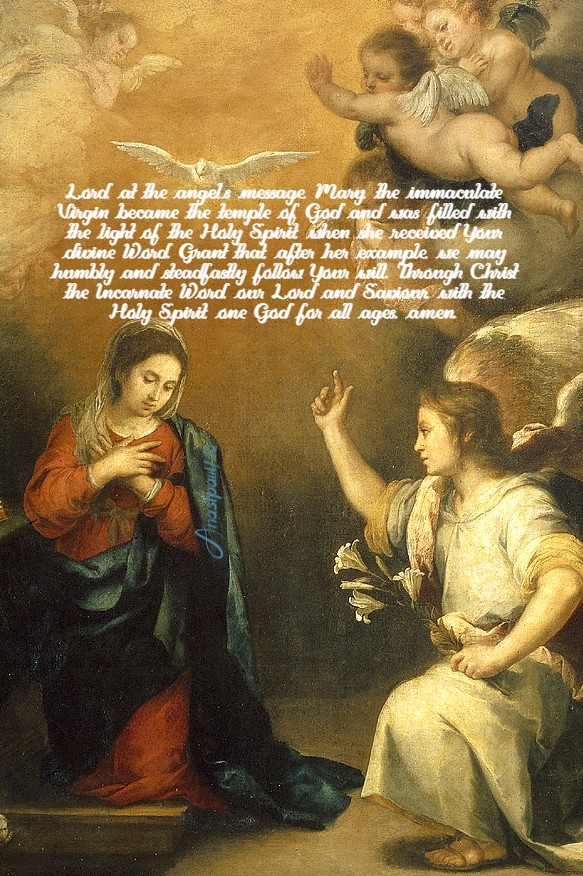
PRAYER – Lord, at the angel’s message, Mary, the immaculate Virgin became the temple of God and was filled with the light of the Holy Spirit, when she received Your divine Word. Grant that, after her example, we may humbly and steadfastly follow Your will. Through Christ the Incarnate Word, our Lord and Saviour, with the Holy Spirit, one God for all ages, amen.
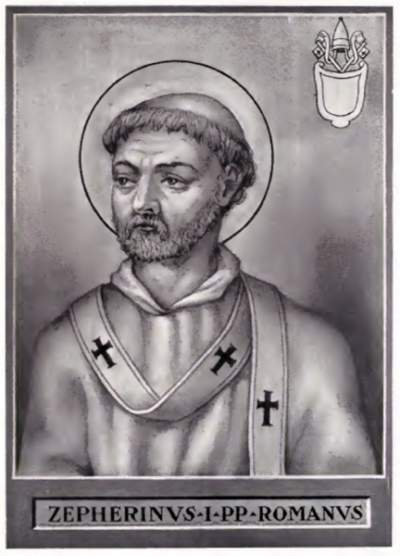
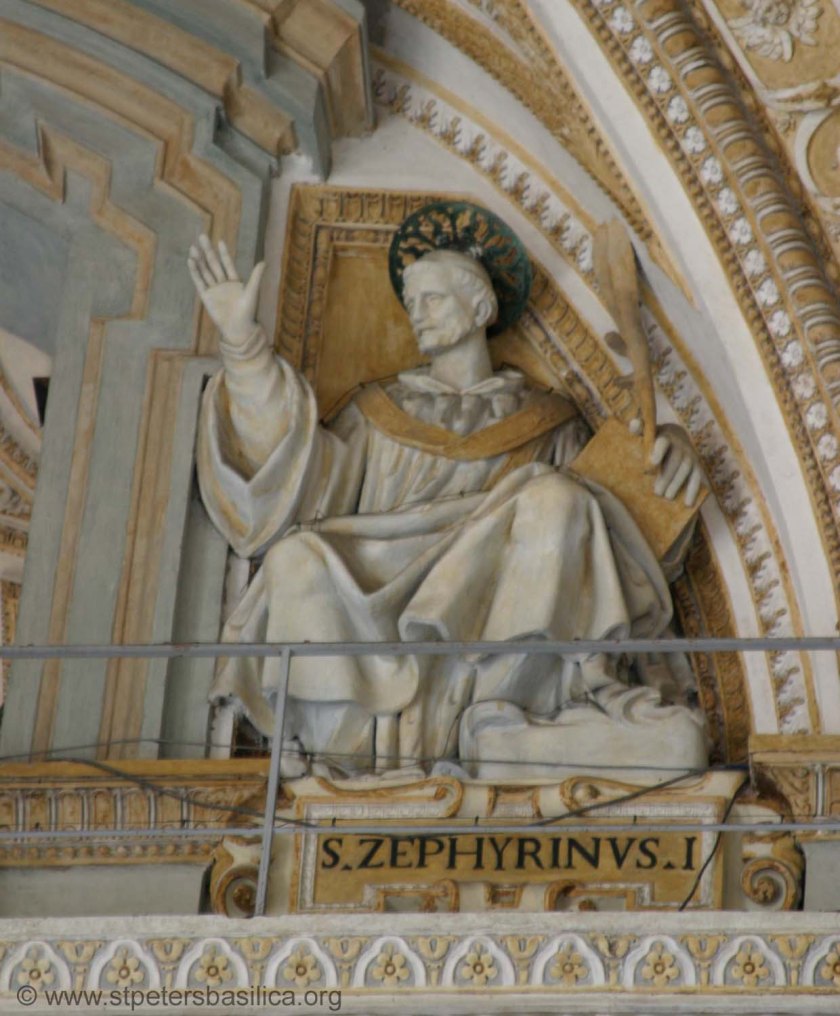
Saint of the Day – 20 December – Saint Pope Zephyrinus (Died 217) Bishop of Rome, Confessor, Defender of the Faith especially of the Doctrine of the Trinity. He is known for combatting heresies and defending the divinity of Christ. Although he was not physically martyred for the faith, his suffering – both mental and spiritual – during his Pontificate have earned him the title of martyr, a title that was repealed 132 years after his death. Born in Rome and died on 20 December 217 also in Rome.
Saint Zephyrinus, a native of Rome, succeeded Victor I in the Pontificate in the year 199.
Immediately after his elevation to the Roman See, Zephyrinus called to Rome the confessor Callistus, who lived at Antium and who had received a monthly pension from Pope Victor and entrusted him with the oversight of the coemeterium. It is evident that shortly before this, the Roman Christian community had, under Victor, become the owner of a common place of burial on the Via Appia and Zephyrinus now, placed Callistus over this cemetery, which was given the name of Callistus. Undoubtedly Callistus was also made a Deacon of the Roman Church by Zephyrinus. He was the confidential counsellor of the Pope, whom he succeeded.
In 202 Septimus Severus, a military despot, raised the fifth and most bloody persecution against the Church, which continued for nine years until the death of the Emperor in 211. Until this furious storm ended, the Holy Father remained concealed for the sake of his flock, supporting and comforting the distressed disciples of Christ.
He suffered by charity and compassion what every confessor underwent. The triumphs of the martyrs were indeed his joy but his heart received many deep wounds from the fall of apostates and heretics. Nor did this latter affliction cease, when peace was restored to the Church. The holy Pope had the affliction of witnessing the fall of Tertullian. He saw to his joy, however, the conversion of Natalis, who had become a heretical Bishop when he lapsed into the Theodotian heresy. God, wishing to bring him back to the Church, sent him a solid correction which opened his eyes and he came to kneel at the feet of the Vicar of Christ, wearing a hair shirt and humbly asking pardon for his revolt.
Eusebius tells us that this holy Pope exerted his zeal so strenuously against the blasphemies of the heretics, that they treated him with the utmost contempt. To his glory, however, they also called him the principal defender of Christ’s divinity.
Saint Zephyrinus governed the Church for eighteen years, dying in 217.
He was buried in his own cemetery on the 26th of August, which date was celebrated as his feast day until 1969 when it was changed to today which is the actual day of his birthday into heaven.
Thought for the Day – 19 December – Meditations with Antonio Cardinal Bacci (1881-1971)
The Cradle of the Divine Infant Jesus
Enter once more with faith and love into the stable of Bethlehem. As soon as her Son has been miraculously delivered without any damage to her virginity, Mary adores Him and, with such maternal love as we could never conceive of, she takes Him to her heart. Joseph, kneeling in ecstasy at the sight, bows reverently and kisses the forehead of the Divine Infant. In this moment of blis, he is well rewarded for his unshaken faith and for all the sacrifices which he has made from his youth until the time of his alliance with Mary.
Now Mary and Joseph look around and, since they can find no better cradel for the Baby Jesus, they place Him upon some straw in a manger and cover Him with a rough linen coth. They have nothing else to give the Son of God, King of Kings and Lord of the Universe, Who wishes, at this early stage, to present us with this wonderful example of humility and voluntary poverty. But each of them has once treasure to offer, for they offer and dedicate their hearts to Jesus. Mary’s heart is only less beautiful and pure than that of our Divine Redeemer and St Joseph’s is similar to hers.
Jesus did not come to look for human wealth or greatness but, He came in search of men’s hearts, so that He might make them holy. Throughout the centuries there have been many generous-hearted people who joined with Mary and Joseph in loving Jesus and in dedicating themselves entirely to Him. Does your heart belong completely to Jesus?
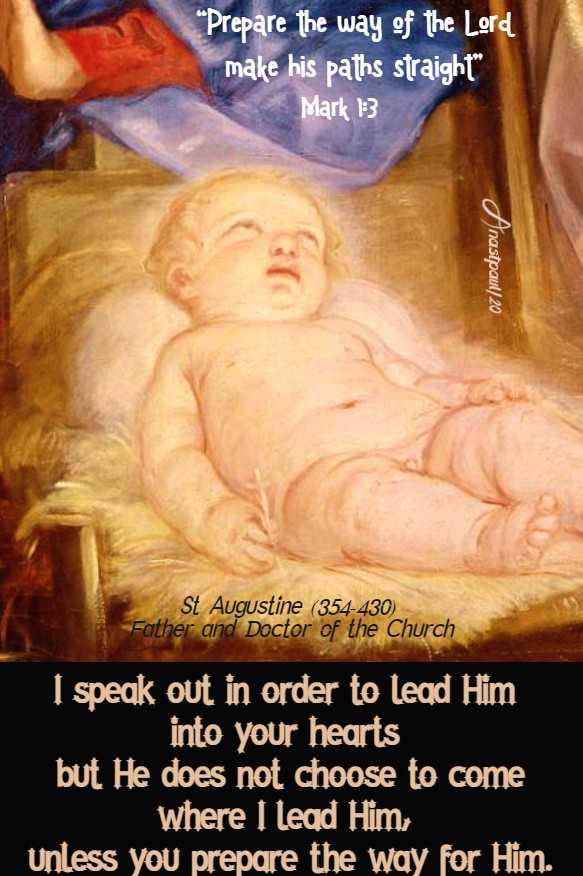
Quote of the Day – Saturday of Advent – 19 December
“I speak out in order to lead Him into your hearts but He does not choose to come where I lead Him, unless you prepare the way for Him.”
St Augustine (354-430) Father and Doctor of the Church
“Unreasoning and stupid that you look for God where He is not! Listen and be filled with awe – God is in our hearts, I know it. God lives in the human heart when this heart lives withdrawn from all that is not Him, when this heart heeds God’s knock at it’s door (Rv 3,20) and, sweeping and cleaning all its rooms, makes itself ready to welcome Him who alone truly satisfies.”
O ROOT OF JESSE, that stands for an ensign of the people, before whom the kings keep silence and unto whom the Gentiles shall make supplication, come, to deliver us and tarry not.
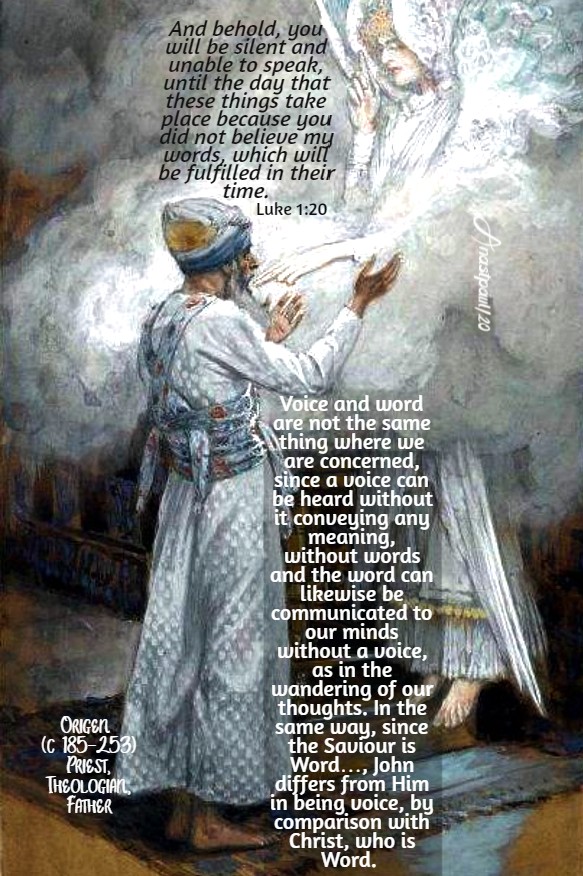
“And behold, you will be silent and unable to speak, until the day that these things take place because you did not believe my words, which will be fulfilled in their time.” – Luke 1:20
REFLECTION – “You will be speechless… until the day these things take place, because you did not believe my words.” Voice and word are not the same thing where we are concerned, since a voice can be heard without it conveying any meaning, without words and the word can likewise be communicated to our minds without a voice, as in the wandering of our thoughts. In the same way, since the Saviour is Word…, John differs from Him in being voice, by comparison with Christ, who is Word. This is what John himself answered to those who asked him who he was: “I am the voice of one crying out in the desert, ‘Prepare the way of the Lord; make straight his paths’” (Lk 3:4; Jn 1:23). Perhaps this is the reason – because he doubted the birth of the voice that would reveal the Word of God – why Zachariah lost his voice but recovered it again, when that voice was born, who is the Word’s forerunner (Lk 1:64). Since, for the mind to be able to grasp the word intended by the voice, we must hear the voice. It is also why, according to the time of his birth, John is slightly older than Christ – for we perceive the voice before the word. Thus John points to Christ since it is with the voice that the Word is made known. Likewise, Christ was baptised by John, who admitted his need of being baptised by Him (Mt 3:14)… In brief, when John pointed to Christ it was as a man pointing to God, the incorporeal Saviour, as a voice pointing to the Word…”… Origen (c 185-253) Priest, Theologian, Father
PRAYER – Deepen our faith Lord, as we celebrate the great mystery of the Incarnation, by which You revealed to the world the splendour of Your glory, through the most pure Virgin Mary when she gave birth to Your Son, who lives and reigns with You and the Holy Spirit, one God now and forever, amen.
Our Morning Offering – The Weekdays of Advent – 19 December
The Benedictus Canticle of Zechariah Luke 1:68-79
The Messiah and His forerunner
Blessed be the Lord, the God of Israel; He has visited His people and redeemed them.
He has raised up for us a mighty saviour, in the house of David, His servant, as He promised by the lips of holy men, those who were His prophets of old.
A Saviour who would free us from our foes, from the hands of all who us. So His love for our fathers is fulfilled and His holy covenant remembered.
He swore to Abraham, our father, to grant us, that free from fear and saved from the hands of our foes. we might worship Him in justice and holiness all the days of our lives, in His Presence.
As for you, little child, you shall be called the prophet of God, the Most High. You shall go ahead of the Lord to prepare His ways before Him,
to make known to His people their salvation, through forgiveness of all their sins, the loving kindness of the heart of our God, who visits us like the dawn from on high.
He will give light to those in darkness, those who dwell in the shadow of death and to guide us into the way of peace.
Glory to the Father and to the Son, and to the Holy Spirit: as it was in the beginning, is now, and will be for ever. Amen
Saint of the Day – 19 December – Blessed William of Fenoli O.Cart. (1065-1120) Carthusian Monk, Hermit, miracle-worker – born in 1965 in Garessio-Borgoratto, Diocese of Mondovi, Italy and died in 1120 in Casotto, Italy of natural causes. He is also known as Guglielmo, Gulielmus and is venerated by the Carthusians on 16 December but by the universal Church today, 19 December.
William was born in the early twelfth century, in the township of Monferrato, in the Diocese of Alba, in Northern Italy. His family was, no doubt, an ordinary but very devout family. He was drawn to solitude and did in fact become a hermit. We may think that his life of prayer as a hermit deeply united him to God. However, a woman of ill repute came to disturb him in his hermitage. He was able to resist her temptations but, afterwards, he realised that he needed the protection of a cloister.
So he took the road to the nearby Charterhouse of our Lady of Cazotto, Asti and asked to be admitted as a brother. As Brother William, he became an outstanding member of the community. He faithfully followed the observance of the Rule. He looked upon his superiors only with the eyes of faith and was always disposed to obey them immediately. The virtue by which he shone the most, was that of simplicity. “If the eminent practice of virtue is admirable when joined to the splendour of doctrine, better still is its charm when it has for its company the ingenuity, the candour, the simplicity of soul. This simplicity must serve as the supreme wisdom especially for those called to live in the obscurity of the cloister” (Statement of the Postulator). How well Saint Bruno’s words to the lay brothers of the Grande Chartreuse apply to William:
“As regards you lay monks, brothers so close to my heart, I have only this to say – My soul glorifies the Lord, since I can perceive the glories of His mercy toward you, from the account of your beloved Father and Prior, who boasts a great deal about you and rejoices over you. I share in this joy, since God in His power, never ceases to inscribe on your hearts, however little education you may have, not only love but understanding, of His holy law. For you show by your lives, what it is you really love and what you know. That is to say, when you are careful and zealous to observe a genuine obedience, conceived not only as the carrying out of God’s commands but as the original key to the spiritual life and its final stamp of authenticity, demanding as it does deep humility and outstanding patience, as well as sincere love for the Lord and our brothers, then it is clear, that you are gathering with relish, no less than the most delectable and life-giving fruits of Holy Scripture.”
His simplicity of heart was a great preparation for contemplation. His piety focused on Christ crucified and he could not think of the Passion of our Lord without becoming deeply afflicted. And so, freed from all fear and earthly plans, his only desire was for Eternity, preparing himself for it with constancy until his death, which occurred around the year 1120.
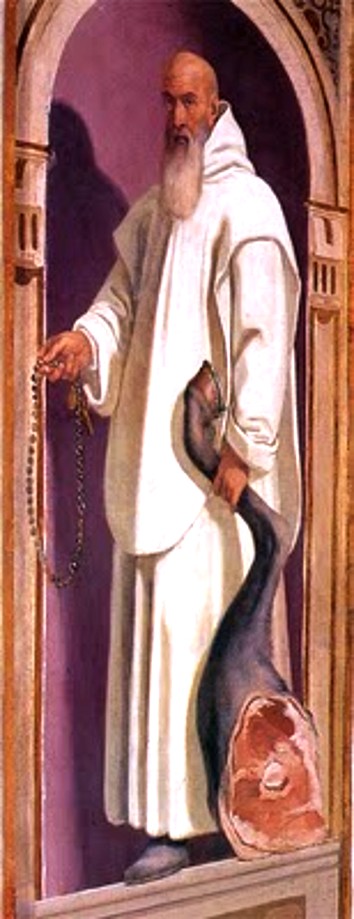
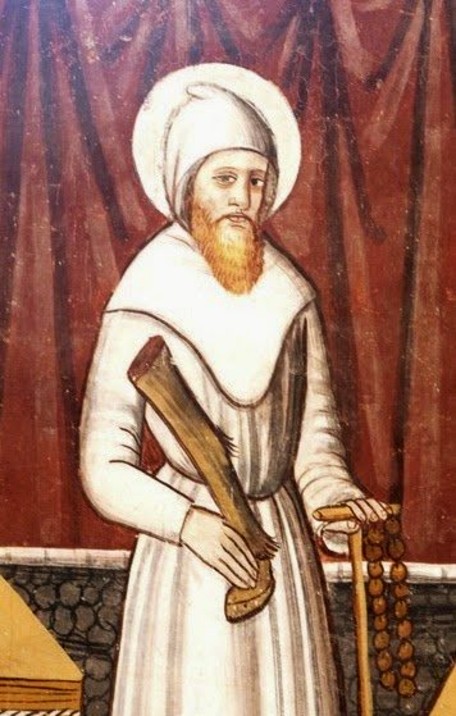
Bl William is widely known for the following miracle: One day, when he was returning from his field work, he was set upon by robbers and defended himself by tearing the leg off his donkey, using this as a cudgel to drive off his attackers. Afterwards, he miraculously healed the donkey, restoring it’s leg. Blessed William is, therefore, often depicted in iconography with his donkey, brandishing the donkey’s leg.
He was buried in the cloister cemetery of the Charterhouse but God let it emphatically be known that He wanted him to be buried at the gatehouse, outside the enclosure, so that the faithful could come to pilgrimage to his tomb. It is this popular veneration century after century, with accompanying miracles, which are the proof of the sanctity of this humble brother of whom we know so little. Pope Saint Pius V authorised the transfer of his relics in 1568 and Pope Blessed Pius IX authorised, in 1862, the veneration of Brother William, whose body was still incorrupt.
Rejoice, because you have escaped the various dangers and shipwrecks of the stormy world. Rejoice, because you have reached the quiet and safe anchorage of a secret harbour. <> Saint Bruno’s letter to his sons the Carthusians
Blessed Mercedarian Fathers – (6 beati): A group of Mercedarian monks noted for their dedication to the Order’s rule, for their continuous prayer life and their personal piety. • Blessed Bartolomeo of Podio • Blessed Giovanni of Verdera • Blessed Guglielmo de Gallinaris • Blessed Guglielmo of Prunera • Blessed Pietro of Benevento • Blessed Pietro of Gualba
Martyrs of Nicaea – (4 saints): A group of Christians martyred together. The only surviving details are four of their names – Darius, Paul, Secundus and Zosimus. They were martyred at Nicaea, Bithynia (modern Izmit, Turkey).
Martyrs of Nicomedia – (5 saints): A group of Christians martyred together in the persecutions of Diocletian. We know little more than the names of five – Anastasius, Cyriacus, Paulillus, Secundus and Syndimius. They were martyred in 303 at Nicomedia, Asia Minor.
Martyred in the Spanish Civil War: Thousands of people were murdered in the anti-Catholic persecutions of the Spanish Civil War from 1934 to 1939. Virtually each day of the year a Group are celebrated, usually individually but sometimes an entire Monastery or Convent or Lay Movement were martyred together. Today we remember: • Blessed Jaume Boguñá Casanovas • Blessed Jordi Sampé Tarragó • Blessed Josep Albareda Ramoneda
Thought for the Day – 18 December – Meditations with Antonio Cardinal Bacci (1881-1971)
Preparation for the Nativity
“The Birth of Our Lord is the most wonderful and most moving mystery of divine omnipotence and goodness. At first thought, the idea of the infinite God becoming man, would seem impossible. Between God and man, there is a vast abyss. Why should God have bridged this gap and assumed our poor mortal nature, becoming like us in everything but sin, while still remaining God? It is a hard question for the human mind to answer. There is only one reply, however. The immensity of God’s power and justice is equalled, by the immensity of His love. It was simply because God loved us infinitely that He took pity on us, lost as we were in sin. He assumed a human body and became man and, He suffered and died for us, so that we might love and obey Him more easily and follow in the way of goodness.
To our poor intellects, God seems not only immense and infinite but also, very remote. For this reason, God determined to come closer to us, so that He became as one of us. He was a tiny infant, crying in a manger; then, He was a lovable young boy Who spoke words of eternal wisdom among the doctors in the Temple; then, He was a prophet Who traversed the countryside of Palestine, teaching and working miracles; finally, He died a martyr’s death on the Cross in the cause of truth and goodness. Reflecting on this mystery of infinite love, let us adore and love Him.”
Quote/s of the Day – The Weekdays of Advent, 18 December O Adonai/O Lord Jeremiah 23:5-8, Psalm 72:1-2, 12-13, 18-19, Matthew 1:18-24
“Only let it be in the name of Jesus Christ, that I may suffer together with Him! I endure everything because He Himself, Who is perfect man, empowers me.”
St Ignatius of Antioch (c 35 – 107) Father of the Church, Martyr
“And you shall call His name Jesus, because in His Name we adore the entire majesty of the Godhead. All who dwell in the heavens, those who abide upon the earth and everyone of those who are held in the depths of hell, bow down prostate to this Name. This is the Name which gave sight to the blind, hearing to the deaf, agility to the lame, speech to the mute and life to the dead, The power of this Name forced the mastery of the devil entirely, from the bodies of the possessed.”
St Peter Chrysologus (c 400-450) Father and Doctor of the Church
“The Name of Jesus is the purest and holiest, the noblest and most indulgent of names, the Name of all blessings and of all virtues, it is the Name of the God-Man, of sanctity itself.”
St Bernard of Clairvaux (1090-1153) Mellifluous Doctor of the Church
Jesus, Name Full of Glory By St Bernardine of Siena (1380-1444)
Jesus, Name full of glory, grace, love and strength! You are the refuge of those who repent, our banner of warfare in this life, the medicine of souls, the comfort of those who morn, the delight of those who believe, the light of those who preach the true faith, the wages of those who toil, the healing of the sick. To You our devotion aspires, by You our prayers are received; we delight in contemplating You. O Name of Jesus, You are the glory of all the saints for eternity. Amen
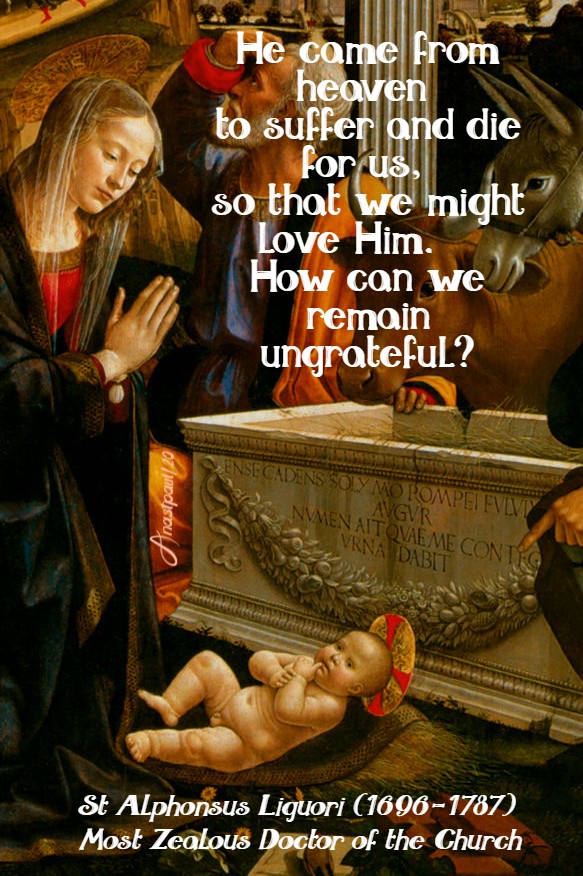
“The Holy Name of Jesus is, first of all, an all-powerful prayer. Our Lord, Himself, solemnly promises, that whatever we ask the Father in His Name, we shall receive. God never fails to keep His word. Each time we say “Jesus,” it is an act of perfect love, for, we offer to God, the infinite love of Jesus”
St Alphonsus Liguori (1696-1787) Doctor of the Church
“There is just one Name in the whole world that lives – it is the Name of One who passed His years in obscurity and who died a malefactor’s death. (Two thousand yeas) have gone by since that time but still It has It’s hold upon the human mind. It has possessed the world and It maintains possession. Amid the most various nations, under the most diversified circumstances, in the most cultivated, in the rudest races and intellects, in all classes of society, the Owner of that great Name reigns. High and low, rich and poor, acknowledge Him. Millions of souls are conversing with Him, are venturing at His word, are looking for His presence. Palaces, sumptuous, innumerable, are raised to His honour. His image, in it’s deepest humiliations, is triumphantly displayed in the proud city, in the open country, at the corners of streets, on the tops of mountains. It sanctifies the ancestral hall, the closet and the bedchamber, it is the subject for the exercise of the highest genius in the imitative arts. It is worn next to the heart in life, it is held before the failing eyes in death.”
St John Henry Newman (1801-1890)
Blessed be the Most Holy Name of Jesus without end!
Advent Reflection – The Weekdays of Advent, 18 December O Adonai/O Lord Jeremiah 23:5-8, Psalm 72:1-2, 12-13, 18-19, Matthew 1:18-24
The Lord is at hand, come let us adore Him.
O LORD AND RULER of the House of Israel, who appeared to Moses in the flame of the burning bush and gave him the law on Sinai, Come and redeem us with outstretched arms.
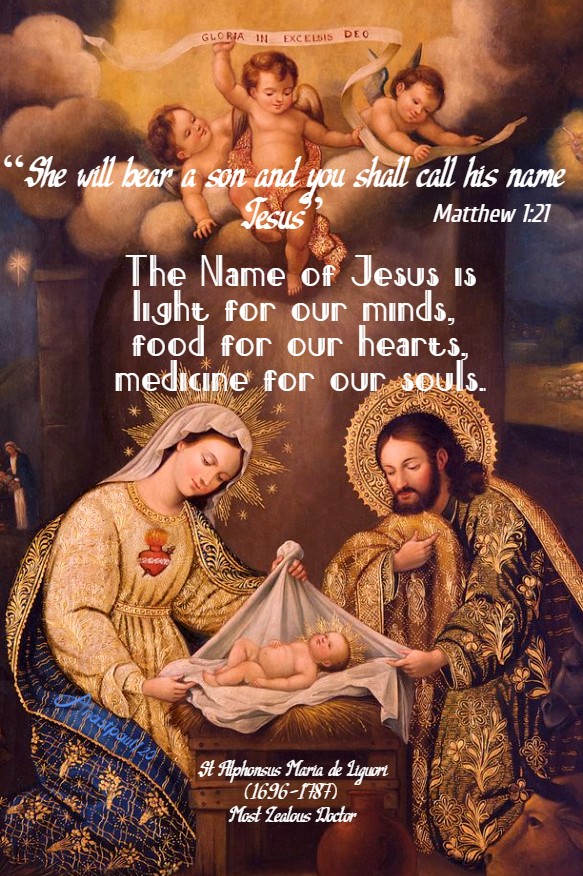
“She will bear a son and you shall call his name Jesus” – Matthew 1:21
REFLECTION – “The Name of Jesus is a divine Name that the Lord made known to Mary through the voice of the Archangel Gabriel: “You will give him the name Jesus” (Lk 1:31). A name that, for this reason, is called “above all names,”“the only name by which we can be saved” (Phil 2:9; Acts 4:12). This great Name is compared to oil by the Holy Spirit: “Your name is oil poured out” (Sg 1:3). Why? Because, as Saint Bernard explains, just as oil is both light, food and medicine, so the Name of Jesus is light for our minds, food for our hearts, medicine for our souls. Light for our minds – it was the brilliance of this Name that enabled the world to pass from the shadows of idolatry to the light of faith. We were born in a land whose inhabitants were all pagans before the coming of the Lord. We should have been as they were if He had not come to enlighten us. So how should we not give thanks to Jesus Christ for the gift of faith! (…) Food for our hearts – this, too, is what the Name of Jesus is. For it calls to our minds all the painful work Jesus accomplished to save us. This is how He comforts us in tribulation, strengthens us to walk along the way of salvation, revives our hope and inflames us with love for our God. And medicine for our souls – Jesus’ Name makes them strong in the face of temptation and our enemies’ attacks. Do they hear this holy Name? The powers of hell tremble and take to flight. This is what Saint Paul says: “that at the name of Jesus every knee should bow, in the heavens, on earth and in the underworld” (Phil 2:10). No-one who is tempted will fall if he calls on Jesus and so long as he calls, he will persevere and be saved.” – St Alphonsus Maria de Liguori (1696-1787) Bishop and named The Most Zealous Doctor of the Church – Meditations for the Octave of Christmas, no 8
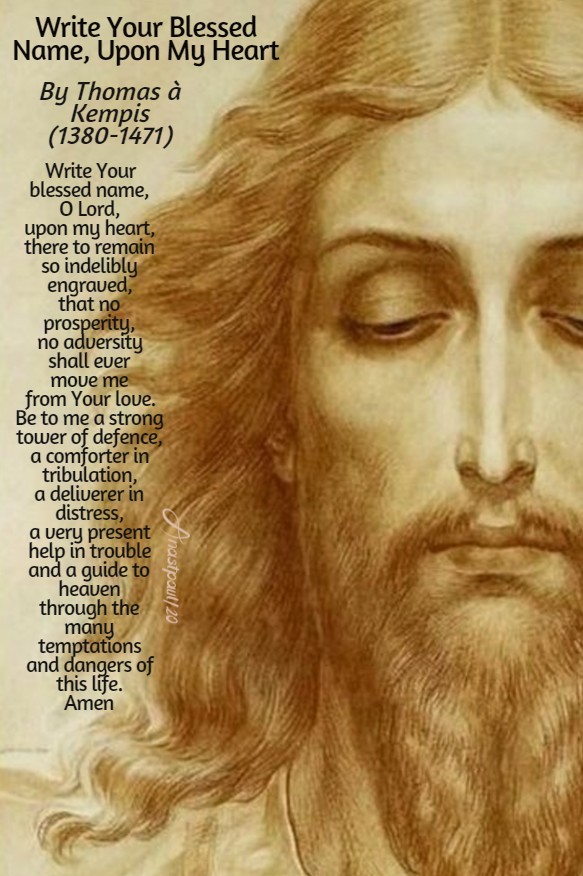
PRAYER – Write Your Blessed Name, Upon My Heart By Thomas à Kempis (1380-1471)
Write Your blessed name, O Lord, upon my heart, there to remain so indelibly engraved, that no prosperity, no adversity shall ever move me from Your love. Be to me a strong tower of defence, a comforter in tribulation, a deliverer in distress, a very present help in trouble and a guide to heaven through the many temptations and dangers of this life. Amen
Our Morning Offering – 18 December and also the Feast of Our Lady of Expectation
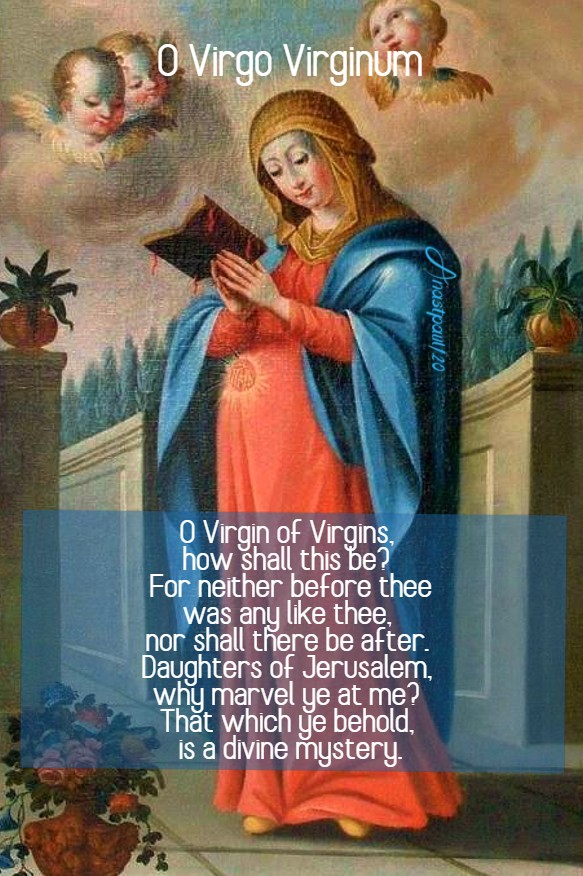
O Virgo Virginum
O Virgin of Virgins, how shall this be? For neither before thee was any like thee, nor shall there be after. Daughters of Jerusalem, why marvel ye at me? That which ye behold, is a divine mystery.
Maiden yet a Mother By Dante Alighieri (1265-1321) Tr Msgr Ronald A Knox (1888-1957)
Maiden yet a mother, daughter of thy Son, high beyond all other, lowlier is none; thou the consummation planned by God’s decree, when our lost creation nobler rose in thee!
Thus His place prepared, he who all things made ‘mid his creatures tarried, in thy bosom laid; there His love He nourished, warmth that gave increase to the root whence flourished our eternal peace.
Nor alone thou hearest When thy name we hail; Often thou art nearest When our voices fail; Mirrored in thy fashion All creation’s gird, Mercy, might compassion Grace thy womanhood.
Lady, let our vision Striving heavenward, fail, Still let thy petition With thy Son prevail, Unto whom all merit, prayer and majesty, With the Holy Spirit And the Father be.
Most authors agree that there were seven original ‘O Antiphons’ and that they are a very ancient expression of Christian Prayer. While their author is unknown, they are cited in at least two works as early as the eighth century. Both Cynewulf, an Anglo-Saxon author and Amalarius, a liturgist and the Archbishop of Trier (died 850), who was a student of the teacher St Alcuin, cite the existence of the ‘O Antiphons’ as early as the seventh/eighth century.
The ‘O Antiphons’ get their name from the fact that they all begin with the interjection ‘O’: O Sapientia (Wisdom); O Adonai (Lord); O Radix Jesse (Root of Jesse); O Clavis David (Key of David); O Oriens (Dawn of the East); O Rex Gentium (King of Gentiles); O Emmanuel.
While the original ‘O Antiphons’ numbered seven, over time a number of others were added to the liturgy of particular regions and sometimes for particular religious feast days which fell during Advent, or even in the liturgy of some medieval religious orders. Some medieval religious churches had as many as twelve O Antiphons which were sung in the Advent Liturgy leading up to Christmas Eve.
Among these, there was an important Marian ‘O Antiphon’ which appears in both the Gallican (France) and Sarum (England) liturgies. Although it is difficult to establish just when this antiphon was first introduced, it was certainly known in the Middle Ages.
This Marian Antiphon is still used today in the liturgy of the Norbertine Order. While the Latin Liturgy begins the O Antiphons on 17 December with ‘O Sapientia,’ and ends on 23 December with ‘O Emmanuel,’ the Liturgy of the Norbertine Order begins their O Antiphons on 16 December with ‘O Sapientia,’ and ends on 23 December with the beautiful Marian Antiphon ‘O Virgo Virginum.’
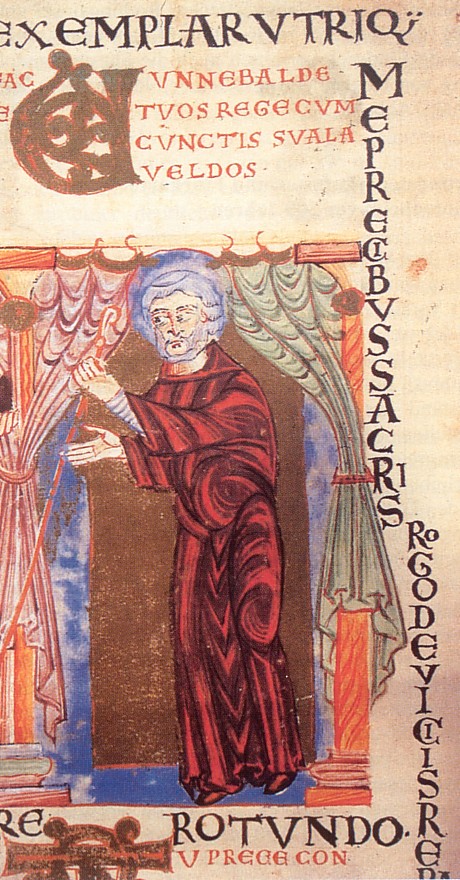
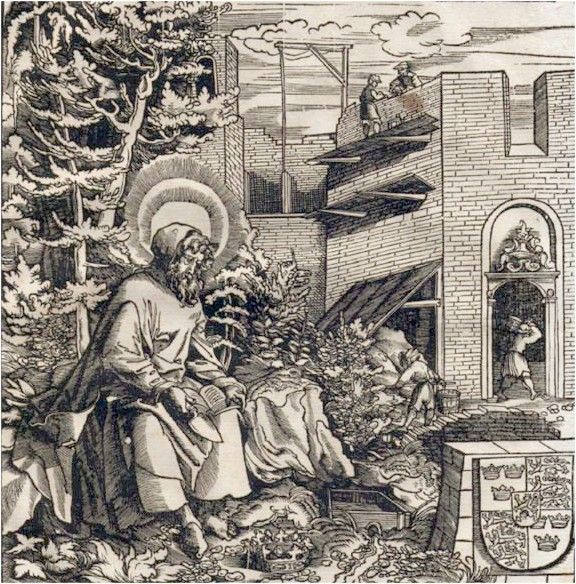
Saint of the Day – 18 December – Saint Winebald OSB (c 701-761) Priest, Abbot, Confessor, Missionary, Founder of many Monasteries, disciple of St Boniface – born in c 701 at Wessex, England and died on 18 December 761 at Heidenheim, Germany of natural causes. St Wieibald was the son of St Richard, Prince of Wessex, brother of St Willibald and St Walburga. Also known as – Winebaldus, Winnibald, Wunebald, Wunibald, Wynbald, Wynnebald, Vunibaldo, Vinebaldo. Patronages – construction workers, engaged couples.
God blessed St Richard with three saintly children, St Winebald, the eldest, St Willibald, who died Bishop of Eichstätt and St Walburga, Abbess. St Richard leaving his native country, took with him his two sons and landed on the coast of Normandy. They visited all the places of devotion on their way and then travelled into Italy, intending to go to Rome but at Lucca, St Richard fell sick and died about the year 722.
Winebald and Willibald accomplished their pilgrimage to Rome. After some stay there to perform their devotions, St Willibald undertook another pilgrimage to the holy places in Palestine but Winebald, who was from his childhood of a weak constitution, remained at Rome, where he pursued his studies for seven years, took the tonsure and devoted himself with his whole heart to the divine service. Then returning to England, he engaged several amongst his kindred and friends to accompany him in his journey back to Rome and there to dedicate themselves to God in a religious state.
Around 737, St Boniface, who was Uncle of St Winebald, visited Rome. By this time Willibald had returned from his travels and had become a Monk at Monte Cassino. Boniface recruited both nephews for the German mission. Willibald was Ordained and based in Eichstätt. Boniface received a promise that Winebald would go to Germany. Winebald arrived in Thuringia on 30 November, 740 and was Ordained Priest by his Uncle who, thereafter, placed him in charge of seven Churches.
Winebald established a Monastery in Schwanfeld but in 742 transferred it to Heidenheim, where the brothers founded a double Monastery for the training of Priests and as a centre of learning. Winibald became the first Abbot.
Winebald took part in the Concilium Germanicum, (the first major Synod of the German Church which was presided over by St Boniface) in 742, and subscribed Pepin’s donation to Fulda in 753. In 762, he joined the League of Attigny, a confraternity of prayer established by Chrodegang, Archbishop of Metz. All this the saint accomplished in spite of continual illness, which prevented him from ending his life at Monte Cassino as he had hoped. Wieibald died at Heidenheim on 18 December 761.
The Vita of St Winebald assures us of several miraculous cures which were performed at his tomb. St Ludger also writes in the life of St Gregory of Utrecht, “Winebald was very dear to my master Gregory and shows, by great miracles since his death what he did whilst living.”
Our Lady of the Expectation – This Feast originated in Spain. When the feast of the Annunciation (25 March) was transferred to 18 December because of the regulation forbidding feasts in Lent, it remained on this date after the Annunciation was again celebrated on its original date. It impressed on the faithful, the sentiments of the Blessed Virgin as the time of her delivery approached.
St Malachi the Prophet St Mawnan of Cornwall Bl Miguel San Román Fernández St Phaolô Nguyen Van My St Phêrô Truong Van Ðuong St Phêrô Vu Van Truat Bl Philip of Ratzeburg St Rufus of Philippi St Samthann of Clonbroney St Theotimus of Laodicea St Winebald OSB (c 701-761) Priest, Abbot St Zosimus of Philippi
Martyrs of Northwest Africa – 42 saints: Mercedarian Redeemers – 6 beati – These are a group of Mercedarian friars who worked together, under the leadership of Saint Peter de Amer, to ransom (e.g., redeem) prisoners and minister to them after.
Thought for the Day – 17 December – Meditations with Antonio Cardinal Bacci (1881-1971)
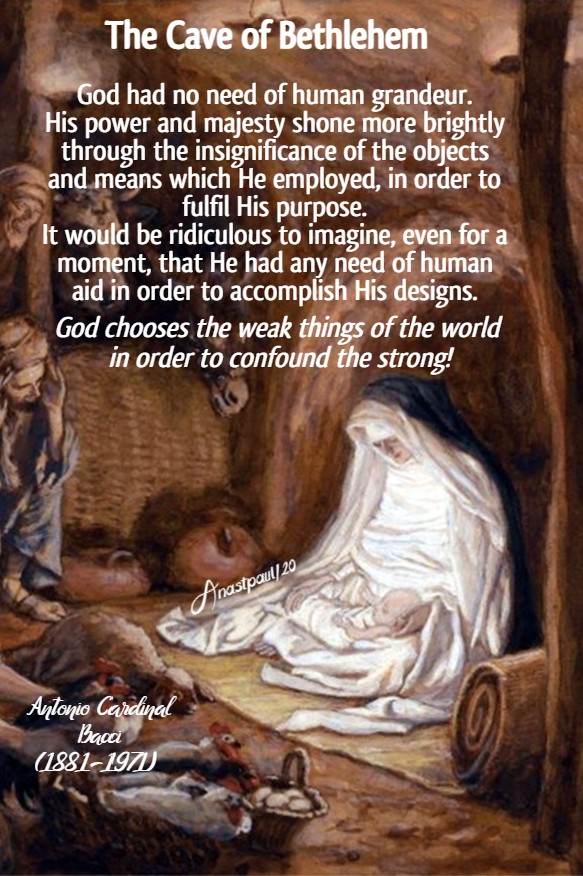
The Cave of Bethlehem
“Why, asked Bossuet, should the Eternal Word of God, infinitely and everlastingly happy, have deigned to assume in time, the fallen state of humanity? Why should He have chosen, as the scene of His miraculous life of love, this insignificant world, a planet almost imperceptible among the myriads of gigantic heavenly bodies? It was for the very same reason, Bossuet replied, that propmpted Him, once He had become man, to choose as His birthplace, the tiny and unknown village of Nazareth in Galilee rather than Rome, the centre of power, or Athens, the centre of learning, or Jerusalem, the capital of the State of Israel. Our world is the Nazareth of creation, one of the smallest planets in the firmament.
God did not even choose, moreover, to be born in the poor but comparatively comfortable house at Nazareth. He preferred to be born in the strange town of Bethlehem. It was the cradle of His ancestral line but it gave Him no welcome and compelled Him to be born in a cold and squalid barn on the straw of a manger. God had no need of human grandeur. His power and majesty shone more brightly through the insignificance of the objects and means which He employed in order to fulfil His purpose. It would be ridiculous to imagine, even for a moment, that He had any need of human aid in order to accomplish His designs. God chooses the weak things of the world in order to confound the strong!” (Missale Romanum, Miss. Virg et Mart).
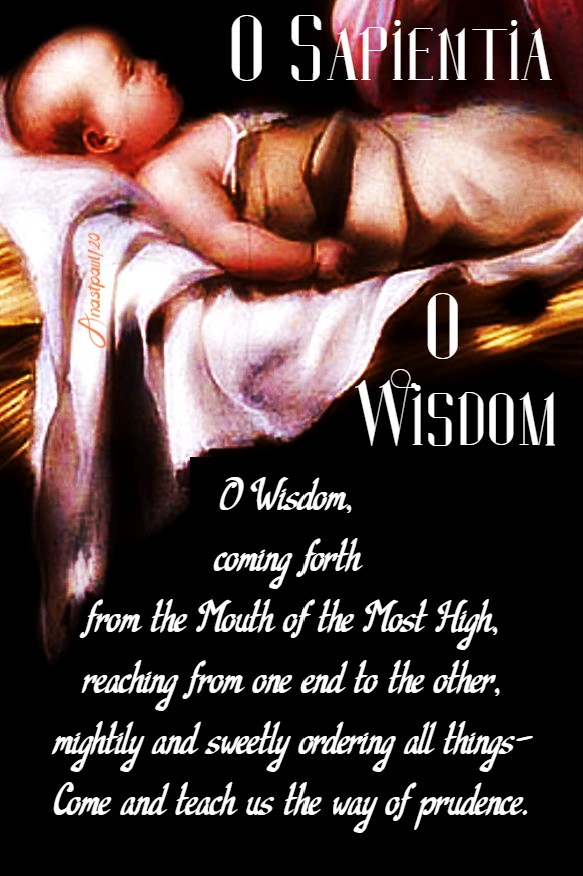
O Sapientia, quae ex ore Altissimi prodiisti, attingens a fine usque ad finem, fortiter suaviterque disponens omnia- veni ad docendum nos viam prudentiae.
O Wisdom, coming forth from the Mouth of the Most High, reaching from one end to the other, mightily and sweetly ordering all things- Come and teach us the way of prudence.
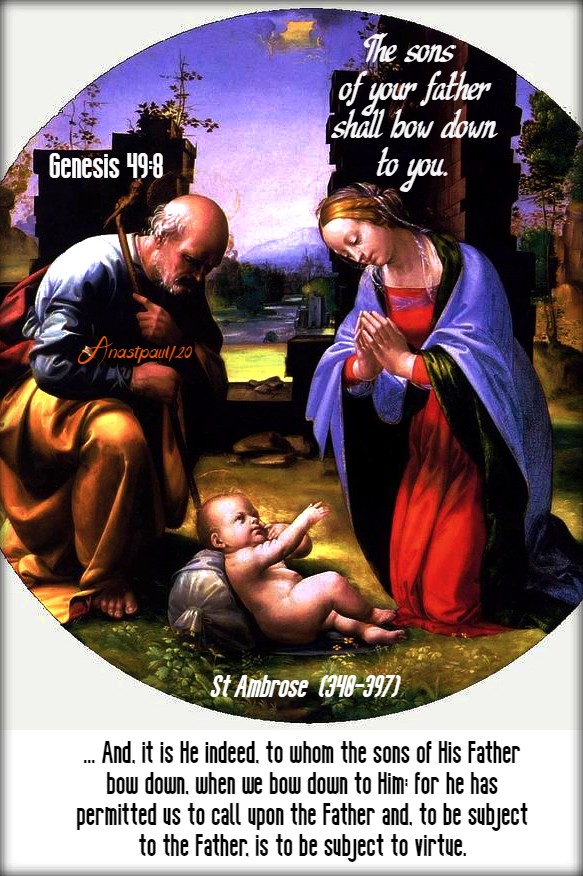
“You, Judah, shall your brothers praise your hand on the neck of your enemies; the sons of your father shall bow down to you.” – Genesis 49:8
REFLECTION – “This text appears to be directed to the Patriarch Judah, indeed but more so that later Judah is meant, the true Confessor who was born of that tribe and who alone is praised by His brothers; of them He says, “I will declare your name to my brothers.” He is the Lord by nature but a brother by grace; His hands, which He stretched out to an unbelieving people, are on the back of His enemies. For with those same hands and by that same passion, Christ protected His own, subjugated hostile powers and made subject to Himself, all people who were without faith and devotion. Of these the Father says to His Son, “And you will rule in the midst of your enemies.” It was their own wickedness that made them enemies, not Christ’s will. In this there is a great gift of the Lord. Previously, spiritual wickedness generally used to make our neck bend to the yoke of captivity. Thus even David wrote that he felt, in some way, the hands of those who triumphed over him, for he said, “Upon my back sinners have wrought.” But now spiritual wickedness is subject to the triumph of Christ and to His hands, as it were; that is, wickedness undergoes the affliction of captivity, being subject forever in deeds and in works. And, it is He indeed, to whom the sons of His Father bow down, when we bow down to Him; for he has permitted us to call upon the Father and, to be subject to the Father, is to be subject to virtue.” – St Ambrose (340-397) One of the original four Doctors of the Latin Church – (The Patriarchs, 4)
PRAYER – Collect: O God, Creator and Redeemer of human nature, Who willed that Your Word should take flesh in an ever-virgin womb, look with favour on our prayers, that Your only Begotten Son, having taken to Himself our humanity, may be pleased to grant us a share in his divinity. Who lives and reigns with You in the unity of the Holy Spirit, one God, for ever and ever. Amen
Rejoice! Rejoice! Emmanuel Shall come to thee, O Israel
Our Morning Offering – 17 December – O Wisdom/O Sapientia
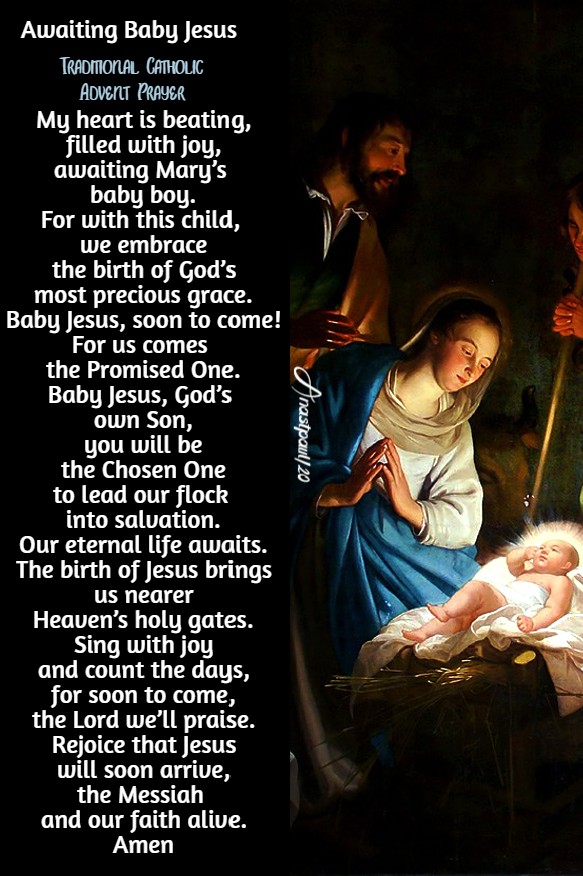
Awaiting Baby Jesus Traditional Catholic Advent Prayer
My heart is beating, filled with joy, awaiting Mary’s baby boy. For with this child, we embrace the birth of God’s most precious grace. Baby Jesus, soon to come! For us comes the Promised One. Baby Jesus, God’s own Son, you will be the Chosen One to lead our flock into salvation. Our eternal life awaits. The birth of Jesus brings us nearer Heaven’s holy gates. Sing with joy and count the days, for soon to come, the Lord we’ll praise. Rejoice that Jesus will soon arrive, the Messiah and our faith alive. Amen
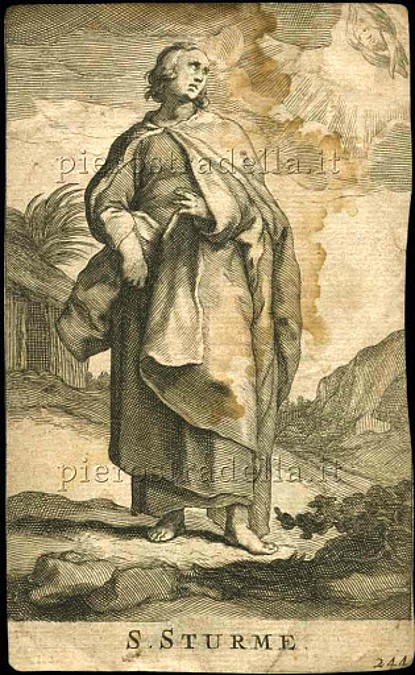
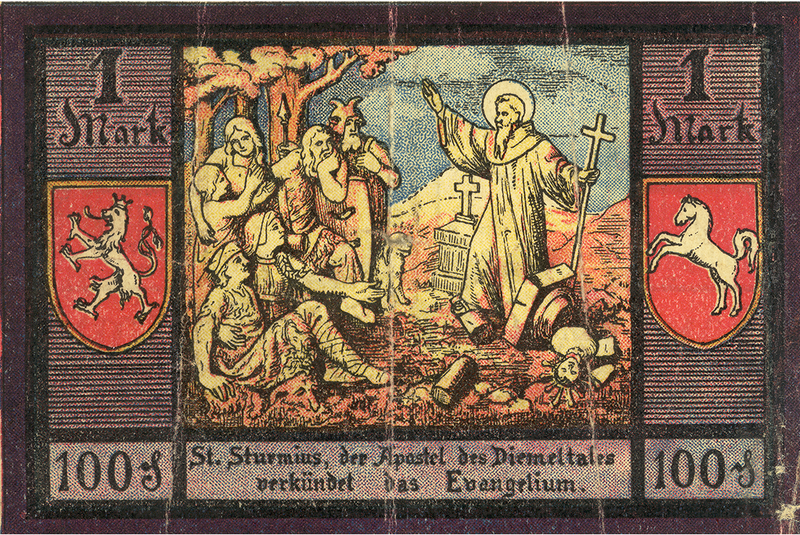
Saint of the Day – 17 December – Saint Sturmi of Fulda (c 705-779) Priest, Monk and Abbot, Missionary, disciple of Saint Boniface and Founder and first Abbot of the Benedictine Monastery and Abbey of Fulda. Sturmi’s tenure as Abbot lasted from 747 until 779. Also known as Apostle of the Saxons, Apostle of Germany, Sturm, Sturmius.
St Sturmi (kneeling) with St Boniface
Sturmi was born c 705 in Lorch, Austria and was most likely related to the Agilolfing Dukes of Bavaria. He met Saint Boniface when the latter was carrying out the church reorganisation in Bavaria and Austria (founding the Bishoprics of Salzburg, Regensburg and Würzburg). He joined Boniface and was educated in the Benedictine monastery of Fritzlar by Abbot Saint Wigbert. He was then active as a Missionary in northern Hesse, where in 736 he established a monastic settlement in Haerulfisfeld (Hersfeld).
Sturmi was Ordained in 740 as Priest in Fritzlar. In 744 he was instructed by St Boniface in 744 to establish a Monastery in the region of Eichloha, which had been granted to Boniface by the Frankish Mayor of the Palace Carloman. He established the Monastery in the ruins of a 6th-century Merovingian royal camp, destroyed 50 years earlier by the Saxons, at a ford on the Fulda River.
Following studies at St Benedict’s Monastery in Monte Cassino in 747–748, Sturmi was named first Abbot of the Fulda Monastery by St Boniface. In 751, St Boniface and his disciple and successor Lullus, obtained an exemption for Fulda, having it placed directly under the Papal See and making it independent of interference by Bishops or worldly princes.
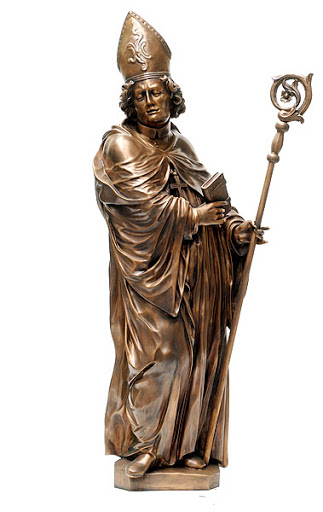
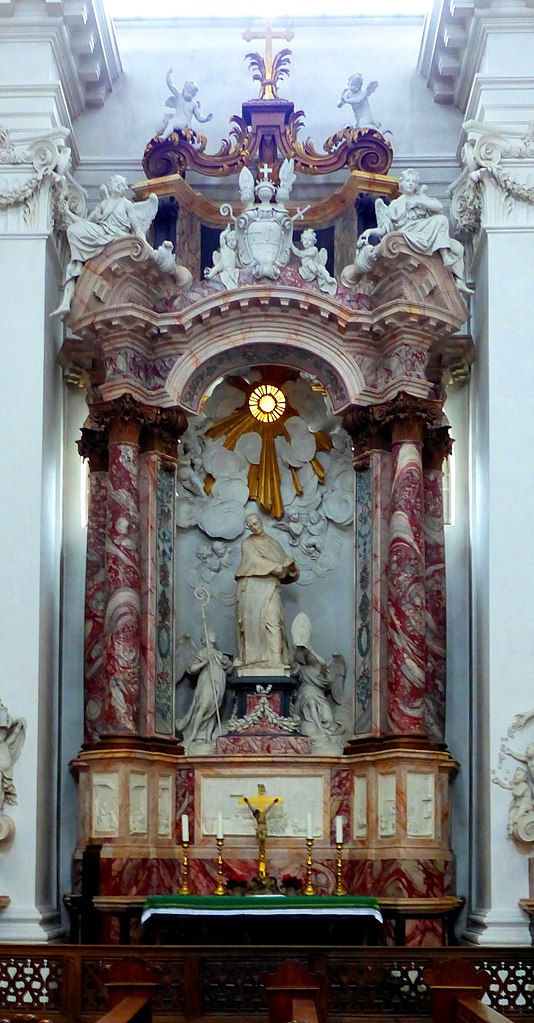
This is St Sturmi, I don’t know why he wears a Bishop’s Mitre
After the death of St Boniface, this exemption led to serious conflicts between Lullus, then Archbishop of Mainz and Abbot Sturmi. Nevertheless, Sturmi prevailed over the Bishops of Mainz and Utrecht in having Boniface, buried in Fulda after his Martyrdom in 754. This made Fulda a major place of pilgrimage for many peoples, including Anglo-Saxons and brought much prestige and a stream of gifts and donations to Fulda.
Building on this success, Sturmi was able to fend off efforts by the Bishops of Mainz and Würzburg to invalidate the Abbey’s exemption. He was sent into exile from 763 to 765 at Jumièges (Normandy) but was rehabilitated in 765 by Pippin the Younger. In 774, the Abbey of Fulda received Royal protection from Charlemagne. In the same year, Fulda was assigned missionary territories in heathen Saxony. Sturmi later established the Abbey of St Boniface at Hamelin. In 779, he accompanied Charlemagne into Saxony but fell ill and died soon after returning to Fulda on 17 December 779, where he was buried in the Cathedral.
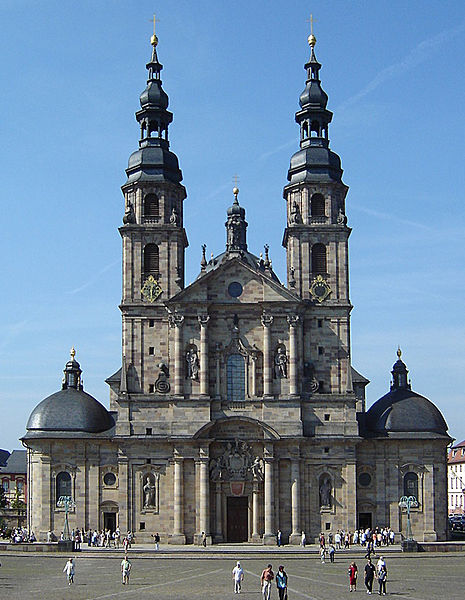
Fulda Abbey Cathedral
Sturmi was recognised as a Saint prior to the East–West Schism in 1054, hence the Orthodox Church continues to honour him. He was formally Canonised in 1139 by Pope Innocent II. His life was recorded in the Vita Sturmi by the fourth Abbot of Fulda, Eigil of Fulda (died 822[1]), a relative of his, who had been a Monk in Fulda for over 20 years under Abbot Sturmi.















 AnaStpaul
You must be logged in to post a comment.