One Minute Reflection – 2 June – “Month of the Most Sacred Heart of Jesus” – Readings: First: Tobit 3: 1-11a, 16-17a, Psalm: Psalms 25: 2-3, 4-5ab, 6 and 7bc, 8-9, Gospel: Mark 12: 18-27
“He is not God of the dead but of the living. You, therefore, do greatly err ” – Mark 12:27
REFLECTION – “Christ died and came to life, that he might be Lord of both the dead and the living,” (Rom 14,9); “He is not God of the dead but of the living.” Since He, the Lord of the dead, is living, the dead are no longer dead, but living. Life reigns in them so that they might live and never more fear death, just as “Christ, raised from the dead, dies no more,” (Rom 6,9). Raised and set free from corruption, they will never more see death; they will have a share in the resurrection of Christ just as He also shared their death. Indeed, if He came on earth, which up till then had been an everlasting prison-house, it was to “shatter bronze doors and snap iron bars,” (Is 45,2), to draw our life out of corruption, by drawing it to Himself and to give us freedom, instead of slavery.
If this plan of salvation has not yet been fully realised (since men continue to die and their bodies to be destroyed by death), that should not be any reason for unbelief. We have already received the firstfruits of what has been promised to us, in the person of Him, Who is our firstborn… “God has raised us up with him and seated us with him in Christ Jesus,” (Eph 2,6). We shall come to full realisation of this promise, when the time fixed by the Father, has come, when we shall put off our childish state and “attain mature manhood” (Eph 4,13. For the eternal Father has willed, that His gift should stand firm. As the Apostle Paul, who was well aware of this, declared – this will come upon all humankind through Christ, who “will change our lowly body to conform with his glorious body,” (Phil 3,21)… The glorious body of Christ is no different from the body “sown in weakness, dishonourable,” (cf. 1Cor 15,42); it is the same body but changed in glory. And what Christ has accomplished by taking His own humanity, the original pattern for our nature, to the Father, He will do for the whole of humanity, according to His promise – “And when I am lifted up from the earth, I will draw all men to myself,” (Jn 12,32). – St Anastasius I of Antioch(Died 599) Monk, then Bishop of Antioch from 549-570 and from 593-599 – Homily 5, On the Resurrection
PRAYER – Holy Father, You made us, we belong to You. Grant that by the prayers of all your holy saints, we may attain eternal life with You to praise and worship You for all eternity. May the prayers of the Blessed Virgin Mary, our Holy Mother, assist us our earthly pilgrimage. We make our prayer through our Lord, Jesus, with You and in the unity of the Holy Spirit, one God forever, amen. HEART of JESUS burning with love of us, inflame our hearts with love of Thee. – 100 Days, once a day. (See Instructions. – Unless otherwise stated, e.g., “once a day,” a partial Indulgence may be gained any number of times in succession.) [169 Raccolta or Collection of Indulgences, 1910] Pope Leo XIII, 16 July 1893
Our Morning Offering – 2 June – “Month of the Most Sacred Heart of Jesus”
Daily Consecration to the Sacred Heart of Jesus Prayers to the Sacred Heart 1936 – 15th Edition, Dublin
O Sacred Heart of Jesus, filled with infinite love, broken by our ingratitude and pierced by our sins, yet loving us still, accept the Consecration we make to Thee, of all that we are and all that we have. Take every faculty of our souls and bodies, only day by day draw us, nearer and nearer to Thy Sacred Heart, and there, as we shall hear the lesson, teach us Thy Holy Way. Amen
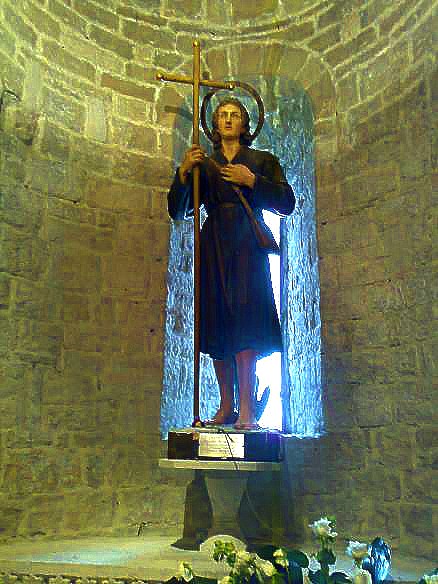
Saint of the Day – 2 June – Saint Nicholas Peregrinus the Pilgrim (1075-1094) Confessor. Born in 1075 in Greece and died in 1094 in Trani, Italy of natural causes, aged 19 years old, just fifteen days after his arrival, having travelled from Taranto and before that from Otranto. Also known as – Nicholas the Pilgrim, Nicola Pellegrino di Trani. Patronage – Trani, Italy. Th name Nicholas derives from the Greek Nikòlaos and means “winner of the people.”
The Cathedral of Trani is his living memory, a memory of extraordinary harmony. Nicola il Pellegrino is the Patron Saint of the Apulian City – the Church built in 1097 is dedicated to him. Nicholas came from Greece and moved to Puglia, he travelled through it in its entirety. The chronicles report that he uttered a single, insistent invocation: “Kyrie Eleison”. He died in Trani in 1094. Since then, the miracles fro the veneration at his tomb, have been endless.
The Roman Martyrology states of him today: “In Trani in Puglia, Saint Nicholas, who, a pilgrim born in Greece, travelled the whole region carrying a Crucifix and repeating without interruption ‘Kyrie, eléison.'”
Nicholas was born in Steiri in Boeotia, Greece, where his solitary life as a shepherd led him to contemplative spirituality. He developed a desire to warn others of their dire need of th great love and mercy of God. He desired to go on pilgrimage to the Holy Sites and on his way, to try to impress upon all, the need for repentance, prayer and supplication to God for His mercy. He developed the constant repetition of the phrase “Kyrie, eléison” – “Lord, have mercy.”
He attracted and gathered around him the young boys giving them small gifts and making them repeat his invocation. After his death numerous miracles blossomed; four years later in 1098 in the Roman Synod, the Bishop of Trani stood up and asked the Assembly that the venerable Nicholas be entered in the catalogue of saints for the merits he had in life and for the miracles that occurred post-mortem.
Pope Urban II issued a ‘Brief’ which authorised the Bishop of Trani, after appropriate reflection, to act as he considered most appropriate. The Bishop returned to Trani and Canonised Nicholas by the decree of Pope Urban II in 1098 and, after having erected a new Basilica, he deposited the body of the saint there.
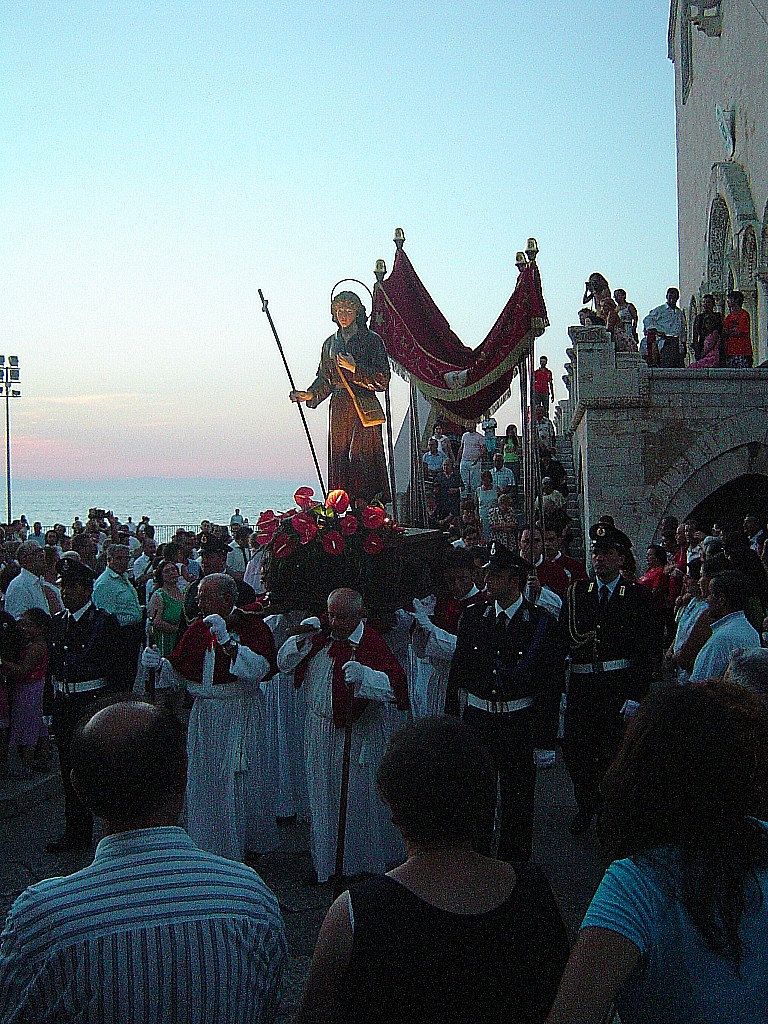
His feast day is honoured each year, with great piety and celebration, by Holy Mass and a procession through the City of Trani.
Madonna delle Lacrime / Madonna of the Tears, Ponte Nossa, Bergamo, Lombardy, Italy , 1511 – 2 June:
In the territory of Ponte Nossa known as Campo Lungo there was a small Oratory dedicated to the Seven Martyr Brothers and the Madonna which had a fresco on the facade by Giacomo Borlone de Buschis depicting the Crucifixion with the Madonna and St John.
On 2 June 1511 , some shepherdesses of the town staring at the picture, saw Mary’s face change, open and close her left eye until tears of blood appeared o her cheek. Among them was a girl from the Bonelli de Ferrari family, who wiped away her tears with her apron. The Virgin said:
“To the first who will pass this way, you will make my apparition kown and you will report that the Blessed Virgin told you so, who she orders that a Church be built in her honour where she will give many graces.”
The young women made the miracle public and showed the blood left on the young woman’s apron as a testimony. Tradition tells of other miraculous facts, such as the story of a soldier who mocked the young girls by questioning what they had reported and who whe he remounted his horse, suddenly found himself blind and his horse too, struck by the ‘wrath of God.’ The punishment made him repent and asking forgiveness from God and the Madonna, he regained the gift of sight. The testimony of the miracle and what happened after, were then collected by the notary Guerinoni of Gorno and put in writing. The construction of the new Church had the authorisation to begin construction as early as 10 June of the same year.
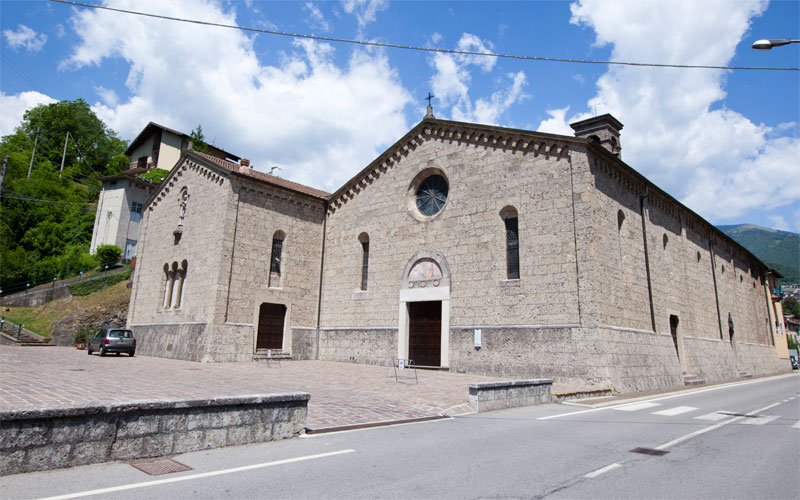
The building was finished in 1533, was built in Lombard Romanesque style next to the existing Church. It was Consecrated with the rite of dedication to Santa Maria Annunziata on 19 April 1575 by the co-adjutor of theBbishop Federico Corner and elevated to Parish in 1583. The miraculous fresco was inserted as a side Altarpiece . The previous church was then demolished in 1716 in order to make room for the new sacristy of the complex.
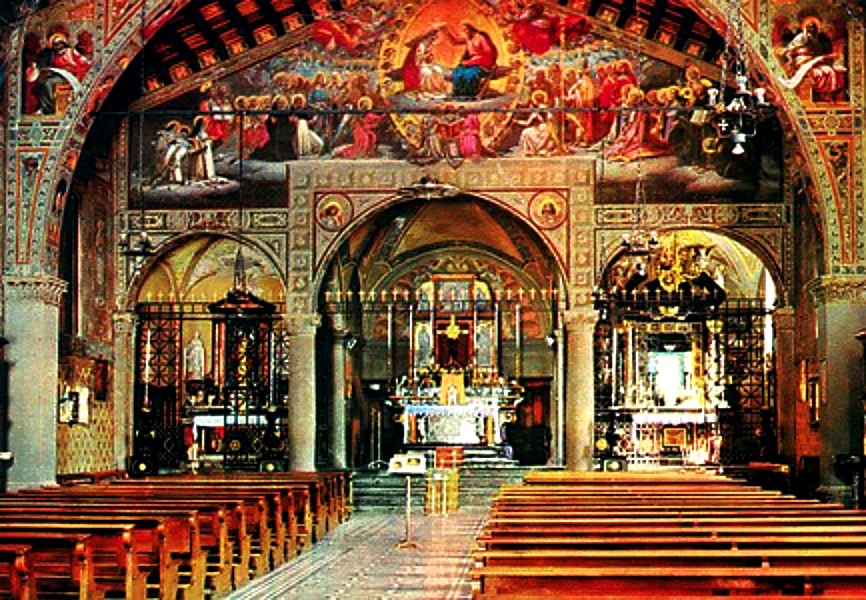
Although the exterior of the Sanctuary appears austere, the interior is full of treasures and frescoes. The frescoe below depicts the blinded soldier begging forgiveness. The Altar of the Madonna delle Lacrime (Our Lady of Tears) was embellished in the seventeenth century with small twisted alabaster columns accompanied by a plague in memory of the graces received and a special prayer to the Virgin.
Hanging from the ceiling of the nave, on the right side, in front of the Altar of the Virgin there is a crocodile. There is no written documentation referring to the true reason for the presence of a crocodile inside the Church. The first citation of it presence is deducible from a document dated 24 January 1594 by Bishop Federico Corner who asked for its immediate removal: “In the Church of the Madonna’s oratory, remove that crocodile skin under the roof, for it is indecent .” This order, however, was eluded by the then Parish Priest, Don Celso Lotteri, who declared – “It would be a huge mistake to remove it because, if on one hand, the skin of a sea monster is indecent in a sacred place, on the other hand, it is a real display of a miracle and a very material votive proving a true miracle and grace obtained through the invocation of Santa Maria dei Campi by some villagers who were miraculously preserved from the jaws of that voracious monster.”
The testimony of this miracle remains only oral, handed down by the faithful. It would seem, that in Rimini a merchant who was travelling to sell his wares, found himself facing a ferocious crocodile. He entrusted his prayers to the Madonna di Campolungo and thus, managed to hit the monster in the throat, killing it (as shown in the third fresco on the right wall in the upper part.) However, it appears, that there are many legends about the crocodile and although they differ slightly in detail, the main focus always remains the same, the intervention of the Blessed Virgin Mary!
In the 19th century, the figure of Mary was solemnly crowned with a diadem of gold and precious jewels. An annual procssion is held each year in honour of Our Lady of Tears.
St Pope Eugene I, St Evasius Bl Giovanni de Barthulono Bl Guy of Acqui St Honorata St Humatus St John de Ortega St Joseph Tien St Nicholas Peregrinus the Pilgrim (1075-1094) Confessor St Photinus of Lyons St Rogate Bl Sadoc of Sandomierz St Stephen of Sweden — Martyrs of Lyons and Vienne: A group of 48 Christians from the areas of Vienne and Lyon, France, who were attacked by a pagan mob, arrested and tried for their faith, and murdered in the persecutions of Marcus Aurelius. A letter describing their fate, possibly written by Saint Irenaeus of Lyons, was sent to the churches in the Middle East. Only a few names and details of their lives have survived; some of them have separate entries on this date – • Alexander of Vienne • Attalus of Pergamos • Biblis of Lyons • Blandina the Slave • Cominus of Lugdunum • Epagathus of Lugdunum • Maturus the Novice • Photinus of Lyons • Ponticus of Lugdunum • Sanctius of Vienne • Vettius of Lugdunum They were martyred in assorted ways on on various during 177.
Martyrs of Sandomierz: A group of 49 Dominicans, some of whom received the habit from Saint Dominic de Guzman himself. They worked separately and together to bring the faith and establish the Dominican Order in Poland, basing their operations in and around Sandomierz. In 1260 they were all martyred by the Tartars as they were singing the Salve Regina at Compline; the custom of singing the Salve Regina at the deathbed of Dominicans stems from this incident. We know a few details about a few of the martyrs, but most survive only as names – • Zadok• Andrea, chaplain• James, novice master• Malachi, convent preacher • Paul, vicar• Peter, guardian of the garden• Simone, penitentiaryfriars • Abel, Barnabas, Bartholomew, Clemente, Elia, John, Luke, Matthew, Philip deacons• Giuseppe, Joachim, Stefanosub-deacons• Abraham, Basil, Moses, Taddeoclerics• Aaron, Benedict, David, Dominico, Mattia, Mauro, Michele, Onofrio, Timothyprofessed students• Christopher, Donato, Feliciano, Gervasio, Gordian, John, Mark, Medardo, Valentinonovices• Daniele, Isaiah, Macario, Raffaele, Tobialay brothers• Cyril, tailor• Jeremiah, shoemaker • Thomas, organist They were martyred in 1260 at Sandomierz, Poland and Beatified on 18 October 1807 by Pope Pius VII (cultus confirmation).
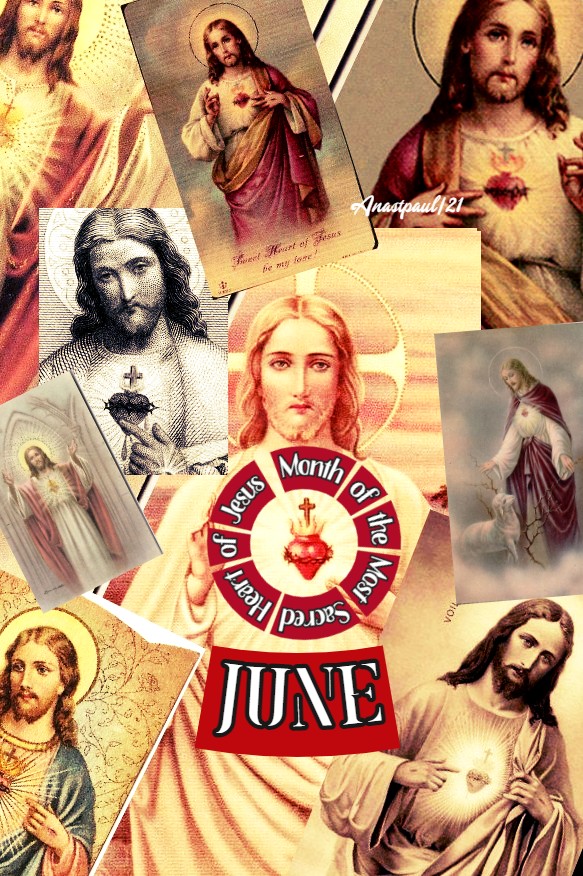
Devotion for June – THE MONTH OF THE MOST SACRED HEART of JESUS – Our Only Hope!
When we view this sinful world, groaning beneath the weight of a thousand crises and a thousand afflictions but, nevertheless, unrepentant, when we consider the alarming progress of neo-paganism, which is on the verge of conquering humanity (in some countries has already done so!) and when, on the other hand, we consider the lack of resolve, foresight and unity among the so-called remnant, we are understandably terrified at the grim prospects of catastrophes that this generation may be calling upon itself. It seems, that now, we are already facing these catastrophes.
Nevertheless, since God is not only just but also merciful, we pray to the Sacred Heart, that the gates of salvation have not yet been shut against us. A people unrelenting in its impiety has every reason to expect God’s rigour. However, He Who is infinitely merciful, does not want the death of this sinful generation but that it “be converted…and live” (Ezech.18:23). His grace thus insistently pursues all men, inviting them to abandon their evil ways and return to the fold of the Good Shepherd.
God is charity, so the simple mention of the Most Holy Name and Sacred Heart of Jesus evokes love. It is the infinite, limitless love that drove the Second Person of the Most Holy Trinity to become man. It is the love manifested in that supreme moment of the Last Supper when, after generously washing the feet of His apostles, He instituted the Holy Eucharist. It is the love in that last pardon of Dismas, which enabled the dying thief to steal heaven. Finally, it is the love manifested in the supreme gift of a Heavenly Mother for a wretched humanity!
In venerating the Sacred Heart of Jesus, the Church specially praises the infinite love demonstrated by Our Lord Jesus Christ to men. Since His Heart is the symbol of love, by venerating His Heart, the Church celebrates Love.
Among the promises made by our Lord to St Margaret Mary was the assurance that, “Those who shall promote this devotion shall have their names written in my Heart, never to be blotted out.”
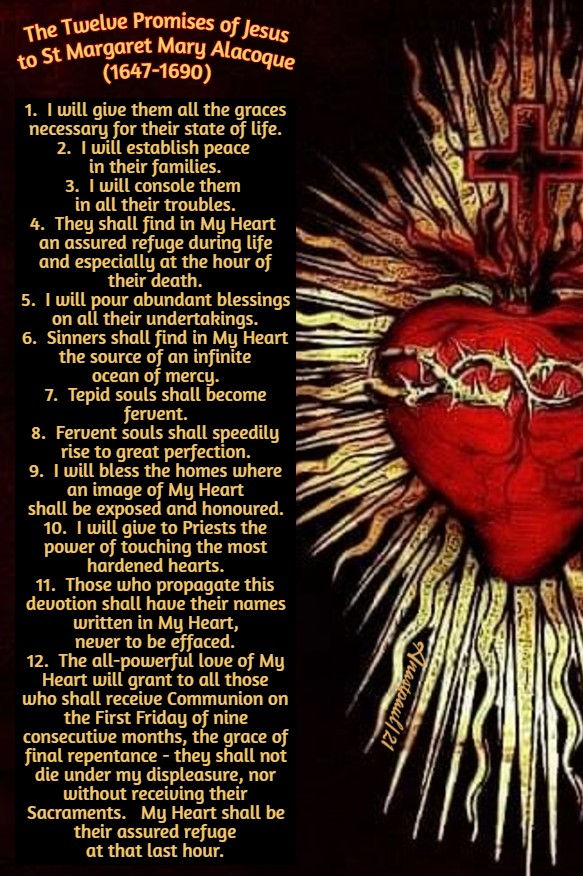
The Twelve Promises of Jesus to Saint Margaret Mary Alacoque (1647-1690) “Apostle of the Sacred Heart For those Devoted to His Sacred Heart:
I will give them all the graces necessary for their state of life.
I will establish peace in their families.
I will console them in all their troubles.
They shall find in My Heart an assured refuge during life and especially at the hour of their death.
I will pour abundant blessings on all their undertakings.
Sinners shall find in My Heart the source of an infinite ocean of mercy.
Tepid souls shall become fervent.
Fervent souls shall speedily rise to great perfection.
I will bless the homes where an image of My Heart shall be exposed and honoured.
I will give to Priests the power of touching the most hardened hearts.
Those who propagate this devotion shall have their names written in My Heart, never to be effaced.
The all-powerful love of My Heart will grant to all those who shall receive Communion on the First Friday of nine consecutive months, the grace of final repentance – they shall not die under my displeasure, nor without receiving their Sacraments. My Heart shall be their assured refuge at that last hour.
From Saint Margaret Mary Alacoque’s Vision of Jesus
Thought for the Day – 1 June – “Month of the Sacred Heart” – Meditations with Antonio Cardinal Bacci (1881-1971)
Devotion to the Sacred Heart
“When we consider it under it’s fundamental aspect as the cult of the love of God, rather than of the Incarnate Word, devotion to the Sacred Heart of Jesus, is as old as Christianity, even though it is only in recent centuries, that it has assumed it’s present symbolism. “He who does not love, does not know God,” says St John, “for God is love” (1 Jn 4:8). “And we have come to know,” he continues “and have believed, the love that God has in our behalf. God is love and he who abides in love, abides in God and God in him” (1 Jn 4:16). This cult of the love of God, particularly of the love of God made man, vibrates throughout the pages of the Gospel and of the writings of the Apostles, especially of St John and of St Paul.
In the works of the Fathers, there are references to the Heart of Jesus, pierced with a lance, from which flowed all the infinite graces of the Church for our redemption. We are reminded of this in the Encylical, Haurietis Aquas, published by Pope Pius XII in the year 1956. But the specific cult of the love of God, as symbolised by the Heart of Jesus, was explicitly approved by the Church after Jesus Himself appeared in the year 1674 to St Margaret Mary Alacoque and showed her His Heart on fire with love for men.”
Quote/s of the Day – 1 June – “Month of the Most Sacred Heart of Jesus” – The Memorial of St Justin Martyr (c 100-165) Father of the Church
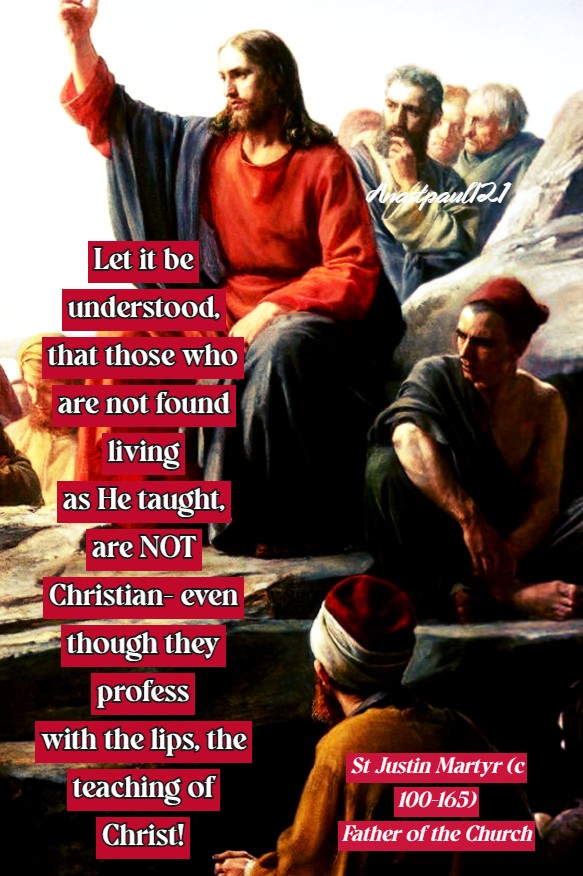
“Let it be understood, that those who are not found living as He taught, are NOT Christian- even though they profess with the lips, the teaching of Christ.”
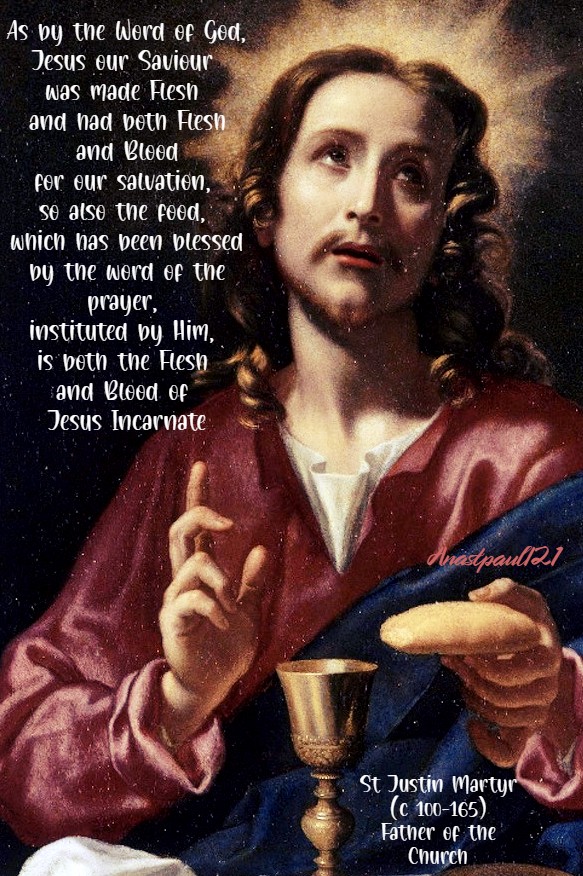
“As by the Word of God, Jesus our Saviour was made Flesh and had both Flesh and Blood for our salvation, so also the food, which has been blessed by the word of the prayer, instituted by Him, is both the Flesh and Blood of Jesus Incarnate.”
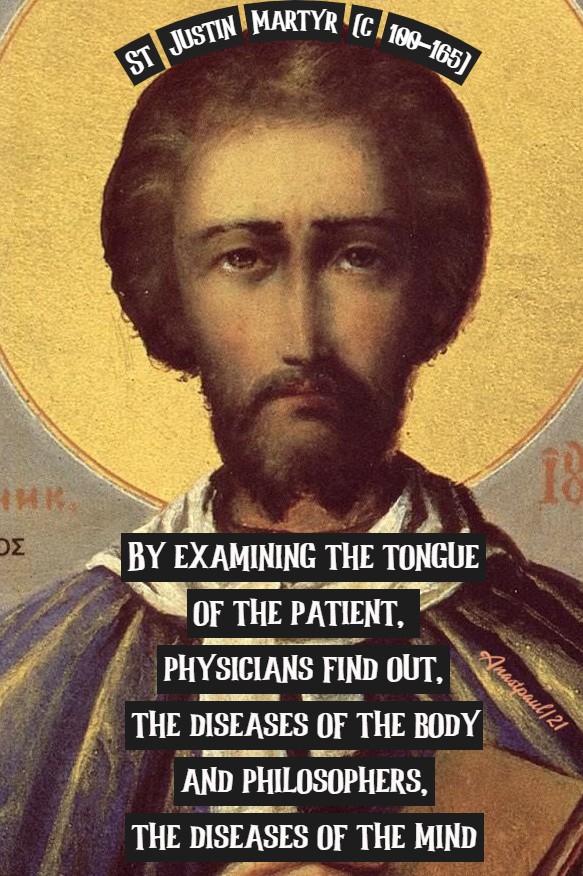
“By examining the tongue of the patient, physicians find out, the diseases of the body and philosophers, the diseases of the mind.”
“Love is like the air we breathe, it isn’t always seen but it is heard, felt and needed.”
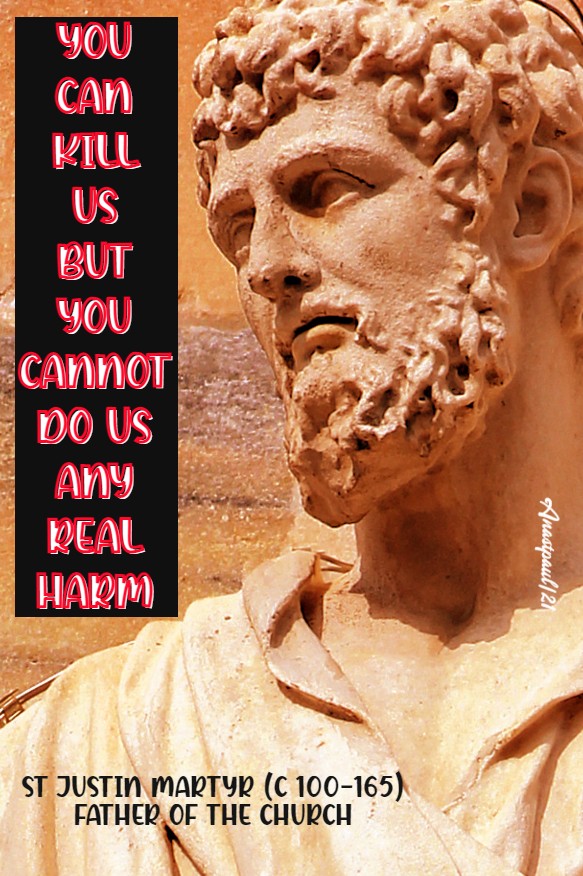
“You can kill us but you cannot do us any real harm.”
One Minute Reflection – 1 June – “Month of the Most Sacred Heart of Jesus” – Readings: First: Tobit 2: 9-14, Psalm: Psalms 112: 1-2, 7-8, 9, Gospel: Mark 12: 13-17
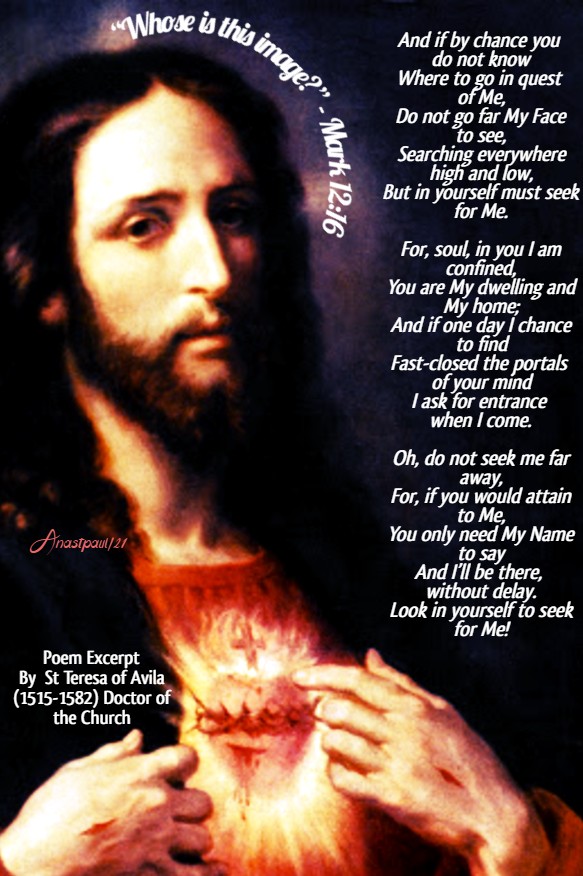
“Whose is this image?” – Mark 12:16
REFLECTION – “Soul, you must seek yourself in Me And in yourself, must seek for Me.
Such is the power of love’s impress, O soul, to engrave you on My Heart, That any craftsman must confess He never could have the same success, However superlative his art.
It was by love that you were made Lovely and beautiful to be; So, if by chance, you should have strayed, Upon My Heart you are portrayed. Soul, you must seek yourself in Me.
For well I know that you will see Yourself engraved upon My Breast— An image vividly impressed— And then you will rejoice to be So safely lodged, so highly blest.
And if by chance you do not know Where to go in quest of Me, Do not go far My Face to see, Searching everywhere high and low, But in yourself must seek for Me.
For, soul, in you I am confined, You are My dwelling and My home; And if one day I chance to find Fast-closed the portals of your mind I ask for entrance when I come.
Oh, do not seek me far away, For, if you would attain to Me, You only need My Name to say And I’ll be there, without delay. Look in yourself to seek for Me!” – St Teresa of Avila (1515-1582) Carmelite, Doctor of the Church – Poems, no 8 “Alma, buscarte has en mí”
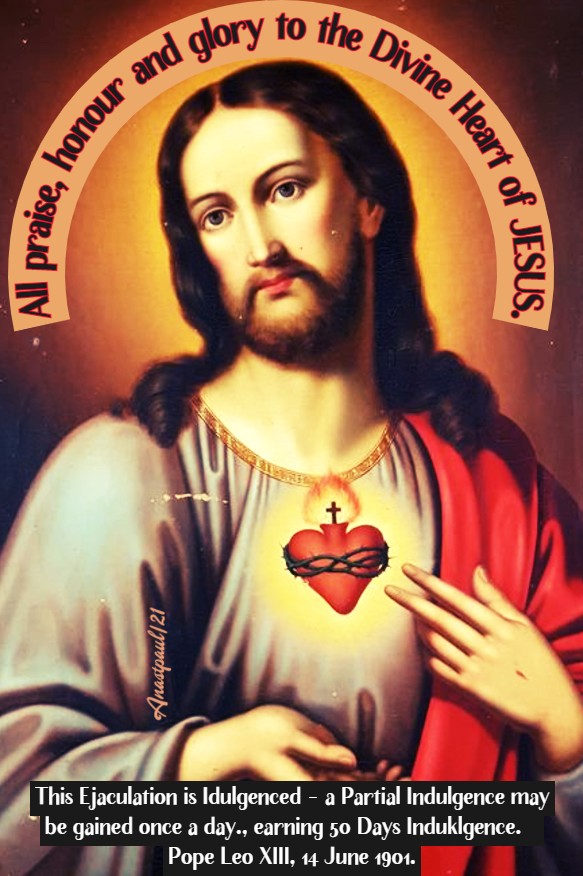
PRAYER – Lord God, true light and creator of light, grant us the grace to see clearly by the light who is Light, Your only Son. Lead us in His path and send us Your Spirit. Grant us the strength to grow in holiness so that our struggle against the powers of darkness may we a victory over temptation. May the prayers of the Mother of Your Son, the Blessed Virgin Mary, our Mother too, be a balm of enduring succour, as we fulfil Your commandments in this world and strive to reach our eternal home. We make our prayer through Christ Your divine Son, Whom You sent to make us like unto Himself, in the Holy Spirit, one God for all eternity, amen. All praise, honour and glory to the Divine Heart of JESUS. (This Ejaculation is Indulgenced – 50 Days, once a day. (See Instructions: – Unless otherwise stated, e.g., “once a day,” a partial Indulgence may be gained any number of times in succession.) 168Pope Leo XIII, 14 June 1901).
Our Morning Offering – 1 June – “Month of the Most Sacred Heart of Jesus
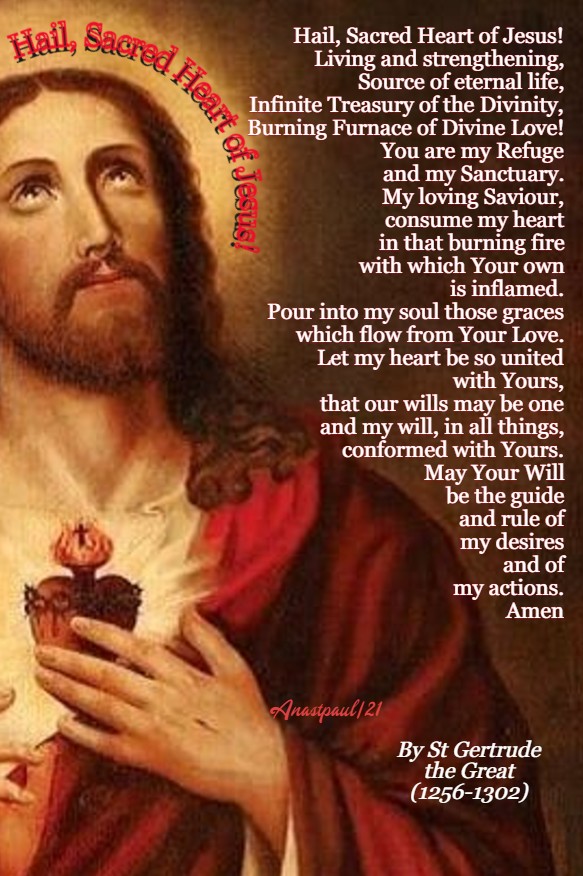
Hail, Sacred Heart of Jesus! By St Gertrude the Great (1256-1302)
Hail, Sacred Heart of Jesus! Living and strengthening, Source of eternal life, Infinite Treasury of the Divinity, Burning Furnace of Divine Love! You are my Refuge and my Sanctuary. My loving Saviour, consume my heart in that burning fire with which Your own is inflamed. Pour into my soul those graces which flow from Your Love. Let my heart be so united with Yours, that our wills may be one and my will, in all things, conformed with Yours. May Your Will be the guide and rule of my desires and of my actions. Amen
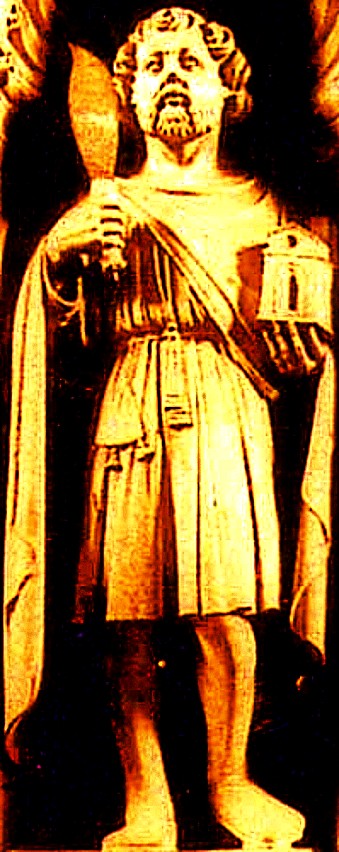
Saint of the Day – 1 June – Blessed Teobaldo Roggeri (c 1100-1150) Layman, Shoemaker, Porter, Apostle of the poor and needy, Penitent, Pilgrim Born in c 1100 in Vico, Liguria, Piedmont, Italy and died in 1150 of natural causes. Patronages – the Diocese of Alba, against fever, against sterility, Church cleaners, Cobblers, Porters, Shoemakers, Tradespeople. Also known as Theobald of Vico, Theobald of Alba, Teobaldo of Alba, Theobald Roggeris. The liturgical feast commonly occurs on 1 June but is also celebrated on 1 February with the “Feast of Remembrance” which opens with the nocturnal sound of the bells with which we remember the miracle of the bells which rang alone, without aid, when the tomb of our saint was re-discovered late at night on 31 January 1429.
The Roman Martyrology states of him today: “In Alba in Piedmont, Blessed Teobaldo, who, driven by love for poverty, gave all his possessions to a widow and became a porter out of a spirit of humility, to carry the burdens of others on himself.”
Teobaldo Roggeri was born in the Ligurian region to nobles from Piedmont. The careful reading and attentiveness to the Gospel caused him to abandon his noble status in favour of a simple and austere life. He was orphaned of both his parents during his childhood, so he set off for Alba in 1112 where he became an apprentice to a shoemaker.
Teobaldo worked as a cobbler and proved to be quite skilled in his trade which prompted the master, to hope in vain, that Teobaldo would wed his daughter, Virida and continue the business after his death. However, the apprentice instead made a private vow to remain chaste.
Teobaldo also worked as a porter and spent time transporting sacks of grain from place to place as part of his job. His master died in 1122 after a decade of working with Teobaldo. This prompted him to embark on a solemn pilgrimage – with a bundle and a staff – to the Santiago de Compostela Cathedral in Spain and he later returned to Alba to resume his work. He used his meager income to help the poor of his region and he often slept outside the local Church, until it would be opened to admit him to spend further time before Our Lord in the Tabernacle.
On one occasion the owner of the shoe store where he worked, asked that he take a sack of wheat to the mill to be ground into flour. He agreed but gave handful after handful to the poor people that he encountered along the path, to the point, where no more wheat remained. He lacked the courage to face the woman back at the store and refused to go back without something to return, so he filled the bag with sand and left it on the woman’s doorstep before running off. The woman found flour in the bag though later learned of what had happened. This began the tale of the “Miracle of the Flour” and happened not long before his death.
Repenting of having reacted with an indignant jerk to an offense received, he wanted to atone for all his remaining life and began to sleep on the bare stone of the steps of the Church of St Lorenzo, where he also began to serve as a Sacristan in the hours free from deliveries.
Teobado died in 1150 after contracting a serious illness while visiting the widow of his cobbler master, where he died under her roof. At his request ,he was buried in an unmarked patch of ground between the two Churches of San Lorenzo and San Silvestro. His grave became a place of pilgrimage and miracles. After several decades, his grave grew obscure and was overgrown and lost. His remains were rediscovered late in the evening of 21 January 1429, almost by inspiration, by the Bishop of Alba, Alerino Rambaudi;. The Church bells rang out on their own during the night pf 31 January 1429 in celebration of the discovery. This miracle is remembered by the marble plaque inserted on the wall. by the Bishop himself in the Chapel dedicated to the saint, in the Alba Cathedral, where the remains were later transferred. This discovery reignited the memory of this humble and holy man, servant of all and the miracles began again at his tomb. Blessed Teobald was Beatified in 1841 by Pope Gregory XVI (cultus confirmation).
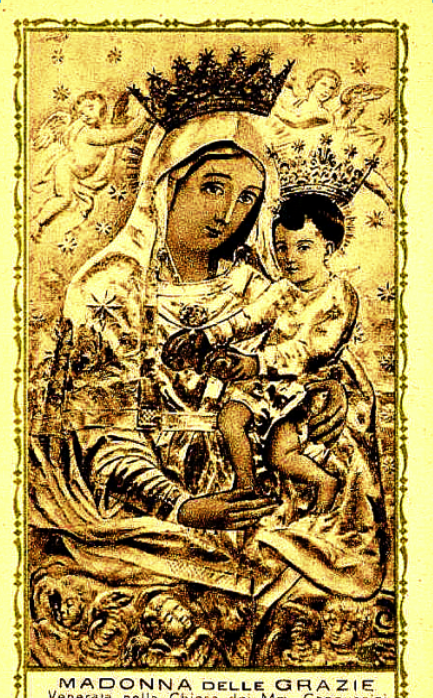
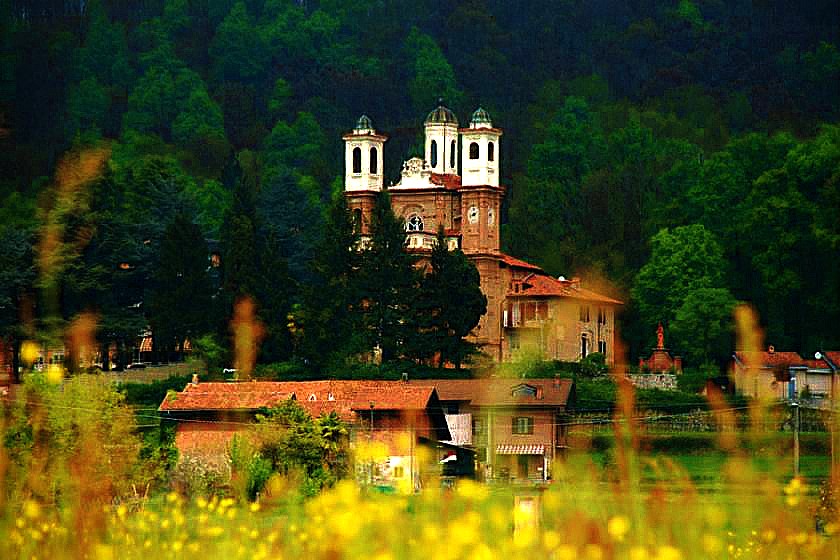
Madonna delle Grazie / Our Lady of Grace, Leini, Torino, Piedmont, Italy (1630) – 1 June:
13 km from Turin, a short distance from the highway to Ivrea, stands a famous Sanctuary. From impeccable evidence and documents, the Madonna appeared to a humble deaf-mute, placing the Rosary around his neck.
For 3 years, since 1627, a famine had ravaged the town of Leini and the surrounding areas followed by the Black Plague, reducing the town to a handful of families. On 1 June 1630, a farmworker, of the Regina family, deaf and dumb from birth, when returning from the fields stopped before the image of the Virgin and implored her: “… save Leini, Mary, Holy Mother, hear our prayer, save us …” She appeared to him with a smile in answer to his prayer and placed a Rosary around his neck. His tongue loosed and from his mouth came a Hymn of praise and thanksgiving to the Virgin. The first voice he ever heard was the Blessed Mother who told him: “… Go, announce, that in my honour a Church should be built in this place and I will ask my Son to stop the plague … “
He began running through the desolate streets shouting the news of the miracle and announcing that the plague had ceased, that the Blessed Virgin prayed for Leini. The few survivors heard the wonders of the miracle and joined with him in the Rosary prayer and supplication with thanksgiving. From that day the plague stopped, the sick were healed,and the survivors were thankful for the wonderful grace that the Virgin had given them. She had asked that they build a Sanctuary and the townspeople fulfilled their solemn promises. An inscription has been affixed on the front facade: “Sacellum hoc BM Gratiarum Virgini Matri against pestiferam emu to majoribus dicatum year 1630.”
The Church has become a famous pilgrimage destination where it is possible to admire inside, a gallery where numerous ex-votos accumulated over the years are collected. The structure was built immediately after the plague of the seventeenth century, to obtain protection from the Blessed Virgin, thanks to the people of Leini.
The Apparition and the Consecration of the Sanctuary are celebrated each year on 1 June and 15 August, the Feast of the Assumption, respectively.
Bl Arnald Arench Bl Arnold of Geertruidenberg St Atto of Oca St Candida of Whitchurch St Caprasius of Lérins St Clarus of Aquitaine St Claudius of Vienne Bl Conrad of Hesse St Conrad of Trier St Crescentinus St Cronan of Lismore St Damian of Scotland St Dionysius of Ruthenia St Donatus of Lucania St Felinus of Perugia Bl Ferdinand Ayala St Firmus St Fortunatus of Spoleto Bl Gaius Xeymon St Gaudentius of Ossero St Giuse Túc St Gratian of Perugia Bl Herculanus of Piegare St Iñigo of Oña St Ischryrion and Companions Bl James of Strepar St Jean-Baptiste-Ignace-Pierre Vernoy de Montjournal
Bl John Pelingotto Bl John Storey St Juventius Bl Leo Tanaka St Melosa St Pamphilus of Alexandria St Peter of Pisa St Porphyrius of Alexandria St Proculus of Bologna St Proculus the Soldier St Ronan St Secundus of Amelia St Seleucus of Alexandria St Simeon of Syracuse St Telga of Denbighshire St Thecla of Antioch Blessed Teobaldo Roggeri (c 1100-1150) Layman St Thespesius of Cappadocia St Wistan of Evesham St Zosimus of Antioch — Martyrs of Alexandria – 5 saints: A group five of imperial Roman soldiers assigned to guard a group of Egyptian Christians who were imprisoned for their faith in the persecutions of Decius. During their trial, they encouraged the prisoners not to apostatize. This exposed them as Christians, were promptly arrested and executed. Martyrs. Their names are – Ammon, Ingen, Ptolomy, Theophilis and Zeno. They were beheaded in 249 at Alexandria, Egypt.
Martyrs of Caesarea – 3 saints: Three Christians martyred together in the persecutions of Galerius. We know little more about them than the name – Paul, Valens and Valerius. They diedf in 309 at Caesarea, Palestine.
Martyrs of Lycopolis – 6 saints: Five foot soldiers and their commander who were martyred for their faith by order of the imperial Roman prefect Arriano during the persecutions of Decius. In Lycopolis, Egypt.
Martyrs of Rome – 6 saints: A group of spiritual students of Saint Justin Martyr who died with him and about whom we know nothing else but their names – Carito, Caritone, Evelpisto, Ierace, Liberiano and Peone. In Rome, Italy.


















 AnaStpaul
You must be logged in to post a comment.