Thought for the Day – 5 March – Meditations with Antonio Cardinal Bacci (1881-1971)
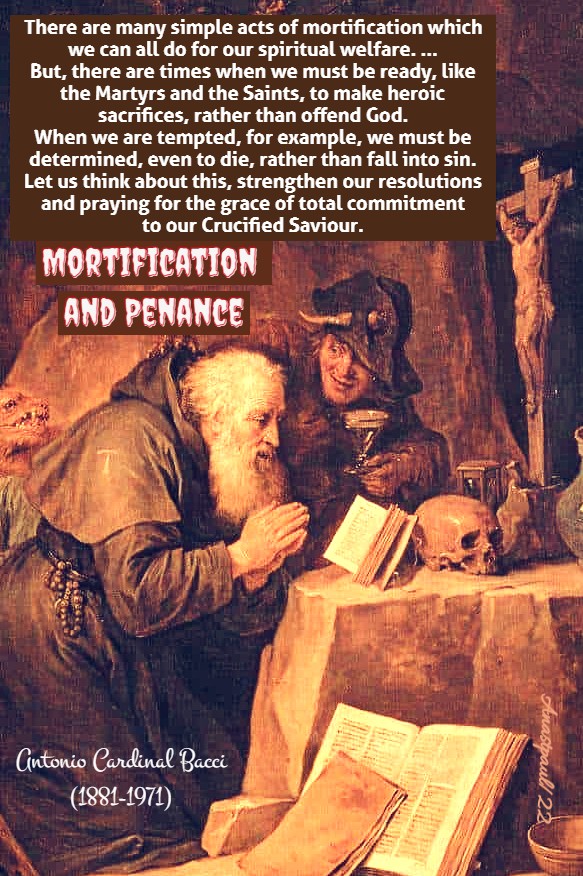
Mortification and Penance
“There are many simple acts of mortification which we can all do for our spiritual welfare. For example, we can remain silent when there is no need to speak; we can deprive ourselves of dainties at table and we can act humbly, when oyer pride is hurt or patiently when we think we have been offended. These are easy ways in which men of goodwill can practise mortification.
But, there are times when we must be ready, like the Martyrs and the Saints, to make heroic sacrifices, rather than offend God. When we are tempted, for example, we must be determined, even to die, rather than fall into sin. Let us think about this, strengthen our resolutions and praying for the grace of total commitment to our Crucified Saviour.”
First Saturday of Lent – 5 March – Our Lenten Journey with the Great Fathers
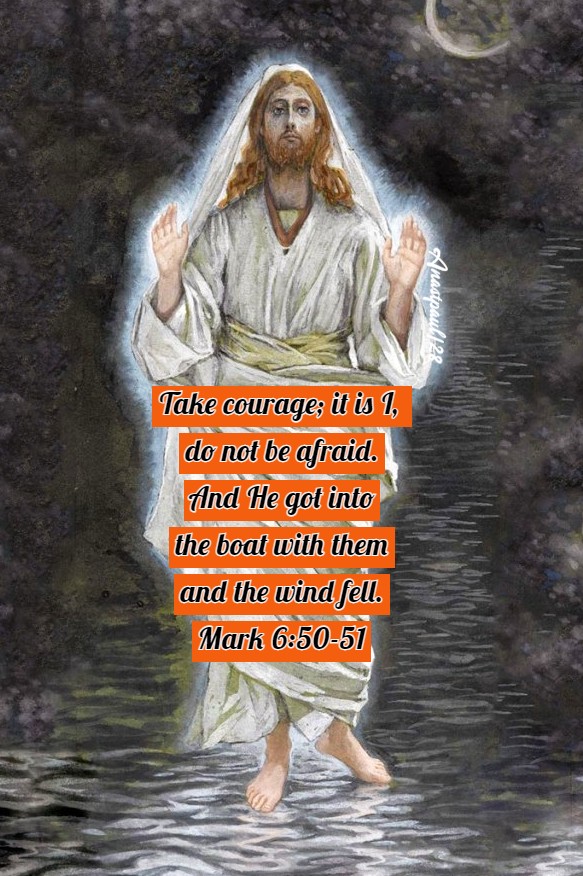
“Take courage; it is I, do not be afraid. And He got into the boat with them and the wind fell.”
Mark 6:50-51
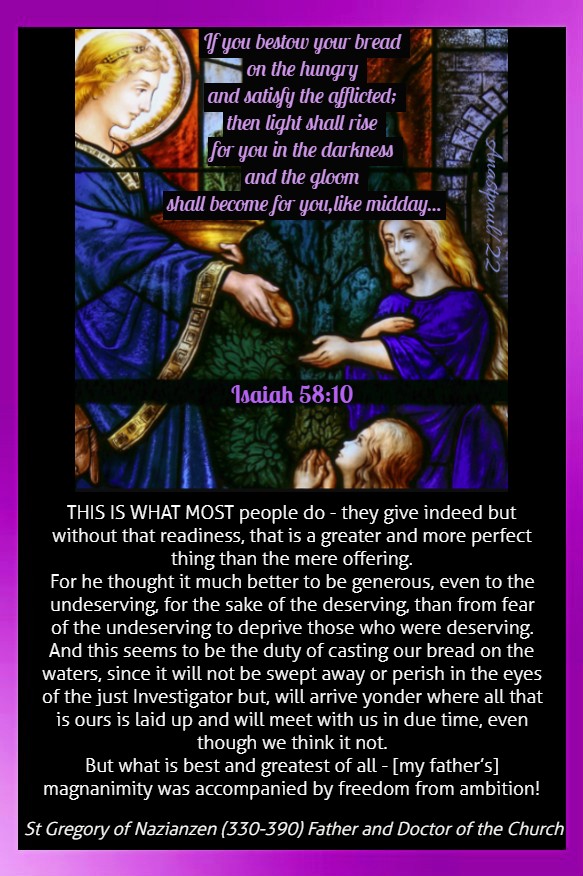
“If you bestow your bread on the hungry and satisfy the afflicted; then light shall rise for you in the darkness and the gloom shall become for you,like midday…”
Isaiah 58:10
[My father] actually treated his own property, as if it were another’s, of which he was but the steward, relieving poverty, as far as he could and expending, not only his superfluities but his necessities — a manifest proof of love for the poor, giving a portion, not only to seven, according to the injunction of Solomon but, if an eighth came forward, not even in his case being mi8serly but, more pleased to dispose of his wealth, than we know others are to acquire it.
THIS IS WHAT MOSTpeople do – they give indeed but without that readiness, that is a greater and more perfect thing than the mere offering. For he thought it much better to be generous, even to the undeserving, for the sake of the deserving, than from fear of the undeserving to deprive those who were deserving. And this seems to be the duty of casting our bread on the waters, since it will not be swept away or perish in the eyes of the just Investigator but, will arrive yonder where all that is ours is laid up and will meet with us in due time, even though we think it not.
But what is best and greatest of all – [my father’s] magnanimity was accompanied by freedom from ambition!– St Gregory of Nazianzen (330-390) Archbishop of Constantinople, Father and Doctor of the Church (On the Death of His Father [Oration 18], 20).
Quote/s – 5 March – The First Saturday of Lent – Isaiah 58:9-14, Mark 6:47-56
“Thus says the Lord God: If you remove from your midst oppression, false accusation and malicious speech. if you bestow your bread on the hungry and satisfy the afflicted; then light shall rise for you in the darkness and the gloom shall become for you,like midday; then the Lord will guide you always and give you plenty, even on the parched land. He will renew your strength and you shall be like a watered garden, like a spring whose water never fails.”
Isaiah 58:9-11
“… If you hold back your foot on the Sabbath from following your own pursuits on My holy day, if you call the Sabbath a delight and the Lord’s Holy Day honourable; if you honour it, by not following your ways, seeking your own interests, or speaking with malice – then you shall delight in the Lord …”
Isaiah 58:13-14
“Take courage; it is I, do not be afraid. And He got into the boat with them and the wind fell.”
One Minute Reflection – 5 March – The First Saturday of Lent – Isaiah 58:9-14, Mark 6:47-56
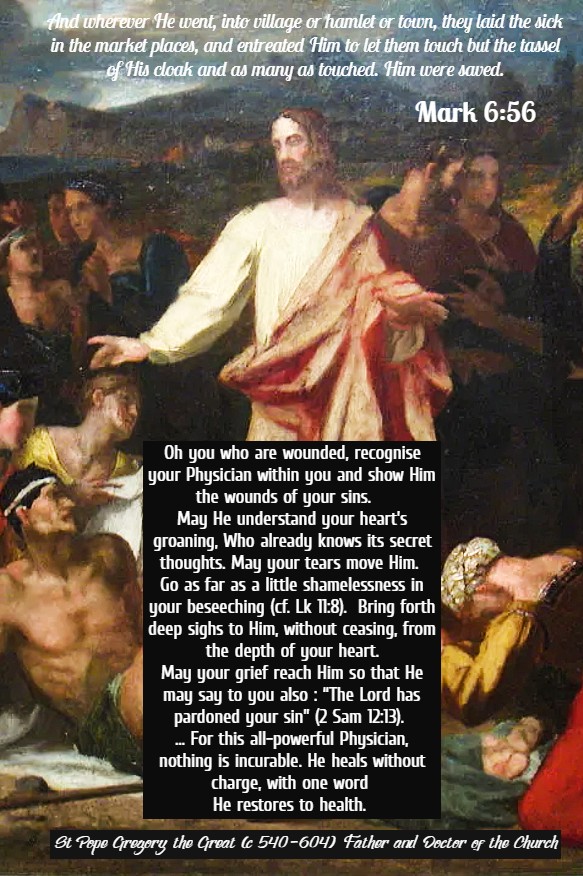
“And wherever He went, into village or hamlet or town, they laid the sick in the market places, and entreated Him to let them touch but the tassel of His cloak and as many as touched. Him were saved. ” – Mark 6:56
REFLECTION – “Let us set before our interior consideration, someone gravely wounded who is about to breathe his last. … Now, the soul’s wound is sin, of which Scripture speaks in these terms: “Wound and welt and gaping gash, not drained or bandaged or eased with salve” (Is 1:6). Oh you who are wounded, recognise your Physician within you and show Him the wounds of your sins. May He understand your heart’s groaning, Who already knows its secret thoughts. May your tears move Him. Go as far as a little shamelessness in your beseeching (cf. Lk 11:8). Bring forth deep sighs to Him, without ceasing, from the depth of your heart. May your grief reach Him so that He may say to you also : “The Lord has pardoned your sin” (2 Sam 12:13). Cry out with David, who said: “Have mercy on me, O God, in … the greatness of your compassion” (Ps 50[51]:3). It is as though one were to say: “I am in great danger because of an enormous wound, that no doctor can cure, unless the all-powerful Physician comes to help me.” For this all-powerful Physician, nothing is incurable. He heals without charge, with one word, He restores to health. I would have despaired of my wound, were it not that I placed my trust in the Almighty.” – St Pope Gregory the Great (c 540-604) Father and Doctor of the Church (Commentary on Psalm 50[51])
PRAYER – Hear, O Lord, our humble prayers and grant that we may devoutly keep this fast that has been established to cure our souls and bodies. Through Jesus Christ, Thy Son our Lord, Who lives and reigns with Thee, in the unity of the Holy Ghost, God, world without end. Amen (Collect).
Our Morning Offering – 5 March – The First Saturday of Lent
Shelter Me Under Thy Mantle, Refuge of Sinners By St Alphonsus Liguori (1696-1787) Most Zealous Doctor
Most holy Virgin Immaculate, my Mother Mary, to thee, who art the Mother of my Lord, the Queen of the Universe, the Advocate, the Hope, the Refuge of sinners, I, who am the most miserable of all sinners, have recourse this day. I venerate thee, great Queen and I thank thee for the many graces thou hast bestowed upon me, even unto this day, in particular, for having delivered me from the hell which I have so often deserved by my sins. I love thee, my dearest Lady and because of that love, I promise to serve thee willingly forever and to do what I can to make thee loved by others. I place in thee all my hopes for salvation, accept me as thy servant and shelter me under thy mantle, thou, who art the Mother of Mercy. And since thou are so powerful with God, deliver me from all temptations, or at least, obtain for me the strength to overcome them until death. From thee, I implore, a true love for Jesus Christ. Through thee, I hope to die a holy death. My dear Mother, by thy love for Almighty God, I pray thee to assist me always but most of all, at the last moment of my life. Forsake me not then, until thou shalt see me safely in Heaven, there to bless thee and sing of thy mercies, throughout all eternity. Such is my hope. Amen
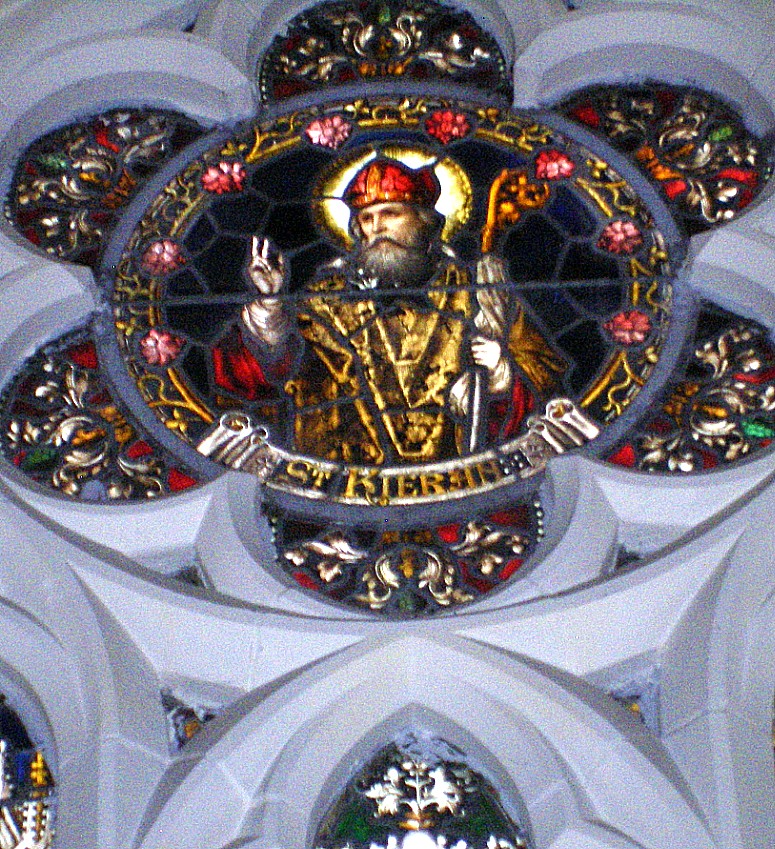
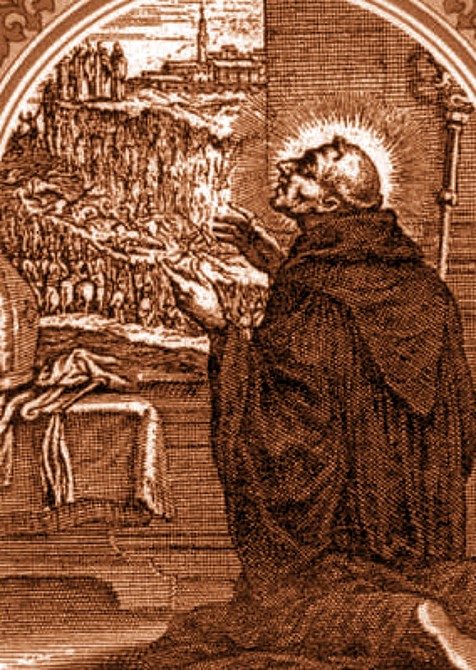
Saint of the Day – 5 March – Saint Kieran (Died c 530) Bishop, one of the Twelve Apostles of Ireland born in Corca-Laighde (modern Cape Clear), Ireland and died c 530 of natural causes. Patronage – Diocese of Ossory, Ireland. Also known as – Kieran of Saighir, Kieran of Seirkeiran, Kieran the Elder, Kieran Saighir, Kieran mac Luaigne, First-born of the Saints of Ireland, Ceran, Chierano, Ciarán, Ciarano, Ciaranus, Kenerin, Kerrier, Kevin, Kieren, Kiernan, Kieron, Kyran, Queran, Queranus. Additional Memorial ON 6 January as one of the Twelve Apostles of Ireland. Kieran is the first person born in Ireland to be Canonised.
Kieran was born in Ireland, possibly on Cape Clear Island. Historians disagree on his date of birth, although most sources place him in the fifth or sixth century. His father’s name was Laighne and his mother was Liadain. At that time, the Irish were pagans. Many legends exist concerning the events of Kieran’s life. One says that when his mother was pregnant with Kieran, she had a dream that a star fell from heaven and came to rest upon her. People said this meant tthat he baby she carried would have a special purpose.
When Kieran was a child, he was kind and gentle. He loved animals and they, in turn, trusted him. Several of the stories about Kieran tell of his ability to tame wild animals and he is often shown with a badger, a doe and a fox.
Kieran wanted to learn more about God, so when he was thirty years old he went to Rome, the centre of Christianity. He spent several years there, studying. Kieran was Baptised a Christian and later Ordained a Priest. Legends disagree about whether Kieran was Consecrated a Bishop in Rome or later in Ireland. Many stories say that St. Patrick (c 386-461) met with Kieran in Rome and commissioned him to return to Ireland and build a Monastery. One legend tells of St. Patrick giving Kieran a bell that rang for the first time when he reached the sight of a holy well in Saighir and there he built his Church. This became renowned as a holy place and many of the ancient Kings of Ossory were buried there.
Legend tells that Kieran had hoped to live a life of solitude and upon his return to Ossary he dwelt in a cave where he spent much of his time in prayer. As the story goes, he befriended the animals who come to him when they were ill or hurt. People began to hear of his powers of healing. He ministered to the people and soon had a following. Kieran built a Monastery in Ossary and the Town of Saighir grew up around it. Kieran served the people as Bishop of Ossory until his death.
The ruins of the original Church, the well round the fountain and other holy sites related to St Kieran can be seen today in Saighir, Ossory, Ireland. In Ireland, his name is spelled Ciaran, pronounced “Kigh-ran” of “Sigh-gear.” He is also called St. Kieran the Elder, to distinguish from Saint Kieran of Clonmacnoise.
St Adrian of Caesarea St Caron St Carthach the Elder Bl Christopher Macassoli of Vigevano St Clement of Santa Lucia St Colman of Armagh St Conon of Pamphylia Bl Conrad Scheuber St Eusebius of Cremona St Eusebius the Martyr St Gerasimus Bl Giovanna Irrizaldi Bl Ion Costist
Thought for the Day – 4 March – Meditations with Antonio Cardinal Bacci (1881-1971)
How We Should Pray
“We must pray with deep humility. Once again we find, that the Man-God Jesus, has given us an example. In Gethsemane He fell prostate on the ground and begged that, if it were possible, the bitter chalice might be taken away from Him. Immediately He added. with full submission to the will of His Heavenly Father – “Yet, not my will but thine be done” (Lk 22:42). Let us remember, moreover, the parable of the Pharisee and the publican. The former appeared to be full of virtue but he was proud and was rejected. The latter, recognised in all humility, that he was a poor sinner and he was exalted. “Everyone who exalts himself shall be humbled and he who humbles himself shall be exalted” (Lk 14:11). “God resists the proud but gives grace to the humble” (Js 4:6). “The prayer of the lowly pierces the clouds; it does not rest, until t reaches its goal” (Ecclus 35:17).
When we kneel down to pray, therefore, we should make an Act of Humility. We are poor beggars, as St Augustine puts it, before the throne of God. Let us pray with confidence in God’s goodness but also with a proper realisation of our own helplessness. Then God will take pity on us.
First Friday of Lent – 4 March – Our Lenten Journey with the Great Fathers – Isaiah 58:1-9, Matthew 5:43-38,6:1-4
“One thing I ask the Lord; this I seek: to dwell in the house of the Lord.”
Psalm 26:4
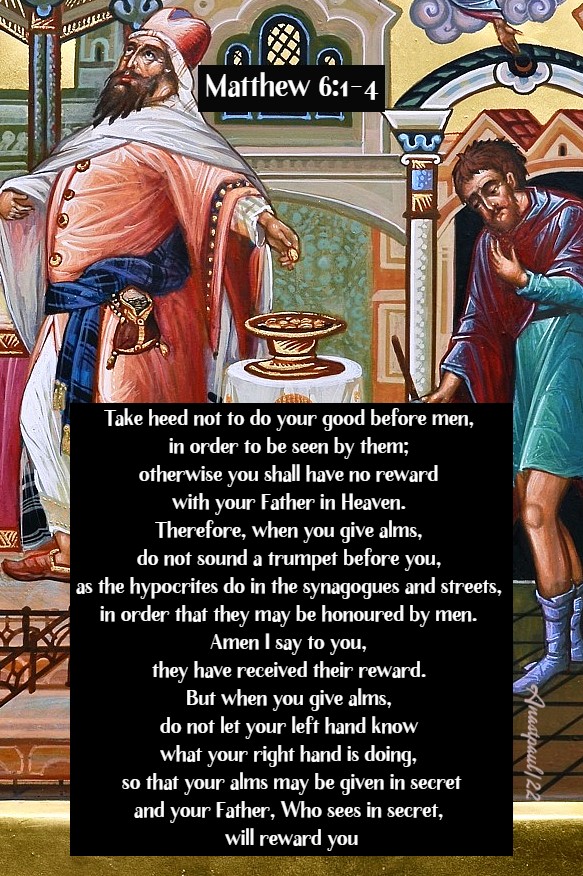
“Take heed not to do your good before men, in order to be seen by them; otherwise you shall have no reward with your Father in Heaven.”
Matthew 6:1
AND WHAT KIND OF CHRISTIAN is itwho will not fast, at least until None (the mid-afternoon Breviary hour), during this season? Recall how the Ninevites required even of children at the breast that they too should fast and their flocks and herds likewise, that all might be delivered from the danger that threatened them. What kind of Christian is he who, although well and able refuses to fast with … the Lord? They will say: We cannot both work and fast. They cannot because they WILL NOT. Then let them work less that they may fast more. I warn you and I exhort you in the Lord, that none among you, unless a sick person or a child, eat or drink before the hour of Nones, except on Sundays.
I COUNSEL YOU ALSO, that he who is near the Church and can come, should hear Mass each day. And that he who can, should come each evening to the recitation of Vespers. Let those who live far from the Church try to come to Vespers each Sunday at least …
LET HIM who has HATE in his heart, or anger, against another, put it wholly from himself, if he wishes to be saved. … And you must understand, that whatever it is that you deny yourself through fasting must be given entirely to the poor, not kept back for yourselves!
MAY ALMIGHTY GOD grant, that you keep before you what I have told you and that you fulfil it … so that at the end of this life and at the close of your labours, you may enter into eternal rest. May He grant you this, Who created you and sought at the price of His own Blood to redeem you, Who lives and reigns world without end. Amen. – St John Chrysostom (347-407) Archbishop of Constantinople, Father and Doctor of the Church
Quote/s of the Day – 4 March – First Friday of Lent – Isaiah 58:1-9, Matthew 5:43-38,6:1-4
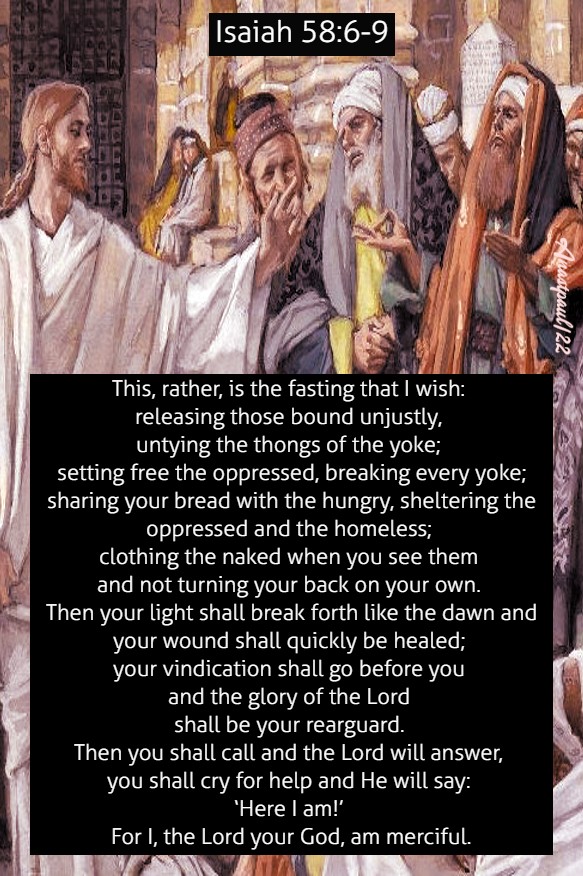
“This, rather, is the fasting that I wish: releasing those bound unjustly, untying the thongs of the yoke; setting free the oppressed, breaking every yoke; sharing your bread with the hungry, sheltering the oppressed and the homeless; clothing the naked when you see them and not turning your back on your own. Then your light shall break forth like the dawn and your wound shall quickly be healed; your vindication shall go before you and the glory of the Lord shall be your rearguard. Then you shall call and the Lord will answer, you shall cry for help and He will say: ‘Here I am!’ For I, the Lord your God, am merciful.”
Isaiah 58:6-9
“Take heed not to do your good before men, in order to be seen by them; otherwise you shall have no reward with your Father in Heaven. Therefore, when you give alms, do not sound a trumpet before you, as the hypocrites do in the synagogues and streets, in order that they may be honoured by men. Amen I say to you, they have received their reward. But when you give alms, do not let your left hand know what your right hand is doing, so that your alms may be given in secret and your Father, Who sees in secret, will reward you.”
One Minute Reflection – 4 March – First Friday of Lent – Isaiah 58:1-9, Matthew 5:43438,6:1-4 and the Memorial of St Casimir- (1458-1484)
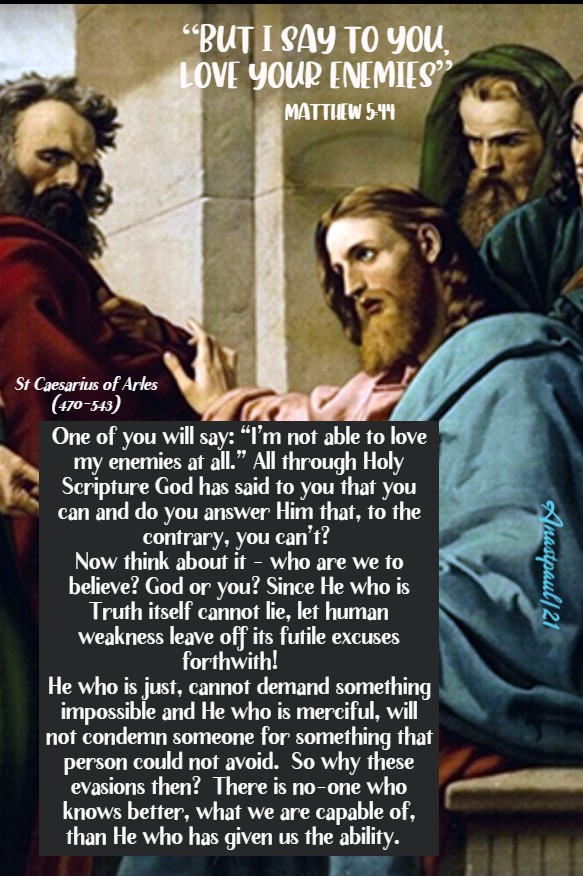
“But I say to you, love your enemies” – Matthew 5:44
REFLECTION – “One of you will say: “I’m not able to love my enemies at all.” All through Holy Scripture God has said to you that you can and do you answer Him that, to the contrary, you cannot!? Now think about it – who are we to believe? God or you? Since He who is Truth itself cannot lie, let human weakness leave off its futile excuses forthwith! He who is just, cannot demand something impossible and He who is merciful, will not condemn someone for something that person could not avoid. So why these evasions then? There is no-one who knows better, what we are capable of, than He who has given us the ability. Such numbers of men, women, children, tender young girls, have borne flames, fire, sword and the wild beasts for Christ’s sake, without flinching and we, do we say that we cannot bear the insults of unintelligent persons?…
Indeed, if only the good are to be loved, what are we to say of the action of our God, of whom it is written: “God so loved the world that he gave his only Son?” (Jn 3,16). For what good deeds are they, that the world had done, for God to love it so? Christ our Lord, found us all to be, not only evil but even dead, on account of original sin and yet… “he loved us and handed himself over for us” (Eph 5,2). In so acting, He loved even those who did not love Him, as the Apostle Paul also says: “Christ died for the guilty” (Rm 5,6). And in his inexpressible mercy, He gave this example to all humankind, saying: “Learn from me, for I am gentle and humble of heart” (Mt 11,29).” – St Caesarius of Arles (470-543) Bishop and Monk – Sermons to the people, no 37
PRAYER – Almighty God, to whom this world, with all it’s goodness and beauty belongs, give us grace joyfully, to begin this day for Christ Your Son, in Him and with Him and to fill it, with an active love for all Your children, even those who may not like or who do us harm. Help us to love as You do, so that we may become like You. St Casimir, you who spread your charity abundantly in your short life and continue to do so now from Heaven, pray for us. Through Christ our Lord, with the Holy Spirit, one God, forever, amen.
Our Morning Offering – 4 March – First Friday of Lent
Prayer Before a Crucifix
Look down upon me, good and gentle Jesus, while before Thy face I humbly kneel and, with burning soul, pray and beseech Thee to fix deep in my heart lively sentiments of faith, hope and charity; true contrition for my sins and a firm purpose of amendment. While I contemplate, with great love and tender pity, Thy Five Most Precious Wounds, pondering over them within me and calling to mind the words which David, Thy prophet, said of Thee, my Jesus: “They have pierced My hands and My feet, they have numbered all My bones.” Amen
This Prayer is often said after Holy Mass before the Crucifix in the Church. The faithful receive a Partial Indulgence but on the Fridays of Lent, the Indulgence is a Plenary Indulgence, under the usual conditions.
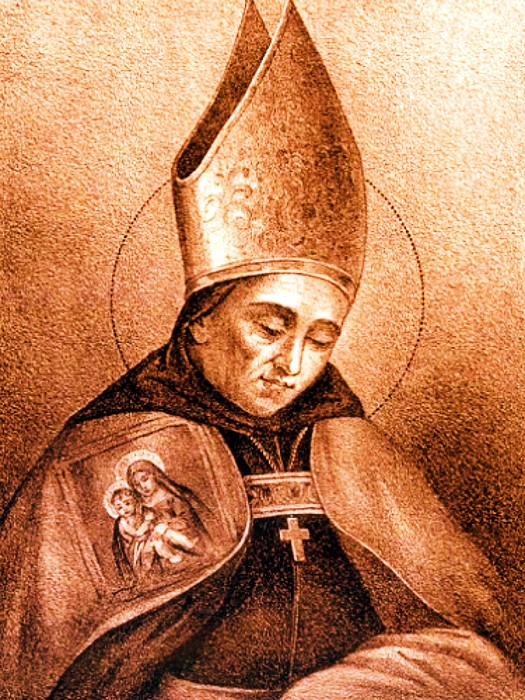
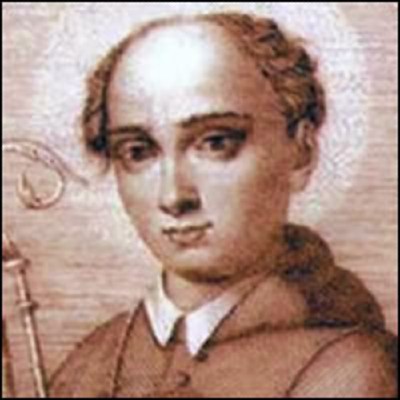
Saint of the Day – 4 March – Saint Peter of Pappacarbone (c 1038-1123) Bishop, Abbot, Reformer. Born in Salerno, Italy and died in 1123 of natural causes. Patronage – Policastro, Italy. Also known as – Pieror de Cava, Peter of La Cava, Peter I of Cava.
The Roman Martyrology reads: “In the Monastery of Cava de Tirreni in Campania, St Peter, Abbot, admirably renewed the discipline.”
Peter was a native of Salerno in Italy, a nephew of St Alferius, founder of the Monastery of Cava. Peter entered the religious life at a very early age under St Leo, the 2nd Abbot of Cava. He distinguished himself at once by his piety, mortifications and love of solitude.
At this time, the fame of the Abbey of Cluny had spread far and wide, and the young monk was so attracted by what he had heard, that in about 1062 he obtained Permission to leave Cava and go to France to investigate the way of life at Cluny When the older Monks at Cluny would have sent him to the school to be trained, their Abbot, St Hugh disagreed, saying that Peter might be young in years but that he was a full-grown man in devotion. The Abbot’s opinion was abundantly justified, for Peter proved himself well amongst that household of holy men and he remained there for some six years.
He was then recalled to Italy, having been released by St Hugh apparently at the request of the Archdeacon of Rome, Hildebrand (who was afterwards Pope St Gregory VII). Peter was appointed the first Bishop of Policastro but he found himself unfitted for the turmoil of the world and for the secular cares which devolved upon him. He obtained permission to resign and retired to Cava, where Abbot Leo, realising that he himself was becoming too old to govern, nominated him as his successor and withdrew. The Monks, by their votes, had confirmed the election of their new superior but soon found the strict rule he had brought from Cluny extremely irksome: they began to murmur and rebel and some of them carried their complaints to the aged Leo in his retirement.
Peter, far from resisting and equally far from relaxing the rule, quietly left and betook himself to another Monastery. It was not long before the Monks of Cava, urged by Abbot Leo, came to entreat Peter to return, which he consented to do. Thereafter it was remarked, that those who had the most vehemently opposed him ,were now foremost in welcoming the rule they had previously spurned.
Under the government of Abbot Peter the Monastery flourished amazingly. Not only did numbers of aspirants to the religious life, flock to him from all sides but men and women in the world, showered money and lands upon the community, which was then enabled to minister far and wide, to the sick and the poor. The Abbey itself had to be enlarged to admit the new members and a new Church was built, to the dedication of which, came Pope Urban II, who had been with Peter at Cluny and had remained his close friend. The description of this occasion was preserved in the chronicles of Cava, where it is stated that Blessed Urban talked freely with the Abbot and Monks, as though “forgetting that he was the Pope.”
Peter lived to a great age and died in 1123. He was succeeded by St Constabilis, who had served as Peter’s Assistant and Auxiallary.
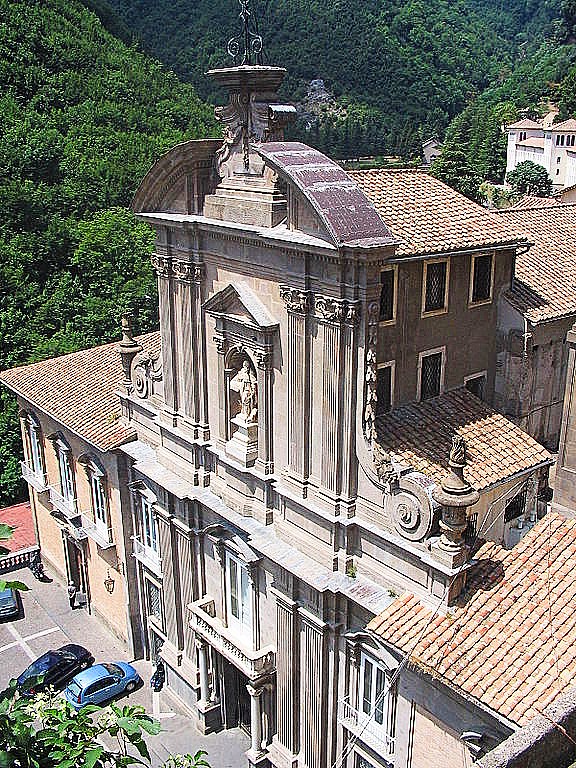
The Abbey of Cava still exists and in 1912 the Monks gave proof of their devotion to the Founders of their observance by reprinting, from the unique ancient manuscript in their possession, the Lives of the Saints Alferius, Peter and two other early Sainted Abbots, purporting to be written by Hugh of Venosa, a younger contemporary of St Peter. It is to this biography, which may be found in the Acta Sanctorum (March, vol. i), that we owe all our knowledge of St Peter of Cava.
The first four Abbots of Cava were officially recognised and Canonised as Saints on 21 December 1893, by Pope Leo XIII. They are Alferius, the Founder and first Abbot (1050), Leo I (1050–79), Peter of Pappacarbone (1079–1123) and Constabilis (1122-1124). Their relics rest in the Abbey Church in the Chapel of the Saintly Fathers.’
St Adrian of May St Adrian of Nicomedia Bl Alexander Blake St Appian of Comacchio St Arcadius of Cyprus St Basinus of Trier Bl Christopher Bales St Felix of Rhuys St Gaius of Nicomedia Bl Humbert III of Savoy St Leonard of Avranches St Nestor the Martyr St Owen Bl Paolo of Brescia St Peter of Pappacarbone (c 1038-1123) Bishop
Martyrs on the Appian Way – 900 Saints – Group of 900 Martyrs buried in the Catacombs of Saint Callistus on the Appian Way, Rome, Italy.c 260
Martyrs of Nicomedia – 20 Saints – A group of 20 Christians murdered together for their faith. The only details about them to survive are three of their names – Archelaus, Cyrillos and Photius. Nicomedia, Bithynia (in modern Turkey)
Martyrs of the Crimea – 7 Saints – A group of 4th century missionary Bishops who evangelised in the Crimea and southern Russia, and were Martyred for their work. We know little else beyond the names – Aetherius, Agathodorus, Basil, Elpidius, Ephrem, Eugene and Gapito.
Martyred in the Spanish Civil War: Bl Pedro Ruiz Ortega, Bl Pere Roca Toscas
Thought for the Day – 3 March – Meditations with Antonio Cardinal Bacci (1881-1971)
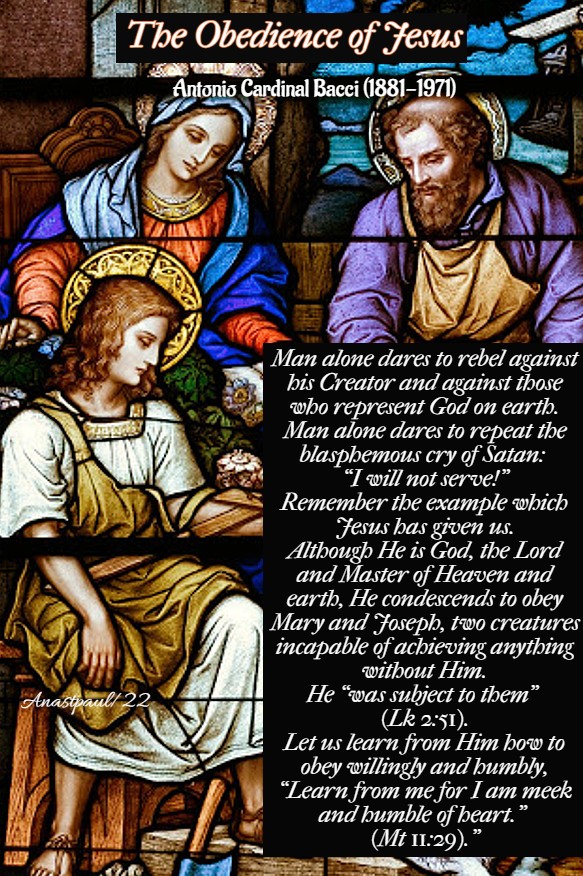
The Obedience of Jesus
“Obedience is an universal rule, without which, there could be no harmony in the world. All creatures and all creation, obey the laws of nature laid down by their Creator. The sun rises in the east, moves along its accustomed path everyday and every season and sets in the west. The stars never leave the order arranged for them by the Hand of God. The waves of the sea toss about when disturbed by the strength of the wind but, they fall back again without ever crossing the boundaries which God has set for them.
Man alone dares to rebel against his Creator and against those who represent God on earth. Man alone dares to repeat the blasphemous cry of Satan: “I will not serve!”
Remember the example which Jesus has given us. Although He is God, the Lord and Master of Heaven and earth, He condescends to obey Mary and Joseph, two creatures incapable of achieving anything without Him. He “was subject to them” (Lk 2:51).
Let us learn from Him how to obey willingly and humbly, “Learn from me for I am meek and humble of heart.” (Mt 11:29).”
First Thursday of Lent – 3 March – Our Lenten Journey with the Great Fathers – Isaiah 38:1-6, Matthew 8:5-13
To You, O Lord, I lift up my soul: in You, O my God, I trust …
Psalm 24:1
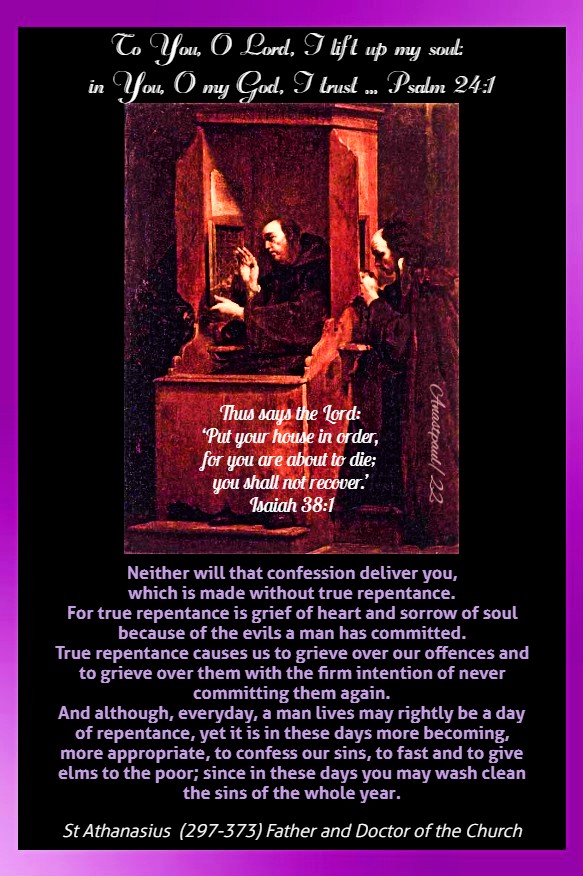
“In those days, when Hezekiah was mortally ill, the prophet Isaiah … came and said to him; Thus says the Lord: ‘Put your house in order, for you are about to die; you shall not recover.’
Isaiah 38:1
BEHOLD, NOW IS THE APPOINTED TIME, in which you must confess your sins to God and to the priest and by prayer and by fasting, by tears and by almsgiving, wipe them away. Why should a sinner be ashamed to make known his sins, since they are already known and manifest to God and to His angels and even to the blessed in heaven?
CONFESSION delivers the soul from death. Confession opens the door to heaven. Confession brings us hope of salvation. Because of this, the Scripture says: First tell thy iniquities that you may be justified (Is. xliii. Here we are shown, that the man will not be saved, who, during his life, does not confess his sin. Neither will that confession deliver you, which is made without true repentance. For true repentance is grief of heart and sorrow of soul because of the evils a man has committed. True repentance causes us to grieve over our offences and to grieve over them with the firm intention of never committing them again.
And although, everyday, a man lives may rightly be a day of repentance, yet it is in these days more becoming, more appropriate, to confess our sins, to fast and to give elms to the poor; since in these days you may wash clean the sins of the whole year. Therefore, I counsel all of you and I exhort each one of you singly, to repair, whatever you know within your soul, is blameworthy. Whosoever among you discerns, within himself, what is unworthy in a Christian, let him correct it. … St Athanasius (297-373) Archbishop of Alexandria, Father and Doctor of the Church (The Season of Lent).
Quote/s of the Day – 3 March – The First Thursday of Lent – Isias 38:1-6, Matthew 8:5-13
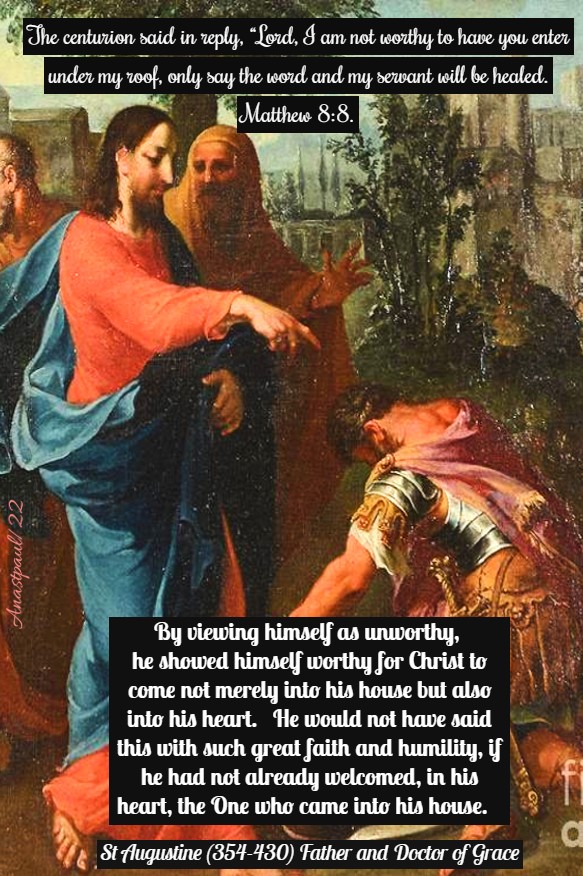
“The centurion said in reply, “Lord, I am not worthy to have you enter under my roof; only say the word and my servant will be healed.”
Matthew 8:8
“Take my yoke upon you and learn from me, for I am meek and humble of heart and you will find rest for your souls…”
Matthew 11:29
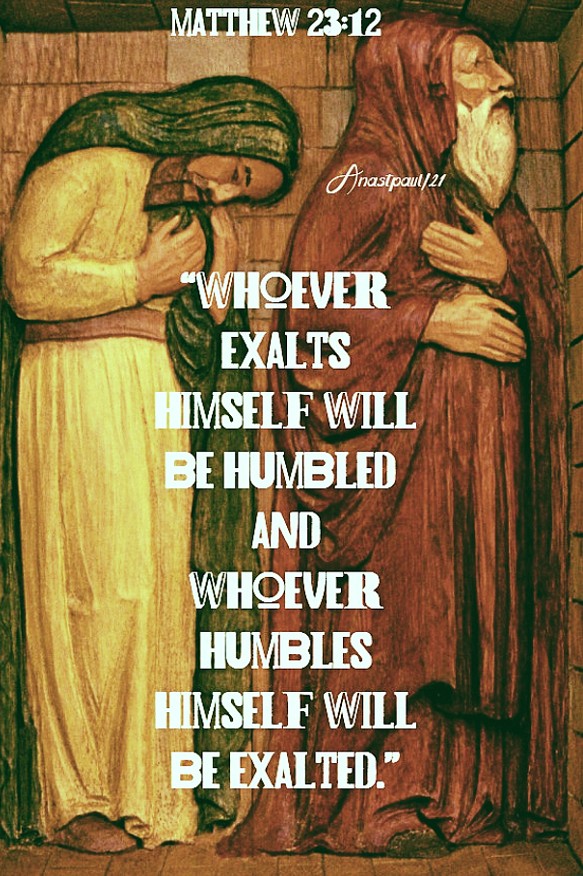
“Whoever exalts himself will be humbled and whoever humbles himself will be exalted.”
Matthew 23:12
“For the Master of humility, both by word and example, sat down also, in the house of a certain proud Pharisee, Simon and although He sat down in his house, there was no place in his heart. For in his heart. the Son of Man could not lay His head.”
St Augustine (354-430) Father and Doctor of Grace
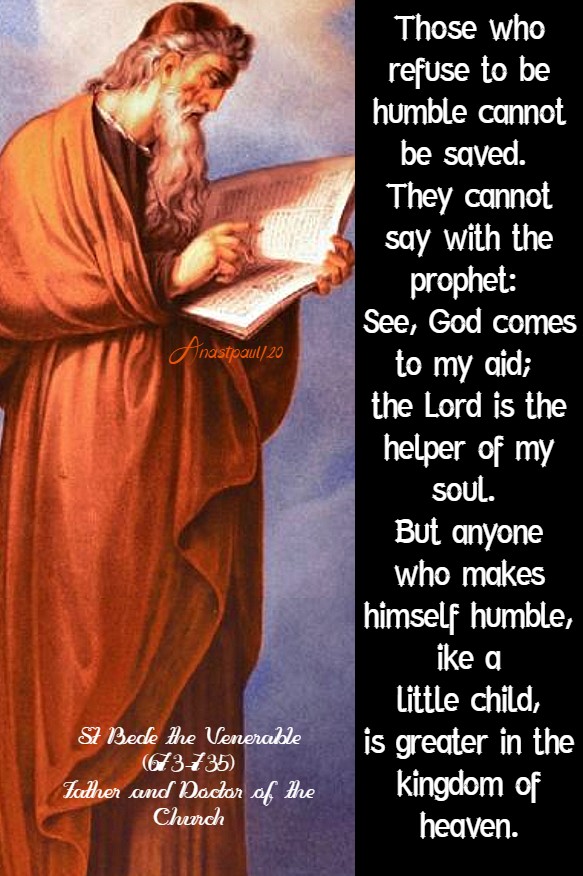
“Those who refuse to be humble cannot be saved. They cannot say with the prophet: See, God comes to my aid; the Lord is the helper of my soul. But anyone who makes himself humble, like a little child, is greater in the kingdom of heaven.”
St Bede the Venerable (673-735) Father and Doctor if the Church
“ … If you die with Him, you shall also likewise live with Him. If you are His companion in punishment, so shall you be in glory.”
Thomas à Kempis (1380-1471)
“Humility is not just about self-mistrust but about the entrusting of ourselves to God. Distrusting ourselves and our own strength produces trust in God and from that trust, generosity of soul is born.”
One Minute Reflection – 3 March – The First Thursday of Lent – Isaiah 38:1-6, Matthew 8:5-13
“The centurion said in reply, “Lord, I am not worthy to have you enter under my roof, only say the word and my servant will be healed.” – Matthew 8:8.
REFLECTION – “When the Lord promised to go to the centurion’s house to heal his servant, the centurion answered, “Lord, I am not worthy to have you come under my roof but only say the word, and my servant will be healed.” By viewing himself as unworthy, he showed himself worthy for Christ to come not merely into his house but also into his heart. He would not have said this with such great faith and humility, if he had not already welcomed, in his heart, the One who came into his house. It would have been no great joy for the Lord Jesus to enter into his house and not to enter his heart. For the Master of humility, both by word and example, sat down also in the house of a certain proud Pharisee, Simon and although he sat down in his house, there was no place in his heart. For in his heart the Son of Man could not lay his head.” – St Augustine (354-430) Father and Doctor of Grace (Sermon 62)
PRAYER – O God, offended by sin and appeased by penitence, graciously hear the prayers of Your people as they entreat You, to turn away from us the scourges of anger that we have deserved because of our sins. Through Jesus Christ, Thy Son our Lord, Who lives and reigns with Thee, in the unity of the Holy Ghost, God, world without end. Amen (Collect).
Our Morning Offering – 3 March – The First Thursday of Lent
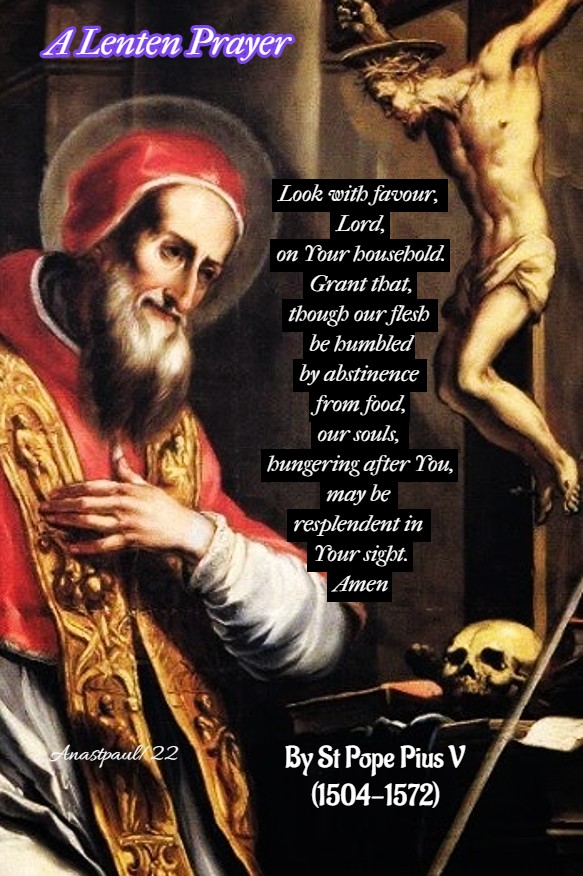
A Lenten Prayer By St Pope Pius V (1504-1572)
Look with favour, Lord, on Your household. Grant that, though our flesh be humbled by abstinence from food, our souls, hungering after You, may be resplendent in Your sight. Amen
St Pius V is the Pope of the Council of Trent, the Counter Reformation, the excommunication of Elizabeth I for Heresy and persecution of English Catholics and of the Battle of Lepanto, amongst many other illustrious and holy achievements.
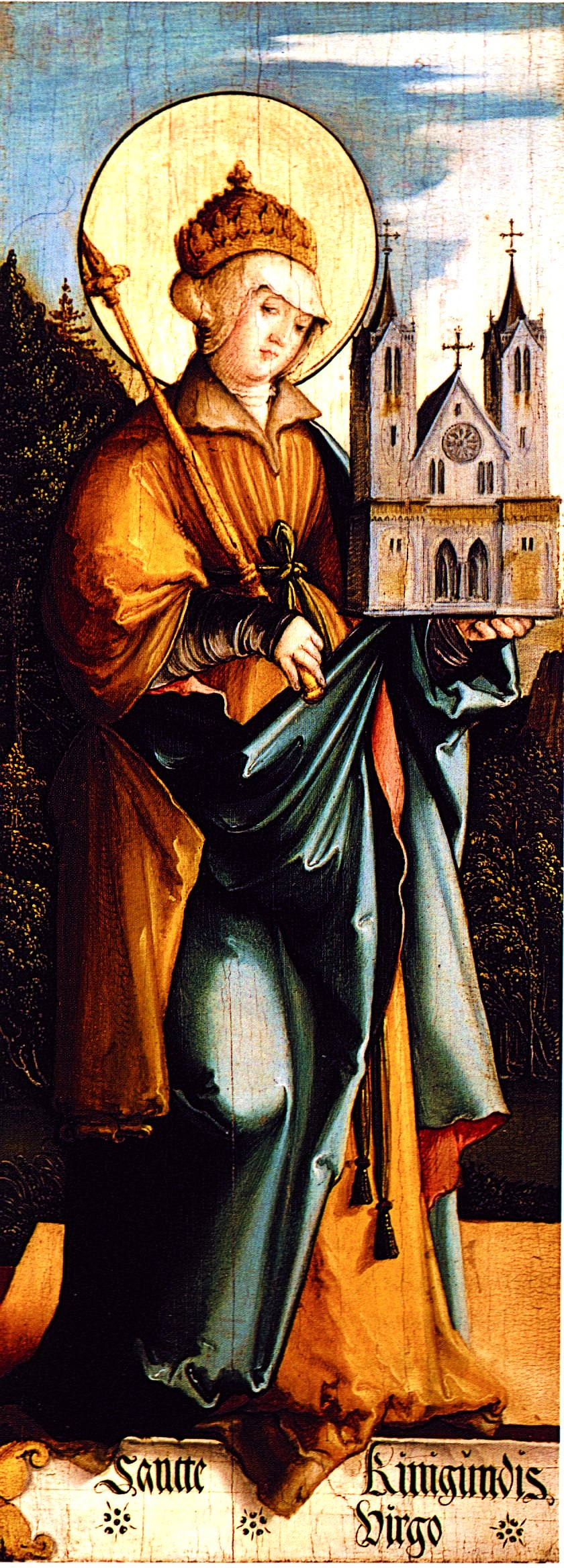
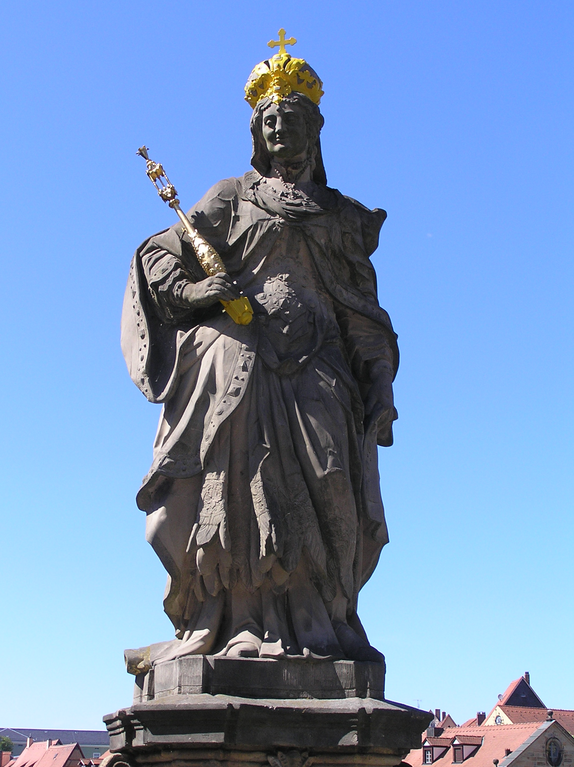
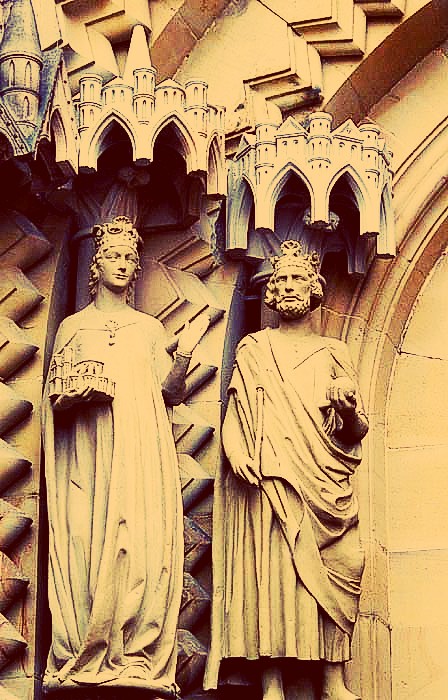
Saint of the Day – 3 March – St Cunegundes (c 975-1040) Empress of the Holy Roman Empire, Nun, she took a vow of Virginity before her marriage, which, after a miracle was upheld by her husband, the King (also a Saint). Founder of Monasteries and Churches, Nun in one of her Convents, Apostle of Charity. Born in c 975 and died in 1040 of natural causes. Patronages – Bamberg, Germany, Archdiocese of, Luxembourg, Lithuania.Also known as – Cunegundes of Luzembourg, Chunigundis, Cunnegunda, Cunigunde, Cunegonda, Kinga, Kunegunda, Kunigunde.
Saint Cunegundes was the daughter of Siegfried I, one of eleven children. Siegfried was the first Count of Luxemburg and his pious wife was Hadeswigee. From her cradle, her virtuous parents instilled into their daughter the most tender sentiments of piety.
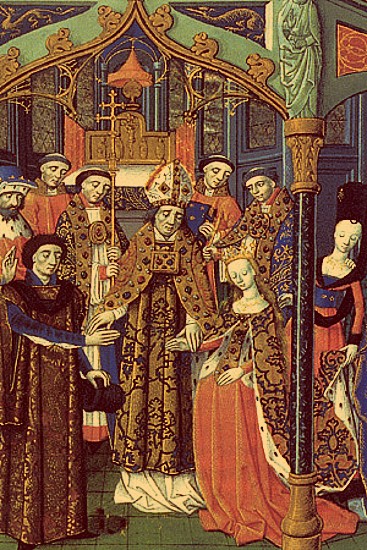
When she was of an age to marry, they chose for her spouse Saint Henry, Duke of Bavaria, who at the death of the Emperor Otto III, was named King of Bavaria and the Holy Romans and was crowned on 6 June 1002. Queen Cunegundes was crowned at Paderborn on Saint Laurence’s day.
In the year 1014 she went with her husband to Rome and they received the Imperial Crown from the hands of Pope Benedict VIII. With Saint Henry’s consent, before their marriage, she had made a vow of perpetual Virginity. Afterwards, certain vile accusations were made against her chastity and the holy Empress, to remove the scandal of such a slander, trusting in God to prove her innocence, walked over red-hot ploughshares without being hurt. The Emperor in turn, renounced and condemned, his own too scrupulous fears and credulity and from that time on, they lived in the strictest union of heart, working together to promote piety and God’s honour in every sphere.
The Crowning of Sts Henry and Cunegonde’s by Pope Benedict VIII
Going once to make a retreat in Hesse, Saint Cunegonde’s fell dangerously ill and she made a vow to found a Monastery at Kaffungen, in the Diocese of Paderborn, if she recovered. This she executed in a stately manner and gave it to Nuns of the Order of Saint Benedict. Before it was finished, Saint Henry died in 1024. She earnestly recommended his soul to the prayers of the empire and especially to her dear Nuns and expressed her longing desire to join the Sisters.
She had already exhausted her treasures in founding Bishoprics, Churches and Monasteries and in relieving the poor, and she had, therefore,little left to give. But intending to embrace perfect evangelical poverty, to renounce all things in order to serve God without obstacle, she assembled a great number of prelates at the dedication of her Church of Kaffungen, on the anniversary day of her husband’s death in 1025. After the Gospel was sung at Mass, she offered on the Altar a relic of the True Cross and then, putting off her imperial robes, clothed herself with a poor habit. Her hair was cut off and the Bishop gave her the Veil and a ring as a pledge of her fidelity to her heavenly Spouse.
After Cunegonde’s was consecrated to God in religion, she seemed to forget entirely that she had been an Empress and served as the least in the Convent, being persuaded that she was such, before God. She prayed and read a great deal, worked with her hands and took singular pleasure in visiting and comforting the sick. In this way, she passed the last fifteen years of her life.
When her last hour was drawing near, perceiving that they were preparing a cloth fringed with gold to cover her corpse after her death, she ordered it to be taken away and she could not rest until the promise was given, that she would be buried as a poor religious in her Habit. She died on the 3rd of March, 1040. Her body was carried to Bamberg and buried near that of her husband. She was solemnly Canonised by Pope Innocent III, in 1200.
St Anselm of Nonantola St Arthelais of Benevento Bl Benedetto Sinigardi da Arezzo St Calupan St Camilla St Cele-Christ St Cunegundes (c 975-1040) Empress of the Holy Roman Empire, Nun
St Foila Bl Frederick of Hallum St Gervinus Bl Innocent of Berzo Bl Jacobinus de’ Canepaci St Lamalisse St Non
Bl Pierre-René Rogue St Sacer St Teresa Eustochio Verzeri St Titian of Brescia St Winwallus of Landévennec
40 Martyrs in North Africa – A group of Christians martyred together in North Africa, date unknown. No details have survived, but we know these names – Antonius, Artilaus, Asclipius, Astexius, Basil, Bosimus, Carissimus, Castus, Celedonius, Claudianus, Cyricus, Donata, Emeritus, Emeterius, Euticus, Felix, Fortunatus, Frunumius, Gajola, Georgius, Gorgonius, Hemeterus, Isicus, Janula, Julius, Luciola, Luciolus, Marcia, Marinus, Meterus, Nicephorus, Papias, Photius, Risinnius, Sabianus, Savinianus and Solus
Martyrs of Pontus – 3+ Saints – A large group of Christians Martyred together in the persecutions of Emperor Maximian Galerius and governor Ascleopiodato. We have some details on three of them – Basiliscus, Cleonicus and Eutropius. 308 in Pontus (in modern Turkey) Martyrs of Caesarea; Asterius Marinus
Martyrs of CalahorraL Cheledonius Emeterius
Martyrs of Gondar, Ethiopia: Bl Antonio Francesco Marzorati Bl Johannes Laurentius Weiss Bl Michele Pío Fasol
Thought for the Day – 2 March – Meditations with Antonio Cardinal Bacci (1881-1971)
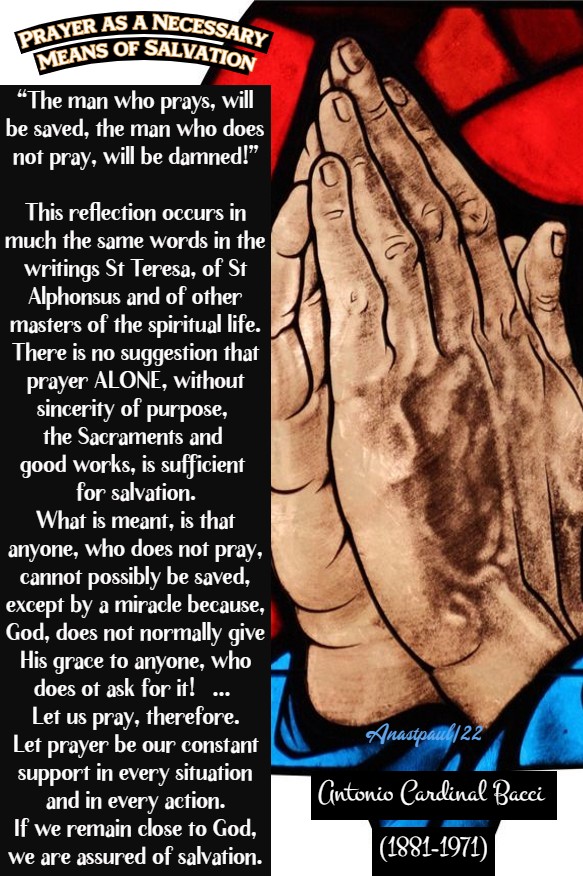
Prayer as a Necessary Means of Salvation
“The man who prays, will be saved, the man who does not pray, will be damned!” This reflection occurs in much the same words in the writings St Teresa, of St Alphonsus and of other masters of the spiritual life. There is no suggestion that prayer ALONE, without sincerity of purpose, the Sacraments and good works, is sufficient for salvation. What is meant, is that anyone, who does not pray, cannot possibly be saved, except by a miracle because, God, does not normally give His grace to anyone, who does ot ask for it! Even though the soul has grown indifferent and submerged in sin, if it does not abandon the habit of praying, it will sooner or later, be overcome by remorse and will turn again to God. St John Chrysostom teaches us, that it is impossible for anyone, who prays fervently and consta\ntly, to fall and remain in serious sin.
Let us pray, therefore. Let prayer be our constant support in every situation and in every action. If we remain close to God, we are assured of salvation. As long as we remain united to Our Lord, His grace will pervade our souls. But, if we sever this bond of prayer with God, we shall be alone and helpless and shall fall into sin. This has been the sad experience of many before us.”
Ash Wednesday – 2 March – Our Lenten Journey with the Great Fathers Begins
“In the face of my darkness, You are Light. In the face of my mortality, You are Life.”
St Gregory of Narek (950-1003) Father & Doctor of the Church
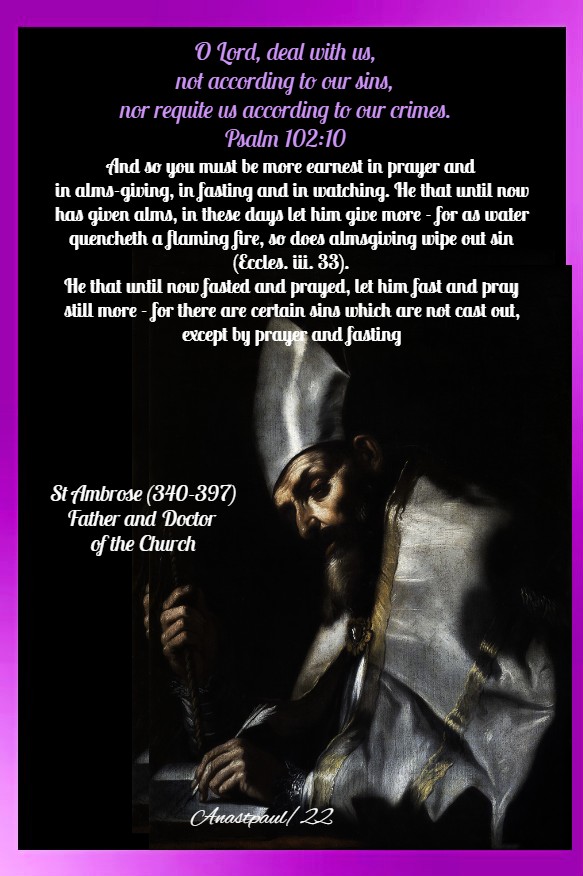
“O Lord, deal with us, not according to our sins, nor requite us according to our crimes.”
Psalm 102:10
BEHOLD, DEARLY BELOVED, the Sacred days are drawing near, the acceptable time, of which it is written – Behold, now is the acceptable time. behold, now is the day of salvation (II Cor vi) And so you must be more earnest in prayer and in alms-giving, in fasting and in watching. He that until now has given alms, in these days let him give more – for as water quencheth a flaming fire, so does almsgiving wipe out sin (Eccles. iii. 33). He that until now fasted and prayed, let him fast and pray still more – for there are certain sins which are not cast out, except by prayer and fasting (Mc. xvii. 20).
SHOULD ANYONE CHERISH ANGER towards another, let him forgive from his heart. Should anyone take, unjustly what belongs to another, let him restore it and if not fourfold, at least that which he has taken, if he desires God to be merciful to himself (Lk. xix. 8).
AND although a Christian should abstain at all times from cursings and revilings, from oaths, from excessive laughter and from idle words, he must do this especially in these holy days, which are set apart, so that during these forty days, he may, by Penance, wipe out the sins of the whole year!
MAY YOU BELIEVE and believe firmly, that if, in these days, you have made a thorough Confession of your sins and done Penance as we have told you, you shall receive from Our Most Merciful Lord, the pardon of all your offences, as did the Ninivites, who earned deliverance from their afflictions by doing penance in sackcloth and ashes (Jn. iii).
So you also, following their example, if you cry out with all your heart to the Lord, you will invoke His Mercy on you, so that, serene and joyful, you will celebrate the day of the Lord’s Resurrection and, thus blessed, you will, after this life, cross over to your heavenly home, by the grace of Our Lord Jesus Christ, Who with the Father and the Holy Ghost livest and reignest, world without end. Amen. – St Ambrose (340-397) Bishop of Milan. Father and One of the Four Original Doctors of the Latin Church
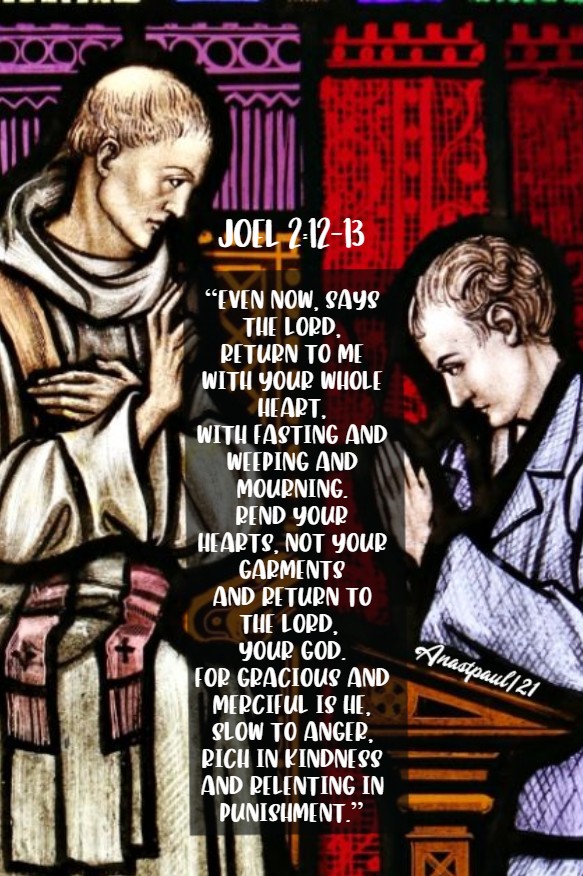
“Even now, says the LORD, return to me with your whole heart, with fasting and weeping and mourning. Rend your hearts, not your garments and return to the LORD, your God. For gracious and merciful is he, slow to anger, rich in kindness and relenting in punishment.”
Joel 2:12-13
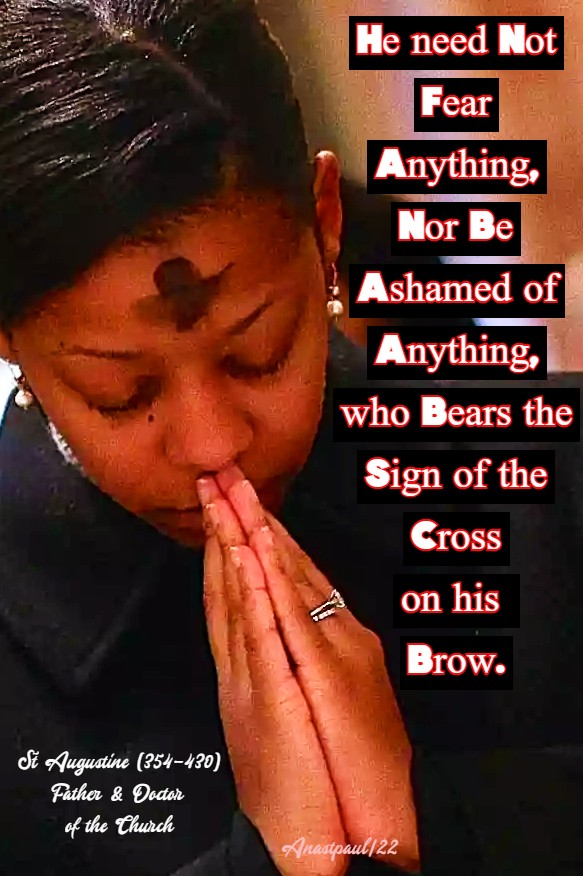
“He need not fear anything, nor be ashamed of anything, who bears the Sign of the Cross on his brow.”
“Fasting is the soul of prayer, mercy is the lifeblood of fasting. Let no-one try to separate them, they cannot be separated. If you have only one of them, or not all together, you have nothing! So if you pray, fast; if you fast, show mercy; if you want your petition to be heard, hear the petition of others. If you do not close your ear to others, you open God’s ear to yourself.”
St Peter Chrysologus (c 400-450) Father & Doctor of the Church
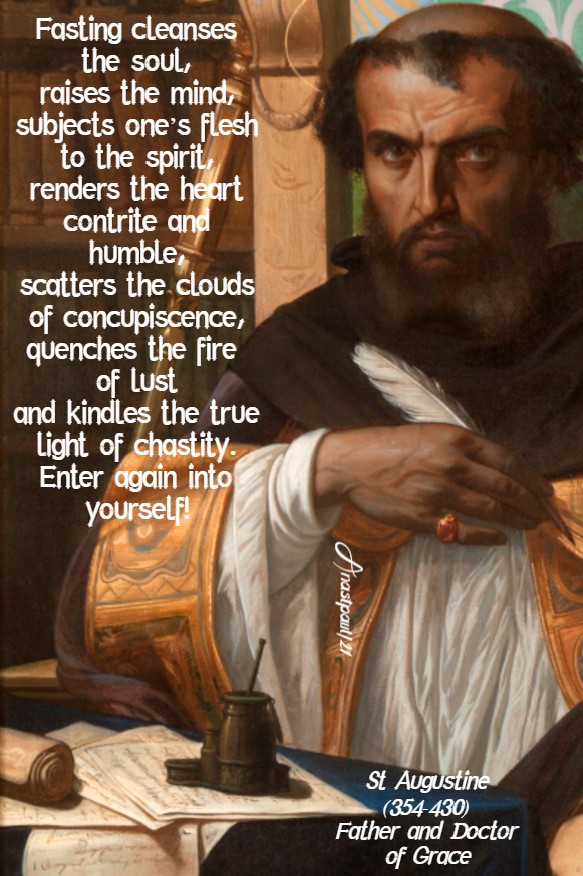
“Fasting cleanses the soul, raises the mind, subjects one’s flesh to the spirit, renders the heart contrite and humble, scatters the clouds of concupiscence, quenches the fire of lust and kindles the true light of chastity. Enter again into yourself!”
St Augustine (354-430) Father & Doctor of the Church
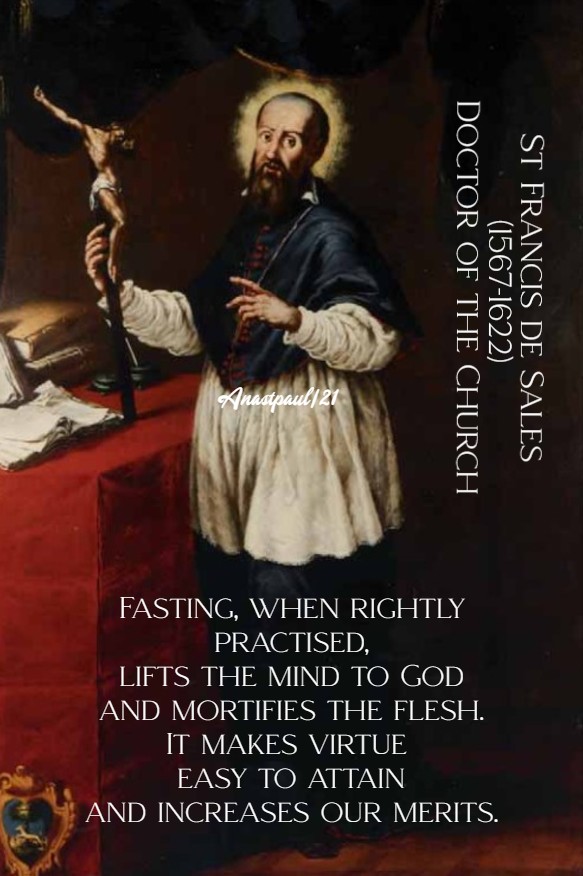
“Fasting, when rightly practised, lifts the mind to God and mortifies the flesh. It makes virtue easy to attain and increases our merits.”
St Francis de Sales (1567-1622) Doctor of the Church
One Minute Reflection – 2 March – Ash Wednesday –Joel 2:12-19, Matthew 6:16-21
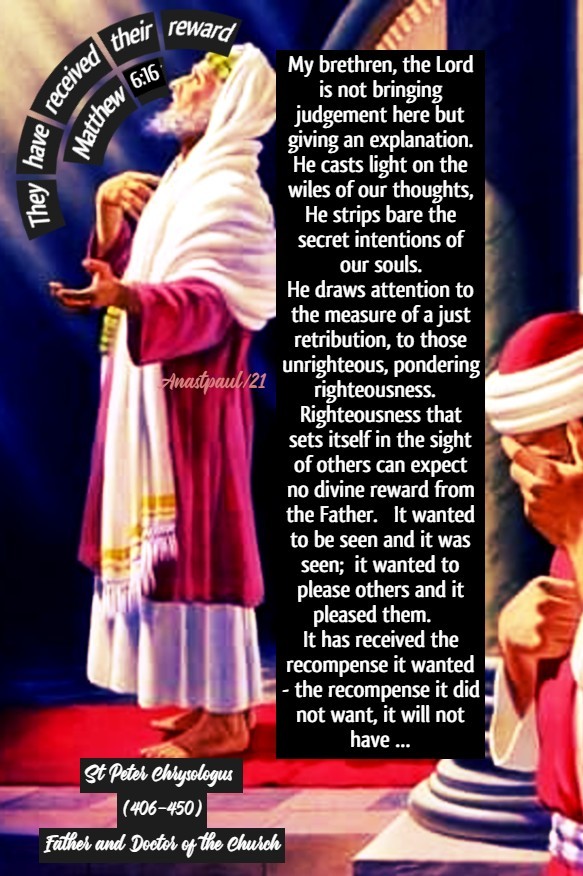
“They have received their reward” – Matthew 6:16
REFLECTION – “Take care not to perform righteous deeds in order that people may see them.” Why not? If people see them then what will you get out of them? “You will have no recompense from your heavenly Father.”My brethren, the Lord is not bringing judgement here but giving an explanation. He casts light on the wiles of our thoughts, He strips bare the secret intentions of our souls. He draws attention to the measure of a just retribution, to those unrighteous, pondering righteousness. Righteousness that sets itself in the sight of others can expect no divine reward from the Father. It wanted to be seen and it was seen; it wanted to please others and it pleased them. It has received the recompense it wanted – the recompense it did not want, it will not have …
“When you give alms, do not blow a trumpet before you, as the hypocrites do.” “Blow your trumpet” – this is the exact phrase in that this kind of alms is more like a deed of war than of peace. It passes wholly into its sound but has nothing to do with mercy. It comes from the land of disunion but has not been nourished by goodness. It is a dealing in outward show, not chaste commerce …. “So, then, when you give alms, do not blow a trumpet before you as the hypocrites do in the synagogues and in the streets to win the praise of others. Amen, I say to you, they have received their reward.” You have taken good note: – alms offered at a meeting, in public square and street corners, is not an offering made for the comforting of the poor but has been set forward in the sight of others to attract their admiration … Flee hypocrisy, my brethren, flee from it …. It does not bring comfort to the poor; the groans of the homeless but is only a pretext for it, to seek out even more busily, a spectacular glory for itself. It inflates its praise of the suffering of the poor. – St Peter Chrysologus (406-450) Bishop of Ravenna, Father and Doctor of the Church (Sermon 9).
PRAYER – Grant, O Lord, that Your faithful people may, with true piety, undertake the time-honoured custom of fasting and may carry it out with unwavering devotion. Through Jesus Christ, Thy Son our Lord, Who lives and reigns with Thee, in the unity of the Holy Ghost, God, world without end. Amen (Collect).
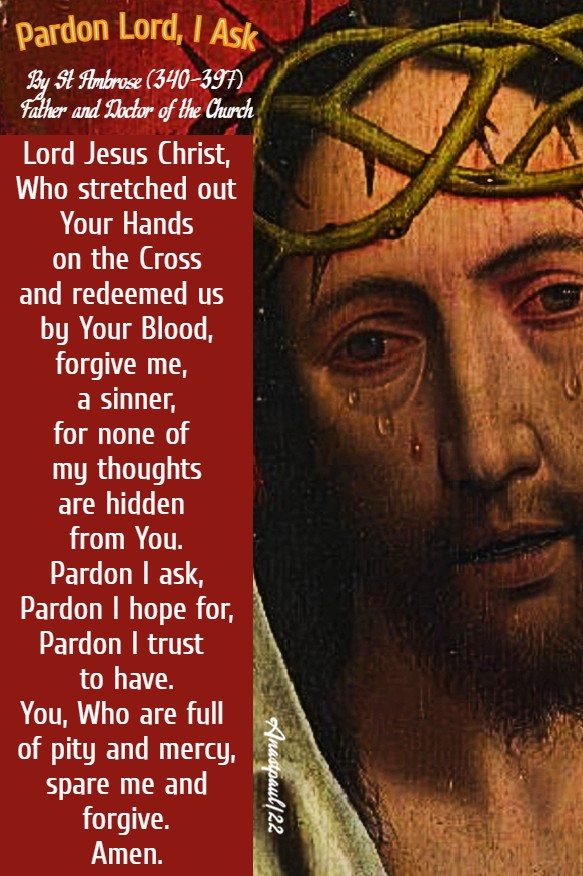
Pardon Lord, I Ask By St Ambrose (340-397) Father and Doctor of the Church
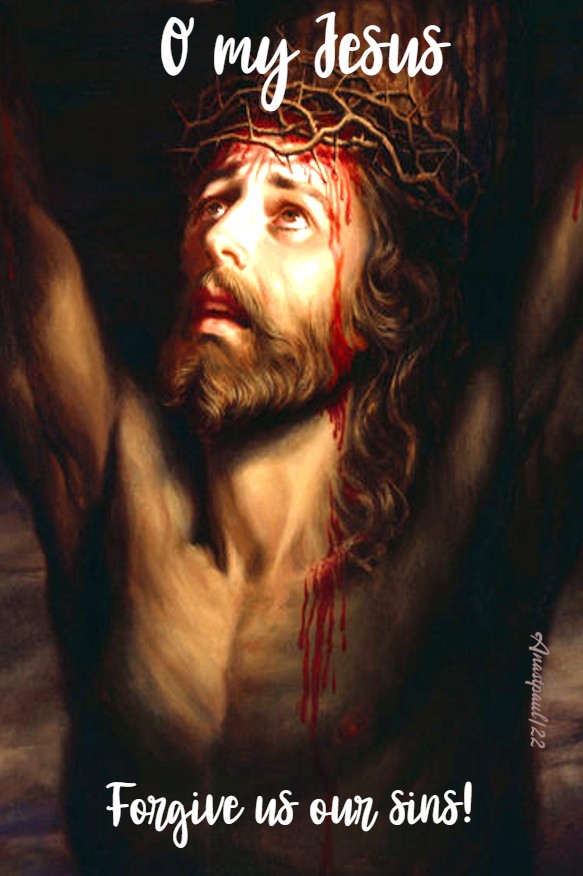
Lord Jesus Christ, Who stretched out Your Hands on the Cross and redeemed us by Your Blood, forgive me, a sinner , for none of my thoughts are hidden from You. Pardon I ask, Pardon I hope for, Pardon I trust to have. You, Who are full of pity and mercy, spare me and forgive. Amen.
Saint of the Day – 2 March – Saint Luke Casali of Nicosia (Died c 800) Priest, Abbot Born in Nicosia, Sicily, Italy and died in c 800 at the Monastery of Saint Philip in Agira, Sicily, Italy of natural causes. Also known as – Luke Casalius, Lucad Casali. Lucad of Nicosia. Patronages – Nicosia, Sicily, Italy.
The Roman Martyrology reads: “In Agíra in Sicily, Saint Luke Casale of Nicosía, a Monk, full of humility and virtue.”
Luke Casali was born in Nicosia in Sicily in the ninth century. At around the age of twelve, he was led by a Monk to the Monastery of Santa Maria Latina di Agira, where he took the Habit and was later Ordained Priest. He grew up and lived endowed with spiritual virtues and the population of the faithful willingly went to the Monastery to consult him.
In adulthood he was elected Abbot of the Monastery of Agira, but he refused the position out of humility. However, the Monks did not surrender and asked the Pope to intervene. Luke then accepted out of obedience.
Years passed, in which he showed great humility and prudence in the office of Abbot, until he was struck by blindness but this serious limitation, especially for those times, did not stop him and he continued to carry out his apostolate, by being accompanied in his travels by his confreres.
His holiness was revealed to the incredulous Monks, when one day, returning from Nicosia where he had visited his relatives, he was made to believe that he had a large crowd of faithful in front of him and he began to preach. But there was no-one before him and the place was deserted! At the end of the sermon, he gave the blessing, to which the stones responded with a resounding “Amen!” Faced with this prodigy, the Monks who accompanied him, asked him for forgiveness.
He died a holy death in sanctity and peace in the Monastery of Agira,and was buried in the Church of St Philip. His fame as a Saint grew so much, that his body was placed in the same urn as St Philip of Agira, a great Exorcist Priest, who died in Agira around 453. Later the memory of his sepulchre was lost but the cult continued. In 1575 at the end of the plague epidemic, the people and the Senate of the City of Nicosia, in gratitude to St Luke Casali, decided to celebrate his feast at the expense of the Municipality, asking the Pope to recognise him as the Patron saint of the City.
Twenty years later in 1596, during some renovations, the remains of sSt Luke Casali, of St Eusebius, a Monk and of St Philip of Agira, evidently hidden at the time of the Saracen invasions,were found. On that occasion, St Luke’s birthplace Nicosia, asked for and obtained, a relic of the holy Abbot, which was received with great solemnity.
For the rest, the historical sources concerning hSt Luke differ; the year of his death according to some scholars is in the year c 900. others say around 1164, however, he seems to have lived before the Arab invasions in Sicily, which began in 827. Even the religious Order to which he belonged is questioned, there are those who consider him a Benedictine, others a Basilian. But, none of these details truly matter. St Luke’s efficacious intercession has been experienced by the faithful of Nicosia for centuries – he is always there to help when needed and the City celebrates him each year on his Feast Day today.
Bl Charles the Good St Cynibild of Laestingaeu Bl Engelmar Unzeitig St Felix of Treves St Fergna the White Bl Girolamo Carmelo di Savoia St Gistilian St Joavan of Brittany St John Maron St Jovinus the Martyr St Lorgius of Caesarea St Lucius of Caesarea St Luke Casali of Nicosia (Died c 800) Priest Abbot St Quintus the Thaumaturge St Slebhene St Troas St Willeic
Martyrs of Campania – Approximately 400 northern Italian Christians Martyred for their faith by pagan Lombards. Their story was recorded by Pope Saint Gregory the Great, who reports that they people spent their final days supporting each other with prayer. c 579 in Camnpania, Italy.
Martyrs of Porto Romano – 4 Saints – Group of Christians Martyred in the persecution of Diocletian. The only other information that survives are the names of four of them – Heraclius, Januaria, Paul and Secondilla. c305 at Porto Romano at the mouth of the River Tiber, Rome.
The beloved Foster-Father and Guardian of Jesus and Protector of the Holy Family, is celebrated for this whole month and his Feast Day falls in the middle of it – 19 March.
“Joseph shines among all mankind by the most august dignity, since by divine will, he was the Guardian of the Son of God and reputed as His father among men. Hence it came about, that the Word of God was humbly subject to Joseph, that He obeyed him and that He rendered to him, all those offices that children are bound to render to their parents. From this two-fold dignity flowed the obligation which nature lays upon the head of families, so that Joseph became the Guardian, the Administrator and the legal Defender of the Divine house, whose chief he was. And, during the whole course of his life ,he fulfilled those charges and those duties. … It is, then, natural and worthy, that as the Blessed Joseph ministered to all the needs of the Family at Nazareth and girt it about with his protection, he should now cover, with the cloak of his heavenly patronage and defend the Church of Jesus Christ.
“Quamquam Pluries” – On the Devotion to St Joseph –Pope Leo XIII
On 10 March, we begin the Novena to St Joseph, entrusting so many of our woes and cares to his holy and fatherly care and intercession. His Patronages are numerous, as we know, one of them will fit our needs perfectly and if not, then we should all ask him to intercede on our behalf for our families and for a Happy and Holy Death. On the 19th we pray the Consecration to St Joseph.
Patronages • against doubt and hesitation • accountants • all the legal professions • bursars • cabinetmakers • carpenters • cemetery workers • children • civil engineers • confectioners • craftsmen • the dying • teachers • emigrants • exiles • expectant mothers • families • fathers • furniture makers • grave diggers • happy death • holy death • house hunters • immigrants • joiners • labourers • married couples • orphans • against Communism • pioneers • social justice • travellers • the unborn • wheelwrights • workers • workers • Catholic Church • Oblates of Saint Joseph • for protection of the Church • Universal Church • Americas • Austria • Belgium • Bohemia • Canada • China • Croatian people • Korea • Mexico • New France • New World • Peru • Philippines • Vatican City • VietNam • Canadian Armed Forces • Papal States • 46 Diocese • 26 cities • states and regions.
“In him the Old Testament finds its fitting close. He brought the noble line of patriarchs and prophets to its promised fulfilment. What the divine goodness had offered as a promise to them, he held in his arms.
Obviously, Christ does not now deny to Joseph that intimacy, reverence and very high honour which He gave him on earth, as a son to His father. Rather, we must say, that in Heaven, Christ completes and perfects, all that He gave at Nazareth.” – St Bernardine of Siena (1380-1444) (An excerpt from his On Saint Joseph [Sermon 2])
A few last-minute sowing plans for the garden of our souls. Planting virtue and good habits and ascending that steep hill, day-by-day, with love, faithfulness and perseverance. Accompanying our Saviour on His Journey of our Redemption:
Five Rows of Squash:
Squash gossip
Squash indifference
Squash unkindness
Squash temper
Squash the idols of greed and lust
Six Rows of Peas:
Prayer
Penance
Perseverance
Purity
Patience
Politeness
Seven Heads of Lettuce:
Let us be unselfish
Let us be charitable
Let us be obedient
Let us be truthful
Let us be gentle and kind
Let us be repentant
Let us be renewed
No garden is complete without Turnips:
Turn up for Daily Mass
Turn up fo Eucharistic Adoration
Turn up for Daily Morning and Night Prayer
Turn up for Spiritual reading on Breathing Catholic 🤗🙏💘
Conclude with Thyme:
Thyme with God, thyme for fasting, thyme for generosity and care of the poor, the sick, the suffering.
Water daily with patience Feed with love The Beloved Saviour will provide the growth.






































 AnaStpaul
You must be logged in to post a comment.