Thought for the Day – 17 May – Meditations with Antonio Cardinal Bacci (1881-1971)
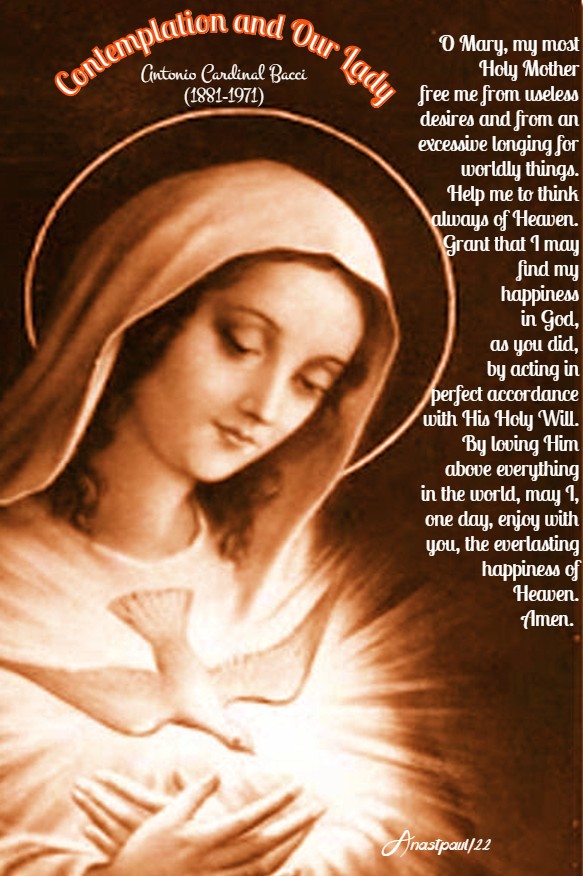
Contemplation and Our Lady
“O Mary, my most Holy Mother, free me from useless desires and from an excessive longing for worldly things. Help me to think always of Heaven. Grant that I may find my happiness in God, as you did, by acting in perfect accordance with His Holy Will. By loving Him above everything in the world, may I, one day, enjoy with you, the everlasting happiness of Heaven. Amen. ”
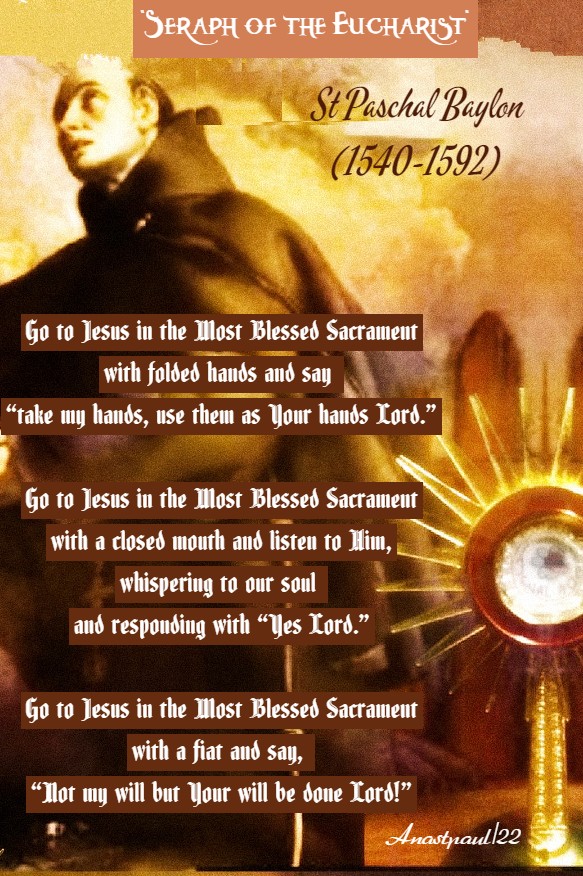
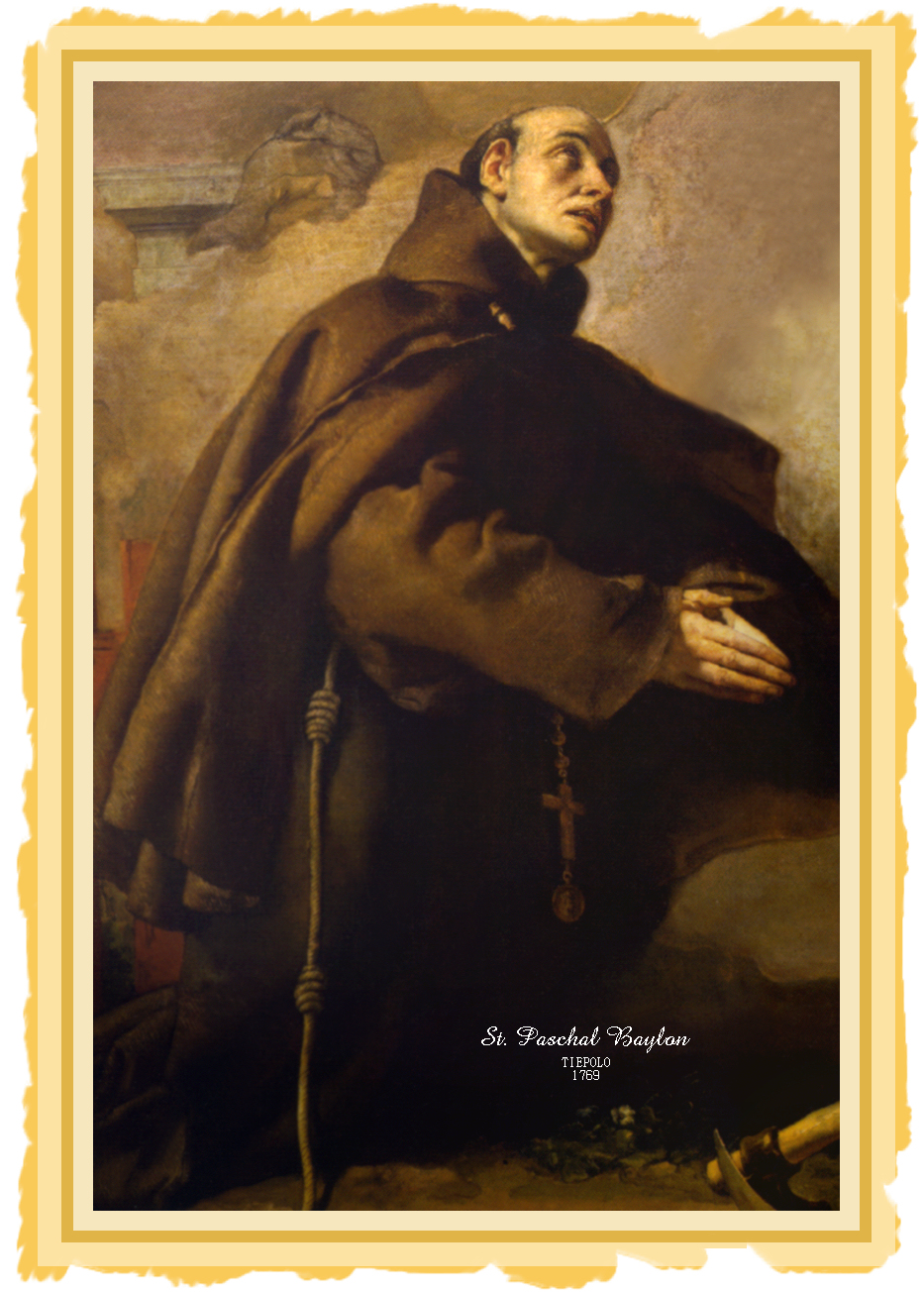
Quote/s of the Day – 17 May – The Memorial of St Paschal Baylon OFM (1540-1592) Confessor, “Seraph of the Eucharist,” “Saint of the Blessed Sacrament,” “Servant of the Blessed Sacrament.” Franciscan Lay Brother.
“Go to Jesus in The Most Blessed Sacrament with folded hands and say “take my hands, use them as Your hands Lord.”
“Go to Jesus in the Most Blessed Sacrament with a closed mouth and listen to Him, whispering to our soul and responding with “Yes Lord.”
“Go to Jesus in the Most Blessed Sacrament with a fiat and say, “Not my will but Your will be done Lord!”
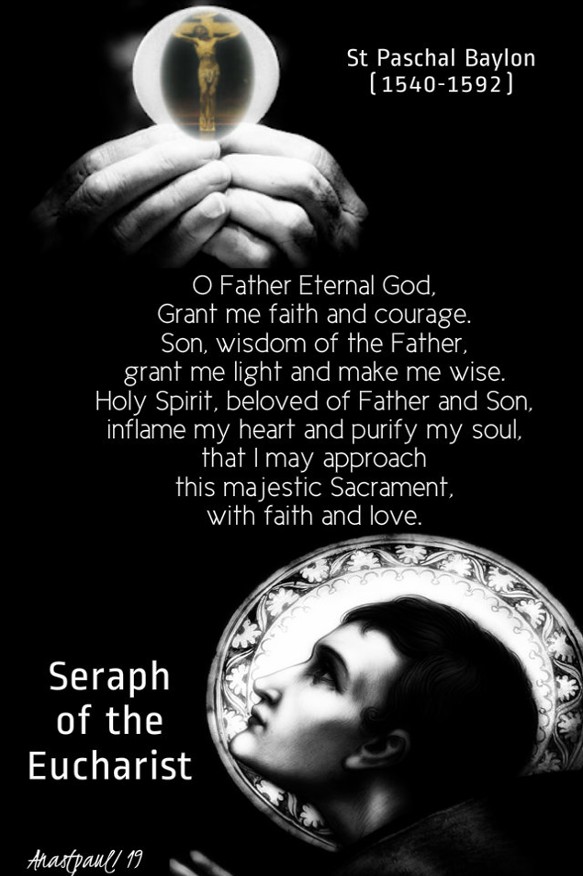
“O Father Eternal God, Grant me faith and courage. Son, wisdom of the Father, grant me light and make me wise. Holy Spirit, beloved of Father and Son, inflame my heart and purify my soul, that I may approach this majestic Sacrament, with faith and love.”
One Minute Reflection – 17 May – The Memorial of St Paschal Baylon OFM (1540-1592) Confessor – Sirach 31:8-11, Luke 12:35-40
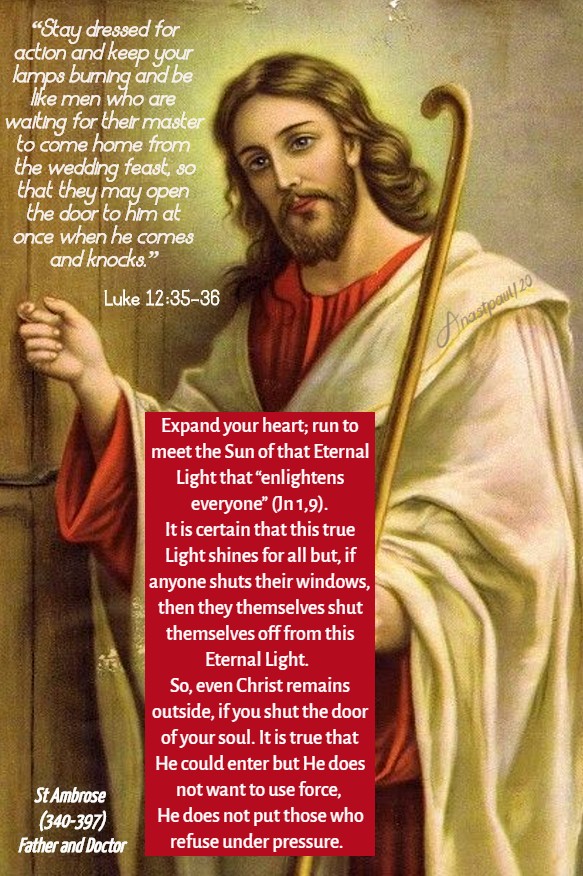
“Stay dressed for action and keep your lamps burning and be like men who are waiting for their master to come home from the wedding feast, so that they may open the door to him at once when he comes and knocks.” – Luke 12:35-36
REFLECTION – “God, the Word, stirs up the lazy and arouses the sleeper. For indeed, someone who comes knocking at the door is always wanting to come in. But it depends on us, if He does not always enter, or always remain. May your door be open to Him Who comes; open your soul, enlarge your spiritual capacities, that you may discover the riches of simplicity, the treasures of peace and sweetness of grace. Expand your heart; run to meet the Sun of that Eternal Light that “enlightens everyone” (Jn 1,9). It is certain that this true Light shines for all but, if anyone shuts their windows, then they themselves shut themselves off from this Eternal Light.
So, even Christ remains outside, if you shut the door of your soul. It is true that He could enter but He does not want to use force, He does not put those who refuse under pressure. Descended from the Virgin, born from her womb, He shines throughout the universe to give Light to all. Those who long to receive the Light, which shines with an everlasting brightness, open up to Him. No night comes to intervene. Indeed, the sun we see each day gives way to night’s darkness but the Sun of Justice (Mal 3,20) knows no setting for Wisdom is not overcome by evil.” – St Ambrose (340-397) Bishop of Milan and Father and Doctor of the Church – 12th Sermon on Psalm 118
PRAYER – O God, Who endowed blessed Paschal, Your Confessor, with a wondrous love for the Sacred Mysteries of Your Body and Blood, mercifully grant that we may be found worthy to share in the same spiritual abundance, which he received in this Divine Banquet. Who lives and reigns with God the Father, in the unity of the Holy Ghost, God, world without end. Amen (Collect).
Our Morning Offering – 17 May – “The Month of the Blessed Virgin Mary”
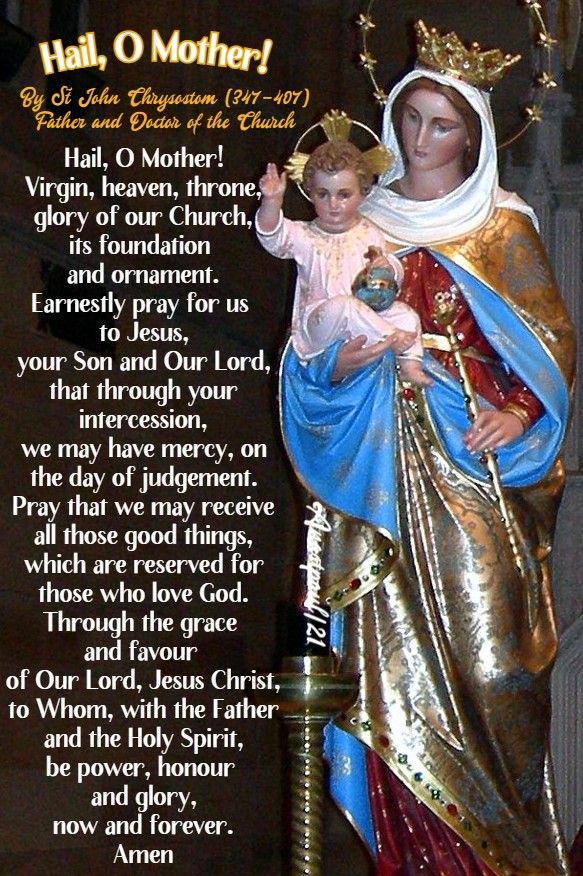
Hail, O Mother! By St John Chrysostom (347-407) Father and Doctor of the Church
Hail, O Mother! Virgin, Heaven, throne, glory of our Church, it’s foundation and ornament. Earnestly pray for us to Jesus, your Son and Our Lord, that through your intercession, we may have mercy on the day of judgement. Pray that we may receive, all those good things which are reserved for those who love God. Through the grace and favour of Our Lord, Jesus Christ, to Whom, with the Father and the Holy Spirit, be power, honour and glory, now and forever. Amen
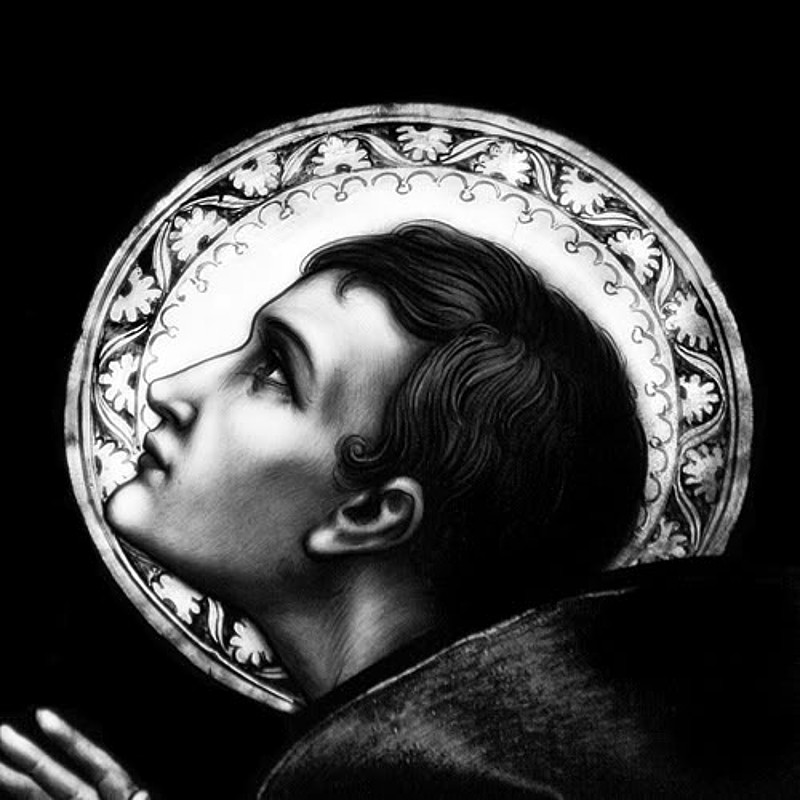
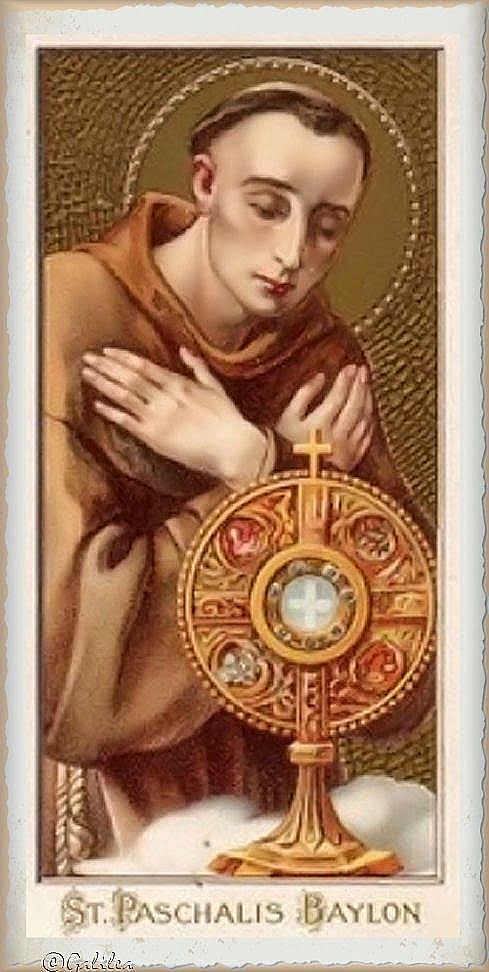
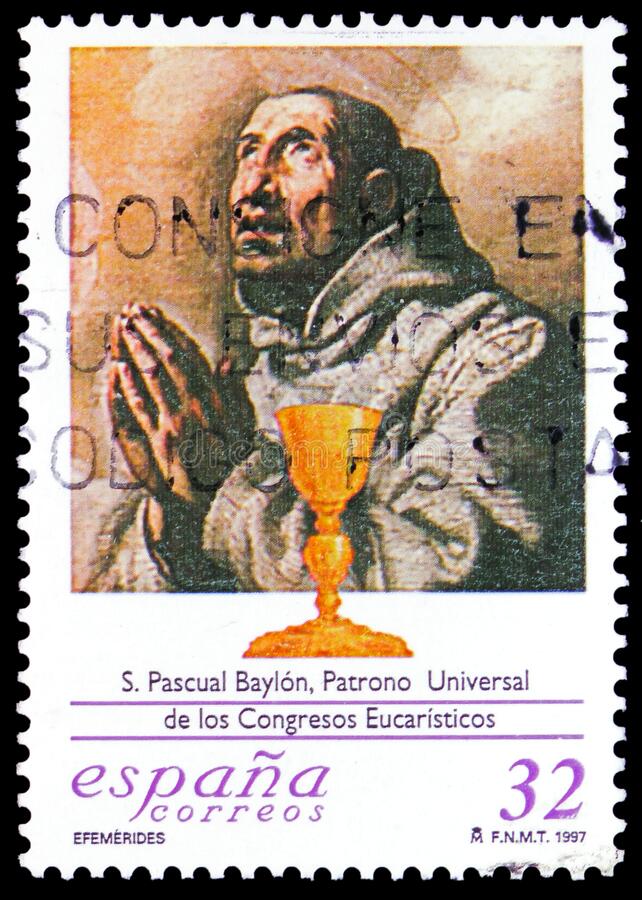
Saint of the Day – 17 May – St Paschal Baylon OFM (16 May 1540 – 17 May 1592) Spanish Lay Brother “Seraph of the Eucharist,” “Saint of the Blessed Sacrament,” “Servant of the Blessed Sacrament,” Franciscan Lay Brother, Mystic…….. Also known as – Pasquale, PascaL. Paschal was Beatified on 29 October 1618 by Pope Paul V and Canonised on 16 October 1690 by Pope Alexander VIII. Pope Leo XIII[7] proclaimed the saint as the “Seraph of the Eucharist” as well as the Patron of Eucharistic congresses and affiliated associations.
The Roman Martyrology states: “At Villa Real near Valencia in Spain, Saint Pasquale Baylon, a religious of the Order of Friars Minor, who, always showing himself caring and kind to everyone, constantly venerated the Mystery of the Most Holy Eucharist with fervent love.”
Childhood and early years: Let’s start by saying that the Spanish name Pasquale, is of Christian origin and is also widely used in the feminine – Pasqualina. It was given to children born on Easter Sunday but its distant origins are Jewish (Pesach = passage) meaning the passage of the Jewish people through the Red Sea and the passage of the Angel of the Lord, who saved, the Jewish firstborns, by marking their houses with the blood of the lamb, to distinguish them from the Egyptians, who were destined for death, in the last plague of Egypt. However, this is not the case with Pasquale Baylon, who was born on 16 May 1540, the day of Pentecost (which is also called in Spanish, “Pascua de Pentecostés.” From his childhood, he showed a marked devotion to the Holy Eucharist, which would later become the centre of his entire religious life. He was a shepherd first of the family’s flock, then in the service of other masters. The solitude of the fields favoured meditation, his desire for continuous prayer. He also began to mortify his young body with long fasts and painful flagellations.
Franciscan vocation: At the age of 18 he asked to join the Convent of Santa Maria di Loreto, of the Reformed Franciscans called Alcantarini by St Peter of Alcantara, reformer of the Order. But he was not accepted, perhaps due to his young age. In order to remain in the vicinity of the Convent, he entered the service, again as a shepherd, of the very wealthy landowner, Martín García. Admired by this young employee, he proposed to adopt Paschal, sin order to make him his heir. However, Paschal refused this offer as he was more determined than ever to enter among the Friars of St. Francis. In 1560, he was admitted to the Convent of St Maria di Loreto, where he made his religious profession on 2 February 1564. He never wanted to ascend to the Priesthood, despite the favourable opinion of his superiors because he did not feel worthy.
Friar, Porter, Cook, gifted with holy wisdom: For years Paschal fulfilled the various services necessary to the convent, especially as a Porter, a task that he always carried out with great goodness. Although so young, he acquired a reputation for holiness, for his Christian virtues but also for the miraculous deeds attributed to him. He was truly “Pentecostal,” that is, favoured by the extraordinary gifts of the Holy Spirit, including that of wisdom: he could read and write but he was not very cultured. Still, he was constantly asked for advice by many illustrious persons
On mission among the Calvinists: In 1576, even the Provincial Father of the Alcantarins of Spain, having to communicate urgently with the Father General residing in Paris, thought of sending Brother Paschal with the letter, knowing full well the serious difficulties of the journey, for the crossing of some French Provinces, which at that time were dominated by Calvinists. In fact, the Friar was made the object of continuous derision, insults, beatings. In Orléans, he too was in danger of death by stoning! There, Paschal had disputed with the Calvinist in regard to the Holy Eucharist debunking their false arguments.
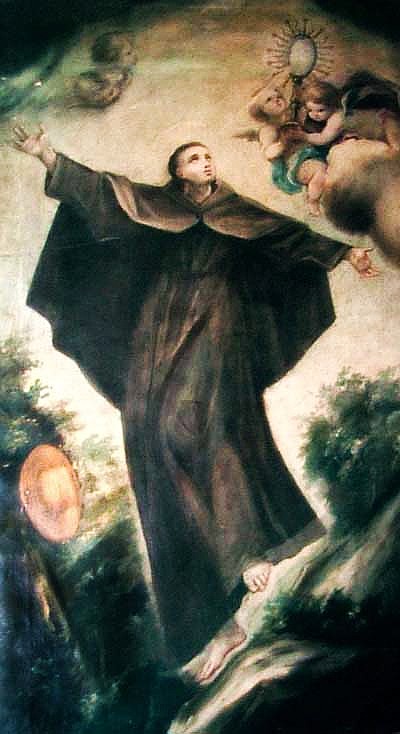
“São Pascoal Bailão adora a Eucaristia” – Convento de São Pedro de Alcântara, Arenas de San Pedro (Espanha) – Foto: Francisco Lecaros
Seraph of the Eucharist: On returning from his delicate and dangerous mission, Paschal composed a small book of definitions and sentences on the Real Presence of Jesus in the Blessed Sacrament and, on the divine power transmitted to the Roman Pontiff. As evidence of this great devotion, for which he was nicknamed “Seraph of the Eucharist,” we have received his personal thoughts and prayers, which he added to the collections of writings on Eucharistic themes.
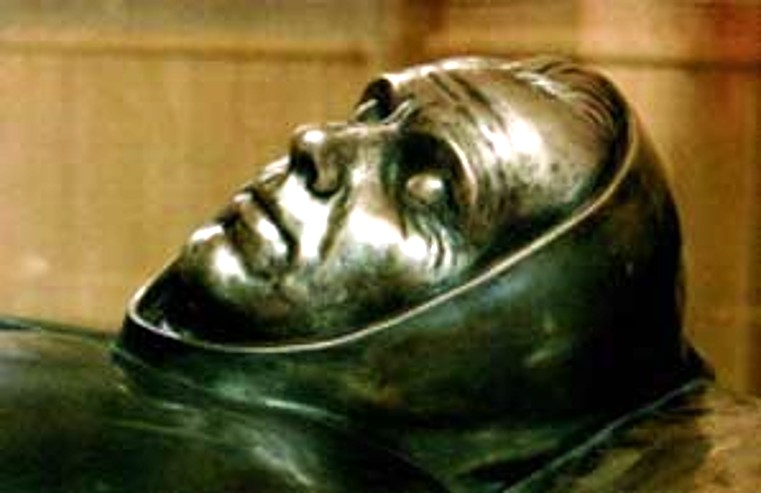
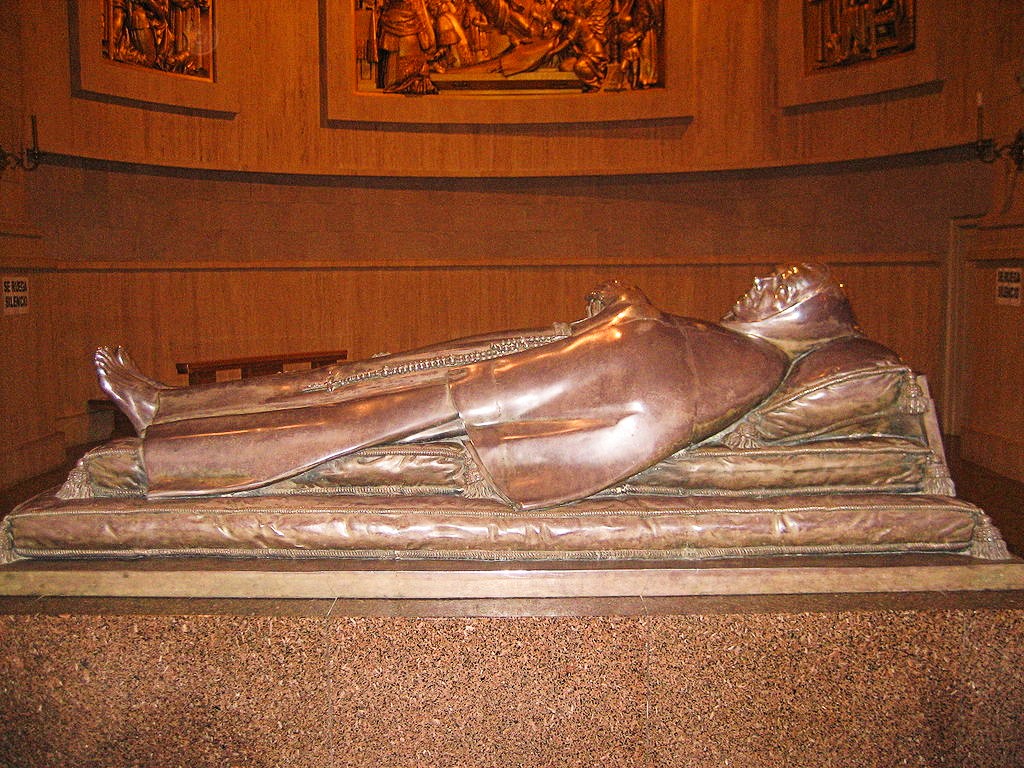
Death: In order to acquire greater perfection, Paschal underwent continuous and heavy mortifications and increasingly numerous penances, to the point that his health was now compromised. On 17 May 1592, the day after his fifty-second birthday, Paschale died at the Convent of the Rosary in Villarreal, near Valencia. As had happened on the day of his birth, it was Pentecost! The funeral saw the participation of a crowd of faithful, who wanted to pay homage of heartfelt veneration to the body of the humble lay Franciscan Brother, whose holiness, fand miracles were well-known throughout the Catholic world.
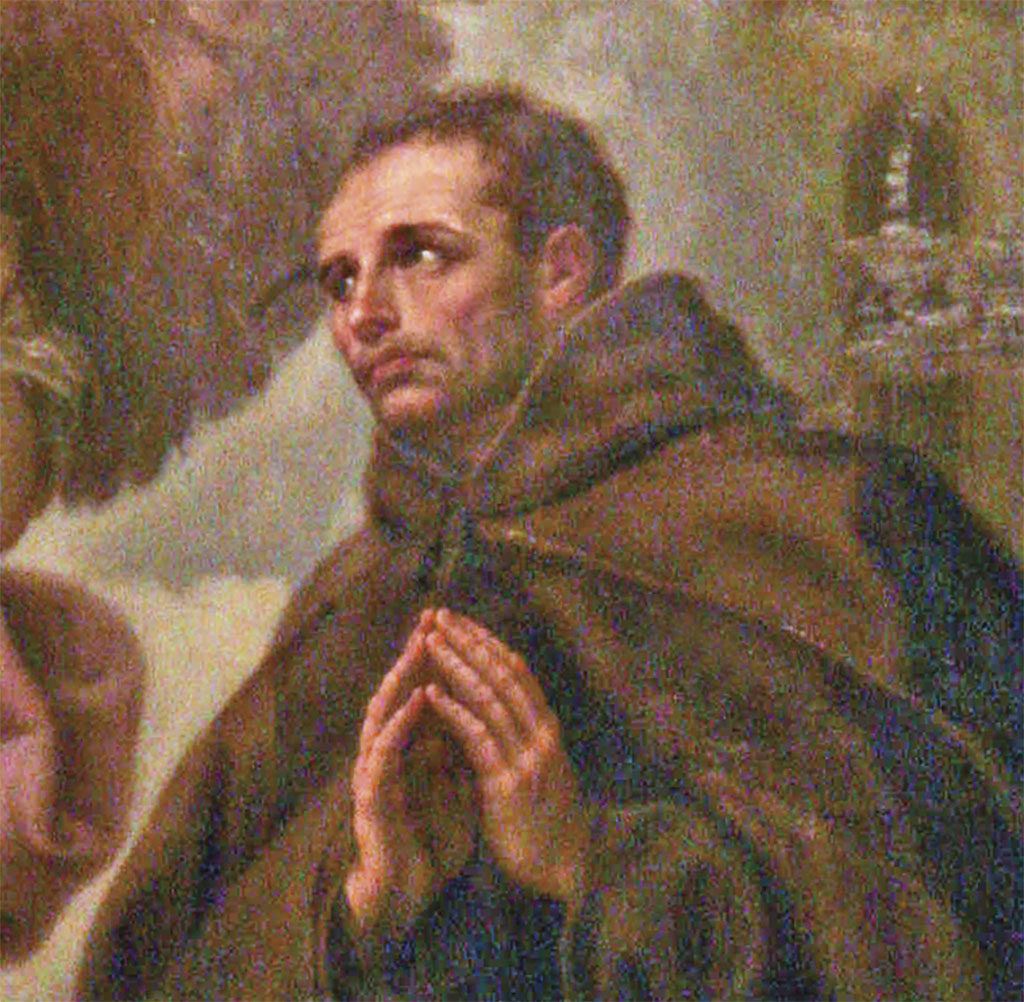
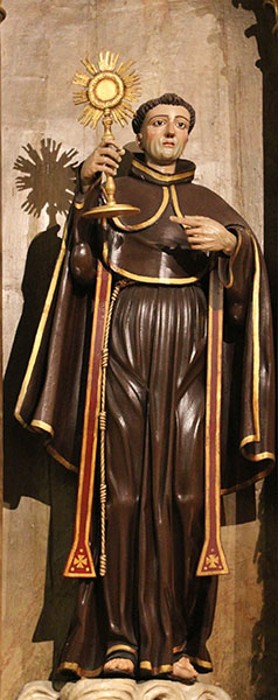
Veneration and iconography: He was particularly revered in Naples, subject to Spanish domination. The cult was concentrated in two large and famous Franciscan Convents, once belonging to the Alcantarini but still existing – St Paschal a Chiaia and St Paschal Granatello. His name was given to generations of children, especially in Southern Italy. He was Beatified 26 years after his death, on 29 October 1618, by Pope Paul V and proclaimed a Saint on 16 October 1690 by Pope Alexander VIII. His remains, which were venerated with great devotion in Villarreal, were desecrated and dispersed during the Spanish Civil War; some were later recovered and returned to the City in 1952. Over the centuries, his passionate devotion to the Eucharist have inspired the many artists who have depicted him. Paschal usually appears in the act of adoring the Blessed Sacrament in a Monstrance.
Official and traditional Patronages: Pope Leo XIII, on 28 November 1897, proclaimed him Patron of Eucharistic Congresses and Associations. Popularly he is also considered Patron of cooks and pastry chefs, on the basis of his humble services carried out in the Convent – according to tradition, Paschal is the creator of the famous desert called Zabaglione, whose name evidently derives from him. Probably due to a resemblance in the sound of Paschal’s Surname (“St Paschal Baylonne”). Paschal is finally invoked by single women looking for a husband and by women in general.
St Paschal Baylon OFM (1540-1592) “Seraph of the Eucharist,” “Saint of the Blessed Sacrament,” “Servant of the Blessed Sacrament.” Franciscan Lay Brother, Mystic…….. A man remarkable for innocence of life and the spirit of penance. Pope Leo XIII declared him the heavenly patron of Eucharistic Congresses and Societies and Apostolates, formed in honour of the Most Blessed Sacrament. About this beautiful Saint: https://anastpaul.wordpress.com/2018/05/17/saint-of-the-day-17-may-st-paschal-baylon-o-f-m-1540-1592-the-seraph-of-the-eucharist/
St Heraclius of Noviodunum Bl Ivan Ziatyk St Madron of Cornwall St Maildulf of Malmesbury St Maw
St Paul of Noviodunum St Peter Lieou St Rasso of Grafrath St Restituta of Carthage St Silaus of Lucca St Solochanus of Chalcedon St Thethmar St Victor Roma
Martyrs of Alexandria – 3 Saints: Three Christians Martyred together; no details about them have survived except their names: Adrio, Basilla and Victor. 4th century Alexandria, Egypt.
Martyrs of Nyon: A group of Christians Martyred together in the persecutions of Diocletian. We know little more than three of their names: Aquilinus, Heradius and Paul. 303 at Noyon, Switzerland.
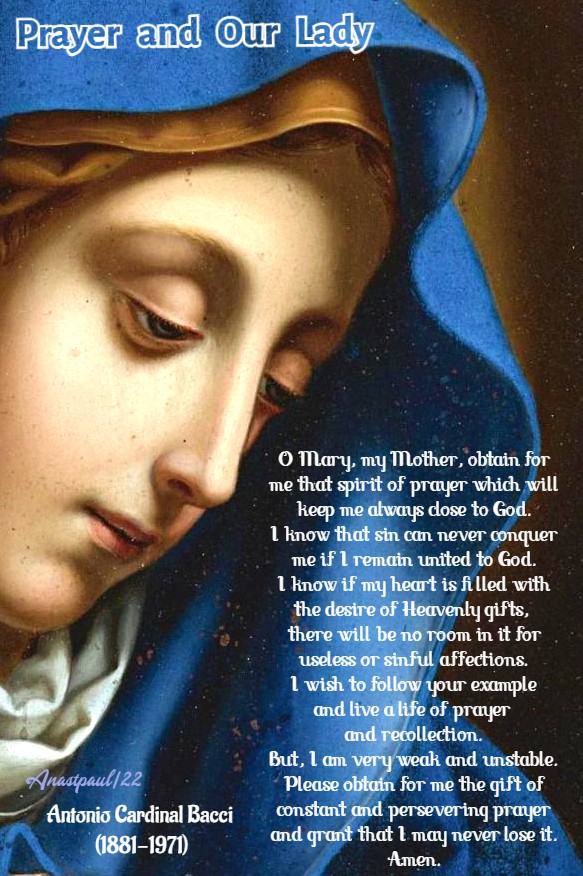
Thought for the Day – 16 May – Meditations with Antonio Cardinal Bacci (1881-1971)
Prayer and Our Lady
“O Mary, my Mother, obtain for me that spirit of prayer which will keep me always close to God. I know that sin can never conquer me if I remain united to God. I know if my heart is filled with the desire of Heavenly gifts, there will be no room in it for useless or sinful affections. I wish to follow your example and live a life of prayer and recollection. But, I am very weak and unstable. Please obtain for me the gift of constant and persevering prayer and grant that I may never lose it. Amen.”
Quote/s of the Day – 16 May – Sirach 44:16-27; 45:3-20, Matthew 25:14-23
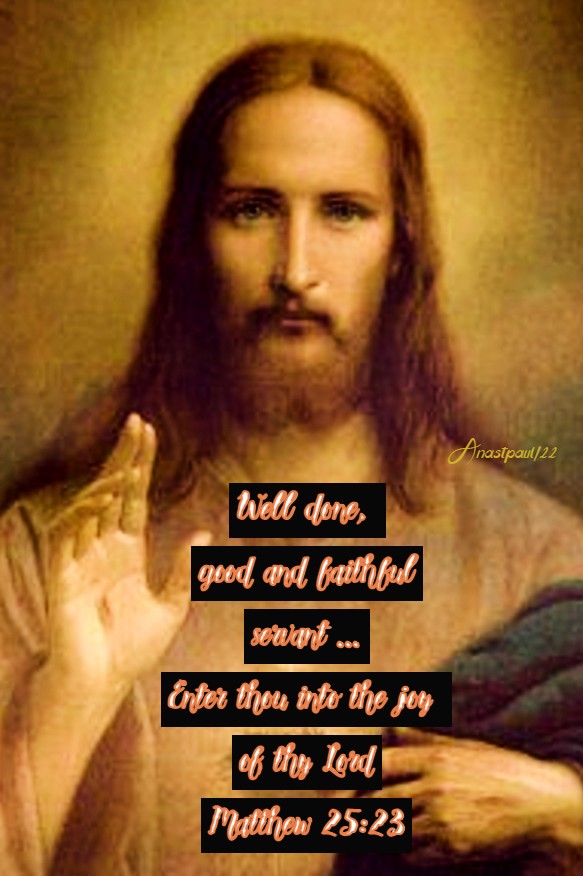
“Well done, good and faithful servant … Enter thou into the joy of thy Lord.”
Matthew 25:23
“I have chosen you and have appointed you, that you should go and should bring forth fruit and your fruit should remain, says the Lord.”
John 15:16
“If we follow Christ closely we shall be allowed, even on this earth, to stand, as it were, on the threshold of the heavenly Jerusalem and enjoy the contemplation, of that everlasting feast, like the blessed Apostles, who, in following the Saviour as their leader, showed and still show, the way to obtain the same gift from God. They said – See, we have left all things and followed You. We too follow the Lord and we keep His feast by deeds rather than by words.”
St Athanasius (297-373) Father & Doctor of the Church
“Rejoice and be happy! Persevere to the end and prefer to die rather than abandon the post, to which God has called you!”
St Catherine of Siena (1347-1380) Doctor of the Church
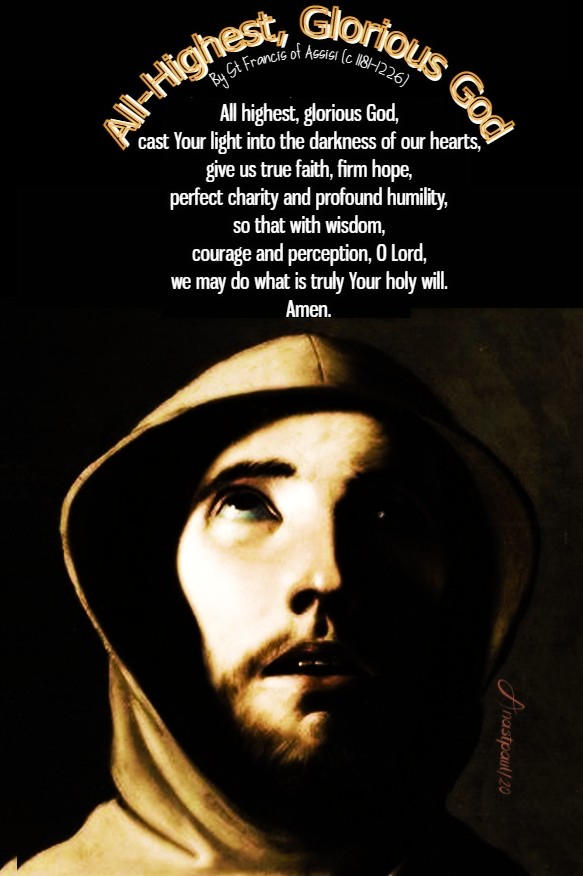
All Highest, Glorious God
All highest, glorious God, cast Your light into the darkness of our hearts, give us true faith, firm hope, perfect charity and profound humility, so that with wisdom, courage and perception, O Lord, we may do what is truly Your holy will. Amen.
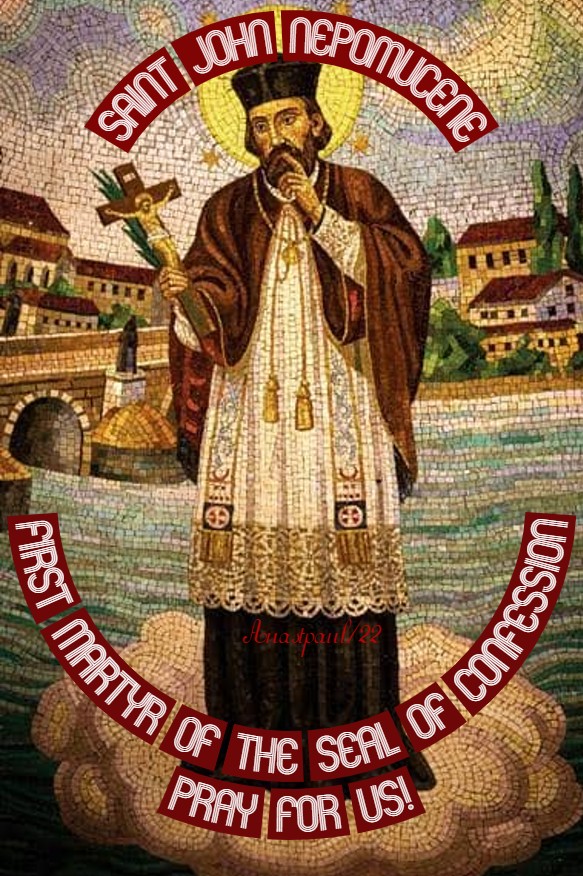
One Minute Reflection – 16 May – The Memorial of St John Nepomucene (c 1345–1393) Priest, Martyr, “The First Martyr of the Seal of the Confession.” – Sirach 44:16-27; 45:3-20, Matthew 25:14-23
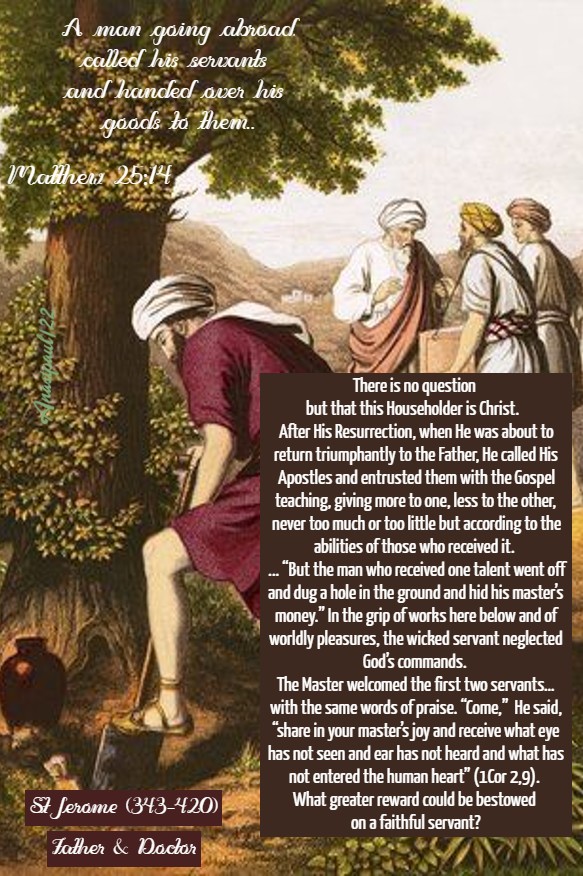
“A man going abroad, called his servants and handed over his goods to them.” – Matthew 25:14
REFLECTION – “There is no question but that this Householder is Christ. After His Resurrection, when He was about to return triumphantly to the Father, He called His Apostles and entrusted them with the Gospel teaching, giving more to one, less to the other, never too much or too little but according to the abilities of those who received it. In the same way, the Apostle Paul said that he had fed with milk those unable to take solid food (1Co 3,2)…
Five, two, one talent: let us take these to be the different graces granted to each, whether the five senses for the first; understanding of faith and works for the second; the reasons for distinguishing us from other creatures, for the third. “The one who received five talents went away and traded with them and made another five.” That is to say, besides the physical and material senses he had received, he added knowledge of heavenly things. His knowledge was raised from the creatures to the Creator, from the corporal to the incorporeal, from the visible to the invisible, from the transient to the eternal. “The one who received two made another two.” This one likewise, according to his ability, doubled in the school of the Gospel what he had learned in the school of the Law. Or perhaps we could say, that he understood that knowledge of faith and the works of this present life, lead to future happiness. “But the man who received one talent went off and dug a hole in the ground and hid his master’s money.” In the grip of works here below and of worldly pleasures, the wicked servant neglected God’s commands. However, let us note that, according to another evangelist, he wrapped it in a linen cloth – by this we could understand that he took away the force of his Master’s teaching, by a life of softness and pleasure…
The Master welcomed the first two servants… with the same words of praise. “Come,” He said, “share in your master’s joy and receive what eye has not seen and ear has not heard and what has not entered the human heart” (1Cor 2,9). What greater reward could be bestowed on a faithful servant?” – St Jerome (343-420) Translator of Sacred Scripture (the Vulgate), Father and One of the Original Four Doctors of the Latin Church .
PRAYER – Mercifully give us Your help, we beseech You, O Lord and by the intercession of blessed John, Your Confessor and Martyr, stretch over us the right hand of Your mercy against all wickedness of the devil. Through Jesus Christ, Thy Son our Lord, Who lives and reigns with Thee, in the unity of the Holy Ghost, God, world without end. Amen.
Our Morning Offering – 16 May – “The Month of the Blessed Virgin Mary”
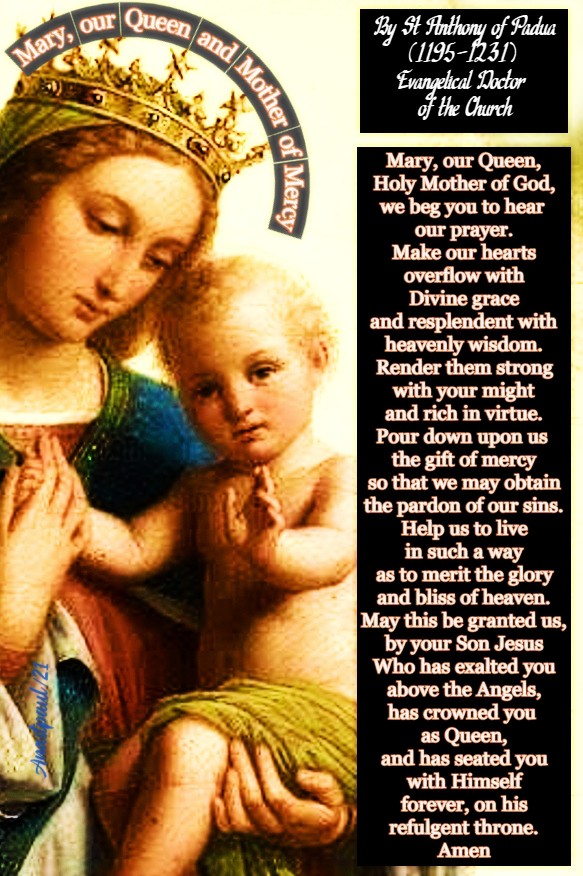
Mary, our Queen and Mother of Mercy By St Anthony of Padua (1195-1231) Evangelical Doctor of the Church
Mary, our Queen, Holy Mother of God, we beg you to hear our prayer. Make our hearts overflow with Divine grace and resplendent with heavenly wisdom. Render them strong with your might and rich in virtue. Pour down upon us the gift of mercy so that we may obtain the pardon of our sins. Help us to live in such a way as to merit the glory and bliss of Heaven. May this be granted us, by your Son Jesus Who has exalted you above the Angels, has crowned you as Queen, and has seated you with Himself forever, on his refulgent throne. Amen.
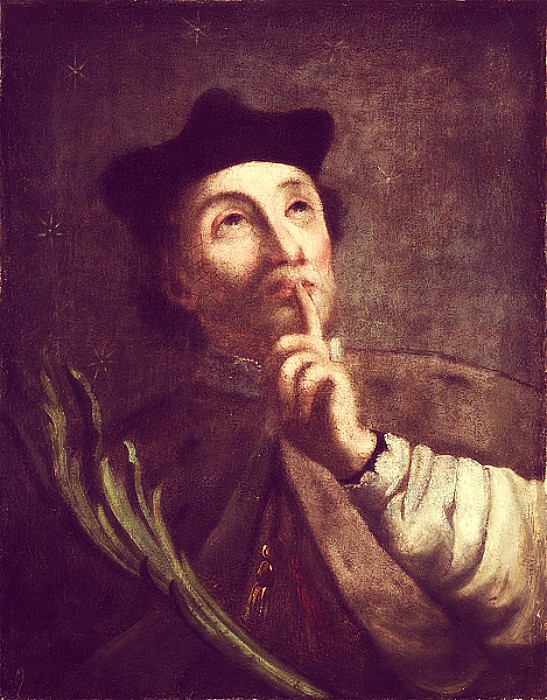
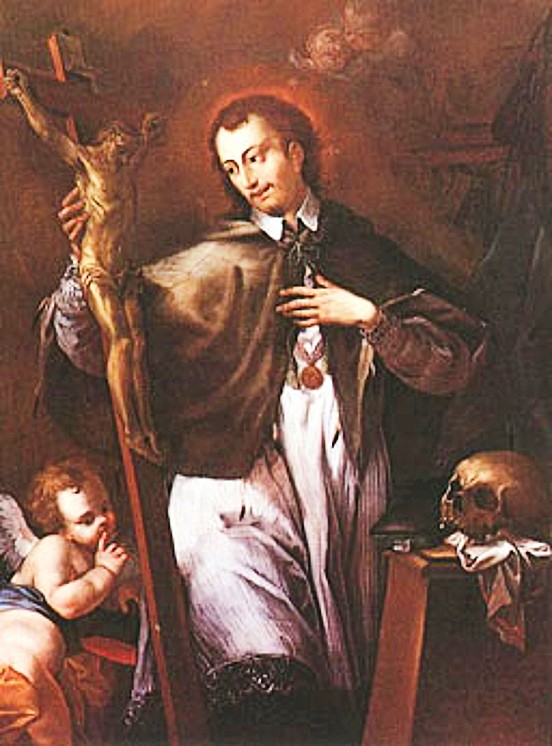
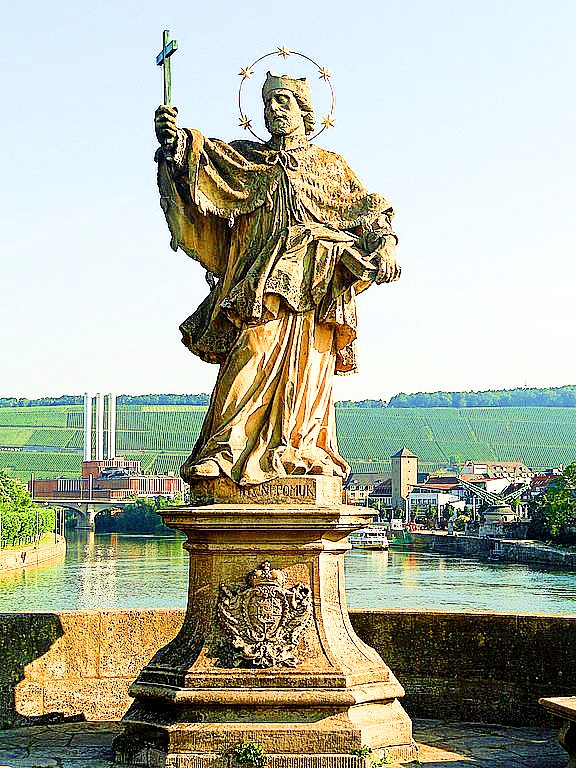
Saint of the Day – 16 May – St John Nepomucene (c 1345–1393) Priest, Martyr, Confessor and almoner.to the Queen of Bohemia – “The First Martyr of the Seal of Confession.” Born in c1345 in Nepomuk, Bohemia and died on 20 March 1393 (aged 47–48) at Prague . St John’s tongue is incorrupt and is kept in the Cathedral of St Vitus in Prague, Czech Republic. Patronages – Bohemia. – which includes the greater Czechoslovakia, Moravia and parts of Austria before various divisions; protection against slander, restoration of the good name of those slandered, help in confessing sins, for the protection of Priests and the Seal of Confession, San Juan, Batangas, Malibay, Pasay; Alfonso, Cavite; Moalboal, Cebu; San Remigio, Cebu; Cabiao; Spanish Navy. Also known as – John of Nepomuk, Nepomuc, Ioannes Nepomucenus, Johannes Nepomuk.
The Roman Martyrology states of him today: “At Prague in Bohemia, St John Nepomucene, a Canon of the Metropolitan Church, who, being tempted in vain to betray the secret of Confession, was cast into the river Moldaw and thus won the Palm of Martyrdom.”
Saint John Nepomucene, Priest and Martyr By Fr Francis Xavier Weninger SJ (1805-1888) (Excerpt)
John, whom, in our time, God has honoured with many miracles, received his surname from Nepomuc, a small town two miles from Prague, where he was born. His parents were plain people and had lived many years without issue. After having made a vow, however, in honour of the Blessed Virgin, whose miraculous picture is kept in a Cistercian Convent not far from Nepomuc, John was born to them. At the time of his birth, several stars were seen which floated down from heaven and rested upon the house of his parents. This event was interpreted and admired, as a prophecy of his future holiness. In his infancy, he fell dangerously ill but recovered after his parents had consecrated him to God, in the above-named place of pilgrimage.
As he grew, his greatest delight was to assist the Priests at Mass and he passed the whole forenoon in that sacred occupation, in the Cistercian Church. In his studies he made such rapid progress that he became Doctor of Divinity and Canon Law. After being Ordained Priest, he retired, for one month from all intercourse with men and prepared himself, by prayers, penances and purifying his soul, for his first Holy Mass. Soon after, he was commissioned to preach at Prague in the Church of our Lady, in the suburb and he did this with such eminent success, that the Archbishop raised him to the dignity of Canon and Preacher of the Cathedral, which functions he discharged until his death.
Wencelaus, at that period King of Bohemia, attended his sermons frequently, with his whole Court and esteemed the Saint highly. He offered him the See of Leimeritz and afterwards, the rich provostship of Wissherad but John refused both, hoping to do more good by preaching. Queen Jane, the wife of Wencelaus chose him for her Confessor and Almoner. The king, neglecting the affairs of the land, became, meanwhile, more and more, a slave to debauchery and drunkenness and added to the scandal which this gave to his people, by acts of the most unheard of cruelty. Not able to alter his conduct, either by exhortations or entreaties, the pious Queen, at last became silent, and endeavoured by prayer and other virtuous exercises, to inspire her husband with better thoughts and the fear of God. She frequently received the Holy Sacraments in order to give more power to her prayers and to be strengthened in patience. The wicked King regarded her frequent Confessions with mistrusting eyes, even suspecting that the Queen might have been as faithless to him, as he had been to her.
Hence, the desire to know what the Queen confessed was awakened in him and calling John into his presence, he, after long circumlocution and giving some feigned reasons, informed him of his wish, promising him all possible favours and honours. The Saint was at first stunned at so sacrilegious a demand and then explained to the King, the greatness of the crime, which a Priest would commit, if he revealed the least thing which had been told him, under the Seal of Confession, adding, that he would much rather die than become guilty of so terrible a crime.
The King dissimulated his anger at this reply, resolving to wait for another opportunity. He had not to wait long, for when, with unprecedented cruelty he had commanded that a cook, who had sent to the Royal table, a capon badly roasted, should be himself roasted alive on a spit and no-one dared to disobey the tyrant. Sohn, however, went to him and endeavoured to dissuade him from such barbarity. But instead of listening to the Saint, he gave orders to cast him into a dark, horrible dungeon and left him there a day without any food. After this, he sent the jailer to him with a message that he could save his life only by fulfilling the king’s desire. The Saint well understood the message and replied that he remained firm in what he had already said to the King. Wencelaus then determined to have recourse to kindness. He had the Saint liberated and informed, that he repented of his harshness and begged his pardon, at the same time requesting him to appear the following day at the Royal table, as a token of complete reconciliation. The Saint complied with the behest and appeared but no sooner had the King arisen from the table, than he repeated his godless desire, pressing the holy man, at first with great promises and then with cruel menaces. Seeing that neither the one nor the other were respected by John, he commanded that he should be again dragged to the dungeon and stretched upon the rack. To add to his suffering, he was, at the same time, burned with torches. The brave Martyr raised his eyes to Heaven and only repeated frequently the sacred names of Jesus and Mary. When he had been long tortured, the King, who was present, left and John was once more set at liberty.
He informed nobody of what had happened to him but as soon as his wounds were healed, he discharged his functions as he had hitherto done. As it was, however, revealed to him in a vision, that his silence would cost him his life, he bade farewell to his hearers on the Sunday before Ascension. His text was, “A little while and you shall not see me.” In this sermon he predicted the evils which would soon fall upon Bohemia, in consequence of new heresies and exhorted all to repentance and to constancy in the Catholic faith.
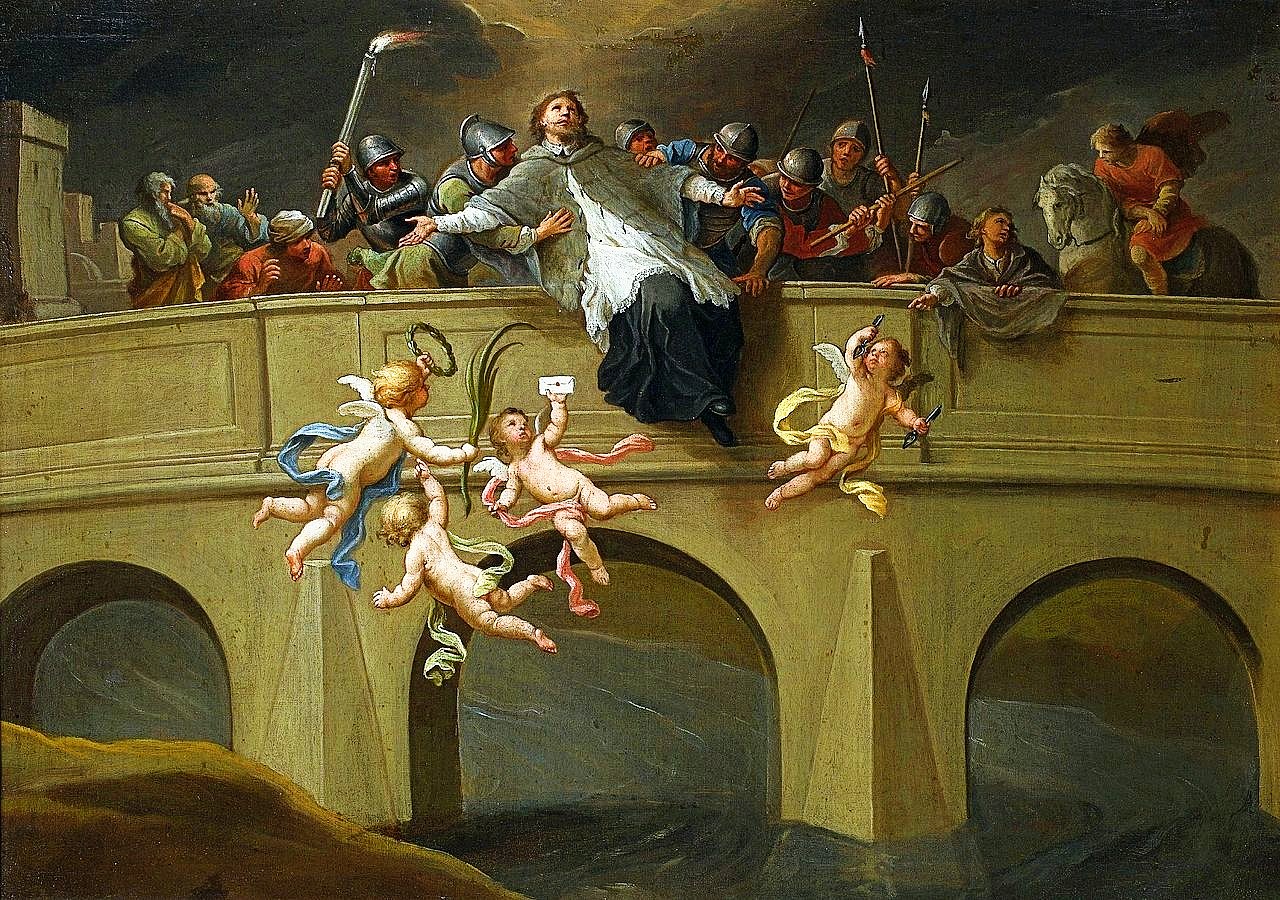
On the day before the festival of the Ascension, he made a pilgrimage to Bunzel where the miraculous image of the Blessed Virgin was honoured. Arriving there, he fervently recommended his approaching death-agony to the divine Mother. At evening, he returned to Prague. The King, leaning out of the window of his palace, saw him. Having given orders to bring the Saint before him, he addressed him with these shameless words: “Listen, parson! Thou wilt have to die, if thou dost not immediately tell me what the Queen confessed to thee. I vow to God, that thou shalt drink water!” The Saint repeated fearlessly his former words: “I will rather die a thousand times.” Hardly had this passed his lips, when the King commanded the holy man to be dragged into the adjoining apartment and kept there. As soon as night had come, he was led to the bridge that unites the old and new portions of Prague, and from thence cast into the Moldaw, in the year 1383.
Heaven did not allow this crime to be concealed for one single hour. An uncommonly bright light in the form of many stars was seen, which seemed to float upon the water and accompanying the holy body, remaining with it. All the people came running towards the river but could not explain the prodigy. The King himself was called by the Queen to witness the scene and looked at it in fear and trembling. When the next day dawned, the waters of the river were divided into two parts and in the midst was seen, lying on the sand, with a sweet smile upon his face, the body of the Saint. The Canons brought it, at first into the nearest Church but soon after, transferred it with imposing solemnities to the Cathedral.
From that day, date the honours which were paid to the Saint and which God approved by numberless miracles which were wrought at his tomb.
After the expiration of more than 300 years, the holy body was exhumed and the tongue of the Saint was found fresh without a sign of corruption. When, six years later, this tongue was shown to a deputation, sent by the Pope to verify the report, it suddenly swelled up before the eyes of all present and changed from dark red to purple, as though it were still, imbued with life.
The tomb and reliquary of St John, containing the incorrupt tongue
St Vitus Cathedral
Remarkable is the fact, that everyone who approached the tomb of the Saint, irreverently was sure to be punished with some public derision. Many examples of recent date have verified this.
In conclusion, it is to be remarked, that the intercession of Saint John Nepomuceno, may be requested with great benefit by those whose good name has been tarnished, or who are in danger of a public disgrace, as also by those who feel difficulties in confessing their sins. In our times this glorious Saint has become particularly renowned, not only on account of the incorruption of his tongue and the many miracles which have taken place at his shrine but also, on account of the many graces and benefits which the Almighty has bestowed upon those, throughout the whole Christian world, who with confidence ask his intercession. Many books are filled with the relation of these facts.
St Carantac St Carantoc St Diocletian of Osimo St Felix of Uzalis St Fidolus of Aumont St Fiorenzo of Osimo St Fort of Bordeaux St Francoveus St Gennadius of Uzalis St Germerius of Toulouse St Hilary of Pavia
St Ubaldus Baldassini St Victorian of Isauria Bl Valdimir Ghika
Martyrs of Saint Sabas: A group of Monks, whose names have not come down to us, who were massacred by Moors at the monastery of Saint Sabas in Palestine.
Martyrs of Caramasi Albertin-Marie Maisonade Ignace-Alexandre-Joseph Cardon Jan Chrysostom Zavrel Maturin-Marie Pitri Modeste-Marie Burgen Zosimo Maria Brambat
Thought for the Day – 15 May – Meditations with Antonio Cardinal Bacci (1881-1971)
The Power of Mary
“O Mary, my powerful and merciful Mother, my soul is constantly troubled by temptations. I am standing on the edge of the chasm. I promise to place myself, at once, under your maternal protection. Grant that I may never fall into sin again. Cast your merciful eyes upon me and save me when I am tempted. Grant that temptations may never again endanger the purity of my soul, by obtaining for me from God, a lively spirit of faith, a burning love fo Him and for you, a constant watchfulness over my senses and over worldly dangers and the gift of fervent and persevering prayer, in union with you and your divine Son, Jesus, Amen.”
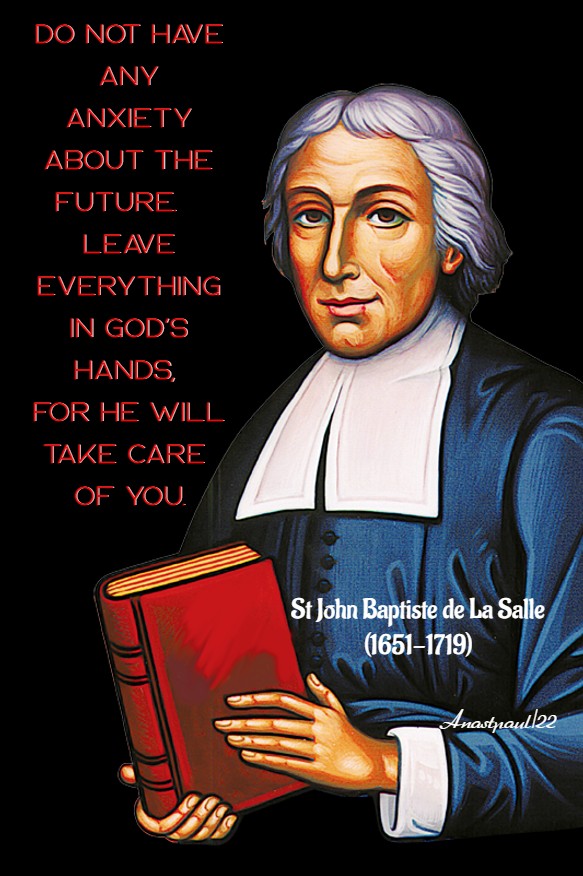
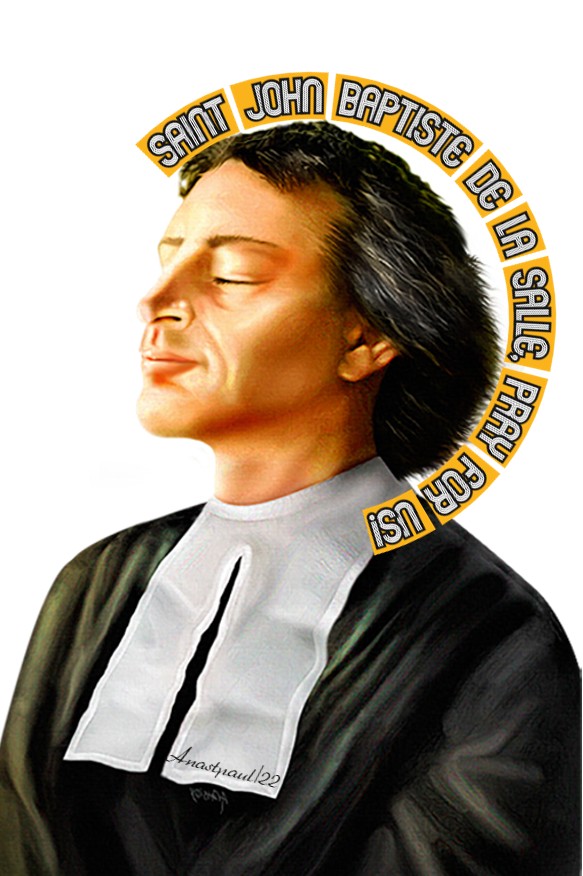
One Minute Reflection – 15 May – The Fourth Sunday after Easter – James 1:17-21, John 16:5-14 and the Memorial of St John Baptiste de la Salle (1651-1719) “The Father of Modern Education,” Confessor, Priest, Founder
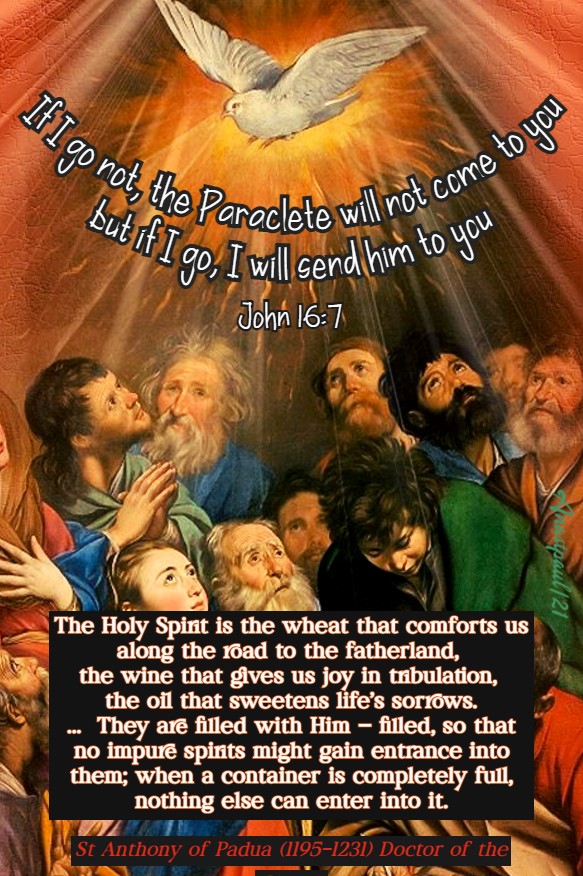
“But I tell you the truth, it is expedient to you that I go; for if I go not, the Paraclete will not come to you but if I go, I will send him to you.” – John16:7
REFLECTION – “The Holy Spirit is the wheat that comforts us along the road to the fatherland, the wine that gives us joy in tribulation, the oil that sweetens life’s sorrows. This threefold support, was needed by the apostles who had to go out to preach through the whole world. This is why Jesus sends the Holy Spirit to them. They are filled with Him – filled, so that no impure spirits might gain entrance into them; when a container is completely full, nothing else can enter into it.
The Holy Spirit “will teach you.” (Jn 16,13) so that you can know; he will prompt you. so that you can will. He gives both knowledge and will add to this our “ability,” according to the measure of our strength and we shall be temples of the Holy Spirit (1Cor 6,19).” – St Anthony of Padua (1195-1231) Franciscan, Doctor of the Church – Sermons
PRAYER – God, Who raised up the holy Confessor John Baptiste for the Christian education of the poor and to strengthen youth in the way of truth and through him, formed a new family in the Church, graciously grant, by his intercession and example, that we, striving to save souls out of zeal for Your glory, may be found worthy to share his heavenly crown. T hrough Jesus Christ, Thy Son our Lord, Who lives and reigns with Thee, in the unity of the Holy Ghost, God, world without end. Amen.
Our Morning Offering – 15 May – The Fourth Sunday after Easter
Prayer Before Holy Mass By St Ambrose (340-397) Father & Doctor of the Church
Lord Jesus Christ, we approach Your banquet table as saints and sinners and dare not rely on our own worth but only on Your goodness and mercy. Gracious God of majesty and awe, we seek Your protection, we look for Your healing. We appeal to You, the fountain of all mercy. Lord Jesus Christ, eternal King, Crucified for us, look upon us with mercy and hear our prayer, for we trust in You. Merciful Father, purify us in body and soul and make us worthy to taste the Holy of Holies. May Your Body and Blood, which we intend to receive, unworthy as we are, be for us the remission of our sins, the washing away of our guilt, the end of our evil thoughts and the rebirth of our better instincts. May it incite us to do the works pleasing to You and profitable to our health in body and soul and may it deliver us from evil. Amen
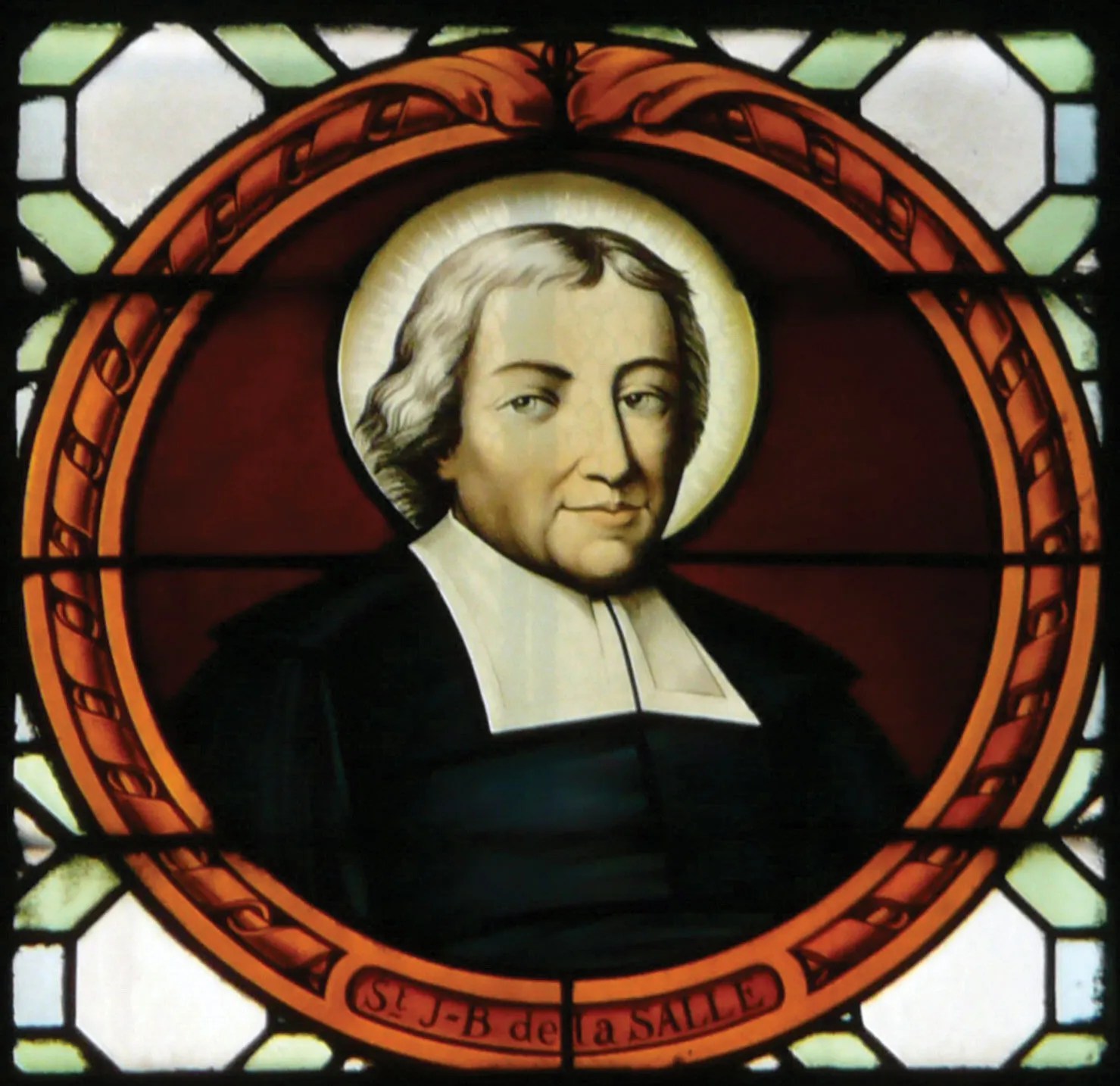
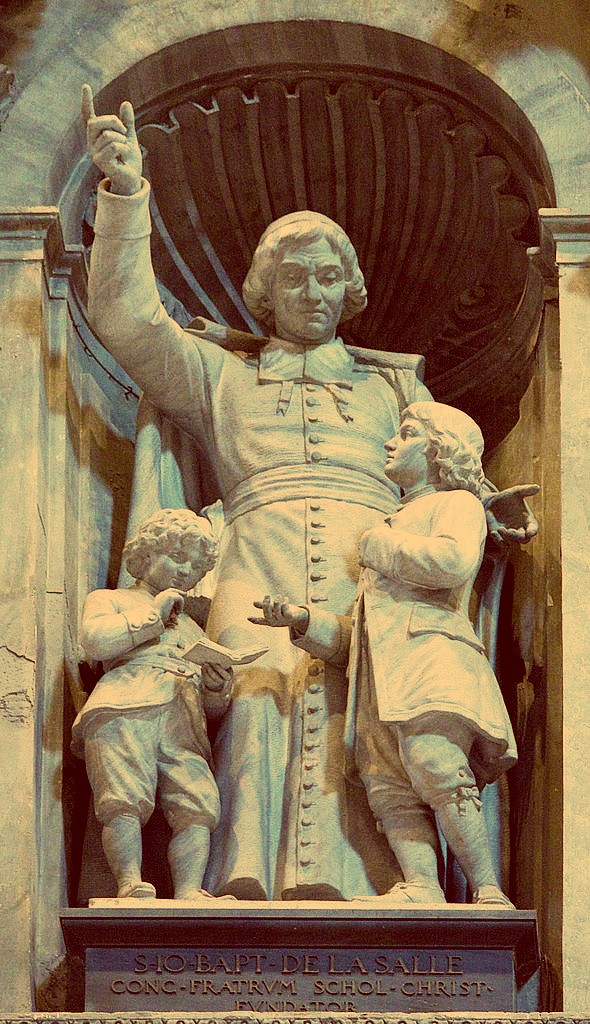
Saint of the Day – 15 May – St John Baptiste de la Salle (1651-1719) Confessor. Known as the “Father of Modern Education,” “Apostle of Children and Youth.”
The Roman Martyrology reads today: “At Rouen in France, St John Baptiste de la Salle, Confessor, who deserved well the veneration of both the religious and society, by his labours for the education of the youth, especially the poor and by the founding of the Society of the Brothers of the Christian Schools.”
John Baptiste de La Salle, born of an honourable family at Rheims, when still a boy, showed by his manners and actions, that he was called by destiny to the Lord and was to be adorned with the excellence of holiness. As a youth he studied literature and the philosophical sciences at the Academy at Rheims. During this time, although his mental powers and his lively and pleasant disposition endeared him to all, he nevertheless, shrank from the company of his fellows, so that, being inclined to solitude, he might the more easily find time for God.
Already having been, for some time, enlisted in the ranks of the clergy, he was enrolled among the Canons of Rheims at the age of sixteen years. He went to Paris to study theology at the University of the Sorbonne and was admitted to the Sulpician Seminary. But he was soon forced to return home due to the death of his parents and undertook the education of his brothers, which he carried on,, without interrupting his sacred studies and with the greatest success, as was proved by subsequent events.
He was finally Ordained Priest and said his first Mass with the intense faith and ardour of the soul which, throughout his whole life, he brought to those Sacred Mysteries. Meanwhile, burning with zeal for the salvation of souls, he devoted himself wholly to their service. He undertook the direction of the Sisters of the Infant Jesus, founded for the education of girls and not only managed them most prudently, but saved their institute from dissolution. From this time onwards, he turned his attention to the education of poor boys in religion and good morals. And God had raised him up for this very end, namely, that he should found, in h=His Church, a new family of religious men and should look after boys’ schools, especially of poor boys, with unceasing and efficient care. And, indeed, this duty, entrusted to him by Divine Providence, was successfully accomplished, in spite of active and extreme and opposition and great hardships, by the foundation of an Institute of Brothers which he named the Christian Schools.
His male associates in this great and arduous work, he at first received into his own house and then, establishing them in a more suitable dwelling, thoroughly inspired them with his method and with those wise laws and regulations, which were afterwards confirmed by Benedict XIII. Because of humility and love of poverty, he first resigned his Canonry and distributed all his property among the poor and later too, after many unsuccessful attempts to do so, he of his own will, resigned the government of the Institute which he had founded.
But meanwhile his solicitude for the brothers and for the schools which he had opened in different places, did not lessen, although he began to give himself more diligently to God. Showing his hatred for self in constant fastings, in the use of the discipline and in other austerities, he spent his nights in prayer. At length, conspicuous for every kind of virtue, especially, obedience and zeal for fulfilling the Divine Will and love and devotion to the Apostolic See, full of merit and having devoutly received the Sacraments, he fell asleep in the Lord in the sixty-eighth year of his age.
The Supreme Pontiff Leo XIII placed him in the list of the Blessed and, illustrious by new miracles, he was adorned with honours of the Saints, in the year of Jubilee, 1900 on the 24th day of May of that year by the same Pontiff..
Prayer for the Intercession of St John Baptist de La Salle
O Glorious Saint John Baptiste de la Salle, Apostle of Children and Youth, be thou, from the heights of Heaven, our guide and our patron. Offer thy prayers fo us and help us, that we may be kept free from every stain of error and corruption and remain ever faithful to Jesus Christ and to His Church. Grant that we, practising the virtues of which thou has been so wondrous an example, may be made partakers of the glory in Heaven, our true country. Amen.
Bercthun of Beverley Bertha of Bingen St Caecilius of Granada St Caesarea of Otranto St Cassius of Clermont Bl Clemente of Bressanone St Colman Mc O’Laoighse St Ctesiphon of Verga Blessed Diego of Valdieri
St Hesychius of Gibraltar St Hilary of Galeata St Indaletius of Urci St Isaias St Isidore of Chios Bl Joan Montpeó Masip St Maximus of Clermont St Nicholas the Mystic St Rupert of Bingen St Secundus of Avila St Simplicius of Sardinia St Sophia of Rome St Victorinus of Clermont St Waldalenus of Beze
Thought for the Day – 14 May – Meditations with Antonio Cardinal Bacci (1881-1971)
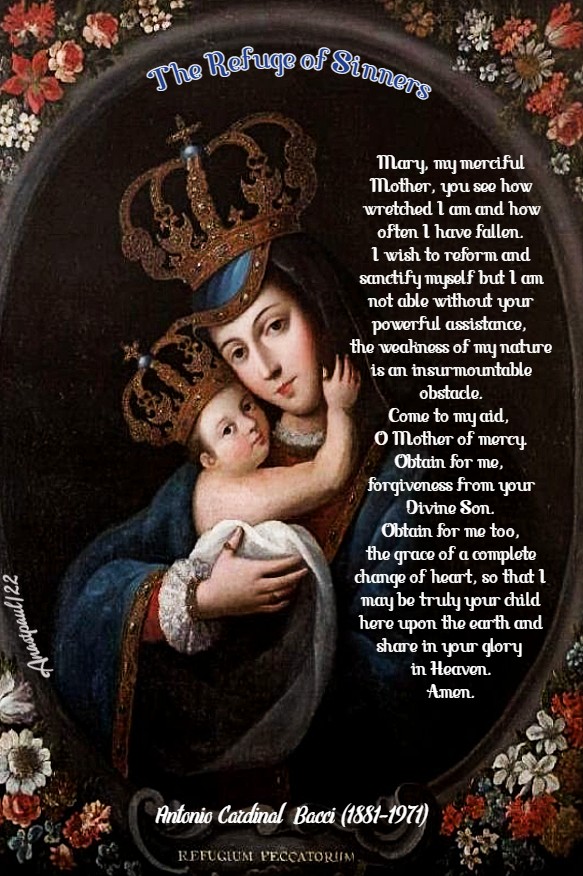
The Refuge of Sinners
“Mary, my merciful Mother, you see how wretched I am and how often I have fallen. I wish to reform and sanctify myself but I am not able without your powerful assistance, the weakness of my nature is an insurmountable obstacle. Come to my aid, O Mother of mercy. Obtain for me, forgiveness from your Divine Son. Obtain for me too, the grace of a complete change of heart, so that I may be truly your child here upon the earth and share in your glory in Heaven. Amen.”
Quote/s of the Day – 14 April – “The Month of the Blessed Virgin Mary” and Mary’s Day – Sirach 24:14 -16, John 19:25-27
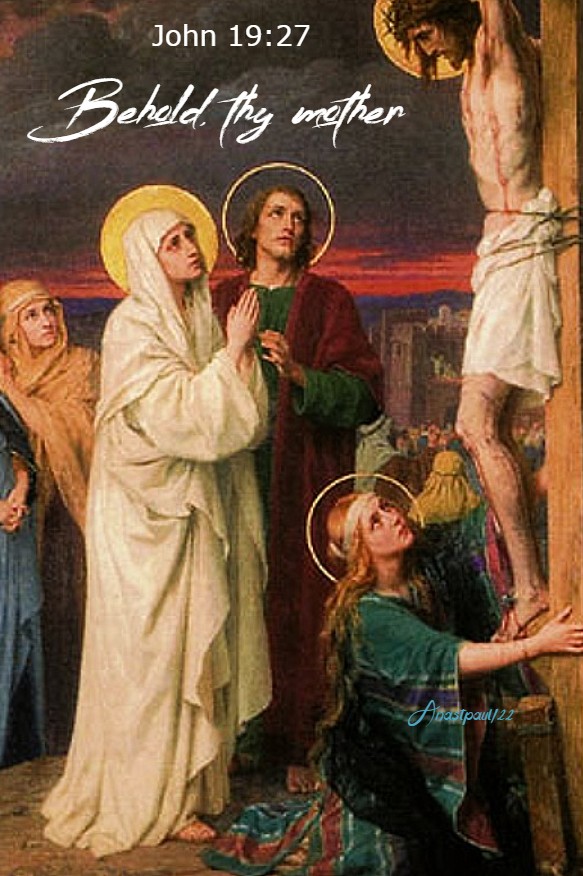
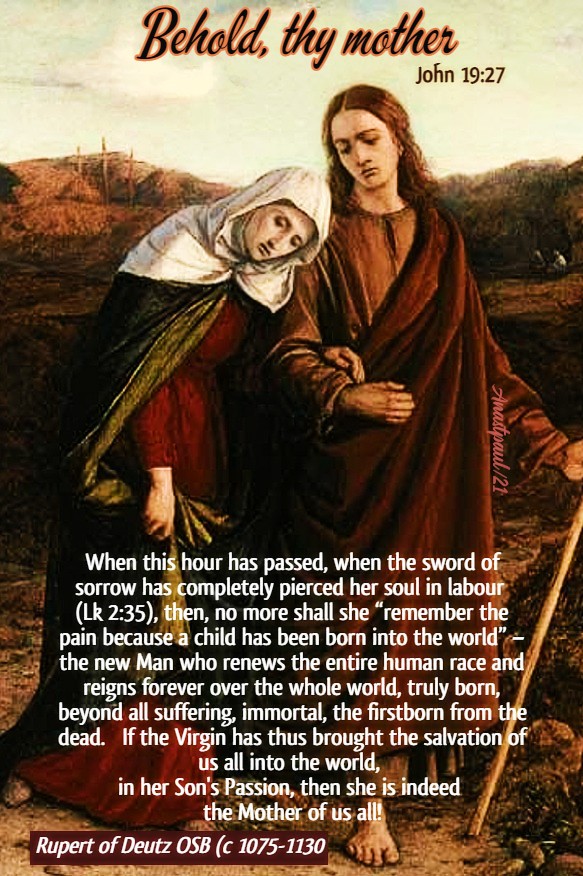
“Behold, thy mother”
John 19:27
“Go to Mary and sing her praises and you will be enlightened. For it is through her, that the true Light shines on the sea of this life.”
St Ildephonsus (607-670)
“O Mary, you give assistance to everyone endeavouring to rise to God!”
St Bridget of Sweden (c 1303 – 1373)
“Wherefore, in the same holy bosom of His most chaste Mother, Christ took to Himself flesh and united to Himself, the spiritual Body formed by those who were to believe in Him. Hence Mary, carrying the Saviour within her, may be said, to have also carried, all those. whose life was contained in the life of the Saviour. Therefore, all we, who are united to Christ and, as the Apostle says, are members of His body, of His flesh and of His bones (Eph 5:30), have issued from the womb of Mary, like a body united to it’s Head.”
One Minute Reflection – 14 April – “The Month of the Blessed Virgin Mary” and Mary’s Day – Sirach 24:14 -16, John 19:25-27
“Behold, thy mother” – John 19:27
REFLECTION – “Woman, this is your son. This is your mother.” By what right is the disciple whom Jesus loved, the son of the Lord’s mother? By what right is she his mother? By the fact that, without pain, she brought into the world the salvation of us all, when she gave birth in the flesh to the God-man. But now she is in labour with great pain as she stands at the foot of the Cross.
At the hour of His Passion, the Lord Himself rightly compared the Apostles to a woman in childbirth, when He said: “When a woman is in labour she is in anguish because a child is born into the world” (cf. Jn 16:21). How much more, then, might such a Son compare such a Mother, the Mother standing at the foot of His Cross, to a woman in labour? What am I saying? “Compare?” She is indeed truly a woman and truly a mother and, at this hour, she is truly experiencing the pains of childbirth. When her Son was born she did not experience the anguish of giving birth in pain as other women do; it is now that she is suffering, that she is crucified, that she experiences sorrow like a woman in labour because her hour has come ( Jn 16:21; cf.13:1; 17:1). …
When this hour has passed, when the sword of sorrow has completely pierced her soul in labour (Lk 2:35), then, no more shall she “remember the pain because a child has been born into the world” – the new Man who renews the entire human race and reigns forever over the whole world, truly born, beyond all suffering, immortal, the firstborn from the dead. If the Virgin has thus brought the salvation of us all into the world, in her Son’s Passion, then she is indeed the Mother of us all!” – Rupert of Deutz (c 1075-1130) Benedictine Monk, Theologian, Exegete and Writer – Commentary on Saint Johns Gospel, 13 ; PL 169, 789.
PRAYER – Grant, we beseech Thee, O Lord God, unto all Thy servants, that they may remain continually in the enjoyment of soundness, both of mind and body and, by the glorious intercession of the Blessed Mary, always a Virgin, may be delivered from present sadness, and enter into the joy of Thine eternal gladness. Through Jesus Christ, Thy Son our Lord, Who lives and reigns with Thee, in the unity of the Holy Ghost, God, world without end. Amen (Collect).
Our Morning Offering – 14 May – “The Month of the Blessed Virgin Mary” and Mary’s Day
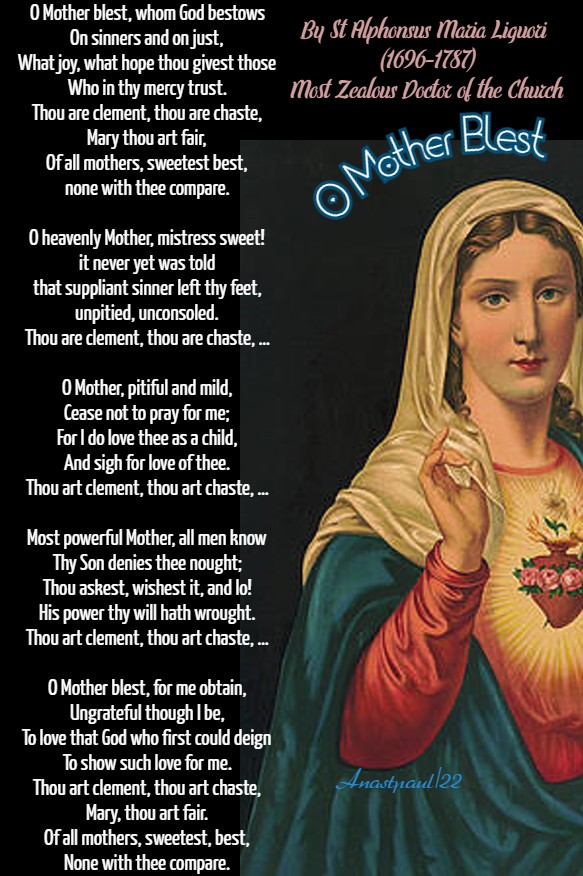
O Mother Blest By St Alphonsus Maria Liguori (1696-1787) Most Zealous Doctor of the Church Trns. Fr Edmund Vaughn C.SS,R, (1827 – 1908 )
O Mother blest, whom God bestows On sinners and on just, What joy, what hope thou givest those Who in thy mercy trust. Thou are clement, thou are chaste, Mary thou art fair, Of all mothers, sweetest best, none with thee compare.
O heavenly Mother, mistress sweet! it never yet was told that suppliant sinner left thy feet, unpitied, unconsoled. Thou are clement, thou are chaste, …
O Mother, pitiful and mild, Cease not to pray for me; For I do love thee as a child, And sigh for love of thee. Thou art clement, thou art chaste, …
Most powerful Mother, all men know Thy Son denies thee nought; Thou askest, wishest it, and lo! His power thy will hath wrought. Thou art clement, thou art chaste, …
O Mother blest, for me obtain, Ungrateful though I be, To love that God who first could deign To show such love for me. Thou art clement, thou art chaste, Mary, thou art fair. Of all mothers, sweetest, best, None with thee compare.
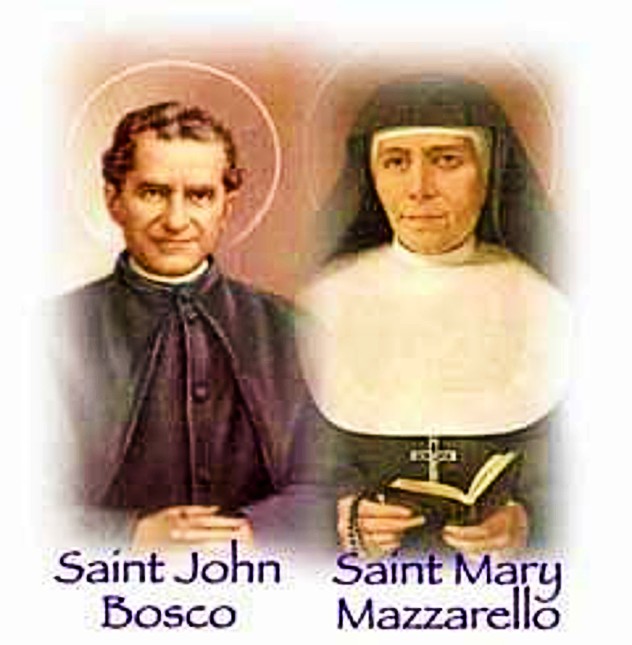
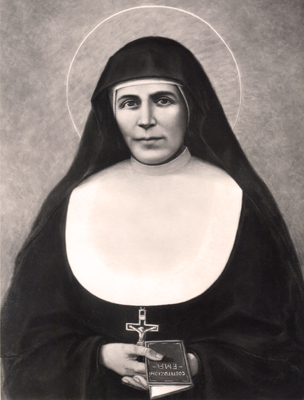
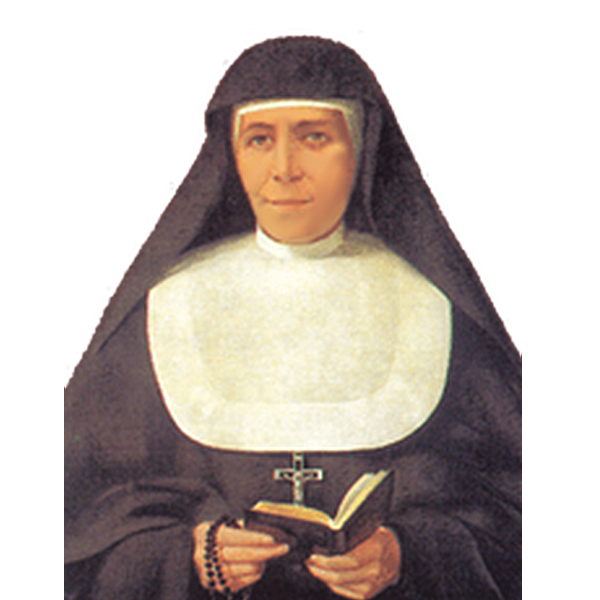
Saint of the Day – 14 May – St Maria Domenica Mazzarello FMA (1837-1881) Virgin, Religious Sister and Founder with St John Bosco of the Daughters of Mary Help of Christians. They were founded to work alongside Saint John Bosco and his Salesians of Don Bosco, in his teaching projects in Turin. They continue to be a teaching Order worldwide and are now called the Salesian Sisters of St John Bosco. Born on 9 May 1837 at Mornese, Acqui, Italy and died on 14 May 1881, aged 44, in Nizza Monferrato, Asti, Italy of natural causes. Also known as – Mary Dominic Mazzarello.
Maria was born in Mornese, in what is now the Province of Alessandria, northern Italy, to a peasant family who worked in a vineyard. She was the eldest of ten children of Joseph and Maddalena Calcagno Mazzarelli. When she was fifteen she joined the Association of the Daughters of Mary Immaculate, known for there charitable works and run by the Parish Priest, Father, Domenico Pestarino – this Apostolate was a precursor to the founding of the Salesian Sisters.
When she was 23 years old, a typhoid epidemic hit Mornese causing the death of many villagers. Soon, her uncle and aunt were taken ill and Maria volunteered to care for them and their many children. After a week they recovered, however, when Maria returned home, she also became ill with typhoid. Due to the illness, she received the last rites. She recovered, but the illness left her weak. The strength which had formerly sustained her, in her work in the fields, was no more. Maria was now thin and frail; a shell of her formerly robust self.
She took an apprenticeship as a seamstress in the town and worked diligently at the craft. Like St John Bosco, the skills which she learned in her youth, she was able to pass onto those who would come after her. One day, Maria was walking in her village and was suddenly astounded to see before her, a vision of a large building with a courtyard and many girls playing and laughing. A voice said to her, “I entrust them to you.”
The education of girls was a particular need in the nineteenth century and Maria decided to devote herself to this work. Hosts of farm girls , or serving girls, factory workers and street vending girls, filled the streets of the city and all of them were at risk to juvenile prostitution. She wished to educate them and teach them a trade, to save them from the dangers of street life. She persuaded some of her girl friends to join her in this project. Fifteen young women now comprised the Daughters of Mary Immaculate. Fr Pestarino busied himself with training them in the spiritual life and managed to secure a place for some of them to live in community, thus was the beginning of religious life in Mornese. The Daughters took in a few young girls and housed them, schooling them in the faith and handing down to them, their knowledge of dress aking, tailoring and general sewing skills.
John Bosco was told of the Daughters by Fr Pestarino, who himself was training as a Salesian of Don Bosco, under the Saint. Considering his vision of the young girls, Bosco decided to meet with them. He went to Mornese with his boy band under the guise of raising funds for his Oratory but his true intention was to investigate the possibility of founding a female counterpart of the male Salesian religious Order,.
In 1867, after meeting with them and receiving the Daughters’ enthusiastic response to his proposal, St John drew up their first rule of life. A source of the community’s good spirit, sense of humour, optimism and charity, Maria Mazzarello was the natural choice for the first Superior. Eventually obedience won out and she was the first Mother of the young community at age thirty.
After many formation, struggles, the well-intentioned but misdirected advice of others, and difficulties with the townspeople (whose school for boys which they had raised money for and built, st John transferred to the Daughters, for their work). The day of their profession arrived. The fifteen young women, led by Maria, professed their vows as religious women in the presence of the Bishop of Acqui, their spiritual father St John and Fr Pestarino. The date was 31 July 1872, the birthday of this new religious family.
Collegio, the first community of the Daughters of Mary Help of Christians.
At age thirty-five, donned in a habit, she was now Sister Maria Mazzarello. As the feminine branch of the Salesian religious family, the Daughters sought to do for girls what the Priests and Brothers were doing in Turin for boys.
After being elected Mother General of the Salesian Sisters, Maria Mazzarello felt that it was important that she and the other Sisters, have a good understanding of how to read and write; it was a skill which many of them had never had the opportunity to acquire and which training she now organised. Her dedication to her Sisters was not limited to their intellectual development alone. In every way, she was an attentive mother, which is why to this day, she is still fondly referred to as “Mother Mazzarello” by the Salesian Family.
The first Missionary Sisters set out for Uruguay in 1877. Mother Mazzarello accompanied them to their port of call in Genoa, and then took a boat to France, so that she could visit the SIsters who had already established themselves there.
In Marseilles their ship had to be repaired and all of the passengers were forced to disembark while it was dry docked. Although the Sisters had been told that lodging had been prepared for them, there was a mix-up and they were left without stranded.. Mother Mazzarello was not one to let events such as this discourage her, so she took the sheets that they had brought with them, stuffed them with straw and made makeshift beds for all of them. After a miserable night of sleep, they all awoke but Mother Mazzarello could not get up. A fever was ravaging her body and she was in terrible pain. The next morning,, more out of a concern for her already exhausted companions, she was able to get up, see the Missionaries off and then journey with her remaining Sisters to their house and orphanage in St.Cyr.
Once in St Cyr ,she fainted and was confined to bed for forty days.. The diagnosis was pleurisy. Eventually she returned to Italy, even though the doctor told her not to travel. She said that she wanted to die in her own community. She made her return journey in stages, she was painfully aware of her delicate condition. Fortunately. on one of her stops St John was near and they were able to meet for the last time.
In early April, Maria returned to Mornese. Her native air strengthened her and since she felt stronger she insisted on keeping the community schedule and doing her usual work. Unfortunately, it was too much for her and she relapsed. Near the end of April it seemed that death was approaching. Finally, in the pre-dawn hours of 14 May 1881, Mother Mazzarello began her death agony. After receiving the last rites she turned her attention to those around her and weakly whispered, “Good-bye. I am going now. I will see you in Heaven.” Shortly after she died at the age of forty-four.
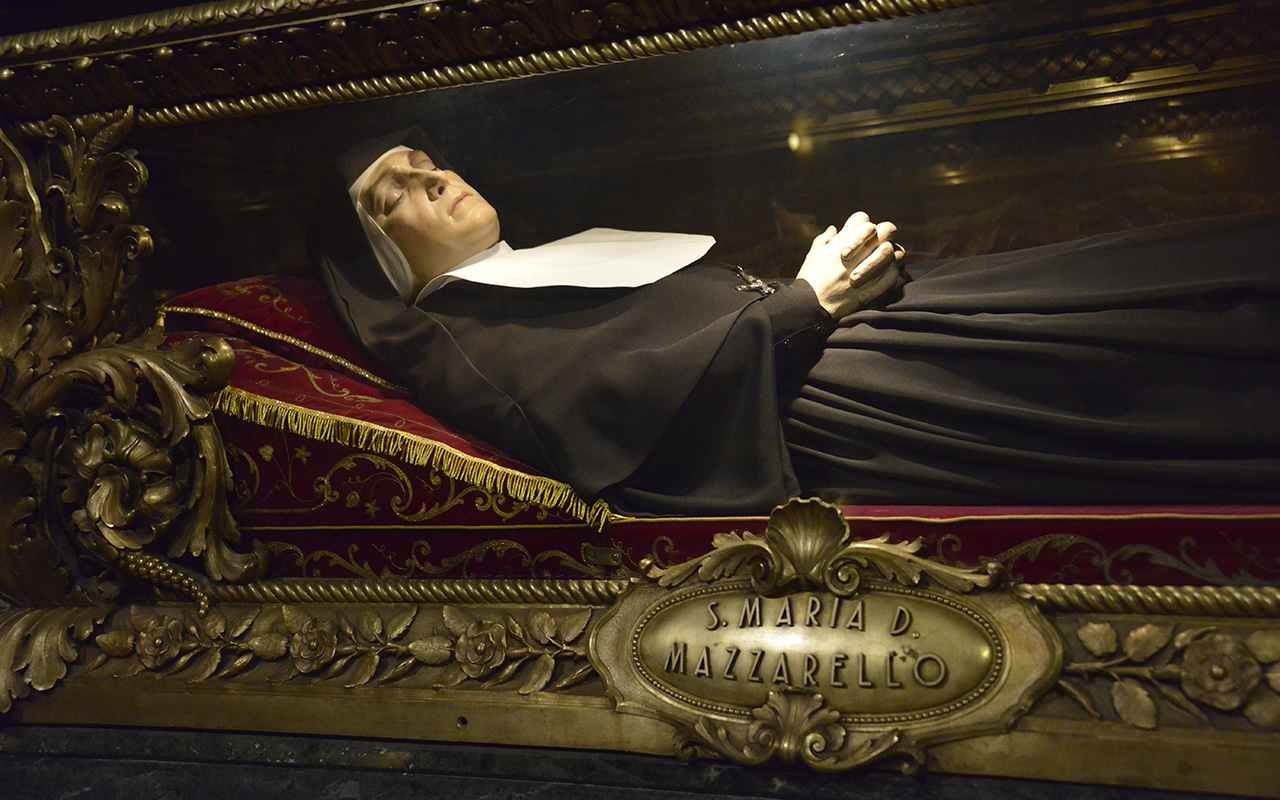
Maria was Beatified on 20 November 1938 and Canonised on 24 June 1951. Her incorrupt body is venerated in the Basilica of Our Lady Help of Christians, in Turin, Italy, which is the Mother Basilica of the Salesians, built by St John Bosco. A Church in southeast Rome bears her name, Santa Maria Domenica Mazzarello – the Statue below resides there..
St Boniface of Ferentino St Boniface of Tarsus St Corona the Martyr St Costanzo of Capri St Costanzo of Vercelli Bl Diego of Narbonne St Dyfan St Engelmer St Erembert of Toulouse St Felice of Aquileia St Fortunatus of Aquileia St Gal of Clermont-Ferrand
St Henedina of Sardinia St Justa of Sardinia St Justina of Sardinia St Maria Domenica Mazzarello FMA (1837-1881) Virgin, Religious Sister and Founder with St John Bosco of the Daughters of Mary Help of Christians. They were founded to work alongside Saint John Bosco and his Salesians of Don Bosco in his teaching projects in Turin. They continue to be a teaching Order worldwide and are now called the Salesian Sisters of St John Bosco.Her Body is incorrupt.
St Pons of Pradleves St Pontius of Cimiez St Tuto of Regensburg St Victor the Martyr
Martyrs of Seoul – 5 Beata: A group of lay people Nartyred together in the apostolic vicariate of Korea. • Petrus Choe Pil-je • Lucia Yun Un-hye • Candida Jeong Bok-hye • Thaddeus Jeong In-hyeok • Carolus Jeong Cheol-sang 14 May 1801 at the Small West Gate, Seoul, South Korea
Second Thought for the Day – 13 May – The Memorial of St Robert Bellarmine SJ (1542-1621) Bishop, Confessor, Doctor of the Church
“The Month of the Blessed Virgin Mary” St Robert’s Personal Devotion to the Mother of God
“St Robert was devoted to the Blessed Virgin from his earliest years. According to his schoolmate, later Canon Vincent Patiuchelli, as a young boy Bellarmine used to recite daily the Office of the Blessed Virgin, often in company with Vincent as the two of them walked slowly along the road. Bellarmine retained this custom of reciting the Office of Our Lady throughout life. In the same way. he kept the custom into his old age. of daily saying the Rosary. Alexander Jacobelli, who was the Cardinal’s Almoner for twenty years, testified at the Beatification process that, “He never omitted saying the Office and the Rosary of the Blessed Virgin Mary, during which he was often found melted in tears.”
However, Robert was not satisfied with only a single recitation of the Rosary. The beads were literally his constant companion. In the words of his chaplain, “when fatigued with study, Bellarmine would find recreation in reciting the beads with uncovered head.” And again, “his relaxation was to say the Rosary of Our Lady.” On his frequent journeys as Archbishop of Capua, attendants noticed that he always followed the same ritual – celebrate Mass, say the Itinerarium and, Rosary in hand, enter the carriage for the journey.
Juan de Serayz, a close friend of Robert, left some interesting details on how Bellarmine would say the Rosary. It was 14 June 1618, the Feast of Corpus Christi, when Robert and Juan were returning from a procession at St Peter’s Basilica. “As we got into the carriage,” relates Juan, “he told me that he was able to say the third part of the Rosary exactly three times, from the time the procession left the Sistine Chapel to where it finally ended at the Altar of Exposition in St Peter’s. Which I asked him, out of curiosity, how he said the Rosary, he told me that he separated the decades of the Angelic Salutation with an Our Father, adding to each decade a short prayer corresponding to the different mysteries and preceding with emphasis, he said that he recited the Hail Mary’s slowly, slowly. When I observed that this did not leave much time for keeping his partner company, he answered that during the whole procession, he did not say a single word to his Cardinal companion.”
We understand, therefore, how painful were the doctor’s orders during Robert’s last illness, when he was forbidden, not only to say the Breviary but also, the Rosary. For, as his brother explained, the doctor knew with what ardour and devotion he applied himself to these prayers. Finally, the doctor was moved by the dying man’s pleas and mitigated the orders first given to the servant, allowing the sick man “a moderate use of the Rosary,” although everyone knew that, “his intense application to this prayer would be a great strain upon him.”
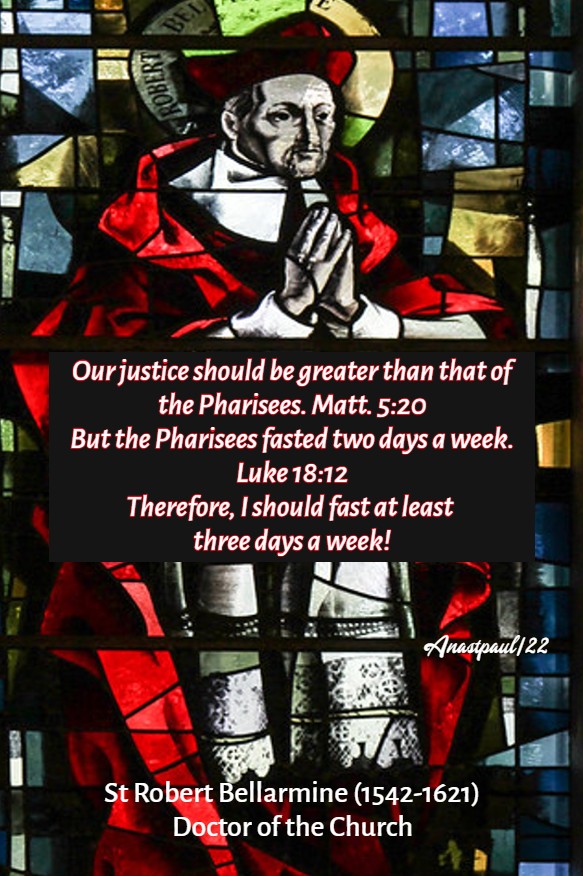
To the Office and the Rosary, Bellarmine added the Saturday fast in Mary’s honour. He fasted three days a week with the same rigour that he kept the Lenten fast, that is, most strictly. According to a syllogism which he wrote on the subject, he argued in this way:
“Our justice should be greater than that of the Pharisees. Matt. 5/20 But the Pharisees fasted two days a week. Luke 18/12 Therefore, I should fast at least three days a week!” So, besides the fasts for the vigils and the Lenten fast and besides the whole of Advent, he kept a sacred fast on Wednesday, Friday and Saturday of each week. That he kept the Saturday fast in honour of Our Lady is clear from the sermon which he gave on one occasion for the Feast of the Immaculate Conception, when he said that among the practices most pleasing to the Blessed Virgin and her Divine Son and most useful to growing in their love and friendship, is the daily recitation of the Rosary and the Saturday fast in Mary’s honour. It was only under express orders from his Confessor to fast only twice a week, that in his old age Bellarmine relinquished the Saturday fast.” [Excerpt by Servant of God Fr John A Hardon SJ (1914-2000)]
Thought for the Day – 13 May – Meditations with Antonio Cardinal Bacci (1881-1971)
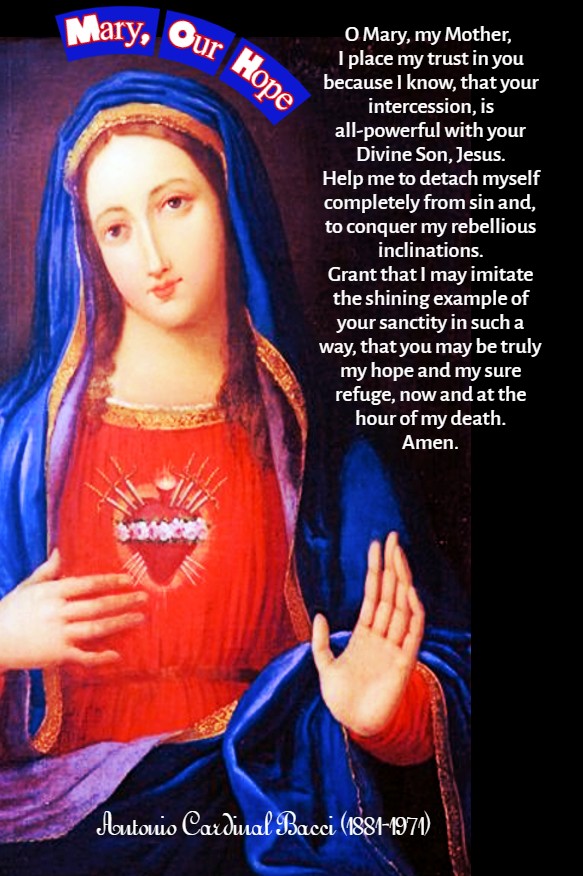
Mary, Our Hope
“O Mary, my Mother, I place my trust in you because I know, that your intercession, is all-powerful with your Divine Son, Jesus. Help me to detach myself completely from sin and, to conquer my rebellious inclinations. Grant that I may imitate the shining example of your sanctity in such a way, that you may be truly my hope and my sure refuge, now and at the hour of my death. Amen.”
Quote/s of the Day – 13 May – The Memorial of St Robert Bellarmine SJ (1542-1621) Bishop, Confessor, Doctor of the Church
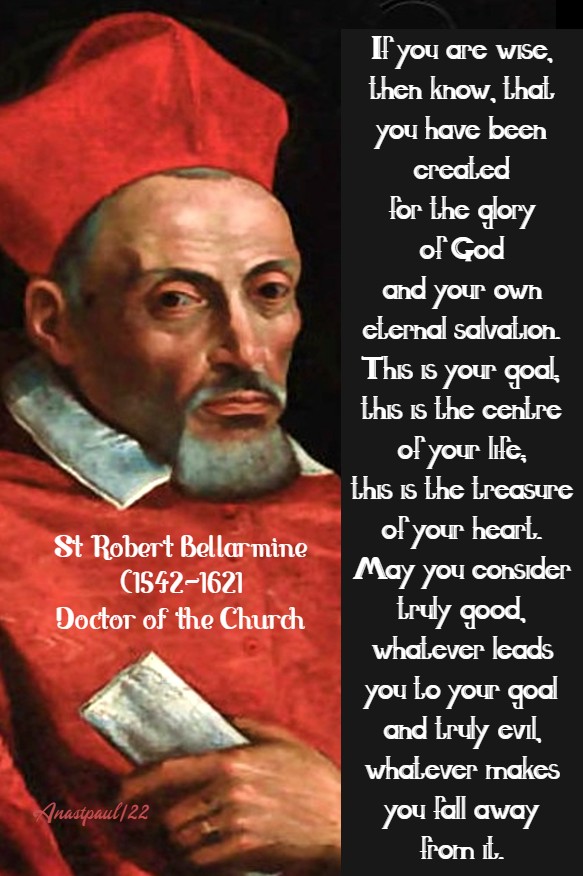
“If you are wise, then know, that you have been created for the glory of God and your own eternal salvation. This is your goal; this is the centre of your life; this is the treasure of your heart. May you consider truly good, whatever leads you to your goal and truly evil, whatever makes you fall away from it.”
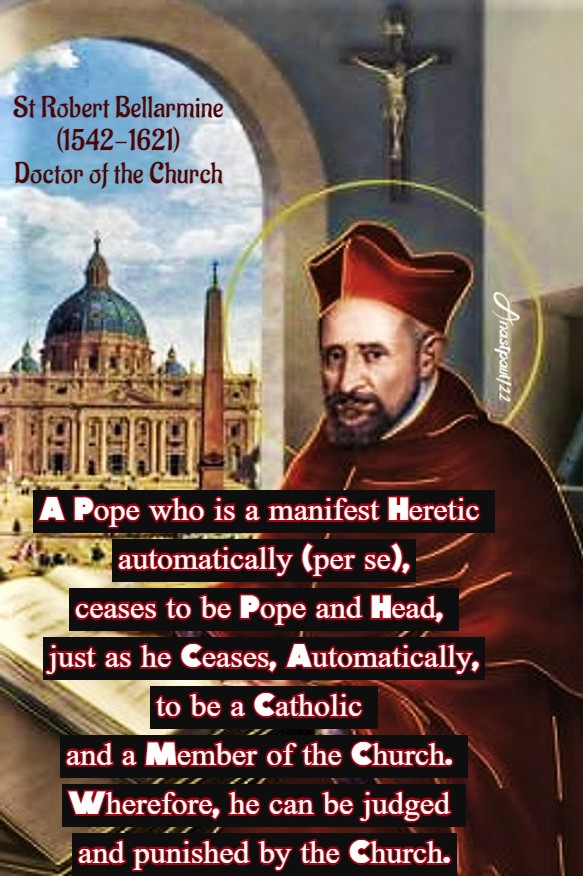
“A Pope who is a manifest heretic automatically (per se), ceases to be Pope and Head, just as he ceases, automatically, to be a Catholic and a Member of the Church. Wherefore, he can be judged and punished by the Church. This is too, the teaching of all the ancient Fathers.”
One Minute Reflection – 13 May – The Memorial of St Robert Bellarmine SJ (1542-1621) Bishop, Confessor, Doctor of the Church – Wisdom 7:7-14, Matthew 5:13-19
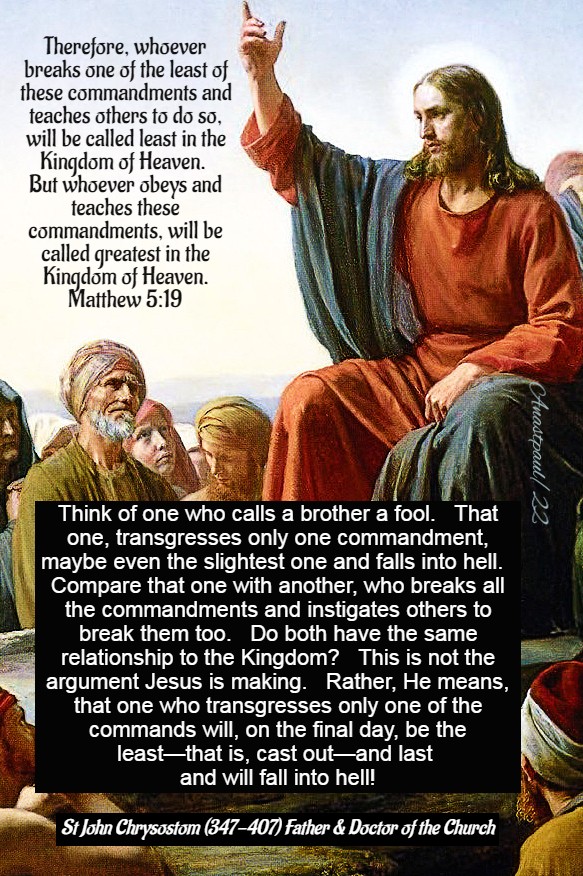
“Therefore, whoever breaks one of the least of these commandments and teaches others to do so, will be called least in the Kingdom of Heaven. But whoever obeys and teaches these commandments, will be called greatest in the Kingdom of Heaven.” – Matthew 5:19
REFLECTION – “For what reason then does He call some of these commandments “least,” although they are so magnificent and lofty? Jesus spoke this way because He was about to introduce His own teaching, as a new law . As He humbles Himself and speaks of Himself with great modesty, so He refers to His own teaching in the same manner. In this way, Jesus teaches us to practice humility in everything. And besides, since some suspected His teaching to be a new departure, He temporarily taught it in a more reserved way.
But when you hear “least in the Kingdom of Heaven,” you are to think of nothing but hell and punishment. For it was His practice to speak, not only of the joy the Kingdom brings but also, of the time of the resurrection and the fearful event of the Second Coming.
Think of one who calls a brother a fool. That one, transgresses only one commandment, maybe even the slightest one and falls into hell. Compare that one with another, who breaks all the commandments and instigates others to break them too. Do both have the same relationship to the Kingdom? This is not the argument Jesus is making. Rather, He means, that one who transgresses only one of the commands will, on the final day, be the least—that is, cast out—and last and will fall into hell!” – St John Chrysostom (347-407) Archbishop of Constantinople, Father and Doctor of the Church (The Gospel of Saint Matthew, Homily 16).
PRAYER – O God, Who endowed blessed Robert, Your Bishop and Doctor, with wondrous learning and virtue to repel the deceits of error and to defend the rights of the Apostolic See, grant, by his merits and intercession, that we may ever grow in love of truth and that the hearts of the erring may return to the unity of Your Church. Through Jesus Christ, Thy Son our Lord, Who lives and reigns with Thee, in the unity of the Holy Ghost, God, world without end. Amen (Collect).
Our Morning Offering – 13 May – “The Month of the Blessed Virgin Mary” and the Memorial of St Robert Bellarmine SJ (1542-1621) Bishop, Confessor, Doctor of the Church.
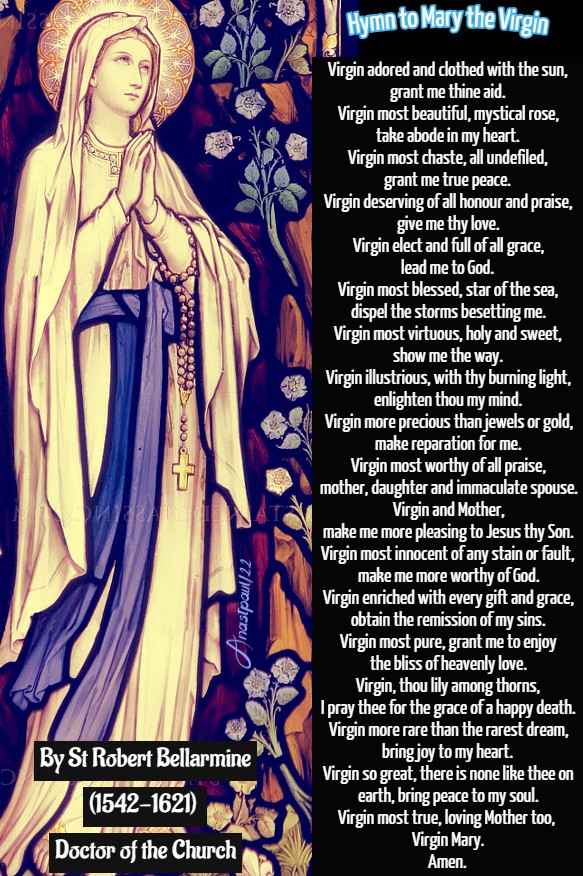
St Robert Bellarmine’s Hymn to Mary the Virgin: Among St Robert’s extant writing, there is a short poem of twenty stanzas which he composed in the nature of a Litany to the Blessed Virgin. The text was first published in Italian some fifty years ago and to the best of the writer’s knowledge, has never been translated into English. Each verse-line begins with the name “Virgin,” joined to a title and petition to Our Lady, starting with the letter “A” and going down the Italian alphabet to “V.” Thus the first seven verses begin with the invocation: “Vergine adorna … Vergine Bella …Vergine casta … Vergine degna … Vergine eletta … Vergine felice … Vergine gradita …”
A translation to this tribute to the Virgin Mother reads as follows: – Servant of God Fr John A Hardon SJ (1914-2000).
Hymn to Mary the Virgin By St Robert Bellarmine (1542-1621) Doctor of the Church.
Virgin adored and clothed with the sun, grant me thine aid. Virgin most beautiful, mystical rose, take abode in my heart. Virgin most chaste, all undefiled, grant me true peace. Virgin deserving of all honour and praise, give me thy love. Virgin elect and full of all grace, lead me to God. Virgin most blessed, star of the sea, dispel the storms besetting me. Virgin most virtuous, holy and sweet, show me the way. Virgin illustrious, with thy burning light, enlighten thou my mind. Virgin more precious than jewels or gold, make reparation for me. Virgin most worthy of all praise, mother, daughter and immaculate spouse. Virgin and Mother, make me more pleasing to Jesus thy Son. Virgin most innocent of any stain or fault, make me more worthy of God. Virgin enriched with every gift and grace, obtain the remission of my sins. Virgin most pure, grant me to enjoy the bliss of heavenly love. Virgin, thou lily among thorns, I pray thee for the grace of a happy death. Virgin more rare than the rarest dream, bring joy to my heart. Virgin so great, there is none like thee on earth, bring peace to my soul. Virgin most true, loving Mother too, Virgin Mary. Amen.
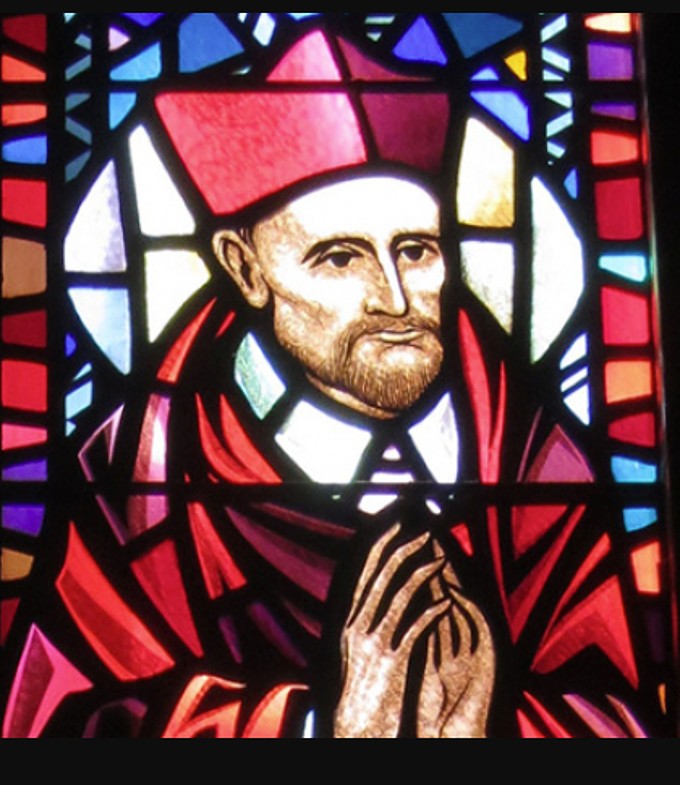
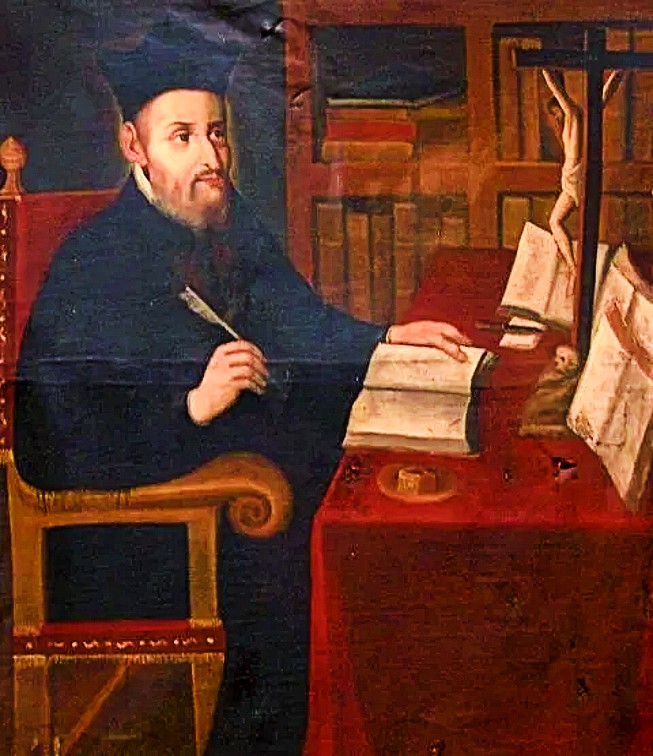
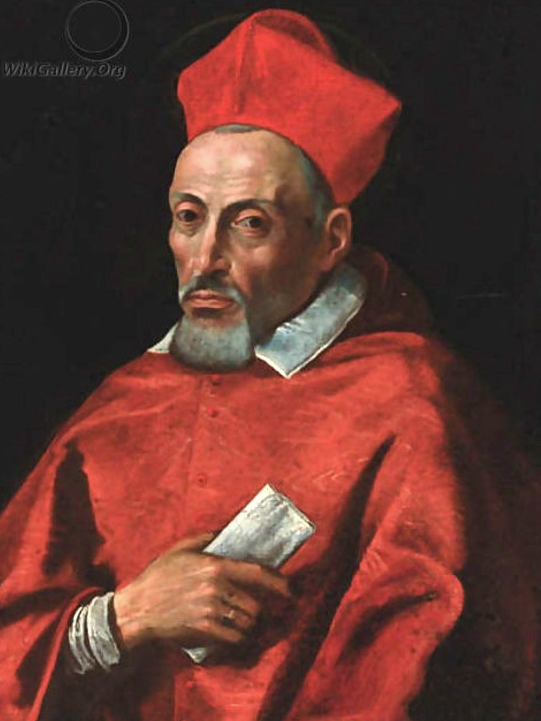
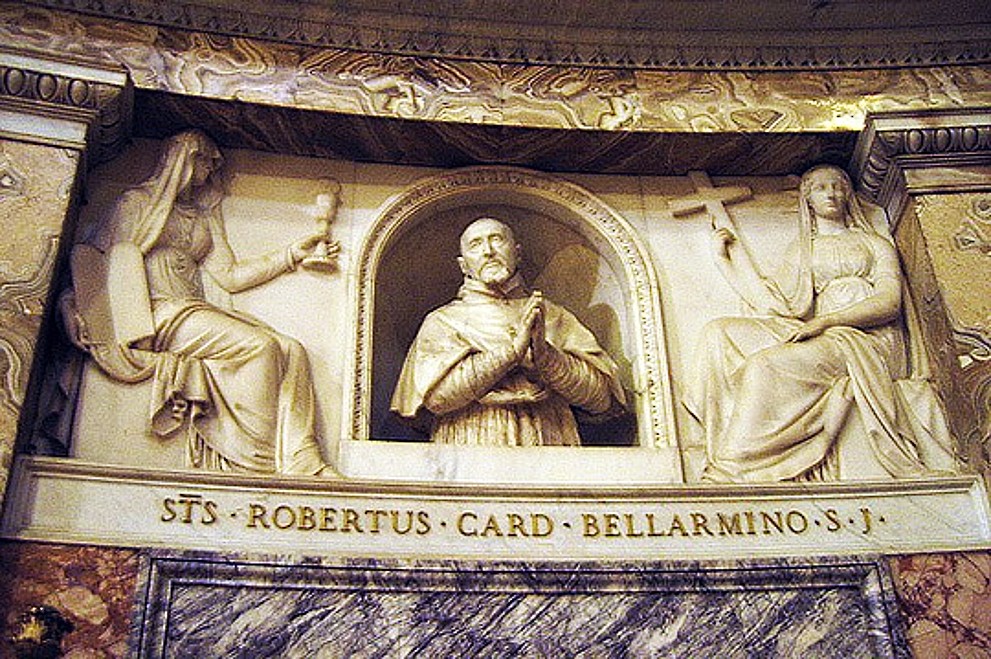
Saint of the Day – 13 May – St Robert Bellarmine SJ (1542-1621) Archbishop of Capua, Italy, Rector of the Roman College, Confessor, Cardinal, Doctor of the Church, Theologian, Professor, Writer, Preacher, Mediator. Known as – “The Father of the Poor,” “The Hammer of Heretics,” “The Model of Promoters and Defenders of the Catholic religion.”
St Robert Bellarmine From the Roman Breviary
Robert, a native of Montepulciano, Italy and of the noble family of Bellarmine, had for his mother, the most pious Cynthia Cervini, sister of Pope Marcellus II. From the first, he was conspicuous for exemplary piety and most chaste manners, earnestly desiring this one thing, to please God alone and to win souls to Christ.
He attended the college of the Society of Jesus in his native town where he was highly commended for his intelligence and modesty. At the age of eighteen, he entered the same Society at Rome and was a model of all religious virtues. Having passed through the course of philosophy at the Roman College, he was sent firstly to Florence, then to Monreale, later to Padua to teach Sacred Theology and afterwards, to Louvain where, not yet a Priest, he ably discharged the office of preacher. After Ordination at Louvain, he taught Theology with such success, that he brought back many heretics to the unity of the Church and was regarded throughout Europe, as a most brilliant Theologian, so much so, that St Charles, Bishop of Milan and others, keenly sought after him.
Recalled to Rome at the wish of Pope Gregory XIII, he taught the science of controversial Theology at the Roman College and there, as Spiritual Director, he guided the angelic youth St Aloysius in the paths of holiness. He governed the Roman College and then the Neapolitan Province of the Society of Jesus, in accordance with the spirit of St Ignatius.
Again summoned to Rome, he was employed by Clement VIII in the most important affairs of the Church, with the greatest advantage to the Christian state. Then, against his will and in spite of opposition, he was admitted among the number of the Cardinals because, as the Pontiff publicly declared, he did not have his equal among Theologians in the Church of God, at the time. He was Consecrated Bishop by the same Pope and administered the Archdiocese of Capua in a most saintly manner for three years. Having resigned this office, he lived in Rome until his death, as a most impartial and trusty Counsellor to the Supreme Pontiff. He wrote much and in an admirable manner.
His principal merit lies in his complete victory in the struggle against the new errors, during which he distinguished himself as a strenuous and outstanding vindicator of Catholic tradition and the rights of the Roman See. He gained this victory by following St Thomas as his guide and teacher, by a prudent consideration of the needs of his times, by his irrefragable teaching and by a most abundant wealth of testimony, well-chosen from the Sacred Writings and from the very rich fountain of the Fathers of the Church. He is eminently noted for very numerous short works, for fostering piety and especially for that golden Catechism, winch he never failed to explain to the young and ignorant, both at Capua and at Rome, although preoccupied with other very important affairs.
A contemporary Cardinal declared, that Robert was sent by God for the instruction of Catholics, for the guidance of the good and for the confusion of heretics. St Francis de Sales regarded him as a fountain of learning; the Supreme Pontiff Benedict XIV called him the Hammer of Heretics and Benedict XV proclaimed him the Model of Promoters and Defenders of the Catholic religion.
He was most zealous in the religious life and he maintained that manner of life after having been chosen as one of the empurpled Cardinals. He did not want any wealth beyond what was necessary; he was satisfied with a moderate household and scanty fare and clothing. He did not strive to enrich his relatives and he could scarcely be induced to relieve their poverty, even occasionally. He had the lowest opinion of himself and was of wonderful simplicity of soul. He had an extraordinary love for the Mother of God; he spent many hours daily in prayer. He ate very sparingly and fasted three times a week. Uniformly austere with himself, he burned with charity towards his neighbour and was often called the Father of the poor. He earnestly strove that he might not stain his baptismal innocence by even the slightest fault.
Almost eighty years old, he fell into his last illness at St Andrew’s on the Quirinal hill and in it, he showed his usual radiant virtue. Pope Gregory XV and many Cardinals visited him on his deathbed, lamenting the loss of such a great pillar of the Church. He fell asleep in the Lord in the year 1621, on the day of the Sacred Stigmata of St Francis, the memory of which, he had been instrumental in having celebrated everywhere. The whole City mourned his death, unanimously proclaiming him a Saint. The Supreme Pontiff Pius XI inscribed his name, firstly, in the number of the Blessed, and then in that of the Saints and shortly afterwards, by a Decree of the Sacred Congregation of Rites, he declared him a Doctor of the Universal Church.
His body is honoured with pious veneration at Rome in the Church of St Ignatius, near the tomb of St Aloysius, as he himself had desired. Blessed be God in His Holy Saints! Amen.































 AnaStpaul
You must be logged in to post a comment.