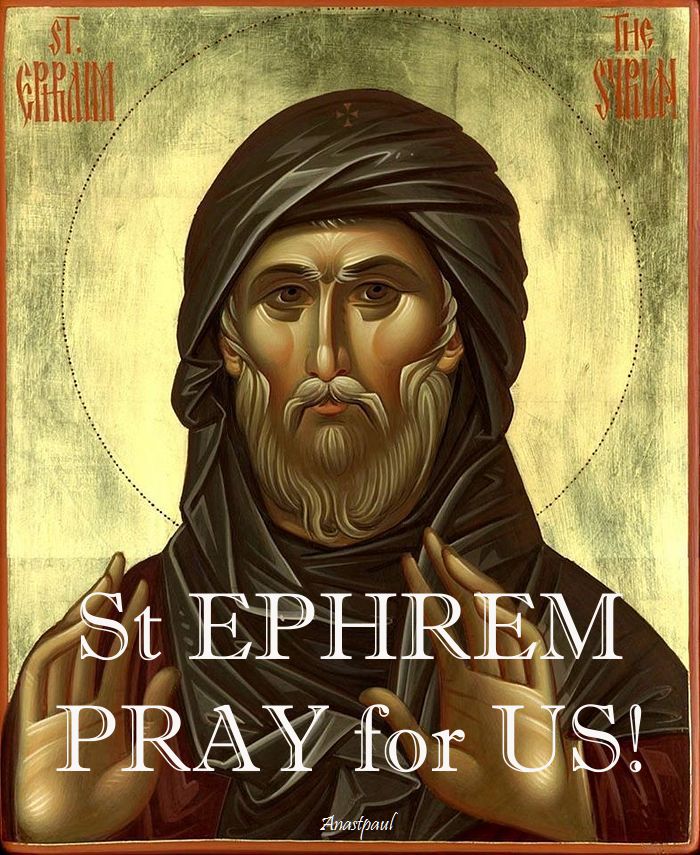
Quote/s of the Day – 18 June – the Memorial of St Ephrem of Syria (306-373) Confessor, Father and Doctor of the Church
“Our Lord chose Matthew, the tax collector, to encourage his fellows to join him. He looked on sinners, called them and brought them to sit beside Him. What a wonderful sight! Angels stand trembling, while publicans, seated, rejoice!”
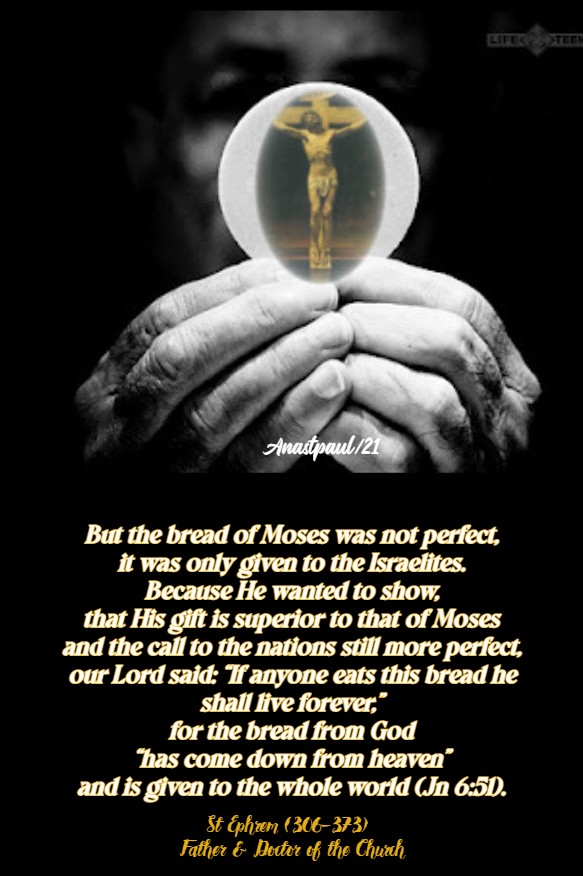
“But the bread of Moses was not perfect, it was only given to the Israelites. Because He wanted to show, that His gift is superior to that of Moses and the call to the nations still more perfect, our Lord said: “If anyone eats this bread he shall live forever,” for the bread from God “has come down from heaven” and is given to the whole world (Jn 6:51).”
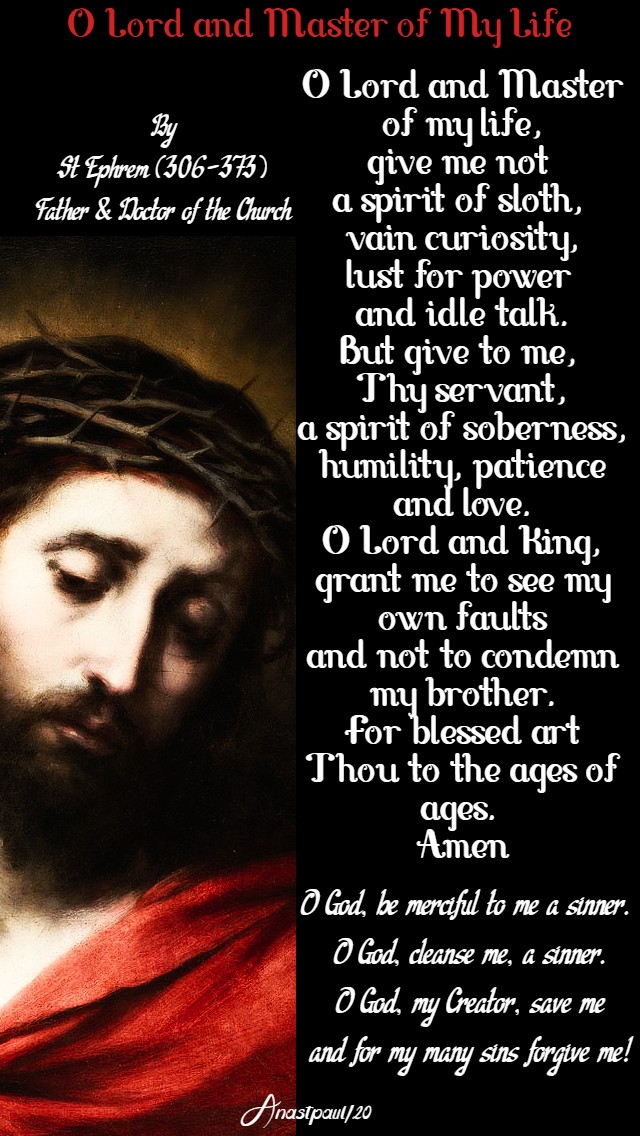
O Lord and Master of My Life By Saint Ephrem (306-373) Father & Doctor of the Church
O Lord and Master of my life, give me not a spirit of sloth, vain curiosity, lust for power and idle talk. But give to me, Thy servant, a spirit of soberness, humility, patience and love. O Lord and King, grant me to see my own faults and not to condemn my brother. For blessed art Thou to the ages of ages. Amen O God, be merciful to me a sinner. O God, cleanse me, a sinner. O God, my Creator, save me and for my many sins forgive me!
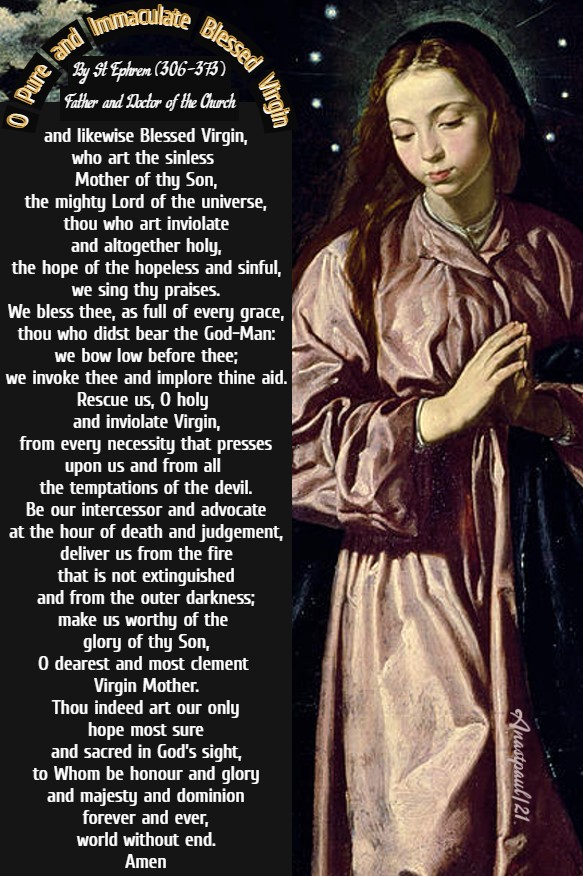
O Pure and Immaculate Blessed Virgin By St Ephrem (306-373) Father and Doctor of the Church
O Pure and Immaculate and likewise Blessed Virgin, who art the sinless Mother of thy Son, the mighty Lord of the universe, thou who art inviolate and altogether holy, the hope of the hopeless and sinful, we sing thy praises. We bless thee, as full of every grace, thou who didst bear the God-Man: we bow low before thee; we invoke thee and implore thine aid. Rescue us, O holy and inviolate Virgin, from every necessity that presses upon us and from all the temptations of the devil. Be our intercessor and advocate at the hour of death and judgement, deliver us from the fire that is not extinguished and from the outer darkness; make us worthy of the glory of thy Son, O dearest and most clement Virgin Mother. Thou indeed art our only hope most sure and sacred in God’s sight, to Whom be honour and glory and majesty and dominion forever and ever, world without end. Amen
One Minute Reflection – 18 June – “The Month of the Sacred Heart of Jesus” – Saturday within the Octave of Cprpus Chris and the Memorial of St Ephrem of Syria (306-373) Confessor, Father and Doctor of the Church – 1 Corinthians 23-29, John 6:56-59.
“As the living Father has sent Me and as I live because of the Father, so he who eats Me, he also shall live because of Me.” – John 6:58
REFLECTION – “We believe that the Word became Flesh and that we receive His Flesh in the Lord’s Supper. How then can we fail to believe, that He really dwells within us? When He became Man, He actually clothed Himself in our flesh, uniting it to Himself forever. In the Sacrament of His Body, He actually gives us His own Flesh, which He has united to His Divinity. This is why we are all one because the Father is in Christ and Christ is in us. He is in us through His Flesh and we are in Him. With Him, we form a Unity, which is in God.
The manner of our indwelling in Him through the Sacrament of His Body and Blood, is evident from the Lord’s own Words: This world will see Me no longer but you shall see Me. Because I live ,you shall live also, for I am in My Father, you are in Me and I am in you. If it had been a question of mere unity of will, why should He have given us this explanation of the steps, by which it is achieved? He is in the Father by reason of His Divine Nature, we are in Him by reason of His Human Birth and He is in us, through the Mystery of the Sacraments. This, surely, is what He wished us to believe; this is how He wanted us to understand the perfect Unity that is achieved through our Mediator, Who lives in the Father, while we live in Him and Who,, while living in the Father, lives also in us. This is how we attain to Unity with the Father. Christ is in very truth in the Father by His Eternal Generation; we are in very truth, in Christ and He likewise is in us.
Christ Himself bore witness to the reality of His Unity, when He said: He who eats My Flesh and drinks My Blood, lives in Me and I in him. No-one will be in Christ, unless Christ Himself has been in him; Christ will take to Himself only the Flesh of those who have received His Flesh.
He had already explained the Mystery of this perfect Unity, when He said: As the living Father sent Me and I draw life from the Father, so he who eats My Flesh will draw life from Me. We draw life from His Flesh, just as He draws life from the Father. Such comparisons aid our understanding, since we can grasp a point more easily, when we have an analogy. And the point is that Christ is the well-spring of our life. Since we, who are in the flesh, have Christ dwelling in us through His Flesh, we shall draw life from Him in the same way, in which He draws life from the Father.” – St Hilary of Poitiers (315-368) Bishop of Poitiers , Father and Doctor of the Divinity of Christ (An excerpt from his On the Trinity).
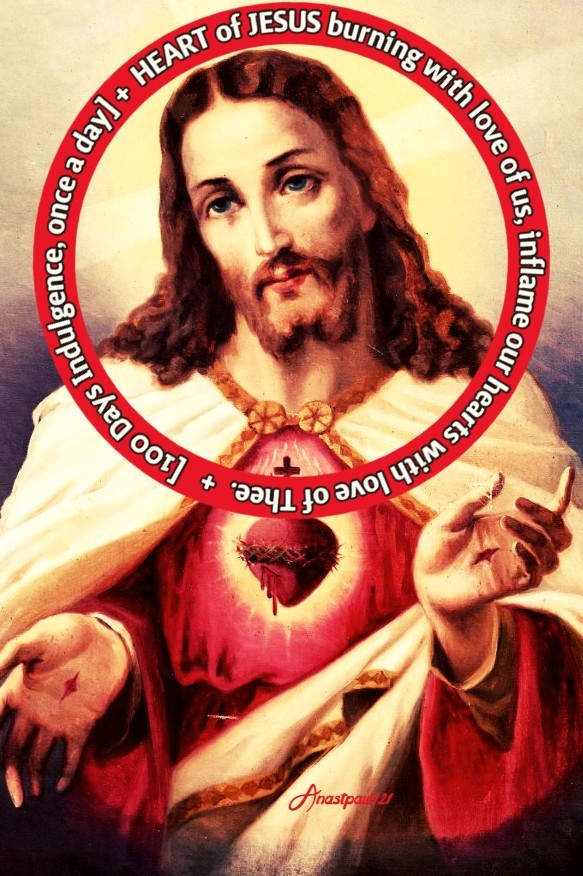
PRAYERS – O God, Who willed to enlighten Thy Church by the wondrous learning and glorious merits of the life of blessed Ephrem, Thy Confessor and Doctor, we humbly pray Thee that, by his pleading, Thou will shield her with Thy lasting power, against the snares of error and evil. Through Jesus Christ, Thy Son our Lord, Who lives and reigns with Thee, in the unity of the Holy Ghost, God, world without end. Amen (Collect). HEART of JESUS burning with love of us, inflame our hearts with love of Thee. – 100 Days, once a day. (See Instructions. – Unless otherwise stated, e.g., “once a day,” a partial Indulgence may be gained any number of times in succession.) [169 Raccolta or Collection of Indulgences, 1910] Pope Leo XIII, 16 July 1893.
Our Morning Offering – 18 June – The Memorial of St Ephrem of Syria (306-373) Father and Doctor of the Church
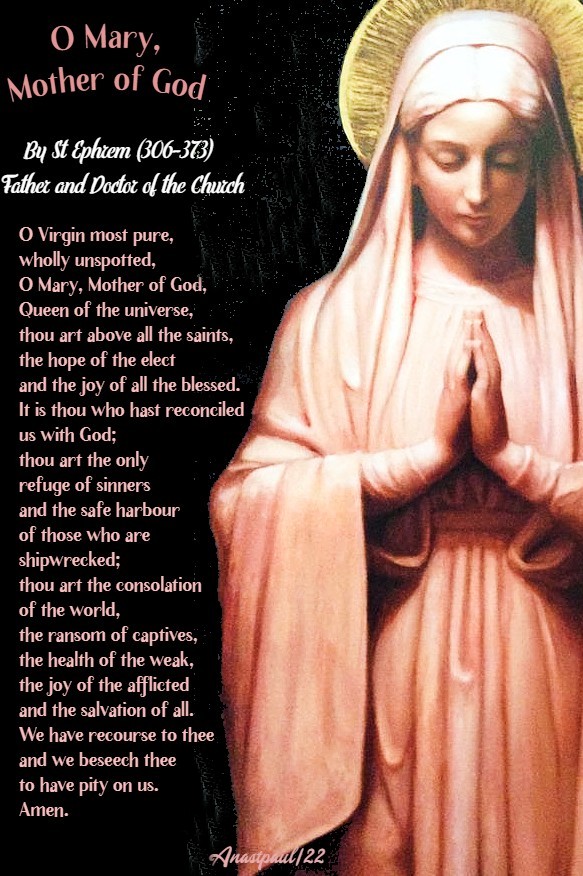
O Mary, Mother of God By St Ephrem of Syria (306-373) Father and Doctor of the Church
O Virgin most pure, wholly unspotted, O Mary, Mother of God, Queen of the universe, thou art above all the saints, the hope of the elect and the joy of all the blessed. It is thou who hast reconciled us with God; thou art the only refuge of sinners and the safe harbour of those who are shipwrecked; thou art the consolation of the world, the ransom of captives, the health of the weak, the joy of the afflicted and the salvation of all. We have recourse to thee and we beseech thee to have pity on us. Amen.
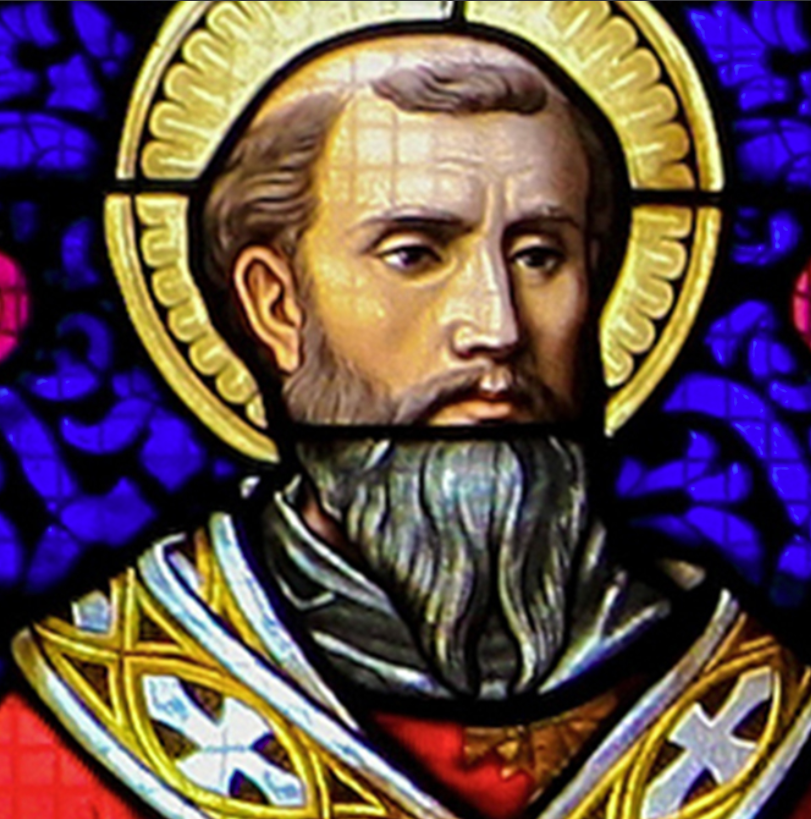
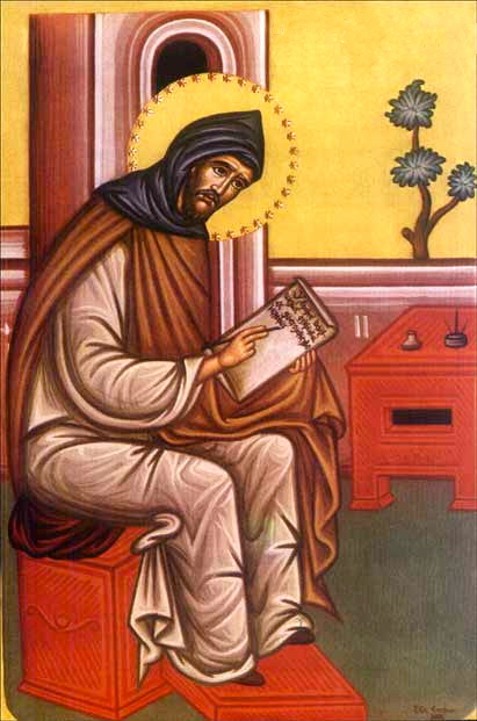
Saint of the Day – 18 June – St Ephrem of Syria (306-373) – “The Harp of the Holy Spirit!” Father & Doctor of the Church, Confessor, Deacon and Confessor, Apostle of the Poor and Needy, Exegesist, Writer, Poet, Hymnographer, Theologian, Teacher, Orator, Defender of the Faith – declared Doctor of the Church in 1920 by Pope Benedict XV. Born in c306 at Nisibis, Mesopotamia (in modern Syria) and died on 9 June 373 at Edessa (in modern Iraq) of natural causes. Patronages – spiritual directors, spiritual leaders, Armenea. Also known as – Ephrem of Edessa, Ephrem the Syrian, Ephraem…, Ephraim…, Ephraem Syrus, Deacon of Edessa, Jefrem Sirin, “Sun of the Syrians.”
St Ephrem, Confessor By Fr Francis Xavier Weninger SJ (1805-1888)
His sanctity is demonstrated in the many virtues with which he was endowed, amongst which chastity, deep humility and untiring benevolence towards the poor, shine most brilliantly.
Under this day’s date is also mentioned, in the Roman Book of Martyrs, St Ephrem, a Deacon of the Church of Edessa, in Syria and great praise is bestowed on his wisdom and virtue, as well as his labour on behalf of the Christian Faith. His work consisted partly, in verbally teaching the Christians and partly, in refuting the doctrines of the heretics, whose leader and teacher he boldly opposed and publicly confuted.
Apollinarius, an arch-heretic, had written his heresy in two books and had given them into the charge of a notable woman of his party. Ephrem, having become acquainted with this woman, requested the loan of these books, as he wished to study thoroughly the doctrine of Apollinarius. The woman, who thought that Ephrem desired to adopt these doctrines, permitted him to have the books. As soon, however, as the Saint became convinced of the impiety of the work, he pasted the leaves together in such a manner, that they could not be separated. He then returned the books to the woman, who did not perceive what he had done, as the outside was unimpaired. Just at this time it happened, that Apollinarius was called to a public disputation. As he, on account of his defective memory, was unable to speak much, he had his books brought, in order that one of his followers might read his doctrines out of them. The books were brought, the heretic proceeds to open them but finds the leaves are pasted together and that, in consequence, they are of no service to him. Unable to dispute verbally, he stood for a long time immovable, deeply ashamed. At last, he ran away and, not long after this event, expired most miserably.
As far as the teachings of St Ephrem are concerned, they exist to this hour in the splendid works he has left. In former times, they were so highly esteemed that they were read aloud in the Churches, after the Gospel, for the edification of the people. In these works much is to be found that the holy man said in praise of the Blessed Virgin, as also many prayers in which he invoked her: a proof that already, in the first centuries, the Mother of our Saviour was honoured and invoked.
One day an immoral woman tried to seduce him. Ephrem seemed to lend her a willing ear and said: “ If I consent to fulfil your desire, you must consent that I select the place for our meeting.” “Where shall it be? Where shall we meet?” asked the shameless woman. “In the public market,” replied he. “Oh! not there,” said she; “we should be ashamed of the people who are there.” This was the answer that the pure servant of God wished to obtain and he said to her, full of deep earnestness: “Unhappy woman! when the eyes of men are upon you, you are ashamed and will not commit evil; why then, are you not ashamed of the Lord your God, Who is everywhere and Who not only sees and knows everything but Who also punishes with the everlasting fire of hell all vices? How much more should His Presence deter you from the commission of sin?“
It needed no more to bring the unchaste woman to the knowledge and repentance of her corruption. Ephrem placed her in a Convent, where she did most severe penance until her death, never weary of thanking him, again and again, for the benevolence he had shown to her. Just as the holy man, on this occasion, evinced his love of purity, so he manifested, on many others, his deep humility.
When it was intended to elect him Bishop, he to evade this dignity, pretended insanity and, hiding in a corner, remained until another was elected. So far from valuing the praises of men, he even regarded those who lauded him as his enemies, while he loved, as his best friends, those who despised him.
In his last will he ordered that he should not be honoured with music, or a costly shroud, or a panegyric; neither did he desire to be buried in a Church but requested to be laid among the poor, to whom he had been more attached than a father to his children. During a great famine, he himself collected from the wealthy, corn and other provisions, divided them among the starving people and assisted them wherever he could, day and night, with untiring kindness. Many other instances of his great charity, which are recorded by the holy Father Saints, Gregory of Nyssa, Basil, Chrysostom, and Jerome, I have to pass over. Only one more will I mention, which the Saint related of himself.
When a boy, his parents one day sent him somewhere out of the City. Passing through a wood, he saw a cow, belonging to a poor man. Out of mischief, he pelted her so long with stones that she fell to the ground, dead. Four weeks later, his parents sent him again out of the City. Night overtook him on the road and the shepherds, whose flock was in the wood, having compassion on him, invited him into their hut, with the understanding that he should continue his journey on the following day. Ephrem accepted the offered hospitality and remained with them through the night. But just before morning, the sheep of those men were attacked by wolves and widely dispersed. The shepherds, believing that this was the work of thieves and that Ephrem was one of them, made him prisoner and brought him before the Judge, who immediately ordered him to be thrown into prison.
At the same time, two other men were also incarcerated, of whom one was charged with homicide, the other with adultery. Ephrem wept bitter tears at suffering thus innocently. After forty days his Guardian Angel appeared to him and asked what he was doing there. Ephrem related to him the circumstances and declared his innocence. The Angel said: “ I know that you are innocent, but the cruelty with which, some time ago, you treated the cow of a poor man is also known to me. Therefore, you must atone for that wrong now, just as those two men, who are also innocent of the crimes for which they are imprisoned, suffer this present punishment for sins formerly committed. Learn from this, that God is just and that He leaves no evil deed unpunished!” Ephrem, coming thus to the knowledge of his fault, repented and received a promise, that he should be set free and, in fact, soon after, regained his liberty. This event induced him to devote himself entirely to the service of the Almighty.
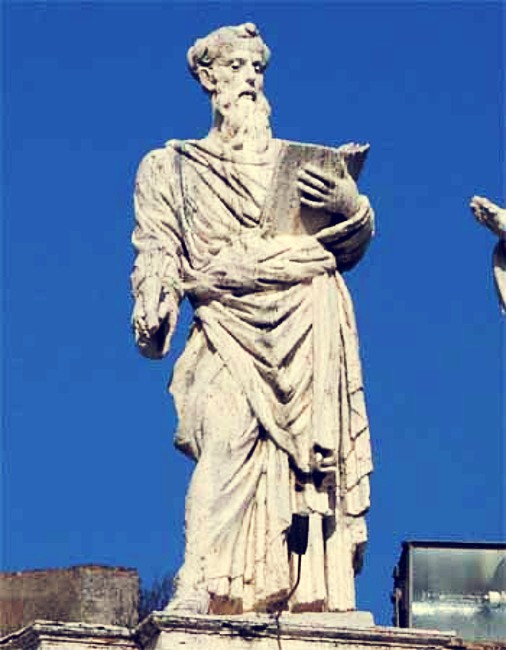
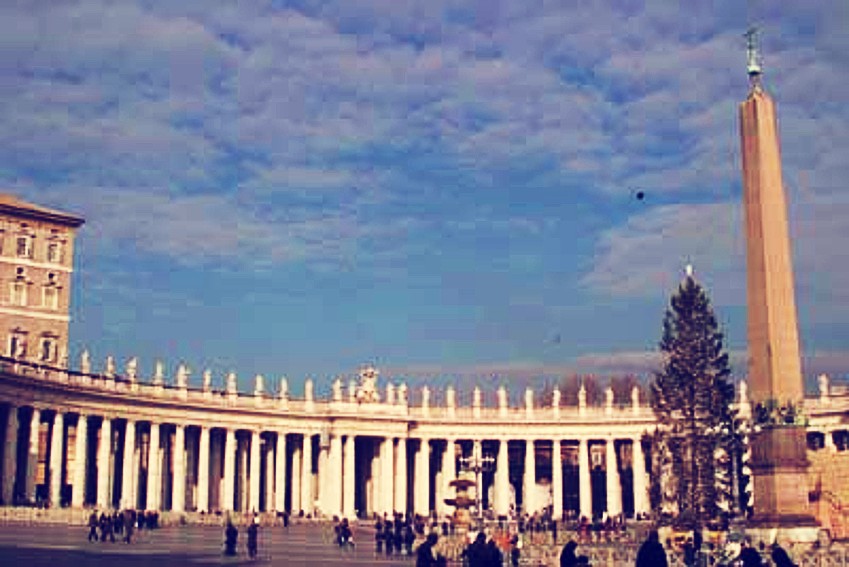
Ripe in years, he ended his holy life c 373. Below is the Statue of St Ephrem on the North Colonnade at St Peter’s. It was installed in c 1662-1667. The Sculptor is unknown but it is known that he created 3 Statues at that time. The Saint looks into a book that he holds with his left hand. The right hand holds a palm.
St Ephrem of Syria (306-373)– “The Harp of the Holy Spirit!” Father & Doctor of the Church, Deacon and Confessor, Exegesist, Writer, Poet, Hymnographer, Theologian, Teacher, Orator, Defender of the Faith – declared Doctor of the Church in 1920 by Pope Benedict XV. For 48 years (1920–1969), it was on 18 June, and this date is still observed in the Traditional Calendar. About St Ephrem! https://anastpaul.com/2017/06/09/saint-of-the-day-9-june-st-ephrem-of-syria-father-and-doctor-of-the-church/
St Abraham of Clermont St Alena of Dilbeek St Amandus of Bordeaux St Arcontius of Brioude St Athenogenes of Pontus St Calogero of Sicily St Calogerus of Fragalata St Calogerus the Anchorite St Colman mac Mici St Cyriacus of Malaga St Demetrius of Fragalata St Edith of Aylesbury
St Elpidius of Brioude St Equizio of Telese St Erasmo St Etherius of Nicomedia Bl Euphemia of Altenmünster St Fortunatus the Philosopher St Gerland of Caltagirone St Gregory of Fragalata Blessed Hermann of Floreffe O.Praem (Early 12th Century- 1193) Abbot and Canon of the Premonstratensians or Norbertines. St Guy of Baume St Jerome of Vallumbrosa St Marina of Alexandria St Marina of Bithynia Bl Marina of Spoleto
St Osanna of Northumberland St Osmanna of Jouarre St Paula of Malaga Bl Peter Sanchez
Hermits of Karden: A father (Felicio) and his two sons (Simplicio and Potentino) who became pilgrim to various European holy places and then hermits at Karden (modern Treis-Karden, Germany). (Born in Aquitaine (in modern France. ) Their relics transferred to places in the Eifel region of western Germany at some point prior to 930. They were canonised on 12 August 1908 by Pope Pius X (cultus confirmation).
Martyrs of Ravenna – 4 Saints: A group of four Christians Martyred together. We have no details but their names – Crispin, Cruciatus, Emilius and Felix. They were martyred in Ravenna, Italy, date unknown.
Martyrs of Rome – 3 Saints: Three Christians Martyred together . We have no details but their names – Cyriacus, Paul and Thomas. In Rome, Italy, date unknown.
Martyrs of Tripoli – 3 Saints: Three imperial Roman soldiers, at last two of them recent converts, who were imprisoned, tortured and executed for their faith. Martyrs – Hypatius, Leontius and Theodulus. They were Greek born and they died c135 at Tripoli, Phoenicia (in modern Lebanon).
Everyday unite your prayers and adorations with those of the Most Holy Virgin and of one of the nine choirs of Angels and Saints, to honour one of the dispositions of the Sacred Heart of Jesus and to practise some virtue in its honour.
THE THIRD DAY
With the Blessed Virgin, the Thrones and the Holy Apostles.
Adore the Sacred Heart of Jesus, presenting to the Eternal Father our good works and our prayers and beseeching for our deficiencies, to the infinite Majesty of God.
Practice—Thank God for having given you so powerful a Mediator and endeavour to conform daily, more and more, to the sentiments of this Sacred Heart.
Prayer of St Alphonsus Liguori to the Sacred Heart
O Adorable Heart of my Jesus, Heart created expressly. for the love of men! Until now, I have shown towards Thee only ingratitude. Pardon me, O my Jesus. Heart of my Jesus, Abyss of Love and of Mercy, how is it possible, that I do not die of sorrow when I reflect on Thy Goodness to me and my ingratitude to Thee? Thou, my Creator, after having created me, hast given Thy Blood and Thy Life for me and, not content with this, Thou hast invented a means of offering Thyself everyday for me, in the Holy Eucharist, exposing Thyself to a thousand insults and outrages. Ah, Jesus, do Thou wound my heart with a great contrition for my sins and a lively love for Thee. Through Thy Tears and Thy Blood, give me the grace of perseverance in Thy fervent love, until I breathe my last sigh. Amen.
Quote of the Day – 17 June – “The Month of the Sacred Heart of Jesus” – Friday within the Octave of Corpus Christi – 1 Corinthians 23-29, John 6:56-59.
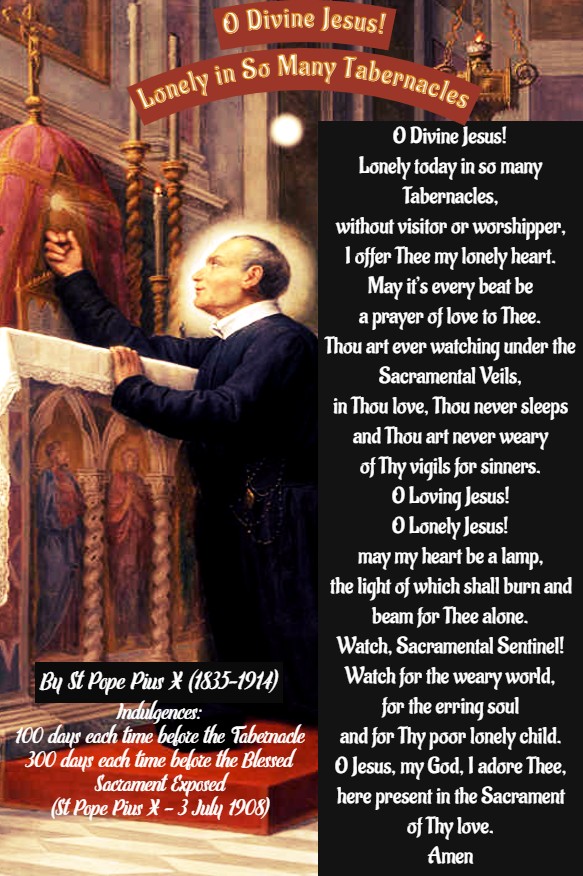
O Divine Jesus! Lonely in So Many Tabernacles By St Pope Pius X (1835-1914) “Pope of the Blessed Sacrament”
O Divine Jesus! Lonely today in so many Tabernacles, without visitor or worshipper, I offer Thee my lonely heart. May it’s every beat be a prayer of love to Thee. Thou art ever watching under the Sacramental Veils, in Thou love, Thou never sleeps and Thou art never weary of Thy vigils for sinners. O Loving Jesus! O Lonely Jesus! may my heart be a lamp, the light of which shall burn and beam for Thee alone. Watch, Sacramental Sentinel! Watch for the weary world, for the erring soul and for Thy poor lonely child. O Jesus, my God, I adore Thee, here present in the Sacrament of Thy love. Amen
Indulgences: 100 days each time before the Tabernacle 300 days each time before the Blessed Sacrament Exposed (St Pope Pius X – 3 July 1908) Prayers to the Sacred Heart 15th Ed 1936
One Minute Reflection – 17 June – “The Month of the Sacred Heart of Jesus” – Friday within the Octave of Corpus Christi – 1 Corinthians 23-29, John 6:56-59.
“This is the Bread that has come down from Heaven; not as your fathers ate the manna and died. He who eats this Bread shall live forever.”- John 6:59
REFLECTION – “It is wonderful that God rained manna on our fathers and they were fed with daily food from Heaven. And so it is written: Man ate the bread of angels. Yet, those who ate that bread all died in the desert. But the food that you receive, that living Bread which came down from Heaven, supplies the very substance of eternal life, and whoever will eat it, will never die, for it is the Body of Christ!
Consider now which is the more excellent – the bread of Angels or the Flesh of Christ, which is indeed the Body that gives Life. The first was manna from Heaven, the second is above the Heavens. One was of Heaven, the other is of the Lord of the Heavens; one subject to corruption if it was kept till the morrow, the other free from all corruption, for if anyone tastes of it with reverence, he will be incapable of corruption. For our fathers, water flowed from the rock; for you, Blood flows from Christ. Water satisfied their thirst for a time; Blood cleanses you forever. The Jew drinks and still thirsts but when you drink, you will be incapable of thirst. What happened in symbol is now fulfilled in reality.
If what you marvel at is a shadow, how great is the reality, whose very shadow you marvel at. Listen to this, which shows, that what happened in the time of our fathers was but a shadow. They drank, it is written, from the rock that followed them and the Rock was Christ! All this took place as a symbol for us. You know now what is more excellent – Light is preferable to its shadow, reality to its symbol, the Body of the Giver, to the manna He gave from Heaven.” – St Ambrose (340-397) Great Western Father and Doctor of the Church (An excerpt from On the Mysteries).
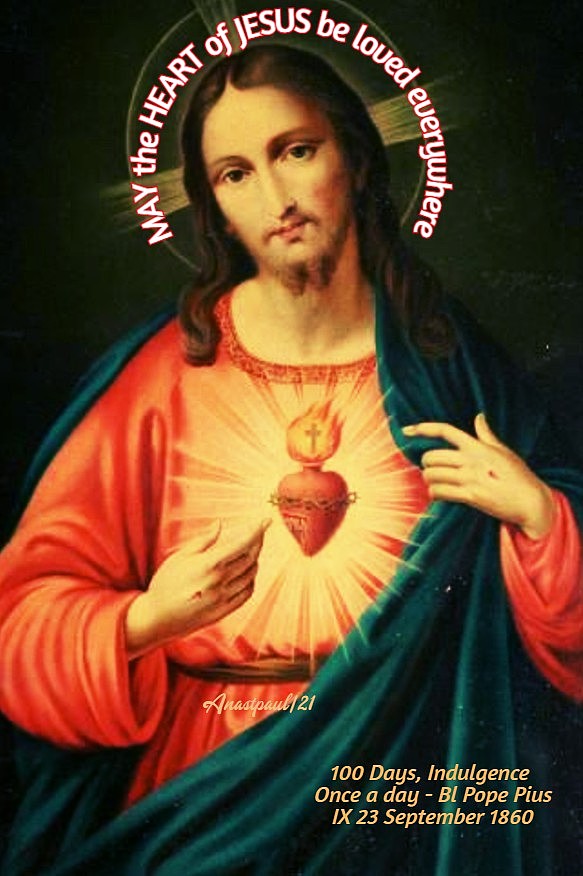
PRAYER – O God, Thou Who in this wondrous Sacrament have left us a memorial of Thy Passion, grant us, we beseech Thee, so to venerate the Sacred Mysteries of Thy Body and Blood, that we may ever experience, within us, the effect of Thy Redemption. Through Jesus Christ, Thy Son our Lord, Who lives and reigns with God the Father, in the unity of the Holy Ghost, God, world without end. Amen (Collect). MAY the HEART of JESUS be loved everywhere.100 Days, Indulgence Once a day – Pope Pius IX 23 September 1860.
Our Morning Offering – 17 June – “Month of the Sacred Heart”
Be the Heart of My Heart By St John Eudes (1601-1680) Apostle of the Sacred Heart
O Heart all Lovable and all Loving of my Saviour, be the Heart of my heart, the Soul of my soul, the Spirit of my spirit, the Life of my life and the sole Principle of all my thoughts, words and actions, of all the faculties of my soul and of all my senses, both interior and exterior. Amen
St John Eudes is the Author of the Proper for the Mass and Divine Office of the Sacred Heart of Jesus Christ and the Immaculate Heart of the Blessed Virgin. St John was an ardent proponent of the Sacred Heart and dedicated himself to it’s promotion and celebration. The Masses he compiled for both the Sacred Heart of Jesus and for the Immaculate Heart of Mary, were both first celebrated during his lifetime. He preached missions across France, including Paris and Versailles, while earning recognition as a popular Evangelist and Confessor. St John Eudes was also a prolific writer and wrote on the two Holy Hearts despite opposition from the Jansenists.
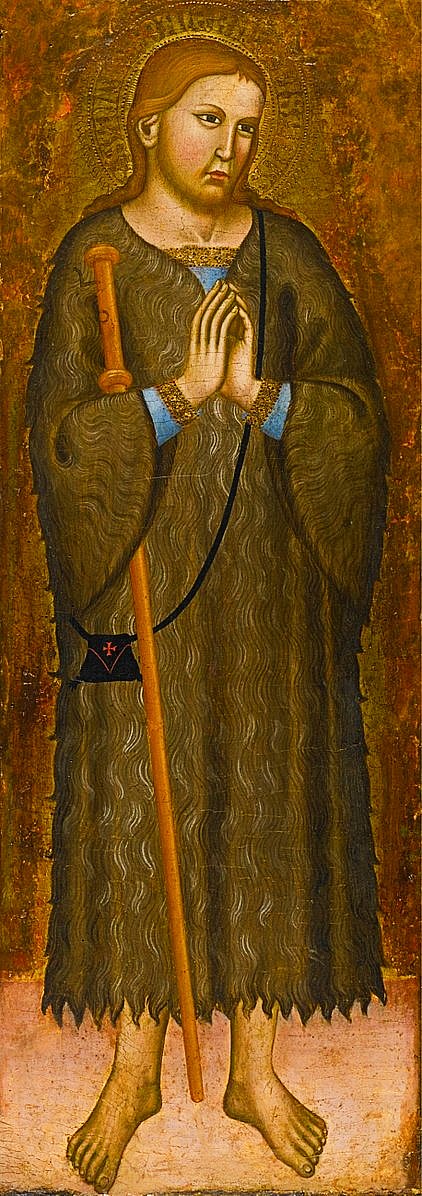
Saint of the Day – 17 June – Saint Ranieri Scaccero (c 1117-1161) Confessor, Pilgrim, Monk, Musician, Penitent, Ascetic, Preacher, Miracle-worker. Born in c 1117 in Pisa, Italy and died on 17 June 1161 at the Abbey of Saint Vito, Pisa, Italy of natural causes. Patronage – of Pisa, Italy. Also known as – Ranieri of Pisa, Ranieri de Aqua, Rainer, Rainerius, Rainier, Raniero, Raynerius, Regnier.
The Roman Martyrology reads today: “In Pisa, Saint Raniero, poor man and pilgrim for Christ.”
Ranieri was the son of Gandulfo Scacceri, a prosperous merchant and shipowner of Pisa and Mingarda Buzzaccherini. In his youth, he was a travelling musician. He spent a wild and sinful youth as a wandering minstrel and musician, carousing all night, sleeping by day if at all.
It was at the age of 19 that Ranieri decided to radically change his life. One evening, while performing for a merry crowd in a castle,he met a Hermit named Alberto, from Corsica “who wore a cloak of animal hair, like a goat” and had entered the Pisan Monastery of St Vitus and had become renowned for his work for the poor. This meeting led Ranieri to embrace the Faith with conviction, he burned his fiddle, and gave up the life of a minstrel. Thus he place himself, at the service of God
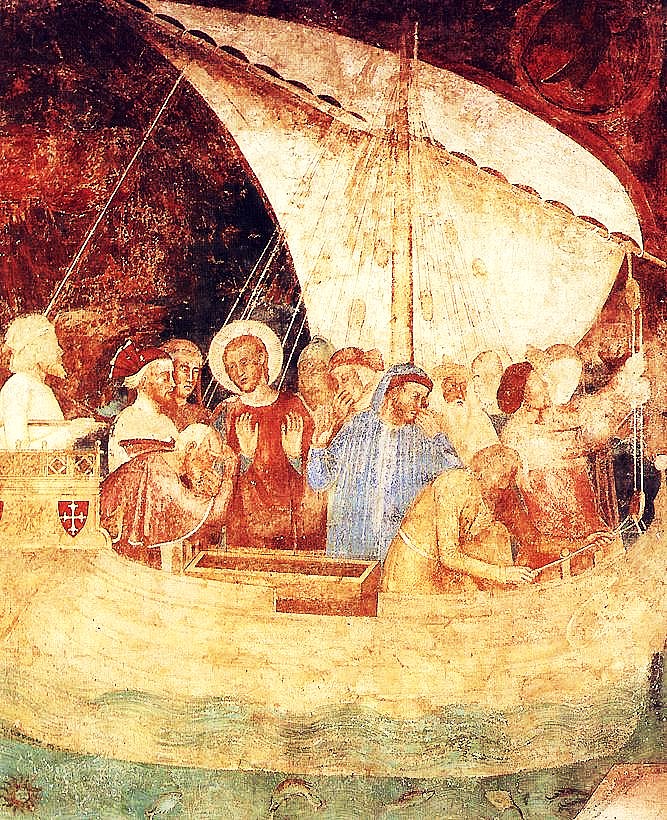
Desiring to visit the Holy Land, Raineri set himself up as a merchant in order to pay for his fare. The business took him to many ports and he became wealthy. His travels eventually took him to the Holy Land, where, it is said, he had a vision by which he understood that his wealth was hindering him from devoting himself to God.
At the age of 23 he decided to live in absolute poverty: he got rid of all the riches and gave them to the poor and needy. His only concern remained to imitate his teacher, Jesus Christ, as best as possible. Wearing the robe of the penitent given to all the pilgrims who went to Mount Calvary, he spent a long period with the Hermits in the Holy Land, where he performed numerous miracles.
He punished his body with long fasts, normally abstaining from food everyday of the week except Thursdays and Sundays. His austerity was so excessive, his later biographer noted, that God had to tell him to eat! The renunciation of himself and the total service to God, allowed him to overcome the numerous temptations that the evil one never ceased attacking him with during his 13-year stay in the Holy Land.
Returning to Pisa in 1154 and entered the Monastery of Saint Andrew and subsequently that of Saint Vitus. and became a renowned Preacher. Ranieri was already then, surrounded by the fame of a saint. He continued to work miracles even in his hometown. The admiration of his fellow citizens would accompany him, until the last day of his life. Ranieri died seven years after his return from the Holy Land on Friday 17 June 1161. His body was carried in a triumph through the City to the Cathedral of Pisa, its resting place.
In the eyes of the Pisans, Ranieri was a saint already in life. Once he abandoned his earthly life, one of his disciples, the Canon Benincasa, undertook to write a Life of the Saint in 1162, a text that knew a great success . In 1755 it was translated by the Carmelite Friar ,Giuseppe Maria Sanminiatelli . In 1842 it was re-published in Pisa.
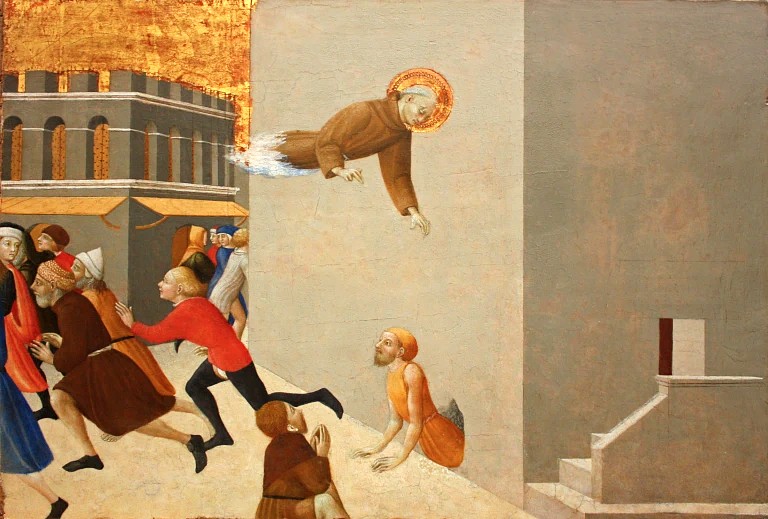
The Blessed Ranieri Frees the Poor from a Prison in Florence (1437-44)
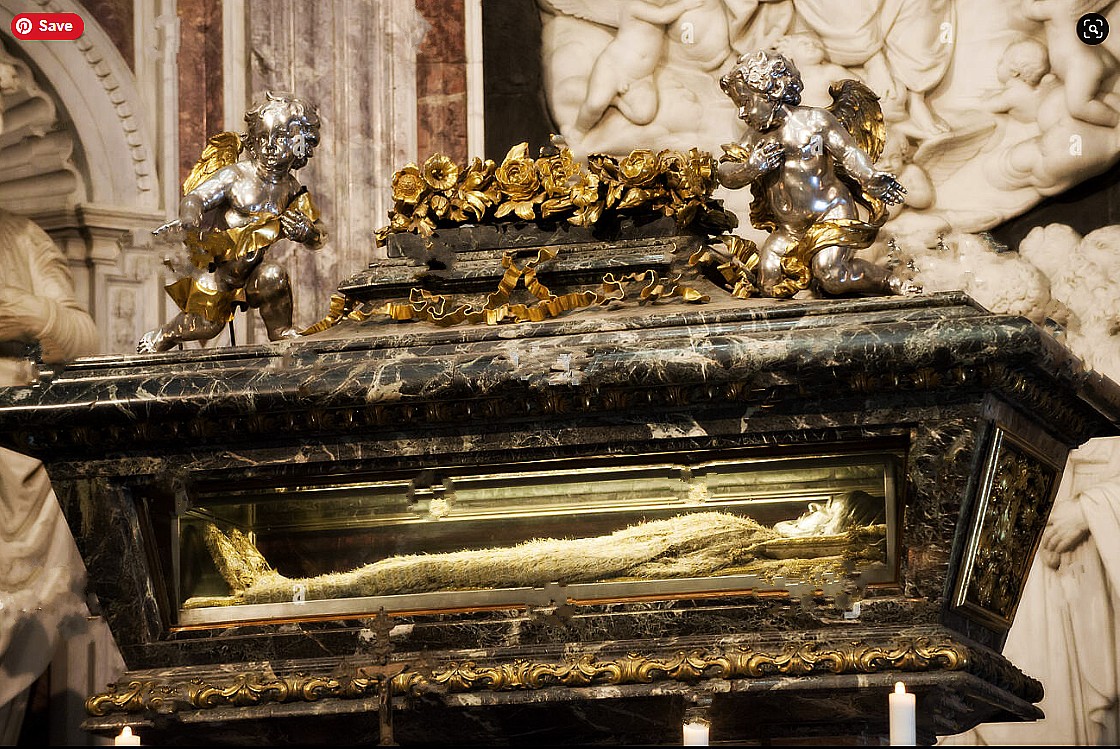
In 1632 the Archbishop of Pisa, the local clergy, the Pisan Magistrate, with the announcement of the sacred Congregation of Rites, elected Ranieri as the main Patron of the City and the Diocese. In 1689 the transfer of his body was decided, which was definitively placed on the High Altar. During the night of the translation, the Pisans illuminated their houses to pay homage to the figure of their most beloved Saint. He was Canonised by Pope Alexander III.
In 1161 or 1162, a Pisan Canon, Benincasa, wrote a long and invaluable Vita of the Saint. He says Raineri resembled the Son of God through his life of strict imitatio Christi – imitation of Christ. Benincasa wrote that Ranieri demonstrated “a royal priesthood in Christ” of which Raineri and all the Baptised are a part.
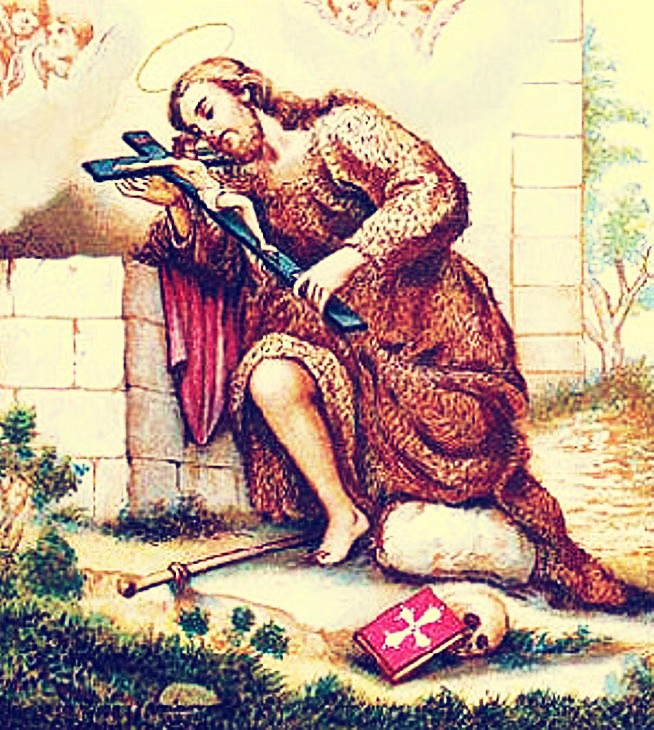
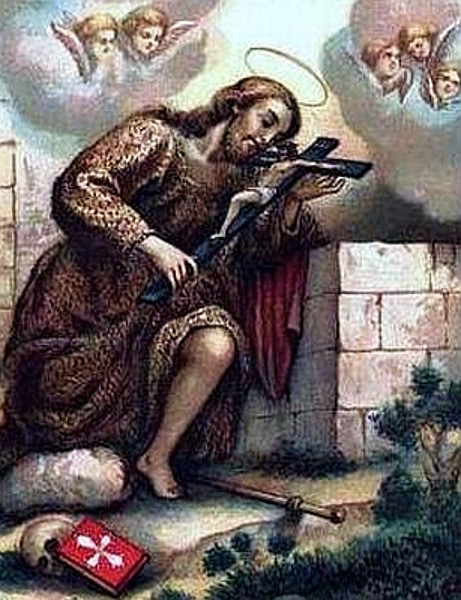
Ranieri is generally portrayed as a bearded hermit in a hairshirt holding a Rosary or Crucifix; as a young pilgrim in a hairshirt carrying a banner with the Pisan Cross; as being raised up by devils; or as dying in a hairshirt.
St Himerius of Amelia St Hypatius of Chalcedon St Molling of Wexford St Montanus of Gaeta St Nectan of Hartland Bl Paul Burali d’Arezzo Bl Peter Gambacorta Bl Philippe Papon St Prior St Rambold of Ratisbon St Ranieri Scaccero (c 1117-1161) Pilgrim, Monk St Theresa of Portugal
Martyrs of Apollonia – 7 Saints: A group of Christians who fled to a cave near Apollonia, Macedonia to escape persecution for his faith, but were caught and executed. The names we know are – Basil, Ermia, Felix, Innocent, Isaurus, Jeremias and Peregrinus. They were beheaded at Apollonia, Macedonia.
Martyrs of Aquileia – 4 Saints: Four Christian Martyrs memorialised together. No details about them have survived, not even if they died together – Ciria, Maria, Musca and Valerian. c.100 in Aquileia, Italy.
Martyrs of Chalcedon – 3 Saints: Three well-educated Christian men who were sent as ambassadors from King Baltan of Persia to the court of emperor Julian the Apostate to negotiate peace between the two states, and an end of Julian’s persecutions of Christians. Instead of negotiating, Julian imprisoned them, ordered them to make a sacrifice to pagan idols and when they refused, had them executed. Their names were Manuel, Sabel and Ismael. They were beheaded in 362 in Chalcedon (part of modern Istanbul, Turkey) and their bodies burned and no relics survive.
Martyrs of Fez – 4 Beati: A group of Mercedarians sent to Fez, Morocco to ransom Christians imprisoned and enslaved by Muslims. For being openly Christian they were imprisoned, tortured, mutilated and executed. Martyrs – Egidio, John, Louis and Paul. They were martyred in Fez, Morocco.
Martyrs of Rome – 262 Saints: A group of 262 Christians Martyred in the persecutions of Diocletian. In c303 in Rome, Italy. They were buried on the old Via Salaria in Rome.
Martyrs of Venafro – 3 Saints: Three Christian lay people, two of them imperial Roman soldiers, who were converts to Christianity and were Martyred together in the persecutions of Maximian and Diocletian – Daria, Marcian and Nicander. They were beheaded c.303 in Venafro, Italy. By 313 a basilica had been built over their graves which were re-discovered in 1930. They are patrons of Venafro, Italy.
Everyday unite your prayers and adorations with those of the Most Holy Virgin and of one of the nine choirs of Angels and Saints, to honour one of the dispositions of the Sacred Heart of Jesus and to practise some virtue in its honour.
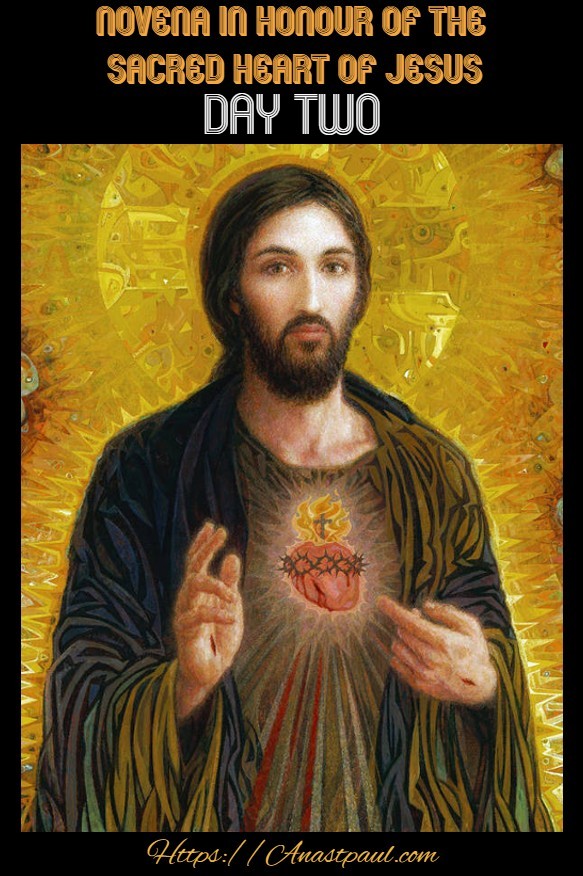
THE SECOND DAY
With the Blessed Virgin, the Cherubim, and the Holy Prophets.
Adore the Sacred Heart of Jesus, which solicits, night and day, the mercy of God in our favour, and incessantly offers itself in sacrifice for the expiation of our sins.
Practice—Recall to your mind, in the bitterness of your soul, the enormity of your sins; implore this Sacred Heart to give you a true contrition for them and unite the sorrow which you endeavour to conceive, with that which our Lord experienced in His adorable Heart.
Prayer of St Alphonsus Liguori to the Sacred Heart
O Adorable Heart of my Jesus, Heart created expressly. for the love of men! Until now, I have shown towards Thee only ingratitude. Pardon me, O my Jesus. Heart of my Jesus, Abyss of Love and of Mercy, how is it possible, that I do not die of sorrow when I reflect on Thy Goodness to me and my ingratitude to Thee? Thou, my Creator, after having created me, hast given Thy Blood and Thy Life for me and, not content with this, Thou hast invented a means of offering Thyself everyday for me, in the Holy Eucharist, exposing Thyself to a thousand insults and outrages. Ah, Jesus, do Thou wound my heart with a great contrition for my sins and a lively love for Thee. Through Thy Tears and Thy Blood, give me the grace of perseverance in Thy fervent love, until I breathe my last sigh. Amen.
Thought for the Day – 16 June – Meditations with Antonio Cardinal Bacci (1881-1971)
The Feast of Corpus Christi
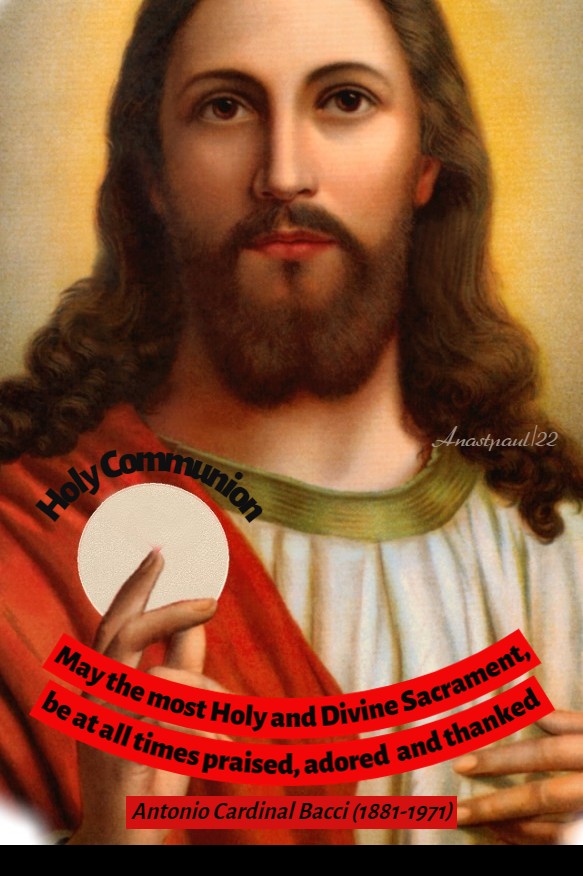
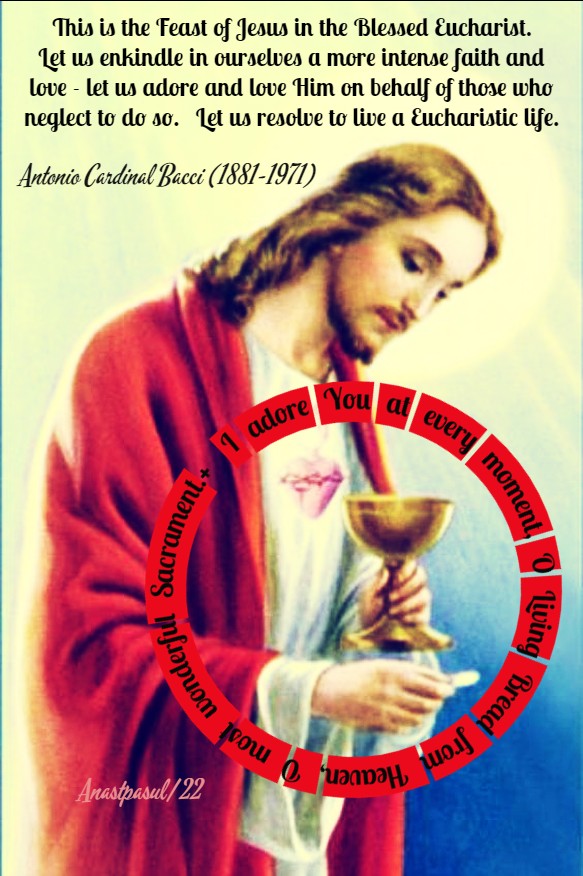
“This is the Feast of Jesus in the Blessed Eucharist. Let us enkindle in ourselves a more intense faith and love – let us adore and love Him on behalf of those who neglect to do so. Let us resolve to live a Eucharistic life.
Aspiration: I adore You at every moment, O Living Bread from Heaven, O most wonderful Sacrament.”
Quote/s of the Day – 16 June – Corpus Christi, The Most Holy Body and Blood of our Lord Jesus Christ – 1 Corinthians 23-29, John 6:56-59.
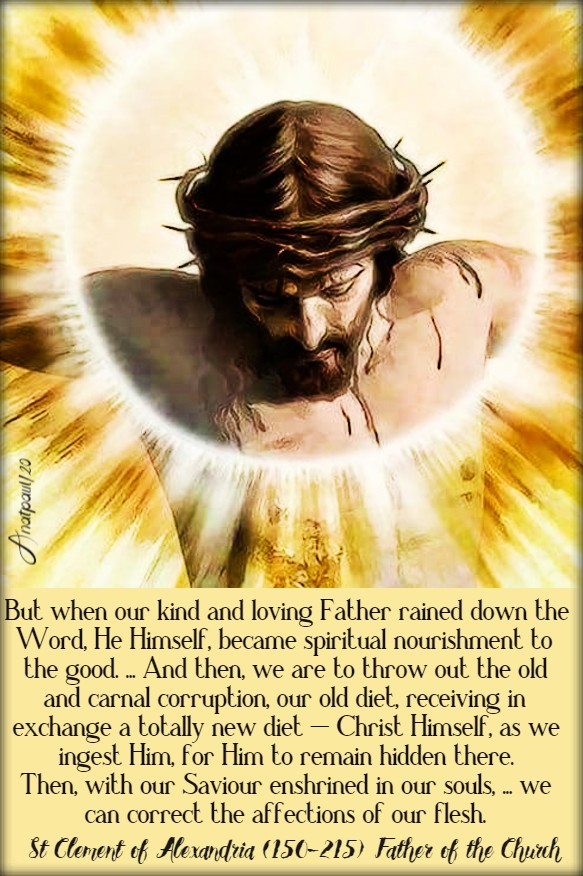
“But when our kind and loving Father rained down the Word, He Himself, became spiritual nourishment to the good. … And then, we are to throw out the old and carnal corruption, our old diet, receiving in exchange a totally new diet — Christ Himself, as we ingest Him for Him to remain hidden there. Then, with our Saviour enshrined in our souls, as it were, we can correct the affections of our flesh.”
St Clement of Alexandria (150-215) Father of the Church
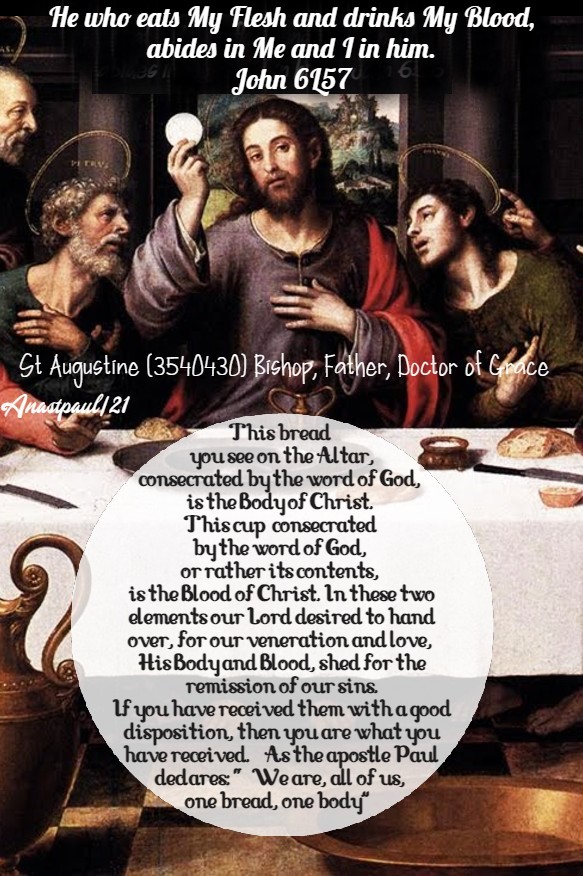
“He who eats My Flesh and drinks My Blood, abides in Me and I in him.”
John 6:57
“This bread you see on the Altar, consecrated by the word of God, is the Body of Christ. This cup consecrated by the word of God, or rather its contents, is the Blood of Christ. In these two elements our Lord desired to hand over, for our veneration and love, His Body and Blood, shed for the remission of our sins. If you have received them with a good disposition, then you are what you have received. As the apostle Paul declares: “We are, all of us, one bread, one body” (1 Cor 10,17)…”
St Augustine (354-430) Bishop, Father, Doctor of Grace
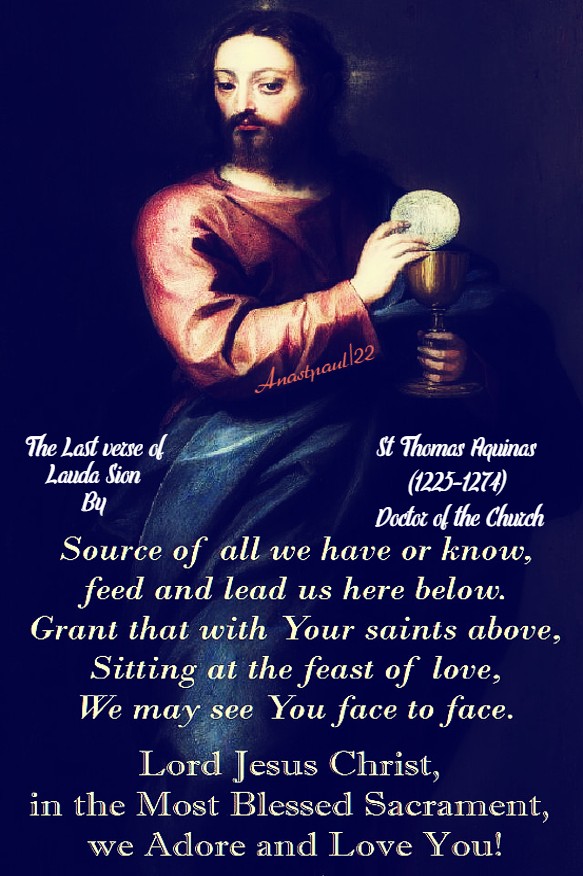
Source of all we have or know, feed and lead us here below. Grant that with Your saints above, Sitting at the feast of love, We may see You face to face.
Amen Alleluia!
Lord Jesus Christ, in the Most Blessed Sacrament, we Adore and Love You!
( The last Verse of the Lauda Sion, the Eucharistic Hymn/Sequence By St Thomas Aquinas (1225-1274)
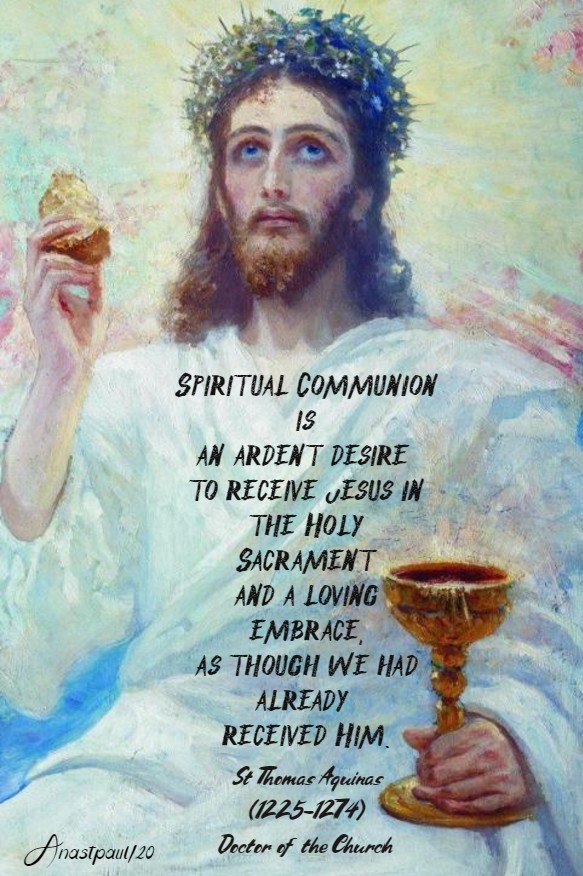
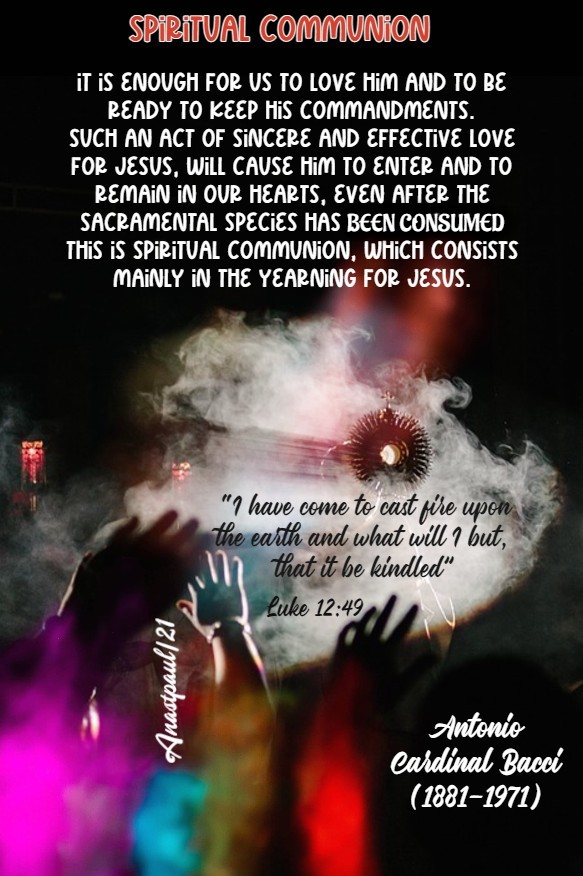
“Spiritual Communion is an ardent desire to receive Jesus in the Holy Sacrament and a loving embrace, as though we had already received Him.”
St Thomas Aquinas (1225-1274) Doctor of the Church
“It is enough for us to love Him and to be ready to keep His commandments. Such an act of sincere and effective love for Jesus, will cause Him to enter and to remain in our hearts, even after the sacramental species has been consumed. This is Spiritual Communion, which consists mainly in the yearning for Jesus. “I have come to cast fire upon the earth and what will I but, that it be kindled” (Lk 12:49).”
Antonio Cardinal Bacci (1881-1971)
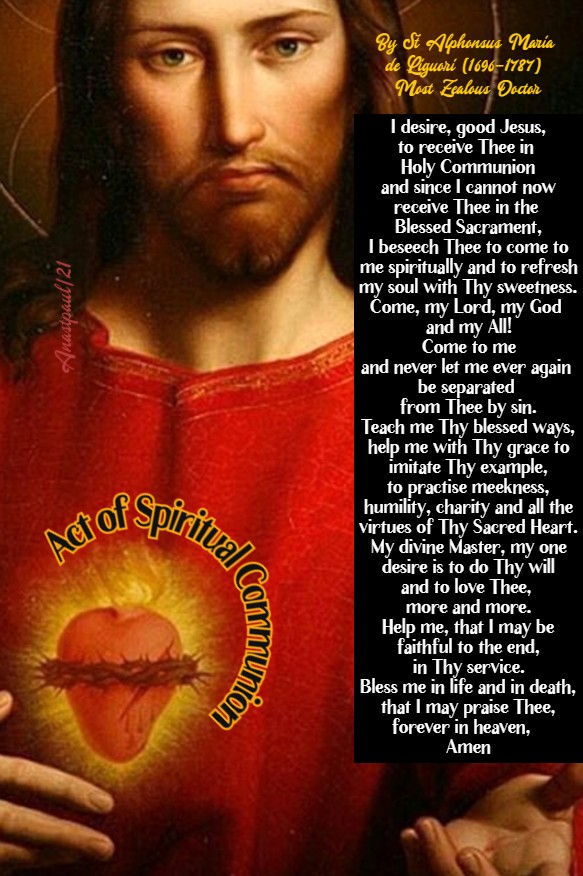
Act of Spiritual Communion By St Alphonsus Maria de Liguori (1696-1787) Most Zealous Doctor
I desire, good Jesus, to receive Thee in Holy Communion and since I cannot now receive Thee in the Blessed Sacrament, I beseech Thee to come to me spiritually and to refresh my soul with Thy sweetness. Come, my Lord, my God and my All! Come to me and never let me ever again be separated from Thee by sin. Teach me Thy blessed ways, help me with Thy grace to imitate Thy example, to practise meekness, humility, charity and all the virtues of Thy Sacred Heart. My divine Master, my one desire is to do Thy will and to love Thee, more and more. Help me, that I may be faithful to the end, in Thy service. Bless me in life and in death, that I may praise Thee, forever in heaven, Amen
One Minute Reflection – 16 June – Corpus Christi, The Most Holy Body and Blood of our Lord Jesus Christ – 1 Corinthians 23-29, John 6:56-59.
“He who eats My Flesh and drinks My Blood, abides in Me and I in him..” – John 6:57
REFLECTION – “Or think of it this way: Whereas people desire meat and drink to satisfy hunger and thirst, real satisfaction is produced, only by that meat and drink that make the receivers of it, immortal and incorruptible. He’s talking here about the fellowship of the saints where there is peace and unity, full and perfect. Therefore, our Lord has chosen, for the types of His Body and Blood, things that become one out of many.
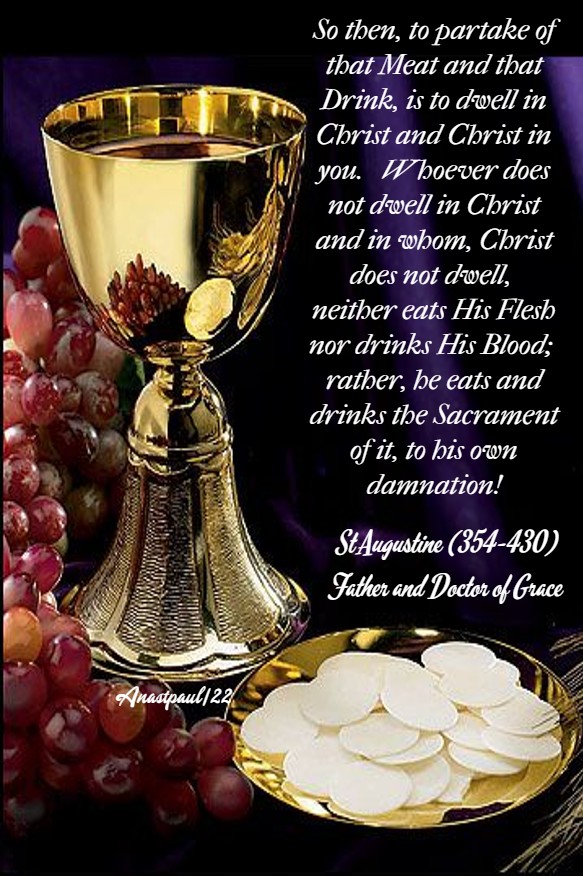
Bread is a quantity of grains united into one mass, wine a quantity of grapes squeezed together. Then He explains what it is to eat His Body and drink His Blood: “He that eats my flesh and drinks my blood dwells in me and I in him.” So then, to partake of that Meat and that Drink, is to dwell in Christ and Christ in you. Whoever does not dwell in Christ and in whom, Christ does not dwell, neither eats His Flesh nor drinks His Blood; rather, he eats and drinks the Sacrament of it, to his own damnation!” – St Augustine (354-430) Father and Doctor of Grace (Tractates on the Gospel of John, 26).
PRAYER – O God, Thou Who in this wondrous sacrament have left us a memorial of Thy Passion, grant us, we beseech Thee, so to venerate the Sacred Mysteries of Thy Body and Blood, that we may ever experience, within us, the effect of Thy Redemption. Through Jesus Christ, Thy Son our Lord, Who lives and reigns with Thee, in the unity of the Holy Ghost, God, world without end. Amen (Collect). EUCHARISTIC Heart of JESUS, model of the priestly heart, have mercy on us. COR JESU Eucharisticum, cordis sacerdotalis exemplar, miserere nobis. – Indulgence 300 Days, Everytime – Raccolta 177 St Pius X, 11 September 1907.
Our Morning Offering – 16 June – Corpus Christ, The Most Holy Body and Blood of our Lord Jesus Christ
Lauda Sion Salvatorem Sion, Lift Up thy Voice and Sing (Excerpt) By St Thomas Aquinas (1225-1274) Doctor Angelicus / Doctor Communis
Sion, lift thy voice and sing, Praise thy Saviour and thy King, Praise with hymns thy Shepherd true, Dare thy most to praise Him well, For He doth all praise excel, None can ever reach His due.
Special theme of praise is Thine, That true living Bread divine, That life-giving flesh adored, Which the brethren twelve received, As most faithfully believed, At the Supper of the Lord.
Let the chant be loud and high, Sweet and tranquil be the joy Felt to-day in every breast; On this festival divine Which recounts the origin Of the glorious Eucharist.
St Thomas Aquinas wrote the Liturgy for Corpus Christi when Pope Urban IV added the Solemnity to the universal Church’s Liturgical calendar in 1264. He provided a great sequence, one of the great poems chanted or recited before the proclamation of the Gospel. Lauda Sion is one of only four medieval sequences which were preserved in the Roman Missal published in 1570 following the Council of Trent (1545–1563)—the others being Victimae Paschali Laudes (Easter), Veni Sancte Spiritus (Pentecost) and Dies irae (requiem masses). (A fifth, Stabat Mater, would later be added in 1727.) Before Trent, many feasts had their own sequences. The existing versions were unified in the Roman Missal promulgated in 1570. The Lauda Sion is still sung today as solemn Eucharistic hymn, though its use is optional in the post-Vatican II Ordinary form. As with St Thomas’s other three Eucharistic Hymns, the last few stanzas of the Lauda Sion are often used alone, in this case, to form the “Ecce Panis Angelorum”.
By Fr Francis Xavier Weninger, SJ (1805-1888) (Excerpt)
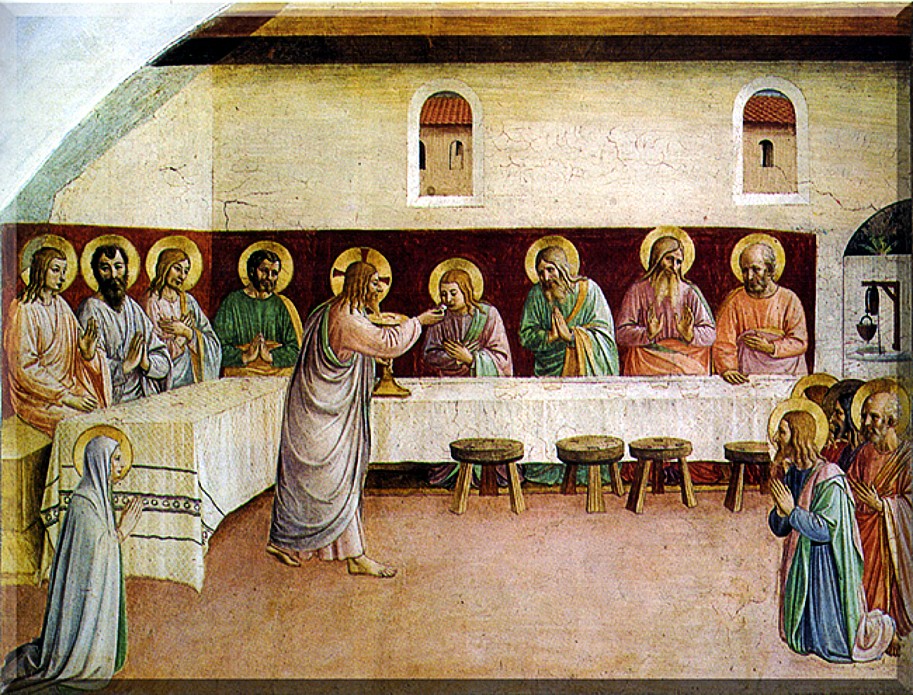
The same reason which caused the Festival of the Holy Trinity, induced the Catholic Church to institute the Feast of Corpus Christi, which we celebrate today. She requires that we shall confess and renew today, the faith which we have in the Blessed Eucharist and that we bestow, all possible honours, upon the Most Holy Sacrament and give due thanks to our Saviour for its institution. In order that this just requirement of the Church may be more fully complied with, we shall here give some explanation of the above reasons.
In regard to the first reason, the following are the facts, which the Church especially desires to call to our memory by this joyous festival. Our dear Saviour, on the same evening when His bitter suffering for the Redemption of man began, instituted the Blessed Eucharist, out of His immeasurable love for us. In it, He is truly and substantially present with Body and Doul, with Flesh and Blood, as God and Man, under the form of bread and wine. Under the form of bread, not only His Holy Body but also, His Holy bBood is present – because a living body cannot exist without blood. Hence he receives it, who partakes of Holy Communion only in th,e form of bread, not less than he who receives it in two forms, as the pPriests, when they say Holy Mass. The latter partake of Holy Communion under two forms, in order that the Passion and Death of our Saviour, during which His Blood flowed from His wounds, might be more vividly represented.
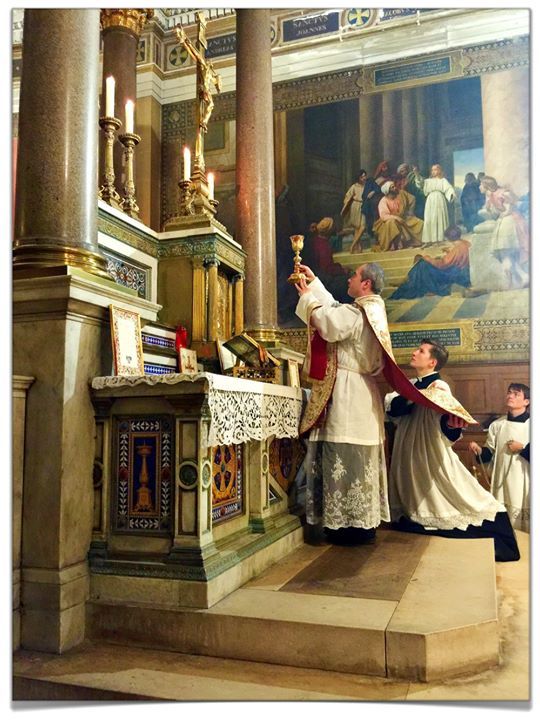
From the moment that the Priest speaks the prescribed holy words, in the name of Christ, over the bread and wine, the Lord is present in the Holy Sacrament. Bread and wine change their substance, miraculously, into the true Body and Blood of the Saviour, in such a manner, that all that remains of the bread and wine, is their form, colour and taste. The Presence of Christ lasts as long as the bread and the wine are unconsumed. It is further to be considered, that our Lord is present in a small host as well as in a large one, as well in a portion of a Host, as in a whole one. Hence, he who receives an entire host, has no more than he who receives only a part of one, the latter has just as much as the former. The same is the case with those, who by inadvertence, receive more than one Host, while others receive only one. It is only to be remarked that in case a Consecrated Host is broken or divided, the Holy Body of the Saviour, is not broken nor divided but, the form of the bread only: even as Christ will not again die, so His Holy Body can neither be broken nor divided. All these points are Articles of Faith in the Catholic Church and are explained in sermons, in religious instructions and in many books and are especially demonstrated, by the Word of God. All true Catholics believe this without any doubt, as the Almighty, Who is Eternal and Infallible Truth, has revealed it and, as that Church assures us, which, on account of the Assistance of the Holy Ghost, promised to her by Christ, cannot err.
Those who are not Catholics teach in many points quite differently. They especially reject the Real Presence of Christ in the form of bread and wine and also, the Transubstantiation of these latter, into the Real Body and Blood of the Lord. They maintain it to be impossible, that bread and wine can be changed into the Body and Blood of Christ, or that Christ can be Really Present at the same time, in so many different places, in so small a compass, as the Holy Host. If we ask them why they consider it impossible, they answer: “because we cannot conceive, cannot comprehend, how it can be possible.” But if they believe impossible all which they cannot understand, they must, besides many other Articles of Faith, reject the creation of the world; the Humanity and Resurrection of Christ; the Holy Trinity; because all these are just as inconceivable for the mind of man, as the Transubstantiation of the bread and wine and the substantial Presence of the Lord in the Blessed Sacrament. It matters not, in Articles of Faith, whether we are able to comprehend them or not, so long as they are revealed by God.
That which the Almighty has revealed must be true, whether I can understand it or not – for He is Omniscient, hence Infallible and cannot be deceived, while our understanding, can as easily be deceived, as our senses. God is Truth, therefore, cannot deceive. He is Omnipotent, hence, He can do more than the human mind can comprehend. “With God all things are possible,” said Christ Himself. “Let us admit that God can do more than we are able to fathom,” says St Augustine, while St Cyril of Alexandria writes; “The Lord says by the prophet Isaias: ‘My counsel is not like yours, neither are my ways like your ways: for as the heaven is above the earth, so are my ways above your ways and my thoughts above your thoughts.’ Cannot, therefore, the Works of Him, Who stands so high above us in Wisdom and Power, exceed in their Greatness the limits of our understanding?”
The same is taught by all the Holy Fathers. They also refer to many occurrences in nature, which, although we cannot comprehend them, nevertheless, take place. They speak of the creation of the world and say, if we believe that God created a whole world out of nothing, how can we hesitate to believe that He can change bread and wine, or that He can be Present in that form? The water at Cana was changed into wine – why then should He not possess the Power to transform bread and wine into His Holy Body and Blood? Truly, whoever believes that God is Omnipotent, Infallible and Infinite, cannot doubt this Article of Faith. We Catholics believe so and hence, we cannot doubt any of the abovementioned points of the True Faith. This faith we this day renew and confess publicly. The Catholic Church requires it and has, for this reason, instituted today’s Festival. She further demands that we unanimously, bestow today all possible honour upon the Blessed Sacrament and that we praise and glorify, with all the powers of our soul, the Saviour therein concealed. And is not this justly demanded of us? of us who firmly believe that our Lord is Present in His double nature, as God and as Man, in the Blessed Sacrament? All honour, all praise belongs to the true God! …
Everything connected with this ceremony, is intended to honour our Lord in every possible manner. The Church tries, by this public manifestation, to atone somewhat for the many and great wrongs to which the Blessed Sacrament is so frequently subjected, by heretics as well as by Catholics.
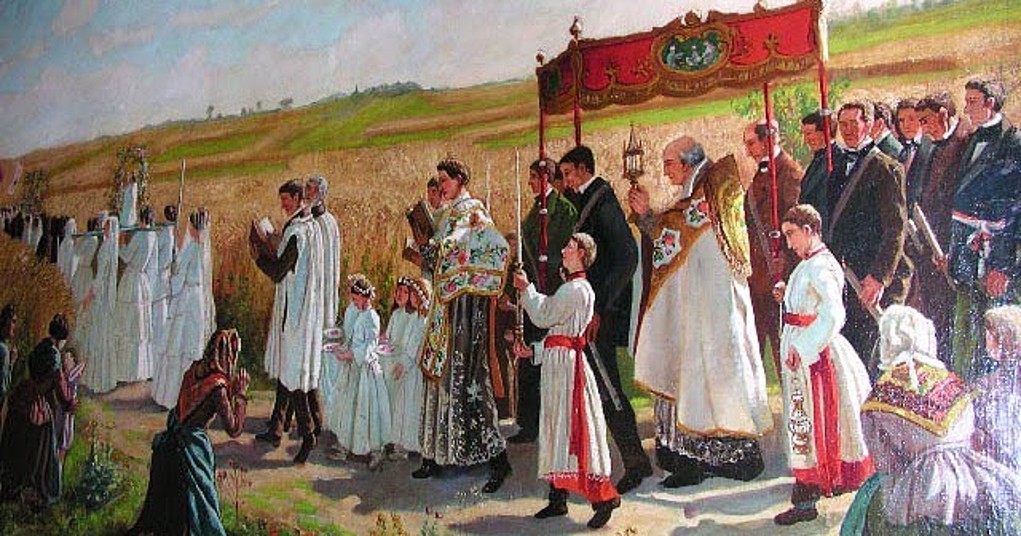
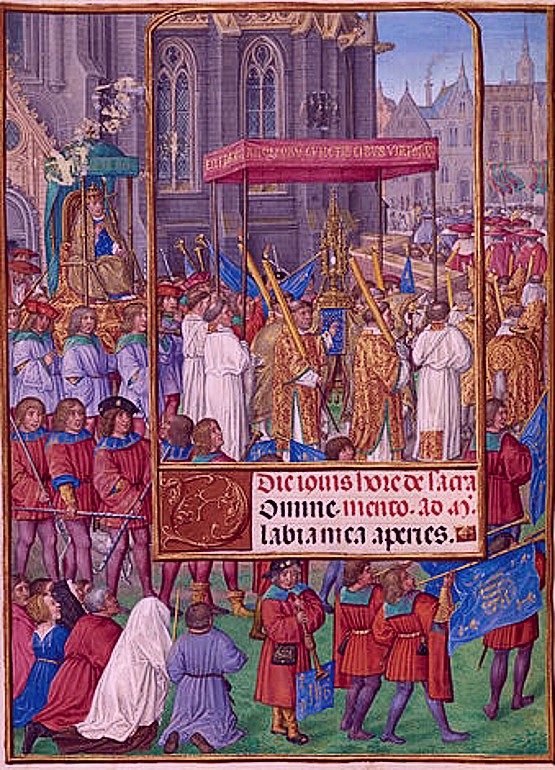
One cannot, without horror, think how this Sacred Mystery has been assailed and dishonoured in Centuries gone by and down to our days. A pious Christian dares not even relate the wrongs done to it, which are great enough to deserve hell! And what does our Saviour, concealed in the Blessed Sacrament, suffer from those who believe in His Presence? The irreverence and levity with which many Catholics conduct themselves, in the Presence of the Blessed Eucharist, tend to dishonour and disgrace our Saviour. The unworthy Communions which unhappily take place, offend Him in a most grievous manner. The misuse of the Body, especially of the tongue and mouth, which are so often sanctified by partaking of the True Body and Blood of Christ, cannot but excite the wrath of the Lord. For these, as well as other wrongs done to the Blessed Sacrament, the Church of Christ seeks to make amends by these Solemn Processions and by all the other pious exercises she has ordained for this festival and during the whole Octave. Hence, every pious Christian should be solicitous, to conform to the ordinances of the Church and not only assist in the Procession and all other devout exercises but also, endeavour to contribute to render them, what the Church desires.
Those who are not Catholics disapprove of everything that we do today in honour of the Blessed Sacrament and accuse us of idolatry, as we, according to them, worship bread. They say also that all that we do in this regard, cannot be agreeable to God because it was not ordained by Him. We, Catholics, are, however, not disturbed by this, for we know that we do not worship bread but Him Whom Three Wise Men worshipped in the Manger, namely, Jesus Christ, true God and Man. We know also, that although what we do this day in honour of the Blessed Sacrament is not, especially and expressly ordained in Holy Writ, still we are assured that a voluntary worship of it, is in accordance with reason and the laws of God, pleasing and agreeable to His Majesty. And this is made clear to us from the above-mentioned example of the three Wise Men and from the acts with which King David honoured the Most High, on the solemn return of the Ark of the Covenant; not to mention that Christ gave us a general Command to worship God, in the words: “The Lord Thy God shalt thou adore and Him only, shalt thou serve.” (Matth. iv.) This Command we fulfil today by our actions, as they all aim at one end, namely, the honour of the Lord, Who is concealed in the Blessed Sacrament. The more we are blamed and derided by the heretics for our adoration of the Holy Eucharist, the more fervent should we become in our zeal. When King David was derided by Michol, on account of his devotion at the return of the Ark of the Covenant, he said: “Before the Lord who chose me . . . . I will both play and make myself meaner than I have done and I will be little in my own eyes.” (II. Kings vi.)
We will still add in a few words, what the True Church further demands of us. We today give humble thanks to the Lord for the institution of the Blessed Eucharist. This is no more than our duty, for if we are obliged to thank God for the smallest benefit He confers upon us, we are surely under much greater obligation, when the benefit is great and of especial importance.
Who can tell, who can comprehend, the greatness of the benefit, which Christ Our Saviour and Lord bestowed upon us by the institution of the Blessed Eucharist. It is as great as it is unfathomable: great as He Who devised it; as Christ our Lord, true God and Man, the King of all Kings, the Lord of all, Who reigns. Great and inconceivable is the miracle by which the substance of bread and wine is changed into the substance of the Body and Blood of Christ and the Miraculous Presence of the Lord in the form of bread and wine. St Thomas de Aquin, calls the Blessed Sacrament a miracle and the greatest that Christ ever wrought! Amen Amen Alleluia, Praise be Thee Lord Jesus Christ in the Most Blessed and Life-giving Sacrament!
St Berthaldus St Ceccardus of Luni St Cettin of Oran St Colman McRhoi St Crescentius of Antioch St Cunigunde of Rapperswil St Curig of Wales St Cyriacus of Iconium (c 301-c 304) Child Martyr
Blessed Donizetti Tavares de Lima (1882-1961) Priest, Apostle of the poor, the elderly and the sick, miracle-worker, known to bilocate. A prophecy related to Vatican II: “No, no, Archbishop! We won’t see this disgrace (prophesying that they both would die soon) but it will come! This was not just a dream, nor a nightmare! The darkness will fall over this world! I beg you: don’t let them destroy the Altars!” An amazing life: https://anastpaul.com/2020/06/16/saint-of-the-day-16-june-blessed-donizetti-tavares-de-lima-1882-1961/
St Elidan St Felix of San Felice St Ferreolus of Besançon St Ferrutio of Besançon Bl Gaspare Burgherre St Graecina of Volterra St Ismael of Wales
St Maurus of San Felice St Palerio of Telese St Similian of Nantes Bl Thomas Redyng St Tycho of Amathus
Martyrs of Africa: A group of five Christians Martyred together. We know nothing else but the names – Cyriacus, Diogenes, Marcia, Mica, Valeria. They were martyred in an unknown location in Africa, date unknown.
Everyday unite your prayers and adorations with those of the Most Holy Virgin and of one of the nine choirs of Angels and Saints, to honour one of the dispositions of the Sacred Heart of Jesus and to practise some virtue in its honour.
THE FIRST DAY
With the Blessed Virgin, the Seraphim and the Holy Patriarchs.
Adore often the Sacred Heart of our Lord Jesus Christ in the most Holy Sacrament, humble yourself before the Infinite Majesty of God the Father and offer, continually to Him, the purest and most profound homages.
Practice—Renew in your soul, the most lively sentiments of respect and adoration for God and frequently make these acts.
Prayer of St Alphonsus Liguori to the Sacred Heart
O Adorable Heart of my Jesus, Heart created expressly. for the love of men! Until now, I have shown towards Thee only ingratitude. Pardon me, O my Jesus. Heart of my Jesus, Abyss of Love and of Mercy, how is it possible, that I do not die of sorrow when I reflect on Thy Goodness to me and my ingratitude to Thee? Thou, my Creator, after having created me, hast given Thy Blood and Thy Life for me and, not content with this, Thou hast invented a means of offering Thyself everyday for me, in the Holy Eucharist, exposing Thyself to a thousand insults and outrages. Ah, Jesus, do Thou wound my heart with a great contrition for my sins and a lively love for Thee. Through Thy Tears and Thy Blood, give me the grace of perseverance in Thy fervent love, until I breathe my last sigh. Amen.
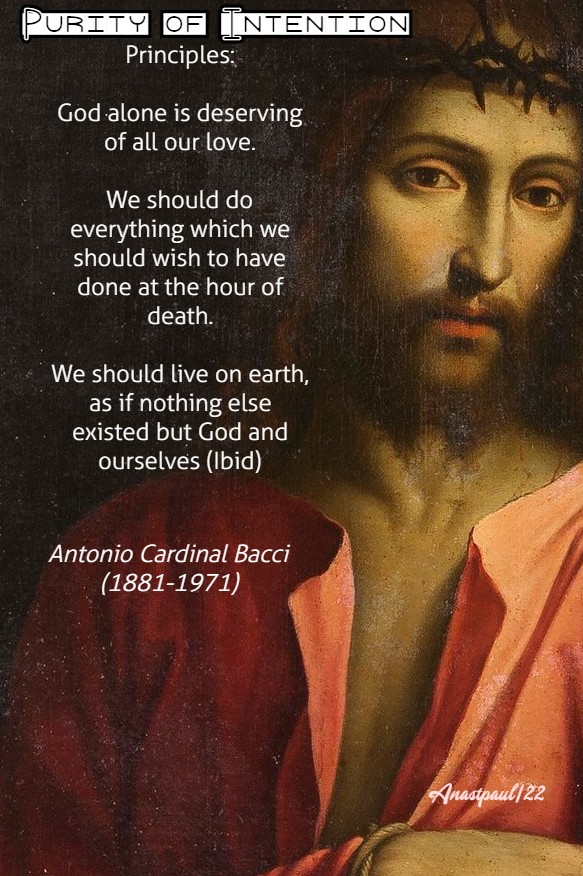
Thought for the Day – 15 June – Meditations with Antonio Cardinal Bacci (1881-1971)
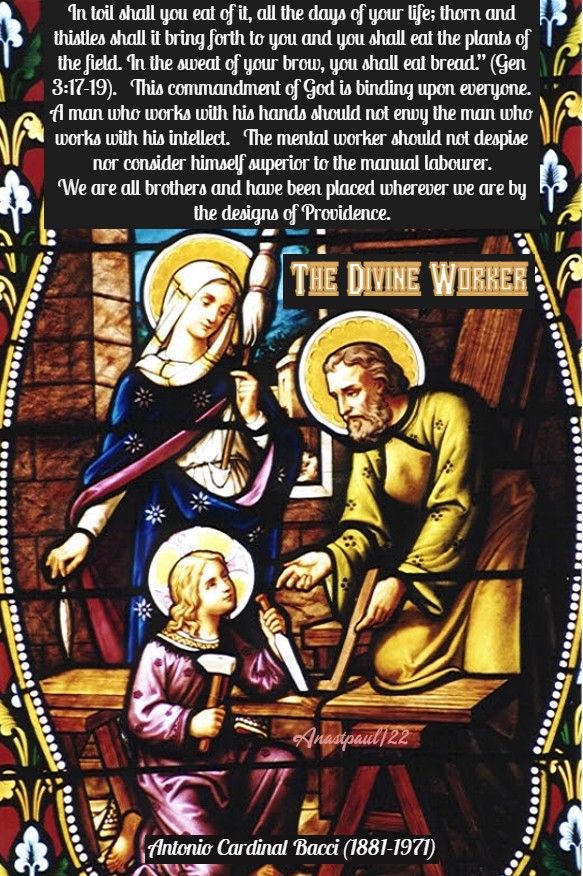
The Divine Worker
“Work is both a right and an obligation, which belongs to all men. In the beginning of creation, however, work was a pleasure for the human race and the earth yielded its fruits easily and readily. “The Lord God took the man and placed him in the Garden of Eden to till it and to keep it” (Gen 2:15). But after Adam’s sin of rebellion, nature, in its turn, rebelled against man. Work was no longer merely a pleasure but, a chastisement and a dire necessity too.
“Cursed be the ground because of you,” God said to Adam. “In toil shall you eat of it, all the days of your life; thorn and thistles shall it bring forth to you and you shall eat the plants of the field. In the sweat of your brow, you shall eat bread.” (Gen 3:17-19).
This commandment of God is binding upon everyone. Idleness is condemned as the source of evil. “Idleness is an apt teacher of mischief ” (Ecclus 33:29). Everyone must engage, in either mental or manual labour. These two kinds of work, complement one another and are equally dignified and necessary. A man who works with his hands should not envy the man who works with his intellect. The mental worker should not despise nor consider himself superior to the manual labourer. We are all brothers and have been placed wherever we are by the designs of Providence. For this reason, we should love and help one another.”
Quote/s of the Day – 15 June – The Memorial of St Vitus (c 290-c 303) and Companions, Martyrs – Wisdom 3:1-8, Luke 10:16-20
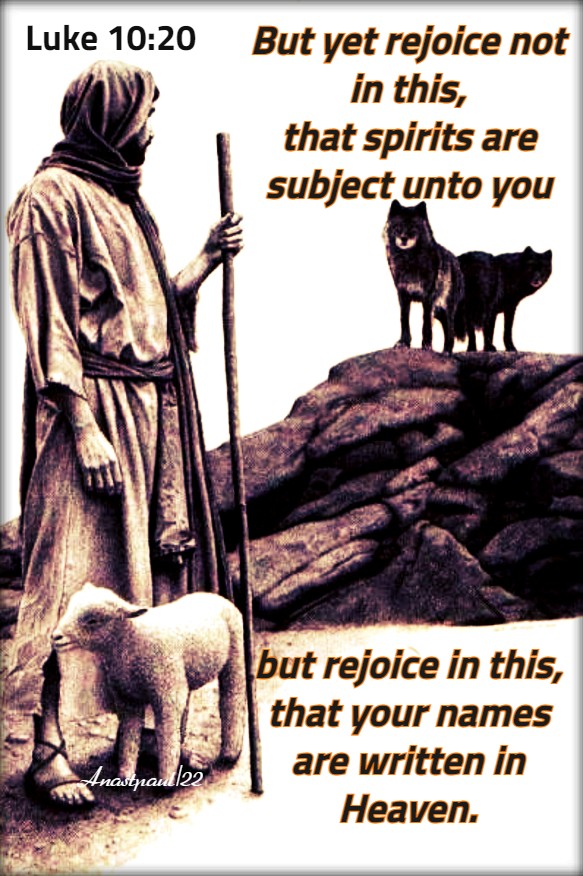
“But yet rejoice not in this, that spirits are subject unto you but rejoice in this, that your names are written in Heaven.”
Luke 10:20
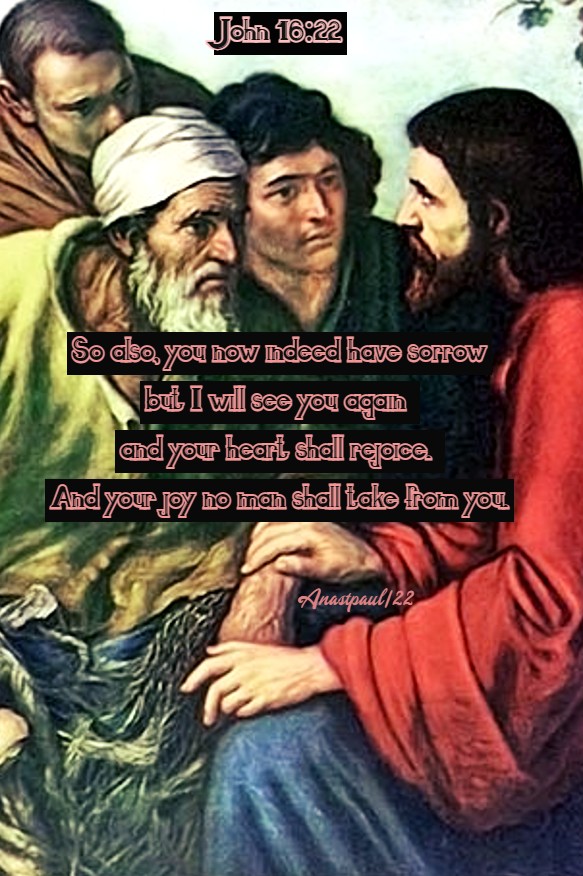
“So also, you now indeed have sorrow but I will see you again and your heart shall rejoice. And your joy, no man shall take from you.”
John 16:22
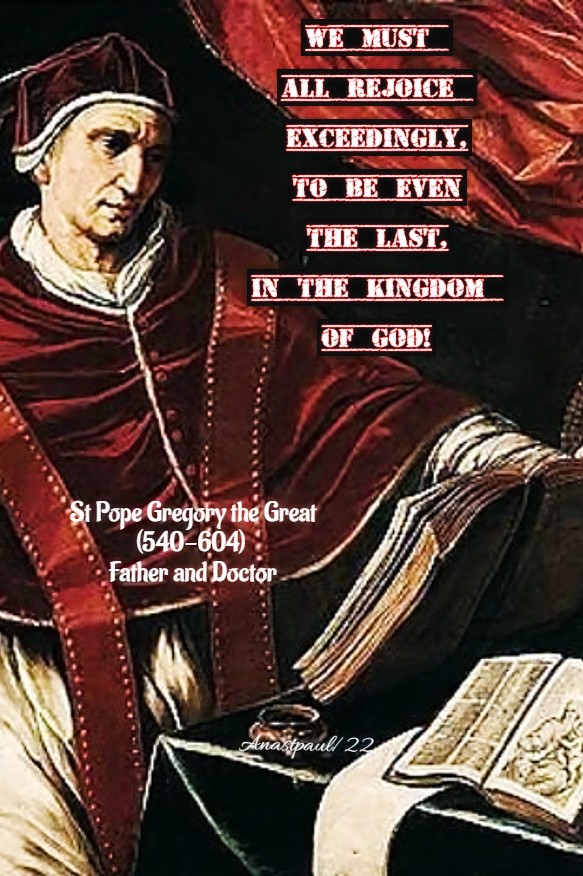
“…We must all rejoice exceedingly, to be even the last, in the Kingdom of God!”
St Gregory the Great (540-604) Pope, Confessor, Father and Doctor “Father of the Fathers”
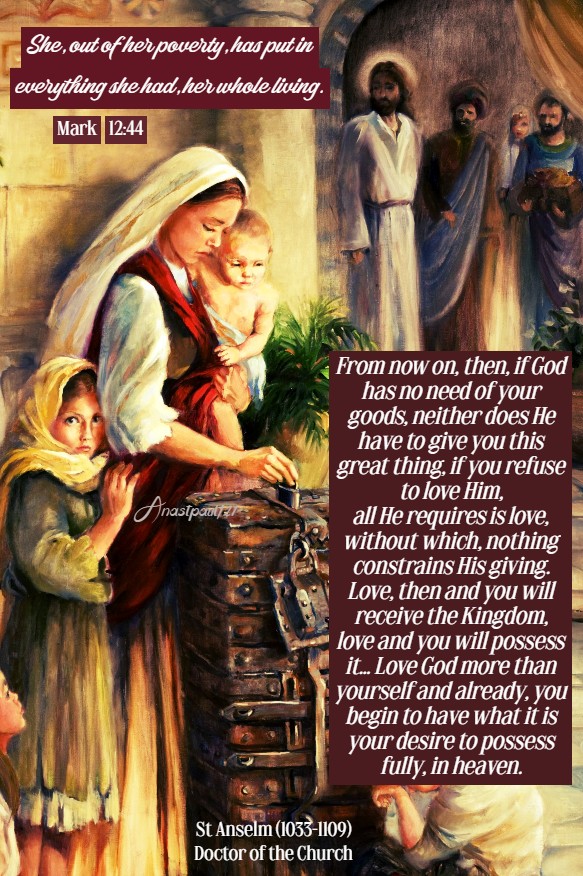
“From now on, then, if God has no need of your goods, neither does He have to give you this great thing, if you refuse to love Him, all He requires is love, without which nothing constrains His giving. Love, then and you will receive the Kingdom, love and you will possess it… Love God more than yourself and already, you begin to have what it is your desire to possess fully, in Heaven.”
St Anselm (1033-1109) Doctor magnificus Doctor Marianus
One Minute Reflection – 15 June – “The Month of the Sacred Heart” – The Memorial of St Vitus (c 290-c 303) and Companions, Martyrs – Wisdom 3:1-8, Luke 10:16-20
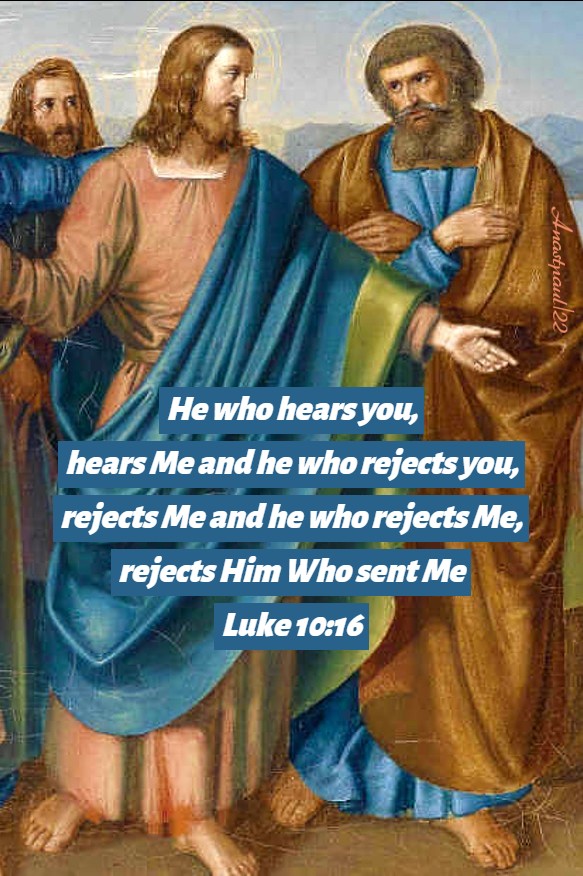
“He who hears you, hears Me and he who rejects you, rejects Me and he who rejects Me, rejects Him Who sent Me.”…Luke 10:16
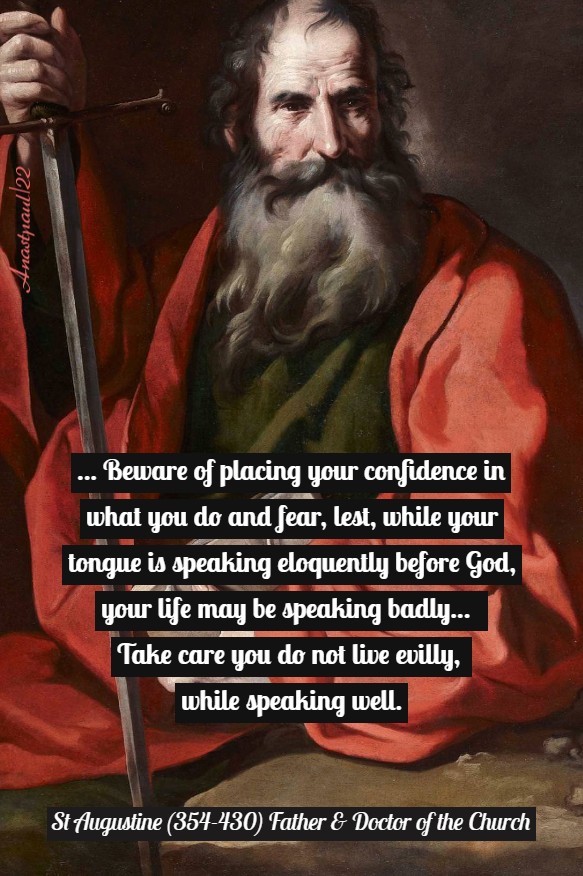
REFLECTION – “Someone, having listened to the verse: “Offer to God a sacrifice of praise” (Ps 50[49].14), said to himself: “I will go to Church every day when I get up and sing a morning hymn; then an evening hymn at the end of the day and then, in my own home, a third and fourth hymn. This is how I will make a sacrifice of praise everyday and offer it to my God.” It is good to do this if you do it in truth but beware of placing your confidence in what you do and fear lest, while your tongue is speaking eloquently before God, your life may be speaking badly… Take care you do not live evilly, while speaking well.”…St Augustine (354-430) Father & Doctor of the Church
PRAYER – Grant O Lord, we pray, that through the intercession of Thy Holy Martyrs Vitus, Modestus and Crescentia, Thy Church be not high-minded but grow in that humility which is pleasing to Thee, so that despising evil, she may practice whatever is good with unbounded charity. Through Jesus Christ, Thy Son our Lord, Who lives and reigns with Thee, in the unity of the Holy Ghost, God, world without end. Amen (Collect). “Jesus, meek and humble of heart, make my heart like unto Thine.” – 300 Days, EVERYTIME. (Unless otherwise stated, e.g., “once a day,” a partial Indulgence may be gained any number of times in succession.) St Pope Pius X, 15 September 1905.
Our Morning Offering – 15 June – “The Month of the Sacred Heart”
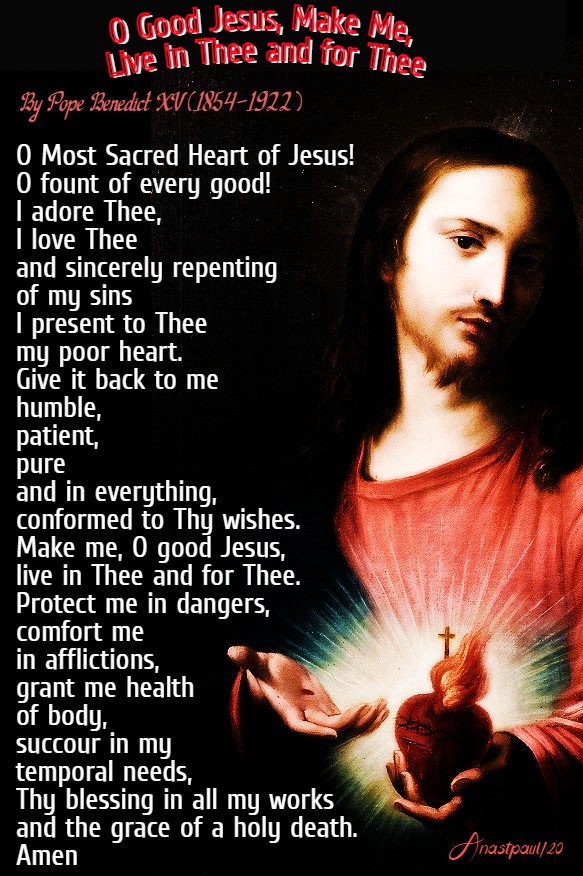
O Good Jesus, Make Me Live in Thee and for Thee By Pope Benedict XV (1854-1922)
O Most Sacred Heart of Jesus! O fount of every good! I adore Thee, I love Thee and sincerely repenting of my sins I present to Thee my poor heart. Give it back to me humble, patient, pure and in everything, conformed to Thy wishes. Make me, O good Jesus, live in Thee and for Thee. Protect me in dangers, comfort me in afflictions, grant me health of body, succour in my temporal needs, Thy blessing in all my works and the grace of a holy death. Amen
Indulgence – 100 days Once a day Pope Benedict XV 4 December 1916
Saint of the Day – 15 June – Saint Isfrid of Ratzeburg O.Praem (c 1115-1204) Bishop of Ratzeburg, Confessor, Spiritual advisor, Missionary, Mediator and Peacemaker, a renowned Administrator and gentle corrector of his flock, whom he protected against political abuses, Defender of the Pope and the Holy See. Istfrid also built and restored Churches and Monasteries and established many new Parishes. Born in c.1125 in Germany and died on 15 June 1204 at Ratzeburg, Holstein, Germany of natural causes, aged 89. Additional Memorial – 17 February in the Diocese of Osnabrück, Germany and the Archdiocese of Hamburg, Germany. Also known as – Isfried, Isfrido.
Isfrid was born around 1115 in Germany. Nothing is known about his early years. He entered the Order of the Premonstratensians, which is also called the Norbertines, after its founder, St Norbert of Xanten (1080-1134), or White Canons, after the colour of their habit.
Istfrid became a Canon in the Monastery in Cappenberg near Selm in Westphalia. In 1159 he was elected the first Prior of the Monastery of Jerichow near Berlin. There he built a magnificent Romanesque Church.
At the request of Henrik Löwe, Duke of Saxony, the Norbertines of Magdeburg had turned their attention to the conversion of the pagan Vendors, a common name for the Slavic tribes on the Elbe and the Baltic Sea. Saint Evermod was elected by Henrik Löwe, as the first Bishop of the restored Diocese of Ratzeburg in northern Germany. Upon the death of St Evermod, Istfrid was proposed as his successor. But strife over this election led to a two-year sedis vacancy. But the battle was ended through Henrik Löwe’s intervention and in 1180, Isfrid was finally elected, as the second Bishop of Ratzeburg. The medieval chronicle describes him as sanctus sancti successor – a saint who succeeds a saint.
St Isfrid on the right, with Sts Ludolph and Evermod, the three first Bishops of Ratzeburg.
Isfrid completed the construction of the Cathedral, which was begun by Evermod. He was known for his organisational skills and created many Parishes. He also worked tirelessly for the German colonisation of the land of the Vendians. Against himself, he tended to be strict in his penance but against the rebellious, he was a gentle judge and tried to convince them and win them over through his preaching. In 1190 he visited the Monastery of Floreffe in present-day Belgium, which had been destroyed by fire. According to Arnold of Lübeck, he succeeded in recalling all the Canons who had been scattered in all directions over the past year and a half. He restored the Monastery and Consecrated seven Altars in one day. The same year, he also Consecrated the Romanesque Church in Postel, a daughter house of Floreffe.
Isfrid was the Confessor and friend of Duke Henrik Löwe, a pious layman who enthusiastically supported Isfrid in his project to continue the missionary work of the invaders that Evermod had started. But Emperor Frederick I Barbarossa (1152-90; Emperor from 1155) wrongly took from Henrik his possessions and gave them to Bernhard of Anhalt. In the battle between the imperial party stauferne and the papal party, Isfrid took the side of the defeated Henrik Löwe, as he had once sworn allegiance to him, despite all threats and protests.
Isfrid also defended the rights of his people against the intrigues of Emperor Fredrik and his vassal, Bernhard of Anhalt. Bernhard punished anyone who disliked the Emperor’s policy towards the Pope or who sympathised with Duke Henrik. Isfrid bore these persecutions with dignity and patience until Henrik was finally reconciled with the Emperor, who returned to him the duchy. Isfrid remained Duke Henrik’s Confessor and spiritual guide and when Henrik was dying in 1195, Isfrid went to him to hear his Confession, give him absolution and the last Sacraments before he died on 6 August 1195. In the old annals of Stederburg, Isfrid is called, “a man who excelled in Christian wisdom, humility and strength.”
In 1195, the Canons at the Chapter in Schwerin, which was composed of both Saxons and Wends, could not agree on the election of a Bishop. Isfrid was asked by the Pope to mediate and judge between the candidates and the choice fell on Brunward, one of the first converts to receive the Episcopal honour.
Isfrid died on 15 June 1204 in Ratzeburg, aged 89 and was buried in the choir in his Cathedral, next to his predecessor St Evermod. His reputation for holiness spread rapidly and miracles continued to occur after his death. Pope Benedict XIII (1724-1730), confirmed his cult on 26 March and 12 April 1728, along with a number of other Premonstratensians.
His memorial day is the day of his death, 15 June. In the Diocese of Osnabrück he is commemorated on 17 February with two other Bishops of Ratzeburg, Saints Evermod (1154-1178) and Ludolf (1236-1250), both of whom, were PremonstratensianS. Because Ratzeburg in the state of Schleswig-Holstein is today located in the newly established Catholic Diocese of Hamburg (1995), the three holy Bishops were transferred from the calendar of the Diocese of Osnabrück to the calendar of the Archdiocese of Hamburg. He is depicted as a Bishop, with the water that turned into wine and with the blind man for whom he prayed that his sight be restored, which God approved.
St Vitus (c 290-c 303) – Martyr, One of the Fourteen Holy Helpers. Died aged 12-13 years of age. Patronages – against animal attacks, against dog bites, against epilepsy; epileptics, against lightning, against over-sleeping, against rheumatic chorea or Saint Vitus Dance, against snake bites, against storms, against wild beasts, of actors, comedians, dancers, dogs, Bohemia, Czech Republic, Serbia, 17 cities. His very short life: https://anastpaul.com/2017/06/15/saint-of-the-day-15-june-st-vitus/
St Abraham of Saint-Cyriacus St Achaicus of Corinth St Barbara Cui Lianshi St Benildis of Córdoba
St Bernard of Montjoux/Menthon CRSA (c 1020-1081) “Apostle of the Alps” Priest, Founder of a patrol that cleared robbers from the mountains and he established hospices for travellers and pilgrims. The large dogs, trained to search for lost victims in the mountains, are named for him. Patronages – Alpinists, Alps (proclaimed by Pope Pius XI on 20 August 1923), Campiglia Cervo, Italy, mountain climbers (proclaimed by Pope Pius XI on 20 August 1923), mountaineers, skiers, travellers in the mountains (proclaimed by Pope Pius XI on 20 August 1923). Biography: https://anastpaul.com/2018/06/15/saint-of-the-day-15-june-st-bernard-of-menthon-c-r-s-a-c-1020-1081-apostle-of-the-alps/
St Constantine of Beauvais St Domitian of Lobbes St Edburgh of Winchester St Eigil St Eutropia of Palmyra St Fortunatus of Corinth
St Hadelinus of Lobbes St Hesychius of Durostorum St Hilarion of Espalion St Isfrid of Ratzeburg O.Praem (c 1115-1204) Bishop, Confessor Bl Juan Rodriguez St Julius of Durostorum St Landelin of Crespin St Leonides of Palmyra St Libya of Palmyra St Lotharius of Séez St Melan of Viviers St Orsisius Bl Pedro da Teruel Bl Peter Snow St Pierre de Cervis
Bl Ralph Grimston St Tatian of Cilicia Bl Thomas Scryven St Trillo of Wales St Vaughen of Ireland
St Vouga of Lesneven
Martyr of Lucania – 11 Saints: Eleven Christians Martyred together. We known nothing else about them but the names – Anteon, Candidus, Cantianilla, Cantianus, Chrysogonus, Jocundus, Nivitus, Protus, Quintianus, Silvius, Theodolus in Lucania (modern Basilicata), Italy, date unknown.
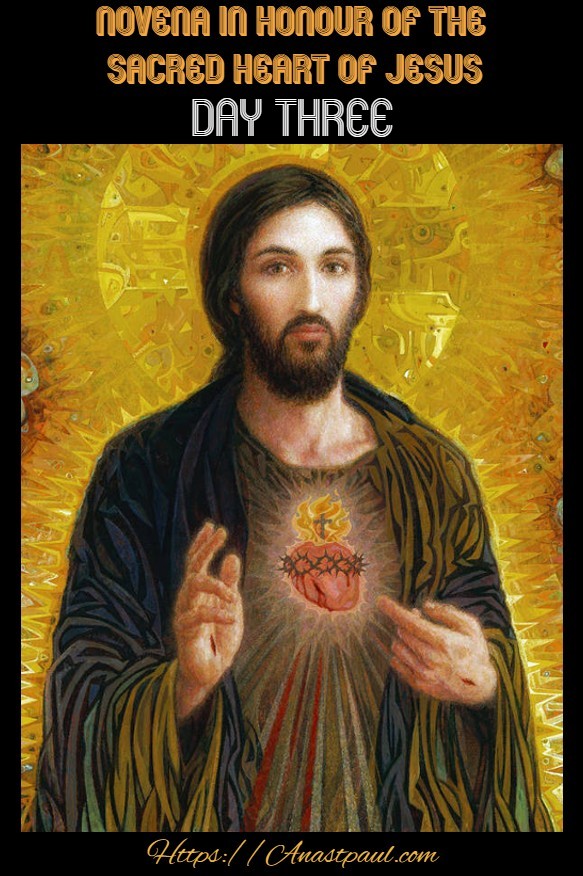
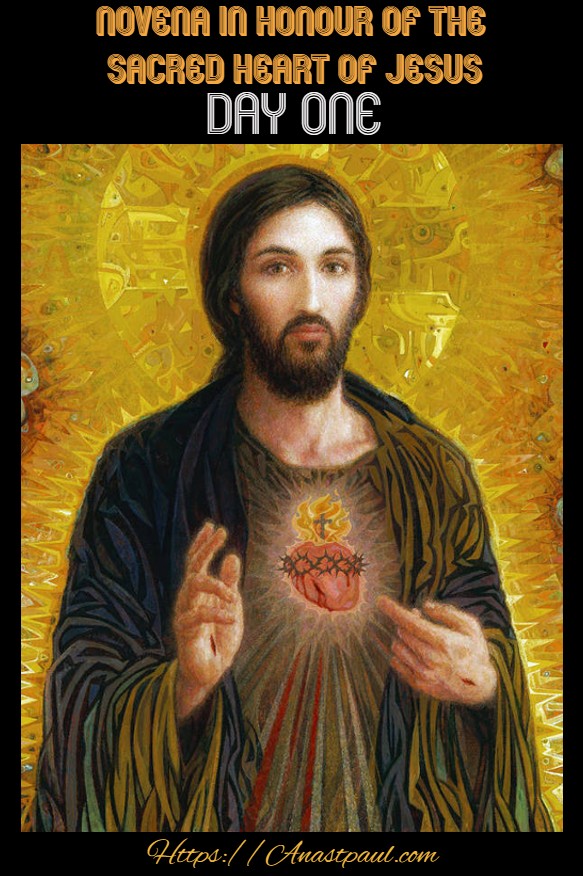
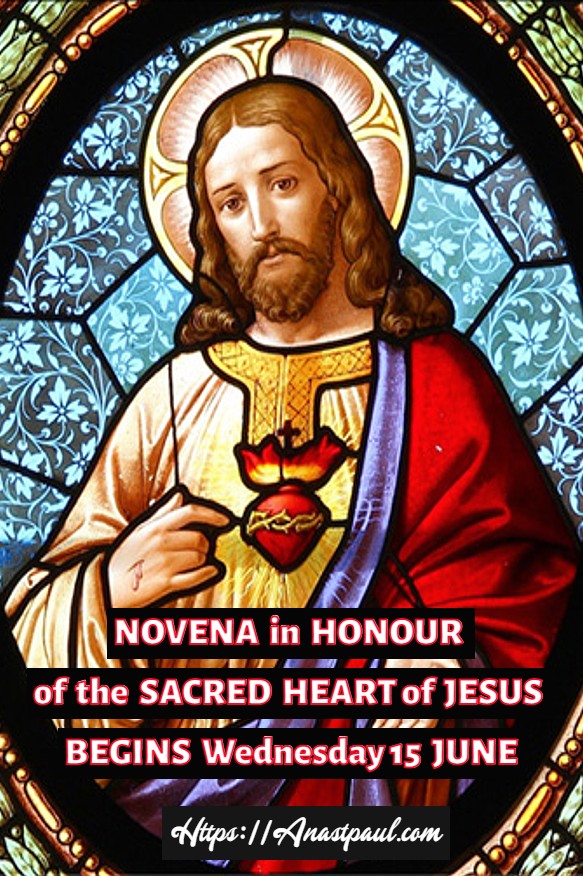
REMINDER the NOVENA in HONOUR of the SACRED HEART of JESUS BEGINS Wednesday 15 JUNE
Feast Day: 19 days after Pentecost
Please join me in this most beautiful Novena to our Beloved Lord.🙏🧡
The Sacred Heart of Jesus is a special form of Devotion to the physical Heart of Jesus. It is the Love He shares for humankind, with the Father and the Holy Ghost . In the Eleventh and Twelfth Centuries, devotion to the Sacred Heart arose in Benedictine and Cistercian Monasteries. Passages from the published work “Vitis Mystica” inspired the devotion and were used by the Church for the lessons of the Second Nocturn of the Feast. From the Thirteenth to the Sixteenth Centuries, the Devotion was practiced by different Congregations such as Franciscans, Dominicans and Carthusians but remained an individual or private Devotion.
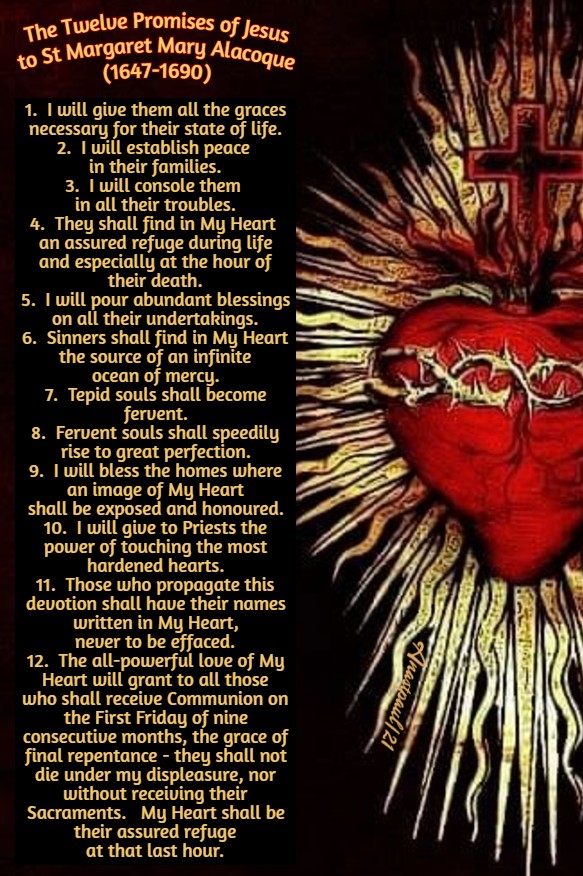
St John Eudes Orat. (1601-1680), established the Devotion publicly in the Seventeenth Century, gave it an Office and established a Feast for it. He shared Devotion to the Sacred Heart along with his Devotion to the Immaculate Heart of the Blessed Virgin Mary. Little by little the Devotions separated and the first Feast of the Sacred Heart of Jesus, was celebrated on 31 August 1670. On 27 December 1673, on the Feast of St John the Beloved Apostle of the Heart of Our Lord, Saint Margaret Mary Alacoque VHM. (1647-1690), a Nun at the Visitation Convent in France, began to have visions of Jesus. He [Jesus] asked her to promote Devotion to His Sacred Heart, symbolic of His Love for humanity. Jesus attached twelve promises to those who practiced Devotion to His Sacred Heart including peace in families, consolation in time of trouble, abundant blessings and refuge at the hour of death. By Order of Pope Leo XIII in 1899, all of mankind was Solemnly Consecrated to the Sacred Heart of Jesus.
Jesus’ Sacred Heart is typically pictured as a flaming heart, pierced, surrounded by a Crown of Thorns and Bleeding. The wounds and thorns symbolise the manner of His Death and the fire represents His burning undying Love.
Quote/s of the Day – 14 June – The Memorial of St Basil the Great (329-379) Bishop of Caesarea, Confessor, Father and Doctor of the Church
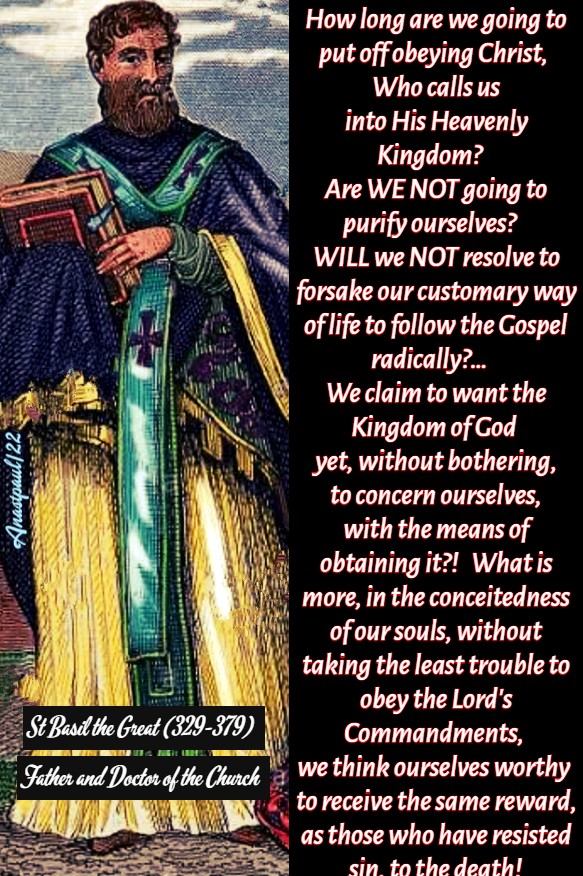
“How long are we going to put off obeying Christ, Who calls us into His Heavenly Kingdom? Are WE NOT going to purify ourselves? WILL we NOT resolve to forsake our customary way of life to follow the Gospel radically?… We claim to want the Kingdom of God yet, without bothering, to concern ourselves, with the means of obtaining it?! What is more, in the conceitedness of our souls, without taking the least trouble to obey the Lord’s Commandments, we think ourselves worthy to receive the same reward, as those who have resisted sin, to the death!”
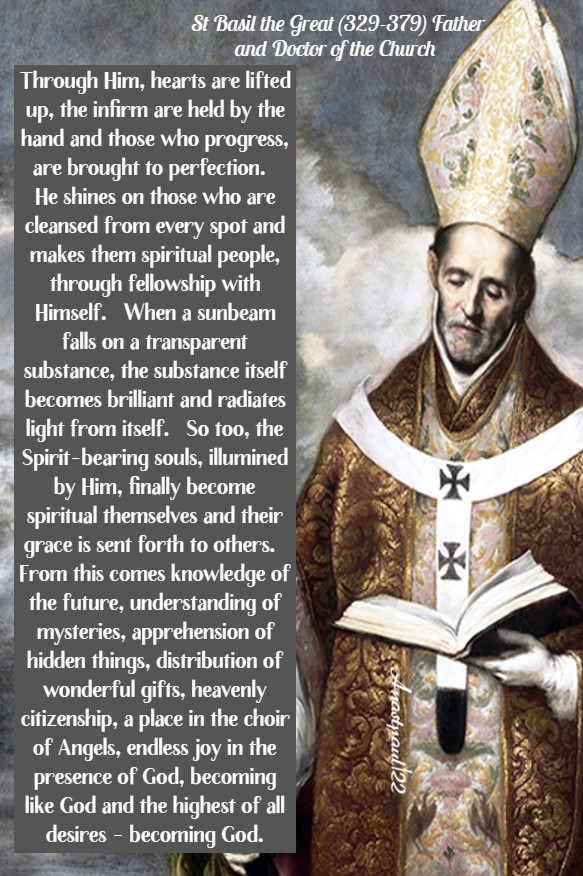
“Through Him, hearts are lifted up, the infirm are held by the hand and those who progress, are brought to perfection. He shines on those who are cleansed from every spot and makes them spiritual people, through fellowship with Himself. When a sunbeam falls on a transparent substance, the substance itself becomes brilliant and radiates light from itself. So too, the Spirit-bearing souls, illumined by Him, finally become spiritual themselves and their grace is sent forth to others. From this comes knowledge of the future, understanding of mysteries, apprehension of hidden things, distribution of wonderful gifts, heavenly citizenship, a place in the choir of Angels, endless joy in the presence of God, becoming like God and the highest of all desires – becoming God!”
St Basil the Great (329-379) Father and Doctor of the Church
One Minute Reflection – 14 June – The Memorial of St Basil the Great (329-379) Bishop of Caesarea, Confessor, Father and Doctor of the Church – 2 Timothy 4:1-8, Luke 14:26-35
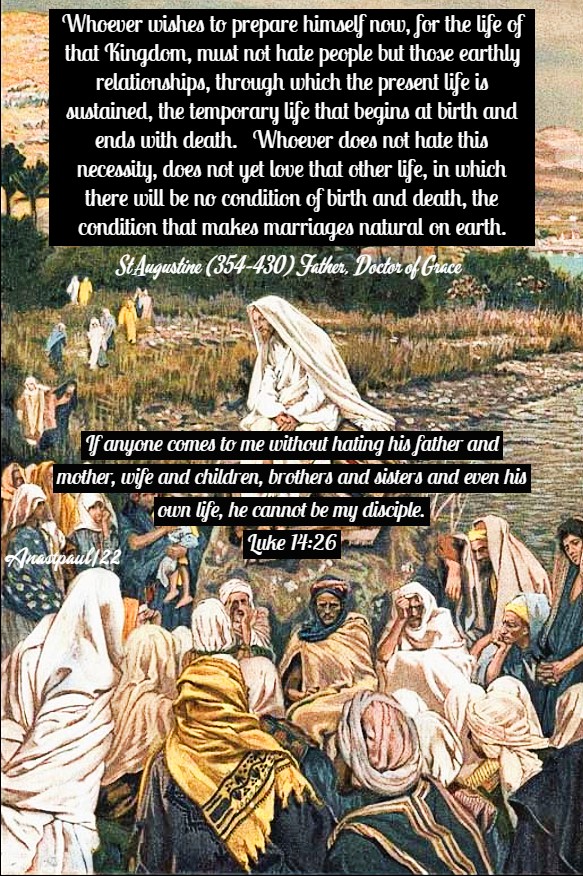
“If anyone comes to Me, without hating his father and mother, wife and children, brothers and sisters and even his own life, he cannot be my disciple.” – Luke 14:26
REFLECTION – “On another occasion, the Lord says, “Whoever comes to me and does not hate his father and mother, and wife and children and brothers and sisters and even his own soul, cannot be my disciple.” As a rule, this is more upsetting to the mind of new Christians, who are eager to begin at once, to live in accordance with the precepts of Christ. To those who do not fully grasp its meaning, it would seem contradictory…. He has condescended to call His disciples to the eternal Kingdom. He also called them brothers. In the Kingdom these relationships are transcended because, “there is neither Jew nor Greek, neither male nor female, neither slave nor freeman but Christ, is all things and in all.” The Lord says, “For in the resurrection, they will neither be married nor marry but will be as the Angels of God in Heaven.”
Whoever wishes to prepare himself now, for the life of that Kingdom, must not hate people but those earthly relationships, through which the present life is sustained, the temporary life that begins at birth and ends with death. Whoever does not hate this necessity, does not yet love that other life, in which there will be no condition of birth and death, the condition that makes marriages natural on earth.” – St Augustine (354-430) Bishop, Father, Doctor of Grace (Sermon on the Mount,15).
PRAYER – We beseech Thee, O Lord, hear our prayers which we offer on the festival of blessed Basil, Thy Confessor and Bishop and through his intercessory merits, who had the grace to serve Thee worthily, absolve us from all our sins. Through Jesus Christ, Thy Son our Lord, Who lives and reigns with Thee, in the unity of the Holy Ghost, God, world without end. Amen (Collect). Sweet Heart of Jesus, be my love.300 days ONCE A DAY – (Unless otherwise stated, e.g., “once a day,” a partial Indulgence may be gained any number of times in succession.) Pope Leo XIII 21 May.

















 AnaStpaul
You must be logged in to post a comment.