Thought for the Day – 26 November – Meditations with Antonio Cardinal Bacci (1881-1971)
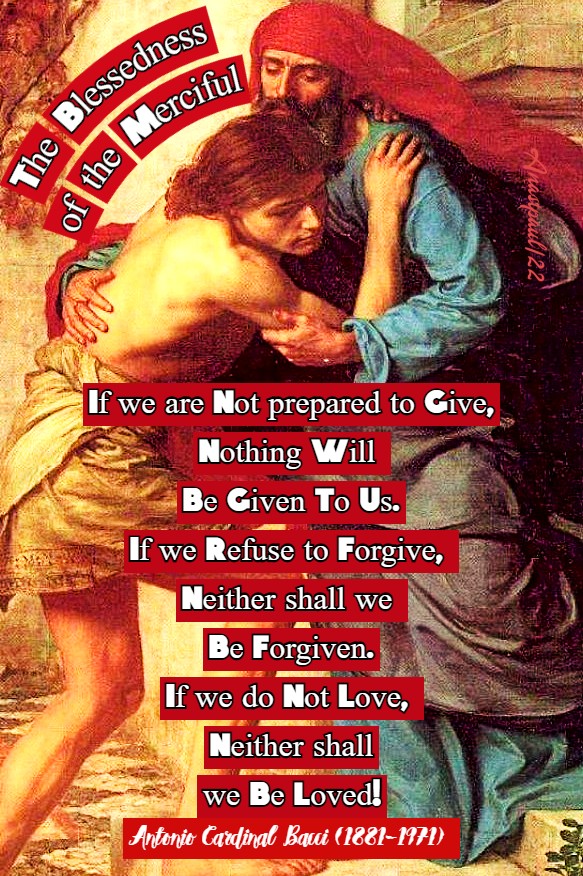
The Blessedness of the Merciful
“Since God is so merciful to us, however, He requires us to be good and merciful to our neighbour. “Blessed are the merciful,” Jesus says in the Sermon on the Mount, “for they shall obtain mercy” (Mt 5:7). St James adds a stern warning. “Judgement” he says, “is without mercy to him who has not shown mercy but mercy triumphs over judgement” (Js 2:12).
If we hope to receive God’s mercy, we must show compassion to those who are poor or unfortunate in any way, even to the greatest sinner. In the presence of so much need and misfortune in the world – avarice, miserliness, selfishness or indifference – cry out to God for retribution.
If we are not prepared to give, nothing will be given to us. If we refuse to forgive, neither shall we be forgiven. If we do not love, neither shall we be loved!”
Quote/s of the Day – 26 November – The Memorial of St Leonard of Port Maurice OFM (1676-1751) Confessor, Priest
“The Little Number of Those Who Are Saved” By St Leonard of Port Maurice
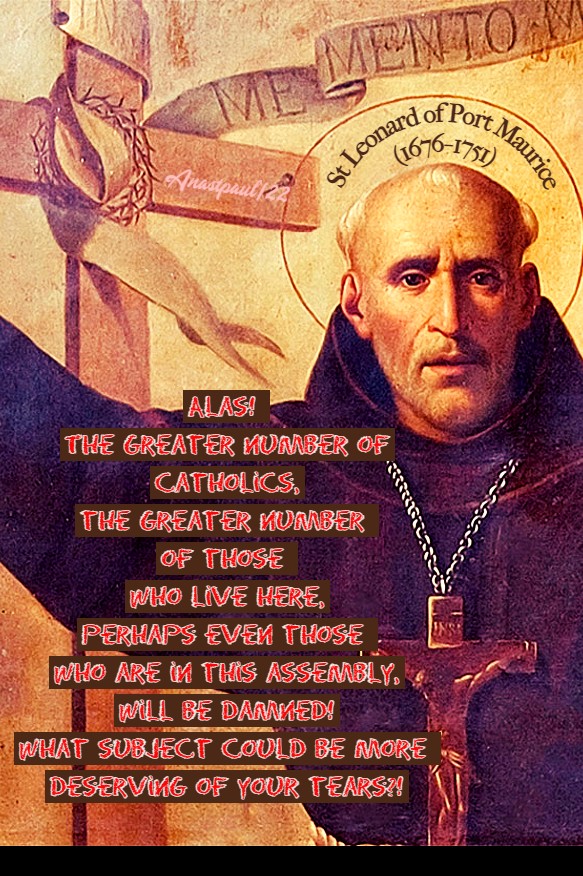
“Alas! The greater number of Catholics, the greater number of those who live here, perhaps even those who are in this assembly, will be damned! What subject could be more deserving of your tears?!”
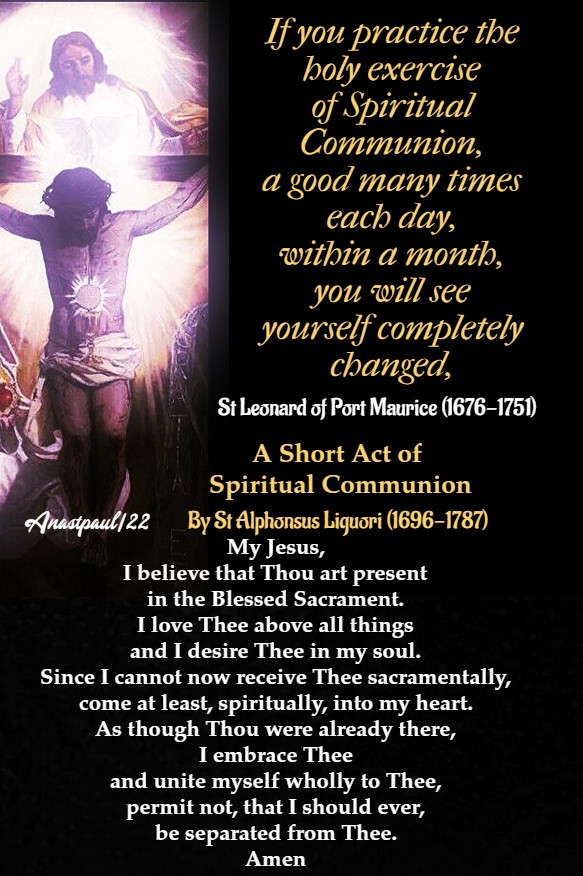
“If you practice the holy exercise of Spiritual Communion, a good many times each day, within a month, you will see yourself completely changed.”
St Leonard of Port Maurice (1676-1751)
A Short Act of Spiritual Communion By St Alphonsus Liguori (1696-1787) Doctor of the Church
My Jesus, I believe that Thou art present in the Blessed Sacrament. I love Thee above all things and I desire Thee in my soul. Since I cannot now receive Thee sacramentally, come at least, spiritually, into my heart. As though Thou were already there, I embrace Thee and unite myself wholly to Thee, permit not, that I should ever, be separated from Thee. Amen
One Minute Reflection – 26 November – St Sylvester Gozzolini OSB Silv. (1177– 1267) Priest, Abbot – Ecclesiasticus 45:1-6, Matthew 19:27-29 – Scripture search here: https://www.drbo.org/
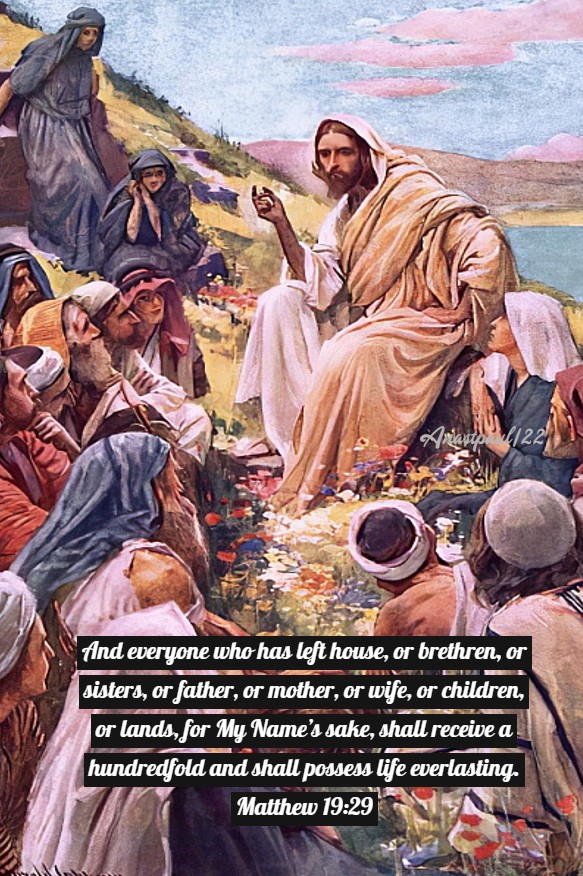
“And everyone who has left house, or brethren, or sisters, or father, or mother, or wife, or children, or lands, for My Name’s sake, shall receive a hundredfold and shall possess life everlasting.” – Matthew 19:29
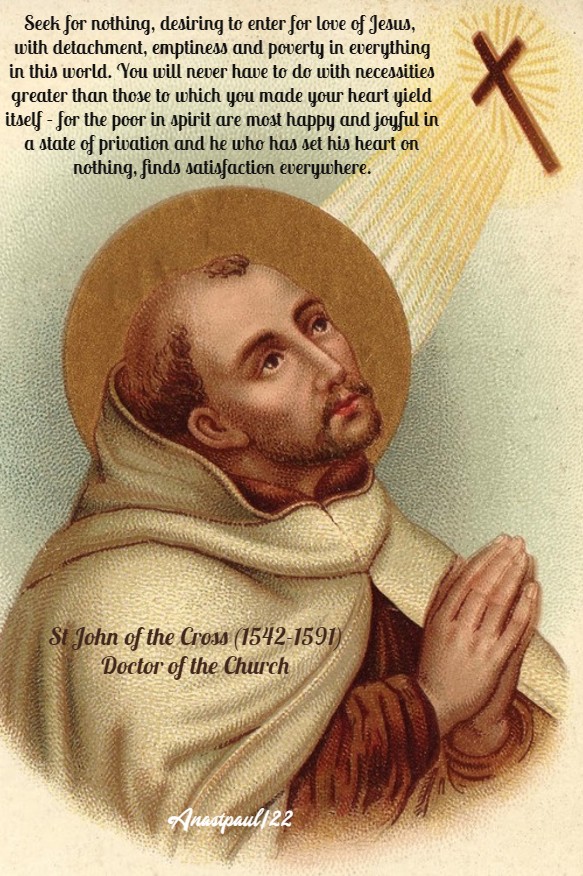
REFLECTION – “Seek for nothing, desiring to enter for love of Jesus, with detachment, emptiness and poverty in everything in this world. You will never have to do with necessities greater than those to which you made your heart yield itself – for the poor in spirit are most happy and joyful in a state of privation and he who has set his heart on nothing, finds satisfaction everywhere.
The poor in spirit (Mt 5:3) give generously all they have and their pleasure consists in being thus deprived of everything for God’s sake and out of love for their neighbour … Not only do temporal goods – the delights and tastes of the senses – hinder and thwart the way of God but spiritual delights and consolations also, if sought for or clung to eagerly, disturb the way of virtue.” – St John of the Cross (1542-1591) Carmelite, Doctor of the Church (Spiritual maxims, nos. 352, 355,356, 364; 1693 edition).
PRAYER – Most merciful God, Who when the holy Abbot Sylvester was devoutly meditating upon the vanity of this world beside an open grave, graciously willed to call him into the desert and enrich him with unusual merits, we humbly pray that, following his example, despising the things of earth, we may thoroughly enjoy Thy everlasting presence.Through Jesus Christ, Thy Son our Lord, Who lives and reigns with Thee, in the unity of the Holy Ghost, God, world without end. Amen (Collect).
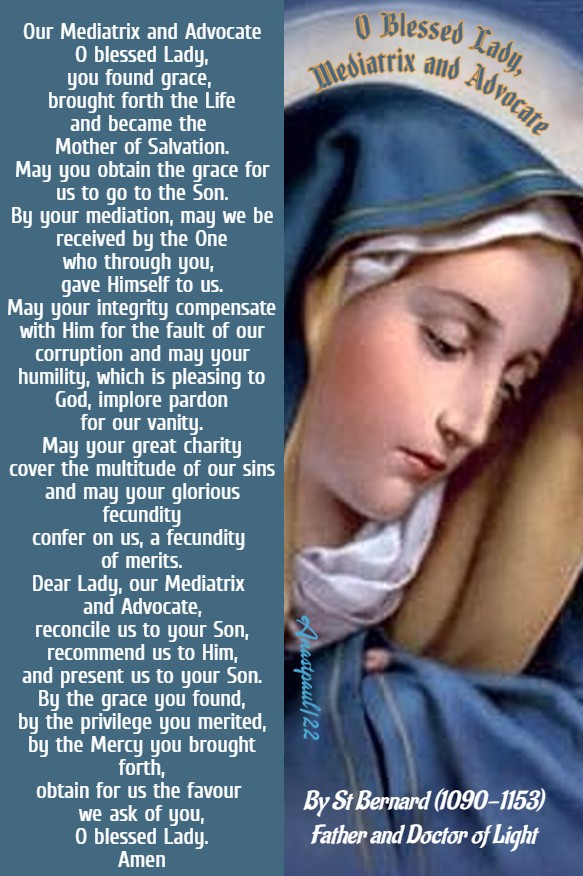
O Blessed Lady, Mediatrix and Advocate By St Bernard (1090-1153) Father and Doctor of Light
Our Mediatrix and Advocate O blessed Lady, you found grace, brought forth the Life, and became the Mother of Salvation. May you obtain the grace for us to go to the Son. By your mediation, may we be received by the One who through you, gave Himself to us. May your integrity compensate with Him for the fault of our corruption and may your humility, which is pleasing to God, implore pardon for our vanity. May your great charity cover the multitude of our sins and may your glorious fecundity confer on us, a fecundity of merits. Dear Lady, our Mediatrix and Advocate, reconcile us to your Son, recommend us to Him and present us to your Son. By the grace you found, by the privilege you merited, by the Mercy you brought forth, obtain for us the favour we ask of you, O blessed Lady. Amen
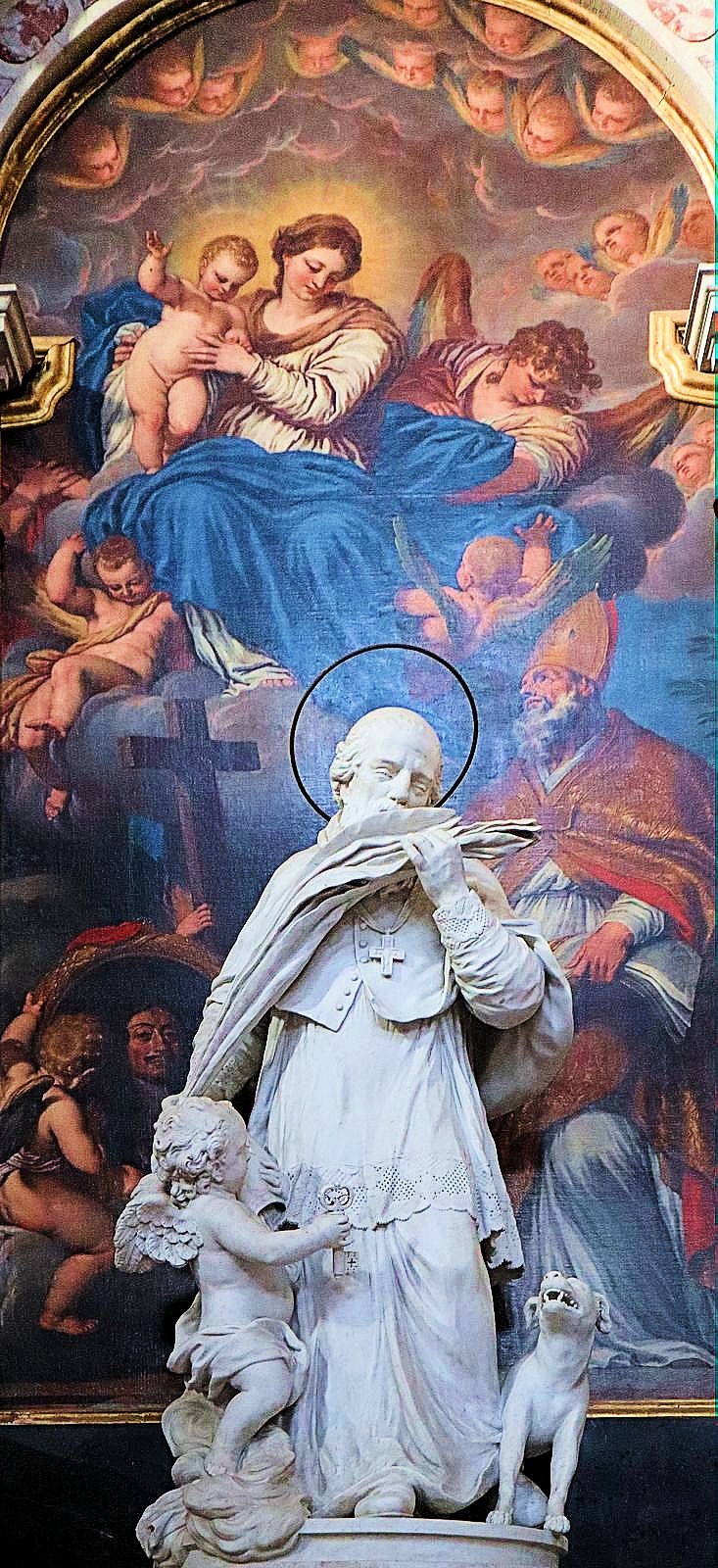
Saint of the Day – 26 November – Saint Bellinus of Padua (Died 1151) Bishop of Padua and Martyr, Reformer (he led a reform of the spiritual lives of the Clergy in his Diocese) he rebuilt the Cathedral and opened schools, Miracle-worker. Born in the late 11th Century in Padua, Italy and died by being stabbed by assassins in 1151 on a forest road while on a trip to Rome. Patronages – the City and Diocese of Adria, Italy, against dog bites, against rabies. Also known as – Bellino. He was Canonised by Pope Eugene IV.
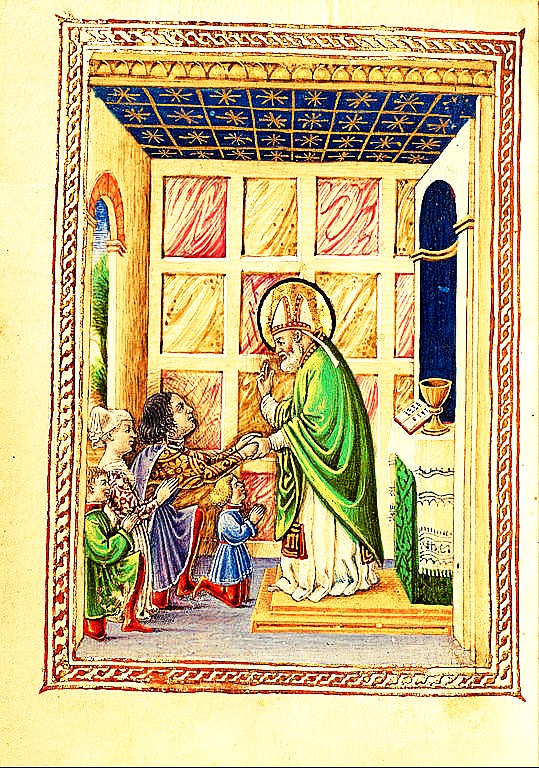
Artwork by Taddeo Crivelli – St Bellinus dyring Mass
Bellinus, according to some sources from Germany, was born in the region on the Baltic Sea but, according to others, he was the son of the noble Bertaldo family in Padua and became the Bishop of Padua in 1128 .
Even as a Priest, he was loyal to the legitimate Popes Callistus II and Honorius II, while his predecessor in office, supported the anti-popes. In 1144 Bellinus made a pilgrimage to Rome to meet Pope Celestine II.
In Padua as the Bishop, he introduced reforms in the clergy, appointed canons, had the Cathedral rebuilt after it was destroyed in 1117 by an earthquake and saw to it that schools were built.
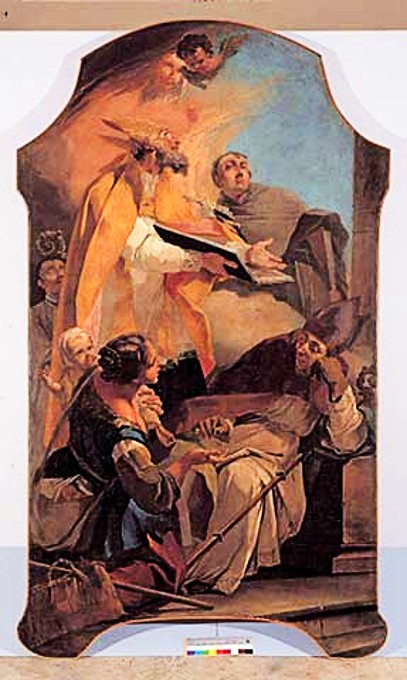
Mattia Bortoloni – The Saints Bellinus, Anthony of Padua and Thomas of Villanova
Bellinus worked zealously to rebuild the status and dignity of the Church and defended Church rights against the secular powers. He, therefore, entered into conflicts with the influential Capodivacca family, who organised hired assassins to attack him. They met him during a journey to Rome in a forest in Fratta Polesinelet and murdered him.
Bellinus’ corpse was taken to the Church of San Giacomo di Fratta, After a flood, his bones were taken to the new Church dedicated to him in San Bellino near Rovigo. In 1647, his Relics were moved to a Chapel in the same Church.
Marble statue, 1672, in the Cathedral of Chioggia. The Altarpiece behind shows Bishop St Liborius of le Mans
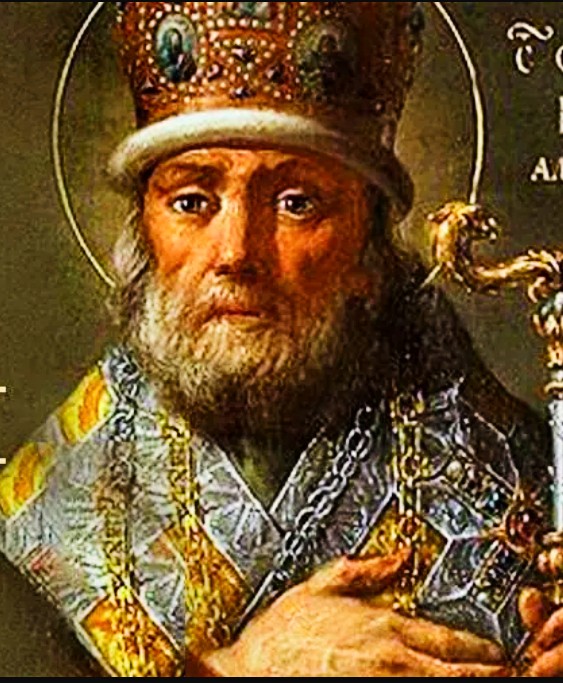
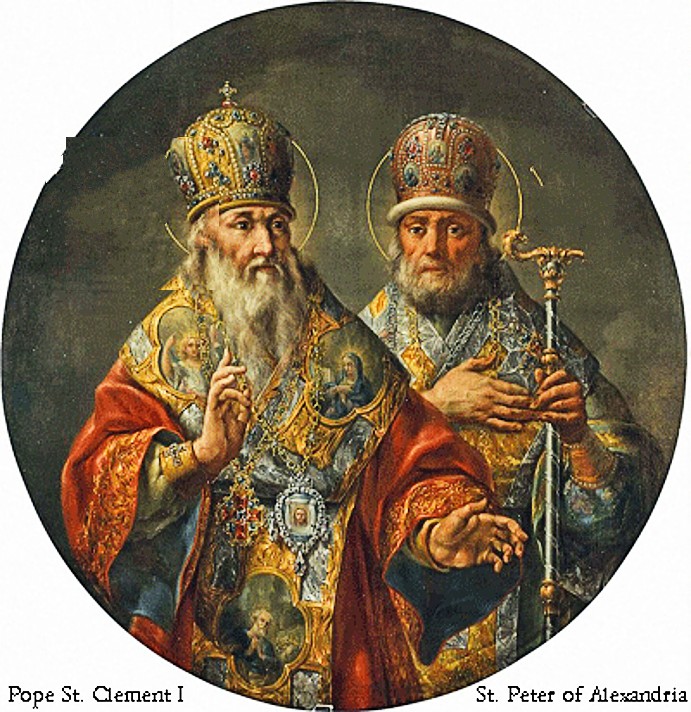
Saint of the Day – 26 November – Saint Peter of Alexandria (Died 311) Bishop Martyr, known as the “Seal of the Martyrs” Born at Alexandria, Egypt and died by Martyrdom in 311 at Alexandria, Egypt. Tradition attests that the Egyptian Bishop was the last believer to suffer death at the hands of Roman imperial authorities for his faith in Christ. For this reason, St Peter of Alexandria is known as the “Seal of the Martyrs.”
He is said to have undertaken severe penances for the sake of the suffering Church during his lifetime and written letters of encouragement to those in prison, before going to his own death at the close of the “era of the Martyrs.”
Peter was born and raised in Alexandria but both the date of Peter’s birth and of his Ordination as a Priest, are unknown. It is clear, however, that he was chosen to lead Egypt’s main Catholic community in the year 300, after the death of Saint Theonas of Alexandria. He may have previously been in charge of Alexandria’s well-known Catechetical School, an important centre of religious instruction in the early Church. Peter’s own theological writings were cited in a later fifth-century dispute over Christ’s divinity and humanity.
In 302, the Emperor Diocletian and his subordinate Maximian, attempted to wipe out the Church in the territories of the Roman Empire. They used their authority to destroy Church properties, imprison and torture believers and eventually kill those who refused to take part in pagan ceremonies. As the Bishop of Alexandria, Peter offered spiritual support to those who faced these penalties, encouraging them to hold to their faith without compromise.
One acute problem for the Church during this period, was the situation of the “lapsed.” These were Catholics who had violated their faith by participating in pagan rites under coercion but who later, repented and sought to be reconciled to the Church. Peter issued canonical directions for addressing their various situations and these guidelines became an important part of the Eastern Christian tradition for centuries afterward.
Around the year 306, Peter led a Council which deposed Bishop Meletius of Lycopolis, a member of the Catholic hierarchy who had allegedly offered sacrifice to a pagan idol. Peter left his Diocese for reasons of safety during some portions of the persecution , travelling through many lands, encouraging his flock by letter, before returning to his City to guide the Alexandrian Church personally during this period. He secretly visited those imprisoned, assisted widows and orphans, and conducted clandestine services. His absence from Alexandria, however, gave Meletius an opening to set himself up as his rival and lead a schismatic church in the area.
The “Meletian schism” would continue to trouble the Church for years after the death of Alexandria’s legitimate Bishop. Saint Athanasius, who led the Alexandrian Church during a later period, in the fourth century, claimed that Meletius personally betrayed Peter of Alexandria to the state authorities during the Diocletian persecution.
Although Diocletian himself chose to resign his rule in 305, persecution continued under Maximinus Daia, who assumed leadership of the Roman Empire’s eastern half in 310. The early Church historian, Eusebius, attests that, in 311, Maximinus, during an imperial visit to Alexandria, unexpectedly ordered its Bishop to be seized and killed without imprisonment or trial. Three Priests – Faustus, Dio and Ammonius – were reportedly beheaded along with him.
St Peter of Alexandria’s entry in the “History of the Patriarchs of the Coptic Church of Alexandria” (a volume first compiled by a Coptic Bishop in the 10th century) concludes with a description of the aftermath of his death.
“And the City was in confusion and was greatly disturbed, when the people beheld this Martyr of the Lord Christ. Then, the chief men of the City came, and wrapped his body in the leathern mat, on which he used to sleep and they took him to the Church … And, when the liturgy had been performed, they buried him with the fathers. May his prayers be with us and all those who are Baptised!”
St Leonard of Port Maurice OFM (1676-1751) Confessor, Priest and Friar of the Friars Minor, reacher – in particular Parish Mission Preacher, Ascetic Writer, Spiritual Director. St Leonard founded many pious societies and confraternities and exerted himself to spread devotion to the Sacred Heart of Jesus, the Perpetual Adoration of the Most Blessed Sacrament, the Blessed Virgin Mary and the Passion of Christ. He was among the few to insist that the concept of the Immaculate Conception of Mary be defined as a Dogma of the Faith. He was Beatified on 19 June 1796 by Pope Pius VI and Canonised on 29 June 1867 by Pope Pius IX. About St Leonard: https://anastpaul.com/2018/11/27/saint-of-the-day-27-november-st-leonard-of-port-maurice-ofm-1676-1751/
Bl Albert of Haigerloch St Alypius Stylites St Amator of Autun St Basolus of Verzy St Bellinus of Padua (Died 1151) Bishop and Martyr St Bertger of Herzfeld St Conrad of Constance Bl Delphine of Glandèves St Egelwine of Athelney St Ida of Cologne St James the Hermit St Magnance of Ste-Magnance St Marcellus of Nicomedia St Martin of Arades St Nicon of Sparta Bl Pontius of Faucigny St Sabaudus of Trier St Siricius, Pope St Stylianus St Vacz
Martyrs of Alexandria – 650+- Saints: A group of approximately 650 Christian Priests, Bishops and Laity Martyred together in the persecution of Maximian Galerius. We have the names and a few details only seven of them – Ammonius, Didius, Faustus, Hesychius, Pachomius, Phileas and Theodore. The were born in Egypt and were martyred there in c 311 in Alexandria, Egypt.
Martyrs of Capua – 7 Saints: A group of seven Christians Martyred together. The only details about them to survive are the names – Ammonius, Cassianus, Felicissimus, Nicander, Romana, Saturnin and Serenus. They were martyred in Capua, Campania, Italy, date unknown.
Martyrs of Nicomedia – 6 Saints: A group of six Christians Martyred by Arians. Few details have survived except their names – Marcellus, Melisus, Numerius, Peter, Serenusa and Victorinus. Martyred in 349 in Nicomedia, Bithynia, Asia Minor (modern Izmit, Turkey).
Thought for the Day – 25 November – Meditations with Antonio Cardinal Bacci (1881-1971)
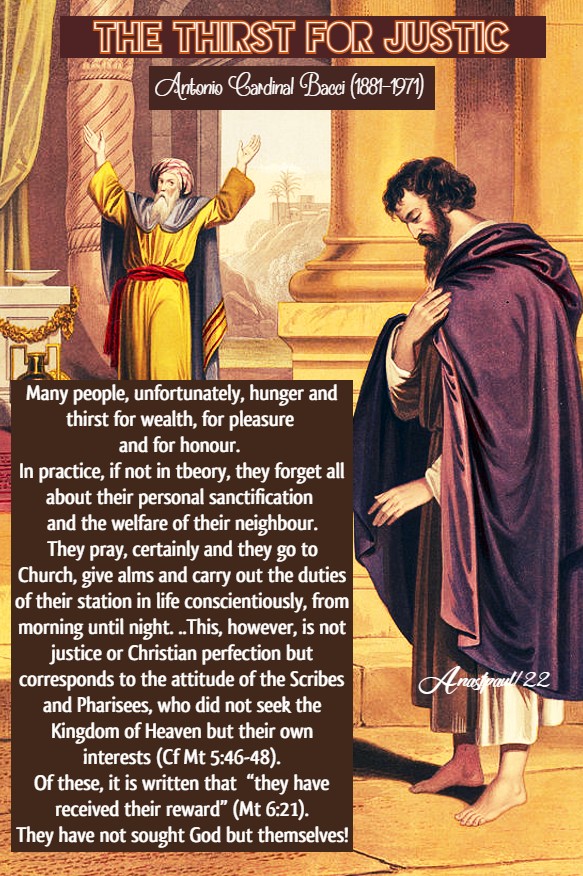
The Thirst for Justice
“Many people, unfortunately, hunger and thirst for wealth, for pleasure and for honour. In practice, if not in tbeory, they forget all about their personal sanctification and the welfare of their neighbour. They pray, certainly and they go to Church, give alms and carry out the duties of their station in life conscientiously, from morning until night. They may even engage in many external works of charity, on their neighbour’s behalf but, what is their dominant thought and their principal ambition? To keep up appearances, to be praised and esteemed, to be successful in their careers. This, however, is not justice or Christian perfection but corresponds to the attitude of the Scribes and Pharisees, who did not seek the Kingdom of Heaven but their own interests (Cf Mt 5:46-48). Of these, it is written that “they have received their reward” (Mt 6:21). They have not sought God but themselves! Therefore, they can never have God or His everlasting happiness as their reward. They must be content with the insignificant and passing glory of the world. Indeed, on many occasions, they will be unable to gain even this much and will find that they have laboured in vain!
The envious man will even find cause for personal sorrow and unhappiness, in the welfare and in the success of others, He would have nobody wealthy, respected or happy in the world but himself! Even when the zealous man is working for a good cause, he is not concerned with it but only, with himself. He identifies his own ego with the cause for which he is fighting!”
Quote/s of the Day – 25 November – Sirach 51:1-8; 5:12, Matthew 25:1-13 – Scripture search here: https://www.drbo.org/
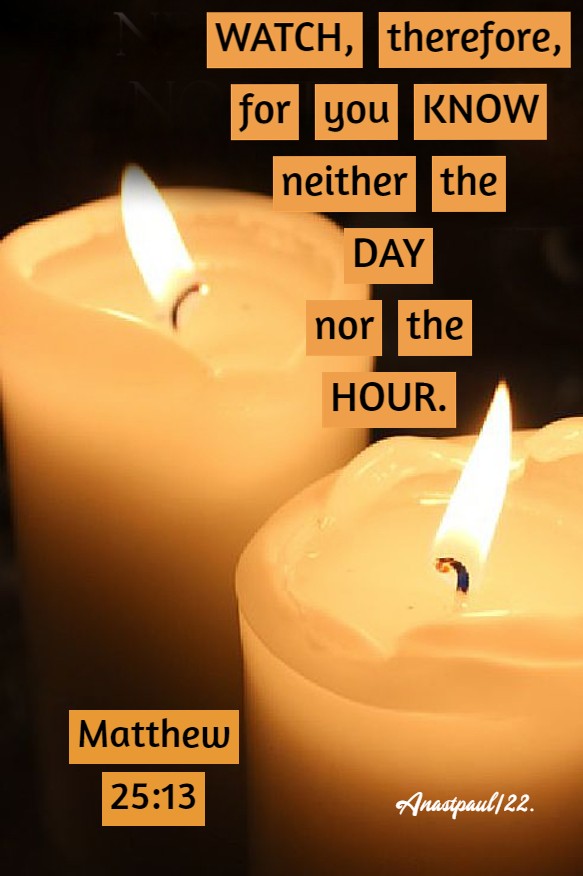
“Watch, therefore, for you know neither the day nor the hour.”
Matthew 25:13
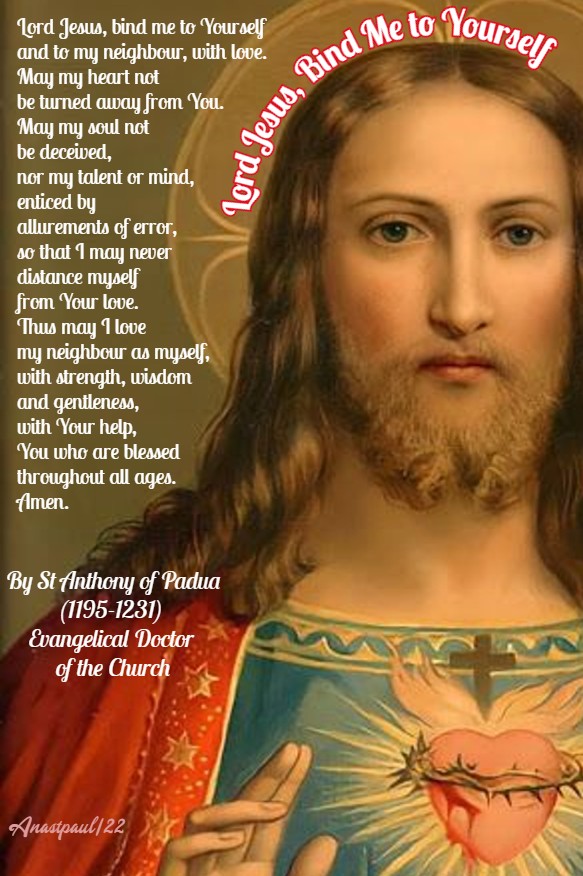
Lord Jesus, Bind Me to Yourself
Lord Jesus, bind me to Yourself and to my neighbour, with love. May my heart not be turned away from You. May my soul not be deceived, nor my talent or mind, enticed by allurements of error, so that I may never distance myself from Your love. Thus, may I love my neighbour as myself, with strength, wisdom and gentleness, with Your help, You Who are blessed throughout all ages. Amen.
St Anthony of Padua (1195-1231) Evangelical Doctor of the Church
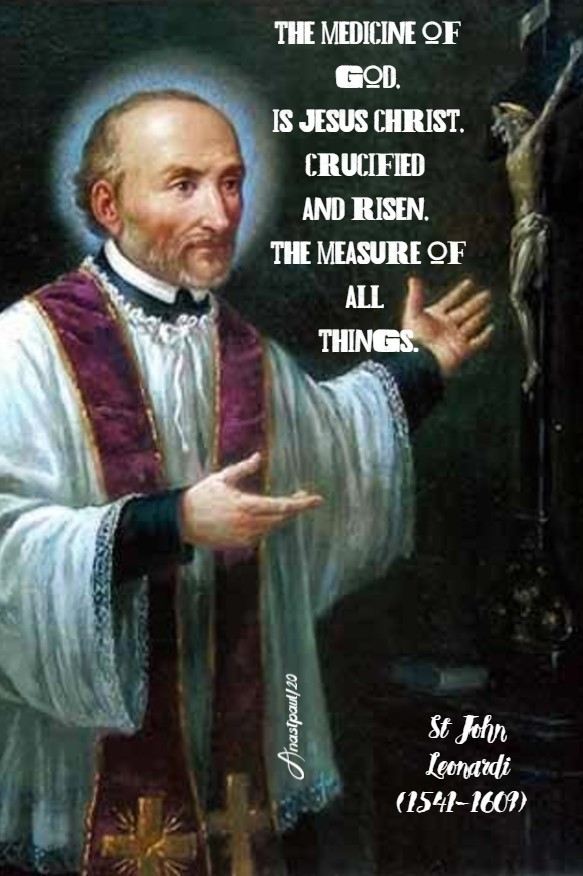
“The medicine of God, is Jesus Christ, Crucified and Risen, the measure of all things.”
St John Leonardi (1541-1609) Confessor, Priest, Founder
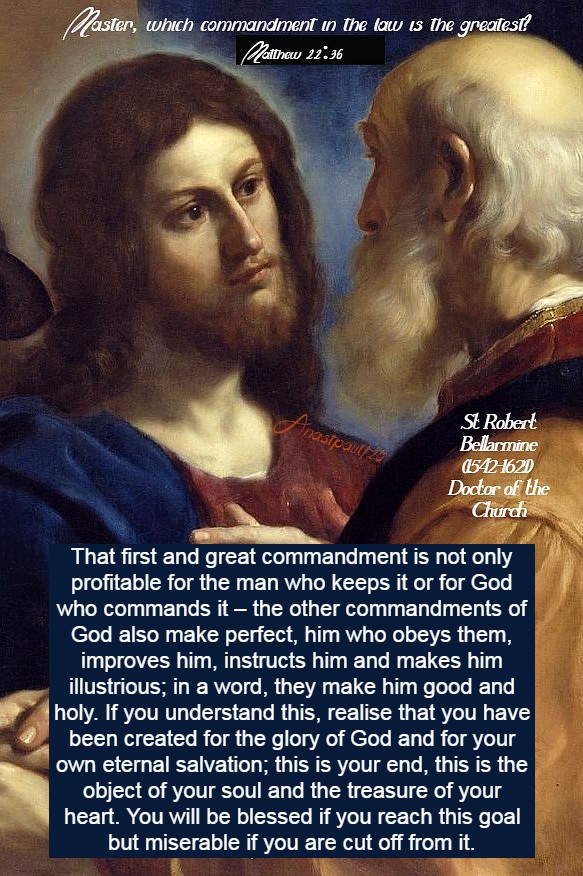
“Master, which commandment in the law is the greatest?”
Matthew 22:36
“That first and great commandment is not only profitable for the man who keeps it. or for God Who commands it – the other commandments of God also make perfect, him who obeys them, improves him, instructs him and makes him illustrious; in a word, they make him good and holy. If you understand this, realise that you have been created for the glory of God and for your own eternal salvation; this is your end, this is the object of your soul and the treasure of your heart. You will be blessed if you reach this goal but miserable if you are cut off from it.”
St Robert Bellarmine (1542-1621) Doctor of the Church
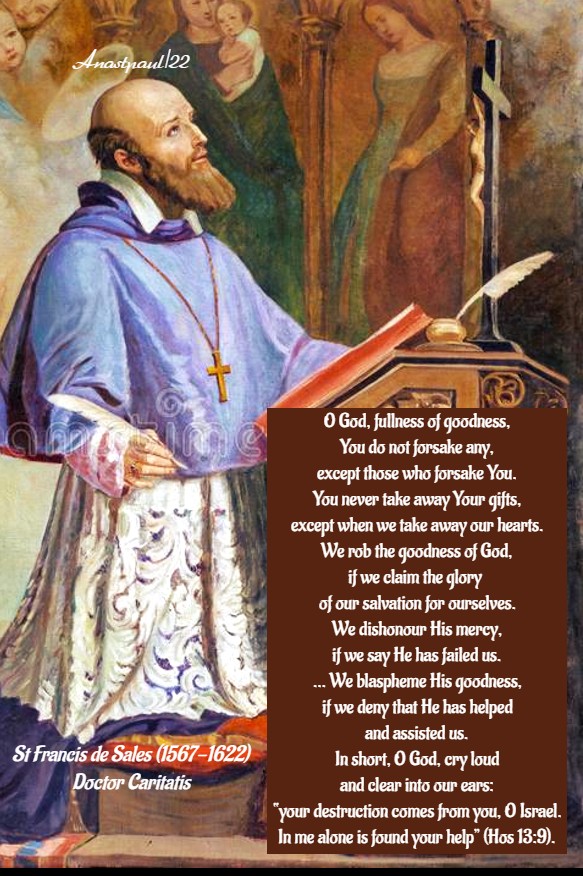
“O God, fullness of goodness, You do not forsake any, except those who forsake You. You never take away Your gifts, except when we take away our hearts. We rob the goodness of God, if we claim the glory of our salvation for ourselves. We dishonour His mercy, if we say He has failed us. … We blaspheme His goodness, if we deny that He has helped and assisted us. In short, O God, cry loud and clear into our ears: “your destruction comes from you, O Israel. In Me alone is found your help” (Hos 13:9).
St Francis de Sales (1567-1622) Doctor Caritatis
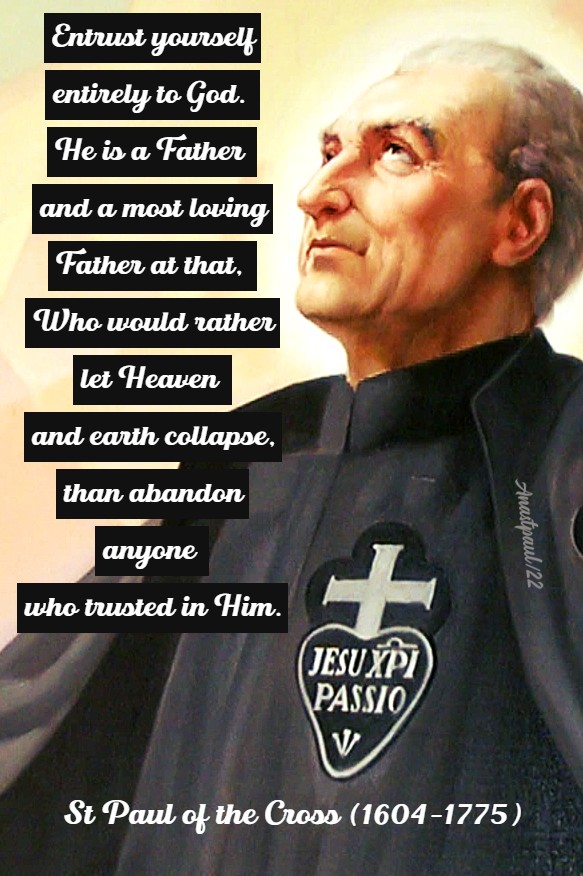
“Entrust yourself entirely to God. He is a Father and a most loving Father at that, Who would rather let Heaven and earth collapse, than abandon anyone who trusted in Him.”
St Paul of the Cross (1604-1775)
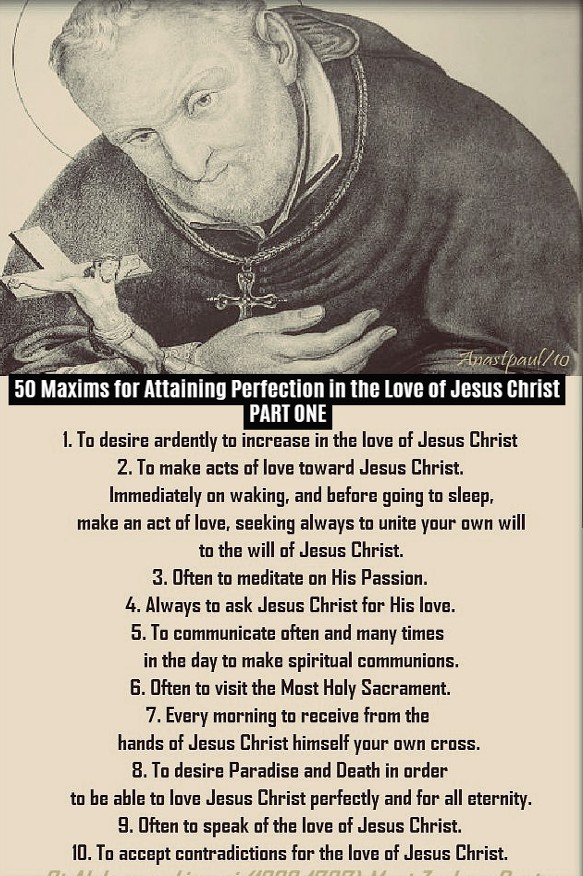
“50 Maxims for Attaining Perfection” – all on the link below
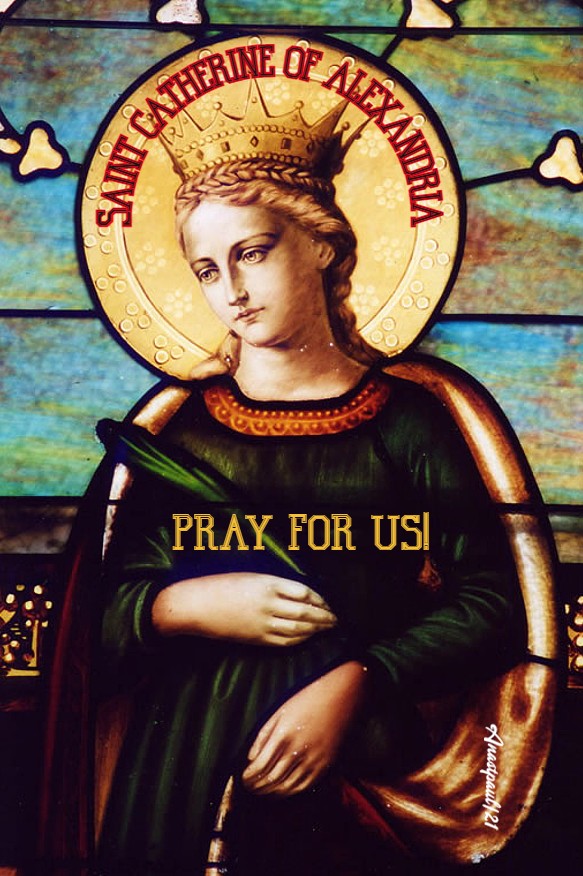
One Minute Reflection – 25 November – St Catherine of Alexandria (Died c 305) Virgin Martyr – Sirach 51:1-8; 5:12, Matthew 25:1-13 – Scripture search here: https://www.drbo.org/
“Watch, therefore, for you know neither the day nor the hour.” – Matthew 25:13
REFLECTION – “Consider now the Way of Light – any man who is bent on reaching his appointed goal, must be very careful in all he does. Now these are the directions that have been given to us for this journey,- love your Creator, reverence your Maker; give glory to Him Who redeemed you when you were dead; be single-minded but rich in spiritual treasure; avoid those who travel down death’s highway; hate whatever is displeasing to God; detest all hypocritical pretence; do not abandon God’s commandments. Do not put on airs but be modest in whatever you do; claim no credit for yourself. Plot no evil against your neighbour and do not give pride an entrance into your heart.
Love your neighbour more than your own life. Do not kill an unborn child through abortion, nor destroy it after birth. Do not refrain from chastising son or daughter,but bring them up from childhood in the fear of the Lord. Do not set your heart on what belongs to your neighbour and do not give in to greed. Do not associate with the arrogant but cultivate those who are humble and virtuous.
Accept as a blessing whatever comes your way, in the knowledge, that nothing ever happens without God’s concurrence. Avoid duplicity in thought or in word, for such deception is a deadly snare. Share with your neighbor whatever you have and do not say of anything, this is mine. If you both share an imperishable treasure, how much more must you share what is perishable. Do not be hasty in speech – the mouth is a deadly snare. For your soul’s good, make every effort to live chastely. Do not hold out your hand for what you can get, only to withdraw it when it comes to giving. Cherish as the apple of your eye anyone who speaks to you of the word of the Lord.
Night and day you will bear in mind the hour of judgement; everyday you will seek out the company of God’s faithful, either by preaching the word, earnestly exhorting them, ever considering how you can save souls, by your eloquence, or else by working with your hands, to make reparation for your past sins.
Never hesitate to give and when you do give, never grumble; then you will know the One Who will repay you. Preserve the traditions you have received, adding nothing and taking nothing away. The evildoer will ever be hateful to you. Be fair in your judgments. Never stir dissension but act as peacemaker and reconcile the quarrelsome. Confess your sins and do not begin to pray with a guilty conscience. Such the,n is the Way of Light.” – An excerpt from The Letter of Saint Barnabas (Chapter 19).
PRAYER – O God, Who gave the law to Moses on Sinai’s height and through Thy holy Angels, miraculously placed there, the body of blessed Catherine, Thy Virgin and Martyr, grant, we beseech Thee that by her merits and intercession, we may reach that towering eminence which is Christ our Lord. Through the same Jesus Christ, Thy Son our Lord, Who lives and reigns with Thee, in the unity of the Holy Ghost, God, world without end. Amen (Collect).
Our Morning Offering – 25 November – “The Month of the Holy Souls in Purgatory”
O DIVINE Heart of JESUS Pope Leo XIII Indulgence 100 Days, Once a day Raccolta 167 13 March 1901.
O DIVINE Heart of JESUS, grant, we beseech Thee, eternal rest to the souls in purgatory, the final grace to those who shall die today, true repentance to sinners, the light of the faith to pagans and Thy Blessing to me and mine. To Thee, O most compassionate Heart of JESUS! I commend all these souls and I offer to Thee, on their behalf, all Thy merits, together with the merits of Thy most Holy Mother and of all the Saints, Angels and all the Sacrifices of the Holy Mass, Communions, prayers and good works, which shall be accomplished today, throughout the Christian world. Amen
Bl Adalbert of Caramaico St Alanus of Lavaur St Audentius of Milan
Blessed Beatrice d’Ornacieux O.Cart (c 1260–1303) Virgin, Carthusian Nun, Mystic, Founded a Monastery at Eymeu on France. The Roman Martyrology states: “In the territory of Valence in France, Blessed Beatrice d’Ornacieux, Virgin of the Carthusian Order, who, famous for her love for the Cross, lived and died in extreme poverty in the Monastery of Eymeu which she founded.” Biography: https://anastpaul.com/2021/11/25/saint-of-the-day-25-november-blessed-beatrice-dornacieux-o-cart-c-1260-1303/
St Bernold of Ottobeuren Bl Conrad of Heisterbach Bl Ekbert of Muensterschwarzach
St Erasmus of Antioch Bl Garcia of Arlanza Bl Guido of Casauria St Imma of Wurzburg Bl Jacinto Serrano López St Jucunda of Reggio Aemilia Bl Maria Corsini Beltrame Quattrocchi St Mercurius of Caesarea St Moses of Rome
Martyrs of Africa – (13 Saints): A group of 13 Christians murdered together for their faith in Africa, date unknown. The only details to have survived are their names – Claudian, Cyprian, Donatus, Felix, Januarius, Julian, Lucian, Marcian, Martialis, Peter, Quirianus, Victor and Vitalis.
Thought for the Day – 24 November – Meditations with Antonio Cardinal Bacci (1881-1971)
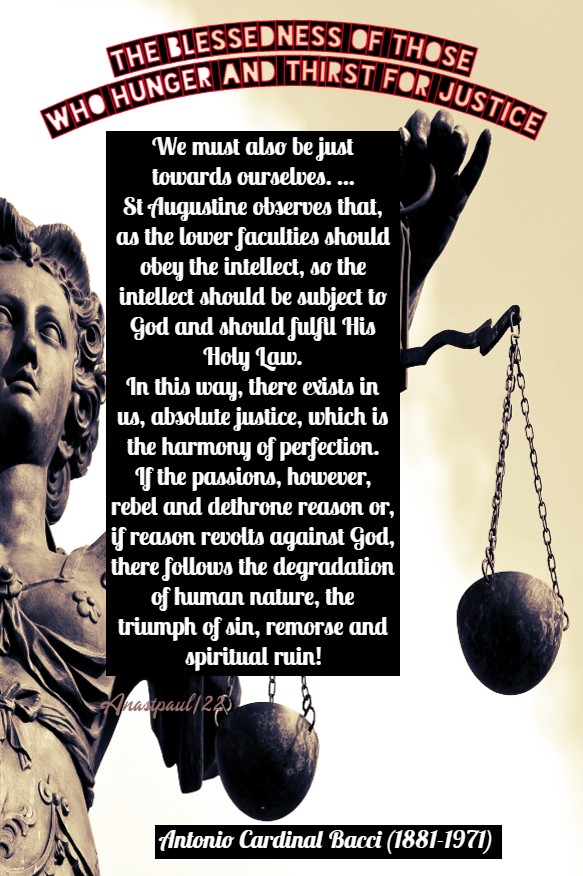
The Blessedness of Those who Hunger and Thirst for Justice
“We must also be just towards ourselves. God has established a hierarchy of faculties in human nature. There are the lower faculties, which are often moved to action by our passions and above these, there is right reason, which ought to govern all else through the will. According to St Thomas Aquinas, the rule of right reason within us, should be comparable to that of God in the universe. (De Regimine I, 12). “It is fitting,” he says elsewhere, “that everything in man, should be subject to reason” (Summa Theologiae I-II, q 100, a 2 ad 1). St Augustine observes that, as the lower faculties should obey the intellect, so the intellect should be subject to God and should fulfil His Holy Law (Cf De Serm. Domini in Monte, Bk 1, c 2).
In this way, there exists in us, absolute justice, which is the harmony of perfection. If the passions, however, rebel and dethrone reason or, if reason revolts against God, there follows the degradation of human nature, the triumph of sin, remorse and spiritual ruin!”
Quote/s of the Day – 24 November – St John of the Cross OCD (1542-1591) Confessor, Doctor of the Church
“Happiness is not a destination, it is a method of travel.”
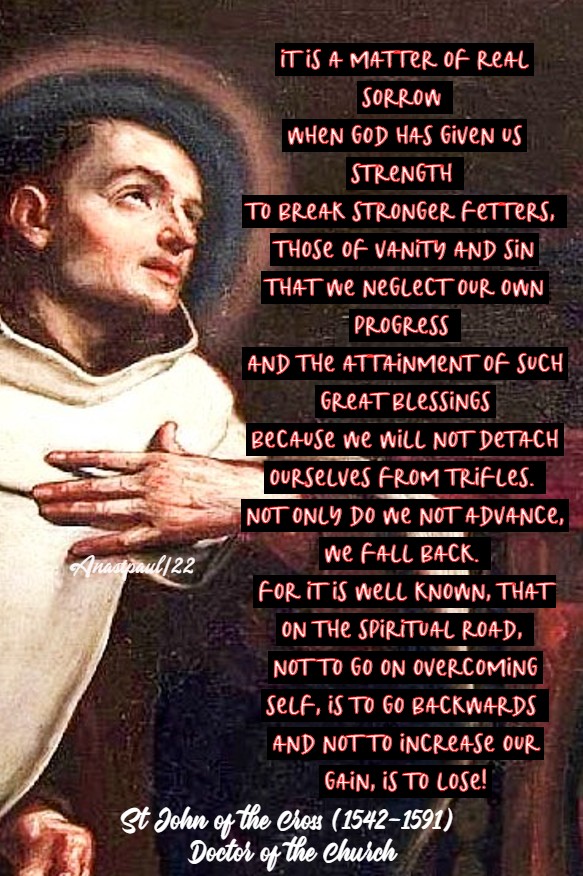
“It is a matter of real sorrow when God has given us strength to break stronger fetters, those of vanity and sin that we neglect our own progress and the attainment of such great blessings because we will not detach ourselves from trifles. Not only do we not advance, we fall back. For it is well known, that on the spiritual road, not to go on overcoming self, is to go backwards and not to increase our gain, is to lose!”
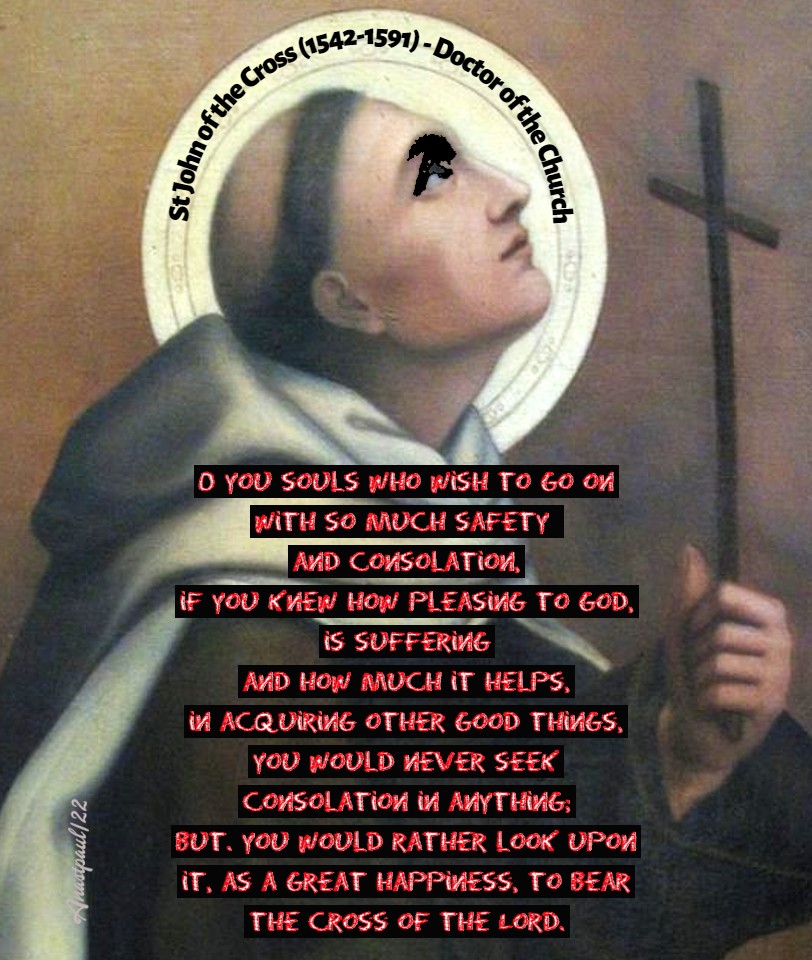
“O you souls who wish to go on with so much safety and consolation, if you knew how pleasing to God, is suffering and how much it helps, in acquiring other good things, you would never seek consolation in anything; but. you would rather look upon it, as a great happiness, to bear the Cross of the Lord.”
One Minute Reflection – 24 November – St John of the Cross OCD (1542-1591) Confessor, Doctor of the Church – 2 Timothy 4:1-8, Matthew 5:13-19 – Scripture search here: https://www.drbo.org/
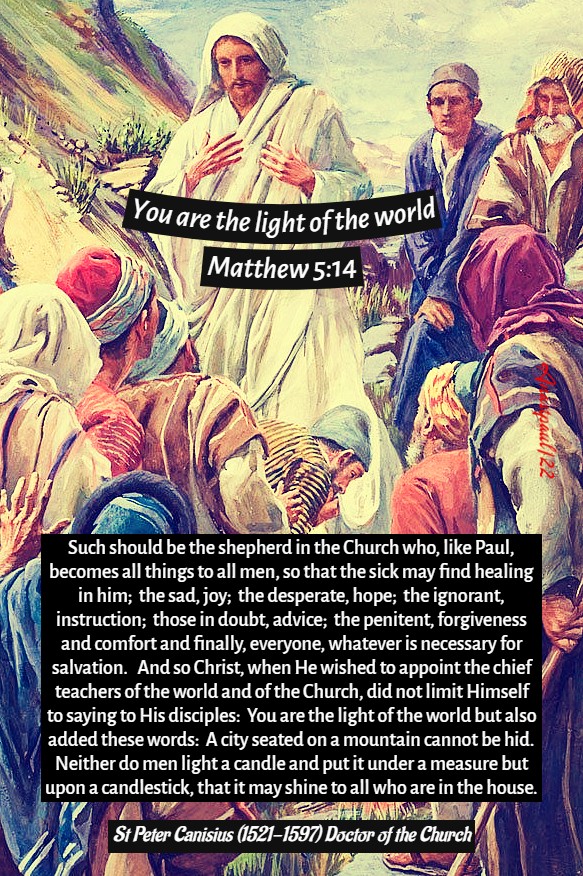
“You are the light of the world.” – Matthew 5:14
REFLECTION – “I shall always love and reverence the Apostles sent by Christ and their successors, in sowing the seed of the Gospel, those zealous and tireless co-operators in propagating the Word, who may justly say of themselves: Let a man so account of us as the ministers of Christ and the dispensers of the mysteries of God. For Christ, like a most watchful and most faithful householder, wished that the Gospel lamp should be lighted by such ministers and delegates, with fire sent down from Heaven and once lighted, should not be put under a measure but set upon a candlestick, so that it may spread its brightness far and wide and put to flight, all darkness and error, rife among both Jews and Gentiles.
Now it is not enough for the Gospel teacher to be a brilliant speaker in the eyes of the people; he must also be as a voice crying in the desert and endeavour, by his eloquence, to help many to lead good lives, lest, if he omit his duty of speaking, he be called the dumb dog that is not able to bark, spoken of by the prophet. Yes, he should also burn, in such a way, that, equipped with good works and love, he may adorn his evangelical office and follow the leadership of Paul. He indeed was not satisfied with bidding the Bishop of the Ephesians: This command and teach: conduct thyself in work as a good soldier of Christ Jesus but he unflaggingly preached the Gospel to friend and foe alike and, said with a good conscience to the Bishops gathered at Ephesus: You know how I have kept back nothing that was for your good but have declared it to you and taught you in public and from house to house, urging Jews and Gentiles to turn to God in repentance and to believe in our Lord Jesus Christ.
Such should be the shepherd in the Church who, like Paul, becomes all things to all men, so that the sick may find healing in him; the sad, joy; the desperate, hope; the ignorant, instruction; those in doubt, advice; the penitent, forgiveness and comfort and finally, everyone, whatever is necessary for salvation. And so Christ, when He wished to appoint the chief teachers of the world and of the Church, did not limit Himself to saying to His disciples: You are the light of the world but also added these words: A city seated on a mountain cannot be hid. Neither do men light a candle and put it under a measure but upon a candlestick, that it may shine to all who are in the house. Those churchmen err, who imagine that it is by brilliant preaching, rather than by holiness of and all-embracing love, they fulfil their office.” – St Peter Canisius SJ (1521-1597) Doctor of the Church
PRAYER – O God, Who made blessed John, Thy Confessor and Teacher, an extraordinary lover of perfect self-denial and the Cross, grant that, by continually striving to imitate him, we may reach everlasting glory. Through Jesus Christ, Thy Son our Lord, Who lives and reigns with Thee, in the unity of the Holy Ghost, God, world without end. Amen (Collect).
Our Morning Offering – 24 November – St John of the Cross OCD (1542-1591) Confessor, Doctor of the Church
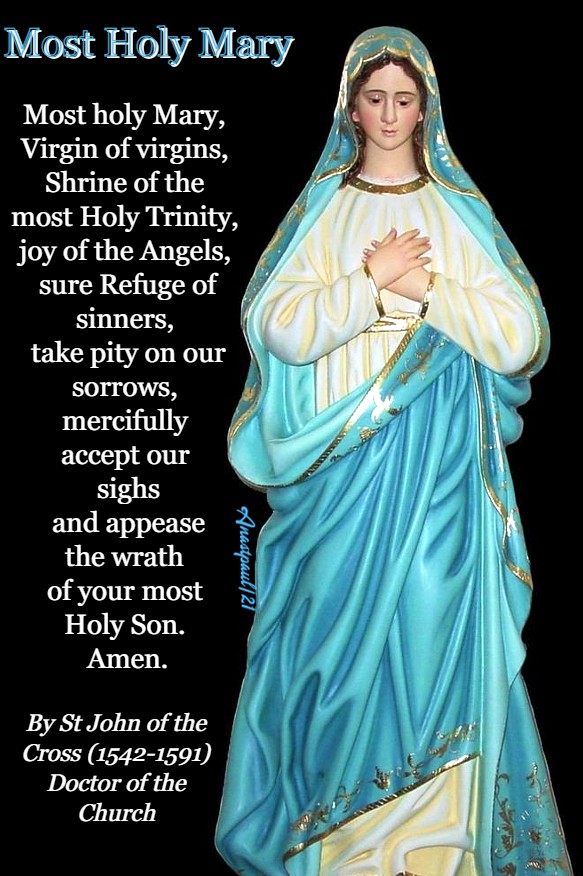
Most Holy Mary By St John of the Cross (1542-1591) Doctor of the Church
Most holy Mary, Virgin of virgins, Shrine of the most Holy Trinity, joy of the Angels, sure Refuge of sinners, take pity on our sorrows, mercifully accept our sighs and appease the wrath of your most holy Son. Amen.
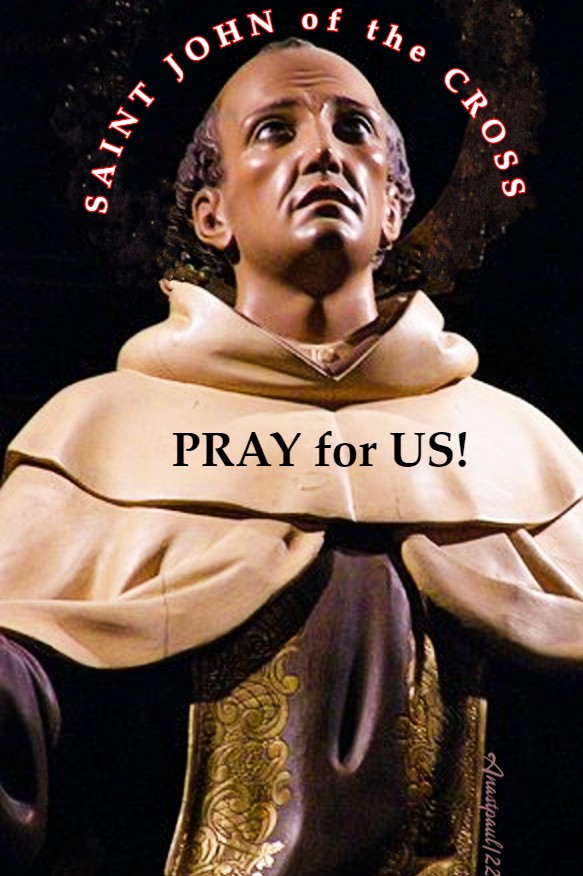
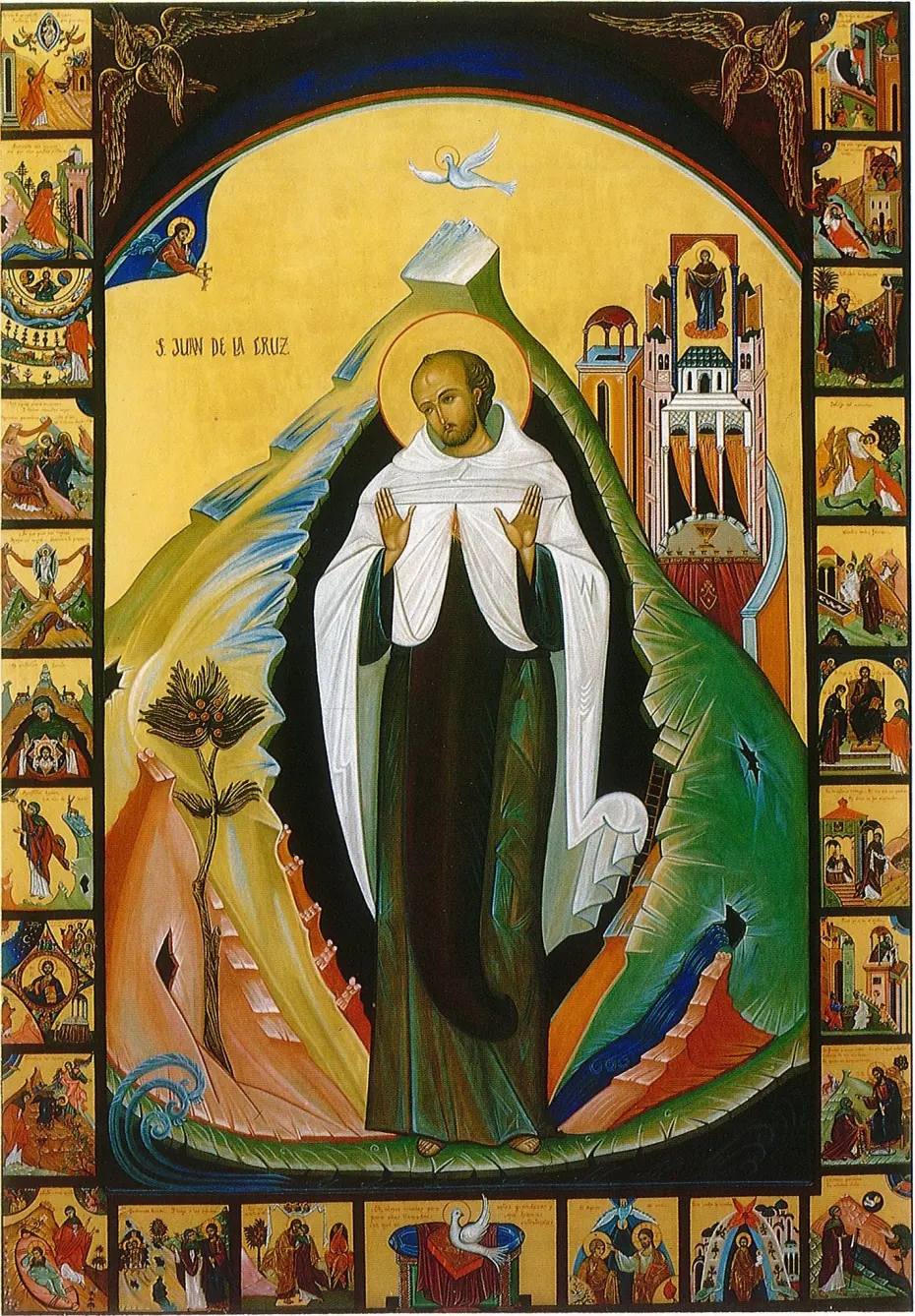
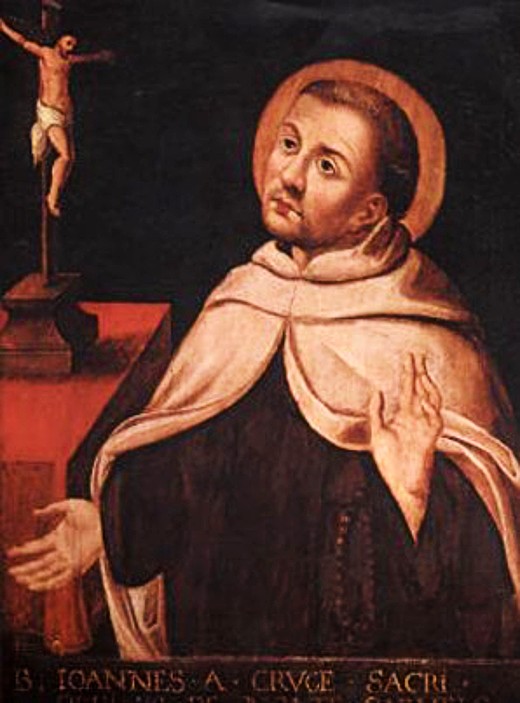
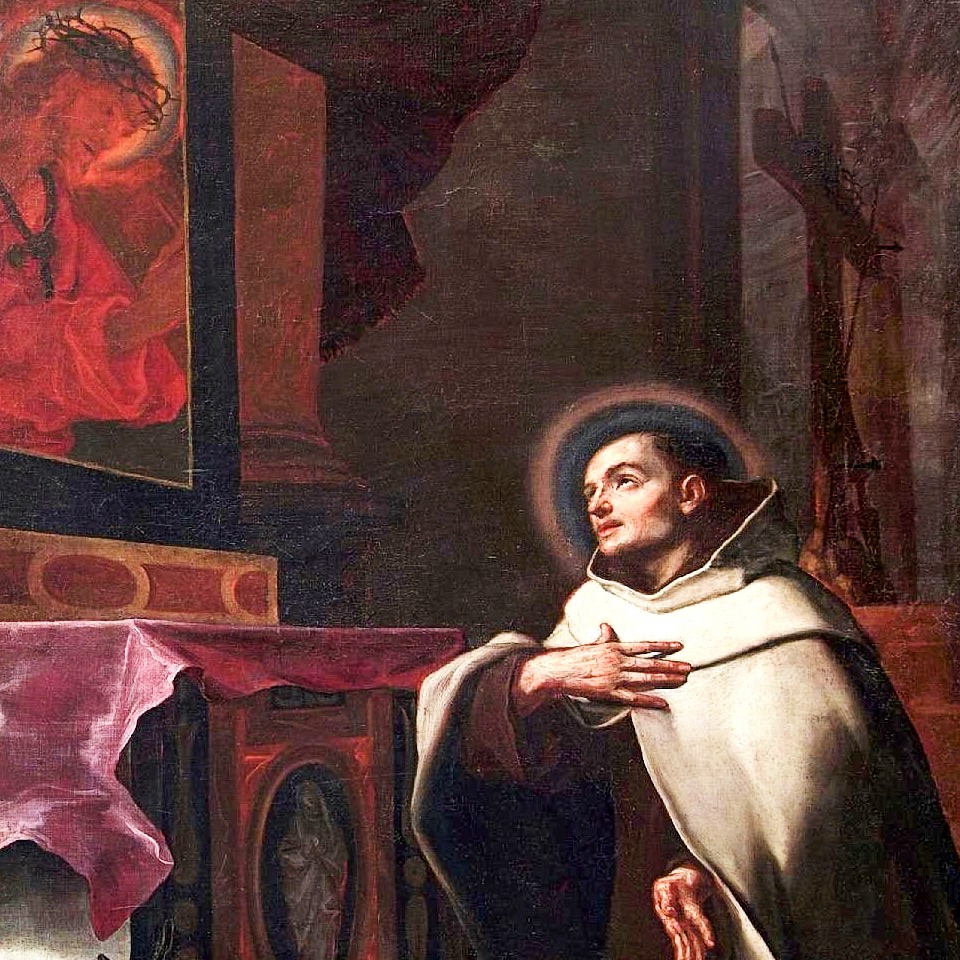
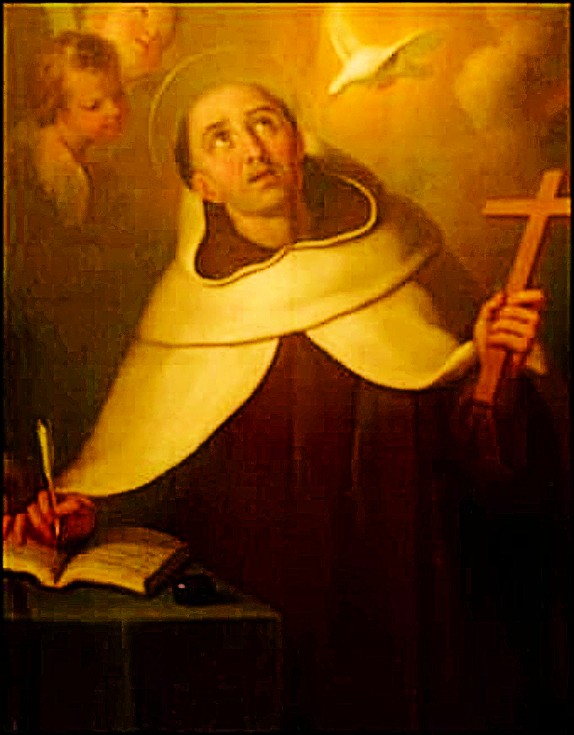
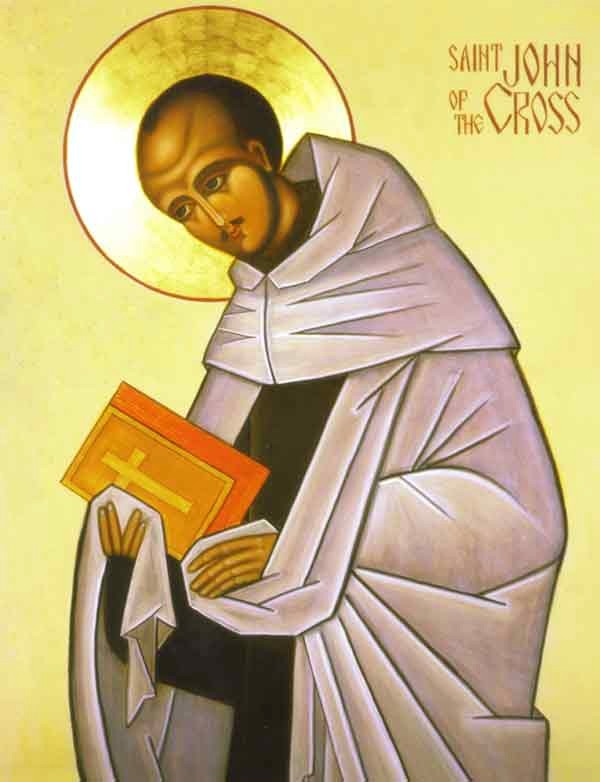
Saint of the Day – 24 November – Saint John of the Cross OCD (1542-1591) Doctor of the Church, Confessor, Carmelite Priest, Mystic, Poet, Reformer, Writer. He was gifted with prophecy and miracles, visions and the ability to read hearts.
St John of the Cross By Father Francis Xavier Weninger SJ (1805-1888)
In 1542, was born at Fontiveros, a hamlet of old Castile, St John of the Cross, renowned through the entire Christian world, as the restorer of the Carmelite Order. His mother, after his father’s early death, went to Medina del Campo, where John commenced his studies and continued them until he entered the Order of the Blessed Virgin of Mount Carmel. From his early youth he had entertained a childlike devotion to the Blessed Virgin, who more than once saved him most miraculously from death. One day, when playing with some other lads around a deep pond, he fell into it. In this danger, the Divine Mother appeared to him in a most beautiful form and offered him her hand, to draw him out of the water. But as his hands were much soiled, he hesitated to take those of so brilliant a lady, whereupon his Guardian Angel, or some other inhabitant of Heaven, held out to him, from the edge of the pond, a long pole, by the aid of which he was happily saved. At another time he fell into a well and when all feared that he was drowned, they saw him sitting quietly upon the water. When they drew him out, he said that the Queen of Heaven had caught him in her cloak and thus prevented his sinking.
Before he was nine years old, he showed a wonderful zeal in mortifying his body, chastising himself by taking only a short rest on a hard bed and by voluntary fasts. While yet a student, he nursed, with great solicitude and charity, the sick in the hospitals. After he had taken the Carmelite Habit, he was not satisfied with the penances then practiced in the Convent but endeavoured to regulate his life, in accordance with the first rules and ancient austerity of the Order.
When he prepared himself to say his first Holy Mass, he searched his conscience very carefully,but found no grievous fault. He then gave humble thanks to the Almighty and during his Mass, begged for the grace to be kept in future, free from all mortal sin. His prayer was accepted and he heard the words: “I grant thee thy wish.” From that time, St John never offended the Lord by a mortal sin, nor voluntarily by a venial one.
St Teresa, who lived at that period, said of him that he was a Saint, and had been one all his life. This renowned and holy virgin met St John at Medina and, conferred with him about her desire to found houses for religious, who would live according to the original strict regulations of the Carmelites. John, who, in his eagerness to live in greater austerity, had thought of joining the Carthusian Monks, asked St Teresa’s advice. She told him that it would be more agreeable to God, if he remained in his Order and restored among the men, the same primitive rigour which she was endeavouring to restore among the women. She added, that God had called him to this work. John took counsel with God and his Confessor and then resolved to follow St Teresa’s advice. He erected his first Monastery on a farm which had been presented to him for this purpose and God so visibly blest his undertaking, that he not only filled his house, in a short time, with zealous men but was enabled also, to found several new Convents.
In these religious houses, all the inmates lived so holy and so austere a life that many, thought it was more to be admired, than imitated. The Saint was an example to all and one could hardly imagine a penance which he did not practice. He gave no ear to those who told him to moderate his severities but said: “The narrow path leading to Heaven cannot be travelled by me, in a manner less austere.” The hardships he endured in founding his Monasteries and in restoring the severe regulations of the Order; the persecutions and wrongs he suffered, cannot be described in the short space allotted to us, yet in all these trials, he was never despondent. The love of God possessed his heart so entirely, that he desired nothing but to labour and to suffer for His honour.
The Lord asked him one day what recompense he desired for all his trouble and labour. “Nothing else, O Lord but to suffer and to be despised for Thy sake,” was his answer. Three things he used to ask of the Almighty – first, much work and much suffering; secondly, not to depart this life as a superior; thirdly that he might live and die despised. So unusual a desire to suffer and to be despised, was the result of his meditation on the Passion of Jesus Christ and of his great love for God. This love was so intense that his countenance was frequently seen radiant with a heavenly light, especially when he spoke of divine things. At the time of prayer, as well as during Holy Mass, he often fell into ecstasy and was dissolved in tears. Our Lord once appeared to him in the same form as when He died for us on the Cross. This picture remained so indelibly imprinted on the Saint’s memory,that it almost daily drew tears from his eyes.
Into all those, over whom he had the slightest influence, he endeavoured to instill a tender devotion to our Crucified Lord, as well as to the Most Holy Trinity and to the Blessed Eucharist. His language to sinners was so forcible that he converted even the most hardened. He was much aided in this by the gift which the Almighty had bestowed upon him, of reading the thoughts of the heart. Many who came to him were reproached with their secret sins and admonished to reform their lives. He possessed also the gifts of prophecy, of driving out devils and curing all kinds of diseases. Besides this, he had many visions of the Blessed Virgin, St Joseph, St John and Christ the Lord. Especially remarkable, were the heavenly favours, with which this great servant of the Almighty was comforted, during an imprisonment of nine months, to which he was unjustly condemned. Christ appeared to him and said: “Behold! John, I am here! Fear not. I will rescue thee!” The Blessed Virgin, accompanied by a great many Saints, appeared to him and said: “My son, be patient and endure, for your trials will soon give way to joy.” In another vision, she admonished him to escape from the prison, promising him her assistance, a promise which she also kept. St Teresa, who, during her life, had been closely united with him, appeared also to him after her death, speaking to him most kindly. In his adversity she comforted him, and encouraged him to new labours for the honour of God.
The reward of all the work which the holy man had accomplished, as also of the trials and tribulations he had suffered, was at length bestowed upon him, in the year 1591, when he was in the forty-ninth year of his age. He was seized with fever, in the hermitage of Pegnuela and was brought from there to Ubeda, according to his wish. He had an ulcer on that part of his right foot where the holy feet of our Lord were pierced with nails. To open it, the surgeon was obliged to make a deep incision. The pain thus caused was very great but greater still, was the patience of the Saint, who even rejoiced at bearing, in some manner, the image of the sufferings of Christ and at having five wounds on one foot.
God had already, some time previously, revealed to him the hour of his death and the Blessed Virgin, whom the Saint had always especially honoured, appeared to him on the eve of the Immaculate Conception, saying that she would come for him on the Sunday after the festival. When the physicians told him that his end was not far distant, he said, in the words of the Psalmist: “I was glad when they said unto me, We shall go up into the house of the Lord.” Half an hour before his death, he called all his religious to him, exhorted them to persevere in their zeal and said: “My parting hour draws near.” After the usual prayers of the Church, he heard the bells ring for the midnight Matins. “I shall sing the Matins in Heaven,” said he, after which, taking the Crucifix, he kissed it most devoutly and calmly ended his holy life, saying: “Into Thy hands, O Lord, I commend my soul.” A large ball, as of fire, was seen above the dying Saint. After his death, his countenance beamed with a heavenly brightness and was so beautiful that none grew weary of looking at him, while at the same time, such delicious odour emanated from him that the whole Monastery was filled with it. The Almighty has carefully preserved his body incorrupt until this hour.
Bl Conrad of Frisach St Crescentian of Rome St Eanfleda of Whitby St Felicissimus of Perugia St Félix Alonso Muñiz St Firmina of Amelia St Flora of Cordoba St Francisco Borrás Román St Hitto of Saint-Gall St Kenan of Damleag St Leopardinus of Vivaris Bl Maria Anna Sala St Marinus of Maurienne St Mary of Cordoba St Pierre Rose Ursule Dumoulin Borie St Portianus of Miranda St Protasius of Milan St Romanus of Le Mans
Thought for the Day – 23 November – Meditations with Antonio Cardinal Bacci (1881-1971)
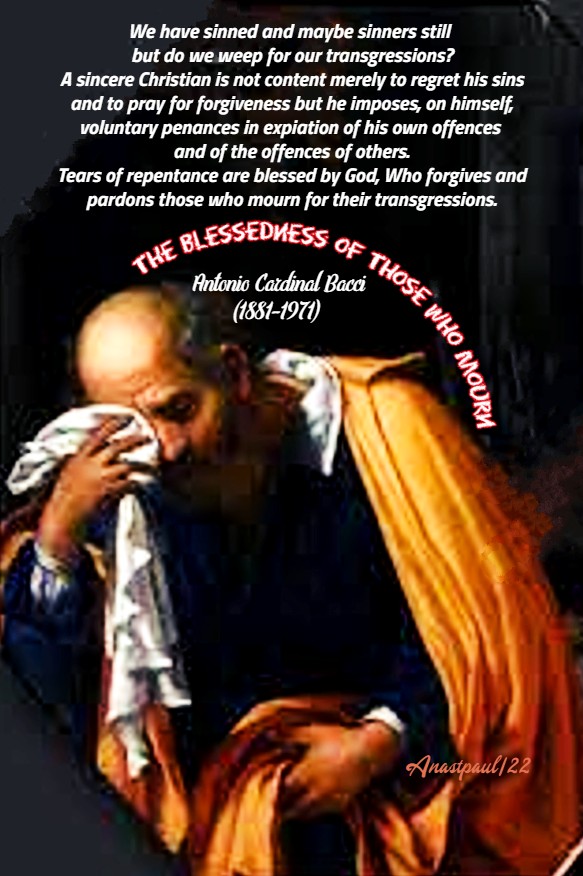
The Blessedness of Those Who Mourn
“As well as regretting the evils which beset humanity, the Christian should also shed tears of repentance for his sins. Our sins are so many that they demand penance and reparation. St Aloysius Gonzaga wept whenever he recalled the peccadilloes of his childhood, which were hardly serious enough to be real sins. We have sinned and maybe sinners still but do we weep for our transgressions?
A sincere Christian is not content merely to regret his sins and to pray for forgiveness but he imposes, on himself, voluntary penances in expiation of his own offences and of the offences of others. Tears of repentance are blessed by God, Who forgives and pardons those who mourn for their transgressions.”
Quote/s of the Day – 23 November – St Clement I (c 88–c 101) Pope Martyr and St Columban (543-615) Monk, Missionary
“Follow the Saints because those who follow them, will become Saints.”
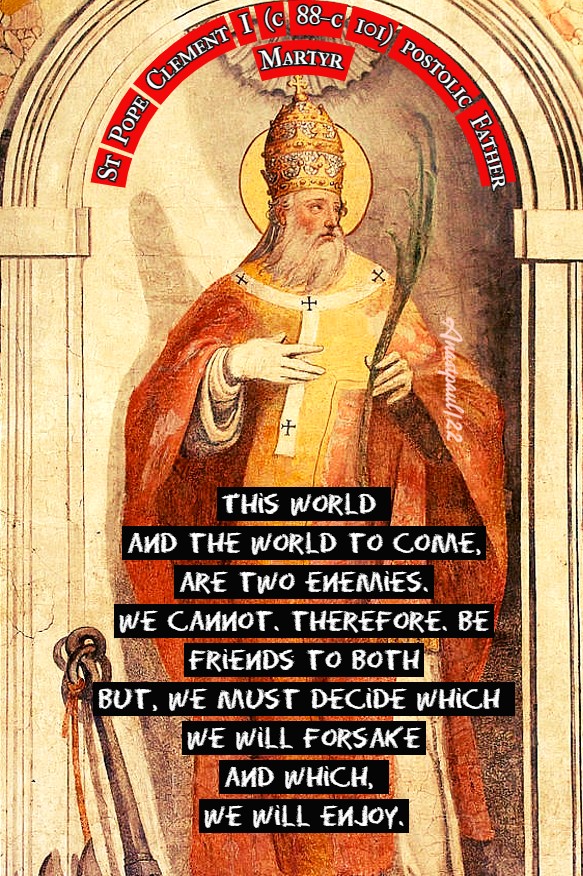
“This world and the world to come, are two enemies. We cannot. therefore. be friends to both but, we must decide which we will forsake and which, we will enjoy.”
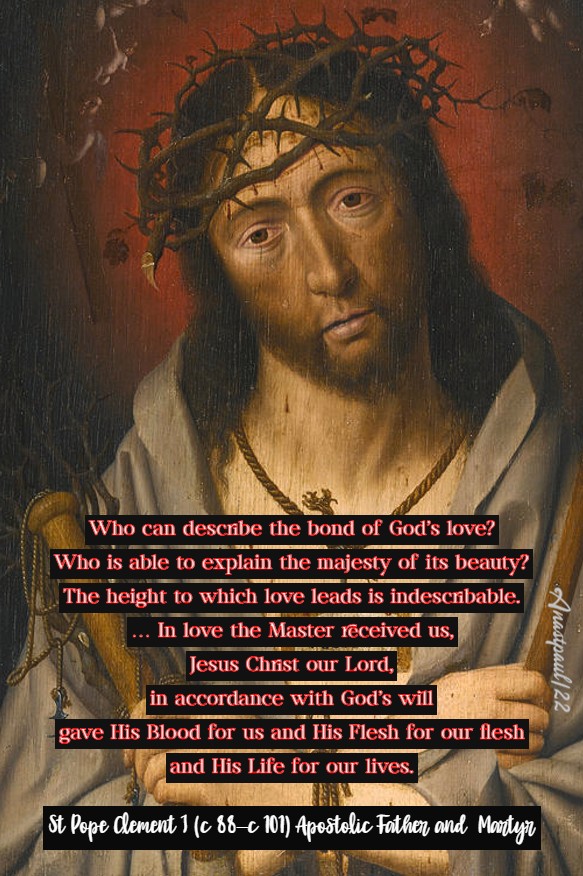
“Who can describe the bond of God’s love? Who is able to explain the majesty of its beauty? The height to which love leads is indescribable. … In love the Master received us, Jesus Christ our Lord, in accordance with God’s will gave His Blood for us and His Flesh for our flesh and His Life for our lives.”
“We are all fellow members of one body, whether Franks or Britons or Irish or whatever our race. Thus, let all our races rejoice, in knowledge of the faith and in recognising the Son of God … In Him, let us love one another, praise one another, correct one another, encourage one another, pray for one another.”
(Letter 2, to the French bishops)
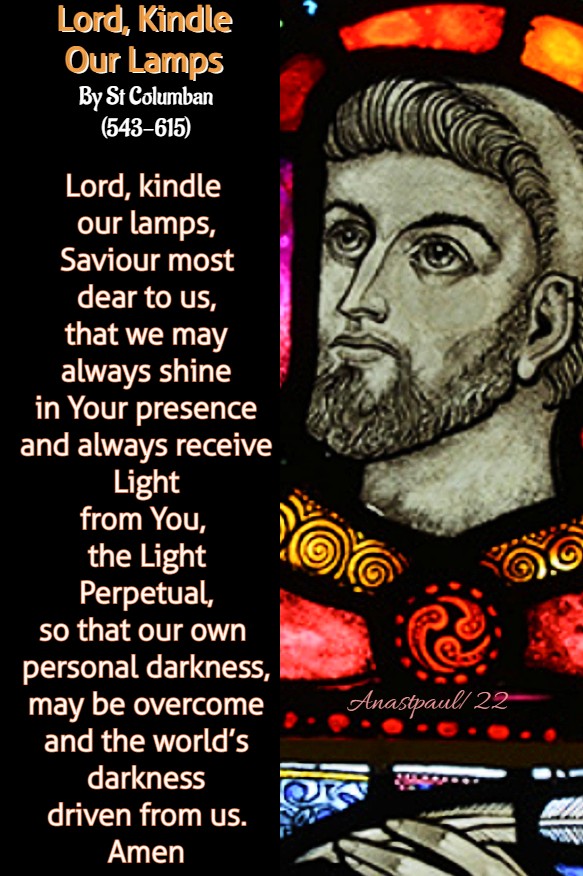
Lord, Kindle our Lamps By St Columban (543-615)
Lord, kindle our lamps, Saviour most dear to us, that we may always shine in Your presence and always receive Light from You, the Light Perpetual, so that our own personal darkness, may be overcome and the world’s darkness driven from us. Amen
(This is an excerpt from a much longer prayer and is taken from the wonderful Sermon XII by St Columban/us)
One Minute Reflection – 23 November – St Clement I (c 88–c 101) Pope Martyr – Philippians 3:17-21; 4:1-3, Matthew 16:13-19 – Scripture search here: https://www.drbo.org/
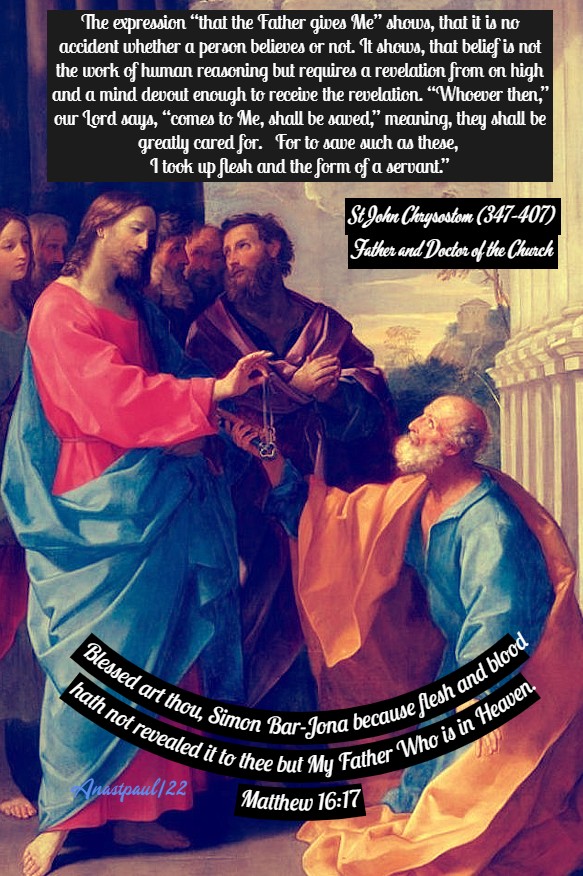
“Blessed art thou, Simon Bar-Jona because flesh and blood hath not revealed it to thee but My Father Who is in Heaven.” – Matthew 16:17
REFLECTION – “Faith in Me, He intimates here, is no ordinary thing or one that comes from human reason but [it] needs a revelation from above. And this He establishes throughout His discourses, showing, that this faith requires a noble sort of soul and one drawn on by God. The expression “that the Father gives Me” shows, that it is no accident whether a person believes or not. It shows, that belief is not the work of human reasoning but requires a revelation from on high and a mind devout enough to receive the revelation. “Whoever then,” our Lord says, “comes to Me, shall be saved,” meaning, they shall be greatly cared for. For to save such as these, I took up flesh and the form of a servant.” – St John Chrysostom (347-407) Archbishop of Constantinople, Father and Doctor of the Church (Homilies on the Gospel of John 45)”
PRAYER – Look forgivingly on Thy flock, Eternal Shepherd and keep it in Thy constant protection, by the intercession of blessed Clement Thy Martyr and Sovereign Pontiff, whom Thou didst constitute Shepherd of the whole Church. Through Jesus Christ, Thy Son our Lord, Who lives and reigns with Thee, in the unity of the Holy Ghost, God, world without end. Amen (Collect).
Our Morning Offering – 23 November – The Memorial of St Columban (543-615).
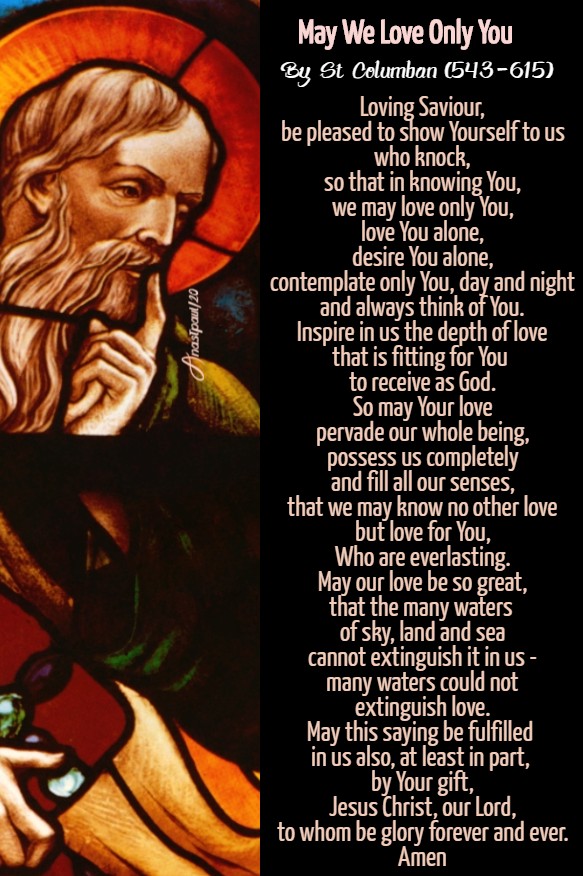
May We Love Only You By St Columban (543-615)
Loving Saviour, be pleased to show Yourself to us who knock, so that in knowing You, we may love only You, love You alone, desire You alone, contemplate only You, day and night and always think of You. Inspire in us the depth of love that is fitting for You to receive as God. So may Your love pervade our whole being, possess us completely and fill all our senses, that we may know no other love but love for You, Who are everlasting. May our love be so great, that the many waters of sky, land and sea cannot extinguish it in us – many waters could not extinguish love. May this saying be fulfilled in us also, at least in part, by Your gift, Jesus Christ, our Lord, to whom be glory forever and ever. Amen
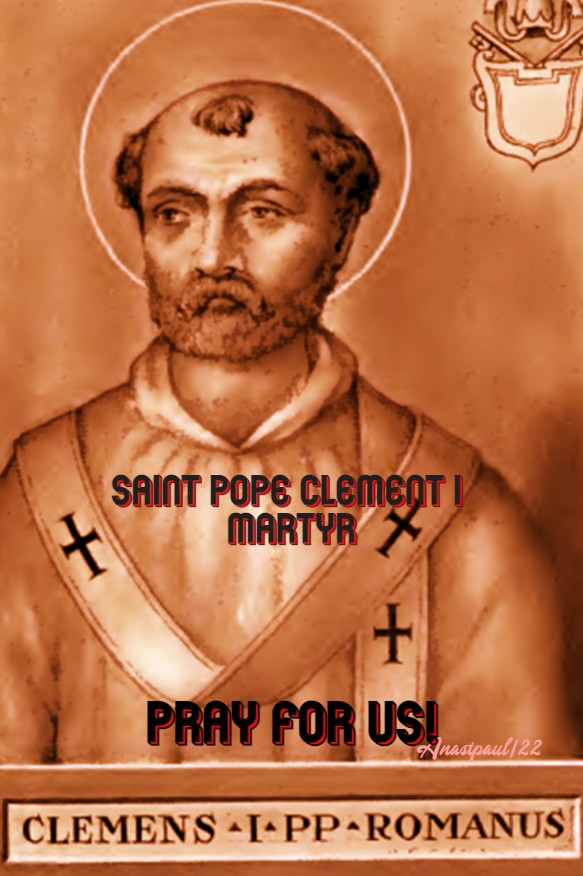
Saint of the Day – 23 November – St Clement I (c 88–c 101) Pope Martyr, Miracle-worker. St Clement is considered to be the first Apostolic Father of the Church, one of the three chief ones together with St Polycarp and St Ignatius of Antioch. Papal Ascensi,on c 88. Born in Rome, Italy and died by drowning at Chersonesus, Taurica, Bosporan Kingdom (modern Greece). Patronages – boatmen, sailors, marble workers, against blindness, sick children, stonecutters, Diocese of Aarhus, Denmark, Dundee, Scotland. Steenwijk, Netherlands, Velletri, Italy. Also known as – Clement of Rome, Clemens Romanus.
The Roman Martyrology reads: “The birthday of Pope Clement, who held the sovereign Pontificate, the third after the blessed Apostle St Peter. In the persecution of Trajan, he was banisbed to Chersonesus, where being percipitated into the sea with an anchor tied to his neck, he was crowned with Martyrdom. His body was taken to Rome during the Pontificate of Nicholas I and placecd, with due honour in the Church which had been previously built under his invocation.”
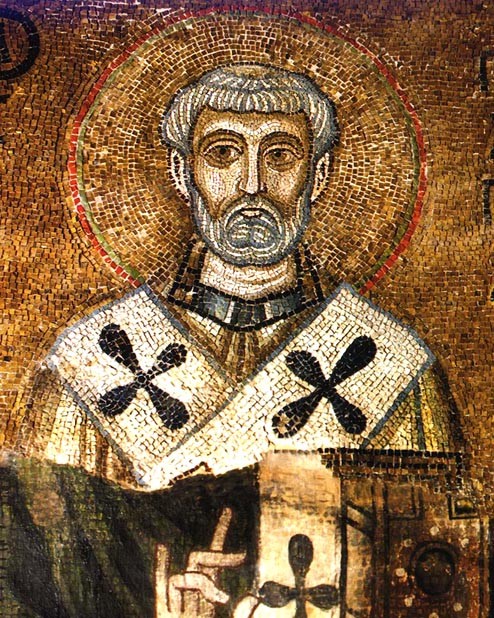
c 1000 portrayal at Saint Sophia’s Cathedral, Kyiv
Saint Clement I., Pope and Martyr By Father Francis Xavier Weninger SJ (1805-1888)
Whilst the holy Apostles, Peter and Paul, were preaching the Gospel at Rome, there came to them Clement, a son of Faustinus, who was related to the Emperor Domitian. After several discourses with St Peter, he saw the error of Paganism, in which he had been born and educated and became a convert to the Christian faith. He progressed so rapidly in virtue and holiness that he was of great help to Paul in converting the heathens, as the holy Apostle testifies in his Epistle to the Philippians. The unwearied zeal he manifested in such holy endeavours, his purity and other bright virtues, raised him, after the death of Sts Linus and Cletus, to the government of the entire Church of Christ.
In this elevated but burdensome dignity, his holy life was an example to his flock. He gave several excellent laws to the Church, by one of which he divided the City into seven districts and placed in each, a notary to record the deeds, virtues and Martyrdom, of those who were persecuted for Christ’s sake that posterity, admiring their heroism, might be animated to follow their example. His sermons were so full of deep thought and so powerful, that he daily converted several heathens. Among these was Flavia Domitilla, a niece of the Emperor Domitian, who not only became a zealous Christian but, refusing several advantageous offers of marriage, vowed her virginity to God.
He converted Sisinius, one of the most influential men in the City, by a miracle. While yet a heathen, Sisinius went unseen into the secret Chapel where the Christians assembled, in order to ascertain what they were doing and to see whether his wife was among them. God, however, punished him immediately with blindness in both eyes. He revealed himself by calling for, someone to lead him home and St. Clement, who was present, went to him and, restoring his sight after a short prayer, he improved the occasion, to explain to him, the truths of Christianity. Sisinius, being soon convinced, received holy Baptism and many heathens followed his example. The Emperor Trajan, being informed of this, commanded St Clement to be banished to the Chersonesus, unless he consented to sacrifice to the gods. Nearly two thousand Christians had already been banished to that region, where they were forced to work in mines and quarries. The holy Vicar of Christ rejoiced to be thought worthy to suffer for his Divine Master and indignantly, refused to comply with the Emperor’s command to worship the Pagan idols. He was accordingly transported, and condemned to labour like the others.
This fate at first seemed very hard to him but. the thought that he suffered it for Christ’s sake, strengthened him. With the same thought. he endeavoured also to inspire his unhappy companions, when he saw that they became discouraged and lost their patience. He also frequently represented to them, the reward which was awaiting them in Heaven. A miracle which God performed through him, raised him to great consideration, even with the heathens.
There was a great scarcity of water and the Christians suffered much from the thirst occasioned by their hard work. St Clement, pitying them most deeply, prayed to God to help them. Rising from his knees, he saw, on a high rock, a lamb, which seemed, with his raised right foot, to point to the place where water could be found. The holy man, trusting in the Almighty, seized an axe and, lightly striking the rock, procured a rich stream of clear water, which refreshed all the inhabitants of the country, especially the poor persecuted Christians. So many heathens were converted on account of this miracle, that, in the course of a year, almost all the idolatrous temples were torn down and Christian c=Churches erected in their stead.
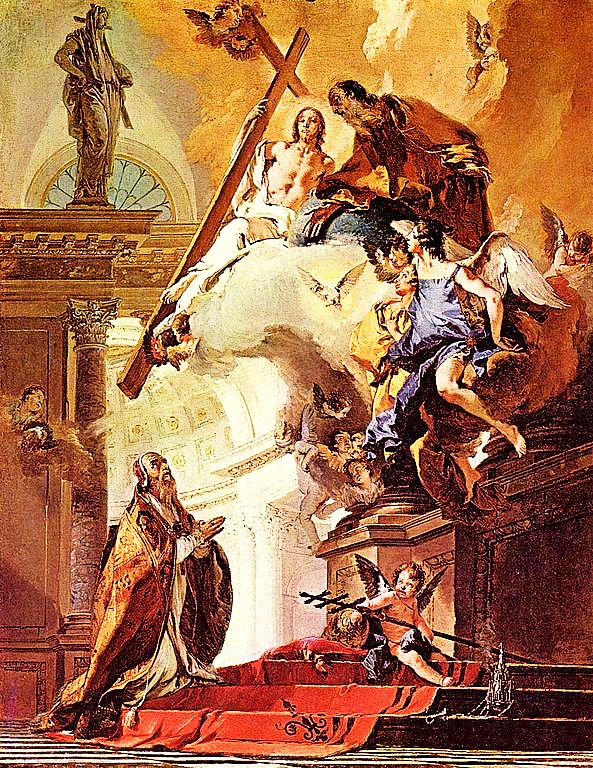
St Clement by Tiepolo
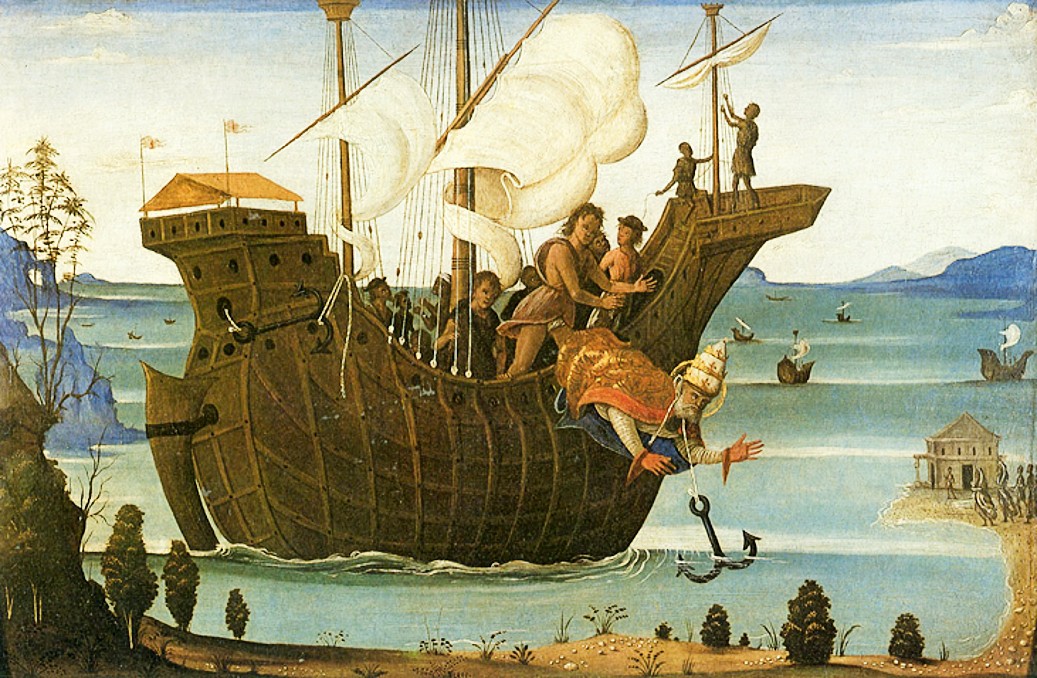
Some of the idolatrous priests complained of this to the Emperor, who immediately sent Aufidian, a cruel tyrant, to force the Christians to forsake their faith and to put St Clement to death. The tyrant endeavoured to induce the holy man to forsake Christ but finding that all words were useless, he commanded the executioners to tie an anchor to the neck of St Clement, take him out into the sea and cast him into the deep, in order that nothing of him should remain to comfort the Christians. The last words of the holy Pope were: “Eternal Father! receive my spirit!”
Martyrdom of St Clement by Fungai
The Christians, who had been encouraged by him to remain constant in their faith, stood on the sea-shore, until the tyrant and his followers had departed, after the death of the Saint. They then knelt in prayer, to beg of the Almighty that He would restore to them the body of their beloved shepherd and, whilst they prayed, the sea began slowly to retreat from the shore. The Christians, following the retreating water, came to the place where the Saint had been cast into the sea and found, to their inexpressible astonishment and joy, a small marble Chapel and in it, a tomb of stone, in which the body of the holy Pope was reposing. At his side, lay the anchor which had been tied around his neck. The joy and comfort which filled the hearts of the faithful at this sight, can more easily be imagined than described. They wished to take the holy body away but God made known to them that, for the present, it should not be disturbed and that, every year, the sea would retreat, during seven days, so as to permit all to visit the shrine of the Saint! This took place for several years, until, at last, by divine revelation, the Relics were transported to Rome.
St Adalbert of Casauria St Alexander Nevski St Amphilochius of Iconium St Augusta of Alexandria St Clement of Metz Bl Detlev of Ratzeburg St Falitrus of Chabris St Faustina of Alexandria St Gregory of Girgenti Bl Guy of Casauria St Jaume Nàjera Gherna St Loëvan of Brittany St Lucretia of Mérida Bl Margaret of Savoy St Mustiola of Chiusi St Paternian of Fano St Paulinus of Whitland St Rachildis of Saint-Gall St Severin of Paris St Sisinius of Cyzicus St Trudo of Hesbaye St Wilfetrudis of Nivelless
Thought for the Day – 22 November – Meditations with Antonio Cardinal Bacci (1881-1971)
The Blessedness of the Meek
“Learn from me,” said Jesus when He proposed Himself to us, as our model, “for I am meek and humble of heart and You will find rest for your souls. For my yoke is easy and my burden light” (Mt 11:30). “By your patience,” He said on another occasion, “you will win your souls” (Lk 21:19). “Love your enemies,” He said too, “do good to those who hate you and pray for those who persecute and calymuniate you, so that you may be children of your Father in Heaven, Who makes His sun to rise on the good and the evil and sends rain on the just and the unjust” (Mt 5:44).
If we obey this lofty teaching, we shall have peace of soul. We shall not be easily annoyed but shall rather, regret the misdeeds and unhappiness, of those who unjustly offend us. Moreover, we shall be able to persuade our fellowmen to follow the path of virtue. This is why the Psalmist says that “the meek shall possess the land, they shall delight in abounding peace” (Ps 36:11). “Blessed are the meek,” Jesus repeats in the Sermon on the Mount, “for they shall possess the earth” (Mt 5:4).
What is meant by this promise? Tyrants, persecutions and evil-doers, have passed away and are remembered with bitterness and execration. But the Saints still hold sway over the world and dominate the minds and hearts of millions, winning universal love and veneration. We should imitate the gentleness which can give such peace and exert such influence!”
Quote/s of the Day – 22 November – St Cecilia Died 3rd Century) Virgin Martyr – Ecclesiasticus 51:13-17, Matthew 25:1-13 – Scripture search here: https://www.drbo.org/
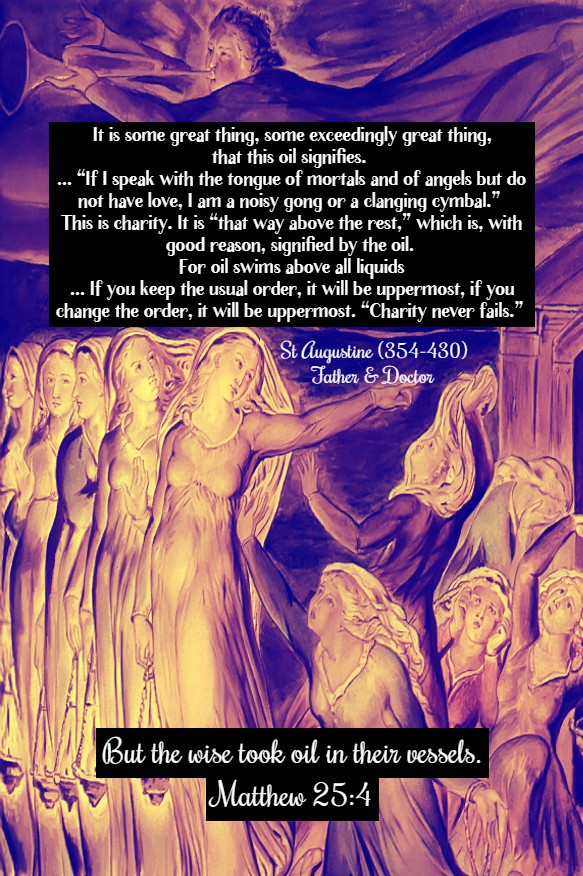
“But the wise took oil in their vessels”
Matthew 25:4
“The Apostle says, “I will show you a still more excellent way.” “If I speak with the tongue of mortals and of angels but do not have love, I am a noisy gong or a clanging cymbal.” This is charity. It is “that way above the rest,” which is, with good reason, signified by the oil. For oil swims above all liquids. Pour in water and pour in oil upon it, the oil will swim above. If you keep the usual order, it will be uppermost, if you change the order, it will be uppermost. “Charity never fails!”
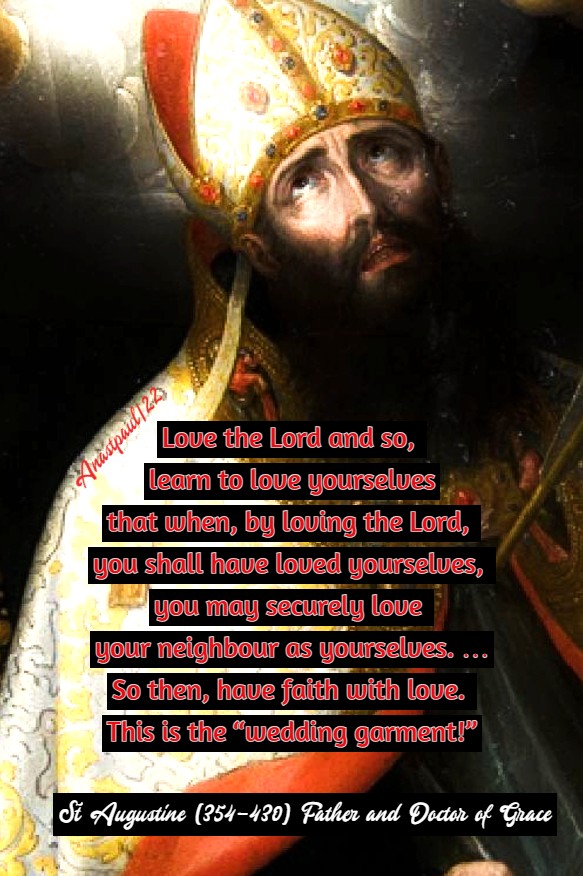
“Love the Lord and so, learn to love yourselves that when, by loving the Lord, you shall have loved yourselves, you may securely love your neighbour as yourselves. … So then, have faith with love. This is the “wedding garment!”
St Augustine (354-430) Father and Doctor of Grace
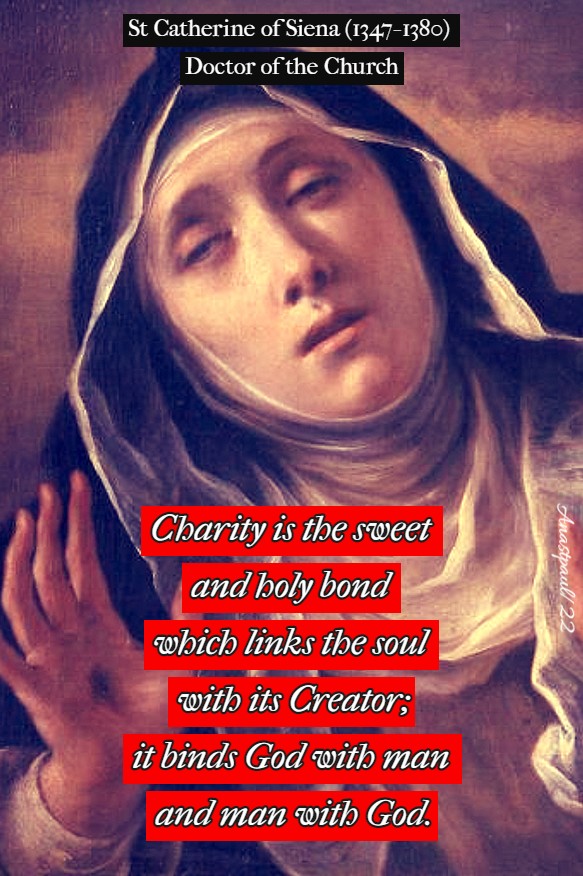
“Charity is the sweet and holy bond which links the soul with its Creator; it binds God with man and man with God.”
St Catherine of Siena OP (1347-1380) Doctor of the Church
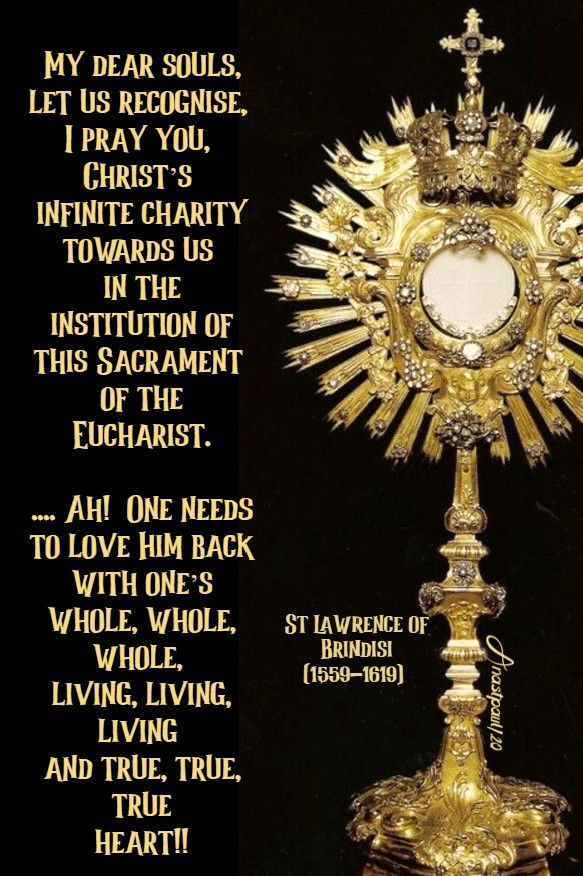
“My dear souls, let us recognise, I pray you, Christ’s infinite charity towards us in the institution of this Sacrament of the Eucharist. In order that our love be a spiritual love, He wills a new heart, a new love, a new spirit for us. It is not with a carnal heart but with a spiritual one, that Christ has loved us with a gratuitous love, a supreme and most ardent love, by way of pure grace and charity. Ah! One needs to love Him back with one’s whole, whole, whole, living, living, living and true, true, true heart!”
St Lawrence of Brindisi(1559-1619)
“Humility and charity are the two master chords – one, the lowest; the other, the highest; all the others are dependent on them. Therefore, it is necessary, above all. to maintain ourselves in these two virtues, for observe well, that the preservation of the whole edifice depends on the foundation and the roof!”
St Vincent de Paul (1581-1660)
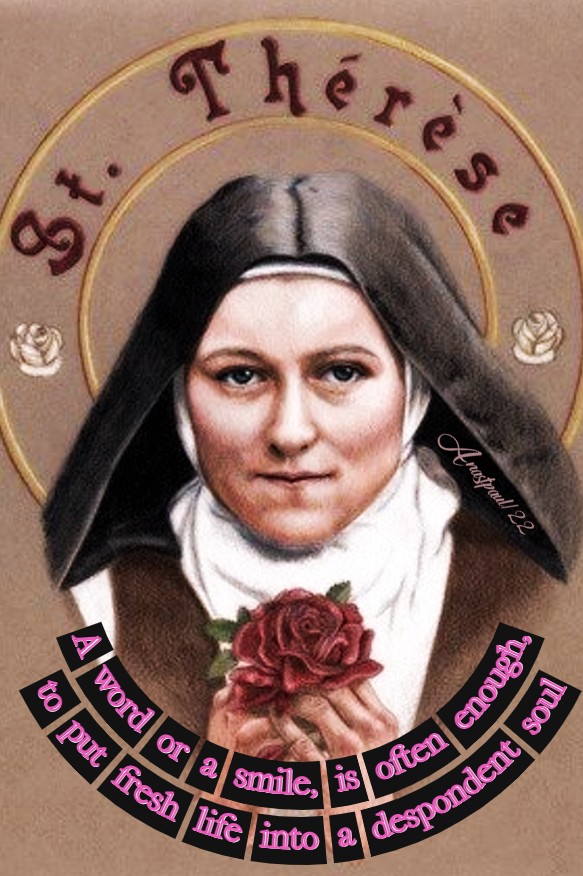
“A word or a smile, is often enough, to put fresh life into a despondent soul.”
St Therese of the Child Jesus and the Holy Face (1873-1897) Doctor of the Church
One Minute Reflection – 22 November – St Cecilia Died 3rd Century) Virgin Martyr – Ecclesiasticus 51:13-17, Matthew 25:1-13 – Scripture search here: https://www.drbo.org/
“But the wise took oil in their vessels” – Matthew 25:4
REFLECTION – “It is some great thing, some exceedingly great thing, that this oil signifies. Do you think it might be charity? If we try out this hypothesis, we hazard no precipitate judgement. I will tell you why charity seems to be signified by the oil. The Apostle says, “I will show you a still more excellent way.” “If I speak with the tongue of mortals and of angels but do not have love, I am a noisy gong or a clanging cymbal.” This is charity. It is “that way above the rest,” which is, with good reason, signified by the oil. For oil swims above all liquids. Pour in water and pour in oil upon it, the oil will swim above. If you keep the usual order, it will be uppermost, if you change the order, it will be uppermost. “Charity never fails!” … St Augustine (354-430) Father & Doctor (Sermon 93).
PRAYER – O God, Who gladden us by the annual feast of blessed Cecilia, Thy Virgin and Martyr, grant, we beseech Thee, that we may by virtuous conduct follow her, whom we venerate in this sacred rite. Through Jesus Christ, Thy Son our Lord, Who lives and reigns with Thee, in the unity of the Holy Ghost, God, world without end. Amen (Collect).
Our Morning Offering – 22 November – “The Month of the Holy Souls in Purgatory”
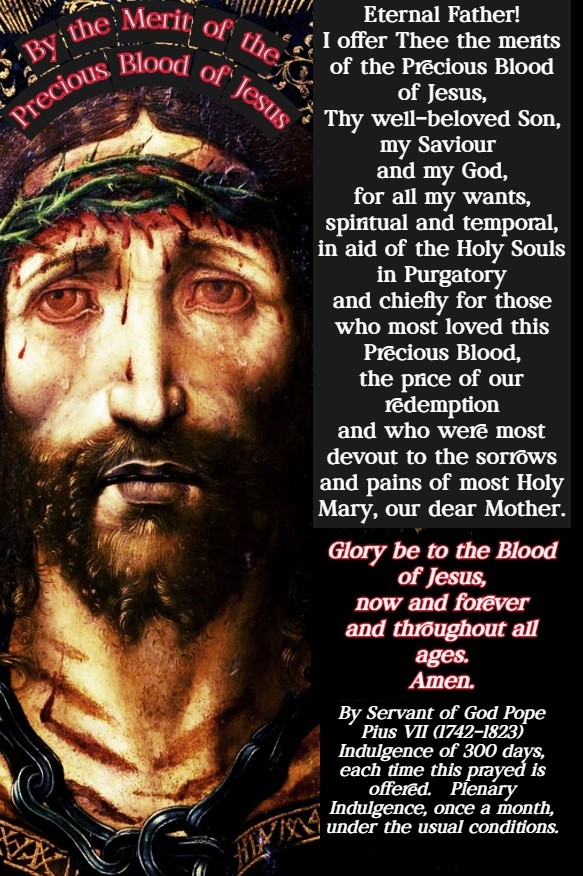
By the Merit of the Precious Blood of Jesus By Servant of God Pope Pius VII (1742-1823) Papacy from 1800 to 1823 Indulgenced Act of Oblation to Our Father
Eternal Father! I offer Thee the merit of the Precious Blood of Jesus, Thy well-beloved Son, my Saviour and my God, for all my wants, spiritual and temporal, in aid of the Holy Souls in Purgatory and chiefly for those who most loved this Precious Blood, the price of our redemption and who were most devout to the sorrows and pains of most Holy Mary, our dear Mother.
Glory be to the Blood of Jesus, now and forever and throughout all ages. Amen.
Indulgence of 300 days, each time this prayed is offered 22 September 1817 with a Plenary Indulgence, once a month, under the usual conditions.
Note of Interest:On 15 August 1811 – the Feast of the Assumption – it is recorded that the Pope celebrated Mass and was said to have entered a trance and began to levitate in a manner that drew him to the Altar. This particular episode aroused great wonder and awe among attendants, which included the French soldiers guarding him, who were awestruck at what had occurred and left records of it.
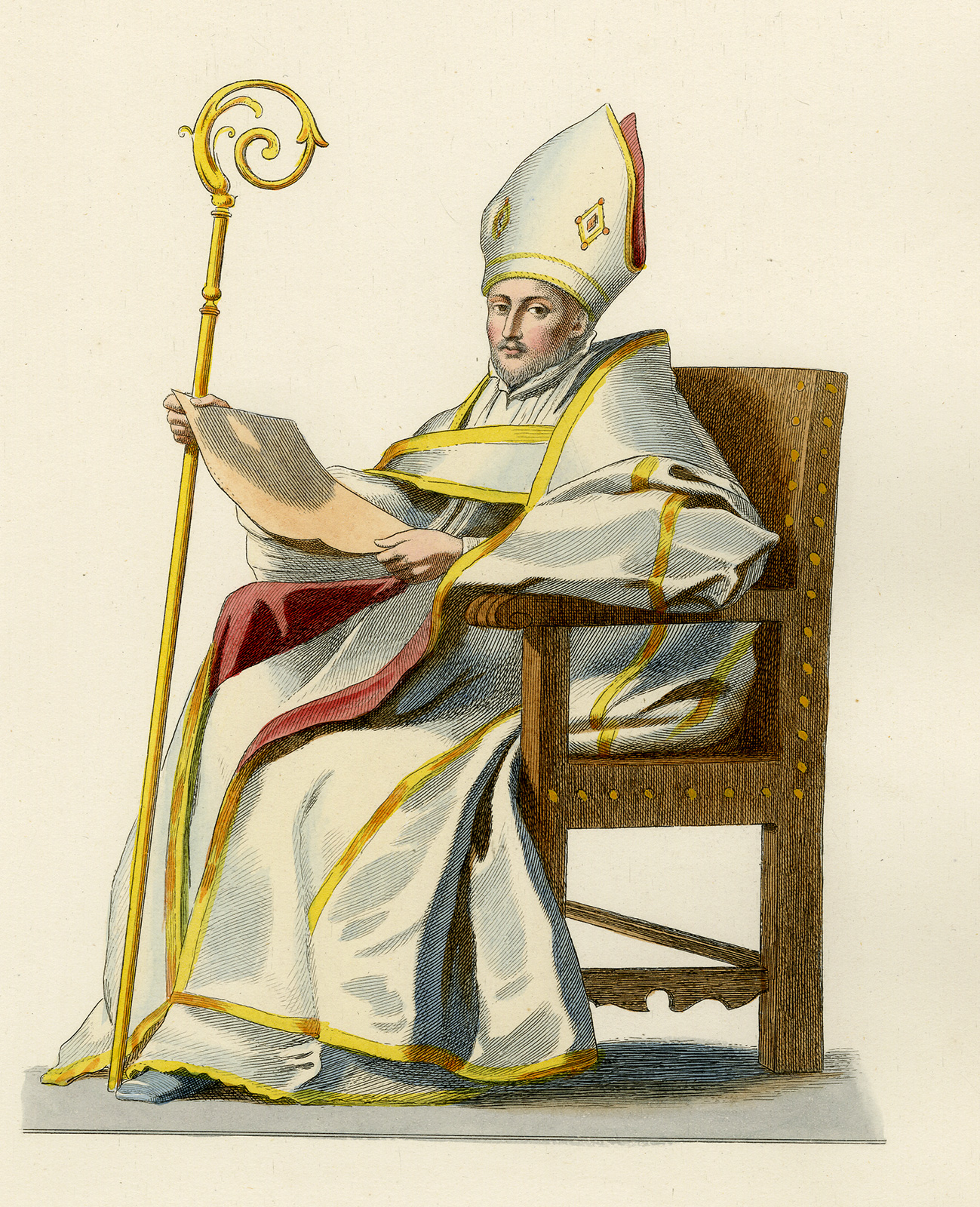
Saint of the Day – 22 November – Saint Pragmatius of Autun (Died c 520) Bishop of Autun, France, Peacemaker. Also known as Prammazio, Pragmazio.
We have very little information regarding the life of our Saint but we do know that he was a friend of the great holy Bishops of his time, Saints Sidoine Apollinaire and Saint Avitus of Vienne. We also we find his signature at the bottom of the Acts of one of the Councils of his time.
As Bishop, Pragmatius worked tirelessly, to spare his Diocese from the violence caused by the bitter feuding among the claimants to the Frankish throne during the early 6th Century.
In his old age, he had the pain of seeing his Episcopal See, devastated by the sons of Clovis, winners of the Burgundians, who opposed the invading Franks.
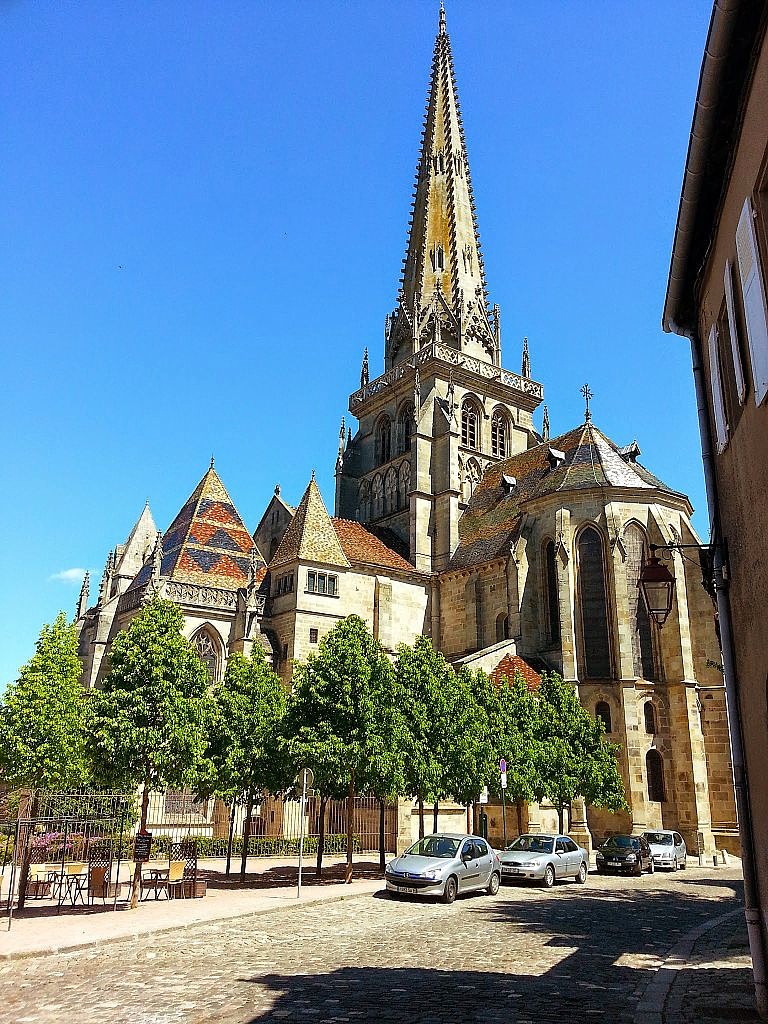
Autun Cathedral a famous Romanesque and Pilgrimage Church
St Agabbas of Syria St Amphilochius of Iconium St Ananias of Arbela St Apphia St Eugenia of Matera St Christian of Auxerre St Dayniolen the Younger St Joan of Montefalco St Mark of Antioch St Maurus of North Africa St Philemon St Pragmatius of Autun (Died c 520) Bishop St Sabinian the Abbot St Stephen of Antioch















 AnaStpaul
You must be logged in to post a comment.