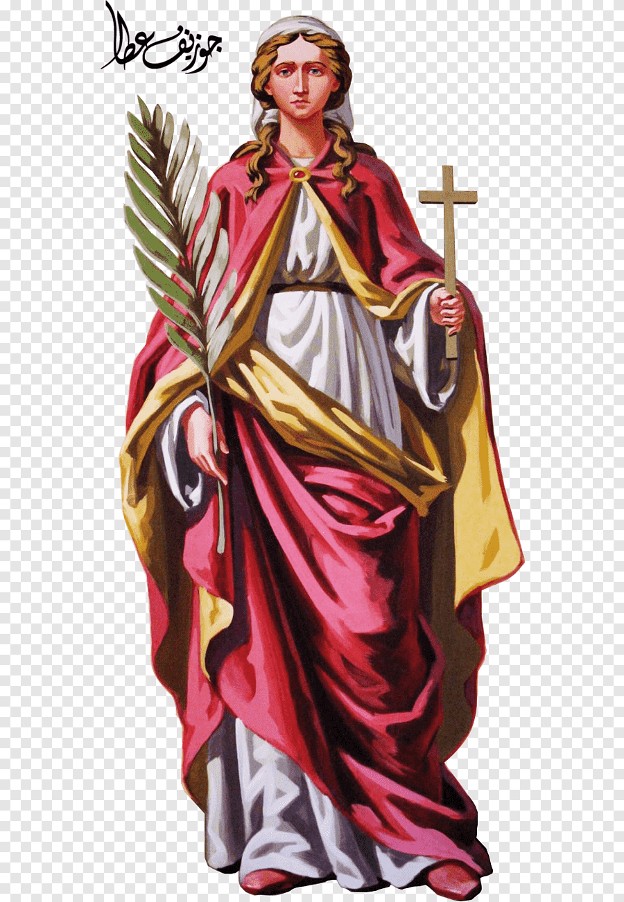
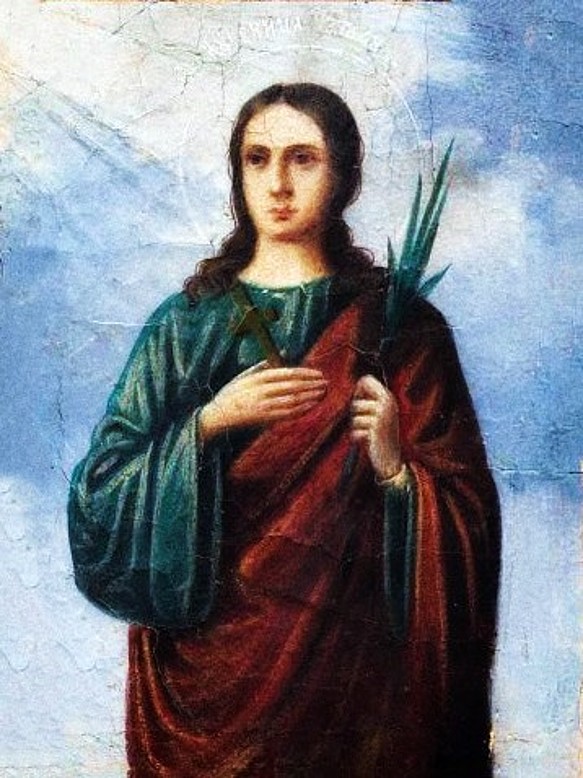
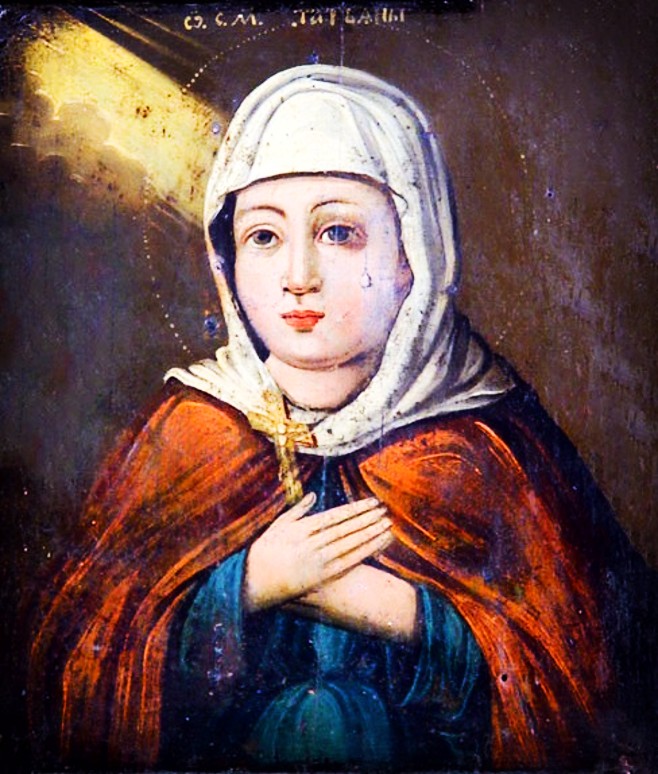
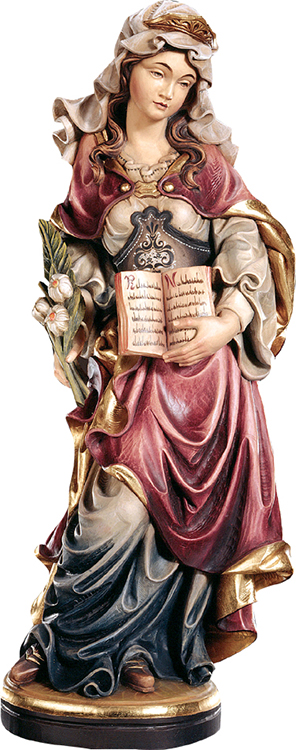
Saint of the Day – 12 January – Saint Tatiana of Rome (Died c 226) Virgin, Martyr. Died by being beheaded in c 226 in Rome, Italy. Patronage – students, school children. Also known as – Martina, Tatienne.
The Roman Martyrology reads today: “At Rome in the time of the Emperor Alexander, St Tatiana, Martyr who was torn with iron hooks and combs, thrown to the beasts and cast into the fire but, having received no injury, was beheaded and thus, went to Heaven.”
Tatiana was a Christian Martyr in the 3rd Century, in Rome during the reign of Emperor Alexander Severus. According to legend, she was the daughter of a Roman civil servant who was secretly Christian. He raised his daughter in the Faith and she became prominent in helping the early Church. This was dangerous, bringing her to the attention of the persecutors and one day the jurists Ulpian, captured Tatiana and attempted to force her to make a sacrifice to Apollo. She prayed and miraculously an earthquake destroyed the Apollo statue and part of the temple.
Tatiana was then blinded and beaten for two days, before being brought to a Circus and thrown into the pit with a hungry lion. But the lion did not touch her,and instead, lay at her feet. This resulted in a death sentence being pronounced and after being tortured, Tatiana was beheaded with a sword.
Tatiana was venerated as a Saint from the early days of the Church. The miracles performed by Tatiana are said to have converted thousands upon thousands,and many converted to the Faith immediately. She is the Oatron Saint of students.
Bl Bartholomew Alvarez Bl Bernardo de Plano St Biccianus St Bernard of Corleone St Caesaria of Arles St Caroticus Bl Emmanuel d’Abreu St Eutropius St Ferreolus of Grenoble Bishop Martyr Bl John Gaspard Cratz St John of Ravenna Bl Lucia of Valcaldara St Martinian of Belozersk St Peter of Abessala St Probus of Verona St Quinctus the Soldier St Satyrus St Tatiana of Rome (Died c 226) Virgin, Martyr St Tigrius St Victorian of Asana Bl Vincent da Cunha
Martyrs of Africa – 44 Saints: A group of 44 Christian soldiers murdered together for their faith in Africa. The only details that survive are four of their names – Castulus, Modestus, Rogatus and Zoticus.
Martyrs of Ephesus – 42 Saints: Forty-two Monks Martyred at a Monastery in Ephesus (modern Turkey) during the persecutions of the Iconoclast Byzantine Emperor Constantine V. Their names have not come down to us. Martyred c 762.
Martyrs of Iona – 38 Saints: Thirty-eight Monks Martyred in Iona, Ireland. Their names have not come down to us. They were Martyred in 750 at Iona, Ireland.
Thought for the Day – 11 January – Meditations with Antonio Cardinal Bacci (1881-1971)
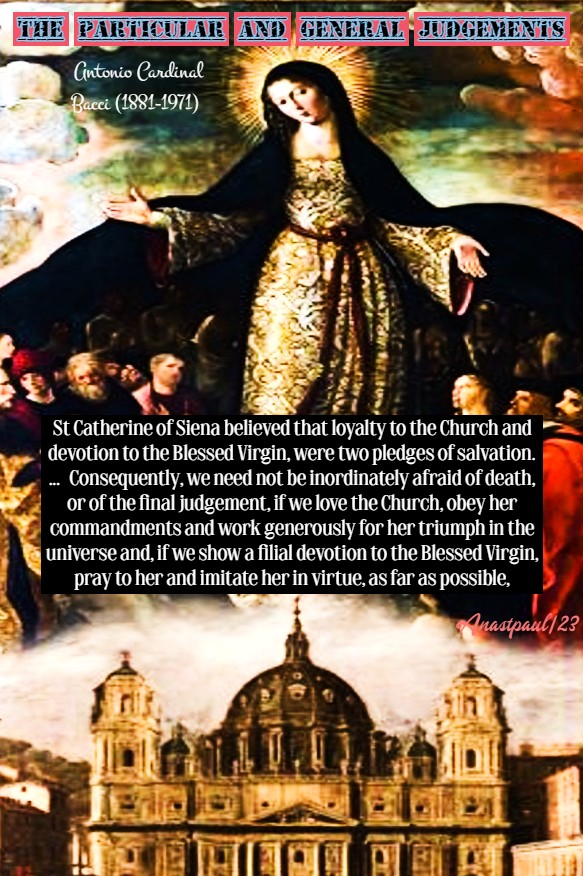
The Particular and General Judgements
“St Catherine of Siena believed that loyalty to the Church and devotion to the Blessed Virgin, were two pledges of salvation. In one of her letters she wrote that “he will not die forever, who serves the Church faithfully.” Elsewhere she said that “out of reverence for the Word, the Divine Goodness has granted Our Lady, the privilege that any man, good or sinful, who pays her due honour, will not be taken captive by the devil.” Consequently, we need not be inordinately afraid of death, or of the final judgement, if we love the Church, obey her commandments and work generously for her triumph in the universe and, if we show a filial devotion to the Blessed Virgin, pray to her and imitate her in virtue, as far as possible,
It will be profitable for us to think about death and the last judgement (Cf Ecclus 7:36). It will moderate our impatience in tribulations and our inordinate pleasure in consolations. It will be a stimulus to perseverance in good actions.”
Quote/s of the Day – 11 January – Within the Octave if Epiphany
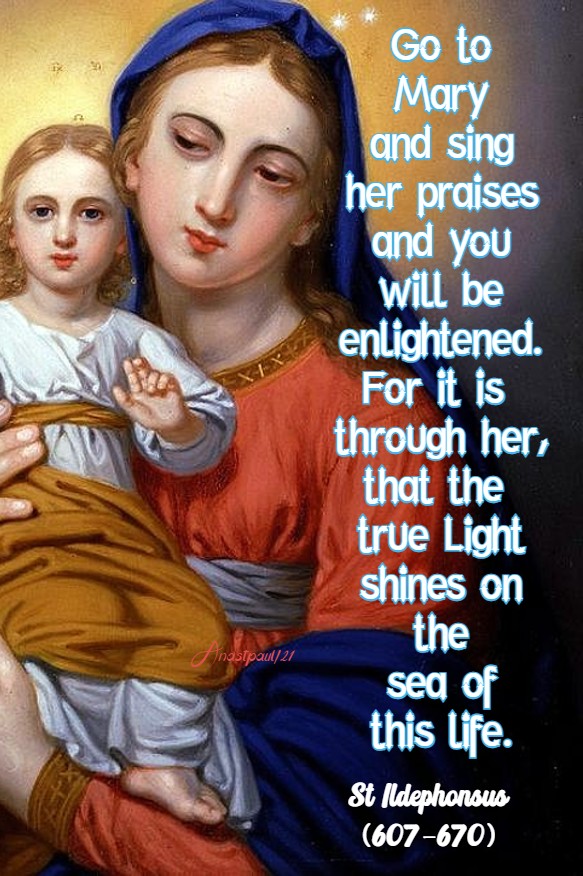
“Go to Mary and sing her praises and you will be enlightened. For it is through her, that the true Light shines on the sea of this life.”
St Ildephonsus (607-670)
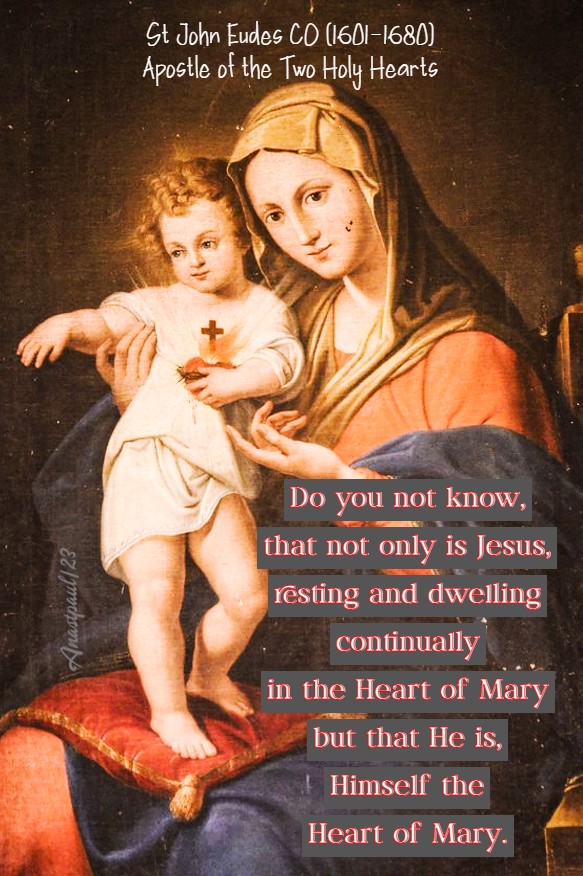
“Do you not know, that not only is Jesus, resting and dwelling continually in the Heart of Mary but that He is, Himself the Heart of Mary …”
St John Eudes CO (1601-1680) Apostle of the Two Holy Hearts
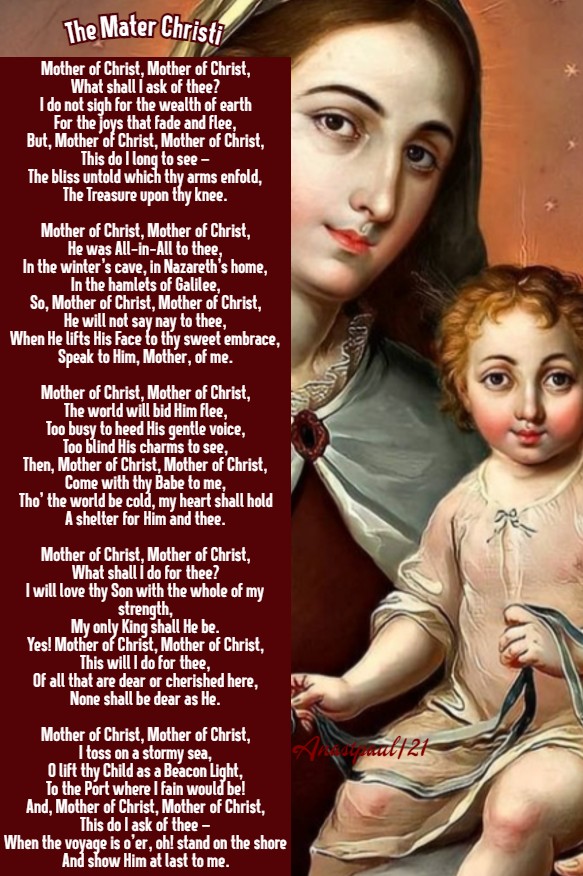
The Mater Christi Unknown Author
Mother of Christ, Mother of Christ, What shall I ask of thee? I do not sigh for the wealth of earth For the joys that fade and flee, But, Mother of Christ, Mother of Christ, This do I long to see — The bliss untold which thy arms enfold, The Treasure upon thy knee.
Mother of Christ, Mother of Christ, He was All-in-All to thee, In the winter’s cave, in Nazareth’s home, In the hamlets of Galilee, So, Mother of Christ, Mother of Christ, He will not say nay to thee, When He lifts His Face to thy sweet embrace, Speak to Him, Mother, of me.
Mother of Christ, Mother of Christ, The world will bid Him flee, Too busy to heed His gentle voice, Too blind His charms to see, Then, Mother of Christ, Mother of Christ, Come with thy Babe to me, Tho’ the world be cold, my heart shall hold A shelter for Him and thee.
Mother of Christ, Mother of Christ, What shall I do for thee? I will love thy Son with the whole of my strength, My only King shall He be. Yes! Mother of Christ, Mother of Christ, This will I do for thee, Of all that are dear or cherished here, None shall be dear as He.
Mother of Christ, Mother of Christ, I toss on a stormy sea, O lift thy Child as a Beacon Light, To the Port where I fain would be! And, Mother of Christ, Mother of Christ, This do I ask of thee — When the voyage is o’er, oh! stand on the shore And show Him at last to me.
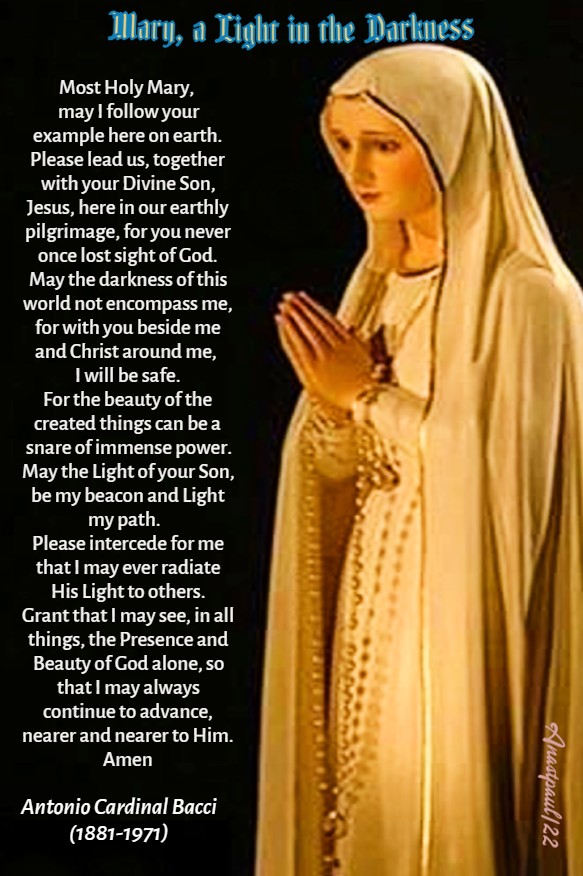
“Most Holy Mary, may I follow your example here on earth. Please lead us, together with your Divine Son, Jesus, here in our earthly pilgrimage, for you never once lost sight of God. May the darkness of this world not encompass me, for with you beside me and Christ around me, I will be safe. For the beauty of the created things can be a snare of immense power. May the Light of your Son, be my beacon and Light my path and intercede for me, that I may ever radiate His Light. Grant that I may see, in all things, the Presence and Beauty of God alone, so that I may always continue to advance, nearer and nearer to Him. Amen.”
One Minute Reflection – 11 January – “The Month of the Most Holy Name of Jesus” – Within the Octave of Epiphany – Isaias 60:1-6, Matthew 2:1-12 – Scripture search here: https://www.drbo.org/
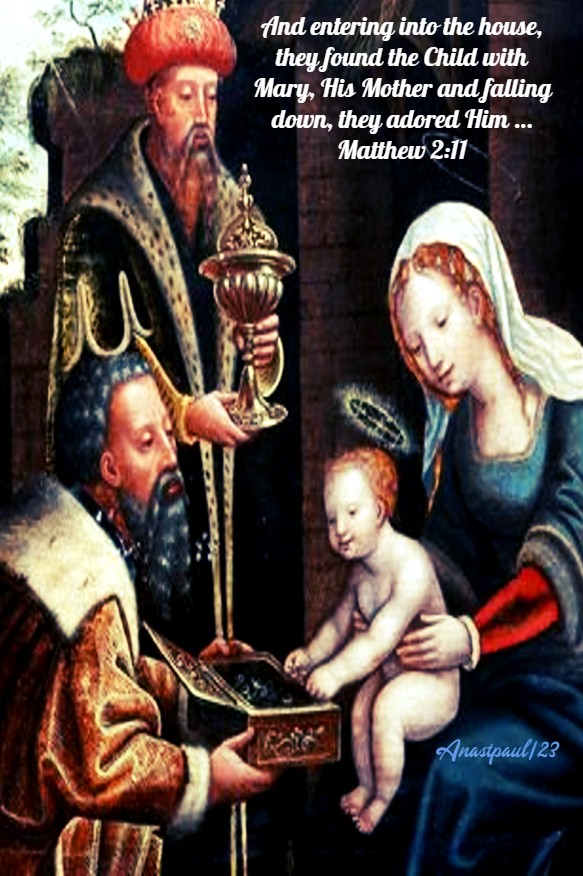
“And entering into the house, they found the Child with Mary, His Mother and falling down, they adored Him …” – Matthew 2:11
REFLECTION – “God’s intention was not only to come down to earth but to become known there; not only to be born but to be recognised. In fact, it is with this recognition in mind that we hold this celebration of the Epiphany, the great day of His manifestation. For it was today that the Magi came from the East in search of the Sun of Justice at its rising (Mal 3,20), He of Whom we read: “Behold a Man whose name is the Orient,” (Zec 6,12 Vul.). Today they have adored the Virgin’s newborn Child, following the guidance of a New Star. What great cause for joy do we not find here, my brethren, as also in those words of the Apostle Paul: “The kindness and generous love of God our Saviour have appeared,” (Tit 3,4)…
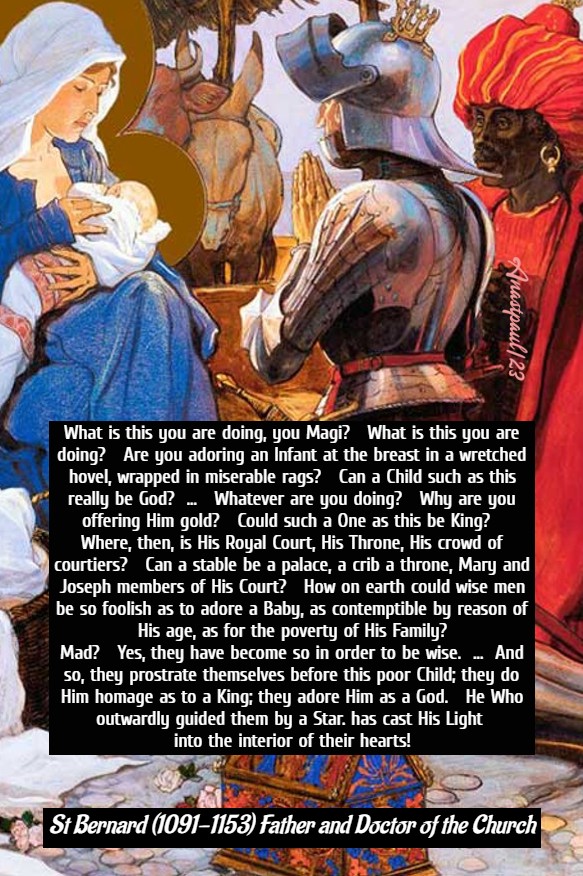
What is this you are doing, you Magi? What is this you are doing? Are you adoring an Infant at the breast in a wretched hovel, wrapped in miserable rags? Can a Child such as this really be God? Yet, “The Lord is in His holy temple, the Lord’s throne is in Heaven.” (Ps 11:4) while you are looking for Him in a common stable, held in His Mother’s arms! Whatever are you doing? Why are you offering Him gold? Could such a One as this be King? Where, then, is His Royal Court, His Throne, His crowd of courtiers? Can a stable be a palace, a crib a throne, Mary and Joseph members of His Court? How on earth could wise men be so foolish as to adore a Baby, as contemptible by reason of His age, as for the poverty of His Family?
Mad? Yes, they have become so in order to be wise. The Holy Spirit has taught them already what the Apostle Paul would later proclaim: “Whoever would be wise, let him become a fool. For since the world, in all its wisdom, did not come to know God in His Wisdom, it has pleased God to save those who believe, through the foolishness of the Gospel we proclaim, (cf 1 Cor 1:21)… And so, they prostrate themselves before this poor Child; they do Him homage as to a King; they adore Him as a God. He Who outwardly guided them by a Star, has cast His Light into the interior of their hearts!” – St Bernard (1091-1153) Cistercian Monk, Father and Doctor of the Church (1st Sermon for the Epiphany).
PRAYER – O God, Thou Who by the guidance of a star this day revealed Thy Only-begotten Son to the Gentiles, mercifully grant that we, who know Thee now by faith, may come to behold Thee in glory. Through the same Jesus Christ, Thy Son our Lord, Who lives and reigns with Thee, in the unity of the Holy Ghost, God, world without end. Amen (Collect).
Our Morning Offering – 11 January – Within the Octave of Epiphany – “The Month of the Most Holy Name of Jesus”
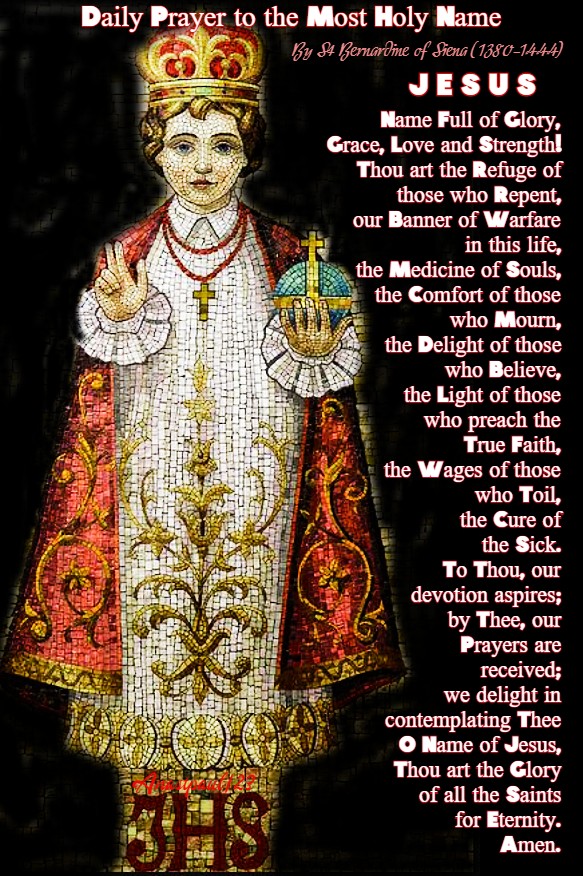
Daily Prayer to the Most Holy Name By St Bernardine of Siena (1380-1444) Apostle of the Most Holy Name
Jesus, Name full of glory, grace, love and strength! Thou art the Refuge of those who repent, our Banner of warfare in this life, the Medicine of souls, the Comfort of those who mourn, the Delight of those who believe, the Light of those who preach the true faith, the Wages of those who toil, the Cure of the sick. To Thou, our devotion aspires; by Thee, our prayers are received; we delight in contemplating Thee. O Name of Jesus, Thou art the glory of all the Saints for eternity. Amen.
Saint of the Day – 11 January – Saint Anastasius of Suppentonia (Died c 570) Monk, Abbot of the Monastery at Suppendonia, Italy. Died in c 570 at Suppentonia, Italy of natural causes. Patronage – of Castel Saint’Elia, Italy. Also known as – Anastasius of Castel Sant’Elia, Anastasius X.
The Roman Martyrology reads today: “At Suppentonia, near Mount Socrates, the holy Monk Anastasius and his companions, who were called by a voice from Heaven to enter the Kingdom of God.”
A source on Anastasius’ life is St Gregory the Great, who wrote that an Angel appeared to summon Anastasius and all of the Abbot’s Monks. Anastasius and all of his Monks all subsequently died one after the other within the next eight days.
St Nonnosus (Died c 570) Monk, was one of Anastasius’ Monks.
St Pope Hyginus (Died 142) Papal Ascension c 138. It is believed he was a Martyr for Christ and suffered during the persecution of Antoninus, although our ancient sources do not confirm this. Tradition holds that during his Papacy he determined the various prerogatives of the clergy and defined the grades of the ecclesiastical hierarchy. Hyginus also instituted Godparents at Baptism to assist the baptised during their Christian life. In addition, he decreed, that all Churches be Consecrated. His Life and Death: https://anastpaul.com/2022/01/11/saint-of-the-day-11-january-saint-pope-hyginus-died-142/
St Alexander of Fermo St Anastasius of Suppentonia (Died c 570) Monk, Abbot St Boadin of Ireland St Breandan of Ireland (the name is not an error) St Eithne St Fedelemia St Honorata of Pavia St Leucius of Alexandria St Leucius of Brindisi St Liberata of Pavia St Lucius the Soldier St Luminosa of Pavia St Mark the Soldier St Michael of Klopsk St Palaemon St Paldo St Peter Balsam St Peter of Alexandria St Peter of Anea St Peter the Soldier
Thought for the Day – 10 January – Meditations with Antonio Cardinal Bacci (1881-1971)
The Death of the Sinner as Opposed to the Death of the Just
“Now that we have witnessed these contrasting scenes, let us examine ourselves in the presence of God. Let each of us ask: What will be my fate? If we can rank ourselves amongst the just, let us thank God. We are not there on our own merits. “By the grace of God, I am what I am” (1 Cor 15:10).
Perhaps we need only reproach ourselves with some deficiency or weakness but, have at the same times, a strong desire to serve God and a great love for Him. In this case, we can take heart. We can cast ourselves into the merciful arms of God. But, if on the other hand, we are hardened and habitual sinners, then woe betide us! Perhaps this meditation is the last grace which God will bestow on us!”
Quote/s of the Day – 10 January – Within the Octave of Epiphany – Isaias 60:1-6, Matthew 2:1-12 – Scripture search here: https://www.drbo.org/
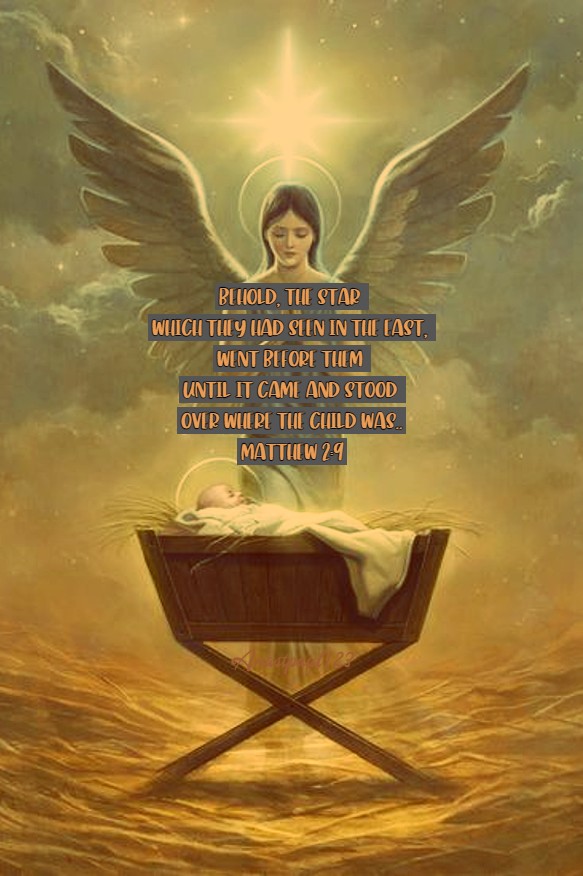
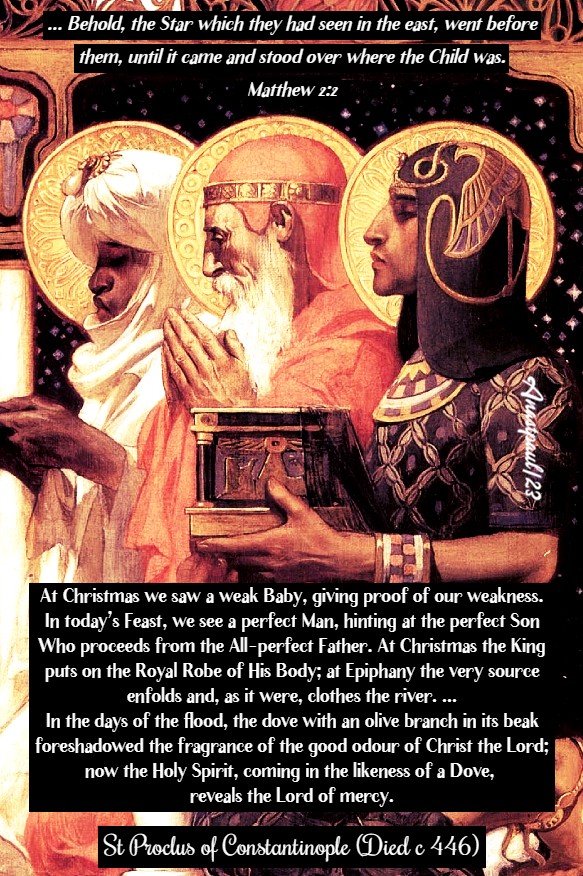
“Behold, the star which they had seen in the east, went before them until it came and stood over where the Child was…”
Matthew 2:9
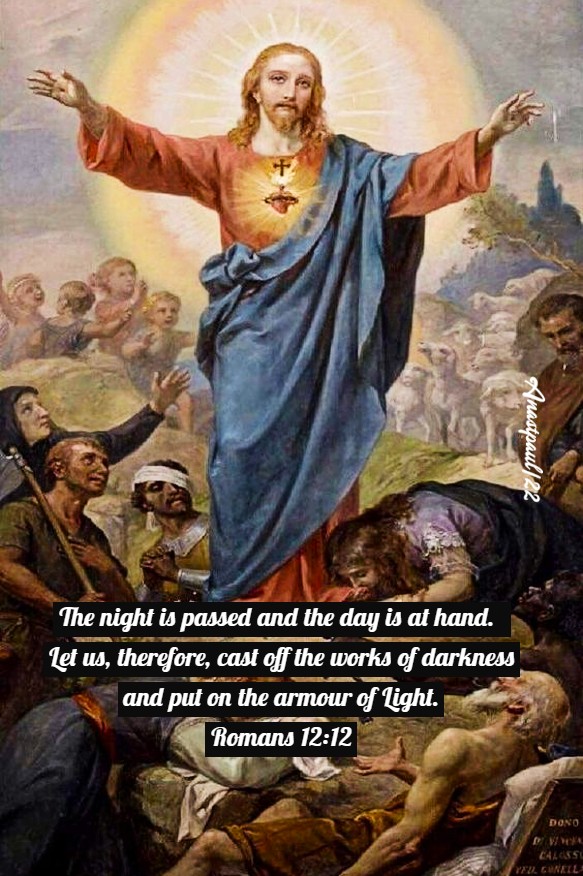
“The night is passed and the day is at hand. Let us, therefore, cast off the works of darkness and put on the armour of Light.”
Romans 12:12
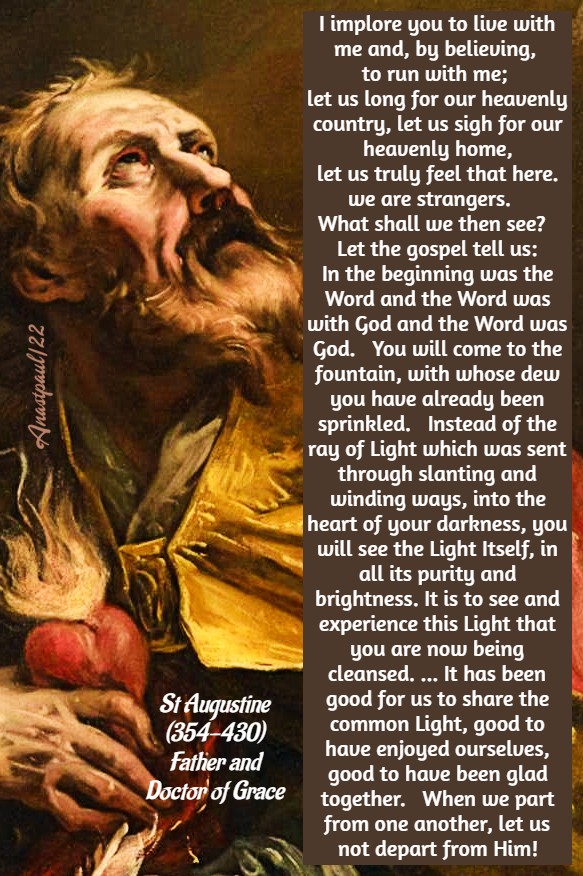
“I implore you to live with me and, by believing, to run with me; let us long for our Heavenly Country, let us sigh for our Heavenly Home, let us truly feel that here, we are strangers. What shall we then see? Let the gospel tell us: In the beginning was the Word and the Word was with God and the Word was God. You will come to the fountain, with whose dew you have already been sprinkled. Instead of the ray of Light which was sent through slanting and winding ways, into the heart of your darkness, you will see the Light Itself, in all its purity and brightness. It is to see and experience this Light that you are now being cleansed. … It has been good for us to share the common Light, good to have enjoyed ourselves, good to have been glad together. When we part from one another, let us not depart from Him!”
St Augustine (354-430) Father and Doctor of Grace
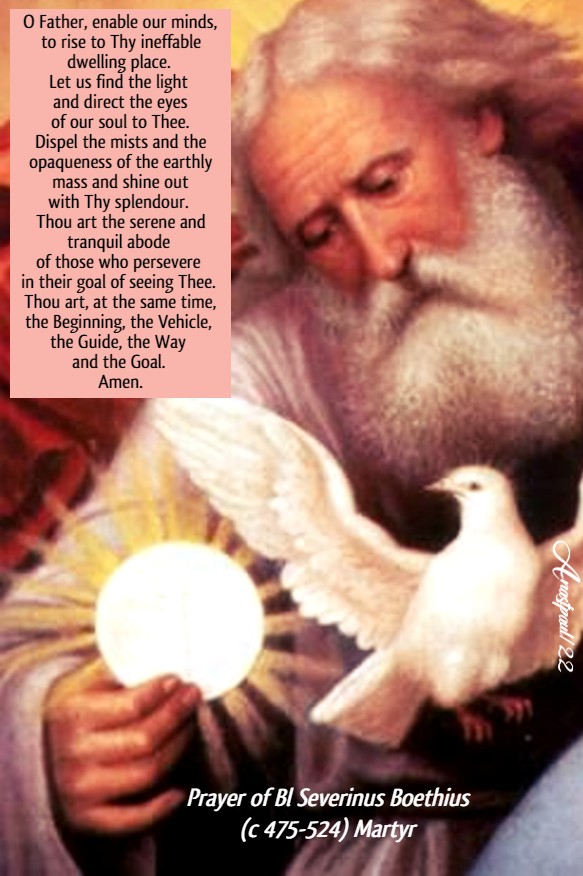
Prayer of Blessed Severinus Boethius (c 475-524) Martyr
“O Father, enable our minds, to rise to Thy ineffable dwelling place. Let us find the light and direct the eyes of our soul to Thee. Dispel the mists and the opaqueness of the earthly mass and shine out with Thy splendour. Thou art the serene and tranquil abode of those who persevere in their goal of seeing Thee. Thou art, at the same time, the Beginning, the Vehicle, the Guide, the Way and the Goal. Amen.”
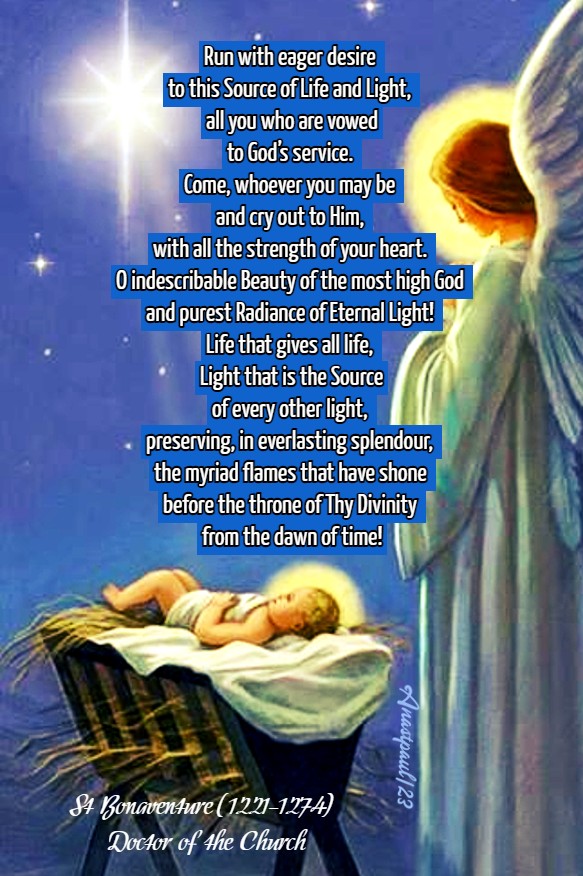
“Run with eager desire to this Source of Life and Light, all you who are vowed to God’s service. Come, whoever you may be and cry out to Him, with all the strength of your heart. O indescribable Beauty of the most high God and purest Radiance of Eternal Light! Life that gives all life, Light that is the Source of every other light, preserving, in everlasting splendour, the myriad flames that have shone before the throne of Thy Divinity from the dawn of time!”
One Minute Reflection – 10 January – “The Month of the Most Holy Name of Jesus” –Within the Octave of Epiphany – Isaias 60:1-6, Matthew 2:1-12 – Scripture search here: https://www.drbo.org/
“ … Behold, the Star which they had seen in the east, went before them, until it came and stood over where the Child was. ” – Matthew 2:9
REFLECTION – “Christ appeared in the world and, bringing beauty out of disarray, gave it lustre and joy. He bore the world’s sin and crushed the world’s enemy. He sanctified the fountains of waters and enlightened the minds of men. Into the fabric of miracles, He interwove ever greater miracles.
For on this day, land and sea share between them, the grace of the Saviour and the whole world is filled with joy. Today’s Feast of the Epiphany manifests even more wonders than the Feast of Christmas.
On the Feast of the Saviour’s birth, the earth rejoiced because it bore the Lord in a manger but on today’s Feast of the Epiphany, it is the sea that is glad and leaps for joy; the sea is glad because it receives the blessing of holiness in the river Jordan.
At Christmas we saw a weak Baby, giving proof of our weakness. In today’s Feast, we see a perfect Man, hinting at the perfect Son Who proceeds from the All-perfect Father. At Christmas the King puts on the Royal Robe of His Body; at Epiphany the very source enfolds and, as it were, clothes the river.
Come then and see new and astounding miracles – the Sun of Righteousness washing in the Jordan, fire immersed in water, God sanctified by the ministry of man.
Today every creature shouts in resounding song – Blessed is He who comes in the name of the Lord. Blessed is He who comes in every age, for this is not His first coming. And Who is He? Tell us more clearly, I beg you, blessed David – the Lord is God and has shone upon us. David is not alone in prophesying this; the Apostle Paul adds his own witness, saying: the grace of God has appeared, bringing salvation for all men and instructing us. Not for some men but for all. To Jews and Greeks alike God bestows salvation through Baptism, offering Baptism as a common grace for all.
Come, consider this new and wonderful deluge, greater and more important than the flood of Noah’s day. Then, the water of the flood destroyed the human race but now, the water of Baptism has recalled the dead to life, by the power of the One Who was Baptised. In the days of the flood, the dove with an olive branch in its beak foreshadowed the fragrance of the good odour of Christ the Lord; now the Holy Spirit, coming in the likeness of a Dove, reveals the Lord of mercy.” – St Proclus of Constantinople (Died c 446) Confessor, Archbishop of Constantinople, Father (An excerpt from On the Holy God-showing, Sermon 7)
PRAYER – O God, Thou Who by the guidance of a star this day revealed Thy Only-begotten Son to the Gentiles, mercifully grant that we, who know Thee now by faith, may come to behold Thee in glory. Through the same Jesus Christ, Thy Son our Lord, Who lives and reigns with Thee, in the unity of the Holy Ghost, God, world without end. Amen (Collect).
Our Morning Offering – 10 January – Within the Octave of Epiphany – “The Month of the Most Holy Name of Jesus”
Beloved and Most Holy Word of God By St James of the Marches (1391-1476)
Beloved and most holy Word of God! You enlighten the hearts of the faithful, You satisfy the hungry, console the afflicted. You make the souls of all, productive of good and cause all virtues to blossom. You snatch souls from the devil’s jaw. You make the wretched holy and men of earth, citizens of Heaven! Amen
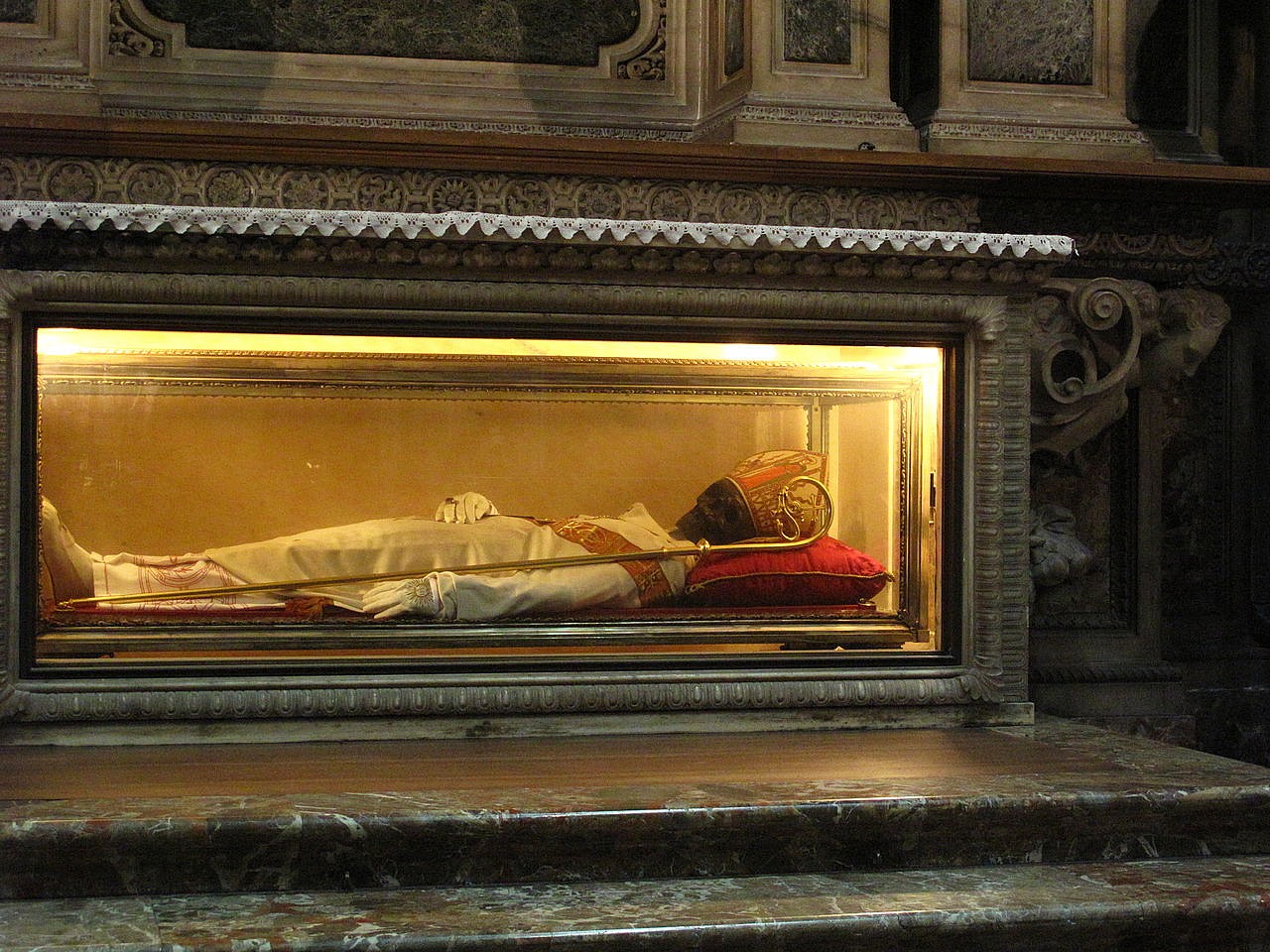
Saint of the Day – 10 January – St John Camillus the Good (Died c 669) Confessor, Archbishop of Milan from c. 641 until his death. Known as “the Good” for his great charity and generosity, his holiness, devotion and his many miracles. Additional Memorials – 2 January on some calendars, 15 January in Milan and 25 September together with all the Saint Bishops of Milan. Also known as – John Bonus, John Camillus, John the Good of Milan, Giovanni Bonus.
The Bishop of Milan, Honoratus, escaped to Genoa and Honoratus’ successors remained in Genoa. Genoa was then a suffragan Diocese of Milan. There, John the Good, is particularly remembered for being the first Bishop to return the Seat to Milan after more than 70 years absence.
John the Good was born in the Diocese of Genoa in the village of Recco (also the nearby town of Camogli claims the birth of John). It is not exactly known when he became Bishop of Milan but it is believed that his election was in consequence of the 641 conquest of Genoa by the Lombard’s King Rothari. John was the Bishop who returned the Seat and See of the Diocese to Milan.
There are two main sources for John’s life – the Catalogue of the Bishops of Milan (dated about the 10th Century) and a poem in his honour which can be dated from the 11th to the 13th Century. According to this Poem/Vita, John was distinguished for his generosity and charity, from which he was given the sobriquet “the Good.”
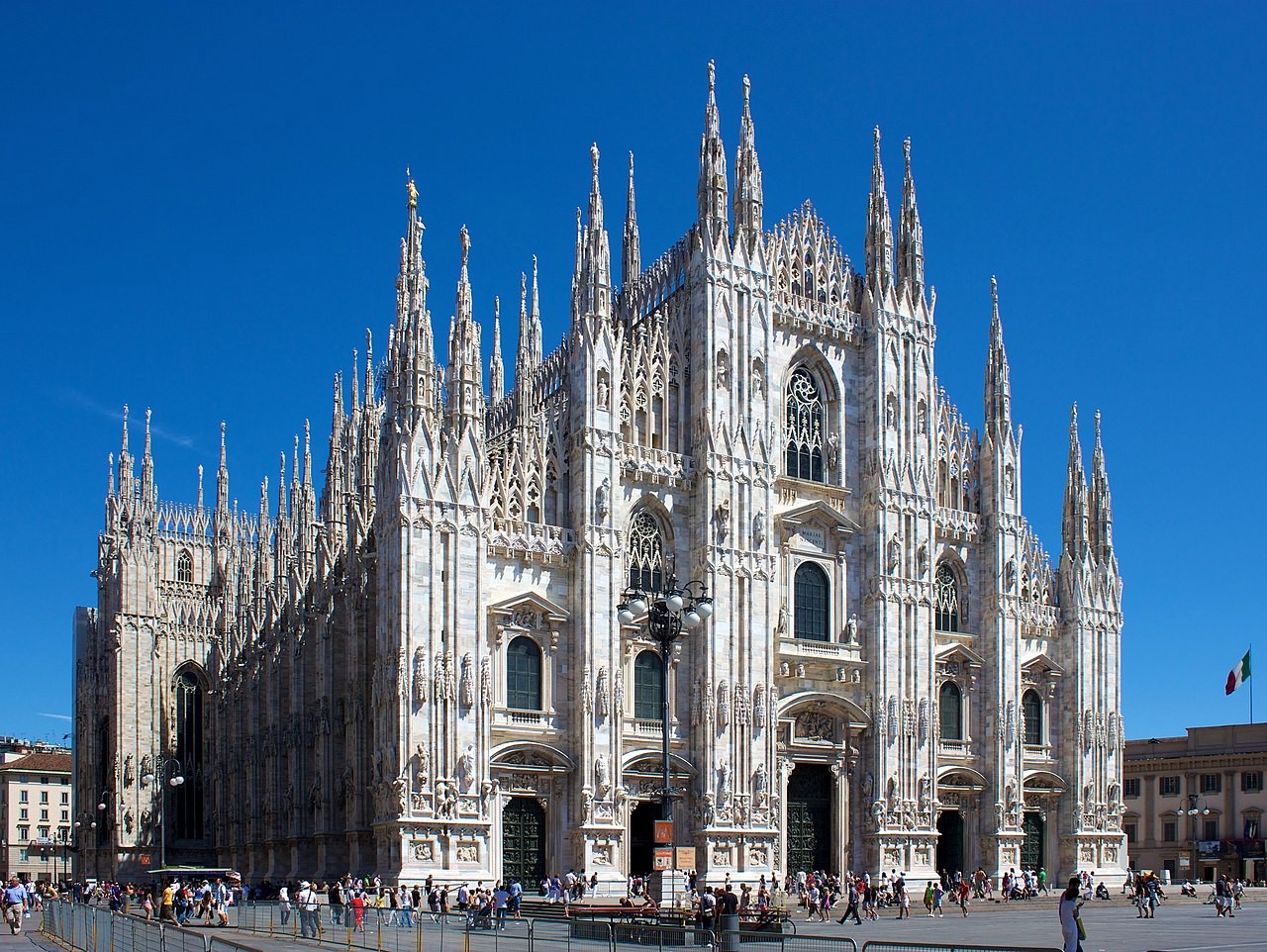
The Alter erected by St Charles Borromeo in Milan Cathedral. The immense windows beside it depict the life of St John the Good
In 649, John was invited to participate to the Lateran Council but he arrived in Rome when the Council had already ended. He, however, subscribed to all the Decrees issued by the Council.
According to the Vita, he accomplished many miracles and moved some of the Relics of Saint Syrus of Genoa to Desio. He died in c 669 leaving all his properties, including estates in Genoa, to the Church of Milan.
John’s body was initially buried in the little Church of Saint Michael in Milan and the first survey on his Relics was made by Archbishop Aribert (1018–1045). On 24 May 1582, shortly before the demolition of the Church of St Michael, Cardinal Saint Charles Borromeo translated John’s body to the south transept of the Cathedral of Milan, where it is still venerated. Our Saint John the Good, was a tall man, his body measures 1.90 metres (6 ft 3 in) in height.
John died on 2 January according to the catalogue, or on 10 January according to the Poem Vita. The latter date became his Feast day. Today, his Feast is celebrated on 2 January, or on 10 January where he is still listed for this date in the Roman Martyrology (or 15 January in the Cathedral of Milan and together with all the Saint Bishops of Milan on 25 September).
Blessed Giles of Lorenzana OFM (1443-1518) Lay Brother of the Friars Minor.
St John Camillus the Good (Died c 669) Confessor, Bishop of Milan St Maurilius of Cahors St Nicanor of Cyprus
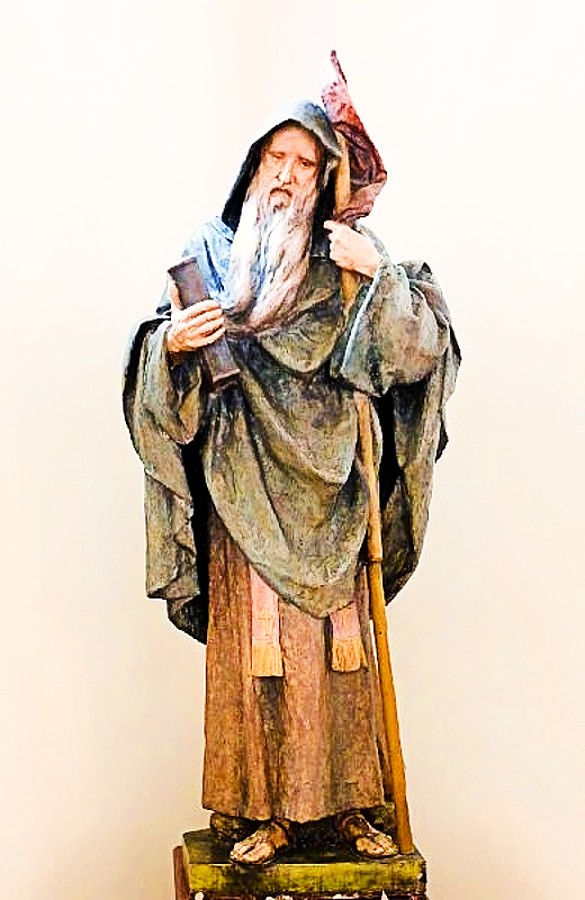
St Paul the Hermit (c 230-342) The First Desert Hermit “In Thebais, the birthday of St Paul, the first Hermit, who lived alone in the desert from the sixteenth to the one hundred and thirteenth year of his age. His soul was seen by St Anthony Abbot, carried by Angels among the choirs of Apostles and Prophets. His Feast is celebrated on the 15th day of this Month.” (Roman Martyrology).
Thought for the Day – 9 January – Meditations with Antonio Cardinal Bacci (1881-1971)
DEATH
“The greatest lesson in life springs from reflection on death. Whoever does not learn, how to live, from death, will never learn anything from anybody!
We MUST DIE and we DIE ONLY ONCE. This is a test which we shall never have a chance to repeat! This thought should inspire in us a healthy fear of sin and an ardent desire to be more closely united with God and more faithful in the observance of His law.
As a special fruit of this mediation, let us form the resolution of asking for the last Sacraments at the hour of death, instead of waiting until our relatives are obliged to exhort us to receive them. It is not a sentence but a gift, for which we ask. It is the greatest gift which God’s mercy could grant us in that final and decisive moment of our lives .
There is another resolution which we ought to make. We should live everyday as if it were our last but, we should work as tirelessly as if we never had to die!”
Quote/s of the Day – 9 January – The Holy Family – Within the Octave of Epiphany – Colossians 3:12-17, Luke 2:42-52 – Scripture search here: https://www.drbo.org/
“But put on the Lord Jesus Christ.”
Romans 13:14
“You are walking now by faith, still on pilgrimage in a mortal body away from the Lord but He, to Whom your steps are directed, is Himself the sure and certain Way for you – Jesus Christ, Who, for our sake became man. For all who fear Him, He has stored up abundant happiness which He will reveal to those who hope in Him, bringing it to completion, when we have attained the reality which, even now, we possess, in hope. Set your hearts on heavenly things, not the things that are on earth. For you have died and your life is hidden with Christ in God. When Christ, your Life, appears, then you too will appear with Him in glory.”
St Augustine (354-430) Father and Doctor of Grace
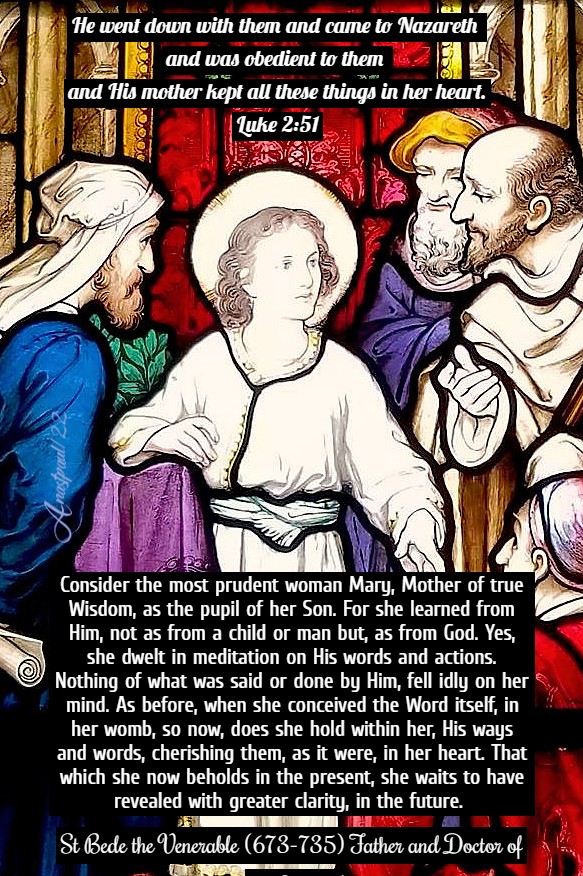
“And His Mother kept all these words in her heart.”
Luke 2:51
“Consider the most prudent woman Mary, Mother of true Wisdom, as the pupil of her Son. For she learned from Him, not as from a child or man but as from God. Yes, she dwelt in meditation on His words and actions. Nothing of what was said or done by Him, fell idly on her mind. … That which she now beholds in the present, she waits to have revealed with greater clarity, in the future.”
St Bede the Venerable (673-735) Father and Doctor of the Church
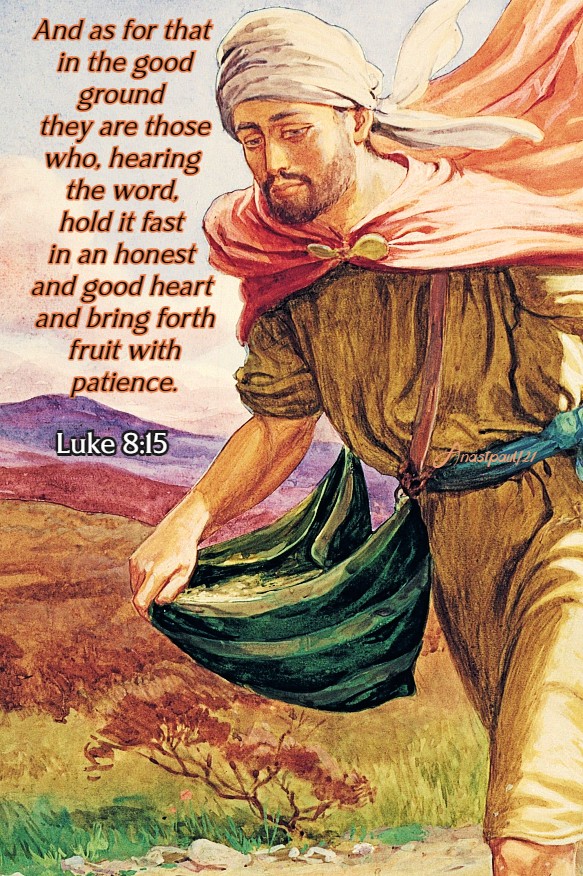
“And as for that in the good ground they are those who, hearing the word, hold it fast in an honest and good heart and bring forth fruit with patience.”
Luke 8:15
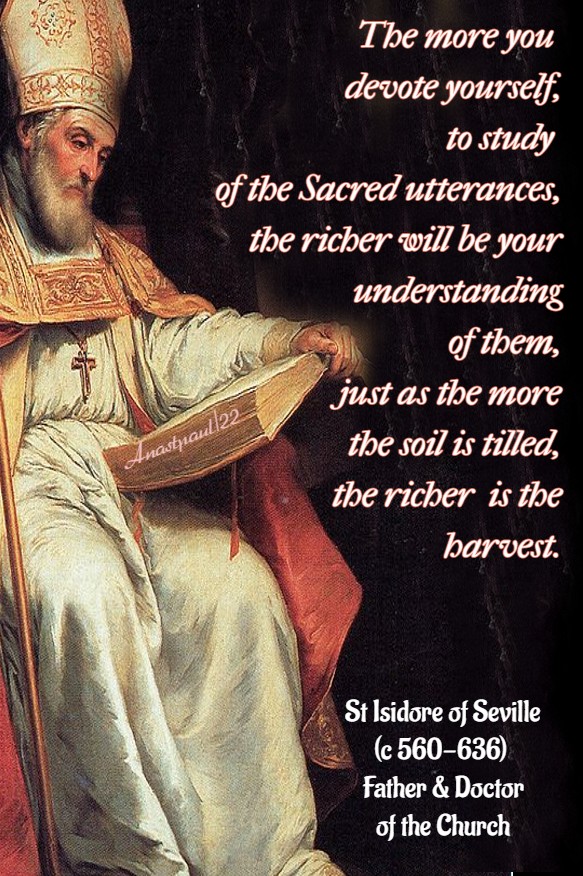
“The more you devote yourself, to study of the Sacred utterances, the richer will be your understanding of them, just as the more the soil is tilled,, the richer is the harvest.”
St Isidore of Seville (c 560-636) Father & Doctor of the Church
Be Thou My Vision By St Dallan Forgaill (c 530- 598)
Be Thou my vision, O Lord of my heart; Naught be all else to me, save that Thou art. Thou my best thought by day or by night, Waking or sleeping, Thy presence my Light.
Be Thou my Wisdom and Thou my true Word; I ever with Thee and Thou with me, Lord. Thou my great Father, I Thy true son; Thou in me dwelling and I with Thee one.
Be Thou my battle-shield, sword for my fight, Be Thou my dignity, Thou my delight. Thou my soul’s shelter, Thou my high tower. Raise Thou me heavenward, O Power of my power.
Riches I heed not, nor man’s empty praise, Thou mine inheritance, now and always. Thou and Thou only, first in my heart, High King of Heaven, my Treasure Thou art.
High King of Heaven, my victory won, May I reach Heaven’s joys, O bright Heaven’s Son, Heart of my heart, whatever befall Still be my vision, O ruler of all.
One Minute Reflection – 9 January – The Holy Family – Within the Octave of Epiphany – Colossians 3:12-17, Luke 2:42-52 – Scripture search here: https://www.drbo.org/
“And His Mother kept all these words in her heart.” – Luke 2:51
REFLECTION – “Often, it seems to us, Mary forgot to eat and to drink, keeping vigil in order to think about Christ, to see Christ in His flesh. She burned with love of Him and passionately loved to serve Him. She often did what the Song of Songs sings about: “I was sleeping but my heart kept vigil.” (Song 5:2) Even when she was resting, she continued to dream of Him Who filled her thoughts throughout the day. Whether she was keeping vigil or resting in peace, she always lived in Him, was always occupied with Him.
Where her treasure was, there also was her heart (Mt 6:21); where her glory was, there also was her mind. She loved her Lord and her Son with all her heart, with all her mind, with all her strength (Mt 22:37). She saw with her eyes, touched with her hands, the Word of Life (1 Jn 1:1). How blessed was Mary, to whom it was given to embrace Him who embraces and nourishes everything! How happy was she, who carried Him, Who carries the universe (Heb 1:3), she, who nursed a Son, Who gives her life, a Son Who nourishes her and all beings on earth (Ps 145:15).
The One Who is the Wisdom of the Father, put His arms around her neck, the One Who is the strength, that gives movement to everything, sat in her arms. He Who is the rest of souls, (Mt 11:29) rested on her motherly breast. How gently He held her in His hands, peacefully looked at her, He Whom the angels wish to contemplate (1 Pet 1:12) and He gently called her, He Whom every being calls upon when in need. Filled with the Holy Spirit, she held Him close to her heart … She never had enough of seeing Him or of hearing Him, Whom “many prophets and kings wished to see … but did not see.” (Lk 10:24) Thus Mary grew evermore in love and her mind was unceasingly attached to Divine contemplation.” – St Amadeus of Lausanne (1108-1159) Bishop (Homily on the Motherhood of Mary, 4).
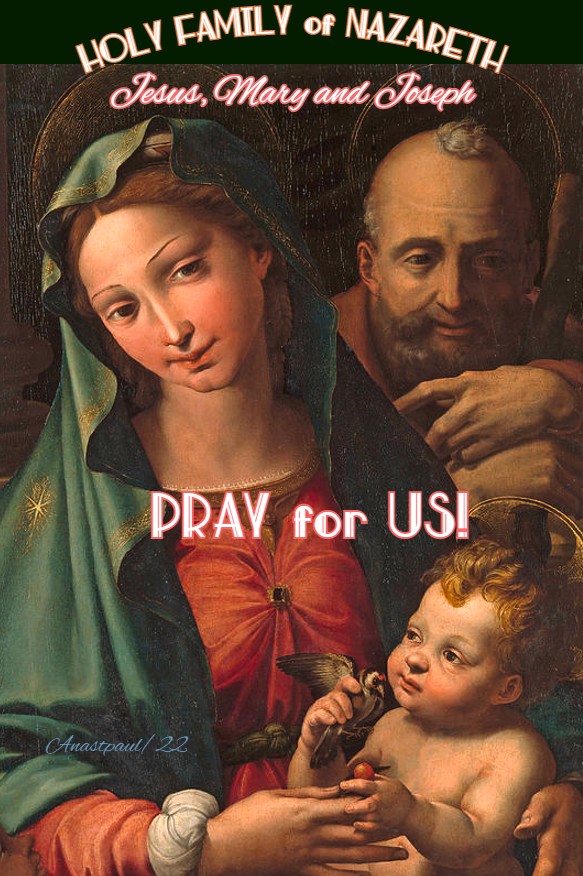
PRAYER – O Lord Jesus Christ, Thou Who while subject to Mary and Joseph, hallowed family life with virtues beyond description, grant us by their combined intercession, that, having been taught by the example of the Holy Family, we may attain unto their everlasting companionship. Through the same Jesus Christ, Thy Son our Lord, Who lives and reigns with Thee, in the unity of the Holy Ghost, God, world without end. Amen (Collect).
Our Morning Offering – 9 January – The Holy Family – Within the Octave of Epiphany
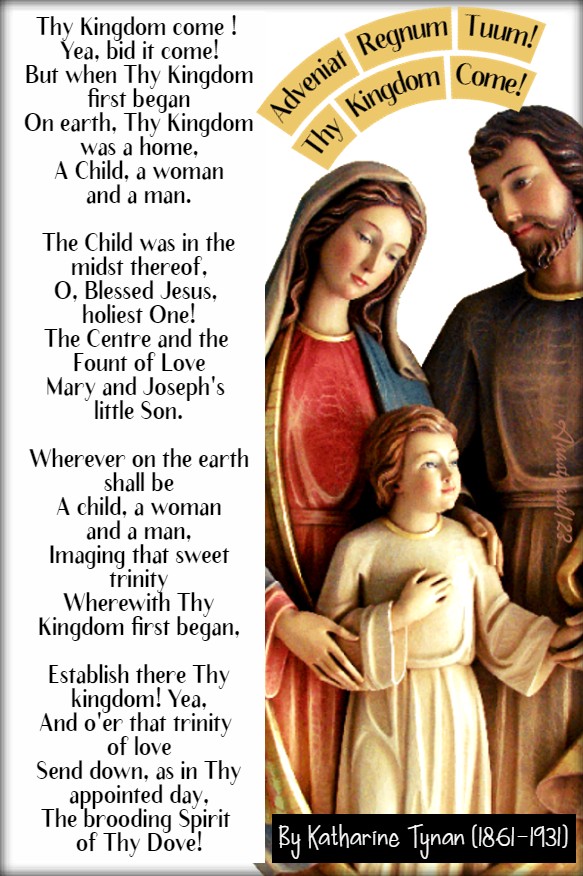
Adveniat Regnum Tuum! Thy Kingdom Come! By Katharine Tynan (1861-1931)
Thy Kingdom come ! Yea, bid it come! But when Thy Kingdom first began On earth, Thy Kingdom was a home, A Child, a woman and a man.
The Child was in the midst thereof, O, Blessed Jesus, holiest One! The Centre and the Fount of Love Mary and Joseph’s little Son.
Wherever on the earth shall be A child, a woman and a man, Imaging that sweet trinity Wherewith Thy Kingdom first began,
Establish there Thy kingdom! Yea, And o’er that trinity of love Send down, as in Thy appointed day, The brooding Spirit of Thy Dove!
Katharine Tynan (1861-1931) was an Irish born Poet and Writer and a friend of the Jesuit Poet, Fr Gerard Manley Hopkins. She contributed to many periodicals and magazines such as the Jesuit published Studies, the Dominican published Irish Rosary, Irish Monthly, Hibernia and Dublin University Review, besides her own private publications. After her marriage, the addition of her husband’s name, “Hinkson” is often appended to her publications.
Saint of the Day – 9 January – Saint Waningus of Fécamp (Died c 688) Monk, Abbot, Count and Royal Official , husband and father of Saint Desiderius of Fontenelle. widower. Born in Rouen, France and died in c 688 of natural causes. Also known as – Waningus of Ham, Vaneng, Waneng, Wanging, Waning, Wanning. Additional Memorials – 31 January (Normandy, France), 15 February (Rouen, France), 23 September (translation of relics).
Born in Rouen, Waningus was Governor of the Pays de Caux in Neustria., N ormandy, at which time he took great pleasure in hunting. Nevertheless, he was very pious and particularly devout to Saint Eulalia of Barcelona.
One night he dreamt that she reminded him of the difficulties the rich had in entering Heaven. He heard that holy Virgin and Martyr repeat to him those words of our blessed “it is easier for a camel to pass through the eye of a needle, than for a rich man to be saved.”
Soon after, around 648, Waningus withdrew from Court to assist St Wandrille in founding Fontenelle Abbey and in building the Churches of Saints Peter and Paul.
About ten years later, after recovering from a serious illness, Waningus founded the Church of the Holy Trinity and the adjoining Abbey of the Holy Trinity at Fécamp for nuns. under the direction of Saint Owen and Saint Waningus as Abbot. He sheltered Saint Leodegarius when he was being pursued by his enemies.
This Saint is titular Patron of several Churches in Aquitain and Normandy and has given his name to the village of Saint Vaneng. His body is possessed in a rich Shrine, in the abbatial Church of our Lady at Ham, in Picardy, belonging to the regular canons of Saint Augustine.
The Abbey of the Holy Trinity in Fécamp (see below) was honoured by the Dukes of Normandy above all their other Monasteries and is the richest and most magnificent Abbey in Normandy.
Waningus entrusted his son, St Desiderius (died c 700) to be educated by the Abbot of Fontenelle. Desiderius later became a Monk at the Abbey. His Feast Day is kept on 18 December; his Relics are at Ghent, Belgium.
St Marcellinus of Ancona St Marciana Bl Martinus In Eon-min St Maurontius St Nearchus St Paschasia of Dijon
St Peter of Sebaste (c 340-c 391) Bishop of Sebaste in Lesser Armenia. Member of the glorious family of Saints – He was the younger brother of Basil of the Great, Gregory of Nyssa, the famous Christian Hermit Naucratius and Macrina the Younger and a close friend of Gregory of Nazianzen, all Saints. Of course, Basil and Gregory of Nazianzen are both Doctors too. About St Peter: https://anastpaul.com/2021/01/09/saint-of-the-day-9-january-st-peter-of-sebaste-c-340-c-391-bishop/
St Philip Berruyer St Polyeucte St Waningus of Fécamp (Died c 688) Monk, Abbot
Martyrs of Africa – 21 Saints: A group of 21 Christians murdered together for their faith in the persecutions of Decius. The only details to survive are 14 of their names – Artaxes, Epictetus, Felicitas, Felix, Fortunatus, Jucundus, Pictus, Quietus, Quinctus, Rusticus, Secundus, Sillus, Vincent and Vitalis. They were Martyred in c 250.
Martyrs of Antioch – 6 Saints: A group of Christians Martyred together during the persecutions of Diocletian – Anastasius, Anthony, Basilissa, Celsus, Julian and Marcionilla.
Thought for the Day – 8 January – Meditations with Antonio Cardinal Bacci (1881-1971)
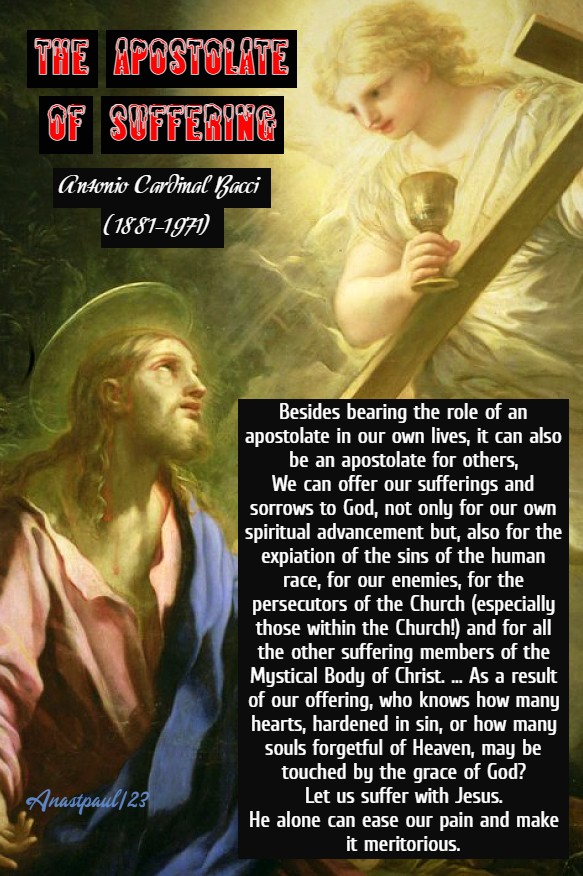
The Apostolate of Suffering
The Agony in the Garden by Luca Giordono (1634-1705) Naples, Italy
“Suffering has a still further purpose. Besides bearing the role of an apostolate in our own lives, it can also be an apostolate for others, We can offer our sufferings and sorrows to God, not only for our own spiritual advancement but, also for the expiation of the sins of the human race, for our enemies, for the persecutors of the Church (especially those within the Church!) and for all the other suffering members of the Mystical Body of Christ. In this way, we can accomplish great good and can acquire great merit before God.
As a result of our offering, who knows how many hearts, hardened in sin, or how many souls forgetful of Heaven, may be touched by the grace of God? Let us suffer with Jesus. He alone can ease our pain and make it meritorious.”
Quote/s of the Day – 8 January – The Holy Family – Sunday within the Octave of Epiphany – Colossians 3:12-17, Luke 2:42-52 – Scripture search here: https://www.drbo.org/
“And He went down with them and came to Nazareth and was subject to them.”
Luke 2:51
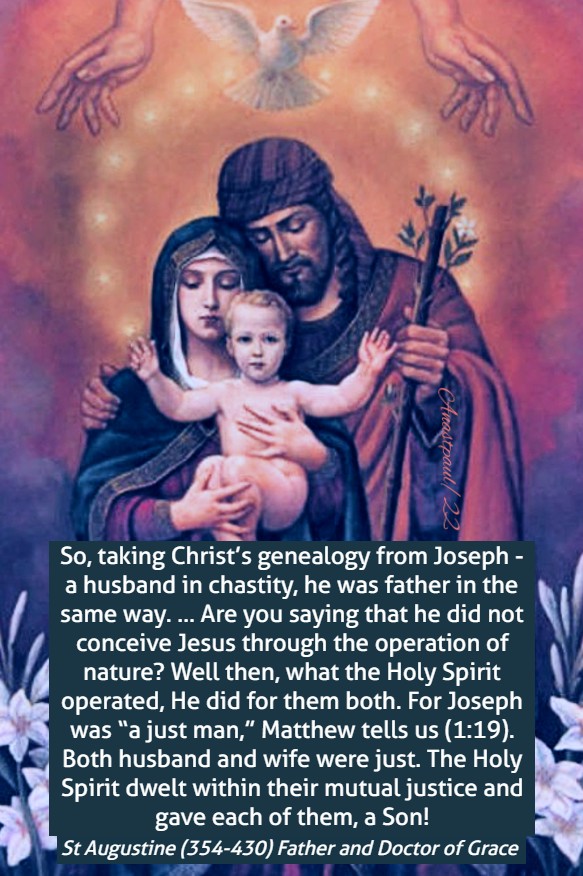
“So, taking Christ’s genealogy from Joseph – a husband in chastity, he was father in the same way. … Are you saying that he did not conceive Jesus through the operation of nature? Well then, what the Holy Spirit operated, He did for them both. For Joseph was “a just man,” Matthew tells us (1:19). Both husband and wife were just. The Holy Spirit dwelt within their mutual justice and gave each of them, a Son!”
St Augustine (354-430) Father and Doctor of Grace
(Marriage and concupiscence 1,11; Sermon 51)
“God, to whom angels submit themselves and who principalities and powers obey, was subject to Mary and not only to Mary but Joseph atoo, for Mary’s sake [….]. God obeyed a human creature – this is humility without precedent. A human creature commands God; it is sublime beyond measure!”
St Bernard (1090-1153) Father and Doctor of the Church
O Gente Felix O House of Nazareth The Blest By Pope Leo XIII (1810-1903)
O house of Nazareth the blest, Fair hostess of the Lord, The Church was nurtured at thy breast And shared thy scanty hoard.
In all the spreading lands of earth. The wandering sun may see No dearer spot, no ampler worth Than erst was found in thee!
We know thy humble tenement Was heaven’s hermitage: Celestial heralds came and went In endless embassage.
There, whatsoever Joseph asks Christ hastens to fulfil; While Mary loves the household tasks That wait her joyous will.
There, Joseph toileth at her side Her joys and griefs to share, With thousand ties knit to his bride, Of love and work and prayer.
Yet how their bosoms constant burn And deeper ardours prove In love of Christ, whose eyes return Tokens of mutual love.
O then, in all the homes of earth, Be Love the bond of life: May it enthrone at every hearth The peace that husheth strife.
All praise to thee, O Jesus, Who parents dost obey; Praise to the sovereign Father And Paraclete for aye. Amen.
One Minute Reflection – 8 January – The Holy Family – Sunday within the Octave of Epiphany – Colossians 3:12-17, Luke 2:42-52 – Scripture search here: https://www.drbo.org/
“And He went down with them and came to Nazareth and was subject to them.” – Luke 2:51
REFLECTION – “He was subject to them.” With these words let all pride dissolve, all rigidness crumble, all disobedience submit. “He was subject to them.” Who? In brief, He Who created all things from nothing; He Who, as Isaiah says, “has cupped in His Hand the waters of the sea and marked off the heavens with a span; Who has held in a measure the dust of the earth, weighed the mountains in scales and the hills in a balance” (40:12). He Who, as Job says, “shakes the earth and the pillars beneath it tremble. He commands the sun and seals up the stars. He alone stretches out the heavens and treads upon the crests of the sea; He Who made the constellations; He does marvellous things beyond reckoning” (9:6-10)… This is He who, great and powerful though He be, was subject. And subject to whom? To a workman and a poor young maid.
O “First and Last”! (Apoc 1:17). O Leader of Angels, subject to men! The Creator of Heaven, subject to a workman; God of eternal glory, subject to a poor young maid! Has anyone ever seen anything like this? Has anyone heard such a thing before?
So no longer hesitate to obey or be submissive… Come down, come to Nazareth, be subject, obey perfectly: all Wisdom lies in this… This is what it means to be soberly wise. Simplicity that is pure, is “like the waters of Shiloah that flow silently” (Is 8:6). There are people of wisdom within religious orders but it is by means of simple men that God brought them there. God chose the foolish and weak, the lowly and ignorant to bring together those who were wise, powerful and of noble birth through them, “so that no human being might boast in itself” (cf 1 Cor 1:26-29) but in Him Who came down, Who came to Nazareth,and Who was subject!” – St Anthony of Padua (1195-1231) Franciscan, Doctor of the Church (Sermons for Sundays and Feasts of the Saints).
PRAYER – O Lord Jesus Christ, Thou Who while subject to Mary and Joseph, hallowed family life with virtues beyond description, grant us by their combined intercession, that, having been taught by the example of the Holy Family, we may attain unto their everlasting companionship. Through the same Jesus Christ, Thy Son our Lord, Who lives and reigns with Thee, in the unity of the Holy Ghost, God, world without end. Amen (Collect).
Our Morning Offering – 8 January – Within the Octave of Epiphany
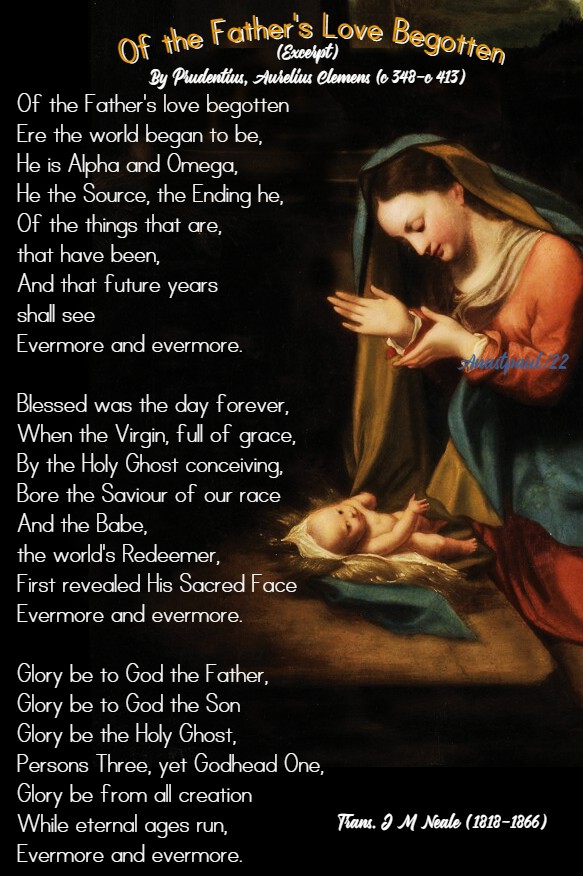
Of the Father’s Love Begotten (Excerpt) By Prudentius, Aurelius Clemens (c 348-c 413) Trans. J M Neale (1818-1866)
Of the Father’s love begotten Ere the world began to be, He is Alpha and Omega, He the Source, the Ending he, Of the things that are, that have been, And that future years shall see Evermore and evermore.
Blessed was the day forever, When the Virgin, full of grace, By the Holy Ghost conceiving, Bore the Saviour of our race And the Babe, the world’s Redeemer, First revealed His Sacred Face Evermore and evermore.
Glory be to God the Father, Glory be to God the Son Glory be the Holy Ghost, Persons Three, yet Godhead One, Glory be from all creation While eternal ages run, Evermore and evermore.
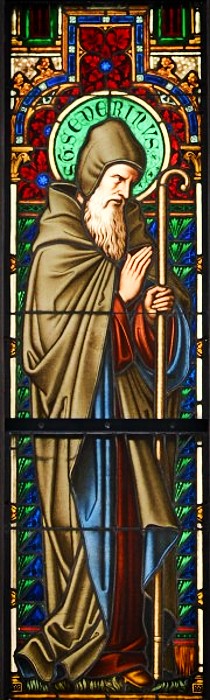
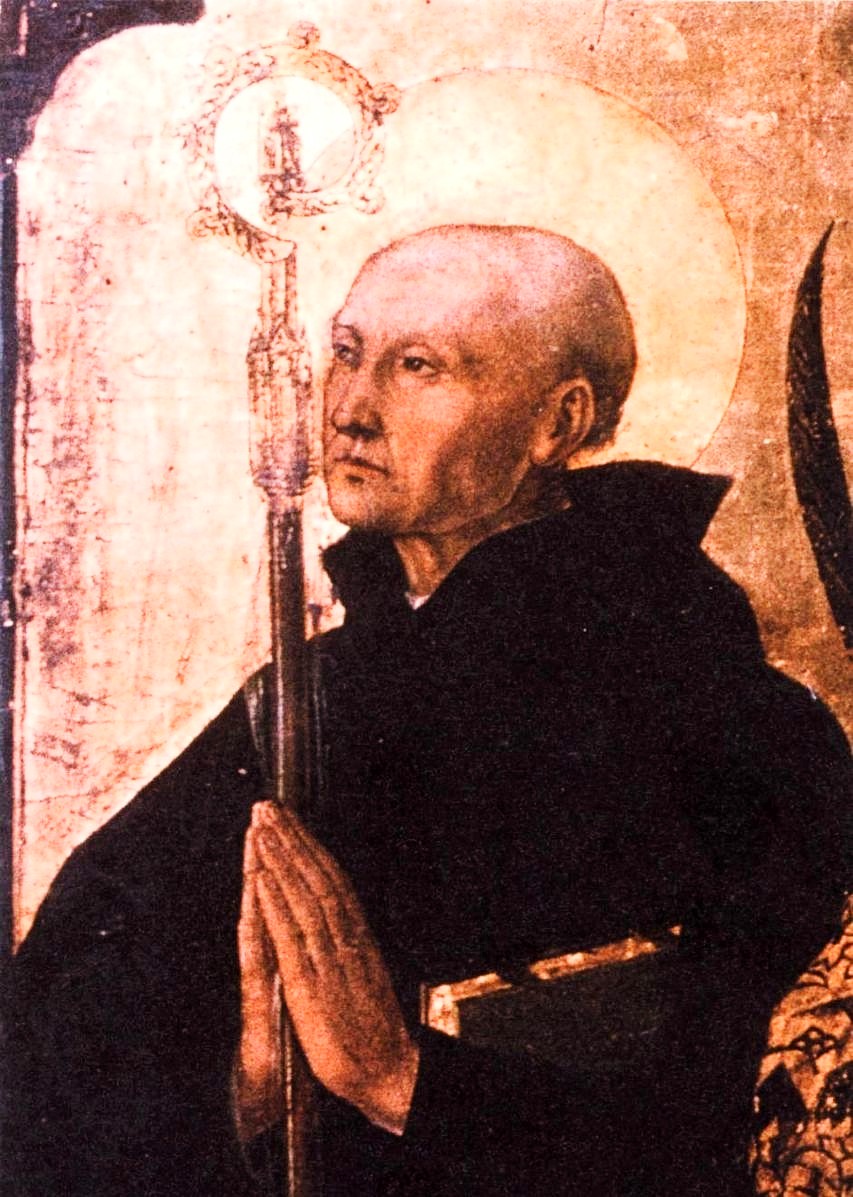
Saint of the Day – 8 January – Saint Severinus of Noricum (c410-482) Abbot, Hermit, Missionary, established Monasteries and refuge centres for those stricken by war. Severinus was graced with the gifts of prophecy and miracles. He is known as “The Apostle to Noricum” – Noricum is the Latin name for the Celtic Kingdom or Federation of Tribes which included most of modern Austria and part of Slovenia. Born in c410 and died on 8 January 482 at Favianae, Noricum of natural causes. Patronages – against famine, of linen weavers, prisoners, vineyards/vintners/wine farms, Austria, Bavaria, Germany, the Diocese of Linz, Austria. Also known as – Severrin, Severino.
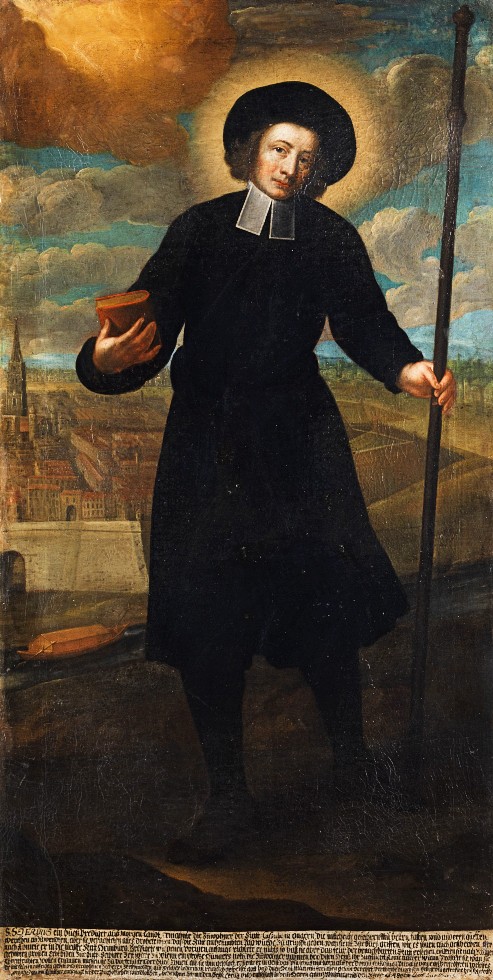
Saint Severin blesses Austria – Hans Gustav Dittenberger von Dittenberg, 1849
The Roman Martyrology reads today: “This same day, among the inhabitants of Noricum (now Austria), the Abbot, St Severin, who preached the Gospel in that country and is called it’s apostle. By Divine Power, his body was carried to Lucullanum, near Naples and thence transferred to the Monastery of St Severin.”
It has been speculated that Severinus was born in either Southern Italy or in the Roman province of Africa. Severinus himself refused to discuss his personal history prior to arriving along the Danube in Noricum. However, he did mention experiences with eastern desert monasticism and his Vita draws connections between Severinus and Saint Anthony of Lérins (c 428-c 520) https://anastpaul.com/2021/12/28/saint-of-the-day-28-december-saint-anthony-of-lerins-c-428-c-520/
Little is known of his origins. The source for information about him is the Commemoratorium Vitae St Severini (511) by Eugippius (c 460-c 535), who was a disciple of Severinus. In 511 Eugippius wrote to Paschasius and asked his venerated and dear friend, who had great literary skill, to write a biography of St Severinus from the accounts of the Saint which he (Eugippius) had put together in crude and unartistic form. Paschasius, however, replied that the acts and miracles of the Saint could not be described better than had done by Eugippius. This Vita is available online at: https://www.tertullian.org/fathers/severinus_02_text.htm
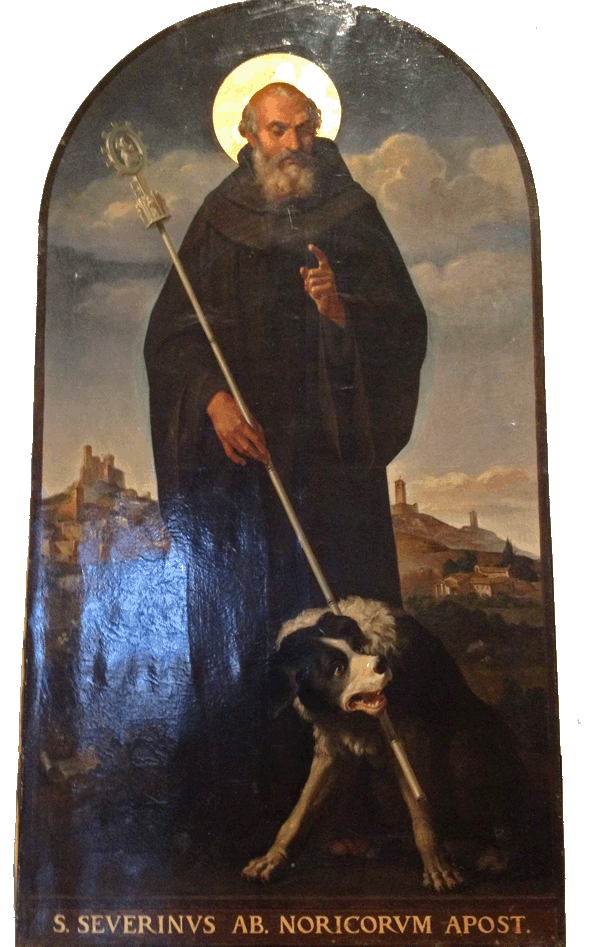
St Severinus – St.Severin Parish Church Lower Austria
Severinus was a high-born Roman living as an Hermit in the East. He was an ascetic in practice. He is first recorded as travelling along the Danube in Noricum and Bavaria, preaching Christianity, procuring supplies for the starving, redeeming captives and establishing Monasteries at Passau and Favianae,
While the Western Empire was falling apart, Severinus, thanks to his virtues and organisational skills, committed himself to the religious and material care of the frontier peoples, also taking care of their military defence. He organised refugee camps, migrations to safer areas and food distribution.
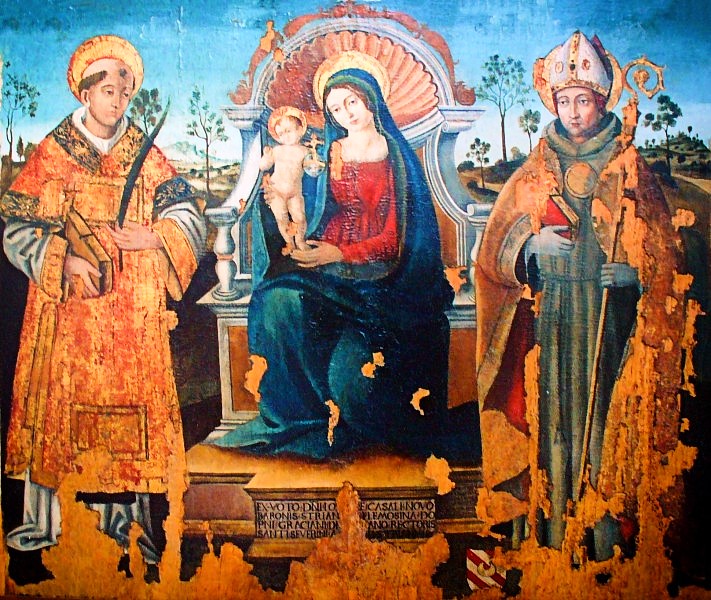
Madonna and Child Enthroned between San Severino and San Sossio – Protasio Crivelli, 1506
Serverinus offered practical leadership, as well as spiritual leadership. He was a tireless preacher and a marvellous Miracle-worker – he miraculously multiplied food reserves, cured the sick, cast out devils, commanded the elements of nature and once even resurrected the dead.
The main theme of his teaching was the value of penance. It was a propitious choice. The sufferings of his people under the Germanic invasions were acute and, uniting them with Christ’s sufferings for the reparation of sin and the conversion of sinners, enabled them to find meaning and strength amid calamity. He also practiced what he preached. In his constant barefoot journeying throughout Austria and Bavaria, he ate only one meal a day and slept on a sack which he carried around with him, wherever he happened to find himself at bedtime.
His efforts seem to have won him wide respect, including that of the Germanic chieftain Odoacer. Eugippius credits him with the prediction that Odoacer would become king of Rome. However, Severinus warned that Odoacer would rule not more than fourteen years.
Severinus also prophesied the destruction of Asturis in Austria, by the Huns. When the people would not heed his warning, he took refuge in Comagena. There he established refugee centres for people displaced by the invasion and founded Monasteries to re-establish spirituality and preserve learning in the stricken region.
He died in his monastic cell at Favianae while singing Psalm 150. Six years after his death, his Monks were driven from their Abbey and his body was taken to Italy, where it was at first kept in the Castel dell’Ovo, Naples, then eventually interred at the Benedictine Monastery rededicated to him, the Abbey of San Severino in the City of Naples.
Austrian postage stamp of their Patron Saint
St Severinus Statue on the Church in Church at Steinhof, Vienna
St Apollinaris the Apologist (Died 2nd Century) Confessor, Defender of the True Faith against heretics, Writer, renowned Scholar. Bishop, Apologist. The Roman Martyrology states: “In Hierapolis in Phrygia, in today’s Turkey, Saint Apollinaris, Bishop, who shone under the Emperor Marcus Aurelius for doctrine and holiness.” A Courageous and Zealous Life: https://anastpaul.com/2022/01/08/saint-of-the-day-8-january-saint-apollinaris-the-apologist-died-2nd-century/
St Athelm of Canterbury St Atticus of Constantinople St Carterius of Caesarea Bl Edward Waterson St Ergnad of Ulster St Erhard of Regensburg St Eugenian of Autun St Garibaldus of Regensburg St Gudule of Brussels St Helladius St Julian of Beauvais St Lucian of Beauvais St Maximian of Beauvais St Maximus of Pavia Bl Nathalan of Aberdeen St Patiens of Metz St Pega of Peakirk
St Severinus of Noricum (c 410-482) Abbot, Hermit, Missionary, the “Apostle to Noricum” (Noricum is the Latin name for the Celtic kingdom or federation of tribes that included most of modern Austria and part of Slovenia.) St Theophilus the Martyr St Thorfinn St Wulsin of Sherborne
Martyrs of Greece – 9 Saints: A group of Christians honoured in Greece as Martyrs, but we have no details about their lives or deaths – Euctus, Flix, Januarius, Lucius, Palladius, Piscus, Rusticus, Secundus and Timotheus
Martyrs of Terni – 4 Saints: A group of Christian soldiers in the imperial Roman army. Executed during the persecutions of Emperor Claudius. Martyrs. – Carbonanus, Claudius, Planus and Tibudianus. They were martyred in 270 in Terni, Italy.
Thought for the Day – 7 January – Meditations with Antonio Cardinal Bacci (1881-1971)
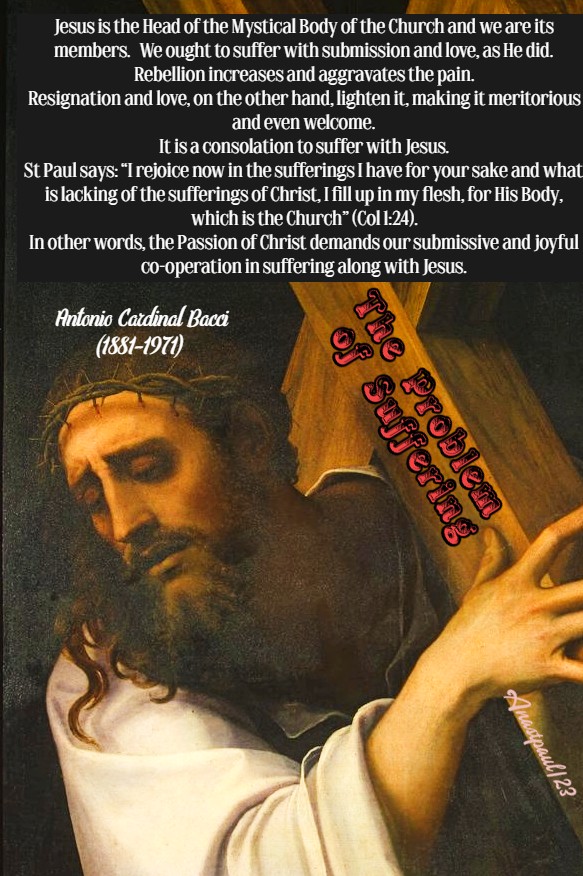
The Problem of Suffering
“Jesus is the Head of the Mystical Body of the Church and we are its members. We ought to suffer with submission and love, as He did. Rebellion increases and aggravates the pain. Resignation and love, on the other hand, lighten it, making it meritorious and even welcome. It is a consolation to suffer with Jesus. St Paul says: “I rejoice now in the sufferings I have for your sake and what is lacking of the sufferings of Christ, I fill up in my flesh, for His Body, which is the Church” (Col 1:24). In other words,the Passion of Christ demands our submissive and joyful co-operation in suffering along with Jesus.
The Acts says of the Apostles, “So they departed from the presence of the Sanhedrin, rejoicing that they had been counted worthy to suffer disgrace for the Name of Jesus.” (Acts 5:41).
“So great is the reward which awaits me,” exclaims St Francis, “every suffering is pure joy to me!” He knew well, that the sorrows of this world are very tiny compared with the wonderful recompense which awaits us in Heaven. “The sufferings of the present time are not worthy to be compared with the glory to come that will be revealed in us” (Rom 8:18).”
Quote/s of the Day – 7 January – Within the Octave of Epiphany
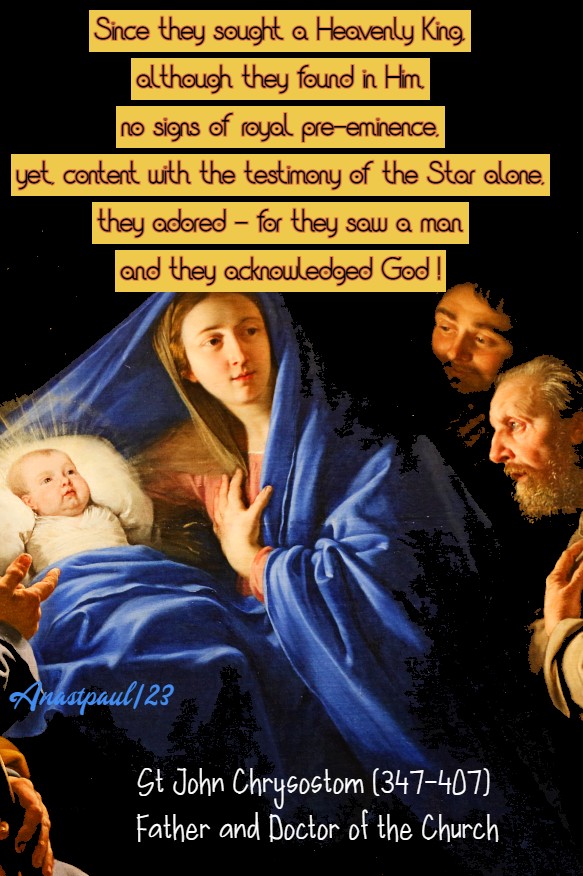
“If the Magi had come in search of an earthly King, they would have been disconcerted at finding that they had taken the trouble to come such a long way for nothing. Consequently, they would have neither adored, nor offered gifts. But since they sought a Heavenly King, although they found in Him, no signs of royal pre-eminence, yet, content with the testimony of the Star alone, they adored – for they saw a man and they acknowledged God!”
St John Chrysostom (347-407) Father and Doctor of the Church
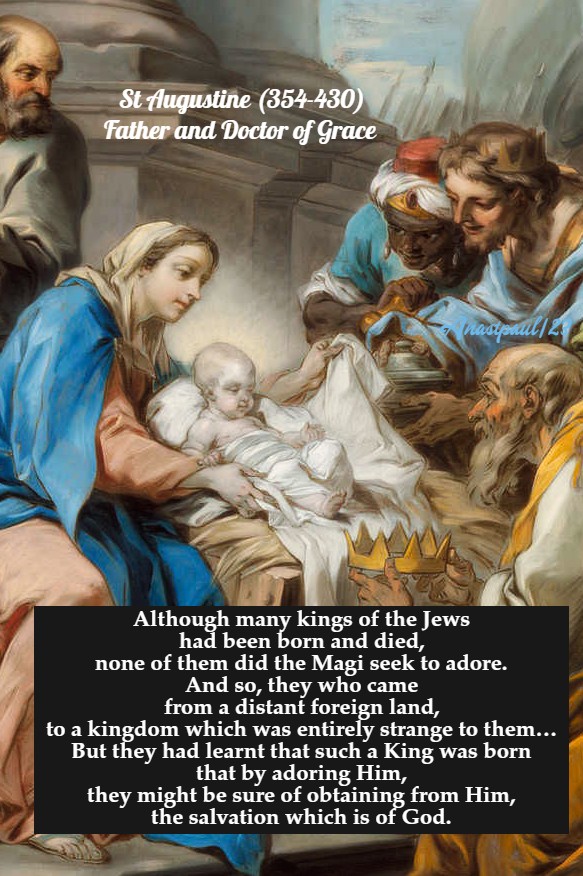
“Although many kings of the Jews had been born and died, none of them did the Magi seek to adore. And so, they who came from a distant foreign land, to a kingdom which was entirely strange to them… But they had learnt that such a King was born that by adoring Him, they might be sure of obtaining from Him, the salvation which is of God.”
St Augustine (354-430) Father and Doctor of Grace
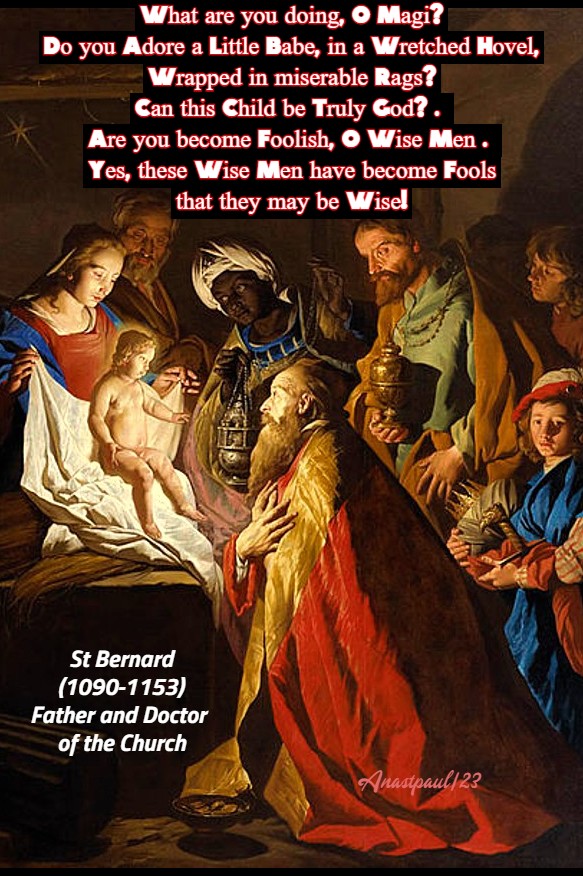
“What are you doing, O Magi? Do you adore a little Babe, in a wretched hovel, wrapped in miserable rags? Can this Child be truly God? … Are you become foolish, O Wise Men … Yes, these Wise Men have become fools that they may be wise!”
St Bernard (1090-1153) Father and Doctor of the Church
One Minute Reflection – 7January – Within the Octave of Epiphany – Isaias 60:1-6, Matthew 2:1-12 – Scripture search here: https://www.drbo.org/
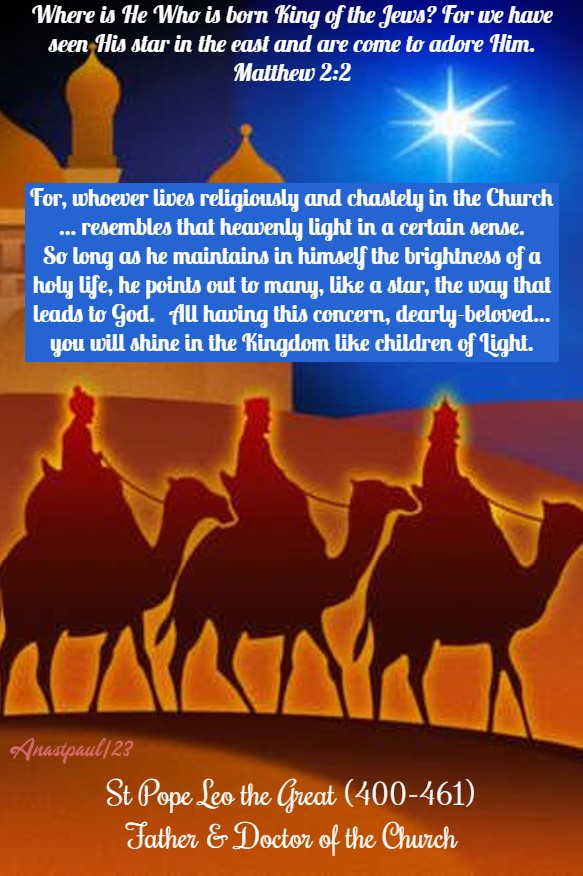
“Where is He Who is born King of the Jews? For we have seen His star in the east and are come to adore Him.” – Matthew 2:2
REFLECTION – “All these things we know to have taken place ever since the three wise men, aroused in their far-off land, were led by a star to recognise and worship the King of Heaven and earth. The responsiveness of that star exhorts us to imitate it’s obedience and, as much as we can, to make ourselves servants of that grace which invites us all to Christ. For, whoever lives religiously and chastely in the Church and “sets his mind on the things which are above, not on the things that are upon the earth” (Col 3:2) resembles that heavenly light in a certain sense. So long as he maintains in himself the brightness of a holy life, he points out to many, like a star, the way that leads to God. All having this concern, dearly-beloved… you will shine in the Kingdom like children of Light.”… St Pope Leo the Great (400-461) Father & Doctor of the Church.
PRAYER – O God, Thou Who by the guidance of a star this day revealed Thy Only-begotten Son to the Gentiles, mercifully grant that we, who know Thee now by faith, may come to behold Thee in glory. Through the same Jesus Christ, Thy Son our Lord, Who lives and reigns with Thee, in the unity of the Holy Ghost, God, world without end. Amen (Collect).
Our Morning Offering – 7 January – Within the Octave of Epiphany – “The Month of the Most Holy Name of Jesus”
The Love of Thy Name By Thomas à Kempis CRSA (1380-1471) The Imitation of Christ (Book 3 Ch 26:1-4)
My God, Sweetness beyond words, make bitter all the carnal comfort which draws me from love of the eternal and lures me to its evil self, by the sight of some delightful good in the present. Let it not overcome me, my God. Let not flesh and blood conquer me. Let not the world and its brief glory deceive me, nor the devil trip me by his craftiness. Give me courage to resist, patience to endure and constancy to persevere. Give me the soothing unction of Thy spirit, rather than all the consolations of the world and in place of carnal love, infuse into me, the love of Thy Name. Amen





























 AnaStpaul
You must be logged in to post a comment.