
Saint of the Day – 11 March – Saint Sophronius of Jerusalem (c550-c638) Bishop of Jerusalem from 634 until his death, Father of the Church. Before rising to the primacy of the See of Jerusalem, he was a Monk, Theologian and Philosopher, who was the chief protagonist for orthodox teaching in the doctrinal controversy on the essential nature of Jesus. He was a well-travelled and honoured Teacher of Rhetoric, living for several years in Alexandria, Egypt near St John the Almoner. Ecclesiastical and Liturgical Writer, Poet and exercised an extensive correspondence, some of which has survived and some of which we still use within the Liturgy. He is also renowned in history for his peace negotiations with the invading Saracens, thus ensuring a level of protection to the City’s Christians Born in Damascus, Syria in the 6th Century and died in c638; sources disagree on cause and location. Also known as – Sophronius of Damascus, “Sophronius the Sophist” Sofronio…
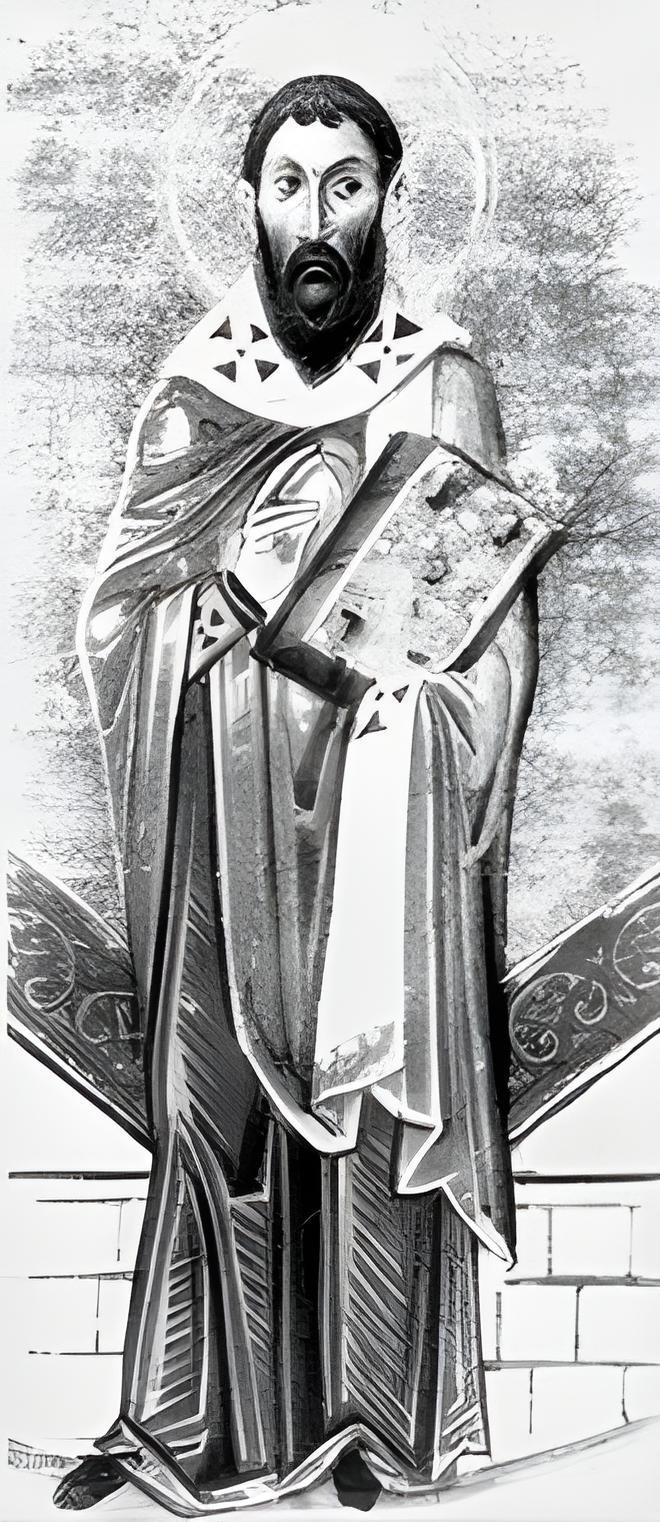
Sophronius the Sophist, was one of the most rivetting personalities of the time, cultured, open-minded and a passionate defender of orthodoxy, was born in Damascus around 550. He abandoned his hometown as a young man to undertake numerous journeys but always remained proud of his place of origin:
“where Paul arrived blind and left healed, where a fleeing persecutor became a preacher; the City which gave refuge to the Apostle and from which he fled in a basket lowered from the window, thus earning the graces of the saints and acquiring great fame […] ”
Sophronius completed his studies mainly in Damascus, where he was educated in Greek and Syriac culture. Eager to become a Monk, he visited the Monastery of San Theodosius, near Bethlehem in Judea and here he met the Monk ascetical Writer John Moschus (c550 – 619), with whom he formed a lasting bond of friendship.
It is difficult to evaluate the influence which each exerted on the other — Sophronius was decidedly more cultured but, he considered his friend his spiritual guide and advisor. Their main bond was perhaps their common Chalcedonian faith but they also began a collaboration in passing on the lives of the Desert Fathers to future generations. The conflicts already present at that time in the Middle Eastern world, caused the two friends to move around a lot, being hosted by different Monasteries. Between 578 and 584, they were in Egypt, where Sophronius was a pupil of the Aristotelian Stephen of Alexandria and both became friends of Theodore, the Philosopher and Zoilus, the latter an erudite Calligrapher. In this period, Sofronio began to lose his sight but he was miraculous cured of his ailment by visiting the Tombs of Saints Cyrus and John near Menuti and, in thanksgiving, he wrote an account of seventy miracles attributed to their intercession.
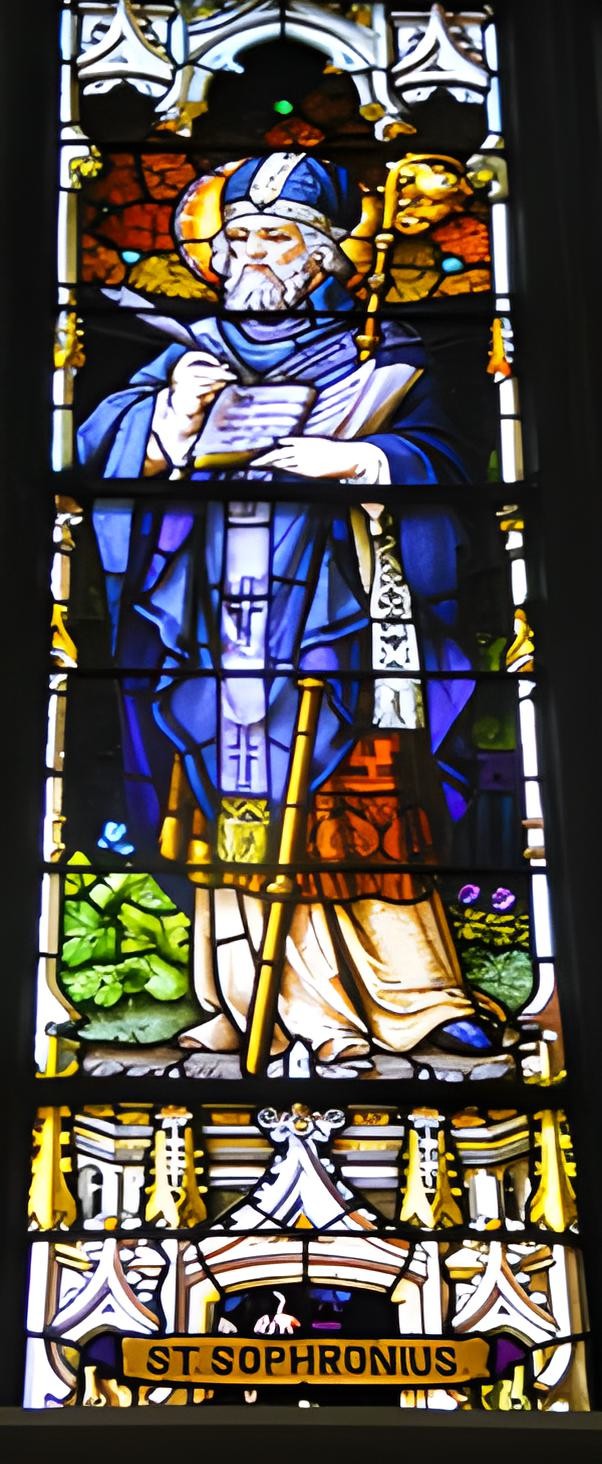
From 584 onwards it becomes difficult to reconstruct their movements exactly. For a certain time it seems they took different paths — Sophronius became a Monk in the Monastery of Saint Theodosius, while John Moschus wandered between Sinai, Cilicia and Syria. The two friends finally found themselves in the service of the Bishop of Alexandria, Saint John the Almoner, appointed in 610. A few years later the Persians occupied the holy places and headed towards Egypt, so the Bishop with Sophronius and John, left through Cyprus, moving onto other islands and finally arrived in Rome. In 619, in the Eternal City St John the Almoner, handing over his last wishes to Sophronius. Here too, sadly, our Saint lost another great friend and staunch advocate of orthodoxy, John Moschus, who also died in Rome in 619. Sophronius accompanied the body of his friend and spiritual advisor, back to Jerusalem for monastic burial.
Sophronius made great efforts to counteract the rampant heresies, in particular the Monothelitism which the Emperor Heraclius had imposed on the entire Empire with the approval of the Patriarch, Sergius of Constantinople. From 634 Sophronius was the new Bishop of Jerusalem, a rolewhich allowed him to continue his battle against heresy, with greater authority. As the heresies into which Sergius was falling, were increasingly evident and in fear that Pope Honorius might fall into the trap, he commissioned Bishop Stephen of Dora, to go to Rome in his stead, as he was unable to do so due to an imminent Saracen invasion and made him swear on Calvary, to remain faithful to the One True Faith taught our Saint so deeply by the Chalcedonian Fathers (remember we clebrated one of them recently – St Gregory of Nyssa).
The envoy, Bishop Stephen of Dora, reported Sophronius’ will to the Lateran Council of 649 (the image below shows St Sophronius on the left, St Michael the Archangel in the middler and St? Stephen of Dora on the right):
“There he made me promise with a solemn oath:
“If you forget or despise the Faith which is now threatened, you will have to give an account to Him Who, although God, was Crucified in this saintly place, when in His Next Coming, He will judge the living and the dead.
As you know, I cannot make this journey, due to the invasion of the Saracens […].
Go without delay to the other end of the earth, to the Apostolic See, the Foundation of Orthodox teaching and tell the holy men who are there, not once, not twice but many times, what is happening — tell them the whole truth and nothing more.
Do not hesitate, ask them and insistently pray to them, to use their inspired wisdom to pass a final judgement and destroy this new teaching which has been inflicted on us.”
Impressed by the solemn appeal which Sophronius had pronounced in that holy and venerable place and, considering the Episcopal power which had been conferred on me, by the grace of God, I immediately left for Rome.
I am here before you for the third time, bending before the Apostolic See imploring, as Sophronius and many others did, “come to the aid of the threatened Catholic faith!”.

It took a good ten years before Pope Saint Martin I condemned the heresy at the same Council. Sophronius came to terms with the Saracens, to avoid massacres of the people in Jerusalem but, he died a few months later. He left several sermons and writings to posterity, a splendid prayer (which we still use) to bless the water on the Feast of the Baptism of the Lord, as well as Hymns and Canticles of extraordinary beauty! His Antiphons for Holy Week constituted the source of the “Improperia” — lso known as the Reproaches, they are sung in the Liturgy as part of the observance of the Passion, usually on the afternoon of Good Friday.



 AnaStpaul
One thought on “Saint of the Day – 11 March – Saint Sophronius of Jerusalem (c550-c638) Bishop, Father of the Church”