
Saint of the Day – 17 March – St Patrick (c386-461) “The Apostle of Ireland,” Bishop, Confessor, Missionary, wondrous Miracle-worker. Born between 387 and 390 either in Scotland, or somewhere in England, or in Brittany, France (so many sources and so many different traditions) as Maewyn Succat and died between 461 and 464 at Saul, County Down, Ireland of natural causes. Also known as – “The Apostle of Ireland,” Maewyn Succat, Patricius, Patrizio.
Today on Ireland’s Patronal and National Festival, the Patron Saint of miners, hairdressers, coopers and blacksmiths; for cattle and poor souls; against fear of snakes, against pests and cattle diseases, against evil – just some of our bel;oved St Patrick’s many patronages.
The Roman Martyrology reads: “In Ireland, the birthday of St Patrick, Bishop and Confessor, who was the first to preach Christ in that country and became illustrious by great miracles and virtues.”

There are no reliable historical reports regarding Patrick’s origins. One of the problems with his biography is exacerbated by the fusion of Patrick’s life with reports about St Palladius of Ireland , the Gallic missionary of the 5th Century (https://anastpaul.com/2022/07/06/saint-of-the-day-6-july-saint-palladius-of-ireland-died-c-432-apostle-of-the-scots/).
According to his own testimony however, Patrick was born in Banna Venta Berniae in Roman Britain. His father, Calpurnius, was an Official of the Roman occupying power and was later Ordained a Deacon; his grandfather was a Priest. At the age of 15, Patrick was kidnapped by pirates from his father’s country estate near the town of Bannauem Taburniae – which is also unknown today – and taken to Ireland as a slave. There, according to tradition, he had to look after the sheep of the tribal chief Maelchu on Mount Slieve Mish – today’s Slemish. After six years he heard a promise in a dream that he would soon find his way home on a ship and should then proclaim the good news to the Irish. He fled and returned home on a ship.
There he was Ordained a Priest. According to tradition,, he then went to the northern coast of Gaul, where he initially stayed as a Monk in the Noirmoutier Monastery. Again he had a dream which shaped his future life – an Irishman gave him a letter asking him to return home. In preparation, he studied Theology on the Lérins Island of St-Honorat and in Auxerre under St Germanus . Although he was criticised for his lack of education, he was appointed as the successor to the first Irish missionary, St Palladius . St Germanus is said to have Consecrated him as a Bishop but a trip to Rome with Consecration and Commission by Pope Celestine I, is also reported. It is confirmed that in 432, he arrived in Ireland with 24 companions, where he worked successfully as a Missionary in the north of the Island for decades.
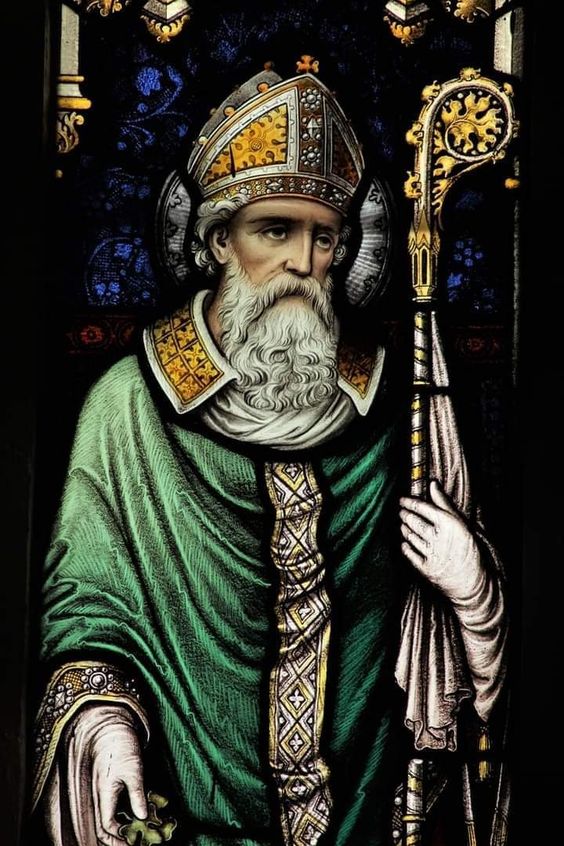
When he arrived, all snakes and poisonous animals were said to have left the Island. Patrick lured the last snake in Ireland into a box and promised to let it out again tomorrow. When the snake asked when tomorrow was , he always answered tomorrow. Finally, he threw the box into the sea. It tells how he exposed a mutton thief by summoning the eaten prey to come forward from the robber’s stomach. At Patrick’s request, God established an earthly purgatory in Ireland that allows penitents to cleanse themselves of their sins.
Despite all odds, Patrick converted tens of thousands of people, as he reports in ‘Confession.’ He ahad 365 Churches built. Since Patrick had learned the Irish language during his captivity, he was able to use the local language in teaching. This was one of the reasons why the Christian faith was accepted by the Irish as something of their own and has taken particularly strong roots to this day. He is said to have illustrated the Trinity to his congregation using a three-leaf clover, which became the Irish National Symbol called the Shamrock.
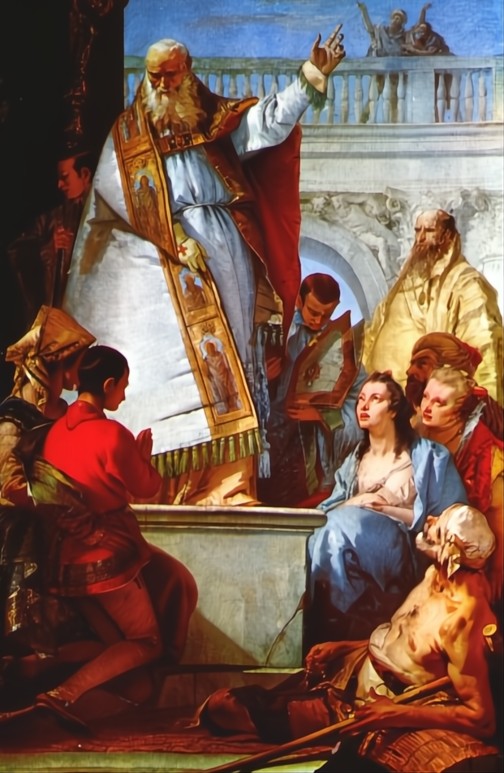
Municipal Museums of Padua
On Easter 433, Patrick lit a fire on a hill visible far into the country near what is now Slane, marking the victory of the Light of Christ over darkness where the Kings once ruled. In 449 he is said to have retreated to the mountain in County Mayo, now known as Croagh Patrick, for forty days – like Moses at Sinai – for pre-Easter fasting . Every night an Angel came to ask him about his wishes – Patrick had asked to be allowed to judge the Irish himself in the Last Judgement. When this wish was rejected, he threatened never to leave the mountain again, whereupon the Angel admitted to him that since the Apostles, there has not been a man who is more to be admired which is why the wish was finally agreed to. Now the mountain has become the most important pilgrimage site in Ireland. Crowds of pilgrims trek up the mountain, many walking with bare feet or crawling on their knees to do penance. The stone on which Patrick is said to have knelt in prayer, for so long that his knees left an imprint, can still be seen today – yes, this is a living miracle!

mountain called Croagh Patrick
Patrick left behind two writings providing much insight into the life of a Missionary among pagans on the edge of the world . His ‘Confession’ – only preserved as a translation done three centuries after St Patrick’s death and its authenticity is questionable in parts – and a letter to the soldiers of Croticus.
Patrick was dearly venerated in Ireland as early as the end of the 6th Century and in France from the 7th Century onwards. From the Episcopal See of Armagh, Patrick was praised as the Founder of the Church in Ireland. In the Middle Ages, St Patrick’s cult spread to many areas of Europe. Patrick’s Purgatory on Station Island in Lough Derg in County Donegal, became a much-visited place of pilgrimage . Patrick’s Day is celebrated as the Irish National holiday, Dublin celebrates Saint Patrick with a large parade and four days of celebration. Artificial snakes are carried through the City with their red tongues poking threateningly out of paper and plastic bodies. On people’s lapels is the Shamrock , the three-leaf clover.
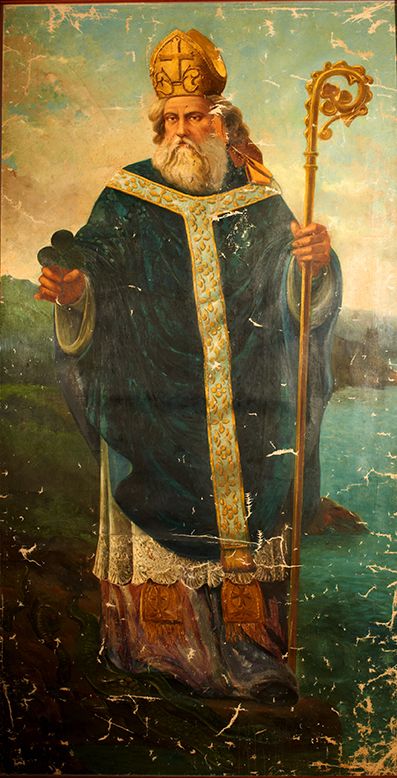
The counties of Armagh and Down – around Downpatrick – in Protestant Northern Ireland were declared St Patrick’s Country a few years ago to stimulate tourism.
It is not only in Ireland that a holiday is still celebrated in honour of the National Saint of Ireland. Many Irish emigrant communities also celebrate in Canada, the USA, Australia, New Zealand, South Africa and elsewhere – for example, in Munich in Germany – with cheerful, colourful parades which also invite non-Irish people to join in the celebrations. Rivers such as the Chicago River are coloured green on this day and even the beer is green.
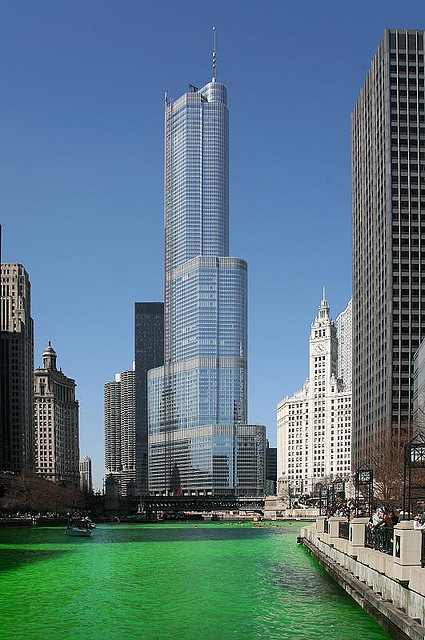
Chicago


 AnaStpaul
2 thoughts on “Saint of the Day – 17 March – St Patrick (c386-461) “The Apostle of Ireland””