
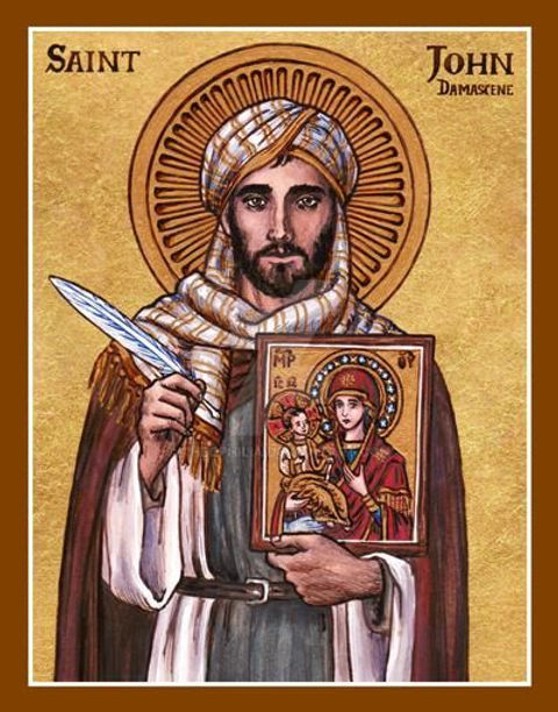
Saint of the Day – 27 March – Saint John Damascene (675-749) Confessor, Father & Doctor of the Church – Priest, Monk, Theologian, Writer, Defender of Iconography, Poet, a Polymath and more. Patronages – Pharmacists, Artists, Theologians and Theology Students.

John Damascene, was a Monk and Theologian, whose writings were crucially important in staunchly defending the value of visual art in communicating the Christian faith and in the acquisition and growth of devotion, piety and the worship of God alone..
John was born into an Arabic Christian family, around the year 675 in Damascus, in present-day Syria, ASas the son of Mansur, the Representative of the Christians to the Court of the Muslim Caliph. In the period following the Muslim Caliphs conquering of the City, most of the Christians who had lived in Damascus were either displaced, or forced to convert. John’s family, however, had worked with the Muslim rulers once they captured the City and John’s father had a position in the Court of the Caliphate, thus their family had been allowed to remain Christian. John’s father ensured that his son received the best education possible, providing his son with a Christian Monk as a tutor. The brilliant young John became a scholar of astronomy, mathematics, classical Greek and Arabic texts.
Some sources claim that John himself became the Chief Administrator of the Caliph’s Court. Eventually, however, John, hearing the call of Christ, resigned his life at the Court and made his way to Jerusalem, to become a Priest and Monk at the Monastery of Mar Saba, outside Jerusalem.
Wheile John was establishing himself at Mar Saba, a great debate, known as the Iconoclastic Controversy, continued to divide the Church. Emperor Leo III issued an Edict forbidding the use of images. John wrote vehemently in favour of the use of images and encouraged lay Christians to continue using them, in defiance of the Emperor’s edict. John’s treatises are beautiful defences of an Incarnation Theology and of the importance of the imagination in developing faith in Christ.

John wrote that art is appropriate for depicting a God Who became human: “I do not draw an image of the immortal Godhead, I paint the visible flesh of God, for it is impossible to represent a spirit, how much more God Who gives breath to the spirit. When the Invisible One becomes visible in the flesh, you may then draw a likeness of His form.”
Indeed, “I do not worship matter,” wrote John, “I worship the God of matter, Who became matter for my sake. Do not despise matter, for it is not despicable.”
John continues to discuss the human imagination, “the mind, which is set upon getting beyond corporeal things, is incapable of doing it. For the invisible things of God, since the creation of the world, are made visible through images.” The imagination reaches towards God but needs faith, needs grace, to receive the image of God’s own self which God brings to the human being. And images are important for igniting the imagination, for “Image speaks to the sight, as words to the ear, it brings understanding.”
In 787, at the Second Council of Nicaea, forty years after John’s death in 749, John’s writings were essential arguments which were used, when the Iconoclastic Controversy was finally settled in favour of the Iconophiles—those who advocated the use of Sacred Images in Christian life.

John wrote and adapted many Scriptural texts for musical use in the Liturgy —these texts still survive and are frequently used.
Known as the last of the Greek Fathers, John Damascene was proclaimed a Doctor of the Church in 1890 by Pope Leo XIII for his orthodox works and especially for his defence of Sacred Art.
St John of Damascus, saint who defended art’s power to move the heart and mind, to God—pray for us!


 AnaStpaul