Thought for the Day – 25 June – Meditations with Antonio Cardinal Bacci (1881-1971)
Devotion to the Sacred Heart
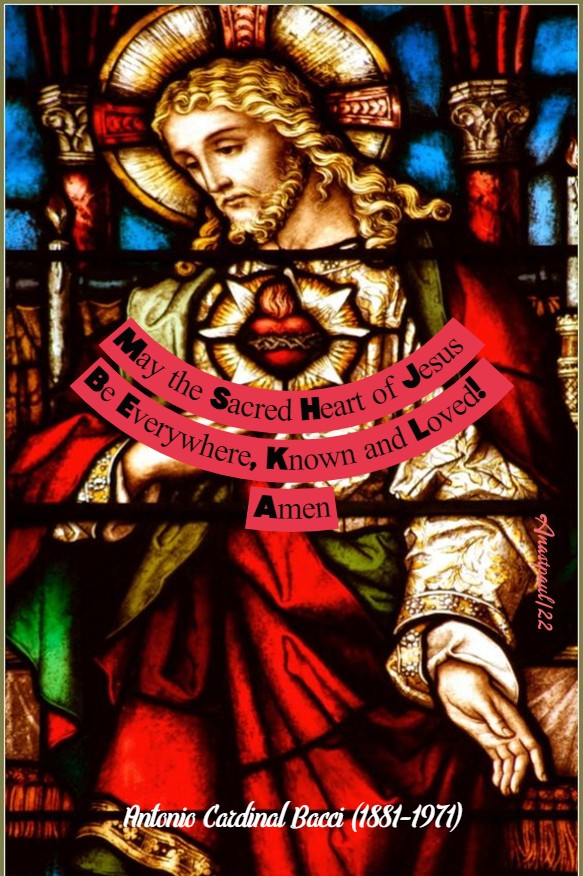
“We should have a very high regard for devotion to the Sacred Heart. We should excite in our hearts, acts of love, which will compensate, in some way, for the Infinite Love which Jesus has for us.
Finally, we should try to make our lives correspond with our love by emulating, as far as possible, the holy and immaculate life of Jesus Christ. It is not a waste of time to constantly think to ourselves, “What would Jesus do in this situation?”
Ejaculation: May the Sacred Heart of Jesus be everywhere, known and loved! Amen
Quote/s of the Day – 25 June – Ecclesiasticus 45:1-6 – Matthew 19:27-29 – Scripture search here: https://www.drbo.org/
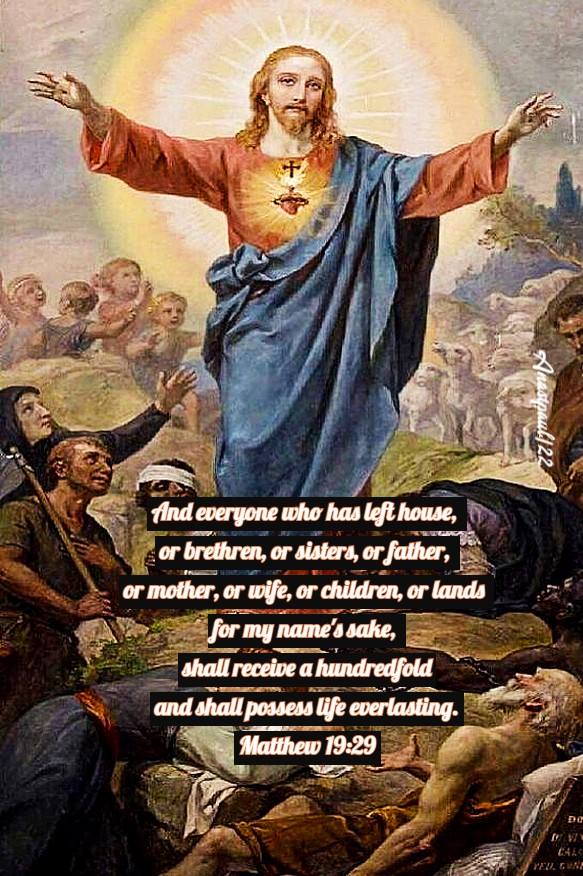
“And everyone who has left house, or brethren, or sisters, or father, or mother, or wife, or children, or lands for My Name’s sake, shall receive a hundredfold and shall possess life everlasting.”
Matthew 19:29
“Let us then, my brethren, endure in hope. Let us devote ourselves, side-by-side with our hoping, so that the God of all the Universe, as He beholds our intention, may cleanse us from all sins, fill us with high hopes from what we have in hand and grant us the change of heart which saves. God has called you and you have your calling!”
St Cyril of Jerusalem (315-387) Father and Doctor of the Church
“The one who walks in the love of God seeks neither gain nor reward but seeks only, with the will, to lose self and all things, for God and this loss, the lover judges to be a gain! ”
St John of the Cross (1542-1591) Doctor of the Church
One Minute Reflection – 25 June – “The Month of the Most Sacred Heart of Jesus” – Within the Corpus Christi Octave – St William (1085-1142) Abbot – Ecclesiasticus 45:1-6 – Matthew 19:27-29 – Scripture search here: https://www.drbo.org/
“And everyone who has left house, or brethren, or sisters, or father, or mother, or wife, or children, or lands for My Name’s sake, shall receive a hundredfold and shall possess life everlasting.” – Matthew 19:29
REFLECTION – “There is a kind of wealth which is deadly to all – the loss of it, unwelcome. Which, when it makes the soul pure – that is, poor and bare – hears the Saviour speaking thus: “Come, follow Me.” For to the pure in heart, He now becomes the Way. But into the impure soul the grace of God finds no entrance because that soul is unclean which is rich in lusts and enthrall to many worldly posessions.
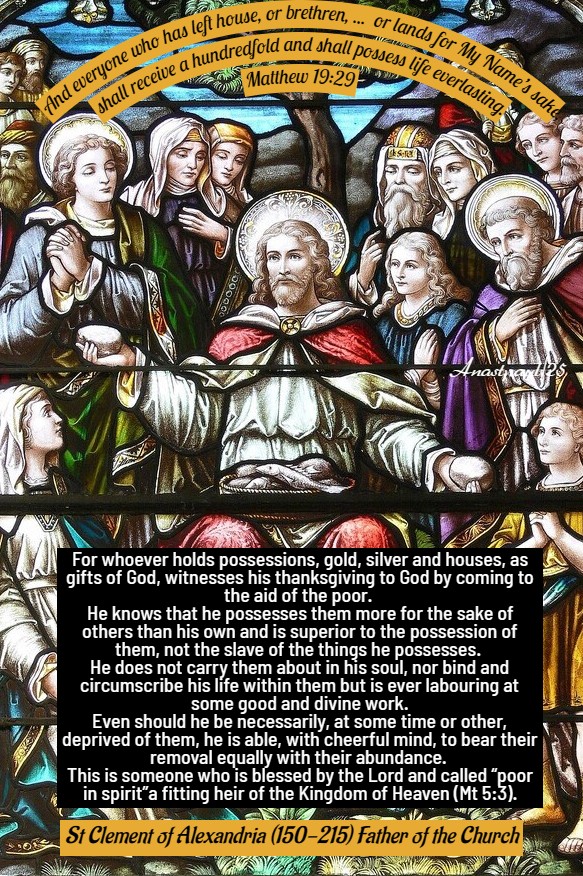
For whoever holds possessions, gold, silver and houses, as gifts of God, witnesses his thanksgiving to God by coming to the aid of the poor. He knows that he possesses them more for the sake of others than his own and is superior to the possession of them, not the slave of the things he possesses. He does not carry them about in his soul, nor bind and circumscribe his life within them but is ever labouring at some good and divine work. Even should he be necessarily, at some time or other, deprived of them, he is able, with cheerful mind, to bear their removal equally with their abundance. This is someone who is blessed by the Lord and called “poor in spirit”a fitting heir of the Kingdom of Heaven (Mt 5:3)…
But someone who carries his riches around enclosed within his soul and, bears in his heart, instead of God’s Spirit, gold or land and is always acquiring possessions without end and is perpetually on the lookout for more, never looking up to Heaven, such a one is fettered in the toils of the world, being earth and destined to return to the earth (Gn 3:19). How can someone like that be able to desire the Kingdom of Heaven who, instead of a heart, carries land or metal and who is due to be surprised by death in the midst of his uncontrolled desires? For “where your heart is, there also will your treasure be” (Mt 6:21).” – St Clement of Alexandria (150-215) Father of the Church, Theologian (Sermon “What rich man can be saved?” )
PRAYER – O God, Who made Thy Saints an example and a help for our weakness, grant us, as we walk the path of salvation, so to venerate the virtues of the blessed Abbot William that we may obtain his intercession and follow in his footsteps. Through Jesus Christ, Thy Son our Lord, Who lives and reigns with Thee, in the unity of the Holy Ghost, God, world without end. Amen (Collect).
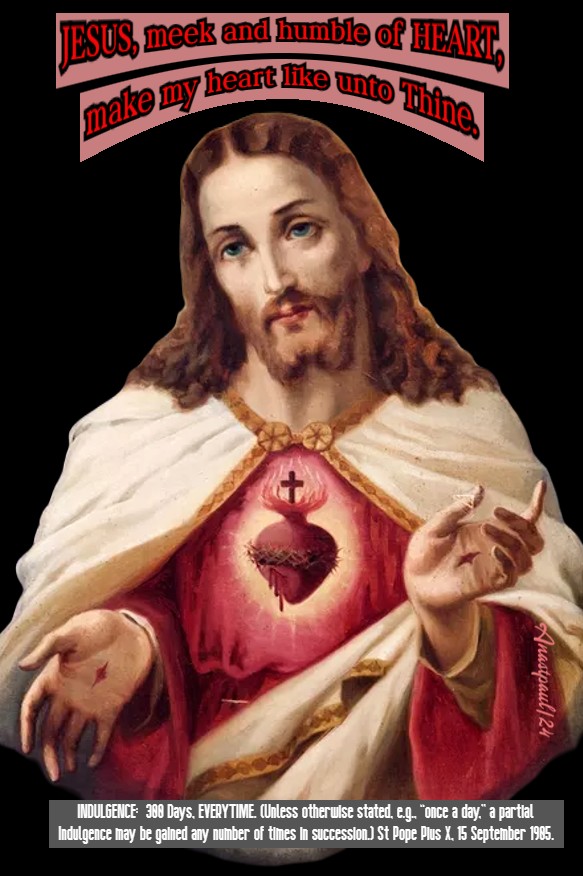
“JESUS, meek and humble of HEART, make my heart like unto Thine.” – 300 Days, EVERYTIME. (Unless otherwise stated, e.g., “once a day,” a partial Indulgence may be gained any number of times in succession.) St Pope Pius X, 15 September 1905.
Our Morning Offering – 25 June – “The Month of the Most Sacred Heart of Jesus” – Within the Corpus Christi Octave
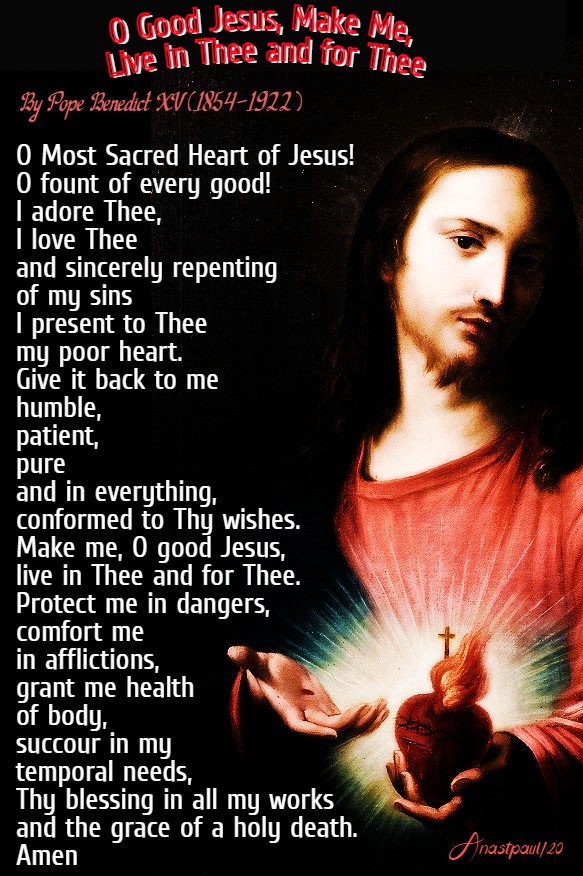
O Good Jesus, Make Me Live in Thee and for Thee By Pope Benedict XV (1854-1922)
O Most Sacred Heart of Jesus! O fount of every good! I adore Thee, I love Thee and sincerely repenting of my sins I present to Thee my poor heart. Give it back to me humble, patient, pure and in everything, conformed to Thy wishes. Make me, O good Jesus, live in Thee and for Thee. Protect me in dangers, comfort me in afflictions, grant me health of body, succour in my temporal needs, Thy blessing in all my works and the grace of a holy death. Amen
Saint of the Day – 25 June – St Febronia (284-305) Virgin Martyr. Also known as – Fevronia, Fibronia, Pebronia.
The Roman Martyrology reads today: “At Sibarolis, in Syria, under the Governor Lysimachus, in the persecution of Diocletian, St Febronia, Virgin and Martyr, who was scourged and racked for defending her faith and her charity, then torn with iron combs and exposed to fire. Finally having her teeth plucked out and her breasts cut off, she was condemned to capital punishment and went to her Spouse adorned with her sufferings as with so many jewels!”
Febronia is the subject of a Passio in Greek which is at least as old as the 17th Century and which has early medieval translations in Syriac and in Latin.
This Passio speak of her as a Nun who refused to flee her monastery during the Persecution and who was arrested, tortured at great length and finally decapitated at Nisibis (now Nusaybin in south eastern Turkey’s Mardin Province).
Guglielmo Borremans – The Martyrdom of Saint Febronia
Nisibis was the Seat of a Syrian Christian Diocese (Nestorian from the later 5th Century onward) for most of late antiquity and throughout the Middle Ages. Febronia’s Passio is thought to have been written there.
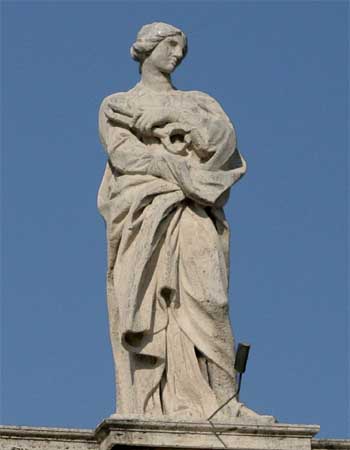
St Febronia on the North Colonnade at St Peter’s
An apparently reliable later reference and in 563, the existence of a Church dedicated to Febronia in Marga, across the Tigris from Nisibis, has been cited to show the cult’s existence already at that time.
St Amand of Coly (6th Century) Founder and the 1st Abbot of Saint-Amand-de-Coly Monastery, Diocese of Limoges, France. There is now a village named for St Amand.
Thought for the Day – 24 June – Meditations with Fr Richard Frederick Clarke SJ (1839-1900)
From “The Devout Year” By Fr Richard Frederick Clarke SJ (1839-1900)
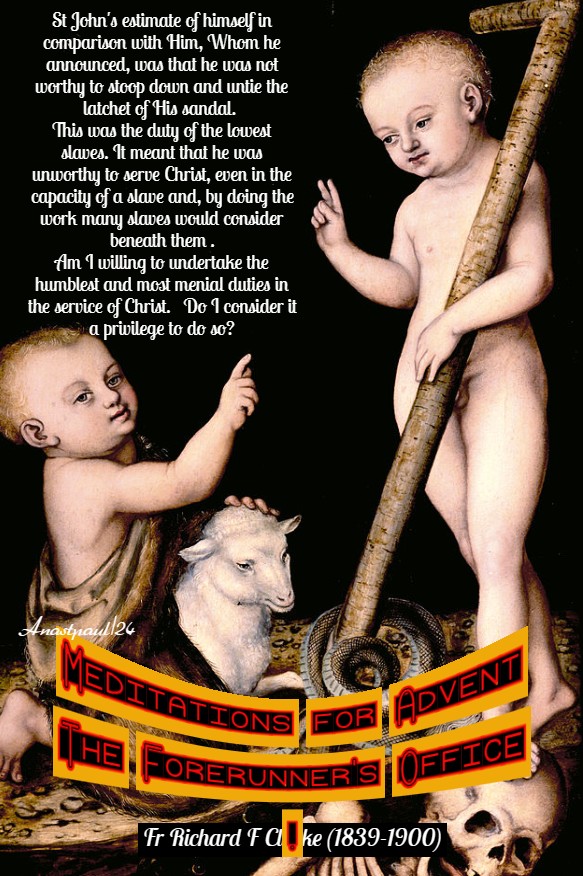
The Forerunner’s Office .
+1. St John was something more than a Herald. He had to prepare the way for the King, to make the crooked ways straight and the rough places smooth. His office was that which is entrusted to us all in our own sphere – to try and make the way in which the followers of Christ have to tread straight and easy. What a privilege, if we can, by our charity and our edifying life, make the path of life easier for those whose lot it is to tread the way of the Cross and to walk over rough or stormy paths! Is this your endeavour in your daily life, or do you place obstacles in the path of others by your bad example, want of charity and consideration, impatience, etc?
+2. St John , as the Herald or Forerunner of Christ, had to proclaim the coming of the King. He, himself expresses this by his description of himself as the voice of one who cries in the desert; that is , Christ spoke through his mouth. So He speaks through the mouths of all His servants in proportion to their devotion and singleness of purpose. How poor an echo are my words of the whispers of Christ to the faithful soul! How mixed with the discordant notes of self-will and worldliness!
+3. St John’s estimate of himself in comparison with Him, Whom he announced, was that he was not worthy to stoop down and untie the latchet of His sandal. This was the duty of the lowest slaves. It meant that he was unworthy to serve Christ, even in the capacity of a slave and, by doing the work many slaves would consider beneath them . Am I willing to undertake the humblest and most menial duties in the service of Christ. Do I consider it a privilege to do so?
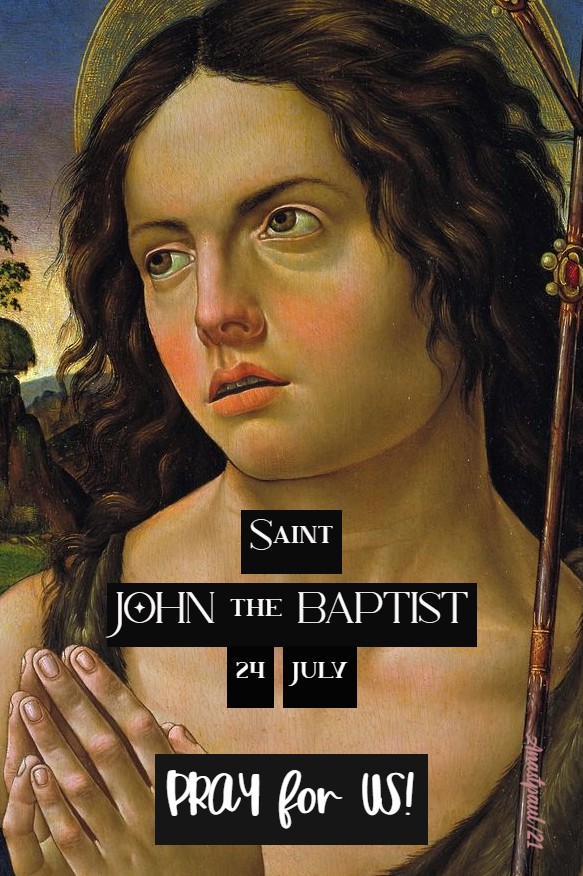
Quote/s of the Day – 24 June – The Nativity of St John the Baptist
“Amen I say to you. there hath not risen among them that are born of women, a greater than John the Baptist.”
Matthew 11:11
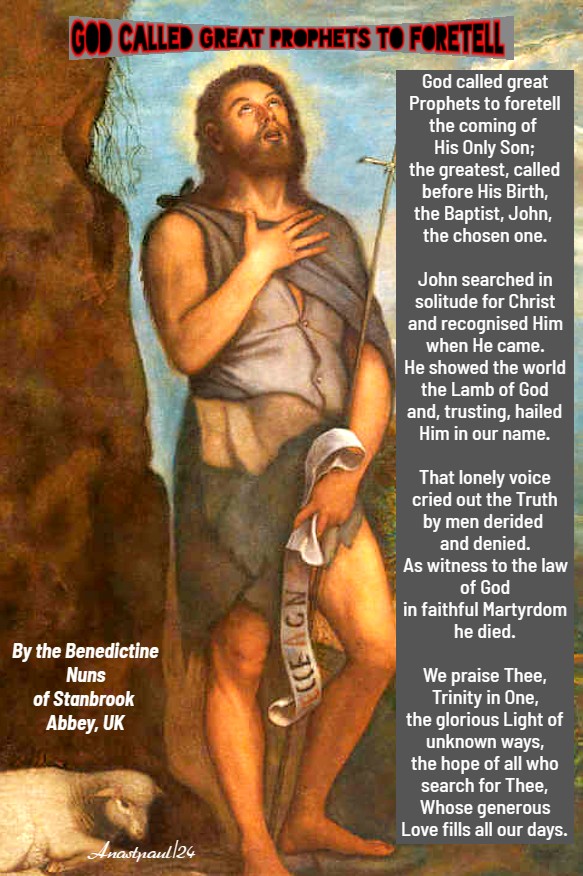
God Called Great Prophets to Foretell By the Benedictine Nuns of Stanbrook Abbey, UK
God called great Prophets to foretell the coming of His Only Son; the greatest, called before His Birth, the Baptist, John, the chosen one.
John searched in solitude for Christ and recognised Him when He came. He showed the world the Lamb of God and, trusting, hailed Him in our name.
That lonely voice cried out the Truth by men derided and denied. As witness to the law of God in faithful Martyrdom he died.
We praise Thee, Trinity in One, the glorious Light of unknown ways, the hope of all who search for Thee, Whose generous Love fills all our days.
In the Divine Office, God Called Great Prophets to Foretell, is used for Morning Prayer on the Memorial of the Beheading of St John the Baptist, as well as with Evening Prayer I on Solemnity of the Birth of St John the Baptist.
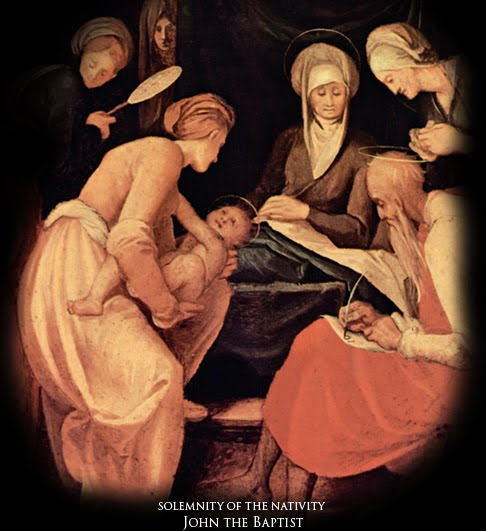
One Minute Reflection – 24 June – “The Month of the Most Sacred Heart of Jesus”– Within the Corpus Christi Octave – The Nativity of St John the Baptist – Isaias 49:1-3, 5-7 – Luke 1:57-68 – Scripture search here: https://www.drbo.org/
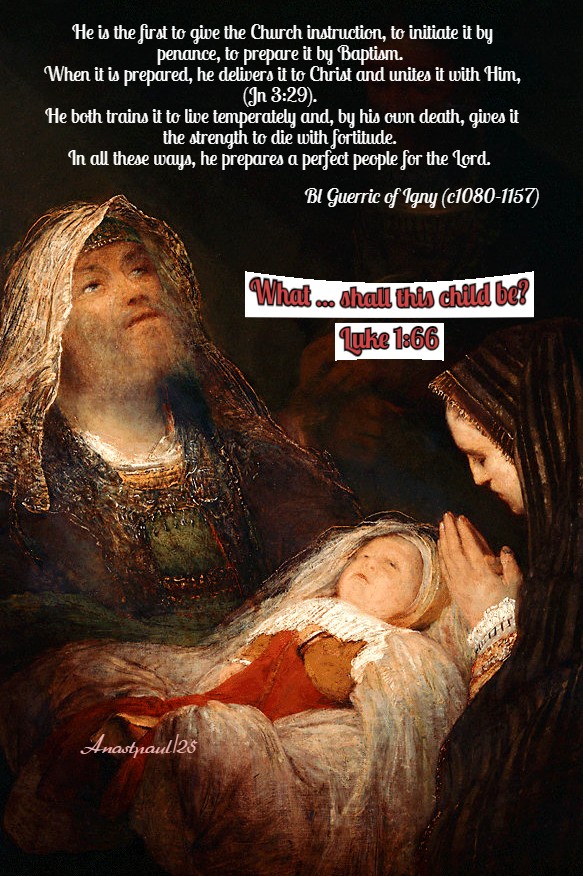
“ What … shall this child be? For the hand of the Lord was with him.” – Luke 1:66
REFLECTION – “Rightly then, did the birth of this child make many rejoice then and does make many rejoice today – born in the old age of his parents, he was to preach the grace of rebirth to an aging world. Rightly does the Church solemnly venerate this birth which is wonderfully brought about by grace and, at which nature wonders.
To me certainly, the birth of the world’s Lamp (Jn 5:35) brings fresh joy, for it enabled me to recognise the true Light shining in the darkness but not mastered by the darkness, (Jn1:5.9). His birth brings me a joy utterly unspeakable, for so many outstanding benefits accrue to the world through it. He is the first to give the Church instruction, to initiate it by penance, to prepare it by Baptism. When it is prepared, he delivers it to Christ and unites it with Him, (Jn 3:29). He both trains it to live temperately and, by his own death, gives it the strength to die with fortitude. In all these ways, he prepares a perfect people for the Lord. (Lk 1:17).” – Bl Guerric of Igny (c1080-1157) Cistercian Abbot (Sermon 1 for Saint John the Baptist).
PRAYER – O God, Who made this a day most worthy of our celebration because of blessed John; grant Thy people the grace of spiritual joys and direct the minds of all the faithful into the path of eternal salvation. T hrough Jesus Christ, thy Son our Lord, Who liveth and reigneth with thee, in the unity of the Holy Ghost, God, world without end. Amen (Collect).
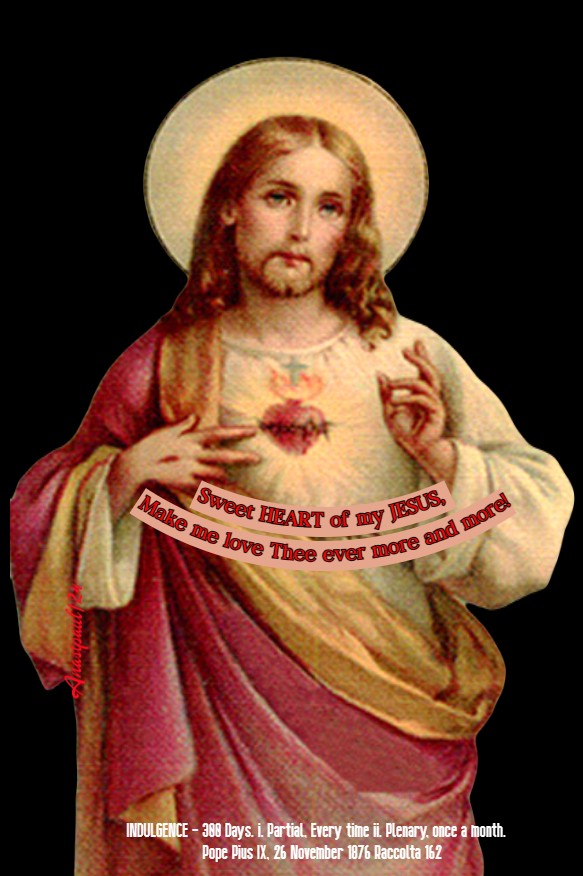
Sweet Heart of my JESUS, Make me love Thee ever more and more! INDULGENCE – 300 Days. i. Partial, Every time ii. Plenary, once a month. Pope Pius IX, 26 November 1876 Raccolta 162
Our Morning Offering – 24 June – “The Month of the Sacred Heart of Jesus” – Within the Corpus Christi Octave – The Feast of the Nativity of St John the Baptist
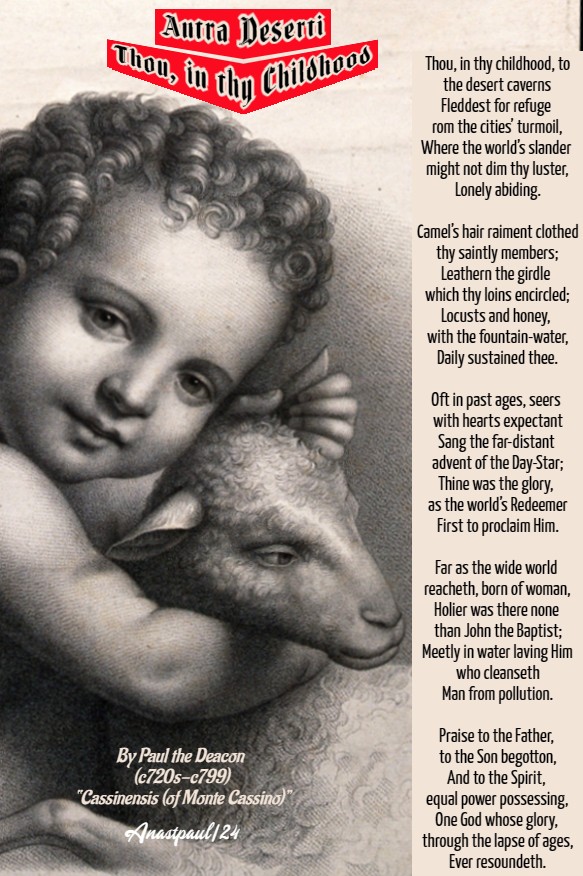
Antra Deserti Thou, in thy Childhood By Paul the Deacon (c720s-c799) “Cassinensis (of Monte Cassino)” Monk, Spiritual Author, Historian, Poet
Thou, in thy childhood, to the desert caverns Fleddest for refuge from the cities’ turmoil, Where the world’s slander might not dim thy luster, Lonely abiding.
Camel’s hair raiment clothed thy saintly members; Leathern the girdle which thy loins encircled; Locusts and honey, with the fountain-water, Daily sustained thee.
Oft in past ages, seers with hearts expectant Sang the far-distant advent of the Day-Star; Thine was the glory, as the world’s Redeemer First to proclaim Him.
Far as the wide world reacheth, born of woman, Holier was there none than John the Baptist; Meetly in water laving Him who cleanseth Man from pollution.
Praise to the Father, to the Son begotton, And to the Spirit, equal power possessing, One God whose glory, through the lapse of ages, Ever resoundeth.
This Hymn, “Ut queant laxis resonare fibris”, is in three parts. The Breviary and Roman Missal list the above for Matins today, on the Feast of the Nativity of St John the Baptist.
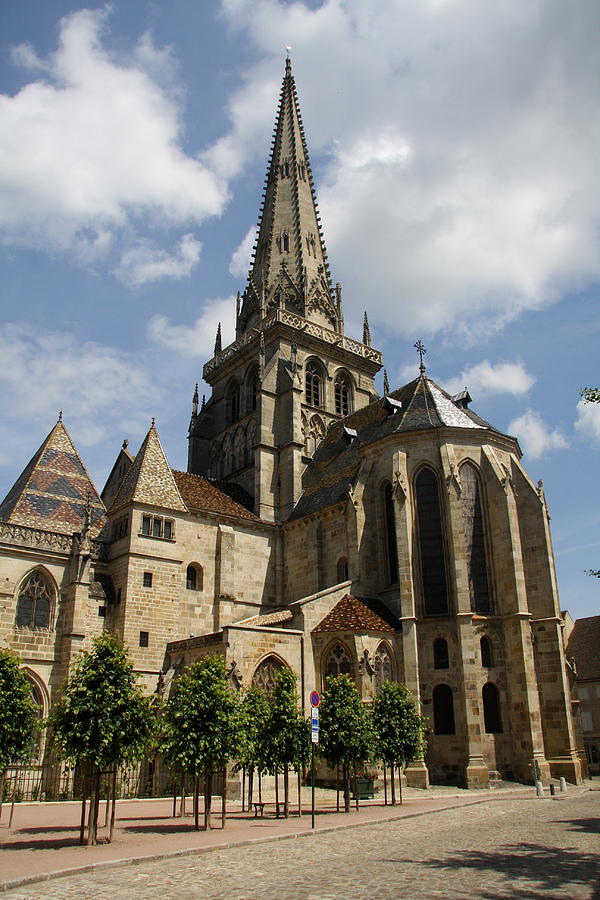
Saint of the Day – 24 June – Saint Simplicius (Died c375) Bishop and Confessor of Autun, married but living in a chaste marriage by mutual consent, Defender of the Faith against heresies, excellent administrator and devoted and zealous shepherd of his flock paying great attention to the temporal and spiritual needs of the poor and lowly. Miracle-worker. He led his Diocese with wisdom and compassion, preaching the Gospel and fighting the heresies which threatened to corrupt the faith of the faithful.
The Roman Martyrology reads today: “At Autun, the demise of St Simplicius, Bishop and Confessor.”
Unknown Bishop Statue
Simplicius was born into a noble Gallo-Roman family in Autun, in present-day France. From a young age, he stood out for his piety and moral rigour.
At a time when society was still permeated by pagan customs, Simplicius and his wife, a woman of equal virtue, chose to live in chastity, while remaining united in marriage. This bold and unconventional choice testifies to the depth of their faith and their desire to consecrate themselves entirely to God.
Simplicius’ fame for sanctity and wisdom soon spread, winning the applause and esteem of his fellow citizens. Upon the death of Bishop Hegemonius, the choice of successor fell unanimously upon him. Recognising in him a man of profound faith and exceptional virtue, the people of Autun saw in Simplicius, the idealshepherd for their community. Having assumed the Episcopate, Simplicius devoted himself with zeal and self-denial to his pastoral task. His work was distinguished by the particular attention paid to the poorest and the needy, to whom he offered relief and material and spiritual support.
The life of Saint Simplicius was studded with miracles and wonders which consolidated his reputation for sanctity. Among the most famous is the miracle performed to expose the falsity of the pagan cult of the pagan goddess, Cybele Berecintiana. According to tradition, Simplicius, with a gesture of unshakable faith, caused the statue of the goddess to collapse, demonstrating the futility of idolatry and converting numerous pagans to Christianity.
Another episode exemplifies his moral integrity and his unshakable faith. Unjustly accused of immorality by his jealous detractors, Simplicius subjected himself to the test of fire, walking barefoot on burning coals. He emerged unscathed from this ordeal, proving his innocence and strengthening his spiritual authority.
Saint Simplicius died in Autun around 375, leaving behind an invaluable spiritual legacy. His memory was immediately venerated by the faithful who considered him a miracle-worker and an intercessor with God. His remains were buried in the Cathedral of Autun, where they became a place of pilgrimage for devotees from all over the region and further afield.
Even today, Saint Simplicius is highly venerated by the Church which celebrates his memory on 24 June. (Author: Franco Diego).
St John of Tuy St Joseph Yuan Zaide St Rumold St Simplicius (Died c375) Bishop and Confessor of Autun St Theodulphus of Lobbes
The First Martyrs of the Church of Rome: Countless numbers were Christians Martyred in the City of Rome during Nero’s persecution in 64. The event is recorded by both Tacitus and Pope Clement I, among others. They are celebrated today.
Martyrs of Satala: Seven Christian brothers who were soldiers in the imperial Roman army. They were expelled from the military, exiled and eventually martyred in the persecutions of Maximian. We know little more about them than their names – Cyriacus, Firminus, Firmus, Longinus, Pharnacius, Heros and Orentius. The martyrdoms occurred in c 311 at assorted locations around the Black Sea.
Thought for the Day – 23 June – Meditations with Antonio Cardinal Bacci (1881-1971)
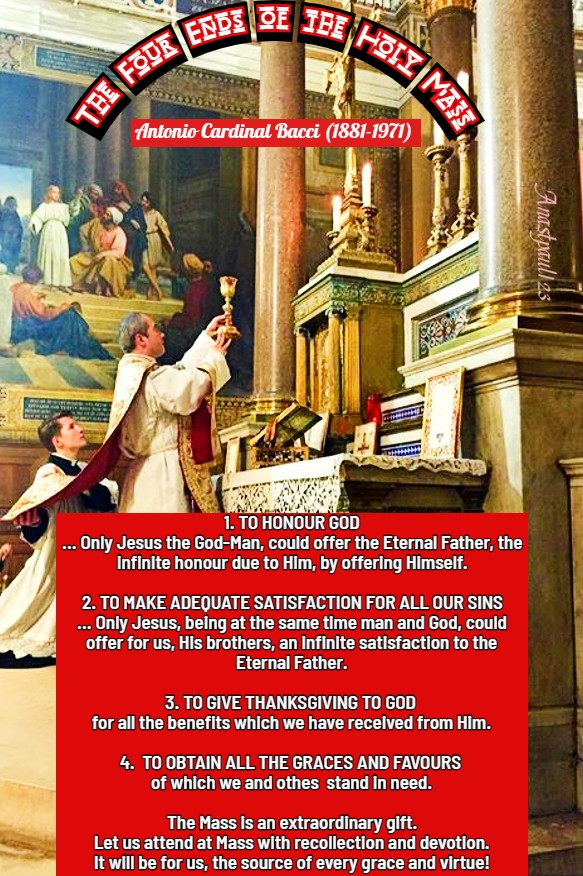
The Holy Mass The Four Ends of the Holy Mass
“Let us meditate on the fact, that the Sacrifice of the Eucharist, was instituted for four ends, namely:
1. TO HONOUR GOD All the Angels and Saints of Heaven and all the human beings upon earth, could not possibly honour God, as He ought to be honoured because, they are creatures who derive everything which they possess from God. Only Jesus the God-Man, could offer the Eternal Father, the infinite honour due to Him, by offering Himself.
2. TO MAKE ADEQUATE SATISFACTION FOR ALL OUR SINS Insofar, as they are a revolt against God, our sins are, in a certain way, infinite. This is because they offend an Infinite Being. Only Jesus, being at the same time man and God, could offer for us, His brothers, an infinite satisfaction to the Eternal Father. Only He, could redeem us from the debt of crime and punishment, which we had contracted, by offering Himself, without reserve, in the Eucharistic Sacrifice. It must be explained, however, that although the Mass is of infinite value in itself, God applies this value to us in a finite way only, according to His good pleasure and according to our dispositions. For this reason, we should do well to attend Mass, as often as possible and with the maximum fervour.
3. TO GIVE THANKSGIVING TO GOD for all the benefits which we have received from Him.
4. Finally, TO OBTAIN ALL THE GRACES AND FAVOURS of which we and others stand in need. The Mass is an extraordinary gift. Let us attend at Mass with recollection and devotion. It will be for us, the source of every grace and virtue!” Amen
Quote/s of the Day – 23 June – “The Month of the Most Sacred Heart of Jesus”– Within the Corpus Christi – The Vigil of the Nativity of St John the Baptist or St John’s Eve – – 1 Peter 3:8-15 – Matthew 5:20-24 – Scripture search here: https://www.drbo.org/
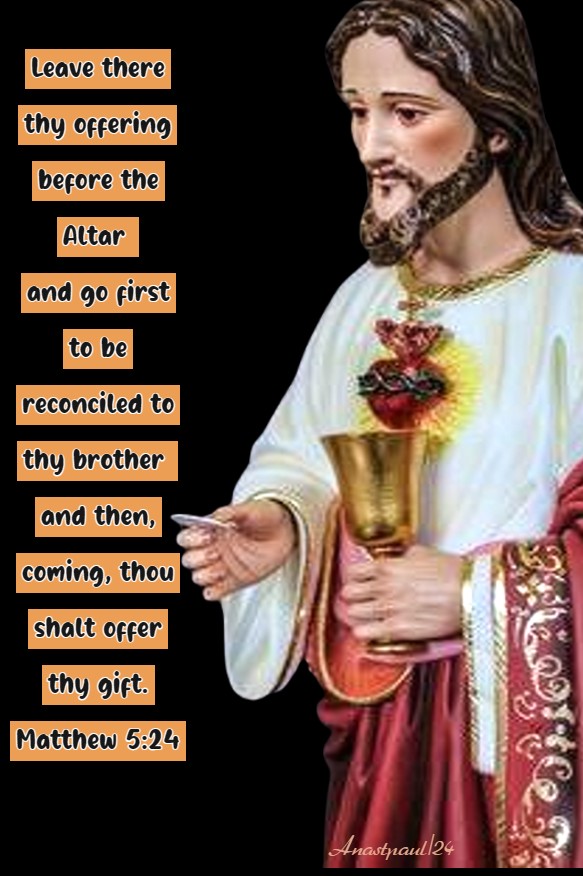
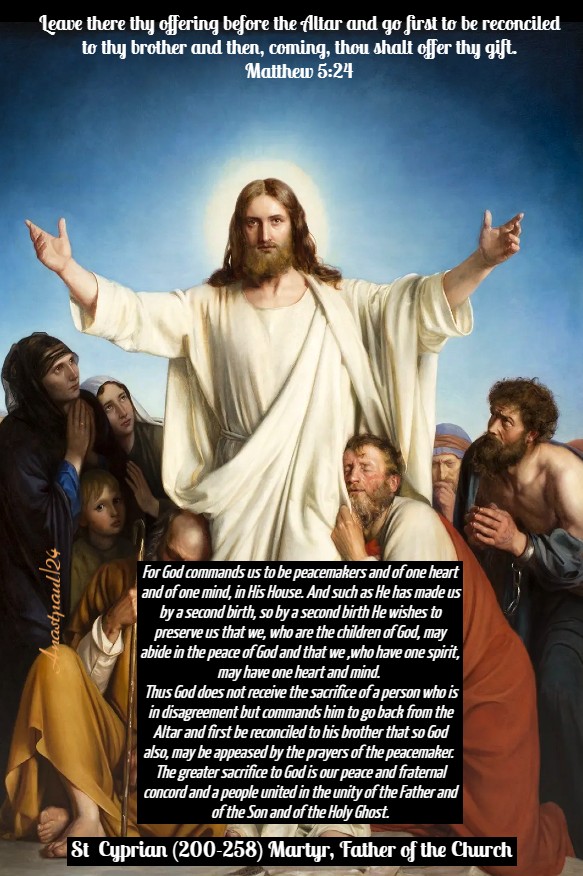
“Leave there thy offering before the Altar and go first to be reconciled to thy brother and then, coming, thou shalt offer thy gift.”
Matthew 5:24
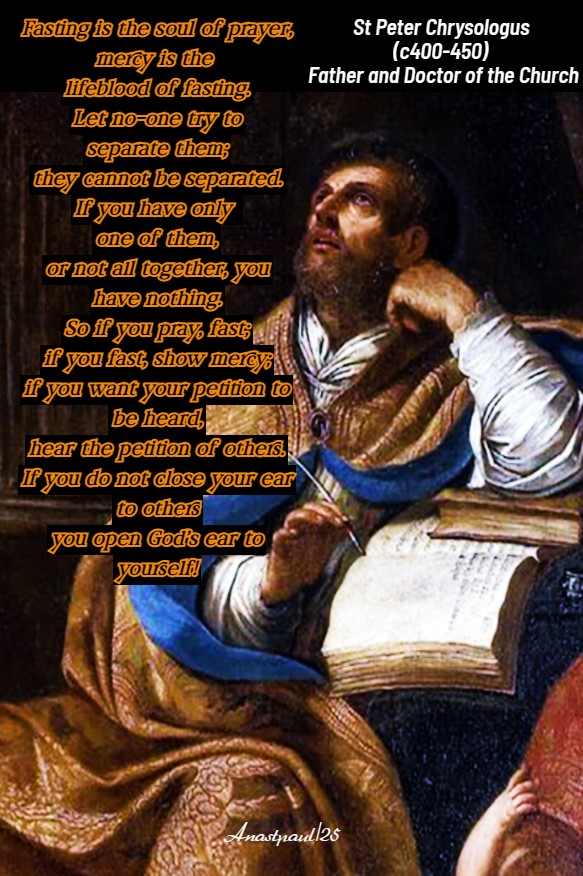
“Fasting is the soul of prayer, mercy is the lifeblood of fasting. Let no-one try to separate them; they cannot be separated. If you have only one of them, or not all together, you have nothing. So if you pray, fast; if you fast, show mercy; if you want your petition to be heard, hear the petition of others. If you do not close your ear to others you open God’s ear to yourself!”
St Peter Chrysologus (c400-450) Bishop of Ravenna “Doctor of Homilies” Father and Doctor of the Church
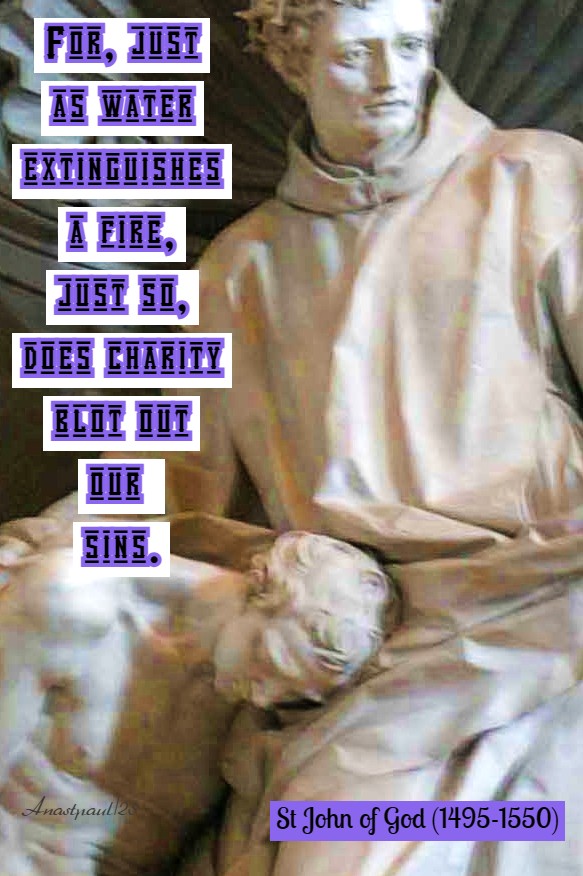
“For, just as water extinguishes a fire, just so, does charity blot out our sins.”
St John of God (1495-1550)
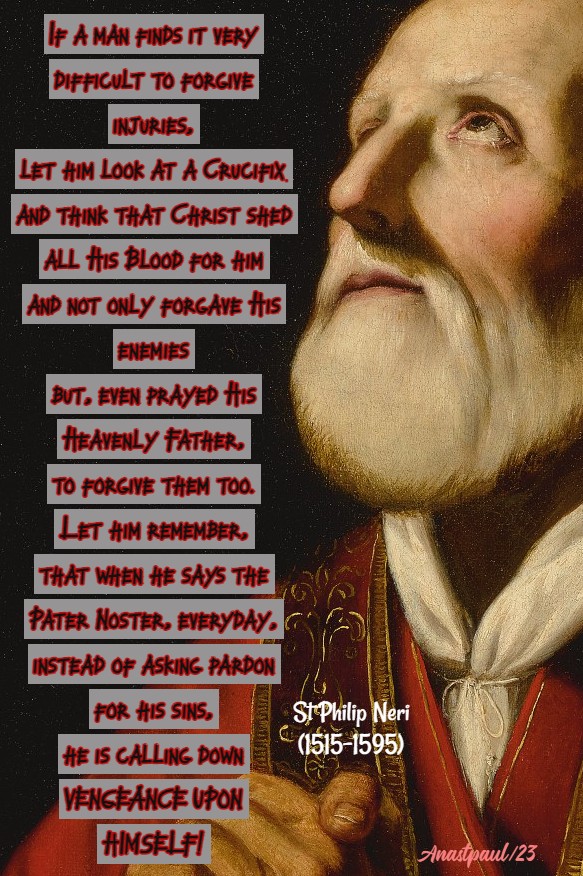
“If a man finds it very difficult to forgive injuries, let him look at a Crucifix and think that Christ shed all His Blood for him and not only forgave His enemies but, even prayed His Heavenly Father, to forgive them too. Let him remember, that when he says the Pater Noster, everyday, instead of asking pardon for his sins, he is calling down VENGEANCE UPON HIMSELF!”
One Minute Reflection – 23 June – “The Month of the Most Sacred Heart of Jesus” – Within the Corpus Christi – The Vigil of the Nativity of St John the Baptist or St John’s Eve – – 1 Peter 3:8-15 – Matthew 5:20-24 – Scripture search here: https://www.drbo.org/
“Leave there thy offering before the Altar and go first to be reconciled to thy brother and then, coming, thou shalt offer thy gift.” – Matthew 5:24
REFLECTION – “The measure with which you measure shall be measured out to you” (Mt 7:2). And the servant who, after having had all his debt forgiven him by his master, would not forgive his fellow-servant, is confined to prison. Because he was unwilling to forgive his fellow-servant, he lost the forgiveness which had been granted him by the Lord (Mt 18:23f). And these things Christ sets forth still more strongly in his precepts by the greater force of his censure. He says: “When you stand praying, forgive anyone against whom you have a grievance, so that your heavenly Father may in turn forgive you your transgressions. But if you do not forgive, neither will your heavenly Father forgive your transgressions” (Mk 11:25) …
For God commands us to be peacemakers and of one heart and of one mind, in His House. And such as He has made us by a second birth, so by a second birth He wishes to preserve us that we, who are the children of God, may abide in the peace of God and that we ,who have one spirit, may have one heart and mind. Thus God does not receive the sacrifice of a person who is in disagreement but commands him to go back from the Altar and first be reconciled to his brother that so God also, may be appeased by the prayers of the peacemaker. The greater sacrifice to God is our peace and fraternal concord and a people united in the unity of the Father and of the Son and of the Holy Ghost.” – St Cyprian of Carthage (200-258) Bishop of Carthage, Martyr, Father of the Church (The Lord’s Prayer, 23).
PRAYER – O God, Thou Who hast prepared good things as yet unseen for those who love Thee, pour a burning love into our hearts, so that we, loving Thee, in and above all things, may obtain Thy promises which surpass all desire. Through Jesus Christ, Thy Son our Lord, Who lives and reigns with Thee, in the unity of the Holy Ghost, God, world without end. Amen (Collect).
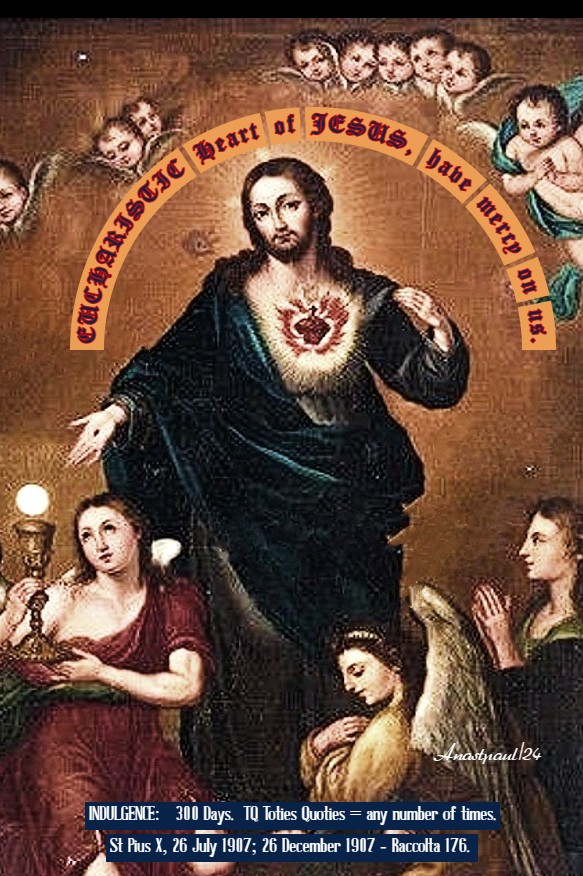
EUCHARISTIC Heart of JESUS, have mercy on us. INDULGENCE: 300 Days. TQ Toties Quoties = any number of times. St Pius X, 26 July 1907; 26 December 1907 – Raccolta 176.
Our Morning Offering – 23 June – “The Month of the Most Sacred Heart of Jesus” – Within the Corpus Christi Octave
Anima Christi
Soul of Christ, sanctify me Body of Christ, save me Blood of Christ, inebriate me Water from the side of Christ, wash me Passion of Christ, strengthen me Good Jesus, hear me Within Your wounds, shelter me from turning away, keep me From the evil one, protect me At the hour of my death, call me Into Your presence lead me to praise You with all Your saints Forever and ever, Amen
For many years the Anima Christi was popularly believed to have been composed by Saint Ignatius Loyola (1491-1556) , as he puts it at the beginning of his Spiritual Exercises and often refers to it. In the first edition of the Spiritual Exercises Ignatius merely mentions it, evidently supposing that the reader would know it. In later editions, it was printed in full. It was by assuming that everything in the book was written by Ignatius that it came to be looked upon as his composition. On this account the prayer is sometimes referred to as the Aspirations of St. Ignatius Loyola and so my image shows St Ignatius at prayer.
However, the prayer actually dates to the early fourteenth century and was possibly written by Pope John XXII but its authorship remains uncertain. It has been found in a number of prayer books printed during the youth of Ignatius and is in manuscripts which were written a hundred years before his birth. The English hymnologist James Mearns found it in a manuscript of the British Museum which dates to about 1370. In the library of Avignon there is preserved a prayer book of Cardinal Pierre de Luxembourg (died 1387), which contains the prayer in practically the same form as we have it today. It has also been found inscribed on one of the gates of the Alcázar of Seville, which dates to the time of Pedro the Cruel (1350–1369).
The invocations in the prayer have rich associations with Catholic concepts that relate to the Eucharist (Body and Blood of Christ), Baptism (water) and the Passion of Jesus (Precious Blood and Holy Wounds).And yes – that is St Ignatius in my image.
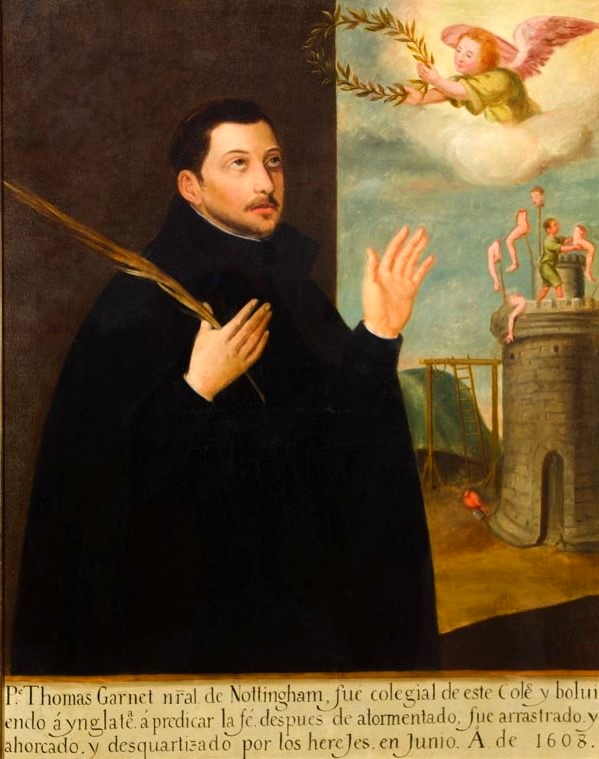
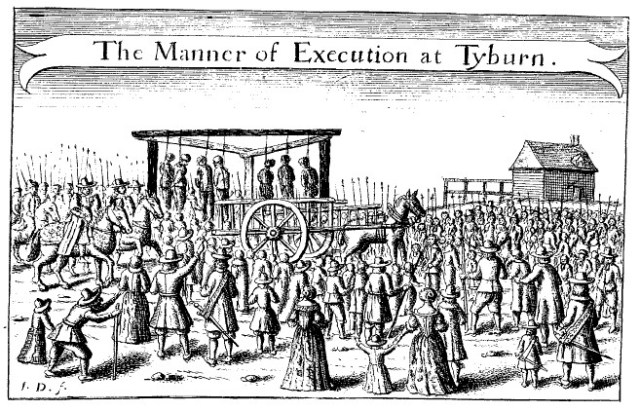
Saint of the Day – 23 June – Blessed Thomas Garnet SJ (1574-1608) Priest Martyr, Born in 1574 at Southwark, England and died by being hanged, drawn and quartered on 23 June 1608 at Tyburn Tree, London. A vowed Priest of the Society of Jesus and a Missionary to the Recusant Catholics suffering under Elizabeth I. He should not be confused with his uncle, St Henry Garnet SJ (1555-1606) Martyr. Our Thomas was named in love for St Thomas a Becket and St Thomas More – both Martyrs. He was Beatified on 15 December 1929 by Pope Pius XI. Additional Feasts – 25 October as one of the Forty Martyrs of England and Wales; 1 December as one of the Martyrs of Oxford University.
Portrait from the Royal English College in Valladolid
Thomas Garnet was imprisoned on three different occasins but would not be deterred from caring for English Catholics. He was arrested for the last time when the man in whose home he was living was implicated in the fabricated Gunpowder Plot supposedly to explode the Houses of Parliament.
A native of London, Thomas’ parents were loyal Catholics who allowed him to attend the newly-opened Jesuit College in Saint-Omer, Flanders. He wanted to continue his studies at the English Seminary in Valladolid, Spain and was travelling there but landed at England rather than Spain when a storm pushed the ship off course.
Thomas and five companions were immediately arrested but they all managed to escape and eventually to make their way to Spain. Thomas finished his theology studies in 1599, was Ordained to the Holy Priesthood and then returned to England.
For six years the young Priest worked fearlessly among the Recusant Catholics who refused to accept the Queen’s supremacy in religious matters, this was, of course, after the death of Henry VIII. Inspired by the example of his uncle, Father Henry Garnet, the superior of the Jesuits in England, the young Thomas decided to enter the Jesuits himself. He was accepted in September 1604 but could not progress further before he was caught in the entangling web of deceit of the Gunpowder Plot.
Although he himself was innocent, he was implicated when government agents searched for Thomas Rookwood, in whose home our Thomas resided, who had been involved to some degree. Eventually his captors concluded he had no information to divulge and sent him back to prison where he remained for seven months until a group of 47 Priests were deported to make room for other, more dangerous Priests. All were warned that they would lose their lives if they returned.
Thomas made his way to the English Jesuit Novitiate at Louvain and took his vows there a year later, on 2 July 1607. In September he returned to England but was arrested within 6 weeks when an apostate priest betrayed him. He was taken back to the same prison he had endured before but would give no information when he was interrogated.
On 19 June 1608 he went to trial at the Old Bailey, indicted for being a Priest under orders from Rome. The only evidence against him was the testimony of a witness who claimed he had once seen a letter on which Thomas had signed his name and then added, “Priest.” He was found guilty of High Treason and condemned to be hanged, drawn and quartered.
“I wandered,” he said during his trial, “from place to place to recover souls who had gone astray and were in error as to the knowledge of the true Catholic Church.”
Four days later Thomas was publicly dragged through the cobbled, muddied and we streets, to Tyburn Tree for execution. During the customary final speech, he said that he was indeed a Priest and a Jesuit and that he was happy to die for his Lord. He was 33 years old at his death.
Bl Peter of Juilly Bl Thomas Corsini of Orvieto Blessed Thomas Garnet SJ (1574-1608) Priest Martyr. Beatified on 15 December 1929 by Pope Pius XI. Bl Walhere of Dinant St Zenas of Philadelphia St Zeno of Philadelphia
Martyrs of Ancyra: A family of converts who were arrested, tortured, and sent in chains to Ancyra, Galatia (modern Ankara, Turkey) where they was tortured again by order of governor Agrippinus during the persecutions of Diocletian. Martyrs. They were – Eustochius, Gaius, Lollia, Probus, Urban. Died by being roasted over a fire and finally beheaded c300 in Ancyra, Galatia (modern Ankara, Turkey).
Martyrs of Nicomedia: During the persecutions of Diocletian, many Christians fled their homes to live in caves in the area of Nicomedia. In 303 troops descended on the area, systematically hunted them down and murdered all they could find.
Thought for the Day – 22 June – Meditations with Antonio Cardinal Bacci (1881-1971)
The Holy Mass
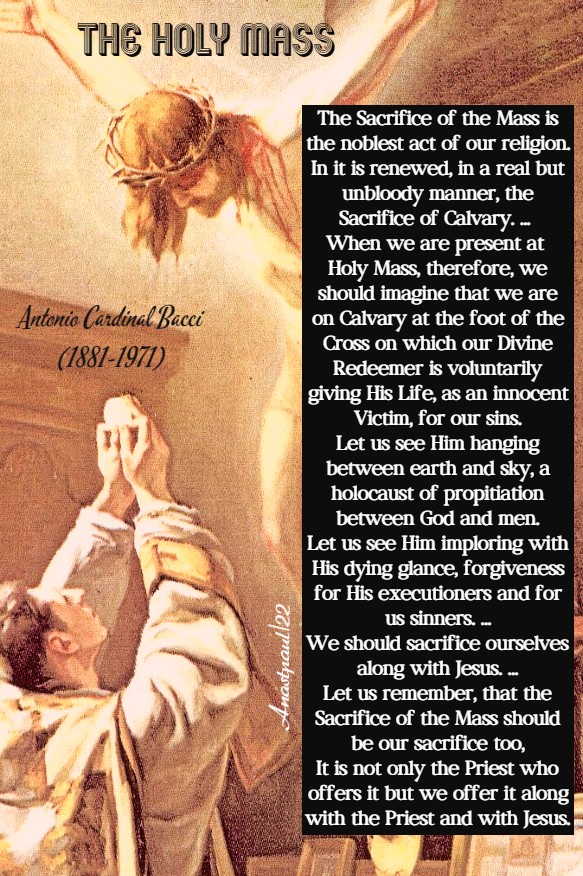
“The Sacrifice of the Mass is the noblest act of our religion. In it is renewed, in a real but unbloody manner, the Sacrifice of Calvary.
Jesus desired to remain with us throughout the centuries in the Blessed Eucharist as our friend, comforter and spiritual food. Similarly, not being satisfied with having shed His Precious Blood on the Cross for our Redemption, it was His wish that this sacrificial action should be renewed daily in every corner of the world, in such a way, that everyone could participate in it and benefit from it. When we are present at Holy Mass, therefore, we should imagine that we are on Calvary at the foot of the Cross on which our Divine Redeemer is voluntarily giving His Life, as an innocent Victim, for our sins. Let us see Him hanging between earth and sky, a holocaust of propitiation between God and men. Let us see Him imploring with His dying glance, forgiveness for His executioners and for us sinners.
Let us imagine, moreover, His most Holy Mother as she gazes sorrowfully upon her suffering Son. With love far greater than that of any other human creature, she offers herself in union with Jesus, for our salvation.
We should make a similar offering when we assist at the Sacrifice of the Altar. We should sacrifice ourselves along with Jesus. If we are tormented by sufferings, let us offer them up along with those of Jesus. If we are troubled by passionate inclinations to sin, let us sacrifice these bravely, along with Jesus and for love of Him. If we are full of hatred and coldness towards others, let us sacrifice these feelings for love of Jesus, Who forgave everyone who asked and repented and prayed even for His executioners.
Let us remember, the Sacrifice of the Mass should be our sacrifice too. It is not only the Priest who offers it but we offer it along with the Priest and with Jesus. “Receive, O Holy Trinity, this oblation which we make to Thee.” Let us unite the offering of our entire selves to the Sacrifice of Jesus and we sgall obtain great spiritual benefits.”
Quote/s of the Day – 22 June – St Paulinus of Nola (c 354-431) Bishop, Confessor, Father
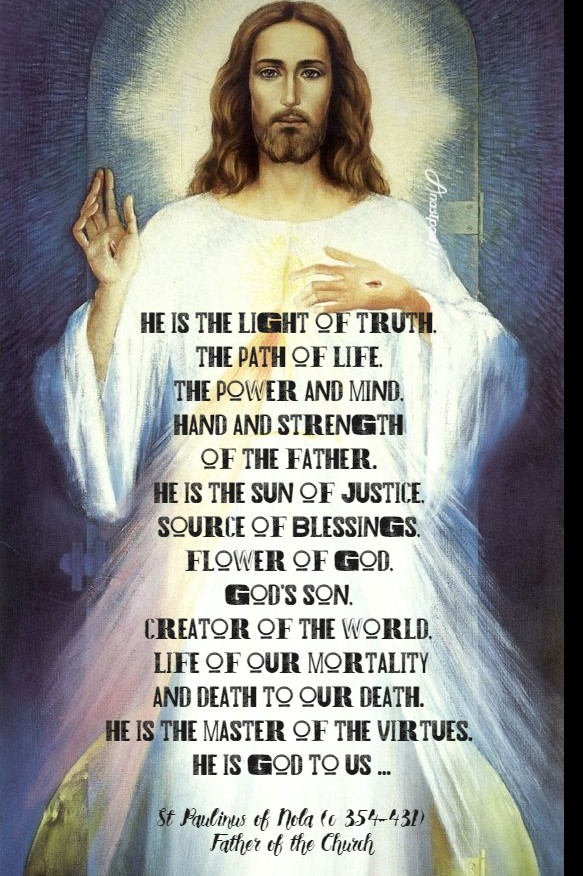
“He is the Light of Truth, the Path of life, the Power and Mind, Hand and Strength of the Father. He is the Sun of Justice, Source of Blessings, Flower of God, God’s Son, Creator of the world, Life of our mortality and Death to our death. He is the Master of the virtues. He is God to us …!”
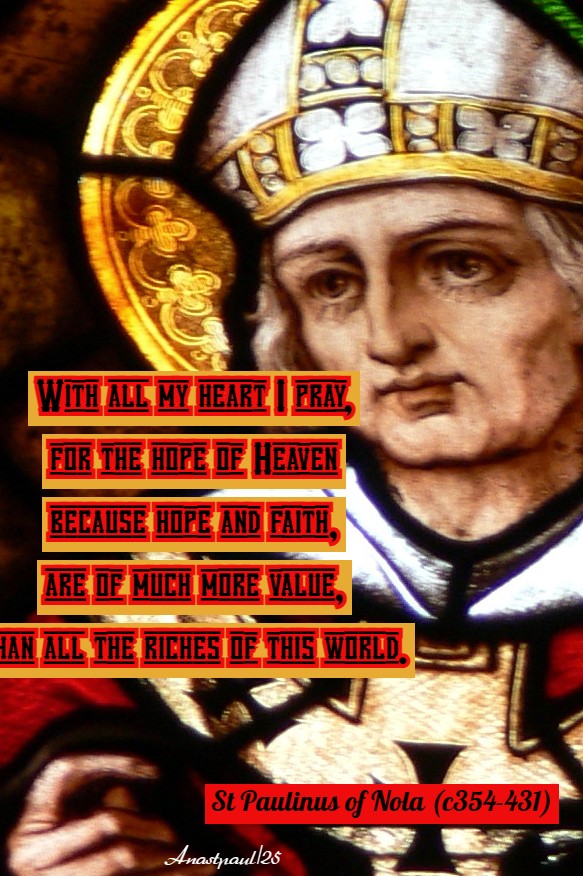
“With all my heart I pray, for the hope of Heaven because hope and faith, are of much more value, than all the riches of this world.”
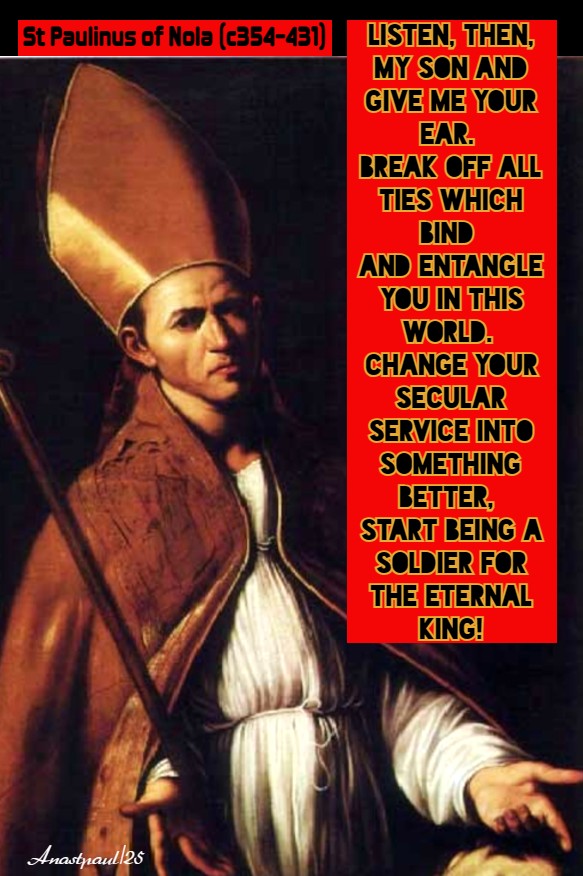
“Listen, then, my son and give me your ear. Break off all ties which bind and entangle you in this world. Change your secular service into something better, start being a soldier for the eternal King!”
One Minute Reflection – 22 June – “The Month of the Most Sacred Heart of Jesus” – The Solemnity of Corpus Christi and Within the Corpus Christi Octave – St Paulinus of Nola (c 354-431) Bishop, Confessor, Father of the Church –1 John 3:13-18 – Luke 14:16-24 – Scripture search here: https://www.drbo.org/
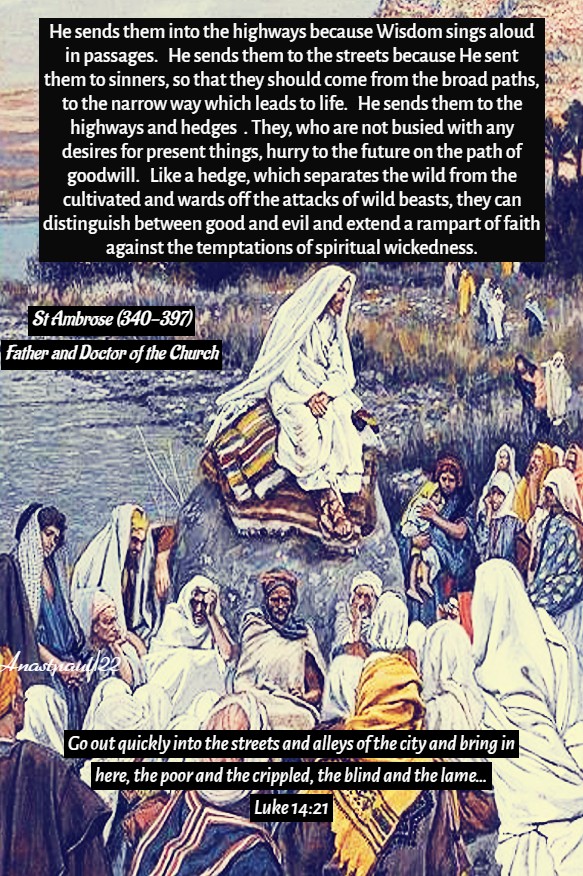
“The servant went and reported this to his Master. Then the Master of the house was angry and commanded His servant, ‘Go out quickly into the streets and alleys of the city and bring in here, the poor and the crippled, the blind and the lame…” – Luke 14:21
REFLECTION – “He turned to the Gentiles from the careless scorn of the rich. He invites both good and evil to enter, in order to strengthen the good and change the disposition of the wicked for the better. The saying that was read today is fulfilled, “Then wolves and lambs will feed together.” He summons the poor, the maimed and the blind. By this, He shows us, either that handicaps do not exclude us from the Kingdom of Heaven that the Lord’s mercy forgives the weakness of sinners. Whoever glories in the Lord, glories as one redeemed from reproach, not by works but by faith.
He sends them into the highways because Wisdom sings aloud in passages. He sends them to the streets because He sent them to sinners, so that they should come from the broad paths, to the narrow way which leads to life. He sends them to the highways and hedges . They, who are not busied with any desires for present things, hurry to the future on the path of goodwill. Like a hedge, which separates the wild from the cultivated and wards off the attacks of wild beasts, they can distinguish between good and evil and extend a rampart of faith against the temptations of spiritual wickedness.” – St Ambrose (340-397) Bishop of Milan, Father and Doctor of the Church (Exposition on the Gospel of Luke, 7).
PRAYER – O God, Who promised to those who forsake all things in this world for Thee, a hundred-fold reward in the world to come and life everlasting, mercifully grant that, following closely in the footsteps of the holy Bishop, Paulinus, we may look upon earthly things as nought and long only for those of Heaven. Who lives and reigns with God the Father, in the unity of the Holy Spirit, God, world without end. Amen (Collect).
MAY the Heart of JESUS in the most Blessed Sacrament be praised, adored and loved with grateful affection, at every moment, in all the Tabernacles of the world, even to the end of time. Amen. Indulgence 100 Days, Once a day. Raccolta 161 Pope Pius IX, 29 February 1868.
Our Morning Offering – 22 June – “The Month of the Most Sacred Heart of Jesus” – he Solemnity of Corpus Christi and Within the Corpus Christi Octave
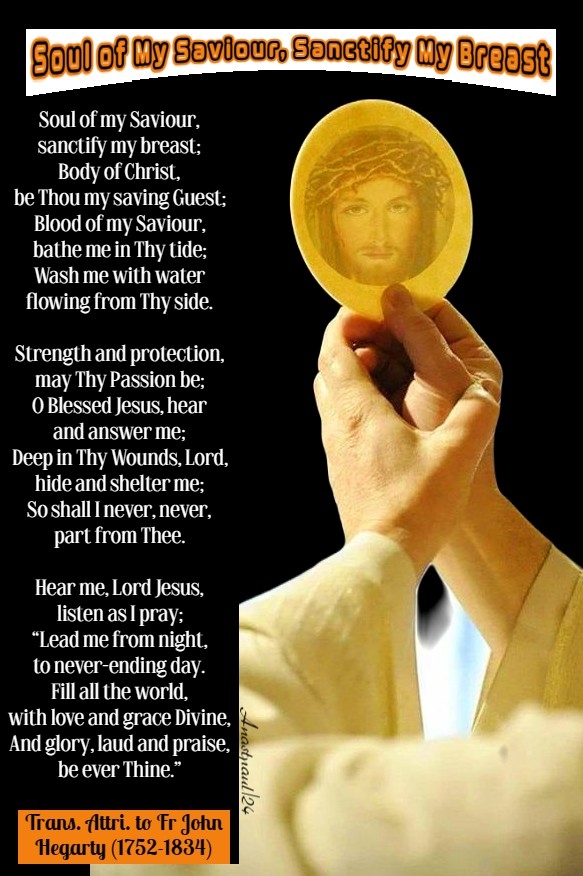
Soul of My Saviour, Sanctify My Breast Trans. Attri. to Fr John Hegarty (1752-1834)
Soul of my Saviour, sanctify my breast; Body of Christ, be Thou my saving Guest; Blood of my Saviour, bathe me in Thy tide; Wash me with water flowing from Thy side.
Strength and protection, may Thy Passion be; O Blessed Jesus, hear and answer me; Deep in Thy Wounds, Lord, hide and shelter me; So shall I never, never, part from Thee.
Hear me, Lord Jesus, listen as I pray; “Lead me from night, to never-ending day. Fill all the world, with love and grace Divine, And glory, laud and praise, be ever Thine.”
This Hymn is based on the original Latin text of the Anima Christi. Fr Hegarty is attributed with its translation and/or arrangement. He was born in County Derry, Ireland, educated at Dublin University and was Ordained in June 1890 and spent most of active apostolic years in Brisbane, Australia. He died aged 82 years.
Saint of the Day – 22 June – Saint Giovanni d’Acquarola (Died c849) Bishop of Naples who served as the Bishop of Naples from 26 February 842 until his death. Died on 17 Decenber c849 at his See in Naples. Patronage – co-with many others, of Naples. Also known as – Giovanni Scrib, John IV, John the Peacemaker, John the Serene.
The Roman Martyrology reads today: “At Naples, in Campania, St John, Bishop. who was called to the Kingdom of Heaven by blessed Paulinus, the Bishop of Nola, who is also celebrated today.”
He had the Relics of St Aspren translated to a Chapel in the Church of Santa Restituta in Naples.
Giovanni also assisted Duke Andrew II in negotiating an economic treaty called the Pactum Sicardi with Sicard, the Lombard Prince of Benevento, hence the honourary title ‘the Peacemaker.’
The Solemnity of Corpus Christi, The Most Holy Body and Blood of Our Lord Jesus Christ: Corpus Christi The Feast is liturgically celebrated on the Thursday after Trinity Sunday which this year was 19 June. https://anastpaul.com/2022/06/16/the-festival-of-corpus-christi/
St Paulinus of Nola (c354-431) Bishop, Confessor, Poet, Writer, Apostle of Charity, Preacher, Orator, Senator and Governor. St Paulinus was an inspiration to many—including six great Saints of the Church, who referenced him in letters of encouragement to others: St Augustine, St Jerome, Melania, St Martin of Tours, St Gregory and St Ambrose. St Augustine wrote, “Go to Campania– there study Paulinus, that choice servant of God. With what generosity, with what still greater humility, he has flung from himself the burden of this world’s grandeurs to take on him the yoke of Christ and in His service how serene and unobtrusive his life!” This glorious Saint Paulinus!: https://anastpaul.com/2018/06/22/saint-of-the-day-22-june-st-paulinus-of-nola-c-354-431/ AND: https://anastpaul.com/2022/06/22/saint-of-the-day-22-june-st-paulinus-of-nola-c-354-431-2/
St Aaron of Brettany St Aaron of Pais-de-Laon St Alban of Britain Bl Altrude of Rome St Consortia St Cronan of Ferns
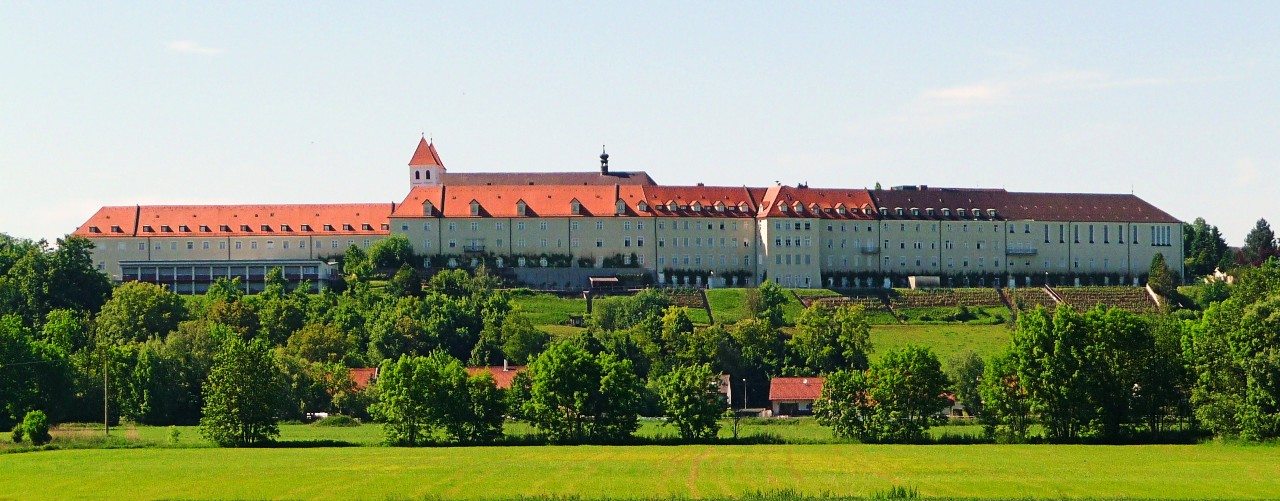
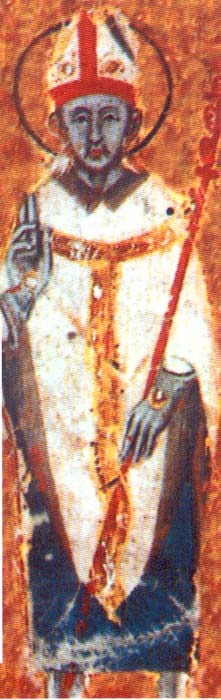
St Eberhard (1085-1164)Archbishop of Salzburg, Austria, Defender of the Papacy, Apostle of the poor and sick, Papal Legate and negotiator. Born in 1085 at Nuremberg, Germany and died on 21 June 1164 at the Cistercian Monastery of Rein, Austria of natural causes. Patronages – Bamberg, Germany, Salzburg, Austria. His Holy Life: https://anastpaul.com/2024/06/22/saint-of-the-day-22-june-saint-eberhard-of-salzburg-1085-1164-bishop/
St Eusebius of Samosata St Exuperantius of Como St Flavius Clemens St Giovanni d’Acquarola (Died c849) Bishop of Naples
St Gregory of Agrigento St Heraclius the Soldier St Hespérius of Metz
Blessed Pope Innocent V OP (c 1225-1275) Papal Ascesion 21 January 1276 unril 22 June 1276 (the date of his death. Friar of the Order of Preachers, Theologian, renowned Preacher, Scholar, Writer,, Dominican Office bearer, disciple of St Albert the Great and collaborator and friend of St Thomas Aquinas.and St Bonaventure. His Life: https://anastpaul.com/2021/06/22/saint-of-the-day-22-june-blessed-pope-innocent-v-op-c-1225-1275/
St John IV of Naples St Julius of Pais-de-Laon Bl Kristina Hamm Bl Marie Lhuilier St Nicetas of Remesiana St Precia of Epinal St Rotrudis of Saint-Omer St Rufinus of Alexandria
Martyrs of Samaria – 1480 Saints: 1480 Christians massacred in and near Samaria during the war between the Greek Emperor Heraclius and the pagan Chosroas of Persia. c 614 in the vicinity of Samaria, Palestine.
Thought for the Day – 21 June – Meditations with Antonio Cardinal Bacci (1881-1971)
The Eucharistic Life
“The Eucharistic life which is the life of union with Jesus, especially by means of daily Communion, transforms us and makes us holy. It preserves and increases in us, the grace which is the supernatural life of the soul. The Eucharist, of itself, does not bestow grace because, it is a Sacrament of the living. It is our food and food is not given to the dead but, to the living. For this reason, we should receive Holy Communion free from the stain of sin. The Eucharist, moreover, remits venial sin, strengthens us in our resolution and increases our charity. Venial sin, is a sickness of the soul. Just as natural food banishes listlessness and vulnerability to disease, our Eucharistic nourishment has the same effect on our spiritual life.
It is because the Blessed Eucharist increases our love for Jesus, that it weakens our evil inclinations. The Eucharist and sin, are mutually exclusive of one another because, the Eucharist is Jesus and sin is the devil. Our Eucharistic food, moreover, produces, in our souls, a spiritual consolation which is a foretaste of the happiness of Heaven.
Let us listen to Jesus living within us. He will enable us to forget our worldly cares and will raise us to a higher plane where, by God’s Infinite Goodness, we shall continue to grow in virtue.”
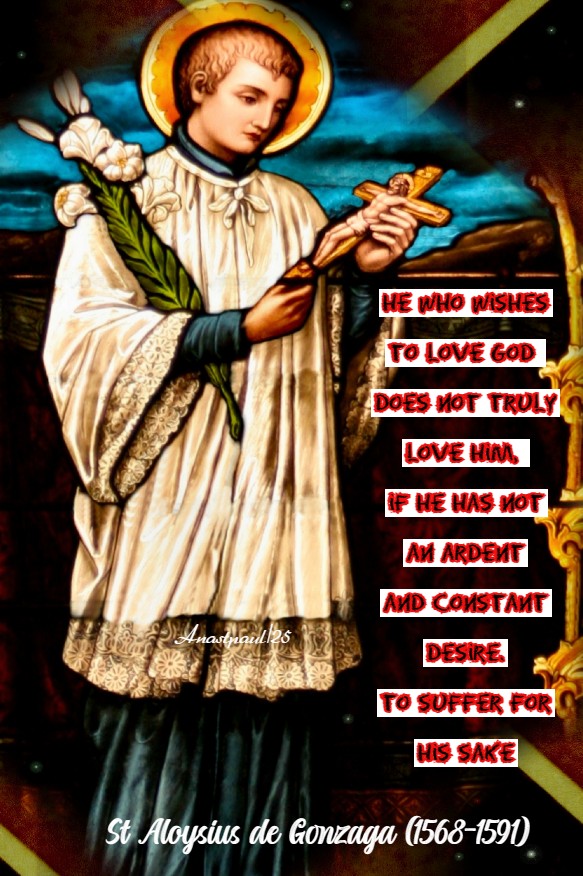
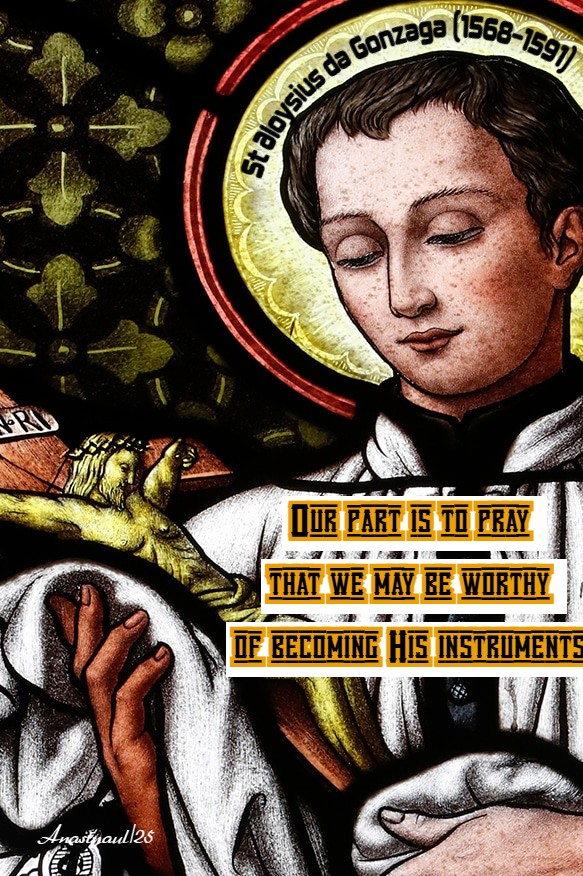
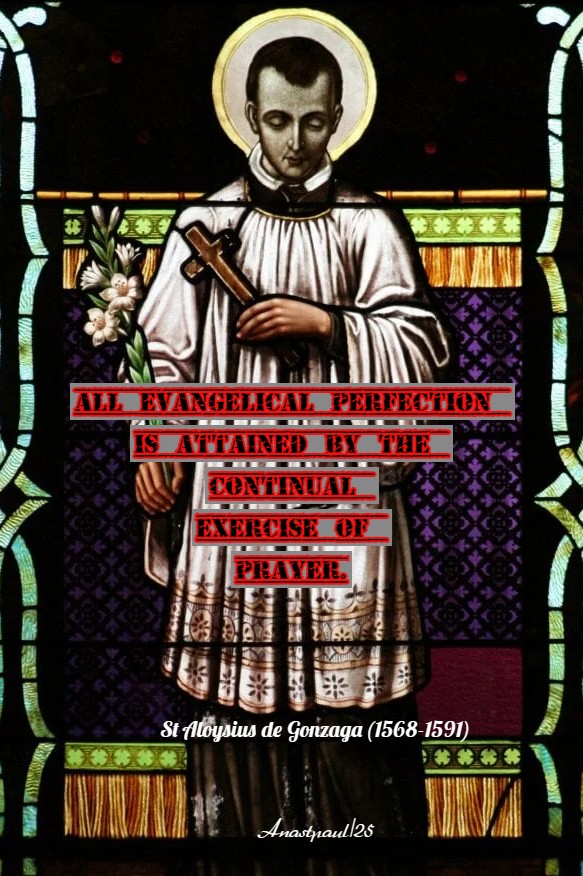
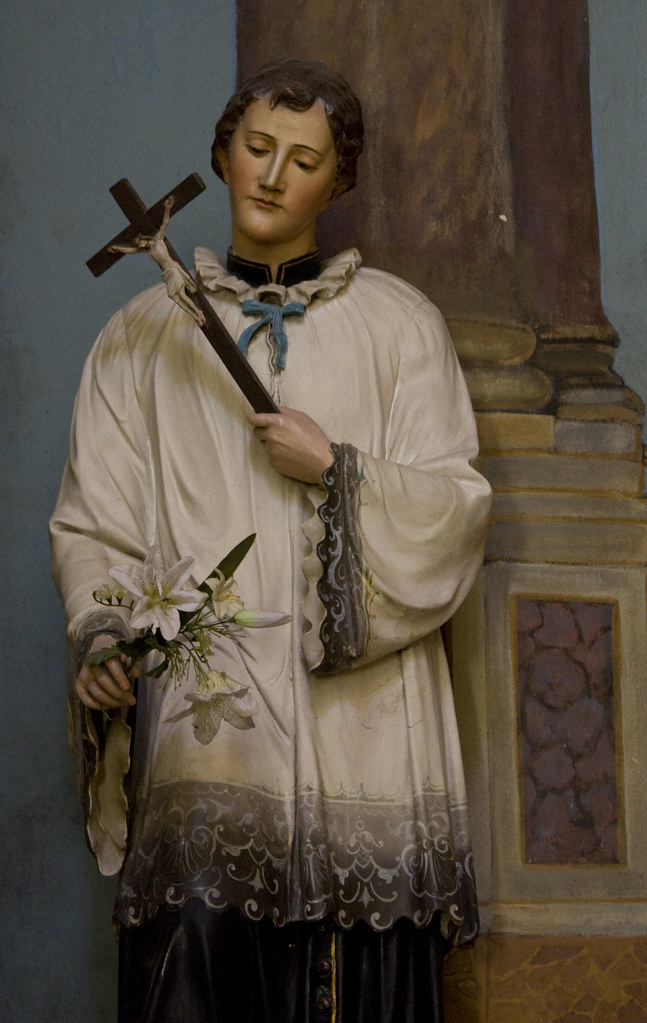
One Minute Reflection – 21 June – “The Month of the Most Sacred Heart of Jesus” – Within the Cor[us Christi Octave –St Aloysius de Gonzaga SJ (1568-1591) Confessor – Ecclesiasticus 31:8-11 – Matthew 22:29-40 – Scripture search here: https://www.drbo.org/
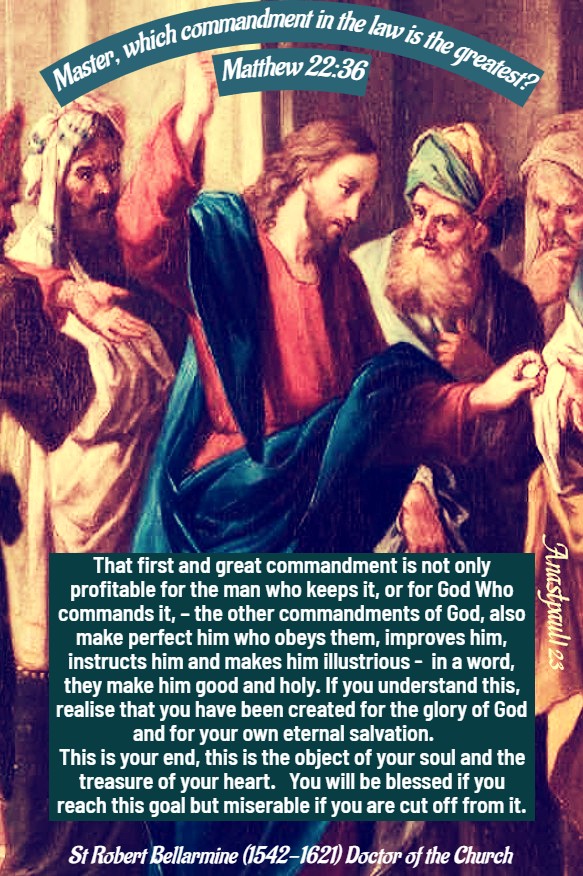
“Master, which commandment in the law is the greatest?” … Matthew 22:36
REFLECTION – “O Lord, what is it that you require of Your servants? “Take my yoke upon you,” you say. And what sort of yoke is this? “My yoke is easy and my burden light.” Now who would not willingly bear a yoke that does not press down but gives strength; a burden that does not weigh heavily but refreshes? As You rightly added: “And you will find rest” (Mt 11:29). And what is this yoke of Yours that does not tire but gives rest? It is the first and greatest of the commandments: “You shall love the Lord your God with all your heart.” What could be easier, better or more agreeable than to love the goodness, beauty and love that is most perfectly Yours, O Lord my God?
Do You not offer a reward to those who keep the commandments, which are “more desirable than a heap of gold and sweeter than honey from the comb?” (Ps 19[18]:11) So in every way You offer a very ample reward, as James the Apostle says: “The Lord has prepared, the crown of life, for those who love Him” (Jas 1:12) (…) And Paul quotes these words from Isaiah: “No eye has seen, nor ear heard, nor has the heart of man conceived, what God has prepared for those who love Him” (1 Cor 2:9).
That first and great commandment is not only profitable for the man who keeps it, or for God Who commands it, – the other commandments of God, also make perfect him who obeys them, improves him, instructs him and makes him illustrious – in a word, they make him good and holy. If you understand this, realise that you have been created for the glory of God and for your own eternal salvation. This is your end, this is the object of your soul and the treasure of your heart. You will be blessed if you reach this goal but miserable if you are cut off from it.” – St Robert Bellarmine (1542-1621) Doctor of the Church (The Ascent of the Mind to God, 1).
PRAYER – O God, bestower of heavenly gifts, Who in the angelic youth Aloysius joined wondrous innocence of life to an equally wondrous love of penance; grant, by his merits and prayers, that we who have not followed him in his innocence may imitate him in his penance. Through Jesus Christ, Thy Son our Lord, Who lives and reigns with Thee, in the unity of the Holy Ghost, God, world without end. Amen (Collect).
OUR Lady of the Sacred Heart, Pray for Us! – Indulgence 100 Days. Everytime – Raccolta 174 St Pius X, 9 July 1904.
Our Morning Offering – 21 June – “The Month of the Most Sacred Heart of Jesus” – Saturday within the Corpus Christi Octave
Consecration to Our Lady of the Eucharist After Holy Communion By the Claretian Fathers Teaching Ministry Order founded by St Anthony Mary Claret (1807-1870)
Mary is called Our Lady of the Eucharist, because without her, there would be no physical Body of Jesus to be present in the Eucharist. (See John 6:51)
Most kind Mother, we consecrate to thee, our bodies, which have just been honoured and sanctified, by the presence of thy Divine Son, our souls which have conversed with Him and our hearts which have loved Him. O dearest Mother, may the words which we have spoken, be made acceptable to Him. through thy intercession. Tell Him the things which we should have said but were unable to express. Love Him and beseech Him for us, thy poor children. Receive and keep us in thine heart. Warn us, protect us and guide us during this day that we may faithfully serve thy Divine Son and please Him in all our thoughts, desires and actions. Amen
Saint of the Day – 21 June – Saint Eusebius (Died c379) Bishop and Martyr of Samosata in Syria. Died by being hit on the head by a thrown roof tile which caused a fractured skull and his death and the glory of the Palm of Martyrdom. His life had been a zealous one of defending the One True Faith against Arianism and of the intense pastoral care of his flock.
The Roman Martyrology reads today: “St Eusebius, the Bishop of Samosata, who, in the time of the Arian Emperor Constantius, disguised himself under a military dress and visited the Churches of God, to confirm them in the Faith. He was banished by Valens into Thrace but when peace was restored to the Church in the reign of Theodosius, he was recalled. As he again visited the Churches, an Arian woman struct him with a tile which fractured his skull and honoured him with the Palm of Martyrdom.”
Eusebius was one of the most zealous defenders of orthodoxy in the 4th Century. All which is definitely known of Eusebius is gathered from the letters of St Basil the Great and of St Gregory Nazianzen and from some incidents in the “Ecclesiastical History” of Theodoret.
In around 361 he became the Bishop of the ancient Syrian City of Samosata. Eusebius had been entrusted with the official recording of the election (360) of Bishop St Meletius of Antioch, who was supported by the Arian Bishops, who were under the mistaken notion that he would prove sympathetic to their cause.
When St Meletius expounded his orthodoxy, the Bishops persuaded the Roman Emperor, Constantius II, a staunch Arian, to extort the record from Eusebius and destroy it. Constantius threatened Eusebius with the loss of his right hand because he refused to surrender the record but the threat was withdrawn when Eusebius offered both hands.
It was chiefly due to the concerted efforts of Eusebius and St Gregory Nazianzen that, in 370, St. Basil was elected Archbishop of Cæsarea in Cappadocia.
During the persecution of orthodox Christians under Julian the Apostate, Eusebius travelled incognito throughout Syria, Palestine and Phoenicia, disguised as a military officer, Ordaining Presbyters and Deacons and celebrated the Sacrament of Confirmation for the faithful.
Orthodox Christians experienced a short respite during the brief reign of Jovian but in 374 the Emperor Valens, an Arian, banished Eusebius to Thrace, in the Balkan Peninsula. Bishop Eusebius asked the messenger to keep the imperial order confidential saying: “If the people should be apprised, such is their zeal for the Faith, they would rise in arms against you and your death might be laid to my charge.”
Although advanced in years, Eusebius left that evening. After the Emperor’s death in 378, Eusebius was restored to his See of Samosata. While in Dolikha to consecrate a Bishop, he was killed after being struck on the head by a roof tile thrown by an Arian woman.
Our lovely zealous St Eusebius is remembered today, 21 June in the Roman Martyrology as a Martyr. We have no extant sermons or writings by St Eusebius bar that little quote above which appears in St Gregory’s letters.
St Lazarus the Leper St Leutfridus of La-Croix St Martia of Syracuse St Martin of Tongres St Melchiorre della Pace St Mewan of Bretagne Bl Nicholas Plutzer
Martyrs of Taw – 3+ Saints: Three Christians of different backgrounds who were Martyred together – Moses, Paphnutius, Thomas. They were beheaded in Taw, Egypt, date unknown.

































 AnaStpaul
You must be logged in to post a comment.