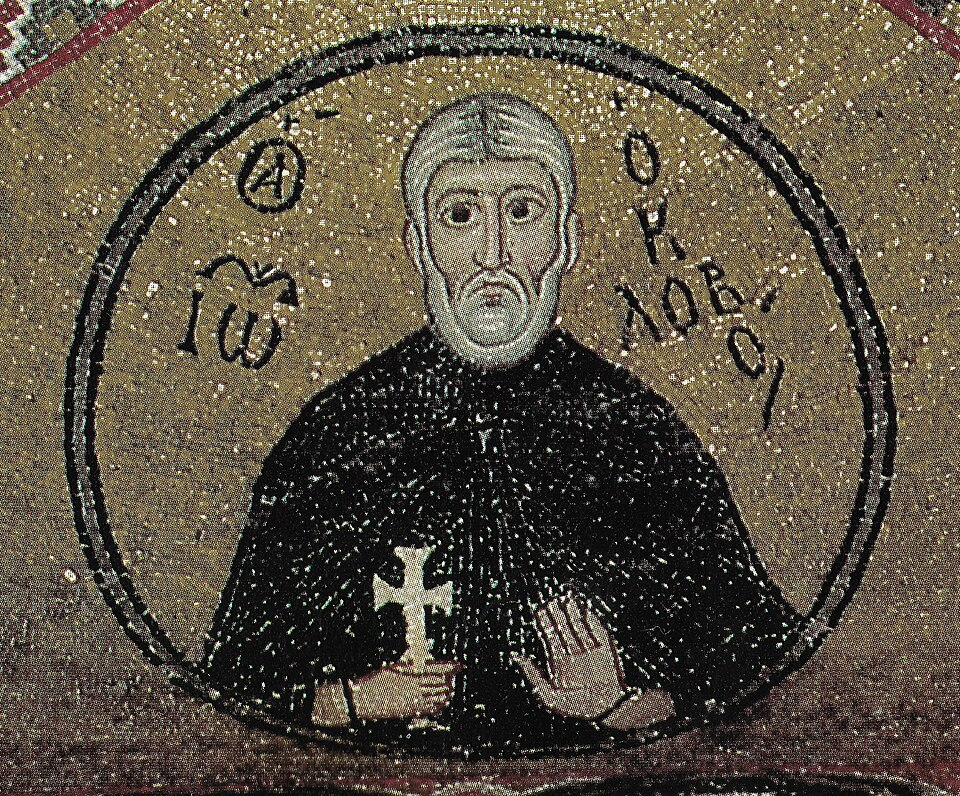
Saint John the Short, also known as John Colobus, John Kolobos, John the Little, John the Dwarf, Yoannis Pi Kolobos, was a Coptic Desert Father born in 339 at Thebes, Egypt. Born to a poor but pious family, from age 18, John lived in an underground cave he dug in the desert of Skete. He was the spiritual student of Saint Poemen and Saint Ammoes.
Noted for being short of stature, short of temper, and conceited by nature; he did not grow in height, but as his faith increased, so did his gentleness and humility. John lived on only flatbread and vegetables his entire life and ate only one meal a day. In later life he was known for absent-mindedness, his thoughts being on the spiritual life. As a test of his new humble obedience, his director Pambo ordered him to water a walking staff stuck in the sand; John obeyed and went on watering it twice a day even though the water was about 12 miles from where they lived. After three years, the piece of wood sprouted and grew into a fruitful tree. Pambo took some of this tree’s fruits and went around to all the elder monks, saying “take, eat from the fruit of obedience”. John was ordained a priest by Pope Theophilus and became abbot of the monastery he founded around the Tree of Obedience.
To escape Berber invaders around 395, he fled Skete and lived for years as a hermit on Mount Qolzum, near the current city of Suez. He was the spiritual teacher of Saint Arsenius, and died in 405 at Mount Qolzum, Egypt, of natural causes. When Saint John died, his servant, who had been in a nearby village, had a vision of him being carried to heaven by a group of angels and saints.
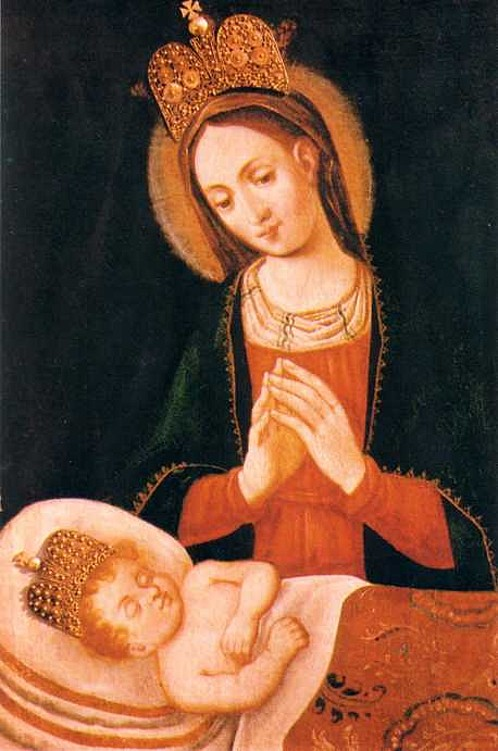
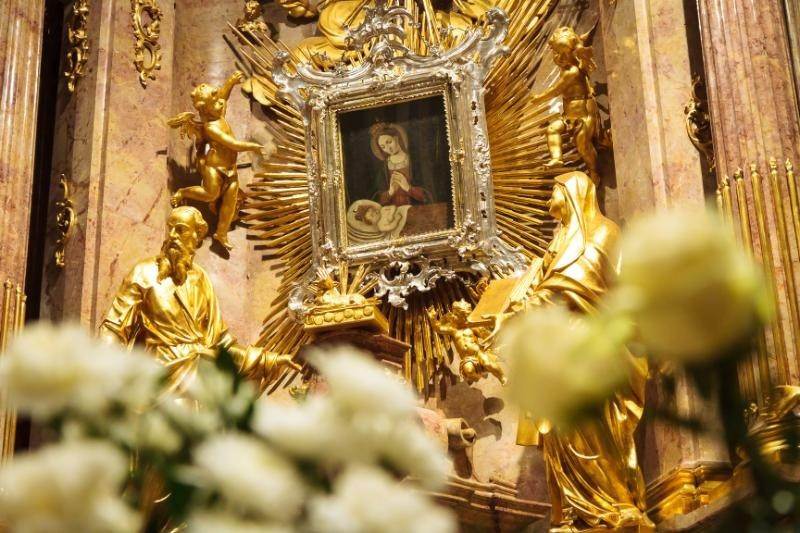
Könnyezo Szuz Mária / Our Lady of Tears or the Weeping Madonna (Sajópálfala, Miskolci, Borsod-Abaúj-Zemplén, Hungary) (1717) – Third Sunday of October, 16 February:
During the Turkish occupation of the late 1600s, the town of Sajópálfala in northeastern Hungary was destroyed and deserted. Not long after Greek Catholics resettled the area. The painting of the Madonna and Child in their village Church perspired and wept bloody tears, from 6 January to 16 February 1717.
The investigating Bishop took the picture to Eger, where it stayed in the Franciscan Church until the Communists dissolved the religious orders in 1950. Then the painting was lost to the faithful of Sajópálfala, who had made an annual pilgrimage to Eger on the Feast of Our Lady of Sorrows.
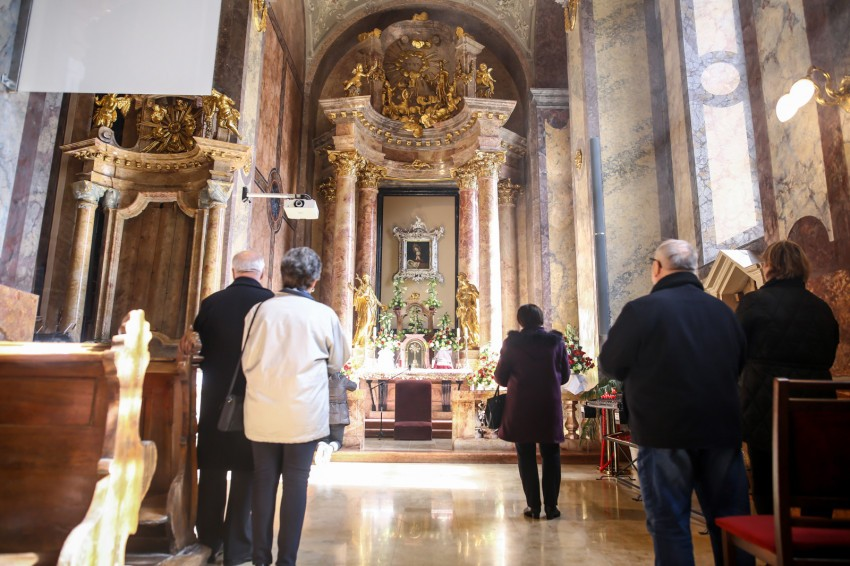
In 1969, they located the original weeping image in a Church in the Diocese of Pécs, where a friar had taken it when the Eger Monastery closed. On 25 October 1973, after 256 years, the Weeping Virgin Mary returned to the Church of the Visitation in Sajópálfala, where the main pilgrimage days are now Pentecost Sunday and the third Sunday in October.
St Margaret Mary Alacoque VHM (1647-1690) Virgin, Nun of the Order of the Visitation of Holy Mary, Mystic, Saint and Apostle of the Sacred Heart. Her feast day was moved to after Vatican II and prior to that was 17 October. (Optional Memorial)
Blessed Balthassar of Chiavari OFM (1420–1492) Priest of the Order of Friars Minor of the strict observance, Confessor, renowned Preacher, Professor of Theology, Superior General of the Order.
Bl Battista de Bonafede St Berarius I of Le Mans St Catervus St Colman of Kilroot Blessed Contardo Ferrini TOSF (1859-1902) Layman, Third Order Franciscan
Bl Francois Isidore Gagelin (1799-1833) Priest and Martyr, Missionary, was a member of the Paris Foreign Missions Society in Vietnam.
Bl Gilbert the Theologian St Heron of Antioch Bl Jacques Burin St John the Short/Dwarf St Louthiern St Mamelta of Persia St Nothelm of Canterbury St Richard Gwyn St Rudolph of Gubbio St Rufus of Rome St Serafino of Montegranaro St Solina of Chartres St Zosimus of Rome — Martyrs of Nicomedia – 3 saints: A group of Christians martyred in the persecutions of Diocletian. The only details about them that have survived are their names – Alexander, Marianus and Victor. 303 in Nicomedia (in modern Turkey).
Martyrs of Valenciennes -5 beati: A group of Ursuline nuns martyred in the persecutions of the French Revolution. • Hyacinthe-Augustine-Gabrielle Bourla • Jeanne-Reine Prin • Louise-Joseph Vanot • Marie-Geneviève-Joseph Ducrez • Marie-Madeleine-Joseph Déjardins
Martyrs of Volitani: A group of martyrs who were praised by Saint Augustine of Hippo. In Volitani, proconsular Africa (in modern Tunisia).
Martyred in the Spanish Civil War: • BlessedFidel Fuidio Rodriguez • BlessedJosé Sánchez Medina • BlessedPerfecto Carrascosa Santos • BlessedTársila Córdoba Belda de Girona
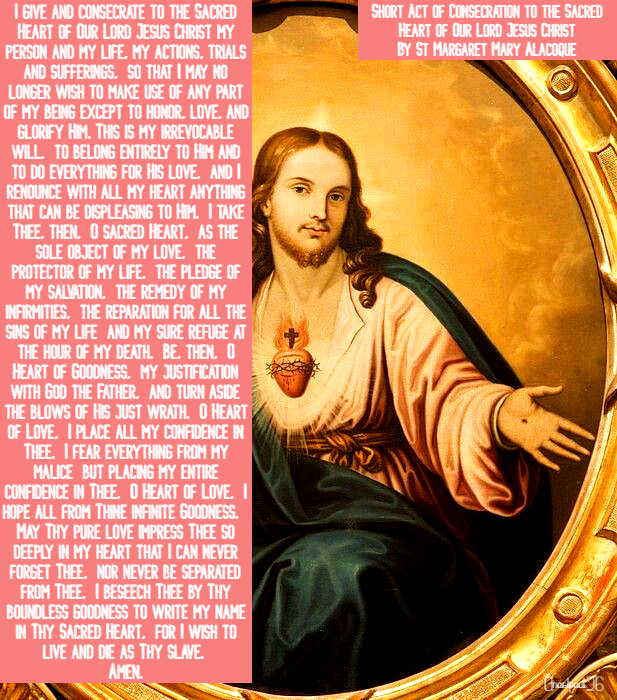
Short Act of Consecration to the Sacred Heart of Our Lord Jesus Christ By St Margaret Mary Alacoque
I give and consecrate to the Sacred Heart of Our Lord Jesus Christ my person and my life, my actions, trials and sufferings, so that I may no longer wish to make use of any part of my being except to honor, love, and glorify Him. This is my irrevocable will, to belong entirely to Him and to do everything for His love, and I renounce with all my heart anything that can be displeasing to Him. I take Thee, then, O sacred Heart, as the sole object of my love, the protector of my life, the pledge of my salvation, the remedy of my infirmities, the reparation for all the sins of my life and my sure refuge at the hour of my death. Be, then, O Heart of Goodness, my justification with God the Father, and turn aside the blows of His just wrath. O Heart of Love, I place all my confidence in Thee. I fear everything from my malice but placing my entire confidence in Thee, O Heart of Love, I hope all from Thine infinite Goodness. May Thy pure love impress Thee so deeply in my heart that I can never forget Thee, nor never be separated from Thee. I beseech Thee by Thy boundless goodness to write my name in Thy Sacred Heart, for I wish to live and die as Thy slave. Amen.
One Minute Reflection – 17 October – “Month of the Most Holy Rosary” – Readings: Cant 2:3, Ps 83:2-3, Eph 3:8-9, 14-19, Matt 11:25-30
At that time, Jesus spoke and said, I praise You, Father, Lord of heaven and earth, that You hid these things from the wise and prudent, and revealed them to little ones.
Matt 11:25-30
REFLECTION – Thanks, thanks be to you, eternal Father, that you have not despised me, your handiwork, nor turned your face from me, nor made light of these desires of mine. You, Light, have disregarded my darksomeness; you, Life, have not considered that I am death; nor you, Doctor, considered these grave weaknesses of mine. You, eternal Purity, have disregarded my wretched filthiness; you who are infinite have overlooked the fact that I am finite, and you, Wisdom, the fact that I am foolishness. For all these and so many other endless evils and sins of mine, your wisdom, your kindness, your mercy, your infinite goodness have not despised me. No, in your light you have given me light. In your wisdom I have come to know the truth; in your mercy I have found your charity and affection for my neighbors. What has compelled you? Not my virtues but only your charity. Let this same love compel you to enlighten the eye of my understanding with the light of faith, so that I may know your truth, which you have revealed to me.
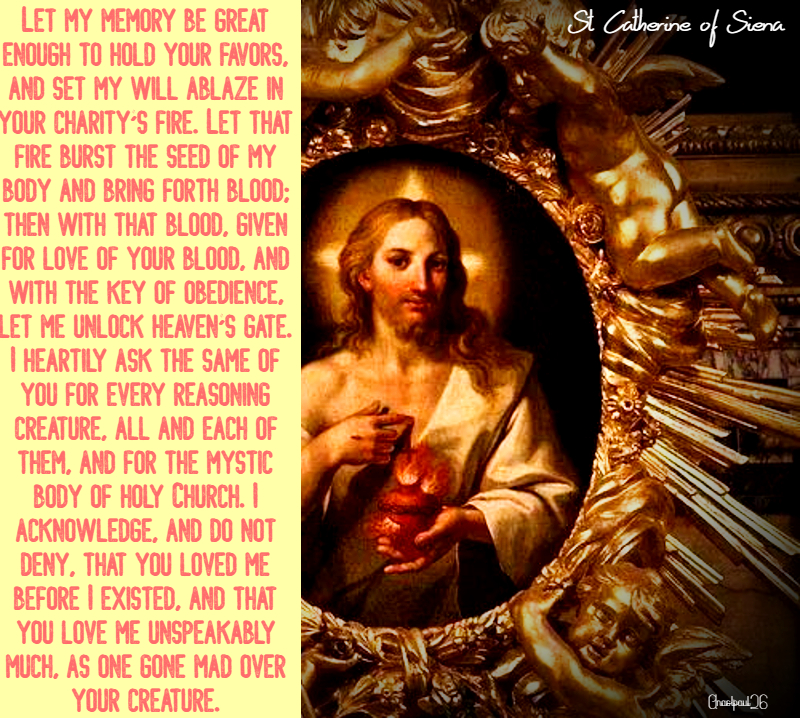
Let my memory be great enough to hold your favors, and set my will ablaze in your charity’s fire. Let that fire burst the seed of my body and bring forth blood; then with that blood, given for love of your blood, and with the key of obedience, let me unlock heaven’s gate. I heartily ask the same of you for every reasoning creature, all and each of them, and for the mystic body of holy Church. I acknowledge, and do not deny, that you loved me before I existed, and that you love me unspeakably much, as one gone mad over your creature.
St Catherine of Siena
PRAYER – Holy Father, grant me an operative faith, a faith that will move mountains. Enlighten my soul with Your Light, Goodness, Power and Wisdom. Let my faith be an image of You by lively deeds and love and by conforming myself to Your Will in all things. As the Blessed Virgin, Mother of Your only-begotten Son, longed only to serve the God of all in complete self-denial and humility, may we always strive to imitate her Fiat in serving You, with upright hearts and thus manifest a true faith, through Christ our Lord, with the Holy Spirit, God forever, amen.
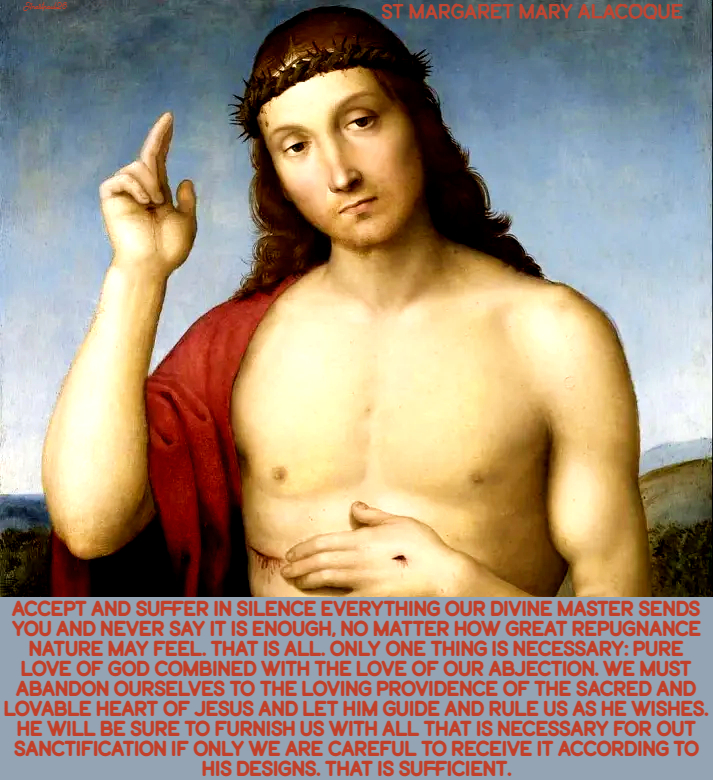
Accept and suffer in silence everything our divine Master sends you and never say it is enough, no matter how great repugnance nature may feel. That is all. Only one thing is necessary: pure love of God combined with the love of our abjection. We must abandon ourselves to the loving providence of the Sacred and lovable Heart of Jesus and let Him guide and rule us as He wishes. He will be sure to furnish us with all that is necessary for out sanctification if only we are careful to receive it according to His designs. That is sufficient.
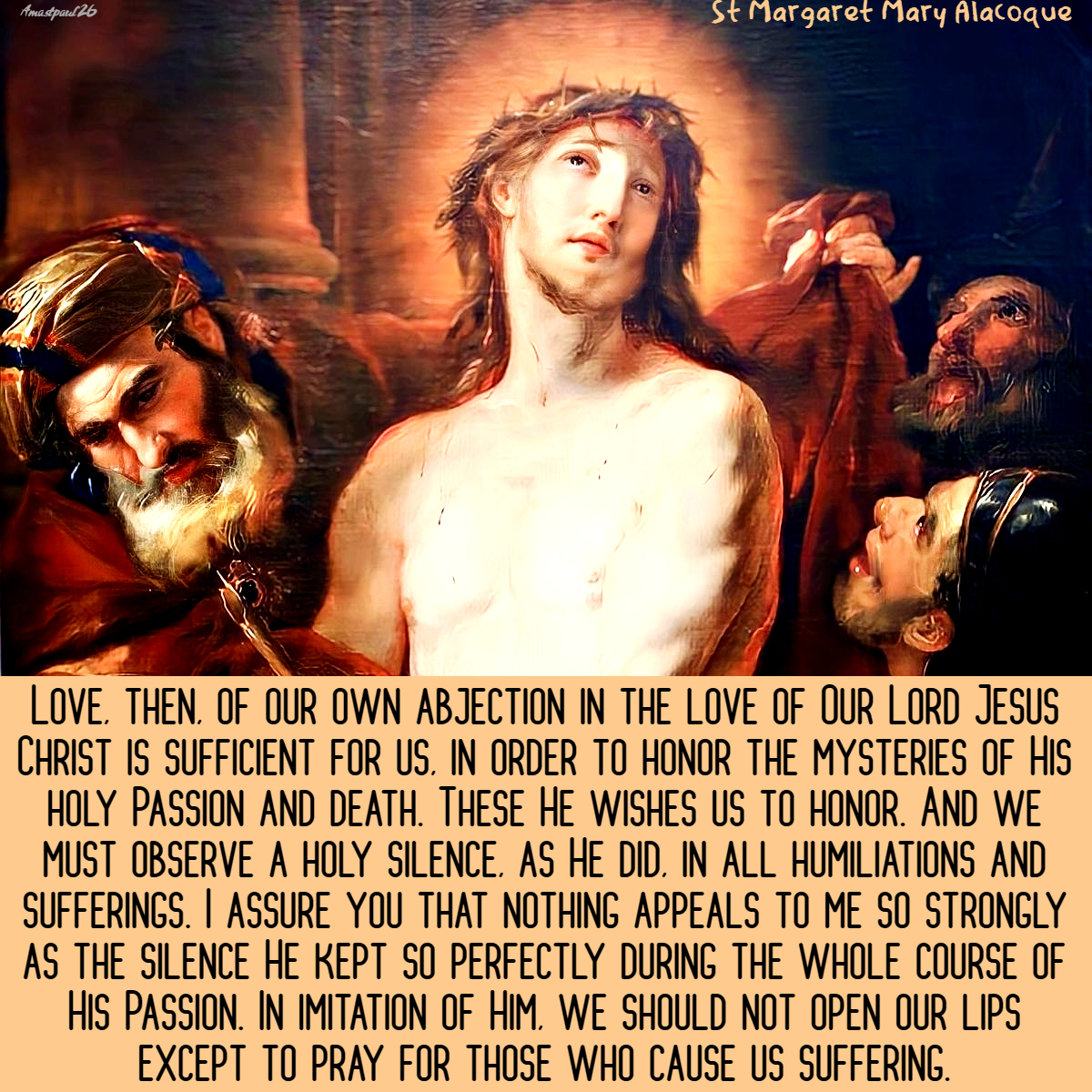
Love, then, of our own abjection in the love of Our Lord Jesus Christ is sufficient for us, in order to honor the mysteries of His holy Passion and death. These He wishes us to honor. And we must observe a holy silence, as He did, in all humiliations and sufferings. I assure you that nothing appeals to me so strongly as the silence He kept so perfectly during the whole course of His Passion. In imitation of Him, we should not open our lips except to pray for those who cause us suffering.
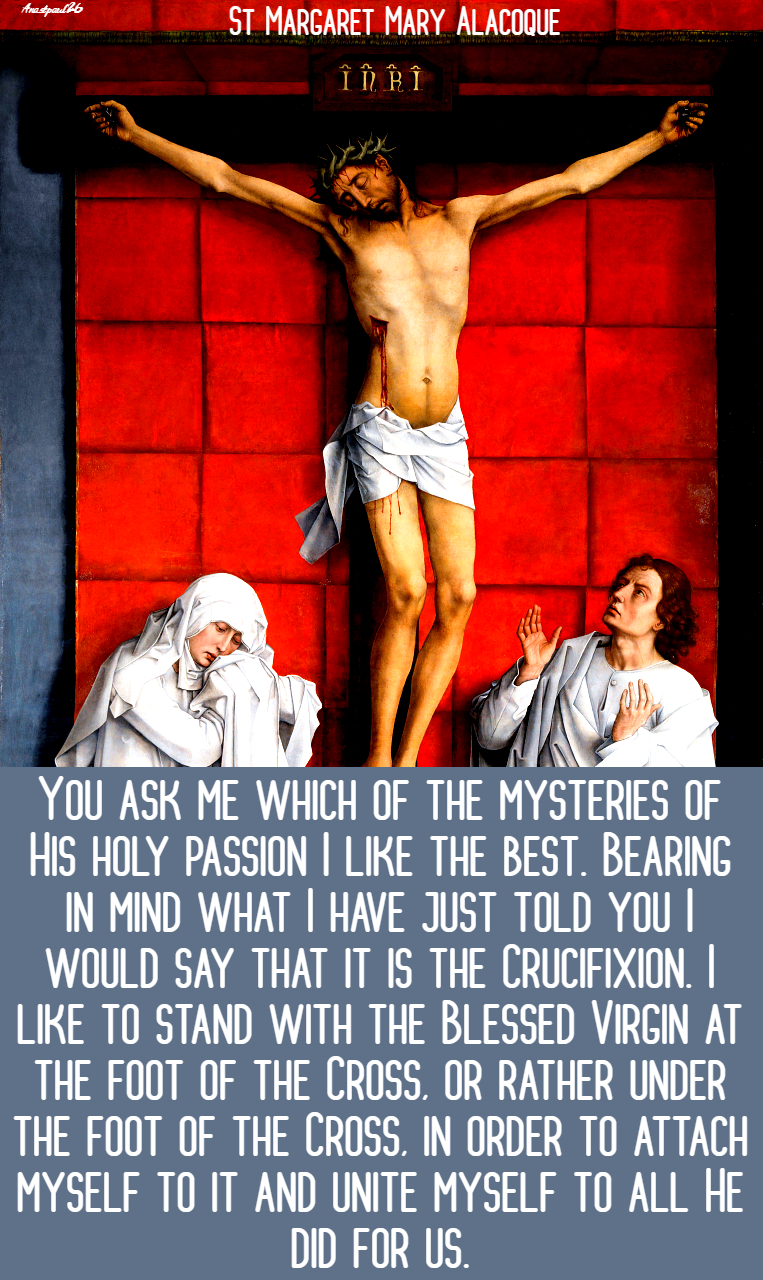
You ask me which of the mysteries of His holy passion I like the best. Bearing in mind what I have just told you I would say that it is the Crucifixion. I like to stand with the Blessed Virgin at the foot of the Cross, or rather under the foot of the Cross, in order to attach myself to it and unite myself to all He did for us.
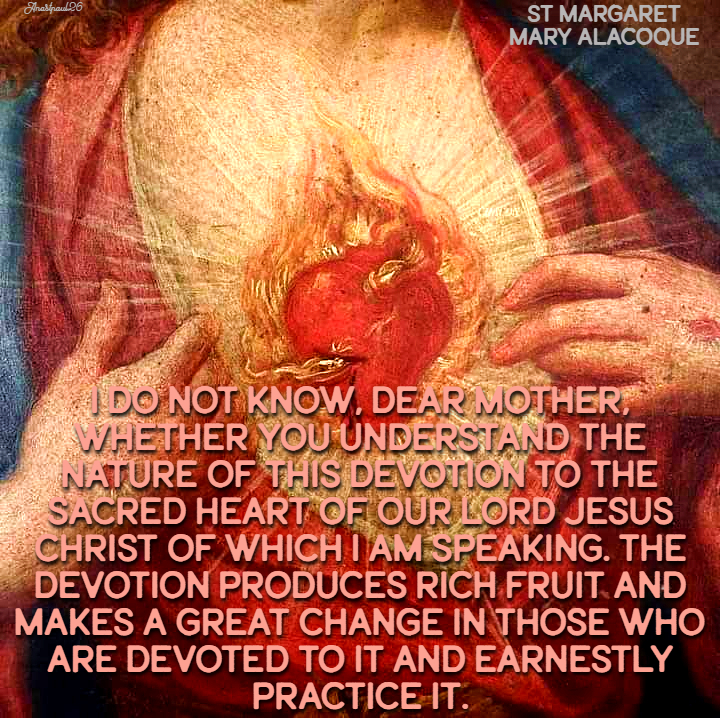
I do not know, dear Mother, whether you understand the nature of this devotion to the Sacred Heart of Our Lord Jesus Christ of which I am speaking. The devotion produces rich fruit and makes a great change in those who are devoted to it and earnestly practice it.
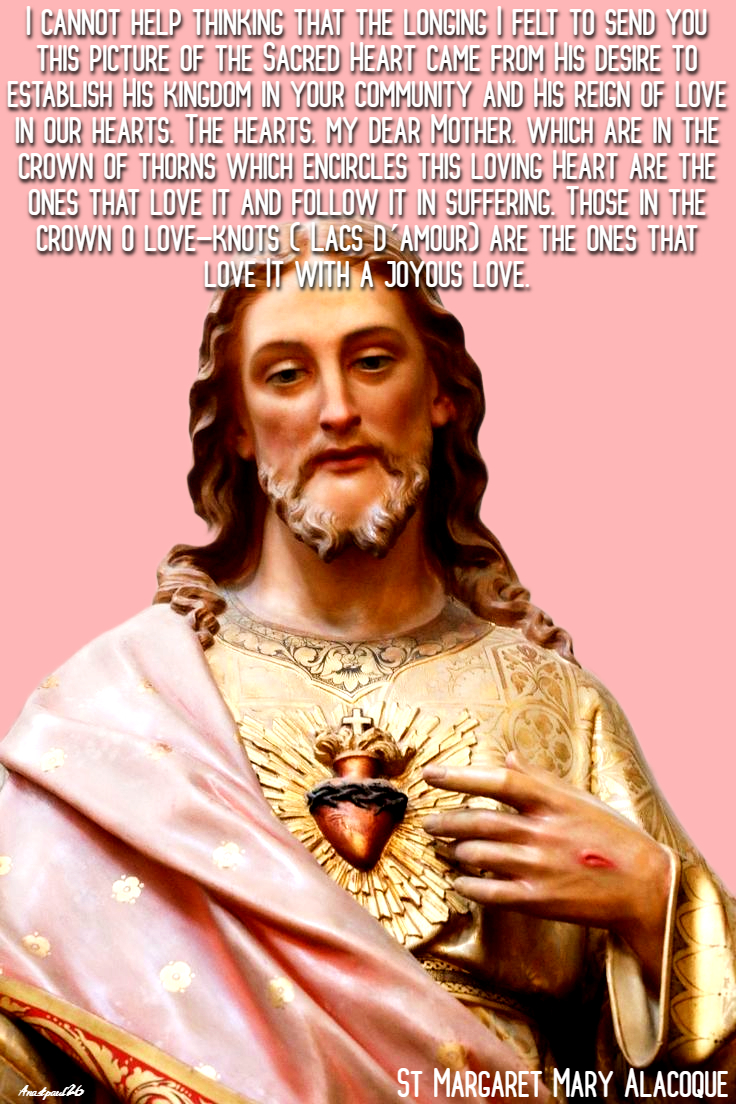
I cannot help thinking that the longing I felt to send you this picture of the Sacred Heart came from His desire to establish His kingdom in your community and His reign of love in our hearts. The hearts, my dear Mother, which are in the crown of thorns which encircles this loving Heart are the ones that love it and follow it in suffering. Those in the crown o love-knots ( Lacs d´amour) are the ones that love It with a joyous love.
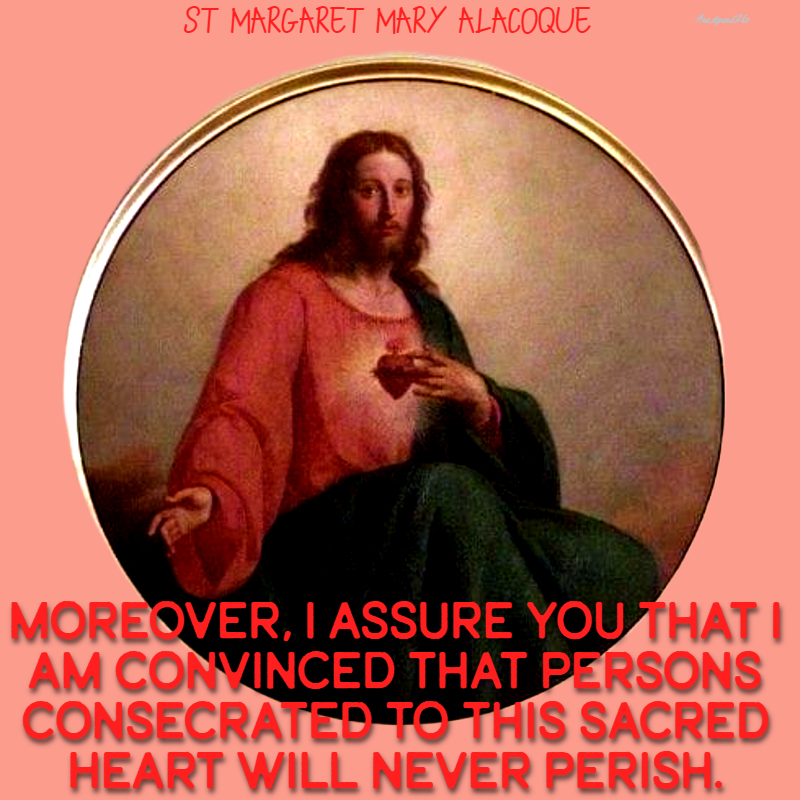
Moreover, I assure you that I am convinced that persons consecrated to this Sacred Heart will never perish.
To have a great Devotion to the Seven Spirits who are before the Throne.
The Holy Scriptures assure us, that there are seven of the holy Angels specially appointed to assist before the Throne, and stand continually in the presence of the Most High. In the 1st chapter of the Apocalypse, grace and peace are given in the name of these sublime Spirits. We only know the names of three of them—St. Michael, St. Gabriel, St. Raphael. Some say that the fourth is called Uriel, of whom there is mention made in the Book of Esdras. E.
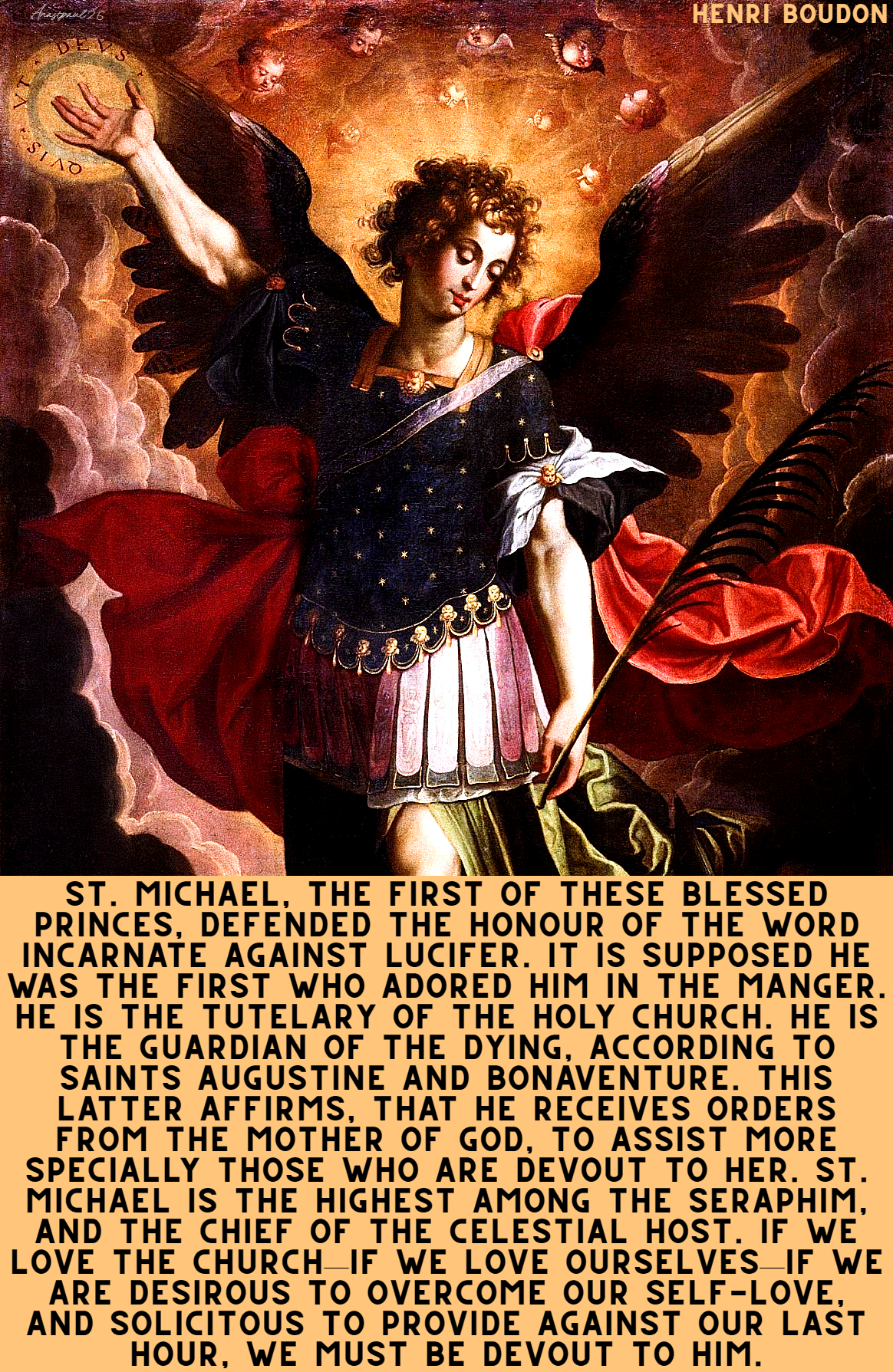
But to say something of each in particular: St. Michael, the first of these blessed princes, defended the honour of the Word incarnate against Lucifer. It is supposed he was the first who adored him in the manger. He is the tutelary of the holy Church. He is the guardian of the dying, according to Saints Augustine and Bonaventure. This latter affirms, that he receives orders from the Mother of God, to assist more specially those who are devout to her. St. Michael is the highest among the Seraphim, and the chief of the celestial host. If we love the Church—if we love ourselves—if we are desirous to overcome our self-love, and solicitous to provide against our last hour, we must be devout to him.
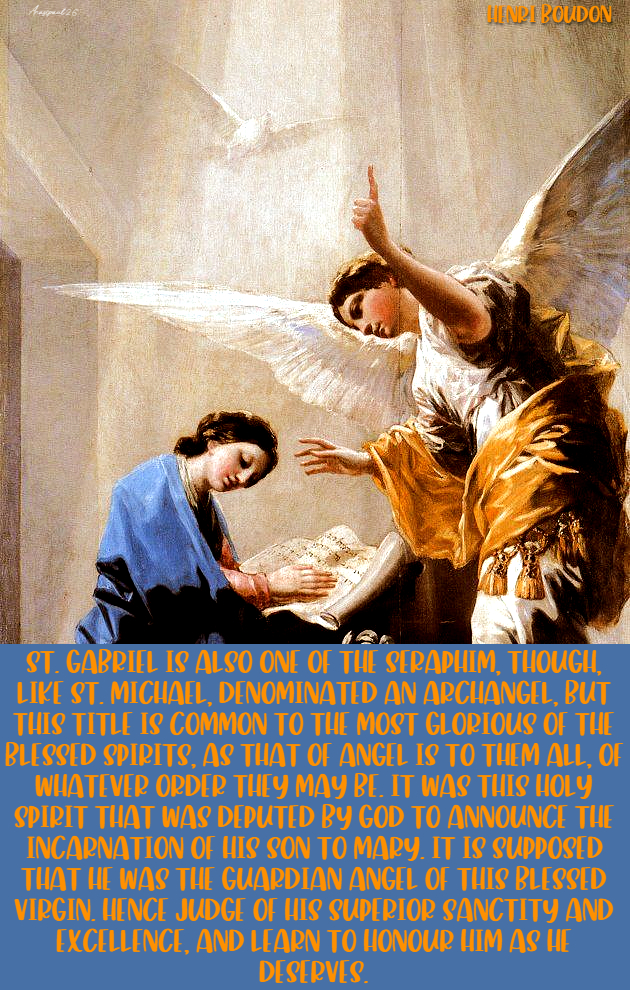
St. Gabriel is also one of the Seraphim, though, like St. Michael, denominated an archangel, but this title is common to the most glorious of the blessed Spirits, as that of Angel is to them all, of whatever order they may be. It was this holy spirit that was deputed by God to announce the incarnation of his Son to Mary. It is supposed that he was the Guardian Angel of this blessed Virgin. Hence judge of his superior sanctity and excellence, and learn to honour him as he deserves.
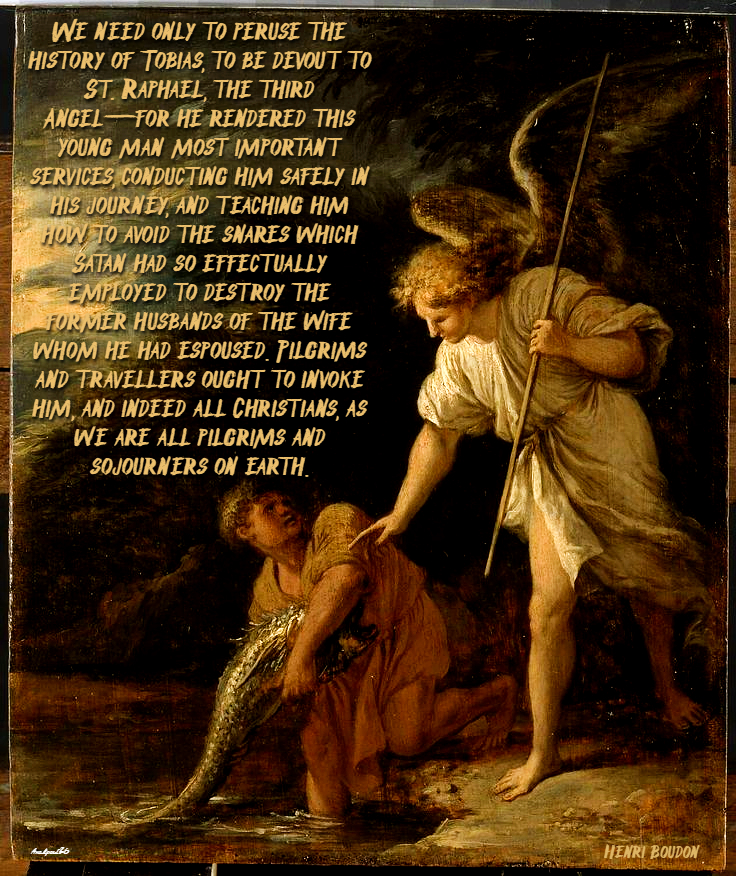
We need only to peruse the history of Tobias, to be devout to St. Raphael, the third Angel—for he rendered this young man most important services, conducting him safely in his journey, and teaching him how to avoid the snares which Satan had so effectually employed to destroy the former husbands of the wife whom he had espoused. Pilgrims and travellers ought to invoke him, and indeed all Christians, as we are all pilgrims and sojourners on earth.
Let us honour all these blessed Seven—let us be but truly devout to them let us beg their prayers, in order that we may avoid the seven capital sins, and obtain the seven gifts of the Holy Ghost.
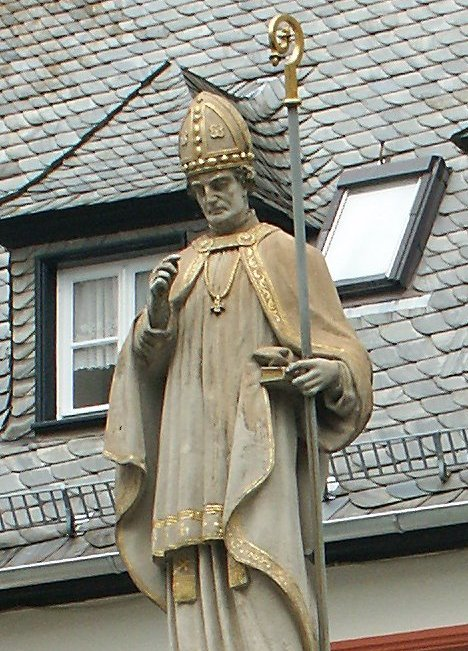
Saint Lull, also known as Lul, Lullon, Lullus, Lulo, was an 8th century Wessex monk at Malmesbury Abbey in England, and missionary to Germany with St Boniface. During a pilgrimage to Rome in 737, he met Boniface and decided to join him in his missionary work in northern Germany. In 738, Lullus joined the Benedictine monastery of Fritzlar, founded by Boniface in 732. There, his teacher was abbot Saint Wigbert, who had also come from England.
St Boniface ordained him a priest with a mission of training new priests. He was bishop of Mainz, Germany, succeeding Boniface, and first abbot of the Benedictine Hersfeld Abbey. He is historiographically considered the first official sovereign of the Electorate of Mainz.
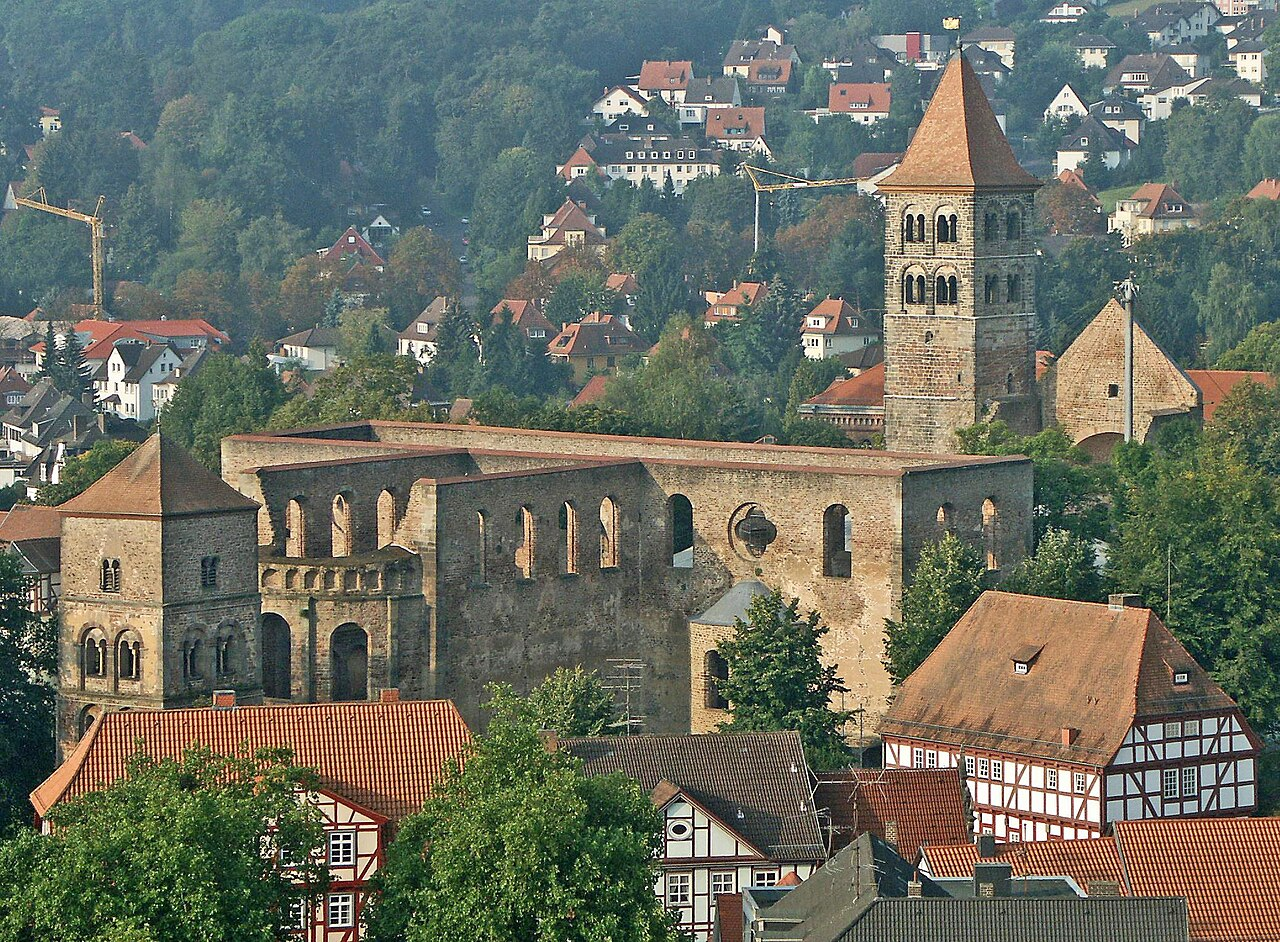
And after the death of Boniface, Lull took charge of missionary work. He founded several monasteries in the region and died on 16 October 786 in Hersfeld Abbey at Bad Hersfeld, and is buried in the church.
View of the monastery ruins from the tower of the town church
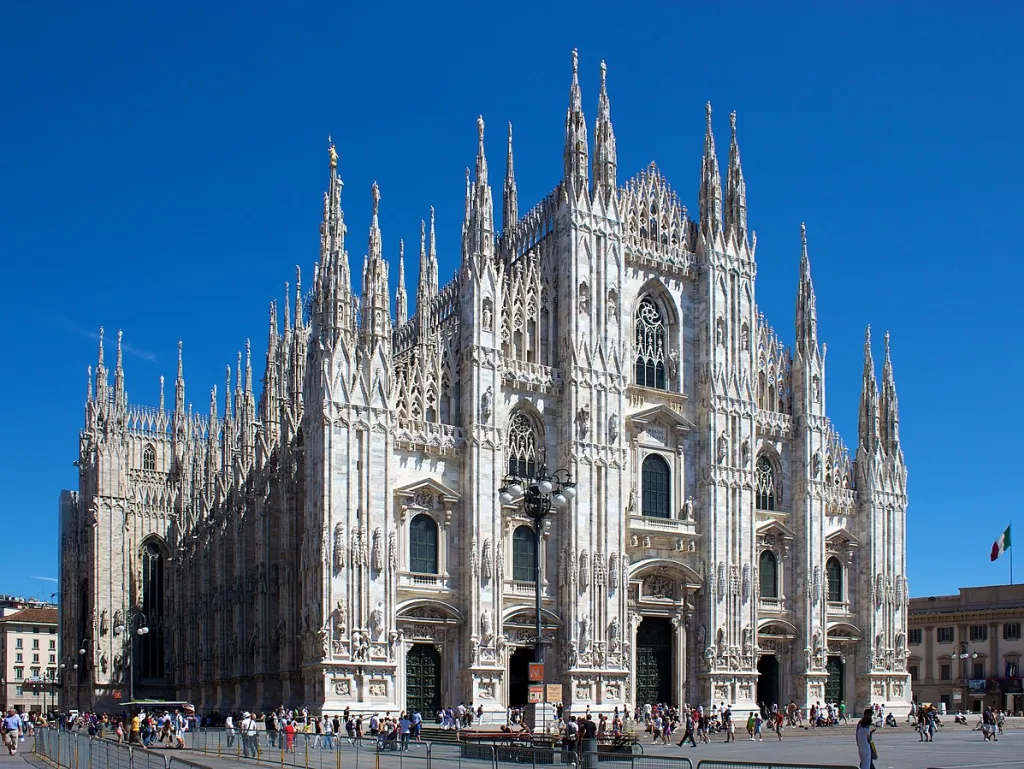
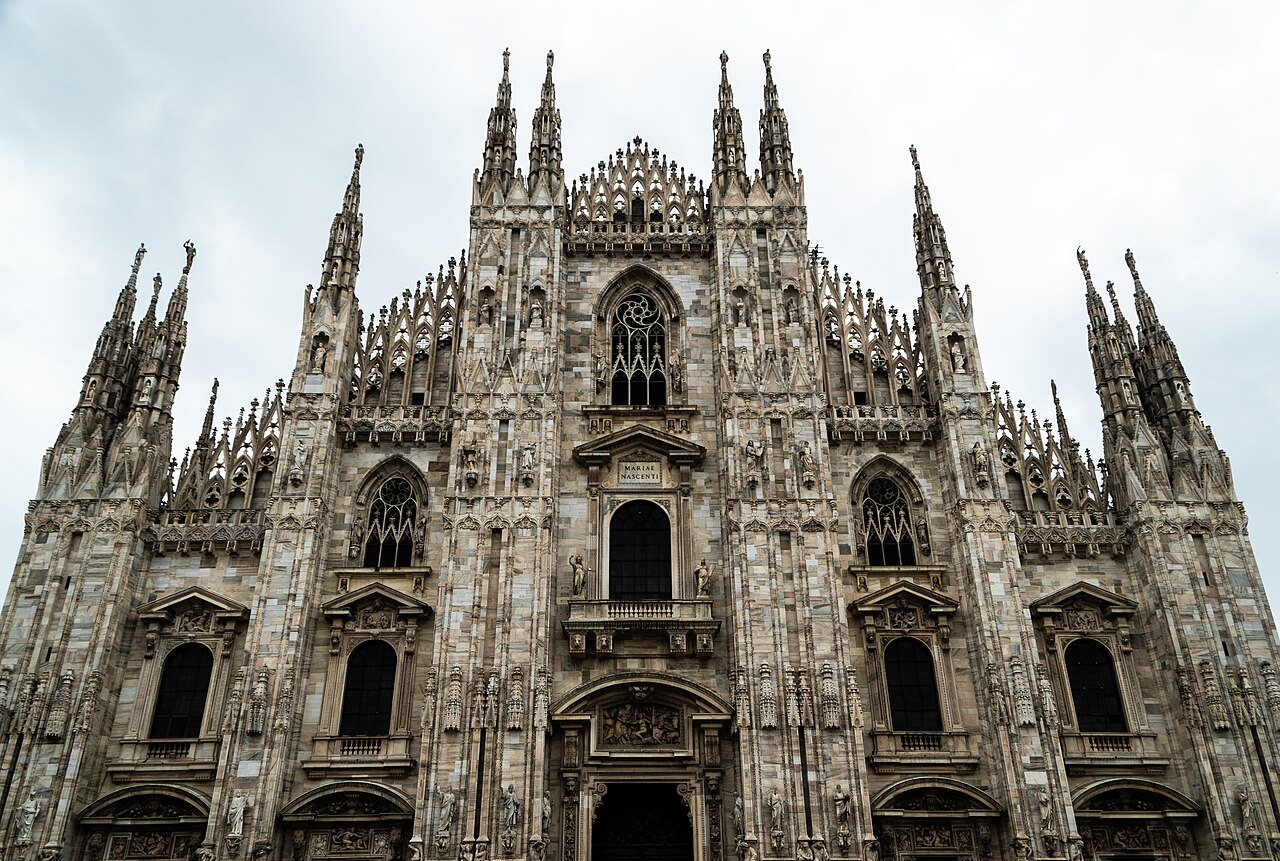
Dedication of the Church of Our Lady of Milan (1417) by Pope Martin V – 16 October:
The Abbot Orsini wrote: “Dedication of Our Lady of Milan, by Pope Martin V, in the year 1417. This Church was built in 1388 by John Galleas, Duke of Milan.”
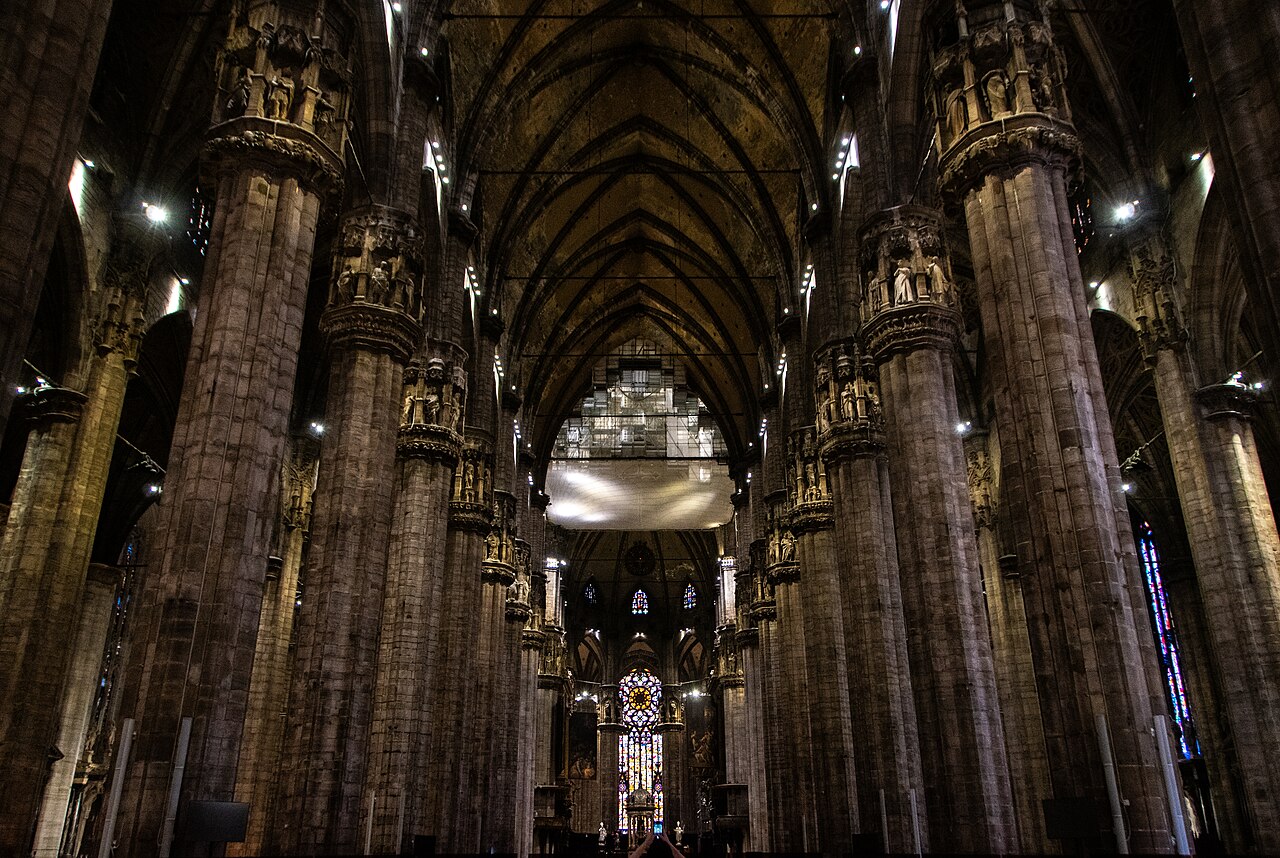
The magnificent Milan Cathedral is a Gothic Cathedral that has its roots in the fourth centurY. Today it is one of the most famous and celebrated structures in all of Europe. It is the second largest Church in Italy after St Peter’s Basilica in Rome and the third largest Catholic Church in the world.
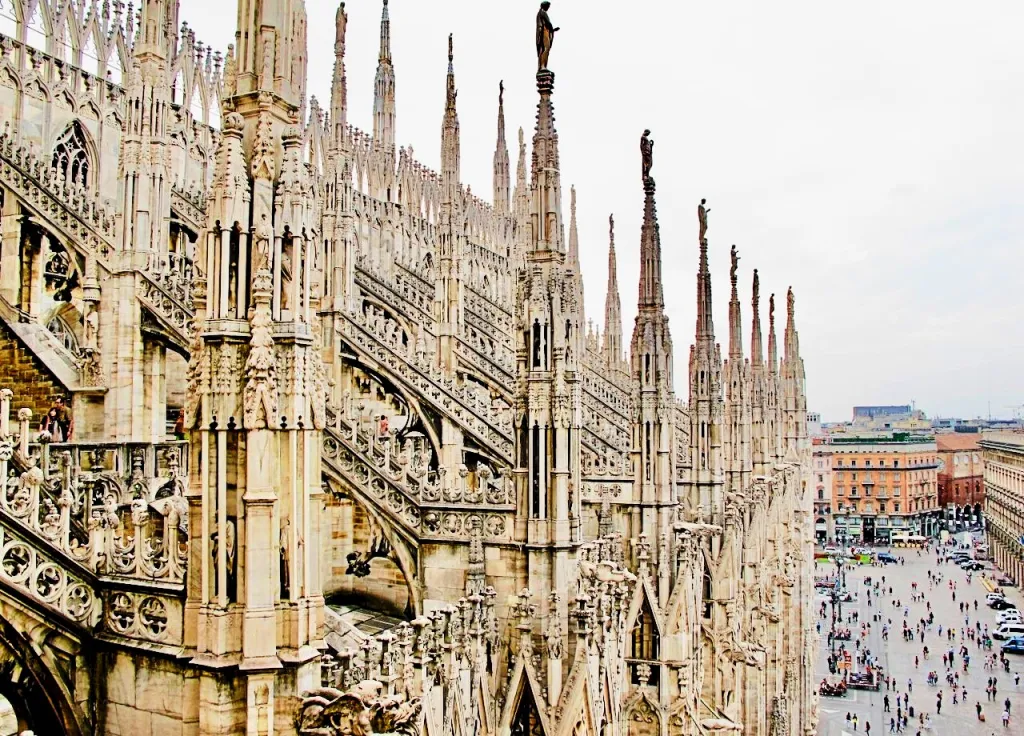
Dedicated to the Mother of God, the present Cathedral was begun in the 14th century but was not completed until the 20th century when the last gate was finally installed in 1965. Emperor Napoleon Bonaparte himself ordered that the façade be finished in the year 1805, as he desired to see the beautiful structure completed. He guaranteed that the French would pay for the work, although they never actually did. Even so, it took seven years to complete the work. There were other additions that followed, including stained glass windows and various arches and lace-like spires. In the end it can be said, that the Cathedral required 6 centuries to complete and is one of the largest Cathedrals in the entire world.
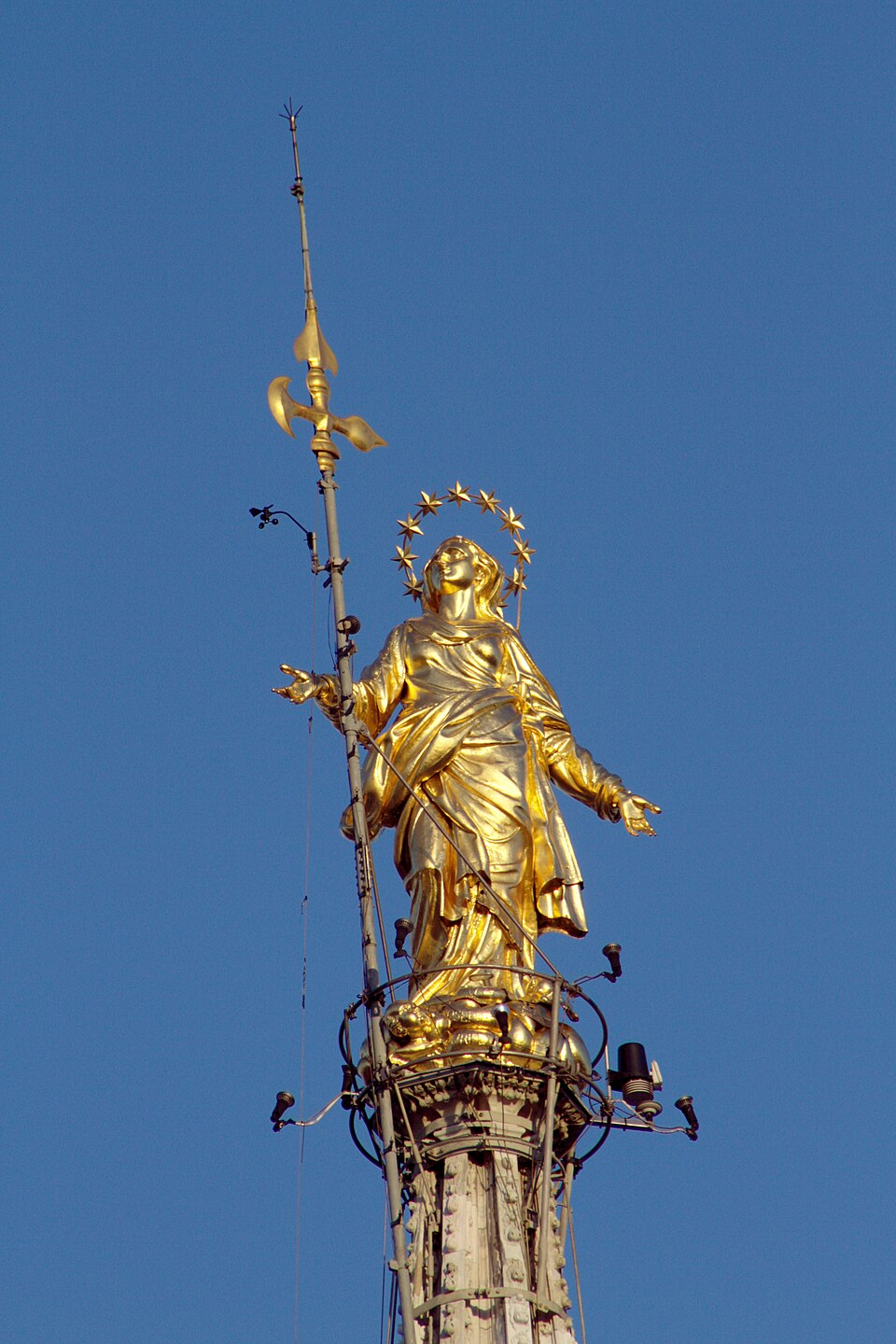
The Madonnina Spire or guglia del tiburio (“lantern spire“), one of the main features of the Cathedral, was erected in 1762 at the height of 108.5 m (356 ft), as designed by Francesco Croce. At the top of the spire is the polychrome Madonnina Statue, designed and built by Carlo Pellicani in 1774, during the episcopacy of Bishop Giuseppe Pozzobonelli who supported the idea to place the Madonnina at the top of the Cathedral, By tradition, no building in Milan may be higher than the Madonnina.
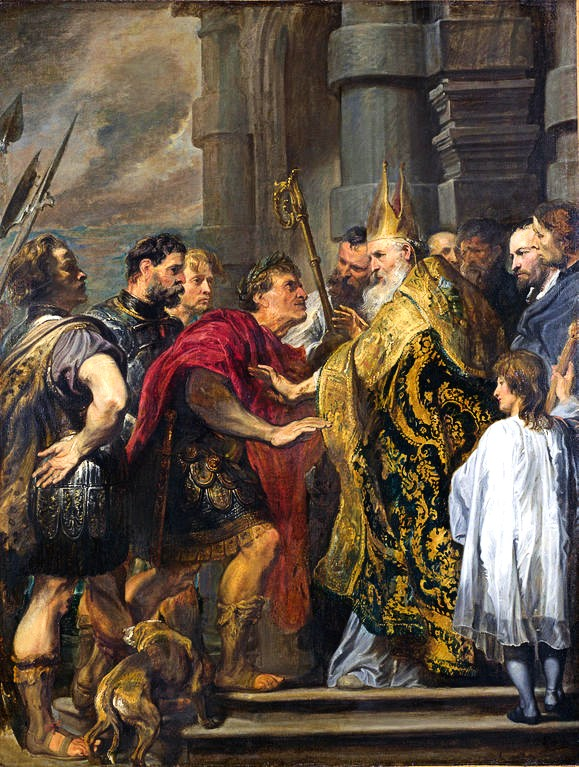
The first Church thought to occupy the location was built by Saint Ambrose, although there is an old baptistery which was constructed in about 335. The good Abbot appears to have been incorrect in dating the Cathedral from 1388, as there is a plate attached to a stone on the Church which states: “El Principio del Duomo di Milano Nel Anno 1386.”
St Ambrose barring Theodocius from Milan Cathedral
The Milan Cathedral houses a Holy Nail which was used to Crucify Christ. It is marked by a tiny red light located in the dome above the apse. There are more Statues on this Cathedral than any other in the world, 3159 in total. 2245 of these are on the exterior together with 96 gargoyles and 135 spires. It is said that if the Statues were placed on top of each other, they would reach a height of about 5,300 meters (3.3 miles).
The Cathedral is 158.5 meters (520 feet) long, 92 meters (302 feet) wide. It has a cruciform plan in the form of a Latin cross that covers nearly 12,000 square meters. 40,000 people can fit comfortably within. Its construction was up five naves, a central and two lateral on each side, resting on 40 columns of 24.50 meters (80 feet) each.
St Margaret Mary Alacoque VHM (1647-1690) Virgin, Nun of the Order of the Visitation of Holy Mary, Mystic, Saint and Apostle of the Sacred Heart
St Gall (c 550–c 646) “Apostle of Switzerland,” Monk, Missionary, Hermit – he was a disciple and one of the traditional twelve companions of Saint Columbanus on his mission from Ireland to the continent.
St Gerard Majella CSsR (1726-1755) Religious Lay Brother of the Congregation of the Holy Redeemer, better known as the Redemptorists, Apostle of the Holy Eucharist, Apostle of Charity, known as a Thaumaturge.
Bl Gerald of Fossanuova St Hedwig of Andechs (1174-1243) Mother, Widow, High Duchess of Poland Bl Jesús Villaverde Andrés Bl Józef Jankowski St Junian St Lull St Magnobodus of Angers
St Martinian of Mauretania St Mummolinus St Saturian of Mauretania St Silvanus of Ahun St Victor of Cologne St Vitalis of Noirmoutier — Martyrs in Africa – 220 saints: A group of 220 Christians martyrs about whom we know nothing but that they died for their faith.
Martyrs of North Africa – 365 saints: A group of 365 Christians who were martyred together in the persecutions of the Vandal king Genseric. The only details that have survived are the names of two of the martyrs – Nereus and Saturninus. 450 in North Africa.
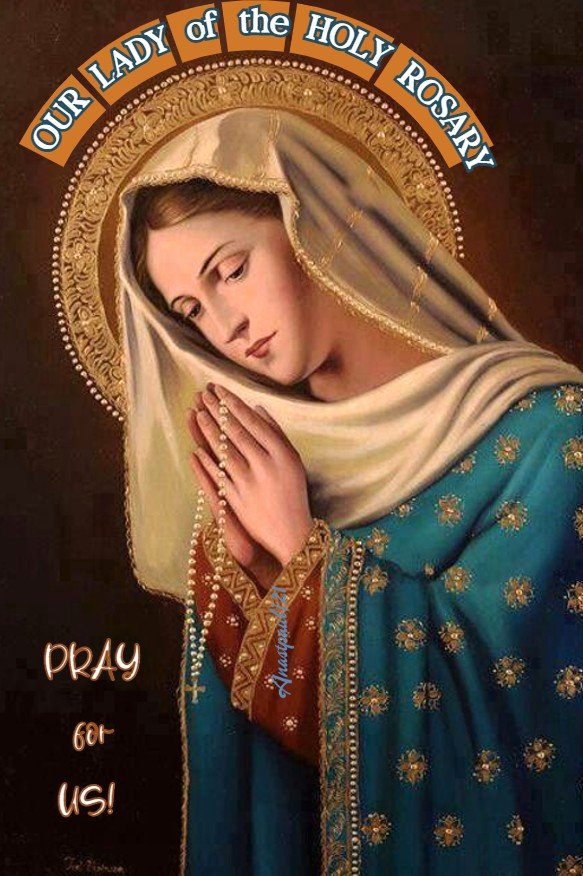
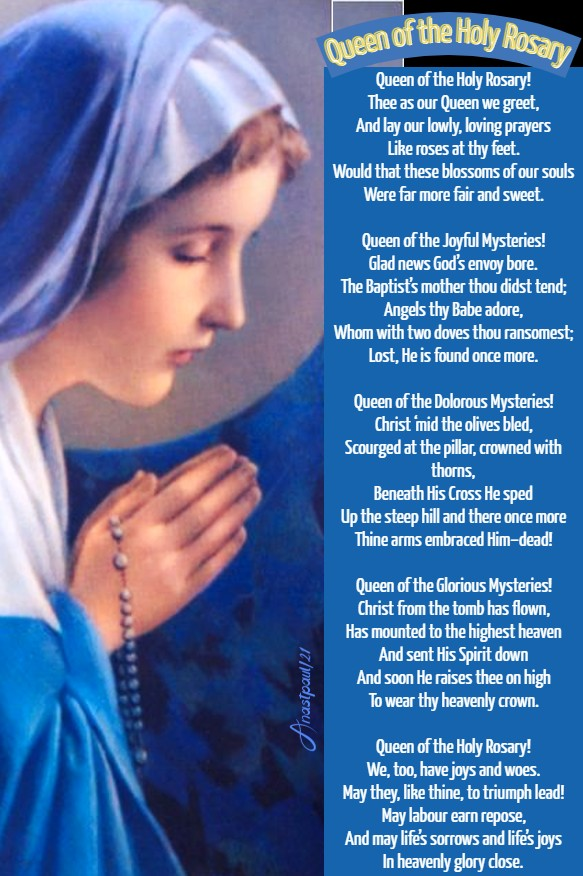
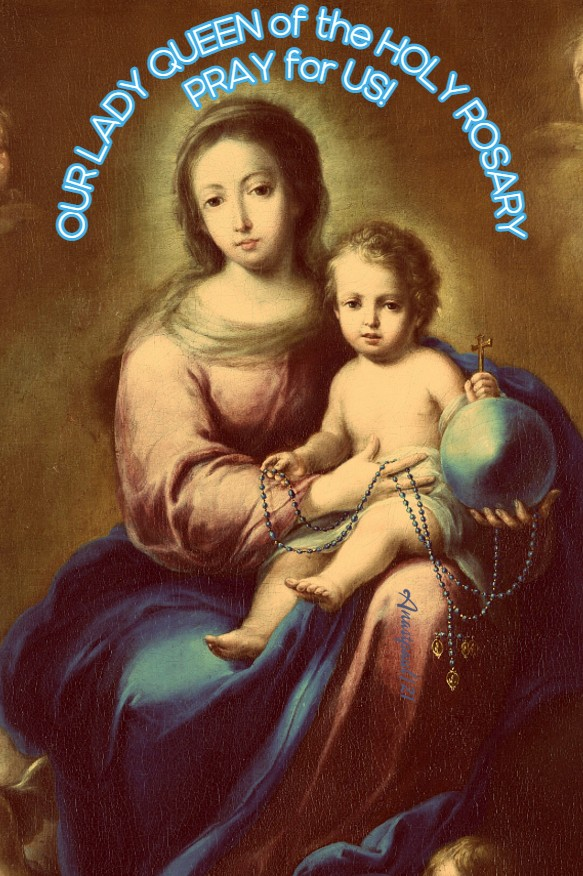
Queen of the Holy Rosary! Thee as our Queen we greet, And lay our lowly, loving prayers Like roses at thy feet. Would that these blossoms of our souls Were far more fair and sweet.
Queen of the Joyful Mysteries! Glad news God’s envoy bore. The Baptist’s mother thou didst tend; Angels thy Babe adore, Whom with two doves thou ransomest; Lost, He is found once more.
Queen of the Dolorous Mysteries! Christ ‘mid the olives bled, Scourged at the pillar, crowned with thorns, Beneath His Cross He sped Up the steep hill and there once more Thine arms embraced Him–dead!
Queen of the Glorious Mysteries! Christ from the tomb has flown, Has mounted to the highest heaven And sent His Spirit down And soon He raises thee on high To wear thy heavenly crown.
Queen of the Holy Rosary! We, too, have joys and woes. May they, like thine, to triumph lead! May labour earn repose, And may life’s sorrows and life’s joys In heavenly glory close.
Again, the kingdom of heaven is like a merchant in search of fine pearls. When he finds a single pearl of great price, he goes and sells all that he has and buys it. So will it be at the end of the world. The angels will go out and separate the wicked from among the just, and will cast them into the furnace of fire, where there will be the weeping, and the gnashing of teeth.
Matt 13:44-52
REFLECTION – And if you be willing to produce in the midst a miser’s soul; like a garment eaten by innumerable worms, and not having any sound part, even so will you find it, perforated on all sides by cares; rotted, cankered by sins.
But not such the poor man’s soul, the soul of him, I mean, that is voluntarily poor; but it is resplendent as gold, it shines like a pearl, and it blooms like a rose. For no moth is there, no thief is there, no worldly care, but as angels converse, so do they.
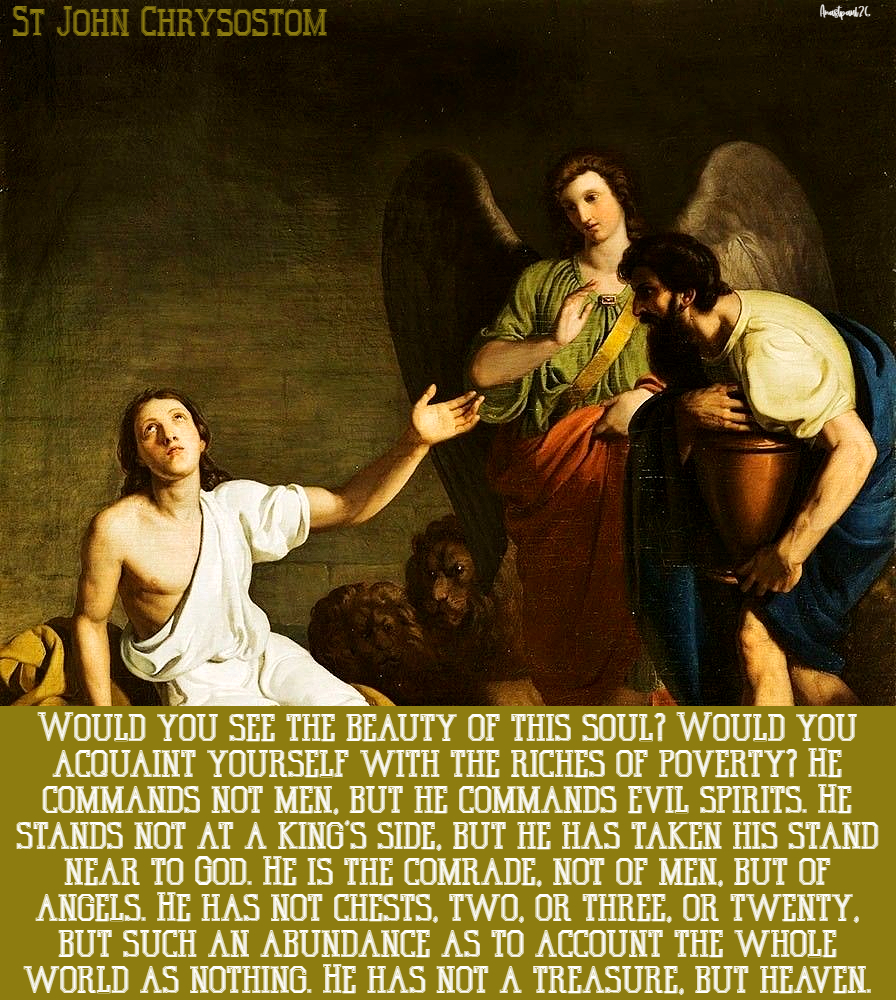
Would you see the beauty of this soul? Would you acquaint yourself with the riches of poverty? He commands not men, but he commands evil spirits. He stands not at a king’s side, but he has taken his stand near to God. He is the comrade, not of men, but of angels. He has not chests, two, or three, or twenty, but such an abundance as to account the whole world as nothing. He has not a treasure, but heaven. He needs not slaves, or rather has his passions for slaves, has for slaves the motives that rule over kings. For that which commands him who wears the purple, that motive shrinks before him. And royalty, and gold, and all such things, he laughs at, as at children’s toys; and like hoops, and dice, and heads, and balls, so does he count all these to be contemptible. For he has an adorning, which they who play with these things cannot even see.
What then can be superior to this poor man? He has at least heaven for his pavement; but if the pavement be like this, imagine the roof!
St John Chrysostom
PRAYER – All-powerful, eternal God, grant us the grace of Your Spirit and fill us with the light of understanding and love. Grant that by the prayers of your Saints we may be strengthened and depend only on You. Holy Queen of the Holy Rosary, our Mother Mary and St Hedwig, pray for us. We make our prayer through Jesus, our Lord with the Holy Spirit, God forever, amen.
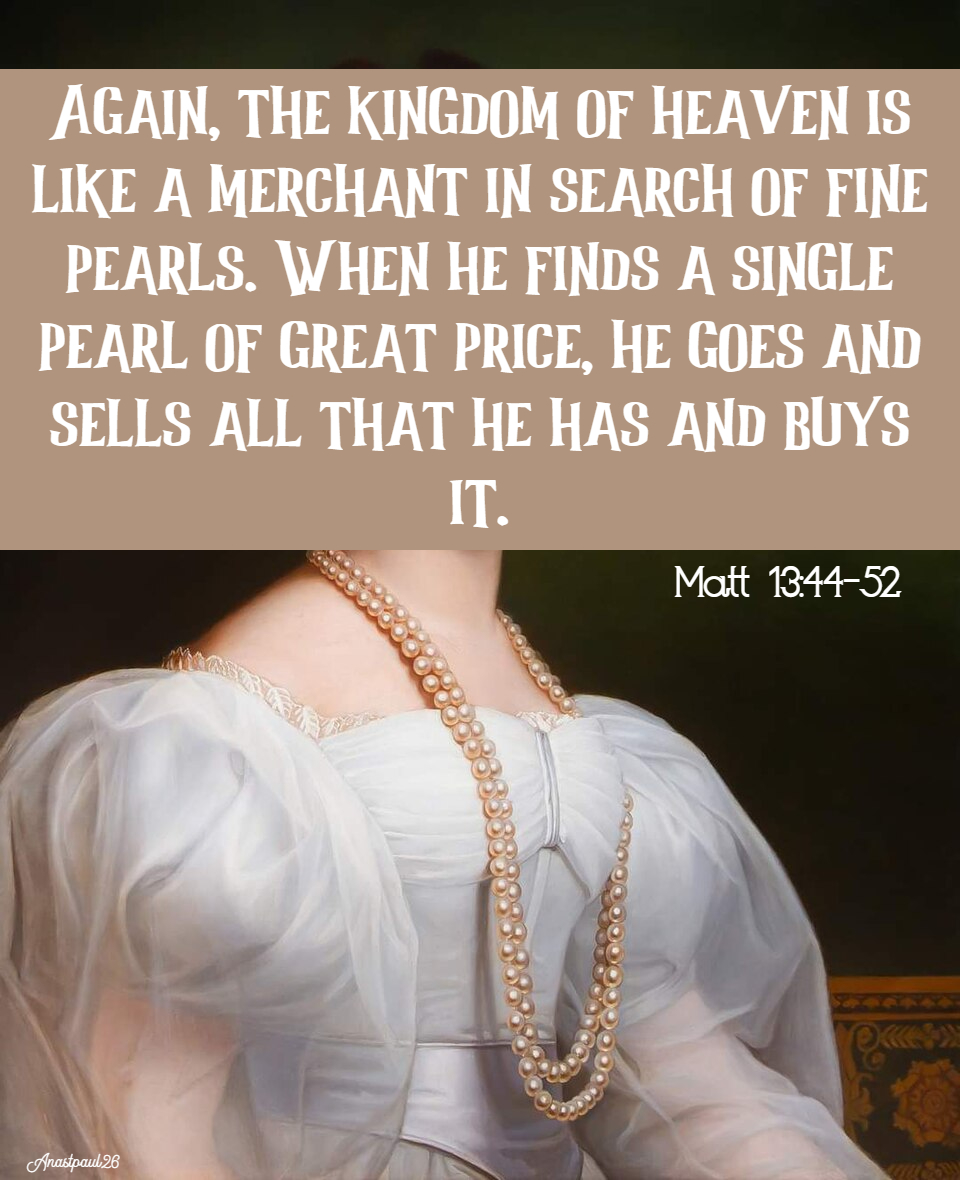
Again, the kingdom of heaven is like a merchant in search of fine pearls. When he finds a single pearl of great price, he goes and sells all that he has and buys it.
Matt 13:44-52
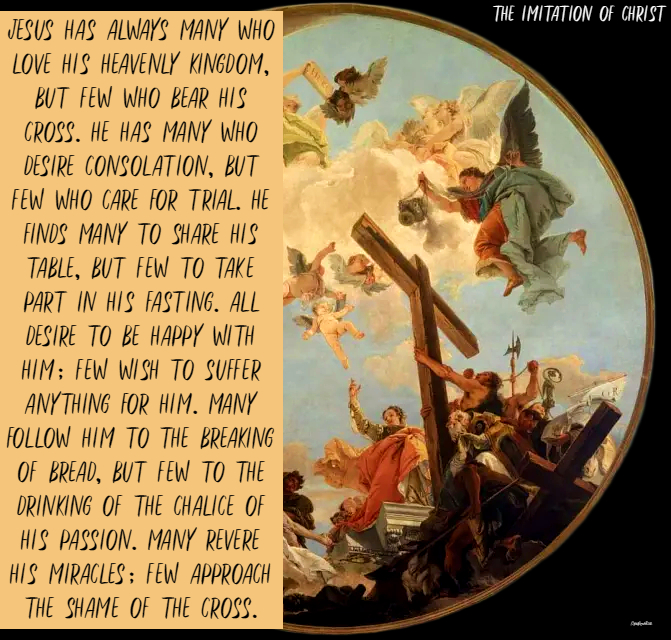
Jesus has always many who love His heavenly kingdom, but few who bear His cross. He has many who desire consolation, but few who care for trial. He finds many to share His table, but few to take part in His fasting. All desire to be happy with Him; few wish to suffer anything for Him. Many follow Him to the breaking of bread, but few to the drinking of the chalice of His passion. Many revere His miracles; few approach the shame of the Cross.
The Imitation of Christ
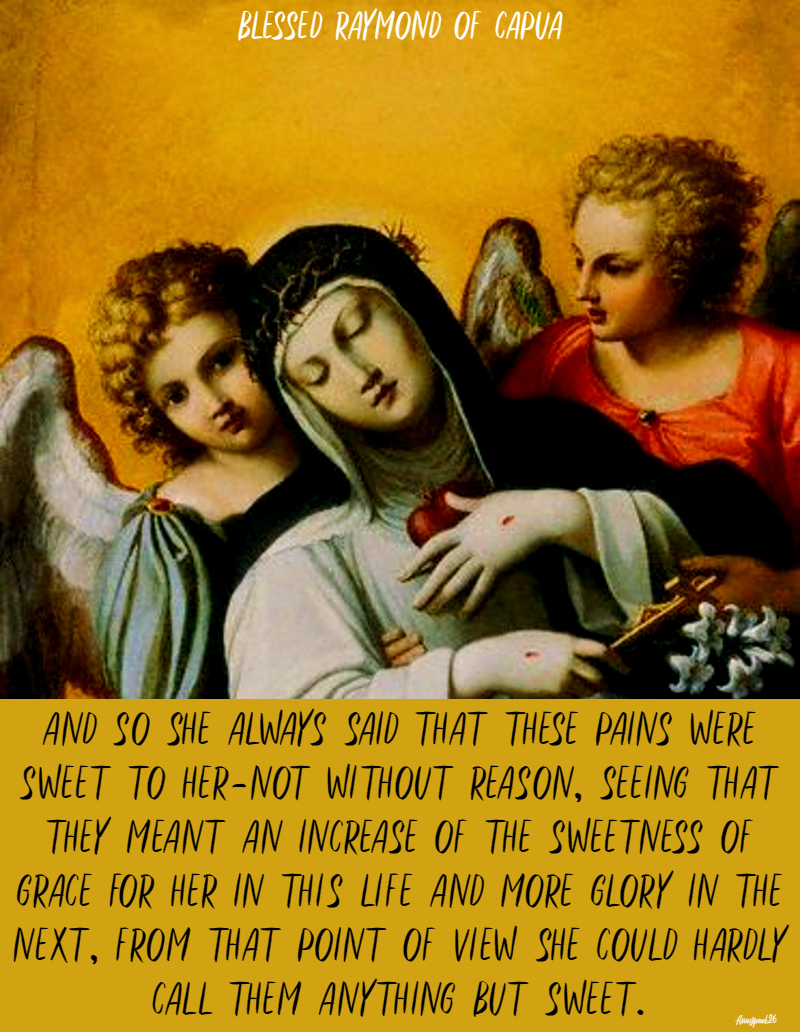
And so she always said that these pains were sweet to her-not without reason, seeing that they meant an increase of the sweetness of grace for her in this life and more glory in the next, from that point of view she could hardly call them anything but sweet.
Blessed Raymond of Capua
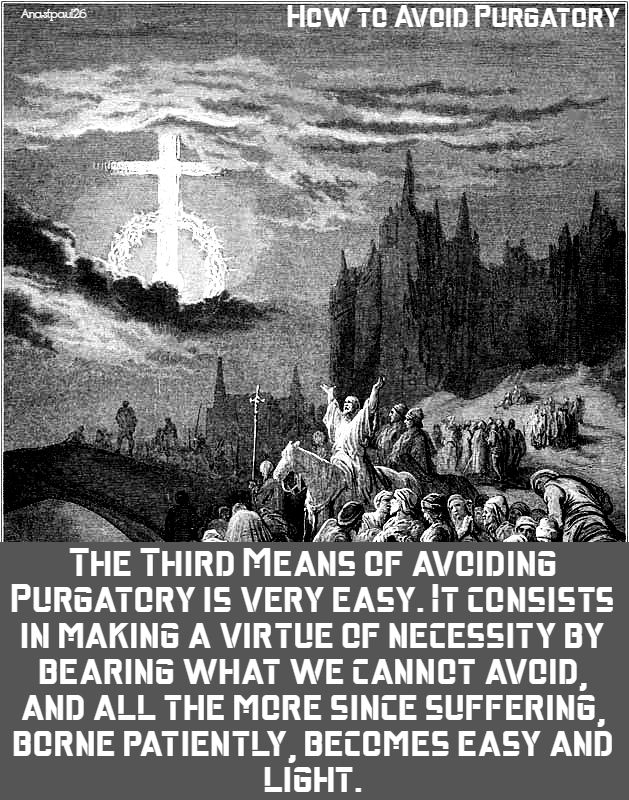
The Third Means of avoiding Purgatory is very easy. It consists in making a virtue of necessity by bearing what we cannot avoid, and all the more since suffering, borne patiently, becomes easy and light.
How to Avoid Purgatory
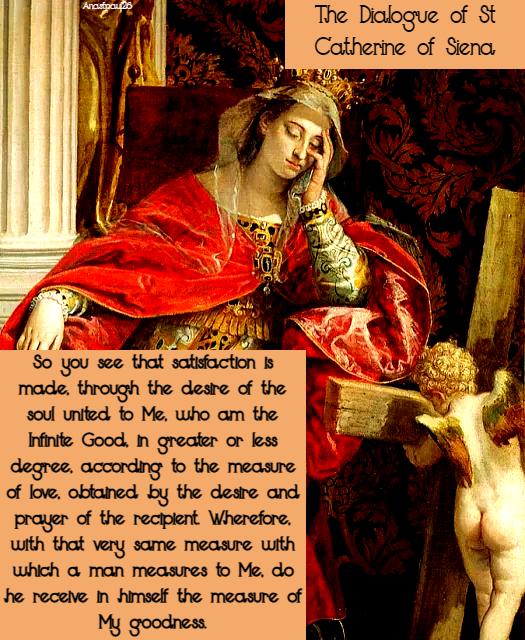
So you see that satisfaction is made, through the desire of the soul united to Me, who am the Infinite Good, in greater or less degree, according to the measure of love, obtained by the desire and prayer of the recipient. Wherefore, with that very same measure with which a man measures to Me, do he receive in himself the measure of My goodness.
The Dialogue of St Catherine of Siena
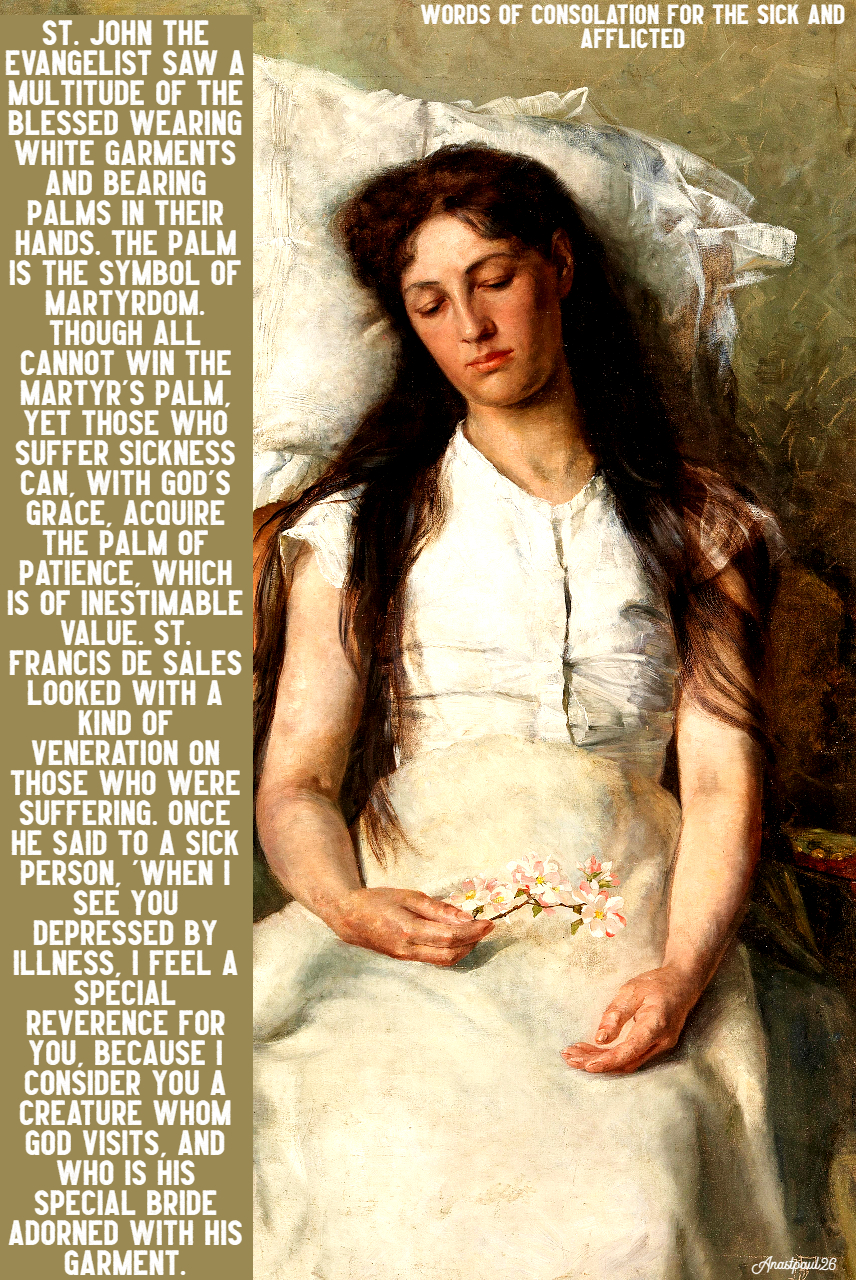
St. John the Evangelist saw a multitude of the blessed wearing white garments and bearing palms in their hands. The palm is the symbol of martyrdom. Though all cannot win the martyr’s palm, yet those who suffer sickness can, with God’s grace, acquire the palm of patience, which is of inestimable value. St. Francis de Sales looked with a kind of veneration on those who were suffering. Once he said to a sick person, ‘When I see you depressed by illness, I feel a special reverence for you, because I consider you a creature whom God visits, and who is His special bride adorned with His garment.
To entertain a profound respect and extraordinary love for the Thrones, the Cherubim and Seraphim.
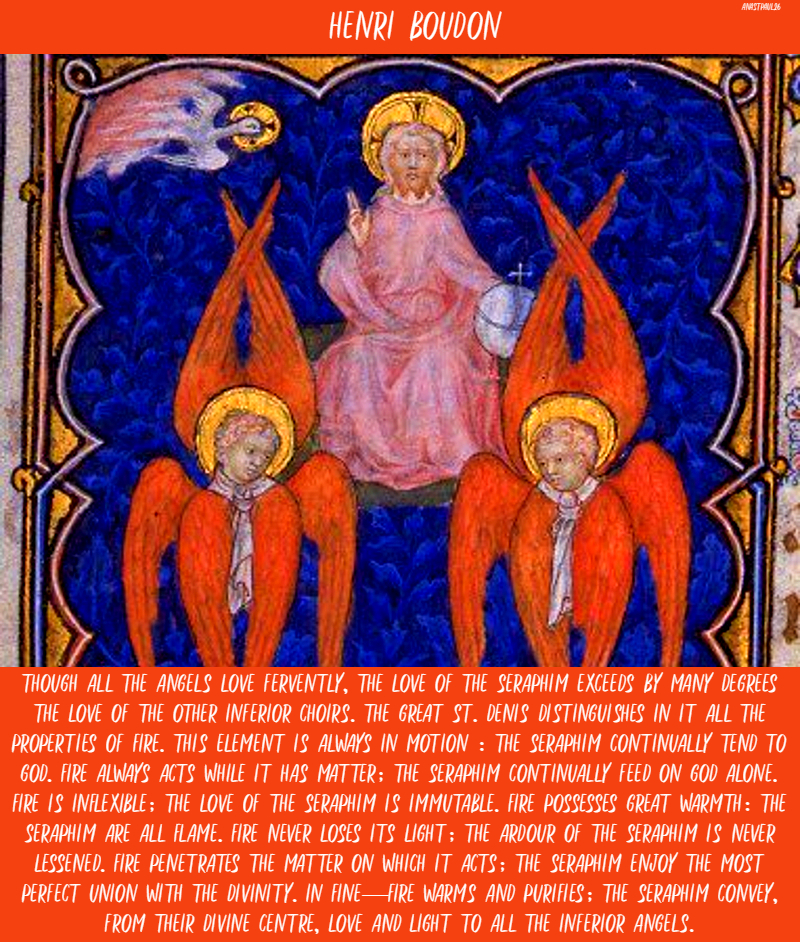
The first Hierarchy of the Angels is composed of the Thrones, the Cherubim and Seraphim. The latter excel in love—hence their name, Seraphim, which signifies ardour. Though all the Angels love fervently, the love of the Seraphim exceeds by many degrees the love of the other inferior choirs. The great St. Denis distinguishes in it all the properties of fire. This element is always in motion : the Seraphim continually tend to God. Fire always acts while it has matter; the Seraphim continually feed on God alone. Fire is inflexible; the love of the Seraphim is immutable. Fire possesses great warmth: the Seraphim are all flame. Fire never loses its light; the ardour of the Seraphim is never lessened. Fire penetrates the matter on which it acts; the Seraphim enjoy the most perfect union with the Divinity. In fine—fire warms and purifies; the Seraphim convey, from their divine centre, love and light to all the inferior Angels.
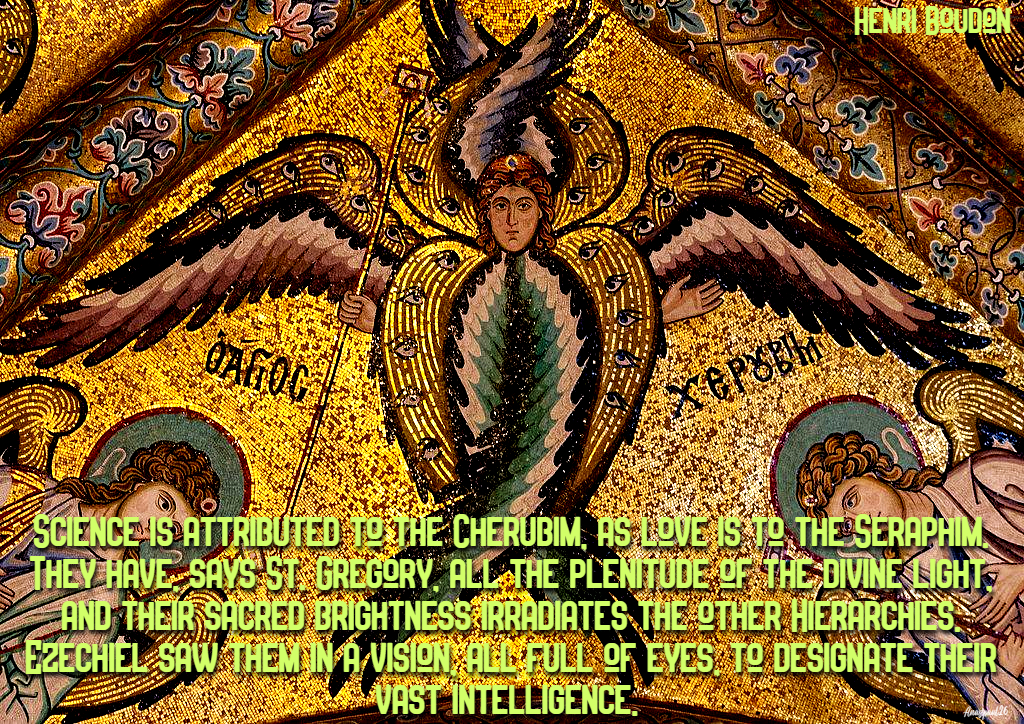
Science is attributed to the Cherubim, as love is to the Seraphim. They have, says St. Gregory, all the plenitude of the divine light, and their sacred brightness irradiates the other Hierarchies. Ezechiel saw them in a vision, all full of eyes, to designate their vast intelligence.
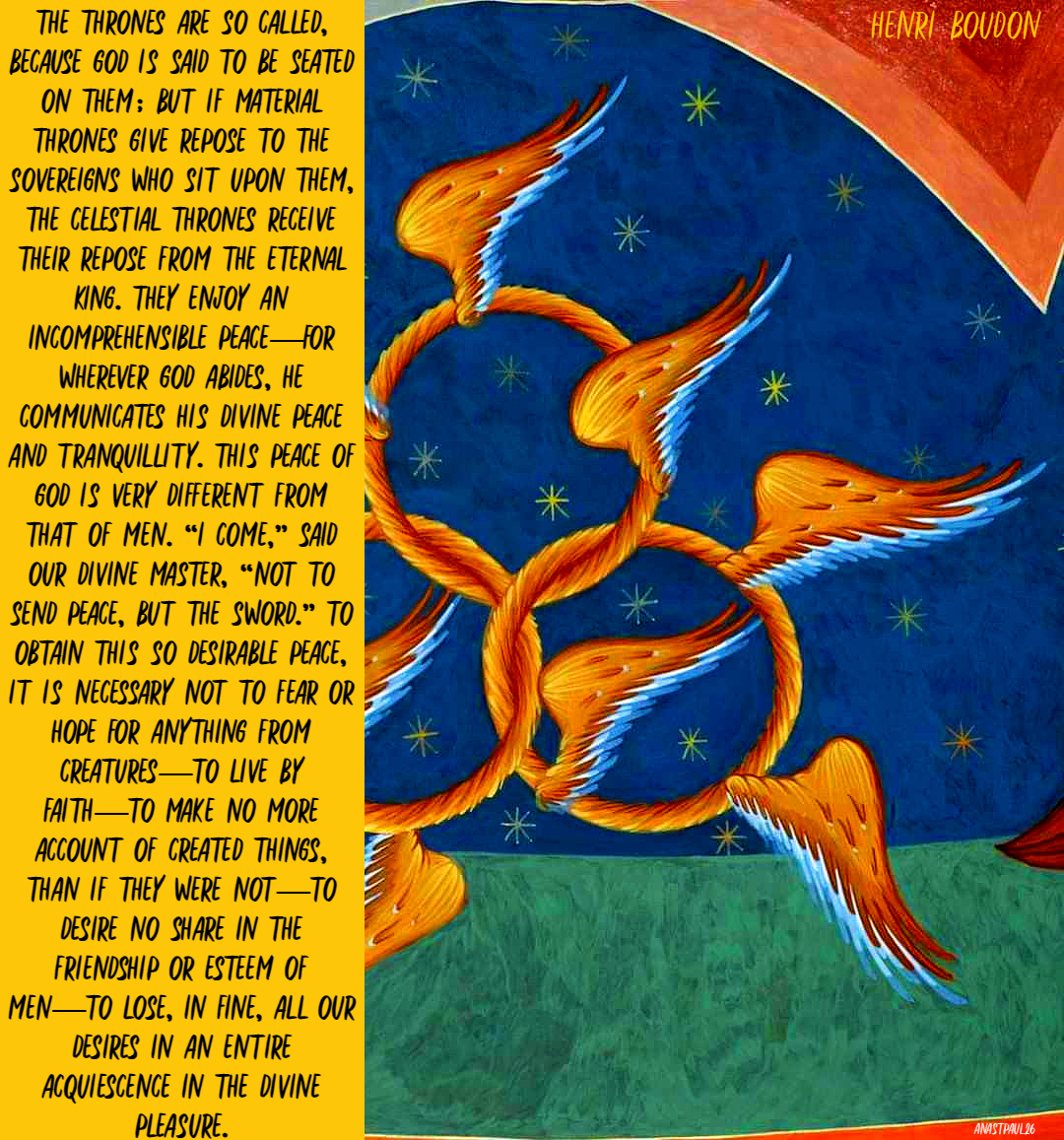
The Thrones are so called, because God is said to be seated on them; but if material thrones give repose to the Sovereigns who sit upon them, the celestial Thrones receive their repose from the Eternal King. They enjoy an incomprehensible peace—for wherever God abides, he communicates his divine peace and tranquillity. This peace of God is very different from that of men. “I come,” said our divine Master, “not to send peace, but the sword.” To obtain this so desirable peace, it is necessary not to fear or hope for anything from creatures—to live by faith—to make no more account of created things, than if they were not—to desire no share in the friendship or esteem of men—to lose, in fine, all our desires in an entire acquiescence in the divine pleasure. Be devout to the Thrones, and they will exert themselves in obtaining for you this greatest of all blessings. In like manner with the Cherubim.
It is said, that in the way of virtue we know more than we do but it is certain that perfect knowledge is rare. We speak of that of the saints. Few persons are practically convinced of the excellence of poverty and humiliation—of the advantages of the hidden and suffering life. It is in the school of a God, and at the feet of the crucifix, that this divine lesson is to be learned. Let us frequent it under the auspices of the Cherubim, the spirits of light, and we shall soon be illumined, and walk in the brightness of the children of God.
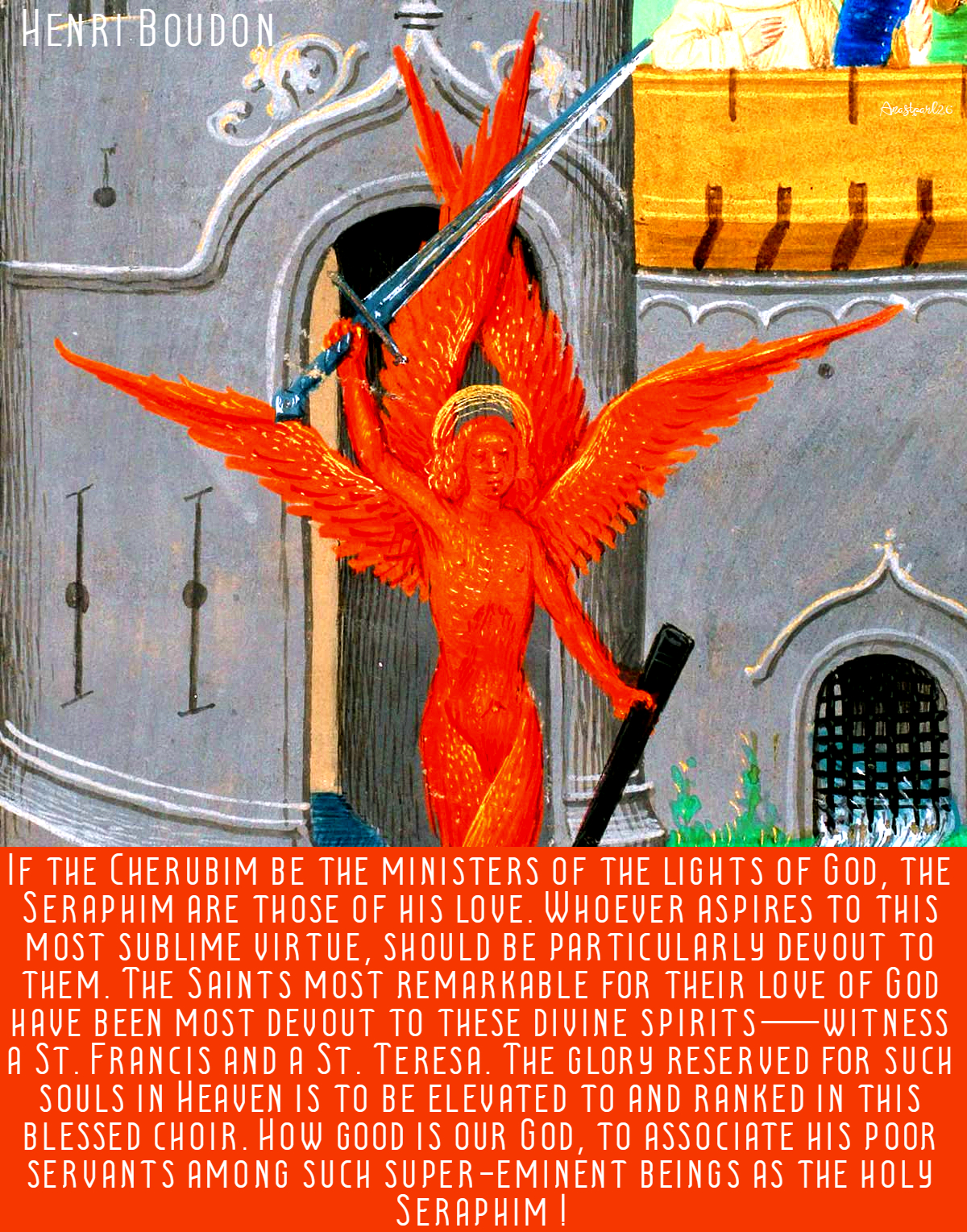
If the Cherubim be the ministers of the lights of God, the Seraphim are those of his love. Whoever aspires to this most sublime virtue, should be particularly devout to them. The Saints most remarkable for their love of God have been most devout to these divine spirits—witness a St. Francis and a St. Teresa. The glory reserved for such souls in Heaven is to be elevated to and ranked in this blessed choir. How good is our God, to associate his poor servants among such super-eminent beings as the holy Seraphim !
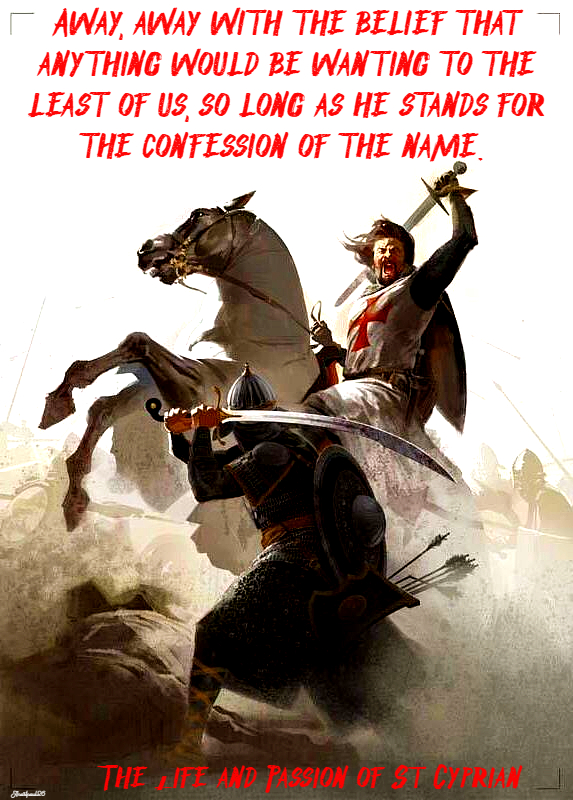
St. Callistus of Huesca, was a Spanish martyr and companion of St. Mercurialis. Callistus was born in Huesca, in Aragon, Spain. Callistus went to France with St. Mercurialis to fight against the Saracens/Moors (Muslims), dying in battle in 1003.
Away, away with the belief that anything would be wanting to the least of us, so long as he stands for the confession of the Name.
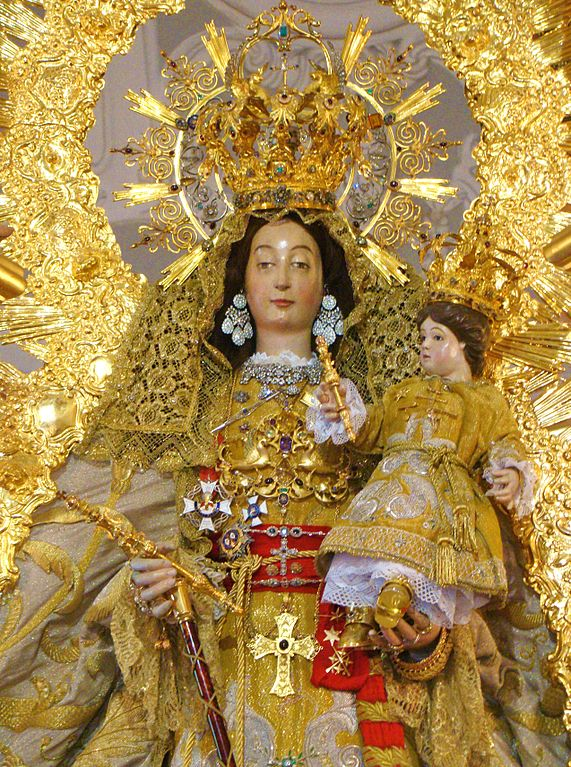
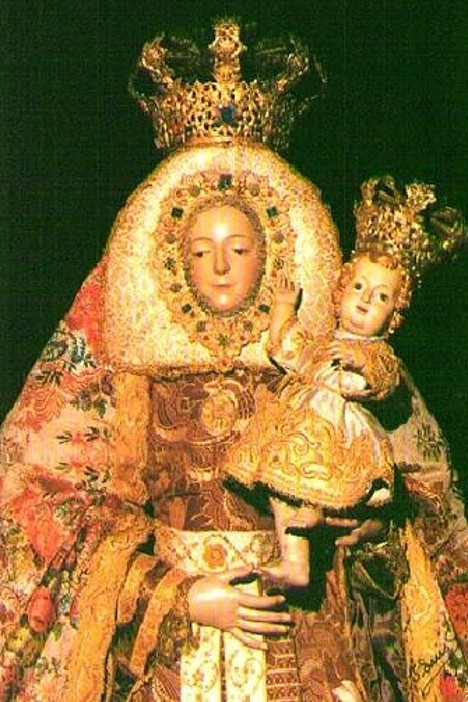
Virgen de los Remedios / Virgin of the Remedies, Rubite, Granada, Spain (12th Century) – 15 October:
The Virgin of Los Remedios is the title of the Virgin Mary which was promoted by the Trinitarian Order, founded in the late 12th century. The devotion became tied to the re-conquest of Spain, then still at its height. In the following century it spread to other parts of Europe. When Spain began the exploration and conquest of the Americas, it was a favourite devotion of the Spanish conquistadores.
It remains a popular devotion in Spain. Patronages – Diocese of San Cristóbal de La Laguna, the island of Tenerife, and the city of Cali, Colombia.
St Antiochus of Lyon St Aurelia of Strasbourg (Died 1027) Virgin Recluse, Princess St Callistus of Huesca St Cannatus of Marseilles Bl Cipriano Alguacil Torredenaida St Euthymius the Younger Bl Josefa Martínez Pérez St Leonard of Vandoeuvre Bl Narcis Basté y Basté Bl Pere Verdaguer Saurina Bl Ramón Esteban Bou Pascual St Sabinus of Catania St Severus of Trier
St Thecla of Kitzengen OSB (Died c 790) a Benedictine Nun and Abbess. Born in England, she went to Germany to assist Saint Boniface in his missionary labours.
St Willa of Nonnberg — Martyrs of Cologne: A group of 360 Christian soldiers martyred together in the persecutions of Diocletian and Maximian. They were martyred in 303 outside the city walls of Cologne, Germany.
Martyred in the Spanish Civil War: • Blessed Cipriano Alguacil Torredenaida • Blessed Josefa Martínez Pérez • Blessed Narcis Basté y Basté • Blessed Pere Verdaguer Saurina • Blessed Ramón Esteban Bou Pascual
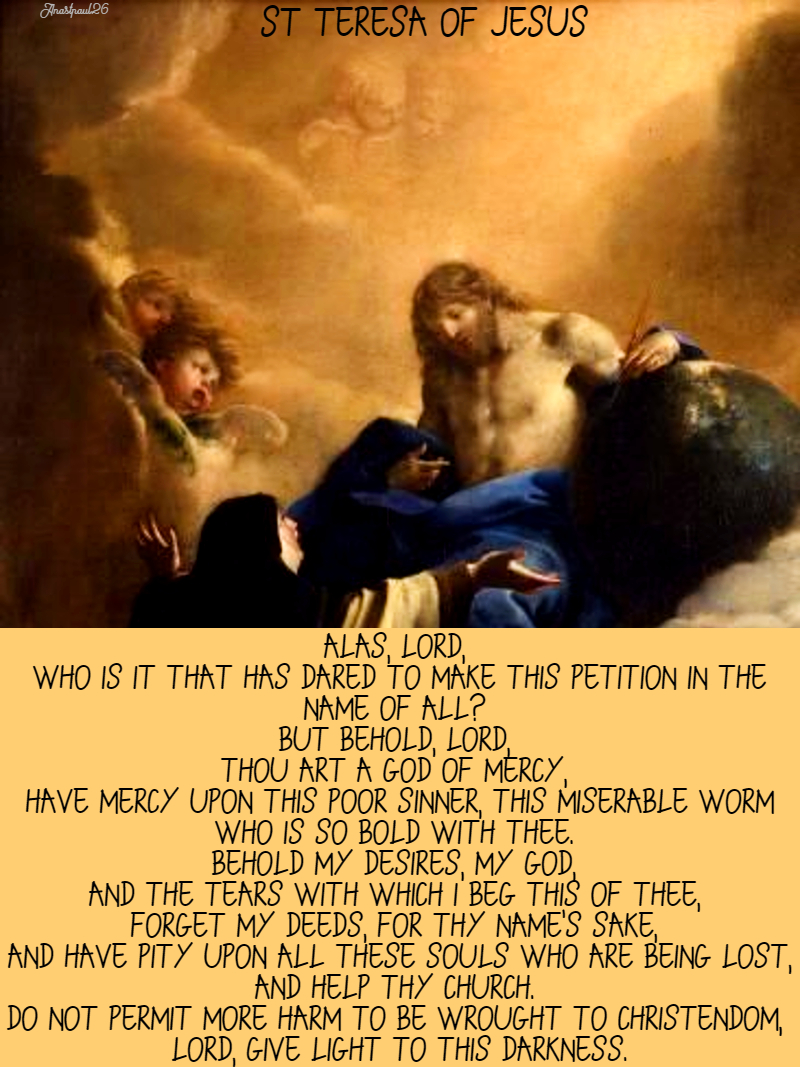
Alas, Lord, who is it that has dared to make this petition in the name of all? But behold, Lord, Thou art a God of mercy, have mercy upon this poor sinner, this miserable worm who is so bold with Thee. Behold my desires, my God, and the tears with which I beg this of Thee, forget my deeds, for Thy name’s sake, and have pity upon all these souls who are being lost, and help Thy Church. Do not permit more harm to be wrought to Christendom, Lord, give light to this darkness.
One Minute Reflection – 15 October – Readings: Ps 44:8, Ps 44:2, 2 Cor 10:17-18; 11:1-2, Matt 25:1-13
At that time Jesus spoke this parable to His disciples: “Then will the kingdom of heaven be like ten virgins who took their lamps and went forth to meet the bridegroom and the bride. Five of them were foolish and five wise.
Matt 25:1-13
REFLECTION – In this world, which is to say in the Church wholly following Christ, he says to all of us: “Whoever wishes to come after me must deny himself”. This command is not being directed to virgins but not married women, to widows but not wives, to monks but not husbands, to priests but not laity. It is the whole Church, the whole Body of Christ with all its members, differentiated and divided according to their proper functions, that is to follow Christ. May she wholly follow him, she who is one alone, the dove, the bride; may she follow him, she who has been redeemed and endowed with the blood of her Bridegroom. Virginal purity has its place here; the continence of widows has its place here; wedded chastity has its place here.
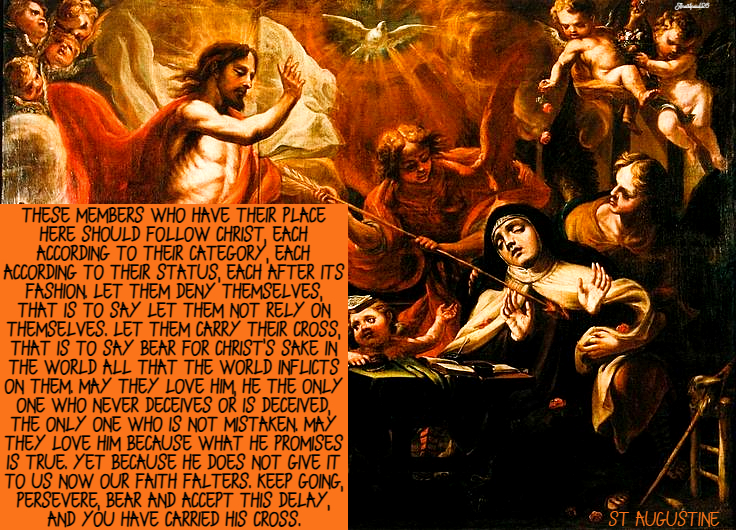
These members who have their place here should follow Christ, each according to their category, each according to their status, each after its fashion. Let them deny themselves, that is to say let them not rely on themselves. Let them carry their cross, that is to say bear for Christ's sake in the world all that the world inflicts on them. May they love him, he the only one who never deceives or is deceived, the only one who is not mistaken. May they love him because what he promises is true. Yet because he does not give it to us now our faith falters. Keep going, persevere, bear and accept this delay, and you have carried his cross.
St Augustine
PRAYER – Lord Jesus Christ, You wondrously revealed all of the deep treasures of Your Heart to St Teresa. May her merits and example win us the grace to love You above all things and in all things so that we may make our abode in Your own Sacred Heart. Through You, Lord Jesus, who live and reign forever, in union with God our Father and the Holy Spirit, one God, amen.
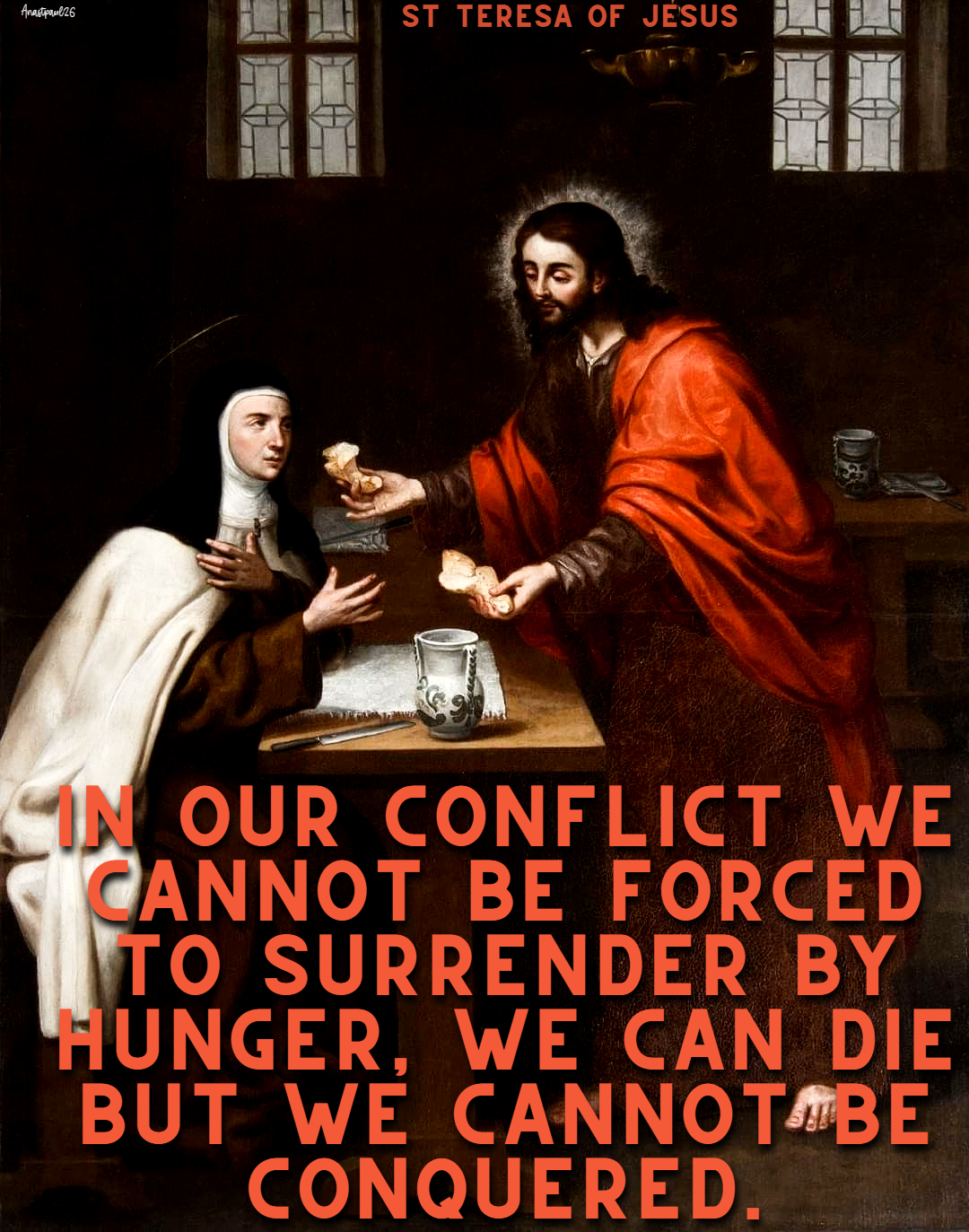
In our conflict we cannot be forced to surrender by hunger, we can die but we cannot be conquered.
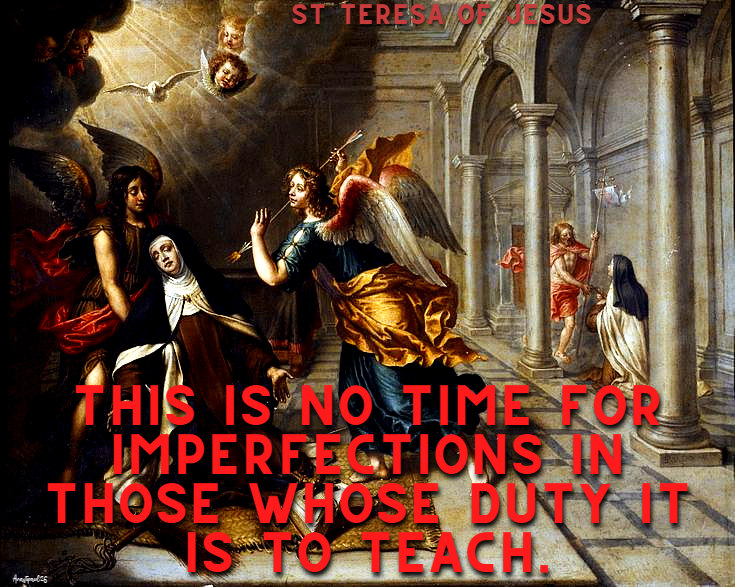
This is no time for imperfections in those whose duty it is to teach.
If these teachers are not inwardly fortified by realising the great importance of spurning everything beneath their feet and by being detached from things which come to an end on earth, and attached to things eternal, they will betray this defect in themselves, however much they may try to hide it. For whom are they dealing but with the world?
If the confessor is seen to be tending in any way towards vanity, he should be regarded with grave suspicion, and in such a case, conversation with him, however edifying, should be avoided, and the sister should make her confession briefly and say nothing more.
How dearly people have to pay for their miserable worries and concerns about honour!
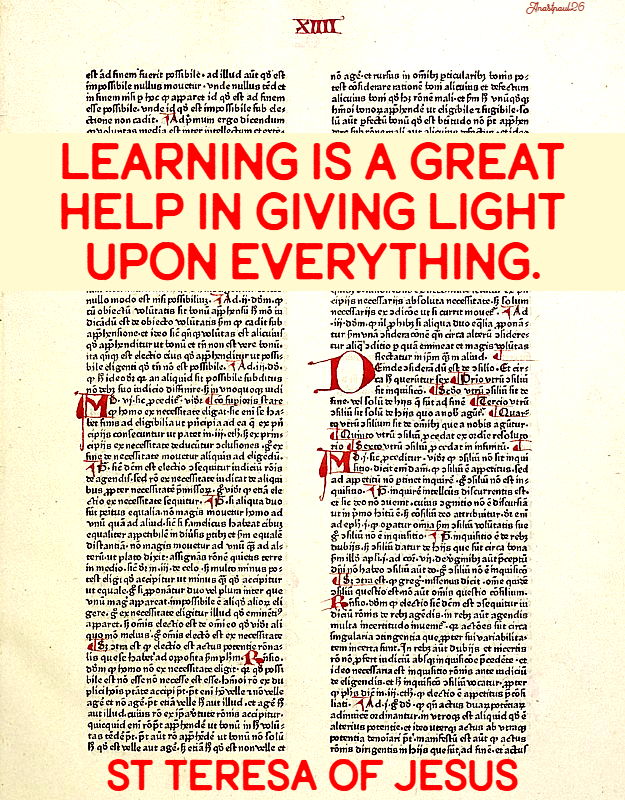
Page from the Summa Theologica
Learning is a great help in giving light upon everything.
To honour specially the Powers, Virtues, and Dominations.
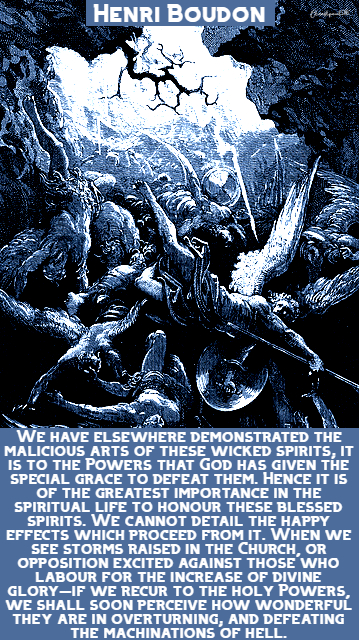
The Second Hierarchy of Angels is composed of the Powers, Virtues, and Dominations. The Dominations, as the principal Choir, give or dispense the orders which they receive from the higher Angels—the Virtues enable us to execute them— and the Powers to surmount the obstacles which the Devils oppose thereto. We have elsewhere demonstrated the malicious arts of these wicked spirits; it is to the Powers that God has given the special grace to defeat them. Hence it is of the greatest importance in the spiritual life to honour these blessed spirits. We cannot detail the happy effects which proceed from it. When we see storms raised in the Church, or opposition excited against those who labour for the increase of divine glory—if we recur to the holy Powers, we shall soon perceive how wonderful they are in overturning; and defeating the machinations of hell.
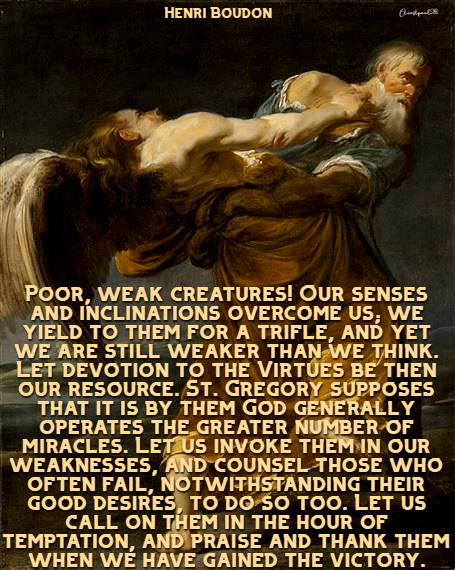
With all our good desires, we do very little; our tongues are longer than our arms. It seems as if nothing could arrest our course—and when we make a few steps, we grow tired and think of reposing. Poor, weak creatures! Our senses and inclinations overcome us; we yield to them for a trifle, and yet we are still weaker than we think. Let devotion to the Virtues be then our resource. St. Gregory supposes that it is by them God generally operates the greater number of miracles. Let us invoke them in our weaknesses, and counsel those who often fail, notwithstanding their good desires, to do so too. Let us call on them in the hour of temptation, and praise and thank them when we have gained the victory.
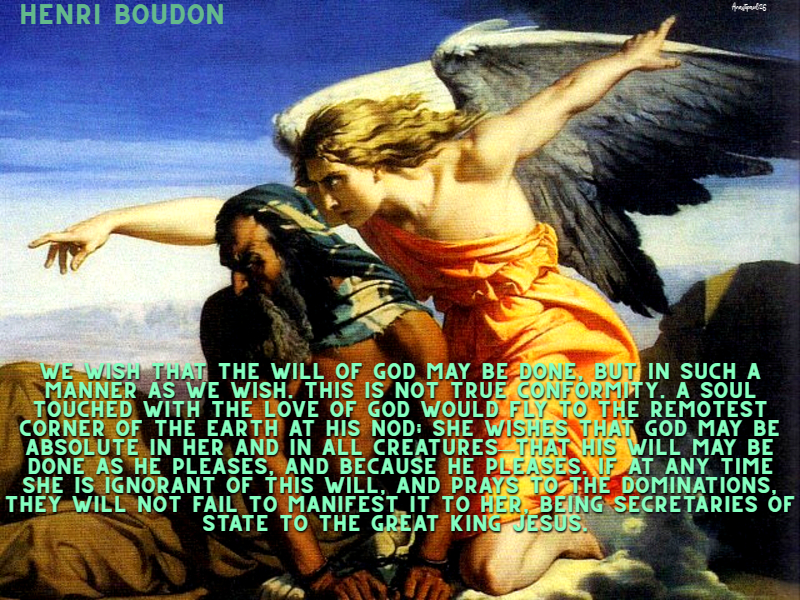
If the Dominations dispense the orders of God to the other Angels, they manifest his holy will to man. O! how happy should we be, if we always discerned this blessed will! But alas ! we often mistake for it the will of the creature, and still oftener, when we know it, we find it difficult to submit to it. We wish that the will of God may be done, but in such a manner as we wish. This is not true conformity. A soul touched with the love of God would fly to the remotest corner of the earth at his nod; she wishes that God may be absolute in her and in all creatures—that his will may be done as he pleases, and because he pleases. If at any time she is ignorant of this will, and prays to the Dominations, they will not fail to manifest it to her, being Secretaries of State to the great King Jesus.
O my God ! how just it appears, that all should serve and be subject to you ! “All the nations are before you as a drop of dew.” He who knows your will, and does it not, deserves punishment indeed. O! may it be done in all things—and may we seek our peace only in its accomplishment. Amen.
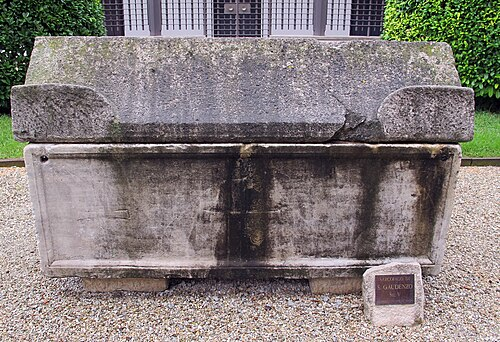
Saint Gaudentius of Rimini, also known as Gaudenzo, Gaudenzio, martyr and bishop. Gaudentius was born in Ephesus in around 280 and fled to Rome in 308 because his parents were killed by Manichaeans. Consecrated a bishop, he evangelised Rimini, Italy in 346. He ordained Saint Marinus as deacon and attended the Council of Rimini in 359 which condemned Arianism.
To to flee Arian violence in the city, with seventeen other bishops, Gaudentius retreated to a nearby town, which tradition says was renamed Cattolica (‘Catholic’) after their retreat. On his return to Rimini, Gaudentius was arrested for condemning Arianism. A mob snatched him from the hands of the city’s magistrates: he was lynched or stoned to death by Arians on 14 October 360.
Gaudentius’ sarcophagus by the Tempio Malatestiano in Rimini
Saint Gaudentius performed several miracles during his life: he exorcised a man possessed by the devil and he transformed the waters of the Misa river into wine for his travelling companions.
As well as being the patron saint of Rimini, Gaudentius is celebrated in Ostra, in the Marche region, Garaguso, in Basilicata, both of which host some of his relics. In 1857, Pope Pius IX donated a silver reliquary to Rimini’s Tempio Malatestiano to house Gaudentius’ skull.
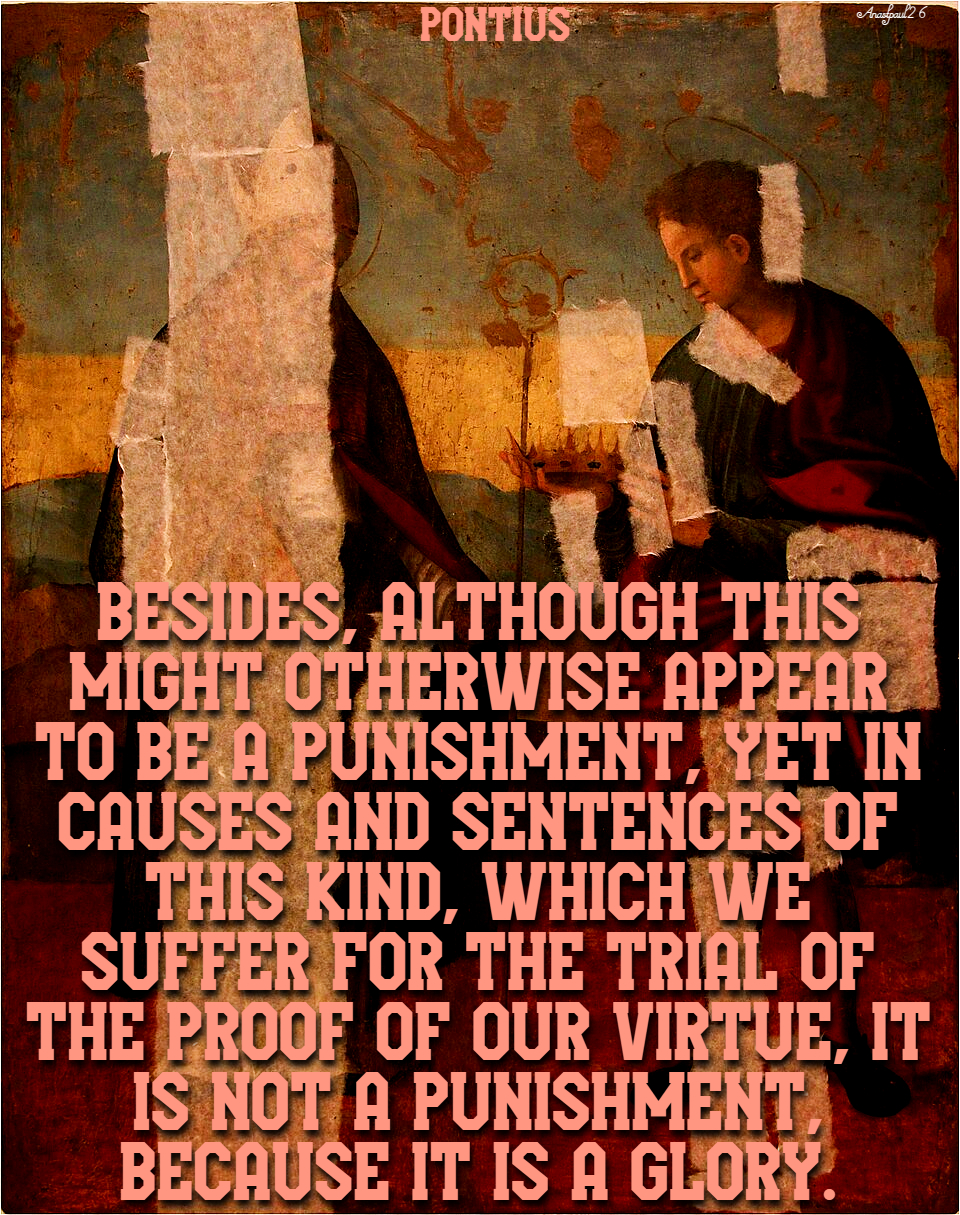
Besides, although this might otherwise appear to be a punishment, yet in causes and sentences of this kind, which we suffer for the trial of the proof of our virtue, it is not a punishment, because it is a glory.
October 14: Our Lady of La Rochette, France (7th Century)
The Abbot Orsini wrote: “Our Lady of La Rochette near Geneva. A shepherd coming up to a bush, where he heard a plaintive voice, found there an image of the Blessed Virgin, which led to a church being built there.”
St Donatian of Rheims (Died 390) St Donatian was the Seventh Bishop of Rheims, France from 360 to 390. His Memorial is beautifully celebrated in Bruges with a procession of his relics.
Saint Fortunatus of Todi (Died 537) Bishop, Confessor, miracle-worker. An entry in the Roman Martyrology under 14 October records: “At Todi in Umbria, St Fortunatus, Bishop, who, as is mentioned by blessed Gregory, was endowed with an extraordinary gift for casting out unclean spirits.”
St Franciszek Roslaniec St Gaudentius of Rimini St Gundisalvus of Lagos Bl Jacques Laigneau de Langellerie St Lupulo of Capua St Lupus of Caesarea St Manacca St Manehildis St Modesto of Capua Bl Richard Creagh
St Rusticus of Trier St Saturninus of Caesarea St Stanislaw Mysakowski St Venanzio of Luni — Martyrs of Caesarea – (4 saints): Three brothers and a sister martyred together in the persecutions of Diocletian – Carponius, Evaristus, Fortunata and Priscian. In 303 in Caesarea, Cappadocia (in modern Turkey) – their relics enshrined in Naples, Italy.
Martyred in the Spanish Civil War: • Blessed Ana María Aranda Riera • Blessed Jacques Laigneau de Langellerie
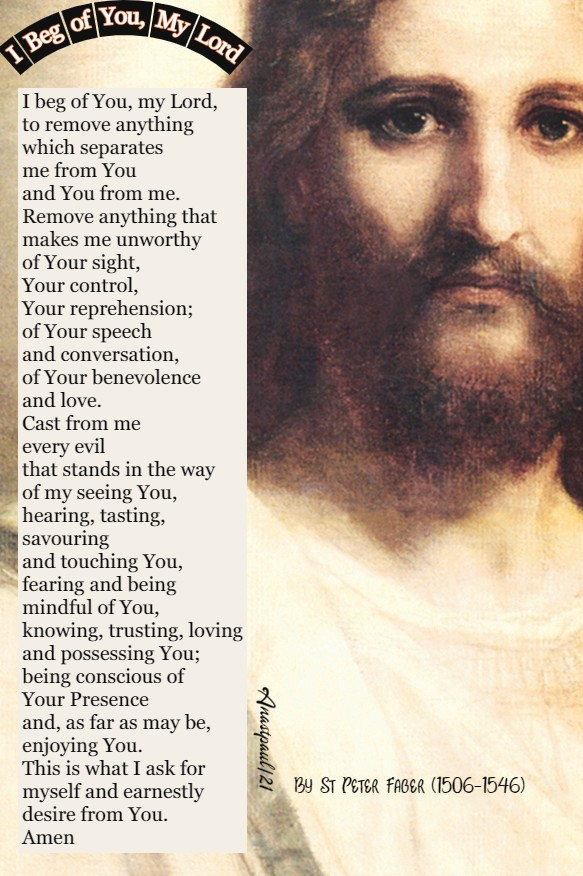
I Beg of You, My Lord By St Peter Faber (1506-1546)
I beg of You, my Lord, to remove anything which separates me from You and You from me. Remove anything that makes me unworthy of Your sight, Your control, Your reprehension; of Your speech and conversation, of Your benevolence and love. Cast from me every evil that stands in the way of my seeing You, hearing, tasting, savouring and touching You, fearing and being mindful of You, knowing, trusting, loving and possessing You; being conscious of Your Presence and, as far as may be, enjoying You. This is what I ask for myself and earnestly desire from You. Amen
One Minute Reflection – 14 October – “Month of the Holy Rosary” – Readings: John 21:15-17, Ps 29:2, 1 Pet 5:1-4; 5:10-11, Matt 16:13-19
And Jesus answering, said to him: Blessed art thou, Simon Bar-Jona: because flesh and blood hath not revealed it to thee, but my Father who is in heaven. And I say to thee: That thou art Peter; and upon this rock I will build My Church, and the gates of hell shall not prevail against it. And I will give to thee the keys of the kingdom of heaven. And whatsoever thou shalt bind upon earth, it shall be bound also in heaven: and whatsoever thou shalt loose upon earth, it shall be loosed also in heaven.
Matt 16:13-19
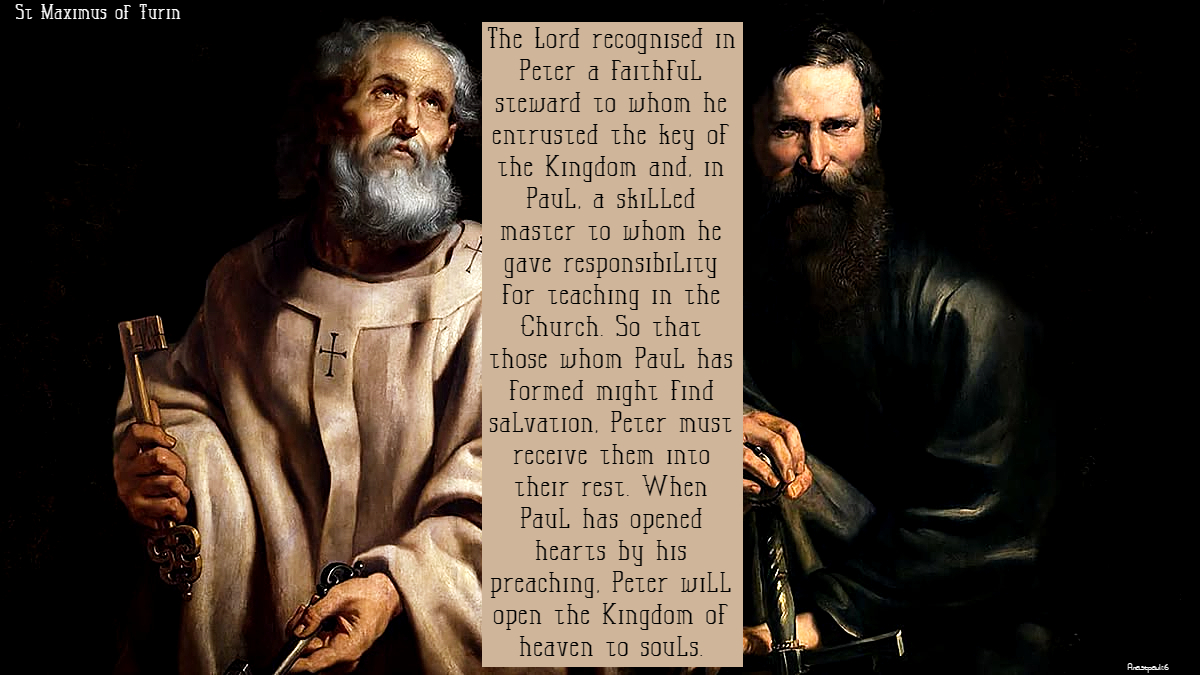
REFLECTION – The Lord recognised in Peter a faithful steward to whom he entrusted the key of the Kingdom and, in Paul, a skilled master to whom he gave responsibility for teaching in the Church. So that those whom Paul has formed might find salvation, Peter must receive them into their rest. When Paul has opened hearts by his preaching, Peter will open the Kingdom of heaven to souls. So it is a kind of key that Paul, too, has received from Christ: the key of knowledge, enabling him to open up to their very depths hearts hardened towards the faith. Then, in spiritual unveiling, it causes what was hidden within to appear in the light of day. This is a key that allows the confession of sin to escape from consciences and locks within them for ever the grace of the Savior’s mystery.
So both have received keys from the Lord's hands: the key of knowledge for the one and the key of authority for the other; the former metes out the riches of immortality, the latter dispenses treasures of wisdom. For there are treasures of knowledge, as it is written: this mystery is Christ “in whom are hidden all the treasures of wisdom and knowledge,”
St Maximus of Turin
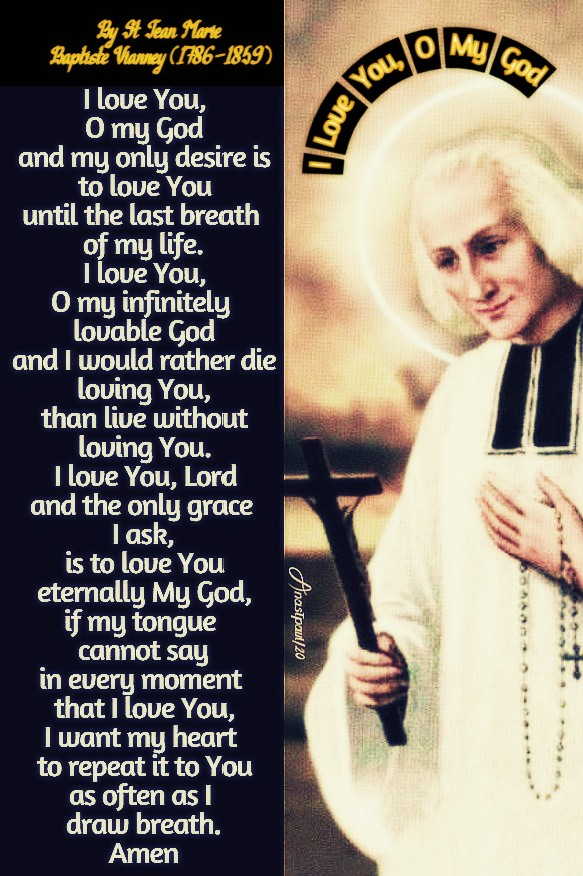
PRAYER – I Love You, O My God – By St Jean Marie Baptiste Vianney (1786-1859) I love You, O my God and my only desire is to love You until the last breath of my life. I love You, O my infinitely lovable God and I would rather die loving You, than live without loving You. I love You, Lord and the only grace I ask, is to love You eternally My God, if my tongue cannot say in every moment that I love You, I want my heart to repeat it to You as often as I draw breath. Amen
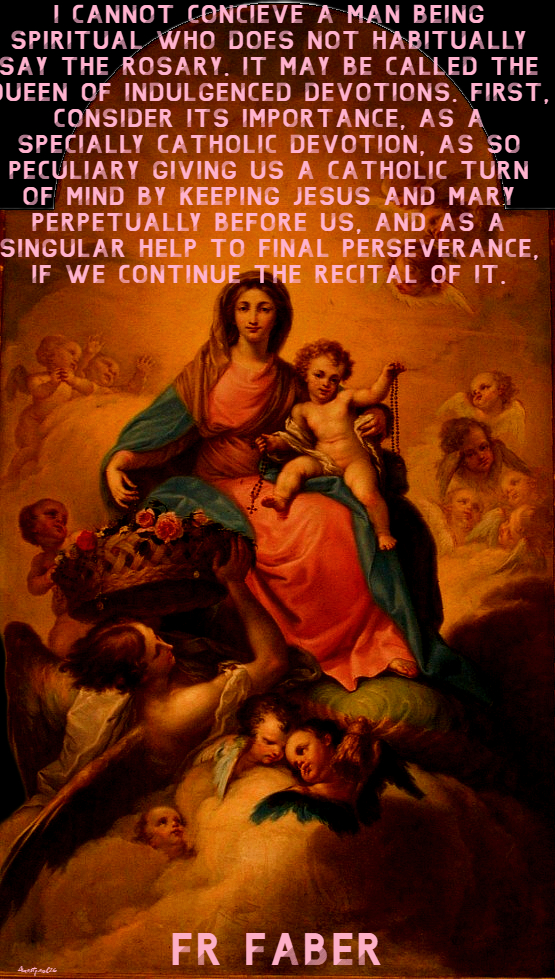
I cannot concieve a man being spiritual who does not habitually say the rosary. It may be called the queen of indulgenced devotions. First, consider its importance, as a specially Catholic devotion, as so peculiary giving us a Catholic turn of mind by keeping Jesus and Mary perpetually before us, and as a singular help to final perseverance, if we continue the recital of it.
Fr Faber
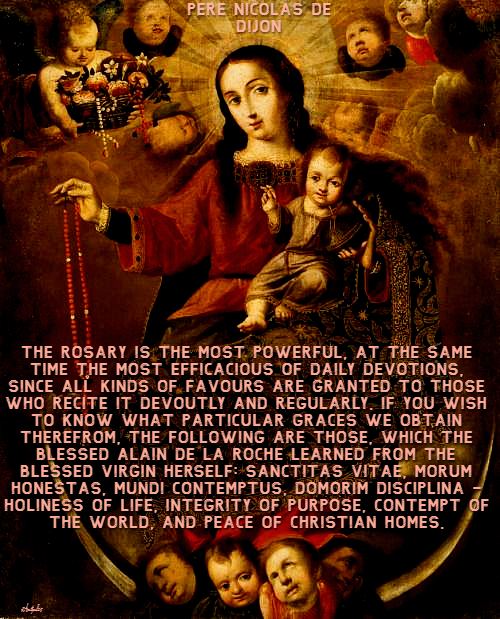
The Rosary is the most powerful, at the same time the most efficacious of daily devotions, since all kinds of favours are granted to those who recite it devoutly and regularly. If you wish to know what particular graces we obtain therefrom, the following are those, which the Blessed Alain de la Roche learned from the Blessed Virgin herself: Sanctitas vitae, morum honestas, mundi contemptus, domorim disciplina – Holiness of life, integrity of purpose, contempt of the world, and peace of Christian homes.
Pere Nicolas de Dijon
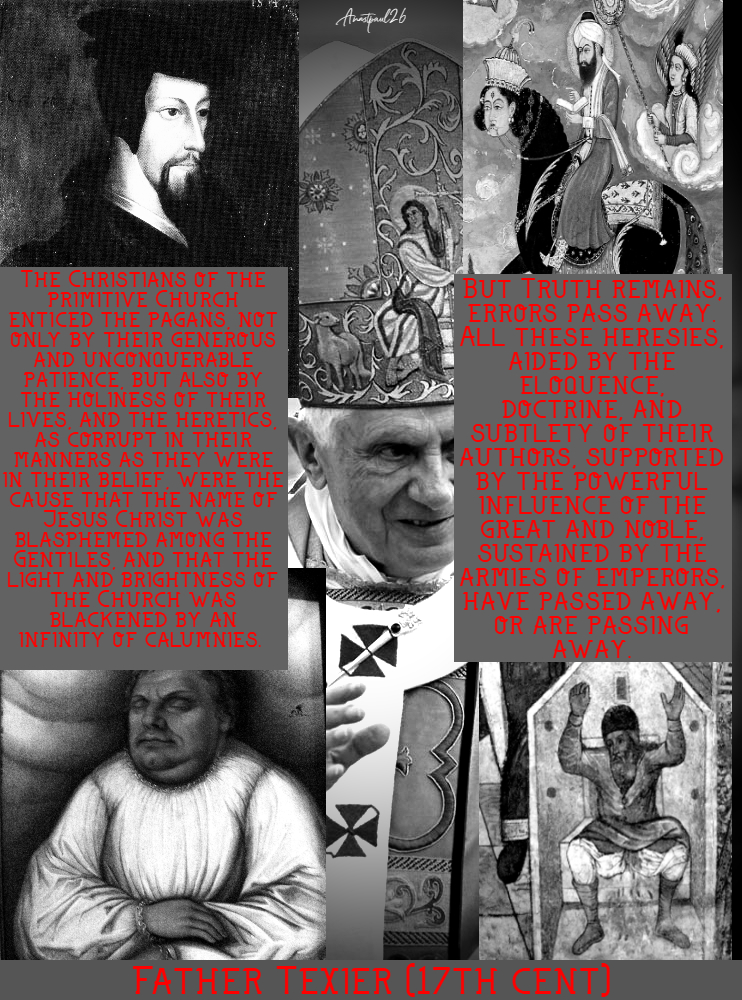
The Christians of the primitive Church enticed the pagans, not only by their generous and unconquerable patience, but also by the holiness of their lives, and the heretics, as corrupt in their manners as they were in their belief, were the cause that the name of Jesus Christ was blasphemed among the Gentiles, and that the light and brightness of the Church was blackened by an infinity of calumnies. But Truth remains, errors pass away. All these heresies, aided by the eloquence, doctrine, and subtlety of their authors, supported by the powerful influence of the great and noble, sustained by the armies of emperors, have passed away, or are passing away.
Father Texier (17th cent)
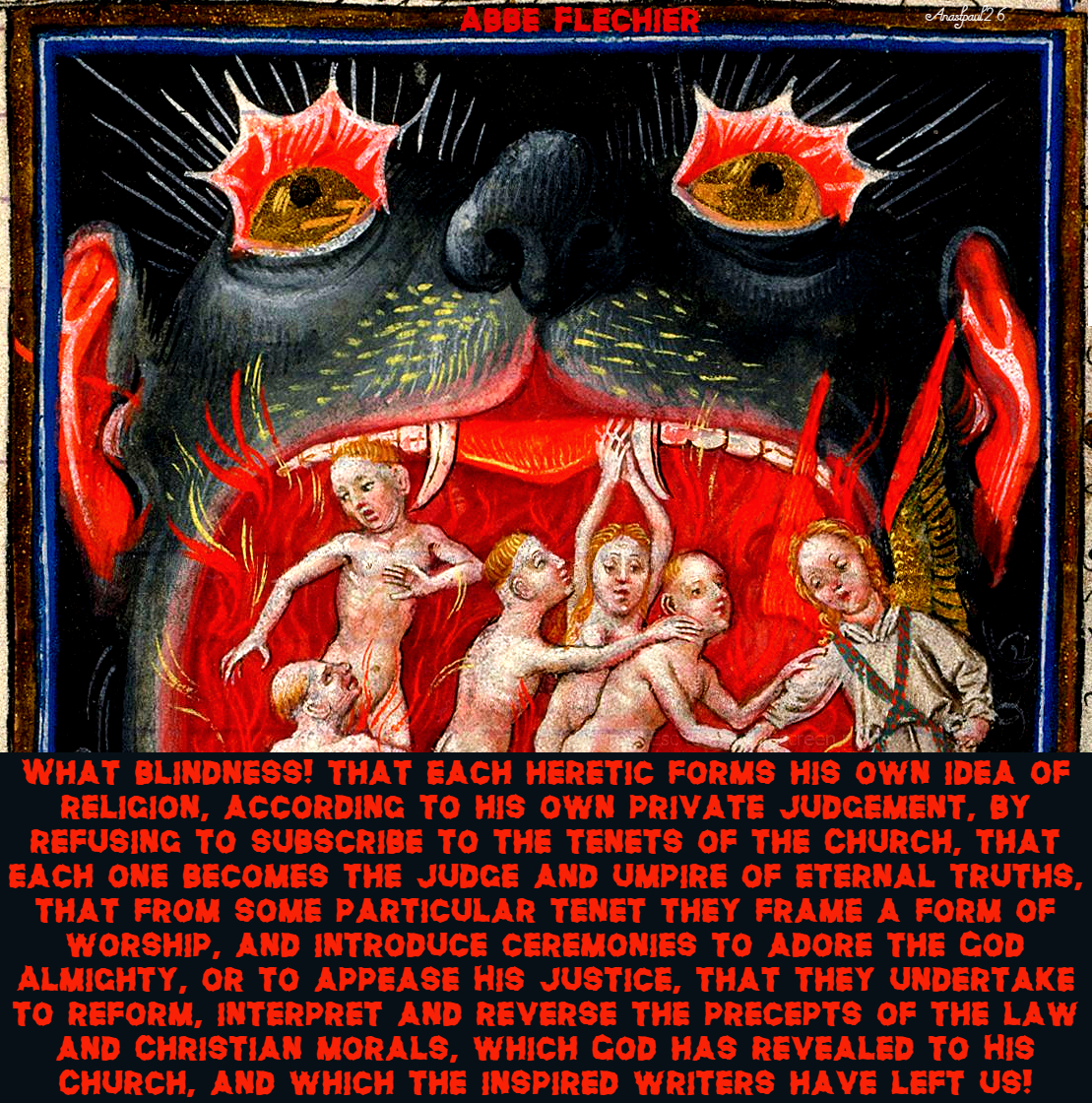
What blindness! that each heretic forms his own idea of religion, according to his own private judgement, by refusing to subscribe to the tenets of the Church, that each one becomes the judge and umpire of eternal truths, that from some particular tenet they frame a form of worship, and introduce ceremonies to adore the God Almighty, or to appease His justice, that they undertake to reform, interpret and reverse the precepts of the law and Christian morals, which God has revealed to His Church, and which the inspired writers have left us!
Abbe Flechier
Priests should be holy, says God, because I am holy, and that My being holy I wish My ministers to be holy, and I cannot endure any but holy men to approach Me or My altars. Sanctity is a necessary appendage for the priest, and the want of holiness is a species of irregularity which is unbearable and which I cannot suffer. Let not those who have not the courage to try to become saints, be rash enough to be priests of My altars.
Abbe Flechier
You have the church, which is a refuge, and, if I may dare to say so, is a heaven in miniature. You have a sacrifice offered up and consummated, you have the house wherein the Holy Ghost showers down abundant graces, you have the tombs and relics of the martyrs and saints, and many other things, which should induce you to return from a state of sin and indifference to that of grace and justice.
To have a singular Devotion to the holy Spirits of the First Choir—the Angels, Archangels, and Principalities.
The third or last Hierarchy of the Holy Angels is formed of three Choirs Angels, Archangels, and Principalities. They are particularly applied to the affairs of kingdoms and provinces, and in general to all that regards the happiness of man. Their goodness and kindness is so great, that we can never make them a suitable return. The principalities are so called, says St. Gregory, because they are the princes of the other two choirs, and communicate to them those lights and intelligences which they receive from the higher Hierarchies. The Archangels watch over kingdoms and provinces and the Angels are appointed the guardians of men.
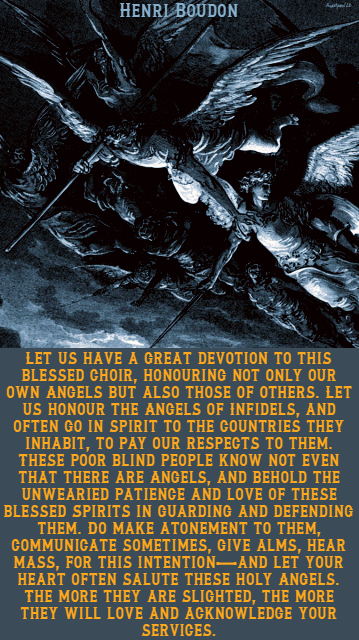
Let us have a great devotion to this blessed choir, honouring not only our own Angels but also those of others. Let us honour the Angels of Infidels, and often go in spirit to the countries they inhabit, to pay our respects to them. These poor blind people know not even that there are Angels, and behold the unwearied patience and love of these blessed Spirits in guarding and defending them. Do make atonement to them, communicate sometimes, give alms, hear mass, for this intention—and let your heart often salute these holy Angels. The more they are slighted, the more they will love and acknowledge your services. If a great king, in the revolt of his subjects, received considerable services from foreigners, he would not fail to acknowledge them gratefully, when reinstated in his dominions : hence judge what you may expect from the princes of the celestial realm. Do the same for the Angels of Heretics—for those of uninstructed Catholics, the greater number of whom know as little about these holy Spirits, as Pagans and Infidels. Pray for their conversion, that knowing the adorable Jesus, whom God has sent, and Mary his amiable mother, they may also know and honour the Angels.
Be devout to the Angels of your friends; these often render you services, which you would not receive from your own guardian. As, in the number of your friends, your confessor holds the first place, honour particularly his Angel, and pray him to bear on his mind a perfect knowledge of the designs of God on those whom he directs. Honour the Angels of your parents, relations, benefactors, and- of all with whom you have to do; they have more part than you think in the favours you receive by means of those persons. Be devout to the Angels of your enemies—it is the true way to gain them—or, if God wills that you should suffer the effects of their hatred, it is the best means of obtaining grace to love them cordially and make a good use of your sufferings. In fine, revere the Angels of the Sovereign Pontiff, the Bishops, the Clergy, and all persons in authority—that they may fitly discharge their obligations.
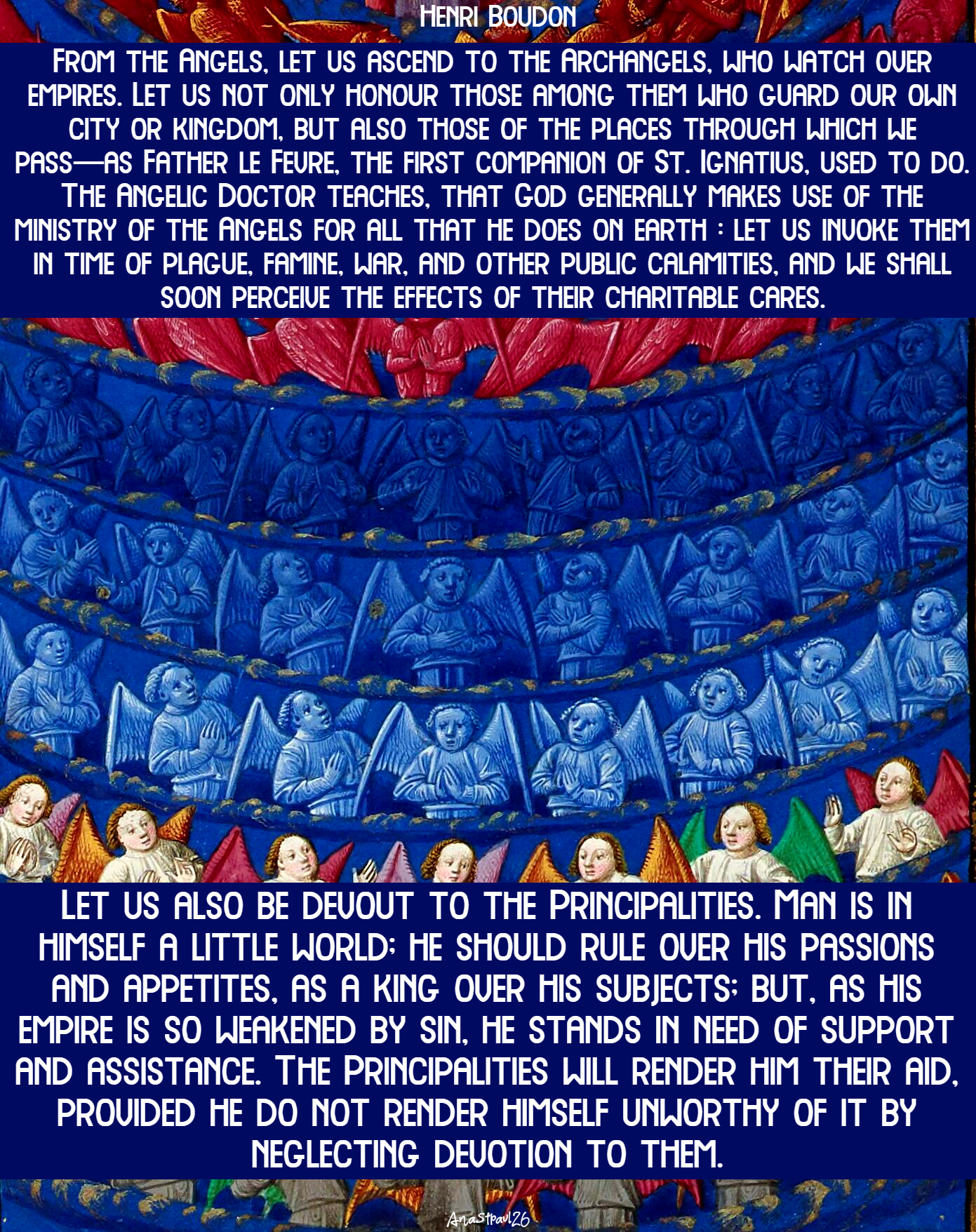
From the Angels, let us ascend to the Archangels, who watch over empires. Let us not only honour those among them who guard our own city or kingdom, but also those of the places through which we pass—as Father le Fevre, the first companion of St. Ignatius, used to do. The Angelic Doctor teaches, that God generally makes use of the ministry of the Angels for all that he does on earth : let us invoke them in time of plague, famine, war, and other public calamities, and we shall soon perceive the effects of their charitable cares.
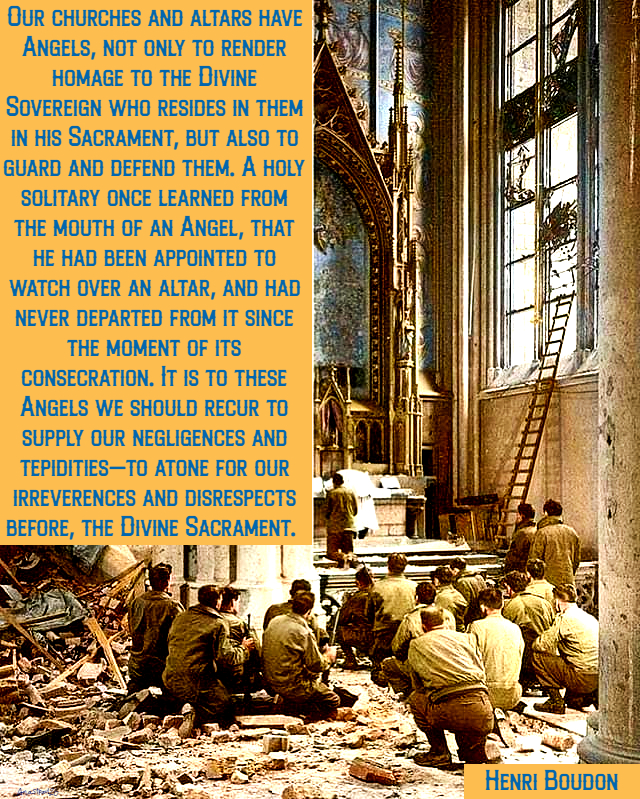
Our churches and altars have Angels, not only to render homage to the Divine Sovereign who resides in them in his Sacrament, but also to guard and defend them. A holy solitary once learned from the mouth of an Angel, that he had been appointed to watch over an altar, and had never departed from it since the moment of its consecration. It is to these Angels we should recur to supply our negligences and tepidities—to atone for our irreverences and disrespects before, the Divine Sacrament. It is well to unite in the love and homage which they continually render to it, and like the Psalmist, to “sing canticles of praise to our God in the presence of his Angels.”
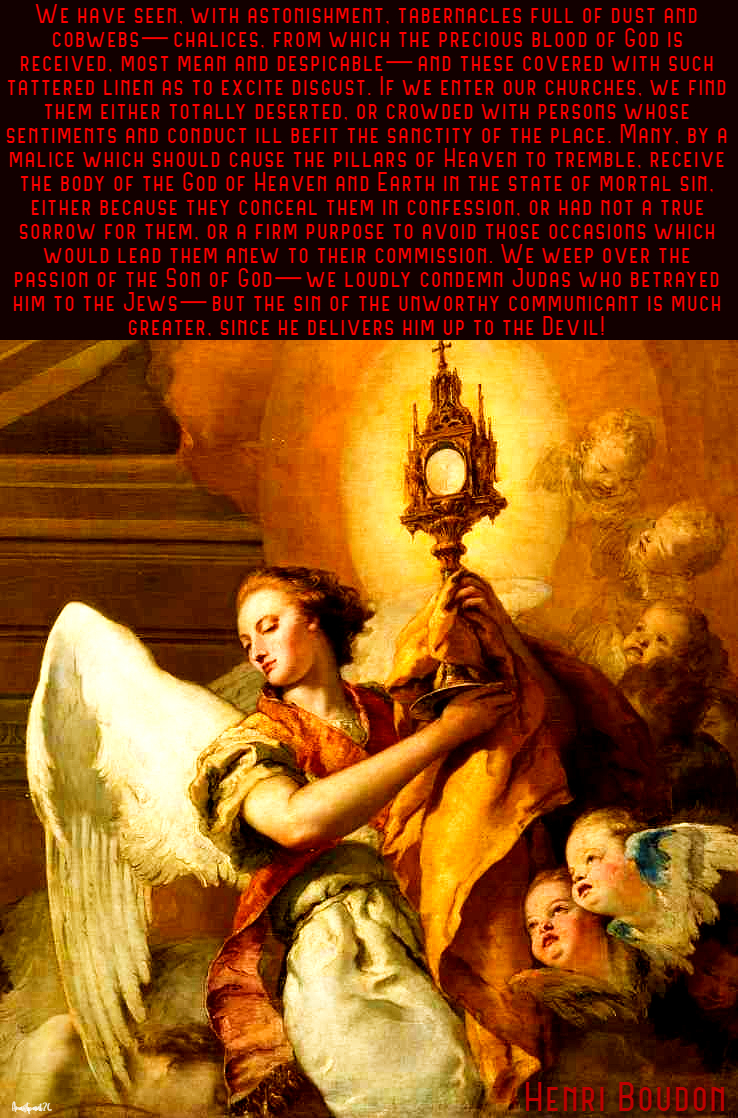
O my Lord and my God! here permit me to bewail, in the presence of your Divine Majesty, the deplorable blindness of Christians, who are the children of light, regarding your holy Sacrament. Is it then true, that they still believe you to be really present in this adorable mystery and behave as they do ? We are seized with horror when we reflect on the irreverences committed against you by Heretics and Infidels but those offered to you by Christians, who profess themselves ready to sacrifice their lives in defence of this adorable truth, are inconceivable. We have seen, with astonishment, tabernacles full of dust and cobwebs—chalices, from which the precious blood of God is received, most mean and despicable—and these covered with such tattered linen as to excite disgust. If we enter our churches, we find them either totally deserted, or crowded with persons whose sentiments and conduct ill befit the sanctity of the place. This is not all—the sufferings which love has imposed on our Sovereign stop not here. Many, by a malice which should cause the pillars of Heaven to tremble, receive the body of the God of Heaven and Earth in the state of mortal sin, either because they conceal them in confession, or had not a true sorrow for them, or a firm purpose to avoid those occasions which would lead them anew to their commission. We weep over the passion of the Son of God—we loudly condemn Judas who betrayed him to the Jews—but the sin of the unworthy communicant is much greater, since he delivers him up to the Devil!
O ! Angels of Paradise ! I address myself to you—knowing the obduracy of men, inspire them with all that respect for the adorable body of your Sovereign, which they are capable of conceiving—give them a knowledge of the dispositions with which it should be received:—that this abominable crime, this sin more hellish than human, may be no more committed. Inspire the rich to provide churches and altars, with suitable decorations—and repair, by your unceasing homage, the insults which have been offered to this mystery of inconceivable love.
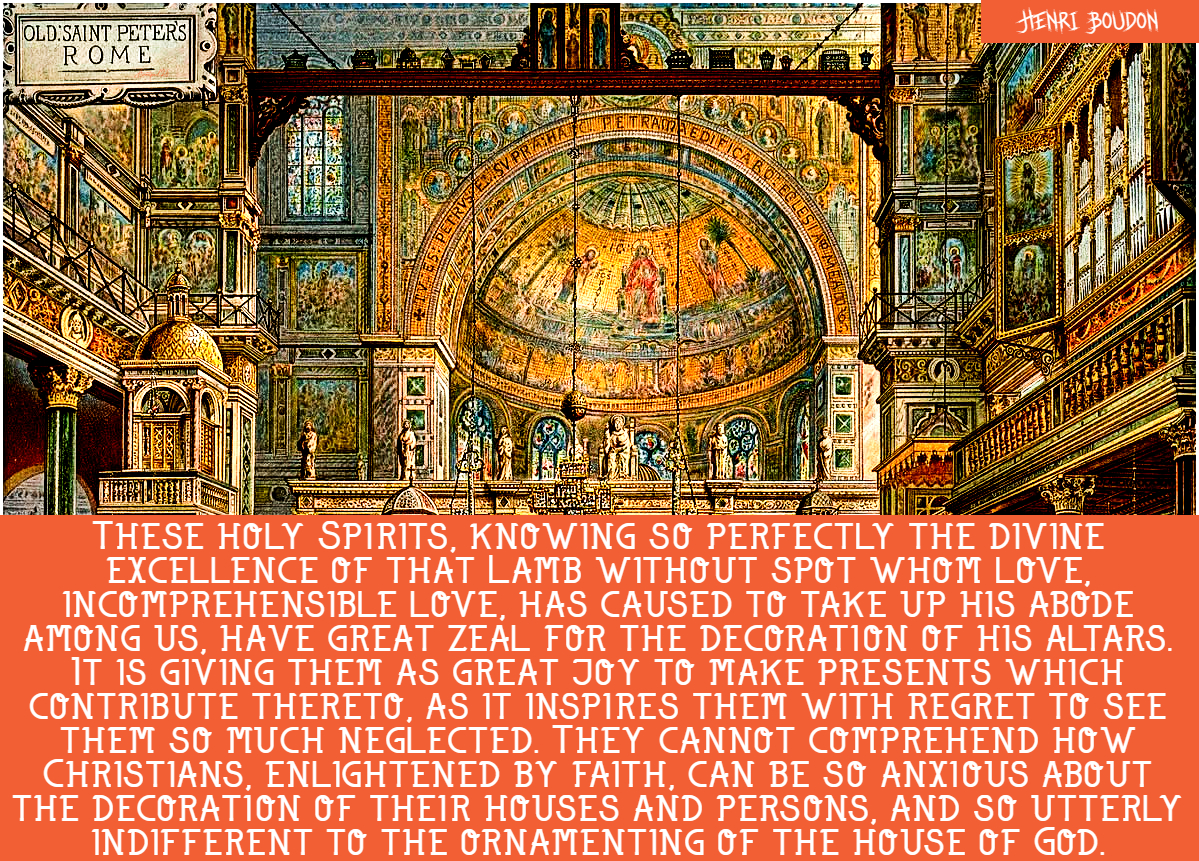
These holy Spirits, knowing so perfectly the divine excellence of that Lamb without spot whom love, incomprehensible love, has caused to take up his abode among us, have great zeal for the decoration of his altars. It is giving them as great joy to make presents which contribute thereto, as it inspires them with regret to see them so much neglected. They cannot comprehend how Christians, enlightened by faith, can be so anxious about the decoration of their houses and persons, and so utterly indifferent to the ornamenting of the house of God.
Let us also be devout to the Principalities. Man is in himself a little world; he should rule over his passions and appetites, as a king over his subjects; but, as his empire is so weakened by sin, he stands in need of support and assistance. The Principalities will render him their aid, provided he do not render himself unworthy of it by neglecting devotion to them.
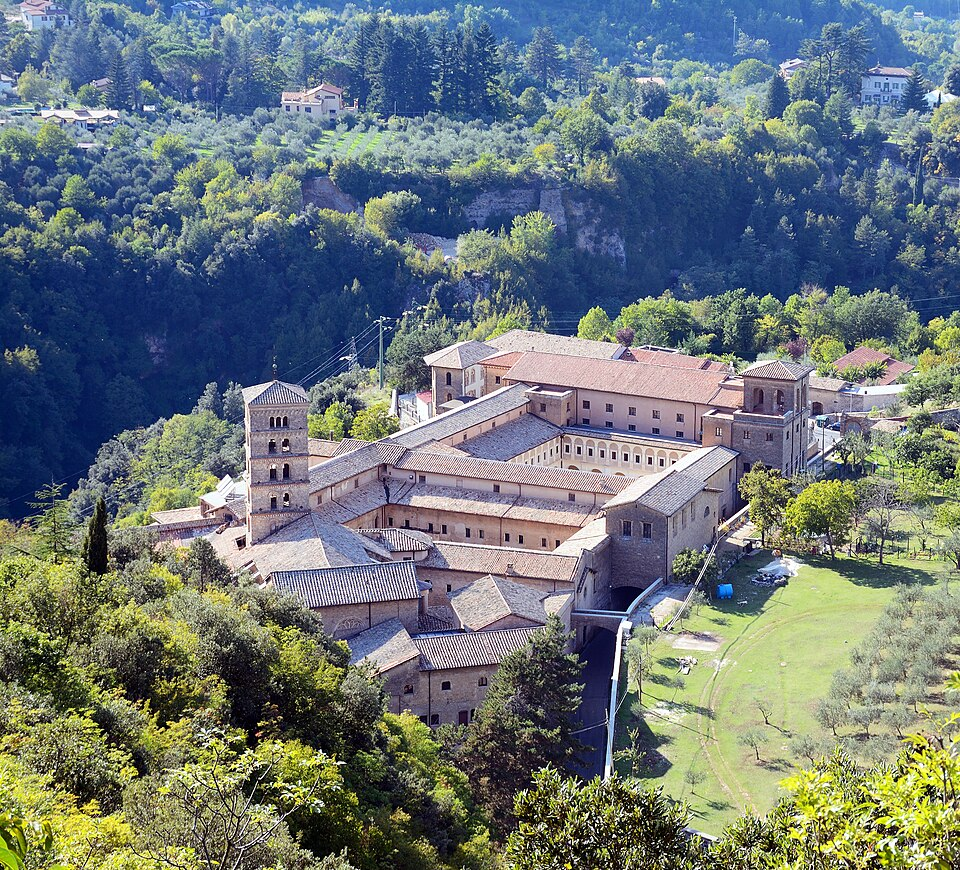
St. Chelidonia, was a Benedictine nun and hermitess. Born in Ciculum, Abruzzi, Italy, she became a recluse in the mountains near Subiaco, in a cave now called Marra Ferogna. Chelidonia received her habit from Cardinal Cuno of Frascati. When she died in 1152, many, including Pope Eugenius III, saw her soul ascend to heaven. Her remains are in the church of St. Scholastica in Subiaco, and she is patron of that city.
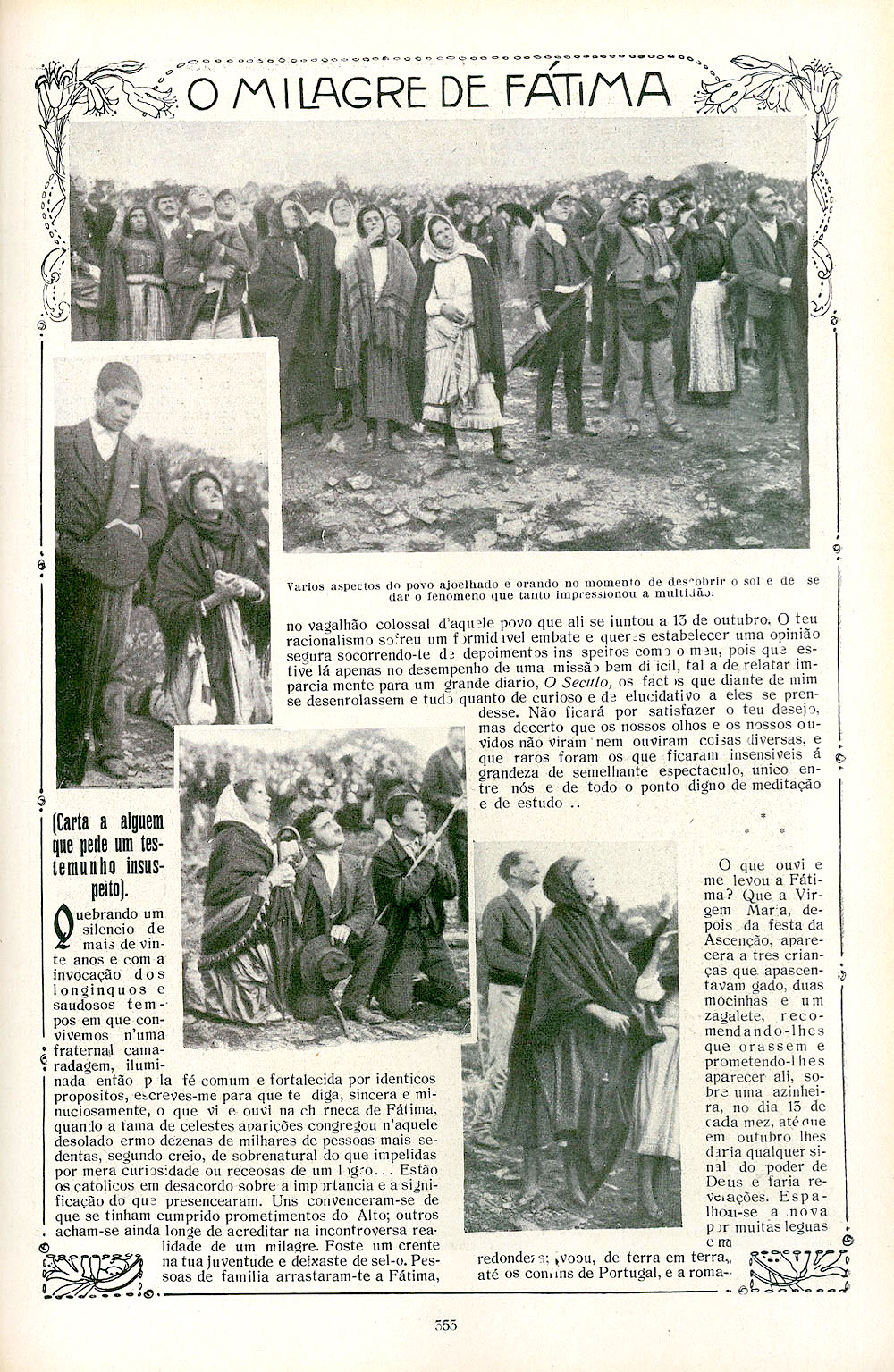
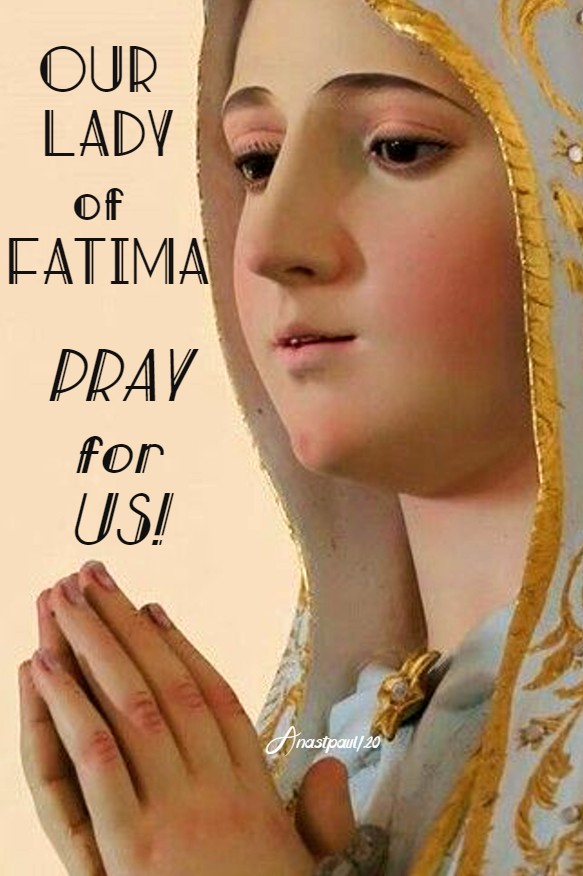
Our Lady of Fatima: The Sixth & Final Apparition & the Miracle of the Sun (1917) 13 October
The Day the Sun Danced… The Miracle of the Sun which occurred miraculously on 13 October 1917, attended by a large crowd who had gathered in Fátima, Portugal, in response to a prophecy made by three shepherd children, Lúcia Santos and Francisco and Jacinta Marto. The prophecy was that the Virgin Mary (referred to as Our Lady of Fátima), would appear and perform miracles on that date. Newspapers published testimony from witnesses who said that they had seen extraordinary solar activity, such as the Sun appearing to “dance” or zig-zag in the sky, careen towards the Earth, or emit multicolored light and radiant colours. According to these reports, the event lasted approximately ten minutes.
The local Bishop opened a canonical investigation of the event in November 1917, to review witness accounts and assess whether the private revelations from Mary were compatible with Catholic doctrine. The local Priest conducting the investigation was particularly convinced by the concurring testimony of the extraordinary solar phenomena, received from secular reporters, government officials and other skeptics in attendance. Bishop José da Silva declared the miracle “worthy of belief” on 13 October 1930, permitting “officially the cult of Our Lady of Fatima” within the Catholic Church.
At a gathering on 13 October 1951 at Fátima, the Papal Legate, Cardinal Federico Tedeschini, told the million people attending, that on 30 October, 31 October, 1 November and 8 November 1950, Pope Pius XII himself witnessed the miracle of the Sun from the Vatican gardens.
St Benedict of Cupra St Berthoald of Cambrai
St Edward King and Confessor (c 1003-1066) “Confessor ” reflects his reputation as a Saint who did not suffer Martyrdom, as opposed to King Edward the Martyr.
St Carpus of Troas St Chelidonia St Comgan the Monk St Florence of Thessalonica St Fyncana St Fyndoca Bl Gebrand of Klaarkamp
Blessed Maddalena Panattieri OP (1443–1503) Religious of the Sisters of Penance of Saint Dominic, Stigmatist, she was blessed with many Mystical gifts.
St Maurice of Carnoet St Regimbald of Speyer St Romulus of Genoa St Simbert of Augsburg St Theophilus of Antioch St Venantius — Three Crowns of Cordoba – (3 saints): Three Christian men martyred in the persecutions of Diocletian – Faustus, Januarius and Martial. They were burned to death in 304 in Cordoba, Spain.
Martyred in the Spanish Civil War: • Blessed Àngel Presta Batllé • Blessed ángel Ramos Velázquez • Blessed Antonio Ayet Canós • Blessed Ruperto García Arce • Blessed Salustiano González Crespo • Blessed Tomás Pallarés Ibáñez • Blessed Francesc Mitjá i Mitjá • Blessed Herminio Motos Torrecillas • Blessed Joan Puig Serra
Our Morning Offering – 13 October – “Month of the Holy Rosary” and the 104th Anniversary of the Last Apparition of Our Lady of Fatima and the Miracle of the Sun
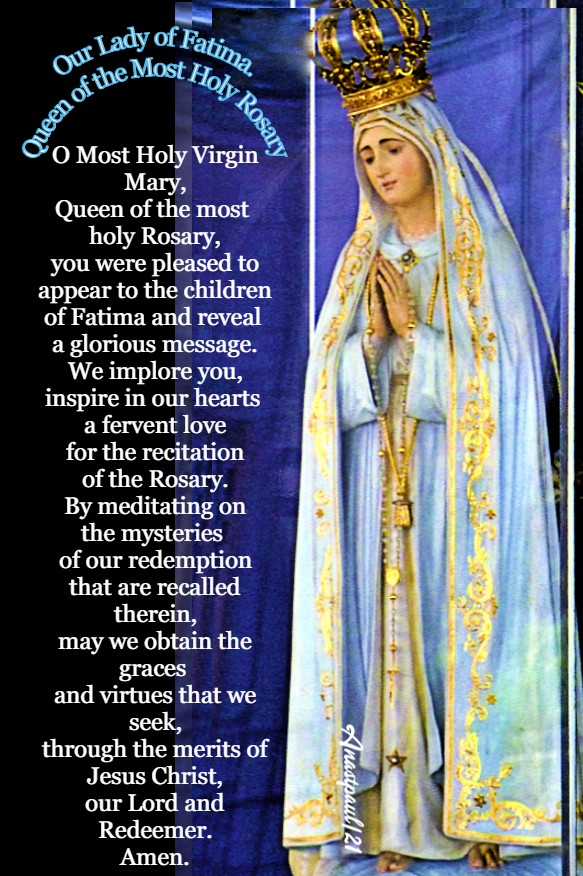
Our Lady of Fatima. Queen of the Most Holy Rosary
O Most Holy Virgin Mary, Queen of the most holy Rosary, you were pleased to appear to the children of Fatima and reveal a glorious message. We implore you, inspire in our hearts a fervent love for the recitation of the Rosary. By meditating on the mysteries of our redemption that are recalled therein, may we obtain the graces and virtues that we seek, through the merits of Jesus Christ, our Lord and Redeemer. Amen.
One Minute Reflection- 13 October – “Month of the Holy Rosary” and the Anniversary of the Last Apparition of Our Lady of Fatima and the Miracle of the Sun – Readings: Dan 3:31; 3:29; 3:35, Ps 118:1, Eph 5:15-21, John 4:46-53
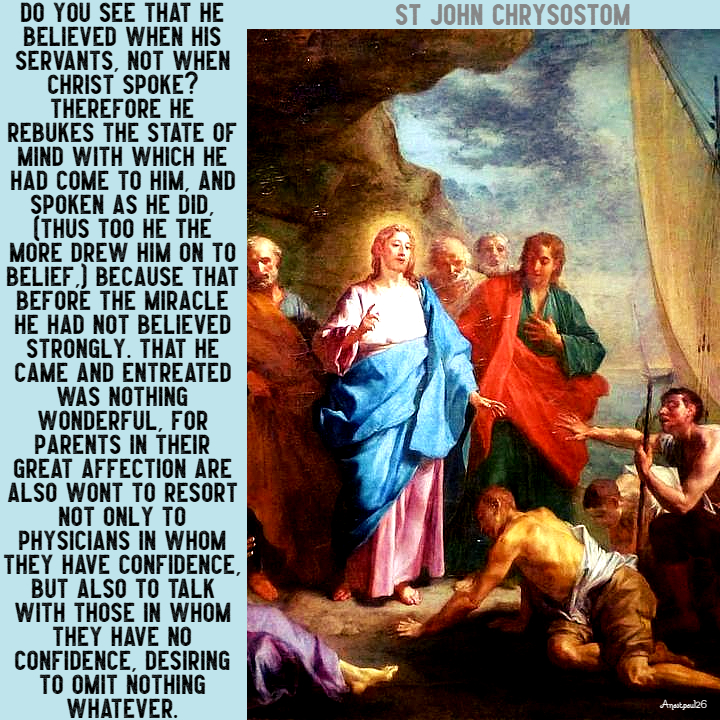
When he heard that Jesus had come from Judea into Galilee, he went to Him and besought Him to come down and heal his son, for he was at the point of death. Jesus therefore said to him, Unless you see signs and wonders, you do not believe.
John 4:46-53
REFLECTION – Yet the very coming and beseeching Him was a mark of faith. And besides, after this the Evangelist witnesses to him, declaring that when Jesus said, Go, your son lives, he believed His word, and went. What then is that which He says here? Either He uses the words as approving of the Samaritans because they believed without signs; or, to touch Capernaum which was thought to be His own city, and of which this person was. Moreover, another man in Luke, who says, Lord, I believe, said besides, help my unbelief. And so if this ruler also believed, yet he believed not entirely or soundly, as is clear from his enquiring at what hour the fever left him, since he desired to know whether it did so of its own accord, or at the bidding of Christ. When therefore he knew that it was yesterday at the seventh hour, then himself believed and his whole house.
Do you see that he believed when his servants, not when Christ spoke? Therefore He rebukes the state of mind with which he had come to Him, and spoken as he did, (thus too He the more drew him on to belief,) because that before the miracle he had not believed strongly. That he came and entreated was nothing wonderful, for parents in their great affection are also wont to resort not only to physicians in whom they have confidence, but also to talk with those in whom they have no confidence, desiring to omit nothing whatever. Indeed, that he came without any strong purpose appears from this, that when Christ had come into Galilee, then he saw Him, whereas if he had firmly believed in Him, he would not, when his child was on the point of death, have hesitated to go into Judæa. Or if he was afraid, this is not to be endured either.
Observe how the very words show the weakness of the man; when he ought, after Christ had rebuked his state of mind, to have imagined something great concerning Him, even if he did not so before, listen how he drags along the ground.
St John Chrysostom
PRAYER – Lord God, open our hearts to Your Grace, that we may be filled with Your light and overflow with gratitude for Your merciful love. May we love and adore and worship You in return. Although we are sinners, our hearts long to thank You in total trust and humble thankfulness. Grant that by the prayers of the Blessed Virgin Mary of Fatima, our Mother, we may grow in holiness. Through Your only Son, our Saviour and Redeemer, with the Holy Spirit, God, forever, amen.
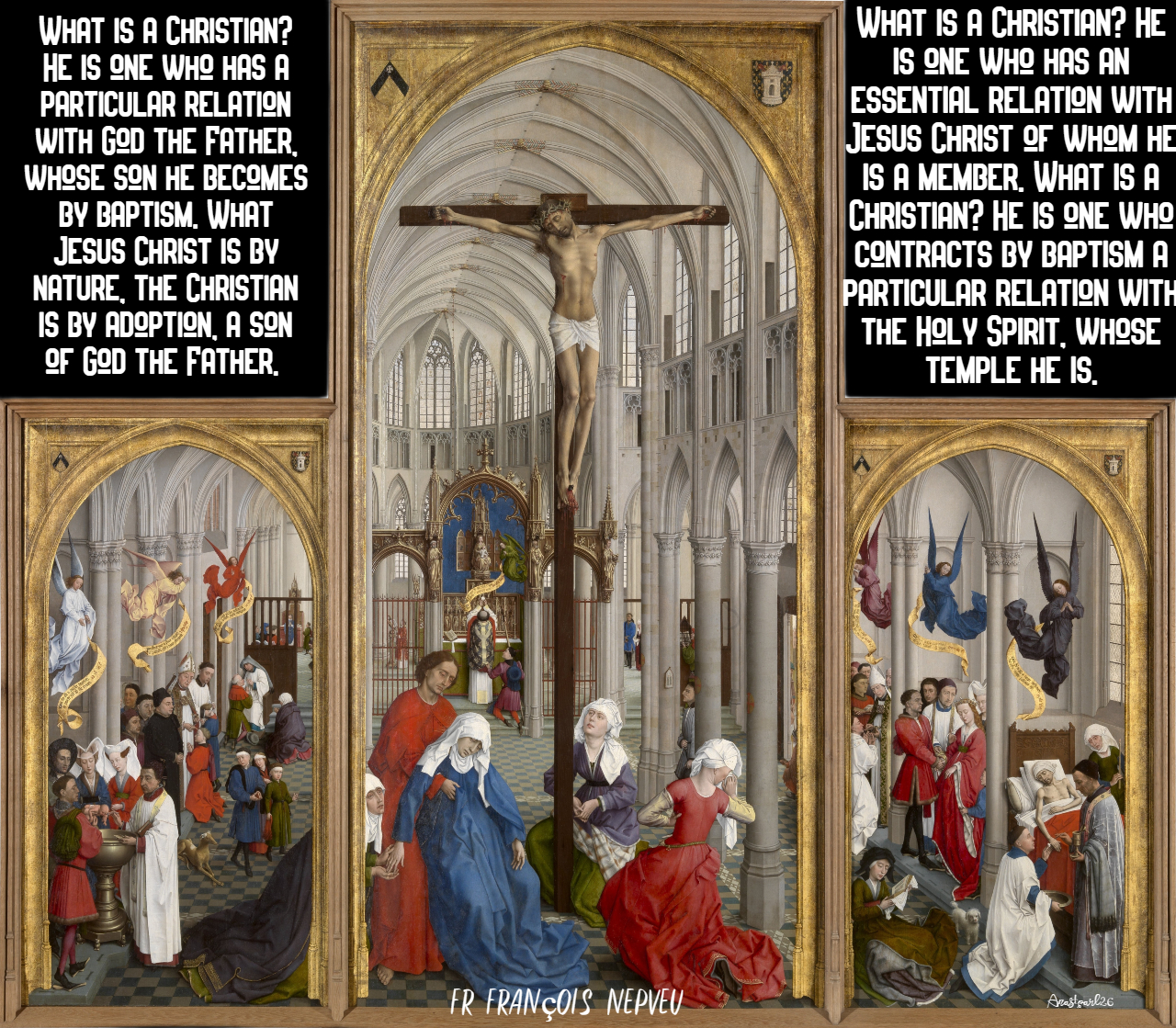
What is a Christian? He is one who has a particular relation with God the Father, whose son he becomes by baptism. What Jesus Christ is by nature, the Christian is by adoption, a son of God the Father. What is a Christian? He is one who has an essential relation with Jesus Christ of whom he is a member. What is a Christian? He is one who contracts by baptism a particular relation with the Holy Spirit, whose temple he is.
Fr François Nepveu
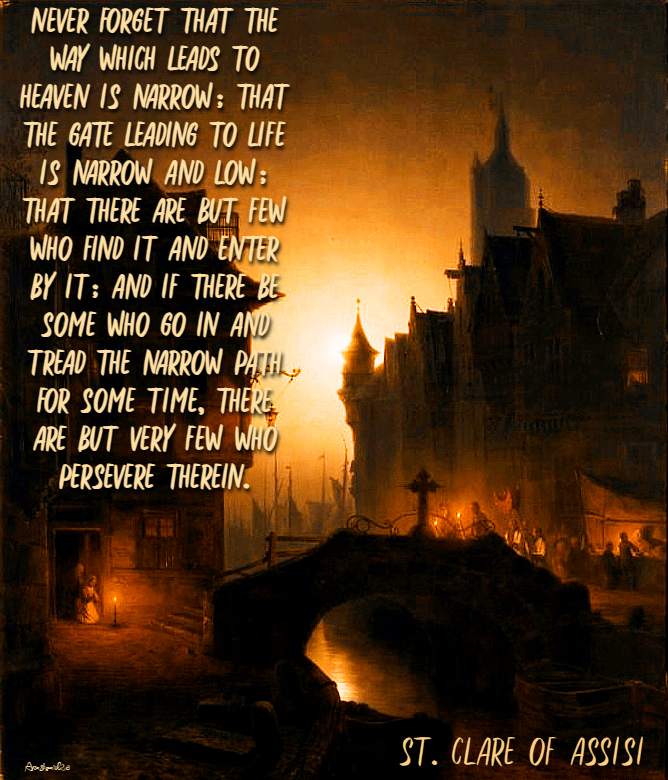
Never forget that the way which leads to heaven is narrow; that the gate leading to life is narrow and low; that there are but few who find it and enter by it; and if there be some who go in and tread the narrow path for some time, there are but very few who persevere therein.
St. Clare of Assisi
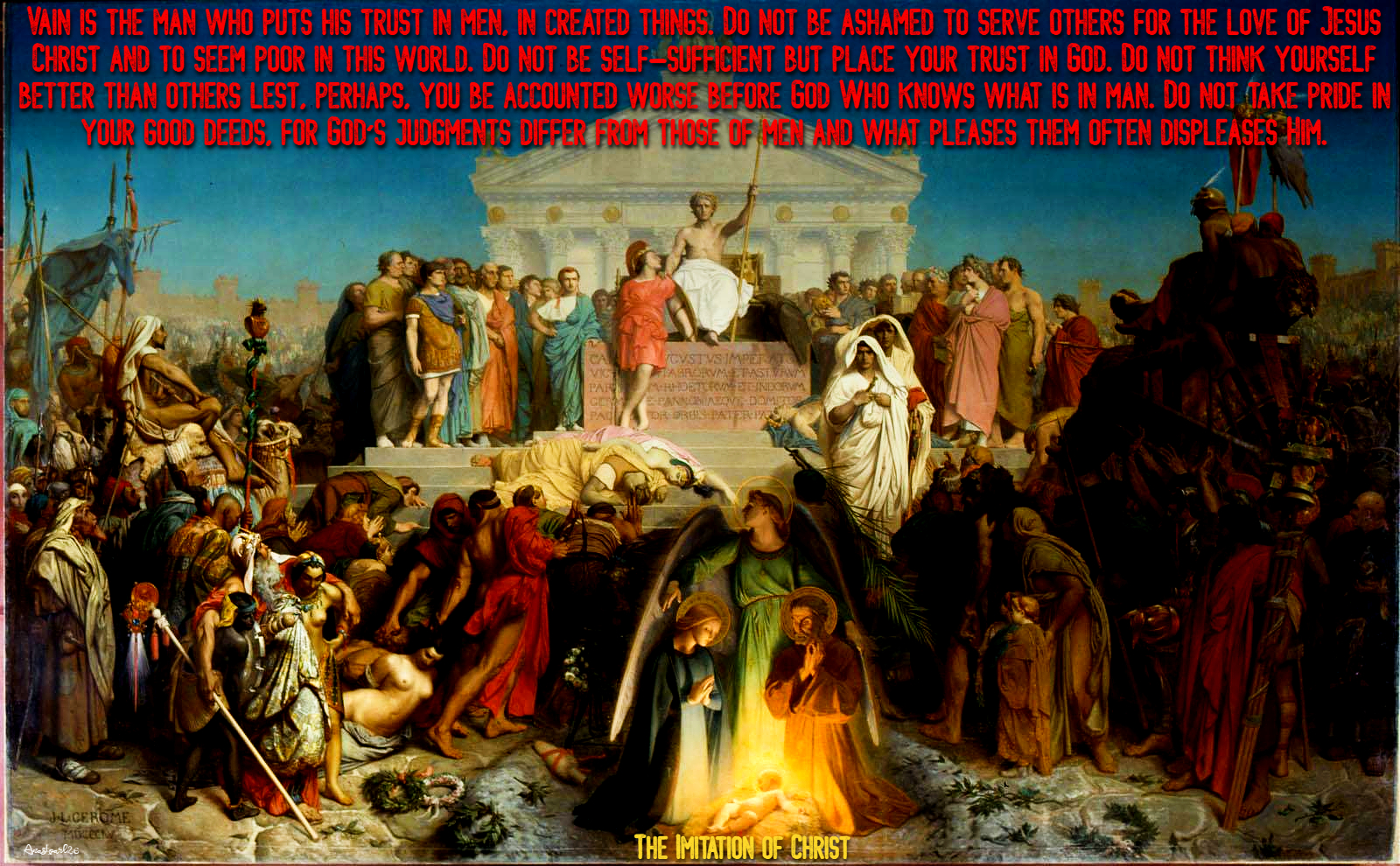
Vain is the man who puts his trust in men, in created things. Do not be ashamed to serve others for the love of Jesus Christ and to seem poor in this world. Do not be self-sufficient but place your trust in God. Do not think yourself better than others lest, perhaps, you be accounted worse before God Who knows what is in man. Do not take pride in your good deeds, for God’s judgments differ from those of men and what pleases them often displeases Him.
The Imitation of Christ
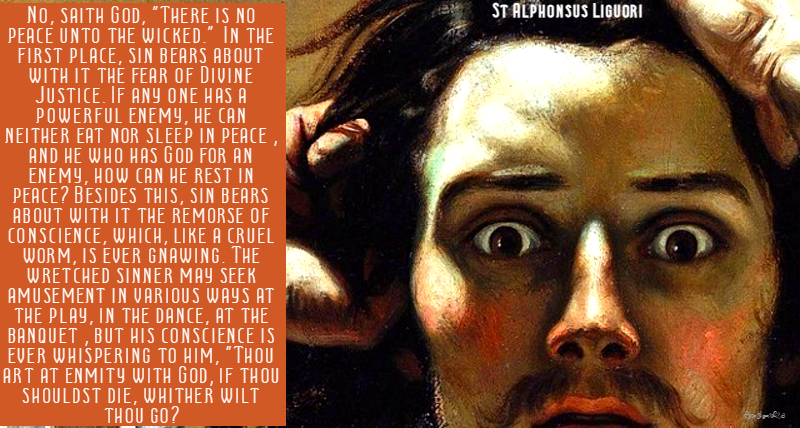
No, saith God, “There is no peace unto the wicked.” In the first place, sin bears about with it the fear of Divine Justice. If any one has a powerful enemy, he can neither eat nor sleep in peace ; and he who has God for an enemy, how can he rest in peace? Besides this, sin bears about with it the remorse of conscience, which, like a cruel worm, is ever gnawing. The wretched sinner may seek amusement in various ways at the play, in the dance, at the banquet ; but his conscience is ever whispering to him, “Thou art at enmity with God; if thou shouldst die, whither wilt thou go?
St Alphonsus Liguori
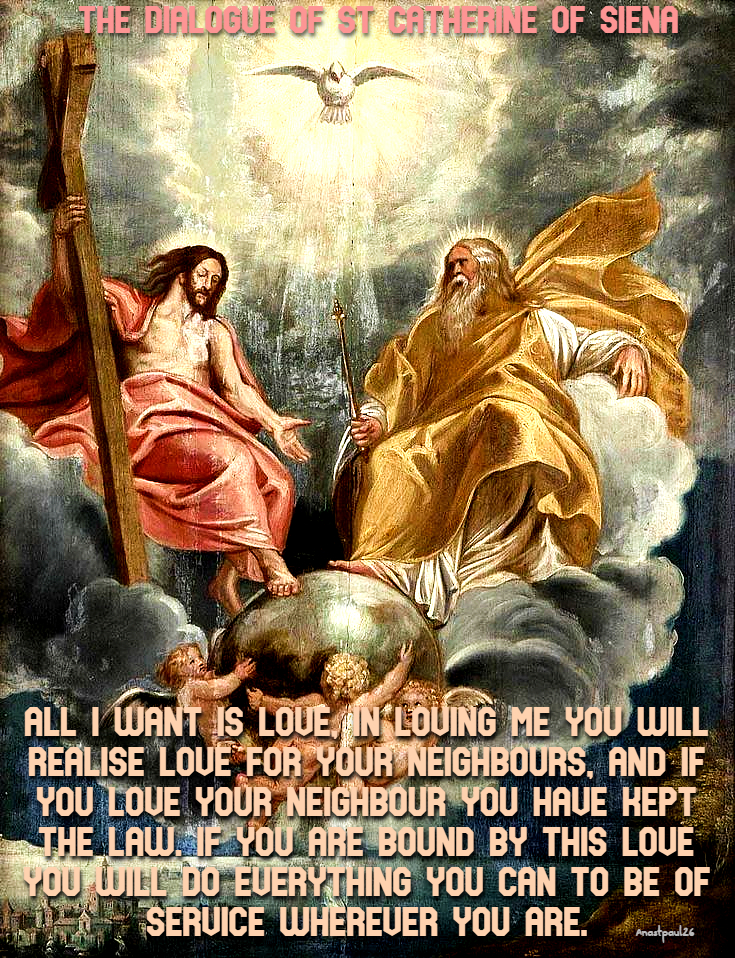
All I want is love, in loving me you will realise love for your neighbours, and if you love your neighbour you have kept the law. If you are bound by this love you will do everything you can to be of service wherever you are.
The Dialogue of St Catherine of Siena
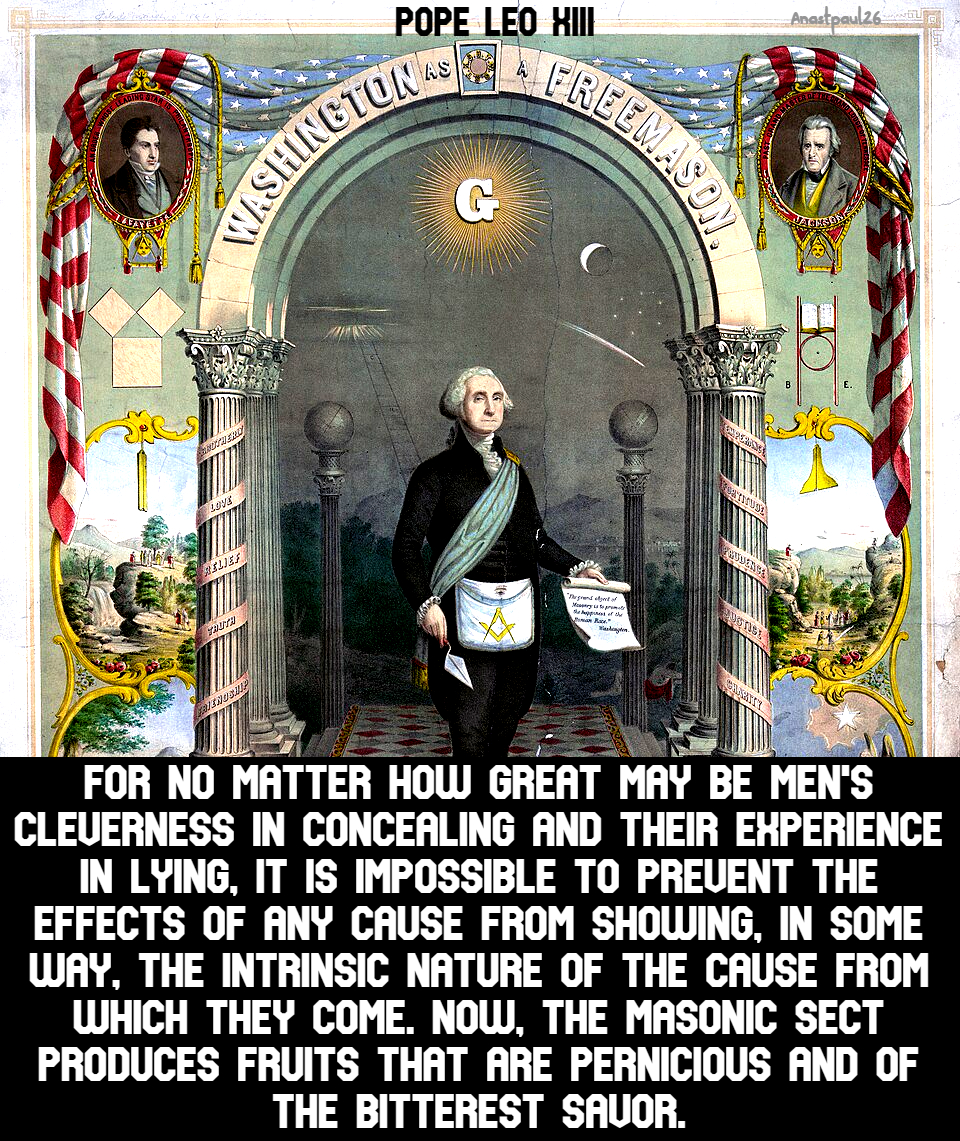
For no matter how great may be men’s cleverness in concealing and their experience in lying, it is impossible to prevent the effects of any cause from showing, in some way, the intrinsic nature of the cause from which they come. Now, the Masonic sect produces fruits that are pernicious and of the bitterest savor.
The Honour of God alone in connected with the Devotion to the Holy Angels.
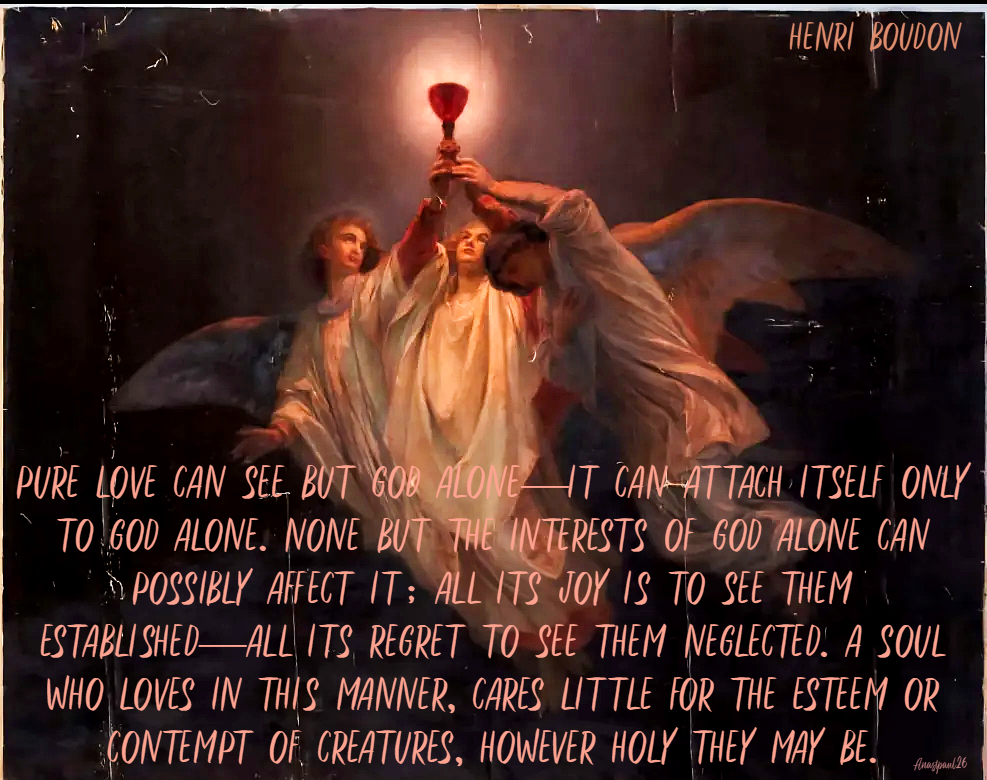
When a person has said “God,” he has said all. A true lover of this Divine Being can say nothing more, since he knows nothing more. “ What have I in heaven, or on earth,” exclaims such a one, “ but thee, my God ! I care not for honours, or riches, or pleasures; in Heaven itself, I regard but God alone—He is my only all in all things.” Such was St. Catherine of Genoa; she could not bear the word “ mine;” that is, she could not bear to regard self-interest, even in good things.” “O my God, and my all !” used the humble St. Francis to exclaim; and in repeating these words of love, he frequently passed the days and nights. Pure love can see but God alone—it can attach itself only to God alone. None but the interests of God alone can possibly affect it; all its joy is to see them established—all its regret to see them neglected. A soul who loves in this manner, cares little for the esteem or contempt of creatures, however holy they may be. The contradictions it meets from the servants of God, and the censure heaped on such actions as grace inspires it to perform, give it no concern; on the contrary, as its abandonments increase, its joy becomes more great—its repose more calm—its peace more profound—for its greatest felicity is to be freed from the creature, in order to be wholly occupied with the Creator.
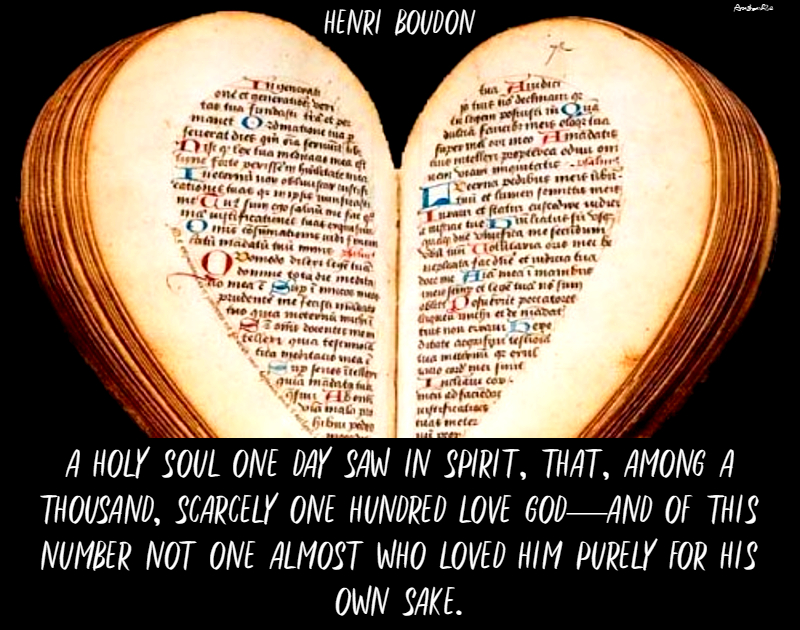
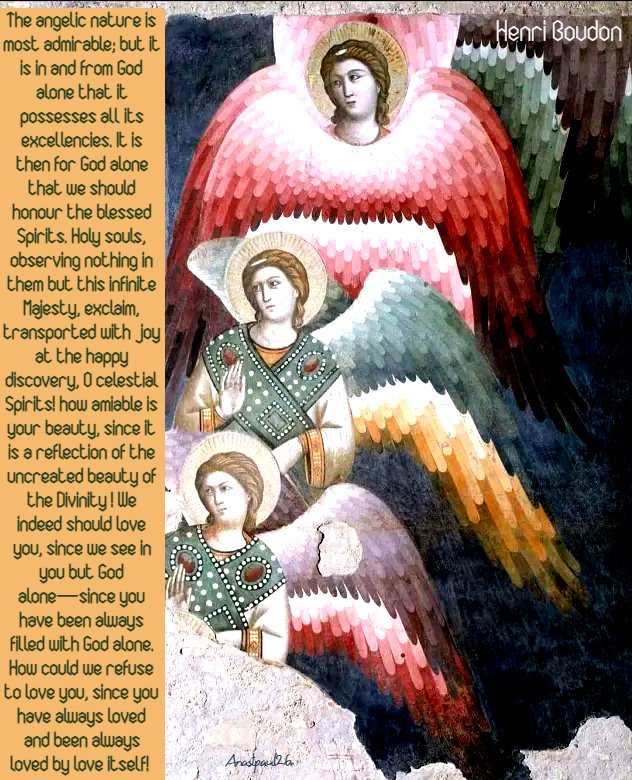
This uncreated Being, God alone, makes all the occupation of the blessed in heaven—and it were but just that he made that of men on earth ; but alas ! they seek their treasure, their delight, elsewhere. Even those who are freed from grosser attachments are not without their petty desires and little interests. A holy soul one day saw in spirit, that, among a thousand, scarcely one hundred love God—and of this number not one almost who loved him purely for his own sake. The angelic nature is most admirable; but it is in and from God alone that it possesses all its excellencies. It is then for God alone that we should honour the blessed Spirits. Holy souls, observing nothing in them but this infinite Majesty, exclaim, transported with joy at the happy discovery, O celestial Spirits! how amiable is your beauty, since it is a reflection of the uncreated beauty of the Divinity ! We indeed should love you, since we see in you but God alone—since you have been always filled with God alone. How could we refuse to love you, since you have always loved and been always loved by love itself!
O my soul ! God wills and ordains that we love his Angels. Let us then regulate our inclinations by his, and make these glorious princes the objects of our love, for God alone ! God alone ! God alone !




You must be logged in to post a comment.