Passionate Catholic.
Being a Catholic is a way of life - a love affair "Religion must be like the air we breathe..."- St John Bosco
Prayer is what the world needs combined with the example of our lives which testify to the Light of Christ.
This site, which is now using the Traditional Calendar, will mainly concentrate on Daily Prayers, Novenas and the Memorials and Feast Days of our friends in Heaven, the Saints who went before us and the great blessings the Church provides in our Catholic Monthly Devotions.
This Site is placed under the Patronage of my many favourite Saints and especially, St Paul.
"For the Saints are sent to us by God
as so many sermons.
We do not use them, it is they who move us
and lead us, to where we had not expected to go.”
Charles Cardinal Journet (1891-1975)
This site adheres to the pre-Vatican II Catholic Church and all her teachings. .
PLEASE ADVISE ME OF ANY GLARING TYPOS etc - In June 2021 I lost 100% sight in my left eye and sometimes miss errors. Thank you and I pray all those who visit here will be abundantly blessed. Pax et bonum! 🙏
Our Morning Offering – 9 December – Thursday of the Second week of Advent
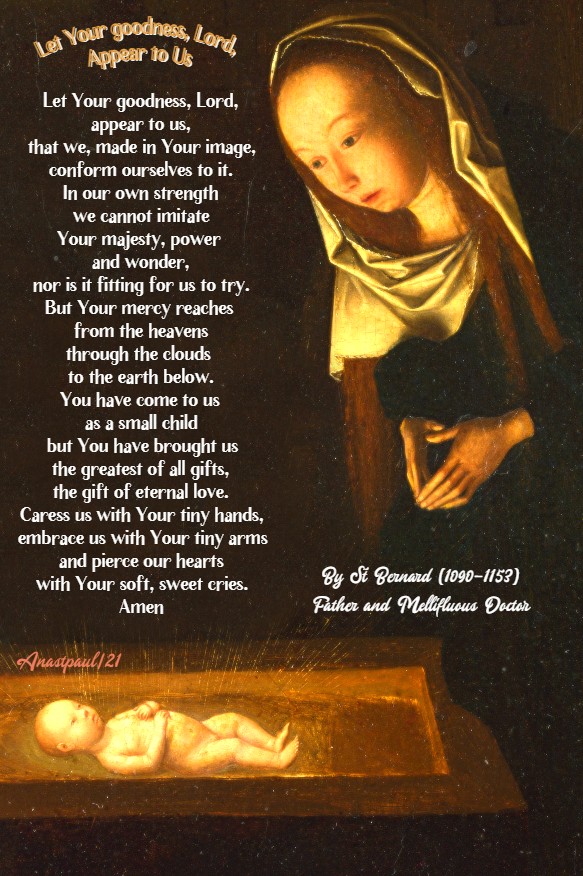
Let Your goodness, Lord, Appear to Us An Advent Prayer By St Bernard (1090-1153) Father and Mellifluous Doctor
Let Your goodness, Lord, appear to us, that we, made in Your image, conform ourselves to it. In our own strength we cannot imitate Your majesty, power and wonder, nor is it fitting for us to try. But Your mercy reaches from the heavens through the clouds to the earth below. You have come to us as a small child but You have brought us the greatest of all gifts, the gift of eternal love. Caress us with Your tiny hands, embrace us with Your tiny arms and pierce our hearts with Your soft, sweet cries. Amen
Saint of the Day – 9 December – Saint Syrus of Pavia (1st Century) the First Bishop of Pavia, Italy, Confessor, miracle-worker, Defender of the Faith, Evangeliser. His birthplace is unknown but he died at Pavia where his relics are enshrined in the City’s Cathedral. Also known as – Cyrus, Cyril, Siro.Patronages – the City and the Diocese of Pavia, Italy.
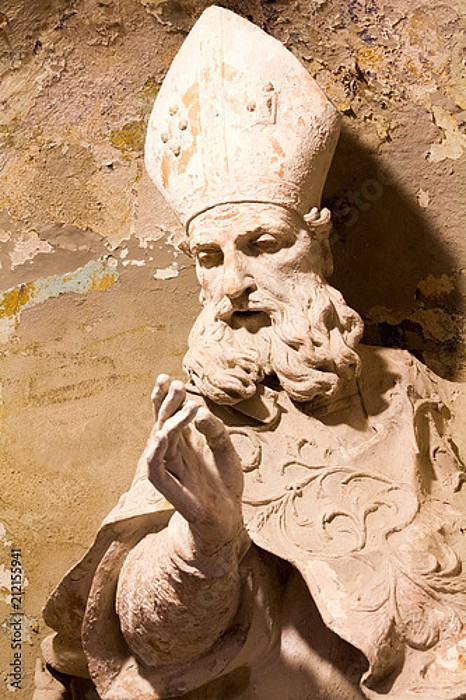
Detail of St Syrus on Pavia Cathedral facade. Full image below.
The Roman Martyrology states: “At Pavia, St Syrus, the first Bishop of that City, who was renowned for miracles and virtues worthy of an apostle.”
Nothing is known of St Syrus early life but some believe that he was the little boy with the five loaves and 2 fish, who appears in the Gospels.
Syrus is said to have followed Saint Peter to Rome and from there he was sent to the Po valley to preach and convert the people to the Christian faith. He preached in all of the major cities of northern Italy.
Another tradition, from the eighth century, states that Syrus was also a disciple of St Hermagoras, the first Bishop of Achilles, himself a disciple of St Mark the Evangelist.
In the company of St Juventius, Syrus fought against Arianism. Syrus worked to challenge and convert those who followed Arianism in his Diocese.
St Syrus refuting the Arians
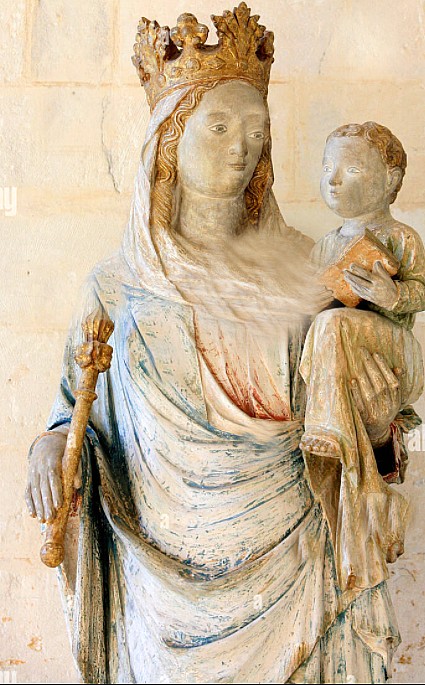
Syrus’ relics are enshrined in the Chapel of Saint Syrus in the Pavia Cathedral on the facade of which the Statue below is displayed.
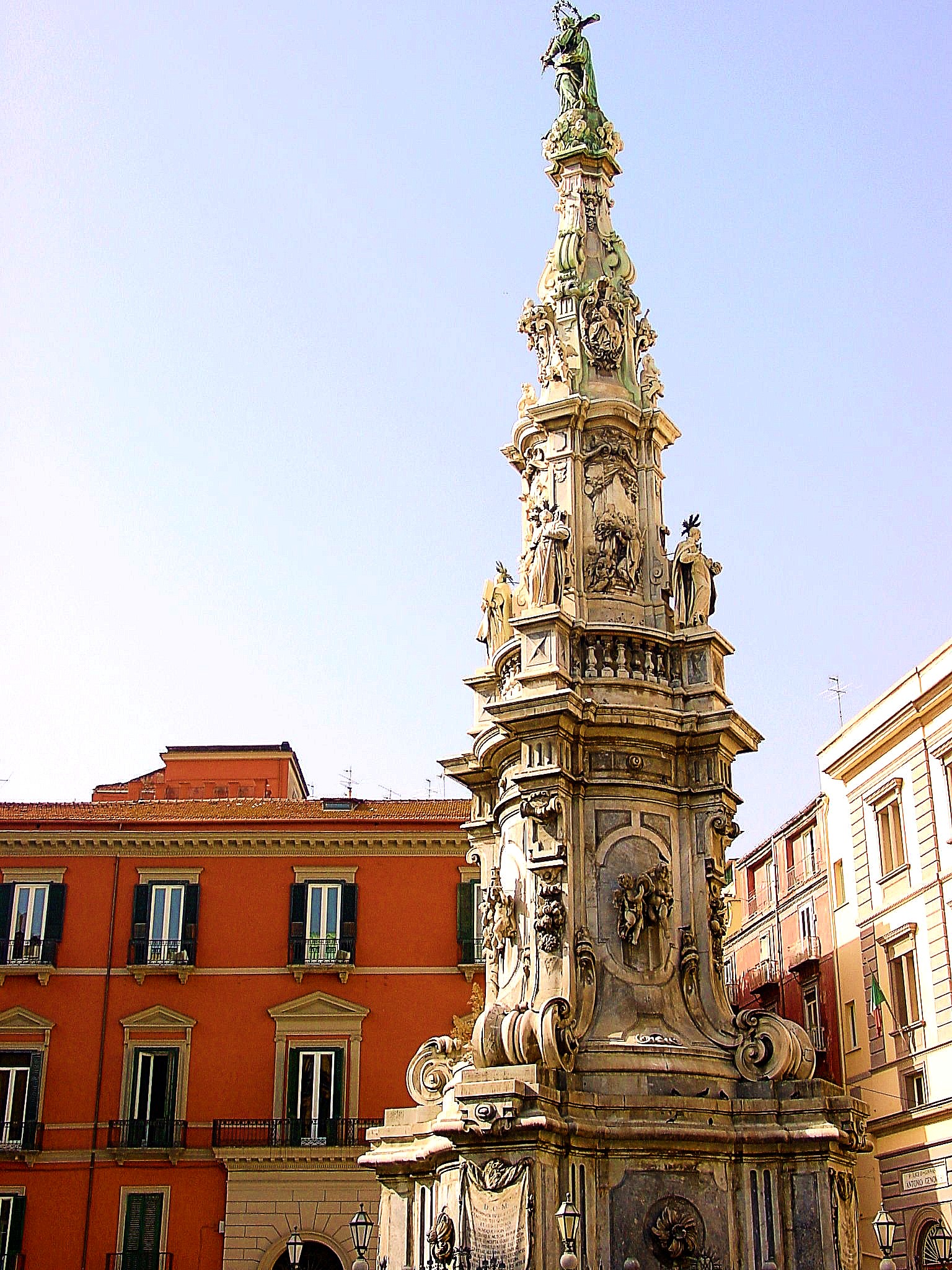
Nostra Signora dell’Immacolata Concezione / Our Lady of the Conception, Naples, Italy (1618) – 9 December:
The Abbot Orsini wrote: “Our Lady of the Conception, at Naples, so called because, in the year 1618, the Viceroy, with all his Court and the soldiery of Naples, made a vow, in the Church of Our Lady the Great, to believe and defend the Immaculate Conception of the Blessed Virgin.”
Pedro Tellez-Giron, 3rd Duke of Osuna, was the Viceroy of Naples under King Philip III of Spain. He was a Spanish nobleman born in 1574 and married in 1594. He joined the army of the Archduke of Austria as a mere private but his ability and courage, must have been considerable, as he was soon placed in command of two cavalry companies. He fought in several battles and was seriously wounded on two occasions before being made the Viceroy of Sicily in 1610. When he took this new position as Viceroy, the Spanish had not a single galley on the island that was seaworthy. It was necessary to remedy that problem at once, as Sicily was vulnerable to Barbary pirates as well as potential attacks of the fleet of the Ottoman Empire. Within two years he was no longer in a weak position, and as he had 8 galleys and several other ships in the new navy, he used them to attack Ottoman territory. In the summer of 1613 his fleet encountered a larger Ottoman fleet under the command of Sinari Pasha. The encounter lasted three hours and became known as the Battle of Cape Corvo. Sinari Pasha was captured, and Mahamet, Bey of Alexandria and son of Muezzinzade Ali Pasho, Commander of the Ottoman fleet at the battle of LepanTo, was also captured. In 1616 Pedro Tellez-Giron was promoted to Viceroy of Naples and it was during this time, that the now Knight of the Order of the Golden Fleece ,made his vow to defend what would later become a Dogma of the Catholic Faith, the Immaculate Conception of the Blessed Virgin Mary. This doctrine was not actually formally proclaimed by the Church until the Blessed Pope Pius IX formally proclaimed it, on 8 December 1854, in the Papal Bull, Ineffabilis Deus. The Napule have a great devotion to the Blessed Virgin of the Immaculate Conception as manifested by this immense “Guglia” Column or Spire proudly displayed in Naples.
St Adam Scotus Bl Agustín García Calvo * Bl Antonio Martín Hernández * St Auditor of Saint-Nectaire St Balda of Jouarre St Bernhard Mariea Silvestrelli St Budoc of Brittany Bl Carmen Rodríguez Banazal * St Caesar of Korone St Cephas Bl Clara Isabella Fornari St Cyprian of Perigueux Bl Dolores Broseta Bonet * Bl Estefanía Irisarri Irigaray * St Ethelgiva of Shaftesbury St Gorgonia Bl Isidora Izquierdo García * Bl José Ferrer Esteve * Bl José Giménez López * Bl Josefa Laborra Goyeneche * Bl Josep Lluís Carrera Comas * St Julian of Apamea Bl Julián Rodríguez Sánchez *
Bl María Pilar Nalda Franco * St Michaela Andrusikiewicz St Nectarius of Auvergne
St Peter Fourier CRSA (1565-1640) “The Good Father of Mattaincourt,” Priest, Founder, Reformer, Confessor, Ascetic, Theologian, Teacher, Preacher, Apostle of Prayer, Penance and Charity, Marian devotee. Together with the Blessed Alix Le Clerc, in 1597, Fourier founded the Congregation of Notre Dame of Canonesses Regular of St Augustine, who were committed to the free education of children, taking a fourth vow to that goal. Biography: https://anastpaul.com/2018/12/09/saint-of-the-day-9-december-st-peter-fourier-c-r-s-a-1565-1640/
St Proculus of Verona Bl Recaredo de Los Ríos Fabregat * St Syrus of Pavia (1st Century) Bishop St Valeria of Limoges St Wulfric of Holme
Blessed Mercedarian Fathers – (10 beati): The memorial of ten Mercedarian friars who were especially celebrated for their holiness. • Arnaldo de Querol • Berengario Pic • Bernardo de Collotorto • Domenico de Ripparia • Giovanni de Mora • Guglielmo Pagesi • Lorenzo da Lorca • Pietro Serra • Raimondo Binezes • Sancio de Vaillo
Martyred Salesians of Valencia – (5 beati) Martyrs of North Africa – (4 saints): Twenty-four Christians murdered together in North Africa for their faith. The only details to survive are four of their names – Bassian, Peter, Primitivus and Successus.
Martyrs of Paterna – (7 beati) Martyrs of Samosata – (7 saints): Seven martyrs crucified in 297 in Samosata (an area of modern Turkey) for refusing to perform a pagan rite in celebration of the victory of Emperor Maximian over the Persians. They are – Abibus, Hipparchus, James, Lollian, Paragnus, Philotheus and Romanus. They were crucified in 297 in Samosata (an area in modern Turkey).
Martyrs of the Spanish Civil War – (13 beati): • Blessed Agustín García Calvo • Blessed Antonio Martín Hernández • Blessed Carmen Rodríguez Banazal • Blessed Dolores Broseta Bonet • Blessed Estefanía Irisarri Irigaray • Blessed Isidora Izquierdo García • Blessed José Ferrer Esteve • Blessed José Giménez López • Blessed Josefa Laborra Goyeneche • Blessed Josep Lluís Carrera Comas • Blessed Julián Rodríguez Sánchez • Blessed María Pilar Nalda Franco • Blessed Recaredo de Los Ríos Fabregat
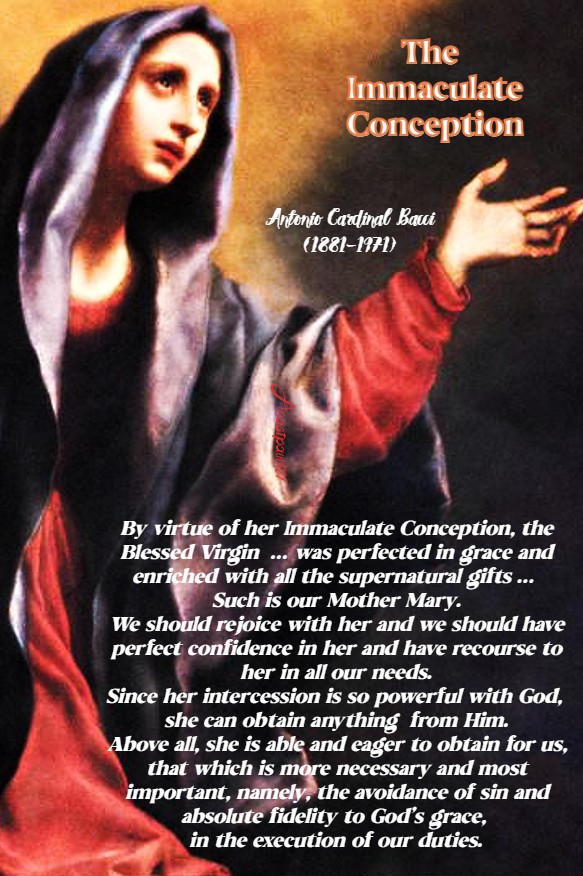
Thought for the Day – 8 December – Meditations with Antonio Cardinal Bacci (1881-1971)
The IMMACULATE CONCEPTION
“By virtue of her Immaculate Conception, the Blessed Virgin obtained four distinct privileges. (1) She was preserved free from the stain of original sin. (2) She never experienced the rebellion of the passion against the spirit. (3) She was confirmed in grace, so that, in the words of St Augustine, (De natura er gratia, c 361), one could not mention sin and the name of Mary in one breath. (4) She was perfected in grace and enriched with all the supernatural gifts, to a degree far higher than any of the Saints and than the Angels themselves.
Such is our Mother Mary. We should rejoice with her and we should have perfect confidence in her and have recourse to her in all our needs. Since her intercession is so powerful with God, she can obtain anything from Him. Above all, she is able and eager to obtain for us, that which is more necessary and most important, namely, the avoidance of sin and absolute fidelity to God’s grace, in the execution of our duties.”
Quote/s of the Day – 8 December on the Solemnity of the Immaculate Conception
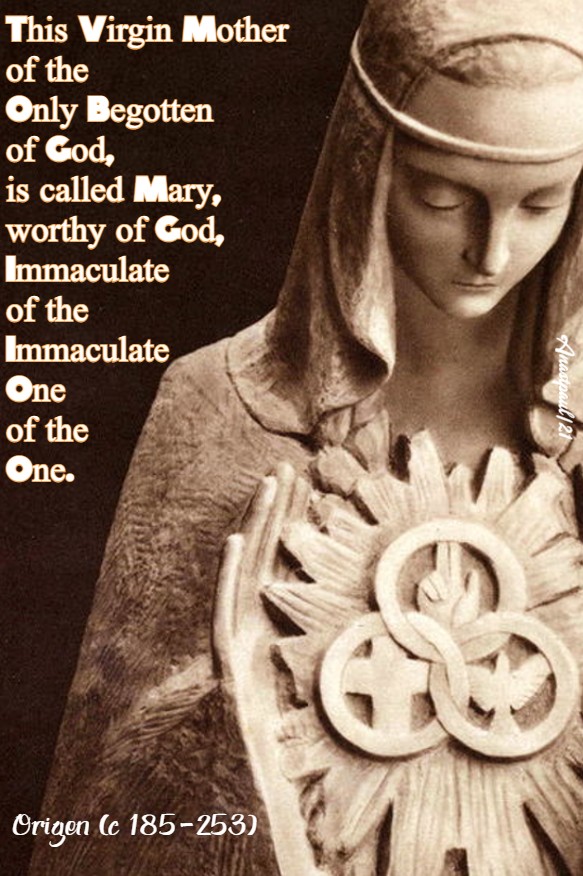
“This Virgin Mother of the Only begotten of God, is called Mary, worthy of God, Immaculate of the Immaculate, One of the One.”
Origen (c 185-253) Priest, Theologian, Exegist, Writer, Apologist, Father
“Thou alone and Thy Mother, are in all things fair, there is no flaw in Thee and no stain in Thy Mother.”
St Ephrem of Syria (306-373) Father and Doctor of the Church
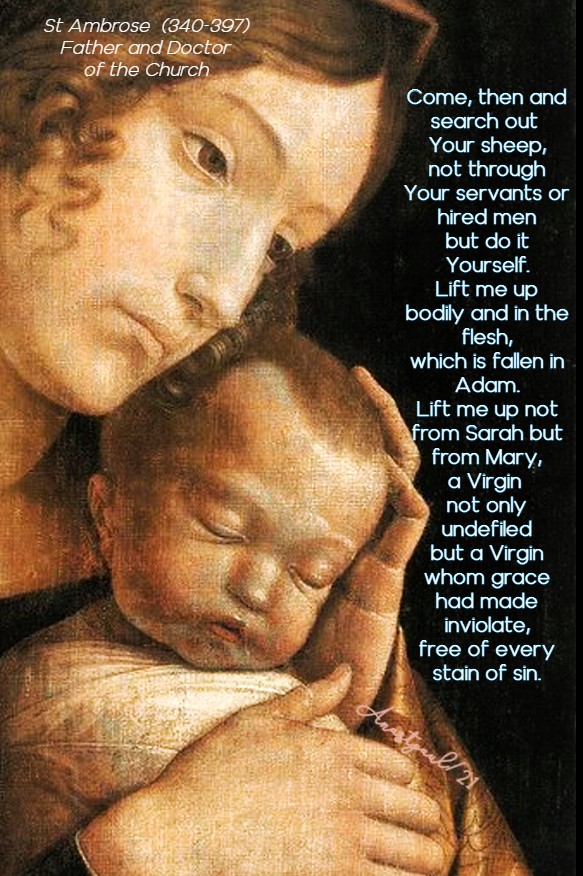
“Come, then and search out Your sheep, not through Your servants or hired men but do it Yourself. Lift me up bodily and in the flesh, which is fallen in Adam. Lift me up not from Sarah but from Mary, a Virgin not only undefiled but a Virgin whom grace had made inviolate, free of every stain of sin.”
St Ambrose (340-397) Father and Doctor of the Church
“The very fact that God has elected her, proves, that none was ever holier than Mary; if any stain had disfigured her soul, if any other virgin had been purer and holier, God would have selected her and rejected Mary.”
St Jacob of Sarug (c 451-521) Bishop, Theologian, Poet, Writer
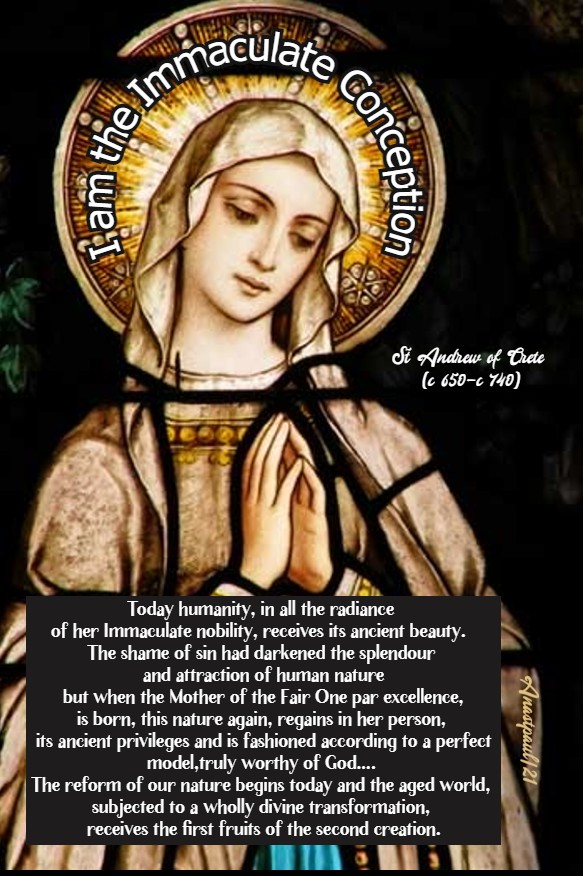
“Today humanity, in all the radiance of her Immaculate nobility, receives its ancient beauty. The shame of sin had darkened the splendour and attraction of human nature but when the Mother of the Fair One par excellence, is born, this nature again, regains in her person, its ancient privileges and is fashioned according to a perfect model, truly worthy of God…. The reform of our nature begins today and the aged world, subjected to a wholly divine transformation, receives the first fruits of the second creation.”
St Andrew of Crete (c 650-c 740) Bishop, Theologian, Hymnist
One Minute Reflection – 8 December on the Solemnity of the Immaculate Conception – Readings: Genesis 3:9-15, 20, Psalm 98:1-4, Ephesians 1:3-6, 11-12, Luke 1:26-38
And behold, you will conceive in your womb and bear a son and you shall call his name Jesus.
And Mary said, “Behold, I am the handmaid of the Lord, let it be done to me according to your word.” … Luke 1:38
REFLECTION – “Son of God, grant me Your own admirable Gift, that I may celebrate the wondrous beauty of Your beloved Mother! The Virgin gave birth to a Son while preserving her virginity, she suckled Him who gives nourishment to the peoples, in her Immaculate breast she bore Him who carries the whole world in His Hands. She is Virgin and Mother, what will she not be hereafter? Holy in body, all beautiful in soul, pure of mind, upright in intelligence, perfect in feeling, chaste and faithful, pure of heart and filled with virtue.
May the hearts of virgins rejoice in Mary, since of her was born the One Who set humankind free from dreadful slavery. May the old Adam, wounded by the serpent, rejoice in Mary; it is Mary who gives Adam a posterity that allows him to crush the accursed serpent and who cures him of his mortal wound (Gen 3:15). Let Priests rejoice in the blessed Virgin; she has brought the High Priest into the world, Who gave Himself as a victim, putting an end to the sacrifices of the Old Covenant. … Let the Prophets rejoice in Mary, since in her, were fulfilled their visions, in her were realised their prophecies, in her were confirmed their oracles. Let all the Patriarchs rejoice in Mary since she received the blessing promised to them, she, who, in her Son, has brought them to completion. …
Mary is the new Tree of Life, who, instead of the bitter fruit picked by Eve, gives to mankind that Sweet Fruit on which the whole world is fed.” – St Ephrem (306-373) Deacon in Syria, Father and Doctor of the Church (Marian hymn).
PRAYER –O Mary, My Hope! By St John Damascene (675-749) Father and Doctor of the Church I salute you, O Mary! you are the hope of Christians. Receive the prayer of a sinner, who loves you tenderly, honours you in a special manner and places in you the whole hope of his salvation. From you I have my life. You reinstate me in the grace of your Son: you are the sure pledge of my salvation. I beseech of you, therefore, to deliver me from the burden of my sins, dispel the darkness of my mind, banish from my heart the love of the world, repress the temptations of my enemies and so rule my whole life, that by your means and under your guidance, I may obtain everlasting happiness in heaven. Amen
Our Morning Offering – 8 December – The Solemnity of the Immaculate Conception
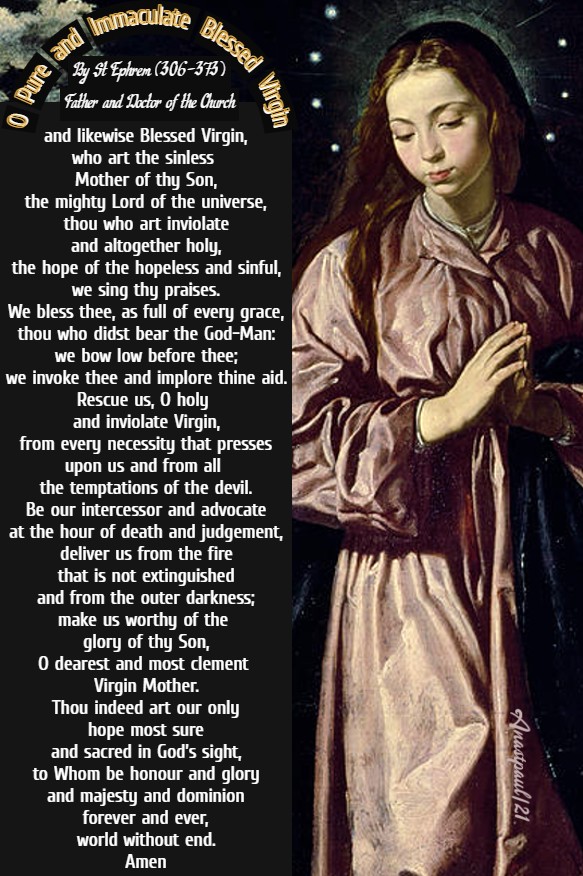
O Pure and Immaculate Blessed Virgin By St Ephrem (306-373) Father and Doctor of the Church
O Pure and Immaculate and likewise Blessed Virgin, who art the sinless Mother of thy Son, the mighty Lord of the universe, thou who art inviolate and altogether holy, the hope of the hopeless and sinful, we sing thy praises. We bless thee, as full of every grace, thou who didst bear the God-Man: we bow low before thee; we invoke thee and implore thine aid. Rescue us, O holy and inviolate Virgin, from every necessity that presses upon us and from all the temptations of the devil. Be our intercessor and advocate at the hour of death and judgement, deliver us from the fire that is not extinguished and from the outer darkness; make us worthy of the glory of thy Son, O dearest and most clement Virgin Mother. Thou indeed art our only hope most sure and sacred in God’s sight, to Whom be honour and glory and majesty and dominion forever and ever, world without end. Amen
The Solemnity of the Immaculate Conception of the Blessed Virgin Mary – 8 December. Patronages – barrel makers, coopers, cloth makers, cloth workers, soldiers of the United States, Spanish infantry, tapestry workers, upholsterers, Argentina, Brazil, Congo, Equatorial Guinea, Guam, Nicaragua, Panama, Portugal, Tanzania, Tunisia, United States, 68 Diocese, 8 Cities.
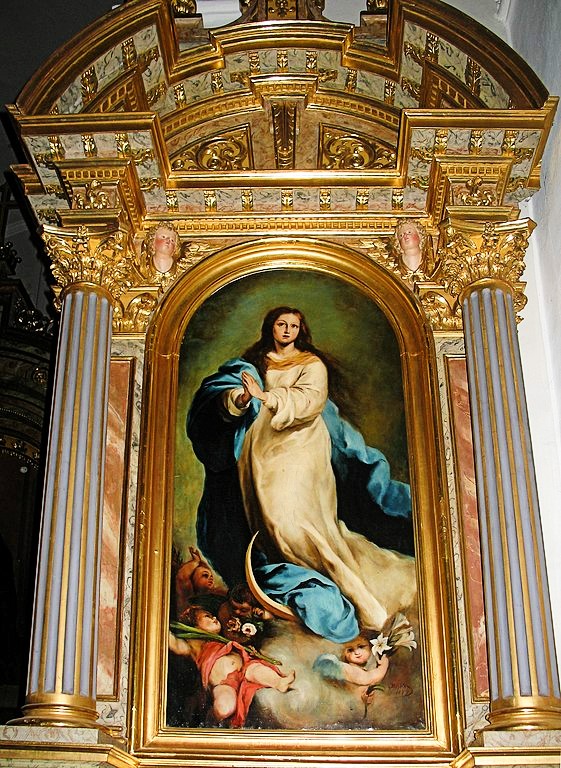
Altar of the Immaculata by Joseph Lusenberg, 1876. Saint Antony’s Church, Urtijëi, Italy.
Today we celebrate the Solemnity of the Immaculate Conception, nine months before the Feast of the Nativity of Mary, which is celebrated on 8 September. I wish you all a Blessed and Holy Feast Day!
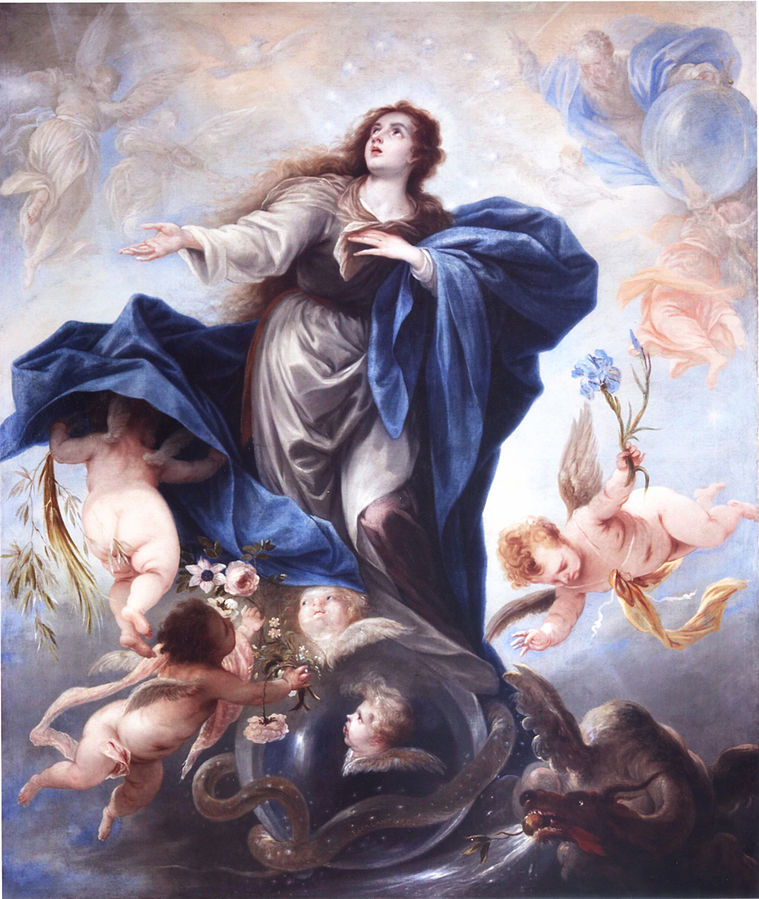
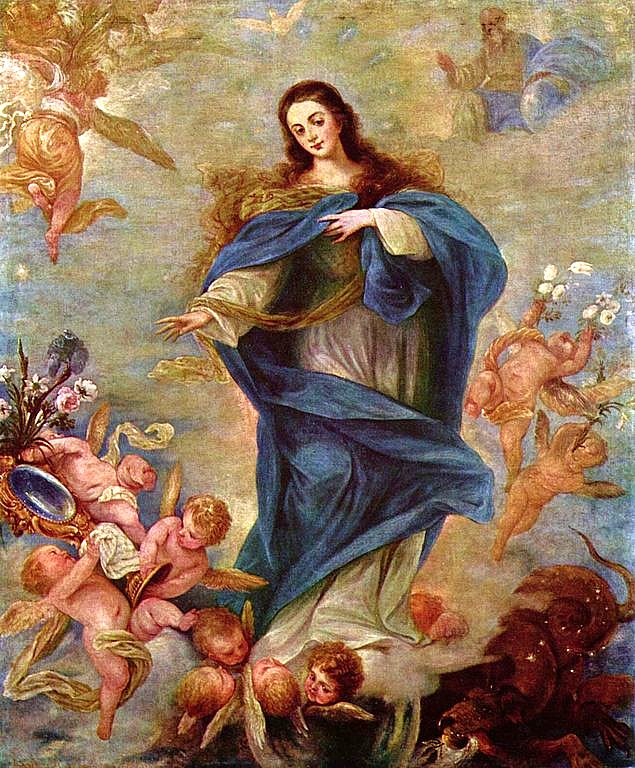
Juan Antonio Escalante, Spanish, 17th century
This festival began in the East, in the 8th Century, since mention is made of it by Saint John Damascen, who lived n 721. It was instituted in England in the year 1100 by Saint Anselm, Archbishop of Canterbury. Afterwards in the Diocese of Lyons in the year 1145. Pope Sixtus IV commanded, in the year 1576, the celebration of it throughout Christendom.
At the very first moment of conception in the womb of Saint Ann, Mary’s soul was flooded with the fullness of grace: “all fair, all beautiful.” The laws of man and of nature did not apply to Mary. Her soul was flooded with light so that she could make her acceptance of the Mystical Marriage with her God.
“You have ravished my heart, my sister, my spouse, you have wounded my heart…My sister, my Bride is a garden enclosed, a fountain sealed up…Thou art beautiful, O my Love, sweet and comely; terrible as an army set in array…One is my Dove; My perfect one is but one; she is the holy one of her mother, the chosen of her that bore her. How beautiful art thou, by dearest delights!…Put me as a seal upon they heart, as a seal upon thy arm, for love is strong as death…” – thus God speaks to her in the “Canticle of Canticles,” and Mary replies: “I found Him Whom my soul loved…”
Juan Antonio Escalante, Spanish, 17th century
Mary’s Suscipe – the most perfect act of surrender a creature ever made, an oblation which would have a permanent re-echo every moment of her life, her bridal consecration, her mystical union with God was spoken at the very first moment of her being. Fiat – Be is done to me…
There was never a questioning of God’s will in the life of Mary but it was always perfect acceptance of whatever He planned and wanted of her. Therein lies sanctity – doing God’s will, not ours, regardless. Yes, even the Motherhood of Mary as the “Mater Dei” depended on this, for Christ in the Gospels says:
“Who are My Mother and My Brethren? If anyone does the will of My Father, he is My Mother and My Brethren.”
You, who love the Blessed Mother so intimately should certainly desire, with all your heart, to imitate Mary’s Fiat in every instance of life. Strive for this initial complete consecration to the Will of God in everything, regardless. At the root, foundation of every life lived for God, there must be a “Suscipe” “Take O Lord, and receive all my liberty, my will…” and a Fiat in deepest love and conformity to God’s Holy Will. In return God will favour you with peace, joy of service but, also, as He did His own dear Mother, with suffering but, always, He will give you the grace to say with Mary, “Behold the Handmaid of the Lord, be it done unto me according to Thy Will.”
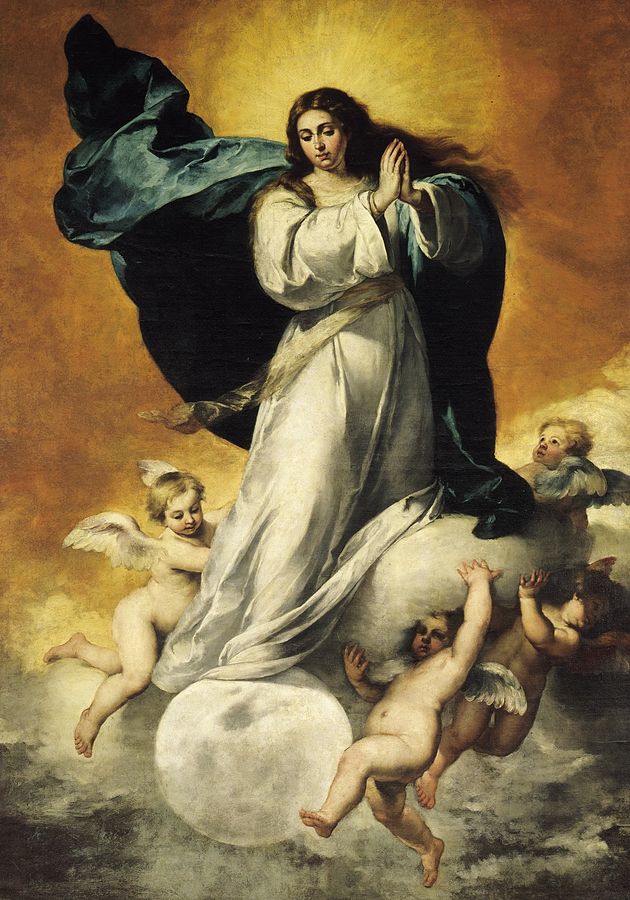
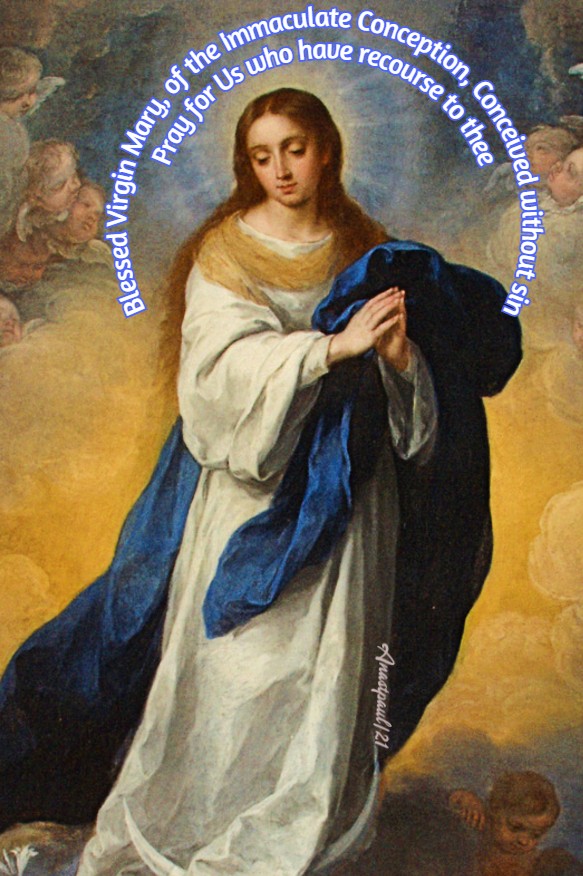
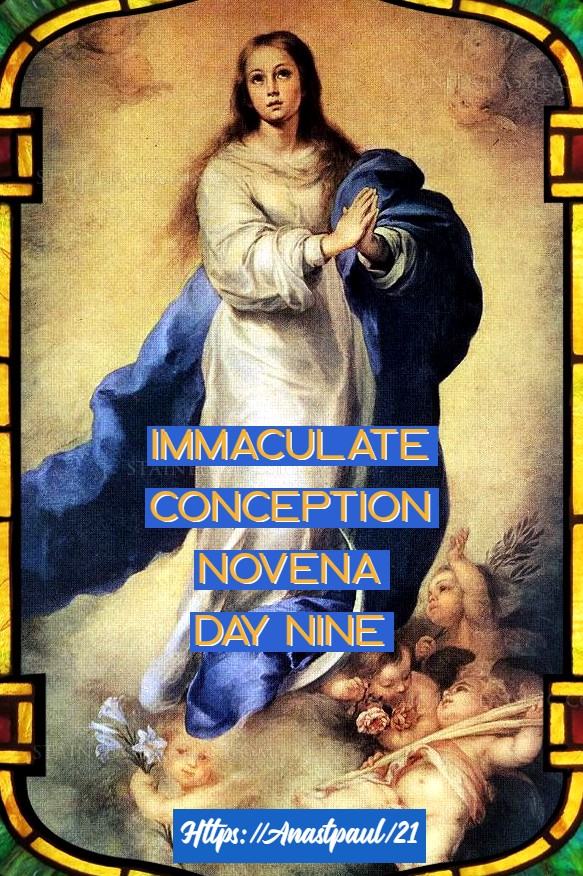
Murillo, Immaculate Conception, 1650
Mary is “our tainted nature’s solitary boast” and we are her children. Should not a daughter try to resemble her Mother in everything? Mary is the Treasure-house of God’s graces, she will give whatever we ask of her, if it be the divine Will.
“Holy Mary, Mother of God, Immaculate One, pray for us!”
St Gunthildis of Ohrdruf Bl Jacob Gwon Sang-yeon Bl Johanna of Cáceres Bl José María Zabal Blasco St Macarius of Alexandria St Marin Shkurti St Patapius Bl Paul Yun Ji-chung St Rafael Román Donaire St Romaric of Remiremont St Sofronius of Cyprus
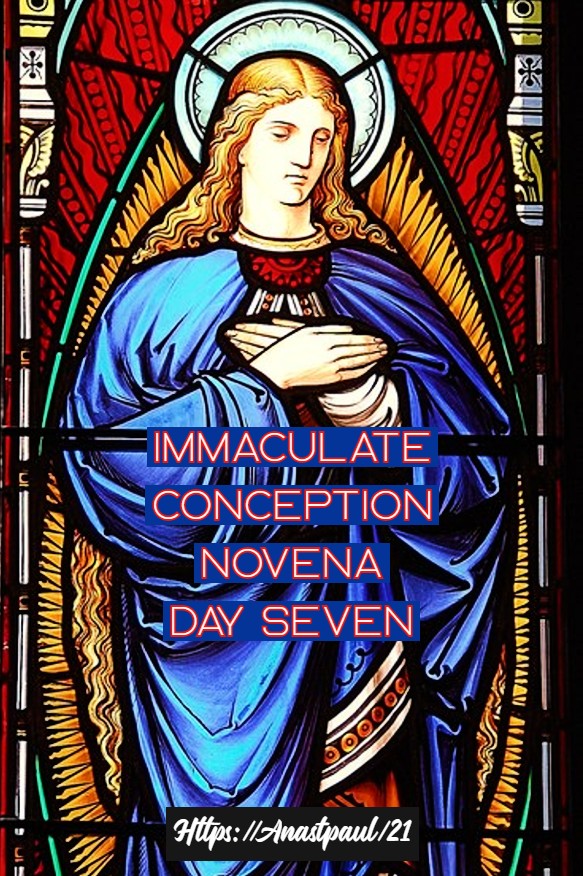
Let us begin: In the Name of the Father and of the Son and of the Holy Spirit. Amen
O God, Who by the Immaculate Conception of the Blessed Virgin Mary, did prepare a worthy dwelling place for Your Son, we beseech You that, as by the foreseen death of this, Your Son, You did preserve Her from all stain, so too You would permit us, purified through Her intercession, to come unto You. Through the same Lord Jesus Christ, Your Son, who lives and reigns with You in the unity of the Holy Spirit, God, world without end. Amen
O Mother of the King of the Universe, most perfect member of the human race, our tainted nature’s solitary boast, we turn to you as mother, advocate and mediator. O Holy Mary, assist us in our present necessity. By your Immaculate Conception, O Mary conceived without sin, we humbly beseech you, from the bottom of our heart, to intercede for us with your Divine Son and ask, that we be granted the favour for which we now plead… ………………………………. (State your intention here… ) O Mary of the Immaculate Conception, Mother of Christ, you had influence with your Divine Son while upon this earth, you have the same influence now in Heaven. Pray for us and obtain for us from Him, the granting of our petition, if it be the Divine Will. Amen
Say the: Our Father… the: Hail Mary… the: Glory Be…
Thought for the Day – 7 December – Meditations with Antonio Cardinal Bacci (1881-1971)
The Contemplative and the Active Life
“We ought not to imagine that contemplation is a privilege exvclusive to Monks and Nuns. In fact, it belongs to all Catholics. It is the privilege of the peasant, artisan, or clerk, who, on his way home from work, pays a visit to Jesus in the Blessed Sacrament. “Here I am, my God,“ anyone of them may say. “I am very tired. Please give me some rest for my soul. I am weary and worried, both in body and in soul. I wish to love You more and to be faithful to You, until I die. I wish to think only of You but there are so many other things which I must think about. I have so many temptations and disturbances, which cause me to forget You and which often lead me into evil. O God, be the light of my soul, the peace of my heart, the divine strength of my weak will. …” Murmuring words like these, they listen to God and seem to see Him bending down towards them.
Then there is the student who has spent the day pouring over books, searching for the truth. He goes into the Church for a moment and kneels down. His mind is full of the tumult of thoughts, calculations and problems, never completely answered or explained in the books, written by men. He asks God for the light which he has not found, for the answer which he has not discovered, for the peace and calm, which only He can give.
At least for a moment, all these workers and students are contemplatives. They have left behind the noise of the world, in order to listen to the Voice of God. But this Voice, which does not speak in words but in silence and in peace, is the Voice of contemplation. Prayer comes afterwards, when God makes His presence felt in the soul. In this way, no matter who or what we are, we should all be contemplatives. In other words, we should seek, in quiet conversation with God, the truth and tranquiliity which the world cannot give us.”
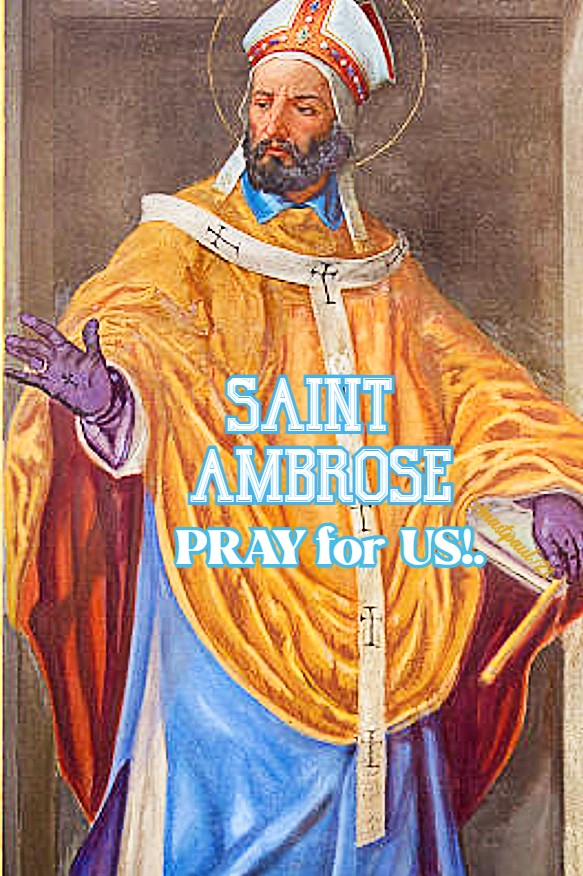
Quote/s of the Day – 7 December – Tuesday of the Second Week of Advent and the Memorial of St Ambrose (c 340-397)- Father and Doctor of the Church
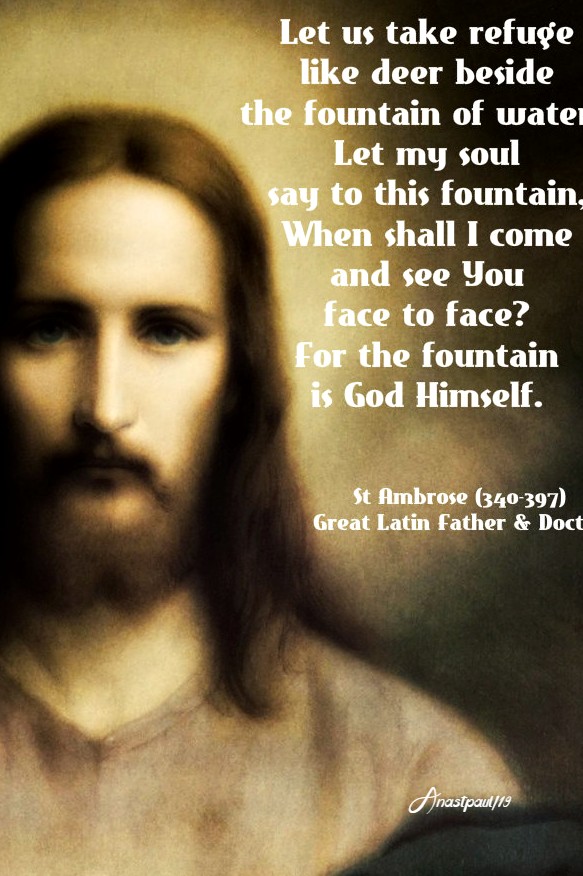
“Let us take refuge like deer beside the fountain of waters. Let our soul thirst, as David thirsted, for the fountain. What is that fountain? Listen to David – With you is the fountain of life. Let my soul say to this fountain, When shall I come and see You face to face? For the fountain is God Himself.”
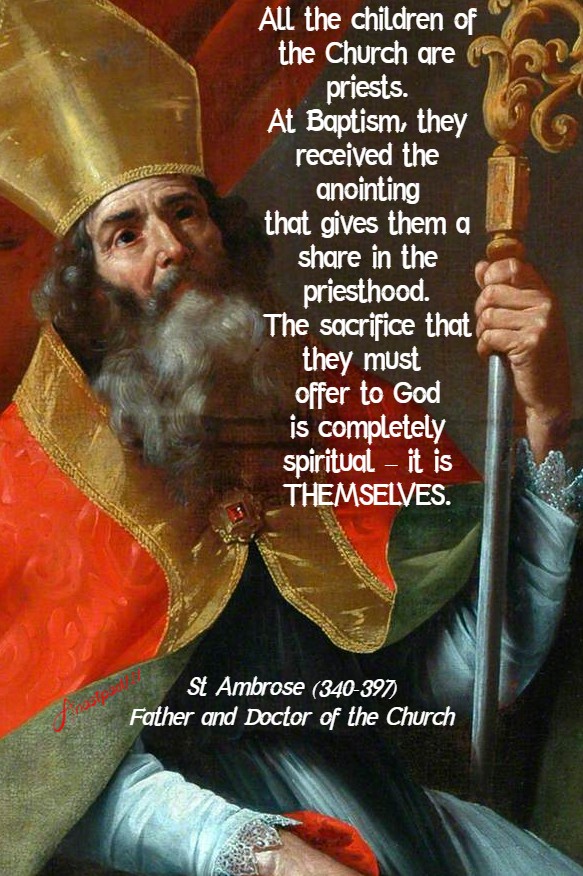
“All the children of the Church are priests. At Baptism, they received the anointing that gives them a share in the priesthood. The sacrifice that they must offer to God is completely spiritual – it is themselves.”
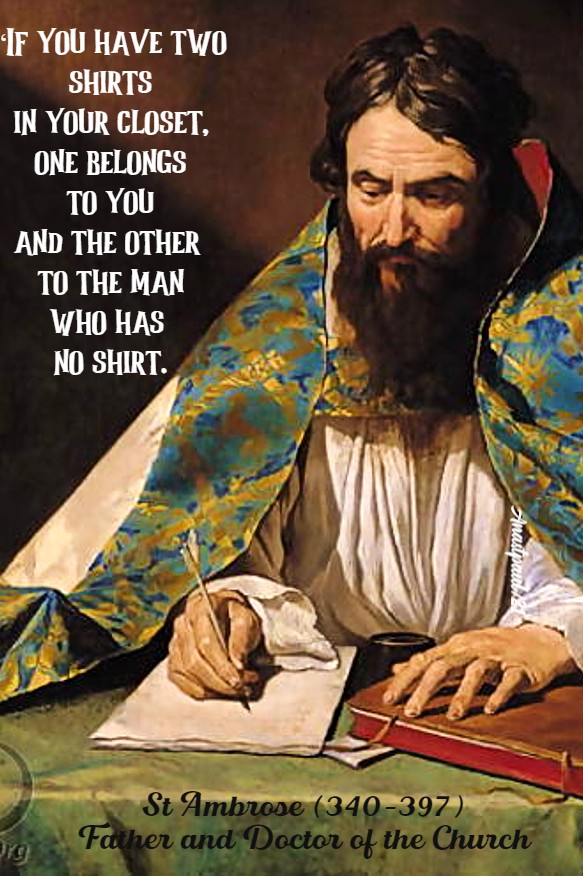
“If you have two shirts in your closet, one belongs to you and the other to the man who has no shirt.”
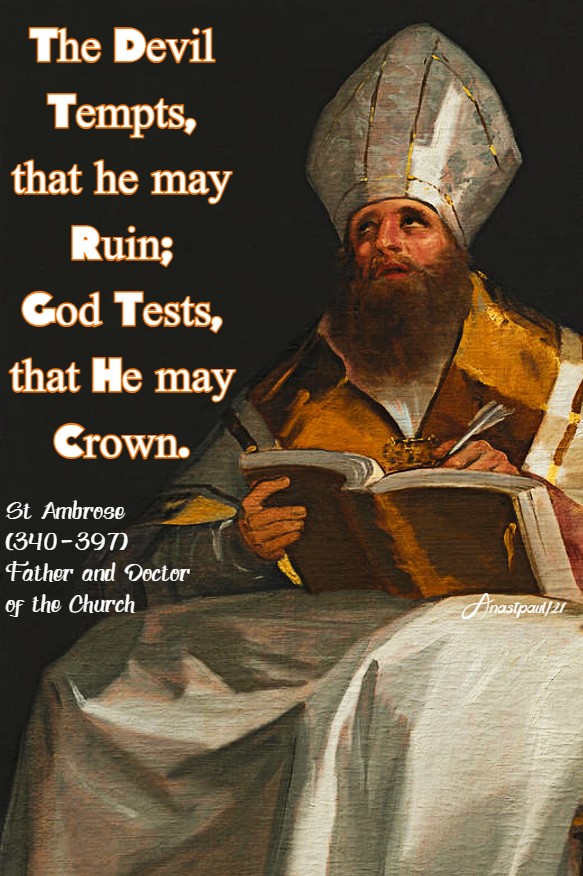
“The devil tempts, that he may ruin; God tests, that He may crown.”
St Ambrose (340-397) Father and Doctor of the Church
One Minute Reflection – 7 December – Tuesday of the Second Week of Advent, Readings: Isaiah 40: 1-11; Psalm 96: 1-3 and 10-13; Matthew 18: 12-14 and the Memorial of St Ambrose (c 340-397) Father and Doctor of the Church
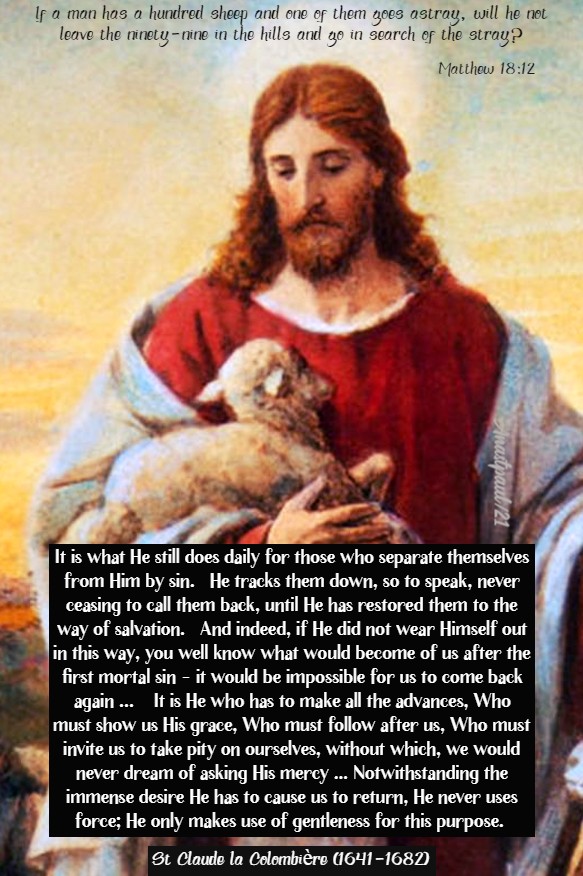
“If a man has a hundred sheep and one of them goes astray, will he not leave the ninety-nine in the hills and go in search of the stray?” Matthew 18:12
REFLECTION – “Imagine to yourself the sadness of the poor shepherd, whose sheep has strayed. The only thing to be heard in the fields roundabout, is the call of this unfortunate lad who, having abandoned the better part of the flock, runs about in woods and hills, passes by thicket and bush, mourning and calling out as hard as he can, unable to make up his mind to go back, until he has found his sheep again and led it back to the fold.
Here is what the Son of God did when men had gone astray, through their disobedience, from their Creator’s way of behaving. He came down to earth and did not stint, either care or labour ,to restore us again to the state from which we had fallen. It is what He still does daily for those who separate themselves from Him by sin. He tracks them down, so to speak, never ceasing to call them back, until He has restored them to the way of salvation. And indeed, if He did not wear Himself out in this way, you well know what would become of us after the first mortal sin – it would be impossible for us to come back again … It is He who has to make all the advances, Who must show us His grace, Who must follow after us, Who must invite us to take pity on ourselves, without which, we would never dream of asking His mercy …
The zeal with which God pursues us is undoubtedly the result of a very great mercy. But the sweetness by which this zeal is accompanied shows an even more wonderful goodness. Notwithstanding the immense desire He has to cause us to return, He never uses force; He only makes use of gentleness for this purpose. In all the Gospel I see no sinner who was invited to repent except by endearments and kindness.” – St Claude la Colombière SJ (1641-1682) “Apostle of the Sacred Heart” (A sermon preached in London before the Duchess of York).
PRAYER – Lord God, You made St Ambrose a teacher of the Catholic Faith and a pattern of apostolic fortitude. Raise up in the Church today, men after Your own heart, to lead Your people with wisdom, strength and courage in the face of widespread evil. And may his prayers intercede for us all. We make our prayer, through our Lord Jesus Christ, Your Son in the unity of the Holy Spirit, one God forever and ever, amen.
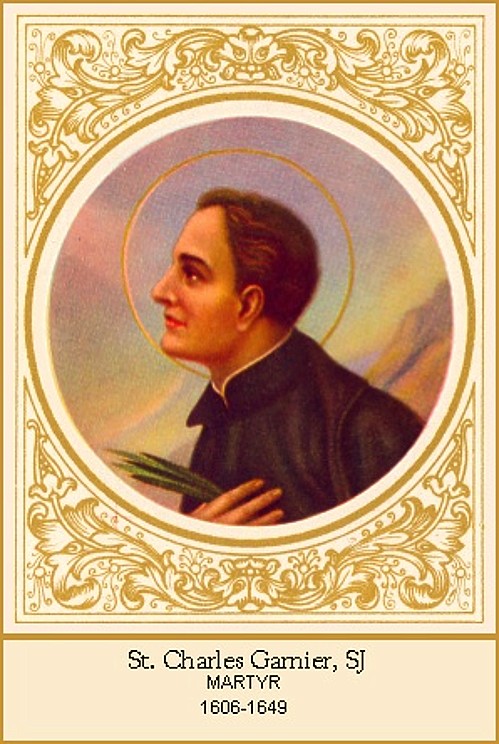
Saint of the Day – 7 December – St Charles Garnier SJ (1606-1649) Priest Martyr, Missionary. Born in 1606 in Paris, France and died by being shot in the chest and abdomen and then tomahawked in the head on 7 December 1649 at Fort Saint Jean, Canada, he was just 43 years old. Additional Memorials – 19 October as one of the Martyrs of North America, 26 September in Canada.
Charles was the son of a secretary to King Henri III of France. He attended the Collège de Clermont in Paris and joined the Jesuit Seminary in Clermont in September 1624
After his novitiate, he returned to the College of Clermont as Prefect. When he finished his studies in rhetoric and philosophy, he spent two years teaching at the College of Eu. Completing years of studies in language, culture and theology, he was Ordained in 1635.
Charles had to be persistent in asking to become a missionary because his father, a wealthy Parisian gentleman, opposed his desires and obstructed his first request. That same persistence proved invaluable as he worked with the Petun people who initially were hostile to the Black Robes, as they called the Jesuits.
Garnier spent his first three years in New France learning the Huron language and ministering at the mission in Ossossané. In November 1639 he and Father Isaac Jogues were sent to the Petuns who would not accept them because they remembered the accusation that the Black Robes had caused the epidemic that swept through the Huron lands in 1636. The two Jesuits spent the winter months among the Petun, then returned to Ossossané because they thought they had failed. Father Garnier returned the following autumn and then left again. Finally he returned during the winter of 1647 and founded two missions. For now, the people were more responsive than on his previous visits.
For several years the Iroquois had been increasing their attacks on the Huron world; they had already killed Father Anthony Daniel in 1648, so Garnier took the report very seriously, which he received in November 1649, that the Iroquois were on the warpath against the Petun and threatened to burn their villages. He sent his newly-arrived assistant, Father Noel Chabanel back to the mission headquarters because he did not want to leave him at risk but Charles himself was firm in wanting to stay with his people. On 7 November at mid-afternoon, the Iroquois attacked, killing anyone they found. Garnier was shot twice, once in the chest and once in the abdomen. He was stripped of his cassock and left to die in the cold but he regained consciousness and tried to move towards a Petun man who had been wounded. An attacker scalped him and then killed him with a blow to the head. Another Jesuit came to the village the next day and buried the gentleman’s son, our Saint, in a shallow grave among the people he so wanted to bring to Christ.
Charles Garnier was Canonised on 29 June 1930 by Pope Pius XI with the seven other Canadian Martyrs (also known as the North American Martyrs).
Vigil of the Solemnity of the Immaculate Conception – 7 December On this vigil day, Catholics stand in the remains of the night as the dawn makes its appearance. This resplendent dawn is that Singular Conception, the Immaculate Conception, who ushers in the Light of Christ. A day of Fast and Abstinence following the Rubrics of Pope Pius X for the Universal Calendar of the Church.
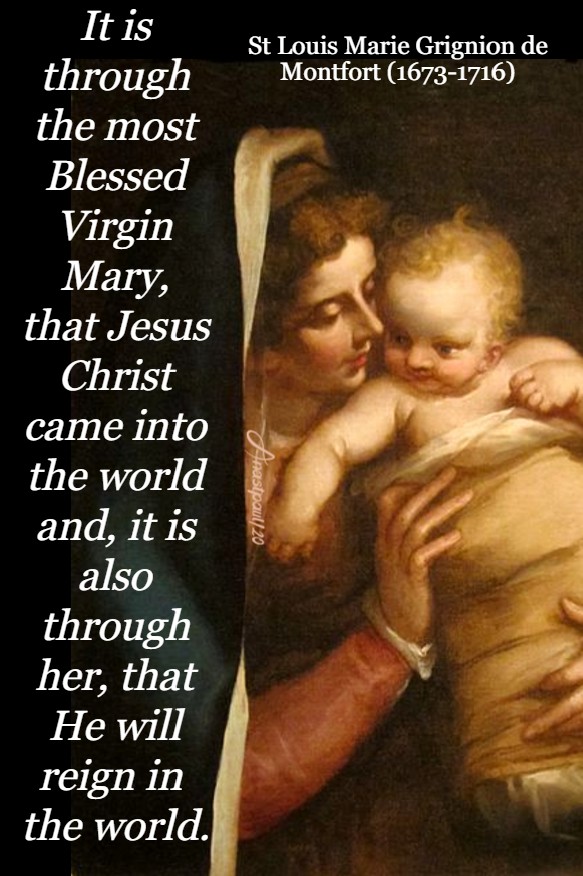
“It is through the most Blessed Virgin Mary, that Jesus Christ came into the world and, it is also through her, that He will reign in the world.” – St Louis Marie Grignion de Montfort (1673-1716)
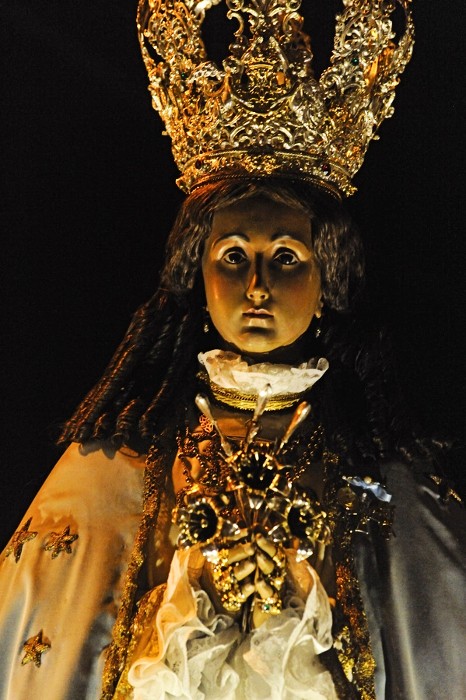
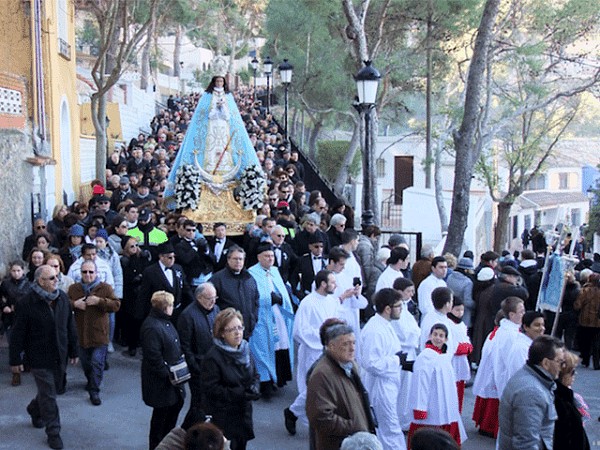
Virgen del Castillo, Inmaculada Concepción / Virgin of the Castle, Yecla, Spain (1642) – 7 and 8 December:
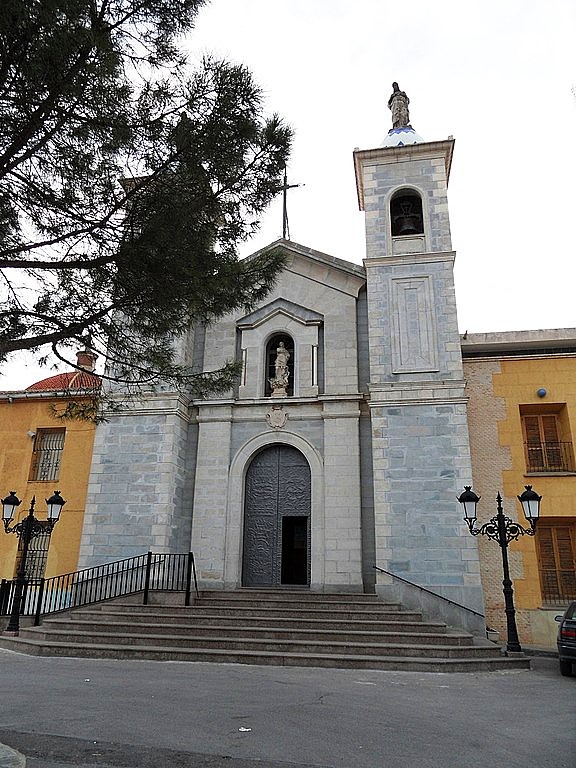
The Virgen del Castillo, Inmaculada Concepción, is venerated as Patron in the City of Yecla ( Murcia, Spain ). The Sanctuary constitutes a pilgrimage centre not only for the people of Yecla but also for the inhabitants of the entire region and even the neighboring Provinces. The name of Virgen del Castillo or Virgin of the Castle, even though it is not the official title, is the popular name with which the faithful have called their Patron because she is enshrined in the Castle Sanctuary, which is next to the medieval fortress that crowns the hill on which the City is situate. The invocation actually corresponds to the Immaculate Conception, being venerated in the aforementioned Sanctuary since time immemorial. The existence in that same place of a Mozarabic Church, dedicated to Santa María, which even became a Parish until the middle of the 16th century, is documented .
But the event that marked the transcendence of the old Sanctuary would occur during the reign of Felipe IV, when a group of Yeclans led by Captain Martín Soriano Zaplana, returned to the City after fighting against the French troops that had invaded Catalonia. The combatants return to Yecla without having suffered any casualties, a fact that they knew was miraculous, due to their devotion to the Virgin Mary and for which, they went to the hermitage of the Castle in thanksgiving. That act was an event for the City, which from then on would see in the image of Our Lady of the Castle, a symbol of protection.
The Church where the Virgin is enshrined has undergone numerous reconstructions and restorations throughout its history. The current building dates from the 19th century . The carving that is venerated today, is not the original either, since it disappeared in the Spanish Civil War – it is a replica made by Miguel Torregrosa in 1941 in the likeness of the original one, which was canonically crowned in 1954. The Procession is held on 7 December and the High Mass on the Solemnity of the Immaculate Conception, 8 December.
St Agatho of Alexandria St Anianas of Chartres St Antonius of Siya St Athenodoros of Mesopotamia St Buithe of Monasterboice St Burgundofara St Charles Garnier SJ (1606-1649) Priest Martyr St Diuma St Geretrannus of Bayeux Bl Humbert of Clairvaux St Martin of Saujon
Let us begin: In the Name of the Father and of the Son and of the Holy Spirit. Amen
O God, Who by the Immaculate Conception of the Blessed Virgin Mary, did prepare a worthy dwelling place for Your Son, we beseech You that, as by the foreseen death of this, Your Son, You did preserve Her from all stain, so too You would permit us, purified through Her intercession, to come unto You. Through the same Lord Jesus Christ, Your Son, who lives and reigns with You in the unity of the Holy Spirit, God, world without end. Amen
O Most gracious Virgin Mary, beloved Mother of Jesus Christ, our Redeemer, intercede with Him for us, that we be granted the favour which we petition for so earnestly in this novena… O Mother of the Word Incarnate, we feel animated with confidence that your prayers, on our behalf, will be graciously heard before the throne of God. O Glorious Mother of God, in memory of your joyous Immaculate Conception, hear our prayers and obtain for us our petitions. … …………………………………. (State your intention here… ) O Mary of the Immaculate Conception, Mother of Christ, you had influence with your Divine Son while upon this earth, you have the same influence now in Heaven. Pray for us and obtain for us from Him, the granting of our petition, if it be the Divine Will. Amen
Say the: Our Father… the: Hail Mary… the: Glory Be…
Thought for the Day – 6 December – Meditations with Antonio Cardinal Bacci (1881-1971)
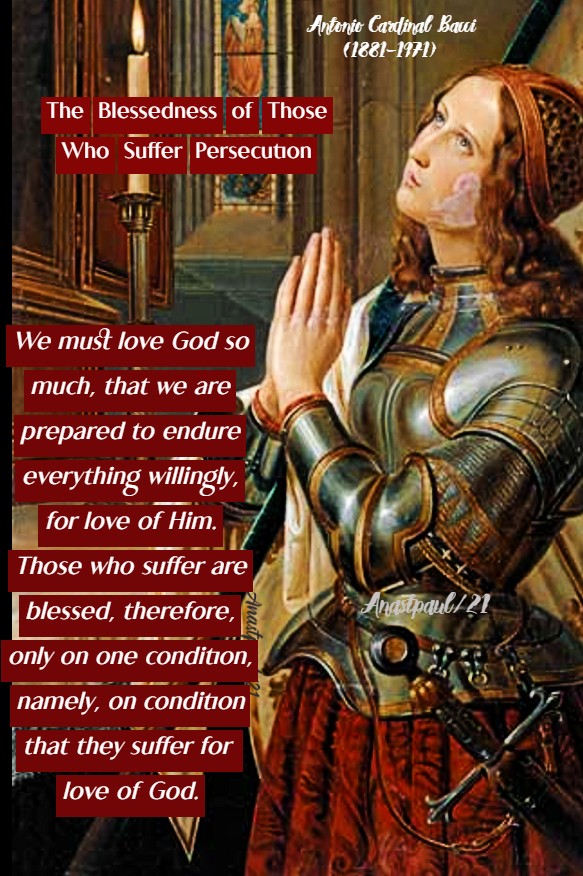
The Blessedness of Those Who Suffer Persecution
“It would seem impossible, that suffering and persecution, could bring us happiness. Yet, we have our Lord’s assurance for it. “Blessed are they who suffer persecution for justice’s sake,” He says, “for theirs is the kingdom of heaven. Blessed are you when men reproach you and persecute you and, speaking falsely, say all manner of evil against you, for MY sake. Rejoice and exult for your reward is great in heaven” (Mt 5:9-12).
Not only is this true of persecution borne in defence of the Faith and of the Church but, it is equally true of any kind of trouble and suffering as long as it is endured for the love of God. “Rejoice,” writes St Peter, “insofar as you are partakers of the sufferings of Christ, that you may also rejoice with exultation in the revelation of his glory” (1 Peter 4:13).
“It is good for us now and then,” The Imitation of Christ assures us, “to have some troubles and adversities, for oftentimes, they make a man enter into himself, that he may know that he is an exile and place not his hopes in anything of the world. It is good for us sometimes, to suffer contradictions and to allow people to think ill and slightingly of us, even when we do and mean well. These are often helps to humility and rid us of vainglory. For then we more earnestly seek God to be witness of what passes within us, when outwardly, we are slighted by men and incur their discredit” (Bk 1 c 12).
This is a repetition of the teaching of Jesus Christ, Who said: “If anyone wishes to come after me, let him deny himself and take up his cross daily and follow me” (Lk 9:23).
The happiness which our Lord promises us, is that which results from our own self-renewal and from the acceptance of our cross. This happiness, is not easy to acquire because, our selfish and sensual impulses, as well as the insults of others, seem to be forever stirring up a nest of vipers inside us. Too often, our hearts are overflowing, not with happiness but, with rebelion. How can we remedy this? There is only one way. We must love God so much, that we are prepared to endure everything willingly, for love of Him. Those who suffer are blessed, therefore, only on one condition, namely, on condition that they suffer for love of God.”
Quote/s of the Day – 6 December – Monday of the Second Week of Advent, Readings: Isaiah 35:1-10, Psalms 85:9 and 10, 11-12, 13-14, Luke 5:17-26
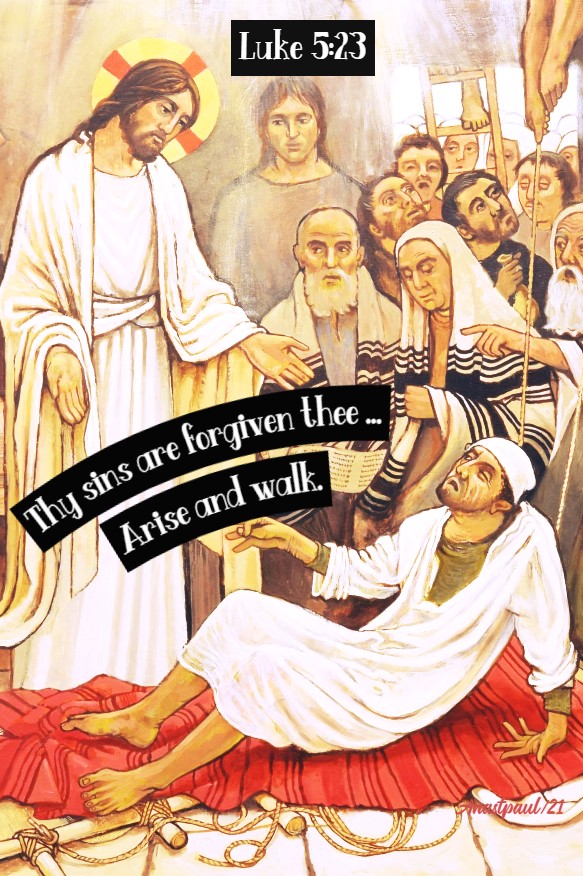
“Thy sins are forgiven thee … Arise and walk.”
Luke 5:23
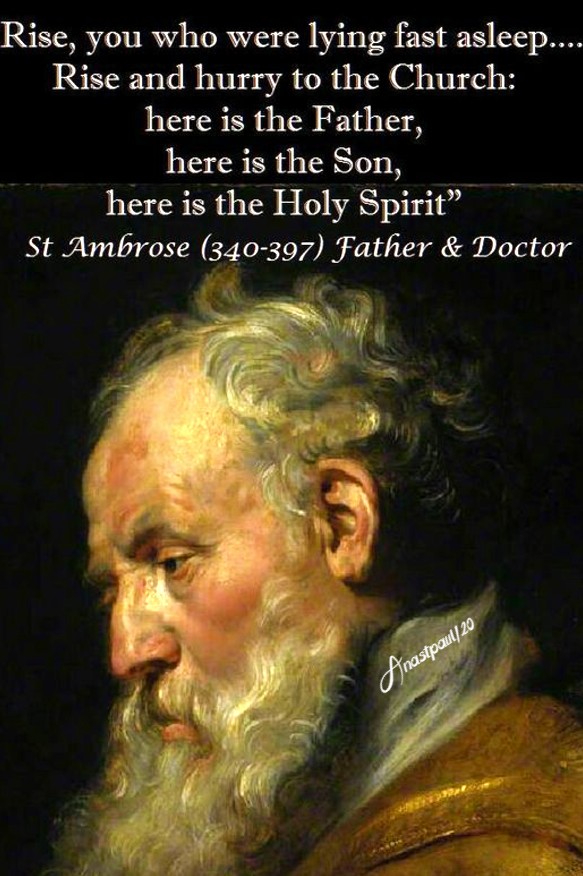
“Rise, you who were lying fast asleep… Rise and hurry to the Church: here is the Father, here is the Son, here is the Holy Spirit.”
St Ambrose (340-397) Father and Doctor of the Church
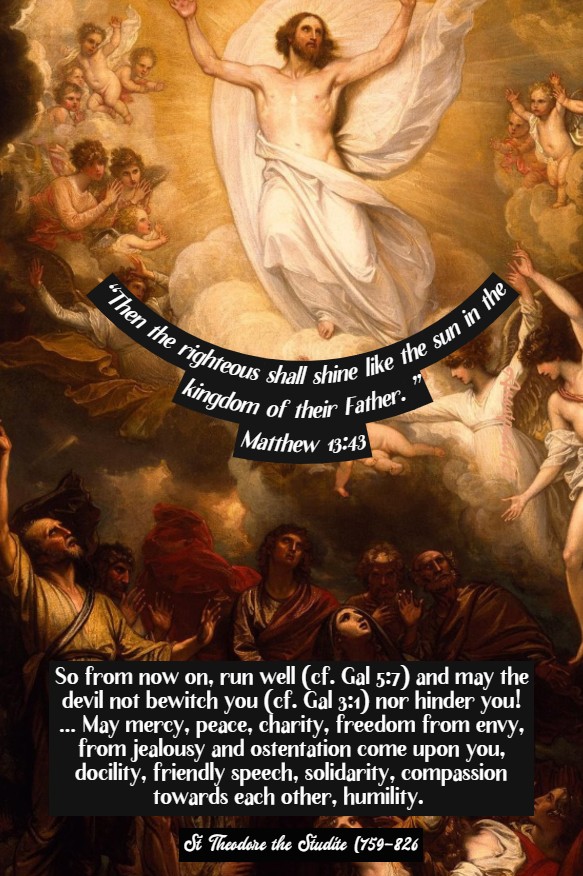
“Then the righteous shall shine like the sun in the kingdom of their Father.”
Matthew 13:43
“So from now on, run well (cf. Gal 5:7) and may the devil not bewitch you (cf. Gal 3:1) nor hinder you! … May mercy, peace, charity, freedom from envy, from jealousy and ostentation come upon you, docility, friendly speech, solidarity, compassion towards each other, humility.”
St Theodore the Studite (759-826)
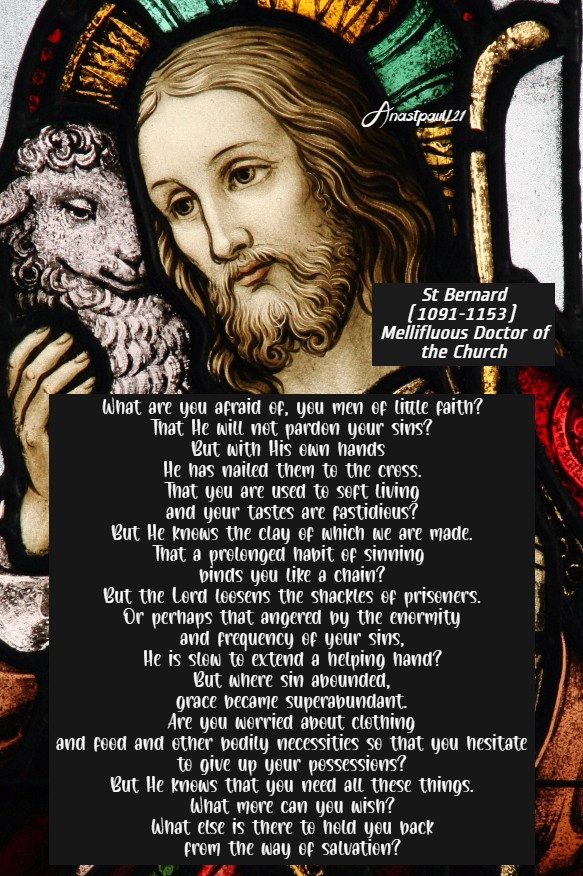
“What are you afraid of, you men of little faith? That He will not pardon your sins? But with His own hands He has nailed them to the cross. That you are used to soft living and your tastes are fastidious? But He knows the clay of which we are made (Gn 2:7). That a prolonged habit of sinning binds you like a chain? But the Lord loosens the shackles of prisoners. Or perhaps that angered by the enormity and frequency of your sins, He is slow to extend a helping hand? But where sin abounded, grace became superabundant (Rom 5,20). Are you worried about clothing and food and other bodily necessities so that you hesitate to give up your possessions? But He knows that you need all these things (Mt 6,32). What more can you wish? What else is there to hold you back from the way of salvation? ”
St Bernard (1091-1153) Mellifluous Doctor of the Church
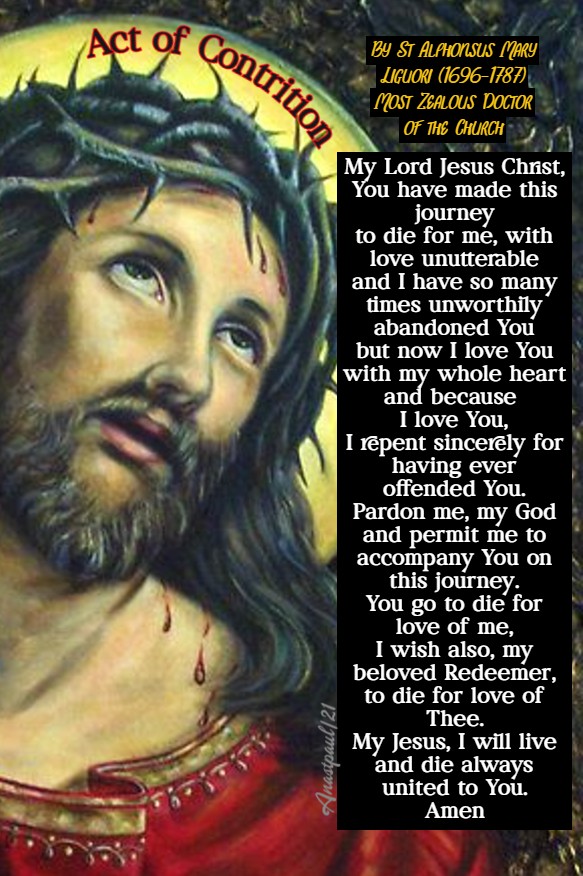
My Lord Jesus Christ, You have made this journey to die for me, with love unutterable and I have so many times unworthily abandoned You but now I love You with my whole heart and because I love You, I repent sincerely for having ever offended You. Pardon me, my God and permit me to accompany You on this journey. You go to die for love of me, I wish also, my beloved Redeemer, to die for love of Thee. My Jesus, I will live and die always united to You.” Amen
By St Alphonsus Mary Liguori (1696-1787) Most Zealous Doctor of the Church
One Minute Reflection – 6 December – Monday of the Second Week of Advent, Readings: Isaiah 35:1-10, Psalms 85:9 and 10, 11-12, 13-14, Luke 5:17-26
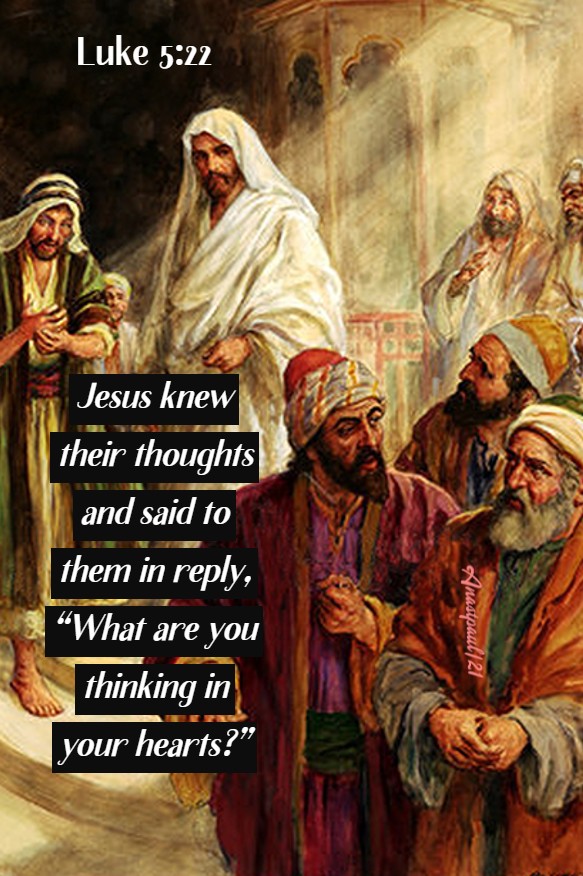
“Jesus knew their thoughts and said to them in reply, “What are you thinking in your hearts?” – Luke 5:22
REFLECTION – “Thanks to the faith of others the cripple’s soul would be cured before his body. “Seeing their faith,” the Gospel says. Note here, my brethren, that God is not interested in what foolish people want and does noy expect to find faith among the ignorant … among those who conduct themselves badly. On the other hand he does not refuse to come to the help of others’ faith. Such faith is a gift of grace, at one with God’s will … In His divine goodness, Christ the Physician, strives to draw to salvation, even in spite of themselves, those affected by sickness of soul, those whom the burden of their sins and offences overwhelms, even to delirium. Yet they do not want to submit.
O my brethren, if only we wanted to, if only we all wanted to perceive our soul’s paralysis in all its depth! Then we would see that it is lying on a stretcher of sins, deprived of strength. Christ’s action within us, would be a source of light and we would understand that each day He sees our lack of faith, harmful as it is, that He draws us towards healing remedies and sharply presses our rebellious wills. “My son” He says, “your sins are forgiven you.”– St Peter Chrysologus (c 400-450) Bishop of Ravenna, Father and Doctor of the Church (Sermon 50 ; PL 52, 339).
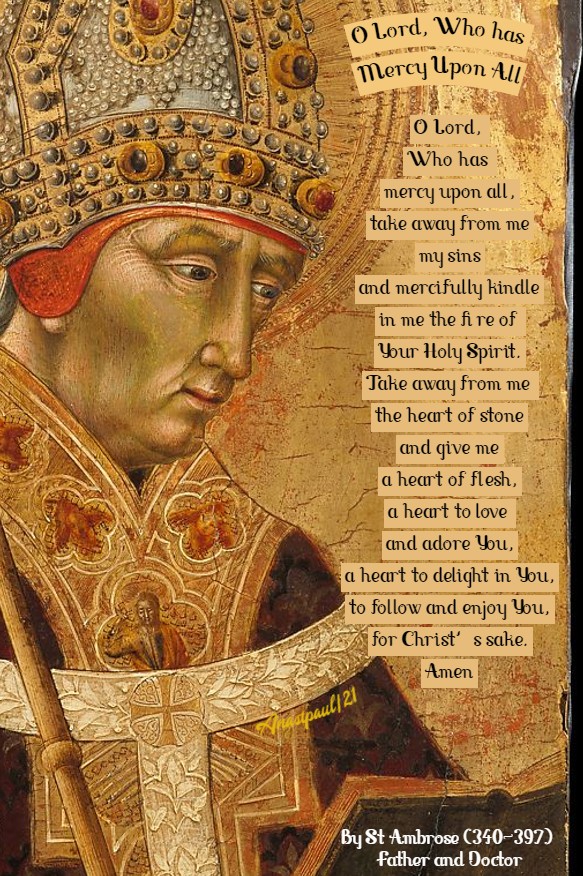
PRAYER – Prayer of St Ambrose (340-397) O Lord, who has mercy upon all, take away from me my sins and mercifully kindle in me the fire of Your Holy Spirit. Take away from me the heart of stone and give me a heart of flesh, a heart to love and adore You, a heart to delight in You, to follow and enjoy You, for Christ’s sake. Amen
Our Morning Offering – 6 December – Monday of the Second Week of Advent
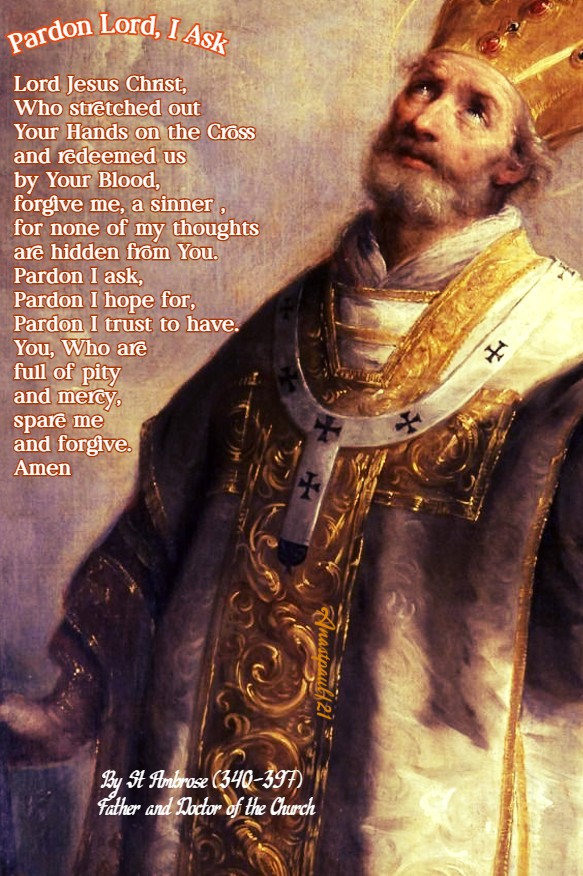
Pardon Lord, I Ask By St Ambrose (340-397) Father and Doctor of the Church
Lord Jesus Christ, Who stretched out Your Hands on the Cross and redeemed us by Your Blood, forgive me, a sinner , for none of my thoughts are hidden from You. Pardon I ask, Pardon I hope for, Pardon I trust to have. You, Who are full of pity and mercy, spare me and forgive. Amen
Saint of the Day – 6 December – Saint Asella of Rome (Died c 406) Virgin Hermit Friend of St Jerome., Ascetic, Prioress, “A Flower of the Lord.” She died in c 406 of natural causes. Also known as Osella and Ocella.
The Roman Martyrology states: “At Rome, St Asella, Virgin, who according to the words of St Jerome, being blessed from her mother’s womb, lived to old age in fasting and prayer.”
Asella was a disciple and friend of Saint Jerome, who spoke of her in his writings. She was a member of a noble and wealthy Roman Christian family, perhaps the sister of Marcella, another ascetic and saint.
When Asella was ten years old, she heard St Athanasius speak during his third and final visit to Rome and that, already being a “pious child”, inspired her to “dedicate her life to the service of Christ.” At first, her parents would not allow her to wear the garments usually worn by ascetics but she secretly sold a gold necklace, paid for the garment’s production and when she was 12, surprised her parents by appearing to them in “this garb of consecration.”
From that time on, Asella lived in silence and seclusion, living in a small cell, sleeping on the ground or on a stone, upon which she also prayed. She fasted all year, living on bread, salt, and water, often eating nothing for two or three days,and would fast for many weeks at a time during Lent. She lived a life of self-isolation, leaving her cell only to visit the Churches of the Martyrs and often, without being seen by others and rarely by her own sister.
According to historian Claude Fieury, Asella never spoke to any man. As hagiographer Agnes Dunbar stated, “She worked with her hands and sang psalms.” Despite her austere lifestyle, it did not affect her health. Jerome wrote that “with a sound body and even sounder soul, she found for herself a monkish cell in the midst of a busy Rome.” Fleury also said about Asella: “Her life was simple and regular and in the midst of Rome led a life of perfect solitude.”
St Jerome also cited Asella as an example and role model for young women, widows and virgins, calling her “A Flower of the Lord.”
In 405, the Bishop and Historian ,Palladius of Galatia visited Rome and met Asella, who was 70 years old at the time. He called her “the gentlest of women” and reported that she was in charge of a community of nuns.
Notre-Dame de Séez/ Our Lady of Séez, Normandy, France (5th Century) – 6 December:
Saint Latuinus (Died c 440), the first Bishop of Séez, built the first Cathedral to Our Lady in the Diocese of Seez. The original Cathedral would date back to the middle of the 5th century. A later Church replaced it – one dedicated under the title of Notre-Dame-du-Vivier. The Normans, at the beginning of the 5th century, destroyed this structure. A third Church was built, a hundred meters away on the site of a pagan temple. This one had added to it, the names of the martyrs Saints Fervais and Protase, whose relics were enshrined there. A special Chapel in the Cathedral recalled the memory of the first cathedral dedicated to Our Lady of Seez, for Mary remained the principal Patroness of the Diocese. Many famous people made pilgrimages to Our Lady of Seez – among them were Saint Germain, Bishop of Paris; Saint Evroult, Founder of the Abbey of Ouche; Saint Osmond, Count of Seez, who became Bishop of Salisbury; Saint Thierry, Abbot of Saint Evroult; Saint Louis IX was there in 1259 and about the same time Blessed Giles, one of the early companions of Saint Francis of Assisi, came to recommend to Mary’s protection, the first French Franciscan Convent, which he was going to found at Seez. The Augustinians served the sanctuary from 1127. In the latter half of the 18th century, the Bishop of Seez, in response to the wishes of the entire Diocese, repaired and embellished the Chapel of Our Lady at considerable expense. Later the work of redoing the entire Cathedral was undertaken. In June of 1784, the Cathedral chapter asked the Bishop to consecrate the new Altar and the entire Cathedral under the patronage of Our Lady. This was done in 1786. Mary rewarded the prelates for their zeal in promoting her honour, by granting all of them the grace of Martyrdom in the violent persecution that broke out in 1792. The beautiful façade of the Cathedral was destroyed in 1795. A revolutionary bought the debris with the intent of building a private property, however, two attempts proved failures and he finally gave up the attempt. After the revolution, a new Cathedral was built when the Diocese was re-established by the Concordat of 1802.
St Aemilianus the Martyr Bl Angelica of Milazzo St Asella of Rome (Died c 406) Virgin Hermit Friend of St Jerome St Boniface the Martyr St Dativa the Martyr St Dionysia the Martyr St Gerard of La Charite St Gertrude the Elder St Giuse Nguyen Duy Khang St Isserninus of Ireland Bl Janos Scheffler St Leontia the Martyr St Majoricus the Martyr
Thought for the Day – 5 December – Meditations with Antonio Cardinal Bacci (1881-1971)
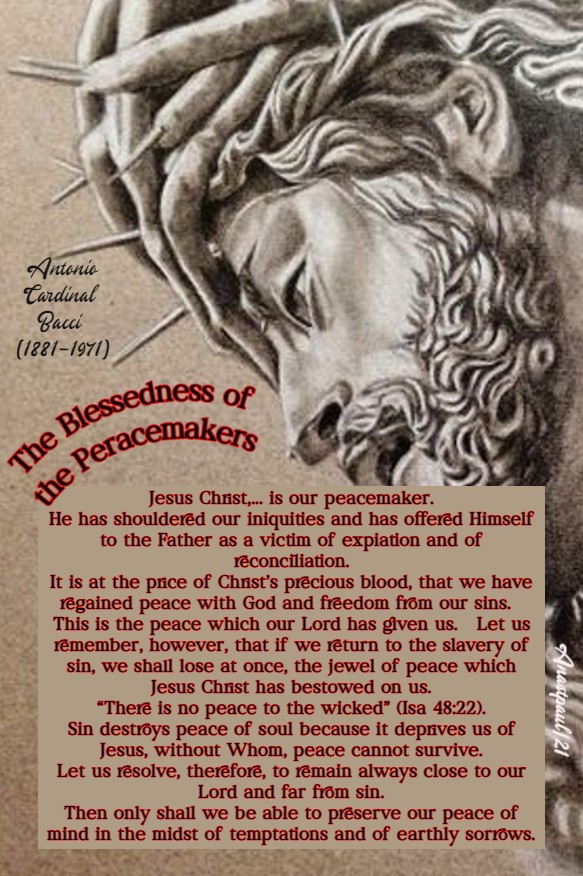
The Blessedness of the Peracemakers
“The spirit of peace pervades the Gospel. When Jesus is born, choirs of angels sing above the stable in Bethlehem: “Glory to God in the highest ad on earth, peace among men of good will” (Lk 2:14). When our Saviour has risen gloriously from the dead, He appears to His disciples and greets them with the words: “Peace be to you.” Finally, when He is departing from this earth, He leaves his peace to His followers as their inheritance.“Peace I leave with you,” He says to them, “my peace I give to you; not as the world gives, do I give to you. Do not let your heart be troubled or be afraid” (Jn 14:27).
Exactly what is the peace of Jesus Christ? It is much different from worldly peace, presuming that the world can give some kind of peace. St Paul says of the Saviour that “he himself is our peace” (Eph 2:14). How are we to understand what is meant by this? The Apostle himself explains when he writes: “Having been justified by faith, let us have peace with God through our Lord Jesus Christ” (Rom 5:1). Jesus Christ, therefore, is our peacemaker. He has shouldered our iniquities and has offered Himself to the Father as a victim of expiation and of reconciliation. It is at the price of Christ’s precious blood, that we have regained peace with God and freedom from our sins. This is the peace which our Lord has given us. Let us remember, however, that if we return to the slavery of sin, we shall lose at once, the jewel of peace which Jesus Christ has bestowed on us. “There is no peace to the wicked” (Isa 48:22). We have experienced on many occasions how true this is. Sin destroys peace of soul because it deprives us of Jesus, without Whom, peace cannot survive. Let us resolve, therefore, to remain always close to our Lord and far from sin. Then only shall we be able to preserve our peace of mind in the midst of temptations and of earthly sorrows.
Let us begin: In the Name of the Father and of the Son and of the Holy Spirit. Amen
O most Holy Virgin, who was pleasing to the Lord and became His Mother, Immaculate in body and spirit, in faith and in love, look kindly on us as we implore your powerful intercession.
O Immaculate Virgin, Mother of God and our Mother, from the sublime heights of your dignity, turn your merciful eyes upon us while we, full of confidence in your bounty and fully conscious of your power, beg of you, to come to our aid and ask your Divine Son to grant the favour we earnestly seek in this novena… if it be beneficial for our immortal souls and the souls for whom we pray. ………………………… (State your intention here… ) O Mary of the Immaculate Conception, Mother of Christ, you had influence with your Divine Son, while upon this earth, you have the same influence now in Heaven. Pray for us and obtain for us from Him the granting of our petition if it be the Divine Will. Amen
Say the: Our Father… the: Hail Mary… the: Glory Be…
Quote/s of the Day – 5 December – The Second Sunday of Advent – Readings: Baruch 5: 1-9; Psalm 126: 1-6; Philippians 1: 4-6, 8-11; Luke 3: 1-6
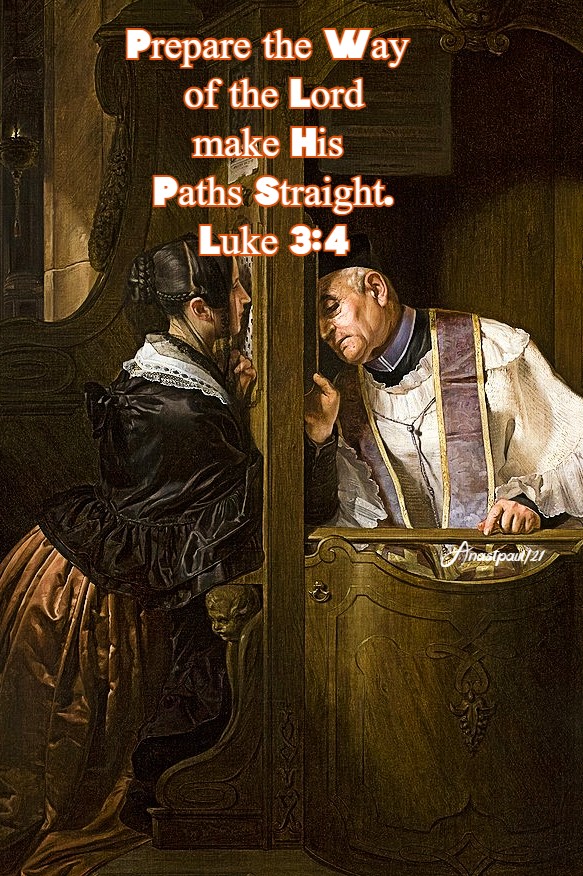
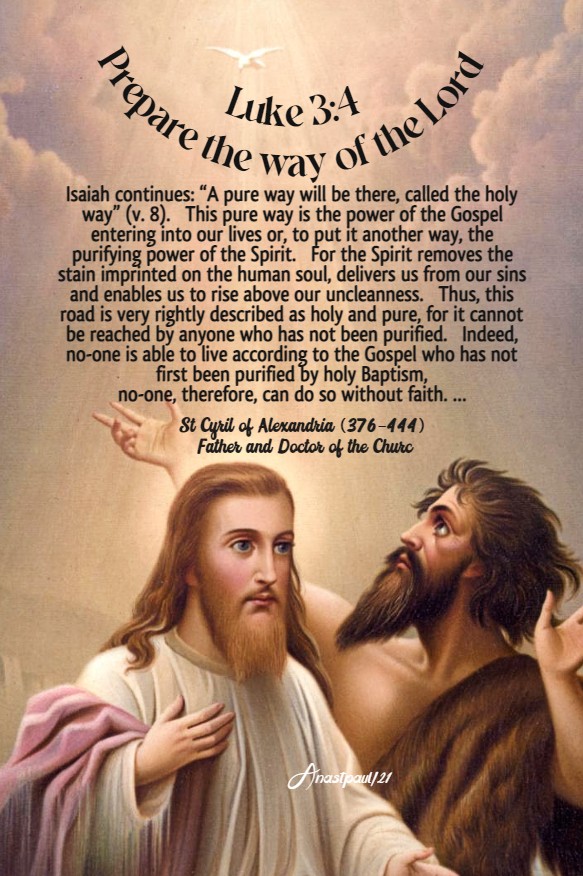
“Prepare the way of the Lord make his paths straight” …
Luke 3:4
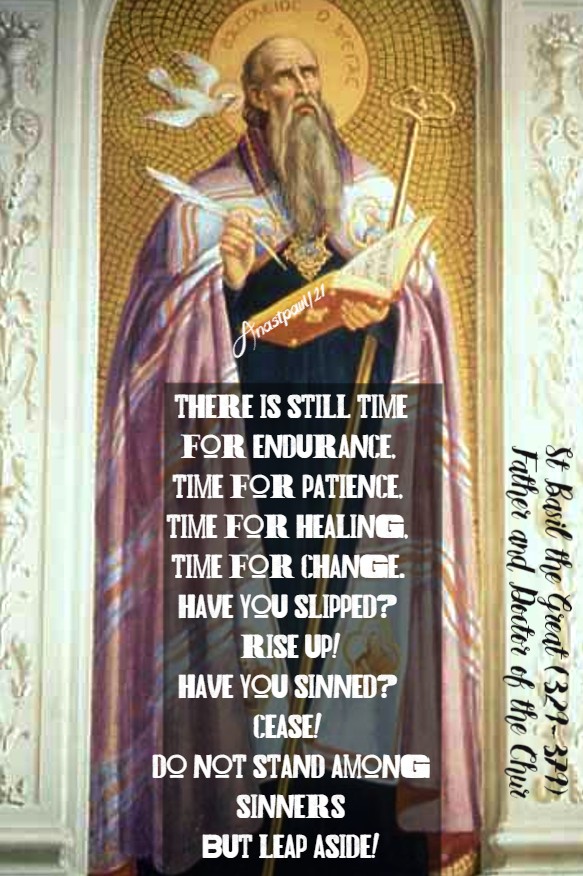
“There is still time for endurance, time for patience, time for healing, time for change. Have you slipped? Rise up! Have you sinned? Cease! Do not stand among sinners but leap aside!”
St Basil the Great (329-379) Father and Doctor of the Church
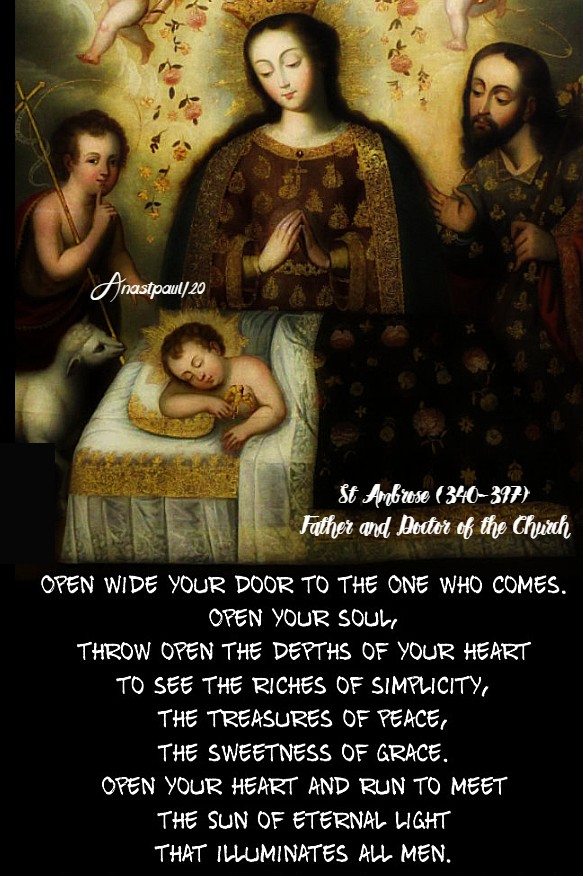
“Open wide your door to the One who comes. Open your soul, throw open the depths of your heart to see the riches of simplicity, the treasures of peace, the sweetness of grace. Open your heart and run to meet the Sun of eternal Light that illuminates all men.”
St Ambrose (340-397) Father and Doctor of the Church
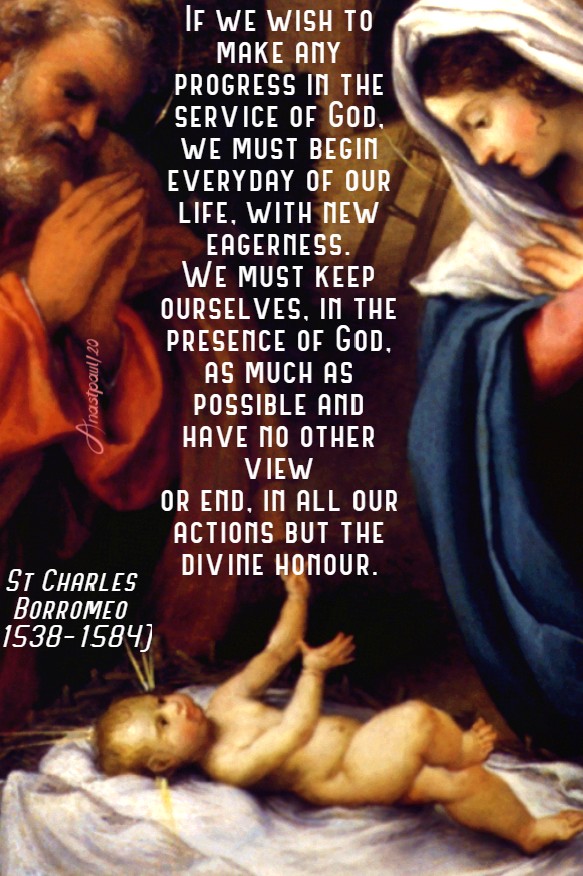
“If we wish to make any progress in the service of God, we must begin everyday of our life, with new eagerness. We must keep ourselves, in the presence of God, as much as possible and have no other view or end, in all our actions but the divine honour.”
St Charles Borromeo (1538-1584)
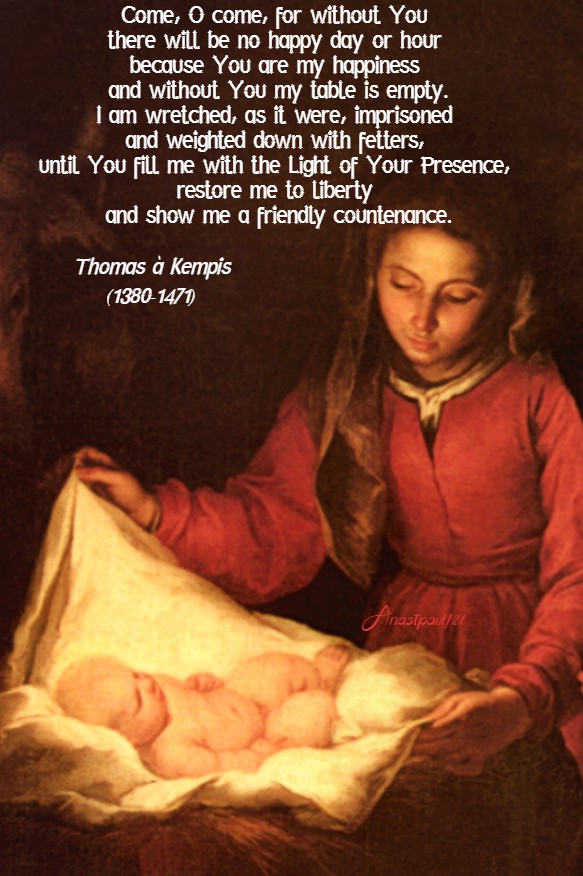
“Come, O come, for without You there will be no happy day or hour because You are my happiness and without You my table is empty. I am wretched, as it were imprisoned and weighted down with fetters, until You fill me with the Light of Your Presence, restore me to liberty and show me a friendly countenance.”
One Minute Reflection – 5 December – “Month of the Immaculate Conception” and The Second Sunday of Advent – Readings: Baruch 5: 1-9; Psalm 126: 1-6; Philippians 1: 4-6, 8-11; Luke 3: 1-6
“Prepare the way of the Lord” – Luke 3:4
REFLECTION – “Let the desert and the parched land exult! Let the arid ground rejoice and bloom. Let it bloom with abundant flowers” (Is 35:1). What the inspired Scriptures usually call ‘desert’ and ‘waste,‘ is the Church of the pagans. She already existed in former times among the peoples but had not received her mystical Spouse from Heaven, I mean the Christ … Christ came to her, however. Captivated by her faith, He enriched her from the divine river that streams from Him – streams because it is the “fountain of life, stream of delight” (Ps 36[35]:10.9) … At His Presence, the Church ceased to be parched and arid, she encountered her Spouse, brought into the world countless children and was adorned with mystical flowers. …
Isaiah continues: “A pure way will be there, called the holy way” (v. 8). This pure way is the power of the Gospel entering into our lives or, to put it another way, the purifying power of the Spirit. For the Spirit removes the stain imprinted on the human soul, delivers us from our sins and enables us to rise above our uncleanness. Thus, this road is very rightly described as holy and pure, for it cannot be reached by anyone who has not been purified. Indeed, no-one is able to live according to the Gospel who has not first been purified by holy Baptism, no-one, therefore, can do so without faith. … Only those delivered from the devil’s tyranny can lead the glorious life the prophet describes with these images: “No lion will be there nor beast of prey” (v. 9) on that pure way. Indeed, in former times such fierce beasts, as is the devil, that inventor of sin, used to attack earth’s inhabitants together with the evil spirits. But he was crushed by Christ, driven far away from the flock of believers and stripped of the dominion he used to wield over them. That is why, redeemed by Christ and brought together in faith, they will walk united in heart along this pure way (v. 9). Forsaking their former ways “they will return to Zion,” that is, the Church, “with everlasting joy” (v. 10) that has no end, whether on earth or in Heaven and they will glorify God their Saviour. – St Cyril of Alexandria (376-444) Bishop of Alexandria, Father and Doctor of the Church (On Isaiah, III, 3).
PRAYER – Almighty and merciful God, let neither our daily work nor the cares of this life prevent us from hastening to meet your Son. Teach us Holy Father God, silence and solitude, to hear and learn, then lead us into the company of Your Son, as He comes to save us! And may His Mother and ours, the most pure Virgin Mary be our intercessor and advocate. We make our prayer through Christ our Lord, in the unity of the Holy Spirit, God forever, amen.
Our Morning Offering – 5 December – The Second Sunday of Advent
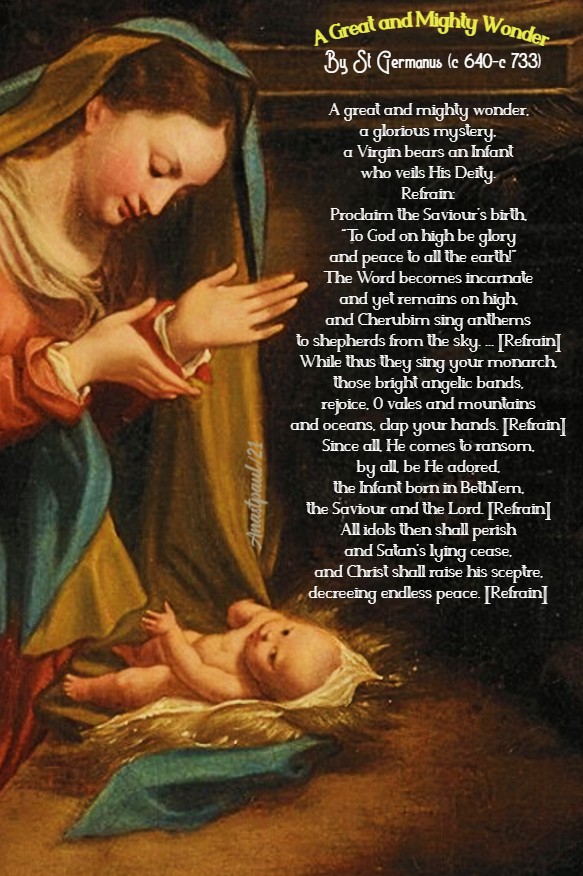
A Great and Mighty Wonder By St Germanus (c 640-c 733)
A great and mighty wonder, a glorious mystery, a Virgin bears an Infant who veils His Deity. Refrain: Proclaim the Saviour’s birth, “To God on high be glory and peace to all the earth!” The Word becomes incarnate and yet remains on high, and Cherubim sing anthems to shepherds from the sky. … [Refrain] While thus they sing your monarch, those bright angelic bands, rejoice, O vales and mountains and oceans, clap your hands. [Refrain] Since all, He comes to ransom, by all, be He adored, the Infant born in Bethl’em, the Saviour and the Lord. [Refrain] All idols then shall perish and Satan’s lying cease, and Christ shall raise his sceptre, decreeing endless peace. [Refrain]
St Germanus was one of the Greek hymnwriters and one of the grandest among the defenders of the Icons. He was born at Constantinople of a patrician family, was ordained there and became subsequently Bishop of Cyzicus. He was present at the Synod of Constantinople in 712, which restored the Monothelite heresy but in after years he condemned it. He was made Archbishop of Constantinople in 715. In 730 he was driven from the See, not without blows, for refusing to yield to the Iconoclastic Emperor Leo the Isaurian. He died shortly afterwards in exile at a good old age. His Life below: https://anastpaul.com/2021/05/12/saint-of-the-day-12-may-saint-germanus-of-constantinople-c-640-733/
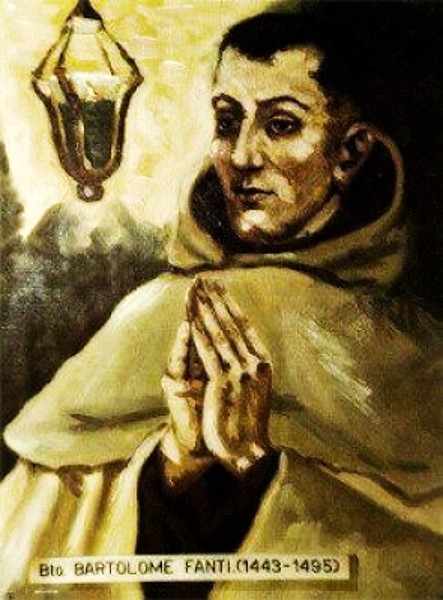
Saint of the Day – 5 December – Blessed Bartholomew Fanti of Mantua O.Carm. (c 1443-1495) Carmelite Priest renowned Preacher. Born in c 1428 at at Mantua, Italy and died on 5 December 1495 of natural causes. Patronage – Mantua.
Bartholomew became a professed member of the Carmelite Order at the age of seventeen and by the age of 24 was already Ordained as a Priest.
On 1 January 1460, he became the Spiritual Director and the Rector of the Confraternity of the Blessed Virgin Mary and composed their Rule and Statues. Long before he formalised the Confraternity’s Rule, he had been a member and remained so for all his life, serving the Confraternity and the Blessed Virgin faithfully for 35 years in his hometown of Mantua.
He became a spiritual teacher of the Carmelite Priest Blessed John Baptist Spagnuolo, a Poet and Writer who also served as Prior General of the Carmelite Order. Bartholonew became well known for being an effective preacher with an ardent devotion to the Blessed Sacrament.
He died on 5 December 1495 in Mantua. His remains were relocated to another chapel in 1516 and again in 1783 to the Church of Saint Mark in Mantua before being relocated for the final time, in 1793.
Humble and gentle, Bartholomew gave an example to everyone of a life of prayer, of loving kindness and generosity to all and of faithful service to the Lord. He was remembered and revered, even during his life, for his great love ot the Blessed Sacrament, which was the source and the summit of his apostolic life, together with his love and devotion to the Virgin Mother.
His Beatification received the papal approval of Pope Pius X on 18 March 1909 (cultus confirmed).
Prayer: Lord God, You made Blessed Bartholomew Fanti outstanding in his zeal for the salvation of souls, in his devotion to the Holy Eucharist and to the Blessed Virgin Mary. May we experience, by his intercession, the same fullness of devotion and love. We ask this through our Lord Jesus Christ, Your Son, Who lives and reigns with You and the Holy Spirit, one God, forever and ever. Amen
The Sodality of Our Lady / Our Lady of the Jesuit College, Rome (1584) – 5 December:
The Abbot Orsini wrote: “In the year 1584 was instituted, the first congregation of Our Lady at the Jesuits’ college, at Rome, whence is derived their custom of establishing it in all their houses.”
The Sodality of Our Lady, or the Sodality of the Blessed Virgin Mary, was actually founded in 1563 by a Belgian Jesuit, Father John Leunis, at the Collegio Romano in Rome. It was established for young schoolboys and the Papal Bull Superna Dispositione opened it to adults, under the authority of the Superior General of the Society of Jesus. A Jesuit historian recorded that it was originally “made up especially of younger boys from the college, who agreed to go to daily Mass, weekly confession, and monthly Communion, as well as to engage in a half-hour of meditation each day and do some other pious exercises.” The youths who felt drawn to the spirit of the Jesuits and were often called the “Congregation Mariana.” Once formed into a Sodality of Our Lady, they were to do apostolic work in the City of Rome, while also serving the poor. Since the time of its humble beginnings in 1563, twenty-two Sodalists have become Popes. After Fr Leunis’ death in 1584, Pope Gregory XIII canonically established the Sodality Group of the Roman College in his bull “Omnipotentis Dei.” The sodality of Fr Leunis was declared to be the mother of all such subsequent sodalities. Having attained the status of Prima Primaria, it had gained the right to partner with other similar groups, and through that affiliation ,all could share in the indulgences and privileges of the Prima Primaria, with the General of the Society of Jesus having the authority to grant such an affiliation. These sodalities were established all over Europe, India and Asia, as well as in the Americas and included both sexes. They reached their greatest number in the 17th century, when it was estimated that there were as many as 2500 such groups. In 1773, Pope Clement XIV suppressed the Society of Jesus and separated the sodalities from their jurisdiction. From that time on it was Catholic bishops who established Marian Sodalities throughout the world.
St Abercius St Anastasius St Aper of Sens Blessed Bartholomew Fanti of Mantua O.Carm. (c 1428-1495) Carmelite Priest St Basilissa of Øhren St Bassus of Lucera St Bassus of Nice St Cawrdaf of Fferreg St Christina of Markyate St Consolata of Genoa St Crispina St Cyrinus of Salerno St Dalmatius of Pavia St Firminus of Verdun St Gerald of Braga St Gerbold St Gratus
St Joaquín Jovaní Marín St John Almond Bl Giovanni/John Gradenigo St Justinian St Martiniano of Pecco Bl Narcyz Putz St Nicetius of Trier Bl Niels Stenson St Pelinus of Confinium
St Vicente Jovaní Ávila — Martyrs of Thagura – (12 saints): A group of twelve African Christians who were martyred together in the persecutions of Diocletian. The only details about them that have survived are five of their names – Crispin, Felix, Gratus, Juliua and Potamia. 302 in Thagura, Numidia
Martyred in the Spanish Civil War: • Blessed Joaquín Jovaní Marín • Blessed Vicente Jovaní Ávila






















 AnaStpaul
You must be logged in to post a comment.