Our Morning Offering – 22 September – “Month of The Seven Sorrows of the Blessed Virgin Mary and The Holy Cross” and Friday, the Day of the Passion of Our Lord Jesus Christ
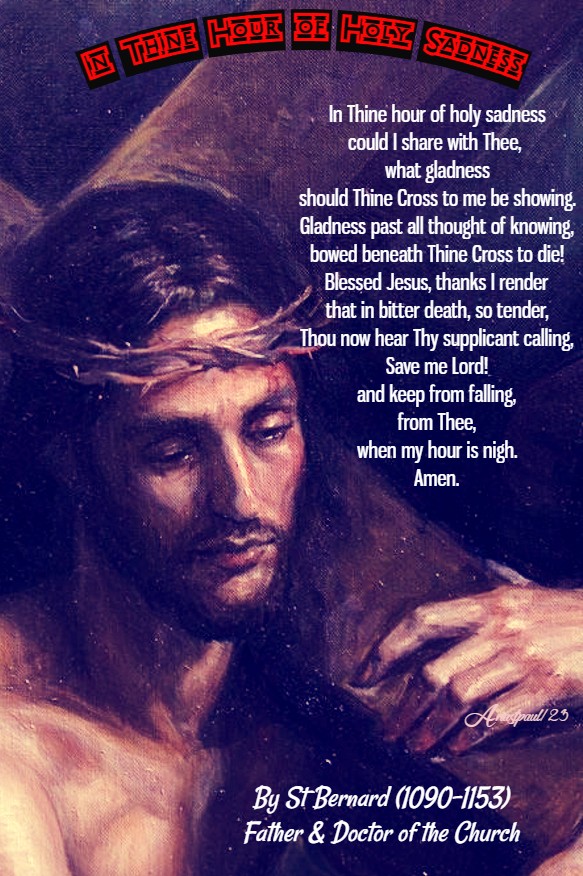
In Thine Hour of Holy Sadness By St Bernard (1090-1153) Father & Doctor of the Church
In Thine hour of holy sadness could I share with Thee, what gladness should Thine Cross to me be showing. Gladness past all thought of knowing, bowed beneath Thine Cross to die! Blessed Jesus, thanks I render that in bitter death, so tender, Thou now hear Thy supplicant calling, Save me Lord! and keep from falling, from Thee, when my hour is nigh. Amen.
Saint of the Day – 22 September – Blessed Otto of Freising O.Cist. (c1111-1158) Bishop of Freising, Cistercian Priest and Abbot Historian, Reformer, Diplomatic Peace-maker, Defender of the Church, Crusader. Born between 1111 and 1114 in Klosterneuburg near Vienna, Austria and died at Morimond, Champagne, France, on 22 September, 1158 at the young age of 47 at the most. Also known as – Ottone. Additional Memorial – 7 September (Freising and Vienna).
Otto was as the fifth son of Leopold III, Margrave of Austria, by his wife Agnes, daughter of the Emperor Henry IV. By her first husband, Frederick I of Hohenstaufen, Duke of Swabia, by whom she was widowed, Agnes was the mother of the German King, Conrad III and grandmother of the Emperor, Frederick I. Otto’s sister, Judith, was married to Marquess William V of Montferrat. Otto was thus related to the most powerful families in Germany and northern Italy.
Like his younger brothers, he was destined for the Priesthood and when a very young adult, he was made Provost of the Chapter of Canons at Klosterneuberg. For his education, he was sent to the University of Paris, the centre of learning, philosophical, theological and classical.
Whilst travelling towards his homeland after completing his studies, he together with fifteen colleagues, all noblemen, entered the Cistercian Order at Morimond. It is not known what led him to take this step but it seems, by the attendance of his friends that they had contemplated, discussed and spent time in prayer before making this decision. Within three years Otto was elected Abbot of the Monastery. In 1133, Otto now convinced his father to found Heiligenkreuz Abbey, thus bringing literacy and sophisticated agriculture (including wine making) to the region that would become Vienna.
Probably in 1137 or 1138, Otto was called to Freising as Bishop, although he did not lay aside the Habit of his Order.
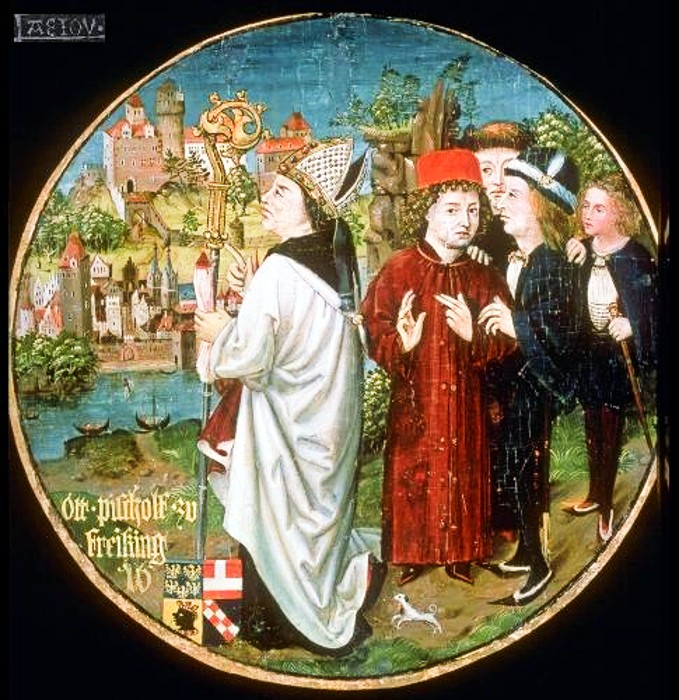
Painting of Blessed Otto of Freising by Hans Part in the Babenberger Stammbaum, ca. 1490, Stift Klosterneuburg. The Bishop is looking at the Cathedral and the City of Freising from the east bank of the Isar river.
As Bishop, Otto displayed a highly beneficent activity by founding and reforming Monasteries and zealously furthering studies by introducing Aristotelian philosophy and scholastic disputations on the model of the University of Paris. As a result, the school at Freising flourished anew.
He removed many of the abuses which had slowly infiltrated the Church and the secular institutions, in consequence of the investiture strife and demanded the return of the properties of which the Church had been robbed. In every way, Ottoe raised the prestige of the Church in Freising as against the nobility and after bitter struggles, freed it from the burdensome jurisdiction of certain Count. As Prince of the German Empire and closely connected with the Hohenstaufen family, he possessed great influence and used his high standing to obtain relief for the Church.
He was especially active in bringing about a reconciliation between Frederick and Henry and in restoring peace between the Emperor and the Pope.
In 1147 he accompanied King Conrad III on his unsuccessful Crusade to the Holy Land. The military division entrusted to Otto was completely routed and he, himself returned home after undergoing the severest privations and facing the greatest dangers. In 1158, due to ill health, Otto was forced to abandon his preposed accompaniment of Emperor Frederick on his march into Italy.
Otto is considered one of the most important historions of the High Middle Ages. Thanks to his excellent education and his noble position, he had access to numerous documents and information on history and politics. His works do not aim to be mere records but above all, to proclaim theological, philosophical and political messages. His “Chronica sive Historia de duabus civitatibus” (The Chronicle or History of the Two States) contains the history of the world in seven books and a vision of the Last Judgment in the eighth book. Otto writes this work as a theological continuation of St Augustine’s “De civitate Dei.” In contrast to St Augustine, Otto sees the Civitas Dei already realised on earth: it consists in the harmony of spiritual and secular power.
From 1156 onwards, Otto wrote the first two books of the “Gesta Friderici Imperatoris” (The Deeds of Emperor Frederick). In them he reproduces several imperial documents in their wording. Above all, he highlights the work of Emperor Friedrich Barbarossa. But this latter work is not confined to Germanic affairs, as tOtto digresses to tell of the preaching of St Bernard of Clairvaux and of his zeal against the heretics. Before his death, Otto commissioned his loyal secretary and Chaplain, Fr Rahewin (Died c1177) to complete this work.
On the way to the General Chapter in 1158 in Cîteaux, Bishop Otto reached his Monastery, Morimond, already ill. He died there surrounded by his monastic brothers. Otto’s body was buried in the Abbey Church of Morimond. Under the Sacramental Altar of the Cistercian Abbey Church of Heiligenkreuz, the bones, which were discovered in 1954 in the ruins of the Morimond Abbey Church and examined from 1966 to 1969 by the Anthropological Department of the Natural History Museum in Vienna, are venerated as Relics of Blessed Otto.
Otto is named as a Blessed with a Memorial day of 7 September in the Archdioceses of Vienna and Munich-Freising and in some Cistercian Monasteries, his memorial day is also celebrated on 7 September.
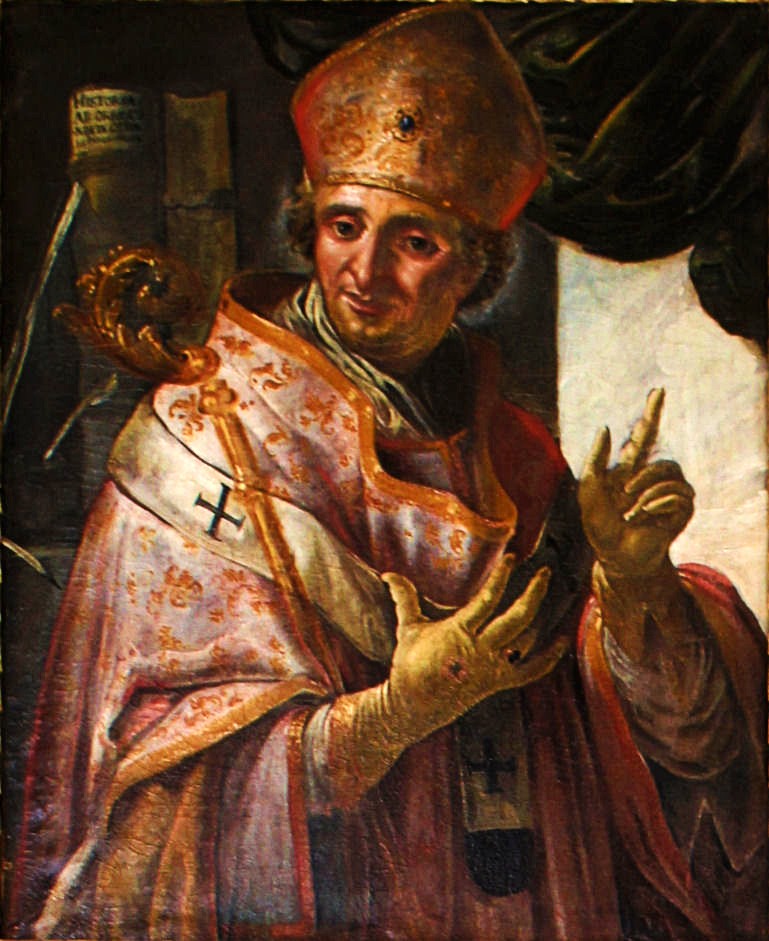
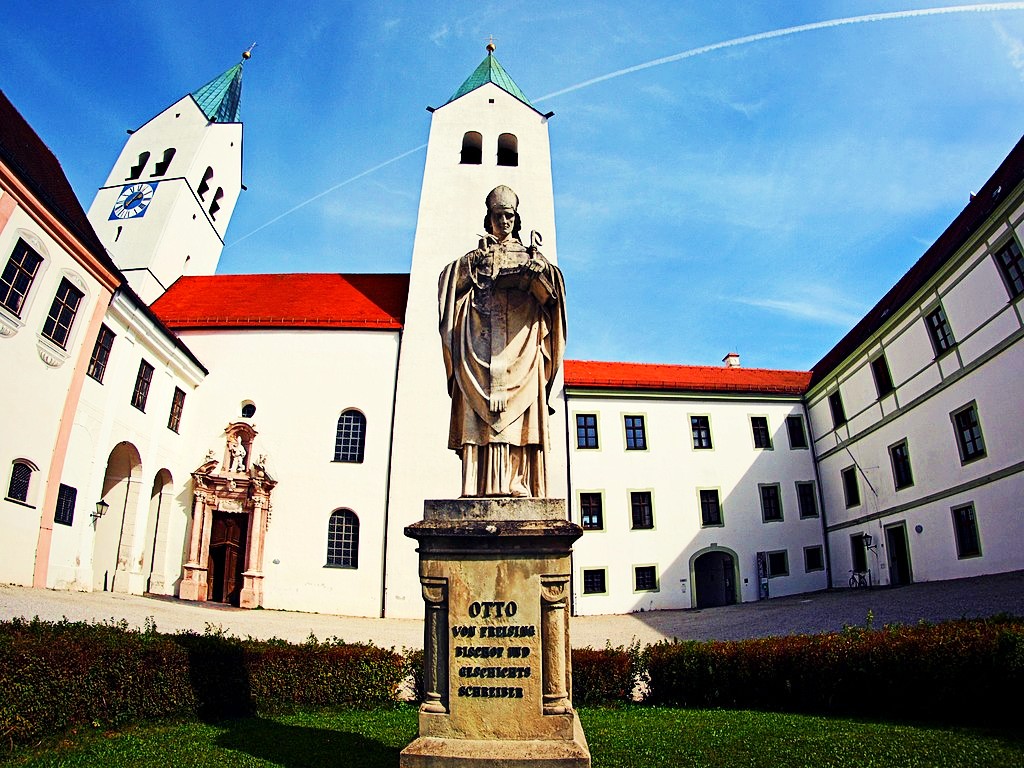
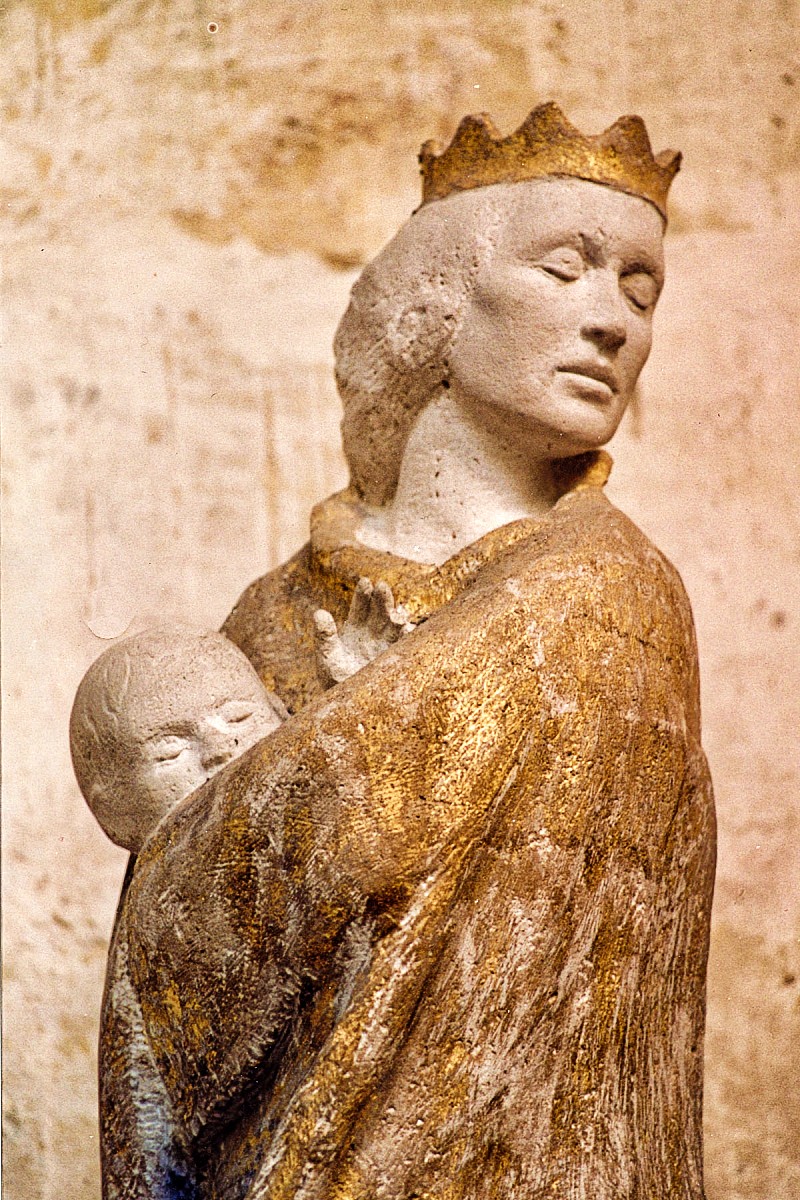
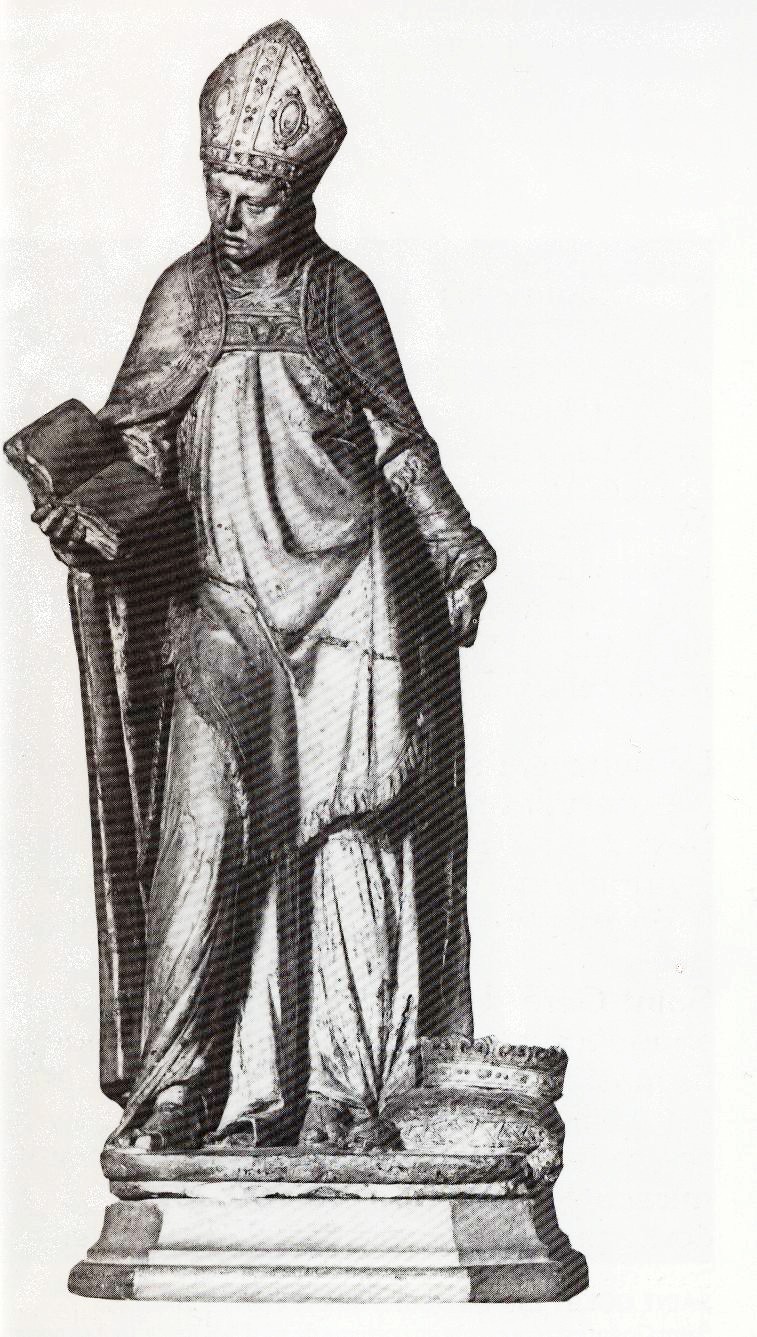
The Statue below is situate at Weihenstephan Abbey which was founded by Bl Otto’s father at Otto’s request. Sadly, it is no longer a working Monastery but it still produces beer and is the oldest brewery in the world.
St Thomas of Villanueva/Villanova OSA (1488-1555) Archbishop, Confessor, Religious Priest of the Order of St Augustine,Writer, Preacher, Teacher, Apostle of Charity, Mystic, Miracle-Worker often called “the Almsgiver” and “the Father of the Poor“, Reformer. Canonised on 1 November 1658 by Pope Alexander VII. About St Thomas here: https://anastpaul.com/2017/09/22/saint-of-the-day-22-september-st-thomas-of-villanova-o-s-a/
St Maurice & Companions: Martyrs of the Theban Legion: + Martyrs (c 287) A Roman imperial legion of 6,600 soldiers, all of whom were Christians; they had been recruited from the area around Thebes in Upper Egypt, were led by Saint Maurice and served under Emperor Maximian Herculeus. Around the year 287, Maximian led the army across the Alps to Agaunum, an area in modern Switzerland, in order to suppress a revolt by the Bagandre in Gaul. In connection with battle, the army offered public sacrifices to the Roman gods; the Theban Legion refused to participate. For refusing orders, the Legion was decimated – one tenth of them were executed. When the remainder refused to sacrifice to the gods, they were decimated again. When the survivors still refused to sacrifice, Maximinian ordered them all killed. Martyrs. https://anastpaul.com/2018/09/22/saints-of-the-day-22-september-st-maurice-and-the-martyrs-of-the-theban-legion-martyrs-c-287/
Bl Alfonso da Cusco St Basilia St Digna of Rome St Emerita of Rome St Emmeramus St Florentius the Venerable
Thought for the Day – 21 September – Meditations with Antonio Cardinal Bacci (1881-1971)
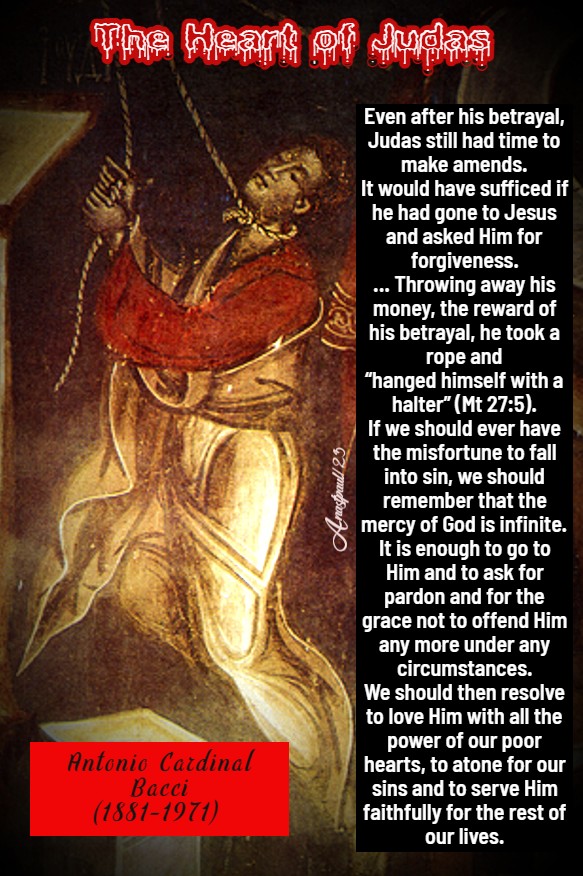
The Heart of Judas
“Even after his betrayal, Judas still had time to make amends. It would have sufficed if he had gone to Jesus and asked Him for forgiveness. He would certainly have received the kiss of peace. He was overcome by despair, however and decided that his sin was too great to be forgiven. So, throwing away his money, the reward of his betrayal, he took a rope and “hanged himself with a halter” (Mt 27:5).
If we should ever have the misfortune to fall into sin, we should remember that the mercy of God is infinite.
It is enough to go to Him and to ask for pardon and for the grace not to offend Him any more under any circumstances. We should then resolve to love Him with all the power of our poor hearts, to atone for our sins and to serve Him faithfully for the rest of our lives.”
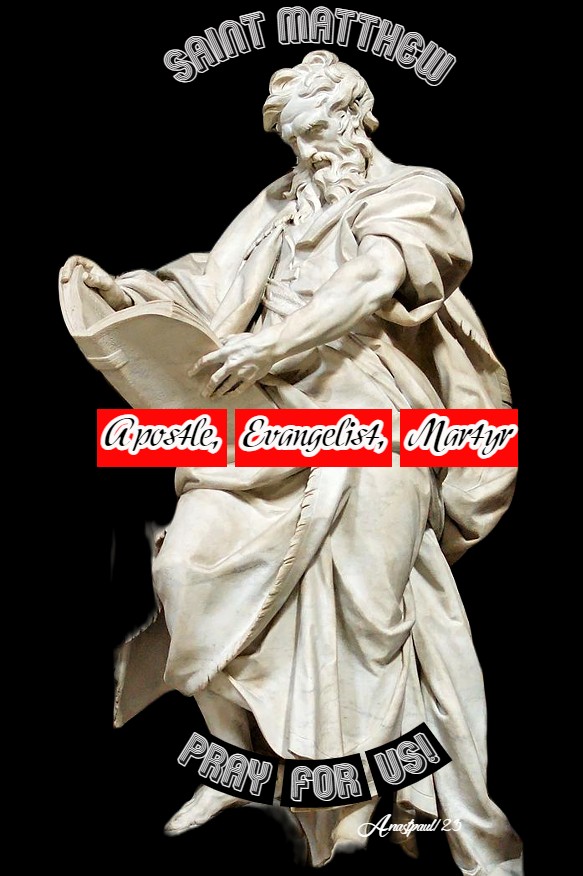
Quote/s of the Day – 21 September – The Feast of St Matthew, Apostle and Evangelist, Martyr
“For, as Scripture says, “The first living creature was like a lion,” (Rev 4:7) symbolising His effectual working, His leadership and Royal Power; “the second was like a calf,” signifying His Sacrificial and Priestly order but, “the third had, as it were, the face as of a man,” – an evident description of His coming as a human being; “the fourth was like a flying eagle,” pointing out the gift of the Spirit hovering with its wings over the Church. And, therefore, the Gospels of Mark, Luke, Matthew and John are in accord with these living things, among which Christ Jesus is seated. …”
St Irenaeus (c130-c202) Bishop, Martyr, Father
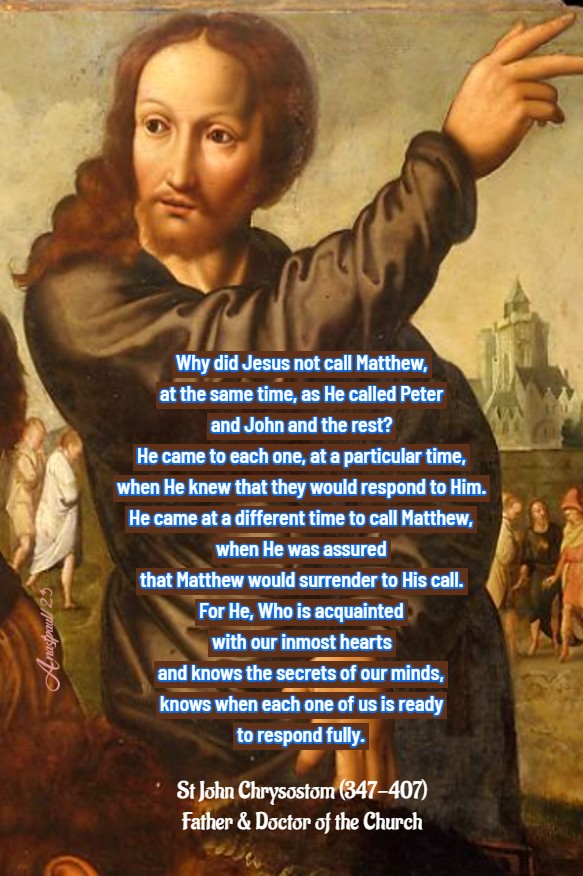
“Why did Jesus not call Matthew, at the same time, as He called Peter and John and the rest? He came to each one, at a particular time, when He knew that they would respond to Him. He came at a different time to call Matthew, when He was assured that Matthew would surrender to His call. For He, Who is acquainted with our inmost hearts and knows the secrets of our minds, knows when each one of us is ready to respond fully.”
St John Chrysostom (347-407) Father & Doctor of the Church
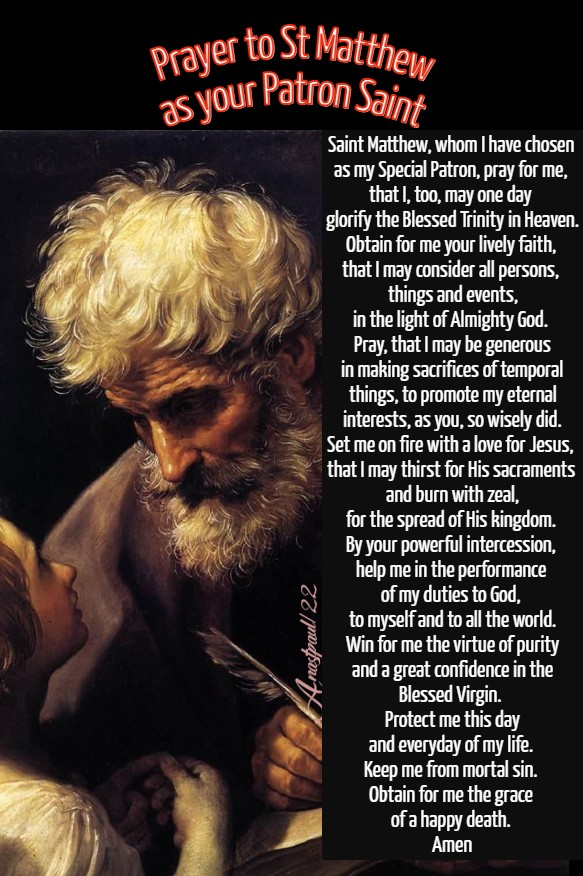
Prayer to St Matthew as your Patron Saint
Saint Matthew, whom I have chosen as my Special Patron, pray for me, that I, too, may one day glorify the Blessed Trinity in Heaven. Obtain for me your lively faith, that I may consider all persons, things and events, in the light of Almighty God. Pray, that I may be generous in making sacrifices of temporal things, to promote my eternal interests, as you, so wisely did. Set me on fire with a love for Jesus, that I may thirst for His sacraments and burn with zeal, for the spread of His kingdom. By your powerful intercession, help me in the performance of my duties to God, to myself and to all the world. Win for me the virtue of purity and a great confidence in the Blessed Virgin. Protect me this day and everyday of my life. Keep me from mortal sin. Obtain for me the grace of a happy death. Amen
One Minute Reflection – 21 September – “Month of The Seven Sorrows of the Blessed Virgin Mary and The Holy Cross” – The Feast of St Matthew, Apostle and Evangelist, Martyr – Ezekiel 1:10-14, Matthew 9:9-13– – Scripture search here: https://www.drbo.org/
“Why does your Master eat with publicans and sinners? ” – Matthew 9:11
REFLECTION – “Our Lord chose Matthew, the Tax Collector, to encourage his fellows to join him. He looked on sinners, called them and brought them to sit beside Him. What a wonderful sight! Angels stand trembling while Publicans, seated, rejoice! The Angels are struck with awe before the Lord’s greatness, while sinners eat and drink with Him! The Scribes choke with hatred and indignation, the Publicans rejoice because of his mercy. The heavens saw the sight and were filled with wonder; hell saw it and was maddened. Satan saw it and was enraged; death saw it and withered; the Scribes saw it and were much troubled.
There was joy in Heaven and happiness among the Angels because the rebellious had been persuaded, the recalcitrant quieted and sinners reformed and because, Publicans had been made righteous. Just as our Lord did not turn away from the shamefulness of the Cross, in spite of the entreaties, of His friends (Mt 16:22) so, He did not refuse the company of Publicans in spite of the taunts of His enemies. He despised mockery and scorned praise, thus, accomplishing all that is for mankind’s good!” – St Ephrem (306-373) Deacon in Syria, Father and Doctor of the Church (Commentary on the Gospel).
PRAYER – May we be helped, O Lord, by the prayers of the blessed Apostle and Evangelist, Matthew that what we ourselves cannot obtain, maybe granted by his intercession. Through Jesus Christ, Thy Son our Lord, Who lives and reigns with Thee, in the unity of the Holy Ghost, God, world without end. Amen (Collect).
Our Morning Offering – 21 September – Feast of St Matthew – Apostle and Evangelist
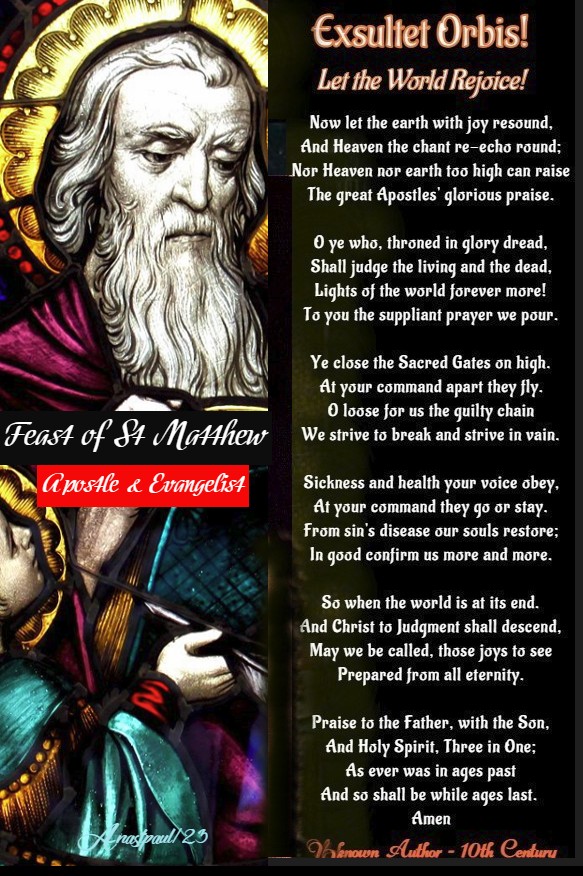
Exsultet Orbis! Let the World Rejoice! Unknown Author
Now let the earth with joy resound, And Heaven the chant re-echo round; Nor Heaven nor earth too high can raise The great Apostles’ glorious praise.
O ye who, throned in glory dread, Shall judge the living and the dead, Lights of the world forever more! To you the suppliant prayer we pour.
Ye close the Sacred Gates on high. At your command apart they fly. O loose for us the guilty chain We strive to break and strive in vain.
Sickness and health your voice obey, At your command they go or stay. From sin’s disease our souls restore; In good confirm us more and more.
So when the world is at its end. And Christ to Judgment shall descend, May we be called, those joys to see Prepared from all eternity.
Praise to the Father, with the Son, And Holy Spirit, Three in One; As ever was in ages past And so shall be while ages last. Amen
(Roman Breviary for the Common of Apostles) An Office Hymn that was traditionally prescribed for Vespers and Lauds on the Feasts of Apostles and Evangelists outside Easter time. The Hymn is found as early as the 10th Century in a Hymnal of Moissac Abbey.
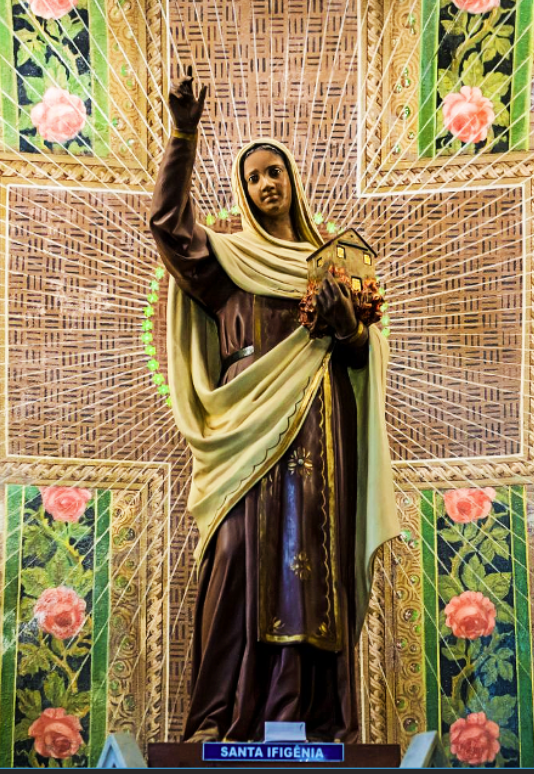
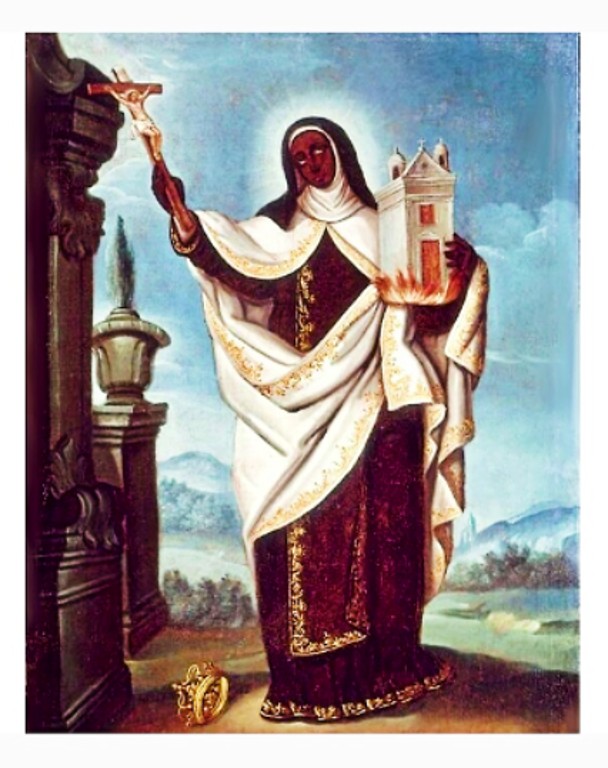
Saint of the Day – 21 September – Saint Iphigenia of Ethiopia (1st Century) Virgin, Princess, Abbess, Converted, Baptised and Consecrated to God by St Matthew, the Apostle and Evangelist and sharing his Feast day today. Also known as – Ephigenia, Iphigenia of Abyssinia.
The Roman Martyrology reads today: “In Ethiopia, St Iphigenia, virgin, who being Baptised and Consecrated to God by the blessed Apostle, St Matthew, ended her holy life in peace.”
Iphigenia was born a Princess to the Royal House of Ethiopia in the 1st Century. As a nation steeped in the paganism of the era, Ethiopia was to become witness to St Matthew the Apostle and Evangelist, who spread the Gospel there and converted much of the people.
Although we know little for certain about the events that transpired, an idea of her conversion and the efforts of the Apostle can be garnered from the 13th Century, “Golden Legend” by Blessed James of Voragin OP c1226-1298) the Archbishop of Genoa. Originally in Latin, it was the most widely read book during the late Middle Ages. This legend gives detail to St Matthew’s travels in Africa – his story is closely bound to the Princess Iphigenia.
“The Ethiopian King, at the time of St Matthew’s arrival, was named Egippus. He sent for all the men in his Provinces saying to them: “Come and see ye God in the likeness of a man.” Upon this, the people came with crowns of gold and divers manner of sacrifices and would have sacrificed to him. St Matthew beheld them and said: “What do ye men? I am not God but I am servant of our Lord.“
[Therefore, from the resources brought, they instead built a Church for the glory and honour of the Lord]. In which Church the Apostle sat three and thirty years and converted all Ethiopia to the Faith of Christ. The King Egippus, with his wife and his daughter,Iphigenia and all the people, were Baptised. And then the apostle hallowed to God Iphigenia the King’s daughter and made her mistress and governess of more than two hundred virgins.
And after this, Hirtacus succeeded to the King and coveted the said virgin Iphigenia and the Apostle said to him that after the custom of his predecessor, he should come on the Sunday to the Church and Iphigenia being present with the other virgins, he should hear what he should say of the goodness of lawful marriage.
And when the virgins and all the people were assembled, he spoke long of good and lawful matrimony and he made rehearsal of his sermon saying that marriage is good if it be truly held by good alliance. But ye that be here, know ye well that if any servant would take the wife of a king wedded, he should not only run to the offence of the king but above that, he should deserve death and not for to wed her but for that he in so taking the spouse of his lord should corrupt the marriage joined. And thou the king that knew that Iphigenia is made the spouse of the King perdurable [eternal] and is sacred with the holy veil, how mayst thou take the wife of a more puissant [powerful] king and couple her to thee by marriage?
And when the King heard this he began to enrage and departed [in a] frantic rage. And the Apostle without dread confirmed all the others to patience. And Iphigenia, Iying before him for dread, he blessed and all the other virgins too. And after the solemnities of the Mass, the King sent a tormentor, with a sword behind him, which slew Matthew, who was standing by the Altar holding up his hands unto Heaven and so was consecrated a Martyr.
[Following Hirtacus’ death sometime later] the people then established for to be King, the brother of Iphigenia whom the Apostle had Baptised too and reigned seventy years and established his son for to be King after him and increased much the honour of Christianity and replenished all Ethiopia with noble Churches of our Lord.”
St Alexander of the Via Claudia St Eusebius of Phoenicia St Gerulph St Iphigenia of Ethiopia 1st Century) Virgin converted by St Matthew, the Apostle and Evangelist St Isaac of Cyprus St Jonas the Prophet St Landelino of Ettenheim
St Maura of Troyes St Meletius of Cyprus St Pamphilus of Rome
Martyrs of Gaza – 3 Saints: Three brothers, Eusebius, Nestulus and Zeno, who were seized, dragged through the street, beaten and murdered by a pagan mob celebrating the renunciation of Christianity by Julian the Apostate. They were burned to death in 362 on a village garbage heap in Gaza, Palestine.
Thought for the Day – 20 September – Meditations with Antonio Cardinal Bacci (1881-1971)
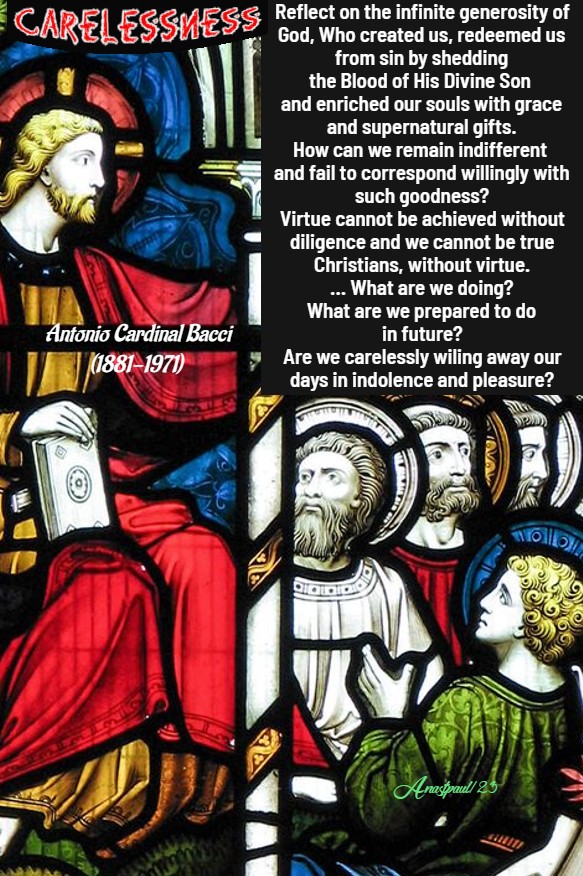
CARELESSNESS
“Reflect on the infinite generosity of God, Who created us, redeemed us from sin by shedding the Blood of His Divine Son and enriched our souls with grace and supernatural gifts. How can we remain indifferent and fail to correspond willingly with such goodness? Virtue cannot be achieved without diligence and we cannot be true Christians, without virtue. Let us consider the example given us by the Saints. They lived in a continual and prayerful union with God; they never refused any task or any sacrifice, in order to show their love for Jesus and their total dedication to His will; they made every effort to attract others towards holinesss and to bring about the triumph of the Kingdom of Christ in the world.
What are we doing? What are we prepared to do in future? Are we carelessly wiling away our days in indolence and pleasure?”
Quote/s of the Day – 20 September – Wisdom 5:16-20, Luke 6:17-23 – Scripture search here: https://www.drbo.org/
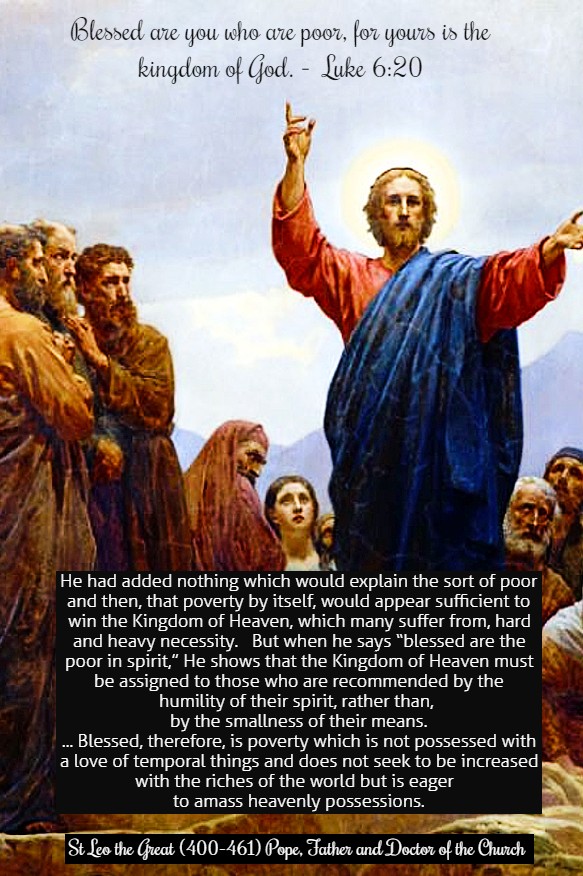
“Blessed are you who are poor, for yours is the Kingdom of God.”
Luke 6:20
“He had added nothing which would explain the sort of poor and then, that poverty by itself, would appear sufficient to win the Kingdom of Heaven, which many suffer from, hard and heavy necessity. But when He says “blessed are the poor in spirit,” He shows that the Kingdom of Heaven must be assigned to those who are recommended by the humility of their spirit, rather than, by the smallness of their means. Blessed, therefore, is poverty which is not possessed with a love of temporal things and does not seek to be increased with the riches of the world but is eager to amass heavenly possessions.”
St Leo the Great (400-461) Pope, Father and Doctor of the Church
“True humility consists in persuading and convincing oneself that without God, we are insignificant and despicable and, in accepting to be treated as such!”
St Ignatius Loyola SJ (1491-1556)
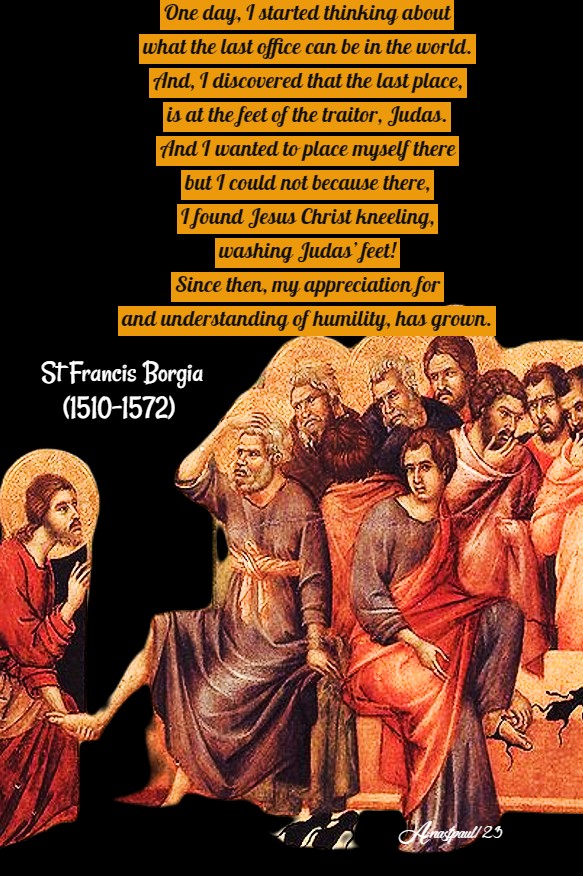
“One day, I started thinking about what the last office can be in the world. And, I discovered that the last place, is at the feet of the traitor, Judas. And I wanted to place myself there but I could not because there, I found Jesus Christ kneeling, washing Judas’ feet! Since then, my appreciation for and understanding of humility, has grown.”
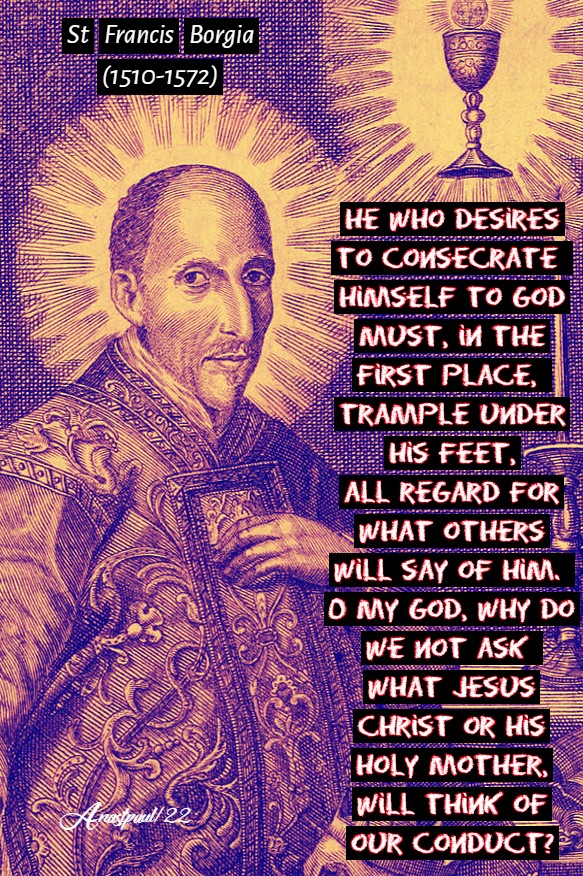
“He who desires to consecrate himself to God must, in the first place, trample under his feet, all regard for what others will say of him. O my God, why do we not ask what Jesus Christ or His holy Mother, will think of our conduct?”
One Minute Reflection – 20 September – “Month of The Seven Sorrows of the Blessed Virgin Mary and The Holy Cross” – The Vigil of St Matthew, Apostle and Evangelist – Wisdom 5:16-20, Luke 6:17-23 – Scripture search here: https://www.drbo.org/
“And He, lifting up His eyes on His disciples, said: Blessed are you …” – Luke 6:20
REFLECTION – “Lord Jesus Christ, to teach us the summit of virtue, You ascended the mountain with Your disciples and taught them the Beatitudes and highest virtues, promising them the rewards applicable to each. Grant that my weakness may hear Your Voice, that I may apply myself, through their practice, to acquire the merit of the virtues, so that by Your Mercy, I may receive the promised reward. As I consider the payment, do not let me refuse the effort of the labour. Make my hope of eternal salvation, sweeten the bitterness of the cure, inflaming my soul with the splendour of Your work. Out of the wretched person I am, create one of the blessed; from the blessedness here below, lead me, by Your Grace, to the blessedness of the homeland.
Come, Lord Jesus Christ, in search of Your servant, seeking Your erring and exhausted sheep. Come, Spouse of the Church, in search of Your lost coin. Come, Father of mercies, welcome the prodigal son returning to You. Come, then, Lord, for You are the only One, able to call back the sheep that has strayed, to find the lost drachma, to reconcile the runaway son. Come, that there may be salvation on earth and joy in Heaven! Turn me towards You and grant that I may carry out a true and perfect repentance, so that I may become an occasion for joy, among the Angels. Sweetest Jesus, I pray Thee, by the immensity of Thine Love for me, a sinner, grant that I may love Thee alone, above all things, that I may be consoled by none but Thee, my sweetest God!” – Ludolph of Saxony (c1300-1378) Monk, Theologian, Writer, Dominican then a Carthusian (Prayers to Jesus Christ).
PRAYER – Grant, we beseech Thee, Almighty God that the worshipful Feast of Thy blessed Apostle and Evangelist, St Matthew, on the eve whereof we now stand, may avail us, to the increase, both of godliness toward Thee and of health to our own souls. Through Jesus Christ, Thy Son our Lord, Who lives and reigns with Thee, in the unity of the Holy Ghost, God, world without end. Amen (Collect).
Our Morning Offering – 20 September – “Month of The Seven Sorrows of the Blessed Virgin Mary and The Holy Cross”
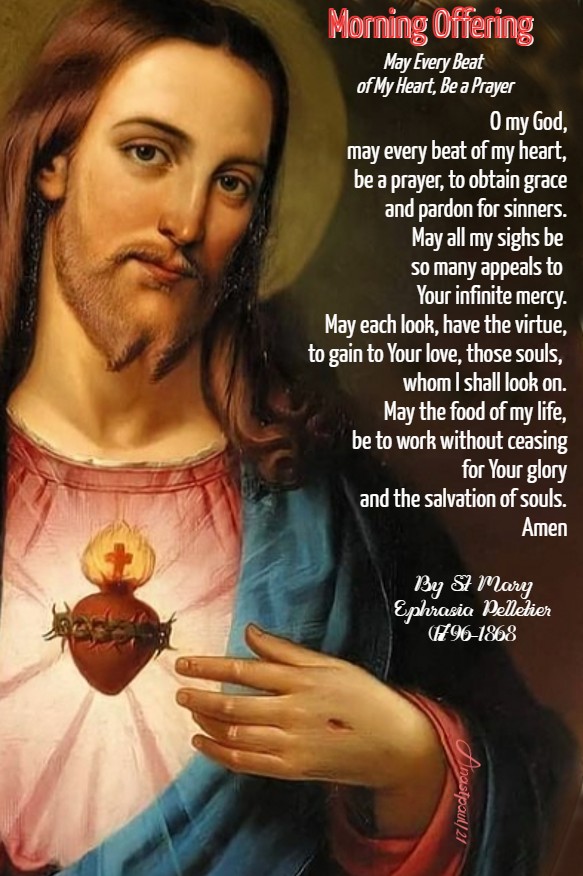
Morning Offering May Every Beat of My Heart Be a Prayer By St Mary Euphrasia Pelletier (1796-1868)
O my God, may every beat of my heart, be a prayer, to obtain grace, and pardon for sinners. May all my sighs, be so many appeals, to Your infinite mercy. May each look, have the virtue to gain to Your love, those souls, whom I shall look on. May the food of my life, be to work without ceasing for Your glory and the salvation of souls. Amen
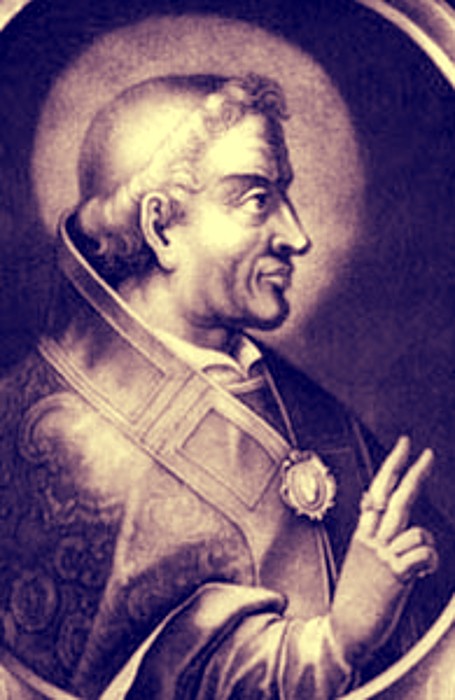
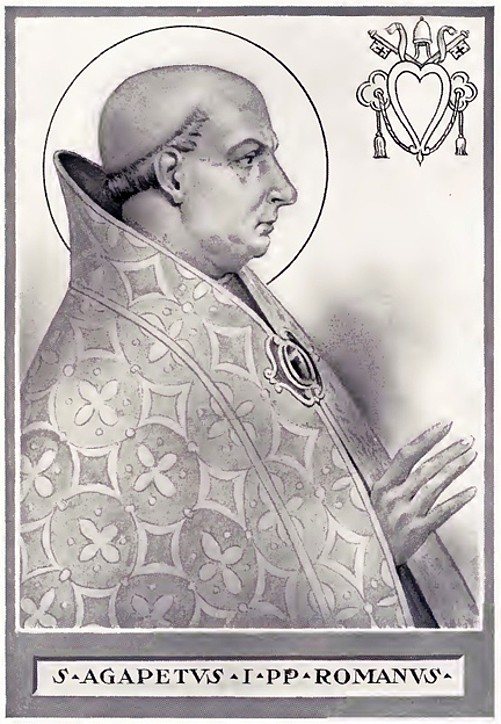
Saint of the Day – 20 September – St Pope Agapetus I (c489-536) the 57th Bishop of Rome Papal Reign from 13 May 535 – 22 April 536. Agapetus was born in Rome, although his exact date of birth is unknown. He was the son of Gordianus, a Roman Priest who had been slain during the riots in the days of Pope Symmachus (term 498–514). The name ‘Gprdianus’ might point to a familial relationship with 2 Popes – Felix III (Reign – 483–492) and Gregory I the GREAT (Reign – 590–604).
Agapetus was Ordained as a Deacon perhaps as early as 502, then elevated to Archdeacon and from there to Suprme Pontiff on 13 May 535.
As Pope, he confirmed the Decrees of the Council held at Carthage, after the liberation of Africa from the Vandal yoke, according to which, converts from Arianism were declared ineligible to Holy Orders and those already Ordained, were merely admitted to lay communion.
Agapetus assisted the Servant of God, Senator Cassiodorus, in the founding of his Monastery, named Vivarium in Calabria, Italy.
He accepted an appeal from Contumeliosus, Bishop of Riez in France, whom a Council at Marseilles had condemned for immorality and he ordered St Caesarius of Arles, the Archbishop, to grant the accused a new trial before Papal delegates, the outcome we believe went against Bishop Contumeliosus.
During his short Papacy, the Byzantine Empire, under the helm of General Belisarius, looked to invade Italy. It was the Ostrogothic King, Theodahad who informed Pope Agapetus of this. Following his advice, Agapetus and five Bishops, left in winter to meet with the Byzantine Emperor Justinian I. They made it to Constantinople in February of 536. Unfortunately, Emperor claimed he could not prevent Belisarius.
Seeing the situation as a religious issue and not as a political problem, Agapetus sought out the Byzantine Patriarch, Anthimus I. Things quickly unraveled into a heated debate of faith and power. Agapetus questioned Anthimus I’s faith, demanding a written confession of faith and that he resign as Patriarch. When Anthimus refused, Agapetus further and more vigorously questioned him. To this, Emperor Justinian I said he would banish the Pope if need be!
Agapetus replied with spirit: “With eager longing have I come to gaze upon the Most Christian Emperor Justinian. In his place I find a Diocletian, whose threats, however, terrify me not!” This intrepid language made Justinian pause and being finally convinced that Anthimus was unsound in faith, he made no objection to the Pope’s exercising the plenitude of his powers in deposing and suspending the intruder and, for the first time in the history of the Church, personally Consecrating his legally elected successor, Mennas. This memorable exercise of the Papal prerogative was not soon forgotten by the Orientals, who, together with the Latins, venerate him as a Saint even before death.
In order to clear himself of every suspicion of abetting heresy, Justinian delivered, to the Pope, a written confession of faith which the latter accepted with the judicious proviso that “although he could not admit, in a layman. the right of teaching religion, yet, he observed, with pleasure that the zeal of the Emperor was in perfect accord, with the decisions of the Fathers.”
Shortly afterwards, Agapetus fell ill and died, after a glorious and very busy reign of just ten months. His remains were brought in a leaden coffin to Rome and deposited in St Peter’s. His memory is kept on 20 September, the day of his deposition.
St Pope Agapetus I (c489-536) Bishop of Rome Papal Reign from 13 May 535 – 22 April 536 St Candida of Carthage St Clicerius of Milan Bishop St Dionysius of Phrygia St Dorimedonte of Synnada St Eusebia of Marseilles St Evilasius of Cyzicum St Fausta of Cyzicum St Glycerius of Milan Bl John Eustace St Priscus
Martyrs of Constantinople – 3 Saints: A Priest and two Bishops who were imprisoned, tortured and Martyred for the defence of icons in the iconoclast persecutions of Emperor Leo the Isaurian. – Andrea, Asiano and Hypatius. They were Martyred in 735 in Constantinople (modern Istanbul, Turkey) and their bodies were thrown to the dogs.
Martyrs of Pergen – 6 Saints: A group of lay people Martyred in the persecutions of Emperor Elagabalus. The names that have come down to us are Dionysius, Dioscorus, Philippa, Privatus, Socrates and Theodore. They were crucified c 220 at Pergen, Pamphylia, Asia Minor (in modern Turkey).
Thought for the Day – 19 September – Meditations with Antonio Cardinal Bacci (1881-1971)
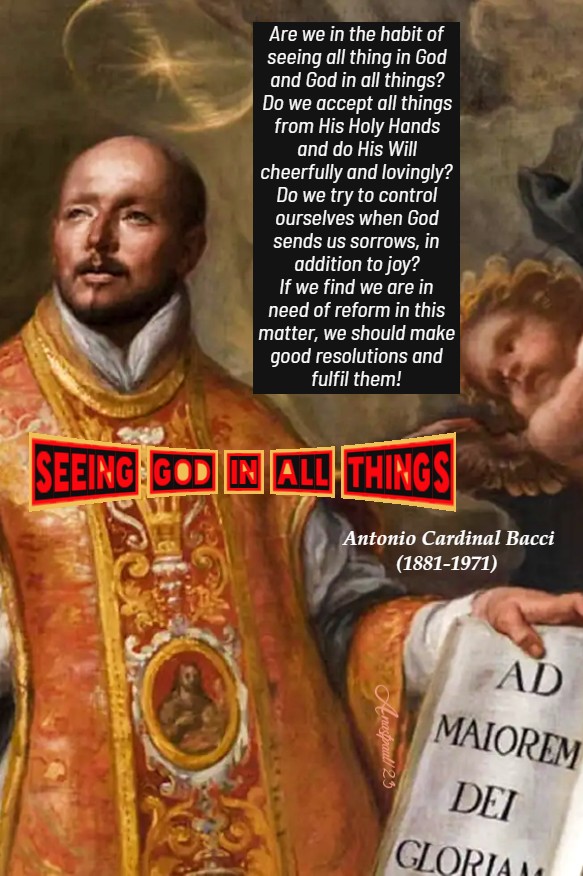
Seeing God in All Things
“Are we in the habit of seeing all thing in God and God in all things? Do we accept all things from His Holy Hands and do His Will cheerfully and lovingly?
Do we try to control ourselves when God sends us sorrows, in addition to joy? If we find we are in need of reform in this matter, we should make good resolutions and fulfil them!”
Quote/s of the Day – 19 September – Hebrews 10:32-38, Matthew 24:3-13 – Scripture search here: https://www.drbo.org/
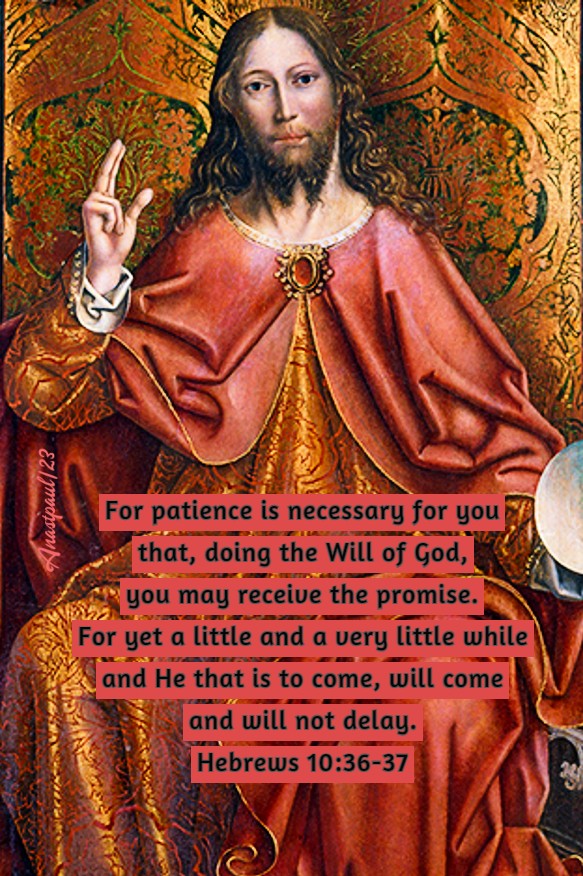
“For patience is necessary for you that, doing the Will of God, you may receive the promise. For yet a little and a very little while and He that is to come, will come and will not delay.”
Hebrews 10:36-37
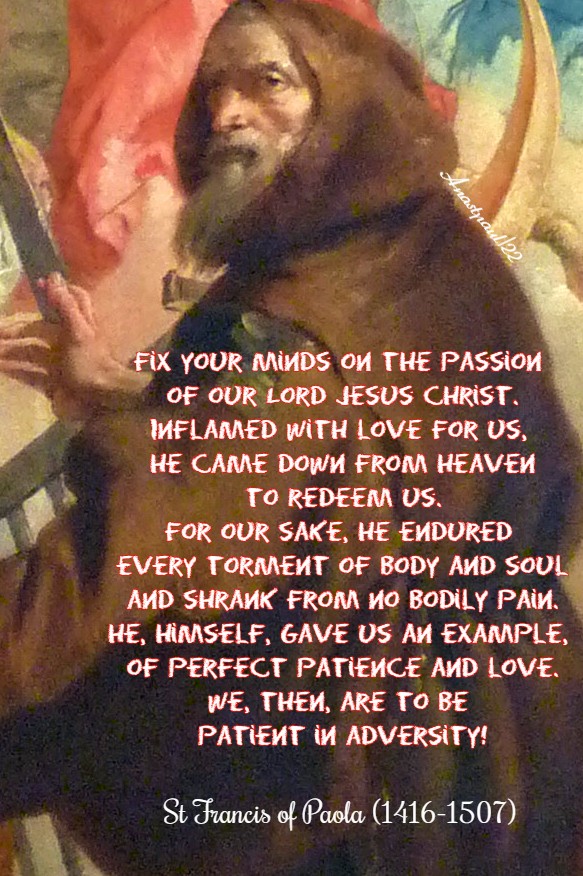
“Fix your minds on the Passion of our Lord Jesus Christ. Inflamed with love for us, He came down from Heaven to redeem us. For our sake, He endured every torment of body and soul and shrank from no bodily pain. He, Himself, gave us an example of perfect patience and love. We, then, are to be patient, in adversity!”
St Francis of Paola (1416-1507)
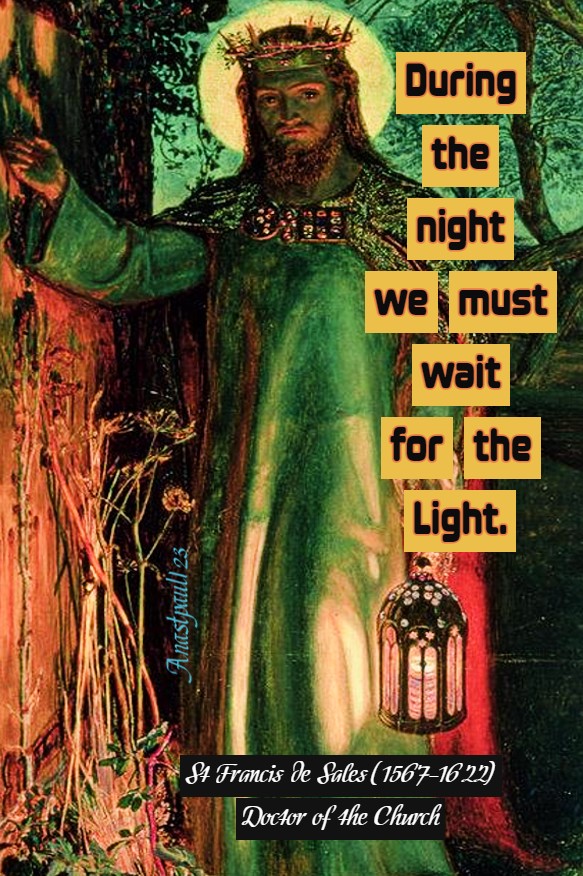
“During the night we must wait for the Light.”
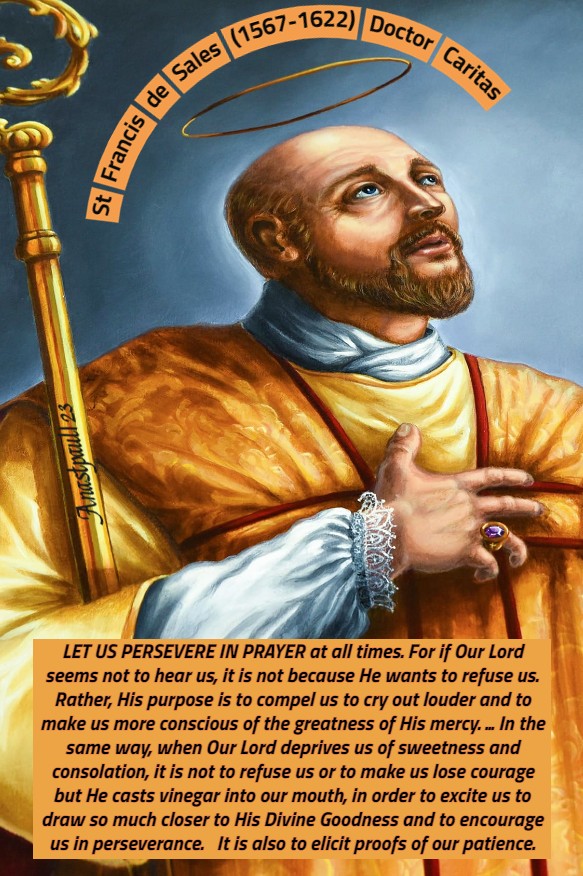
“LET US PERSEVERE IN PRAYER at all times. For if Our Lord seems not to hear us, it is not because He wants to refuse us. Rather, His purpose is to compel us to cry out louder and to make us more conscious of the greatness of His mercy. … In the same way, when Our Lord deprives us of sweetness and consolation, it is not to refuse us or to make us lose courage but He casts vinegar into our mouth, in order to excite us to draw so much closer to His Divine Goodness and to encourage us in perseverance. It is also to elicit proofs of our patience.”
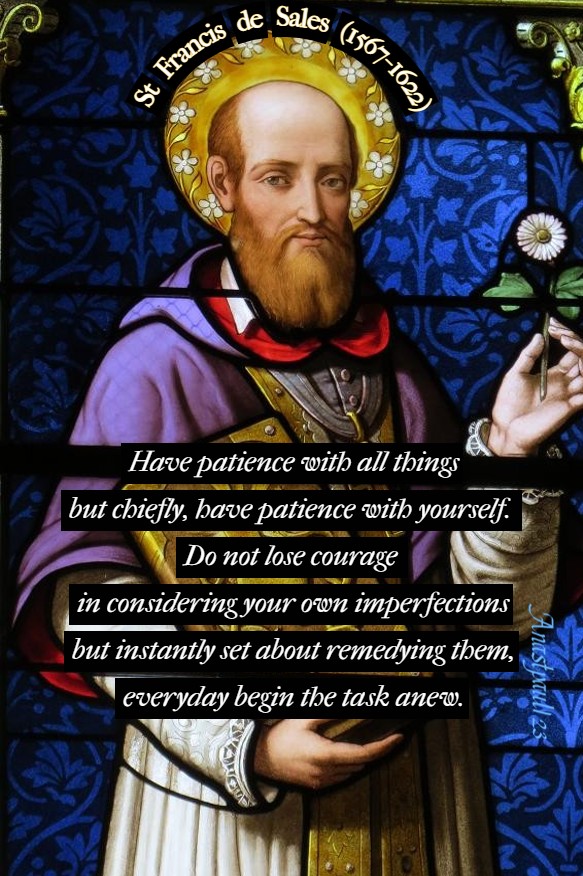
“Have patience with all things but chiefly, have patience with yourself. Do not lose courage in considering your own imperfections but instantly set about remedying them, everyday begin the task anew.”
St Francis de Sales (1567-1622) Doctor of the Church
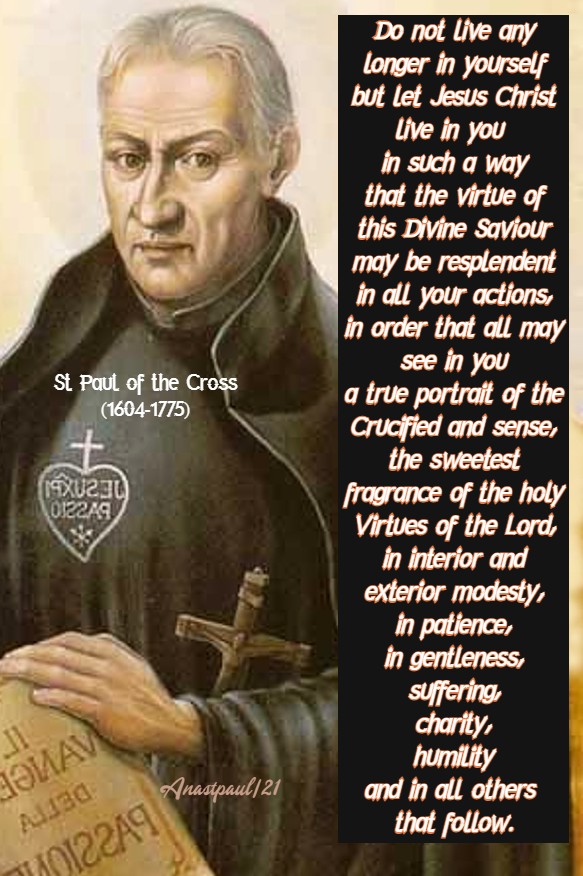
“Do not live any longer in yourself but let Jesus Christ live in you in such a way that the virtue of this Divine Saviour may be resplendent in all your actions, in order that all may see in you a true portrait of the Crucified and sense, the sweetest fragrance of the holy virtues of the Lord, in interior and exterior modesty, in patience, in gentleness, suffering, charity, humility and in all others that follow.”
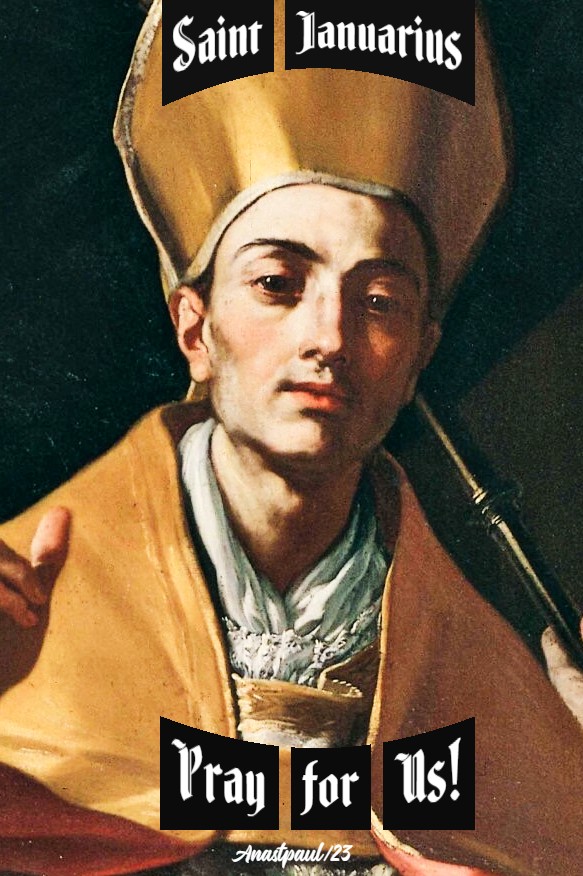
One Minute Reflection – 19 September – “Month of The Seven Sorrows of the Blessed Virgin Mary and The Holy Cross” – St Januarius of Naples (Died c304) Confessor, Bishop, Martyr and his Martyred Companions – Hebrews 10:32-38, Matthew 24:3-13 – Scripture search here: https://www.drbo.org/
“For yet a very little while and He, Who is to come, will come …” – Hebrews 10:37
REFLECTION – “ It is only right, my brothers, to celebrate our Lord’s coming with all possible devotion, so greatly does His comfort gladden us… and His love burn within us. But do not just think about His first coming, when He came “to seek and save the lost” (Lk 19:10); think, too, of that other coming when He will come to take us with Him. I should like to see you constantly occupied in meditating on these two comings… “resting among the sheepfolds” (Ps 67:14), for they are the two arms of the Bridegroom, in which the Bride of the Song of Songs took her rest: “His left arm is under my head and His right arm embraces me” (2:6)…
But, there is a third coming between the two, to which I have just referred and those who know of it, can rest in it, for their greater happiness. The other two are visible but this one is not. In the first, “ the Lord has appeared on earth and has spoken to us” (Bar 3:38)… in the last, “all mankind shall see the salvation of God” (Lk 3:6; Is 40:5)… But the one that comes between them is secret – it is that in which the elect alone see the Saviour within themselves and their souls find salvation.
In His first coming, Christ came in our flesh and in our weakness; in His coming in the midst of time, He comes in Spirit and power; in His final coming, He will come in His glory and majesty. But it is by the strength of the virtues that we attain to glory, as it is written: “The Lord, the King of armies, He is the King of glory” (Ps 23:10) and, in the same book: “That I may see Thy power and Thy glory” (Ps 62:3). And so, the second coming is like a road leading from the first to the last. In the first, Christ has been our Redemption; in the last, He will appear as our Life; in His coming between, He is our Rest and our Consolation!” – St Bernard (1091-1153) Cistercian Monk, The Last Father and Mellifluous Doctor of the Church (Sermons 4 and 5 for Advent).
PRAYER – O God, Who gladdens us by the annual festival of Thy Martyrs Januarius and Companions, grant that we, may be inspired by the example of those, in whose merits we rejoice.Through tJesus Christ, Thy Son our Lord, Who lives and reigns with Thee, in the unity of the Holy Ghost, God, world without end. Amen (Collect).
Our Morning Offering – 19 September – “Month of The Seven Sorrows of the Blessed Virgin Mary and The Holy Cross”
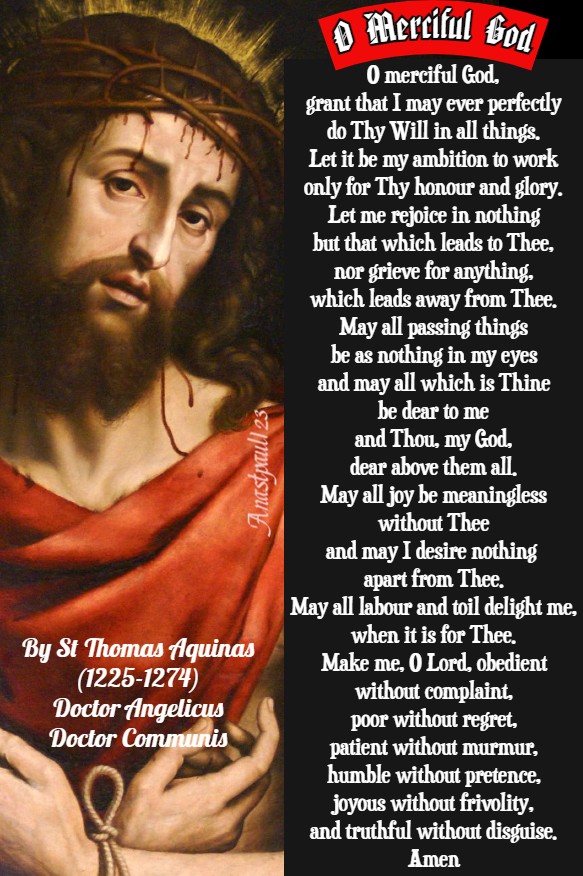
O Merciful God By St Thomas Aquinas (1225-1274) Doctor Angelicus Doctor Communis
O merciful God, grant that I may ever perfectly do Thy Will in all things. Let it be my ambition to work only for Thy honour and glory. Let me rejoice in nothing but that which leads to Thee, nor grieve for anything, which leads away from Thee. May all passing things be as nothing in my eyes and may all which is Thine be dear to me and Thou, my God, dear above them all. May all joy be meaningless without Thee and may I desire nothing apart from Thee. May all labour and toil delight me, when it is for Thee. Make me, O Lord, obedient without complaint, poor without regret, patient without murmur, humble without pretence, joyous without frivolity, and truthful without disguise. Amen
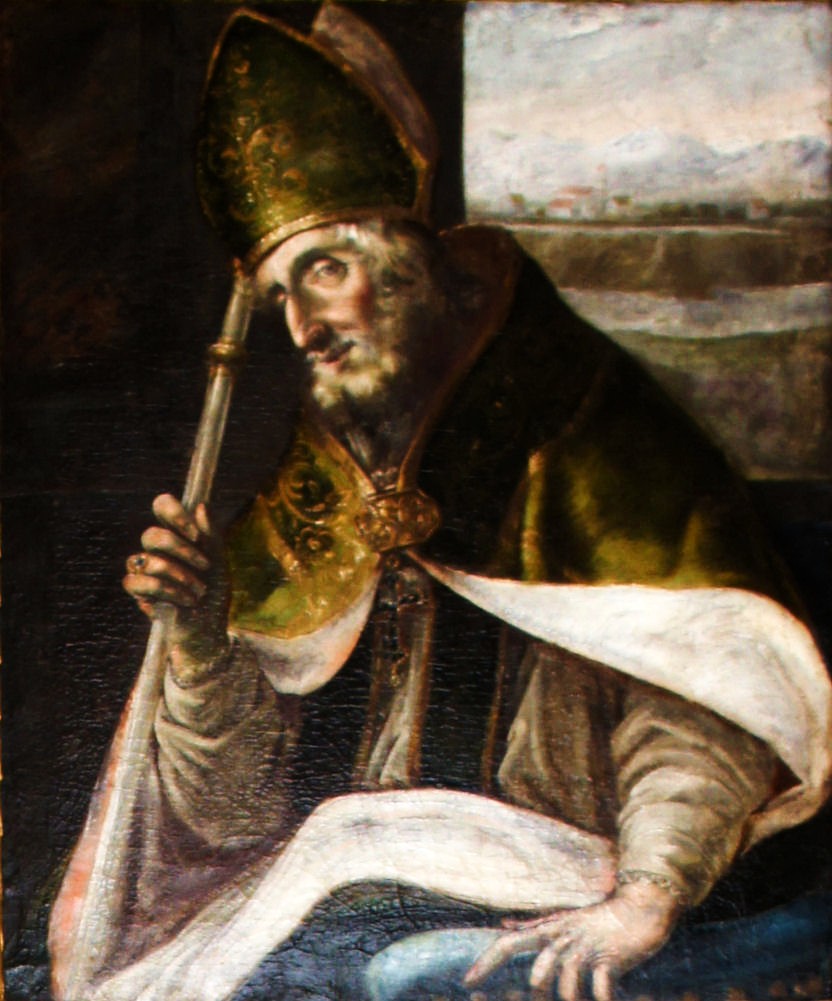
Saint of the Day – 19 September – Saint Goeric of Metz (c570-c643), Bishop of Metz. Goeric was married and a father, Courtier and Soldier of hjgh rank. In the official catalogues of the Diocese, Goeric is listed as the 30th Bishop of Metz, having governed that See from 625 to 642 or 643. Born in c570 in Aquitaine, Gaul and died in c643 in Metz, in today’s France, of natural causes. Also known as – Abbo I of Medtz, Abbone, Goerico, Goericus, Goëry, Goéry. Additional Memorial 15 April (Translation of Relics). In the Germanic Martyrologies, in that of Metz and other Cities of Gaul, he is remembered on 19 September as “Bishop and Confessor, admirable for holiness, amiable to his subjects.”
Goeric was born in Aquitaine, between 565 and 575, son, apparently, of Gamard and nephew of his predecessor Bishop, Saint Arnulf, whose remains he recognised in Remiremont in 641 and brought them back to Metz.
Goeric was a Courtier at the Court of King Dagobert I (628-639) and was married. He is said to have had two daughters – Vittorina and Precia (or Aprincia), the latter on whom, he himself imposed the veil of virginity as Bishop and, who later became a Saint.
According to all the documents that tell us about him, Goeric was a valiant warrior, he won numerous victories against the barbarians and thanks to his extraordinary skills as a Captain, he went through all the levels of his military career, reaching the highest dignities.
Being wounded in a clash, he lost his sight and that he bore this unhappiness with Christian patience. In response to what he felt was a supernatural command, he decided to make a pilgrimage to the Cathedral of St Stephen, the seat of the Bishop in Metz, where his uncle, Saint Arnulf (580-640), was the Bishop (613-628). He set off with his daughters Precia and Victorina. to guide him, and when they reached Metz, he went straight to the Church. There, he regained his sigh while praying. In gratitude, he decided to become a Priest and offer the rest of his life to God. The following year,, 628, when Arnulf resigned as Bishop, Goericus succeeded him in the Bishopric of Metz.
The Cathedral of St Stephen in Metz
Here he had the Church of St Pieter built. He was greatly honoured by King Dagobert, who named him in his will (636). Goeric enjoyed a vibrant correspondence with St Desiderius, Bishop of Cahors. As Bishop of Metz, Goeric founded a Nunnery at Epinal on the River Moselle, where his daughter St Precia became the first Abbess.
In the 10th Century, in Metz, there was a Church built in honour of St Goeric. A Breviary printed in Paris in 1535 and a Breviary of 1554, have an office composed by him.
In the 10th Century, his Relics were brought from Saint-Symphorien to Epinal. This event is commemorated in the local Calendar of Saints on 15 April.
Illustration of Saint Goeric in the Church of Saint Maurice of Épinal
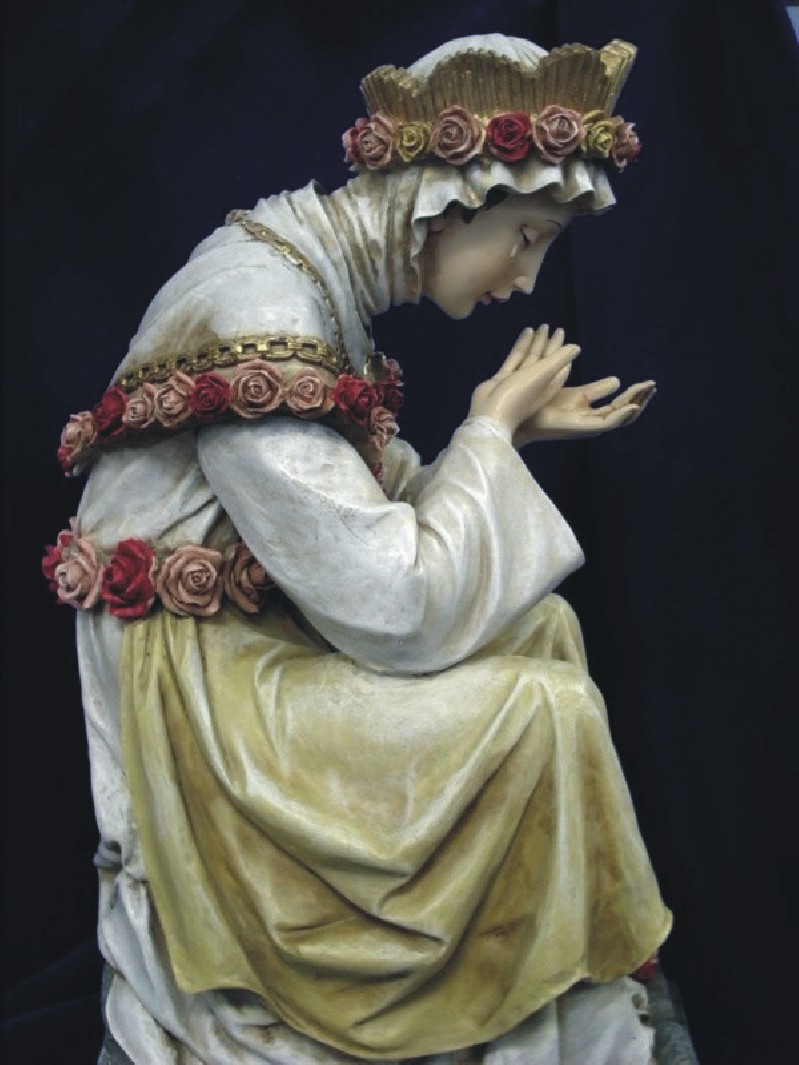
Notre-Dame de la Salette / Our Lady of La Salette), La Salette-Fallavaux, Isère, Rhône-Alpes, France (1846) 19 September: Our Lady appeared to two small children, Melanie Mathieu and Maximin Giraud, on the mountain of La Salette in the French Alps. She was crying and around her neck was a crucifix, with a hammer and pincers on either side – 19 September 1846. Approved by the Diocesan Bishop in 1851. Read the story here: https://anastpaul.wordpress.com/2017/09/19/feast-of-our-lady-of-la-salette-19-september/
St Arnulph of Gap Bl Carolus Hyon Song-Mun St Constantia of Nocera St Desiderius of Pozzuoli St Eustochius of Tours St Felix of Nocera St Festus of Pozzuoli St Goeric of Metz (c570-c643)Bishop
St Maria de Cervellón OdeM (1230 – 1290) Virgin, Catalan Superior of Second Order of the Mercedarians in her region. Mystic, graced with the gift of bilocation, Apostle of the poor, the abandoned, the needy. She was the first woman to wear the Habit of the ‘ Order of the Blessed Virgin Mary of Ransom. She is considered the Founder of the Mercedary Nuns. Her entry in the Roman Martyrology states: “At Barcelona in Spain, blessed Maria de Cervellione, Virgin of the Order of Our Lady of Ransom. She is commonly called Maria of Help on account of the prompt assistance she renders to those who invoke her.“ Patronages – Mercadarian Nuns and Sisters, Navigators, against shipwreck, Spanish sailors., of the abandoned. On 13 February1692, Pope Innocent XII gave a favourable judgement and confirmed her immemorial cult;and she was introduced into the Roman Martyrology as a Saint on 8 November 1729. Her body is Incorrupt. Her Holy Life: https://anastpaul.com/2021/09/19/saint-of-the-day-19-september-st-maria-de-cervellon-odem-1230-1290/ Please watch this video if you are able to spare the time. It is absolutely beautiful.
St Pomposa St Sequanus St Sosius of Puzzuoli St Theodore of Canterbury St Trophimus of Synnada
Martyrs of Antioch – 3 Saints: Christians imprisoned, tortured and executed in various ways in the persecutions of Emperor Probus; some names have come down to us – Dorymedon, Sabbatius and Trophimus. c 277 at Antioch (in modern Turkey).
Martyrs of Phunon – (4 aints): Four bishops in Egypt who were sentenced to forced labour in a rock quarry and martyred in the persecution of Diocletian. Noted for celebrating Mass in prison. – Elias, Nilus, Patermuzio and Peleus. They were burned to death in 310 at Phunon, near Petra in Palestine.
Thought for the Day – 18 September – Meditations with Antonio Cardinal Bacci (1881-1971)
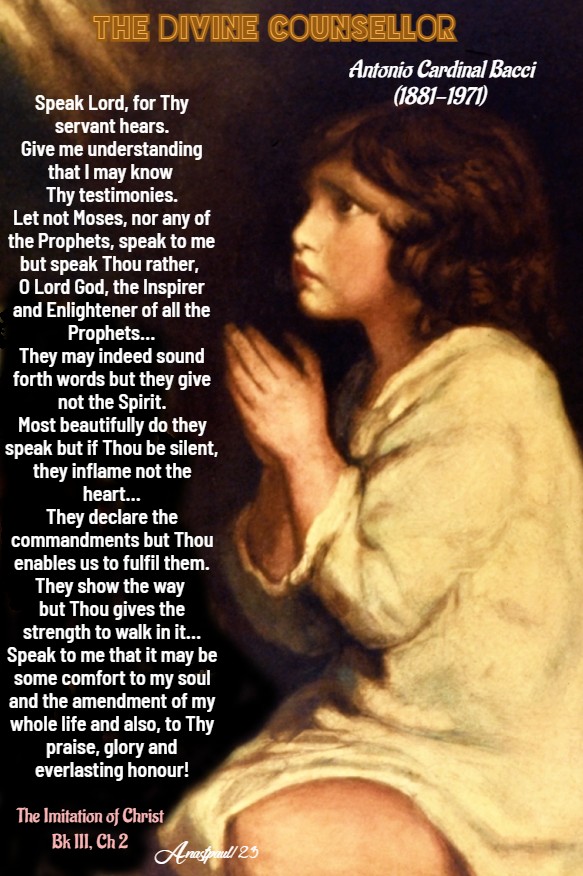
The Divine Counsellor
“Speak Lord, for Thy servant hears. Give me understanding that I may know Thy testimonies. Let not Moses, nor any of the Prophets, speak to me but speak Thou rather, O Lord God, the Inspirer and Enlightener of all the Prophets… They may indeed sound forth words but they give not the Spirit. Most beautifully do they speak but if Thou be silent, they inflame not the heart… They declare the commandments but Thou enables us to fulfil them. They show the way but Thou gives the strength to walk in it… Speak to me that it may be some comfort to my soul and the amendment of my whole life and also, to Thy praise, glory and everlasting honour!” (Cf The Imitation of ChristBk III, Ch 2).
Quote/s of the Day – 18 September – “Month of The Seven Sorrows of the Blessed Virgin Mary and The Holy Cross” – St Methodius of Olympus (Died c311) Confessor, Bishop, Martyr, Father
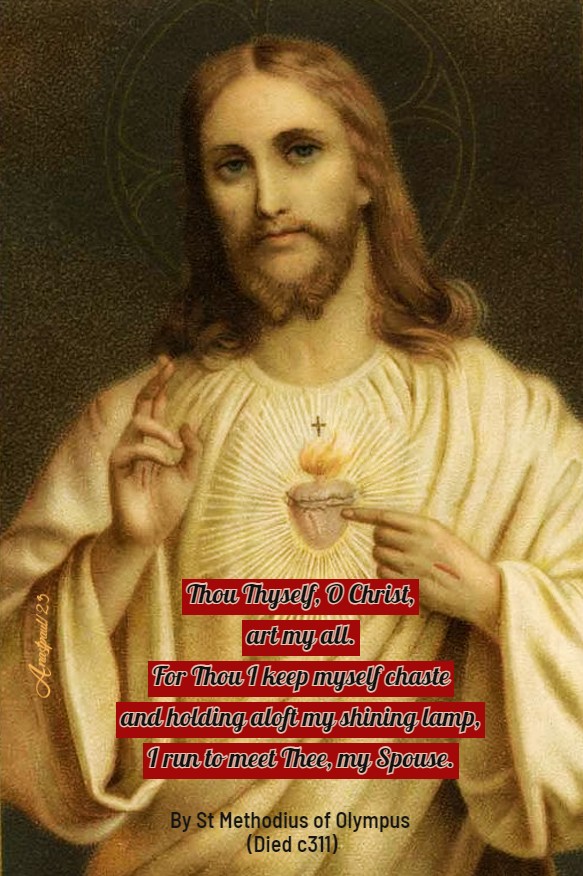
“Thou Thyself, O Christ, art my all. For Thou I keep myself chaste and holding aloft my shining lamp, I run to meet Thee, my Spouse.”
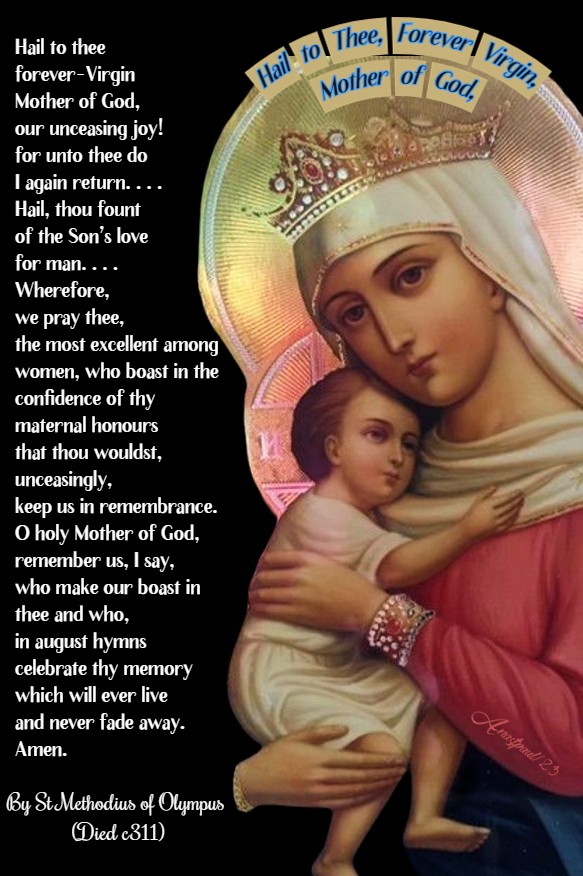
Hail to Thee, Forever Virgin, Mother of God, By St Methodius of Olympus (Died c311)
Hail to thee forever-Virgin Mother of God, our unceasing joy! for unto thee do I again return. . . . Hail, thou fount of the Son’s love for man. . . . Wherefore, we pray thee, the most excellent among women, who boast in the confidence of thy maternal honours that thou wouldst, unceasingly, keep us in remembrance. O holy Mother of God, remember us, I say, who make our boast in thee and who, in august hymns celebrate thy memory which will ever live and never fade away. Amen.
One Minute Reflection – 18 September – “Month of The Seven Sorrows of the Blessed Virgin Mary and The Holy Cross” – St Joseph of Cupertino OFM Conv. (1603-1663) Confessor – 1 Corinthians 13:1-8, Matthew 22:1-14 – Scripture search here: https://www.drbo.org/
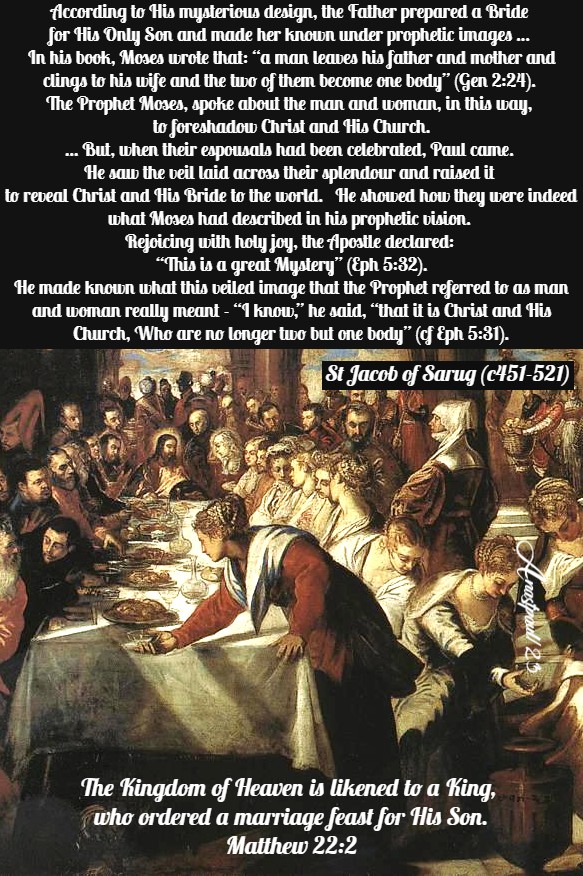
“The Kingdom of Heaven is likened to a King, who ordered a marriage feast for his son.” – Matthew 22:2
REFLECTION – “According to His mysterious design, the Father prepared a Bride for His Only Son and made her known under prophetic images … In his book, Moses wrote that: “a man leaves his father and mother and clings to his wife and the two of them become one body” (Gen 2:24). The Prophet Moses, spoke about the man and woman, in this way, to foreshadow Christ and His Church.
With the Prophet’s piercing eye, he beheld Christ becoming One with the Church, thanks to the Mystery of the water – he envisioned Christ drawing the Church to Himself, from the virginal womb and the Church drawing Christ to herself, in the waters of Baptism. Thus, were the Bridegroom and Bride wholly united, in a mystical way. That is why Moses, with veiled face, (Ex 34:33) beheld – Christ and the Church – one he called “man” and the other “woman” so as to avoid revealing the reality to the Hebrew people, in all its clarity …. For a time, the veil would conceal this Mystery – none would know the meaning of this great image and would be ignorant of what it represented.
But, when their espousals had been celebrated, Paul came. He saw the veil laid across their splendour and raised it to reveal Christ and His Bride to the world. He showed how they were indeed what Moses had described in his prophetic vision. Rejoicing with holy joy, the Apostle declared: “This is a great Mystery” (Eph 5:32). He made known what this veiled image that the Prophet referred to as man and woman really meant – “I know,” he said, “that it is Christ and His Church, Who are no longer two but one body” (cf Eph 5:31).” – St Jacob of Sarug (c451-521) Bishop, Father (Sermon on Moses’ veil).
PRAYER – O God, Who willed that all things be drawn unto Thy Son, when He was raised above the earth, mercifully grant, by the merits and example of Thy seraphic Confessor Joseph that, having been raised above all earthly desires, we may be found worthy to come unto Him. Through the same Jesus Christ, Thy Son our Lord, Who lives and reigns with Thee, in the unity of the Holy Ghost, God, world without end. Amen (Collect).
O Most Sacred Heart of Jesus! By Pope Benedict XV (1854-1922)
O Most Sacred Heart of Jesus! O Fount of every good! I adore Thee, I love Thee and sincerely repenting of my sins, I present to Thee my poor heart. Give it back to me humble, patient, pure and in everything, conformed to Thy wishes. Make me, O good Jesus, live in Thee and for Thee. Protect me in dangers, comfort me in afflictions, grant me health of body, succour in my temporal needs, Thy blessing in all my works and the grace of a holy death. Amen
Indulgence – 100 days Once a day Pope Benedict XV 4 December 1916
Saint of the Day – 18 September – Saint Methodius of Olympus (Died c311) Confessor, Bishop of Olympus in Lycia in Asia Minor, Martyr, Ecclesiastical Scholar and Author, renowned Theologian. After Olympus it seems that he was appointed as the Bishop of Tyre, Lebanon, or possibly Patara, in the same country. Date of birth unknown, Methodius died a Martyr, probably in 311 in Chalcis, in modern Greece. His works include the “Treatise “On the Resurrection” and “Symposium on Virginity.”
The Roman Martyrology reads today: “The same da, [as St Joseph of Cupertino] the birthday of St Methodius, Bishop of Olympus in Lycia and afterwards of Tyre. Most renowned for his eloquence and learning. St Jerome says that he won the Crown of Martyrdom at Chalcis in Greece at the end of the last persecution there.”
The Martyrdom of St Methodius
We are indebted to St Jerome for the earliest accounts of Methodius. According to him, Methodius suffered Martyrdom at Chalcis at the end of the newest persecution, i.e., under Diocletian, Galerius or Maximinus.
Papyrus fragment of the Symposium, Oratio 8, dated 5th or 6th Century, the earliest known Manuscript of a work by St Methodiu.
Methodius had a very comprehensive philosophical education and was an important Theologian and a prolific and polished Author. Chronologically, his works can only be assigned, in a general way, to the end of the 3rd and beginning of the 4th Century. He became of special importance in the history of theological literature, in that he successfully combated various erroneous views of the great Alexandrian, Origen.
He particularly attacked his doctrine that man’s body, at the resurrection, is not the same body as he had in lif. Another area of Methodius’ opposition was Origen’s idea of the world’s eternity and the erroneous notions it involved. Nevertheless, he recognised Origen’s great services to the Church in Ecclesiastical Theology. Like Origen, Methodius is strongly influenced by Plato’s philosophy and uses, to a great extent, the allegorical style of explanation especially of Scripture.
Of his numerous works only one has come down to us in a complete state in a Greek text, –Th Symposium on Virginity. However, we do have Slavonian versions or portions thereof, of all his other works. He also wrote commentaries on Genesis and on the Song of Songs, many other areas of Sacred Scripture and other holy subjects, for example on the Martyrs, on marriage, on the food laws of the Jews, etc.
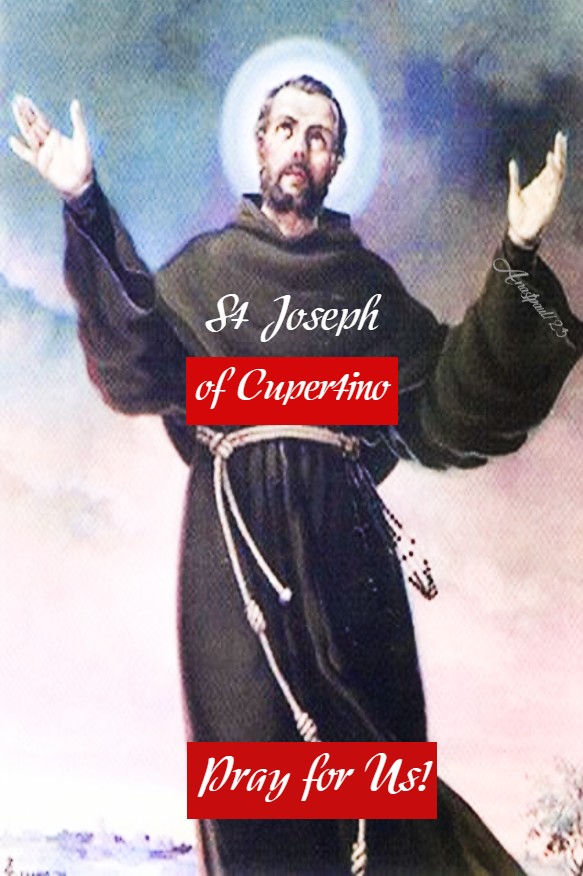
St Joseph of Cupertino OFM Conv. (1603-1663) Confessor, Religious Priest of the First Order of St Francis and Friar, Mystic, Miracle-worker. If ever a tiny child began life with nothing in his favour it was Joseph of Cupertino; he had only one hopeful and saving quality—that he knew it. … – Read on and be ashamed, for this is a Saint before the Throne of God! All about the this holy Flying Saint here: https://anastpaul.wordpress.com/2017/09/18/saint-of-the-day-18-september-st-joseph-of-cupertino-o-f-m-conv-1603-1663/
St Ariadne St Eumenius Thaumaturgus
St Eustorgius of Milan (Died c 349) The Ninth Bishop of Milan, Confessor, Defender of the Faith. Both St Athanasius and St Ambrose remember Eustorgius of Milan as one of the most steadfast and illustrious opponents of the Arian heresy. The Roman Martyrology says of him: “At Milan, St Eustorgius, Bishop of that City, highly recommended by blessed Ambrose.” Biography: https://anastpaul.com/2021/09/18/saint-of-the-day-18-september-saint-eustorgius-of-milan-died-c-349/
St Ferreolus the Tribune St Ferreolus of Limoges St Hygbald St Irene of Egypt
Thought for the Day – 17 September – Meditations with Antonio Cardinal Bacci (1881-1971)
The Commandments and the Desires of Jesus Christ
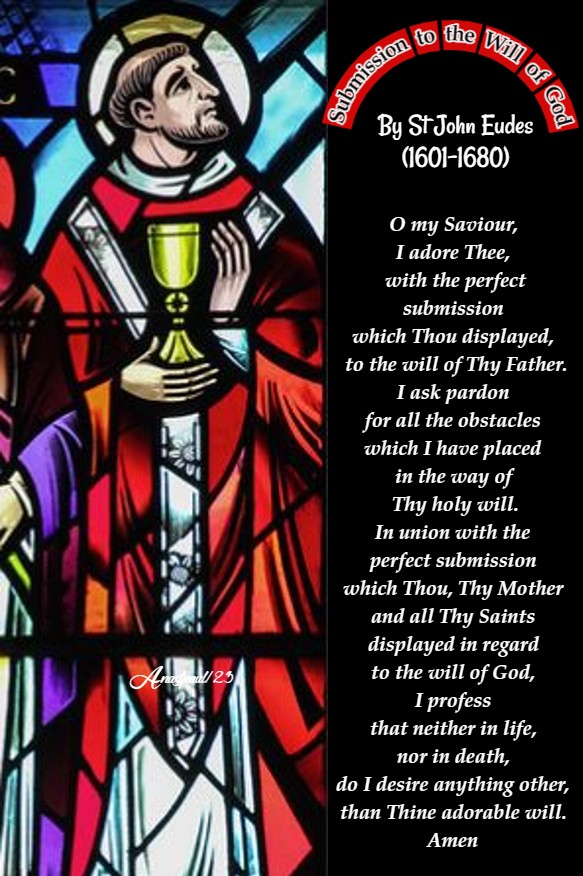
“O my Saviour, I adore Thee, with the perfect submission which Thou displayed to the will of Thy Father. I ask pardon for all the obstacles which I have placed in the way of Thy holy will. In union with the perfect submission which Thou, Thy Mother and all Thy Saints displayed in regard to the will of God, I profess that neither in life, nor in death, do I desire anything other, than Thine adorable will. Amen [St John Eudes (1601-1680)]”
Quote/s of the Day – 17 September – Ephesians 3:13-21, Luke 14:1-11 – Scripture search here: https://www.drbo.org/
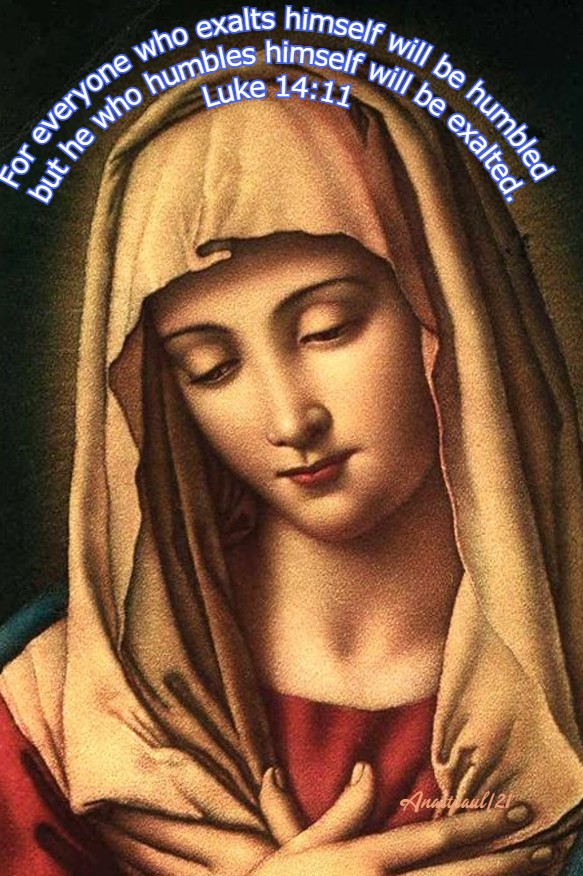
“For everyone who exalts himself, will be humbled and he who humbles himself, will be exalted.”
Luke 14:11
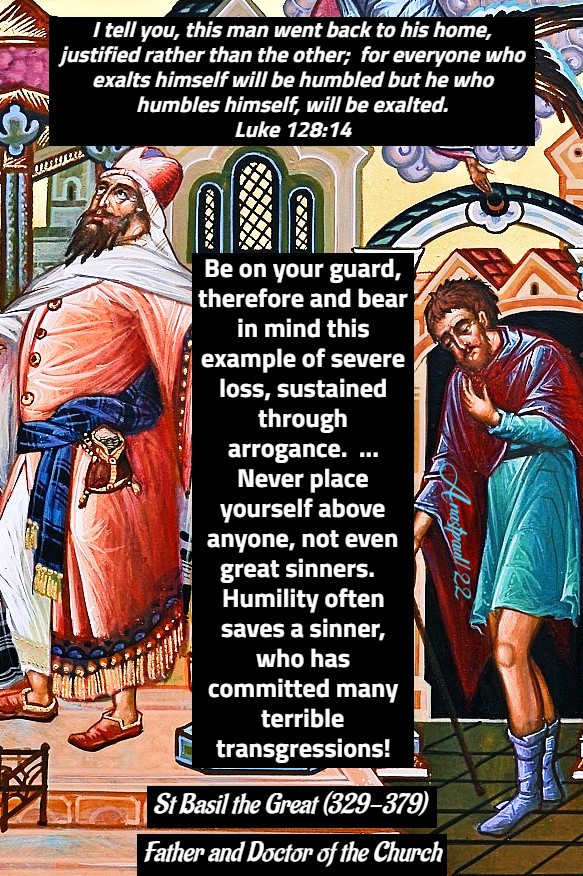
“I tell you, this man went back to his home justified, rather than the other; for everyone who exalts himself will be humbled but he who humbles himself, will be exalted” Luke 18:14
“Be on your guard, therefore and bear in mind, this example of severe loss, sustained through arrogance. … Never place yourself above anyone, not even great sinners. Humility often saves a sinner, who has committed many terrible transgressions!”
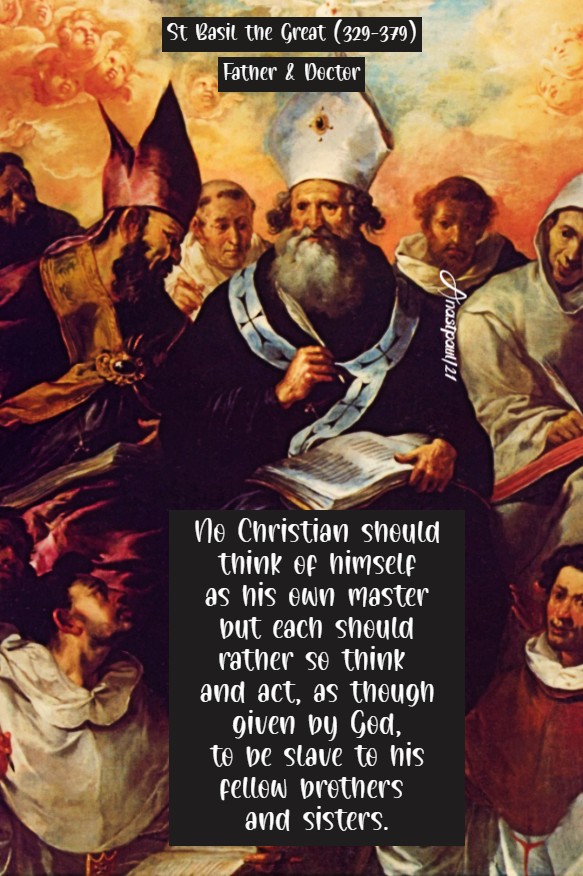
“No Christian should think of himself as his own master but each should rather so think and act, as though given by God, to be slave to his fellow brothers and sisters.”
St Basil the Great (329-379) Father and Doctor of the Church
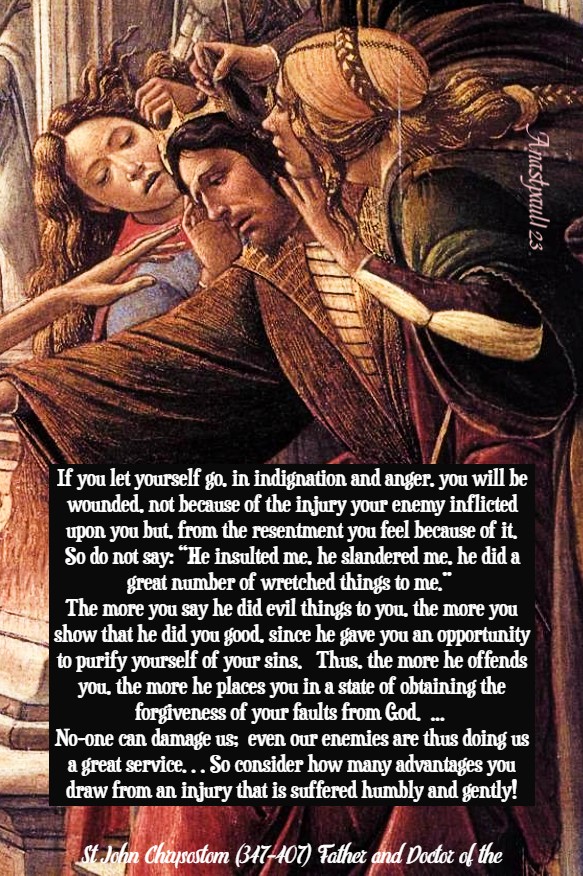
“What evil can your enemy do to you which would be comparable to that, which you do to yourself? … If you let yourself go, in indignation and anger, you will be wounded, not because of the injury your enemy inflicted upon you but, from the resentment you feel because of it. So do not say: “He insulted me, he slandered me, he did a great number of wretched things to me.” The more you say he did evil things to you, the more you show that he did you good, since he gave you an opportunity to purify yourself of your sins. Thus, the more he offends you, the more he places you in a state of obtaining the forgiveness of your faults from God. For if we want, no-one can damage us; even our enemies are thus doing us a great service… So consider how many advantages you draw from an injury that is suffered humbly and gently!”
St John Chrysostom (347-407) Father and Doctor of the Church
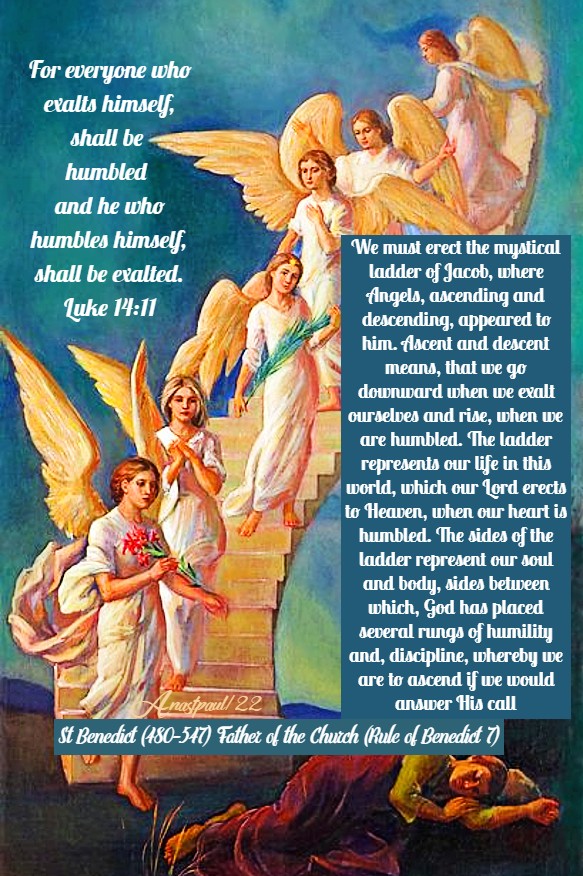
“We must erect the mystical ladder of Jacob, where Angels, ascending and descending, appeared to him. Ascent and descent means, that we go downward when we exalt ourselves and rise, when we are humbled. The ladder represents our life in this world, which our Lord erects to Heaven, when our heart is humbled. The sides of the ladder represent our soul and body, sides between which, God has placed several rungs of humility and, discipline, whereby we are to ascend if we would answer His call.”
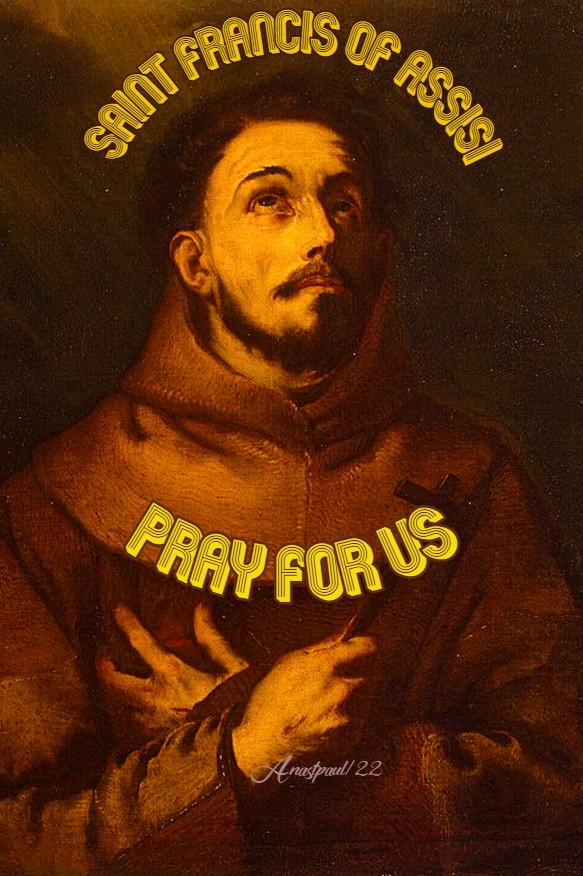
One Minute Reflection – 17 September – Solemnity of the Seven Sorrows of the Blessed Virgin Mary – The 16th Sunday after Pentecost – The Commutation of the Stigmata of St Francis of Assisi – Ephesians 3:13-21, Luke 14:1-11 – Scripture search here: https://www.drbo.org/
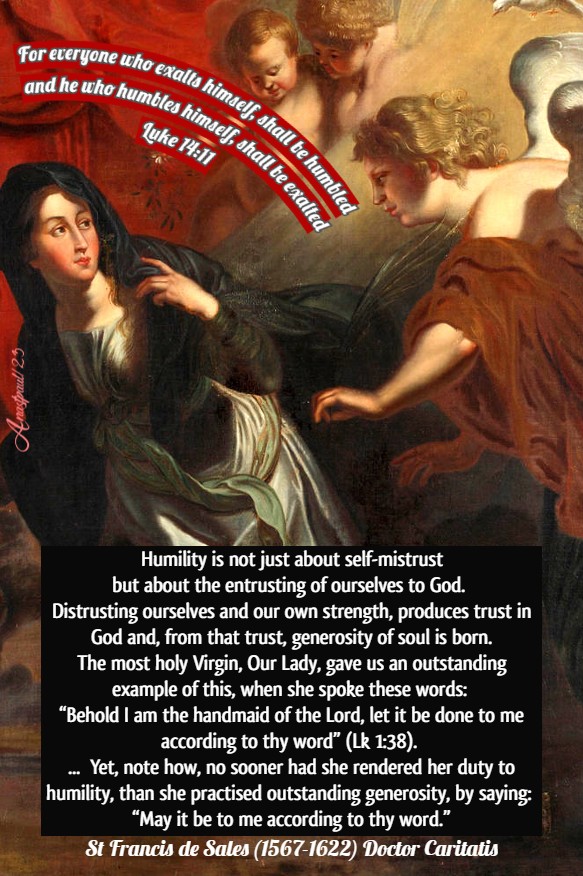
“For everyone who exalts himself, shall be humbled and he who humbles himself, shall be exalted.” – Luke 14:11
REFLECTION – “Humility is not just about self-mistrust but about the entrusting of ourselves to God. Distrusting ourselves and our own strength, produces trust in God and, from that trust, generosity of soul is born.The most holy Virgin, Our Lady, gave us an outstanding example of this, when she spoke these words: “Behold I am the handmaid of the Lord, let it be done to me according to thy word” (Lk 1:38). When she said she was the handmaid of the Lord, she was performing, the greatest act of humility, it is possible to do and, all the more so, in that, she was contradicting the praise given her by the Angel – that she would be mother of God, that the child to be born from her womb would be called Son of the Most High, a greater dignity than any we might imagine – I say, she opposed her lowliness and unworthines,to all these praises and greatness, by saying that she was the handmaid of the Lord. Yet, note how, no sooner had she rendered her duty to humility, than she practised outstanding generosity, by saying: “May it be to me according to thy word.”
What she wanted to say was – “It is true, I am in no way capable of this grace, if one is to consider ,what I am, of myself but, insofar as what is good in me, comes from God and what thou say to me, is His own most holy will, I believe it can happen and will happen.” And so, without the least hesitation, she said: “Let it be done to me according to thou word.” – St Francis de Sales (1567-1622) Bishop of Geneva, Doctor Caritatis (Conversations 5).
PRAYER – O Lord, Jesus Christ, Who, to inflame our hearts with the fire of Thy love, when the world was becoming cold in spirit, renewed in the flesh of most blessed Francis, the sacred marks of Thine own Passion, graciously grant that by his merits and prayers, we may steadfastly carry our cross and bring forth worthy fruits of penance. Through the same Jesus Christ, Thy Son our Lord, Who lives and reigns with Thee, in the unity of the Holy Ghost, God, world without end. Amen (Collect).



























 AnaStpaul
You must be logged in to post a comment.