Thought for the Day – 6 May – Monday of the Third week of Easter, Gospel: John 6:22–29 and the Memorial of St Francois Laval (1623-1708)
The Contest of Faith
Saint Cyprian of Carthage (200-258)
Bishop, Martyr, Father of the Church and Martyr
An excerpt from his Letter 58
Dear brothers, the commands of the Gospel are nothing else than God’s lessons, the foundations on which to build up hope, the supports for strengthening faith, the food that nourishes the heart. They are the rudder for keeping us on the right course, the protection that keeps our salvation secure. As they instruct the receptive minds of believers on earth, they lead safely to the kingdom of heaven.
As we do battle and fight, in the contest of faith, God, His angels and Christ Himself, watch us. How exalted is the glory, how great the joy of engaging in a contest with God presiding, of receiving a crown, with Christ as judge.
Dear brethren, let us arm ourselves with all our might, let us prepare ourselves for the struggle with uncorrupted minds, with a whole faith and with devoted courage.
The blessed Apostle teaches us how to arm and prepare ourselves – Put round you the belt of truth, put on the breastplate of righteousness, for shoes wear zeal for the Gospel of peace, take up the shield of faith to extinguish all the burning arrows of the evil one, take the helmet of salvation and the sword of the spirit, which is the word of God.
Let us take this armour and defend ourselves with these spiritual defences from heaven, so that when the evil day comes we may be able to resist the threats of the devil and fight back against him.
Let us put on the breastplate of righteousness so that our breasts may be protected and kept safe from the arrows of the enemy. Let our feet be shod in the teaching of the Gospel and armoured so that when we begin to trample on the serpent and crush it, it will not be able to bite us or trip us up.
Let us with fortitude bear the shield of faith to protect us by extinguishing all the burning arrows that the enemy may launch against us.
Let us wear on our head the helmet of the Spirit, to defend our ears against the proclamations of death, to defend our eyes against the sight of accursed idols, to defend our foreheads so that God’s sign may be kept intact and to defend our mouths, so that our tongues may proclaim victoriously the name of Christ their Lord.
Let us arm our right hand with the sword of the Spirit so that it may courageously refuse the daily sacrifices and let the hand—mindful of the Eucharist—that took hold of the body of the Lord, embrace the Lord Himself and so gain from the Lord the future prize of a heavenly crown.
Dear brethren, have all this firmly fixed in your hearts. If the day of persecution finds us thinking on these things and meditating upon them, the soldier of Christ, trained by Christ’s commands and instructions, will not tremble at the thought of battle but will be ready to receive the crown of victory. Amen!
St Francois Laval, who have received the Crown, please pray for us!
Quote/s of the Day – 6 May – Monday of the Third week of Easter, Gospel: John 6:22–29
Speaking of – Dangerous Affections – St Augustine
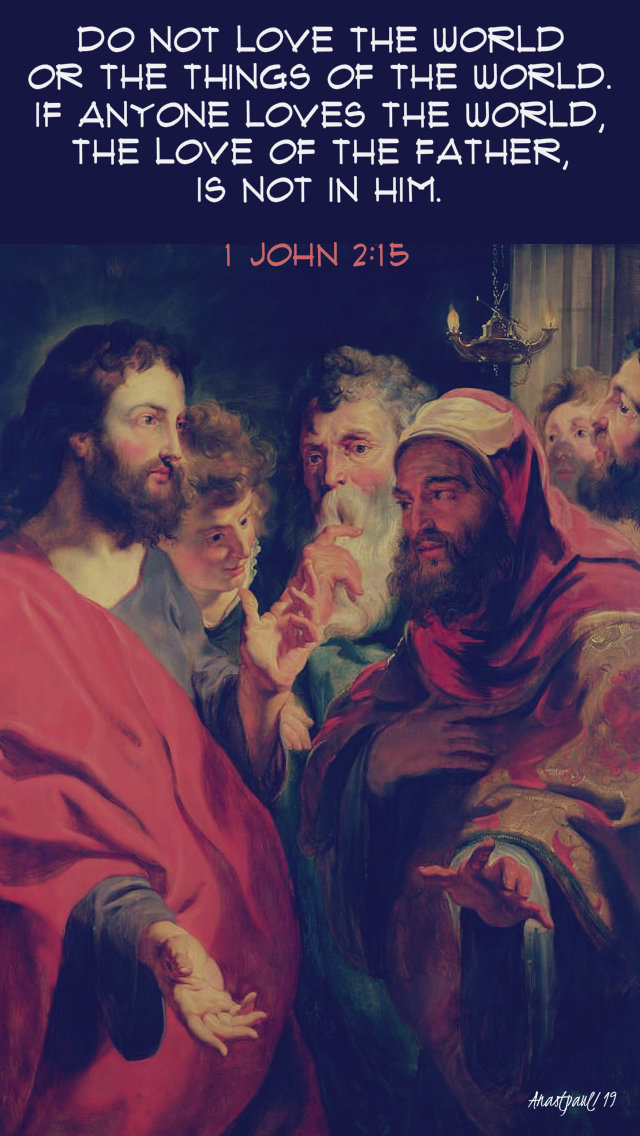
“Do not love the world or the things of the world. If anyone loves the world, the love of the Father, is not in him.”
1 John 2:15
“The honours of this world, what are they but puff and emptiness and peril of falling?”
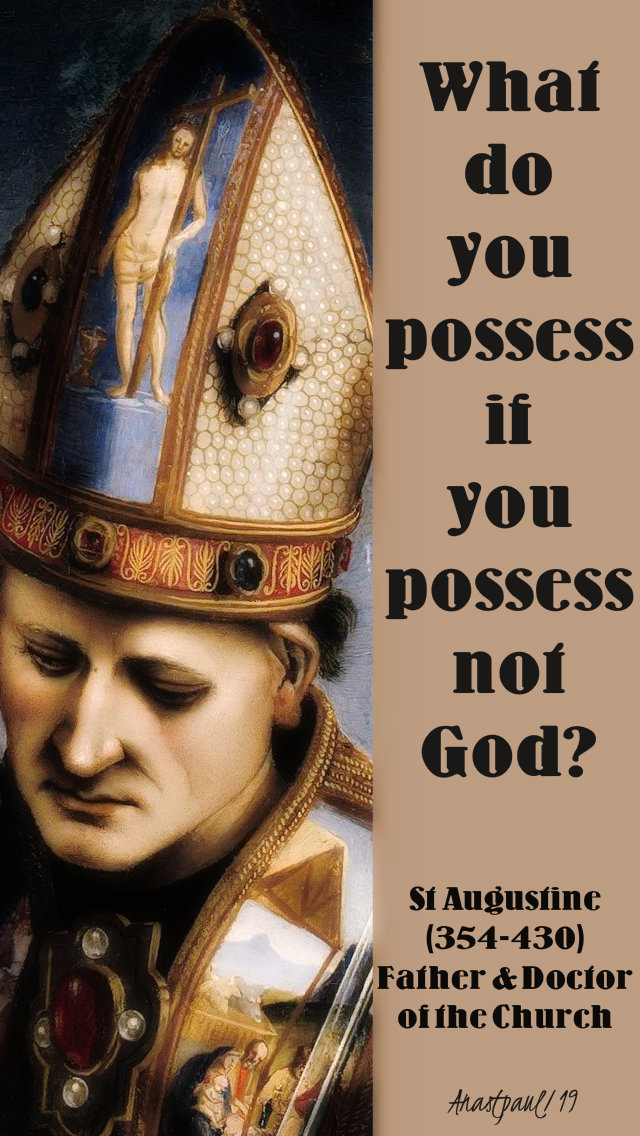
“What do you possess if you possess not God?”
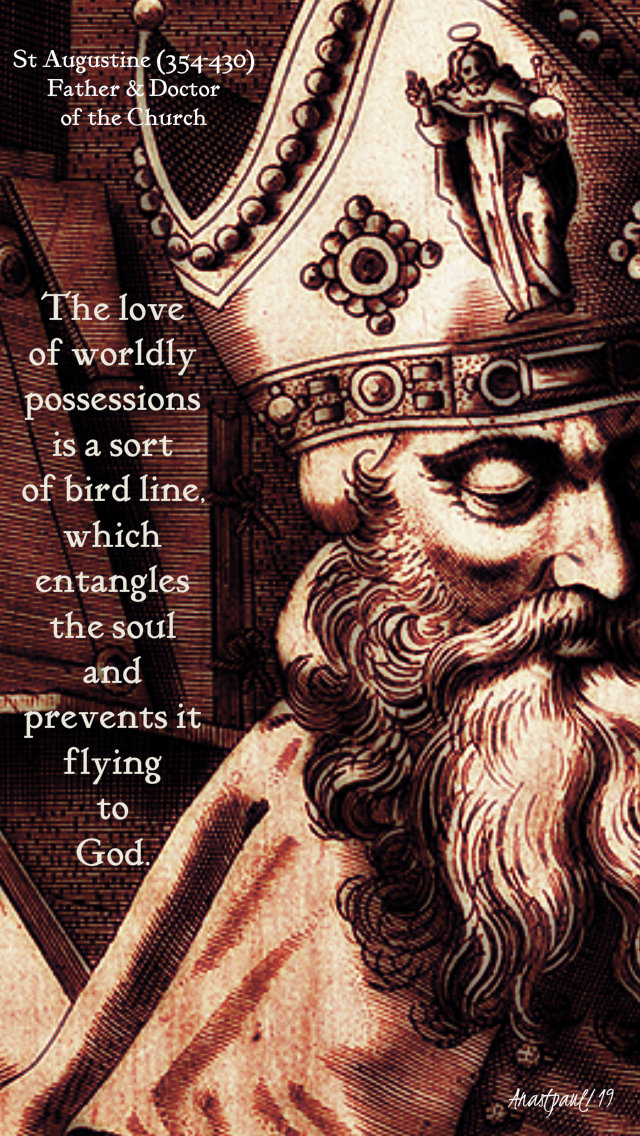
“The love of worldly possessions is a sort of bird line, which entangles the soul and prevents it flying to God.”
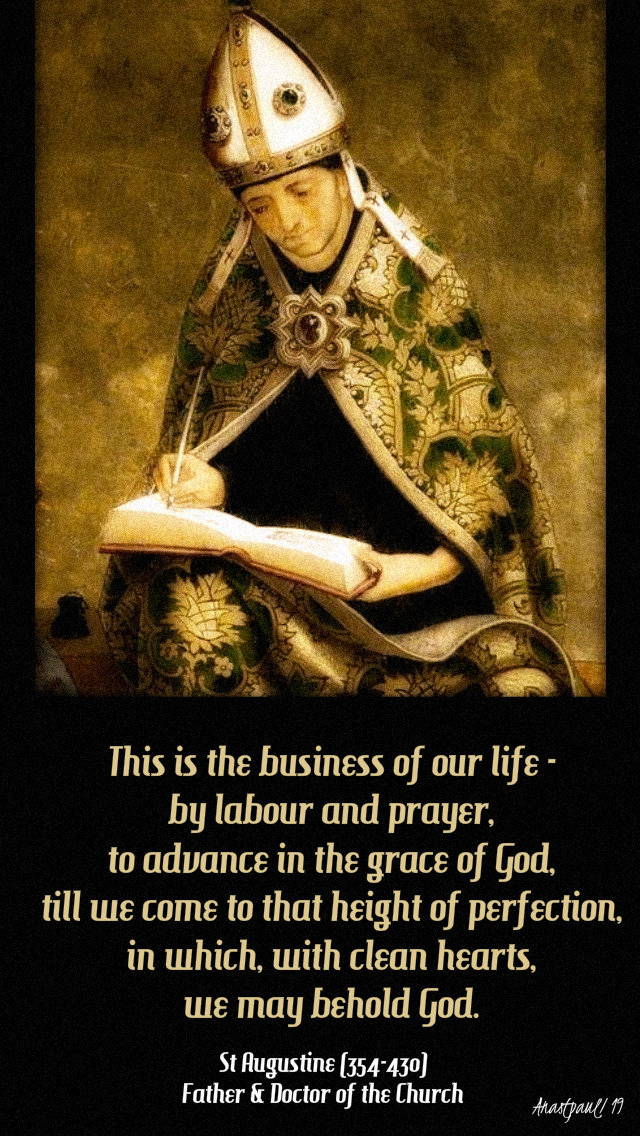
“This is the business of our life – by labour and prayer, to advance in the grace of God, till we come to that height of perfection in which, with clean hearts, we may behold God.”
“Daily advance, then, in this love, both by praying and by well-doing, that through the help of Him who enjoined it on you and whose gift it is, it may be nourished and increased, until, being perfected, it render you perfect.”
“God does not command impossibilities but by commanding, admonishes you do what you can and to pray for what you cannot and aids you, that you may be able.”
“This very moment, I may, if I desire, become the friend of God.”
Saint Augustine (354-430)
Father & Doctor of the Church
One Minute Reflection – 6 May – Monday of the Third week of Easter, Gospel: John 6:22–29
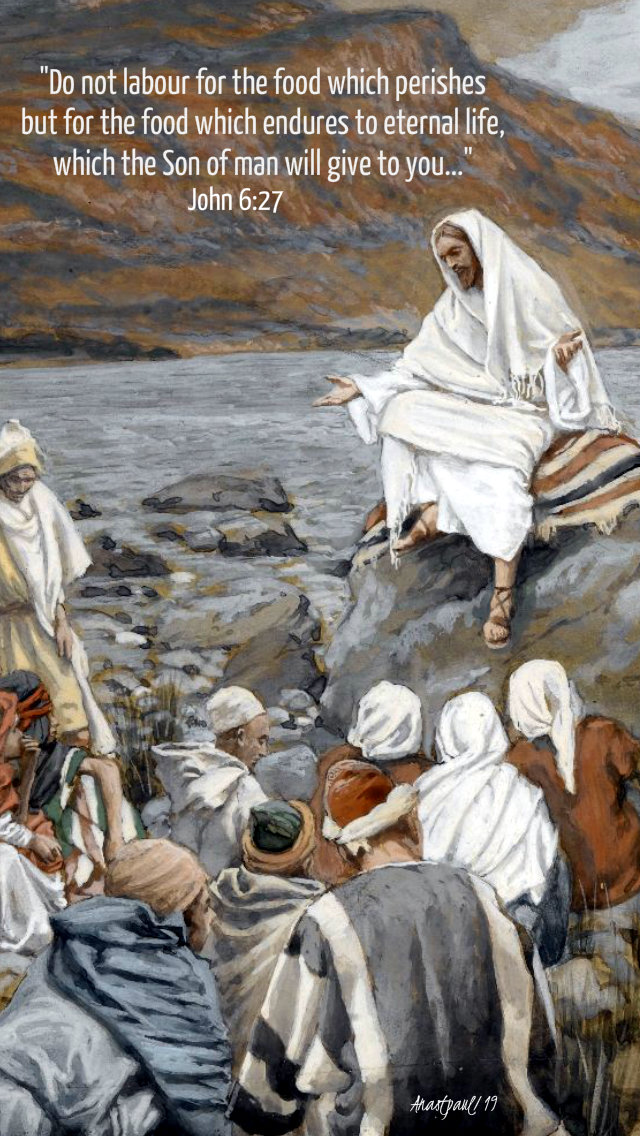
“Do not labour for the food which perishes but for the food which endures to eternal life, which the Son of man will give to you...”John 6:27
REFLECTION – “Someone who works frenziedly on Sundays, thinking he is going to earn more money or get more done, is making a mistake in his calculations! Can two or three dollars ever compensate for the harm he does himself by violating the law of God? You imagine everything depends on your work, but then an illness, an accident…! It takes so little: a storm, hail, frost… Do not work for food that perishes but for that which dwells in eternal life. What will you gain by having worked on Sunday? You leave the land just as it is when you depart; you do not carry anything away. Our first aim is to go to God, we are not on earth for anything but this! My brethren, we should die on Sundays and come back to life again on Mondays. Sunday belongs to God – it is His day, the Day of the Lord. He made all the days of the week and could have kept them all. He has given you six of them and has only held back the seventh for himself!”…St John Vianney (1786-1859)
PRAYER – King of heaven and earth, Lord God, rule over our hearts and bodies this day. Sanctify us and guide our every thought, word and deed, according to the commandments of Your law, so that now and forever, Your grace may free and save us. Let us walk in Your ways and be your lights and thus by our lives, help others to follow You. Grant that the prayers of our blessed Mother, the Mother of Jesus Your Son and St Francois Laval, who always lived for You alone, may help us, as we work through each day to reach our heavenly home. Through Jesus the Lord, with the Holy Spirit, God now and forever, amen.
Thought for the Day – 5 May – Third Sunday of Easter, Year C, Gospel: John 21:1–19
“…Lead you where you do not wish to go.”…John 21:18
The Gospel of the appearance of the Lord at the Sea of Tiberias, ends with the installation of Peter in his pastoral office. Everything that precedes this, is preparatory -unsuccessful fishing, then the miraculous catch, after which Peter swims to the Lord and stands beside Him on the bedrock of eternity, while the rest of the Church brings her harvest to the two of them, at which point, Peter, himself, hauls the entire netfull ashore. Finally, the crucial question to Peter – “Do you love me more than these?” You, the Denier, do you love me more than the Beloved Disciple there, who stood under the Cross? Made conscious of his guilt by means of the threefold question, Peter answers with a repentant first ‘Yes’ (since he can, by no means say No), undoubtedly, gaining the strength to do so from John (in the communion of saints).
Without this confession of greater love, the Good Shepherd, who gives His life for his sheep, could not entrust His flock to Peter’s pasturing.
For the office Jesus has received from the Father, is identical, with His own loving sacrifice of His life, for His sheep.
Ever since Jesus bestowed this office on Peter, this unity of love and office has been unconditionally required. This unity is then sealed by the prediction of Peter’s crucifixion, the gift of completed discipleship. The cross will be bound up with the papacy, from this point onward, even when it is given to unworthy popes.
The more seriously a pope takes his office, the heavier the weight of the cross, on his shoulder becomes.
Cardinal Hans Urs von Balthasar
Light of the World
Pray for Pope Francis, amen!
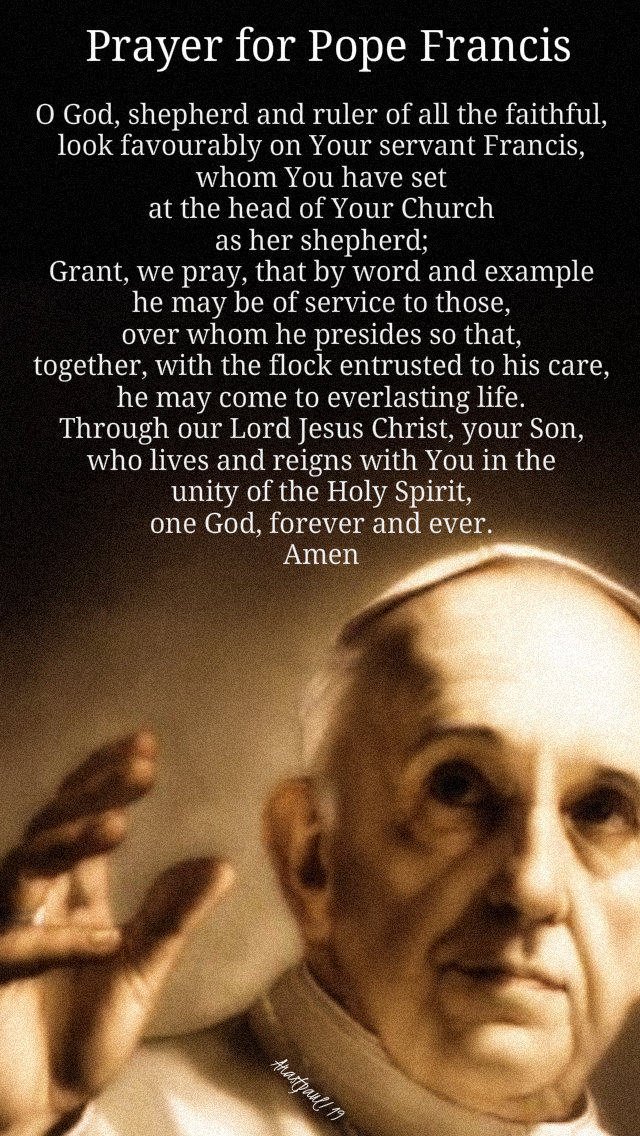
Prayer for Pope Francis
O God, shepherd and ruler of all the faithful, look favourably on Your servant Francis, whom You have set at the head of Your Church as her shepherd; Grant, we pray, that by word and example he may be of service to those over whom he presides so that, together with the flock entrusted to his care, he may come to everlasting life. Through our Lord Jesus Christ, your Son, who lives and reigns with You in the unity of the Holy Spirit, one God, forever and ever. Amen
Apostolic Exhortation of St Pope Paul VI
Marialis Cultus – 2 February 1974
To Honour Mary
Devotion to the Mother of the Lord becomes for the faithful an opportunity for growing in divine grace and this is the ultimate aim of all pastoral activity. For it is impossible to honour her who is “full of grace” (Lk. 1:28) without thereby honouring, in oneself, the state of grace, which is friendship with God, communion with Him and the indwelling of the Holy Spirit. It is this divine grace which takes possession of the whole man and conforms him to the image of the Son of God (cf. Rom. 8:29; Col. 1:18).
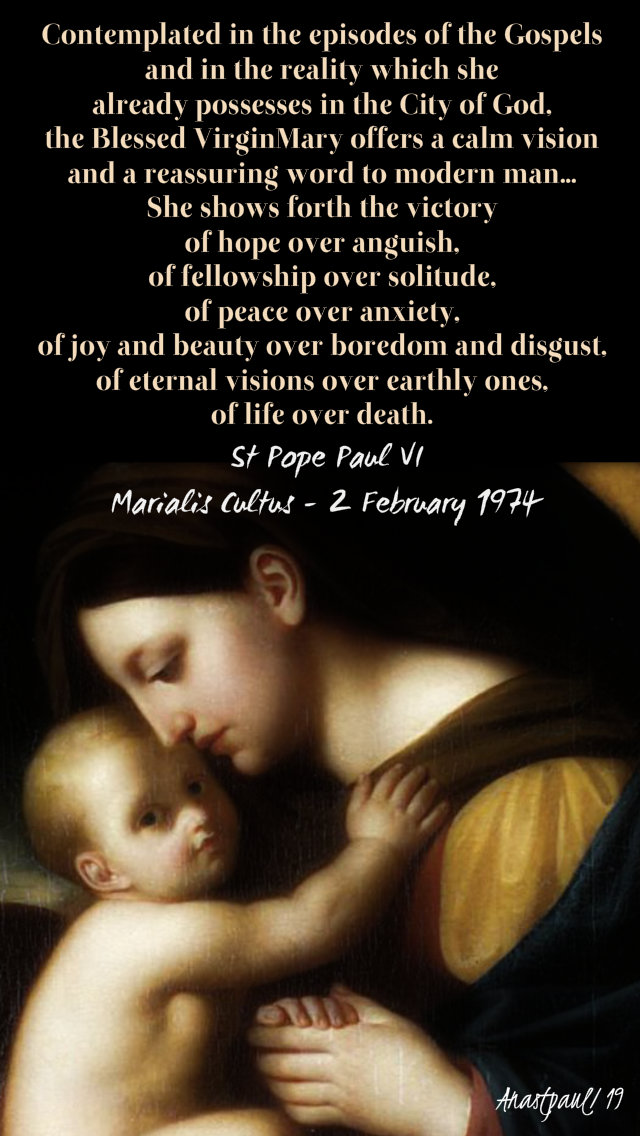
The Catholic Church, endowed with centuries of experience, recognises in devotion to the Blessed Virgin a powerful aid for man as he strives for fulfilment. Mary, the New Woman, stands at the side of Christ, the New Man, within whose mystery the mystery of man(124) alone finds true ligh,; she is given to it as a pledge and guarantee that God’s plan in Christ for the salvation of the whole man has already achieved realisation in a creature – in her. Contemplated in the episodes of the Gospels and in the reality which she already possesses in the City of God, the Blessed Virgin Mary offers a calm vision and a reassuring word to modern man, torn as he often is between anguish and hope, defeated by the sense of his own limitations and assailed by limitless aspirations, troubled in his mind and divided in his heart, uncertain before the riddle of death, oppressed by loneliness while yearning for fellowship, a prey to boredom and disgust. She shows forth the victory of hope over anguish, of fellowship over solitude, of peace over anxiety, of joy and beauty over boredom and disgust, of eternal visions over earthly ones, of life over death.
Let the very words that she spoke to the servants at the marriage feast of Cana, “Do whatever he tells you” (Jn. 2:5), be a seal on our Exhortation and a further reason in favour of the pastoral value of devotion to the Blessed Virgin as a means of leading men to Christ. Those words, which at first sight were limited to the desire to remedy an embarrassment at the feast, are seen in the context of Saint John’s Gospel to re-echo the words used by the people of Israel to give approval to the Covenant at Sinai (cf. Ex. 19:8, 24:3, 7; Dt. 5:27) and to renew their commitments (cf. Jos. 24:24; Ezr. 10:12; Neh. 5:12). And they are words which harmonise wonderfully with those spoken by the Father at the theophany on Mount Tabor – “Listen to him” (Mt. 17:5
Second Reading The Little Office of Mary Saturdays ===============
Sunday Reflection – 5 May – Third Sunday of Easter, Year C
Pope Benedict XVI
” The Eucharist, the privileged place in which the Church recognises “the Author of life” (Acts 3: 15) is “the breaking of the bread”, as it is called in the Acts of the Apostles. In it, through faith, we enter into communion with Christ, who is “the priest, the altar and the lamb of sacrifice” (see Preface for Easter, 5) and is among us.
Let us gather round Him to cherish the memory of His words and of the events contained in Scripture, let us relive His Passion, death and Resurrection. In celebrating the Eucharist, we communicate with Christ, the victim of expiation and from Him we draw forgiveness and life.
What would our lives as Christians be without the Eucharist? The Eucharist is the perpetual, living inheritance which the Lord has bequeathed to us in the Sacrament of His Body and His Blood and which we must constantly rethink and deepen so that, as venerable Pope Paul VI said, it may “impress its inexhaustible effectiveness on all the days of our earthly life.” – (Insegnamenti, V [1967], p. 779)
Many Christians take their time and have leisure enough in their social life (no hurry here). They are leisurely, too, in their professional activities, at table and recreation (no hurry here either). But isn’t it strange, how those same Christians. find themselves in such a rush and want to hurry the priest, in their anxiety to shorten the time devoted to the most holy sacrifice of the altar?“
One Minute Reflection – 5 May – Third Sunday of Easter, Year C, Gospel: John 21:1–19 and the Memorial of Saint Nunzio Sulprizio (1917-1836)
“When it was already dawn, Jesus was standing on the shore”...John 21:4
REFLECTION – “When it was already dawn, Jesus was standing on the shore”
What does the sea indicate but the present age, which is disturbed by the uproar of circumstances and the commotion of this perishable life? What does the solidity of the shore signify but the uninterrupted continuance of eternal peace? Therefore, since the disciples were still held in the waves of this mortal life, they were labouring on the sea. But since our Redeemer had already passed beyond His perishable body, after His Resurrection, He stood on the shore, as if He were speaking to His disciples by His actions, of the mystery of His Resurrection: “I am not appearing to you on the sea, because I am not with you in the waves of confusion” (Mt 14:25)
It is for this reason that He said, in another place, to these same disciples after his Resurrection: “These are the words I spoke to you when I was still with you” (Lk 24:44). It was not that He wasn’t with them, when He appeared to them as a bodily presence but… He, in His immortal body, was apart from their mortal bodies. He was saying, that He was no longer with them, even as He stood in their midst. In the passage we read today, He also disclosed, by the place in which He was standing, when He showed Himself on the shore, while they were still at sea, what He professed, when he was with them.”…St Pope Gregory the Great (540-604) Father & Doctor of the Church
PRAYER – Lord God, grant Your people constant joy in the renewed vigour of their souls. They rejoice because You have restored them to the glory of Your adopted children, let them look forward gladly to the certain hope of the resurrection. May the prayers of our Blessed Mother and St Nunzio, who so bravely fought the good fight, be of assistance to us amidst the storms of this mortal life. We make our prayer through our Resurrected Christ, with the Holy Spirit, one God forever, amen, alleluia!
Marian Thought for the Day – 4 May – “Mary’s Month”
Pope Benedict XVI
Excerpt- Solemnity of the Annunciation of the Lord, Saint Peter’s Square, Saturday, 25 March 2006
And Mary said, “Behold, I am the handmaid of the Lord, let it be to me according to your word.”…Luke 1:38
“The icon of the Annunciation, more than any other, helps us to see clearly how everything in the Church goes back to that mystery of Mary’s acceptance of the divine Word, by which, through the action of the Holy Spirit, the Covenant between God and humanity was perfectly sealed. Everything in the Church, every institution and ministry, including that of Peter and his Successors, is “included” under the Virgin’s mantle, within the grace-filled horizon of her “yes” to God’s will. T his link with Mary naturally evokes a strong affective resonance in all of us but first of all it has an objective value….
Everything in this world will pass away. In eternity only Love will remain. For this reason, … taking the opportunity offered by this favourable time …, let us commit ourselves to ensure that everything in our personal lives and in the ecclesial activity in which we are engaged is inspired by charity and leads to charity. In this respect too, we are enlightened by the mystery that we are celebrating today.
Indeed, the first thing that Mary did after receiving the Angel’s message was to go “in haste” to the house of her cousin Elizabeth in order to be of service to her (cf. Lk 1: 39). The Virgin’s initiative was one of genuine charity, it was humble and courageous, motivated by faith in God’s Word and the inner promptings of the Holy Spirit. Those who love, forget about themselves and place themselves at the service of their neighbour.
Thought for the Day- 4 May – Saturday of the Second Week of Easter
God’s Plan of Salvation
Second Vatican Council
An excerpt from Sacrosanctum Concilium, #7-8
In His desire that all men should be saved and come to the knowledge of the truth, God spoke in former times to our forefathers through the prophets, on many occasions and in different ways. Then, in the fullness of time He sent His Son, the Word made man, anointed by the Holy Spirit, to bring good news to the poor, to heal the broken-hearted as the physician of body and spirit and the mediator between God and men. In the unity of the person of the Word, His human nature was the instrument of our salvation. Thus in Christ, there has come to be, the perfect atonement that reconciles us with God and we have been given the power to offer the fullness of divine worship.
This work of man’s redemption and God’s perfect glory was foreshadowed by God’s mighty deeds among the people of the Old Covenant. It was brought to fulfilment by Christ the Lord, especially through the paschal mystery of His blessed passion, resurrection from the dead and ascension in glory – by dying He destroyed our death, and by rising again He restored our life. From His side, as He lay asleep on the cross, was born that wonderful sacrament, which is the Church in its entirety.
As Christ was sent by the Father, so in His turn He sent the apostles, filled with the Holy Spirit. They were sent to preach the Gospel to every creature, proclaiming that we had been set free from the power of Satan and from death by the death and resurrection of God’s Son and brought into the kingdom of the Father. They were sent also to bring into effect, this saving work that they proclaimed, by means of the sacrifice and sacraments that are the pivot of the whole life of the liturgy.
So, by baptism men are brought within the paschal mystery. Dead with Christ, buried with Christ, risen with Christ, they receive the Spirit that makes them God’s adopted children, crying out – Abba, Father and so they become the true adorers that the Father seeks.
In the same way, whenever they eat the supper of the Lord they proclaim His death until He comes. So, on the very day of Pentecost, on which the Church was manifested to the world, those who received the word of Peter were baptised. They remained steadfast in the teaching of the apostles and in the communion of the breaking of bread, praising God and enjoying the favour of all the people.
From that time onward the Church has never failed to come together to celebrate the paschal mystery, by reading what was written about Him in every part of Scripture, by celebrating the Eucharist in which the victory and triumph of His death are shown forth, and also by giving thanks to God for the inexpressible gift He has given in Christ Jesus, to the praise of God’s glory.
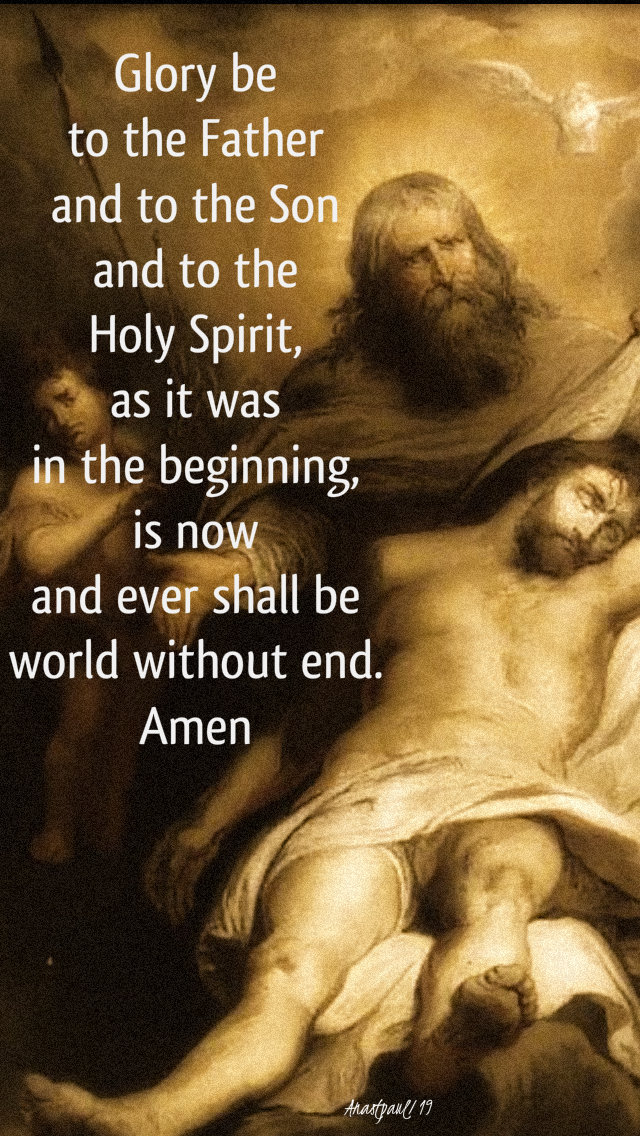
Glory be to the Father and to the Son and to the Holy Spirit, as it was in the beginning, is now and ever shall be world without end. Amen
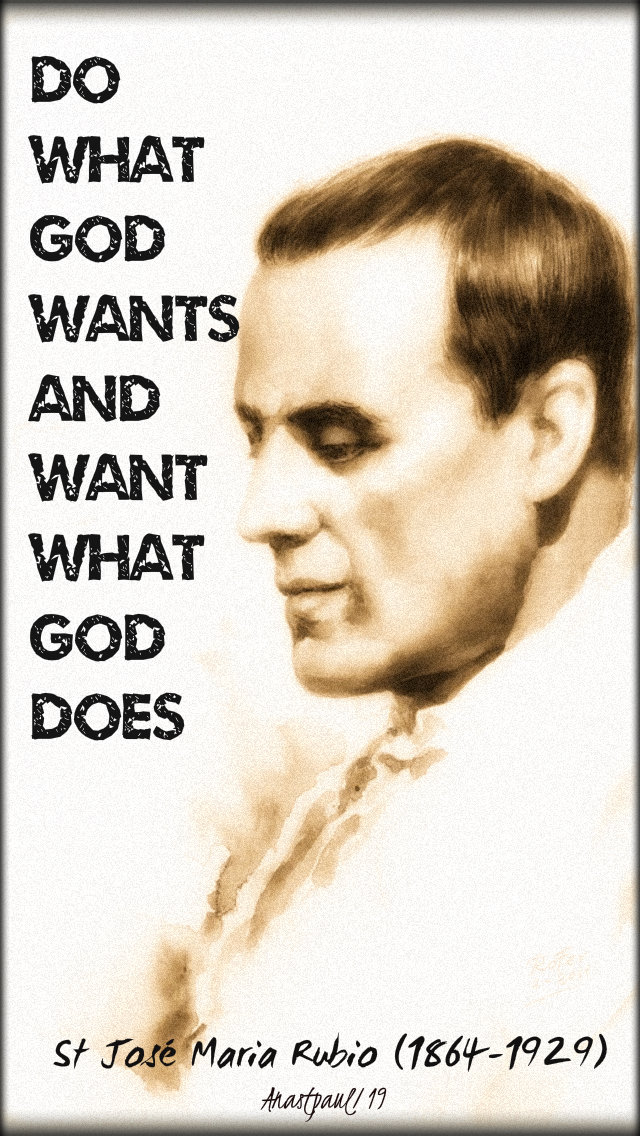
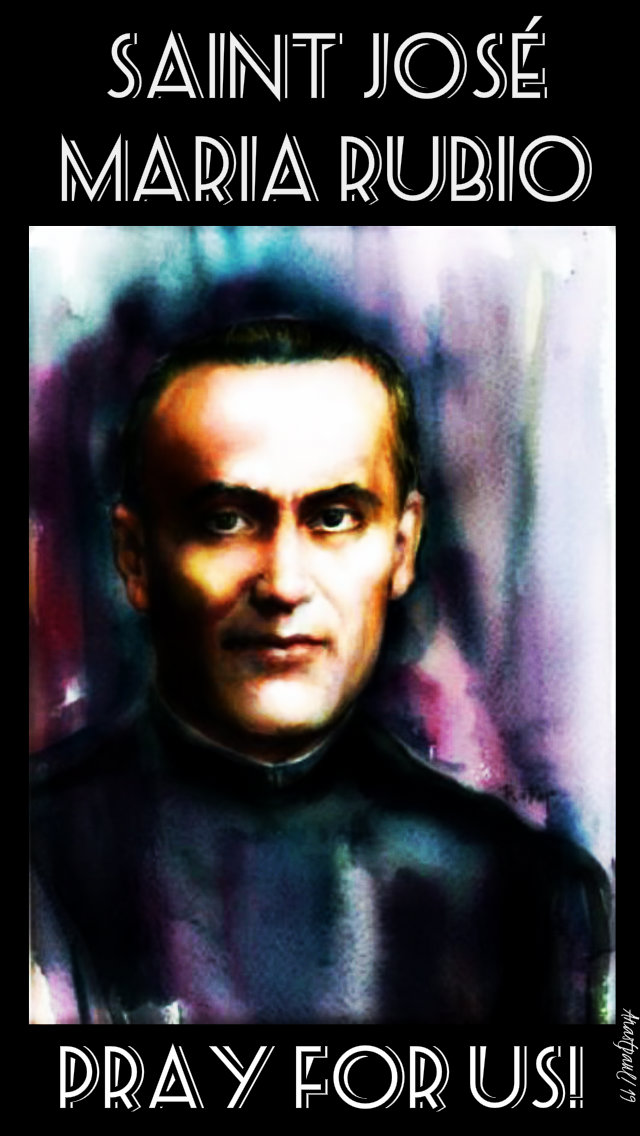
One Minute Reflection – 4 May – Mary’s Month and a Marian Saturday of the Second Week of Easter,Gospel: John 6:16–21 and the Memorial of St José Maria Rubio y Peralta SJ (1864-1929)
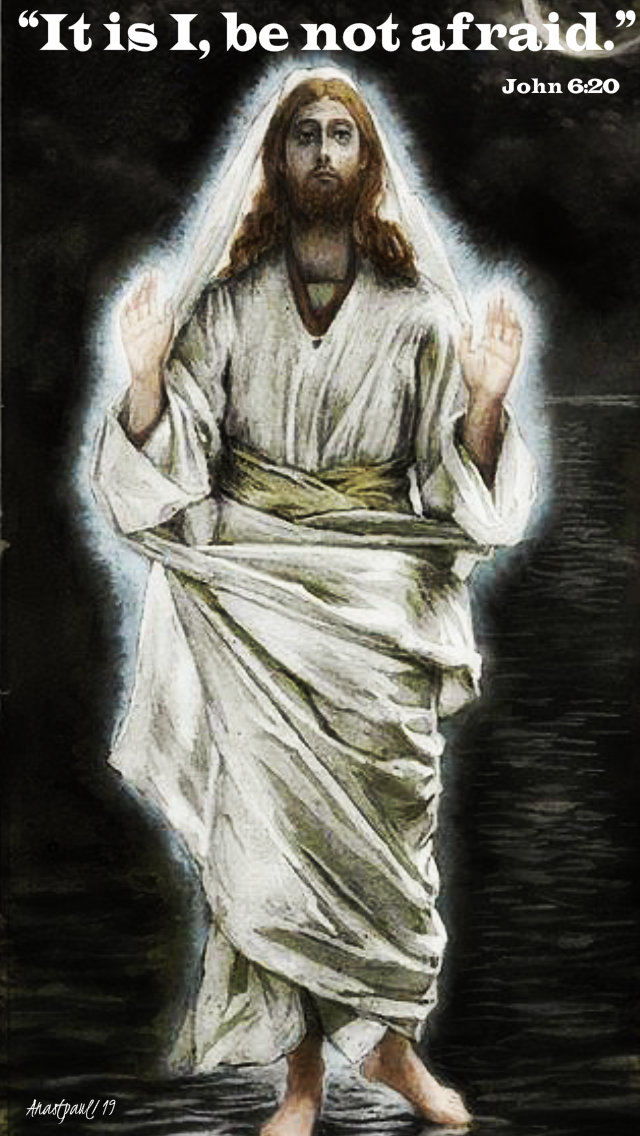
“It is I, be not afraid.”…John 6:20
REFLECTION – Saint Teresa Benedicta of the Cross [Edith Stein] (1891-1942) Carmelite, martyr, co-patron of Europe – “At the Helm”
Fierce are the waves, Lord, rough the seas,
And dark, so dark, the night.
I beg of You to grant me, please,
On lonely vigil, light.
Then steer your ship with steady arm,
Trust me and rest your soul.
Your little boat I’ll keep from harm,
I’ll guide it toward its goal.
Be firm of purpose as you keep
The compass e’er in view.
Through stormy night you’ll cross the deep,
’twill help you to steer true.
The needle trembles faintly, then
Holds steady and prevails;
It points your way and guides you when
I, God, direct your sails.
Be therefore steadfast, calm and true,
Your God is at your side.
Through storm and night He’ll see you through
With conscience as your guide.
PRAYER – Let us praise You Lord, with voice and mind and deed and since life itself is Your gift, may all we have and are, be Yours! May our Mother be with us and pray for us and listen, we pray, to the prayers of St José Maria Rubio as we ask his intercession. Through Christ our Lord, with the Holy Spirit, in union with You, one God for all eternity, amen.
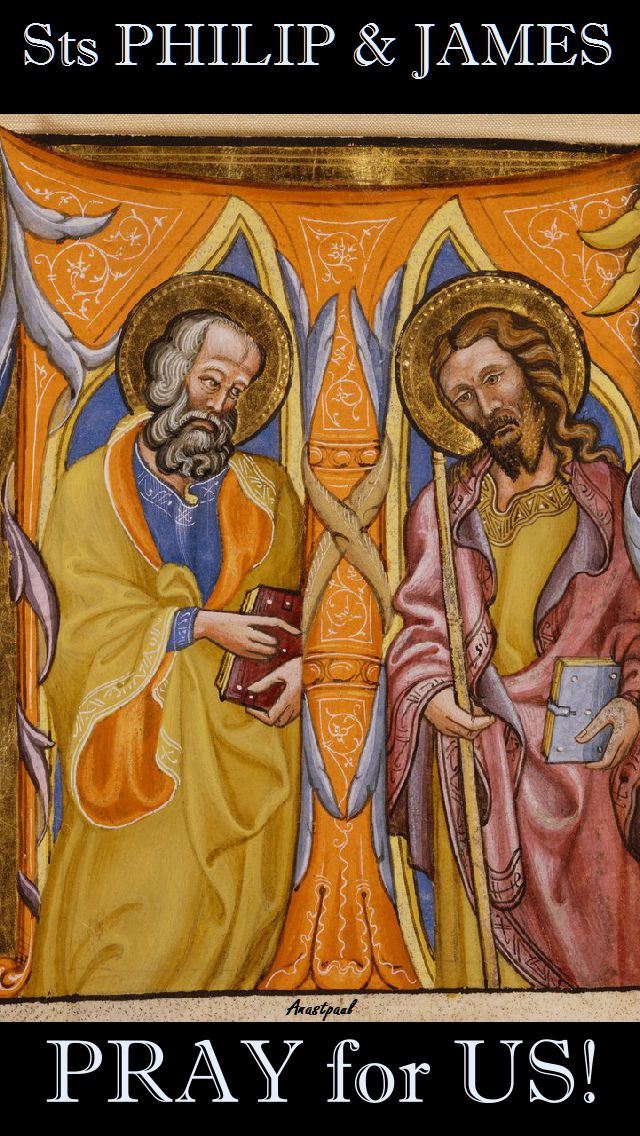
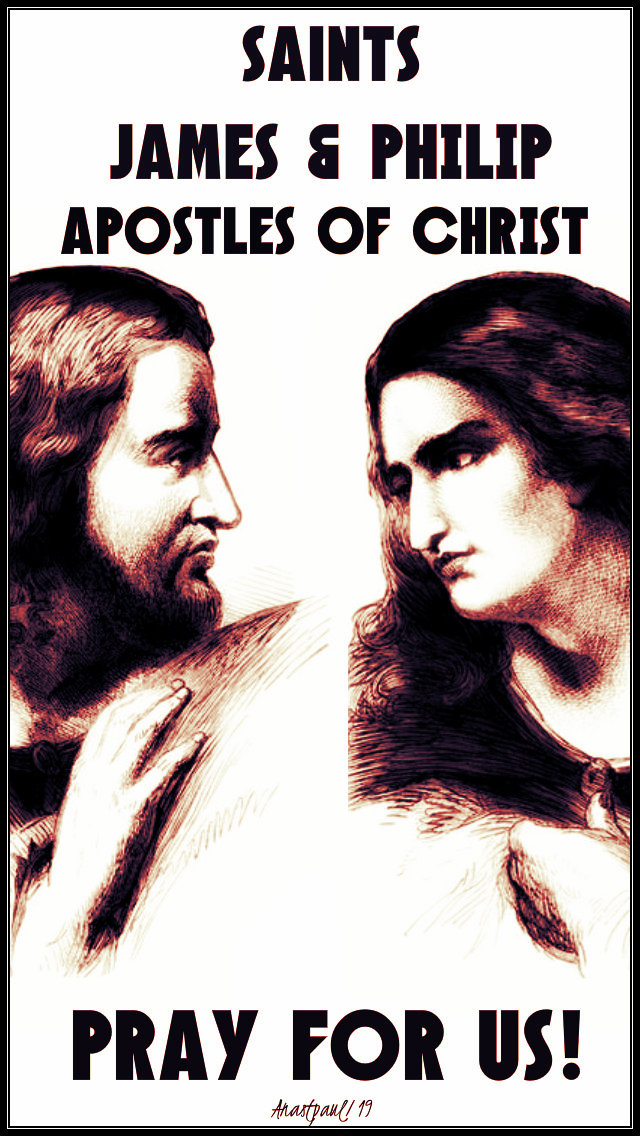
Thought for the Day – 3 May – The Feast of Saints Philip and James, Apostles
The Preaching of the Apostles
Tertullian (c 155- c 240)
Priest, Father and Ancient Christian Writer
An excerpt from his On the Prescription of Heretics
Our Lord Jesus Christ Himself declared what He was, what He had been, how He was carrying out His Father’s will, what obligations He demanded of men. This He did during His earthly life, either publicly to the crowds, or privately to His disciples. Twelve of these He picked out, to be His special companions, appointed to teach the nations.
One of them fell from His place. The remaining eleven were commanded by Christ, as He was leaving the earth to return to the Father after His resurrection, to go and teach the nations and to baptise them into the Father, the Son and the Holy Spirit.
The apostles cast lots and added Matthias to their number, in place of Judas, as the twelfth apostle. The authority for this action is to be found in a prophetic psalm of David. After receiving the power of the Holy Spirit which had been promised to them, so that they could work miracles and proclaim the truth, they first bore witness to their faith in Jesus Christ and established churches throughout Judea. They then went out into the whole world and proclaimed to the nations the same doctrinal faith.
They set up churches in every city. Other churches received from them a living transplant of faith and the seed of doctrine and through this daily process of transplanting they became churches. They therefore qualify as apostolic churches by being the offspring of churches that are apostolic.
Every family has to be traced back to its origins. That is why we can say that all these great churches constitute that one original Church of the apostles, for it is from them that they all come. They are all primitive, all apostolic, because they are all one. They bear witness to this unity by the peace in which they all live, the brotherhood which is their name, the fellowship to which they are pledged. The principle on which these associations are based is common tradition by which they share the same sacramental bond.
The only way in which we can prove what the apostles taught—that is to say, what Christ revealed to them — is through those same churches. They were founded by the apostles themselves, who first preached to them by what is called the living voice and later by means of letters.
The Lord had said clearly in former times – I have many more things to tell you but you cannot endure them now. But He went on to say – When the Spirit of truth comes, He will lead you into the whole truth. Thus Christ shows us that the apostles had full knowledge of the truth, for He had promised that they would receive the whole truth through the Spirit of truth. His promise was certainly fulfilled, since the Acts of the Apostles prove, that the Holy Spirit came down on them.
Quote of the Day – 3 May – Friday of the Second Week of Easter
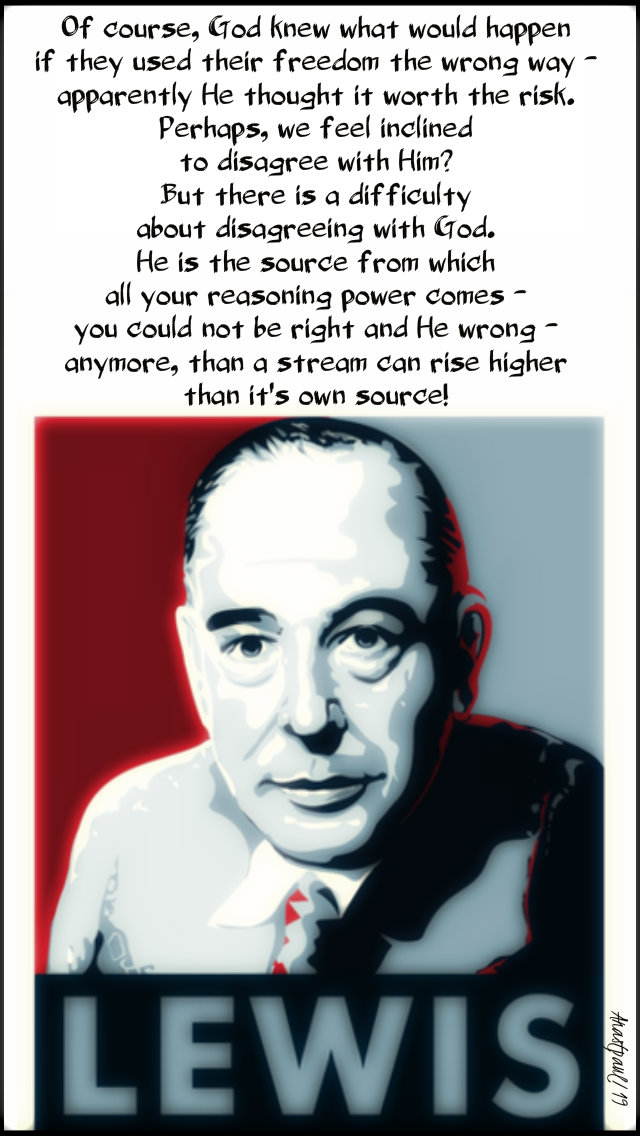
“The happiness that God designs for His higher creatures, is the happiness of being freely, voluntarily united to Him and to each other, in an ecstasy of love and delight, compared with which, the most rapturous love between a man and woman, on this earth, is mere milk and water. And for that, they must be free.
Of course, God knew what would happen if they used their freedom the wrong way – apparently He thought it worth the risk. Perhaps, we feel inclined to disagree with Him? But there is a difficulty about disagreeing with God. He is the source from which all your reasoning power comes – you could not be right and He wrong – anymore, than a stream can rise higher than it’s own source!”
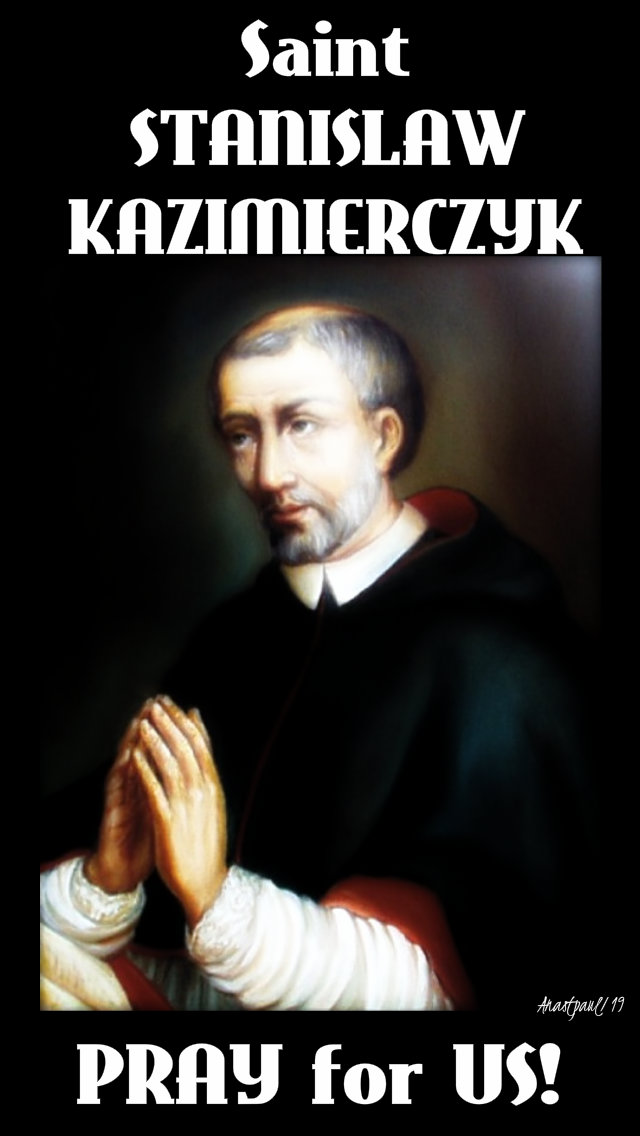
One Minute Reflection – 3 May – Friday of the Second Week of Easter, Gospel: John 14:6–14 and the Feast of Sts James and Philip and the Memorial of Saint Stanislaw Kazimierczyk CRL (1433–1489)
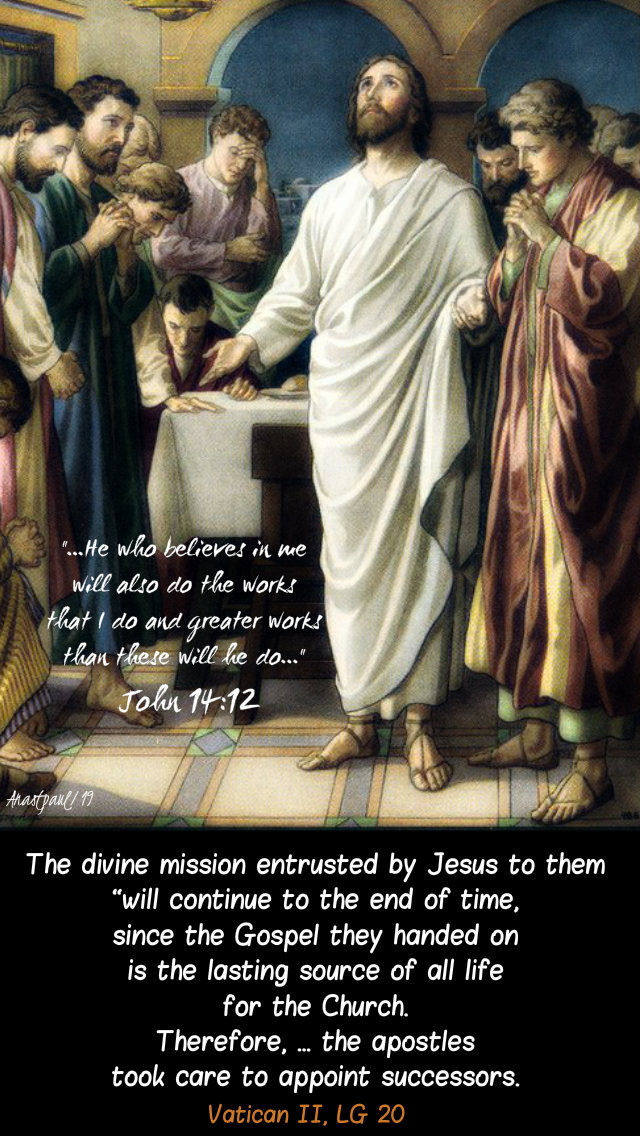
“Truly, truly, I say to you, he who believes in me will also do the works that I do and greater works than these will he do, because I go to the Father…”...John 14:12
REFLECTION – “Jesus is the Father’s Emissary. From the beginning of His ministry, He “called to him those whom he desired … And he appointed twelve, whom also He named apostles, to be with Him and to be sent out to preach.” (Mk 3:13-14) From then on, they would also be His “emissaries” (Greek apostoloi). In them, Christ continues His own mission = “As the Father has sent me, even so I send you.” (Jn 20:21) The apostles’ ministry is the continuation of His mission, Jesus said to the Twelve: “he who receives you receives me.” (Mt 10:40)
Jesus unites them to the mission He received from the Father. As “the Son can do nothing of his own accord” but receives everything from the Father who sent Him, so those whom Jesus sends can do nothing apart from Him (Jn 5:19.30), from whom they received both the mandate for their mission and the power to carry it out. Christ’s apostles knew that they were called by God as “ministers of a new covenant,” “servants of God,” “ambassadors for Christ,” “servants of Christ and stewards of the mysteries of God” (1 Cor 4:1).
In the office of the apostles, there is one aspect that cannot be transmitted – to be the chosen witnesses of the Lord’s Resurrection and so the foundation stones of the Church. But their office also has a permanent aspect. Christ promised to remain with them always. The divine mission entrusted by Jesus to them “will continue to the end of time, since the Gospel they handed on is the lasting source of all life for the Church. Therefore, … the apostles took care to appoint successors.” (Vatican II, LG 20) Catechism of the Catholic Church- #858-860
PRAYER – Almighty Father, we believe, strengthen our faith. Divine Son, we follow You, remain with us. Holy Spirit, come, guide our steps. Glory be to the Father and to the So and to the Holy Spirit, as it was in the beginning is now and ever shall be, amen. Saints James and Philip, Saint Stanislaw, pray for us!
Marian Thoughts – May, the Month of Mary – 2 May 2019
Apostolic Exhortation of St Pope Paul VI (1897-1978) Marialis Cultus – 2 February 1974
To Honour Mary
Finally, insofar as it may be necessary, we would like to repeat that the ultimate purpose of devotion to the Blessed Virgin is to glorify God and to lead Christians, to commit themselves, to a life which is in absolute conformity with His will. When the children of the Church unite their voices, with the voice of the unknown woman, in the Gospel and glorify the Mother of Jesus, by saying to Him: “Blessed is the womb that bore you and the breasts that you sucked” (Lk. 11:27), they will be led to ponder the Divine Master’s serious reply: “Blessed rather are those who hear the word of God and keep it!” (Lk. 11:28) While it is true, that this reply is, in itself, lively praise of Mary, as various Fathers of the Church interpreted it and the Second Vatican Council has confirmed, it is also an admonition to us, to live our lives in accordance with God’s commandments. It is also an echo of other words of the Saviour: “Not everyone who says to me ‘Lord, Lord,’ will enter the kingdom of heaven but he who does the will of my Father who is in heaven” (Mt. 7:21); and again: “You are my friends if you do what I command you” (Jn. 15:14).
Christ is the only way to the Father (cf. Jn. 14:4-11) and the ultimate example to whom the disciple must conform his own conduct (cf. Jn. 13:15), to the extent of sharing Christ’s sentiments (cf. Phil. 2:5), living His life and possessing His Spirit (cf. Gal. 2:20; Rom. 8:10-11). The Church has always taught this and nothing in pastoral activity should obscure this doctrine. But the Church, taught by the Holy Spirit and benefiting from centuries of experience, recognises, that devotion to the Blessed Virgin, subordinated to worship of the divine Saviour and in connection with it, also has a great pastoral effectiveness and constitutes, a force, for renewing Christian living.
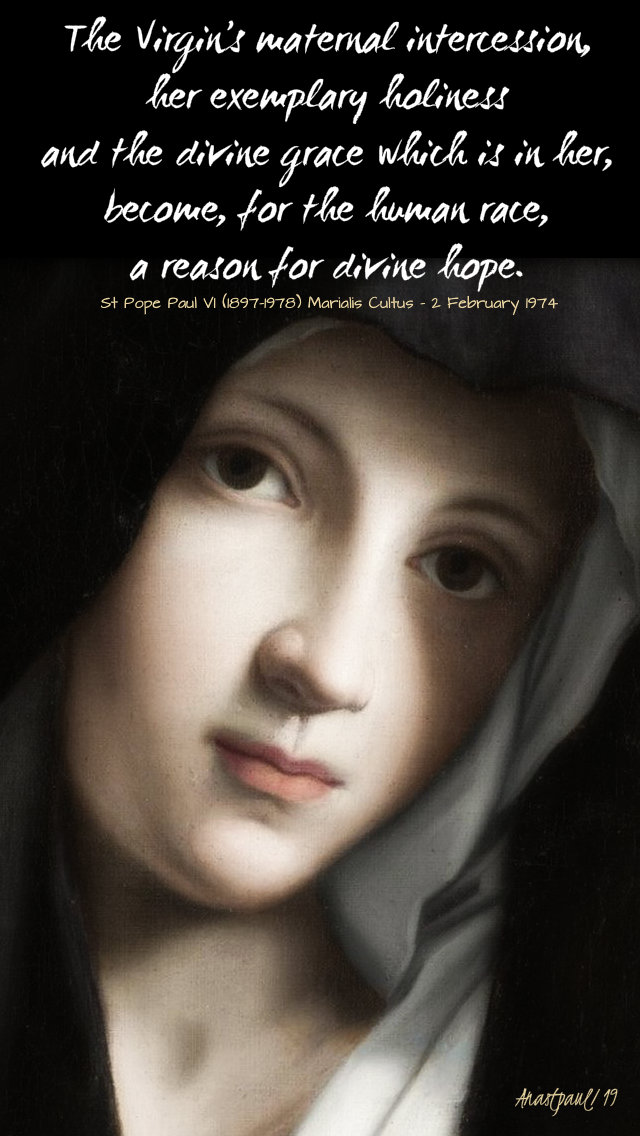
It is easy to see the reason for this effectiveness. Mary’s many-sided mission to the People of God is a supernatural reality which operates and bears fruit within the body of the Church. One finds cause for joy, in considering, the different aspects of this mission and seeing how each of these aspects, with its individual effectiveness, is directed towards the same end, namely, producing in the children the spiritual characteristics of the first-born Son. The Virgin’s maternal intercession, her exemplary holiness and the divine grace which is in her, become, for the human race, a reason for divine hope.
Second Reading The Little Office of Mary Sunday, Tuesday, Thursday
=================
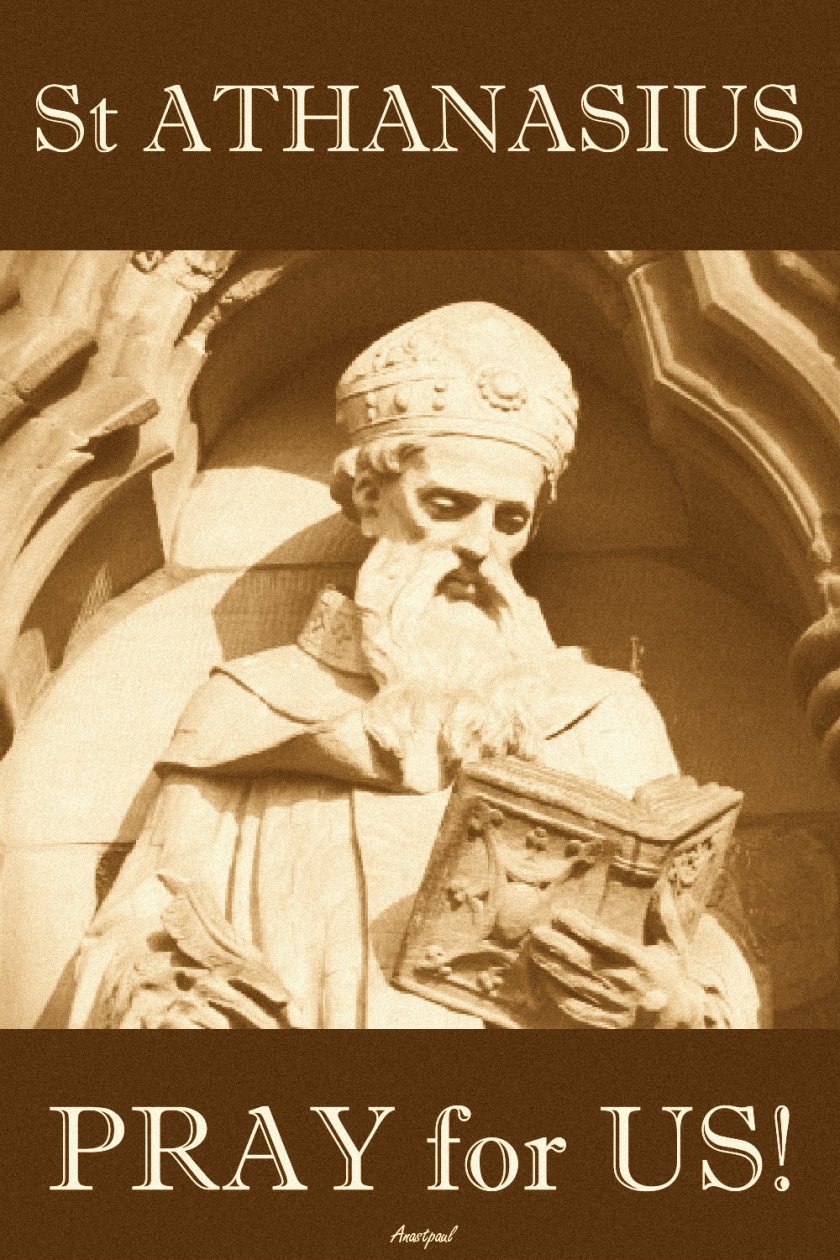
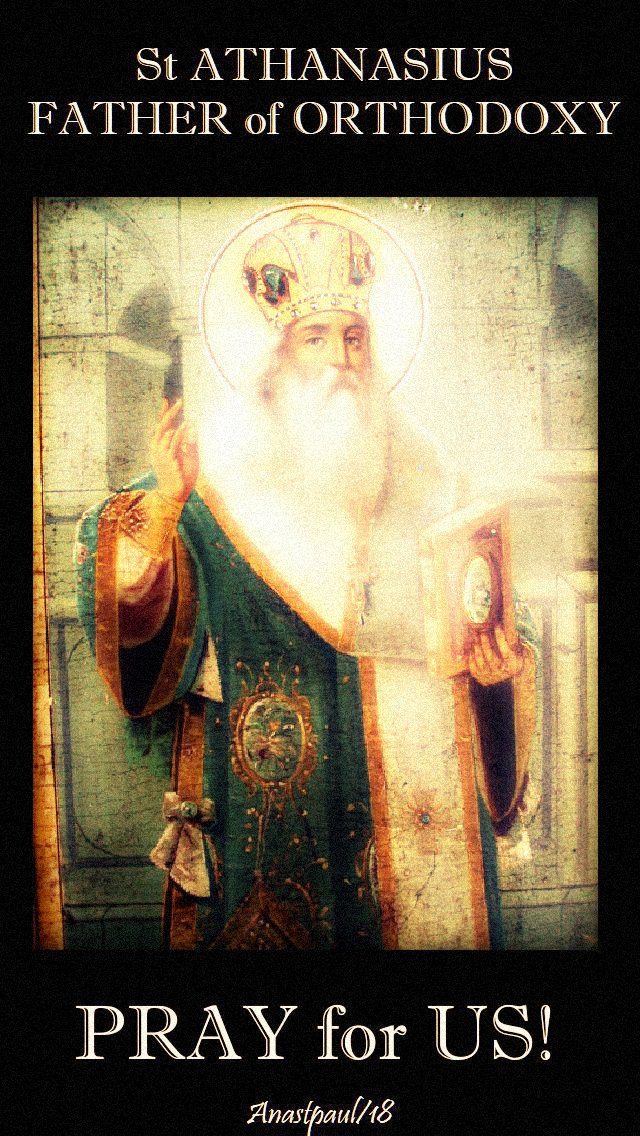
Thought for the Day – 2 May – Thursday of the Second week of Easter, Gospel: John 3:31–36 and the Memorial of St Athanasius (297-373)
On the Incarnation of the Word
Saint Athanasius (297-373)
Bishop, Great Eastern Father & Doctor of the Church
Known as “The Father of Orthodoxy”
An excerpt from On the Incarnation of the Word
The Word of God, incorporeal, incorruptible and immaterial, entered our world. Yet it was not as if He had been remote from it up to that time. For there is no part of the world that was ever without His Presence; together with His Father, He continually filled all things and places.
Out of His loving-kindness for us, He came to us and we see this in the way He revealed Himself openly to us. Taking pity on mankind’s weakness and moved by our corruption, He could not stand aside and see death have the mastery over us, He did not want creation to perish and His Father’s work in fashioning man, to be in vain. He, therefore, took to Himself a body, no different from our own, for He did not wish simply to be in a body or only to be seen.
If He had wanted simply to be seen, He could indeed have taken another and nobler, body. Instead, He took our body in its reality.
Within the Virgin, He built himself a temple, that is, a body, He made it His own instrument in which to dwell and to reveal Himself. In this way, He received from mankind, a body like our own and, since all were subject to the corruption of death, He delivered this body over to death for all and with supreme love, offered it to the Father. He did so, to destroy the law of corruption, passed against all men, since all died in Him. The law, which had spent its force on the body of the Lord, could no longer have any power over His fellowmen. Moreover, this was the way in which the Word was to restore mankind to immortality, after it had fallen into corruption and summon it back, from death to life. He utterly destroyed the power death had against mankind—as fire consumes chaff—by means of the body He had taken and the grace of the Resurrection.
This is the reason why the Word assumed a body that could die, so that this body, sharing in the Word who is above all, might satisfy death’s requirement in place of all. Because of the Word dwelling in that body, it would remain incorruptible and all would be freed forever from corruption, by the grace of the Resurrection.
In death, the Word made a spotless sacrifice and oblation of the body He had taken. By dying for others, He immediately banished death for all mankind.
In this way the Word of God, who is above all, dedicated and offered His temple, the instrument that was His body, for us all, as He said and so paid, by His own death the debt that was owed. The immortal Son of God, united with all men by likeness of nature, thus fulfilled all justice, in restoring mankind to immortality, by the promise of the resurrection.
The corruption of death, no longer holds any power over mankind, thanks to the Word, who has come to dwell among them through His one body.
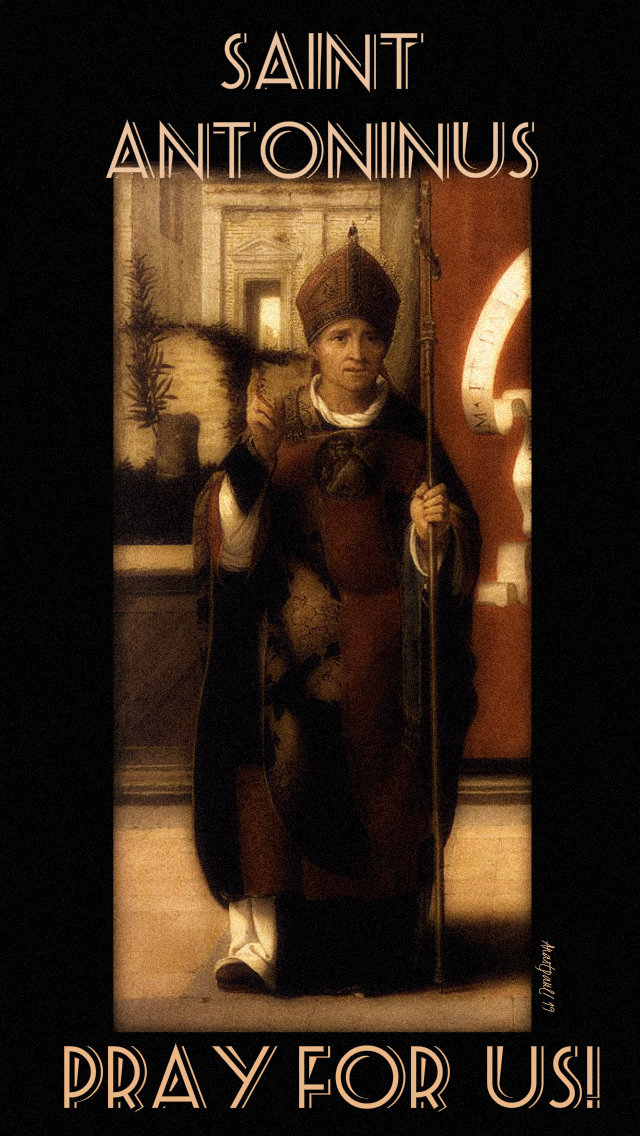
Quote/s of the Day – 2 May – Thursday of the Second week of Easter, Gospel: John 3:31–36 and the Memorial of St Athanasius (297-373) – Father and Doctor of the Church and St Antoninus of Florence OP (1389-1459)
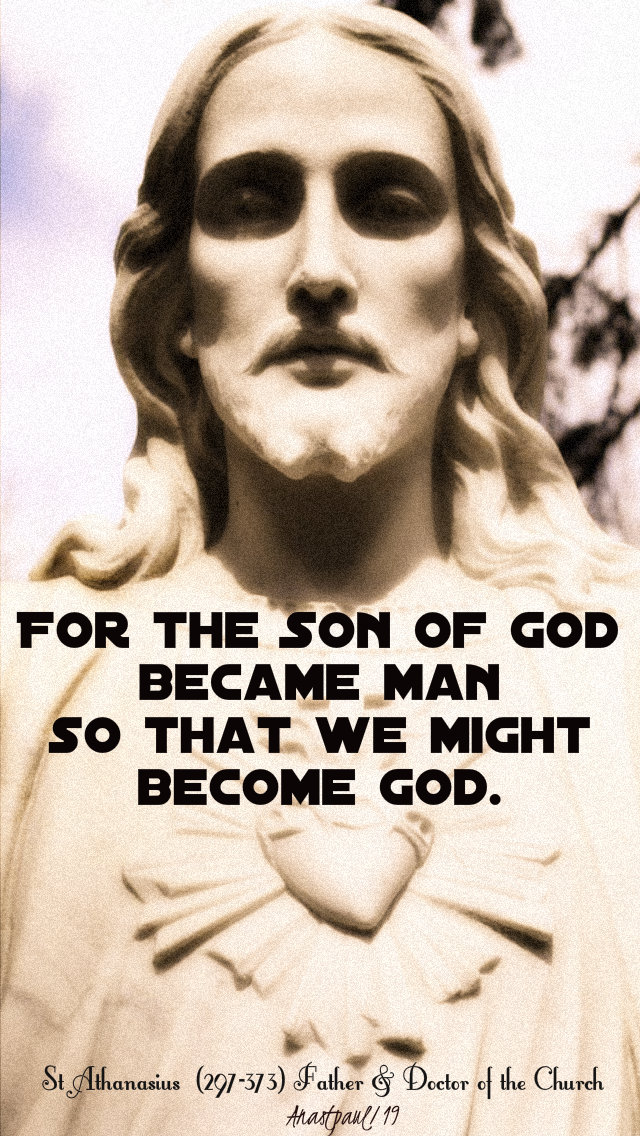
“For the Son of God became man so that we might become God.”
“Christians, instead of arming themselves with swords, extend their hands in prayer.”
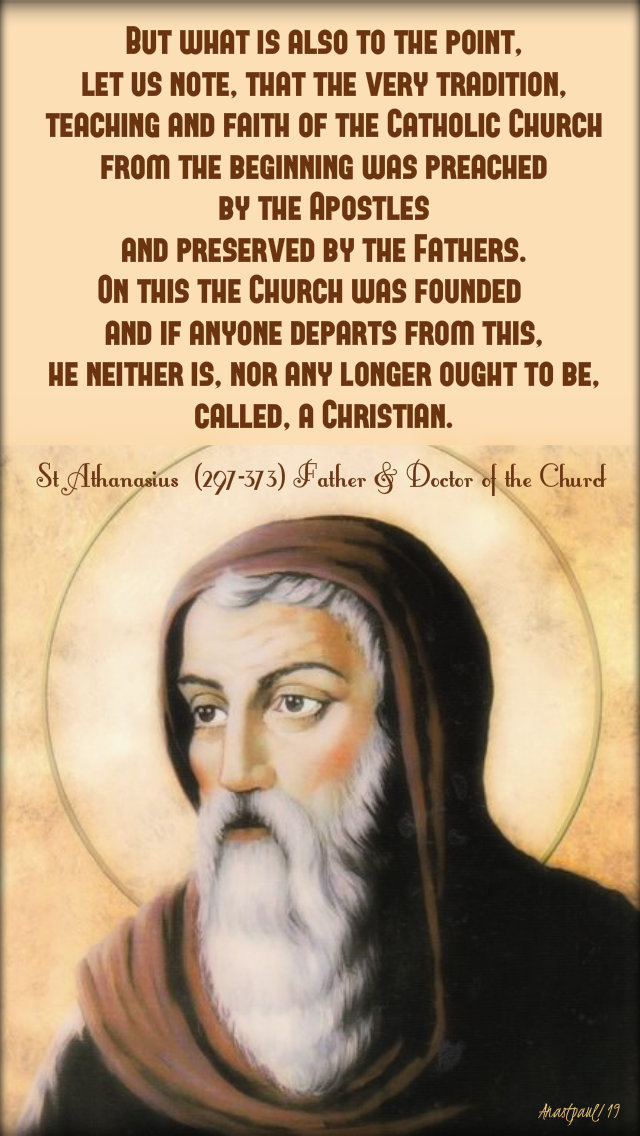
“But what is also to the point, let us note that the very tradition, teaching and faith of the Catholic Church from the beginning was preached by the Apostles and preserved by the Fathers. On this the Church was founded – and if anyone departs from this, he neither is, nor any longer ought to be called, a Christian.”
St Athanasius (297-373) Father & Doctor of the Church
“While other martyrs suffered by sacrificing their own lives, the Blessed Virgin suffered, by sacrificing her Son’s life.”
One Minute Reflection – 2 May – Thursday of the Second week of Easter, Gospel: John 3:31–36 and the Memorial of St Athanasius (297-373) – Father and Doctor of the Church and St Antoninus OP (1389-1459), Gospel: John 3:31–36
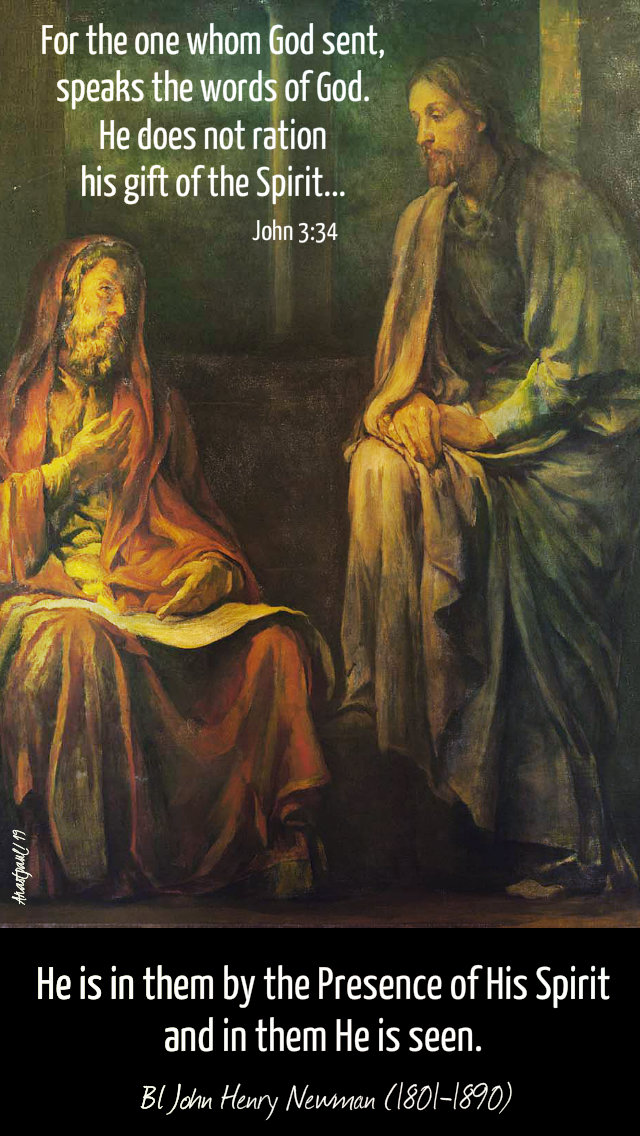
For the one whom God sent speaks the words of God. He does not ration his gift of the Spirit…he who does not obey the Son shall not see life…John 3:34,36
REFLECTION – “The sanctification or, rather, the deification of the nature of man, is one main subject of St Athanasius’s theology. Christ, in rising, raises His Saints with Him to the right hand of power. They become instinct with His life, of one body with His flesh, divine sons, immortal kings, gods. He is in them, because He is in human nature and He communicates in them that nature, deified by becoming His, that them Itmay deify. He is in them by the Presence of His Spirit and in them He is seen.”…Bl John Henry Newman (1801-1890)
PRAYER – Lord God, whose name is holy and whose mercy is proclaimed in every generation, send forth Your Spirit into our hearts and grant that, faithfully pondering on all that is holy, we may ever live in the splendour of Your presence. Listen we beseech You, to the prayers we request from St Athanasius and St Antoninus, to help us on this earthly journey. We make our prayer through Christ, Your Son our Lord and Saviour, with the Holy Spirit, one God forever amen.
Thought for the Day – 1 May – Devotion for May – the Month of Mary
“God wills that all his gifts should come to us through Mary” (St Bernard)
It was in Rome, towards the end of the eighteenth century, one fine evening in May. A child of the poor gathered his companions around him and led them to a statue of Mary, before which a lamp was burning, as is the custom in that holy city. There, these fresh young voices sang the Litany of our Lady. The next day, the little group, followed by other children, again gathered at the feet of the Mother of God. Next came their mothers, to join the little assembly. Soon, other groups were formed and the devotion rapidly became popular. Holy souls, troubled by the disorderly conduct which always increases and becomes graver at the return of the pleasant springtime, saw in these growing practices the hand of God and they co-operated with the designs of Providence by approving and promoting this new devotion, as a public and solemn act of reparation. The Month of Mary was founded….A Carthusian, A Month with Mary
“This is the month in which, in the churches and individual homes, the most affectionate and fervent homage of prayers and devotions from the hearts of Christians are raised to Mary. It is also the month in which from His throne descend upon us the most generous and abundant gifts of the Divine Mercy.”….St Pope Paul VI, The Month of Mary,1967.
In our own times, we Catholics, wanting to be close to her always, offer her special presents in May – pilgrimages, visits to churches dedicated to her, little sacrifices in her honour, periods of study and well-finished work offered up to her and a more attentive recitation of the rosary….
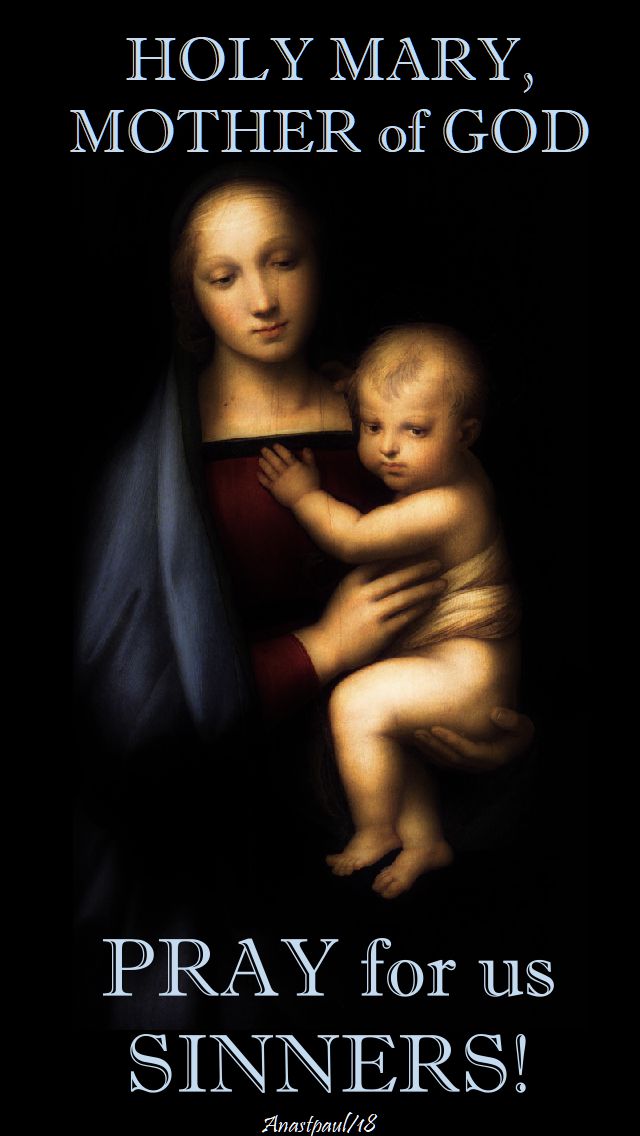
MARY: THE MOTHER OF GOD
“When the Blessed Virgin said yes, freely, to the plans revealed to her by the Creator, the divine Word assumed a human nature — a rational soul and a body — which was formed in the most pure womb of Mary. The divine nature and the human were united in a single Person – Jesus Christ, true God and, thenceforth, true man, the only begotten and eternal son of the Father and from that moment on, as man, the true son of Mary. This is why our Lady is the mother of the Incarnate Word, of the second person of the Blessed Trinity, who has united our human nature to Himself forever, without any confusion of the two natures. The greatest praise we can give to the Blessed Virgin is to address her loudly and clearly by the name that expresses her very highest dignity: ‘Mother of God’.”
Let us offer to our Mother today:
Brief but frequent prayers of love, such as:
“Mother of God, your petitions are most powerful.”
St Josemaria Escriva – “Mother of God and Our Mother,” Friends of God, 274.
May Magnificat
Poem by Fr Gerard Manley Hopkins SJ (1844-1889)
May is Mary’s month and I Muse at that and wonder why: Her feasts follow reason, Dated due to season—
Candlemas, Lady Day But the Lady Month, May, Why fasten that upon her, With a feasting in her honour?
Is it only its being brighter Than the most are must delight her? Is it opportunest And flowers finds soonest?
Ask of her, the mighty mother: Her reply puts this other Question: What is Spring?— Growth in every thing—
Flesh and fleece, fur and feather, Grass and greenworld all together, Star-eyed strawberry-breasted Throstle above her nested
Cluster of bugle blue eggs thin Forms and warms the life within, And bird and blossom swell In sod or sheath or shell.
All things rising, all things sizing Mary sees, sympathising With that world of good, Nature’s motherhood.
Their magnifying of each its kind With delight calls to mind How she did in her stored Magnify the Lord.
Well but there was more than this: Spring’s universal bliss Much, had much to say To offering Mary May.
When drop-of-blood-and-foam-dapple Bloom lights the orchard-apple And thicket and thorp are merry With silver-surfed cherry
And azuring-over greybell makes Wood banks and brakes wash wet like lakes And magic cuckoocall Caps, clears, and clinches all—
This ecstasy all through mothering earth Tells Mary her mirth till Christ’s birth To remember and exultation In God who was her salvation.
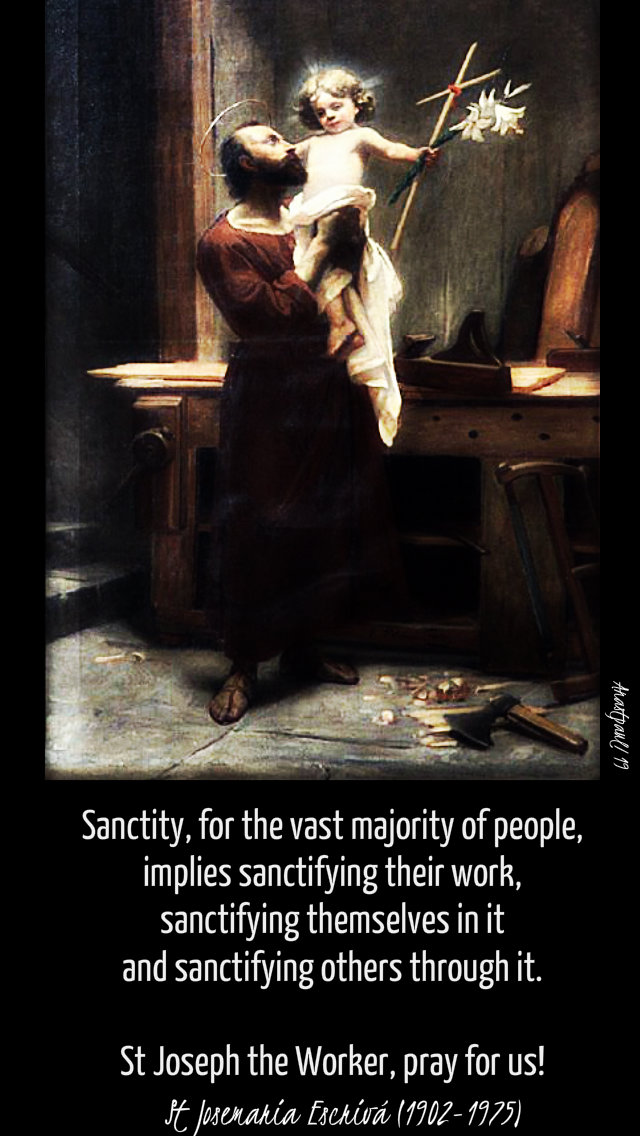
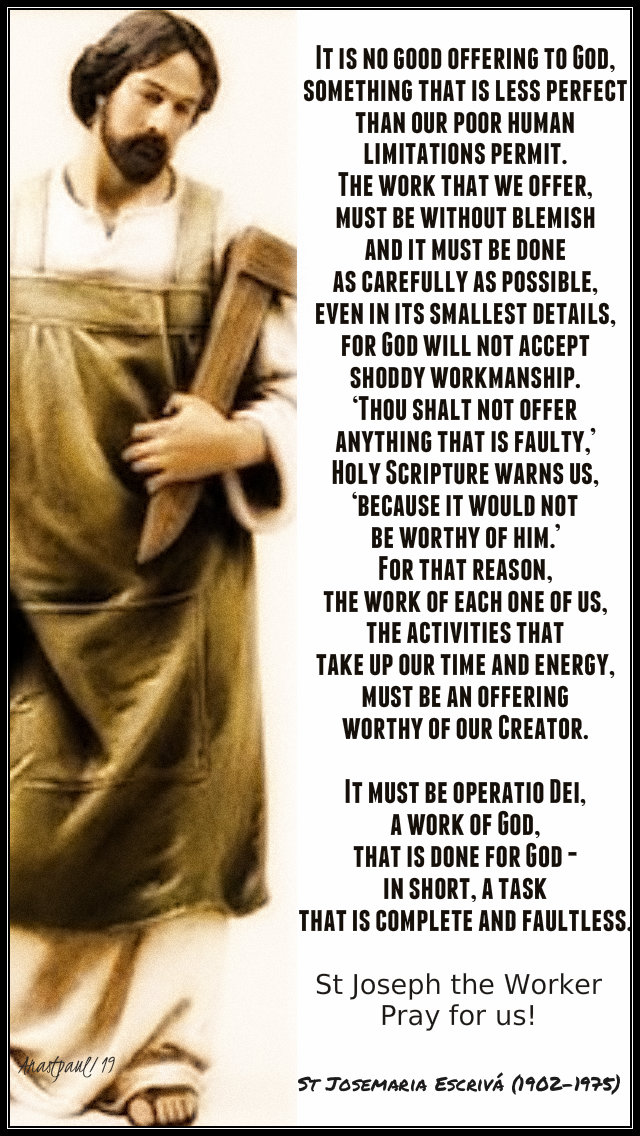
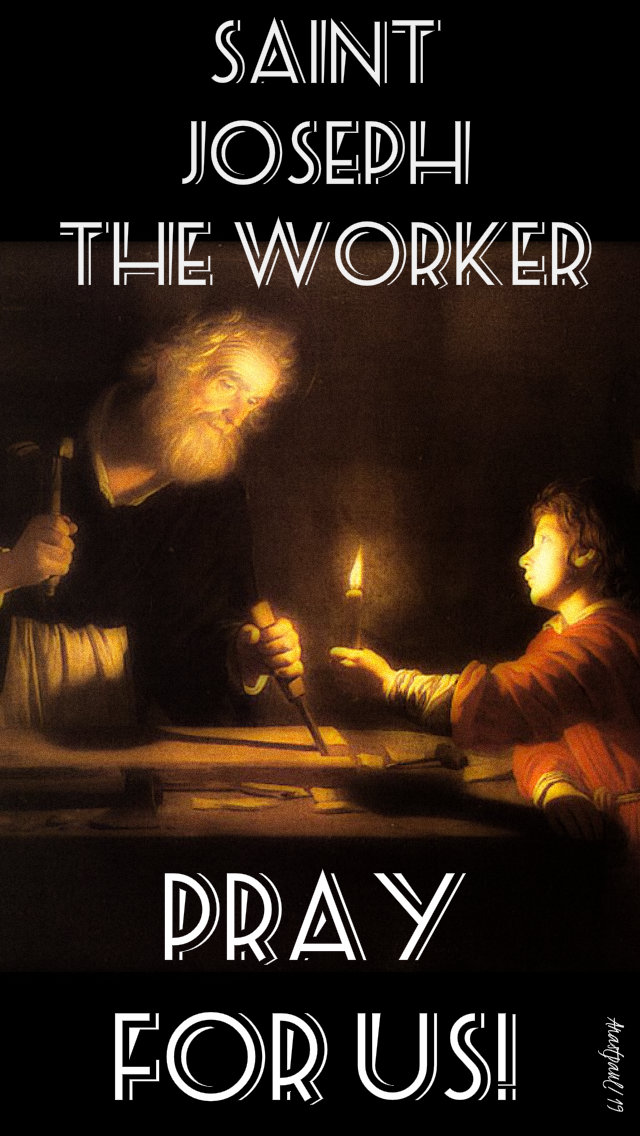
Quote/s of the Day – 1 May – Wednesday of the Second week of Easter, the first day of Mary’s Month and the Memorial of St Joseph the Worker, Gospel: John 3:16–21
“Sanctity, for the vast majority of people, implies sanctifying their work, sanctifying themselves in it and sanctifying others through it.”
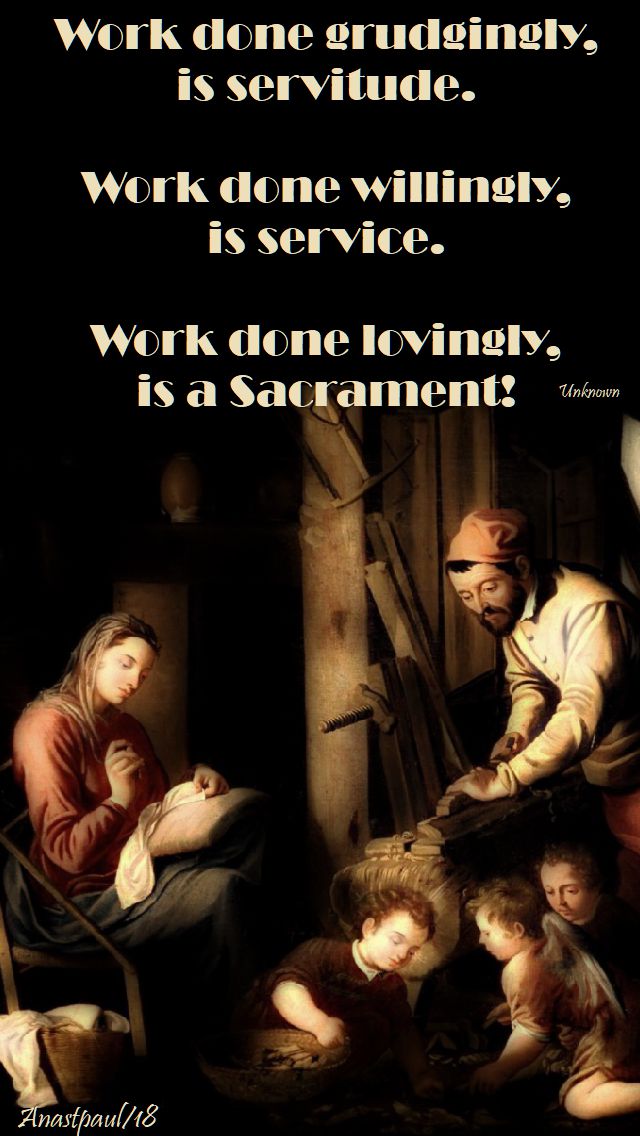
“It is no good offering to God, something that is less perfect than our poor human limitations permit. The work that we offer, must be without blemish and it must be done as carefully as possible, even in its smallest details, for God will not accept shoddy workmanship. ‘Thou shalt not offer anything that is faulty,’ Holy Scripture warns us, ‘because it would not be worthy of him.’ For that reason, the work of each one of us, the activities that take up our time and energy, must be an offering worthy of our Creator. It must be operatio Dei, a work of God, that is done for God – in short, a task that is complete and faultless.”
St Josemaria Escrivá (1902-1975)
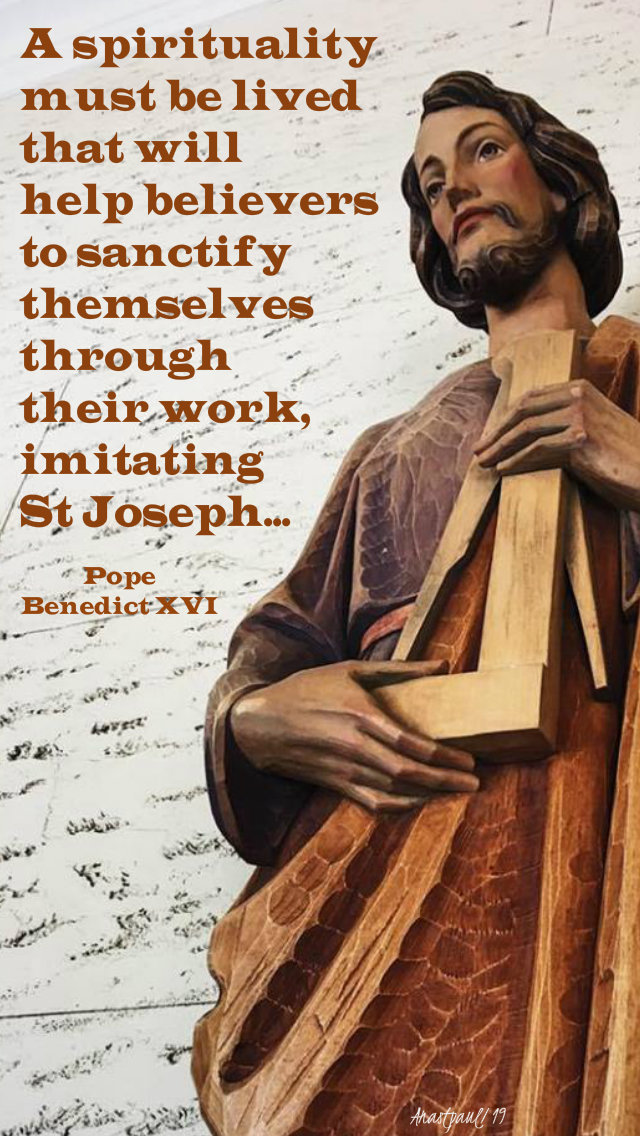
“A spirituality must be lived that will help believers to sanctify themselves through their work, imitating St Joseph, who everyday, had to provide for the needs of the Holy Family with his hands and who because of this, the Church indicates as patron of workers.”
One Minute Reflection – 1 May – Wednesday of the Second week of Easter, the first day of Mary’s Month and the Memorial of St Joseph the Worker, Gospel: John 3:16–21
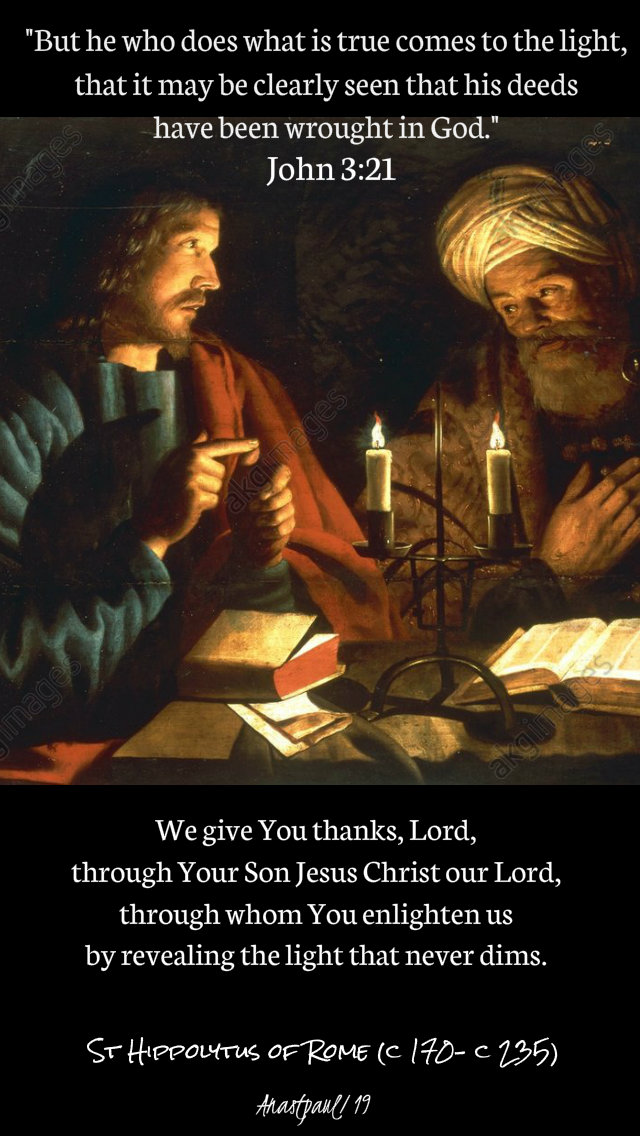
“But he who does what is true comes to the light, that it may be clearly seen that his deeds have been wrought in God.”…John 3:21
REFLECTION – “In the evening, when the Bishop is present, the deacon carries in the lamp. And standing in the midst of all the faithful who are there, he will offer thanksgiving. First of all he says the greeting: “The Lord be with you,” and the people respond: “And with your spirit.” – Then he says: “Let us give thanks to the Lord” and they reply: “It is right and just. To Him be the greatness and supremacy together with the glory”… Then he will pray thus, saying:
“We give you thanks, Lord, through your Son Jesus Christ our Lord, through whom you enlighten us by revealing the light that never dims. Since day is spent and we have now reached evening, filled with the light of the day you created for our joy and since, through your grace, we do not now lack the light of evening, we praise and glorify you through your Son, Jesus Christ our Lord, through whom to you be glory and power and honour, with the Holy Spirit, now and for ever and through all ages. Amen.” And everyone will say: “Amen.”
In this way, after the meal, all will stand in prayer. The children say psalms as also the virgins.”…St Hippolytus of Rome (c 170– c 235) Priest and Martyr – Apostolic Tradition, 25
PRAYER – Shed your clear light on our hearts, Lord, so that walking continually in the way of Your commandments, we may never be deceived or misled. Your ways are not our ways, teach us to willingly agree to them, for You know which way we should go. Help us to say “yes” always to Your plan and to render ourselves as a sacrament of Your divine love to all we meet. Fill us with the grace to be your tools to bring glory to Your kingdom. St Joseph, silent and loving husband and father, as you worked for and protected your family on earth, protect us all now in the Church of Your adopted son. Through Him, our Our Lord Jesus Christ with You, in the union of the Holy Spirit, one God forever, amen.
Quote of the Day – Lepanto – 30 April – Tuesday of the Second week of Easter and the Memorial of St Pope Pius V OP (1504-1572), The Pope of Lepanto
Lepanto
BY G K CHESTERTON (1874-1936)
White founts falling in the courts of the sun,
And the Soldan of Byzantium is smiling as they run.
There is laughter like the fountains in that face of all men feared,
It stirs the forest darkness, the darkness of his beard,
It curls the blood-red crescent, the crescent of his lips,
For the inmost sea of all the earth is shaken with his ships.
They have dared the white republics up the capes of Italy,
They have dashed the Adriatic round the Lion of the Sea,
And the Pope has cast his arms abroad for agony and loss,
And called the kings of Christendom for swords about the Cross,
The cold queen of England is looking in the glass.
The shadow of the Valois is yawning at the Mass.
From evening isles fantastical rings faint the Spanish gun,
And the Lord upon the Golden Horn is laughing in the sun.
Dim drums throbbing, in the hills half heard,
Where only on a nameless throne a crownless prince has stirred,
Where, risen from a doubtful seat and half attainted stall,
The last knight of Europe takes weapons from the wall,
The last and lingering troubadour to whom the bird has sung,
That once went singing southward when all the world was young,
In that enormous silence, tiny and unafraid,
Comes up along a winding road the noise of the Crusade.
Strong gongs groaning as the guns boom far, Don John of Austria is going to the war,
Stiff flags straining in the night-blasts cold
In the gloom black-purple, in the glint old-gold,
Torchlight crimson on the copper kettle-drums,
Then the tuckets, then the trumpets, then the cannon, and he comes.
Don John laughing in the brave beard curled,
Spurning of his stirrups like the thrones of all the world,
Holding his head up for a flag of all the free.
Love-light of Spain—hurrah!
Death-light of Africa!
Don John of Austria
Is riding to the sea.
Mahound is in his paradise above the evening star, (Don John of Austria is going to the war.)
He moves a mighty turban on the timeless houri’s knees,
His turban that is woven of the sunset and the seas.
He shakes the peacock gardens as he rises from his ease,
And he strides among the tree-tops and is taller than the trees,
And his voice through all the garden is a thunder sent to bring
Black Azrael and Ariel and Ammon on the wing.
Giants and the Genii,
Multiplex of wing and eye,
Whose strong obedience broke the sky
When Solomon was king.
They rush in red and purple from the red clouds of the morn,
From temples where the yellow gods shut up their eyes in scor,
They rise in green robes roaring from the green hells of the sea
Where fallen skies and evil hues and eyeless creatures be,
On them the sea-valves cluster and the grey sea-forests curl,
Splashed with a splendid sickness, the sickness of the pearl,
They swell in sapphire smoke out of the blue cracks of the ground,—
They gather and they wonder and give worship to Mahound.
And he saith, “Break up the mountains where the hermit-folk can hide,
And sift the red and silver sands lest bone of saint abide,
And chase the Giaours flying night and day, not giving rest,
For that which was our trouble comes again out of the west.
We have set the seal of Solomon on all things under sun,
Of knowledge and of sorrow and endurance of things done,
But a noise is in the mountains, in the mountains, and I know
The voice that shook our palaces—four hundred years ago:
It is he that saith not ‘Kismet’; it is he that knows not Fate,
It is Richard, it is Raymond, it is Godfrey in the gate!
It is he whose loss is laughter when he counts the wager worth,
Put down your feet upon him, that our peace be on the earth.”
For he heard drums groaning and he heard guns jar, (Don John of Austria is going to the war.)
Sudden and still—hurrah!
Bolt from Iberia!
Don John of Austria
Is gone by Alcalar.
St Michael’s on his mountain in the sea-roads of the north (Don John of Austria is girt and going forth.)
Where the grey seas glitter and the sharp tides shift
And the sea folk labour and the red sails lift.
He shakes his lance of iron and he claps his wings of stone,
The noise is gone through Normandy; the noise is gone alone;
The North is full of tangled things and texts and aching eyes
And dead is all the innocence of anger and surprise,
And Christian killeth Christian in a narrow dusty room,
And Christian dreadeth Christ that hath a newer face of doom,
And Christian hateth Mary that God kissed in Galilee,
But Don John of Austria is riding to the sea.
Don John calling through the blast and the eclipse
Crying with the trumpet, with the trumpet of his lips,
Trumpet that sayeth ha! Domino gloria!
Don John of Austria
Is shouting to the ships.
King Philip’s in his closet with the Fleece about his neck (Don John of Austria is armed upon the deck.)
The walls are hung with velvet that is black and soft as sin,
And little dwarfs creep out of it and little dwarfs creep in.
He holds a crystal phial that has colours like the moon,
He touches, and it tingles, and he trembles very soon,
And his face is as a fungus of a leprous white and grey
Like plants in the high houses that are shuttered from the day,
And death is in the phial, and the end of noble work,
But Don John of Austria has fired upon the Turk.
Don John’s hunting, and his hounds have bayed—
Booms away past Italy the rumour of his raid
Gun upon gun, ha! ha!
Gun upon gun, hurrah!
Don John of Austria
Has loosed the cannonade.
The Pope was in his chapel before day or battle broke, (Don John of Austria is hidden in the smoke.)
The hidden room in man’s house where God sits all the year,
The secret window whence the world looks small and very dear.
He sees as in a mirror on the monstrous twilight sea
The crescent of his cruel ships whose name is mystery.
They fling great shadows foe-wards, making Cross and Castle dark,
They veil the plumèd lions on the galleys of St Mark
And above the ships are palaces of brown, black-bearded chiefs,
And below the ships are prisons, where with multitudinous griefs,
Christian captives sick and sunless, all a labouring race repines
Like a race in sunken cities, like a nation in the mines.
They are lost like slaves that sweat, and in the skies of morning hung
The stair-ways of the tallest gods when tyranny was young.
They are countless, voiceless, hopeless as those fallen or fleeing on
Before the high Kings’ horses in the granite of Babylon.
And many a one grows witless in his quiet room in hell
Where a yellow face looks inward through the lattice of his cell,
And he finds his God forgotten, and he seeks no more a sign— (But Don John of Austria has burst the battle-line!)
Don John pounding from the slaughter-painted poop,
Purpling all the ocean like a bloody pirate’s sloop,
Scarlet running over on the silvers and the golds,
Breaking of the hatches up and bursting of the holds,
Thronging of the thousands up that labour under sea
White for bliss and blind for sun and stunned for liberty. Vivat Hispania! Domino Gloria!
Don John of Austria
Has set his people free!
Cervantes on his galley sets the sword back in the sheath (Don John of Austria rides homeward with a wreath.)
And he sees across a weary land a straggling road in Spain,
Up which a lean and foolish knight forever rides in vain,
And he smiles, but not as Sultans smile and settles back the blade…. (But Don John of Austria rides home from the Crusade.)
One Minute Reflection – 30 April – Tuesday of the Second week of Easter and the Feast of Our Lady, Mother of Africa (1840) and the Memorial of St Pope Pius V OP (1504-1572), The Pope of Lepanto
“…So that everyone who believes, may have eternal life in him”…John 3:15
REFLECTION –
“My Lord, God,
You have led me by a long, dark path,
Rocky and hard.
Often my strength threatened to fail me.
I almost lost all hope of seeing the light.
But when my heart grew numb with deepest grief,
A clear star rose for me.
Steadfast it guided me- I followed,
At first reluctant, but more confidently later.
At last I stood at Church’s gate.
It opened. I sought admission.
From Your priest’s mouth Your blessing greets me.
Within me stars are strung like pearls.
Red blossom stars show me the path to You.
They wait for You at Holy Night.
But Your goodness
Allows them to illuminate my path to You.
They lead me on.
The secret which I had to keep in hiding
Deep in my heart,
Now I can shout it out:
I believe-I profess!
The priest accompanies me to the altar:
I bend my face-
Holy water flows over my head.
Lord, is it possible that someone who is past
Midlife can be reborn (Jn 3:4)?
You said so and for me it was fulfilled,
A long life’s burden of guilt and suffering
Fell away from me.
Erect I receive the white cloak,
Which they place round my shoulders,
Radiant image of purity!
In my hand I hold a candle.
Its flame makes known
That deep within me glows Your holy life.
My heart has become Your manger,
Awaiting You,
But not for long!
Maria, Your mother and also mine
Has given me her name.
At midnight she will place her newborn child
Into my heart.
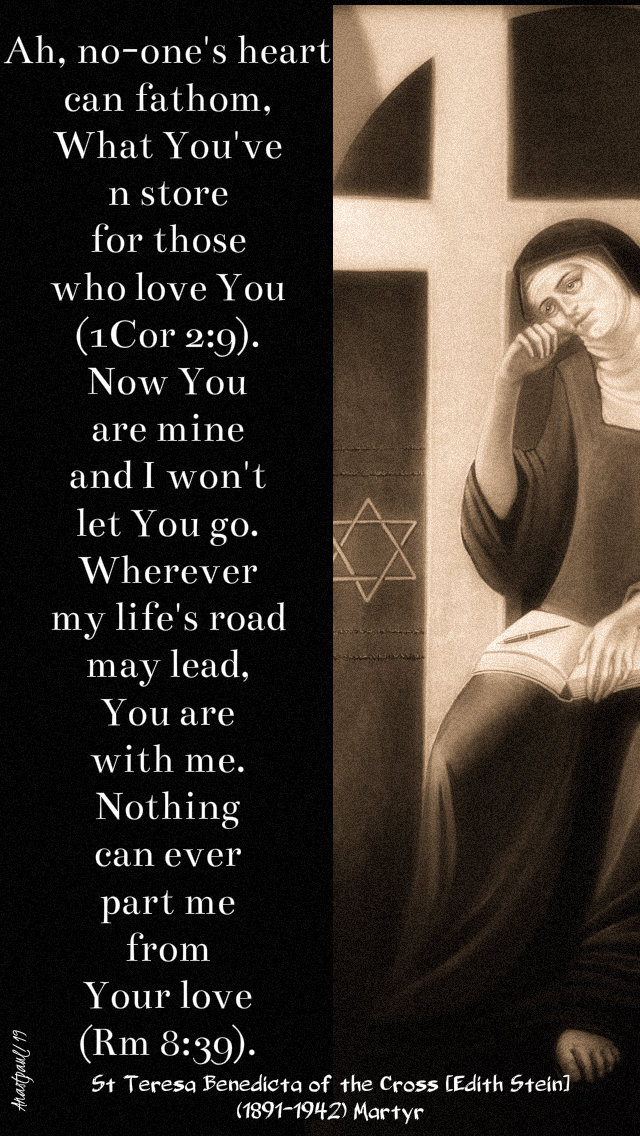
Ah, no-one’s heart can fathom,
What You’ve in store for those who love You (1Cor 2:9).
Now You are mine and I won’t let You go.
Wherever my life’s road may lead,
You are with me.
Nothing can ever part me from Your love (Rm 8:39).”
St Teresa Benedicta of the Cross [Edith Stein] OCD (1891-1942) Martyr
PRAYER – True Light of the world, Lord Jesus Christ, as You enlighten all men for their salvation, give us grace, we pray, to herald Your coming, by preparing the ways of justice and of peace. May the intercession of Your Mother and our Mother of Africa and St Pope Pius V, assist us on our journey to You. Who live and reign with the Father and the Holy Spirit, God, forever and ever, amen.
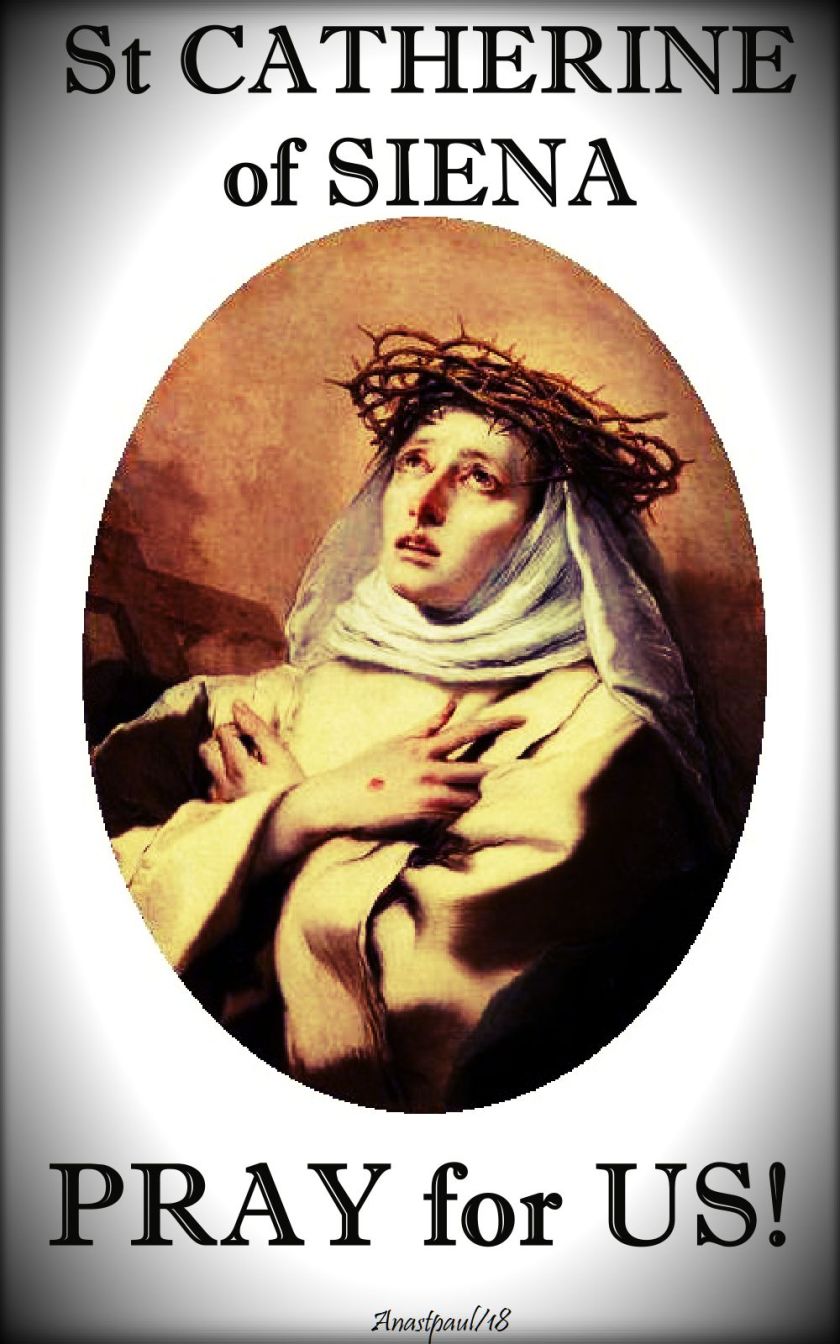
Thought for the Day – 29 April – Monday of the Second week of Easter, Year C and the Memorial of St Catherine of Siena (1347-1380) Doctor of the Church
I tasted and I saw
Saint Catherine of Siena OP (1347-1380)
Doctor of the Church
An excerpt from Dialogue on Divine Providence
With a look of mercy that revealed His indescribable kindness, God the Father spoke to Catherine:
“Eternal God, eternal Trinity, You have made the blood of Christ so precious through His sharing in Your divine nature. You are a mystery as deep as the sea, the more I search, the more I find and the more I find, the more I search for You. But I can never be satisfied, what I receive, will ever leave me desiring more. When You fill my soul I have an even greater hunger and I grow more famished for Your Light. I desire above all to see You, the true Light, as You really are.
I have tasted and seen the depth of Your mystery and the beauty of Your creation with the light of my understanding. I have clothed myself with Your likeness and have seen what I shall be. Eternal Father, You have given me a share in Your power and the wisdom, that Christ claims as His own and Your Holy Spirit has given me, the desire to love You. You are my Creator, eternal Trinity and I am Your creature. You have made of me a new creation in the blood of Your Son and I know, that You are moved with love, at the beauty of Your creation, for You have enlightened me.
Eternal Trinity, Godhead, mystery deep as the sea, You could give me no greater gift than the gift of Yourself. For You are a fire ever burning and never consumed, which itself consumes all the selfish love that fills my being. Yes, You are a fire that takes away the coldness, illuminates the mind with its Light and causes me to know Your truth. By this Light, reflected as it were in a mirror, I recognise that You are the highest good, one we can neither comprehend nor fathom. And I know, that You are beauty and wisdom itself. The food of angels, You gave Yourself to man, in the fire of Your love.
You are the garment which covers our nakedness and in our hunger, You are a satisfying food, for You are sweetness and in You there is no taste of bitterness, O triune God! Amen”
Quote/s of the Day – 29 April – Monday of the Second week of Easter, Year C and the Memorial of St Catherine of Siena (1347-1380) Doctor of the Church
“What is it you want to change? Your hair, your face, your body? Why? For God is in love with all those things and He might weep when they are gone!”
“All the way to heaven IS heaven because Jesus said, “I am the way.”
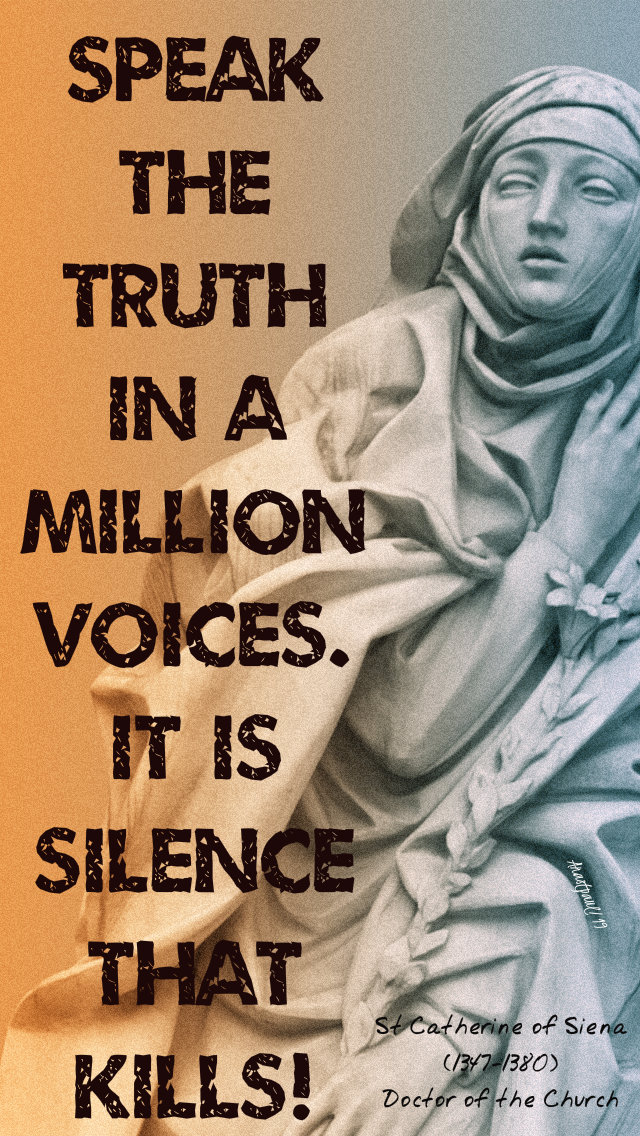
“Speak the truth in a million voices. It is silence that kills!”
“Turn over the rudder in God’s name and sail with the wind, heaven sends us.”
St Catherine of Siena OP (1347-1380) Doctor of the Church
More St Catherine quotes here: https://anastpaul.wordpress.com/2018/04/29/quote-s-of-the-day-29-april-fifth-sunday-of-eastertide-and-the-memorial-of-st-catherine-of-siena-1347-1380-doctor-of-the-church/
One Minute Reflection – 29 April – Monday of the Second week of Easter, Year C, Gospel: John 3:1–8 and the Memorial of St Peter of Verona OP (1205–1252)
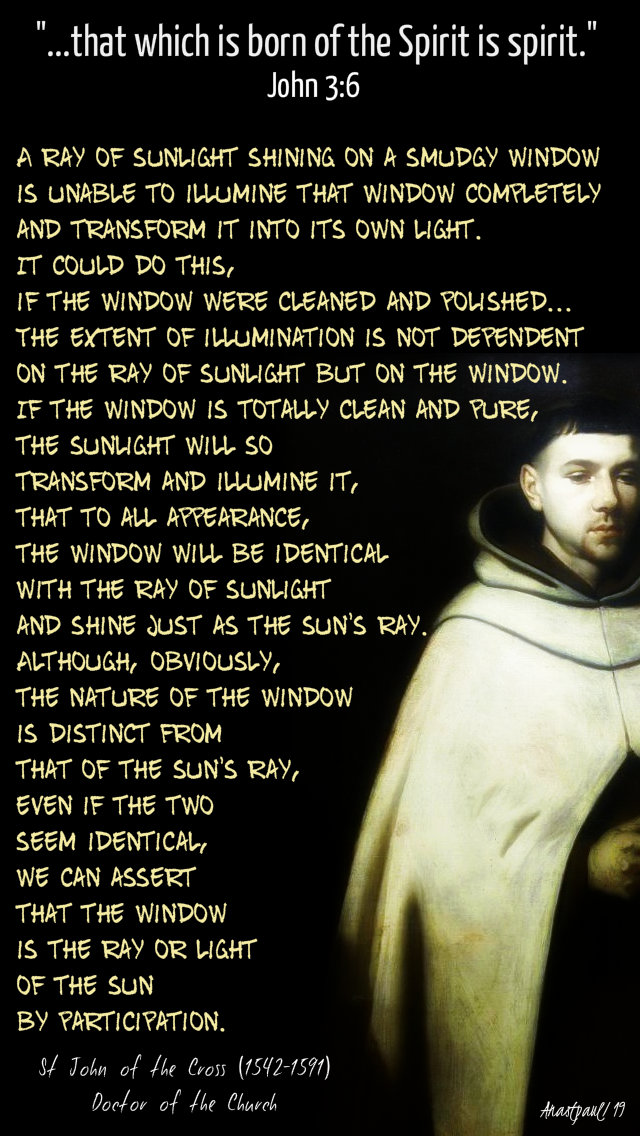
“…that which is born of the Spirit is spirit.”...John 3:6
REFLECTION – “We read in Saint John – No one can enter the Kingdom of God without being born of water and Spirit. To be reborn in the Holy Spirit during this life is to become most like God in purity, without any mixture of imperfection. Accordingly, pure transformation can be effected – although not essentially – through the participation of union.
Here is an example that will provide a better understanding of this explanation. A ray of sunlight shining on a smudgy window, is unable to illumine that window completely and transform it into its own light. It could do this, if the window were cleaned and polished… The extent of illumination is not dependent on the ray of sunlight but on the window. If the window is totally clean and pure, the sunlight will so transform and illumine it, that to all appearances the window will be identical with the ray of sunlight and shine just as the sun’s ray. Although, obviously, the nature of the window is distinct from that of the sun’s ray, even if the two seem identical, we can assert, that the window is the ray or light of the sun by participation.
The soul on which the divine light of God’s being is ever shining, or better, in which it is ever dwelling by nature, is like this window. A soul makes room for God by wiping away all the smudges and smears of creatures, by uniting its will perfectly to God’s, for to love is to labour, to divest and deprive oneself for God, of all that is not God. When this is done, the soul will be illumined by and transformed in God.”…St John of the Cross (1542-1591) Doctor of the Church
PRAYER – Almighty God and Father, grant that Your faithful people who were buried with Your Son in baptism, may by His Resurrection and intercession at Your right hand, obtain for us eternal life. Send Your Spirit upon Your adopted children and lead us in Your way. Grant that by the intercession of St Peter of Verona, our path may be straightened and glow with Your light. Through Christ our Lord, with the Holy Spirit, God forever, amen.
Thought for the Day – 28 April – Low Sunday the Octave Day of Easter and Divine Mercy Sunday, Gospel: John 20:19–31
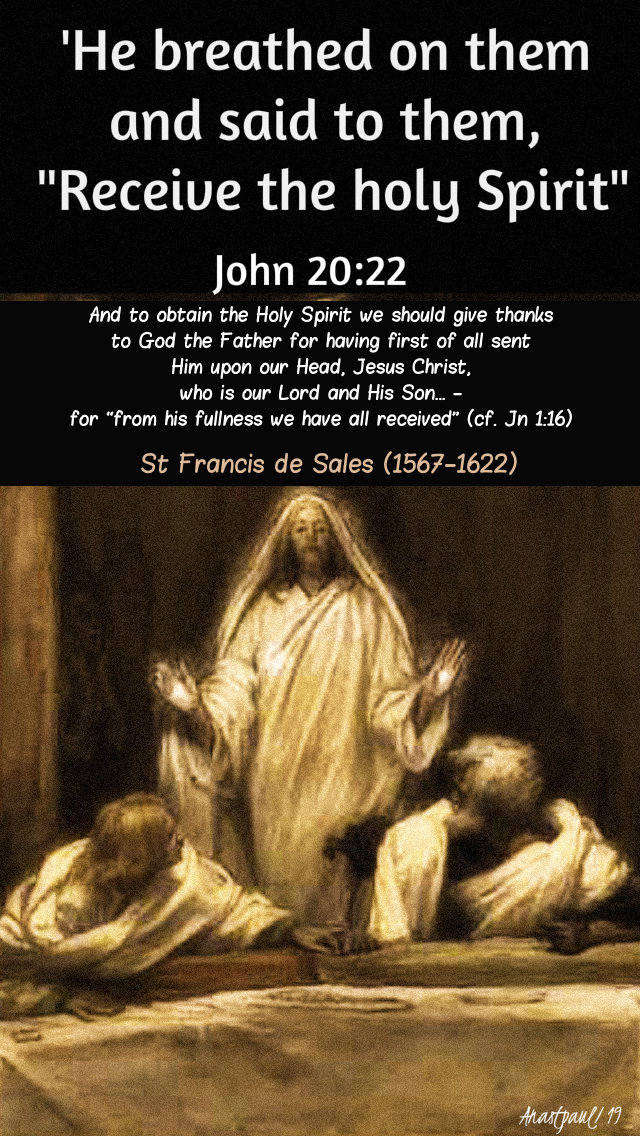
Jesus said to them again, “Peace be with you. As the Father has sent me, even so I send you.” And when he had said this, he breathed on them and said to them, “Receive the Holy Spirit. “...John 20:21-22
Saint Francis de Sales (1567-1622)
Bishop of Geneva and Doctor of the Church
First Sermon for Pentecost
‘He breathed on them and said to them, “Receive the holy Spirit” ‘
Lord Jesus Christ, once again grant that of us, too, there may be but “one heart and mind” (Acts 4:32) for then there will be “a great calm” (Mk 4:39). My dear listeners, I exhort you to good will and kindness to one another and peace with all. For were we to have charity among ourselves, we would have both peace and the Holy Spirit. Let us undertake to become devout and pray to God… since the apostles persevered in prayer… If we set ourselves to fervent prayer then the Holy Spirit will enter us and say: “Peace be with you! It is I; be not afraid” (cf. Mk 6:50)… And what ought we to ask God for, my brethren? For all that is for His honour and the salvation of your souls and, in a word, for the help of the Holy Spirit – “Send forth your Spirit and they will be created” (Ps 104[103]:30) – peace and tranquillity…
We are to ask for this peace so that the Spirit of peace may come down on us. We should give thanks to God, too, for all His blessings if we want Him to grant us those victories that are the beginning of peace. And to obtain the Holy Spirit we should give thanks to God the Father for having first of all sent Him upon our Head, Jesus Christ, who is our Lord and His Son… – for “from his fullness we have all received” (cf. Jn 1:16) – and for having sent Him upon His apostles that through their hands they might pass Him onto us. We should give thanks to the Son – as God, He sends the Spirit upon those who prepare themselves to receive Him. But, most especially, we should thank Him because, as man, He merited for us, the grace of receiving this divine Spirit…
And how has Jesus Christ merited the Holy Spirit’s coming? When “bowing his head, he gave up his spirit” (Jn 19:30), for, when He gave breathed His last and handed over His spirit to the Father, He merited the Father’s sending His Spirit upon His mystical body.
Quote of the Day – 28 April – Low Sunday the Octave Day of Easter and Divine Mercy Sunday
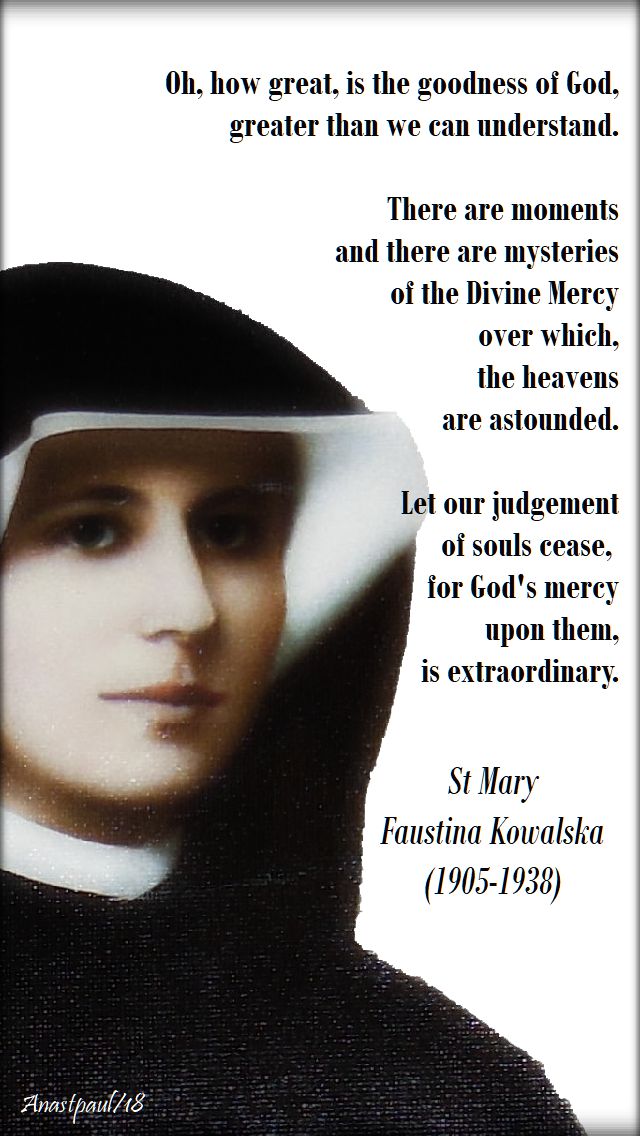
“Oh, how great, is the goodness of God, greater than we can understand. There are moments and there are mysteries, of the Divine Mercy over which, the heavens are astounded. Let our judgement of souls cease, for God’s mercy upon them, is extraordinary.”
One Minute Reflection – 28 April – Low Sunday the Octave Day of Easter and Divine Mercy Sunday, Gospel: John 20:19–31
“Peace be with you. As the Father has sent me, even so I send you.” And when he had said this, he breathed on them, and said to them, “Receive the Holy Spirit. If you forgive the sins of any, they are forgiven; if you retain the sins of any, they are retained.”…John 20:21–23
REFLECTION – “This Sunday, … concludes the week or, more properly, the “Octave” of Easter, which the liturgy considers as a single day: “the day which the Lord has made” (Ps 117[116]: 24). It is not a chronological but a spiritual time, which God opened in the sequence of days when He raised Christ from the dead. The Creator Spirit, infusing new and eternal life in the buried body of Jesus of Nazareth, carried to completion the work of creation, giving origin to a “firstfruits” – the firstfruits of a new humanity, which at the same time is a firstfruits of a new world and a new era.
This world renewal can be summed up in a single phrase, the same one that the Risen Jesus spoke to his disciples as a greeting and even more, as an announcement of his victory: “Peace be with you!” (Lk 24: 36; Jn 20: 19, 21, 26).
Peace is the gift that Christ left his friends (see Jn 14: 27) as a blessing destined for all men and women and all peoples. It is not a peace according to a “worldly” mentality, as an equilibrium of forces but a new reality, fruit of God’s Love, of His Mercy. It is the peace that Jesus Christ earned, by the price of His Blood and communicates to those who trust in Him.
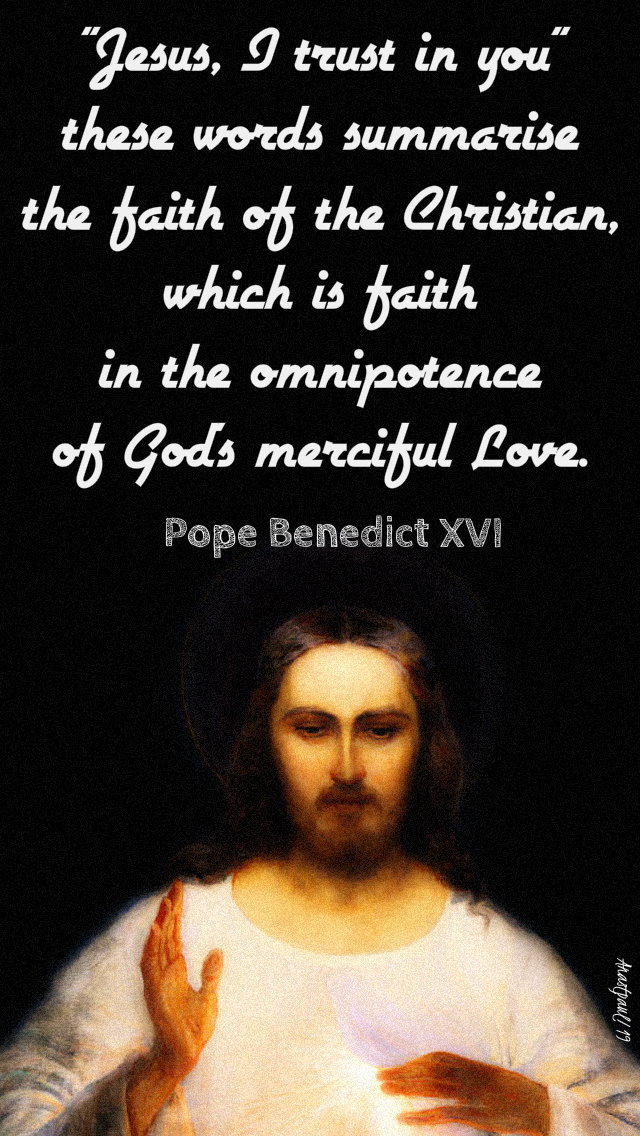
“Jesus, I trust in you” these words summarise the faith of the Christian, which is faith in the omnipotence of God’s merciful Love.”…Pope Benedict XVI – REGINA CÆLI – Second Sunday of Easter, 15 April 2007
PRAYER – Almighty Father, grant we pray that with Mary’s help, Mater Misericordiae, Mother of Jesus who is the incarnation of Divine Mercy, that we become renewed in the Spirit, in order to cooperate in the work of peace which You are accomplishing in the world and which is not just talk, but which is actualised in the countless gestures of charity by all his sons and daughters. Grant we pray, that we taste the beauty of the encounter with the Risen Lord and draw from the source of His merciful love, to be apostles of His peace. Through Christ, Redeemer and Merciful Lord, with the Holy Spirit, God for always and forever, amen.
Sunday Reflection – 28 April – Low Sunday the Octave Day of Easter and Divine Mercy Sunday
Fr Benedict Groeschel CFR (1933-2014)
O Lord Jesus Christ, how am I to prepare myself to attend that holy sacrifice, which You began at Your Last Supper and which You consummated on Calvary?
That eternal Eucharist begun in sorrow and agony continues, not simply to the end of the world but throughout all eternity. It is, the eternal act of obedience and love that You, as the head of our whole human race, offered to the Trinity, even to Yourself, in Your divinity. These mysteries are completely beyond me. Yet I know, they are true because You revealed them.
Soon, in the person of a priest, a poor human being, Your divine words will be spoken and each of us, at this Mass, will be lifted beyond this place and be part of the heavenly choirs and the eternal divine liturgy. How dare we think that we, creatures of earth, could participate in such a thing! We believe it, because this liturgy began here on earth. From the very first moment of Your existence, as a human being, the altar was prepared, the linens were laid on the altar. Throughout Your earthly life, You laboured in the preaching of the Gospel and in calling the faithful to prayer. Then, at the supreme moment of Your earthly existence, You offered Yourself in total obedience and sacrifice to the Father, for all the world. Your glorious Resurrection and Ascension, point beyond the Cross and beyond the tomb and remind us that this Eucharist, is not only a memorial but an everlasting participation in Your divine and heavenly worship, as priest of the new covenant.
O Lord, give me Your Holy Spirit, that my heart may be lifted up in this Mass, that I may be in one of the choirs that join with You, that I may take my place prayerfully and in reverent attention, with the billions of saints, with the great choirs of angels, with the army of holy souls on their pilgrimage and with all the devout and struggling Christians in the world. Let this Mass be the beginning of a new moment in my life, one step closer to You. May I be encouraged by this sacred meal, to know that You will go with me in the wilderness of life, that You will sustain me so that I may, in fact, not only pray as one of those united to You but, that I may live and act, so that it may indeed be true, that I live, no longer I but You, who live in me. Amen, alleluia!
O Sacrament most holy O Sacrament divine, All praise and all thanks giving, Be very moment Thine.+
Jesus, I love You with all my heart. I wish to love You more every day. Thank You for being with me in this most Holy Sacrament.
























 AnaStpaul
You must be logged in to post a comment.