Posted in JESUIT SJ, LENT, MORNING Prayers, QUOTES of the SAINTS, SAINT of the DAY, The WORD

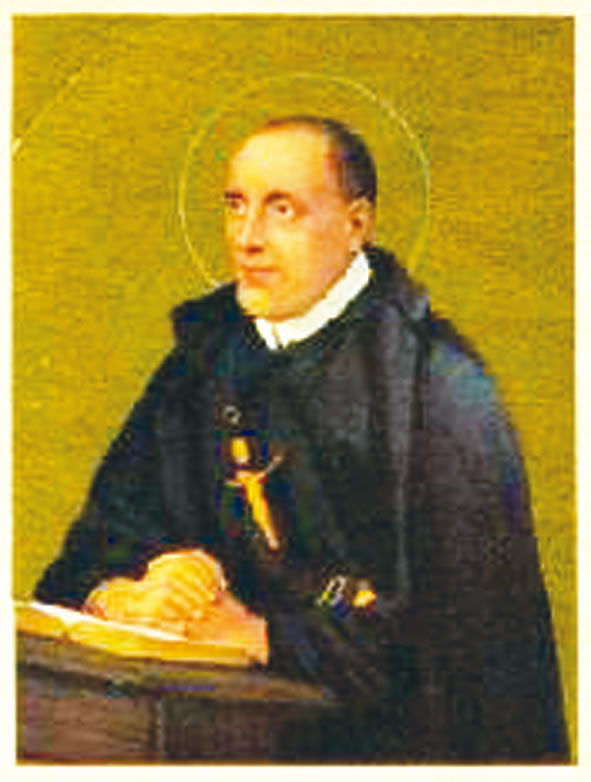
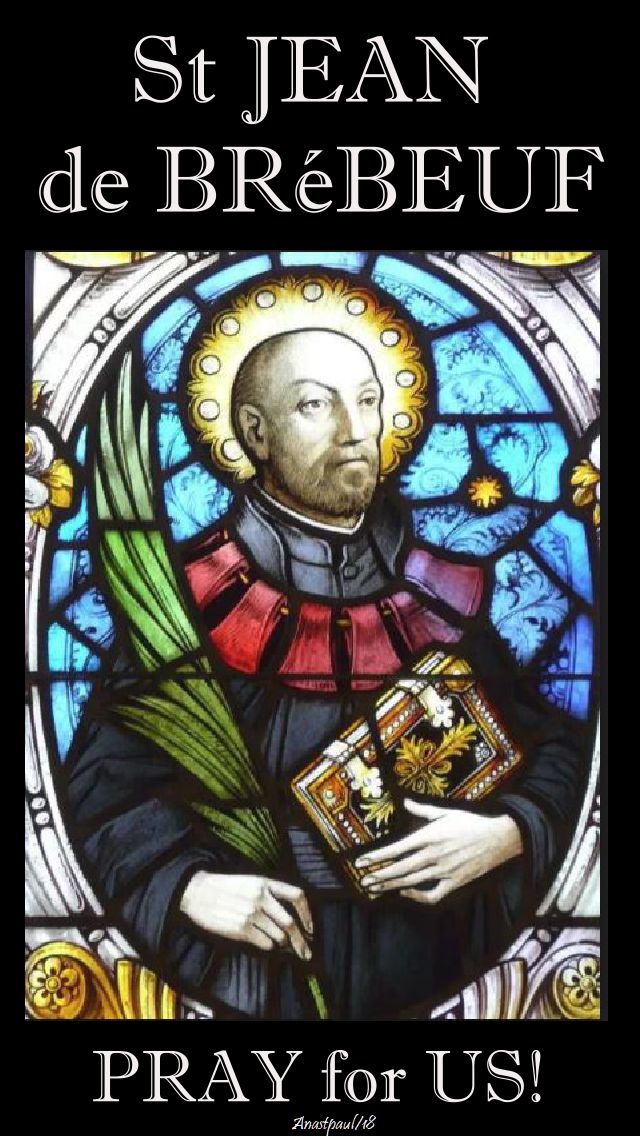
One Minute Reflection – 16 March – The Memorial of St Jean de Brébeuf (1593-1649) Martyr and Friday in the 4th Week of Lent 2018

One Minute Reflection – 16 March – The Memorial of St Jean de Brébeuf (1593-1649) Martyr and Friday in the 4th Week of Lent 2018

..Let us condemn him to a shameful death, for according to his own words, God will take care of him…Wisdom 2:20 (Today’s First Reading)

REFLECTION – “My God and my Saviour Jesus, what return can I make to You for all the benefits You have conferred on me?   I make a vow to You never to fail, on my side, in the grace of martyrdom, if by Your infinite mercy You offer it to me some day.”…St Jean de Brébeufmy god and my saviour - st jean de brebeuf - 16 march 2018

PRAYER – Heavenly Father, only in You re we able to stand against our enemies, those within and without.   Seeking to follow Your Son, our Saviour, Lord give us strength! Grant we pray, that by the intercession of Your Holy Martyr, St Jean de Brébeuf, we may obtain the courage and be filled with Your Holy Spirit, to go forth in truth, amen.st jean de brebeuf - pray for us - 16 march 2018

Posted in MORNING Prayers, PRACTISING CATHOLIC, QUOTES of the SAINTS, QUOTES on the CHURCH, SAINT of the DAY

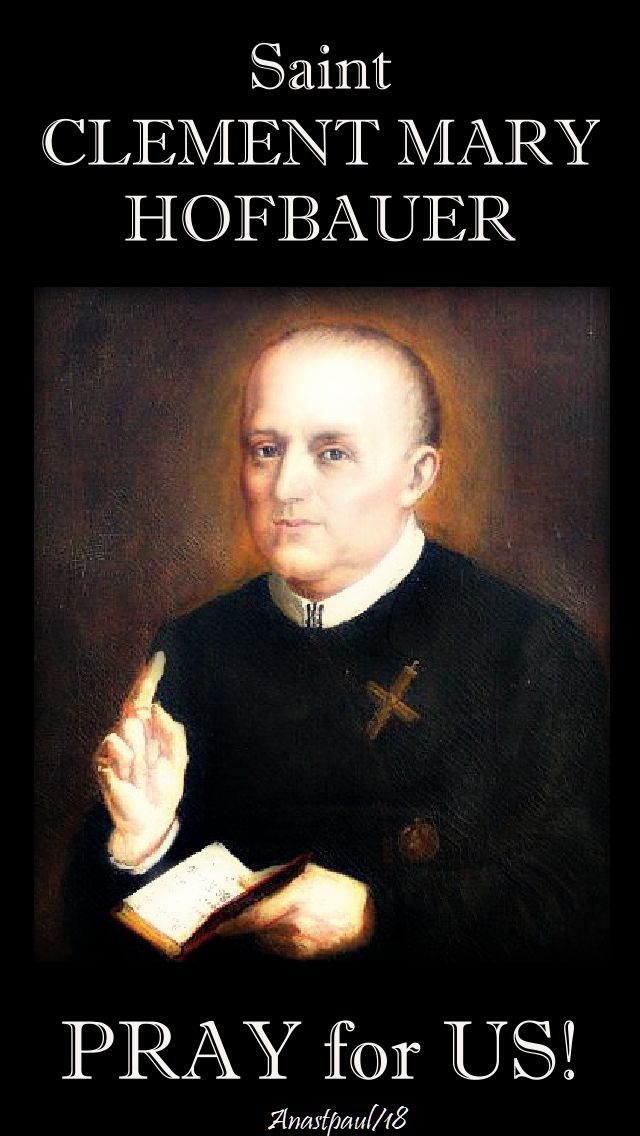
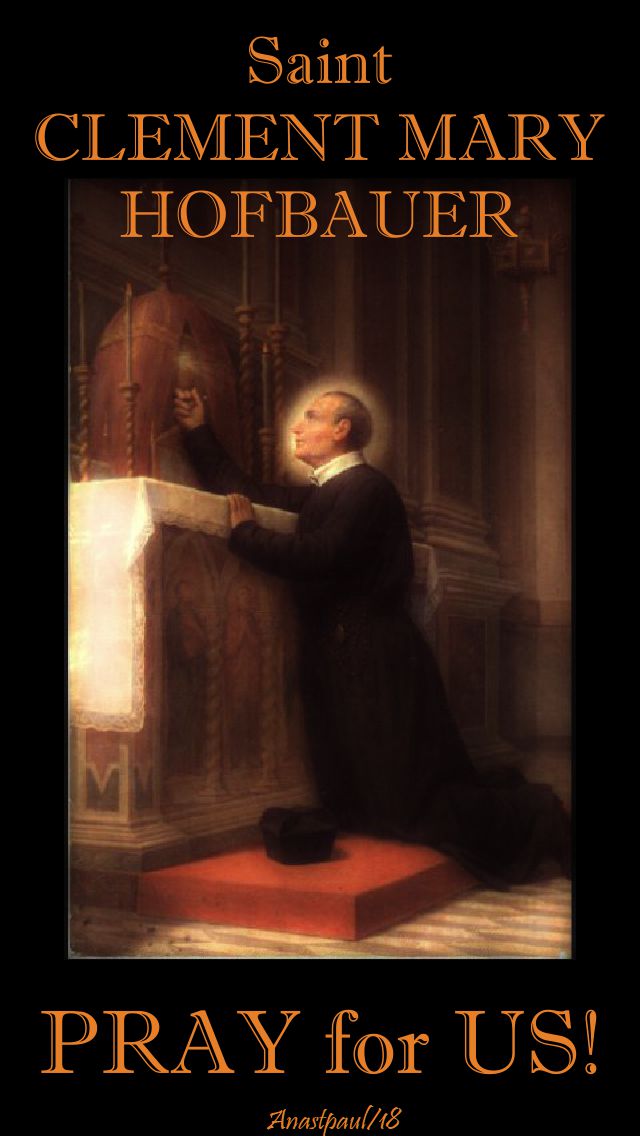
Thought for the Day – 15 March – The Memorial of St Clement Mary Hofbauer C.Ss.R.(1751-1820)

Thought for the Day – 15 March – The Memorial of St Clement Mary Hofbauer C.Ss.R.(1751-1820)

Drastic maladies, Clement reasoned, require drastic remedies.   If in Warsaw evil and moral perversity abounded in the extreme, then dosages of Catholicity in the extreme — if indeed there can be such a thing — were needed to correct them.   A powerful antidote invented by Clement Hofbauer was what he called the “Perpetual Mission.” He outlined it in the following manner:

“On all Sundays and holy days there is a sermon at five o’clock in the morning for servants, who . . . cannot attend the divine service at a later hour.   For their convenience Holy Mass is said immediately after the sermon. . . . Every day at six o’clock there is a Mass of Exposition, during which the people chant hymns.   After the Mass an instruction is given in Polish.   During these instructions and sermons Masses are constantly being said, so that those who do not understand Polish or German, or who have not the time to remain for a sermon, may not be deprived of the Holy Sacrifice.   Every day at eight o’clock there is a High Mass with Plain Chant, after which there are two sermons — the first in Polish and the second in German.   Then the school children come to the church and the Solemn High Mass with musical accompaniment is celebrated. . . . In the afternoon at three o’clock the confraternities chant the Office of the Blessed Virgin.   At four o’clock there is a German sermon, followed by Vespers solemnly chanted and followed in turn by a Polish sermon.   Finally there is a visit to the Blessed Sacrament and to the Blessed Virgin publicly made with the faithful . . . . Every day at five o’clock there is a German sermon.   Then follow in order, a Visit to the Blessed Sacrament, a sermon in Polish, the Way of the Cross and congregational singing of hymns in honour of the Passion of Our Lord and of the Blessed Virgin Mary.   Lastly there is an Examination of Conscience for the people, the Acts of Faith, Hope and Charity are made, a short sketch of the life of the saint whose feast is celebrated on the morrow is read and then the Litany of the Blessed Virgin Mary is recited, after which the people are dismissed and the church is closed.”

This was the daily routine at St Benno’s for years!   Besides these were the many other pastoral, charitable and educational labours carried out by the religious community.   And its holy Superior assumed the lion’s share of these tasks.

O St Clement, pray for our world, pray for the Church, pray for us all!st clement mary hofbauer - pray for us - 15 march 2018-no 2

Posted in CONFESSION/PENANCE, MARIAN QUOTES, MORNING Prayers, QUOTES of the SAINTS, QUOTES on CONVERSION, QUOTES on REPENTANCE, SAINT of the DAY

Quote of the Day – 15 March – The Memorial of St Clement Mary Hofbauer C.Ss.R.(1751-1820)

Quote of the Day – 15 March – The Memorial of St Clement Mary Hofbauer C.Ss.R.(1751-1820)

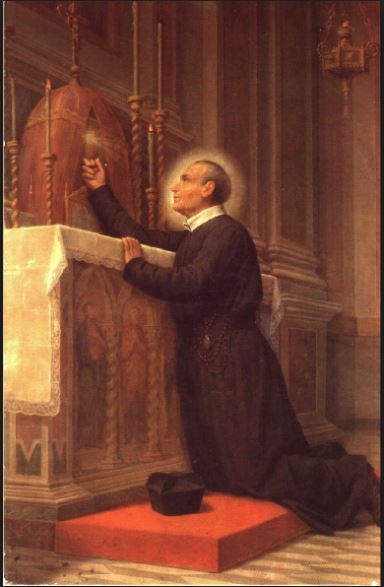
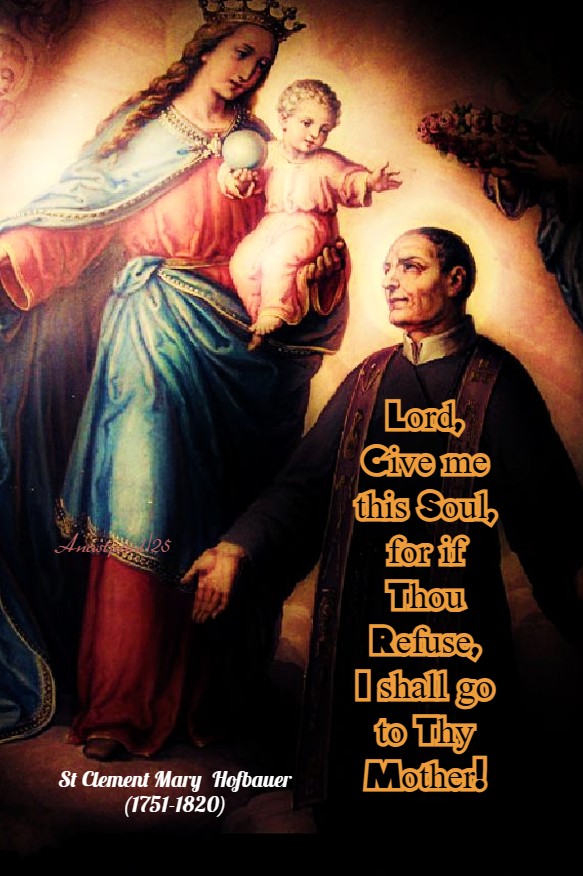
St Clement was unrelenting in pursuing souls cut off from the life of grace, especially those facing imminent death. A nun entered the church one day and found Father Hofbauer kneeling before the altar. Unobserved by the saint, she saw his cheeks wet with tears as he pleaded for the conversion of some sinner outside the fold.

“Lord, give me this soul, for if Thou refuse, I shall go to Thy Mother!”

Posted in CONFESSION/PENANCE, MORNING Prayers, QUOTES of the SAINTS, QUOTES on REPENTANCE, QUOTES/PRAYERS on THE FAMILY, SACRAMENTS, SAINT of the DAY, The WORD

One Minute Reflection – 15 March – The Memorial of St Clement Mary Hofbauer C.Ss.R.(1751-1820)

One Minute Reflection – 15 March – The Memorial of St Clement Mary Hofbauer C.Ss.R.(1751-1820)

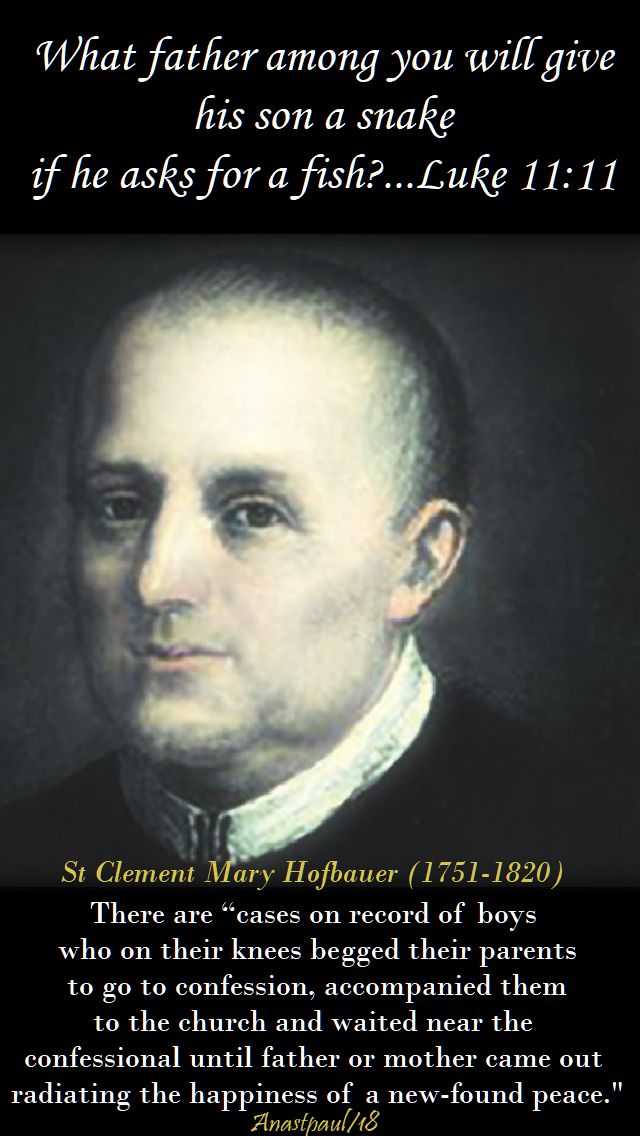
What father among you will give his son a snake if he asks for a fish?...Luke 11:11

REFLECTION – There are “cases on record of boys who on their knees begged their parents to go to confession, accompanied them to the church and waited near the confessional until father or mother came out radiating the happiness of a new-found peace” … St Clement Mary Hofbauer

there are cases on record - st clement mary hofbauer - 15 march 2018

PRAYER – All-merciful Father, help me to be ever open to Your love and mercy, running to You in all my needs and in all my fears.   Allow me too, to run to the confessional when I have sinned, to ask for and receive forgiveness and love.   Grant that the prayers of St Clement Mary Hofbauer, may assist us all in living holy lives according to Your Commandments and the laws of the Church. Amenst clement mary hofbauer - pray for us - 15 march 2018-no 3

Posted in QUOTES of the SAINTS, SAINT of the DAY

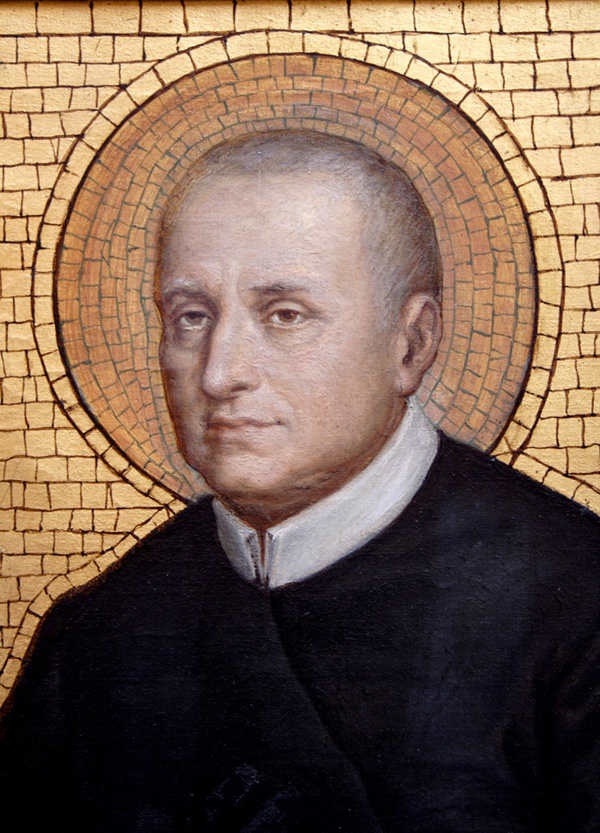
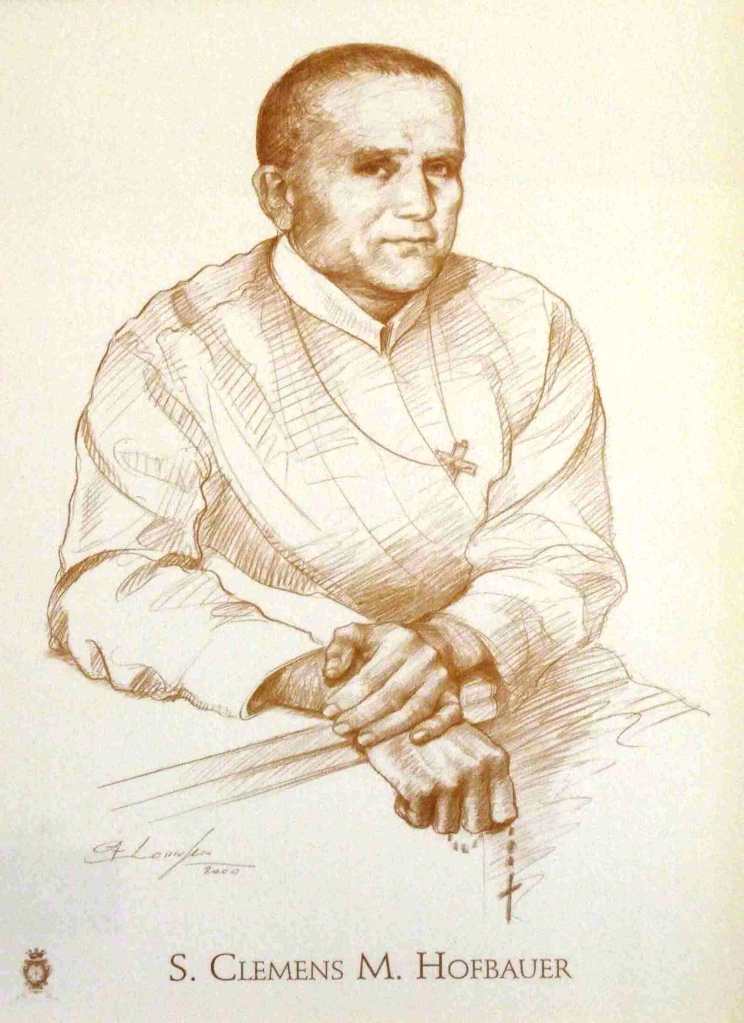
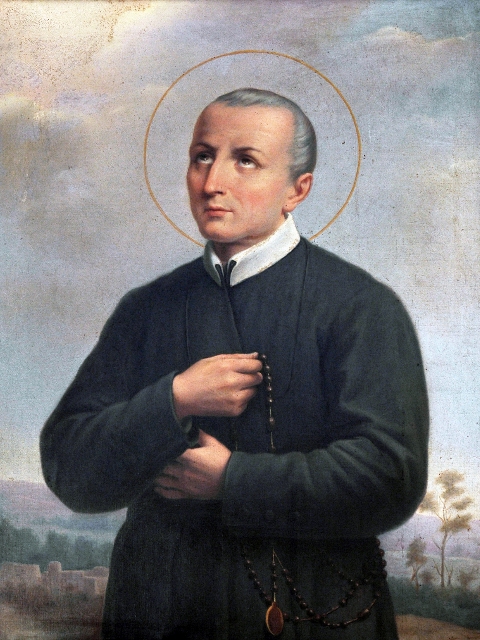
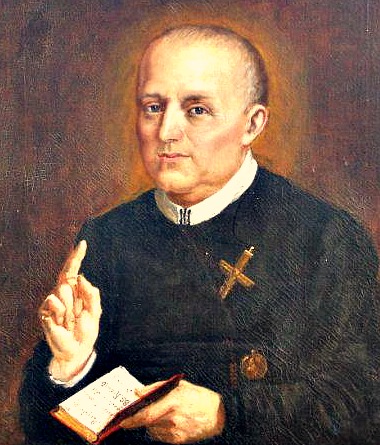
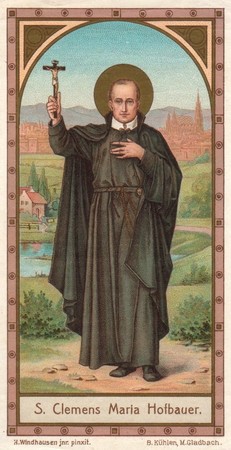
Saint of the Day – 15 March – St Clement Mary Hofbauer C.Ss.R.(1751-1820) “The Apostle of Vienna” 

header 1 - st clement mary hofbauer

Saint of the Day – 15 March – St Clement Mary Hofbauer C.Ss.R.(1751-1820) Hermit, Priest, Religious, Co-Founder of the Redemptorist Order (in Austria),  “The Apostle of Vienna.”   St Clement was born on 26 December 1751 at Tasswitz, Moravia (in the modern Czech Republic) as John Dvorák and he died on 15 March 1820 at Vienna, Austria of natural causes.   He was Canonised on 20 May 1909 by Pope Pius X.   Patronage – Vienna, Austria (named by Pope Saint Pius X in 1914).   

St Clement was born in Tasswitz, Austria, on December 26, 1751 — the eve of the feast of the Apostle who Jesus loved — he was christened John.   But he would become known to the Catholic world by the names he would adopt in religious life, Clement Maria Hofbauer.

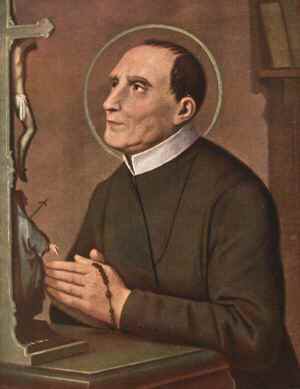
He was only six when his Bohemian-born father passed away.   On this tragic occasion, his mother stood him before a crucifix and said:  “Henceforth; He is your father. Take care that you never grieve Him by sin.”   The words etched so deeply upon his heart that he never forgot them — and ever lived by them.

Saint_Clement_Maria_Hofbauer

Often, the boy would gather the household together to recite the Rosary, his favourite devotion, would fast until nightfall on Saturdays, in honour of the Blessed Virgin and would distribute to the poor food and money of which he deprived himself.   Not surprisingly, Hofbauer had yearned from his boyhood to enter the priesthood.   “Priests,” he said, “are the light of the world and the salt of the earth.”   But fulfilment of this, his singular earthly ambition, so long evaded him that it would seem he must have abandoned all hope of realising it.   Instead, he twice withdrew himself from the world to adopt the contemplative life of a hermit.  Yet, circumstances frustrated even these aspirations and at length he settled into the life of a baker.

If our heavenly Father will not reach a stone to one who asks for bread, could He deny the holy yearnings of so pious a soul?   Indeed, he would not leave this saint of predestination a common baker confecting common bread for common food but would call him to confect Bread of Life upon the Altar of God.

Three wealthy sisters who attended Mass at St Stephen’s Cathedral in Vienna, where Hofbauer daily served as an altar boy, were caught in a torrential downpour at the cathedral one Sunday.   When Clement fetched a carriage for them, the ladies urged him to ride with them out of the drenching rain.   Long having observed his pious comportment in the sanctuary, the women inquired why their carriage guest, now thirty years old, had not entered the priesthood.   “That has been my most ardent desire since childhood,” Hofbauer admitted, “but I am obliged to forego it, because I lack the means to carry it out.”   At this the eldest sister announced:  “If that is the only obstacle, we will gladly see that you reach your goal.”   Thanks to the ladies’ generosity, an ecstatic saint was soon enrolled for seminary training at the University of Vienna.

As Clement Hofbauer began his pursuit of Holy Orders, Protestantism was in its third century of open defiance of the Church.   The poison of Freemasonry had been seeping into the body of Europe for more than six decades.   Where Catholicism had survived the ravages of the “Reformation,” many of its faithful were now weakened in spirit by Masonic “free thinking.”   In many if not most portions of the continent, Catholics — including priests and even bishops — had grown tepid and indifferent in their faith.   In this state, the wellsprings of grace seemed to dry up, and pitiful ignorance of even the most fundamental Truths of the Faith became pandemic.   As a consequence, even regions still nominally Catholic were infected with scepticism toward the Apostolic authority of Rome and were easily drawn to the false doctrine of the divine right of kings which had been resurrected by Luther.   Thus, emboldened monarchs intruded into ecclesiastical affairs with increasing brazenness.

Out of pure devotion, Saint Clement had undertaken several pilgrimages to Rome on foot in the years prior to entering the seminary.   Now he made it an annual exercise, to escape the repulsive air of unorthodoxy at the university and the religious repression of the imperial state  and to refresh himself spiritually in the capitol of Christendom.   He was joined on these arduous journeys by a fellow seminarian of kindred spirit, Thaddeus Huebl, ten years the saint’s junior.   By the fall of 1784, conditions in Vienna had become so intolerable that Hofbauer could not bring himself to return to the University.   He decided instead to complete his studies in the Eternal City.   The plan came to him with such suddenness and resoluteness that he implored Huebl to leave a hospital bed to join him.   Because of his stricken condition, Huebl at first rejected the idea.   But the saint would not be put off.   He insisted that Huebl join him, promising that God would take care of his friend’s health.   At this, Huebl consented — and his health was restored so rapidly as to seem miraculous.

It was a common practice for the two pilgrims to sleep in fields, drawing a circle about their earthen beds and invoking their guardian angels to protect them within it.   In the mornings, they would attend Mass at the first church whose bells they heard. Having retired one evening in the neighbourhood of Santa Maria Maggiore, they were awakened in the very early morning by the soft pealing of a bell from the little church of San Giuliano.   Upon their arrival, they realised it was a convent church but of a religious order they did not recognise.   Impressed by the recollection of the Religious in their meditation, Hofbauer asked an altar boy what kind of priests these were.   “They are Redemptorists,” the boy returned, adding, “and some day you, too, will be one of them.”   Convinced that the astonishing oracle was a message from God, Saint Clement and his friend presented themselves to the Superior of the Convent and, with a burst of inspiration which left Huebl’s head spinning, found themselves enrolled as Redemptorists.

Monsignor Alphonsus Maria de Liguori, the Neapolitan Bishop of Agatha and the Founder of the Redemptorists, was not unknown to Clement Hofbauer.   The latter saint in recent years had become an enthusiastic reader of the former’s voluminous spiritual writings — works that would eventually merit Saint Alphonsus canonical recognition as one of the 32 Doctors of the Church.   But the Congregation of the Most Holy Redeemer, founded by Liguori in 1732, was scarcely known outside of Naples and not at all beyond the borders of Italy.    Monsignor Liguori received with great joy the news that the first two non-Italians had entered his order in 1784.   Isolated from them as he was, however, his keen interest in them as the hope of spreading the Congregation into the German kingdoms had to be taken from afar.   Saint Alphonsus and Saint Clement would never meet in this life.

With a sense of urgency to carry on Liguori’s work and to cultivate new vocations in the German kingdoms to the north, the Superior General at San Guiliano shortened Hofbauer’s and Huebl’s novitiate.   In March of 1785, ten days after they took their vows as professed Religious, they received the Sacrament of Holy Orders.   Several months later, they were dispatched back across the Alps to establish the Congregation in the northern lands.

His first mission was to Warsaw, where he was in charge of the German church and he soon enjoyed a certain repute as a confessor and the instigator of good works to remedy the social evils of the day.   Thus he founded an orphanage, a poor school and a secondary school.   In 1808 the invading French cast him into prison, whence, after four weeks, he was able to go to Vienna.   Here he became the inspiration and religious leader of a group of German romantics—von Muller, Schlegel, Werner and others—and exerted tremendous influence not only among the poor but also and despite his rather scanty education, with officials, statesmen and scholars.   In this way he was able to defeat the project for a German national church at the Congress of Vienna and eventually succeeded in arranging for the legal establishment of the Redemptorists north of the Alps, though he did not live to see this occur, since he died in 1820.

As a consequence he is regarded by the Redemptorists as their second founder.   He was a man of great energy and drive, seeing clearly the end in view and always indefatigable in his work for souls, in the confessional especially, and among the poor.

St Clement’s is a story that continues with the Venerable Joseph Passerat who, as the succeeding Vicar General, brought to fulfilment the prophecies of Saint Alphonsus and Saint Clement about the Congregation, leading to an inspiring re flowering of the One True Faith in much of Europe.   It is a story that carries over, a century later, into the reign of Pope Saint Pius X who, after canonising Clement Hofbauer, valiantly defended the Faith against the very same forces of darkness posturing as Enlightenment.

But the Church’s victory has already been foretold.   By Jesus Christ, Who promises the gates of hell shall not prevail against it.   And by the Virgin Mary who, at Fatima, assured us: “In the end, my Immaculate Heart shall triumph.”

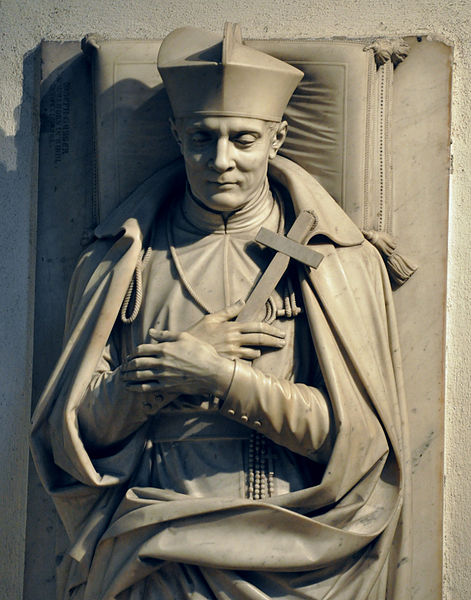
Saint Clement Maria Hofbauer, Pray for Us!Hofbauer's tombstone in the Church of Maria am Gestade, Vienna, Austria

Posted in JESUIT SJ, LENT, MORNING Prayers, QUOTES of the SAINTS, QUOTES on DEATH, QUOTES on ETERNAL LIFE, The LAST THINGS

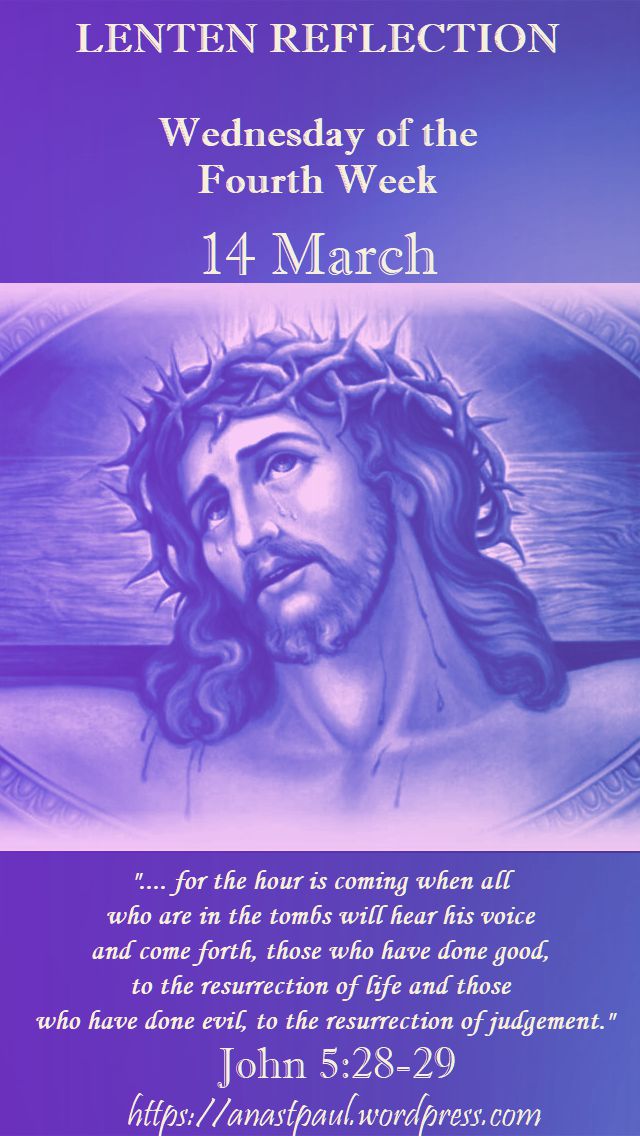
Lenten Reflection – 14 March 2018 – – Wednesday of the 4th Week of Lent

Lenten Reflection – 14 March 2018 – Wednesday of the 4th Week of Lent

Isaiah 49:8-15, Psalms 145:8-9, 13-14, 17-18, John 5:17-30

Isaiah 49:13 – “For the Lord has comforted his people and will have compassion on his afflicted.”

John 5:28-29 – “…. for the hour is coming when all who are in the tombs will hear his voice 29 and come forth, those who have done good, to the resurrection of life, and those who have done evil, to the resurrection of judgement.”

As we approach the end of the Lenten journey, the tone becomes darker and we can feel the crises approaching.
Today’s first reading is a lovely one, Israel’s God promising that all is going to be well “I shall answer you” and “they shall find food on all the bare places.”   And there is a beautiful image of God as mother, utterly incapable of forgetting Israel.   Notice however, that Israel is feeling forgotten, they are hungry and thirsty and in desolate places and in darkness.

These dark tones return in today’s gospel, which continues from yesterday.   Jesus here lays His cards on the table and states plainly and simply, His intimate relationship with the One whom He calls Father and precisely because of who He is – He incurs now the homicidal wrath of His opponents.

We need to be clear this Lent, NOW and forever, about who we think Jesus is – and KNOW that what we believe, will bring the same response – hostility, ire, persecution even hatred!   For it is literally – it is very important to be aware of this – a matter of life and death!

But, “the one who hears my word and believes the One who sent me, has eternal life”. There is Resurrection here but there is also first death.

We must choose our sides NOW!   Now is the time!…(Fr Nicholas King SJ – Reflections for Lent)

Am I ready?
Have I chosen my side?
Am I prepared?

“There was once a good Trappist Father, who was trembling all over at perceiving the approach of death.   Someone said to him, “Father, of what then are you afraid?”   “Of the judgement of God,” he said. “Ah! if you dread the judgement–you who have done so much penance, you who love God so much, who have been so long preparing for death–what will become of me?”

See, my children, to die well we must live well;  to live well, we must seriously examine ourselves:  every evening think over what we have done during the day; at the end of each week review what we have done during the week;  at the end of each month review what we have done during the month;  at the end of the year, what we have done during the year.   By this means, my children, we cannot fail to correct ourselves and to become fervent Christians in a short time.   Then, when death comes, we are quite ready; we are happy to go to Heaven.”St John Vianney (1786-1859) lenten reflection - wed of the 4th week - 14 march 2018

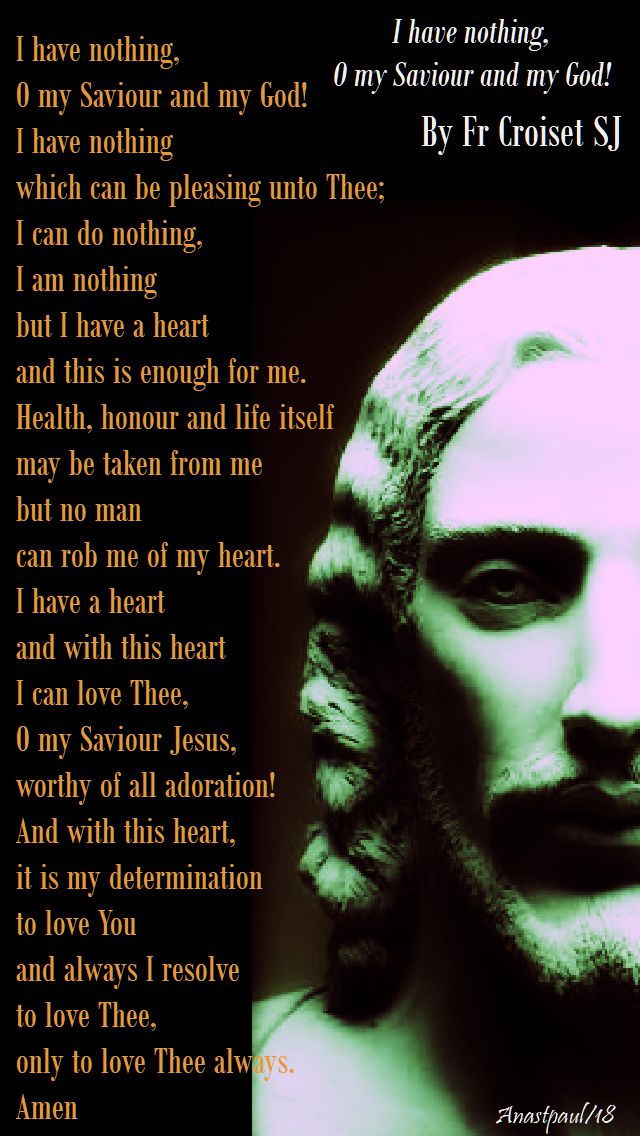
I have nothing, O my Saviour and my God!

I have nothing, O my Saviour and my God!
I have nothing which can be pleasing unto Thee;
I can do nothing,
I am nothing
but I have a heart
and this is enough for me.
Health, honour and life itself
may be taken from me
but no man can rob me of my heart.
I have a heart and with this heart I can love Thee,
O my Saviour Jesus, worthy of all adoration!
And with this heart,
it is my determination to love You
and always I resolve to love Thee,
only to love Thee always.
Amen

Father John Croiset SJi have nothing o my saviour and my god - fr croiset sj - 14 march 2018

Posted in LENT, MORNING Prayers, QUOTES of the SAINTS, QUOTES on DEATH, QUOTES on ETERNAL LIFE, QUOTES on FAITH, The LAST THINGS

Thought for the Day – 14 March 2018 – Wednesday of the 4th Week of Lent

Thought for the Day – 14 March 2018 – Wednesday of the 4th Week of Lent

Each of us must enter on eternity.
Blessed John Henry Newman (1801-1890)

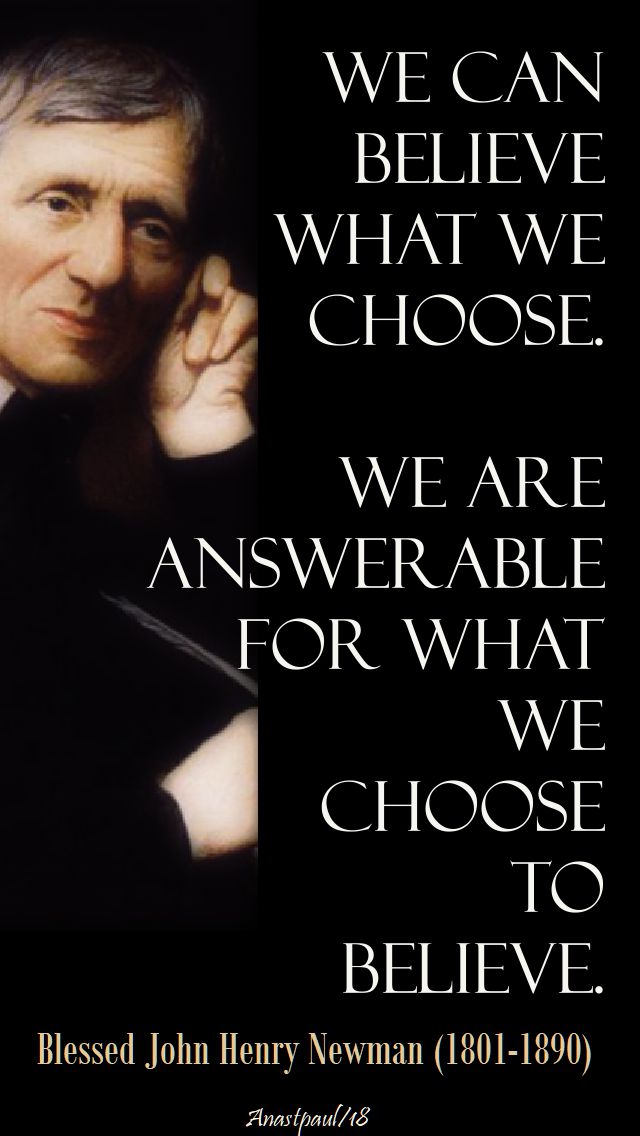
“Each of us must come to the evening of life.   Each of us must enter on eternity.   Each of us must come to that quiet, awful time, when we will appear before the Lord of the vineyard and answer for the deeds done in the body, whether they be good or bad.  That, my dear brethren, you will have to undergo. … It will be the dread moment of expectation when your fate for eternity is in the balance and when you are about to be sent forth as the companion of either saints or devils, without possibility of change. There can be no change;  there can be no reversal. As that judgement decides it, so it will be for ever and ever.   Such is the particular judgement. … when we find ourselves by ourselves, one by one, in His presence and have brought before us most vividly all the thoughts, words and deeds of this past life.   Who will be able to bear the sight of himself?

And yet we shall be obliged steadily to confront ourselves and to see ourselves.   In this life we shrink from knowing our real selves.   We do not like to know how sinful we are. We love those who prophesy smooth things to us and we are angry with those who tell us of our faults.

But on that day, not one fault only but all the secret, as well as evident, defects of our character will be clearly brought out.   We shall see what we feared to see here and much more.   And then, when the full sight of ourselves comes to us, who will not wish that he had known more of himself here, rather than leaving it for the inevitable day to reveal it all to him! …………………….We can believe what we choose.   We are answerable for what we choose to believe.”we can believe what we choose - bl j h newman - 14 march 2018

Posted in DOCTORS of the Church, FATHERS of the Church, LENT, MORNING Prayers, QUOTES of the SAINTS, QUOTES on DEATH, QUOTES on ETERNAL LIFE, SPEAKING of .....

Quote/s of the Day – 14 March 2018 – Wednesday of the 4th Week of Lent “Speaking of Death & Eternity”

Quote/s of the Day – 14 March 2018 – Wednesday of the 4th Week of Lent

“Speaking of Death & Eternity”

“Christ’s martyrs feared neither death nor pain. He triumphed in them who lived in them; and they, who lived not for themselves but for Him, found in death itself the way to life.”

St Augustine – (354-430) – Father & Doctor of the Churchchrist's martyrs - st augustine - 14 march 2018

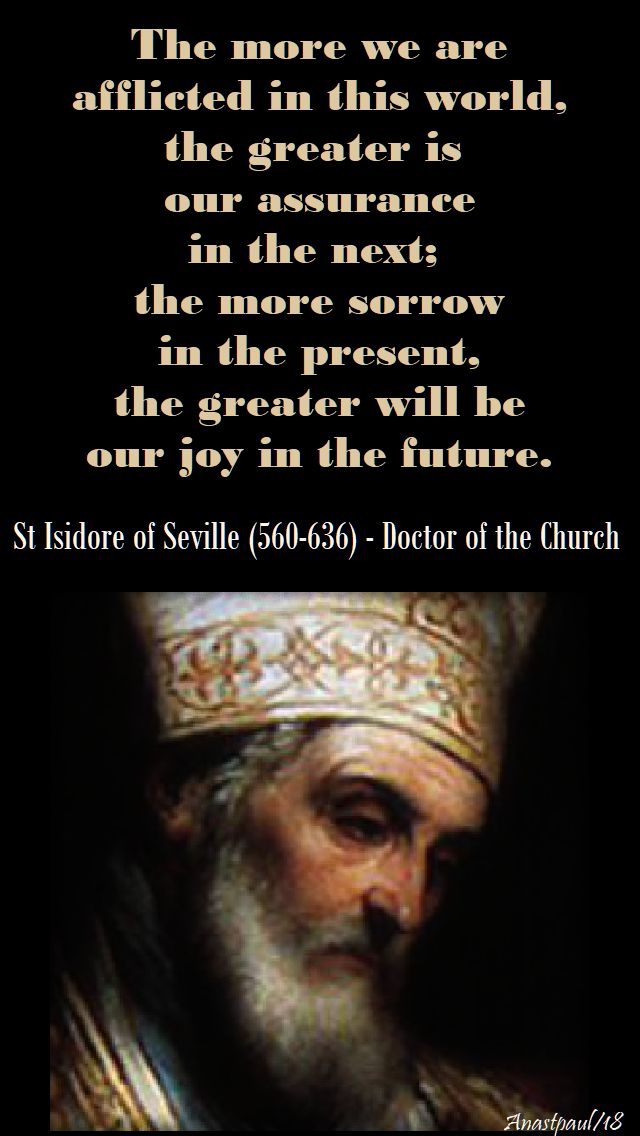
“The more we are afflicted in this world, the greater is our assurance in the next; the more sorrow in the present, the greater will be our joy in the future.”

St Isidore of Seville (560-636) – Doctor of the Churchthe more we are afflicted - st isidore - 14 march 2018

“A man may very well lose his head and yet come to no harm – yea, I say, to unspeakable good and everlasting happiness.”

St Thomas More (1478-1535) a man may very well - st thomas more - 14 march 2018

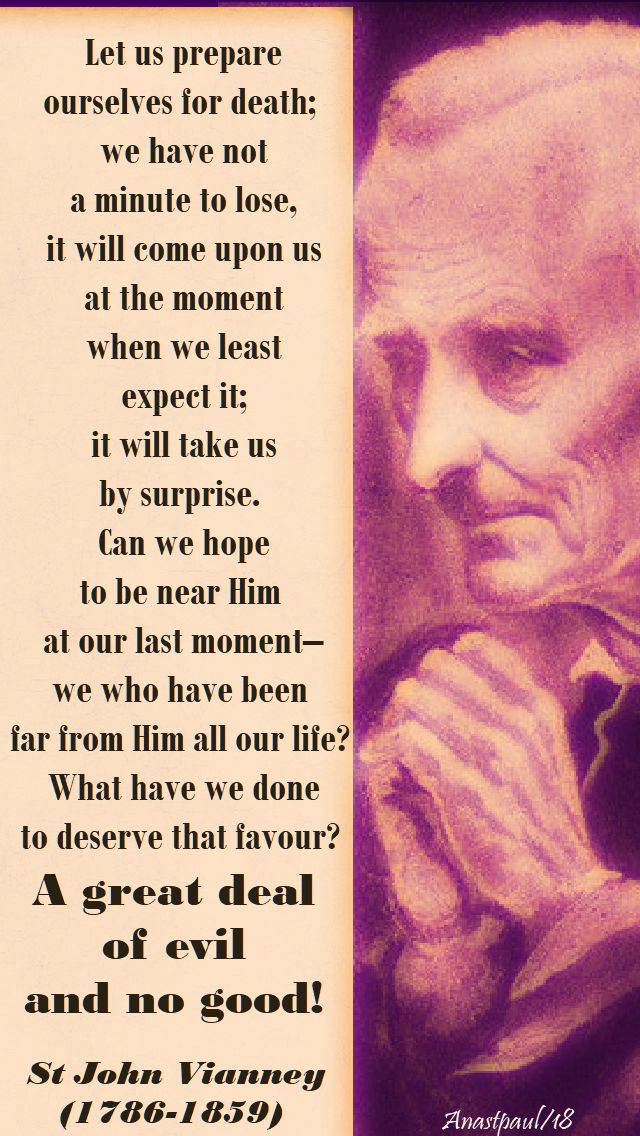
“Let us prepare ourselves for death;  we have not a minute to lose:  it will come upon us at the moment when we least expect it; it will take us by surprise.  Look at the saints, my children, who were pure;  they were always trembling, they pined away with fear and we, who so often offend the good God–we have no fears.   Life is given us that we may learn to die well and we never think of it.   We occupy ourselves with everything else.   The idea of it often occurs to us and we always reject it;  we put it off to the last moment.   O my children! this last moment, how much it is to be feared!   Yet the good God does not wish us to despair;   He shows us the good thief, touched with repentance, dying near Him on the cross;   but he is the only one and then see, he dies near the good God.   Can we hope to be near Him at our last moment–we who have been far from Him all our life?   What have we done to deserve that favour?   A great deal of evil and no good.”

St John Vianney  (1786-1859) let us prepare ourselves for death - st john vianney - 14 march 2018

Posted in DOCTORS of the Church, DOMINICAN OP, LENT, MORNING Prayers, QUOTES of the SAINTS, QUOTES on CONVERSION, QUOTES on REPENTANCE, SAINT of the DAY

One Minute Reflection – – 14 March 2018 – Wednesday of the 4th Week of Lent and the Memorial of St Matilda

One Minute Reflection – – 14 March 2018 – Wednesday of the 4th Week of Lent and the Memorial of St Matilda

Now is the acceptable time!   Now is the time of salvation….2 Corinthians 6:2

REFLECTION – “You no longer have the time that is past.   Nor are you sure of the time that is to come.   Hence, all you do have, is this present point in time – and nothing more!”… St Catherine of Siena (1347-1380) Doctor of the Churchyou no longer have the time - st catherine of siena - 14 march 2018

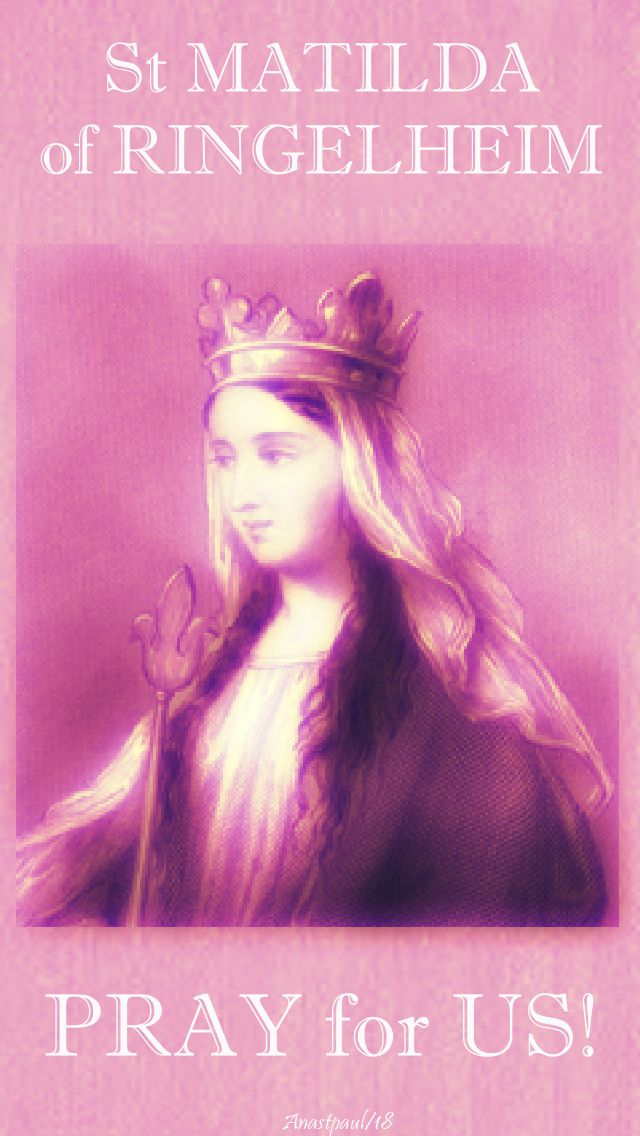
PRAYER – Timeless loving Lord, teach me to be grateful for every moment that You allot to me.   Grant that I may always understand this ‘blink of an eye’ and live each moment only for You, in You and with You.   Difficult as your times were St Matilda, you maintained your eyes on the Lord alone, pray for us all, that we too may follow your example. Amenst matilda pray for us - 14 march 2018

Posted in CONFESSION/PENANCE, DOCTORS of the Church, FATHERS of the Church, LENT, MORNING Prayers, PRAYERS of the SAINTS, QUOTES of the SAINTS, QUOTES on CONVERSION, QUOTES on LOVE, QUOTES on OBEDIENCE, QUOTES on REPENTANCE, QUOTES on SANCTITY, QUOTES on SIN, QUOTES on TEMPTATION, SACRAMENTS, The HOLY EUCHARIST / The HOLY MASS

Lenten Reflection – 13 March 2018 – Tuesday of the 4th Week of Lent

Lenten Reflection – 13 March – Tuesday of the 4th Week of Lent

Ezekiel 47:1-9, 12, Psalms 46:2-3, 5-6, 8-9, John 5:1-16

Ezekiel 47:9And wherever the river goes every living creature which swarms will live, and there will be very many fish; for this water goes there, that the waters of the seak may become fresh; so everything will live where the river goes.

John 5:6-9When Jesus saw him and knew that he had been lying there a long time, he said to him, “Do you want to be healed?” The sick man answered him, “Sir, I have no man to put me into the pool when the water is troubled, and while I am going another steps down before me.” Jesus said to him, “Rise, take up your pallet, and walk.” And at once the man was healed, and he took up his pallet and walked.tuesday of the fourth week - 13 march 2018

The theme of life-giving water again dominates the readings of today’s Mass. “Come to the waters, all who thirst, though you have no money, come and drink with joy” (Entrance Antiphon).   The time for the prospective converts’ baptism is drawing near.
We need to be reminded that we don’t have to imagine ourselves as catechumens to share their desire and thirst.   We can and do, always long for greater and greater union in love “All who thirst, come to the waters.”   The Opening Prayer is not just for catechumens but for us all – “Father, may our lenten observance prepare us to embrace the paschal mystery and proclaim Your salvation with joyful praise.”
To embrace the paschal mystery is to die and rise with Jesus.   It is the ultimate glory of every human, baptised or not.   If we do not yet experience the fullness of the thirst for God signified by the living waters of baptism, it may well be that our thirst has been dulled by our personal alienation from Christ.   Conversion to Christ is ongoing, it never ends!   This conversion we claim to be working at, is it for real and for how long?   We don’t have to tell our Lord that we have no-one to put us into the water, we KNOW where the pool is – it is the Sacrament of Confession, it is in Confession where He heals us just as He healed the man at the pool!   The healing pool is also the Eucharist and certainly, it will be the grace-filled moment of our baptismal renewal on Holy Saturday night and Easter.

What the catechumens longed for, we possess now – Baptism, the Eucharist, Confession and these are always available. We don’t even have to wait for Easter!

In our Easter encounter with Him who is our Good Shepherd and who says, “I lay down my life for my sheep”, satisfies all our wants and desires and needs.   “In green pastures He will give us rest, He will lead us along the waters of peace” (Communion Antiphon).   In the Eucharist, in Confession, God is and always will be in our midst!   Run to Him, praise Him!…(Fr E Lawrence OSB- Daily Meditations for Lent)

When has God been most present to you?
How often to I attend Daily Mass and Confession?
Could I change this practise – today and for the rest of my life?

“Ah, who would not be touched? …. A God who weeps with so many tears at the loss of one soul and Who cries unceasingly:  My friend, my friend, why proceedest thou thus to lose thy soul and thy God?   Stop! Stop!   Ah! Look at my tears, my Blood which flows yet. Must I die a second time to save thee?   Look at me.   Ah! Angels from Heaven descend upon earth, come and weep with me for the loss of this soul!   Oh, that a Christian should be so unfortunate as to persevere still in running towards the abyss despite the voice which his God causes him to hear continually!   But, you may say to me, no one says these things to us.   Oh my friends, unless you want to stop up your ears, you will hear the voice of God, which follows you unceasingly.

Tell me, my friends, then, what is this remorse of conscience which overwhelms you in the midst of sin?   Why do these anxieties and storms agitate you?   Why this fear, this dread that you are in, when you seem to be forever expecting to be crushed by the thunders of Heaven?   How many times, even when you were sinning, have you not experienced the touch of an invisible hand which seemed to push you away, as if someone were saying:   Unhappy man, what are you doing?   Unhappy man, where are you going?   Ah my son, why do you wish to damn yourself? ….

Would you not agree with me that a Christian who despises so many graces deserves to be abandoned and rejected because he has not listened to the voice of God or profited by His graces?   On the contrary, my dear brethren, it is God Himself Who is scorned by this ungrateful soul who would seem to wish to put Him to death again.   All creation demands vengeance and it is, in fact, God alone Who wishes to save this soul and Who is opposed to all that could be prejudicial to it.

He watches over its salvation as if it were the only soul in the world.”...St John Vianney (1786-1859)

For a small teardrop from the eye
can cause an entire evil platoon of the Tempter’s
army to shrink away,
like the squirming of centipedes or earthworms,
drowning in a puddle of oil or a drop of
some lethal potion.
And the faint groan of a sighing heart,
rising from the soul,
is like a warm southerly breeze, mixed with sun,
that melts the fiercest blizzard,
for like storms, they are easily born and when
opposed, quickly die.

St Gregory of Narek (c951-c1010) Doctor of the Churchfor a small teardrop from the eye - st gregory of narek - 13 march 2018

Posted in CONFESSION/PENANCE, LENT, MORNING Prayers, QUOTES of the SAINTS, QUOTES on CONVERSION, QUOTES on REPENTANCE, SACRAMENTS, SPEAKING of ....., Thomas a Kempis

Thought for the Day – 13 March – Tuesday of the 4th Week of Lent – “Speaking of Confession”

Thought for the Day – 13 March – Tuesday of the 4th Week of Lent – “Speaking of Confession”

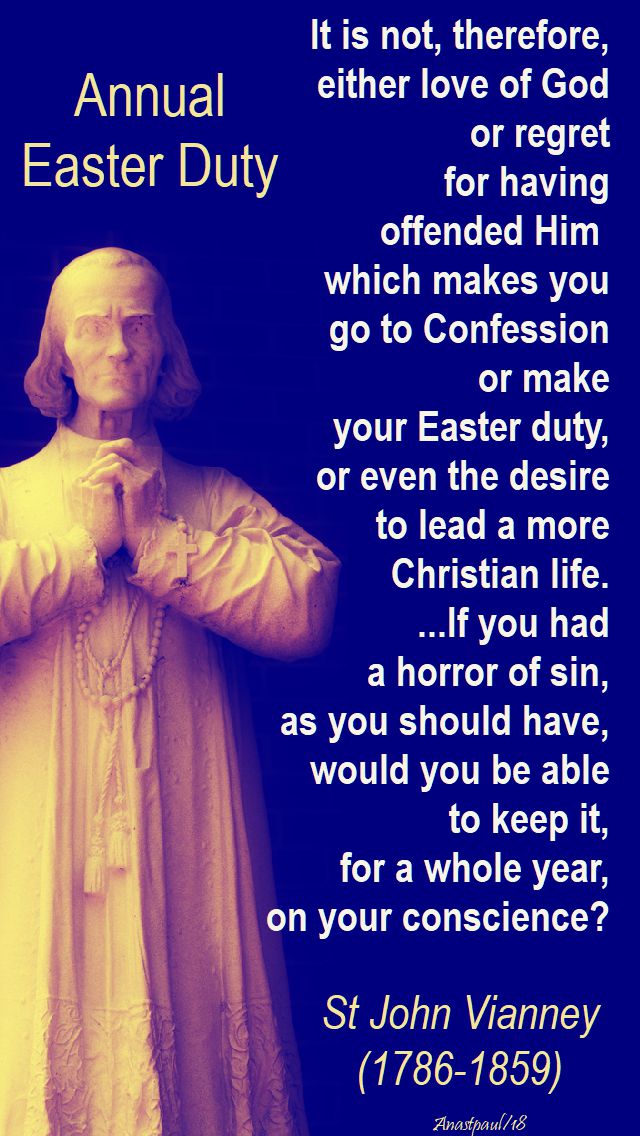
ANNUAL EASTER DUTY CONFESSIONS – St John Vianney (1786-1859)

If Easter were prolonged to Pentecost, you would not go to Confession until Pentecost, or if the latter did not come around for ten years, you would go to Confession only every ten years.   Indeed, if the Church did not give you a commandment about it, you would not go to Confession until death.   What do you think of that, my dear brethren?   Does it not mean that you have neither regret for having offended God, Who requires you to go to Confession, nor love for God, Who requires you to make your Easter Communion?

Ah you will say to me, that’s all very well.   We do not make our Easter duty without knowing why.

Ah! You know nothing at all about it!   You do it from habit, to be able to say you have made your Easter duty, or, if you would prefer to speak the truth, you would say that you have added a new sin to your old ones.   It is not, therefore, either love of God or regret for having offended Him which makes you go to Confession or make your Easter duty, or even the desire to lead a more Christian life.   And here is the proof of it:  if you loved God, would you consent to commit sin with such ease and even with so much enjoyment?   If you had a horror of sin, as you should have, would you be able to keep it,for a whole year, on your conscience?   If you had a real desire to live a more Christian life, would we not see at least some little change in your way of living?

No, my dear brethren, I do not wish to talk to you today about those unfortunate people who tell only half their sins through fear of not making their Easter duty or of being refused Absolution — perhaps even for the sake of covering up their shameful lives with the veil of virtue and who, in this state, approach the altar and are going to complete their dreadful work by handing over their God to the Devil and precipitating their sacrilegious souls into Hell.

No, I dare to hope that this does not concern you but I will continue, nevertheless, to tell you that going to Confession only once a year is not something about which you should feel any peace or satisfaction.annual easter duty - st john vianney - 13 march 2018

“You cannot have two heavens – it is impossible to enjoy yourself here and afterward to reign with Christ.”…Thomas à Kempis (1380-1471) – Book I The Imitation of Christyou cannot have two heavens - thomas a kempis - 13 march 2018

Posted in CONFESSION/PENANCE, DOCTORS of the Church, FATHERS of the Church, LENT, MORNING Prayers, PAPAL SERMONS, QUOTES of the SAINTS, QUOTES on CONVERSION, QUOTES on REPENTANCE, SPEAKING of .....

Quote/s of the Day – 13 March “Speaking of Confession”

Quote/s of the Day – 13 March – “Speaking of Confession”

“In failing to confess, Lord, I would only hide You from myself, not myself from You.”

St Augustine (354-430) Doctor of the Churchin failing to confess lord - st augustine - 13 march 2018

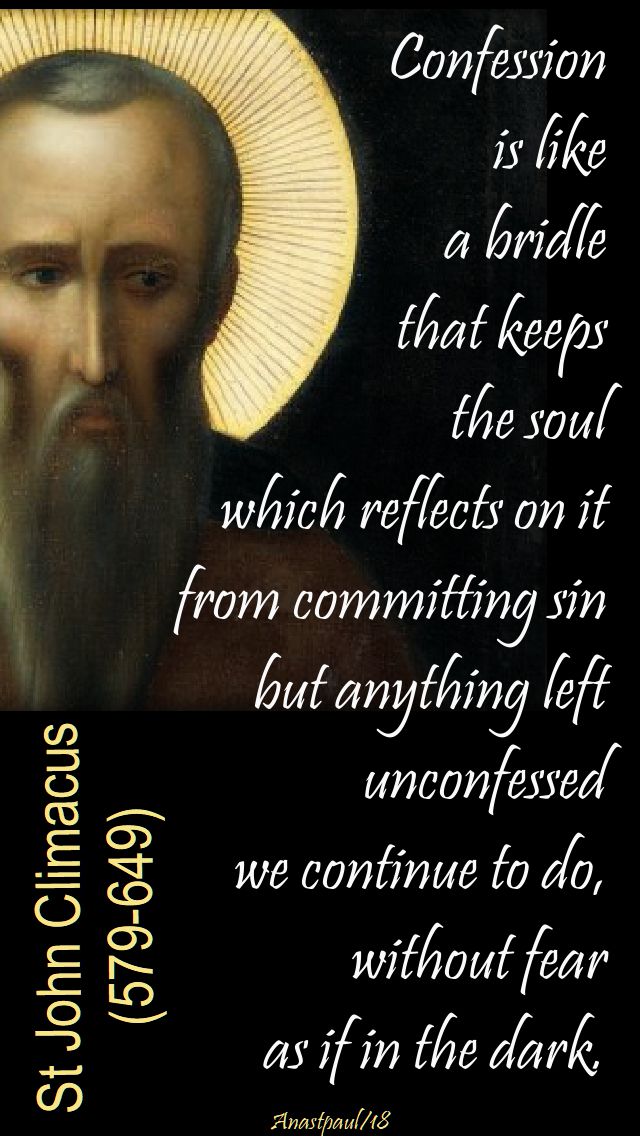
“Confession is like a bridle that keeps the soul which reflects on it from committing sin but anything left unconfessed we continue to do without fear as if in the dark.”

St John Climacus (579-649)confession is like a bridle - st john climacus - 13 march 2018

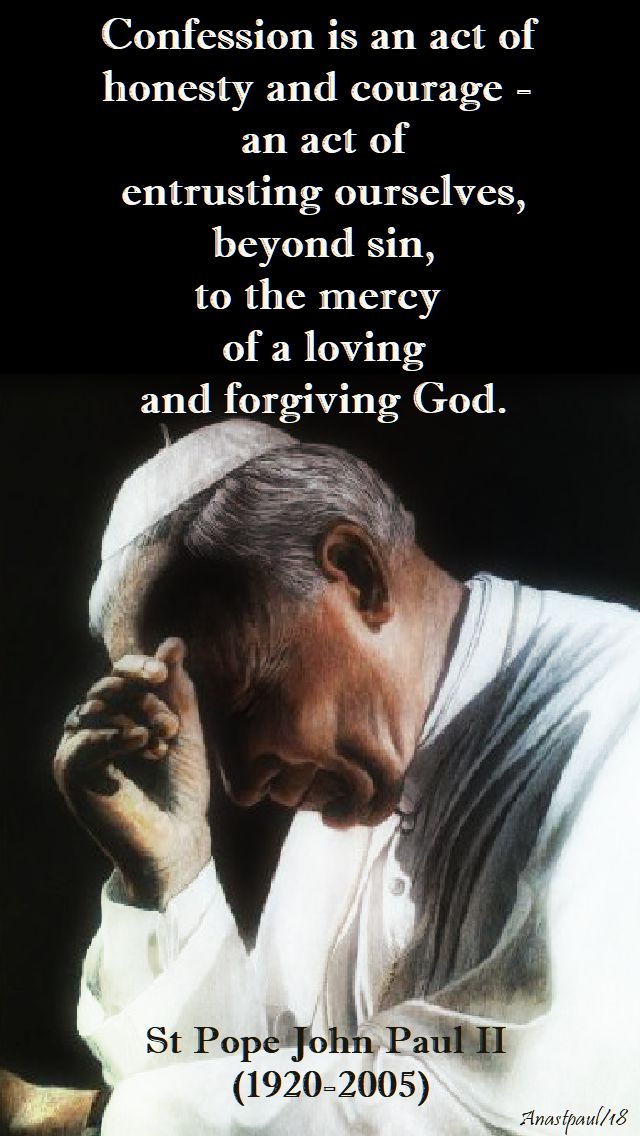
“Confession is an act of honesty and courage – an act of entrusting ourselves, beyond sin, to the mercy of a loving and forgiving God.”

St Pope John Paul II (1920-2005)confession is an act of courage - st john paul - 13 march 2018

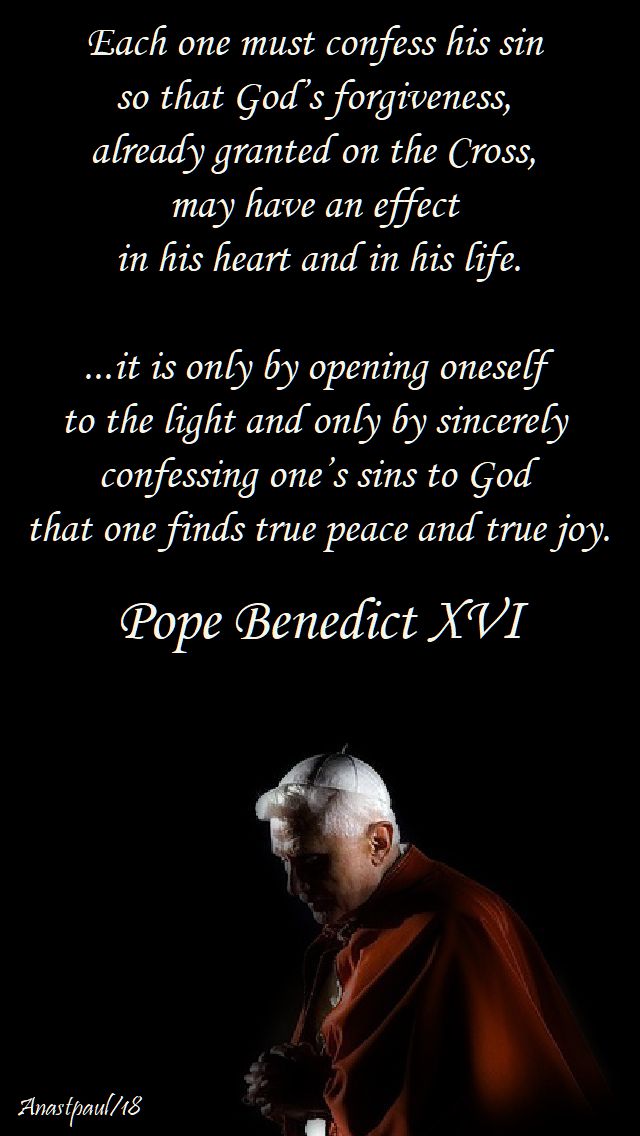
“Each one must confess his sin so that God’s forgiveness, already granted on the Cross, may have an effect in his heart and in his life.

St Augustine writes further: “God accuses your sins and if you also accuse them, you are united to God…. When your own deeds will begin to displease you, from that time your good works begin, as you find fault with your evil works.   The confession of evil works is the beginning of good works” (ibid., 13: PL 35, 1191).

Sometimes men and women prefer the darkness to the light because they are attached to their sins.   Nevertheless it is only by opening oneself to the light and only by sincerely confessing one’s sins to God that one finds true peace and true joy.   It is therefore important to receive the Sacrament of Penance regularly, especially during Lent, in order to receive the Lord’s forgiveness and to intensify our process of conversion.”

Pope Benedict – Angelus Address, 18 March 2012each one must confess his sin = pope benedict - 13 march 2018

Posted in DOCTORS of the Church, MORNING Prayers, ON the SAINTS, QUOTES of the SAINTS, SAINT of the DAY, The WORD

One Minute Reflection – 13 March – The Memorial of St Leander (c 534-c 600)

One Minute Reflection – 13 March – The Memorial of St Leander (c 534-c 600)

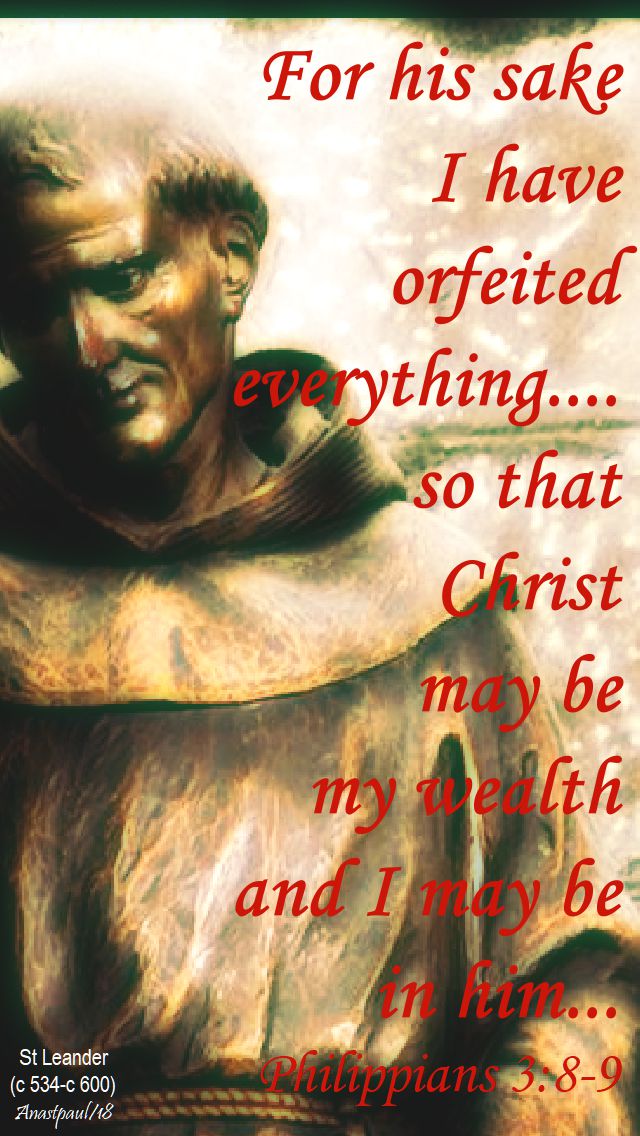
For his sake I have forfeited everything….so that Christ may be my wealth and I may be in him....Philippians 3:8-9philippians 3 8-9

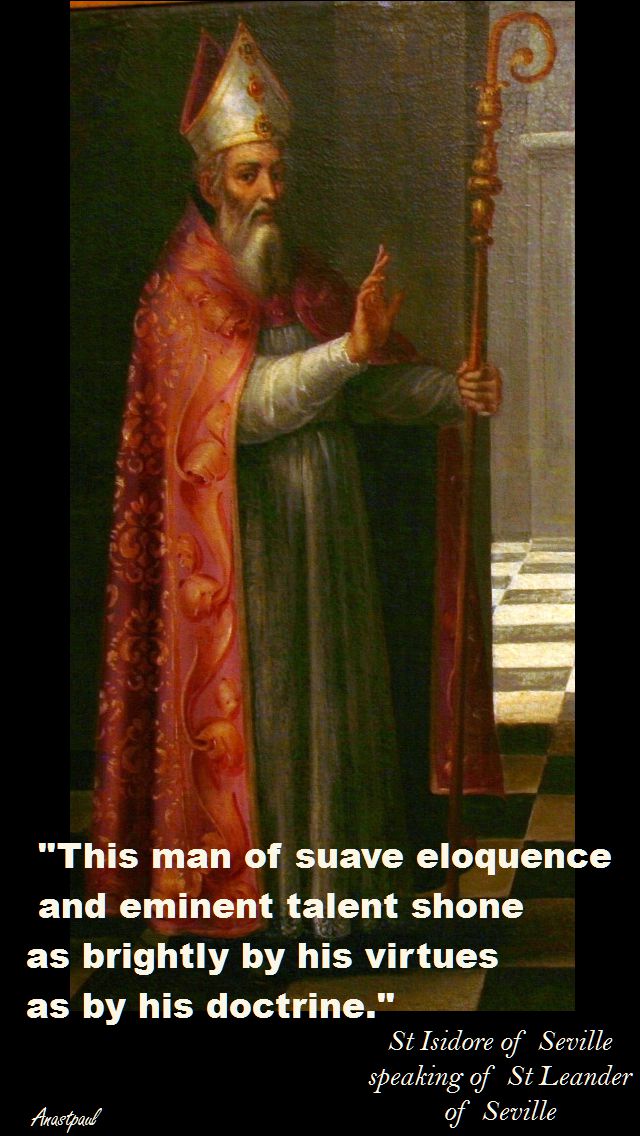
REFLECTION – “This man of suave eloquence and eminent talent shone as brightly by his virtues as by his doctrine. By his faith and zeal the Gothic people have been converted from Arianism to the Catholic faith”…St Isidore of Seville speaking of his brother St Leander, whom we celebrate today.this-man-st-isidore-of-seville-13 march 2017

PRAYER – Help me to discern through prayer and meditation what You truly want of me. Then enable me to offer it to You – and indeed to offer myself and all I have to You.   St Leander, you were and are an example to all of total and complete commitment to the Glory of the Kingdom and the One, True Faith.   Grant Holy Father, that by the prayers of St Leander we may too be filled with zeal and love, amen!st-leander-pray-for-us-2- 13 march 2017

Posted in CATHOLIC Quotes, FEASTS and SOLEMNITIES, MARIAN QUOTES, MARIAN TITLES, MARY, MATER ECCLESIAE, PAPAL DECREE, The BLESSED VIRGIN MARY

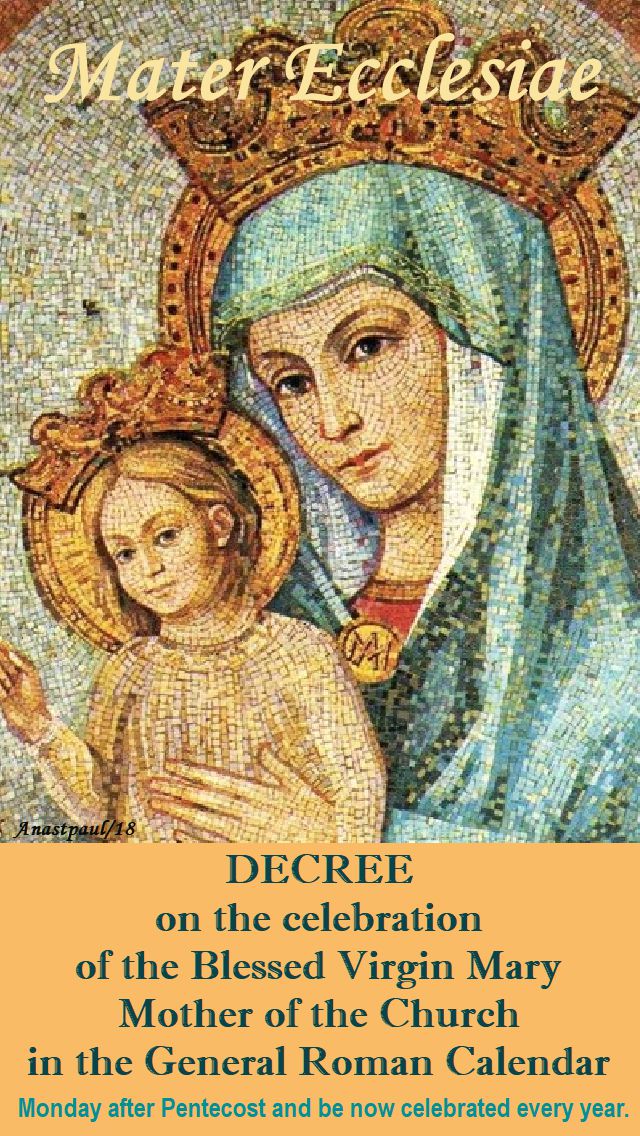
Pope Francis institutes new celebration of Mary, Mother of the Church

Pope Francis institutes new celebration of Mary, Mother of the Church

Congregation of Divine Worship and the Discipline of the Sacraments

DECREE
on the celebration
of the Blessed Virgin Mary
Mother of the Church
in the General Roman Calendar

The joyous veneration given to the Mother of God by the contemporary Church, in light of reflection on the mystery of Christ and on his nature, cannot ignore the figure of a woman (cf. Gal 4:4), the Virgin Mary, who is both the Mother of Christ and Mother of the Church.

In some ways this was already present in the mind of the Church from the premonitory words of Saint Augustine and Saint Leo the Great.   In fact the former says that Mary is the mother of the members of Christ, because with charity she co-operated in the rebirth of the faithful into the Church, while the latter says that the birth of the Head is also the birth of the body, thus indicating that Mary is at once Mother of Christ, the Son of God, and mother of the members of his Mystical Body, which is the Church.   These considerations derive from the divine motherhood of Mary and from her intimate union in the work of the Redeemer, which culminated at the hour of the cross.

Indeed, the Mother standing beneath the cross (cf. Jn 19:25), accepted her Son’s testament of love and welcomed all people in the person of the beloved disciple as sons and daughters to be reborn unto life eternal.   She thus became the tender Mother of the Church which Christ begot on the cross handing on the Spirit.   Christ, in turn, in the beloved disciple, chose all disciples as ministers of his love towards his Mother, entrusting her to them so that they might welcome her with filial affection.

As a caring guide to the emerging Church, Mary had already begun her mission in the Upper Room, praying with the Apostles while awaiting the coming of the Holy Spirit (cf. Acts 1:14).   In this sense, in the course of the centuries, Christian piety has honoured Mary with various titles, in many ways equivalent, such as Mother of Disciples, of the Faithful, of Believers, of all those who are reborn in Christ and also as “Mother of the Church” as is used in the texts of spiritual authors as well as in the Magisterium of Popes Benedict XIV and Leo XIII.

Thus the foundation is clearly established by which Blessed Paul VI, on 21 November 1964, at the conclusion of the Third Session of the Second Vatican Council, declared the Blessed Virgin Mary as “Mother of the Church, that is to say of all Christian people, the faithful as well as the pastors, who call her the most loving Mother” and established that “the Mother of God should be further honoured and invoked by the entire Christian people by this tenderest of titles”.

Therefore the Apostolic See on the occasion of the Holy Year of Reconciliation (1975), proposed a votive Mass in honour of Beata Maria Ecclesiæ Matre, which was subsequently inserted into the Roman Missal.   The Holy See also granted the faculty to add the invocation of this title in the Litany of Loreto (1980) and published other formularies in the Collection of Masses of the Blessed Virgin Mary (1986).   Some countries, dioceses and religious families who petitioned the Holy See were allowed to add this celebration to their particular calendars.

Having attentively considered how greatly the promotion of this devotion might encourage the growth of the maternal sense of the Church in the pastors, religious and faithful, as well as a growth of genuine Marian piety, Pope Francis has decreed that the Memorial of the Blessed Virgin Mary, Mother of the Church, should be inscribed in the Roman Calendar on the Monday after Pentecost and be now celebrated every year.

This celebration will help us to remember that growth in the Christian life must be anchored to the Mystery of the Cross, to the oblation of Christ in the Eucharistic Banquet and to the Mother of the Redeemer and Mother of the Redeemed, the Virgin who makes her offering to God.

The Memorial therefore is to appear in all Calendars and liturgical books for the celebration of Mass and of the Liturgy of the Hours.   The relative liturgical texts are attached to this decree and their translations, prepared and approved by the Episcopal Conferences, will be published after confirmation by this Dicastery.

Where the celebration of the Blessed Virgin Mary, Mother of the Church, is already celebrated on a day with a higher liturgical rank, approved according to the norm of particular law, in the future it may continue to be celebrated in the same way.

Anything to the contrary notwithstanding.

From the Congregation of Divine Worship and the Discipline of the Sacraments, 11 February 2018, the memorial of the Blessed Virgin Mary of Lourdes.

Robert Card. Sarah
Prefect

+ Arthur Roche
Archbishop Secretarydecree - mater ecclesiae - new memorial monday after pentecost - 4 march 2018

Posted in LENT, MORNING Prayers, PRAYERS of the SAINTS, QUOTES of the SAINTS, QUOTES on CONVERSION, QUOTES on FAITH, QUOTES on LOVE, QUOTES on OBEDIENCE, QUOTES on SANCTITY, QUOTES on TRUST and complete CONFIDENCE in GOD, The WORD

Lenten Reflection – 28 February 2018 – Wednesday of the Second Week of Lent

Lenten Reflection – 28 February 2018 – Wednesday of the Second Week of Lent

Jeremiah 18:18-20, Psalms 31:5-6, 14-16, Matthew 20:17-28

Jeremiah 18:18-19 – Then they said, “Come, let us make plots against Jeremiah, for the law shall not perish from the priest, nor counsel from the wise, nor the word from the prophet. Come, let us smite him with the tongue and let us not heed any of his words.” Give heed to me, O LORD and hearken to my plea.

Psalm 31:5 & 13-14 – Into thy hand I commit my spirit; thou hast redeemed me, O LORD, faithful God. Yea, I hear the whispering of many – terror on every side! – as they scheme together against me, as they plot to take my life. But I trust in thee, O LORD, I say, “Thou art my God.”

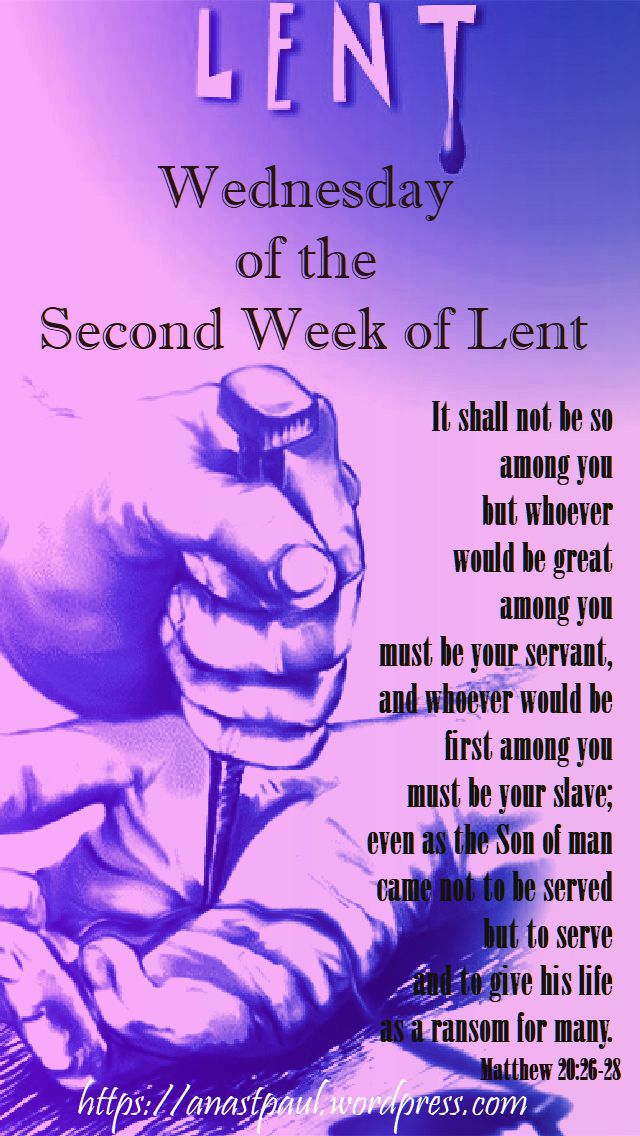
Matthew 20:26-28 – It shall not be so among you; but whoever would be great among you must be your servant, and whoever would be first among you must be your slave; even as the Son of man came not to be served but to serve and to give his life as a ransom for many.”wed of the second week - 28 feb 2018

There are several ways in which we can get things wrong on our journey to God and this season of Lent is a good time to become aware of them.

Firstly, we must not be taken by surprise if trying to follow God’s lead brings us persecution and hatred. Jeremiah in today’s first reading is not at all pleased with this state of affairs and is quite firm in his demands that his God should rescue him.

The psalmist is facing a similar situation (“terror all aound me”) and he is not exactly delighted that his life is in danger. However, he does not make any complaints, simply places his life confidently into the hands of God.

In the Gospel, Jesus is for the third time privately predicting to his slightly dim-witted disciples (though it is easy for us at this distance to second-guess the disciples – you? me? – have we done any better?) what is going to happen to Him and it is at least, as bas as what faces Jermiah, except for the last part of the prediction, which we hardly ever notice “and on the third day he will be raised.” That, however, is not what goes wrong. The failure on the part of His hearers is that of the mother of the sons of Zebedee. So James and John have to have it explained to them that Jesus’ way is the way of death.

Not that the other apostles are any better and now it is their turn to get things wrong, as they turn crossly on the two brothers. This is presumably not because they are shocked that James and John had so radically misunderstood Jesus but because, they had got ahead in the power-game.

For, the odd thing is – and at this point in Lent we shall do well to remind ourselves of it – that we are following a Lord who came not to be served but to serve – and to give His life!

On my journey to the Resurrection, do I trust God despite the difficulties I encounter?
Are there times in my life where I exercise power over others and delight in it?
Am I really one who serves?

Fr Nicholas King – The Lenten Journey to Easter

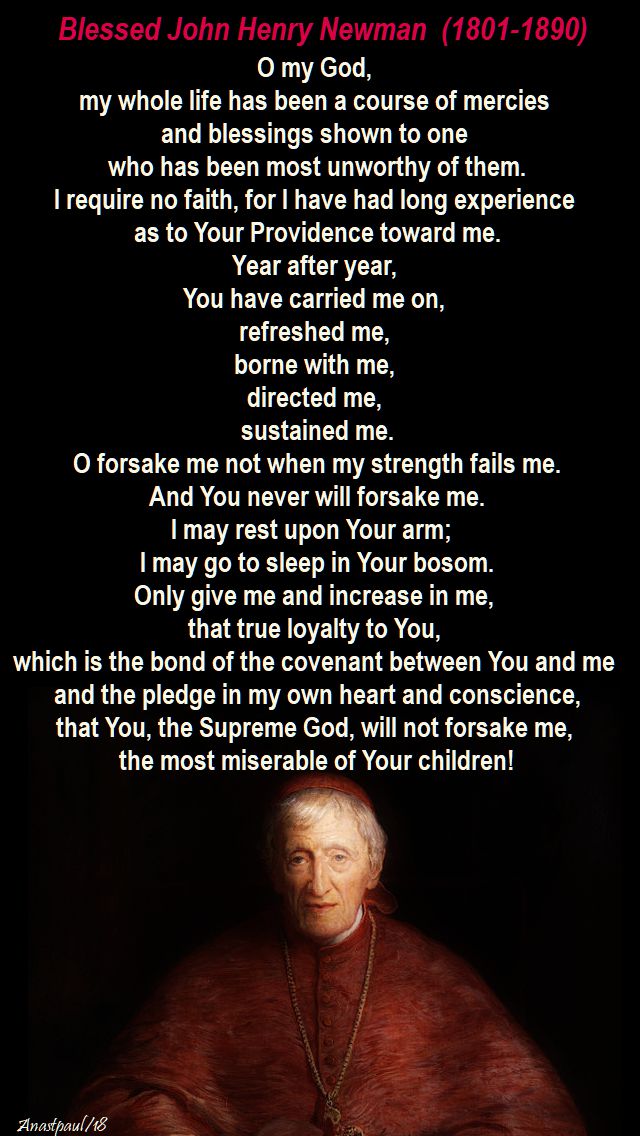
Loyalty to You 
Blessed John Henry Newman (1801-1890)

O my God, my whole life has been a course of mercies and blessings shown to one who has been most unworthy of them.
I require no faith, for I have had long experience as to Your Providence toward me.
Year after year, You have carried me on, refreshed me, borne with me, directed me, sustained me.
O forsake me not when my strength fails me.
And You never will forsake me.
I may rest upon Your arm; I may go to sleep in Your bosom.
Only give me and increase in me, that true loyalty to You, which is the bond of the covenant between You and me and the pledge in my own heart and conscience that You, the Supreme God, will not forsake me, the most miserable of Your children!o my god, my whole life - bl john henry newman - 28 feb 2018

Posted in GOD the FATHER, LENT, MORNING Prayers, QUOTES - J R R Tolkien and MORE, QUOTES on CONVERSION, QUOTES on FAITH, QUOTES on LOVE, QUOTES on REPENTANCE, QUOTES on SANCTITY, QUOTES on SUFFERING, The HOLY CROSS, The PASSION, The WORD

Thought for the Day – 28 February 2018 – Wednesday of the Second Week of Lent

Thought for the Day – 28 February 2018 – Wednesday of the Second Week of Lent

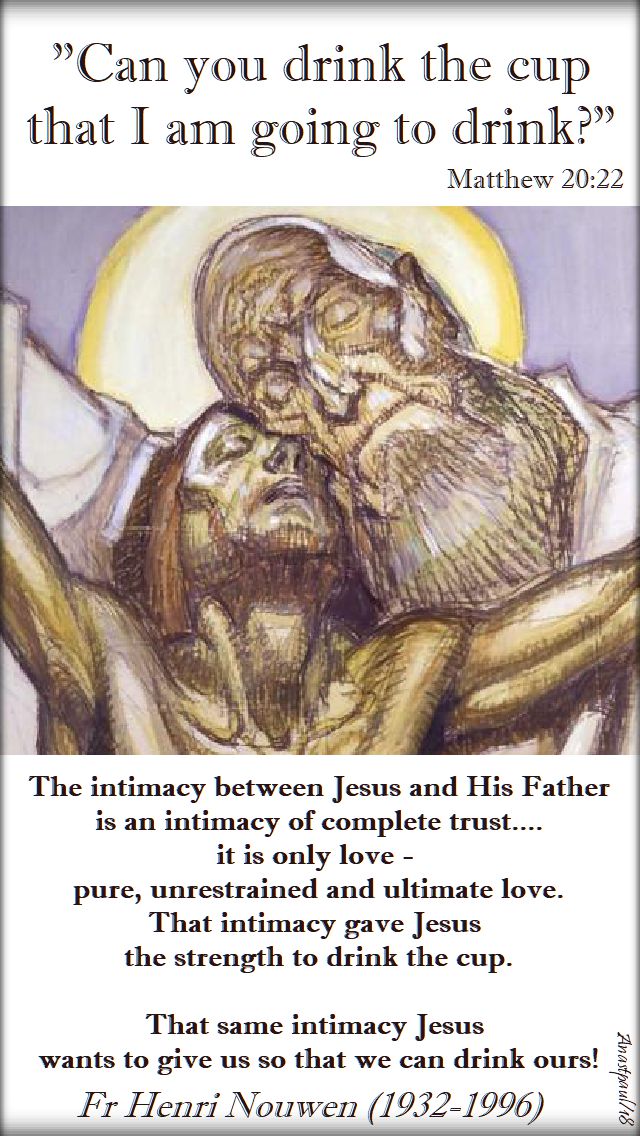
“The cup that Jesus speaks about is neither a symbol of death nor a symbol of victory.
It is a symbol of life, filled with sorrows and joys, that we can hold, lift and drink
as a blessing and a way to salvation. “Can you drink the cup that I am going to drink?”,
Jesus asks us. It is a question that will have a different meaning every day of our lives.
Can we embrace fully the sorrows and joys that come to us day after day?

Drinking the cup that Jesus drank is living a life in and with the spirit of Jesus, which is
the spirit of unconditional love. The intimacy between Jesus and His Father is an
intimacy of complete trust….it is only love – pure, unrestrained and ultimate love.
That intimacy gave Jesus the strength to drink the cup.

That same intimacy Jesus wants to give us so that we can drink ours!”

Fr Henri Nouwen (1932-1996) (Can you drink the Cup)the intimacy between jesus and his father - 28 feb 2018-henri nouwen

Posted in LENT, MORNING Prayers, QUOTES of the SAINTS, QUOTES on LOVE, QUOTES on SUFFERING, Uncategorized

Quote of the Day – 28 February 2018 – Wednesday of the Second Week of Lent

Quote of the Day – 28 February 2018 – Wednesday of the Second Week of Lent

“Does our life become from day to day more painful,
more oppressive, more replete with sufferings?
Blessed be He a thousand times who desires it so.
If life be harder, love makes it also stronger 
and only this love, grounded on suffering,
can carry the Cross of my Lord, Jesus Christ.”

Blessed Miguel Pro – Martyr (1891-1927)DOES OUR LIFE BECOME-BL MIGUEL PRO

Posted in franciscan OFM, LENT, MORNING Prayers, QUOTES on FAITH, QUOTES on LOVE, QUOTES on SANCTITY, QUOTES on SUFFERING, SACRED and IMMACULATE HEARTS, SAINT of the DAY, The PASSION, The WORD

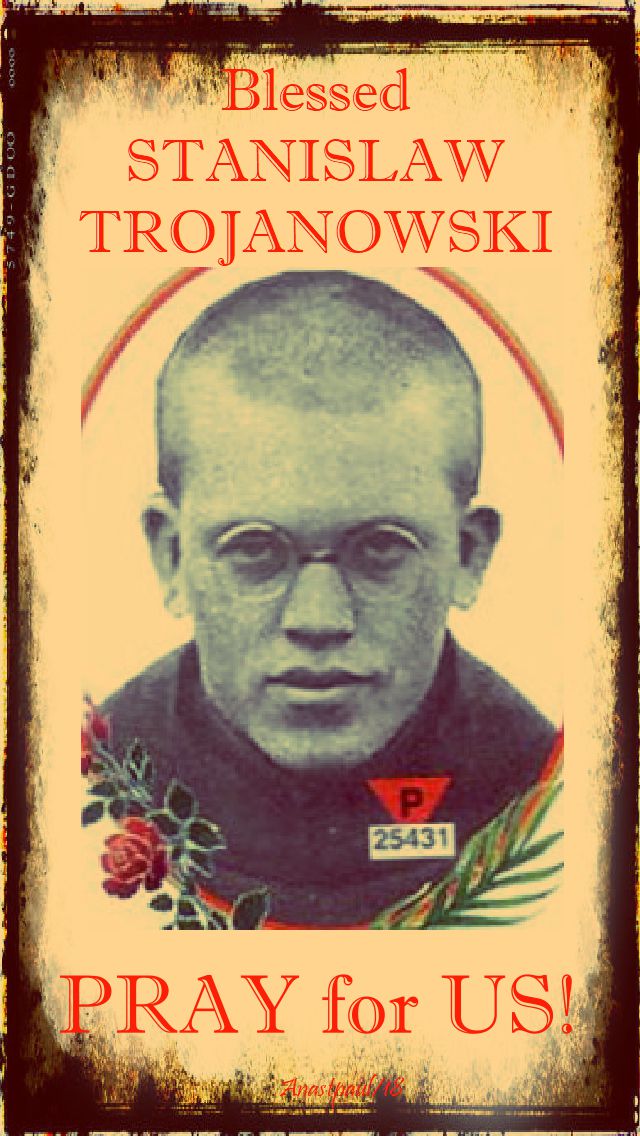
One Minute Reflection – 28 February 2018 – Wednesday of the Second Week of Lent and the Memorial of Blessed Stanislaw Antoni Trojanowski (1908-1942) Martyr

One Minute Reflection – 28 February 2018 – Wednesday of the Second Week of Lent and the Memorial of Blessed Stanislaw Antoni Trojanowski (1908-1942) Martyr

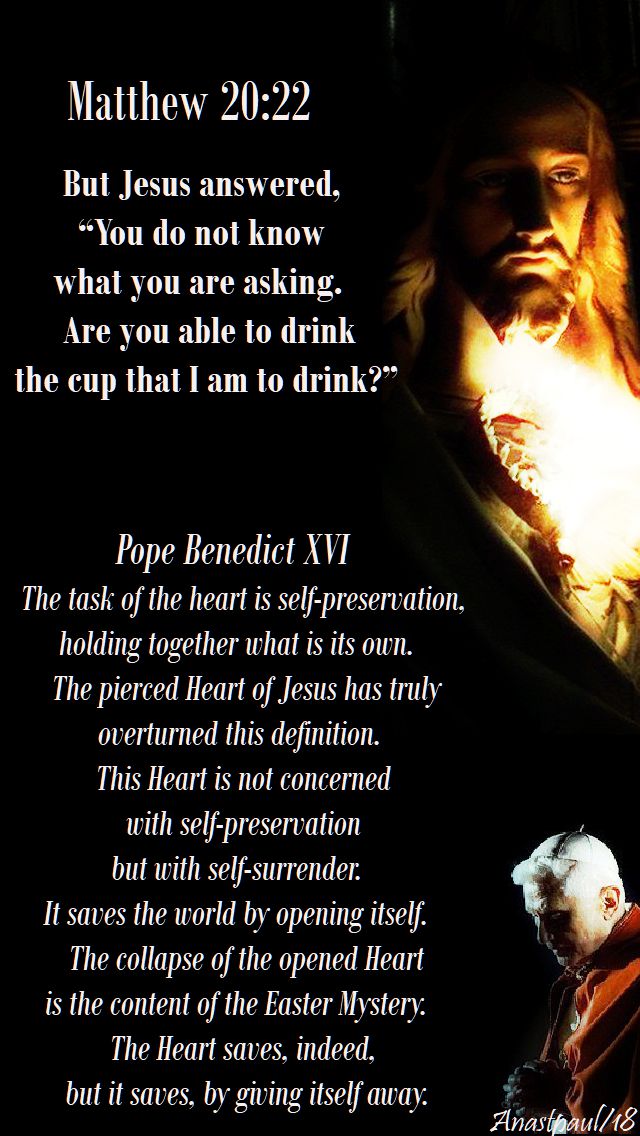
But Jesus answered, “You do not know what you are asking. Are you able to drink the cup that I am to drink?”…Matthew 20:22

REFLECTION – “The task of the heart is self-preservation, holding together what is its own.   The pierced Heart of Jesus has truly… overturned this definition.   This Heart is not concerned with self-preservation but with self-surrender.   It saves the world by opening itself.   The collapse of the opened Heart is the content of the Easter Mystery.   The Heart saves, indeed, but it saves, by giving itself away.”…Pope Benedict XVIthe task of the heart is self-preservation - pope benedict xvi - 28 feb 2018

PRAYER – We give You thanks Holy God and Father, for sending us Your Son to teach us how to love, to teach us that only in giving ourselves may we receive ourselves.   Our hearts are made of stone but You O God, can turn them into flesh and teach us to open our hearts completely to the way of the Cross.   May the Martyr Blessed Stanislaw Trojanowski, offer his prayers for us, as we strive to learn, as he did, this way our Lord taught us.   Through Jesus Christ, Your Son, in the unity of the Holy Spirit, one God forever, amen.bl stanislaw trojanowski pray for us - 28 feb 2018

Posted in LENT, MORNING Prayers, PRAYERS of the SAINTS, QUOTES on SUFFERING, SACRED and IMMACULATE HEARTS

Our Morning Offering – 28 February 2018 – Wednesday of the Second Week of Lent

Our Morning Offering – 28 February 2018 – Wednesday of the Second Week of Lent

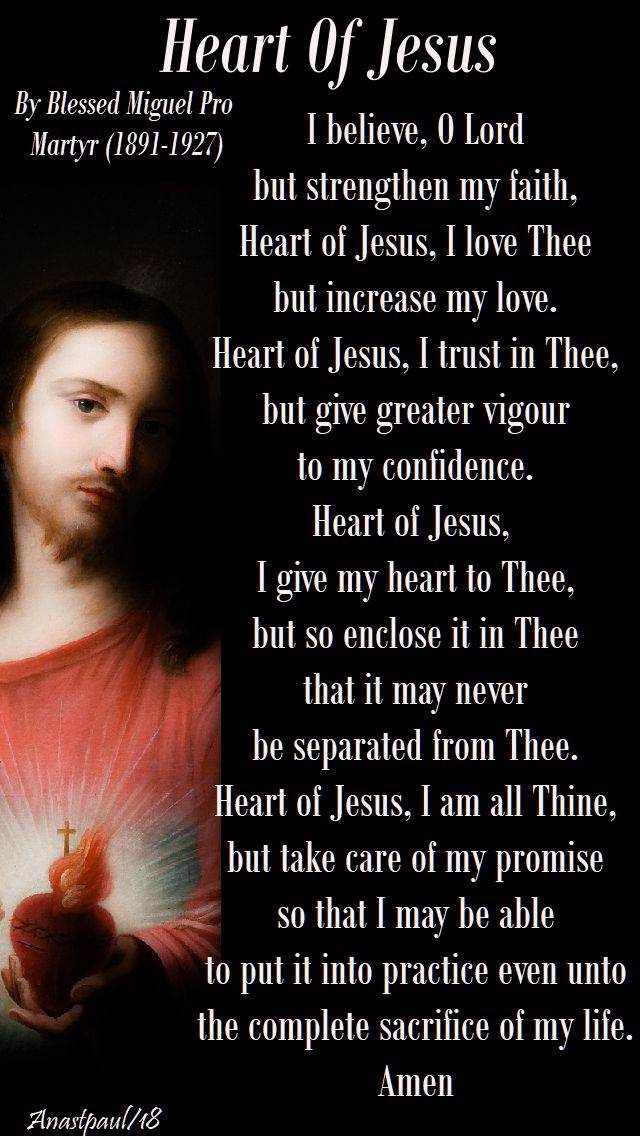
Heart Of Jesus
By Blessed Miguel Pro – Martyr (1891-1927)

I believe, O Lord
but strengthen my faith,
Heart of Jesus, I love Thee
but increase my love.
Heart of Jesus, I trust in Thee,
but give greater vigour
to my confidence.
Heart of Jesus,
I give my heart to Thee,
but so enclose it in Thee
that it may never
be separated from Thee.
Heart of Jesus, I am all Thine,
but take care of my promise
so that I may be able
to put it into practice even unto
the complete sacrifice of my life.
Amenheart of jesus - bl miguel pro - 28 feb 2018

Posted in DOCTORS of the Church, GOD the FATHER, LENT, MORNING Prayers, QUOTES of the SAINTS, QUOTES on CONVERSION, QUOTES on FAITH, QUOTES on HUMILITY, QUOTES on LOVE, QUOTES on MERCY, QUOTES on PRAYER, QUOTES on REPENTANCE, QUOTES on SANCTITY, QUOTES on SIN

Lenten Reflection – 27 February 2018 – Tuesday of the Second Week of Lent, Year B and the Memorial of St Gregory of Narek (950-1003) – Doctor of the Church

Lenten Reflection – 27 February 2018 – Tuesday of the Second Week of Lent, Year B and the Memorial of St Gregory of Narek (950-1003) – Doctor of the Church

Isaiah 1:10, 16-20, Psalms 50:8-9, 16-17, 21, 23, Matthew 23:1-12

Isaiah 1:10 – Hear the word of the Lord, you rulers of Sodom!
Give ear to the teaching of our God, you people of Gomorrah!
Psalm 50:8-9 – I do not reprove you for your sacrifices;
your burnt offerings are continually before me.
I will accept no bull from your house,
nor he-goat from your folds.
Matthew 23:2-3 – “The scribes and the Pharisees sit on Moses’ seat; so practice and observe whatever they tell you but not what they do; for they preach, but do not practice…
All their actions are done to be seen by others, for they broaden their CLERICAL COLLARS and lengthen their CHASUBLES.”tuesday of the second week - 27 feb 2018

God often works by shocking us (otherwise we should drift into comfortable complacency).   Today’s readings are very shocking indeed.
First of all you have Isaiah calling the religious leaders of his time and place “rulers of Sodom” and his compatriots, ‘peoples of Gomorrah” and as they digest this he bellows at them:  “Wash! Make yourselves clean!” and reminds them – that is us of course, of how much they have got wrong and how much they have still to put right.
But there is hope, nevertheless, ‘come now, let us reason together’, says God disarmingly.

And the Psalm today offers another shock.   Suddenly, it is the sacrificial system that is thrown into doubt.   God is apparently bored by all these sacrifices – unless they are accompanied by internal reform, they are of not value.   And this Lent, the same applies to all of us, of course!

Finally, the Gospel brings yet another shock, as Jesus lays into the Pharisees and scribes. Now, we must be beware of nodding wisely as we listen and saying ‘quite right Jesus, they had it coming to them’, for the scribes and the Pharisees are you and me, anyone who exercises any kind of Christian leadership and so ‘I have translated the word ‘phylactery’ as ‘clerical collar’ and ‘hem’ as ‘chasuble’.   For all these criticisms can be laid against us all and this Lent we need to look closely at this fact!   (Fr Nicholas King S.J. – Daily Meditations for Lent)

Our task, by contrast, is to ‘humble ourselves’ as Jesus did in the awfulness of the Cross and from that plight it is possible for God to rescue us.

Sometimes we need to be reminded of our failings in order to start that turn back toward God. Many of us are unaware that we are in the pig pen like the prodigal before he realised his state and sought his father’s house.

Where in my life could I be more humble?
Where do I seek recognition, honour or positions of power, perhaps to the detriment of my neighbour?
Has power gone to my head?

YOU HAVE NOT THE TIME!

“We can only find our happiness on earth in loving God and we can only love Him in prayer to Him.   We see that Jesus Christ, to encourage us often to have recourse to Him through prayer, promises never to refuse us anything if we pray for it as we should.   But there is no need to go looking for elaborate and roundabout ways of showing you that we should pray often, for you have only to open your catechism and you will see there that the duty of every good Christian is to pray morning and evening and often during the day — that is to say, always….

Which of us, my dear brethren, could, without tears of compassion, listen to those poor Christians who dare to say that they have not time to pray?   You have not the time!   Poor blind creatures, which is the more precious action:  to strive to please God and to save your soul, or to go out to feed your animals in the stable or to call your children or your servants in order to send them out to till the earth or to tidy up the stable?   Dear God!   How blind man is! …. You have not the time!   But tell me, ungrateful creatures, if God had called you to die that night, would you have exerted yourselves?   If He had sent you three or four months of illness, would you have exerted yourselves?   Go away, you miserable creatures;  you deserve to have God abandon you in your blindness and leave you thus to perish.   We find that it is too much to give Him a few minutes to thank Him for the graces which He is giving us at every instant! ….

You must get on with your work, you say.

That, my dear people, is where you are greatly mistaken.  You have no other work to do except to please God and to save your souls.   All the rest is not your work.   If you do not do it, others will, but if you lose your soul, who will save it?”

St John Vianney (1786-1859)

And now, my heavy laden soul,
what will you do?
You call with your lips and voice to
God most high,
God, who cares only for deeds and
is not taken in by words.
You, my soul, with a heart always turned toward Egypt,
how can I describe you?

Am I
a Sodom, to be punished likewise with destruction, 
or the prosecutor of Ninevah, who was struck dumb? 

Am I
more cowardly and barbarous than the
queen of the south, 
lower than Canaan, 
more stubborn than Amalek,
incurable as the city of idols, 
a relic left behind from the rebellion of Israel,
a reminder of the broken covenant of Judah, 
more reproachable than Tyre, 
more shunned than Zidon, 
more immoral than Galilee,
more unpardonable than faithless Capernaum,
maligned like Korazin, 
slandered like Bethsaida? 

Or am I
immodest as Ephraim as he grayed,
or a dove, whose gentleness seems due to
feeblemindedness and not to inner calm, 
or an evil serpent born of lion’s cubs,
or the serpent’s egg filled with decay,
or like the last blow against Jerusalem?

Or am I
in the words of our Lord
and the sayings of the prophets,
an abandoned tabernacle about to collapse,
the unlatched doors of the stronghold,
my speaking edifice stained again,
having given up my rightful inheritance,
my home built by God,
as Moses, David and Jeremiah prophesied?  
My thinking body now consumed by disease,
afflicted with carping counsel, rehabilitated by the law,
anointed with the clay of mildness,
incapable of finding my own salvation,
torn away from the maker’s hand,
expelled as just punishment
by order of the Almighty, to an unholy place,
rejected, exiled, greatly shunned, nothing spared,
having buried my gift in the ground, 
like the one chastised in the Gospel by
losing his inheritance.

But you, God,
Lord of souls and all flesh,
in the words of one divinely graced, 
You are long-suffering and abounding in mercy.
In the voice of blessed Jonah,
grant that I finish to Your delight
this book of prayers, now begun.
And having sown these words with tears
and set forth on this journey toward the dwellings You have prepared,
may I return joyfully in the time of harvest
with the bounty of atonement,
with sheaves of goodness and the fruits of delight.

St Gregory of Narek (950-1003) – Doctor of the Churchbut you God - st gregory of narek - 27 feb 2018

Posted in DOCTORS of the Church, LENT, MORNING Prayers, QUOTES of the SAINTS, QUOTES on CONVERSION, QUOTES on FAITH, QUOTES on LOVE, QUOTES on MERCY, QUOTES on REPENTANCE, SAINT of the DAY

Thought for the Day – 27 February – The Memorial of St Gregory of Narek (950-1003) – Doctor of the Church and Tuesday of the Second Week of Lent, Year B 2018

Thought for the Day – 27 February – The Memorial of St Gregory of Narek (950-1003) – Doctor of the Church and Tuesday of the Second Week of Lent, Year B 2018
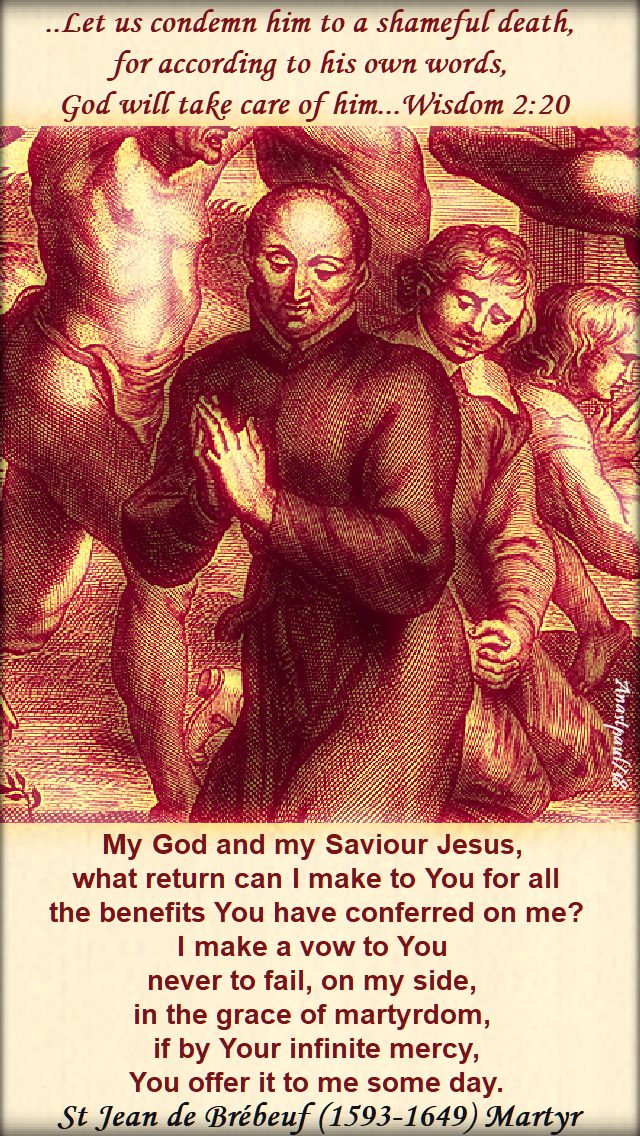
We welcome you, St Gregory of Narek, as our newest Doctor of the Universal Church, with gratitude and joy!
Gregory’s Book of Lamentations was the source of consolation and guidance for generations in times of immense suffering. His monastery survived for a thousand years but was destroyed by the Turks during the genocide.
Armenians lost Narek but they still have the book they call by that name “Narek”, in his honour and many Armenians have traditionally slept with a copy of the work under their pillows.
The words of Gregory, too, are consonant with Pope Francis’ call on all Catholics to reach out to God in our brokenness with humble and contrite hearts.
Perhaps we should allow St Gregory to help us through our Lenten journey this year?
As Gregory wrote in the Lamentations, “Hear the prayers of my embattled heart for mercy, when I cry out to you, ‘Lord,’ in my time of need.”

St Gregory of Narek- Doctor of the Universal Church, pray for us!st-gregory-of-narek-pray-for-us-27 feb 2017.2.st-gregory-of-narek-pray-for-us-27 march 2018.3

All you Holy Martyrs and Saints of Armenia, pray for us!armenian-martyrs-ico-pray-for-us-27 feb 2017

Posted in DOCTORS of the Church, LENT, MORNING Prayers, QUOTES of the SAINTS, QUOTES on CONVERSION, QUOTES on FAITH, QUOTES on LOVE, QUOTES on SIN, SAINT of the DAY, The GOOD SHEPHERD

Quote of the Day – 27 February – The Memorial of St Gregory of Narek (950-1003) – Doctor of the Church
Quote of the Day – 27 February – The Memorial of St Gregory of Narek (950-1003) – Doctor of the Church
“You found me,
a sinner,
lost in darkness
crying like
the psalmist in prayer,
and because of
Your willing care
you were called Shepherd,
for not only
did You care
but You sought,
not only did You find,
O worker of miracles
but with the goodness
of Your love,
a love that
defies description,
You rescued me,
lifting me upon
Your shoulders,
to set me down alongside
Your heavenly army,
the heirs to
Your fatherly legacy. ”

St Gregory of Narek (Book of Lamentations)you found me a sinner - st gregory of narek - 27 feb 2018

Posted in DOCTORS of the Church, LENT, MORNING Prayers, QUOTES of the SAINTS, QUOTES on FAITH, QUOTES on PRAYER, QUOTES on SANCTITY, SAINT of the DAY, The WORD

One Minute Reflection – 27 February – The Memorial of St Gregory of Narek (950-1003) – Doctor of the Church
One Minute Reflection – 27 February – The Memorial of St Gregory of Narek (950-1003) – Doctor of the Church
I tell you that everyone will have to give account on the day of judgement for every empty word they have spoken…“…Matthew 12:36.

REFLECTION – “But so that I do not become tedious and long-winded, let me compress my words, words I say echoing the blessed David in his inspired voice, “I seek you with all my heart.”…St Gregory of Narekbut so that i do not become tedious - st gregory of narek - 27 feb 2018

PRAYER – God of goodness, teach us Your ways.   Do not let us waste a moment in futile and worthless words and deeds but help us to seek and to find You.   Grant that by the prayers of St Gregory, we may follow the steps of Your Son, so that we may be found worthy to stand with him and with all the saints, praising You with our hearts and words, amen.st gregory of narek pray for us - 27 feb 2018

Posted in CATHOLIC-PRAYERS OF THE CHURCH, CHRIST, the WAY,TRUTH,LIFE, GOD ALONE!, LENT, MORNING Prayers, POETRY, PRAYERS of the CHURCH, QUOTES for CHRIST, QUOTES on LOVE of GOD, The WORD, Thomas a Kempis

Lenten Reflection – 26 February 2018 – Monday of the Second Week of Lent

26 February 2018 – Monday of the Second Week of Lent
Daniel 9:4-10, Psalms 79:8-9, 11, 13, Luke 6:36-38

Daniel 9:4-5 – “I prayed to the Lord my God and made confession, saying, “O Lord, the great and terrible God, who keepest covenant and steadfast love with those who love him and keep his commandments, we have sinned and done wrong and acted wickedly and rebelled, turning aside from thy commandments and ordinances…”

Luke 6:36-38 – Be merciful, even as your Father is merciful. “Judge not, and you will not be judged; condemn not and you will not be condemned; forgive and you will be forgiven; give and it will be given to you; good measure, pressed down, shaken together, running over, will be put into your lap. For the measure you give will be the measure you get back.”monday of the second week - 26 feb 2018

Daniel confesses that his people’s sufferings in exile are due to their own lack of fodelity to God. This sort of confession is a frank admission that evil has consequences. It is similar to Jesus’ teaching – “one who takes up the sword will perish by the sword.”

The argument may be turned round – good deeds have beneficial consequences. “The measure you give will be the measure you get back” whether it be mercy, forgiveness or sympathetic understanding.

If we keep giving out good things consistently, the blessings we will receive will be beyond measure. Every giving enriches the giver, whether gift be in the form of material assistance, psychologival affirmation or spiritual admonition, giving up an argument, settling a quarrel or going out of our way to help someone who deserves it least!

Be not afraid then to give, for you will receive beyond anything you could ever expect.

Am I generous with my time, material gifts, with my love?
Am I patient and willing to be forgiving, even when I was not in error?
Am I aware that as part of the Body of Christ, my good and my bad, affect all?
Archbishop Thomas Menamparampil SDB – God’sWord

“Desire not the praises of men, seeing they are vain.   Be not fearful of their reproach, for instead of doing harm to your soul, humiliations cleanses it and renders it more meet to receive a brighter crown in heaven and none are worthy to be glorified in heaven who are unable to bear reproach on earth for the love of God.”Thomas a Kempis

Help us, O God of our salvation, for the glory of thy name;
deliver us and forgive our sins, for thy name’s sake! …Psalm 79:9

For ah! the Master is so fair,
His smile so sweet to banished men
That they who meet it unaware
Can never rest on earth again.

And they who see Him risen afar
At God’s right hand to welcome them
Forgetful stand of home and land,
Desiring fair Jerusalem.

Praise God! the Master is so sweet;
Praise God! the country is so fair,
We would not hold them from His feet.
We would but haste to meet them there.

English Missal 1936for ah, the master is so fair - lenten prayer - missal 1936 - monday of the 2nd week - 26 feb 2018

Posted in LENT, MORNING Prayers, QUOTES of the SAINTS, QUOTES on CONVERSION, QUOTES on SIN, The INCARNATION, The PASSION

Thought for the Day – 26 February 2018 – Monday of the Second Week of Lent

Thought for the Day – 26 February 2018 – Monday of the Second Week of Lent
Daniel 9:4-10, Psalms 79:8-9, 11, 13, Luke 6:36-38

WE ARE WRETCHED CREATURES

We cannot dwell upon the conduct of the Jews, my dear people, without being struck with amazement.   These very people had waited for God for four thousand years, they had prayed much because of the great desire they had to receive Him and yet when He came, He could not find a single person to give Him the poorest lodging.   The all-powerful God was obliged to make His dwelling with the animals.

And yet, my dear people, I find in the conduct of the Jews, criminal as it was, not a subject for explanations but a theme for the condemnation of the conduct of the majority of Christians.

We can see that the Jews had formed an idea of their Redeemer which did not conform with the state of austerity in which He appeared.   It seemed as if they could not persuade themselves that this could indeed be He who was to be their Saviour;  St Paul tells us very clearly that if the Jews had recognised Him as God, they would never have put Him to death.   There is, then, some small excuse for the Jews.   But what excuse can we make, my dear brethren, for the coldness and the contempt which we show towards Jesus Christ?

Oh, yes, we do indeed truly believe that Jesus Christ came upon earth, that He provided the most convincing proofs of His divinity.   Hence the reason for our hope.   We rejoice and we have good reason to recognise Jesus Christ as our God, our Saviour and our Model.   Here is the foundation of our faith.

But, tell me, with all this, what homage do we really pay Him?   Do we do more for Him than if we did not believe all this?   Tell me, dear brethren, does our conduct correspond at all to our beliefs?   We are wretched creatures.

We are even more blameworthy than the Jews!

St John Marie Baptiste Vianney (1786-1859)oh yes, we do indeed truly believe - st john vianney - 26 feb 2018


Posted in LENT, MORNING Prayers, QUOTES of the SAINTS, QUOTES on CONVERSION, QUOTES on FAITH, QUOTES on SANCTITY

Quote of the Day – 26 February 2018 – Monday of the Second Week of Lent

Quote of the Day – 26 February 2018 – Monday of the Second Week of Lent

“There is one thing everyone can do,
whether they find it hard to meditate or not
and that is to make up their mind in the morning,
to cultivate some particular virtue during the day,
to practice the interior Presence of God
and to live their life in union with Him.”

St John Marie Baptiste Vianney (1786-1859)there is one thing - st john vianney - 26 feb 2018 - mon 2nd week lent

Posted in MORNING Prayers, QUOTES of the SAINTS, SAINT of the DAY, The WORD

One Minute Reflection – 26 February – St Paula Montal Fornés of Saint Joseph of Calasanz (1799-1889)

One Minute Reflection – 26 February – St Paula Montal Fornés of Saint Joseph of Calasanz (1799-1889)

…may grace and peace be yours in abundance through knowledge of God and of Jesus our Lord…2 Peter 1:2

REFLECTION – “… (St Paula) as foundress of a religious family, inspired by the slogan of St Joseph Calasanz “Piety and Letters”, she gave herself to advancing women and the family with her ideal: “Save the family, educating the young girls in a holy fear of God”... (She) belongs to the group of founders of religious orders who in the 19th century came forward to meet the many needs that were present and that the Church, inspired by the Gospel and by the Spirit, wanted to respond to for the good of society.  The message of St Paula is still valid today and her educational charism is a source of inspiration in the formation of the generations of the third Christian millennium.”…St Pope John Paul II Canonisation Homily 25 November 2001

PRAYER – Heavenly Father, may Your Holy Saints’ examples inspire us to living contemplation of Christ the King, crucified and risen. May St Paula’s supporting intercession, help us to walk faithfully in the footsteps of the Redeemer, to share one day with her together with Mary and all the saints, His eternal glory in heaven. Amen.st paula montal fornes - pray for us - 26 feb 2018

Posted in LENT, MORNING Prayers, POETRY, QUOTES of the SAINTS, QUOTES on CONVERSION, QUOTES on FAITH, QUOTES on LOVE, QUOTES on OBEDIENCE, QUOTES on PERSECUTION, QUOTES on REPENTANCE, QUOTES on SANCTITY, QUOTES on SUFFERING, The HOLY CROSS, The TRANSFIGURATION, The WORD

25 February 2018 – Lenten Reflection – The Second Sunday in Lent, Year B THE GLORY OF THE CRUCIFIED CHRIS

25 February 2018 – Lenten Reflection – The Second Sunday in Lent, Year B
THE GLORY OF THE CRUCIFIED CHRIST

Genesis 22:1-2, 9-13, 15-18, Psalms 116:10, 15-19, Romans 8:31-34, Mark 9:2-10

Mark 9:2-3 – And after six days Jesus took with him Peter and James and John and led them up a high mountain apart by themselves;  and he was transfigured before them and his garments became glistening, intensely white, as no fuller on earth could bleach them.second sunday lenten reflection - mark 9 3

On the second Sunday in Lent we always read the Gospel of the Transfiguration of our Lord.   We do so in order that our focus may be directed towards the glory of Easter and our Lord’s victory over sin and death by His glorious Resurrection.   Our Lenten penance is not an end in itself but a means to an end;  that cleansed of our faults and sanctified in both body and mind we might more fully appreciate and participate in God’s own glory. The word that Sacred Scripture most commonly uses to describe the nature of God is glory.   We associate glory with power, majesty, radiance, awe and wonder.   Yet all the Gospels, especially the Gospel of John, speak of God’s humiliation as His exaltation, His glory.   By faith, we are seized by the beauty and glory of the Crucified Christ.   In this mystery of the Transfiguration a twofold glory is revealed:  the glory which our Lord possesses as the eternal Son of the Father and the glory that is manifested in His sacred Passion;  the glory that is manifested from the unsurpassable torture of Holy Week.   God Himself is “whipped to blood, crowned with thorns, mocked, spat upon, ridiculed, nailed, pierced…   In this consummate ugliness, this unspeakable outrage, shines a picture of divine beauty, of divine glory.   The Gospel of the Transfiguration presents us with a vision of the glory of God on its way to the Passion”… (Cardinal Hans Urs Von Balthasar 1905-1988).

The glory revealed to Peter, James and John is a glimpse of the glory of the Resurrection, a glory that we too are destined to share;  however, it is the Passion that “leads to the glory of the Resurrection” (Preface for the Second Sunday in Lent, The Roman Missal). Consequently, we are ever mindful that “we preach Christ crucified … Christ the power of God and the wisdom of God” (1 Cor 1:23-24).   Our Lord Jesus Christ “is the radiant light of God’s glory and the perfect copy of His nature” (Heb 1:3).   Those who gaze on the Crucified Christ in faith are able to perceive that His hour of highest spiritual beauty—and glory—is a moment of utmost bodily degradation.   In the humiliation of the Cross the Saviour brings near and makes visible the divine glory for we see in Him the ineffable love of God for sinners.   This is a love, a beauty and a glory that can only be perceived by a prayerful, contemplative gaze  . It is only by means of prayer and penance that we can come to some understanding of why our Lord brought about our salvation in such weakness, diminishment and pain.

No human life is exempt from diminishment and pain.   If we are given the grace to grow older, the weight of years alone brings about diminishment.   Why must it be so?   Perhaps our own diminishment is meant to conform us to the self-emptying of the Son of God on the Cross.   This may very well be the grace of old age.   That our redemption has taken place through suffering of the flesh and spilling of blood may mean that it could take place in no other way.   It is for this reason that above all things we must seek simply to be with Jesus and to learn from Him what He alone can teach us in the silence of prayer.   On the Cross we have the ultimate and only adequate answer to the problem of evil, the only solution to the mystery of sin.   The world’s redemption could only be brought about “in the mystery of a love that by suffering understands all the insults inflicted upon it” (Hans Urs Von Balthasar).   Our profession of faith, if taken seriously, is journey into the depth of this Mystery.

What do we discover as we come to know more of this mystery?   Quite simply, that the essence of Christian discipleship is to be with Jesus and to learn from Him who accompanies us on life’s journey and who is never distant from us by means of His grace. We must endeavour to abandon ourselves to the will of the Father as He did and in this is our peace:  not only our peace but also our way to holiness, to glory.   Christians are not immune from suffering.   Indeed, our long history teaches us that often we suffer more precisely because of our Christian faith but as St Paul asks, “who will separate us from the love of Christ? Will hardship, or distress or persecution, or famine, or nakedness, or peril or sword? No, in all these things we are more than conquerors, through him who loved us” (Rom 8:35-37).   These words are more than ever relevant as we witness the persecution of Christians in the Middle East, Africa and elsewhere.   Our faith enables us not only to overcome the trials we suffer but also to be sanctified by them and through them.   We understand these as our means to holiness; a state to which we are called.

“The entire virtue of what we call holiness lies in faithfulness to what God ordains” (Jean Pierre de Caussade, The Joy of Full Surrender, [Paraclete Press], p.17).   Surely, this is what we learn when we contemplate the life and Passion of our Lord.   Fidelity to duty, discipline of life, moral rectitude;  these are the ways in which we are faithful to what God ordains.   They are no less the means by which our lives are so transformed and so transfigured that we come to “live for the praise of his glory” (Eph 1:12).   Anything that contradicts these principles is a path to misery and destruction and a betrayal of the Cross of Christ.

After His glorious resurrection our Lord asked the disciples on the road to Emmaus, “Was it not necessary that the Christ should suffer these things and enter into his glory?” (Lk 24:26).   And so it is with us; we must be willing to recognise what is best for us in what God ordains for us.   Like the disciples on the mountain, the revelation of God’s will for us, whether it be in the suffering that He asks of us or permits us to endure, or simply in the challenges that we face in living; these may confound us and might even cause us to be very much afraid.   Like Peter, James and John, however, we too are privileged to perceive the glory of the Lord;  a glory however that is veiled in the poverty, humility, and vulnerability of the Crucifix that hangs before us and in the Sacrament of the Cross, the Eucharist.   These reveal a love so powerful that neither hate nor death could conquer it.   Because we receive and worship this Sacrament, this same love is at work in the hearts of all who believe.   By its power great deeds of love are done and great evils are faced and overcome.   The Passion of our Lord gives a human face to the love of God for a fallen humanity.   Our own sufferings, mysterious as they may be in both their origin and purpose, place us in the very heart of the Paschal Mystery.   Suffering is not meaningless nor is it without purpose and neither is our life.   “Nothing short of suffering, except in rare cases, makes us what we should be;  gentle instead of harsh, meek instead of violent, conceding instead of arrogant, lowly instead of proud, pure-hearted instead of sensual”   (Bl. John Henry Newman (1801-1890), “The Sweet Yoke of Christ,” 1839).

Transfiguration
By Blessed John Henry Newman (1801-1890)

They were talking to Him about resurrection,
about law, about the suffering ahead.
They were talking as if to remind Him who He was and
who they were. He was not

Like his three friends watching a little way off,
not like the crowd At the foot of the hill.
A grey-green thunderhead massed
from the sea

And God spoke from it and said He was His.
They were talking about how the body, broken or
burned,
could live again, remade.

Only the fiery text of the thunderhead could explain it.
And they were talking
About pain and the need for judgement
and how He would make Himself

A law of pain, both its spirit and its letter in His own
flesh,
and then break it,
That is, transcend it.
His clothes flared like magnesiumtransfiguration by bl john henry newman - 2nd sun lent 25 feb 2018

My Lord, I Offer You Myself
Blessed John Henry Newman (1801-1890)

My Lord,
I offer You myself in turn,
as a sacrifice of thanksgiving.
You have died for me,
And I in turn make myself over to You.
I am not my own.
You have bought me:
I will, by my own act and deed,
complete the purchase.
My wish is to be separated
from everything of this world;
To cleanse myself simply from sin;
To put away from me even what is innocent,
If used for its own sake
and not for Yours.
I put away reputation and honour
and influence and power,
For my praise and strength,
shall be in You.
Enable me to carry out what I profess
Amenmy lord i offer you myself - bl john henry newman - lenten prayer - 25 feb 2018 - 2nd sun lent

Posted in MORNING Prayers, QUOTES of the SAINTS, SUNDAY REFLECTIONS, The HOLY EUCHARIST / The HOLY MASS

Sunday Reflection – 25 February 2018 – Second Sunday of Lent, Year B

Sunday Reflection – 25 February 2018 – Second Sunday of Lent, Year B

Referring to the Emmaus event, Blessed John Henry Newman (1801-1890) reminded his congregation:

“Only by faith is He known to be present;  He is not recognised by sight.   When He opened his disciples’ eyes, He at once vanished.   He removed his visible presence and left but a memorial of Himself.   He vanished from sight that He might be present in a sacrament;  and in order to connect His visible presence to His presence invisible, He for one instant manifested Himself to their open eyes;  manifested Himself, if I may so speak, while He passed from His hiding place of sight without knowledge, to that of knowledge without sight.”

What He left to the disciples in Emmaus is what He left to us:  His memorial and more than that:  His living presence spiritually in the Church and – through the Holy Spirit – in each of its members through baptism and His Real Presence, communion with Himself, the living God and man in the Blessed Eucharist and in the Christians who have just received Him in the Blessed Eucharist and adore Him in this Most Blessed Sacrament of the Altar.   Christ’s real presence is given to each communicant in a most personal and if accepted with a sincere and humble heart, transforming way.   With Newman’s own words:
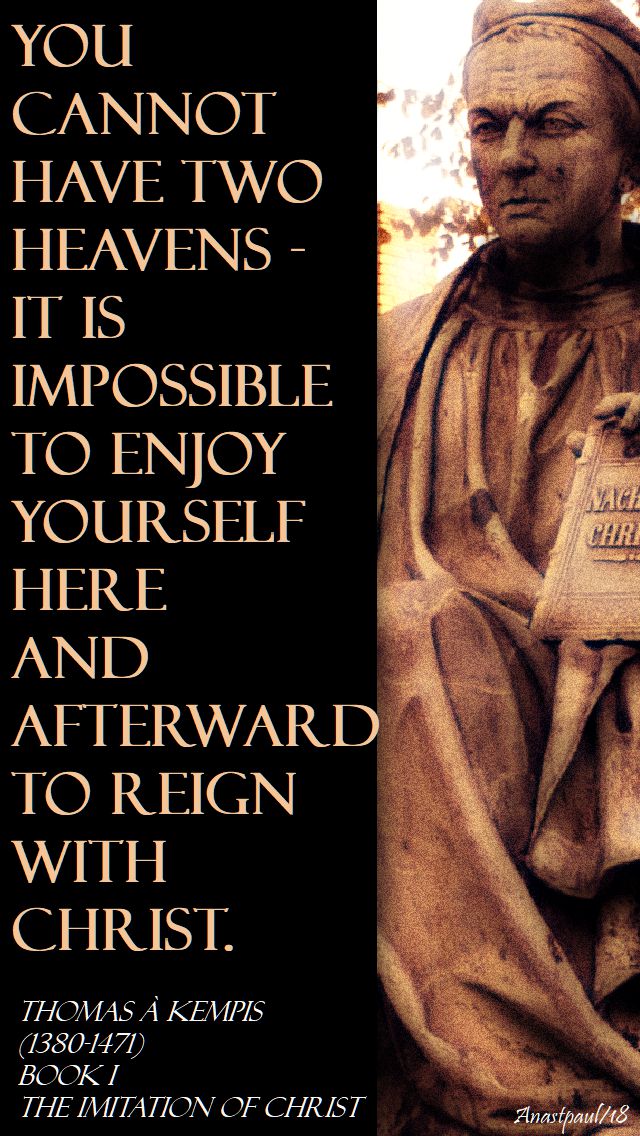
“Christ then took on our nature, when He would redeem it;  He redeemed it by making it suffer in His own Person;  He purified it, by making it pure in His own Person.   He first sanctified it in Himself, made it righteous, made it acceptable to God, submitted it to an expiatory passion and then He imparted it to us.   He took it, consecrated it, broke it and said, “Take, and divide it among your-selves.”

Newman was convinced that no one “realises the mystery of the Incarnation but must feel disposed towards that of the Holy Communion.”   Both are mysteries of the coming of Christ, longed for as the hope of mankind for salvation.   If we accept that God unites Himself, His divinity and His spirit, to humanity, nature and matter in His birth as man, then we can also accept that He binds His presence to the species of bread and wine.   When Jesus says, “This is my body, this is my blood”, this remains a mystery but our faith in it is not against our reason.

Years later this Catholic priest wrote:

“O wisest love! That flesh and blood
Which did in Adam fail,
Should strive afresh against the foe,
Should strive and should prevail.”
“And that a higher gift than grace
Should flesh and blood refine,
God’s presence and His very Self,
And Essence all-divine.”christ then took on our nature - bl john henry newman - no 2 25 feb 2018 - sunday reflection

Posted in CONFESSION/PENANCE, LENT, MORNING Prayers, QUOTES of the SAINTS, QUOTES on CONVERSION, QUOTES on REPENTANCE, QUOTES on SANCTITY

Thought for the Day – 25 February 2018 – Second Sunday of Lent, Year B

Thought for the Day – 25 February 2018 – Second Sunday of Lent, Year B

“Now is the accepted time, now the day of salvation.”

Blessed John Henry Newman (1801-1890)

“These are thoughts, I need hardly say, especially suited to this season.
From the earliest times down to this day, these weeks before Easter have been set apart every year, for the particular remembrance and confession of our sins.   From the first age downward, not a year has passed but Christians have been exhorted to reflect how far they have let go their birthright, as a preparation for their claiming the blessing.   At Christmas we are born again with Christ;  at Easter we keep the Eucharistic Feast.

In Lent, by penance, we join the two great sacraments together.   Are you, my brethren, prepared to say—is there any single Christian alive who will dare to profess—that he has not in greater or less degree sinned against God’s free mercies as bestowed on him in Baptism without, or rather against his deserts?   Who will say that he has so improved his birthright that the blessing is his fit reward, without either sin to confess, or wrath to deprecate?

See, then, the Church offers you this season for the purpose.   “Now is the accepted time, now the day of salvation.”
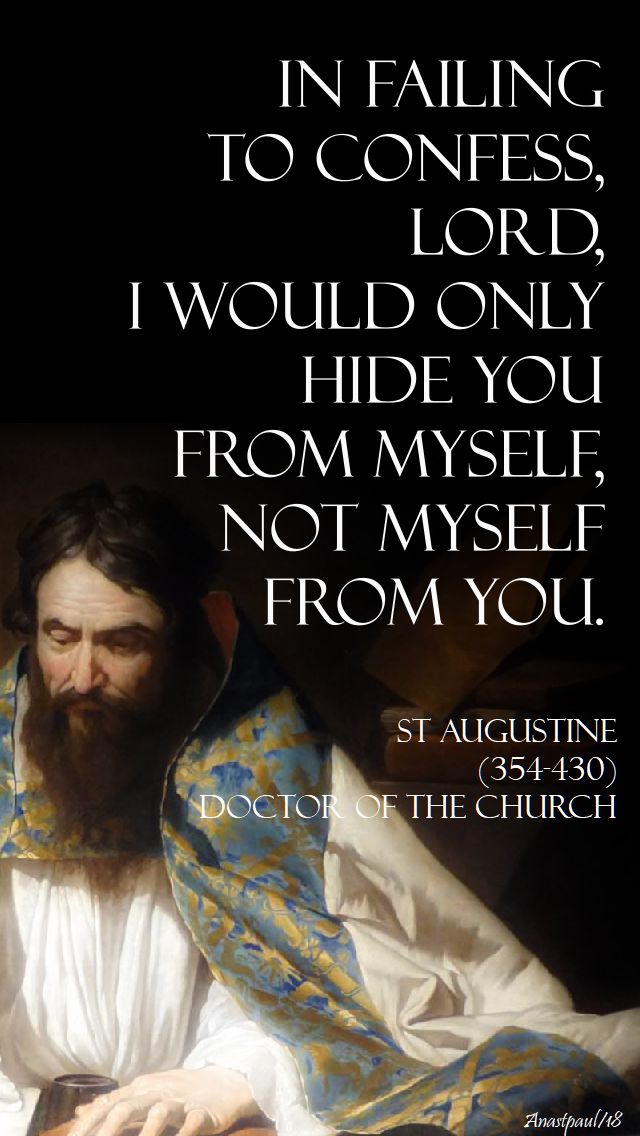
Now it is that, God being your helper, you are to attempt to throw off from you the heavy burden of past transgression, to reconcile yourselves to Him who has once already imparted to you His atoning merits and you have profaned them.”

are-you-my-brethren-bl-j-h-newman.- lenten reflection - 2017 - 25 feb 2017 (in the novena for lent) jpg