Posted in CARMELITES, SAINT of the DAY

Saint of the Day – 19 November – St Raphael of St Joseph Kalinowski O.C.D. (1835-1907)

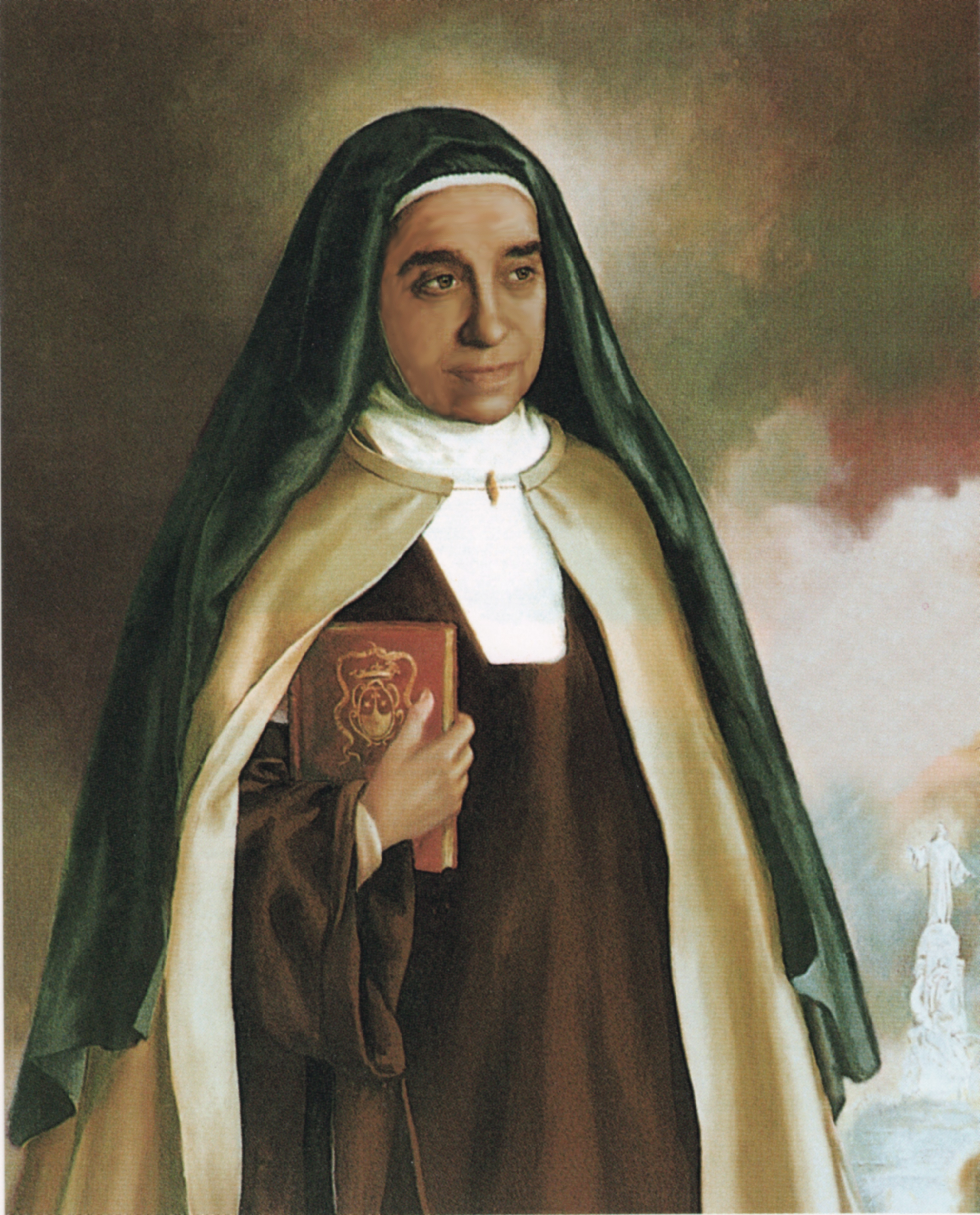
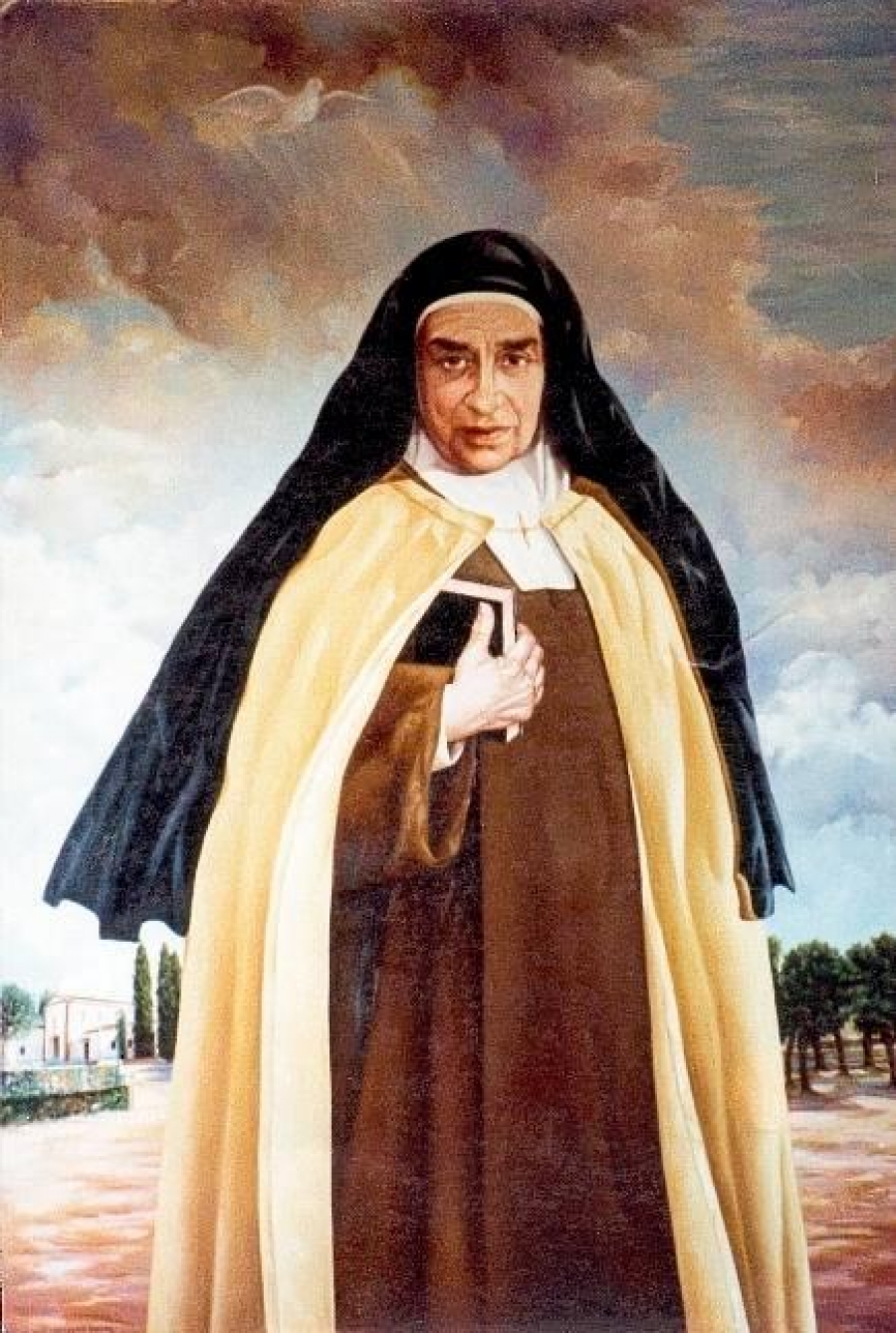
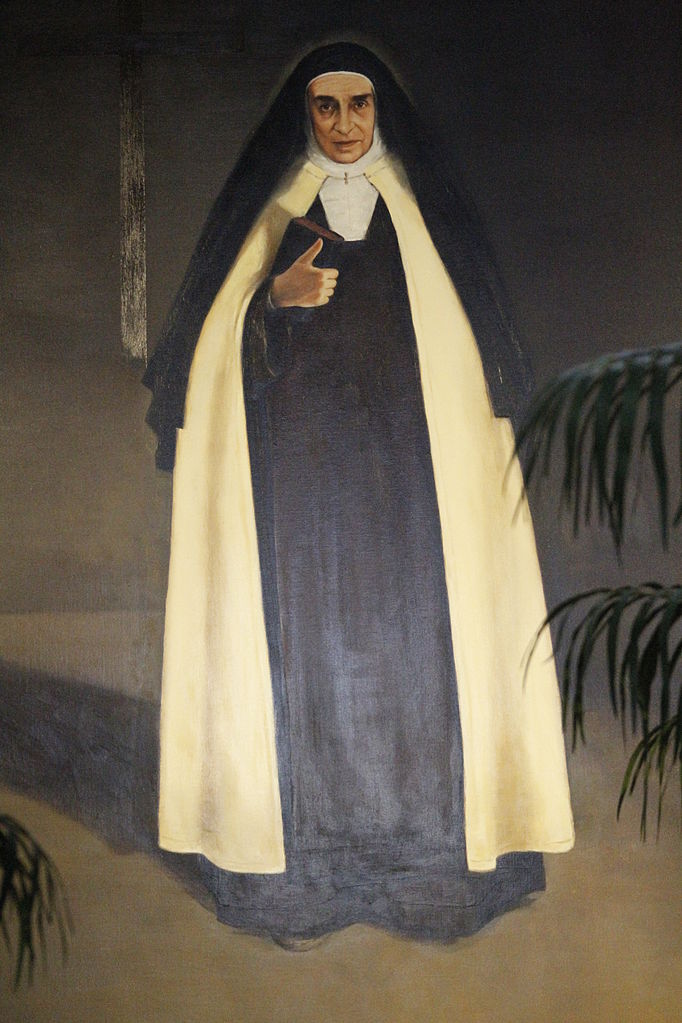
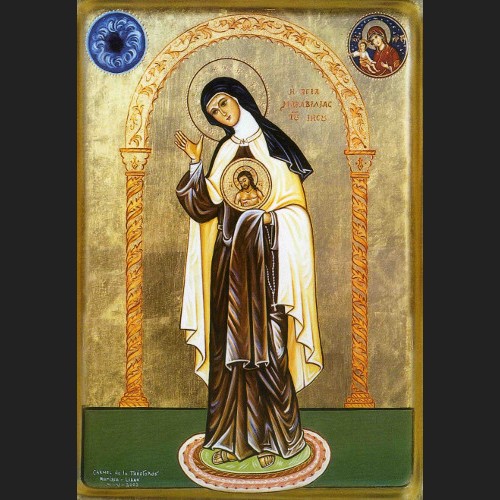
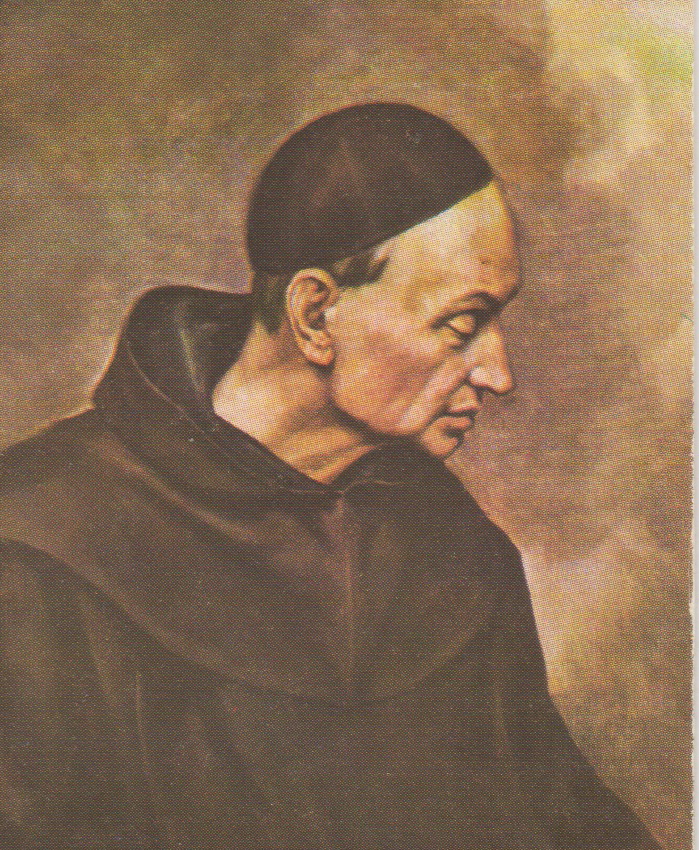
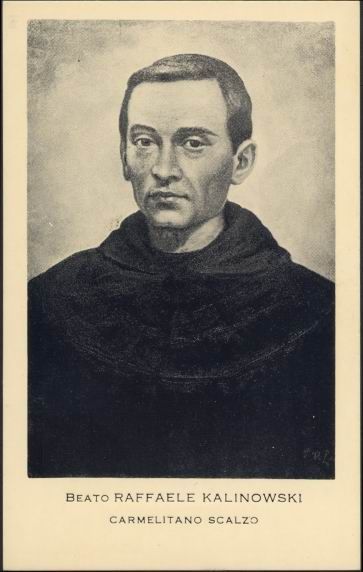
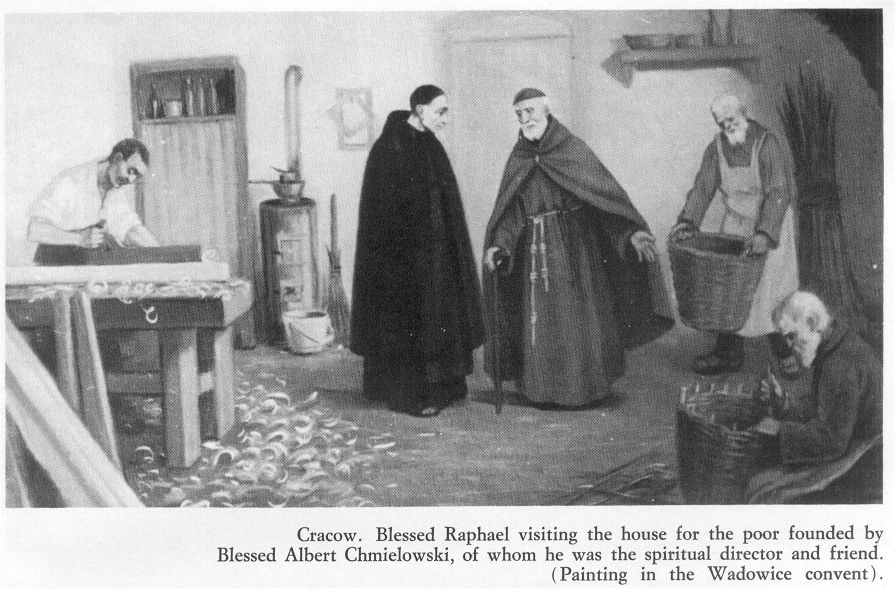
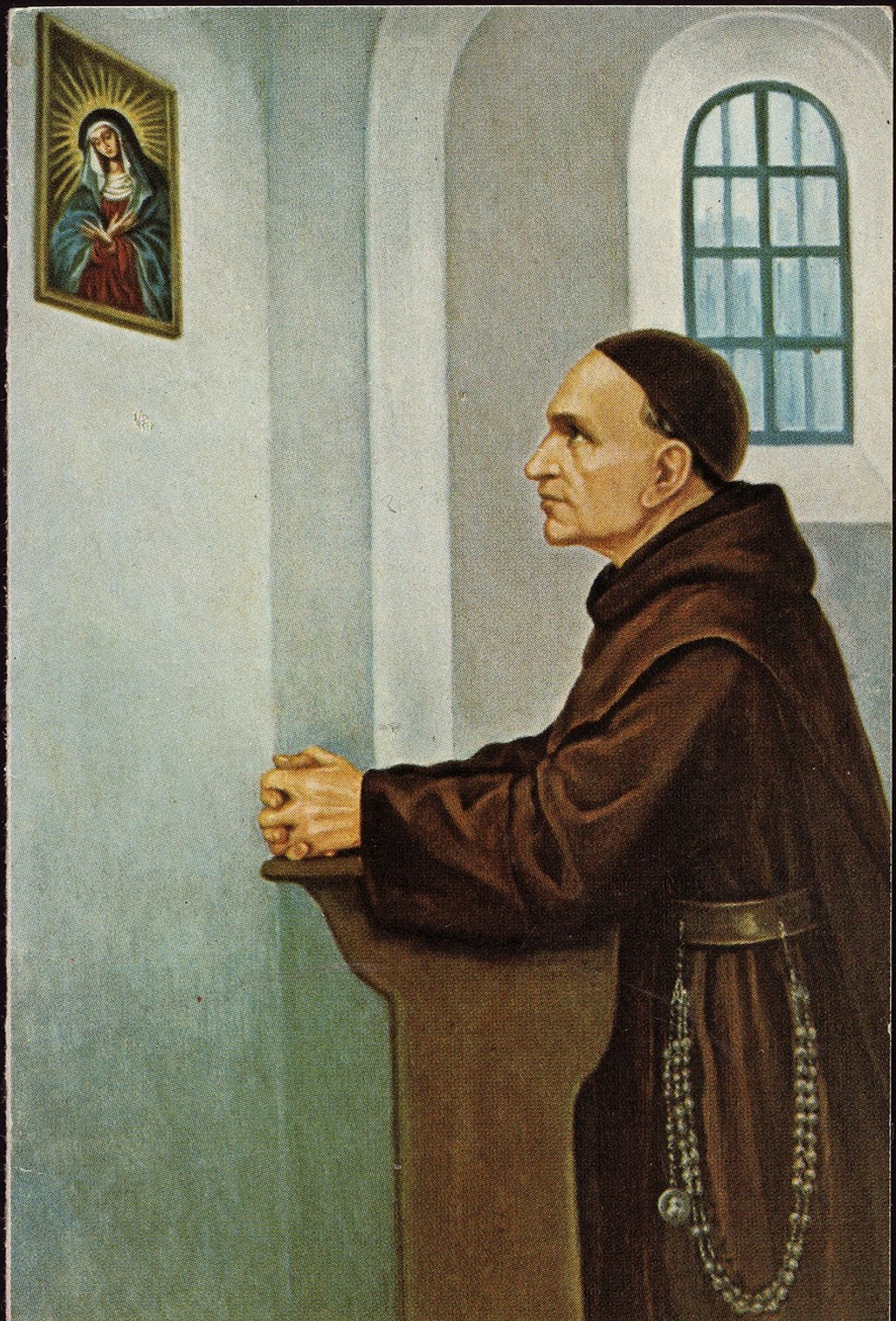
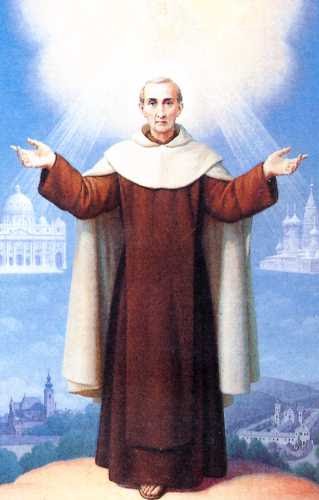
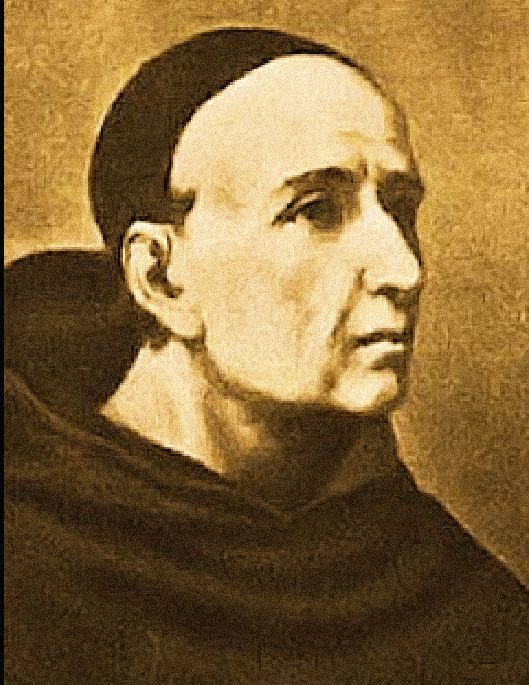
Saint of the Day – 19 November – St Raphael of St Joseph Kalinowski O.C.D. (1835-1907) – Carmelite Friar and Priest, Teacher, Engineer, Prisoner of war, Royal tutor, Spiritual Director, founder of many Carmelite monasteries in Poland.   St Raphael was born on 1 September 1835 at Vilna, Russian Poland (modern Vilnius, Lithuania) as Joseph Kalinowski and died on 15 November 1907 at Wadowice, Malopolskie, Poland of natural causes.St.-Raphael-of-St.-Joseph

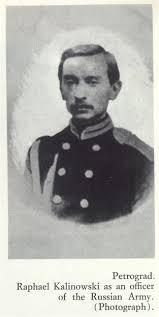
Father Raphael of Saint Joseph Kalinowski, was born at Vilna and at baptism received the name Joseph.   Under the teaching of his father Andrew, at the Institute for Nobles at Vilna, he progressed so well that he received the maximum distinction in his studies.   He then went for two years (1851-1852) to the school of Agriculture at Hory-Horky.   During the years 1853-1857, he continued his studies at the Academy of Military Engineering at St Petersburg, obtaining his degree in Engineering and the rank of Lieutenant. Immediately afterwards he was named Lecturer in Mathematics at the same Academy.  In 1859, he took part in the designing of the Kursk-Kiev-Odessa railway.st raphael young

In 1863 the Polish insurrection against their Russian oppressors broke out.   He resigned from the Russian forces and accepted the post of Minister of War for the region of Vilna, in the rebel army.   On 24 March 1864, he was arrested and condemned to death, a penalty that was mitigated to 10 years hard labour in Siberia.   With an admirable strength of spirit, patience and love for his fellow exiles, he knew how to instil into them the spirit of prayer, serenity and hope and to give material help, together with a word of encouragement.raphael officer

Repatriated in 1874, he accepted the post of tutor to the Venerable Servant of God, Prince Augusto Czartoryski (1858-1893) (now Blessed- he was Beatified in 2004), living mostly in Paris.   His influence on the young prince was such, that Augusto discovered his true vocation as priest and religious.   He was received into the Salesians by their founder, Saint John Bosco, in 1887.   On the other hand, Joseph Kalinowski entered the Discalced Carmelites at Graz in Austria and received the religious name of Brother Raphael of Saint Joseph.   He studied theology in Hungary and was ordained Priest at Czerna near Krakow, on 15 January 1882.ST Raphael kalinowski

Afire with apostolic zeal, he did not spare himself in helping the faithful and assisting his Carmelite brothers and sisters and many others in the ascent of the mountain of perfection.st raphael - WadowicePainting

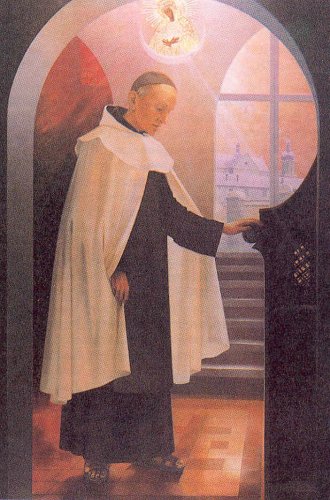
In the sacrament of Reconciliation, he lifted up many from the mire of sin.   He did his utmost for the work of reunification of the Church and bequeathed this mission to his Carmelite brothers and sisters.   His superiors entrusted him with many important offices, which he carried out perfectly, right until the time of his death.St._Raphael_1

Overcome by fatigue and suffering and held in great respect by all the people, he gave his soul to God, on 15 November 1907, at Wadowice in the monastery founded by himself.   He was buried in the monastery cemetery, at Czerna, near Krakow.

During his life and after death, he enjoyed a remarkable fame for sanctity, even on the part of the most noble and illustrious of people, such as the Cardinals Dunajewski, Puzyna, Kakowski and Gotti.   The Ordinary Process for his eventual beatification, was set in motion in the Curia of Krakow during the years 1934-1938 and later taken to Rome where in 1943 was issued the Decree concerning his writings.   His cause was introduced in 1952.   From 1953-1956 the Apostolic Process was carried out and the Congregation proceeded to the discussion on his virtues.

Pope John Paul II, on 11 October 1980, promulgated the Decree on the heroism his virtues.   After the approval of the miraculous healing of the Reverend Mis, the Holy Father Beatified Father Raphael Kalinowski at Krakow on 22 June 1983.

As the fame of his miracles was increasing, the Curia of Krakow in 1989, set in motion the Canonical Process to investigate the extraordinary healing of a young child.   The discussions of the doctors, theologians and cardinals, were brought to a happy conclusion.   On 10 July 1990, the Holy Father St John Paul II, approved the miracle for the Canonisation.ST Raphael kalinowski.2

In the Consistory of 26th November 1990, Pope John Paul together with the Cardinals, decided to Canonise Blessed Raphael Kalinowski.   They set the ceremony for Sunday, 17 November 1991.
St Pope John Paul II, today Canonises him and presents him as a model to all Christians in the universal Church….vatican.va 17 November 1991.

Note:  Attending the Canonisation rite, were delegations from the Carmelite Order, from Russia, Byelorussa, Ukraine and especially from Poland and Lithuania, with their cardinals and bishops.   And in the places of honour knelt Lech Walesa, president of liberated Poland, and Vytautas Landsbergis, president of the Supreme Council of the Lithuanian Republic.

Proud to do honour to this new saint who was both Pole and Lithuanian and who reached out towards the Eastern Churches as well, they must have responded warmly when the pope cried out:  “Rejoice, O Mother Poland … Rejoice, O Mother of God, Mother of the Church, Mother of all peoples!”

st raphael my edit

Posted in CARMELITES, DOCTORS of the Church, GOD the FATHER, MORNING Prayers, MYSTICS, ON the SAINTS, PAPAL SERMONS, QUOTES of the SAINTS, QUOTES on CHARITY, QUOTES on CONVERSION, QUOTES on FAITH, QUOTES on LOVE, QUOTES on PRAYER, QUOTES on SANCTITY, SAINT of the DAY

Thought for the Day – 15 October – The Memorial of St Teresa of Jesus/Avila (1515-1582) Doctor of the Church

Thought for the Day – 15 October – The Memorial of St Teresa of Jesus/Avila (1515-1582) Doctor of the Church “Doctor of Prayer”

Excerpt of Pope Benedict’s Catechesis
on the Doctors of the Church
Wednesday, 2 February 2011

“It is far from easy to sum up in a few words Teresa’s profound and articulate spirituality.   I would like to mention a few essential points.   In the first place St Teresa proposes the evangelical virtues as the basis of all Christian and human life and in particular, detachment from possessions, that is, evangelical poverty and this concerns all of us;  love for one another as an essential element of community and social life; humility as love for the truth;  determination as a fruit of Christian daring;  theological hope, which she describes as the thirst for living water.   Then we should not forget the human virtues: affability, truthfulness, modesty, courtesy, cheerfulness, culture.

Secondly, St Teresa proposes a profound harmony with the great biblical figures and eager listening to the word of God.   She feels above all closely in tune with the Bride in the Song of Songs and with the Apostle Paul, as well as with Christ in the Passion and with Jesus in the Eucharist.   The Saint then stresses how essential prayer is.   Praying, she says, “means being on terms of friendship with God frequently conversing in secret with Him who, we know, loves us” (Vida 8, 5).  St Teresa’s idea coincides with Thomas Aquinas’ definition of theological charity as “amicitia quaedam hominis ad Deum”, a type of human friendship with God, who offered humanity His friendship first – it is from God that the initiative comes (cf. Summa Theologiae II-II, 23, 1).

Prayer is life and develops gradually, in pace with the growth of Christian life – it begins with vocal prayer, passes through interiorisation by means of meditation and recollection, until it attains the union of love with Christ and with the Holy Trinity. Obviously, in the development of prayer climbing to the highest steps does not mean abandoning the previous type of prayer.  Rather, it is a gradual deepening of the relationship with God that envelops the whole of life.

Dear brothers and sisters, St Teresa of Jesus is a true teacher of Christian life for the faithful of every time.   In our society, which all too often lacks spiritual values, St Teresa teaches us to be unflagging witnesses of God, of His presence and of His action.   She teaches us truly to feel this thirst for God that exists in the depths of our hearts, this desire to see God, to seek God, to be in conversation with Him and to be His friends.

This is the friendship we all need that we must seek anew, day after day.   May the example of this Saint, profoundly contemplative and effectively active, spur us too every day to dedicate the right time to prayer, to this openness to God, to this journey, in order to seek God, to see Him, to discover His friendship and so to find true life – indeed, many of us should truly say:  “I am not alive, I am not truly alive because I do not live the essence of my life”.

Therefore time devoted to prayer is not time wasted, it is time in which the path of life unfolds, the path unfolds to learning from God an ardent love for Him, for His Church and practical charity for our brothers and sisters.    Many thanks.”

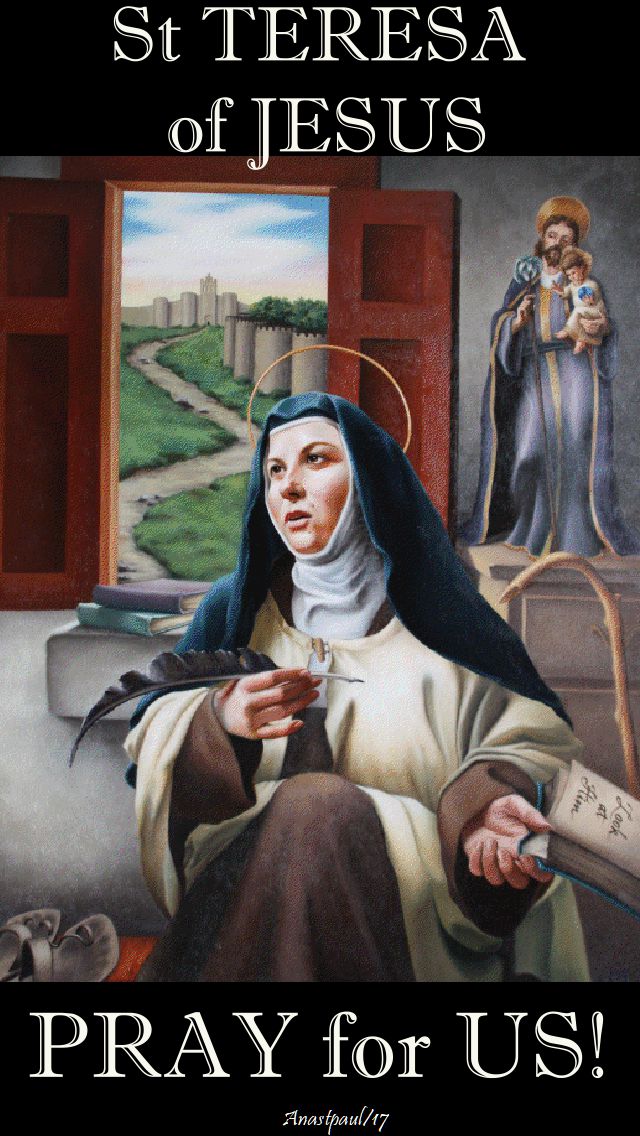
St Teresa, Pray for Us!st-teresa-of-jesus-pray-for-us-215 oct 2017

Posted in CARMELITES, DOCTORS of the Church, EUCHARISTIC Adoration, MORNING Prayers, QUOTES of the SAINTS, QUOTES on DIVINE PROVIDENCE, QUOTES on ETERNAL LIFE, QUOTES on FAITH, QUOTES on LOVE, QUOTES on SANCTITY, SAINT of the DAY, The HOLY EUCHARIST / The HOLY MASS

Quote/s of the Day – 1 October – The Memorial of St Thérèse of Lisieux O.C.D. (1873 – 1897) Doctor of the Church

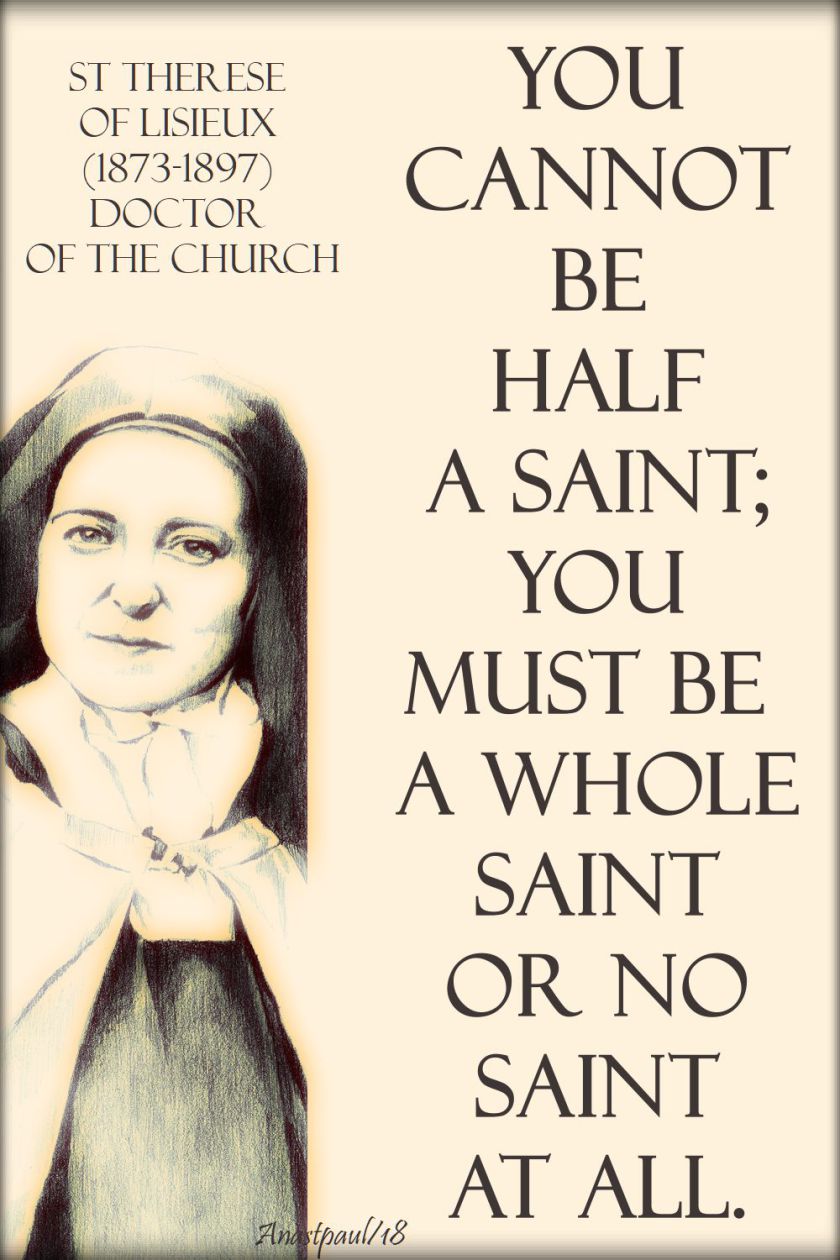
Quote/s of the Day – 1 October – The Memorial of St Thérèse of Lisieux O.C.D. (1873 – 1897) Doctor of the Church

“You cannot be half a saint;
you must be a whole saint
or no saint at all.”you-cannot-be-half-a-saint-st-therese-lisieux-11-june-2018-seeking-sainthood

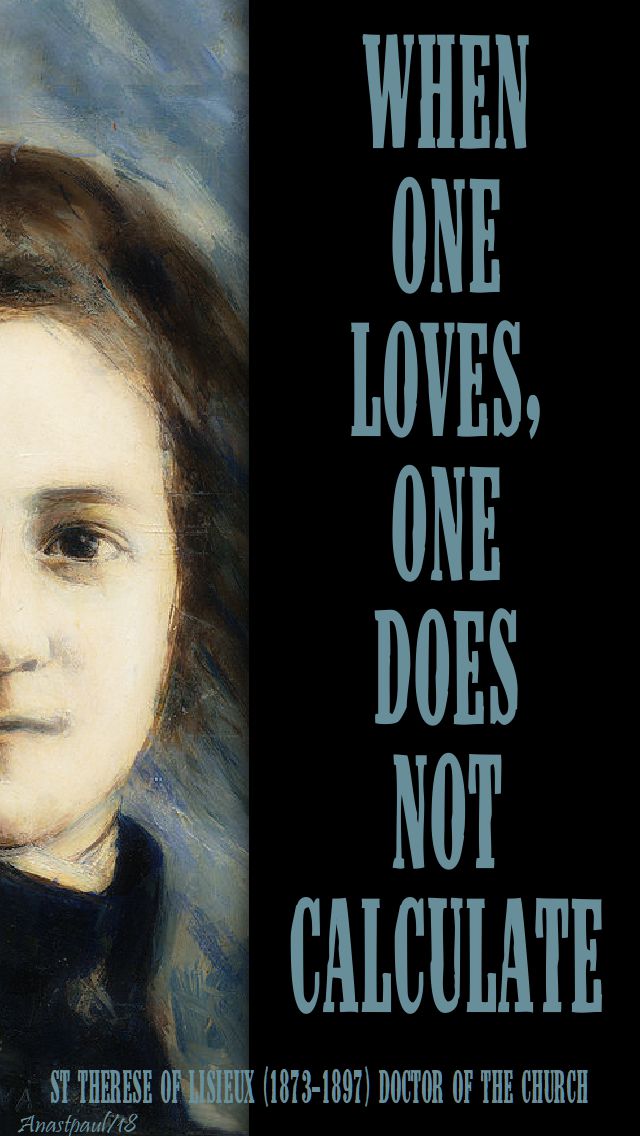
“When one loves,
one does not calculate.”when one loves one does not calculate - st t of l - 1 oct 2018

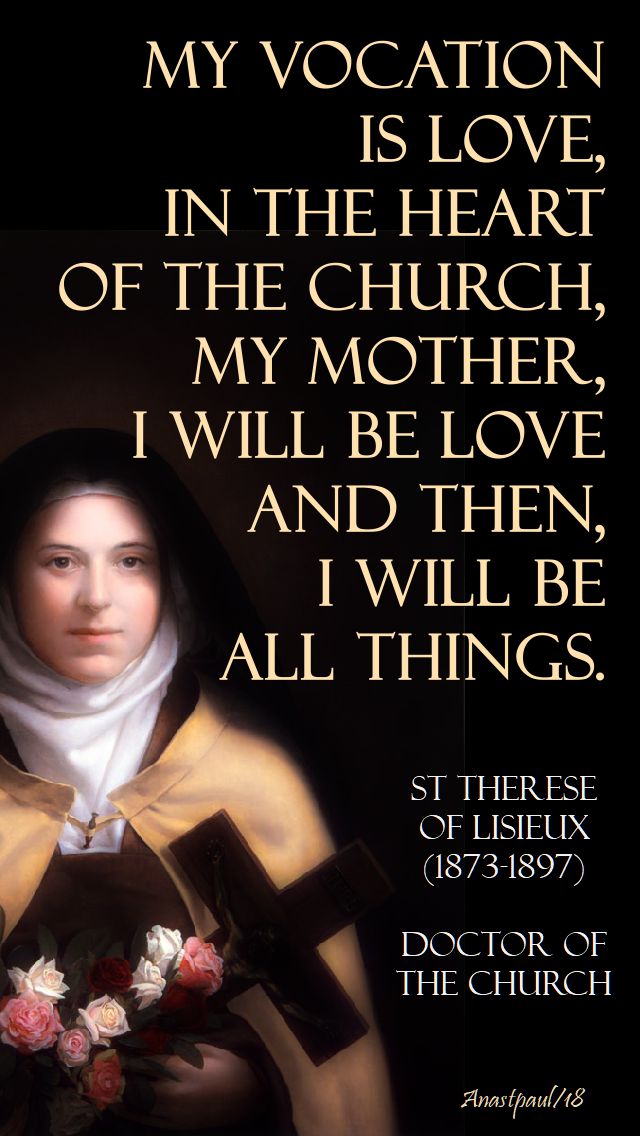
“My vocation is love.
In the heart of the Church, my mother,
I will be love
and then I will be all things.”my vocation is love - st t of l - 1 oct 2018

I am convinced,
that one should tell one’s spiritual director,
if one has a great desire for Communion,
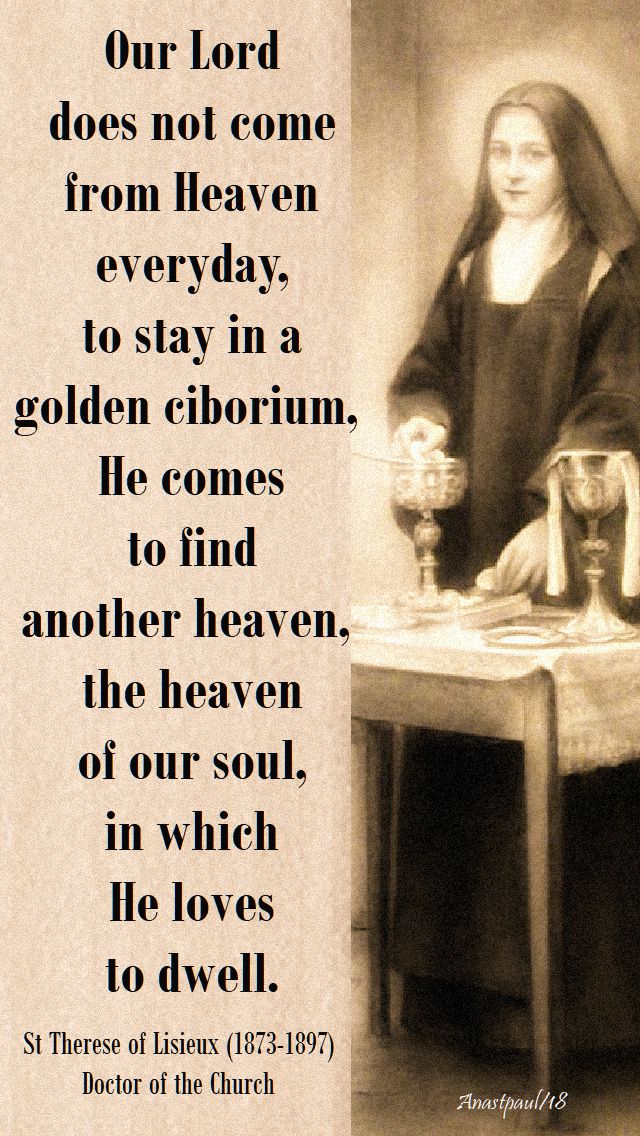
for Our Lord does not
come from Heaven everyday,
to stay in a golden ciborium;
He comes to find another heaven,
the heaven of our soul,
in which He loves to dwell.”our lord does not come from heaven - st t of l - 1 oct 2018

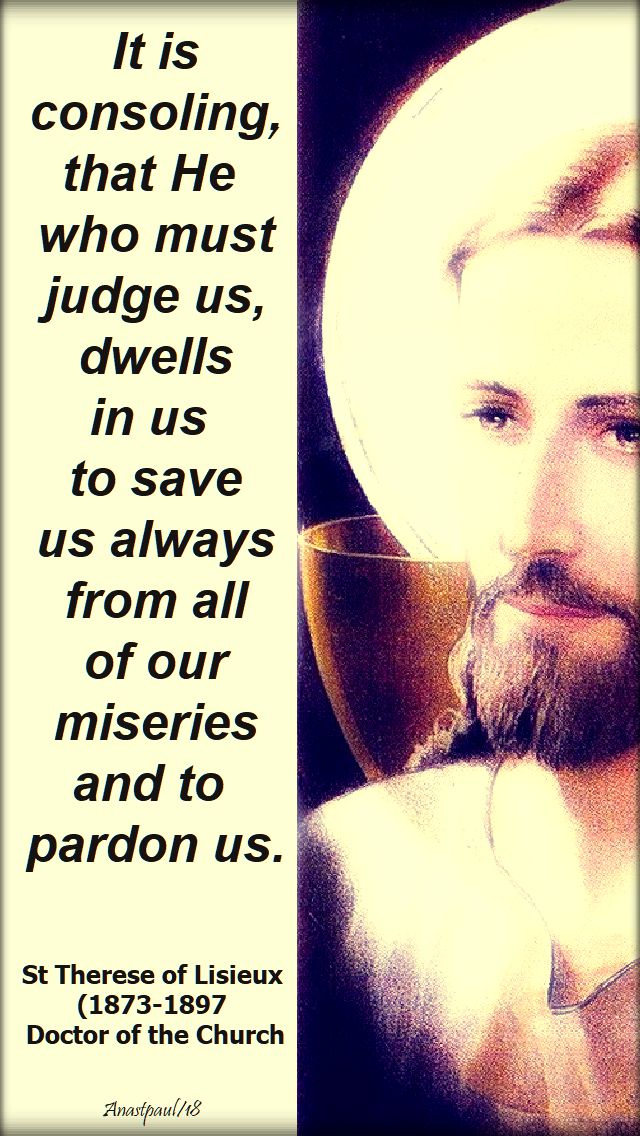
“It is consoling,
that He who must judge us,
dwells in us
to save us always
from all of our miseries
and to pardon us.”it is consoling that he who must judge us - st t of l - 1 oct 2018

St Therese of Lisieux (1873-1897) Doctor of the Church

Posted in CARMELITES, CATECHESIS, DOCTORS of the Church, MORNING Prayers, ON the SAINTS, PAPAL SERMONS, PRACTISING CATHOLIC, QUOTES of the SAINTS, QUOTES on LOVE, QUOTES on MERCY, QUOTES on SANCTITY, QUOTES on TRUST and complete CONFIDENCE in GOD, SAINT of the DAY, The WORD

Thought for the Day – 1 October – The Memorial of St Thérèse of Lisieux O.C.D. (1873 – 1897) Doctor of the Church

Thought for the Day – 1 October – The Memorial of St Thérèse of Lisieux O.C.D. (1873 – 1897) Doctor of the Church

Excerpt from Pope Benedict’s Catechesis on St Thérèse – 6 April 2011

“Today I would like to talk to you about St Thérèse of Lisieux, Thérèse of the Child Jesus and of the Holy Face, who lived in this world for only 24 years, at the end of the 19th century, leading a very simple and hidden life but who, after her death and the publication of her writings, became one of the best-known and best-loved saints. “Little Thérèse” has never stopped helping the simplest souls, the little, the poor and the suffering who pray to her.

I would like to invite you to rediscover this small-great treasure, this luminous comment on the Gospel lived to the full!   The Story of a Soul, in fact, is a marvellous story of Love, told with such authenticity, simplicity and freshness that the reader cannot but be fascinated by it!   But what was this Love that filled Thérèse’s whole life, from childhood to death?   Dear friends, this Love has a Face, it has a Name, it is Jesus!   The Saint speaks continuously of Jesus.

Dear friends, we too, with St Thérèse of the Child Jesus must be able to repeat to the Lord every day that we want to live of love for Him and for others, to learn at the school of the saints to love authentically and totally.  Thérèse is one of the “little” ones of the Gospel who let themselves be led by God to the depths of his Mystery.   A guide for all, especially those who, in the People of God, carry out their ministry as theologians.   With humility and charity, faith and hope, Thérèse continually entered the heart of Sacred Scripture which contains the Mystery of Christ.   And this interpretation of the Bible, nourished by the science of love, is not in opposition to academic knowledge.   The science of the saints, in fact, of which she herself speaks on the last page of her The Story of a Soul, is the loftiest science.

In the Gospel Thérèse discovered above all the Mercy of Jesus, to the point that she said: “To me, He has given His Infinite Mercy and it is in this ineffable mirror, that I contemplate His other divine attributes.   Therein all appear to me radiant with Love.   His Justice, even more perhaps than the rest, seems to me to be clothed with Love” (Ms A, 84r).

In these words she expresses herself in the last lines of The Story of a Soul:   “I have only to open the Holy Gospels and at once I breathe the perfume of Jesus’ life and then I know which way to run;  and it is not to the first place but to the last, that I hasten…. I feel that even had I on my conscience every crime one could commit… my heart broken with sorrow, I would throw myself into the arms of my Saviour Jesus, because I know that He loves the Prodigal Son” who returns to Him. (Ms C, 36v-37r).

“Trust and Love” are therefore the final point of the account of her life, two words, like beacons, that illumined the whole of her journey to holiness, to be able to guide others on the same “little way of trust and love”, of spiritual childhood (cf. Ms C, 2v-3r; LT 226).

Trust, like that of the child who abandons himself in God’s hands, inseparable from the strong, radical commitment of true love, which is the total gift of self for ever, as the Saint says, contemplating Mary:   “Loving is giving all, and giving oneself” (Why I love thee, Mary, P 54/22).

Thus Thérèse points out to us all that Christian life consists in living to the full the grace of Baptism in the total gift of self to the Love of the Father, in order to live like Christ, in the fire of the Holy Spirit, His same love for all the others.”…Pope Benedict XVI

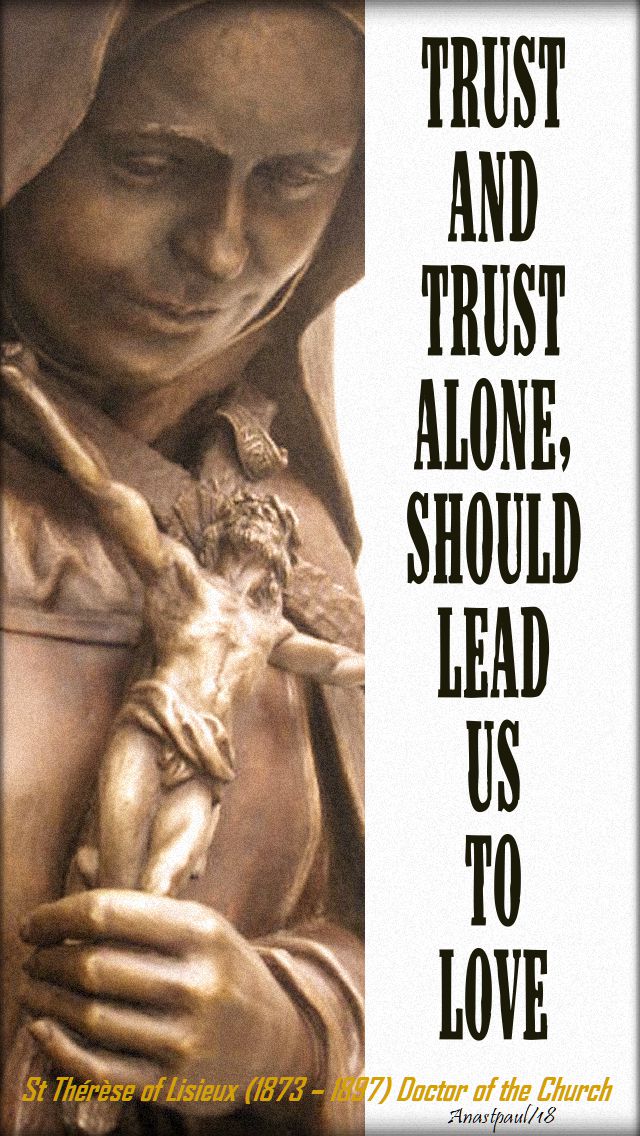
“Trust and trust alone,
should lead us to love”trust and trust alone - st t of l - 1 oct 2018

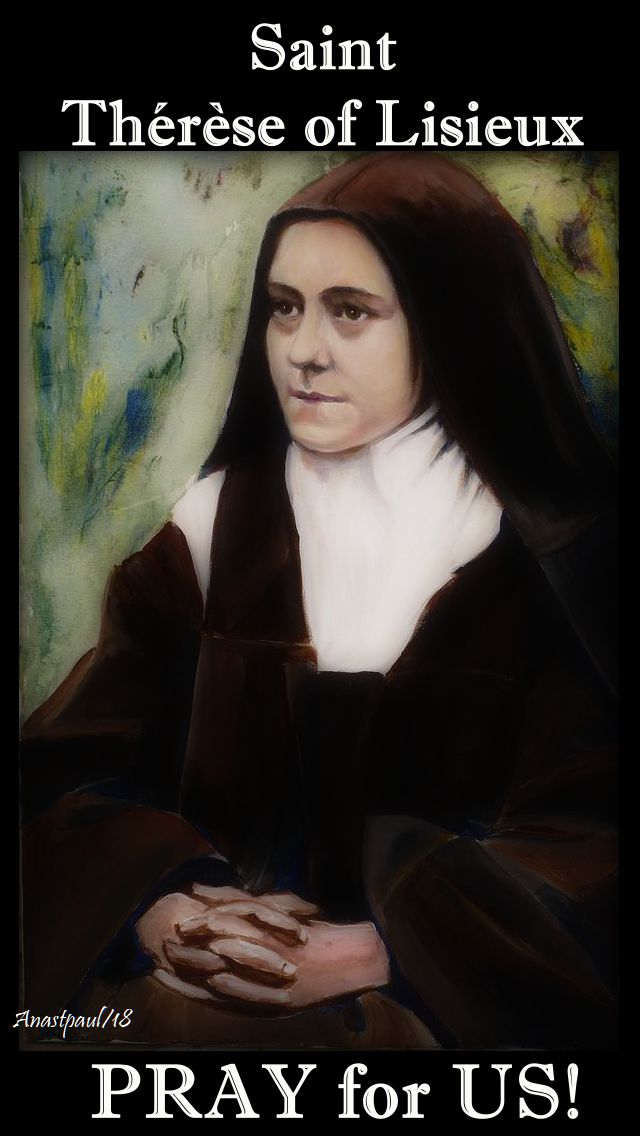
St Thérèse of Lisieux, Pray for Us!st t of l pray for us - 1 oct 2018

Posted in CARMELITES, SAINT of the DAY

Saint of the Day – 14 September – St Albert of Jerusalem (1149-1214)

Saint of the Day – 14 September – St Albert of Jerusalem (1149-1214) also known as St Albert of Vercelli – Bishop, Canon Lawyer, Diplomat and Peacemaker and is regarded as a Co-Founder of the Carmelite Order.   He was Bishop of Bobbio and Bishop of Vercelli and served as mediator and diplomat under Pope Clement III.   Pope Innocent III appointed him Patriarch of Jerusalem in 1204 or 1205.   In Jerusalem, he contributed the Carmelite Rule of St Albert to the newly-founded Carmelite Order.Albert_01

Saint Albert was born towards the middle of the 12th century in Castel Gualtieri in Emilia, Italy.   He entered the Canons Regular of the Holy Cross at Mortara, Pavia and became Prior there in 1180.   In 1184, he was named bishop of Bobbio and the following year he was transferred to Vercelli which he governed for twenty years.    During this period, he undertook diplomatic missions of national and international importance with rare prudence and firmness – in 1194, he effected a peace between Pavia and Milan and, five years later, also between Parma and Piacenza.

Albert+of+Jerusalem+1

In 1191, he celebrated a diocesan synod which proved of great value for its disciplinary provisions which continued to serve as a model until modern times.   He was also involved in a large amount of legislative work for various religious orders – he wrote the statutes for the canons of Biella and was among the advisers who drew up the Rule of the Humiliates.

In 1205, Albert was appointed Patriarch of Jerusalem and a little later nominated Papal Legate for the ecclesiastical province of Jerusalem.   He arrived in Palestine early in 1206 and lived in Acre because, at that time, Jerusalem was occupied by the Saracens.   In Palestine, Albert was involved in various peace initiatives, not only among Christians but also between the Christians and non-Christians and he carried out his duties with great energy.albert of jerusalem

During his stay in Acre he gathered together the hermits on Mount Carmel and gave them a Rule.  On 14 September 1214, during a procession, he was stabbed to death by the Master of the Hospital of the Holy Spirit, whom Albert had reprimanded and deposed for his evil life, while taking part in a procession on the Feast of the Exaltation of the Holy Cross.

He is honoured by the Carmelites on 17 September.albert

Posted in CARMELITES, MORNING Prayers, QUOTES on LOVE, QUOTES on SUFFERING, SAINT of the DAY

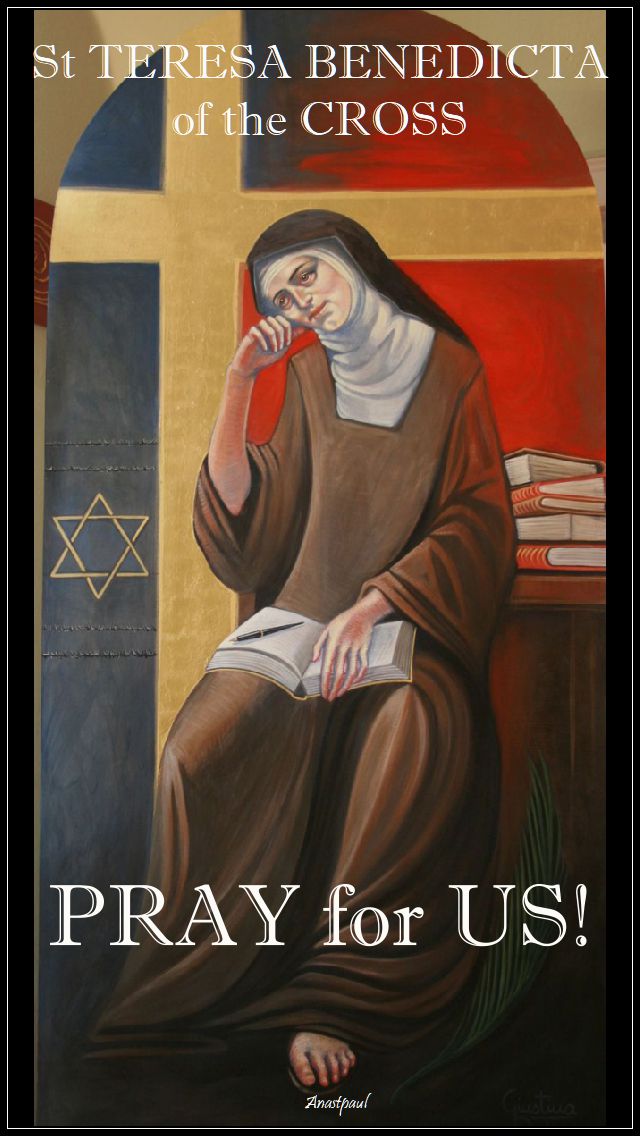
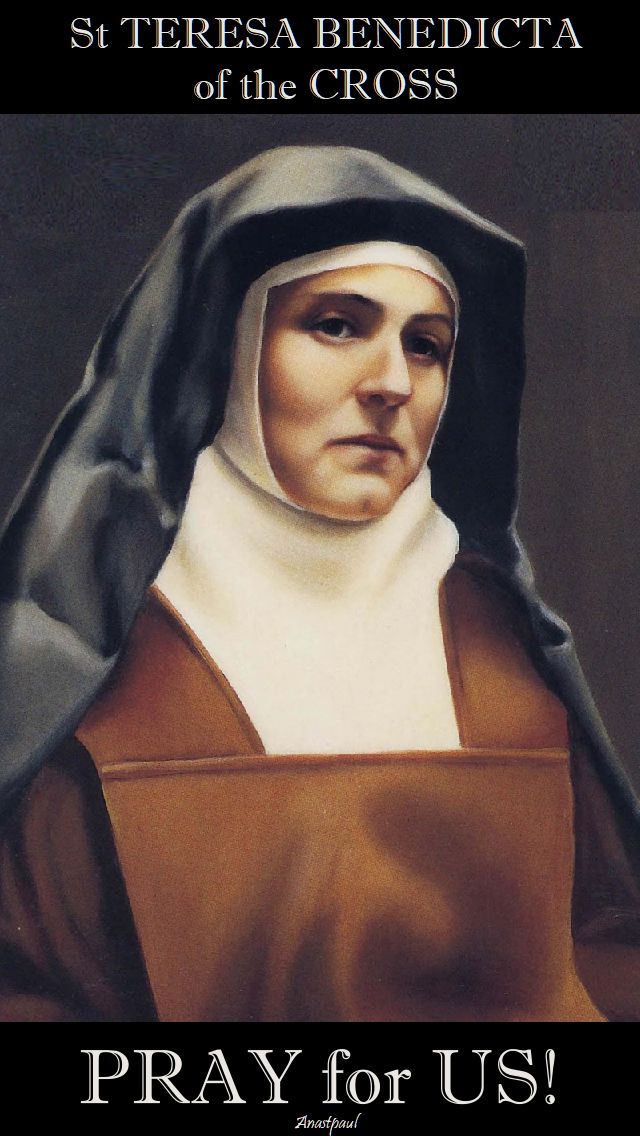
Thought for the Day – 9 August – The Memorial of St Teresa Benedicta of the Cross (1891-1942) Martyr

Thought for the Day – 9 August – The Memorial of St Teresa Benedicta of the Cross (1891-1942) Martyr

“A Lesson in Love”

Her name reflects her beloved spiritual sister and fellow Carmelite, Teresa of Ávila and her fate of sharing in the Cross of Christ in a very tangible, visible way. Edith, now Teresa Benedicta of the Cross, viewed her own life as a sacrificial offering to God for her people. In 1939, she offered her life to God for all those she loved:  for the Church, for the Carmelite Order, for the Jewish people, for her family, and for “the deliverance of Germany and peace throughout the world.”   Rather than give in to despair, darkness and hopelessness, Edith offered her own life and sufferings to God for others—even for those who murdered her.   She saw herself as her brothers’ keeper and asked Our Lord to accept her life for theirs.

A Jewish businessman from Cologne, Julius Markan, who had been put in charge of the prisoners at Westerbork Camp, remembers how she cared for those around her as they faced death. He wrote:

“Amongst the prisoners who were brought in on the 5th of August, Sister Benedicta stood out on account of her calmness and composure.   The distress in the barracks and the stir caused by the new arrivals were indescribable. Sister Benedicta was just like an angel, going around amongst the women, comforting them, helping them and calming them.   Many of the mothers were near to distraction, they had not bothered about their children the whole day long but just sat brooding in dumb despair.   Sister Benedicta took care of the little children, washed them and combed them, attending to their feeding and other needs.   During the whole of her stay there, she washed and cleaned for people, following one act of charity with another, until everyone wondered at her goodness.”

Another person who met her on the way to her death, Dr. Wielek, recalled a conversation he had with her in Westerbork just before she was transferred to Auschwitz:

“In one conversation she said to me: ‘The world is made up of opposites but in the end nothing remains of these contrasts.   What only remains is great love. How is it possible for it to be otherwise?’”

Indeed in this world, we do experience such opposites,good and evil, joy and suffering, life and death. “What only remains is great love.”   Edith’s final conviction teaches us how to suffer, how to offer ourselves and how to embrace a world so seemingly full of violations against the human person.   Edith shows how to live as a balm for these wounds in the world—and how such a life lived for Christ will ultimately heal it.
(Angela Micali Stout)

St Teresa Benedicta of the Cross, Pray for us!st-teresa-benedicta-pray-for-us-2-9 aug 2017

Posted in CARMELITES, MORNING Prayers, QUOTES of the SAINTS, QUOTES on CHARITY, QUOTES on COURAGE, QUOTES on DIVINE PROVIDENCE, QUOTES on FAITH, QUOTES on PEACE, QUOTES on PRAYER, QUOTES on the CROSS of CHRIST, SAINT of the DAY

Quote/s of the Day – 9 August – The Memorial of St Teresa Benedicta of the Cross (1891-1942) Martyr

Quote/s of the Day – 9 August – The Memorial of St Teresa Benedicta of the Cross (1891-1942) Martyr

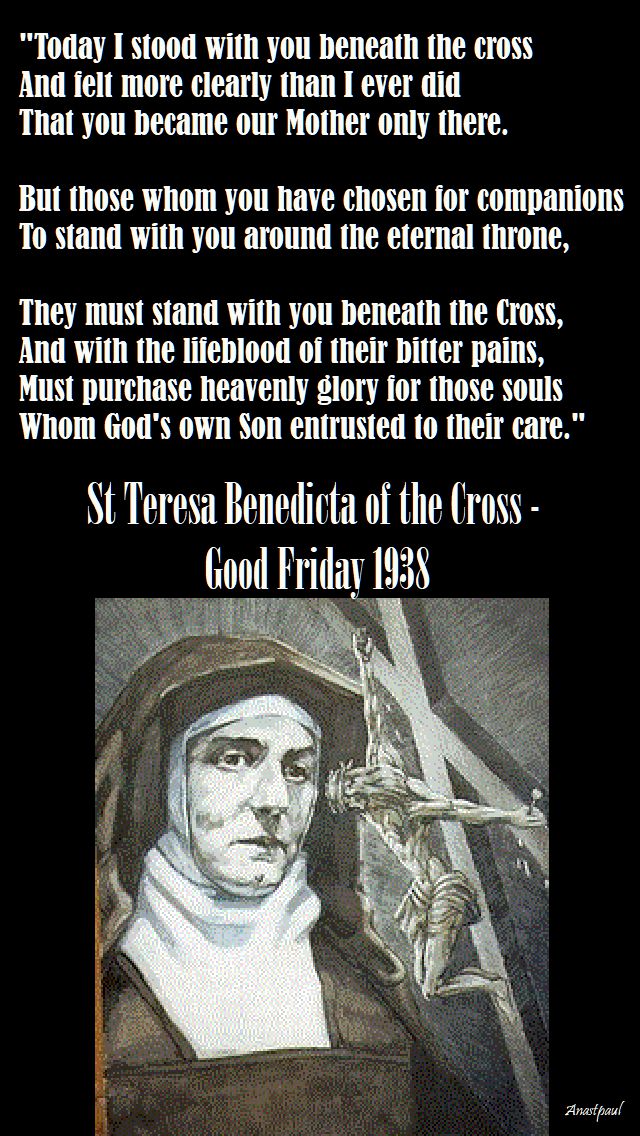
“Today I stood with you beneath the cross
And felt more clearly than I ever did
That you became our Mother only there.

But those whom you have chosen for companions
To stand with you around the eternal throne,

They must stand with you beneath the Cross,
And with the lifeblood of their bitter pains,
Must purchase heavenly glory for those souls
Whom God’s own Son entrusted to their care.”

St Teresa Benedicta of the Cross – Good Friday 1938today-i-stood-with-you-beneath-the-cross-st-teresa-benedicta-9 aug 2017

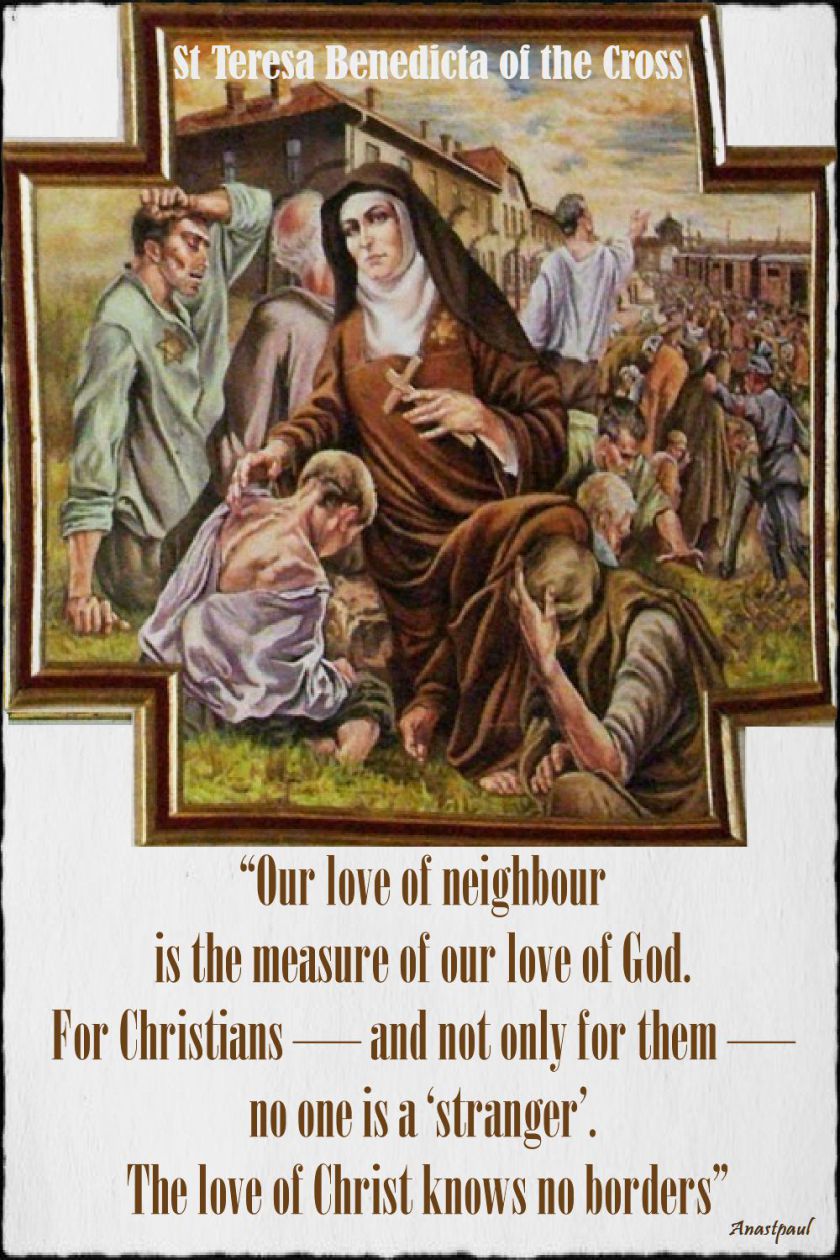
“Our love of neighbour is the measure of our love of God.
For Christians — and not only for them —
no one is a ‘stranger’.
The love of Christ knows no borders”our-love-of-neighbour-is-the-measure-of-our-love-of-god-st-teresa-benedicta-9 aug 2017

“God is there in these moments of rest
and can give us, in a single instant, exactly what we need.
Then the rest of the day can take its course,
under the same effort and strain, perhaps, but in peace.
And when night comes and you look back over the day
and see how fragmentary everything has been
and how much you planned that has gone undone
and all the reasons you have, to be embarrassed and ashamed:
just take everything, exactly as it is,
put it in God’s hands and leave it with Him.
Then you will be able to rest in Him – really rest –
and start the next day, as a new life.”just take everything - st teresa benedicta of the cross - 9 aug 2018

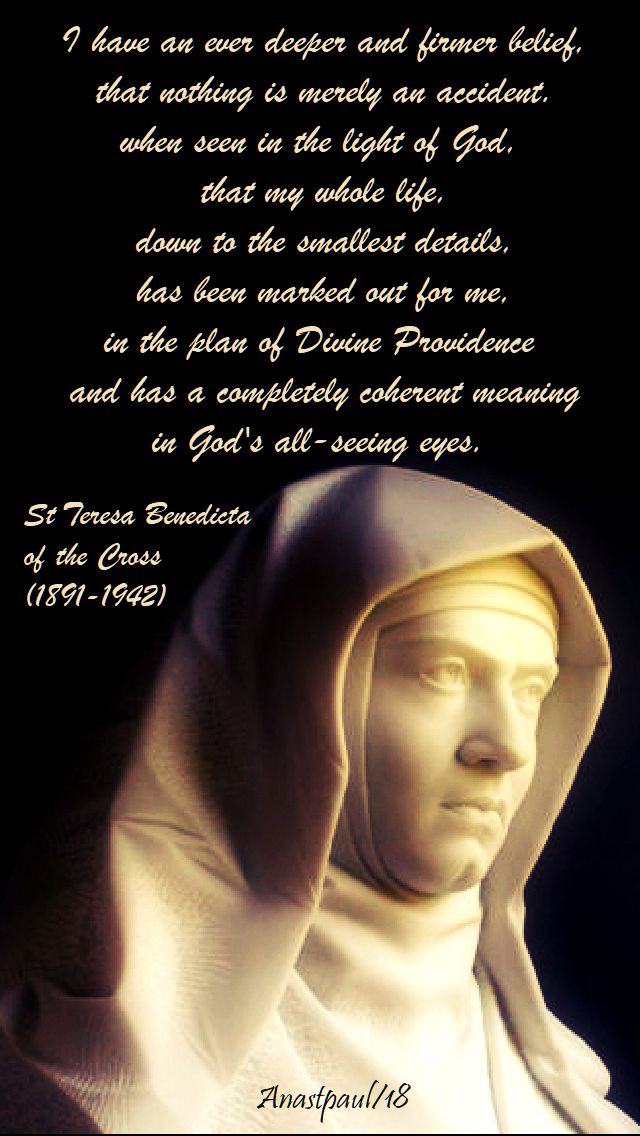
“Whatever did not fit in with my plan, did lie within the plan of God.
I have an ever deeper and firmer belief,
that nothing is merely an accident.
when seen in the light of God, that my whole life,
down to the smallest details,
has been marked out for me,
in the plan of Divine Providence
and has a completely coherent meaning in God’s all-seeing eyes.
And so I am beginning to rejoice,
in the light of glory, wherein this meaning, will be unveiled to me.”i have an ever deeper and firmer belief - st teresa benedicta of the cross - 9 aug 2018

“Every true prayer, is a prayer of the Church,
by means of that prayer, the Church prays,
since it is the Holy Spirit, living in the Church,
Who in every single soul, ‘prays in us with unspeakable groanings’.”every true prayer - st teresa benedicta of the cross - 9 aug 2018

“Since Mary is the prototype of pure womanhood,
the imitation of Mary, must be the goal of girls’ education.”

St Teresa Benedicta of the Cross (1891-1942) since mary is the prototype - st teresa benedicta of the cross - 9 aug 2018

Posted in CARMELITES, MORNING Prayers, QUOTES on SIN, SAINT of the DAY, The WORD

One Minute Reflection – 9 August – Today’s Gospel: Matthew 16:13–23

One Minute Reflection – 9 August – Thursday of the Eighteenth week in Ordinary Time, Year B – Today’s Gospel:  Matthew 16:13–23 and the Memorial of St Teresa Benedicta of the Cross (1891-1942) Martyr

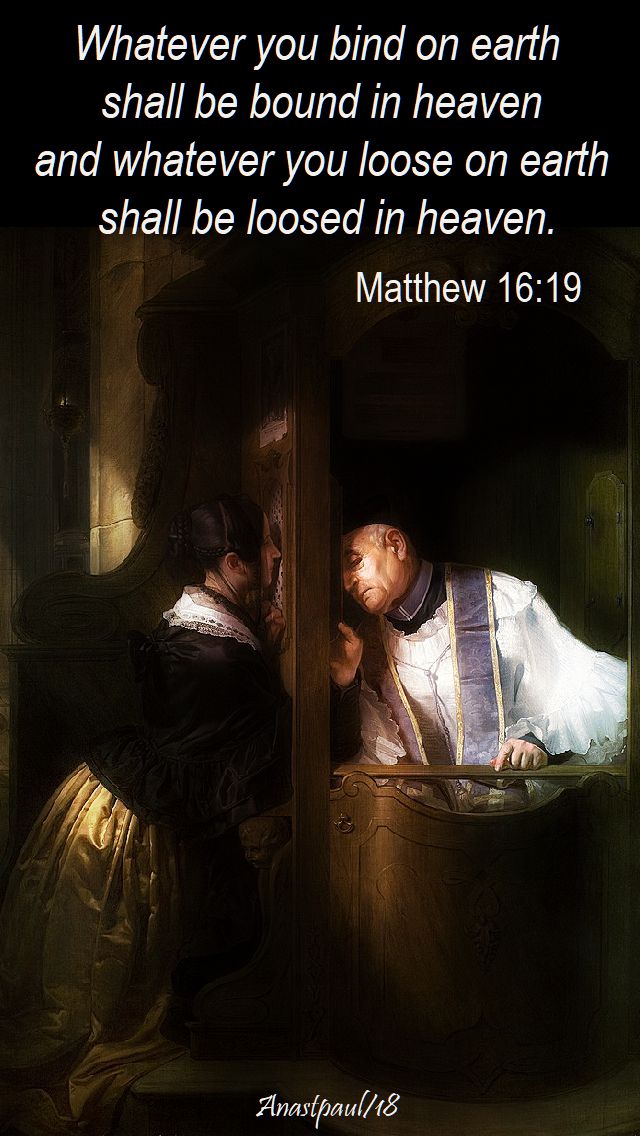
“Whatever you bind on earth shall be bound in heaven and whatever you loose on earth shall be loosed in heaven.“…Matthew 16:19whatever you bind on earth - matthew 16 -19

REFLECTION – “Sin is before all else, an offence against God, a rupture of communion with Him.   At the same time it damages communion with the Church.   For this reason, conversion entails, both God’s forgiveness and reconciliation with the Church, which are expressed and accomplished liturgically, by the sacrament of Penance and Reconciliation.

Only God forgives sin (Mk 2,7).   Since He is the Son of God, Jesus says of Himself, “The Son of man has authority on earth to forgive sins” (Mk 2,10) and exercises this divine power:  “Your sins are forgiven” (v.5; Lk 7,48).   Further, by virtue of His divine authority He gives this power to men to exercise in His name (Jn 20,21).   Christ has willed that in her prayer and life and action, His whole Church should be the sign and instrument of the forgiveness and reconciliation that He acquired for us at the price of His blood.   But He entrusted the exercise of the power of absolution, to the apostolic ministry, which He charged with the “ministry of reconciliation” (2Cor 5,18).   The apostle is sent out “on behalf of Christ” with “God making his appeal” through him and pleading: ”  Be reconciled to God” (v.20).

During His public life, Jesus not only forgave sins but also made plain the effect of this forgiveness, He reintegrated forgiven sinners, into the community of the People of God from which sin had alienated or even excluded them.   A remarkable sign of this is the fact that Jesus receives sinners at His table (Mk 2,16), a gesture that expresses in an astonishing way, both God’s forgiveness and the return to the bosom of the People of God (cf. Lk 15; 19,9).”…Catechism of the Catholic Church – § 1440-1443ccc 1440 - sin is before all else, an offence against god - 9 aug 2018

PRAYER – Lord our God, the Light and Creator of Light, grant that faithfully pondering on all that is holy, we may ever live in the splendour of Your presence.   By the help and intercession of St Teresa Benedicta, You may never permit us to separate ourselves from You and thus we may come, to completion in You, Through Jesus Christ with the Holy Spirit, one God forever, amen.st-teresa-benedicta-pray-for-us-9 aug 2017

Posted in CARMELITES, MORNING Prayers, PRAYERS of the SAINTS, SAINT of the DAY, The TRANSFIGURATION, Uncategorized

Our Morning Offering – 9 August – The Memorial of St Teresa Benedicta of the Cross (1891-1942) Martyr

Our Morning Offering – 9 August – The Memorial of St Teresa Benedicta of the Cross (1891-1942) Martyr

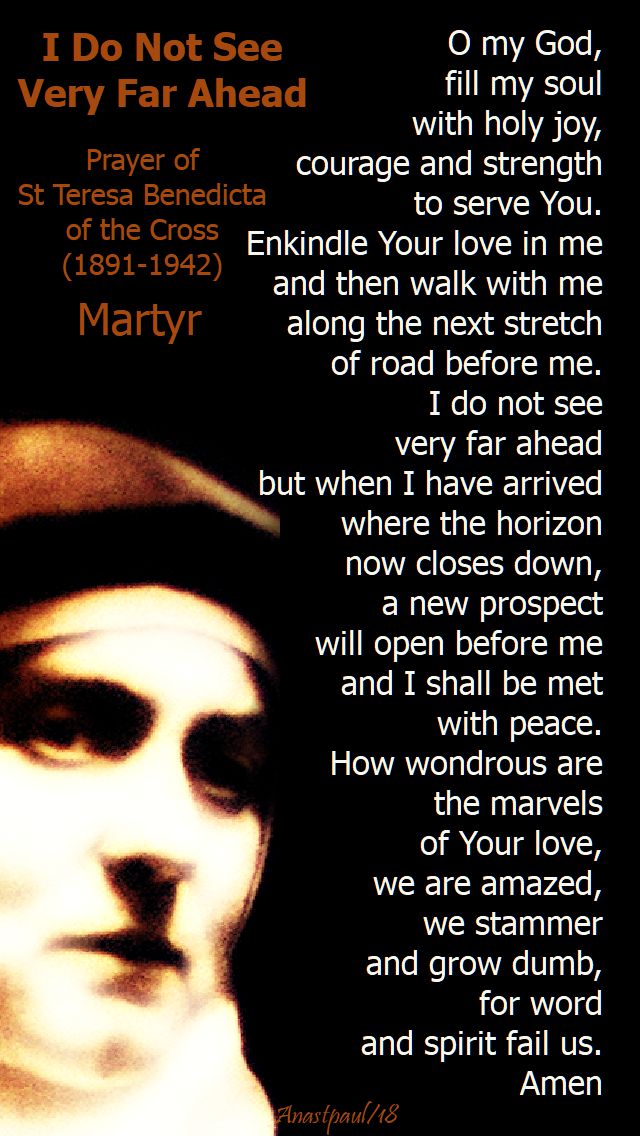
I Do Not See Very Far Ahead
By St Teresa Benedicta of the Cross (1891-1942)

O my God,
fill my soul with holy joy,
courage and strength to serve You.
Enkindle Your love in me
and then walk with me
along the next stretch of road before me.
I do not see very far ahead
but when I have arrived
where the horizon now closes down,
a new prospect will open before me
and I shall be met with peace.
How wondrous are the marvels of Your love,
we are amazed,
we stammer and grow dumb,
for word and spirit fail us.
Ameni do not see very far ahead - st teresa benedicta of the cross - 9 aug 2018

Posted in CARMELITES, SAINT of the DAY, VATICAN Resources

Saint of the Day – 9 August – St Teresa Benedicta of the Cross/Edith Stein (1891-1942)

Saint of the Day – 9 August – St Teresa Benedicta of the Cross/Edith Stein (1891-1942) Nun, Discalced Carmelite, Martyr.   Below is a lengthy biography from the Vatican, it’s worth reading.

“We bow down before the testimony of the life and death of Edith Stein, an outstanding daughter of Israel and at the same time a daughter of the Carmelite Order, Sister Teresa Benedicta of the Cross, a personality who united within her rich life a dramatic synthesis of our century.   It was the synthesis of a history full of deep wounds that are still hurting … and also the synthesis of the full truth about man.   All this came together in a single heart that remained restless and unfulfilled until it finally found rest in God.”   These were the words of Pope John Paul II when he beatified Edith Stein in Cologne on 1 May 1987.

EDITH STEYN - SNIP

Edith Stein was born in Breslau on 12 October 1891, the youngest of 11, as her family were celebrating Yom Kippur, that most important Jewish festival, the Feast of Atonement.   “More than anything else, this helped make the youngest child very precious to her mother.”   Being born on this day was like a foreshadowing to Edith, a future Carmelite nun.   Edith’s father, who ran a timber business, died when she had only just turned two.   Her mother, a very devout, hard-working, strong-willed and truly wonderful woman, now had to fend for herself and to look after the family and their large business.   However, she did not succeed in keeping up a living faith in her children.   Edith lost her faith in God. “I consciously decided, of my own volition, to give up praying,” she said.

In 1911 she passed her school-leaving exam with flying colours and enrolled at the University of Breslau to study German and history, though this was a mere “bread-and-butter” choice.   Her real interest was in philosophy and in women’s issues.   She became a member of the Prussian Society for Women’s Franchise.   “When I was at school and during my first years at university,” she wrote later, “I was a radical suffragette.   Then I lost interest in the whole issue.  Now I am looking for purely pragmatic solutions.”st teresa benedicta info
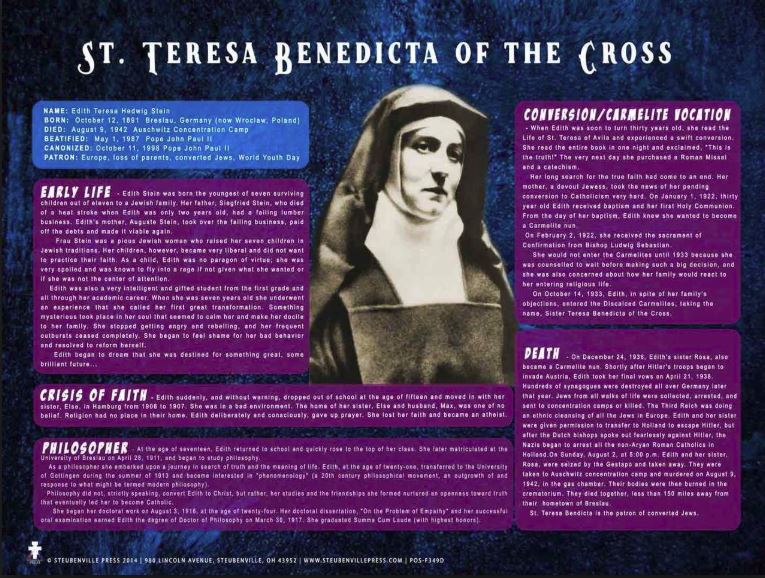
In 1913, Edith Stein transferred to Gottingen University, to study under the mentorship of Edmund Husserl.   She became his pupil and teaching assistant and he later tutored her for a doctorate.   At the time, anyone who was interested in philosophy was fascinated by Husserl’s new view of reality, whereby the world as we perceive it does not merely exist in a Kantian way, in our subjective perception.   His pupils saw his philosophy as a return to objects:  “back to things”.   Husserl’s phenomenology unwittingly led many of his pupils to the Christian faith.   In Gottingen Edith Stein also met the philosopher Max Scheler, who directed her attention to Roman Catholicism.   Nevertheless, she did not neglect her “bread-and-butter” studies and passed her degree with distinction in January 1915, though she did not follow it up with teacher training.

“I no longer have a life of my own,” she wrote at the beginning of the First World War, having done a nursing course and gone to serve in an Austrian field hospital.   This was a hard time for her, during which she looked after the sick in the typhus ward, worked in an operating theatre and saw young people die.   When the hospital was dissolved, in 1916, she followed Husserl as his assistant to the German city of Freiburg, where she passed her doctorate summa cum laude (with the utmost distinction) in 1917, after writing a thesis on “The Problem of Empathy.”

During this period she went to Frankfurt Cathedral and saw a woman with a shopping basket going in to kneel for a brief prayer.   “This was something totally new to me.   In the synagogues and Protestant churches I had visited people simply went to the services. Here, however, I saw someone coming straight from the busy marketplace into this empty church, as if she was going to have an intimate conversation.  It was something I never forgot.”   Towards the end of her dissertation she wrote:   “There have been people who believed that a sudden change had occurred within them and that this was a result of God’s grace.”   How could she come to such a conclusion?   Edith Stein had been good friends with Husserl’s Göttingen assistant, Adolf Reinach and his wife.   When Reinach fell in Flanders in November 1917, Edith went to Göttingen to visit his widow.   The Reinachs had converted to Protestantism.   Edith felt uneasy about meeting the young widow at first but was surprised when she actually met with a woman of faith.   “This was my first encounter with the Cross and the divine power it imparts to those who bear it … it was the moment when my unbelief collapsed and Christ began to shine his light on me – Christ in the mystery of the Cross.”

Later, she wrote:   “Things were in God’s plan which I had not planned at all. I am coming to the living faith and conviction that – from God’s point of view – there is no chance and that the whole of my life, down to every detail, has been mapped out in God’s divine providence and makes complete and perfect sense in God’s all-seeing eyes.”

In Autumn 1918 Edith Stein gave up her job as Husserl’s teaching assistant.   She wanted to work independently.   It was not until 1930 that she saw Husserl again after her conversion and she shared with him about her faith, as she would have liked him to become a Christian, too.   Then she wrote down the amazing words: “Every time I feel my powerlessness and inability to influence people directly, I become more keenly aware of the necessity of my own holocaust.”

Edith Stein wanted to obtain a professorship, a goal that was impossible for a woman at the time.   Husserl wrote the following reference:  “Should academic careers be opened up to ladies, then I can recommend her whole-heartedly and as my first choice for admission to a professorship.”   Later, she was refused a professorship on account of her Jewishness.

Back in Breslau, Edith Stein began to write articles about the philosophical foundation of psychology.   However, she also read the New Testament, Kierkegaard and Ignatius of Loyola’s Spiritual Exercises.   She felt that one could not just read a book like that but had to put it into practice.   In the summer of 1921. she spent several weeks in Bergzabern (in the Palatinate) on the country estate of Hedwig Conrad-Martius, another pupil of Husserl’s.   Hedwig had converted to Protestantism with her husband.   One evening Edith picked up an autobiography of St Teresa of Avila and read this book all night. “When I had finished the book, I said to myself: This is the truth.”   Later, looking back on her life, she wrote:  “My longing for truth was a single prayer.”young st teresa

On 1 January 1922 Edith Stein was baptised.   It was the Feast of the Circumcision of Jesus, when Jesus entered into the covenant of Abraham.   Edith Stein stood by the baptismal font, wearing Hedwig Conrad-Martius’ white wedding cloak.   “I had given up practising my Jewish religion when I was a 14-year-old girl and did not begin to feel Jewish again until I had returned to God.”   From this moment on she was continually aware that she belonged to Christ not only spiritually but also through her blood.   At the Feast of the Purification of Mary – another day with an Old Testament reference – she was confirmed by the Bishop of Speyer in his private chapel.   After her conversion she went straight to Breslau:   “Mother,” she said, “I am a Catholic.”   The two women cried. Hedwig Conrad Martius wrote:  “Behold, two Israelites indeed, in whom is no deceit!” (cf. John 1:47).

Immediately after her conversion she wanted to join a Carmelite convent.   However, her spiritual mentors, Vicar-General Schwind of Speyer and Erich Przywara SJ, stopped her from doing so.   Until Easter 1931 she held a position teaching German and history at the Dominican Sisters’ school and teacher training college of St Magdalen’s Convent in Speyer.   At the same time she was encouraged by Arch-Abbot Raphael Walzer of Beuron Abbey to accept extensive speaking engagements, mainly on women’s issues.   “During the time immediately before and quite some time after my conversion I … thought that leading a religious life meant giving up all earthly things and having one’s mind fixed on divine things only.   Gradually, however, I learnt that other things are expected of us in this world…   I even believe that the deeper someone is drawn to God, the more He has to `get beyond himself’ in this sense, that is, go into the world and carry divine life into it.”

She worked enormously hard, translating the letters and diaries of Cardinal Newman from his pre-Catholic period as well as Thomas Aquinas’ Quaestiones Disputatae de Veritate.   The latter was a very free translation, for the sake of dialogue with modern philosophy.   Erich Przywara also encouraged her to write her own philosophical works. She learnt that it was possible to “pursue scholarship as a service to God… It was not until I had understood this that I seriously began to approach academic work again.”   To gain strength for her life and work, she frequently went to the Benedictine Monastery of Beuron, to celebrate the great festivals of the Church year.

In 1931 Edith Stein left the convent school in Speyer and devoted herself to working for a professorship again, this time in Breslau and Freiburg, though her endeavours were in vain.   It was then that she wrote Potency and Act, a study of the central concepts developed by Thomas Aquinas.   Later, at the Carmelite Convent in Cologne, she rewrote this study to produce her main philosophical and theological oeuvre, Finite and Eternal Being.   By then, however, it was no longer possible to print the book.   In 1932 she accepted a lectureship position at the Roman Catholic division of the German Institute for Educational Studies at the University of Munster, where she developed her anthropology.   She successfully combined scholarship and faith in her work and her teaching, seeking to be a “tool of the Lord” in everything she taught. “If anyone comes to me, I want to lead them to Him.”

In 1933 darkness broke out over Germany.   “I had heard of severe measures against Jews before.   But now it dawned on me that God had laid his hand heavily on His people and that the destiny of these people would also be mine.”   The Aryan Law of the Nazis made it impossible for Edith Stein to continue teaching.   “If I can’t go on here, then there are no longer any opportunities for me in Germany,” she wrote; “I had become a stranger in the world.”   The Arch-Abbot of Beuron, Walzer, now no longer stopped her from entering a Carmelite convent.   While in Speyer, she had already taken a vow of poverty, chastity and obedience.   In 1933 she met with the prioress of the Carmelite Convent in Cologne.   “Human activities cannot help us but only the suffering of Christ.   It is my desire to share in it.”st teresa benedicta icon

Edith Stein went to Breslau for the last time, to say good-bye to her mother and her family.   Her last day at home was her birthday, 12 October, which was also the last day of the Feast of Tabernacles.   Edith went to the synagogue with her mother.   It was a hard day for the two women.   “Why did you get to know it [Christianity]?” her mother asked, “I don’t want to say anything against Him.   He may have been a very good person.   But why did He make Himself God?” Edith’s mother cried.   The following day Edith was on the train to Cologne.   “I did not feel any passionate joy.   What I had just experienced was too terrible.   But I felt a profound peace – in the safe haven of God’s will.”   From now on she wrote to her mother every week, though she never received any replies.   Instead, her sister Rosa sent her news from Breslau.

Edith joined the Carmelite Convent of Cologne on 14 October and her investiture took place on 15 April, 1934.   The mass was celebrated by the Arch-Abbot of Beuron.   Edith Stein was now known as Sister Teresia Benedicta a Cruce – Teresa, Blessed of the Cross. In 1938 she wrote:  “I understood the cross as the destiny of God’s people, which was beginning to be apparent at the time (1933).   I felt that those who understood the Cross of Christ should take it upon themselves on everybody’s beha  lf. Of course, I know better now what it means to be wedded to the Lord in the sign of the cross.   However, one can never comprehend it, because it is a mystery.”   On 21 April 1935 she took her temporary vows.   On 14 September 1936, the renewal of her vows coincided with her mother’s death in Breslau.   “My mother held on to her faith to the last moment.   But as her faith and her firm trust in her God … were the last thing that was still alive in the throes of her death, I am confident that she will have met a very merciful judge and that she is now my most faithful helper, so that I can reach the goal as well.”   When she made her eternal profession on 21 April 1938, she had the words of St John of the Cross printed on her devotional picture:   “Henceforth my only vocation is to love.”   Her final work was to be devoted to this author.St Teresa Benedicta of the Cross-lg
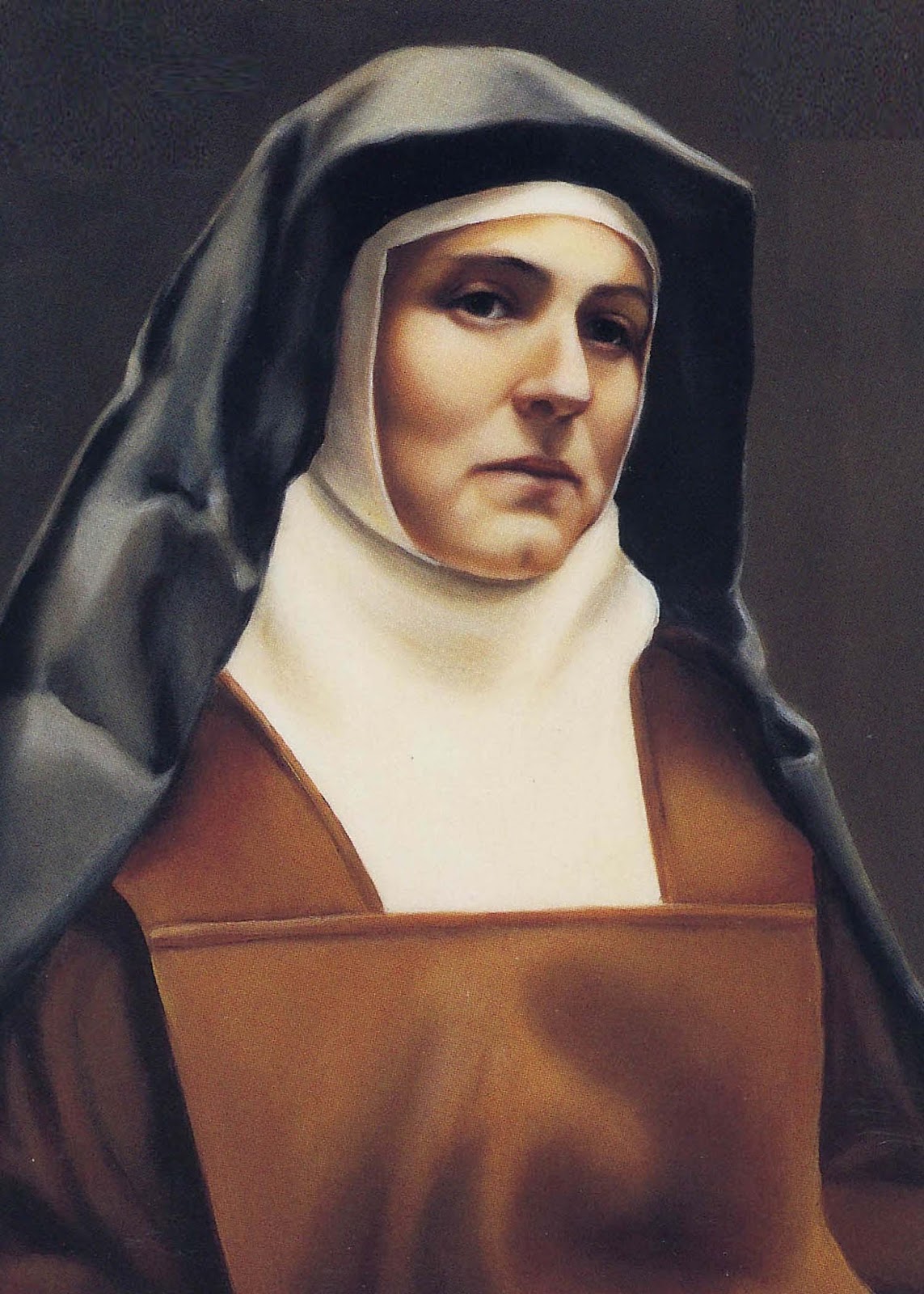
Edith Stein’s entry into the Carmelite Order was not escapism.   “Those who join the Carmelite Order are not lost to their near and dear ones but have been won for them, because it is our vocation to intercede to God for everyone.”   In particular, she interceded to God for her people:   “I keep thinking of Queen Esther who was taken away from her people precisely because God wanted her to plead with the king on behalf of her nation.   I am a very poor and powerless little Esther but the King who has chosen me is infinitely great and merciful.   This is great comfort.” (31 October 1938)

On 9 November 1938 the anti-Semitism of the Nazis became apparent to the whole world.   Synagogues were burnt and the Jewish people were subjected to terror.   The prioress of the Carmelite Convent in Cologne did her utmost to take Sister Teresia Benedicta a Cruce abroad.   On New Year’s Eve 1938 she was smuggled across the border into the Netherlands, to the Carmelite Convent in Echt in the Province of Limburg.   This is where she wrote her will on 9 June 1939:  “Even now I accept the death that God has prepared for me in complete submission and with joy as being his most holy will for me. I ask the Lord to accept my life and my death … so that the Lord will be accepted by His people and that His Kingdom may come in glory, for the salvation of Germany and the peace of the world.”st teresa benedicta artwork
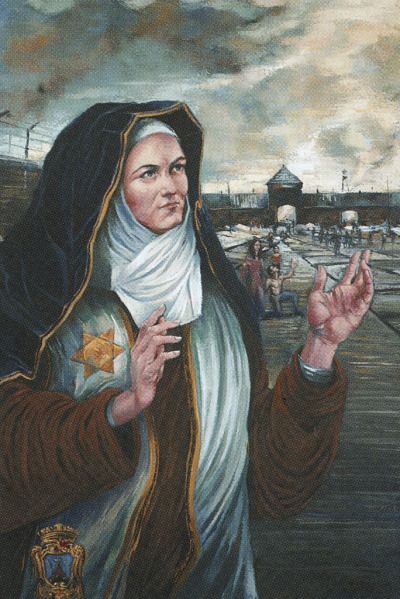
While in the Cologne convent, Edith Stein had been given permission to start her academic studies again.   Among other things, she wrote about “The Life of a Jewish Family” (that is, her own family): “I simply want to report what I experienced as part of Jewish humanity,” she said, pointing out that “we who grew up in Judaism have a duty to bear witness … to the young generation who are brought up in racial hatred from early childhood.”

In Echt, Edith Stein hurriedly completed her study of “The Church’s Teacher of Mysticism and the Father of the Carmelites, John of the Cross, on the Occasion of the 400th Anniversary of His Birth, 1542-1942.”   In 1941 she wrote to a friend, who was also a member of her order:  “One can only gain a scientia crucis (knowledge of the cross) if one has thoroughly experienced the cross.   I have been convinced of this from the first moment onwards and have said with all my heart:   ‘Ave, Crux, Spes unica’ (I welcome you, Cross, our only hope).”   Her study on S. John of the Cross is entitled: “Kreuzeswissenschaft” (The Science of the Cross).

Edith Stein was arrested by the Gestapo on 2 August 1942, while she was in the chapel with the other sisters.   She was to report within five minutes, together with her sister Rosa, who had also converted and was serving at the Echt Convent.   Her last words to be heard in Echt were addressed to Rosa:  “Come, we are going for our people.”   Together with many other Jewish Christians, the two women were taken to a transit camp in Amersfoort and then to Westerbork.   This was an act of retaliation against the letter of protest written by the Dutch Roman Catholic Bishops against the pogroms and deportations of Jews.   Edith commented, “I never knew that people could be like this, neither did I know that my brothers and sisters would have to suffer like this. … I pray for them every hour.   Will God hear my prayers?   He will certainly hear them in their distress.”   Prof. Jan Nota, who was greatly attached to her, wrote later:  “She is a witness to God’s presence in a world where God is absent.”st teresa benedicta art
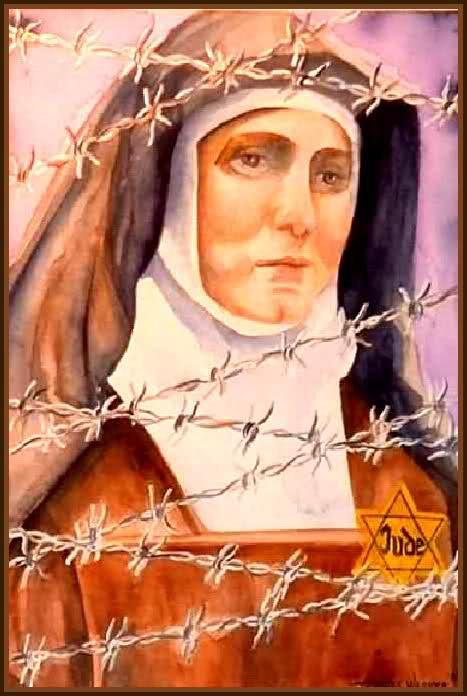
On 7 August, early in the morning, 987 Jews were deported to Auschwitz.  It was probably on 9 August that Sister Teresia Benedicta a Cruce, her sister and many other of her people were gassed.
When Edith Stein was beatified in Cologne on 1 May 1987, the Church honoured “a daughter of Israel”, as Pope John Paul II put it, who, as a Catholic during Nazi persecution, remained faithful to the crucified Lord Jesus Christ and, as a Jew, to her people in loving faithfulness.”   St John Paul II canonised her in 1998 and proclaimed her a co-patroness of Europe the next year.Edith-Stein_0
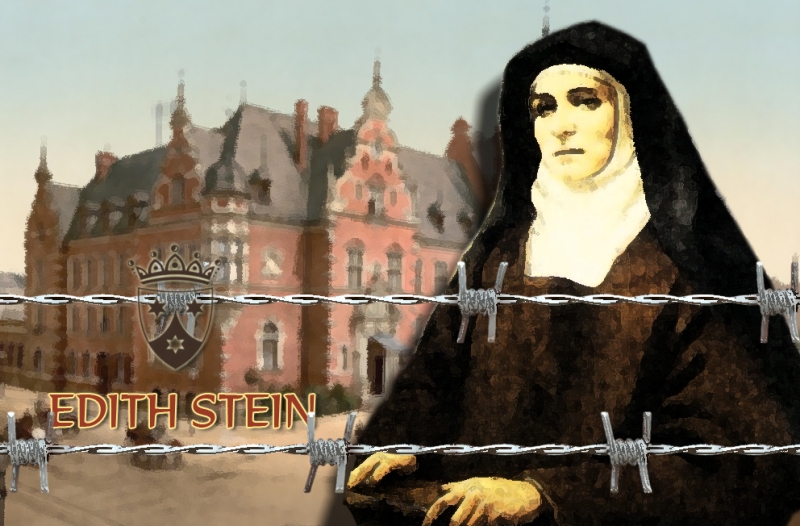
More here:  https://anastpaul.wordpress.com/2017/08/09/saint-of-the-day-9-august-st-teresa-benedicta-of-the-cross-ocd/

Posted in CARMELITES, SAINT of the DAY

Memorials of the Saints -9 August

St Teresa Benedicta of the Cross OCD (1891-1942)Martyr, Co-Patron of Europe  (Optional Memorial)
https://anastpaul.wordpress.com/2017/08/09/saint-of-the-day-9-august-st-teresa-benedicta-of-the-cross-ocd/
St Amor of Franche-Comté
St Autor of Metz
St Bandaridus of Soissons
St Bonifacia Rodriguez Castro
St Candida Maria de Jesus Cipitria y Barriola
St Claude Richard
St Domitian of Châlons
Bl Falco the Hermit
St Firmus of Verona
Bl John Norton
Bl John of Salerno
Bl John Talbot
St Marcellian of Civitavecchia
Bl Michal Tomaszek
St Nathy
St Numidicus of Carthage
St Phelim
Bl Richard Bere
St Romanus Ostiarius
St Rusticus of Sirmium
St Rusticus of Verona
St Secundian of Civitavecchia
St Stephen of Burgos
Bl Thomas Palaser
St Verian of Civitavecchia
Bl Zbigniew Adam Strzalkowski

Martyrs of Civitavecchia: Three Christians martyred together in the persecutions of Decius. We know little more than the names – Marcellian, Secundian and Verian. 250 near Civitavecchia, Italy.

Martyrs of Constantinople: 10 saints: A group of ten Christians who were arrested, tortured and executed for defending an icon of Christ in defiance of orders from Emperor Leo the Isaurian. We know the names of three, but nothing else about them – Julian, Marcian and Mary. They were beheaded in Constantinople.

Martyred in the Spanish Civil War:
Martyred Colombians of Barcelona: – 7 beati: Additional Memorial – 30 July as one of the Martyred Hospitallers of Spain
A group of Colombian members of the Hospitallers of Saint John of God who worked together in Spain, and who were martyred together in the Spanish Civil War.
• Blessed Alfonso Antonio Ramírez Salazar
• Blessed Gabriel Maya Gutiérrez
• Blessed José Velázquez Peláez
• Blessed Luis Ayala Niño
• Blessed Luis Modesto Páez Perdomo
• Blessed Ramón Ramírez Zuluoga
• Blessed Rubén de Jesús López Aguilar
They were martyred on 9 August 1936 in Barcelona, Spain and Beatified on 25 October 1992 by Pope John Paul II.
Martyred in the Spanish Civil War:
Bl Antonio Mateo Salamero
Bl Faustino Oteiza Segura
Bl Florentín Felipe Naya
Bl Florentino Asensio Barroso
Bl Francisco López-Gasco Fernández-Largo
Bl Guillermo Plaza Hernández
Bl Joan Vallés Anguera
Bl José María Garrigues Hernández
Bl Josep Figuera Rey
Bl Josep Maria Aragones Mateu
Bl Julián Pozo Ruiz de Samaniego
Bl Mateo Molinos Coloma
Bl Narcís Sitjà Basté

Posted in CARMELITES, MORNING Prayers, QUOTES of the SAINTS, QUOTES on COURAGE, QUOTES on DIVINE PROVIDENCE, QUOTES on FAITH, QUOTES on FEAR, QUOTES on SUFFERING, SAINT of the DAY

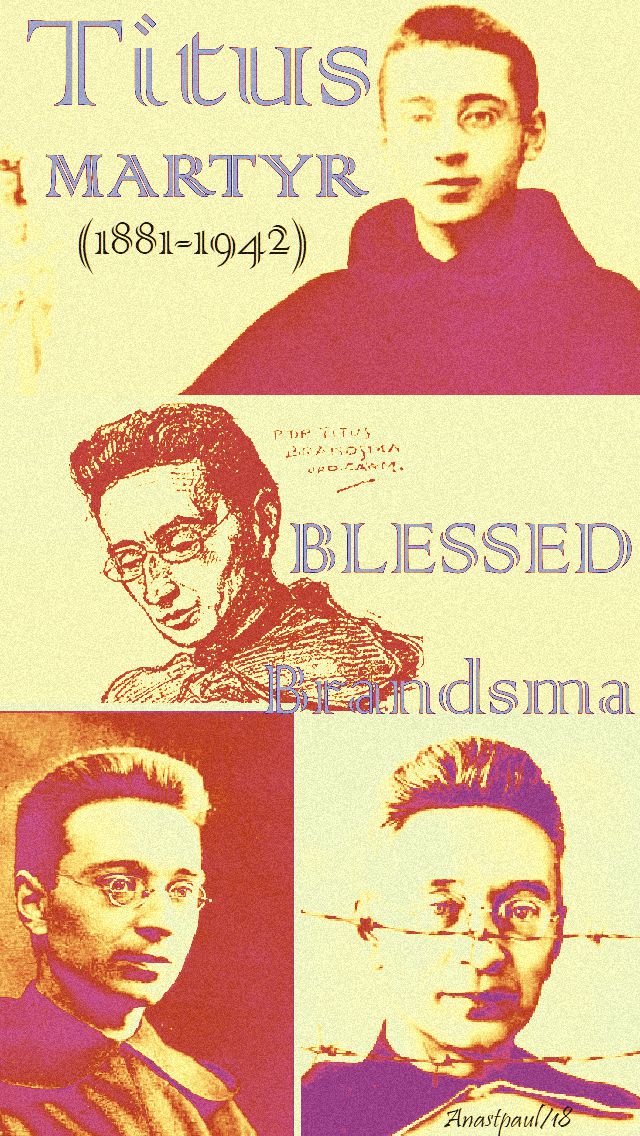
Quote/s of the Day – 26 July – The Memorial of Blessed Titus Brandsma O.C.D. (1881-1942) Martyr of the Faith

Quote/s of the Day – 26 July – The Memorial of Blessed Titus Brandsma O.C.D. (1881-1942) Martyr of the Faith

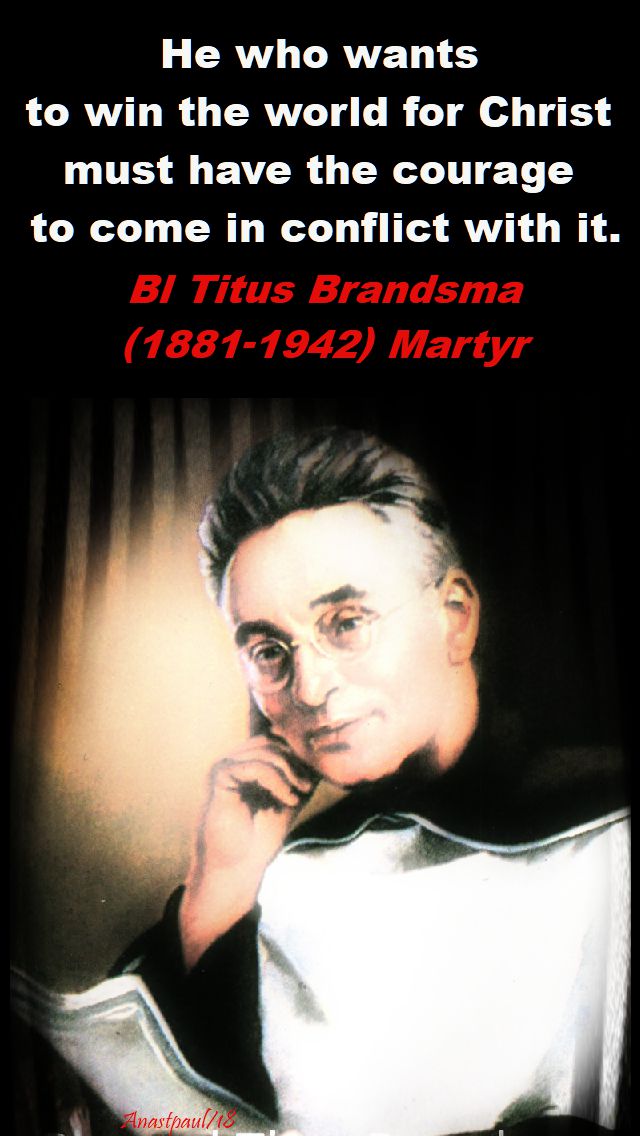
“He who wants to win the world for Christ
must have the courage,
to come in conflict with it.”he who wants to win the world for christ - bl titus brandsma - 2 june 2018

I am awestruck by Blessed Titus, who despite his ghastly sufferings, exclaimed:

“I see God in the work of His hands
and the marks of His love
in every visible thing.”

“Not my will but yours be done!” (what Blessed Titus would shout during torture and medical experiments)

++++++++++++++++++++i see god in the work of his hands - not my will but yours be done - bl titus brandsma - 26 july 2018

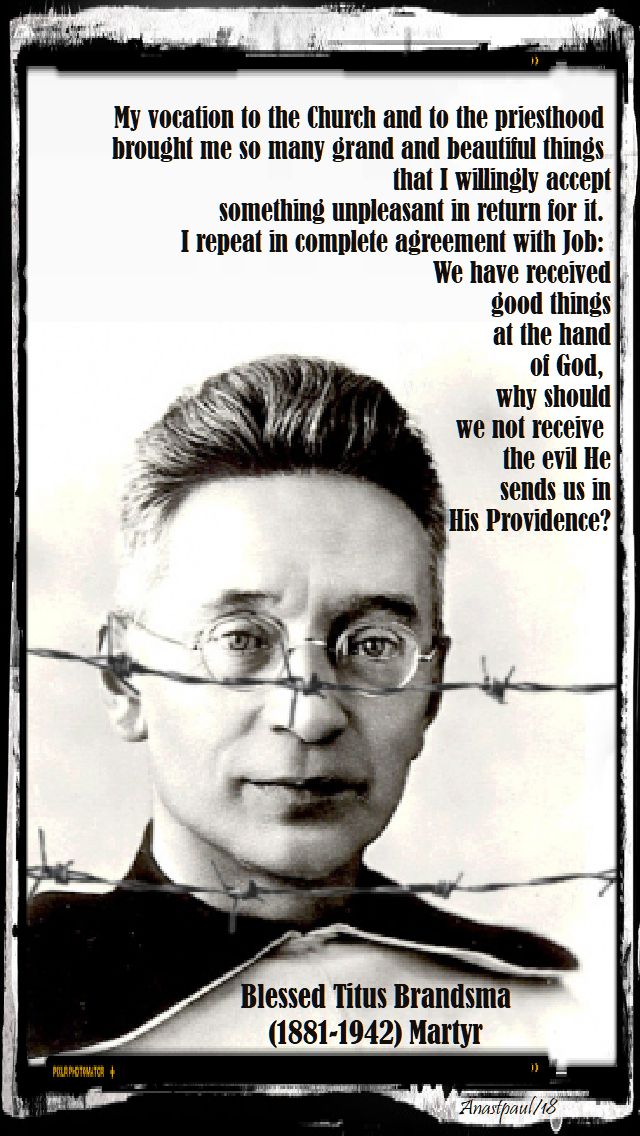
“My vocation to the Church and to the priesthood
brought me so many grand and beautiful things
that I willingly accept something unpleasant in return for it.
I repeat in complete agreement with Job:
We have received good things at the hand of God,
why should we not receive
the evil He sends us in His Providence?”

Bl Titus Brandsma (1881-1942) Martyrmy vocation to the church - bl titus - 26 july 2018

Posted in CARMELITES, MORNING Prayers, PRAYERS of the SAINTS, SAINT of the DAY, The HOLY CROSS

Our Morning Offering – 26 July – The Memorial of Blessed Titus Brandsma O.C.D. (1881-1942) Martyr of the Faith

Our Morning Offering – 26 July – The Memorial of Blessed Titus Brandsma O.C.D. (1881-1942) Martyr of the Faith

Prayer Before Jesus Crucified
By Blessed Titus Brandsma
(1881-1942) Martyr

Dear Lord, when looking up at Thee,
I see Thy loving eyes on me,
Love overflows my humble heart,
Knowing what a faithful friend Thy art.
A cup of sorrow I foresee,
Which I accept for love of Thee,
Thy painful way I wish to go,
The only way to God I know.
My soul is full of peace and light,
Although in pain, this light shines bright.
For here Thou keep to Thou breast.
My longing heart to find there rest.
Leave me here freely all alone,
In cell where never sunlight shone.
Should no one ever speak to me,
This golden silence makes me free!
For though alone, I have no fear,
Never wert Thou, O Lord, so near.
Sweet Jesus, please, abide with me!
My deepest peace I find in Thee.
Amenprayer before jesus crucified - bl titus brandsma no 2- 26 july 2018

Posted in CARMELITES, SAINT of the DAY

Saint of the Day – 26 July – Blessed Titus Brandsma O.C.D. (1881-1942) Martyr of the Faith

Saint of the Day – 26 July – Blessed Titus Brandsma O.C.D. (1881-1942) Martyr of the Faith – Carmelite Religious Priest, Mystic, Philosopher, Lecturer, Writer, Editor, Preacher, Linguist, Social Activist – born Anno Sjoerd Brandsma on 23 February 1881 at Oegeklooster, Friesland, Netherlands and was martyred on 26 July 1942 by lethal injection in the concentration camp at Dachau, Bavaria, Germany.   His executioner was a nurse who had been raised Catholic but left the Church.   His body was cremated and no relics remain.Bl titus - mini collage - no 2 - 26 july 2018

Bl Titus’ parents, who ran a small dairy farm, were devout and committed Catholics, a minority in a predominantly-Calvinist region.   With the exception of one daughter, all of their children entered religious orders.   As a young boy, Brandsma did his secondary studies in the town of Megen, at a Franciscan-run minor seminary for boys considering a priestly or religious vocation, commonly known as a “Seminary Minor.”   He entered the novitiate of the Carmelite friars in Boxmeer on 17 September 1898, where he took the religious name Titus (in honour of his father) by which he is now known.   He professed his first vows in October 1899 and was Ordained a priest in 190.   Brandsma was knowledgeable in Carmelite mysticism and was awarded a doctorate of philosophy at Rome in 1909.   He then taught in various schools in the Netherlands.   From 1916 on, he initiated and led a project to translate the works of St Teresa of Ávila into Dutch.Blessed Titus Brandsma

One of the founders of the Catholic University of Nijmegen (now Radboud University), Brandsma became a professor of philosophy and the history of mysticism at the school in 1923.   He later served as Rector Magnificus.   He was noted for his constant availability to everyone, rather than for his scholarly work as a professor.   Brandsma also worked as a journalist and was the ecclesiastical adviser to Catholic journalists by 1935.   That same year he did a lecture tour of the United States, speaking at various institutions of his Order.

tito_brandsma_1brandsma.mainz.refectory.blk_border.2

After the invasion of the Netherlands by the Third Reich in May 1940, it was Brandsma’s fight against the spread of Nazi ideology and for educational and press freedom that brought him to the attention of the Nazis.   In January 1942 he undertook to deliver by hand a letter from the Conference of Dutch Bishops to the editors of Catholic newspapers in which the bishops ordered them not to print official Nazi documents, as was required under a new law by the German occupiers.   He had visited 14 editors before being arrested on the 19th of that month at the Boxmeer monastery.film - titus

After being held prisoner in Scheveningen, Amersfoort and Cleves, Brandsma was transferred to the Dachau concentration camp, arriving there on 19 June.   His health quickly gave way and he was transferred to the camp hospital.   He died on 26 July 1942, from a lethal injection administered by a nurse of the Allgemeine SS, as part of their program of medical experimentation on the prisoners.

In 1921 Brandsma worked to resolve a controversy concerning Belgian artist Albert Servaes’ depiction of the Stations of the Cross.   From this came his series of meditations on each of the 14 stations, though he never finished the 14th Station as he wrote them whilst in Dachau and was executed before completing them.

He was beatified in November 1985 by Pope John Paul II.   His feast day is observed within the universal Church today and within the Carmelite Order on 27 July.tito brandsma (2)

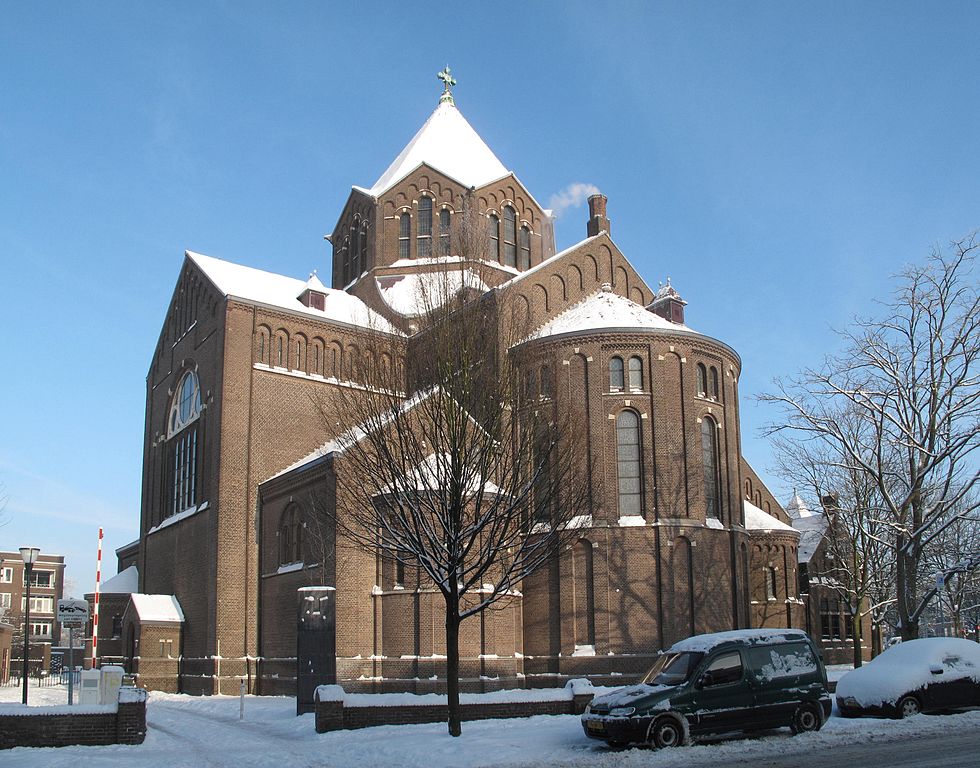
In 2005 Brandsma was chosen by the inhabitants of Nijmegen as the greatest citizen to have lived there. A memorial church now stands in the city dedicated to him.980px-Nijmegen,_Titus_Brandsma_Gedachteniskerk-2

Brandsma’s studies on mysticism was the basis for the establishment in 1968 of the Titus Brandsma Institute in Nijmegen, dedicated to the study of spirituality.   It is a collaboration between the Dutch Carmelite friars and Radboud University Nijmegen. Brandsma was honoured by the city of Dachau with a street adjoining the former camp.

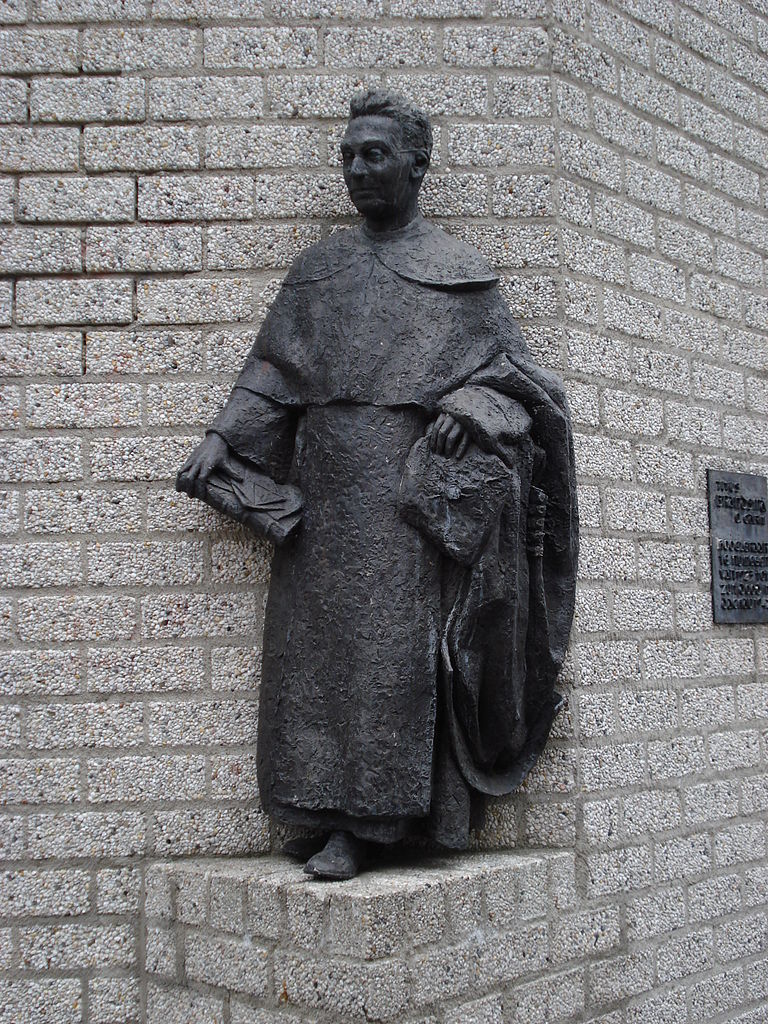
768px-Nimègue,_statue_Titus_Brandsma
Statue of Titus Brandsma on the grounds of Radboud University, Nijmegen
Posted in CARMELITES, SAINT of the DAY

Memorials of the Saints – 26 July

Sts Anne & St Joachim (Memorial) – Parents of the Blessed Virgin Mary, Grandparents of Jesus

https://anastpaul.wordpress.com/2017/07/26/saints-of-the-day-26-july-sts-joachim-and-anne-parents-of-the-blessed-virgin-mary-grandparents-of-jesus/

Bl Andrew the Catechist
St Austindus of Auch
St Bartholomea Capitanio
St Benigno of Malcestine
Bl Camilla Gentili
St Charus of Malcestine
Bl Edward Thwing
Bl Élisabeth-Thérèse de Consolin
St Erastus
Bl Évangéliste of Verona
St Exuperia the Martyr
Bl George Swallowell
St Gérontios
Bl Giuseppina Maria de Micheli
St Gothalm
St Hyacinth
Bl Jacques Netsetov
Bl John Ingram
St Joris
Bl Marcel-Gaucher Labiche de Reignefort
Bl Marie-Claire du Bac
Bl Marie-Madeleine Justamond
Bl Marie-Marguerite Bonnet
St Olympius the Tribune
St Parasceva of Rome
St Pastor of Rome
Bl Pérégrin of Verona
Bl Pierre-Joseph le Groing de la Romagère
Bl Robert Nutter
St Simeon of Padolirone
St Symphronius the Slave
St Theodulus the Martyr
St Titus Brandsma O.C.D. (1881-1942) Martyr of the Faith

St Valens of Verona
Bl William Ward

Martyred in the Spanish Civil War:
Bl Aleix Miquel Rossell
Bl Amancio Marín Mínguez
Bl Antoni Jaume Secases
Bl Josep Maria Jordá i Jordá
Bl Josep Masquef Ferré
Bl Manuel Martín Sierra
Bl Miquel Vilatimó Costa
Bl Pau Roselló Borgueres
Bl Santiago Altolaguirre y Altolaguirre
Bl Vicente Pinilla Ibáñez

Posted in CARMELITES, EUCHARISTIC Adoration, MORNING Prayers, QUOTES of the SAINTS, SAINT of the DAY, The BLESSED VIRGIN MARY, The HOLY EUCHARIST / The HOLY MASS

Quote of the Day – 12 June – The Memorial of Blessed Maria Candida of the Eucharist (1884-1949) (celebrated by the Carmelite Order today)

Quote of the Day – 12 June – The Memorial of Blessed Maria Candida of the Eucharist (1884-1949) (celebrated by the Carmelite Order today)

“I want to be like Mary, to be Mary for Jesus,
to take the place of His Mother.
When I receive Jesus in Communion,
Mary is always present.
I want to receive Jesus from her hands,
she must make me one with Him.
I cannot separate Mary from Jesus.
Hail, O Body born of Mary.
Hail Mary, dawn of the Eucharist!”

Bl Maria Candida of the Eucharist OCD (1884-1949)i want to be like mary, like mary for jesus - 12 june 2018 - bl maria candida of the eucharist

Posted in CARMELITES, CATHOLIC DEVOTIONS of the Month, MARIAN DEVOTIONS, MARIAN PRAYERS, MARIAN QUOTES, MARIAN TITLES, MORNING Prayers, SAINT of the DAY, The BLESSED VIRGIN MARY

Our Morning Offering – 16 May “Mary’s Month!” – Wednesday of the Seventh Week of Eastertide and the memorial of St Simon Stock (1165-1265)

Our Morning Offering – 16 May “Mary’s Month!” – Wednesday of the Seventh Week of Eastertide and the memorial of St Simon Stock (1165-1265)

Carmel’s Flower
By St Simon Stock (1165-1265)

Carmel’s Flower,
Vine ever blossoming,
Heaven’s splendour!
Virgin who bore a child.
No one is like thee.
Mother gentle and kind.
Yet never touched by man!
To Carmelites give thou the privilege.
Help us Star of the Sea.carmel's flower - st simon stock - 16 may 2018

Posted in CARMELITES, DEVOTIO, MARIAN DEVOTIONS, MARIAN TITLES, MORNING Prayers, SAINT of the DAY, The BLESSED VIRGIN MARY

Saint of the Day – 16 May – St Simon Stock (1165-1265)

Saint of the Day – 16 May – St Simon Stock (1165-1265) Religious Monk, Visionary, Mystic, Marian devotee, early prior general of the Carmelite religious order.   Born c 1165 in Aylesford, County Kent, England – died on 16 May 1265 in the Carmelite monastery at Bordeaux, France of natural causes while on a visit.    Patronage – Bordeaux, France.

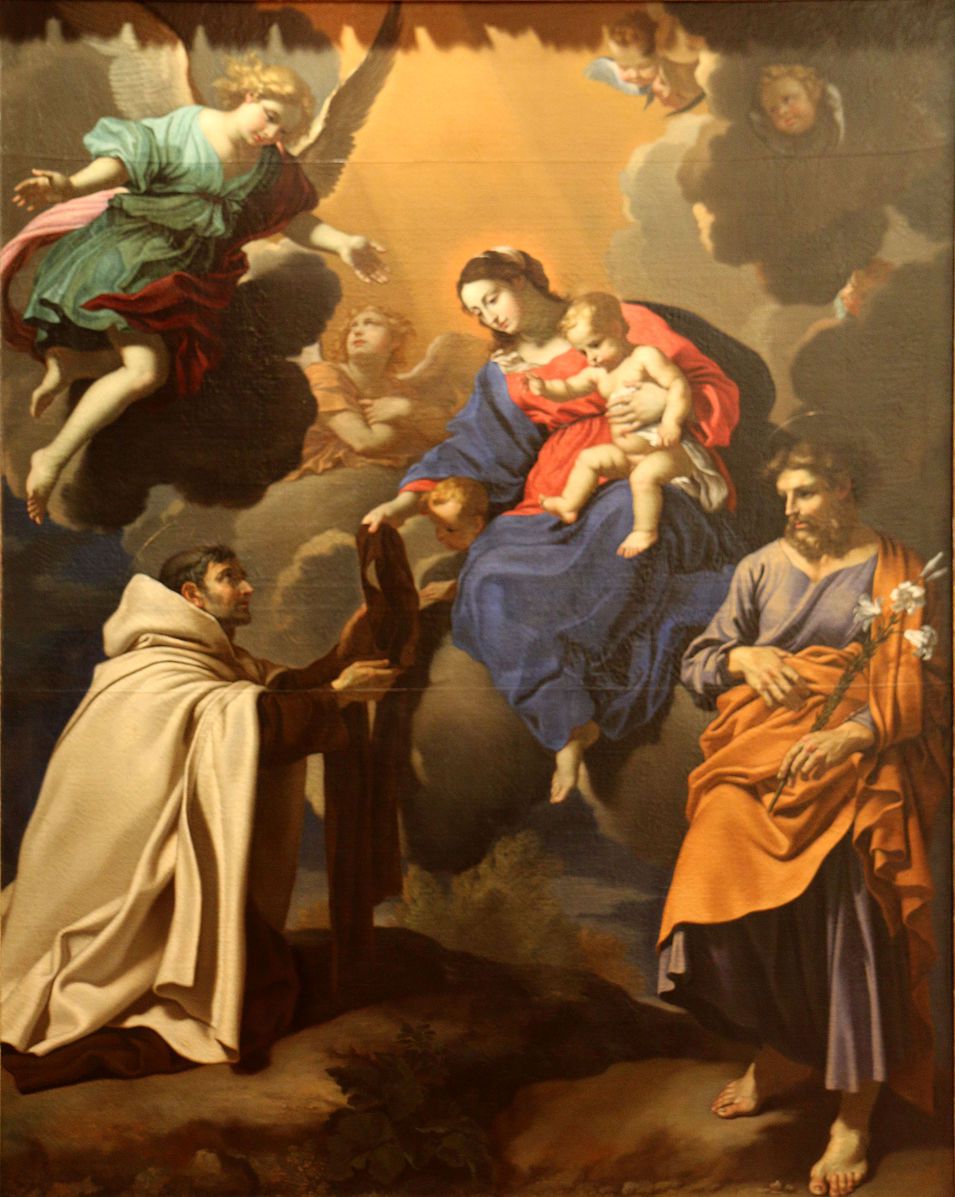
HEADER 2 marian-scapular-vision-small1header - Nicolas_Mignard-Vierge_et_saint_Simon_Stock

Simon was born in Aylesford, England, to one of the most well-known and respected Christian families in the County of Kent.   While still an infant, he was chosen by the Blessed Mother for her own, with his parents and others hearing him recite the Angelic Salutation of the Archangel Gabriel, long before he had learned to speak.   Prodigious as a child, he learned and memorised the Little Office of the Blessed Virgin before he was able to read, reciting it on a daily basis.   He was observed to read the Holy Scripture, kneeling in his room, by the age of six.

At the age of twelve, Simon left home, living as a hermit in the hollowed trunk of a large oak tree, earning him the name Simon “Stock.”   There he triumphed over the demon, as he would later tell his religious, only by the assistance of the Most Holy Virgin.   While living as a hermit, he drank only water and ate only herbs, roots and wild apples. Eventually, after eight years of solitude, Simon felt called back to communion with others and joined the Carmelite Order.   He finished his studies at Oxford and later (in 1215) was appointed Vicar General of the Order.

Saint Simon worked tirelessly to spread the Carmelite Order throughout Europe, founding many communities in university towns such as Cambridge, Oxford, Paris and Bologna.   He was responsible for the revision of the Rules of the Order, leading the community from lives as hermits to those of mendicant friars.   Known for his deep devotion to Our Blessed mother, as well as for the spiritual gifts of miracles and prophecy, Simon was elected as the sixth Superior General of the Carmelites at age 82.   He continued to govern the order for twenty years, demonstrating holiness, vision and prudence.

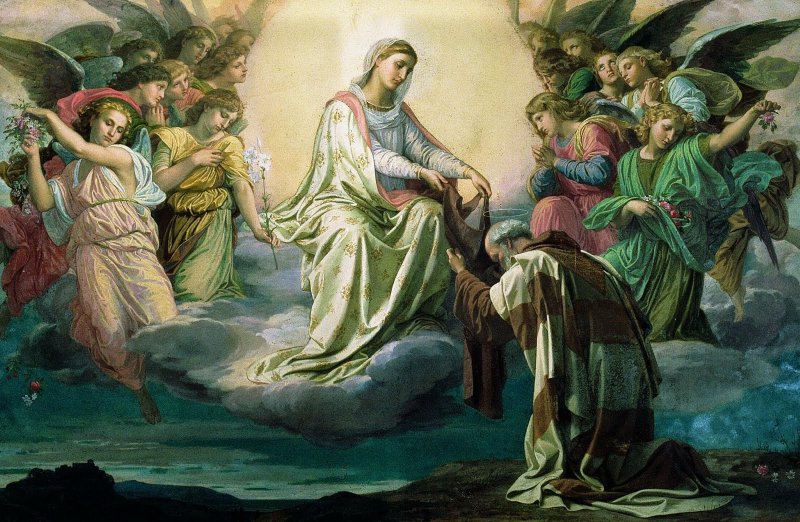
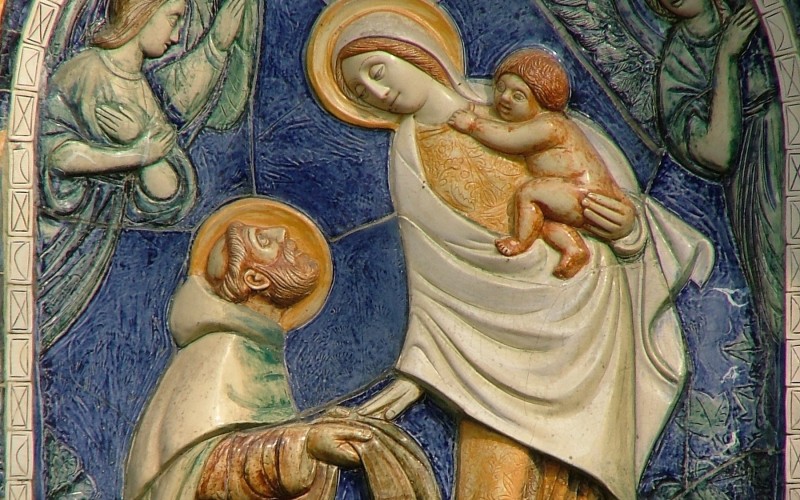
During his tenure as Superior General, Simon was graced with a visitation from the Blessed Mother, to whom he was so devoted.   Radiantly surrounded by a multitude of Angels, Our Lady of Mount Carmel appeared to him as he knelt in prayer at Aylesford, England.   Presenting to him the Carmelite Brown Scapular, she made Her Promise of unparalleled generosity to him, his spiritual children and to all those who wished to consecrate themselves to her by this special sign: Her words were:

“Receive, my beloved son, this scapular of your Order.   It is the special sign of my favour, which I have obtained for you and for your children of Mount Carmel.   He who dies clothed with this habit shall be preserved from eternal fire.   It is the badge of salvation, a shield in time of danger and a pledge of special peace and protection.”

The scapular (from the Latin, scapular, meaning “shoulder blade”) consists of two pieces of cloth, one worn on the chest and the other on the back, which were connected by straps or strings passing over the shoulders.   In certain Orders, monks and nuns wear scapulars that reach from the shoulders almost to the ground as outer garments.   Lay persons usually wear scapulars underneath their clothing, consisting of two pieces of material only a few inches square.   Although the scapular may be worn by any Catholic, even an infant, proper investiture must be done by a priest.   Subsequently, the scapular must be worn in the proper manner, the individual forfeiting its holy benefits if neglectful or careless.

Saint Simon Stock died on 16 May 1265, at the age of 100 and was buried in the cathedral of Bordeaux, where he was visiting at the time of his death.   The Saint’s bones are still preserved in a cathedral in Bordeaux;  a tibia was brought to England in the 1860s for the Carmelite church in Kensington, a part of the skull was enshrined at Aylesford in 1950.   St Simon was never formally Canonised but he has been venerated by the Carmelites since at least 1564 and the Vatican has approved the Carmelite celebration of his feast.

Pietro_Novelli_Our_Lady_of_Carmel_and_Saints
Pietro Novelli, Our Lady of Mount Carmel and Carmelite Saints (Simon Stock (standing), Angelus of Jerusalem (kneeling), Mary Magdalene de’Pazzi, Teresa of Avila), 1641 (Museo Diocesano, Palermo.)

Scapular-Vision-Shrine-12-800x500

Devotion to the Brown Scapular remains widespread and recommended by the Catholic Church.   The Carmelites continue to find meaning in the traditional story and iconography of Saint Simon Stock receiving the scapular, particularly as reflecting their filial relationship with Mary.   When St Pope John Paul II addressed the Carmelite family in 2001 on the occasion of the 750th anniversary of the bestowal of the Scapular, he said:

“Over time, this rich Marian heritage of Carmel, has become, through the spread of the Holy Scapular devotion, a treasure for the whole Church.   By its simplicity, its anthropological value and its relationship to Mary’s role, in regard to the Church and humanity, this devotion was so deeply and widely accepted, by the People of God, that it came to be expressed, in the memorial of 16 July on the liturgical calendar, of the universal Church, “the Feast of Our Lady of Mount Carmel.”

Posted in ADVENT, CARMELITES, DOCTORS of the Church, MORNING Prayers, SAINT of the DAY, The HOLY CROSS

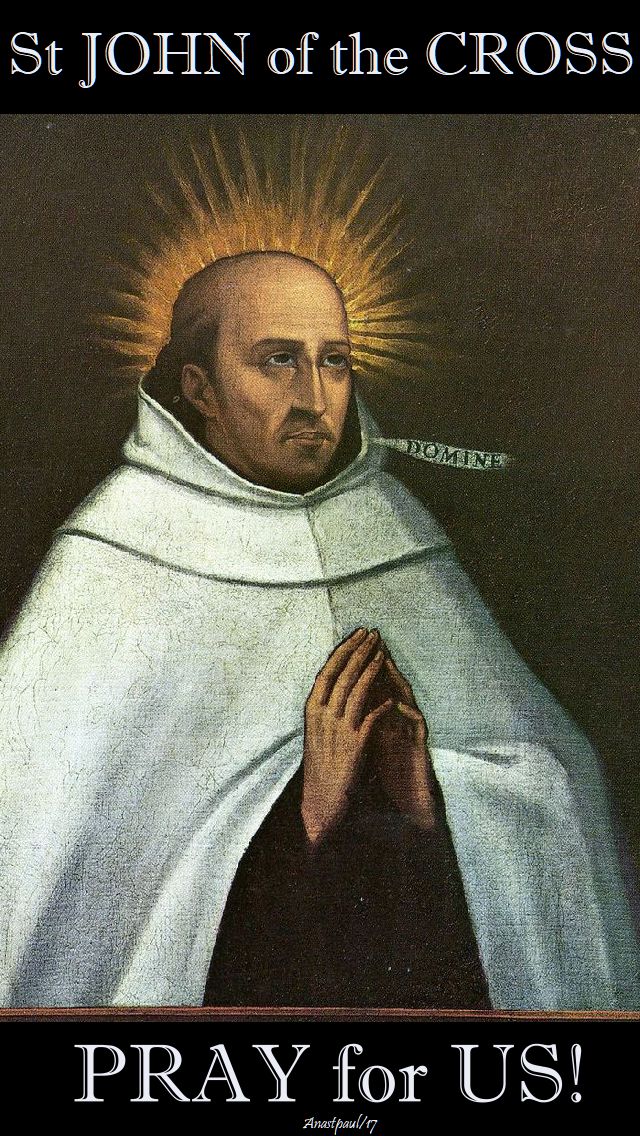
Thought for the Day – 14 December – The Memorial of St John of the Cross (1542-1591) Doctor of the Church

Thought for the Day – 14 December – The Memorial of St John of the Cross (1542-1591) Doctor of the Church

In his life and writings, John of the Cross has a crucial word for us today.   We tend to be rich, soft, comfortable.   We shrink even from words like self-denial, mortification, purification, asceticism, discipline.   We run from the cross.   John’s message—like the gospel—is loud and clear:   Don’t—if you really want to live! (Fr Don Miller OFM)

St John of the Cross – pray for us!ST J OF THE CROSS - PRAY FOR US - 14 DEC 2017

Posted in ADVENT, CARMELITES, DOCTORS of the Church, MORNING Prayers, POETRY, PRAYERS of the SAINTS, SAINT of the DAY

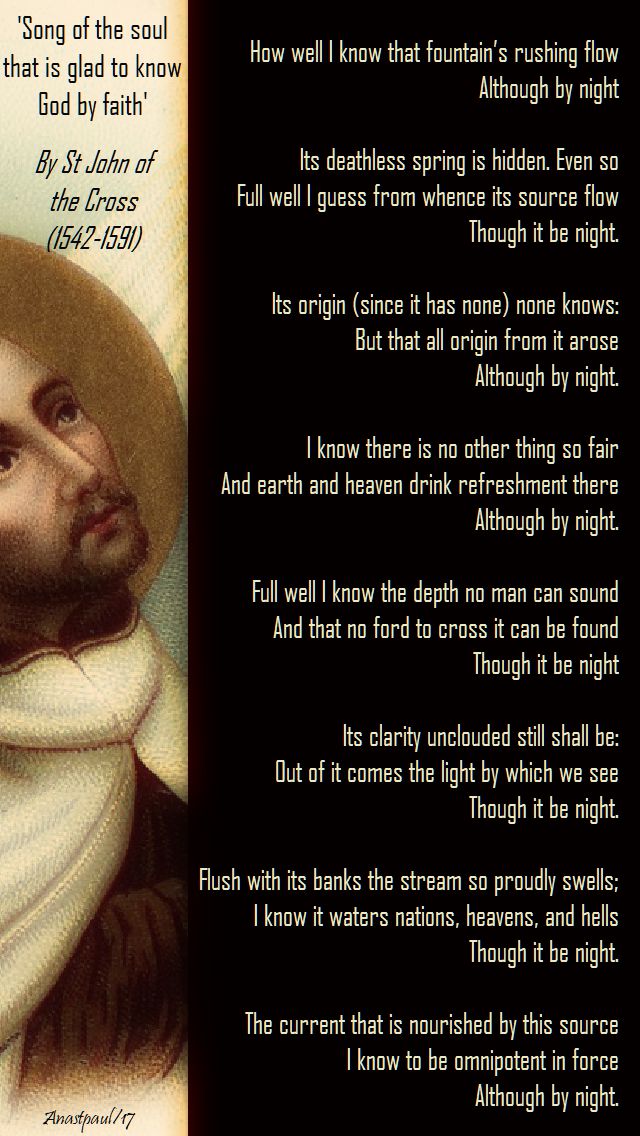
‘Song of the soul that is glad to know God by faith’

‘Song of the soul that is glad to know God by faith’

14 December – The Memorial of St John of the Cross (1542-1591) Doctor of the Church

There have been a number of translations into English of the works of St John of the Cross.   One of the translations which has been considered one of the best is that by the Anglo-South African convert poet Roy Campbell (2 October 1901 – 22 April 1957).

In October 2009, Roger Scruton wrote about Roy Campbell in his article “A Dark Horse” published in The American Spectator. He was hated by the English “left establishment” especially because of his position on The Spanish Civil War.

The Wikipedia entry says of Roy Campbell that he “was considered by T. S. Eliot, Edith Sitwell and Dylan Thomas to have been one of the best poets of the period between the First and Second World wars but he is seldom found in anthologies today.”

Campbell’s translations of the poetry by St John of the Cross were lavishly praised by Argentine writer Jorge Luis Borges

For more about Campbell`s work, R J Dent has published an essay on Roy Campbell and his work entitled: Violence and exquisite beauty – the aesthetics of Roy Campbell.

Here is a poem of St John of the Cross with the translations by the late Roy Campbell.

‘Song of the soul that is glad to know God by faith’

How well I know that fountain’s rushing flow
Although by night

Its deathless spring is hidden. Even so
Full well I guess from whence its source flow
Though it be night.

Its origin (since it has none) none knows:
But that all origin from it arose
Although by night.

I know there is no other thing so fair
And earth and heaven drink refreshment there
Although by night.

Full well I know the depth no man can sound
And that no ford to cross it can be found
Though it be night

Its clarity unclouded still shall be:
Out of it comes the light by which we see
Though it be night.

Flush with its banks the stream so proudly swells;
I know it waters nations, heavens, and hells
Though it be night.

The current that is nourished by this source
I know to be omnipotent in force
Although by night.song of the soul that is glad to know god by faith - st j of the cross - 14 dec 2017

After the beatification of St John of the Cross on 25 January 1675, the Carmelite convent of Nuestra Señora de los Remedios near Seville commissioned this life-sized statue from the young Sevillian sculptor, Francisco Antonio Gijón, then only 21.
The figure of the saint holds a quill pen in his right hand and, in the left, a book with a model of a mountain surmounted by a cross, which refers to his mystic commentary, “The Ascent of Mount Carmel.”

Francisco Antonio Gijón (1653–c. 1721) and unknown painter (possibly Domingo Mejías)
Saint John of the Cross
c 1675
Painted and gilded wood
168 cm (66 1/8 in.)


Posted in ADVENT, CARMELITES, DOCTORS of the Church, MORNING Prayers, QUOTES of the SAINTS, QUOTES on LOVE, SAINT of the DAY, The HOLY CROSS

Quotes of the Day – 14 December – The Memorial of St John of the Cross (1542-1591) Doctor of the Church

Quotes of the Day – 14 December – The Memorial of St John of the Cross (1542-1591) Doctor of the Church

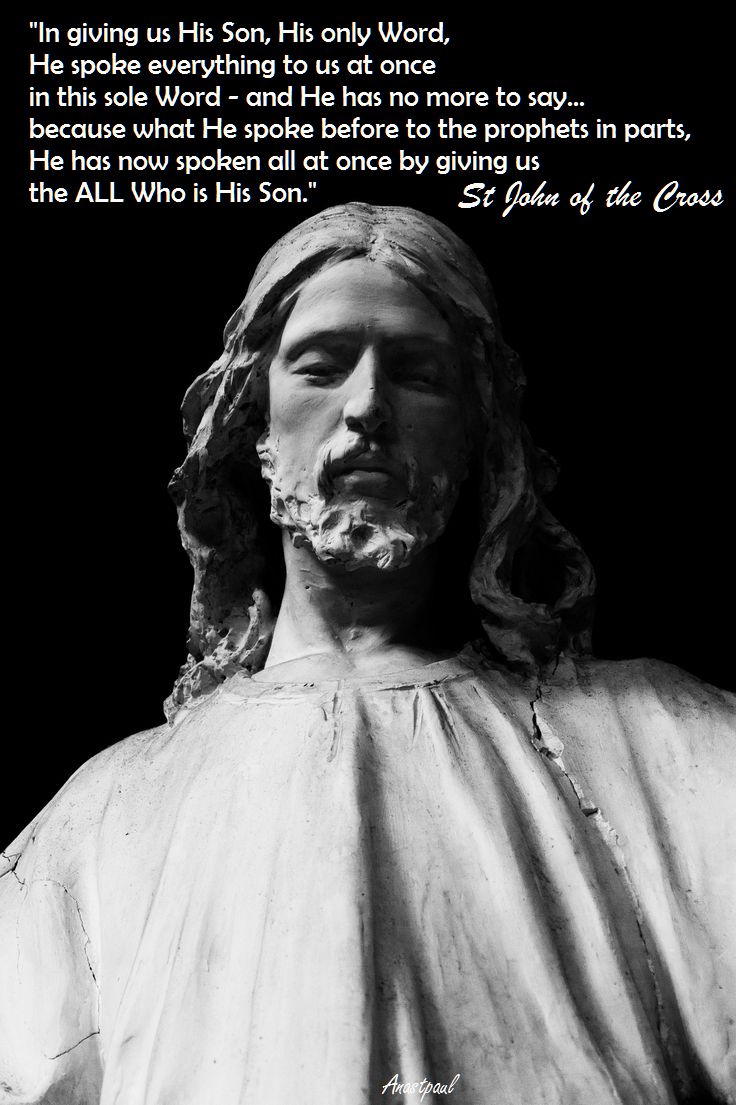
“In giving us His Son, His only Word,
He spoke everything to us at once
in this sole Word – and He has no more to say…
because what He spoke before to the prophets in parts,
He has now spoken all at once by giving us
the ALL Who is His Son.”in giving us his son - st john of the cross - 14 dec 2016

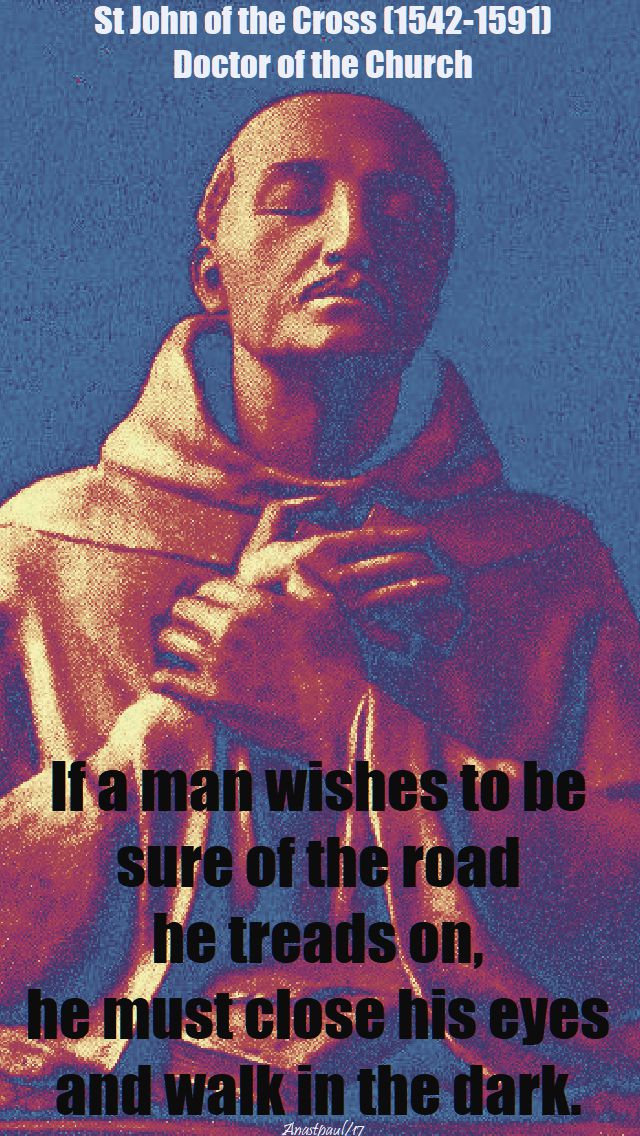
“If a man wishes to be sure of the road
he treads on, he must close his eyes
and walk in the dark.”if a man wishes to be sure of the road - st john of the cross - 14 dec 2017

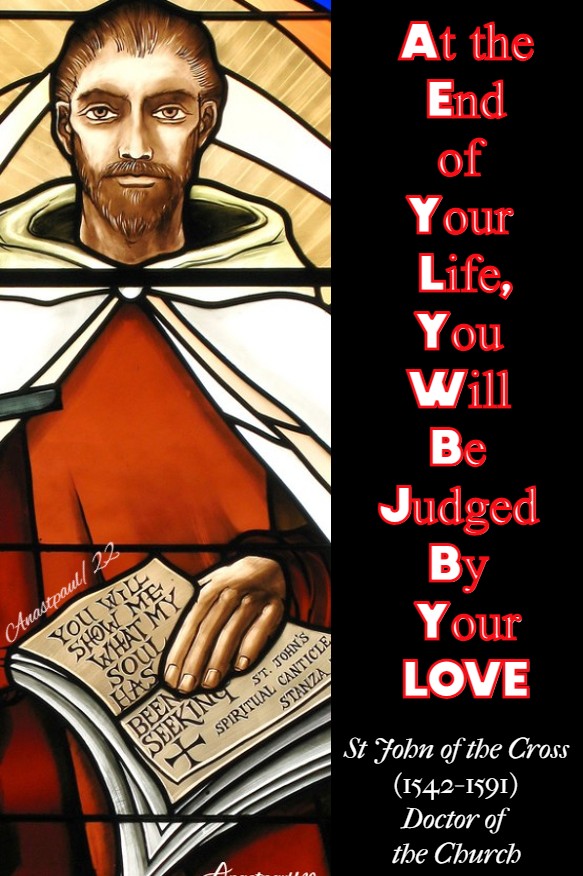
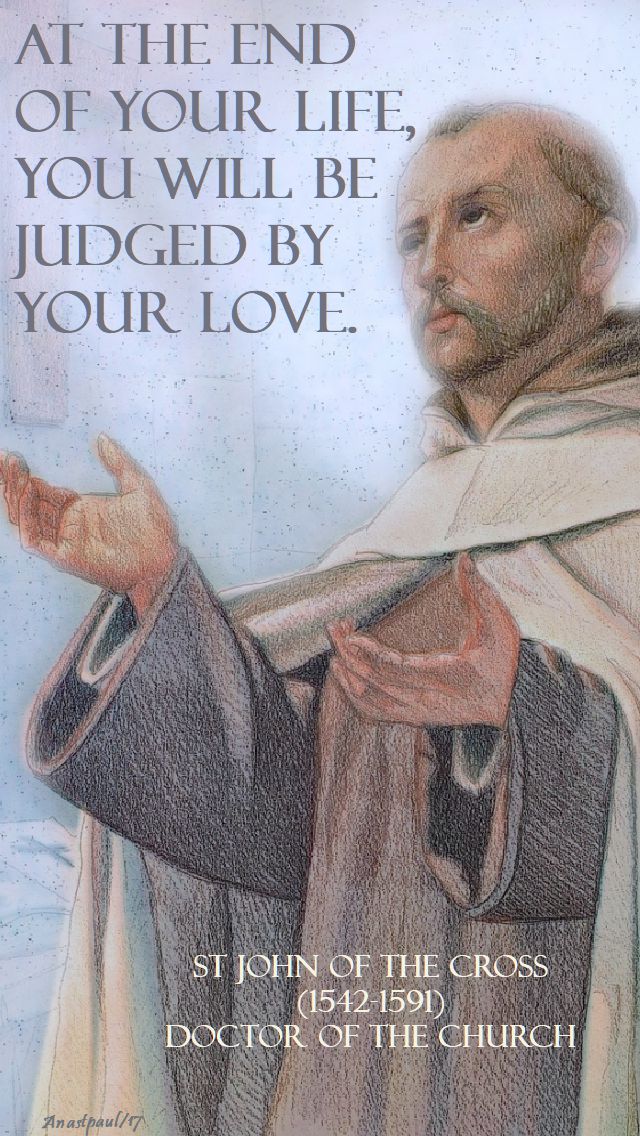
“At the end of your life,
you will be judged by your love.”

St John of the Cross (1542-1591) Doctor of the Churchat the end of your life - st j of the cross = 14 dec 2017


Posted in ADVENT, CARMELITES, DOCTORS of the Church, MORNING Prayers, QUOTES on SUFFERING, SAINT of the DAY, The WORD

One Minute Reflection – 14 December – The Memorial of St John of the Cross (1542-1591) Doctor of the Church

One Minute Reflection – 14 December – The Memorial of St John of the Cross (1542-1591) Doctor of the Church

In all truth I tell you, unless a grain of wheat
falls into the earth and dies,
it remains only a single grain;
but if it dies it yields a rich harvest…John 12:24john 12 - 24

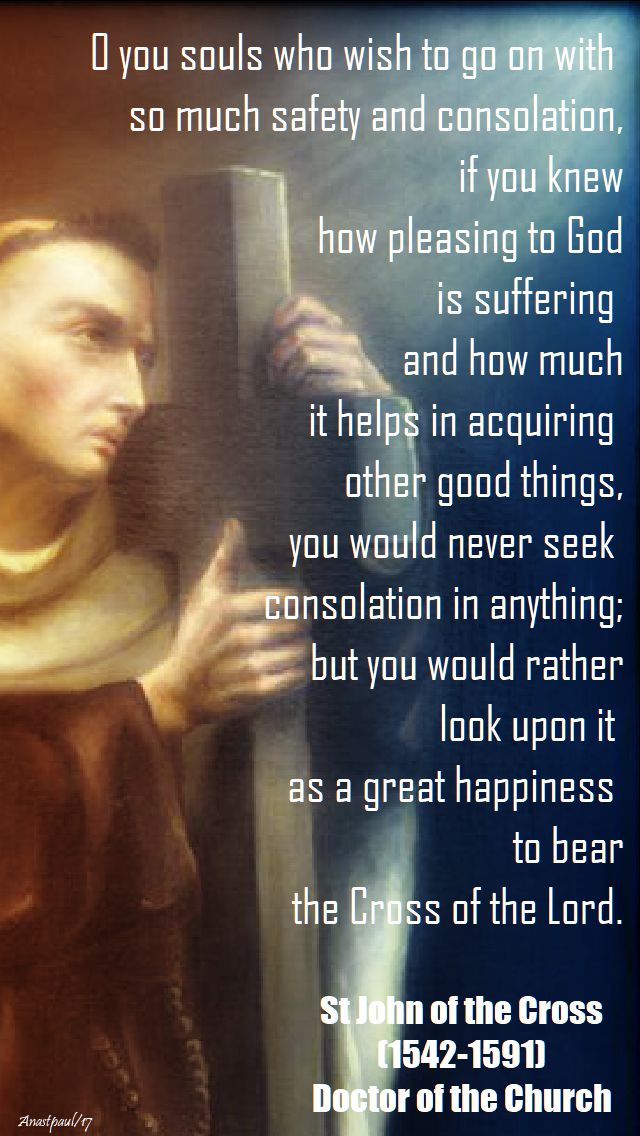
REFLECTION – “O you souls who wish to go on with so much safety and consolation, if you knew how pleasing to God is suffering and how much it helps in acquiring other good things, you would never seek consolation in anything; but you would rather look upon it as a great happiness to bear the Cross of the Lord.”…Saint John of the Crosso you souls - st john of the cross - 14 dec 2017

PRAYER – Lord God, You gave St John of the Cross, the grace of complete self-denial and an ardent love for the Cross of Christ. Grant that by following always in the footsteps of Christ and by the prayers of St John of the Cross on our behalf, we may come to the eternal vision of Your glory. Through our Lord Jesus Christ, in unity with the Holy Spirit, one God forever, amen.st john of the cross pray for us - 14 dec 2017

Posted in ADVENT, CARMELITES, DOCTORS of the Church, MORNING Prayers, PRAYERS of the SAINTS, SAINT of the DAY, Uncategorized

Our Morning Offering – 14 December – The Memorial of St John of the Cross (1542-1591) Doctor of the Church

Our Morning Offering – 14 December – The Memorial of St John of the Cross (1542-1591) Doctor of the Church

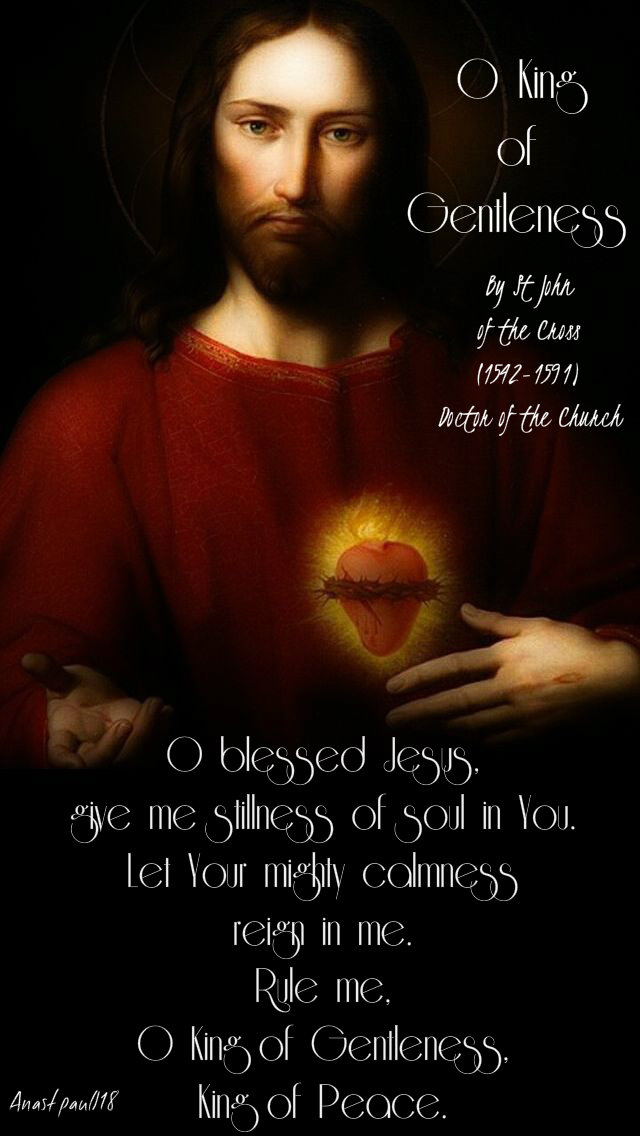
O King of Gentleness
By St John of the Cross

O blessed Jesus,
give me stillness of soul in You.
Let Your mighty calmness reign in me.
Rule me, O King of Gentleness,
King of Peace.o king of gentleness - o blessed jesus give me - st john of the cross - 14 dec 2017

Posted in ADVENT, ART DEI, CARMELITES, MORNING Prayers, ON the SAINTS, SAINT of the DAY, The HOLY CROSS

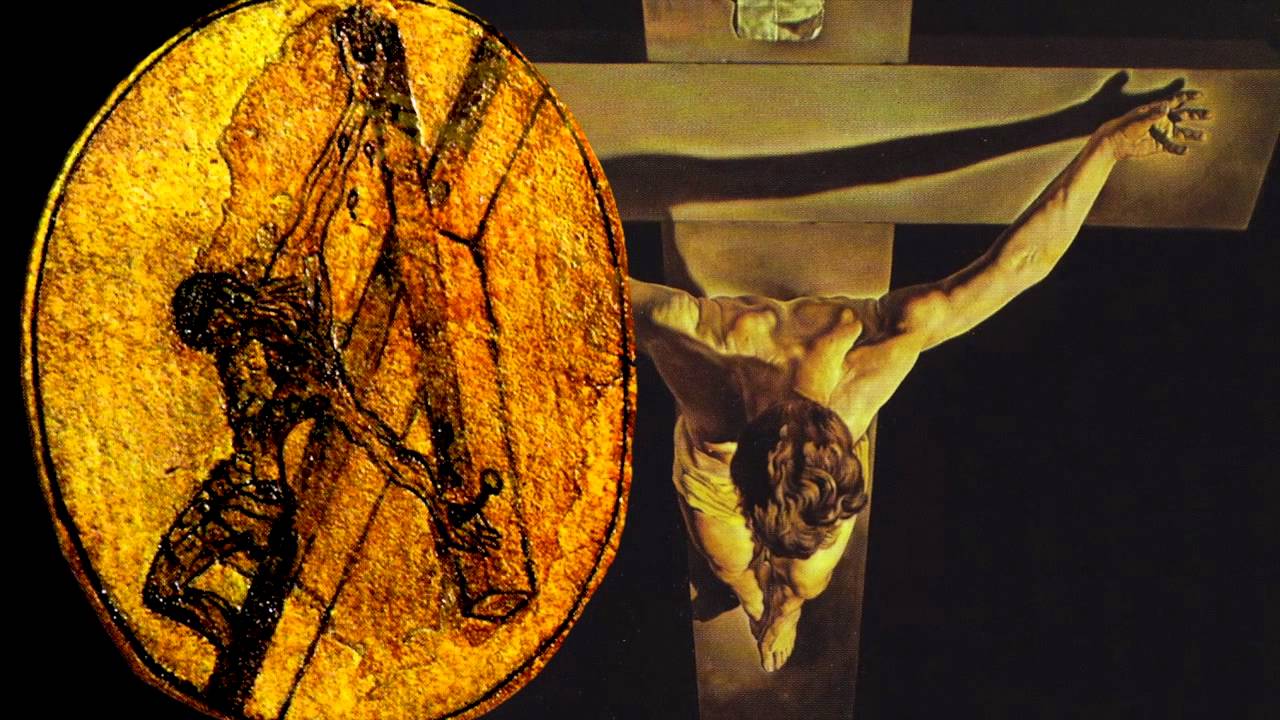
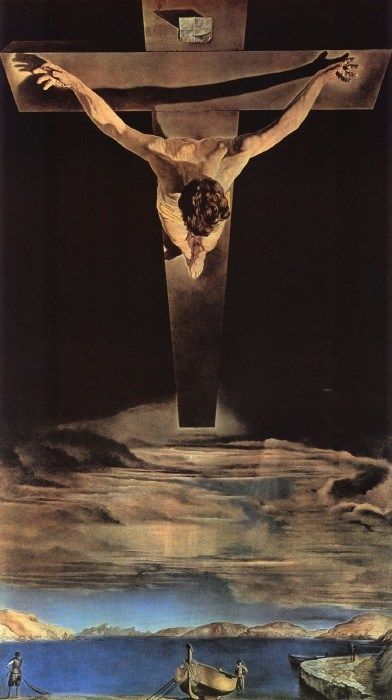
Christ of Saint John of the Cross

Christ of Saint John of the Cross is a painting by Salvador Dalí made in 1951.   maxresdefault

It depicts Jesus Christ on the cross in a darkened sky floating over a body of water complete with a boat and fishermen.   Although it is a depiction of the Crucifixion, it is devoid of nails, blood and a crown of thorns, because, according to Dalí, he was convinced by a dream that these features would mar his depiction of Christ.   Also in a dream, the importance of depicting Christ in the extreme angle evident in the painting was revealed to him.

70ddc4b4dc7e3d28326a32e29d6c4997--dali-paintings-cross-paintings

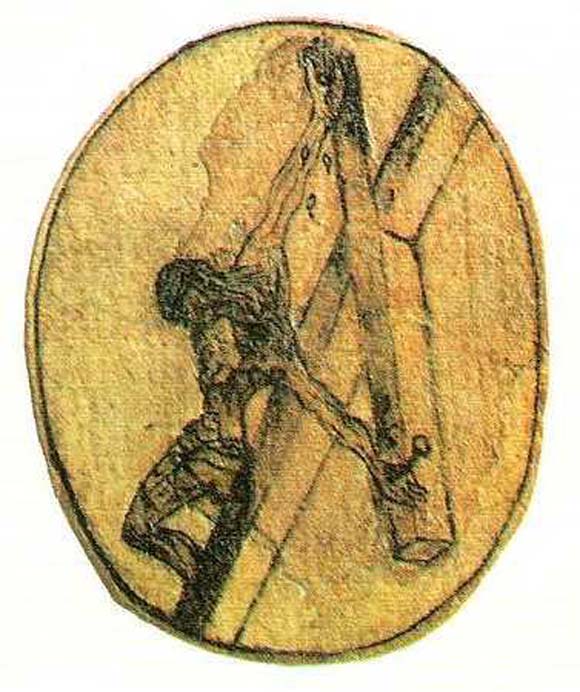
It is known by it’s Title because its design is based on a drawing by the 16th-century Spanish friar, today’s saint and a Doctor of the Church, St Jon of the Cross.   The composition of Christ is also based on a triangle and circle (the triangle is formed by Christ’s arms;  the circle is formed by Christ’s head).  The triangle, since it has three sides, can be seen as a reference to the Trinity and the  circle represents Unity.    Below is the drawing by St John of the Cross.drawing-by-st-john-of-the-cross

On the bottom of his studies for the painting, Dalí explained its inspiration:   “In the first place, in 1950, I had a ‘cosmic dream’ in which I saw this image in colour and which in my dream represented the ‘nucleus of the atom.’   This nucleus later took on a metaphysical sense;  I considered it ‘the very unity of the universe,’  the Christ!”

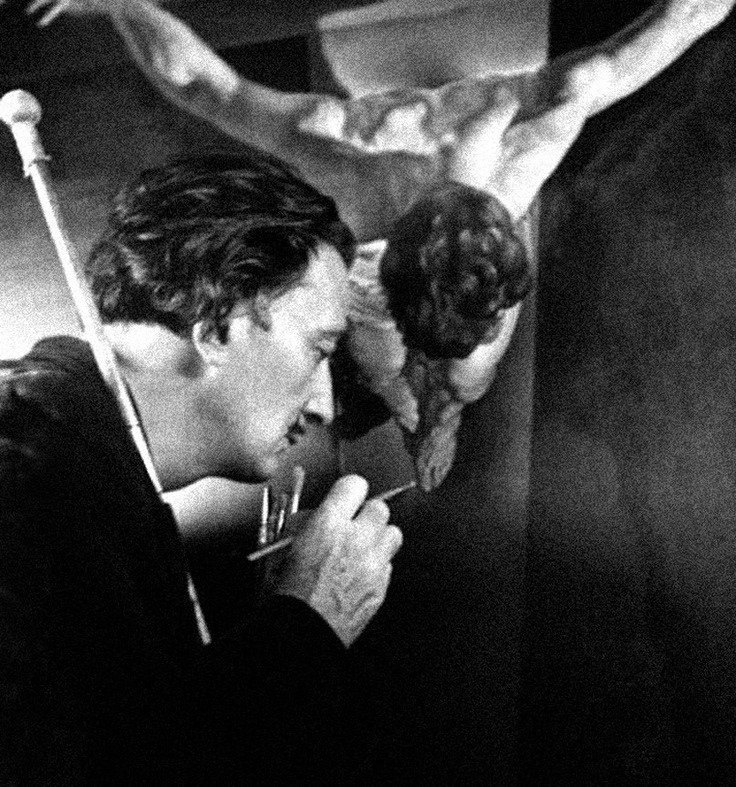
In order to create the figure of Christ, Dalí had Hollywood stuntman Russell Saunders suspended from an overhead gantry, so he could see how the body would appear from the desired angle and also envisage the pull of gravity on the human body.   The depicted body of water is the bay of Port Lligat, Dalí’s residence at the time of the painting.Salvador Dalí painting St. John of the Cross

Posted in ADVENT, CARMELITES, CONTEMPLATIVE Prayer, DOCTORS of the Church, SAINT of the DAY

Saint of the Day – 14 December – (1542-1591) Doctor of the Church

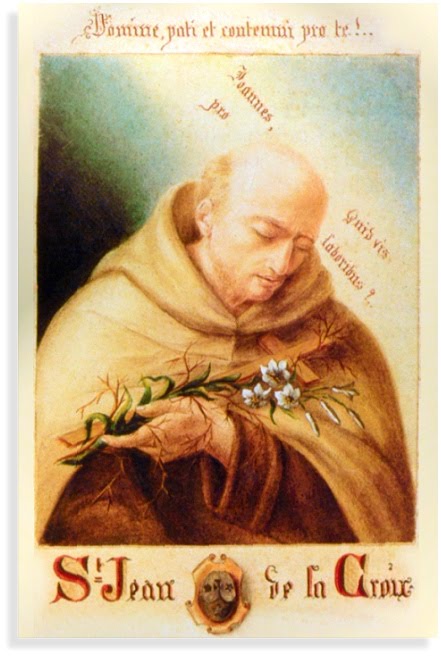
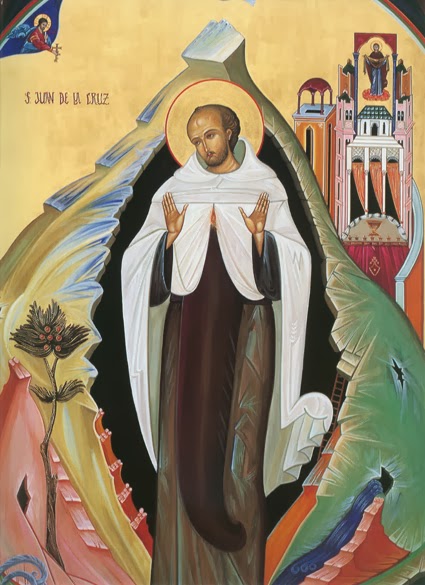
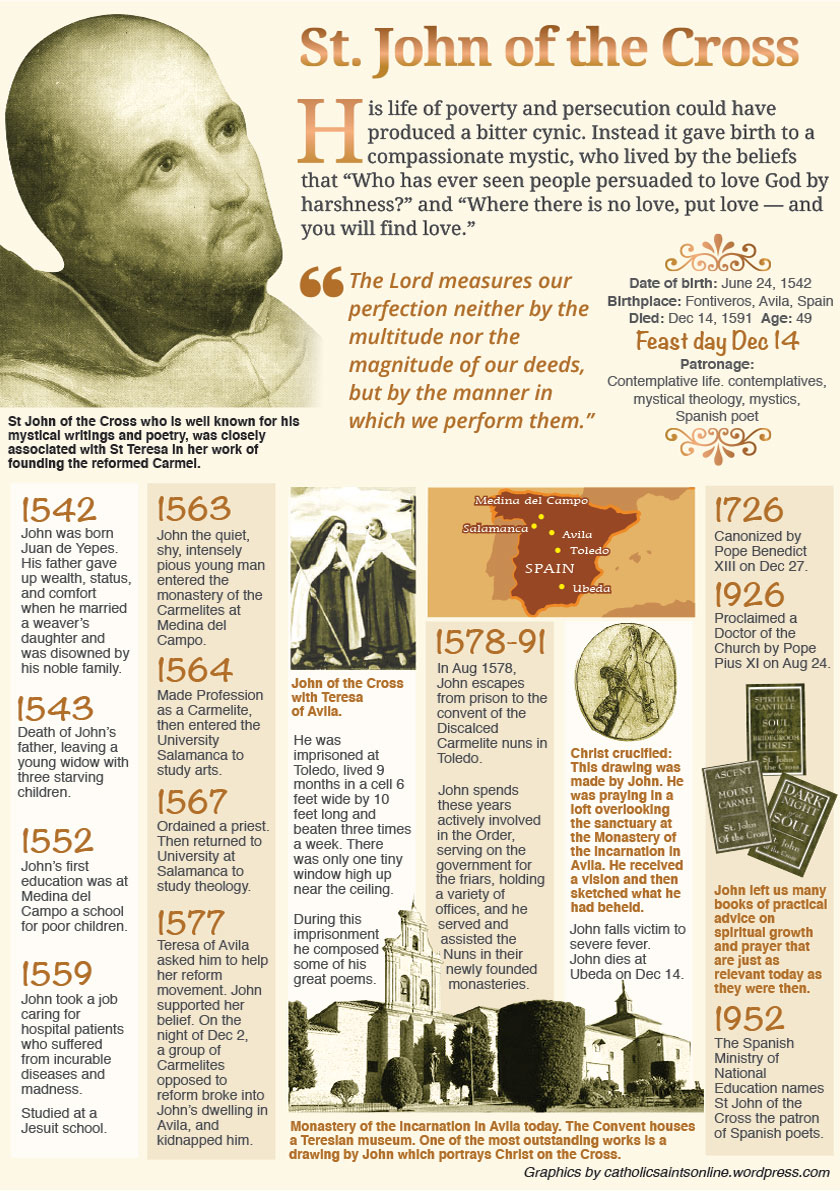
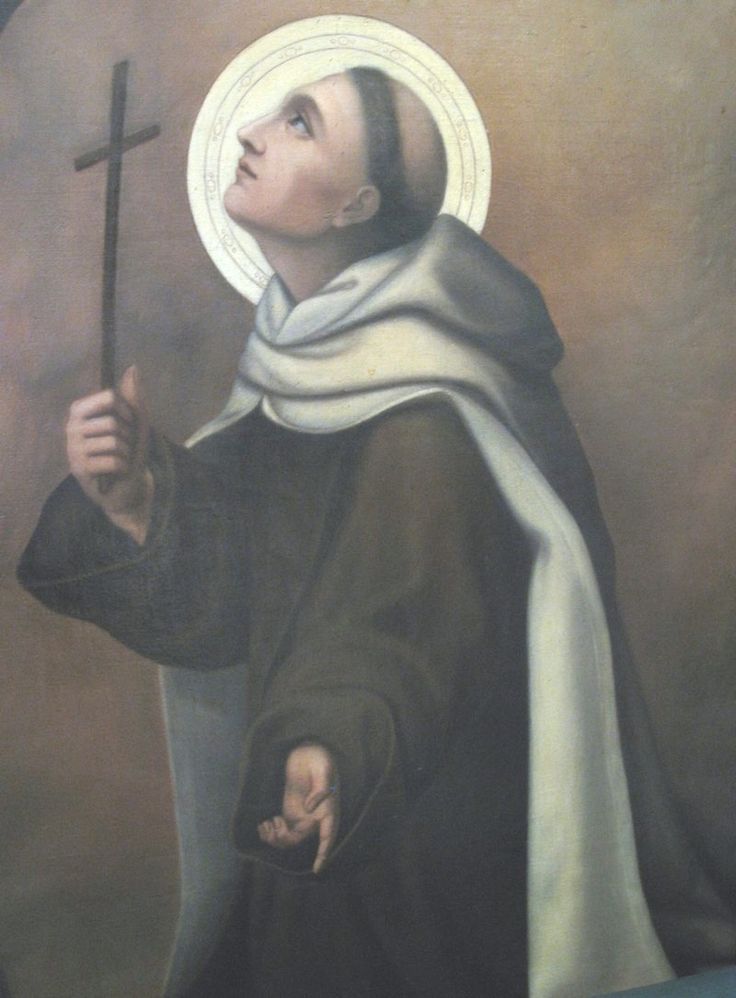
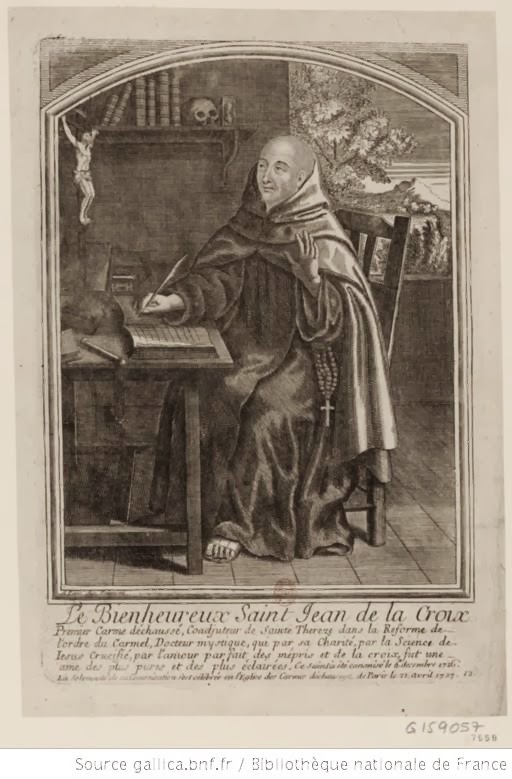
Saint of the Day – 14 December – (1542-1591) Doctor of the Church – Carmelite monk and Priest, Religious Founder, Writer, Poet, Mystic, Apostle of Contemplative Prayer.   Also known as • Doctor of Mystical Theology • John della Croce • John de la Croix • John de la Cruz.   Patronages – • contemplative life, contemplatives• mystical theology, mystics• Spanish poets• World Youth Day 2011• Segovia, Spain• Ta’ Xbiex, Malta.   Attributes – eagle, Crucifix, Cross, Carmelite habit.    John of the Cross is known for his writings.   Both his poetry and his studies on the growth of the soul are considered the summit of mystical Spanish literature and one of the peaks of all Spanish literature.   He was canonised as a saint in 1726 by Pope Benedict XIII.   He is one of the thirty-six Doctors of the Church, added by Pope Pius XI in 1926.   His works are • Ascent of Mount Carmel• Dark Night of the Soul, Book 1 • Dark Night of the Soul, Book 2 • A Spiritual Canticle of the Soul and the Bridegroom Christ.st john of the cross - infost john cross LARGE

St John was born Juan de Yepes y Álvarez into a converso family (descendents of Jewish converts to Christianity) in Fontiveros, near Ávila, a town of around 2,000 people.  John’s father had been disowned by his wealthy Spanish family when he married a poor weaver rather than a woman of equal economic status.   Living in poverty proved to be too much for him and he died shortly after John was born.   John spent much of his youth in an orphanage, where he was clothed, fed and given an elementary education.   At the age of 17, he found a job in a hospital and was accepted into a Jesuit college.   In 1563 he entered the Carmelite Order.   Eventually he enrolled in another university, where he did so well that he was asked to teach a class and to help settle disputes.

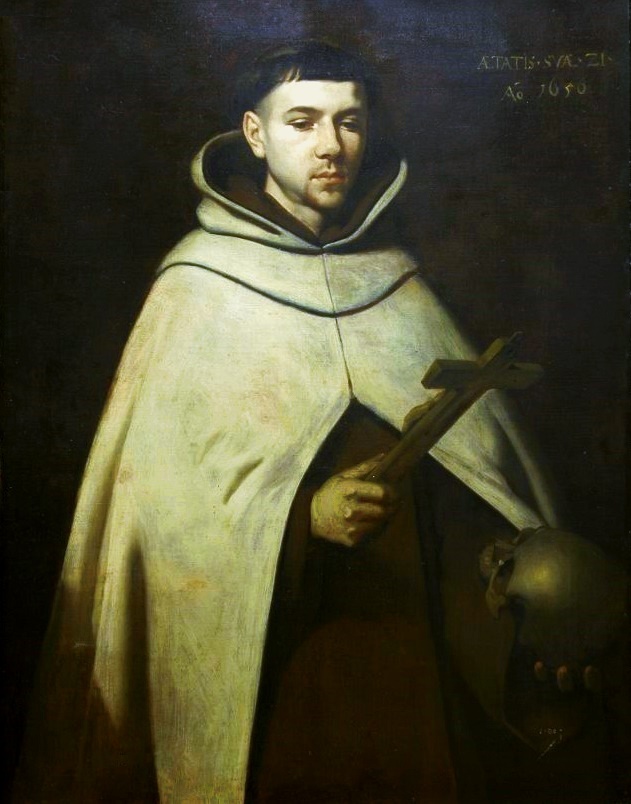
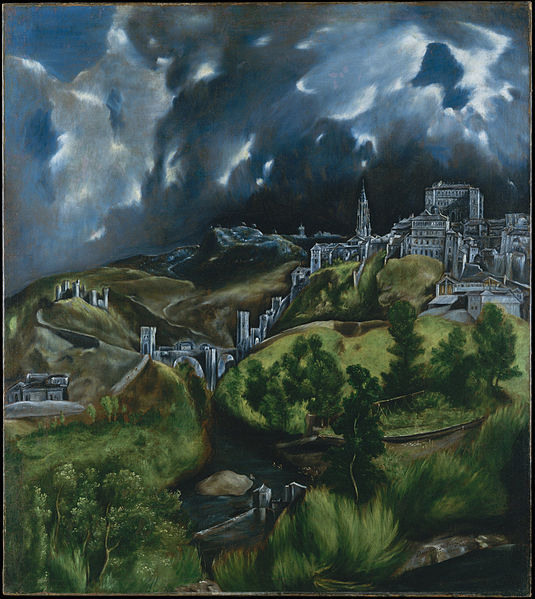
Ordained a Carmelite priest in 1567 at age 25, John met Teresa of Avila and, like her, vowed himself to the primitive Rule of the Carmelites.   As partner with Teresa and in his own right, John engaged in the work of reform and came to experience the price of reform:  increasing opposition, misunderstanding, persecution, imprisonment.    John was caught up in a misunderstanding and imprisoned at Toledo, Spain.   During those months of darkness in that little cell, John could have become bitter, revengeful, or filled with despair.   But instead, he kept himself open to God’s action, for no prison could separate him from God’s all-embracing love.   During this time he had many beautiful experiences and encounters with God in prayer.   He came to know the cross acutely—to experience the dying of Jesus—as he sat month after month in his dark, damp, narrow cell with only his God.Zurbarán_St._John_of_the_Cross. - large

Yet, the paradox!   In this dying of imprisonment John came to life, uttering poetry.   In the darkness of the dungeon, John’s spirit came into the Light.   There are many mystics, many poets-  John is unique as mystic-poet, expressing in his prison-cross the ecstasy of mystical union with God in the Spiritual Canticle.the blessed St John of the Cross


But as agony leads to ecstasy, so John had his Ascent to Mt Carmel, as he named it in his prose masterpiece.   As man-Christian-Carmelite, he experienced in himself this purifying ascent;  as spiritual director, he sensed it in others;  as psychologist-theologian, he described and analysed it in his prose writings.   His prose works are outstanding in underscoring the cost of discipleship, the path of union with God:  rigorous discipline, abandonment, purification.   Uniquely and strongly John underlines the gospel paradox: The cross leads to resurrection, agony to ecstasy, darkness to light, abandonment to possession, denial to self to union with God.   If you want to save your life, you must lose it.   John is truly “of the Cross.”   He died at 49—a life short, but full.    AND his reforms of the “Discalced” Carmelites revitalised the Order.   He was proclaimed a Doctor of the Church by Pope Pius XI on 24 August 1926.

496px-diego_de_sanabria_-_saint_john_of_the_cross_-_google_art_project
Diego de Sanabria – Saint John of the Cross
535px-el_greco_-_view_of_toledo_-_google_art_project
Image above – El Greco‘s landscape of Toledo depicts the priory in which John was held captive, just below the old Muslim alcázar and perched on the banks of the Tajo on high cliffs
Posted in CARMELITES, DOCTORS of the Church, DOMINICAN OP, EUCHARISTIC Adoration, MORNING Prayers, QUOTES of the SAINTS, SAINT of the DAY, The HOLY EUCHARIST / The HOLY MASS

Quote/s of the Day – 15 November – The Memorials of St Albert the Great (1200-1280) Doctor of the Church and St Raphael Kalinowski (1835-1907)

Quote/s of the Day – 15 November – The Memorials of St Albert the Great (1200-1280) Doctor of the Church and St Raphael Kalinowski (1835-1907)

“Nor could He have commanded anything more lovable,
for this sacrament produces love and union.
It is characteristic of the greatest love to give itself as food.
“Had not the men of my text exclaimed:
‘ Who will feed us with his flesh to satisfy our hunger?’
as if to say: ‘I have loved them and they have loved me
so much that I desire to be within them
and they wish to receive me so that the,
may become my members.’
There is no more intimate or more natural means
for them to be united to me and I to them.
Nor could He have commanded anything
which is more like eternal life.
Eternal life flows from this sacrament
because God with all sweetness
pours Himself out upon the blessed.”

St Albert the Great (1200-1280) Doctor of the Church

“Our Redeemer ever present in the most Blessed Sacrament,
extends His hands to everyone.
He opens His heart and says, ‘Come to Me, all of you.'”

St Raphael Kalinowski (1835-1907)our redeemer ever present - st raphael kalinowski - 15 nov 2017

Posted in CARMELITES, MORNING Prayers, QUOTES of the SAINTS, QUOTES on SUFFERING, SAINT of the DAY, The MOST HOLY & BLESSED TRINITY

Thought for the Day – 8 November – The Memorial of St Elizabeth of the Trinity (1880-1906)

Thought for the Day – 8 November – The Memorial of St Elizabeth of the Trinity (1880-1906)

Elizabeth Catez offers hope to any parent who struggles with a strong-willed child.   A holy terror as a toddler, she once embarrassed her mother by shouting out at Mass, “Bad priest! Bad priest! That’s my doll!”   The priest had secretly borrowed her doll to be used as the Christ Child in his creche.   But gradually Elizabeth channeled her willfulness into a determination to become a saint.

Elizabeth’s first communion and confirmation at age 10 touched her deeply without quelling her rambunctiousness.   But from that time she opened up to an interior prayer life that slowly matured into the infused contemplation of a mystic.   At 14 she felt drawn to choose Christ as her spouse.   Without hesitating she made a private vow of virginity. And having been intrigued by visits to the local Carmelite convent at Dijon, France, since childhood, she was determined to become a Carmelite.

Marie, her mother, was horrified at the thought.   She did all she could do to prevent it. She sent Elizabeth to parties in hopes that these might distract her and arranged for suitors to pursue her.   But she could not in the end resist her daughter’s strong will.   She gave up and allowed Elizabeth to enter the Dijon Carmel in 1901.

Appropriately, she took the name Elizabeth of the Trinity, for the focus of her life became her immersion in the Godhead, or rather the Trinity’s immersion in her.   This letter from Elizabeth to a friend typifies her spirituality:

I love to penetrate beyond the veil of the soul to this inner sanctuary where we live alone with God.   He wants us entirely to Himself and is making there within us a cherished solitude.   Listen to everything that is being sung . . . in His heart.   It is Love, the infinite love that envelops us and desires to give us a share . . . in all His blessedness.   The whole Blessed Trinity dwells in us, the whole of that mystery which will be our vision in heaven.  I am “Elizabeth of the Trinity”—Elizabeth disappearing, losing herself, allowing herself to be invaded by the Three…All day long let us surrender ourselves to Love, by doing the will of God, under His gaze, with Him, in Him, for Him alone. . . . And then, when evening comes, after a dialogue of love that has never stopped in our hearts, let us go to sleep still in love. And if we are aware of any faults, let us simply abandon them to Love, which is a consuming fire and so do our purgatory in His love!

Like St Theresa Margaret of the Sacred Heart, another Carmelite, Elizabeth delighted the other sisters in the cloister with her simple and joyful service.   However, in 1903, she contracted Addison’s disease.   She suffered intensely and joyfully until she died in 1906. St. Elizabeth of the Trinity was only 26-years-old.

“During painful times, when you feel a terrible void, think how God is enlarging the capacity of your soul, so that it can receive Him – making it, as it were, infinite as He is infinite.”   Look upon each pain, as a love token coming to you directly from God, in order to unite you to Him.during painful times - st elizabeth of the trinity - 8 nov 2017

St Elizabeth of the Trinity, Pray for us!st elizabeth pray for usno2

Posted in CARMELITES, MORNING Prayers, QUOTES on SANCTITY, SAINT of the DAY, The WORD

One Minute Reflection – 8 November – The Memorial of St Elizabeth of the Trinity (1880-1906)

One Minute Reflection – 8 November – The Memorial of St Elizabeth of the Trinity (1880-1906)

“Father, I will that where I am, they also whom you have given me may be with me….” John 17:24john 17 24

REFLECTION – “Jesus’ desire is for us to be with Him in communion.   This is what He aches for, His deepest desire that He prays for.   This is what Jesus was doing the night before He died.” …St Elizabeth of the Trinityjesus' desire - st elizabeth of the trinity - 8 nov 2017

PRAYER – My Lord and my God, You have prayed that I may be in You and You in me.   This is the guiding consolation of my life and the source of my prayer.   Lead me to Yourself, guide me and teach me that I may never stray from You.   Holy St Elizabeth of the Trinity, in your young life you followed the way of the Lord, the way of the Cross, doing all for God by the love of the Holy Spirit.   Please pray for us, amen.st elizabeth pray for us

Posted in CARMELITES, MORNING Prayers, PRAYERS of the SAINTS, SAINT of the DAY, The MOST HOLY & BLESSED TRINITY

Our Morning Offering – 8 November – The Memorial of St Elizabeth of the Trinity (1880-1906)

Our Morning Offering – 8 November – The Memorial of St Elizabeth of the Trinity (1880-1906)

Holy Trinity, Whom I Adore
By St Elizabeth of the Trinity

O my God, Trinity whom I adore, let me entirely forget myself that I may abide in You, still and peaceful as if my soul were already in eternity; let nothing disturb my peace nor separate me from You, O my unchanging God but that each moment may take me further into the depths of Your mystery! Pacify my soul! Make it Your heaven, Your beloved home and place of Your repose; let me never leave You there alone but may I be ever attentive, ever alert in my faith, ever adoring and all given up to Your creative action.

O my beloved Christ, crucified for love, would that I might be for You a spouse of Your heart! I would anoint You with glory, I would love You – even unto death! Yet I sense my frailty and ask You to adorn me with Yourself; identify my soul with all the movements of Your soul, submerge me, overwhelm me, substitute Yourself in me that my life may become but a reflection of Your life. Come into me as Adorer, Redeemer and Saviour.

O Eternal Word, Word of my God, would that I might spend my life listening to You, would that I might be fully receptive to learn all from You. In all darkness, all loneliness, all weakness, may I ever keep my eyes fixed on You and abide under Your great light; O my Beloved Star, fascinate me so that I may never be able to leave Your radiance.

O Consuming Fire, Spirit of Love, descend into my soul and make all in me as an incarnation of the Word, that I may be to Him a super-added humanity wherein He renews His mystery; and You O Father, bestow Yourself and bend down to Your little creature, seeing in her only Your beloved Son in whom You are well pleased.

O my `Three’, my All, my Beatitude, infinite Solitude, Immensity in whom I lose myself, I give myself to You as a prey to be consumed; enclose Yourself in me that I may be absorbed in You so as to contemplate in Your light the abyss of Your Splendour!holy trinity whom I adore - st elizabeth of the trinity - 8 nov 2017

Posted in CARMELITES, SAINT of the DAY

Saint of the Day – 8 November – St Elizabeth of the Trinity O.C.D. (1880-1906)

Saint of the Day – 8 November – St Elizabeth of the Trinity O.C.D. (1880-1906) – professed Religious, Mystic, Writer, gifted Pianist.   Born Elizabeth Catez on Sunday 18 July 1880 in a military camp in the diocese of Bourges, France  – 9 November 1906 at Dijon, Côte-d’Or, France of Addison’s disease, a hormone disorder whose side effects are painful and exhausting.  Pope John Paul II beatified Elizabeth on 24 November 1984 and Pope Francis Canonised her on 16 October 2016.   Patronages – • against the death of parents • against bodily ills, illness or sickness • sick people.

Elizabeth was born on 18 July 1880 at the army camp in Avor near Bourges in France, where her father was a captain.    She was baptised four days later on the Feast of St. Mary Magdalene, a fact which she treasured.    When she was 2½ her sister Marguerite, known as Guite, was born.   Elizabeth’s father died when she was only seven years old.   By this time the family was living in a camp in Dijon but after the captain died, they moved into a flat.   Elizabeth could see the Carmel of Dijon from her bedroom window.   She was very high spirited and given to fiery outbursts of anger when things did not go her way.   In 1891 Elizabeth received her First Holy Communion and it made a deep impression on her.   From this time on the Eucharist became the centre of Elizabeth’s life and it gave her the strength and determination she needed to make a real effort to overcome her rages.
When she was eight Elizabeth’s mother enrolled her in the Conservatoire, probably with the intention of preparing her to teach music.   Elizabeth practised the piano for several hours each day;  she was an exceptionally gifted pianist.   She often played in concerts and when she was thirteen she won first prize for her playing.   She could undoubtedly have gone on to become a concert pianist but God had other plans for her.
Around the time of her fourteenth birthday Elizabeth made a vow of virginity, as an act of total self-offering to God.   She had already felt the call to religious life and one day after receiving Holy Communion she became convinced God was calling her to Carmel.

first communion

Meanwhile she spent happy holidays with her mother and sister.   Elizabeth dressed in the latest fashions, enjoyed dances and loved walking in the country, where she appreciated all the beauties of creation.   She had a great gift for friendship and was popular with her peers but in everything God was at the centre.   She said that when she played the piano she forgot all about the audience and played only for Him.
Elizabeth had a natural gift for contemplative prayer, people remarked on her total stillness and said that she seemed ‘Lost in God’ but she was active in her parish too.   She taught catechism and ran a club for the children of workers in a tobacco factory;  she visited the sick and sang in the parish choir.

Elizabeth entered the Carmel of Dijon on 2 August 1901 and on 8 December  Feast of the Immaculate Conception, she was clothed in the Carmelite habit.

Elizabeth was full of joy as a postulant;  she found God everywhere, in her work as well as at prayer.   She loved the silence of her cell where she could listen to Him speaking to her in the scriptures.   Her novitiate year was not so smooth, as with her great desire for perfection she struggled with scruples.   Elizabeth lived  in pure faith, during her novitiate;  it was a purification which strengthened her and gave her courage.   Mother Germaine, at 31 was Elizabeth’s prioress and novice mistress.   She understood Elizabeth and emphasised the way of confidence in the merciful love of God, as expressed by Thérèse of Lisieux in her Story of a Soul, which had been sent to the Carmels as Thérèse’s obituary circular about three years before Elizabeth entered.

Elizabeth made her Profession as a Carmelite on J11 January 1903 and on 21 January, the Feast of St. Agnes, she received the black veil in a public ceremony.
Elizabeth shared in her sister’s joy when she married and again later when she had her first two children.   Seeing her sister so happy and devoted to her husband, made Elizabeth reflect on her role as spouse of Christ.   She wanted to love Him with an undivided heart, to stay with Him all the time in deep communion; to share in His redemptive suffering and prayer and so become fruitful, by nourishing others and drawing them to Him.

Elizabeth’s horizons were expanding; as she pondered the scriptures she felt she was being transformed into another humanity for Christ, an idea which she developed from Paul’s text ‘It is no longer I who live but Christ lives in me’.  She had an intuitive grasp of the ‘universal call to holiness’ long before it was named in the Church.st elizabeth - carmel

Elizabeth also had a strong awareness of the indwelling of the Trinity.   She often called the Trinity ‘My Three’ and had an intimate relationship with Father, Word and Spirit, as she usually called them.   Later she discovered her vocation to be a ‘Praise of glory’ and sometimes she even signed herself by this name.

Around the time of her twenty-third birthday it became clear that Elizabeth’s health was failing, she had developed Addison’s disease, at that time incurable.    It led to her death at the age of 26 on 9 November 1906.   By this time she was fully surrendered to God and died saying, ‘I am going to Light to Love to Life!’