Posted in QUOTES of the SAINTS, SAINT of the DAY

Quote of the day – 30 June

Quote/s of the Day – 30 June

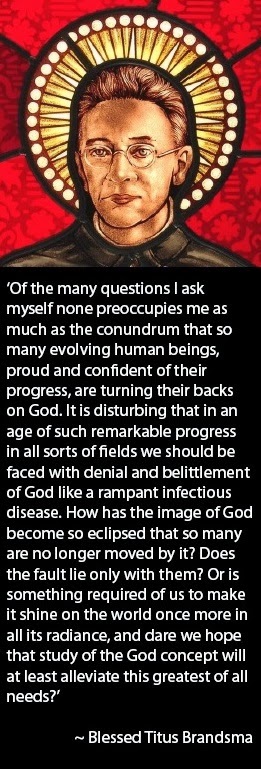
“Of the many questions I ask myself none preoccupies me as much as the conundrum that so many evolving human beings, proud and confident of their progress, are turning their backs on God. It is disturbing that in an age of such remarkable progress in all sorts of fields we should be faced with denial and belittlement of God like a rampant infectious disease. How has the image of God become so eclipsed that so many are no longer moved by it? Does the fault lie only with them? Or is something required of us to make it shine on the world once more in all its radiance, and dare we hope that study of the God concept will at least alleviate this greatest of all needs?”

of the many questions I ask myself...bl titus brandsma

“He who wants to win the world for Christ,must have the courage, to come in conflict with it.”

he wh wants to win the world-bl titus brandsma

Blessed Titus Brandsma

Posted in QUOTES of the SAINTS, SAINT of the DAY, The WORD

One Minute Reflection – 30 June

One Minute Reflection – 30 June

Just as we have a share in Christ’s many sufferings, so also through Christ, we share in his great help……2 Cor 1:4-5

REFLECTION – “Christians celebrate the memory of the martyrs with religious ceremony in order to arouse emulation and in order that they may be associated with their merits and helped by their prayers. But to none of the martyrs do we erect altars as we do to the God of martyrs; we erect altars at their shrines. For what bishop standing at the altars over the bodies of martyrs ever said: We offer to Peter or Paul or Cyprian?
Mass is offered to God who crowned the martyrs, at the shrine of the martyrs, so that the very spot may remind us to arouse in ourselves a more fervent charity toward those whom we imitate and toward Him who gives us the power to do so.”……..St Augustine

PRAYER – Lord God, you consecrated with the blood of the martyrs the fertile beginnings of the Roman Church. Grant us the grace to rejoice at the martyrs’ victory and strengthen us with firm courage as we remember their endurance of such a trial. Through our Lord Jesus Christ, in union with the Holy Spirit, one God forever and ever. Holy Martyrs of the early Church of Rome, Pray for us, amen.

first martyrs of the church of rome.- pray for us

Posted in DOCTORS of the Church, FATHERS of the Church, FEASTS and SOLEMNITIES, MORNING Prayers, QUOTES of the SAINTS, SAINT of the DAY, The APOSTLES & EVANGELISTS

Quote/s of the Day – 29 June

Quote/s of the Day – 29 June

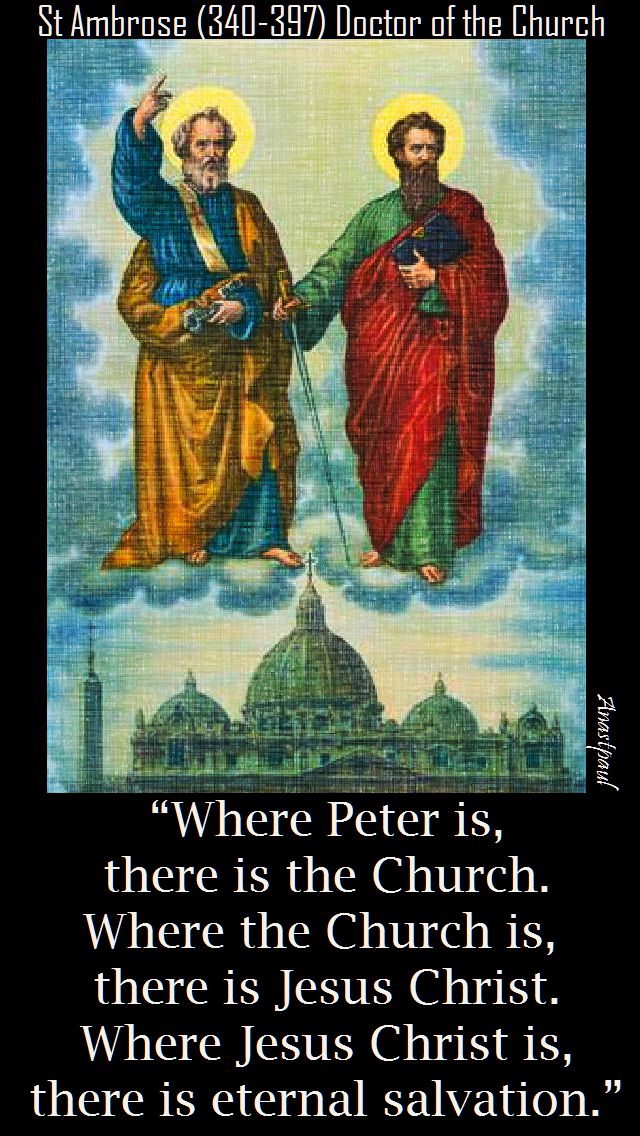
“Where Peter is,
there is the Church.
Where the Church is,
there is Jesus Christ.
Where Jesus Christ is,
there is eternal salvation.”

St Ambrose (340-397)
One of the original four Doctors of the Church

where peter is 2

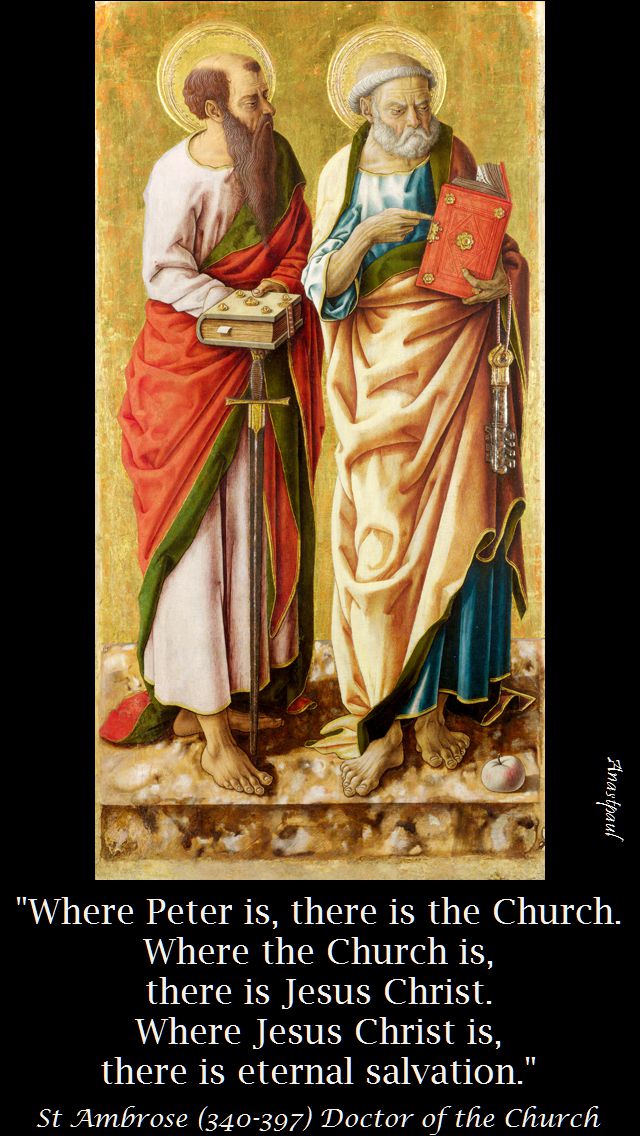
where peter is, there is the church - st ambrose

“There must be general rejoicing, dearly beloved,
over this holy company whom God has appointed
for our example in patience and for our confirmation in faith.
But we must glory even more in the excellence of their fathers,
Peter and Paul, whom the grace of God has raised
to such a height among all the members of the Church
that He has set them like twin lights
of eyes in that Body whose head is Christ.”

St Pope Leo the Great (400-461) Doctor of the Church’s Unity

he has set them like twinlight - st pope leo the great


Posted in FATHERS of the Church, FEASTS and SOLEMNITIES, MORNING Prayers, QUOTES of the SAINTS, SAINT of the DAY, The APOSTLES & EVANGELISTS, The WORD

One Minute Reflection – 29 June

One Minute Reflection – 29 June

“Their sound has gone out into all the earth and their words to the ends of the world” ……….Psalm 19

psalm 19 - sts peter and paul

REFLECTION – “There is one day for the passion of two apostles. But these two also were as one; although they suffered on different days, they were as one. Peter went first, Paul followed. We are celebrating a feast day, consecrated for us by the blood of the apostles. Let us love their faith, their lives, their labours, their sufferings, their confession of faith, their preaching.”………St Augustine

these two also were as one-staugustine

PRAYER – Almighty God, whose blessed Apostles Peter and Paul glorified you by their martyrdom: grant that your Church, instructed by their teaching and example and knit together in unity by your Spirit, may ever stand firm upon the one foundation, which is Jesus Christ our Lord;  who lives and reigns with you, in the unity of the Holy Spirit, one God, for ever and ever. Sts Peter and Paul, pray for us and for the universal Church, amen.

sts peter and paul - pray for us

Posted in FATHERS of the Church, MORNING Prayers, QUOTES of the SAINTS, SAINT of the DAY, The WORD

One Minute Reflection – 28 June

One Minute Reflection – 28 June

Everyone who looks upon the Son
and believes in him shall have eternal life………….John 6:40

john 6-40

REFLECTION – “The Father made God visible to human beings through numerous mysteries to prevent them from losing everything – even their very lives. For the glory of God is the living person and the life of a person is the vision of God.”………..St Irenaeus – Father of the Church

the fathr made god visible-st irenaeus

PRAYER – Heavenly Father, You left us Your Church and Your Vicar the Holy Father our Pope, to insure our contact with You. Let me always cling to Your Church and follow its teachings in every detail and with all my heart. St Irenaeus, please pray for us all the members of Body of Christ, the one Holy Catholic and Apostolic Church, amen.

st irenaeus - pray for us

Posted in FATHERS of the Church, MORNING Prayers, QUOTES of the SAINTS, SAINT of the DAY

Quotes of the Day – 28 June

Quotes of the Day – 28 June

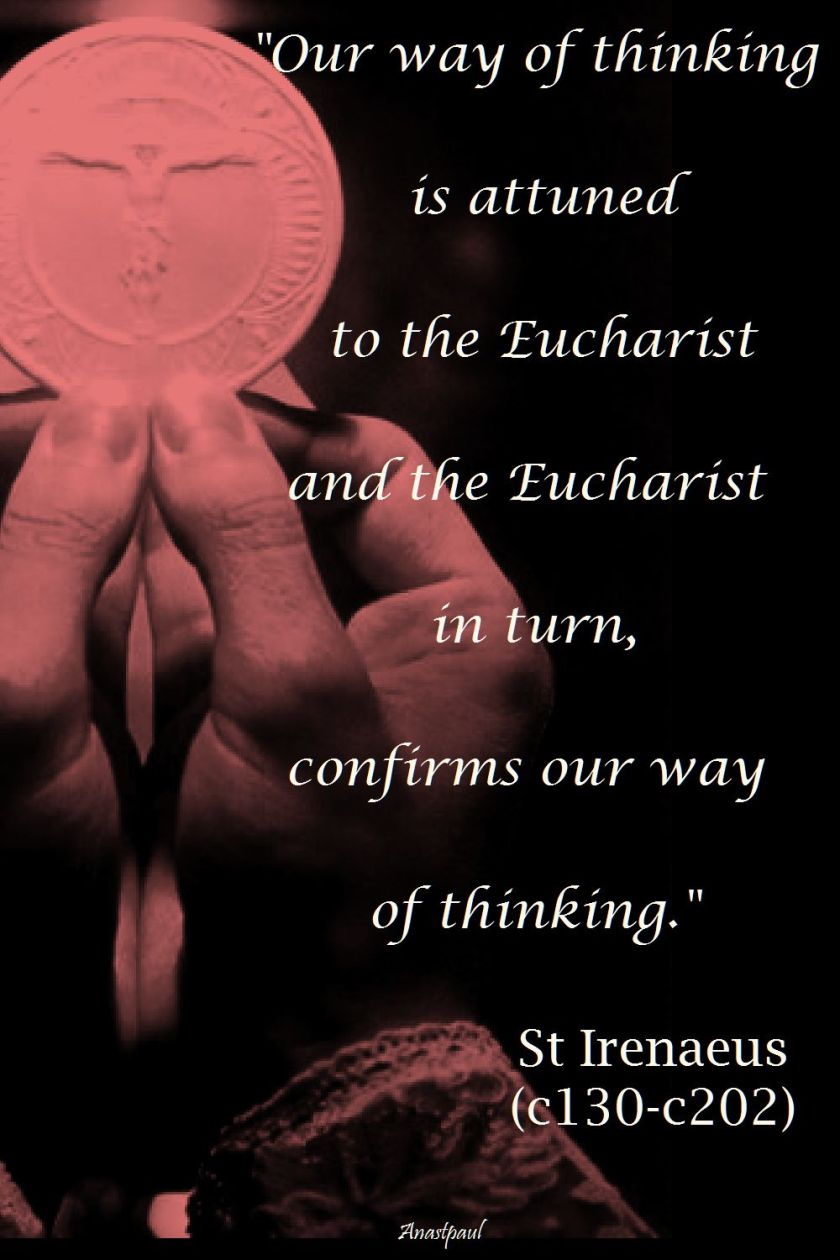
“Our way of thinking is attuned to the Eucharist
and the Eucharist in turn, confirms our way of thinking.”

our way of thinking - st irenaeus

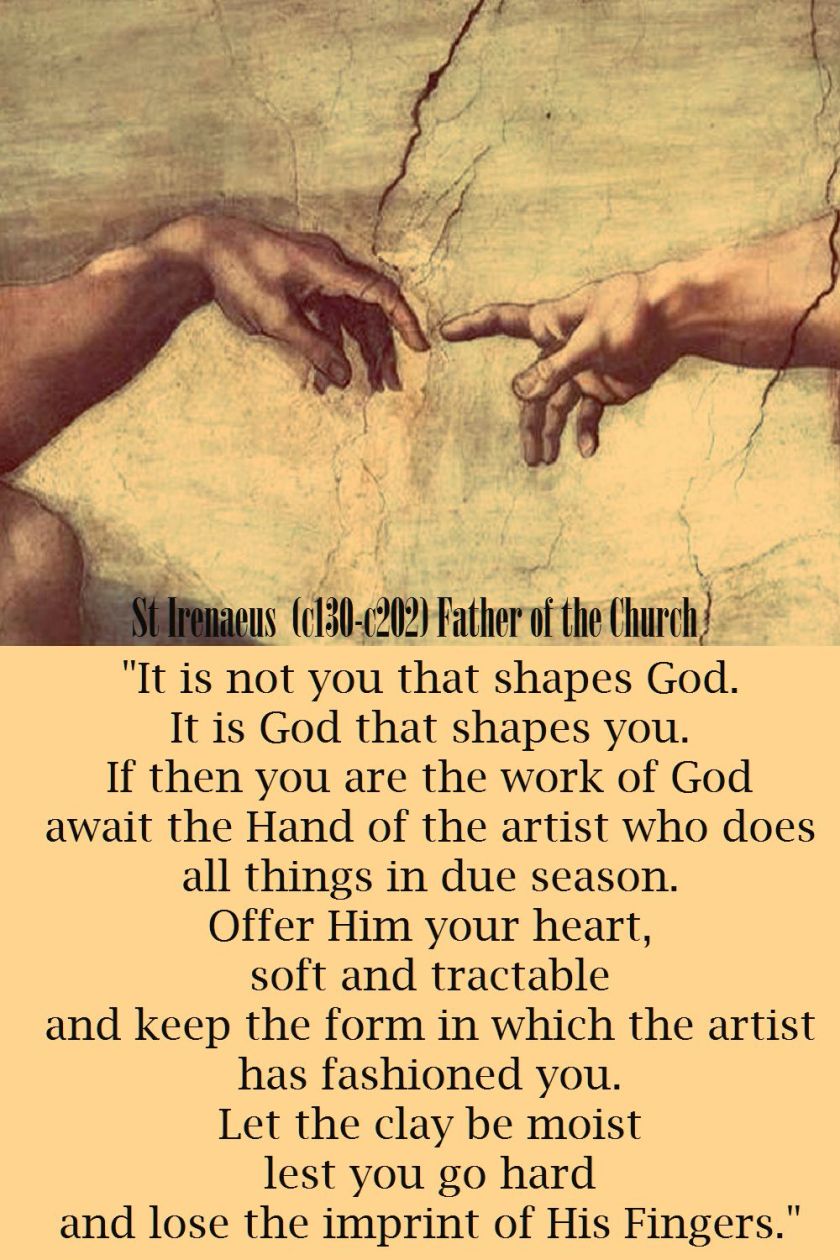
“It is not you that shapes God.
It is God that shapes you.
If then you are the work of God
await the Hand of the artist who does
all things in due season.
Offer Him your heart,
soft and tractable
and keep the form in which the artist
has fashioned you.
Let the clay be moist
lest you go hard
and lose the imprint of His Fingers.”

it is not you that shapes god-strenaeus

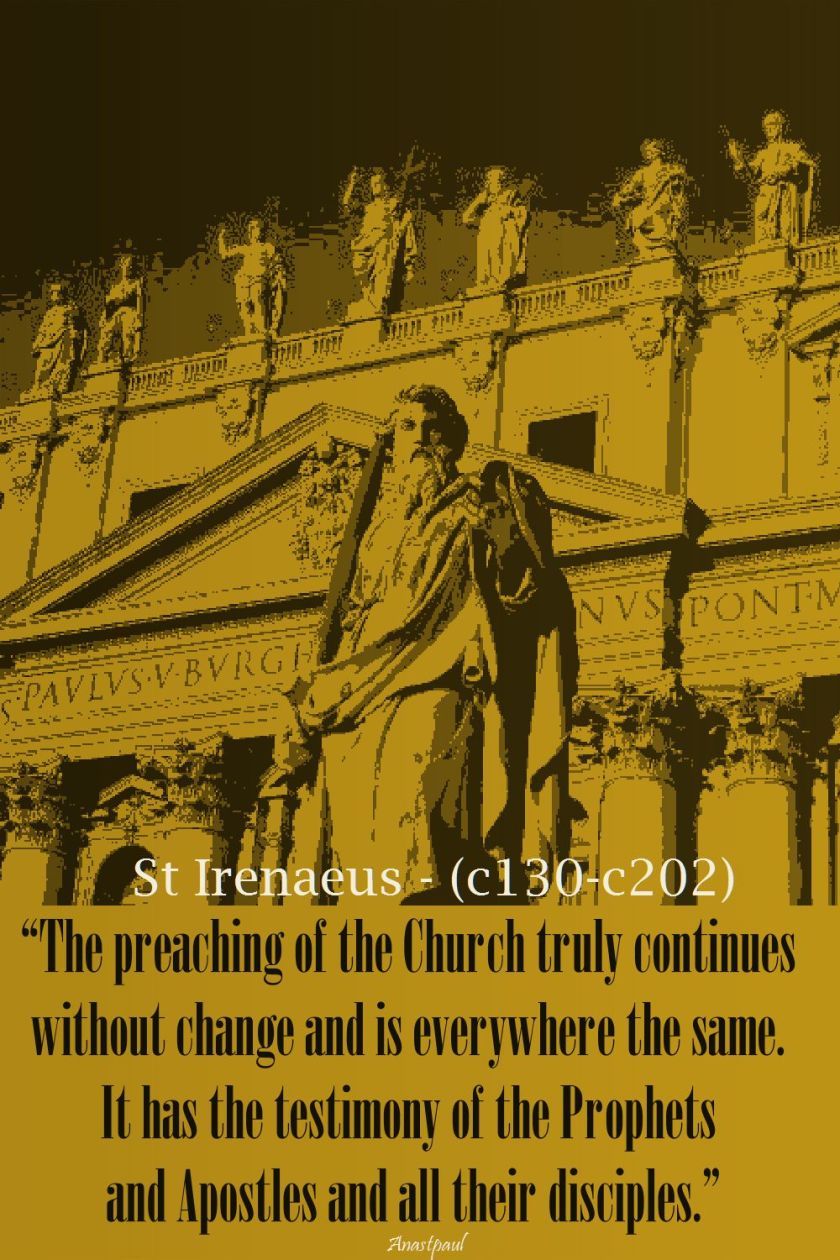
“The preaching of the Church truly continues
without change and is everywhere the same.
It has the testimony of the Prophets
and Apostles and all their disciples.”

the preaching of the church

“Being obedient she (Mary)
became the cause of salvation for herself
and for the whole human race.
The knot of Eve’s disobedience was untied
by Mary’s obedience:
what the virgin Eve bound through her disbelief,
Mary loosened by her faith.”

being obedient-st irenaeus

“As long as any one has the means
of doing good to his neighbours
and does not do so,
he shall be reckoned a stranger
to the love of the Lord.”

as long as any one has the means-st irenaeus

St. Irenaeus (c130-c202), pray for us!

Posted in DOCTORS of the Church, FATHERS of the Church, MORNING Prayers, QUOTES of the SAINTS, SAINT of the DAY

Thought for the Day – 27 June – The Memorial of St Cyril of Alexandria (376-444) Father and Doctor of the Incarnation

Thought for the Day – 27 June – The Memorial of St Cyril of Alexandria (376-444) Father and Doctor of the Incarnation

Theotokos is the official name of Mary and it is well to remember the great battle that was fought (and to my mnd, continues to fought today) over this title.  SHE IS the Mother of God – the Son of God was born of her in His human nature, without ceasing to be God. The whole mystery of the Incarnation is bound up in Mary and she is at the very heart of the work of Jesus’ Redemption of mankind!
St Cyril of Alexandria’s battle raged over the combined front of the Divinity of Christ and therefore, Mary the Mother of the Divinity, is summed up thus:   “Only if it is one and the same Christ who is consubstantial with the Father and with men can He save us, for the meeting ground between God and man is the flesh of Christ. Only if this is God’s own flesh can man come into contact with Christ’s divinity through His humanity, through his earthy mother, Mary.  Because of our kinship with the Word made flesh we are sons of God.   The Eucharist consummates our kinship with the word, our communion with the Father, our sharing in the divine nature—there is very real contact between our body and that of the Word.”

St Cyril of Alxandria, pray for us.
Mary, Mother of God, pray for us.

st cyril of alexandria pray for usholy mary mothr of god pray for us

Posted in DOCTORS of the Church, FATHERS of the Church, MORNING Prayers, QUOTES of the SAINTS, SAINT of the DAY

Quote/s of the Day – 27 June – Memorial of St Cyril of Alexandria (376-444) Father and Doctor

Quote/s of the Day – 27 June – Memorial of St Cyril of Alexandria (376-444) Father and Doctor

“He who receives Communion is made holy and divinised in soul and body
in the same way that water, set over a fire, becomes boiling…
Communion works like yeast that has been mixed into dough
so that it leavens the whole mass;
…Just as by melting two candles together you get one piece of wax,
so, I think, one who receives the Flesh and Blood of Jesus
is fused together with Him by this Communion
and the soul finds that he is in Christ and Christ is in him.”

as two pieces of wax-st cyril of alexandria

“Indeed the mystery of Christ runs the risk
of being disbelieved – precisely because
it is so incredibly wonderful.”

indeed the mystery of christ - st cyril of alexandria

“It is like employing a small tool on big constructions,
if we use human wisdom
in the hunt for knowledge of reality.”

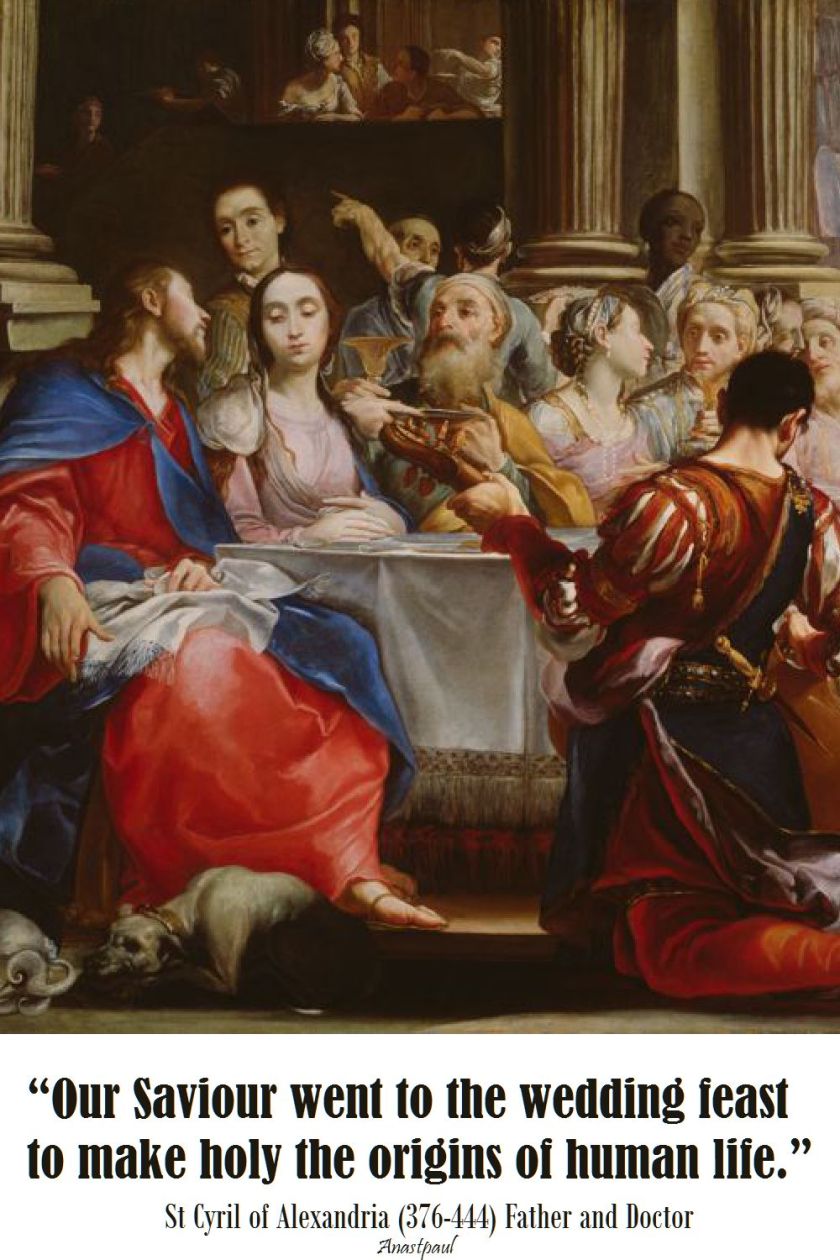
“Our Saviour went to the wedding feast
to make holy the origins of human life.”

our saviour went to the edding feast-st cyril of alexandria

ST CYRIL OF ALEXANDRIA

Posted in DOCTORS of the Church, FATHERS of the Church, MORNING Prayers, QUOTES of the SAINTS, SAINT of the DAY, The WORD

One Minute Reflection – 27 June

One Minute Reflection – 27 June

Do you not see that your bodies are members of Christ?………..1 Cor 7:15

1 corinthians 7-15

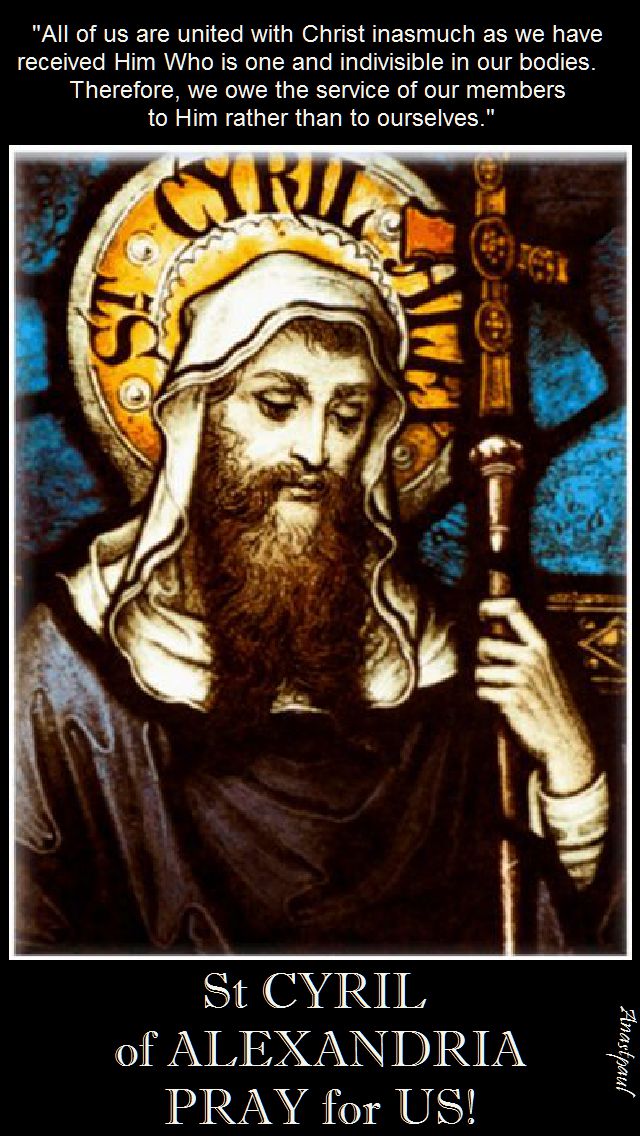
REFLECTION – “All of us are united with Christ inasmuch as we have received Him Who is one and indivisible in our bodies.   Therefore, we owe the service of our members to Him rather than to ourselves.”………. St Cyril of Alexandria (376-444) Doctor and Father of the Church (Saint of the Day)

PRAYER – Almighty God and Father, help me to put all my faculties at the disposal of Christ so as to be His link to others and with the world around me.   Let me give myself wholly to Him this day and every day. St Cyril of Alexandria, defender of the divinity of Christ and the Mother of God, intercede for us, amen.

all of us are united - st cyrill of alexandria

Posted in MORNING Prayers, QUOTES of the SAINTS, SAINT of the DAY

Thought for the Day – 26 June

Thought for the Day – 26 June

Opus Dei, which means Work of God, emphasizes that men and women can become holy by performing their daily duties with a Christian spirit.   In his homily, Pope John Paul II emphasised the importance of every believer following God’s will, as had the newly sainted founder of Opus Dei.   “The Lord has a plan for each one of us.  Saints cannot even conceive of themselves outside of God’s plan: they live only to fulfill it.”

St Josemaria is a good example of what one person with conviction can do.   Granted, we all have differing personalities and talents but still each of us can do great things with the grace of God and, let us never forget “we are all called to be saints! – a saint is a person who lets the light shine through.”

Let us go forth!   St Josemaria, Pray for us!

a saint is a person who lets the light shine through

st josemaria - pray for us 2


Posted in EUCHARISTIC Adoration, MORNING Prayers, QUOTES of the SAINTS, SAINT of the DAY, The BLESSED VIRGIN MARY

Quote/s of the Day 26 June

Quote/s of the Day 26 June

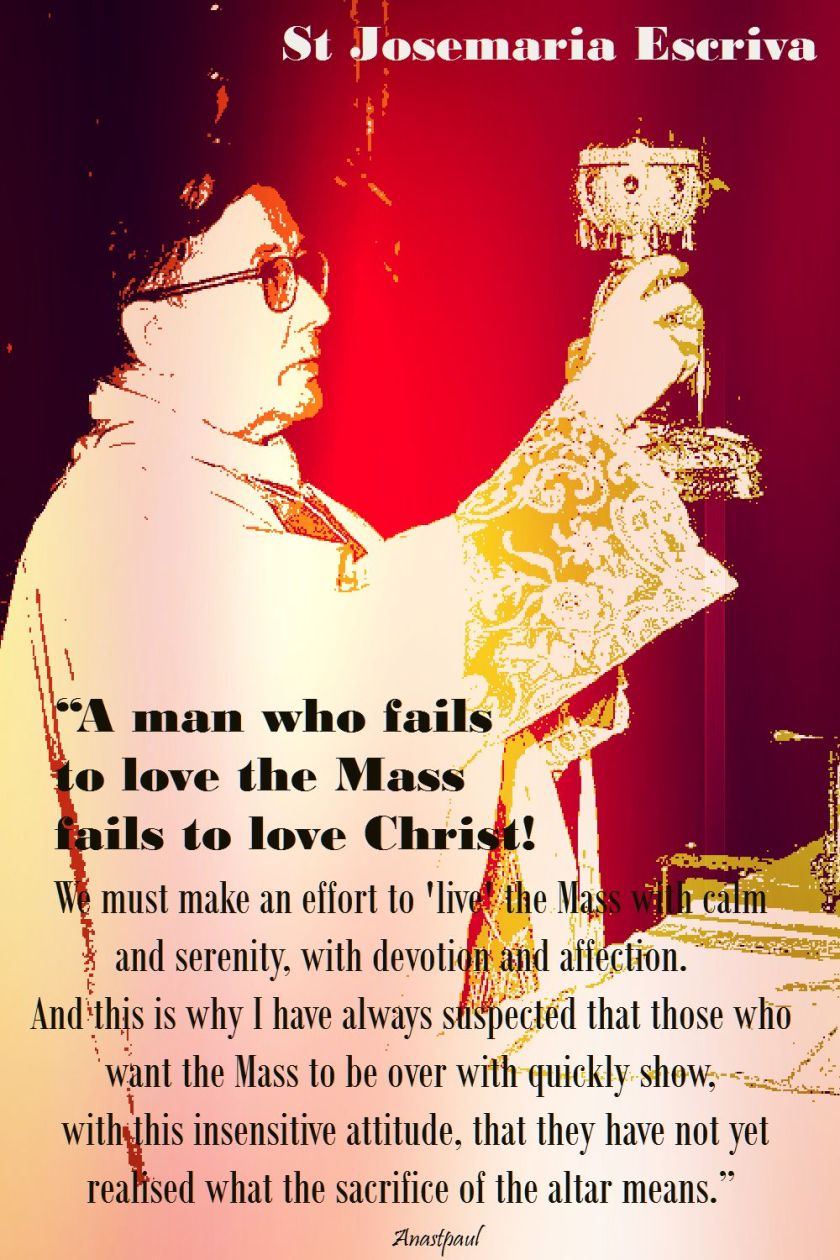
“A man who fails to love the Mass fails to love Christ.   We must make an effort to ‘live’ the Mass with calm and serenity, with devotion and affection.   And this is why I have always suspected that those who want the Mass to be over with quickly show, with this insensitive attitude, that they have not yet realised what the sacrifice of the altar means.” AND   “Many Christians take their time and have leisure enough in their social life (no hurry here).   They are leisurely, too, in their professionally activities, at table and recreation (no hurry here either).   But isn’t it strange how those same Christians find themselves in such a rush and want to hurry the priest, in their anxiety to shorten the time devoted to the most holy sacrifice of the altar?”

the man who fails to love the mass-st josemaria

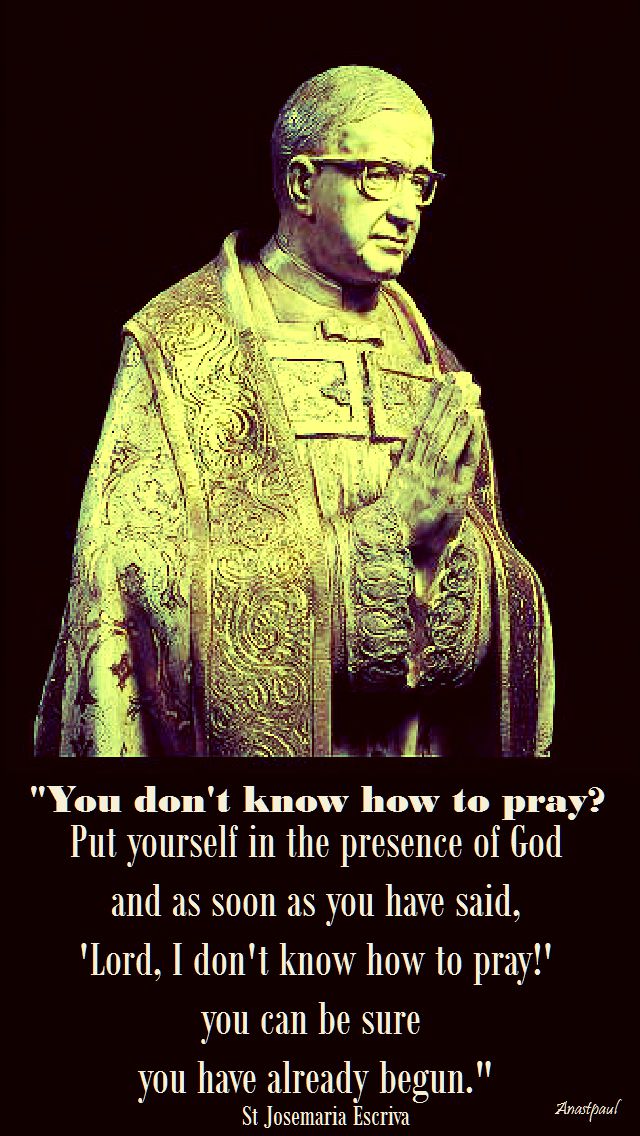
“You don’t know how to pray? Put yourself in the presence of God, and as soon as you have said, ‘Lord, I don’t know how to pray!” you can be sure you have already begun.”

you don't know how to pay - st josemaria

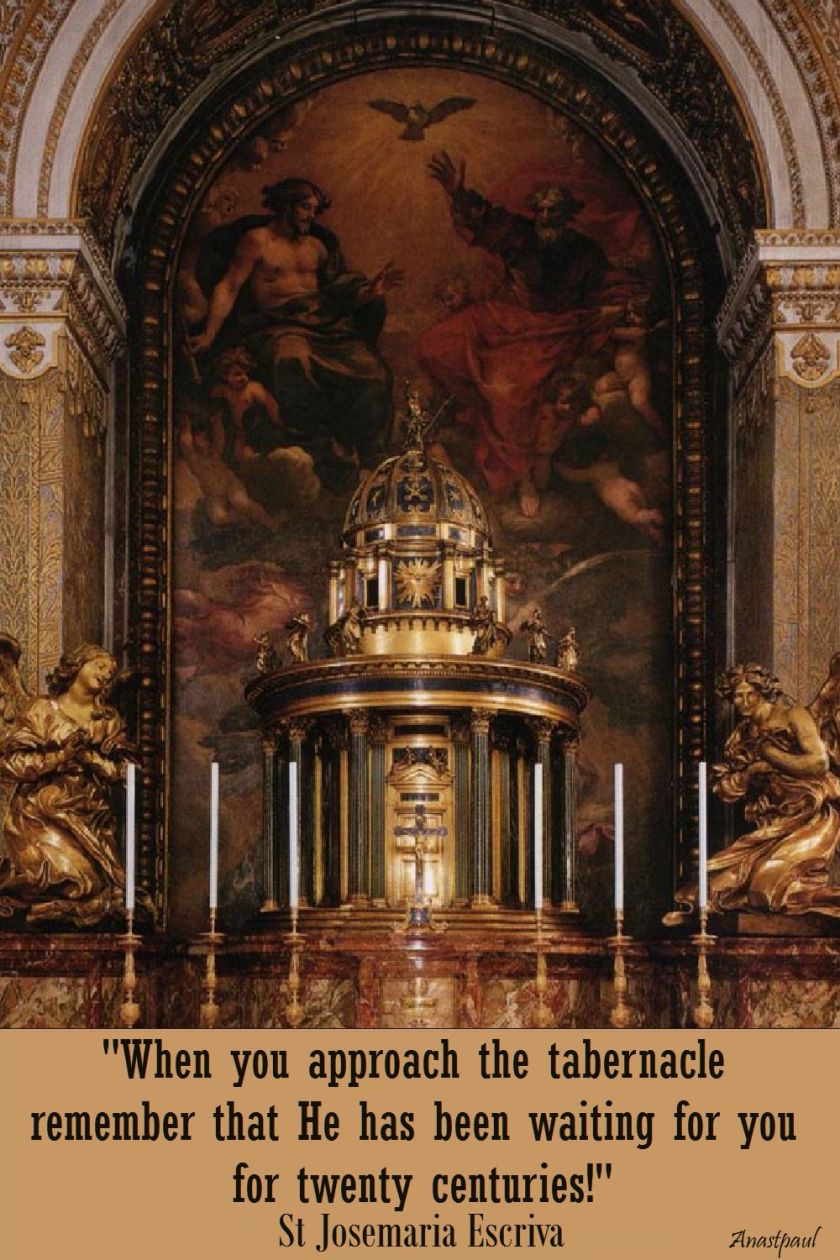
“When you approach the tabernacle remember that he has been waiting for you for twenty centuries.”

when you approach the tabernacle - st josemaria

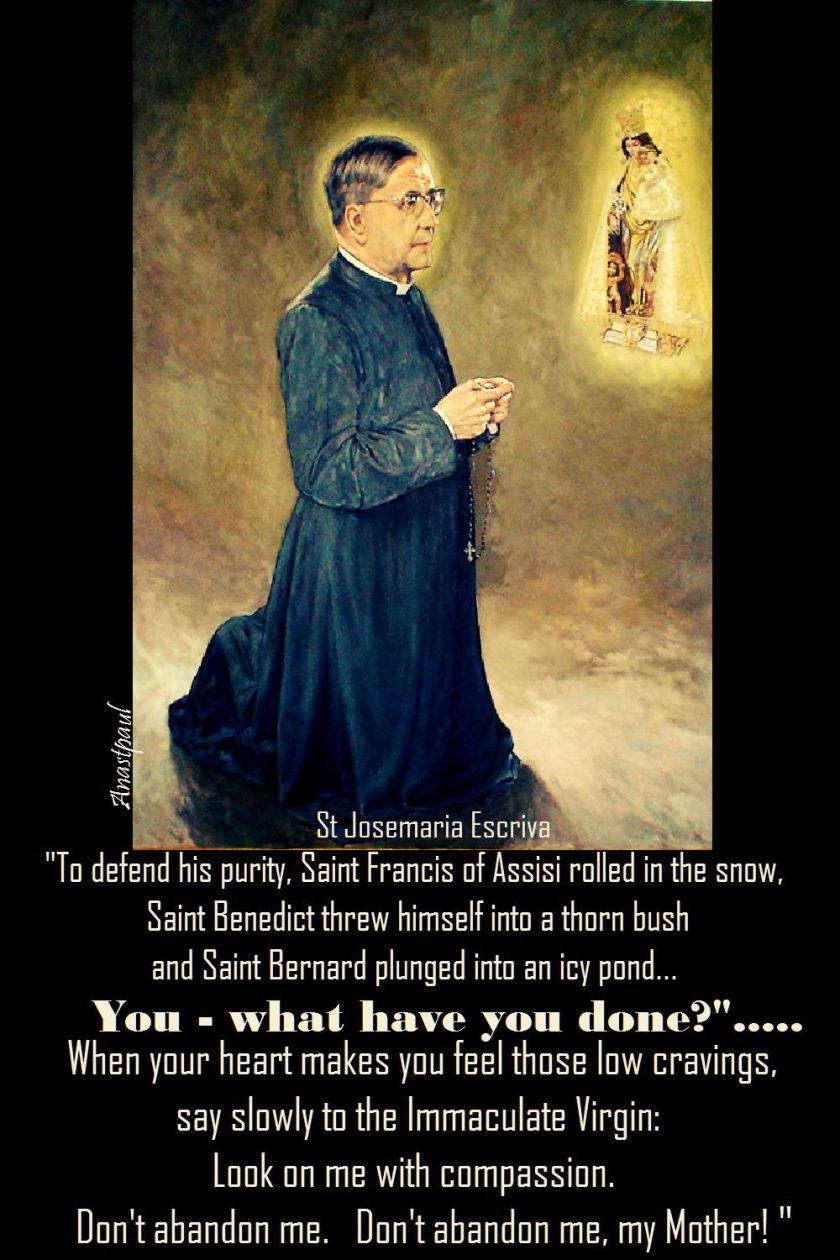
“To defend his purity, Saint Francis of Assisi rolled in the snow, Saint Benedict threw himself into a thorn bush and Saint Bernard plunged into an icy pond… You – what have you done?” …………………May I give you some advice for you to put into practice daily? When your heart makes you feel those low cravings, say slowly to the Immaculate Virgin:  Look on me with compassion.   Don’t abandon me.   Don’t abandon me, my Mother! – And recommend this prayer to others.”

don't abandon me my mother - st josemaria

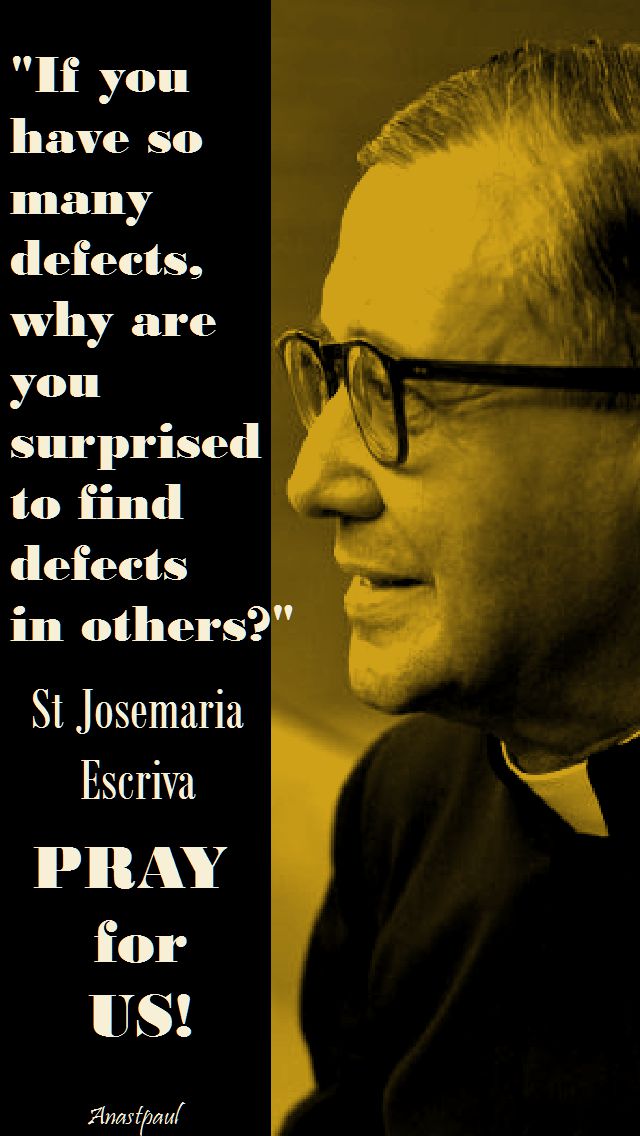
“If you have so many defects, why are you surprised to find defects in others?”

IF YOU HAVE SO MANY DEFECTS-ST JOSEMARIA


Posted in QUOTES of the SAINTS, SAINT of the DAY

Saint of the Day – 26 June – Josemaría Escrivá de Balaguer y Albás

Saint of the Day – 26 June – Josemaría Escrivá de Balaguer y Albás – (9 January 1902 at Barbastro, Spain Died– 26 June 1975 of natural causes in his office in Rome, Italy; his body is interred at Prelatic Church of Our Lady of Peace at Viale Bruno Buozzi 75, Rome, Italy) – Priest, Founder Writer, Teacher, Doctor of Civil Law and Theology – known as “The Saint of Ordinary Life”.; St Josemaria was Beatified on 17 May 1992 by Pope John Paul II: the beatification miracle involved the cure in 1976 of Carmelite Sister Concepcion Boullon Rubio from the nearly-fatal cancerous form of lipomatosis following prayers by her family for the intercession of Father Josemaria and was Canonised on 6 October 2002 by Pope John Paul II: the canonization miracle involved saving a surgeon’s hands from a career-ending disease. Patron of Opus Dei and of Ordinary Life.

1312215965_stjosemariaprayercard-127878617_1458725696

St Josemaria founded Opus Dei, an organization of laypeople and priests dedicated to the teaching that everyone is called to holiness by God and that ordinary life can result in sanctity.   He was canonised during 2002 by Pope John Paul II, who declared Saint Josemaría should be “counted among the great witnesses of Christianity.”
His principal work was the initiation, government and expansion of Opus Dei.  Escrivá’s best-known publication is The Way, which has been translated into 43 languages and has sold several million copies.

St Josemaria Escrivá and Opus Dei have aroused controversy, primarily concerning allegations of secrecy, elitism, cult-like practices and political involvement with right-wing causes, such as the dictatorship of General Franco in Spain (1939–1975).   After his death, his canonisation attracted considerable attention and controversy, by some Catholics and the worldwide press.   Several journalists who have investigated the history of Opus Dei, among them Vatican analyst John L. Allen, Jr., have argued that these accusations are unproven or have grown from allegations by enemies of Escrivá and his organization.   Cardinal Albino Luciani (later Pope John Paul I), John Paul II, Benedict XVI, Francis, Oscar Romero and many Catholic leaders have endorsed Escrivá’s teaching concerning the universal call to holiness, the role of laity and sanctification of ordinary work.   According to Allen, among Catholics, Escrivá is “reviled by some and venerated by millions more”.

Early life
José María Mariano Escrivá y Albás was born to José Escrivá y Corzán and his wife, María de los Dolores Albás y Blanc on 9 January 1902, in the small town of Barbastro, in Huesca, Aragon, Spain, the second of six children and the first of two sons.   José Escrivá was a merchant and a partner of a textile company which eventually became bankrupt, forcing the family to relocate during 1915 to the city of Logroño, in the northern province of La Rioja, where he worked as a clerk in a clothing store.   Young Josemaría first felt that “he had been chosen for something”, it is reported, when he saw footprints left in the snow by a monk walking barefoot.

With his father’s blessing, Escrivá prepared to become a priest.   He studied first in Logroño and then in Zaragoza, where he was ordained as deacon on Saturday, 20 December 1924.   He was ordained a priest, also in Zaragoza, on Saturday, 28 March 1925. After a brief appointment to a rural parish in Perdiguera, he went to Madrid, the Spanish capital, during 1927 to study law at the Central University.   In Madrid, Escrivá was employed as a private tutor and as a chaplain to the Foundation of Santa Isabel, which comprised the royal Convent of Santa Isabel and a school managed by the Little Sisters of the Assumption.

Mission as the founder of Opus Dei
A prayerful retreat helped him to discern more definitely what he considered to be God’s will for him and, on 2 October 1928, he “saw” Opus Dei (English: Work of God), a way by which Catholics might learn to sanctify themselves by their secular work.   He founded it during 1928 and Pius XII gave it final approval during 1950.   According to the decree of the Congregation for the Causes of Saints, which contains a condensed biography of Escrivá, “[t]o this mission he gave himself totally. From the beginning his was a very wide-ranging apostolate in social environments of all kinds. He worked especially among the poor and the sick languishing in the slums and hospitals of Madrid.”

During the Spanish Civil War, Escrivá fled from Madrid, which was controlled by the republicans, via Andorra and France, to the city of Burgos, possessed by the nationalist forces of General Francisco Franco.   After the war ended during 1939 with Franco’s victory, Escrivá was able to resume his studies in Madrid and complete a doctorate in law, for which he submitted a thesis on the historical jurisdiction of the Abbess of Santa María la Real de Las Huelgas.

The Priestly Society of the Holy Cross, affiliated with Opus Dei, was founded on Sunday, 14 February 1943.   Escrivá relocated to Rome during 1946.  The decree declaring Escrivá “Venerable” states that “in 1947 and on Monday, 16 June 1950, he obtained approval of Opus Dei as an institution of pontifical right.   With tireless charity and operative hope he guided the development of Opus Dei throughout the world, activating a vast mobilization of lay people … He gave life to numerous initiatives in the work of evangelisation and human welfare;  he fostered vocations to the priesthood and the religious life everywhere… Above all, he devoted himself tirelessly to the task of forming the members of Opus Dei.”\

Later years
According to some accounts, at the age of two he suffered from a disease (perhaps epilepsy) so severe that the doctors expected him to die soon but his mother had taken him to Torreciudad, where the Aragonese locals venerated a statue of the Virgin Mary (as “Our Lady of the Angels”), thought to date from the 11th century.   Escrivá recovered and as the director of Opus Dei during the 1960s and 1970s, promoted and oversaw the design and construction of a major shrine at Torreciudad.   The new shrine was inaugurated on 7 July 1975, soon after Escrivá’s death and to this day remains the spiritual center of Opus Dei, as well as an important destination for pilgrimage.   By the time of Escrivá’s death during 1975, the members of Opus Dei numbered some 60,000 in 80 countries.   As an adult, Escrivá suffered from type 1 diabetes and, according to some sources, also epilepsy.

During 1950, Escrivá was appointed an Honorary Domestic Prelate by Pope Pius XII, which allowed him to use the title of Monsignor.   During 1955, he received a doctorate of theology from the Pontifical Lateran University in Rome.   He was a consultor to two Vatican congregations (the Congregation for Seminaries and Universities and the Pontifical Commission for the Authentic Interpretation of the Code of Canon Law) and an honourary member of the Pontifical Academy of Theology.   The Second Vatican Council (1962–65) confirmed the importance of the universal call to holiness, the role of the laity, and the Mass as the basis of Christian life.

During 1948 Escrivá founded the Collegium Romanum Sanctae Crucis (Roman College of the Holy Cross), Opus Dei’s educational center for men, in Rome. During 1953 he founded the Collegium Romanum Sanctae Mariae (Roman College of Saint Mary) to serve the women’s section (these institutions are now joined into the Pontifical University of the Holy Cross.)   Escrivá also established the University of Navarre, in Pamplona, and the University of Piura (in Peru), as secular institutions affiliated with Opus Dei. Escrivá died on 26 June 1975, aged 73.

Three years after Escrivá died, the then Cardinal Albino Luciani (later Pope John Paul I) celebrated the originality of his contribution to Christian spirituality.   The Statue below is at St Peter’s the Vatican.

St Josemaria and the Blessed Virgin Mary 
Pope John Paul II stated on Sunday, 6 October 2002, after the Angelus greetings:  “Love for our Lady is a constant characteristic of the life of Josemaría Escrivá and is an eminent part of the legacy that he left to his spiritual sons and daughters.”   The Pope also said that “St. Josemaría wrote a beautiful small book called The Holy Rosary which presents spiritual childhood, a real disposition of spirit of those who wish to attain total abandonment to the divine will”.

When Escrivá was 10 or 11 years old, he already had the habit of carrying the rosary in his pocket.   As a priest, he would ordinarily end his homilies and his personal prayer with a conversation with the Blessed Virgin.   He instructed that all rooms in the offices of Opus Dei should have an image of the Virgin.   He encouraged his spiritual children to greet these images when they entered a room.   He encouraged a Marian apostolate, preaching that To Jesus we go and to Him we return through Mary”. While looking at a picture of the Virgin of Guadalupe giving a rose to San Juan Diego, he commented:  “I would like to die that way.”   On 26 June 1975, after entering his work room, which had a painting of the Virgin of Guadalupe, he slumped on the floor and died.

st josemaria 3200px-Univnavarrefairlovest josemaria 12

Teachings and legacy
The significance of Escrivá’s message and teachings has been a topic of debate, by Catholics and others.   The Protestant French historian Pierre Chaunu, a professor at the Sorbonne and president of the Academy of Moral and Political Sciences, said that “the work of Escrivá de Balaguer will undoubtedly mark the 21st century.   This is a prudent and reasonable wager.   Do not pass close to this contemporary without paying him close attention”.   The Catholic theologian Hans Urs von Balthasar, who was appointed cardinal by Pope John Paul II (but died during 1988 before his investiture), dismissed Escrivá’s principal work, The Way, as “a little Spanish manual for advanced Boy Scouts” and argued that it was quite insufficient to sustain a major religious organization. However, the monk and spiritual writer Thomas Merton declared that Escrivá’s book “will certainly do a great deal of good by its simplicity, which is the true medium for the Gospel message”.

Critics of Opus Dei have often argued that the importance and originality of Escrivá’s intellectual contributions to theology, history and law, at least as measured by his published writings, has been grossly exaggerated by his devotees.   However, various officials of the Catholic church have spoken well of Escrivá’s influence and of the relevance of his teachings.  In the decree introducing the cause of beatification and canonisation of Escrivá, Cardinal Ugo Poletti wrote during 1981:  “For having proclaimed the universal call to holiness since he founded Opus Dei during 1928, Msgr. Josemaría Escrivá de Balaguer, has been unanimously recognized as the precursor of precisely what constitutes the fundamental nucleus of the Church’s magisterium, a message of such fruitfulness in the life of the Church.”  Sebastiano Baggio, Cardinal Prefect of the Congregation for Bishops, wrote a month after Escrivá’s death:  “It is evident even today that the life, works, and message of the founder of Opus Dei constitutes a turning point, or more exactly a new original chapter in the history of Christian spirituality.”   A Vatican peritus or consultor for the process of beatification said that “he is like a figure from the deepest spiritual sources”. Franz König, Archbishop of Vienna, wrote in 1975:

“The magnetic force of Opus Dei probably comes from its profoundly lay spirituality.   At the very beginning, in 1928, Msgr. Escrivá anticipated the return to the Patrimony of the Church brought by the Second Vatican Council … [H]e was able to anticipate the great themes of the Church’s pastoral action in the dawn of the third millennium of her history.”

The “absolutely central” part of Escrivá’s teaching, says American theologian William May, is that “sanctification is possible only because of the grace of God, freely given to his children through his only-begotten Son and it consists essentially in an intimate, loving union with Jesus, our Redeemer and Saviour.”

Escrivá’s books, including Furrow, The Way, Christ is Passing By and The Forge, continue to be read widely and emphasize the laity’s calling to daily sanctification (a message also to be found in the documents of Vatican II).   Pope John Paul II made the following observation in his homily at the beatification of Escrivá:

“With supernatural intuition, Blessed Josemaría untiringly preached the universal call to holiness and apostolate.   Christ calls everyone to become holy in the realities of everyday life.   Hence work too is a means of personal holiness and apostolate, when it is done in union with Jesus Christ.”

John Paul II’s decree Christifideles omnes states:  “By inviting Christians to seek union with God through their daily work — which confers dignity on human beings and is their lot as long as they exist on earth — his message is destined to endure as an inexhaustible source of spiritual light regardless of changing epochs and situations”   St Josemaria pray for us!
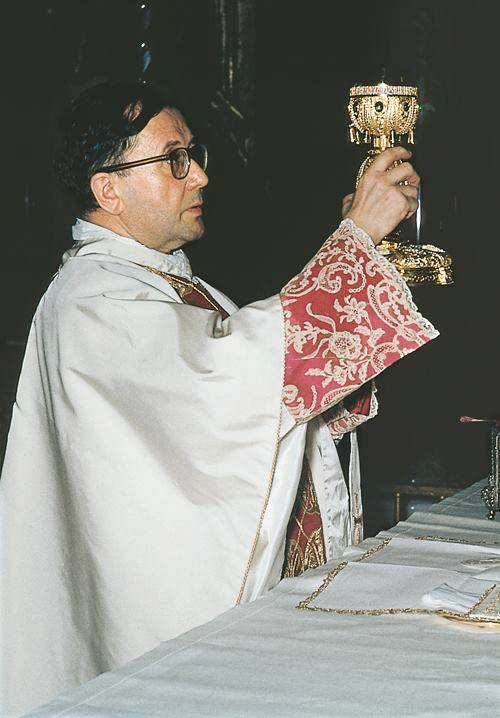
st josemaria 14st-josemaria-escriva-sylvia-castellanosst josemaria 13st josemaria 11

Posted in DOCTORS of the Church, FATHERS of the Church, MORNING Prayers, QUOTES of the SAINTS, SAINT of the DAY, The WORD

One Minute Reflection – 25 June

One Minute Reflection – 25 June

Blessed be God the Father . who gave us a new birth to a living hope…..to an inheritance that is imperishable, undefiled and unfading, kept in heaven for you………1 Peter 1:3-4

1 PETER 1-3,4

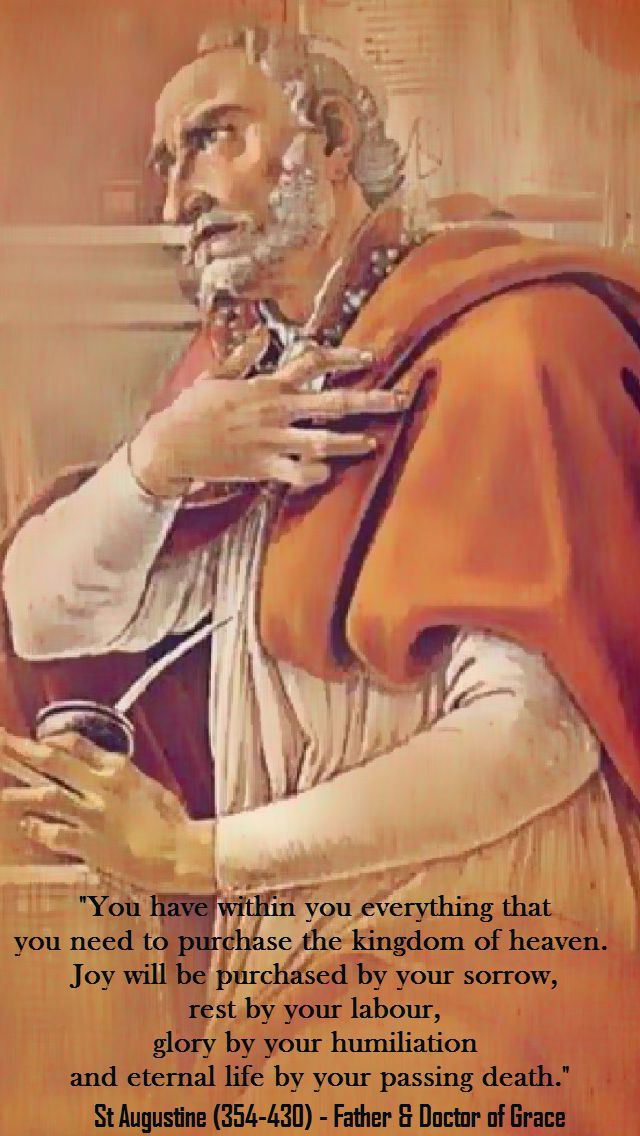
REFLECTION – “You have within you, everything that you need to purchase the kingdom of heaven.
Joy will be purchased by your sorrow,
rest by your labour,
glory by your humiliation
and eternal life by your passing death.”………………….St Augustine

YOU HAVE WITHIN YOU - ST AUGUSTINE

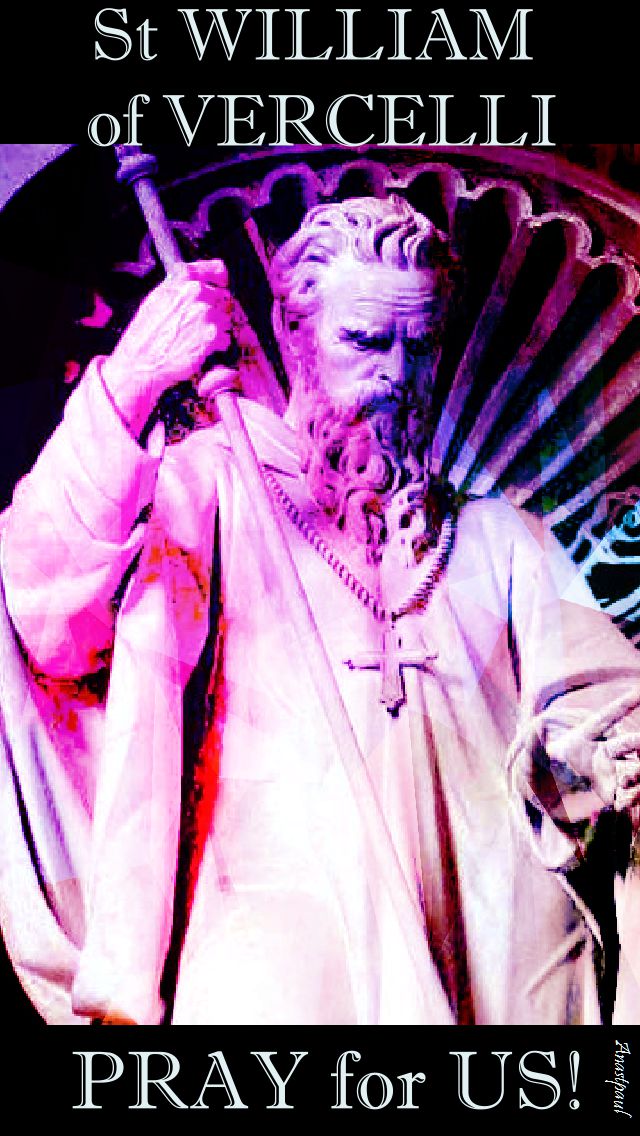
PRAYER – Loving Father,. teach me how to make every event on earth lay up treasures for me in heaven. Help me to endure sorrows, labour, humiliations, pain and death willingly so as to attain heaven with You, in unity with Your Son, Lord Jesus Christ and the Holy Spirit, one God forever and ever. St William of Vercelli, your life was a focused gift to God, pray for us that we too may join you in eternal life. Amen

st william of vercelli pray for us

Posted in CATHOLIC DEVOTIONS of the Month, FEASTS and SOLEMNITIES, MORNING Prayers, QUOTES of the SAINTS, SACRED and IMMACULATE HEARTS

Celebrating the Solemnity of the Most Sacred Heart of Jesus – 23 June 2017

Celebrating the Solemnity of the Most Sacred Heart of Jesus – 23 June 2017

Excerpts from “To Be Loved by a Sacred Heart” – St Josemaria Escriva
“Christ is Passing By,” no. 162

“That Christ has come to us with a heart made of flesh tells us a lot about how the Sacred Heart loves us and about the kind of love we need.   We are loved by any number of hearts during our earthly lives but one alone among them we call Sacred.   We know how it feels to be loved by fallen people—by those who try but cannot love perfectly.   But what it is to be loved by a Sacred Heart?

At the outset of the last supper, the Lord gets down on His hands and knees and washes the feet of His disciples.  “Do you understand this?”  He asks them.   Before He tells the Apostles about union with Him, about the great commandment of love, about His joy, Jesus first shows them what it all “looks” like.

“Do you understand this?”   This is perhaps the ultimate question as we reflect on what it means to be loved by the Sacred Heart.   Perhaps the answer will be an honest, “No, Lord, I do not understand your love for me,” and that could be nearer the truth than anything. “I don’t understand what God is doing on His hands and knees wiping the dirt off of my feet.   If I were Jesus, I wouldn’t treat me like He treats me.   I wouldn’t be so tolerant and forgiving.  I wouldn’t keep on loving someone like me.”

But to spend our lives in contemplation of His love for us, as the apostles surely did, is what will bring us ever closer to the source of the Love that constantly reaches into our lives, showing itself to be subtle, selfless and inexhaustible.   If the fire, thorns and blood are the divinely revealed gauge of divine love in a human heart, then the more I welcome His tireless forgiveness, His unflinching friendship in the face of my infidelity, the more I will appreciate the mystery of divine charity which the Sacred Heart reveals.
Now we see imperfectly, in part but the part we do see should teach us why He needed to come to us with a heart of flesh, like ours.”

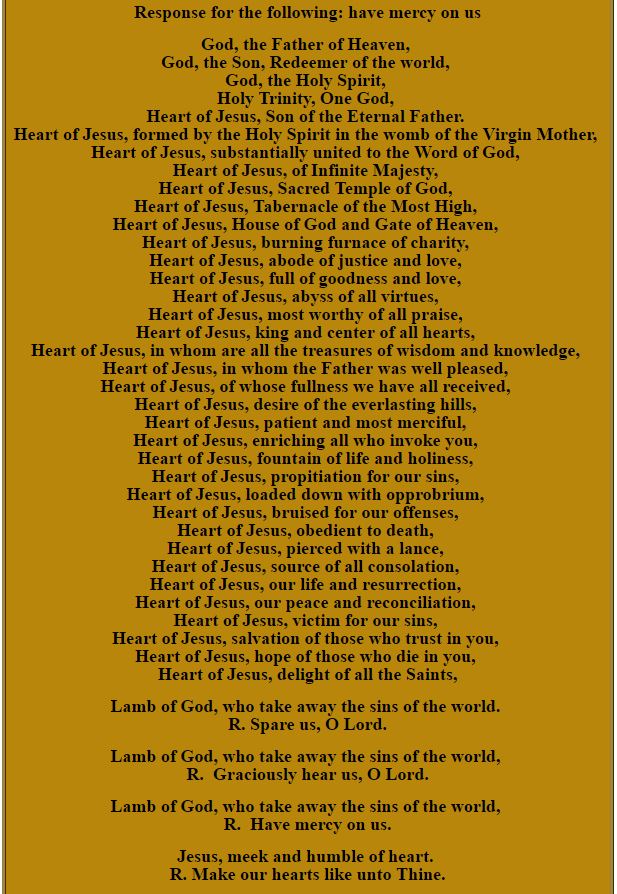
Devotion to the Saced Heart 1litany of the sh 1 - sh 8litany of the sh 2 - sh 8litany of the sh 3 - sh 10

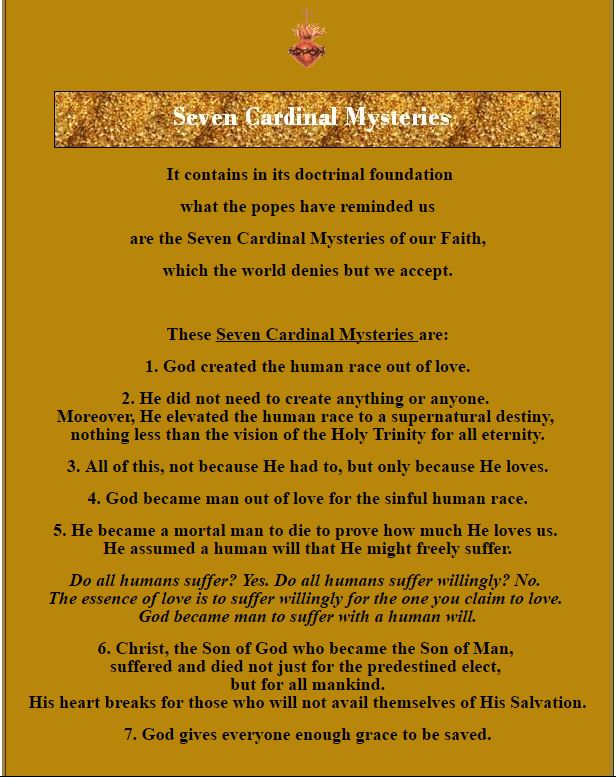
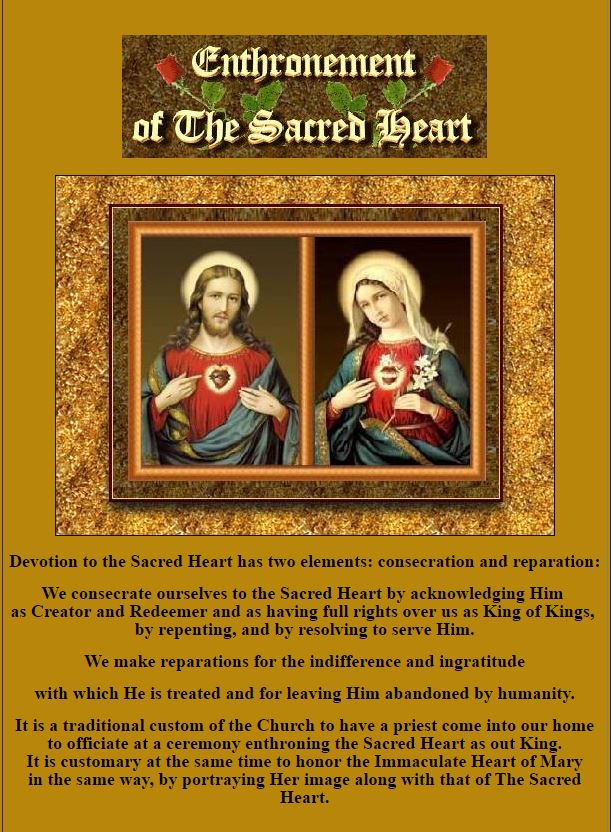
sh3 snip3seven cardinal mysteries - sh 2sh 4 - enthronement


Posted in CATHOLIC DEVOTIONS of the Month, DOCTORS of the Church, EUCHARISTIC Adoration, FEASTS and SOLEMNITIES, MORNING Prayers, QUOTES of the SAINTS, SACRED and IMMACULATE HEARTS

Quote/s of the Day – The Solemnity of the Body and Blood of Christ

Quote/s of the Day – The Solemnity of the Body and Blood of Christ

“How I loved the feasts!….
I especially loved the processions in honour
of the Blessed Sacrament.   What a joy it was
for me to throw flowers beneath the feet of God!…
I was never so happy as when I saw my roses
touch the sacred Monstrance…”
– from St. Therese’s Autobiography Story of A Soul

how i loved the feast..st t of l

“It is invaluable to converse with Christ
and leaning against Jesus’ breast like His beloved disciple,
we can feel the infinite love of his Heart.
We learn to know more deeply the One who gave Himself totally,
in the different mysteries of His divine and human life,
so that we may become disciples and in turn enter into
this great act of giving, for the glory of God
and the salvation of the world.   Through adoration,
the Christian mysteriously contributes to the
radical transformation of the world and to the sowing of the Gospel.
Anyone who prays to the Saviour draws the whole world with him
and raises it to God.   Those who stand before the Lord
are therefore fulfilling an eminent service.
They are presenting to Christ all those who do not know Him
or are far from Him;  they keep watch in His presence on their behalf!”

– from St Pope John Paul II’s 1996 letter to the Bishop of Liege,
written on the occasion of the 750th anniversary of the first celebration of the Feast of Corpus Christi

those who stand before the lord

“When you have received Him,
stir up your heart to do Him homage, 
speak to Him about your spiritual life,
gazing upon Him in your soul where He is present
for your happiness;  welcome Him as warmly as possible,
and behave outwardly in such a way, that your actions
may give proof to all of His Presence.”
– St. Francis de Sales

when you have received Him - st francis de sales

Posted in CATHOLIC DEVOTIONS of the Month, EUCHARISTIC Adoration, FEASTS and SOLEMNITIES, MORNING Prayers, QUOTES of the SAINTS, SACRED and IMMACULATE HEARTS, The WORD

One Minute Reflection – 18 June – Feast of Corpus Christi

One Minute Reflection – 18 June – Feast of Corpus Christi

He who abides in me and I in him, he it is that bears much fruit, for apart from me you can do nothing……John 15:5

REFLECTION – “Eternal happiness begins now for the Christian who is comforted with the definitive manna of the Eucharist. The old life has gone forever. Let us leave everything behind us so that everything will be new, “our hearts, our words and our actions.” This is the Good News. News, because it speaks to us of a deep love which we never could have dreamed of. Good, because there is nothing better than uniting ourselves to God, the greatest Good of all. It is Good News, because in an inexplicable way it gives us a foretaste of heaven.”……….St Josemaria Escriva (Christ is passing By – On the Feast of Corpus Christ No 153)

eternal happiness begins now - st josemaria

PRAYER – In response to Your Presence, O Lord,
I offer You my presence.
In response to Your silence,
I offer You my silence.
In response to the gaze of Your Eucharistic Face,
I offer You my eyes.
In response to Your Eucharistic Heart,
I offer You every heartbeat of mine.
In response to the mystery of Your Eucharistic poverty,
I offer You my poverty.
My one desire is to remain before You
even as You remain before me
in this the Sacrament of Your Love.
(Benedictines of Perpetual Adoration)

BENEDICTINES OF PERPETUAL ADORATION - in reponse to your presence o Lord

Posted in DOCTORS of the Church, EUCHARISTIC Adoration, FEASTS and SOLEMNITIES, MORNING Prayers, PAPAL ENCYLICALS, PRAYERS of the CHURCH, PRAYERS of the SAINTS, QUOTES of the SAINTS

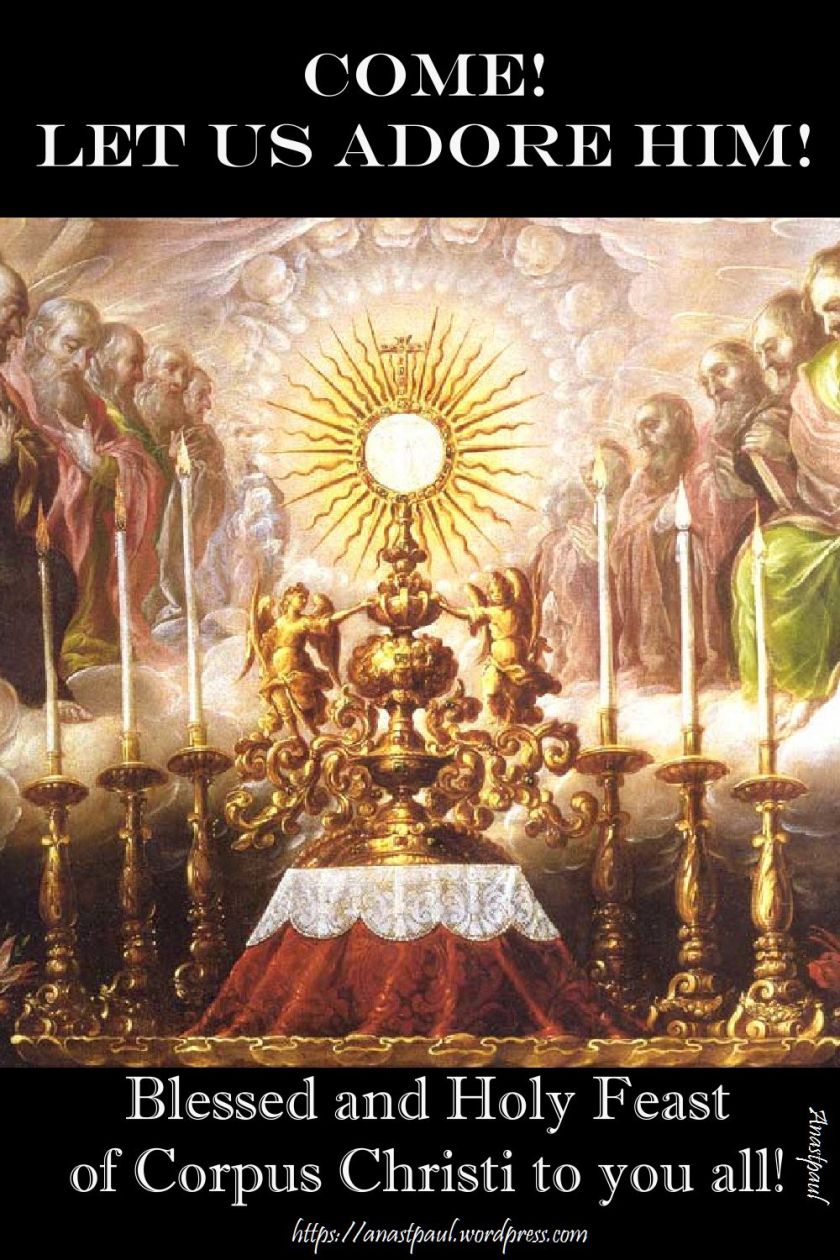
Blessed and Holy Feast of Corpus Christi! 18 June 2017

Blessed and Holy Feast of Corpus Christi! 18 June 2017

come let us adore him- 18 june 2017

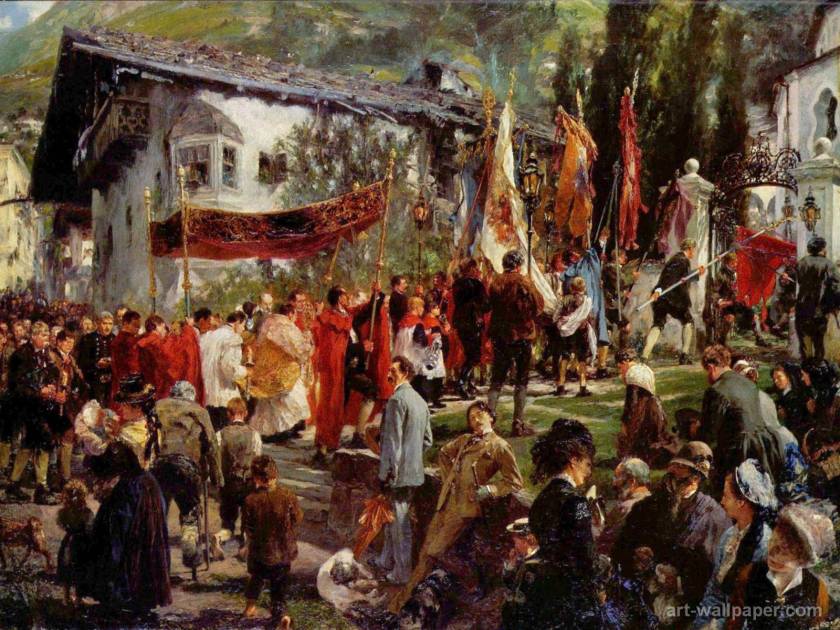
“The solemnity of Corpus Christi originated within a very precise cultural and historical context.   Its aim was to proclaim openly the faith of the People of God in Jesus Christ’s real, living presence in the Blessed Sacrament of the Eucharist.”

CC_homeCorpusChristiProcession

Pope Benedict XVI explains the history of this feast, which dates back to the 13th century, as follows:

St Juliana of Cornillon had a vision which “presented the moon in its full splendour, crossed diametrically by a dark stripe.   The Lord made her understand the meaning of what had appeared to her.   The moon symbolised the life of the Church on earth, the opaque line, on the other hand, represented the absence of a liturgical feast (…) in which believers would be able to adore the Eucharist so as to increase in faith, to advance in the practice of the virtues and to make reparation for offences to the Most Holy Sacrament. (…)

Jacques Pantaléon of Troyes was also won over to the good cause of the Feast of Corpus Christi during his ministry as Archdeacon in Lièges.   It was he who, having become Pope with the name of Urban IV in 1264, instituted the Solemnity of Corpus Christi on the Thursday after Pentecost as a holiday of obligation for the universal Church.

Until the end of the world

Detail of the reliquary containing the corporal with traces of the Eucharistic miracle that occurred in Bolsena in 1263. It is kept in the Cathedral of Orvieto, Italy.

Detail of the reliquary containing the corporal with traces of the Eucharistic miracle that occurred in Bolsena in 1263. It is kept in the Cathedral of Orvieto, Italy.

In the Bull of its institution, entitled Transiturus de hoc mundo, (11 Aug. 1264), Pope Urban even referred discreetly to Juliana’s mystical experiences, corroborating their authenticity.   He wrote: “Although the Eucharist is celebrated solemnly every day, we deem it fitting that at least once a year it be celebrated with greater honour and a solemn commemoration.

“Indeed we grasp the other things we commemorate with our spirit and our mind but this does not mean that we obtain their real presence.   On the contrary, in this sacramental commemoration of Christ, even though in a different form, Jesus Christ is present with us in his own substance.   While he was about to ascend into Heaven he said ‘And lo, I am with you always, to the close of the age’ (Matthew 28:20).”
The Pontiff made a point of setting an example by celebrating the solemnity of Corpus Christi in Orvieto, the town where he was then residing.   Indeed, he ordered that the famous Corporal with the traces of the Eucharistic miracle which had occurred in Bolsena the previous year, 1263, be kept in Orvieto Cathedral — where it still is today.

While a priest was consecrating the bread and the wine he was overcome by strong doubts about the Real Presence of the Body and Blood of Christ in the sacrament of the Eucharist.   A few drops of blood began miraculously to ooze from the consecrated Host, thereby confirming what our faith professes.

Texts that move the heart

Urban IV asked one of the greatest theologians of history, St Thomas Aquinas — who at that time was accompanying the Pope and was in Orvieto — to compose the texts of the Liturgical Office for this great feast.   They are masterpieces, still in use in the Church today, in which theology and poetry are fused.   These texts pluck at the heartstrings in an expression of praise and gratitude to the Most Holy Sacrament, while the mind, penetrating the mystery with wonder, recognizes in the Eucharist the Living and Real Presence of Jesus, of His Sacrifice of love that reconciles us with the Father and gives us salvation.

In the words of St. Thomas:

“How inestimable a dignity, beloved brethren, divine bounty has bestowed upon us Christians from the treasury of its infinite goodness!   For there neither is nor ever has been a people to whom the gods were so nigh as our Lord and God is nigh unto us.

“Desirous that we be made partakers of His divinity, the only-begotten Son of God has taken to Himself our nature so that having become man, He would be enabled to make men gods.  Whatever He assumed of our nature He wrought unto our salvation. For on the altar of the Cross He immolated to the Father His own Body as victim for our reconciliation and shed His blood both for our ransom and for our regeneration. Moreover, in order that a remembrance of so great benefits may always be with us, He has left us His Body as food and His Blood as drink under appearances of bread and wine.

“O banquet most precious!   O banquet most admirable!   O banquet overflowing with every spiritual delicacy!   Can anything be more excellent than this repast, in which not the flesh of goats and heifers, as of old, but Christ the true God is given us for nourishment?   What more wondrous than this holy sacrament! In it bread and wine are changed substantially, and under the appearance of a little bread and wine is had Christ Jesus, God and perfect Man.   In this sacrament sins are purged away, virtues are increased, the soul is satiated with an abundance of every spiritual gift.   No other sacrament is so beneficial.   Since it was instituted unto the salvation of all, it is offered by Holy Church for the living and for the dead, that all may share in its treasures.

“My dearly beloved, is it not beyond human power to express the ineffable delicacy of this sacrament in which spiritual sweetness is tasted in its very source, in which is brought to mind the remembrance of that all-excelling charity which Christ showed in His sacred passion? Surely it was to impress more profoundly upon the hearts of the faithful the immensity of this charity that our loving Savior instituted this sacrament at the last supper when, having celebrated the Pasch with His disciples.   He was about to leave the world and return to the Father.   It was to serve as an unending remembrance of His passion, as the fulfillment of ancient types — this the greatest of His miracles.   To those who sorrow over His departure He has given a unique solace.”

“Eucharistic springtime”

I would like to affirm with joy that today there is a “Eucharistic springtime” in the Church.   How many people pause in silence before the Tabernacle to engage in a loving conversation with Jesus!   It is comforting to know that many groups of young people have rediscovered the beauty of praying in adoration before the Most Blessed Sacrament.
John Paul II said in his Encyclical Ecclesia de Eucharistia: “In many places, adoration of the Blessed Sacrament is also an important daily practice and becomes an inexhaustible source of holiness. The devout participation of the faithful in the Eucharistic procession on the Solemnity of the Body and Blood of Christ is a grace from the Lord which yearly brings joy to those who take part in it. Other positive signs of Eucharistic faith and love might also be mentioned” (no. 10).

In remembering St Juliana of Cornillon let us also renew our faith in the Real Presence of Christ in the Eucharist.   As we are taught by the Compendium of the Catechism of the Catholic Church, “Jesus Christ is present in the Eucharist in a unique and incomparable way.   He is present in a true, real and substantial way, with his Body and his Blood, with his Soul and his Divinity.   In the Eucharist, therefore, there is present in a sacramental way, that is, under the Eucharistic Species of bread and wine, Christ whole and entire, God and Man” (no. 282).

Dear friends, fidelity to the encounter with Christ in the Eucharist in Holy Mass on Sunday is essential for the journey of faith but let us also seek to pay frequent visits to the Lord present in the Tabernacle!   In gazing in adoration at the consecrated Host, we discover the gift of God’s love, we discover Jesus’ Passion and Cross and likewise his Resurrection.

Source of joy
It is precisely through our gazing in adoration that the Lord draws us towards Him into His mystery in order to transform us as He transforms the bread and the wine.

The Saints never failed to find strength, consolation and joy in the Eucharistic encounter. Let us repeat before the Lord present in the Most Blessed Sacrament the words of the Eucharistic hymn Adoro te devote, “Devoutly I adore Thee: Make me believe ever more in you, Draw me deeply into faith, into Your hope, into Your love”.

BENEDICT XVI, General Audience, November 17, 2010

corpus christi 3

Posted in CATHOLIC DEVOTIONS of the Month, EUCHARISTIC Adoration, MORNING Prayers, QUOTES of the SAINTS, SACRED and IMMACULATE HEARTS

Quote of the Day – 17 June

Quote of the Day – 17 June

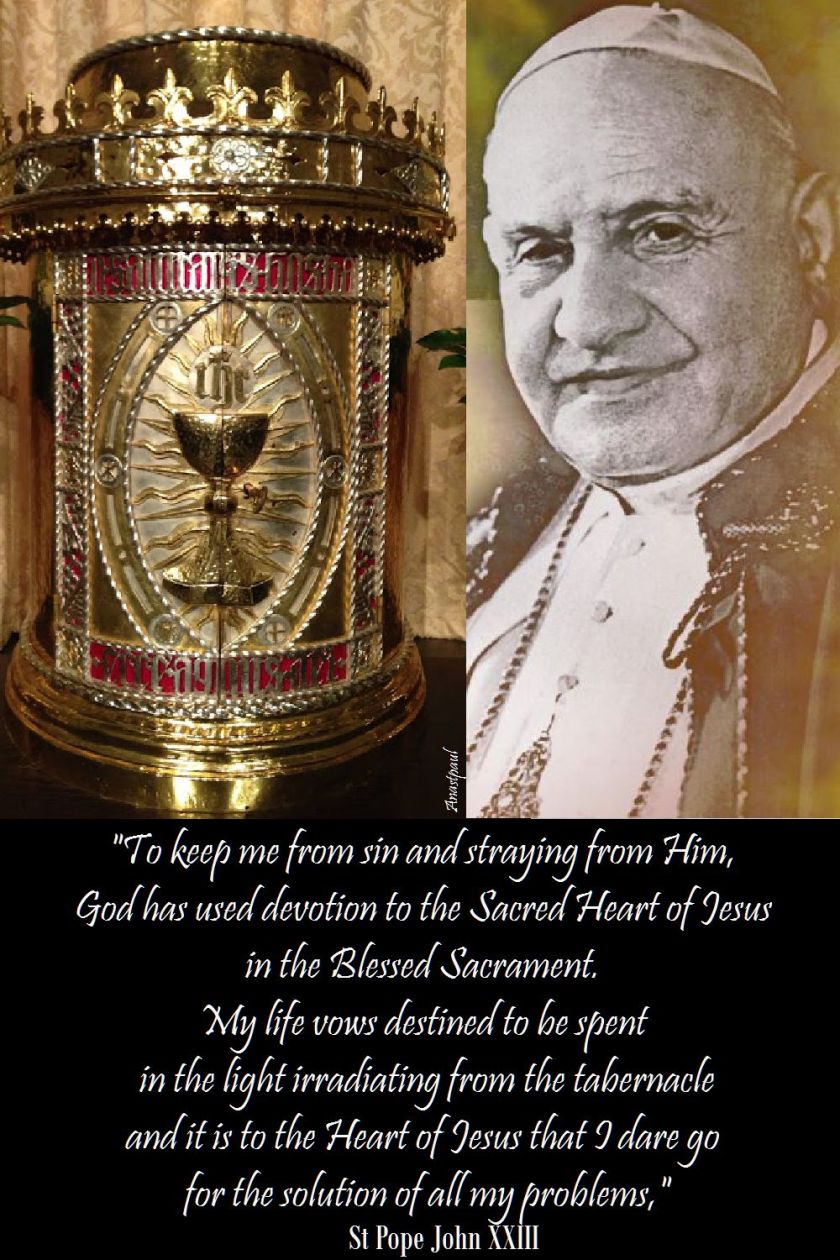
“To keep me from sin and straying from Him,
God has used devotion to the Sacred Heart of Jesus
in the Blessed Sacrament.
My life vows destined to be spent
in the light irradiating from the tabernacle
and it is to the Heart of Jesus that I dare go
for the solution of all my problems,”

– Pope John XXIII

to keep me from sin - st pope john xxIII

Posted in MORNING Prayers, QUOTES of the SAINTS, SAINT of the DAY, The WORD

One Minute Reflection – 17 June

One Minute Reflection – 17 June

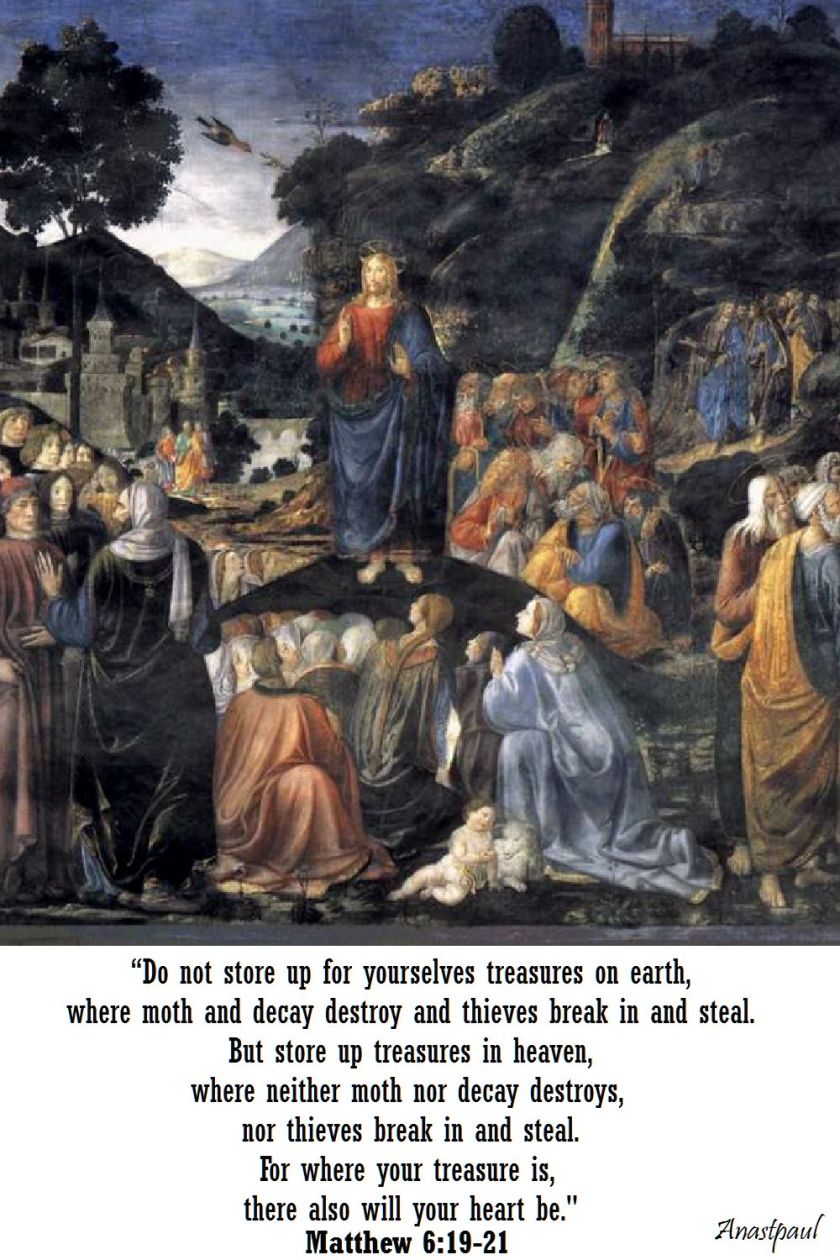
“Do not store up for yourselves
treasures on earth,
where moth and decay destroy
and thieves break in and steal.
But store up treasures in heaven,
where neither moth nor decay destroys,
nor thieves break in and steal.
For where your treasure is,
there also will your heart be.”….Matthew 6:19-21

matthew 6 19-21

REFLECTION – Reflecting on his own priestly vocation, Pope John Paul II wrote in 1996 that Brother Albert had played a role in its formation …..“because I found in him a real spiritual support and example in leaving behind the world of art, literature and the theater and in making the radical choice of a vocation to the charity” ………..St John Paul speaking of St Albert Chmielowski (Gift and Mystery: On the Fiftieth Anniversary of My Priestly Ordination)

PRAYER – Father of goodness, make me realise and understand that each and all of my brothers represent the face of Jesus and that He is the only way to You for us all!  Help me to extend all of myself to my neighbour in loving imitation of Your Son.   St Albert Chmielowski, pray for us that we too may be a light in the darkness of this world, to all who call out to us in their pain and suffering.   And please pray for us! Amen
st albert chmielowski pray for us

Posted in EUCHARISTIC Adoration, MORNING Prayers, QUOTES of the SAINTS

Quote of the Day – 16 June

Quote of the Day – 16 June

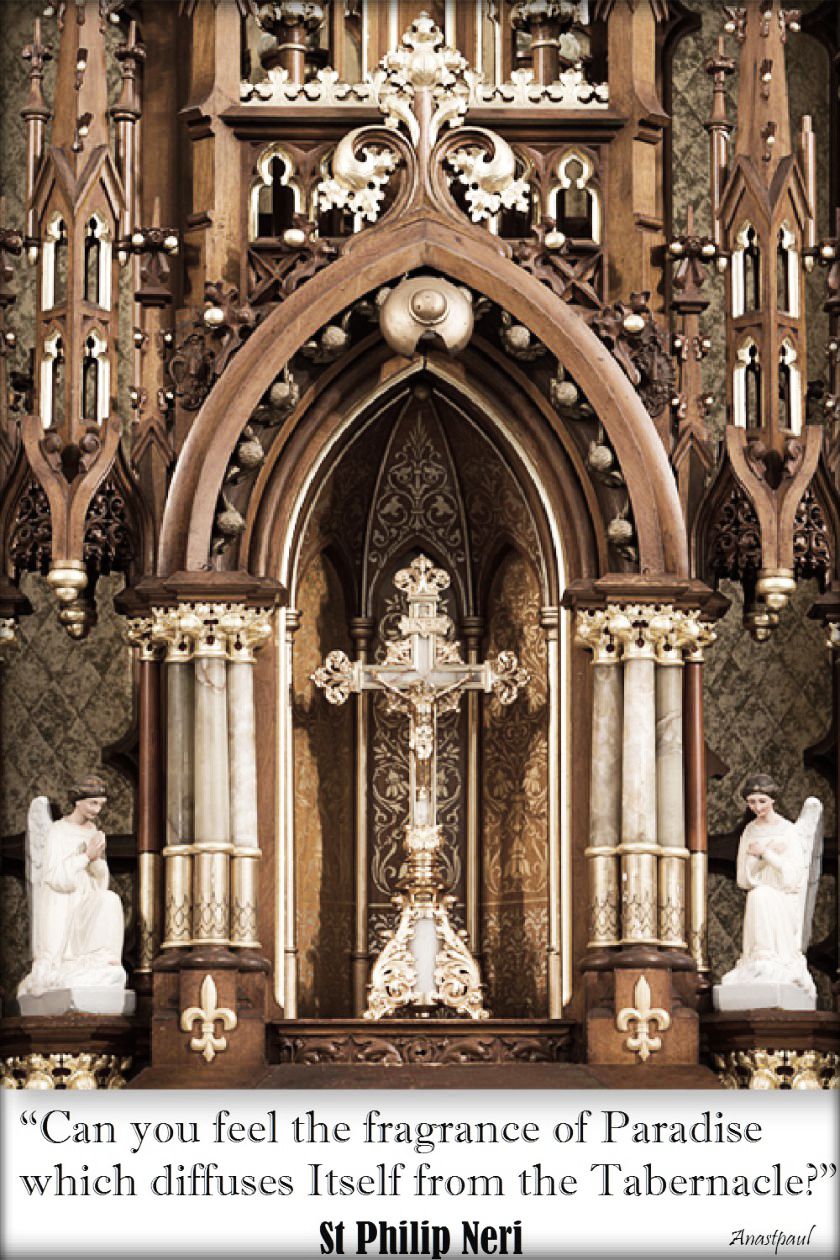
“Can you feel the fragrance of Paradise
which diffuses Itself from the Tabernacle?”

St Philip Neri

e2809ccan-you-feel-the-fragrance-of-paradise-st-philip-neri-16 june 2017-no 2

Posted in CATHOLIC DEVOTIONS of the Month, QUOTES of the SAINTS, SACRED and IMMACULATE HEARTS, SAINT of the DAY, Uncategorized

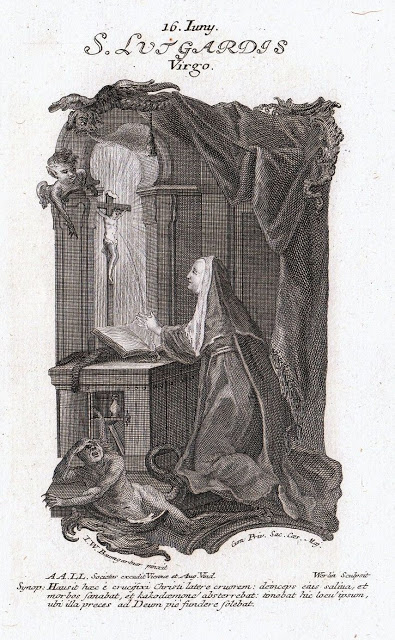
Saint of the Day – 16 June – St Lutgarde of Aywières (1182-1246 –The first known woman stigmatic of the Church and one of the first promoters of devotion to the Sacred Heart

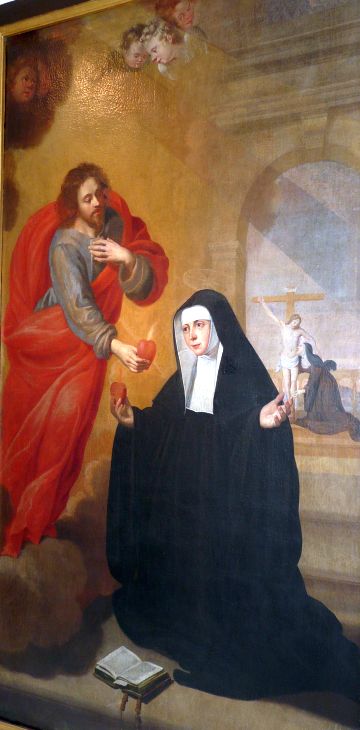
Saint of the Day – 16 June – St Lutgarde of Aywières (1182-1246 –The first known female stigmatic of the Church and one of the first promoters of devotion to the Sacred Heart – Religious, Mystric, Miracle-Worker, Stimatist, Visionary (1182 at Tongres, Limburg, Belgium – 16 June 1246 at Aywieres (modern Awirs), Belgium of natural causes, just as night office began on the Saturday night following Feast of the Holy Trinity)   Her relics were transferred to Ittre, Belgium on 4 December 1796 to avoid destruction in the French Revolution.   Patronages – birth, childbirth, blind people, againts blindness, disabled, handicapped of physically challenged people, Belgium, Flanders, Belgium.   Attributes – • woman with Christ showing her His wounded side, blind Cistercian abbess, Cistercian nun being blinded by the Heart of Jesus, Cistercian to whom Christ extends his hand from the cross, woman in attendance when Christ shows his Heart to the Father

St Lutgarde 5

When Lutgarde was twelve, her parents placed her in the care of the Benedictine sisters at St. Catherine’s monastery near Liège, Belgium.   The convent allowed visitors and young men came to court the beautiful young woman.   Once when an ardent fellow and Lutgarde were talking, Christ appeared to her.   Opening His garment, Christ showed Lutgarde the wound in His side bleeding as if recently opened and He said to her, “Do not seek any longer the caresses of unseemly love. Contemplate here what you should love and why you should love it. Here, I pledge to you are the delights of total purity, which will follow it.”   When the confused young man tried to resume their conversation, Lutgarde chased him off. “Get away from me, you fodder of death,” she said, “for I have been overtaken by another lover.”

St. Lutgarde made unusually rapid progress in the spiritual life.   She opened herself fully to Christ in prayer and He favoured her with an intimate experience of His presence.   He gave her gifts of healing and of understanding the convent’s Latin prayers.   But she asked him to take them back because both kept her from focusing on loving Him.   Then the Lord said to her, “What do You want?” “I want Your heart,” she said.   “No, rather it is Your heart that I want,” replied the Lord. “So be it, Lord,” said Lutgarde, “so long as Your heart’s love is mingled with mine and I have and hold my heart in You.   For with You as my shield, my heart is secure for all time.”

SANTA LUTGARD - Santa_Lutgarda-Goya

St Lutgarde spent nine years in St. Catherine’s convent and she was elected to be Superioress of the community there.   The year was 1205, when the saint was twenty-three years old.  Far from being flattered or pleased by her elevation to this dignity, Lutgarde regarded it as a disaster.   Indeed, it seems to have moved her to look elsewhere and to seek some other Order.   She thought St. Catherine’s could provide her with sufficient opportunities for living as a contemplative as long as she was an obscure member of the community but not when she took her place at its head.  While taking up her role as Superior, it was natural that her thoughts should turn to the austere Cistercian nuns, commonly known as Trappists, who had by this time, many flourishing convents in the Low Countries.

She asked the advice of a learned preacher of Liege, Jean de Lierre, who urged her to give up her post as prioress and leave the Benedictine Order for the Cistercian convent of Aywieres, (Awirs) which had recently been founded near Liege but had been transferred to a site in Brabant, near the village of Lillois.   She was very reluctant to accept this particular choice because French was spoken in Brabant and she felt it would be unwise to enter a convent where she would not understand the language of her superiors or spiritual directors.   Meanwhile, Christ Himself intervened and spoke the following words to her:  “It is My will that you go to Aywieres, and if you do not go, I will have nothing more to do with you.”
As if this were not enough, Lutgarde was also admonished by a saintly friend, who has since been venerated as St. Christine “the Admirable” who told her to go to Aywieres and so with no further possibility of doubt as to the convent of the Cistercian Order to which she was called, Lutgarde left St. Catherine’s without consulting her community and went to Aywieres.

When the nuns of St. Catherine’s discovered their loss, they were inconsolable, but it was too late to do anything about it. Lutgarde, in her turn, prayed earnestly for the peace of the community she had left and was assured by the Blessed Virgin that her prayers would be answered.   Indeed, Thomas of Cantimpre ends the first book of his life of St. Lutgarde with the comment:  “The indubitable effect of these prayers is to be seen even today [some fifty years later] in the community of St. Catherine’s. For this particular convent continues to grow in fervour more than ever, and to increase, at the same time, in temporal prosperity.”

Three times she fasted for periods of seven years, subsisting only on bread and liquids. The saint dedicated each fast for the Lord’s purposes:  once for Lutgarde of Aywières the conversion of heretics, a second time for the salvation of sinners and a final time for Emperor Frederick II, who was threatening the church.   Before her death she prophesied the latter’s demise, which occurred in 1250.

St Lutgardis is considered one of the leading mystics of the 13th century.[   A life of Lutgardis, Vita Lutgardis, was composed less than two years after her death by Thomas of Cantimpre, a Dominican friar and a theologian of some ability.  Lutgardis was venerated at Aywières for centuries and her relics were exhumed in the 16th century.   Works of art depicting the saint include a baroque statue of Lutgardis on the Charles Bridge by Matthias Braun in Prague and a painting by Goya.

Thomas Merton, in his biography of the Saint, reports that she had a particular devotion to St. Agnes, the Roman virgin martyr.   She was one day praying to St. Agnes when “suddenly a vein near her heart burst, and through a wide open wound in her side, blood began to pour forth, soaking her robe and cowl.”    She then sank to the floor and “lost her senses.”   She was never known to have been wounded in this way again but it is known that she kept the scar until the end of her life.   This took place when she was twenty-nine years old.   Witnesses to this event were two nuns, one named Margaret, the other Lutgarde of Limmos, who washed the Saint’s clothes.

Thomas Merton also tells that on many occasions, this saintly Cistercian, in meditating on Christ’s Passion, would fall into ecstasy and sweat blood.   A priest who had heard of this sweat of blood watched for an opportunity to witness it himself.   One day he found her in ecstasy, leaning against a wall, her face and hands dripping with blood.   Finding a pair of scissors, he managed to snip off a lock of the Saint’s hair which was wet with blood (he did so thinking to have proof of the event and also to have the lock of hair as a relic)   As he stood marveling at the blood on the lock of hair, the Saint suddenly came to herself.  Instantly the blood vanished; not only from her face and hands but also from the lock in his hands and also the blood that was on his hands!   Thomas Merton writes “At this, the priest was so taken aback that he nearly collapsed from astonishment.”

St. Lutgarde spent four decades at Aywières entirely devoted to the heart of Christ.   Five years before her death, that is, in 1241, St. Lutgarde received the revelation that she would enter heaven on the third Sunday after Pentecost, when the Gospel of the Great Marriage Feast would be sung.   She died in 1246.

St Lutgarde 8
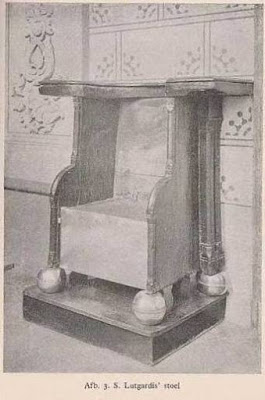
St Lutgarde chair
06-16-1246-lutgardis_2

Read further about St Lutgarde here : http://www.mysticsofthechurch.com/2015/09/st-lutgarde-of-aywieres-first-known.html

Posted in CATECHESIS, CATHOLIC DEVOTIONS of the Month, CATHOLIC Quotes, EUCHARISTIC Adoration, JESUIT SJ, MORNING Prayers, QUOTES of the SAINTS

Thought for the Day – 15 June

Thought for the Day – 15 June

Why is the Sacred Heart the Holy Eucharist?

It is impossible to identify the Holy Eucharist too closely with Jesus Christ.   We should remember He is in the Holy Eucharist not merely with His substance.   I have corrected many of my students over the years who tell me “Transubstantiation means that the substance of bread and wine become the substance of Jesus Christ.” I reply, “No, transubstantiation means the substance of bread and wine are no longer there. The substance of bread and wine is replaced not only by the substance of Christ’s Body and Blood. What replaces the substance of bread and wine is Jesus Christ!” Everything that makes Christ, Christ replaces what had been the substance of bread and wine.   The substance of bread and wine become the whole Christ.

Therefore, Christ in the Holy Eucharist is here with His human heart.   Is it a living heart?   Yes! That is why the revelations our Lord made to St. Margaret Mary about promoting devotion to the Sacred Heart were all made from the Holy Eucharist.

Why do we equate the Sacred Heart with the Holy Eucharist?   Because the Holy Eucharist is the whole Christ with His human heart.   According to St. Margaret Mary, the Sacred Heart is the Holy Eucharist.   So it follows that devotion to the Sacred Heart is devotion to the Holy Eucharist.   It is infinite Love Incarnate living in our midst in the Blessed Sacrament.

Servant of God Fr John A Hardon SJ

why is the sacred heart the Holy Eucharist - fr john a hardon

Posted in DOCTORS of the Church, EUCHARISTIC Adoration, MORNING Prayers, QUOTES of the SAINTS

Quote of the Day – 15 June

Quote of the Day – 15 June

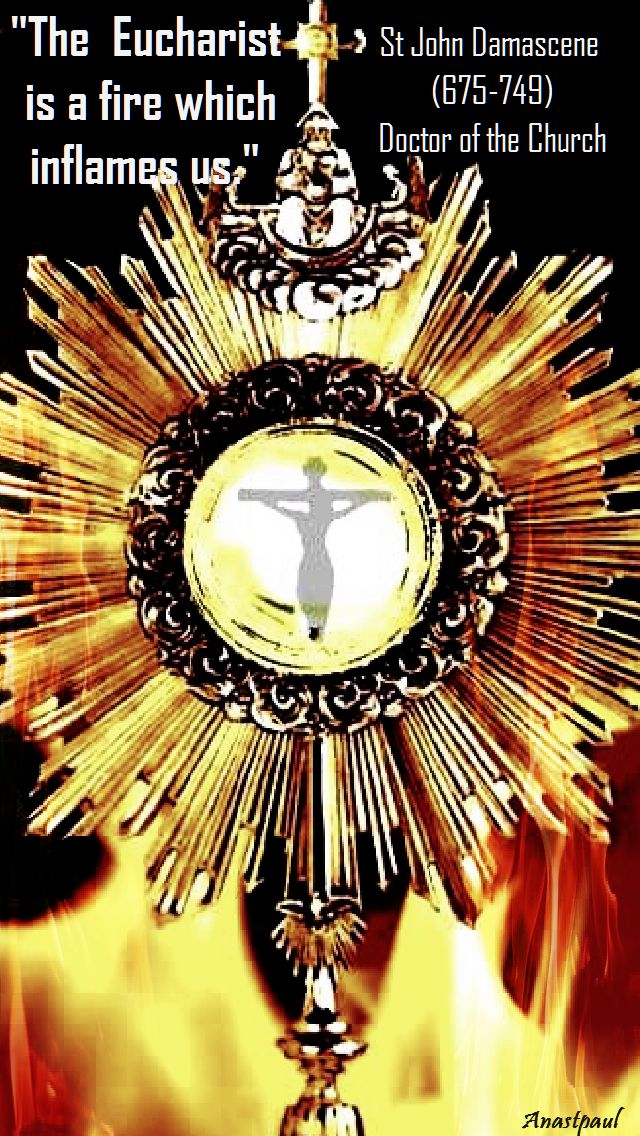
“The Eucharist is a fire
which inflames us.”

St John Damascene (675-749) – Doctor of the Church

the eucharist is a fire which enflames us - st john damascene

Posted in DOCTORS of the Church, FATHERS of the Church, MORNING Prayers, QUOTES of the SAINTS, The WORD

One Minute Reflection – 15 June

One Minute Reflection – 15 June

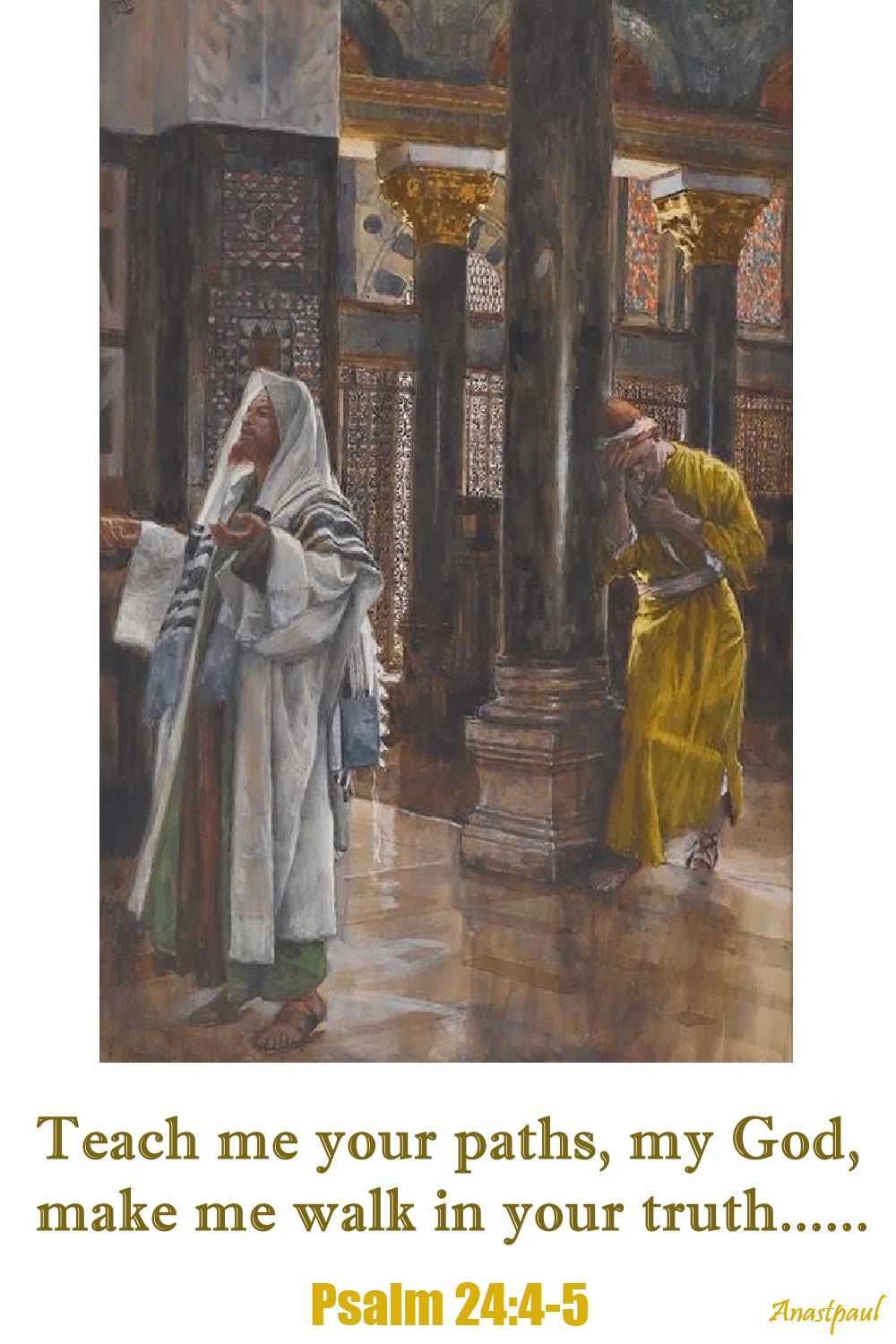
Teach me your paths, my God,
make me walk in your truth………..Psalm 24:4-5

Psalm 24 4-5

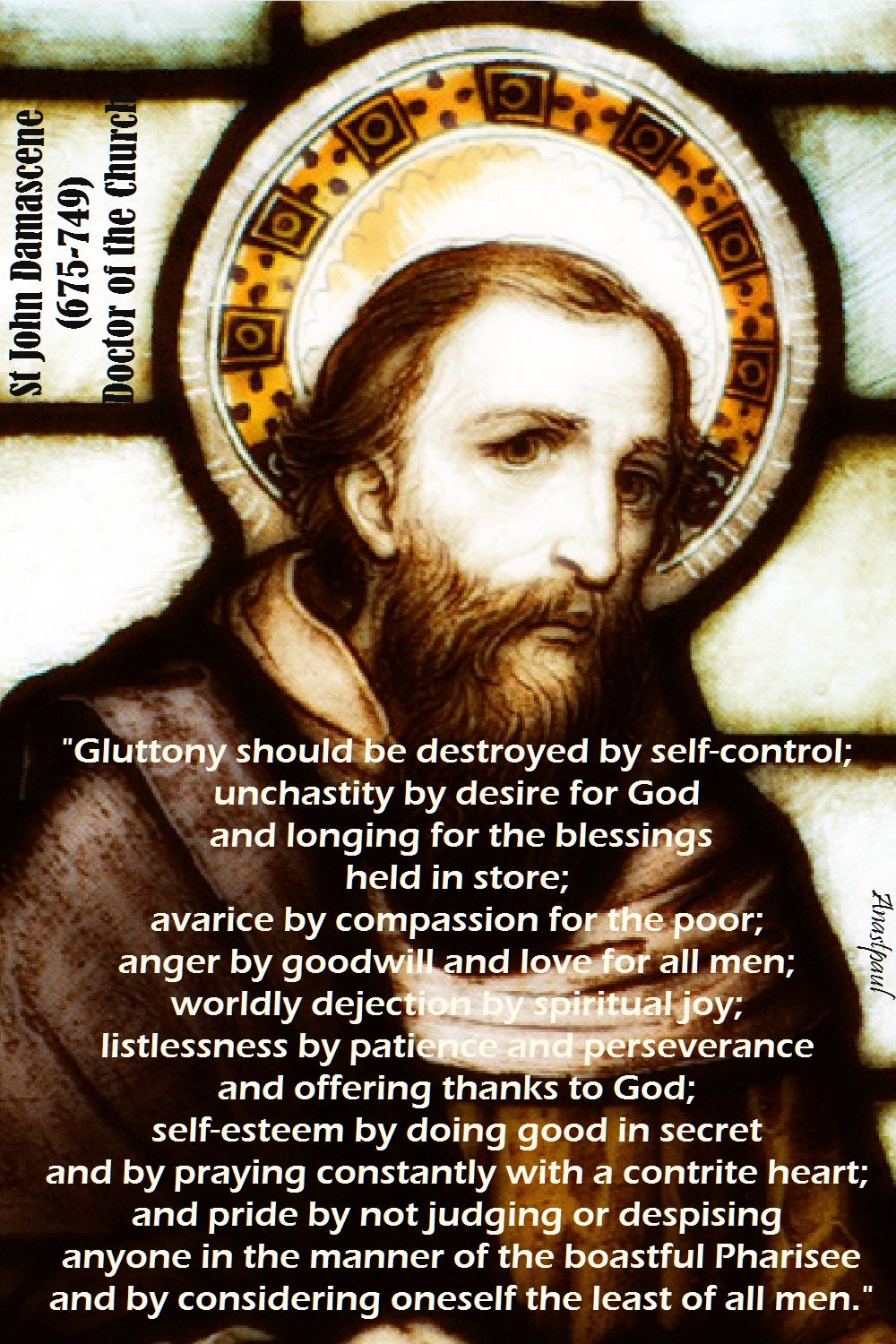
REFLECTION – “Gluttony should be destroyed by self-control; unchastity by desire for God and longing for the blessings held in store; avarice by compassion for the poor; anger by goodwill and love for all men; worldly dejection by spiritual joy; listlessness by patience, perseverance and offering thanks to God; self-esteem by doing good in secret and by praying constantly with a contrite heart; and pride by not judging or despising anyone in the manner of the boastful Pharisee, and by considering oneself the least of all men.”………..St John Damascene (675-749) – Doctor of the Church

gluttony - st john damascene

PRAYER – Heavenly Father, teach me Your paths and help me to walk always in Your truth, following ever more closely the way set before me by Your Divine Son, Our Lord Jesus Christ.  May Your Grace and Your Spirit fill my heart with the love, courage, zeal and strength I need to overcome the world and be a light to my neighbour. Amen

Posted in franciscan OFM, MORNING Prayers, QUOTES of the SAINTS, SAINT of the DAY

Quote/s of the Day – 13 June

Quote/s of the Day – 13 June

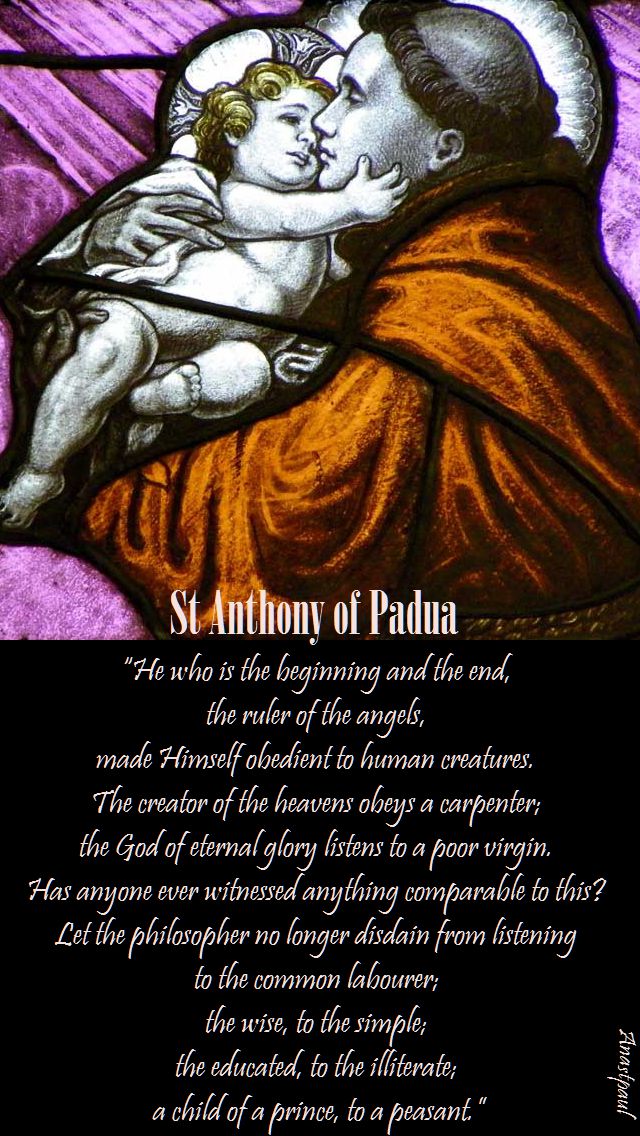
“He who is the beginning and the end,
the ruler of the angels,
made Himself obedient to human creatures.
The creator of the heavens obeys a carpenter;
the God of eternal glory listens to a poor virgin.
Has anyone ever witnessed anything comparable to this?
Let the philosopher no longer disdain from listening
to the common labourer;
the wise, to the simple;
the educated, to the illiterate;
a child of a prince, to a peasant.”

he who is the beginning and the end - st anthony of padua

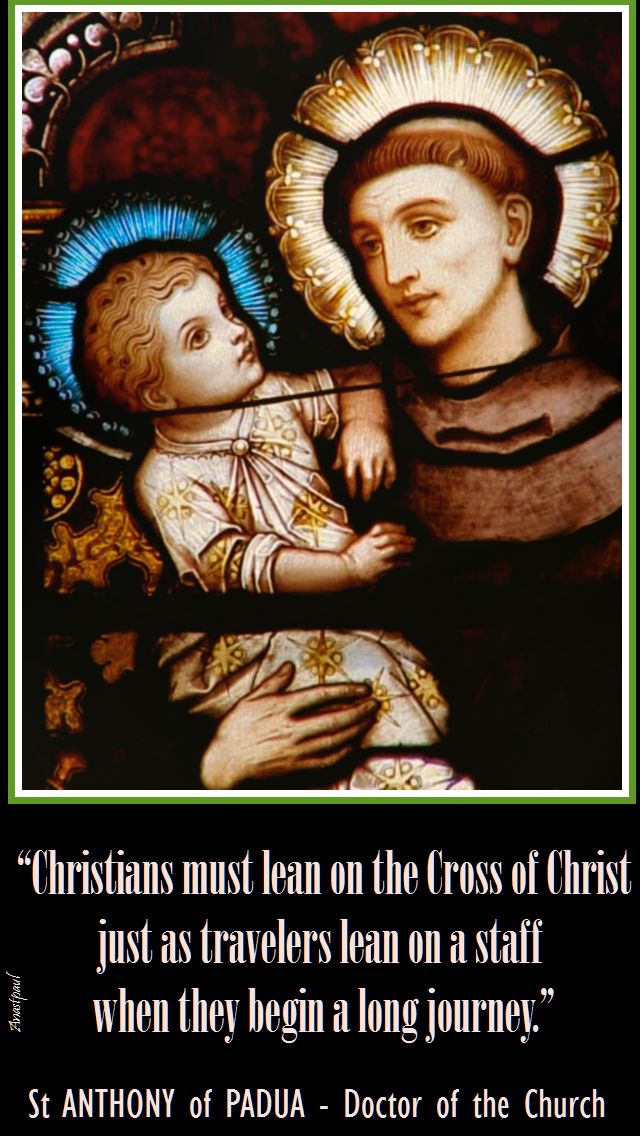
“Christians must lean on the Cross of Christ
just as travelers lean on a staff
when they begin a long journey.”

christians must lean - st anthony of padua

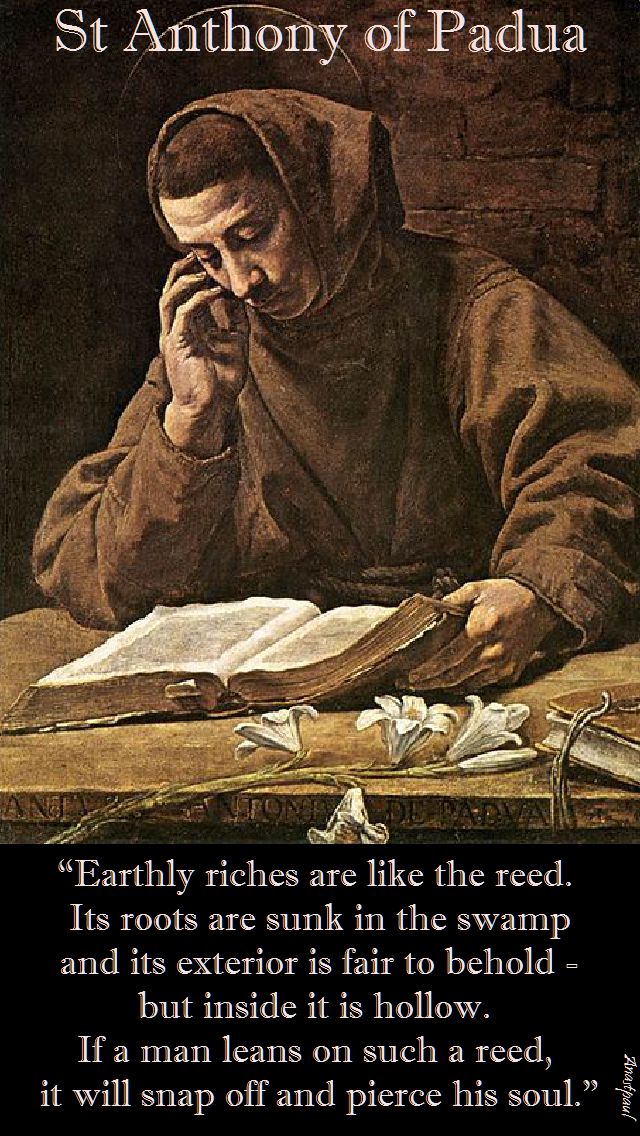
“Earthly riches are like the reed.
Its roots are sunk in the swamp
and its exterior is fair to behold –
but inside it is hollow.
If a man leans on such a reed,
it will snap off and pierce his soul.”

earthly riches are like the reed-st anthony of padua

“Not without a long procession does the devil wish the sinner to be carried to his grave
and therefore he arranges the file after the usual manner:
Ambition carries the cross,
Detraction the incense,
Oppression the holy – or rather the cursed – water,
Hypocrisy bears the lights.
There are two chanters:
one is the Fallacious Confidence of living a long time
and he sings, Requiem aeternam – you still have abundant time;
the other is Presumption as to the Divine Mercy
and he sings, In Paradisnm le ducant angeli.
Pride celebrates the office.
Then follow Vain-Glory on the right,
Envy on the left, and, walking after,
Anger, Impatience, Insolence, Blasphemy,
Contumely, Arrogance, Lasciviousness,
Gluttony, Idle Talk, Boasting, Injury, Curiosity
and Uneasiness.
Lo! what a crowd in the conscience following him
who is dead in trespasses and sin.”

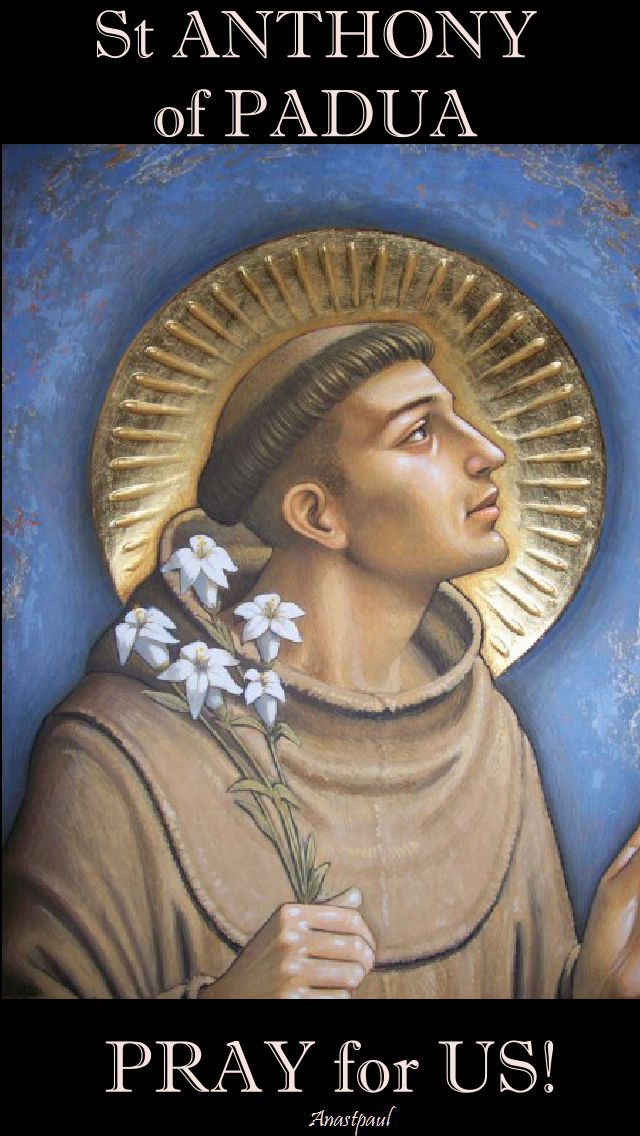
St Anthony of Padua Pray for us!

st anthony pray for us 2

Posted in franciscan OFM, MORNING Prayers, QUOTES of the SAINTS, SAINT of the DAY, The WORD

One Minute Reflection – 13 June

One Minute Reflection – 13 June

“You are the light of the world. A city built on a hill cannot be hid. No one after lighting a lamp puts it under the bushel basket, but on the lampstand, and it gives light to all in the house. In the same way, let your light shine before others, so that they may see your good works and give glory to your Father in heaven.”………….Matthew 5:15-16

matthew 5 15-16

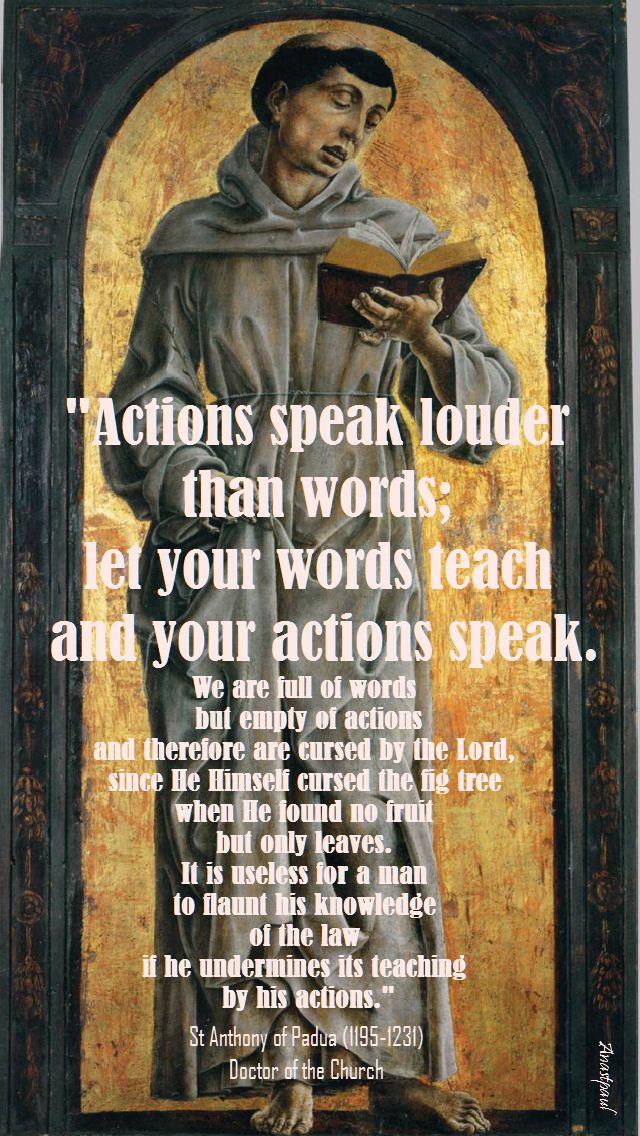
REFLECTION – “Actions speak louder than words;
let your words teach and your actions speak.
We are full of words but empty of actions
and therefore are cursed by the Lord,
since He Himself cursed the fig tree
when He found no fruit but only leaves.
It is useless for a man to flaunt his knowledge
of the law if he undermines its teaching by his actions.”…….St Anthony of Padua

ACTIONS SPEAK LOUDER THAN WORDS - st anthony

PRAYER – My Lord and my God, teach me the gift of silence and the gift of charity. Help me to live as I speak and to do as You say. Let my fruit be the proof of my love for You and for my neighbour. St Anthony your preaching and teaching was always accompanied by love and charity, pray for us all that we may be a light for the world, amen.

st anthony pray for us

Posted in DOCTORS of the Church, FATHERS of the Church, MORNING Prayers, QUOTES of the SAINTS, The MOST HOLY & BLESSED TRINITY

Quote of the Day – 12 June

Quote of the Day – 12 June

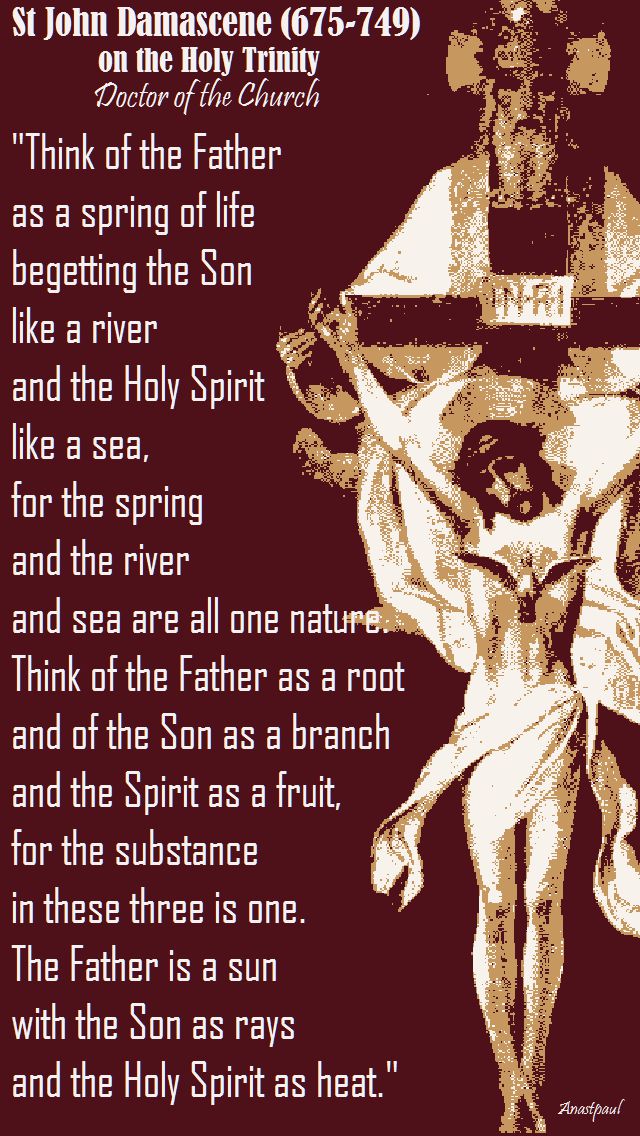
St John Damascene (675-749) – Doctor of the Church on the Holy Trinity

“Think of the Father as a spring of life
begetting the Son like a river
and the Holy Ghost like a sea,
for the spring and the river and sea are all one nature.  
Think of the Father as a root
and of the Son as a branch
and the Spirit as a fruit,
for the substance in these three is one.  
The Father is a sun
with the Son as rays
and the Holy Spirit as heat.”

ST JOHN DAMASCENE ON THE HOLY TRINITY


Posted in EUCHARISTIC Adoration, MORNING Prayers, QUOTES of the SAINTS, SAINT of the DAY, The WORD

One Minute Reflection – 12 June

One Minute Reflection – 12 June

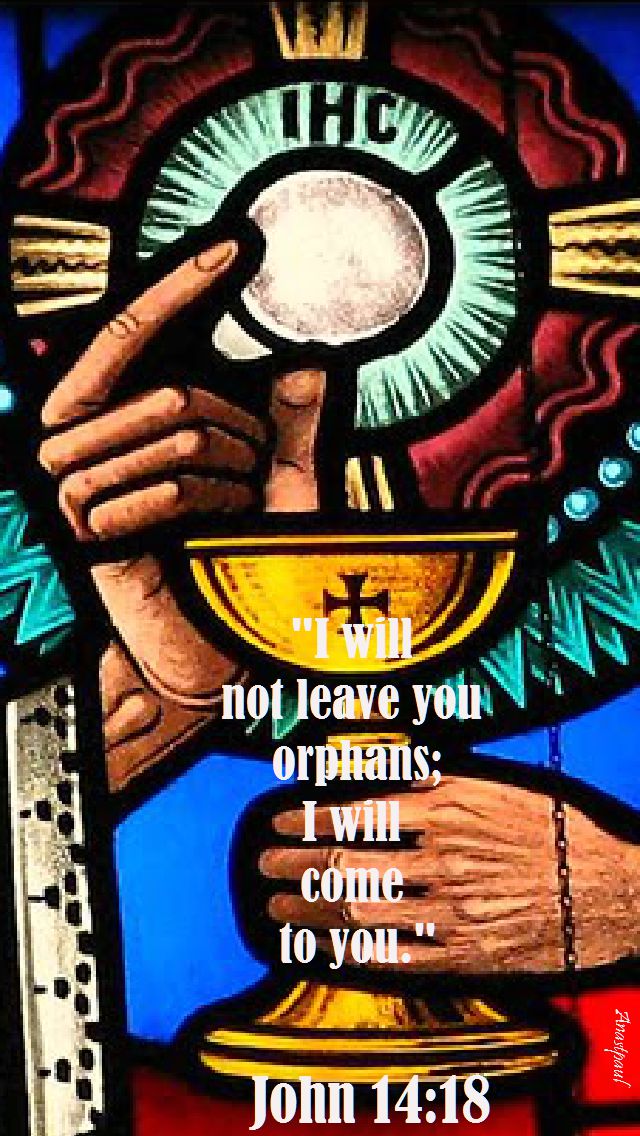
“I will not leave you orphans; I will come to you.”…..John 14:18

JOHN 14 18

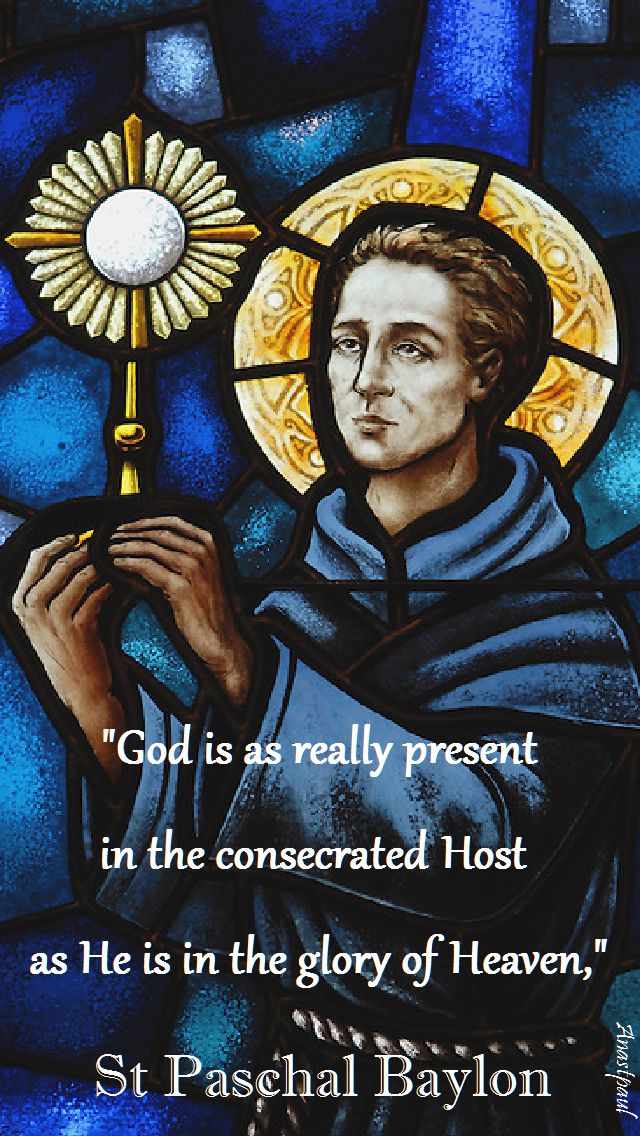
REFLECTION – “God is as really present in the consecrated Host as He is in the glory of Heaven,”…………St Paschal Baylon

god is as really pesent - st paschal baylon

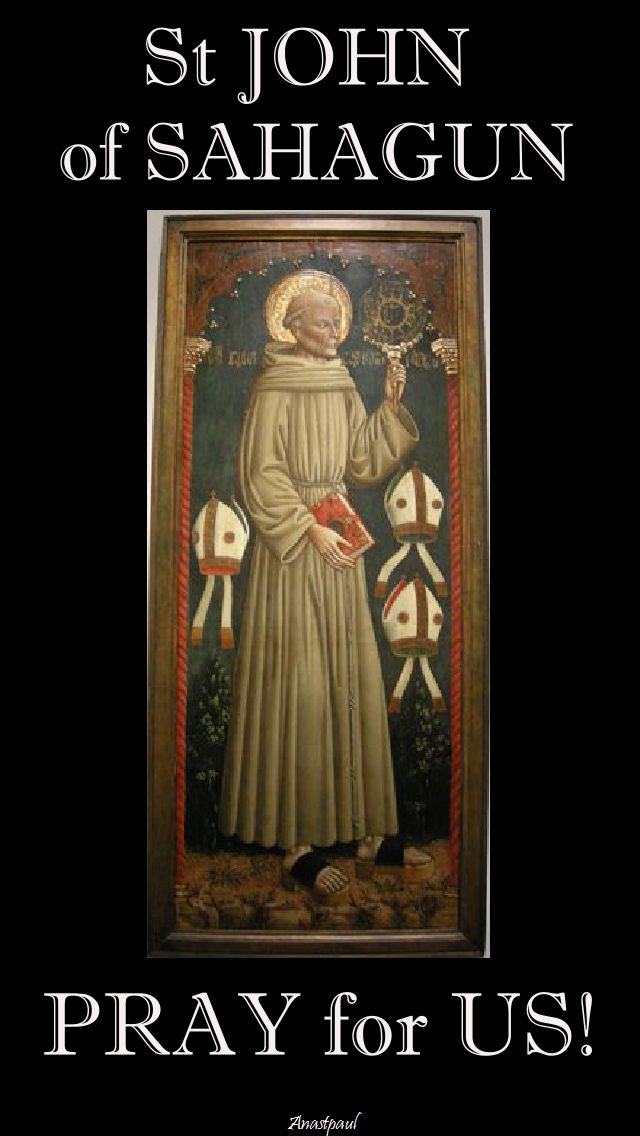
PRAYER – Jesus my Lord and God, You have come to us. You are here with us. How blessed we are and how blessed St John of Sahagun who was able to speak with You during the celebration of the Eucharist and who spent countless hours with You in holy adoration. Teach us all, that we too may learn the glory of spending time with You in loving adoration. St John of Sahagun pray for us! amen.

ST JOHN OF SAHAGUN PRAY FOR US

Posted in DOCTORS of the Church, FATHERS of the Church, FEASTS and SOLEMNITIES, MORNING Prayers, QUOTES of the SAINTS, The MOST HOLY & BLESSED TRINITY

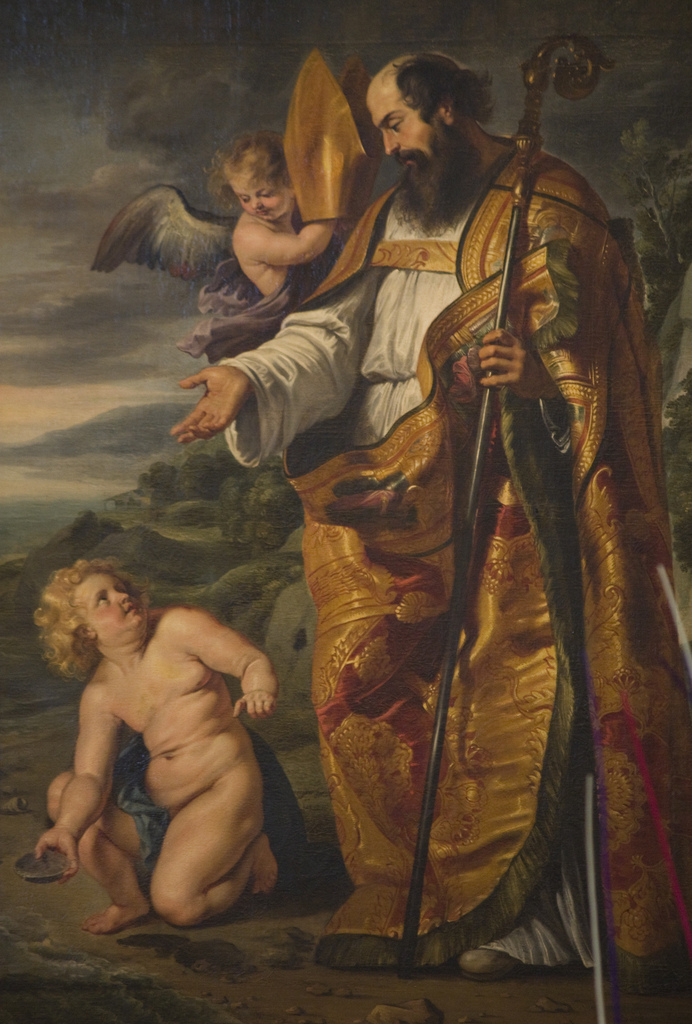
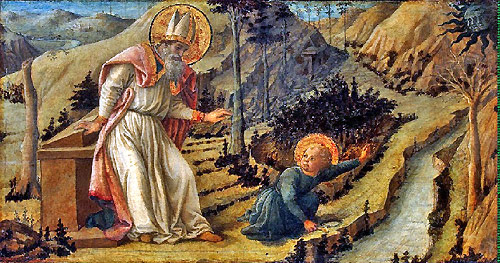
St Augustine, the Holy Trinity, the Child and the SeaShell

St Augustine, the Holy Trinity, the Child and the SeaShell

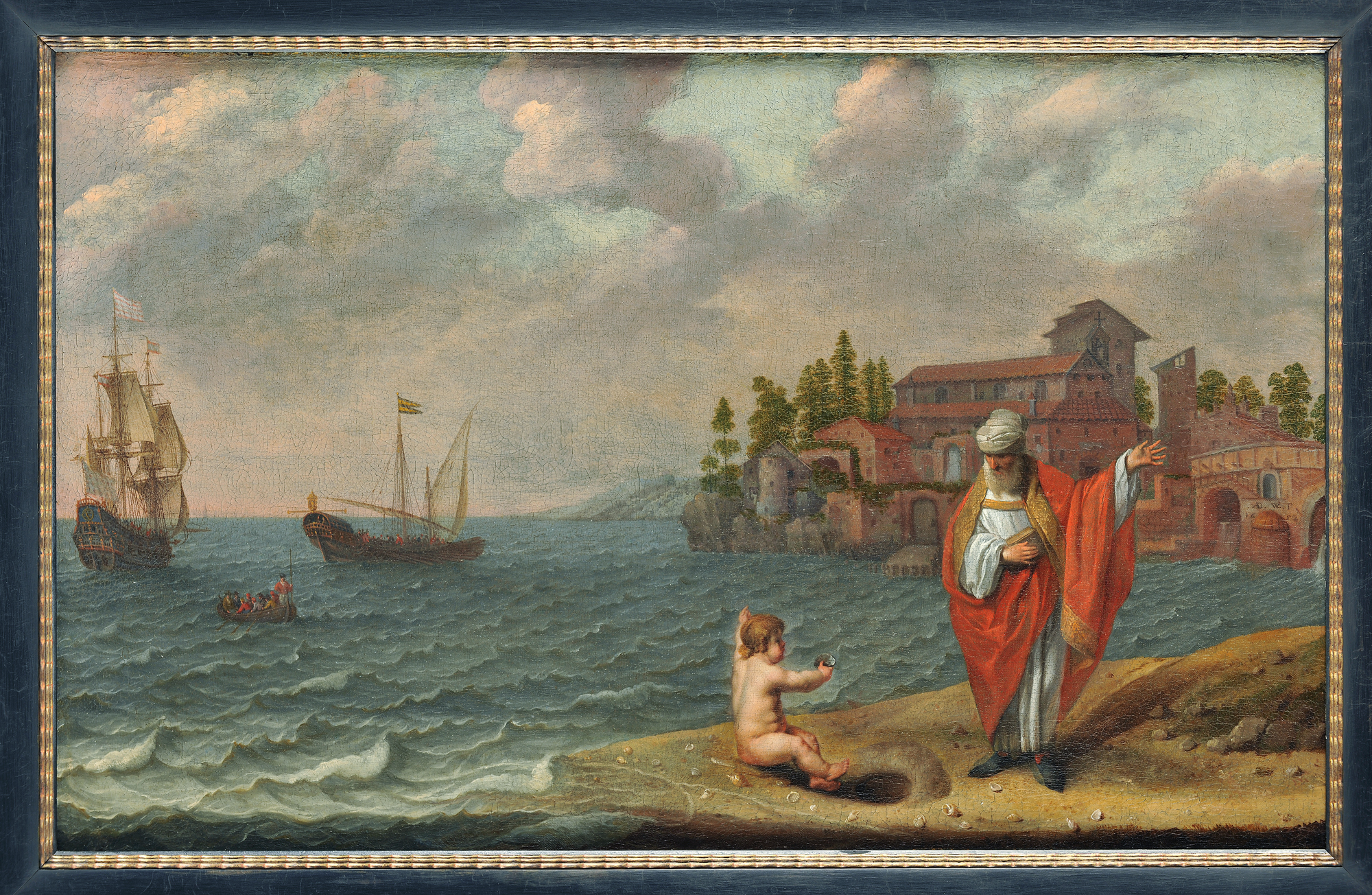
Today, 11 June 2017, on the Solemnity of the Holy Trinity, we remember the legend of St Augustine and the Seashell.

Abraham Willaerts – Saint Augustine and the child
Abraham Willaerts – St Augustine and the Child

The great Doctor of the Church St. Augustine of Hippo spent over 30 years working on his treatise De Trinitate [about the Holy Trinity], endeavouring to conceive an intelligible explanation for the mystery of the Trinity.

He was walking by the seashore one day contemplating and trying to understand the mystery of the Holy Trinity when he saw a small boy running back and forth from the water to a spot on the seashore.   The boy was using a sea shell to carry the water from the ocean and place it into a small hole in the sand.

The Bishop of Hippo approached him and asked, “My boy, what are doing?”

“I am trying to bring all the sea into this hole,” the boy replied with a sweet smile.

“But that is impossible, my dear child, the hole cannot contain all that water” said Augustine.

The boy paused in his work, stood up, looked into the eyes of the Saint, and replied, “It is no more impossible than what you are trying to do – comprehend the immensity of the mystery of the Holy Trinity with your small intelligence.”

The Saint was absorbed by such a keen response from that child, and turned his eyes from him for a short while.   When he glanced down to ask him something else, the boy had vanished.

ST AUGUSTINE AND THE CHILDst augustine and the child 2

Some say that it was an Angel sent by God to teach Augustine a lesson on pride in learning. Others affirm it was the Christ Child Himself who appeared to the Saint to remind him of the limits of human understanding before the great mysteries of our Faith.

Posted in CATHOLIC Quotes, DOCTORS of the Church, MORNING Prayers, QUOTES of the SAINTS, The MOST HOLY & BLESSED TRINITY

One Minute Reflection – 11 June – The Solemnity of the Holy Trinity

One Minute Reflection – 11 June – The Solemnity of the Holy Trinity

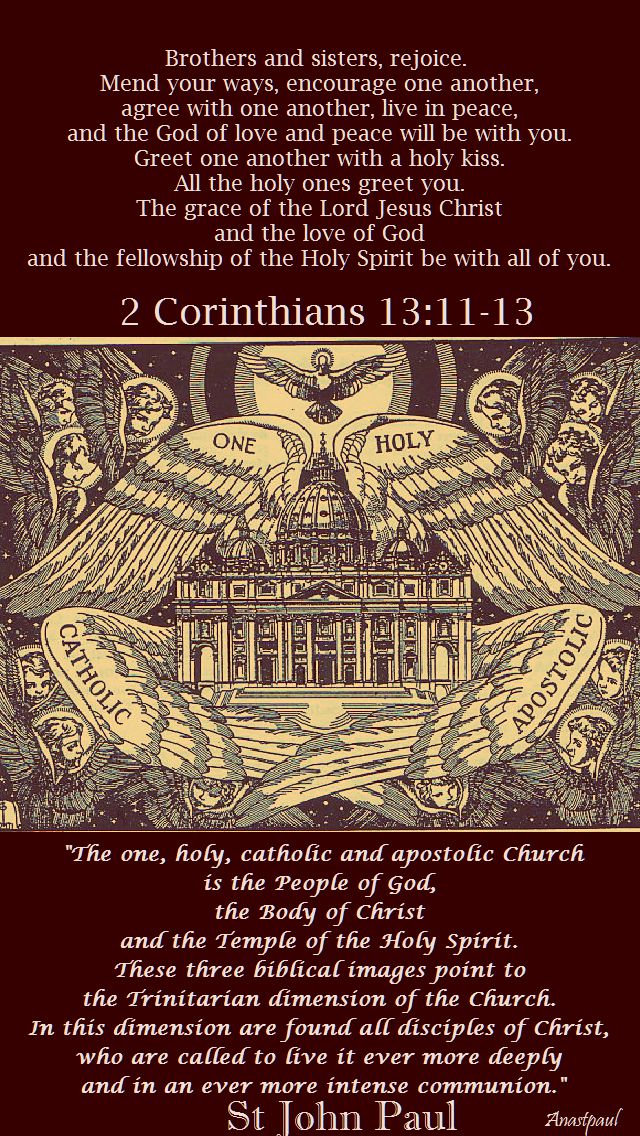
Brothers and sisters, rejoice.
Mend your ways, encourage one another,
agree with one another, live in peace,
and the God of love and peace will be with you.
Greet one another with a holy kiss.
All the holy ones greet you.
The grace of the Lord Jesus Christ
and the love of God
and the fellowship of the Holy Spirit be with all of you………..2 Corinthians 13:11-13

REFLECTION – “The one, holy, catholic and apostolic Church is the People of God, the Body of Christ and the Temple of the Holy Spirit.   These three biblical images point to the Trinitarian dimension of the Church.   In this dimension are found all disciples of Christ, who are called to live it ever more deeply and in an ever more intense communion.”…..St John Paul

the one holy - st john paul

PRAYER – God our Father, who by sending into the world. the Word of truth and the Spirit of sanctification, made known to the human race your wondrous mystery, grant us, we pray, that in profession the true faith, we may acknowledge the Trinity of eternal glory and adore your Unity, powerful in majesty. T  hat we, as your chosen may too live our lives in total unity with all the peoples of Christ’s Church.   Through our Lord Jesus Christ, your Son, who lives and reigns with you in the unity of the Holy Spirit, one God, for ever and ever. Amen