Quote/s of the Day – 12 July – “Month of the Most Precious Blood” – Readings: Exodus 1: 8-14, 22; Psalms 124: 1b-3, 4-6, 7-8; Matthew 10: 34 – 11: 1
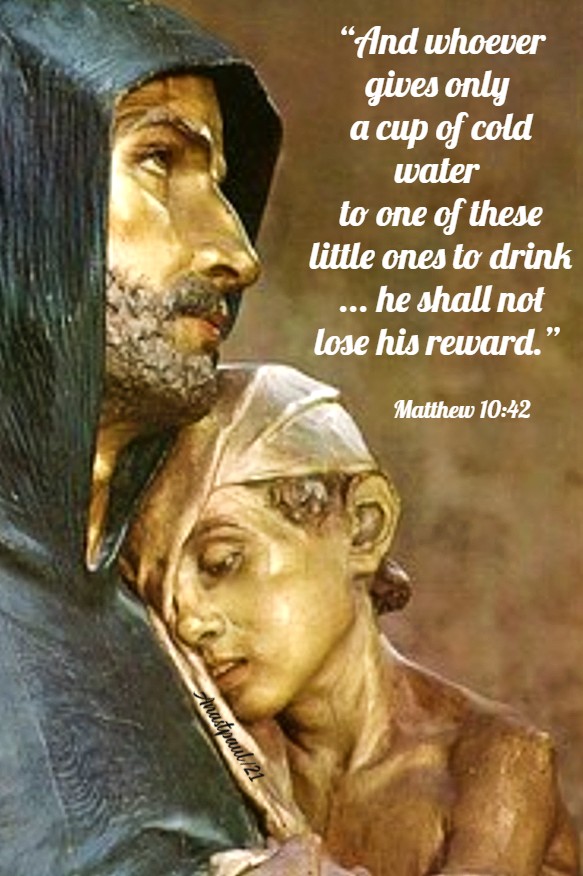
“And whoever gives only a cup of cold water to one of these little ones to drink , … he shall not lose his reward.”
Matthew 10:42
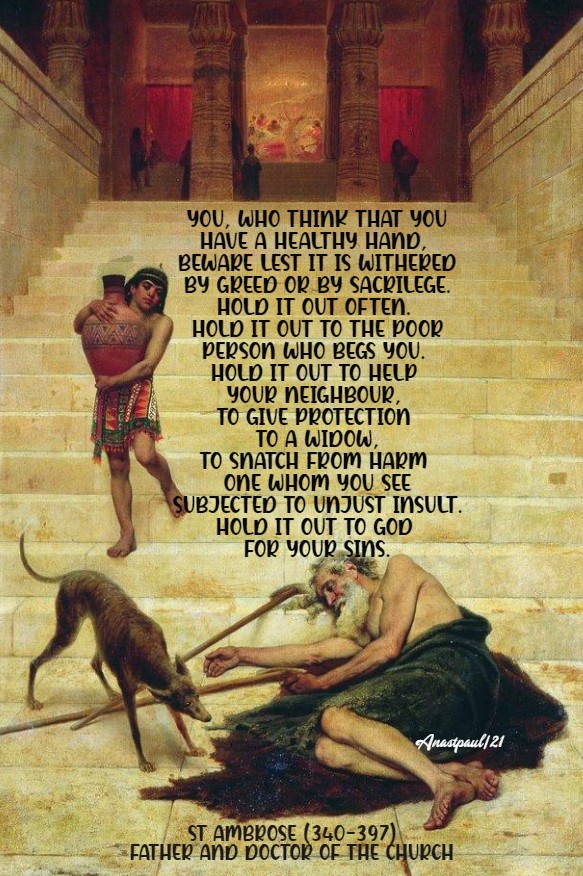
“You, who think that you have a healthy hand, beware lest it is withered by greed or by sacrilege. Hold it out often. Hold it out to the poor person who begs you. Hold it out to help your neighbour, to give protection to a widow, to snatch from harm one whom you see subjected to unjust insult. Hold it out to God for your sins.”
St Ambrose (340-397) Father and Doctor of the Church
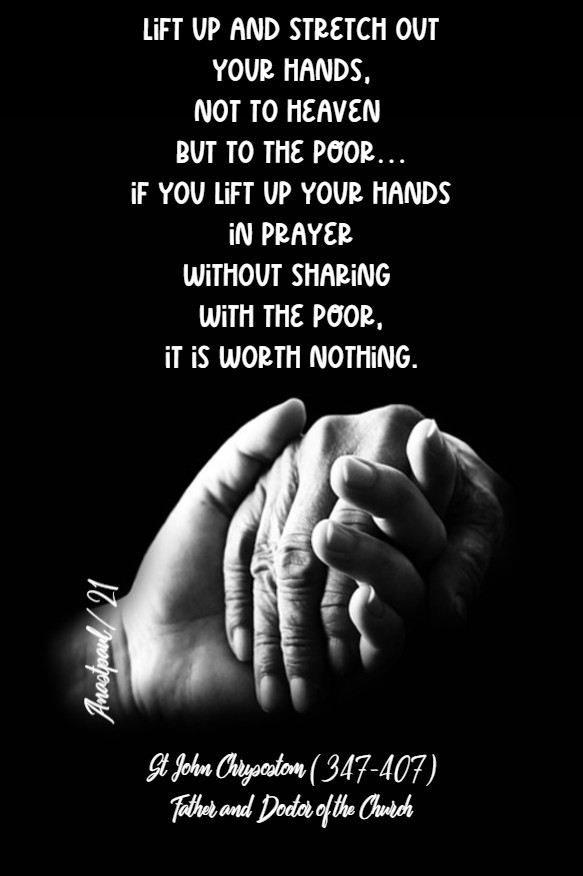
“ Lift up and stretch out your hands, not to heaven but to the poor… if you lift up your hands in prayer without sharing with the poor, it is worth nothing.”
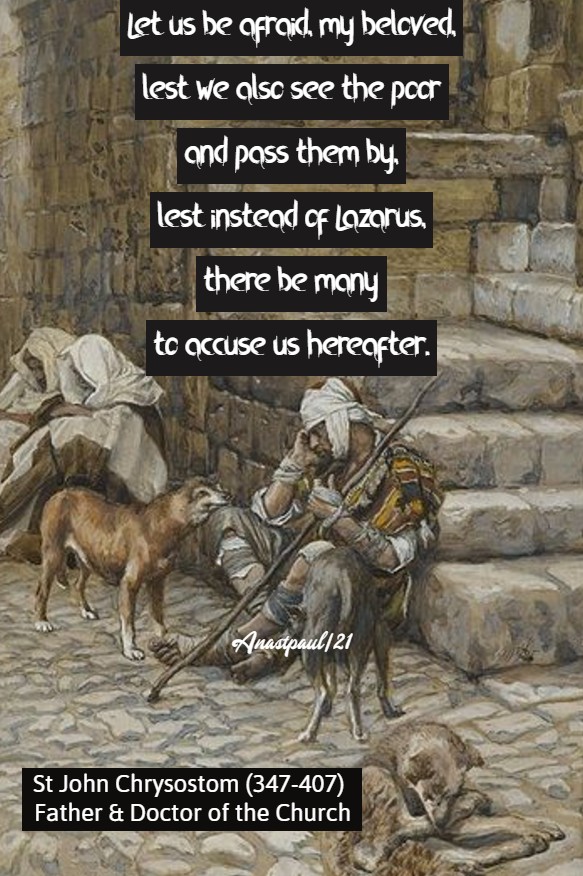
“… Let us be afraid, my beloved, lest we also see the poor and pass them by, lest instead of Lazarus, there be many to accuse us hereafter.”
St John Chrysostom (347-407) Father and Doctor of the Church
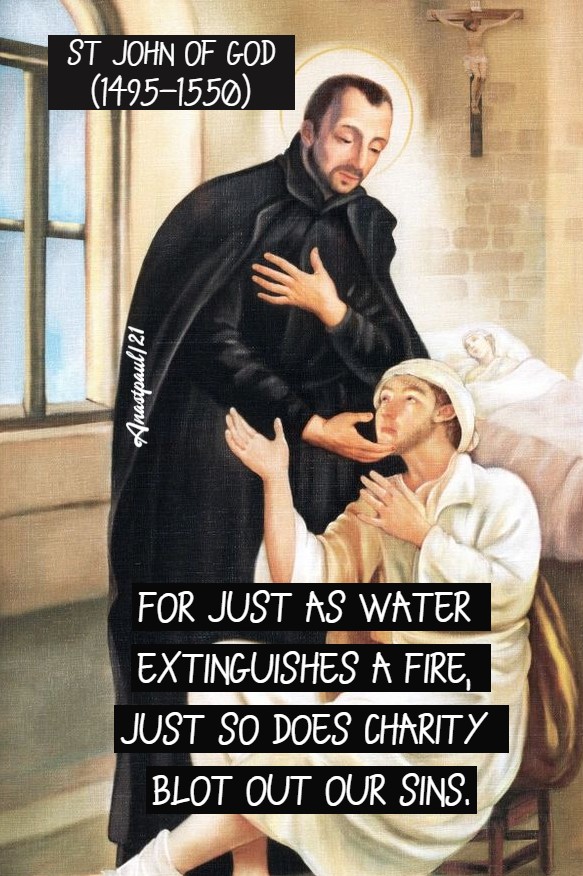
“For just as water extinguishes a fire, just so does charity blot out our sins.”
St John of God (1495-1550)
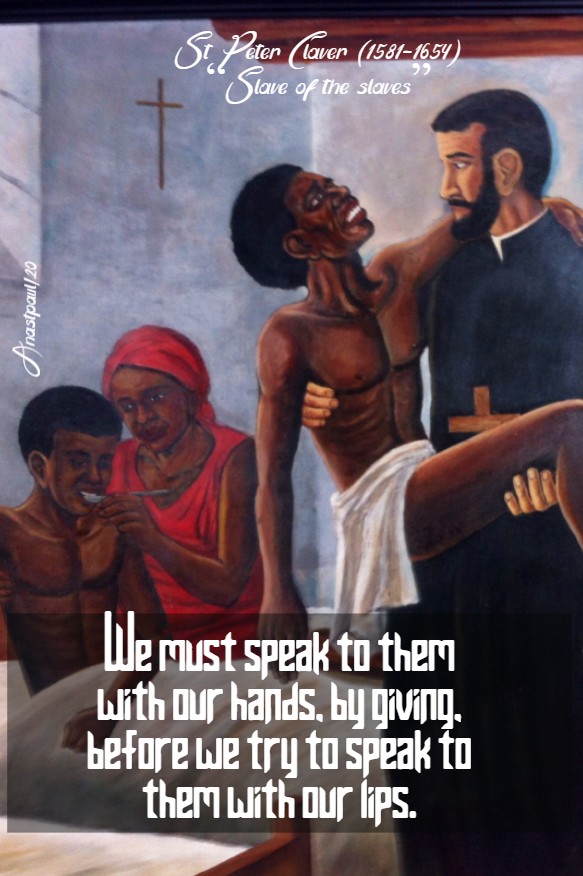
“We must speak to them with our hands, by giving, before we try to speak to them with our lips.”
St Peter Claver (1581-1654) “Slave of the slaves”
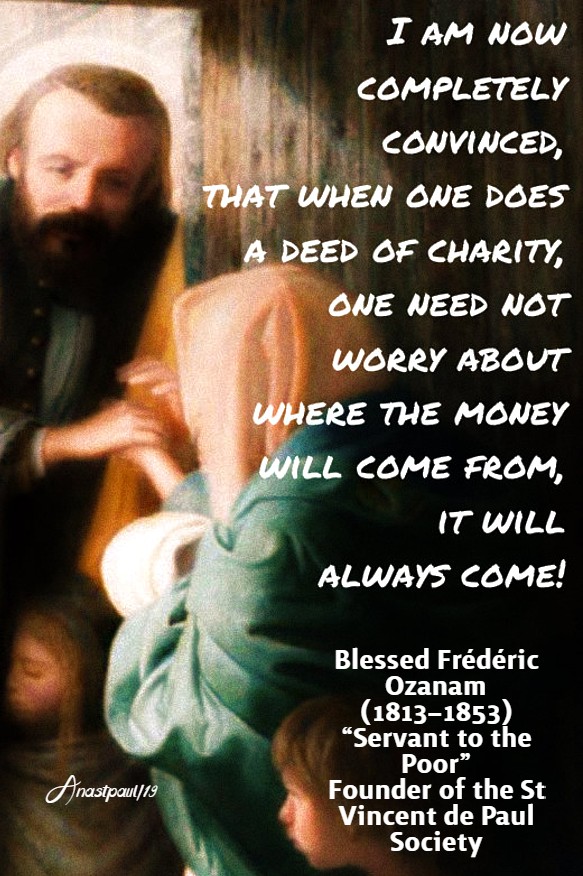
“I am now completely convinced, that when one does a deed of charity, one need not worry about where the money will come from, it will always come!”
Blessed Frédéric Ozanam (1813–1853) “Servant to the Poor”
Quote/s of the Day – 10 July – “Month of the Precious Blood” – Readings: enesis 49: 29-32; 50: 15-26a; Psalm 105: 1-2, 3-4, 6-7; Matthew 10: 24-33
“The very hairs of your head are numbered.”
Matthew 10:30
“I see clearly with the interior eye, that the sweet God loves, with a pure love, the creature that He has created and has a HATRED for nothing but SIN, which is more opposed to Him, than can be thought or imagined.”
St Catherine of Genoa (1447-1510)
“Every moment comes to us, pregnant with a command from God, only to pass on and plunge into eternity, there to remain forever, what we have made of it!”
St Francis de Sales (1567-1622) Doctor Caritatis
“Oh! My God, how much Your Hand was upon me and yet how little I was aware of it! How good You are! How good You are! How You protected me! How you covered me with Your wings, when I did not even believe in Your existence!”
Bl Charles of Jesus de Foucauld (1858-1916)
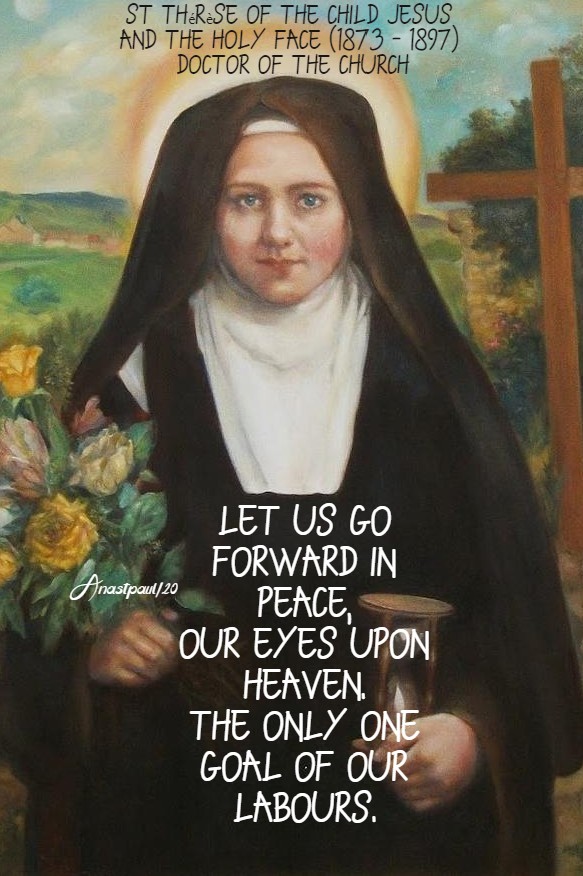
“Let us go forward in peace, our eyes upon heaven, the only one goal of our labours.”
St Thérèse of the Child Jesus (1873-1897) Doctor of the Church
Quote/s of the Day – 8 July – “Month of the Most Precious Blood” – Readings: Genesis 44, 18-21, 23b-29, 45: 1-5; Psalms 105: 16-17, 18-19, 20-21; Matthew 10: 7-15.
Obedience
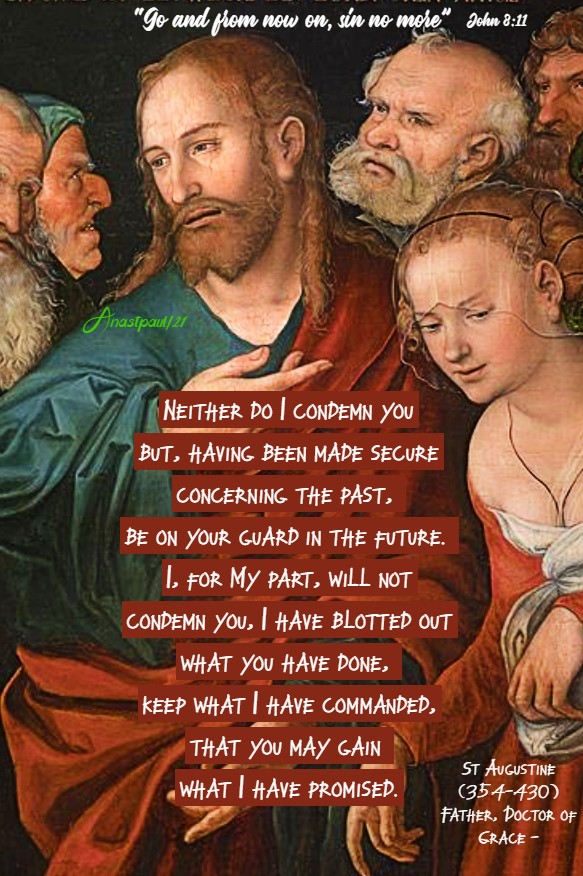
“Go and from now on, sin no more”
John 8:11
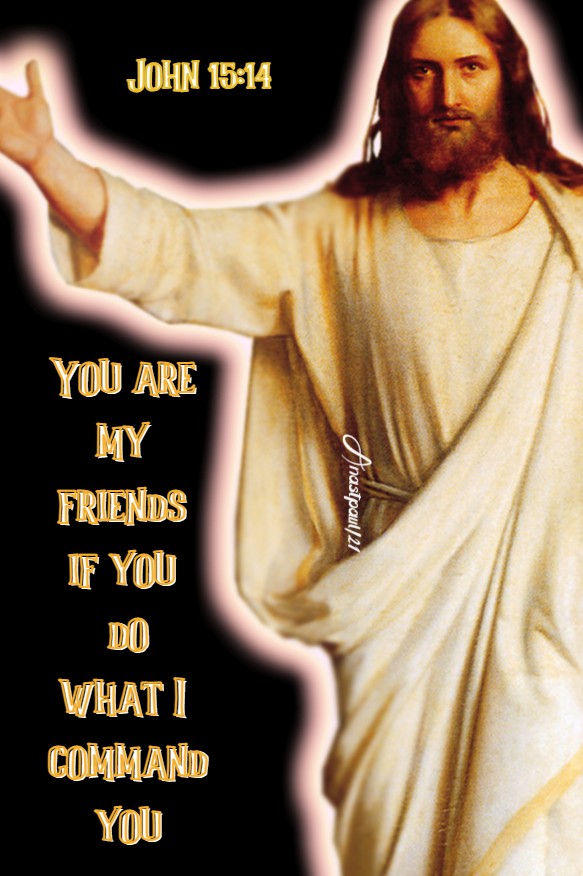
“You are my friends, if you do the things that I command you.”
John 15:14
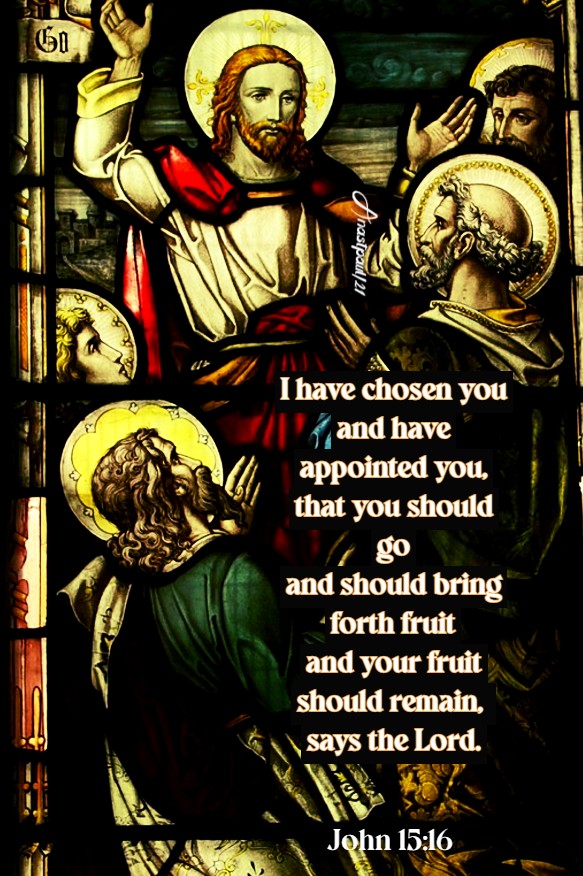
“I have chosen you and have appointed you, that you should go and should bring forth fruit and your fruit should remain, says the Lord.”
John 15:16
“Let it be understood, that those who are not found living as He taught, are NOT Christian- even though they profess with the lips, the teaching of Christ.”
St Justin Martyr (c 100-165) Father of the Church
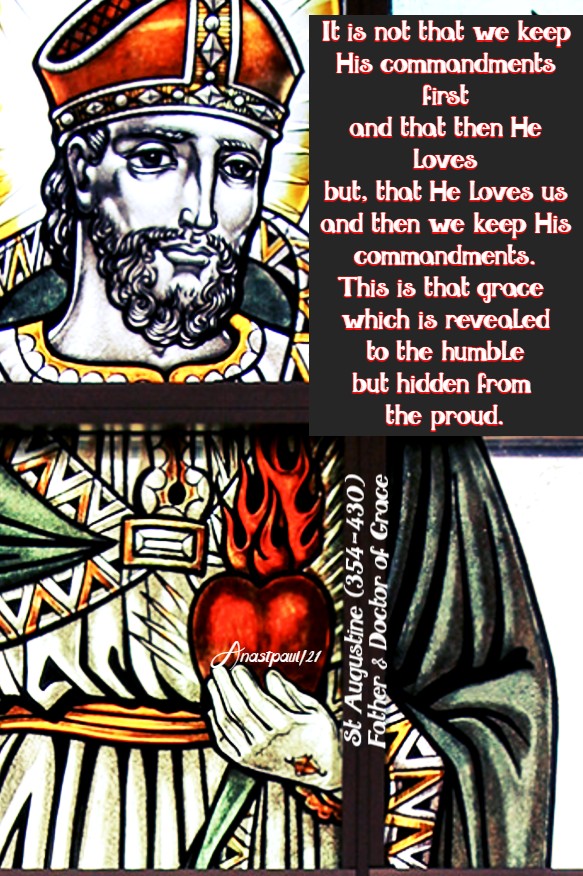
“It is not that we keep His commandments first and that then He loves but, that He loves us and then we keep His commandments. This is that grace which is revealed to the humble but hidden from the proud.”
“Neither do I condemn you but, having been made secure concerning the past, be on your guard in the future. I, for My part, will not condemn you, I have blotted out what you have done; keep what I have commanded, that you may gain what I have promised.”
Thought for the Day – 5 July – Meditations with Antonio Cardinal Bacci (1881-1971)
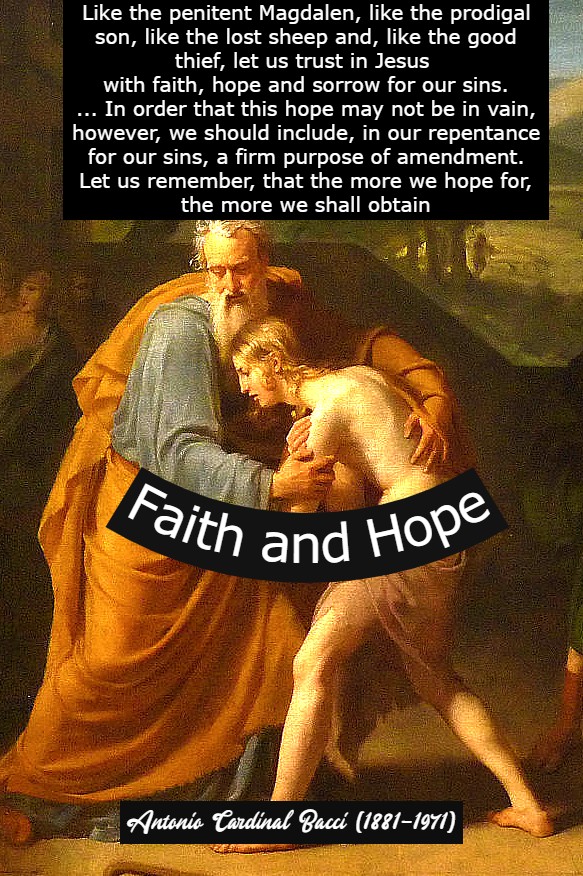
Faith and Hope
“Christian hope derives from faith. When we believe in the infinitely good and merciful God, Who was made man for us and Who shed His Precious Blood, for our salvation, we experience a great hope and a great confidence. No matter how numerous our sins and our defects, as long as we are sincerely repentant, we should continue to hope for the forgiveness of God. Despair, which led Judas to commit suicide, should never be allowed to enter our minds. Like the penitent Magdalen, like the prodigal son, like the lost sheep and, like the good thief, let us trust in Jesus with faith, hope and sorrow for our sins. Let us remember, that He is infinitely good and merciful and ardently desires to pardon us. Together with this hope of God’s forgiveness, we should nurture the hope of gaining Heaven, which the Lord, in His infinite goodness, has promised, not only to innocent souls but, also to repentant sinners. In order that this hope may not be in vain, however, we should include, in our repentance for our sins, a firm purpose of amendment.
Let us remember, that the more we hope for, the more we shall obtain!”
Quote/s of the Day – 2 July – “Month of the Most Precious Blood” – Readings: Genesis 23: 1-4, 19; 24: 1-8, 62-67, Psalms 106: 1b-2, 3-4a, 4b-5, Matthew 9: 9-13
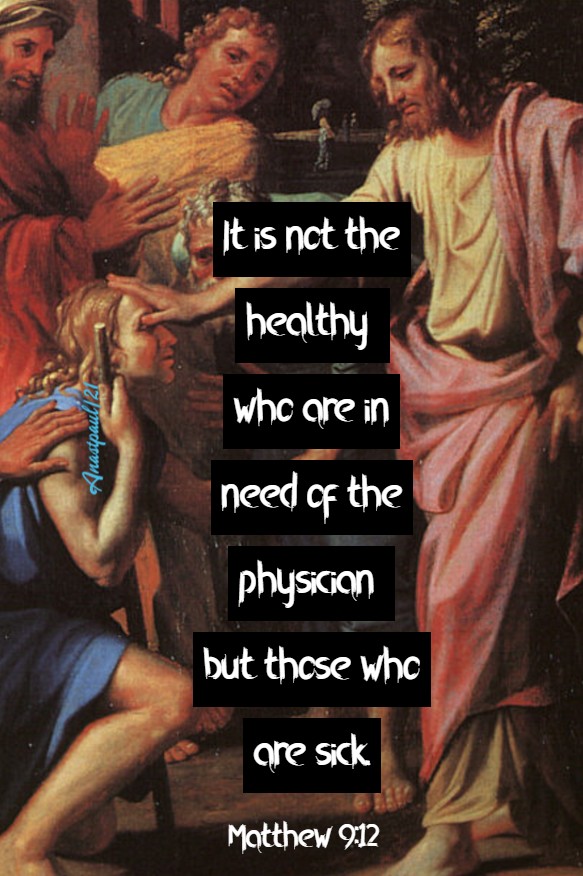
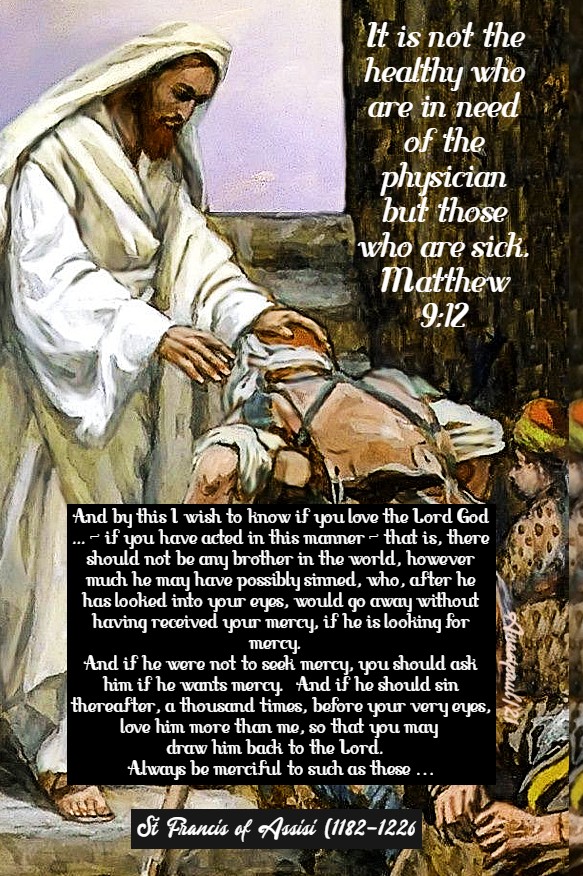
“It is not the healthy who are in need of the physician but those who are sick”
Matthew 9:12
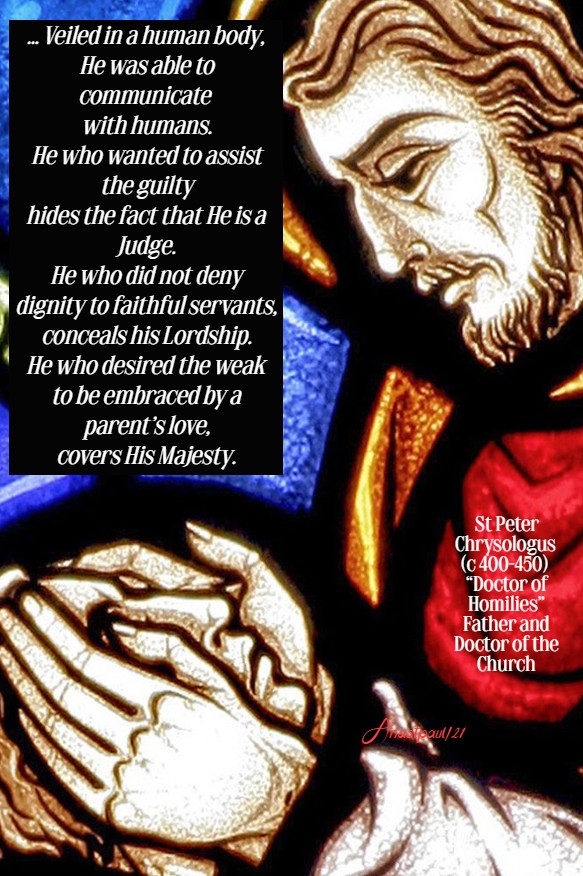
“… Veiled in a human body, He was able to communicate with humans. He who wanted to assist the guilty hides the fact that He is a Judge. He who did not deny dignity to faithful servants, conceals his Lordship. He who desired the weak to be embraced by a parent’s love, covers His Majesty.”
St Peter Chrysologus (c 400-450) “Doctor of Homilies” Father and Doctor of the Church
” Indeed, the instant you say: “I have sinned against the Lord”, the response is given you: “Your sins are forgiven” (Mt 9:2). … Only do not keep away, or distance yourself, from He who has chosen you to sing and pray but all your life long, remain close to Him, either through pure confidence, or by a holy audacity and courageous confession.”
John of Karpathos (7th Century) Bishop
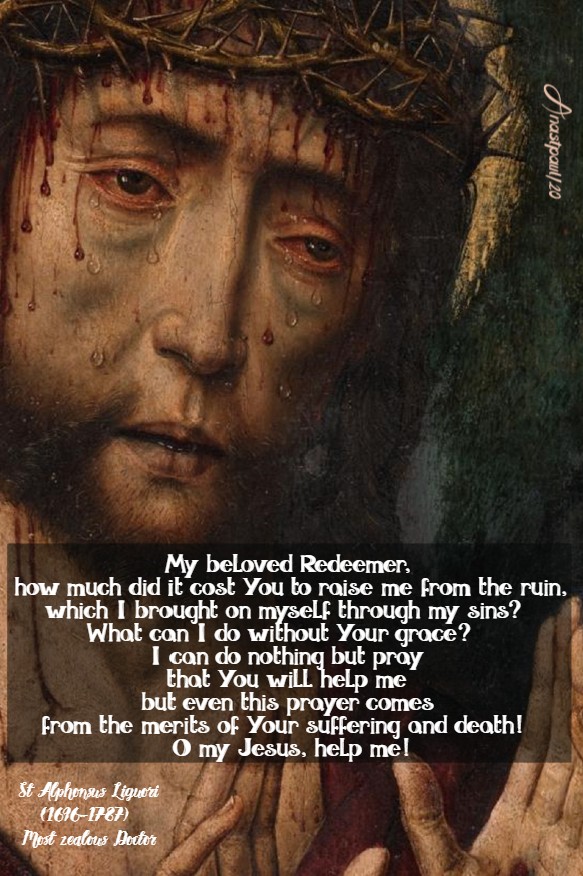
“My beloved Redeemer, how much did it cost You to raise me from the ruin, which I brought on myself through my sins? What can I do without Your grace? I can do nothing but pray that You will help me but even this prayer comes from the merits of Your suffering and death! O my Jesus, help me!”
St Alphonsus Liguori (1696-1787) Most zealous Doctor
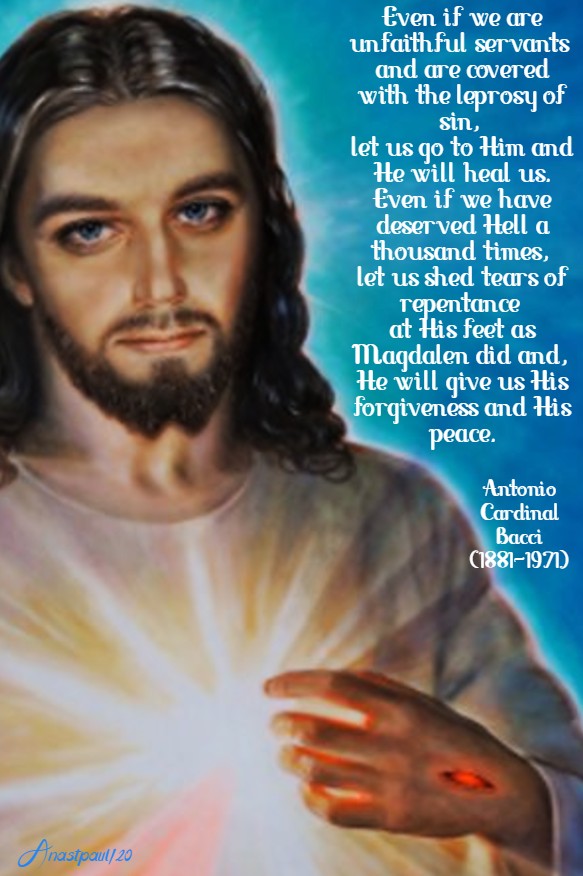
“Even if we are unfaithful servants and are covered with the leprosy of sin, let us go to Him and He will heal us. Even if we have deserved Hell a thousand times, let us shed tears of repentance at His feet as Magdalen did and, He will give us His forgiveness and His peace.”
Antonio Cardinal Bacci (1881-1971)
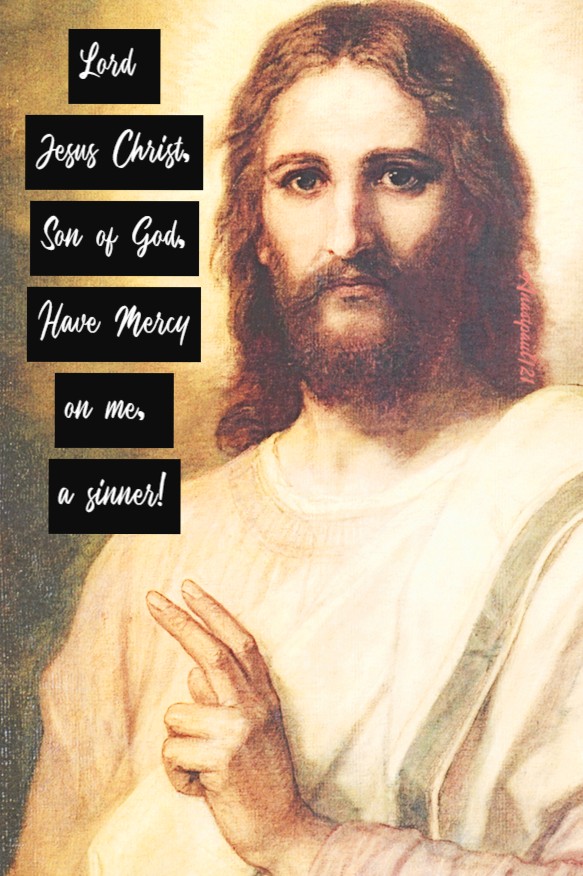
“Lord Jesus Christ,Son of God, Have Mercy on me, a sinner.”
One Minute Reflection – 2 July – “Month of the Most Precious Blood” – Readings: Genesis 23: 1-4, 19; 24: 1-8, 62-67, Psalms 106: 1b-2, 3-4a, 4b-5, Matthew 9: 9-13
“It is not the healthy who are in need of the physician but those who are sick” – Matthew 9:12
REFLECTION – “And by this I wish to know if you love the Lord God and me, His servant and yours – if you have acted in this manner – that is, there should not be any brother in the world, however much he may have possibly sinned, who, after he has looked into your eyes, would go away without having received your mercy, if he is looking for mercy. And if he were not to seek mercy, you should ask him if he wants mercy. And if he should sin thereafter, a thousand times, before your very eyes, love him more than me, so that you may draw him back to the Lord. Always be merciful to such as these …
If anyone of the brothers, at the instigation of the enemy, should sin mortally, he is bound by obedience to have recourse to his guardian. And all the brothers who might know that he has sinned are not to bring shame upon him or speak ill of him but let them show great mercy toward him and keep most secret, the sin of their brother; “because it is not the healthy who are in need of the physician, but those who are sick” (Mt 9:12) … And let the Custodian mercifully take care of him, as he would like to be taken care of, if he were in a similar position.
And if this brother falls into some venial sin, let him confess this to a brother who is a Priest. And if there is no Priest at hand, let him confess to his brother, until he has contact with a Priest who will absolve him canonically. And the brothers should have no power to enjoin any other penance, except this: “Go and sin no more!” (Jn 8:11). – St Francis of Assisi (1182-1226) Founder of the Friars Minor – Letter to a Minister of the Franciscan Order.
PRAYER – Lord Jesus Christ You showed Your great mercy to Matthew the tax-gatherer, by calling him to become Your Apostle,. Supported by the intercession of the Your Mother and oursby and the prayers and example of Your Saints, may we always answer Your call, obey Your commandments, fulfil Your Will and thus live in close union with You. We make our prayer, in union with God our Father and the Holy Spirit, one God forever and ever.
Quote/s of the Day – 26 June – “Month of the Sacred Heart”- Readings: Genesis 18: 1-15, Luke 1: 46-47, 48-49, 50 and 53, 54-55, Matthew 8: 5-17
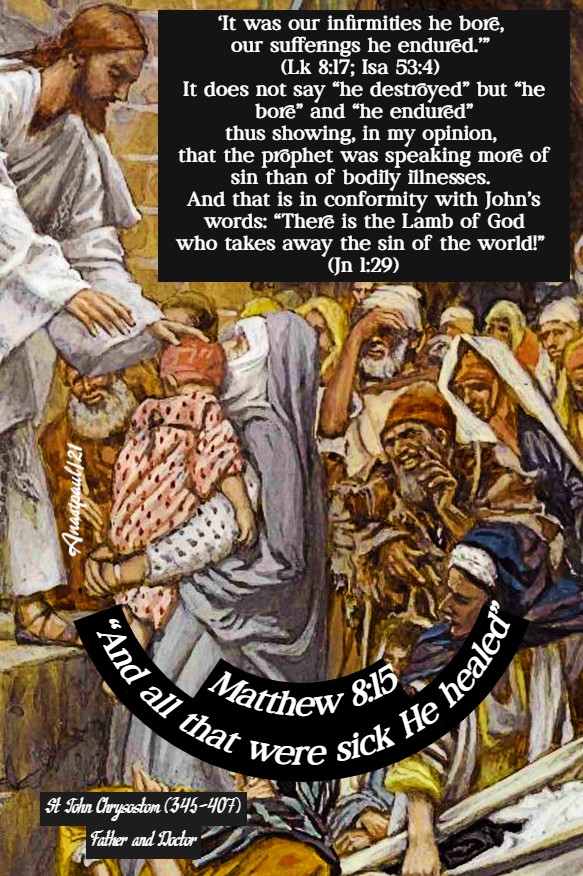
“And all that were sick He healed”
Matthew 8:15
“ Think of the many cures of which the evangelists do not speak. They do not tell us about all of them, one by one – rather, in a single sentence, they let us see an infinite ocean of miracles. … The gospel brings the testimony of the prophet, which is as extraordinary and as surprising as the deeds themselves: “ … thereby fulfilling what had been said through Isaiah the prophet: ‘It was our infirmities he bore, our sufferings he endured.’” (Lk 8:17; Isa 53:4) It does not say “he destroyed” but “he bore” and “he endured” thus showing, in my opinion, that the prophet was speaking more of sin than of bodily illnesses. And that is in conformity with John’s words: “There is the Lamb of God who takes away the sin of the world!” (Jn 1:29)
St John Chrysostom (345-407) Father and Doctor
Commentary on St Matthew’s Gospel, 27
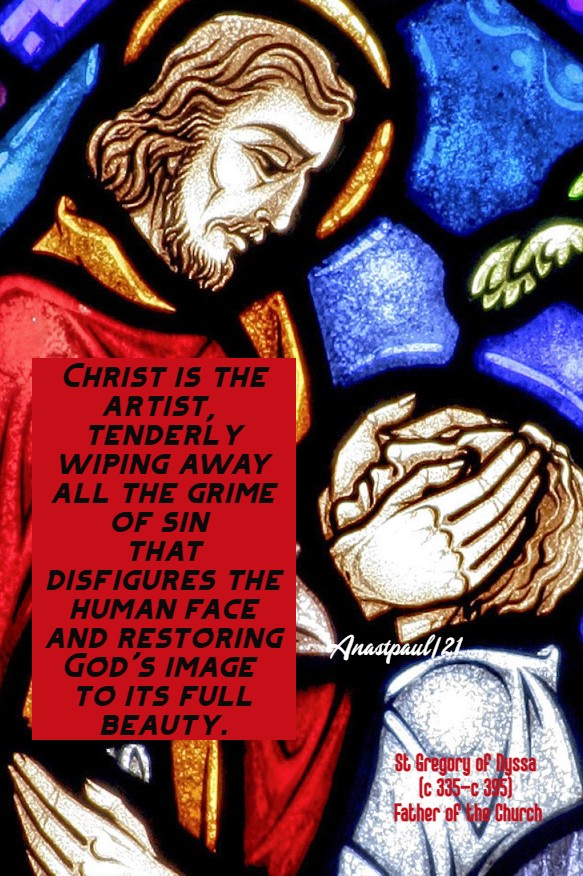
“Christ is the artist, tenderly wiping away all the grime of sin that disfigures the human face and restoring God’s image to its full beauty.”
St Gregory of Nyssa (c 335–C 395) Father of the Church
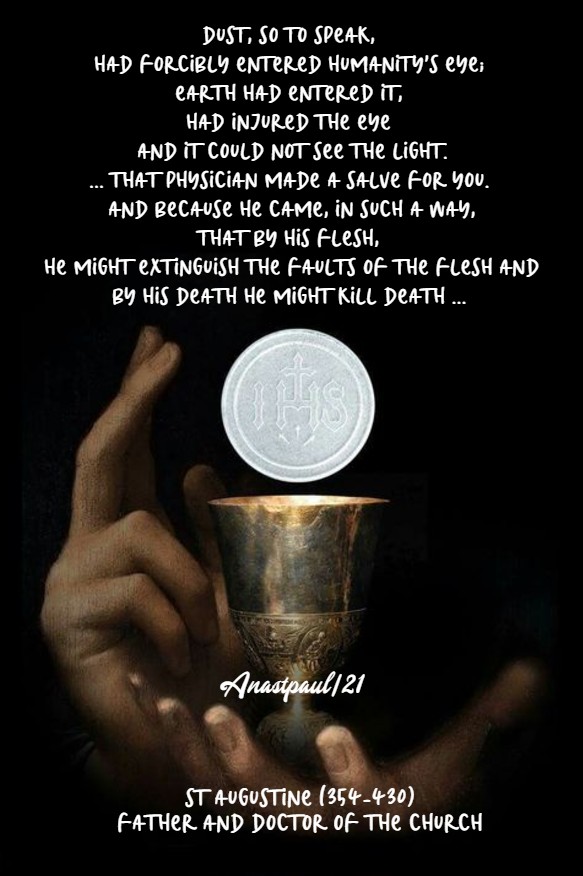
“Dust, so to speak, had forcibly entered humanity’s eye; earth had entered it, had injured the eye and it could not see the light. … That physician made a salve for you. And because He came, in such a way, that by His flesh, He might extinguish the faults of the flesh and by His death, He might kill death … ”
St Augustine (354-430) Father and Doctor of the Church
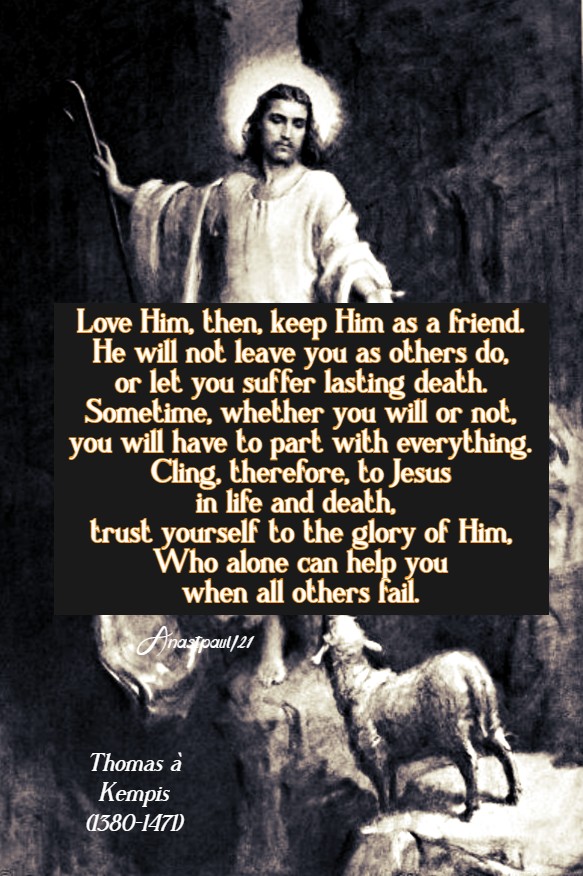
“Love Him, then, keep Him as a friend. He will not leave you as others do, or let you suffer lasting death. Sometime, whether you will or not, you will have to part with everything. Cling, therefore, to Jesus in life and death, trust yourself to the glory of Him, Who alone can help you when all others fail.“
Thomas à Kempis (1380-1471) (Book 2 Ch 7)
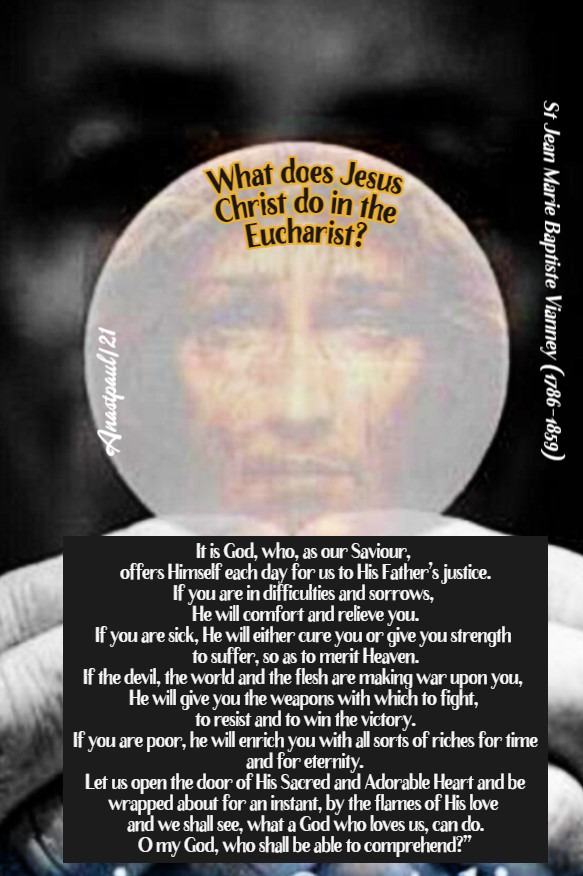
“What does Jesus Christ do in the Eucharist?
It is God, who, as our Saviour, offers Himself each day for us to His Father’s justice.
If you are in difficulties and sorrows, He will comfort and relieve you. If you are sick, He will either cure you or give you strength to suffer, so as to merit Heaven. If the devil, the world and the flesh are making war upon you, He will give you the weapons with which to fight, to resist and to win the victory. If you are poor, he will enrich you with all sorts of riches for time and for eternity. Let us open the door of His Sacred and Adorable Heart and be wrapped about for an instant, by the flames of His love and we shall see, what a God who loves us, can do. O my God, who shall be able to comprehend?”
Thought for the Day – 25 June – Meditations with Antonio Cardinal Bacci (1881-1971)
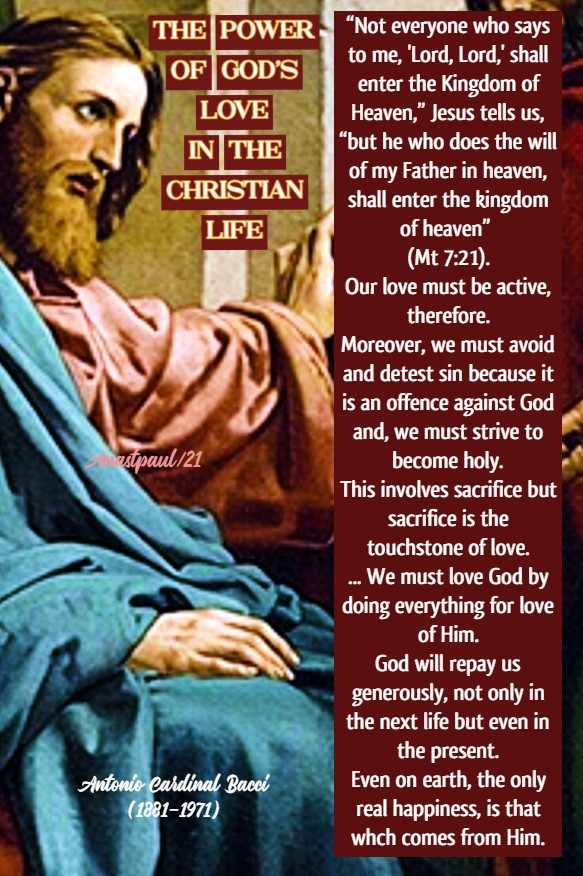
The Power of God’s Love in the Christian Life
“The love which we have for God, our Creator, Redeemer and Benefactor, should not be merely sentimental. It must be effective. When love is sincere, it is active. It is not enought to say: I love You, O my God. We must show by our actions, that we love Him. “Not everyone who says to me, ‘Lord, Lord,’ shall enter the Kingdom of Heaven,” Jesus tells us, “but he who does the will of my Father in heaven, shall enter the kingdom of heaven” (Mt 7:21). Our love must be active, therefore. Moreover, we must avoid and detest sin because it is an offence against God and, we must strive to become holy. This involves sacrifice but sacrifice is the touchstone of love. Anyone in love, is not afraid of sacrifice – in fact, he looks for it, in order to prove his love. Charity, like faith, is a lifeless thing, if it is not accompanied by actions (Cf Js 2:17). We must love God by doing everything for love of Him. God will repay us generously, ot only in the next life but even in the present. Even on earth, the only real happiness, is that whch comes from Him.”
One Minute Reflection – 25 June – “Month of the Sacred Heart” – Readings: Genesis 17: 1, 9-10, 15-22,Psalms 128: 1-2, 3, 4-5, Matthew 8: 1-4
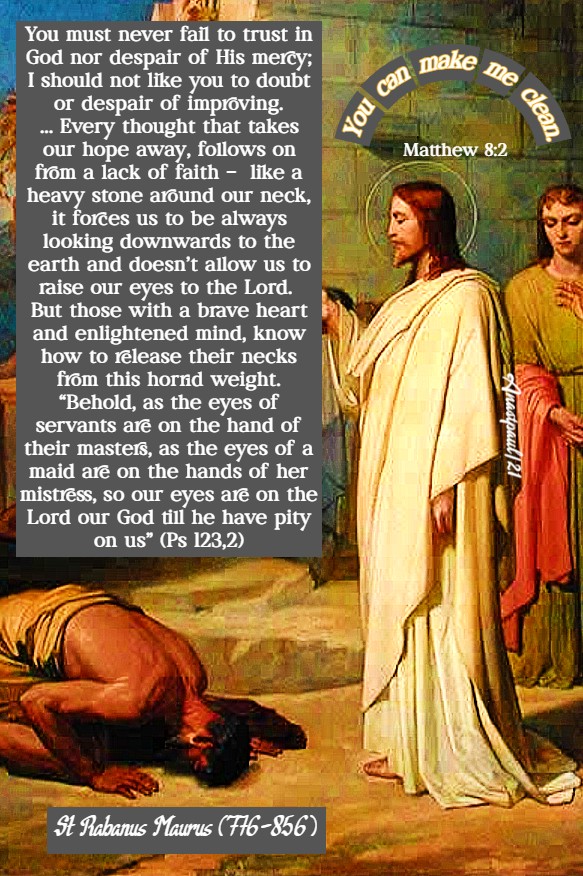
“‘You can make me clean.’” – Matthew 8:2
REFLECTION – “You must never fail to trust in God nor despair of His mercy; I should not like you to doubt or despair of improving. For even if the devil were able to throw you down from the heights of virtue, to the depths of wickedness, how much more can God recall you, to the summit of goodness. And not just bring you back, to the state you were in before your fall but He can make you much happier than you seemed to be before. Do not lose heart, I beg you and do not close your eyes to the hope of good, for fear that what happens to people who do not love God, should happen to you. For it is not the great number of one’s sins that leads the soul to despair but, disdain for God. As the Wise man says: “It is the characteristic of the impious to despair of salvation and hold it in contempt, since they have fallen into the pit of sin” (cf. Prv 18,3 Vg).
Therefore, every thought that takes our hope away, follows on from a lack of faith – like a heavy stone around our neck, it forces us to be always looking downwards to the earth and doesn’t allow us to raise our eyes to the Lord. But those with a brave heart and enlightened mind, know how to release their necks from this horrid weight. “Behold, as the eyes of servants are on the hand of their masters, as the eyes of a maid are on the hands of her mistress, so our eyes are on the Lord our God till he have pity on us” (Ps 123,2).” – St Rabanus Maurus (776-856), Benedictine Abbot and Bishop, Theologian, Poet, Writer – Three books dedicated to Bonosus, Bk 3, 4 ; PL 112, 1306
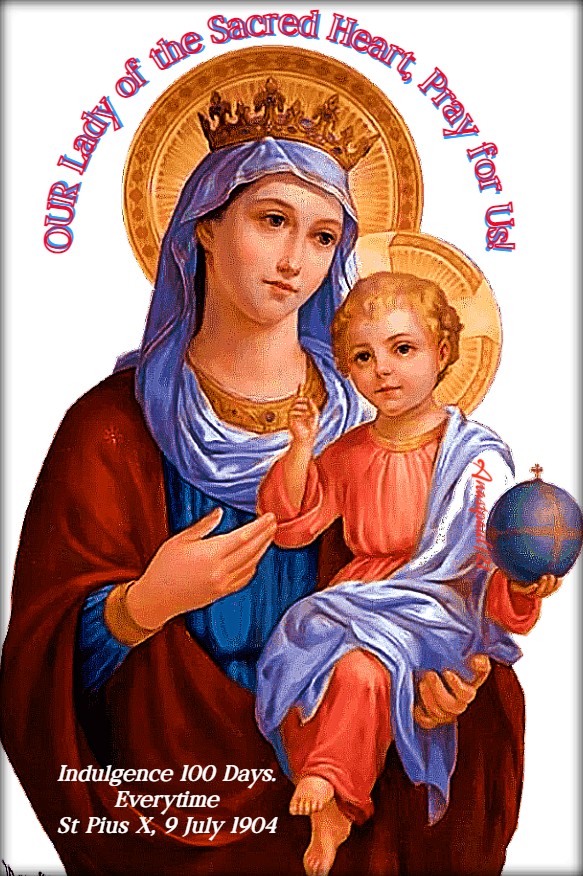
PRAYER – Almighty, ever-living God, we make our prayer to You at morning, noon and evening. Dispel from our hearts, the darkness of sin and bring us to the true light, Christ Your Son. Grant that through the intercession of the Blessed Virgin Mary, we may deny ourselves and love You above all things. Through Jesus, our Lord, with the Holy Spirit, God forever and ever, amen. OUR Lady of the Sacred Heart, Pray for Us! – Indulgence 100 Days. Everytime – Raccolta 174 St Pius X, 9 July 1904.
Quote/s of the Day – 19 June – “Month of the Sacred Heart”- Readings: Second Corinthians 12: 1-10, Psalms 34: 8-9, 10-11, 12-13, Matthew 6: 24-34
“If God so clothes the grass of the field… will he not much more provide for you, O you of little faith?”
Matthew 6:30
“He [Christ], protects their faith and gives strength to believers, in proportion to the TRUST, that each man, who receives that strength, is willing to place in Him.”
St Cyprian of Carthage (c 200- c 258) Bishop and Martyr, Father of the Church
“The soul’s every movement is a reminder of God, the taking of a step, the extension of the right hand, the raising of the arm, with thanks for good works, with shame for bad, for familiar conversation and public addresses, in rational discourse, in works of success, in the fervour of virtue, day and night, we are guided by You in the useful movements for our spirit, asleep or awake … ”
St Gregory of Narek (950-1003) Father & Doctor of the Church
“You first loved us so that we might love You— not because You needed our love but because, we could not be what You created us to be, except by loving You.”
William of Saint Thierry (c 1075-1148)
“What are you afraid of, you men of little faith? That He will not pardon your sins? But with His own hands He has nailed them to the cross. That you are used to soft living and your tastes are fastidious? But He knows the clay of which we are made (Gn 2:7). That a prolonged habit of sinning binds you like a chain? But the Lord loosens the shackles of prisoners. Or perhaps that angered by the enormity and frequency of your sins, He is slow to extend a helping hand? But where sin abounded, grace became superabundant (Rom 5,20). Are you worried about clothing and food and other bodily necessities s so that you hesitate to give up your possessions? But He knows that you need all these things (Mt 6,32). What more can you wish? What else is there to hold you back from the way of salvation? ”
St Bernard (1091-1153) Mellifluous Doctor of the Church
Thought for the Day – 9 June – “Month of the Sacred Heart” – Meditations with Antonio Cardinal Bacci (1881-1971)
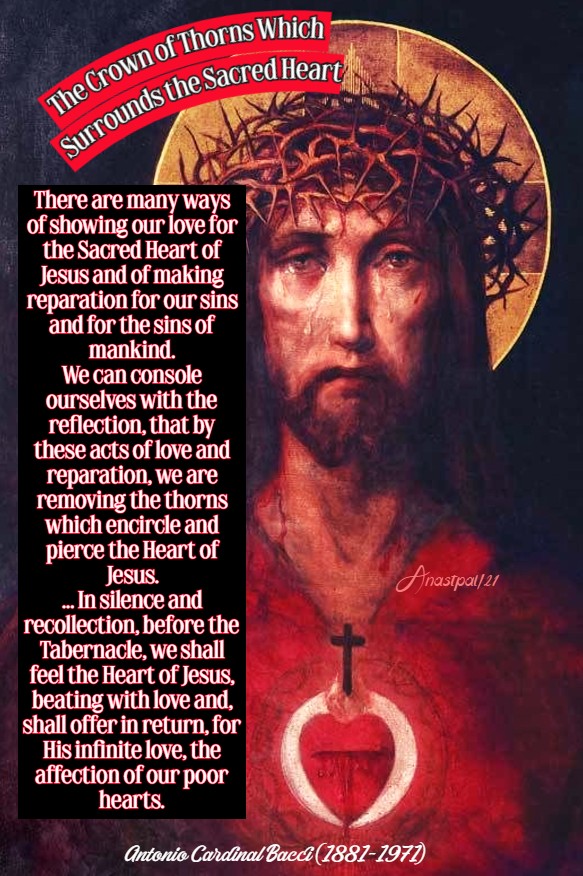
The Crown of Thorns Which Surrounds the Sacred Heart
“There are many ways of showing our love for the Sacred Heart of Jesus and of making reparation for our sins and for the sins of mankind. We can console ourselves with the reflection, that by these acts of love and reparation, we are removing the thorns which encircle and pierce the Heart of Jesus. The simplest ways of doing this, are by prayers, aspirations and expressions of love, directed towards the adorable Heart of our Redeemer and, by visits to Jesus in the Blessed Sacrament. In silence and recollection, before the Tabernacle, we shall feel the Heart of Jesus, beating with love and, shall offer in return, for His infinite love, the affection of our poor hearts.
We can also receive Holy Communion in reparation. When Jesus is in us and we are in Jesus, it will be easier and more pleasant, to offer Him our love and expiation. We can make reparation also, by practising the devotion of the First Fridays of the month. This pious practice, so pleasing to the Heart of Jesus, aims at being a mass offering of love and reparation, for the sins of the entire human race.”
Thought for the Day – 8 June – “Month of the Sacred Heart” – Meditations with Antonio Cardinal Bacci (1881-1971)
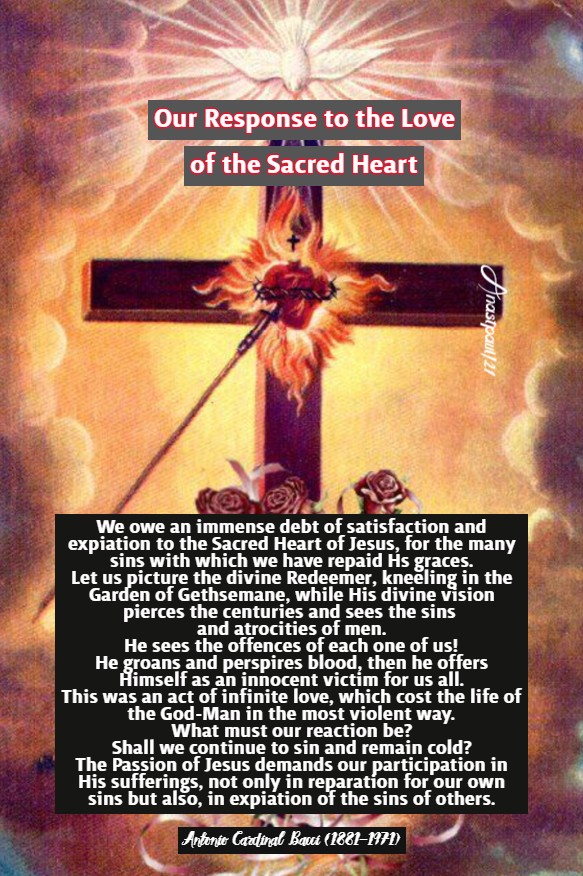
Our Response to the Love
of the Sacred Heart
“We owe an immense debt of satisfaction and expiation to the Sacred Heart of Jesus, for the many sins with which we have repaid Hs graces. Let us picture the divine Redeemer, kneeling in the Garden of Gethsemane, while His divine vision pierces the centuries and sees the sins and atrocities of men. He sees the offences of each one of us! He groans and perspires blood, then he offers Himself as an innocent victim for us all. This was an act of infinite love, which cost the life of the God-Man in the most atrocious way.
What must our reaction be? Shall we continue to sin and remain cold? The Passion of Jesus demands our participation in His sufferings, not only in reparation for our own sins but also, in expiation of the sins of others. Let us look around us and see how many men are so indifferent and wicked, as if Jesus had never come to save us, had never shed His Precious Blood for us and, had never loved us with an infinite love. At this spectacle, the Saints inflicted penances on themselves, in order to offer to Jesus, a return of love and reparation for sin.”
Thought for the Day – 5 June – “Month of the Sacred Heart” – Meditations with Antonio Cardinal Bacci (1881-1971)
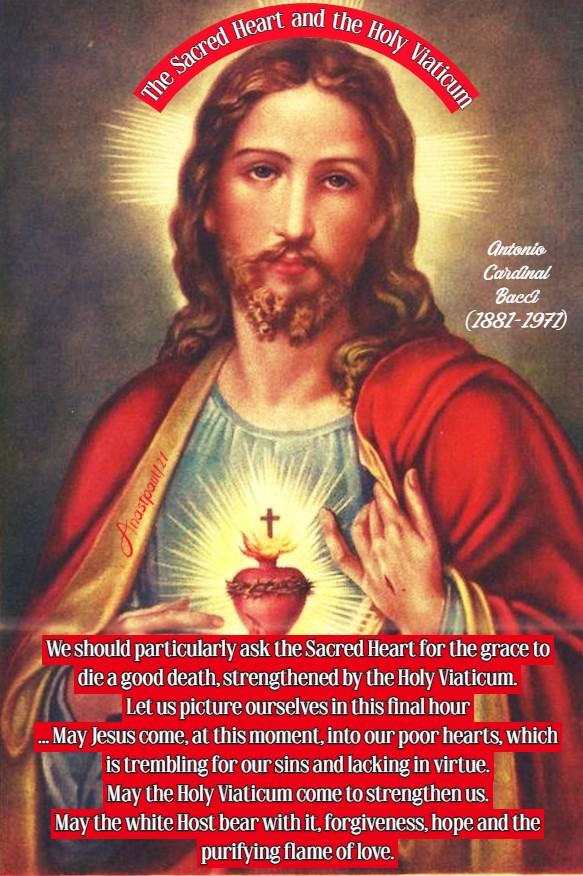
The Sacred Heart and the Holy Viaticum
“We should particularly ask the Sacred Heart for the grace to die a good death, strengthened by the Holy Viaticum. Let us picture ourselves in this final hour. The world is fading away and nothing remains of the honours, successes and pleasures of our passing life. There will remain only two things – on one side, the merits which we have obtained by our prayers, penances and good works; on the other side, the sum total of our sins and ingratitude to God. May Jesus come, at this moment, into our poor hearts, which is trembling for our sins and lacking in virtue. May the Holy Viaticum come to strengthen us. May the white Host bear with it, forgiveness, hope and the purifying flame of love.
Then, the infinite love of the Heart of Jesus will be mingled with th weak limited love of our hearts. It will waft us into a state of everlasting happiness, where, to love, is to possess, the boundless joy of God.
Thought for the Day – 14 May – Meditations with Antonio Cardinal Bacci (1881-1971)
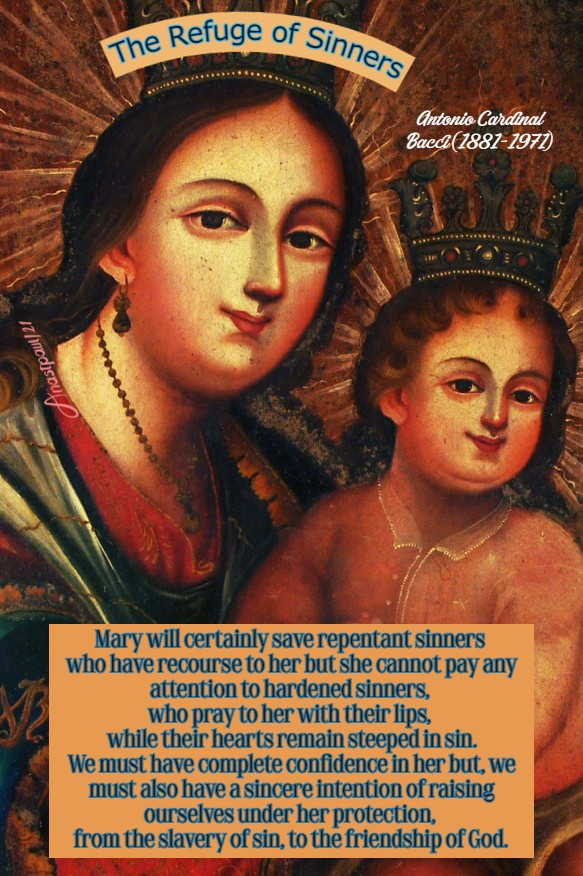
The Refuge of Sinners
“Mary is called, the Star of Sea because, as St Thomas Aquinas says, “even as sailors are guided into port, by means of a star, so Christians are guided towards Heaven, by means of Mary, .” (Opuse, 7). This absolute guarantee of the protection of our heavenly Mother, should increase our trust in her and lead us to turn towards her in every difficulty and temptation. It should not, however, result in an unhealthy attitude of spiritual inactivity, a passive dependence on Mary’s favours, without any co-operation on our part. Such behaviour would be the height of filial ingratitude. Mary will certainly save repentant sinners who have recourse to her but she cannot pay any attention to hardened sinners, who pray to her with their lips, while their hearts remain steeped in sin. We must have complete confidence in her but, we must also have a sincere intention of raising ourselves under her protection, from the slavery of sin, to the friendship of God.
Quote/s of the Day – 5 May – Wednesday of the Fifth Week of Easter, Readings: First: Acts 15: 1-6; Psalm: Psalms 122: 1-2, 3-4ab, 4cd-5; Gospel: John 15: 1-8 and the Memorial of the Conversdion of St Augustine
“Without Me you can do nothing”
John 15:5
“You do not know when your last day may come. You are an ingrate! Why not use the day, today, that God has given you to repent?”
“What do you possess if you possess not God?”
St Augustine (354-430) Father & Doctor of Grace
“A saint is not someone, who never sins, but one who sins less and less frequently and gets up more and more quickly.”
St Bernard of Clairvaux (1090-1153) Mellifluous Doctor
“Each day then, we ought to renew our resolutions and arouse ourselves to fervour, as though it were the first day of our turning back to God. We ought to say: “Help me, O Lord God, in my good resolution and in Your holy service. Grant me now, this very day, to begin perfectly, for thus far I have done nothing.” … Just men depend on the grace of God rather than on their own wisdom in keeping their resolutions. In Him they confide every undertaking …” ”
Thomas à Kempis CRSA (1380-1471)
“A soul makes room for God by wiping away all the smudges and smears of creatures, by uniting its will perfectly to God’s, for to love is to labour, to divest and deprive oneself for God, of all that is not God . When this is done, the soul will be illumined by and transformed in God.”
St John of the Cross (1542-1591) Mystical Doctor of the Church
Thought for the Day – 1 May – Meditations with Antonio Cardinal Bacci (1881-1971)
The Month of Mary
“This work of eradicating of our faults and replacing them by their opposite virtues, is a difficult task which we cannot carry out on our own. Prayer is necessary if we are to obtan the grace which we need. During Mary’s month, we should beseech our heavenly Mother, with greater earnestness, to obtain for us, from her divine Son, the grace which we need to correct the evil in our nature and to perfect it in goodness.
Mary wants us to pray to her because she wishes to obtain for us, the graces which we require. She loves us very much and is ready to help us to become, like her, living imitations of Jesus, insofar as the weakness of our nature will permit.
Among our other prayers, let us remember to give pride of place to the Holy Rosary, whether we recite it in Church or with the family. Let us include, at least a quarter of an hour meditation; a daily visit, however short, to the Blessed Sacrament and to Our Lady’s Altar; an examination of conscience in the evening and many ejaculatory prayers during the day, which will express our love for Mary and for her divine Son.”
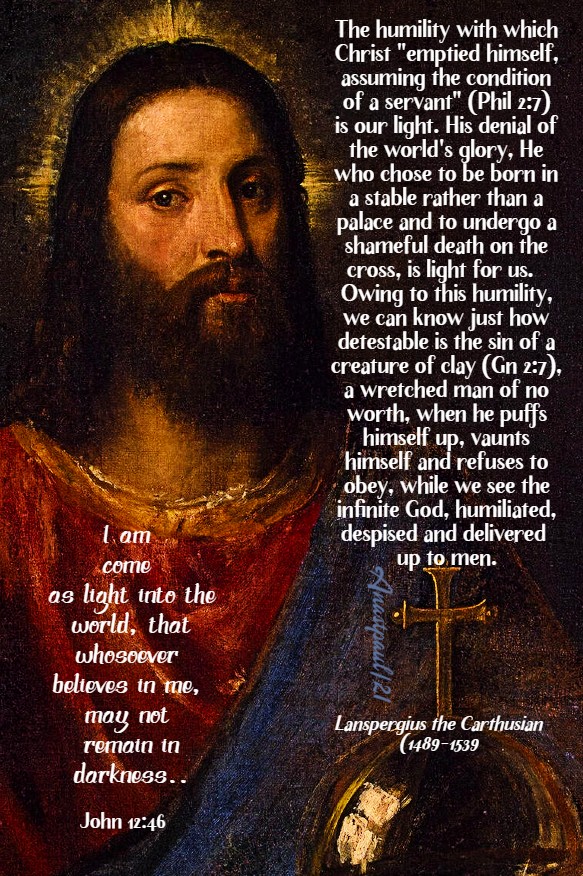
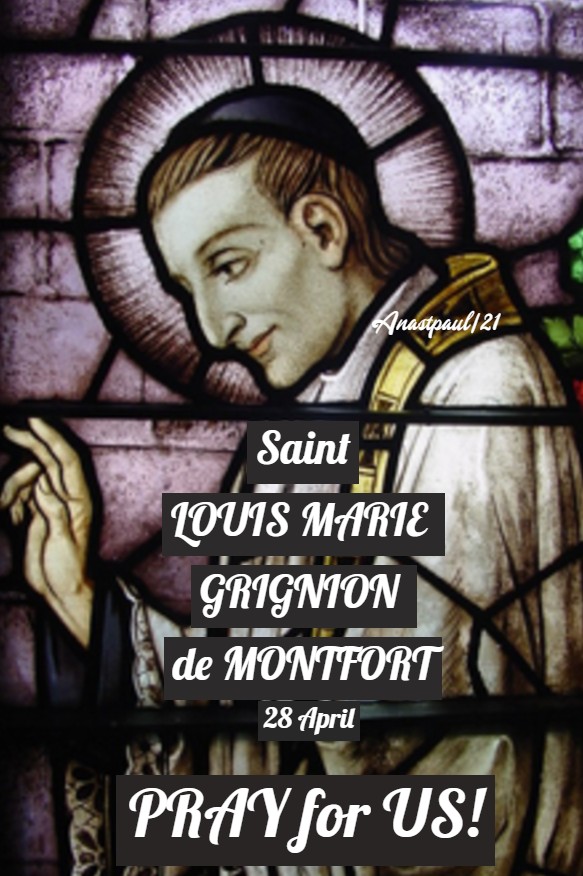
One Minute Reflection – 28 April – Wednesday of the Fourth week of Easter, Readings: Acts 12:24–13:5, Psalm 67:2-3, 5-6, 8, John 12:44-50 and the Memorial of St Louis Marie Grignion de Montfort (1673-1716)
“I am come as light into the world, that whosoever believes in me, may not remain in darkness..” – John 12:46
REFLECTION – “The humility with which Christ “emptied himself, assuming the condition of a servant” (Phil 2:7) is our light. His denial of the world’s glory, He who chose to be born in a stable rather than a palace and to undergo a shameful death on the cross, is light for us. Owing to this humility, we can know just how detestable is the sin of a creature of clay (Gn 2:7), a wretched man of no worth, when he puffs himself up, vaunts himself and refuses to obey, while we see the infinite God, humiliated, despised and delivered up to men.
A light for us, too, is the meekness with which He bore hunger, thirst and cold, insults, blows and wounding, when “like a lamb led to the slaughter and like a sheep before its shearers, he did not open his mouth” (Is 53:7). Indeed, in view of this meekness, we see how pointless anger is, as also threats. Then we consent to suffer and do not serve Christ out of habit. Thanks to this, we learn to pay heed to all that is asked of us, weeping for our sins in submission and silence and patiently bearing the sufferings that come our way. For Christ bore His torments with such great meekness and patience, not for sins He had not committed but for those of others.
From now on, dearest brethren, ponder over all the virtues Christ taught us by the example of His life, that He recommends to us through His preaching and. gives us the strength to imitate, by the aid of His grace.” – Lanspergius the Carthusian (1489-1539) Monk, theologian – Sermon 5
PRAYER – Lord God, life of those who believe in You, glory of the humble and happiness of the Saints, listen kindly to our prayer. We long for what You promises, fill us from Your abundance, give us true faith and obedience. May the Blessed Virgin, Mother of Your Son, be our constant recourse. and may her cliet and Yours, St Louis Marie de Montfort, pray for us all. Through Our Lord, Jesus with the Holy Spirit, God forever, amen.
Acts 12: 24 — 13: 5a 24 But the word of the Lord increased and multiplied. 25 And Barnabas and Saul returned from Jerusalem, having fulfilled their ministry, taking with them John, who was surnamed Mark. 13:1 Now there were in the church which was at Antioch, prophets and doctors, among whom was Barnabas and Simon who was called Niger and Lucius of Cyrene and Manahen, who was the foster brother of Herod the tetrarch, and Saul. 2 And as they were ministering to the Lord and fasting, the Holy Ghost said to them: Separate me Saul and Barnabas, for the work whereunto I have taken them. 3 Then they, fasting and praying and imposing their hands upon them, sent them away. 4 So they being sent by the Holy Ghost, went to Seleucia and from thence they sailed to Cyprus. 5 And when they were come to Salamina, they preached the word of God in the synagogues of the Jews.
Gospel: John 12: 44-50 44 But Jesus cried and said: He that believes in me, does not believe in me but in him that sent me. 45 And he that sees me, sees him that sent me. 46 I am come as light into the worl, that whosoever believes in me, may not remain in darkness. 47 And if any man hears my words and keeps them not, I do not judge him: for I came not to judge the world but to save the world. 48 He that despises me and receives not my words, has one that judges him; the word that I have spoken, the same shall judge him in the last day. 49 For I have not spoken of myself but of the Father who sent me, he gave me commandments what I should say and what I should speak. 50 And I know that his commandment is life everlasting. The things, therefore, that I speak, even as the Father said unto me, so do I speak.
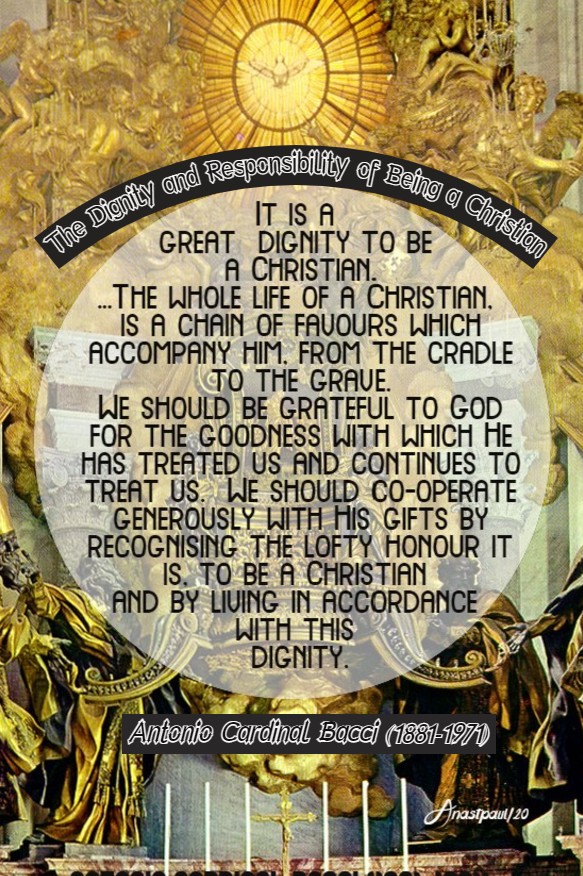
Thought for the Day – 21 April – Meditations with Antonio Cardinal Bacci (1881-1971)
The Dignity and Responsibility of Being a Christian
“It is a great dignity to be a Christian. By Baptism, we become sons of God, heirs to Heaven, temples of the Holy Spirit and members of the Mystical Body of Jesus, which is the Church. God’s grace raises us to the supernatural order and makes us, as St Paul expresses it, sharers in the divine nature. By the Sacrament of Confirmation, the Holy Spirit fortifies our faith and gives us the strength to resist the temptations of the devil and to fight like loyal soldiers, for the triumph in ourselves and in others, of the Kingdom of Jesus Christ. The Sacrament of Penance, is our plank of salvation in the shipwreck of sin.
Although, we are all wretched sinners, by this give of the divine mercy, we can recover our lost innocence and return to the grace and friendship of God. Moreover, in order to prevent us from falling back into sin, Jesus give us Himself in the Blessed Eucharist, which is called, by St Thomas Aquinas, the greatest miracle of His infinite love (Opusculum 56, Officium de festo Corporis Christi, lectures 1-4).
But this is not all. If it is our vocation for form a family, God consecrates our union at the altar and gives us the graces necessary, to sanctify it, so that it may produce a good Christian family. If God has called us, on the other hand, to become spiritual fathers of the souls redeemed by His Precious Blood, He raises us to this high dignity, by the Sacrament of Holy Orders. Finally, when we shall have come to the end of our mortal lives, the Priest will be still by our side, to wash away, by the Sacrament of Extreme Unction, the last traces of sin and to comfort us in our passage to eternity. The whole life of a Christian, is a chain of favours which accompany him, from the cradle to the grave. We should be grateful to God for the goodness with which He has treated us and continues to treat us. We should co-operate generously with His gifts by recognising the lofty honour it is, to be a Christian and by living in accordance with this dignity.”
Quote/s of the Day – 17 April – “Saturday of the Second Week of Easter, Readings: First: Acts 6: 1-7, Psalm: Psalms 33: 1-2, 4-5, 18-19, Gospel: John 6: 16-21
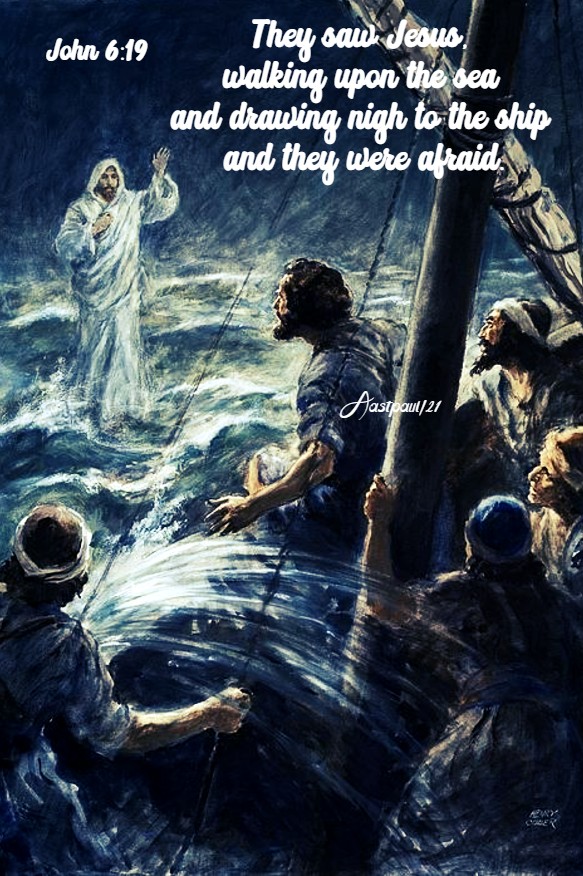
“They saw Jesus, walking upon the sea and drawing nigh to the ship and they were afraid.”
John 6:19
And the wind ceased and there was a great calm. He said to them, “Why are you so afraid? Have you still no faith?”
Mark 4:39-40
“What are you afraid of, you men of little faith? That He will not pardon your sins? But with His own hands He has nailed them to the cross. That you are used to soft living and your tastes are fastidious? But He knows the clay of which we are made (Gn 2:7). That a prolonged habit of sinning binds you like a chain? But the Lord loosens the shackles of prisoners. Or perhaps that angered by the enormity and frequency of your sins, He is slow to extend a helping hand? But where sin abounded, grace became superabundant (Rom 5,20). Are you worried about clothing and food and other bodily necessities s o that you hesitate to give up your possessions? But He knows that you need all these things (Mt 6,32). What more can you wish? What else is there to hold you back from the way of salvation? ”
St Bernard (1091-1153) Mellifluous Doctor of the Church Commentary on the Song of Songs, Sermon 38
“Keep Jesus Christ as your dial, at all times, His Cross for mast, on which to hoist your resolutions, as a sail. Let your anchor be, profound trust in Him and set out early!”
St Francis de Sales (1567-1622) Doctor of the Church
“Then steer your ship with steady arm, Trust me and rest your soul. Your little boat I’ll keep from harm, I’ll guide it toward its goal. … Be ,therefore, steadfast, calm and true, Your God is at your side. Through storm and night He’ll see you through With conscience as your guide.”
St Teresa Benedicta of the Cross Edith Stein “At the Helm”
Thought for the Day – 15 April – Meditations with Antonio Cardinal Bacci (1881-1971)
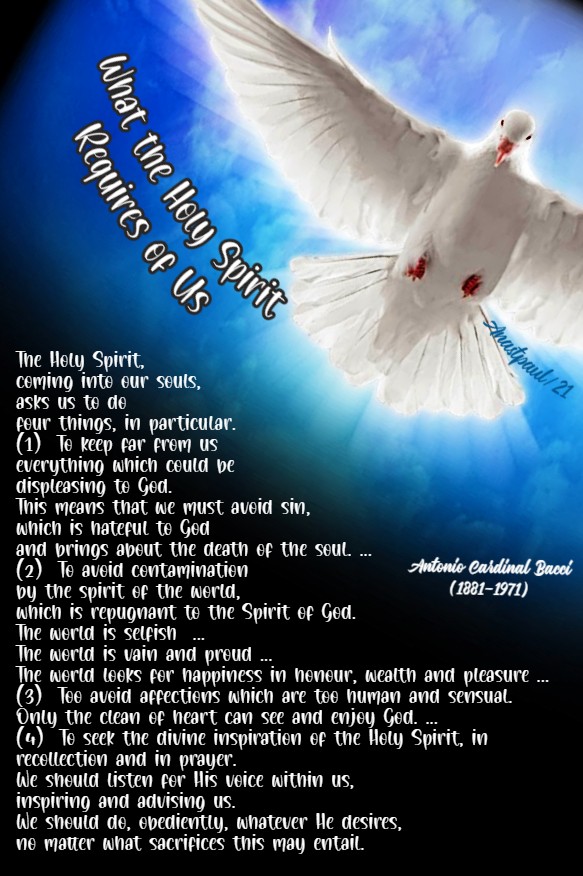
What the Holy Spirit Requires of Us
“The Holy Spirit, coming into our souls, asks us to do four things, in particular.
(1) To keep far from us everything which could be displeasing to God. This means that we must avoid sin, which is hateful to God and brings about the death of the soul. When the sin is grave, it destroys charity in us; when it is venial sin, it diminishes our fervour and capacity for good action. We have become the temples of the Holy Spirit. Let us do our best, therefore, to keep ourselves pure and free from every stain of sin. “Do not grieve the Holy Spirit of God, in whom you were sealed for the day of redemption” (Eph 4:30).
(2) To avoid contamination by the spirit of the world, which is repugnant to the Spirit of God. The world is selfish and we should be on fire with love for God and for our neighbour. The world is vain and proud and we should love obscurity, recollection and humility. The world looks for happiness in honour, wealth and pleasure in the passing goods of this life. We, on the other hand, should seek our happiness in eternal and heavenly values because God alone can satisfy our hearts and make us happy.
(3) Too avoid affections which are too human and sensual. Only the clean of heart can see and enjoy God. All the objects and all the people of this world, should form for us, a ladder which leads to God.
(4) To seek the divine inspiration of the Holy Spirit, in recollection and in prayer.
We should listen for His voice within us, inspiring and advising us. We should do, obediently, whatever He desires, no matter what sacrifices this may entail.”
Thought for the Day – 11 April – Meditations with Antonio Cardinal Bacci (1881-1971)
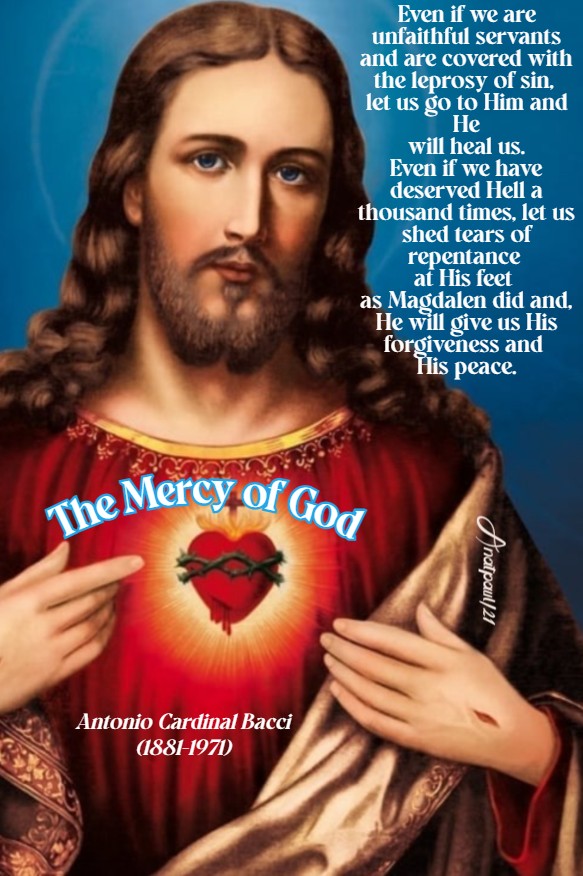
The Mercy of God
“God is the Being, Who is infinitely true, beautiful and good. His goodness is manifested in His infinite love for all the creatures which He has made but, it is in His relations with sinners, in particular, that we call Him merciful. He loves all things which He has created and directs them towards Himself, their beginning and their end. When He is dealing, however, with beings endowed with free will, who can separate themselves from Him and even offend Him, He tries, while respecting the liberty which He has given them, to recall them to Himself, by the influence of His love and of His grace. It is this supernatural outpouring of love towards sinners, which we call mercy.
The mercy of God shines forth in all the pages of Sacred Scripture. In the Old Testament, there is promised and foreshadowed, in many ways, the coming of the Saviour of the sinful human race. In the New Testament, Jesus appears, made man for our salvation, meek and humble of heart and merciful towards the unfortunate, especially towards sinners. For them, He offers His life and His Precious Blood, dying on the Cross with His arms outstretched, as if in an embrace of forgiveness. He tells us that He has not come to call the just but sinners, (Lk 5:32) and, that He has not come to those who are in health but to those who are sick (Mk 2:17); He assures us that, if we ask the Father for anything in His name, it will be given to us (Jn 16:23). So much goodness should move and soften our hearts. Even if we are unfaithful servants and are covered with the leprosy of sin, let us go to Him and He will heal us. Even if we have deserved Hell a thousand times, let us shed tears of repentance at His feet as Magdalen did and, He will give us His forgiveness and His peace.”
Thought for the Day – 9 April – Meditations with Antonio Cardinal Bacci (1881-1971)
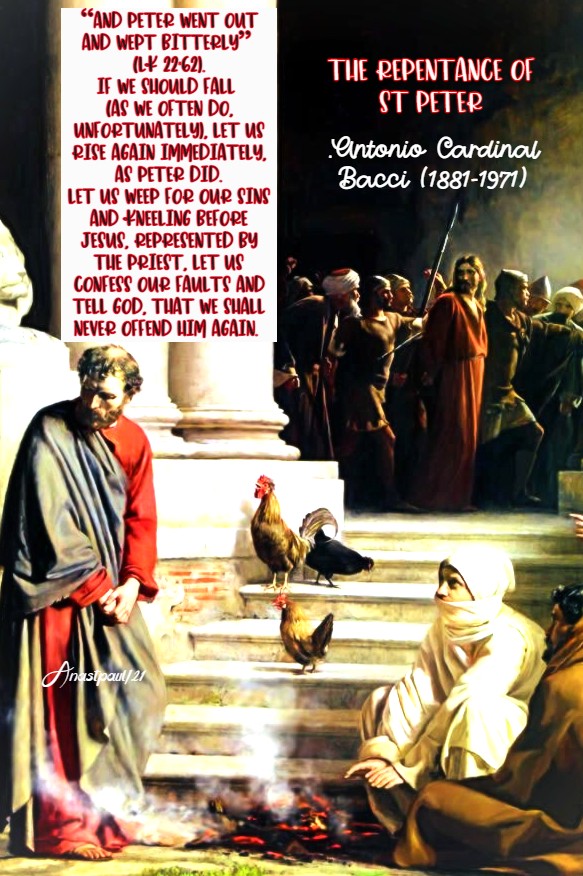
The Repentance of St Peter
“Peter had denied his Master three times. He was standing in the courtyard of the High Priest, waming hmself before a brazier and not even thinking of the depths to which he had descended. Jesus, caluminated, struck and mocked, as if He were a criminal, forgets altogether about Himself. Moved by compassion for the leader of His Apostles, now become a perjurer, He turns His gaze towards him. Peter is jerked back to his senses by this look, which is at the same time, stern and affectionate. He realises at last, the level to which he has fallen. He is stricken to the heart and feels a sudden tightness in hs throat. “And Peter went out and wept bitterly” (Lk 22:62).
Peter saw clearly, at this stage, the chasm into which he had fallen. He thought of all the gifts and favours which he had received from Jesus and recalled the prophecy which his Master had made. “A cock will not crow ths day, until thou hast denied, three times, that thou knowest me” (Lk 22:34). He remembered, also, how he had sworn that he would never deny Jesus. Now he saw himself in the role of the prodigal son or the lost sheep … and, as he wept bitterly, he saw again, the reproachful, yet loving gaze of Jesus. His grief found an outlet in hIs tears and he was filled with confidence, that Jesus, in His infinite goodness, wuld forgive him.
If we should fall (as we often do, unfortunately), let us rise again immediately, as Peter did. Let us weep for our sins and kneeling before Jesus, represented by the Priest, let us confess our faults and tell God, that we shall never offend Him again. ”
Quote/s of the Day – 9 April – Easter Friday, Readings: Acts 4:1-12, Psalm 118:1-2, 4, 22-27, John 21:1-14
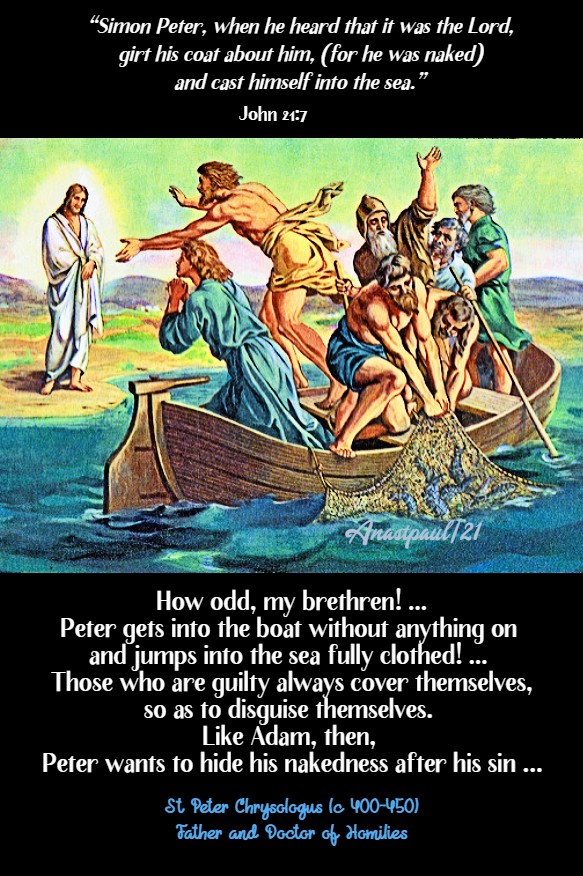
“Simon Peter, when he heard that it was the Lord, girt his coat about him, (for he was naked) and cast himself into the sea.”
John 21:7
“ How odd, my brethren! … Peter gets into the boat without anything on and jumps into the sea fully clothed! (…) Those who are guilty always cover themselves, so as to disguise themselves. Like Adam, then, Peter wants to hide his nakedness after his sin …”
St Peter Chrysologus (c 400-450) Father and Doctor of Homilies
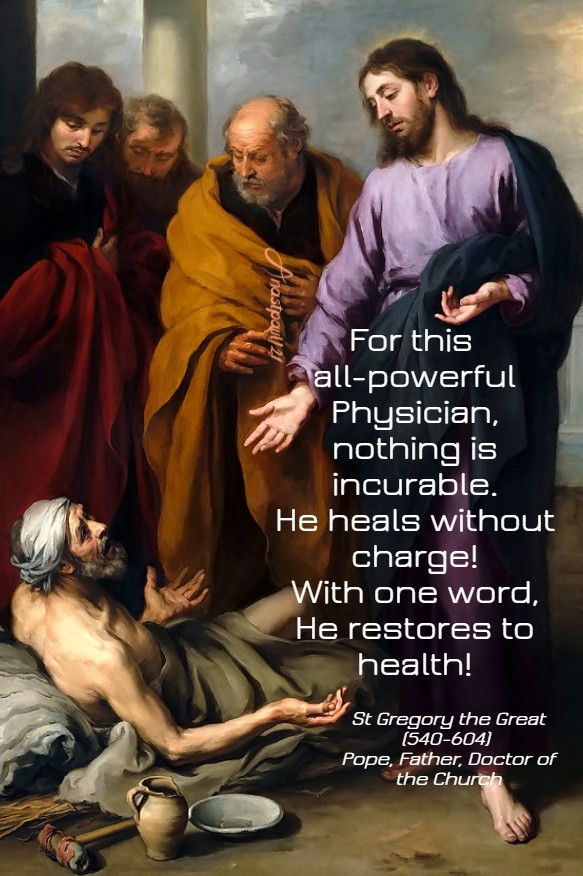
“For this all-powerful Physician, nothing is incurable. He heals without charge! With one word, He restores to health! I would have despaired of my wound were it not, that I placed my trust in the Almighty.”
St Gregory the Great (540-604) Pope, Father, Doctor of the Church
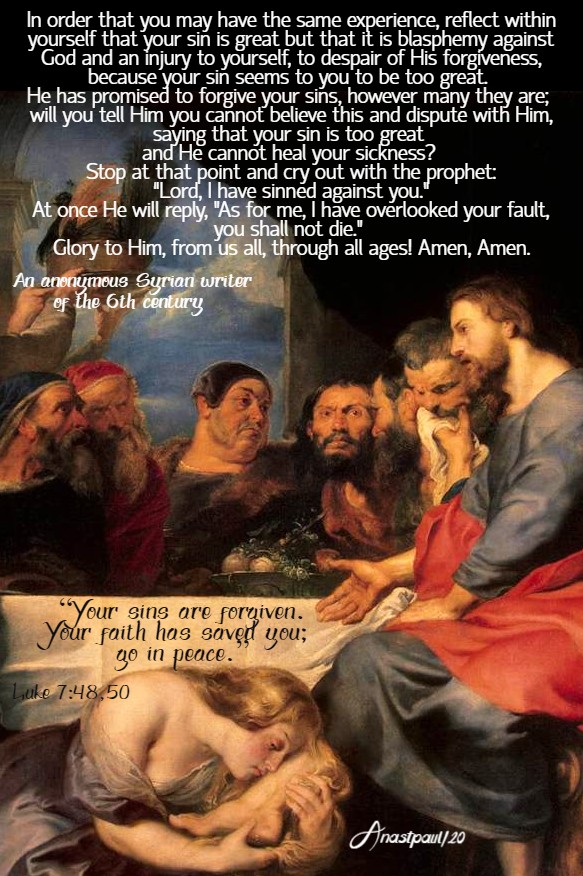
“In order that you may have the same experience, reflect within yourself that your sin is great but that it is blasphemy against God and an injury to yourself, to despair of His forgiveness, because your sin seems to you to be too great. He has promised to forgive your sins, however many they are; will you tell Him you cannot believe this and dispute with Him, saying that your sin is too great and He cannot heal your sickness? Stop at that point and cry out with the prophet: “Lord, I have sinned against you” (Ps 51[50]:6). At once He will reply, “As for me, I have overlooked your fault, you shall not die.” Glory to Him from us all, through all ages! Amen, Amen.”
Thought for the Day – 8 April – Meditations with Antonio Cardinal Bacci (1881-1971)
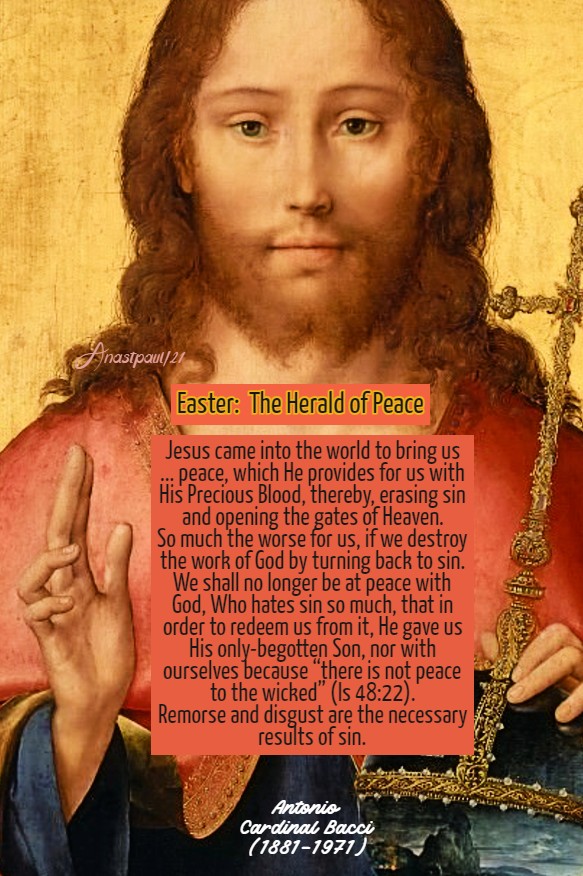
Easter: The Herald of Peace
“For this interior peace to be complete, it is necessary that it should exist in our relations with God, with ourselves and with our neighbour. Peace with God, is especially necessary. This involves the subjection of the intellect and will, to Him, perfect obedience to His law, the avoidance of sin and the entire surrender of ourselves to Him. When we have prepared ourselves in this way, God will visit us with His grace and we shall experience the joy of inward peace.
Jesus came into the world to bring us this peace, which He provides for us with His Precious Blood, thereby, erasing sin and opening the gates of Heaven. So much the worse for us, if we destroy the work of God by turning back to sin. We shall no longer be at peace with God, Who hates sin so much, that in order to redeem us from it, He gave us His only-begotten Son, nor with ourselves because “there is not peace to the wicked” (Is 48:22). Remorse and disgust are the necessary results of sin.
Let us remember, that those who are really content, even in this world, are those who lead good lives. Whoever extinguishes divine grace in himself, destroys the harmony and order which reigned in his soul as a result of the subjection of his reason to his Creator and Redeemer. Then, because we are not at peace with God, nor with ourselves, we cannot really be at peace with men. It is our faith which teaches us, that they are our brothers, redeemed, as we have been, by the Precious Blood of Jesus Christ and that, therefore, we should always love and assist them.”
Thought for the Day – 6 April – Meditations with Antonio Cardinal Bacci (1881-1971)
The Meaning of Easter
“Today the Church adorns herself in festival array. Gone are the lengthy lamentations of Holy Saturday and the sorrowful recitations of the Passion and in their place, is the glad cry of Alleluia, the hymn of vitory over death and sin. The true joy of Easter, lies, not merely in external celebration, however but in the spiritual gladness of the soul. As Jesus has conquered death and sin, so we must purify ourselves of every trace of guilt by a good confession and must be sure, that it will result in a practical renovation of our lives. We should approach Jesus in the Blessed Eucharist with greater fervour and humility and with greater trust in His goodness and mercy. When we have received Him into our hearts, we should ask Him to renew and transform us in Himself. He is everything and we are nothing without Him. He is strong, we are weak. We are capable only of feeble desires to do good but He can make them effective by His grace. We should not be satisfied with forming general resolutions when we go to confession and receive Holy Communion at Easter. We should examine the depths of our soul and discover the sin which we are most accustomed to commit and the virtue which we are principally lacking. As a result of our investigation, we should form a particular resolution to combat this sin and to practise this virtue. It is only in this way, that our celebration of Easter can inaugurate the beginning of a genuine self-renewal which will gain momentum daily, until it becomes a true spiritual resurrection. It will be a hard battle, which will necessitate a constant vigilance and a readiness to begin again, everytime we realise, that we have fallen. It will require an unfailing spirit of prayer but, the final victory, will bring us such happiness, that worldly pleasures will seem empty and illusory, by comparison.”
Thought for the Day – 1 April – Meditations with Antonio Cardinal Bacci (1881-1971)
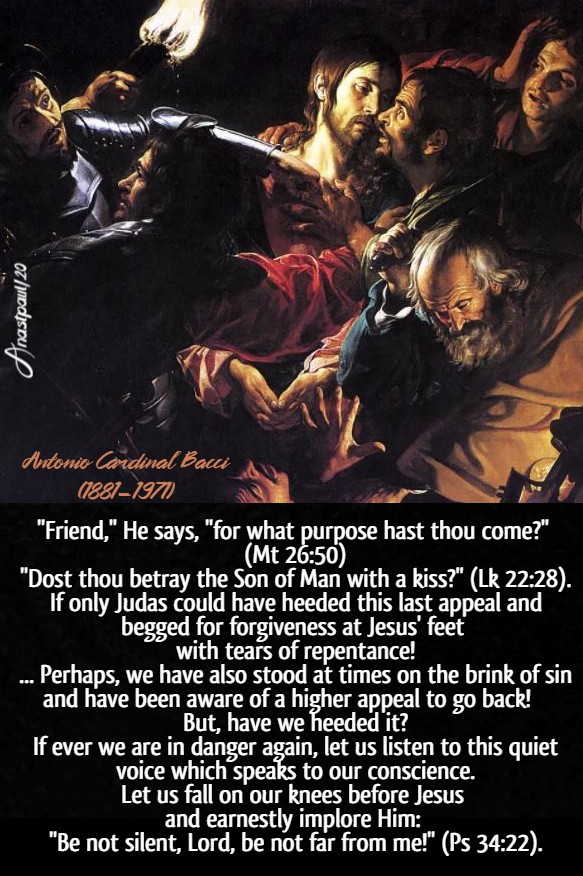
The Betrayal of Judas
“Ingratitude is a very cruel thing. It imprints a deep wound on the human heart and the heart of Jesus, was infinitely more sensitive than ours. He had raised Judas to the high rank of the Apostolate; He had made him one of His closest friends and had entrusted him with the secrets of His infinite love. Now Judas betrays Him for the wretched sum of thirty pieces of silver. Worse is to follow, however. While Jesus is praying and perspiring blood at the thought of the ingratitude of men and of the nearness of His passion and death, the Garden of Gethsemane becomes suddenly aglow with torches and reverberates with the shouting of the hired ruffians, whom Judas has brought with him to arrest Jesus. The treacherous Apostle comes forward. He embraces our divine Redeemer, hails Him as his Master and greets Him with a sacrilegious kiss upon the cheek. Jesus neither repulses nor rebukes him but, with a gesture of infinite mercy, He addresses him as a friend. “Friend,” He says, “for what purpose hast thou come?” (Mt 26:50). “Dost thou betray the Son of Man with a kiss?” (Lk 22:28). If only Judas could have heeded this last appeal and begged for forgiveness at Jesus’ feet with tears of repentance! Jesus would certainly have taken him to His heart and returned his kiss with a kiss of pardon and divine friendship. Perhaps, we have also stood at times on the brink of sin and have been aware of a higher appeal to go back! But, have we heeded it? If ever we are in danger again, let us listen to this quiet voice which speaks to our conscience. Let us fall on our knees before Jesus and earnestly implore Him: “Be not silent, Lord, be not far from me!” (Ps 34:22). Let us ask Him to have pity on our weakness and to come to our assistance.”
Thought for the Day – 30 March – A Meditations with Antonio Cardinal Bacci (1881-1971)
The Hour of Trial
“Whether they are physical, moral or spiritual, these severe trials affect us greatly. We feel crushed and abandoned, lacking in the power to resist and tend to yield to temptation or to despair. At these times, we should take the Crucifix in our hands and remember the suffering of Jesus. Let us recall His terrible physical suffering, as He was dying upon the Cross. Let us remember the suffering of His Heart, when He was betrayed by Judas, deserted by the Apostles, denied by St Peter and rejected by his own people. Finally, let us recall His spiritual sufferings, for He, Who was innocence itself, willed to carry the weight of our sins and to experience, in a mysterious manner, the sense of abandonment by His heavenly Father.
No matter what our trial may be, let us ask Jesus for the grace of resignation, of perseverance aganst temptation and for Christian hope.”
Lenten Journey Day Forty – 30 March – Tuesday of Holy Week, Readings: First: Isaiah 49: 1-6, Psalm: Psalms 71: 1-2, 3-4a, 5ab-6ab, 15 and 17, Gospel: John 13: 21-33, 36-38
Imitating Christ with Thomas à Kempis (1380-1471)
In You is the source of life and in Your Light Lord, we see light Psalm 35(36)
“The cock will not crow before you deny me three times.” – John 13:38
Truly, my sins have deserved nothing but hell and everlasting damnation. I confess that I am deserving of all scorn and contempt. Neither is it fitting that I should be remembered among Your devoted servants. And although it is hard for me to hear this, yet for truth’s sake I will accuse my sins against myself, so that I may more easily deserve to beg Your mercy. What shall I say, guilty as I am and full of all confusion? My tongue can say nothing but this alone: “I have sinned, O Lord, I have sinned; have mercy on me and pardon me. Suffer me a little that I may pour out my grief, before I go to that dark land that is covered with the shadow of death.” (Job 10:20-21)
What do you especially demand of a guilty and wretched sinner, except that he be contrite and humble himself for his sins? In true sorrow and humility of heart, hope of forgiveness is born, the troubled conscience is reconciled, grace is found, man is preserved from the wrath to come and God and the penitent meet with a holy kiss.
To You, O Lord, humble sorrow for sins is an acceptable sacrifice, a sacrifice far sweeter than the perfume of incense. This is also the pleasing ointment which You would have poured upon Your sacred feet, for a contrite and humble heart You will not spurn (Ps 51:19). There is the place of refuge from the wrath of the enemy, there, watever has been defiled, is washed away. (Book 3 Ch 52:2b-4)
One Minute Reflection – 30 March – Tuesday of Holy Week, Readings: First: Isaiah 49: 1-6, Psalm: Psalms 71: 1-2, 3-4a, 5ab-6ab, 15 and 17, Gospel: John 13: 21-33, 36-38
“The cock will not crow before you deny me three times.” – John 13:38
REFLECTION – “The first time Peter denied, he did not weep because the Lord had not looked at him. He denied a second time and did not weep because the Lord still did not look at him. He denied a third time; Jesus looked at him and he wept very bitterly (Lk 22:62). Look at us, Lord Jesus, so that we might know how to weep for our sins. This shows us that even the fall of the saints may be useful to us. Peter’s denial has done me no wrong, on the contrary, I have gained from his repentance – I have learned to be beware of faithless companions. …
So Peter wept and wept bitterly; he wept so hard that he washed away his offence with his tears. And you, too, if you would win pardon, wipe out your guilt with tears. At that very moment, in that same hour, Christ will look at you. If some kind of fall happens to you, then He, the ever-present witness of your intimate life, looks at you to call you back and cause you to confess your lapse. Then do as Peter did, who thrice said: “Lord, you know that I love you” (Jn 21:15). He denied three times and three times he also confessed. But he denied by night; he confessed in broad daylight.
All this has been written, to make us understand, that no-one should be puffed up. If Peter fell for having said: “Though all may have their faith in you shaken, mine will never be” (Mt 26:33), who is there to count on himself? … From whence then, Peter, shall I call you to mind, to teach me your thoughts as you wept? From heaven where you have already taken your place among the choirs of angels, or from the grave? For that death, from which the Lord was raised, did not reject you in your turn. Teach us what use your tears were to you. But you taught it without delay for having fallen before you wept, your tears caused you to be chosen to guide others, you who, to begin with, did not know how to guide yourself.” – St Ambrose (340-397) Bishop of Milan, Father and Doctor of the Church – Commentary on St Luke’s Gospel, 10,89f.
PRAYER – Almighty Father, we are slow to understand. In that love that You have for us and the grace, mercy and forgiveness You grant us. You gave Your only Son to save us from ourselves, help our lowly hearts, that we may understand Your love and in our smallness, offer all of our hearts, minds and souls, back to You in total submission and love. May Your saints and angels, help us on our way by their prayers and may Mary, the Sorrowful Mother of our Saviour, grant us, her heart, to love You in return. We make our prayer through our Saviour, Your Son, Jesus Christ in the unity of the Holy Spirit, God now and forever, amen.
One Minute Reflection – 27 March – Saturday of Passion Week or the Fifth Week of Lent, Readings: First Reading: Ezekiel 37: 21-28, Responsorial Psalm: Jeremiah 31: 10, 11-12abcd, 13, Verse Before the Gospel: Ezekiel 18: 31, Gospel: John 11: 45-56
“It is expedient for you, that one man should die for the people.” – John 11:50
REFLECTION – “ The darkening of one, makes many bright… “It is better,” said Caiaphas, “for one man to die for the people, than for the whole nation to be destroyed.” It is better that one be darkened “in the likeness of sinful flesh,” (Rm 8:3) for the sake of all, than for the whole of mankind to be lost, by the darkness of sin; that the splendour and image of the substance of God, should be shrouded in the form of a slave, in order that a slave might live; that the brightness of eternal ligh,t should become dimmed in the flesh for the purifying of the flesh; that He who surpasses all mankind in beauty (Ps 44:2) should be eclipsed by the darkness of the Passion for the enlightening of mankind; that He should suffer the ignominy of the Cross, grow pale in death, be totally deprived of beauty and comeliness, that He might gain the Church as a beautiful and comely bride, without spot or wrinkle (Ep 5:27). But under His dark covering (Sg 1:5) I recognise the King… I recognise Him and I embrace Him. For though He presents this dark exterior… within is the brightness of divine life, the beauty of His strength, the splendour of grace, the purity of innocence. But covering it all, is the abject hue of infirmity, His Face, as it were, hidden and despised: “one tempted in every respect as we are, yet without sinning” (Heb 4:15). I recognise here the image of our sin-darkened nature; I recognise the garments that clothed our first parents after their sin (Gn 3:21). My God has clothed Himself in them, by assuming the condition of a slave and becoming as men are, He was seen in their likeness (Ph 2:7). Under the skin that Jacob wore (Gn 27:16), symbol of sin, I recognise both the hand that committed no sin and the neck which never bowed to evil; no word of treachery was found in His mouth. I know, Lord, that you are gentle by nature, meek and humble of heart, pleasing in appearance and loveable in Your ways, “anointed with the oil of gladness above your companions” (Mt 11:29; Ps 44:8). Why then this disfigured likeness to Esau? Whose haggard image this?… Ah! It is mine. He has taken my likeness, taken on my sin… And beneath the rough skin of my sinfulness, I recognise my God and my Saviour! ” – St Bernard (1091-1153) “Doctor of Light”of the Church – 28th Homily on the Song of Songs
PRAYER – Lord God, at all times You are working out the salvation of man but now, more especially, You enrich Your people with grace. Look kindly on this people, Lord, keep the seal of Baptism inviolate in those who have received it and in those, who still await their rebirth in te Spirit. With Mary, our advocate of love and mercy by our side, may we attain the brightness of Your Face. Through Jesus Christ, Your Son and our Saviour, in the unity of the Holy Spirit, one God now and forver, amen.

























 AnaStpaul
You must be logged in to post a comment.